VOLUME V SLICE I Calhoun to Camoens (continued 8)
Reading edition
(W. L. A.; A. J. G.)
1 The family name of Calvin seems to have been written indifferently Cauvin, Chauve, Chauvin, Calvus, Calvinus. In the contemporary notices of Gerard and his family, in the capitular registers of the cathedral at Noyon, the name is always spelt Cauuin. The anagram of Calvin is Alcuin, and this in its Latinized form Alcuinus appears in two editions of his Instltutio as that of the author (Audin, Vie de Calvin, i. 520). The syndics of Geneva address him in a letter written in 1540, and still preserved, as “Docteur Caulvin.” In his letters written in French he usually signs himself “Jean Calvin.” He affected the title of “Maitre,” for what reason is not known.
2 Pierre de Montaigu refounded this institution in 1388. Erasmus and Ignatius Loyola also studied here.
3 Calv. Praef. ad Comment. in Psalmos.
4 Jo. Calvini Vita, sub init.
5 Epist. Ded., Comment in Ep. II. ad Corinthios praefix.
6 This edition forms a small 8vo of 514 pages, and 6 pages of index. It appeared at Basel from the press of Thomas Platter and Balthasar Lasius in March 1536, and was published by Johann Oporin. The dedicatory preface is dated 23rd August 1535. It is a masterpiece of apologetic literature. See W. Walker, John Calvin, 132 f., and for an outline of the contents of the treatise, ib. 137-149.
7 Praef. ad Psalmos.
8 Ibid.
9 Beza, Vit. Calv. an. 1536.
10 Fidelis Expositio Errorum Serveti, sub init. Calvini, Opp. t. ix.
11 Calvin to Farel, 20th Aug. 1553.
12 Tuo judicio prorsus assentior. Affirmo etiam vestros magistratus juste fecisse quod hominem blasphemum, re ordine judicata, interfecerunt.—Melanchthon to Calvin, 14th Oct. 1554.
13 Field On the Church, bk. iii. c. 27, vol. i. p. 288 (ed. Cambridge, 1847).
14 Notes on English Divines, vol. i. p. 49. See also Table Talk, vol. ii. p. 282 (ed. 1835).
15 W. Walker, John Calvin, pp. 403-8.
CALVINISTIC METHODISTS, a body of Christians forming a church of the Presbyterian order and claiming to be the only denomination in Wales which is of purely Welsh origin. Its beginnings may be traced to the labours of the Rev. Griffith Jones (1684-1761), of Llanddowror, Carmarthenshire, whose sympathy for the poor led him to set on foot a system of circulating charity schools for the education of children. In striking contrast to the general apathy of the clergy of the period, Griffith Jones’s zeal appealed to the public imagination, and his powerful preaching exercised a widespread influence, many travelling long distances in order to attend his ministry. There was thus a considerable number of earnest people dispersed throughout the country waiting for the rousing of the parish clergy. An impressive announcement of the Easter Communion Service, made by the Rev. Pryce Davies, vicar of Talgarth, on the 30th of March 1735, was the means of awakening Howell Harris (1714-1773) of Trevecca, and he immediately began to hold services in his own house. He was soon invited to do the same at the houses of others, and ended by becoming a fiery itinerant preacher, stirring to the depths every neighbourhood he visited. Griffith Jones, preaching at Llanddewi Brefi, Cardiganshire—the place at which the Welsh Patron Saint, David, first became famous—found Daniel Rowland (1713-1790), curate of Llangeitho, in his audience, and his patronizing attitude in listening drew from the preacher a personal supplication on his behalf, in the middle of the discourse. Rowland was deeply moved, and became an ardent apostle of the new movement. Naturally a fine orator, his new-born zeal gave an edge to his eloquence, and his fame spread abroad. Rowland and Harris had been at work fully eighteen months before they met, at a service in Devynock church, in the upper part of Breconshire. The acquaintance then formed lasted to the end of Harris’s life—an interval of ten years excepted. Harris had been sent to Oxford in the autumn of 1735 to “cure him of his fanaticism,” but he left in the following February. Rowland had never been to a university, but, like Harris, he had been well grounded in general knowledge. About 1739 another prominent figure appeared. This was Howell Davies of Pembrokeshire, whose ministry was modelled on that of his master, Griffith Jones, but with rather more clatter in his thunder.
In 1736, on returning home, Harris opened a school, Griffith Jones supplying him with books from his charity. He also set up societies, in accordance with the recommendations in Josiah Wedgwood’s little book on the subject; and these exercised a great influence on the religious life of the people. By far the most notable of Harris’s converts was William Williams (1717-1791), Pant y Celyn, the great hymn-writer of Wales, who while listening to the revivalist preaching on a tombstone in the graveyard of Talgarth, heard the “voice of heaven,” and was “apprehended as by a warrant from on high.” He was ordained deacon in the Church of England, 1740, but Whitefield recommended him to leave his curacies and go into the highways and hedges. On Wednesday and Thursday, January 5th and 6th, 1743, the friends of aggressive Christianity in Wales met at Wadford, near Caerphilly, Glam., in order to organize their societies. George Whitefield was in the chair. Rowland, Williams and John Powell—afterwards of Llanmartin—(clergymen), Harris, John Humphreys and John Cennick (laymen) were present. Seven lay exhorters were also at the meetings; they were questioned as to their spiritual experience and allotted their several spheres; other matters pertaining to the new conditions created by the revival were arranged. This is known as the first Methodist Association—held eighteen months before Johm Wesley’s first conference (June 25th, 1744). Monthly meetings covering smaller districts, were organized to consider local matters, the transactions of which were to be reported to the Quarterly Association, to be confirmed, modified, or rejected. Exhorters were divided into two classes—public, who were allowed to itinerate as preachers and superintend a number of societies; private, who were confined to the charge of one or two societies. The societies were distinctly understood to be part of the established church, as Wedgwood’s were, and every attempt at estranging them therefrom was sharply reproved; but persecution made their position anomalous. They did not accept the discipline of the Church of England, so the plea of conformity was a feeble defence; nor had they taken out licenses, so as to claim the protection of the Toleration Act. Harris’s ardent loyalty to the Church of England, after three refusals to ordain him, and his personal contempt for ill-treatment from persecutors, were the only things that prevented separation.
A controversy on a doctrinal point—“Did God die on Calvary?”—raged for some time, the principal disputants being Rowland and Harris; and in 1751 it ended in an open rupture, which threw the Connexion first into confusion and then into a state of coma. The societies split up into Harrisites and Rowlandites, and it was only with the revival of 1762 that the breach was fairly repaired. This revival is a landmark in the history of the Connexion. Williams of Pant y Celyn had just published a little volume of hymns, the singing of which inflamed the people. This led the bishop of St David’s to suspend Rowland’s license, and Rowland had to confine himself to a meeting-house at Llangeitho. Having been turned out of other churches, he had leased a plot of land in 1759, anticipating the final withdrawal of his license, in 1763, and a spacious building was erected to which the people crowded from all parts on Sacrament Sunday. Llangeitho became the Jerusalem of Wales; and Rowland’s popularity never waned until his physical powers gave way. A notable event in the history of Welsh Methodism was the publication in 1770, of a 4to annotated Welsh Bible by the Rev. Peter Williams, a forceful preacher, and an indefatigable worker, who had joined the Methodists in 1746, after being driven from several curacies. It gave birth to a new interest in the Scriptures, being the first definite commentary in the language. A powerful revival broke out at Llangeitho in the spring of 1780, and spread to the south, but not to the north of Wales. The ignorance of the people of the north made it very difficult for Methodism to benefit from these manifestations, until the advent of the Rev. Thomas Charles (1755-1814), who, having spent five years in Somersetshire as curate of several parishes, returned to his native land to marry Sarah Jones of Bala. Failing to find employment in the established church, he joined the Methodists in 1784. His circulating charity schools and then his Sunday schools gradually made the North a new country. In 1791 a revival began at Bala; and this, strange to say, a few months after the Bala Association had been ruffled by the proceedings which led to the expulsion of Peter Williams from the Connexion, in order to prevent him from selling John Canne’s Bible among the Methodists, because of some Sabellian marginal notes.
In 1790, the Bala Association passed “Rules regarding the proper mode of conducting the Quarterly Association,” drawn up by Charles; in 1801, Charles and Thomas Jones of Mold, published (for the association) the “Rules and Objects of the Private Societies among the People called Methodists.” About 1795, persecution led the Methodists to take the first step towards separation from the Church of England. Heavy fines made it impossible for preachers in poor circumstances to continue without claiming the protection of the Toleration Act, and the meeting-houses had to be registered as dissenting chapels. In a large number of cases this had only been delayed by so constructing the houses that they were used both as dwellings and as chapels at one and the same time. Until 1811 the Calvinistic Methodists had no ministers ordained by themselves; their enormous growth in numbers and the scarcity of ministers to administer the Sacrament—only three in North Wales, two of whom had joined only at the dawn of the century—made the question of ordination a matter of urgency. The South Wales clergy who regularly itinerated were dying out; the majority of those remaining itinerated but irregularly, and were most of them against the change. The lay element, with the help of Charles and a few other stalwarts, carried the matter through—ordaining nine at Bala in June, and thirteen at Llandilo in August. In 1823, the Confession of Faith was published; it is based on the Westminster Confession as “Calvinistically construed,” and contains 44 articles. The Connexion’s Constitutional Deed was formally completed in 1826.
Thomas Charles had tried to arrange for taking over Trevecca College when the trustees of the Countess of Huntingdon’s Connexion removed their seminary to Cheshunt in 1791; but the Bala revival broke out just at the time, and, when things grew quieter, other matters pressed for attention. A college had been mooted in 1816, but the intended tutor died suddenly, and the matter was for the time dropped. Candidates for the Connexional ministry were compelled to shift for themselves until 1837, when Lewis Edwards (1809-1887) and David Charles (1812-1878) opened a school for young men at Bala. North and South alike adopted it as their college, the associations contributing a hundred guineas each towards the education of their students. In 1842, the South Wales Association opened a college at Trevecca, leaving Bala to the North; the Rev. David Charles became principal of the former, and the Rev. Lewis Edwards of the latter. After the death of Dr Lewis Edwards, Dr. T.C. Edwards resigned the principalship of the University College at Aberystwyth to become head of Bala (1891), now a purely theological college, the students of which were sent to the university colleges for their classical training. In 1905 Mr David Davies of Llandinam—one of the leading laymen in the Connexion—offered a large building at Aberystwyth as a gift to the denomination for the purpose of uniting North and South in one theological college; but in the event of either association declining the proposal, the other was permitted to take possession, giving the association that should decline the option of joining at a later time. The Association of the South accepted, and that of the North declined, the offer; Trevecca College was turned into a preparatory school on the lines of a similar institution set up at Bala in 1891.
The missionary collections of the denomination were given to the London Missionary Society from 1798 to 1840, when a Connexional Society was formed; and no better instances of missionary enterprise are known than those of the Khasia and Jaintia Hills, and the Plains of Sylhet in N. India. There has also been a mission in Brittany since 1842.
The constitution of the denomination (called in Welsh, “Hen Gorph,” i.e. the Old Body) is a mixture of Presbyterianism and Congregationalism; each church manages its own affairs and reports (1) to the district meeting, (2) to the monthly meeting, the nature of each report determining its destination. The monthly meetings are made up of all the officers of the churches comprised in each, and are split up into districts for the purpose of a more local co-operation of the churches. The monthly meetings appoint delegates to the quarterly Associations, of which all officers are members. The Associations of North and South are distinct institutions, deliberating and determining matters pertaining to them in their separate quarterly gatherings. For the purpose of a fuller co-operation in matters common to both, a general assembly (meeting once a year) was established in 1864. This is a purely deliberative conclave, worked by committees, and all its legislation has to be confirmed by the two Associations before it can have any force or be legal. The annual conference of the English churches of the denomination has no legislative standing, and is meant for social and spiritual intercourse and discussions.
In doctrine the church is Calvinistic, but its preachers are far from being rigid in this particular, being warmly evangelical, and, in general, distinctly cultured. The London degree largely figures on the Connexional Diary; and now the Welsh degrees, in arts and divinity, are being increasingly achieved. It is a remarkable fact that every Welsh revival, since 1735, has broken out among the Calvinistic Methodists. Those of 1735, 1762, 1780 and 1791 have been mentioned; those of 1817, 1832, 1859 and 1904-1905 were no less powerful, and their history is interwoven with Calvinistic Methodism, the system of which is so admirably adapted for the passing on of the torch. The ministerial system is quite anomalous. It started in pure itineracy; the pastorate came in very gradually, and is not yet in universal acceptance. The authority of the pulpit of any individual church is in the hands of the deacons; they ask the pastor to supply so many Sundays a year—from twelve to forty, as the case may be—and they then fill the remainder with any preacher they choose. The pastor is paid for his pastoral work, and receives his Sunday fee just as a stranger does; his Sundays from home he fills up at the request of deacons of other churches, and it is a breach of Connexional etiquette for a minister to apply for engagements, no matter how many unfilled Sundays he may have. Deacons and preachers make engagements seven or eight years in advance. The Connexion provides for English residents wherever required, and the English ministers are oftener in their own pulpits than their Welsh brethren.
The Calvinistic Methodists form in some respects the strongest church in Wales, and its forward movement, headed by Dr. John Pugh of Cardiff, has brought thousands into its fold since its establishment in 1891. Its Connexional Book Room, opened in 1891, yields an annual profit of from £1600 to £2000, the profits being devoted to help the colleges and to establish Sunday school libraries, etc. Its chapels in 1907 numbered 1641 (with accommodation for 488,080), manses 229; its churches1 numbered 1428, ministers 921, unordained preachers 318, deacons 6179; its Sunday Schools 1731, teachers 27,895, scholars 193,460, communicants 189,164, total collections for religious purposes £300,912. The statistics of the Indian Mission are equally good: communicants 8027, adherents 26,787, missionaries 23, native ministers (ordained) 15, preachers (not ordained) 60.
The Calvinistic Methodists are intensely national in sentiment and aspirations, beyond all suspicion loyalists. They take a great interest in social, political and educational matters, and are prominent on public bodies. They support the Eisteddfod as the promoter and inspirer of arts, letters and music, and are conspicuous among the annual prize winners. They thus form a living, democratic body, flexible and progressive in its movements, yet with a sufficient proportion of conservatism both in religion and theology to keep it sane and safe.
(D. E. J.)
1 Adherents and members in scattered hamlets and attending different meeting-houses or chapels, often combine to form one society or church.
CALVISIUS, SETHUS (1556-1615), German chronologer, was born of a peasant family at Gorschleben in Thuringia on the 21st of February 1556. By the exercise of his musical talents he earned money enough for the start, at Helmstadt, of an university career, which the aid of a wealthy patron enabled him to continue at Leipzig. He became director of the music-school at Pforten in 1572, was transferred to Leipzig in the same capacity in 1594, and retained this post until his death on the 24th of November 1615, despite the offers successively made to him of mathematical professorships at Frankfort and Wittenberg. In his Opus Chronologicum (Leipzig, 1605, 7th ed. 1685) he expounded a system based on the records of nearly 300 eclipses. An ingenious, though ineffective, proposal for the reform of the calendar was put forward in his Elenchus Calendarii Gregoriani (Frankfort, 1612); and he published a book on music, Melodiae condendae ratio (Erfurt, 1592), still worth reading.
For details see V. Schmuck’s Leichenrede (1615); J. Bertuch’s Chronicon Portense (1739); F.W. E. Rost’s Oratio ad renovendam S. Calvisii memoriam (1805); J G. Stallbaum’s Nachrichten über die Cantoren an der Thomasschule (1842); Allgemeine Deutsche Biographie; Poggendorff’s Biog.-Litterarisches Handworterbuch.
CALVO, CARLOS (1824-1906), Argentine publicist and historian, was born at Buenos Aires on the 26th of February 1824, and devoted himself to the study of the law. In 1860 he was sent by the Paraguayan government on a special mission to London and Paris. Remaining in France, he published in 1863 his Derecho international teorico y practice de Europay America, in two volumes, and at the same time brought out a French version. The book immediately took rank as one of the highest modern authorities on the subject, and by 1887 the first French edition had become enlarged to six volumes. Señor Calvo’s next publications were of a semi-historical character. Between 1862 and 1869 he published in Spanish and French his great collection in fifteen volumes of the treaties and other diplomatic acts of the South American republics, and between 1864 and 1875 his Annales historiques de la revolution de l’Amerique latine, in five volumes. In 1884 he was one of the founders at the Ghent congress of the Institut de Droit International. In the following year he was Argentine minister at Berlin, and published his Dictionnaire du droit international public et privé in that city. Calvo died in May 1906 at Paris.
CALW or Kalw, a town of Germany, in the kingdom of Württemberg, on the Nagold, 34 m. S.W. of Stuttgart by rail. Pop. (1905), 4943. It contains a Protestant and a Roman Catholic Church, two schools, missionary institution, and a fine public library. The industries include spinning and weaving operations in wool and cotton. Carpets, cigars and leather are also manufactured. The timber trade, chiefly with the Netherlands, is important. The place is in favour as a health resort.
The name of Calw appears first in 1037. In the middle ages the town was under the dominion of a powerful family of counts, whose possessions finally passed to Württemberg in 1345. In 1634 the town was taken by the Bavarians, and in 1692 by the French.
CALYDON (Καλυδών), an ancient town of Aetolia, according to Pliny, 7½ Roman m. from the sea, on the river Euenus. It was said to have been founded by Calydon, son of Aetolus; to have been the scene of the hunting, by Meleager and other heroes, of the famous Calydonian boar, sent by Artemis to lay waste the fields; and to have taken part in the Trojan war. In historical times it is first mentioned (391 b.c.) as in the possession of the Achaeans, who retained it for twenty years, by the assistance of the Lacedaemonian king, Agesilaus, notwithstanding the attacks of the Arcarnanians. After the battle of Leuctra (371 b.c.) it was restored by Epaminondas to the Aetolians. In the time of Pompey it was a town of importance; but Augustus removed its inhabitants to Nicopolis, which he founded to commemorate his victory at Actium (31 b.c.). The walls of Calydon are almost certainly to be recognized in the Kastro of Kurtagá. These comprise a circuit of over 2 m., with one large gate and five smaller ones, and are situated on a hill on the right or west bank of the Euenus. Remains of large terrace walls outside the town probably indicate the position of the temple of Artemis Laphria, whose gold and ivory statue was transferred to Patras, together probably with her ritual. This included a sacrifice in which all kinds of beasts, wild and tame, were driven into a wooden pyre and consumed.
See W.M. Leake, Travels in N. Greece, i. p. 109, iii. pp. 533 sqq.; W.J. Woodhouse, Aetolia, pp. 95 ssq.
(E. Gr.)
CALYPSO, in Greek mythology, daughter of Atlas (or Oceanus, or Nereus), queen of the mythical island of Ogygia. When Odysseus was shipwrecked on her shores, Calypso entertained the hero with great hospitality, and prevailed on him to remain with her seven years. Odysseus was then seized with a longing to return to his wife and home; Calypso’s promise of eternal youth failed to induce him to stay, and Hermes was sent by Zeus to bid her release him. When he set sail, Calypso died of grief. (Homer, Odyssey, i. 50, v. 28, vii. 254; Apollodorus i. 2, 7.)
CAM (CÃO), DIOGO (fl. 1480-1486), Portuguese discoverer, the first European known to sight and enter the Congo, and to explore the West African coast between Cape St Catherine (2°S.) and Cape Cross (21° 50′ S.) almost from the equator to Walfish Bay. When King John II. of Portugal revived the work of Henry the Navigator, he sent out Cam (about midsummer (?) 1482) to open up the African coast still further beyond the equator. The mouth of the Congo was now discovered (perhaps in August 1482), and marked by a stone pillar (still existing, but only in fragments) erected on Shark Point; the great river was also ascended for a short distance, and intercourse was opened with the natives. Cam then coasted down along the present Angola (Portuguese West Africa), and erected a second pillar, probably marking the termination of this voyage, at Cape Santa Maria (the Monte Negro of these first visitors) in 13° 26′ S. He certainly returned to Lisbon by the beginning of April 1484, when John II. ennobled him, made him a cavalleiro of his household (he was already an escudeiro or esquire in the same), and granted him an annuity and a coat of arms (8th and 14th of April 1484). That Cam, on his second voyage of 1483-1486, was accompanied by Martin Behaim (as alleged on the latter’s Nuremberg globe of 1492) is very doubtful; but we know that the explorer revisited the Congo and erected two more pillars beyond the furthest of his previous voyage, the first at another “Monte Negro” in 15° 41′ S., the second at Cape Cross in 21° 50′, this last probably marking the end of his progress southward. According to one authority (a legend on the 1489 map of Henricus Martellus Germanus), Cam died off Cape Cross; but João de Barros and others make him return to the Congo, and take thence a native envoy to Portugal. The four pillars set up by Cam on his two voyages have all been discovered in situ, and the inscriptions on two of them from Cape Santa Maria and Cape Cross, dated 1482 and 1485 respectively, are still to be read and have been printed; the Cape Cross padrão is now at Kiel (replaced on the spot by a granite facsimile); those from the Congo estuary and the more southerly Monte Negro are in the Museum of the Lisbon Geographical Society.
See Barros, Decadas da Asia, Decade i. bk. iii., esp. ch. 3; Ruy de Pina, Chronica d’ el Rei D. João II.; Garcia de Resende, Chronica; Luciano Cordeiro, “Diogo Cão” in Boletim of the Lisbon Geog. Soc., 1892; E.G. Ravenstein, “Voyages of Diogo Cão,” &c., in Geog. Jnl. vol. xvi. (1900); also Geog. Jnl. xxxi. (1908).
(C. R. B.)
CAMACHO, JUAN FRANCISCO (1824-1896), Spanish statesman and financier, was born in Cadiz in 1824. The first part of his life was devoted to mercantile and financial pursuits at Cadiz and then in Madrid, where he managed the affairs of and liquidated a mercantile and industrial society to the satisfaction and profit of the shareholders. In 1837 he became a captain in the national militia, in 1852 Conservative deputy in the Cortes for Alcoy, in 1853 secretary of congress, and was afterwards elected ten times deputy, twice senator and life senator in 1877. Camacho took a prominent part in all financial debates and committees, was offered a seat in the Mon cabinet of 1864, and was appointed under-secretary of state finances in 1866 under Canovas and O’Donnell. After the revolution of 1868 he declined the post of minister of finance offered by Marshal Serrano, but served in that capacity in 1872 and 1874 in Sagasta’s cabinets. When the restoration took place, Camacho sat in the Cortes among the dynastic Liberals with Sagasta as leader, and became finance minister in 1881 at a critical moment when Spain had to convert, reduce, and consolidate her treasury and other debts with a view to resuming payment of coupons. Camacho drew up an excellent budget and collected taxation with a decidedly unpopular vigour. A few years later Sagasta again made him finance minister under the regency of Queen Christina, but had to sacrifice him when public opinion very clearly pronounced against his too radical financial reforms and his severity in collection of taxes. He was for the same reasons unsuccessful as a governor of the Tobacco Monopoly Company. He then seceded from the Liberals, and during the last years of his life he affected to vote with the Conservatives, who made him governor of the Bank of Spain. He died in Madrid on the 23rd of January 1896.
(A. E. H.)
CAMALDULIANS, or Camaldolese, a religious order founded by St Romuald. Born of a noble family at Ravenna c. 950, he retired at the age of twenty to the Benedictine monastery of S. Apollinare in Classe; but being strongly drawn to the eremitical life, he went to live with a hermit in the neighbourhood of Venice and then again near Ravenna. Here a colony of hermits grew up around him and he became the superior. As soon as they were established in their manner of life, Romuald moved to another district and there formed a second settlement of hermits, only to proceed in the same way to the establishment of other colonies of hermits or “deserts” as they were called. In this way during the course of his life Romuald formed a great number of “deserts” throughout central Italy. His chief foundation was at Camaldoli on the heights of the Tuscan Apennines not far from Arezzo, in a vale snow-covered during half the year. Romuald’s idea was to reintroduce into the West the primitive eremitical form of monachism, as practised by the first Egyptian and Syrian monks. His monks dwelt in separate huts around the oratory, and came together only for divine service and on certain days for meals. The life was one of extreme rigour in regard to food, clothing, silence and general observance. Besides the hermits there were lay brothers to help in carrying out the field work and rougher occupations. St Romuald and the early Camaldolese exercised considerable influence on the religious movements of their time; the emperors Otto III. and Henry II. esteemed him highly and sought his advice on religious questions. Disciples of St Romuald went on missions to the still heathen parts of Russia, Poland and Prussia, where some of them suffered martyrdom. In his extreme old age St Romuald with twenty-five of his monks started on a missionary expedition to Hungary, but he was unable to accomplish the journey. He died in 1027. After his death mitigations were gradually introduced into the rule and manner of life; and in the monastery of St Michael in Murano, Venice, the life became cenobitical. From that time to the present day there have always been both eremitical and cenobitical Camaldolese, the latter approximating to ordinary Benedictine life. The Camaldolese spread all over Italy, and into Germany, Poland and France. Camaldoli itself exists as a “desert,” the primitive observance of the institute being strictly maintained. There are a few other “deserts,” all in Italy, except one in Poland; and there are about 90 hermits. The chief monastery of the cenobitical Camaldolese is S. Gregorio on the Caelian Hill in Rome; they number less than forty. Since the 11th century there have been Camaldolese nuns; at present there are five nunneries with 150 nuns, all belonging to the cenobitical branch of the order. The habit of the Camaldulians is white.
See Helyot, Hist. des ordres religieux (1792) v. cc. 21-25; Max Heimbucher, Orden und Kongregationen (1896) i. § 29; and the art. “Camaldulenser” in Wetzer and Welte, Kirchenlexikon (2nd ed.), and Herzog, Realencyklopädie (3rd ed.).
(E. C. B.)
CAMARGO, MARIE ANNE DE CUPIS DE (1710-1770), French dancer, of Spanish descent, was born in Brussels on the 15th of April 1710. Her father, Ferdinand Joseph de Cupis, earned a scanty living as violinist and dancing-master, and from childhood she was trained for the stage. At ten years of age she was given lessons by Mlle Françoise Prévost (1680-1741), then the first dancer at the Paris Opéra, and at once obtained an engagement as première danseuse, first at Brussels and then at Rouen. Under her grandmother’s family name of Camargo she made her Paris début in 1726, and at once became the rage. Every new fashion bore her name; her manner of doing her hair was copied by all at court; her shoemaker—she had a tiny foot—made his fortune. She had many titled adorers whom she nearly ruined by her extravagances, among others Louis de Bourbon, comte de Clermont. At his wish she retired from the stage from 1736 to 1741. In her time she appeared in seventy-eight ballets or operas, always to the delight of the public. She was the first ballet-dancer to shorten the skirt to what afterwards became the regulation length. There is a charming portrait of her by Nicolas Lancret in the Wallace collection, London.
CAMARGUE (Insula Camaria), a thinly-populated region of southern France contained wholly in the department of Bouches-du-Rhône, and comprising the delta of the Rhone. The Camargue is a marshy plain of alluvial formation enclosed between the two branches of the river, the Grand Rhône to the east and the Petit Rhône to the west. Its average elevation is from 6½ to 8 ft. The Camargue has a coast-line some 30 m. in length and an area of 290 sq. m., of which about a quarter consists of cultivated and fertile land. This is in the north and on the banks of the rivers. The rest consists of rough pasture grazed by the black bulls and white horses of the region and by large flocks of sheep, or of marsh, stagnant water and waste land impregnated with salt. The region is inhabited by flocks of flamingoes, bustards, partridge, and by sea-birds of various kinds. The Étang de Vaccarès, the largest of the numerous lagoons and pools, covers about 23 sq. m.; it receives three main canals constructed to drain off the minor lagoons. The Camargue is protected by dikes from the inundations both of the sea and of the rivers. Inlets in the sea-dike let in water for the purposes of the lagoon fisheries and the salt-pans; and the river-water is used for irrigation and for the submersion of vines. The climate is characterized by hard winters and scorching summers. Rain falls in torrents, but at considerable intervals. The mistral, blowing from the north and north-west, is the prevailing wind. The south-eastern portion of the Camargue is known as the Ile du Plan du Bourg. A secondary delta to the west of the Petit Rhône goes by the name of Petite Camargue.
CAMARINA, an ancient city of Sicily, situated on the south coast, about 17 m. S.E. of Gela (Terranova). It was founded by Syracuse in 599 b.c., but destroyed by the mother city in 552 for attempting to assert its independence. Hippocrates of Gela received its territory from Syracuse and restored the town in 492, but it was destroyed by Gelon in 484; the Geloans, however, founded it anew in 461. It seems to have been in general hostile to Syracuse, but, though an ally of Athens in 427, it gave some slight help to Syracuse in 415-413. It was destroyed by the Carthaginians in 405, restored by Timoleon in 339 after its abandonment by Dionysius’s order, but in 258 fell into the hands of the Romans. Its complete destruction dates from a.d. 853. The site of the ancient city is among rapidly shifting sandhills, and the lack of stone in the neighbourhood has led to its buildings being used as a quarry even by the inhabitants of Terranova, so that nothing is now visible above ground but a small part of the wall of the temple of Athena and a few foundations of houses; portions of the city wall have been traced by excavation, and the necropolis has been carefully explored (see J. Schubring in Philologus, xxxii. 490; P. Orsi in Monumenti dei Lincei, ix. 201, 1899; xiv. 756, 1904). To the north lay the lake to which the answer of the Delphic oracle referred, μὴ κίνει Καμάριναν, when the citizens inquired as to the advisability of draining it.
CAMBACÉRÈS, JEAN JACQUES RÉGIS DE, duke of Parma (1753-1824), French statesman, was born at Montpellier on the 18th of October 1753. He was descended from a well-known family of the legal nobility (noblesse de la robe). He was designed for the magistracy of his province; and in 1771, when for a time the provincial parlement was suppressed, with the others, by the chancellor Maupeou, he refused to sit in the royal tribunal substituted for it. He continued, however, to study law with ardour, and in 1774 succeeded his father as councillor in the court of accounts and finances of his native town. Espousing the principles of the Revolution in 1789, he was commissioned by the noblesse of the province to draw up the cahier (statement of principles and grievances); and the sénéchaussée of Montpellier elected him deputy to the states-general of Versailles; but the election was annulled on a technical point. Nevertheless in 1792 the new department of Hérault, in which Montpellier is situated, sent him as one of its deputies to the Convention which assembled and proclaimed the Republic in September 1792. In the strife which soon broke out between the Girondins and the Jacobins he took no decided part, but occupied himself mainly with the legal and legislative work which went on almost without intermission even during the Terror. The action of Cambacérès at the time of the trial of Louis XVI. (December 25, 1792-January 20, 1793) was characteristic of his habits of thought. At first he protested against the erection of the Convention into a tribunal in these words: “The people has chosen you to be legislators; it has not appointed you as judges.” He also demanded that the king should have due facilities for his defence. Nevertheless, when the trial proceeded, he voted with the majority which declared Louis to be guilty, but recommended that the penalty should be postponed until the cessation of hostilities, and that the sentence should then be ratified by the Convention or by some other legislative body. It is therefore inexact to count him among the regicides, as was done by the royalists after 1815. Early in 1793 he became a member of the Committee of General Defence, but he did not take part in the work of its more famous successor, the Committee of Public Safety, until the close of the year 1794. In the meantime he had done much useful work, especially that of laying down, conjointly with Merlin of Douai, the principles on which the legislation of the revolutionary epoch should be codified. At the close of 1794 he also used his tact and eloquence on behalf of the restoration of the surviving Girondins to the Convention, from which they had been driven by the coup d’état of the 31st of May 1793. In the course of the year 1795, as president of the Committee of Public Safety, and as responsible especially for foreign affairs, he was largely instrumental in bringing about peace with Spain. Nevertheless, not being a regicide, he was not appointed to be one of the five Directors to whom the control of public affairs was entrusted after the coup d’état of Vendémiaire 1795; but, as before, his powers of judgment and of tactful debating soon carried him to the front in the council of Five Hundred. The moderation of his views brought him into opposition to the Directors after the coup d’état of Fructidor (September 1797), and for a time he retired into private life. Owing, however, to the influence of Sieyès, he became minister of justice in July 1799. He gave a guarded support to Bonaparte and Sieyès in their enterprise of overthrowing the Directory (coup d’état of Brumaire 1799).
After a short interval Cambacérès was, by the constitution of December 1799, appointed second consul of France—a position which he owed largely to his vast legal knowledge and to the conviction which Sieyès entertained of his value as a manipulator of public assemblies. It is impossible here to describe in detail his relations to Napoleon, and the part which he played in the drawing up of the Civil Code, later on called the Code Napoleon. It must suffice to say that the skilful intervention of Cambacérès helped very materially to ensure to Napoleon the consulship for life (August 1, 1802); but the second consul is known to have disapproved of some of the events which followed, notably the execution of the duc d’Enghien, the rupture with England, and the proclamation of the Empire (May 19, 1804). This last occurrence ended his title of second consul; it was replaced by that of arch-chancellor of the Empire. To him was decreed the presidence of the Senate in perpetuity. He also became a prince of the Empire and received in 1808 the title duke of Parma. Apart from the important part which he took in helping to co-ordinate and draft the Civil Code, Cambacérès did the state good service in many directions, notably by seeking to curb the impetuosity of the emperor, and to prevent enterprises so fatal as the intervention in Spanish affairs (1808) and the invasion of Russia (1812) proved to be. At the close of the campaign of 1814 he shared with Joseph Bonaparte the responsibility for some of the actions which zealous Bonapartists have deemed injurious to the fortunes of the emperor. In 1815, during the Hundred Days, he took up his duties reluctantly at the bidding of Napoleon; and after the second downfall of his master, he felt the brunt of royalist vengeance, being for a time exiled from France. A decree of 13th May 1818 restored him to his civil rights as a citizen of France; but the last six years of his life he spent in retirement. He was a member of the Academy till the 31st of March 1816, when a decree of exclusion was passed. In demeanour he was quiet, reserved and tactful, but when occasion called for it he proved himself a brilliant orator. He was a celebrated gourmet, and his dinners were utilized by Napoleon as a useful adjunct to the arts of statecraft.
See A. Aubriet, Vie de Cambacérès (2nd ed., Paris, 1825).
(J. Hl. R.)
CAMBALUC, the name by which, under sundry modifications, the royal city of the great khan in China became known to Europe during the middle ages, that city being in fact the same that we now know as Peking. The word itself represents the Mongol Khan-Balik, “the city of the khan,” or emperor, the title by which Peking continues, more or less, to be known to the Mongols and other northern Asiatics.
A city occupying approximately the same site had been the capital of one of the principalities into which China was divided some centuries before the Christian era; and during the reigns of the two Tatar dynasties that immediately preceded the Mongols in northern China, viz. that of the Khitans, and of the Kin or “Golden” khans, it had been one of their royal residences. Under the names of Yenking, which it received from the Khitan, and of Chung-tu, which it had from the Kin, it holds a conspicuous place in the wars of Jenghiz Khan against the latter dynasty. He captured it in 1215, but it was not till 1284 that it was adopted as the imperial residence in lieu of Karakorum in the Mongol steppes by his grandson Kublai. The latter selected a position a few hundred yards to the north-east of the old city of Chung-tu or Yenking, where he founded the new city of Ta-tu (“great capital”), called by the Mongols Taidu or Daitu, but also Khan-Balik; and from this time dates the use of the latter name as applied to this site.
The new city formed a rectangle, enclosed by a colossal mud rampart, the longer sides of which ran north and south. These were each about 51⁄3 English m. in length, the shorter sides 3¾ m., so that the circuit was upwards of 18 m. The palace of the khan, with its gardens and lake, itself formed an inner enclosure fronting the south. There were eleven city gates, viz. three on the south side, always the formal front with the Tatars, and two on each of the other sides; and the streets ran wide and straight from gate to gate (except, of course, where interrupted by the palace walls), forming an oblong chess-board plan.
Ta-tu continued to be the residence of the emperors till the fall of the Mongol power (1368). The native dynasty (Ming) which supplanted them established their residence at Nan-king (“South Court”), but this proved so inconvenient that Yunglo, the third sovereign of the dynasty, reoccupied Ta-tu, giving it then, for the first time, the name of Pe-king (“North Court”). This was the name in common use when the Jesuits entered China towards the end of the 16th century, and began to send home accurate information about China. But it is not so now; the names in ordinary use being King-cheng or King-tu, both signifying “capital.” The restoration of Cambaluc was commenced in 1409. The size of the city was diminished by the retrenchment of nearly one-third at the northern end, which brought the enceinte more nearly to a square form. And this constitutes the modern (so-called) “Tatar city” of Peking, the south front of which is identical with the south front of the city of Kublai. The walls were completed in 1437. Population gathered about the southern front, probably using the material of the old city of Yenking, and the excrescence so formed was, in 1544, enclosed by a wall and called the “outer city.” It is the same that is usually called by Europeans “the Chinese city.” The ruins of the retrenched northern portion of Kublai’s great rampart are still prominent along their whole extent, so that there is no room for question as to the position or true dimensions of the Cambaluc of the middle ages; and it is most probable, indeed it is almost a necessity, that the present palace stands on the lines of Kublai’s palace.
The city, under the name of Cambaluc, was constituted into an archiepiscopal see by Pope Clement V. in 1307, in favour of the missionary Franciscan John of Montecorvino (d. 1330); but though some successors were nominated it seems probable that no second metropolitan ever actually occupied the seat.
Maps of the 16th and 17th centuries often show Cambaluc in an imaginary region to the north of China, a part of the misconception that has prevailed regarding Cathay. The name is often in popular literature written Cambalu, and is by Longfellow accented in verse Cámbălú. But this spelling originates in an accidental error in Ramusio’s Italian version, which was the chief channel through which Marco Polo’s book was popularly known. The original (French) MSS. all agree with the etymology in calling it Cambaluc, which should be accented Cămbáluc.
CAMBAY, a native state of India, within the Gujarat division of Bombay. It has an area of 350 sq. m. Pop. (1901) 75,225, showing a decrease of 16% in the decade, due to the famine of 1899-1900. The estimated gross revenue is £27,189; the tribute, £1460. In physical character Cambay is entirely an alluvial plain. As a separate state it dates only from about 1730, the time of the dismemberment of the Mogul empire. The present chiefs are descended from Momin Khan II., the last of the governors of Gujarat, who in 1742 murdered his brother-in-law, Nizam Khan, governor of Cambay, and established himself there.
The town of Cambay had a population in 1901 of 31,780. It is supposed to be the Camanes of Ptolemy, and was formerly a very flourishing city, the seat of an extensive trade, and celebrated for its manufactures of silk, chintz and gold stuffs; but owing principally to the gradually increasing difficulty of access by water, owing to the silting up of the gulf, its commerce has long since fallen away, and the town has become poor and dilapidated. The spring tides rise upwards of 30 ft., and in a channel usually so shallow form a serious danger to shipping. The trade is chiefly confined to the export of cotton. The town is celebrated for its manufacture of agate and carnelian ornaments, of reputation principally in China. The houses in many instances are built of stone (a circumstance which indicates the former wealth of the city, as the material had to be brought from a very considerable distance); and remains of a brick wall, 3 m. in circumference, which formerly surrounded the town, enclose four large reservoirs of good water and three bazaars. To the south-east there are very extensive ruins of subterranean temples and other buildings half-buried in the sand by which the ancient town was overwhelmed. These temples belong to the Jains, and contain two massive statues of their deities, the one black, the other white. The principal one, as the inscription intimates, is Pariswanath, or Parswanath, carved in the reign of the emperor Akbar; the black one has the date of 1651 inscribed. In 1780 Cambay was taken by the army of General Goddard, was restored to the Mahrattas in 1783, and was afterwards ceded to the British by the peshwa under the treaty of 1803. It was provided with a railway in 1901 by the opening of the 11 m. required to connect with the gaekwar of Baroda’s line through Petlad.
CAMBAY, GULF OF, an inlet in the coast of India, in the Gujarat division of Bombay. It is about 80 m. in length, but is shallow and abounds in shoals and sandbanks. It is supposed that the depth of water in this gulf has been decreasing for more than two centuries past. The tides, which are very high, run into it with amazing velocity, but at low water the bottom is left nearly dry for some distance below the latitude of the town of Cambay. It is, however, an important inlet, being the channel by which the valuable produce of central Gujarat and the British districts of Ahmedabad and Broach is exported; but the railway from Bombay to Baroda and Ahmedabad, near Cambay, has for some time past been attracting the trade to itself.
CAMBER (derived through the Fr. from Lat. camera, vault), in architecture, the upward curvature given to a beam and provided for the depression or sagging, which it is liable to, before it has settled down to its bearings. A “camber arch” is a slight rise given to the straight-arch to correct an apparent sinking in the centre (see Arch).
CAMBERT, ROBERT (1628-1677), French operatic composer, was born in Paris in 1628. He was a pupil of Chambonnières. In 1655, after he had obtained the post of organist at the church of St Honoré, he married Marie du Moustier. He was musical superintendent to Queen Anne of Austria, mother of Louis XIV., and for a time held a post with the marquis de Sourdeac. His earlier works, the words of which were furnished by Pierre Perrin, continued to be performed before the court at Vincennes till the death of his patron Cardinal Mazarin. In 1669 Perrin received a patent for the founding of the Académie Nationale de musique, the germ of the Grand Opéra, and Cambert had a share in the administration until both he and Perrin were discarded in the interests of Lulli. Displeased at his subsequent neglect, and jealous of the favour shown to Lulli, who was musical superintendent to the king, he went in 1673 to London, where soon after his arrival he was appointed master of the band to Charles II. One at least of his operas, Pomone, was performed in London under his direction, but it did not suit the popular taste, and he is supposed to have killed himself in London in 1677. His other principal operas were Ariadne ou les amours de Bacchus and Les Peines et les plaisirs de l‘amour.
CAMBERWELL, a southern metropolitan borough of London, England, bounded N. by Southwark and Bermondsey, E. by Deptford and Lewisham, W. by Lambeth, and extending S. to the boundary of the county of London. Pop, (1901) 259,339. Area, 4480 acres. It appears in Domesday, but the derivation of the name is unknown. It includes the districts of Peckham and Nunhead, and Dulwich (q.v.) with its park, picture-gallery and schools. Camberwell is mainly residential, and there are many good houses, pleasantly situated in Dulwich and southward towards the high ground of Sydenham. Dulwich Park (72 acres) and Peckham Rye Common and Park (113 acres) are the largest of several public grounds, and Camberwell Green was once celebrated for its fairs. Immediately outside the southern boundary lies a well-known place of recreation, the Crystal Palace. Among institutions may be mentioned the Camberwell school of arts and crafts, Peckham Road. In Camberwell Road is Cambridge House, a university settlement, founded in 1897 and incorporating the earlier Trinity settlement. The parliamentary borough of Camberwell has three divisions, North, Peckham and Dulwich, each returning one member: but is not wholly coincident with the municipal borough, the Dulwich division extending to include Penge, outside the county of London. The borough council consists of a mayor, ten aldermen, and sixty councillors.
CAMBIASI, LUCA (1527-1585), Genoese painter, familiarly known as Lucchetto da Genova (his surname is written also Cambiaso or Cangiagio), was born at Moneglia in the Genoese state, the son of a painter named Giovanni Cambiasi. He took to drawing at a very early age, imitating his father, and developed great aptitude for foreshortening. At the age of fifteen he painted, along with his father, some subjects from Ovid’s Metamorphoses on the front of a house in Genoa, and afterwards, in conjunction with Marcantonio Calvi, a ceiling showing great daring of execution in the Palazzo Doria. He also formed an early friendship with Giambattista Castello; both artists painted together, with so much similarity of style that their works could hardly be told apart; from this friend Cambiasi learned much in the way of perspective and architecture. Luchetto’s best artistic period lasted for twelve years after his first successes; from that time he declined in power, though not at once in reputation, owing to the agitations and vexations brought upon him by a passion which he conceived for his sister-in-law. His wife having died, and the sister-in-law having taken charge of his house and children, he endeavoured to procure a papal dispensation for marrying her; but in this he was disappointed. In 1583 he accepted an invitation from Philip II. to continue in the Escorial a series of frescoes which had been begun by Castello, now deceased; and it is said that one principal reason for his closing with this offer was that he hoped to bring the royal influence to bear upon the pope, but in this again he failed. Worn out with his disquietudes, he died in the Escorial in the second year of his sojourn. Cambiasi had an ardent fancy, and was a bold designer in a Raphaelesque mode. His extreme facility astonished the Spanish painters; and it is said that Philip II., watching one day with pleasure the offhand zest with which Luchetto was painting a head of a laughing child, was allowed the further surprise of seeing the laugh changed, by a touch or two upon the lips, into a weeping expression. The artist painted sometimes with a brush in each hand, and with a certainty equalling or transcending that even of Tintoret. He made a vast number of drawings, and was also something of a sculptor, executing in this branch of art a figure of Faith. Altogether he ranks as one of the ablest artists of his day. In personal character, notwithstanding his executive energy, he is reported to have been timid and diffident. His son Orazio became likewise a painter, studying under Luchetto.
The best works of Cambiasi are to be seen in Genoa. In the church of S. Giorgio—the martyrdom of that saint; in the Palazzo Imperiali Terralba, a Genoese suburb—a fresco of the “Rape of the Sabines”; in S. Maria da Carignano—a “Pietà,” containing his own portrait and (according to tradition) that of his beloved sister-in-law. In the Escorial he executed several pictures; one is a Paradise on the vaulting of the church, with a multitude of figures. For this picture he received 12,000 ducats, probably the largest sum that had, up to that time, ever been given for a single work.
CAMBODIA1 (called by the inhabitants Sroc Khmer and by the French Cambodge), a country of south-eastern Asia and a protectorate of France, forming part of French Indo-China.
Geography.—It is bounded N. by Siam and Laos, E. by Annam, S.E. and S. by Cochin-China, S.W. by the Gulf of Siam, and W. by Siam. Its area is estimated at approximately 65,000 sq. m.; its population at 1,500,000, of whom some three-quarters are Cambodians, the rest Chinese, Annamese, Chams, Malays, and aboriginal natives. The whole of Cambodia lies in the basin of the lower Mekong, which, entering this territory on the north, flows south for some distance, then inclines south-west as far as Pnom-penh, where it spreads into a delta and resumes a southerly course. The salient feature of Cambodian geography is the large lake Tonlé-Sap, in a depression 68 m. long from south-east to north-west and 15 m. wide. It is fed by several rivers and innumerable torrents, and at flood-time serves as a reservoir for the Mekong, with which it is connected by a channel some 70 m. long, known as the Bras du Lac and joining the river at Pnom-Penh. In June the waters of the Mekong, swollen by the rains and the melting of the Tibetan snows, rise to a height of 40 to 45 ft. and flow through the Bras du Lac towards the lake, which then covers an area of 770 sq. m., and like the river inundates the marshes and forests on its borders. During the dry season the current reverses and the depression empties so that the lake shrinks to an area of 100 sq. m., and its depth falls from 45-48 ft. to a maximum of 5 ft. Tonlé-Sap probably represents the chief wealth of Cambodia. It supports a fishing population of over 30,000, most of whom are Annamese; the fish, which are taken by means of large nets at the end of the inundation, are either dried or fermented for the production of the sauce known as nuoc-mam. The northern and western provinces of Cambodia which fall outside the densely populated zone of inundation are thinly peopled; they consist of plateaus, in many places thickly wooded and intersected by mountains, the highest of which does not exceed 5000 ft. The region to the east of the Mekong is traversed by spurs of the mountains of Annam and by affluents of the Mekong, the most important of these being the Se-khong and the Tonle-srepok, which unite to flow into the Mekong at Stung-treng. Small islands, inhabited by a fishing population, fringe the west coast.
Climate, Fauna and Flora.—The climate of Cambodia, like that of Cochin China, which it closely resembles, varies with the monsoons. During the north-east monsoon, from the middle of October to the middle of April, dry weather prevails and the thermometer averages from 77° to 80° F. During the south-west monsoon, from the middle of April to the middle of October, rain falls daily and the temperature varies between 85° and 95°. The wild animals of Cambodia include the elephant, which is also domesticated, the rhinoceros, buffalo and some species of wild ox; also the tiger, panther, leopard and honey-bear. Wild boars, monkeys and rats abound and are the chief enemies of the cultivator. The crocodile is found in the Mekong, and there are many varieties of reptiles, some of them venomous. The horse of Cambodia is only from 11 to 12 hands in height, but is strong and capable of great endurance; the buffalo is the chief draught animal. Swine are reared in large numbers. Nux vomica, gamboge, caoutchouc, cardamoms, teak and other valuable woods and gums are among the natural products.
People.—The Cambodians have a far more marked affinity with their Siamese than with their Annamese neighbours. The race is probably the result of a fusion of the Malay aborigines of Indo-China with the Aryan and Mongolian invaders of the country. The men are taller and more muscular than the Siamese and Annamese, while the women are small and inclined to stoutness. The face is flat and wide, the nose short, the mouth large and the eyes only slightly oblique. The skin is dark brown, the hair black and, while in childhood the head is shaved with the exception of a small tuft at the top, in later life it is dressed so as to resemble a brush. Both sexes wear the langouti or loin-cloth, which the men supplement with a short jacket, the women with a long scarf draped round the figure or with a long clinging robe. Morose, superstitious, and given to drinking and gambling, the Cambodians are at the same time clean, fairly intelligent, proud and courageous. The wife enjoys a respected position and divorce may be demanded by either party. Polygamy is almost confined to the richer classes. Though disinclined to work, the Cambodians make good hunters and woodsmen. Many of them live on the borders of the Mekong and the great lake, in huts built upon piles or floating rafts. The religion of Cambodia is Buddhism, and involves great respect towards the dead; the worship of spirits or local genii is also wide-spread, and Brahmanism is still maintained at the court. Monks or bonzes are very numerous; they live by alms and in return they teach the young to read, and superintend coronations, marriages, funerals and the other ceremonials which play a large part in the lives of the Cambodians. As in the rest of Indo-China, there is no hereditary nobility, but there exist castes founded on blood-relationship—the members of the royal family within the fifth degree (the Brah-Vansa) those beyond the fifth degree (Brah-Van), and the Bakou, who, as descendants of the ancient Brahmans, exercise certain official functions at the court. These castes, as well as the mandarins, who form a class by themselves, are exempt from tax or forced service. The mandarins are nominated by the king and their children have a position at court, and are generally chosen to fill the vacant posts in the administration. Under the native régime the common people attached themselves to one or other of the mandarins, who in return granted them the protection of his influence. Under French rule, which has modified the old usages in many respects, local government of the Annamese type tends to supplant this feudal system. Slavery was abolished by a royal ordinance of 1897.
Cambodian idiom bears a likeness to some of the aboriginal dialects of south Indo-China; it is agglutinate in character and rich in vowel-sounds. The king’s language and the royal writing, and also religious words are, however, apparently of Aryan origin and akin to Pali. Cambodian writing is syllabic and complicated. The books (manuscripts) are generally formed of palm-leaves upon which the characters are traced by means of a style.
Industry and Commerce.—Iron, worked by the tribe of the Kouis, is found in the mountainous region. The Cambodians show skill in working gold and silver; earthenware, bricks, mats, fans and silk and cotton fabrics, are also produced to some small extent, but fishing and the cultivation of rice and in a minor degree of tobacco, coffee, cotton, pepper, indigo, maize, tea and sugar are the only industries worthy of the name. Factories exist near Pnom-Penh for the shelling of cotton-seeds. The Cambodian is his own artificer and self-sufficing so far as his own needs are concerned. Rice, dried fish, beans, pepper and oxen are the chief elements in the export trade of the country, which is in the hands of Chinese. The native plays little or no part in commerce.
Trade is carried on chiefly through Saigon in Cochin-China, Kampot, the only port of Cambodia, being accessible solely to coasting vessels. With the exception of the highway from Pnom-Penh (q.v.) the capital, to Kampot, the roads of Cambodia are not suited for vehicles. Pnom-Penh communicates regularly by the steamers of the “Messageries Fluviales” by way of the Mekong with Saigon.
Administration.—At the head of the government is the king (rāj). His successor is either nominated by himself, in which case he sometimes abdicates in his favour, or else elected by the five chief mandarins from among the Brah Vansa. The upayuvrāj (obbaioureach) or king who has abdicated, the heir-presumptive (uparāj, obbareach) and the first princess of the blood are high dignitaries with their own retinues. The king is advised by a council of five ministers, the superior members of the class of mandarins; and the kingdom is divided into about fifty provinces administered by members of that body. France is represented by a resident superior, who presides over the ministerial council and is the real ruler of the country, and by residents exercising supervision in the districts into which the country is split up for the purposes of the French administration. In each residential district there is a council, composed of natives and presided over by the resident, which deliberates on questions affecting the district. The resident superior is assisted by the protectorate council, consisting of heads of French administrative departments (chief of the judicial service, of public works. &c.) and one native “notable,” and the royal orders must receive its sanction before they can be executed. The control of foreign policy, public works, the customs and the exchequer are in French hands, while the management of police, the collection of the direct taxes and the administration of justice between natives remain with the native government. A French tribunal alone is competent to settle disputes where one of the parties is not a native.
The following is a summary of the local budget of Cambodia for 1899 and 1904:—
Receipts. Expenditure.
1899 £235,329 £188,654
1904 250,753 229,880
The chief sources of revenue are the direct taxes, including the poll-tax and the taxes on the products of the soil, which together amounted to £172,636 in 1904. The chief heads of expenditure are the civil list, comprising the personal allowance to the king and the royal family (£46,018 in 1904), public works (£39,593) and government house and residences (£29,977).
History.—The Khmers, the ancient inhabitants of Cambodia, are conjectured to have been the offspring of a fusion between the autochthonous dwellers in the Indo-Chinese peninsula, now represented by the Kouis and other savage tribes, and an invading race from the plateaus of central Asia. As early as the 12th century b.c., Chinese chronicles, which are almost the only source for the history of Cambodia till the 5th century a.d., mention a region called Fou-nan, in later times appearing under the name of Tchin-la; embracing the basin of the Menam, it extended eastwards to the Mekong and may be considered approximately coextensive with the Khmer kingdom. Some centuries before the Christian era, immigrants from the east coast of India began to exert a powerful influence over Cambodia, into which they introduced Brahmanism and the Sanskrit language. This Hinduizing process became more marked about the 5th century a.d., when, under S’rutavarman, the Khmers as a nation rose into prominence. The name Kambuja, whence the European form Cambodia, is derived from the Hindu Kambu, the name of the mythical founder of the Khmer race; it seems to have been officially adopted by the Khmers as the title of their country about this period. At the end of the 7th century the dynasty of S’rutavarman ceased to rule over the whole of Cambodia, which during the next century was divided into two portions ruled over by two sovereigns. Unity appears to have been re-established about the beginning of the 9th century, when with Jayavarman III. there begins a dynasty which embraces the zenith of Khmer greatness and the era during which the great Brahman monuments were built. The royal city of Angkor-Thorn (see Angkor) was completed under Yasovarman about a.d. 900. In the 10th century Buddhism, which had existed for centuries in Cambodia, began to become powerful and to rival Brahmanism, the official religion. The construction of the temple of Angkor Vat dates probably from the first half of the 12th century, and appears to have been carried out under the direction of the Brahman Divakara, who enjoyed great influence under the monarchs of this period. The conquest of the rival kingdom of Champa, which embraced modern Cochin-China and southern Annam, and in the later 15th century was absorbed by Annam, may probably be placed at the end of the 12th century, in the reign of Jayavarman VIII., the last of the great kings. War was also carried on against the western neighbours of Cambodia, and the exhaustion consequent upon all these efforts seems to have been the immediate cause of the decadence which now set in. From the last decade of the 13th century there dates a valuable description of Tchin-la2 written by a member of a Chinese embassy thereto. The same period probably also witnessed the liberation of the Thais or inhabitants of Siam from the yoke of the Khmers, to whom they had for long been subject, and the expulsion of the now declining race from the basin of the Menam. The royal chronicles of Cambodia, the historical veracity of which has often to be questioned, begin about the middle of the 14th century, at which period the Thais assumed the offensive and were able repeatedly to capture and pillage Angkor-Thorn. These aggressions were continued in the 15th century, in the course of which the capital was finally abandoned by the Khmer kings, the ruin of the country being hastened by internal revolts and by feuds between members of the royal family. At the end of the 16th century, Lovek, which had succeeded Angkor-Thorn as capital, was itself abandoned to the conquerors. During that century, the Portuguese had established some influence in the country, whither they were followed by the Dutch, but after the middle of the 17th century, Europeans counted for little in Cambodia till the arrival of the French. At the beginning of the 17th century the Nguyen, rulers of southern Annam, began to encroach on the territory of Cochin-China, and in the course of that and the 18th century, Cambodia, governed by two kings supported respectively by Siam and Annam, became a field for the conflicts of its two powerful neighbours. At the end of the 18th century the provinces of Battambang and Siem-reap were annexed by Siam. The rivalries of the two powers were concluded after a last and indecisive war by the treaty of 1846, as a result of which Ang-Duong, the protégé of Siam, was placed on the throne at the capital of Oudong, and the Annamese evacuated the country. In 1863, in order to counteract Siamese influence there, Doudart de Lagrée was sent by Admiral la Grandière to the court of King Norodom, the successor of Ang-Duong, and as a result of his efforts Cambodia placed itself under the protectorate of France. In 1866 Norodom transferred his capital to Pnom-Penh. In 1867 a treaty between France and Siam was signed, whereby Siam renounced its right to tribute and recognized the French protectorate over Cambodia in return for the provinces of Battambang and Angkor, and the Laos territory as far as the Mekong. In 1884 another treaty was signed by the king, confirming and extending French influence, and reducing the royal authority to a shadow, but in view of the discontent aroused by it, its provisions were not put in force till several years later. In 1904 the territory of Cambodia was increased by the addition to it of the Siamese provinces of Melupré and Bassac, and the maritime district of Krat, the latter of which, together with the province of Dansai, was in 1907 exchanged for the provinces of Battambang, Siem-reap and Sisophon. By the same treaty France renounced its sphere of influence on the right bank of the Mekong. In 1904 King Norodom was succeeded by his brother Sisowath.
See E. Aymonier, Le Cambodge (3 vols., Paris, 1900-1904); L. Moura, Le royaume de Cambodge (2 vols., Paris, 1883); A. Leclère, Les codes cambodgiens (2 vols., Paris, 1898), and other works on Cambodian law; Francis Gamier, Voyage d’exploration en Indo-Chine (Paris, 1873).
1 See also Indo-China, French
2 Translated by Abel Rémusat, Noveaux Mélanges Asiatiques (1829).
CAMBON, PIERRE JOSEPH (1756-1820), French statesman, was the son of a wealthy cotton merchant at Montpellier. In 1785 his father retired, leaving the direction of the business to Pierre and his two brothers, but in 1788 Pierre turned aside to politics, and was sent by his fellow-citizens as deputy suppléant to Versailles, where he was little more than a spectator. In January 1790 he returned to Montpellier, was elected a member of the municipality, was one of the founders of the Jacobin club in that city, and on the flight of Louis XVI. in 1791, he drew up a petition to invite the Constituent Assembly to proclaim a republic,—the first in date of such petitions. Elected to the Legislative Assembly, Cambon became noted for his independence, his honesty and his ability in finance. He was the most active member of the committee of finance and was often charged to verify the state of the treasury. Nothing could be more false than the common opinion that as a financier his sole expedient was to multiply the emissions of assignats. His remarkable speech of the 24th of November 1791 is a convincing proof of his sagacity. In politics, while he held aloof from the clubs, and even from parties, he was an ardent defender of the new institutions. On the 9th of February 1792, he succeeded in having a law passed sequestrating the possessions of the emigrés, and demanded, though in vain, the deportation of refractory priests to French Guiana. He was the last president of the Legislative Assembly. Re-elected to the Convention, he opposed the pretensions of the Commune and the proposed grant of money to the municipality of Paris by the state. He denounced Marat’s placards as inciting to murder, summoned Danton to give an account of his ministry, watched carefully over the furnishing of military supplies, and was a strong opponent of Dumouriez, in spite of the general’s great popularity. Cambon then incurred the hatred of Robespierre by proposing the suppression of the pay to the clergy, which would have meant the separation of church and state. His authority grew steadily. On the 15th of December 1792 he got the Convention to adopt a proclamation to all nations in favour of a universal republic. In the trial of Louis XVI. he voted for his death, without appeal or postponement. He attempted to prevent the creation of the Revolutionary Tribunal, but when called to the first Committee of Public Safety he worked on it energetically to organize the armies. On the 3rd of February 1793 he had decreed the emission of 800 millions of assignats, for the expenses of the war. His courageous intervention in favour of the Girondists on the and of June 1793 served Robespierre as a pretext to prevent his re-election to the Committee of Public Safety. But Cambon soon came to the conclusion that the security of France depended upon the triumph of the Mountain, and he did not hesitate to accord his active co-operation to the second committee. He took an active share in the various expedients of the government for stopping the depreciation of the assignats. He was responsible, especially, for the great operation known as the opening of the Grand Livre (August 24), which was designed to consolidate the public debt by cancelling the stock issued under various conditions prior to the Revolution, and issuing new stock of a uniform character, so that all fund-holders should hold stock of the revolutionary government and thus be interested in its stability. Each fund-holder was to be entered in the Great Book, or register of the public debt, for the amount due to him every year. The result of this measure was a rise in the face value of the assignats from 27% to 48% by the end of the year. In matters of finance Cambon was now supreme; but his independence, his hatred of dictatorship, his protests against the excesses of the Revolutionary Tribunal, won him Robespierre’s renewed suspicion, and on the 8th Thermidor Robespierre accused him of being anti-revolutionary and an aristocrat. Cambon’s proud and vehement reply was the signal of the resistance to Robespierre’s tyranny and the prelude to his fall. Cambon soon had reason to repent of that event, for he became one of those most violently attacked by the Thermidorian reaction. The royalist pamphlets and the journals of J.L. Tallien attacked him with fury as a former Montagnard. He was charged with being responsible for the discredit of the assignats, and even accused of malversations. On the 21st of February 1795 the project which he presented to withdraw four milliards of assignats from circulation, was rejected, and on the 3rd of April he was excluded from the committee of finance. On the 16th Germinal, Tallien procured a decree of accusation against him, but he was already in safety, taking refuge probably at Lausanne. In any case he does not seem to have remained in Paris, although in the riot of the 1st Prairial some of the insurgents proclaimed him mayor. The amnesty of the 4th Brumaire of the year IV. (the 5th of October 1795), permitted him to return to France, and he withdrew to his estate of Terral near Montpellier, where, during the White Terror, he had a narrow escape from an attempt upon his life. At first Cambon hoped to find in Bonaparte the saviour of the republic, but, deceived by the 18th Brumaire, he lived throughout the whole of the empire in peaceful seclusion. During the Hundred Days he was deputy for Hérault in the chamber of representatives, and pronounced himself strongly against the return of the Bourbons, and for religious freedom. Under the Restoration the “amnesty” law of 1816 condemned him as a regicide to exile, and he withdrew to Belgium, to St Jean-Ten-Noode, near Brussels, where he died on the 15th of February 1820.
(R. A.*)
See Bornarel, Cambon (Paris).
CAMBON, PIERRE PAUL (1843- ), French diplomatist, was born on the 20th of January 1843. He was called to the Parisian bar, and became private secretary to Jules Ferry in the prefecture of the Seine. After ten years of administrative work in France as secretary of prefecture, and then as prefect successively of the departments of Aube (1872), Doubs (1876), Nord (1877-1882), he exchanged into the diplomatic service, being nominated French minister plenipotentiary at Tunis. In 1886 he became French ambassador to Madrid; was transferred to Constantinople in 1890, and in 1898 to London. He was decorated with the grand cross of the Legion of Honour, and became a member of the French Academy of Sciences.
His brother, Jules Martin Cambon (1845- ), was called to the bar in 1866, served in the Franco-Prussian War and entered the civil service in 1871. He was prefect of the department of Nord (1882) and of the Rhone (1887-1891), and in 1891 became governor-general of Algeria (see Guyot, L’œuvre de M. Jules Cambon, Paris, 1897), where he had served in a minor position in 1874. He was nominated French ambassador at Washington in 1897, and in that capacity negotiated the preliminaries of peace on behalf of the Spanish government after the war with the United States. He was transferred in 1902 to Madrid, and in 1907 to Berlin.
CAMBORNE, a market town in the Camborne parliamentary division of Cornwall, England, on the Great Western railway, 13 m. E.N.E. of Penzance. Pop. of urban district (1901), 14,726. It lies on the northward slope of the central elevation of the county, and is in the neighbourhood of some of the most productive tin and copper mines. These and the manufacture of mining machinery employ most of the inhabitants. The parish church of St Martin contains several monuments and an ancient stone altar bearing a Latin inscription. There are science and art and mining schools, and practical mining is taught in South Condurrow mine, the school attracting a large number of students. It was developed from classes initiated in 1859 by the Miners’ Association, and a three years’ course of instruction is provided.
Camborne (Cambron, Camron) formed a portion of the extensive manor of Tehidy, which at the time of the Domesday Survey was held by the earl of Mortain and subsequently by the Dunstanville and Basset families. Its interests were economically insignificant until the beginning of the 18th century when the rich deposits of copper and tin began to be vigorously worked at Dolcoath. It has been estimated that in 1788 this mine alone had produced ore worth £2,000,000 and in 1882 ore worth £5,500,000. As the result of the prosperity of this and other mines in the neighbourhood the population in 1860 was double that of 1830, six times that of 1770 and fifteen times that of 1660. Camborne was the scene of the scientific labours of Richard Trevithick (1771-1833), the engineer, born in the neighbouring parish of Illogan, and of William Bickford, the inventor of the safety-fuse, a native of Camborne. Three fairs on the feasts of St Martin and St Peter and on 25th of February were granted in 1708. The two former are still held, the last has been transferred to the 7th of March. A Tuesday market formed the subject of a judicial inquiry in 1768, but since the middle of the 19th century it has been held on Saturdays.
CAMBRAI, a town of northern France, capital of an arrondissement in the department of Nord, 37 m. S.S.E. of Lille on the main line of the Northern railway. Pop. (1906) 21,791. Cambrai is situated on the right and eastern bank of the Scheldt (arms of which traverse the west of the town) and at one extremity of the canal of St Quentin. The fortifications with which it was formerly surrounded have been for the most part demolished. The fosses have been filled up and the ramparts in part levelled to make way, as the suburbs extended, for avenues stretching out on all sides. The chief survivals from the demolition are the huge square citadel, which rises to the east of the town, the chateau de Selles, a good specimen of the military architecture of the 13th century, and, among other gates, the Porte Notre-Dame, a stone and brick structure of the early 17th century. Handsome boulevards now skirt the town, the streets of which are clean and well-ordered, and a large public garden extends at the foot of the citadel, with a statue of Enguerrand de Monstrelet the chronicler. The former cathedral of Cambrai was destroyed after the Revolution. The present cathedral of Notre-Dame is a church of the 19th century built on the site of the old abbey church of St Sépulchre. Among other monuments it contains that of Fénelon, archbishop from 1695 to 1715, by David d’Angers. The church of St Géry (18th century) contains, among other works of art, a marble rood-screen of Renaissance workmanship. The Place d’Armes, a large square in the centre of the town, is bordered on the north by a handsome hôtel de ville built in 1634 and rebuilt in the 19th century. The Tour St Martin is an old church-tower of the 15th and 18th centuries transformed into a belfry. The triple stone portal, which gave entrance to the former archiepiscopal palace, is a work of the Renaissance period. The present archbishop’s palace, adjoining the cathedral, occupies the site of an old Benedictine convent.
Cambrai is the seat of an archbishop and a sub-prefect, and has tribunals of first instance and of commerce, a board of trade-arbitrators, a chamber of commerce and a branch of the Bank of France. Its educational institutions include communal colleges, ecclesiastical seminaries, and schools of drawing and music. The library has over 40,000 volumes and there is a museum of antiquities and objects of art. The chief industry of Cambrai is the weaving of muslin (batiste) and other fine fabrics (see Cambric); wool-spinning and weaving, bleaching and dyeing, are carried on, as well as the manufacture of chicory, oil, soap, sausages and metal boxes. There are also large beet-sugar works and breweries and distilleries. Trade is in cattle, grain, coal, hops, seed, &c.
Cambrai is the ancient Nervian town of Camaracum, which is mentioned in the Antonine Itinerary. In the 5th century it was the capital of the Frankish king Raguacharius. Fortified by Charlemagne, it was captured and pillaged by the Normans in 870, and unsuccessfully besieged by the Hungarians in 953. During the 10th, 11th and 12th centuries it was the scene of frequent hostilities between the bishop and his supporters on the one hand and the citizens on the other; but the latter ultimately effected their independence. In 1478 Louis XI., who had obtained possession of the town on the death of Charles the Bold, duke of Burgundy, handed it over to the emperor, and in the 16th century Charles V. caused it to be fortified with a strong citadel, for the erection of which the castles of Cavillers, Escaudoeuvres and many others were demolished. From that date to the peace of Nijmwegen, 1678, which assigned it to France, it frequently passed from hand to hand by capture or treaty. In 1793 it was besieged in vain by the Austrians. The League of Cambrai is the name given to the alliance of Pope Julius II., Louis XII., Maximilian I., and Ferdinand the Catholic against the Venetians in 1508; and the peace of Cambrai, or as it is also called, the Ladies’ Peace, was concluded in the town in 1529 by Louise of Savoy, mother of Francis I., and Margaret of Austria, aunt of Charles V., in the name of these monarchs. The bishopric of Cambrai dates from the 5th century, and was raised in 1559 to the rank of an archbishopric, which continued till the Revolution, and has since been restored. The bishops received the title of count from the emperor Henry I. (919-936), and in 1510 were raised to the dignity of dukes, their territory including the town itself and its territory, called Cambrésis.
See E. Bouly, Histoire de Cambrai et du Cambrésis (Cambria, 1843).
CAMBRIA, the Med. Lat. name for Wales. After the end of the western Roman empire the Cymric Celts held for a while both Wales and the land round the Solway (now Cumberland and adjacent regions), and the former came to be called Cambria, the latter Cumbria, though the two names were sometimes interchanged by early medieval writers.
CAMBRIAN SYSTEM, in geology, the name now universally employed to designate the earliest group of Palaeozoic rocks which possesses a connected suite of fossils. The strata of this system rest upon the Pre-Cambrian, and are succeeded by the Ordovician system. Until the fourth decade of the 19th century all stratified rocks older than the Carboniferous had been grouped by geologists into a huge and indefinite “Transition Series.” In 1831 Adam Sedgwick and Sir Roderick I. Murchison began the herculean task of studying and sub-dividing this series of rocks as it occurs in Wales and the bordering counties of England. Sedgwick attacked the problem in the Snowdon district, where the rocks are highly altered and displaced and where fossils are comparatively difficult to obtain; Murchison, on the other hand, began to work at the upper end of the series where the stratigraphy is simple and the fossils are abundant. Murchison naturally made the most of the fossils collected, and was soon able to show that the transition series could be recognized by them, just as younger formations had fossils peculiar to themselves; as he zealously worked on he followed the fossiliferous rocks further afield and continually lower in the series. This fossil-bearing set of strata he first styled the “fossiliferous greywacke series,” changing it in 1835 to “Silurian system.”
In the same year Sedgwick introduced the name “Cambrian series” for the older and lower members. Murchison published his Silurian system in 1839, wherein he recognized the Cambrian to include the barren slates and grits of Harlech, Llanberis and the Long Mynd. So far, the two workers had been in agreement; but in his presidential address to the Geological Society of London in 1842 Murchison stated his opinion that the Cambrian contained no fossils that differed from those of the Lower Silurian. Whereupon Sedgwick undertook a re-examination of the Welsh rocks with the assistance of J.W. Salter, the palaeontologist; and in 1852 he included the Llandeilo and Bala beds (Silurian) in the Upper Cambrian. Two years later Murchison brought out his Siluria, in which he treated the Cambrian system as a mere local facies of the Silurian system, and he included in the latter, under J. Barrande’s term “Primordial zone,” all the lower rocks, although they had a distinctive fauna.
Meanwhile in Europe and America fossils were being collected from similar rocks which were classed as Silurian, and the use of “Cambrian” was almost discarded, because, following Murchison, it was taken to apply only to a group of rocks without a characteristic fauna and therefore impossible to recognize. Most of the Cambrian rocks were coloured as Silurian on the British official geological maps.
Nevertheless, from 1851 to 1855, Sedgwick, in his writings on the British palaeozoic deposits, insisted on the independence of the Cambrian system, and though Murchison had pushed his Silurian system downward in the series of rocks, Sedgwick adhered to the original grouping of his Cambrian system, and even proposed to limit the Silurian to the Ludlow and Wenlock beds with the May Hill Sandstone at the base. This attitude he maintained until the year of his death (1873), when there appeared his introduction to Salter’s Catalogue of Cambrian and Silurian Fossils.
It is not to be supposed that one of these great geologists was necessarily in the wrong; each had right on his side. It was left for the subsequent labours of Salter and H. Hicks to prove that the rocks below the undoubted lower Silurian of Murchison did indeed possess a characteristic fauna, and their work was confirmed by researches going on in other countries. To-day the recognition of the earliest fossil-bearing recks, below the Llandeilo formation of Murchison, as belonging to the Cambrian system, and the threefold subdivision of the system according to palaeontological evidence, may be regarded as firmly established.
It should be noted that A. de Lapparent classifies the Cambrian as the lowest stage in the Silurian, the middle and upper stages being Ordovician and Gothlandian. E. Renevier proposed to use Silurique to cover the same period with the Cambrian as the lowest series, but these differences of treatment are merely nominal. Jules Marcou and others have used Taconic (Taconian) as the equivalent of Cambrian, and C. Lapworth proposed to apply the same term to the lowest sub-division only; he had also used “Annelidian” in the same sense. These names are of historical interest alone.
Cambrian Rocks.—The lithological characters of the Cambrian rocks possess a remarkable uniformity in all quarters of the globe. Muds, sands, grits and conglomerates are the predominant types. In Scotland, North America and Canada important deposits of limestone occur and subordinate limestones are found in the Cambrian of central Europe.
In some regions, notably in the Baltic province and in parts of the United States, the rocks still retain their original horizontality of deposition, the muds are scarcely indurated and the sands are still incoherent; but in most parts of the world they bear abundant evidence of the many movements and stresses to which they have been exposed through so enormous a period of time. Thus, we find them more frequently, folded, tilted and cleaved; the muds have become shales, slates, phyllites or schists, the grey and red sands and conglomerates have become quartzites and greywackes, while the limestones are very generally dolomitized. In the Cambrian limestones, as in their more recent analogues, layers and nodules of chert and phosphatized material are not wanting.
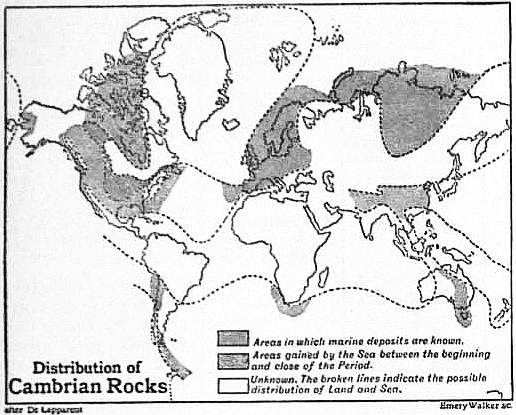
Igneous rocks are not extensively developed; in Wales they form an important feature and occur in considerable thickness; they are represented by lavas of olivine-diabase and by contemporaneous tuffs which are traversed by later granite and quartz felsite. In the Cambrian of Brittany there are acid lavas and tuffs. Quartz porphyry, diabase and diorite appear in the Ardennes. In Bohemia, North America and Canada igneous rocks have been observed.
In China, on the Yang-tse river, a thick deposit has been found full of boulders of diverse kinds of rock, striated in the manner that is typical of glacial action. A similar deposit occurs in the Gaisa beds near the Varanger Fjord in Norway. These formations lie at the base of the lowest Cambrian strata and may possibly be included in the pre-Cambrian, though in Norway they are clearly resting upon a striated floor of crystalline rocks.
Cambrian Life.—In a general survey of the life of this period, as it is revealed by the fossils, three outstanding facts are apparent: (1) the great divergence between the Cambrian fauna and that of the present day; (2) the Cambrian life assemblage differs in no marked manner from that of the succeeding Ordovician and Silurian periods; there is a certain family likeness which unites all of them; (3) the extraordinary complexity and diversity not only in the assemblage as a whole but within certain limited groups of organisms. Although in the Cambrian strata we have the oldest known fossiliferous rocks—if we leave out of account the very few and very obscure organic remains hitherto recorded from the pre-Cambrian—yet we appear to enter suddenly into the presence of a world richly peopled with a suite of organisms already far advanced in differentiation; the Cambrian fauna seems to be as far removed from what must have been the first forms of life, as the living forms of this remote period are distant from the creatures of to-day.
With the exception of the vertebrates, every one of the great classes of animals is represented in Cambrian rocks. Simple protozoa appear in the form of Radiolaria; Lithistid sponges are represented by such forms as Archaeoscyphia, Hexactinellid sponges by Protospongia; Graptolites (Dictyograptus (Dictyonema)) come on in the higher parts of the system. Medusa-like casts have been found in the lower Cambrian of Scandinavia (Medusina) and in the mid-Cambrian of Alabama (Brooksella). Corals, Archaeocyathus, Spirocyathus, &c., lived in the Cambrian seas along with starfishes (Palaeasterina), Cystideans, Protocystites, Trochocystites and possibly Crinoids, Dendrocrinus. Annelids left their traces in burrows and casts on the sea-floor (Arenicolites, Cruziana, Scolithus, &c.). Crustacea occupied an extremely prominent place; there were Phyllocarids such as Hymenocaris, and Ostracods like Entomidella; but by far the most important in numbers and development were the Trilobites, now extinct, but in palaeozoic times so abundant. In the Cambrian period trilobites had already attained their maximum size; some species of Paradoxides were nearly 2 ft. long, but in company with these monsters were tiny forms like Agnostus and Microdiscus. Many of the Cambrian trilobites appear to have been blind, and they had not at this period developed that flexibility in the carapace that some forms acquired later.
Brachiopods were fairly abundant, particularly the non-articulated forms (Obolus, Lingulella, Acrotreta, Discinopsis, &c.); amongst the articulate genera are Kutorgina, Orthis, Khynchonella. It is a striking fact that certain of these non-articulate “lamp-shells” are familiar inhabitants of our present seas. Each of the principal groups of true mollusca was represented: Pelecypods (Modioloides); Gasteropods (Scenella, Pleurotomaria, Trochonema); Pteropods (Hyohthellus, Hyolithes, Salleretta); Cephalopods (Orthoceras, Cystoceras). Of land plants no traces have yet been discovered. Certain markings on slates and sandstones, such as the “fucoids” of Scandinavia and Scotland, the Phycoides of the Fichtelgebirge, Eophyton and other seaweed-like impressions, may indeed be the casts of fucoid plants; but it is by no means sure that many of them are not mere inorganic imitative markings or the tracks or casts of worms. Oldhamia, a delicate branching body, abundant in the Cambrian of the south-east of Ireland, is probably a calcareous alga, but its precise nature has not been satisfactorily determined.
Cambrian Stratigraphy.—Wherever the Cambrian strata have been carefully studied it has now been found possible and convenient to arrange them into three series, each of which is characterized by a distinctive genus of trilobite. Thus we have a Lower Cambrian with Olenellus, a middle series with Paradoxides and an Upper Cambrian with Olenus. It is true that these fossils are not invariably present in every occurrence of Cambrian strata, but this fact notwithstanding, the threefold division holds with sufficient constancy. An uppermost series lies above the Olenus fauna in some areas; it is represented by the Tremadoc beds in Britain or by the Dictyonema beds or Euloma-Niobe fauna elsewhere. Three regions deserve special attention: (1) Great Britain, the area in which the Cambrian was first differentiated from the old “Transition Series”; (2) North America, on account of the wide-spread occurrence of the rocks and the abundance and perfection of the fossils; and (3) Bohemia, made classic by the great labours of J. Barrande.