VOLUME V SLICE I Calhoun to Camoens (continued 6)
Reading edition
CALLANDER, a police burgh of Perthshire, Scotland, 16 m. north-west of Stirling by the Caledonian railway. Pop. (1901) 1458. Situated on the north bank of the Teith, here crossed by a three-arched bridge, and sheltered by a ridge of wooded hills, it is in growing repute as a health resort. A mile and a half north-east are the Falls of Bracklinn (Gaelic, “white-foaming pool”), formed by the Keltie, which takes a leap of 50 ft. down the red sandstone gorge on its way to the Teith. Two miles north-west of Callander is the Pass of Leny, “the gate of the Highlands,” and farther in the same direction is Loch Lubnaig, on the shores of which stand the ruins of St Bride’s chapel. Callander owes much of its prosperity to the fact that it is the centre from which the Trossachs is usually visited, the route being that described in Scott’s Lady of the Lake. The ascent of Ben Ledi is commonly made from the town.
CALLAO, a city, port and coast department of Peru, 8½ m. west of Lima, in 12° 04′ S., 77° 13′ W. Pop. (1905) 31,128, of whom 3349 were foreigners. The department includes the city and its environs, Bellavista and La Punta, and the neighbouring islands, San Lorenzo, Fronton, the Palominos, &c., and covers an area of 14½ sq. m. Callao is the principal port of the republic, its harbour being a large bay sheltered by a tongue of land on the south called La Punta, and by the islands of San Lorenzo and Fronton. The anchorage is good and safe, and the harbour is one of the best on the Pacific coast of South America. The city stands on the south side of the bay, and is built on a flat point of land only 8 ft. above sea-level. The houses are for the most part low and cheaply built, and the streets are narrow, badly paved, irregular and dirty. The climate is good and the coast is swept by cool ocean breezes, the average temperatures ranging from 65° to 77° F., but notwithstanding this, Callao has a bad reputation for fevers and contagious diseases, chiefly because of its insanitary condition. Its noteworthy public buildings are the custom-house and its storehouses which occupy the old quadrangular fortress built by the Spanish government between 1770 and 1775, and cover 15 acres, the prefecture, the military and naval offices and barracks, the post-office, three Catholic churches, a hospital, market, three clubs and some modern commercial houses. The present city is half a mile north of the site of the old town, which was destroyed by an earthquake and tidal wave in 1746. For a short time the commercial interests of the stricken city centred at Bellavista, 1¼ m. east, where wheat granaries were built and still remain, but later the greater convenience of a waterside site drew the merchants and population back to the vicinity of the submerged town. The importance of Callao in colonial times, when it was the only open port south of Panama, did not continue under the new political order, because of the unsettled state of public affairs and the loss of its monopoly. This decline in its prosperity was checked, and the modern development of the port began, when a railway was built from Callao into the heart of the Andes, and Callao is now an important factor in the development of copper-mining. The port is connected with Lima by two railways and an electric tramway, with Oroya by railway 138 m. long, and with Cerro de Pasco by railway 221 m. A short railway also runs from the port to the Bellavista storehouses. The port is provided with modern harbour improvements, consisting of sea-walls of concrete blocks, two fine docks with berthing spaces for 30 large vessels, and a large floating-dock (300 ft. long on the blocks and capable of receiving vessels up to 21 ft. draught and 5000 tons weight), which was built in Glasgow and was sent out to Callao in 1863. The docks are provided with gas and electric lights, 18 steam cranes for loading and discharging vessels, a triple line of railway and a supply of fresh water. Callao was formerly the headquarters in South America of the Pacific Steam Navigation Co., Ltd. (incorporated 1840), but Valparaiso now occupies that position. There are, owing perhaps to the proximity of Lima, few industrial establishments in the city; among them are a large sugar refinery, some flour-mills, a brewery, a factory for making effervescent drinks, and a number of foundries and repair shops. Being a port of the first class, Callao is an important distributing centre for the coasting trade, in which a large number of small vessels are engaged. The foreign steamship companies making it a regular port of call are the Pacific Steam Navigation Co. (British), the Compañia Sud-America (Chilean), the Kosmos and Roland lines (German), the Merchants line (New York), and a Japanese line from the ports of Japan and China. A subsidized Peruvian line is also contemplated to ply between the Pacific ports of South America with an eventual extension of the service to Europe. The arrivals from and clearances for foreign ports in 1907 were as follows:—
Steamers. Sailing Vessels.
No. Tonnage. No. Tonnage.
Arrivals 518 937,302 924 174,165
Clearances 517 937,706 931 163,365
The exports from Callao are guano, sugar, cotton, wool, hides, silver, copper, gold and forest products, and the imports include timber and other building materials, cotton and other textiles, general merchandise for personal, household and industrial uses, railway material, coal, kerosene, wheat, flour and other food stuffs. The maintenance of peace and order, and the mining development of the interior, have added to the trade and prosperity of the port.
The history of Callao has been exceptionally eventful. It was founded in 1537, two years after Pizarro had founded Lima. As the port of that capital and the only open port below Panama it grew rapidly in importance and wealth. It was raised to the dignity of a city in 1671. The appearance of Sir Francis Drake in the bay in 1578 led to the fortification of the port, which proved strong enough to repel an attack by the Dutch in 1624. The city was completely destroyed and partly submerged by the great earthquake of the 28th of October 1746, in which about 6000 persons perished. The new city was strongly fortified and figured prominently in the struggle for independence, and also in the various revolutions which have convulsed the republic. Its political autonomy dates from 1836, when it was made a coast department. The Callao fortifications were bombarded by a Spanish fleet under Admiral Mendez Nuñez on the 2nd of May 1866, when there were heavy losses both in lives and material. Again, in 1880, the city was bombarded by the Chileans, though it was almost defenceless, and fell into the possession of the invaders after the capture of Lima in the following year. Before the surrender all the Peruvian naval vessels in the harbour were sunk, to prevent their falling into the possession of the enemy.
CALLCOTT, SIR AUGUSTUS WALL (1779-1844), English landscape painter, was born at Kensington in 1779 and died there in 1844. His first study was music; and he sang for several years in the choir of Westminster Abbey. But at the age of twenty he had determined to give up music, and had exhibited his first painting at the Royal Academy. He gradually rose to distinction, and was elected an associate in 1807 and an academician in 1810. In 1827 he received the honour of knighthood; and, seven years later, was appointed surveyor of the royal pictures. His two principal subject pictures—“Raphael and the Fornarina,” and “Milton dictating to his Daughters,” are much inferior to his landscapes, which are placed in the highest class by their refined taste and quiet beauty.
His wife, Maria, Lady Callcott (1786-1844), whom he married in 1827, was a daughter of Admiral Dundas and widow of Captain Thomas Graham, R.N. (d. 1822). With her first husband she travelled in India, South Africa and South America, where she acted for some time as teacher of Donna Maria, who became queen of Portugal in 1826; and in the company of her second husband she spent much time in the south of Europe. She published accounts of her visits to India (1812), and to the environs of Rome (1820); Memoirs of Poussin (1820); a History of France; a History of Spain (1828); Essays toward a History of Painting (1836); Little Arthur’s History of England (1836); and the Scripture Herbal (1842).
CALLCOTT, JOHN WALL (1766-1821), English musician, brother of Sir Augustus Callcott, was born at Kensington on the 20th of November 1766. At the age of seven he was sent to a neighbouring day-school, where he continued for five years, studying chiefly Latin and Greek. During this time he frequently went to Kensington church, in the repairs of which his father was employed, and the impression he received on hearing the organ of that church seems to have roused his love for music. The organist at that time was Henry Whitney, from whom Callcott received his first musical instruction. He did not, however, choose music as a profession, as he wished to become a surgeon. But on witnessing a surgical operation he found his nervous system so seriously affected by the sight, that he determined to devote himself to music. His intimacy with Dr Arnold and other leading musicians of the day procured him access to artistic circles; he was deputy organist at St George the Martyr, Queen Square, Bloomsbury, from 1783 to 1785, in which year his successful competition for three out of the four prize medals offered by the “Catch Club” soon spread his reputation as composer of glees, catches, canons and other pieces of concerted vocal music. The compositions with which he won these medals were—the catch “O beauteous fair,” the canon “Blessed is he,” and the glee “Dull repining sons of care.” In these and other similar compositions he displays considerable skill and talent, and some of his glees retain their popularity at the present day. In 1787 Callcott helped Dr Arnold and others to form the “Glee Club.” In 1789 he became one of the two organists at St Paul’s, Covent Garden, and from 1793 to 1802 he was organist to the Asylum for Female Orphans. As an instrumental composer Callcott never succeeded, not even after he had taken lessons from Haydn. But of far greater importance than his compositions are his theoretical writings. His Musical Grammar, published in 1806 (3rd ed., 1817), was long considered the standard English work of musical instruction, and in spite of its being antiquated when compared with modern standards, it remains a scholarly and lucid treatment of the rudiments of the art. Callcott was a much-esteemed teacher of music for many years. In 1800 he took his degree of Mus.D. at Oxford, where fifteen years earlier he had received his degree of bachelor of music, and in 1805 he succeeded Dr Crotch as musical lecturer at the Royal Institution. Towards the end of his life his artistic career was twice interrupted by the failure of his mental powers. He died at Bristol after much suffering on the 15th of May 1821. A posthumous collection of his most favourite vocal pieces was published in 1824 with a memoir of his life by his son-in-law, William Horsley, himself a composer of note.
Callcott’s son, William Hutchins Callcott (1807-1882), inherited to a large extent the musical gifts of his father. His song, “The last man,” and his anthem, “Give peace in our time, O Lord,” were his best-known compositions.
CALLIAS, tyrant of Chalcis in Euboea. With the assistance of Philip II. of Macedon, which he hoped to obtain, he contemplated the subjugation of the whole island. But finding that Philip was unwilling to help him, Callias had recourse to the Athenians, although he had previously (350 b.c.) been engaged in hostilities with them. With the support of Demosthenes, he was enabled to conclude an alliance with Athens, and the tribute formerly paid by Eretria and Oreus to Athens was handed over to him. But his plan of uniting the whole of Euboea under his rule, with Chalcis as capital, was frustrated by Philip, who set up tyrants chosen by himself at Eretria and Oreus. Subsequently, when Philip’s attention was engaged upon Thrace, the Athenians in conjunction with Callias drove out these tyrants, and Callias thus became master of the island (Demosthenes, De Pace, p. 58; Epistola Philippi, p. 159; Diod. Sic. xvi. 74). At the end of his life he appears to have lived at Athens, and Demosthenes proposed to confer the citizenship upon him (Aeschines, Contra Ctesiphontem, 85, 87).
CALLIAS and HIPPONICUS, two names borne alternately by the heads of a wealthy and distinguished Athenian family. During the 5th and 4th centuries b.c. the office of daduchus or torch-bearer at the Eleusinian mysteries was the hereditary privilege of the family till its extinction. The following members deserve mention.
1. Callias, the second of the name, fought at the battle of Marathon (490) in priestly attire. Some time after the death of Cimon, probably about 445 b.c., he was sent to Susa to conclude with Artaxerxes, king of Persia, a treaty of peace afterwards misnamed the “peace of Cimon.” Cimon had nothing to do with it, and he was totally opposed to the idea of peace with Persia (see Cimon). At all events Callias’s mission does not seem to have been successful; he was indicted for high treason on his return to Athens and sentenced to a fine of fifty talents.
See Herodotus vii. 151; Diod. Sic. xii. 4; Demosthenes, De Falsa Legatione, p. 428; Grote recognizes the treaty as a historical fact, History of Greece, ch. xlv., while Curtius, bk. iii. ch. ii., denies the conclusion of any formal treaty; see also Ed. Meyer, Forschungen, ii.; J.B. Bury in Hermathena, xxiv. (1898).
2. Hipponicus, son of the above. Together with Eurymedon he commanded the Athenian forces in the incursion into Boeotian territory (426 b.c.) and was slain at the battle of Delium (424). His wife, whom he divorced, subsequently became the wife of Pericles; one of his daughters, Hipparete, married Alcibiades; another, the wife of Theodorus, was the mother of the orator Isocrates.
See Thucydides iii. 91; Diod. Sic. xii. 65; Andocides, Contra Alcibiadem, 13.
3. Callias, son of the above, the black sheep of the family, was notorious for his profligacy and extravagance, and was ridiculed by the comic poets as an example of a degenerate Athenian (Aristophanes, Frogs, 429, Birds, 283, and schol. Andocides, De Mysteriis, 110-131). The scene of Xenophon’s Symposium and Plato’s Protagoras was laid at his house. He was reduced to a state of absolute poverty and, according to Aelian (Var. Hist. iv. 23), committed suicide, but there is no confirmation of this. In spite of his dissipated life he played a certain part in public affairs. In 392 he was in command of the Athenian hoplites at Corinth, when the Spartans were defeated by Iphicrates. In 371 he was at the head of the embassy sent to make terms with Sparta. The peace which was the result was called after him the “peace of Callias.”
See Xenophon, Hellenica, iv. 5, vi. 3; and Delian League.
CALLIMACHUS, an Athenian sculptor of the second half of the 5th century b.c. Ancient critics associate him with Calamis, whose relative he may have been. He is given credit for two inventions, the Corinthian column and the running borer for drilling marble. The most certain facts in regard to him are that he sculptured some dancing Laconian maidens, and made a golden lamp for the Erechtheum (about 408 b.c.); and that he used to spoil his works by over-refinement and excessive labour.
CALLIMACHUS, Greek poet and grammarian, a native of Cyrene and a descendant of the illustrious house of the Battiadae, flourished about 250 b.c. He opened a school in the suburbs of Alexandria, and some of the most distinguished grammarians and poets were his pupils. He was subsequently appointed by Ptolemy Philadelphus chief librarian of the Alexandrian library, which office he held till his death (about 240). His Pinakes (tablets), in 120 books, a critical and chronologically arranged catalogue of the library, laid the foundation of a history of Greek literature. According to Suidas, he wrote about 800 works, in verse and prose; of these only six hymns, sixty-four epigrams and some fragments are extant; a considerable fragment of the Hecale, an idyllic epic, has also been discovered in the Rainer papyri (see Kenyon in Classical Review, November 1893). His Coma Berenices is only known from the celebrated imitation of Catullus. His Aitia (causes) was a collection of elegiac poems in four books, dealing with the foundation of cities, religious ceremonies and other customs. According to Quintilian (Instit. x. i. 58) he was the chief of the elegiac poets; his elegies were highly esteemed by the Romans, and imitated by Ovid, Catullus and especially Propertius. The extant hymns are extremely learned, and written in a laboured and artificial style. The epigrams, some of the best specimens of their kind, have been incorporated in the Greek Anthology. Art and learning are his chief characteristics, unrelieved by any real poetic genius; in the words of Ovid (Amores, i. 15)—
“Quamvis ingenio non valet, arte valet.”
Editions.—Hymns, epigrams and fragments (the last collected by Bentley) by J.A. Ernesti (1761), and O. Schneider (1870-1873) (with elaborate indices and excursuses); hymns and epigrams, by A. Meineke (1861), and U. Wilamowitz-Möllendorff (1897). See Neue Bruchstücke aus der Hekale des Kallimachus, by T. Gomperz (1893); also G. Knaack, Callimachea (1896); A. Bertrami, Gl’ Inni di Callimacho e il Nomo di Terpandro (1896); K. Kuiper, Studia Callimachea (1896); A. Hamette, Les Épigrammes de Callimaque: étude critique et litteraire (Paris, 1907). There are English translations (verse) by W. Dodd (1755) and H.W. Tytler (1793); (prose) by J. Banks (1856). See also Sandys, Hist. of Class. Schol. i. (ed. 1906), p. 122.
CALLINUS of Ephesus, the oldest of the Greek elegiac poets and the creator of the political and warlike elegy. He is supposed to have flourished between the invasion of Asia Minor by the Cimmerii and their expulsion by Alyattes (630-560 b.c.). During his lifetime his own countrymen were also engaged in a life-and-death struggle with the Magnesians. These two events give the key to his poetry, in which he endeavours to rouse the indolent Ionians to a sense of patriotism. Only scanty fiagments of his poems remain; the longest of these (preserved in Stobaeus, Florilegium, li. 19) has even been ascribed to Tyrtaeus.
Edition of the fragments by N. Bach (1831), and in Bergk, Poetae Lyrici Graeci (1882). On the date of Callinus, see the histories of Greek literature by Mure and Müller; G.H. Bode, Geschichte der hellenischen Dichtkunst, ii. pt. i. (1838); and G. Geiger, De Callini Aetate (1877), who places him earlier, about 642.
CALLIOPE, the muse of epic poetry, so named from the sweetness of her vioce (Gr. κάλλος, beauty; ὄψ, voice). In Hesiod she was the last of the nine sisters, but yet enjoyed a supremacy over the others. (See also Muses, The.)
CALLIRRHOE, in Greek legend, second daughter of the river-god Achelous and wife of Alcmaeon (q.v.). At her earnest request her husband induced Phegeus, king of Psophis in Arcadia, and the father of his first wife Arsinoë (or Alphesiboea), to hand over to him the necklace and peplus (robe) of Harmonia (q.v.), that he might dedicate them at Delphi to complete the cure of his madness. When Phegeus discovered that they were really meant for Callirrhoe, he gave orders for Alcmaeon to be waylaid and killed (Apollodorus iii. 7, 2. 5-7; Thucydides ii. 102). Callirrhoe now implored the gods that her two young sons might grow to manhood at once and avenge their father’s death. This was granted, and her sons Amphoterus and Acarnan slew Phegeus with his two sons, and returning with the necklace and peplus dedicated them at Delphi (Ovid, Metam. ix. 413).
CALLISTHENES (c. 360-328 b.c.), of Olynthus, Greek historian, a relative and pupil of Aristotle, through whose recommendation he was appointed to attend Alexander the Great in his Asiatic expedition. He censured Alexander’s adoption of oriental customs, inveighing especially against the servile ceremony of adoration. Having thereby greatly offended the king, he was accused of being privy to a treasonable conspiracy and thrown into prison, where he died from torture or disease. His melancholy end was commemorated in a special treatise (Καλλισθένης ἢ περὶ πένθους) by his friend Theophrastus, whose acquaintance he made during a visit to Athens. Callisthenes wrote an account of Alexander’s expedition, a history of Greece from the peace of Antalcidas (387) to the Phocian war (357), a history of the Phocian war and other works, all of which have perished. The romantic life of Alexander, the basis of all the Alexander legends of the middle ages, originated during the time of the Ptolemies, but in its present form belongs to the 3rd century a.d. Its author is usually known as pseudo-Callisthenes, although, in the Latin translation by Julius Valerius Alexander Polemius (beginning of the 4th century) it is ascribed to a certain Aesopus; Aristotle, Antisthenes, Onesicritus and Arrian have also been credited with the authorship. There are also Syrian, Armenian and Slavonic versions, in addition to four Greek versions (two in prose and two in verse) in the middle ages (see Krumbacher, Geschichte der byzantinischen Litteratur, 1897, p. 849). Valerius’s translation was completely superseded by that of Leo, arch-priest of Naples in the 10th century, the so-called Historia de Preliis.
See Scriptores rerum Alexandri Magni (by C.W. Müller, in the Didot edition of Arrian, 1846), containing the genuine fragments and the text of the pseudo-Callisthenes, with notes and introduction; A. Westermann, De Callisthene Olynthio et Pseudo-Callisthene Commentatio (1838-1842); J. Zacher, Pseudo-Callisthenes (1867); W. Christ, Geschichte der griechischen Litteratur (1898), pp. 363, 819; article by Edward Meyer in Ersch and Gruber’s Allgemeine Encyklopädie; A. Ausfeld, Zur Kritik des griechischen Alexanderromans (Bruchsal, 1894); Plutarch, Alexander, 52-55; Arrian, Anab. iv. 10-14; Diog. Laërtius v. I; Quintus Curtius viii. 5-8; Suidas s.v. See also Alexander The Great (ad fin.). For the Latin translations see Teuffel-Schwabe, Hist. of Roman Literature (Eng, trans.), § 399; and M. Schanz, Geschichte der römischen Litteratur, iv. i., p.43.
CALLISTO, in Greek mythology, an Arcadian nymph, daughter of Lycaon and companion of Artemis. She was transformed into a bear as a penalty for having borne to Zeus a son, Arcas, the ancestor of the Arcadians. Hera, Zeus and Artemis are all mentioned as the authors of the transformation. Arcas, when hunting, encountered the bear Callisto, and would have shot her, had not Zeus with swift wind carried up both to the skies, where he placed them as a constellation. In another version, she was slain by Artemis. Callisto was originally only an epithet of the Arcadian Artemis herself.
See Apollodorus iii. 8; Ovid, Metam. ii. 381-530; R. Franz, De Callistus fabula (1890), which deals exhaustively with the various forms of the legend.
CALLISTRATUS, Alexandrian grammarian, flourished at the beginning of the 2nd century b.c. He was one of the pupils of Aristophanes of Byzantium, who were distinctively called Aristophanei. Callistratus chiefly devoted himself to the elucidation of the Greek poets; a few fragments of his commentaries have been preserved in the various collections of scholia and in Athenaeus. He was also the author of a miscellaneous work called Συμμικτά used by the later lexicographers, and of a treatise on courtesans (Athenaeus iii. 125 B, xiii. 591 D). He is not to be confused with Callistratus, the pupil and successor of Isocrates and author of a history of Heraclea in Pontus.
See R. Schmidt, De Callistrato Aristophaneo, appended to A. Nauck’s Aristophanis Byzantii Fragmenta (1848); also C.W. Müller, Fragmenta Historicorum Graecorum, iv. p. 353 note.
CALLISTRATUS, an Athenian poet, only known as the author of a hymn in honour of Harmodius (q.v.) and Aristogeiton. This ode, which is to be found in Athenaeus (p. 695), has been beautifully translated by Thomas Moore.
CALLISTRATUS, Greek sophist and rhetorician, probably flourished in the 3rd century. He wrote Έκφράσεις, descriptions of fourteen works of art in stone or brass by distinguished artists. This little work, which is written in a dry and affected style, without any real artistic feeling, is usually edited with the Εἰκόνες of Philostratus.
Edition by Schenkl-Reisch (Teubner series, 1902); see also C.G. Heyne, Opuscula Academica, v. pp. 196-221, with commentary on the Descriptiones; F. Jacobs, Animadversiones criticae in Callistrati statuas (1797).
CALLISTRATUS of Aphidnae, Athenian orator and general in the 4th century b.c. For many years, as prostates, he supported Spartan interests at Athens. On account of the refusal of the Thebans to surrender Oropus, which on his advice they had been allowed to occupy temporarily, Callistratus, despite his magnificent defence (which so impressed Demosthenes that he resolved to study oratory), was condemned to death, 361 b.c. He fled to Methone in Macedonia, and on his return to Athens in 355 he was executed.
See Xenophon, Hellenica, iii. 3, vi. 2; Lycurgus, In Leocr. 93.
CALLOT, JACQUES (1592-1635), French engraver, was born at Nancy in Lorraine, where his father, Jean Callot, was a herald-at-arms. He early discovered a very strong predilection for art, and at the age of twelve quitted home without his father’s consent, and set out for Rome where he intended to prosecute his studies. Being utterly destitute of funds he joined a troop of Bohemians, and arrived in their company at Florence. In this city he had the good fortune to attract the notice of a gentleman of the court, who supplied him with the means of study; but he removed in a short time to Rome, where, however, he was recognized by some relatives, who immediately compelled him to return home. Two years after this, and when only fourteen years old, he again left France contrary to the wishes of his friends, and reached Turin before he was overtaken by his elder brother, who had been despatched in quest of him. As his enthusiasm for art remained undiminished after these disappointments, he was at last allowed to accompany the duke of Lorraine’s envoy to the papal court. His first care was to study the art of design, of which in a short time he became a perfect master. Philip Thomasin instructed him in the use of the graver, which, however, he ultimately abandoned, substituting the point as better adapted for his purposes. From Rome he went to Florence, where he remained till the death of Cosimo II., the Maecenas of these times. On returning to his native country he was warmly received by the then duke of Lorraine, who admired and encouraged him. As his fame was now spread abroad in various countries of Europe, many distinguished persons gave him commissions to execute. By the Infanta Isabella, sovereign of the Low Countries, he was commissioned to engrave a design of the siege of Breda; and at the request of Louis XIII. he designed the siege of Rochelle and the attack on the Isle of Ré. When, however, in 1631 he was desired by that monarch to execute an engraving of the siege of Nancy, which he had just taken, Callot refused, saying, “I would rather cut off my thumb than do anything against the honour of my prince and of my country”; to which Louis replied that the duke of Lorraine was happy in possessing such subjects as Callot. Shortly after this he returned to his native place, from which the king failed to allure him with the offer of a handsome pension. He engraved in all about 1600 pieces, the best of which are those executed in aquafortis. No one ever possessed in a higher degree the talent for grouping a large number of figures in a small space, and of representing with two or three bold strokes the expression, action and peculiar features of each individual. Freedom, variety and naiveté characterize all his pieces. His Fairs, his Miseries of War, his Sieges, his Temptation of St Anthony and his Conversion of St Paul are the best-known of his plates.
See also Edouard Meaume, Recherches sur la vie de Jacques Callot (1860).
CALLOVIAN (from Callovium, the Latinized form of Kellaways, a village not far from Chippenham in Wiltshire), in geology, the name introduced by d’Orbigny for the strata which constitute the base of the Oxfordian or lowermost stage of the Middle Oolites. The term used by d’Orbigny in 1844 was “Kellovien,” subsequently altered to “Callovien” in 1849; William Smith wrote “Kellaways” or “Kelloways Stone” towards the close of the 18th century. In England it is now usual to speak of the Kellaways Beds; these comprise (1) the Kellaways Rock, alternating clays and sands with frequent but irregular concretionary calcareous sandstones, with abundant fossils; and (2) a lower division, the Kellaways Clay, which often contains much selenite but is poor in fossils. The lithological characters are impersistent, and the sandy phase encroaches sometimes more, sometimes less, upon the true Oxford Clay. The rocks may be traced from Wiltshire into Bedfordshire, Lincolnshire and Yorkshire, where they are well exposed in the cliffs at Scarborough and Gristhorpe, at Hackness (90 ft.), Newtondale (80 ft.) and Kepwick (100 ft.). In Yorkshire, however, the Callovian rocks lie upon a somewhat higher palaeontological horizon than in Wiltshire. In England, Kepplerites calloviensis is taken as the zone fossil; other common forms are Cosmoceras modiolare, C. gowerianum, Belemnites oweni, Ancyloceras calloviense, Nautilus calloviensis, Avicula ovalis, Gryphaea bilobata, &c.
On the European continent the “Callovien” stage is used in a sense that is not exactly synonymous with the English Callovian; it is employed to embrace beds that lie both higher and lower in the time-scale. Thus, the continental Callovien includes the following zones:—
Upper Callovien (Divesien) { Zone of Peltoceras athleta, Cosmoceras Duncani, Quenstedtoceras Lamberti and Q. mariae.
Lower Callovien { Zone of Reineckia anceps, Stephanoceras coronatum and Cosmoceras jason and a lower zone of C. gowerianum and Macrocephalites macrocephalus.
Rocks of Callovian age (according to the continental classification) are widely spread in Europe, which, with the exception of numerous insular masses, was covered by the Callovian Sea. The largest of these land areas lay over Scandinavia and Finland, and extended eastward as far as the 40th meridian. In arctic regions these rocks have been discovered in Spitzbergen, Franz Josef Land, the east coast of Greenland, and Siberia. They occur in the Hebrides and Skye and in England as indicated above. In France they are well exposed on the coast of Calvados between Trouville and Dives, where the marls and clays are 200 ft. thick. In the Ardennes clays bearing pyrites and oolitic limonite are about 30 ft. thick. Around Poitiers the Callovian is 100 ft. thick, but the formation thins in the direction of the Jura.
Clays and shales with ferruginous oolites represent the Callovian of Germany; while in Russia the deposits of this age are mainly argillaceous. In North America Callovian fossils are found in California; in South America in Bolivia. In Africa they have been found in Algeria and Morocco, in Somaliland and Zanzibar, and on the west coast of Madagascar. In India they are represented by the shales and limestones of the Chari series of Cutch. Callovian rocks are also recorded from New Guinea and the Moluccas.
See Jurassic; also A. de Lapparent, Traité de géologie, vol. ii. (5th ed., 1906), and H.B. Woodward, “The Jurassic Rocks of Britain,” Mem. Geol. Survey, vol. v.
(J. A. H.)
CALM, an adjective meaning peaceful, quiet; particularly used of the weather, free from wind or storm, or of the sea, opposed to rough. The word appears in French calme, through which it came into English, in Spanish, Portuguese and Italian calma. Most authorities follow Diez (Etym. Wörterbuch der romanischen Sprachen) in tracing the origin to the Low Latin cauma, an adaptation of Greek καῦμα, burning heat, καίειν, to burn. The Portuguese calma has this meaning as well as that of quiet. The connexion would be heat of the day, rest during that period, so quiet, rest, peacefulness. The insertion of the l, which in English pronunciation disappears, is probably due to the Latin calor, heat, with which the word was associated.
CALMET, ANTOINE AUGUSTIN (1672-1757), French Benedictine, was born at Mesnil-la-Horgne on the 26th of February 1672. At the age of seventeen he joined the Benedictine order, and in 1698 was appointed to teach theology and philosophy at the abbey of Moyen-Moutier. He was successively prior at Lay, abbot at Nancy and of Sénones in Lorraine. He died in Paris on the 25th of October 1757. The erudition of Calmet’s exegetical writings won him a reputation that was not confined to the Roman Catholic Church, but they have failed to stand the test of modern scholarship. The most noteworthy are:—Commentaire de la Bible (Paris, 23 vols. 1707-1716), and Dictionnaire historique, géographique, critique, chronologique et littéral de la Bible (Paris, 2 vols., 1720). These and numerous other works and editions of the Bible are known only to students, but as a pioneer in a branch of Biblical study which received a wide development in the 19th century, Calmet is worthy of remembrance. As a historical writer he is best known by his Histoire ecclésiastique et civile de la Lorraine (Nancy, 1728), founded on original research and various useful works on Lorraine, of which a full list is given In Vigouroux’s Dictionnaire de la Bible.
See A. Digot, Notice biographique et littéraire sur Dom Augustin Calmet (Nancy, 1860).
CALNE, a market town and municipal borough in the Chippenham parliamentary division of Wiltshire, England, 99 m. west of London by the Great Western railway. Pop. (1901) 3457. Area, 356 acres. It lies in the valley of the Calne, and is surrounded by the high table-land of Salisbury Plain and the Marlborough Downs. The church of St Mark has a nave with double aisles, and massive late Norman pillars and arches. The tower, which fell in 1628, was perhaps rebuilt by Inigo Jones. Other noteworthy buildings are a grammar school, founded by John Bentley in 1660, and the town-hall. Bacon-curing is the staple industry, and there are flour, flax and paper mills. The manufacture of broadcloth, once of great importance, is almost extinct. Calne is governed by a mayor, four aldermen and twelve councillors.
In the 10th century Calne (Canna, Kalne) was the site of a palace of the West-Saxon kings. Calne was the scene of the synod of 978 when, during the discussion of the question of celibacy, the floor suddenly gave way beneath the councillors, leaving Archbishop Dunstan alone standing upon a beam. Here also a witenagemot was summoned in 997. In the Domesday Survey Calne appears as a royal borough; it comprised forty-seven burgesses and was not assessed in hides. In 1565 the borough possessed a gild merchant, at the head of which were two gild stewards. Calne claimed to have received a charter from Stephen and a confirmation of the same from Henry III., but no record of these is extant, and the charter actually issued to the borough by James II. in 1687 apparently never came into force. The borough returned two members to parliament more or less irregularly from the first parliament of Edward I. until the Reform Bill of 1832. From this date the borough returned one member only until, by the Redistribution of Seats Act of 1885, the privilege was annulled. In 1303 Lodovicus de Bello Monte, prebendary of Salisbury, obtained a grant of a Saturday market at the manor of Calne, and a three days’ fair at the feast of St Mary Magdalene; the latter was only abandoned in the 19th century. Calne was formerly one of the chief centres of cloth manufacture in the west of England, but the industry is extinct.
CALOMEL, a drug consisting of mercurous chloride, mercury subchloride, Hg2Cl2, which occurs in nature as the mineral horn-quicksilver, found as translucent crystals belonging to the tetragonal system, with an adamantine lustre, and a dirty white grey or brownish colour. The chief localities are Idria, Obermoschel, Horowitz in Bavaria and Almaden in Spain. It was used in medicine as early as the 16th century under the names Draco mitigatus, Manna metallorum, Aquila alba, Mercurius dulcis; later it became known as calomel, a name probably derived from the Greek καλός, beautiful, and μέλας, black, in allusion to its blackening by ammonia, or from καλός and μέλι, honey, from its sweet taste. It may be obtained by heating mercury in chlorine, or by reducing mercuric chloride (corrosive sublimate) with mercury or sulphurous acid. It is manufactured by heating a mixture of mercurous sulphate and common salt in iron retorts, and condensing the sublimed calomel in brick chambers. In the wet way it is obtained by precipitating a mercurous salt with hydrochloric acid. Calomel is a white powder which sublimes at a low red heat; it is insoluble in water, alcohol and ether. Boiling with stannous chloride solution reduces it to the metal; digestion with potassium iodide gives mercurous iodide. Nitric acid oxidizes it to mercuric nitrate, while potash or soda decomposes it into mercury and oxygen. Long continued boiling with water gives mercury and mercuric chloride; dilute hydrochloric acid or solutions of alkaline chlorides convert it into mercuric chloride on long boiling.
The molecular weight of mercurous chloride has given occasion for much discussion. E. Mitscherlich determined the vapour density to be 8.3 (air = 1), corresponding to HgCl. The supporters of the formula Hg2Cl2 pointed out that dissociation into mercury and mercuric chloride would give this value, since mercury is a monatomic element. After contradictory evidence as to whether dissociation did or did not occur, it was finally shown by Victor Meyer and W. Harris (1894) that a rod moistened with potash and inserted in the vapour was coloured yellow, and so conclusively proved dissociation. A. Werner determined the molecular weights of mercurous, cuprous and silver bromides, iodides and chlorides in pyridine solution, and obtained results pointing to the formula HgCl, etc. However, the double formula, Hg2Cl2, has been completely established by H.B. Baker (Journ. Chem. Soc., 1900, 77, p. 646) by vapour density determinations of the absolutely dry substance.
Calomel possesses certain special properties and uses in medicine which are dealt with here as a supplement to the general discussion of the pharmacology and therapeutics of mercury (q.v.). Calomel exerts remote actions in the form of mercuric chloride. The specific value of mercurous chloride is that it exerts the valuable properties of mercuric chloride in the safest and least irritant manner, as the active salt is continuously and freshly generated in small quantities. Its pharmacopeial preparations are the “Black wash,” in which calomel and lime react to form mercurous oxide, a pill still known as “Plummer’s pill” and an ointment. Externally the salt has not any particular advantage over other mercurial compounds, despite the existence of the official ointment. Internally the salt is given in doses—for an adult of from one-half to five grains. It is an admirable aperient, acting especially on the upper part of the intestinal canal, and causing a slight increase of intestinal secretion. The stimulant action occurring high up in the canal (duodenum and jejunum), it is well to follow a dose of calomel with a saline purgative a few hours afterwards. The special value of the drug as an aperient depends on its antiseptic power and its stimulation of the liver. The stools are dark green, containing calomel, mercuric sulphide and bile which, owing to the antiseptic action, has not been decomposed. The salt is often used in the treatment of syphilis, but is probably less useful than certain other mercurial compounds. It is also employed for fumigation; the patient sits naked with a blanket over him, on a cane-bottomed chair, under which twenty grains of calomel are volatilized by a spirit-lamp; in about twenty minutes the calomel is effectually absorbed by the skin.
CALONNE, CHARLES ALEXANDRE DE (1734-1803), French statesman, was born at Douai of a good family. He entered the profession of the law, and became in succession advocate to the general council of Artois, procureur to the parlement of Douai, master of requests, then intendant of Metz (1768) and of Lille (1774). He seems to have been a man of great business capacity, gay and careless in temperament, and thoroughly unscrupulous in political action. In the terrible crisis of affairs preceding the French Revolution, when minister after minister tried in vain to replenish the exhausted royal treasury and was dismissed for want of success, Calonne was summoned to take the general control of affairs. He assumed office on the 3rd of November 1783. He owed the position to Vergennes, who for three years and a half continued to support him; but the king was not well disposed towards him, and, according to the testimony of the Austrian ambassador, his reputation with the public was extremely poor. In taking office he found “600 millions to pay and neither money nor credit.” At first he attempted to develop the latter, and to carry on the government by means of loans in such a way as to maintain public confidence in its solvency. In October 1785 he recoined the gold coinage, and he developed the caisse d’ escompte. But these measures failing, he proposed to the king the suppression of internal customs, duties and the taxation of the property of nobles and clergy. Turgot and Necker had attempted these reforms, and Calonne attributed their failure to the malevolent criticism of the parlements. Therefore he had an assembly of “notables” called together in January 1787. Before it he exposed the deficit in the treasury, and proposed the establishment of a subvention territoriale, which should be levied on all property without distinction. This suppression of privileges was badly received by the privileged notables. Calonne, angered, printed his reports and so alienated the court. Louis XVI. dismissed him on the 8th of April 1787 and exiled him to Lorraine. The joy was general in Paris, where Calonne, accused of wishing to augment the imposts, was known as “Monsieur Deficit.” In reality his audacious plan of reforms, which Necker took up later, might have saved the monarchy had it been firmly seconded by the king. Calonne soon afterwards passed over to England, and during his residence there kept up a polemical correspondence with Necker on the finances. In 1789, when the states-general were about to assemble, he crossed over to Flanders in the hope of being allowed to offer himself for election, but he was sternly forbidden to enter France. In revenge he joined the émigré party at Coblenz, wrote in their favour, and expended nearly all the fortune brought him by his wife, a wealthy widow. In 1802, having again taken up his abode in London, he received permission from Napoleon to return to France. He died on the 30th of October 1802, about a month after his arrival in his native country.
See Ch. Gomel, Les Causes financières de la Révolution (Paris, 1893); R. Stourm, Les Finances de l‘ancien régime et de la Révolution (2 vols., Paris, 1885); Susane, La Tactique financière de Calonne, with bibliography (Paris, 1902).
CALORESCENCE (from the Lat. calor, heat), a term invented by John Tyndall to describe an optical phenomenon, the essential feature of which is the conversion of rays belonging to the dark infra-red portion of the spectrum into the more refrangible visible rays, i.e. heat rays into rays of light. Such a transformation had not previously been observed, although the converse phenomenon, i.e. the conversion of short waves of light into longer or less refrangible waves, had been shown by Sir G.G. Stokes to occur in fluorescent bodies. Tyndall’s experiments, however, were carried out on quite different lines, and have nothing to do with fluorescence (q.v.). His method was to sift out the long dark waves which are associated with the short visible waves constituting the light of the sun or of the electric arc and to concentrate the former to a focus. If the eye was placed at the focus, no sensation of light was observed, although small pieces of charcoal or blackened platinum foil were immediately raised to incandescence, thus giving rise to visible rays.
The experiment is more easily carried out with the electric light than with sunlight, as the former contains a smaller proportion of visible rays. According to Tyndall, 90% of the radiation from the electric arc is non-luminous. The arc being struck in the usual way between two carbons, a concave mirror, placed close behind it, caused a large part of the radiation to be directed through an aperture in the camera and concentrated to a focus outside. In front of the aperture were placed a plate of transparent rock-salt, and a flat cell of thin glass containing a solution of iodine in carbon bisulphide. Both rock-salt and carbon bisulphide are extremely transparent to the luminous and also to the infra-red rays The iodine in the solution, however, has the property of absorbing the luminous rays, while transmitting the infra-red rays copiously, so that in sufficient thicknesses the solution appears nearly black. Owing to the inflammable nature of carbon bisulphide, the plate of rock-salt was found to be hardly a sufficient protection, and Tyndall surrounded the iodine cell with an annular vessel through which cold water was made to flow. Any small body which was a good absorber of dark rays was rapidly heated to redness when placed at the focus. Platinized platinum (platinum foil upon which a thin film of platinum had been deposited electrolytically) and charcoal were rendered incandescent, black paper and matches immediately inflamed, ordinary brown paper pierced and burned, while thin white blotting-paper, owing to its transparency to the invisible rays, was scarcely tinged. A simpler arrangement, also employed by Tyndall, is to cause the rays to be reflected outwards parallel to one another, and to concentrate them by means of a small flask, containing the iodine solution and used as a lens, placed some distance from the camera. The rock-salt and cold water circulation can then be dispensed with.
Since the rays used by Tyndall in these experiments are similar to those emitted by a heated body which is not hot enough to be luminous, it might be thought that the radiation, say from a hot kettle, could be concentrated to a focus and employed to render a small body luminous. It would, however, be impossible by such means to raise the receiving body to a higher temperature than the source of radiation. For it is easy to see that if, by means of lenses of rock-salt or mirrors, we focused all or nearly all the rays from a small surface on to another surface of equal area, this would not raise the temperature of the second surface above that of the first; and we could not obtain a greater concentration of rays from a large heated surface, since we could not have all parts of the surface simultaneously in focus. The desired result could be obtained if it were possible, by reflection or otherwise, to cause two different rays to unite without loss and pursue a common path. Such a result must be regarded as impossible of attainment, as it would imply the possibility of heat passing from one body to another at a higher temperature, contrary to the second law of thermodynamics (q.v.). Tyndall used the dark rays from a luminous source, which are emitted in a highly concentrated form, so that it was possible to obtain a high temperature, which was, however, much lower than that of the source.
A full account of Tyndall’s experiments will be found in his Heat, a Mode of Motion.
(J. R. C.)
CALORIMETRY, the scientific name for the measurement of quantities of heat (Lat. calor), to be distinguished from thermometry, which signifies the measurement of temperature. A calorimeter is any piece of apparatus in which heat is measured. This distinction of meaning is purely a matter of convention, but it is very rigidly observed. Quantities of heat may be measured indirectly in a variety of ways in terms of the different effects of heat on material substances. The most important of these effects are (a) rise of temperature, (b) change of state, (c) transformation of energy.
§ 1. The rise of temperature of a body, when heat is imparted to it, is found to be in general nearly proportional to the quantity of heat added. The thermal capacity of a body is measured by the quantity of heat required to raise its temperature one degree, and is necessarily proportional to the mass of the body for bodies of the same substance under similar conditions. The specific heat of a substance is sometimes defined as the thermal capacity of unit mass, but more often as the ratio of the thermal capacity of unit mass of the substance to that of unit mass of water at some standard temperature. The two definitions are identical, provided that the thermal capacity of unit mass of water, at a standard temperature, is taken as the unit of heat. But the specific heat of water is often stated in terms of other units. In any case it is necessary to specify the temperature, and sometimes also the pressure, since the specific heat of a substance generally depends to some extent on the external conditions. The methods of measurement, founded on rise of temperature, may be classed as thermometric methods, since they depend on the observation of change of temperature with a thermometer. The most familiar of these are the method of mixture and the method of cooling.
§ 2. The Method of Mixture consists in imparting the quantity of heat to be measured to a known mass of water, or some other standard substance, contained in a vessel or calorimeter of known thermal capacity, and in observing the rise of temperature produced, from which data the quantity of heat may be found as explained in all elementary text-books. This method is the most generally convenient and most readily applicable of calorimetric methods, but it is not always the most accurate, for various reasons. Some heat is generally lost in transferring the heated body to the calorimeter; this loss may be minimized by performing the transference rapidly, but it cannot be accurately calculated or eliminated. Some heat is lost when the calorimeter is raised above the temperature of its enclosure, and before the final temperature is reached. This can be roughly estimated by observing the rate of change of temperature before and after the experiment, and assuming that the loss of heat is directly proportional to the duration of the experiment and to the average excess of temperature. It can be minimized by making the mixing as rapid as possible, and by using a large calorimeter, so that the excess of temperature is always small. The latter method was generally adopted by J.P. Joule, but the rise of temperature is then difficult to measure with accuracy, since it is necessarily reduced in nearly the same proportion as the correction. There is, however, the advantage that the correction is rendered much less uncertain by this procedure, since the assumption that the loss of heat is proportional to the temperature-excess is only true for small differences of temperature. Rumford proposed to eliminate this correction by starting with the initial temperature of the calorimeter as much below that of its enclosure as the final temperature was expected to be above the same limit. This method has been very generally recommended, but it is really bad, because, although it diminishes the absolute magnitude of the correction, it greatly increases the uncertainty of it and therefore the probable error of the result. The coefficient of heating of a calorimeter when it is below the temperature of its surroundings is seldom, if ever, the same as the coefficient of cooling at the higher temperature, since the convection currents, which do most of the heating or cooling, are rarely symmetrical in the two cases, and moreover, the duration of the two stages is seldom the same. In any case, it is desirable to diminish the loss of heat as much as possible by polishing the exterior of the calorimeter to diminish radiation, and by suspending it by non-conducting supports, inside a polished case, to protect it from draughts. It is also very important to keep the surrounding conditions as constant as possible throughout the experiment. This may be secured by using a large water-bath to surround the apparatus, but in experiments of long duration it is necessary to use an accurate temperature regulator. The method of lagging the calorimeter with cotton-wool or other non-conductors, which is often recommended, diminishes the loss of heat considerably, but renders it very uncertain and variable, and should never be used in work of precision. The bad conductors take so long to reach a steady state that the rate of loss of heat at any moment depends on the past history more than on the temperature of the calorimeter at the moment. A more serious objection to the use of lagging of this kind is the danger of its absorbing moisture. The least trace of damp in the lagging, or of moisture condensed on the surface of the calorimeter, may produce serious loss of heat by evaporation. This is another objection to Rumford’s method of cooling the calorimeter below the surrounding temperature before starting. Among minor difficulties of the method may be mentioned the uncertainty of the thermal capacity of the calorimeter and stirrer, and of the immersed portion of the thermometer. This is generally calculated by assuming values for the specific heats of the materials obtained by experiment between 100° C. and 20° C. Since the specific heats of most metals increase rapidly with rise of temperature, the values so obtained are generally too high. It is best to make this correction as small as possible by using a large calorimeter, so that the mass of water is large in proportion to that of metal. Analogous difficulties arise in the application of other calorimetric methods. The accuracy of the work in each case depends principally on the skill and ingenuity of the experimentalist in devising methods of eliminating the various sources of error. The form of apparatus usually adopted for the method of mixtures is that of Regnault with slight modifications, and figures and descriptions are given in all the text-books. Among special methods which have been subsequently developed there are two which deserve mention as differing in principle from the common type. These are (1) the constant temperature method, (2) the continuous flow method.
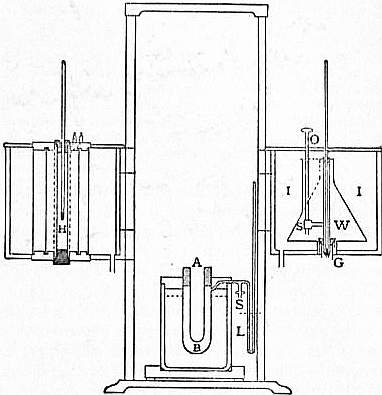
Fig. 1.
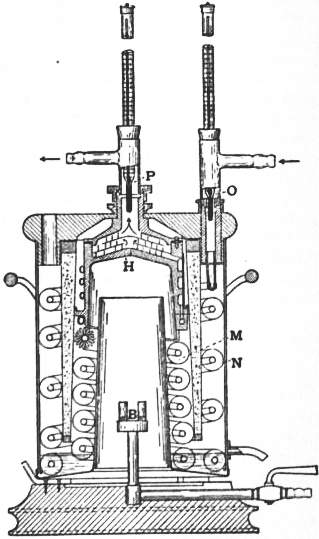
Fig. 2.
The constant temperature method of mixtures was proposed by N. Hesehus (Jour. Phys., 1888, vii. p. 489). Cold water at a known temperature is added to the calorimeter, immediately after dropping in the heated substance, at such a rate as to keep the temperature of the calorimeter constant, thus eliminating the corrections for the water equivalent of the calorimeter and the external loss of heat. The calorimeter is surrounded by an air-jacket connected to a petroleum gauge which indicates any small change of temperature in the calorimeter, and enables the manipulator to adjust the supply of cold water to compensate it. The apparatus as arranged by F.A. Waterman is shown in fig. 1 (Physical Review, 1896, iv. p. 161). A is the calorimetric tube, B the air-jacket and L the gauge. H is an electric heater for raising the body to a suitable temperature, which can swing into place directly over the calorimeter. W is a conical can containing water cooled by ice I nearly to 0°, which is swung over the calorimeter as soon as the hot body has been introduced and the heater removed. The cold water flow is regulated by a tap S with a long handle O, and its temperature is taken by a delicate thermometer with its bulb at G. The method is interesting, but the manipulations and observations involved are more troublesome than with the ordinary type of calorimeter, and it may be doubted whether any advantage is gained in accuracy.
The continuous flow method is specially applicable to the important case of calorific value of gaseous fuel, where a large quantity of heat is continuously generated at a nearly uniform rate by combustion. Fig. 2 illustrates a recent type of gas calorimeter devised by C.V. Boys (Proc. R.S., 1906, A. 77, p. 122). The heated products of combustion from the burner B impinge on a metal box H, through which water is circulating, and then pass downwards and outwards through a spiral cooler which reduces them practically to the atmospheric temperature. A steady stream of water enters the apparatus by the inflow thermometer O, flows through the spiral coolers N and M, and finally through the box H, where it is well mixed before passing the outflow thermometer P. As soon as a steady state is reached, the difference of temperature between the outflow and inflow thermometers, multiplied by the current of water in grammes per minute gives the heat per minute supplied by combustion. The gas current is simultaneously observed by a suitable meter, which, with subsidiary corrections for pressure, temperature, &c., gives the necessary data for deducing calorific value.
A continuous flow calorimeter has been used by the writer for measuring quantities of heat conveyed by conduction (see Conduction of Heat), and also for determining the variation of the specific heat of water. In the latter case two steady currents of water at different temperatures, say 0° and 100° are passed through an equalizer, and the resulting temperature measured without mixing the currents, which are then separately determined by weighing. This is a very good method of comparing the mean specific heats over two ranges of temperature such as 0-50, and 50-100, or 0-20 and 20-40, but it is not so suitable as the electric method described below for obtaining the actual specific heat at any point of the range.
§ 3. Method of Cooling.—A common example of this method is the determination of the specific heat of a liquid by filling a small calorimeter with the liquid, raising it to a convenient temperature, and then setting it to cool in an enclosure at a steady temperature, and observing the time taken to fall through a given range when the conditions have become fairly steady. The same calorimeter is afterwards filled with a known liquid, such as water, and the time of cooling is observed through the same range of temperature, in the same enclosure, under the same conditions. The ratio of the times of cooling is equal to the ratio of the thermal capacities of the calorimeter and its contents in the two cases. The advantage of the method is that there is no transference or mixture; the defect is that the whole measurement depends on the assumption that the rate of loss of heat is the same in the two cases, and that any variation in the conditions, or uncertainty in the rate of loss, produces its full effect in the result, whereas in the previous case it would only affect a small correction. Other sources of uncertainty are, that the rate of loss of heat generally depends to some extent on the rate of fall of temperature, and that it is difficult to take accurate observations on a rapidly falling thermometer. As the method is usually practised, the calorimeter is made very small, and the surface is highly polished to diminish radiation. It is better to use a fairly large calorimeter to diminish the rate of cooling and the uncertainty of the correction for the water equivalent. The surface of the calorimeter and the enclosure should be permanently blackened so as to increase the loss of heat by radiation as much as possible, as compared with the losses by convection and conduction, which are less regular. For accurate work it is essential that the liquid in the calorimeter should be continuously stirred, and also in the enclosure, the lid of which must be water-jacketed, and kept at the same steady temperature as the sides. When all these precautions are taken, the method loses most of the simplicity which is its chief advantage. It cannot be satisfactorily applied to the case of solids or powders, and is much less generally useful than the method of mixture.
§ 4. Method of Fusion.—The methods depending on change of state are theoretically the simplest, since they do not necessarily involve any reference to thermometry, and the corrections for external loss of heat and for the thermal capacity of the containing vessels can be completely eliminated. They nevertheless present peculiar difficulties and limitations, which render their practical application more troublesome and more uncertain than is usually supposed. They depend on the experimental fact that the quantity of heat required to produce a given change of state (e.g. to convert one gramme of ice at 0° C. into water at 0° C., or one gramme of water at 100° C. into steam at 100° C.) is always the same, and that there need be no change of temperature during the process. The difficulties arise in connexion with the determination of the quantities of ice melted or steam condensed, and in measuring the latent heat of fusion or vaporization in terms of other units for the comparison of observations. The earlier forms of ice-calorimeter, those of Black, and of Laplace and Lavoisier, were useless for work of precision, on account of the impossibility of accurately estimating the quantity of water left adhering to the ice in each case. This difficulty was overcome by the invention of the Bunsen calorimeter, in which the quantity of ice melted is measured by observing the diminution of volume, but the successful employment of this instrument requires considerable skill in manipulation. The sheath of ice surrounding the bulb must be sufficiently continuous to prevent escape of heat, but it must not be so solid as to produce risk of strain. The ideal condition is difficult to secure. In the practical use of the instrument it is not necessary to know both the latent heat of fusion of ice and the change of volume which occurs on melting; it is sufficient to determine the change of volume per calorie, or the quantity of mercury which is drawn into the bulb of the apparatus per unit of heat added. This can be determined by a direct calibration, by inserting a known quantity of water at a known temperature and observing the contraction, or weighing the mercury drawn into the apparatus. In order to be independent of the accuracy of the thermometer employed for observing the initial temperature of the water introduced, it has been usual to employ water at 100° C., adopting as unit of heat the “mean calorie,” which is one-hundredth part of the heat given up by one gramme of water in cooling from 100° to 0° C. The weight of mercury corresponding to the mean calorie has been determined with considerable care by a number of observers well skilled in the use of the instrument. The following are some of their results:—Bunsen, 15.41 mgm.; Velten, 15.47 mgm.; Zakrevski, 15.57 mgm.; Staub, 15.26 mgm. The explanation of these discrepancies in the fundamental constant is not at all clear, but they may be taken as an illustration of the difficulties of manipulation attending the use of this instrument, to which reference has already been made. It is not possible to deduce a more satisfactory value from the latent heat and the change of density, because these constants are very difficult to determine. The following are some of the values deduced by well-known experimentalists for the latent heat of fusion:—Regnault, 79.06 to 79.24 calories, corrected by Person to 79.43; Person, 79.99 calories; Hess, 80.34 calories; Bunsen, 80.025 calories. Regnault, Person and Hess employed the method of mixture which is probably the most accurate for the purpose. Person and Hess avoided the error of water sticking to the ice by using dry ice at various temperatures below 0° C., and determining the specific heat of ice as well as the latent heat of fusion. These discrepancies might, no doubt, be partly explained by differences in the units employed, which are somewhat uncertain, as the specific heat of water changes rapidly in the neighbourhood of 0° C; but making all due allowance for this, it remains evident that the method of ice-calorimetry, in spite of its theoretical simplicity, presents grave difficulties in its practical application.
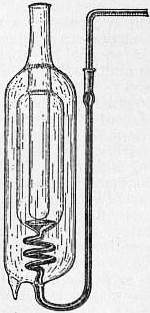
Fig. 3.
One of the chief difficulties in the practical use of the Bunsen calorimeter is the continued and often irregular movement of the mercury column due to slight differences of temperature, or pressure between the ice in the calorimeter and the ice bath in which it is immersed. C.V. Boys (Phil. Mag., 1887, vol. 24, p. 214) showed that these effects could be very greatly reduced by surrounding the calorimeter with an outer tube, so that the ice inside was separated from the ice outside by an air space which greatly reduces the free passage of heat. The present writer has found that very good results may be obtained by enclosing the calorimeter in a vacuum jacket (as illustrated in fig. 3), which practically eliminates conduction and convection. If the vacuum jacket is silvered inside, radiation also is reduced to such an extent that, if the vacuum is really good, the external ice bath may be dispensed with for the majority of purposes. If the inner bulb is filled with mercury instead of water and ice, the same arrangement answers admirably as a Favre and Silbermann calorimeter, for measuring small quantities of heat by the expansion of the mercury.
The question has been raised by E.L. Nichols (Phys. Rev. vol. 8, January 1899) whether there may not be different modifications of ice with different densities, and different values of the latent heat of fusion. He found for natural pond-ice a density 0.9179 and for artificial ice 0.9161. J. Vincent (Phil. Trans. A. 198, p. 463) also found a density .9160 for artificial ice, which is probably very nearly correct. If such variations of density exist, they may introduce some uncertainty in the absolute values of results obtained with the ice calorimeter, and may account for some of the discrepancies above enumerated.
§ 5. The Method of Condensation was first successfully applied by J. Joly in the construction of his steam calorimeter, a full description of which will be found in text-books. The body to be tested is placed in a special scale-pan, suspended by a fine wire from the arm of a balance inside an enclosure which can be filled with steam at atmospheric pressure. The temperature of the enclosure is carefully observed before admitting steam. The weight of steam condensed on the body gives a means of calculating the quantity of heat required to raise it from the atmospheric temperature up to 100° C. in terms of the latent heat of vaporization of steam at 100° C. There can be no appreciable gain or loss of heat by radiation, if the admission of the steam is sufficiently rapid, since the walls of the enclosure are maintained at 100° C., very nearly. The thermal capacity of the scale-pan, &c., can be determined by a separate experiment, or, still better, eliminated by the differential method of counterpoising with an exactly similar arrangement on the other arm of the balance. The method requires very delicate weighing, as one calorie corresponds to less than two milligrammes of steam condensed; but the successful application of the method to the very difficult problem of measuring the specific heat of a gas at constant volume, shows that these and other difficulties have been very skilfully overcome. The application of the method appears to be practically limited to the measurements of specific heat between the atmospheric temperature and 100° C. The results depend on the value assumed for the latent heat of steam, which Joly takes as 536.7 calories, following Regnault. Joly has himself determined the mean specific heat of water between 12° and 100° C. by this method, in terms of the latent heat of steam as above given, and finds the result .9952. Assuming that the mean specific heat of water between 12° and 100° is really 1.0011 in terms of the calorie at 20° C. (see table, p. 66), the value of the latent heat of steam at 100° C., as determined by Joly, would be 540.2 in terms of the same unit. The calorie employed by Regnault is to some extent uncertain, but the difference is hardly beyond the probable errors of experiment, since it appears from the results of recent experiments that Regnault made an error of the same order in his determination of the specific heat of water at 100° C.
§ 6. Energy Methods.—The third general method of calorimetry, that based on the transformation of some other kind of energy into the form of heat, rests on the general principle of the conservation of energy, and on the experimental fact that all other forms of energy are readily and completely convertible into the form of heat. It is therefore often possible to measure quantities of heat indirectly, by measuring the energy in some other form and then converting it into heat. In addition to its great theoretical interest, this method possesses the advantage of being frequently the most accurate in practical application, since energy can be more accurately measured in other forms than in that of heat. The two most important varieties of the method are (a) mechanical, and (b) electrical. These methods have reached their highest development in connexion with the determination of the mechanical equivalent of heat, but they may be applied with great advantage in connexion with other problems, such as the measurement of the variation of specific heat, or of latent heats of fusion or vaporization.
§ 7. Mechanical Equivalent of Heat.—The phrase “mechanical equivalent of heat” is somewhat vague, but has been sanctioned by long usage. It is generally employed to denote the number of units of mechanical work or energy which, when completely converted into heat without loss, would be required to produce one heat unit. The numerical value of the mechanical equivalent necessarily depends on the particular units of heat and work employed in the comparison. The British engineer prefers to state results in terms of foot-pounds of work in any convenient latitude per pound-degree-Fahrenheit of heat. The continental engineer prefers kilogrammetres per kilogramme-degree-centigrade. For scientific use the C.G.S. system of expression in ergs per gramme-degree-centigrade, or “calorie,” is the most appropriate, as being independent of the value of gravity. A more convenient unit of work or energy, in practice, on account of the smallness of the erg, is the joule, which is equal to 10.7 ergs, or one watt-second of electrical energy. On account of its practical convenience, and its close relation to the international electrical units, the joule has been recommended by the British Association for adoption as the absolute unit of heat. Other convenient practical units of the same kind would be the watt-hour, 3600 joules, which is of the same order of magnitude as the kilo-calorie, and the kilowatt-hour, which is the ordinary commercial unit of electrical energy.
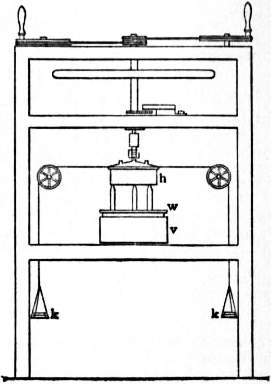
Fig. 4.
§ 8. Joule.—The earlier work of Joule is now chiefly of historical interest, but his later measurements in 1878, which were undertaken on a larger scale, adopting G.A. Hirn’s method of measuring the work expended in terms of the torque and the number of revolutions, still possess value as experimental evidence. In these experiments (see fig. 4) the paddles were revolved by hand at such a speed as to produce a constant torque on the calorimeter h, which was supported on a float w in a vessel of water v, but was kept at rest by the couple due to a pair of equal weights k suspended from fine strings passing round the circumference of a horizontal wheel attached to the calorimeter. Each experiment lasted about forty minutes, and the rise of temperature produced was nearly 3° C. The calorimeter contained about 5 kilogrammes of water, so that the rate of heat-supply was about 6 calories per second. Joule’s final result was 772.55 foot-pounds at Manchester per pound-degree-Fahrenheit at a temperature of 62° F., but individual experiments differed by as much as 1%. This result in C.G.S. measure is equivalent to 4.177 joules per calorie at 16.5° C., on the scale of Joule’s mercury thermometer. His thermometers were subsequently corrected to the Paris scale by A. Schuster in 1895, which had the effect of reducing the above figure to 4.173.
§ 9. Rowland.—About the same time H.A. Rowland (Proc. Amer. Acad. xv. p. 75, 1880) repeated the experiment, employing the same method, but using a larger calorimeter (about 8400 grammes) and a petroleum motor, so as to obtain a greater rate of heating (about 84 calories per second), and to reduce the importance of the uncertain correction for external loss of heat. Rowland’s apparatus is shown in fig. 5. The calorimeter was suspended by a steel wire, the torsion of which made the equilibrium stable. The torque was measured by weights O and P suspended by silk ribbons passing over the pulleys n and round the disk kl. The power was transmitted to the paddles by bevel wheels, f, g, rotating a spindle passing through a stuffing box in the bottom of the calorimeter. The number of revolutions and the rise of temperature were recorded on a chronograph drum. He paid greater attention to the important question of thermometry, and extended his researches over a much wider range of temperature, namely 5° to 35° C. His experiments revealed for the first time a diminution in the specific heat of water with rise of temperature between 0° and 30° C., amounting to four parts in 10.000 per 1° C. His thermometers were compared with a mercury thermometer standardized in Paris, and with a platinum thermometer standardized by Griffiths. The result was to reduce the coefficient of diminution of specific heat at 15° C. by nearly one half, but the absolute value at 20° C. is practically unchanged. Thus corrected his values are as follows:—
Temperature 10° 15° 20° 25° 30° 35°
Joules per cal. 4.197 4.188 4.181 4.176 4.175 4.177
These are expressed in terms of the hydrogen scale, but the difference from the nitrogen scale is so small as to be within the limits of experimental error in this particular case. Rowland himself considered his results to be probably correct to one part in 500, and supposed that the greatest uncertainty lay in the comparison of the scale of his mercury thermometer with the air thermometer. The subsequent correction, though not carried out strictly under the conditions of the experiment, showed that the order of accuracy of his work about the middle of the range from 15° to 25° was at least 1 in 1000, and probably 1 in 2000. At 30° he considered that, owing to the increasing magnitude and uncertainty of the radiation correction, there “might be a small error in the direction of making the equivalent too great, and that the specific heat might go on decreasing to even 40° C.” The results considered with reference to the variation of the specific heat of water are shown in the curve marked Rowland in Fig. 6.
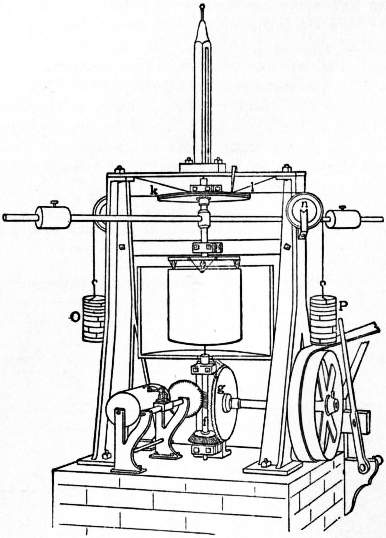
Fig. 5.
§ 10. Osborne Reynolds and W.H. Moorby (Phil. Trans., 1897, p. 381) determined the mechanical equivalent of the mean thermal unit between 0° and 100° C., on a very large scale, with a Froude-Reynolds hydraulic brake and a steam-engine of 100 h.p. This brake is practically a Joule calorimeter, ingeniously designed to churn the water in such a manner as to develop the greatest possible resistance. The admission of water at 0° C. to the brake was controlled by hand in such a manner as to keep the outflow nearly at the boiling-point, the quantity of water in the brake required to produce a constant torque being regulated automatically, as the speed varied, by a valve worked by the lifting of the weighted lever attached to the brake.
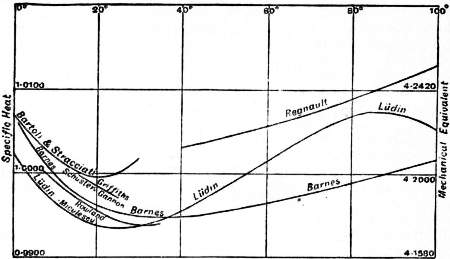
Fig. 6.
The accompanying illustration (fig. 7) shows the brake lagged with cotton-wool, and the 4-ft. lever to which the weights are suspended. The power of the brake may be estimated by comparison with the size of the rope pulley seen behind it on the same shaft. With 300 pounds on a 4-ft. lever at 300 revolutions per minute, the rate of generation of heat was about 12 kilo-calories per second. In spite of the large range of temperature, the correction for external loss of heat amounted to only 5%, with the brake uncovered, and was reduced to less than 2% by lagging. This is the special advantage of working on so large a scale with so rapid a generation of heat. But, for the same reason, the method necessarily presents peculiar difficulties, which were not overcome without great pains and ingenuity. The principal troubles arose from damp in the lagging which necessitated the rejection of several trials, and from dissolved air in the water, causing loss of heat by the formation of steam. Next to the radiation loss, the most uncertain correction was that for conduction of heat along the 4-in. shaft. These losses were as far as possible eliminated by combining the trials in pairs, with different loads on the brake, assuming that the heat-loss would be the same in the heavy and light trials, provided that the external temperature and the gradient in the shaft, as estimated from the temperature of the bearings, were the same. The values deduced in this manner for the equivalent agreed as closely as could be expected considering the impossibility of regulating the external condition of temperature and moisture with any certainty in an engine-room. The extreme variation of results in any one series was only from 776.63 to 779.46 ft.-pounds, or less than ½%. This variation may have been due to the state of the lagging, which Moorby distrusted in spite of the great reduction of the heat-loss, or it may have been partly due to the difficulty of regulating the speed of the engine and the water-supply to the brake in such a manner as to maintain a constant temperature in the outflow, and avoid variations in the heat capacity of the brake. Since hand regulation is necessarily discontinuous, the speed and the temperature were constantly varying, so that it was useless to take readings nearer than the tenth of a degree. The largest variation recorded in the two trials of which full details are given, was 4-9° F. in two minutes in the outflow temperature, and four or five revolutions per minute on the speed. These variations, so far as they were of a purely accidental nature, would be approximately eliminated on the mean of a large number of trials, so that the accuracy of the final result would be of a higher order than might be inferred from a comparison of separate pairs of trials. Great pains were taken to discuss and eliminate all the sources of constant error which could be foreseen. The results of the light trials with 400 ft.-pounds on the brake differ slightly from those with 600 ft.-pounds. This might be merely accidental, or it might indicate some constant difference in the conditions requiring further investigation. It would have been desirable, if possible, to have tried the effect of a larger range of variation in the experimental conditions of load and speed, with a view to detect the existence of constant errors; but owing to the limitations imposed by the use of a steam-engine, and the difficulty of securing steady conditions of running, this proved to be impossible. There can be no doubt, however, that the final result is the most accurate direct determination of the value of the mean calorie between 0° and 100° C. in mechanical units. Expressed in joules per calorie the result is 4.1832, which agrees very closely with the value found by Rowland as the mean over the range 15° to 20° C. The value 4.183 is independently confirmed in a remarkable manner by the results of the electrical method described below, which give 4.185 joules for the mean calorie, if Rowland’s value is assumed as the starting-point, and taken to be 4.180 joules at 20° C.
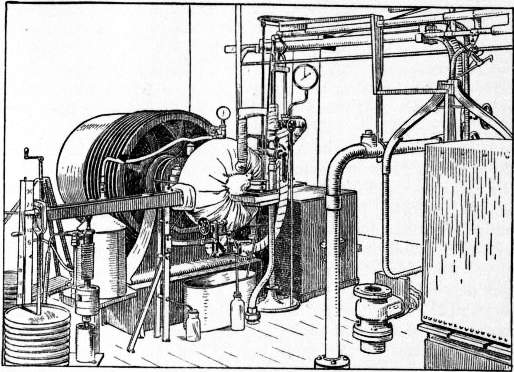
Fig. 7.
§ 11. Electrical Methods.—The value of the international electrical units has by this time been so accurately determined in absolute measure that they afford a very good, though indirect, method of determining the mechanical equivalent of heat. But, quite apart from this, electrical methods possess the greatest value for calorimetry, on account of the facility and accuracy of regulating and measuring the quantity of heat supplied by an electric current. The frictional generation of heat in a metallic wire conveying a current can be measured in various ways, which correspond to slightly different methods. By Ohm’s law, and by the definition of difference of electric pressure or potential, we obtain the following alternative expressions for the quantity of heat H in joules generated in a time T seconds by a current of C amperes flowing in a wire of resistance R ohms, the difference of potential between the ends of the wire being E = CR volts:—
H = ECT = C2RT = E2T/R (1).
The method corresponding to the expression C2RT was adopted by Joule and by most of the early experimentalists. The defects of the earlier work from an electrical point of view lay chiefly in the difficulty of measuring the current with sufficient accuracy owing to the imperfect development of the science of electrical measurement. These difficulties have been removed by the great advances since 1880, and in particular by the introduction of accurate standard cells for measurements of electrical pressure.
§ 12. Griffiths.—The method adopted by E.H. Griffiths (Phil. Trans., 1893, p. 361), whose work threw a great deal of light on the failure of previous observers to secure consistent results, corresponded to the last expression E2T/R, and consisted in regulating the current by a special rheostat, so as to keep the potential difference E on the terminals of the resistance R balanced against a given number of standard Clark cells of the Board of Trade pattern. The resistance R could be deduced from a knowledge of the temperature of the calorimeter and the coefficient of the wire. But in order to obtain trustworthy results by this method he found it necessary to employ very rapid stirring (2000 revolutions per minute), and to insulate the wire very carefully from the liquid to prevent leakage of the current. He also made a special experiment to find how much the temperature of the wire exceeded that of the liquid under the conditions of the experiment. This correction had been neglected by previous observers employing similar methods. The resistance R was about 9 ohms, and the potential difference E was varied from three to six Clark cells, giving a rate of heat-supply about 2 to 6 watts. The water equivalent of the calorimeter was about 85 grammes, and was determined by varying the quantity of water from 140 to 260 or 280 grammes, so that the final results depended on a difference in the weight of water of 120 to 140 grammes. The range of temperature in each experiment was 14° to 26° C. The rate of rise was observed with a mercury thermometer standardized by comparison with a platinum thermometer under the conditions of the experiment. The time of passing each division was recorded on an electric chronograph. The duration of an experiment varied from about 30 to 70 minutes. Special observations were made to determine the corrections for the heat supplied by stirring, and that lost by radiation, each of which amounted to about 10% of the heat-supply. The calorimeter C, fig. 8, was gilded, and completely surrounded by a nickel-plated steel enclosure B, forming the bulb of a mercury thermo-regulator, immersed in a large water-bath maintained at a constant temperature. In spite of the large corrections the results were extremely consistent, and the value of the temperature-coefficient of the diminution of the specific heat of water, deduced from the observed variation in the rate of rise at different points of the range 15° to 25°, agreed with the value subsequently deduced from Rowland’s experiments over the same range, when his thermometers were reduced to the same scale. Griffiths’ final result for the average value of the calorie over this range was 4.192 joules, taking the E.M.F. of the Clark cell at 15° C. to be 1.4342 volts. The difference from Rowland’s value, 4.181, could be explained by supposing the E.M.F. of the Clark cells to have in reality been 1.4323 volts, or about 2 millivolts less than the value assumed. Griffiths subsequently applied the same method to the measurement of the specific heat of aniline, and the latent heat of vaporization of benzene and water.
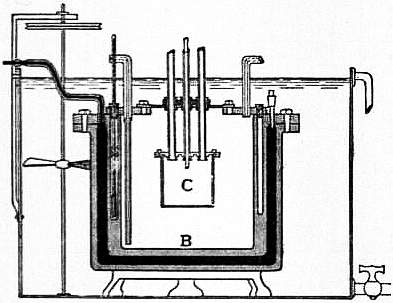
Fig. 8.
§ 13. Schuster and Gannon.—The method employed by A. Schuster and W. Gannon for the determination of the specific heat of water in terms of the international electric units (Phil. Trans. A, 1895, p. 415) corresponded to the expression ECT, and differed in many essential details from that of Griffiths. The current through a platinoid resistance of about 31 ohms in a calorimeter containing 1500 grammes of water was regulated so that the potential difference on its terminals was equal to that of twenty Board of Trade Clark cells in series. The duration of an experiment was about ten minutes, and the product of the mean current and the time, namely CT, was measured by the weight of silver deposited in a voltameter, which amounted to about 0.56 gramme. The uncertainty due to the correction for the water equivalent was minimized by making it small (about 27 grammes) in comparison with the water weight. The correction for external loss was reduced by employing a small rise of temperature (only 2.22°), and making the rate of heat-supply relatively rapid, nearly 24 watts. The platinoid coil was insulated from the water by shellac varnish. The wire had a length of 760 cms., and the potential difference on its terminals was nearly 30 volts. The rate of stirring adopted was so slow that the heat generated by it could be neglected. The result found was 4.191 joules per calorie at 19° C. This agrees very well with Griffiths considering the difficulty of measuring so small a rise of temperature at 2° with a mercury thermometer. Admitting that the electro-chemical equivalent of silver increases with the age of the solution, a fact subsequently discovered, and that the E.M.F. of the Clark cell is probably less than 1.4340 volts (the value assumed by Schuster and Gannon), there is no difficulty in reconciling the result with that of Rowland.
§ 14. H.L. Callendar and H.T. Barnes (Brit. Assoc. Reports, 1897 and 1899) adopted an entirely different method of calorimetry, as well as a different method of electrical measurement. A steady current of liquid, Q grammes per second, of specific heat, Js joules per degree, flowing through a fine tube, A B, fig. 9, is heated by a steady electric current during its passage through the tube, and the difference of temperature dθ between the inflowing and the outflowing liquid is measured by a single reading with a delicate pair of differential platinum thermometers at A and B. The difference of potential E between the ends of the tube, and the electric current C through it, are measured on an accurately calibrated potentiometer, in terms of a Clark cell and a standard resistance. If hdθ is the radiation loss in watts we have the equation,
EC = JsQdθ + hdθ (2).
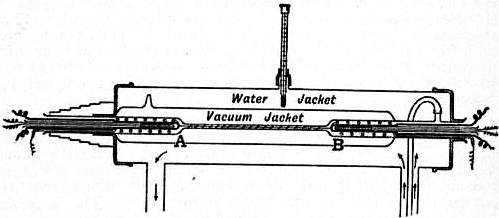
Fig. 9.
The advantage of this method is that all the conditions are steady, so that the observations can be pushed to the limit of accuracy and sensitiveness of the apparatus. The water equivalent of the calorimeter is immaterial, since there is no appreciable change of temperature. The heat-loss can be reduced to a minimum by enclosing the flow-tube in a hermetically sealed glass vacuum jacket. Stirring is effected by causing the water to circulate spirally round the bulbs of the thermometers and the heating conductor as indicated in the figure. The conditions can be very easily varied through a wide range. The heat-loss hdθ is determined and eliminated by varying the flow of liquid and the electric current simultaneously, in such a manner as to secure approximately the same rise of temperature for two or more widely different values of the flow of liquid. An example taken from the Electrician, September 1897, of one of the earliest experiments by this method on the specific heat of mercury will make the method clearer. The flow-tube was about 1 metre long and 1 millim. in diameter, coiled in a short spiral inside the vacuum jacket. The outside of the vacuum jacket was immersed in a water jacket at a steady temperature equal to that of the inflowing mercury.
Specific Heat of Mercury by Continuous Electric Method
Flow of Hg. Rise of Temp. Watts. Heat-loss. Specific Heat.
gm./sec. dθ EC hdθ Per gm. deg.
8.753 11.764 14.862 0.655 .13780 joules
4.594 12.301 7.912 0.865 .03297 cals.
It is assumed as a first approximation that the heat-loss is proportional to the rise of temperature dθ, provided that dθ is nearly the same in both cases, and that the distribution of temperature in the apparatus is the same for the same rise of temperature whatever the flow of liquid. The result calculated on these assumptions is given in the last column in joules, and also in calories of 20° C. The heat-loss in this example is large, nearly 4.5% of the total supply, owing to the small flow and the large rise of temperature, but this correction was greatly reduced in subsequent observations on the specific heat of water by the same method. In the case of mercury the liquid itself can be utilized to conduct the electric current. In the case of water or other liquids it is necessary to employ a platinum wire stretched along the tube as heating conductor. This introduces additional difficulties of construction, but does not otherwise affect the method. The absolute value of the specific heat deduced necessarily depends on the absolute values of the electrical standards employed in the investigation. But for the determination of relative values of specific heats in terms of a standard liquid, or of the variations of specific heat of a liquid, the method depends only on the constancy of the standards, which can be readily and accurately tested. The absolute value of the E.M.F. of the Clark cells employed was determined with a special form of electrodynamometer (Callendar, Phil. Trans. A. 313, p. 81), and found to be 1.4334 volts, assuming the ohm to be correct. Assuming this value, the result found by this method for the specific heat of water at 20° C. agrees with that of Rowland within the probable limits of error.
§ 15. Variation of Specific Heat of Water.—The question of the variation of the specific heat of water has a peculiar interest and importance in connexion with the choice of a thermal unit. Many of the uncertainties in the reduction of older experiments, such as those of Regnault, arise from uncertainty in regard to the unit in terms of which they are expressed, which again depends on the scale of the particular thermometer employed in the investigation. The first experiments of any value were those of Regnault in 1847 on the specific heat of water between 110° C. and 192° C. They were conducted on a very large scale by the method of mixture, but showed discrepancies of the order of 0.5%, and the calculated results in many cases do not agree with the data. This may be due merely to deficient explanation of details of tabulation. We may probably take the tabulated values as showing correctly the rate of variation between 110° and 190° C., but the values in terms of any particular thermal unit must remain uncertain to at least 0.5% owing to the uncertainties of the thermometry. Regnault himself adopted the formula,
s = 1 + 0.00004t + 0.0000009t2 (Regnault), (3)
for the specific heat s at any temperature t C. in terms of the specific heat at 0° C. taken as the standard. This formula has since been very generally applied over the whole range 0° to 200° C., but the experiments could not in reality give any information with regard to the specific heat at temperatures below 100° C. The linear formula proposed by J. Bosscha from an independent reduction of Regnault’s experiments is probably within the limits of accuracy between 100° and 200° C., so far as the mean rate of variation is concerned, but the absolute values require reduction. It may be written—
s = S100 + .00023(t − 100) (Bosscha-Regnault) (4).
The work of L. Pfaundler and H. Platter, of G.A. Hirn, of J.C. Jamin and Amaury, and of many other experimentalists who succeeded Regnault, appeared to indicate much larger rates of increase than he had found, but there can be little doubt that the discrepancies of their results, which often exceeded 5%, were due to lack of appreciation of the difficulties of calorimetric measurements. The work of Rowland by the mechanical method was the first in which due attention was paid to the thermometry and to the reduction of the results to the absolute scale of temperature. The agreement of his corrected results with those of Griffiths by a very different method, left very little doubt with regard to the rate of diminution of the specific heat of water at 20° C. The work of A. Bartoli and E. Stracciati by the method of mixture between 0° and 30° C., though their curve is otherwise similar to Rowland’s, had appeared to indicate a minimum at 20° C., followed by a rapid rise. This lowering of the minimum was probably due to some constant errors inherent in their method of experiment. The more recent work of Lüdin, 1895, under the direction of Prof. J. Pernet, extended from 0° to 100° C., and appears to have attained as high a degree of excellence as it is possible to reach by the employment of mercury thermometers in conjunction with the method of mixture. His results, exhibited in fig. 6, show a minimum at 25° C., and a maximum at 87° C., the values being .9935 and 1.0075 respectively in terms of the mean specific heat between 0° and 100° C. He paid great attention to the thermometry, and the discrepancies of individual measurements at any one point nowhere exceed 0.3%, but he did not vary the conditions of the experiments materially, and it does not appear that the well-known constant errors of the method could have been completely eliminated by the devices which he adopted. The rapid rise from 25° to 75° may be due to radiation error from the hot water supply, and the subsequent fall of the curve to the inevitable loss of heat by evaporation of the boiling water on its way to the calorimeter. It must be observed, however, that there is another grave difficulty in the accurate determination of the specific heat of water near 100° C. by this method, namely, that the quantity actually observed is not the specific heat at the higher temperature t, but the mean specific heat over the range 18° to t. The specific heat itself can be deduced only by differentiating the curve of observation, which greatly increases the uncertainty. The peculiar advantage of the electric method of Callendar and Barnes, already referred to, is that the specific heat itself is determined over a range of 8° to 10° at each point, by adding accurately measured quantities of heat to the water at the desired temperature in an isothermal enclosure, under perfectly steady conditions, without any possibility of evaporation or loss of heat in transference. These experiments, which have been extended by Barnes over the whole range 0° to 100°, agree very well with Rowland and Griffiths in the rate of variation at 20° C., but show a rather flat minimum of specific heat in the neighbourhood of 38° to 40° C. At higher points the rate of variation is very similar to that of Regnault’s curve, but taking the specific heat at 20° as the standard of reference, the actual values are nearly 0.56% less than Regnault’s. It appears probable that his values for higher temperatures may be adopted with this reduction, which is further confirmed by the results of Reynolds and Moorby, and by those of Lüdin. According to the electric method, the whole range of variation of the specific heat between 10° and 80° is only 0.5%. Comparatively simple formulae, therefore, suffice for its expression to 1 in 10,000, which is beyond the limits of accuracy of the observations. It is more convenient in practice to use a few simple formulae, than to attempt to represent the whole range by a single complicated expression:—