VOLUME V SLICE I Calhoun to Camoens (continued 10)
Reading edition
Cambridgeshire has always been mainly an agricultural county. The Domesday Survey mentions over ninety mills and numerous valuable fisheries, especially eel-fisheries, and contains frequent references to wheat, malt and honey. The county had a flourishing wool-industry in the 14th century, and became noted for its worsted cloths. The Black Death of 1349 and the ravages committed during the Wars of the Roses were followed by periods of severe depression, and in 1439 several Cambridgeshire towns obtained a remission of taxation on the plea of poverty. In the 16th century barley for malt was grown in large quantities in the south, and the manufacture of willow-baskets was carried on in the fen-districts. Saffron was extensively cultivated in the 18th century, and paper was manufactured near Sturbridge. Sturbridge fair was at this period reckoned the largest in Europe, the chief articles of merchandise being wool, hops and leather; and the Newmarket races and horse-trade were already famous. Large waste areas were brought under cultivation in the 17th century through the drainage of the fen-district, which was brought to completion about 1652 through the labours of Cornelius Vermuyden, a Dutchman. The coprolite industry was very profitable for a short period from 1850 to 1880, and its decline was accompanied by a general industrial and agricultural depression. Cambridgeshire returned three members to parliament in 1290, and in 1295 the county returned two members, the borough of Cambridge two members, and the city of Ely two members, this being the sole return for Ely. The university was summoned to return members in 1300 and again in 1603, but no returns are recorded before 1614, after which it continued to return two members. Under the Reform Act of 1832 the county returned three members.
Antiquities.—In ecclesiastical architecture Cambridgeshire would be rich only in the possession of the magnificent cathedral at Ely and the round church of the Holy Sepulchre, Jesus College and King’s College chapels, and many other examples in Cambridge. But there are many fine churches elsewhere. At Thorney, a small town in the north of the county, which owes much in appearance to the 8th duke of Bedford (d. 1872), the parish church is actually a portion of the church of an abbey said to date originally from the 7th century, and refounded in 972 by Ethelwold, bishop of Winchester, as a Benedictine monastery. The church is partly fine Norman. Another Norman building of special interest is Sturbridge chapel near Cambridge, which belonged to a lepers’ hospital. To this foundation King John granted a fair, which became, and continued until the 18th century, one of the most important in England. It is still held in September. At Swaffham Prior there are remains of two churches in one churchyard, the tower of one being good Transitional Norman, while that of the other is Perpendicular, the upper part octagonal. Among many Early English examples the church of Cherry Hinton near Cambridge may be mentioned. The churches of Trumpington and Bottisham are fine specimens of the Decorated style; in the first is a famous brass to Sir Roger de Trumpington (1289). As Perpendicular examples the tower and spire of St Mary’s, Whittlesey, and the rich wooden roof of Outwell church, may be selected. Monastic remains are scanty. Excluding the town of Cambridge there are no domestic buildings, either ancient or modern, of special note, with the exception of Sawston Hall, in the south of the county, a quadrangular mansion dated 1557-1584.
Authorities.—See D. and S. Lysons, Magna Britannia, vol. ii. part i. (London, 1808); C.C. Babington, Ancient Cambridgeshire (Cambridge, 1883); R. Bowes, Catalogue of Books printed at or relating to Cambridge (Cambridge, 1891 et seq.); E. Conybeare, History of Cambridgeshire (London, 1897); Victoria County History, Cambridgeshire.
CAMBUSLANG, a town of Lanarkshire, Scotland. It is situated near the Clyde, 4½ m. S.E. of Glasgow (of which it is a residential suburb) by the Caledonian railway. Pop. (1891) 8323; (1901) 12,252. Its leading industries include coal-mining, turkey-red dyeing and brick-making. It contains one of the largest steel works in the United Kingdom. Among the chief edifices are a public hall, institute and library. It was the birthplace of John Claudius London (1783-1843), the landscape gardener and writer on horticulture, whose Arboretum et Fruticetum Britannicum still ranks as an authority.
CAMBYSES (Pers. Kambujiya), the name borne by the father and the son of Cyrus the Great. When Cyrus conquered Babylon in 539 he was employed in leading religious ceremonies (Chronicle of Nabonidus), and in the cylinder which contains Cyrus’s proclamation to the Babylonians his name is joined to that of his father in the prayers to Marduk. On a tablet dated from the first year of Cyrus, Cambyses is called king of Babel. But his authority seems to have been quite ephemeral; it was only in 530, when Cyrus set out on his last expedition into the East, that he associated Cambyses on the throne, and numerous Babylonian tablets of this time are dated from the accession and the first year of Cambyses, when Cyrus was “king of the countries” (i.e. of the world). After the death of his father in the spring of 528 Cambyses became sole king. The tablets dated from his reign in Babylonia go down to the end of his eighth year, i.e. March 521 b.c.1 Herodotus (iii. 66), who dates his reign from the death of Cyrus, gives him seven years five months, i.e. from 528 to the summer of 521. For these dates cf. Ed. Meyer, Forschungen zur alien Geschichte, ii. 470 ff.
The traditions about Cambyses, preserved by the Greek authors, come from two different sources. The first, which forms the main part of the account of Herodotus (iii. 2; 4; 10-37), is of Egyptian origin. Here Cambyses is made the legitimate son of Cyrus and a daughter of Apries (Herod, iii. 2, Dinon fr. 11, Polyaen. viii. 29), whose death he avenges on the successor of the usurper Amasis. (In Herod, iii. 1 and Ctesias ap. Athen. xiii. 560 D, this tradition is corrected by the Persians: Cambyses wants to marry a daughter of Amasis, who sends him a daughter of Apries instead of his own daughter, and by her Cambyses is induced to begin the war.) His great crime is the killing of the Apis, for which he is punished by madness, in which he commits many other crimes, kills his brother and his sister, and at last loses his empire and dies from a wound in the hip, at the same place where he had wounded the sacred animal. Intermingled are some stories derived from the Greek mercenaries, especially about their leader Phanes of Halicarnassus, who betrayed Egypt to the Persians. In the Persian tradition the crime of Cambyses is the murder of his brother; he is further accused of drunkenness, in which he commits many crimes, and thus accelerates his ruin. These traditions are found in different passages of Herodotus, and in a later form, but with some trustworthy detail about his household, in the fragments of Ctesias. With the exception of Babylonian dated tablets and some Egyptian inscriptions, we possess no contemporary evidence about the reign of Cambyses but the short account of Darius in the Behistun inscription. It is impossible from these sources to form a correct picture of Cambyses’ character; but it seems certain that he was a wild despot and that he was led by drunkenness to many atrocious deeds.
It was quite natural that, after Cyrus had conquered Asia, Cambyses should undertake the conquest of Egypt, the only remaining independent state of the Eastern world. Before he set out on his expedition he killed his brother Bardiya (Smerdis), whom Cyrus had appointed governor of the eastern provinces. The date is given by Darius, whereas the Greek authors narrate the murder after the conquest of Egypt. The war took place in 525, when Amasis had just been succeeded by his son Psammetichus III. Cambyses had prepared for the march through the desert by an alliance with Arabian chieftains, who brought a large supply of water to the stations. King Amasis had hoped that Egypt would be able to withstand the threatened Persian attack by an alliance with the Greeks. But this hope failed; the Cyprian towns and the tyrant Polycrates of Samos, who possessed a large fleet, now preferred to join the Persians, and the commander of the Greek troops, Phanes of Halicarnassus, went over to them. In the decisive battle at Pelusium the Egyptians were beaten, and shortly afterwards Memphis was taken. The captive king Psammetichus was executed, having attempted a rebellion. The Egyptian inscriptions show that Cambyses officially adopted the titles and the costume of the Pharaohs, although we may very well believe that he did not conceal his contempt for the customs and the religion of the Egyptians. From Egypt Cambyses attempted the conquest of Ethiopia (Cush), i.e. the kingdom of Napata and Meroe, the modern Nubia. But his army was not able to cross the deserts; after heavy losses he was forced to return. In an inscription from Napata (in the Berlin museum) the Ethiopian king Nastesen relates that he had beaten the troops of Kembasuden, i.e. Cambyses, and taken all his ships (H. Schäfer, Die Aethiopische Königsinschrift des Berliner Museums, 1901). Another expedition against the great oasis failed likewise, and the plan of attacking Carthage was frustrated by the refusal of the Phoenicians to operate against their kindred. Meanwhile in Persia a usurper, the Magian Gaumata, arose in the spring of 522, who pretended to be the murdered Bardiya (Smerdis). He was acknowledged throughout Asia. Cambyses attempted to march against him, but, seeing probably that success was impossible, died by his own hand (March 521). This is the account of Darius, which certainly must be preferred to the traditions of Herodotus and Ctesias, which ascribe his death to an accident. According to Herodotus (iii. 64) he died in the Syrian Ecbatana, i.e. Hamath; Josephus (Ant. xi. 2. 2) names Damascus; Ctesias, Babylon, which is absolutely impossible.
See A. Lincke, Kambyses in der Sage, Litteratur und Kunst des Mittelalters, in Aegyptiaca: Festschrift für Georg Ebers (Leipzig 1897), pp. 41-61; also Persia: Ancient History. (Ed. M.)
1 On the much discussed tablet, which is said to date from his 11th year, the writer had at first written “10th year of Cyrus,” and then corrected this date into “1st year of Cambyses”; see Strassmaier, Inschriften von Cambyses, No. 97.
CAMDEN, CHARLES PRATT, 1st Earl (1714-1794), lord chancellor of England, was born in Kensington in 1714. He was a descendant of an old Devonshire family of high standing, the third son of Sir John Pratt, chief-justice of the king’s bench in the reign of George I. He received his early education at Eton and King’s College, Cambridge. In 1734 he became a fellow of his college, and in the following year obtained his degree of B.A. Having adopted his father’s profession, he had entered the Middle Temple in 1728, and ten years later he was called to the bar. He practised at first in the courts of common law, travelling also the western circuit. For some years his practice was so limited, and he became so much discouraged, that he seriously thought of turning his back on the law and entering the church. He listened, however, to the advice of his friend Sir Robert Henley, a brother barrister, afterwards known as Lord Chancellor Northington, and persevered, working on and waiting for success. The first case which brought him prominently into notice and gave him assurance of ultimate success was the government prosecution, in 1752, of a bookseller, William Owen, for a libel on the House of Commons.
His speech for the defence contributed much to the verdict for the defendant. In 1757, through the influence of William Pitt (afterwards earl of Chatham), with whom he had formed an intimate friendship while at Eton, he received the appointment of attorney-general. The same year he entered the House of Commons as member for the borough of Downton in Wiltshire. He sat in parliament four years, but did not distinguish himself as a debater. His professional practice now largely increased. One of the most noticeable incidents of his tenure of office as attorney-general was the prosecution of Dr. J. Shebbeare (1709-1788), a violent party writer of the day, for a libel against the government contained in his notorious Letters to the People of England, which were published in the years 1756-1758. As a proof of Pratt’s moderation in a period of passionate party warfare and frequent state trials, it is noted that this was the only official prosecution for libel which he set on foot. In January 1762 Pratt was raised to the bench as chief-justice of the common pleas. He was at the same time knighted. Soon after his elevation the nation was thrown into great excitement about the prosecution of John Wilkes, and the question involved in it of the legality of “general warrants.” Chief-Justice Pratt pronounced, with decisive and almost passionate energy, against their legality, thus giving voice to the strong feeling of the nation and winning for himself an extraordinary degree of popularity as one of the “maintainers of English constitutional liberty.” Honours fell thick upon him in the form of addresses from the city of London and many large towns, and of presentations of freedom from various corporate bodies. In July 1765 he was raised to the peerage as Baron Camden, of Camden Place, in the county of Kent; and in the following year he was removed from the court of common pleas to take his seat as lord chancellor (July 30, 1766). This seat he retained less than four years; for although he discharged its duties in so efficient a manner that, with one exception, his decisions were never reversed on appeal, he took up a position of such uncompromising hostility to the governments of the day, the Grafton and North administrations, on the greatest and most exciting matters, the treatment of the American colonies and the proceedings against John Wilkes, that the government had no choice but to require of him the surrender of the great seal. He retired from the court of chancery in January 1770, but he continued to take a warm interest in the political affairs and discussions of the time. He continued steadfastly to oppose the taxation of the American colonists, and signed, in 1778, the protest of the Lords in favour of an address to the king on the subject of the manifesto of the commissioners to America. In 1782 he was appointed president of the council under the Rockingham administration, but retired in the following year. Within a few months he was reinstated in this office under the Pitt administration, and held it till his death. Lord Camden was a strenuous opponent of Fox’s India Bill, took an animated part in the debates on important public matters till within two years of his death, introduced in 1786 the scheme of a regency on occasion of the king’s insanity, and to the last zealously defended his early views on the functions of juries, especially of their right to decide on all questions of libel. He was raised to the dignity of an earl in May 1786, and was at the same time created Viscount Bayham. Earl Camden died in London on the 18th of April 1794. His remains were interred in Seale church in Kent.
CAMDEN, JOHN JEFFREYS PRATT, 2nd Earl and 1st Marquess (1759-1840), only son of the 1st earl, was born on the 11th of February 1750, and was educated at Trinity College, Cambridge. In 1780 he was chosen member of parliament for Bath, and he obtained the lucrative position of teller of the exchequer, an office which he kept until his death, although after 1812 he refused to receive the large income arising from it. In the ministry of William Pitt, Pratt was successively a lord of the admiralty and a lord of the treasury; then, having succeeded his father in the earldom in 1794, he was appointed lord-lieutenant of Ireland in 1795. Disliked in Ireland as an opponent of Roman Catholic emancipation and as the exponent of an unpopular policy, Camden’s term of office was one of commotion and alarm, culminating in the rebellion of 1798. Immediately after the suppression of the rising he resigned, and in 1804 became secretary for war and the colonies under Pitt, and in 1805 lord president of the council. He was again lord president from 1807 to 1812, after which date he remained for some time in the cabinet without office. In 1812 he was created earl of Brecknock and Marquess Camden. He died on the 8th of October 1840, and was succeeded by his only son, George Charles, 2nd marquess (1799-1866). The present marquess is his descendant. Camden was chancellor of the university of Cambridge and a knight of the Garter.
CAMDEN, WILLIAM (1551-1623), English antiquary and historian, was born in London on the 2nd of May 1551. His father, Sampson Camden, a native of Lichfield, had settled in London, and, as a painter, had become a member of the company of painter-stainers. His mother, Elizabeth, belonged to the old Cumberland family of Curwen. Young Camden received his early education at Christ’s Hospital and St Paul’s school, and in 1566 went to Magdalen College, Oxford, probably as a servitor or chorister. Failing to obtain a demyship at Magdalen he removed to Broadgates Hall, afterwards Pembroke College, and later to Christ Church, where he was supported by his friend, Dr Thomas Thornton, canon of Christ Church. As a defender of the established religion he was soon engaged in controversy, and his failure to secure a fellowship at All Souls’ College is attributed to the hostility of the Roman Catholics. In 1570 he supplicated in vain for the degree of B.A., and although a renewed application was granted in 1573 it is doubtful if he ever took a degree; and in 1571 he went to London and devoted himself to antiquarian studies, for which he had already acquired a taste.
Camden spent some time in travelling in various parts of England collecting materials for his Britannia, a work which was first published in 1586. Owing to his friendship with Dr Gabriel Goodman, dean of Westminster, Camden was made second master of Westminster school in 1575; and when Dr Edward Grant resigned the headmastership in 1593 he was appointed as his successor. The vacations which he enjoyed as a schoolmaster left him time for study and travel, and during these years he supervised the publication of three further editions of the Britannia. Although a layman he was granted the prebend of Ilfracombe in 1589, and in 1597 he resigned his position at Westminster on being made Clarencieux king-at-arms, an appointment which caused some ill-feeling, and the York herald, Ralph Brooke, led an attack on the genealogical accuracy of the Britannia, and accused its author of plagiarism. Camden replied to Brooke in an appendix to the fifth edition of the Britannia, published in 1600, and his reputation came through the ordeal untarnished. Having brought out an enlarged and improved edition of the Britannia in 1607, he began to work on a history of the reign of Queen Elizabeth, to which he had been urged by Lord Burghley in 1597. The first part of this history dealing with the reign down to 1588 was published in 1615 under the title Annales rerum Anglicarum et Hibernicarum regnante Elizabetha. With regard to this work some controversy at once arose over the author’s treatment of Mary, queen of Scots. It was asserted that Camden altered his original narrative in order to please James I., and, moreover, that the account which he is said to have given to his friend, the French historian, Jacques de Thou, differed substantially from his own. It seems doubtful if there is any truth in either of these charges. The second part of this work, finished in 1617, was published, after the author’s death, at Leiden in 1625 and in London in 1627. In 1622 Camden carried out a plan to found a history lectureship at Oxford. He provided an endowment from some lands at Bexley, and appointed as the first lecturer, his friend, Degory Wheare. The present occupant of the position is known as the Camden professor of ancient history. His concluding years were mainly spent at Chislehurst, where he had taken up his residence in 1609, and in spite of recurring illnesses he continued to work at material for the improvement of the Britannia and kindred subjects. He died at Chislehurst on the 9th of November 1623, and was buried in Westminster Abbey, where a monument now stands to his memory.
The Britannia, the first edition of which is dedicated to Burghley, is a survey of the British islands written in elegant Latin. It was first translated into English in 1610, probably under the author’s direction, and other translations have subsequently appeared, the best of which is an edition edited by Richard Gough and published in three volumes in 1789, and in four volumes in 1806. The Annales has been translated into French, and English translations appeared in 1635, 1675 and 1688. The Latin version was published at Leiden in 1639 and 1677, and under the editorship of T. Hearne at Oxford in 1717. In addition to these works Camden compiled a Greek grammar, Institutio Graecae Grammatices Compendiaria, which became very popular, and he published an edition of the writings of Asser, Giraldus Cambrensis, Thomas Walsingham and others, under the title, Anglica, Hibernica, Normannica, Cambrica, a veteribus scripta, published at Frankfort in 1602, and again in 1603. He also drew up a list of the epitaphs in Westminster Abbey, which was issued as Reges, Reginae, Nobiles et alii in ecclesia collegiata Beati Petri Westmonasterii sepulti. This was enlarged and published again in 1603 and 1606. In 1605 he published his Remains concerning Britain, a book of collections from the Britannia, which quickly passed through seven editions; and he wrote an official account of the trial of the Gunpowder Plot conspirators as Actio in Henricum Garnetum, Societatis Jesuiticae in Anglia superiorem et caeteros.
Camden, who refused a knighthood, was a man of enormous industry, and possessed a modest and friendly disposition. He had a large number of influential friends, among whom were Archbishop Ussher, Sir Robert Cotton, John Selden, the French jurist Brisson, and Isaac Casaubon. His correspondence was published in London in 1691 by Dr Thomas Smith under the title, Vita Gulielmi Camdeni et Illustrium virorum ad G. Camdenum Epistolae. This-volume also contains his Memorabilia de seipso; his notes of the reign of James I.; and other interesting matter. In 1838 the Camden Society was founded in his honour, and much valuable work has been done under its auspices.
CAMDEN, a city and the county-seat of Camden county, New Jersey, U.S.A., on the Delaware river, directly opposite Philadelphia, Pa. Pop. (1880) 41,659; (1890) 58,313; (1900) 75,935, of whom 10,097 were foreign-born and 5576 were negroes; (1910) 94,538. It is a terminus of the Atlantic City, the West Jersey & Sea Shore, and the Pennsylvania (Amboy division) railways, and is also served by river and coasting steamboat lines. Camden is practically a suburb of Philadelphia, with which it is connected by ferries. It has several pleasant residential sections, and among its public buildings are the city hall, the Camden county court house, the post office, the free public library, the Cooper hospital and the West Jersey homeopathic hospital. The high school has a thoroughly equipped manual training department. The city owns and operates its water-works system, and is an important manufacturing and ship-building centre, among its manufactories being chemical works; asbestos, wall-paper, oil-cloth and morocco-leather factories; woollen, worsted and yarn mills; preserving factories; iron and steel mills; boot and shoe factories; and ship-yards. In 1900 the total value of the city’s manufactured products was $20,451,874 (of which $17,969,954 was the value of factory products, which in 1905 had increased 86.5% to $33,587,273), several of the largest items being worsted goods ($2,090,991 in 1900, and $2,528,040 in 1905); leather, tanned, curried and finished ($1,515,935 in 1900, and $6,364,928 in 1905); oil-cloth ($1,638,556 in 1900); pickles, preserves and sauces ($685,358 in 1900), and wooden ships and boats ($409,500 in 1900, and $361,089 in 1905, when the value of the iron and steel ship-building industry was $4,673,504). The first settlers on the site of Camden came in 1679, but for a century the settlement consisted of isolated farms and a small group of houses about the ferry by which travellers from the east crossed to Philadelphia. The early settlers were largely Quakers. About 1773 Jacob Cooper laid out a town near the ferry, and gave it the name Camden in honour of Lord Chancellor Camden, who had been one of the strongest opponents of the Stamp Act. The settlement, however, was known variously as “Pluckemin,” “The Ferry” and “Cooper’s Ferry” until about the time of the War of 1812. Until 1828 it was administratively a part of the town of Newton, Gloucester county, but in that year, with more than a thousand inhabitants, it was chartered as a city under its present name. During the British occupation of Philadelphia in the War of Independence, a British force was stationed here, and Camden was the scene of several skirmishes between the British troops and the New Jersey irregular militia. Camden was the home of Walt Whitman from 1873 until his death.
CAMDEN, a town and the county-seat of Kershaw county, South Carolina, U.S.A., near the Wateree river, 33 m. N.E. of Columbia. Pop. (1890) 3533; (1900) 2441; this decrease was due to the separation from Camden during the decade of its suburb “Kirkwood,” re-annexed in 1905; (1910) 3569. It is served by the Atlantic Coast Line, the Seaboard Air Line and the Southern railways. Camden is situated about 100 ft. above the river, which is navigable to this point. The town is a winter resort, chiefly for Northerners. Cotton, grain and rice are produced in the vicinity, and there are some manufactories, including cotton mills, a cotton-seed oil mill and planing mills. Camden, first known as Pine Tree Hill, is one of the oldest interior towns of the state, having been settled in 1758; in 1768 the present name was adopted in honour of Lord Chancellor Camden. The town was first incorporated in 1791; its present charter dates from 1890. For a year following the capture of Charleston by the British in May 1780, during the War of Independence, Camden was the centre of important military operations. It was occupied by the British under Cornwallis in June 1780, was well fortified and was garrisoned by a force under Lord Rawdon. On the 16th of August Gen. Horatio Gates, with an American force of about 3600, including some Virginia militia under Charles Porterfield (1750-1780) and Gen. Edward Stevens (1745-1820), and North Carolina militia under Gen. Richard Caswell (1729-1789), was defeated here by the British, about 2000 strong, under Lord Cornwallis, who had joined Rawdon in anticipation of an attack by Gates. Soon after the engagement began a large part of the Americans, mostly North Carolina and Virginia militia, fled precipitately, carrying Gates with them; but Baron De Kalb and the Maryland troops fought bravely until overwhelmed by numbers, De Kalb himself being mortally wounded. A monument was erected to his memory in 1825, Lafayette laying the corner-stone. The British loss in killed, wounded and missing was 324; the American loss was about 800 or 900 killed and 1000 prisoners, besides arms and baggage. On the 3rd of December Gates was superseded by Gen. Nathanael Greene, who after Cornwallis had left the Carolinas, advanced on Camden and arrived in the neighbourhood on the 19th of April 1781. Considering his force (about 1450) insufficient for an attack on the fortifications, he withdrew a short distance north of Camden to an advantageous position on Hobkirk’s Hill, where on the 25th of April Rawdon, with a force of only 950, took him somewhat by surprise and drove him from the field. The casualties on each side were nearly equal: American 271; British 258. On the 8th of May Rawdon evacuated the town, after burning most of it. On the 24th of February 1865, during the Civil War, a part of Gen. W.T. Sherman’s army entered Camden and burned stores of tobacco and cotton, and several buildings. (See American War of Independence.)
See also T.J. Kirkland and R.M. Kennedy, Historic Camden (Columbia, S.C., 1905).
CAMEL (from the Arabic Djemal or the Heb. Gamal), the name of the single-humped Arabian Camelus dromedarius, but also applied to the two-humped central Asian C. bactrianus and to the extinct relatives of both. The characteristics of camels and their systematic position are discussed under the headings Tylopoda and Artiodactyla. The two living species are distinguishable at a glance. It may be mentioned that the Bactrian camel, which is a shorter-legged and more ponderous animal than the Arabian species, grows an enormously long and thick winter coat, which is shed in blanket-like masses in spring. The Arabian camel, which is used not only in the country from which it takes its name, but also in North Africa and India, and has been introduced into Australia and North America, is known only as a domesticated animal. On the other hand, the Bactrian species, which is employed throughout a large tract of central Asia in the domesticated condition, appears, according to recent researches, to exist in the wild state in some of the central Asian deserts. From the examination of specimens collected by Dr Sven Hedin, Professor W. Leche shows that the wild Bactrian camel differs from the domesticated breed of central Asia in the following external characters: the humps are smaller; the long hair does not occupy nearly so much of the body; the colour is much more rufous; and the ears and muzzle are shorter. Many important differences are also recorded between the skulls of the two animals, and it is especially noteworthy that the last lower molar is smaller in the wild than in the tame race. In connexion with this point it should be noticed that, unlike what occurs in the yak, the wild animal is not larger than the tame one, although it is incorrect to say that the former is decidedly the inferior of the latter in point of stature. Dr Leche also institutes a comparison between the skeletons of the wild and the tame Bactrian camel with the remains of certain fossil Asiatic camels, namely, Camelus knoblochi from Sarepta, Russia, and C. alutensis from the Aluta valley, Rumania. This comparison leads to the important conclusion that the wild Bactrian Camelus bactrianus ferus comes much nearer to the fossil species than it does to the domesticated breed, the resemblance being specially noticeable in the absolutely and relatively small size of the last molar. In view of these differences from the domesticated breed, and the resemblance of the skull or lower jaw to that of the extinct European species, it becomes practically impossible to regard the wild camels as the offspring of animals that have escaped from captivity.
On the latter hypothesis it has been generally assumed that the wild camels are the descendants of droves of the domesticated breed which escaped when certain central Asian cities were overwhelmed by sand-storms. This theory, according to Professor Leche, is rendered improbable by Dr Sven Hedin’s observations on the habits and mode of life of the wild camel. The habitat of the latter extends from the lower course of the Keria river to the desert at the termination of that river, and thence to the neighbourhood of the Achik, the ancient bed of the Tarim river. These animals also occur in the desert district south of the Tarim; but are most abundant in the deserts and mountains to the southward of Kuruktagh, where there are a few brackish-water pools, and are also common in the barren mountains between Kuruktagh and Choetagh. Large herds have also been observed in the deserts near Altyntagh. The capacity of camels for travelling long distances without water—owing to special structural modifications in the stomach—is familiar to all. That the Arabian species was one of the earliest animals to be domesticated is evident from the record of Scripture, where six thousand camels are said to have formed part of the wealth of the patriarch Job. Camels also formed part of the present which Pharaoh gave to Abraham, and it was to a company of Ishmaelites travelling from Gilead to Egypt on camels, laden with spices, much as their Arabian descendants do at the present day, that Joseph was sold by his brothers.
The hump (or humps) varies in size according to the condition of the animal, becoming small and flaccid after hard work and poor diet.
During the rutting-season male camels become exceedingly savage and dangerous, uttering a loud bubbling roar and engaging in fierce contests with their fellows. The female carries her young for fully eleven months, and produces only one calf at a time, which she suckles for a year. Eight days after birth the young Arabian camel stands 3 ft. high, but does not reach its full growth till its sixteenth or seventeenth year; it lives from forty to fifty years. The flesh of the young camel resembles veal, and is a favourite food of the Arabs, while camel’s milk forms an excellent and highly nutritious beverage, although it does not furnish butter. The long hair is shorn every summer, and woven into a variety of stuffs used by the Arab for clothing himself and his family, and covering his tent. It was in raiment of camel’s hair that John the Baptist appeared as a preacher. The hair imported into Europe is chiefly used in the manufacture of small brushes used by painters, while the thick hide is formed into a very durable leather. The droppings are used as fuel, and from the incinerated remains of these sal-ammoniac is extracted, which was at one time largely exported from Egypt.
The Bactrian camel is, if possible, of still more importance to many of the central Asian Mongol races, supplying them alike with food and raiment. It is, however, as “the ship of the desert,” without which vast tracts of the earth’s surface could scarcely be explored, that the camel is specially valuable. In its fourth year its training as a beast of burden begins, when it is taught to kneel and to rise at a given signal, and is gradually accustomed to bear increasing loads. These vary in weight from 500 to 1000 lb., according to the variety of camel employed, for of the Arabian camel there are almost as many breeds as there are of the horse. When crossing a desert camels are expected to carry their loads 25 m. a day for three days without drink, getting a supply of water, however, on the fourth; but the fleeter breeds will carry their rider and a bag of water 50 m. a day for five days without drinking. When too heavily laden the camel refuses to rise, but on the march it is exceedingly patient under its burden, only yielding beneath it to die. Relieved from its load it does not, like other animals, seek the shade, even when that is to be found, but prefers to kneel beside its burden in the broad glare of the sun, seeming to luxuriate in the burning sand. When overtaken by a dust-storm it falls on its knees, and stretching its neck along the sand, closes its nostrils and remains thus motionless till the atmosphere clears; and in this position it affords some shelter to its driver, who, wrapping his face in his mantle, crouches behind his beast.
The food of the camel consists chiefly of the leaves of trees, shrubs and dry hard vegetables, which it is enabled to tear down and masticate by means of its powerful front teeth. As regards temperament, if, writes Sir F. Palgrave, “docile means stupid, well and good; in such a case the camel is the very model of docility. But if the epithet is intended to designate an animal that takes an interest in its rider so far as a beast can, that in some way understands his intentions, or shares them in a subordinate fashion, that obeys from a sort of submissive or half-fellow-feeling with his master, like the horse or elephant, then I say that the camel is by no means docile—very much the contrary. He takes no heed of his rider, pays no attention whether he be on his back or not, walks straight on when once set agoing, merely because he is too stupid to turn aside, and then should some tempting thorn or green branch allure him out of the path, continues to walk on in the new direction simply because he is too dull to turn back into the right road. In a word, he is from first to last an undomesticated and savage animal rendered serviceable by stupidity alone, without much skill on his master’s part, or any co-operation on his own, save that of an extreme passiveness. Neither attachment nor even habit impresses him; never tame, though not wide-awake enough to be exactly wild.”
For extinct camels see Tylopoda.
(R. L.*)
The Biblical expression (Matt. xix. 24, &c.), “it is easier for a camel to go through a needle’s eye,” &c., is sometimes explained by saying that the “needle’s eye” means the small gate which is opened in the great gate of a city, when the latter is closed for the night; but recent criticism (e.g. Post in Hastings’ Dict., under “Camel”) throws doubt on this explanation, and assumes that the more violent hyperbole is intended. There is a various reading κάμιλος (cable) for κάμηλος (camel), but Cheyne, in the Ency. Biblica, rejects this (see Cable).
CAMELFORD, THOMAS PITT, 1st Baron (1737-1793), English politician and art patron, was a nephew of the 1st earl of Chatham. He sat in parliament from 1761 till 1784, siding against his uncle and following George Grenville, who was also a relative; and in 1784 he was raised to the peerage. He dabbled in architecture and the arts generally, and was a prominent figure in the artistic circles of his day. His son Thomas Pitt, 2nd Baron Camelford (1775-1804), who succeeded him in 1793, had an adventurous and misspent career in the navy, but is principally remembered for his death in a duel with Mr Best on the 10th of March 1804, the title becoming extinct.
CAMELLIA, a genus or subgenus of evergreen trees or shrubs belonging to the natural order Ternstroemiaceae, with thick dark shining leaves and handsome white or rose-coloured flowers. The name Camellia was given by Linnaeus in honour of George Joseph Camellus or Kamel, a Moravian Jesuit who travelled in Asia and wrote an account of the plants of the Philippine Island, Luzon, which is included in the third volume of John Ray’s Historia Plantarum (1704). Modern botanists are agreed that the tea-plant, placed by Linnaeus in a separate genus, Thea, is too nearly allied to Camellia to admit of the two being regarded as distinct genera. Thea and Camellia are therefore now considered to represent one genus, which has been generally called Camellia, but more correctly Thea, as this name was the earlier of the two. Under the latter view Camellia is regarded as a subgenus or section of Thea. It contains about eight species, natives of India, China and Japan. Most of the numerous cultivated forms are horticultural products of C. japonica, a native of China and Japan, which was introduced into Europe by Lord Petre in 1739. The wild plant has red flowers, recalling those of the wild rose, but most of the cultivated forms are double. In the variety anemonaeflora nearly all the stamens have become transformed into small petaloid structures which give the flower the appearance of a double anemone.
Another species, C. reticulata, a native of Hongkong, is also prized for its handsome flowers, larger than those of C. japonica, which are of a bright rose colour and as known in cultivation semi-double or double.
Both C. sasanqua and C. drupifera, the former inhabiting Japan and China, the latter Cochin-China and the mountains of India, are oil-yielding plants. The oil of C. sasanqua (of which sasankwa is the native Japanese name) has an agreeable odour and is used for many domestic purposes. It is obtained from the seeds by subjecting them to pressure sufficient to reduce them to a coarse powder, and then boiling and again pressing the crushed material. The leaves are also used in the form of a decoction by the Japanese women for washing their hair; and in a dried state they are mixed with tea on account of their pleasant flavour. The oil of C. drupifera, which is closely allied to C. sasanqua, is used medicinally in Cochin-China. The flowers of these two species, unlike those of C. japonica and C. reticulata, are odoriferous.
Camellias, though generally grown in the cool greenhouse, are hardy in the south of England and the south-west of Scotland and Ireland. They grow best in a rich compost of sandy peat and loam, and should not be allowed to get too dry at the roots; a liberal supply of water is especially necessary during the flowering period. The best position—when grown out of doors—is one facing north or north-west, with a wall or hedge behind for protection from cold winds. July is the best time for planting; care must be taken that the roots are evenly spread, not matted into a ball.
The plants are propagated by layers or cuttings, and the single-flowered ones also by seeds. Cuttings are taken in August and placed in sandy peat or loam in a cold shaded frame. In the following spring those which have struck are placed in a gentle heat, and in September or October the rooted plants are potted off. Camellias are also propagated by grafting or inarching in early spring on stocks of the common variety of C. japonica.
The scale insect sometimes attacks the camellia. To remove the white scale, the plants are washed with a sponge and solution of soft soap as soon as their growth is completed, and again before the buds begin to swell. The brown scale may be got rid of by repeated washings with one of the many insecticides, but it should be applied at a temperature of 90°.
CAMEO, a term of doubtful origin, applied in the first instance to engraved work executed in relief on hard or precious stones. It is also applied to imitations of such stones in glass, called “pastes,” or on the shells of molluscous animals. A cameo is therefore the converse of an intaglio, which consists of an incised or sunk engraving in the same class of materials. For the history of this branch of art, and for an account of some of its most remarkable examples, see Gem.
The origin of the word is doubtful and has been a matter of copious controversy. The New English Dictionary quotes its use in a Sarum inventory of 1222, ”lapis unus cameu” and ”magnus camehu.” The word is in current use in the 13th century. Thus Matthew Paris, in his Life of Abbot Leofric of St Albans, in the Abbatum S. Albani Vitae, says: ”retentis quibusdam nobilibus lapidibus insculptis, quos camaeos vulgariter appellamus.” In variant forms the word has found its way into most languages, e.g. Latin, camahutus, camahelus, camaynus; Italian, chammeo, chameo; French, camahieu, chemahou, camaut, camaieu. The following may be mentioned among the derivations that have been proposed:—von Hammer: camaut, the hump of a camel; Littré and others: camateum, an assumed Low Latin form from καματεύειν and κάματον; Chabouillet and Babelon: κειμήλια, treasures, connecting the word in particular with the dispersion of treasures from Constantinople, in 1204; King: Arabic camea, an amulet.
For a bibliography of the question, see Babelon, Cat. des Camées ... de la Bibliothèque Nationale, p. iv.
CAMERA (a Latin adaptation of Gr. καμάρα, an arched chamber), in law, a word applied at one time to the English judges’ chambers in Serjeants’ Inn, as distinct from their bench in Westminster Hall. It was afterwards applied to the judges’ private room behind the court, and, hence, in the phrase in camera, to cases heard in private, i.e. in chambers. So far as criminal cases are concerned, the courts have no power to hear them in private, nor have they any power to order adults (men or women) out of court during the hearing. In civil proceedings at common law, it may also be laid down that the public cannot be excluded from the court; in Malan v. Young, 1889, 6 T.L.R. 68, Mr Justice Denman held that he had power to hear the case in camera, but he afterwards stated that there was considerable doubt among the judges as to the power to hear cases in camera, even by consent, and the case was, by consent of the parties, finally proceeded with before the judge as arbitrator. In the court of chancery it is the practice to hear in private cases affecting wards of the court and lunatics, family disputes (by consent), and cases where a public trial would defeat the object of the action (Andrew v. Raeburn, 1874, L.R. 9 Ch. 522). In an action for infringement of a patent for a chemical process the defendant was allowed to state a secret process in camera (Badische Anilin und Soda Fabrik v. Gillman, 1883, 24 Ch. D. 156). The Court of Appeal has decided that it has power to sit in private; in Mellor v. Thompson, 1885, 31 Ch. D. 55, it was stated that a public hearing would defeat the object of the action, and render the respondent’s success in the appeal useless. In matrimonial causes, the divorce court, following the practice of the ecclesiastical courts under the provisions of the Matrimonial Causes Act 1857, s. 22, hears suits for nullity of marriage on physical grounds in camera, but not petitions for dissolution of marriage, which must be heard in open court. It was also decided in Druce v. Druce, 1903, 19 T.L.R. 387, that, in cases for judicial separation the court has jurisdiction to hear the case in camera, where it is satisfied that justice cannot be done by hearing the case in public.
CAMERA LUCIDA, an optical instrument invented by Dr William Hyde Wollaston for drawing in perspective. Closing one eye and looking vertically downwards with the other through a slip of plain glass, e.g. a microscope cover-glass, held close to the eye and inclined at an angle of 45° to the horizon, one can see the images of objects in front, formed by reflection from the surface of the glass, and at the same time one can also see through the transparent glass. The virtual images of the objects appear projected on the surface of a sheet of paper placed beneath the slip of glass, and their outline can be accurately traced with a pencil. This is the simplest form of the camera lucida. The image (see fig. 1) is, however, inverted and perverted, and it is not very bright owing to the poor reflecting power of unsilvered glass. The brightness of the image is sometimes increased by silvering the glass; and on removing a small portion of the silver the observer can see the image with part of the pupil while he sees the paper through the unsilvered aperture with the remaining part. This form of the instrument is often used in conjunction with the microscope, the mirror being attached to the eye-piece and the tube of the microscope being placed horizontally.
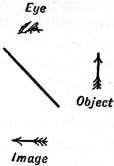
Fig. 1.
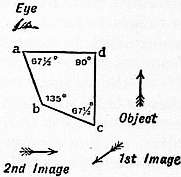
Fig. 2.
About the beginning of the 19th century Dr Wollaston invented a simple form of the camera lucida which gives bright and erect images. A four-sided prism of glass is constructed having one angle of 90°, the opposite angle of 135°, and the two remaining angles each of 67½°. This is represented in cross-section and in position in fig. 2. When the pupil of the eye is held half over the edge of the prism a, one sees the image of the object with one half of the pupil and the paper with the other half. The image is formed by successive total reflection at the surfaces b c and a b. In the first place an inverted image (first image) is formed in the face b c, and then an image of this image is formed in a b, and it is the outline of this second image seen projected on the paper that is traced by the pencil. It is desirable for two reasons that the image should lie in the plane of the paper, and this can be secured by placing a suitable lens between the object and the prism. If the image does not lie in the plane of the paper, it is impossible to see it and the pencil-point clearly at the same time. Moreover, any slight movement of the head will cause the image to appear to move relatively to the paper, and will render it difficult to obtain an accurate drawing.
Before the application of photography, the camera lucida was of considerable importance to draughtsmen. The advantages claimed for it were its cheapness, smallness and portability; that there was no appreciable distortion, and that its field was much larger than that of the camera obscura. It was used largely for copying, for reducing or for enlarging existing drawings. It will readily be understood, for example, that a copy will be half-size if the distance of the object from the instrument is double the distance of the instrument from the copy.
(C. J. J.)
CAMERA OBSCURA, an optical apparatus consisting of a darkened chamber (for which its name is the Latin rendering) at the top of which is placed a box or lantern containing a convex lens and sloping mirror, or a prism combining the lens and mirror. If we hold a common reading lens (a magnifying lens) in front of a lamp or some other bright object and at some distance from it, and if we hold a sheet of paper vertically at a suitable distance behind the lens, we see depicted on the paper an image of the lamp. This image is inverted and perverted. If now we place a plane mirror (e.g. a lady’s hand glass) behind the lens and inclined at an angle of 45° to the horizon so as to reflect the rays of light vertically downwards, we can produce on a horizontal sheet of paper an unperverted image of the bright object (fig. 1), i.e. the image has the same appearance as the object and is not perverted as when the reflection of a printed page is viewed in a mirror. This is the principle of the camera obscura, which was extensively used in sketching from nature before the introduction of photography, although it is now scarcely to be seen except as an interesting side-show at places of popular resort. The image formed on the paper may be traced out by a pencil, and it will be noticed that in this case the image is real—not virtual as in the case of the camera lucida. Generally the mirror and lens are combined into a single piece of worked glass represented in section in fig. 2. Rays from external objects are first refracted at the convex surface a b, then totally reflected at the plane surface a c, and finally refracted at the concave surface b c (fig. 2) so as to form an image on the sheet of paper d e. The curved surfaces take the place of the lens in fig. 1, and the plane surface performs the function of the mirror. The prism a b c is fixed at the top of a small tent furnished with opaque curtains so as to prevent the diffused daylight from overpowering the image on the paper, and in the darkened tent the images of external objects are seen very distinctly.
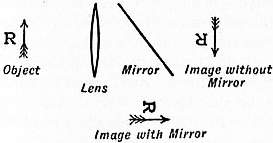
Fig. 1.
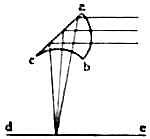
Fig. 2.
Quite recently, the camera obscura has come into use with submarine vessels, the periscope being simply a camera obscura under a new name.
(C. J. J.)
History.—The invention of this instrument has generally been ascribed, as in the ninth edition of this work, to the famous Neapolitan savant of the 16th century, Giovanni Battista della Porta, but as a matter of fact the principle of the simple camera obscura, or darkened chamber with a small aperture in a window or shutter, was well known and in practical use for observing eclipses long before his time. He was anticipated in the improvements he claimed to have made in it, and all he seems really to have done was to popularize it. The increasing importance of the camera obscura as a photographic instrument makes it desirable to bring together what is known of its early history, which is far more extensive than is usually recognized. In southern climes, where during the summer heat it is usual to close the rooms from the glare of the sunshine outside, we may often see depicted on the walls vivid inverted images of outside objects formed by the light reflected from them passing through chinks or small apertures in doors or window-shutters. From the opening passage of Euclid’s Optics (c. 300 b.c.), which formed the foundation for some of the earlier middle age treatises on geometrical perspective, it would appear that the above phenomena of the simple darkened room were used by him to demonstrate the rectilinear propagation of light by the passage of sunbeams or the projection of the images of objects through small openings in windows, &c. In the book known as Aristotle’s Problems (sect. xv. cap. 5) we find the correlated problem of the image of the sun passing through a quadrilateral aperture always appearing round, and he further notes the lunated image of the eclipsed sun projected in the same way through the interstices of foliage or lattice-work.
There are, however, very few allusions to these phenomena in the later classical Greek and Roman writers, and we find the first scientific investigation of them in the great optical treatise of the Arabian philosopher Alhazen (q.v.), who died at Cairo in a.d. 1038. He seems to have been well acquainted with the projection of images of objects through small apertures, and to have been the first to show that the arrival of the image of an object at the concave surface of the common nerve—or the retina—corresponds with the passage of light from an object through an aperture in a darkened place, from which it falls upon a surface facing the aperture. He also had some knowledge of the properties of concave and convex lenses and mirrors in forming images. Some two hundred years later, between a.d. 1266 and 1279, these problems were taken up by three almost contemporaneous writers on optics, two of whom, Roger Bacon and John Peckham, were Englishmen, and Vitello or Witelo, a Pole.
That Roger Bacon was acquainted with the principle of the camera obscura is shown by his attempt at solving Aristotle’s problem stated above, in the treatise De Speculis, and also from his references to Alhazen’s experiments of the same kind, but although Dr John Freind, in his History of Physick, has given him the credit of the invention on the strength of a passage in the Perspectiva, there is nothing to show that he constructed any instrument of the kind. His arrangement of concave and plane mirrors, by which the realistic images of objects inside the house or in the street could be rendered visible though intangible, there alluded to, may apply to a camera on Cardan’s principle or to a method of aerial projection by means of concave mirrors, which Bacon was quite familiar with, and indeed was known long before his time. On the strength of similar arrangements of lenses and mirrors the invention of the camera obscura has also been claimed for Leonard Digges, the author of Pantometria (1571), who is said to have constructed a telescope from information given in a book of Bacon’s experiments.
Archbishop Peckham, or Pisanus, in his Perspectiva Communis (1279), and Vitello, in his Optics (1270), also attempted the solution of Aristotle’s problem, but unsuccessfully. Vitello’s work is to a very great extent based upon Alhazen and some of the earlier writers, and was first published in 1535. A later edition was published, together with a translation of Alhazen, by F. Risner in 1572.
The first practical step towards the development of the camera obscura seems to have been made by the famous painter and architect, Leon Battista Alberti, in 1437, contemporaneously with the invention of printing. It is not clear, however, whether his invention was a camera obscura or a show box, but in a fragment of an anonymous biography of him, published in Muratori’s Rerum Italicarum Scriptores (xxv. 296), quoted by Vasari, it is stated that he produced wonderfully painted pictures, which were exhibited by him in some sort of small closed box through a very small aperture, with great verisimilitude. These demonstrations were of two kinds, one nocturnal, showing the moon and bright stars, the other diurnal, for day scenes. This description seems to refer to an arrangement of a transparent painting illuminated either from the back or the front and the image projected through a hole on to a white screen in a darkened room, as described by Porta (Mag. Nat. xvii. cap. 7) and figured by A. Kircher (Ars Magna Lucis et Umbrae), who notes elsewhere that Porta had taken some arrangement of projecting images from an Albertus, whom he distinguished from Albertus Magnus, and who was probably L.B. Alberti, to whom Porta also refers, but not in this connexion.
G.B.I.T. Libri-Carucci dalla Sommaja (1803-1869), in his account of the invention of the camera obscura in Italy (Histoire des sciences mathématiques en Italic, iv. 303), makes no mention of Alberti, but draws attention to an unpublished MS. of Leonardo da Vinci, which was first noticed by Venturi in 1797, and has since been published in facsimile in vol. ii. of J.G.F. Ravaisson-Mollien’s reproductions of the MSS. in the Institut de France at Paris (MS. D, fol. 8 recto). After discussing the structure of the eye he gives an experiment in which the appearance of the reversed images of outside objects on a piece of paper held in front of a small hole in a darkened room, with their forms and colours, is quite clearly described and explained with a diagram, as an illustration of the phenomena of vision. Another similar passage is quoted by Richter from folio 404b of the reproduction of the Codice Atlantico, in Milan, published by the Italian government. These are probably the earliest distinct accounts of the natural phenomena of the camera obscura, but remained unpublished for some three centuries. Leonardo also discussed the old Aristotelian problem of the rotundity of the sun’s image after passing through an angular aperture, but not so successfully as Maurolycus. He has also given methods of measuring the sun’s distance by means of images thrown on screens through small apertures. He was well acquainted with the use of magnifying glasses and suggested a kind of telescope for viewing the moon, but does not seem to have thought of applying a lens to the camera.
The first published account of the simple camera obscura was discovered by Libri in a translation of the Architecture of Vitruvius, with commentary by Cesare Caesariano, one of the architects of Milan cathedral, published at Conio in 1521, shortly after the death of Leonardo, and some twenty years before Porta was born. He describes an experiment made by a Benedictine monk and architect, Dom Papnutio or Panuce, of the same kind as Leonardo’s but without the demonstration.
About the same time Francesco Maurolico, or Maurolycus, the eminent mathematician of Messina, in his Theoremata de Lumine et Umbra, written in 1521, fully investigated the optical problems connected with vision and the passage of rays of light through small apertures with and without lenses, and made great advances in this direction over his predecessors. He was the first correctly to solve Aristotle’s problem, stated above, and to apply it practically to solar observations in a darkened room (Cosmographia, 1535). Erasmus Reinhold has described the method in his edition of G. Purbach’s Theoricae Novae Planetarum (1542), and probably got it from Maurolycus. He says it can also be applied to terrestrial objects, though he only used it for the sun. His pupil, Rainer Gemma-Frisius, used it for the observation of the solar eclipse of January 1544 at Louvain, and fully described the methods he adopted for making measurements and drawings of the eclipsed sun, in his De Radio Astronomico et Geometrico (1545). He says they can be used for observation of the moon and stars and also for longitudes. The same arrangement was used by Copernicus, Tycho Brahe, by M. Moestlin and his pupil Kepler—the latter applying it in 1607 to the observation of a transit of Mercury—also by Johann Fabricius, in 1611, for the first observations of sun-spots. It is interesting to note this early employment of the camera obscura in the field of astronomical research, in which its latest achievements have been of such pre-eminent value.
The addition of optical appliances to the simple dark chamber for the purpose of seeing what was going on outside, was first described by Girolamo Cardan in his De Subtilitate (1550), as noted by Libri. The sun shining, he fixed a round glass speculum (orbem e vitro) in a window-shutter, and then closing it the images of outside objects would be seen transmitted through the aperture on to the opposite wall, or better, a white paper screen suitably placed. The account is not very clear, but seems to imply the use of a concave mirror rather than a lens, which might be suggested by the word orbem. He refers to Maurolycus’ work with concave specula.
We now come to Giovanni Battista della Porta, whose account of the camera obscura in the first edition of the Magia Naturalis, in four books (1558, lib. iv. cap. 2), is very similar to Caesariano’s—a darkened room, a pyramidal aperture towards the sun, and a whitened wall or white paper screens, but no lens. He discloses as a great secret the use of a concave speculum in front of the aperture, to collect the rays passing through it, when the images will be seen reversed, but by prolonging them beyond the centre they would be seen larger and unreversed. This is much the same as Cardan’s method published eight years earlier, but though more detailed is not very clear. He then notes the application to portraiture and to painting by laying colours on the projected images. Nothing is said about the use of a lens or of solar observations. The second edition, in which he in the same words discloses the use of a convex lens in the aperture as a secret he had intended to keep, was not published till 1589, thirty-one years after the first. In this interval the use of the lens was discovered and clearly described by Daniello Barbaro, a Venetian noble, patriarch of Aquileia, in his work La Pratica della perspettiva (p. 192), published in 1568, or twenty-one years before Porta’s mention of it. The lens used by Barbaro was an ordinary convex or old man’s spectacle-glass; concave, he says, will not do. He shows how the paper must be moved till it is brought into the focus of the lens, the use of a diaphragm to make the image clearer, and also the application of the method for drawing in true perspective. That Barbaro was really the first to apply the lens to the camera obscura is supported by Marius Bettinus in his Apiaria (1645), and by Kaspar Schott in his Magia Universalis (1657), the former taunting Porta with the appropriation.
In an Italian translation of Euclid’s Optica, with commentary, Egnacio Danti (1573), after discussing the effects of plane, convex and concave reflectors, fully describes the method of showing reversed images passing through an aperture in a darkened room, and shows how, by placing a mirror behind the aperture, unreversed images might be obtained, both effects being illustrated by diagrams. F. Risner, who died in 1580, also in his Opticae (1606) very clearly explained the reversal of the images of the simple camera obscura. He notes the convenience of the method for solar observations and its previous use by some of the observers already mentioned, as well as its advantages for easily and accurately copying on an enlarged or reduced scale, especially for chorographical or topographical documents. This is probably the first notice of the application of the camera to cartography and the reproduction of drawings, which is one of its principal uses at the present time. In the Diversarum Speculationum Mathematicarum el Physicarum (1585), by the Venetian Giovanni Battista Benedetti, there is a letter in which he discusses the simple camera obscura and mentions the improvement some one had made in it by the use of a double convex lens in the aperture; he also says that the images could be made erect by reflection from any plane mirror.
Thus the use of the camera and of the lens with it was well known before Porta published his second edition of the Magia Naturalis in 1589. In this the description of the camera obscura is in lib. xvii. cap. 6. The use of the convex lens, which is given as a great secret, in place of the concave speculum of the first edition, is not so clearly described as by Barbaro; the addition of the concave speculum is proposed for making the images larger and clearer, and also for making them erect, but no details are given. He describes some entertaining peep-show arrangements, possibly similar to Alberti’s, and indicates how the dark chamber with a concave speculum can be used for observing eclipses. There is no mention whatever of a portable box or construction beyond the darkened room, nor is there in his later work, De Refractione Optices Parte (1593), in which he discusses the analogy between vision and the simple dark room with an aperture, but incorrectly. Though Porta’s merits were undoubtedly great, he did not invent or improve the camera obscura. His only novelty was the use of it as a peep-show; his descriptions of it are vague, but being published in a book of general reference, which became popular, he acquired credit for the invention.
The first to take up the camera obscura after Porta was Kepler, who used it in the old way for solar observations in 1600, and in his Ad Vitellionem Paralipomena (1604) discusses the early problems of the passages of light through small apertures, and the rationale of the simple dark chamber. He was the first to describe an instrument fitted with a sight and paper screen for observing the diameters of the sun and moon in a dark room. In his later book, Dioptrice (1611), he fully discusses refraction and the use of lenses, showing the action of the double convex lens in the camera obscura, with the principles which regulate its use and the reason of the reversal of the image. He also demonstrates how enlarged images can be produced and projected on paper by using a concave lens at a suitable distance behind the convex, as in modern telephotographic lenses. He was the first to use the term camera obscura, and in a letter from Sir H. Wotton written to Lord Bacon in 1620 we learn that Kepler had made himself a portable dark tent fitted with a telescope lens and used for sketching landscapes. Further, he extended the work of Maurolycus, and demonstrated the exact analogy between the eye and the camera and the arrangement by which an inverted image is produced on the retina.
In 1609 the telescope came into use, and the danger of observing the sun with it was soon discovered. In 1611 Johann Fabricius published his observations of sun-spots and describes how he and his father fell back upon the old method of projecting the sun’s image in a darkened room, finding that they could observe the spots just as well as with the telescope. They do not seem to have used a lens, or thought of using the telescope for projecting an enlarged imase on Kepler’s principle. This was done in 1612 by Christoph Schemer, who fully described his method of solar observation in the Rosa Ursina (1630), demonstrating very clearly and practically the advantages and disadvantages of using the camera, without a lens, with a single convex lens, and with a telescopic combination of convex object-glass and concave enlarging lens, the last arrangement being mounted with an adjustable screen or tablet on an equatorial stand. Most of the earlier astronomical work was done in a darkened room, but here we first find the dark chamber constructed of wooden rods covered with cloth or paper, and used separately to screen the observing-tablet.
Various writers on optics in the 17th century discussed the principle of the simple dark chamber alone and with single or compound lenses, among them Jean Tarde (Les Astres de Borbon, 1623); Descartes, the pupil of Kepler (Dioptrique, 1637); Bettinus (Apiaria, 1645); A. Kircher (Ars Magna Lucis et Umbrae, 1646); J. Hevelius (Selenographia, 1647); Schott (Magia Universalis Naturae et Artis, 1674); C.F.M. Deschales (Cursus, seu Mundus Mathematicus, 1674); Z. Traber (Nervus Opticus, 1675), but their accounts are generally more interesting theoretically than as recording progress in the practical use and development of the instrument.
The earliest mention of the camera obscura in England is probably in Francis Bacon’s De Augmentis Scientiarum, but it is only as an illustration of the projected images showing better on a white screen than on a black one. Sir H. Wotton’s letter of 1620, already noted, was not published till 1651 (Reliquiae Wottonianae, p. 141), but in 1658 a description of Kepler’s portable tent camera for sketching, taken from it, was published in a work called Graphice, or the most excellent Art of Painting, but no mention is made of Kepler. In W. Oughtred’s English edition (1633) of the Récréations mathématiques (1627) of Jean Leurechon (“Henry van Etten”) there is a quaint description, with figures, of the simple dark chamber with aperture, and also of a sort of tent with a lens in it and the projection on an inner wall of the face of a man standing outside. The English translation of Porta’s Natural Magick was published in 1658.
Robert Boyle seems to have been the first to construct a box camera with lens for viewing landscapes. It is mentioned in his essay On the Systematic or Cosmical Qualities of Things (ch. vi.), written about 1570, as having been made several years before and since imitated and improved. It could be extended or shortened like a telescope. At one end of it paper was stretched, and at the other a convex lens was fitted in a hole, the image being viewed through an aperture at the top of the box. Robert Hooke, who was some time Boyle’s assistant, described (Phil. Trans., 1668, 3, p. 741) a camera lucida on the principle of the magic lantern, in which the images of illuminated and inverted objects were projected on any desired scale by means of a broad convex lens through an aperture into a room where they were viewed by the spectators. If the objects could not be inverted, another lens was used for erecting the images. From Hooke’s Posthumous Works (1705), p. 127, we find that in one of the Cutlerian lectures on Light delivered in 1680, he illustrated the phenomena of vision by a darkened room, or perspective box, of a peculiar pattern, the back part, with a concave white screen at the end of it, being cylindrical and capable of being moved in and out, while the fore part was conical, a double convex lens being fixed in a hole in front. The image was viewed through a large hole in the side. It was between 4 and 5 ft. long.
Johann Zahn, in his Oculus Artificialis Teledioptricus (1685-1686), described and figured two forms of portable box cameras with lenses. One was a wooden box with a projecting tube in which a combination of a concave with a convex lens was fitted, for throwing an enlarged image upon the focusing screen, which in its proportions and application is very similar to our modern telephotographic objectives. The image was first thrown upon an inclined mirror and then reflected upwards to a paper screen on the top of the box. In an earlier form the image is thrown upon a vertical thin paper screen and viewed through a hole in the back of the camera. There is a great deal of practical information on lenses in connexion with the camera and other optical instruments, and the book is valuable as a repertory of early practical optics, also for the numerous references to and extracts from previous writers. An improved edition was published in 1702.
Most of the writers already noticed worked out the problems connected with the projection of images in the camera obscura more by actual practice than by calculation, but William Molyneux, of Dublin, seems to have been the first to treat them mathematically in his Dioptrica Nova (1692), which was also the first work in English on the subject, and is otherwise an interesting book. He has fully discussed the optical theory of the dark chamber, with and without a lens, and its analogy to the eye, also several optical problems relating to lenses of various forms and their combinations for telescopic projection, rules for finding foci, &c. He does not, however, mention the camera obscura as an instrument in use, but in John Harris’s Lexicon Technicum (1704) we find that the camera obscura with the arrangement called the “scioptric ball,” and known as scioptricks, was on sale in London, and after this must have been in common use as a sketching instrument or as a show.
Sir Isaac Newton, in his Opticks (1704), explains the principle of the camera obscura with single convex lens and its analogy with vision in illustration of his seventh axiom, which aptly embodies the correct solution of Aristotle’s old problem. He also made great use of the simple dark chamber for his optical experiments with prisms, &c. Joseph Priestley (1772) mentions the application of the solar microscope, both to the small and portable and the large camera obscura. Many patterns of these two forms for sketching and for viewing surrounding scenes are described in W.J.’s Gravesande’s Essai de perspective (1711), Robert Smith’s Compleat System of Optics (1738), Joseph Harris’s Treatise on Optics (1775), Charles Hutton’s Philosophical and Mathematical Dictionary, and other books on optics and physics of that period. The camera obscura was first applied to photography (q.v.) probably about 1794, by Thomas Wedgwood. His experiments with Sir Humphrey Davy in endeavouring to fix the images of natural objects as seen in the camera were published in 1802 (Journ. Roy. Inst.).
(J. Wa.)
CAMERARIUS, JOACHIM (1500-1574), German classical scholar, was born at Bamberg on the 12th of April 1500. His family name was Liebhard, but he was generally called Kammermeister, previous members of his family having held the office of chamberlain (camerarius) to the bishops of Bamberg. He studied at Leipzig, Erfurt and Wittenberg, where he became intimate with Melanchthon. For some years he was teacher of history and Greek at the gymnasium, Nuremberg. In 1530 he was sent as deputy for Nuremberg to the diet of Augsburg, where he rendered important assistance to Melanchthon in drawing up the Confession of Augsburg. Five years later he was commissioned by Duke Ulrich of Württemberg to reorganize the university of Tübingen; and in 1541 he rendered a similar service at Leipzig, where the remainder of his life was chiefly spent. He translated into Latin Herodotus, Demosthenes, Xenophon, Homer, Theocritus, Sophocles, Lucian, Theodoretus, Nicephorus and other Greek writers. He published upwards of 150 works, including a Catalogue of the Bishops of the Principal Sees; Greek Epistles; Accounts of his Journeys, in Latin verse; a Commentary on Plautus; a treatise on Numismatics; Euclid in Latin; and the Lives of Helius Eobanus Hessus, George of Anhalt and Philip Melanchthon. His Epistolae Familiares (published after his death) are a valuable contribution to the history of his time. He played an important part in the Reformation movement, and his advice was frequently sought by leading men. In 1535 he entered into a correspondence with Francis I. as to the possibility of a reconciliation between the Catholic and Protestant creeds; and in 1568 Maximilian II. sent for him to Vienna to consult him on the same subject. He died at Leipzig on the 17th of April 1574.
See article by A. Horawitz in Allgemeine deutsche Biographie; C. Bursian, Die Geschichte der klassischen Philologie in Deutschland (1883); J.E. Sandys, Hist. Class. Schol. (ed. 1908), ii. 266.
CAMERARIUS, JOACHIM (1534-1598), German botanist and physician, son of the classical scholar of the same name, was born at Nuremberg on the 6th of November 1534. After finishing his studies in Germany he visited Italy, where he graduated as doctor of medicine. On his return he was invited to reside at the courts of several princes, but preferred to settle in his native town of Nuremberg, where he had a botanical garden and formed extensive collections. He wrote a Hortus Medicus (1588) and several other works. He died at Nuremberg on the 11th of October 1598.
CAMERARIUS, RUDOLF JAKOB (1665-1721), German botanist and physician, was born at Tübingen on the 12th of February 1665, and became professor of medicine and director of the botanical gardens at Tübingen in 1687. He died at Tübingen on the 11th of September 1721. He is chiefly known for his investigations on the reproductive organs of plants (De sexu plantarum epistola, 1694).
CAMERINO (anc. Camerinum), a city and episcopal see (since 465, if not sooner; Treia is now combined with it) of the Marches, Italy, in the province of Macerata, 6 m. S. of the railway station of Castelraimondo (to which there is an electric tramway) which is 24 m. W. of Macerata; 2148 ft. above sea-level. Pop. (1901) of town, 4005; of commune, 12,083. The cathedral is modern, the older building having fallen in 1799; the church of S. Venanzio suffered similarly, but preserves a portal of the 15th century. The citadel, perhaps constructed from the plans of Leonardo da Vinci, dates from 1503. Camerino occupies the site of the ancient Camerinum, the inhabitants of which (Camertes Umbri) became allies of the Romans in 310 b.c. (at the time of the attack on the Etruscans in the Ciminian Forest). On the other hand, the Καμέρτιοι referred to in the history of the year 295 b.c. are probably the inhabitants of Clusium. Later it appears as a dependent autonomous community with the foedus aequum (Mommsen, Röm. Staatsrecht, iii. 664). Two cohorts of Camertes fought with distinction under Marius against the Cimbri. It was much affected by the conspiracy of Catiline, and is frequently mentioned in the Civil Wars; under the empire it was a municipium. It belonged to ancient Umbria, but was on the borders of Picenum. No ancient buildings are visible, the Roman level lying as much as 30 ft. below the modern.
See P. Savini, Storia delta Città di Camerino (2nd ed., Camerino, 1895); M. Mariani, Intorno agli antichi Camerti Umbri (Camerino, 1900).
(T. As.)
CAMERON, JOHN (1579-1623), Scottish theologian, was born at Glasgow about 1579, and received his early education in his native city. After having taught Greek in the university for twelve months, he removed to Bordeaux, where he was soon appointed a regent in the college of Bergerac. He did not remain long at Bordeaux, but accepted the offer of a chair of philosophy at Sedan, where he passed two years. He then returned to Bordeaux, and in the beginning of 1604 he was nominated one of the students of divinity who were maintained at the expense of the church, and who for the period of four years were at liberty to prosecute their studies in any Protestant seminary. During this period he acted as tutor to the two sons of Calignon, chancellor of Navarre. They spent one year at Paris, and two at Geneva, whence they removed to Heidelberg. In this university, on the 4th of April 1608, he gave a public proof of his ability by maintaining a series of theses, De triplici Dei cum Homine Foedere, which were printed among his works. The same year he was recalled to Bordeaux, where he was appointed the colleague of Dr Primrose; and when Francis Gomarus was removed to Leiden, Cameron, in 1618, was appointed professor of divinity at Saumur, the principal seminary of the French Protestants.
In 1620 the progress of the civil troubles in France obliged Cameron to seek refuge for himself and family in England. For a short time he read private lectures on divinity in London; and in 1622 the king appointed him principal of the university of Glasgow in the room of Robert Boyd, who had been removed from his office in consequence of his adherence to Presbyterianism. Cameron was prepared to accept Episcopacy, and was cordially disliked for his adherence to the doctrine of passive obedience. He resigned his office in less than a year.
He returned to France, and lived at Saumur. After an interval of a year he was appointed professor of divinity at Montauban. The country was still torn by civil and religious dissensions; and Cameron excited the indignation of the more strenuous adherents of his own party. He withdrew to the neighbouring town of Moissac; but he soon returned to Montauban, and a few days afterwards he died at the age of about forty-six. Cameron left by his first wife several children, whose maintenance was undertaken by the Protestant churches in France. All his works were published after his death.
His name has a distinct place in the development of Calvinistic theology in Europe. He and his followers maintained that the will of man is determined by the practical judgment of the mind; that the cause of men’s doing good or evil proceeds from the knowledge which God infuses into them; and that God does not move the will physically, but only morally, by virtue of its dependence on the judgment of the mind. This peculiar doctrine of grace and free-will was adopted by Amyraut, Cappel, Bochart, Daillé and others of the more learned among the Reformed ministers, who dissented from Calvin’s. The Cameronites (not to be confused with the Scottish sect called Cameronians) are moderate Calvinists, and approach to the opinion of the Arminians. They are also called Universalists, as holding the universal reference of Christ’s death, and sometimes Amyraldists. The rigid adherents to the synod of Dort accused them of Pelagianism, and even of Manichaeism, and the controversy between the parties was carried on with great zeal; yet the whole question between them was only, whether the will of man is determined by the immediate action of God upon it, or by the intervention of a knowledge which God impresses on the mind.
CAMERON, RICHARD (1648?-1680), founder of a Scottish religious sect of Cameronians, which formed the nucleus of the regiment of this name in the British army, was born at Falkland in the county of Fife. He was educated at the village school, and his success was so great that, while still a youth, he was appointed schoolmaster. In this situation he became acquainted with some of the more enthusiastic field-preachers. Persuaded by them he resigned his post and entered the family of Sir Walter Scott of Harden as chaplain and tutor. Refusing to acknowledge the Indulgence, he joined the ranks of the non-conforming ministers, and incited the inhabitants of the southern counties of Scotland to protest openly against the new edict. So formidable was the agitation that the government pronounced illegal all armed assemblages for religious purposes. Cameron took refuge in Holland, where he resided for some time; but in the autumn of 1679 (probably) he returned to Scotland, and once more made himself formidable to the government. Shortly after the defeat of the Covenanters at Bothwell Bridge in that year, Cameron was slain in a skirmish at the Aird’s, or Airs, Moss, fighting bravely at the head of the few troops which he had been able to collect. His prayer before going into battle became a tradition—“Lord spare the green and take the ripe.” After the accession of William III. the survivors were amnestied, and the Cameronian regiment was formed from them.
See Andrew Lang, History of Scotland, vol. iii. (1907); Herzog-Hauck, Realencyklopädie (1897), s.v. “Cameronianer”; A. Smellie, Men of the Covenant; Herkless, Richard Cameron; P. Walker, Six Saints of the Covenant.
CAMERON, SIMON (1799-1889), American politician, was born in Lancaster county, Pennsylvania, on the 8th of March 1799. Left an orphan at the age of nine, he early entered journalism, and, in banking and railway enterprises, accumulated a considerable fortune. He became influential in Pennsylvania politics, and in 1845-1849 served in the United States Senate, being elected by a combination of Democratic, Whig and “American” votes to succeed James Buchanan. In 1854, having failed to secure the nomination for senator from the “Know-Nothing” Party, which he had recently joined, he became a leader of the “People’s Party,” as the Republican Party was at first called in Pennsylvania. In 1857 he was elected to the United States Senate as a Republican, despite a Democratic majority in the state legislature, a fact that gave rise to charges of bribery. His prominence as a candidate first for the presidential and then for the vice-presidential nomination in the Republican national convention of 1860 led to his being selected by President Lincoln as secretary of war. His administration of this office at a critical time was marked by his accustomed energy, but unfortunately also by partiality in the letting of government contracts, which brought about his resignation at Lincoln’s request in January 1862 and his subsequent censure by the House of Representatives. Lincoln sent him as minister to Russia, but he returned in November 1862. He again served in the Senate (after 1872, being chairman of the committee on foreign relations) from 1867 until 1877, when he resigned to make room for his son, whose election he dictated. Cameron was one of the ablest political organizers the United States has ever known, and his long undisputed control of Pennsylvania politics was one of the most striking examples of “boss rule” in American history. The definition of an honest politician as “one who when he is bought will stay bought” has been attributed to him. He died on the 26th of June 1889.
His son James Donald Cameron (1833- ) was born at Middletown, Pennsylvania, on the 14th of May 1833, graduated at Princeton in 1852, became actively interested in his father’s banking and railway enterprises, and from 1863 to 1874 was president of the Northern Central railway. Trained in the political school of his father, he developed into an astute politician. From June 1876 to March 1877 he was secretary of war in President Grant’s cabinet. In the Republican national convention of 1876 he took an influential part in preventing the nomination of James G. Elaine, and later was one of those who directed the policy of the Republicans in the struggle for the presidency between Tilden and Hayes. From 1877 until 1897 he was a member of the United States Senate, having been elected originally to succeed his father, who resigned in order to create the vacancy. He was chairman of the Republican national committee during the campaign of 1880.
CAMERON, VERNEY LOVETT (1844-1894), English traveller in Central Africa, was born at Radipole, near Weymouth, Dorsetshire, on the 1st of July 1844. He entered the navy in 1857, served in the Abyssinian campaign of 1868, and was employed for a considerable time in the suppression of the East African slave trade. The experience thus obtained led to his being selected to command an expedition sent by the Royal Geographical Society in 1873, to succour Dr. Livingstone. He was also instructed to make independent explorations, guided by Livingstone’s advice. Soon after the departure of the expedition from Zanzibar, Livingstone’s servants were met bearing the dead body of their master. Cameron’s two European companions turned back, but he continued his march and reached Ujiji, on Lake Tanganyika, in February 1874, where he found and sent to England Livingstone’s papers. Cameron spent some time determining the true form of the south part of the lake, and solved the question of its outlet by the discovery of the Lukuga river. From Tanganyika he struck westward to Nyangwe, the Arab town on the Lualaba previously visited by Livingstone. This river Cameron rightly believed to be the main stream of the Congo, and he endeavoured to procure canoes to follow it down. In this he was unsuccessful, owing to his refusal to countenance slavery, and he therefore turned south-west. After tracing the Congo-Zambezi watershed for hundreds of miles he reached Bihe and finally arrived at the coast on the 28th of November 1875, being the first European to cress Equatorial Africa from sea to sea. His travels, which were published in 1877 under the title Across Africa, contain valuable suggestions for the opening up of the continent, including the utilization of the great lakes as a “Cape to Cairo” connexion. In recognition of his work he was promoted to the rank of commander, made a Companion of the Bath and given the gold medal of the Geographical Society. The remainder of Cameron’s life was chiefly devoted to projects for the commercial development of Africa, and to writing tales for the young. He visited the Euphrates valley in 1878-1879 in connexion with a proposed railway to the Persian Gulf, and accompanied Sir Richard Burton in his West African journey of 1882. At the Gold Coast Cameron surveyed the Tarkwa region, and he was joint author with Burton of To the Gold Coast for Gold (1883). He was killed, near Leighton Buzzard, by a fall from horseback when returning from hunting, on the 24th of March 1894.
A second edition of Across Africa, with new matter and corrected maps, appeared in 1885. A summary of Cameron’s great journey, from his own pen, appears in Dr Robert Brown’s The Story of Africa, vol. ii. pp. 266-279 (London, 1893).
CAMERON OF LOCHIEL, SIR EWEN (1629-1719), Scottish Highland chieftain, was the eldest son of John Cameron and the grandson of Alan Cameron, the head of the clan Cameron. Having lost his father in infancy he passed part of his youth with the marquess of Argyll at Inveraray, leaving his guardian about 1647 to take up his duties as chief of the clan Cameron, a position in which he succeeded his grandfather. In 1653 Lochiel joined the earl of Glencairn in his rising on behalf of Charles II., and after the defeat of this attempt he served the Royalist cause by harassing General Monk. In 1681 he was knighted by Charles II., and in July 1689 he was with Viscount Dundee at Killiecrankie. He was too old to share personally in the Jacobite rising of 1715, but his sympathies were with the Stuarts, and his son led the Camerons at Sheriffmuir. Lochiel, who died in February 1719, is called by Macaulay the “Ulysses of the Highlands.” He was a man of enormous strength and size, and one who met him in 1716 says “he wrung some blood from the point of my fingers with a grasp of his hand.” An incident showing his strength and ferocity in single combat is used by Sir Walter Scott in The Lady of the Lake (canto v.). Lochiel’s son and successor, John, who was attainted for sharing in the rebellion of 1715, died in Flanders in 1748. John’s son Donald, sometimes called “gentle Lochiel,” joined Charles Edward, the Young Pretender, in 1745, was wounded at Culloden, and escaped to France, dying in the same year as his father. The 79th regiment, or Cameron Highlanders, was raised from among the members of the clan in 1793 by Sir Alan Cameron (1753-1828).
See Memoirs of Sir Ewen Cameron of Lochiel (Bannatyne Club, 1842).
CAMERONIANS, the name given to that section of the Scottish Covenanters (q.v.) who followed Richard Cameron (q.v.), and who were chiefly found among those who signed the Sanquhar Declaration in 1680. Known also as “Society Men,” “Sanquharians” and “Hillmen,” they became a separate church after the religious settlement of 1690, taking the official title of Reformed Presbyterians in 1743. Societies of Cameronians for the maintenance of the Presbyterian form of worship were formed about 1681; their testimony, “The Informatory Vindication,” is dated 1687; and they quickly became the most pronounced and active adherents of the covenanting faith. Holding fast to the two covenants, the National Covenant of 1580 and the Solemn League and Covenant of 1643, they wished to restore the ecclesiastical order which had existed between 1638 and 1649, and were dissatisfied with the moderate character of the religious settlement of 1690. Refusing to take the oaths of allegiance to an “uncovenanted” ruler, or to exercise any civil function, they passed through a period of trial and found some difficulty in maintaining a regular ministry; but in 1706 they were reinforced by some converts from the established church. They objected strongly to the proposal for the union of England and Scotland, and were suspected of abetting a rising which took place in the west of Scotland in 1706; but there appears to be no foundation for the statement that they intrigued with the Jacobites, and they gave no trouble to the government either in 1715 or in 1745. In 1712 they publicly renewed the covenants at Auchensauch Hill in Lanarkshire, and in 1743 their first presbytery was constituted at Braehead, while a presbytery was formed in North America in 1774. In 1863 the Cameronians, or Reformed Presbyterians, decided to inflict no penalties upon those members who had taken the oaths, or had exercised civil functions, and consequently a few congregations seceded. In 1876 the general body of the Reformed Presbyterians united with the Free Church of Scotland, leaving the few seceding congregations as the representatives of the principles of the Cameronians. In the British army the first battalion of the Cameronians (Scottish Rifles) is directly descended from the “Cameronian guard,” which, composed of Cameronians, was embodied by the convention parliament in 1689, and was afterwards employed to restore order in the Highlands.
See J.H. Burton, History of Scotland, vols. vii. and viii. (Edinburgh, 1905); and A. Lang, History of Scotland, vol. iv. (Edinburgh, 1907).
CAMEROON1 (Ger. Kamerun), a German protectorate in West Africa, bounded W. by the Atlantic, N.W. by British Nigeria, N. by Lake Chad, E. and S. by French Congo, save for a short distance on the south where it is conterminous with the Spanish Muni river settlement.
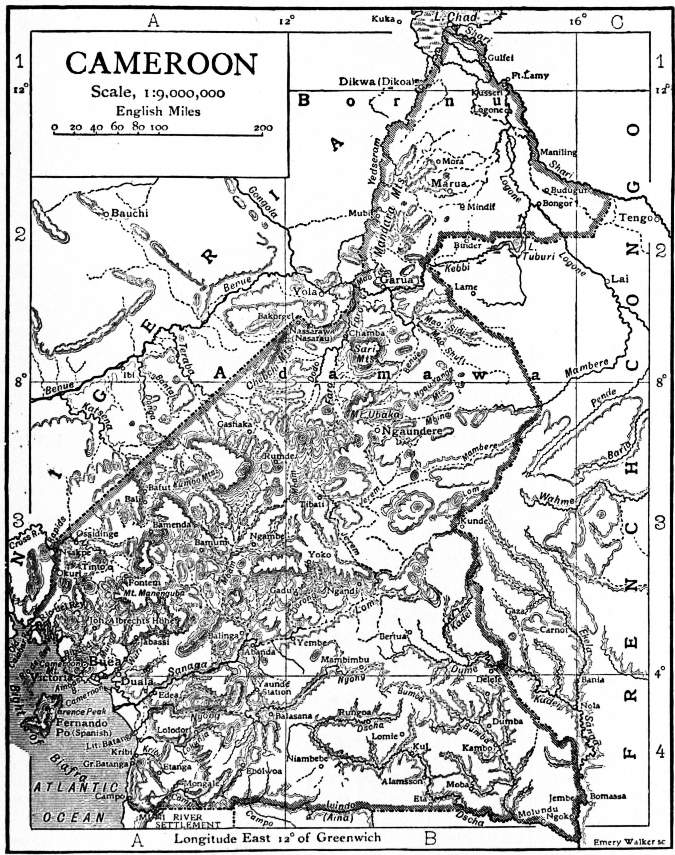
Boundaries and Area.—The sea frontier extends from the Rio del Rey, just where the great bend of the coast-line east to south begins, forming the Bight of Biafra, to the Campo river, a distance of 200 m. The north-western boundary, laid down in an agreement between Germany and Great Britain on the 15th of November 1893, runs from the mouth of the Rio del Rey to the “rapids” of the Cross river in 8° 48′ E. Thence it is continued in a north-east line towards Yola, as far as the confines of that town. The boundary is then deflected south so as to leave Yola in British territory, turning north again to cross the Benue river at a spot 3 m. west of where the Faro joins the Benue. From this point the frontier goes north-east to the border of Lake Chad, 35 m. east of the meridian of the town of Kuka. The southern shores of Lake Chad for a distance of some 40 m. belong to the protectorate. The south and east boundaries were laid down by agreements between Germany and France on the 24th of December 1885, the 15th of March 1894 and the 18th of April 1908. The south boundary runs in a fairly direct line from the mouth of the Campo river to the river Dscha (or Ngoko), which it follows to its confluence with the Sanga. The eastern boundary runs from the Sanga irregularly north to 10° N., where it approaches the British frontier at Yola, so that at its narrowest part the protectorate is little more than 50 m. across. From 10° N. the frontier turns eastwards to the Logone, thence going north-east to the Shari river, which it follows to Lake Chad. The protectorate has an area of about 190,000 sq. m. Estimated population (1908) 3,500,000, of whom 1128 were whites.