VOLUME IV SLICE IV Bradford, William to Brequigny, Louis (continued 6)
Reading edition
In the Lancaster criminal court a branding-iron is still preserved in the dock. It is a long bolt with a wooden handle at one end and an M (malefactor) at the other. Close by are two iron loops for firmly securing the hands during the operation. The brander, after examination, would turn to the judge and exclaim, “A fair mark, my lord.” Criminals were formerly ordered to hold up their hands before sentence to show if they had been previously convicted.
Cold branding or branding with cold irons became in the 18th century the mode of nominally inflicting the punishment on prisoners of higher rank. “When Charles Moritz, a young German, visited England in 1782 he was much surprised at this custom, and in his diary mentioned the case of a clergyman who had fought a duel and killed his man in Hyde Park. Found guilty of manslaughter he was burnt in the hand, if that could be called burning which was done with a cold iron” (Markham’s Ancient Punishments of Northants, 1886). Such cases led to branding becoming obsolete, and it was abolished in 1829 except in the case of deserters from the army. These were marked with the letter D, not with hot irons but by tattooing with ink or gunpowder. Notoriously bad soldiers were also branded with BC (bad character). By the British Mutiny Act of 1858 it was enacted that the court-martial, in addition to any other penalty, may order deserters to be marked on the left side, 2 in. below the armpit, with the letter D, such letter to be not less than 1 in. long. In 1879 this was abolished.
See W. Andrews, Old Time Punishments (Hull, 1890); A.M. Earle, Curious Punishments of Bygone Days (London, 1896).
BRANDIS, CHRISTIAN AUGUST (1790-1867), German philologist and historian of philosophy, was born at Hildesheim and educated at Kiel University. In 1812 he graduated at Copenhagen, with a thesis Commentationes Eleaticae (a collection of fragments from Xenophanes, Parmenides and Melissus). For a time he studied at Göttingen, and in 1815 presented as his inaugural dissertation at Berlin his essay Von dem Begriff der Geschichte der Philosophie. In 1816 he refused an extraordinary professorship at Heidelberg in order to accompany B.G. Niebuhr to Italy as secretary to the Prussian embassy. Subsequently he assisted I. Bekker in the preparation of his edition of Aristotle. In 1821 he became professor of philosophy in the newly founded university of Bonn, and in 1823 published his Aristotelius et Theophrasti Metaphysica. With Boeckh and Niebuhr he edited the Rheinisches Museum, to which he contributed important articles on Socrates (1827, 1829). In 1836-1839 he was tutor to the young king Otho of Greece. His great work, the Handbuch der Geschichte der griechisch-röm. Philos. (1835-1866; republished in a smaller and more systematic form, Gesch. d. Entwickelungen d. griech. Philos., 1862-1866), is characterized by sound criticism. Brandis died on the 21st of July 1867.
See Trendelenburg, Zur Erinnerung an C. A. B. (Berlin, 1868).
BRANDON, a city and port of entry of Manitoba, Canada, on the Assiniboine river, and the Canadian Pacific and Canadian Northern railways, situated 132 m. W. of Winnipeg, 1184 ft. above the sea. Pop. (1891) 3778; (1907) 12,519. It is in one of the finest agricultural sections and contains a government experimental farm, grain elevators, saw and grist mills. It was first settled in 1881, and incorporated as a city in 1882.
BRANDON, a market town in the Stowmarket parliamentary division of Suffolk, England, on the Little Ouse or Brandon river, 86½ m. N.N.E. from London by the Ely-Norwich line of the Great Eastern railway. Pop. (1901) 2327. The church of St Peter is Early English with earlier portions; there is a free grammar school founded in 1646; and the town has some carrying trade by the Little Ouse in corn, coal and timber. Rabbit skins of fine texture are dressed and exported. Extensive deposits of flint are worked in the neighbourhood, and the work of the “flint-knappers” has had its counterpart here from the earliest eras of man. Close to Brandon, but in Norfolk across the river, at the village of Weeting, are the so-called Grimes’ Graves, which, long supposed to show the foundations of a British village, and probably so occupied, were proved by excavation to have been actually neolithic flint workings. The pits, though almost completely filled up (probably as they became exhausted), were sunk through the overlying chalk to the depth of 20 to 60 ft., and numbered 254 in all. Passages branched out from them, and among other remains picks of deer-horn were discovered, one actually bearing in the chalk which coated it the print of the workman’s hand.
BRANDY, an alcoholic, potable spirit, obtained by the distillation of grape wine. The frequently occurring statement that the word “brandy” is derived from the High German Branntwein is incorrect, inasmuch as the English word (as Fairley has pointed out) is quite as old as any of its continental equivalents. It is simply an abbreviation of the Old English brandewine, brand-wine or brandy wine, the word “brand” being common to all the Teutonic languages of northern Europe, meaning a thing burning or that has been burnt. John Fletcher’s Beggar’s Bush (1622) contains the passage, “Buy brand wine”; and from the Roxburgh Ballads (1650) we have “It is more fine than brandewine.” The word “brandy” came into familiar use about the middle of the 17th century, but the expression “brandywine” was retained in legal documents until 1702 (Fairley). Thus in 1697 (View Penal Laws, 173) there occurs the sentence, “No aqua vitae or brandywine shall be imported into England.” The British Pharmacopoeia formerly defined French brandy, which was the only variety mentioned (officially spiritus vini gallici), as “Spirit distilled from French wine; it has a characteristic flavour, and a light sherry colour derived from the cask in which it has been kept.” In the latest edition the Latin title spiritus vini gallici is retained, but the word French is dropped from the text, which now reads as follows: “A spirituous liquid distilled from wine and matured by age, and containing not less than 36½% by weight or 43½% by volume of ethyl hydroxide.” The United States Pharmacopoeia (1905), retains the Latin expression spiritus vini gallici (English title Brandy), defined as “an alcoholic liquid obtained by the distillation of the fermented, unmodified juice of fresh grapes.”
Very little of the brandy of commerce corresponds exactly to the former definition of the British Pharmacopoeia as regards colouring matter, inasmuch as trade requirements necessitate the addition of a small quantity of caramel (burnt sugar) colouring to the spirit in the majority of cases. The object of this is, as a rule, not that of deceiving the consumer as to the apparent age of the brandy, but that of keeping a standard article of commerce at a standard level of colour. It is practically impossible to do this without having recourse to caramel colouring, as, practically speaking, the contents of any cask will always differ slightly, and often very appreciably, in colour intensity from the contents of another cask, even though the age and quality of the spirits are identical.
The finest brandies are produced in a district covering an area of rather less than three million acres, situated in the departments of Charente and Charente Inférieure, of which the centre is the town of Cognac. It is generally held that only brandies produced within this district have a right to the name “cognac.” The Cognac district is separated into district zones of production, according to the quality of the spirit which each yields. In the centre of the district, on the left bank of the Charente, is the Grande Champagne, and radiating beyond it are (in order of merit of the spirit produced) the Petite Champagne, the Borderies (or Premiers Bois), the Fins Bois, the Bons Bois, the Bois Ordinaires, and finally the Bois communs dits à terroir. Many hold that the brandy produced in the two latter districts is not entitled to the name of “cognac,” but this is a matter of controversy, as is also the question as to whether another district called the Grande Fine Champagne, namely, that in the immediate neighbourhood of the little village of Juillac-le-Coq, should be added to the list. The pre-eminent quality of the Cognac brandies is largely due to the character of the soil, the climate, and the scientific and systematic cultivation of the vines. For a period—from the middle ’seventies to the ’nineties of the 19th century—the cognac industry was, owing to the inroads of the phylloxera, threatened with almost total extinction, but after a lengthy series of experiments, a system of replanting and hybridizing, based on the characteristics of the soils of the various districts, was evolved, which effectually put a stop to the further progress of the disease. In 1907 the area actually planted with the vine in the Cognac district proper was about 200,000 acres, and the production of cognac brandy, which, however, varies widely in different years, may be put down at about five million gallons per annum. The latter figure is based on the amount of wine produced in the two Charentes (about forty-five million gallons in 1905).
Brandy is also manufactured in numerous other districts in France, and in general order of commercial merit may be mentioned the brandies of Armagnac, Marmande, Nantes and Anjou. The brandies commanding the lowest prices are broadly known as the Trois-Six de Monlpellier. In a class by themselves are the Eaux-de-vie de Marc, made from the wine pressings or from the solid residues of the stills. Some of these, particularly those made in Burgundy, have characteristic qualities, and are considered by many to be very fine. The consumption is chiefly local. Brandy of fair quality is also made in other wine-producing countries, particularly in Spain, and of late years colonial (Australian and Cape) brandies have attracted some attention. The comsumption of brandy in the United Kingdom amounts to about two million gallons.
Brandy, in common with other potable spirits, owes its flavour and aroma to the presence of small quantities of substances termed secondary or by-products (sometimes “impurities”). These are dissolved in the ethyl alcohol and water which form over 99% of the spirit. The nature and quantity of all of these by-products have not yet been fully ascertained, but the knowledge in this direction is rapidly progressing. Ch. Ordonneau fractionally distilled 100 litres of 25-year-old cognac brandy, and obtained the following substances and quantities thereof:—
Grammes in 100 Litres.
Normal propyl alcohol 40.0
Normal butyl alcohol 218.6
Amyl alcohol 83.8
Hexyl alcohol 0.6
Heptyl alcohol 1.5
Ethyl acetate 35.0
Ethyl propionate, butyrate and caproate 3.0
Oenanthic ether (about) 4.0
Aldehyde 3.0
Acetal traces
Amines traces
Most of the above substances, in fact probably all of them, excepting the oenanthic ether, are contained in other spirits, such as whisky and rum. The oenanthic ether (ethyl pelargonate) is one of the main characteristics which enable us chemically to differentiate between brandy and other distilled liquors. Brandy also contains a certain quantity of free acid, which increases with age, furfural, which decreases, and small quantities of other matters of which we have as yet little knowledge.
The table gives analyses, by the present author (excepting No. 3, which is by F. Lusson), of undoubtedly genuine commercial cognac brandies of various ages.
Genuine Cognac Brandies.
(Excepting the alcohol, results are expressed in grammes per 100 litres of absolute alcohol.)
Age, &c. Alcohol % by vol. Total Acid. Non- volatile Acid. Esters. “Higher Alcohols.” Aldehyde. Furfural.
1. New 1904 61.7 45 5 82 125 8 2.3
2. New, still heated by steam coil 56.3 22 4 61 100 3 1.2
3. New 67.7 51 · · 158 152 6 1.3
4. Five years old, 1900 vintage 57.7 92 37 125 · · · · · ·
5. 1875 vintage, pale 46.7 144 37 177 261 55 1.0
6. 1848 vintage, brown 38.5 254 109 190 488 32 2.1
Note.—In the above table the acid is expressed in terms of acetic acid, the esters are expressed as ethyl acetate, and the aldehyde as acetaldehyde. The “Higher Alcohol” figures do not actually represent these substances, but indicate the relative coloration obtained with sulphuric acid when compared with an iso-butyl standard under certain conditions.
Storage and Maturation.—Brandy is stored in specially selected oak casks, from which it extracts a certain quantity of colouring matter and tannin, &c. Commercial cognac brandies are generally blends of different growths and vintages, the blending being accomplished in large vats some little time prior to bottling. The necessary colouring and sweetening matter is added in the vat. In the case of pale brandies very little colouring and sweetening are added, the usual quantity being in the neighbourhood of ½ to 1%. Old “brown brandies,” which are nowadays not in great demand, require more caramel and sugar than do the pale varieties. The preparation of the “liqueur,” as the mixed caramel and sugar syrup is termed, is an operation requiring much experience, and the methods employed are kept strictly secret. Fine “liqueur” is prepared with high-class brandy, and is stored a number of years prior to use. Brandy, as is well known, improves very much with age (for chemical aspects of maturation see Spirits), but this only holds good when the spirit is in wood, for there is no material appreciation in quality after bottling. It is a mistake to believe, however, that brandy improves indefinitely, even when kept in wood, for, as a matter of fact, after a certain time—which varies considerably according to the type of brandy, the vintage, &c.—there is so much evaporation of alcohol that a number of undesirable changes come about. The brandy begins to “go back,” and becomes, as it is called, “worn” or “tired.” It is necessary, therefore, that the bottling should not be deferred too long. Sometimes, for trade reasons, it is necessary to keep brandy in cask for a long period, and under these conditions the practice is to keep a series of casks, which are treated as follows:—The last cask is kept filled by occasionally adding some spirit from the cask next in order, the latter is filled up by spirit taken from the third cask from the end, and so on, until the first cask in the row is reached. The latter is filled up or “topped” with some relatively fresh spirit.
Brandy is much employed medicinally as a food capable of supplying energy in a particularly labile form to the body, as a stimulant, carminative, and as a hypnotic.
Adulteration.—A good deal has been written about the preparation of artificial brandy by means of the addition of essential oils to potato or beetroot spirit, but it is more than doubtful whether this practice was really carried on on a large scale formerly. What undoubtedly did occur was that much beet, potato or grain spirit was used for blending with genuine grape spirit. Prosecutions under the Food and Drugs Act, by certain English local authorities in the year 1904, resulted in the practical fixation of certain chemical standards which, in the opinion of the present writer, have, owing to their arbitrary and unscientific nature, resulted in much adulteration of a type previously non-existent. There is no doubt that at the present time artificial esters and higher alcohols, &c., are being used on an extensive scale for the preparation of cheap brandies, and the position, in this respect, therefore, has not been inproved. Where formerly fraud was practically confined to the blending of genuine brandy with spirit other than that derived from the grape, it is now enhanced by the addition of artificial essences to the blend of the two spirits.
(P. S.)
BRANDYWINE, the name of a stream in Pennsylvania and Delaware, U.S.A., which runs into the Delaware river a few miles east of Wilmington, Delaware. It is famous as the scene of the battle of Brandywine in the American War of Independence, fought on the 11th of September 1777 about 10 m. north-west of Wilmington, and a few miles inside the Pennsylvania border. Sir William Howe, the British commander-in-chief, while opposed to Washington’s army in New Jersey, had formed the plan of capturing Philadelphia from the south side by a movement by sea to the head of Delaware Bay. But contrary winds and accidents delayed the British transports so long that Washington, who was at first puzzled, was able to divine his opponents’ intentions in time; and rapidly moving to the threatened point he occupied a strong entrenched position at the fords over the Brandywine, 25 m. south-west of Philadelphia. Here on the 11th of September the British attacked him. Howe’s plan, which was carefully worked out and exactly executed, was to deliver an energetic feint attack against the American front, to take a strong column 12 m. up the stream, and crossing beyond Washington’s right to attack his entrenchments in rear. Washington was successfully held in play during the movement, and General Sullivan, the commander of the American right wing, misled by the conflicting intelligence which reached him from up-stream, was surprised about noon by definite information as to the approach of Cornwallis on his right rear. Changing front “right back” in the dense country, he yet managed to oppose a stubborn resistance to the flanking attack, and with other troops that were hurried to the scene his division held its ground for a time near Birmingham meeting-house. But Howe pressed his attack sharply and drove back the Americans for 2 m.; the holding attack of the British right was converted into a real one, and by nightfall Washington was in full retreat northward toward Chester, protected by General Greene and a steady rear-guard, which held off Howe’s column for the necessary time. The British were too exhausted to pursue, and part of Howe’s force was inextricably mixed up with the advancing troops of the frontal attack. The American loss in killed, wounded and prisoners was about 1000; that of the British less than 600. Howe followed up his victory, and on the 27th of September entered Philadelphia.
BRANFORD, a township, including a borough of the same name, in New Haven county, Connecticut, U.S.A., at the mouth of the Branford river and at the head of a short arm of Long Island Sound, about 7 m. E.S.E. of New Haven. Pop. of the township (1890) 4460; (1900) 5706 (1968 foreign-born);(1910) 6047; of the borough (1910) 2560. The borough is served by the New York, New Haven & Hartford railway, and by an electric line connecting with New Haven. A range of rocky hills commands fine views of the Sound, the shore is deeply indented, the harbour and bays are dotted with islands, and the harbour is deep enough for small craft, and these natural features attract many visitors during the summer season. In Branford is the James Blackstone Memorial library (1896), designed by Solon Spencer Beman (b. 1853) in the Ionic style (the details being taken from the Erechtheum at Athens). On the interior of the dome which covers the rotunda are a series of paintings by Oliver Dennett Grover (b. 1861) illustrating the evolution of book-making, and between the arches are medallion portraits, by the same artist, of New England authors—Longfellow, Emerson, Hawthorne, Lowell, Bryant, Whittier, Holmes and Mrs Stowe. The library was erected by Timothy B. Blackstone (1829-1900), a native of Branford, and president of the Chicago & Alton railway from 1864 to 1899—as a memorial to his father, a descendant of William Blackstone (d. 1675), the New England pioneer. The principal industries of Branford are the manufacture of malleable iron fittings, locks and general hardware, the quarrying of granite, and oyster culture.
The territory of Totoket (now the township of Branford) was purchased from the Indians by the New Haven Plantation, in December 1638, for eleven coats of trucking cloth and one coat of English cloth, but with the reservation for a few Indians of what is still known as Indian Neck. In 1640 the general court of New Haven granted it to the Rev. Samuel Eaton (1596?-1665), a brother of Theophilus Eaton, on condition that he brought friends from England to settle it. As Eaton went to England and did not return, Totoket was granted in 1644 to settlers mostly from Wethersfield, Conn., on condition that they should organize a church state after the New Haven model and join the New Haven Jurisdiction. The settlement was made in the same year, and about two years later several new families came from Southampton, Long Island, under the leadership of the Rev. Abraham Pierson (c. 1608-1678), an ardent advocate of the church state, who was chosen pastor at Totoket. The present name of the township, derived from Brentford, England, was adopted about 1645. After the members of the New Haven Jurisdiction had submitted to Connecticut, Pierson, in 1666-1667, led the most prominent citizens of Branford to New Jersey, where they were leaders in founding Newark. The borough of Branford was incorporated in 1893.
See E.C. Baldwin, Branford Annals, in Papers of New Haven Colony Historical Society (New Haven, 1882 and 1888).
BRANGWYN, FRANK (1867- ), English painter, was born at Bruges, and received his first instruction from his father, the owner of an establishment for church embroideries and kindred objects, who took a leading part in the Gothic revival under Pugin. When the family moved to England, Brangwyn attracted the attention of William Morris by a drawing on which he was engaged at South Kensington museum. He worked for some time in Morris’s studio, and then travelled more than once to the East, whereby his sense of colour and the whole further development of his art became deeply influenced. Indeed, the impressions he then received, and his love of Oriental decorative art—tiles and carpets—exercised a greater influence on him than any early training or the works of any European master. His whole tendency is essentially decorative: a colour-sense of sumptuous richness is wedded to an equally strong sense of well-balanced, harmonious design. These qualities, together with a summary suppression of the details which tie a subject to time and place, give his compositions a nobly impressive and universal character, such as may be seen in his decorative panel “Modern Commerce” in the ambulatory of the Royal Exchange, London. Among other decorative schemes executed by him are those for “L’Art nouveau” in the rue de Provence, Paris; for the hall of the Skinners’ Company, London; and for the British room at the Venice International Exhibition, 1905. The Luxembourg museum has his “Trade on the Beach”; the Venice municipal museum, the “St Simon Stylites”; the Stuttgart gallery, the “St John the Baptist”; the Munich Pinakothek, the “Assisi”; the Carnegie Institute in Pittsburg, his “Sweetmeat Seller”; the Prague gallery, his “Turkish Boatmen”; and the National Gallery of New South Wales, “The Scoffers.” Brangwyn embarked successfully in many fields of applied art, and made admirable designs for book decoration, stained glass, furniture, tapestry, metal-work and pottery. He devoted himself extensively to etching, and executed many plates of astonishing vigour and dramatic intensity. He was elected associate of the Royal Academy in 1904.
BRANKS, (probably akin to Irish brancas, a halter; Ger. Pranger, fetter, pillory), or Scolding-Bridle, a contrivance formerly in use throughout England and Scotland for the punishment of scolding women. It is said to have originated in the latter country. It seems to have never been a legalized form of punishment; but corporations and lords of manors in England, town councils, kirk-sessions and barony courts in Scotland assumed a right to inflict it. While specially known as the “Gossip’s or Scold’s Bridle” the branks was also used for women convicted of petty offences, breaches of the peace, street-brawling and abusive language. It was the equivalent of the male punishments of the stocks and pillory. In its earliest form it consisted of a hoop head-piece of iron, opening by hinges at the side so as to enclose the head, with a flat piece of iron projecting inwards so as to fit into the mouth and press the tongue down. Later it was made, by a multiplication of hoops, more like a cage, the front forming a mask of iron with holes for mouth, nose and eyes. Sometimes the mouth-plate was armed with a short spike. With this on her head the offending woman was marched through the streets by the beadle or chained to the market-cross to be gibed at by passers. The date of origin is doubtful. It was used at Edinburgh in 1567, at Glasgow in 1574, but not before the 17th century in any English town. A brank in the church of Walton-on-Thames, Surrey, bears date 1633; while another in a private collection has the crowned cipher of William III. The Ashmolean Museum at Oxford, the Scottish National Museum of Antiquities at Edinburgh, the towns of Lichfield, Shrewsbury, Leicester and Chester have examples of the brank. As late as 1856 it was in use at Bolton-le-Moors, Lancashire.
See W. Andrews, Old Time Punishments (Hull, 1890); A.M. Earle, Curious Punishments of Bygone Days (Chicago, 1896).
BRANT, JOSEPH (1742-1807), American Indian chief of the Mohawk tribe, known also by his Indian name, Thayendanegea, was born on the banks of the Ohio river in 1742. In early youth he attracted the attention of Sir William Johnson, who sent him to be educated by Dr Eleazar Wheelock at Lebanon, Conn., in Moor’s Indian charity school, in which Dartmouth College had its origin. He took part, on the side of the English, in the French and Indian War, and in 1763 fought with the Iroquois against Pontiac. Subsequently he settled at Canajoharie, or Upper Mohawk Castle (in what is now Montgomery county, New York), where, being a devout churchman, he devoted himself to missionary work, and translated the Prayer Book and St Mark’s Gospel into the Mohawk tongue (1787). When Guy Johnson (1740-1788) succeeded his uncle, Sir William, as superintendent of Indian affairs in 1774, Brant became his secretary. At the outbreak of the War of Independence, he remained loyal, was commissioned colonel, and organized and led the Mohawks and other Indians allied to the British against the settlements on the New York frontier. He took part in the Cherry Valley Massacre, in the attack on Minisink and the expedition of General St Leger which resulted in the battle of Oriskany on the 6th of August 1777. After the war he discouraged the continuance of Indian warfare on the frontier, and aided the commissioners of the United States in securing treaties of peace with the Miamis and other western tribes. Settling in Upper Canada, he again devoted himself to missionary work and in 1786 visited England, where he raised funds with which was erected the first Episcopal church in Upper Canada. His character was a peculiar compound of the traits of an Indian warrior—with few rivals for daring leadership—and of a civilized politician and diplomat of the more conservative type. He died on an estate granted him by the British government on the banks of Lake Ontario on the 24th of November 1807. A monument was erected to his memory at Brantford, Ontario, Canada (named in his honour) in 1886.
See W.L. Stone, Life of Joseph Brant (2 vols., New York, 1838; new ed., Albany, 1865); Edward Eggleston and Elizabeth E. Seelye, Brant and Red Jacket in “Famous American Indians” (New York, 1879); and a Memoir (Brantford, 1872).
BRANT, SEBASTIAN (1457-1521), German humanist and satirist, was born at Strassburg about the year 1457. He studied at Basel, took the degree of doctor of laws in 1489, and for some time held a professorship of jurisprudence there. Returning to Strassburg, he was made syndic of the town, and died on the 10th of May 1521. He first attracted attention in humanistic circles by his Latin poetry, and edited many ecclesiastical and legal works; but he is now only known by his famous satire, Das Narrenschiff(1494), a work the popularity and influence of which were not limited to Germany. Under the form of an allegory—a ship laden with fools and steered by fools to the fools’ paradise of Narragenia—Brant here lashes with unsparing vigour the weaknesses and vices of his time. Although, like most of the German humanists, essentially conservative in his religious views, Brant’s eyes were open to the abuses in the church, and the Narrenschiff was a most effective preparation for the Protestant Reformalion. Alexander Barclay’s Ship of Fools (1509) is a free imitation of the German poem, and a Latin version by Jacobus Locher (1497) was hardly less popular than the German original. There is also a large quantity of other “fool literature.” Nigel, called Wireker (fl. 1190), a monk of Christ Church Priory, Canterbury, wrote a satirical Speculum stultorum, in which the ambitious and discontented monk figured as the ass Brunellus, who wanted a longer tail. Brunellus, who has been educated at Paris, decides to found an order of fools, which shall combine the good points of all the existing monastic orders. Cock Lovell’s Bote (printed by Wynkyn de Worde, c. 1510) is another imitation of the Narrenschiff. Cock Lovell is a fraudulent currier who gathers round him a rascally collection of tradesmen. They sail off in a riotous fashion up hill and down dale throughout England. Brant’s other works, of which the chief was a version of Freidank’s Bescheidenheit (1508), are of inferior interest and importance.
Brant’s Narrenschiff has been edited by F. Zarncke (1854); by K. Goedeke (1872); and by F. Bobertag (Kürschner’s Deutsche Nationalliteratur, vol. xvi., 1889). A modern German translation was published by K. Simrock in 1872. On the influence of Brant in England see especially C.H. Herford, The Literary Relations of England and Germany in the 16th Century (1886).
BRANTFORD, a city and port of entry of Ontario, Canada, on the Grand river, and on the Grand Trunk, and Toronto, Hamilton & Buffalo railways. The river is navigable to within 2½ m. of the town; for the remaining distance a canal has been constructed. Agricultural implements, plough, engine, bicycle and stove works, potteries and large railway shops constitute the important industrial establishments. It contains an institute for the education of the blind, maintained by the provincial government, and a women’s college. The city is named in honour of the Mohawk Indian chief, Joseph Brant (Thayendanegea), who settled in the neighbourhood after the American War of Independence, in which he had led the Six Nations (Iroquois) on the British side. The amalgamated tribes of the Six Nations still make it their headquarters, and a monument to Brant has been erected in Victoria Square. Brantford is one of the most flourishing industrial towns of the province, and its population rose from 9616 in 1881 to 20,713 in 1907.
BRANTINGHAM, THOMAS DE (d. 1394), English lord treasurer and bishop of Exeter, came of a Durham family. An older relative, Ralph de Brantingham, had served Edward II. and Edward III., and Thomas was made a clerk in the treasury. Edward III. obtained preferment for him in the church, and from 1361 to 1368 he was employed in France in responsible positions. He was closely associated with William of Wykeham, and while the latter was in power as chancellor, Brantingham was lord treasurer (1369-1371, and 1377-1381), being made bishop of Exeter in 1370. He continued to play a prominent part in public affairs under Richard II., and in 1389 was again lord treasurer for a few months. He died in 1394 and was buried in Exeter cathedral.
BRANTÔME, PIERRE DE BOURDEILLE, Seigneur and Abbé de (c. 1540-1614), French historian and biographer, was born in Périgord about 1540. He was the third son of the baron de Bourdeille. His mother and his maternal grandmother were both attached to the court of Marguerite of Valois, and at her death in 1549 he went to Paris, and later (1555) to Poitiers, to finish his education. He was given several benefices, the most important of which was the abbey of Brantôme (see below), but he had no inclination for an ecclesiastical career. At an early age he entered the profession of arms. He showed himself a brave soldier, and was brought into contact with most of the great leaders who were seeking fame or fortune in the wars that distracted the continent. He travelled much in Italy; in Scotland, where he accompanied Mary Stuart (then the widow of Francis I.); in England, where he saw Queen Elizabeth (1561, 1579); in Morocco (1564); and in Spain and Portugal. He fought on the galleys of the order of Malta, and accompanied his great friend, the French commander Philippe Strozzi (grandson of Filippo Strozzi, the Italian general, and nephew of Piero), in his expedition against Terceira, in which Strozzi was killed (1582). During the wars of religion under Charles IX. he fought in the ranks of the Catholics, but he allowed himself to be won over temporarily by the ideas of the reformers, and though he publicly separated himself from Protestantism it had a marked effect on his mind. A fall from his horse compelled him to retire into private life about 1589, and he spent his last years in writing his Memoirs of the illustrious men and women whom he had known. He died on the 15th of July 1614.
Brantôme left distinct orders that his manuscript should be printed; a first edition appeared, however, late (1665-1666) and not very complete. Of the later editions the most valuable are: one in 15 volumes (1740); another by Louis Jean Nicolas Monmerqué (1780-1860) in 8 volumes (1821-1824), reproduced in Buchan’s Panthéon littéraire; that of the Bibliothèque elzévirienne, begun (1858) by P. Mérimée and L. Lacour, and finished, with vol. xiii., only in 1893; and Lalanne’s edition for the Société de l’Histoire de France (12 vols., 1864-1896). Brantôme can hardly be regarded as a historian proper, and his Memoirs cannot be accepted as a very trustworthy source of information. But he writes in a quaint conversational way, pouring forth his thoughts, observations or facts without order or system, and with the greatest frankness and naïveté. His works certainly gave an admirable picture of the general court-life of the time, with its unblushing and undisguised profligacy. There is not a homme illustre or a dame galante in all his gallery of portraits who is not stained with vice; and yet the whole is narrated with the most complete unconsciousness that there is anything objectionable in their conduct.
The edition of L. Lalanne has great merit, being the first to indicate the Spanish, Italian and French sources on which Brantôme drew, but it did not utilize all the existing MSS. It was only after Lalanne’s death that the earliest were obtained for the Bibliothèque Nationale. At Paris and at Chantilly (Musée Condé) all Brantôme’s original MSS., as revised by him several times, are now collected (see the Bibliothèque de l’école des Chartes, 1904), and a new and definitive edition has therefore become possible. Brantôme’s poems (which amount to more than 2200 verses) were first published in 1881; see Lalanne’s edition.
BRANTÔME, a town of south-western France, in the department of Dordogne, 20 m. N. by W. of Périgueux by steam-tramway. Pop. (1906) 1230. The town is built, in great part, on an island in the river Dronne. It is well known for the remains of an abbey founded by Charlemagne about 770 and afterwards destroyed by the Normans. The oldest existing portion is a square tower dating from the 11th century, built upon a rock beside the church which it overlooks. It communicates by a staircase with the church, a rectangular building partly Romanesque, partly Gothic, to the west of which are the remains of a cloister. The abbey buildings date from the 18th century, and now serve as hôtel-de-ville, magistrature and schools. Caves in the neighbouring rocks were inhabited by the monks before the building of the abbey; one of them, used as an oratory, contains curious carvings, representing the Last Judgment and the Crucifixion. In the middle of the 16th century Pierre de Bourdeille came into possession of the abbey, from which he took the name of Brantôme.
Brantôme has some old houses and a church of the 15th century, which was once fortified and is now used as a market. Truffles are the chief article of commerce; and there are quarries of freestone in the neighbourhood. The dolmen which is known as Pierre-Levée, to the east of the town, is the most remarkable in Périgord.
BRANXHOLM, or Branksome, a feudal castle, now modernized, and an ancient seat of the Buccleuchs, on the Teviot, 3 m. S.W. of Hawick, Roxburgh, Scotland. It was at Branksome Hall that Sir Walter Scott laid the scene of The Lay of the Last Minstrel.
BRANXTON, or Brankston, a village of Northumberland, England, 10½ m. E. by N. of Kelso, and 2 m. E.S.E. of Coldstream, and 10 m. N.W. of Wooler. It was on Branxton Hill, immediately south of the village, that the battle of Flodden (q.v.) was fought between the English and the Scots on the 9th of September 1513. During the fight the Scots centre pushed as far as Branxton church, but “the King’s Stone,” which lies N.W. of the church and is popularly supposed to mark the spot where James IV. fell, is some three-quarters of a mile from the scene of the battle; it is believed in reality to mark the sepulchre of a chieftain, whose name had already perished in the 16th century. Branxton church, dedicated to St Paul, was rebuilt in 1849 in Norman style. Of the older building nothing remains save the chancel arch.
BRAOSE, WILLIAM DE (d. 1211), lord of Brecknock, Radnor and Limerick, spent the early part of his life fighting the Welsh in Radnorshire. He was high in King John’s favour, received a large number of honours, and was even given the custody of Prince Arthur. But John and he quarrelled, probably over money (1207). In 1208 John began to suspect the fidelity of the whole family, and William had to fly to Ireland. After a number of attempted reconciliations, he was outlawed (1210) and died at Corbeil (1211). It is said that his wife and son were starved to death by John.
See Foedera, i. 107; Histoire des ducs (ed. Michel), Wendover; Kate Norgate’s John Lackland.
A descendant, William de Braose (d. 1326), lord of Gower, was a devoted follower of Edward I., and in 1299 was summoned to parliament as baron de Braose; and his nephew Thomas de Braose (d. 1361) also distinguished himself in the wars and was summoned as baron de Braose in 1342. This latter barony became extinct in 1399; but a claim to the barony of William de Braose, which, as he had no son, fell into abeyance between his two daughters and co-heirs, Alina (wife of Lord Mowbray) and Joan (wife of John de Bohun), or their descendants, may still be traced by careful genealogists in various noble English families.
BRASCASSAT, JACQUES RAYMOND (1804-1867), French painter, was born at Bordeaux, and studied art in Paris, where in 1825 he won a prix de Rome with a picture (“Chasse de Méléagre”) now in the Bordeaux gallery. He went to Italy and painted a number of landscapes which were exhibited between 1827 and 1835; but subsequently he devoted himself mainly to animal-painting, in which his reputation as an artist was made. His “Lutte de taureaux” (1837), in the musée at Nantes, and his “Vache attaquée par des loups” (1845), in the Leipzig museum, were perhaps the best of his pictures; but he was remarkable for his accuracy of observation and correct drawing. He was elected a member of the Institute in 1846. He died at Paris on the 28th of February 1867.
BRAS D’OR, a landlocked and tideless gulf or lake of high irregular outline, 50 m. long by 20 m. broad, almost separating Cape Breton Island (province of Nova Scotia, Canada) into two parts. A ship canal across the isthmus (about 1 m. wide) completes the severance of the island. The entrance to the gulf is on the N.E. coast of the island, and it is connected with the Atlantic by the Great and Little Bras d’Or channels, which are divided by Boulardeire Island. One channel is 25 m. long and from ¼ m. to 3 m. broad, but is of little depth, the other (used by shipping) is 22 m. long, 1 to 1½ m. wide, and has a depth of 60 fathoms. The gulf or lake is itself divided into two basins, the inner waters being known as the Great Bras d’Or Lake. The waters are generally from 12 to 60 fathoms deep, but in the outer basin (known as the Little Bras d’Or Lake) are soundings said to reach nearly 700 ft. The shores of the gulf are very picturesque and well wooded and have attracted many tourists. Sea fishing (cod, mackerel, &c.) is the chief industry. The name is said to be a corruption of an Indian word, but it assumed its present form during the French occupation of Cape Breton Island.
BRASDOR, PIERRE (1721-1799), French surgeon, was born in the province of Maine. He took his degree in Paris as master of surgery in 1752, and was appointed regius professor of anatomy and director of the Academy of Surgery. He was a skilful operator, whose name was long attached to a ligature of his invention; and he was an ardent advocate of inoculation. He died in Paris on the 28th of September 1799.
BRASIDAS (d. 422 B.C.), a Spartan officer during the first decade of the Peloponnesian War. He was the son of Tellis and Argileonis, and won his first laurels by the relief of Methone, which was besieged by the Athenians (431 B.C.). During the following year he seems to have been eponymous ephor (Xen. Hell. ii. 3, 10), and in 429 he was sent out as one of the three commissioners (σύμβουλοι) to advise the admiral Cnemus. As trierarch he distinguished himself in the assault on the Athenian position at Pylos, during which he was severely wounded (Thuc. iv. n. 12).
In the next year, while Brasidas mustered a force at Corinth for a campaign in Thrace, he frustrated an Athenian attack on Megara (Thuc. iv. 70-73), and immediately afterwards marched through Thessaly at the head of 700 helots and 1000 Peloponnesian mercenaries to join the Macedonian king Perdiccas. Refusing to be made a tool for the furtherance of Perdiccas’s ambitions, Brasidas set about the accomplishment of his main object, and, partly by the rapidity and boldness of his movements, partly by his personal charm and the moderation of his demands, succeeded during the course of the winter in winning over the important cities of Acanthus, Stagirus, Amphipolis and Torone as well as a number of minor towns. An attack on Eion was foiled by the arrival of Thucydides, the historian, at the head of an Athenian squadron. In the spring of 423 a truce was concluded between Athens and Sparta, but its operation was at once imperilled by Brasidas’s refusal to give up Scione, which, the Athenian partisans declared, revolted two days after the truce began, and by his occupation of Mende shortly afterwards. An Athenian fleet under Nicias and Nicostratus recovered Mende and blockaded Scione, which fell two years later (421 B.C.). Meanwhile Brasidas joined Perdiccas in a campaign against Arrhabaeus, king of the Lyncesti, who was severely defeated. On the approach of a body of Illyrians, who, though summoned by Perdiccas, unexpectedly declared for Arrhabaeus, the Macedonians fled, and Brasidas’s force was rescued from a critical position only by his coolness and ability. This brought to a head the quarrel between Brasidas and Perdiccas, who promptly concluded a treaty with Athens, of which some fragments have survived (I.G. i. 42).
In April 422 the truce with Sparta expired, and in the same summer Cleon was despatched to Thrace, where he stormed Torone and Galepsus and prepared for an attack on Amphipolis. But a carelessly conducted reconnaissance gave Brasidas the opportunity for a vigorous and successful sally. The Athenian army was routed with a loss of 600 men and Cleon was slain. On the Spartan side only seven men are said to have fallen, but amongst them was Brasidas. He was buried at Amphipolis with impressive pomp, and for the future was regarded as the founder (οἰκιστής) of the city and honoured with yearly games and sacrifices (Thuc. iv. 78-v. 11). At Sparta a cenotaph was erected in his memory near the tombs of Pausanias and Leonidas, and yearly speeches were made and games celebrated in their honour, in which only Spartiates could compete (Paus. in. 14).
Brasidas united in himself the personal courage characteristic of Sparta with those virtues in which the typical Spartan was most signally lacking. He was quick in forming his plans and carried them out without delay or hesitation. With an oratorical power rare amongst the Lacedaemonians he combined a conciliatory manner which everywhere won friends for himself and for Sparta (Thuc. iv. 81).
See in particular Thucydides, ii.-v.; what Diodorus xii. adds is mainly oratorical elaboration or pure invention. A fuller account will be found in the histories of Greece (e.g. those of Grote, Beloch, Busolt, Meyer) and in G. Schimmelpfeng, De Brasidae Spartani rebus gestis atque ingenio (Marburg, 1857).
BRASS, a river, town and district of southern Nigeria, British West Africa. The Brass river is one of the deltaic branches of the Niger, lying east of the Rio Nun or main channel of the river. From the point of divergence from the main stream to the sea the Brass has a course of about 100 m., its mouth being in 6° 20′ E., 4° 35′ N. Brass town is a flourishing trading settlement at the mouth of the river. It is the headquarters of a district commissioner and the seat of a native court. Its most conspicuous building is a fine church, the gift of a native chief. The capital of the Brass tribes is Nimbé, 30 m. up river.
The Brass river, called by its Portuguese discoverers the Rio Bento, is said to have received its English name from the brass rods and other brass utensils imported by the early traders in exchange for palm-oil and slaves. The Brass natives, of the pure negro type, were noted for their savage character. In 1856 their chiefs concluded a treaty with Great Britain agreeing to give up the slave-trade in exchange for a duty on the palm-oil exported. Finding their profitable business as middlemen between the up-river producer and the exporter threatened by the appearance of European traders, they made ineffective complaints to the British authorities. The establishment of the Royal Niger Company led to further loss of trade, and on the 29th of January 1895 the natives attacked and sacked the company’s station at Akassa on the Rio Nun, over forty prisoners being killed and eaten as a sacrifice to the fetish gods. In the following month a punitive expedition partially destroyed Nimbé, and a heavy fine was paid by the Brass chiefs. Since then the country has settled down under British administration. The trade regulations of which complaint had been made were removed in 1900 on the establishment of the protectorate of Southern Nigeria (see Nigeria).
Valuable information concerning the country and people will be found in the Report by Sir John Kirk on the Disturbances at Brass (Africa, No. 3, 1896).
BRASS (O. Eng. braes), an alloy consisting mainly if not exclusively of copper and zinc; in its older use the term was applied rather to alloys of copper and tin, now known as bronze (q.v.)Thus the brass of the Bible was probably bronze, and so also was much of the brass of later times, until the distinction between zinc and tin became clearly recognized. The Latin word aes signifies either pure copper or bronze, not brass, but the Romans comprehended a brass compound of copper and zinc under the term orichalcum or aurichalcum, into which Pliny states that copper was converted by the aid of cadmia (a mineral of zinc).
In England there is good evidence of the manufacture of brass with zinc at the end of the 16th century, for Queen Elizabeth by patent granted to William Humfrey and Christopher Schutz the exclusive right of working calamine and making brass. This right subsequently devolved upon a body called the “Governors, Assistants and Societies of the City of London of and for the Mineral and Battery Works,” which continued to exercise its functions down to the year 1710.
When a small percentage of zinc is present, the colour of brass is reddish, as in tombac or red brass, which contains about 10%. With about 20% the colour becomes more yellow, and a series of metals is obtained which simulate gold more or less closely; such are Dutch metal, Mannheim gold, similar and pinchbeck, the last deriving its name from a London clockmaker, Christopher Pinchbeck, who invented it in 1732. Ordinary brass contains about 30% of zinc, and when 40% is present, as in Muntz, yellow or patent metal (invented by G.F. Muntz in 1832), the colour becomes a full yellow. When the proportion of zinc is largely increased the colour becomes silver-white and finally grey. The limit of elasticity increases with the percentage of zinc, as also does the amount of elongation before fracture, the maximum occurring with 30%. The tenacity increases with the proportion of zinc up to a maximum with 45%; then it decreases rapidly, and with 50% the metals are fragile. By varying the proportion between 30 and 43% a series of alloys may be prepared presenting very varied properties. The most malleable of the series has an elongation of about 60%, with a tensile strength of 17.5 tons per sq. in. Increase in the proportion of zinc gives higher tensile strength, accompanied, however, by a smaller percentage of elongation and a materially increased tendency to produce unsound castings. The quality of copper-zinc alloys is improved by the addition of a small quantity of iron, a fact of which advantage is taken in the production of Aich’s metal and delta metal. Of the latter there are several varieties, modified in composition to suit different purposes. Some of them possess high tensile strength and ductility. They are remarkably resistant to corrosion by sea-water, and are well suited for screw-propellers as well as for pump-plungers, pistons and glands. Heated to a dull red delta metal becomes malleable and can be worked under the hammer, press or stamps. By such treatment an ultimate tensile strength of 30 tons per sq. in. may be obtained, with an elongation of 32% in 2 in. and a contraction of area of 30%.
In the arts brass is a most important and widely used alloy. As compared with copper its superior hardness makes it wear better, while being more fusible it can be cast with greater facility. It is readily drawn into fine wire, and formed into rolled sheets and rods which are machined into a huge number of useful and ornamental articles. It is susceptible of a fine polish, but tarnishes with exposure to the air; the brilliancy of the surface can, however, be preserved if the metal is thoroughly cleansed by “dipping” in nitric acid and “lacquered” with a coating of varnish consisting of seed-lac dissolved in spirit.
BRASSES, MONUMENTAL, a species of engraved sepulchral memorials which in the early part of the 13th century began to take the place of tombs and effigies carved in stone. Made of hard latten or sheet brass, let into the pavement, and thus forming no obstruction in the space required for the services of the church, they speedily came into general use, and continued to be a favourite style of sepulchral memorial for three centuries. Besides their great value as historical monuments, they are interesting as authentic contemporary evidence of the varieties of armour and costume, or the peculiarities of palaeography and heraldic designs, and they are often the only authoritative records of the intricate details of family history. Although the intrinsic value of the metal has unfortunately contributed to the wholesale spoliation of these interesting monuments, they are still found in remarkable profusion in England, and they were at one time equally common in France, Germany and the Low Countries. In France, however, those that survived the troubles of the 16th century were totally swept away during the reign of terror, and almost the only evidence of their existence is now supplied by the collection of drawings bequeathed by Gough to the Bodleian library. The fine memorials of the royal house of Saxony in the cathedrals of Meissen and Freiberg are the most artistic and striking brasses in Germany. Among the 13th-century examples existing in German churches are the full-length memorials of Yso von Welpe, bishop of Verden (1231), and of Bernard, bishop of Paderborn (1340). Many fine Flemish specimens exist in Belgium, especially at Bruges. Only two or three examples, and these of late date, are known in Scotland, among which are the memorials of Alexander Cockburn (1564) at Ormiston; of the regent Murray (1569) in the collegiate church of St Giles, Edinburgh; and of the Minto family (1605) in the south aisle of the nave of Glasgow cathedral. England is the only country which now possesses an extensive series of these interesting memorials, of which it is calculated that there may be about 4000 still remaining in the various churches. They are most abundant in the eastern counties, and this fact has been frequently adduced in support of the opinion that they were of Flemish manufacture. But in the days when sepulchral brasses were most in fashion the eastern counties of England were full of commercial activity and wealth, and nowhere do the engraved memorials of civilians and prosperous merchants more abound than in the churches of Ipswich, Norwich, Lynn and Lincoln. Flemish brasses do occur in England, but they were never numerous, and they are readily distinguished from those of native workmanship. The Flemish examples have the figures engraved in the centre of a large plate, the background filled in with diapered or scroll work, and the inscription placed round the edge of the plate. The English examples have the figures cut out to the outline and inserted in corresponding cavities in the slab, the darker colour of the stone serving as a background. This is not an invariable distinction, however, as “figure-brasses” of Flemish origin are found both at Bruges and in England. But the character of the engraving is constant, the Flemish work being more florid in design, the lines shallower, and the broad lines cut with a chisel-pointed tool instead of the lozenge-shaped burin. The brass of Robert Hallum, bishop of Salisbury, the envoy of Henry V. to the council of Constance, who died and was interred there in 1416, precisely resembles the brasses of England in the peculiarities which distinguish them from continental specimens. Scarcely any of the brasses which now exist in England can be confidently referred to the first half of the 13th century, though several undoubted examples of this period are on record. The full-sized brass of Sir John d’Aubernon at Stoke d’Abernon in Surrey (c. 1277) has the decorations of the shield filled in with a species of enamel. Other examples of this occur, and the probability is, that, in most cases, the lines of the engraving were filled with colouring-matter, though brass would scarcely bear the heat requisite to fuse the ordinary enamels. A well-known 13th-century example is that of Sir Roger de Trumpington (c. 1290), who accompanied Prince Edward in his expedition to Palestine and is represented cross-legged. About half a dozen instances of this peculiarity are known. The 14th-century brasses are much more numerous, and present a remarkable variety in their details. The finest specimen is that of Nicholas Lord Burnell (1315) in the church of Acton Burnell, Shropshire. In the 15th century the design and execution of monumental brasses had attained their highest excellence. The beautiful brass of Thomas Beauchamp, earl of Warwick (d. 1401), and his wife Margaret, which formerly covered the tomb in St Mary’s church, Warwick, is a striking example. One of the best specimens of plate armour is that of Sir Robert Stantoun (1458) in Castle Donnington church, Leicestershire, and one of the finest existing brasses of ecclesiastics is that of Abbot de la Mare of St Albans. It is only in the 16th century that the engraved representations become portraits. Previous to that period the features were invariably represented conventionally, though sometimes personal peculiarities were given. A large number of brasses in England are palimpsests, the back of an ancient brass having been engraved for the more recent memorial. Thus a brass commemorative of Margaret Bulstrode (1540) at Hedgerley, on being removed from its position, was discovered to have been previously the memorial of Thomas Totyngton, abbot of St Edmunds, Bury (1312). The abbey was only surrendered to Henry VIII. in 1539, so that before the year was out the work of spoliation had begun, and the abbot’s brass had been removed and re-engraved to Margaret Bulstrode. In explanation of the frequency with which ancient brasses have thus been stolen and re-erected after being engraved on the reverse, as at Berkhampstead, it may be remarked that all the sheet brass used in England previous to the establishment of a manufactory at Esher by a German in 1649, had to be imported from the continent.
Plate I.
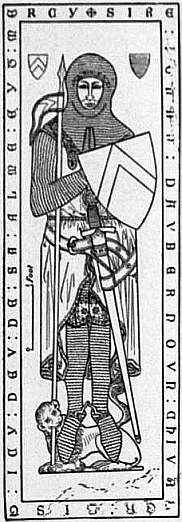
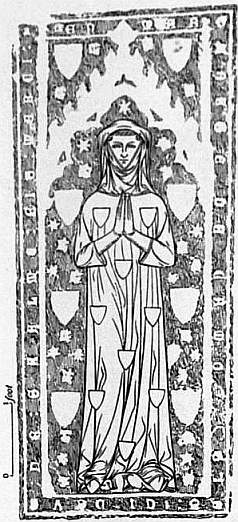
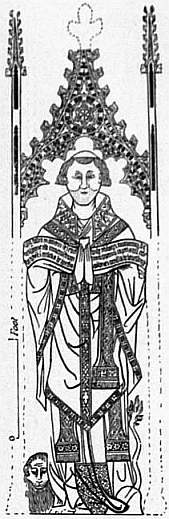
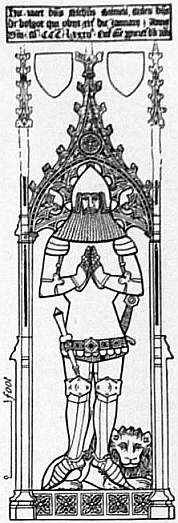
Fig. 1.—Sir John D’Abernon, 1277. Stoke D’Abernon Surrey. Fig. 2.—Margaret de Camoys. 1310. Trotton, Sussex. Fig. 3.—Henry de Grofhurst, c. 1330 Horsemonden, Kent. Fig. 4.—Sir Nicholas Burnell, 1382. Acton Burnell, Shropshire.
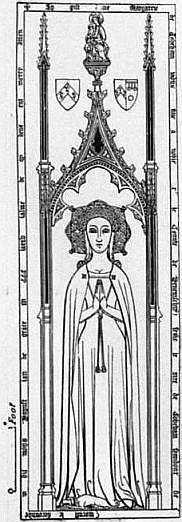
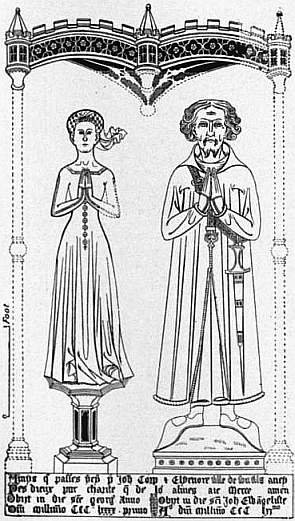
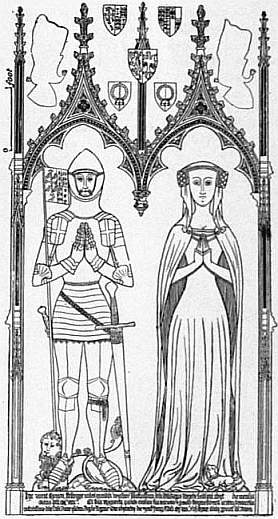
Fig. 5.—Margaret Lady Cobham, 1385. Cobham, Kent. Fig. 6.—Sir John Corp and Eleanor, his grand-daughter 1391, 1361. Stoke Fleming, Devonshire. Fig. 7.—Sir Symon de Felbrigge and Margaret his wife, 1400. Felbrigge, Norfolk.
Figs. 1 and 6 from Waller’s Monumental Brasses. Figs. 5 and 7 from Boutell’s Monumental Brasses. Figs. 2, 3, and 4 by permission of the Monumental Brass Society.
Plate II.
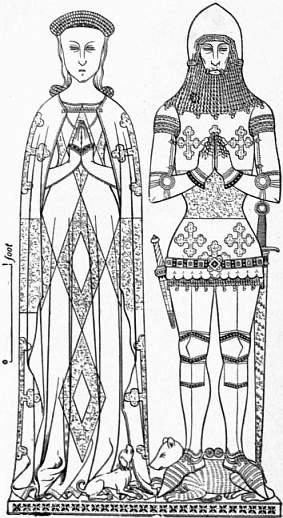
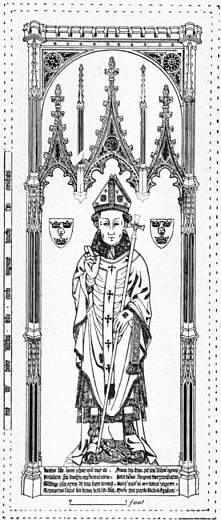
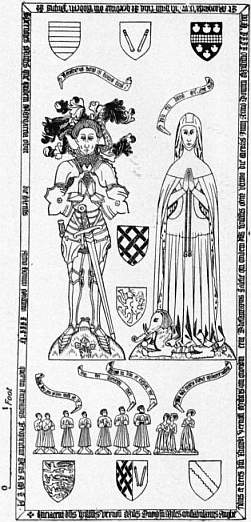
Fig. 1.—Thomas de Beauchamp, Earl of Warwick and Lady, 1406 and 1401. St. Mary’s Church, Warwick. Fig. 2.—Thomas Cranley, Archbishop of Dublin, 1417. New College, Oxford. Fig. 3.—Sir William Vernon and Lady, 1467. Tong Church, Shropshire.
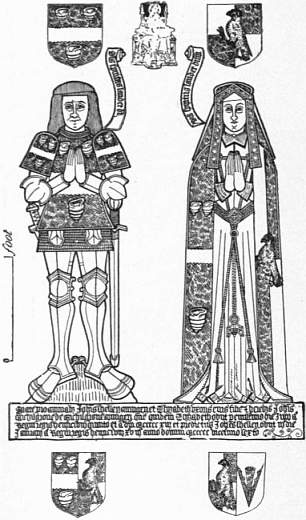
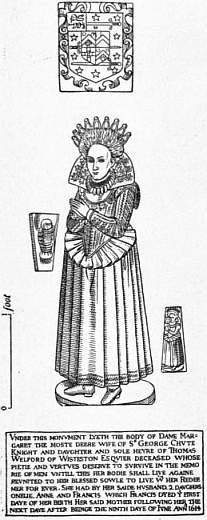
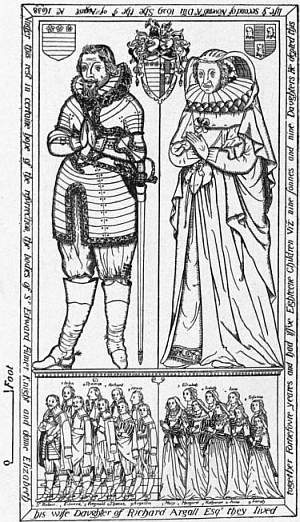
Fig. 4.—John Shelley, Esq., 1526, and his wife Elizabeth, 1513. Clapham, Sussex. Fig. 5.—Dame Margaret Chute, 1614. Mardon, Herefordshire. Fig. 6.—Sir Edward Filmer and Lady, 1638. East Sutton, Kent.
Figs. 1, 2, 3, and 6 from Waller’s Monumental Brasses. Figs. 4 and 5 by permission of the Monumental Brass Society.
Authorities.—(1) General: Manual for the Study of Monumental Brasses (Oxford, 1848); Boutell’s Monumental Brasses of England, engravings on wood, folio (London, 1849); Manual of Monumental Brasses, by H. Haines (2 vols. 8vo, 1861); Waller’s Series of Monumental Brasses in England (London and Oxford, Parkers, 1863); Monumental Brasses, by H.W. Macklin (8vo, 1890); The Brasses of England, by H.W. Macklin (8vo, London, 1907). (2) English Counties: Cotman’s Engravings of the most Remarkable of the Sepulchral Brasses of Norfolk (4to, London, 1813-1816); and second edition, with plates and notes by Meyrick, Albert Way and Sir Harris Nicholas (2 vols. folio, London, 1839); Illustrations of Monumental Brasses in Cambridge (4to, Camden Society, 1846); Monumental Brasses of Northamptonshire, by F. Hudson (folio, 1853); The Monumental Brasses of Wiltshire, by G. Kite (8vo, London, 1860); Architectural and Historical Notes of the Churches of Cambridgeshire, by A.C. Hill (8vo, 1880); Monumental Brasses of Cornwall, by E.H.W. Dunken (4to, London, 1882); Monumental Brasses of Worcestershire and Herefordshire, ed. by C.T. Davis (1884); Kentish Brasses, by W.D. Belcher (4to, London, 1888); List of Monumental Brasses in the County of Norfolk, by the Rev. E. Farrer (Norwich, 1890); The Monumental Brasses of Lancashire and Cheshire, by James Thornby (8vo, Hull, 1893); Monumental Brasses in the Bedfordshire Churches, by Grace Isherwood (8vo, London, 1906), a large collection of rubbings of special interest and value. (3) Foreign: Monumental Brasses and Incised Slabs in Belgium (8vo, 1849); Books of Facsimiles of Monumental Brasses of the Continent of Europe, folio (1884), by the Rev. W.F. Greeny.
BRASSEUR DE BOURBOURG, CHARLES ÉTIENNE (1814-1874), Belgian ethnographer, was born at Bourbourg, near Dunkirk, on the 8th of September 1814. He entered the Roman Catholic priesthood, was professor of ecclesiastical history in the Quebec seminary in 1845, vicar-general at Boston in 1846, and from 1848 to 1863 travelled as a missionary, chiefly in Mexico and Central America. He gave great attention to Mexican antiquities, published in 1857-1859 a history of Aztec civilization, and from 1861 to 1864 edited a collection of documents in the indigenous languages. In 1863 he announced the discovery of a key to Mexican hieroglyphic writing, but its value is very questionable. In 1864 he was archaeologist to the French military expedition in Mexico, and his Monuments anciens du Mexique was published by the French Government in 1866. Perhaps his greatest service was the publication in 1861 of a French translation of the Popol Vuh, a sacred book of the Quiché Indians, together with a Quiché grammar, and an essay on Central American mythology. In 1871 he brought out his Bibliothèque Mexico-Guatemalienne, and in 1869-1870 gave the principles of his decipherment of Indian picture-writing in his Manuscrit Troano, études sur le système graphique et la langue des Mayas. He died at Nice on the 8th of January 1874. His chief merit is his diligent collection of materials; his interpretations are generally fanciful.
BRASSEY, THOMAS (1805-1870), English railway contractor, was born at Buerton, near Chester, on the 7th of November 1805. His father, besides cultivating land of his own, held a large farm of the marquess of Westminster; his ancestors, according to family tradition, having been settled for several centuries at Bulkeley, near Malpas, Cheshire, before they went to Buerton in 1663. Thomas Brassey received an ordinary commercial education at a Chester school. At the age of sixteen he was apprenticed to a surveyor, and on the completion of his term became the partner of his master, eventually assuming the sole management of the business. In the local surveys to which he devoted his attention during his early years he acquired the knowledge and practical experience which were the necessary foundation of his great reputation. His first engagement as railway contractor was entered upon in 1835, when he undertook the execution of a portion of the Grand Junction railway, on the invitation of the distinguished engineer Joseph Locke, who soon afterwards entrusted him with the completion of the London and Southampton railway, a task which involved contracts to the amount of £4,000,000 sterling and the employment of a body of 3000 men. At the same time he was engaged on portions of several other lines in the north of England and in Scotland. In conjunction with his partner, W. Mackenzie, Brassey undertook, in 1840, the construction of the railway from Paris to Rouen, of which Locke was engineer. He subsequently carried out the extension of the same line. A few years later he was engaged with his partner on five other French lines, and on his own account on the same number of lines in England, Wales and Scotland. Brassey was now in control of an industrial army of 75,000 men, and the capital involved in his various contracts amounted to some £36,000,000. But his energy and capacity were equal to still larger tasks. He undertook in 1851 other works in England and Scotland; and in the following year he engaged in the construction of railways in Holland, Prussia, Spain and Italy. One of his largest undertakings was the Grand Trunk railway of Canada, 1100 m. in length, with its fine bridge over the St Lawrence. In this work he was associated with Sir M. Peto and E.L. Betts. In the following years divisions of his industrial army were found in almost every country in Europe, in India, in Australia and in South America. Besides actual railway works, he originated and maintained a great number of subordinate assistant establishments, coal and iron works, dockyards, &c., the direction of which alone would be sufficient to strain the energies of an ordinary mind. His profits were, of course, enormous, but prosperity did not intoxicate him; and when heavy losses came, as sometimes they did, he took them bravely and quietly. Among the greatest of his pecuniary disasters were those caused by the fall of the great Barentin viaduct on the Rouen and Havre railway, and by the failure of Peto and Betts. Brassey was one of the first to aim at improving the relations between engineers and contractors, by setting himself against the corrupt practices which were common. He resolutely resisted the “scamping” of work and the bribery of inspectors, and what he called the “smothering of the engineer”; and he did much in this way to bring about a better state of things. Large-hearted and generous to a rare degree, modest and simple in his taste and manners, he was conscious of his power as a leader in his calling, and knew how to use it wisely and for noble ends. Honours came to him unsought. The cross of the Legion of Honour was conferred on him. From Victor Emmanuel he received the cross of the Order of St Maurice and St Lazarus; and from the emperor of Austria the decoration of the Iron Crown, which it is said had not before been given to a foreigner. He died at St Leonards on the 8th of December 1870. His life and labours are commemorated in a volume by Sir Arthur Helps (1872).
He left three sons, of whom the eldest, Thomas (b. 1836), was knighted and afterwards (1886) created Baron Brassey. Lord Brassey, who was educated at Rugby and Oxford, entered parliament as a liberal in 1865, and devoted himself largely to naval affairs. He was civil lord of the admiralty (1880-1883), and secretary to the admiralty (1883-1885); and both before and after his elevation to the peerage did important work on naval and statistical inquiries for the government. In 1893-1805 he was president of the Institution of Naval Architects. In 1894 he was a lord-in-waiting, and from 1895 to 1900 was governor of Victoria. In 1908 he was appointed lord warden of the Cinque Ports. His voyages in his yacht “Sunbeam” from 1876 onwards, with his first wife (d. 1887), who published an interesting book on the subject, took him all over the world. Lord Brassey married a second time in 1890. Among other publications, his inauguration of the Naval Annual (1886 onwards), and his volumes on The British Navy, are the most important. His eldest son Thomas, who edited the Naval Annual (1890-1904), and unsuccessfully contested several parliamentary constituencies, was born in 1862.
BRASSÓ (Ger. Kronstadt; Rumanian, Braşov), a town of Hungary, in Transylvania, 206 m. S.E. of Kolozsvár by rail. Pop. (1900) 34,511. It is the capital of the comitat (county) of the same name, also known as Burzenland, a fertile country inhabited by an industrious population of Germans, Magyars and Rumanians. Brassó is beautifully situated on the slopes of the Transylvanian Alps, in a narrow valley, shut in by mountains, and presenting only one opening on the north-west towards the Burzen plain. The town is entirely dominated by the Zinne of Kapellenberg, a mountain rising 1276 ft. above the town (total altitude 3153 ft.), from which a beautiful view is obtained of the lofty mountains around and of the carefully cultivated plain of the Burzenland, dotted with tastefully built and well-kept villages. On the summit of the mountain is one of the numerous monuments erected in 1896 in different parts of the country to commemorate the thousandth anniversary of the foundation of the Hungarian state. It is known as Árpád’s Monument, and consists of a Doric column erected on a circular pedestal, which supports the bronze figure of a warrior from the time of Árpád.
Brassó consists of the inner town, which is the commercial centre, and the suburbs of Blumenau, Altstadt and Obere Vorstadt or Bolgárszeg, inhabited respectively by Germans, Magyars and Rumanians. To the east of the inner town rises the Schlossberg, crowned by the citadel, which was erected in 1553, and constitutes the principal remaining fragment of the old fortifications with which Brassó was encircled. The most interesting building in the town is the Protestant church, popularly called the Black Church, owing to its smoke-stained walls, caused by the great fire of 1689. This church, the finest in Transylvania, is a Gothic edifice with traces of Romanesque influence, and was built in 1385-1425. In the square in front of it is the statue of Johannes Honterus (1498-1549), “the apostle of Transylvania,” who was born in Brassó, and established here the first printing-press in Transylvania. In the principal square of the inner town stands the town hall, built in 1420 and restored in the 18th century, with a tower 190 ft. high. Brassó is the most important commercial and manufacturing town of Transylvania. Lying near the frontier of Rumania, with easy access through the Tömös pass, it developed from the earliest time an active trade with that country and with the whole of the Balkan states. Its chief industries are iron and copper works, wool-spinning, turkey-red dyeing, leather goods, paper, cement and petroleum refineries. The timber industry in all its branches, with a speciality for the manufacture of the wooden bottles largely used by the peasantry in Hungary and in the Balkan states, as well as the dairy industry, and ham-curing are also fully developed. A peculiarity of Brassó, which constitutes a survival of the old methods of trade with the Balkan states, is the number of money-changers who ply their trade at small movable tables in the market-place and in the open street. Brassó is the most populous town of Transylvania, and its population is composed in about equal numbers of Germans, Magyars and Rumanians. The town, especially on market days, presents an animated and picturesque aspect. Here are seen Germans, Szeklers, Magyars, Rumanians, Armenians and Gipsies, each of them wearing their distinctive national costume, and talking and bargaining in their own special idiom.
Amongst the places of interest round Brassó is the watering-place Zaizon, 15 m. to the east, with ferruginous and iodine waters; while about 17 m. to the south-west lies the pretty Rumanian village of Zernest, where in 1690 the Austrian general Heussler was defeated and taken prisoner by Imre (Emerich) Tököly, the usurper of the Transylvanian throne.
Brassó was founded by the Teutonic Order in 1211, and soon became a flourishing town. Through the activity of Honterus it played a leading part in the introduction of the Reformation in Transylvania in the 16th century. The town was almost completely destroyed by the big fire of 1689. During the revolution of 1848-1849 it was besieged by the Hungarians under General Bern from March to July 1849, and several engagements between the Austrian and the Hungarian troops took place in its neighbourhood.
BRATHWAIT, RICHARD (1588-1673), English poet, son of Thomas Brathwait, was born in 1588 at his father’s manor of Burneshead, near Kendal, Westmorland. He entered Oriel College, Oxford, in 1604, and remained there for some years, pursuing the study of poetry and Roman history. He removed to Cambridge to study law and afterwards to London to the Inns of Court. Thomas Brathwait died in 1610, and the son went down to live on the estate he inherited from his father. In 1617 he married Frances Lawson of Nesham, near Darlington. On the death of his elder brother, Sir Thomas Brathwait, in 1618, Richard became the head of the family, and an important personage in the county, being deputy-lieutenant and justice of the peace. In 1633 his wife died, and in 1639 he married again. His only son by this second marriage, Sir Stafford Brathwait, was killed in a sea-fight against the Algerian pirates. Richard Brathwait’s most famous work is Barnabae Itinerarium or Barnabees Journall [1638], by “Corymbaeus,” written in English and Latin rhyme. The title-page says it is written for the “travellers’ solace” and is to be chanted to the old tune of “Barnabe.” The story of “drunken Barnabee’s” four journeys to the north of England contains much amusing topographical information, and its gaiety is unflagging. Barnabee rarely visits a town or village without some notice of an excellent inn or a charming hostess, but he hardly deserves the epithet “drunken.” At Banbury he saw the Puritan who has become proverbial,
“Hanging of his cat on Monday For killing of a Mouse on Sunday.”
Brathwait’s identity with “Corymbaeus” was first established by Joseph Haslewood. In his later years he removed to Catterick, where he died on the 4th of May 1673. Among his other works are: The Golden Fleece (1611), with a second title-page announcing “sonnets and madrigals,” and a treatise on the Art of Poesy, which is not preserved; The Poets Willow; or the Passionate Shepheard (1614); The Prodigals Teares (1614); The Schollers Medley, or an intermixt Discourse upon Historicall and Poeticall relations (1614), known in later editions as a Survey of History (1638, &c.); a collection of epigrams and satires entitled A Strappado for the Divell (1615), with which was published incongruously Loves Labyrinth (edited, 1878, by J.W. Ebsworth); Natures Embassie; or, the wildemans measures; danced naked by twelve satyres (1621), thirty satires finding antique parallels for modern vices; with these are bound up The Shepheards Tales (1621), a collection of pastorals, one section of which was reprinted by Sir Egerton Brydges in 1815; two treatises on manners, The English Gentleman (1630) and The English Gentlewoman (1631); Anniversaries upon his Panarete (1634), a poem in memory of his wife; Essaies upon the Five Senses (1620); The Psalmes of David ... and other holy Prophets, paraphras’d in English (1638); A Comment upon Two Tales of ... Jeffray Chaucer (1665; edited for the Chaucer Soc. by C. Spurgeon, 1901). Thomas Hearne, on whose testimony (MS. collections for the year 1713, vol. 47, p. 127) the authorship of the Itinerarium chiefly rests, not inappropriately called him “the scribler of those times,” and the list just given of his works, published under various pseudonyms, is by no means complete.
A full bibliography is given in Joseph Haslewood’s edition of Barnabee’s Journall (ed. W.C. Hazlitt, 1876). See also J. Corser, Collectanea (Chetham Soc., 1860, &c.).
BRATIANU (or Bratiano), ION C. (1821-1891), Rumanian statesman, was born at Pitesci in Walachia on the 2nd of June 1821. He entered the Walachian army in 1838, and visited Paris in 1841 for purposes of study. Returning to Walachia, he took part, with his friend C.A. Rosetti and other prominent politicians, in the Rumanian rebellion of 1848, and acted as prefect of police in the provisional government formed in that year. The restoration of Russian and Turkish authority shortly afterwards drove him into exile. He took refuge in Paris, and endeavoured to influence French opinion in favour of the proposed union and autonomy of the Danubian principalities. In 1854, however, he was sentenced to a fine of £120 and three months’ imprisonment for sedition, and later confined in a lunatic asylum; but in 1856 he returned home with his brother, Dimitrie Bratianu, afterwards one of his foremost political opponents. During the reign of Prince Cuza (1859-1866), Bratianu figured prominently as one of the Liberal leaders. He assisted in 1866 in the deposition of Cuza and the election of Prince Charles of Hohenzollern, under whom he held several ministerial appointments during the next four years. He was arrested for complicity in the revolution of 1870, but soon released. In 1876, aided by C.A. Rosetti, he formed a Liberal cabinet, which remained in power until 1888. For an account of his work in connexion with the Russo-Turkish War of 1877, the Berlin congress, the establishment of the Rumanian kingdom, the revision of the constitution, and other reforms, see Rumania. After 1883 Bratianu acted as sole leader of the Liberals, owing to a quarrel with C.A. Rosetti, his friend and political ally for nearly forty years. His long tenure of office, without parallel in Rumanian history, rendered Bratianu extremely unpopular, and at its close his impeachment appeared inevitable. But any proceedings taken against the minister would have involved charges against the king, who was largely responsible for his policy; and the impeachment was averted by a vote of parliament in February 1890. Bratianu died on the 16th of May 1891. Besides being the leading statesman of Rumania during the critical years 1876-1888, he attained some eminence as a writer. His French political pamphlets, Mémoire sur l’empire d’Autriche dans la question d’Orient (1855), Réflexions sur la situation (1856), Mémoire sur la situation de la Moldavie depuis le traité de Paris (1857), and La Question religieuse en Roumanie (1866), were all published in Paris.
For his other writings and speeches see Din Scrierile şi cuvîntarile lui I.C. Bratianu, 1821-1891 (Bucharest, 1903, &c.), edited with a biographical introduction by D.A. Sturza. A brief anonymous biography, Ion C. Bratianu, appeared at Bucharest in 1893.
BRATLANDSDAL (i.e. Bratland valley), a gorge of southern Norway in Stavanger amt (county), formed by the Bratland river, a powerful torrent issuing into Lake Suldal. A remarkable road traverses the gorge by means of cuttings and a tunnel, and the scenery is among the most magnificent in Norway. It is usually approached from Stavanger by way of Sand and Lake Suldal, and the road divides above the gorge, branches running north to Odde and south-east through Telemarken. The junction of the roads is near Breifond, 13 m. above Naes at the mouth of the river, on the west shore of Lake Roldal, which is fed by the snowfield to the west, north and east, and is drained by the Bratland river.
BRATTISHING, or Brandishing (from the Fr. bretèche), in architecture, a sort of crest or ridge on a parapet, or species of embattlement. The term, however, is generally employed to describe the ranges of flowers which form the crests of so many parapets in the Tudor period.
BRATTLEBORO, a village of Windham county, Vermont, U.S.A., in a township (pop. 1910, 7541) of the same name, in the south-east part of the state, 60 m. N. of Springfield, Massachusetts, on the Connecticut river. Pop. (1890) 5467; (1900) 5297 (686 foreign-born); (1910) 6517. It is served by the Central Vermont and the Boston & Maine railways. Situated in a hilly, heavily wooded country, it is an attractive place, with a few houses dating from the 18th century. Among the manufactures are toys, furniture, overalls and organs, the Estey and the Carpenter organs being made there. First settled about 1753, Brattleboro took its name from one of the original patentees, William Brattle (1702-1776), a Massachusetts loyalist. It was incorporated ten years later.
See H. Burnham, Brattleboro (Brattleboro, 1880), and H.M. Burt, The Attractions of Brattleboro, Glimpses of Past and Present (Brattleboro, 1866).
BRAUNAU (Czech Broumov), a town of Bohemia, Austria, 139 m. E.N.E. of Prague by rail. Pop. (1900) 7622, chiefly German. The town is built on a rocky eminence on the right bank of the Steine. It has an imposing Benedictine abbey, once a castle, but converted into a religious house in 1322, when Ottakar I. gave the district to the Benedictines. Noteworthy also is the great church of Saints Wenceslaus and Adalbert, built between 1683 and 1733. This stands on the site where, in 1618, the Protestants attempted to build a church, the forcible prevention of which by Abbot Wolfgang Solander was the immediate cause of the protest of the Bohemian estates and the “defenestration” of the ministers Martinic and Slavata, which opened the Thirty Years’ War. After the battle of the White Hill, near Prague (1620), the town was deprived of all its privileges, which were, however, in great part restored nine years later. It is now a manufacturing centre (cloth, woollen and cotton stuffs, &c.) and has a considerable trade.
BRAUNSBERG, a town of Germany, in the kingdom of Prussia, 38 m. by rail S.W. of Königsberg, on the Passarge, 4 m. from its mouth in the Frisches Haff. Pop. (1900) 12,497. It possesses numerous Roman Catholic institutions, of which the most important is the Lyceum Hosianum (enjoying university rank), founded in 1564 by the cardinal bishop Stanislaus Hosius. Brewing, tanning, and the manufactures of soap, yeast, carriages and bricks are the most important industries of the town, which also carries on a certain amount of trade in corn, ship timber and yarn. The river is navigable for small vessels. The castle of Braunsberg was built by the Teutonic knights in 1241, and the town was founded ten years later. Destroyed by the Prussians in 1262, it was restored in 1279. The town, which was the seat of the bishops of Ermeland from 1255 to 1298, was granted the “law of Lübeck” by its bishop in 1284, and admitted to the Hanseatic League. After numerous vicissitudes it fell into the hands of the Poles in 1520, and in 1626 it was captured by Gustavus Adolphus. The Swedes kept possession till 1635. It fell to Prussia by the first partition of Poland in 1772.
BRAVO (Ital. for “brave”), the name for hired assassins such as were formerly common in Italy. The word had at first no evil meaning, but was applied to the retainers of the great noble houses, or to the cavalier-type of swashbucklers familiar in fiction. In later Italian history, especially in that of Venice, the bravi were desperate ruffians who for payment were ready to commit any crime, however foul.
BRAWLING (probably connected with Ger. brallen, to roar, shout), in law, the offence of quarrelling, or creating a disturbance in a church or churchyard. During the early stages of the Reformation in England religious controversy too often became converted into actual disturbance, and the ritual lawlessness of the parochial clergy very frequently provoked popular violence. To repress these disturbances an act was passed in 1551, by which it was enacted “that if any person shall, by words only, quarrel, chide or brawl in any church or churchyard, it shall be lawful for the ordinary of the place where the same shall be done and proved by two lawful witnesses, to suspend any person so offending, if he be a layman, from the entrance of the church, and if he be a clerk, from the ministration of his office, for so long as the said ordinary shall think meet, according to the fault.” An act of 1553 added the punishment of imprisonment until the party should repent. The act of 1551 was partly repealed in 1828 and wholly repealed as regards laymen by the Ecclesiastical Courts Jurisdiction Act 1860. Under that act, which applies to Ireland as well as to England, persons guilty of riotous, violent or indecent behaviour, in churches and chapels of the Church of England or Ireland, or in any chapel of any religious denomination, or in England in any place of religious worship duly certified, or in churchyards or burial-grounds, are liable on conviction before two justices to a penalty of not more than £5, or imprisonment for any term not exceeding two months. This enactment applies to clergy as well as to laity, and a clergyman of the Church of England convicted under it may also be dealt with under the Clergy Discipline Act of 1892 (Girt v. Fillingham, 1901, L.R. Prob. 176). When Mr J. Kensit during an ordination service in St Paul’s cathedral “objected” to one of the candidates for ordination, on grounds which did not constitute an impediment or notable crime within the meaning of the ordination service, he was held to have unlawfully disturbed the bishop of London in the conduct of the service, and to be liable to conviction under the act of 1860 (Kensit v. Dean and Chapter of St Paul’s, 1905, L.R. 2 K.B. 249). The public worship of Protestant Dissenters, Roman Catholics and Jews in England had before 1860 been protected by a series of statutes beginning with the Toleration Act of 1689, and ending with the Liberty of Religious Worship Act 1855. These enactments, though not repealed, are for practical purposes superseded by the summary remedy given by the act of 1860. In Scotland disturbance of public worship is punishable as a breach of the peace (Dougall v. Dykes, 1861, 4 Irvine 101).
In British possessions abroad interference with religious worship is usually dealt with by legislation, and not as a common-law offence. In India it is an offence voluntarily to cause disturbance to any assembly lawfully engaged in the performance of religious worship or religious ceremonies (Penal Code, s. 296). Under the Queensland Criminal Code of 1899 (s. 207) penalties are imposed on persons who wilfully and without lawful justification or excuse (the proof of which lies on them) disquiet or disturb any meeting of persons lawfully assembled for religious worship, or assault any forces lawfully officiating at such meeting, or any of the persons there assembled.
In the United States disturbance of religious worship is treated as an offence under the common law, which is in many states supplemented by legislation (see Bishop, Amer. Crim. Law, 8th ed. 1892, vol. i. s. 542, vol. ii. ss. 303-305; California Penal Code, s. 302; Revised Laws of Massachusetts, 1902, chap. 212, s. 30.).
BRAY, SIR REGINALD (d. 1503), British statesman and architect, was the second son of Sir Richard Bray, one of the privy council of Henry VI. Reginald was born in the parish of St John Bedwardine, near Worcester, but the date of his birth is uncertain. He was receiver-general and steward of the household to Sir Henry Stafford, second husband of Margaret, countess of Richmond, whose son afterwards became King Henry VII. The accession of the king Henry VII. favoured the fortunes of Reginald Bray, who was created a knight of the Bath at the coronation and afterwards a knight of the Garter. In the first year of Henry VII.’s reign he was given a grant of the constableship of Oakham Castle in Rutland, and was appointed joint chief justice with Lord Fitz Walter of all the forest south of Trent and chosen of the privy council. Subsequently he was made high treasurer and chancellor of the duchy of Lancaster. In October 1494 he became high steward of the university of Oxford, and he was a member of the parliament summoned in the 11th year of Henry VII’s reign. In June 1497 he was at the battle of Blackheath, and his services in repressing the Cornish rebels were rewarded with a gift of estates and the title of knight banneret. His taste and skill in architecture are attested by Henry VII.’s chapel at Westminster and St George’s chapel at Windsor. He directed the building of the former, and the finishing and decoration of the latter, to which, moreover, he was a liberal contributor, building at his own expense a chapel still called by his name and ornamented with his crest, the initial letters of his name, and a device representing the hemp-bray, an instrument used by hemp manufacturers. He died in 1503, before the Westminster chapel was completed, and was interred in St George’s chapel.
BRAY, THOMAS (1656-1730), English divine, was born at Marton, Shropshire, in 1656, and educated at All Souls’ College, Oxford. After leaving the university he was appointed vicar of Over-Whitacre, and rector of Sheldon in Warwickshire, where he wrote his famous Catechetical Lectures. Henry Compton, bishop of London, appointed him in 1696 as his commissary to organize the Anglican church in Maryland, and he was in that colony in 1699-1700. He took a great interest in colonial missions, especially among the American Indians, and it is to his exertions that the Society for the Propagation of the Gospel owes its existence. He also projected a successful scheme for establishing parish libraries in England and America, out of which grew the Society for Promoting Christian Knowledge. From 1706 till his death in February 1730 he was rector of St Botolph-Without, Aldgate, London, being unceasingly engaged in philanthropic and literary pursuits.
BRAY, a village in the Wokingham parliamentary division of Berkshire, England, beautifully situated on the west (right) bank of the Thames, 1 m. S. of Maidenhead Bridge. Pop. (1901) 2978. There are numerous riverside residences in the locality. The church of St Michael has portions of various dates from the Early English period onward, and is much restored. It contains a number of brasses of the 14th, 15th, 16th and 17th centuries. A well-known ballad, “The Vicar of Bray,” tells how a vicar held his position by easy conversions of faith according to necessity, from the days of Charles II. until the accession of George I. and the foundation of “the illustrious house of Hanover” (1714). One Francis Carswell, who is buried in the church, was vicar for forty-two years, approximately during this period, dying in 1709; but the legend is earlier, and the name of the vicar who gave rise to it is not certainly known. That of Simon Aleyn, who held the office from c. 1540 to 1588, is generally accepted, as, in the reigns of Henry VIII., Edward VI., Mary and Elizabeth, he is said to have been successively Papist, Protestant, Papist and Protestant. The name of Simon Simonds is also given on the authority of the vicar of the parish in 1745; Simonds died a canon of Windsor in 1551, but had been vicar of Bray. Tradition ascribes the song to a soldier in Colonel Fuller’s troop of dragoons in the reign of George I.
BRAY, a seaport and watering-place of Co. Wicklow, Ireland, 12 m. S.S.E. of Dublin on the Dublin & South-Eastern railway, situated on both sides of the river Bray. Pop. of urban district (1901) 7424. For parliamentary purposes it is divided between the eastern division of county Wicklow and the southern of county Dublin. A harbour was constructed by the urban district council (the harbour authority) which accommodates ships of 400 tons. There is some industry in brewing, milling and fishing, but the town, which is known as the “Irish Brighton,” is almost wholly dependent for its prosperity on visitors from Dublin and elsewhere. It therefore possesses all the equipments of a modern seaside resort; there is a fine sea-wall with esplanade upwards of a mile in length; the bathing is good, and race meetings are held. The town is rapidly increasing in size. The coast, especially towards the promontory of Bray Head, offers beautiful sea-views, and some of the best inland scenery in the county is readily accessible, such as the Glens of the Dargle and the Downs, the demesne of Powerscourt, the Bray river, with its loughs, and the pass of the Scalp. The demesne of Kilruddery, the seat of the earls of Meath, is specially beautiful. About 1170 Bray was bestowed by Richard de Clare or Strongbow, earl of Pembroke and Strigul, on Walter de Reddesford, who took the title of baron of Bray, and built a castle.
BRAYLEY, EDWARD WEDLAKE (1773-1854), English antiquary and topographer, was born at Lambeth, London, in 1773. He was apprenticed to the enamelling trade, but early developed literary tastes. He formed a close friendship with John Britton, which lasted for sixty-five years. They entered into a literary partnership, and after some small successes at song and play writing they became joint editors of The Beauties of England and Wales, themselves writing many of the volumes. Long after he had become famous as a topographer, Brayley continued his enamel work. In 1823 he was elected a fellow of the Society of Antiquaries. He died in London on the 23rd of September 1854. His other works include Sir Reginalde or the Black Tower (1803); Views in Suffolk, Norfolk and Northamptonshire, illustrative of works of Robt. Bloowifield (1806); Lambeth Palace (1806); The History of the Abbey Church of Westminster (2 vols., 1818); Topographical Sketches of Brighthelmstone (1825); Historical and Descriptive Accounts of Theatres of London (1826); Londiniana (1829); History of Surrey (5 vols., 1841-1848).
BRAZIER (from the Fr. brasier, which comes from braise, hot charcoal), a metal receptacle for holding burning coals or charcoal, much used in southern Europe and the East for warming rooms. Braziers are often elegant in form, and highly artistic in ornamentation, with chased or embossed feet and decorated exteriors.
BRAZIL, or Brasil, a legendary island in the Atlantic Ocean. The name connects itself with the red dye-woods so called in the middle ages, possibly also applied to other vegetable dyes, and so descending from the Insulae Purpurariae of Pliny. It first appears as the I. de Brazi in the Venetian map of Andrea Bianco (1436), where it is found attached to one of the larger islands of the Azores. When this group became better known and was colonized, the island in question was renamed Terceira. It is probable that the familiar existence of “Brazil” as a geographical name led to its bestowal upon the vast region of South America, which was found to supply dye-woods kindred to those which the name properly denoted. The older memory survived also, and the Island of Brazil retained its place in mid-ocean, some hundred miles to the west of Ireland, both in the traditions of the forecastle and in charts. In J. Purdy’s General Chart of the Atlantic, “corrected to 1830,” the “Brazil Rock (high)” is marked with no indication of doubt, in 51° 10′ N. and 15° 50′ W. In a chart of currents by A.G. Findlay, dated 1853, these names appear again. But in his 12th edition of Purdy’s Memoir Descriptive and Explanatory of the N. Atlantic Ocean (1865), the existence of Brazil and some other legendary islands is briefly discussed and rejected. (See also Atlantis.)
BRAZIL, a republic of South America, the largest political division of that continent and the third largest of the western hemisphere. It is larger than the continental United States excluding Alaska, and slightly larger than the great bulk of Europe lying east of France. Its extreme dimensions are 2629 m. from Cape Orange (4° 21′ N.) almost due south to the river Chuy (33° 45′ S. lat.), and 2691 m. from Olinda (Ponta de Pedra, 8° 0′ 57″ S., 34° 50′ W.) due west to the Peruvian frontier (about 73° 50′ W.). The most northerly point, the Serra Roraima on the Venezuela and British Guiana frontier (5° 10′ N.), is 56 m. farther north than Cape Orange. The area, which was augmented by more than 60,000 sq. m. in 1903 and diminished slightly in the boundary adjustment with British Guiana (1904), is estimated to have been 3,228,452 sq. m. in 1900 (A. Supan, Die Bevölkerung der Erde, Gotha, 1904). A subsequent planimetric calculation, which takes into account these territorial changes, increases the area to 3,270,000 sq. m.
Boundaries.—Brazil is bounded N. by Colombia, Venezuela and the Guianas, N.E., E. and S.E. by the Atlantic, S. by Uruguay, Paraguay and Bolivia, and W. by Argentina, Paraguay, Bolivia, Peru, Ecuador and Colombia. Its territory touches that of every South American nation, except Chile, and with each one there has been a boundary dispute at some stage in its political life. The Spanish and Portuguese crowns attempted to define the limits between their American colonies in 1750 and 1777, and the lines adopted still serve in great part to separate Brazil from its neighbours. Lack of information regarding the geographical features of the interior, however, led to some indefinite descriptions, and these have been fruitful sources of dispute ever since. The Portuguese were persistent trespassers in early colonial times, and their land-hunger took them far beyond the limits fixed by Pope Alexander VI. In the boundary disputes which have followed, Brazil seems to have pursued this traditional policy, and generally with success.
Beginning at the mouth of the Arroyo del Chuy, at the southern extremity of a long sandbank separating Lake Mirim from the Atlantic (33°45′ S. lat.), the boundary line between Brazil and Uruguay passes up that rivulet and across to the most southerly tributary of Lake Mirim, thence down the western shore of that lake to the Jaguarão and up that river to its most southerly source. The line then crosses to the hill-range called Cuchilla de Sant’ Anna, which is followed in a north-west direction to the source of the Cuareim, or Quarahy, this river becoming the boundary down to the Uruguay. This line was fixed by the treaty of 1851, by which the control of Lake Mirim remains with Brazil. Beginning at the mouth of the Quarahy, the boundary line between Brazil and Argentina ascends the Uruguay, crosses to the source of the Santo Antonio, and descends that small stream and the Iguassú to the Paraná, where it terminates. This line was defined by the treaty of 1857, and by the decision of President Cleveland in 1895 with regard to the small section between the Uruguay and Iguassú rivers. The boundary with Paraguay was definitely settled in 1872. It ascends the Paraná to the great falls of Guayrá, or Sete Quedas, and thence westward along the water-parting of the Sierra de Maracayú to the cerro of that name, thence northerly along the Sierra d’Amambay to the source of the Estrella, a small tributary of the Apá, and thence down those two streams to the Paraguay. From this point the line ascends the Paraguay to the mouth of the Rio Negro, the outlet of the Bahia Negra, where the Bolivian boundary begins. As regards the Peruvian boundary, an agreement was reached in 1904 to submit the dispute to the arbitration of the president of Argentina in case further efforts to reach an amicable settlement failed. The provisional line, representing the Brazilian claim, begins at the termination of the Bolivian section (the intersection of the 11th parallel with the meridian of 72° 26′ W. approx.) and follows a semicircular direction north-west and north to the source of the Javary (or Yavary), to include the basins of the Purús and Juruá within Brazilian jurisdiction. The line follows the Javary to its junction with the Amazon, and runs thence north by east direct to the mouth of the Apaporis, a tributary of the Yapurá, in about 1° 30′ S. lat., 69° 20′ W. long., where the Peruvian section ends. The whole of this line, however, was subject to future adjustments, Peru claiming all that part of the Amazon valley extending eastward to the Madeira and lying between the Beni and the east and west boundary line agreed upon by Spain and Portugal in 1750 and 1777, which is near the 7th parallel. With regard to the section between the Amazon and the Apaporis river, already settled between Brazil and Peru, the territory has been in protracted dispute between Peru, Ecuador and Colombia; but a treaty of limits between Brazil and Ecuador was signed in 1901 and promulgated in 1905. The boundary with Colombia, fixed by treaty of April 24, 1907, follows the lower rim of the Amazon basin, as defined by Brazil. The Colombian claim included the left bank of the Amazon eastward to the Auahy or Avahy-paraná channel between the Amazon and Yapurá, whence the line ran northward to the Negro near the intersection of the 66th meridian. The Brazilian line ran north and north-west from the mouth of the Apaporis to the 70th meridian, which was followed to the water-parting south of the Uaupés basin, thence north-east to the Uaupés river, which was crossed close to the 69th meridian, thence easterly along the Serra Tunaji and Isana river to Cuyari, thence northerly up the Cuyari and one of its small tributaries to the Serra Capparro, and thence east and south-east along this range to the Cucuhy rock (Pedra de Cucuhy) on the left bank of the Negro, where the Colombian section ends. Negotiations for the settlement of this controversy, which involved fully one-third of the state of Amazonas, were broken off in 1870, but were resumed in 1905. The boundary with Venezuela, which was defined by a treaty of 1859, runs south-eastward from Cucuhy across a level country intersected by rivers and channels tributary to both the Negro and Orinoco, to the Serra Cupuy watershed which separates the rivers of the Amazon and Orinoco valleys. This watershed includes the ranges running eastward and northward under the names of Imeri, Tapiira-peco, Curupira, Parima and Pacaraima, the Venezuelan section terminating at Mt. Roraima. On the 9th of December 1905 protocols were signed at Caracas accepting the line between Cucuhy and the Serra Cupuy located in 1880, and referring the remainder, which had been located by a Brazilian commission in 1882 and 1884, to a mixed commission for verification.