VOLUME IV SLICE IV Bradford, William to Brequigny, Louis (continued 11)
Reading edition
3. Upright-Wall Breakwaters.—The third type of breakwater consists of a solid structure founded directly on the sea-bottom, in the form of an upright wall, with only a moderate batter on each face. This form of breakwater is strictly limited to sites where the bed of the sea consists of rock, chalk, boulders, or other hard bottom not subject to erosion by scour, and where the depth does not exceed about 40 to 50 ft. If a solid breakwater were erected on a soft yielding bottom, it would be exposed to dislocation from irregular settlement; and such a structure, by obstructing or diverting the existing currents, tends to create a scour along its base; whilst the waves in recoiling from its sea face are very liable to produce erosion of the sea-bottom along its outer toe. Moreover, when the foundations for an upright-wall breakwater have to be levelled by divers, and the blocks laid under water by their help, the extension of such a breakwater into a considerable depth is undesirable on account of the increased pressure imposed upon diving operations.
The Admiralty pier at Dover was begun about the middle of the 19th century, and furnishes an early and notable example of an upright-wall breakwater resting upon a hard chalk bottom; and it was subsequently extended to a depth of about 42 ft. at low tide, in connexion with the works for forming a closed naval harbour at Dover. This breakwater, the Prince of Wales pier of the commercial harbour, and the eastern breakwater and detached south breakwater for the naval harbour, were all founded on a levelled bottom, carried down to the hard chalk underlying the surface layer, by means of men in diving-bells. The extension of the Admiralty pier and the other breakwaters of Dover harbour consist of bonded courses of concrete blocks, from 26 to 40 tons in weight, as shown in figs. 13 and 14, the outer blocks above low water being formed on their exposed side with a facing of granite rubble. The blocks, composed of six parts of sand and stones to one part of Portland cement, moulded in frames, and left to set thoroughly in the block-yard before being used, are all joggled together, and above low-water level are bedded in cement and the joints filled with cement grout. The blocks were laid by Goliath travelling cranes running on temporary staging supported at intervals of 50¼ ft. by clusters of iron piles carried down into the chalk bottom. On each line of staging there were four Goliaths, preceded by a stage-erecting machine. The front Goliath was used for working a grab for excavating the surface layer of chalk, which was finally levelled by divers, the second for carrying the diving-bell, the third for laying the blocks below low water, and the fourth for setting the blocks above low water. This succession of Goliaths enabled more rapid progress to be made than with a single Titan at the end of a breakwater; but it involved a considerable increase in the cost of the plant, owing to the temporary staging required. The foundations were carried down from 4 to 6 ft. into the chalk bottom, the deepest being 53 ft. below low water of spring tides, and the average 47 ft. With a rise of tide at springs of 18¾ ft., the average depth is thus approximately 66 ft. at high tide, necessitating a pressure of 29 ℔ on the square inch, which is the limit at which men can work without inconvenience in the diving-bells. The breakwaters are raised about 11 ft. above high water of springs. The detached southern breakwater was finished off at this level; but the extended western breakwater, or Admiralty pier, is provided with a promenade parapet on its exposed side, rising 13 ft. above the quay; and the eastern breakwater also has a parapet on its exposed eastern side, raised, however, only 9 ft. above its quay. The breakwaters are protected from scour along their outer toe by an apron of concrete blocks, extending 25 ft. out from their sea face.
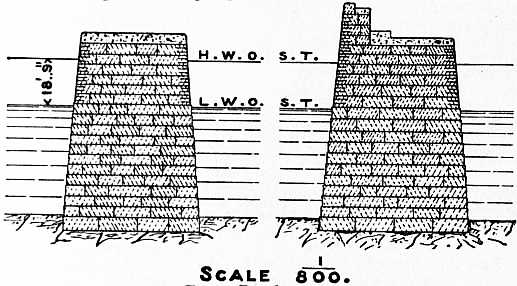
Dover Breakwater.
Fig. 13. South Breakwater. Fig. 14. Admiralty Pier Extension.
The levelling of the foundations for laying the courses of an upright-wall breakwater is costly and tedious, even in chalk; and the expense and delay are considerably enhanced where the bottom is hard rock. Accordingly, in constructing Concrete-bag foundations. two breakwaters at the entrance to Aberdeen harbour on a bottom of granite in 1870-1877, concrete bags were laid on the sea-bed; and these bags, by adapting themselves to the rocky irregularities, obviated levelling the bottom. They formed the foundation for the concrete blocks in the south breakwater; and by the deposit of successive layers of 50-ton concrete bags till they rose above low water, they constituted the whole of the submerged portion of the north breakwater. The 50-ton bags were deposited from hopper barges towed out to the site; and the portions of both breakwaters above low water were carried up with mass concrete. Subsequently, the breakwater at Newhaven was constructed on a foundation of chalk, with lop-ton concrete bags up to low water, and mass concrete above. Still later, the two breakwaters sheltering the approach to the river Wear (see Harbour) and the Sunderland docks were built with a foundation mound of concrete in bags, 56 to 116 tons in weight, on the uneven sea-bottom, raised slightly above low water of spring tides, on which a solid upright wall was erected, formed of concrete blocks on each side faced with granite, filled in the centre and capped on the top with mass concrete. The most exposed northern Roker breakwater, raised about 11 ft. above high water of springs where the rise is 14 ft. 5 in., is devoid of a parapet; but a subway formed near the top in each breakwater gives access to the light on the pierhead in stormy weather (fig. 15). These concrete bags are made by lining the hopper of the barge with jute canvas, which receives the concrete and is sewn up to form a bag whilst the barge is being towed to the site. The concrete is thus deposited unset, and readily accommodates itself to the irregularities of the bottom or of the mound of bags; and sufficient liquid grout oozes out of the canvas when the bag is compressed, to unite the bags into a solid mass, so that with the mass concrete on the top, the breakwater forms a monolith. This system has been extended to the portion of the superstructure of the eastern, little-exposed breakwater of Bilbao harbour below low water, where the rubble mound is of moderate height; but this application of the system appears less satisfactory, as settlement of the superstructure on the mound would produce cracks in the set concrete in the bags.
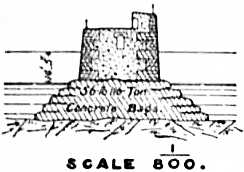
Fig. 15.—Sunderland Southern Breakwater.
Foundation blocks of 2500 to 3000 tons have been deposited for raising the walls on each side of the wide portion of the Zeebrugge breakwater (fig. 16) from the sea-bottom to above low water, and also 4400-ton Foundations with large blocks. blocks along the narrow outer portion (see Harbour), by building iron caissons, open at the top, in the dry bed of the Bruges ship-canal, lining them with concrete, and after the canal was filled with water, floating them out one by one in calm weather, sinking them in position by admitting water, and then filling them with concrete under water from closed skips which open at the bottom directly they begin to be raised. The firm sea-bed is levelled by small rubble for receiving the large blocks, whose outer toe is protected from undermining by a layer of big blocks of stone extending out for a width of 50 ft.; and then the breakwater walls are raised above high water by 55-ton concrete blocks, set in cement at low tide; and the upper portions are completed by concrete-in-mass within framing.
Sometimes funds are not available for a large plant; and in such cases small upright-wall breakwaters may be constructed in a moderate depth of water on a hard bottom of rock, chalk or boulders, by erecting timber framing in suitable Concrete monoliths. lengths, lining it inside with jute cloth, and then depositing concrete below low water in closed hopper skips lowered to the bottom before releasing the concrete, which must be effected with great care to avoid allowing the concrete to fall through the water. The portion of the breakwater above low water is then raised by tide-work with mass concrete within frames, in which large blocks of stone may be bedded, provided they do not touch one another and are kept away from the face, which should be formed with concrete containing a larger proportion of cement. As long continuous lengths of concrete crack across under variations in temperature, it is advisable to form fine straight divisions across the upper part of a concrete breakwater in construction, as substitutes for irregular cracks.
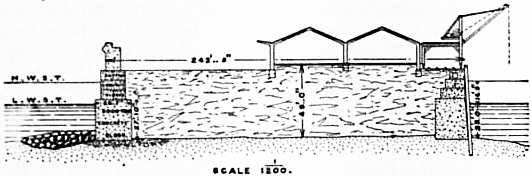
Fig. 16.—Zeebrugge Harbour Breakwater with Quay.
Upright-wall breakwaters should not be formed with two narrow walls and intermediate filling, as the safety of such a breakwater depends entirely on the sea-wall being maintained intact. A warning of the danger of this system of construction, combined with a high parapet, was furnished by the south breakwater of Newcastle harbour in Dundrum Bay, Ireland, which was breached by a storm in 1868, and eventually almost wholly destroyed; whilst its ruins for many years filled up the harbour which it had been erected to protect. In designing its reconstruction in 1897, it was found possible to provide a solid upright wall of suitable strength with the materials scattered over the harbour, together with an extension needed for providing proper protection at the entrance. This work was completed in 1906.
Upright-wall breakwaters and superstructures are generally made of the same thickness throughout, irrespective of the differences in depth and exposure which are often met with in different parts of the same breakwater. This may be accounted for by the general custom of regarding the top of an upright wall or superstructure as a quay, which should naturally be given a uniform width; and this view has also led to the very general practice of sheltering the top of these structures with a parapet. Generally the width is proportioned to the most exposed part, so that the only result is an excess of expenditure in the inner portion to secure uniformity. When, however, as at Madras, the width of the structure is reduced to a minimum, the action of the sea demonstrates that the strength of the structure must be proportioned to the depth and exposure. In small fishery piers, where great economy is essential to obtain the maximum shelter at limited expense, it appears expedient to make the width of the breakwater proportionate to the depth. This was done in Babbacombe Bay; and in reconstructing the southern breakwater at Newcastle, Ireland, advantage was taken of a change in direction of the outer half to introduce an addition to the width, so as to make the strength of the breakwater proportionate to the increase in depth and exposure. In large structures, however, uniformity of design may be desirable for each straight length of breakwater; though where two or more breakwaters or outer arms enclose a harbour, the design should obviously be modified to suit the depth and exposure. At Colombo harbour, the superstructure of the less exposed north-west breakwater has been made slightly narrower than that of the south-west breakwater; and a simple rubble mound shelters the harbour from the moderate north-east monsoon. In special cases, where a breakwater has to serve as a quay, like the Admiralty pier at Dover, a high parapet wall is essential; but in most cases, where a parapet merely enables the breakwater to be more readily accessible in moderate weather, it would be advisable to keep it very low, or to dispense with it altogether, as at the southern Dover breakwater, the northern breakwater at Sunderland, and the Colombo western breakwaters. This course is particularly expedient in very exposed sites, as a high parapet intensifies the shock of the waves against a breakwater and their erosive recoil. Moreover, when a light has to be attended to at the end of a breakwater, sheltered access can be provided by a subway, as at Sunderland.
Structures in the sea almost always require works of maintenance; and when a severe storm has caused any injury, it is most important to carry out the repairs at the earliest available moment, as the waves rapidly enlarge any holes that they may have formed in weak places.
(L. F. V.-H.)
BRÉAL, MICHEL JULES ALFRED (1832- ), French philologist, was born on the 26th of March 1832, at Landau in Rhenish Bavaria, of French parents. After studying at Weissenburg, Metz and Paris, he entered the École Normale in 1852. In 1857 he went to Berlin, where he studied Sanskrit under Bopp and Weber. On his return to France he obtained an appointment in the department of oriental MSS. at the Bibliothèque Impériale. In 1864 he became professor of comparative grammar at the Collège de France, in 1875 member of the Académie des Inscriptions et Belles-lettres, in 1879 inspecteur-général of public instruction for higher schools until the abolition of the office in 1888. In 1890 he was made commander of the Legion of Honour. Among his works, which deal mainly with mythological and philological subjects, may be mentioned: L’Étude des origines de la religion Zoroastrienne (1862), for which a prize was awarded him by the Académie des Inscriptions; Hercule et Cacus (1863), in which he disputes the principles of the symbolic school in the interpretation of myths; Le Mythe d’Oedipe (1864); Les Tables Eugubines (1875); Mélanges de mythologie et de linguistique (2nd. ed., 1882); Leçons de mots (1882,1886), Dictionnaire étymologique latin (1885) and Grammaire latine (1890). His Essai de Sémantique (1897), on the signification of words, has been translated into English by Mrs H. Cust with preface by J.P. Postgate. His translation of Bopp’s Comparative Grammar (1866-1874), with introductions, is highly valued. He has also written pamphlets on education in France, the teaching of ancient languages, and the reform of French orthography. In 1906 he published Pour mieux connaître Homère.
BREAM (Abramis), a fish of the Cyprinid family, characterized by a deep, strongly compressed body, with short dorsal and long anal fins, the latter with more than sixteen branched rays, and the small inferior mouth. There are two species in the British Isles, the common bream, A. brama, reaching a length of 2 ft. and a weight of 12 ℔, and the white bream or bream flat, A. blicca, a smaller and, in most places, rarer species. Both occur in slow-running rivers, canals, ponds and reservoirs. Bream are usually despised for the table in England, but fish from large lakes, if well prepared, are by no means deserving of ostracism. In the days of medieval abbeys, when the provident Cistercian monks attached great importance to pond culture, they gave the first place to the tench and bream, the carp still being unknown in the greater part of Europe. At the present day, the poorer Jews in large English cities make a great consumption of bream—and other Cyprinids, most of them being imported alive from Holland and sold in the Jewish fish markets. In America the name bream is commonly given to the golden shiner minnow (Abramis chrysoleucus), to the pumpkin-seed sunfish (Eupomotis gibbosus), and to some kinds of porgy (Sparidae).
BREAST (a word common to Teutonic languages, of the Ger. Brust, possibly connected with an O. Sax. brustian, to bud), the term properly confined to the external projecting parts of the thorax in females, which contain the mammary glands (for anatomy, and diseases, see Mammary Gland); more generally it is used of the external part of the thorax in animals, including man, lying between the neck and the abdomen.
BREAUTÉ, FALKES DE (d. 1226), one of the foreign mercenaries of King John of England, from whom he received in marriage the heiress of the earldom of Devon. On the outbreak of the Barons’ War (1215) the king gave him the sheriffdoms of six midland shires and the custody of many castles. He fulfilled his military duties with as much skill as cruelty. The royalists owed to his daring the decisive victory of Lincoln (1217). But after the death of William Marshal, earl of Pembroke, Falkes joined the feudal opposition in conspiring against Hubert de Burgh. Deprived in 1223 of most of his honours, he was drawn into a rebellion by the imprudence of his brother, who captured a royal justice and threw him into prison (1224). Falkes was allowed to go into exile after his submission, and endeavoured to obtain a pardon through the mediation of Pope Honorius III. But this was refused, and Falkes died at St Cyriac in 1226.
See Shirley, Royal Letters, vol. i.; the Patent and Close Rolls; Pauli, Geschichte von England, vol. i. pp. 540-545.
(H. W. C. D.)
BRECCIA, in petrology, the name given to rocks consisting of angular fragments embedded in a matrix. They may be composed of volcanic rocks, limestones, siliceous charts, sandstones, in fact of any kind of material, and the matrix, which usually corresponds to some extent to the fragments it encloses, may be siliceous, calcareous, argillaceous, &c. The distinctive character of the group is the sharp-edged and unworn shapes of the fragments; in conglomerates the pebbles are rounded and water-worn, having been transported by waves and currents from some distance. There are many ways in which breccias may originate. Some are formed by ordinary processes of atmospheric erosion; frost, rain and gravity break up exposed surfaces of rock and detach pieces of all sizes; in this way screes are formed at the bases of cliffs, and barren mountain-tops are covered with broken debris. If such accumulations gather and are changed into hard rock by pressure and other indurating agencies they make typical breccias. Conglomerates often pass into rocks of this type, the difference being merely that the fragments are of purely local origin, and are unworn because they have not been transported. In caves breccias of limestone are produced by the collapse of part of the roof, covering the floor with broken masses. Coral reefs often contain extensive areas of limestone breccia, formed of detached pieces of rock which have been dislodged from the surface and have been carried down the steep external slopes of the reef. Volcanic breccias are very common near active or extinct craters, as sudden outbursts of steam bear fragments from the older rocks and scatter them over the ground.
Another group of breccias is due to crushing; these are produced in fissures, faults and veins, below the surface, and maybe described as “crush-breccias” and “friction-breccias.” Very important and well-known examples of this class occur as veinstones, which may be metalliferous or not. A fissure is formed, probably by slight crustal movements, and is subsequently filled with material deposited from solution (quartz, calcite, barytes, &c.). Very often displacement of the walls again takes place, and the infilling or “veinstone” is torn apart and brecciated. It may then be cemented together by a further introduction of mineral matter, which may be the same as that first deposited or quite different. In important veins this process is often repeated several times: detached pieces of the country rock are mingled with the shattered veinstone, and generally experience alteration by the percolating mineral solutions. Other crush-breccias occurring on a much larger scale are due to the folding of strata which have unequal plasticities. If, for example, shales and sandstones are bent into a series of arches, the sandstones being harder and more resistant will tend to crack, while the shales, which are soft and flow under great pressures, are injected into the crevices and separate the broken pieces from one another. Continued movement will give the brecciated fragments of sandstone a rounded form by rubbing them against one another, and, in this way, a crush-conglomerate is produced. Great masses of limestone in the Alps, Scottish Highlands, and all regions of intense folding are thus converted into breccias. Cherts frequently also show this structure; igneous rocks less commonly do so; but it is perhaps most common where there have been thin bedded alternations of rocks of different character, such as limestone and dolerite, limestone and quartzite, shale or phyllite and sandstone. Fault-breccias closely resemble vein-breccias, except that usually their fragments consist principally of the rocks which adjoin the fault and not of mineral deposits introduced in solution; but many veins occupy faults, and hence no hard and fast line can be drawn between these types of breccia.
A third group of breccias is due to movement in a partly consolidated igneous rock, and may be called “fluxion-breccias.” Lava streams, especially when they consist of rhyolite, dacite and some kinds of andesite, may rapidly solidify, and then become exceedingly brittle. If any part of the mass is still liquid, it may break up the solid crust by pressure from within and the angular fragments are enveloped by the fluid lava. When the whole comes to rest and cools, it forms a typical “volcanic-fluxion-breccia.” The same phenomena are sometimes exemplified in intrusive sills and sheets. The fissures which are occupied by igneous dikes may be the seat of repeated injections following one another at longer or shorter intervals; and the latter may shatter the earlier dike rocks, catching up the fragments. Among the older formations, especially when decomposition has gone on extensively, these fluxion and injection-breccias are often very hard to distinguish from the commoner volcanic-breccias and ash-beds, which have been produced by weathering, or by the explosive power of superheated steam.
(J. S. F.)
BRECHIN, a royal, municipal and police burgh of Forfarshire, Scotland. Pop. (1901) 8941. It lies on the left bank of the South Esk, 7¾ m. west of Montrose, and has a station on the loop line of the Caledonian railway from Forfar to Bridge of Dun. Brechin is a prosperous town, of great antiquity, having been the site of a Culdee abbey. The Danes are said to have burned the town in 1012. David I. erected it into a bishopric in 1150, and it is still a see of the Episcopal Church of Scotland. In 1452 the earl of Huntly crushed the insurrection led by the earl of Crawford at the battle of Brechin Muir, and in 1645 the town and castle were harried by the marquis of Montrose. James VI. gave a grant for founding a hospital in the burgh, which yet supplies the council with funds for charity. No trace remains of the old walls and gates of the town, but the river is crossed by a two-arched stone bridge of very early date. The cathedral church of the Holy Trinity belongs to the 13th century. It is in the Pointed style, but suffered maltreatment in 1806 at the hands of restorers, whose work, however, disappeared during the restoration completed in 1902. The western gable with its flamboyant window and Gothic door and the massive square tower are all that is left of the original edifice. The modern stained glass in the chancel is reckoned amongst the finest in Scotland. Immediately adjoining the cathedral to the south-west stands the Round Tower, built about 1000. It is 86¾ ft. high, has at the base a circumference of 50 ft. and a diameter of 16 ft., and is capped with a hexagonal spire of 18 ft., which was added in the 15th century. This type of structure is somewhat common in Ireland, but the only Scottish examples are those at Brechin, Abernethy in Perthshire, and Egilshay in the Orkneys. Brechin Castle played a prominent part in the Scottish War of Independence. In 1303 it withstood for twenty days a siege in force by the English under Edward I., surrendering only when its governor, Sir Thomas Maule, had been slain. From the Maule family it descended to the Dalhousies. Its library contains many important MSS., among them Burns’s correspondence with George Thomson, and several cartularies including those of St Andrews and Brechin. In the Vennel (alley or small street) some ruins remain of the maison dieu, or hospitium, founded in 1256 by William of Brechin. Besides these historical buildings the principal public structures include Smith’s school, the municipal buildings, the free library, the episcopal library (founded by Bishop Forbes, who, as well as Bishop Abernethy-Drummond, presented a large number of volumes). The principal industries include manufactures of linen and sailcloth, bleaching, rope-making, brewing, distilling, paper-making, in addition to nurseries and freestone quarries. Brechin—which is controlled by a provost, bailies and council—unites with Arbroath, Forfar, Inverbervie and Montrose to return one member to parliament.
Edzell (pronounced Edyell, and, locally, Aigle) lies about 6 m. north of Brechin, with which it is connected by rail. It is situated on the North Esk and near the West Water, which falls into the Esk 2 m. south-west. Edzell is on the threshold of romantic Highland scenery. The picturesque ruins of Edzell Castle lie a mile to the west of the town. Once the seat of the Lindsays the estate now belongs to the earl of Dalhousie. The church of the parish of Farnell, 3½ m. south-east of Brechin, was erected in 1806 after the model, so it is stated, of the famous Holy House (Casa Santa) of Loreto in Italy. It was here that the old sculptured stone giving a version of the Fall was found. Between Farnell and Brechin lies Kinnaird Castle, the seat of the earl of Southesk.
BRECKINRIDGE, JOHN CABELL (1821-1875), American soldier and political leader, was born near Lexington, Kentucky, on the 21st of January 1821. He was a member of a family prominent in the public life of Kentucky and the nation. His grandfather, John Breckinridge (1760-1806), who revised Jefferson’s draft of the “Kentucky Resolutions” of 1798, was a United States senator from Kentucky in 1801-1805 and attorney-general in President Jefferson’s cabinet in 1805-1806. His uncles, John Breckinridge (1797-1841), professor of pastoral theology in the Princeton Theological Seminary in 1836-1838 and for many years after secretary of the Presbyterian Board of Foreign Missions, and Robert Jefferson Breckinridge (1800-1871), for several years superintendent of public instruction in Kentucky, an important factor in the organization of the public school system of the state, a professor from 1853 to 1871 in the Danville Presbyterian Theological Seminary at Danville, Kentucky, and the temporary chairman of the national Republican convention of 1864, were both prominent clergymen of the Presbyterian Church. His cousin, William Campbell Preston Breckinridge (1837-1904), was a Democratic representative in Congress from 1885 to 1893. Another cousin, Joseph Cabell Breckinridge (1842- ), served on the Union side in the Civil War, was a major-general of volunteers during the Spanish-American War (1898), became a major-general in the regular United States army in 1903, and was inspector-general of the United States army from 1899 until his retirement from active service in 1904.
John Cabell Breckinridge graduated in 1838 at Centre College, Danville, Kentucky, continued his studies at Princeton, and then studied law at Transylvania University, Lexington, Kentucky. He practised law in Frankfort, Kentucky, in 1840-1841 and in Burlington, Iowa, from 1841 to 1843, and then returned to Kentucky and followed his profession at Lexington. In 1847 he went to Mexico as major in a volunteer regiment, but arrived too late for service in the field. In 1849 he was elected a Democratic member of the Kentucky legislature, and in 1851-1855 he served in the national House of Representatives. President Pierce offered him the position of minister to Spain, but he declined it. In 1856 he was chosen vice-president of the United States on the Buchanan ticket, and although a strong pro-slavery and states rights man, he presided over the Senate with conspicuous fairness and impartiality during the trying years before the Civil War. In 1860 he was nominated for the presidency by the pro-slavery seceders from the Democratic national convention, and received a total of 72 electoral votes, including those of every Southern state except Virginia, Kentucky, Tennessee and Missouri. As vice-president and presiding officer of the Senate, it was his duty to make the official announcement of the election of his opponent, Lincoln. He succeeded John J. Crittenden as United States senator from Kentucky in March 1861, but having subsequently entered the Confederate service he was expelled from the Senate in December 1861. As brigadier-general he commanded the Confederate reserve at Shiloh, and in August 1862 he became major-general. On the 5th of this month he was repulsed in his attack on Baton Rouge, but he won distinction at Stone River (December 31, 1862-January 2, 1863), where his division lost nearly a third of its number. He took part in the battle of Chickamauga, defeated General Franz Sigel at Newmarket, Virginia, on the 15th of May 1864, and then, joined Lee and took part in the battles of Cold Harbor on the 1st and on the 3rd of June. In the autumn he operated in the Shenandoah Valley, and with Early was defeated by Sheridan at Winchester on the 19th of September. Being transferred to the department of South-west Virginia, he fought a number of minor engagements in eastern Tennessee, and in January 1865 became secretary of war for the Confederate States. At the close of the war he escaped to Cuba, and from there went to Europe. In 1868 he returned to the United States and resumed the practice of law at Lexington, Kentucky, where he died on the 17th of May 1875.
BRECON, or Brecknock, a market town and municipal borough, the capital of Breconshire, Wales, 183 m. from London by rail, picturesquely situated nearly in the centre of the county, at the confluence of the Honddu with the Usk. Half a mile higher up the Tarell also falls into the Usk from the south. The ecclesiastical parish of Brecon consists of the two civil parishes of St John the Evangelist and St Mary, both on the left bank of the Usk, while St David’s in Llanfaes is on the other side of the river, and was wholly outside the town walls. Pop. (1901) 5875. There is only one line of railway, over which several companies, however, have running powers, so that the town may be reached by the Brecon & Merthyr railway from Merthyr, Cardiff and Newport, by the Cambrian from Builth Wells, or by the Midland from Hereford and Swansea respectively. The Great Western railway has also a service of road motors between Abergavenny and Brecon. A canal running past Abergavenny connects Brecon with Merthyr.
The Priory church of St John, a massive cruciform building, originally Norman with Early English and Decorated additions, is the finest parish church in Wales, and even taking into account the cathedrals it is according to E.A. Freeman “indisputably the third church not in a state of ruin in the principality,” its choir furnishing “one of the choicest examples of the Early English style.” Previous to the dissolution, a rood-screen bearing a gigantic rood, the object of many pilgrimages, stood to the west of the tower. The church was restored under Sir Gilbert Scott between 1861 and 1875. St Mary’s, in the centre of the town, and St David’s, beyond the Usk, are now mainly modern, though the former has some of the Norman arches of the original church. There is also a Roman Catholic church (St Michael’s) opened in 1851, and chapels belonging to the Baptists, Calvinistic and Wesleyan Methodists, and to the Congregationalists. In Llanfaes there was formerly a Dominican priory, but in 1542 Henry VIII. granted it with all its possessions to a collegiate church, which was transferred thither from Abergwili, and was given the name of Christ College. Many of the bishops of St David’s during the 17th century occasionally resided here, and several are also buried here. A small part of the revenues went to the maintenance of a grammar-school, but in 1841 the collegiate body was dissolved, and its revenues, then amounting to about £8000 a year, were transferred to the ecclesiastical commissioners. In 1853 Henry VIII.’s charter was repealed, and under a chancery scheme adopted two years later, £1200 a year was appropriated for the school. New school buildings were erected at a cost of about £10,000 in 1862, and these were enlarged at a cost of about £5000 in 1880. The chancel of the old Dominican chapel, dating from the 13th century, was restored in 1864, and is now the school chapel. There is also a Congregationalist theological college, built in 1869 at a cost of £12,000, and now affiliated with the university of Wales. The other chief buildings of the town are the shire hall built in 1842 in the Doric style from designs by T.H. Wyatt; the Guildhall; the barracks, which are the headquarters of two battalions of the South Wales Borderers; the county infirmary founded in 1832; and the prison (in Llanfaes) for the counties of Brecon and Radnor. There is a bronze statue of the duke of Wellington (erected in 1854) by John Evan Thomas, a native of the town. The town commands a magnificent view of the Brecknock Beacons, and is noted for its promenades on the banks of the Usk, and in the priory groves. Brecon is favourably known as a fishing centre, and there is also boating on the Usk and the canal. There are several houses of interest, notably the Priory and Dr Awbrey’s residence (now called Buckingham House), both built about the middle of the 16th century, but the finest specimen is Newton (about a mile out, near Llanfaes) built in 1582 by Sir John Games (a descendant of Sir David Gam), but now a farmhouse. The “Shoulder of Mutton” Inn, now known as the “Siddons Wine Vaults,” was the birthplace in 1755 of Mrs Siddons.
The name Brecknock is an anglicized form of Brycheiniog, the Welsh name of the territory of Brychan (whence the alternative form of Brecon), a Goidelic chieftain, who gained possession of the Usk valley in the 5th century. The Welsh name of the town, on the other hand, has always been Aber-Honddu (the estuary of the Honddu). There is no evidence of any settlement on the site of the present town prior to about 1092, when Bernard Newmarch, after defeating Bleddin ab Maenarch, built here a castle which he made his residence and the chief stronghold of his new lordship. For this purpose he utilized what remained of the materials of the Roman fort, 3 m. to the west, at Y Gaer, which some identify as Bannium. He subsequently founded, near the castle, the Benedictine priory of St John, which he endowed and constituted a cell of Battle Abbey. In time a town grew up outside the castle, and its inhabitants received a series of charters from the de Bohuns, into which family the castle and lordship passed, the earliest recorded charter being granted by Humphrey, 3rd earl of Hereford. Under the patronage of his great-grandson, the last earl of Hereford (who lived in great splendour at the castle), the town became one of the chief centres of trade in South Wales, and a sixteen days’ fair, which he granted, still survives as a hiring fair held in November. Further charters were granted by Henry IV. (who married Hereford’s co-heiress), by Henry V., who gave the town two more fairs, and by the Stafford family, to which the castle and lordship were allotted on the partition of the Bohun estates in 1421. Henry Stafford, 2nd duke of Buckingham, resided a good deal at the castle, and Morton, bishop of Ely, whose custody as a prisoner was entrusted to him, plotted with him there for the dethronement of Richard III., for which Stafford was executed in 1483. His son, Edward, the 3rd duke, who was born in the castle in 1478, had the estates restored to him, but, in 1521, suffered a like fate with his father, and the lordship and castle then vested in the crown. Both were acquired in the next century by the ancestors of Viscount Tredegar, to whom they now belong. By a statute of 1535 Brecon was made the county town of the new shire of Brecknock, and was granted the right of electing one burgess to represent it in parliament, a right which it retained till it was merged in the county representation in 1885. A chancery and exchequer for the counties of Brecknock and Radnor were also established at Brecon Castle, and from 1542 till 1830 the great sessions, and since then the assizes, and at all times the quarter sessions for the county, have been held at Brecon. The borough had also a separate court of quarter sessions till 1835. The town was incorporated by a charter granted by Philip and Mary in 1556 and confirmed by Elizabeth in the nineteenth year of her reign. A charter granted by James II. was never acted upon. The borough was placed under the Municipal Corporations Act 1835, and until then the town of Llywel, which is 10 m. off, formed a ward of the borough. There were formerly five trade gilds in the town, the chief industries being cloth and leather manufactures. There are five ancient fairs for stock, and formerly each of them was preceded by a leather fair. The fairs held in May and November were also for hiring, much of the hiring being now done at the Guildhall, and not in the streets as used to be the case.
During the Civil War the greater part of the castle and of the town walls (which with their four gates were until then well preserved) were demolished by the inhabitants in order to prevent the town being either garrisoned or besieged. Charles I., however, stayed a night at the priory house shortly after the battle of Naseby. The chief ruins of the castle are now enclosed in the grounds of the Castle Hotel, the principal object being Ely tower, where Bishop Morton was imprisoned.
Besides those already mentioned the persons of note born in the town include Henry Stafford, duke of Buckingham; Dr Hugh Price, founder of Jesus College, Oxford; Dr Thomas Coke, the first Wesleyan missionary bishop in America; and Theophilus Jones, the historian of the county. Henry Vaughan, the Silurist, at one time practised here as a doctor of medicine.
(D. Ll. T.)
BRECONSHIRE, or Brecknockshire, an inland county in South Wales, and the fourth largest in all Wales, bounded N.W. by Cardigan, N. and N.E. by Radnor, E. and S.E. by Monmouth, S. by Glamorgan and W. by Carmarthen. The general aspect of the county is mountainous, and the scenery is marked by beauty and grandeur. The climate is moist but temperate and healthy, and the soil of the valleys, often consisting of rich alluvial deposits, is very fertile. The loftiest mountains in South Wales, extending from Herefordshire and Monmouthshire (where their eastern spurs form the Hatteral Hills) in a south-easterly direction into Carmarthenshire, completely encircle the county on the east and south except for the break formed by the Vale of Usk at Crickhowell. Their highest summit north of the Usk, on the eastern side, where they are known as the Black Mountains, or sometimes the Black Forest Mountains, is Pen y Gader (2624 ft.) between Talgarth and Llanthony, and on the south-west the twin peaks of the Mynydd Du (“Black Mountain”) or the so-called Carmarthenshire Vans or Beacons, only the higher of which, Fan Brycheiniog (2632 ft.), is, however, in Breconshire; while the centre of the crescent is occupied by the masses of the Brecknockshire Beacons or Vans (often called the Beacons simply), the highest point of which, Pen y Fan, formerly also known as Cadair Arthur, or Arthur’s Chair, attains an altitude of 2910 ft. In the north, a range of barren hills, which goes by the general designation of Mynydd Eppynt (a name more properly limited to its central portion), stretches right across the county in a north-easterly direction, beginning with Mynydd Bwlch-y-Groes on the boundary to the east of Llandovery, and terminating near Builth. In the dreary country still farther north there is a series of rounded hills covered with peat and mosses, the chief feature being Drygarn Fawr (2115 ft.) on the confines of Cardiganshire.
Of the valleys, the most distinguished for beauty is that of the Usk, stretching from east to west and dividing the county into two nearly equal portions. The Wye is the chief river, and forms the boundary between the county and Radnorshire on the north and north-east, from Rhayader to Hay, a distance of upwards of 20 m.; its tributary, the Elan, till it receives the Claerwen, and then the latter river, continue the boundary between the two counties on the north, while the Towy separates the county from Cardigan on the north-west. The hilly country to the north of the Eppynt is mainly drained by the Irfon, which falls into the Wye near Builth. The Usk rises in the Carmarthenshire Van on the west, and flowing in a direction nearly due east through the centre of the county, collects the water from the range of the Beacons in the south, and from the Eppynt range in the north by means of numerous smaller streams, of which the Tarell and the Honddu (which join it at Brecon) are the most important, and it enters Monmouthshire near Abergavenny. The Taff, the Nêdd (with its tributaries the Hepste and the Mellte) and the Tawe, all rise on the south of the Beacon range and passing through Glamorganshire, flow into the Bristol Channel, the upper reaches of the Nêdd and its tributaries in the Vale of Neath being deservedly famous for its scenery. The mountains of the county constitute one of the best water-producing areas in Wales. Recognizing this, the corporation of Birmingham, under an act of 1892, acquired the watershed of the Elan and Claerwen, and constructed on the Elan three impounding reservoirs whence the water is conducted through an aqueduct to Birmingham (q.v.). Swansea obtains its chief supply from a reservoir of one thousand million gallons constructed in 1898-1906 on the Cray, a tributary of the Usk. A large industrial area around Neath is supplied from Ystradfellte. Merthyr Tydfil draws its supply from the lesser Taff, while Cardiff’s main supply comes from the Great Taff valley, where, under acts of 1884 and 1894, two reservoirs with a capacity of 668 million gallons have been constructed and a third authorized.
In the east of the county, at the foot of the Black Forest Mountains, is Llyn Safaddan, or Brecknock Mere, now more generally known as Llangorse Lake (from being partly situated in the parish of that name). It is about 3 m. long by 1 m. broad, being the largest lake in South Wales. Upon an artificial island in the lake traces of lake-dwellings were discovered in 1869, together with the bones of red deer, wild boar and Bos longifrons.
Geology.—The oldest rocks in Brecknockshire are the Llandeilo shales and intrusive diabases of pre-Llandovery age which near Builth extend across the Wye from Radnorshire; another patch with volcanic outflows comes up at Llanwrtyd, and at both places they give rise to mineral springs. Next follow the Bala Beds, which, with the succeeding Lower and Upper Llandovery shales, sandstones and conglomerates, form the sparsely populated sheepwalks and valleys which occupy most of the north-western part of the county. These rocks are much folded and the shales are locally cleaved into slates, while the sandstones and conglomerates form scarps and ridges. To the south-east of this region a narrow outcrop of Upper Llandovery, Wenlock and Ludlow sandstones and mudstones follows, uncomformably overlying the Llandeilo and Bala rocks, and dipping conformably under the Old Red Sandstone; they extend from Newbridge-on-Wye and Builth through Llangammarch (where there are mineral springs) towards Llandovery, while a tongue of Ludlow rocks brought up by faulting extends from Erwood on the Wye for 8 m. south-westwards into the Old Red Sandstone. The remainder and greater part of the county is occupied chiefly by the gently inclined Old Red Sandstone; in the dissected plateau of the Black Mountains north of Crickhowell the lower marls and cornstones are laid open, while south of Brecon the conglomeratic upper beds form the escarpment and plateaus of the Beacons. The southern edge of the county is formed by the scarps and moorlands of the Carboniferous Limestone and Millstone Grit (both of which form also the outlier of Pen-ceryg-calch north of Crickhowell), while the lowest beds of the Coal Measures of the South Wales coalfield are reached in the Tawe and Neath valleys (where the beds are much folded) and near Tredegar and Brynmawr. Glacial deposits spread over the lower grounds and striae occur at great heights on the Black Mountains.
Industries.—Agriculture is the chief industry, and the Agricultural Society of the county, dating from 1755, is the oldest in Wales. About one-fourth only of the area of the county is under cultivation, and the chief crops grown are wheat and barley, but above all, turnips and oats. The acreage devoted to any other crop is practically infinitesimal, though in the eastern part more attention is paid to fruit-growing than perhaps in any other part of South Wales. The farming is, however, chiefly pastoral, nearly one-third of the county is common or waste land, and its number of sheep (mainly of the Radnor Forest breed) far exceeds that of any other county in Wales. The breeding of cobs and ponies comes next in importance, and thirdly that of cattle, now mostly Herefords, though Speed mentions a native breed, long since extinct, all white with red ears. These, together with pigs, wool, butter, and (in small quantities) cheese, form the staple of a considerable trade with the Midlands and the industrial districts to the south and southwest. The farms are of comparatively small size, the average cultivated area of the holdings in 1894 being 63 acres, and the hired labour averages about two men for each farm. A large share of the work, especially on the highland farms, is done by the occupiers and members of their own families, with the aid, where required, of an indoor servant or two. Few hands are employed in manufactures, but the mining industry is more important, coal being extensively worked—chiefly anthracite in the upper reaches of the Swansea and Neath valleys, and bituminous in the south-eastern corner of the county. There are also limestone and fireclay, firebrick and cement works, chiefly on the northern outcrop of the carboniferous limestone, as at Abernant in the Vale of Neath and at Penwyllt.
The Central Wales section of the London & North-Western railway from Craven Arms to Swansea crosses the north-west corner of the county, and is intersected at Builth Road by a branch of the Cambrian, which, running for the most part on the Radnorshire side of the Wye, follows that river from Rhayader to Three Cocks; the Midland railway from Hereford to Swansea runs through the centre of the county, effecting junctions at Three Cocks with the Cambrian, at Talyllyn with the Brecon & Merthyr railway (which connects the county with the industrial areas of East Glamorgan and West Monmouthshire), and at Capel Colbren with the Neath and Brecon line. The North-Western and Rhymney joint line skirts the south-eastern boundary of the county. Brecon is also connected with Newport by means of the Brecknock and Abergavenny Canal, which was completed in 1801 and is 35 m. in length. The Swansea Canal and that of the Vale of Neath have also their northern terminal within the county, at Ystradgynlais and Abernant respectively. The main roads of the county are probably the best in South Wales.
Population and Administration.—The area of the ancient county is 475,224 acres, with a population in 1891 of 57,031 and in 1901 of 59,907. The area of the administrative county is 469,301 acres. The only municipal borough is Brecon, which is the county town, and had in 1901 a population of 5741. The other urban districts are Brynmawr, Builth Wells and Hay, with populations of 6833, of 1805 and of 1680 respectively in 1901. Crickhowell and Talgarth are market towns, while Llanwrtyd Wells is a rapidly developing health resort. The county forms part of the South Wales circuit, and the assizes are held at Brecon. It had one court of quarter sessions, and is divided into ten petty sessional divisions. The borough of Brecon has a separate commission of the peace, but no separate court of quarter sessions. There are 94 civil parishes, while the ecclesiastical parishes or districts wholly or in part within the county number 70, of which 67 are in the diocese of St David’s and the archdeaconry of Brecon, the remaining 3 being in the diocese of Llandaff. The county is not divided for parliamentary purposes, and returns one member to parliament. It contains a small part of the parliamentary borough of Merthyr Tydfil.
In the eastern parts and along the Wye valley, English has become the predominant language, but in the rest of the county, especially north of the Eppynt range, Welsh occupies that position. In 1901 about 51% of the population above three years could speak both English and Welsh, 38% could speak English only and 11% Welsh only. The majority of the population is Nonconformist in religion, the chief denominations being the Baptists, Calvinistic Methodists and Congregationalists. Besides an endowed grammar-school (Christ College) at Brecon, there are in the county four secondary schools, established under the Welsh Intermediate Education Act 1899, viz. separate schools for boys and girls at Brecon, and dual schools at Builth and Brynmawr. Most of the county institutions are in the town of Brecon, but the joint asylum for the counties of Brecon and Radnor is at Talgarth. It was opened in February 1903. At Trevecca, near the same town, was a theological college for ministerial students attached to the Calvinistic Methodist body, but in October 1906 the institution was removed to Aberystwyth, and the buildings have since been utilized for a preparatory school belonging to the same body.
History.—There are no traces or record of Breconshire being inhabited before the Neolithic period, but to that period may be ascribed a number of cairns, menhirs and one cromlech (near Glanusk). In Roman times the eastern half of the county formed part of the territory of the Silures, a pre-Celtic race, whose governing class at that time probably consisted of Brythonic Celts. But an earlier wave of Celtic invasion represented by the Goidels had passed westwards along the valleys of the Usk and Wye, leaving traces in place-names (e.g. llwch, lake), and in the Ogham inscribed stones found at Glanusk, Trallwng and Trecastle, and probably surviving into historic times around the Beacon range and farther south even to Gower and Kidwelly. The conquest of the district by the Romans was effected between about A.D. 75 and 80, and they established a frontier fort (which some have called Caer Bannau, identifying it as Bannium) some 3 m. out of the present town of Brecon, with smaller stations on roads leading thereto at Y Gaer near Crickhowell, and at Capel Colbren in the direction of Neath. On the departure of the Romans, the Goidelic hill-tribes, probably with help from Gower and Ireland, seem to have regained possession of the Usk valley under the leadership of a chieftain of their own race, Brychan, who became the ancestor of one of the three chief tribes of hereditary Welsh saints. His territory (named after him Brycheiniog, whence Brecknock) lay wholly east of the Eppynt range, for the lordship of Buallt, corresponding to the modern hundred of Builth, to the west, remained independent, probably till the Norman invasion. Most of the older churches of central Brecknockshire and east Carmarthenshire were founded by or dedicated to members of Brychan’s family.
From the middle of the 8th century to the 10th, Brycheiniog proper often bore the brunt of Mercian attacks, and many of the castles on its eastern border had their origin in that period. Subsequently, when Bernard de Newmarch and his Norman followers obtained possession of the country in the last quarter of the 11th century, these were converted into regular fortresses. Bernard himself initiated this policy by building a castle at Talgarth on the Upper Wye, but in 1091 he moved southwards, defeated the regulus of Brycheiniog, Bleddyn ab Maenarch, and his brother-in-law Rhys ap Tewdwr, the prince of south-west Wales, and with materials obtained from the Roman fort of Caer Bannau, built a castle at Brecon, which he made his caput baroniae. Brycheiniog was then converted into a lordship marcher and passed to the Fitzwalter, de Breos, the Bohun and the Stafford families in succession, remaining unaffected by the Statute of Rhuddlan (1282), as it formed part of the marches, and not of the principality of Wales.
The Irfon valley, near Builth, was, however, the scene of the last struggle between the English and Llewelyn, who in 1282 fell in a petty skirmish in that district. The old spirit of independence flickered once again when Owen Glendower marched to Brecon in 1403. Upon the attainder of Edward, duke of Buckingham, in 1521, the lordship of Brecon with its dependencies became vested in the crown. In 1536 it was grouped with a whole series of petty lordships marcher and the lordship of Builth to form the county of Brecknock with Brecon as the county town, and the place for holding the county court. The county returns one member to parliament, and has done so since 1536; the borough of Brecon, with the town of Llywel, had also a separate representative from the same date till 1885, when it became merged in the county.
BREDA, a fortified town in the province of North Brabant, Holland, at the confluence of the canalized rivers Merk and Aa, 15 m. by rail E.N.E. of Roozendaal. Pop. (1900) 26,296. It is connected by steam tramway with Antwerp (30 m. S.S.W.), and with Geertruidenberg in the north, and the island of Duiveland on the west. The fortress of Breda, which was once considered impregnable, has been dismantled, but the town is still protected by extensive lines of fortification and lies in the midst of a district which can be readily laid under water. It has a fine quay, town-hall and park. There are several Roman Catholic and Protestant churches. The principal Protestant church is a Gothic building dating from the end of the 13th century, with a fine tower, and a choir of later date (1410). Among the many interesting monuments is the imposing tomb of the stadtholder Count Engelbert II. of Nassau and his wife. This is the work of Tomasino Vincenz of Bologna, who, though a pupil of Raphael in painting, in sculpture followed Michelangelo, to whom the work is sometimes ascribed. Since 1828 Breda has been the seat of a royal military academy for all arms of the service. It also possesses a Latin school, an arsenal, and a modern prison built on the isolated-cell principle. The prison is in the form of a rotunda, 58 yds. in diameter, and covered by a high dome. In the middle is the office of the administration, and on the top of this a small watch-tower. Round the walls of the rotunda are the cells, 208 in number, and arranged in four tiers with balconies reached by iron staircases. Each cell measures 35 cub. yds., is provided with an electric bell communicating with the warder in the tower, heated by hot-air pipes, and lighted by day through a window on the outer wall of the rotunda, and from sunset till ten o’clock by electric light. The industries of Breda comprise the manufacture of linen and woollen goods, carpets, hats, beer and musical instruments. In the neighbourhood of the town are the villages of Ginneken and Prinsenhage, situated in the midst of pretty pine woods. They form favourite places of excursion, and in the woods at Ginneken is a Kneipp sanatorium.
History.—Breda was in the 11th century a direct fief of the Holy Roman Empire, its earliest known lord being Henry I. (1098-1125), in whose family it continued, though, from the latter part of the 13th century, in the female line, until Alix, heiress of Philip (d. 1323), sold it to Brabant. In 1350 the fief was resold to John (Jan) of Polanen (d. 1377), the heiress of whose line, Joanna (d. 1445), married Engelbert of Nassau-Dillenburg (d. 1442). Henceforth it remained in the house of Nassau, passing ultimately to William I. (1533-1584), the first stadtholder of the Netherlands. Breda obtained municipal rights in 1252, but was first surrounded with walls in 1534 by Count Henry of Nassau, who also restored the old castle, originally built by John of Polanen in 1350. From this period until late in the 19th century it remained the most important of the line of fortresses along the Meuse. Breda was captured by surprise by the Spaniards in 1581; but in 1590 it fell again into the hands of Maurice of Nassau, 68 picked men contriving to get into the town concealed under the turf in a peat-boat. The so-called “Spaniard’s Hole” still marks the spot where the peat-boat lay. Its surrender in 1625, after a ten months’ siege, to the Spaniards under Spinola is the subject of the famous picture by Velasquez in the Museo del Prado in Madrid. In 1637 Breda was recaptured by Frederick Henry of Orange after a four months’ siege, and in 1648 it was finally ceded to Holland by the treaty of Westphalia. During the wars of the French Revolution, it was taken by Dumouriez in 1793, evacuated soon after and retaken by Pichegru in 1795, after the whole of Holland had already succumbed to the French. In 1813, a sally being made by the French garrison on an advance-guard of the Russians under Benckendorff, the citizens of Breda again made themselves masters of the town.
Breda was the residence, during his exile, of Charles II., who, by the declaration of Breda (1660), made known the conditions of his acceptance of the crown of England. In 1696 William, prince of Orange and king of England, built the new castle, one of the finest buildings of the period, which now serves as the military academy. Breda also derives some celebrity from the various political congresses of which it has been the scene. In 1575 a conference was held here between the ambassadors of Spain and those of the United Provinces; in 1667 a peace was signed between England, Holland, France and Denmark; and in 1746-1747 the representatives of the same powers met in the town to discuss the terms of another treaty.
BREDAEL, JAN FRANS VAN (1683-1750), Flemish painter, son of Alexander van Bredael (d. 1720), who was also an artist, was born in Antwerp. He imitated the style of Wouverman and Breughel with such dexterity that even connoisseurs are often unable to distinguish his copies of their pictures from the originals. He visited England, where he was so well employed that in a few years he was able to retire to his native country with a competency. The earl of Derwentwater was one of his chief patrons. There were several other van Bredaels, who won honour as artists—notably Pieter (1622-1719), Alexander’s father, and Jozef (1688-1739). They were formerly known as “Breda,” but this apparently is incorrect, though it occurs as a signature on a picture by Jan Frans in the Amsterdam gallery.
BREDERODE, HENRY, Count of (1531-1568), was born at Brussels in 1531. He was the descendant of an ancient race, which had for some centuries been settled in Holland, and had taken an active part in the affairs of war and peace. Count Henry became a convert to the Reformed faith and placed himself at the side of the prince of Orange and Count Egmont in resisting the introduction of the Spanish Inquisition and Spanish despotism into the Netherlands. In 1566 he was one of the founders of the confederacy of nobles who bound themselves to maintain the rights and liberties of the country by signing a document known as “the Compromise.” On the 5th of April of that year Brederode accompanied to the palace a body of 250 confederates, of whom he acted as the spokesman, to present to the regent, Margaret of Parma, a petition setting forth their grievances, called “the Request.” It was at a banquet at the Hotel Culemburg on the 8th of April, presided over by Brederode, that the sobriquet of les Gueux, or “the Beggars,” was first given to the opponents of Spanish rule. Brederode was banished from the Netherlands by Alva, and died in exile shortly afterwards at the early age of thirty-six.
BREDOW, GOTTFRIED GABRIEL (1773-1814), German historian, was born at Berlin on the 14th of December 1773, and became successively professor at the universities of Helmstadt, Frankfort-on-Oder and Breslau. He died at Breslau on the 5th of September 1814. Bredow’s principal works are Handbuch der alien Geschichte, Geographic und Chronologie (Eutin, 1799; English trans., London, 1827); Chronik des 19. Jahrhunderts (Altona, 1801); Entwurf der Weltkunde der Alten (Altona, 1816); Weltgeschichte in Tabellen (Altona, 1801; English trans, by J. Bell, London, 1820); Grundriss einer Geschichte der merkwürdigsten Welthändel von 1796-1810 (Hamburg, 1810).
Bredow’s posthumous writings were edited by J.G. Kunisch (Breslau, 1823), who added a biography of the author.
BREDOW, a village of Germany, in the kingdom of Prussia, immediately north of Stettin, of which it forms a suburb. Here are the Vulcan iron-works and shipbuilding yards, where the liners “Deutschland” (1900), the “Kaiserin Augusta Victoria” (1906), and the “George Washington” (1908), the largest vessel (722 ft. long, 27,000 tons) in the German mercantile marine, were built; and also sugar, cement and other factories.
BREECH (common in early forms to Teutonic languages), a covering for the lower part of the body and legs. The Latin braca or bracca is a Celtic word, probably cognate with the Teutonic. The word in its proper meaning is used in the plural, and, strictly, is confined to a garment reaching to the knees only. The meaning of “the hinder part of the body” is later than, and derived from, its first meaning; this sense appears in the “breech” or hinder part of a gun. The word is also found in “breeches buoy,” a sling life-saving apparatus, consisting of a support of canvas breeches. The “Breeches Bible,” a name for the Geneva Bible of 1560, is so called because “breeches” is used for the aprons of fig-leaves made by Adam and Eve. On the stage the phrase a “breeches” part is used when a woman plays in male costume. “Breeching” is a strap passed round the breech of a harnessed horse and joined to the shafts to allow a vehicle to be backed.
BREEDS AND BREEDING. Breeds may be defined as domestic varieties of animals or plants which man has been able to bring into existence and to maintain in existence. The process of breeding includes all the modifying influences which man may bring to bear on a wild stock for the purpose, conscious or unconscious, of establishing and maintaining breeds. Charles Darwin’s Variation of Animals and Plants under Domestication (1868) was the starting-point of exact knowledge on this subject; when it appeared, it contained not only the best collection of empirical facts, but the only rational theory of the facts. The first relations between man and domesticated animals and plants were due to unconscious or accidental selection of wild stocks that tolerated the vicinity of man and that were useful or attractive to him. The new conditions must have produced modifications in these stocks, whether these were caused by a survival in each generation of individuals with the power of response to the new environment, or were due to a conscious selection of individuals capable of such favourable response. The essence of the process, however, came to be a conscious selection in each generation of the best individuals, that is to say, of those individuals that seemed to man to be most adapted to his wants. The possibility of establishing a breed depended, therefore, in the first place on the natural variability of wild animals and plants, then on the variations induced in animals and plants under subjection to the new conditions brought about by man’s interference, next on the extent to which these variations, natural or artificial, persisted through the series of generations, and finally on man’s intelligence in altering or maintaining the conditions of the environment, and in selective mating. The theory of breeds and breeding depends, in fact, on knowledge of variation, of modification by the environment, and of heredity. Any attempt to give an account of what actually has been done by man in establishing breeds would be little more than an imperfect summary of Darwin’s work. The articles Heredity, Mendelism and Variation and Selection show that what may be called the theoretical and experimental knowledge of variation and heredity is far in advance of the practical art of breeding. Even horticulturists, who have been much more successful than those who deal with animals, are still far from being able to predict the result of their selections and crossings. None the less it may be stated definitely that such prediction is already so nearly within the power of the practical breeder that it would be a waste of time to give a summary of the existing rule-of-thumb methods. The art of breeding is so immediately destined to become a science of breeding that existing knowledge and conceptions must be dismissed as of no more than historical interest.
(P. C. M.)
BREEZE, (1) A current of air generally taken as somewhat less than a “wind,” which in turn is less than a “gale.” The term is particularly applied to the light wind blowing landwards by day, “sea-breeze,” and the counter wind, blowing off the land at night, “land-breeze.” The word appears in Fr. brise (admitted by the Academy in 1762). The Span, brisa, Port. briza, and Ital. brezza are used for a wind blowing from the north or north-east. According to Cotgrave, Rabelais uses brize in the sense of bise, the name of a dry north or north-east wind prevalent in Switzerland and the bordering parts of France, Italy and Germany. The word is first used in English as applied to the cool sea-breeze blowing usually from the east or north-east in the West Indies and Atlantic sea-coast of Central America. It was then applied to sea-breezes from any quarter, and also to the land-breeze, and so to any light wind or current of air. (2) Fine ashes or cinders, the refuse of coal, coke and charcoal burning. This is probably from the O. Fr. brese, modern braise, a word connected with braser, whence Eng. brazier, a pan for burning coals, charcoal, &c.
BREGENZ (anc. Brigantium), the capital of the Austrian, province of Vorarlberg, as well as of the administrative district of Bregenz. In 1900 its population was 7595, German-speaking and Roman Catholic. It is situated at the south-east angle of the Lake of Constance, and, besides communications by water with the other towns on the shores of that lake, is connected by: rail with Feldkirch on the Arlberg line (24 m.) and with Munich. The old town is on a hillock, crowned by the ancient castle, while the new town is built on the level ground at the foot of the hill. The fine parish church (dedicated to St Gall) stands on another mound more to the south. In the local museum are collections of various kinds, especially of the Roman antiquities which have been dug up on the site of the old town. The position of the town on the lake has always made it an important port and commercial centre. Nowadays the main trade is in grain, but much is done also in cattle and in the products of the cotton-spinning factories of Vorarlberg.
We hear of counts of Bregenz as early as the 10th century, their heirs in the early 13th century being the counts of Montfort (a castle north of Feldkirch), who gradually acquired most of the surrounding country (including Feldkirch and Bludenz). But little by little the Habsburgers, counts of Tirol since 1363 bought from them most of their domains—first Feldkirch in 1375, next Bludenz and the Montafon valley in 1394, finally the county of Bregenz in two parts, acquired in 1451 and 1523. In 1408 the Appenzellers were defeated before Bregenz, while in 1647, during the Thirty Years’ War, the town was sacked by the Swedes under Wrangel.
(W. A. B. C.)
BREHON LAWS, the English but incorrect appellation of the ancient laws of Ireland, the proper name for which is Feineachas, meaning the laws of the Feine or Feini (fainyeh), who were the free Gaelic farmers. Dlighthe Feine is another name for the laws, with the same meaning. Laws of universal application which could be administered only by duly qualified judges were called Câin law, while minor laws administered by nobles and magistrates were called Urradhus law. Regular courts and judges existed in Ireland from prehistoric times. The Anglo-Irish word “Brehon” is derived from the Gaelic word Brethem (= judge).
The extant remains of these laws are manuscript transcripts from earlier copies made on vellum from the 8th to the 13th century, now preserved with other Gaelic manuscripts in Trinity College and the Royal Irish Academy, Dublin, the British Museum, Oxford University, some private collections and several libraries on the continent of Europe. The largest and most important of these documents is the Senchus Mór or “Great Old Law Book.” No copy of it now existing is complete, and some portions are missing from all. What remains of it occupies the first, second, and a portion of the third of the volumes produced by the Brehon Law Commission, which was appointed in 1852.
In the Annals of the Four Masters it is said: “The age of Christ 438, the tenth year of King Laeghaire (Lairy), the Senchus Mór and Feineachas of Ireland were purified and written.” This entry has ample historical corroboration. Of many separate treatises dealing with special branches of the law, the Book of Aicill, composed of opinions or placita of King Cormac Mac Art, otherwise Cormac ua Quim, Ard-Rig of Erinn from A.D. 227 until 266, and Cennfaeladh the Learned, who lived in the first part of the 7th century, is the most important.
The text and earlier commentaries are in the Bearla Feini—the most archaic form of the Celtic or Gaelic language. From gradual changes in the living tongue through a long expanse of time many words, phrases and idioms in the Bearla Feini became obsolete, and are so difficult to translate that the official translations are to some extent confessedly conjectural. In many cases only opening words of the original text remain. Wherever the text is whole, it is curt, elliptical, and yet rhythmical to a degree attainable only through long use. The rigorously authentic character of these laws, relating to, and dealing with, the actual realities of life, and with institutions and a state of society nowhere else revealed to the same extent, the extreme antiquity both of the provisions and of the language, and the meagreness of continental material illustrative of the same things, endow them with exceptional archaic, archaeological and philological interest.
In the earliest times all learned men, whether specially learned in law or not, appear to have acted as judges. Gradually as literature and learning increased, judgments delivered by men without special legal training fell into disfavour. In the 1st century of the Christian era, when Conchobhar or Conor Mac Nessa was king of Ulster, a crisis was reached, the result of which was that no man was allowed to act as Brehon until he had studied the full law course, which occupied twenty years, and had passed a rigorous public examination. The course of study for Brehon and Ollamh, advocate and law-agent respectively, is carefully laid down in the law itself. The Brehonship was not an office of state like that of the modern judge, but a profession in which success depended upon ability and judgment. The Brehon was an arbitrator, umpire, and expounder of the law, rather than a judge in the modern acceptation. It appears, without being expressly stated, that the facts of a case were investigated and ascertained by laymen, probably by the Aireachtas—a local assembly or jury—before submission to a Breton for legal decision. A Brehon whose decision was reversed upon appeal was liable to damages, loss of position and of free lands, if any, disgrace, and a consequent loss of his profession. No Brehon had any fixed territorial jurisdiction. A party initiating proceedings could select any Brehon he pleased, if there were more than one in his district. Every king or chief of sufficient territory retained an official Brehon, who was provided with free land for his maintenance. In ordinary cases the Brehon’s fee was said to have been one-twelfth of the amount at stake.
Assemblies, national, provincial and local, were a marked characteristic of ancient Irish life. They all, without exception, discharged some legal functions, legislative or administrative, and even in those in which amusement predominated, the Cáin law was publicly rehearsed. Most of the assemblies were annual, some triennial, some lasted only a day or two, others a week and occasionally longer. All originated in pagan funeral or commemorative rites, and continued to be held, even in Christian times, in very ancient cemeteries. They were called by different names—Feis, Aenach, Aireachtas, Dál, &c.
The Feis of Tara, in Meath, was from its origin seven centuries before Christ down to A.D. 560, mainly national and political, being convened by the Ard-Rig, held at his residence, presided over by him, and consisting of the provincial kings, tanists, flaiths, Brehons, warriors, historians, poets and other distinguished men from the whole of Ireland. It was due to be held every third year for the purpose of “preserving the laws and rules,” and it might be called specially on any urgent occasion. After the statesmen had consulted, the laws were proclaimed, with any modifications agreed upon. Then the proceedings became festive, queens and great ladies taking part. The Feis of A.D. 560 was the last regular one held at Tara because the monarch ceased to reside there. One national assembly of an exceptional character was held at Tara in A.D. 697, by a decree of which women were emancipated from liability to military service.
The Aenach held annually at Tailltenn, also in Meath, was a general assembly of the people without restriction of rank, clan or country, and became the most celebrated for athletic sports, games and contests. Yet even here the laws were read aloud, and it is not without significance that the last national assembly held at Tailltenn under King Rhoderic O’Connor in 1168 was a political one.
The Dál-Criche (= territorial assembly), held at Uisneach in Westmeath, was a gathering for political and quasi-legislative purposes. At one assembly there about a century before Christ, a uniform law of distraint for the whole of Ireland was adopted on the motion of Sen, son of Aigé. This did not prevent the gatherings at Uisneach from being for ages celebrated for gaiety and amusement.
Each provincial kingdom and each tuath had assemblies of its own. Every flaith and flaith-fine was a member of a local assembly, the clan system conferring the qualification, and there being no other election.
An assembly when convened by the Bruigh-fer for the special purpose of electing a tanist or successor to the king was called a Tocomra.
Very careful provision is made for the preparation of the sites of great assemblies, and the preservation of peace and order at them is sanctioned by the severest penalties of the law. The operation of every legal process calculated to occasion friction, such as seizure of property, was suspended during the time the assemblies lasted.
The term Rig (reeh = rex, king) was applied to four classes or grades of rulers, the lower grades being grouped, each group being subject to one of their number, and all being subject to, and owing tribute and allegiance to the Ard-Rig (= supreme king of Erinn). The Ard-Rig had an official residence at Tara and the kingdom of Meath for his special use. The provincial king, Rig Cuicidh, also had an official residence and kingdom of his own, together with allegiance and tribute from each Rig-mor-Tuatha in his province, who in his turn received tribute and allegiance from each Rig-Tuatha under subjection to him. The Rig-Tuatha received tribute and allegiance from the flaiths or nobles in his tuath. The tuath was the political unit, and the ruler of it was the lowest to whom the term “king” was applied. For each payment of tribute a king always made some return. Every king was obliged, on his inauguration, to swear that he would govern justly and according to law, to which he remained always subject. The Ard-Rig was selected by the sub-kings and other leading men who legally constituted the Feis of Tara, the sub-kings by those under them in their respective spheres. No person not of full age, imperfectly educated, stupid, blind, deaf, deformed or otherwise defective in mind or body, or for any reason whatsoever unfit to discharge the duties or unworthy to represent the manhood of the nation, could be king, even though he were the eldest son of the preceding king. “It is a forbidden thing for one with a blemish to be king at Tara.”
Tuath, Cinel and Clann were synonyms meaning a small tribe or nation descended from a common ancestor. A king and clan being able, subject to certain limitations, to adopt new members or families, or amalgamate with another clan, the theory of common origin was not rigidly adhered to. Kinship with the clan was an essential qualification for holding any office or property. The rules of kinship largely determined status with its correlative rights and obligations, supplied the place of contract and of laws affecting the ownership, disposition and devolution of property, constituting the clan an organic, self-contained entity, a political, social and mutual insurance co-partnership. The solidarity of the clan was its most important and all-pervading characteristic. The entire territory occupied by a clan was the common and absolute property of that clan. Subject to this permanent and fundamental ownership, part of the land was set apart for the maintenance of the king as such. Warriors, statesmen, Brehons, Ollamhs, physicians, poets, and even eminent workers in the more important arts, were, in different degrees, rewarded with free lands for their respective public services. On the death of any person so rewarded, the land in theory reverted to the clan; but if like services continued to be rendered by the son or other successor, and accepted by the clan, the land was not withdrawn. The successors of statesmen, for whom the largest provision was made, became a permanent nobility. Flaith (flah = noble chief) was a term applied to a man of this rank. Rank, with the accompanying privileges, jurisdiction and responsibility, was based upon a qualification of kinship and of property, held by a family for a specified number of generations, together with certain concurrent conditions; and it could be lost by loss of property, crime, cowardice or other disgraceful conduct. The flaiths in every tuath and all ranks of society were organized on the same hierarchical pattern as royalty. A portion of land called the Cumhal Senorba was devoted to the support of widows, orphans and old childless people.
Fine (finna), originally meaning family, came in course of time to be applied to a group of kindred families or to a whole clan. From differences between incidental accounts written in different ages, it appears that the social system underwent some change. For the purpose of conveying some idea, one theory may be taken, according to which the fine was made up of seventeen clansmen, with their families, viz. the Geilfine consisting of the flaith-fine and four others in the same or nearest degree of kinship to the centre, and the Deirbhfine, Tarfine and Innfine, each consisting of four heads of families, forming widening concentric circles of kinship to which the rights and liabilities of the fine extended with certainty, but in diminishing degrees.
In course of time a large and increasing proportion of the good land became, under the titles so far described, limited private property. The area of arable land available for the common use of the clansmen was gradually diminished by these encroachments, but was still always substantial. A share of this was the birthright of every law-abiding member of the Feini who needed it. To satisfy this title and give a start in life to some young men who would otherwise have got none, this land was subject to Gabhailcine (= clan-resumption), meaning that the clan resumed the whole area at intervals of a few years for a fresh distribution after some occupants had died, and young men by attaining manhood had become entitled. Hence the Anglo-Irish word gavelkind. Anciently this re-distribution extended throughout the clan at the same time. Later it extended only to the land of a fine, each fine making its own distribution at its own time and in its own way as determined by the seventeen men above specified. In this distribution men might or might not receive again their former portions. In the latter case compensation was made for unexhausted improvements. This land could not be sold, nor even let except for a season in case of domestic necessity. The Feini who used it had no landlord and no rent to pay for this land, and could not be deprived of it except by the clan for a crime. They were subject only to public tributes and the ordinary obligations of free men. Presumably their homesteads were not on this land and were not subject to Gabhailcine. Neither were the unfenced and unappropriated common lands—waste, bog, forest and mountain—which all clansmen were free to use promiscuously at will.
There was hardly any selling and little letting of land in ancient times. Flaiths and other persons holding large areas let to clansmen, who then became Ceiles, not land, but the privilege of feeding upon land a number of cattle specified by agreement. Flaiths and Bo-aires also let cattle to a ceile who had none or not enough, and this was the most prevalent practice. There were two distinct methods of letting and hiring—saer (= free) and daer (= base), the conditions being fundamentally different. The conditions of saer-tenure were largely settled by the law, were comparatively easy, did not require any security to be given, left the ceile free within the limits of justice to end the connexion, left him competent in case of dispute to give evidence against that of the flaith, and did not impose any liability on the fine of the ceile. By continued user of the same land for some years and discharge of the public obligations in respect of it in addition to the ciss or payment as tenant, a ceile became a sub-owner or permanent tenant and could not be evicted. There is no provision in these laws for evicting any one. For the hire of cattle a usual payment was one beast in seven per annum for seven years; after which the cattle that remained became the property of the hirer. A saer-ceile on growing wealthy might become a bo-aire. Daer-tenure, whether of cattle or of the right to graze cattle upon land, was subject to a ciss-ninsciss (= wearisome tribute), for the payment of which security had to be given. A man not in the enjoyment of full civil rights, if able to find security, could become a daer-ceile. A free clansman by becoming a daer-ceile lowered his own status and that of his fine, became incompetent to give evidence against that of a flaith, and could not end the connexion until the end of the term except by a large payment. The members of his fine were liable, in the degree of their relationship, to make good out of their own property any default in the payments. Hence this tenure could not be legally entered into by a free clansman without the permission of his fine. Daer-ceiles were also exposed to casual burdens, like that of lodging and feeding soldiers when in their district. All payments were made in kind. When the particular kind was not specified by the law or by agreement, the payments were made according to convenience in horses, cattle, sheep, pigs, wool, butter, bacon, corn, vegetables, yarn, dye-plants, leather, cloth, articles of use or ornament, &c. As the clan system relaxed, and the fine lost its legal power of fixing the amounts of public tributes, which were similarly payable to the flaith, and neglected its duty of seeing that those tributes were duly applied, the flaith became able to increase these tributes with little check, to confuse them with rent, to confuse jurisdiction with ownership, and to exalt himself at the expense of his fellow-clansmen. A flaith by arranging that his tenants should make their payments at different periods of the year, secured a constant and copious supply without an inconvenient surplus.
People who did not belong to the clan and were not citizens were in a base condition and incompetent to appear in court in suit or defence except through a freeman. The Bothach (= cottier) and the Sen-clèithe (= old dependent) were people who, though living for successive generations attached to the families of flaiths, did not belong to the clan and had no rights of citizenship. Fuidhirs, or manual labourers without property, were the lowest section of the population. Some were born in this condition, some clansmen were depressed into it by crime, consequences of war or other misfortune; and strangers of a low class coming into the territory found their level in it. The fuidhirs also were divided into saer and daer; the former being free by industry and thrift to acquire some property, after which five of them could club together to acquire rights corresponding to those of one freeman. The daer-fuidhirs were tramps, fugitives, captives, &c.
Fosterage, the custom of sending children to be reared and educated in the families of fellow-clansmen, was so prevalent, especially among the wealthy classes, and the laws governing it are so elaborate and occupied such a large space, that some mention of it here is inevitable. Beyond mention, there is little to be said, owing to the absence of general principles in an infinity of specific details, mostly domestic and apparently trivial. A child in fosterage was reared and educated suitably for the position it was destined to fill in life. There was fosterage for affection, for payment and for a literary education. Fosterage began when the child was a year old and ended when the marriageable age was reached, unless previously terminated by death or crime. Every fostered person was under an obligation to provide, if necessary, for the old age of foster-parents. The affection arising from this relationship was usually greater, and was regarded as more sacred than that of blood relationship.
The solidarity of clan and fine in their respective spheres, the provisions of the system, the simple rural life, and the prevalence of barter and payments in kind, left comparatively little occasion for contracts between individuals. Consequently the rules relating to contract are not very numerous. They are, however, sufficiently solemn. No contract affecting land was valid unless made with the consent of the fine and in the presence of the Aire-Forgaill. Contracts relating to other kinds of property are more numerous. When important or involving a considerable amount, they had to be made in the presence of a flaith or magistrate. The Aire-Coisring presided over most of the contracts of the common people. The parties to a contract should be free citizens, of full age, sound mind, free to contract or not, and under no legal disability. “The world would be in a state of confusion if express contracts were not binding.” From the repeated correlative dicta that “nothing is due without deserving,” and that a thing done “for God’s sake,” i.e. gratis, imposed little obligation, it is clear that the importance of valuable consideration was fully recognized. So also was the importance of time. “To be asleep avails no one”; “Sloth takes away a man’s welfare.” Contracts made by the following persons were invalid: (1) a servant without his master’s authority; (2) a monk without authority from his abbot or manager of temporalities; (3) a son subject to his father without the father’s authority; (4) an infant, lunatic, or “one who had not the full vigilance of reason”; (5) a wife in relation to her husband’s property without his authority. She was free to hold and deal with property of her own and bind it by contract. If a son living with his father entered into a contract with his father’s knowledge, the father was held to have ratified the contract unless he promptly repudiated it. “One is held to adopt what he does not repudiate after knowledge, having the power.” Contract of sale or barter with warranty could be dissolved for fraud, provided action was taken within a limited time after the fraud had become known. Treaties and occasional very important contracts were made “blood-covenants” and inviolable by drawing a drop of blood from the little finger of each of the contracting parties, blending this with water, and both drinking the mixture out of the same cup. The forms of legal evidence were pledges, documents, witnesses and oaths. In cases of special importance the pledges were human beings, “hostage sureties.” These were treated as in their own homes according to the rank to which they belonged, and were discharged on the performance of the contract. If the contract was broken, they became prisoners and might be fettered or made to work as slaves until the obligation was satisfied. Authentic documents were considered good evidence. A witness was in all cases important, and in some essential to the validity of a contract. His status affected the force of the contract as well as the value of his evidence; and the laws appear to imply that by becoming a witness, a man incurred liabilities as a surety. The pre-Christian oath might be by one or more of the elements, powers or phenomena of nature, as the sun, moon, water, night, day, sea, land. The Christian oath might be on a copy of the Gospels, a saint’s crozier, relic or other holy thing.
These laws recognized crime, but in the same calm and deliberate way in which they recognized contract and other things seriously affecting the people. Although we find in the poems of Dubhthach, written in the 5th century and prefixed to the Senchus Mór, the sentences, “Let every one die who kills a human being,” and “Every living person that inflicts death shall suffer death,” capital punishment did not prevail in Ireland before or after. The laws uniformly discountenanced revenge, retaliation, the punishment of one crime by another, and permitted capital punishment only in the last resort and in ultimate default of every other form of redress. They contain elaborate provision for dealing with crime, but the standpoint from which it is regarded and treated is essentially different from ours. The state, for all its elaborate structure, did not assume jurisdiction in relation to any crimes except political ones, such as treason or the disturbance of a large assembly. For these it inflicted the severest penalties known to the law—banishment, confiscation of property, death or putting out of eyes. A crime against the person, character or property of an individual or family was regarded as a thing for which reparation should be made, but the individual or family had to seek the reparation by a personal action. This differed from a civil action only in the terms employed and the elements used in calculating the amount of the reparation. The function of a judge in a criminal as in a civil action was to see that the facts, with modifying circumstances, were fully and truly submitted to him, and then by applying the law to these facts to ascertain and declare the amount of compensation that would make a legal adjustment. For this amount the guilty person, and in his default his kindred, became legally debtor, and the injured person or family became entitled to recover the amount like a civil debt by distraint, if not paid voluntarily. There were no police, sheriffs or public prisons. The decisions of the law were executed by the persons concerned, supported by a highly organized and disciplined public opinion springing from honour and interest and inherent in the solidarity of the clan. There is good reason to believe that the system was as effectual in the prevention and punishment of crime and in the redress of wrongs as any other human contrivance has ever been.
In calculating the amount of compensation the most characteristic and important element was Einechlan (= honour-price, honour-value), a value attaching to every free person, varying in amount from one cow to thirty cows according to rank. It was the assessed value of status or caput. It was frequently of consequence in relation to contracts and other clan affairs; but it emerges most clearly in connexion with crime. By the commission of crime, breach of contract, or other disgraceful or injurious conduct, Einechlan was diminished or destroyed, a capitis diminutio occurred, apart from any other punishment. Though existing apart from fine, Einechlan was the first element in almost every fine. Dire was the commonest word for fine, whether great or small. Eric (= reparation, redemption) was the fine for “separating body from soul”; but the term was used in lighter cases also. In capital cases the word sometimes meant Einechlan, sometimes coirp-dire (= body-fine), but most correctly the sum of these two. It may be taken that, subject to modifying circumstances, a person guilty of homicide had to pay (i) coirp-dire for the destruction of life, irrespective of rank; (2) the honour-value of the victim; (3) his own honour-value if the deed was unintentional; and (4) double his own honour-value if committed with malice aforethought. The sum of these was in all cases heavy; heaviest when the parties were wealthy. The amount was recoverable as a debt from the criminal to the extent of his property, and in his default from the members of his fine in sums determined by the degree of relationship; and it was distributable among the members of the fine of a murdered person in the same proportions, like a distribution among the next of kin. The fine of a murderer could free themselves from liability by giving up the murderer and his goods, or if he escaped, by giving up any goods he had left, depriving him of clanship, and lodging a pledge against his future misdeeds. In these circumstances the law held the criminal’s life forfeit, and he might be slain or taken as a prisoner or slave. He could escape only by becoming a daer-fuidhir in some distant territory. When the effect of a crime did not go beyond an individual, if that individual’s fine did not make good their claim while the criminal lived, it lapsed on his death. “The crime dies with the criminal.” If an unknown stranger or person without property caught red-handed in the commission of a crime refused to submit to arrest, it was lawful to maim or slay him according to the magnitude of the attempted crime. “A person who came to inflict a wound on the body may be safely killed when unknown and without a name, and when there is no power to arrest him at the time of committing the trespass.” For crimes against property the usual penalty, as in breach of contract, was generic restitution, the quantity, subject to modifying circumstances, being twice the amount taken or destroyed.