VOLUME IV SLICE IV Bradford, William to Brequigny, Louis (continued 5)
Reading edition
Famous tests of railway brakes were those made by Sir Douglas Galton and Mr George Westinghouse on the London, Brighton and South Coast railway, in England, in 1878, and by a committee of the Master Car Builders’ Association, Brake trials. near Burlington, Iowa, in 1886 and 1887. The object of the former series (for accounts of which see Proc. Inst. Mech. Eng., 1878, 1879) was to determine the co-efficient of friction between the brake-shoe and the wheel, and between the wheel and rail at different velocities when the wheels were revolving and when skidded, i.e. stopped in their rotation and caused to slide. These experiments were the first of their kind ever undertaken, and for many years their results furnished most of the trustworthy data obtainable on the friction of motion. It was found that the co-efficient of friction between cast-iron shoes and steel-tired wheels increased as the speed of the train decreased, varying from 0.111 at 55 m. an hour to 0.33 when the train was just moving. It also decreased with the time during which the brakes were applied; thus at 20 m. an hour the co-efficient was at the beginning 0.182, after ten seconds 0.133, after twenty seconds 0.099. Generally speaking, especially at moderate speeds, the decrease in the co-efficient of friction due to time is less than the increase due to decrease of speed, although when the time is long the reverse may be true. When the wheels are skidded the retardation of the train is always reduced; therefore, for the greatest braking effect, the pressures on the brake-shoes should never be sufficient to cause the wheels to slide on the rails. The Burlington brake tests were undertaken to determine the practicability of using power brakes on long and heavy freight trains. In the 1886 tests there were five competitors—three buffer-brakes, one compressed-air brake, and one vacuum-brake. The tests comprised stops with trains of twenty-five and fifty vehicles, at 20 and 40 m. an hour, on the level and on gradients of 1 in 100. They demonstrated that the buffer-brakes were inadequate for long trains, and that considerable improvements in the continuous brakes, both compressed-air and vacuum, would be needed to make them act quickly enough to avoid excessive shocks in the rear vehicles. In 1887 the trials of the year before were repeated by the same committee, and at the same place. Trains of fifty vehicles, about 2000 ft. long and fitted with each brake, were again provided, and there were again five competitors, but they all entered continuous brakes—three compressed-air brakes, one vacuum and one electric. The results of the first day’s test of the train equipped with Westinghouse brakes are shown in Table I., the distances in which are the feet run by the train after the brakes were set, and the times the seconds that elapsed from the application of the brakes to full stop.
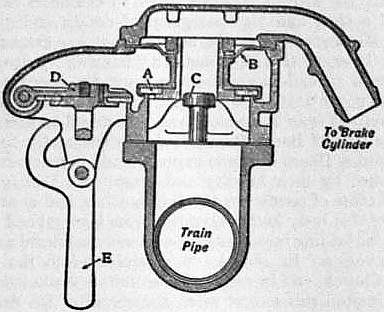
Fig. 3—Rapid-acting Vacuum-Brake Valve.
Table I.—Stops of a Train of Fifty Empty Cars, 1887— Automatic Air-Brakes.
Speed in Miles per Hour. Distance in Feet. Time in Seconds. Equivalent Distance at 20 m. and 40.
19½ 186 9¾ 196 · ·
19¼ 215 11 233 · ·
36½ 588 17 · · 693
The remarkable shortness of these stops is the more evident when they are compared with the best results obtained in 1886, as shown in Table II.
Table II.—Stops of a Train of Fifty Empty Cars, 1886— Automatic Air-Brakes.
Speed in Miles. Distance in Feet. Time in Seconds. Equivalent Distance at 20 m. and 40.
23.5 424 17½ 307 · ·
20.3 354 16 340 · ·
40 922 22½ · · 922
40 927 22¾ · · 927
The time that elapsed between the application of the brakes on the engine and on the fiftieth vehicle was almost twice as great in 1886 as in 1887, being in the latter tests only five to six seconds, and in 1887 the stops were made in less than two-thirds the distance required in 1886. Still, violent shocks were caused by the rear vehicles running against those in front, before the brakes on the former were applied with sufficient force to hold them, and these shocks were so severe as to make the use of the brakes in practice impossible on long trains. When the triple-valves were actuated electrically, however, the stops were still further improved, as shown in Table III.
Table III.—Stops of a Train of Fifty Empty Cars— Electric Application of Air-Brakes.
Speed in Miles. Distance in Feet. Time in Seconds. Equivalent Distance at 20 m. and 40.
21½ 160 7 139 · ·
23 183 8 138 · ·
38 475 14½ · · 519
36½ 460 14 · · 545
Although the same levers, shoes, rods and other connexions were used, there were no shocks in the fiftieth car of the train on any stop, whether on the level or on a gradient. The committee in charge reported that the best type of brake for long freight trains was one operated by air, in which the valves were actuated by electricity, but they expressed doubt of the practicability of using electricity on freight trains. The Westinghouse Company then proceeded to quicken the action of the triple-valve, operated by air only, so that stops with fifty-car trains could be made without shock, and without electrically operated valves; and they were so successful in this respect that, towards the end of the same year, 1887, with a train of fifty vehicles, stops were made without shock, fully equalling in quickness and shortness of distance run any that had been made at the trials by the electrically operated brakes.
In 1889 some further tests were made by Sir Douglas Galton with the automatic vacuum-brake, on a practically level portion of the Manchester, Sheffield & Lincolnshire railway (now the Great Central). The train was composed of an engine, tender and forty carriages, the total length over buffers being 1464 ft., and the total weight 574 tons, of which 423 tons were braked. At a speed of about 32 m. an hour this train was brought to a standstill in twelve seconds after the application of the brakes, in a distance of 342 ft.
BRAKELOND, JOCELYN DE (fl. 1200), English monk, and author of a chronicle narrating the fortunes of the monastery of Bury St Edmunds between 1173 and 1202. He is only known to us through his own work. He was a native of Bury St Edmunds; he served his novitiate under Samson of Tottington, who was at that time master of the novices, but afterwards sub-sacrist, and, from 1182, abbot of the house. Jocelyn took the habit of religion in 1173, during the time of Abbot Hugo (1157-1180), through whose improvidence and laxity the abbey had become impoverished and the inmates dead to all respect for discipline. The fortunes of the abbey changed for the better with the election of Samson as Hugo’s successor. Jocelyn, who became abbot’s chaplain within four months of the election, describes the administration of Samson at considerable length. He tells us that he was with Samson night and day for six years; the picture which he gives of his master, although coloured by enthusiastic admiration, is singularly frank and intimate. It is all the more convincing since Jocelyn is no stylist. His Latin is familiar and easy, but the reverse of classical. He thinks and writes as one whose interests are wrapped up in his house; and the unique interest of his work lies in the minuteness with which it describes the policy of a monastic administrator who was in his own day considered as a model.
Jocelyn has also been credited with an extant but unprinted tract on the election of Abbot Hugo (Harleian MS. 1005, fo. 165); from internal evidence this appears to be an error. He mentions a (non-extant) work which he wrote, before the Cronica, on the miracles of St Robert, a boy whom the Jews of Bury St Edmunds were alleged to have murdered (1181).
See the editions of the Cronica Jocelini de Brakelonda by T. Arnold (in Memorials of St Edmund’s Abbey, vol. i. Rolls series, 1890), and by J.G. Rokewood (Camden Society, 1840); also Carlyle’s Past and Present, book ii. A translation and notes are given in T.E. Tomlin’s Monastic and Social Life in the Twelfth Century in the Chronicle of Jocelyn de Brakelond (1844). There is also a translation of Jocelyn by Sir E. Clarke (1907).
BRAMAH, JOSEPH (1748-1814), English engineer and inventor, was the son of a farmer, and was born at Stainborough, Yorkshire, on the 13th of April 1748. Incapacitated for agricultural labour by an accident to his ankle, on the expiry of his indentures he worked as a cabinet-maker in London, where he subsequently started business on his own account. His first patent for some improvements in the mechanism of water-closets was taken out in 1778. In 1784 he patented the lock known by his name, and in 1795 he invented the hydraulic press. For an important part of this, the collar which secured water-tightness between the plunger and the cylinder in which it worked, he was indebted to Henry Maudslay, one of his workmen, who also helped him in designing machines for the manufacture of his locks. In 1806 he devised for the Bank of England a numerical printing machine, specially adapted for bank-notes. Other inventions of his included the beer-engine for drawing beer, machinery for making aerated waters, planing machines, and improvements in steam-engines and boilers and in paper-making machinery. In 1785 he suggested the possibility of screw propulsion for ships, and in 1802 the hydraulic transmission of power; and he constructed waterworks at Norwich in 1790 and 1793. He died in London on the 9th of December 1814.
BRAMANTE, or Bramante Lazzari (c. 1444-1514), Italian architect and painter, whose real name was Donate d’Augnolo, was born at Monte-Asdrualdo in Urbino, in July 1444. He showed a great taste for drawing, and was at an early age placed under Fra Bartolommeo, called Fra Carnavale. But though he afterwards gained some fame as a painter, his attention was soon absorbed by architecture. He appears to have studied under Scirro Scirri, an architect in his native place, and perhaps under other masters. He then set out from Urbino, and proceeded through several of the towns of Lombardy, executing works of various magnitudes, and examining patiently all remains of ancient art. At last, attracted by the fame of the great Duomo, he reached Milan, where he remained from 1476 to 1499. He seems to have left Milan for Rome about 1500. He painted some frescoes at Rome, and devoted himself to the study of the ancient buildings, both in the city and as far south as Naples. About this time the Cardinal Caraffa commissioned him to rebuild the cloister of the Convent della Pace. Owing to the celerity and skill with which Bramante did this, the cardinal introduced him to Pope Alexander VI. He began to be consulted on nearly all the great architectural operations in Rome, and executed for the pope the palace of the Cancelleria or chancery. Under Julius II., Alexander’s successor, Bramante’s talents began to obtain adequate sphere of exercise. His first large work was to unite the straggling buildings of the palace and the Belvedere. This he accomplished by means of two long galleries or corridors enclosing a court. The design was only in part completed before the death of Julius and of the architect. So impatient was the pope and so eager was Bramante, that the foundations were not sufficiently well attended to; great part of it had, therefore, soon to be rebuilt, and the whole is now so much altered that it is hardly possible to decipher the original design.
Besides executing numerous smaller works at Rome and Bologna, among which is specially mentioned by older writers a round temple in the cloister of San Pietro-a-Montorio, Bramante was called upon by Pope Julius to take the first part in one of the greatest architectural enterprises ever attempted—the rebuilding of St Peter’s. Bramante’s designs were complete, and he pushed on the work so fast that before his death he had erected the four great piers and their arches, and completed the cornice and the vaulting in of this portion. He also vaulted in the principal chapel. After his death on the 11th of March 1514, his design was much altered, in particular by Michelangelo.
See Pungileoni, Memoire intorno alla vita ed alle opere di Bramante (Rome, 1836); H. Semper, Donato Bramante (Leipzig, 1879).
BRAMPTON, HENRY HAWKINS, Baron (1817-1907), English judge, was born at Hitchin, on the 14th of September 1817. He received his education at Bedford school. The son of a solicitor, he was early familiarized with legal principles. Called to the bar at the Middle Temple in 1843, he at once joined the old home circuit, and after enjoying a lucrative practice as a junior, took silk in 1859. His name is identified with many of the famous trials of the reign of Queen Victoria. He was engaged in the Simon Bernard case (of the Orsini plot celebrity), in that of Roupell v. Waite, and in the Overend-Gurney prosecutions. The two causes célèbres, however, in which Hawkins attained his highest legal distinction were the Tichborne trials and the great will case of Sugden v. Lord St Leonards. In both of these he was victorious. In the first his masterly cross-examination of the witness Baigent was one of the great features of the trial. He did a lucrative business in references and arbitrations, and acted for the royal commissioners in the purchase of the site for the new law courts. Election petitions also formed another branch of his extensive practice. Hawkins was raised to the bench in 1876, and was assigned to the then exchequer division of the High Court, not as baron (an appellation which was being abolished by the Judicature Act), but with the title of Sir Henry Hawkins. He was a great advocate rather than a great lawyer. His searching voice, his manner, and the variety of his facial expression, gave him an enormous influence with juries, and as a cross-examiner he was seldom, if ever, surpassed. He was an excellent judge in chambers, where he displayed a clear and vigorous grasp of details and questions of fact. His knowledge of the criminal law was extensive and intimate, the reputation he gained as a “hanging” judge making him a terror to evil-doers; and the court for crown cases reserved was never considered complete without his assistance. In 1898 he retired from the bench, and was raised to the peerage under the title of Baron Brampton. He frequently took part in determining House of Lords appeals, and his judgments were distinguished by their lucidity and grasp. He held for many years the office of counsel to the Jockey Club, and as an active member of that body found relaxation from his legal and judicial duties at the leading race meetings, and was considered a capable judge of horses. In 1898 he was received into the Roman Catholic Church, and in 1903 he presented, in conjunction with Lady Brampton (his second wife), the chapel of SS. Augustine and Gregory to the Roman Catholic cathedral of Westminster, which was consecrated in that year. In 1904 he published his Reminiscences. He died in London on the 6th of October 1907, and Lady Brampton in the following year.
BRAMPTON, a market town in the Eskdale parliamentary division of Cumberland, England, 9 m. E.N.E. of Carlisle, on a branch of the North Eastern railway. Pop. (1901) 2494. It is picturesquely situated in a narrow valley opening upon that of the Irthing. The town has an agricultural trade, breweries, and manufactures of cotton and tweeds. The neighbourhood is rich in historical associations. Two miles N.E. of Brampton is the castle of Naworth, a fine example of a Border fortress. It was built in the reign of Edward III., by a member of the family of Dacre, who for many generations had had their stronghold here. Overlooking a deep wooded ravine, with streams to the east and west, the great quadrangular castle was naturally defended except on the south, where it was rendered secure by a double moat and drawbridge. By marriage in 1577 with Lady Elizabeth Dacre it passed into the hands of William Howard, afterwards lord warden of the Marches, the “Belted Will” of Sir Walter Scott and the Border ballads, who acquired great fame by his victories over the Scottish moss-troopers. The castle, the walls of which have many secret passages and hiding-places, is inhabited, and in its hall are numerous fine pictures, including a portrait of Charles I. by Van Dyck. Not far distant is Lanercost Priory, where in 1169 an Augustinian monastery was established. In 1311 Robert Bruce and his army were quartered here, and the priory was pillaged in 1346 by David, king of Scotland. From this time its prosperity declined, and at its dissolution under Henry VIII. it consisted only of a prior and seven canons. The Early English church has a restored nave, but retains much fine carving. The chancel is ruined, but the interesting crypt is preserved.
BRAMWELL, GEORGE WILLIAM WILSHERE BRAMWELL, Baron (1808-1892), English judge, was born in London on the 12th of June 1808, being the eldest son of George Bramwell, of the banking firm of Dorrien, Magens, Dorrien & Mello. He was educated privately, and at the age of sixteen he entered Dorriens’ bank. In 1830 he gave up this business for the law, being admitted as a student at Lincoln’s Inn in 1830, and at the Inner Temple in 1836. At first he practised as a special pleader, but was eventually called to the bar at both Inns in 1838. He soon worked his way into a good practice both in London and the home circuit, his knowledge of law and procedure being so well recognized that in 1850 he was appointed a member of the Common Law Procedure Commission, which resulted in the Common Law Procedure Act of 1852. This act he drafted jointly with his friend Mr (afterwards Mr Justice) Willes, and thus began the abolition of the system of special pleading. In 1851 Lord Cranworth made Bramwell a queen’s counsel, and the Inner Temple elected him a bencher—he had ceased to be a member of Lincoln’s Inn in 1841. In 1853 he served on the royal commission to inquire into the assimilation of the mercantile laws of Scotland and England and the law of partnership, which had as its result the Companies Act of 1862. It was he who, during the sitting of this commission, suggested the addition of the word “limited” to the title of companies that sought to limit their liability, in order to prevent the obvious danger to persons trading with them in ignorance of their limitation of liability. As a queen’s counsel Bramwell enjoyed a large and steadily increasing practice, and in 1856 he was raised to the bench as a baron of the court of exchequer. In 1867, with Mr Justice Blackburn and Sir John Coleridge, he was made a member of the judicature commission. In 1871 he was one of the three judges who refused the seat on the judicial committee of the privy council to which Sir Robert Collier, in evasion of the spirit of the act creating the appointment, was appointed; and in 1876 he was raised to the court of appeal, where he sat till the autumn of 1881. As a puisne judge he had been conspicuous as a sound lawyer, with a strong logical mind unfettered by technicalities, but endowed with considerable respect for the common law. His rulings were always clear and decisive, while the same quality marked his dealings with fact, and, coupled with a straightforward, unpretentious manner, gave him great influence with juries. In the court of appeal he was perhaps not so entirely in his element as at nisi prius, but the same combination of sound law, strong common sense and clear expression characterized his judgments. His decisions during the three stages of his practical career are too numerous to be referred to particularly, although Ryder v. Wombwell (L. R. 3 Ex. 95); R. v. Bradshaw (14 Cox C. C. 84); Household Fire Insurance Company v. Grant (4 Ex. Div. 216); Stonor v. Fowle (13 App. Cas. 20), The Bank of England v. Vagliano Brothers (App. Cas. 1891) are good examples. Upon his retirement, announced in the long vacation of 1881, twenty-six judges and a huge gathering of the bar entertained him at a banquet in the Inner Temple hall. In December of the same year he was raised to the peerage, taking the title Baron Bramwell of Hever, from his home in Kent. In private life Bramwell had simple tastes and enjoyed simple pleasures. He was musical and fond of sports. He was twice married: in 1830 to Jane (d. 1836), daughter of Bruno Silva, by whom he had one daughter, and in 1861 to Martha Sinden. He died on the 9th of May 1892.
His younger brother, Sir Frederick Bramwell (1818-1903), was a well-known consulting engineer and “expert witness.”
At all times Lord Bramwell had been fond of controversy and controversial writing, and he wrote constant letters to The Times over the signature B. (he also signed himself at different times Bramwell, G.B. and L.L.). He joined in 1882 the Liberty and Property Defence League, and some of his writings after that date took the form of pamphlets published by that society.
BRAN, in Celtic legend, the name of (1) the hero of the Welsh Mabinogi of Branwen, who dies in the attempt to avenge his sister’s wrongs; he is the son of Llyr (= the Irish sea-god Ler), identified with the Irish Bran mac Allait, Allait being a synonym of Ler; (2) the son of Febal, known only through the 8th-century Irish epic, The Voyage of Bran (to the world below); (3) the dog of Ossian’s Fingal. Bran also appears as a historical name, Latinized as Brennus. See Kuno Meyer and D. Nutt, The Voyage of Bran (London, 1895).
BRAN, the ground husk of wheat, oats, barley or other cereals, used for feeding cattle, packing and other purposes (see Flour). The word occurs in French bren or bran, in the dialects of other Romanic languages, and also in Celtic, cf. Breton brenn, Gaelic bran. The New English Dictionary considers these Celtic forms to be borrowed from French or English. In modern French bren means filth, refuse, and this points to some connexion with Celtic words, e.g. Irish brean, manure. If so, the original meaning would be refuse. “Bran-new,” i.e. quite new, is now the common form of “brand-new,” that which is fresh from the “brand,” the branding-iron used for marking objects, &c.
BRANCH (from the Fr. branche, late Lat. branca, an animal’s paw), a limb of a tree; hence any offshoot, e.g. of a river, railway, &c., of a deer’s antlers, of a family or genealogical tree, and generally a subdivision or department, as in “a branch of learning.” The phrase, to destroy “root and branch,” meaning to destroy utterly, taken originally from Malachi iv. 1, was made famous in 1641 by the so-called “Root and Branch” Bill and Petition for the abolition of episcopal government, in which petition occurred the sentence, “That the said government, with all its dependencies, roots and branches, be destroyed.” Among technical senses of the word “branch” are: the certificate of proficiency given to pilots by Trinity House; and in siege-craft a length of trench forming part of a zigzag approach.
BRANCO, or Parima, a river of northern Brazil and tributary of the Rio Negro, formed by the confluence of the Takutú, or “Upper Rio Branco,” and Uraricoera, about 3° N. lat. and 60° 28′ W. long., and flowing south by west to a junction with the Negro. It has rapids in its upper course, but the greater part of its length of 348 m. is navigable for steamers of light draught. The Takutú rises in the Roraima and Coïrrit ranges on the Guiana frontier, while the Uraricoera rises in the Serra de Parima, on the Venezuelan frontier, and has a length of 360 m. before reaching the Branco. These are white water rivers, from which the Branco (white) derives its name, and at its junction with the Negro the two differently-coloured streams flow side by side for some distance before mingling.
BRANCOVAN, or Brancoveanu, the name of a family which has played an important part in the history of Rumania. It was of Servian origin and was connected with the family of Branko or Brankovich. Constantine Brancovan, the most eminent member of the family, was born in 1654, and became prince of Walachia in 1689. In consequence of his anti-Turkish policy of forming an alliance first with Austria and then with Russia, he was denounced to the Porte, deposed from his throne, brought under arrest to Constantinople and imprisoned (1710) in the fortress of Yedi Kuleh (Seven Towers). Here he was tortured by the Turks, who hoped thus to discover the fortune of £3,000,000, which Constantine was alleged to have amassed. He was beheaded with his four sons on the 26th of August 1714. His faithful friend Enake Vacarescu shared his fate. Constantine Brancovan became, through his tragic death, the hero of Rumanian popular ballads. His family founded and endowed the largest hospital in Walachia, the so-called Spital Brancovanescu.
See O.G. Lecca, Familiile Boereşti Române (Bucharest, 1899), p. 90, sqq.
(M. G.)
BRAND, JOHN (1744-1806), English antiquary, was born on the 19th of August 1744 at Washington, Durham, where his father was parish clerk. His early years were spent at Newcastle-on-Tyne with his uncle, a cordwainer, to whom he was apprentice in his fourteenth year. Showing promise, however, at Newcastle grammar school, friends interested themselves in him and assisted him to go to Oxford. It was not, however, until his twenty-eighth year that he matriculated at Lincoln College, but before this he had been ordained, holding in succession the curacies of Bolam, Northumberland, of St Andrew’s, Newcastle, and of Cramlington, 8 m. from the county town. He graduated in 1775 and two years later was elected fellow of the Society of Antiquaries. Having for a short time been under-usher at the Newcastle grammar school, the duke of Northumberland, a former patron, gave him in 1784 the rectory of the combined parishes of St Mary-at-Hill and St Mary Hubbard, London. Appointed secretary to the Society of Antiquaries in the same year, he was annually re-elected until his death in 1806. He was buried in the chancel of his church. His most important work is Observations on Popular Antiquities: including the whole of Mr Bourne’s “Antiquitates Vulgares,” with addenda to every chapter of that work. This was published in London in 1777, and after Brand’s death, a new edition embodying the MSS. left by him, was published by Sir Henry Ellis in 1813. Brand also published a poem entitled: On Illicit Love, written among the ruins of Godstow Nunnery, near Oxford (1775, Newcastle); The History and Antiquities of Newcastle-upon-Tyne (2 vols., London, 1789), and many papers in the Archaeologia.
BRAND, SIR JOHN HENRY (1823-1888), president of the Orange Free State, was the son of Sir Christoffel Brand, speaker of the House of Assembly of the Cape Colony. He was born at Cape Town on the 6th of December 1823, and was educated at the South African College in that city. Continuing his studies at Leiden, he took the degree of D.C.L. in 1845. He was called to the English bar from the Inner Temple in 1849, and practised as an advocate in the supreme court of the Cape of Good Hope from that year until 1863. In 1858 he was appointed professor of law in the South African College. He was elected president of the Orange Free State in 1863, and subsequently re-elected for five years in 1869, 1874, 1879 and 1884. In 1864 he resisted the pressure of the Basuto on the Free State boundary, and after vainly endeavouring to induce Moshesh, the Basuto chief, to keep his people within bounds, he took up arms against them in 1865. This first war ended in the treaty of Thaba Bosigo, signed on the 3rd of April 1866; and a second war, caused by the treachery of the Basuto, ended in the treaty of Aliwal North, concluded on the 12th of February 1869. In 1871 Brand was solicited by a large party to become president of the Transvaal, and thus unite the two Dutch republics of South Africa; but as the project was hostile to Great Britain he declined to do so, and maintained his constant policy of friendship towards England, where his merits were recognized in 1882 by the honour of the G.C.M.G. He died on the 14th of July 1888. (See Orange Free State: History.)
BRANDE, WILLIAM THOMAS (1788-1866), English chemist, was born in London on the 11th of January 1788. After leaving Westminster school, he was apprenticed, in 1802, to his brother, an apothecary, with the view of adopting the profession of medicine, but his bent was towards chemistry, a sound knowledge of which he acquired in his spare time. In 1812 he was appointed professor of chemistry to the Apothecaries’ Society, and delivered a course of lectures before the Board of Agriculture in place of Sir Humphry Davy, whom in the following year he succeeded in the chair of chemistry at the Royal Institution, London. His Manual of Chemistry, first published in 1819, enjoyed wide popularity, and among other works he brought out a Dictionary of Science, Literature and Art in 1842, on a new edition of which he was engaged when he died at Tunbridge Wells on the 11th of February 1866.
BRANDENBURG, the name of a margraviate and electorate which played an important part in German history, and afterwards grew into the kingdom of Prussia. During the early years of the Christian era, the district was inhabited by the Semnones, and afterwards by various Slavonic tribes, who were partially subdued by Charlemagne, but soon regained their independence. The history of Brandenburg begins when the German king, Henry the Fowler, defeated the Havelli, or Hevelli, and took their capital, Brennibor, from which the name Brandenburg is derived. It soon came under the rule of Gero, margrave of the Saxon east mark, who pressed the campaign against the Slavs with vigour, while Otto the Great founded bishoprics at Havelberg and Brandenburg. When Gero died in 965, his mark was divided into two parts, the northern portion, lying along both banks of the middle Elbe, being called the north or old mark, and forming the nucleus of the later margraviate of Brandenburg. After Otto the Great died, the Slavs regained much of their territory, Brandenburg fell again into their hands, and a succession of feeble margraves ruled only the district west of the Elbe, together with a small district east of that river.
A new era began in 1106 when Lothair, count of Supplinburg, became duke of Saxony. Aided by Albert the Bear, count of Ballenstädt, he renewed the attack on the Slavs, and in 1134 appointed Albert margrave of the north mark. Albert the Bear. The new margrave continued the work of Lothair, and about 1140 made a treaty with Pribislaus, the childless duke of Brandenburg, by which he was recognized as the duke’s heir. He took at once the title margrave of Brandenburg, but when Pribislaus died in 1150, a stubborn contest followed with Jazko, a relation of the late duke, which was terminated in 1157 in Albert’s favour. Albert was the real founder of Brandenburg. Under his rule Christianity and civilization were extended, bishoprics were restored and monasteries founded. The country was colonized with settlers from the lower Rhineland, land was brought under cultivation, forts were built, German laws and customs introduced, and gradually the woods and marshes were converted into lands of comparative fertility.
When Albert died in 1170, Brandenburg fell to his eldest son, Otto I. (c. 1130-1184), who compelled the duke of Pomerania to own his supremacy, and slightly increased by conquest the area of the mark. Otto’s son, Otto II., was the succeeding margrave, and having quarrelled with his powerful neighbour, Ludolf, archbishop of Magdeburg, was forced to own the archbishop’s supremacy over his allodial lands. He died in 1205, and was followed by his step-brother, Albert II. (c. 1174-1220), who assisted the emperor Otto IV. in various campaigns, but later transferred his allegiance to Otto’s rival, Frederick of Hohenstaufen, afterwards the emperor Frederick II. His sons, John I. and Otto III., ruled Brandenburg in common until the death of John in 1266, and their reign was a period of growth and prosperity. Otto III. Districts were conquered or purchased from the surrounding dukes; the marriage of Otto with Beatrice, daughter of Wenceslaus, king of Bohemia, in 1253, added upper Lusatia to Brandenburg; and the authority of the margraves was extended beyond the Oder. Many monasteries and towns were founded, among them Berlin; the work of Albert the Bear was continued, and the prosperity of Brandenburg formed a marked contrast to the disorder which prevailed elsewhere in Germany. Brandenburg appears about this time to have fallen into three divisions—the old mark lying west of the Elbe, the middle mark between the Elbe and the Oder, and the new mark, as the newly conquered lands beyond the Oder began to be called. When Otto died in 1267, the area of the mark had been almost doubled, and the margraves had attained to an influential position in the Empire. The Sachsenspiegel, written before 1235, mentions the margrave as one of the electors, by virtue of the office of chamberlain, which had probably been conferred on Albert the Bear by the German king Conrad III.
In 1258 John and Otto had agreed upon a division of their lands, but the arrangement only took effect on Otto’s death in 1267, when John’s son, John II., received the electoral dignity, together with the southern part Otto IV. of the margraviate, which centred around Stendal, and Otto’s son, John III., the northern or Saltzwedel portion. John II.’s brother, Otto IV., who became elector in 1281, had passed his early years in struggles with the archbishop of Magdeburg, whose lands stretched like a wedge into the heart of Brandenburg. In 1280 he was wounded in the head with a dart, and as he retained there a part of the weapon for a year, he was called “Otto with the dart.” He secured the appointment of his brother Eric as archbishop of Magdeburg in 1283, and was afterwards engaged in various feuds. Songs attributed to him are found in F.H. von der Hagen’s Minnesinger. Otto was succeeded in 1309 by his nephew, Valdemar, who, assisted by other members of his family, conquered Pomerellen, which he shared with the Teutonic order in 1310, and held his own in a struggle with the kings of Poland, Sweden and Denmark and others, over the possession of Stralsund.
In order to pay for these wars, and to meet the expenses of a splendid court, the later margraves had sold various rights to the towns and provinces of Brandenburg, and so aided the development of local government. John III. of Saltzwedel had shared his possessions with his brothers, but in 1303 they were reunited by his nephew Hermann, who purchased lower Lusatia in the same year. Hermann’s daughter Agnes married the elector Valdemar, and on the death of her only brother, John VI., in 1317, the possessions of the Saltzwedel branch of the family passed to Valdemar, together with Landsberg and the Saxon Palatinate, which had been purchased from Albert the Degenerate, landgrave of Thuringia. Valdemar thus gathered the whole of the mark under his rule, together with upper and lower Lusatia, and various outlying districts. He died childless in 1319, and was succeeded by his nephew Henry II., who died in 1320, when the Ascanian family, as the descendants of Albert the Bear were called, from the Latinized form of the name of their ancestral castle of Aschersleben, became extinct.
Brandenburg now fell into a deplorable condition, portions were seized by neighbouring princes, and the mark itself was disputed for by various claimants. In 1323 King Louis IV. took advantage of this condition to bestow Wittelsbach dynasty. the mark upon his young son, Louis, and thus Brandenburg was added to the possessions of the Wittelsbach family, although Louis did not receive the extensive lands of the Ascanian margraves. Upper and lower Lusatia, Landsberg, and the Saxon Palatinate had been inherited by female members of the family, and passed into the hands of other princes, the old mark was retained by Agnes, the widow of Valdemar, who was married again to Otto II., duke of Brunswick, and the king was forced to acknowledge these claims, and to cede districts to Mecklenburg and Bohemia. During the early years of the reign of Louis, who was called the margrave Louis IV. or V., Brandenburg was administered by Bertold, count of Henneberg, who established the authority of the Wittelsbachs in the middle mark, which, centring round Berlin, was the most important part of the margraviate. The quarrel between King Louis and Pope John XXII. was inimical to the interests of Brandenburg, which was ravaged by the Poles, torn by the strife of contending clerical factions, and alternately neglected and oppressed by the margrave. Trade and commerce were at a standstill, agriculture was neglected, the privileges and estates of the margrave passed into private hands, the nobles were virtually independent, and the towns sought to defend themselves by means of alliances. During the struggle between the families of Wittelsbach and Luxemburg, which began in 1342, there appeared in Brandenburg an old man who claimed to be the margrave Valdemar. He was gladly received by the king of Poland, and other neighbouring princes, welcomed by a large number of the people, and in 1348 invested with the margraviate by King Charles IV., who eagerly seized this opportunity to deal a blow at his enemy. This step compelled Louis to make peace with Charles, who abandoned the false Valdemar, invested Louis and his step-brothers with Brandenburg, and in return was recognized as king. Louis recovered the old mark in 1348, drove his opponent from the land, and in 1350 made a treaty with his step-brothers, Louis the younger and Otto, at Frankfort-on-Oder, by which Brandenburg was handed over to Louis the younger and Otto. Louis, who then undertook the government, made peace with his neighbours, finally defeated the false Valdemar, and was recognized by the Golden Bull of 1356 as one of the seven electors. The emperor Charles IV. took advantage of a family quarrel over the possessions of Louis the elder, who died in 1361, to obtain a promise from Louis the younger and Otto, that the margraviate should come to his own son, Wenceslaus, in case the electors died childless. Louis the younger died in 1365, and when his brother Otto, who had married a daughter of Charles IV., wished to leave Brandenburg to his own family Charles began hostilities; but in 1373 an arrangement was made, and Otto, by the treaty of Fürstenwalde, abandoned the margraviate for a sum of 500,000 gold gulden.
Under the Wittelsbach rule, the estates of the various provinces of Brandenburg had obtained the right to coin money, to build fortresses, to execute justice, and to form alliances with foreign states. Charles invested Wenceslaus Imperial control. with the margraviate in 1373, but undertook its administration himself, and passed much of his time at a castle which he built at Tangermünde. He diminished the burden of taxation, suppressed the violence of the nobles, improved navigation on the Elbe and Oder, and encouraged commerce by alliances with the Hanse towns, and in other ways. He caused a Landbook to be drawn up in 1375, in which are recorded all the castles, towns and villages of the land with their estates and incomes. When Charles died in 1378, and Wenceslaus became German and Bohemian king, Brandenburg passed to the new king’s half-brother Sigismund, then a minor, and a period of disorder ensued. Soon after Sigismund came of age, he pledged a part of Brandenburg to his cousin Jobst, margrave of Moravia, to whom in 1388 he handed over the remainder of the electorate in return for a large sum of money, and as the money was not repaid, Jobst obtained the investiture in 1397 from King Wenceslaus. Sigismund had also obtained the new mark on the death of his brother John in 1396, but sold this in 1402 to the Teutonic order. Jobst paid very little attention to Brandenburg, and the period was used by many of the noble families to enrich themselves at the expense of the poorer and weaker towns, to plunder traders, and to carry on feuds with neighbouring princes. When in 1410 Sigismund and Jobst were rivals for the German throne, Sigismund, anxious to obtain another vote in the electoral college, declared the bargain with Jobst void, and empowered Frederick VI. of Hohenzollern, burgrave of Nuremberg, to exercise the Brandenburg vote at the election. (See Frederick I., Elector of Brandenburg.) In 1411 Jobst died and Brandenburg reverted to Sigismund, who appointed Frederick as his representative to govern the margraviate, and a further step was taken when, on the 30th of April 1415, the king invested Frederick of Hohenzollern and his heirs with Brandenburg, together with the electoral privilege and the office of chamberlain, in return for a payment of 400,000 gold gulden, but the formal ceremony of investiture was delayed until the 18th of April 1417, when it took place at Constance.
During the century which preceded the advent of the Hohenzollerns in Brandenburg its internal condition had become gradually worse and worse, and had been accompanied by a considerable loss of territory. The central power Condition before the Hohenzollern rule. had become weakened and the central organization relaxed, while the electorate had lost most of the advantages which formerly distinguished it from other German fiefs. Under the rule of the earliest margraves, it was the official side of their position that was prominent, and it was not forgotten that they were technically only the representatives of the emperor. But in the 13th century this feeling began to disappear, and Brandenburg enjoyed an independence and carried out an independent policy in a way that was not paralleled by any other German state. The emperor was still suzerain indeed, but his relations with the mark were so insignificant that they exercised practically no influence on its development; and so the power of the Ascanian margraves was virtually unlimited. This independence was enhanced by the fact that few great nobles had followed Albert the Bear in his work of conquest, and that consequently there were few large lordships with their crowd of dependents. The towns, the village communities and the knights held their lands and derived their rights directly from the margraves. The towns and villages had generally been laid out by contractors or locatores, men not necessarily of noble birth, who were installed as hereditary chief magistrates of the communities, and received numerous encouragements to reclaim waste lands. This mode of colonization was especially favourable to the peasantry, who seem in Brandenburg to have retained the disposal of their persons and property at a time when villenage or serfdom was the ordinary status of their class elsewhere. The dues paid by these contractors in return for the concessions formed the main source of the revenue of the margraves. Gradually, however, the expenses of warfare, liberal donations to the clergy, and the maintenance of numerous and expensive households, compelled them to pledge these dues for sums of ready money. This proceeding gave the barons and knights an opportunity to buy out the village magistrates and to replace them with nominees of their own. Thus the condition of the peasants grew worse, and their freedom was practically destroyed when the emperor Louis IV. recognized the jurisdiction of the nobles over their estates. Henceforth the power of the nobles steadily increased at the expense of the peasants, who soon sank into servitude. Instead of communicating directly with the margrave through his burgraves and bailiffs, or vogts, the village communities came to be represented by the nobles who had obtained possession of their lands. Many of the towns were forced into the same position. Others were able to maintain their independence, and to make use of the pecuniary needs of the margraves to become practically municipal republics. Their strength, however, was perhaps more usefully shown in their ability to resist the nobles, a proceeding which saved industry and commerce from extinction at a time of unbridled lawlessness. In the pecuniary embarrassments of the margraves also originated the power of the Stände, or estates, consisting of the nobles, the clergy and the towns. The first recorded instance of the Stände co-operating with the rulers occurred in 1170; but it was not till 1280 that the margrave solemnly bound himself not to raise a bede or special voluntary contribution without the consent of the estates. In 1355 the Stände secured the appointment of a permanent councillor, without whose concurrence the decrees of the margraves were invalid. In the century which followed the extinction of the Ascanian house, liberty degenerated into licence, and the country was given over to anarchy. Only the most powerful towns were able to maintain their independence; others, together with the clergy, regularly paid blackmail to the neighbouring nobles. Under these conditions it is no wonder that the electorate not only completely lost its political importance, but also suffered a considerable diminution of territory. Upper and lower Lusatia, the new mark of Brandenburg, and other outlying districts had been shorn away, and the electorate now consisted of the old mark, the middle mark with Priegnitz, Uckermark and Sternberg, a total area of not more than 10,000 sq.m.
Such was the condition and extent of Brandenburg in 1411 when Frederick of Hohenzollern became the representative of King Sigismund therein. Entering the electorate with a strong force in June 1412, his authority was quickly Frederick of Hohenzollern, 1412. recognized in the middle mark, but the nobles of the old mark and of Priegnitz refused to follow this example. The two succeeding years were skilfully used by Frederick to make peace with the neighbouring princes, and having thus isolated his domestic enemies, he turned his arms against them early in 1414. Their strongholds were stormed, and in a few weeks their leaders were either prisoners or fugitives. A general peace was then declared at Tangermünde which enabled Frederick to leave the mark to the rule of his wife, Elizabeth, and to turn his attention elsewhere. Returning to Brandenburg as elector in 1416, the last flickers of the insurrection were extinguished; and when Frederick was invested at Constance in April 1417 his authority over the mark was undisputed. His next difficulty was with Pomerania, which had been nominally under the suzerainty of Brandenburg since 1181. The revival of this claim by the elector provoked an invasion of the mark by an army of Pomeranians with their allies in 1420, when Frederick inflicted a severe defeat upon them at Angermünde; but in 1424 a temporary coolness between the elector and the emperor Sigismund led to a renewal of the attack which Frederick was unable to repulse. This reverse, together with the pressure of other business, induced him to leave Brandenburg in January 1426, after handing over its government to his eldest son, John. John, called the “Alchemist,” who was born in 1403, had been disappointed in his hope of obtaining the vacant electoral duchy of Saxe-Wittenberg in 1423. Lacking the diplomatic and military qualities of his father, his difficulties were augmented by the poverty of the country, and the evils which Frederick had suppressed quickly returned. The feeling of security vanished, the towns banded themselves together for defensive purposes, the rights of the margrave were again pledged to provide money, and in 1432 the land was ravaged by the Hussites. John never attained to the electoral dignity; for, in 1437, his father in arranging a division of his territories decided that Brandenburg should pass to his second and fourth sons, both of whom were named Frederick. The elder of the two took up the government at once, whereupon John left the mark for South Germany, where he remained until his death in 1464.
Frederick II., who became elector on his father’s death in September 1440, was born on the 19th of November 1413, and earned the surname of “Iron” through his sternness to his country’s enemies. He had little difficulty Frederick II. in repressing the turbulence of the nobles which had been quickened into life during the regency of his brother, but found it less easy to deal with the towns. Three strong leagues had been formed among them about 1431, and the spirit of municipal independence was most prominently represented by the neighbouring and allied towns of Berlin and Cöln. In his conflict with the towns over his refusal to ratify all their privileges the elector’s task was lightened by a quarrel between the magistrates and the burghers of Berlin, which he was called in to decide in 1442. He deposed the governing oligarchy, changed the constitution of the town, forbade all alliances and laid the foundations of a castle. The inhabitants soon chafed under these restrictions. A revolt broke out in 1447, but the power of the elector overawed the people, who submitted their case to the estates, with the result that the arrangement of 1442 was re-established. In 1447 Frederick was compelled to cede the old mark and Priegnitz to his younger brother, Frederick, under whose feeble rule they quickly fell into disorder. In 1463, however, when the younger Frederick died childless, the elector united them again with his own possessions and took measures to suppress the prevailing anarchy. In his dealings with neighbouring rulers Frederick pursued a peaceful and conciliatory policy. In 1442 he obtained some small additions to his territory, and the right of succession to the duchy of Mecklenburg in case the ducal family should die out. In 1445 an old feud with the archbishop of Magdeburg was settled, and in 1457 a treaty of mutual succession was made with the houses of Saxony and Hesse. Cottbus and Peitz in Lusatia were acquired, and retained after a quarrel with George Podiebrad, king of Bohemia, and the new mark of Brandenburg was purchased from the Teutonic order in 1454. An attempt, however, to secure the duchy of Pomerania-Stettin failed, and the concluding years of this reign were troubled by warfare with the Pomeranians.
The general success of Frederick’s rule was secured by the sedulous care with which he confined himself to the work of government. He is said to have refused the thrones of Poland and Bohemia; and although he made pilgrimages to the Holy Land and to Rome, his interest in ecclesiastical questions was mainly directed towards quickening the religious life of his people. He obtained important concessions from Pope Nicholas V. with regard to the appointment of bishops and other ecclesiastical matters in 1447, and in general maintained cordial relations with the papacy. About 1467 his only son, John, died, and increasing infirmity led him to contemplate abdication. An arrangement was made with his brother, Albert Achilles, to whom early in 1470 the mark was handed over, and Frederick retired to Plassenburg where he died on the 10th of February 1471.
Albert appeared in Brandenburg early in the same year, and after receiving the homage of his people took up the struggle with the Pomeranians, which he soon brought to a satisfactory conclusion; for in May 1472 he not only Albert Achilles. obtained the cession of several districts, but was recognized as the suzerain of Pomerania and as its future ruler. The expenses of this war led to a quarrel with the estates. A subsidy was granted which the elector did not regard as adequate, and by a dexterous use of his power he established his right to take an excise on beer. Albert’s most important contribution to the history of Brandenburg was the issue on the 24th of February 1473 of the Dispositio Achillea. By this instrument the elector decreed that the electoral mark should pass in its entirety to his eldest son, an establishment of primogeniture which had considerable influence on the future development of the country. He then entrusted the government to his eldest son, John, and left Brandenburg. Handicapped by poverty, John had to face attacks from two quarters. The Pomeranians, inspired by the declaration of the emperor Frederick III. that their land was a direct fief of the Empire, and aided by Matthias Corvinus, king of Hungary, took up arms; and a quarrel broke out with John, duke of Sagan, over the possessions of John’s brother-in-law, Henry XI., duke of Glogau. To deal with these difficulties Albert returned to Brandenburg in 1478, and during his stay drove back the Pomeranians, and added Crossen and other parts of duke Henry’s possessions to the electorate. Again left in charge of the country, John beat back a fresh attack made by John of Sagan in 1482; and he became elector on his father’s death in March 1486. He added the county of Zossen to his possessions in 1490, and in 1493 made a fresh treaty with the duke of Pomerania. Although he brought a certain degree of order into the finances, his poverty and the constant inroads of external enemies prevented him from seriously improving the condition of the country. John, who was called “Cicero,” either on account of his eloquence, or of his knowledge of Latin, was interested in learning, welcomed Italian scholars to the electorate, and strove to improve the education of his people. He died at Arneburg on the 9th of January 1499, and was succeeded by his son Joachim I.
When Joachim undertook the government of Brandenburg he had to deal with an amount of disorder almost as great as that which had taxed the energies of Frederick I. a century before. Highway robbery was general, the Joachim. lives and property of traders were in continual jeopardy, and the machinery for the enforcement of the laws was almost at a standstill. About 1504 an attack of unusual ferocity on some Frankfort traders aroused the elector’s wrath, and during the next few years the execution of many lawbreakers and other stern measures restored some degree of order. In this and in other ways Joachim proved himself a sincere friend to the towns and a protector of industry. Following the economic tendencies of the time he issued sumptuary laws and encouraged manufactures; while to suppress the rivalry among the towns he established an order of precedence for them. Equally important was his work in improving the administration of justice, and in this direction he was aided by scholars from the university which he had founded at Frankfort-on-Oder in 1506. He gave a new organization to the highest court of justice, the Kammergericht, secured for himself an important voice in the choice of its members, and ordered that the local law should be supplemented by the law of Rome. He did not largely increase the area of Brandenburg, but in 1524 he acquired the county of Ruppin, and in 1529 he made a treaty at Grimnitz with George and Barnim XI., dukes of Pomerania, by which he surrendered the vexatious claim to suzerainty in return for a fresh promise of the succession in case the ducal family should become extinct. Joachim’s attitude towards the teaching of Martin Luther which had already won many adherents in the electorate, was one of unrelenting hostility. The Jews also felt the weight of his displeasure, and were banished in 1510.
Ignoring the Dispositio Achillea, the elector bequeathed Brandenburg to his two sons. When he died in July 1535 the elder, Joachim II., became elector, and obtained the old and middle marks, while the younger, John, received Joachim II. the new mark. John went definitely over to the side of the Lutherans in 1538, while Joachim allowed the reformed doctrines free entrance into his dominions in 1539. The elector, however, unlike his brother, did not break with the forms of the Church of Rome, but established an ecclesiastical organization independent of the pope, and took up a position similar to that of King Henry VIII. in England. Many of the monasteries were suppressed, a consistory was set up to take over the functions of the bishops and to act as the highest ecclesiastical court of the country. In 1541 the new ecclesiastical system was confirmed by the emperor Charles V. With regard to this policy the elector was probably influenced by considerations of greed. The bishoprics of Brandenburg, Havelberg and Lebus were secularized; their administration was entrusted to members of the elector’s family; and their revenues formed a welcome addition to his impoverished exchequer. Nor did Joachim neglect other opportunities for adding to his wealth and possessions. In 1537 he had concluded a treaty with Frederick III., duke of Liegnitz, which guaranteed to the Hohenzollerns the succession to the Silesian duchies of Liegnitz, Brieg and Wohlau in the event of the ducal family becoming extinct; this arrangement is important as the basis of the claim made by Frederick the Great on Silesia in 1740. The treaty was declared invalid by the German king, Ferdinand I.; but the elector insisted on its legality, and in 1545 strengthened his position by arranging a double marriage between members of his own family and that of Duke Frederick. Of more immediate consequence was an arrangement made in 1569 with the representatives of Joachim’s kinsman, Albert Frederick, duke of Prussia, after which the elector obtained the joint investiture of the duchy of Prussia from Sigismund II., king of Poland, and was assured of the succession if the duke’s family became extinct. Joachim’s luxurious habits, his partiality for adventurers, and his delight in building, led him to incur such a heavy expenditure that after pledging many of his lands and rights he was compelled in 1540 to appeal for help to the estates. Taking advantage of his difficulties, the estates voted him a sum of money as the price of valuable concessions, the most important of which was that the elector should make no alliance without their consent. Fresh liabilities were soon incurred, and in spite of frequent contributions from the estates Joachim left at his death in January 1571 a heavy burden of debt to his son and successor, John George.
The elector’s death was followed ten days later by that of his brother, John, and as John left no sons the whole of Brandenburg, together with the districts of Beeskow and Storkow which had been added by purchase to the new mark, John George. were united under the rule of his nephew, John George. Born on the 11th of September 1525 this prince had served in the field under Charles V., and, disliking his father’s policy and associates, had absented himself from Berlin, and mainly confined his attention to administering the secularized bishopric of Brandenburg which he had obtained in 1560. When he became elector he hastened to put his ideas into practice. His father’s favourites were exiled; foreigners were ousted from public positions and their places taken by natives; and important economies were effected, which earned for John George the surname of Oekonom, or steward. To lighten the heavy burden of debt left by Joachim the elector proposed a tax on wheat and other cereals. Some opposition was shown, but eventually the estates of both divisions of the mark assented; only, however at the price of concessions to the nobles, predominant in the diet, which thrust the peasantry into servitude. Thus the rule of John George was popular with the nobles, and to some extent with the towns. Protestant refugees from France and the Netherlands were encouraged to settle in Brandenburg, and a period of peace was beneficial to a land, the condition of which was still much inferior to that of other parts of Germany. In religion the elector was a follower of Luther, whose doctrines were prevalent among his people. He had accepted the Formula Concordiae, a Lutheran document promulgated in June 1580, and sought to prevent any departure from its tenets. His dislike of Calvinism, or his antipathy to external complications, however, prevented him from taking any serious steps to defend Protestantism from the attacks of the counter-reformation. He did indeed join the league of Torgau, which voted assistance to Henry IV. of France in 1591; but he refused to aid the United Provinces, or even to give assistance to his eldest son, Joachim Frederick, administrator of the archbishopric of Magdeburg, whose claim to sit and vote in the imperial diet was contested, or to his grandson, John George, whose election to the bishopric of Strassburg was opposed by a Roman Catholic minority in the chapter. This indifference to the welfare of the Protestants added to the estrangement between the elector and his eldest son, which was further accentuated when John George, ignoring the Dispositio Achillea, bequeathed the new mark to one of his younger sons. He died on the 8th of January 1598.
Joachim Frederick, who now became elector, was born on the 27th of January 1546. Since 1553 he had held the bishopric of Havelberg, since 1555 that of Lebus; he had been administrator of Magdeburg since 1566, and of Brandenburg since 1571. Resigning these dignities in 1598, he contested his father’s will, and was successful in preventing a division of the electorate. An agreement with George Frederick, the childless margrave of Joachim Frederick. Ansbach and Bayreuth, paved the way for an arrangement with the elector’s younger brothers, who after the margrave’s death in April 1603, shared his lands in Franconia, and were compensated in other ways for surrendering all claims on Brandenburg. This agreement, known as the Gera Bond, ratified the Dispositio Achillea. By George Frederick’s death, Joachim became administrator of the duchy of Prussia, ruled nominally by the weak-minded Albert Frederick, but he had some difficulty in asserting his position. In Brandenburg he made concessions to the nobles at the expense of the peasantry, and admitted the right of the estates to control taxation. In religious matters he was convinced of the necessity of a union between Lutherans and Calvinists, and took steps to bring this about. Public opinion, however, in Brandenburg was too strong for him, and he was compelled to fall back upon the Lutheran Formula and the religious policy of his father. Joachim seems to have been a wise ruler, who improved in various ways the condition of the mark. He married Catherine, daughter of John, margrave of Brandenburg-Cüstrin, and when he died, on the 18th of July 1608, was succeeded by his eldest son John Sigismund.
The new elector, born on the 8th of November 1572, had married in 1594 Anna, daughter of Albert Frederick of Prussia, a union which not only strengthened the pretensions of the electors of Brandenburg to the succession in John Sigismund. that duchy, but gave to John Sigismund a claim on the duchies of Cleves, Jülich and Berg, and other Rhenish lands should the ruling family become extinct. In March 1609 the death of Duke John William left these duchies without a ruler, and by arrangement they were occupied jointly by the elector and by his principal rival, Wolfgang, son of Philip Louis, count palatine of Neuburg. This proceeding aroused some opposition, and, complicated by religious considerations and by the excited state of European politics, almost precipitated a general war. However, in November 1614 the dispute was temporarily settled by the treaty of Xanten. Brandenburg obtained the duchy of Cleves with the counties of Mark and Ravensberg, but as the Dutch and Spanish garrisons were not withdrawn, these lands were only nominally under the elector’s rule. In 1609, John Sigismund had joined the Evangelical Union, probably to win support in the Rhineland, and the same consideration was doubtless one reason why, in 1613, he forsook the Lutheran doctrines of his family, and became an adherent of the reformed, or Calvinist, faith. This step aroused grave discontent in the electorate, and, quickly abandoning his attempts to proselytize, the elector practically conceded religious liberty to his subjects. Over the Cleves-Jülich succession, John Sigismund had incurred heavy expenses, and the public debt had again mounted up. He was thus obliged to seek aid from the estates, and in return for grants to make concessions to the nobles. The elector spent much of his time in Prussia striving to assert his authority in that duchy, and in August 1618, according to the arrangement of 1569, became duke by the death of Albert Frederick. He only enjoyed this dignity for a short time, as he died on the 23rd of December 1619. He was succeeded by his eldest son, George William.
The new elector, born on the 3rd of November 1597, proved a weak and incapable ruler. He had married Elizabeth, daughter of Frederick IV., elector palatine of the Rhine, and sister of the elector Frederick V., afterwards king of George William. Bohemia, and before his accession had acted as his father’s representative in Cleves. Although a Protestant he was under the influence of Adam, count of Schwarzenberg, who was a Roman Catholic of imperialist sympathies. As a result the elector remained neutral during the early years of the Thirty Years’ War in spite of his relationship with Frederick of the Palatinate, and the obvious danger to his Rhenish lands. This attitude was not successful. Brandenburg was ravaged impartially by both parties, and in 1627 George William attacked his brother-in-law, Gustavus Adolphus of Sweden, who was using Prussia as a base of operations for his war against Poland. This campaign was short and inglorious for Brandenburg, and the elector was soon compelled to make peace. Although alarmed by the edict of restitution of 1629, George William took no steps to help the Protestants. In 1631, however, Gustavus Adolphus marched on Berlin, compelled the elector to cede the fortress of Spandau, and to aid him with men and money. The Brandenburg troops then assisted the Swedes until after the death of Gustavus in 1632, and the Swedish defeat at Nördlingen in 1634, when the elector assented to the treaty of Prague, which was made in May 1635 between the emperor Ferdinand II. and John George I., elector of Saxony. The imperialists did nothing, however, to drive the Swedes from Brandenburg, and the unfortunate land was entirely at the mercy of the enemy. This was the principal reason why the elector was unable to annex Pomerania when its last duke, Bogislaus XIV., died in 1637. In 1638 George William transferred his residence to Königsberg, leaving Schwarzenberg to administer the electorate. Although his harsh measures aroused some irritation, the count did something to rid the land of the Swedes and to mitigate its many evils; but its condition was still very deplorable when George William died at Königsberg on the 1st of December 1640, leaving an only son, Frederick William. The most important facts in the internal history of Brandenburg during the 16th century were the increase in the power of the estates, owing chiefly to the continuous pecuniary needs of the electors; the gradual decline in the political importance of the towns, due mainly to intestine feuds; and the lapse of the peasantry into servitude. These events gave a preponderance of power to the nobles, but concurrently a number of circumstances were silently preparing the way for a great increase of authority on the part of the ruler. The substitution of the elector for the pope as head of the church; the introduction of Roman law with its emphasis on a central authority and a central administration; the determined and successful efforts to avoid any partition of the electorate; and the increasing tendency of the separate sections of the diet to act independently; all tended in this direction. This new order was heralded in 1604 by the establishment of a council of state, devoted to the interests of the elector, which strengthened his authority, and paved the way for a bureaucratic government.
When Frederick William, the “Great Elector,” became ruler of Brandenburg in 1640 he found the country in a very deplorable condition. Trade and agriculture were almost destroyed, and the inhabitants, compelled to support Frederick William, the “Great Elector.” the Swedish army of occupation, suffered also from the disorderly conduct of the native soldiers. Although the young elector spent the two first years of his reign mainly in Prussia, he was by no means forgetful of Brandenburg, and began resolutely to root out the many evils which had sprung up during the feeble rule of his father. The powers of Schwarzenberg were curtailed; the state council was restored; and the licence of the soldiers was restrained, while their numbers were reduced. Then turning his attention to the Swedes a truce was arranged, and soon afterwards, in return for an indemnity, they agreed to evacuate the electorate. Having returned to Brandenburg in 1643, Frederick William remained neutral during the concluding years of the Thirty Years’ War, and set to work to organize an army and to effect financial reforms. About the same time diplomatic methods freed Cleves, Mark and Ravensberg from foreign troops, but the estates of these lands gained a temporary victory when the elector attacked their privileges. However, in 1647 his title was formally admitted by Wolfgang, count palatine of Neuburg.
The terms of the treaty of Westphalia in 1648 are the best commentary on the general success of the elector’s policy. Although he was obliged to give up his claim to the western part of Pomerania in favour of Sweden, he secured the eastern part of that duchy, together with the secularized bishoprics of Halberstadt, Minden and Kammin, and other lands, the whole forming a welcome addition to the area of Brandenburg. He was also promised the archbishopric of Magdeburg when its administrator, Augustus, duke of Saxe-Weissenfels, should die. This event happened in 1680 when he secured the lands of the archbishopric. The elector did not, however, take possession of the newly-acquired territories at once. Fresh difficulties arose with Sweden, and it was not until 1653 that eastern Pomerania was freed from her soldiers. Meanwhile a new quarrel had broken out with Wolfgang of Neuburg. In 1650 Frederick William attacked his rival, but a variety of circumstances, among others a change of government in the Netherlands, and the resistance of the estates of Cleves, thwarted his plans, and he was compelled to listen to the mediating powers, and to acquiesce in the status quo.
Profiting by these reverses the elector then undertook a series of internal reforms, tending to strengthen the central authority, and to mitigate the constant lack of money, which was perhaps his chief obstacle to success; a work in which he was aided by George, count of Waldeck (1620-1692), who became his chief adviser about this time. In 1651 the powers of the state council were extended to include all the lands under the elector’s rule; and a special committee was appointed to effect financial economies, and so to augment the electoral resources. In imperial politics Frederick William supported the election of Ferdinand, son of the emperor Ferdinand III., as king of the Romans in 1653; but when the emperor failed to fulfil his promises, influenced by Waldeck, he acted in opposition to the imperial interests, and even formed a plan for a great alliance against the Habsburgs. These projects were disturbed by the war which broke out in 1655 between Sweden and Poland. In this struggle the elector fought first on one side and then on the other; but the important consequences of his conduct belong rather to the history of the duchy of Prussia (q.v.). The transfer of the elector’s support from Sweden to Poland in 1656 was followed by the fall from power of Waldeck, who was succeeded by Otto von Schwerin (1616-1679), under whose influence the elector’s relations with the emperor became more cordial.
The increase in the prestige of Brandenburg was due chiefly to his army, which was gradually brought to a high state of efficiency. A proper organization was established to superintend the pay and maintenance of the soldiers, and they were commanded by experienced officers, among others by Georg Derfflingen (1606-1695), and Otto von Sparr (1605-1668). The general poverty, however, made the estates reluctant to support a standing army, and after the peace of Oliva in 1660, it was reduced to about 3500 men. The continual difficulties with the estates of his different dominions had harassed and hampered the elector, and the general peace which followed the treaty of Oliva offered a favourable opportunity to curtail their powers. Undaunted by two previous rebuffs he attacked the estates of Cleves, and by a display of force gained a substantial victory. Some important privileges were annulled, and he obtained a considerable sum of money. The Landtag of Brandenburg was not cowed so easily into submission, but an increase of revenue was obtained, and the stubborn struggle which ensued in Prussia ended in a victory for the ruler. This increased income enabled the elector to take a more considerable part in European politics. In 1663 he assisted the imperialists in their struggle with the Turks; in 1666 the dispute over Cleves, Mark and Ravensberg was finally settled, and Brandenburg were confirmed in the possession of these lands; and in the same year a reconciliation was effected with Sweden. Several disputes which threatened to disturb the peace of the Empire were settled through his mediation, and he compelled the citizens of Magdeburg to do homage to him. In religious matters he interceded with the emperor and the diet for the Protestants, and sought, but without success, to bring about a reconciliation between Lutherans and Calvinists in Brandenburg.
The elector’s relations with Louis XIV. of France are full of interest. After the conclusion of the war of devolution in 1667, he allied himself with Louis, and together they agreed to support the candidature of Wolfgang of Neuburg for the vacant Polish throne. In 1668, moreover, he refused to join the triple alliance against France, but soon afterwards became aware of the danger to his country from the aggressive policy of Louis. The United Provinces were bound to him by religious interests, political considerations, and family ties alike, and he could not be indifferent when their position was threatened by France. In spite of tempting offers from Louis, he was the first to join the Dutch when they were attacked by Louis in 1672, and conducted an ineffectual campaign on the Rhine until June 1673, when he was forced to make peace. In July 1674, however, he joined the Empire, the United Provinces and Spain, and in return for a subsidy, fought against France in Alsace. Meanwhile Louis had instigated the Swedes to invade Brandenburg, which had been left to the care of John George II., prince of Anhalt-Dessau. Hastening from Franconia to defend the electorate, Frederick William gained a complete victory over a superior number of the enemy at Fehrbellin on the 28th of June 1675, a great and glorious day for the arms of Brandenburg. Aided by the imperialists and the Danes, he followed up this success, and cleared Brandenburg and Pomerania of the Swedes, capturing Stettin in 1677 and Stralsund in 1678, while an attack made by Sweden on Prussia was successfully repelled. The general peace of Nijmwegen was followed by the treaty of St Germain-en-Laye in June 1679 between Sweden and Brandenburg. Owing, however, to the insistence of Louis XIV. and the indifference, or weakness, of the emperor Leopold I., the elector was forced to restore western Pomerania to Sweden, in return for the payment of 300,000 crowns by France. This feebleness on the part of his ally induced Frederick William to listen more readily to the overtures of Louis, and in 1679, and again in 1681, he bound himself to support the interests of France. He had, moreover, a further grievance against the emperor as Leopold refused to recognize his right to the Silesian duchies of Liegnitz, Brieg and Wohlau, which had been left without a ruler in 1675. About 1684, however, the foreign policy of Brandenburg underwent another change. Disliking the harshness shown by Louis to the Protestants, the elector concluded an alliance with William, prince of Orange, in August 1685; and entered into more friendly relations with the emperor. Further incensed against France by the revocation of the edict of Nantes in 1685, he made an alliance with Leopold in January 1686, agreeing in return for a subsidy to send troops against the Turks. Soon afterwards he received Schwiebus to compensate him for abandoning his claim on the Silesian duchies, and in a secret treaty made promises of support to Leopold. The great elector died in May 1688, leaving his territories to his eldest son, Frederick.
The remarkable services of Frederick William to his country can best be judged by comparing its condition in 1640 with that in 1688. At his accession the greater part of his territory was occupied by strangers and devastated by war, and in European politics Brandenburg was merely an appendage of the empire. Its army was useless; its soil was poor; its revenue was insignificant. At his death the state of Brandenburg-Prussia was a power to be reckoned with in all European combinations. Inferior to Austria alone among the states of the Empire, it was regarded as the head of the German Protestantism; while the fact that one-third of its territory lay outside the Empire added to its importance. Its area had been increased to over 40,000 sq. m.; its revenue had multiplied sevenfold; and its small army was unsurpassed for efficiency. The elector had overthrown Sweden and inherited her position on the Baltic, and had offered a steady and not ineffectual resistance to the ambition of France.
While thus winning for himself a position in the councils of Europe, Frederick William was not less active in strengthening the central authority within his own dominions. He found Brandenburg a constitutional state, in which the legislative power was shared between the elector and the diet; he left it to his successor substantially an absolute monarchy. Many circumstances assisted to bring about this change, among the chief of which were the want of harmonious action on the part of the estates, and the decline in the political power of the towns. The substitution of a permanent excise for the subsidies granted from time to time by the estates also tended to increase his independence, and the officials or Steuerräthe, appointed by him to collect this tax in the towns, gradually absorbed many of the administrative functions of the local authorities. The nobles and prelates generally preferred to raise their share of the revenue by the old method of a bede, or contribution, thus weakening the remaining bond between them and the burghers.
In matters of general administration Frederick William showed himself a prudent and careful ruler, and laid the foundation of the future greatness of Prussia in almost every department. The wounds inflicted by the Thirty Years’ War were in a great measure healed, and the finances and credit of the state were established on a firm basis. Agriculture and commerce were improved and encouraged by a variety of useful measures, and in this connexion the settlement of a large number of Flemings, and the welcome extended to French Protestants, both before and after the revocation of the edict of Nantes, were of incalculable service. A small but efficient navy was founded, and strict economy, together with increasing resources, enabled a disciplined army to be maintained. Education was not neglected, a trading company was established, and colonies were founded on the west coast of Africa. In religious matters Calvinists and Lutherans were placed upon an equality, but the elector was unable to impress his own spirit of tolerance upon the clergy, who were occupied with ecclesiastical squabbles while the state of education and of public morals left much to be desired. The condition of the peasantry, however, during this reign reached its lowest point, and the “recess,” or charter, of 1653 practically recognizes the existence of villenage. While the nobles had been losing power with regard to the ruler they had been increasing it at the expense of the peasants. The Thirty Years’ War afforded them frequent opportunities of replacing the village Schulzen, or magistrates, with officials of their own; and the fact that their share of taxation was wholly wrung from the peasants made the burden of the latter much heavier than that of the townsmen.
The new elector, Frederick III., followed in general the policy of his father. Having persuaded his step-brothers to surrender the principalities bequeathed to them by the great elector, he assisted William of Orange to make his Frederick III. descent on England; then in 1688 allied himself with other German princes against Louis XIV., and afterwards fought for the Empire against both France and Turkey. Before he became elector Frederick had promised the emperor that he would restore Schwiebus, and he was now called upon to fulfil this engagement, which after some murmuring he did in 1695. This fact, however, together with some slights put upon him at the peace of 1697, led him to look with less favour upon imperial interests. Frederick’s chief adviser about this time was Eberhard Danckelmann (1643-1722), whose services in continuing the reforming work of the great elector were very valuable; but having made many enemies, the electress Sophia among them, he fell from power in 1697, and was imprisoned for several years. The most important work of the elector was to crown the labours of his father by securing the kingly title for himself and his descendants. Broached in 1692 this matter was brought up again in 1698 when the emperor and his ministers, faced with the prospect of a fight over the Spanish succession, were anxious to conciliate Brandenburg. It was at length decided that the title should be taken from Prussia rather than from Brandenburg as the former country lay outside the Empire, and in return Frederick promised to assist Leopold with 8000 men. The coronation ceremony took place at Königsberg on the 18th of January 1701. The territorial additions to Brandenburg during this reign were few and unimportant, but the comparative wealth and prosperity enabled the elector to do a good deal for education, and to spend some money on buildings. In 1694 the university of Halle was founded; academies for arts and sciences were established, and Berlin was greatly improved. The subsequent history of Brandenburg is merged in that of Prussia (q.v.).
Bibliography.—H. Brosien, Geschichte der Mark Brandenburg in Mittelalter (Leipzig, 1887); G.G. Küster, Bibliotheca historica Brandenburgensis (Breslau, 1743); and Accessiones (Breslau, 1768), and Collectio opusculorum historiam marchicam illustrantium (Breslau, 1731-1733); A. Voss and G. Stimming, Vorgeschichtliche Alterthümer aus der Mark Brandenburg (Berlin, 1886-1890); F. Voigt, Geschichte des brandenburgisch-preussischen Staats (Berlin, 1878); E. Berner, Geschichte des preussischen Staats (Berlin, 1890-1891); A.F. Riedel, Codex diplomaticus Brandenburgensis (Berlin, 1838-1865); J. Heidemann, Die Reformation in der Mark Brandenburg (Berlin, 1889); Forschungen zur brandenburgischen und preussischen Geschichte, edited by R. Koser (Leipzig, 1888 fol.); T. Carlyle, History of Frederick the Great, vol. i. (London, 1858); J.G. Droysen, Geschichte der preussischen Politik (Berlin, 1855-1886); E. Lavisse, Étude sur une des origines de la monarchie prussienne (Paris, 1875); B. Gebhardt, Handbuch der deutschen Geschichte, Band ii. (Leipzig, 1901).
(A. W. H.*)
BRANDENBURG, the central and one of the largest provinces of Prussia, consisting of a part of the former electorate of Brandenburg from which it derives its name. With the other territories of the elector of Brandenburg, it was merged in 1701 in the kingdom of Prussia, and when the administration of Prussia was reformed in 1815, Brandenburg became one of the provinces of Prussia. The boundaries of the new province, however, differed considerably from those of the old district. The old mark, the district on the left bank of the Elbe, was added to the province of Saxony, and in return a district to the south, taken from the kingdom of Saxony, was added to the province of Brandenburg. It has an area of 15,382 sq. m., and is divided into the two governments of Potsdam and Frankfort-on-Oder; the capital, Berlin, forming a separate jurisdiction. The province is a sandy plain interspersed with numerous fertile districts and considerable stretches of woodland, mostly pine and fir. Its barrenness was formerly much exaggerated, when it was popularly described as the “sandbox of the Holy Roman Empire.” It is generally well watered by tributaries of its two principal rivers, the Elbe and the Oder, and is besides remarkable for the number of its lakes, of which it contains between 600 and 700. The mineral products comprise lignite, limestone, gypsum, alum and potter’s earth; barley and rye are the usual cereals; fruits and vegetables are abundant; and considerable quantities of hemp, flax, hops and tobacco are raised. The breeding of sheep receives much attention, and the province exports wool in considerable quantity. Bees are largely kept, and there is an abundance of game. The rivers and lakes also furnish fish, particularly carp, of excellent quality. The climate is cold and raw in winter, excessively hot in summer, and there are frequently violent storms of wind. The manufacturing industry of the province is both varied and extensive, but is for the most part concentrated in the principal towns. The most important branches are the spinning and weaving of wool and cotton, the manufacturing of paper, and the distillation of brandy. Pop. (1895) 2,821,695; (1905) 3,529,839.
BRANDENBURG, a town of Germany, capital of the district and province of same name, on the river Havel, 36 m. S.W. from Berlin, on the main line to Magdeburg and the west. Pop. (1905) 51,251, including 3643 military. The town is enclosed by walls, and is divided into three parts by the river—the old town on the right and the new town on the left bank, while on an island between them is the “cathedral town,”—and is also called, from its position, “Venice.” Many of the houses are built on piles in the river. There are five old churches (Protestant), all more or less noteworthy. These are the Katharinenkirche (nave 1381-1401, choir c. 1410, western tower 1583-1585), a Gothic brick church with a fine carved wooden altar and several interesting medieval tombs; the Petrikirche (14th century Gothic); the cathedral (Domkirche), originally a Romanesque basilica (1170), but rebuilt in the Gothic style in the 14th century, with a good altar-piece (1465), &c., and noted for its remarkable collection of medieval vestments; the Gothardskirche, partly Romanesque (1160), partly Gothic (1348); the Nikolaikirche (12th and 13th centuries), now no longer used. There is also a Roman Catholic church. Of other buildings may be mentioned the former town hall of the “old town” (Altstadt Rathaus), built in the 13th and 14th centuries, now used as government offices; the new Real-gymnasium; and the town hall in the Neustadt, before which, in the market-place, stands a Rolandssäule, a colossal figure 18 ft. in height, hewn out of a single block of stone. A little north of the town is the Marienberg, or Harlungerberg, on which the heathen temple of Triglaff and afterwards the church and convent of St Mary were built. On the top stands a lofty monument to the soldiers from the Mark who fell in the wars of 1864, 1866 and 1870-71. The town has a considerable trade, with manufactures of woollens, silks, linens, hosiery and paper, as well as breweries, tanneries, boat-building and bicycle factories.
Brandenburg, originally Brennaburg (Brennabor) or Brendanburg, was originally a town of the Slavic tribe of the Hevelli, from whom it was captured (927-928) by the German king Henry I. In 948 Otto I. founded a bishopric here, which was subordinated first to the archdiocese of Mainz, but from 968 onwards to the newly created archbishopric of Magdeburg. It was, however, destroyed by the heathen Wends in 983, and was only restored when Albert the Bear recaptured the town from them in 1153. In 1539 the bishop of Brandenburg, Matthias von Jagow, embraced the Lutheran faith, and five years later the Protestant worship was established in the cathedral. The see was administered by the elector of Brandenburg until 1598 and then abolished, its territories being for the most part incorporated in the electoral domains. The cathedral chapter, however, survived, and though suppressed in 1810, it was restored in 1824. It consists of twelve canons, of whom three only are spiritual, the other nine prebends being held by noblemen; all are in the gift of the king of Prussia.
The “old” and “new” towns of Brandenburg were for centuries separate towns, having been united under a single municipality so late as 1717.
See Schillmann, Geschichte der Stadt Brandenburg (Brandenburg, 1874-1882).
BRANDER, GUSTAVUS (1720-1787), English naturalist, who came of a Swedish family, was born in London in 1720, and was brought up as a merchant, in which capacity he achieved success and became a director of the Bank of England. His leisure time was occupied in scientific pursuits, and at his country residence at Christchurch in Hampshire he became interested in the fossils so abundant in the clays of Hordwell and Barton. A set of these was presented by him to the British Museum, and they were described by D.C. Solander in the beautifully illustrated work entitled Fossilia Hantoniensia collecta, et in Musaeo Britannico deposita a Gustavo Brander (London, 1766). Brander was elected F.R.S. in 1754, and he was also a trustee of the British Museum. He died on the 21st of January 1787.
BRANDES, GEORG MORRIS COHEN (1842- ), Danish critic and literary historian, was born in Copenhagen on the 4th of February 1842. He became a student in the university in 1859, and first studied jurisprudence. From this, however, his maturer taste soon turned to philosophy and aesthetics. In 1862 he won the gold medal of the university for an essay on The Nemesis Idea among the Ancients. Before this, indeed since 1858, he had shown a remarkable gift for verse-writing, the results of which, however, were not abundant enough to justify separate publication. Brandes, indeed, did not collect his poems till so late as 1898. At the university, which he left in 1864, Brandes was much under the influence of the writings of Heiberg in criticism and Sören Kierkegaard in philosophy, influences which have continued to leave traces on his work. In 1866 he took part in the controversy raised by the works of Rasmus Nielsen in a treatise on “Dualism in our Recent Philosophy.” From 1865 to 1871 he travelled much in Europe, acquainting himself with the condition of literature in the principal centres of learning. His first important contribution to letters was his Aesthetic Studies (1868), in which, in several brief monographs on Danish poets, his maturer method is already foreshadowed. In 1870 he published several important volumes, The French Aesthetics of Our Days, dealing chiefly with Taine, Criticisms and Portraits, and a translation of The Subjection of Women of John Stuart Mill, whom he had met that year during a visit to England. Brandes now took his place as the leading critic of the north of Europe, applying to local conditions and habits of thought the methods of Taine. He became docent or reader in Belles Lettres at the university of Copenhagen, where his lectures were the sensation of the hour. On the professorship of Aesthetics becoming vacant in 1872, it was taken as a matter of course that Brandes would be appointed. But the young critic had offended many susceptibilities by his ardent advocacy of modern ideas; he was known to be a Jew, he was convicted of being a Radical, he was suspected of being an atheist. The authorities refused to elect him, but his fitness for the post was so obvious that the chair of Aesthetics in the university of Copenhagen remained vacant, no one else daring to place himself in comparison with Brandes. In the midst of these polemics the critic began to issue the most ambitious of his works, Main Streams in the Literature of the Nineteenth Century, of which four volumes appeared between 1872 and 1875 (English translation, 1901-1905). The brilliant novelty of this criticism of the literature of the chief countries of Europe at the beginning of the 19th century, and his description of the general revolt against the pseudo-classicism of the 18th century, at once attracted attention outside Denmark. The tumult which gathered round the person of the critic increased the success of the work, and the reputation of Brandes grew apace, especially in Germany and Russia. Among his later writings must be mentioned the monographs on Sören Kierkegaard (1877), on Esaias Tegnér (1878), on Benjamin Disraeli (1878), Ferdinand Lassalle (in German, 1877), Ludvig Holberg (1884), on Henrik Ibsen (1899) and on Anatole France (1905). Brandes has written with great fulness on the main contemporary poets and novelists of his own country and of Norway, and he and his disciples have long been the arbiters of literary fame in the north. His Danish Poets (1877), containing studies of Carsten Hauch, Ludwig Bödtcher, Christian Winther, and Paludan-Müller, his Men of the Modern Transition (1883), and his Essays (1889), are volumes essential to the proper study of modern Scandinavian literature. He wrote an excellent book on Poland (1888; English translation, 1903), and was one of the editors of the German version of Ibsen. In 1877 Brandes left Copenhagen and settled in Berlin, taking a considerable part in the aesthetic life of that city. His political views, however, made Prussia uncomfortable for him, and he returned in 1883 to Copenhagen, where he found a whole new school of writers and thinkers eager to receive him as their leader. The most important of his recent works has been his study of Shakespeare (1897-1898), which was translated into English by William Archer, and at once took a high position. It was, perhaps, the most authoritative work on Shakespeare, not principally intended for an English-speaking audience, which had been published in any country. He was afterwards engaged on a history of modern Scandinavian literature. In his critical work, which extends over a wider field than that of any other living writer, Brandes has been aided by a singularly charming style, lucid and reasonable, enthusiastic without extravagance, brilliant and coloured without affectation. His influence on the Scandinavian writers of the ’eighties was very great, but a reaction, headed by Holger Drachmann, against his “realistic” doctrines, began in 1885 (see Denmark: Literature). In 1900 he collected his works for the first time in a complete and popular edition, and began to superintend a German complete edition in 1902.
His brother Edvard Brandes (b. 1847), also a well-known critic, was the author of a number of plays, and of two psychological novels: A Politician (1889), and Young Blood (1899).
BRANDING (from Teutonic brinnan, to burn), in criminal law a mode of punishment; also a method of marking goods or animals; in either case by stamping with a hot iron. The Greeks branded their slaves with a Delta, Δ, for Δοῦλος. Robbers and runaway slaves were marked by the Romans with the letter F (fur, fugitivus); and the toilers in the mines, and convicts condemned to figure in gladiatorial shows, were branded on the forehead for identification. Under Constantine the face was not permitted to be so disfigured, the branding being on the hand, arm or calf. The canon law sanctioned the punishment, and in France galley-slaves could be branded “TF” (travaux forcés) until 1832. In Germany, however, branding was illegal. The punishment was adopted by the Anglo-Saxons, and the ancient law of England authorized the penalty. By the Statute of Vagabonds (1547) under Edward VI. vagabonds, gipsies and brawlers were ordered to be branded, the first two with a large V on the breast, the last with F for “fraymaker.” Slaves, too, who ran away were branded with S on cheek or forehead. This law was repealed in 1636. From the time of Henry VII. branding was inflicted for all offences which received benefit of clergy (q.v.), but it was abolished for such in 1822. In 1698 it was enacted that those convicted of petty theft or larceny, who were entitled to benefit of clergy, should be “burnt in the most visible part of the left cheek, nearest the nose.” This special ordinance was repealed in 1707. James Nayler, the mad Quaker, who in the year 1655 claimed to be the Messiah, had his tongue bored through and his forehead branded B for blasphemer.