VOLUME IV SLICE I Bisharin to Bohea (continued 7)
Reading edition
From the earliest years manual dexterity should be cultivated by kindergarten work, modelling, sewing, knitting and sloyd. Blind children who have not had the advantage of Early manual training. this early handwork find much more difficulty when they begin a regular course in technical training. Early manual training cultivates the perceptive faculties, gives activity to the body, and prepares the hands and finger for pianoforte-playing, pianoforte-tuning and handicrafts.
Besides a good general education, the blind must have careful and detailed training in some handicraft, or thorough preparation for some profession. The trades and professions open to them are few, and if they fail in one of these they Choice of occupation cannot turn quickly to some other line of work. Those who have charge of their education should avail themselves of the knowledge that has been gained in all countries, in order to decide wisely in regard to the trade or occupation for which each pupil should be prepared. It may be some kind of handicraft, pianoforte-tuning, school-teaching, or the profession of music; the talent and ability of each child should be carefully considered before finally deciding his future occupation. The failure to give the blind a practical education often means dependence through life.
Pianoforte-tuning as an employment for the blind originated in Paris. About 1830 Claud Montal and a blind fellow-pupil attempted to tune a piano. The seeing tuner in charge of the school pianos complained to the director, and Pianoforte-tuning. they were forbidden to touch the works, but the two friends procured an old piano and continued their efforts. Finally, the director, convinced of their skill, gave them charge of all the school pianos, and classes were soon started for the other pupils. When Montal left the institution he encountered great prejudice, but his skill in tuning became known to the professors of the Conservatoire, and his work rapidly increased and success was assured. Montal afterwards established a manufactory, and remained at its head for many years. Tuning is an excellent employment for the blind, and one in which they have certain advantages. The seeing who excel in the business go through a long apprenticeship, and one must give the blind even more careful preparation. They must work a number of hours daily, under suitable tuition, for several years. After a careful examination by an expert pianoforte-tuning authority, every duly qualified tuner should be furnished with an official certificate of proficiency, and tuners who cannot take the required examinations ought not to be allowed to impose upon the public.
Music in its various branches, when properly taught, is the best and most lucrative employment for the blind. To become successful in the profession, it is necessary for the blind to have opportunities of instruction, practice, Musical training. study, and hearing music equal to those afforded the seeing, with whom they will have to compete in the open market. If the blind musician is to rise above mediocrity, systematic musical instruction in childhood is indispensable, and good instruction will avail little unless the practice is under constant and judicious supervision. The musical instruction, in its several branches of harmony, pianoforte, organ and vocal culture, must be addressed to the mind, not merely to the ear. This is the only possible method by which musical training can be made of practical use to the blind. The blind music teacher or organist must have a well-disciplined mind, capable of analysing and dealing with music from an intellectual point of view. If the mental faculties have not been developed and thoroughly disciplined, the blind musician, however well he may play or sing, will be a failure as a teacher. The musical instruction must be more thorough, more analytical, more comprehensive, than corresponding instruction given to seeing persons. In 1871 Dr Armitage published a book on the education and employment of the blind, in which he stated that of the blind musicians trained in the United Kingdom not more than one-half per cent were able to support themselves, whereas of those trained in the Paris school 30% supported themselves fully, and 30% partially, by the profession of music.
To provide a better education and improve the musical training of the blind, the Royal Normal College was established in 1872.3 Its object was to afford the young blind a thorough general and musical education, to qualify Royal Normal College. them to earn a living by various intellectual pursuits, especially as organists, pianists, teachers and pianoforte-tuners. From the first, the founders of the college maintained that the blind could only be made self-sustaining by increasing their intelligence, bodily activity and dexterity, by inculcating business habits, by arousing their self-respect, and by creating in their minds a belief in the possibility of future self-maintenance. A kindergarten department was opened in 1881. In July 1896 Queen’s Scholarship examinations were held at the Royal Normal College, for the first time, for blind students, and the institution recognized by the Education Department as a training college for blind school-teachers.
From the first day a pupil enters school until he finishes his course of training, care must be taken to implant business habits. Blind children are allowed to be idle and helpless at home; they do not learn to appreciate the value of Educational needs. time, and in after years this is one of the most difficult lessons to inculcate. Having drifted through childhood, they are content to drift through life. The important habits of punctuality, regularity and precision should be cultivated in all the arrangements and requirements. A great effort should be made to lift the blind from pauperism. As soon as pupils enter a school, all semblance of pauper origin should be removed. They must be inspired with a desire for independence and a belief in its possibility. In the public mind blindness has been so long and closely associated with dependence and pauperism that schools for the blind, even the most progressive, have been regarded hitherto as asylums rather than educational establishments. A sad mistake in the training of the blind is the lack of an earnest effort to improve their social condition. The fact that their education has been left to charity has helped to keep them in the ranks of dependents.
The question of day-classes versus boarding-schools has been much discussed. It is claimed by some that a blind child gains more independence if kept at home and educated in a school with the seeing. This theory is not verified by practical experience. At home its blindness makes the child an exception, and often it takes little or no part in the active duties of everyday life. Again, in a class of seeing children the blind member is treated as an exception. The memory is cultivated at the expense of the other faculties, and the facility with which it recites in certain subjects causes it to make a false estimate of its attainments. The fundamental principles in different branches are imperfectly understood, from the failure to follow the illustrations of the teacher. In the playgrounds, a few irrepressibles join in active games, but most of the blind children prefer a quiet corner.
For the sake of economy, schools for deaf-mutes and the blind are sometimes united. As the requirements of the two classes are entirely separate and distinct, the union is undesirable, whether for general education or industrial training. The plan was tried in America, but has been given up in most of the states. To meet the difficulty of proper classification with small numbers, blind boys and girls are taught in the same classes. The acquaintances then made lead to intimacy in later years and foster intermarriage among the blind. Intermarriage among the blind is a calamity, both for them and for their children; some who might have been successful business men are to-day begging in the streets in consequence of intermarriage.
In every school or class there will be a certain number of young blind children who, from neglect, want of food, or other causes, are feeble in body and defective in intellect; such children are a great burden in any class or school, and require special treatment and instruction. Educational authorities should unite and have one or two schools in a healthful locality for mentally defective blind children.
More and more, in educational work for the seeing, there is a tendency to specialize, and thus enable each student to have the best possible instruction in the subjects that bear most directly on his future calling. To prepare the blind for self-maintenance, there should be an equally careful study of the ability of each child.
A scheme of education which has for its object to make the blind a self-sustaining class should include: kindergarten schools for children from 5 to 8 years of age; preparatory schools from 8 to 11; intermediate schools from 11 to 14. At 14 an intelligent opinion can be formed in regard to the future career of the pupils. They will fall naturally into the following categories:—(a) A certain number will succeed better in handicraft than in any other calling, and should be drafted into a suitable mechanical school. (b) A few will have special gifts for general business, and should be educated accordingly. (c) A few will have the ability and ambition to prepare for the university, and the special college should afford them the most thorough preparation for the university examinations. (d) Some will have the necessary talent, combined with the requisite character and industry, to succeed in the musical profession; in addition to a liberal education, these should have musical instruction, equal to that given to the seeing, in the best schools of music. (e) Some may achieve excellent success as pianoforte-tuners, and in a pianoforte-tuning school strict business habits should be cultivated, and the same attention to work required as is demanded of seeing workmen in well-regulated pianoforte factories.
The United Kingdom stands almost alone in allowing the education of the blind to depend upon charity. In the United States, each state government not only makes liberal provision for the education and training of the blind, but most of them provide grounds, buildings and a complete equipment in all departments. Although it costs much more per capita, from £40 to £60 per annum, the blind are as amply provided with the means of education as the seeing. The government of the United States appropriates $10,000 per annum for printing embossed books for the blind. Most of the European countries and the English colonies provide by taxation for the education of the blind.
Types
The earliest authentic records of tangible letters for the blind describe a plan of engraving the letters upon blocks of wood, the invention of Francesco Lucas, a Spaniard, who dedicated it to Philip II. of Spain in the 16th century. In 1640 Pierre Moreau, a writing-master in Paris, cast a movable leaden type for the use of the blind, but being without means to carry out his plan, abandoned it. Pins inserted in cushions were next tried, and large wooden letters. After these came a contrivance of Du Puiseaux, a blind man, who had metal letters cast and set them in a small frame with a handle. Whilst these experiments were going on in France, attempts had also been made in Germany. R. Weissembourg (a resident of Mannheim), who lost his sight when about seven years of age, made use of letters cut in cardboard, and afterwards pricked maps in the same material. By this method he taught Mlle Paradis, the talented blind musician and the friend of Valentin Haüy.
To Haüy belongs the honour of being the first to emboss paper as a means of reading for the blind; his books were embossed in large and small italics, from movable type set by his pupils. The following is an account of the origin of his discovery. Haüy’s first pupil was François Lesueur, a blind boy whom he found begging at the porch door of St Germain des Prés. While Lesueur was sorting the papers on his teacher’s desk, he came across a card strongly indented by the types in the press. The blind lad showed his master he could decipher several letters on the card. Immediately Haüy traced with the handle of his pen some signs on paper. The boy read them, and the result was printing in relief, the greatest of Haüy’s discoveries. In 1821 Lady Elizabeth Lowther brought embossed books and types from Paris, and with the types her son, Sir Charles Lowther, Bart., printed for his own use the Gospel of St Matthew. The work of Haüy was taken up by Mr Gall of Edinburgh, Mr Alston of Glasgow, Dr Howe of Boston, Mr Friedlander of Philadelphia, and others. In 1827 James Gall of Edinburgh embossed some elementary works, and published the Gospel of St John in 1834. His plan was to use the common English letter and replace curves by angles.

Fig. 1.—Moon Alphabet.
In 1832 the Edinburgh Society of Arts offered a gold medal for the best method of printing for the blind, and it was awarded to Dr Edmond Fry of London, whose alphabet consisted of ordinary capital letters without their small strokes. In 1836 the Rev. W. Taylor of York and John Alston in Glasgow began to print with Fry’s type. Mr Alston’s appeal for a printing fund met with a hearty response, and a grant of £400 was made by the treasury; in 1838 he completed the New Testament, and at the end of 1840 the whole Bible was published in embossed print. In 1833 printing for the blind was commenced in the United States at Boston and Philadelphia. Dr S.G. Howe in Boston used small English letters without capitals, angles being employed instead of curves, while J.R. Friedlander in Philadelphia used only Roman capitals. About 1838 T.M. Lucas of Bristol, a shorthand writer, and J.H. Frere of Blackheath, each introduced an alphabet of simpler forms, and based their systems on stenography. In 1847 Dr Moon of Brighton brought out a system which partially retains the outline of the Roman letters. This type is easily read by the adult blind, and is still much used by the home teaching societies. The preceding methods are all known as line types, but the one which is now in general use is a point type.
In the early part of the 19th century Captain Charles Barbier, a French officer, substituted embossed dots for embossed lines. The slate for writing was also invented by him.
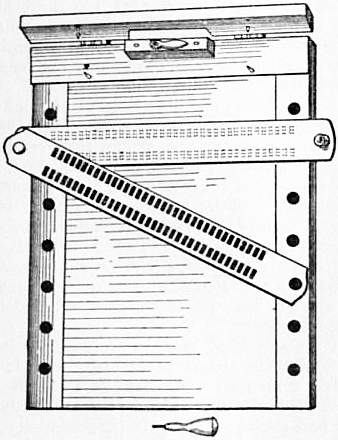
Apparatus for writing Braille.
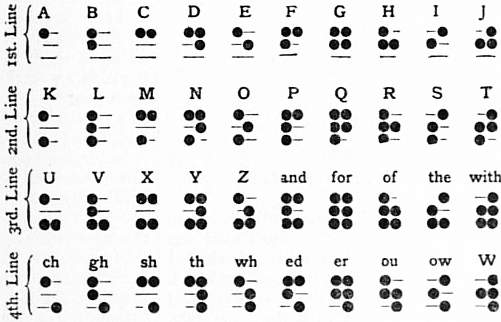
Braille Alphabet. The black dots represent the raised points of the sign in their position in relation to the group of six. Fig. 2.
Barbier arranged a table of speech sounds, consisting of six lines with six sounds in each line. His rectangular cell contained two vertical rows of six points each. The number of points in the left-hand row indicates in which horizontal line, and that in the right-hand row in which vertical line, of the printed table the speech sound is to be found.
Louis Braille, a pupil and afterwards a professor of the Institution Nationale des Jeunes Aveugles, Paris, studied all the various methods in which arbitrary characters were used. Barbier’s letter, although it gave a large number of combinations, was too long to be covered by the finger in reading, and Louis Braille reduced the number of dots. In 1834 Braille perfected his system. Dr Armitage considered it was the greatest advance that had ever been made in the education of the blind.
The Braille alphabet consists of varying combinations of six dots in an oblong, of which the vertical side contains three, and the horizontal two dots . There are 63 possible combinations of these six dots, and after the letters of the alphabet have been supplied, the remaining signs are used for punctuation, contractions, &c.

“For writing, a ruler is used, consisting of a metal bed either grooved or marked by groups of little pits, each group consisting of six; over this bed is fitted a brass guide, punched with oblong holes whose vertical diameter is three-tenths of an inch, while the horizontal diameter is two-tenths. The pits are arranged in two parallel lines, and the guide is hinged on the bed in such a way that when the two are locked together the openings in the guide correspond exactly to the pits in the bed. The brass guide has a double row of openings, which enables the writer to write two lines; when these are written, he shifts his guide downwards until two little pins, which project from the under surface at its ends, drop into corresponding holes of a wooden board; then two more lines are written, and this operation is repeated until the bottom of the page is reached. The paper is introduced between the frame and the metal bed. The instrument for writing is a blunt awl, which carries a little cap of paper before it into the grooves or pits of the bed, thereby producing a series of little pits in the paper on the side next the writer. When taken out and turned over, little prominences are felt, corresponding to the pits on the other side. The reading is performed from left to right, consequently the writing is from right to left; but this reversal presents no practical difficulty as soon as the pupil had caught the idea that in reading and writing alike he has to go forwards.
“The first ten letters, from ‘a’ to ‘j,’ are formed in the upper and middle grooves; the next ten, from ‘k’ to ‘t,’ are formed by adding one lower back dot to each letter of the first series; the third row is formed from the first by adding two lower dots to each letter; the fourth row, similarly, by adding one lower front dot.
“The first ten letters, when preceded by the prefix for numbers, stand for the nine numbers and the cipher. The same signs, written in the lower and middle grooves, instead of the upper and middle, serve for punctuation. The seven last letters of each series stand for the seven musical notes—the first series representing quavers, the second minims, the third semibreves, the fourth crotchets. Rests, accidentals, and every other sign used in music can be readily and clearly expressed without having recourse to the staff of five lines which forms the basis of ordinary musical notation, and which, though it has been reproduced tor the blind, can only be considered as serving to give them an idea of the method employed by the seeing, and cannot, of course, be written. By means of this dotted system, a blind man is able to keep memoranda or accounts, write his own music, emboss his own books from dictation, and carry on correspondence.”
The Braille system for literature and music was brought into general use in England by Dr T.R. Armitage. Through his wise, untiring zeal and noble generosity, every blind man, woman and child throughout the English-speaking world can now obtain not only the best literature, but the best music.
In America there are two modifications of the point type, known as New York point and American braille. In each of these the most frequently recurring letters are represented by the least number of dots.
The original Braille is used by the institutions for the blind in the British empire, European countries, Mexico, Brazil and Egypt.
Appliances for Educational Work
The apparatus for writing point alphabets has already been described. Frank H. Hall, former superintendent of the School for the Blind, Jacksonville, Ill., U.S.A., has invented a Braille typewriter and stereotype maker; the latter embosses metal plates from which any number of copies can be printed. An automatic Braille-writer has been brought out in Germany, and William B. Wait (principal of the Institution for the Blind in New York City) has invented a machine for writing New York point. These machines are expensive, but A. Wayne of Birmingham has brought out a cheap and effective Braille-writer. H. Stainsby, secretary of the Birmingham institution, and Wayne have invented a machine for writing Braille shorthand.
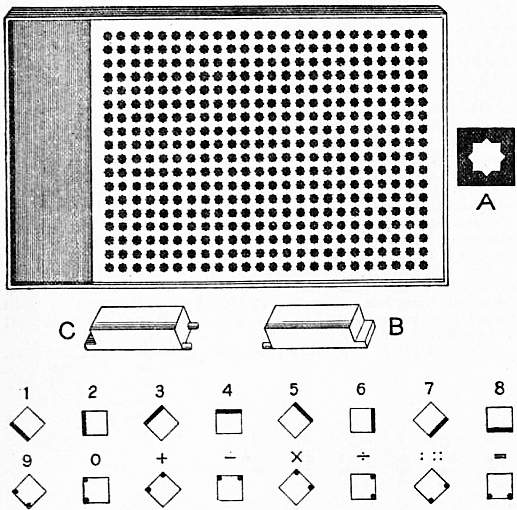
Fig. 3.—Arithmetic Board, Pin and Characters. A, Shape of opening in the board for pin; B and C, pin.
Many boards have been constructed to enable the blind to work arithmetical problems. The one which is most used was invented by the Rev. W. Taylor. The board has star-shaped openings in which a square pin fits in eight different positions. The pin has on one end a plain ridge and on the other a notched ridge; sixteen characters can be formed with the two ends. The board is also used for algebra, another set of type furnishing the algebraic symbols.
Books are prepared with raised geometrical diagrams; figures can be formed with bent wires on cushions, or on paper with a toothed wheel attached to one end of a pair of compasses.
Geography is studied by means of relief maps, manufactured in wood or paper. The physical maps and globes prepared for seeing children are used also for the blind.
Chiefly owing to the unremitting energy and liberality of Dr T.R. Armitage, in connexion with the British and Foreign Blind Association, all school appliances for the blind have been greatly improved and cheapened.
Employment
Reference has been made to the fact that music in its various branches furnishes the best and most lucrative employment for the blind. But those who have not the ability, or are too old to be trained for music or some other profession, must depend upon handicrafts for their support. The principal ones taught in the various institutions are the making of baskets, brushes, mats, sacks, ships’ fenders, brooms and mattresses, upholstery, wire-work, chair-caning, wood-chopping, &c. Females are taught to make fancy baskets and brushes, chair-caning, knitting, netting, weaving, sewing—hand and machine—crocheting, &c. It is difficult to find employment for blind girls. It is hoped that typewriting and massage will prove remunerative.
The blind, whether educated for the church, trained as teachers, musicians, pianoforte-tuners, or for any other trade or occupation, generally require assistance at the outset. They need help in finding suitable employment, recommendations for establishing a connexion, pecuniary assistance in providing outfits of books, tools, instruments, &c., help in the selection and purchase of the best materials at the lowest wholesale rates, in the sale of their manufactured goods in the best markets, and if overtaken by reverses, judicious and timely help towards a fresh start. Every institution should keep in touch with its old pupils. The superintendent who carefully studies the successes and failures of his pupils when they go into the world, will more wisely direct the work and energies of his present and future students.
Within recent years great improvements have been made in some of the progressive workshops for the blind. At the conference in London in 1902 Mr T. Stoddart gave the following information in regard to the work in Glasgow:—“We are building very extensive additions to our workshops, which will enable us to accommodate 600 blind people. We mean to employ the most up-to-date methods, and are introducing electric power to drive the machinery and light the workshops. We have to do with the average blind adult recently deprived of sight after he has attained an age of from 25 to 40 or even 50 years. In Glasgow we have developed an industry eminently suitable for the employment of the blind, namely, the manufacture of new and the remaking of old bedding. There are industries which are purely local, where certain articles of manufacture largely used in one district are useless, or nearly so, in another; but the field in which this industry may be promoted is practically without limit. It is perhaps the employment par excellence for the blind, and among other advantages it has the following to recommend it: employment is provided for the blind of both sexes and of all ages; there is no accumulation nor deterioration of stock; it yields an excellent profit, and its use is universal. We have been pushing this industry for years, our annual turnover in this particular department having exceeded £7000, and as we find it so suited to the capabilities of all grades of blind people, it is our intention to provide facilities for doing a turnover of three times that amount. Instead of the thirty sewing-machines which we have at present running by power, we hope to employ 100 blind women. At cork-fender-making, also an industry of the most suitable kind, we are at present employing about thirty workers. It is also our intention to greatly develop and extend our mat-making department.”
In the United States many blind persons are engaged in agricultural pursuits, and some are very successful in commercial pursuits. When a man loses his sight in adult life, if he can possibly follow the business in which he has previously been engaged, it is the best course for him. In the present day, work in manufactories is subdivided to such an extent that often some one portion can be done by a blind person; but it needs the interest of some enthusiastic believer in the capabilities of the blind to persuade the seeing manager that blind people can be safely employed in factories.
In England, at the time of the royal commission of 1889, upwards of 8000 blind persons, above the age of 21, were in receipt of relief from the guardians, of whom no less than 3278 were resident in workhouses or workhouse infirmaries. The census returns for 1901 indicate that the number at that time was equally large. It would certainly be more economical to establish workshops where the able-bodied adult blind can be trained in some handicraft and employed.
The papers read at the various conferences show that, even under the most favourable circumstances, some are not able to earn enough for their support; nevertheless, employment improves their condition; there is no greater calamity than to live a life of compulsory idleness in total darkness. The cry of the blind is not alms but work. One of the workshops in western America has adopted the motto, “Independence through Industry,” and it should be the aim of every civilized country to hasten the time when blindness and pauperism shall no longer be synonymous terms.
Biography
It may be interesting, in conclusion, to mention some of the names of prominent blind people in history:—
Timoleon (c. 410-336 B.C.), a Greek general.
Aufidius, a Roman senator.
Bela II. (d. 1141), king of Hungary.
John, king of Bohemia (1296-1346), killed in the battle of Crécy.
John Zizca (c. 1376-1424), Bohemian general.
Basil III. (d. 1462), prince of Moscow.
Shah Alam (d. 1806), the last of the Great Moguls.
Diodorus, the instructor of Cicero.
Didymus of Alexandria (c. 308-395), mathematician, theologian and linguist.
Nicase of Malines (d. 1492), professor of law in the university of Cologne. The degree of doctor of divinity was conferred on him by the university of Louvain, and the pope granted a dispensation suspending the law of the Church, that he might be ordained as a priest.
Ludovico Scapinelli (b. 1585), professor at the universities of Bologna, Modena and Pisa.
James Schegkius (d. 1587), professor of philosophy and medicine at Tübingen.
Franciscus Salinas, professor of music at the university of Salamanca, in the 16th century.
Nicholas Bacon (16th century), doctor of laws in the university of Brussels.
Count de Pagan of Avignon (b. 1604), mathematician of note.
John Milton (1608-1674), the poet.
Rev. Richard Lucas (1648-1715), prebendary of Westminster.
Nicholas Saunderson (q.v.; 1682-1739).
John Stanley (1713-1786), Mus. Bac. Oxon., was born in London in 1713. At seven he began to study music, and made such rapid progress that he was appointed organist of All-Hallows, Bread Street, at the age of eleven. He graduated as Mus. Bac. at Oxford when sixteen, and was organist of the Temple church at the age of twenty-one. He composed a number of cantatas, and after the death of Handel he superintended the performance of Handel’s oratorios at Covent Garden. He received the degree of doctor of music, and was master of the king’s band.
Leonard Euler (1707-1783), the celebrated mathematician and astronomer.
John Metcalf (b. 1717), road-builder and contractor.
Sir John Fielding (d. 1780), eminent lawyer and magistrate.
Thomas Blacklock (q.v.; 1721-1791), Scottish scholar and poet.
François Huber (1750-1831), Swiss naturalist, noted for his observations on bees.
Edward Rushton (b. 1756). At six years of age he entered the Liverpool free grammar school, and at eleven shipped for his first voyage in a West India merchantman. On a later voyage he was shipwrecked, and owed his life to the self-sacrifice of a negro. Rushton and the black man swam for their lives to a floating cask; the negro reached it first, saw Rushton about to sink, pushed the cask to the failing lad, and struck out for the shore, but never reached it. This incident made Rushton an enthusiastic champion through life of the cause of the negro. During a voyage to Dominica malignant ophthalmia broke out among the slave cargo, and Rushton caught the disease by attending them in the hold when all others refused help. This attack deprived him of sight, and cut short a promising nautical career at the age of nineteen. He struggled bravely against difficulties, and besides entering successfully into various literary engagements, maintained himself and family as a bookseller. A volume of his poems containing a memoir was published in 1824.
Marie Thérèse von Paradis (b. 1759), the daughter of an imperial councillor in Vienna. She was a godchild of the empress Marie Thérèse, and as her parents possessed rank and wealth, no expense was spared in her education. Weissembourg, a blind man, was her tutor, and she learned to spell with letters cut out of pasteboard, and read words pricked upon cards with pins. She studied the piano with Richter (of Holland) and Kozeluch. She was a highly esteemed pianist, and Mozart wrote a concerto for her; she also attained considerable skill on the organ, in singing and in composition. She made a concert tour of Europe, visiting the principal courts and everywhere achieving great success. She remained four months in England, under the patronage of the queen. On her return to Vienna, through Paris, she met Valentin Haüy. Towards the close of her life she devoted herself to teaching singing and the pianoforte with great success.
James Holman (q.v.; 1786-1857), traveller.
William H. Prescott (q.v.; 1796-1859), the American historian.
Several early 19th-century musicians held situations as organists in London; among them Grenville, Scott, Lockhart, Mather, Stiles and Warne.
Louis Braille (1809-1852). In 1819 he went to the school for the blind in Paris. He became proficient on the organ, and held a post in one of the Paris churches. While a professor at the Institution Nationale des Jeunes Aveugles, he perfected his system of point writing.
Alexander Rodenbach, Belgian statesman. When a member of the chamber of deputies, in 1836, he introduced and succeeded in establishing by law the right of blind and deaf-mute children to an education.
Dr William Moon (1818-1894), the inventor of the type for the blind which bears his name.
Rev. W.H. Milburn, D.D. (1823-1903), the American chaplain, known in the United States as “The Blind Man Eloquent.” He often travelled from thirty to fifty thousand miles a year, speaking and preaching every day. He was three times chaplain of the House of Representatives, and in 1893 was chosen to the chaplaincy of the senate.
Dr T.R. Armitage (b. 1824). After spending his youth on the continent, he became a medical student, first at King’s College, and afterwards at Paris and Vienna. His career promised to be a brilliant one, but at the age of thirty-six failing sight caused him to abandon his profession. For the rest of his life he devoted his time and fortune to the interests of the blind. He reorganized the Indigent Blind Visiting Society, endowed its Samaritan fund, founded the British and Foreign Blind Association, and, in conjunction with the late duke of Westminster and others, founded the Royal Normal College.
Elizabeth Gilbert (b. 1826), daughter of the bishop of Chichester. She lost her sight at the age of three. She was educated at home, and took her full share of household duties and cares and pleasures. When she was twenty-seven, she began to consider the condition of the poor blind of London. She saw some one must befriend those who had been taught trades, some one who could supply material, give employment or dispose of the articles manufactured. In 1854 her scheme was started, and work was given to six men in their own homes, but the number soon increased. In 1856 a committee was formed, a house converted into a factory, and the Association for Promoting the General Welfare of the Blind was founded.
Rev. George Matheson, D.D. (b. 1842), preacher and writer of the Church of Scotland. The degree of D.D. was conferred on him by the university of Edinburgh in 1879, and he was appointed Baird Lecturer in 1881, and St Giles’ Lecturer in 1882.
Henry Fawcett (1833-1884), professor of political economy at Cambridge, and postmaster-general.
W.H. Churchman of Pennsylvania, who was instrumental in establishing the schools for the blind in Tennessee, Indiana and Wisconsin.
H.L. Hall, founder of the workshops and home for the blind in Philadelphia; by his energetic management he raised the standard of work for the adult blind throughout America.
Bibliography.—See also W.H. Levy, Blindness and the Blind (1872); J. Wilson, Biography of the Blind (1838); Dr T.R. Armitage, Education and Employment of the Blind (2nd ed., 1882); R.H. Blair, Education of the Blind (1868); M. Anagnos, Education of the Blind (1882); H.J. Wilson, Institutions, Societies and Classes for the Blind in England and Wales (1907); Guillié, Instruction and Amusements of the Blind (1819); Dr W. Moon, Light for the Blind (1875); R. Meldrum, Light on Dark Paths (2nd ed., 1891); Dr H. Roth, Prevention of Blindness (1885), and his Physical Education of the Blind (1885); Report of Royal Commission (1889); Gavin Douglas, Remarkable Blind Persons (1829); John Bird, Social Pathology (1862); M. de la Sizeranne, The Blind in Useful Avocations (Paris, 1881), True Mission of Smaller Schools (Paris, 1884), The Blind in France (Paris, 1885), Two Years’ Study and Work for the Blind (Paris, 1890), and The Blind as seen by a Blind Man [translated by Dr Park Lewis] (Paris, 1893); Dr Émile Javal, The Blind Man’s World [translated by Ernest Thomson] (Paris, 1904); Prof. A. Mell, Encyklopadisches Handbuch des Blindenwesens (Vienna, 1899).
(F. J. C.)
1 There are no late returns for Iceland, but the last available statistics gave 3400 per million. A paper written in 1903 on blindness in Egypt stated that 1 in every 50 of the population was blind.
2 Previous returns from Finland have shown a much larger number of blind persons, but these statistics were supplied by the British consul in St Petersburg from the last census.
3 Its principal (responsible, with Dr Armitage, the duke of Westminster and others, for its foundation) was Sir F.J. Campbell, LL.D., F.R.G.S., F.S.A., himself a blind man, who, born in Tennessee, U.S.A., in 1832, and educated at the Nashville school, and afterwards in music at Leipzig and Berlin, had from 1858 to 1869 been associated with Dr Howe at the Perkins Institution, Boston. He was knighted in 1909.
BLISS, CORNELIUS NEWTON (1833- ), American merchant and politician, was born at Fall River, Massachusetts, on the 26th of January 1833. He was educated in his native city and in New Orleans, where he early entered his step-father’s counting-house. Returning to Massachusetts in 1849, he became a clerk and subsequently a junior partner in a prominent Boston commercial house. Later he removed to New York City to establish a branch of the firm. In 1881 he organized and became president of Bliss, Fabyan & Company, one of the largest wholesale dry-goods houses in the country. A consistent advocate of the protective tariff, he was one of the organizers, and for many years president, of the American Protective Tariff League. In politics an active Republican, he was chairman of the Republican state committee in 1887 and 1888, and contributed much to the success of the Harrison ticket in New York in the latter year. He was treasurer of the Republican national committee from 1892 to 1904, and was secretary of the interior in President McKinley’s cabinet from 1897 to 1899.
BLISTER (a word found in many forms in Teutonic languages, cf. Ger. Blase; it is ultimately connected with the same root as in “blow,” cf. “bladder”), a small vesicle filled with serous fluid raised on the skin by a burn, by rubbing on a hard surface, as on the hand in rowing, or by other injury; the term is also used of a similar condition of the skin caused artificially, as a counter-irritant in cases of inflammation, by the application of mustard, of various kinds of fly (see Cantharides) and of other vesicatories. Similar small swellings, filled with fluid or air, on plants and on the surface of steel or paint, &c., are also called “blisters.”
BLIZZARD (origin probably onomatopoeic, cf. “blast,” “bluster”), a furious wind driving fine particles of choking, blinding snow whirling in icy clouds. The conditions to which the name was originally given occur with the northerly winds in rear of the cyclones crossing the eastern states of America during winter.
BLOCK, MARK ELIEZER (c. 1723-1799), German naturalist, was born at Ansbach, of poor Jewish parents, about 1723. After taking his degree as doctor at Frankfort-on-Oder he established himself as a physician at Berlin. His first scientific work of importance was an essay on intestinal worms, which gained a prize from the Academy of Copenhagen, but he is best known by his important work on fishes (see Ichthyology). Bloch was fifty-six when he began to write on ichthyological subjects. To begin at his time of life a work in which he intended not only to give full descriptions of the species known to him from specimens or drawings, but also to illustrate each species in a style truly magnificent for his time, was an undertaking the execution of which most men would have despaired of. Yet he accomplished not only this task, but even more than he at first contemplated. He died at Carlsbad on the 6th of August 1799.
BLOCK, MAURICE (1816-1901), French statistician, was born in Berlin of Jewish parents on the 18th of February 1816. He studied at Bonn and Giessen, but settled in Paris, becoming naturalized there. In 1844 he entered the French ministry of agriculture, becoming in 1852 one of the heads of the statistical department. He retired in 1862, and thenceforth devoted himself entirely to statistical studies, which have gained for him a wide reputation. He was elected a member of the Académie des Sciences Morales et Politiques in 1880. He died in Paris on the 9th of January 1901. His principal works are: Dictionnaire de l’administration française (1856); Statistique de la France (1860); Dictionnaire général de la politique (1862); L’Europe polilique et sociale (1869); Traité théorique et pratique de statistique (1878); Les Progrés de l’économie politique depuis Adam Smith (1890); he also edited from 1856 L’Annuaire de l’économie politique et de la statistique, and wrote in German Die Bevolkerung des französischen Kaiserreichs (1861); Die Bevolkerung Spaniens und Portugals (1861); and Die Machtstellung der europäischen Staaten (1862).
BLOCK (from the Fr. bloc, and possibly connected with an Old Ger. Block, obstruction, cf. “baulk”), a piece of wood. The word is used in various senses, e.g. the block upon which people were beheaded, the block or mould upon which a hat is shaped, a pulley-block, a printing-block, &c. From the sense of a solid mass comes the expression, a “block” of houses, i.e. a rectangular space covered with houses and bounded by four streets. From the sense of “obstruction” comes a “block” in traffic, a block in any proceedings, and the block system of signalling on railways.
BLOCKADE (Fr. blocus, Ger. Blokade), a term used in maritime warfare. Originally a blockade by sea was probably nothing more than the equivalent in maritime warfare of a blockade or siege on land in which the army investing the blockaded or besieged place is in actual physical possession of a zone through which it can prevent and forbid ingress and egress. An attempt to cross such a zone without the consent of the investing army would be an act of hostility against the besiegers. A maritime blockade, when it formed part of a siege, would obviously also be a close blockade, being part of the military cordon drawn round the besieged place. Even from the first, however, differences would begin to grow up in the conditions arising out of the operations on land and on sea. Thus whereas conveying merchandise across military lines would be a deliberate act of hostility against the investing force, a neutral ship which had sailed in ignorance of the blockade for the blockaded place might in good faith cross the blockade line without committing a hostile act against the investing force. With the development of recognition of neutral rights the involuntary character of the breach would be taken into account, and notice to neutral states and to approaching vessels would come into use. With the employment in warfare of larger vessels in the place of the more numerous small ones of an earlier age, notice, moreover, would tend to take the place of de facto investment, and at a time when communication between governments was still slow and precarious, such notice would sometimes be given as a possible measure of belligerent tactics before the blockade could be actually carried out. Out of these circumstances grew up the abuse of “paper blockades.”
The climax was reached in the “Continental Blockade” decreed by Napoleon in 1806, which continued till it was abolished by international agreement in 1812. This blockade forbade all countries under French dominion or allied with France to have any communication with Great Britain. Great Britain replied in 1807 by a similar measure. The first nation to protest against these fictitious blockades was the United States. Already in 1800 John Marshall, secretary of state, wrote to the American minister in Great Britain pointing out objections which have since been universally admitted. In the following interesting passage he said:—
“Ports not effectually blockaded by a force capable of completely investing them have yet been declared in a state of blockade.... If the effectiveness of the blockade be dispensed with, then every port of the belligerent powers may at all times be declared in that state, and the commerce of neutrals be thereby subjected to universal capture. But if this principle be strictly adhered to, the capacity to blockade will be limited by the naval force of the belligerent and, in consequence, the mischief to neutral commerce cannot be very extensive. It is, therefore, of the last importance to neutrals that this principle be maintained unimpaired. I observe that you have pressed this reasoning on the British minister, who replies that an occasional absence of a fleet from a blockaded port ought not to change the state of the place. Whatever force this observation may be entitled to, where that occasional absence has been produced by an accident, as a storm, which for a moment blows off a fleet and forces it from its station, which station it immediately resumes, I am persuaded that where a part of the fleet is applied, though only for a time, to other objects or comes into port, the very principle requiring an effective blockade, which is that the mischief can only be coextensive with the naval force of the belligerent, requires that during such temporary absence the commerce to the neutrals to the place should be free.”1
Again in 1803 James Madison wrote to the then American minister in London:—
“The law of nations requires to constitute a blockade that there should be the presence and position of a force rendering access to the prohibited place manifestly difficult and dangerous.”2
In 1826 and 1827 Great Britain as well as the United States asserted that blockades in order to be binding must be effective. This became gradually the recognized view, and when in 1856 the powers represented at the congress of Paris inserted in the declaration there adopted that “blockades in order to be binding must be effective, that is to say, maintained by a force sufficient really to prevent access to the coast of an enemy,” they were merely enunciating a rule which neutral states had already become too powerful to allow belligerents to disregard.
Blockade is universally admitted to be a belligerent right to which under international law neutrals are obliged to submit. It is now also universally admitted that the above-quoted rule of the Declaration of Paris forms part of international law, independently of the declaration. Being, however, exclusively a belligerent right, it cannot be exercised except by a belligerent force. Even a de facto belligerent has the right to institute a blockade binding on neutrals if it has the means of making it effective, though the force opposed to it may treat the de facto belligerent as rebels.
It is also admitted that, being exclusively a belligerent right, it cannot be exercised in time of peace, but there has been some inconsistency in practice (see Pacific Blockade) which will probably lead governments, in order to avoid protests of neutral powers against belligerent rights being exercised in mere coercive proceedings, to exercise all the rights of belligerents and carry on de facto war to entitle them to use violence against neutral infringers. This was done in the case of the blockade of Venezuela by Great Britain, Germany and Italy in 1902-1903.
The points upon which controversy still arises are as to what constitutes an “effective” blockade and what a sufficient notice of blockade to warrant the penalties of violation, viz. confiscation of the ship and of the cargo unless the evidence demonstrates the innocence of the cargo owners. A blockade to be effective must be maintained by a sufficient force to prevent the entrance of neutral vessels into the blockaded port or ports, and it must be duly proclaimed. Subject to these principles being complied with, “the question of the legitimacy and effectiveness of a blockade is one of fact to be determined in each case upon the evidence presented” (Thomas F. Bayard, American secretary of state, to Messrs Kamer & Co., 19th of February 1889). The British manual of naval prize law sums up the cases in which a blockade, validly instituted, ceases to be effectively maintained, as follows:—(1) If the blockading force abandons its position, unless the abandonment be merely temporary or caused by stress of weather, or (2) if it be driven away by the enemy, or (3) if it be negligent in its duties, or (4) if it be partial in the execution of its duties towards one ship rather than another, or towards the ships of one nation rather than those of another. These cases, however, are based on decisions of the British admiralty court and cannot be relied on absolutely as a statement of international law.
As regards notice the following American instructions vere given to blockading officers in June 1898:—
“Neutral vessels are entitled to notification of a blockade before they can be made prize for its attempted violation. The character of this notification is not material. It may be actual, as by a vessel of the blockading force, or constructive, as by a proclamation of the government maintaining the blockade, or by common notoriety. If a neutral vessel can be shown to have had notice of the blockade in any way, she is good prize, and should be sent in for adjudication; but should formal notice not have been given, the rule of constructive knowledge arising from notoriety should be construed in a manner liberal to the neutral.
“Vessels appearing before a blockaded port, having sailed without notification, are entitled to actual notice by a blockading vessel. They should be boarded by an officer, who should enter in the ship’s log the fact of such notice, such entry to include the name of the blockading vessel giving notice, the extent of the blockade, the date and place, verified by his official signature. The vessel is then to be set free; and should she again attempt to enter the same or any other blockaded port as to which she has had notice, she is good prize. Should it appear from a vessel’s clearance that she sailed after notice of blockade had been communicated to the country of her port of departure, or after the fact of blockade had, by a fair presumption, become commonly known at that port, she should be sent in as a prize.”
The passages in italics are not in accordance with the views held by other states, which do not recognize the binding character of a diplomatic notification or of constructive notice from notoriety.
The subject was brought up at the second Hague Conference (1907). The Italian and Mexican delegations submitted projects, but after a declaration by the British delegate in charge of the subject (Sir E. Satow) that blockade not having been included in the Russian programme, his government had given him no instructions upon it, the subject, at his suggestion, was dropped. A Voeu, however, was adopted in favour of formulating rules on all branches of the laws and customs of naval war, and a convention was agreed to for the establishment of an international Prize Court (see Prize). Under Art. 7 of the latter convention the Court was to apply the “rules of international law,” and in their absence the “general principles of justice and equity.” As soon as possible after the close of the second Hague Conference the British government took steps to call a special conference of the maritime powers, which sat from December 4, 1908 to February 26, 1909. Among the subjects dealt with was Blockade, the rules relating to which are as follow:—
Art. 1. A blockade must not extend beyond the ports and coasts belonging to or occupied by the enemy.
Art. 2. In accordance with the Declaration of Paris of 1856, a blockade, in order to be binding, must be effective—that is to say, it must be maintained by a force sufficient really to prevent access to the enemy coastline.
Art. 3. The question whether a blockade is effective is a question of fact.
Art. 4. A blockade is not regarded as raised if the blockading force is temporarily withdrawn on account of stress of weather.
Art. 5. A blockade must be applied impartially to the ships of all nations.
Art. 6. The commander of a blockading force may give permission to a warship to enter, and subsequently to leave, a blockaded port.
Art. 7. In circumstances of distress, acknowledged by an officer of the blockading force, a neutral vessel may enter a place under blockade and subsequently leave it, provided that she has neither discharged nor shipped any cargo there.
Art. 8. A blockade, in order to be binding, must be declared in accordance with Article 9, and notified in accordance with Articles 11 and 16.
Art. 9. A declaration of blockade is made either by the blockading power or by the naval authorities acting in its name. It specifies (1) the date when the blockade begins; (2) the geographical limits of the coastline under blockade; (3) the period within which neutral vessels may come out.
Art. 10. If the operations of the blockading power, or of the naval authorities acting in its name, do not tally with the particulars, which, in accordance with Article 9 (1) and (2), must be inserted in the declaration of blockade, the declaration is void, and a new declaration is necessary in order to make the blockade operative.
Art. 11. A declaration of blockade is notified: (1) to neutral powers, by the blockading power by means of a communication addressed to the governments direct, or to their representatives accredited to it; (2) to the local authorities, by the officer commanding the blockading force. The local authorities will, in turn, inform the foreign consular officers at the port or on the coastline under blockade as soon as possible.
Art. 12. The rules as to declaration and notification of blockade apply to cases where the limits of a blockade are extended, or where a blockade is re-established after having been raised.
Art. 13. The voluntary raising of a blockade, as also any restriction in the limits of a blockade, must be notified in the manner prescribed by Article 11.
Art. 14. The liability of a neutral vessel to capture for breach of blockade is contingent on her knowledge, actual or presumptive, of the blockade.
Art. 15. Failing proof to the contrary, knowledge of the blockade is presumed if the vessel left a neutral port subsequently to the notification of the blockade to the power to which such port belongs, provided that such notification was made in sufficient time.
Art. 16. If a vessel approaching a blockaded port has no knowledge, actual or presumptive, of the blockade, the notification must be made to the vessel itself by an officer of one of the ships of the blockading force. This notification should be entered in the vessel’s logbook, and must state the day and hour, and the geographical position of the vessel at the time. If through the negligence of the officer commanding the blockading force no declaration of blockade has been notified to the local authorities, or if in the declaration, as notified, no period has been mentioned within which neutral vessels may come out, a neutral vessel coming out of the blockaded port must be allowed to pass free.
Art. 17. Neutral vessels may not be captured for breach of blockade except within the area of operations of the warships detailed to render the blockade effective.
Art. 18. The blockading forces must not bar access to neutral ports or coasts.
Art. 19. Whatever may be the ulterior destination of a vessel or of her cargo, she cannot be captured for breach of blockade, if, at the moment, she is on her way to a non-blockaded port.
Art. 20. A vessel which has broken blockade outwards, or which has attempted to break blockade inwards, is liable to capture so long as she is pursued by a ship of the blockading force. If the pursuit is abandoned, or if the blockade is raised, her capture can no longer be effected.
Art. 21. A vessel found guilty of breach of blockade is liable to condemnation. The cargo is also condemned, unless it is proved that at the time of the shipment of the goods the shipper neither knew nor could have known of the intention to break the blockade.
(T. Ba.)
1 John Marshall, secretary of state, to Rufus King, minister to England, 20th of September 1800, Am. State Papers, Class I, For. Rel. II, No. 181, J.B. Moore, Digest of International Law, vii. 788.
2 James Madison, secretary of state, to Mr Thornton, 27th of October 1803, 14 MS. Dom. Let. 215. Moore, Digest of International Law, vii. 789.
BLOCKHOUSE, in fortification, a small roofed work serving as a fortified post for a small garrison. The word, common since 1500, is of uncertain origin, and was applied to what is now called a fort d’arrêt, a detached fort blocking the access to a landing, channel, pass, bridge or defile. The modern blockhouse is a building, sometimes of two storeys, which is loopholed on all sides, and not infrequently, in the case of two-storey blockhouses, provided with a mâchicoulis gallery. Blockhouses are built of wood, brick, stone, corrugated iron or any material available. During the South African War (1899-1902) they were often sent from England to the front in ready-made sections.
BLOEMAERT, ABRAHAM (1564-1651), Dutch painter and engraver, was born at Gorinchem, the son of an architect. He was first a pupil of Gerrit Splinter (pupil of Frans Floris) and of Joos de Beer, at Utrecht. He then spent three years in Paris, studying under several masters, and on his return to his native country received further training from Hieronymus Francken. In 1591 he went to Amsterdam, and four years later settled finally at Utrecht, where he became dean of the Gild of St Luke. He excelled more as a colourist than as a draughtsman, was extremely productive, and painted and etched historical and allegorical pictures, landscapes, still-life, animal pictures and flower pieces. Among his pupils are his four sons, Hendrick, Frederick, Cornelis and Adriaan (all of whom achieved considerable reputation as painters or engravers), the two Honthorsts and Jacob G. Cuyp.
BLOEMEN, JAN FRANS VAN (1662-1740), Flemish painter, was born at Antwerp, and studied and lived in Italy. At Rome he was styled Orizonte, on account of his painting of distance in his landscapes, which are reminiscent of Gaspard Poussin and much admired. His brothers Pieter (1657-1719), styled Standaart (from his military pictures), and Norbert (1670-1746), were also well-known painters.
BLOEMFONTEIN, capital of the Orange Free State, in 29º 8′ S., 26º 18′ E. It is situated on the open veld, surrounded by a few low kopjes, 4518 ft. above the sea, 105 m. by rail E. by S. of Kimberley, 750 N.E. by E. of Cape Town, 450 N. by E. of Port Elizabeth, and 257 S.W. of Johannesburg.
Bloemfontein is a very pleasant town, regularly laid out with streets running at right angles and a large central market square. Many of the houses are surrounded by large wooded gardens. Through the town runs the Bloemspruit. After a disastrous flood in 1904 the course of this spring was straightened and six stone bridges placed across it. There are several fine public buildings, mostly built of red brick and a fine-grained white stone quarried in the neighbourhood. The Raadzaal, a building in the Renaissance style, faces Market Square. Formerly the meeting-place of the Orange Free State Raad, it is now the seat of the provincial council. In front of the old Raadzaal (used as law courts) is a statue of President Brand. In Douglas Street is an unpretentious building used in turn as a church, a raadzaal, a court-house and a museum. In it was signed (1854) the convention which recognized the independence of the Free State Boers (see Orange Free State: History). Among the churches the most important, architecturally, are the Dutch Reformed, a building with two spires, and the Anglican cathedral, which has a fine interior. The chief educational establishment is Grey University College, built 1906-1908 at a cost of £125,000. It stands in grounds of 300 acres, a mile and a half from the town. In the town is the original Grey College, founded in 1856 by Sir George Grey, when governor of Cape Colony. The post and telegraph office in Market Square is one of the finest buildings in the town. The public library is housed in a handsome building in Warden Street. Opposite it is the new national museum.
Bloemfontein possesses few manufactures, but is the trading centre of the province. Having a dry healthy climate, it is a favourite residential town and a resort for invalids, being recommended especially for pulmonary disease. The mean maximum temperature is 76.7° Fahr., the mean minimum 45.8°; the mean annual rainfall about 24 in. There is an excellent water-supply, obtained partly from Bloemspruit, but principally from the Modder river at Sanna’s Post, 22 m. to the east, and from reservoirs at Moches Dam and Magdepoort.
The population in 1904 was 33,883, of whom, including the garrison of 3487, 15,501 were white, compared with a white population of 2077 in 1890. The coloured inhabitants are mostly Bechuana and Basuto. Most of the whites are of British origin, and English is the common language of all, including the Dutch.
The spruit or spring which gives its name to the town was called after one of the emigrant farmers, Jan Bloem. The town dates from 1846, in which year Major H.D. Warden, then British resident north of the Orange, selected the site as the seat of his administration. When in 1854 independence was conferred on the country the town was chosen by the Boers as the seat of government. It became noted for the intelligence of its citizens, and for the educational advantages it offered at the time when education among the Boers was thought of very lightly. In 1892 the railway connecting it with Cape Town and Johannesburg was completed. During the Anglo-Boer War of 1899-1902 it was occupied by the British under Lord Roberts without resistance (13th of March 1900), fourteen days after the surrender of General Cronje at Paardeberg. In Market Square on the 28th of the following May the annexation of the Orange Free State to the British dominions was proclaimed. In 1907 the first session of the first parliament elected under the constitution granting the colony self-government was held in Bloemfontein. In 1910 when the colony became a province of the Union of South Africa under its old designation of Orange Free State, Bloemfontein was chosen as the seat of the Supreme Court of South Africa. Its growth as a business centre after the close of the war in 1902 was very marked. The rateable value increased from £709,000 in 1901 to £2,400,000 in 1905.
BLOET, ROBERT (d. 1123), English bishop, was chancellor to William I. and Rufus. From the latter he received the see of Lincoln (1093) in succession to Remigius. His private character was indifferent; but he administered his see with skill and prudence, built largely, and kept a magnificent household, which served as a training-school even for the sons of nobles. Bloet was active in assisting Henry I. during the rebellion of 1102, and became that monarch’s justiciar. Latterly, however, he fell out of favour, and, although he had been very rich, was impoverished by the fines which the king extorted from him. Perhaps his wealth was his chief offence in the king’s eyes; for he was in attendance on Henry when seized with his last illness. He was the patron of the chronicler Henry of Huntingdon, whom he advanced to an archdeaconry.
Henry of Huntingdon and W. Malmesbury (De Gestis Pontificum) are original authorities. See E.A. Freeman’s William Rufus; Sir James Ramsay, The Foundations of England, vol. ii.
(H. W. C. D.)
BLOIS, LOUIS DE (1506-1566), Flemish mystical writer, generally known under the name of Blosius, was born in October 1506 at the château of Donstienne, near Liége, of an illustrious family to which several crowned heads were allied. He was educated at the court of the Netherlands with the future emperor Charles V. of Germany, who remained to the last his staunch friend. At the age of fourteen he received the Benedictine habit in the monastery of Liessics in Hainaut, of which he became abbot in 1530. Charles V. pressed in vain upon him the archbishopric of Cambrai, but Blosius studiously exerted himself in the reform of his monastery and in the composition of devotional works. He died at his monastery on the 7th of January 1566.
Blosius’s works, which were written in Latin, have been translated into almost every European language, and have appealed not only to Roman Catholics, but to many English laymen of note, such as W.E. Gladstone and Lord Coleridge. The best editions of his collected works are the first edition by J. Frojus (Louvain, 1568), and the Cologne reprints (1572, 1587). His best-known works are:—the Institutio Spiritualis (Eng. trans., A Book of Spiritual Instruction, London, 1900); Consolatio Pusillanimium (Eng. trans., Comfort for the Faint-Hearted, London, 1903); Sacellum Animae Fidelis (Eng. trans., The Sanctuary of the Faithful Soul, London, 1905); all these three works were translated and edited by Father Bertrand Wilberforce, O.P., and have been reprinted several times; and especially Speculum Monachorum (French trans. by Félicité de Lamennais, Paris, 1809; Eng. trans., Paris, 1676; re-edited by Lord Coleridge, London, 1871, 1872, and inserted in “Paternoster” series, 1901).
See Georges de Blois, Louis de Blois, un Bénédictin au XVIème siècle (Paris, 1875), Eng. trans. by Lady Lovat (London, 1878, &c.).
BLOIS, a town of central France, capital of the department of Loir-et-Cher, 35 m. S.W. of Orleans, on the Orleans railway between that city and Tours. Pop. (1906) 18,457. Situated in a thickly-wooded district on the right bank of the Loire, it covers the summits and slopes of two eminences between which runs the principal thoroughfare of the town named after the philosopher Denis Papin. A bridge of the 18th century from which it presents the appearance of an amphitheatre, unites Blois with the suburb of Vienne on the left bank of the river. The streets of the higher and older part of the town are narrow and tortuous, and in places so steep that means of ascent is provided by flights of steps. The famous château of the family of Orleans (see Architecture: Renaissance Architecture in France), a fine example of Renaissance architecture, stands on the more westerly of the two hills. It consists of three main wings, and a fourth and smaller wing, and is built round a courtyard. The most interesting portion is the north-west wing, which was erected by Francis I., and contains the room where Henry, duke of Guise, was assassinated by order of Henry III. The striking feature of the interior façade is the celebrated spiral staircase tower, the bays of which, with their beautifully sculptured balustrades, project into the courtyard (see Architecture, Plate VIII. fig. 84). The north-east wing, in which is the entrance to the castle, was built by Louis XII. and is called after him; it contains picture-galleries and a museum. Opposite is the Gaston wing, erected by Gaston, duke of Orleans, brother of Louis XIII., which contains a majestic domed staircase. In the north corner of the courtyard is the Salle des États, which, together with the donjon in the west corner, survives from the 13th century. Of the churches of Blois, the cathedral of St Louis, a building of the end of the 17th century, but in Gothic style, is surpassed in interest by St Nicolas, once the church of the abbey of St Laumer, and dating from the 12th and 13th centuries. The picturesqueness of the town is enhanced by many old mansions, the chief of which is the Renaissance Hôtel d’Alluye, and by numerous fountains, among which that named after Louis XII. is of very graceful design. The prefecture, the law court, the corn-market and the fine stud-buildings are among the chief modern buildings.
Blois is the seat of a bishop, a prefect, and a court of assizes. It has a tribunal of first instance, a tribunal of commerce, a board of trade arbitration, a branch of the Bank of France, a communal college and training-colleges. The town is a market for the agricultural and pastoral regions of Beauce and Sologne, and has a considerable trade in grain, the wines of the Loire valley, and in horses and other live-stock. It manufactures boots and shoes, biscuits, chocolate, upholstering materials, furniture, machinery and earthenware, and has vinegar-works, breweries, leather-works and foundries.
Though of ancient origin, Blois is first distinctly mentioned by Gregory of Tours in the 6th century, and was not of any importance till the 9th century, when it became the seat of a powerful countship (see below). In 1196 Count Louis granted privileges to the townsmen; the commune, which survived throughout the middle ages, probably dated from this time. The counts of the Châtillon line resided at Blois more often than their predecessors, and the oldest parts of the chateau (13th century) were built by them. In 1429 Joan of Arc made Blois her base of operations for the relief of Orleans. After his captivity in England, Charles of Orleans in 1440 took up his residence in the château, where in 1462 his son, afterwards Louis XII., was born. In the 16th century Blois was often the resort of the French court. Its inhabitants included many Calvinists, and it was in 1562 and 1567 the scene of struggles between them and the supporters of the Roman church. In 1576 and 1588 Henry III., king of France, chose Blois as the meeting-place of the states-general, and in the latter year he brought about the murders of Henry, duke of Guise, and his brother, Louis, archbishop of Reims and cardinal, in the château, where their deaths were shortly followed by that of the queen-mother, Catherine de’ Medici. From 1617 to 1619 Marie de’ Medici, wife of King Henry IV., exiled from the court, lived at the château, which was soon afterwards given by Louis XIII. to his brother Gaston, duke of Orleans, who lived there till his death in 1660. The bishopric dates from the end of the 17th century. In 1814 Blois was for a short time the seat of the regency of Marie Louise, wife of Napoleon I.
See L. de la Saussaye, Blois et ses environs (1873); Histoire du château de Blois (1873); L. Bergevin et A. Dupré, Histoire de Blois (1847).
BLOIS, Countship of. From 865 to about 940 the countship of Blois was one of those which were held in fee by the margrave of Neustria, Robert the Strong, and by his successors, the abbot Hugh, Odo (or Eudes), Robert II. and Hugh the Great. It then passed, about 940 and for nearly three centuries, to a new family of counts, whose chiefs, at first vassals of the dukes of France, Hugh the Great and Hugh Capet, became in 987, by the accession of the Capetian dynasty to the throne of France, the direct vassals of the crown. These new counts were orjginally very powerful. With the countship of Blois they united, from 940 to 1044, that of Touraine, and from about 950 to 1218, and afterwards from 1269 to 1286, the countship of Chartres remained in their possession.
The counts of Blois of the house of the Theobalds (Thibauds) began with Theobald I., the Cheat, who became count about 940. He was succeeded by his son, Odo (Eudes) I., about 975. Theobald II., eldest son of Odo I., became count in 996, and was succeeded by Odo II., younger son of Odo I., about 1005. Odo II. was one of the most warlike barons of his time. With the already considerable domains which he held from his ancestors, he united the heritage of his kinsman, Stephen I., count of Troyes. In 1033 he disputed the crown of Burgundy with the emperor, Conrad the Salic, and perished in 1037 while fighting in Lorraine. He was succeeded in 1037 by his eldest son, Theobald III., who was defeated by the Angevins in 1044, and was forced to give up the town of Tours and its dependencies to the count of Anjou. In 1089 Stephen Henry, eldest son of Theobald III., became count. He took part in the first crusade, fell into the hands of the Saracens, and died in captivity; he married Adela, daughter of William I., king of England. In 1102 Stephen Henry was succeeded by his son, Theobald IV. the Great, who united the countship of Troyes with his domains in 1128. In 1135, on the death of his maternal uncle, Henry I., king of England, he was called to Normandy by the barons of the duchy, but soon renounced his claims on learning that his younger brother, Stephen, had just been proclaimed king of England. In 1152 Theobald V. the Good, second son of Theobald IV., became count; he died in 1191 in Syria, at the siege of Acre. His son Louis succeeded in 1191, took part in the fourth crusade, and after the taking of Constantinople was rewarded with the duchy of Nicaea. He was killed at the battle of Adrianople in 1205, in which year he was succeeded by his son, Theobald VI. the Young, who died childless. In 1218 the countship passed to Margaret, eldest daughter of Theobald V., and to Walter (Gautier) of Avesnes, her third husband.
The Châtillon branch of the counts of Blois began in 1230 with Mary of Avesnes, daughter of Margaret of Blois and her husband, Hugh of Châtillon, count of St Pol. In 1241 her brother, John of Châtillon, became count of Blois, and was succeeded in 1279 by his daughter, Joan of Châtillon, who married Peter, count of Alençon, fifth son of Louis IX., king of France. In 1286 Joan sold the countship of Chartres to the king of France. Hugh of Châtillon, her first-cousin, became count of Blois in 1293, and was succeeded by his son, Guy I., in 1307. In 1342 Louis II., eldest son of Guy I., died at the battle of Crécy, and his brother, Charles of Blois, disputed the duchy of Brittany with John of Montfort. Louis III., eldest son of Louis II., became count in 1346, and was succeeded by John II., second son of Louis II., in 1372. In 1381 Guy II., brother of Louis III. and John II., succeeded in 1381, but died childless. Overwhelmed with debt, he had sold the countship of Blois to Louis I., duke of Orleans, brother of King Charles VI., who took possession of it in 1397.
In 1498 the countship of Blois was united with the crown by the accession of King Louis XII., grandson and second successor of Louis I., duke of Orleans.
See Bernier, Histoire de Blois (1682); La Saussaye, Histoire de la ville de Blois (1846).
(A. Lo.)
BLOMEFIELD, FRANCIS (1705-1752), English topographer of the county of Norfolk, was born at Fersfield, Norfolk, on the 23rd of July 1705. On leaving Cambridge in 1727 he was ordained, becoming in 1729 rector of Hargham, Norfolk, and immediately afterwards rector of Fersfield, his father’s family living. In 1733 he mooted the idea of a history of Norfolk, for which he had begun collecting material at the age of fifteen, and shortly afterwards, while collecting further information for his book, discovered some of the famous Paston Letters. By 1736 he was ready to put some of the results of his researches into type. At the end of 1739 the first volume of the History of Norfolk was completed. It was printed at the author’s own press, bought specially for the purpose. The second volume was ready in 1745. There is little doubt that in compiling his book Blomefield had frequent recourse to the existing historical collections of Le Neve, Kirkpatrick and Tanner, his own work being to a large extent one of expansion and addition. To Le Neve in particular a large share of the credit is due. When half-way through his third volume, Blomefield, who had come up to London in connexion with a special piece of research, caught smallpox, of which he died on the 16th of January 1752. The remainder of his work was published posthumously, and the whole eleven volumes were republished in London between 1805 and 1810.
BLOMFIELD, SIR ARTHUR WILLIAM (1829-1899), English architect, son of Bishop C.J. Blomfield, was born on the 6th of March 1829, and educated at Rugby and Trinity, Cambridge. He was then articled as an architect to P.C. Hardwick, and subsequently obtained a large practice on his own account. He became president of the Architectural Association in 1861, and a fellow (1867) and vice-president (1886) of the Royal Institute of British Architects. In 1887 he became architect to the Bank of England, and designed the law courts branch in Fleet Street, and he was associated with A.E. Street in the building of the law courts. In 1889 he was knighted. He died on the 30th of October 1899. He was twice married, and brought up two sons, Charles J. Blomfield and Arthur Conran Blomfield, to his own profession, of which they became distinguished representatives. Among the numerous churches which Sir Arthur Blomfield designed, his work at St Saviour’s, Southwark, is a notable example of his use of revived Gothic, and he was highly regarded as a restorer.
BLOMFIELD, CHARLES JAMES (1786-1857), English divine, was born on the 29th of May 1786 at Bury St Edmunds. He was educated at the local grammar school and at Trinity College, Cambridge, where he gained the Browne medals for Latin and Greek odes, and carried off the Craven scholarship. In 1808 he graduated as third wrangler and first medallist, and in the following year was elected to a fellowship at Trinity College. The first-fruits of his scholarship was an edition of the Prometheus of Aeschylus in 1810; this was followed by editions of the Septem contra Thebas, Persae, Choephorae, and Agamemnon, of Callimachus, and of the fragments of Sappho, Sophron and Alcaeus. Blomfield, however, soon ceased to devote himself entirely to scholarship. He had been ordained in 1810, and held in quick succession the livings of Chesterford, Quarrington, Dunton, Great and Little Chesterford, and Tuddenham. In 1817 he was appointed private chaplain to Wm. Howley, bishop of London. In 1819 he was nominated to the rich living of St Botolph’s, Bishopsgate, and in 1822 he became archdeacon of Colchester. Two years later he was raised to the bishopric of Chester where he carried through many much-needed reforms. In 1828 he was translated to the bishopric of London, which he held for twenty-eight years. During this period his energy and zeal did much to extend the influence of the church. He was one of the best debaters in the House of Lords, took a leading position in the action for church reform which culminated in the ecclesiastical commission, and did much for the extension of the colonial episcopate; and his genial and kindly nature made him an invaluable mediator in the controversies arising out of the tractarian movement. His health at last gave way, and in 1856 he was permitted to resign his bishopric, retaining Fulham Palace as his residence, with a pension of £6000 per annum. He died on the 5th of August 1857. His published works, exclusive of those above mentioned, consist of charges, sermons, lectures and pamphlets, and of a Manual of Private and Family Prayers. He was a frequent contributor to the quarterly reviews, chiefly on classical subjects.
See Memoirs of Charles James Blomfield, D.D., Bishop of London, with Selections from his Correspondence, edited by his son, Alfred Blomfield (1863); G.E. Biber, Bishop Blomfield and his Times (1857).
BLOMFIELD, EDWARD VALENTINE (1788-1816), English classical scholar, brother of Bishop C.J. Blomfield, was born at Bury St Edmunds on the 14th of February 1788. Going to Caius College, Cambridge, he was thirteenth wrangler in 1811, obtained several of the classical prizes of the university, and became a fellow and lecturer at Emmanuel College. In 1813 he travelled in Germany and made the acquaintance of some of the great scholars of Germany. On his return, he published in the Museum Criticum (No. ii.) an interesting paper on “The Present State of Classical Literature in Germany.” Blomfield is chiefly known by his translation of Matthiae’s Greek Grammar (1819), which was prepared for the press by his brother. He died on the 9th of October 1816, his early death depriving Cambridge of one who seemed destined to take a high place amongst her most brilliant classical scholars.
See “Memoir of Edward Valentine Blomfield,” by Bishop Monk, in Museum Criticum, No. vii.
BLONDEL, DAVID (1591-1655), French Protestant clergyman, was born at Châlons-sur-Marne in 1591, and died on the 6th of April 1655. In 1650 he succeeded G.J. Vossius in the professorship of history at Amsterdam. His works were very numerous; in some of them he showed a remarkable critical faculty, as in his dissertation on Pope Joan (1647, 1657), in which he came to the conclusion, now universally accepted, that the whole story is a mere myth. Considerable Protestant indignation was excited against him on account of this book.
BLONDEL, JACQUES FRANÇOIS (1705-1774), French architect, began life as an architectural engraver, but developed into an architect of considerable distinction, if of no great originality. As architect to Louis XV. from 1755 he necessarily did much in the rococo manner, although it would seem that he conformed to fashion rather than to artistic conviction. He was among the earliest founders of schools of architecture in France, and for this he was distinguished by the Academy; but he is now best remembered by his voluminous work L’Architecture française, in which he was the continuator of Marot. The book is a precious collection of views of famous buildings, many of which have disappeared or been remodelled.
BLONDIN (1824-1897), French tight-rope walker and acrobat, was born at St Omer, France, on the 28th of February 1824. His real name was Jean François Gravelet. When five years old he was sent to the École de Gymnase at Lyons and, after six months’ training as an acrobat, made his first public appearance as “The Little Wonder.” His superior skill and grace as well as the originality of the settings of his acts, made him a popular favourite. He especially owed his celebrity and fortune to his idea of crossing Niagara Falls on a tight-rope, 1100 ft. long, 160 ft. above the water. This he accomplished, first in 1859, a number of times, always with different theatric variations: blindfold, in a sack, trundling a wheelbarrow, on stilts, carrying a man on his back, sitting down midway while he made and ate an omelette. In 1861 Blondin first appeared in London, at the Crystal Palace, turning somersaults on stilts on a rope stretched across the central transept, 170 ft. from the ground. In 1862 he again gave a series of performances at the Crystal Palace, and elsewhere in England, and on the continent. After a period of retirement he reappeared in 1880, his final performance being given at Belfast in 1896. He died at Ealing, London, on the 19th of February 1897.
BLOOD, the circulating fluid in the veins and arteries of animals. The word itself is common to Teutonic languages; the O. Eng. is blód, cf. Gothic bloth, Dutch bloed, Ger. Blut. It is probably ultimately connected with the root which appears in “blow,” “bloom,” meaning flourishing or vigorous. The Gr. word for blood, αἷμα, appears as a prefix haemo- in many compound words. As that on which the life depends, as the supposed seat of the passions and emotions, and as that part which a child is believed chiefly to inherit from its parents, the word “blood” is used in many figurative and transferred senses; thus “to have his blood,” “to fire the blood,” “cold blood,” “blood-royal,” “half” or “whole blood,” &c. The expression “blue blood” is from the Spanish sangre azul. The nobles of Castile claimed to be free from all admixture with the darker blood of Moors or Jews, a proof being supposed to lie in the blue veins that showed in their fairer skins. The common English expletive “bloody,” used as an adjective or adverb, has been given many fanciful origins; it has been supposed to be a contraction of “by our Lady,” or an adaptation of the oath common during the 17th century, “’sblood,” a contraction of “God’s blood.” The exact origin of the expression is not quite clear, but it is certainly merely an application of the adjective formed from “blood.” The New English Dictionary suggests that it refers to the use of “blood” for a young rowdy of aristocratic birth, which was common at the end of the 17th century, and later became synonymous with “dandy,” “buck,” &c.; “bloody drunk” meant therefore “drunk as a blood,” “drunk as a lord.” The expression came into common colloquial use as a mere intensive, and was so used till the middle of the 18th century. There can be little doubt that the use of the word has been considerably affected by the idea of blood as the vital principle, and therefore something strong, vigorous, and parallel as an intensive epithet with such expressions as “thundering,” “awfully” and the like.
Anatomy and Physiology
In all living organisms, except the most minute, only a minimum number of cells can come into immediate contact with the general world, whence is to be drawn the food supply for the whole organism. Hence those cells—and they are by far the most numerous—which do not lie on the food-absorbing surface, must gain their nutriment by some indirect means. Further, each living cell produces waste products whose accumulation would speedily prove injurious to the cell, hence they must be constantly removed from its immediate neighbourhood and indeed from the organism as a whole. In this instance again, only a few cells can lie on a surface whence such materials can be directly discharged to the exterior. Hence the main number of the cells of the organism must depend upon some mechanism by which the waste products can be carried away from them to that group of cells whose duty it is to modify them, or discharge them from the body. These two ends are attained by the aid of a circulating fluid, a fluid which is constantly flowing past every cell of the body. From it the cells extract the food materials they require for their sustenance, and into it they discharge the waste materials resulting from their activity. This circulating medium is the blood.
Whilst undoubtedly the two functions of this circulating fluid above given are the more prominent, there are yet others of great importance. For instance, it is known that many tissues as a result of their activity produce certain chemical substances which are of essential importance to the life of other tissue cells. These substances—internal secretions as they are termed—are carried to the second tissue by the blood stream. Again, many instances are known in which two distant tissues communicate with one another by means of chemical messengers, bodies termed hormones (ὁρμάειν, to stir up), which are produced by one group of cells, and sent to the other group to excite them to activity. Here, also, the path by which such messengers travel is the blood stream. A further and most important manner in which the circulating fluid is utilized in the life of an animal is seen in the way in which it is employed in protecting the body should it be invaded by micro-organisms.
Hence it is clear that the blood is of the most vital importance to the healthy life of the body. But the fact that it is present as a circulating medium exposes the animal to a great danger, viz. that it may be lost should any vessel carrying it become ruptured. This is constantly liable to happen, but to minimize as far as possible any such loss, the blood is endowed with the peculiar property of clotting, i.e. of setting to a solid or stiff jelly by means of which the orifices of the torn vessels become plugged and the bleeding stayed.
The performance of these essential functions depends upon the maintenance of a continuous flow past all tissue cells, and this is attained by the circulatory mechanism, consisting of a central pump, the heart, and a system of ramifying tubes, the arteries, through which the blood is forced from the heart to every tissue (see Vascular System). A second set of tubes, the veins, collects the blood and returns it to the heart. In many invertebrates the circulating fluid is actually poured into the tissue spaces from the open terminals of the arteries. From these spaces it is in turn drained away by the veins. Such a system is termed a haemolymph system and the circulating fluid the haemolymph. Here the essential point gained is that the fluid is brought into direct contact with the tissue cells. In all vertebrates, the ends of the arteries are united to the commencements of the veins by a plexus of extremely minute tubes, the capillaries, consequently the blood is always retained within closed tubes and never comes into contact with the tissue cells. It is while passing through the capillaries that the blood performs its work; here the blood stream is at its slowest and is brought nearest to the tissue cell, only being separated from it by the extremely thin wall of the capillary and by an equally thin layer of fluid. Through this narrow barrier the interchanges between cell and blood take place.
The advantage gained in the vertebrate animal by retaining the blood in a closed system of tubes lies in the great diminution of resistance to the flow of blood, and the consequent great increase in rate of flow past the tissue cells. Hence any food stuffs which can travel quickly through the capillary wall to the tissue cell outside can be supplied in proportionately greater quantity within a given time, without requiring any very great increase in the concentration of that substance in the blood. Conversely, any highly diffusible substance may be withdrawn from the tissues by the blood at a similarly increased pace. These conditions are more peculiarly of importance for the supply of oxygen and the removal of carbonic acid-especially for the former, because the amount of it which can be carried by the blood is small. But as the rate at which a tissue lives, i.e. its activity, depends upon the rate of its chemical reactions, and as these are fundamentally oxidative, the more rapidly oxygen is carried to a tissue the more rapidly it can live, and the greater the amount of work it can perform within a given time. The rate of supply is of much less importance in the case of the other food substances because they are far more soluble in water, so that the supply in sufficient quantity can easily be met by a relatively slow blood flow. Hence we find that the gradual evolution of the animal kingdom goes hand in hand with the gradual development of a greater oxygen-carrying capacity of the blood and an increase in the rate of its flow.
In the groundwork of a tissue are a number of spaces—the tissue spaces. They are filled with fluid and intercommunicate freely, finally connecting with a number of fine tubes, the lymphatics, through which excess of fluid or any solid particles present are drained away. The contained fluid acts as an intermediary between the blood and the cell; from it, the cell takes its various food stuffs, these having in the first instance been derived from the blood, and into it the cell discharges its waste products. On the course of the lymphatics a number of typical structures, the lymphatic glands, are placed, and the lymph has to pass through these structures where any deleterious products are retained, and the fluid thus purified is drained away by further lymphatics and finally returned to the blood. Thus there is a second stream of fluid from the tissues, but one vastly slower than that of the blood. The flow is too slow for it to act as the vehicle for the removal of those waste products (carbonic acid, &c.) which must of necessity be removed quickly. These must be removed by the blood. The same is true for the main number of other waste products, which, however, being of small molecular size are readily absorbed into the blood stream.
But in addition to fluid, the tissue spaces may at times be found to contain solid matter in the form of particles, which may represent the debris of destroyed cells, or which are, as is quite commonly the case, micro-organisms. Apparently such material cannot be removed from a tissue by absorption into the blood stream—indeed in the case of living organisms such an absorption would in many instances rapidly prove fatal, and special provision is made to prevent such an accident. These, therefore, are made to travel along the lymphatic channels, and so, before gaining access to the blood stream and thus to the body generally, have to run the gauntlet of the protective mechanism provided by the lymphatic glands, where in the major number of cases they are readily destroyed.
Hence we see that first and foremost we have to regard the blood as a food-carrier to all the cells of the body; in the second place as the vehicle carrying away most if not all the waste products; in a third direction, it is acting as a means for transmitting chemical substances manufactured in one tissue to distant cells of the body for whose nutrition or excitation they may be essential; and in addition to these important functions there is yet another whose value it is almost impossible to overestimate, for it plays the essential rôle in rendering the animal immune to the attacks of invading organisms. The question of immunity is discussed elsewhere, and it is sufficient merely to indicate the chief means by which the blood subserves this essential protective mechanism. Should living organisms find their way into the surface cells or within the tissue spaces, the body fights them in a number of ways, (1) It may produce one or more chemical substances capable of neutralizing the toxic material produced by the organism. (2) It may produce chemical substances which act as poisons to the micro-organism, either paralysing it or actually killing it. Or (3) the organism may be attacked and taken up into the body of wandering cells, e.g. certain of the leucocytes, and then digested by them. Such cells are therefore called phagocytes (φάγειν, to eat). Thus, by its power of reacting in these ways the body has become capable of withstanding the attacks of many different varieties of micro-organisms, of both animal and vegetable origin.
General Properties.—Blood is an opaque, viscid liquid of bright red colour possessing a distinct and characteristic odour, especially when warm. Its opacity is due to the presence of a very large number of solid particles, the blood corpuscles, having a higher refractive index than that of the liquid in which they float. The specific gravity in man averages about 1.055. The specific gravity of the liquid portion, the plasma (Gr. πλάσμα, something formed or moulded, πλάσσειν, to mould), is about 1.027, whilst that of the corpuscles amounts to 1.088. To litmus it reacts as a weak alkali.
Blood Plasma.—The plasma is a solution in water of a varied number of substances, and as a solvent it confers on the blood its power of acting as a carrier of food stuffs and waste products. One important food substance, oxygen, is, however, only partly carried in solution, being mainly combined with haemoglobin in the red corpuscles. The food stuffs carried by the plasma are proteins, carbohydrates, salts and water. The main waste products dissolved in it are ammonium carbonate, urea, urates, xanthin bases, creatin and small amounts of other nitrogenous bodies, carbonic acid as carbonates, other carbon compounds such as cholesterin, lecithin and a number of other substances. Thus, if we take mammalian blood as a type, the plasma would have the following approximate composition:—
In 1000 grms. plasma—
Water 901.51
Substances not vaporizing at 120° C.—
Fibrin 8.06
Other proteins and organic substances 81.92
Inorganic substances—
Chlorine 3.536
Sulphuric acid 0.129
Phosphoric acid 0.145
Potassium 0.314
Sodium 3.410
Calcium 0.298
Magnesium 0.218
Oxygen 0.455
—— 8.505
—— 98.49
———
1000.00
Proteins.—The proteins of the blood plasma belong to the two classes of the albumins and the globulins. The globulins present are named fibrinogen and serum-globulin; as its name implies, the chief physiological property of fibrinogen is that it can give rise to fibrin, the solid substance formed when blood clots. It possesses the typical properties of a globulin, i.e. it coagulates on heating (in this instance at a temperature of 56°C.), and is precipitated by half saturating its solution with ammonium sulphate. It differs from other globulins in that it is less soluble. It is only present in very small quantities, 0.4%. The other globulin, serum-globulin, is not coagulated until 75°C. is reached, and we now know that it is in reality a mixture of several proteins, but so far these have not been completely separated from one another and obtained in a pure form. On dialysing a solution of serum-globulin a part is precipitated, and this portion has been termed the eu-globulin fraction, the remainder being known, in contradistinction, as the pseudo-globulin. Again, on diluting a solution and adding a small amount of acetic acid a precipitate is formed which in some respects differs from the remainder of the globulin present. Whether in these two instances we are dealing with approximately pure substances is extremely doubtful. A further important point in connexion with the chemistry of the globulins is that dextrose may be found among their decomposition products, i.e. that a part of it, or possibly the whole, possesses a glucoside character.