VOLUME IV SLICE I Bisharin to Bohea (continued 3)
Reading edition
BLACKIE, JOHN STUART (1809-1895), Scottish scholar and man of letters, was born in Glasgow on the 28th of July 1809. He was educated at the New Academy and afterwards at the Marischal College, in Aberdeen, where his father was manager of the Commerical Bank. After attending classes at Edinburgh University (1825-1826), Blackie spent three years at Aberdeen as a student of theology. In 1829 he went to Germany, and after studying at Göttingen and Berlin (where he came under the influence of Heeren, Ottfried Müller, Schleiermacher, Neander and Böckh) he accompanied Bunsen to Italy and Rome. The years spent abroad extinguished his former wish to enter the Church, and at his father’s desire he gave himself up to the study of law. He had already, in 1824, been placed in a lawyer’s office, but only remained there six months. By the time he was admitted a member of the Faculty of Advocates (1834) he had acquired a strong love of the classics and a taste for letters in general. A translation of Faust, which he published in 1834, met with considerable success. After a year or two of desultory literary work he was (May 1839) appointed to the newly-instituted chair of Humanity (Latin) in the Marischal College.
Difficulties arose in the way of his installation, owing to the action of the Presbytery on his refusing to sign unreservedly the Confession of Faith; but these were eventually overcome, and he took up his duties as professor in November 1841. In the following year he married. From the first his professorial lectures were conspicuous for the unconventional enthusiasm with which he endeavoured to revivify the study of the classics; and his growing reputation, added to the attention excited by a translation of Aeschylus which he published in 1850, led to his appointment in 1852 to the professorship of Greek at Edinburgh University, in succession to George Dunbar, a post which he continued to hold for thirty years. He was somewhat erratic in his methods, but his lectures were a triumph of influential personality. A journey to Greece in 1853 prompted his essay On the Living Language of the Greeks, a favourite theme of his, especially in his later years; he adopted for himself a modern Greek pronunciation, and before his death he endowed a travelling scholarship to enable students to learn Greek at Athens. Scottish nationality was another source of enthusiasm with him; and in this connexion he displayed real sympathy with Highland home life and the grievances of the crofters. The foundation of the Celtic chair at Edinburgh University was mainly due to his efforts. In spite of the many calls upon his time he produced a considerable amount of literary work, usually on classical or Scottish subjects, including some poems and songs of no mean order. He died in Edinburgh on the 2nd of March 1895. Blackie was a Radical and Scottish nationalist in politics, but of a fearlessly independent type; he was one of the “characters” of the Edinburgh of the day, and was a well-known figure as he went about in his plaid, worn shepherd-wise, wearing a broad-brimmed hat, and carrying a big stick. His published works include (besides several volumes of verse) Homer and the Iliad (1866), maintaining the unity of the poems; Four Phases of Morals: Socrates, Aristotle, Christianity, Utilitarianism (1871); Essay on Self-Culture (1874); Horae Hellenicae (1874); The Language and Literature of the Scottish Highlands (1876); The Natural History of Atheism (1877); The Wise Men of Greece (1877); Lay Sermons (1881); Altavona (1882); The Wisdom of Goethe (1883); The Scottish Highlanders and the Land Laws (1885); Life of Burns (1888); Scottish Song (1889); Essays on Subjects of Moral and Social Interest (1890); Christianity and the Ideal of Humanity (1893). Amongst his political writings may be mentioned a pamphlet On Democracy (1867), On Forms of Government (1867), and Political Tracts (1868).
See Anna M. Stoddart, John Stuart Blackie (1895); A. Stodart-Walker, Selected Poems of J.S. Blackie, with an appreciation (1896); Howard Angus Kennedy, Professor Blackie (1895).
BLACK ISLE, The, a district in the east of the county of Ross and Cromarty, Scotland, bounded N. by Cromarty Firth, E. by Moray Firth, S. by Inner Moray Firth (or Firth of Inverness) and Beauly Firth, and W. by the river Conon and the parish of Urray. It is a diamond-shaped peninsula jutting out from the mainland in a north-easterly direction, the longer axis, from Muir of Ord station to the South Sutor at the entrance to Cromarty Firth, measuring 20 m., and the shorter, from Ferryton Point to Craigton-Point, due north and south, 12 m., and it has a coastline of 52 m. Originally called Ardmeanach (Gaelic ard, height; manaich, monk, “the monk’s height,” from an old religious house on the finely-wooded ridge of Mulbuie), it derived its customary name from the fact that, since snow does not lie in winter, the promontory looks black while the surrounding country is white. Within its limits are comprised the parishes of Urquhart and Logie Wester, Killearnan, Knockbain (Gaelic cnoc, hill; bàn, white), Avoch (pron. Auch), Rosemarkie, Resolis (Gaelic rudha or ros soluis, “cape of the light”) or Kirkmichael and Cromarty. The Black Isle branch of the Highland railway runs from Muir of Ord to Fortrose; steamers connect Cromarty with Invergordon and Inverness, and Fortrose with Inverness; and there are ferries, on the southern coast, at North Kessock (for Inverness) and Chanonry (for Fort George), and, on the northern coast, at Alcaig (for Dingwall), Newhallpoint (for Invergordon), and Cromarty (for Nigg). The principal towns are Cromarty and Fortrose. Rosehaugh, near Avoch, belonged to Sir George Mackenzie, founder of the Advocates’ library in Edinburgh, who earned the sobriquet of “Bloody” from his persecution of the Covenanters. Redcastle, on the shore, near Killearnan church, dates from 1179 and is said to have been the earliest inhabited house in the north of Scotland. On the forfeiture of the earldom of Ross it became a royal castle (being visited by Queen Mary), and afterwards passed for a period into the hands of the Mackenzies of Gairloch. The chief industries are agriculture—high farming flourishes owing to the great fertility of the peninsula—sandstone-quarrying and fisheries (mainly from Avoch). The whole district, though lacking water, is picturesque and was once forested. The Mulbuie ridge, the highest point of which is 838 ft. above the sea, occupies the centre and is the only elevated ground. Antiquarian remains are somewhat numerous, such as forts and cairns in Cromarty parish, and stone circles in Urquhart and Logie Wester and Knockbain parishes, the latter also containing a hut circle and rock fortress.
BLACKLOCK, THOMAS (1721-1791), Scottish poet, the son of a bricklayer, was born at Annan, in Dumfriesshire, in 1721. When not quite six months old he lost his sight by smallpox, and his career is largely interesting as that of one who achieved what he did in spite of blindness. Shortly after his father’s death in 1740, some of Blacklock’s poems began to be handed about among his acquaintances and friends, who arranged for his education at the grammar-school, and subsequently at the university of Edinburgh, where he was a student of divinity. His first volume of Poems was published in 1746. In 1754 he became deputy librarian for the Faculty of Advocates, by the kindness of Hume. He was eventually estranged from Hume, and defended James Beattie’s attack on that philosopher. Blacklock was among the first friends of Burns in Edinburgh, being one of the earliest to recognize his genius. He was in 1762 ordained minister of the church of Kirkcudbright, a position which he soon resigned; in 1767 the degree of doctor in divinity was conferred on him by Marischal College, Aberdeen. He died on the 7th of July 1791.
An edition of his poems in 1793 contains a life by Henry Mackenzie.
BLACKMAIL, a term, in English law, used in three special meanings, at different times. The usual derivation of the second half of the word is from Norman Fr. maille (medalia; cf. “medal”), small copper coin; the New English Dictionary derives from “mail” (q.v.), meaning rent or tribute. (1) The primary meaning of “blackmail” was rent paid in labour, grain or baser metal (i.e. money other than sterling money), called reditus nigri, in contradistinction to rent paid in silver or white money (mailles blanches). (2) In the northern counties of England (Northumberland, Westmorland and the bishopric of Durham) it signified a tribute in money, corn, cattle or other consideration exacted from farmers and small owners by freebooters in return for immunity from robbers or moss-troopers. By a statute of 1601 it was made a felony without benefit of clergy to receive or pay such tribute, but the practice lingered until the union of England and Scotland in 1707. (3) The word now signifies extortion of money or property by threats of libel, presecution, exposure, &c. See such headings as Coercion, Conspiracy, Extortion, and authorities quoted under Criminal Law.
BLACKMORE, SIR RICHARD (c. 1650-1729), English physician and writer, was born at Corsham, in Wiltshire, about 1650. He was educated at Westminster school and St Edmund Hall, Oxford. He was for some time a schoolmaster, but finally, after graduating in medicine at Padua, he settled in practice as a physician in London. He supported the principles of the Revolution, and was accordingly knighted in 1697. He held the office of physician in ordinary both to William III. and Anne, and died on the 9th of October 1729. Blackmore had a passion for writing epics. Prince Arthur, an Heroick Poem in X Books appeared in 1695, and was followed by six other long poems before 1723. Of these Creation ... (1712), a philosophic poem intended to refute the atheism of Vanini, Hobbes and Spinoza, and to unfold the intellectual philosophy of Locke, was the most favourably received. Dr Johnson anticipated that this poem would transmit the author to posterity “among the first favourites of the English muse,” while John Dennis went so far as to describe it as “a philosophical poem, which has equalled that of Lucretius in the beauty of its versification, and infinitely surpassed it in the solidity and strength of its reasoning.” These opinions have not been justified, for the poem, like everything else that Blackmore wrote, is dull and tedious. His Creation appears in Johnson’s and Anderson’s collections of the British poets. He left also works on medicine and on theological subjects.
BLACKMORE, RICHARD DODDRIDGE (1825-1900), English novelist, was born on the 7th of June 1825 at Longworth, Berkshire, of which village his father was curate in charge. He was educated at Blundell’s school, Tiverton, and Exeter College, Oxford, where he obtained a scholarship. In 1847 he took a second class in classics. Two years later he entered as a student at the Middle Temple, and was called to the bar in 1852. His first publication was a volume of Poems by Melanter (1854), which showed no particular promise, nor did the succeeding volume, Epullia (1855), suggest that Blackmore had the makings of a poet. He was nevertheless enthusiastic in his pursuit of literature; and when, a few years later, the complete breakdown of his health rendered it clear that he must remove from London, he determined to combine a literary life in the country with a business career as a market-gardener. He acquired land at Teddington, and set earnestly to work, the literary fruits of his new surroundings being a translation of the Georgics, published in 1862. In 1864 he published his first novel, Clara Vaughan, the merits of which were promptly recognized. Cradock Nowell (1866) followed, but it was in 1869 that he suddenly sprang into fame with Lorna Doone. This fine story was a pioneer in the romantic revival; and appearing at a jaded hour, it was presently recognized as a work of singular charm, vigour and imagination. Its success could scarcely be repeated, and though Blackmore wrote many other capital stories, of which the best known are The Maid of Sker (1872), Christowell (1880), Perlycross (1894), Tales from the Telling House (1896) and Dariel (1897), he will always be remembered almost exclusively as the author of Lorna Doone. He continued his quiet country life to the last, and died at Teddington on the 20th of January 1900, in his seventy-fifth year. Lorna Doone has the true out-of-door atmosphere, is shot through and through with adventurous spirit, and in its dramatic moments shows both vigour and intensity. The heroine, though she is invested with qualities of faëry which are scarcely human, is an idyllic and haunting figure; and John Ridd, the bluff hero, is, both in purpose and achievement, a veritable giant of romance. The story is a classic of the West country, and the many pilgrimages that are made annually to the Doone Valley (the actual characteristics of which differ materially from the descriptions given in the novel) are entirely inspired by the buoyant imagination of Richard Blackmore. A memorial window and tablet to his memory were erected in Exeter cathedral in 1904.
BLACK MOUNTAIN, a mountain range and district on the Hazara border of the North-West Frontier Province of India. It is inhabited by Yusafzai Pathans. The Black Mountain itself has a total length of 25 to 30 m., and an average height of 8000 ft. above the sea. It rises from the Indus basin near the village of Kiara, up to its watershed by Bruddur; thence it runs north-west by north to the point on the crest known as Chittabut. From Chittabut the range runs due north, finally descending by two large spurs to the Indus again. The tribes which inhabit the western face of the Black Mountain are the Hassanzais (2300 fighting men), the Akazais (1165 fighting men) and the Chagarzais (4890 fighting men), all sub-sections of the Yusafzai Pathans. It was in this district that the Hindostani Fanatics had their stronghold, and they were responsible for much of the unrest on this part of the border.
The Black Mountain is chiefly notable for four British expeditions:—
1. Under Lieut.-Colonel F. Mackeson, in 1852-53, against the Hassanzais. The occasion was the murder of two British customs officers. A force of 3800 British troops traversed their country, destroying their villages and grain, &c.
2. Under Major-General A.T. Wilde, in 1868. The occasion was an attack on a British police post at Oghi in the Agror Valley by all three tribes. A force of 12,500 British troops entered the country and the tribes made submission.
3. The First Hazara Expedition in 1888. The cause was the constant raids made by the tribes on villages in British territory, culminating in an attack on a small British detachment, in which two English officers were killed. A force of 12,500 British troops traversed the country of the tribes, and severely punished them. Punishment was also inflicted on the Hindostani Fanatics of Palosi.
4. The Second Hazara Expedition of 1891. The Black Mountain tribes fired on a force within British limits. A force of 7300 British troops traversed the country. The tribesmen made their submission and entered into an agreement with government to preserve the peace of the border.
The Black Mountain tribes took no part in the general frontier rising of 1897, and after the disappearance of the Hindostani Fanatics they sank into comparative unimportance.
BLACKPOOL, a municipal and county borough and seaside resort in the Blackpool parliamentary division of Lancashire, England, 46 m. N. of Liverpool, served by the Lancashire & Yorkshire, and London & North Western railways. Pop. (1891) 23,846; (1901) 47,346. The town, which is quite modern, contains many churches and chapels of all denominations, a town hall, public libraries, the Victoria hospital, three piers, theatres, ball-rooms, and other places of public amusement, including a lofty tower, resembling the Eiffel Tower of Paris. The municipality maintains an electric tram service. There are handsome promenades along the sea front, which command fine views. Extensive works upon these, affording a sea front unsurpassed by that of any English watering-place, were completed in 1905. The beach is sandy and the bathing good. The borough was created in 1876 (county borough, 1904), and is governed by a mayor, 12 aldermen and 36 councillors. Area, exclusive of foreshore, 3496 acres; including foreshore, 4244 acres.
BLACK ROD (more fully, “Gentleman Usher of the Black Rod “), an official of the House of Lords, instituted in 1350. His appointment is by royal letters patent, and his title is due to his staff of office, an ebony stick surmounted with a gold lion. He is a personal attendant of the sovereign in the Upper House, and is also usher of the order of the Garter, being doorkeeper at the meetings of the knights’ chapter. He is responsible for the maintenance of order in the House of Lords, and on him falls the duty of arresting any peer guilty of breach of privilege or other offence of which the House takes cognizance. But the duty which brings him most into prominence is that of summoning the Commons and their speaker to the Upper House to hear a speech from the throne or the royal assent given to bills. If the sovereign is present in parliament, Black Rod commands the attendance of the gentlemen of the Commons, but when lords commissioners represent the king, he only desires such attendance. Black Rod is on such occasions the central figure of a curious ceremony of much historic significance. As soon as the attendants of the House of Commons are aware of his approach, they close the doors in his face. Black Rod then strikes three times with his staff, and on being asked “Who is there?” replies “Black Rod.” Being then admitted he advances to the bar of the House, makes three obeisances and says, “Mr Speaker, the king commands this honourable House to attend his majesty immediately in the House of Lords.” This formality originated in the famous attempt of Charles I. to arrest the five members, Hampden, Pym, Holies, Hesilrige and Strode, in 1642. Indignant at this breach of privilege, the House of Commons has ever since maintained its right of freedom of speech and uninterrupted debate by the closing of the doors on the king’s representative.
BLACK SEA (or Euxine; anc. Pontus Euxinus),1 a body of water lying almost entirely between the latitudes 41º and 45º N., but extending to about 47º N. near Odessa. It is bounded N. by the southern coast of Russia; W. by Rumania, Turkey and Bulgaria; S. and E. by Asia Minor. The northern boundary is broken at Kertch by a strait entering into the Sea of Azov, and at the junction of the western and southern boundary is the Bosporus, which unites the Black Sea with the Mediterranean through the Sea of Marmora and the Dardanelles. The 100-fathom line is about 10 to 20 m. from the shore except in the north-west corner between Varna and Sevastopol, where it extends 140 m. seawards. The greatest depth is 1030 fathoms (1227 Russian fathoms) near the centre, there being only one basin. The steepest incline outside 100 fathoms is to the south-east of the Crimea and at Amastra; the incline to the greater depths is also steep off the Caucasus and between Trebizond and Batum. The conditions that prevail in the Black Sea are very different from those of the Mediterranean or any other sea. The existence of sulphuretted hydrogen in great quantities below 100 fathoms, the extensive chemical precipitation of calcium carbonate, the stagnant nature of its deep waters, and the absence of deep-sea life are conditions which make it impossible to discuss it along with the physical and biological conditions of the Mediterranean proper.
The depths of the Black Sea are lifeless, higher organic life not being known to exist below 100 fathoms. Fossiliferous remains of Dreissena, Cardium and other molluscs have, however, been dredged up, which help to show that conditions formerly existed in the Black Sea similar to those that exist at the present day in the Caspian Sea. According to N. Andrusov, when the union of the Black Sea with the Mediterranean through the Bosporus took place, salt water rushed into it along the bottom of the Bosporus and killed the fauna of the less saline waters. This gave rise to a production of sulphuretted hydrogen which is found in the deposits, as well as in the deeper waters.
Observations in temperature and salinity have only been taken during summer. During summer the surface salinity of the Black Sea is from 1.70 to 2.00% down to 50 fathoms, whereas in the greater depths it attains a salinity of 2.25%. The temperature is rather remarkable, there being an intermediate cold layer between 25 and 50 fathoms. This is due to the sinking of the cold surface water (which in winter reaches freezing-point) on to the top of the denser more saline water of the greater depths. There is thus a minimum circulation in the greater depths causing there uniformity of temperature, an absence of the circulation of oxygen by other means than diffusion, and a protection of the sulphuretted hydrogen from the oxidation which takes place in homologous situations in the open ocean. The temperature down to 25 fathoms is from 78.3º to 46.2º F., and in the cold layer, between 25 and 50 fathoms, is from 46.2º to 43.5º F., rising again in greater depths to 48.2º F.
The Sea of Marmora may be looked upon as an arm of the Aegean Sea and thus part of the Mediterranean proper. Its salinity is comparable to that of the eastern basin of the Mediterranean, which is greater than that of the Black Sea, viz. 4%. Similar currents exist in the Bosporus to those of the Strait of Gibraltar. Water of less salinity flows outwards from the Black Sea as an upper current, and water of greater salinity from the Sea of Marmora flows into the Black Sea as an under-current. This under-current flows towards Cape Tarhangut, where it divides into a left and right branch. The left branch is appreciably noticed near Odessa and the north-west corner; the right branch sweeps past the Crimea, strikes the Caucasian shore (where it comes to the surface running across, but not into, the south-east corner of the Black Sea), and finally disperses flowing westwards along the northern coast of Asia Minor between Cape Jason and Sinope. This current causes a warmer climate where it strikes. So marked is this current that it has to be taken into account in the navigation of the Black Sea.
The Sea of Azov is exceedingly shallow, being only about 6 fathoms in its deepest part, and it is largely influenced by the river Don. Its water is considerably fresher than the Black Sea, varying from 1.55 to 0.68%. It freezes more readily and is not affected by the Mediterranean current.
See N. Andrusov, “Physical Exploration of the Black Sea,” in Geographical Journal, vol. i. p. 49.
1 The early Greek navigators gave it the epithet of axenus, i.e. unfriendly to strangers, but as Greek colonies sprang up on the shores this was changed to euxinus, friendly to strangers.
BLACK SEA (Russ. Chernomorskaya), a military district of the province of Kuban, formerly an independent province of Transcaucasia, Russia; it includes the narrow strip of land along the N.E. coast of the Black Sea from Novorossiysk to the vicinity of Pitsunda, between the sea and the crest of the main range of the Caucasus. Area, 2836 sq. m. Pop. (1897) 54,228; (1906, estimate) 71,900. It is penetrated by numerous spurs of this range, which strike the sea abruptly at right angles to the coast, and in many cases plunge down into it sheer. Owing to its southern exposure, its sheltered position, and a copious rainfall, vegetation, in part of a sub-tropical character, grows in great profusion. In consequence, however, of the mountainous character of the region, it is divided into a large number of more or less isolated districts, and there is little intercourse with the country north of the Caucasus, the passes over the range being few and difficult (see Caucasus). But since the Russians became masters of this region, its former inhabitants (Circassian tribes) have emigrated in thousands, so that the country is now only thinly inhabited. It is divided into three districts—Novorossiysk, with the town (pop. in 1897, 16,208) of the same name, which acts as the capital of the Black Sea district; Velyaminovsk; and Sochi. Novorossiysk is connected by rail, at the west end of the Caucasus, with the Rostov-Vladikavkaz line, and a mountain road leads from Velyaminovsk (or Tuapse) to Maikop in the province of Kuban.
BLACKSTONE, SIR WILLIAM (1723-1780), English jurist, was born in London, on the 10th of July 1723. His parents having died when he was young, his early education, under the care of his uncle, Dr Thomas Bigg, was obtained at the Charterhouse, from which, at the age of fifteen, he was sent to Pembroke College, Oxford. He was entered in the Middle Temple in 1741. In 1744 he was elected a fellow of All Souls’ College. From this period he divided his time between the university and the Temple, where he took chambers in order to attend the law courts. In 1746 he was called to the bar. Though but little known or distinguished as a pleader, he was actively employed, during his occasional residences at the university, in taking part in the internal management of his college. In May 1749, as a small reward for his services, and to give him further opportunities of advancing the interests of the college, Blackstone was appointed steward of its manors. In the same year, on the resignation of his uncle, Seymour Richmond, he was elected recorder of the borough of Wallingford in Berkshire. In 1750 he became doctor of civil law. In 1753 he decided to retire from London work to his fellowship and an academical life, still continuing the practice of his profession as a provincial counsel.
His lectures on the laws of England appear to have been an early and favourite idea; for in the Michaelmas term immediately after he abandoned London, he entered on the duty of reading them at Oxford; and we are told by the author of his Life, that even at their commencement, the high expectations formed from the acknowledged abilities of the lecturer attracted to these lectures a very crowded class of young men of the first families, characters and hopes. Bentham, however, declares that he was a “formal, precise and affected lecturer—just what you would expect from the character of his writings—cold, reserved and wary, exhibiting a frigid pride.” It was not till the year 1758 that the lectures in the form they now bear were read in the university. Blackstone, having been unanimously elected to the newly-founded Vinerian professorship, on the 25th of October read his first introductory lecture, afterwards prefixed to the first volume of his celebrated Commentaries. It is doubtful whether the Commentaries were originally intended for the press; but many imperfect and incorrect copies having got into circulation, and a pirated edition of them being either published or preparing for publication in Ireland, the author thought proper to print a correct edition himself, and in November 1765 published the first volume, under the title of Commentaries on the Laws of England. The remaining parts of the work were given to the world in the course of the four succeeding years. It may be remarked that before this period the reputation which his lectures had deservedly acquired for him had induced him to resume practice in London; and, contrary to the general order of the profession, he who had quitted the bar for an academic life was sent back from the college to the bar with a considerable increase of business. He was likewise elected to parliament, first for Hindon, and afterwards for Westbury in Wilts; but in neither of these departments did he equal the expectations which his writings had raised. The part he took in the Middlesex election drew upon him many attacks as well as a severe animadversion from the caustic pen of “Junius.” This circumstance probably strengthened the aversion he professed to parliamentary attendance, “where,” he said, “amidst the rage of contending parties, a man of moderation must expect to meet with no quarter from any side.” In 1770 he declined the place of solicitor-general; but shortly afterwards, on the promotion of Sir Joseph Yates to a seat in the court of common pleas, he accepted a seat on the bench, and on the death of Sir Joseph succeeded him there also. He died on the 14th of February 1780.
The design of the Commentaries is exhibited in his first Vinerian lecture printed in the introduction to them. The author there dwells on the importance of noblemen, gentlemen and educated persons generally being well acquainted with the laws of the country; and his treatise, accordingly, is as far as possible a popular exposition of the laws of England. Falling into the common error of identifying the various meanings of the word law, he advances from the law of nature (being either the revealed or the inferred will of God) to municipal law, which he defines to be a rule of civil conduct prescribed by the supreme power in a state commanding what is right and prohibiting what is wrong. On this definition he founds the division observed in the Commentaries. The objects of law are rights and wrongs. Rights are either rights of persons or rights of things. Wrongs are either public or private. These four headings form respectively the subjects of the four books of the Commentaries.
Blackstone was by no means what would now be called a scientific jurist. He has only the vaguest possible grasp of the elementary conceptions of law. He evidently regards the law of gravitation, the law of nature, and the law of England, as different examples of the same principle—as rules of action or conduct imposed by a superior power on its subjects. He propounds in terms the doctrine that municipal or positive laws derive their validity from their conformity to the so-called law of nature or law of God. “No human laws,” he says, “are of any validity if contrary to this.” His distinction between rights of persons and rights of things, implying, as it would appear, that things as well as persons have rights, is attributable to a misunderstanding of the technical terms of the Roman law. In distinguishing between private and public wrongs (civil injuries and crimes) he fails to seize the true principle of the division. Austin, who accused him of following slavishly the method of Hale’s Analysis of the Law, declares that he “blindly adopts the mistakes of his rude and compendious model; missing invariably, with a nice and surprising infelicity, the pregnant but obscure suggestions which it proffered to his attention, and which would have guided a discerning and inventive writer to an arrangement comparatively just.” By the want of precise and closely-defined terms, and his tendency to substitute loose literary phrases, he falls occasionally into irreconcilable contradictions. Even in discussing a subject of such immense importance as equity, he hardly takes pains to discriminate between the legal and popular senses of the word, and, from the small place which equity jurisprudence occupies in his arrangement, he would scarcely seem to have realized its true position in the law of England. Subject, however, to these strictures the completeness of the treatise, its serviceable if not scientific order, and the power of lucid exposition possessed by the author demand emphatic recognition. Blackstone’s defects as a jurist are more conspicuous in his treatment of the underlying principles and fundamental divisions of the law than in his account of its substantive principles.
Blackstone by no means confines himself to the work of a legal commentator. It is his business, especially when he touches on the framework of society, to find a basis in history and reason for all the most characteristic English institutions. There is not much either of philosophy or fairness in this part of his work. Whether through the natural conservatism of a lawyer, or through his own timidity and subserviency as a man and a politician, he is always found to be a specious defender of the existing order of things. Bentham accuses him of being the enemy of all reform, and the unscrupulous champion of every form of professional chicanery. Austin says that he truckled to the sinister interests and mischievous prejudices of power, and that he flattered the overweening conceit of the English in their own institutions. He displays much ingenuity in giving a plausible form to common prejudices and fallacies; but it is by no means clear that he was not imposed upon himself. More undeniable than the political fairness of the treatise is its merits as a work of literature. It is written in a most graceful and attractive style, and although no opportunity of embellishment has been lost, the language is always simple and clear. Whether it is owing to its literary graces, or to its success in flattering the prejudices of the public to which it was addressed, the influence of the book in England has been extraordinary. Not lawyers only, and lawyers perhaps even less than others, accepted it as an authoritative revelation of the law. It performed for educated society in England much the same service as was rendered to the people of Rome by the publication of their previously unknown laws. It is more correct to regard it as a handbook of the law for laymen than as a legal treatise; and as the first and only book of the kind in England it has been received with somewhat indiscriminating reverence. It is certain that a vast amount of the constitutional sentiment of the country has been inspired by its pages. To this day Blackstone’s criticism of the English constitution would probably express the most profound political convictions of the majority of the English people. Long after it has ceased to be of much practical value as an authority in the courts, it remains the arbiter of all public discussions on the law or the constitution. On such occasions the Commentaries are apt to be construed as strictly as if they were a code. It is curious to observe how much importance is attached to the ipsissima verba of a writer who aimed more at presenting a picture intelligible to laymen than at recording the principles of the law with technical accuracy of detail.
See also the article English Law.
BLACK VEIL, in the Roman Catholic Church, the symbol of the most complete renunciation of the world and adoption of a nun’s life. On the appointed day the nun goes through all the ritual of the marriage ceremony, after a solemn mass at which all the inmates of the convent assist. She is dressed in bridal white with wreath and veil, and receives a wedding-ring, as spouse of the Church. Afterwards she presides at a wedding-breakfast, at which a bride-cake is cut. She thus bids adieu to all her friends, and having previously taken the white veil, the betrothal, she now assumes the black, and for ever forswears the world and its pleasures. Her hair is cut short, and her bridal robes are exchanged for the sombre religious habit. Her wedding-ring, however, she continues to wear, and it is buried with her.
BLACKWATER, the name of a number of rivers and streams in England, Scotland and Ireland. The Blackwater in Essex, which rises near Saffron Walden, has a course of about 40 m. to the North Sea. The most important river of the name is in southern Ireland, rising in the hills on the borders of the counties Cork and Kerry, and flowing nearly due east for the greater part of its course, as far as Cappoquin, where it turns abruptly southward, and discharges through an estuary into Youghal Bay. The length of its valley (excluding the lesser windings of the river) is about 90 m., and the drainage area about 1300 sq. m. It is navigable only for a few miles above the mouth, but its salmon fisheries are both attractive to sportsmen and of considerable commercial value. The scenery of its banks is at many points very beautiful.
BLACKWATER FEVER, a disease occurring in tropical countries and elsewhere, which is often classed with malaria (q.v.). It is characterized by irregular febrile paroxysms, accompanied by rigors, bilious vomiting, jaundice and haemoglobinuria (Sambon). It has a wide geographical distribution, including tropical Africa, parts of Asia, the West Indies, the southern United States, and—in Europe—Greece, Sicily and Sardinia; but its range is not coextensive with malaria. Malarial parasites have occasionally been found in the blood. Some authorities believe it to be caused by the excessive use of quinine, taken to combat malaria. This theory has had the support of Koch, but it is not generally accepted. If it were correct, one would expect blackwater fever to be regularly prevalent in malarial countries and to be more or less coextensive with the use of quinine, which is not at all the case. It often resembles yellow fever, but the characteristic black vomit of yellow fever rarely occurs in blackwater fever, while the black urine from which the latter derives its name is equally rare in the former. According to the modern school of tropical parasitology, blackwater fever is neither a form of malaria nor produced by quinine, but a specific disease due to a protozoal parasite akin to that which causes the redwater fever of cattle.
BLACKWELL, THOMAS (1701-1757), Scottish classical scholar, was born at Aberdeen on the 4th of August 1701. He took the degree of M.A. at the Marischal College in 1718. He was appointed professor of Greek in 1723, and was principal of the institution from 1748 until his death on the 8th of March 1757. In 1735 his first work, An Inquiry into the Life and Writings of Homer, was published anonymously. It was reprinted in 1736, and followed (in 1747) by Proofs of the Enquiry into Homer’s Life and Writings, a translation of the copious notes in foreign languages which had previously appeared. This work, intended to explain the causes of the superiority of Homer to all the poets who preceded or followed him, shows considerable research, and contains many curious and interesting details; but its want of method made Bentley say that, when he had gone through half of it, he had forgotten the beginning, and, when he had finished the reading of it, he had forgotten the whole. Blackwell’s next work (also published anonymously in 1748) was Letters Concerning Mythology. In 1752 he took the degree of doctor of laws, and in the following year published the first volume of Memoirs of the Court of Augustus; the second volume appeared in 1755, the third in 1764 (prepared for the press, after Blackwell’s death, by John Mills). This work shows considerable originality and erudition, but is even more unmethodical than his earlier writings and full of unnecessary digressions. Blackwell has been called the restorer of Greek literature in the north of Scotland; but his good qualities were somewhat spoiled by pomposity and affectation, which exposed him to ridicule.
BLACKWOOD, WILLIAM (1776-1834), Scottish publisher, founder of the firm of William Blackwood & Sons, was born of humble parents at Edinburgh on the 20th of November 1776. At the age of fourteen he was apprenticed to a firm of booksellers in Edinburgh, and he followed his calling also in Glasgow and London for several years. Returning to Edinburgh in 1804, he opened a shop in South Bridge Street for the sale of old, rare and curious books. He undertook the Scottish agency for John Murray and other London publishers, and gradually drifted into publishing on his own account, removing in 1816 to Princes Street. On the 1st of April 1817 was issued the first number of the Edinburgh Monthly Magazine, which on its seventh number, bore the name of Blackwood’s as the leading part of the title. “Maga,” as this magazine soon came to be called, was the organ of the Scottish Tory party, and round it gathered a host of able writers. William Blackwood died on the 16th of September 1834, and was succeeded by his two sons, Alexander and Robert, who added a London branch to the firm. In 1845 Alexander Blackwood died, and shortly afterwards Robert.
A younger brother, John Blackwood (1818-1879), succeeded to the business; four years later he was joined by Major William Blackwood, who continued in the firm until his death in 1861. In 1862 the major’s elder son, William Blackwood (b. 1836), was taken into partnership. John Blackwood was a man of strong personality and great business discernment; it was in the pages of his magazine that George Eliot’s first stories, Scenes of Clerical Life, appeared. He also inaugurated the “Ancient Classics for English readers” series. On his death Mr William Blackwood was left in sole control of the business. With him were associated his nephews, George William and J.H. Blackwood, sons of Major George Blackwood, who was killed at Maiwand in 1880.
See Annals of a Publishing House; William Blackwood and his Sons ... (1897-1898), the first two volumes of which were written by Mrs Oliphant; the third, dealing with John Blackwood, by his daughter, Mrs Gerald Porter.
BLADDER (from A.S. blaēddre, connected with blāwan, to blow, cf. Ger. blase), the membranous sac in animals which receives the urine secreted from the kidneys. The word is also used for any similar sac, such as the gall-bladder, the swim-bladder in fishes, or the small vesicle in various seaweeds.
BLADDER AND PROSTATE DISEASES. The urinary bladder in man (for the anatomy see Urinary System), being the temporary reservoir of the renal secretion, and, as such, containing the urine for longer or shorter periods, is liable to various important affections. These are dealt with in the first part of this article. The diseases of the prostate are so intimately allied that they are best considered, as in the subsequent section, as part of the same subject.
Diseases of the Bladder.
Cystitis, or inflammation of the bladder, which may be acute or chronic, is due to the invasion of the mucous lining by micro-organisms, which gain access either from the urethra, the kidneys or the blood-stream. It is easy to see how Cystitis. the diplococci of gonorrhoea may infect the bladder-membrane by direct extension of the inflammation, and how the bacilli which are swarming in the neighbouring bowel may find access to the urethra or bladder when the intervening tissues have been rendered penetrable by a wound or by inflammation. Sometimes, however, especially in the female, the germs from the large intestine enter the bladder by way of the vulva and the urethra.
Any condition leading to disturbance of the function of the bladder, such as enlargement of the prostate, stricture of the urethra, stone, or injury, may cause cystitis by preparing the way for bacillary invasion. The bacilli of tuberculosis and of typhoid fever may set up cystitis by coming down into the bladder from the kidneys with the urine, or they reach it by the blood-stream, or invade it by the urethra. Another way of cystitis being set up is by the introduction of the germs of suppuration by a catheter or bougie sweeping them in from the urethra; or the instrument itself may be unsterilized and dirty and so may introduce them. It used formerly to be thought that wet or cold was enough to cause inflammation of the bladder, but the probability is that this acts only by lowering the resistance of the lining membrane of the bladder, and preparing it for the invasion of the germs which were merely waiting for an opportunity. In the same way, gout or injury may lead to the lurking bacilli being enabled to effect their attack. But in every case disease-germs are the cause of the trouble, and they may be found in the urine. The first effect of inflammation is to render the bladder irritable, so that as soon as a few drops of urine have collected, the individual has intense or uncontrollable desire to micturate. The effort may be very painful and may be accompanied by bleeding from the overloaded blood-vessels of the inflamed membrane. In addition to blood, pus is likely to be found in the urine, which by this time is alkaline and ammoniacal, and teeming with micro-organisms. As regards treatment, the patient should be at once sent to bed in a warm room, and should sit several times a day in a very hot hip-bath. When he has got back to bed, a fomentation under oil-silk, or some other waterproof material, should be placed over the lower part of the abdomen. The diet should be milk (diluted with hot or cold water), barley-water, and bread and butter; no alcoholic drink should be allowed. If the urine is acid, bicarbonate of soda may be given, or citrate of soda; if alkaline, urotropine—a derivative of formic aldehyde—may prove a useful urinary disinfectant. If the straining and distress are great, a suppository of ¼ or ½ a grain of morphia may be introduced into the rectum every two or three hours. The bowels must be kept freely open. If the urine is foul, the bladder should be frequently washed out by a soft catheter and two or three feet of india-rubber tubing with a funnel at the other end, weak and abundant hot lotions of Sanitas or Condy’s fluid being used.
Chronic cystitis is the condition left when the acute symptoms have passed away, but it is liable at any moment to resume the acute condition. If the cystitis is very intractable, refusing to yield to hot irrigations, and to washings with nitrate of silver lotion, it may be advisable to open the bladder from the front, and to explore, treat, drain and rest it.
In tuberculous cystitis there is added to the symptoms the discovery of the bacilli of tuberculosis in the urine, and cystoscopic examination may reveal the presence of tubercles of the mucous membrane or even of ulceration. The patient is probably losing weight, and he may present foci of tuberculosis at the back of the testicle, the lung or kidney, or in a joint or bone, or in a lymphatic gland. Treatment is rebellious and unpromising. Washings and lotions give but temporary relief, and if the bladder is opened for rest, and for a more direct treatment, the germs of suppuration may enter, and, working in conjunction with the bacilli, may cause great havoc. Koch’s tuberculin treatment should certainly be given a trial. This consists of the injection into the body of an emulsion of dead tubercle bacilli which have been sterilized by heat. As a result of this injection the blood sets to work to form an “opsonin”—a protective material which so modifies the disease-germs as to render them attractive to the white corpuscles of the patient’s blood (phagocytes), which then seize upon and destroy them. Sir A.E. Wright has devised a delicate method of examination of the blood (the calculation of the opsonic index) which tells when the tuberculin injections should be resorted to and when withheld (see Blood).
Calculi and Gravel.—Uric acid is deposited from the urine either as small crystals resembling cayenne pepper, or else, in combination with soda and ammonia, as an amorphous “brick-dust” deposit, which, on cooling, leaves a red stain on Stone. the bottom of the vessel, soluble in hot water. These substances are derived from the disintegration of nitrogenized food taken in excess of demand, and from the breaking down of the human tissues. They occur therefore in fevers, in wasting diseases, and in the normal subject after excessive muscular exercises, especially if these exercises have been accompanied with so much perspiration that the excess of water from the blood has escaped by the skin rather than by the kidneys. The abundance of this deposit is in accordance with the amount of heat developed and work done in the body, and corresponds with the dust and ashes raked out of the fire-box of the locomotive after a long run. But supposing that the uric acid débris continues to be excessive, the risk of the formation of renal or vesical calculi becomes considerable, and it may be advisable to place the patient on a restricted nitrogenized diet, to induce him to drink large quantities of water, and to keep his bowels so loose with watery laxatives, such as Epsom salts or sulphate of soda, that the waste products of his body are made to escape by the bowels rather than by the kidneys. In addition to the salts just mentioned, an occasional dose of blue pill will prove helpful. A course of treatment at Contrexéville or Carlsbad may be taken with advantage.
Alkaline urine is unable to hold the phosphates of ammonia and magnesia in solution, so they are deposited in abundance either in the kidney or bladder. If the voided urine is allowed to stand in a tall glass they sink to the bottom with pus and mucus in a cloudy deposit. To remedy this condition it is necessary to treat the cystitis with which the bacterial decomposition of the urine is associated. It may be that a calculus of acid urine, such as one of uric acid or oxalate of lime, has been resting in the bladder and keeping up incessant irritation, and that the micro-organisms of decomposition or suppuration have found their way to the mucous lining of the bladder from either the bowel, the urethra or the blood-stream; undergoing cultivation there they break up the urea into carbonate of ammonia and so render the urine alkaline. This alkaline urine deposits its phosphates, which light upon the calculus and encrust it with a mortary shell, which may go on increasing in size until it may even fill the bladder. Sometimes the nucleus of a calculus is a chip of bone or a blood-clot, or some foreign substance which has been introduced into the bladder. Sooner or later the urine becomes alkaline and the calculus is encrusted with lime salts.
When urine contains a larger amount of chemical constituents than it can conveniently hold in solution, a certain quantity crystallizes out, and may be deposited in the kidney or in the bladder. If the crystals run together in the kidney the resulting concretion may either remain in that organ or may find its way into the bladder, where it may remain to form the nucleus of a larger vesical calculus, or, especially in the case of females, it may, while still small, escape from the bladder during micturition.
In children, in whom there is a rapid disintegration of nitrogenized tissues, a uric acid calculus in escaping from the bladder may block the urethra and give rise to sudden retention of urine. On introducing a metal “sound,” the surgeon may strike the stone, and if it happens to be near the bladder he may push it back and subsequently remove it by crushing. But if it has made its way some distance along the urethra, so that he can feel it from the outside, he should remove it by a clean incision.
A stone in the bladder worries the nerves of the mucous membrane, and, giving them the impression that the bladder contains much water, causes the desire and need for micturition to be constant. The irritation causes an excessive secretion of mucus, just as a piece of grit under the eyelid causes a constant running from the eye. So the urine, if allowed to stand, gives a copious deposit. During micturition the contracting bladder bruises its congested blood-vessels against the stone, so that towards the end of micturition blood appears in the urine. Lastly, cystitis occurs, and the urine contains fetid pus. A stone in the bladder gives rise to pain at the end of the penis, and it is apt suddenly to stop the flow of urine during micturition.
The association of any of these symptoms leads the surgeon to suspect the presence of a stone in the bladder, and he confirms his suspicions by introducing a slender steel rod, a “sound,” by which he strikes and feels the stone. Further confirmation may be obtained by the help of the X-rays, or, in the adult, by using a cystoscope. In a child the stone may often be felt by a finger in the rectum, the front of the bladder being pressed by a hand on the lower part of the abdomen. The cystoscope is a straight, hollow metal tube about the size of a long cedar pencil, which the surgeon introduces into the adult bladder, which has already been filled with warm boracic lotion. Down the tube run two fine wires which control a minute electric lamp at the bladder end of the instrument. At that end also is a small glass window which prevents the fluid escaping by the tube, and also a prism; at the other end of the tube is an eye-piece. By the use of this slender speculum the practised surgeon can recognize the presence of tubercle or tuberculous ulceration of the bladder, stone, or other foreign material, and innocent or malignant growths. He can also watch the urine entering the bladder by the openings of the ureters, and determine from which kidney blood or pus is coming.
The treatment of stone in the bladder is governed by various conditions. Speaking generally, the surgeon prefers to introduce a lithotrite and crush the stone into small fragments, and then to flush out the fragments by using a full-sized, hollow metal catheter and an india-rubber wash-bottle. Even in children this operation may generally be adopted with success, the stone being crushed to atoms and the fragments being washed out to the last small chip. But if the stone is a very hard one (as are some of the oxalate of lime calculi), or if it is very large, or if the bladder or the prostate gland is in a state of advanced disease, or if the urethra is not roomy enough to admit instruments of adequate calibre, the crushing operation (lithotrity) must be deemed unsuitable, and the stone must be removed by a cutting operation (lithotomy).
Lithotomy.—Cutting for stone has been long practised; but up to the beginning of the 19th century it was performed only by a few men, who, bolder than their contemporaries, had specially worked at that operation and had attained celebrity as skilful lithotomists. Patients went long distances to be operated on by them, and certain of the older surgeons, as William Cheselden, performed a large number of operations with most excellent results. The operation was by an incision from the perineum, and is ordinarily spoken of as lateral lithotomy. It was splendidly designed, and gave good results, especially in children. But it is now a thing of the past, having almost entirely given place to the high or supra-pubic operation. In the high operation the patient, being duly prepared, is placed upon his back and the bladder is washed out with hot boracic lotion, and when the lotion returns quite clean a final injection is made until the bladder is felt rising above the pubes. Then the india-rubber tube is removed from the silver catheter by which the injection has been made, and the end of the catheter is plugged by a spigot. An incision is then made in the middle line of the abdomen over the bladder region. The incision must be kept as low as possible, so that the bladder may be reached below the peritoneum, which, higher up, gives it an external, serous coat. As the bladder is approached, a good many veins are seen to be in the way, some of which have to be wounded. The bladder-wall is recognized by its coarse network of pale muscular fibres, through which, on each side of the middle line, a strong suture is passed, so that when the bladder is opened and the lotion comes rushing out, the opening which has been made into the bladder may not sink into the depths of the pelvis. A finger introduced into the bladder makes out the exact size and position of the stone, or stones, and the removal is effected by special forceps. Bleeding having ceased, the bladder-wound is partly or entirely closed by sutures and allowed to fall into the pelvis, the catheter having been removed. It is advisable to leave a drainage tube in the abdominal wound for a while, so that if urine leaks from the bladder-wound it may find a ready escape to the dressings.
Litholapaxy.—Lithotrity consists of two parts—the crushing of the stone, and the removal of the detritus. The two stages are now carried out at one “sitting,” without an interval being allowed between them, as was formerly the practice, and the term “litholapaxy” designates this method. The patient having been anaesthetized, 10 oz. of hot boracic lotion are injected, and the crushing instrument, the lithotrite, is then passed into the bladder. The lithotrite has two blades, a “male” and a “female,” the latter fenestrated, the former solid with its surface notched. When the stone is fixed between the blades the screw is used, and great pressure is applied evenly, gradually and continuously to the stone. The lithotrite is made of very tough steel, so that hard stones may be crushed without danger of the instrument breaking or bending. Care must be taken not to catch the bladder-wall with the lithotrite. This danger is avoided by raising the point of the lithotrite immediately after grasping the stone and before crushing. The stone breaks into two or more pieces, and these fragments must be crushed, one by one, until they are powdered fine enough to escape by the large evacuating catheter. If the stone be large and hard, half an hour or longer may be required to crush it sufficiently fine. When the surgeon fails to catch any more large pieces, the presumption is that the stone has been thoroughly broken up. The lithotrite is then withdrawn and the detritus is washed out by an “aspirator,” which consists of a stiff elastic ball which is connected with a trap, into which fragments of stone fall so as not to pass out on the instrument being used at later periods in the operation. A large catheter, with the eye very near the end of the short curve, is passed into the bladder; the aspirator, full of boracic lotion, is attached to the catheter, and a few ounces of the fluid are expressed from the aspirator into the bladder by squeezing the rubber ball. When the pressure is taken off the ball, it dilates and draws the fluid out of the bladder, and with it some of the detritus, which falls into the trap. This is repeated until all the fragments have been removed. After the operation the patient sometimes suffers from discomfort. His urine should be drawn off by a soft catheter at regular intervals for a few days. If the pain be severe, it can generally be relieved by fomentations. The patient must be kept in bed after the operation, and in cases where the stone has been large and the bladder irritable, the surgeon should insist on his remaining there for at least a week; in those cases which go on favourably the patients are soon able to perform their ordinary duties. Fatal terminations, however, do now and again occur from suppression of urine, the result of the old-standing kidney disease which so often complicates these cases.
To Brigade-Surgeon Lieutenant-Colonel Dennis Francis Keegan, of the Indian Medical Service, is due the fact that the operation of crushing and promptly removing all fragments of a vesical calculus is as well suited for boys as for men. In entire opposition to long-standing European prejudices, Keegan’s operation is now firmly and permanently established. The old operation (Cheselden’s) of cutting a stone out through the bottom of a boy’s bladder is now seldom resorted to, and if a stone in a boy is found too large or too hard to lend itself to the crushing operation, it is removed by a vertical incision through the lower part of the anterior wall of the abdomen, as described above. For a successful performance of the crushing operation in a boy a small lithotrite has, of course, to be used, and it must be of the very best English make. The operation has to be done with the utmost gentleness and thoroughness, not a particle of the crushed stone being left in the bladder, since otherwise the piece left becomes the nucleus of a fresh stone and the trouble recurs.
The treatment of vesical calculi by other means than operative surgery is of little value. Attempts have been made to dissolve them by internal remedies, or by the injection of chemical agents into the bladder; but, although such methods have for a time been apparently successful, they have invariably been found worthless for removing calculi once actually formed. Nevertheless, much can be done towards preventing the formation of calculi in those who have a tendency to their formation, by attention to diet, by taking proper exercise, and by the internal administration of drugs.
Rupture of the bladder may be caused by a kick or blow over the upper part of the abdomen, or by a wheel passing over it; or it may be a complication of fracture of the pelvis. If the rupture is in that part of the bladder which is uncovered by the peritoneum, the extravasated urine may be cut down upon and let out with good prospect of success; but if the rupture is in the upper or hinder part of the bladder the urine is let loose into the general peritoneal cavity and sets up peritonitis, which is more than likely to prove fatal. If the surgeon knows that the bladder is ruptured he should operate at once in order to provide escape for the urine, and also to sew up the rent. If the possibility of the bladder being ruptured be even suspected, the surgeon should pass a catheter. Perhaps he draws off an ounce or two of blood-stained urine. This makes him doubly suspicious, so he injects into the bladder five, eight or ten ounces of warm boracic lotion, and, leaving it there for a few minutes, he measures the amount which he is able afterwards to withdraw; if he finds that a certain amount is lost he is assured that a leakage has taken place and he at once proceeds to operate. If only the diagnosis is made promptly, and the operation is at once undertaken, the outlook is not unfavourable. A generation or so back nearly all the cases of rupture of bladder ended fatally.
Villous disease of the bladder is innocent; that is to say, it does not spread to the neighbouring structures or implicate the lymphatic glands. The villi are slender, branched, filamentous processes which, springing from the floor of the bladder, float in the urine like seaweed. They are freely supplied with blood-vessels, so that when a piece of a villus is broken off there is likely to be blood in the urine. Indeed, painless haemorrhage is one of the characteristic features of the disease, and when fragments of the “seaweed” are found in the urine the diagnosis is clear. If the bladder is opened from the front, as already described, the villi may be nipped off by special forceps and the disease permanently cured.
Malignant disease of the bladder is almost always the warty form of cancer known as epithelioma. It springs as a sessile growth from the mucous membrane of the floor near the opening of one of the ureters, and, worrying the sensory nerves, causes irritability of the bladder and incontinence of urine. In due course septic germs reach the bladder, either from the urethra, the bowel, the kidneys or the blood-stream, and cystitis sets in. When ulceration has taken place, blood occurs in the urine, and the patient—generally beyond middle age—suffers dull or lancinating pains. Eventually the rectum may also be involved and the distress becomes extreme. The presence of the growth may be determined by sounding the bladder, by the cystoscope, and by the finger in the rectum. If the growth invades the outlet, retention of urine may occur, and the surgeon may be compelled to open the bladder from the front of the abdomen. In cases where operation is out of the question, washing the bladder with hot boracic lotion may give great relief. The treatment of cancer of the bladder by operation is, as a rule, unsatisfactory, because of the close proximity of the growth to the ureters and to the rectum. If, however, the disease were recognized early and had not invaded the neighbouring structures, and if it were upon the upper or the anterior part of the bladder, its removal might be hopefully undertaken.
Hypertrophy and Dilatation.—When there is long-continued obstruction to the flow of urine, as in stricture of the urethra, or enlargement of the prostate, the bladder-wall becomes much thickened, the muscular fibres increasing both in size and number; the condition is known as “hypertrophy.” Hypertrophy may be accompanied by dilatation of the bladder, a condition which the bladder may assume when the voiding of its contents is interfered with for a length of time.
Paralysis of the bladder is a want of contractile power in the muscular fibres of the bladder-wall. It may result from injuries whereby the spinal cord is lacerated or pressed upon, so that the micturition centre, which is situated in the lumbar region, is thrown out of working order. The result may be either retention or incontinence of urine; sometimes there is at first retention, which later is followed by incontinence. Paralysis is also met with in certain nervous diseases, as in locomotor ataxia, and in various cerebral lesions, as in apoplexy.
Atony of the bladder is a paresis or partial paralysis. It is due to a want of tone in the muscular fibres, and is frequently the result of over-distension of the bladder, such as may occur in cases of enlargement of the prostate. The patient is unable to empty the bladder, and the condition of atony gets increasingly worse.
In both paralysis and atony the indication is carefully to prevent over-distension by the urine being retained too long, and at the same time to treat by appropriate means the cause which has produced or is keeping up the condition.
Incontinence of urine may occur in the adult or in the child, but is due to widely different causes in the two cases. In the child it may be simply a bad habit, the child not having been properly trained; but more frequently there is a want of control in the micturition-centre, so that the child passes its water unwittingly, especially during the night. In adults it is not so much a condition of incontinence in the sense of water being passed against the will, but is a suggestion that the bladder is already full, the water which passes being the overflow from a too full reservoir. It is usually caused by an obstruction external to the bladder, e.g. enlarged prostate or stricture of the urethra; a calculus may produce the condition. In the child an attempt must be made to improve the tone of the micturition-centre by the use of belladonna or strychnine internally, and of a blister or faradism externally over the lumbar region, and every effort should be made to train the child to pass water at stated times and regular intervals. In the adult the cause which produces the over-distension must be removed if possible; but, as a rule, the patient has to be provided with a catheter, which he can pass before the bladder has filled to overflowing. A soft flexible catheter should be given in preference to a rigid or semi-rigid one. The best form is the red-rubber catheter, and he should be taught the need of keeping it absolutely clean. In the case of children incontinence of urine means irritability; in adults it means overflow.
The condition termed by Sir James Paget stammering micturition is analogous to speech stammering, and occurs in those who are nervous and easily put out. It would seem to be due to the sphincter of the bladder not relaxing synchronously with the contraction of the detrusor, and is sometimes caused by external irritation, such as preputial adhesions. Occasionally not a drop of urine can be passed, or a little passes and then a sudden stoppage occurs; the more the patient strains the worse he becomes, until at last there is complete retention of urine. The trouble can sometimes be cured by the removal of irritating causes, and in these cases, as well as in those in which no such cause can be discovered, care should be taken to avoid those difficulties which have given rise to the patient’s worst failures. If at any time he should fail to perform the act of micturition, he ought not to strain, but should quietly wait for a little before making any further effort. Regularity in the times of making water is also of much importance.
Retention of urine may occur in paralysis of the bladder, or in conditions where the patient is suffering from an illness which blunts the nervous sensibility, such as apoplexy, concussion of the brain, or typhoid fever. It is, however, more commonly due to obstruction anterior to the bladder, as in stricture of the urethra or enlargement of the prostate. The distended bladder can be felt as a rounded swelling above the pubes, and perhaps reaching to the level of the navel. Percussion over it gives a dull note. When the bladder is distended, it is necessary to evacuate it as soon as possible. If there is no obstruction to the flow of urine, the retention being due to atony or paralysis, a soft catheter is passed and the water drawn off. But when there is an obstruction which cannot be overcome, aspiration has to be resorted to, the needle of the aspirator being pushed through the abdominal wall into the bladder. The point of puncture in the abdominal wall is in the middle line a few inches above the symphysis pubis. The bladder may be emptied in this way very many times in the same person with only good result.
Diseases of Prostate Gland.
The prostate gland may become acutely inflamed as the result of the backward extension of gonorrhoeal inflammation of the urethra; it may also be attacked by the germs of ordinary suppuration as well as by the bacilli of tuberculosis. A sudden enlargement of a large gland lying against the outlets of the bladder and the bowel renders micturition difficult, painful or impossible, and interferes with defaecation. Pressure of the seat of the chair upon the perineum also causes distress, so the man sits sideways and on the edge of the seat. If abscess forms, it should be incised from the perineum; if allowed to run its course it may burst into the bladder, the urethra or the rectum, and set up serious complication. The treatment of prostatitis (inflammation of the prostate) consists in rest in bed, sitz-baths and fomentations. If retention of urine takes place a soft catheter must be passed. In the early stage of an acute attack a dozen leeches upon the perineum may do good. The bowels must be kept freely open, and from time to time, as the pain demands, a morphia suppository may be introduced into the bowel.
Chronic prostatitis is a legacy from a recent or long-past attack of gonorrhoea. The enlargement gives rise to a feeling of weight and fulness in the perineum, irritability of the bladder, and a gleety urethral discharge. Manual examination reveals the presence of a large, hard mass in front of the bladder, and in the mass there can often be felt softish or tender areas which seem to threaten abscess. On urine being passed into a glass, a cloudiness is seen, and material like pieces of vermicelli or broken threads may be noticed. These are the castings from the long tubular glands, and are characteristic of chronic inflammation of the prostate. The occasional passage of a large metal bougie, the use of weak lotions of nitrate of silver, the administration of quinine and iron, and the application of blisters to the perineum, may be tried as circumstances direct. The patient should lead a quiet life, free from sexual excitement. Horse-exercise, cycle-riding, rough games and alcohol should be avoided.
Enlargement of the prostate exists in a considerable proportion of men of about sixty years of age and onward. It consists of an uncontrolled growth of the normal muscular and glandular tissue of the prostate, interfering with, or absolutely stopping, the outflow of the urine. Gently pushing the bladder upwards and backwards, it increases the length of the urethra, so that in order to draw off retained urine the catheter must be longer than ordinary, but inasmuch as there is no actual narrowing of the passage it may be of full calibre. The beak should be well turned up so that it may ride in front of, and surmount, the median enlargement. Because of the thick, ring-like mass of new tissue around the outlet of the bladder, there is difficulty in micturition, and because the muscular bladder wall is now unable to contract upon all its contents a certain amount of urine is retained. As the enlarged prostate bulges up in the floor of the bladder, a pouch or hollow forms behind it, from which the muscular wall is unable to dislodge the stagnant urine. This keeps up constant irritation, and if by chance the germs of decomposition find their way thither, cystitis sets in and the patient’s condition becomes serious, not only because of the risk to which his tired and irritated kidneys are submitted, but because of the possibility of a phosphatic stone being formed in the bladder. The seriousness of enlargement of the prostate does not depend upon the size of the growth so much as upon the inability of the patient to empty his bladder completely.
The surgeon forms his estimate of the size of the prostate by rectal examination. But sometimes a patient has retention of urine from enlarged prostate, when by this method of manual examination the amount of increase appears quite unimportant. The explanation is that the enlargement is chiefly confined to a small piece of the gland which protrudes like a tongue into the water-way. Robert McGill of Leeds was the first surgeon to remove by a supra-pubic operation this tongue-like process of new prostatic growth. Attempts had sometimes been made to get rid of it by instrumentation through the urethra, but they had not met with much success.
When the surgeon has made out the existence of an enlargement of the prostate, the next thing is to find to what extent this interferes with the bladder being emptied. To do this, he asks the patient to pass as much water as he is able, and then with due precautions introduces a soft catheter and measures the amount of urine which he thus draws off—half an ounce, an ounce, two ounces, however much it may be. It is this “residual urine” which causes the annoyance and the danger of enlarged prostate, and unless arrangements can be made for its regular withdrawal serious trouble is almost certain to ensue. The passing of a large catheter may have the effect of so opening up the water-way that, at any rate for a time, the irritability of the bladder may cease, in which case the patient may be instructed in the art of passing a catheter for himself. Or the surgeon may find that in addition to the regular passing of a large catheter an occasional washing-out of the bladder with hot boracic lotion is all that is needed in the way of active treatment. At the same time, however, the patient is placed upon a plain and wholesome diet with little or no alcohol, and he is instructed to lead in every respect a regular and quiet life. To many men with enlarged prostate the passing of an instrument night and morning is no great hardship, while to others the idea of leading what is called a “catheter life” appears intolerable, or, having for a time been patiently carried out, is found not only severely trying but greatly disappointing.
In some people the very first passing of a catheter sets up a local and constitutional disturbance, the bladder being rendered irritable and intolerant, the temperature going up, and shiverings and perspirations manifesting themselves. This condition was formerly called “catheter fever,” and was looked upon as something mysterious and peculiar. It is now generally understood to be the result of septic inoculation of the interior of the bladder.
Lastly, in other persons the passing of the catheter is attended with so much difficulty, distress or bleeding, that something more helpful and effectual is urgently called for.
Operative Treatment.—It has long been known that large tumours of the uterus sometimes dwindle if the ovaries are removed by operation, and Professor William White of Philadelphia thought that prostatic growths might be similarly influenced by the removal of the testicles. Beyond question considerable improvement has followed this operation in cases of enlargement of the prostate, especially where the enlargement seemed to be general, soft and vascular. A similar though perhaps a slower effect is produced when the duct of the testis, the vas deferens, is divided on each side of the body. If there is no great urgency about the case this treatment may well be tried, the bladder being all the while duly emptied by catheter and washed by irrigation. But if the case is urgent, there being difficulty or bleeding with the passing of the catheter, the bladder being excessively irritable and the urine foul, a more radical measure is needed. The best operation is that upon the lines laid down by Robert McGill, who opened the bladder through the anterior abdominal wall and removed that part of the prostate gland which was blocking the water-way. McGill’s operation was improved upon by Eugene Fuller of New York, who, in 1895, published a full account of his procedure.1 Having opened the bladder from the front (as in supra-pubic lithotomy), he introduced his left index finger into the rectum and thrust the prostate gland towards the right index finger, which was then in the bladder. With the nail of that finger, or with the end of a pair of scissors, he made a rent in the mucous membrane of the bladder and the capsule of the gland, and then shelled out the mass of new tissue which had caused the prostatic enlargement. This operation is called “prostatectomy,” which means the removal of the prostate gland. The prostate gland, however, is not removed, but only a muscular and glandular mass (adenoma), which, growing within the prostatic capsule, encircles the urethra and squeezes the original gland tissue out of existence. Following on the lines of McGill and Fuller, P.J. Freyer has done excellent work in England towards placing this operation upon a sound basis.
Subsequently to the operation the bladder enjoys complete and needful rest, and the kidneys, which previously were in a condition of perpetual disturbance, improve in working power. The wound in the bladder and in the abdominal wall gradually closes; the function of the bladder returns, and the patient is soon able to go back to his usual occupation in greatly improved health and vigour. The operation is, necessarily, a serious one, and the age of the patient, the condition of his bladder, of his kidneys, and of his blood-vessels, require to be taken into consideration; still, the operation gives an excellent account of itself in statistics, and if a practical surgeon advises a patient to accept its risks his counsel may well be followed.
Malignant disease of the prostate is distinguished from senile glandular enlargement by the rapidity of its growth, by the freeness of the bleeding which is associated with the introduction of a catheter, and by the marked wasting which the individual undergoes. Unfortunately, by the time that the cancerous nature of the disease is definitely recognized, the prospect of relief being afforded by operation is small.
(E. O.*)
1 Diseases of the Genito-urinary System, by Eugene Fuller, M.D. (London and New York, 1900).
BLADDER-WORT, the name given to a submerged water plant, Utricularia vulgaris, with finely divided leaves upon which are borne small bladders provided with trap-door entrances which open only inwards. Small crustaceans and other aquatic animals push their way into the bladders and are unable to escape. The products of the decay of the organisms thus captured are absorbed into the plant by star-shaped hairs which line the interior of the bladder. In this way the plant is supplied with nitrogenous food from the animal kingdom. Bladder-wort bears small, yellow, two-lipped flowers on a stem which rises above the surface of the water. It is found in pools and ditches in the British Isles, and is widely distributed in the north temperate zone. The genus contains about two hundred species in tropical and temperate regions.
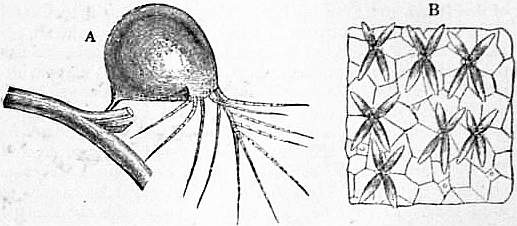
A, Bladder of Utricularia neglecta (after Darwin), enlarged. B, stellate hairs from interior of bladder of U. vulgaris.
BLADES, WILLIAM (1824-1890), English printer and bibliographer, was born at Clapham, London, on the 5th of December 1824. In 1840 he was apprenticed to his father’s printing business in London, being subsequently taken into partnership. The firm was afterwards known as Blades, East & Blades. His interest in printing led him to make a study of the volumes produced by Caxton’s press, and of the early history of printing in England. His Life and Typography of William Caxton, England’s First Printer, was published in 1861-1863, and the conclusions which he set forth were arrived at by a careful examination of types in the early books, each class of type being traced from its first use to the time when, spoilt by wear, it passed out of Caxton’s hands. Some 450 volumes from the Caxton Press were thus carefully compared and classified in chronological order. In 1877 Blades took an active part in organizing the Caxton celebration, and strongly supported the foundation of the Library Association. He was a keen collector of old books, prints and medals. His publications relate chiefly to the early history of printing, the Enemies of Books, his most popular work, being produced in 1881. He died at Sutton in Surrey on the 27th of April 1890.
BLAENAVON, or Blaenafon, an urban district in the northern parliamentary division of Monmouthshire, England, 15 m. N. by W. of Newport, on the Great Western, London & North Western and Rhymney railways. Pop. (1901) 10,869. It lies in the uppermost part of the Afon Lwyd valley, at an elevation exceeding 1000 ft., in a wild and mountainous district, on the eastern edge of the great coal and iron mining region of Glamorganshire and Monmouthshire. There are very extensive iron and steel works, with blast furnaces and rolling mills in the district, which employ the large industrial population.
BLAGOVYESHCHENSK, a town of East Siberia, chief town of the Amur government, on the left bank of the Amur, near its confluence with the Zeya in 50° 15′ N. lat. and 127° 38′ E. long., 610 m. by river above Khabarovsk. Founded in 1856, the town had, in 1900, 37,368 inhabitants, and is the seat of the bishop of Amur and Kamchatka. There are steam flour-mills and ironworks. It is a centre for tea exported to Russia, cattle brought from Transbaikalia and Mongolia for the Amur, and for grain.
BLAIKIE, WILLIAM GARDEN (1820-1899), Scottish divine, was born on the 5th of February 1820, at Aberdeen, where his father had been the first provost of the reformed corporation. After studying at the Marischal College, where Alexander Bain and David Masson were among his contemporaries, he went in 1839 to Edinburgh to complete his theological course under Thomas Chalmers. In 1842 he was presented to the living of Drumblade by Lord Kintore, with whose family he was connected. The Disruption controversy reached its climax immediately afterwards, and Blaikie, whose sympathies were entirely with Chalmers, was one of the 474 ministers who signed the deed of demission and gave up their livings. He was Free Church minister at Pilrig, between Edinburgh and Leith, from 1844 to 1868. Keenly interested in questions of social reform, his first publication was a pamphlet, which was afterwards enlarged into a book called Better Days for Working People. It received public commendation from Lord Brougham, and 60,000 copies were sold. He formed an association for providing better homes for working people, and the Pilrig Model Buildings were erected. He also undertook the editorship of the Free Church Magazine, and then that of the North British Review, which he carried on until 1863. In 1864 he was asked to undertake the Scottish editorship of the Sunday Magazine, and for this magazine much of his most characteristic literary work was done, especially in the editorial notes, then a new feature in magazine literature.
In 1868 Blaikie was called to the chair of apologetics and pastoral theology at New College, Edinburgh. In dealing with the latter subject he was seen at his very best. He had wide experience, a comprehensive grasp of facts, abundant sympathy, an extensive knowledge of men, and a great capacity for teaching. In 1870 he was one of two representatives chosen from the Free Church of Scotland to attend the united general assembly of the Presbyterian churches of the United States. He prolonged his visit to make a thorough acquaintance with American Presbyterianism, and this, followed by a similar tour in Europe, fitted him to become the real founder of the Presbyterian Alliance. Much of his strength in the later years of life was given to this work. In 1892 he was elected to the chairmanship of the general assembly, the last of the moderators who had entered the church before the disruption. In 1897 he resigned his professorship, and died on the 11th of June 1899.
Blaikie was an ardent philanthropist, and an active and intelligent temperance reformer, in days when this was far from easy. He raised £14,000 for the relief of the Waldensian churches. Although he took an active part in the affairs of his denomination, he was not a mere ecclesiastic. He had a keen eye for the evidences of spiritual growth or decline, and emphasized the need of maintaining a high level of spiritual life. He welcomed Moody to Scotland, and the evangelist made his headquarters with him during his first visit. His best books are The Work of the Ministry—A Manual of Homiletic and Pastoral Theology (1873); The Books of Samuel in the Expositors’ Bible Series (2 vols.); The Personal Life of David Livingstone (1880); After Fifty Years (1893), an account of the Disruption Movement in the form of letters of a grandfather; Thomas Chalmers (1896).
(D. Mn.)
BLAINE, JAMES GILLESPIE (1830-1893), American statesman, was born in West Brownsville, Pennsylvania, on the 31st of January 1830, of sturdy Scottish-Irish stock on the side of his father. He was the great-grandson of Colonel Ephraim Blaine (1741-1804), who during the War of Independence served in the American army, from 1778 to 1782 as commissary-general of the Northern Department. With many early evidences of literary capacity and political aptitude, J.G. Blaine graduated at Washington College in Washington, Pennsylvania, in 1847, and subsequently taught successively in the Military Institute, Georgetown, Kentucky, and in the Institution for the Blind at Philadelphia. During this period, also, he studied law. Settling in Augusta, Maine, in 1854, he became editor of the Kennebec Journal, and subsequently of the Portland Advertiser. But his editorial work was soon abandoned for a more active public career. He was elected to the lower house of the state legislature in 1858, and served four years, the last two as speaker. He also became chairman of the Republican state committee in 1859, and for more than twenty years personally directed every campaign of his party.
In 1862 he was elected to Congress, serving in the House thirteen years (December 1863 to December 1876), followed by a little over four years in the Senate. He was chosen speaker of the House in 1869 and served three terms. The House was the fit arena for his political and parliamentary ability. He was a ready and powerful debater, full of resource, and dexterous in controversy. The tempestuous politics of the war and reconstruction period suited his aggressive nature and constructive talent. The measures for the rehabilitation of the states that had seceded from the Union occupied the chief attention of Congress for several years, and Blaine bore a leading part in framing and discussing them. The primary question related to the basis of representation upon which they should be restored to their full rank in the political system. A powerful section contended that the basis should be the body of legal voters, on the ground that the South could not then secure an increment of political power on account of the emancipated blacks unless these blacks were admitted to political rights. Blaine, on the other hand, contended that representation should be based on population instead of voters, as being fairer to the North, where the ratio of voters varied widely, and he insisted that it should be safeguarded by security for impartial suffrage. This view prevailed, and the Fourteenth Amendment to the Constitution was substantially Blaine’s proposition. In the same spirit he opposed a scheme of military governments for the southern states, unless associated with a plan by which, upon the acceptance of prescribed conditions, they could release themselves from military rule and resume civil government. He was the first in Congress to oppose the claim, which gained momentary and widespread favour in 1867, that the public debt, pledged in coin, should be paid in greenbacks. The protection of naturalized citizens who, on return to their native land, were subject to prosecution on charges of disloyalty, enlisted his active interest and support, and the agitation, in which he was conspicuous, led to the treaty of 1870 between the United States and Great Britain, which placed adopted and native citizens on the same footing.
As the presidential election of 1876 approached, Blaine was clearly the popular favourite of his party. His chance for securing the nomination, however, was materially lessened by persistent charges which were brought against him by the Democrats that as a member of Congress he had been guilty of corruption in his relations with the Little Rock & Fort Smith and the Northern Pacific railways.1 By the majority of Republicans, at least, he was considered to have cleared himself completely, and in the Republican national convention he missed by only twenty-eight votes the nomination for president, being finally beaten by a combination of the supporters of all the other candidates. Thereupon he entered the Senate, where his activity was unabated. Currency legislation was especially prominent. Blaine, who had previously opposed greenback inflation now resisted depreciated silver coinage. He was the earnest champion of the advancement of American shipping, and advocated liberal subsidies, insisting that the policy of protection should be applied on sea as well as on land. The Republican national convention of 1880, divided between the two nearly equal forces of Blaine and General U.S. Grant—John Sherman of Ohio also having a considerable following—struggled through thirty-six ballots, when the friends of Blaine, combining with those of Sherman, succeeded in nominating General James A. Garfield. In the new administration Blaine became secretary of state, but, owing to the assassination of President Garfield and the reorganization of the cabinet by President Chester A. Arthur, he held the office only until December 1881. His brief service was distinguished by several notable steps. In order to promote the friendly understanding and co-operation of the nations on the American continents he projected a Pan-American congress, which, after being arranged for, was frustrated by his retirement. He also sought to secure a modification of the Clayton-Bulwer treaty, and in an extended correspondence with the British government strongly asserted the policy of an exclusive American control of any isthmian canal which might be built to connect the Atlantic and Pacific oceans.
With undiminished hold on the imagination and devotion of his followers he was nominated for president in 1884. After a heated canvass, in which he made a series of brilliant speeches, he was beaten by a narrow margin in New York. By many, including Blaine himself, the defeat was attributed to the effect of a phrase, “Rum, Romanism and Rebellion,” used by a clergyman, Rev. Samuel D. Burchard (1812-1891), on the 29th of October 1884, in Blaine’s presence, to characterize what, in his opinion, the Democratic party stood for. The phrase was not Blaine’s, but his opponents made use of it to misrepresent his attitude toward the Roman Catholics, large numbers of whom are supposed, in consequence, to have withdrawn their support. Refusing to be a presidential candidate in 1888, he became secretary of state under President Harrison, and resumed his work which had been interrupted nearly eight years before. The Pan-American congress, then projected, now met in Washington, and Blaine, as its master spirit, presided over and guided its deliberation through its session of five months. Its most important conclusions were for reciprocity in trade, a continental railway and compulsory arbitration in international complications. Shaping the tariff legislation for this policy, Blaine negotiated a large number of reciprocity treaties which augmented the commerce of his country. He upheld American rights in Samoa, pursued a vigorous diplomacy with Italy over the lynching of eleven Italians, all except three of them American naturalized citizens, in New Orleans on the 14th of May 1891, held a firm attitude during the strained relations between the United States and Chile (growing largely out of the killing and wounding of American sailors of the U.S. ship “Baltimore” by Chileans in Valparaiso on the 16th of October 1891), and carried on with Great Britain a resolute controversy over the seal fisheries of Bering Sea,—a difference afterwards settled by arbitration. He resigned on the 4th of June 1892, on the eve of the meeting of the Republican national convention, wherein his name was ineffectually used, and he died at Washington, D.C., on the 27th of January 1803.
During his later years of leisure he wrote Twenty Years of Congress (1884-1886), a brilliant historical work in two volumes. Of singularly alert faculties, with a remarkable knowledge of the men and history of his country, and an extraordinary memory, his masterful talent for politics and state-craft, together with his captivating manner and engaging personality, gave him, for nearly two decades, an unrivalled hold upon the fealty and affection of his party.
See the Biography of James G. Blaine (Norwich, Conn., 1895) by Mary Abigail Dodge (“Gail Hamilton”), and, in the “American Statesmen Series,” James G. Blaine (Boston, 1905) by C.E. Stanwood; also Mrs Blaine’s Letters (1908).
(C. E. S.)
1 This attack led to a dramatic scene in the House, in which Blaine fervidly asseverated his denial.
BLAINVILLE, HENRI MARIE DUCROTAY DE (1777-1850), French naturalist, was born at Arques, near Dieppe, on the 12th of September 1777. About 1796 he went to Paris to study painting, but he ultimately devoted himself to natural history, and attracted the attention of Baron Cuvier, for whom he occasionally lectured at the Collège de France and at the Athenaeum. In 1812 he was aided by Cuvier to obtain the chair of anatomy and zoology in the Faculty of Sciences at Paris, but subsequently an estrangement grew up between the two men and ended in open enmity. In 1825 Blainville was admitted a member of the Academy of Sciences; and in 1830 he was appointed to succeed J.B. Lamarck in the chair of natural history at the museum. Two years later, on the death of Cuvier, he obtained the chair of comparative anatomy, which he continued to occupy for the space of eighteen years, proving himself no unworthy successor to his great teacher. He died at Paris on the 1st of May 1850. Besides many separate memoirs, he was the author of Prodrome d’une nouvelle distribution méthodique du règne animal (1816); Ostéographic ou description iconographique comparée du squelette, &c. (1839-1864); Faune française (1821-1830); Corns de physiologie générale et comparée (1833); Manuel de malacologie et de conchyliologie (1825-1827); Histoire des sciences de l’organisme (1845).