VOLUME IV SLICE I Bisharin to Bohea (continued 5)
Reading edition
BLASS, FRIEDRICH (1843-1907), German classical scholar, was born on the 22nd of January 1843 at Osnabrück. After studying at Göttingen and Bonn from 1860 to 1863, he lectured at several gymnasia and at the university of Königsberg. In 1876 he was appointed extraordinary professor of classical philology at Kiel, and ordinary professor in 1881. In 1892 he accepted a professorship at Halle, where he died on the 5th of March 1907. He frequently visited England, and was intimately acquainted with leading British scholars. He received an honorary degree from Dublin University in 1892, and his readiness to place the results of his labours at the disposal of others, together with the courtesy and kindliness of his disposition, won the respect of all who knew him. Blass is chiefly known for his works in connexion with the study of Greek oratory: Die griechische Beredsamkeit von Alexander bis auf Augustus (1865); Die attische Beredsamkeit (1868-1880; 2nd ed., 1887-1898), his greatest work; editions for the Teubner series of Andocides (1880), Antiphon (1881), Hypereides (1881, 1894), Demosthenes (Dindorf’s ed., 1885), Isocrates (1886), Dinarchus (1888), Demosthenes (Rehdantz’ ed., 1893), Aeschines (1896), Lycurgus, Leocrates (1902); Die Rhythmen der attischen Kunstprosa (1901); Die Rhythmen der asianischen und römischen Kunstprosa (1905). Among his other works are editions of Eudoxus of Cnidus (1887), the Άθηναίων πολιτεία (4th ed., 1903), a work of great importance, and Bacchylides (3rd. ed., 1904); Grammatik des neutestamentlichen Griechisch (1902; Eng. trans, by H. St John Thackeray, 1905); Hermeneutik und Kritik and Paläographie, Buchwesen, und Handschriftenkunde (vol. i. of Müller’s Handbuch der klassischen Altertumswissenschaft, 1891); Über die Aussprache des Griechischen (1888; Eng. trans, by W.J. Purton, 1890); Die Interpolationen in der Odyssee (1904); contributions to Collitz’s Sammlung der griechischen Dialektinschriften; editions of the texts of certain portions of the New Testament (Gospels and Acts). His last work was an edition of the Choephori (1906).
See notices in the Academy, March 16, 1907 (J.P. Mahaffy); Classical Review, May 1907 (J.E. Sandys), which contains also a review of Die Rhythmen der asianischen und römischen Kunstprosa.
BLASTING, the process of rending or breaking apart a solid body, such as rock, by exploding within it or in contact with it some explosive substance. The explosion is accompanied by the sudden development of gas at a high temperature and under a tension sufficiently great to overcome the resistance of the enclosing body, which is thus shattered and disintegrated. Before the introduction of explosives, rock was laboriously excavated by hammer and chisel, or by the ancient process of “fire-setting,” i.e. building a fire against the rock, which, on cooling, splits and flakes off. To hasten disintegration, water was often applied to the heated rock, the loosened portion being afterwards removed by pick or hammer and wedge. In modern times blasting has become a necessity for the excavation of rock and other hard material, as in open surface cuts, quarrying, tunnelling, shaft-sinking and mining operations in general.
For blasting, a hole is generally drilled to receive the charge of explosive. The depth and diameter of the hole and the quantity of explosive used are all variable, depending on the character of the rock and of the explosive, the shape of the mass to be blasted, the presence or absence of cracks or fissures, and the position of the hole with respect to the free surface of the rock. The shock of a blast produces impulsive waves acting radially in all directions, the force being greatest at the centre of explosion and varying inversely as the square of the distance from the charge. This is evidenced by the observed facts. Immediately surrounding the explosive, the rock is often finely splintered and crushed. Beyond this is a zone in which it is completely broken and displaced or projected, leaving an enveloping mass of more or less ragged fractured rock only partially loosened. Lastly, the diminishing waves produce vibrations which are transmitted to considerable distances. Theoretically, if a charge of explosive be fired in a solid material of perfectly homogeneous texture and at a proper distance from the free surface, a conical mass will be blown out to the full depth of the drill hole, leaving a funnel-shaped cavity. No rock, however, is of uniform mineralogical and physical character, so that in practice there is only a rough approximation to the conical crater, even under the most favourable conditions. Generally, the shape of the mass blasted out is extremely irregular, because of the variable texture of the rock and the presence of cracks, fissures and cleavage planes. The ultimate or resultant useful effect of the explosion of a confined charge is in the direction where the least resistance is presented. In the actual work of rock excavation it is only by trial, or by deductions based on experience, that the behaviour of a given rock can be determined and the quantity of explosive required properly proportioned.
Blasting, as usually carried on, comprises several operations: (1) drilling holes in the rock to be blasted; (2) placing in the hole the charge of explosive, with its fuze; (3) tamping the charge, i.e. compacting it and filling the remainder of the hole with some suitable material for preventing the charge from blowing out without breaking the ground; (4) igniting or detonating the charge; (5) clearing away the broken material. The holes for blasting are made either by hand, with hammer and drill or jumper, or by machine drill, the latter being driven by steam, compressed air, or electricity, or, in rare cases, by hydraulic power. Drill holes ordinarily vary in diameter from 1 to 3 in., and in depth from a few inches up to 15 or 20 ft. or more. The deeper holes are made only in surface excavation of rock, the shallower, to a maximum depth of say 12 ft., being suitable for tunnelling and mining operations.

Fig. 1.
Hand Drilling.—The work is either “single-hand” or “double-hand.” In single-hand drilling, the miner wields the hammer with one hand, and with the other holds the drill or “bit,” rotating it slightly after every blow in order to keep the hole round and prevent the drill from sticking fast; in double-hand work, one man strikes, while the other holds and rotates the drill. For large and deep holes, two hammermen are sometimes employed.
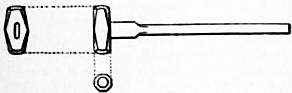
Fig. 2.—Sledge-hammer.
A miner’s drill is a steel bar, occasionally round but generally of octagonal cross-section, one end of which is forged out to a cutting edge (fig. 1). The edge of the drill is made either straight, like that of a chisel, or with a convex curve, the latter shape being best for very hard rock. For hard rock the cutting edge should be rather thicker and blunter, and therefore stronger, than for soft rock. Drills are made of high-grade steel, as they must be tempered accurately and uniformly. The diameter of drill steel for hand work is usually from ¾ to 1 in., and the length of cutting edge, or gauge, of the drill is always greater than the diameter of the shank, in the proportion of from 7.4 to 4.3. Holes over 10 or 12 in. deep generally require the use of a set of drills of different lengths and depending in number on the depth required. The shortest drill, for starting the hole, has the widest cutting edge, the edges of the others being successively narrower and graduated to follow each other properly, as drill after drill is dulled in deepening the hole. Thus the hole decreases in diameter as it is made deeper. The miner’s hammer (fig. 2) ranges in weight from 3½ to 4½ ℔ for single-hand drilling, up to 8 or 10 ℔ for double-hand. If the hole is directed downward, a little water is poured into it at intervals, to keep the cutting edge of the drill cool and make a thin mud of the cuttings. From time to time the hole is cleaned out by the “scraper” or “spoon,” a long slender iron bar, forged in the shape of a hollow semi-cylinder, with one end flattened and turned over at right angles. If the hole is directed steeply upward and the rock is dry, the cuttings will run out continuously during the drilling; otherwise the scraper is necessary, or a small pipe with a plunger like a syringe is used for washing out the cuttings. The “jumper” is a long steel bar, with cutting edges on one or both ends, which is alternately raised and dropped in the hole by one or two men. In rock work the jumper is rarely used except for holes directed steeply downward, though for coal or soft shale or slate it may be employed for drilling holes horizontally or upward. Other tools used in connexion with rock-drilling are the pick and gad.
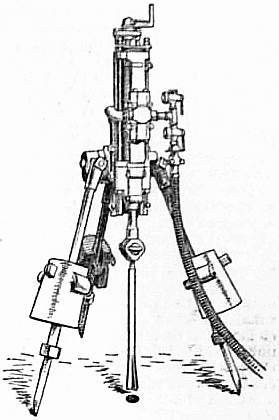
Fig. 3.—Ingersoll-Sergeant Mining Drill.
Holes drilled by hand usually vary in depth from say 18 to 36 in., according to the nature of the rock and purpose of the work, though deeper holes are often made. For soft rock, single-hand drilling is from 20 to 30% cheaper than double-hand, but this difference does not hold good for the harder rocks. For these double-hand drilling is preferable, and may even be essential, to secure a reasonable speed of work.
Machine Drills.—The introduction of machine drills in the latter part of the 19th century exerted an important influence on the work of rock excavation in general, and specially on the art of mining. By their use many great tunnels and other works involving rock excavation under adverse conditions have been rapidly and successfully carried out. Before the invention of machine drills such work progressed slowly and with difficulty. Nearly all machine drills are of the reciprocating or percussive type, in which the drill bit is firmly clamped to the piston rod and delivers a rapid succession of strong blows on the bottom of the hole. The ordinary compressed air drill (which may, for surface work, be operated also by steam) may be taken as an illustration. The piston works in a cylinder, provided with a valve motion somewhat similar to that of a steam-engine, together with an automatic device for producing the necessary rotation of the piston and drill bit. While at work the machine is mounted on a heavy tripod (fig. 3); or, if underground, sometimes on an iron column or bar, firmly wedged in position between the roof and floor, or side walls, of the tunnel or mine working. As the hole is deepened, the entire drill head is gradually fed forward on its support by a screw feed, a succession of longer and longer drill bits being used as required.
Among the numerous types and makes of percussion drill may be named the following:—Adelaide, Climax, Darlington, Dubois-François, Ferroux, Froelich, Hirnant, Ingersoll, Jeffrey, Leyner, McKiernan, Rand, Schram, Sergeant, Sullivan and Wood.
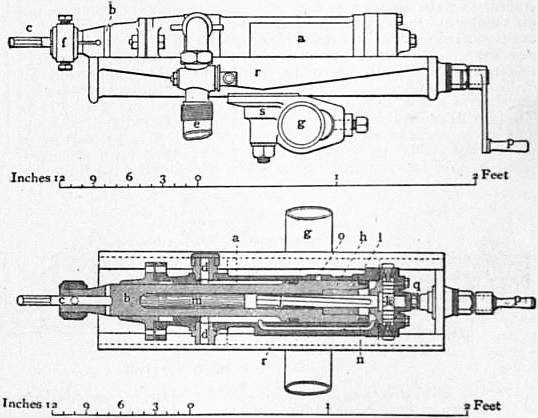
Figs. 4 and 5.—Darlington’s Rock Drill.
One of the simplest of the machine drills is the Darlington (figs. 4 and 5): a is the cylinder; b, piston rod; c, bit; d, d, air inlets, either being used according to the position of the drill while at work; h, piston; j, rifle-bar for rotating piston and bit; k, ratchet attached to j; l, brass nut, screwed into h, and in which j works; f, chuck for holding drill-bit; n, air port communicating between ends of cylinder, front and back of piston; o, exhaust port. This machine has no valve. From its construction, the compressed air (or steam) is always acting on the annular shoulder round the forward end of the piston. The piston is thereby forced back on the in-stroke until the port n is uncovered. This admits the compressed air to the rear end of the cylinder, and as the area of this end of the piston is much greater than that of the shoulder on the other end, the piston is driven forward and strikes its blow. When it has advanced far enough to cover the exhaust port o, the air behind the piston is exhausted, and, under the constant inward pressure noted above, the stroke is reversed. The rotation of piston and bit is caused by the rifle-bar j. On the outward stroke, j, with its ratchet k, is free to turn under a couple of pawls and springs, and consequently the piston delivers its blow without rotation. On the inward stroke the ratchet is held fast by the pawls, and the piston and bit are forced to rotate through a small part of a revolution. The cylinder is fed forward with respect to the shell r, by rotating the handle p, which works a long screw-bar engaging with a nut on the under side of the cylinder. The shell r is bolted to the clamp s, which in turn is mounted on the hollow column or bar g, or on a tripod, according to the character of the work. By means of the adjustable clamp s, the machine can be set for drilling a hole in any desired direction. The drill makes from 400 to 800 strokes per minute.
The “New Ingersoll” drill, which may be taken as an example of the numerous machines in which valves are used, is shown in section in fig. 6. The steam or compressed air is distributed through the ports alternately to the ends of the cylinder, by the reciprocations of a spool-valve working in a chest mounted on the cylinder. The movements of this valve are caused by the strokes of the main piston, which, by means of the wide annular groove around the middle of the piston, alternately open and close the spool-valve exhaust ports. Fig. 3 shows the Ingersoll “Light Mining drill,” as mounted on a tripod, and in position for drilling a hole vertically downward. In the Leyner drill the drill-bit is not connected to the piston, but is struck a quick succession of blows by the latter. An important feature of this machine is the provision for directing a stream of water into the hole for clearing out the cuttings. For this purpose the shank of the drill-bit is perforated longitudinally, the water being supplied under pressure from a small tank, to which compressed air is led.
A rock drill of entirely different design, the Brandt, has been successfully used in Europe for driving railway tunnels. It is operated by hydraulic power, the pressure water being supplied by a pump. The hollow drill-bit, which has a serrated cutting edge, is forced under heavy pressure against the bottom of the hole, and is rotated slowly—at six to eight revolutions per minute—by a pair of small hydraulic cylinders, thus grinding and crushing the rock instead of chipping it. The bottom of the hole is kept clean and the drill-bit cooled by a stream of water passing down through its hollow shank. On account of its size and weight, this machine is not suitable for mine work.
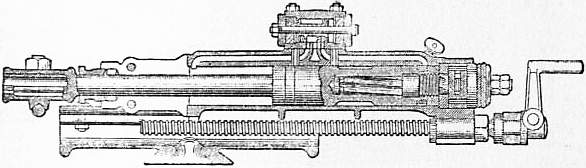
Fig. 6.—New Ingersoll Drill.
Most of the machine drills are made in a number of sizes, from 2 in. up to 5 in. diameter of cylinder, the larger sizes being capable of drilling holes 5 in. diameter and 30 ft. deep. They range in weight from say 95 to 690 ℔ for the drill head (unmounted), the tripods weighing from 40 to 260 ℔, exclusive of the weights placed for stability on the tripod legs (fig. 3). The sizes in most common use for mining are from 2½ in. to 31⁄8 in. diameter of cylinder. In rock of average hardness the best drills make from 4 to 7.5 linear ft. of hole per hour. For use in narrow veins, or other confined workings underground, several extremely small and light compressed air drills have been introduced, as, for example, the Franke and Wonder, the first of which weighs complete only 16 ℔, and the second 18 ℔ These drills are held in the hands of the miner in the required position, and strike a rapid succession of light blows. A large number of mechanical drills operated by hand power have been invented. Some imitate hand-drilling in the mode of delivering the blow; in others the drill-bit is caused to reciprocate by means of combinations of crank and spring. None of these machines is entirely satisfactory, and but few are in use.
Among percussion rock-drills operated by electricity are the Bladray, Box, Durkee, Marvin and Siemens-Halske. The Marvin drill works with a solenoid; most of the others have crank and spring movements for producing the reciprocations of the piston. Power is furnished by a small electric motor, either mounted on the machine itself, as with the Box drill, or more often standing on the ground and transmitting its power through a flexible shaft. Although rather frequently used, electric percussion drills cannot yet be considered entirely successful, at least for mine service, in competition with compressed air machines. Another type of electric drill, however, has been successfully used in collieries, viz. rotary auger drills, mounted on light columns and driven through gearing by diminutive motors. These are intended for boring in coal, slate or other similar soft material. Hand augers resembling a carpenter’s brace and bit are also often used in collieries.
Whatever may be the method of drilling, after the hole has been completed to the depth required, it is finally cleaned out by a scraper or swab; or, when compressed air drills are used, by a jet of air directed into the hole by a short piece of pipe connected through a flexible hose with the compressed air supply pipe. The hole is then ready for the charge.
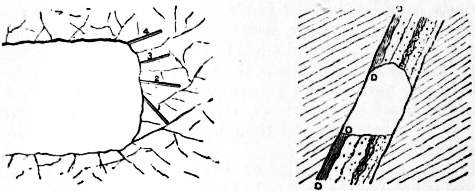
Fig. 7. Fig. 8.
Location and Arrangement of Holes.—For hand drilling in mining the position of the holes is determined largely by the character and shape of the face of rock to be blasted. The miner observes the joints and cracks of the rock, placing the holes to take advantage of them and so obtain the best result from the blast. In driving a tunnel or drift, as in figs. 7 and 8, the rock joints can be made of material assistance by beginning with hole No. 1 and following in succession by Nos. 2, 3 and 4. Frequently the ore, or vein matter, is separated from the wall-rock by a thin, soft layer of clay (D, D, fig. 8). This would act almost as a free face, and the first holes of the round would be directed at an angle towards it, for blasting out a wedge; after which the positions of the other holes would be chosen.
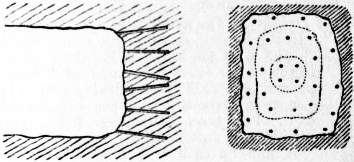
Fig. 9. Fig. 10.
When machine drills are employed, less attention is given to natural cracks or joints, chiefly because when the drill is once set up several holes at different angles can be drilled in succession by merely swinging the cylinder of the machine into a new position with respect to its mounting. According to one method, the holes are placed with some degree of symmetry, in roughly concentric rings, as shown by figs. 9 and 10. The centre holes are blasted first, and are followed by the others in one or more volleys as indicated by the dotted lines. Another method is the “centre cut,” in which the holes are drilled in parallel rows on each side of the centre line of the tunnel, drift or shaft. Those in the two rows nearest the middle are directed towards each other, and enclose a prism of rock, which is first blasted put by heavy charges, after which the rows of side holes will break with relatively light charges.
Explosives.—A great variety of explosives are in use for blasting purposes. Up to 1864, gunpowder was the only available explosive, but in that year Alfred Nobel first applied nitroglycerin for blasting, and in 1867 invented dynamite. This name was originally applied to his mixture of nitroglycerin with kieselguhr, but now includes also other mechanical mixtures or chemical compounds which develop a high explosive force as compared with gunpowder. Besides these there are the so-called flameless or safety explosives, used in collieries where inflammable gases are given off from the coal.
Gunpowder, or black powder, is seldom used for rock-blasting, except in quarrying building-stone, where slow explosives of relatively low power are desirable to avoid shattering the stone, and in such collieries as do not require the use of safety explosives. Gunpowder is exploded by deflagration, by means of a fuze, and exerts a comparatively slow and rending force. The high explosives, on the other hand, are exploded by detonation, through the agency of a fuze and fulminating cap, exerting a quick, shattering, rather than a rending force. Dynamites and flameless explosives are made in a variety of strengths, and are packed in waterproofed cartridges of different sizes. The grades of dynamite most commonly employed contain from 35 to 60% of nitroglycerin; the stronger are used for tough rock or deep holes, or for holes unfavourably placed in narrow mine workings, as sometimes in shaft-sinking or tunnelling. When of good quality high explosives are safer to handle than gunpowder, as they cannot be ignited by sparks and are not so easily exploded. The ordinary dynamites used in mining are about four times as powerful as gunpowder.
Nitroglycerin in its liquid form is now rarely used for blasting, partly because its full strength is not often necessary but chiefly because of the difficulty and danger of transporting, handling and charging it. If employed at all, it is charged in thin tinned plate cases or rubber-cloth cartridges.
Blasting with Black Powder.—The powder is coarse-grained, usually from 1⁄8 to 3⁄16 in. in size, and is charged in paper cartridges, 8 to 10 in. long and of a proper diameter to fit loosely in the drill hole. A piece of fuze, long enough to reach a little beyond the mouth of the hole, is inserted in the cartridge and tied fast. For wet holes paraffined paper is used, the miner waterproofing the joints with grease. When more than one cartridge is required for the blast, that which has the fuze attached is usually charged last. The cartridges are carefully rammed down by a wooden tamping bar and the remainder of the hole filled with tamping. This consists of finely broken rock, dry clay or other comminuted material, carefully compacted by the tamping bar on top of the charge. The fuze is a cord, having in the centre a core of gunpowder, enclosed in several layers of linen or hemp waterproofed covering. It is ignited by the miner’s candle or lamp, or by a candle end so placed at the mouth of the hole that the flame must burn its way through the fuze covering. As the fuze burns slowly, at the rate of 2 or 3 ft. per minute, the miner uses a sufficient length to allow him to reach a place of safety.
For blasting in coal, “squibs” instead of fuzes are often used. A squib is simply a tiny paper rocket, about 1⁄8 in. diameter by 3 in. long, containing fine gunpowder and having a sulphur slow-match at one end. It is fired into the charge through a channel in the tamping. This channel may be formed by a piece of ¼ in. gas pipe, tamped in the hole and reaching the charge; or a “needle,” a long taper iron rod, is laid longitudinally in the hole, with its point entering the charge, and after the tamping is finished, by carefully withdrawing the needle a little channel is left, through which the squib is fired. In this connexion it may be noted that for breaking ground in gassy collieries several substitutes for explosives have been used to a limited extent, e.g. plugs of dry wood driven tightly into a row of drill holes, and which on being wetted swell and split the coal; quicklime cartridges, which expand powerfully on the application of water; simple wedges, driven by hammer into the drill holes; multiple wedges, inserted in the holes and operated by hydraulic pressure from a small hand force-pump.
Blasting with High Explosives.—High explosives are fired either by ordinary fuze and detonating cap or by electric fuze. Detonating caps of ordinary strength contain 10 to 15 grains of fulminating mixture. The cap is crimped tight on the end of the fuze, embedded in the cartridge, and on being exploded by fire from the fuze detonates the charge. The number of cartridges charged depends on the depth of hole, the length of the line of least resistance, and the toughness and other characteristics of the rock. Each cartridge should be solidly tamped, and, to avoid waste spaces in the hole, which would reduce the effect of the blast, it is customary to split the paper covering lengthwise with a knife. This allows the dynamite to spread under the pressure of the tamping bar. The cap is often placed in the cartridge preceding the last one charged, but it is better to insert it last, in a piece of cartridge called a “primer.” Though the dynamites are not exploded by sparks, they should nevertheless always be handled carefully. It is not so essential to fill the hole completely and so thoroughly to compact the tamping, as in charging black powder, because of the greater rapidity and shattering force of the explosion of dynamite; tamping, however, should never be omitted, as it increases the efficiency of the blast. In exploding dynamite, strong caps, containing say 15 grains of fulminating powder, produce the best results. Weaker caps are not economical, as they do not produce complete detonation of the dynamite. This is specially true if the weather be cold. Dynamite then becomes less sensitive, and the cartridges should be gently warmed before charging, to a temperature of not more than 80° F. Poisonous fumes are often produced by the explosion of the nitroglycerin compounds. These are probably largely due to incomplete detonation, by which part of the nitroglycerin is vaporized or merely burned. This is most likely to occur when the dynamite is chilled, or of poor quality, or when the cap is too weak. There is generally but little inconvenience from the fumes, except in confined underground workings, where ventilation is imperfect.
Like nitroglycerin, the common dynamites freeze at a temperature of from 42° to 46° F. They are then comparatively safe, and so far as possible should be transported in the frozen state. At very low temperatures dynamite again becomes somewhat sensitive to shock. When it is frozen at ordinary temperatures even the strongest detonating caps fail to develop the full force. In thawing dynamite, care must be exercised. The fact that a small quantity will often burn quietly has led to the dangerously mistaken notion that mere heating will not cause explosion. It is chiefly a question of temperature. If the quantity ignited by flame be large enough to heat the entire mass to the detonating point (say 360° F.) before all is consumed, an explosion will result. Furthermore, dynamite, when even moderately heated, becomes extremely sensitive to shocks. There are several accepted modes of thawing dynamite: (1) In a water bath, the cartridges being placed in a vessel surrounded on the sides and bottom by warm water contained in a larger enclosing vessel. The warm water may be renewed from time to time, or the water bath placed over a candle or small lamp, not on a stove. (2) In two vessels, similar to the above, with the space between them occupied by air, provided the heat applied can be definitely limited, as by using a candle. (3) When large quantities of dynamite are used a supply may be kept on shelves in a wooden room or chamber, warmed by a stove, or by a coil of pipe heated by exhaust steam from an engine. Live steam should not be used, as the heat might become excessive. Thawing should always take place slowly, never before an open fire or by direct contact with a stove or steam pipes and care must be taken that the heat does not rise high enough to cause sweating or exudation of liquid nitroglycerin from the cartridges, which would be a source of danger.
For the storage of explosives at mines, &c., proper magazines must be provided, situated in a safe place, not too near other buildings, and preferably of light though fireproof construction. Masonry magazines, though safer from some points of view, may be the cause of greater damage in event of an explosion, because the brick or stones act as projectiles. Isolated and abandoned mine workings, if dry, are sometimes used as magazines.

Fig 11. Electrical Fuze.
Firing blasts by electricity has a wide application for both surface and underground work. An electrical fuze (fig. 11) consists of a pair of fine, insulated copper wires, several feet long and about 1⁄40 of an inch in diameter, with their bare ends inserted in a detonating cap. For firing, the fuze wires are joined to long leading wires, connected with some source of electric current. By joining the fuze wires in series or in groups, any number of holes may be fired simultaneously, according to the current available. A round of holes fired in this way, as for driving tunnels, sinking shafts, or in large surface excavations, produces better results, both in economy of explosive and effect of the blast, than when the holes are fired singly or in succession. Also, the miners are enabled to prepare for the blast with more care and deliberation, and then to reach a place of safety before the current is transmitted. Another advantage is that there is no danger of a hole “hanging fire,” which sometimes causes accidents in using ordinary fuzes.
Hanging fire may be due to a cut, broken or damaged powder fuze, which may smoulder for some time before communicating fire to the charge. “Miss-fires,” which also are of not infrequent occurrence with both ordinary and electric fuzes, are cases where explosion from any cause fails to take place. After waiting a sufficient length of time before approaching the charged hole, the miner carefully removes the tamping down to within a few inches of the explosives and inserts and fires another cartridge, the concussion usually detonating the entire charge. Sometimes another hole is drilled near the one which has missed. No attempt to remove the old charge should ever be made.
High tension electricity, generated by a frictional machine, provided with a condenser, was formerly much used for blasting. The bare ends of the fuze wires in the detonating cap are placed say 1⁄8 in. apart, leaving a gap across which a spark is discharged, passing through a priming charge of some sensitive composition. The priming is not only combustible but also a conductor of electricity, such as an intimate mixture of potassium chlorate with copper sulphide and phosphide. By the combustion of the priming the fulminate mixture in the cap is detonated. As these fuzes are more apt to deteriorate when exposed to dampness than fuzes for low-tension current, and the generating machine is rather clumsy and fragile, low-tension current is more generally employed. It may be generated by a small, portable dynamo, operated by hand, or may be derived from a battery or from any convenient electric circuit. The ends of the fuze wires in the detonating cap are connected by a fine platinum filament (fig. 11), embedded in a guncotton priming on top of the fulminating mixture, and explosion results from the heat generated by the resistance opposed to the passage of the current through the filament. Blasting machines are made in several sizes, the smaller ones being capable of firing simultaneously from ten to twenty holes. The fuzes must obviously be of uniform electrical resistance, to ensure that all the connected charges will explode simultaneously. The premature explosion of any one of the fuzes would break the circuit.
In the actual operations of blasting, definite rules for the proportioning of the charges are rarely observed, and although the blasts made by a skilful miner seldom fail to do their work, it is a common fault that too much, rather than too little, explosive is used. The high explosives are specially liable to be wasted, probably through lack of appreciation of their power as compared with that of black powder. Among the indications of excessive charges are the production of much finely broken rock or of crushed and splintered rock around the bottom of the hole, and excessive displacement or projection of the rock broken by the blast. In beginning any new piece of work, such waste may be avoided or reduced by making trial shots with different charges and depths of hole, and noting the results; also by letting contracts under which the workmen pay for the explosive. In surface rock excavation the location and determination of the depth of the holes and the quantity of explosive used, are occasionally put in charge of one or more skilled men, who direct the work and are responsible for the results obtained.
Blasting in surface excavations and quarries is sometimes done on an immense scale—called “mammoth blasting.” Shafts are sunk, or tunnels driven, in the mass of rock to be blasted, and, connected with them, a number of chambers are excavated to receive the charges of explosive. The preparation for such blasts may occupy months, and many tons of gunpowder or dynamite are at times exploded simultaneously, breaking or dislodging thousands, or even hundreds of thousands, of tons of rock. This method is adopted for getting stone cheaply, as for building macadamized roads, dams and breakwaters, obtaining limestone for blast furnace flux, and occasionally in excavating large railway cuttings. It is also applied in submarine blasting for the removal of reefs obstructing navigation, and sometimes for loosening extensive banks of partly cemented gold-bearing gravel, preparatory to washing by hydraulic mining.
Authorities.—For further information on drilling and blasting see:—Callon, Lectures on Mining (1876), vol. i. chs. v. and vi.; Foster, Text-book of Ore and Stone Mining, (1900), ch. iv.; Hughes, Text-book of Coal Mining (1901), ch. iii.; H.S. Drinker, Tunnelling, Explosive Compounds and Rock Drills (1878); M.C. Ihlseng, Manual of Mining (1905), pp. 596-696; Köhler, Der Bergbaukunde (1897), pp. 104-208; Daw, The Blasting of Rock (1898); Prelini, Earth and Rock Excavation (1905), chs. v., vi. and vii.; Gillette, The Excavation of Rock (1904); Guttmann, Blasting (1892); Spon’s Dictionary of Engineering, art. “Boring and Blasting”; Eissler, Modern High Explosives (1893), pts. ii. and iii.; Walke, Lectures on Explosives (1897), chs. xix.-xxii. Also: Proc. Inst. Civ. Eng. (London), vol. lxxxv. p. 264; Trans. Inst. Min. Eng. (England), vols. xiv., xv. and xvi. (arts, by W. Maurice), vol. xxvi. pp. 322, 348, vol. xxiv. p. 526 and vol. xxv. p. 108; Trans. Amer. Soc. Civ. Eng., vol. xxvii. p. 530; Trans. Amer. Inst. Min. Eng., vol. xviii. p. 370, vol. xxix p. 405 and vol. xxxiv. p. 871; South Wales Inst. Eng. (1888); Jour. Ass. Eng. Socs., vol. vii. p. 58; Jour. Chem. Met. and Mining Soc. of South Africa, August 1905; School of Mines Quarterly, N.Y., vol. ix. p. 308; Colliery Guardian, April 15, 1898, and February 6, 1903; Mines and Minerals, February 1905, p. 348, January 1906, p. 259, and April 1906, p. 393; Eng. and Mining Jour., April 19, 1902, p. 552; The Engineer, February 24, 1905; Elec. Rev., June 9, 1899; Eng. News, vol. xxxii. p. 249, and August 3, 1905; Gluckauf, September 28, 1901, and July 5, 1902; Österr. Zeitschr. f. Berg- u. Hüttenwesen, May 18, 25, 1901, April 18, 1903 and November, 18, 1905; Annales des mines, vol. xviii. pp. 217-248.
(R. P.*)
BLAUBEUREN, a town of Germany, in the kingdom of Württemberg, 12 m. W. of Ulm, with which it is connected by railway. Pop. (1900) 3114. It is romantically situated in a wild and deep valley of the Swabian Alps at an altitude of 1600 ft. and is partly surrounded by ancient walls. Of the three churches (two Evangelical and one Roman Catholic) the most remarkable is the abbey church (Klosterkirche), a late Gothic building dating from 1465-1496, the choir of which contains beautiful 15th century carved choir-stalls and a fine high altar with a triptych (1496). The choir only is used for service (Protestant), the nave being used as a gymnasium. The town church (Stadtkirche) also has a fine altar with triptych. The Benedictine abbey, founded in 1095, was used after the Reformation as a school, and is now an Evangelical theological seminary. There are two hospitals in the town.
BLAVATSKY, HELENA PETROVNA (1831-1891), Russian theosophist, was born at Ekaterinoslav, on the 31st of July (O.S.) 1831, the daughter of Colonel Peter Hahn, a member of a Mecklenburg family, settled in Russia. She married in her seventeenth year a man very much her senior, Nicephore Blavatsky, a Russian official in Caucasia, from whom she was separated after a few months; in later days, when seeking to invest herself with a halo of virginity, she described the marriage as a nominal one. During the next twenty years Mme Blavatsky appears to have travelled widely in Canada, Texas, Mexico and India, with two attempts on Tibet. In one of these she seems to have crossed the frontier alone in disguise, been lost in the desert, and, after many adventures, been conducted back by a party of horsemen. The years from 1848 to 1858 were alluded to subsequently as “the veiled period” of her life, and she spoke vaguely of a seven years’ sojourn in “Little and Great Tibet,” or preferably of a “Himalayan retreat.” In 1858 she revisited Russia, where she created a sensation as a spiritualistic medium. About 1870 she acquired prominence among the spiritualists of the United States, where she lived for six years, becoming a naturalized citizen. Her leisure was occupied with the study of occult and kabbalistic literature, to which she soon added that of the sacred writings of India, through the medium of translations. In 1875 she conceived the plan of combining the spiritualistic “control” with the Buddhistic legends about Tibetan sages. Henceforth she determined to exclude all control save that of two Tibetan adepts or “mahatmas.” The mahatmas exhibited their “astral bodies” to her, “precipitated” messages which reached her from the confines of Tibet in an instant of time, supplied her with sound doctrine, and incited her to perform tricks for the conversion of sceptics. At New York, on the 17th of November 1875, with the aid of Colonel Henry S. Olcott, she founded the “Theosophical Society” with the object of (1) forming a universal brotherhood of man, (2) studying and making known the ancient religions, philosophies and sciences, (3) investigating the laws of nature and developing the divine powers latent in man. The Brahmanic and Buddhistic literature supplied the society with its terminology, and its doctrines were a curious amalgam of Egyptian, kabbalistic, occultist, Indian and modern spiritualistic ideas and formulas. Mme Blavatsky’s principal books were Isis Unveiled (New York, 1877), The Secret Doctrine, the Synthesis of Science, Religion and Philosophy (1888), The Key to Theosophy (1891). The two first of these are a mosaic of unacknowledged quotations from such books as K.R.H. Mackenzie’s Royal Masonic Encyclopaedia, C.W. King’s Gnostics, Zeller’s Plato, the works on magic by Dunlop, E. Salverte, Joseph Ennemoser, and Des Mousseaux, and the mystical writings of Eliphas Levi (L.A. Constant). A Glossary of Theosophical Terms (1890-1892) was compiled for the benefit of her disciples. But the appearance of Home’s Lights and Shadows of Spiritualism (1877) had a prejudicial effect upon the propaganda, and Heliona P. Blavatsky (as she began to style herself) retired to India. Thence she contributed some clever papers, “From the Caves and Jungles of Hindostan” (published separately in English, London, 1892) to the Russky Vyestnik. Defeated in her object of obtaining employment in the Russian secret service, she resumed her efforts to gain converts to theosophy. For this purpose the exhibition of “physical phenomena” was found necessary. Her jugglery was cleverly conceived, but on three occasions was exposed in the most conclusive manner. Nevertheless, her cleverness, volubility, energy and will-power enabled her to maintain her ground, and when she died on the 8th of May 1891 (White Lotus Day), at the theosophical headquarters in the Avenue Road, London, she was the acknowledged head of a community numbering not far short of 100,000, with journalistic organs in London, Paris, New York and Madras.
Much information respecting her will be found in V.S. Solovyov’s Modern Priestess of Isis, translated by Walter Leaf (1895), in Arthur Lillie’s Madame Blavatsky and Her Theosophy (1895), and in the report made to the Society for Psychical Research by the Cambridge graduate despatched to investigate her doings in India. See also the article Theosophy.
BLAYDES, FREDERICK HENRY MARVELL (1818-1908), English classical scholar, was born at Hampton Court Green, on the 29th of September 1818, being a collateral descendant of Andrew Marvell, the satirist and friend of Milton. He was educated at St Peter’s school, York, and Christ Church, Oxford. He was Hertford scholar in 1838, took a second class in literae humaniores in 1840, and was subsequently elected to a studentship at Christ Church. In 1842 he took orders, and from 1843 to 1886 was vicar of Harringworth in Northamptonshire. During a long life he devoted himself almost entirely to the study of the Greek dramatists. His editions and philological papers are remarkable for bold conjectural emendations of corrupt (and other) passages. His distinction was recognized by his being made an honorary LL.D. of Dublin, Ph.D. of the university of Buda Pest and a fellow of the royal society of letters at Athens. He died at Southsea on the 7th of September 1908.
His works include:—Aristophanes: Comedies and Fragments, with critical notes and commentary (1880-1893); Clouds, Knights, Frogs, Wasps (1873-1878); Opera Omnia, with critical notes (1886); Sophocles; Oedipus Coloneus, Oedipus Tyrannus and Antigone (in the Bibliotheca Classica, 1859); Philoctetes (1870), Trachiniae (1871), Electra (1873), Ajax (1875), Antigone (1005); Aeschylus: Agamemnon (1898), Choephori (1899), Eumenides (1900), Adversaria Critica in Comicorum Graecorum Fragmenta (1890); in Tragicorum Graec. Frag. (1894), in Aeschylum (1895), in Varios Poetas Graecos et Latinos (1898), in Aristophanem (1899), in Sophoclem (1899), in Euripidem (1901), in Herodotum (1901); Analecta Comica Graeca (1905); Analecta Tragica Graeca (1906).
BLAYDON, an urban district in the Chester-le-Street parliamentary division of Durham, England, on the Tyne, 4 m. W. of Newcastle by a branch of the North-Eastern railway. Pop. (1881) 10,687; (1901) 19,617. The chief industries are coal-mining, iron-founding, pipe, fire-brick, chemical manure and bottle manufactures. In the vicinity is the beautiful old mansion of Stella, and below it Stellaheugh, to which the victorious Scottish army crossed from Newburn on the Northumberland bank in 1640, after which they occupied Newcastle.
BLAYE-ET-STE LUCE, a town of south-western France, capital of an arrondissement in the department of Gironde, on the right bank of the Gironde (here over 2 m. wide), 35 m. N. of Bordeaux by rail. Pop. (1906) of the town, 3423; of the commune, 4890. The town has a citadel built by Vauban on a rock beside the river, and embracing in its enceinte ruins of an old Gothic château. The latter contains the tomb of Caribert, king of Toulouse, and son of Clotaire II. Blaye is also defended by the Fort Pâté on an island in the river and the Fort Médoc on its left bank, both of the 17th century. The town is the seat of a sub-prefect, and has tribunals of first instance and of commerce and a communal college. It has a small river-port, and carries on trade in wine, brandy, grain, fruit and timber. The industries include the building of small vessels, distilling, flour-milling, and the manufacture of oil and candles. Fine red wine is produced in the district.
In ancient times Blaye (Blavia) was a port of the Santones. Tradition states that the hero Roland was buried in its basilica, which was on the site of the citadel. It was early an important stronghold which played an important part in the wars against the English and the Religious Wars. The duchess of Berry was imprisoned in its fortress in 1832-1833.
BLAZE (A.-S. blaese, a torch), a fire or bright flame; more nearly akin to the Ger. blass, pale or shining white, is the use of the word for the white mark on the face of a horse or cow, and the American use for a mark made on a tree by cutting off a piece of the bark. The word “to blaze,” in the sense of to noise abroad, comes from the A.-S. blaesan, to blow, cf. the Ger. blasen; in sense, if not in origin, it is confused with “blazon” in heraldry.
BLAZON, a heraldic shield, a coat of arms properly “described” according to the rules of heraldry, hence a proper heraldic description of such a coat. The O. Fr. blason seems originally to have meant simply a shield as a means of defence and not a shield-shaped surface for the display of armorial bearings, but this is difficult to reconcile with the generally accepted derivation from the Ger. blasen, to blow, proclaim, English “blaze,” to noise abroad, to declare. In the 16th century the heraldic term, and “blaze” and “blazon” in the sense of proclaim, had much influence on each other.
BLEACHING, the process of whitening or depriving objects of colour, an operation incessantly in activity in nature by the influence of light, air and moisture. The art of bleaching, of which we have here to treat, consists in inducing the rapid operation of whitening agencies, and as an industry it is mostly directed to cotton, linen, silk, wool and other textile fibres, but it is also applied to the whitening of paper-pulp, bees’-wax and some oils and other substances. The term bleaching is derived from the A.-S. blaecan, to bleach, or to fade, from which also comes the cognate German word bleichen, to whiten or render pale. Bleachers, down to the end of the 18th century, were known in England as “whitsters,” a name obviously derived from the nature of their calling.
The operation of bleaching must from its very nature be of the same antiquity as the work of washing textures of linen, cotton or other vegetable fibres. Clothing repeatedly washed, and exposed in the open air to dry, gradually assumes a whiter and whiter hue, and our ancestors cannot have failed to notice and take advantage of this fact. Scarcely anything is known with certainty of the art of bleaching as practised by the nations of antiquity. Egypt in early ages was the great centre of textile manufactures, and her white and coloured linens were in high repute among contemporary nations. As a uniformly well-bleached basis is necessary for the production of a satisfactory dye on cloth, it may be assumed that the Egyptians were fairly proficient in bleaching, and that still more so were the Phoenicians with their brilliant and famous purple dyes. We learn, from Pliny, that different plants, and likewise the ashes of plants, which no doubt contained alkali, were employed as detergents. He mentions particularly the Struthium as much used for bleaching in Greece, a plant which has been identified by some with Gypsophila Struthium. But as it does not appear from John Sibthorp’s Flora Graeca, edited by Sir James Smith, that this species is a native of Greece, Dr Sibthorp’s conjecture that the Struthium of the ancients was the Saponaria officinalis, a plant common in Greece, is certainly more probable.
In modern times, down to the middle of the 18th century, the Dutch possessed almost a monopoly of the bleaching trade although we find mention of bleach-works at Southwark near London as early as the middle of the 17th century. It was customary to send all the brown linen, then largely manufactured in Scotland, to Holland to be bleached. It was sent away in the month of March, and not returned till the end of October, being thus out of the hands of the merchant more than half a year.
The Dutch mode of bleaching, which was mostly conducted in the neighbourhood of Haarlem, was to steep the linen first in a waste lye, and then for about a week in a potash lye poured over it boiling hot. The cloth being taken out of this lye and washed, was next put into wooden vessels containing buttermilk, in which it lay under a pressure for five or six days. After this it was spread upon the grass, and kept wet for several months, exposed to the sunshine of summer.
In 1728 James Adair from Belfast proposed to the Scottish Board of Manufactures to establish a bleachfield in Galloway; this proposal the board approved of, and in the same year resolved to devote £2000 as premiums for the establishment of bleachfields throughout the country. In 1732 a method of bleaching with kelp, introduced by R. Holden, also from Ireland, was submitted to the board; and with their assistance Holden established a bleachfield for prosecuting his process at Pitkerro, near Dundee.
The bleaching process, as at that time performed, was very tedious, occupying a complete summer. It consisted in steeping the cloth in alkaline lyes for several days, washing it clean, and spreading it upon the grass for some weeks. The steeping in alkaline lyes, called bucking, and the bleaching on the grass, called crofting, were repeated alternately for five or six times. The cloth was then steeped for some days in sour milk, washed clean and crofted. These processes were repeated, diminishing every time the strength of the alkaline lye, till the linen had acquired the requisite whiteness.
For the first improvement in this tedious process, which was faithfully copied from the Dutch bleachfields, manufacturers were indebted to Dr Francis Home of Edinburgh, to whom the Board of Trustees paid £100 for his experiments in bleaching. He proposed to substitute water acidulated with sulphuric acid for the sour milk previously employed, a suggestion made in consequence of the new mode of preparing sulphuric acid, contrived some time before by Dr John Roebuck, which reduced the price of that acid to less than one-third of what it had formerly been. When this change was first adopted by the bleachers, there was the same outcry against its corrosive effects as arose when chlorine was substituted for crofting. A great advantage was found to result from the use of sulphuric acid, which was that a souring with sulphuric acid required at the longest only twenty-four hours, and often not more than twelve; whereas, when sour milk was employed, six weeks, or even two months, were requisite, according to the state of the weather. In consequence of this improvement, the process of bleaching was shortened from eight months to four, which enabled the merchant to dispose of his goods so much the sooner, and consequently to trade with less capital.
No further modification of consequence was introduced in the art till the year 1787, when a most important change was initiated by the use of chlorine (q.v.), an element which had been discovered by C.W. Scheele in Sweden about thirteen years before. The discovery that this gas possesses the property of destroying vegetable colours, led Berthollet to suspect that it might be introduced with advantage into the art of bleaching, and that it would enable practical bleachers greatly to shorten their processes. In a paper on chlorine or oxygenated muriatic acid, read before the Academy of Sciences at Paris in April 1785, and published in the Journal de Physique for May of the same year (vol. xxvi. p. 325), he mentions that he had tried the effect of the gas in bleaching cloth, and found that it answered perfectly. This idea is still further developed in a paper on the same substance, published in the Journal de Physique for 1786. In 1786 he exhibited the experiment to James Watt, who, immediately upon his return to England, commenced a practical examination of the subject, and was accordingly the person who first introduced the new method of bleaching into Great Britain. We find from Watt’s own testimony that chlorine was practically employed in the bleachfield of his father-in-law, Mr Macgregor, in the neighbourhood of Glasgow, in March 1787. Shortly thereafter the method was introduced at Aberdeen by Messrs Gordon, Barron & Co., on information received from De Saussure through Professor Patrick Copland of Aberdeen. Thomas Henry of Manchester was the first to bleach with chlorine in the Lancashire district, and to his independent investigations several of the early improvements in the application of the material were due.
In these early experiments, the bleacher had to make his own chlorine and the goods were bleached either by exposing them in chambers to the action of the gas or by steeping them in its aqueous solution. If we consider the inconveniences which must have arisen in working with such a pungent substance as free chlorine, with its detrimental effect on the health of the work-people, it will be readily understood that the process did not at first meet with any great amount of success. The first important improvement was the introduction in 1792 of eau de Javel, which was prepared at the Javel works near Paris by absorbing chlorine in a solution of potash (1 part) in water (8 parts) until effervescence began. The greatest impetus to the bleaching industry was, however, given by the introduction in 1799 of chloride of lime, or bleaching-powder, by Charles Tennant of Glasgow, whereby the bleacher was supplied with a reagent in solid form which contained up to one-third of its weight of available chlorine. Latterly frequent attempts have been made to replace bleaching-powder by hypochlorite of soda, which is prepared by the bleacher as required, by the electrolytic decomposition of a solution of common salt in specially constructed cells, but up to the present this mode of procedure has met with only a limited success (see Alkali Manufacture).
Bleaching of Cotton.
Cotton is bleached in the raw state, as yarn and in the piece. In the raw state, and as yarn, the only impurities present are those which are naturally contained in the fibres and which include cotton wax, fatty acids, pectic substances, colouring matters, albuminoids and mineral matter, amounting in all to some 5% of the weight of the material. Both in the raw state and in the manufactured condition cotton also contains small black particles which adhere firmly to the material and are technically known as “motes.” These consist of fragments of the cotton seed husk, which cannot be completely removed by mechanical means. The bleaching of cotton pieces is more complicated, since the bleacher is called upon to remove the sizing materials with which the manufacturer strengthens the warp before weaving (see below).
In principle, the bleaching of cotton is a comparatively simple process in which three main operations are involved, viz. (1) boiling with an alkali; (2) bleaching the organic colouring matters by means of a hypochlorite or some other oxidizing agent; (3) souring, i.e. treating with weak hydrochloric or sulphuric acid. For loose cotton and yarn these three operations are sufficient, but for piece goods a larger number of operations is usually necessary in order to obtain a satisfactory result.
Loose Cotton.—The bleaching of loose or raw cotton previous to spinning is only carried out to a very limited extent, and consists essentially in first steeping the material in a warm solution of soda for some hours, after which it is washed and treated with a solution of bleaching powder or sodium hypochlorite. It is then again washed, soured with weak sulphuric or hydrochloric acid, and ultimately washed free from acid. Careful treatment is necessary in order to avoid any undue matting of the fibres, while any drastic treatment, such as heating with caustic soda and soap, as used for other cotton materials, cannot be employed, since the natural wax would thereby be removed, and this would detract from the spinning qualities of the fibre. In case the cotton is not intended to be spun, but is to serve for cotton wool or for the manufacture of gun cotton, more drastic treatment can be employed, and is, in fact, desirable. Thus, cotton waste is first extracted with petroleum spirit or some other suitable solvent, in order to remove any mineral oil or grease which may be present. It is then boiled with dilute caustic soda and resin soap, washed, bleached white with bleaching-powder, washed, soured and finally washed free from acid. In these operations, a certain amount of matting is unavoidable, and it is consequently necessary to open out the material after drying, in scutchers.
Cotton Yarn.—Cotton yarn is bleached in the form of cops, hanks or warps. In principle the processes employed are the same in each case, but the machinery necessarily differs. Most yarn is bleached in the hank, and it will suffice to give an account of this process only. The sequence of operations is the same as in the bleaching of cotton waste, and these can be conducted for small lots in an ordinary rectangular wooden vat as used in dyeing, in which the yarn is suspended in the liquor from poles which rest with their ends on the two longer sides of the vat. For bleaching yarn in bulk, however, this mode of procedure would involve so much manual labour that the process would become too expensive. It is, therefore, mainly with the object of economy that machinery has been introduced, by means of which large quantities can be dealt with at a time.
The first operation, viz. that of boiling in alkali, is carried out in a “kier,” a large, egg-ended, upright cylindrical vessel, constructed of boiler-plate and capable of treating from one to three tons of yarn at a time. In construction, the kiers used for yarn bleaching are similar in construction to those used for pieces (see below). The yarn to be bleached is evenly packed in the kier, and is then boiled by means of steam with the alkaline lye (3-4% of soda ash or 2% caustic soda on the weight of the cotton being usually employed) for periods varying from six to twelve hours. It is essential that a thorough circulation of the liquor should be maintained during the boiling, and this is effected either by means of a steam injector, or in other ways. As a rule low pressure kiers (working up to 10 lb pressure) are employed for yarn bleaching, though some bleachers prefer to use high pressure kiers for the purpose.
When the boiling has continued for the requisite time (6-8 hours), the steam is shut off, and the kier liquor blown off, when the yarn is washed in the kier by filling the latter with water and then running off, this operation being repeated two or three times. The hanks are now transferred to a stone cistern provided with a false bottom, from beneath which a pipe connects the cistern with a well situated below the floor line. The well contains a solution of bleaching-powder, usually of 2° Tw. strength, and this is drawn up by means of a centrifugal brass pump and showered over the top of the goods through a perforated wooden tray, passing then by gravitation through the goods back into the well. The circulation is maintained for one and a half to two hours, when the yarn will be found to be white. The bleaching-powder solution is now allowed to drain off, and water is circulated through the cistern to wash out what bleaching powder remains in the goods. The souring is next carried out either in the same or in a separate cistern by circulating hydrochloric or sulphuric acid of 2° Tw. for about half an hour. This is also allowed to drain, and the yarn is thoroughly washed to remove all acid, when it is taken out and wrung or hydroextracted. At this stage the yarn may be dyed in light or bright shades without further treatment, but if it is to be sold as white yarn, it is blued. The blueing may either be effected by dyeing or tinting with a colouring matter like Victoria blue 4R or acid violet, or by treatment in wash stocks with a suspension of ultramarine in weak soap until the colour is uniformly distributed throughout the material. The yarn is now straightened out and dried.
The bleaching of cotton yarn is a very straightforward process, and it is very seldom that either complications or faults arise, providing that reasonable care and supervision are exercised.
The raison d’être of the various operations is comparatively simple. The effect of boiling with alkali is to remove the pectic acid, the fatty acids, part of the cotton wax and the bulk of the colouring matter, while the albuminoids are destroyed and the motes swelled up. If soap be used along with the alkali, the whole of the wax is removed by emulsification. In the operation of bleaching proper, the calcium hypochlorite of the chloride of lime through coming into contact with the carbonic acid of the atmosphere suffers decomposition according to the equation, Ca(OCl)2 + CO2 + H2O → CaCO3 + 2HOCl, and the hypochlorous acid thus liberated destroys the colouring matter still remaining from the first operation, by oxidation. At the same time the motes which were swelled up by the alkali are broken up into small fragments and are thus removed. In the operation of souring, the lime which has been deposited on the fibres during the treatment with bleaching powder is dissolved, while at the same time any other metallic oxides (iron, copper, &c.) are removed.
Cotton Pieces.—By far the largest bulk of cotton is bleached in the piece, as it can be more conveniently and more economically dealt with in this form than in any other. Though similar in principle to yarn bleaching, the process of piece bleaching is somewhat more complex because the pieces contain in addition to the natural impurities of the cotton a considerable amount of foreign matter in the form of size which has been incorporated with the warp before weaving, with the object of strengthening it. This size consists essentially of starch (farina), with additions of tallow, zinc chloride, and occasionally other substances such as paraffin wax, magnesium chloride, soap, &c., all of which must be removed if a perfect bleach is to result. Besides, mineral oil stains from the machinery of the weaving-shed are of common occurrence in piece goods.
Cotton pieces are bleached either for whites, for prints or for dyed goods. The processes employed for these different classes vary but slightly and only in detail. The most drastic bleach is that required for goods which are subsequently to be printed. For dyed goods, the main object is not so much to obtain a perfect white as to remove any impurities which might interfere with the dyeing, while avoiding the formation of any oxycellulose. In bleaching for whites (“market bleaching”) it is essential that the white should be as perfect as possible, and such goods are consequently invariably blued after bleaching.
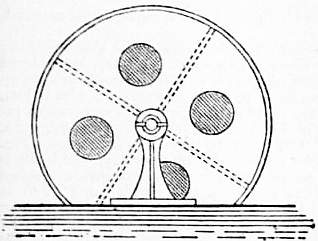
Fig. 1.—Section of a Dash-wheel.
For small lots (1-20 pieces) the bleaching can be conducted on very simple machinery. Thus many small piece dyers conduct the whole of their bleaching on the jigger, a simple form of dyeing machine on which most cotton piece goods are dyed (see Dyeing). For muslins, laces and other very light fabrics, which will not stand rough handling, the operations are conducted mainly by hand, washing being effected in the dash-wheel (fig. 1), which consists of a cylindrical box, revolving on its axis. It has four divisions, as shown by the dotted lines, and an opening into each division. A number of pieces are put into each, abundance of water is admitted behind, and the knocking of the pieces as they alternately dash from one side of the division to the other during the revolution of the wheel effects the washing. The process lasts from four to six minutes.
For velveteens, corduroys, heavy drills, pocketings and other fabrics in which creasing has to be avoided as much as possible, the so-called “open bleach” is resorted to, which differs from the ordinary process chiefly in that the goods are treated throughout at full width.
The great bulk of cotton pieces is bleached in rope form, i.e. stitched together end to end and laterally collapsed, so that they will pass through a ring of 4 to 5 in. in diameter.
The first operation which the goods undergo on arriving in the grey-room of the bleachworks is that of stamping with tar or some other indelible material in order that they may be identified after passing through the whole process. They are then stitched together end to end by means of special sewing machines, the stitch being of such a nature (chain stitch) that the thread can be ripped out at one pull at the end of the operations.
Singeing.—In the condition in which the pieces leave the loom and come into the hands of the bleacher, the surface of the fabric is seen to be covered with a nap of projecting fibres which gives it a downy appearance. For some classes of goods this is not a disadvantage, but in the majority of cases, especially for prints where a clean surface is essential, the nap is removed before bleaching. This is usually effected by running the pieces at full width over a couple of arched copper plates heated to a full red heat by direct fire. An arrangement of the kind is shown in fig. 2, in which the singe-plates, a and b, are mounted over the flues of a coal fire. The plate b is most highly heated, a being at the end of the flue farthest removed from the fire. The cloth enters over a rail A, and in passing over the plate a is thoroughly dried and prepared for the singeing it receives when it comes to the highly-heated plate b. A block d, carrying two rails in the space between the plates, can be raised or lowered so as to increase or lessen the pressure of the cloth against the plates, or, if necessary, to lift it quite free of contact with them.
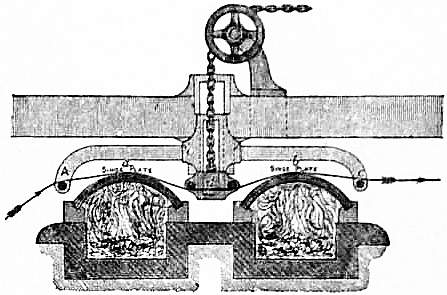
Fig. 2.—Section of Singe-stove.
The pieces on leaving the singeing machine are passed either through a water trough or through a steam box with the object of extinguishing sparks, and are then plaited down. The speed at which the pieces travel over the singe plates is necessarily considerable and varies with different classes of material.1
In lieu of plates, a cast-iron cylinder is sometimes employed (“roller singeing”), the heating being effected by causing the flame of the fire to be drawn through the roller, which is carried on two small rollers at each end and revolves slowly in the reverse direction to that followed by the piece, thus exposing continuously a freshly heated surface and avoiding uneven cooling.
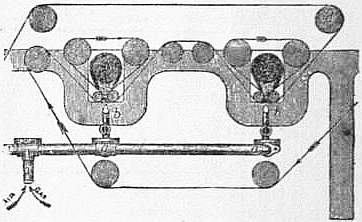
Fig. 3.—Gas Singeing Apparatus.
For figured pieces which have an uneven surface, it is obvious that plate or roller singeing would only affect the portions which project most, leaving the rest untouched. For such goods, “gas singeing” is employed, which consists in running the pieces over a non-luminous gas flame, the breadth of which slightly exceeds that of the piece, or in drawing the flame right through the piece.2 The construction of an ordinary gas singeing apparatus is seen in section in fig. 3. Coal gas mixed with air is sent under pressure through pipe a into the burners b, b, where the mixture burns with an intense heat. The cloth travels in the direction of the arrows, and in passing over the small nap rollers c comes into contact with the flame four times in succession before leaving the machine.
Gas singeing is also used for plain goods, and being cleaner and under better control has largely replaced plate singeing.
At this stage the goods which have been browned on the surface by singeing are ready for the bleaching operations. A great many innovations have been introduced in recent years in the bleaching of calico, but although it is generally admitted that in point of view of time and economy many of these processes offer considerable advantages, the old process, in which a lime boil precedes the other operations, is still the one which is most largely employed by bleachers in England. In this, the sequence of operations is the following—
Grey Washing.—This operation (which is sometimes omitted) simply consists in running the pieces through an ordinary washing machine (as shown in fig. 5) through water in order to wet them out. On leaving the machine they are piled in a heap and left over night, when fermentation sets in, which results in the starch being to a large extent hydrolysed and rendered soluble in water.
Lime Boil.—In this operation, which is also known as bowking (Ger. beuchen), the pieces are first run through milk of lime contained in an ordinary washing machine and of such a strength that they take up about 4% of their weight of lime (CaO). They are then run over winches and guided through smooth porcelain rings (“pot-eyes”) into the kier, where they are evenly packed by boys who enter the vessel through the manhole at the top. It is of the greatest importance that the goods should be evenly packed, for, if channels or loosely-packed places are left, the liquor circulating through the kier, when boiling is subsequently in progress, will follow the line of least resistance, and the result is an uneven treatment. Of the numerous forms of kier in use, the injector kier is the one most generally adopted. This consists of an egg-ended cylindrical vessel constructed of stout boiler plate and shown in sectional elevation in fig. 4. The kier is from 10 to 12 ft. in height and from 6 to 7 ft. in diameter, and stands on three iron legs riveted to the sides, but not shown in the figure. The bottom exit pipe E is covered with a shield-shaped false bottom of boiler plate, or (and this is more usual) the whole bottom of the kier is covered with large rounded stones from the river bed, the object in either case being simply to provide space for the accumulation of liquor and to prevent the pipe E being blocked. The cloth is evenly packed up to within about 3 to 4 ft. of the manholes M, when lime water is run in through the liquor pipe until the level of the liquid reaches within about 2 ft. of the top of the goods. The manholes are now closed, and steam is turned on at the injector J by opening the valve v. The effect of this is to suck the liquor through E, and to force it up through pipe P into the top of the kier, where it dashes against the umbrella-shaped shield U and is distributed over the pieces, through which it percolates, until on arriving at E it is again carried to the top of the kier, a continuous circulation being thus effected. As the circulation proceeds, the steam condensing in the liquor rapidly heats the latter to the boil, and as soon as, in the opinion of the foreman, all air has been expelled, the blow-through tap is closed and the boiling is continued for periods varying from six to twelve hours under 20-60 ℔ pressure. Steam is now turned off, and by opening the valve V the liquor, which is of a dark-brown colour, is forced out by the pressure of the steam it contains.
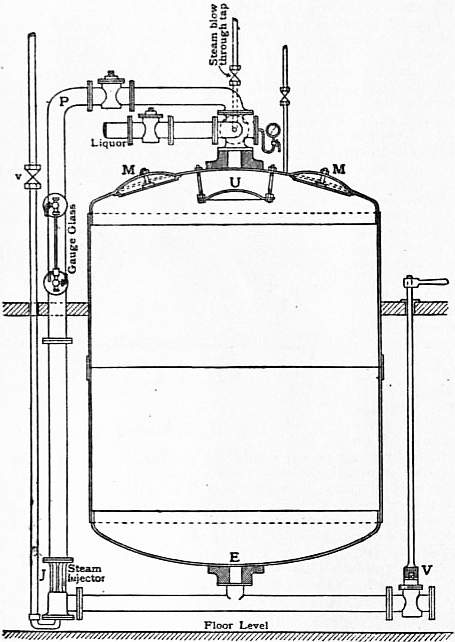
Fig 4.—High Pressure Blow-through Kier.
The pieces are now run through a continuous washing machine, which is provided with a plentiful supply of water. The machine, which is shown in fig. 5, consists essentially of a wooden vat, over which there is a pair of heavy wooden (sycamore) bowls or squeezers. The pieces enter the machine at each end, as indicated by the arrows, and pass rapidly through the bowls down to the bottom of the vat over a loose roller, thence between the first pair of guide pegs through the bowls again, and travel thus in a spiral direction until they arrive at the middle of the machine, when they leave at the side opposite to that on which they entered. The same type of machine is used for liming, chemicking, and souring.
The next operation is the “grey sour,” in which the goods are run through a washing machine containing hydrochloric acid of 2° Tw. strength, with the object of dissolving out the lime which the goods retain in considerable quantity after the lime boil. The goods are then well washed, and are now boiled again in the ash bowking kier, which is similar in construction to the lime kier, with soda ash (3%) and a solution of rosin (1½%) in caustic soda (1¼%) for eight to ten hours. For white bleaching the rosin soap is omitted, soda ash alone being employed.
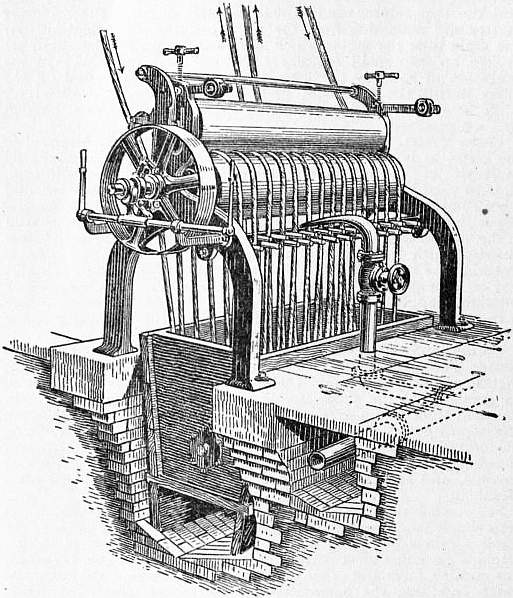
Fig 5.—Roller Washing Machine.
The pieces are now washed free from alkali and the bleaching proper or “chemicking” follows. This operation may be effected in various ways, but the most efficient is to run the goods in a washing machine through bleaching powder solution at ½°-1° Tw., and allow them to lie loosely piled over night, or in some cases for a longer period. They are now washed, run through dilute sulphuric or hydrochloric acid at 2° Tw. (“white sour”) and washed again. Should the white not appear satisfactory at this stage (and this is usually the case with very heavy or dense materials), they are boiled again in soda ash, chemicked with bleaching powder at 1⁄8° Tw. or even weaker, soured and washed. It is of the utmost importance that the final washing should be as thorough as possible, in order to completely remove the acid, for if only small quantities of the latter are left in the goods, they are liable to become tender in the subsequent drying, through formation of hydrocellulose.
The modern processes of bleaching cotton pieces differ from the one described above, chiefly in that the lime boil is entirely dispensed with, its place being taken by a treatment in the kier with caustic soda (or a mixture of caustic soda and soda ash) and resin soap. The best known and probably the most widely practised of these processes is one which was worked out by the late M. Horace Koechlin in conjunction with Sir William Mather, and this differs from the old process not only in the sequence of the operations but also in the construction of the kier. This consists of a horizontal egg-ended cylinder, and is shown in transverse and longitudinal sections in figs. 6 and 7. One of the ends E constitutes a door which can be raised or lowered by means of the power-driven chain C. The goods to be bleached are packed in wagons W outside the kier, and when filled these are pushed home into the kier, so that the pipes p fit with their flanges on to the fixed pipes at the bottom of the kier. The heating is effected by means of steam pipes at the lowest extremity of the kier, while the circulation of the liquor is brought about by means of the centrifugal pump P, which draws the liquor through the pipes p from beneath the false bottoms of the wagons and showers it over distributors D on to the goods. By this mode of working a considerable economy is effected in point of time, as the kier can be worked almost continuously; for as soon as one lot of goods has been boiled, the wagons are run out and two freshly-packed wagons take their place. The following is the sequence of operations:—The goods are first steeped over night in dilute sulphuric acid, after which they are washed and run through old kier liquor from a previous operation. They are then packed evenly in the wagons which are pushed into the kier, and, the door having been closed, they are boiled for about eight hours at 7-15 lb pressure with a liquor containing soda ash, caustic soda, resin soap and a small quantity of sulphite of soda. The rest of the operations (chemicking, souring and washing) are the same as in the old process.
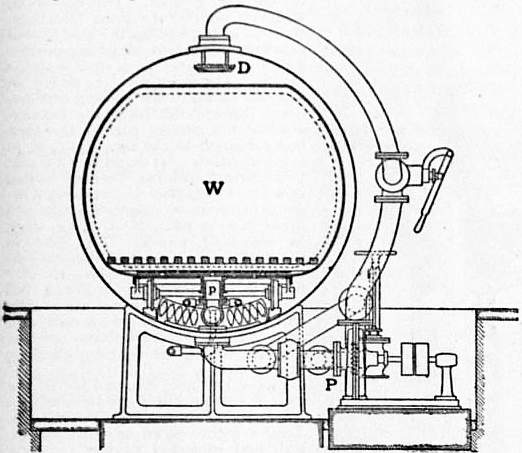
Fig. 6.—The Mather Kier, cross section.
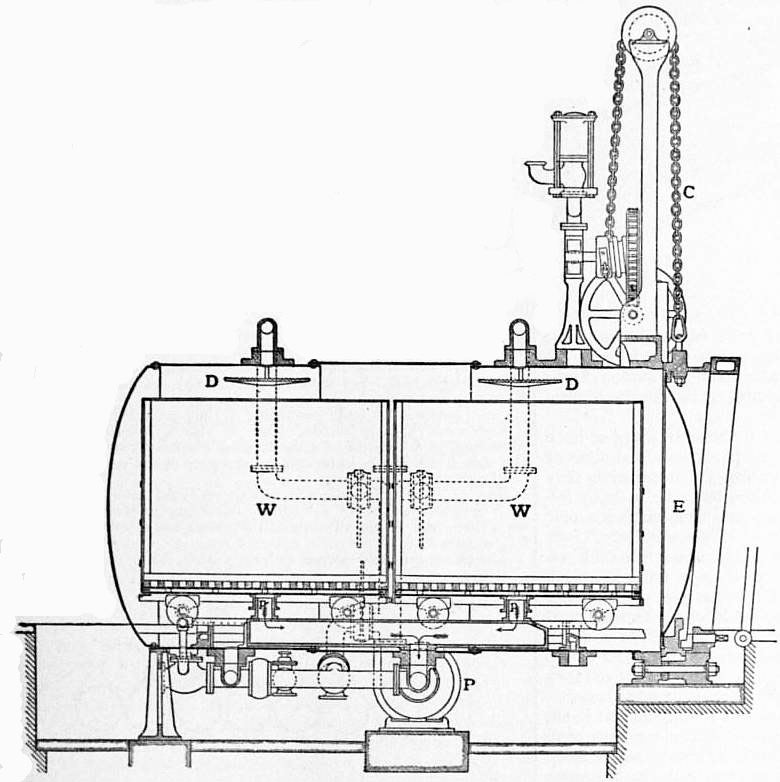
Fig. 7.—The Mather Kier, longitudinal section.
A somewhat different principle is involved in the Thies-Herzig process. In this the kier is vertical, and the circulation of the liquor is effected by means of a centrifugal or other form of pump, while the heating of the liquor is brought about outside the kier in a separate vessel between the pump and the kier by means of indirect steam. The sequence of operations is similar to that adopted in the Mather-Koechlin process, differing chiefly from the latter in the first operation, which consists in running the goods, after singeing, through very dilute boiling sulphuric or hydrochloric acid, containing in either case a small proportion of hydrofluoric acid, and then running them through a steam box, the whole operation lasting from twenty to sixty seconds.
Bleached by any of the above processes, the cloth is next passed over a mechanical contrivance known as a “scutcher,” which opens it out from the rope form to its full breadth, and is then dried on a continuous drying machine. Fig. 8 shows the appearance and construction of an improved form of the horizontal drying machine, which is in more common use for piece goods than the vertical form. The machine consists essentially of a series of copper or tinned iron cylinders, which are geared together so as to run at a uniform speed. Steam at 10-15 ℔ pressure is admitted through the journalled bearings at one side of the machine, and the condensed water is forced out continuously through the bearings at the other side. The pieces pass in the direction of the arrow (fig. 9) over a scrimp rail or expanding roller round the first cylinder, then in a zigzag direction over all succeeding cylinders, and ultimately leave the machine dry, being mechanically plaited down at the other end.
If the bleaching process has been properly conducted, the pieces should not only show a uniform pure white colour, but their strength should remain unimpaired. Careful experiments conducted by the late Mr. Charles O’Neill showed in fact that carefully bleached cotton may actually be stronger than in the unbleached condition, and this result has since been corroborated by others. Excessive blueing, which is frequently resorted to in order to cover the defects of imperfect bleaching, can readily be detected by washing a sample of the material in water, or, better still, in water containing a little ammonia, and then comparing with the original. The formation of oxycellulose during the bleaching process may either take place in boiling under pressure with lime or caustic soda in consequence of the presence of air in the kier, or through excessive action of bleaching powder, which may either result from the latter not being properly dissolved or being used too strong. Its detection may be effected by dyeing a sample of the bleached cotton in a cold, very dilute solution of methylene blue for about ten minutes, when any portions of the fabric in which the cellulose has been converted into oxycellulose will assume a darker colour than the rest. The depth of the colour is at the same time an indication of the extent to which such conversion has taken place. Most bleached cotton contains some oxycellulose, but as long as the formation has not proceeded far enough to cause tendering, its presence is of no importance in white goods. If, on the other hand, the cotton has to be subsequently dyed with direct cotton colours (see Dyeing), the presence of oxycellulose may result in uneven dyeing. Tendering of the pieces, due to insufficient washing after the final souring operation, is a common defect in bleached goods. As a rule the free acid can be detected by extracting the tendered material with distilled water and adding to the extract a drop of methyl orange solution, when the latter will turn pink if free acid be present. Other defects which may occur in bleached goods are iron stains, mineral oil stains, and defects due to the addition of paraffin wax in the size.
Bleaching of Linen.
The bleaching of linen is a much more complicated and tedious process than the bleaching of cotton. This is due in part to the fact that in linen the impurities amount to 20% or more of the weight of the fibre, whereas in cotton they do not usually exceed 5%. Furthermore these impurities, which include colouring matter, intracellular substances and a peculiar wax known as “flax wax,” are more difficult to attack than those which are present in cotton, and the difficulty is still further enhanced in the case of piece goods owing to their dense or impervious character.
Till towards the end of the 18th century the bleaching of linen both in the north of Ireland and in Scotland was accomplished by bowking in cows’ dung and souring with sour milk, the pieces being exposed to light on the grass between these operations for prolonged periods. Subsequently potash and later on soda was substituted for the cows’ dung, while sour milk was replaced by sulphuric acid. This “natural bleach” is still in use in Holland, a higher price being paid for linen bleached in this way than for the same material bleached with the aid of bleaching powder. In the year 1744 Dr. James Ferguson of Belfast received a premium of £300 from the Irish Linen Board for the application of lime in the bleaching of linen. Notwithstanding this reward, the use of lime in the bleaching of linen was for a long time afterwards forbidden in Ireland under statutory penalties, and so late as 1815 Mr Barklie, a respectable linen bleacher of Linen Vale, near Keady, was “prosecuted for using lime in the whitening of linens in his bleachyard.”
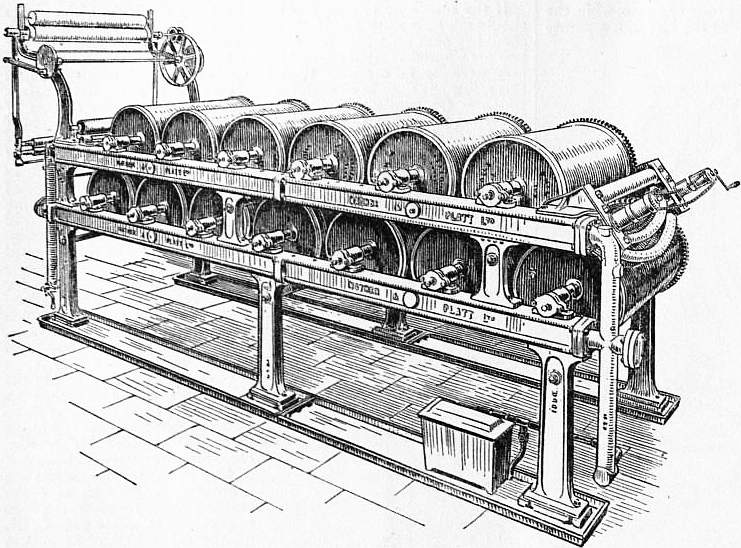
Fig. 8.—Mather & Platt’s Horizontal Drying Machine.
The methods at present employed for the bleaching of linen are, except in one or two unimportant particulars, the same as were used in the middle of the 19th century. In principle they resemble those used in cotton bleaching, but require to be frequently repeated, while an additional operation, which is a relic of the old-fashioned process, viz. that of “grassing” or “crofting,” is still essential for the production of the finest whites. Considerably more care has to be exercised in linen bleaching than is the case with cotton, and the process consequently necessitates a greater amount of manual labour. The practical result of this is that whereas cotton pieces can be bleached and finished in less than a week, linen pieces require at least six weeks. Many attempts have naturally been made to shorten and cheapen the process, but without success. The use of stronger reagents and more drastic treatment, which would at first suggest itself, incurs the risk of injury to the fibre, not so much in respect to actual tendering as to the destruction of its characteristic gloss, while if too drastic a treatment is employed at the beginning the colouring matter is liable to become set in the fibre, and it is then almost impossible to remove it. Among the many modern improvements which have been suggested, mention may be made of the use of hypochlorite of soda in place of bleaching powder, the use of oil in the first treatment in alkali (Cross & Parkes), while de Keukelaere suggests the use of sodium sulphide for this purpose. With the object of dispensing with the operation of grassing, which besides necessitating much manual labour is subject to the influences of the atmospheric conditions, Siemens & Halske of Berlin have suggested exposure of the goods in a chamber to the action of electrolytically prepared ozone. Jardin seeks to achieve the same object by steeping the linen in dilute nitric acid.
Since the qualities of linen which are submitted to the bleacher vary considerably, and the mode of treatment has to be varied accordingly, it is not possible to give more than a bare outline of linen bleaching.
Linen is bleached in the yarn and in the piece. Whenever one of the operations is repeated, the strength of the reagent is successively diminished. In yarn-bleaching the sequence of the operations is about as follows:—(1) Boil in kier with soda ash. (2) Reel in bleaching powder. This operation, which is peculiar to linen bleaching, consists in suspending the hanks from a square roller into bleaching powder solution contained in a shallow stone trough. The roller revolves slowly, so that the hanks, while passing continuously through the bleaching powder, are for the greater part of the time being exposed to the air. (3) Sour in sulphuric acid. (4) Scald in soda ash. (The term “scalding” means boiling in a kier.) (5) Reel in bleaching powder. (6) Sour in sulphuric acid. (7) Scald in soda ash. (8) Dip, i.e. steep in bleaching powder. (9) Sour in sulphuric acid. (10) Scald in soda ash. (11) Dip in bleaching powder. (12) Sour in sulphuric acid. For a full white, two more operations are usually required, viz. (13) scald in soda ash, and (14) dip in bleaching powder. Washing intervenes between all these operations.
Pieces are not stamped as in the case of cotton, but thread-marked by hand with cotton dyed Turkey red. They are then sewn together end to end, and subjected to the following operations:—
Boil with lime in kier.
The pieces are now separated and made up into bundles (except in the case of very light linens, which may pass through the whole of the operations in rope form) and soured with sulphuric acid.
First lye boil with soda ash and caustic soda.
Second lye boil. For some classes of goods no less than six lye boils may be required.
Grass between lye boils (according to their number).
Rub with rubbing boards. This is also a speciality in linen bleaching, and consists of a mechanical treatment with soft soap, the object of which is to remove black stains in the yarn.
Bleach with hypochlorite of soda.
Scald. The two latter treatments are repeated three to five times, each series constituting a “turn.” Grassing intervenes between each turn, and in some instances the pieces are rubbed before the last soda boil.
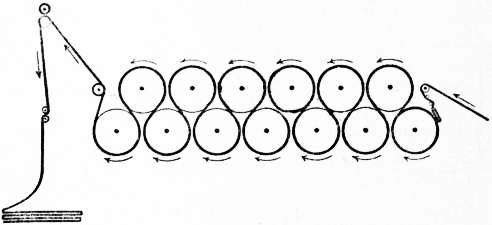
Fig. 9.—Diagram showing the Horizontal Drying Machine threaded with Cloth.
The pieces are next steeped in large vessels (kiers) in weak hypochlorite of soda, and then in weak sulphuric acid, these treatments being repeated several times.
Ultimately the goods are mill-washed, blued with smalt and dried.
Bleaching of other Vegetable Textile Fabrics.
Hemp may be bleached by a process similar to that used for linen, but this is seldom done owing to the expense entailed. China grass is bleached like cotton. Jute contains in its raw state a considerable amount of colouring matter and intracellular substance. Since the individual fibres are very short, the complete removal of the latter would be attended by a disintegration of the material. Although it is possible to bleach jute white, this is seldom if ever carried out on a large scale owing to the great expense involved. A half-bleach on jute is obtained by steeping the goods alternately in bleaching powder (or hypochlorite of soda) and sulphuric acid, washing intervening. For a cream these treatments are repeated.
Bleaching of Straw.
In the Luton district, straw is bleached principally in the form of plait, in which form it is imported. The bleaching is effected by steeping the straw for periods varying from twelve hours to several days in fairly strong alkaline peroxide of hydrogen. The number of baths depends upon the quality of straw and the degree of whiteness required. Good whites are thus obtained, and no further process would be necessary if the hats had not subsequently to be “blocked” or pressed at a high temperature which brings about a deterioration of the colour. After bleaching with peroxide and drying, the straw consequently undergoes a further process of sulphuring, i.e. exposure to gaseous sulphurous acid. Panama hats are bleached after making up, but in this case only peroxide of hydrogen is used and a very lengthy treatment entailing sometimes fourteen days’ steeping is required.
Bleaching of Wool.
In the condition in which it is delivered to the manufacturers wool is generally a very impure article, even if it has been washed on the sheep’s back before shearing. The impurities which it contains consist in the main of the natural grease (in reality a kind of wax) exuded from the skin of the sheep and technically known as the “yolk,” the dried-up perspiration from the body of the sheep; technically called “suint,” and dust, dirt, burrs, &c., which mechanically adhere to the sticky surfaces of the fibres. In this condition wool is quite unfit for any manufacturing purposes and must be cleansed before any mechanical operations can be commenced. Formerly the washing was effected in stale urine, which owed its detergent properties mainly to the presence of ammonium carbonate. The stale urine or lant was diluted with four to five times its bulk of water, and in this liquor, heated to 40°-50° C., the washing was effected.
At the present day this method has been entirely abandoned, the washing or “scouring” being effected with soap, assisted by ammonia, potash, soda or silicate of soda. The finest qualities of wool are washed with soft soap and potash, while for inferior qualities, cheaper detergents are employed. The operation is in principle perfectly simple, the wool being submerged in the warm soap solution, where it is moved about with forks and then taken out and allowed to drain. A second treatment in weaker soap serves to complete the process. In dealing with large quantities, wool-washing machines are employed, which consist essentially of long cast-iron troughs which contain the soap solution. The wool to be washed is fed in at one end of the machine and is slowly propelled to the other end by means of a system of mechanically-driven forks or rakes. As it passes from the machine, it is squeezed through a pair of rollers. Three such machines are usually required for efficient washing, the first containing the strongest and the third the weakest soap.
The washing of wool is in the main a mechanical process, in which the water dissolves out the suint while the soap emulsifies the yolk and thus removes it from the fibre. The attendant earthy impurities pass mechanically into the surrounding liquid and are swilled away.
In some works the wool is washed first with water alone, the aqueous extract thus obtained being evaporated to dryness and the residue calcined. A very good quality of potash is thus obtained as a by-product. In many works in Yorkshire and elsewhere, the dirty soap liquors obtained in wool-washing are not allowed to run to waste, but are run into tanks and there treated with sulphuric acid. The effect of this treatment is to decompose the soap, and the fatty acids along with the wool-grease rise as a magma to the surface. The purified product is known in the trade as “Yorkshire grease.”
Attempts have been made from time to time to extract the natural grease from wool by means of organic solvents, such as carbon bisulphide, carbon tetrachloride, petroleum spirit, &c., but have not met with much success.
Worsted yarn spun on the English system, as well as woollen yarn and fabrics made from them, contain oil which has been incorporated with the wool to facilitate the spinning. This oil must be got rid of previous to bleaching, and this is effected by scouring in warm soap with or without the assistance of alkalis.
The actual bleaching of wool may be effected in two ways, viz. by treating the material either with sulphurous acid or with hydrogen peroxide. Sulphurous acid may either be applied in the gaseous form or in solution as bisulphite of soda. In working by the first method, which is technically known as “stoving,” the scoured yarn is wetted in very weak soap containing a small amount of blue colouring matter, wrung or hydro-extracted and then suspended in a chamber or stove. Sulphur contained in a vessel on the floor of the chamber is now lighted, and the door having been closed, is allowed to burn itself out. The goods are left thus exposed to the sulphur dioxide overnight, when they are taken out and washed in water. For piece goods a somewhat different arrangement is employed, the pieces passing through a slit into a chamber supplied with sulphur dioxide, then slowly up and down over a large number of rollers and ultimately emerging again at the same slit. Wool may also be bleached by steeping in a fairly strong solution of bisulphite of soda and then washing well in water. Wool bleached with sulphurous acid or bisulphite is readily affected by alkalis, the natural yellow colour returning on washing with soap or soda. A more permanent bleach is obtained by steeping the wool in hydrogen peroxide (of 12 volumes strength), let down with about three times its bulk of water and rendered slightly alkaline with ammonia or silicate of soda. Black or brown wools cannot be bleached white, but when treated with peroxide they assume a golden colour, a change which is frequently desired in human hair.
Bleaching of Silk.
In raw silk, the fibre proper is uniformly coated with a proteid substance known as silk-gum, silk-glue or sericine which amounts to 19-25% of the weight of the material, and it is only after the removal of this coating that the characteristic properties of the fibre become apparent. This is effected by the process of “discharging” or “boiling-off,” which consists in suspending the hanks of raw silk over poles or sticks in a vat containing a strong hot soap solution (30% of soap on the weight of the silk). The liquor is kept just below boiling point for two or three hours, the hanks being turned from time to time. During the process, the sericine at first swells up considerably, the fibres becoming slippery, but as the operation proceeds it passes into solution. It is important that only soft water should be used for boiling-off since calcareous impurities are liable to mar the lustre of the silk.
The silk is now rinsed in weak soda solution and wrung. In this condition it is suitable for being dyed, but if it is to be bleached, the hanks are tied up loosely with smooth tape, put into coarse linen bags to prevent the silk becoming entangled, and boiled again in soap solution which is half as strong as that used in the first operation. The hanks are now taken out, rinsed in a weak soda solution, washed in water and wrung.
The actual bleaching of silk is usually effected by stoving as in the case of wool, with this difference, that the operation is repeated several times and blueing or tinting with other colours is effected after bleaching. Silk may also be bleached with peroxide of hydrogen, but this method is only used for certain qualities of spun silk and for tussore.
Ornamental feathers are best bleached by steeping in peroxide of hydrogen, rendered slightly alkaline by the addition of ammonia. The same treatment is applied to the bleaching of ivory. If peroxide of hydrogen could be prepared at a moderate cost, it would doubtless find a much more extensive application in bleaching, since it combines efficiency with safety, and gives good results with both vegetable and animal substances.
(E. K.)
1 Besides being used for cotton goods, plate singeing is also employed for certain classes of worsted goods (alpacas, bunting, &c.), and for most union goods (cotton warp and worsted weft).