VOLUME IV SLICE I Bisharin to Bohea (continued 6)
Reading edition
2 A machine working on this principle has been constructed by F. Binder, and the makers of the machine (Messrs Mather & Platt, Ltd.) claim that it does better service than the machines constructed on the older principle.
BLEAK, or Blick (Alburnus lucidus), a small fish of the Cyprinid family, allied to the bream and the minnow, but with a more elongate body, resembling a sardine. It is found in European streams, and is caught by anglers, being also a favourite in aquariums. The well-known and important industry of “Essence Orientale” and artificial pearls, carried on in France and Germany with the crystalline silvery colouring matter of the bleak, was introduced from China about the middle of the 17th century.
BLEEK, FRIEDRICH (1793-1859), German Biblical scholar, was born on the 4th of July 1793, at Ahrensbök, in Holstein, a village near Lübeck. His father sent him in his sixteenth year to the gymnasium at Lübeck, where he became so much interested in ancient languages that he abandoned his idea of a legal career and resolved to devote himself to the study of theology. After spending some time at the university of Kiel, he went to Berlin, where, from 1814 to 1817, he studied under De Wette, Neander and Schleiermacher. So highly were his merits appreciated by his professors—Schleiermacher was accustomed to say that he possessed a special charisma for the science of “Introduction”—that in 1818 after he had passed the examinations for entering the ministry he was recalled to Berlin as Repetent or tutorial fellow in theology, a temporary post which the theological faculty had obtained for him. Besides discharging his duties in the theological seminary, he published two dissertations in Schleiermacher’s and G.C.F. Lücke’s Journal(1819-1820,1822), one on the origin and composition of the Sibylline Oracles “Über die Entstehung und Zusammensetzung der Sibyllinischen Orakel,” and another on the authorship and design of the Book of Daniel, “Über Verfasser und Zweck des Buches Daniel.” These articles attracted much attention, and were distinguished by those qualities of solid learning, thorough investigation and candour of judgment which characterized all his writings. Bleek’s merits as a rising scholar were recognized by the minister of public instruction, who continued his stipend as Repetent for a third year, and promised further advancement in due time. But the attitude of the political authority underwent a change. De Wette was dismissed from his professorship in 1819, and Bleek, a favourite pupil, incurred the suspicion of the government as an extreme democrat. Not only was his stipend as Repetent discontinued, but his nomination to the office of professor extraordinarius, which had already been signed by the minister Karl Altenstein, was withheld. At length it was found that Bleek had been confounded with a certain Baueleven Blech, and in 1823 he received the appointment.
During the six years that Bleek remained at Berlin, he twice declined a call to the office of professor ordinarius of theology, once to Greifswald and once to Königsberg. In 1829, however, he was induced to accept Lücke’s chair in the recently-founded university of Bonn, and entered upon his duties there in the summer of the same year. For thirty years he laboured with ever-increasing success, due not to any attractions of manner or to the enunciation of novel or bizarre opinions, but to the soundness of his investigations, the impartiality of his judgments, and the clearness of his method. In 1843 he was raised to the office of consistorial councillor, and was selected by the university to hold the office of rector, a distinction which has not since been conferred upon any theologian of the Reformed Church. He died suddenly of apoplexy on the 27th of February 1859.
Bleek’s works belong entirely to the departments of Biblical criticism and exegesis. His views on questions of Old Testament criticism were “advanced” in his own day; for on all the disputed points concerning the unity and authorship of the books of the Old Covenant he was opposed to received opinion. But with respect to the New Testament his position was conservative. An opponent of the Tübingen school, his defence of the genuineness and authenticity of the gospel of St. John is among the ablest that have been written; and although on some minor points his views did not altogether coincide with those of the traditional school, his critical labours on the New Testament must nevertheless be regarded as among the most important contributions to the maintenance of orthodox opinions. His greatest work, his commentary on the epistle to the Hebrews (Brief an die Hebräer erläutert durch Einleitung, Übersetzung, und fortlaufenden Commentar, in three parts, 1828, 1836 and 1840) won the highest praise from men like De Wette and Fr. Delitzsch. This work was abridged by Bleek for his college lectures, and was published in that condensed form in 1868. In 1846 he published his contributions to the criticism of the gospels (Beiträge zur Evangelien Kritik, pt. i.), which contained his defence of St John’s gospel, and arose out of a review of J.H.A. Ebrard’s Wissenschaftliche Kritik der Evangelischen Geschichte (1842).
After his death were published:—(1) His Introduction to the Old Testament (Einleitung in das Alte Testament), (3rd ed., 1869); Eng. trans. by G.H. Venables (from 2nd ed., 1869); in 1878 a new edition (the 4th) appeared under the editorship of J. Wellhausen, who made extensive alterations and additions; (2) his Introduction to the New Testament (3rd ed., W. Mangold, 1875), Eng. trans. (from 2nd German ed.) by William Urwick (1869, 1870); (3) his Exposition of the First Three Gospels (Synoptische Erklarung der drei ersten Evangelien), by H. Holtzmann (1862); (4) his Lectures on the Apocalypse (Vorlesungen über die Apokalypse), (Eng. trans. 1875). Besides these there has also appeared a small volume containing Lectures on Colossians, Philemon and Ephesians (Berlin, 1865). Bleek also contributed many articles to the Studien und Kritiken. For further information as to Bleek’s life and writings, see Kamphausen’s article in Herzog-Hauck, Realencyklopadie; Frédéric Lichtenberger’s Histoire des idées religieuses en Allemagne, vol. iii.; Diestel’s Geschichte des Allen Testamentes (1869); and T.K. Cheyne’s Founders of Old Testament Criticism (1893).
BLEEK, WILHELM HEINRICH IMMANUEL (1827-1875), German philologist, son of Friedrich Bleek, was born in 1827 at Berlin. He studied first at Bonn and afterwards at Berlin, where his attention was directed towards the philological peculiarities of the South African languages. In his doctor’s dissertation (Bonn, 1851), De nominum generibus linguarum Africae Australis, he endeavoured to show that the Hottentot language was of North African descent. In 1854 his health prevented him accompanying Dr W.B. Baikie in the expedition to the Niger; but in the following year he accompanied Bishop Colenso to Natal, and was enabled to prosecute his researches into the language and customs of the Kaffirs. Towards the close of 1856 he settled at Cape Town, and in 1857 was appointed interpreter by Sir George Grey. In 1859 he was compelled by ill health to visit Europe, and on his return in the following year he was made librarian of the valuable collection of books presented to the colony by Sir George Grey. In 1869 he visited England, where the value of his services was recognized by a pension from the civil list. He died at Cape Town on the 17th of August 1875. His works, which are of considerable importance for African and Australian philology, consist of the Vocabulary of the Mozambique Language (London, 1856); Handbook of African, Australian and Polynesian Philology (Cape Town and London, 3 vols., 1858-1863); Comparative Grammar of, the South African Languages (vol. i., London, 1869); Reynard the Fox in South Africa, or Hottentot Fables and Tales (London, 1864); Origin of Language (London, 1869).
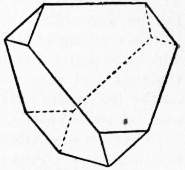
Fig. 1.
BLENDE, or Sphalerite, a naturally occurring zinc sulphide, ZnS, and an important ore of zinc. The name blende was used by G. Agricola in 1546, and is from the German blenden, to blind, or deceive, because the mineral resembles lead ore in appearance but contains no lead, and was consequently often rejected as worthless. Sphalerite, introduced by E.F. Glocker in 1847, has the same meaning (σφαλερός, deceptive), and so have the miners’ terms “mock ore,” “false lead,” and “blackjack.” The term “blende” was at one time used in a generic sense, and as such enters into the construction of several old names of German origin; the species under consideration is therefore sometimes distinguished as zinc-blende.
Crystals of blende belong to that subclass of the cubic system in which there are six planes of symmetry parallel to the faces of the rhombic dodecahedron and none parallel to the cubic faces; in other words, the crystals are cubic with inclined hemihedrism, and have no centre of symmetry. The fundamental form is the tetrahedron. Fig. 1 shows a combination of two tetrahedra, in which the four faces of one tetrahedron are larger than the four faces of the other: further, the two sets of faces differ in surface characters, those of one set being dull and striated, whilst those of the other set are bright and smooth. A common form, shown in fig. 2, is a combination of the rhombic dodecahedron with a three-faced tetrahedron y (311); the six faces meeting in each triad axis are often rounded together into low conical forms. The crystals are frequently twinned, the twin-axis coinciding with a triad axis; a rhombic dodecahedron so twinned (fig. 3) has no re-entrant angles. An important character of blende is the perfect dodecahedral cleavage, there being six directions of cleavage parallel to the faces of the rhombic dodecahedron, and angles between which are 60°.
When chemically pure, which is rarely the case, blende is colourless and transparent; usually, however, the mineral is yellow, brown or black, and often opaque, the depth of colour and degree of transparency depending on the amount of iron present. The streak, or colour of the powder, is brownish or light yellow, rarely white. The lustre is resinous to adamantine, and the index of refraction high (2.369 for sodium light). The substance is usually optically isotropic, though sometimes it exhibits anomalous double refraction; fibrous zinc sulphide which is doubly refracting is to be referred to the hexagonal species wurtzite. The specific gravity is 4.0, and the hardness 4. Crystals exhibit pyroelectrical characters, since they possess four uniterminal triad axes of symmetry.
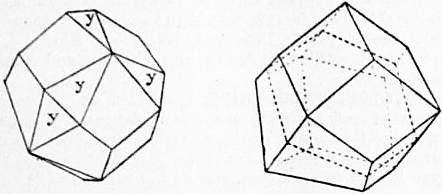
Fig. 2. Fig. 3.
Crystals of blende are of very common occurrence, but owing to twinning and distortion and curvature of the faces, they are often rather complex and difficult to decipher. For this reason the mineral is not always readily recognized by inspection, though the perfect dodecahedral cleavage, the adamantine lustre, and the brown streak are characters which may be relied upon. The mineral is also frequently found massive, with a coarse or fine granular structure and a crystalline fracture; sometimes it occurs as a soft, white, amorphous deposit resembling artificially precipitated zinc sulphide. A compact variety of a pale liver-brown colour and forming concentric layers with a reniform surface is known in Germany as Schalenblende or Leberblende.
A few varieties of blende are distinguished by special names, these varieties depending on differences in colour and chemical composition. A pure white blende from Franklin in New Jersey is known as cleiophane; snow-white crystals are also found at Nordmark in Vermland, Sweden. Black blende containing ferrous sulphide, in amounts up to 15 or 20% isomorphously replacing zinc sulphide, is known as marmatite (from Marmato near Guayabal in Colombia, South America) and christophite (from St Christophe mine at Breitenbrunn near Eibenstock in Saxony). Transparent blende of a red or reddish-brown colour, such as that found near Holywell in Flintshire, is known as “ruby-blende” or “ruby-zinc.” Přibramite is the name given to a cadmiferous blende from Přibram in Bohemia. Other varieties contain small amounts of mercury, tin, manganese or thallium. The elements gallium and indium were discovered in blende.
Blende occurs in metalliferous veins, often in association with galena, also with chalcopyrite, barytes, fluorspar, &c. In ore-deposits containing both lead and zinc, such as those filling cavities in the limestones of the north of England and of Missouri, the galena is usually found in the upper part of the deposit, the blende not being reached until the deeper parts are worked. Blende is also found sporadically in sedimentary rocks; for example, in nodules of clay-ironstone in the Coal Measures, in the cement-doggers of the Lias, and in the casts of fossil shells. It has occasionally been found on the old timbers of mines. In these cases the zinc sulphide has probably arisen from the reduction of sulphate by organic matter.
Localities for fine crystallized specimens are numerous. Mention may be made of the brilliant black crystals from Alston Moor in Cumberland, St Agnes in Cornwall and Derbyshire. Yellow crystals are found at Kapnik-Bánya, near Nagy-Bánya in Hungary. Transparent yellow cleavage masses of large size occur in limestone in the zinc mines at Picos de Europa in the province of Santander, Spain. Beautiful isolated tetrahedra of transparent yellow blende are found in the snow-white crystalline dolomite of the Binnenthal in the Valais, Switzerland.
(L. J. S.)
BLENHEIM (Ger. Blindheim), a village of Bavaria, Germany, in the district of Swabia, on the left bank of the Danube, 30 m. N.E. from Ulm by rail, a few miles below Höchstädt. Pop. 700. It was the scene of the defeat of the French and Bavarians under Marshals Tallard and Marsin, on the 13th of August 1704, by the English and the Austrians under the duke of Marlborough and Prince Eugene. In consideration of his military services and especially his decisive victory, a princely mansion was erected by parliament for the duke of Marlborough near Woodstock in Oxfordshire, England, and was named Blenheim Palace after this place.
The battle of Blenheim is also called Höchstädt, but the title accepted in England has the advantage that it distinguishes this battle from that won on the same ground a year previously, by the elector of Bavaria over the imperial general Styrum (9-20 September 1703), and from the fighting between the Austrians under Krag and the French under Moreau in June 1800 (see French Revolutionary Wars). The ground between the hills and the marshy valley of the Danube forms a defile through which the main road from Donauwörth led to Ulm; parallel streams divide the narrow plain into strips. On one of these streams, the Nebel, the French and Bavarians (somewhat superior in numbers) took up their position facing eastward, their right flank resting on the Danube, their left in the under-features of the hilly ground, and their front covered by the Nebel, on which were the villages of Oberglau, Unterglau and Blenheim. The imperialist army of Eugene and the allies under Marlborough (52,000 strong) encamped 5 m. to the eastward along another stream, their flanks similarly protected. On the 2nd-13th of August 1704 Eugene and Marlborough set their forces in motion towards the hostile camps; several streams had to be crossed on the march, and it was seven o’clock (five hours after moving off) when the British of Marlborough’s left wing, next the Danube, deployed opposite Blenheim, which Tallard thereupon garrisoned with a large force of his best infantry, aided by a battery of 24-pounder guns. The French and Bavarians were taken somewhat by surprise, and were arrayed in two separate armies, each with its cavalry on the wings and its foot in the centre. Thus the centre of the combined forces consisted of the cavalry of Marsin’s right and of Tallard’s left.
Here was the only good ground for mounted troops, and Marlborough followed Tallard’s example when forming up to attack, but it resulted from the dispositions of the French marshal that this weak point of junction of his two armies was exactly that at which decisive action was to be expected. Tallard therefore had a few horse on his right between the Danube and Blenheim, a mass of infantry in his centre at Blenheim itself, and a long line of cavalry supported by a few battalions forming his left wing in the plain, and connecting with the right of Marsin’s army. This army was similarly drawn up. The cavalry right wing was in the open, the French infantry near Oberglau, which was strongly held, the Bavarian infantry next on the left, and finally the Bavarian cavalry with a force of foot on the extreme left in the hills. The elector of Bavaria commanded his own troops in person. Marlborough and Eugene on their part were to attack respectively Tallard and Marsin. The right wing under Eugene had to make a difficult march over broken ground before it could form up for battle, and Marlborough waited, with his army in order of battle between Unterglau and Blenheim, until his colleague should be ready. At 12.30 the battle opened. Lord Cutts, with a detachment of Marlborough’s left wing, attacked Blenheim with the utmost fury. A third of the leading brigade (British) was killed and wounded in the vain attempt to break through the strong defences of the village, and some French squadrons charged upon it as it retired; a colour was captured in the mêlée, but a Hessian brigade in second line drove back the cavalry and retook the colour. After the repulse of these squadrons, in which some British cavalry from the centre took part, Cutts again moved forward. The second attack, though pressed even more fiercely, fared no better than the first, and the losses were heavier than before. The duke then ordered Cutts to observe the enemy in Blenheim, and concentrated all his attention on the centre. Here, between Unterglau and Blenheim, preparations were being made, under cover of artillery, for the crossing of the Nebel, and farther up-stream a corps was sent to attack Oberglau. This attack failed completely, and it was not until Marlborough himself, with fresh battalions, drove the French back into Oberglau that the allies were free to cross the Nebel.
In the meanwhile the first line of Marlborough’s infantry had crossed lower down, and the first line of cavalry, following them across, had been somewhat severely handled by Tallard’s cavalry. The squadrons under the Prussian general Bothmar, however, made a dashing charge, and achieved considerable temporary success. Eugene was now closely engaged with the elector of Bavaria, and both sides were losing heavily. But Eugene carried out his holding attack successfully. Marsin dared not reinforce Tallard to any extent, and the duke was preparing for the grand attack. His whole force, except the detachment of Cutts, was now across the Nebel, and he had formed it in several lines with the cavalry in front. Marlborough himself led the cavalry; the French squadrons received the attack at the halt, and were soon broken. Marsin’s right swung back towards its own army. Those squadrons of Tallard’s left which retained their order fell back towards the Danube, and a great gap was opened in the centre of the defence, through which the victorious squadrons poured. Wheeling to their left the pursuers drove hundreds of fugitives into the Danube, and Eugene was now pressing the army of Marsin towards Marlborough, who re-formed and faced northward to cut off its retreat. Tallard was already a prisoner, but in the dusk and confusion Marsin slipped through between the duke and Eugene. General Churchill, Marlborough’s brother, had meanwhile surrounded the French garrison of Blenheim; and after one or two attempts to break out, twenty-four battalions of infantry and four regiments of dragoons, many of them the finest of the French army, surrendered.
The losses of the allies are stated at 4500 killed and 7500 wounded (British 670 killed and 1500 wounded). Of the French and Bavarians 11,000 men, 100 guns and 200 colours and standards were taken; besides the killed and wounded, the numbers of which vere large but uncertain—many were drowned in the Danube. Marsin’s army, though it lost heavily, was drawn off in good order; Tallard’s was almost annihilated.
BLENNERHASSETT, HARMAN (1765-1831), Irish-American lawyer, son of an Irish country gentleman of English stock settled in Co. Kerry, was born on the 8th of October 1765. He was educated at Trinity College, Dublin, and in 1790 was called to the Irish bar. After living for several years on the continent, he married in 1796 his niece, Margaret Agnew, daughter of Robert Agnew, the lieutenant-governor of the Isle of Man. Ostracised by their families for this step the couple decided to settle in America, where Blennerhassett in 1798 bought an island in the Ohio river about 2 m. below Parkersburg, West Virginia. Here in 1805 he received a visit from Aaron Burr (q.v.), in whose conspiracy he became interested, furnishing liberal funds for its support, and offering the use of his island as a rendezvous for the gathering of arms and supplies and the training of volunteers. When the conspiracy collapsed, the mansion and island were occupied and plundered by the Virginia militia. Blennerhassett fled, was twice arrested and remained a prisoner until after Burr’s release. The island was then abandoned, and Blennerhassett was in turn a cotton planter in Mississippi, and a lawyer (1819-1822) in Montreal, Canada. After returning to Ireland, he died in the island of Guernsey on the 2nd of February 1831. His wife, who had considerable literary talent and who published The Deserted Isle (1822) and The Widow of the Rock and Other Poems (1824), returned to the United States in 1840, and died soon afterward in New York City while attempting to obtain through Congress payment for property destroyed on the island.
See William H. Safford, Life of Harman Blennerhassett (Cincinnati, 1853); W.H. Safford (editor), The Blennerhassett Papers (Cincinnati, 1864); and “The True Story of Harman Blennerhassett,” by Therese Blennerhassett-Adams, in the Century Magazine for July 1901, vol. lxii.
BLERA (mod. Bieda), an ancient Etruscan town on the Via Clodia, about 32 m. N.N.W. of Rome. It was of little importance, and is only mentioned by geographers and in inscriptions. It is situated on a long, narrow tongue of rock at the junction of two deep glens. Some remains of the town walls still exist, and also two ancient bridges, both belonging to the Via Clodia, and many tombs hewn in the rock—small chambers imitating the architectural forms of houses, with beams and rafters represented in relief. See G. Dennis, Cities and Cemeteries of Etruria, i. 207. There was another Blera in Apulia, on the road from Venusia to Tarentum.
BLESSINGTON, MARGUERITE, Countess of (1789-1849), Irish novelist and miscellaneous writer, daughter of Edmund Power, a small landowner, was born near Clonmel, Co. Tipperary, Ireland, on the 1st of September 1789. Her childhood was made unhappy by her father’s character and poverty,—and her early womanhood wretched by her compulsory marriage at the age of fifteen to a Captain Maurice St Leger Farmer, whose drunken habits brought him at last as a debtor to the king’s bench prison, where, in October 1817, he died. His wife had left him some time before, and in February 1818 she married Charles John Gardiner, earl of Blessington. Of rare beauty, charm and wit, she was no less distinguished for her generosity and for the extravagant tastes which she shared with her husband, which resulted in encumbering his estates with a load of debt. In the autumn of 1822 they went abroad, spent four months of the next year at Genoa in close intimacy with Byron, and remained on the continent till Lord Blessington’s death in May 1829. Some time before this they had been joined by Count D’Orsay, who in 1827 married Lady Harriet Gardiner, Lord Blessington’s only daughter by a former wife. D’Orsay, who had soon separated from his wife, now accompanied Lady Blessington to England and lived with her till her death. Their home, first at Seamore Place, and afterwards Gore House, Kensington, became a centre of attraction for whatever was distinguished in literature, learning, art, science and fashion. After her husband’s death she supplemented her diminished income by contributing to various periodicals as well as by writing novels. She was for some years editor of The Book of Beauty and The Keepsake, popular annuals of the day. In 1834 she published her Conversations with Lord Byron. Her Idler in Italy (1839-1840), and Idler in France (1841) were popular for their personal gossip and anecdote, descriptions of nature and sentiment. Early in 1849, Count D’Orsay left Gore House to escape his creditors; the furniture and decorations were sold, and Lady Blessington joined the count in Paris, where she died on the 4th of June 1849.
Her Literary Life and Correspondence (3 vols.), edited by R.R. Madden, appeared in 1855. Her portrait was painted in 1808 by Sir Thomas Lawrence.
BLIDA, a town of Algeria, in the department of Algiers, 32 m. by railway S.W. from Algiers, on the line to Oran. Pop. (1906) 16,866. It lies surrounded with orchards and gardens, 630 ft. above the sea, at the base of the Little Atlas, on the southern edge of the fertile plain of the Metija, and the right bank of the Wad-el-Kebir affluent of the Chiffa. The abundant water of this stream provides power for large corn mills and several factories, and also supplies the town, with its numerous fountains and irrigated gardens. Blida is surrounded by a wall of considerable extent, pierced by six gates, and is further defended by Fort Mimieh, crowning a steep hill on the left bank of the river. The present town, French in character, has well-built modern streets with many arcades, and numbers among its buildings several mosques and churches, extensive barracks and a large military hospital. The principal square, the place d’Armes, is surrounded by arcaded houses and shaded by trees. The centre of a fertile district, and a post on one of the main routes in the country, Blida has a flourishing trade, chiefly in oranges and flour. The orange groves contain over 50,000 trees, and in April the air for miles round is laden with the scent of the orange blossoms. In the public gardens is a group of magnificent olive trees. The products of the neighbouring cork trees and cedar groves are a source of revenue to the town. In the vicinity are the villages of Joinville and Montpensier, which owe their origin to military camps established by Marshal Valée in 1838; and on the road to Medea are the tombs of the marabout Mahommed-el-Kebir, who died in 1580, and his two sons.
Blida, i.e. boleida, diminutive of the Arab word belad, city, occupies the site of a military station in the time of the Romans, but the present town appears to date from the 16th century. A mosque was built by order of Khair-ed-din Barbarossa, and under the Turks the town was of some importance. In 1825 it was nearly destroyed by an earthquake, but was speedily rebuilt on a site about a mile distant from the ruins. It was not till 1838 that it was finally held by the French, though they had been in possession for a short time eight years before. In April 1906 it was chosen as the place of detention of Behanzin, the ex-king of Dahomey, who died in December of that year.
Blida is the chief town of a commune of the same name, having (1906) a population of 33,332.
BLIGH, WILLIAM (1754-1817), English admiral, was born of a good Cornish family in 1754. He accompanied Captain Cook in his second expedition (1772-1774) as sailing-master of the “Resolution.” During the voyage, the bread-fruit, already known to Dampier, was found by them at Otaheite; and after seeing service under Lord Howe and elsewhere, “Bread-fruit Bligh,” as he was nicknamed, was despatched at the end of 1787 to the Pacific in command of H.M.S. “Bounty,” for the purpose of introducing it into the West Indies from the South Sea Islands. Bligh sailed from Otaheite, after remaining there about six months; but, when near the Friendly Islands, a mutiny (April 28, 1789) broke out on board the “Bounty,” headed by Fletcher Christian, the master’s mate, and Bligh, with eighteen others, was set adrift in the launch. The mutineers themselves settled on Pitcairn Island (q.v.), but some of them were afterwards captured, brought to England and in three cases executed. This mutiny, which forms the subject of Byron’s Island, did not arise so much from tyranny on the part of Bligh as from attachments contracted between the seamen and the women of Otaheite. After suffering severely from hunger, thirst and storms, Bligh and his companions landed at Timor in the East Indies, having performed a voyage of about 4000 m. in an open boat. Bligh returned to England in 1790, and he was soon afterwards appointed to the “Providence,” in which he effected the purpose of his former appointment by introducing the bread-fruit tree into the West India Islands. He showed great courage at the mutiny of the Nore in 1797, and in the same year took part in the battle of Camperdown, where Admiral Duncan defeated the Dutch under De Winter. In 1801 he commanded the “Glatton” (54) at the battle of Copenhagen, and received the personal commendations of Nelson. In 1805 he was appointed “captain general and governor of New South Wales.” As he made himself intensely unpopular by the harsh exercise of authority, he was deposed in January 1808 by a mutiny headed by Major George Johnston of the 102nd foot, and was imprisoned by the mutineers till 1810. He returned to England in 1811, was promoted to rear-admiral in that year, and to vice-admiral in 1814. Major Johnston was tried by court martial at Chelsea in 1811, and was dismissed the service. Bligh, who was an active, persevering and courageous officer, died in London in 1817.
BLIND, MATHILDE (1841-1896), English author, was born at Mannheim on the 21st of March 1841. Her father was a banker named Cohen, but she took the name of Blind after her step-father, the political writer, Karl Blind (1826-1907), one of the exiled leaders of the Baden insurrection in 1848-1849, and an ardent supporter of the various 19th-century movements for the freedom and autonomy of struggling nationalities. The family was compelled to take refuge in England, where Mathilde devoted herself to literature and to the higher education of women. She produced also three long poems, “The Prophecy of St Oran” (1881), “The Heather on Fire” (1886), an indignant protest against the evictions in the Highlands, and “The Ascent of Man” (1888), which was to be the epic of the theory of evolution. She wrote biographies of George Eliot (1883) and Madame Roland (1886), and translated D.F. Strauss’s The Old Faith and the New (1873-1874) and the Memoirs of Marie Bashkirtseff (1890). She died on the 26th of November 1896, bequeathing her property to Newnham College, Cambridge.
A complete edition of her poems was edited by Mr Arthur Symons in 1900, with a biographical introduction by Dr Richard Garnett.
BLIND HOOKEY, a game of chance, played with a full pack of cards. The deal, which is an advantage, is decided as at whist, the cards being shuffled and cut as at whist. The dealer gives a parcel of cards to each player including himself. Each player puts the amount of his stake on his cards, which he must not look at. The dealer has to take all bets. He then turns up his parcel, exposing the bottom card. Each player in turn does the same, winning or losing according as his cards are higher or lower than the dealer’s. Ties pay the dealer. The cards rank as at whist. The suits are of no importance, the cards taking precedence according to their face-value.
BLINDING, a form of punishment anciently common in many lands, being inflicted on thieves, adulterers, perjurers and other criminals. The inhabitants of Apollonia (Illyria) are said to have inflicted this penalty on their “watch” when found asleep at their posts. It was resorted to by the Roman emperors in their persecutions of the Christians. The method of destroying the sight varied. Sometimes a mixture of lime and vinegar, or barely scalding vinegar alone, was poured into the eyes. Sometimes a rope was twisted round the victim’s head till the eyes started out of their sockets. In the middle ages the punishment seems to have been changed from total blindness to a permanent injury to the eyes, amounting, however, almost to blindness, produced by holding a red-hot iron dish or basin before the face. Under the forest laws of the Norman kings of England blinding was a common penalty. Shakespeare makes King John order his nephew Arthur’s eyes to be burnt out.
BLINDMAN’S-BUFF (from an O. Fr. word, buffe, a blow, especially a blow on the cheek), a game in which one player is blindfolded and made to catch and identify one of the others, who in sport push him about and “buffet” him.
BLINDNESS, the condition of being blind (a common Teutonic word), i.e. devoid of sight (see also Vision; and Eye: Diseases). The data furnished in various countries by the census of 1901 showed generally a decrease in blindness, due to the progress in medical science, use of antiseptics, better sanitation, control of infectious diseases, and better protection in shops and factories. Blindness is much more common in hot countries than in temperate and cold regions, but Finland and Iceland are exceptions to the general rule.1 In hot countries the eyes are affected by the glaring sunlight, the dust and the dryness of the air. From statistics in Italy, France and Belgium, localities on the coast seem to have more blind persons than those at a distance from the sea.
The following table gives the number of blind persons as reported in the census of each country. Unless otherwise stated, it refers to the statistics of 1900.
Country. Total Number. Number per Million of Population.
Austria 14,582 540
Belgium 3448 487
Canada 3279 610
Denmark 1047 427
England 25,317 778
France 27,174 698
Finland2 3229 1191
Germany 34,334 609
Hungary 19,377 1006
Ireland 4263 954
Italy 38,160 1175
Holland (1890) 2114 414
Norway 1879 838
Portugal 5650 1040
Sweden 3413 664
Switzerland (1895) 2107 722
Scotland 3253 727
Spain (1877) 24,608 1006
Russia · · about 2000
United States (corrected census) 85,662 1125
Causes and Prevention
There are many cases of complete or partial blindness which might have been prevented, and a knowledge of the best methods of prevention and cure should be spread as widely as possible. Magnus, Bremer, Steffen and Rössler are of opinion that 40% of the cases of blindness might have been prevented. Hayes gives 33.35% as positively avoidable, 38.75% possibly avoidable, and 46.27% as a conservative estimate. Cohn regards blindness as certainly preventable in 33%, as probably preventable in 43%, and as quite unpreventable in only 24%. If we take the lowest of these figures, and assume that 400 out of every 1000 blind persons might have been saved from such a calamity, we realize the importance of preventative measures. For the physiology and pathology of the eye generally, see Vision and Eye.
The great majority of these cases are due to infantile purulent ophthalmia. This arises from inoculation of the eyes with hurtful material at time of birth. If the contagious discharges are allowed to remain, violent inflammation Ophthalmia. is set up which usually ends in the loss of sight. It depends on the presence of a microbe, and the effective application of a weak solution of nitrate of silver is curative, if made in a proper manner at an early period of the case. In Germany, midwives are expressly prohibited by law from treating any affection of the eyes or eyelids of infants, however slight. On the appearance of the first symptoms, they are required to represent to the parents, or others in charge, that medical assistance is urgently needed, or, if necessary, they are themselves to report to the local authorities and the district doctor. Neglect of these regulations entails liability to punishment. Eleven of the United States of America have enacted laws requiring that, if one or both eyes of an infant should become inflamed, swollen or reddened at any time within two weeks of its birth, it shall be the duty of the midwife or nurse having charge of such infant to report in writing within six hours, to the health officer or some legally qualified physician, the fact that such inflammation, swelling or redness exists. The penalty for failure to comply is fine or imprisonment.
The following weighty words, from a paper prepared by Dr Park Lewis, of Buffalo, N.Y., for the American Medical Association, show that laws are not sufficient to prevent evil, unless supported by strong public sentiment:—
“When an enlightened, civilized and progressive nation quietly and passively, year after year, permits a multitude of its people unnecessarily to become blind, and more especially when one-quarter of these are infants, the reason for such a startling condition of affairs demands explanation. That such is the fact, practically all reliable ophthalmologists agree.
“From a summary of carefully tabulated statistics it has been demonstrated that at least four-tenths of all existing blindness might have been avoided had proper preventative or curative measures been employed, while one-quarter of this, or one-tenth of the whole, is due to ophthalmia neonatorum, an infectious, preventable and almost absolutely curable disease. Perhaps this statement will take on a new meaning when it is added that there are in the state of New York alone more than 6000, and in the United States more than 50,000 blind people; of these 600 in the one state, and 5000 in the country, would have been saved from lives of darkness and unhappiness, in having lost all the joys that come through sight, and of more or less complete dependence—for no individual can be as self-sufficient without as with eyes—if a simple, safe and easily applied precautionary measure had been taken at the right time and in the right way to prevent this affliction. The following three vital facts are not questioned, but are universally accepted by those qualified to know:—
“1. The ophthalmia of infancy is an infectious germ disease.
“2. By the instillation of a silver salt in the eyes of a new-born infant the disease is prevented from developing in all but an exceedingly small number of the cases in which it would otherwise have appeared.
“3. In practically all those few exceptional cases the disease is absolutely curable, if like treatment is employed at a sufficiently early period.
“Since these facts are no longer subjects of discussion, but are universally accepted by all educated medical men, the natural inquiry follows: Why, as a common-sense proposition, are not these simple, harmless, preventive measures invariably employed, and why, in consequence of this neglect, does a nation sit quietly and indifferently by, making no attempt to prevent this enormous and needless waste of human eyes?
“The reasons are three-fold, and lie—first, with the medical profession; second, with the lay public; third, with the state.
“For the education of its blind children annually New York alone pays per capita at least $350, and a yearly gross sum amounting to much more than $100,000. If, as sometimes happens, the blind citizen is a dependent throughout a long life, the cost of maintenance is not less than $10,000, and the mere cost in money will be multiplied many times in that a productive factor, by reason of blindness, has been removed from the community.
“If, therefore, as an economic proposition, it were realized how vitally it concerns the state that not one child shall needlessly become blind, thereby increasing the public financial burden, there is no doubt that early and effective measures would be instituted to protect the state from this unnecessary and extravagant expenditure of public funds.
“Eleven states have passed legislative enactments requiring that the midwife shall report each case to the proper health authority, and affixing a penalty for the failure to do so. As has been intimated, however, it is not by any means always under the ministration of midwives that these cases occur, and, like all laws behind which is not a strong and well-informed public sentiment, this law is rarely enforced. A more effective method must be devised. Every physician having to do with the parturient woman, every obstetrician, every midwife, must be frequently and constantly advised of the dangers and possibilities of this disease, the necessity of prevention, and the value of early and correct treatment. They must then have placed in their hands, ready for instant use, a safe and efficient preparation, issued by the health authorities as a guarantee as to its quality and efficiency.
“An important step was taken in this direction when a resolution was passed by the House of Delegates at the annual meeting of the New York State Medical Society, requesting the various health officers of the state to include ophthalmia neonatorum among contagious diseases which must be reported to the local boards of health.
“The second essential, in order that the cause of infantile ophthalmia be abolished, is that a solution of the necessary silver salt be prepared under the authority of somebody capable of inspiring universal confidence, and that it be distributed by the health department of every state gratuitously to every obstetrician, physician or midwife qualified to care for the parturient woman. The nature of the solution, together with the character of the descriptive card which should accompany it, should be determined by a committee, chosen by the president of the American Medical Association, which should have among its members at least one representative ophthalmologist, one obstetrician and one sanitarian. The conclusions of this committee should be reported back to the House of Delegates, so that the preparation and its text should carry with it, on the great authority of this association, the assurance that the solution is entirely safe and necessary, and that its use should invariably be part of the toilet of every new-born child. The solution, probably silver nitrate, could be put up either by the state itself or by some trustworthy pharmacist, at an insignificant cost; its purity and sterility should be vouched for by the board of health of the state. It should be enclosed in specially prepared receptacles, each containing a special quantity, and so arranged that it may be used drop by drop. These, properly enclosed, accompanied by a brief lucid explanation of the danger of the disease, the necessity of this germicide, the method of its employment, and the right subsequent care of the eyes, should be sent to the obstetrician on the receipt of each birth certificate.
“I have said that responsibility for the indifference that is annually resulting in such frightful disaster lies primarily with the state, the public and the medical profession.
“The state is already aroused to the necessity of taking effective measures to wipe out this controllable plague. Bills have been introduced in the legislature of Massachusetts and of New York, providing for the appointment of commissions for the blind, one of whose duties will be to study the causes of unnecessary blindness and to suggest preventative measures.”
One of the most common diseases of the eye is trachoma, often called “granular lids,” because the inner surface of the lid seems to be covered with little granulations. The disease sometimes lasts for years without causing Trachoma. blindness, though it gives rise to great irritation. It is generally attended by a discharge, which is highly contagious, producing the same disease if it gets into other eyes. Want of cleanliness is one of the most important factors in the propagation of trachoma, hence its great prevalence in Oriental countries. Trachoma is very prevalent in Egypt, where those suffering from total or partial blindness are said to amount to 10% of the population. During Napoleon’s Egyptian campaign, nearly every soldier, out of an army of 32,000 men, was affected. During the following twenty years the disease spread through almost all European armies. In the Belgian army, there was one trachomatous soldier out of every five, and up to 1834 no less than 4000 soldiers had lost both eyes and 10,000 one eye. It is a disease which is very common in workhouse schools, orphan asylums and similar establishments. Unlike ophthalmia of new-born children, it is difficult to cure, and a total separation of the diseased from the healthy children should be effected.
About one-half of those who are blinded by injuries lose the second eye by sympathetic ophthalmia. It is a constant source of danger to those who retain an eye blinded by Sympathetic inflammation. injury. Blindness from this cause can be prevented by the removal of the injured eye, but unfortunately the proposal often meets with opposition from the patient.
Glaucoma is a disease which almost invariably leads to total Glaucoma. blindness; but in most cases it can be arrested by a simple operation if the case is seen sufficiently early.
Myopia, or “short-sight,” makes itself apparent in children between the ages of seven and nine. Neglect of a year or two may do serious mischief. Short-sight, when not inherited, is produced by looking intently and continuously Short-sight. at near objects. Children should be encouraged to describe objects at a distance, with which they are unacquainted, and parents should choose out-door occupations and amusements for children who show a tendency to shortsightedness.
A report was issued in 1906, by the school board of Glasgow, as to an investigation by Dr H. Wright Thomas, ophthalmic surgeon, regarding the eyesight of school children, which includes the following passage. Dr Wright Thomas states that the teachers tested the visual acuteness of 52,493 children, and found 18,565, or 35%, to be below what is regarded as the normal standard. He examined the 18,565 defectives by retinoscopy, and found that 11,209, or 21% of the whole, had ocular defects. The proportion of these cases was highest in the poor and closely-built districts and in old schools, and was lowest in the better-class schools and those near the outskirts of the city. Defective vision, apart from ocular defect, seems to be due partly to want of training of the eyes for distant objects and partly to exhaustion of the eyes, which is easily induced when work is carried on in bad light, or the nutrition of the children is defective from bad feeding and unhealthy surroundings. Regarding training of the eyes for distant objects, much might be done in the infant department by the total abolition of sewing, which is definitely hurtful to such young eyes, and the substitution of competitive games involving the recognition of small objects at a distance of 20 ft. or more. An annual testing by the teachers, followed by medical inspection of the children found defective, would soon cause all existing defects to be corrected, and would lead to the detection of those which develop during school life.
History of Institutions
Although there is a record of a hospital established by St Basil at Caesarea, Cappadocia, in the 4th century, a refuge by the hermit St Lymnee (d. c. 455) at Syr, Syria, in the 5th century, and an institution by St Bertrand, bishop of Le Mans, in the 7th century, the first public effort to benefit the blind was the founding of a hospital at Paris, in 1260, by Louis IX., for 300 blind persons. The common legend is that he founded it as an asylum for 300 of his soldiers who had become blinded in the crusade in Egypt, but the statutes of the founder are preserved, and no mention is made of crusaders. This Hospice des Quinze-Vingts, increased by subsequent additions to its funds, still assists the adult blind of France. The pensioners are divided into two classes—those who are inmates of the hospital (300), and those who receive pensions in the form of out-door relief. All appointments to inmates or pensions are vested in the minister of the Interior, and applicants must be of French nationality, totally blind and not less than forty years of age.
From the time of St Louis to the 18th century, there are records of isolated cases of blind persons who were educated, and of efforts to devise tangible apparatus to assist them.
Girolamo Cardan, the 16th-century Italian physician, conceived the idea that the blind could be taught to read and write by means of touch. About 1517 Francesco Lucas in Spain, and Rampazetto in Italy, made use of large letters cut in wood for instructing the blind. In 1646 a book, on the condition of the blind, was written by an Italian, and published in Italian and French, under the title of L’Aveugle affligé et consolé. In 1670 a book was written on the instruction of the blind by Lana Terzi, the Jesuit. In 1676 Jacques Bernoulli, the Swiss savant, taught a blind girl to read, but the means of her instruction were not made known. In 1749 D. Diderot wrote his Lettre sur les aveugles à l’usage de ceux qui voient, to show how far the intellectual and moral nature of man is modified by blindness. Dr S.G. Howe, who many years after translated and printed the “Letter” in embossed type, characterizes it as abounding with errors of fact and inference, but also with beauties and suggestions. The heterodox speculations contained in his “Letter on the Blind” caused Diderot to be imprisoned three months in the Bastille. He was released because his services were required for the forthcoming Encyclopaedia. Rousseau visited Diderot in prison, and is reported to have suggested a system of embossed printing. J. Locke, G.W. Leibnitz, Molineau and others discussed the effect of blindness on the human mind. In Germany, Weissembourg had used signs in relief and taught Mlle Paradis.
Prior to the 18th century, blind beggars existed in such numbers that they struggled for standing room in positions favourable for asking alms. Their very affliction led to their being used as spectacles for the amusement of the populace. The degraded state of the masses of the blind in France attracted the attention of Valentin Haüy. In 1771, at the annual fair of St Ovid, in Paris, an innkeeper had a group of blind men attired in a ridiculous manner, decorated with peacock tails, asses’ ears, and pasteboard spectacles without glasses, in which condition they gave a burlesque concert, for the profit of their employer. This sad scene was repeated day after day, and greeted with loud laughter by the gaping crowds. Among those who gazed at this outrage to humanity was the philanthropist Valentin Haüy, who left the disgraceful scene full of sorrow. “Yes,” he said to himself, “I will substitute truth for this mocking parody. I will make the blind to read, and they shall be enabled to execute harmonious music.” Haüy collected all the information he could gain respecting the blind, and began teaching a blind boy who had gained his living by begging at a church door. Encouraged by the success of his pupil, Haüy collected other blind persons, and in 1785 founded in Paris the first school for the blind (the Institution Nationale des Jeunes Aveugles), and commenced the first printing in raised characters. In 1786, before Louis XVI. and his court at Versailles, he exhibited the attainments of his pupils in reading, writing, arithmetic, geography and music, and in the same year published an account of his methods, entitled Essai sur l’education des aveugles. As the novelty wore off, contributions almost came to an end, and the Blind School must have ceased to exist, had it not been taken, in 1791, under the protection of the state.
The emperor of Russia, and later the dowager empress, having learned of Haüy’s work, invited him to visit St Petersburg for the purpose of establishing a similar institution in the Russian capital. On his journey Haüy was invited by the king of Prussia to Charlottenburg. He took part in the deliberations of the Academy of Sciences in Berlin, and as a result a school was founded there.
Edward Rushton, a blind man, was the projector of the first institution for the blind in England—the School for the Indigent Blind, Liverpool. In 1790 Rushton suggested to the literary and philosophical society of which he was a member, the establishment of a benefit club for the indigent blind. The idea was communicated to his friend, J. Christie, a blind musician, and the latter thought the scheme should also include the instruction of young blind persons. They circulated letters amongst individuals who would be likely to give their assistance, and the Rev. Henry Dannett warmly advocated the undertaking. It was mainly due to his co-operation and zeal that Messrs Rushton and Christie’s plan was carried out, and the Liverpool asylum was opened in 1791. Thomas Blacklock of Edinburgh, a blind poet and scholar, translated Haüy’s work on the Education of the Blind. He interested Mr David Millar, a blind gentleman, the Rev. David Johnston and others in the subject, and after Blacklock’s death the Edinburgh Asylum for the Relief of the Indigent and Industrious Blind was established (1793). Institutions were established in the United Kingdom in the following order:—
School for the Indigent Blind, Liverpool 1791
Royal Blind Asylum, Edinburgh 1793
Bristol Asylum 1793
School for the Indigent Blind Southwark (now removed to Leatherhead) 1799
Norwich Asylum and School 1805
Richmond Asylum, Dublin 1810
Aberdeen Asylum 1812
Molyneux Asylum, Dublin 1815
Glasgow Asylum and School 1827
Belfast School 1831
Wilberforce School, York 1833
Limerick Asylum 1834
London Society for Teaching the Blind to Read, St John’s Wood, N. 1838
Royal Victoria School for the Blind, Newcastle-on-Tyne 1838
West of England Institute for the Blind, Exeter 1838
Henshaw’s Blind Asylum, Manchester 1839
County and City of Cork Asylum 1840
Catholic Asylum, Liverpool 1841
Brighton Asylum 1842
Midland Institute for the Blind, Nottingham 1843
General Institute for the Blind, Birmingham 1848
Macan Asylum, Armagh 1854
St Joseph’s Asylum, Dublin 1858
St Mary’s Asylum, Dublin 1858
Institute for the Blind, Devonport 1860
South Devon and Cornwall Institute for the Blind, Plymouth 1860
School for the Blind, Southsea 1864
Institute for the Blind, Dundee 1865
South Wales Institute for the Blind, Swansea 1865
School for the Blind, Leeds 1866
College for the Sons of Gentlemen, Worcester 1866
Northern Counties Institute for the Blind, Inverness 1866
Royal Normal College and Academy of Music for the Blind, Upper Norwood 1872
School for the Blind, Sheffield 1879
Barclay Home and School for Blind Girls, Brighton 1893
Homes for Blind Children, Preston 1895
North Stafford School, Stoke-on-Trent 1897
Many of the early institutions were asylums, and to the present day schools for the blind are regarded by the public as asylums rather than as educational establishments. With nearly all these schools workshops were connected. In 1856 Miss Gilbert, the blind daughter of the bishop of Chichester, established a workshop in Berners Street, London, and since that date workshops have been started in many of the provincial towns.
After the beginning of the 19th century, institutions for the blind were established in various parts of Europe. The institution at Vienna was founded in 1804 by Dr W. Klein, a blind man, and he remained at its head for fifty years. That of Berlin was established in 1806, Amsterdam, Prague and Dresden in 1808, Copenhagen in 1811. There are more than 150 on the European continent, most of them receiving aid from the government, and being under government supervision.
The first school for the blind in the United States was founded in Boston, Mass., chiefly through the efforts of Dr John D. Fisher, a young physician who visited the French school. It was incorporated in 1829, and in honour of T.H. Perkins (1764-1854) who gave his mansion to the institution was named the Perkins Institution and Massachusetts Asylum (now School) for the Blind. Aid was granted by the state from the beginning. In 1831 Dr Samuel G. Howe (q.v.) was appointed director, and held that position for nearly forty-four years; being succeeded by his son-in-law Michael Anagnos (d. 1906), who established a kindergarten for the blind at Jamaica Plain, in connexion with the Perkins Institution. Dr Howe was interested in many charitable and sociological movements, but his life-work was on behalf of the blind. One of his most notable achievements was the education of Laura Bridgman (q.v.) who was deaf, dumb and blind, and this has since led to the education of Helen Keller and other blind deaf-mutes. The New York Institution was incorporated in 1831, and the Pennsylvania Institution was founded at Philadelphia by the Society of Friends in 1833. The Ohio was founded at Columbus in 1837, Virginia at Staunton in 1839, Kentucky at Louisville in 1842, Tennessee at Nashville in 1844, and now every state in the Union makes provision for the education of the blind.
Statistics
In England and Wales the total number of persons returned in 1901 as afflicted with blindness was 25,317, being in the proportion of 778 per million living, or 1 blind person in every 1285 of the population. The following table England and Wales. shows that the proportion of blind persons to population has diminished at each successive enumeration since 1851, in which year particulars of those afflicted in this manner were ascertained for the first time. It will, however, be noted that, although the decrease in the proportion of blind in the latest intercensal period was still considerable, yet the rate of decrease which had obtained between 1871 and 1891 was not maintained.—
Year. Number of Blind. Blind per Million of the Population. Persons Living to one Blind Person.
1851 18,306 1021 979
1861 19,352 964 1037
1871 21,590 951 1052
1881 22,832 879 1138
1891 23,467 809 1236
1901 25,317 778 1285
The following table, which gives the proportions of blind per million living at the earlier age-groups, shows that in the decennium 1891-1901, as also in recent previous intercensal periods, there was a decrease in the proportion of blind children in England and Wales generally; it thus lends support to the contention, in the General Report for 1891, that the decrease was due either to the lesser prevalence, or to the more efficient treatment, of purulent ophthalmia and other infantile maladies which may result in blindness.
Age-Period. 1851 1861 1871 1881 1891 1901
Under 5 years 198 196 185 166 155 129
5-10 297 256 259 288 188 192
10-15 365 366 359 ” 290 323
15-20 416 415 404 388 370 239
20-25 481 443 451 422 385 359
Total under 25 339 322 317 298 269 261
In 1886 a royal commission on the blind, deaf and dumb was appointed by the government, and, after taking much valuable evidence, issued an exhaustive and instructive report. Following on the practical recommendations submitted by this commission, the Elementary Education (Blind and Deaf Children) Act 1893, was passed, under which the education of the blind became for the first time compulsory. In terms of this statute, the school authorities were made responsible for the provision of suitable elementary education for blind children up to sixteen years of age, and grants of £3, 3s. for elementary subjects, and of £2, 2s. for industrial training, were contributed by the state towards the cost of educating children in schools certified as efficient within the meaning of the Elementary Education Act 1876. The principal aim of the Education Act of 1893 was to supply education in some useful profession or trade which will enable the blind to earn their livelihood and to become useful citizens; but the weak spot was that no provision was made therein for the completion of their education and industrial training after the age of sixteen.
In England and Wales, in 1907, there were twenty-four resident schools and forty-three workshops for the blind. In many of the large towns, day classes for the education of blind children have been established by local education authorities. There are forty-six home teaching societies, who send teachers to visit the blind in their homes, to teach adults who wish to learn to read, to act as colporteurs, to lend and exchange useful books, and to act as Scripture readers to those who are aged and infirm. All the home teaching societies for the blind and many public libraries lend embossed books. The public library at Oxford has nearly 400 volumes of classical works for the use of university students.
A society was instituted in 1847 by Dr W. Moon for stereotyping and embossing the Scriptures and other books in “Moon” type. The type has been adapted to over 400 languages and dialects. After Dr Moon’s death in 1884 the work was carried on by his daughter, Miss Adelaide Moon, and the books are much used by the adult blind.
In 1868 Dr T.R. Armitage, being aware of the great improvements which had been made in the education of the blind in other countries, founded the British and Foreign Blind Association. This association was formed for the purpose of promoting the education and employment of the blind, by ascertaining what had been done in these respects in various countries, by endeavouring to supply deficiencies where these were found to exist, and by attempting to bring about greater harmony of action between the different existing schools and institutions. It gave a new impetus to the education and training of the blind in the United Kingdom. At that time their education was in a state of chaos. The Bible, or a great part of it, had been printed in five different systems. The founders took as an axiom that the relative merits of the various methods of education through the sense of touch should be decided by those and those only who have to rely on this sense. The council, who were all totally or partially blind, spent two years in comparing the different systems of embossed print. In 1869 and 1870 Dr Armitage corresponded with Dr J.R. Russ in regard to the New York Point. No trouble was spared to arrive at a right conclusion. The Braille system was finally adopted, and the association at once became a centre for supplying frames for writing Braille, printed books, maps, music and other educational apparatus for the blind. All books printed by the association are printed from stereotyped plates embossed by blind copyists. About 3000 separate works, varying in length from 1 to 12 volumes, have been copied by hand to meet the requirements of public libraries and individuals. About 700 ladies, who give their services, make the first Braille copy of these books, and they are recopied by blind scribes, chiefly women and girls, who are paid for their work.
The National Lending library, London, was founded in 1882. It has over 5500 volumes in Braille and other types. Books are forwarded to all parts of the United Kingdom.
There are fourteen magazines published in embossed type in the United Kingdom.
There are thirty-six pension societies—the principal are Hetherington’s, Day’s, the Clothworkers’, the Cordwainers’, the National Blind Relief Society, Royal Blind Pension Society and Indigent Blind Visiting Society.
The Gardner Trust administers the income of £300,000 left by Henry Gardner in 1879. The income is used for instructing the blind in the profession of music, in suitable trades, handicrafts and professions other than music, for pensions, and free grants to institutions and individuals for special purposes.
According to the census of 1901, Scotland had 3253 (or 727 per million) blind persons, as against 2797 in 1891, but in a paper read at the conference in Edinburgh, 1906, the superintendent of the Glasgow Mission to the Out-door Blind stated Scotland. that there were 758 employed or being educated in institutions, and 3238 known as “out-door blind,” making a total of 3996. There are in Scotland ten missions, so distributed as to cover the whole country, and regular visits are made as far north as the Orkney and Shetland Islands. In carrying on the work, there are twenty-four paid missionaries or teachers and a large number of voluntary helpers. These societies originated in a desire to teach the blind to read in their own homes, and to provide them with the Scriptures and other religious books, but the social, intellectual and temporal needs of the blind also receive a large share of attention. These teachers afford the best means of circulating embossed literature, therefore the library committee of the Glasgow corporation has agreed to purchase books and place them in the mission library instead of in the public library. As the institutions provide for only a small number of the blind, strenuous efforts are made by the committee and teachers of missions to find some employment for the many adults who come under their care.
In Glasgow, a ladies’ auxiliary furnishes work for 150 knitters, and takes the responsibility of disposing of their work. In Scotland there are five schools for the young blind, and in connexion with each is a workshop for adults. In Edinburgh the school is at West Craigmillar, and the workshop in the city, but both are under the same board of directors.
According to the census of 1901, there were 4253 totally blind persons in Ireland, a proportion of 954 per million, as against 1135 in 1891. Of these, 2430 were over 60 years of age and 11 over 100. These figures do not include the partially Ireland. blind, who numbered 1217. The fact that so many aged blind persons are to be found in Ireland is doubtless due to an ophthalmic epidemic which occurred during the Irish famine. There are twelve institutions, a home mission and home teaching society; nine of these institutions are asylums, that system having been largely adopted in Ireland. The scarcity of manufacturing industries, except in a few northern counties, entails a lack of work suited to the blind. The Elementary Education Act (Blind and Deaf) does not extend to Ireland.
The following table gives the number of blind in age-groups in 1901:—
Age-Period. Number. Age-Period. Number.
Under 5 years 10 50-55 392
5-10 38 55-60 314
10-15 64 60-65 617
15-20 73 65-70 382
20-25 95 70-75 540
25-30 116 75-80 306
30-35 146 80-85 372
35-40 146 85-90 118
40-45 205 95 and upwards 95
45-50 224
In the Dominion of Canada, South Africa, the states of the Australian Commonwealth and New Zealand, provision is made by the government for the education of the young blind, and British Colonies. in some cases for training the adults in handicrafts. Embossed literature is carried free of expense, and on the Victorian railways no charge is made for the guide who accompanies a blind person.
The following were the census returns for 1901:—
Victoria 1082 Tasmania 173
New South Wales 884 New Zealand 274 (1891)
South Australia 315 Natal 68
Queensland 209 Cape Colony 2802 (1904)
West Australia 121 Canada 3279
In Australia there are institutions for the blind at Melbourne, Sydney, Adelaide, Brighton, Brisbane and Maylands near Perth. In New Zealand the institution is at Auckland.
In Cape Colony between 1875 and 1891, there was an extraordinary increase in blindness, but between 1891 and 1904 the rate per 10,000 has decreased 23.78%. There is an institution at Worcester for deaf-mutes and blind, founded in 1881. It is supported by a government grant, fees and subscription.
Schools for the blind were established by the Dominion government at Brantford, Ontario (1871), and Halifax, Nova Scotia (1867).
In Montreal there are two private institutions, the M‘Kay Institute for Protestant Deaf-Mutes and Blind, and a school for Roman Catholic children under the charge of the Sisters of Charity.
In the United States the education of the blind is not regarded as a charity, but forms part of the educational system of the country, and is carried on at the public expense. According to the Annual Report of the Commissioner of Education United States. for 1908, there were 40 state schools, with 4340 pupils. The value of apparatus, grounds and buildings was $9,201,161. For salaries and other expenditure, the aggregate was $1,460,732. The United States government appropriates $10,000 annually for printing embossed books, which are distributed among the different state schools for the blind. Beside these state schools, there are workshops for the blind subsidized by the state government or the municipality. Commissions composed of able men have recently been appointed in several of the states to take charge of the affairs of the blind from infancy to old age. The exhaustive summary of the 12th census enables these commissions to communicate with every blind person in their respective states.
At the 12th census a change was made in the plan for securing the returns, and the work of the enumerators was restricted to a brief preliminary return, showing only the name, sex, age, post office address, and nature of the existing defects in all persons alleged to be blind or deaf. Dr Alexander Graham Bell, of Washington, D.C., was appointed expert special agent of the census office for the preparation of a report on the deaf and blind. He was empowered to conduct in his own name a correspondence relating to this branch of the census inquiry. A circular containing eighteen questions was addressed to every blind person given in the census, and from the data contained in the replies the following tables (I., II., III., IV.) have been compiled.
Table I.—The Blind, by Degree of Blindness and Sex.
Sex. The Blind. The Totally Blind. The Partially Blind.
Number—
Total 64,763 35,645 29,118
Male 37,054 20,144 16,190
Female 27,709 15,501 12,208
Per cent distribution—
Total 100.0 100.0 100.0
Male 57.2 56.5 58.1
Female 42.8 43.5 41.9
Number per 1,000,000 population of same sex—
Both sexes 852 469 383
Male 955 519 436
Female 745 417 328
The enumerators reported a total of 101,123 persons alleged to be blind as defined in the instructions contained in the schedules, but this number was greatly reduced as a result of the correspondence directly with the individuals, 8842 reporting that the alleged defect did not exist, and 6544 that they were blind only in one eye but were able to see with the other, and hence did not come within the scope of the inquiry. No replies were received in 19,884 cases in which personal schedules were sent, although repeated inquiries were made; consequently these cases were dropped. In 380 cases the personal schedules returned were too incomplete for use, and in 75 cases duplication was discovered. The number of cases remaining for statistical treatment, after making the eliminations and corrections, was 64,763, representing 35,645 totally blind, and 29,118 partially blind. This number, however, can be considered only as the minimum, as an unknown proportion of the blind were not located by the enumerators, and doubtless a considerable proportion of the 19,884 persons who failed to return the personal schedules should be included in the total.
“Blindness, either total or partial, is so largely a defect of the aged, and occurs with so much greater frequency as the age advances and the population diminishes, that in any comparison of the proportion of the blind in the general population of different classes, such as native and foreign-born whites, or white and coloured, the age distribution of the population of each class should be constantly borne in mind. The differences in this respect account for many of the differences in the gross ratios, and it is only when ratios are compared for classes of population of identical ages that their relative liability to blindness can be properly inferred.”
Table II.—The Blind, by Degree of Blindness, Age-Periods, Colour and Nativity.
Degree of Blindness and Age-Period. All Classes. White. Coloured.
Total. Native. Foreign- born.
Number—
The blind 64,763 56,535 45,479 10,694 8228
Under 20 years 8,308 7,252 6,937 231 1056
20 years and over 56,165 49,067 38,388 10,420 7098
Age unknown 290 216 154 43 74
The totally blind 35,645 30,359 23,636 6,511 5286
Under 20 years 4,123 3,543 3,377 129 580
20 years and over 31,363 26,704 20,179 6,636 4639
Age unknown 159 112 80 19 27
The partially blind 29,118 26,176 21,843 4,183 2942
Under 20 years 4,185 3,709 3,560 102 476
20 years and over 24,802 22,363 18,209 4,057 2439
Age unknown 131 104 74 24 27
Number per 1,000,000 population of same age—
The blind 852 846 804 1,047 896
Under 20 years 247 250 248 215 229
20 years and over 1,334 1,305 1,348 1,143 1574
The totally blind 469 454 418 637 576
Under 20 years 123 122 121 120 126
20 years and over 745 710 708 698 1033
The partially blind 383 392 386 410 320
Under 20 years 124 128 127 95 103
20 years and over 589 595 639 445 541
Table II. shows the classification, by degree of blindness, of the blind under twenty years of age, twenty years of age and over, and of unknown age, with respect to colour and nativity, with the number at the specified ages per million of population in the same age-group.
The relationship or consanguinity of parents of the 64,763 blind was reported in 56,507 cases, in 2527 (or 4.5%) of which the parents were related as cousins.
In 57,726 cases the inquiry as to the existence of blind relatives was answered; 10,967 (or 19%) of this number reported that they had blind relatives.
Of the 2527 blind persons whose parents were cousins, 993 (or 39.3%) had blind relatives,—844 having blind brothers, sisters or ancestors, and 149 having blind collateral relatives or descendants.
Of the 53,980 blind whose parents were not related, 9490 (or 17.6%) had blind relatives, 7395 having blind brothers, sisters or ancestors, and 2095 having blind collateral relatives or descendants.
It was found that, of the 2527 blind whose parents were cousins, 632 (or 25%) were congenitally blind, of whom 350 (or 55.4%) had also blind relatives of the classes specified; while, among the 53,980 whose parents were not so related, the number of congenitally blind was 3666 (or but 6.8%), of whom only 1023 (or 27.9%) had blind relatives.
In 1883 the number of blind in France was estimated at 32,056, the total population of the country being 38,000,000; 2548 of the France. blind were under, and 29,508 above, 21 years of age; of the former 857 were receiving instruction in 21 schools supported by the state, by the city of Paris, by some of the departments, and by some religious bodies. The four Parisian institutions are the Institution Nationale des Jeunes Aveugles, the École Braille (founded in 1883), the Établissement des Soeurs Aveugles de St Paul (founded in 1852), and that of the Frères de Saint Jean de Dieu (founded in 1875).
Table III.—The Blind, by Degree of Blindness and Age-Periods.
Age-Period. The Blind. The Totally Blind. The Partially Blind.
Number—
All Ages 64,763 35,645 29,118
Under 10 years 2,307 1,262 1,045
10-19 years 6,001 2,861 3,140
20-29 ” 4,861 2,851 2,010
30-39 ” 5,024 3,077 1,947
40-49 ” 6,504 3,778 2,726
50-59 ” 8,530 4,791 3,739
60-69 ” 10,507 5,835 4,672
70-79 ” 11,421 6,132 5,289
80-89 ” 7,490 3,885 3,605
90-99 ” 1,596 851 745
100 years and over 232 163 69
Age unknown 290 159 131
Number per 1,000,000 population of same age—
All ages 852 469 383
Under 10 years 128 70 58
10-19 years 384 183 201
20-29 ” 351 206 145
30-39 ” 478 293 185
40-49 ” 845 491 354
50-59 ” 1,655 930 725
60-69 ” 3,396 1,886 1,510
70-79 ” 8,136 4,368 3,768
80-89 ” 22,022 11,423 10,599
90-99 ” 52,746 28,125 24,621
100 years and over 66,210 46,518 19,692
Age unknown 1,446 793 653
The number of the blind in Germany was about 39,000, or 870 per million in 1885. The number of institutions was 28, nearly all being educational, with a total of 2139 pupils. All these institutions, except two which are supported entirely by Germany. private munificence, are largely assisted by the state, the communes or the provinces. Seventeen of them derive their entire requirements from the state, so that they are quite independent of private charity, while the remainder are only supplemented from public funds so far as the private contributions fall short of the expenses.
The following extracts were made from an official communication from Hofrath Büttner, director of the institution for the blind in Dresden, Saxony system. to the royal commission, concerning the care and supervision (Fürsorge) of the blind after their discharge from the institution:—
“When twenty years of age, the blind are usually discharged from the institution. Long experience has taught us that the care and supervision of the blind after their discharge from the institution are quite as important as their education and training in the institution. It would, in our opinion, be unjust to remove them from their sad surroundings, educate and accustom them to higher wants, and then allow them to sink backward into their former miserable way of life. After much deliberation it was decided to remain in connexion with the discharged blind, to visit them in their places of abode, to learn their wants, to study the difficulties which they experienced in supporting themselves independently, and, as far as possible, to remove their grievances. Director Georgi began this work in 1843. Director Reinhard continued it from 1867 to 1879, and the present director has followed the same path. With the knowledge of these difficulties the Fürsorge (care) for discharged blind steadily advanced, and has won the confidence of the Saxon people. It was decided that, on the discharge of the blind person, the director should select a trustworthy person, residing in his future place of abode, to give him advice and practical help, to protect him from imposition, and to keep up communication with the director. If this guardian is unable to advise or help, he then writes to the director, who, if necessary, comes to the place, and this is all the easier as he travels free on all railways in Saxony. The result of these visits, as well as all communications from the guardian, the letters from the blind person, and every document relating to him, are entered in a register kept at the institution. These guardians are respectable, benevolent, practical men, capable of procuring custom for their wards. But there was no doubt that, in spite of these arrangements, the discharged blind were unable to support themselves without the assistance of capital, whether in money or outfit. The blind man can do as good work as the man who can see; but as a rule he does not work so quickly, and if the man who is not blind has to use every exertion to support himself and his family, the blind man to do the same requires some special help, without which he will either not be able to compete, or will have to lead a life of great privation.
“The first difficulty when a blind pupil is starting in life is to provide himself with the necessary tools and material. These the institution supplies to him, and continues through life to afford him moral and material help; and by this means the greater part of the blind are enabled to save money for sickness and old age. Those who cannot return to their relations cannot at once meet all their expenses, and the weak and old need special help. A part of the money for their board and lodging is paid for those who have to be settled in other places on account of the death or untrustworthiness of their relatives.
“The fund for the discharged blind is administered by the director of the institution. The number of those assisted amounts at present to about 400, who live respectably in all parts of Saxony, are almost self-supporting, and feel themselves free men. For, just as a son does not feel galled by a gift from his father, so they are not ashamed to receive assistance from their second paternal home, the institution.”
The number of the blind in Holland, according to the census of the 1st of December 1869, was 1593, or one in every 2247 of the general population. The Protestants and Roman Catholics were about equally balanced. No cognizance was taken of the Holland. blind in the census of 1879. There is only one blind institution, that of Amsterdam, with 60 pupils, with a preparatory school at Benuchem (with 20 pupils) and an asylum for adults with 52 inmates (unmarried). Besides these, there are workshops at Amsterdam, Rotterdam, the Hague, Utrecht and Middelburg.
According to the census of 1870, there were in Denmark 1249 blind (577 males and 672 females), or one blind for every 1428 persons. One institution has been established by government, i.e. the Royal Institution for the Blind, at Copenhagen; Denmark. 100 children, aged 10 and upwards, are here educated. There is a preparatory school for blind children under 10 years of age, and an asylum for blind females, most of whom are former pupils of the royal school. An association for promoting the self-dependence of the blind assists not only former pupils of the school but every blind man or woman willing and able to work.
Table IV.—The Blind, by Consanguinity of Parents, Degree of Blindness, and Blind Relatives of Other Classes.
Consanguinity of Parents. Total. Blind Brothers, Sisters or Ancestors. Collateral Relatives or De- scendants alone, Blind. No Blind Relatives or Rela- tives by Marriage alone, Blind. Not Stated.
All Classes—
The blind 64,763 8629 2338 46,759 7037
Totally blind 35,645 4378 1215 25,349 3703
Partially blind 29,118 4251 1123 20,410 3334
Parents cousins—
The blind 2,527 844 149 1,456 78
Totally blind 1,291 435 78 739 39
Partially blind 1,236 409 71 717 39
Parents not cousins—
The blind 53,980 7395 2095 43,368 1122
Totally blind 29,892 3720 1090 24,541 541
Partially blind 24,088 3675 1005 18,827 581
Consanguinity of parents not stated—
The blind 8,256 390 94 1,935 5837
Totally blind 4,462 223 47 1,069 3123
Partially blind 3,794 167 47 866 2714
The number of blind persons in Sweden, according to the census of December 1880, was 3723, being at the rate of one blind person for every 1226 of the general population. At the beginning of the year 1879, the instruction of the blind in Sweden was completely Sweden. separated from that of the deaf and dumb, on the grounds that it hindered the intellectual development of the blind—a conclusion which experience shows to be tolerably correct. Since July 1888 the Royal Institution of the Blind has obtained a new building at Tomteboda, near Stockholm.
The law of the 8th of July 1881, concerning the instruction of abnormal children, has imposed on the state the duty of establishing a sufficient number of schools for the blind in Norway Norway. as well as for the other abnormal children. All the blind of the country, from 9 years of age until the age of 21, are compelled to be educated, with a maximum of 8 years of instruction for each pupil.
The census of 1873 showed that in Finland there were 7959 blind in a total population of about 2,000,000 inhabitants, the proportion reaching the very high figure of one for every 251 of the Finland. total population. Nevertheless there were only 160 of school age. For these there are two institutions, one at Helsingfors where the instruction is given in the Swedish language, and where there are about 12 pupils, and another at Kuopio, where the instruction is given in the Finnish language, and where the pupils number about 30.
According to information received from the I.R. Central Commission for Statistics, the number of blind in the provinces represented in the Austrian Reichsrath amounted to 15,582 in the year Austria. 1884. Of these, 2345 were children up to 15 years of age, namely 433 below 5, 779 from 5 to 10, and 1113 from 10 to 15 years. The total number of institutions for blind children in Austria amounts to 8. The blind children of school age who are not placed in special institutions are compulsorily taught in the public general free schools, as far as practicable. The number of blind in the whole dominion of the crown of St Stephen was 208,391.
The number of blind persons in Italy was 21,718, according to the census of 1881, and those of school age were estimated to form 25% Italy. of the whole, or about 5429 in number. But no special cognizance of the blind is taken in the government census. There are 20 institutions, schools and workshops for the blind.
Statistics with regard to the number and condition of the blind in the Russian empire are of a very limited character, and it is only of late years that any attempt has been made to draw Russia. up any accurate returns with regard to them. The total number of the blind throughout the empire is generally reckoned at from 160,000 to 200,000, thus making 1600 to 2000 per million inhabitants. In Russia there are 21 institutions for the support of the blind.
“In Egypt the blind are very numerous in comparison with other countries, and although no exact statistics are at present obtainable on this point, it is computed that the proportion is at least one totally blind person to every 50 of the population. Egypt This is principally the result of acute ophthalmia occurring in infancy, and it is fostered by the superstitious observance which prevents the mothers from washing their children from the time of birth until they are two years old, at which late date only they are weaned. There is also a great deal of infection carelessly and ignorantly conveyed direct from eye to eye, by means of unwashed fingers, and this is accountable for the occurrence of much more eye-disease than any that may be caused by the proverbial flies. The only employment followed by the blind, both Mahommedan and Coptic (or native Christian), and that only to a limited extent, is recitation aloud—the former repeating portions of the Koran at funerals, and the latter chanting the church-ritual in their services; the blind girls and women are without occupation. Practically no education is given to the blind as a class, and anything which they learn has to be acquired orally by frequent repetition. The blind were not always so completely neglected, as the native ecclesiastical authorities (Wakf) gave an annual grant of £2000 for the continued maintenance of a school for the blind and the deaf and dumb in Cairo, which taught about 80 day-pupils; the latter years of the school were passed under the ministry of education, and it was ultimately discontinued. Such a condition of affairs appealed to Dr T.R. Armitage, and explains his motive in trying to establish some proper means for affording the blind in Egypt the necessary scholastic instruction and other training. In Egypt, as in other countries, it is occasionally very difficult, and takes some time, to start any enterprise such as this on a satisfactory and practical footing, and it was left for Mrs T.R. Armitage to be the means of successfully carrying out her husband’s wishes in this particular. In 1900 Mrs Armitage asked Dr Kenneth Scott to prepare a scheme for the education and welfare of the blind in Egypt, on lines suggested to her. This, through the British and Foreign Blind Association, was submitted to Queen Victoria, who graciously commanded it to be sent, through the foreign office, to the khedive, who in mark of approbation and encouragement generously gave a handsome donation towards its realization. The Institution for the Blind was established at Zeitoun, Cairo, early in the year 1901, through funds provided by Mrs T.R. Armitage. The object of the institution, which is wholly unsectarian in character, is to educate and train the blind mentally and physically and in industrial occupations, and at the same time to improve their moral standard, so that eventually they may become in great measure, or even completely, self-supporting.” (Dr Kenneth Scott.)
India has a large proportion of blind inhabitants, ranging from one in 600 in some provinces, to one in 400 in others, with a total of more than half a million. Until recently, little had been done in the way of organized effort to educate them, though many of the India. missionaries had helped individual cases. At Amritsar a large and well-organized work for the blind has been carried on for many years. This school has now been moved to Rajpur, and helps 70 blind women and children. In 1903 a government school and hospital were established at Bombay as a memorial to Queen Victoria. Reading, writing, arithmetic, tailoring, typewriting, carpentering, lathe-work and carpet-weaving are taught. There are small schools at Parantij, Calcutta, Palancottah, Calicut, Coorg, Chota-Nagpur, and at Moulmein in Burma. The memorial to Queen Victoria in Ceylon took the form of work for the blind. J. Knowles, with the help of L. Garthwaite of the Indian Civil Service, devised a scheme of oriental Braille, which has been adopted by the British and Foreign Bible Society for the production of the Scriptures in Eastern languages.
Blindness is very prevalent in China, and to eye-diseases, neglect and dirt, must be added leprosy and smallpox as causes. Blind beggars may be seen on every highway, clamouring for alms. As in India their pitiful condition attracted the China. attention of the missionaries. W.H. Murray, a Scottish missionary in Peking, made a simple and ingenious adaptation of the Braille symbols to the complicated system of Chinese printing, in which over 4000 characters are required. It was necessary to represent at least 408 sounds, and each one was given a corresponding Braille number. When a pupil reads the number he knows instantly the sound for which it stands. A school for the blind was established at Peking, and the version of the Scriptures printed at Peking can be read in all the provinces where the Northern Mandarin dialect is spoken (see Miss Gordon Cumming, The Inventor of the Numeral Type for China). A Braille code has recently been arranged for Mandarin, based on a system of initials and finals, by Miss Garland of the China Inland Mission. At Foochow there is a large school for boys and girls in connexion with the Church Missionary Society. At Ningpo, Amoy, Canton and Fukien work for the blind is carried on by the missionaries.
The blind in Japan have long been trained in massage, acupuncture and music, and until recently, with few exceptions, none but the blind engaged in these occupations. From three to five years are required to become proficient in massage, but a Japan. blind person is then able to support himself. In Yokohama, with a population of half a million, there are 1000 men and women engaged in massage, and all but about 100 of these are blind. In 1878 a school for the blind and deaf-mutes was established in Kyoto, and soon after one in Tokyo. Japan has four schools for the blind, and seven combined schools for the blind and deaf-mutes.
As in other Eastern countries, blindness is very prevalent in Palestine. Ophthalmic hospitals and medical attendance are now Palestine. available in the larger towns, and the missionary schools have done much to inculcate habits of cleanliness, therefore there is a slight decrease in the number of the blind. The home and school for blind girls in Jerusalem is the outcome of a day school opened in 1896 by an American missionary. There is also a small school at Urfa under the auspices of the American mission in that town.
Education
As more sensations are received through the eye than through any other organ, the mind of a blind child is vacant, and the training should begin early or the mind will degenerate. Indirectly the loss of sight results in inaction. If no Early training. one encourages a blind child to move, he will sit quietly in a corner, and when he leaves his seat will move timidly about. This want of activity produces bad physical effects, and further delays mental growth. The blind are often injured, some of them ruined for life, through the ignorance and mistaken kindness of their friends during early childhood. They should be taught to walk, to go up and down stairs, to wash, dress and feed themselves.
They should be carefully taught correct postures and attitudes, and to avoid making grimaces. They should be told the requirements of social conventions which a seeing child learns through watching his elders. They have no consciousness that their habits are disagreeable, and the earlier unsightly mannerisms are corrected the better. It is a fallacy to suppose that the other senses of the blind are naturally sharper than those of the seeing. It is only when the senses of hearing and touch have been cultivated that they partially replace sight, and such cultivation can begin with very young children.
Blind children have a stronger claim upon the public for education than other children, because they start at a disadvantage in life, they carry a burden in their infirmity, they come mostly of poor parents, and without special instruction and training they are almost certain to become a public charge during life.
Public authorities should adopt the most efficient plan for preparing blind children to become active, independent men and women, rather than consider the cheapest and easiest method of educating them. We cannot afford to give the blind an education that is not the best of its kind in the trade or profession they will have to follow. There are many seeing persons with little education who are useful citizens and successful in various industries, but an uneducated blind person is helpless, and must become dependent.
The surroundings of the blind do not favour the development of activity, self-reliance and independence. Parents and friends find it easier to attend to the wants and requirements of their blind children than to teach them to be self-helpful in the common acts of everyday life. A mistaken kindness leads the friends to guard every movement and prevent physical exertion. As a rule, the vitality of the blind is much below the average vitality of seeing persons, and any system of education which does not recognize and overcome this defect will be a failure. It is the lack of energy and determination, not the want of sight, that causes so many failures among the blind.
A practical system of education, which has for its object to make the blind independent and self-sustaining, must be based upon a comprehensive course of physical development. Physical training. A blind man who has received mechanical training, general education, or musical instruction, without physical development, is like an engine provided with everything necessary except motive power.
Schools for the blind should be provided with well-equipped gymnasia, and the physical training should include various kinds of mass and apparatus work. Large and suitable playgrounds are also essential. Besides a free space where they can run and play, it should have a supply of swings, tilts, jumping-boards, stilts, chars-à-bancs, skittle-alleys, &c. Any game that allows of sides being taken adds greatly to the enjoyment, and is a powerful incentive to play. The pupils should be encouraged to enter into various competitions, as walking, running, jumping, leap-frog, sack-racing, shot-pitching, tug-of-war, &c. Cycling, rowing, swimming and roller-skating are not only beneficial but most enjoyable.
The subjects in the school curriculum should be varied according to the age and capacity of the pupils, but those which cultivate the powers of observation and the perceptive faculties should have a first place. Object Mental training. lessons or nature study should have a large share of attention. Few people realize that a blind child knows nothing of the size, shape and appearance of common objects that lie beyond the reach of his arm. When he has once been shown how to learn their characteristics, he will go on acquiring a knowledge of his surroundings unaided by a teacher. Again, a careful drill in mental arithmetic, combining accuracy with rapidity, is essential. A good command of English should be cultivated by frequent exercises in composition, and by committing to memory passages of standard prose and poetry. In his secondary course, the choice of subjects must depend upon his future career. Above all, stimulate a love of good reading.