VOLUME IV SLICE I Bisharin to Bohea (continued 2)
Reading edition
(J. P. Pe.)
BISON, the name of the one existing species of European wild ox, Bos (Bison) bonasus, known in Russian as zubr. Together with the nearly allied New World animal known in Europe as the (North) American bison, but in its own country as “buffalo,” and scientifically as Bos (Bison) bison, the bison represents a group of the ox tribe distinguished from other species by the greater breadth and convexity of the forehead, superior length of limb, and the longer spinal processes of the dorsal vertebrae, which, with the powerful muscles attached for the support of the massive head, form a protuberance or hump on the shoulders. The bisons have also fourteen pairs of ribs, while the common ox has only thirteen. The forehead and neck of both species are covered with long, shaggy hair of a dark brown colour; and in winter the whole of the neck, shoulders and hump are similarly clothed, so as to form a curly, felted mane. This mane in the European species disappears in summer; but in the American bison it is to a considerable extent persistent.
The bison is now the largest European quadruped, measuring about 10 ft. long, exclusive of the tail, and standing nearly 6 ft. high. Formerly it was abundant throughout Europe, as is proved by the fossil remains of this or a closely allied form found on the continent and in England, associated with those of the extinct mammoth and rhinoceros. Caesar mentions the bison as abounding, along with the extinct aurochs or wild ox, in the forests of Germany and Belgium, where it appears to have been occasionally captured and afterwards exhibited alive in the Roman amphitheatres. At that period, and long after, it seems to have been common throughout central Europe, as we learn from the evidence of Herberstein in the 16th century. Nowadays bison are found in a truly wild condition only in the forests of the Caucasus, where they are specially protected by the Russian government. There is, however, a herd, somewhat in the condition of park-animals, in the forest of Byelovitsa, in Lithuania, where it is protected by the tsar, but nevertheless is gradually dying out. In 1862 the Lithuanian bisons numbered over 1200, but by 1872 they had diminished to 528, and in 1892 there were only 491. The prince of Pless has a small herd at Promnitz, his Silesian estate, founded by the gift of a bull and three cows by Alexander II. in 1855, his herd being the source of the menagerie supply.
Bison feed on a coarse aromatic grass, and browse on the leaves, shoots, bark and twigs of trees.
The American bison is distinguished from its European cousin by the following among other features: The hind-quarters are weaker and fall away more suddenly, while the withers are proportionately higher. Especially characteristic is the great mass of brown or blackish brown hair clothing the head, neck and forepart of the body. The shape of the skull and horns is also different; the horns themselves being shorter, thicker, blunter and more sharply curved, while the forehead of the skull is more convex and the sockets of the eyes are more distinctly tubular. This species formerly ranged over a third of North America in countless numbers, but is now practically extinct. The great herd was separated into a northern and southern division by the completion of the Union Pacific railway, and the annual rate of destruction from 1870 to 1875 has been estimated at 2,500,000 head. In 1880 the completion of the Northern Pacific railway led to an attack upon the northern herd. The last of the Dakota bisons were destroyed by Indians in 1883, leaving then less than 1000 wild individuals in the United State.
A count which was concluded at the end of February 1903, put the number of captive bisons at 1119, of which 969 were in parks and zoological gardens in the United States, 41 in Canada and 109 in Europe. At the same time it was estimated that there were 34 wild bison in the United States and 600 in Canada.
In England small herds are kept by the duke of Bedford at Woburn Abbey, Bedfordshire, and by Mr C.J. Leyland at Haggerston Castle, Northumberland.
Two races of the American bison have been distinguished—the typical prairie form, and the woodland race, B. bison athabascae; but the two are very similar.
(R. L.*)
BISQUE (a French word of unknown origin, formerly spelt in English “bisk”), a term for odds given in the games of tennis, lawn tennis, croquet and golf; in the two former a bisque is one point to be taken at any time during a “set” at the choice of the receiver of the odds, while in croquet and golf it is one extra stroke to be taken similarly during a game. The name is given, in cookery, to a thick soup, made particularly of crayfish or lobsters.
BISSELL, GEORGE EDWIN (1839- ), American sculptor, son of a quarryman and marble-cutter, was born at New Preston, Connecticut, on the 16th of February 1839. During the Civil War he served as a private in the 23rd Connecticut volunteers in the Department of the Gulf (1862-1863), and on being mustered out became acting assistant paymaster in the South Atlantic squadron. At the close of the war he joined his father in business. He studied the art of sculpture abroad in 1875-1876, and lived much in Paris during the years 1883-1896, with occasional visits to America. Among his more important works are the soldiers’ and sailors’ monument, and a statue of Colonel Chatfield, at Waterbury, Connecticut; and statues of General Gates at Saratoga, New York, of Chancellor John Watts in Trinity churchyard, New York City; of Colonel Abraham de Peyster in Bowling Green, New York City; of Abraham Lincoln at Edinburgh; of Burns and “Highland Mary,” in Ayr, Scotland; of Chancellor James Kent, in the Congressional library, Washington; and of President Arthur in Madison Square, New York City.
BISSEXT, or Bissextus (Lat. bis, twice; sextus, sixth), the day intercalated by the Julian calendar in the February of every fourth year to make up the six hours by which the solar year was computed to exceed the year of 365 days. The day was inserted after the 24th of February, i.e. the 6th day before the calends (1st) of March; there was consequently, besides the sextus, or sixth before the calends, the bis-sextus or “second sixth,” our 25th of February. In modern usage, with the exception of ecclesiastical calendars, the intercalary day is added for convenience at the end of the month, and years in which February has 29 days are called “bissextile,” or leap-years.
BISTRE, the French name of a brown paint made from the soot of wood, now largely superseded by Indian ink.
BIT (from the verb “to bite,” either in the sense of a piece bitten off, or an act of biting, or a thing that bites or is bitten), generally, a piece of anything; the word is, however, used in various special senses, all derivable from its origin, either literally or metaphorically. The most common of these are (1) its use as the name of various tools, e.g. centre-bit; (2) a horse’s “bit,” or the metal mouth-piece of the bridle; (3) in money, a small sum of money of varying value (e.g. threepenny-bit), especially in the West Indies and southern United States.
BITHUR, a town in the Cawnpore district of the United Provinces of India, 12 m. N.W. of Cawnpore city. Pop. (1901) 7173. It is chiefly notable for its connexion with the mutiny of 1857. The last of the peshwas, Baji Rao, was banished to Bithur, and his adopted son, the Nana Sahib, made the town his head-quarters. It was captured by Havelock on the 19th of July 1857, when the Nana’s palaces were destroyed.
BITHYNIA (Βιθυνία), an ancient district in the N.W. of Asia Minor, adjoining the Propontis, the Thracian Bosporus and the Euxine. According to Strabo it was bounded on the E. by the river Sangarius; but the more commonly received division extended it to the Parthenius, which separated it from Paphlagonia, thus comprising the district inhabited by the Mariandyni. On the W. and S.W. it was separated from Mysia by the river Rhyndacus; and on the S. it adjoined Phrygia Epictetus and Galatia. It is in great part occupied by mountains and forests, but has valleys and districts near the sea-coast of great fertility. The most important mountain range is the (so-called) “Mysian” Olympus (7600 ft.), which towers above Brusa and is clearly visible as far away as Constantinople (70 m.). Its summits are covered with snow for a great part of the year. East of this the range now called Ala-Dagh extends far above 100 m. from the Sangarius to Paphlagonia. Both of these ranges belong to that border of mountains which bounds the great tableland of Asia Minor. The country between them and the coast, covered with forests and traversed by few lines of route, is still imperfectly known. But the broad tract which projects towards the west as far as the shores of the Bosporus, though hilly and covered with forests—the Turkish Aghatch Denizi, or “The Ocean of Trees”—is not traversed by any mountain chain. The west coast is indented by two deep inlets, (1) the northernmost, the Gulf of Ismid (anc. Gulf of Astacus), penetrating between 40 and 50 m. into the interior as far as Ismid (anc. Nicomedia), separated by an isthmus of only about 25 m. from the Black Sea; (2) the Gulf of Mudania or Gemlik (Gulf of Cius), about 25 m. long. At its extremity is situated the small town of Gemlik (anc. Cius) at the mouth of a valley, communicating with the lake of Isnik, on which was situated Nicaea.
The principal rivers are the Sangarius (mod. Sakaria), which traverses the province from south to north; the Rhyndacus, which separated it from Mysia; and the Billaeus (Filiyas), which rises in the Ala-Dagh, about 50 m. from the sea, and after flowing by Boli (anc. Claudiopolis) falls into the Euxine, close to the ruins of the ancient Tium, about 40 m. north-east of Heraclea, having a course of more than 100 m. The Parthenius (mod. Bartan), the boundary of the province towards the east, is a much less considerable stream.
The natural resources of Bithynia are still imperfectly developed. Its vast forests would furnish an almost inexhaustible supply of timber, if rendered accessible by roads. Coal also is known to exist near Eregli (Heraclea). The valleys towards the Black Sea abound in fruit trees of all kinds, while the valley of the Sangarius and the plains near Brusa and Isnik (Nicaea) are fertile and well cultivated. Extensive plantations of mulberry trees supply the silk for which Brusa has long been celebrated, and which is manufactured there on a large scale.
According to ancient authors (Herodotus, Xenophon, Strabo, &c.), the Bithynians were an immigrant Thracian tribe. The existence of a tribe called Thyni in Thrace is well attested, and the two cognate tribes of the Thyni and Bithyni appear to have settled simultaneously in the adjoining parts of Asia, where they expelled or subdued the Mysians, Caucones, and other petty tribes, the Mariandyni alone maintaining themselves in the north-east. Herodotus mentions the Thyni and Bithyni as existing side by side; but ultimately the latter must have become the more important, as they gave their name to the country. They were incorporated by Croesus with the Lydian monarchy, with which they fell under the dominion of Persia (546 B.C.), and were included in the satrapy of Phrygia, which comprised all the countries up to the Hellespont and Bosporus. But even before the conquest by Alexander the Bithynians appear to have asserted their independence, and successfully maintained it under two native princes, Bas and Zipoetes, the last of whom transmitted his power to his son Nicomedes I., the first to assume the title of king. This monarch founded Nicomedia, which soon rose to great prosperity, and during his long reign (278-250 B.C.), as well as those of his successors, Prusias I., Prusias II. and Nicomedes II. (149-91 B.C.), the kingdom of Bithynia held a considerable place among the minor monarchies of Asia. But the last king, Nicomedes III., was unable to maintain himself against Mithradates of Pontus, and, after being restored to his throne by the Roman senate, he bequeathed his kingdom by will to the Romans (74 B.C.). Bithynia now became a Roman province. Its limits were frequently varied, and it was commonly united for administrative purposes with the province of Pontus. This was the state of things in the time of Trajan, when the younger Pliny was appointed governor of the combined provinces (103-105 A.D.), a circumstance to which we are indebted for valuable information concerning the Roman provincial administration. Under the Byzantine empire Bithynia was again divided into two provinces, separated by the Sangarias, to the west of which the name of Bithynia was restricted.
The most important cities were Nicomedia and Nicaea, which disputed with one another the rank of capital. Both of these were founded after Alexander the Great; but at a much earlier period the Greeks had established on the coast the colonies of Cius (afterwards Prusias, mod. Gemlik); Chalcedon, at the entrance of the Bosporus, nearly opposite Constantinople; and Heraclea Pontica, on the Euxine, about 120 m. east of the Bosporus. All these rose to be flourishing places of trade, as also Prusa at the foot of M. Olympus (see Brusa). The only other places of importance at the present day are Ismid (Nicomedia) and Scutari.
See C. Texier, Ásie Mineure (Paris, 1839); G. Perrot, Calatie et Bithynie (Paris, 1862); W. von Diest in Petermanns Mittheilungen, Ergansungshelt, 116 (Gotha, 1895).
(E. H. B.; F. W. Ha.)
BITLIS, or Betlis (Arm. Paghesh), the chief town of a vilayet of the same name in Asiatic Turkey, situated at an altitude of 4700 ft. in the deep, narrow valley of the Bitlis Chai, a tributary of the Tigris. The main part of the town and the bazaars are crowded alongside the stream, while suburbs with scattered houses among orchards and gardens extend up two tributary streams. The houses are massive and well built of a soft volcanic tufa, and with their courtyards and gardens climbing up the hillsides afford a striking picture. At the junction of two streams in the centre of the town is a fine old castle, partly ruined, which, according to local tradition, occupies the site of a fortress built by Alexander the Great. It is apparently an Arab building, as Arabic inscriptions appear on the walls, but as the town stands on the principal highway between the Van plateau and the Mesopotamian plain it must always have been of strategic importance. The bazaars are crowded, covered across with branches in summer, and typical of a Kurdish town. The population numbers 35,000, of whom about 12,000 are Armenians and the remainder are Kurds or of Kurdish descent.
Kurdish beys and sheids have much influence in the town and wild mountain districts adjoining, while the Sasun mountains, the scene of successive Armenian revolutions of late years, are not far off to the west. The town was ruled by a semi-independent Kurdish bey as late as 1836. There are some fine old mosques and medresses (colleges), and the Armenians have a large monastery and churches. There are British, French and Russian consuls in the town, and a branch of the American Mission with schools is established also. The climate is healthy and the thermometer rarely falls below 0° Fahr., but there is a heavy snowfall and the narrow streets are blocked for some five months in the year.
A good road runs southward down the pass, passing after a few miles some large chalybeate and sulphur springs. Roads also lead north to Mush and Erzerum and along the lake to Van. Postal communication is through Erzerum with Trebizond. Tobacco of an inferior quality is largely grown, and the chief industry is the weaving of a coarse red cloth. Manna and gum tragacanth are also collected. Fruit is also plentiful, and there are many vineyards close by.
The Bitlis vilayet comprises a very varied section of Asiatic Turkey, as it includes the Mush plain and the plateau country west of Lake Van, as well as a large extent of wild mountain districts inhabited by turbulent Kurds and Armenians on either side of the central town of Bitlis, also some of the lower country about Sairt along the left bank of the main stream of the Tigris. The mountains have been little explored, but are believed to be rich in minerals, iron, lead, copper, traces of gold and many mineral springs are known to exist.
(F. R. M.)
BITONTO (anc. Butunti), a town and episcopal see of Apulia, Italy, in the province of Bari, 10 m. west by steam tramway from Bari. Pop. (1901) 30,617. It was a place of no importance in classical times. Its medieval walls are still preserved. Its cathedral is one of the finest examples of the Romanesque architecture of Apulia, and has escaped damage from later restorations. The palazzo Sylos-Labini has a fine Renaissance court of 1502.
BITSCH (Fr. Bitche), a town of Germany, in Alsace-Lorraine, on the Horn, at the foot of the northern slope of the Vosges between Hagenau and Saargemund. Pop. (1905) 4000. There are a Roman Catholic and a Protestant church, a classical school and an academy of forestry. The industries include shoe-making and watch-making, and there is some trade in grain and timber. The town of Bitsch, which was formed out of the villages of Rohr and Kaltenhausen in the 17th century, derives its name from the old stronghold (mentioned in 1172 as Bytis Castrum) standing on a rock some 250 ft. above the town. This had long given its name to the countship of Bitsch, which was originally in the possession of the dukes of Lorraine. In 1297 it passed by marriage to Eberhard I. of Zweibrücken, whose line became extinct in 1569, when the countship reverted to Lorraine. It passed with that duchy to France in 1766. After that date the town rapidly increased in population. The citadel, which had been constructed by Vauban on the site of the old castle after the capture of Bitsch by the French in 1624, had been destroyed when it was restored to Lorraine in 1698. This was restored and strengthened in 1740 into a fortress that proved impregnable in all succeeding wars. The attack upon it by the Prussians in 1793 was repulsed; in 1815 they had to be content with blockading it; and in 1870, though it was closely invested by the Germans after the battle of Wörth, it held out until the end of the war. A large part of the fortification is excavated in the red sandstone rock, and rendered bomb-proof; a supply of water is secured to the garrison by a deep well in the interior.
BITTER, KARL THEODORE FRANCIS (1867- ), American sculptor, was born in Vienna on the 6th of December 1867. After studying art there, in 1889 he removed to the United States, where he became naturalized. In America he gained great popularity as a sculptor, and in 1906-1907 was president of the National Sculpture Society, New York. Among his principal works are: the Astor memorial gates, Trinity church, New York; “Elements Controlled and Uncontrolled,” on the Administration Building at the Chicago Exposition; a large relief, “Triumph of Civilization,” in the waiting-room of the Broad Street station of the Pennsylvania railway in Philadelphia; decorations for the Dewey Naval Arch in New York City; the “Standard Bearers,” at the Pan-American Exposition grounds; a sitting statue and a bust of Dr Pepper, provost of the University of Pennsylvania; and the Villard and Hubbard memorials in the New York chamber of commerce.
BITTERFELD, a town of Germany, in the Prussian province of Saxony, 26 m. N. from Leipzig by rail, on the river Mulde, and an important junction of railways from Leipzig and Halle to Berlin. Pop. (1900) 11,839. It manufactures drain-pipes, paper-roofing and machinery, and has saw-mills. Several coal-mines are in the vicinity. The town was built by a colony of Flemish immigrants in 1153. It was captured by the landgrave of Meissen in 1476, and belonged thenceforth to Saxony, until it was ceded to Prussia in 1815. Owing to its pleasant situation and accessibility, it has become a favourite residence of business men of Leipzig and Halle.
BITTERLING (Rhodeus amarus), a little carp-like fish of central Europe, belonging to the Cyprinid family. In it we have a remarkable instance of symbiosis. The genital papilla of the female acquires a great development during the breeding season and becomes produced into a tube nearly as long as the fish itself; this acts as an ovipositor by means of which the comparatively few and large eggs (3 millimetres in diameter) are introduced through the gaping valves between the branchiae of pond mussels (Unio and Anodonta), where, after being inseminated, they undergo their development, the fry leaving their host about a month later. The mollusc reciprocates by throwing off its embryos on the parent fish, in the skin of which they remain encysted for some time, the period of reproduction of the fish and the mussel coinciding.
BITTERN, a genus of wading birds, belonging to the family Ardeidae, comprising several species closely allied to the herons, from which they differ chiefly in their shorter neck, the back of which is covered with down, and the front with long feathers, which can be raised at pleasure. They are solitary birds, frequenting countries possessing extensive swamps and marshy grounds, remaining at rest by day, concealed among the reeds and bushes of their haunts, and seeking their food, which consists of fish, reptiles, insects and small quadrupeds, in the twilight. The common bittern (Botaurus stellaris) is nearly as large as the heron, and is widely distributed over the eastern hemisphere. Formerly it was common in Britain, but extensive drainage and persecution have greatly dimished its numbers and it is now only an uncertain visitor. Not a winter passes without its appearing in some numbers, when its uncommon aspect, its large size, and beautifully pencilled plumage cause it to be regarded as a great prize by the lucky gun-bearer to whom it falls a victim. Its value as a delicacy for the table, once so highly esteemed, has long vanished. The old fable of this bird inserting its beak into a reed or plunging it into the ground, and so causing the booming sound with which its name will always be associated, is also exploded, and nowadays indeed so few people in Britain have ever heard its loud and awful voice, which seems to be uttered only in the breeding-season, and is therefore unknown in a country where it no longer breeds, that incredulity as to its booming at all has in some quarters succeeded the old belief in this as in other reputed peculiarities of the species. The bittern in the days of falconry was strictly preserved, and afforded excellent sport. It sits crouching on the ground during the day, with its bill pointing in the air, a position from which it is not easily roused, and even when it takes wing, its flight is neither swift nor long sustained. When wounded it requires to be approached with caution, as it will then attack either man or dog with its long sharp bill and its acute claws. It builds a rude nest among the reeds and flags, out of materials which surround it, and the female lays four or five eggs of a brownish olive. During the breeding season it utters a booming noise, from which it probably derives its generic name, Botaurus, and which has made it in many places an object of superstitious dread. Its plumage for the most part is of a pale buff colour, rayed and speckled with black and reddish brown. The American bittern (Botaurus lentiginosus) is somewhat smaller than the European species, and is found throughout the central and southern portions of North America. It also occurs in Britain as an occasional straggler. It is distinguishable by its uniform greyish-brown primaries, which want the tawny bars that characterize B. stellaris. Both species are good eating.
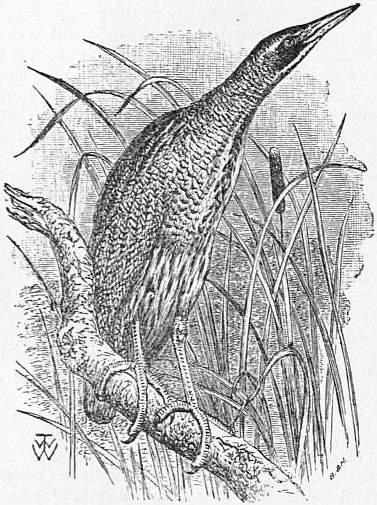
Bittern.
BITTERN (from “bitter”), the mother liquor obtained from sea-water or brines after the separation of the sodium chloride (common salt) by crystallization. It contains various magnesium salts (sulphate, chloride, bromide and iodide) and is employed commercially for the manufacture of Epsom salts (magnesium sulphate) and bromine. The same term is applied to a mixture of quassia, iron sulphate, cocculus indicus, liquorice, &c., used in adulterating beer.
BITTERS, the name given to aromatized (generally alcoholic) beverages containing a bitter substance or substances, used as tonics, appetizers or digestives. The bitterness is imparted by such substances as bitter orange rind, gentian, rhubarb, quassia, cascarilla, angostura, quinine and cinchona. Juniper, cinnamon, carraway, camomile, cloves and other flavouring agents are also employed in conjunction with the bitter principles, alcohol and sugar. Some bitters are prepared by simple maceration and subsequent filtration (see Liqueurs), others by the more complicated distillation process. Those prepared by the latter process are the finer commercial articles. Bitters are usually sold under the name of the substance which has been used to give them the predominant flavour, such as orange, angostura or peach bitters, &c. The alcoholic strength of bitters varies, but is generally in the neighbourhood of 40% of alcohol. Some bitters, although possessing tonic properties, may be regarded as beverages pure and simple, notwithstanding the fact that they are seldom consumed in an undiluted state; others again, are obviously medicinal preparations and should be treated as such.
BITUMEN, the name applied by the Romans to the various descriptions of natural hydrocarbons, the word petroleum not being used in classical Latin. In its widest sense it embraces the whole range of these substances, including natural gas, the more or less liquid descriptions of petroleum, and the solid forms of asphalt, albertite, gilsonite or uintahite, elaterite, ozokerite and hatchettite. To distinguish bitumen intermediate in consistency between asphalt and the more liquid kinds of crude petroleum, the term maltha (Latin) is frequently employed. The bitumens of chief commercial importance may be grouped under the three headings of (1) natural gas, (2) petroleum, and (3) asphalt, and will be found fully described under these titles. In the scriptures there are numerous references to bitumen, among which the following may be quoted:—In Genesis ix. 3, we are told that in the building of the tower of Babel “slime had they for mortar,” and in Genesis xiv. 10, that the vale of Siddim “was full of slime-pits,” the word slime in the latter quotation from our version appearing as bitumen in the Vulgate. Herodotus alludes to the use of the bitumen brought down by the Is, a tributary of the Euphrates, as mortar in building the walls of Babylon. Diodorus, Curtius, Josephus, Bochart and others make similar mention of this use of bitumen, and Vitruvius tells us that it was employed in admixture with clay.
In its various forms, bitumen is one of the most widely distributed of substances. It occurs, though sometimes only in small quantity, in almost every part of the globe, and throughout the whole range of geological strata, from the Laurentian rocks to the most recent members of the Quaternary period. Although the gaseous and liquid forms of bitumen may be regarded as having been formed in the strata in which they are found or as having been received into such strata shortly after formation, the semi-solid and solid varieties may be considered to have been produced by the oxidation and evaporation of liquid petroleum escaping from underlying or better preserved deposits into other strata, or into fissures where atmospheric action and loss of the more volatile constituents can take place. It should, however, be stated that there is some difference of opinion as to the precise manner of production of some of the solid forms of bitumen, and especially of ozokerite.
(B. R.)
BITURIGES, a Celtic people, according to Livy (v. 34) the most powerful in Gaul in the time of Tarquinius Priscus. At some period unknown they split up into two branches—Bituriges Cubi and Bituriges Vivisci. The name is supposed to mean either “rulers of the world” or “perpetual kings.”
The Bituriges Cubi, called simply Bituriges by Caesar, in whose time they acknowledged the supremacy of the Aedui, inhabited the modern diocese of Bourges, including the departments of Cher and Indre, and partly that of Allier. Their chief towns were Avaricum (Bourges), Argentomagus (Argenton-sur-Creuse), Neriomagus (Néris-les-Bains), Noviodunum (perhaps Villate). At the time of the rebellion of Vercingetoix (52 B.C.), Avaricum, after a desperate resistance, was taken by assault, and the inhabitants put to the sword. In the following year, the Bituriges submitted to Caesar, and under Augustus they were incorporated (in 28 B.C.) in Aquitania. Pliny (Nat. Hist. iv. 109) speaks of them as liberi, which points to their enjoying a certain amount of independence under Roman government. The district contained a number of iron works, and Caesar says they were skilled in driving galleries and mining operations.
The Biturgies Vivisci occupied the strip of land between the sea and the left bank of the Garonne, comprising the greater part of the modern department of Gironde. Their capital was Burdigala (Bordeaux), even then a place of considerable importance and a wine-growing centre. Like the Cubi, they also are called liberi by Pliny.
See A. Desjardins, Géographie historique de la Gaule romaine, ii. (1876-1893); A. Longnon, Géographie de la Gaule on VIe siècle (1878); A. Hohler, Alt-celtischer Sprachschatz; T.R. Holmes, Caesar’s Conquest of Gaul (1899).
BITZIUS, ALBRECHT (1797-1854), Swiss novelist, best known by his pet name of “Jeremias Gotthelf,” was born on the 4th of October 1797 at Morat, where his father was pastor. In 1804 the home was moved to Utzenstorf, a village in the Bernese Emmenthal. Here young Bitzius grew up, receiving his early education and consorting with the boys of the village, as well as helping his father to cultivate his glebe. In 1812 he went to complete his education at Bern, and in 1820 was received as a pastor. In 1821 he visited the university of Göttingen, but returned home in 1822 to act as his father’s assistant. On his father’s death (1824) he went in the same capacity to Herzogenbuchsee, and later to Bern (1829). Early in 1831 he went as assistant to the aged pastor of the village of Lützelflüh, in the Upper Emmenthal (between Langnau and Burgdorf), being soon elected his successor (1832) and marrying one of his granddaughters (1833). He spent the rest of his life there, dying on the 22nd of October 1854, and leaving three children (the son was a pastor, the two daughters married pastors). His first work, the Bauernspiegel, appeared in 1837. It purported to be the life of Jeremias Gotthelf, narrated by himself, and this name was later adopted by the author as his pen name. It is a living picture of Bernese (or, strictly speaking, Emmenthal) village life, true to nature, and not attempting to gloss over its defects and failings. It is written (like the rest of his works) in the Bernese dialect of the Emmenthal, though it must be remembered that Bitzius was not (like Auerbach) a peasant by birth, but belonged to the educated classes, so that he reproduces what he had seen and learnt, and not what he had himself personally experienced. The book was a great success, as it was a picture of real life, and not of fancifully beribboned 18th-century villagers. Among his later tales are the Leiden und Freuden eines Schulmeisters (1838-1839), Uli der Knecht (1841), with its continuation, Uli der Pachter (1849), Anne Babi Jowager (1843-1844), Käthi die Grossmutter (1847), Die Käserei in der Vehfreude (1850), and the Erlebnisse eines Schuldenbauers (1854). He published also several volumes of shorter tales. One slight drawback to some of his writings is the echo of local political controversies, for Bitzius was a Whig and strongly opposed to the Radical party in the canton, which carried the day in 1846.
Lives by C. Manuel, in the Berlin edition of Bitzius’s works (Berlin, 1861), and by J. Ammann in vol. i. (Bern, 1884) of the Sammlung Bernischer Biographien. His works were issued in 24 vols. at Berlin, 1856-1861, while 10 vols., giving the original text of each story, were issued at Bern, 1898-1900 (edition not to be completed).
(W. A. B. C.)
BIVOUAC (a French word generally said to have been introduced during the Thirty Years’ War, perhaps derived from Beiwacht, extra guard), originally, a night-watch by a whole army under arms to prevent surprise. In modern military parlance the word is used to mean a temporary encampment in the open field without tents, as opposed to “billets” or “cantonment” on the one hand and “camp” on the other. The use of bivouacs permits an army to remain closely concentrated for all emergencies, and avoids the necessity for numerous wagons carrying tents. Constant bivouacs, however, are trying to the health of men and horses, and this method of quartering is never employed except when the military situation demands concentration and readiness. Thus the outposts would often have to bivouac while the main body of the army lay in billets.
BIWA, a lake in the province of Omi, Japan. It measures 36 m. in length by 12 m. in extreme breadth, has an area of 180 sq. m., is about 330 ft. above sea-level, and has an extreme depth of some 300 ft. There are a few small islands in the lake, the principal being Chikubu-shima at the northern end.
Tradition alleges that Lake Biwa and the mountain of Fuji were produced simultaneously by an earthquake in 286 B.C. On the west of the lake the mountains Hiei-zan and Hira-yama slope down almost to its margin, and on the east a wide plain extends towards the boundaries of the province of Mino. It is drained by a river flowing out of its southern end, and taking its course into the sea at Osaka. This river bears in succession the names of Seta-gawa, Uji-gawa and Yodo-gawa. The lake abounds with fish, and the beauty of its scenery is remarkable. Small steamboats ply constantly to the points of chief interest, and around its shores are to be viewed the Omi-no-hakkei, or “eight landscapes of Omi”; namely, the lake silvering under an autumn moon as one looks down from Ishi-yama; the snow at eve on Hira-yama; the glow of sunset at Seta; the groves and classic temple of Mii-dera as the evening bell sounds; boats sailing home from Yabase; cloudless peaks at Awazu; rain at nightfall over Karasaki; and wild geese sweeping down to Katata. The lake is connected with Kyoto by a canal constructed in 1890, and is thus brought into water communication with Osaka.
BIXIO, NINO (1821-1873), Italian soldier, was born on the 2nd of October 1821. While still a boy he was compelled by his parents to embrace a maritime career. After numerous adventures he returned to Italy in 1846, joined the Giovine Italia, and, on 4th November 1847, made himself conspicuous at Genoa by seizing the bridle of Charles Albert’s horse and crying, “Pass the Ticino, Sire, and we are all with you.” He fought through the campaign of 1848, became captain under Garibaldi at Rome in 1849, taking prisoners an entire French battalion, and gaining the gold medal for military valour. In 1859 he commanded a Garibaldian battalion, and gained the military cross of Savoy. Joining the Marsala expedition in 1860, he turned the day in favour of Garibaldi at Calatafimi, was wounded at Palermo, but recovered in time to besiege Reggio in Calabria (21st of August 1860), and, though again wounded, took part in the battle of Volturno, where his leg was broken. Elected deputy in 1861, he endeavoured to reconcile Cavour and Garibaldi. In 1866, at the head of the seventh division, he covered the Italian retreat from Custozza, ignoring the Austrian summons to surrender. Created senator in February 1870, he was in the following September given command of a division during the movement against Rome, took Cività Vecchia, and participated in the general attack upon Rome (20th September 1870). He died of cholera at Achin Bay in Sumatra en route for Batavia, whither he had gone in command of a commercial expedition (16th December 1873).
BIZERTA (properly pronounced Ben Zert; Fr. Bizerte), a seaport of Tunisia, in 37° 17′ N., 9° 50′ E. Pop. about 12,000. Next to Toulon, Bizerta is the most important naval port of France in the Mediterranean. It occupies a commanding strategical position in the narrowest part of the sea, being 714 m. E. of Gibraltar, 1168 m. W.N.W. of Port Said, 240 m. N.W. of Malta, and 420 m. S. by E. of Toulon. It is 60 m. by rail N.N.W. of Tunis. The town is built on the shores of the Mediterranean at the point where the Lake of Bizerta enters the sea through a natural channel, the mouth of which has been canalized. The modern town lies almost entirely on the north side of the canal. A little farther north are the ancient citadel, the walled “Arab” town and the old harbour (disused). The present outer harbour covers about 300 acres and is formed by two converging jetties and a breakwater. The north jetty is 4000 ft. long, the east jetty 3300 ft., and the breakwater—which protects the port from the prevalent north-east winds—2300 ft. long. The entrance to the canal is in the centre of the outer harbour. The canal is 2600 ft. long and 787 ft. wide on the surface. Its banks are lined with quays, and ships drawing 26 ft. of water can moor alongside. At the end of the canal is a large commercial harbour, beyond which the channel opens into the lake—in reality an arm of the sea—roughly circular in form and covering about 50 sq. m., two-thirds of its waters having a depth of 30 to 40 ft. The lake, which merchant vessels are not allowed to enter, contains the naval port and arsenal. There is a torpedo and submarine boat station on the north side of the channel at the entrance to the lake, but the principal naval works are at Sidi Abdallah at the south-west corner of the lake and 10 m. from the open sea. Here is an enclosed basin covering 123 acres with ample quayage, dry docks and everything necessary to the accommodation, repair, revictualling and coaling of a numerous fleet. Barracks, hospitals and waterworks have been built, the military town, called Ferryville, being self-contained.
Fortifications have been built for the protection of the port. They comprise (a) the older works surrounding the town; (b) a group of coast batteries on the high ground of Cape Bizerta or Guardia, 4 m. north-north-west of the town; these are grouped round a powerful fort called Jebel Kebir, and have a command of 300 to 800 ft. above sea-level; (c) another group of batteries on the narrow ground between the sea and the lake to the east of the town; the highest of these is the Jebel Tuila battery 265 ft. above sea-level.
The Lake of Bizerta, called Tinja by the Arabs, abounds in excellent fish, especially mullets, the dried roe of which, called botargo, is largely exported, and the fishing industry employs a large proportion of the inhabitants. The western shore of the lake is low, and in many places is covered with olive trees to the water’s edge. The south-eastern shores are hilly and wooded, and behind them rises a range of picturesque hills. A narrow and shallow channel leads from the western side of the lake into another sheet of water, the Lake of Ishkul, so called from Jebel Ishkul, a hill on its southern bank 1740 ft. high. The Lake of Ishkul is nearly as large as the first lake, but is very shallow. Its waters are generally sweet.
Bizerta occupies the site of the ancient Tyrian colony, Hippo Zarytus or Diarrhytus, the harbour of which, by means of a spacious pier, protecting it from the north-east wind, was rendered one of the safest and finest on this coast. The town became a Roman colony, and was conquered by the Arabs in the 7th century. The place thereafter was subject either to the rulers of Tunis or of Constantine, but the citizens were noted for their frequent revolts. They threw in their lot (c. 1530) with the pirate Khair-ed-Din, and subsequently received a Turkish garrison. Bizerta was captured by the Spaniards in 1535, but not long afterwards came under the Tunisian government. Centuries of neglect followed, and the ancient port was almost choked up, though the value of the fisheries saved the town from utter decay. Its strategical importance was one of the causes which led to the occupation of Tunisia by the French in 1881. In 1890 a concession for a new canal and harbour was granted to a company, and five years later the new port was formally opened. Since then the canal has been widened and deepened, and the naval port at Sidi Abdallah created.
BIZET [Alexandre César Léopold] GEORGES (1838-1875), French musical composer, was born at Bougival, near Paris, on the 25th of October 1838, the son of a singing-master. He displayed musical ability at an early age, and was sent to the Paris Conservatoire, where he studied under Halévy and speedily distinguished himself, carrying off prizes for organ and fugue, and finally in 1857, after an ineffectual attempt in the previous year, the Grand Prix de Rome for a cantata called Cloris et Clotilde. A success of a different kind also befell him at this time. Offenbach, then manager of the Théâtre des Bouffes-Parisiens, had organized a competition for an operetta, in which young Bizet was awarded the first prize in conjunction with Charles Lecocq, each of them writing an operetta called Docteur Miracle. After the three years spent in Rome, an obligation imposed by the French government on the winners of the first prize at the Conservatoire, Bizet returned to Paris, where he achieved a reputation as a pianist and accompanist. On the 23rd of September 1863 his first opera, Les Pêcheurs de perles, was brought out at the Théâtre Lyrique, but owing possibly to the somewhat uninteresting nature of the story, the opera did not enjoy a very long run. The qualities displayed by the composer, however, were amply recognized, although the music was stated, by some critics, to exhibit traces of Wagnerian influence. Wagnerism at that period was a sort of spectre that haunted the imagination of many leading members of the musical press. It sufficed for a work to be at all out of the common for the epithet “Wagnerian” to be applied to it. The term, it may be said, was intended to be condemnatory, and it was applied with little understanding as to its real meaning. The score of the Pêcheurs de perles contains several charming numbers; its dreamy melodies are well adapted to fit a story laid in Eastern climes, and the music reveals a decided dramatic temperament. Some of its dances are now usually introduced into the fourth act of Carmen.
On the 3rd of June 1865 Bizet married a daughter of his old master, Halévy. His second opera, La Jolie Fitte de Perth, produced at the Théâtre Lyrique on 26th December 1867, was scarcely a step in advance. The libretto was founded on Sir Walter Scott’s novel, but the opera lacks unity of style, and its pages are marred by concessions to the vocalist. One number has survived, the characteristic Bohemian dance which has been interpolated into the fourth act of Carmen. In his third opera Bizet returned to an oriental subject. Djamileh, a one-act opera given at the Opéra Comique on the 22nd of May 1872, is certainly one of his most individual efforts. Again were accusations of Wagnerism hurled at the composer’s head, and Djamileh did not achieve the success it undoubtedly deserved. The composer was more fortunate with the incidental music he wrote to Alphonse Daudet’s drama, L’Arlésienne, produced in October 1872. Different numbers from this, arranged in the form of suites, have often been heard in the concert-room. Rarely have poetry and imagination been so well allied as in these exquisite pages, which seem to reflect the sunny skies of Provence.
Bizet’s masterpiece, Carmen, was brought out at the Opéra Comique on the 3rd of March 1875. It was based on a version by Meilhac and Halévy of a study by Prosper Mérimée—in which the dramatic element was obscured by much descriptive writing. The detection of the drama underlying this psychological narrative was in itself a brilliant discovery, and in reconstructing the story in dramatic form the authors produced one of the most famous libretti in the whole range of opera. Still more striking than the libretto was the music composed by Bizet, in which the peculiar use of the flute and of the lowest notes of the harp deserves particular attention.
On the 3rd of June, three months after the production of Carmen in Paris, the genial composer expired after a few hours’ illness from a heart affection. Before dying he had the satisfaction of knowing that Carmen had been accepted for production at Vienna. After the Austrian capital came Brussels, Berlin and, in 1878, London, when Carmen was brought out at Her Majesty’s theatre with immense success. The influence exercised by Bizet on dramatic music has been very great, and may be discerned in the realistic works of the young Italian school, as well as in those of his own countrymen.
BJÖRNEBORG (Finnish, Pori), a district town of Finland, province of Åbo-Björneborg, on the E. coast of the Gulf of Bothnia, at the mouth of the Kumo. Lat. 51° 8′ N., long. 46° 0′ E. Pop. (1904) 16,053, mostly Swedes. Large vessels cannot enter its roadstead, and stop at Räfsö. The town has shipbuilding wharves, machine works, and several tanneries and brick-works, and has a total trade of over 16,000,000 marks, the chief export being timber.
BJÖRNSON, BJÖRNSTJERNE (1832-1910), Norwegian poet, novelist and dramatist, was born on the 8th of December 1832 at the farmstead of Björngen, in Kvikne, in Österdal, Norway. In 1837 his father, who had been pastor of Kvikne, was transferred to the parish of Noesset, in Romsdal; in this romantic district the childhood of Björnson was spent. After some teaching at the neighbouring town of Molde, he was sent at the age of seventeen to a well-known school in Christiania to study for the university; his instinct for poetry was already awakened, and indeed he had written verses from his eleventh year. He matriculated at the university of Christiania in 1852, and soon began to work as a journalist, especially as a dramatic critic. In 1857 appeared Synnöve Solbakken, the first of Björnson’s peasant-novels; in 1858 this was followed by Arne, in 1860 by A Happy Boy, and in 1868 by The Fisher Maiden. These are the most important specimens of his bonde-fortaellinger or peasant-tales—a section of his literary work which has made a profound impression in his own country, and has made him popular throughout the world. Two of the tales, Arne and Synnöve Solbakken, offer perhaps finer examples of the pure peasant-story than are to be found elsewhere in literature.
Björnson was anxious “to create a new saga in the light of the peasant,” as he put it, and he thought this should be done, not merely in prose fiction, but in national dramas or folke-stykker. The earliest of these was a one-act piece the scene of which is laid in the 12th century, Between the Battles, was written in 1855, but not produced until 1857. He was especially influenced at this time by the study of Baggesen and Ochlenschläger, during a visit to Copenhagen 1856-1857. Between the Battles was followed by Lame Hulda in 1858, and King Sverre in 1861. All these efforts, however, were far excelled by the splendid trilogy of Sigurd the Bastard, which Björnson issued in 1862. This raised him to the front rank among the younger poets of Europe. His Sigurd the Crusader should be added to the category of these heroic plays, although it was not printed until 1872.
At the close of 1857 Björnson had been appointed director of the theatre at Bergen, a post which he held, with much journalistic work, for two years, when he returned to the capital. From 1860 to 1863 he travelled widely throughout Europe. Early in 1865 he undertook the management of the Christiania theatre, and brought out his popular comedy of The Newly Married and his romantic tragedy of Mary Stuart in Scotland. Although Björnson has introduced into his novels and plays songs of extraordinary beauty, he was never a very copious writer of verse; in 1870 he published his Poems and Songs and the epic cycle called Arnljot Gelline; the latter volume contains the magnificent ode called “Bergliot,” Björnson’s finest contribution to lyrical poetry. Between 1864 and 1874, in the very prime of life, Björnson displayed a slackening of the intellectual forces very remarkable in a man of his energy; he was indeed during these years mainly occupied with politics, and with his business as a theatrical manager. This was the period of Björnson’s most fiery propaganda as a radical agitator. In 1871 he began to supplement his journalistic work in this direction by delivering lectures over the length and breadth of the northern countries. He possessed to a surprising degree the arts of the orator, combined with a magnificent physical prestige. From 1873 to 1876 Björnson was absent from Norway, and in the peace of voluntary exile he recovered his imaginative powers. His new departure as a dramatic author began with A Bankruptcy and The Editor in 1874, social dramas of an extremely modern and realistic cast.
The poet now settled on his estate of Aulestad in Gausdal. In 1877 he published another novel, Magnhild—an imperfect production, in which his ideas on social questions were seen to be in a state of fermentation, and gave expression to his republican sentiments in the polemical play called The King, to a later edition of which he prefixed an essay on “Intellectual Freedom,” in further explanation of his position. Captain Mansana, an episode of the war of Italian independence, belongs to 1878. Extremely anxious to obtain a full success on the stage, Björnson concentrated his powers on a drama of social life, Leonardo (1879), which raised a violent controversy. A satirical play, The New System, was produced a few weeks later. Although these plays of Björnson’s second period were greatly discussed, none of them (except A Bankruptcy) pleased on the boards. When once more he produced a social drama, A Gauntlet, in 1883, he was unable to persuade any manager to stage it, except in a modified form, though this play gives the full measure of his power as a dramatist. In the autumn of the same year, Björnson published a mystical or symbolic drama Beyond our Powers, dealing with the abnormal features of religious excitement with extraordinary force; this was not acted until 1899, when it achieved a great success.
Meanwhile, Björnson’s political attitude had brought upon him a charge of high treason, and he took refuge for a time in Germany, returning to Norway in 1882. Convinced that the theatre was practically closed to him, he turned back to the novel, and published in 1884, Flags are Flying in Town and Port, embodying his theories on heredity and education. In 1889 he printed another long and still more remarkable novel, In God’s Way, which is chiefly concerned with the same problems. The same year saw the publication of a comedy, Geography and Love, which continues to be played with success. A number of short stories, of a more or less didactic character, dealing with startling points of emotional experience, were collected in 1894; among them those which produced the greatest sensation were Dust, Mother’s Hands, and Absalom’s Hair. Later plays were a political tragedy called Paul Lange and Tora Parsberg (1898), a second part of Beyond our Powers (1895), Laboremus (1901), At Storhove (1902), and Daglannet (1904). In 1899, at the opening of the National theatre, Björnson received an ovation, and his saga-drama of Sigurd the Crusader was performed.
A subject which interested him greatly, and on which he occupied his indefatigable pen, was the question of the bonde-maal, the adopting of a national language for Norway distinct from the dansk-norsk (Dano-Norwegian), in which her literature has hitherto been written. Björnson’s strong and sometimes rather narrow patriotism did not blind him to the fatal folly of such a proposal, and his lectures and pamphlets against the maal-straev in its extreme form did more than anything else to save the language in this dangerous moment. Björnson was one of the original members of the Nobel committee, and was re-elected in 1900. In 1903 he was awarded the Nobel prize for literature. Björnson had done as much as any other man to rouse Norwegian national feeling, but in 1903, on the verge of the rupture between Norway and Sweden, he preached conciliation and moderation to the Norwegians. He was an eloquent advocate of Pan-Germanism, and, writing to the Figaro in 1905, he outlined a Pan-Germanic alliance of northern Europe and North America. He died on the 26th of April 1910.
See Björnson’s Samlede Vaerker (Copenhagen, 1900-1902, 11 vols.); The Novels of Björnstjerne Björnson (1894, &c.), edited by Edmund Gosse; G. Brandes, Critical Studies (1899); E. Tissot, Le drame norvégien (1893); C.D. af Wirsén, Kritiker (1901); Chr. Collin, Björnstjerne Björnson (2 vols., German ed., 1903), the most complete biography and criticism at present available; and B. Halvorsen, Norsk Forfatter Lexikon (1885).
(E. G.)
BLACHFORD, FREDERIC ROGERS, Baron (1811-1889), British civil servant, eldest son of Sir Frederick Leman Rogers, 7th Bart. (whom he succeeded in the baronetcy in 1851), was born in London on the 31st of January 1811. He was educated at Eton and Oriel college, Oxford, where he had a brilliant career, winning the Craven University scholarship, and taking a double first-class in classics and mathematics. He became a fellow of Oriel (1833), and won the Vinerian scholarship (1834), and fellowship (1840). He was called to the bar in 1837, but never practised. At school and at Oxford he was a contemporary of W.E. Gladstone, and at Oxford he began a lifelong friendship with J.H. Newman and R.W. Church; his classical and literary tastes, and his combination of liberalism in politics with High Church views in religion, together with his good social position and interesting character, made him an admired member of their circles. For two or three years (1841-1844) he wrote for The Times, and he helped to found The Guardian in 1846; he also did a good deal to assist the Tractarian movement. But he eventually settled down to the life of a government official. He began in 1844 as registrar of joint-stock companies, and in 1846 became commissioner of lands and emigration. Between 1857 and 1859 he was engaged in government missions abroad, connected with colonial questions, and in 1860 he was appointed permanent under-secretary of state for the colonies. Sir Frederic Rogers was the guiding spirit of the colonial office under six successive secretaries of state, and on his retirement in 1871 was raised to the peerage as Baron Blachford of Wisdome, a title taken from his place in Devonshire. He died on the 21st of November 1889.
A volume of his letters, edited by G.E. Marindin (1896), contains an interesting Life, partly autobiographical.
BLACK, ADAM (1784-1874), Scottish publisher, founder of the firm of A. & C. Black, the son of a builder, was born in Edinburgh on the 20th of February 1784. After serving his apprenticeship to the bookselling trade in Edinburgh and London, he began business for himself in Edinburgh in 1808. By 1826 he was recognized as one of the principal booksellers in the city; and a few years later he was joined in business by his nephew Charles. The two most important events connected with the history of the firm were the publication of the 7th, 8th and 9th editions of the Encyclopaedia Brittannica, and the purchase of the stock and copyright of the Waverley Novels. The copyright of the Encyclopaedia passed into the hands of Adam Black and a few friends in 1827. In 1851 the firm bought the copyright of the Waverley Novels for £27,000; and in 1861 they became the proprietors of De Quincey’s works. Adam Black was twice lord provost of Edinburgh, and represented the city in parliament from 1856 to 1865. He retired from business in 1865, and died on the 24th of January 1874. He was succeeded by his sons, who removed their business in 1895 to London. There is a bronze statue of Adam Black in East Princes Street Gardens, Edinburgh.
See Memoirs of Adam Black, edited by Alexander Nicholson (2nd ed., Edinburgh, 1885).
BLACK, JEREMIAH SULLIVAN (1810-1883), American lawyer and statesman, was born in Stony Creek township, Somerset county, Pennsylvania, on the 10th of January 1810. He was largely self-educated, and before he was of age was admitted to the Pennsylvania bar. He gradually became one of the leading American lawyers, and in 1851-1857 was a member of the supreme court of Pennsylvania (chief-justice 1851-1854). In 1857 he entered President Buchanan’s cabinet as attorney-general of the United States. In this capacity he successfully contested the validity of the “California land claims”—claims to about 19,000 sq. m. of land, fraudulently alleged to have been granted to land-grabbers and others by the Mexican government prior to the close of the Mexican War. From the 17th of December 1860 to the 4th of March 1861 he was secretary of state. Perhaps the most influential of President Buchanan’s official advisers, he denied the constitutionality of secession, and urged that Fort Sumter be properly reinforced and defended. “For ... the vigorous assertion at last in word and in deed that the United States is a nation,” says James Ford Rhodes, “for pointing out the way in which the authority of the Federal government might be exercised without infringing on the rights of the states, the gratitude of the American people is due to Jeremiah S. Black.” He became reporter to the Supreme Court of the United States in 1861, but after publishing the reports for the years 1861 and 1862 he resigned, and devoted himself almost exclusively to his private practice, appearing in such important cases before the Supreme Court as the one known as Ex-Parte Milligan, in which he ably defended the right of trial by jury, the McCardle case and the United States v. Blyew et al. After the Civil War he vigorously opposed the Congressional plan of reconstructing the late Confederate states, and himself drafted the message of President Johnson, vetoing the Reconstruction Act of the 2nd of March 1867. Black was also for a short time counsel for President Andrew Johnson, in his trial on the article of impeachment, before the United States Senate, and for William W. Belknap (1829-1890), secretary of war from 1869 to 1876, who in 1876 was impeached on a charge of corruption; and with others he represented Samuel J. Tilden during the contest for the presidency between Tilden and Hayes (see Electoral Commission). He died at Brockie, Pennsylvania, on the 19th of August 1883.
See Essays and Speeches of Jeremiah S. Black, with a Biographical Sketch (New York, 1885), by his son, C.F. Black.
BLACK, JOSEPH (1728-1799), Scottish chemist and physicist, was born in 1728 at Bordeaux, where his father—a native of Belfast but of Scottish descent—was engaged in the wine trade. At the age of twelve he was sent to a grammar school in Belfast, whence he removed in 1746 to study medicine in Glasgow. There he had William Cullen for his instructor in chemistry, and the relation between the two soon became that of professor and assistant rather than of master and pupil. The action of lithontriptic medicines, especially lime-water, was one of the questions of the day, and through his investigations of this subject Black was led to the chemical discoveries associated with his name. The causticity of alkaline bodies was explained at that time as depending on the presence in them of the principle of fire, “phlogiston”; quicklime, for instance, was chalk which had taken up phlogiston, and when mild alkalis such as sodium or potassium carbonate were causticized by its aid, the phlogiston was supposed to pass from it to them. Black showed that on the contrary causticization meant the loss of something, as proved by loss of weight; and this something he found to be an “air,” which, because it was fixed in the substance before it was causticized, he spoke of as “fixed air.” Taking magnesia alba, which he distinguished from limestone with which it had previously been confused, he showed that on being heated it lost weight owing to the escape of this fixed air (named carbonic acid by Lavoisier in 1781), and that the weight was regained when the calcined product was made to reabsorb the fixed air with which it had parted. These investigations, by which Black not only gave a great impetus to the chemistry of gases by clearly indicating the existence of a gas distinct from common air, but also anticipated Lavoisier and modern chemistry by his appeal to the balance, were described in the thesis De humore acido a cibis orto, et magnesia alba, which he presented for his doctor’s degree in 1754; and a fuller account of them was read before the Medical Society of Edinburgh in June 1753, and published in the following year as Experiments upon magnesia, quicklime and some other alkaline substances.
It is curious that Black left to others the detailed study of this “fixed air” he had discovered. Probably the explanation is pressure of other work. In 1756 he succeeded Cullen as lecturer in chemistry at Glasgow, and was also appointed professor of anatomy, though that post he was glad to exchange for the chair of medicine. The preparation of lectures thus took up much of his time, and he was also gaining an extensive practice as a physician. Moreover, his attention was engaged on studies which ultimately led to his doctrine of latent heat. He noticed that when ice melts it takes up a quantity of heat without undergoing any change of temperature, and he argued that this heat, which as was usual in his time he looked upon as a subtle fluid, must have combined with the particles of ice and thus become latent in its substance. This hypothesis he verified quantitatively by experiments, performed at the end of 1761. In 1764, with the aid of his assistant, William Irvine (1743-1787), he further measured the latent heat of steam, though not very accurately. This doctrine of latent heat he taught in his lectures from 1761 onwards, and in April 1762 he described his work to a literary society in Glasgow. But he never published any detailed account of it, so that others, such as J.A. Deluc, were able to claim the credit of his results. In the course of his inquiries he also noticed that different bodies in equal masses require different amounts of heat to raise them to the same temperature, and so founded the doctrine of specific heats; he also showed that equal additions or abstractions of heat produced equal variations of bulk in the liquid of his thermometers. In 1766 he succeeded Cullen in the chair of chemistry in Edinburgh, where he devoted practically all his time to the preparation of his lectures. Never very robust, his health gradually became weaker and ultimately he was reduced to the condition of a valetudinarian. In 1795 he received the aid of a coadjutor in his professorship, and two years later he lectured for the last time. He died in Edinburgh on the 6th of December 1799 (not on the 26th of November as stated in Robison’s life).
As a scientific investigator, Black was conspicuous for the carefulness of his work and his caution in drawing conclusions. Holding that chemistry had not attained the rank of a science—his lectures dealt with the “effects of heat and mixture”—he had an almost morbid horror of hasty generalization or of anything that had the pretensions of a fully fledged system. This mental attitude, combined with a certain lack of initiative and the weakness of his health, probably prevented him from doing full justice to his splendid powers of experimental research. Apart from the work already mentioned he published only two papers during his life-time—“The supposed effect of boiling on water, in disposing it to freeze more readily” (Phil. Trans., 1775), and “An analysis of the waters of the hot springs in Iceland” (Trans. Roy. Soc. Ed., 1794).
After his death his lectures were written out from his own notes, supplemented by those of some of his pupils, and published with a biographical preface by his friend and colleague, Professor John Robison (1739-1805), in 1803 as Lectures on the Elements of Chemistry, delivered in the University of Edinburgh.
BLACK, WILLIAM (1841-1898), British novelist, was born at Glasgow on the 9th of November 1841. His early ambition was to be a painter, but he made no way, and soon had recourse to journalism for a living. He was at first employed in newspaper offices in Glasgow, but obtained a post on the Morning Star in London, and at once proved himself a descriptive writer of exceptional vivacity. During the war between Prussia and Austria in 1866 he represented the Morning Star at the front, and was taken prisoner. This paper shortly afterwards failed, and Black joined the editorial staff of the Daily News. He also edited the Examiner, at a time when that periodical was already moribund. After his first success in fiction, he gave up journalism, and devoted himself entirely to the production of novels. For nearly thirty years he was successful in retaining the popular favour. He died at Brighton on the 10th of December 1898, without having experienced any of that reaction of the public taste which so often follows upon conspicuous successes in fiction. Black’s first novel, James Merle, published in 1864, was a complete failure; his second, Love or Marraige (1868), attracted but very slight attention. In Silk Attire (1869) and Kilmeny (1870) marked a great advance on his first work, but in 1871 A Daughter of Heth suddenly raised him to the height of popularity, and he followed up this success by a string of favourites. Among the best of his books are The Strange Adventures of a Phaeton (1872); A Princess of Thule (1874); Madcap Violet (1876); Macleod of Dare (1878); White Wings (1880); Sunrise (1880); Shandon Bells (1883); Judith Shakespeare (1884); White Heather (1885); Donald Ross of Heimra (1891); Highland Cousins (1894); and Wild Eelin (1898). Black was a thoroughgoing sportsman, particularly fond of fishing and yachting, and his best stories are those which are laid amid the breezy mountains of his native land, or upon the deck of a yacht at sea off its wild coast. His descriptions of such scenery are simple and picturesque. He was a word-painter rather than a student of human nature. His women are stronger than his men, and among them are many wayward and lovable creatures; but subtlety of intuition plays no part in his characterization. Black also contributed a life of Oliver Goldsmith to the English Men of Letters series.
BLACK APE, a sooty, black, short-tailed, and long-faced representative of the macaques, inhabiting the island of Celebes, and generally regarded as forming a genus by itself, under the name of Cynopithecus niger, but sometimes relegated to the rank of a subgenus of Macacus. The nostrils open obliquely at some distance from the end of the snout, and the head carries a crest of long hair. There are several local races, one of which was long regarded as a separate species under the name of the Moor macaque, Macacus maurus. (See Primates.)
BLACKBALL, a token used for voting by ballot against the election of a candidate for membership of a club or other association. Formerly white and black balls about the size of pigeons’ eggs were used respectively to represent votes for and against a candidate for such election; and although this method is now generally obsolete, the term “blackball” survives both as noun and verb. The rules of most clubs provide that a stated proportion of “blackballs” shall exclude candidates proposed for election, and the candidates so excluded are said to have been “blackballed”; but the ballot (q.v.) is now usually conducted by a method in which the favourable and adverse votes are not distinguished by different coloured balls at all. Either voting papers are employed, or balls—of which the colour has no significance—are cast into different compartments of a ballot-box according as they are favourable or adverse to the candidate.
BLACKBERRY, or Bramble, known botanically as Rubus fruticosus (natural order Rosaceac), a native of the north temperate region of the Old World, and abundant in the British Isles as a copse and hedge-plant. It is characterized by its prickly stem, leaves with usually three or five ovate, coarsely toothed stalked leaflets, many of which persist through the winter, white or pink flowers in terminal clusters, and black or red-purple fruits, each consisting of numerous succulent drupels crowded on a dry conical receptacle. It is a most variable plant, exhibiting many more or less distinct forms which are regarded by different authorities as sub-species or species. In America several forms of the native blackberry, Rubus nigrobaccus (formerly known as R. villosus), are widely cultivated; it is described as one of the most important and profitable of bush-fruits.
For details see F.W. Card in L.H. Bailey’s Cyclopedia of American Horticulture (1900).
BLACKBIRD (Turdus merula), the name commonly given to a well-known British bird of the Turdidae family, for which the ancient name was ousel (q.v.), Anglo-Saxon ósle, equivalent of the German Amsel, a form of the word found in several old English books. The plumage of the male is of a uniform black colour, that of the female various shades of brown, while the bill of the male, especially during the breeding season, is of a bright gamboge yellow. The blackbird is of a shy and restless disposition, courting concealment, and rarely seen in flocks, or otherwise than singly or in pairs, and taking flight when startled with a sharp shrill cry. It builds its nest in March, or early in April, in thick bushes or in ivy-clad trees, and usually rears at least two broods each season. The nest is a neat structure of coarse grass and moss, mixed with earth, and plastered internally with mud, and here the female lays from four to six eggs of a blue colour speckled with brown. The blackbird feeds chiefly on fruits, worms, the larvae of insects and snails, extracting the last from their shells by dexterously chipping them on stones; and though it is generally regarded as an enemy of the garden, it is probable that the amount of damage by it to the fruit is largely compensated for by its undoubted services as a vermin-killer. The notes of the blackbird are rich and full, but monotonous as compared with those of the song-thrush. Like many other singing birds it is, in the wild state, a mocking-bird, having been heard to imitate the song of the nightingale, the crowing of a cock, and even the cackling of a hen. In confinement it can be taught to whistle a variety of tunes, and even to imitate the human voice.
The blackbird is found in every country of Europe, even breeding—although rarely—beyond the arctic circle, and in eastern Asia as well as in North Africa and the Atlantic islands. In most parts of its range it is migratory, and in Britain every autumn its numbers receive considerable accession from passing visitors. Allied species inhabit most parts of the world, excepting Africa south of the Sahara, New Zealand and Australia proper, and North America. In some of these the legs as well as the bill are yellow or orange; and in a few both sexes are glossy black. The ring-ousel, Turdus torquatus, has a dark bill and conspicuous white gorget, whence its name. It is rarer and more local than the common blackbird, and occurs in England only as a temporary spring and autumn visitor.
BLACK BUCK (Antilope cervicapra), the Indian Antelope, the sole species of its genus. This antelope, widely distributed in India, with the exception of Ceylon and the region east of the Bay of Bengal, stands about 32 in. high at the shoulder; the general hue is brown deepening with age to black; chest, belly and inner sides of limbs pure white, as are the muzzle and chin, and an area round the eyes. The horns are long, ringed, and form spirals with from three to five turns. The doe is smaller in size, yellowish-fawn above, and this hue obtains also in young males. These antelopes frequent grassy districts and are usually found in herds. Coursing black-buck with the cheeta (q.v.) is a favourite Indian sport.
BLACKBURN, COLIN BLACKBURN, Baron (1813-1896), British judge, was born in Selkirkshire in 1813, and educated at Eton and at Trinity College, Cambridge, taking high mathematical honours in 1835. He was called to the bar in 1838, and went the northern circuit. His progress was at first slow, and he employed himself in reporting and editing, with T.F. Ellis, eight volumes of the highly-esteemed Ellis and Blackburn reports. His deficiency in all the more brilliant qualities of the advocate almost confined his practice to commercial cases, in which he obtained considerable employment in his circuit; but he continued to belong to the outside bar, and was so little known to the legal world that his promotion to a puisne judgeship in the court of queen’s bench in 1859 was at first ascribed to Lord Campbell’s partiality for his countrymen, but Lord Lyndhurst, Lord Wensleydale and Lord Cranworth came forward to defend the appointment. Blackburn himself is said to have thought that a county court judgeship was about to be offered him, which he had resolved to decline. He soon proved himself one of the soundest lawyers on the bench, and when he was promoted to the court of appeal in 1876 was considered the highest authority on common law. In 1876 he was made a lord of appeal and a life peer. Both in this capacity and as judge of the queen’s bench he delivered many judgments of the highest importance, and no decisions have been received with greater respect. In 1886 he was appointed a member of the commission charged to prepare a digest of the criminal law, but retired on account of indisposition in the following year. He died at his country residence, Doonholm in Ayrshire, on the 8th of January 1896. He was the author of a valuable work on the Law of Sales.
See The Times, 10th of January 1896; E. Manson, Builders of our Law (1904).
BLACKBURN, JONATHAN (c. 1700-c. 1765), American portrait painter, was born in Connecticut. He seems to have been the son of a painter, and to have had a studio in Boston in 1750-1765; among his patrons were many important early American families, including the Apthorps, Amorys, Bulfinches, Lowells, Ewings, Saltonstalls, Winthrops, Winslows and Otises of Boston. Some of his portraits are in the possession of the public library of Lexington, Massachusetts, and of the Massachusetts Historical Society, but most of them are privately owned and are scattered over the country, the majority being in Boston. John Singleton Copley was his pupil, and it is said that he finally left his studio in Boston, through jealousy of Copley’s superior success. He was a good portrait painter, and some of his pictures were long attributed to Copley.
BLACKBURN, a municipal, county and parliamentary borough of Lancashire, England, 210 m. N.W. by N. from London, and 24½ N.N.W. from Manchester, served by the Lancashire & Yorkshire and the London & North Western railways, with several lines from all parts of the county. Pop. (1891) 120,064; (1901) 127,626. It lies in the valley of a stream called in early times the Blackeburn, but now known as the Brook. The hills in the vicinity rise to some 900 ft., and among English manufacturing towns Blackburn ranks high in beauty of situation. Besides numerous churches and chapels the public buildings comprise a large town hall (1856), market house, exchange, county court, municipal offices, chamber of commerce, free library, and, outside the town, an infirmary. There are an Elizabethan grammar school, in modern buildings (1884) and an excellent technical school. The Corporation Park and Queen’s Park are well laid out, and contain ornamental waters. There is an efficient tramway service, connecting the town with Darwen, 5 m. south. The cotton industry employs thousands of operatives, the iron trade is also very considerable, and many are engaged in the making of machines; but a former woollen manufacture is almost extinct. Blackburn’s speciality in the cotton industry is weaving. Coal, lime and building stone are abundant in the neighbourhood. Blackburn received a charter of incorporation in 1851, and is governed by a mayor, 14 aldermen and 42 councillors. The county borough was created in 1888. The parliamentary borough, which returns two members, is coextensive with the municipal, and lies between the Accrington and Darwen divisions of the county. Area, 7432 acres.
Blackburn is of considerable antiquity; indeed, the 6th century is allocated to the original foundation of a church on the site of the present parish church. Of another church on this site Cranmer was rector after the Reformation. Blackburn was for some time the chief town of a district called Blackburnshire, and as early as the reign of Elizabeth ranked as a flourishing market town. About the middle of the 17th century it became famous for its “checks,” which were afterwards superseded by a similar linen-and-cotton fabric known as “Blackburn greys.” In the 18th century the ability of certain natives of the town greatly fostered its cotton industry; thus James Hargreaves here probably invented his spinning jenny about 1764, though the operatives, fearing a reduction of labour, would have none of it, and forced him to quit the town for Nottingham. He was in the employment of Robert Peel, grandfather of the prime minister of that name, who here instituted the factory system, and as the director of a large business carefully fostered the improvement of methods.
See W.A. Abram, History of Blackburn (Blackburn, 1897).
BLACKBURNE, FRANCIS (1782-1867), lord chancellor of Ireland, was born at Great Footstown, Co. Meath, Ireland, on the 11th of November 1782. Educated at Trinity College, Dublin, he was called to the English bar in 1805, and practised with great success on the home circuit. Called to the Irish bar in 1822, he vigorously administered the Insurrection Act in Limerick for two years, effectually restoring order in the district. In 1826 he became a serjeant-at-law, and in 1830, and again, in 1841, was attorney-general for Ireland. In 1842 he became master of the rolls in Ireland, in 1846 chief-justice of the queen’s bench, and in 1852 (and again in 1866) lord chancellor of Ireland. In 1856 he was made a lord justice of appeal in Ireland. He is remembered as having prosecuted O’Connell and presided at the trial of Smith O’Brien. He died on the 17th of September 1867.
BLACKCOCK (Tetrao tetrix), the English name given to a bird of the family Tetraonidae or grouse, the female of which is known as the grey hen and the young as poults. In size and plumage the two sexes offer a striking contrast, the male weighing about 4 ℔, its plumage for the most part of a rich glossy black shot with blue and purple, the lateral tail feathers curved outwards so as to form, when raised, a fan-like crescent, and the eyebrows destitute of feathers and of a bright vermilion red. The female, on the other hand, weighs only 2 ℔, its plumage is of a russet brown colour irregularly barred with black, and its tail feathers are but slightly forked. The males are polygamous, and during autumn and winter associate together, feeding in flocks apart from the females; but with the approach of spring they separate, each selecting a locality for itself, from which it drives off all intruders, and where morning and evening it seeks to attract the other sex by a display of its beautiful plumage, which at this season attains its greatest perfection, and by a peculiar cry, which Selby describes as “a crowing note, and another similar to the noise made by the whetting of a scythe.” The nest, composed of a few stalks of grass, is built on the ground, usually beneath the shadow of a low bush or a tuft of tall grass, and here the female lays from six to ten eggs of a dirty-yellow colour speckled with dark brown. The blackcock then rejoins his male associates, and the female is left to perform the labours of hatching and rearing her young brood. The plumage of both sexes is at first like that of the female, but after moulting the young males gradually assume the more brilliant plumage of their sex. There are also many cases on record, and specimens may be seen in the principal museums, of old female birds assuming, to a greater or less extent, the plumage of the male. The blackcock is very generally distributed over the highland districts of northern and central Europe, and in some parts of Asia. It is found on the principal heaths in the south of England, but is specially abundant in the Highlands of Scotland.
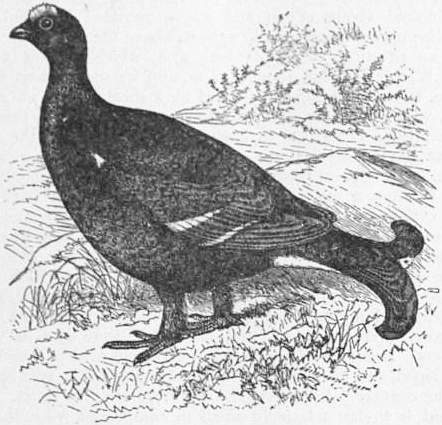
Blackcock.
BLACK COUNTRY, THE, a name commonly applied to a district lying principally in S. Staffordshire, but extending into Worcestershire and Warwickshire, England. This is one of the chief manufacturing centres in the United Kingdom, and the name arises from the effect of numerous collieries and furnaces, which darken the face of the district, the buildings and the atmosphere. Coal, ironstone and clay are mined in close proximity, and every sort of iron and steel goods is produced. The district extends 15 m. N.W. from Birmingham, and includes Smethwick, West Bromwich, Dudley, Oldbury, Sedgley, Tipton, Bilston, Wednesbury, Wolverhampton and Walsall as its most important centres. The ceaseless activity of the Black Country is most readily realized when it is traversed, or viewed from such an elevation as Dudley Castle Hill, at night, when the glare of furnaces appears in every direction. The district is served by numerous branches of the Great Western, London & North Western, and Midland railways, and is intersected by canals, which carry a heavy traffic, and in some places are made to surmount physical obstacles with remarkable engineering skill, as in the case of the Castle Hill tunnels at Dudley. Among the numerous branches of industry there are several characteristic of certain individual centres. Thus, locks are a specialty at Wolverhampton and Willenhall, and keys at Wednesfield; horses’ bits, harness-fittings and saddlery at Walsall and Bloxwich, anchors and cables at Tipton, glass at Smethwick, and nails and chains at Cradley.
BLACK DROP, in astronomy, an apparent distortion of the planet Mercury or Venus at the time of internal contact with the limb of the sun at the beginning or end of a transit. It has been in the past a source of much perplexity to observers of transits, but is now understood to be a result of irradiation, produced by the atmosphere or by the aberration of the telescope.
BLACKFOOT (Siksika), a tribe and confederacy of North American Indians of Algonquian stock. The name is explained as an allusion to their leggings being observed by the whites to have become blackened by marching over the freshly burned prairie. Their range was around the headwaters of the Missouri, from the Yellowstone northward to the North Saskatchewan and westward to the Rockies. The confederacy consisted of three tribes, the Blackfoot or Siksika proper, the Kaina and the Piegan. During the early years of the 19th century the Blackfoots were one of the strongest Indian confederacies of the north-west, numbering some 40,000. At the beginning of the 20th century there were about 5000, some in Montana and some in Canada.
See Jean L’Heureux, Customs and Religious Ideas of Blackfoot Indians in J.A.I., vol. xv. (1886); G.B. Grinnell, Blackfoot Lodge Tales (1892); G. Catlin, North American Indians (1876); Handbook of American Indians (Washington, 1907), under “Siksika.”
BLACK FOREST (Ger. Schwarzwald; the Silva Marciana and Abnoba of the Romans), a mountainous district of south-west Germany, having an area of 1844 sq. m., of which about two-thirds lie in the grand duchy of Baden and the remaining third in the kingdom of Württemberg. Bounded on the south and west by the valley of the Rhine, to which its declivities abruptly descend, and running parallel to, and forming the counterpart of the Vosges beyond, it slopes more gently down to the valley of the Neckar in the north and to that of the Nagold (a tributary of the Neckar) on the north-east. Its total length is 100 m., and its breadth varies from 36 m. in the south to 21 in the centre and 13 in the north. The deep valley of the Kinzig divides it laterally into halves, of which the southern, with an average elevation of 3000 ft., is the wilder and contains the loftiest peaks, which again mostly lie towards the western side. Among them are the Feldberg (4898 ft.), the Herzogenhorn (4600), the Blössling (4260) and the Blauen (3820). The northern half has an average height of 2000 ft. On the east side are several lakes, and here the majority of the streams take their rise. The configuration of the hills is mainly conical and the geological formation consists of gneiss, granite (in the south) and red sandstone. The district is poor in minerals; the yield of silver and copper has almost ceased, but there are workable coal seams near Offenburg, where the Kinzig debouches on the plain. The climate in the higher districts is raw and the produce is mostly confined to hardy cereals, such as oats. But the valleys, especially those on the western side, are warm and healthy, enclose good pasture land and furnish fruits and wine in rich profusion. They are clothed up to a height of about 2000 ft. with luxuriant woods of oak and beech, and above these again and up to an elevation of 4000 ft., surrounding the hills with a dense dark belt, are the forests of fir which have given the name to the district. The summits of the highest peaks are bare, but even on them snow seldom lies throughout the summer.
The Black Forest produces excellent timber, which is partly sawn in the valleys and partly exported down the Rhine in logs. Among other industries are the manufactures of watches, clocks, toys and musical instruments. There are numerous mineral springs, and among the watering places Baden-Baden and Wildbad are famous. The towns of Freiburg, Rastatt, Offenburg and Lahr, which lie under the western declivities, are the chief centres for the productions of the interior.
The Black Forest is a favourite tourist resort and is opened up by numerous railways. In addition to the main lines in the valleys of the Rhine and Neckar, which are connected with the towns lying on its fringe, the district is intersected by the Schwarzwaldbahn from Offenburg to Singen, from which various small local lines ramify.
BLACK HAWK [Ma‘katawimesheka‘ka, “Black Sparrow Hawk”], (1767-1838), American Indian warrior of the Sauk and Fox tribes, was born at the Sauk village on Rock river, near the Mississippi, in 1767. He was a member of the Thunder gens of the Sauk tribe, and, though neither an hereditary nor an elected chief, was for some time the recognized war leader of the Sauk and Foxes. From his youth he was intensely bloodthirsty and hostile to the Americans. Immediately after the acquisition of “Louisiana,” the Federal government took steps for the removal of the Sauk and Foxes, who had always been a disturbing element among the north-western Indians, to the west bank of the Mississippi river. As early as 1804, by a treaty signed at St Louis on the 3rd of November, they agreed to the removal in return for an annuity of $1000. British influences were still strong in the upper Mississippi valley and undoubtedly led Black Hawk and the chiefs of the Sauk and Fox confederacy to repudiate this agreement of 1804, and subsequently to enter into the conspiracy of Tecumseh and take part with the British in the war of 1812. The treaties of 1815 at Portage des Sioux (with the Foxes) and of 1816 at St Louis (with the Sauk) substantially renewed that of 1804. That of 1816 was signed by Black Hawk himself, who declared, however, when in 1823 Chief Keokuk and a majority of the two nations crossed the river, that the consent of the chiefs had been obtained by fraud. In 1830 a final treaty was signed at Prairie du Chien, by which all title to the lands of the Sauk and Foxes east of the Mississippi was ceded to the government, and provision was made for the immediate opening of the tract to settlers. Black Hawk, leading the party in opposition to Keokuk, at once refused to accede to this cession and threatened to retaliate if his lands were invaded. This precipitated what is known as the Black Hawk War. Settlers began pouring into the new region in the early spring of 1831, and Black Hawk in June attacked several villages near the Illinois-Wisconsin line. After massacring several isolated families, he was driven off by a force of Illinois militia. He renewed his attack in the following year (1832), but after several minor engagements, in most of which he was successful, he was defeated (21st of July) at Wisconsin Heights on the Wisconsin river, opposite Prairie du Sac, by Michigan volunteers under Colonels Henry Dodge and James D. Henry, and fleeing westward was again decisively defeated on the Mississippi at the mouth of the Bad Axe river (on the 1st and 2nd of August) by General Henry Atkinson. His band was completely dispersed, and he himself was captured by a party of Winnebagoes. At Fort Armstrong, Rock Island, on the 21st of September, a treaty was signed, by which a large tract of the Sauk and Fox territory was ceded to the United States; and the United States granted to them a reservation of 400 sq. m., the payment of $20,000 a year for thirty years, and the settlement of certain traders’ claims against the tribe. With several warriors Black Hawk was sent to Fortress Monroe, Virginia, where he was confined for a few weeks; afterwards he was taken by the government through the principal Eastern cities. On his release he settled in 1837 on the Sauk and Fox reservation on the Des Moines river, in Iowa, where he died on the 3rd of October 1838.
See Frank E. Stevens, The Black Hawk War (Chicago, 1903); R.G. Thwaites, “The Story of the Black Hawk War” in vol. xii. of the Collections of the State Historical Society of Wisconsin; J.B. Patterson, Life of Ma-ka-tai-me-she-kia-kiak or Black Hawk (Boston, 1834), purporting to be Black Hawk’s story as told by himself; and Benjamin Drake, Life of Black Hawk (Cincinnati, 1846).
BLACKHEATH, an open common in the south-east of London, England, mainly in the metropolitan borough of Lewisham. This high-lying tract was crossed by the Roman Watling Street from Kent, on a line approximating to that of the modern Shooter’s Hill; and was a rallying ground of Wat Tyler (1381), of Jack Cade (1450), and of Audley, leader of the Cornish rebels, defeated and captured here by the troops of Henry VII. in 1497. It also witnessed the acclamations of the citizens of London on the return of Henry V. from the victory of Agincourt, the formal meeting between Henry VIII. and Anne of Cleves, and that between the army of the restoration and Charles II. The introduction into England of the game of golf is traditionally placed here in 1608, and attributed to King James I. and his Scottish followers. The common, the area of which is 267 acres, is still used for this and other pastimes. For the residential district to which Blackheath gives name, see Lewisham.
BLACK HILLS, an isolated group of mountains, covering an area of about 6000 sq. m. in the adjoining corners of South Dakota and Wyoming, U.S.A. They rise on an average some 2000 ft. above their base, the highest peak, Harney, having an altitude above the sea of 7216 ft. They are drained and in large part enclosed by the North (or Belle Fourche) and South forks of the Cheyenne river (at whose junction a fur-trading post was established about 1830); and are surrounded by semi-arid, alkaline plains lying 3000 to 3500 ft. above the sea. The mass has an elliptical shape, its long axis, which extends nearly N.N.W.-S.S.E., being about 120 m. and its shorter axis about 40 m. long. The hills are formed by a short, broad, anticlinal fold, which is flat or nearly so on its summit. From this fold the stratified beds have in large part been removed, the more recent having been almost entirely eroded from the elevated mass. The edges of these are now found encircling the mountains and forming a series of fairly continuous rims of hog-backs. The carboniferous and older stratified beds still cover the west half of the hills, while from the east half they have been removed, exposing the granite. Scientific exploration began in 1849, and systematic geological investigation about 1875. Rich gold placers had already been discovered, and in 1875 the Sioux Indians within whose territory the hills had until then been included, were removed, and the lands were open to white settlers. Subsequently low-grade quartz mines were found and developed, and have furnished a notable part of the gold supply of the country (about $100,000,000 from 1875 to 1901). The output is to-day relatively small in comparison with that of many other fields, but there are one or two permanent gold mines of great value working low-grade ore. The silver product from 1879 to 1901 was about $4,154,000. Deposits of copper, tin, iron and tungsten have been discovered, and a variety of other mineral products (graphite, mica, spodumene, coal, petroleum, &c.). In sharp contrast to the surrounding plains the climate is subhumid, especially in the higher Harney region. There is an abundance of fertile soil and magnificent grazing land. A third of the total area is covered with forests of pine and other trees, which have for the most part been made a forest-reserve by the national government. Jagged crags, sudden abysses, magnificent canyons, forests with open parks, undulating hills, mountain prairies, freaks of weathering and erosion, and the enclosing lines of the successive hog-backs afford scenery of remarkable variety and wild beauty. There are several interesting limestone caverns, and Sylvan Lake, in the high mountain district, is an important resort.
See the publications of the United States Geological Survey (especially Professional Paper No. 26, Economic Resources of the Northern Black Hills, 1904), and of the South Dakota School of Mines (Bulletin No. 4, containing a history and bibliography of Black Hills investigations); also R.L. Dodge, The Black Hills: A Minute Description ... (New York, 1876).