VOLUME III SLICE VII Bible to Bisectrix (continued 7)
Reading edition
Trichromates.—The trichromates are obtained by the addition of nitric acid (of specific gravity about 1.2) to solutions of the bichromates. They form rhombic crystals of a red or brown red or brown red colour and are readily decomposed by warm water, with formation of the bichromate.
Perchromic Acid.—By the addition of hydrogen peroxide to a solution of chromic acid, a fine blue coloration due to a perchromic acid is produced which is readily absorbed by shaking out with ether. The following formulae have been assigned to the compound:—H2O2·CrO3 (H. Moissan, Comptes rendus, 1883, 97, p. 96); H2O2·2HCrO4 (M. Berthelot, Comptes rendus, 1889, 108, p. 25); Cr2O7·xH2O (L.C.A. Barreswil, Ann. chim. et phys., 1847 [3], 20, p. 364), and CrO6·3H2O (T. Fairley, Chem. News, 1876, 33, p. 237). The more recent investigations of H.G. Byers and E.E. Reed (Amer. Chem. Jour., 1904, 32, p. 503) show that if metallic potassium be added to an ethereal solution of the blue compound at −20° C., hydrogen is liberated and a purple black precipitate of the perchromate, of composition KCrO4 or K2Cl2O8, is produced; this compound is very unstable, and readily decomposes into oxygen and potassium bichromate. Similar sodium, ammonium, lithium, magnesium, calcium, barium and zinc salts have been obtained. It is shown that the blue solution most probably contains the acid of composition, H2Cr2O8, whilst in the presence of an excess of hydrogen peroxide more highly oxidized products probably exist.
BICKER (connected by Skeat with bike, to thrust or strike), an Old English word (traced from the 13th century) implying conflict or disputation. A poetical use, from the noise, is seen in Tennyson’s Brook, “to bicker down the valley.”
BICKERSTAFFE, ISAAC (c. 1735-c. 1812), English dramatist, was born in Ireland about 1735. At the age of eleven he was appointed a page to Lord Chesterfield, then lord lieutenant of Ireland, and subsequently held a commission in the Marines, but was dismissed the service under discreditable circumstances. He was the author of a large number of plays and burlesque farces interspersed with songs, produced between 1760 and 1771. The best-known are Maid of the Mill (founded on Richardson’s Pamela), The Padlock, He Would if he Could, Love in a Village, The Hypocrite and The Captive. In 1772 Bickerstaffe, suspected of a capital offence, fled to the continent. The exact date of his death is unknown, but he is stated to have been still living in abject misery in 1812.
A full account of his dramatic productions is given in Biographia Dramatica, edited by Stephen Jones (1812).
BICKERSTETH, EDWARD (1786-1850), English evangelical divine, brother of Henry, Baron Langdale, master of the rolls (1836-1851), and uncle of Robert Bickersteth, bishop of Ripon (1857-1884), was born at Kirkby Lonsdale, and practised as a solicitor at Norwich from 1812 to 1815. In 1816 he took orders, and was made one of the secretaries of the Church Missionary Society. On receiving the living of Watton, Hertfordshire, in 1830, he resigned his secretaryship, but continued to lecture and preach, both for the Church Missionary Society and the Society for the Conversion of the Jews. His works include A Scripture Help (London, 1816), which has been translated into many European languages, and Christian Psalmody (London, 1833), a collection of over 700 hymns, which forms the basis of the Hymnal Companion (London, 1870), compiled by his son, E.H. Bickersteth, bishop of Exeter (1885-1890). He was active in promoting the Evangelical Alliance of 1845, strongly opposed the Tractarian Movement, and was one of the founders of the Irish Church Missions, and Parker, Societies.
Edward Bickersteth (1814-1892), dean of Lichfield, was his nephew, and Edward Bickersteth (1850-1897), bishop of South Tokyo, his grandson.
BICYCLE (from prefix bi = twice, and κὐκλος a circle, wheel). The modern bicycle, as developed from the old velocipede (see Cycling), consists essentially of two wheels placed one behind the other and mounted on a frame which carries a saddle for the rider. Between the wheels is a crank-axle which the rider drives by means of the cranks and pedals, and its motion is transmitted to the rear or driving wheel either by a chain which passes over two chain wheels, one fixed on the crank-axle and the other on the hub of the rear wheel, or, in the chainless bicycle, by a tubular shaft and two pairs of bevel-wheels. The rear wheel is usually so arranged that it can turn, when the bicycle is running by its own momentum, independently of the chain and pedals (“free-wheel”), and a variable speed gear is often provided so that the rider may at will alter the ratio between the rate of revolution of the crank-axle and the driving wheel. The front, or steering wheel, is mounted in a fork having its two upper ends brazed into the “crown,” to which also the lower end of the steering tube is brazed. The steering tube is mounted by ball bearings in the socket tube, which forms the forward portion of the rear-frame.
The highest quality of materials and the most accurate workmanship are required to produce a first-class bicycle. Steel of 75 to 100 tons per sq. in. tensile strength is used in chains, spokes, &c. In balls and ball-races, hardness without brittleness, and homogeneity are of primary importance. Broken balls, or even traces of wear in bearings, are now seldom heard of in a first-class bicycle. The process of case-hardening, whereby an extremely hard outer skin is combined with a tough interior, has been brought to a high degree of perfection, and is applied to many parts of the bicycle, particularly chains, free-wheels and toothed-wheel variable speed gears. Interchangeability of parts is secured by working to the smallest possible limits of error of workmanship.
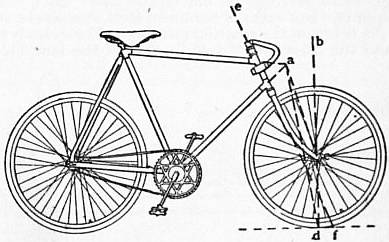
Fig. 1.
Frames.—Fig. 1 represents a road-racer. A full roadster would have the handles a little higher relatively to the saddle, and would be provided with mud-guards, free-wheel and sometimes a gear-case and variable speed gear. Fig. 2 shows a lady’s bicycle with gear-case and dress-guard. The rear frame of the “diamond” type (fig. 1) is subjected to very small stresses due to vertical load. The front fork and steering post are subject to bending moment due to the reaction from the ground in the direction dcb. A slight amount of elasticity in the front fork adds considerably to the comfort in riding over rough roads. When the brake is applied lightly to the front wheel, the reaction from the ground falls more closely along the axis of the front fork, and the bending moment at the crown is diminished. If the front brake is applied harder the reaction from the ground at d may pass through the crown, in which case the bending moment at the crown is zero. Still harder application of the brake causes a bending moment in the opposite direction. In fig. 1 the axes of the top and bottom tubes of the rear frame are produced to meet at a. If the reaction from the ground is in the direction da, the top and bottom tubes are subjected to pure compressive and tensile stresses respectively. When no brake pressure is applied a bending moment due to the overhang ab is superimposed on these tubes. Thus a short socket head with top tube sloping downwards towards the head gives a stronger frame than a horizontal top tube. The steering axis ef is arranged so as to cut the ground at f, a little in front of the point of contact d of the wheel with the ground, giving a slight castor action, and making steering possible without use of the handle-bar. The rake of the steering head (that is the angle between ef and bd) and the set of the fork (that is the displacement of the wheel centre c from the axis ef) may be varied within tolerably large limits without much affecting the easy steering properties of the bicycle. The transverse stresses on the rear frame due to the action of pedalling are more severe than those due to the vertical load. The pedal pressure is applied at a considerable distance from the central plane of the bicycle, and the pedal pin, cranks and crank-axle are subjected to a bending moment which is transmitted by the ball bearings to the frame. The down-tube from the seat lug to the crank-bracket and the bottom tube from the foot of the steering socket tube to the crank-bracket are made fairly stout to resist this bending moment. Further, the pull of the chain causes a transverse bending moment in the plane of the chain-stays, which must be stiff enough under heavy pedal pressure.
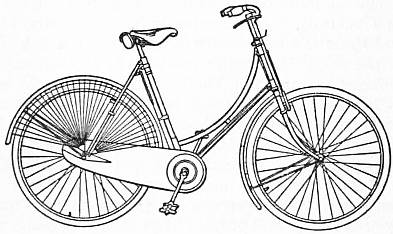
Fig. 2.
The tubular portions of the frame are made of weldless cold-drawn steel tube. The junctions or lugs are usually of malleable cast iron, bored to fit the outside of the tube, the final union being effected by brazing. In very light bicycles the tubes are kept thin, 22 or 24 W.G. (.028 in. or .022 in. thickness) at the middle, and are strengthened at the ends by internal liners. Or butt-ended tubes are employed, the tubes being drawn thicker at the ends than in the middle. The steering post and fork sides especially should be thus strengthened at their junction with the crown. Some of the best makers use sheet steel stampings instead of cast lugs, greater lightness and strength being secured, and in some cases the sheet steel lugs are inside the tubes, so that the joints are all flush on the outside. The front fork blades are best made of sheet steel stamped to shape and with the edges brazed together to form a hollow tube. The sheet steel that can be thus employed has a much higher elastic limit than a weldless steel tube.
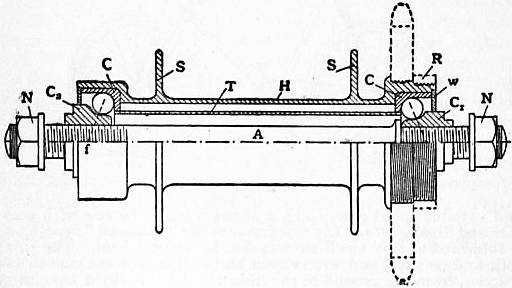
Fig. 3.
Bearings.—Ball bearings are universally used. Each row of balls runs between two ball-races of hardened steel, one on the stationary member, the other on the rotating member. The outer is called the “cup,” and the inner the “cone.” One of the four ball-races is adjustable axially so that the bearing may run without any shake. The ball-races are often made of separate pieces of steel, but the crank-axle usually has the cones formed integral with it, the necessary hardness being obtained by case-hardening. According as the two cups face outwards or inwards the bearing is said to have outward or inward cups, and according as the adjustable ball race is the cone or cup, the bearing is said to be cone-adjusting or cup-adjusting. Fig. 3 shows a ball-bearing hub with outward cups. The hub-shell H is turned out of mild steel, and the cups C are forced into the ends of the hub-shell and soldered thereto. A thin washer W is then spun into the end, for the purpose of retaining oil, and a thin internal tube T unites the two cups, and guides the oil fed in at the middle of the hub to the balls. The projecting flanges S are for the attachment of the tangent spokes used to build the hub into the wheel. The spindle A has the two cones screwed on it, one C1 against a shoulder, the other C2 adjustable. The spindle ends are passed through the back-fork ends and are there adjusted in position by the chain-tension adjusters. After adjustment the nuts N clamp the spindle securely between the fork-ends. The chain-wheel or free-wheel clutch is screwed on the end of the hub-shell, with a right-hand thread. The chain being at the right-hand side of the bicycle (as the rider is seated) the driving pull of the chain tends to screw the chain-wheel tight against the shoulder. A locking-ring R with a left-hand thread, screwed tight against the chain-wheel, prevents the latter from being unscrewed by back-pedalling. With a free-wheel clutch screwed on the hub, the locking-ring may be omitted.
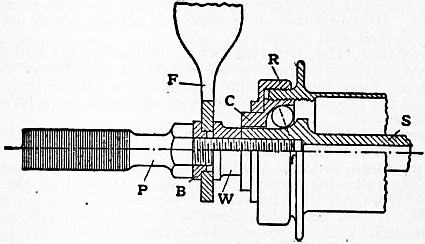
Fig. 4.
Fig. 4 shows one end of the cup-adjusting hub, with inward bearings. The cones are formed of one piece with the spindles, and the adjusting cup C is screwed in the end of the hub shell, and locked in position by the screwed locking-ring R. The figure also illustrates a divided spindle for facilitating the removal of the tire for repair when required without disturbing the wheel, bearings, chain or gear-case. The chain side of the hub-spindle, not shown in the figure, is secured to the frame in the usual way; on the left side the spindle S projects very little beyond the adjusting cup. A distance washer W is placed between the end of the spindle S and the fork-end F. A detachable screw-pin, or the footstep, P, passes through the chain-adjusting draw-bolt B, the fork-end F, and the distance washer W, and is screwed into the end of the spindle S, the hexagon head of the detachable pin drawing all the parts securely together. On unscrewing the detachable pin, the distance washer W drops out of place, leaving a clear space for removing the tire without disturbing any other part.
The inward-cups bearing retains more oil than the other form. The pressure on a ball being normal to the surface of contact with the ball race, and each ball touching two ball races, the two points of contact must be in line with the centre of the ball. All the lines of pressure on the balls of a row meet at a point f on the axis of the spindle. The distance between the two points f (fig. 5) may be called the virtual length of the bearing. Other things being equal, the outward-cups bearing has a greater virtual length than the inward-cups bearing. In hubs and pedals where the actual distance between the two rows of balls is sufficient, this point is of little importance. At the crank-axle bearing, however, where the pedal pressure which produces pressure on the axle bearings is applied at a considerable overhang beyond the ball-races, the greater virtual length of the outward-cups is an advantage.
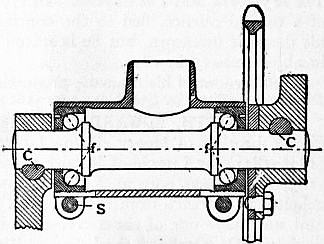
Fig. 5.
Fig. 5 shows diagrammatically the usual form of crank-axle bearing which has inward-cups and is cup-adjusting. The end of the bracket is split and the cup after adjustment is clamped in position by the clamping screw S. The usual mode of fastening the cranks to the axle is by round cotters C with a flat surface at a slight angle to the axis, thus forming a wedge, which is driven in tight. The small end of the cotter projects through the crank, and is screwed and held in place by a nut. The chain-wheel at the crank-axle is usually detachably fastened to the right-hand crank.
The Rudge-Whitworth crank-bracket has outward cups and is cup-adjusting. The cranks are cotterless. Fig. 6 is a sectional view. The left crank and axle are forged in one piece. The fastening of the right crank and chain-wheel is by multiple grooves and teeth, this fastening being better mechanically than the cotter type.
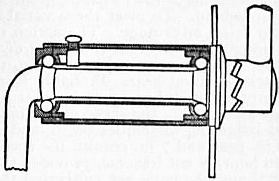
Fig. 6.
Pedals.—The pedal consists of a pedal body, on which the foot of the rider rests, mounted by ball-bearings on a pedal-pin, which is secured to the end of the crank and turns with it. The pedal body is made in many forms, but usually the bearing-cups are contained in a tube from the ends of which project plates, carrying rubber blocks, or serrated plates (rat-trap pedals), on which the foot of the rider rests. Cone adjustment is most used. The fastening of the pedal pin to the crank is best effected by screwing it up against a shoulder, the right and left crank eyes being tapped with right and left hand screws respectively. With this arrangement, if the pedal pin screw is a slack fit in the crank eye, the pressure on the pedal tends to screw it up against the shoulder.
Wheels.—Bicycle and tricycle wheels are made on the “suspension” principle, the spokes being of high-tenacity steel wire, screwed up to a certain initial tension, thus putting a circumferential compression on the rim. In the “artillery” wheel, the wooden spokes are in compression, and the rim is under tension. The rims, which are made to a section suitable for pneumatic tires (see Tire), may be of sheet steel or aluminium alloy rolled to the required section, either without joint or jointed by brazing or riveting. Wood rims are used on racing bicycles, but in England are not popular for roadster bicycles. Holes are drilled at or near the central plane of the rim for the spoke nipples, which have shoulders resting on the outer surface of the rim and shanks projecting through the rim towards the hub. The spoke ends are screwed to fit the nipples. The shank of the nipple has a square cut on its outside surface by which it can be screwed up. The spoke flanges on the hub are placed far apart and the spread of the spokes gives the wheel lateral stability. Tangential rigidity under driving and braking is obtained by fastening the spokes to the hub tangentially (figs. 1 and 2). The hub fastening of the spoke is simply obtained by forming a hook and head on the spoke end, and passing it through a hole in the hub flange. The best spokes are butted at the ends, i.e. made of larger diameter than at the middle, to allow for screwing at one end and the hook bend at the other.

Fig. 7.
Chains.—There are two widely used types of chains. The “block” chain (fig. 7) consists of a series of central blocks connected by side plates. The “roller” chain (fig. 8) consists of a series of outside and inside links. The outside link A is made up of two steel side plates P united by two shouldered rivets R. The inside link B consists of two side plates P united by two tubular pieces T, which form bushes for the rivets R and pivots for the rollers L. The rivets, bushes and rollers are case-hardened.
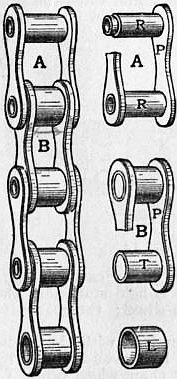
Fig. 8.
Roller chains for cycles are made in two pitches, ½ in. and 5⁄8 in., and in widths from 1⁄8 in. to ¼ in. between the side plates of the inside links. The weight of 4 ft. length (96 links) of a ½ in. pitch 1⁄8 in. wide roller chain is about 12¼ oz., and its breaking load is about 2000 ℔ In a block chain the ends of the blocks engage with the teeth of the chain-wheels, and the same surfaces continually coming into contact, the wear may become excessive, especially when exposed to mud and grit. In the roller chain the outer surfaces of the rollers engage with the teeth of the chain-wheels, and during the engagement and disengagement may roll slightly on the tubular rivets. The surface of contact of the roller and tubular rivet is not directly exposed to the dust and grit from the road. The rollers therefore serve the double purpose of (1) transferring the relative motion of the parts to a pair of surfaces under better conditions as regards lubrication, and (2) presenting a new part of the outside surface of the roller for the next engagement with the chain-wheel. The durability of roller chains is thus much greater than that of block chains, under the usual conditions of cycling.
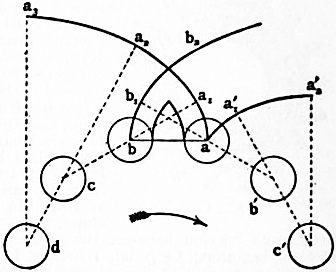
Fig. 9.
Chain-wheels.—The pitch line of the chain-wheel is polygonal (fig. 9), a, b, c, d being centres of adjacent joints of the chain when lying in contact with the wheel. The path of the joint a of the chain, relative to the chain-wheel as it enters on to and leaves the chain-wheel, is evidently the curve a3 a2 a a′1 a′2 made up of a series of circular arcs having centres d, c, b, b′, c′, respectively. Similarly for the path of the adjacent joint b. The fullest possible form of the tooth is that between the two parallel curves, of radii less by an amount equal to the radius of the roller, as indicated in fig. 9. But since it is neither necessary nor desirable that the roller should roll along the whole length of the tooth, the radii of curvature of the tooth outline may be less than shown in fig. 9. A good arrangement of tooth form is shown in fig. 10.
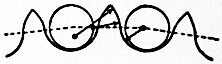
Fig. 10.
Owing to the polygonal pitch surfaces of the chain-wheels a chain does not transmit motion with constant speed-ratio of the shafts. The variation of speed-ratio in a chain with links of equal pitch is approximately inversely proportional to the square of the number of teeth in the smaller chain-wheel, as shown in the table annexed, in which the percentage variation is—
maximum speed-ratio − minimum speed-ratio × 100.
average speed-ratio
Number of teeth on hub chain-wheel 10 12 14 16 18 20 24 28
Percentage Variation 5.1 3.5 2.7 2.1 1.6 1.3 0.9 0.7
The rollers as they come in contact with the chain-wheel strike it with a speed proportional to the angular speed of the chain-wheel and to the pitch of the chain, causing a certain amount of noise.
Chain Adjustment.—To keep the chain running at correct tension, it is necessary to have some adjustment of the distance between the crank-axle and hub. This is obtained either by an eccentric adjustment at the crank-bracket, an eccentric adjustment at the hub-spindle or by draw-bolts at the fork-ends, the last method being most common.
Gear-case.—The modern roller chain by makers of repute is so durable that the necessity for a gear-case is not so great as when chains were of inferior quality. But if the bicycle is to require the minimum amount of care and attention a gear-case should be fitted. The Sunbeam gear-case is built into the frame and is oil-retaining, and the chain, chain-wheels, free-wheel and two-speed gear are continually lubricated by an oil-bath. A detachable gear-case is not usually oil-retaining, but serves to exclude grit and mud from the chain.
Gear and Crank-length.—The “gear” of a bicycle is given by the formula Dn1/n2 where D is the diameter of the driving wheel in inches, n1 and n2 the numbers of teeth on the crank-axle and hub chain-wheels respectively. At each revolution of the crank-axle, the bicycle is moved forward a distance equal to the circumference of the circle of diameter equal to the gear. Thus with a 28 in. diameter driving-wheel, 18 teeth on the hub chain-wheel, 45 teeth on the crank-axle chain-wheel, the bicycle is geared to 70 in. The usual crank-length is 6½ to 7 in. Cranks of 7½, 8 and 9 in. length can be had, but require a bicycle frame of special design. The gear should be roughly proportional to the crank-length. The gear 10 times the crank-length is a good proportion for an average rider.
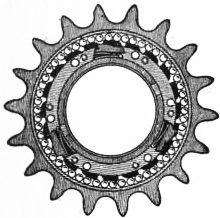
Fig. 11.
Free-wheels.—A free-wheel clutch transmits the drive in one direction only, allowing the pedals to remain at rest at the will of the rider, while the bicycle runs on. With a free-wheel, chain breakages are reduced or nearly eliminated, as should the chain get accidentally caught the free-wheel comes into play. There are three principal types of free-wheel clutches—roller, ratchet and friction cone. The roller type was the earliest in use, but has fallen into disfavour. A sectional view of a ball-bearing ratchet free-wheel, with outer cover removed, is shown in fig. 11. The ring on which the three pawls and springs are carried is screwed on the end of the hub; the chain-wheel is combined with an inner ratchet wheel and is mounted by two rows of ball bearings on the pawl ring. The friction cone type of free-wheel clutch is usually combined with a brake inside the hub, the whole combination being termed a coaster hub. Fig. 12 shows a sectional view of the Eadie two-speed coaster, in which the free-wheel clutch and brake are combined with a two-speed gear. The free-wheel clutch action is as follows: A forward pressure of the pedals turns the externally threaded driving cone H in the internally threaded cone F, the latter being thus forced to the right into engagement with the cup J which is screwed to the hub-shell, thus forming a friction driving clutch. The pedals being held stationary the driving cone H is stationary, and the hub running on the ball bearings G, the cone F travels towards the left until released from the cup J, when it also remains at rest. In this type of free-wheel clutch it is essential that there be little or no friction between the screwed surfaces of H and F, else on beginning to pedal, the cone F may remain stationary relative to the driving cone H, and no engagement between F and J may take place. If F be prevented from turning faster than the hub-shell, as is sometimes done by a light spring between the two, the engagement of the friction clutch must take place as soon as the pedals tend to move faster than the speed corresponding to that of the hub-shell.
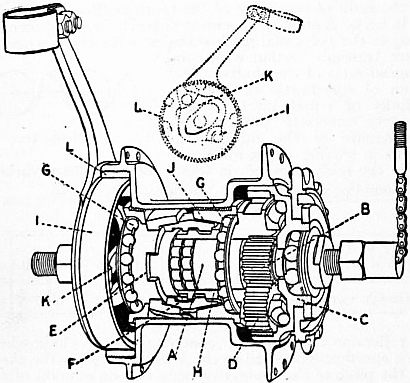
Fig. 12.—Eadie Two-speed Coaster Hub.
Brakes of many types are used, differing in the place and mode of application. The tire brake has fallen into disuse, rim brakes and internal hub brakes being usual. The retarding force that can be applied by a brake is limited by the possibility of skidding the wheel. In riding at uniform speed, without acceleration, the greater part of the load is on the rear-wheel; but as soon as the brake is applied to cause retardation the wheel load distribution is altered, more load being thrown on the front wheel. Thus the most powerful brake is one applied to the front wheel. On the other hand, a front-wheel brake often sets up an unpleasant vibration of the front fork. On a greasy road too powerful pressure on the front-wheel brake may cause a side-slip with no chance of recovery; while with the back-wheel brake recovery is possible. The Bowden system of transmission, which is largely used for cycle brake work, consists of a steel stranded cable inside a flexible tube formed by a closely wound spiral of steel wire, the cable being practically inextensible and the spiral tube practically incompressible; if the ends of the latter be fastened it forms a guide tube for the cable, any movement given to one end of the cable being transmitted to the other end. The spiral tube may be led round any corners, but the frictional resistance of the cable inside the spiral tube increases with the total angle of curvature of the guide tube; the laws of friction of a rope passing over a drum apply. In fitting the Bowden system the total curvature should therefore be kept as small as possible. With a back-pedalling rim brake the cycle cannot be wheeled backwards unless a special device is used to throw the operating clutch out of action. A back-pedalling brake is most conveniently applied inside the hub, as in the coaster hub. In the Eadie two-speed coaster (fig. 12) the braking action is obtained by the expansion of the steel band I against a phosphor bronze ring L carried by the rotating hub-shell. The steel band I is mounted on a disk with a projecting arm, the end of which is clipped to the frame tube. The expansion of the steel band is effected by the movement of the lever K fixed to the cone E. On moving the pedals backward the screw drive-ring H forces the cone nut F with which it engages to the left into contact with the cone E. The backward movement of the pedals being continued sets up the required movement of the lever K, and applies the brake.
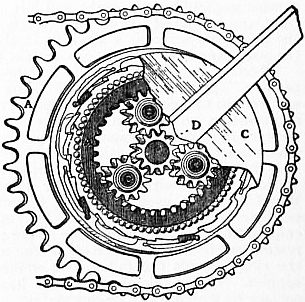
Fig. 13: Sunbeam Two-Speed Gear.
Variable Speed Gears.—The effort required to propel a bicycle varies greatly, according to the conditions of road surface, gradient up or down hill, wind against or behind. To meet these variable conditions, a variable speed-gear is an advantage. The action of the human motor is, however, so entirely different from that of a mechanical motor that it is easy, without practical experience, to over-estimate the value of a variable speed gear. Probably from 50 in. to 80 in. represents the greatest useful range of gear for an average rider. With a gear lower than 50 in., the speed of climbing a steep gradient is so slow that balancing difficulties begin, and it is better to walk up. With 80 in. gear and 7 in. cranks, the speed of pedalling, even at 25 miles an hour, is not irksome, provided the conditions are favourable. For those who have not cultivated the art of quick pedalling the useful range of gear under favourable conditions may be extended to say 90 in. or 100 in. The gear-ratio of a two-speed gear is the ratio of the high to the low gear. The most suitable gear-ratio for any rider will depend upon his personal physique and the nature of the country in which he rides. For a middle-aged rider of average physique a gear-ratio of 125 : 100 is suitable, for those of weaker physique the gear-ratio may with advantage be greater, say 137.5 : 100; while for road racing it may be smaller, say 117:100. With a three-speed gear the low and high gears should be chosen respectively below and above the single gear which suits the rider, the middle gear being about the same as the rider’s usual single gear.
All the variable speed gears at present made consist of toothed wheel mechanism either at the hub or crank-bracket, and nearly all are based on the same epicyclic train of toothed wheels. At one speed there is no relative motion of the toothed wheels, the whole mechanism revolving as one solid piece; this is called the “normal” speed. At the other speed one part of the mechanism is held stationary and the driven part revolves faster or slower than the driver, according as the gearing is up or down. In some two-speed gears the normal is the high speed, in others the low. In expressing the gear-ratio, the normal speed will be denoted by 100. At the normal gear there is of course no additional friction. The type of two-speed gear used practically settles whether the normal gear is at high or low speed; but it seems best, other things being equal, to have the low speed the normal gear, as then the conditions are worst. If the high speed is at normal gear, then at low speed the chain gears up and the two-speed gear gears down; which is, to say the least, a roundabout transmission.
Fig. 13 is a sectional view of the Sunbeam two-speed gear which is arranged at the crank-axle, and clearly shows the relative disposition of the toothed wheel mechanism common to nearly all cycle speed gears. The chain-wheel is fixed to the annular wheel A; the planet carrier C is fixed to the crank; and when the sun-wheel D is held stationary, the chain-wheel is driven faster than the cranks. When the sun-wheel D is released, the planet carrier C drives the annular wheel A by the ratchet free-wheel clutch; the part thus revolves as a solid piece, and gives the normal or low speed. The gear-ratio is 133.3 : 100.
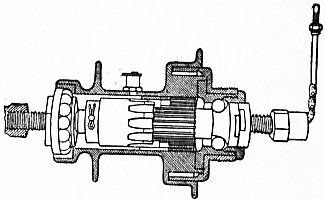
Fig. 14.
Fig. 14 is a sectional view of the “Hub” two-speed gear, the chain-wheel or free-wheel clutch being omitted. In this the annular wheel is the driver, and the planet carrier is part of the hub-shell. When the central pinion is held stationary the hub is driven at a less speed than the chain-wheel; the gear-ratio is 100 : 76.2.
In the Fagan two-speed gear, shown combined with the Eadie coaster hub in fig. 12, the sun-wheel B can be moved laterally by the striking gear, so as to engage with the chain-wheel centre C, giving normal gear, or with an internally toothed wheel A fixed to the spindle. The chain-wheel centre C carries the annular wheel, and the four planet pinions D are mounted on the driving cone H. Thus the gear gives a reduction of speed, the gear-ratio being 100 : 75. The Sturmey-Archer three-speed hub (fig. 15) has gear-ratios 125 : 100 : 80. In the high gear position the epicyclic toothed wheels are to the extreme left position. The chain-wheel is mounted by a free-wheel on a drive-ring, with which the ends of the spindles of the planet wheels engage at high gear. The sun-wheel, not shown in the figure, is held stationary, and the annular wheel engages with a ring screwed to the hub-shell, by means of keys engaging in notches. The hub is thus driven at a higher speed than the chain-wheel. For normal gear, the striking gear draws the internal mechanism of the hub towards a central position, compressing a spring, disengaging the sun-wheel and locking the drive-ring hub and annular wheel together. At low gear, the internal mechanism is drawn to the right-hand side, where the planet carrier engages with the end plate of the hub by means of claw-clutches. The annular wheel is still engaged with the drive-ring, and the sun-wheel is again locked to the spindle. The hub is thus driven at a lower speed.
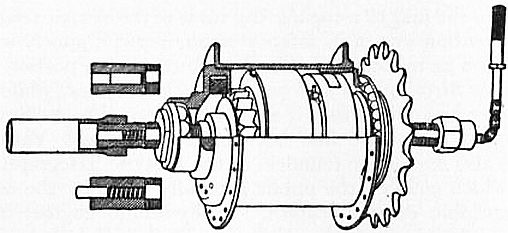
Fig. 15.
Tandem Bicycles.—The weight of a roadster tandem is about the same as, or a trifle less than, that of two single roadster bicycles, but the frictional resistance of the mechanism, the rolling resistance of the tires, and the air resistance at a given speed are much less than twice the values for a single bicycle. Consequently, much higher speeds are attained on the level, and free-wheeling down hill is much faster. On the other hand for riding up hill on a moderate gradient, the effort required is about the same as on a single, while on very steep gradients the tandem is at a slight disadvantage. For the full enjoyment of tandem riding, therefore, a two-speed gear is a necessity, while a three-speed gear is better. In the Raleigh tandem (fig. 16) the frame design is such that it can be ridden by two ladies, and the strength and rigidity is sufficient for two heavyweight riders. The steering and control of the brakes is done by the front rider. Connected steering is employed in some tandems, allowing the rear rider to steer if necessary. For two expert tandem riders, connected steering is slightly more pleasurable than fixed handle grips for the rear rider, but on the other hand, divided control may lead to disaster at a critical moment. Most passengers on a tandem with connected steering unconsciously give the steering a bias in one direction or the other, putting a nervous strain on the steersman which becomes almost intolerable towards the end of a long ride.
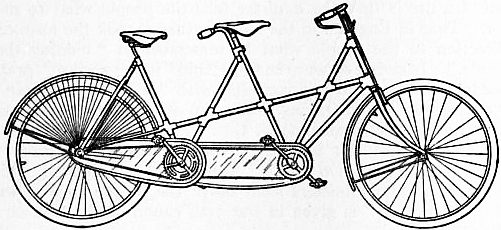
Fig. 16.
Motor Bicycles.—Fig. 17 shows a touring motor bicycle, fitted with luggage carrier and stand, the latter for supporting the bicycle while at rest. The average speed of a motor bicycle being much greater than that of a pedal bicycle the stresses on the frame due to moving over rough roads are greater. This necessitates greater strength and weight in all parts—frame, wheels and tires. To take this increased weight up steep gradients requires increased engine power. The weight of a touring motor bicycle may be from 150 to 200 ℔ The drive is usually by a V belt of leather, or of canvas and rubber, the angle of the V being 28°. The engine speed at maximum power is from 1500 to 2000 revolutions a minute, and the belt gears down in a ratio varying between 1⁄3 and 1⁄6 according to the cylinder capacity of the engine. The possibility of the belt slipping slightly is conducive to smoothness of drive; chain-driving, except in combination with a slipping clutch, is too harsh. The principal defect of the belt drive is that the belt stretches, and on coming to a steep hill may have to be tightened before the bicycle can be driven up. The control of the speed and power of the engine is effected by the throttle, extra air valve and spark advance, the levers for which are all placed within convenient reach of the driver. As the engine is almost invariably air-cooled, the skilful manipulation of these three levers is essential for satisfactory results. On a good level road when the engine may be working at a small fraction of its maximum power, the proportion of air mixed with the petrol vapour from the carburettor may be great, giving a “weak” mixture, yet one rich enough to be ignited in the cylinder. The throttle valve may be fully open and the spark advanced for high speed; the throttle partially closed and spark retarded for slow speed. Under these conditions the engine will run for an indefinite period without overheating. Up a steep gradient, the mixture may have to be made “richer” by partial closing of the extra air opening, and as more heat is evolved, the cylinder walls may become overheated, unless the engine power is sufficient to keep the bicycle moving through the air at a good speed. As the engine cannot run steadily at low speed, pedalling is resorted to for starting and for riding slowly through traffic. For this purpose, an “exhaust valve lifter” is usually fitted, by means of which the exhaust can be kept permanently open, in order to relieve the resistance to pedalling which the compression stroke would otherwise offer.
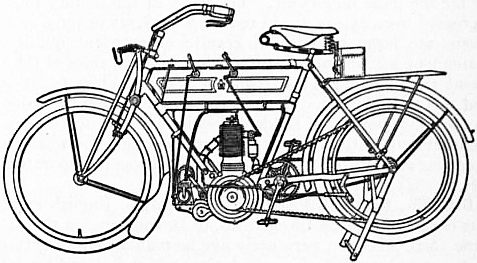
Fig. 17.
The nominal rating of the horse-power of a motor cycle engine is rather vague and indefinite. A 3-H.P. engine may have a cylinder of 76-80 mm. diameter and 76-80 mm. stroke. Twin-cylinder engines, with one crank, are largely used, and some excellent 4-cylinder motor bicycles are made with bevel gear transmission. The chief advantage of the multicylinder engine is the smoother drive obtained.
A “trailer” with two wheels for carrying a passenger can be attached to a motor bicycle, but the element of risk is increased. A side-car, with one additional wheel, forms a safer passenger carrier.
(A. Sp.)
BIDA, a town and administrative district in the British protectorate of Northern Nigeria. Bida town, situated in 9° 5′ N., 6° E., 25 m. N. by E. of Muraji on the Niger, is the capital of the province of Nupe. It was founded in 1859 when Fula rule was established in Nupe, is walled and of considerable size. In 1909 it was connected by railway with Baro, 40 m. S.S.E., the river terminus of the Northern Nigeria railway. The inhabitants, mostly Hausa, carry on an extensive trade and are especially noted for their embossed brass and copper work. The Bida goblets, in which brass and copper are beautifully blended, are of extremely elegant design. The town also boasts a glass factory. The preparation of indigo and the dyeing of cloths are other flourishing industries. The streets are planted with huge shade-trees, so that as Bida is approached it looks like a forest.
In 1897 there was a two-days’ fight outside the walls of Bida between the forces of the emir of Nupe and those of the Royal Niger Company, ending in the defeat of the Fula army (mostly cavalry). The victory was not followed at the time by a British occupation, and the defeated king returned after the withdrawal of the company’s troops and re-established himself upon the throne. In 1900 he allied himself with other hostile chiefs and adopted an openly antagonistic attitude to the British government. In 1901 it became necessary for British troops to march on Bida. The emir fled, without fighting, to Kano. Another emir was appointed in his place, and the province of Nupe was placed under British administrative control. Since that date the town has been peaceful and very prosperous. A mission school has been established, and is attended by the sons of the emir and of the principal chiefs, who are desirous of learning to read and write English. The administrative district of Bida includes the town and is the western division of the province of Nupe (q.v.). (See also Nigeria: History.)
BIDDEFORD, a city of York county, Maine, U.S.A., on the Saco river, opposite Saco, and on the Atlantic Ocean, 15 m. S.W. of Portland. Pop. (1890) 14,443; (1900) 16,145, of whom 7,149 were foreign-born (mostly French Canadians); (census, 1910) 17,079. Biddeford is served by the Boston & Maine railway, and is connected by electric lines with Portland and with Old Orchard Beach, a popular summer resort north of the Saco river. The climate and the scenery in and about Biddeford attract summer visitors and there are two resorts, Biddeford Pool and Fortune Rocks within the municipal limits; but the city is chiefly a manufacturing centre (third in rank among the cities of the state in 1905)—good water-power being furnished by the river—and cotton goods, foundry and machine shop products and lumber are the principal products, the first being by far the most important. The value of the factory products increased from $5,472,254 in 1900 to $6,948,722 in 1905, or 27%. There are large quarries of granite of excellent quality. A permanent settlement was established on both sides of the river about 1630 under the leadership of Richard Vines (1585-1651) and was named Saco. In 1718 the present name was adopted. In 1762 that portion of Biddeford which lay east of the river was incorporated as the town of Pepperellborough, for which name Saco was substituted in 1805. Biddeford was incorporated as a city in 1855.
BIDDER, GEORGE PARKER (1806-1878), English engineer, was born at Moreton Hampstead, in Devonshire, on the 14th of June 1806. From a very early age he manifested an extraordinary natural aptitude for calculation, which induced his father, who was a stone-mason, to exhibit him as a “calculating boy.” In this way his talent was turned to profitable account, but his general education was in danger of being completely neglected. Interest, however, was taken in him by some of those who happened to witness his performances, among them being Sir John Herschel, and it was arranged that he should be sent to school in Camberwell. There he did not remain long, being removed by his father, who wished to exhibit him again, but he was saved from this misfortune and enabled to attend classes at Edinburgh University, largely through the kindness of Sir Henry Jardine, to whom he subsequently showed his gratitude by founding a “Jardine Bursary” at the university. On leaving college in 1824 he received a post in the ordnance survey, but gradually drifted into engineering work. In 1834 Robert Stephenson, whose acquaintance he had made in Edinburgh, offered him an appointment on the London & Birmingham railway, and in the succeeding year or two he began to assist George Stephenson in his parliamentary work, which at that time included schemes for railways between London and Brighton and between Manchester and Rugby via the Potteries. In this way he was introduced to engineering and parliamentary practice at a period of great activity which saw the establishment of the main features and principles that have since governed English railway construction. He is said to have been the best witness that ever entered a committee-room. He was quick to discover and take advantage of the weak points in an opponent’s case, and his powers of mental calculation frequently stood him in good stead, as when, for example, an apparently casual glance at the plans of a railway enabled him to point out errors in the engineering data that were sufficient to secure rejection of the scheme to which he was opposed. In consequence there was scarcely an engineering proposal of any importance brought before parliament in connexion with which his services were not secured by one party or the other.
On the constructive side of his profession he was also busily occupied. In 1837 he was engaged with R. Stephenson in building the Blackwall railway, and it was he who designed the peculiar method of disconnecting a carriage at each station while the rest of the train went on without stopping, which was employed in the early days of that line when it was worked by means of a cable. Another series of railways with which he had much to do were those in the eastern counties which afterwards became the Great Eastern system. He also advised on the construction of the Belgian railways; with R. Stephenson he made the first railway in Norway, from Christiania to Eidsvold; he was engineer-in-chief of the Danish railways; and he was largely concerned with railways in India, where he strongly and successfully opposed break of gauge on through-routes. But though he sometimes spoke of himself as a mere “railway-engineer,” he was in reality very much more; there was indeed no branch of engineering in which he did not take an interest, as was shown by the assiduity with which for half a century he attended the weekly meetings of the Institution of Civil Engineers, of which he was elected president in 1860. He was one of the first to recognize the value of the electric telegraph. That invention was in its infancy when, in 1837, jointly with R. Stephenson he recommended its introduction on a portion of the London & Birmingham and on the Blackwall lines, while three years later he advised that it should be adopted to facilitate the working of the single line between Norwich and Yarmouth. He was also one of the founders of the Electric Telegraph Company, which enabled the public generally to enjoy the benefits of telegraphic communication. In hydraulic engineering, he was the designer of the Victoria Docks (London), being responsible not only for their construction, but also for what was regarded by some people at the time as the foolish idea of utilizing the Essex marshes for dock accommodation on a large scale. His advice was frequently sought by the government on points both of naval and military engineering. He died at Dartmouth on the 28th of September 1878.
His son, George Parker Bidder, Junr. (1836-1896), who inherited much of his father’s calculating power, was a successful parliamentary counsel and an authority on cryptography.
BIDDERY, or Bidri (an Indian word, from Bedar or Bidar, a town in the Nizam’s Dominions), an alloy of copper, lead, tin and zinc used in making various articles and ornaments which are inlaid with gold and silver.
BIDDING-PRAYER (O. Eng. biddan, to pray, cf. Ger. beten), the formula of prayer or exhortation to prayer said in England before the sermon in cathedrals, at university sermons, in the Inns of Court and elsewhere on special occasions. Such formulae are found in the ancient Greek liturgies, e.g. that of St Chrysostom, in the Gallican liturgy, and in the pre-Reformation liturgies of England. The form varies, but in all the characteristic feature is that the minister tells the people what to pray for. Thus in England in the 16th century it took the form of a direction to the people what to remember in “bidding their beads.” In course of time the word “bid” in the sense of “pray” became obsolete and was confused with “bid” in the sense of “command” (from O. Eng. beodan, to offer, present, and hence to announce, or command; cf. Ger. bieten, to offer, gebieten, to command), and the bidding-prayer has come practically to mean the exhortation itself. A form of exhortation which “preachers and ministers shall move the people to join with them in prayer” is given in the 55th canon of the Church of England (1603).
BIDDLE, JOHN (1615-1662), frequently called the father of English Unitarianism, was born on the 14th of January 1615, at Wotton-under-Edge, in Gloucestershire. He was educated at the grammar school of his native town and at Magdalen Hall, Oxford. He graduated B.A. in 1638 and proceeded M.A. in 1641, and was then appointed to the mastership of the free school in the city of Gloucester, where “he was much esteemed for his diligence in his profession, serenity of manners and sanctity of life.” He also diligently prosecuted theological studies, and the results he arrived at were of such a nature as to draw down upon him the reprobation of the civic authorities. A treacherous friend obtained the manuscript of his Twelve Arguments drawn out of Scripture, wherein the commonly received opinion touching the deity of the Holy Spirit is clearly and fully refuted; and in December 1645 he was summoned before the parliamentary committee then sitting at Gloucester. By them he was committed to prison, though he was at the time labouring under a dangerous fever. He was released on bail after a short imprisonment, but was in July 1647 called before parliament, which desired to inquire into his views. After tedious proceedings, during which Sir Henry Vane befriended him, Biddle was committed to custody and his Twelve Arguments, which he had now published, was ordered by parliament to be seized and burned by the hangman. Notwithstanding this and the ordinance of the 2nd of May 1648, visiting denial of the doctrine of the Trinity with death, Biddle issued two tracts, one a Confession of Faith touching the Holy Trinity, and the other The Testimonies of Irenaeus, &c., concerning the one God and the Persons of the Trinity (1648). These were suppressed by government, and the Westminster assembly of divines eagerly pressed for the passing of an act by which heretics like Biddle could be put to death. This, however, was resisted by the army, and by many of the Independent parliamentarians; and after the death of the king, Biddle was allowed to reside in Staffordshire under surveillance. He engaged in preaching and in literary work, particularly an edition of the Septuagint, published by Roger Daniel. In February 1652 the general act of oblivion gave him complete freedom, and his adherents soon began to meet regularly for worship on Sundays. They were called Biddellians, or Socinians, or Unitarians, the name which has now become associated with their opinions. Biddle was not left long in peace. He translated some Socinian books, among others the Life of Socinus, and published two catechisms which excited a fury of indignation. He was summoned before the parliament in December 1654 and imprisoned. The dissolution of that body again set him at liberty for a short time, but he was presently brought up for some expressions used by him in a discussion with John Griffin, an illiterate Baptist pastor, who invoked the law against his superior opponent. He was put upon trial, and was only rescued by Cromwell, who sent him (October 1655) out of the way to one of the Scilly Islands, allowed him 100 crowns a year, and in 1658, on the solicitation of many friends, released him. For a few years he lived and taught quietly in the country, but returning to London he was in June 1662 again arrested, and fined £100. As he was unable to pay this sum, he was at once committed to prison, where fever, caused by the pestilential atmosphere, carried him off on the 22nd of September 1662.
BIDDLE, NICHOLAS (1786-1844), American financier, was born in Philadelphia on the 8th of January 1786. He was the nephew of a naval officer, Captain Nicholas Biddle (1750-1778), who lost his life while fighting on the American side, during the War of American Independence. After almost finishing the prescribed course at the university of Pennsylvania, the boy went to Princeton, where he graduated with high honours in 1801. During 1804-1807 he was the secretary, first of John Armstrong, minister to France, and then of James Monroe, minister to Great Britain. After his return to America he practised law for several years in Philadelphia, was an associate editor of Dennie’s Portfolio, to which he contributed both prose and verse, and, with much literary skill, prepared for the press from the explorers’ own journals a History of the Expedition under the Command of Captains Lewis and Clark (1814). He was a prominent member of the Pennsylvania House of Representatives in 1810-1811 and of the Senate in 1814-1817, and in 1819 became, by President Monroe’s appointment, one of the five government directors of the Bank of the United States. In 1823 he replaced Langdon Cheves as its president. In general he followed a conservative policy and showed marked ability in the management of the bank, but during President Andrew Jackson’s warfare upon that institution, his character and his policy were violently assailed by the president and his followers. The bank’s national charter lapsed in 1836, but it was immediately chartered by Pennsylvania as the “Bank of the United States, of Pennsylvania”; and Biddle remained president until 1839, two years before the bank failed. As president of the board of trustees appointed for the purpose, he took a prominent part in the establishment of Girard College, in accordance with the will of Stephen Girard (q.v.). He died in Philadelphia on the 27th of February 1844.
His son, Charles John Biddle (1819-1873), served in the Mexican War as a captain of infantry, earning the brevet of major at Chapultepec; practised law in Philadelphia; was a representative in Congress in 1861-1863; was long editor-in-chief of the Philadelphia Age; and published ”The Case of Major André, with a Review of the Statement of it in Lord Mahon’s History of England,” in the Memoirs of the Historical Society of Pennsylvania (1858).
The best account of Nicholas Biddle’s administration of the bank may be found in an excellent work, by Ralph C.H. Catterall, The Second Bank of the United States (Chicago, 1903).
BIDEFORD, a seaport, market town and municipal borough in the Barnstaple parliamentary division of Devonshire, England, 8¼ m. S.W. of Barnstaple. Pop. (1901) 8754. It is served by the London & South-Western and the Bideford, Westward Ho & Appledore railways. It is picturesquely situated on two hills rising from the banks of the river Torridge, 3 m. above its junction with the estuary of the Taw. Many of the houses are built with timber framework in Elizabethan style, and the two parts of the town are united by a bridge of 24 arches, originally erected in the 14th century, when the revenue of certain lands was set apart for its upkeep. The church of St Mary, with the exception of the tower, is a modern reconstruction. A stone chancel screen and a Norman font are also preserved. Industries include the manufacture of earthenware, leather goods, sails, ropes and linen, and ironfounding. The small harbour has about 17 ft. of water at high tide, but is dry at low tide. Anthracite and a coarse potter’s clay are found near the town. The borough is under a mayor, 4 aldermen and 12 councillors. Area, 3398 acres.
Bideford (Bedeford, Bydyford, Budeford, Bytheford) is not mentioned in pre-Conquest records, but according to Domesday it rendered geld for three hides to the king. From the time of the Conquest down to the 18th century, Bideford remained in the possession of the Grenville family, and it first appears as a borough in an undated charter (probably of the reign of Edward I.) from Richard de Grenville, confirming a charter from his grandfather, Richard de Grenville, fixing the rent and services due from the burgesses and granting them liberties similar to those in use at Breteuil and a market every Monday. Another charter, dated 1271, confirms to Richard de Grenville and his heirs a market every Monday and five days’ fair yearly at the feast of St Margaret (20th of July). In 1573 Elizabeth granted a charter creating Bideford a free borough corporate, with a common council consisting of a mayor, 5 aldermen and 7 chief burgesses, together with a recorder, town-clerk and 2 serjeants-at-mace. This charter also granted the Tuesday market, which is still held, and three annual fairs in February, July and November, now discontinued. A later charter from James I. in 1610 added the right to have a town seal, 7 aldermen instead of 5, and 10 chief burgesses instead of 7, and continued in force until the Municipal Corporations Act of 1873, which established 4 aldermen and 12 common councillors. In the 16th century Sir Richard Grenville, the famous Virginian settler, did much to stimulate the commercial development of Bideford, which long maintained a very considerable trade with America, Spain and the Mediterranean ports, the import of tobacco from Maryland and Virginia being especially noteworthy. From the beginning of the 18th century this gradually declined and gave place to a coasting trade in timber and coal, chiefly with Wales and Ireland. The silk industry which flourished in the 17th century is extinct.
See John Watkins, History of Bideford (Exeter, 1792).
BIDPAI (or Pilpay), FABLES OF, the name given in the middle ages (from Sanskrit Vidya-pati, chief scholar) to a famous collection of Hindu stories. The origin of them is undoubtedly to be found in the Pancha Tantra, or Five Sections, an extensive body of early fables or apologues. A second collection, called the Hitopadesa, has become more widely known in Europe than the first, on which it is apparently founded. In the 6th century A.D., a translation into Pahlavi of a number of these old fables was made by a physician at the court of Chosroes I. Anushirvan, king of Persia. No traces of this Persian translation can now be found, but nearly two centuries later, Abdallah-ibn-Mokaffa translated the Persian into Arabic; and his version, which is known as the “Book of Kalilah and Dimna,” from the two jackals in the first story, became the channel through which a knowledge of the fables was transmitted to Europe. It was translated into Greek by Simeon Sethus towards the close of the 11th century; his version, however, does not appear to have been retranslated into any other European language. But the Hebrew version of Rabbi Joel, made somewhat later, was translated in the 13th century into Latin by John of Capua, a converted Jew, in his Directorium vitae humanae (first published in 1480), and in that form became widely known. Since then the fables have been translated into nearly every European tongue. There are also versions of them in the modern Persian, Malay, Mongol and Afghan languages.
See Wilson’s analysis of the Pancha Tantra, in the Mem. of the Royal Asiat. Soc. i.; Silvestre de Sacy’s introduction to his edition of the Kalilah and Dimna (1816); articles by the same in Notices et Extr. des MSS. de la Bib. du Roi, vols. ix. and x.; German translation by Philipp Wolff, Bidpai’s Fabeln (2 vols., 2nd ed., Stuttgart, 1839); the Anvār-i Suheili, Persian version of the Fables, translated by E.B. Eastwick (Hertford, 1854); Benfey, Pantscha Tantra, German translation with important introduction (2 vols., Leipzig, 1859); other editions, by L. Fritze (ib. 1884) and R. Schmidt (ib. 1901); Max Müller, Essays (Leipzig, 1872), vol. iii. pp. 303, &c.; J. Jacobs’ edition of Sir T. North’s Morall Philosophie of Doni, the earliest English version of the fables (London, 1888); J.G.N. Keith-Falconer, Kalilah and Dimnah, or the Fables of Bidpai (Cambridge, 1895), their history, with a translation of the later Syriac version and notes; Léopold Hervieux, Les Fabulistes Latins, &c. v. Jean de Capoue et ses dérivés (1899); E.G. Browne, Persian Literat. (1906), ii. 350.
BIEKKICH, a town of Germany, in the Prussian province of Hesse-Nassau, on the right bank of the Rhine, 3 m. S. from Wiesbaden, of which it is the river port, and on the main line of railway from Cologne to Frankfort-on-Main. Pop. (1900) 15,048; (1905) 20,137. The palace of the former dukes of Nassau occupies a fine position on the river bank, and the shady gardens and groves attract large numbers of visitors during the summer. It is an important steamboat station for both passenger and cargo traffic, and besides manufactures of cement, dyes and soap, has a considerable trade in the wines of the district.
BIEDERMANN, FRIEDRICH KARL (1812-1901), German publicist and historian, was born at Leipzig on the 25th of September 1812, and after studying at Leipzig and Heidelberg became professor in the university of his native town in 1838. His early writings show him as an ardent advocate of German unity, and he was a member of the national parliament which met at Frankfort in 1848. Becoming a member of the Upper House of the parliament of Saxony, he advocated union under the leadership of Prussia; and, subsequently losing his professorship, he retired to Weimar, where he edited the Weimarische Zeitung. Returning to Leipzig in 1863 he edited the Deutsche Allgemeine Zeitung, and regained his professorship in 1865. He was again a member of the Saxon Upper House, and from 1871 to 1874 a member of the German Reichstag. He died at Leipzig on the 5th of March 1901. Biedermann’s chief works are: Erinnerungen aus der Paulskirche (Leipzig, 1849); Deutschland im 18. Jahrhundert (Leipzig, 1854-1880); Friedrich der grosse und sein Verhältnis zur Entwickelung des deutschen Geisteslebens (Brunswick, 1859); Geschichte Deutschlands 1815-1871 (Berlin, 1891); Deutsche Volks- und Kulturgeschichte (Wiesbaden, 1901). He also wrote the dramas, Kaiser Heinrich IV. (Weimar, 1861); Kaiser Otto III. (Leipzig, 1862); and Der letzte Bürgermeister von Strassburg (Leipzig, 1870).
BIEL, GABRIEL (c. 1425-1495), scholastic philosopher, was born at Spires (Speier). He was the first professor of theology at the newly founded (1477) university of Tübingen, of which he was twice rector. Some years before his death he entered a religious fraternity. His work consists in the systematic development of the views of his master, William of Occam. His Epitome et Collectorium ex Occamo super libros quatuor Sententiarum (1508, 1512, and various dates) is a clear and consistent account of the nominalist doctrine, and presents the complete system of scholastic thought from that point of view. The empirical individualism of the work, tending necessarily to limit the province of reason and extend that of faith, together with scattered utterances on special points, which gained for Biel the title of Papista Antipapista, had considerable influence in giving form to the doctrines of Luther and Melanchthon. It is the best specimen of the final aspect of scholasticism. His other works also have been frequently reprinted. The title Ultimus Scholasticorum is often wrongly bestowed on Biel; scholasticism did not cease with him, even in Germany, and continued to flourish long after his time in the universities of Spain.
See Linsenmann, in Theologischen Quartalschrift (Tübingen, 1865); Stockl, Phil. d. Mittelalt. ii. § 269; H. Plitt, Gabriel Biel als Prediger (Erlangen, 1879); art. s.v. by P. Tschackert in Herzog-Hauck, Realencyklopädie, vol. iii. (1897); W. Roscher, Ges. d. Nationalokonomik (Munich. 1874), pp. 21-28; and works quoted under Scholasticism.
BIELEFELD, a town of Germany, in the Prussian province of Westphalia, 68 m. S.W. from Hanover on the main line to Cologne. Pop. (1885) 34,931; (1905) 71,797. It is situated at the foot of the Teutoburger Wald, and consists of two portions, separated by the river Lutter, which were first united into one town in 1520. Among its public buildings and institutions are the old town church, with a curious carved altar-piece, the town hall, the gymnasium and the provincial industrial school. On the height above the town is the old castle of Sparenburg, built in the 12th century by Bernhard, count of Lippe. It was for a long time employed as a prison, but was restored after its destruction by fire in 1877 and now contains a historical museum. Bielefeld is the centre of the Westphalian linen industry. It has also important plush, silk and hosiery manufactures, as well as extensive bleaching works, and does a very large export trade to all parts of the world in these branches. Engines, automobiles, biscuits, glass, pianos, furniture and paper are also manufactured.
Bielefeld is mentioned as early as the 9th century, as Belanvelde, but its first recorded mention as a town is in 1233. It belonged at this time to the counts of Ravensberg, who often resided in the Sparenburg. It joined the Hanseatic league in 1270, and about the same time began to engage in the linen manufacture, which was greatly extended during the 16th and 17th centuries by a number of refugees from the Netherlands. In 1347 the town passed with the countship of Ravensberg to the duchy of Jülich, and in 1666 to that of Brandenburg.
BIELITZ (Czech Bilsko, Polish Bielsko), a town of Austria, in Silesia, 80 m. S.E. of Troppau by rail. Pop. (1900) 16,885, chiefly German. It is situated on the Biala river, just opposite the Galician town of Biala and possesses a fine castle belonging to the Sulkowsky family, in favour of whom the lordship of Bielitz was raised to a duchy in 1752. It has an important woollen and linen industry, and manufactures of jute and machinery, as well as an active trade, especially of woollens, to the East. The town was founded in the 13th century, and in the 15th and 16th was a fortified place.
BIELLA, a town and episcopal see of Piedmont, Italy, in the province of Novara, 55 m. N.E. of Turin by rail, and 38 m. direct, situated on the S. edge of the lower Alps. Pop. (1901) town, 3454; commune, 19,267. The old town (1558 ft.) lies on a hill above the new town, and is reached from it by a cable tramway. It has fine palaces with decorations in terra-cotta; and a modern bath establishment is situated here. The new town contains the 15th-century cathedral and the fine Renaissance church of S. Sebastiano; near the former is a baptistery of the 9th century. It is a considerable manufacturing centre for woollens, silks and cottons, electric power being furnished by the torrents descending from the mountains at the foot of which it lies. It is frequented as a tourist centre, and several hydropathic establishments and mountain resorts lie in the vicinity.
BIENNE, or Biel, an industrial town in the Swiss canton of Bern. It is built between the N.E. end of the lake of the same name and the point at which the river Suze or Scheuss (on the right bank of which it is situated) issues from a deep cleft (called the Taubenloch) in the Jura range. Bienne is 19 m. by rail N.E. of Neuchâtel, and 21 m. N.W. of Bern. Its industrial importance is shown by the fact that it is the site of the West Swiss technical institute, which has departments for instruction in watch-making, in electricity, in engraving and chasing, and in subjects relating to railway, postal and telegraph matters. Its chief industries are watch-making, chain-making, the manufacture of machines and other objects for use on railways, &c. Its rapidly increasing commercial activity accounts no doubt for the rapid rise in its population, which in 1850 was but 3589, rose in 1870 to 8165, and in 1900 was 22,016, mainly Protestant, and two-thirds German-speaking. The parish church of St Benedict dates from 1451, but was restored in 1775—it has some fine 15th-century painted glass in the choir. In the town is the Schwab museum, which is chiefly notable for its fine collection of objects from the lake-dwellings. To the north-west of Bienne two funicular railways lead up to Évilard (or Leubringen) and Macolin (or Magglingen), both situated on the slope of the Jura.
First mentioned in the 12th century, Bienne continued for centuries to be under the jurisdiction of the prince-bishop of Basel. In 1279 (permanently in 1352) it made an alliance with Bern, in 1344 with Soleure, and in 1382 with Fribourg. But its attempts to be admitted into the Swiss Confederation were fruitless, though after it adopted the Reformation in 1525, it was closely associated with the Protestant cantons. In 1798 it was seized by the French, but in 1815, with the greater part of the bishopric of Basel, it became part of the canton of Bern.
See C.A. Bloesch, Geschichte der Stadt Biel (to 1854), (3 vols., Biel, 1855-1856).
(W. A. B. C.)
BIENNE, LAKE OF, or Bielersee, a lake in Switzerland, S.W. of the town of Bienne, and extending along the southern foot of the Jura range. It is 7½ m. in length, 2½ m. broad and 249 ft. in depth, while its surface is 1424 ft. above the sea-level, and its area 16 sq. m. In it is the Île de St Pierre, where Rousseau resided for a short time in 1765. Many traces of lake-dwellings have been discovered on the shores of the lake. It receives the river Suze or Scheuss at its north-east end, while the Hagneck canal leads the waters of the Aar into the lake, as that of Nidau conducts them out again. At the southwestern end the river Thièle or Zihl flows into this lake from that of Neuchâtel.
(W. A. B. C.)
BIERSTADT, ALBERT (1830-1902), American landscape painter, was born in Solingen, Westphalia, Germany, on the 7th of January 1830, and was taken to the United States when about a year old. In 1853-1856 he studied painting at Düsseldorf. His pictures of the western part of the United States, and particularly the Rocky Mountains, made him widely popular. His “Estes Park, Colorado,” is in the collection of the earl of Dunraven; his “Sierra Nevada” (1878) is in the Corcoran Gallery in Washington, and “The Valley of Yosemite” in the James Lenox collection in New York. He received many German and Austrian decorations, and was a chevalier of the French Legion of Honour. He rendered panoramic views with a certain ability, though his work was rather topographically correct and impressive than artistic in conception and execution. He was a member of the National Academy of Design of New York, and is represented by two historical paintings, “The Discovery of the Hudson River,” and “The Settlement of California,” in the Capitol in Washington, D.C. He died in New York City on the 18th of February 1902.
BIFROST, in Old Norse mythology, the rainbow, which was supposed to form the bridge by which the gods passed between heaven and earth. It was guarded by Heimdal, god of light.
BIGAMY (from Lat. bis, twice, and Gr. γάμος, marriage), in English law. according to the statute now in force (24 and 25 Vict. c. 100, § 57), the offence committed by a person who “being married shall marry any other person during the life of the former husband or wife.” In the canon law the word had a rather wider meaning, and the marriage of a clerk in minor orders with a widow came within its scope. At the council of Lyons (A.D. 1274) bigamists were stripped of their privilege of clergy. This canon was adopted and explained by an English statute of 1276; and bigamy, therefore, became a usual counterplea to the claim of benefit of clergy. However, by an act of 1547 every person entitled to the benefit of clergy is to be allowed the same, “although he hath been divers times married to any single woman or single women, or to any widow or widows, or to two wives or more.”
A bigamous marriage, by the ecclesiastical law of England, is simply void. By a statute of 1604 the offence was made a felony. This statute, after being repealed in 1828, was re-enacted and reproduced in the Offences against the Person Act 1861. It is immaterial whether the second marriage has taken place within England and Ireland or elsewhere, and the offence may be dealt with in any county or place where the defendant shall be apprehended or be in custody. The following clause embodies the necessary exceptions to the very general language used in the definition of the offence.—“Provided that nothing in this section contained shall extend to any second marriage contracted elsewhere than in England and Ireland by any other than a British subject, or to any person marrying a second time whose husband or wife shall have been continuously absent from such person for the space of seven years then last past, and shall not have been known by such person to be living within that time, or shall extend to any person who at the time of such second marriage shall have been divorced from the bond of the first marriage, or to any person whose former marriage shall have been declared void by any court of competent jurisdiction.” The punishment is penal servitude for not more than seven nor less than five years, or imprisonment with or without hard labour, not exceeding two years.
A valid marriage must be proved in the first instance in order to support a charge of bigamy. A voidable marriage, such as were marriages between persons within the prohibited degrees before the Marriage Act 1836, will be sufficient, but a marriage which is absolutely void as all such marriages now are, will not. For example, if a woman marry B during the lifetime of her husband A, and after A’s death marry C during the lifetime of B, her marriage with C is not bigamous, because her marriage with B was a nullity. In regard to the second marriage (which constitutes the offence) the English courts have held that it is immaterial whether, but for the bigamy, it would have been a valid marriage or not. An uncle, for example, cannot marry his niece; but if being already married he goes through the ceremony of marriage with her he is guilty of bigamy. In an Irish case, however, it has been held that to constitute the offence the second marriage must be one which, but for the existence of the former marriage, would have been valid. With reference to the case in which the parties to the first marriage have been divorced, it may be observed that no sentence or act of any foreign country dissolving a vinculo a marriage contracted in England by persons continuing to be domiciled in England, for grounds on which it is not liable to be dissolved a vinculo in England will be recognized as a divorce (R. v. Lolley 1812, R. & R. 237). Hence, a divorce a vinculo for adultery, in a Scottish court, of persons married in England, is not within the statute. But if a person charged with bigamy in England can prove that he has been legally divorced by the law of the country where the divorced parties were domiciled at the time (even though the ground on which the divorce was granted was not one that would justify a divorce in England) it will be good defence to the charge. Criminal jurisdiction is always regarded as purely territorial, but bigamy (together with homicide and treason) is an exception to this rule. A British subject committing bigamy in any country may be tried for the same in the United Kingdom (Earl Russell’s case, 1901).
In Scotland, at the date of the only statute respecting bigamy, that of 1551, cap. 19, the offence seems to have been chiefly considered in a religious point of view, as a sort of perjury, or violation of the solemn vow or oath which was then used in contracting marriage; and, accordingly, it was ordained to be punished with the proper pains of perjury.
Bigamy was punished in England until the reign of William III. by death, then the penalty changed to life imprisonment and branding of the right hand. An act of George I. still in force lessened the penalty to deportation for seven years or imprisonment for two years with or without hard labour. The Offences against the Person Act 1861 changed deportation to penal servitude.
In the United States the law in regard to bigamy is practically founded on the English statute of 1604, with the exception that imprisonment and a fine, varying in the different states, were substituted instead of making the offence a felony. Congress has passed a statute declaring bigamy within the territories and places within the exclusive jurisdiction of the United States to be a misdemeanour (U.S. Rev. Stat. § 5352). By statute in some states, upon absence of one spouse from the state for five years without being heard of, the other may marry again without committing bigamy, in other states the period is seven years. In most of the states, prosecutions for bigamy are barred after the lapse of a certain number of years. The marriage wherever solemnized must be a valid marriage according to the law of the place of solemnization; if void there, no prosecution for bigamy can be founded upon it. In some jurisdictions, an honest belief that a prior divorce of one of the parties was valid would be a defence to a prosecution for bigamy, in others the contrary is held.
On the continent of Europe, bigamy is punishable in most countries with varying terms of imprisonment, with or without hard labour, according to the circumstances of the case.
See Stephen, History of Criminal Law; Dicey, Conflict of Laws; Report of the Royal Commission on Marriage Laws (1868).
BIGELOW, JOHN (1817- ), American journalist and diplomat, was born at Malden, New York, on the 25th of November 1817. He graduated at Union College in 1835, practised law in New York for several years after 1839; took up journalistic work; was joint owner (with William Cullen Bryant) and managing editor of the New York Evening Post (1849-1861); was United States consul at Paris in 1861-1864, and was minister to France in 1864-1867. While consul, Bigelow wrote Les États-Unis d’Amérique en 1863 in order to counteract the apparent desire of the French people for a dissolution of the American Union, by showing them the relative importance of the commerce of the northern and southern states. On discovering in 1863 that a French shipbuilder, with the connivance of Napoleon III., was constructing two formidable iron-clads and two corvettes for the use of the Confederacy, he devoted his energies to thwarting this scheme, and succeeded in preventing the delivery of all but one of these vessels to the Confederate agents. In his work entitled France and the Confederate Navy (New York, 1888) he gives an account of this episode. In 1865-1866, it devolved upon Bigelow, as minister to France, to represent his government in its delicate negotiations concerning the French occupation of Mexico, and he discharged this difficult task with credit. From 1875 to 1877 he served as secretary of state of New York. He wrote books of travel, of popular biography, or of historical or political discussion, &c., from time to time; but his principal literary achievements were editions, between 1868 and 1888, of Franklin’s autobiography and autobiographical writings, copiously annotated; and of the complete works of Franklin, in ten octavo volumes (New York, 1887-1889). These editions were based in part upon the editor’s personal investigations of manuscript sources in France and elsewhere, and supplanted the well-known, long serviceable, but less accurate edition of Jared Sparks (Boston, 1836-1840); they have in turn been supplanted by the edition of A.H. Smythe (10 vols., 1905-1907). Mr Bigelow was a close friend of Samuel J. Tilden, and became his literary executor, editing his speeches and other political writings (1885), publishing a biography in 1895, and editing a two-volume collection of Tilden’s letters and literary memorials (1908). He also wrote a biography of William Cullen Bryant (1890). In 1897 he published a volume entitled The Mystery of Sleep (2nd ed., 1903). In 1909 he published Retrospections of an Active Life.
BIGGAR, a police burgh of Lanarkshire, Scotland. Pop. (1901) 1366. It is situated about 10 m. S.E. of Carstairs Junction (Caledonian railway), where the lines from Edinburgh and Glasgow connect. Lying on Biggar Water and near the Clyde, in a bracing, picturesque, upland country, Biggar enjoys great vogue as a health and holiday resort. It was the birthplace of Dr John Brown, author of Rab and his Friends, whose father was secession minister in the town. It was created a burgh of barony in 1451 and a police burgh in 1863. St Mary’s church was founded in 1545 by Lord Fleming, the head of the ruling family in the district, whose seat, Boghall Castle, however, is now a ruin. John Gledstanes, great-grandfather of W.E. Gladstone, was a burgess of Biggar, and lies in the churchyard. Easter Gledstanes, the seat of the family from the 13th to the 17th century, and the estate of Arthurshiels, occupied by them for nearly a hundred years more, are situated about 3½ m. to the north-west of the burgh. On the top of Quothquan Law (1097 ft.), about 3 m. west is a rock called Wallace’s Chair, from the tradition that he held a council there prior to the battle of Biggar in 1297. Lamington, nearly 6 m. south-west, is well situated on the Clyde. It is principally associated with the family of the Baillies, of whom the most notable were Cuthbert Baillie (d. 1514), lord high treasurer of Scotland, William Baillie, Lord Provand (d. 1593), the judge, and William Baillie (fl. 1648), the general whose strategy in opposition to the marquess of Montrose was so diligently stultified by the committee of estates. The ancient church of St Ninian’s has a fine Norman doorway. Lamington Tower was reduced to its present fragmentary condition in the time of Edward I., when William Heselrig, the sheriff, laid siege to it. The defenders, Hugh de Bradfute and his son, were slain, and his daughter Marion—the betrothed, or, as some say, the wife of William Wallace—was conveyed to Lanark, where she was barbarously executed because she refused to reveal the whereabouts of her lover. Wallace exacted swift vengeance. He burnt out the English garrison and killed the sheriff.
BIGGLESWADE, a market town in the Biggleswade parliamentary division of Bedfordshire, England, 41 m. N. by W. of London by the Great Northern railway. Pop. of urban district (1901) 5120. It lies on the east bank of the Ivel, a tributary of the Ouse, in a flat plain in which vegetables are largely grown for the London markets. The town is a centre of this trade.
Biggleswade (Bichelswade, Beckeleswade, Bickleswade) is an ancient borough by prescription which has never returned representatives to parliament. The borough court was held by the lord of the manor. At the time of Edward the Confessor, Archbishop Stigand owned the manor, which according to Domesday passed to Ralf de Insula. Henry I. granted it to the bishop of Lincoln, under whose protection the borough evidently grew up. In 1547 the bishop surrendered his rights to the king, and in the 17th century Biggleswade formed part of the jointure of the queens of England. Owing to its important position on the Roman road to the north the town became an agricultural centre for the surrounding district. In 1335 Edward III. renewed the bishop’s licence to hold a Monday market, and annual fairs were held here from very early times. Those for horses are mentioned as famous by Camden. In addition to agriculture, Biggleswade was formerly engaged in straw-plaiting and lace manufacture.
BIGHT (O. Eng. bight, bend; cf. Ger. Bucht, a bay, and beugen, to bend), a nautical term for the loop or bent part of a rope, as distinguished from the ends; also a geographical term for a bay between two distant headlands, or with a shallow curve, e.g. the Bight of Benin, the Great Bight of Australia.
BIGNON, JÉRÔME (1589-1656), French lawyer, was born at Paris in 1589. He was uncommonly precocious, and under his father’s tuition had acquired an immense mass of knowledge before he was ten years of age. In 1600 was published a work by him entitled Chorographie, ou description de la Terre Sainte. The great reputation gained by this book introduced the author to Henry IV., who placed him for some time as a companion to the duc de Vendôme, and made him tutor to the dauphin, afterwards Louis XIII. In 1604 he wrote his Discours de la ville de Rome, and in the following year his Traité sommaire de l’élection du pape. He then devoted himself to the study of law, wrote in 1610 a treatise on the precedency of the kings of France, which gave great satisfaction to Henry IV., and in 1613 edited, with learned notes, the Formulae of the jurist Marculfe. In 1620 he was made advocate-general to the grand council, and shortly afterwards a councillor of state, and in 1626 he became advocate-general to the parlement of Paris. In 1641 he resigned his official dignity, and in 1642 was appointed by Richelieu to the charge of the royal library. He died in 1656.
BIGNON, LOUIS PIERRE ÉDOUARD, Baron (1771-1841), French diplomatist and historian, born on the 3rd of January 1771, was the son of a dyer at Rouen. Though he had received a good education, he served throughout the early part of the revolutionary wars without rising above the rank of private. In 1797, however, the attention of Talleyrand, then minister of foreign affairs, was called to his exceptional abilities by General Huet, and he was attached to the diplomatic service. After serving in the legations in Switzerland and the Cisalpine republic, he was appointed in 1799 attaché to the French legation at Berlin, of which three years later he became chargé d’affaires. As minister-plenipotentiary at Cassel, between the years 1804 and 1806, he took a prominent share in the formation of the confederation of the Rhine; and after the battle of Jena he returned to Prussia as administrator of the public domains and finances. He filled a similar function in Austria after the battle of Wagram. At the end of 1810 he became French resident at Warsaw and was for a couple of years supreme in the affairs of the grand duchy.
The preparation of a constitution for Poland, on which he was engaged, was, however, interrupted by the events of 1812. Bignon, after a short imprisonment at the hands of the allies, returned to France in time to witness the downfall of Napoleon. During the Hundred Days he once more entered Napoleon’s service, and, after Waterloo, as minister of foreign affairs under the executive commission, it was he who signed the convention of the 3rd of July 1815, by which Paris was handed over to the allies. Bignon did not re-enter public life until 1817, when he was elected to the chamber of deputies, in which he sat until 1830, consistent in his opposition to the reactionary policy of successive governments. His great reputation and his diplomatic experience gave a special weight to the attacks which he published on the policy of the continental allies, two of his works attracting special attention. Du Congrès de Troppau ou Examen des prétentions des monarchies absolues à l’égard de la monarchie constitutionelle de Naples (Paris, 1821), and Les Cabinets el les peuples depuis 1815 jusqu’à la fin de 1822 (Paris, 1822).
The revolution of 1830, which brought his party into power, only led to a very temporary resumption of office by Bignon. He was for a few weeks minister of foreign affairs in the first government of Louis Philippe, and again for a few weeks minister of public instruction. But the idea of making him responsible for the foreign policy of France could not be realized owing to the necessity under which Louis Philippe lay of courting the goodwill of the powers, whom Bignon had offended by his outspoken writings. Elected deputy in 1831 and member of the chamber of peers in 1839, he withdrew for the most part from politics, to devote himself to his great work, the Histoire de France sous Napoléon (10 vols. 1829-1838, then 4 posthumous vols., 1847-1850). This history, while suffering from the limitations of all contemporaneous narratives, contains much that does not exist elsewhere, and is one of the best-known sources for the later histories of Napoleon’s reign.
See Mignet, Notice historique sur la vie et les ouvrages de M. Bignon (1848).
BIGOD, HUGH (d. 1177), earl of Norfolk, was the second son of Roger Bigod (d. 1107), the founder of the English family of this name. Hugh inherited large estates in East Anglia on the death of his brother William in 1120, and enjoyed the favour of Henry I. At first a supporter of Stephen during this king’s struggle with the empress Matilda, Hugh was rewarded with the earldom of Norfolk before 1141. After having fought for the king at the battle of Lincoln the earl deserted him, assumed a position of armed neutrality during the general anarchy, and then assisted Henry II. in his efforts to obtain the throne. This king confirmed him in the possession of his earldom; but becoming restless under the rule of law initiated by Henry, he participated in the revolt of 1173, which so far as England was concerned centred round his possessions. Though defeated and compelled to surrender his castles, Bigod kept his lands and his earldom, and lived at peace with Henry II. until his death, which probably took place in Palestine.
His son Roger (d. 1221), who succeeded to the earldom of Norfolk, was confirmed in his earldom and other honours by Richard I., after he had fallen under the displeasure of Henry II. He took part in the negotiations for the release of Richard from prison, and after the king’s return to England became justiciar. The earl was one of the leaders of the baronial party which obtained John’s assent to Magna Carta, and his name appears among the signatories to this document.
Roger was succeeded as 3rd earl by his son, Hugh, who died in 1225, leaving a son, Roger (d. 1270), who became 4th earl of Norfolk. Through his mother, Matilda, a daughter of William Marshal, earl of Pembroke, Roger obtained the office of marshal of England in 1246. He was prominent among the barons who wrested the control of the government from the hands of Henry III., and assisted Simon de Montfort. The earl married Isabella, daughter of William the Lion, king of Scotland, but left no sons.
Hugh, the 3rd earl, left a younger son, Hugh (d. 1266), who was chief justiciar of England from 1258 to 1260, and who fought for Henry III. at the battle of Lewes. The latter’s son, Roger, succeeded his uncle Roger as 5th earl of Norfolk in 1270. This earl is the hero of a famous altercation with Edward I. in 1297, which arose out of the king’s command that Bigod should serve against the king of France in Gascony, while he went to Flanders. The earl asserted that by the tenure of his lands he was only compelled to serve across the seas in the company of the king himself, whereupon Edward said, “By God, earl, you shall either go or hang,” to which Bigod replied, “By the same oath, O king, I will neither go nor hang.” The earl gained his point, and after Edward had left for France he and Humphrey Bohun, earl of Hereford, prevented the collection of an aid for the war and forced Edward to confirm the charters in this year and again in 1301. Stubbs says Bigod and Bohun “are but degenerate sons of mighty fathers; greater in their opportunities than in their patriotism.” The earl died without issue in December 1306, when his title became extinct, and his estates reverted to the crown. The Bigods held the hereditary office of steward (dapifer) of the royal household, and their chief castle was at Framlingham in Suffolk.
See W. Stubbs, Constitutional History, vols. i. and ii. (1896-1897); J.R. Planche, “The Earls of East Anglia” (Brit. Arch. Ass., vol. xxi., 1865); and G.E. C(okayne), Complete Peerage, vol. vi. (1895).
BIGOT, one obstinately and intolerantly holding particular religious opinions, who refuses to listen to reason and is ready to force others to agree with him; hence also applied to one who holds similar views on any subject. The early meaning of the word in English, at the end of the 16th century, was that of a religious hypocrite. The origin is obscure; it appears in French, in the forms bigot or bigos, in the 12th century romance of Girard of Roussillon, where it is applied to certain tribes of southern Gaul, and in the Roman du Rou of Wace (d. 1175?) as an abusive name given by the French to the Normans:
“Moult on Franchois Normans laidis et de meffais et de mesdis. Souvent lor dient reproviers, et claiment Bigos et Draschiers.”
To this use has been attached the absurd origin from “ne se, bi god,” the words in which, according to the 12th century chronicle, Rollo, duke of the Normans, refused to kiss the foot of Charles III., the Simple, king of the West Franks. The word may have some connexion with a corruption of Visigoth, a suggestion to which the use in the Girard romance lends colour. The meaning changed in French to that of “religious hypocrite” through the application, in the feminine bigote, to the members of the religious sisterhoods called Beguines (q.v.).
BIG RAPIDS, a city and the county-seat of Mecosta county, Michigan, U.S.A., on both sides of the Muskegon river, 56 m. N. by E. of Grand Rapids, in the west central portion of the lower peninsula. Pop. (1890) 5303; (1900) 4686, of whom 881 were foreign-born; (1910, U.S. census) 4519. It is served by the Père Marquette and the Grand Rapids & Indiana railways. Big Rapids is the seat of the Ferris Institute (opened 1884, incorporated 1894), a large private co-educational school, founded by W.N. Ferris. The river, which falls 16 ft. within the city limits, is dammed a short distance south of the city, and 16,000 horse-power is generated, part of which is transmitted to the city. The principal manufactures are lumber and furniture, and saw-filing and filing-room machinery. Big Rapids, named from the falls of the Muskegon here, was settled in 1854, was platted in 1859 and was chartered as a city in 1869.
BIGSBY, JOHN JEREMIAH (1792-1881), English geologist and physician, the son of Dr John Bigsby, was born at Nottingham on the 14th of August 1792. Educated at Edinburgh, where he took the degree of M.D., he joined the army medical service and was stationed at the Cape of Good Hope in 1817. About a year later he went to Canada as medical officer to a regiment, and having developed much interest in geology he was commissioned in 1819 to report on the geology of Upper Canada. In 1822 he was appointed British secretary and medical officer to the Boundary Commission, and for several years he made extensive and important geological researches, contributing papers to the American Journal of Science and other scientific journals; and later embodying an account of his travels in a book entitled The Shoe and Canoe (1850). Returning to England in 1827 he practised medicine at Newark until 1846 when he removed to London, where he remained until the end of his life. He now took an active interest in the Geological Society of London, of which he had been elected a fellow in 1823. In 1869 he was elected a fellow of the Royal Society, and in 1874 he was awarded the Murchison medal by the council of the Geological Society. During the last twenty years of his long life he was continually at work preparing, after the most painstaking research, tabulated lists of the fossils of the Palaeozoic rocks. His Thesaurus Siluricus was published with the aid of the Royal Society in 1868; and the Thesaurus Devonico-Carboniferus in 1878. In 1877 he founded the Bigsby medal to be awarded by the Geological Society of London, with the stipulation that the receiver should not be more than forty-five years old. He died in London on the 10th of February 1881.
BIHARI (properly Bihārī), the name of the most western of the four forms of speech which comprise the Eastern Group of modern Indo-Aryan Languages (q.v.). The other members are Bengali, Oriya and Assamese (see Bengali). The number of speakers of Bihari in 1901 was 34,579,844 in British India, out of a total of 90,242,167 for the whole group. It is also the language of the inhabitants of the neighbouring Tarai districts of Nepal. In the present article it is throughout assumed that the reader is in possession of the facts described under the heads of Indo-Aryan Languages and Prakrit. The article Bengali may also be studied with advantage.