VOLUME III SLICE VII Bible to Bisectrix (continued 12)
Reading edition
See R. Leuckart in Graefe and Saemisch’s Handbuch d. Ophthalmologie (Leipzig, 1876, vol. i. chap. 7); H. Müller, Gesammelte Schriften (Otto Becker, Leipzig, 1872), and Arch. f. Ophthalmol. iii.; Ch. Rouget, “Recherches anatomiques et physiologiques sur les appareils érectiles,” “Appareil de l’adaptation de l’œil” ... Compt. Rend. (Paris, xlii., 1856, pp. 937-941); M. Schultze, art. “Retina,” in Stricker’s Handbuch der Gewebelehre, 1871, vol. ii.; J.R. Slonaker, “Comp. Study of the Area of Acute Vision in Vertebrates,” Journ. Morph., 1897.
Ear.—The outer opening of the ear is, with rare exceptions, concealed by feathers, which are often rather stiff, or modified into bristles. There is no other protection, but slight, imperfectly movable folds of skin arise from the outer rim. The largest ear-opening is met with in the owls, with correspondingly larger folds of skin, the function of which is less that of protection than, probably, the catching of sound. In many owls the right and left ears are asymmetrical, and this asymmetry affects the whole of the temporal region, all the bones which surround the outer and middle ear, notably the squamosal and the quadrate, so that the skull becomes lopsided, one ear being turned obliquely down, the other upwards. (For, detail see Collett, Christiania Vidensk. Forhandl., 1881, No. 3.)
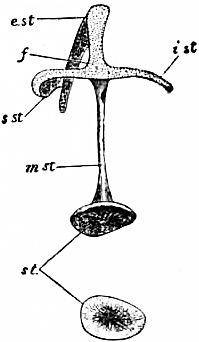
Fig. 16.—Auditory “chain” of Chicken. Lateral and basal views. (After W.K. Parker).
The middle ear communicates with the mouth by the Eustachian tubes, which pass between the basisphenoid and basioccipital bones, and unite upon the ventral side of the sphenoid, a little behind its articulation with the pterygoids, where they open into the mouth cavity by a short membranous duct. The columellar apparatus, or auditory chain of ossicles (fig. 16), extending between the fenestra ovalis and the tympanic membrane or drum, consists of (1) the long and slender columella, a straight, ossified rod which fits with a disk into the fenestra ovalis; it is homologous with the stapes (m.st.), although not stirrup-shaped; (2) the extracolumellar mass. This is chiefly cartilaginous and sends out three processes: the dorsal (s.st.) is attached to the upper wall of the drum cavity; the outermost (e.st.) is fastened on to the middle of the drum membrane; the third, ventral or infracolumellar process (i.st.) is directed downwards and tapers out into a thin, partly cartilaginous, strand, which originally extended to the inner corner of the articular portion of the mandible, but on its long way comes to grief, being squeezed in between the pterygoid and quadrate. This long downward process being homologous with an almost exactly identical arrangement in the crocodile, and with the processus folii of the mammalian malleus, it follows that the whole extracolumellar mass, that between stapes and drum, is equivalent to incus and malleus of the mammalia. There is, in birds, no annulus tympanicus. Birds possess an ear-muscle which at least acts as a tensor tympani; it arises near the occipital condyle, passes through a hole into the tympanic cavity, and its tendon is, in various ways, attached to the inside of the membrane and the neighbouring extracolumellar processes.
As regards the inner ear, the endolymphatic duct ends in a closed saccus, imbedded in the dura mater of the cranial cavity. The apex of the cochlea is turned towards, and almost reaches the anterior wall of the occipital condyle; at most it makes but half a twist or turn; it possesses both Reissner’s membrane and the organ of Corti. Although the scala tympani is so rudimentary, not reaching a higher level than in most of the reptiles, and remaining far below the mammalia, birds do not only hear extremely well, but they distinguish between and “understand” pitch, notes and melodies.
See G. Breschet, Recherches anatomiques et physiologiques sur l’organe de l’audition chez les oiseaux (Paris, 1836), with Atlas; C. Hasse, various papers in Zeitschr. f. wiss. Zool. vol. xvii, and in Anatomische Studien, pts. ii. and iv. (Bresku, 1871); I. Ibsen, Atlas anatomicus auris internae (Copenhagen, 1846); G. Retzius, Das Gehororgan der Wirbelthiere (Stockholm, 1884), ii. pp. 139-198, pls. 15-20.
Nose.—The olfactory organ is poorly developed, and it is still a question whether birds possess much power of smell; many are certainly devoid of it.
The olfactory perceptive membrane is restricted to the posterior innermost region of the nasal chamber, where it covers a slight bulging-out prominence on the nasal wall. This so-called third, upper or posterior conch is not a true conch, nor is that of the vestibulum; only the middle one forms a scroll, and this corresponds to the only one of reptiles and the lower of the mammals. The nasal cavity communicates with the mouth by the choanae or posterior nares, situated between the palatine process of the maxillary, the palatine and the vomer. The outer nares or nostrils are most variable in size and shape. In the Steganopodes they tend to become much reduced, e.g. in cormorants (Phalacrocoracidae), and especially in Sula, where the nasal slits become completely closed up, and the greater portion of the nasal cavity is also abolished, being restricted to the olfactory region with its unusually wide choanae. The nasal septum is often more or less incomplete, producing nares peniae, e.g. in the Cathartae, in the Anseres, gulls, rails and various other aquatic birds. The secretions of the mucous membrane of the nasal cavity, and a pair of naso-lacrymal glands (not to be confounded with the Harderian and the lacrymal glands), moisten and clean the chamber. The glands are variable in size and position; when very large, e.g. in plovers, they extend upon the forehead, causing deep impressions on the bones of the skull. Jacobson’s organ has been lost by the birds, apparently without a trace in the embryonic fowl, but T.J. Parker has described vestiges of the corresponding cartilages in the Apteryx (Phil. Trans., 1890).
See C. Gegenbaur, “Über die Nasenmuscheln der Vögel,” Jena Zeitschr. vii., 1873, pp. 1-21.
5. Vascular System.
The heart lies in the middle line of the body, its long axis being parallel with that of the trunk. The whole ventral surface of the pericardium is exposed when the sternum is removed. The right and left halves are completely divided by septa, no mixture of the venous and arterial blood being possible, an advance upon reptilian conditions, even the highest.
The atria are comparatively small, the walls being thin, especially those of the right, which possesses numerous muscular ridges projecting into the cavity presenting a honeycombed appearance. The interauricular septum is mostly entirely membranous; in the middle it is thinner, rather transparent, but there is no depression or fossa ovalis. The whole sinus venosus has become part of the right atrium. It receives the three great venous trunks of the body, namely the vena cava superior dextra, the vena cava superior sinistra more dorsally, and the vena cava inferior more to the right and below; the opening of the last is guarded by two prominent valves in place of the mammalian valvula Eustachii. The right ventricle occupies the ventral portion of the heart. The communication with the atrium is guarded by a valvula cardiaca dextra, which only in function represents the mammalian tricuspid; it consists of an oblique reduplication of the muscular fibres together with the endocardiac lining of the right ventricle, while the opposite wall is convex and forms neither a velum nor papillary muscles, nor chordae tendineae. The right anterior corner of the right ventricle passes into the short stem, guarded by three semi-lunar valves, which divides into the two pulmonary arteries. There are likewise two pulmonary veins, entering the left atrium by one orifice. Two or three membranous flaps, held by numerous chordae tendineae, form a true mitral valve, and allow the blood to pass through the left ostium atrioventriculare. The blood leaves the heart past three semi-lunar valves, by the right aorta, this being alone functional, a feature characteristic of, and peculiar to, birds. Remnants of the left aortic arch persist sometimes in the shape of a ligamentous strand. The aortic trunk is very short, sends off the coronary arteries and then the left aorta brachiocephalica, while the rest divides into the right brachiocephalic and the aorta descendens. Each brachiocephalic soon sends off its subclavian, while in the normal or more usual cases the rest proceeds as the carotid trunk, inclusive of the vertebral artery. But the carotids show several interesting modifications which have been examined chiefly by C.L. Nitzsch and by A.H. Garrod. (1) The right and left carotids converge towards the middle and extend up the neck, imbedded in a furrow along the ventral surface of the cervical vertebrae. This is the usual arrangement. (2) The two carotids are fused into one carotis conjuncta, imbedded in a special median osseous semicanal of the vertebrae; e.g. herons, flamingos, and some parrots. (3) There is one carotis conjuncta, but the basal portion of its original right component is obliterated, leaving a so-called c. primaria sinistra, an unfortunate name. Such Aves laevocarotidinae of Garrod are common, e.g. all the Passeriformes. (4) The reverse of the third modification, producing a c. primaria dextra in the bustard Eupodotis. In other likewise very rare cases a left, or a left and right, superficial carotids are developed and take the place of the then vanished deep or primary carotids.
Venous System.—The bird’s liver receives nearly all the blood from the stomach, gut, pancreas and spleen, as well as from the left liver itself, into the right hepatic lobe, by a right and left portal vein. The venae hepaticae magnae join the vena cava posterior and thereby form with it the vena cava inferior. The left hepatica magna receives also the umbilical vein, which persists on the visceral surface of the abdominal wall, often anastomosing with the epigastric veins. A likewise unpaired vena coccygeo-mesenterica is usually present. There is no renal portal system, excepting unimportant vestiges of such a system in the head kidneys.
Lymphatic System.—The white blood-corpuscles are produced in the follicles at the base of the intestinal villi. The lymph vessels of the tail and hinder parts of the body enter the hypogastric veins; and at the point of junction, on either side, lies a small lymph heart, which often persists until maturity. The red blood-corpuscles are invariably oval disks, with a central nucleus which causes a slight swelling; hence they are oval and biconvex.
See A.H. Garrod, “On the Carotid Arteries of Birds,” Proc. Zool. Soc., 1873, pp. 457-472; E.A. Lauth, “Mémoire sur les vaisseaux lymphatiques des oiseaux,” Ann, Sci. nat. (iii. 1824), p. 381; J.J. Mackay, “The Development of the Branchial Arterial Arches in Birds, with special reference to the Origin of the Subclavians and Carotids,” Phil. Trans. 179 B (1888), pp. 111-141; L.A. Neugebauer, “Systema venosum avium,” Nov. Act. Leopold. Carol. xxi., 1844, pp. 517-698, 15 pls.; R. Gasch, “Beiträge zur vergl. Anatomic des Herzens der Vögel und Reptilien,” Arch. f. Naturgesch., 1888.
6. Respiratory System.
The lungs are small and occupy only the dorsal portion of the thoracic cavity. There is only one right and one left lobe, each traversed through its whole length by a mesobronchium, whence arise about ten secondary bronchia; these send off radially arranged parabronchia, which end blindly near the surface. The walls of these tertiary tubes send out, in all directions, canaliculi aeriferi which, ending in slight swellings, recall the mammalian aveoli.
Highly specialized air-sacs are characteristic of all birds. They are very thin-walled membranes, very poor in blood-vessels, formed by the bulged-out pleural or peritoneal covering of the lungs, through the parabronchial tubes of which they are filled with air. Their function is not quite clear. The usual suggestion, that the warm air contained within them assists the bird in flight, balloon-like, is absurd. They assist in the extremely rapid and vigorous ventilation of the lungs, the latter being capable of but very limited expansion and contraction in birds. Exchange of gas through the walls of the air-sacs, almost devoid of blood-vessels, can at best be much restricted.
There are five pairs of larger sacs belonging to the pulmonary system:—(1) prebronchial or cervical, extending sometimes far up the neck, even into the cranial cavities; the throat-bags of the prairie fowls (Cupidonia and Pedioecetes) are a further development; (2) subbronchial or interclavicular; (3 and 4) anterior and posterior thoracic or intermediate; (5) abdominal sacs. Most of these extend through narrow apertures—foramina pneumatica—into the hollow bones, sometimes, e.g. in hornbills and screamers, into every part of the skeleton, or, in the shape of innumerable pneumatic cells, even beneath the skin. There is also a naso-pharyngeal or tympanic system of air-sacs, restricted to the head (cf. the siphonium described in connexion with the mandible), but filling also such curious organs as the frontal excrescence of Chasmorhynchus, the Brazilian bell-bird, the throat-bag of the adjutant stork, and the gular pouch of the bustard.
The trachea or windpipe is strengthened by numerous cartilaginous, often osseous, complete rings, but in the emeu several of these rings are incomplete in the medioventral line, and permit the inner lining of the trachea to bulge out into a large neck-pouch, which is used by both sexes as a resounding bag. In humming-birds and petrels the trachea is partly divided by a vertical, longitudinal, cartilaginous septum. In some of those birds which have a peculiarly harsh or trumpeting voice, the trachea is lengthened, forming loops which lie subcutaneously (capercally, curassow), or it enters and dilates the symphysis of the furcula (crested guineafowl); or, e.g. in the cranes and in the hooper swan, even the whole crest of the sternum becomes invaded by the much elongated, manifolded trachea.
The syrinx or lower larynx is the most interesting and absolutely avine modification, although absent as a voice-producing organ (probably due to retrogression) in most Ratitae, storks, turkey buzzards (Cathartes) and Steganopodes. The syrinx is a modification of the lower part of the trachea and of the adjoining bronchi. Essential are vibrating membranes between the cartilaginous framework, and next, special muscles for regulating the tension. The majority of birds possess a pair of internal tympaniform membranes forming the inner or median walls of the bronchi, which are there furnished with semi-rings only. External tympaniform membranes exist, with great variations, between the specialized one or two last tracheal and some of the first bronchial rings.
According to the position of the chief sound-producing membranes, three types of syrinx are distinguishable:—(1) Tracheo-bronchial, by far the commonest form, of which the two others are to a certain extent modifications. The essential feature is that the proximal end of the inner membranes is attached to the last pair of tracheal rings; outer tympaniform membranes exist generally between the 2nd, 3rd and 4th bronchial semi-rings. This type attains its highest development in the Oscines, but it occurs also in many other orders. (2) Syrinx bronchialis. The outer membranes are spread out between two or more successive bronchial semi-rings, a distance from the trachea which is, in typical cases, devoid of sounding membranes; some Cuculi, Caprimulgi, and some owls. (3) Syrinx trachealis. The lower portion of the trachea consists of thin membranes, about half a dozen of the rings being very thin or deficient. Inner and outer membranes may exist on the bronchi. The Tracheophonae among the Passeriformes, the possessors of this specialized although low type of syrinx, form a tolerably well-marked group, entirely neotropical. But indications of such a syrinx occur also in Pittidae, pigeons and gallinaceous birds (Gallidae), the last cases being clearly analogous.
Whilst the type of syrinx affords no help in classification, it is very different with its muscles. These—as indicated by their supply from a branch of the hypoglossal nerve, which descends on either side of the trachea—are, so to speak, a detached, now mostly independent colony of glosso-pharyngeal muscles. Omitting the paired tracheo-clavicular muscles, we restrict ourselves to the syringeal proper, those which extend between tracheal and bronchial rings. Their numbers vary from one pair to seven, and they are inserted either upon the middle portion of the bronchial semi-rings (Mesomyodi), or upon the ends of these semi-rings where these pass into the inner tympaniform membrane (Acromyodi). The former is morphologically the more primitive condition, and is found in the overwhelming majority of birds, including many Passeriformes. The acromyodian type is restricted almost entirely to the Oscines. Further, according to these muscles being inserted only upon the dorsal, or only upon the ventral, or on both ends of the semi-rings, we distinguish between an-, kat- and diacromyodi. But the distinction between such Acromyodi and the Mesomyodi is not always safe. For instance, the Tyranninae are anacromyod, while the closely allied Pipras and Cotingas are katacromyod; both these modifications can be shown to have been derived but recently from the weak meso- and oligomyodian condition which prevails in the majority of the so-called Oligomyodi. On the other hand, the diacromyodian type can have been developed only from a strong muscular basis which could split into a dorsal and a ventral mass; moreover, no Passeres are known to be intermediate between those that are diacromyodian and those that are not.
Attempts to derive the anacromyodian and the katacromyodian from the diacromyodian condition are easy on paper, but quite hopeless when hampered by the knowledge of anatomical facts and how to use them. There remains but one logical way, namely, to distinguish as follows:—(1) Passeres anisomyodi, in which the syrinx muscles are unequally inserted, either on the middle or on one end of the semi-rings, either dorsal or ventral. This type comprises the Clamatores. (2) Passeres diacromyodi, in which some of the syrinx muscles are attached to the dorsal, and some to the ventral ends, those ends being, so to say, equally treated. This type comprises the Oscines. Both types represent rather two divergent lines than successive stages, although that of the Clamatores remains at a lower level, possessing at the utmost three pairs of muscles, whilst these range in the Oscines from rarely two or three to five or seven.
This way of using the characters of the syrinx for the classification of the Passeriformes seems simple, but it took a long time to accomplish. Joh. Müller introduced the terms Polymyodi and Tracheaphones, Huxley that of Oligomyodi; Müller himself had, moreover, pointed out the more important characters of the mode of insertion, but it was Garrod who invented the corresponding terms of Acro- and Mesomyodi (= Tracheophones + Oligomyodi). (For further historical detail, see Ornithology). After W.A. Forbes had investigated such important genera as Philepitta and Xenicus, P.L. Sclater, A. Newton and R.B. Sharpe divided the Passeres respectively into Oscines, Oligomyodae, Tracheophonae and Pseudoscines (=Suboscines); Oligomyodae, Tracheophonae and Acromyodae; Oscines, Oligomyodae, Tracheophonae and Atrichiidae. Ignoring the fact that some Oligomyodae are meso- and others acromyodian, they tried to combine two irreconcilable principles, namely, mere numbers against quality.
Bibliography.—M. Baer, “Beitr. z. Kenntniss d. Atemwerkzeuge bei den Vögeln,” Zeitschr. wiss. Zool. lxi. 1896, pp. 420-498; Campana, Physiologie de la respiration chez les oiseaux. Anatomie de l’appareil pneumatique ... (Paris, 1875); A.H. Garrod, “Major Divisions of Passerine Birds (syrinx, &c.),” P.Z.S., 1876, pp. 506-519; and “On the Conformation of the Thoracic Extremity of the Trachea in the Class Aves,” P.Z.S., 1879, pp. 357-380; J. Müller, Stimmorgane der Passerinen, Müller’s Arch. (1847); and Abh. Akad. Wiss. (Berlin, 1845-1847), translation by F.J. Bell, Oxford, 1878; H. Strasser, “Luftsäcke der Vögel,” Morph. Jahrb. iii., 1877, pp. 179-227; C. Wunderlich, “Unterer Kehlkopf der Vögel,” Nov. Act. Leop. Carol., 1884; Ph. C. Sappey, Recherches sur l’appareil respiratoire des oiseaux (Paris, 1847); W.A. Forbes, “Contributions to the Anatomy of Passerine Birds (syrinx),” P.Z.S., 1880, pp. 380-386, 387-391; 1881, pp. 435-737; 1882, pp. 544-546, 569-571; W. Yarrell, “Observations on the tracheae of Birds,” Trans. Linn. Soc., 1827, pp. 378-391.
7. Digestive System.
For a general account of the digestive organs, see Alimentary Canal. Here only a few peculiar features may be mentioned.
The young pigeons are fed by both parents with a peculiar stuff, the product of the strongly proliferating epithelial cells of the crop, which cells undergo a cheese-like fatty degeneration, and mixed with mucus, perhaps also with the proventricular juice, make up a milk-like fluid. Should the young die or be removed during this period, the parents are liable to die, suffering severely from the turgid congestion of the hypertrophied walls of the crop.
The male of the hornbills, Bucerotinae, feeds his mate, which is imprisoned, or walled-up in a hollow tree, during the whole time of incubation, by regorging his food. This bolus is surrounded, as by a bag, by the cast-up lining of the gizzard. Since this process is repeated for many days the habitual reaction of the stomach well-nigh exhausts the male. A graphic account of this is given in Livingstone’s travels.
The hoactzin, Opisthocomus, feeds to a great extent upon the leaves of the aroid Montrichardia or Caladium arborescens. The crop is modified into a large and very rugose triturating apparatus, while the gizzard, thereby relieved of its function, is reduced to the utmost. The large and heavy crop has caused a unique modification of the sternal apparatus. The keel is pushed back to the distal third of the sternum, whilst the original anterior margin of the keel is correspondingly elongated, and the furcula fused with the rostral portion.
In the ostrich, Struthio, the craze of overloading the stomach with pebbles which, when triturated into sand, are not voided, has brought about a dislocation, so that the enormously widened and stretched space between proventriculus and gizzard forms a bag, directed downwards, whilst the gizzard itself with part of the duodenum is rotated round its axis to more than 100°. A similar rotation and dislocation occurs in various petrels, in correlation with the indigestible sepia-bills, &c., which these birds swallow in great quantities. In Plotus, the snakebird, the pyloric chamber of the stomach is beset with a mass of hair-like stiff filaments which permit nothing but fluid to pass into the duodenum. The gizzard of various birds which are addicted to eating hairy caterpillars, e.g. Cuculus canorus and trogons, is often lined with the broken-off hairs of these caterpillars, which, penetrating the cuticle, assume a regular spiral arrangement, due to the rotatory motion of the muscles of the gizzard.
8. Cloaca and Genital Organs.
The cloaca is divided by transverse circular folds, which project from its inner walls, into three successive chambers. The innermost, the coprodaeum, is an oval dilatation of the end of the rectum, and attains its greatest size in those birds whose faeces are very fluid; it serves entirely as the temporary receptacle of the faeces and the urine. The next chamber, the urodaeum, is small, and receives in its dorso-lateral wall the ureters and the genital ducts; above and below this chamber is closed by circular folds, the lower of which, towards the ventral side, passes into the coating of the copulatory organ when such is present. The urodaeum serves only as a passage, the urine being mixed with the faeces in the chamber above. The third or outermost chamber, the proctodaeum, is closed externally by the sphincter ani; the orifice is quite circular. It lodges the copulatory organ, and on its dorsal wall lies the bursa Fabricii, an organ peculiar to birds. It is most developed in the young of both sexes, is of unknown function, and becomes more or less obliterated in the adult. Only in the ostrich it remains throughout life, being specialized into a large receptacle for the urine, an absolutely unique arrangement. A true urinary bladder, i.e. a ventral dilatation of the urodaeum, is absent in all birds. It is significant that the whole type of their cloaca much resembles that of the Crocodilia and Chelonia, in opposition to that of the Lacertilia.
The penis, and its much reduced vestige of the female, is developed from the ventral wall of the proctodaeum. It occurs in two different forms. In the Ratitae, except Rhea, it consists mainly of a right and left united half (corpora fibrosa), with a deep longitudinal furrow on the dorsal side, and much resembles the same organ in crocodiles and tortoises. It is protruded and retracted by special muscles which are partly attached to the ventral, distal end of the ilium. Another type exists in Rhea and in the Anseriformes, greatly specialized by being spirally twisted and partly reversible like the finger of a glove. This is mainly due to the greater development of an unpaired, median portion, analogous to the mammalian corpus spongiosum, which is much less prominent in the Ratitae; the muscles of this type are derived solely from the anal sphincter. In other Carinatae, e.g. tinamous and storks, the penis is very much smaller and simpler, with every appearance of a degenerated organ. In the great majority of birds it has disappeared completely and the primitive way of everting the cloaca is resorted to.
Both right and left testes are functional. They become greatly enlarged in the breeding season; in the sparrow, for instance, from the size of a mustard seed to that of a small cherry. The vas deferens descends with many undulations down the lateral side of the ureter of the same side, and opens upon a small papilla into the urodaeum. Extraordinary increase in length during the breeding season causes the vasa deferentia in some of the African weaver-birds to protrude, or to bulge out the cloacal walls beyond the vent. The spermatozoa exhibit many differences in shape, size and proportions, in the various groups of birds. They have been studied minutely by E. Ballowitz.
Only the left ovary becomes functional, with rare individual exceptions. Both present the appearance of diminutive clusters of grapes, at the anterior end of the kidneys, close to the suprarenal bodies, separated from each other by the descending aorta and by the vena cava where this is formed by the right and left vena iliaca communis. During the breeding season many more eggs are developed than reach maturity, amounting in most birds to several dozens. Those germs which do not ripen during the season undergo a process of resorption, and in the winter the whole ovary dwindles to often a diminutive size. In young birds both oviducts are almost equal in size, but the right soon degenerates into an insignificant strand. During every laying season the left duct increases enormously by new formation of its component fibres. For instance, in the fowl its volume increases about fifty-fold, growing from some 6 in. in length and scarcely one line in width to more than 2 ft. in length and ½ in. in thickness. The upper, wide opening of the duct is attached by elastic, peritoneal lamellae to the hinder margin of the left lung; the middle portion of the duct is glandular and thick-walled, for the deposition of the albumen; it is connected by a short, constricted “isthmus” (where the shell-membrane is formed) with a dilated “uterus” in which the egg receives its calcareous shell and eventual pigmentation.
Bibliography.—A. v. Brunn, Rückbildung nicht ausgestossener Eierstockseier, Henle Festschrift (Bonn, 1882); E. Ballowitz, “Die Spermatozoen der Vögel,” Arch. Mikr. Anat. xxxii., 1888, pls. 14-18; M. Sacchi, “Contribuzione all’ istiologia del ovidotto dei saurop-sidi,” Att. Soc. Ital., Milano, vol. xxx.; W.A. Forbes, “On the Bursa Fabricii in Birds,” P.Z.S., 1877, pp. 304-318; H. Gadow, “Remarks on the Cloaca and on the Copulatory Organs of the Amniota.” Phil. Trans., 1887, pp. 5-37, pls. 2-5; Martin Saint Ange, “Étude de l’appareil reproducteur dans les cinq classes d’animaux vertébres,” Mem. Ac. Soc., Paris, xiv., 1856; E. Retterer, “Contribution à l’étude du cloaque et de la bourse de Fabricius,” Robin’s Journ. de l’anat. et physiol., 1885, pp. 369-454, pls. 17-19.
B. Fossil Birds
Much had naturally been expected from the study of fossil birds, but, so far as the making of classifications is concerned, they have proved rather a source of perplexities. So long as the characters of new fossils are only of specific and generic value, it is mostly possible to assign the birds to their proper place, but when these characters indicate new families or orders, for instance Hesperornithes, Ichthyornithes, Palaelodi, their owners are put outside the more tersely constructed classifications applicable to modern birds. It is no exaggeration to say that the genus, often even the species, can be determined from almost any recent bone, but in the case of Miocene, and still more, of Eocene fossils, we have often to deal with strange families, which either represent an extinct side branch, or which connect several recent groups with each other. Our artificially-established classifications collapse whilst we gain further insight into the mutual affinities of the existing groups. Of course this must be so if evolution is true. But it also follows that, if every extinct and recent bird were known, neither species, nor genera, nor families, nor orders could be defined. We should be able to construct the pedigree of every group, in other words, the gigantic natural system, but there would be no classification. Much light has also been thrown by fossil birds upon the study of geographical distribution. The key to the distribution of recent groups lies in that of the extinct forms. Not only have many absolutely new families been discovered, but many kinds of modern birds are now known to have existed also in countries which they are now extinct. There were, for instance, trogons, secretary-birds, parrots, and other now Ethiopian forms in Miocene France. Ostriches, undistinguishable from Struthio, have been found in Samos and in the Sivalik Hills.
The proper study of fossil birds may be said to have begun with A. Milne-Edwards, whose magnificent Oiseaux fossiles de la France was published from 1867 to 1871. This work deals chiefly with mid-Tertiary forms. A new impetus was given by O.C. Marsh, who, after 1870, discovered a great number of bird remains in the Cretaceous strata of North America. The most important result is the proof that, until the end of the Cretaceous epoch, most, if not all, birds were still possessed of teeth (see Odontornithes).
The oldest known bird is the Archaeopteryx (q.v.), of the upper Oolite in Bavaria. The imprints in the enormously older new red sandstone or Lower Trias of Connecticut, and originally named Ornithichnites, belong to Dinosaurian Reptiles.
A wide gap separates Archaeopteryx from the next order of fossil birds of the Cretaceous epoch, and, since freshwater deposits of that age are rare, bird remains are uncommon. Many bones formerly referred to birds have since proved to belong to Pterodactyls, e.g. Cimoliornis from the English Chalk. But in 1858 were discerned in the Upper Greensand of Cambridgeshire remains which are now known as Enaliornis. W. Dames has described bones from the Chalk of southern Sweden under the name of Scaniornis, probably allied to Palaelodus. From the Cretaceous rocks of North America a large number of birds have been described by O.C. Marsh. Of these the most interesting are Ichthyornis (= Graculavus) and Hesperornis, from the Cretaceous shales of Kansas. They were placed by Marsh in a distinct subclass of birds, Odontornithes (q.v.). Probably all birds of Cretaceous age were still possessed of teeth. Baptornis, another of Marsh’s genera, seems to be allied to Enaliornis, Palaeotringa and Talmatornis, were by him referred to Limicoline and Passerine birds. Laornis from the Cretaceous marls of New Jersey was as large as a swan.
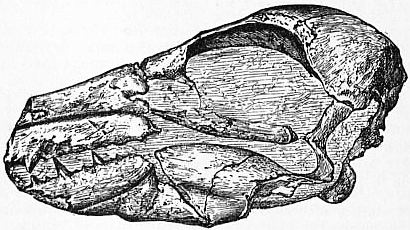
Fig. 17.—Remains of head of Odontopteryx, from the original in the British Museum; side view; natural size.
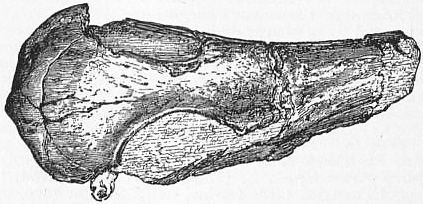
Fig. 18.—Remains of head of Odontopteryx, seen from above.
The lower Eocene has furnished a greater number of bird bones. Some of the largest are those of Gastornis, with three species from France, Belgium and England. Much difference of opinion obtains as to the affinities of these birds, which were far larger than an ostrich; they were undoubtedly incapable of flight and there are indications of teeth in the upper jaw. Provisionally this genus has been grouped with the Ratitae, which at any rate are a heterogenous assembly. Sir R. Owen’s Dasornis, of the London Clay, known from an imperfect cranium, and E.D. Cope’s Diatryma of New Mexico, based upon a gigantic metatarsus, may also belong there. The London Clay of South England has likewise supplied some long upper arm bones, Argillornis. The most remarkable specimen is a skull, Odontopteryx toliapicus (figs. 17, 18); the edges of the jaws were serrated like those of certain tortoises. The character of this skull and the compound rhamphotheca (known by the imprints left upon the jaws) indicate affinities with the Steganopodes. Remnants of a heron-like bird, Proherodius, of a gull-like creature, Halcyornis, a raptorial Lithornis; and a supposed Passerine from Glarus in Switzerland, called Protornis = Osteornis, complete the list.
The upper Eocene has yielded many birds, most of which are at least close forerunners of recent genera, the differentiation into the leading orders and families being already well marked, e.g. Gallinaceous birds, stork- and crane-like waders, rails, birds of prey, cormorants, &c. Especially numerous bones have been found in the Paris basin, chiefly described by G. Cuvier, F.L.P. Gervais, E. Blanchard, and above all by A. Milne-Edwards, and in the equivalent beds of Hampshire. Others have been discovered in Wyoming; a giant penguin, Palaecudyptes, is known from New Zealand, and Palaeospheniscus from Patagonia. The Miocene has yielded by far the greatest number of bird-bones, including even eggs and imprints of feathers. For instance, from the lower Miocene beds of Allier and Puy-de-Dôme Milne-Edwards has described about 50 species. Of these Palaelodus was an ancestral flamingo, but with shorter legs; Limnatornis is referred to the hoopoes. The existing genera include Anas, Aquila, Bubo, Columba, Cypselus, Lanius, Picus, Phalacrocorax, Sula, &c. Very interesting is the fact that Serpentarius, Psittacus and Trogon are amongst this list of birds, which are now restricted to the tropics. A similarly mixed avifauna has been found in the mid-Miocene beds of various other parts of France, Germany and Italy. In Colorado and New Mexico Marsh has detected bones of Meleagris, Puffinus, Sula and Uria, all existing genera; but the first is especially suggestive, since it is one of the most characteristic forms of the New World.
Here may be interpolated a short account of the very peculiar avifauna found in the Tertiary strata of Santa Cruz in Patagonia. Instead of the age of lower Eocene, as had been stated originally, these beds are not older than mid-Miocene, and not a few of the bones are of a much younger, even latest Tertiary date. Discovered, and partly described, by F. Ameghino, the bones have been sumptuously monographed by F.P. Moreno and A. Mercerat, who proposed for them the name of Stereornithes, a new order of birds, mostly gigantic in size, and said to combine the characters of Anseres, Herodiones and Accipitres. But the whole mass of bones is in hopeless disorder, apparently without any record of association. At any rate, the “Stereornithes,” accepted as such in Bronn’s Thierreich, and in Newton’s Dictionary of Birds, had to be dissolved as an unnatural, haphazard assembly. Many of these birds, to judge from the enormous size of their hind-limbs, were undoubtedly flightless, e.g. Brontornis, and remind us of the Eocene Gastornis of Europe. Phororhacos, the most extraordinary of all, belongs to the Gruiformes, perhaps also Pelecyornis and Liornis. On the other hand, the late Tertiary Dryornis is a member of the Cathartae or American vultures, and Mesembriornis, likewise of late Tertiary date, is a close forerunner of the recent genus Rhea.
Pliocene remains are less numerous than those of the Miocene. From Pikermi in Greece is known a Gallus, a Phasianus and a large Grus. From Samos a large stork, Amphipelargus, and a typical Struthio; from the Sivalik Hills on the southern flanks of the Himalayas also an ostrich, and another Ratite with three toes, Hypselornis, as well as Leptoptilus, Pelecanus and Phalacrocorax. The fossil egg of a struthious bird, Struthiolithus, has been found near Cherson, south Russia, and in north China. The Suffolk Crag has yielded the unmistakable bones of an albatross, Diomedea.
Most Pleistocene birds are generically, even specifically, identical with recent forms; some, however, have become extinct, or they have become exterminated by man. A great number of birds’ bones have been found in caves, and among them some bearing marks of human workmanship. In France we have a large and extinct crane, Grus primigenia, but more interesting are the numerous relics of two species, the concomitants even now of the reindeer, which were abundant in that country at the period when this beast flourished there, and have followed it in its northward retreat. These are the snowy owl, Nyctea scandiaca, and the willow-grouse, Lagopus albus. A gigantic swan, Cygnus falconeri, is known from the Zebug cavern in Malta. From caves of Minas Geraes in Brazil, O. Winge has determined at least 126 species, of which nearly all still survive in the country. Kitchen-middens of England, Ireland and Denmark reveal the existence of the capercally, Tetrao urogallus, and of the great auk or gare-fowl, Alca impennis; both species long since vanished from those countries. In the fens of East Anglia have been found two humeri, one of them immature, of a true Pelecanus, a bird now no longer inhabiting middle Europe.
Until a very recent epoch there flourished in Madagascar huge birds referable to the Ratitae, e.g. Aepyornis maximus, which laid enormous eggs, and not unnaturally recalls the mythical “roc” that figures so largely in Arabian tales. New Zealand has also yielded many flightless birds, notably the numerous species and genera of Dinornithidae, some of which survived into the 19th century (see Moa); Pseudapteryx allied to the Kiwi; Cnemiornis, a big, flightless goose; Aptornis and Notornis, flightless rails; and Harpagornis, a truly gigantic bird of prey with tremendous wings and talons.
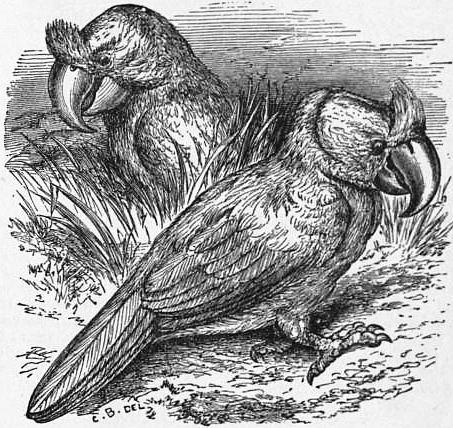
From a tracing by M.A. Milne-Edwards of the original drawing in a MS. Journal kept during Wolphart Harmanszoon’s voyage to Mauritius (A.D. 1601-1602), penes H. Schlegel (Proc. Zool. Soc. 1875, p. 350). Reduced.
Fig. 19.—Extinct Crested Parrot of Mauritius (Lophopsittacus mauritianus).
It is, of course, quite impossible, in a survey of extinct birds, to divide them into those which are bona fide fossil, sub-fossil, recently extirpated and partially exterminated. Nor is it possible, except in a few cases, to decide whether they have come to an end through the agency of man or through so-called natural causes. Like other creatures birds have come, some to flourish and stay, others to die out.

Fig. 20.—Mandible of Aphanapteryx, side view. (From the original in the Museum of Zoology of the University of Cambridge.)
Mauritius is famous for the dodo, killed off by man; there was also a curiously crested parrot, Lophopsittacus (fig. 19). In the Mare aux Songes have been found the bones of another parrot, of ducks, pigeons, rails, herons, geese and of a dwarf darter, Plotus nanus, all sub-fossil, now extinct. Very interesting is Aphanapteryx (fig. 20), a long-billed, flightless rail, practically the same as Erythromachus of Rodriguez and Diaphorapteryx of Chatham Island. Réunion possessed the peculiar starling, Fregilupus. Rodriguez was inhabited by Pezophaps, the solitaire, Necropsittacus and Palaeornis exsul, which is now probably extinct. The Antilles tell a similar tale. The great auk, once common on the British coasts, those of Denmark, the east coast of North America, then restricted to those of Newfoundland, Greenland and Iceland, has been killed by man, and the same fate has overtaken the Labrador duck, the Phillip Island parrot, Nestor productus, and the large cormorant of Bering Island, Phalacrocorax perspicillatus; and how long will the flightless cormorant, Ph. harrisi of the Galapagos, survive its quite recent discovery?
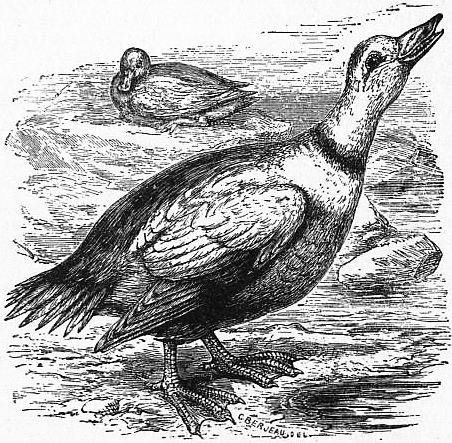
Fig. 2l.—Pied Duck (Somateria labradora), male and female. (From specimens in the British Museum. Reduced.)
Authorities.—A. Milne-Edwards, Recherches anatomiques et paléontologiques pour servir à l’histoire des oiseaux fossiles de la France (Paris, 1867-1868); F.P. Moreno and A. Mercerat, Catalogo de los Pajaros fosiles de la Republica Argentina. Anales Mus. La Plata, 1891, 21 pls.; O.C. Marsh, Odontornithes: A monograph of the Extinct Toothed Birds of North America (New Haven, Conn., 1880); R. Lydekker, article “Fossil Birds,” in A. Newton’s Dictionary of Birds (London, 1893); Cat. Foss. Birds, Brit. Museum, 1891; K. v. Zittel, Handbuch der Palaontologie, i. 3 (1887-1890); C.W. Andrews, “On the Extinct Birds of Patagonia,” Tr. Zool. Soc. xv., 1899, pp. 55-86, pls. 14-17.
C. Geographical Distribution
The study of the extinct organisms of any country leads to a proper appreciation of its existing flora and fauna; while, on the other hand, a due consideration of the plants and animals which may predominate within its bounds cannot fail to throw more or less light on the changes it has in the course of ages undergone. That is to say, the distribution of forms in time is a subject so much connected with the distribution of forms in space, that the one can hardly be separated from the other. Granting this is a general truth, it must yet be acknowledged as a special fact, that in fossil birds we have as yet but scanty means of arriving at any precise results which will justify bold generalization in the matter of avine distribution. Remains of extinct birds are, compared with those of other classes of vertebrates, exceedingly scarce, and these have been found in very few, widely separated countries. The great problems involved in the study of geographical distribution must therefore be based mainly upon the other classes, both vertebrate and invertebrate, which, moreover, enjoy less great facilities of locomotion than the birds.
Yet it so happens that the great zoogeographical regions of the world, now more or less generally accepted, have been based upon the distribution of birds. The whole subject was properly introduced by Treviranus,1 who in his large philosophical work devotes considerable space to the “geographical distribution of animals.” Next we have to mention F. Tiedemann,2 the Heidelberg anatomist, who has been generally ignored, although he surpassed many a recent zoogeographer by the wide view he took of the problem; in fact he was the first to connect distribution with environmental or bionomic factors; e.g. the remark on p. 481 of his work that “the countries of the East Indian flora have no kinds of birds in common with America which are vegetable feeders.” L.K. Schmarda3 divided the land into twenty-one realms, characterizing these mainly by their birds. P.L. Sclater4 was the first to divide the world into a few great “regions,” the Palaearctic, Ethiopian, Indian and Australian forming one group, the “Old World” (Palaeogaea); and the Nearctic and Neotropical forming a second, the New World (Neogaea). Birds being of all animals most particularly adapted for extended and rapid locomotion, it became necessary for him to eliminate from his consideration those groups, be they small or large, which are of more or less universal occurrence, and to ground his results on what was at that time commonly known as the order Insessores or Passeres, comprehending the orders now differentiated as Passeriformes, Coraciiformes and Cuculiformes, in other words the mass of arboreal birds. His six main divisions—practically adopted by A.R. Wallace5 in his epoch-making work—are excellent, taken separately. They express the main complexes of land with their dependencies in well-chosen terms; for instance the “Neotropical region” stands short for South and Central America with the Antilles.
But these six divisions of Sclater and Wallace are not all equivalent, only some are of primary importance; they require co- and sub-ordination. This most important advance was made by T.H. Huxley.6 Some of the “regions” have now to be called subregions, e.g. the Nearctic and the Palaearctic. The reduction of the Oriental to a subregion, with consequent “provincial” rank of its main subdivisions, will probably be objected to, but these are matters of taste and prejudice. Above all it should be borne in mind that nearly all the last subdivisions or provinces are of very little real value and most of them are inapplicable to other classes of animals.
Besides some occasional references in the text, only a few more of the general works dealing with the distribution of birds can here be mentioned. Especial attention has to be drawn to the article “Geographical Distribution,” in Newton’s Dictionary of Birds. See also A. Heilprin, The Geographical and Zoological Distribution of Animals (New York, 1887); W. Marshall and A. Reichenow, two maps with much detail, although badly arranged, in Berghaus’ Physikalischer Atlas, pt. vi. (Atlas d. Thierverbreitung), (Gotha, 1887); A. Reichenow, “Die Begrenzung zoogeographischer Regionen vom ornithologischen Standpunkte,” Zoolog. Jahrb. iii., 1888, pp. 671-704, pl. xxvi.; E.L. Trouessart, La Géographie zoologique. (Paris, 1890).
The scheme adopted in the following account stands as follows:—
(A) Austrogaea or I. Australian Region New Zealand subregion.
Australian ”
Papuan ”
(B) Neogaea or II. Neotropical Region Antillean ”
Columbian ”
Patagonian ”
(C) Arctogaea III. Holarctic Region Nearctic ”
Palaearctic ”
IV Palaeotropical Region Ethiopian ”
Oriental ”
In the following account the characterization of the various regions and subregions has to a very great extent been adopted from Newton’s article in his Dictionary of Birds, and from the chapter on distribution in the article on “Birds” in the Encyclopaedia Britannica, 9th edition. This applies especially to those instances in which the members of families, genera and species are mentioned. The families are those which are enumerated in Garow’s classification. The numbers of genera and species of birds are, of course, a matter of personal inclination. If we take a moderate computation the number of recent species may be taken at 10,000-11,000.7 Dr R.B. Sharpe increases their number to about 15,000 in the New Hand-List of Birds, published by the British Museum. In the first two volumes fossil birds, occasionally based upon a fragmentary bone only, are also included.
(A) Austrogaea, the Australian region in the wider sense, with the Papuan, Australian and New Zealand subregions, including also Polynesia. We may here quote Newton (Encyclopaedia Britannica, 9th ed., “Birds,” p. 738) on the remarkable differences between this region and the rest of the Old World:—“The prevalent zoological features of any Region are of two kinds—negative and positive. It is therefore just as much the business of the zoogeographer, who wishes to arrive at the truth, to ascertain what groups of animals are wanting in any particular locality (altogether independently of its extent) as to determine those which are forthcoming there. Of course, in the former case it would be absurd to regard as a physical feature of any great value the absence from a district of groups which do not occur except in its immediate neighbourhood; but when we find that certain groups, though abounding in some part of the vicinity, either suddenly cease from appearing or appear only in very reduced numbers, and occasionally in abnormal forms, the fact obviously has an important bearing. Now, mere geographical considerations, taken from the situation and configuration of the islands of the so-called Indian or Malay Archipelago, would indicate that they extended in an unbroken series from the shores of the Strait of Malacca to the southern coast of New Guinea, which confronts that of north Australia in Torres Strait, or even farther to the eastward. Indeed, the very name Australasia, often applied to this part of the world, would induce the belief that all the countless islands, be they large or small—and some of them are among the largest on the globe—were but a southern prolongation of the mainland of Asia. But so far from this being the case a very definite barrier is interposed. A strait, some 15 m. or so in width, and separating the two fertile but otherwise insignificant islands of Bali and Lombok, makes such a frontier as can hardly be shown to exist elsewhere. The former of these two islands belongs to the Indian Region, the latter to the Australian, and between them there is absolutely no true transition—that is, no species are common to both which cannot be easily accounted for by the various accidents and migrations that in the course of time must have tended to mingle the productions of islands so close to one another. The faunas of the two are as absolutely distinct as those of South America and Africa, and it is only because they are separated by a narrow strait instead of the broad Atlantic that they have become so slightly connected by the interchange of a few species and genera.
“Now, first, of the forms of birds which are prevalent throughout the Indian Region, but are entirely wanting in the Australian, we have at once the bulbuls (Ixidae), very characteristic of most parts of Africa and Asia, including the sub-group Phyllornithinae, which is peculiar to the Indian Region; the widely-spread families of barbets (Megalaeminae) and vultures (Vulturidae); and the pheasants (Phasianidae), which attain so great a development in various parts of the Asiatic continent and islands that there must their home be regarded as fixed. Some naturalists would add the finches (Fringillidae), rightly if we assume that the Ploceidae or weavers constitute a separate family. Then, of forms which are but weakly represented, we have the otherwise abundant thrushes (Turdidae), and, above all, the woodpeckers (Picidae), of which only very few species, out of 400, just cross the boundary and occur in Lombok, Celebes or the Moluccas, but are unknown elsewhere in the region.”
But the Australian region is also remarkable for its ornithic singularity. All the existing Ratitae (with the exception of the ostriches of Africa and South America, belonging to the genera Struthio and Rhea, and comprising at most but five species) are found in Austrogaea and nowhere else. Of the Passeres the honey-suckers (Meliphagidae) are most characteristic, and, abounding in genera and species, extend to almost every part of the region, yet only one species of Ptilotis oversteps its limits, crossing the sea from Lombok to Bali. Other peculiar families are much more confined. But the positive characteristics of the region as a whole are not its peculiar forms alone; there are at least four families which, being feebly represented elsewhere, here attain the maximum of development. Such are the thick-headed shrikes (Pachycephalidae), the caterpillar-eaters (Campephagidae), the flower-peckers (Dicaeidae), and the swallow-flycatchers (Artamidae). Besides these, three or perhaps four groups, though widely distributed throughout the world, arrive in the Australian region at their culmination, presenting an abundance of most varied forms. These are the weaver-birds (Ploceidae), and the moreporks (Podargidae), but especially the kingfishers (Alcedinidae) and the pigeons (Columbidae), the species belonging to the two last obtaining in this region a degree of prominence and beauty which is elsewhere unequalled.
The boundaries of the subregions are not well defined.
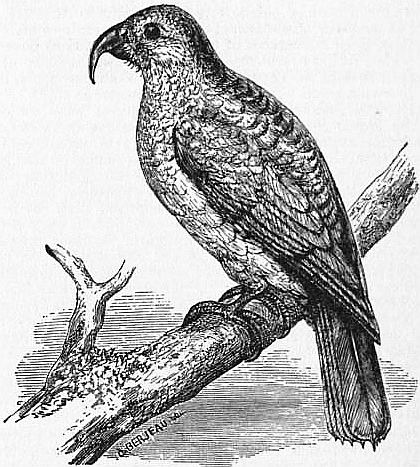
Fig. 22.—Extinct Phillip-Island Parrot (Nestor productus). (From specimen in the British Museum. Reduced.)
The New Zealand Subregion, considered by Professors Newton and Huxley and various other zoogeographers as deserving the rank of a region, is, and to all appearance has long been, more isolated than any other portion of the globe. Besides the three larger islands numerous satellites belong to the subregion, as Lord Howe, Norfolk and Kermadec islands, with the Chatham, Auckland and Macquarie groups. The main affinities of the avifauna are, of course, Australian. The most extraordinary feature is unquestionably the former existence of the gigantic Dinornithes or moas (q.v.) and, another family of Ratitae, the weird-looking kiwis or Apteryges, which are totally unlike any other existing birds. Of other peculiar genera it will suffice to mention only the more remarkable. Rallidae present the very noteworthy woodhens, Ocydromus, and the takahe, Notornis, which is almost extinct. The widely-spread plovers, Charadriidae, have two not less singular generic developments, Thinornis, and the extraordinary wrybill, Anarhynchus. There is an owl, type of the genus Sceloglaux. Of parrots, Stringops, the kakapo or owl-parrot, is certainly peculiar, while Nestor constitutes a peculiar subfamily of the brush-tongued parrots or Trichoglossidae. Xenicus and Acanthositta form a little family of truly mesomyodean Passeres Clamatores. Of the Meliphagidae the genera Prosthemadera, Pogonornis and Anthornis are peculiar. The starlings, Sturnidae, are represented by Callaeas, Creadion and the very abnormal Heterolocha. The gallinaceous birds are represented by a quail, Coturnix novae zealandiae, now exterminated. A large flightless goose, Cnemiornis, allied to the Australian Cereopsis, and the gigantic rapacious Harpagornis, have died out recently, with the moas. In all, there is a wonderful amount of specialization, though perhaps in a very straight line from generalized forms; but the affinity to Australian or Polynesian types is in many cases clearly traceable, and it cannot be supposed but that these last are of cognate origin with those of New Zealand. A very long period of isolation must have been required to produce the differences so manifestly to be observed, but a few forms seem at rare intervals to have immigrated, and this immigration would appear to be kept up to our own day, as shown by the instance of Zosterops lateralis, which is said to have lately made its first appearance, and to have established itself in the country, as well as by the fact of two cuckoos, the widely-ranging Eudynamis taitensis and Chrysococcyx lucidus, which are annual visitors.
Polynesia forms, of course, part of Austrogaea. Its extent is so vast that it necessarily contains some peculiar, outlying forms, so to say forgotten, which in their long-continued isolation have specialized themselves. For instance, the kagu (Rhinochetus) of New Caledonia, a queerly specialized form with Gruine affinities pointing only to South America. The toothbilled pigeon (Didunculus) is restricted to Samoa. Most interesting is the avifauna of the Sandwich islands; entirely devoid of Psittaci and of Coraciiformes, these islands show an extraordinary development of its peculiar family Drepanidae, which are probably of South or Central American descent. Acrulocercus is a Meliphagine, and a peculiar genus. There are a raven (Corvus), a coot (Fulica), the well-known Sandwich island goose (Bernicla sandvicensis), now very commonly domesticated in Europe; and some flycatchers and thrushlike birds.
The Australian Subregion comprises Australia and Tasmania. In the north it is influenced, of course, by its proximity to Papuasia, whence there is a considerable admixture of genera which do not proceed beyond the tropics, and of these Casuarius is a striking example. The Cape York peninsula practically belongs to Papuasia. As a whole, Australia is rich in parrots, of which it has several very peculiar forms, but Picarians in old-fashioned parlance, of all sorts—certain kingfishers excepted—are few in number, and the pigeons are also comparatively scarce, no doubt because of the many arboreal predaceous marsupials. The continent, however, possesses the two important genera of the Pseudoscines, namely the lyre-birds (Menura) and the scrub-birds (Atrichia). Among the more curious forms of other land-birds may be especially mentioned the Megapodiidae, Lipoa and Talegallus, the rail Tribonyx and Pedionomus, which represents the otherwise palaeotropical Turnices in Australia. The presence of bustards (Eupodotis) is a curious example of interrupted distribution, since none other of the Otididae are found nearer than India. The Ratitae are represented by two species of emeu (Dromaeus), besides the cassowary of Cape York peninsula, and the extinct Dromornis and Genyornis with its enormous skull.
The Papuan Subregion, chiefly New Guinea with its dependencies, the Timor group of islands, the Moluccas and Celebes. On the whole its avifauna presents some very remarkable features. Its most distinctive characteristic is the presence of the birds of paradise, which are almost peculiar to it; for, granting that the bower-birds, Chlamydodera and others, of Australia, belong to the same family, they are far less highly specialized than the beautiful and extraordinary forms which are found, within very restricted limits, in the various islands of the subregion. Another chief feature is the extraordinary development of the cassowaries, the richness and specialization of the kingfishers, parrots, pigeons, honey-suckers and some remarkable flycatchers. It has several marked deficiencies compared with Australia, among which are the babblers (Timeliidae), weaver birds (Ploceidae), the Platycercinae among parrots, diurnal birds of prey and the emeus. As a whole, the birds of Papua are remarkable for their brilliance of plumage, or their metallic colouring. The birds of paradise, the racquet-tailed kingfishers, Tanysiptera, the largest and smallest of parrots, Calyptdrhynchiis and Nasiterna, and the great crowned pigeons, Goura, are very characteristic; and so are the various Megapodes.
(B) Neogaea, or the Neotropical region.—Excepting towards the north, where, in Mexico, it meets, and inosculates with the Nearctic subregion, the boundaries of the Neotropical region are simple enough to trace, comprehending as it does the whole of South America and all Central America; besides including the Falkland islands to the south-east and the Galapagos under the equator to the west, as well as the Antilles or West India islands up to the Florida channel.
Owing to the comparatively scanty number of harmful mammalian types, the birds play a considerable part in this large region, and some authorities consider its avifauna the richest in the world. The entire number of species amounts to about 3600. Of these 2000, or a good deal more than half, belong to the order Passeriformes. But the characteristic nature of the avifauna is more clearly brought out when we learn that of the 2000 species just mentioned only about 1070 belong to the higher suborder of Oscines, that means to say, nearly one-half belong to the lower suborder Clamatores. This is a state of things which exists nowhere else; for except in Australia, where a few indigenous and peculiar low non-Oscines are found, and in the Nearctic country, whither one family of Clamatores, viz. the Tyrannidae, has evidently been led by the geographical continuity of its soil with that of the Neotropical region, such forms do not occur elsewhere. Accordingly their disproportionate prevalence in South America points unerringly to the lower rank of the avifauna of the region as a whole, and therefore to the propriety of putting it next in order to that of the Australian region, the general fauna of which is admittedly the lowest in the world. Huxley has urged with his wonted perspicuity the alliance of these two regions as Notogaea, basing his opinion, besides other weighty evidence, in great measure on the evidence afforded by the two main sections of the Galli, viz. the Peristeropodes and the Alectoropodes, the former composed of the families Megapodiidae, almost wholly Australian, and the Cracidae, entirely Neotropical. (Cf. P.Z.S., 1868. pp. 294-319.)
Leaving, however, this matter as in some degree hypothetical, we have as genera, families, or perhaps even larger groups, a great many very remarkable forms which are characteristic of, or peculiar to, the Neotropical region in part, if not as a whole. Of families we find twenty-three, or maybe more, absolutely restricted thereto, besides at least eight which, being peculiar to the New World, extend their range into the Nearctic region, but are there so feebly developed that their origin may be safely ascribed to the southern portion of America. First in point of importance comes the extraordinarily beautiful family of humming-birds (Trochilidae), with nearly 150 genera (of which only three occur in the Nearctic region) and more than 400 species. Then the tyrants (Tyrannidae), with more than seventy genera (ten of which range into the northern region), and over 300 species. To these follow the tanagers (Tanagndae), with upwards of forty genera (only one of which crosses the border), and about 300 species; the piculules (Dendrocolaptidae), with as many genera, and over 200 species; the ant-thrushes, (Formicariidae), with more than thirty genera, and nearly 200 species; together with other groups which, if not so large as those just named, are yet just as well defined, and possibly more significant, namely, the tapaculos (Pteroptochidae), the toucans (Rhamphastidae), the jacamars (Galbulidae), the motmots (Monotidae), the todies (Todidae), the trumpeters (Psophiidae), and the screamers (Palamedeidae); besides such isolated forms as the seriema (Cariama), and the sun-bittern (Eurypyga).
The nature of the South American avifauna will perhaps become still more evident if we arrange the characteristic members as follows:—
1. Birds which are restricted to, probably indigenous of the region: Rhea; Palamedea and Chauna, the screamers; Tinami; Psophia, Dicholophus, Eurypyga, Heliornis of the Gruiform assembly; Thinocorys and Attagis; Cracidae; Opisthocomus; of parrots Ara and Conurus with their allies; Monotidae, incl. Todus; Steatornis; Galbulinae and Bucconinae; Rhamphastidae; Formicariidae, Pteroptochidae, and of the Tyrannidae the Cotinginae.
2. Birds which are indigenous, but extend far into North America: Cathartae, Trochilidae, Tyrannidae.
3. Birds which are originally immigrants from North America: Podicipedidae, with the flightless Centropelma on Lake Titicaca; Ceryle, the only genus of kingfishers in the New World; all the Oscines.
More or less cosmopolitan groups like herons, Falconidae, Anseres, Columbae, &c., and circumtropical families like Parridae, Trogonidae, Capitonidae, are to be excluded from these lists as indifferent. The differences between the Neotropical avifauna and that of North America are fundamental and prove the independence or superior value of the Neotropical region as one of the principal realms.
It is difficult to subdivide the Neotropical region into subregions; the best suggestion is that of Newton: Antillean, with the exception of the islands of Trinidad and Tobago, as well as those which lie on the northern coast of South America; Patagonian, including Chile and part of Peru; Columbian, comprising the rest of the continent and also Central America.
The Antillean Subregion is in many respects one of the most suggestive and interesting, comparatively small though it be. For narrow as are the channels between Cuba and the opposite coast of Central America, between the Bahamas and Florida, and between Grenada and Tobago, the fauna of the Antillean chain, instead of being a mixture of that of the almost contiguous countries, differs much from all, and exhibits in some groups a degree of speciality which may be not unfitly compared with that of oceanic islands. Except such as are of coral formation, the Antilles are hilly, not to say mountainous, their summits rising in places to an elevation of 8000 ft., and nearly all, prior to their occupation by Europeans, were covered with luxuriant forest, which, assisting in the collection and condensation of the clouds brought by the trade winds, ensured its own vitality by precipitating frequent and long-continued rains upon the fertile soil. Under such conditions we might expect to find an extremely plentiful animal population, one as rich as that which inhabits the same latitudes in Central America, not many degrees farther to the west; but no instance perhaps can be cited which shows more strikingly the difference between a continental and an insular fauna, since, making every allowance for the ravages of cultivation by civilized man, the contrary is the case, and possibly no area of land so highly favoured by nature is so poorly furnished with the higher forms of animal life. Here, as over so large a portion of the Australian region, we find birds constituting the supreme class—the scarcity of mammals being accounted for in some measure as a normal effect of insularity.
There is one peculiar subfamily, Todinae, represented by only four species of Todus. We note the absence of Ratitae, Tinami, Cracidae, Rhamphastidae, and any of those gruiform genera which are so characteristic of the continent. There is no family of birds common to the Nearctic area and the Antillean subregion without occurring also in other parts of the Neotropical region, a fact which proves its affinity to the latter.
The Patagonian Subregion, most extratropical, is naturally devoid of a good many typically tropical birds, or these are but poorly represented, for instance Caerebidae, Mniotiltidae, Tanagridae, Vireonidae. On the other hand some of the most characteristic features of the whole region are here well represented, e.g. Rhea, Tinami, Chauna, Dicholophus, Attagis, Pteroptochidae, and indeed therein we find some of the best evidence of the antiquity of its population, both recent and extinct (cf. the numerous fossils of the Santa Cruz formation), and also the nearest resemblance to the fauna of Austrogaea.
(C) Arctogaea is Huxley’s well-chosen term for all the rest of the world (including the Nearctic, Palaearctic, Indian and Ethiopian regions of P.L. Sclater) in opposition to Notogaea. Faunistically, although not geographically, the Nearctic and Palaearctic areas must form the two subdivisions of one great unit, for which the “Holarctic region” is now the generally accepted term.
The Holarctic Region, comprising North America and the extratropical mass of land of the Old World, may from an ornithological point of view be characterized by the Colymbi, Alcidae, Gallidae or Alectoropodous Galli, and the Oscines, which have here reached their highest development; while Ratitae, Tinami, Psittaci, and non-Oscine Passeres (with the exception of Tyrannidae extending into North America and Conurus carolinensis) are absent.
Nearctic Subregion.—The close affinity of North America with the Palaearctic avifauna becomes at once apparent if we exclude those groups of birds which we have good reason to believe have their original home in the Neotropical region, notably numerous Tyrannidae, humming-birds and the turkey-buzzards.
The following groups may be mentioned as characteristic and typically American, and, since we consider them as comparatively recent immigrants into the Neotropical region, as originally peculiar to the Nearctic area: Mniotiltidae, Vireonidae, Icteridae, Meleagris and various Tetraoninae. Restricted to and peculiar to the sub-region is only the little Oscine family of Chamaeidae, restricted to the coast district of California. “More than one-third of the genera of Nearctic birds are common also to the Palaearctic subregion. If we take the number of Nearctic species at 700, which is perhaps an exaggeration, and that of the Palaearctic at 850, we find that, exclusive stragglers, there are about 120 common to the two areas. Nearly 20 more are properly Palaearctic, but occasionally occur in America, and about 50 are Nearctic, which from time to time stray to Europe or Asia. This, however, is by no means the only point of resemblance. Of many genera, the so-called species found in the New World are represented in the Old by forms so like them that often none but an expert can distinguish them, and of such representative ‘species’ about 80 might be enumerated” (Newton, Dict. Birds, p. 335).
Of the many attempts to subdivide the Nearctic subregion, the same authority favours that of Dr S.F. Baird, who distinguishes between Canadian, Alleghanian, Middle or Missourian, Californian and Alaskan provinces. Dr Hart Merriam takes the broad point of view “that the whole of extratropical North America consists of but two primary life regions, a Boreal region, which is circumpolar, and a Sonoran or Mexican tableland region which is unique.” The first of these supports Newton’s contention of the essential unity of the Nearctic and Palaearctic areas. In any case the various Nearctic subdivisions completely merge into each other, just as is to be expected from the physical configuration and other bionomic conditions of the Nort American continent.
The Palaearctic Subregion is, broadly speaking, Europe and Asia, with the exception of India and China. The propriety of comprehending this enormous tract in one zoological “region” was first shown by Dr P.L. Sclater, and as regards the distribution of most classes of animals there have been few to doubt that it is an extremely natural one. Not indeed altogether so homogeneous as the Nearctic area, it presents, however, even at its extreme points, no very striking difference between the bulk of its birds. Though Japan is far removed from western Europe, and though a few generic forms and still fewer families inhabit the one without also frequenting the other, yet there is a most astonishing similarity in a large portion of their respective birds. In some cases the closest examination has failed to detect any distinction that may be called specific between the members of their avifauna; but in most it is possible to discover just sufficient difference to warrant a separation of the subjects. Nevertheless, it is clear that in Japan we have, as it were, a repetition of some of our most familiar species—the redbreast and the hedge-sparrow, for example—slightly modified in plumage or otherwise, so as to furnish instances of the most accurate representation, e.g. Cyanopica cooki of Portugal and Spain, and C. cyana of Amoorland and Japan.
Like the Nearctic the Palaearctic subregion seems to possess but one single peculiar family of land birds, the Panuridae, represented by the beautiful species known to Englishmen as the bearded tit-mouse, Panurus biarmicus. The entire number of Palaearctic families are, according to Newton, 67, and of the genera 323. Of these 128 are common to the Nearctic subregion. Species of 51 more seem to occur as true natives within the Ethiopian and Indian regions, and besides these 18 appear to be common to the Ethiopian without being found in the Indian, and no fewer than 71 to the Indian without occurring in the Ethiopian. To compare the Palaearctic genera with those of the Australian and Neotropical regions would be simply a waste of time, for the points of resemblance are extremely few, and such as they are they lead to nothing. It will therefore be seen from the above that next to the Nearctic are the Palaearctic has a much greater affinity to any other, a fact which might be expected from geographical considerations.
Having shown this much we have next to deal with the peculiarities of the vast Palaearctic subregion. At the lowest computation 37 genera seem to be peculiar to it, though it is certain that species of several are regularly wont to wander beyond its limits in winter seeking a southern climate. Of the peculiar genera only a few examples may be mentioned: Eurynorhynchus, the spoon-billed sandpiper of Siberia; Syrrhaptes, the sandgrouse of central Asia; Musicicapa of Europe.
We distinguish between a Siberian, Mongolian, Mediterranean and European province, none of which can be well defined. The islands of the Canaries, Madeira and the Azores belong to the Mediterranean province, and offer some peculiarities of great interest. The Azores have been monographed by F.D. Godman (Nat. Hist. of the Azores or Western Islands, London, 1870). There is a general tendency among these insular birds to vary more or less from their continental representatives, and this is especially shown by the former having always darker plumage and stronger bills and legs. In one instance the variation is so excessive that it fully justifies the establishment of a specific distinction. This is the case of the bullfinch of the more western of these islands (Pyrrhula murina), the male of which, instead of the ruddy breast of its well-known congener (P. vulgaris), has that part of a sober mouse-colour. A similar sombre hue distinguishes the peculiar chaffinch of the Canary Islands (Fringilla teydea), but to these islands as well as the Azores and Madeiras there belongs in common another chaffinch (F. tintillon) which, though very nearly allied to that of Mauritania (F. spodogenia) is perfectly recognizable, and not found elsewhere. Madeira has also its peculiar golden-crested wren (Regulus maderensis), and its peculiar pigeon (Columba trocaz), while two allied forms of the latter (C. laurivora and C. bollii) are found only in the Canaries. Further on this subject we must not go; we can only state that Godman has shown good reason for declaring that the avifauna of all these islands is the effect of colonization extending over a long period of years, and going on now.
Palaeotropical Region.—Much can be said in favour of combining the mostly tropical portion of the great mass of land of the Old World (excluding, of course, Austrogaea or the Australian region) into one region, for which Oscar Drude’s well-chosen term “palaeotropical” has been adopted (cf. Bronn’s Thierreich, System Part. p. 296, 1893). This region naturally comprises the African and Indian areas, conformably to be called subregions.
Both subregions possess, besides others, the following characteristic birds: Ratitae, viz. Struthio in Africa and Arabia, fossil also in the Sivalik Hills, and Aepyornithidae in Madagascar; Pittidae, Bucerotinae and Upupinae, of which Upupa itself in India, Madagascar and Africa; Coraciidae; Pycnonotidae or bulbuls; Trogonidae, of which the Asiatic genera are the less specialized in opposition to the Neotropical forms; Vulturidae; Leptoptilus, Anastomus and Ciconia among the storks; Pteroclidae; Treroninae among pigeons. Of other families which, however, extend their range more or less far into the Australian realm, may be mentioned Otididae, the bustards; Meropidae or bee-eaters; Muscicapidae or flycatchers; Sturnidae or starlings.
The Ethiopian Subregion comprises the whole of Africa and Madagascar, except the Barbary States, but including Arabia; in the north-east the subregion melts into the Palaearctic between its limits still farther to the eastwards, through Beluchistan and even beyond the Indus.
So large a portion of the Ethiopian subregion lies between the tropics that no surprise need be expressed at the richness of its fauna relatively to that of the last two subregions we have considered. Between fifty and sixty so-called families of land birds alone are found within its limits, and of them at least nine are peculiar; the typical genera of which are Buphaga, Euryceros, Philepitta, Musophaga, Irrisor, Leptosoma, Colius, Serpentarius, Struthio, Aepyornis. It is singular that only the first three of them belong to the order Passeriformes, a proportion which is not maintained in any other tropical region. The number of peculiar genera, besides those just mentioned, is too great for them to be named here; some of the most remarkable on the continent are: Balaeniceps, the whale-headed heron; Balaearica, the crowned crane; Podica, finfoot; Numida and allied genera of guinea fowls.
The natural division of the subregion is that into an African and a Madagascar province. Subdivision of the continental portion is beset with great difficulties, and none of the numerous attempts have proved long-lived. The forest-clad basin of the Congo, with the coastal districts of the bay of Guinea, seem to form one domain in opposition to the rest.
The Malagasy province comprises, besides Madagascar, the Mascarene, Comoro and Seyehelle islands. It may be safely deemed the most peculiar area of the earth’s surface, while from the richness and multifariousness of its animal, and especially of its ornithic population, New Zealand cannot be compared with it. In A. Grandidier’s magnificent Histoire physique, naturelle et politique de Madagascar, vol. xii. (Paris, 1875-1884), are enumerated 238 species as belonging to the island, of which 129 are peculiar to it, and among those are no fewer than 35 peculiar genera. Euryceros of the Oscines, and Philepitta of the Clamatores, are remarkable enough to form the types of Passeriform families, and Mesites half-way between Galli and Gruiformes is of prime importance. The Passerine Falculia, with its recently extinguished allies Fregilupus and Necropsar of the Mascarenes; the Coraciine Brachypteracias, Atelornis and Geobiastes, are very abundant, while Heliodilus is an owl belonging to that subfamily which is otherwise represented only by the widely-spread barn owl, Strix flammea. Lastly must be noted the extinct tall Ratite species of Aepyornis with its several fancy genera. But, as Newton charmingly puts it (Dict Birds, p. 353), the avifauna of Madagascar is not entirely composed of such singularities as these. We have homely genera, even among the true Passeres, occurring there—such as Alauda, Acrocephalus, Motacilla and Pratincola, while the Cisticola madagascariensis is only distinguishable from the well-known fan-tailed warbler, C. schoenicola of Europe, Africa and India by its rather darker coloration. But there are also species, though not Passerine, which are absolutely identical with those of Britain, the barn owl, common quail, pigmy rail, and little grebe or dabchick, all of them common and apparently resident in the island. Mauritius had the dodo (q.v.), Lophopsittacus and Aphanapteryx. Rodriguez had the solitaire, Necropsittacus and Necropsar. Bourbon or Réunion had Fregilupus.
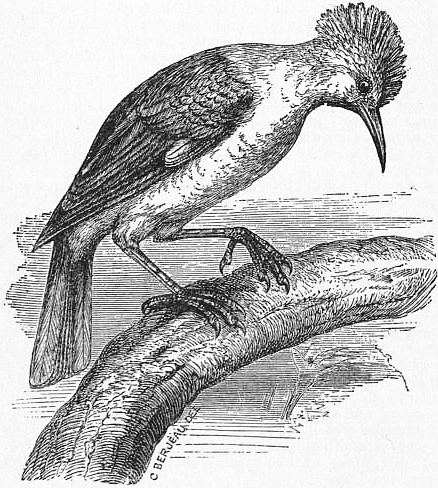
Fig. 23.—Extinct Starling of Reunion (Fregilupus varius), adapted from figures by Daubenton, Levaillant and others. Reduced.
Some of the Malagasy avifauna is certainly ancient, aboriginal, and even points to India; other forms indicate clearly their African origin; while, lastly, such strikingly characteristic Indo-African birds as hornbills are unaccountably absent.
The Oriental Subregion comprises all the countries and numerous islands between the Palaearctic and Australian areas; it possesses upwards of seventy families, of which, however, only one is peculiar, but this family, the Eurylaemidae or broadbills, is of great importance since it represents all the Subclamatores. Of the many characteristic birds may be mentioned Pycnonotidae or bulbuls, of which the Phyllornithinae are peculiar, Campephagidae or cuckoo shrikes, Dicruridae or drongos, Nectariniidae or sunbirds; pheasants, together with Pavo and Gallus. Some of the similarities to the Ethiopian and the great differences from the Australian avifauna have already been pointed out. Naturally no line whatever can be drawn between the Oriental and the Palaearctic subregions, and many otherwise essentially Indo-Malayan families extend far into the Australian realm, far across Wallace’s line, whilst the reverse takes place to a much more moderate extent. Certainly the Oriental area, in spite of its considerable size, cannot possibly claim the standing of a primary region. It is a continuation of the great Arctogaea into the tropics.
Following H.J. Elwes we subdivide the whole subregion into a Himalo-Chinese, Indian and Malayan province. These divisions had the approval of W.T. Blanford, who proposed the terms Cis- and Trans-gangetic for the two first. The Himalo-Chinese or Trans-gangetic province shows the characteristics of its avifauna also far away to the eastward in Formosa, Hainan and Cochin China, and again in a lesser degree to the southward in the mountains of Malacca and Sumatra. Indo-China is especially rich in Eurylaemidae, China proper and the Himalayas in pheasants.
The Indian or Cisgangetic province is the least rich of the three so far as peculiar genera are concerned.
The Malayan province comprising the Malay islands, besides the Malay peninsula, and the very remarkable Philippines, possess an extraordinary number of peculiar and interesting genera.
The influence of the Australian realm is indicated by a Megapode in Celebes, another in Borneo and Labuan, and a third in the Nicobar islands (which, however, like the Andamans, belong to the Indian province), but there are no cockatoos, these keeping strictly to the other side of Wallace’s line, whence we started on this survey of the world’s avifauna.
D. Classification of Birds
Fürbringer’s great work, published in the year 1888 by the Natura Artis Magistra Society of Amsterdam, enabled Gadow not only to continue for the next five years the same lines of morphological research, but also further to investigate those questions which were still left in abeyance or seemed to require renewed study. The resulting “classification is based on the examination, mostly autoptic, of a far greater number of characters than any that had preceded it; moreover, they were chosen in a different way, discernment being exercised in sifting and weighing them, so as to determine, so far as possible, the relative value of each, according as that value may vary in different groups, and not to produce a mere mechanical ‘key’ after the fashion become of late years so common” (Newton’s Dictionary of Birds, Introduction, p. 103). It is not the quantity but the quality of the anatomical and bionomic characters which determines their taxonomic value, and a few fundamental characters are better indications of the affinities of given groups of birds than a great number of agreements if these can be shown to be cases of isomorphism or heterophyletic, convergent analogy. Nature possesses three great educational or developmental schools—terrestrial, aquatic and aerial life. Each of these affords animal, vegetable or mixed diet. Animal diet implies the greatest variety with regard to locality and the modes of procuring the food. Each of these schools impresses its pupils, in the case of the birds, with its own stamp, but there are many combinations, since in the course of phyletic development many a group of birds has exchanged one school for another. Originally terrestrial groups have taken to an entirely aquatic life, and vice versâ; others, originally endowed with the power of flight, have become, or are transforming themselves into, absolutely cursorial forms; some members of one group live entirely on seeds, while others have become fierce fishers, and so forth. Only by the most careful inquiry into their history can their relationship or pedigree be unravelled. A statement may now be given of Gadow’s classification of birds, in which the extinct forms have been intercalated so far as possible. The few characters assigned to the various groups are sufficiently diagnostic when taken together, although they are not always those upon which the classification has been established:—
Class AVES
I. Sub-class Archaeornithes.—The three fingers and their metacarpals remain separate, each with a claw. Well-developed remiges. Both jaws with alveolar teeth. Amphicoelous. Caudal vertebrae more than thirteen, without a pygostyle, but with about twelve pairs of rectrices. Archaeopteryx, A. lithographica, s. macroura, two specimens from the upper Oolite of Solenhofen, Bavaria.
II. Sub-class Neornithes.—Metacarpals fused. Second finger the longest. Not more than thirteen caudal vertebrae.
I. Division Ratitae.—Terrestrial, flightless. Without sternal keel. Quadrate bone with single proximal knob. Without pygostyle. Coracoid and scapula fused. Compound rhamphotheca. Adult without apteria. With copulatory organ. A collective polyphyletic or heterogeneous group, originally cosmopolitan; with certainty existing since the Miocene.
1. Order Struthiones.—With pubic symphysis. Two toes only, third and fourth. Struthio, ostrich, Pliocene of Samos and of north-west India, now Africa and Arabia.
2. Order Rheae.—With long ischiadic symphysis. Three toes. Mesembriornis, Miocene or Pliocene of Argentina. Rhea, South America.
3. Order Casuarii.—Three toes. Aftershaft as long as the other half. Casuarius and Dromaeus, Australian. Hypselornis, Pliocene of Sivalik Hills.
4. Order Apteryges.—Four toes. Bill long and slender. Apteryx, New Zealand.
5. Order Dinornithes.—Three or four toes. Bill short. Anterior limbs extremely reduced. Dinornis, numerous species, recently extinct, New Zealand.
6. Order Aepyornithes.—Aepyornis, recently extinct, Madagascar.
To the Ratitae belong possibly also the imperfectly known Diatryma, Eocene of New Mexico, Gastornis and Dasornis, Eocene of Europe, Genyornis, Pleistocene of Australia.
II. Division Odontolcae.—Marine, flightless, without sternal keel. Upper and lower jaws with teeth in furrows. Cretaceous epoch. Enaliornis, England, vertebrae chiefly biconcave; Hesperornis, North America, vertebrae heterocoelous.
III. Division Carinatae.—With keeled sternum.
1. Order Ichthyornithes.—Power of flight well developed. Vertebrae still amphicoelous. With small pygostyle. Incisura ischiadica. With alveolar teeth. Cretaceous of Kansas. Ichthyornis, Apatornis.
2. Order Colymbiformes.—Plantigrade, nidifugous, aquatic. All toes webbed, fourth largest, hallux short; metatarsus laterally compressed; tibia with high, pyramidal crest. Bill straight, pointed, with simple sheath.
Sub-order 1. Colymbi, Divers. Front toes completely webbed. Holarctic. Colymbus.
Sub-order 2. Podicipedes, Grebes. Toes lobated. Cosmopolitan.
3. Order Sphenisciformes.—Nidicolous, marine. Flightless, wings transformed into rowing paddles. Sphenisci, penguins. Antarctic and southern temperate coasts. Since the Eocene.
4. Order Procellariiformes.—Well flying, pelagic, nidicolous. Hallux absent or vestigial. Rhamphotheca compound. Cosmopolitan. Tubinares, petrels and albatrosses.
5. Order Ciconiiformes.—Swimmers or waders. Desmognathous, without basipterygoid processes; with one pair of sterno-tracheal muscles.
Sub-order 1. Steganopodes.—Well flying, aquatic, nidicolous; with all the four toes webbed together. Rhamphotheca compound; cosmopolitan. Phaëthon, tropic-bird; Sula, gannet; Phalacrocorax, cormorant and Plotus, snake-bird; Fregata, frigate-bird; Pelecanus. Here also Pelagornis, Miocene of France; Argillornis and probably Odontopteryx from the London Clay.
Sub-order 2. Ardeae.—Piscivorous, nidicolous, waders; with complicated hypotarsus and with long cervical apteria. Ardeidae, cosmopolitan; including Cancroma, Neotropical, Balaeniceps, Scopidae, Ethiopian. Proherodius, Eocene of England.
Sub-order 3. Ciconiae.—Zoophagous, nidicolous, waders; with simple hypotarsus and without cervical apteria. Cosmopolitan. Ciconiidae, storks. Ibidae, ibises and spoonbills. Propelargus, Oligocene.
Sub-order 4. Phoenicopteri.—Flamingos. Nidifugous, waders; with simple hypotarsus and without cervical apteria. Front toes completely webbed; hallux very short or absent; feed chiefly on small aquatic invertebrates. Phoenicopterus, cosmopolitan. Oligocene Elornis and, allied, Palaelodus.
6. Order Anseriformes.—Desmognathous, nidifugous; with two pairs of sterno-tracheal muscles, with complete basipterygoid processes and with a penis.
Sub-order 1. Palamedeae.—Screamers. Ribs without uncinate processes. Hypotarsus simple. Neotropical. Chauna, Palamedea.
Sub-order 2. Anseres.—Family Anatidae. Hypotarsus complex. Anser, Anas, Cygnus, since Miocene. Cnemiornis, Pleistocene, New Zealand, flightless.
7. Order Falconiformes.—Birds of prey. Carnivorous, desmognathous, nidicolous, without functional caeca. Terrestrial, aerial.
Sub-order 1. Cathartae.—American vultures. With nares perviae. Cathartes, turkey buzzards, Sarcorhamphus gryphus, condor Gypagus papa, king vulture.
Sub-order 2. Accipitres.—With nares imperviae. Serpentariidae, secretary-bird, Ethiopian; Miocene, France. Vulturidae, Old World vultures, excluding Australia. Falconidae, cosmopolitan, since the Eocene. Harpagornis, Pleistocene, New Zealand; Lithornis, Eocene, England. Pandionidae, ospreys or fish hawks, cosmopolitan.
8. Order Tinamiformes.—Nidifugous, with incisura ischiadica, without pygostyle. Herbivorous, terrestrial, neotropical. Crypturi, tinamous.
9. Order Galliformes.—Schizognathous, herbivorous, terrestrial. With ten functional remiges. With strong spinae sterni.
Sub-order 1. Mesites.—Without basipterygoid processes, and with large spina interna. Mesites, Madagascar.
Sub-order 2. Turnices.—Hemipodes or button-quails. Nidifugous; vomer large; sternum without processus obliqui. Hallux absent or vestigial. Old World. Turnix, Pedionomus.
Sub-order 3. Galli.—With large spina communis, and with large processus obliqui. Hallux functional. Megapodiidae, Australian region. Cracidae, curassows and guans, neotropical. Gallidae, cosmopolitan.
Sub-order 4. Opisthocomi.—Arboreal, with long spina externa; without basipterygoid processes. Opisthocomus hoatzin, Guiana, Venezuela and Amazon countries.
10. Order Gruiformes. Legs of the wading type. Without basipterygoid processes. Without spina interna. Nidifugous. Essentially Schizognathous. Rallidae, cosmopolitan, since Oligocene. Rallus, Fulica, Ocydromus, &c., Gallinula nesiotis, Tristan d’Acunha, flightless. Notornis, New Zealand, flightless, nearly extinct. Aptornis, New Zealand, flightless, extinct. Aphanapteryx (Mauritius) = Erythromachus (Rodriguez) = Diaphorapteryx (Chatham Island), flightless and recently extinct. Gypsornis, upper Eocene, France. Gruidae, cranes, cosmopolitan, allied Phororhacos, Tertiary of Argentina. Dicholophidae, cariamas, neotropical. Otididae, bustards, Old World. Rhinochetidae, kagus, New Caledonia. Eurypygidae, sun-bittern, neotropical. Heliornithidae, finfoots, tropical.
11. Order Charadriiformes.—Schizognathous. With eleven remiges, of which the terminal very short. Aquinto-cubital. Spinae sterni short, separate.
Sub-order 1. Limicolae.—Nidifugous, without spina interna sterni. Hypotarsus complicated. Charadriidae, plovers. Chionididae, sheath-bill. Glareolidae, wading swallows and coursers. Thinocorythidae, seed-snipes. Oedicnemididae, thick-knees. Parridae.
Sub-order 2. Lari.—Aquatic, vomer complete. Without basipterygoid processes. Front toes webbed; hallux small or absent. Large supraorbital glands. Since Miocene. Laridae, gulls, cosmopolitan. Alcidae, auks, northern half of periarctic region.
Sub-order 3. Pterocles.—Sand-grouse. Nidifugous. Vomer vestigial. With large crop and caeca. Hallux vestigial or absent since Oligocene. Africa to India, and Siberia. Pterocles and Syrrhaptes.
Sub-order 4. Columbae.—Pigeons. Nidicolous. Vomer vestigial. With large crop, vestigial caeca. Columbidae, cosmopolitan, since Miocene. Dididae, flightless, recently extinct. Didus, dodo, Mauritius. Pezophaps, solitaire, Rodriguez.
12. Order Cuculiformes.—Desmognathous, nidicolous; zygodactylous, or with the outer toe reversible.
Sub-order 1. Cuculi.—Cuckoos. Quinto-cubital. Cuculidae, cosmopolitan. Musophagidae, plantain-eaters and touracos, Ethiopian since Miocene.
Sub-order 2. Psittaci.—Parrots. Zygodactylous; aquinto-cubital. Cosmopolitan, chiefly tropical. Trichoglossidae, lories, Austro-Malayan. Nestor, New Zealand. Cyclopsittacus, Eos, Lorius, &c. Psittacidae, tongue smooth, incl. Stringops.
13. Order Coraciiformes.—Nidicolous. Nares imperviae, holorhinal. Downs restricted to the apteria or absent. Thirteen to fifteen cervical vertebrae. Mostly desmognathous. Deep plantar tendons connected with each other.
Sub-order 1. Coraciae.—Either (1) with long spina externa sterni, Coraciidae, rollers, Old World. Momotidae, neotropical, motmots and todies. Alcedinidae, kingfishers, cosmopolitan or (2) with long spina communis. Meropidae, bee-eaters, Old World. Upupidae, Upupinae, hoopoes: palaearctic and palaeotropical. Bucerotinae, hornbills, palaeotropical; Irrisorinae, woodhoopoes, Ethiopian.
Sub-order 2. Striges.—Owls. Outer toe reversible. Schizognathous. Long caeca. Flexor tendons normal. Hypotarsus simple. Cosmopolitan.
Sub-order. 3. Caprimulgi.—Nightjars. Nocturnal. With gaping mouth. Ten remiges and ten rectrices. Spinae sterni vestigial. Caeca functional. Steatornithidae, Steatornis, oil-bird or guacharo, South America. Podargidae, Australasian, Caprimulgidae, cosmopolitan.
Sub-order 4. Cypseli.—Tenth terminal remex the longest. With short spinae sterni. Without caeca. Cypselidae, swifts, cosmopolitan. Trochilidae, humming-birds, American.
Sub-order 5. Colii.—Mouse-birds. First and fourth toes reversible. Ethiopian.
Sub-order 6. Trogones.—Trogons. Heterodactyle, first and second toes directed forwards, third and fourth backwards. Tropical. Trogon gallicus, Miocene of France.
Sub-order 7. Pici.—Zygodactylous. Tendon of the flexor hallucis longus muscle sending a strong vinculum to that of the flexor profundus muscle, the tendon of which goes to the third toe only. Galbulidae, puff-birds and jacamars, neotropical. Capitonidae, barbets, tropical. Rhamphastidae, toucans, neotropical. Picidae, woodpeckers, cosmopolitan, excepting Madagascar and Australian region.
14. Order Passeriformes.—Nidicolous. Aegithognathous, without basipterygoid processes. Spina externa sterni large, spina interna absent. Quinto-cubital, toes normal. Apparently since the upper Eocene.
Sub-order 1. Passeres Anisomyodae.—Syrinx muscles entirely lateral or attached to the dorsal or ventral corners of the bronchial semi-rings, (1) Subclamatores. Deep plantar tendons connected by a vinculum. Eurylaemidae, broadbills, Indian and Indo-Malayan. (2) Clamatores. Deep flexor tendons not connected. Pittidae, palaeotropical. Xenicidae, New Zealand. Tyrannidae, American, Formicariidae, Pteroptochidae, neotropical.
Sub-order 2. Passeres Diacromyodae.—Syrinx muscles of either side attached to the dorsal and ventral corners of the rings. Hallux strong, with a large claw, (1) Suboscines with Menura, lyre-bird, and Atrichia, scrub-bird, in Australia. (2) Oscines, the true singing-birds, with more than 5000 recent species, are mostly divided into some thirty “families,” few of which can be defined.
The fourteen orders of the Carinatae are further congregated into four “Legions”:—
I. COLYMBOMORPHAE = Ichthyornithes + Colymbiformes + Sphenisciformes + Procellariiformes.
II. PELARGOMORPHAE = Ciconiiformes + Anseriformes + Falconiformes.
III. ALECTOROMORPHAE = Tinamiformes + Galliformes + Gruiformes + Charadriiformes.
IV. CORACIOMORPHAE = Cuculiformes + Coraciiformes + Passeriformes.
These four legions are again combined into two “Brigades,” the first of which comprises the first and second legions, while the second brigade contains the third and fourth legions.
Thus the whole classification becomes a rounded-off phylogenetic system, which, at least in its broad outlines, seems to approach the natural system, the ideal goal of the scientific ornithologist. The main branches of the resultant “tree” may be rendered as follows:—

The Odontolcae seem to be an early specialized offshoot of the Colymbo Pelargomorphous brigade, while the Ratitae represent a number of side branches of early Alectoromorphae. The Ratitae branched off, probably during the Eocene period, from that still indifferent stock which gave rise to the Tinami + Galli + Gruiformes, when the members of this stock were still in possession of those archaic characters which distinguish Ratitae from Carinatae. It follows that new groups of Ratitae can no longer be developed since there are no Carinatae living which still retain so many low characters, e.g. configuration of the palate, precoracoid, pelvis, intestinal convolutions, copulatory organ, &c. Loss of the keel is co-ordinated with the power of using the forelimbs for locomotion; although a “Ratite” character, it is not sufficient to turn a Notornis, Cnemiornis or Stringops, not even a Phororhacos into a member of the Ratitae.
Another branch of the Alectoromorphae, in particular of the Galliformes, when these were still scarcely separated from the Gruiformes, especially rail-like birds, leads through Opisthocomi to the Cuculiformes. These are, again in an ascending direction, connected with the Coraciiformes, out of which have arisen the Passeriformes, and these have blossomed into the Oscines, which, as the apotheosis of bird life, have conquered the whole inhabitable world.
(H. F. G.)
1 Treviranus, Biologie oder Philosophie der lebenden Natur, vol. ii. cap. 4, § 2 (Göttingen, 1803).
2 F. Tiedemann, Anatomie und Naturgeschichte der Vögel, vol. ii §§ 127-255 (Heidelberg, 1814).
3 L.K. Schmarda, Die geographische Verbreitung der Thiere (Wien, 1853).
4 P.L. Sclater on the general geographical distribution of the members of the class “Aves,” 2. Linn. Soc. ii. pp. 130-145, 1858.
5 A.R. Wallace, The Geographical Distribution of Animals, with a study of the Relations of Living and Extinct Faunas as elucidating the Past Changes of the Earth’s Surface, 2 vols. (London, 1876).
6 T.H. Huxley, “On the Classification and Distribution of the Alectoromorphae,” P.Z.S., 1868, pp. 313-319.
7 The following old-fashioned rough computation may serve as an indication of the relative size of the orders and suborders of recent birds:—
Ratitae 20 Gruiformes 250
Colymbiformes 20 Charadriiformes 650 (incl. Columbae 350)
Sphenisciformes 15 Cuculiformes 600 (incl. Psittaci 400)
Procellariiformes 90 Coraciiformes 1600 (incl. Trochili and Pici)
Ciconiiformes 150 Passeres Clamatores 1000
Anseriformes 150 Passeres Oscines 5000
Falconiformes 360 ———
Tinamiformes 40 Total about 10,300 species
Galliformes 370
BIRD-LOUSE, any small flat degenerate wingless neuropterous insect of the group Mallophaga, parasitic upon birds and mammals and feeding upon dermal excretions or upon the softer parts of hair and feathers. The term “biting-lice” is sometimes given to these parasites, in allusion to the mandibulate character of their mouth-parts, which serves to distinguish them at once from the true lice of the order Rhynchota in which the jaws are haustellate.
BIRD’S-EYE, a name applied to various small bright flowers, especially those which have a small spot or “eye” in the centre. The primula is thus spoken of, on account of its yellow centre, also the adonis, or “pheasant’s eye,” and the blue veronica, or germander speedwell. The word is also applied to a sort of tobacco, in which the stalks (of a mottled colour) are cut up together with the leaves. From a similar sense comes the phrase “bird’s-eye maple,” a speckled variety of maple-wood, or the “bird’s-eye handkerchief” mentioned in Thackeray’s novels.
BIRDSNESTING, a general term for the pursuit of collecting and preserving birds’ eggs, with or without the nests themselves. The nests and eggs of wild birds are nowadays protected by local laws almost everywhere in both Great Britain and the United States. By law they may be taken for scientific purposes only, by special licence. In order not to interfere seriously with breeding it is customary to take but one egg from a nest, and, if the nest itself be taken, to wait until the young birds have left it. Every egg, unless “hard-set,” should be blown as soon as removed from the nest. This is done by opening a small hole in its side by means of a drill with a conical head, manufactured for the purpose, a minute hole for the insertion of the drill-head having first been made in the shell with a needle, which is then used to stir up the contents, so that they shall flow easily. A blow-pipe with a curved mouth is then inserted, the egg is held hole downwards, and the contents blown out. The old-fashioned method of making two holes in the egg is thus superseded. Should the egg be “hard-set” a somewhat larger hole is made and its edges reinforced with layers of paper pasted round them. Minute forceps are then introduced and the embryo cut into pieces small enough to pass through the hole. The inside of the egg is then rinsed out with clean water, and also before being placed in the cabinet, with a solution of corrosive sublimate, which prevents decay and consequent discoloration of the inner membrane. Finally the egg is placed with the hole downwards upon a sheet of white blotting-paper to dry. The authentication of the eggs is the most important duty of an egg-collector, next to identifying the specimens. According to some the best method is to mark with a fine pen on the egg itself the variety, scientific name, locality of nest, date of taking and the initials of the collector, as well as a reference to his note-book or catalogue. Others advocate keeping the authentication separate with only a numbered reference on the egg itself. Eggs should not be transported in bran or sawdust, but in strong wool-lined boxes. The best cabinets are fitted with drawers, pulled out to inspect the eggs, but at other times closed to preserve them from the light, which is injurious to their delicate colouring. When an entire nest is taken it should be disinfected with hyposulphite of soda or insect-powder.
See Birdnesting and Bird-Skinning, by E. Newman (London, 1888); The Young Collector’s Handbook of British Birds’ Nests and Eggs, by W.H. Bath (London, 1888); Birds’ Nests, Eggs and Egg-Collecting, by R. Kearton (London, 1890); British Birds’ Eggs and Nests, by J.C. Atkinson (London, 1898); Nests and Eggs of North American Birds, by Ernest Ingersoll (1880-1881).
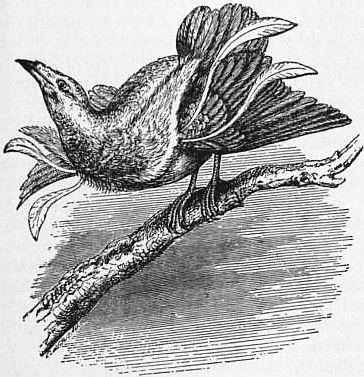
Standard Wing Bird of Paradise (Semioptera wallacei).
BIRDS OF PARADISE, a group of passerine birds inhabiting New Guinea and the adjacent islands, so named by the Dutch voyagers in allusion to the brilliancy of their plumage, and to the current belief that, possessing neither wings nor feet, they passed their lives in the air, sustained on their ample plumes, resting only at long intervals suspended from the branches of lofty trees by the wire-like feathers of the tail, and drawing their food “from the dews of heaven and the nectar of flowers.” Such stories obtained credence from the fact that so late as the year 1760, when Linnaeus named the principal species apoda, or “footless,” no perfect specimen had been seen in Europe, the natives who sold the skins to coast traders invariably depriving them of feet and wings. The birds now usually included under this name belong to the family Paradiseidae, closely allied to the crows. The largest is the great emerald bird (Paradisea apoda), about the size of the common jay. Its head and neck are covered with short thick-set feathers, resembling velvet pile, of a bright straw colour above, and a brilliant emerald green beneath. From under the shoulders on each side springs a dense tuft of golden-orange plumes, about 2 ft. in length, which the bird can raise at pleasure, so as to enclose the greater part of its body. The two centre tail feathers attain a length of 34 in., and, being destitute of webs, have a thin wire-like appearance. This splendid plumage, however, belongs only to the adult males, the females being exceedingly plain birds of a nearly uniform dusky brown colour, and possessing neither plumes nor lengthened tail feathers. The young males at first resemble the females, and it is only after the fourth moulting, according to A.R. Wallace, who has studied those birds in their native haunts, that they assume the perfect plumage of their sex, which, however, they retain permanently afterwards, and not during the breeding season only as was formerly supposed. At that season the males assemble, in numbers varying from twelve to twenty, on certain trees, and there disport themselves, so as to display their magnificent plumes in presence of the females. Wallace in his Malay Archipelago, vol. ii., thus describes the attitude of the male birds at one of those “sacaleli,” or dancing parties, as the natives call them; “their wings,” he says, “are raised vertically over the back, the head is bent down and stretched out, and the long plumes are raised up and expanded till they form two magnificent golden fans striped with deep red at the base, and fading off into the pale brown tint of the finely-divided and softly-waving points; the whole bird is then overshadowed by them, the crouching body, yellow head, and emerald green throat, forming but the foundation and setting to the golden glory which waves above.” It is at this season that those birds are chiefly captured. The bird-catcher having found a tree thus selected for a “dancing party,” builds a hut among the lower branches in which to conceal himself. As soon as the male birds have begun their graceful antics, he shoots them, one after the other, with blunt arrows, for the purpose of stunning and bringing them to the ground without drawing blood, which would injure their plumage; and so eager are those birds in their courtship that almost all the males are thus brought down before the danger is perceived. The natives in preparing the skins remove both feet and wings, so as to give more prominence to the commercially valuable tuft of plumes. They also remove the skull, and the skin is then dried in a smoky hut. The great emerald bird, so far as yet known, is only found in the Aru Islands. The lesser bird of paradise (Paradisea minor), though smaller in size and somewhat less brilliant in plumage, in other respects closely resembles the preceding species. It is also more common, and much more widely distributed, being found throughout New Guinea and the neighbouring islands. Its plumes are those most generally used as ornaments for ladies’ head-dresses. Both species are omnivorous, feeding voraciously on fruits and insects. They are strong, active birds, and are believed to be polygamous. The king bird of paradise (Cicinnurus regius) is one of the smallest and most brilliant of the group, and is specially distinguished by its two middle tail feathers, the ends of which alone are webbed, and coiled into a beautiful spiral disk of a lovely emerald green. In the red bird of paradise (Paradisea rubra) the same feathers are greatly elongated and destitute of webs, but differ from those in the other species, in being flattened out like ribbons. They are only found in the small island of Waigiu off the coast of New Guinea. Of the long-billed paradise birds the most remarkable is that known as the “twelve-wired” (Seleucides alba), its delicate yellow plumes, twelve of which are transformed into wire-like bristles nearly a foot long, affording a striking contrast to the dark metallic tints of the rest of its plumage.