VOLUME III SLICE VII Bible to Bisectrix (continued 3)
Reading edition
It would be somewhat later than this, and not until the eschatological outlook became weaker, and men began to turn their regard to the past rather than to the future, that there would gradually arise a more strictly historical interest. There is reason to think that in the Christian Church this interest did not begin to be active much before the decade A.D. 60-70. Its first conspicuous product was our present Gospel of St Mark, which was probably composed at Rome within the years 64-70. We say advisedly “our present Gospel of St Mark,” because there does not seem to us to be any sufficient reason for presupposing an Ur-Marcus, or older form of this Gospel.
These two works, the Logia (or, as some prefer to call it, the Non-Marcan document common to Matthew and Luke) and the Mark-Gospel, were the prime factors in all the subsequent composition of Gospels. Our Matthew and our Luke are just combinations, differently constructed, of these two documents, with a certain amount of additional matter which the editors had collected for themselves. And it is probable that other Gospels of which only fragments have come down to us, like the Gospel according to the Hebrews and the Gospel of Peter, have been built up out of the same materials.
St Luke was the first to write, as we may see from his preface, definitely in the spirit of a historian. He addresses his work to Theophilus, apparently an official person, who had already been taught the main outlines of Christianity. He had planned his work on a large scale; and in Acts we have its second volume. It is an event of no small importance for criticism that so eminent a scholar as Prof. Harnack should have come round to the view, almost universally prevalent in England, that St Luke himself was the final editor and author of both the Third Gospel and the Acts. It is a very secondary question what is their exact date.
The reasons which converge upon the conclusion just expressed as to the origin and nature of the fundamental documents worked up in our present Synoptic Gospels are as follows:—(i.) The literary analysis of the Synoptic Gospels brings out a number of sections common to Matthew and Luke which probably at one time existed as an independent document. (ii.) This document consisted, in the main though not entirely, of a collection of Sayings of the Lord, which set in strong relief at once His character and the moral and religious ideal that He desired to commend. (iii.) We have an express statement, which must have been originally made before the end of the first century, that the apostle Matthew composed in Hebrew a work described as Logia. This word need not mean, but may quite well and pointedly mean, a collection specially of Sayings, and would still more aptly denote a collection of divine or authoritative sayings (λόγια = prop. “oracles”). (iv.) We know further that the conditions of early Christian missionary teaching were such as have been described. We learn this especially from the Didache; and the first part of that work, the so-called “Two-Ways,” is commonly thought to have been in the first instance a Jewish manual put into the hands of proselytes. On our hypothesis the Logia would have been a sort of Christian manual used with a similar object. (v.) We are confirmed in this opinion by the fact that the epistles of St Paul furnish many indications that Christians in general, including those who had not been much in contact with the original Twelve, were well acquainted with the leading features in the character of Christ and in the Christian ideal, although there is little corresponding evidence for their knowledge of details in the life of Christ.
There is a similar statement to the one mentioned above, that like it must have been originally made before the end of the first century, as to a Gospel composed by St Mark on the basis mainly of the preaching of St Peter, though this need not exclude personal experience (as, e.g., perhaps in Mark xiv. 51-52) or information derived from other sources. Only raw materials came from St Peter, and those probably not checked or revised by him; the arrangement is due to Mark himself, and is more successful than might have been expected in the circumstances—indeed so successful as to suggest advice from some good quarter. According to Irenaeus (c. A.D. 185), who is more precise than Clement of Alexandria, the Gospel was not published until after the death of Peter, which would place its composition between the limits A.D. 65 and 70. The phenomena which are sometimes supposed to require the hypothesis of an Ur-Marcus are more simply and satisfactorily explained as incidents in the transmission of the Marcan text.
The matter peculiar to Matthew and Luke raises a number of interesting questions which are still too much sub judice to be answered decidedly or dogmatically, though approximate and provisional answers may before long be forthcoming. All parts of the problem have been greatly forwarded by the recent publication of important works by Wellhausen and Harnack (see below). The date of the completed Luke depends (a) on whether or not we believe Luke himself or a later disciple to be the author, and (b) whether or not we believe that the author of Acts had seen Josephus’ Antiquities, published in A.D. 93 or 94. Professor Burkitt takes an original line in maintaining that Luke was the author of both works, and yet that he had seen Antiq. The present writer is inclined to think the latter hypothesis not proven. The date of Matthew cannot be fixed more nearly than 70-100.
3. The Catholic Epistles.—The Catholic Epistles were so called in the first instance from their wider and more indefinite address; they were intended for Christians generally, or over some wide area, rather than for a particular church or individual. 2 and 3 John are exceptions, but probably came in under the wing of the larger epistle, which is strictly “catholic.” As applied to a class of epistles, the title dates from Eusebius, early in the 4th century; the epithet is given to single epistles by Origen, and is found as far back as the end of the 2nd century. In later Latin usage “catholic” came to mean much the same as “canonical,” another name that was also given.
This group of epistles practically continues and supplements the work of the epistles of St Paul, 1 Peter, if genuine, must date from the end of the apostle’s career (for the early composition claimed for it by B. Weiss is a paradox that may be disregarded). It was written to instruct and encourage the Christians of Asia Minor at a time of persecution, which on the hypothesis of genuineness, would be the Neronian, i.e. a secondary outbreak perhaps loosely connected with the onslaught in Rome. The Epistle of James (also, if genuine) must be placed late in the lifetime of the brother of the Lord. In that case it was probably not written with any direct polemic against writings of St Paul, but against hearsay versions of his teaching that had reached Jerusalem. Controversy of this kind is not always conducted with complete understanding of that which is being opposed. The Epistle of Jude cannot be either dated or localized with any certainty. It seems on the whole most probable that 2 Peter is not a genuine work, but that it came from the same factory of pseudonymous Petrine writings as the Apocalypse which bears the same name, though the one has, and the other has not, obtained a place within the Canon. This epistle was questioned from the first, and only gained its place with much hesitation, and rather through slackness of opposition than any conclusiveness of proof. The three Johannine epistles may be more conveniently treated under the next head.
Even in the case of the two more important epistles, 1 Peter and James, we have to add the qualification “if genuine,” but rather perhaps because of the persistence with which they are challenged than because of inherent defect of attestation. The evidence for 1 Peter is both early in date and wide in range, and the book was one of those that passed as “acknowledged” in antiquity. The evidence for James is not so widely diffused but is found in early writings. Perhaps the position of these two epistles might be described as not unlike that of Colossians and Ephesians. Instead of casting doubt upon them, we should prefer to say that they are both probably genuine, but that there are features about them that are not as yet fully explained. The chief of these features is their relation to the writings of St Paul. There is indeed so much that is Pauline in 1 Peter as to give distinct attractiveness to the hypothesis, which is most elaborately maintained by Zahn, that a larger share than usual in the composition of the letter was left to Silvanus (1 Peter v. 12). Nor does it appear to us that the objections to this theory brought by Dr Chase in his excellent article on the epistle in Hastings’ Dictionary are really so fatal as he supposes. The epistle is more the work of a companion of St Paul of long standing than of one who, with quite different and independent antecedents, had only been influenced by the perusal of one or two of St Paul’s letters. In the Epistle of James we have a really distinct type; and it seems to us that the degree to which the epistle misses its mark as a polemic may be easily and naturally accounted for in more ways than one.
4. The Johannine Writings.—The Gospel and Epistles that bear the name of John, and the Apocalypse, form a group of writings that stand very much by themselves and are still the subject of active discussion. The points in regard to them that would unite the greatest number of suffrages would seem to be these:—(i.) That, except 2 Peter, they are probably the latest of the New Testament writings, and that they form a group closely connected among themselves, though it is not clear how many hands have been at work in them, (ii.) That they arose not far from each other towards the end of the 1st century. The Apocalypse is plausibly dated by Reinach and Harnack near to the precise year 93, and the other writings may be referred to the reign of Domitian (81-96), though many critics would extend the limit to some two decades later, (iii.) The writings are to be connected, either more or less closely, with John of Ephesus, who was a prominent figure towards the end of the 1st century. On the other hand, the greatest differences would be:—(i.) As to the personal identity of this John—is he himself “the beloved disciple”? Is he the apostle, the son of Zebedee or another? Can the writer of the Apocalypse be the same as the writer of the Gospel and Epistles? (ii.) What is the exact relation of John of Ephesus to the Gospel? Is he its author or only the authority behind it? (iii.) How far is the Gospel intended to be, and how far is it, in the strict sense historical? This last question is beginning to overshadow all the rest.
Whatever may be the ultimate decision on these intricate questions, the Fourth Gospel in any case played a very important part in the history of the Church and of Christian theology. It drew together and gathered up into itself the forces at work in the apostolic age; and, by reaching out a hand as it were (through the preface) towards Greek philosophy, it succeeded in so formulating the leading doctrines of Christianity as to make it more acceptable than it had as yet been to the Gentile world, and in securing for the Gospel a place in the main stream of European thought. It is probably true to say that no other primitive Christian writing has had so marked an effect on all later attempts to systematize the Christian creed.
The situation as to the Fourth Gospel has been altered in recent years by the statement attributed to Papias that the two sons of Zebedee (and not only one) were slain by the Jews—a statement which becomes more difficult to put aside as the evidence for it increases (full details in Burkitt, Gosp. Hist. pp. 252-255; E. Schwartz, Über d. Tod d. Söhne Zebedaci, Berlin, 1904). But this statement does not affect the historical character of John of Ephesus, who is also expressly described by Papias as “a disciple of the Lord” (Eus. H.E. iii. 39. 4). On the other hand, the theory that the Gospel is a thorough-going allegory must be hard to maintain in view of the frequent appeals to “witness” which is several times denned as eye-witness (John i. 15, 32, iii. 11, xix. 35, xxi. 24; 1 John i. 1-3; cf. John v. 36, x. 25). This is borne out by Ignatius with his strong emphasis on the reality of the Gospel history (Eph. xx. 2; Trall, x.; Smyrn. i. 1, 2, ii., iii. 1-3, v. 2). If the writer of the Gospel were simply inventing his facts, they would be no proof of his thesis (John xx. 31). It is a paradox that he should be invoked “to prove the reality of Jesus Christ” (as against Docetism), and yet that it should be contended at the same time that for him “ideas, and not events, were the true realities.”
5. Other Literature not included in the New Testament.—It must not be thought that the primitive Christian literature came abruptly to an end with the writings that are included in our present New Testament. On the contrary, all round these there was a broad fringe of writings more or less approximating to them in character. Most nearly on the lines of the New Testament are the so-called Apostolic (really Sub-Apostolic) Fathers (Clement of Rome to the Corinthians, Didachē, Barnabas, the letters of Ignatius and the single letter of Polycarp, the Shepherd of Hermas, the homily commonly known as the Second Epistle of Clement). These are in most cases the writings of leading persons in the Church who took up and continued the tradition of the apostles. Barnabas and 2 Clement are more eccentric, but the writers must have been persons of some note. Outside this group would come what are called the Apocryphal Gospels and Acts (Gospel according to Hebrews, according to Egyptians, of Peter, of Truth, of the Twelve [or Ebionite Gospel], the recently recovered so-called Logia; the Gospel of Nicodemus, the Protevangelium of James, the Gospel of Thomas, the Acts of Pilate, Acts of Paul, Peter, John, Andrew, Thomas; the Preaching of Peter, the Apocalypse of Peter). As the 2nd century wears on, we come to controversial or philosophical works by Agrippa, Castor, Quadratus, Aristides. With the middle of the century we reach a considerable writer in Justin Martyr. With him the twilight period which succeeds to the apostolic age is over, and we enter upon the main course of ecclesiastical history. At this point, therefore, our survey may end.
(β) The Process of Discrimination and Collection, 1. Discrimination.—Throughout the apostolic age Christians were conscious of being carried forward in a great movement, the origin and motive-power of which they regarded as supernatural. It began on the Day of Pentecost, but continued in full tide almost to the end of the 1st century, and, even when it began to subside, it did so quite gradually. The moment of transition is clearly marked in the Didachē, where the charismatic ministry of “apostles and prophets” is beginning to give place to permanent local officials of the Church, bishops, presbyters and deacons. The literature that we now call the New Testament held its place because it was regarded as a product of the palmy days of that great movement. It was considered to be the work of inspired men, of men whom the Holy Spirit, at that time specially active in the Church, had chosen as its organs. We have seen how St Paul, for instance, fully believed that his own preaching had a force behind it which vindicated for it the claim to be “the word of God” (1 Thess. ii. 13); and it was inevitable that the other preachers and teachers should have had in different degrees something of the same consciousness. This consciousness receives perhaps its strongest expression in the Apocalypse.
There is really no contradiction between this sense of a high calling and mission, with a special endowment corresponding to it, and the other fact that the writings from this age that have come down to us are all (except perhaps the Apocalypse, and even the Apocalypse, in some degree, as we see by the letters to the Seven Churches) strictly occasional and natural in their origin. The lives and actions of apostles and prophets were in their general tenor like those of other men; it was only that, for the particular purpose of their mission, they found themselves carried beyond and above themselves. St Paul himself knew when he was speaking by the Spirit, and when he was not; and we too can recognize to some extent when the afflatus comes upon him. It is fortunate that this should be so clearly marked in his epistles, because it enables us to argue by analogy to the other writers. When we come to historical books like the third Gospel and the Acts, we find the writer just pursuing the ordinary methods of history, and not claiming to do anything more (Luke i. 1-4). With the methods of history, these writers were naturally exposed to the risks and chances of error attendant upon those methods. There was hot at first among the writers any idea that they were composing an infallible narrative. The freedom with which they used each other’s work, and with which the early texts were transmitted, excludes this. But there was the idea that the whole movement of the Church to which they gave expression was in a special sense divine. And this belief was the fundamental principle that determined the marking off of the writings of the first, or apostolic, age from the rest.
At the same time it must not be supposed that a hard and fast line can be drawn beyond which the spiritual stimulus of this first age ceased. The writings of Clement of Rome (A.D. 97) and of Ignatius (c. A.D. 110) mark the transition. Ignatius, for instance, clearly distinguishes between his own position and that of the apostles: “I do not enjoin you. as Peter and Paul did. They were Apostles, I am a convict; they were free, but I am a slave to this very hour” (Rom. iv. 3). And yet, none the less, Ignatius is conscious of acting and speaking at times from a kind of inspiration. “Even though certain persons desired to deceive me after the flesh, yet the spirit is not deceived, being from God; for it knoweth whence it cometh and where it goeth, and it searcheth out the hidden things. I cried out, when I was among you; I spake with a loud voice, with God’s own voice, give ye heed to the bishops, and the presbyters and deacons” (Philadelph. vii. 1). In like manner Clement, in two places (lix. 1, lxiii. 2), writes as though God were speaking through him.
2. Collection.—Concurrently with the tendency to discriminate between the higher authority of certain writings and the lower authority of others, there was also a tendency to collect and group together writings of the first class. The earliest example of this tendency is in the case of the Pauline Epistles. Marcion, we know (c. A.D. 140), had a collection of ten out of thirteen, in the order, Gal., 1 and 2 Cor., Rom., 1 and 2 Thess., Laodic. (= Eph.), Col., Phil., Philem. We observe that the Pastorals are omitted. But it is highly probable that the collection went back a full generation before Marcion. The short Epistle of Polycarp contains references or allusions to no less than nine out of the thirteen epistles, including 2 Thess., Eph., 1 and 2 Tim. Ignatius, writing just before, gives clear indications of six, including 1 Tim. and Titus. The inference lies near at hand that both writers had access to the full collection of thirteen, not omitting the Pastorals. Polycarp (ad Phil. xiii. 2) shows how strong was the interest in collecting the writings of eminent men.
It of course did not follow that, because the letters of St Paul were collected, they were therefore regarded as sacred. The feeling towards them at first would be simply an instinct of respect and deference; but we have seen above that the essential conditions of the higher estimate were present all along, and were only waiting to be recognized as soon as reflective thought was turned upon them. This process appears to have been going on throughout the middle years of the 2nd century.
The famous passage of Irenaeus (Adv. Haer. iii. 15. 8) assumes the possession by the Church of four authoritative Gospels and no more. This is the general view of the Church of his time, except the little clique known as the Alogi who rejected the Fourth Gospel, and Marcion, who only recognized St Luke. But here again, we may go back some way farther. Irenaeus writes (c. A.D. 185) as though the Four Gospels had held the field as far back as he can remember. About A.D. 170 Tatian, the disciple of Justin, composed out of these Gospels his Diatessaron. If Justin used any other Gospel, his use of it was very subordinate. Practically we may say that the estimate of the Four to which Tatian and Irenaeus testify must have been well established by the middle of the century, though sporadic instances may be found of the use of other Gospels that did not become canonical. The sifting out of these was proceeding steadily and gradually, and by the end of the century it may be regarded as complete.
We must make allowance for the existence of this margin, and for the blurring of the boundary-line that goes along with it. We cannot claim for the Church absolute sureness of judgment as to what falls on one side of the line and what on the other. It is possible, e.g., that a mistake has been made in the case of 2 Peter, which, however, is edifying enough. It is not less possible that writings like 1 Clem, and Epp. Ignat. are not inferior in real religious value to the Epistle of Jude. But, broadly speaking, the judgment of the early Church has been endorsed by that of after ages.
Harnack raises an interesting question (Reden u. Aufsätze. ii. 239 ff.), how it came about that Four Gospels were recognized, and not only one. There are many indications early in the 2nd century of a tendency towards the recognition of a single Gospel; for instance, there are the local Gospels according to Hebrews, according to Egyptians; Marcion had but one Gospel, St Luke, the Valentinians preferred St John and so on; Tatian reduced the Four Gospels to one by means of a Harmony, and it is possible that something of the kind may have existed before he did this. There is probably some truth in the view that the Church clung to its Four Gospels as a weapon against Gnosticism; it could not afford to reduce the number of its documents. But, over and above this, there was probably something in the circumstances in which the canonical Gospels were composed, and in their early history, which gave them a special prestige in the eyes of the faithful. The story which Eusebius quotes from Clement of Alexandria (H.E. vi. 14) seems to point to something of the kind.
3. Influences at work.—The whole process of the formation of the New Testament was steady and gradual. The critical period, during which the conception grew up of the New Covenant with its sacred book by the side of the Old Covenant, which in its written embodiment we call the Old Testament, extends roughly over the 2nd century. By the last decades of that century a preliminary list of these new Sacred Books had been formed and placed by the side of the Old with substantially the same attributes. We must briefly sketch the process by which this came about, tracing the causes which led to the result and indicating the manner in which they operated.
We have seen that the ultimate cause was the consciousness on the part of the Church that the first age of its own history was characterized by spiritual workings more intense than other times. This feeling had been instinctive, and it found expression in several ways, each one of them partial, when taken alone, but obtaining their full effect in combination. It should be understood that the goal towards which events were moving all the time was the equalizing of the New Testament with the Old Testament.
(a) Public Reading.—From the first the way in which the Epistles of Paul were brought to the knowledge of the churches to which they were addressed was by reading in the public assemblies for worship. This was done by the direction of the apostle himself (1 Thess. v. 27; Col. iv. 16). At first any writing that was felt to be useful for edification was read in this way, especially if it had local associations (cf. Dionysius of Corinth, ap. Eus. H.E. iv. 23. 11). But, as worship became more thoroughly organized, it was invested with increasing solemnity; the freedom of choice was gradually restricted; and inasmuch as lections were regularly taken from the Old Testament, it was only natural that other lections read alongside of them should gradually be placed upon the same footing.
(b) Authority of Christ and the Apostles.—As the words of prophets and lawgivers had from the first carried their own authority with them under the Old Covenant, so from the first the words of Christ needed no commendation from without under the New. And what applied to words of Christ soon came also to apply in their degree to words of the apostles. The only difference was that an authority at first instinctively assumed came to be consciously recognized and formally defined. There was also a natural tendency towards levelling up the different parts of books and groups of books. In other words, the somewhat vague sense of spiritual power and impressiveness hardened into the conception of sacred books united in a sacred volume.
(c) Controversy.—The process was accelerated by the demand for a standard or rule of faith and practice. At an early date in the 2nd century this demand was met by the composition of the oldest form of what we call the Apostles’ Creed. But the Creed was but the condensed essence of the New Testament scriptures, and behind it there lay an appeal to these scriptures, which was especially necessary where (as in the case of the Valentinian Gnostics) the dissident bodies professed to accept the common belief of Christians. In its conflict with Gnostics, Marcionites and Montanists the Church was led to insist more and more upon its Bible, its own Bible, just as in its older controversy with the Jews it had to insist on the Bible which it inherited from them. This was a yet further cause of the equating of the two parts of the sacred volume, which went on with an imperceptible crescendo through the first three quarters of the 2nd century, and by the last quarter was fairly complete.
(γ) Provisional Canon of New Testament (end of 2nd century).—By the last quarter of the 2nd century the conception of a Christian Bible in two parts, Old Testament and New Testament, may be said to be definitely established. Already at the beginning of this period Melito had drawn up a list of the twenty-two Books of the Old Covenant, i.e. of the documents to which the Old Covenant made its appeal. It was a very short step to the compiling of a similar list for the New Covenant, which by another very short step becomes the New Testament, by the side of the Old Testament. It is therefore not surprising, though a piece of great good fortune, that there should be still extant a list of the New Testament books that may be roughly dated from the end of the century. This list published by Muratori in 1740, and called after him “the Muratorian Fragment on the Canon,” is commonly believed to be of Roman origin and to be a translation from the Greek, though there are a few dissentients on both heads. The list recognized four Gospels, Acts, thirteen epistles of Paul, two epistles of John, Jude, Apocalypse of John and (as the text stands) of Peter; there is no mention of Hebrews or (apparently) of 3 John or Epistles of Peter, where it is possible—we cannot say more—that the silence as to 1 Peter is accidental; the Shepherd of Hermas on account of its date is admitted to private, but not public, reading; various writings associated with Marcion, Valentinus, Basilides and Montanus are condemned.
There are many interesting points about this list, which still shows considerable freshness of judgment, (i.) There are traces of earlier discussions about the Gospels, both in disparagement of the Synoptics as compared with St John, and in criticism of the latter as differing from the former, (ii.) There is a healthy tendency to lay stress on the historical value of narratives which proceed from eye-witnesses, (iii.) An over-ruling and uniting influence is ascribed to the Holy Spirit, (iv.) The writer is concerned to point out that letters addressed to a single church and even to an individual may yet have a wider use for the Church as a whole, (v.) The sense is not yet lost that the appeal of the Old Testament is as coming from men of prophetic gifts, and that of the New Testament as coming from apostles, (vi.) It is in accordance with this that a time limit is placed upon the books included in the New Testament, (vii.) Christians are to be on their guard against writings put forth in the interest of heretical sects.
When the data of Fragm. Murat. are compared with those supplied by the writers of the last quarter of the 2nd and first of the 3rd centuries (Tatian, Theoph. Ant., Iren., Clem. Alex., Tert., Hippol.), it is seen that there is a fixed nucleus of writings that is acknowledged, with one exception, over all parts of the Christian world. The exception is the Syriac-speaking Church of Edessa and Mesopotamia. This Church at first acknowledged only the Gospel (in the form of Tatian’s Diatessaron), Acts and the Epistles of Paul. These seem to have been the only books translated immediately upon the foundation of the Edessan Church, though an edition of the separate Gospels must have followed either before or very soon afterwards. In all other churches the four Gospels, Acts and Epistles of Paul are fixed, with the addition in nearly all of 1 Peter, 1 John. The Apocalypse was generally accepted in the West. Hebrews and James were largely accepted in the East.
In the 3rd century the conspicuous figure is Origen (ob. 253), whose principal service was, through the vast range of his knowledge, his travels and his respect for tradition wherever he found it, to keep open the wider limits of the Canon. There is not one of our present books that he does not show himself inclined to accept, though he notes the doubts in regard to 2 Peter and 2 and 3 John. Later in the century Dionysius of Alexandria applies some acute criticism to justify the Alexandrian dislike of the Apocalypse.
(δ) The Final Canon (4th century).—Early in the 4th century Eusebius, as a historian reviews the situation (H.E. iii. 25. 1). He makes three classes; the first, including the Gospels, Acts, Epistles of Paul, 1 Peter, 1 John, is acknowledged; to these, if one likes, one may add the Apocalypse. The second class is questioned, but accepted by the majority; viz. James, Jude, 2 Peter, 2 and 3 John. The third class, of works to be decidedly rejected, contains the Acts of Paul, Hermas, Apocalypse of Peter, Barnabas, Didachē; to these some would add Apoc. of John, and others Ev. sec. Hebr. About the same time another line of tradition is represented by Lucian and the school of Antioch. The vernacular Church of Syria represented yet a third. In Egypt the uncertainty and laxity of usage was still greater. This state of things the great Athanasius set himself to correct, and he did so by laying down a list identical with our New Testament as we have it now. It was very largely the influence of Athanasius that finally turned the scale. He was peculiarly qualified for exercising this influence, as his long exile in the West made him familiar with Western usage, while he was also able to bring to the West the usage that he was trying to establish in the East. His efforts would be helped by Westerns, like Hilary and Lucifer, who were exiled to the East. The triumph of the Athanasian Canon, indeed, went along with the triumph of Nicene Christianity. And while the movement received its impulse from Athanasius, the power by which it was carried through and established was largely that of his powerful ally, the Church of Rome.
The final victory was no doubt a little delayed. Asia Minor and Syria were for most of the 4th century divided between the following of Eusebius (Cyril of Jerusalem in A.D. 348, Gregory of Nazianzus, the list of Apost. Can. 85, that attached to Can. 59 of the Council of Laodicea, c. A.D. 363) and the school of Antioch. The leading members of that school adopted 3 Epp. Cath. (James, 1 Peter, 1 John), Theod. Mops. omitting this group altogether, and the whole school omitting Apoc. Amphilochius of Iconium (c. 380) gives the two lists, Eusebian and Antiochene, as alternatives. The Eusebian list only wanted the complete admission of the Apocalypse to be identical with the Athanasian; and Athanasius had one stalwart supporter in Epiphanius (ob. 403).
The original Syriac list, as we have seen, had neither Epp. Cath. nor Apoc. The Peshito version, in regard to which Professor Burkitt’s view is now pretty generally accepted, that it was the work of Rabbula, bishop of Edessa, 411-433, added the 3 Epp. Cath. The remaining 4 Epp. Cath. and Apoc. were supplied in the Philoxenian version of 508, and retained in the Harklean revision of 616. But both these were Monophysite and of limited use, and the Nestorians still went on using the Peshito.
Meantime, in the West, an important Synod was held by Damasus at Rome in 382 which, under the dominant influence of Jerome and the Athanasian tradition, drew up a list corresponding to the present Canon. This was ratified by Pope Gelasius (492-496), and independently confirmed for the province of Africa by a series of Synods held at Hippo Regius in 393, and at Carthage in 397 and 419, under the lead of Augustine. The formal completion of the whole process in East and West was reserved for the Quinisextine Council (Council in Trullo) of 692. But even after that date irregularities occur from time to time, especially in the East.
In the fixing of the Canon, as in the fixing of doctrine, the decisive influence proceeded from the bishops and the theologians of the period 325-450. But behind these was the practice of the greater churches; and behind that again was not only the lead of a few distinguished individuals, but the instinctive judgment of the main body of the faithful. It was really this instinct that told in the end more than any process of quasi-scientific criticism. And it was well that it should be so, because the methods of criticism are apt to be, and certainly would have been when the Canon was formed, both faulty and inadequate, whereas instinct brings into play the religious sense as a whole; with spirit speaking to spirit rests the last word. Even this is not infallible; and it cannot be claimed that the Canon of the Christian Sacred Books is infallible. But experience has shown that the mistakes, so far as there have been mistakes, are unimportant; and in practice even these are rectified by the natural gravitation of the mind of man to that which it finds most nourishing and most elevating.
Bibliography.—The separate articles on the various books of the New Testament may be consulted for detailed bibliographies. The object of the above sketch has been to embrace in constructive outline the ground usually covered analytically and on a far larger scale by Introductions to the New Testament, and by Histories of the New Testament Canon. In English there is a standard work of the latter class in Westcott’s General Survey of the History of the Canon of the New Testament (first published in 1855, important revision and additions in 4th ed. 1874, 7th ed. 1896), with valuable appendix of documents at the end. There was also a useful collection of texts by Prof. Charteris of Edinburgh, Canonicity (1880), based on Kirchhofer, Quellensammlung (1844), but with improvements. The leading documents are to be had in the handy and reliable Kleine Texte (ed. Lietzmann, from 1902). On Introduction the ablest older English work was Salmon, Historical Introduction to the Study of N.T. (1st ed. 1885, 5th ed. 1891); but, although still possessing value as argument, this has been more distinctly left behind by the progress of recent years. England has made many weighty contributions both to Introduction and Canon, especially Lightfoot, Essays on Supernatural Religion (collected in 1889); editions of Books of the New Testament and Apostolic Fathers; Westcott, editions; Hort, especially Romans and Ephesians (posthumous, 1895); Swete, editions; Knowling and others. The Oxford Society of Historical Theology put out a useful New Testament in the Apostolic Fathers in 1905, and Prof. Stanton of Cambridge, The Gospels as Historical Documents (part i. in 1903). Prof. Burkitt’s Gospel History and its Transmission appeared in 1906. For introductory matter the student will do well to consult the Dictionary of the Bible (ed. Hastings, 5 vols., 1898-1904) and Encyclopaedia Biblica (ed. Cheyne and Black, 4 vols., 1899-1903). Dr Hastings and his contributors belong more to the right wing of criticism, and Dr Cheyne and his to the left. The systematic Introduction is a characteristic production of Germany and has done excellent service in its day, though there are signs that the analytic method hitherto mainly practised is beginning to give place to something more synthetic or constructive. The pioneer work in this latter direction is Weizsäcker’s skilful and artistic Apostolisches Zeitalter (1st ed. 1886, 3rd ed. 1901; Eng. trans. 1894-1895); somewhat similar on a smaller scale is von Soden, History of Early Christian Literature (trans., 1906). Special mention should be made of Wellhausen on the Synoptic Gospels (1903-1905), and Harnack, Beiträge z. Einleitung in d. N.T. (part i. 1906, part ii. 1907). The most important recent works on Introduction and Canon have been those of H.J. Holtzmann (1st ed. 1885, 3rd ed. 1902), B. Weiss (1st ed. 1886, 3rd ed. 1897); a series of works by Th. Zahn, almost colossal in scale and exhaustive in detail, embracing Gesch. d. neut. Kanöns (2 vols., 1888-1892, third to follow), Forschungen z. Gesch. d. neut. Kan. (7 parts, 1881-1907), Einleitung (2 vols., 1897-1899), Grundriss d. Gesch. d. neut. Kan. (1st ed. 1901, 2nd ed. 1904); A. Jülicher, Einleitung (1st and 2nd ed. 1894, 5th and 6th ed. 1906; Eng. trans. by Miss Janet Ward, 1904). Zahn and Jülicher may be said to supplement and correct each other, as they write from very different points of view, and on Jülicher’s side there is no lack of criticism of his great opponent. Zahn’s series is monumental in its way, and his Grundriss is very handy and full of closely packed and (in statements of facts) trustworthy matter. Jülicher’s work is also highly practical, very complete and well proportioned in scale, and up to a certain point its matter is also excellent. The History of the Canon, by the Egyptologist Joh. Leipoldt (Leipzig, 1907), may also be warmly recommended; it is clear and methodical, and does not make the common mistake of assigning too much to secondary causes; the author does not forget that he is dealing with a sacred book, and that he has to show why it was held sacred.
(W. Sa.)
2. Texts and Versions.
The apparatus criticus of the New Testament consists, from one point of view, entirely of MSS.; but these MSS. may be divided into three groups: (A) Greek MSS., which in practice are known “The MSS,” (B) MSS. of versions in other languages representing translations from the Greek, (C) MSS. of other writings whether in Greek or other languages which contain quotations from the New Testament.
(A) Greek MSS.—These may be divided into classes according to style of writing, material, or contents. The first method distinguishes between uncial or majuscule, and cursive or minuscule; the second between papyrus, vellum or parchment, and paper (for further details see Manuscript and Palaeography); and the third distinguishes mainly between Gospels, Acts and Epistles (with or without the Apocalypse), New Testaments (the word in this connexion being somewhat broadly interpreted), lectionaries and commentaries.
Quite accurate statistics on this subject are scarcely attainable. Von Soden’s analysis of numbers, contents and date may be tabulated as follows, but it must be remembered that it reckons many small fragments as separate MSS., especially in the earlier centuries. It is also necessary to add that there is one small scrap of papyrus of the 3rd century containing a few verses of the 4th Gospel.
Century IV. V. VI. VII. VIII. IX. X. XI. XII. XIII. XIV. XV. XVIf. Total.
New Testaments 2 2 1 ·· 1 2 2 16 24 44 47 19 7 167
Gospels 3 10 26 10 19 26 82 188 282 260 218 107 46 1277
Act and Epistles 1 1 ·· 1 1 4 19 55 49 52 56 31 8 278
Acts and Catholic Epp. ·· ·· 1 4 ·· ·· ·· ·· 2 ·· 3 2 5 25
Pauline Epp. ·· 4 7 1 ·· 5 4 ·· 1 ·· 4 3 3 32
Apocalypse ·· ·· ·· ·· ·· ·· 1 2 3 5 5 21 6 43
Plate I.
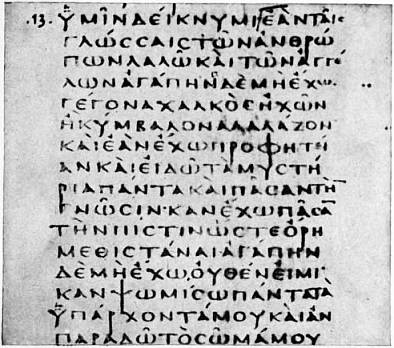
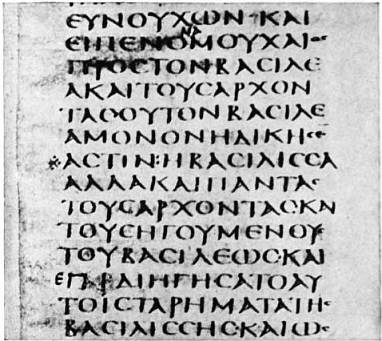
Fig. 1.—Codex Vaticanus (From facsimile ed. by J. Cozza-Luzi, 1889-1890.) Fig. 2.—Codex Sinaiticus (From facsimile published by Palaeographical Soc. 1873.)
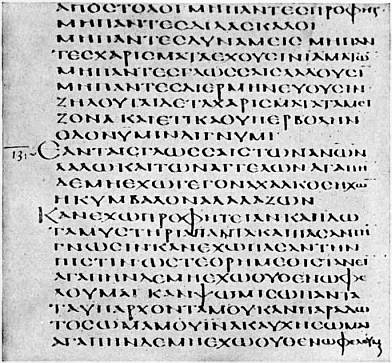
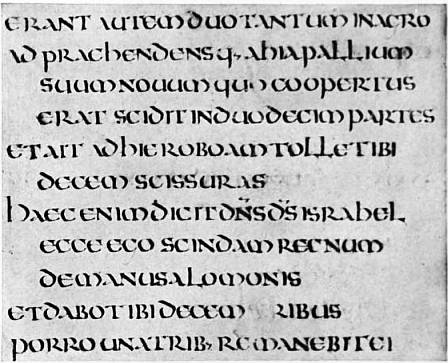
Fig. 3.—Codex Alexandrinus. (British Museum.) Fig. 4.—From a probable Northumbrian Copy of the Codex Amiatinus. (British Museum.)
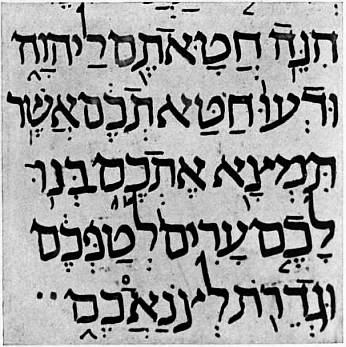
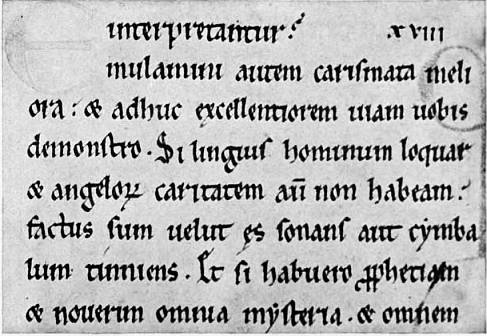
Fig. 5.—Pentateuch in Hebrew, 9th Century. (British Museum.) Fig. 6.—Vulgate. (From MS written for the monastery of Ste Marie de Parco, Louvain, A.D. 1148. British Museum.)
Plate II.
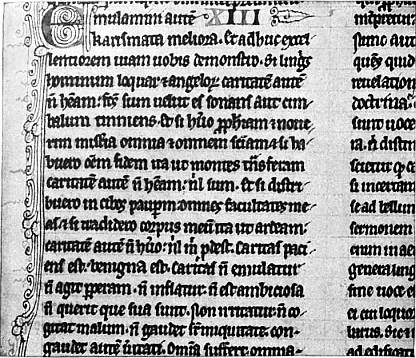
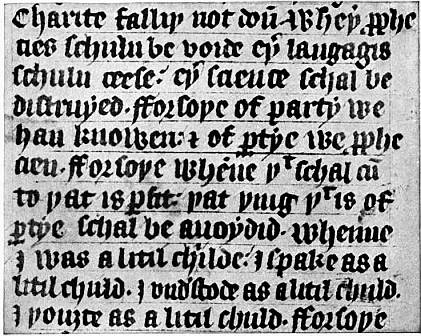
Fig. 7.—13th Century Latin Bible. (From copy belonging to Robert de Bello, abbot of St Augustine’s, Canterbury. British Museum.) Fig. 8.—Early Wycliffite Version. (From copy belonging to Thomas of Woodstock, duke of Gloucester, written towards the end of 14th century. British Museum.)
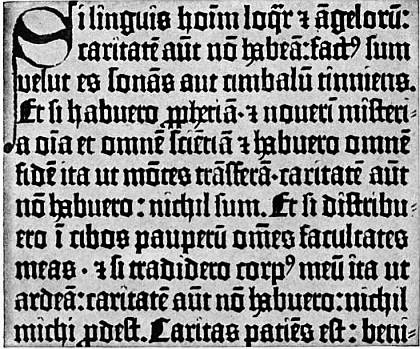
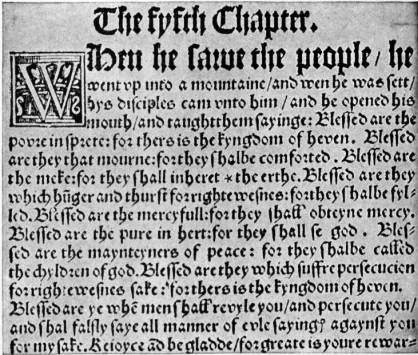
Fig. 9.—The 42-Line Bible. (Printed at Mainz, 1452-6. British Museum.) Fig. 10.—Tyndale’s Quarto Edition of New Testament. (Printed by P. Quentel, Cologne, 1525, from the only remaining fragment, in British Museum.)
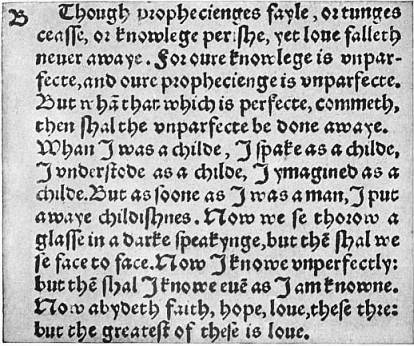
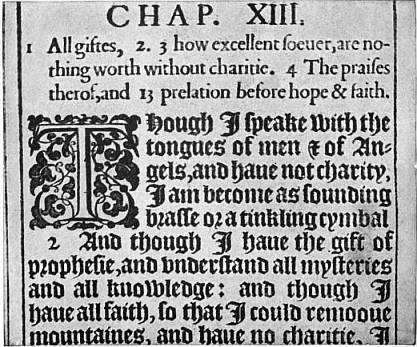
Fig. 11.—First printed English Bible, 1535. (British Museum.) Fig. 12.—First Edition of the Authorized Version, 1611. (British Museum.)
This table says nothing about style of writing or material, but it may be taken as a general rule that MSS. earlier than the 13th century are on vellum and later than the 14th century are on paper, and that MSS. earlier than the 9th century are uncial and later than the 10th are minuscule. There are said to be 129 uncial MSS. of the New Testament (Kenyon, Textual Criticism of the New Testament, p. 45), but it is not easy to be quite accurate on the point.
Besides the MSS. mentioned in the table above, there are 281 MSS. containing commentaries on the Gospels, 169 on Acts and Epistles, 66 on the Apocalypse, 1072 lectionaries of the Gospels and 287 of Acts and Epistles, making a grand total of 3698 MSS. It must be remembered that the dating of the MSS., especially of minuscules, is by no means certain: Greek Palaeography is a difficult subject, and not all the MSS. have been investigated by competent palaeographers.
The notation of this mass of MSS. is very complicated. There are at present two main systems: (1) Since the time of Wetstein it has been customary to employ capital letters, at first of the Latin and latterly also of the Greek and Hebrew alphabets, to designate the uncials, and Arabic figures to designate the minuscules. Of this system there are two chief representatives, Gregory and Scrivener. These agree in the main, but differ for the more recently discovered minuscules. Gregory’s notation is more generally used, and Scrivener’s, though still followed by a few English scholars, is likely to become obsolete. This method of notation has various disadvantages. There are not enough letters to cover the uncials, the same letter has to serve for various fragments which are quite unconnected except by the accident of simultaneous discovery, and no information is given about the MS. referred to. (2) To remedy these drawbacks an entirely new system was introduced in 1902 by von Soden in his Die Schriften des neuen Testaments, Bd. 1, Abt. 1, pp. 33-40. He abandons the practice of making a distinction between uncial and minuscule, on the ground that for textual criticism the style of writing is less important than the date and contents of a MS. To indicate these he divided MSS. into three classes, (1) New Testaments (the Apocalypse being not regarded as a necessary part), (2) Gospels, and (3) Acts, Epistles and Apocalypse (the latter again being loosely regarded). These three classes he distinguished as δ (= διαθήκη), ε (= εὐαγγέλιον) and α (= ἀπόστολος). To these letters he attaches numbers arranged on a principle showing the century to which the MS. belongs and defining its contents more precisely. The number is determined thus:—MSS. of the δ and α classes from the earliest period to the 9th century inclusive are numbered 1 to 49; those of the 10th century 50 to 99; for the later centuries numbers of three figures are used, and the choice is made so that the figure in the hundreds’ place indicates the century, 1 meaning 11th century, 2 meaning 12th century, and so on; to all these numbers the appropriate letter, if it be δ or α, must be always prefixed, but if it be ε, only when there is any chance of ambiguity. In δ MSS. a distinction is made for those of the 11th and subsequent centuries by reserving 1 to 49 in each hundred for MSS. containing the Apocalypse, 50 to 99 for those which omit it. Similarly, in α MSS. a distinction is made according to their contents; the three-figure numbers are reserved for MSS. which contain Acts, Catholic Epistles and Pauline Epistles with or without the Apocalypse, the presence or absence of which is indicated as in the δ MSS.; but when a MS. consists of only one part a “1” is prefixed, thus making a four-figure number, and the precise part is indicated by the two last of the four figures; 00-19 means Acts and Catholic Epistles, 20-69 means Pauline Epistles and 70-99 means Apocalypse. In the case of ε MSS. 1-99 is used for the earliest MSS. up to the 9th century, and as this is insufficient, the available numbers are increased by prefixing a 0, and reckoning a second hundred from 01 to 099; 1000 to 1099 are MSS. of the 10th century; 100 to 199 are MSS. of the 11th century, 200-299 of the 12th century, and so on; as this is insufficient, the range of numbers is increased by prefixing a 1, and so obtaining another hundred, e.g. 1100 to 1199, and in the 12th and subsequent centuries, where even this is not enough, by passing on to the thousands and using 2000-2999 for the 12th century, 3000-3999 for the 13th and so on. In each case ε is prefixed whenever there is any chance of ambiguity. It is claimed that this system gives the maximum of information about a MS., and that it leaves room for the addition of any number of MSS. which are likely to be discovered. At present it has not seriously threatened the hold of Gregory’s notation on the critical world, but it will probably have to be adopted, at least to a large extent, when von Soden’s text is published.
[The full details of this subject can be found in E. Miller’s edition of Scrivener’s Introduction to the Criticism of the New Testament (George Bell, 1894); C.R. Gregory’s Prolegomena to Tischendorf’s Novum Testamentum Graece, Ed. VIII. critica major (Leipzig, 1894); C.R. Gregory’s Textkritik (Leipzig, 1900); H. von Soden’s Die Schriften des neuen Testaments (Berlin, Band i., 1902-1907); F.G. Kenyon’s Handbook to the Textual Criticism of the New Testament (London, 1901), especially valuable for a clear account of the Papyri fragments.]
It is neither possible nor desirable to give any description of most of these MSS., but the following are, critically, the most important.
Uncials.—Codex Vaticanus (Vat. Gr, 1209), Greg. B, v. Soden δ1; an uncial MS. of the 4th century. It is written in three columns and has forty-two lines to the column. It originally contained the whole Bible, but in the New Testament Codex Vaticanus. Heb. ix. 14, xiii. 25, 1 and 2 Tim., Tit., Philemon, Apoc., are now missing. It was written by three scribes of whom the writer of the New Testament was identified by Tischendorf as the scribe D of א (cod. Sinaiticus). The text has been corrected by two scribes, one (the διορθώτης) contemporary with the original writer, the other belonging to the 10th or 11th century. The latter probably also re-inked the whole of the MS. and introduced a few changes in the text, though some critics think that this was done by a monk of the 15th century who supplied the text of the lacuna in Heb. and of the Apocalypse from a MS. belonging to Bessarion. The text is the best example of the so-called Neutral Text, except in the Pauline epistles, where it has a strong “Western” element. How this MS. came to be in the Vatican is not known. It first appears in the catalogue of 1481 (Bibl. Vat. MS. Lat. 3952 f. 50), and is not in the catalogue of 1475, as is often erroneously stated on the authority of Vercellone. It was, therefore, probably acquired between the years 1475 and 1481. The problem of its earlier history is so entangled with the similar questions raised by χ that the two cannot well be discussed separately. [Phototypic editions have been issued in Rome in 1889-1890 and in 1905.]
Codex Sinaiticus (St Petersburg, Imperial library), Greg. א, von Soden δ2; an uncial MS. of the 4th century. It was found in 1844 by C. Tischendorf (q.v.) in the monastery of St Catherine on Mt. Sinai, and finally acquired by the Sinaiticus. tsar in 1869. It is written on thin vellum in four columns of forty-eight lines each to a page. It contained originally the whole Bible, and the New Testament is still complete. At the end it also contains the Ep. of Barnabas and the Shepherd of Ilermas, unfortunately incomplete, and there was probably originally some other document between these two. The text was written, according to Tischendorf, by four scribes, of whom he identified one as also the scribe of cod. Vaticanus. It was corrected many times, especially in the 6th century, by a scribe known as אa and in the 7th by אc. It has, in the main, a Neutral text, less mixed in the Epistles than that of B, but not so pure in the Gospels. The corrections of אc are important, as they are based (according to a note by that scribe, at the end of Esther) on an early copy which had been corrected by Pamphilus, the disciple of Origen, friend of Eusebius and founder of a library at Caesarea.
[The text of א was published in Tischendorf’s Bibliorum codex Sinaiticus Petropolitanus (vol. iv.,1862), and separately in his Novum Testamentum Sinaiticum (1863); in 1909 it was published in collotype by the Clarendon Press, Oxford. The relations of χo to Pamphilus are studied by Bousset in “Textkritische Studien zum N.T.” (in Texte u. Untersuchungen, xi. 4).]
If Tischendorf was right in identifying the scribe of B with that of part of א, it is obvious that these MSS. probably come from the same place. He was probably wrong, but there are some indications of relationship to justify the same view. The two most probable places seem to be Caesarea and Alexandria. The case for Caesarea is that the colophon written by אc at the end of Esther, and also of Ezra, shows that א was then in the library of Caesarea, and that a chapter division in Acts found both in א and B can also be traced to the same library. This is a fairly strong case, but it falls short of demonstration because it cannot be shown that the MS. corrected by Pamphilus was still at Caesarea when it was used by א, and because it is not certain either that the chapter divisions in Acts were added by the original scribes, or that א and B were at that time in their original home, or that the chapter divisions were necessarily only to be found at Caesarea. The case for Alexandria depends partly on the orthography of B, which resembles Graeco-Coptic papyri, partly on the order of the Pauline epistles. At present, both in א and B, Hebrews is placed after 2 Thess., but in B there is also a continuous numeration of sections throughout the epistles, according to which 1 to 58 cover Romans to Galatians, but Ephesians, the next epistle, begins with 70 instead of 59, and the omitted section numbers are found in Hebrews. Obviously, the archetype placed Hebrews between Galatians and Ephesians, but the scribe altered the order and put it between 2 Thess. and 1 Tim., though without changing the section numbers. This older order of the epistles is only found elsewhere in the Sahidic version of the New Testament, and it was probably therefore the old Egyptian or Alexandrian order. Moreover, we know from the Festal letter of A.D. 367 (according to the Greek and Syriac texts, but not the Sahidic), that Athanasius then introduced the order of the epistles which is now given in א B. This is strong evidence for the view that the archetype of B came from Alexandria or the neighbourhood, and was older than the time of Athanasius, but it scarcely proves that B itself is Alexandrian, for the order of epistles which it gives is also that adopted by the council of Laodicea in A.D. 363, and may have been introduced elsewhere, perhaps in Caesarea. A further argument, sometimes based upon and sometimes in turn used to support the foregoing, is that the text of א B represents that of Hesychius; but this is extremely doubtful (see the section Textual Criticism below).
[The question of the provenance of א and B may best be studied in J. Rendel Harris, Stichometry (Cambridge, 1893), pp. 71-89; J. Armitage Robinson, “Euthaliana,” Texts and Studies, iii. 3 (Cambridge, 1895), esp. pp. 34-43 (these more especially for the connexion with Caesarea); A. Rahfls, “Alter und Heimat der vatikanischer Bibelhandschrift,” in the Nachrichten der Gesell. der Wiss. zu Göttingen (1899), vol. i. pp. 72-79; and O. von Gebhardt in a review of the last named in the Theologische Literaturzeitung (1899), col. 556.]
Codex Bezae (Cambridge Univ. Nu. 2, 41), Greg. D, von Soden δ 5; an uncial Graeco-Latin MS. not later than the 6th century and probably considerably earlier. The text is written in one column to a page, the Greek on the left hand page and Bezae. the Latin on the right. It was given to the university of Cambridge in 1581, but its early history is doubtful. Beza stated that it came from Lyons and had been always preserved in the monastery of St Irenaeus there. There is no reason to question Beza’s bona fides, or that the MS. was obtained by him after the sack of Lyons in 1562 by des Adrets, but there is room for doubt as to the accuracy of his belief that it had been for a long time in the same monastery. His information on this point would necessarily be derived from Protestant sources, which would not be of the highest value, and there are two pieces of evidence which show that just previously the MS. was in Italy. In the first place it is certainly identical with the MS. called η which is quoted in the margin of the 1550 edition of Robert Stephanus’ Greek Testament; this MS. according to Stephanus’ preface was collated for him by friends in Italy. In the second place it was probably used at the council of Trent in 1546 by Gul. a Prato, bishop of Clermont in Auvergne, and in the last edition of the Annotationes Beza quotes his MS. as Claromontanus, and not as Lugdunensis. These points suggest that the MS. had only been a short time at Lyons when Beza obtained it. The still earlier history of the MS. is equally doubtful. H. Quentin has produced some interesting but not convincing evidence to show that the MS. was used in Lyons in the 12th century, and Rendel Harris at one time thought that there were traces of Gallicism in the Latin, but the latter’s more recent researches go to show that the corrections and annotations varying in date between the 7th and 12th centuries point to a district which was at first predominantly Greek and afterwards became Latin. This would suit South Italy, but not Lyons. The text of this MS. is important as the oldest and best witness in a Greek MS. to the so-called “Western” text. (See the section Textual Criticism below.)
[The following books and articles are important for the history, as apart from the text of the MS. Codex Bezae ... phototypice repraesentatus (Cambridge, 1899); Scrivener, Codex Bezae (Cambridge, 1864); J. Rendel Harris, “A Study of Cod. Bezae,” Texts and Studies, i. 1 (Cambridge, 1891); J. Rendel Harris, The Annotators of Cod. Bezae (London, 1901); F.E. Brightman and K. Lake, “The Italian Origin of Codex Bezae,” in Journal of Theol. Studies, April 1900, pp. 441 ff.; F.C. Burkitt, “The Date of Codex Bezae,” in the Journal of Theol. Studies, July 1902, pp. 501 ff.; D.H. Quentin, “Le Codex Bezae à Lyon, &c.,” Revue Bénédictine, xxxiii. 1, 1906.]
Codex Alexandrinus (G. M. reg. ID v.-viii.), Greg. A. von Soden 84; an uncial MS. of the 5th century. It was given by Cyril Lucar, patriarch of Constantinople, to Charles I. in 1621. It appears probable that Cyril Lucar had brought it with Alexandrinus. him from Alexandria, of which he had formerly been patriarch. A note by Cyril Lucar states that it was written by Thecla, a noble lady of Egypt, but this is probably merely his interpretation of an Arabic note of the 14th century which states that the MS. was written by Thecla, the martyr, an obviously absurd legend; another Arabic note by Athanasius (probably Athanasius III., patriarch c. 1308) states that it was given to the patriarchate of Alexandria, and a Latin note of a later period dates the presentation in 1098. So far back as it can be traced it is, therefore, an Alexandrian MS., and palaeographical arguments point in the same direction. Originally, the MS. contained the whole of the Old and New Testaments, including the Psalms of Solomon in the former and 1 and 2 Clement in the latter. It has, however, suffered mutilation in a few places. Its text in the Old Testament is thought by some scholars to show signs of representing the Hesychian recension, but this view seems latterly to have lost favour with students of the Septuagint. If it be true, it falls in with the palaeographic indications and suggests an Alexandrian provenance. In the New Testament it has in the gospels a late text of Westcott and Hort’s “Syrian” type, but in the epistles there is a strongly marked “Alexandrian” element. [Cod. A was published in photographic facsimile in 1879-1880.]
Codex Ephraemi Syri Rescriptus (Paris Nat. Gr. 9), Greg. C, von Soden δ 3; an uncial palimpsest (the top writing being that of Ephraem) of the 5th century. It was formerly the property of Catherine de’ Medici, and was probably brought Ephraemi Syri. from the east to Italy in the 16th century. Hort (Introduction, p. 268) has shown from a consideration of displacements in the text of the Apocalypse that it was copied from a very small MS., but this, of course, only holds good of the Apocalypse. It is usually said that this MS., like A, came originally from Egypt, but this is merely a palaeographical guess, for which there is no real evidence. Originally, it contained the whole Bible, but only sixty-four leaves of the Old Testament remain, and 145 (giving about two-thirds of the whole) of the New Testament. The character of the text is mixed with a strong “Alexandrian” element. [Published in facsimile by Tischendorf (1843). Discussed by Lagarde in his Ges. Abhandlungen, p. 94.]
Codex Claromontanus (Paris Nat. Gr. 107), Greg. Dpaul, von Soden α 1026; an uncial Graeco-Latin MS. of the 6th century. This MS. also belonged to Beza, who “acquired” it from the monastery of Clermont, near Beauvais. After his death Claromontanus. it passed through various private hands and was finally bought for the French royal library before 1656. It contains the whole of the Pauline epistles with a few lacunae, and has a famous stichometric list of books prefixed in another hand to Hebrews. It is probably the best extant witness to the type of Greek text which was in use in Italy at an early time. It is closely connected with cod. Sangermanensis (a direct copy) at St Petersburg, Greg. Epaul, von Soden α 1027; cod. Augiensis (Cambridge, Trin. Coll. B xvii. i), Greg. Fpaul, von Soden α 1029; and cod. Boernerianus (Dresden K Bibl.), Greg. Gpaul, von Soden α 1028. [The text is published in Tischendorf’s Codex Claromontanus (1852). Its relations to EFG are best discussed in Westcott and Hort’s Introduction, §§ 335-337.]
There are no other uncials equal in importance to the above. The next most valuable are probably cod. Regius of the 8th century at Paris, Greg. L, von Soden ε 56, containing the Gospels; cod. Laudianus of the 7th century at Oxford, Greg. E, von Soden α 1001, a Latino-Greek MS. containing the Acts; cod. Coislinianus of the 6th century in Paris, Turin, Kiev, Moscow and Mt. Atohs, Greg. Hpaul, von Soden α 1022, containing fragments of þhe Pauline epistles; and cod. Augiensis of the 9th century in Trinity College, Cambridge, Greg. Fpaul, von Soden α 1029, a Graeco-Latin MS. closely related to cod. Claromontanus. [Further details as to these MSS. with bibliographies can be found in Gregory’s Prolegomena to Tischendorf’s N.T. ed. maj. viii.]
Minuscules.—Very few of these are of real importance. The most valuable are the following:—
1. The Ferrar Group; a group of eight MSS. known in Gregory’s notation as 13, 69, 124, 346, 543, 788, 826, 828, or in von Soden’s as ε 368, δ 505, ε 1211, ε 226, ε 257, ε 1033, ε 218, ε 219, all which, except 69, in spite of the dating implied by von Soden’s notation were probably written in the 12th century in Calabria. They have a most peculiar text of a mainly “Western” type, with some special affinities to the Old Syriac and perhaps to the Diatessaron. They are known as the Ferrar group in memory of the scholar who first published their text, and are sometimes quoted as Φ (which, however, properly is the symbol for Codex Beratinus of the Gospels), and sometimes as fam.¹³.
2. Cod. 1 and its Allies; a group of four MSS. known in Gregory’s notation as 1, 118, 131, 209, and in von Soden’s as δ 50, ε 346, δ 467 and δ 457. The dating implied by the latter notation is wrong, as 1 certainly belongs to the 12th, not to the 10th century, and 118 is probably later than 209. It is sometimes quoted as fam.¹. Fam.¹ and fam.¹³ probably have a common archetype in Mark which is also represented by codd. 28 (ε 168), 565 (ε 93, quoted by Tischendorf and others as 2pe) and 700 (ε 133, quoted by Scrivener and others as 604). It seems to have had many points of agreement with the Old Syriac, but it is impossible to identify the locality to which it belonged. Other minuscules of importance are cod. 33 (δ 48) at Paris, which often agrees with א BL and is the best minuscule representative of the “Neutral” and “Alexandrian” types of text in the gospels; cod. 137 (α 364) at Milan, a valuable “Western” text of the Acts; α 78 (not in Gregory) in the Laura on Mt. Athos, a MS. of the Acts and epistles, with an early (mixed) type of text and textual comments and notes from Origen.
[The text of the Ferrar group was published after Ferrar’s death by T.K. Abbott, A Collation of Four Important MSS. of the Gospels (Dublin, 1877). It is best discussed by Rendel Harris’s books, The Origin of the Leicester Codex (1887), The Origin of the Ferrar Group (1893), and The Ferrar Group (1900), all published at Cambridge; the text of fam.¹ with a discussion of its textual relations is given in K. Lake’s “Codex 1 and its Allies” (Texts and Studies, vii. 3, 1902); 565 was edited by J. Belsheim in Das Evang. des Marcus nach d. griech. Cod. Theodorae, &c. (Christiania, 1885), many corrections to which are published in the appendix to H.S. Cronin’s “Codex Purpureus,” Texts and Studies, v. 4; 700 was published by H.C. Hoskier in his collation of cod. Evan. 604, London, 1890; α 78 is edited by E. von der Goltz in Texte und Untersuchungen, N.F. ii. 4.]
(B) The Versions.—These are generally divided into (α) primary and (β) secondary; the former being those which represent translation made at an early period directly from Greek originals, and the latter being those which were made either from other versions or from late and unimportant Greek texts.
(α) The primary versions are three—Latin, Syriac and Egyptian.
Latin Versions.—1. The Old Latin. According to Jerome’s letter to Pope Damasus in A.D. 384, there was in the 4th century a great variety of text in the Latin version, “Tot enim exemplaria pene quot codices.” This verdict is confirmed Old Latin. by examination of the MSS. which have pre-Hieronymian texts. It is customary to quote these by small letters of the Latin alphabet, but there is a regrettable absence of unanimity in the details of the notation. We can distinguish two main types, African and European. The African version is best represented in the gospels by cod. Bobiensis (k) of the 5th (some say 6th) century at Turin, and cod. Palatinus (e) of the 5th century at Vienna, both of which are imperfect, especially k, which, however, is far the superior in quality; in the Acts and Catholic epistles by cod. Floriacensis (f, h. or reg.) of the 6th century, a palimpsest which once belonged to the monks of Fleury, and by the so-called speculum (m) or collection of quotations formerly attributed to Augustine but probably connected with Spain. This scanty evidence is dated and localized as African by the quotations of Cyprian, of Augustine (not from the gospels), and of Primasius, bishop of Hadrumetum (d. c. 560), from the Apocalypse. It is still a disputed point whether Tertullian’s quotations may be regarded as evidence for a Latin version or as independent translations from the Greek, nor is it certain that this version is African in an exclusive sense; it was undoubtedly used in Africa and there is no evidence that it was known elsewhere originally, but on the other hand there is no proof that it was not. The European version is best represented in the gospels by cod. Vercellensis (a) of the 5th century and cod. Veronensis (b) of the same date (the latter being the better), and by others of less importance. It is possible that a later variety of it is found in cod. Monacensis (q) of the 7th century, and cod. Brixianus (f) of the 6th century, and this used to be called the Italic version, owing (as F.C. Burkitt has shown) to a misunderstanding of a remark of Augustine about the “Itala” which really refers to the Vulgate. In the Acts the European text is found in cod. Gigas (g or gig) of the 13th century at Stockholm, in a Perpignan MS. of the 12th century (p), published by S. Berger, and probably in cod. Laudianus (e) of the 7th century at Oxford. In the Catholic epistles it is found in cod. Corbeiensis (f or ff) of the 10th century at St Petersburg. In the Pauline epistles it is doubtful whether it is extant at all, though some have found it in the cod. Claromontanus (d) and its allies. In the Apocalypse it is found in cod. Gigas.
The main problem in connexion with the history of the African and European versions is whether they were originally one or two. As they stand at present they are undoubtedly two, and can be distinguished both by the readings which they imply in the underlying Greek, and by the renderings which they have adopted. But there is also a greater degree of similarity between them than can be explained by accidental coincidence, and there is thus an a priori case for the theory that one of the two is a revision of the other, or that there was an older version, now lost, which was the original of both. If one of the two is the original it is probably the African, for which there is older evidence, and of which the style both in reading and rendering seems purer. The chief argument against this is that it seems paradoxical to think of Africa rather than Rome as the home of the first Latin version; but it must be remembered that Roman Christianity was originally Greek, and that the beginnings of a Latin church in Rome seem to be surprisingly late.
[Editions of Old Latin MSS. are to be found in Old Latin Biblical Texts, i.-iv. (Oxford); in Migne’s Patrologia Latina, tom. xii.; and their history is treated especially in F.C. Burkitt’s “Old Latin and the Itala” (Texts and Studies, iv. 3), as well as in all books dealing with Textual Criticism generally; other important books are Rönsch’s Itala und Vulgata (1875); Corssen’s Der cyprianische Text der Acta Apostolorum (Berlin, 1892); Wordsworth and Sanday on the “Corbey S. James” in Studia Biblica, i. (1885); the article on the “Old Latin Version,” in Hastings’ Dictionary of the Bible. For the textual character and importance of these versions see the section Textual Criticism below.]
2. The Vulgate or Hieronymian version. To remedy the confusion produced by the variations of the Latin text Pope Damasus asked Jerome to undertake a revision, and the latter published a new text of the New Testament in A.D. 384 Vulgate. and the rest of the Bible probably within two years. This version gradually became accepted as the standard text, and after a time was called the “Vulgata,” the first to use this name as a title being, it is said, Roger Bacon. In the Old Testament Jerome made a new translation directly from the Hebrew, as the Old Latin was based on the LXX., but in the New Testament he revised the existing version. He did this fully and carefully in the gospels, but somewhat superficially in the epistles. He seems to have taken as the basis of his work the European version as it existed in his time, perhaps best represented by cod. Monacensis (q) of the 7th century, and by the quotations in Ambrosiaster, to which cod. Brixianus (f) of the 6th century would be added if it were not probable that it is merely a Vulgate MS. with intrusive elements. This type of text he revised with the help of Greek MSS. of a type which does not seem to correspond exactly to any now extant, but to resemble B more closely than any others.
Of Jerome’s revision we possess at least 8000 MSS., of which the earliest may be divided (in the gospels at all events) into groups connected with various countries; the most important are the Northumbrian, Irish, Anglo-Irish and Spanish, but the first named might also be called the Italian, as it represents the text of good MSS. brought from Italy in the 7th century and copied in the great schools of Wearmouth and Jarrow. One of the most important, cod. Amiatinus, was copied in this way in the time of Ceolfrid, Benedict Biscop’s successor, as a present for Pope Gregory in 716. From these MSS. the original Hieronymian text may be reconstructed with considerable certainty. The later history of the version is complicated, but fairly well known. The text soon began to deteriorate by admixture with the Old Latin, as well from the process of transcription, and several attempts at a revision were made before the invention of printing. Of these the earliest of note were undertaken in France in the 9th century by Alcuin in 801, and almost at the same time by Theodulf, bishop of Orleans (787-821). In the 11th century a similar task was undertaken by Lanfranc, archbishop of Canterbury (1069-1089); in the 12th century by Stephen Harding (1109), third abbot of Citeaux, and by Cardinal Nicolaus Maniacoria (1150), whose corrected Bible is preserved in the public library at Dijon. But these were not successful, and in the 13th century, instead of revisions, attempts were made to fix the text by providing correctoria, or lists of correct readings, which were the equivalent of critical editions; of these the chief are the Parisian, the Dominican (prepared under Hugo de S. Caro about 1240), and the Vatican. In the 15th century the history of the printed Vulgates begins. The earliest is the Mentz edition of 1452-1456 (the Mazarin or “42-line” Bible), but the earliest of a critical nature were those of Robert Étienne in 1528 and 1538-1540. In 1546 the council of Trent decided that the Vulgate should be held as authentica, and in 1590 Pope Sixtus V. published a new and authoritative edition, which was, probably at the instigation of the Jesuits, recalled by Pope Clement VIII. in 1592. In the same year, however, the same pope published another edition under the name of Sixtus. This is, according to the Bull of 1592, the authoritative edition, and has since then been accepted as such in the Latin Church. The critical edition by J. Wordsworth (bishop of Salisbury) and H.J. White probably restores the text almost to the state in which Jerome left it.
[The text of the Vulgate may be studied in Wordsworth and White, Novum Testamentum Latine; Corssen, Epistula ad Galatas. Its history is best given in S. Berger’s Histoire de la Vulgate (Paris, 1893), in which a good bibliography is given on pp. xxxii.-xxxiv. The section in Kenyon’s handbook to the Textual Criticism of the New Testament is particularly clear and full.]
Syriac Versions.—1. The Old Syriac. This is only known to us at present through two MSS. of the gospels, containing the Evangelion da-Mepharreshe, or separated gospel, probably so called in distinction to Tatian’s Diatessaron. These Old Syriac. MSS. are known as the Curetonian and Sinaitic. The Curetonian is a MS. of the 5th century. The fragments of it which we possess are MS. Brit. Mus. addit. 14.451, which was brought in 1842 from the monastery of St. Mary in the Nitrian desert, and was edited by Cureton in 1858; and three leaves in Berlin (MS. Orient. Quart. 528) which were bought in Egypt by H. Brugsch and published by A. Roediger in 1872. It was given to the monastery of St. Mary in the 10th century, but its earlier history is unknown. It contained originally the four gospels in the order Mt., Mk., Jo., Lc. It is generally quoted as Syrcur or Syr C. The Sinaitic was discovered in 1892 by Mrs Lewis and Mrs Gibson in the library of St. Catherine’s monastery on Mt. Sinai, where it still remains, and was published in 1894 by R.L. Bensly, J. Rendel Harris and F.C. Burkitt, with an introduction by Mrs Lewis. It is a palimpsest MS., and the upper writing (lives of saints), dated A.D. 778, is the work of “John, the anchorite of Beth Mari Qanon, a monastery of Ma’arrath Mesren city in the district of Antioch.” This town is between Antioch and Aleppo; though the monastery is otherwise unknown, it seems probable that it was the source of many of the MSS. now at Sinai. The under writing seems to be a little earlier than that of the Curetonian; it contains the gospels in the order Mt., Mc., Lc., Jo. with a few lacunae. There is no evidence that this version was ever used in the Church services: the Diatessaron was always the normal Syriac text of the gospels until the introduction of the Peshito. But the quotations and references in Aphraates, Ephraem and the Acts of Judas Thomas show that it was known, even if not often used. It seems certain that the Old Syriac version also contained the Acts and Pauline epistles, as Aphraates and Ephraem agree in quoting a text which differs from the Peshito, but no MSS. containing this text are at present known to exist.
[The text of this version is best given, with a literal English translation, in F.C. Burkitt’s Evangelion da Mepharreshe (Cambridge, 1904).]
2. The Peshito (Simple) Version. This is represented by many MSS. dating from the 5th century. It has been proved almost to demonstration by F.C. Burkitt that the portion containing the gospels was made by Rabbula, bishop of Edessa Peshito. (411), to take the place of the Diatessaron, and was based on the Greek text which was at that time in current use at Antioch. The Old Testament Peshito is a much older and quite separate version. The exact limits of Rabbula’s work are difficult to define. It seems probable that the Old Syriac version did not contain the Catholic epistles, and as these are found in the Peshito they were presumably added by Rabbula. But he never added 2 Peter, Jude, 2 and 3 John, or the Apocalypse, and the text of these books, which is sometimes bound up with the Peshito, really is that of the Philoxenian or of the Harklean version. A comparison of the Peshito with quotations in Aphraates and Ephraem shows that Rabbula revised the text of the Acts and Pauline epistles, but in the absence of MSS. of the Old Syriac for these books, it is difficult to define the extent or character of his work. The Peshito is quoted as Syr P, Pesh., and Syrsch (because Tischendorf followed the edition of Schaaf).
[The best text of the Peshito is by G.H. Gwilliam, Tetraevangelium Sanctum (Oxford, 1901); its relations to Rabbula’s revision are shown by F.C. Burkitt, “S. Ephraim’s quotations from the Gospel” (Texts and Studies, vii. 2, Cambridge, 1901), which renders out of date F.H. Woods’s article on the same subject in Studia Biblica, iii. pp. 105-138.]
3. The Philoxenian Version. This is known, from a note extant in MSS. of the Harklean version, to have been made in A.D. 508 for Philoxenus, bishop of Hierapolis, by Polycarpus, a chorepiscopus. No MSS. of it have survived except in Philoxenian. 2 Peter, Jude, 2 and 3 John and the Apocalypse. The four former are found in some MSS. of the Peshito, as the Philoxenian was used to supply these epistles which were not in the older version, and the Apocalypse was published in 1892 by Dr Gwynn from a MS. belonging to Lord Crawford.
[This version may be studied in Isaac H. Hall’s Williams MS. (Baltimore, 1886); in the European editions of the Syriac Bible so far as the minor Catholic epistles are concerned; in Hermathena, vol. vii. (1890), pp. 281-314 (article by Gwynn); in Zeitschrift für Assyriologie, xii. and xiii. (series of articles by Merx); in Gwynn’s The Apocalypse of St John in a Syriac Version (Dublin, 1897).]
4. The Harklean Version. This is a revision of the Philoxenian made in 616 by Thomas of Harkel (Heraclea), bishop of Hierapolis. It was apparently an attempt to replace the literary freedom of the Philoxenian by an extreme literalness. It Harklean. represents in the main the text of the later Greek MSS., but it has important textual notes, and has adopted a system of asterisks and obeli from the Hexaplar LXX. The source of these notes seems to have been old MSS. from the library of the Enaton near Alexandria. The marginal readings are therefore valuable evidence for the Old Alexandrian text. This version is quoted as Syr H (and when necessary Syr Hc* or Syr Hmg) and by Tischendorf as Syrp (= Syra posterior). It should be noted that when Tischendorf speaks of Syrutr he means the Peshito and the Harklean.
[There is no satisfactory critical edition of this version, nor have the Philoxenian and the Harklean been disentangled from each other. The printed text is that published in 1778-1803 by J. White at Oxford under the title Versio Philoxenia; for the marginal notes see esp. Westcott and Hort, Introduction, and for Acts, Pott’s Abendländische Text der Apostelgesch. (Leipzig, 1900).]
5. The Palestinian or Jerusalem Version. This is a lectionary which was once thought to have come from the neighbourhood of Jerusalem, but has been shown by Burkitt to come from Palestinian. that of Antioch. It was probably made in the 6th century in connexion with the attempts of Justinian to abolish Judaism. Usually quoted as SyrPa and by Tischendorf as Syrhier.
[The text may be found in Lewis and Gibson’s The Palestinian Syriac Lectionary (London, 1899), (Gospels), and in Studia Sinaitica, part vi. (Acts and Epistles); its origin is discussed best by F.C. Burkitt in the Journal of Theological Studies, vol. ii. (1901), pp. 174-183.]
6. The Karkaphensian. This is not a version, but a Syriac “Massorah” of the New Testament, i.e. a collection of notes on the texts. Probably emanates from the monastery of the Skull. Little is known of it and it is unimportant.
[See Gwilliam’s “Materials for the Criticism of the Peshito N.T.” in Studia Biblica, in. esp. pp. 60-63.]
7. Tatian’s Diatessaron. This is something more than a version. It was originally a harmony of the four goepels made by Tatian, the pupil of Justin Martyr, towards the end of the 2nd century. In its original form it is no longer extant, but it Tatian’s “Diatessaron.” exists in Arabic (published by Ciasca) and Latin (cod. Fuldensis) translations, in both of which the text has unfortunately been almost entirely conformed to the ordinary type. These authorities are, therefore, only available for the reconstruction of the order of the selections from the gospels, not for textual criticism properly so called. For the latter purpose, however, we can use an Armenian translation of a commentary on the Diatessaron by Ephraem, and the quotations in Aphraates. The Diatessaron appears to have been the usual form in which the gospels were read until the beginning of the 5th century, when the Peshito was put in its place, and a systematic destruction of copies of the Diatessaron was undertaken.
[The Diatessaron may be studied in Zahn, “Evangelien-harmonie,” article in the Protestantische Realencyklopädie (1898); J.H. Hill, The Earliest Life of Christ (Edinburgh, 1893); J. Rendel Harris, Fragments of the Commentary of Ephraim the Syrian (London, 1895); F.C. Burkitt, Evangelion da Mepharreshe (Cambridge, 1904, vol. ii.).]
Inter-relation of Syriac Versions.—The relations which subsist between the various Syriac versions remain to be discussed. There is little room for doubt that the Harklean was based on the Philoxenian, and the Philoxenian was based on the Peshito, the revision being made in each case by the help of the Greek MSS. of the day, but the relations which subsist between the Old Syriac, the Diatessaron and the Peshito are a more difficult question. There are now but few, if any, scholars who think that the Peshito is an entirely separate version, and the majority have been convinced by Burkitt and recognize (1) that the Peshito is based on a knowledge of the Old Syriac and the Diatessaron; (2) that it was made by Rabbula with the help of the contemporary Greek text of the Antiochene Church. But there is not yet the same degree of consensus as to the relations between the Old Syriac and the Diatessaron. Here it is necessary to distinguish between the original text of the Old Syriac and the existing MSS. of it—Cur. and Sin. There is no question that many passages in these show signs of Diatessaron influence, but this is only to be expected if we consider that from the end of the 2nd to the beginning of the 5th century the Diatessaron was the popular form of the gospels. A large discount has therefore to be made from the agreements between Diatessaron and Syr. S and C. Still, it is improbable that this will explain everything, and it is generally conceded that the original Diatessaron and the original Old Syriac were in some way connected. The connexion is variously explained, and efforts have been made to show on which side the dependence is to be found. The most probable theory is that of Burkitt. He thinks that the first Syriac translation was that of Tatian (c. A.D. 175), who brought the Diatessaron from Rome and translated it into Syriac. There, in the last days of the 2nd century, when Serapion was bishop of Antioch (A.D. 190-203), a new start was made, and a translation of the “separated Gospels” (Evangelion da Mepharreshe) was made from the MSS. which was in use at Antioch. Probably the maker of this version was partly guided, especially in his choice of renderings, by his knowledge of the Diatessaron. Nevertheless, the Diatessaron remained the more popular and was only driven out by Theodoret and Rabbula in the 5th century, when it was replaced by the Peshito. If this theory be correct the Syriac versions represent three distinct Greek texts:—(1) the 2nd-century Greek text from Rome, used by Tatian; (2) the 2nd-century Greek text from Antioch, used for the Old Syriac; (3) the 2nd-century Greek text from Antioch, used by Rabbula for the Peshito.
[The best discussion of this point is in vol. ii. of Burkitt’s Evangelion da Mepharreshe.]
Egyptian Versions.—Much less is known at present about the history of the Egyptian versions. They are found in various dialects of Coptic, the mutual relations of which are not yet certain, but the only ones which are preserved with Coptic. any completeness are the Bohairic, or Lower Egyptian, and Sahidic, or Upper Egyptian, though it is certain that fragments of intermediate dialects such as Middle Egyptian, Fayumic, Akhmimic and Memphitic also exist. The Bohairic has been edited by G. Horner. It is well represented, as it became the official version of the Coptic Church; its history is unknown, but from internal evidence it seems to have been made from good Greek MSS. of the type of אBL, but the date to which this points depends largely on the general view taken of the history of the text of the New Testament. It need not, but may be earlier than the 4th century. The Sahidic is not so well preserved. G. Homer’s researches tend to show that the Greek text on which it was based was different from that represented by the Bohairic, and probably was akin to the “Western” text, perhaps of the type used by Clement of Alexandria. Unfortunately none of the MSS. seems to be good, and at present it is impossible to make very definite use of the version. It is possible that this is the oldest Coptic version, and this view is supported by the general probabilities of the spread of Christianity in Egypt. which suggest that the native church and native literature had their strength at first chiefly in the southern parts of the country. It must be noted that Westcott and Hort called the Bohairic Memphitic, and the Sahidic Thebaic, and Tischendorf called the Bohairic Coptic.
[See G. Horner’s The Coptic Version of the New Testament in the Northern Dialect (Oxford); Scrivener’s Introduction (ed. Miller), vol. ii. pp. 91-144; and especially an article on “Egyptian Versions” in Hastings’ Dictionary of the Bible, vol. i. by Forbes Robinson.]
(β) Among the secondary versions the only one of real importance is the Armenian.
The Armenian Version.—The early history of this version is obscure, but it seems probable that there were two translations made in the 4th century: (1) by Mesrop with the help of Hrofanos (Rufinus?) based on a Greek text; (2) by Armenian. Sahak, based on Syriac. After the council of Ephesus (A.D. 430) Mesrop and Sahak compared and revised their work with the help of MSS. from Constantinople. The general character of the version is late, but there are many places in which the Old Syriac basis can be recognized, and in the Acts and Epistles, where the Old Syriac is no longer extant, this is sometimes very valuable evidence.
[See Scrivener (ed. Miller) vol. ii. pp. 148-154; Hastings’ Dictionary of the Bible, article on “The Armenian Versions of the New Testament,” by F.C. Conybeare; J.A. Robinson, “Euthaliana” (Texts and Studies, iii. 3), cap. 5; on the supposed connexion of Mark xvi. 8 ff. with Aristion mentioned in this version, see esp. Swete’s The Gospel according to St Mark (London, 1902), p. cxi.]
Other secondary versions which are sometimes quoted are the Gothic, Ethiopic, Georgian, Arabic, Anglo-Saxon, Frankish and Persic. None has any real critical importance; details are given in Gregory’s Prolegomena and in Scrivener’s Introduction.
(C) Quotations in Patristic Writings.—The value of this source of evidence lies in the power which it gives us to date and localize texts. Its limitations are found in the inaccuracy of quotation of the writers, and often in the corrupt condition of their text. This latter point especially affects quotations which later scribes frequently forced into accord with the text they preferred.
All writers earlier than the 5th century are valuable, but particularly important are the following groups:—(1) Greek writers in the West, especially Justin Martyr, Tatian, Marcion, Irenaeus and Hippolytus; (2) Latin writers in Italy, especially Novatian, the author of the de Rebaptismate and Ambrosiaster; (3) Latin writers in Africa, especially Tertullian and Cyprian; (4) Greek writers in Alexandria, especially Clement of Alexandria, Origen, Athanasius and Cyril; (5) Greek writers in the East, especially Methodius of Lycia and Eusebius of Caesarea; (6) Syriac writers, especially Aphraates and Ephraem; it is doubtful whether the Diatessaron of Tatian ought to be reckoned in this group or in (1). None of these groups bears witness to quite the same text, nor can all of them be identified with the texts found in existing MSS. or versions, but it may be said with some truth that group 2 used the European Latin version, group 3 the African Latin, and group 6 the Diatessaron in the gospels and the Old Syriac elsewhere, while group I has much in common with cod. Bezae, though the difference is here somewhat greater. In group 4 the situation is more complex; Clement used a text which has most in common with cod. Bezae, but is clearly far from identical; Origen in the main has the text of א B; Athanasius a somewhat later variety of the same type, while Cyril has the so-called Alexandrian text found especially in L. Group 4 has a peculiar text which cannot be identified with any definite group of MSS. For further treatment of the importance of this evidence see the section Textual Criticism below.
[There is as yet but little satisfactory literature on this subject. Outstanding work is P.M. Barnard’s “Clement of Alexandria’s Biblical Text” (Texts and Studies, v. 5), 1899; Harnack’s “Eine Schrift Novatians,” in Texte und Untersuchungen, xiii. 4; Souter’s “Ambrosiaster” in Texts and Studies, vii. 4; the Society of Historical Theology’s New Testament in the Apostolic Fathers; an article by Kostschau, “Bibelcitate bei Origenes,” in the Zeitschrift f. wissenschaftliche Theologie (1900), pp. 321-378; and on the general subject especially Nestle’s Einführung in das griechische Neue Testament (Göttingen, 1909), pp. 159-167.]
(K. L.)
3. Textual Criticism.
The problem which faces the textual critic of the New Testament is to reconstruct the original text from the materials supplied by the MSS., versions, and quotations in early writers, which have been described in the preceding section on the apparatus criticus. His object, therefore, is to discover and remove the various corruptions which have crept into the text, by the usual methods of the textual critic—the collection of material, the grouping of MSS. and other authorities, the reconstruction of archetypes, and the consideration of transcriptional and intrinsic probability. No book, however, presents such a complicated problem or such a wealth of material for the textual critic.
In a certain wide sense the textual criticism of the New Testament began as soon as men consciously made recensions and versions, and in this sense Origen, Jerome, Augustine and many other ecclesiastical writers might be regarded as textual critics. But in practice it is general, and certainly convenient, to regard their work rather as material for criticism, and to begin the history of textual criticism with the earliest printed editions which sought to establish a standard Greek Text. It is, of course, impossible here to give an account of all these, but the following may fairly be regarded as the epoch-making books from the beginning to the present time.
The Complutensian.—The first printed text of the Greek Testament is known as the Complutensian, because it was made under the direction of Cardinal Ximenes of Alcalá (Lat. Complutum). It was printed in 1514, and is thus the first printed text, but is not the first published, as it was not issued until 1522. It is not known what MSS. Ximenes used, but it is plain from the character of the text that they were not of great value. His text was reprinted in 1569 by Chr. Plantin at Antwerp.
Erasmus.—The first published text was that of Erasmus. It was undertaken at the request of Joannes Froben (Frobenius), the printer of Basel, who had heard of Cardinal Ximenes’ project and wished to forestall it. In this he was successful, as it was issued in 1516. It was based chiefly on MSS. at Basel, of which the only really good one (cod. Evan. 1) was seldom followed. Erasmus issued new editions in 1519, 1522, 1527 and 1535, and the Aldine Greek Testament, printed at Venice in 1518, is a reproduction of the first edition.
Stephanus.—Perhaps the most important of all early editions were those of Robert Étienne, or Stephanus, of Paris and afterwards of Geneva. His two first editions (1546, 1549) were based on Erasmus, the Complutensian, and collations of fifteen Greek MSS. These are 16mo volumes, but the third and most important edition (1550) was a folio with a revised text. It is this edition which is usually referred to as the text of Stephanus. A fourth edition (in 16mo) published at Geneva in 1551 is remarkable for giving the division of the text into verses which has since been generally adopted.