VOLUME III SLICE VII Bible to Bisectrix (continued 10)
Reading edition
The ordinary text-books on the law of bills of exchange are constantly re-edited and brought up to date. The following among others may be consulted:—Byles, Bills of Exchange; Chalmers, Bills of Exchange; Daniel, Law of Negotiable Instruments (United States); Nouguier, Des lettres de change et des effets de commerce (France); Thorburn, Bills of Exchange Act 1882 (Scotland); Story, Bills of Exchange (United States); Hodgins, Bills of Exchange Act 1890 (Canada).
(M. D. Ch.)
1 This is also the definition given in the United States, by § 126 of the general act relating to negotiable instruments, prepared by the conference of state commissioners on uniform legislation, and it has been adopted in the leading states.
BILL OF RIGHTS, an important statute in English constitutional history. On the 13th of February 1689 the Declaration of Right, a document drawn up by a committee of the commons, and embodying the fundamental principles of the constitution, was delivered by the lords and commons to the prince and princess of Orange, afterwards William III. and Mary. In December 1689 the rights claimed by the declaration were enacted with some alterations by the Bill of Rights, next to Magna Carta the greatest landmark in the constitutional history of England and the nearest approach to the written constitutions of other countries. The act (the full name of which is An Act declaring the Rights and Liberties of the Subject, and settling the Succession of the Crown), after reciting the unconstitutional proceedings of James II., the abdication of that king, the consequent vacancy of the crown, and the summons of the convention parliament, declared, on the part of the lords and commons, “for the vindicating and asserting their ancient rights and liberties”—
“(1) That the pretended power of suspending of laws or the execution of laws by regal authority without consent of parliament is illegal. (2) That the pretended power of dispensing with laws or the execution of laws by regal authority, as it hath been assumed and exercised of late, is illegal. (3) That the commission for erecting the late court of commissioners for ecclesiastical causes, and all other commissions and courts of like nature, are illegal and pernicious. (4) That levying money for or to the use of the crown, by pretence of prerogative, without grant of parliament, for longer time or in other manner than the same is or shall be granted, is illegal. (5) That it is the right of the subjects to petition the king, and all commitments and prosecutions for such petitioning are illegal. (6) That the raising or keeping a standing army within the kingdom in time of peace, unless it be with consent of parliament, is against law. (7) That the subjects which are Protestants may have arms for their defence suitable to their conditions, and as allowed by law. (8) That elections of members of parliament ought to be free. (9) That the freedom of speech, and debates or proceedings in parliament, ought not to be impeached or questioned in any court or place out of parliament. (10) That excessive bail ought not to be required, nor excessive fines imposed, nor cruel and unusual punishments inflicted. (11) That jurors ought to be duly impanelled and returned and jurors which pass upon men in trials for high treason ought to be freeholders. (12) That all grants and promises of fines and forfeitures of particular persons before conviction are illegal and void. (13) And that for redress of all grievances, and for the amending, strengthening and preserving of the laws, parliament ought to be held frequently. And they do claim, demand and insist upon all and singular the premises, as their undoubted rights and liberties.”
The further provisions of the act were concerned with the settlement of the crown upon the prince and princess of Orange, with the exception of § 12, which negatived the right of dispensation by non obstante1 to or of any statute or any part thereof, unless a dispensation be allowed in the statute itself or by bill or bills to be passed during the then session of parliament.
It is to be noticed that the Declaration of Right and the Bill of Rights introduced no new principle into the English constitution; it was merely a declaration of the law as it stood. In the United States, the main provisions of the Bill of Rights, so far as they are applicable, have been adopted both in the constitution of the United States and in the state constitutions.
1 Non obstante (notwithstanding) means a licence from the crown to do that which could not be lawfully done without it.
BILL OF SALE, in its original sense, a legal document assigning personal property, and still used in connexion with the transference of property in ships. The term has come to be applied to mortgages as well as to sales, and the expression “bill of sale” may now be understood to signify generally a document evidencing a sale or mortgage of personal chattels, unaccompanied by an actual transfer of possession to the purchaser or mortgagor.
The first English legislation on the subject was the Bills of Sale Act 1854, which, after reciting that “frauds were frequently committed upon creditors by secret bills of sale of personal chattels, whereby persons are enabled to keep up the appearance of being in good circumstances and possessed of property, and the grantees or holders of such bills of sale have the power of taking possession of the property of such person to the exclusion of the rest of their creditors,” provided that all bills of sale, as defined in the act, should be void against execution creditors unless registered. This act was amended by the Bills of Sale Act 1866. These acts were repealed and a new act passed, the Bills of Sale Act 1878, which, in the main, followed the lines of the act of 1854. The scope of this legislation was very much widened by the Bills of Sale Act (1878) Amendment Act 1882, which was intended primarily “to prevent needy persons being entrapped into signing complicated documents which they might often be unable to comprehend, and so being subjected by their creditors to the enforcement of harsh and unreasonable provisions” (Manchester &c. Ry. Co. v. N.C. Wagon Co., 1888, 13 App. Ca. 554). The law is now regulated by these two acts, together with the Bills of Sale Acts of 1890 and 1891, which effected further small amendments by excluding from the operation of the principal acts instruments hypothecating, charging or declaring trusts on imported goods, during the interval between their unloading from a ship and their deposit in a warehouse, or re-shipping.
Under the acts of 1878 and 1882 bills of sale are of two kinds, i.e. absolute bills of sale (where chattels are sold absolutely to a purchaser), and bills of sale by way of security for the payment of money. The Bills of Sale Act 1878 governs both kinds and is the only act which applies to absolute bills. Bills of sale given by way of security for the payment of money on or after the 1st of November 1882 are governed by the act of 1882, which, however, does not apply to absolute bills. Section 4 of the act of 1878 defines a bill of sale as (1) including bills of sale, assignments, transfers, declarations of trust without transfer, inventories of goods with receipt thereto attached, or receipts for purchase moneys of goods and other assurances of personal chattels; the term assurance has been best explained as a document “on which the title of the transferee of the goods depends, either as the actual transfer of the property, or an agreement to transfer,” Marsden v. Meadows, 1881, 7 Q.B.D. 80; (2) powers of attorney, authorities or licences to take possession of personal chattels as security for any debt; these words would not include a power of distress for rent in an ordinary lease or bona fide hiring or hire purchase agreements; (3) any agreement, whether intended or not to be followed by the execution of any other instrument, by which a right in equity to any personal chattels, or to any charge or security thereon, shall be conferred; (4) any mode of disposition of trade machinery and attornments and other instruments giving powers of distress to secure a debt or advance. On the other hand, certain assurances and instruments are expressly exempt by statute from the definition: marriage settlements, assignments of ships, assignments for the benefit of creditors, bills of lading and dock warrants, and by the act of 1882, debentures and debenture stock of a company. The expression “personal chattels” is defined as goods, furniture and other articles capable of complete transfer by delivery, and (when separately assigned or charged) fixtures and growing crops.
Absolute Bills.—Absolute bills of sale must be duly attested by a solicitor, and the attestation must state that before execution the effect of it was explained to the grantor by the attesting solicitor. The consideration must be truly stated. The bill of sale, and all schedules and inventories annexed to or referred to in the bill, and also a true copy of the bill and of every schedule and inventory and of every attestation, together with an affidavit stating the time of making or giving the bill, its due execution and attestation and the residence and occupation of the grantor, and every attesting witness, must be presented to, and the copies filed by, the registrar within seven clear days. In the case of absolute bills the effect of non-compliance does not affect the validity of the bill as between the parties to it, but makes it void as against the trustee in bankruptcy and execution creditors of the grantor.
Bills by Way of Security.—All bills of sale given by way of security for the repayment of money must be made in accordance with the form given in the schedule to the act of 1882, and they must not depart from the statutory form in anything which is not merely a matter of verbal difference. The form given in the schedule to the act is as follows:—
This Indenture made the day of between A. B. of of the one part and C. D. of of the other part, witnesseth that in consideration of the sum of £ now paid to A. B. by C. D, the receipt of which the said A. B. hereby acknowledges, he the said A. B. doth hereby assign unto C. D. his executors, administrators and assigns all and singular the several chattels and things specifically described in the schedule hereto annexed by way of security for the payment of the sum of £ and interest thereon at the rate of % per annum. And the said A. B. doth further agree and declare that he will duly pay to the said C. D. the principal sum aforesaid together with the interest then due, by equal payments of £ on the day of And the said A. B. doth also agree with the said C. D. that he will (here insert terms as to insurance, payment of rent, &c., which the parties may agree to for the maintenance or defeasance of the security). Provided always that the chattels hereby assigned shall not be liable to seizure or to be taken possession of by the said C. D. for any cause other than those specified in § 7 of the Bills of Sale Act (1878) Amendment Act 1882.
In witness, &c.
Signed and sealed by the said A. B. in the presence of me E. F. (add witness’s name, address and description).
Non-compliance with the requirement of the statute as to form renders a bill of sale void even as between the parties. The bill of sale must have annexed to it an inventory of the chattels comprised in it, and is void, except as against the grantor, in respect of any personal chattels not specifically described. It must be duly attested by one or more credible witnesses (not necessarily by a solicitor, as in the case of absolute bills). Every witness must sign his name and add his address and description. It must be duly registered within seven clear days after the execution thereof, or if it is executed in any place out of England then within seven clear days after the time at which it would in the ordinary course of post arrive in England if posted immediately after the execution. It must truly set forth the consideration. The grantor must be the true owner of the goods described in the schedule; as to any personal chattels of which he is not the true owner, the bill is void, except as against the grantor. Every bill of sale made or given in consideration of any sum under £30 is void. By § 7 of the act personal chattels shall only be liable to be seized or taken possession of in the following cases:—(1) If the grantor make default in payment of the debt or in the performance of any covenant or agreement contained in the bill and necessary for maintaining the security; (2) if the grantor becomes a bankrupt or suffers the goods to be distrained for rent, rates or taxes; (3) if the grantor fraudulently removes the goods from the premises; (4) if the grantor does not, without reasonable excuse, upon demand in writing by the grantee, produce to him his last receipts for rent, rates or taxes; (5) if execution is levied against the goods of the grantor under any judgment. By § 13 personal chattels seized or taken possession of under a bill must not be removed or sold until after the expiration of five clear days from the date of seizure, and, if the goods have been wrongly seized, the grantor may within the five days apply to the High Court or a judge in chambers for an order to restrain the grantee from removing or selling the goods. The Bills of Sale Acts 1878 and 1882 do not apply to Scotland or Ireland. According to Scots law no security or charge can be created over moveable property without delivery of possession. The Irish statutes corresponding to the English acts are the Bills of Sale (Ireland) Act 1879 and the Amendment Act 1883.
The stamp duties payable on an absolute bill of sale are 2s. 6d. on every £25 secured up to £300; over £300, 5s. on every £50. On bills of sale by way of security, 1s. 3d. for every £50 up to £300 secured; over £300, 2s. 6d. for every £100. The fees payable on filing a bill of sale are, 5s. where the consideration (including further advances) does not exceed £100; above £100 and not exceeding £200, 10s.; above £200, £1.
The various trade protection papers always publish the registration of a bill of sale, and the usual effect is, therefore, to destroy the credit of any person giving one.
(T. A. I.)
BILLROTH, ALBERT CHRISTIAN THEODOR (1829-1894), Viennese surgeon, was born on the 26th of April 1829 at Bergen, on the island of Rügen, his family being of Swedish origin. He studied at the universities of Greifswald, Göttingen and Berlin, and after taking his doctor’s degree at the last in 1852, started on an educational tour, in the course of which he visited the medical schools of Vienna, Prague, Paris, Edinburgh and London. On his return to Berlin he acted as assistant to B.R.K. Langenbeck from 1853 to 1860, and then accepted the professorship of surgery at Zürich. In 1867 he was invited to fill the same position at Vienna, and in that city the remainder of his professional life was spent. In 1887 he received the distinction, rarely bestowed on members of his profession, of a seat in the Austrian Herrnhaus. He died at Abbazia, on the Adriatic, where he had a beautiful villa, on the 6th of February 1894. Billroth was one of the most distinguished surgeons of his day. His boldness as an operator was only equalled by his skill and resourcefulness; no accident or emergency could disturb his coolness and presence of mind, and his ability to invent or carry out any new procedure that might be demanded in the particular case with which he was dealing, gained for him the appellation of “surgeon of great initiatives.” At the same time he was full of consideration for the comfort and well-being of his patient, and never forgot that he had before him a human being to be relieved, not a mere “case” for the display of technical dexterity. He was especially interested in military surgery, and during the Franco-German War volunteered to serve in the hospitals of Mannheim and Weissenburg. His efforts did much to improve the arrangements for the transport and treatment of the wounded in war, and in a famous speech on the War Budget in 1891, he eloquently urged the necessity for an improved ambulance system, pointing out that the use of smokeless powder and the greater precision of the arms of modern warfare must tend to increase the number of men wounded, and that therefore more efficient means must be provided for removing them from the battlefield. Possessing a clear and graceful style, he was the author of numerous papers and books on medical subjects; his Allgemeine chirurgische Pathologie und Therapie (1863) ran through many editions, and was translated into many languages. He was of an exceedingly artistic disposition, and in particular was devoted to music. A good performer on the pianoforte and violin, he was an intimate friend and admirer of Brahms, many of whose compositions were privately performed at his house before they were published. His work on the physiology of music (Wer ist musikalisch?) was published after his death.
BILMA, or Kawar, an oasis in the heart of the Sahara desert, some 60 m. long by 10 broad. The inhabitants are Tibbu and Kanuri. The name Bilma is properly confined to the southern part of this region, where is the chief settlement, called Bilma or Garu. This place is 800 m. due S. of the town of Tripoli and about 350 N. of the N.W. corner of Lake Chad. In the vicinity are a number of lakes, the waters of which on evaporation yield large quantities of very pure and fine salt, which is the object of an extensive trade with the countries of Central Africa. North of Bilma is the town of Dirki, said to date from the 11th century. Near Bilma is a small circular oasis, kept green by a fine spring, but immediately to the south begins the most dreary part of the Saharan desert, over which the caravans travel for fifteen days without discovering the slightest trace of vegetable life. Gustav Nachtigal, who visited Bilma in 1870, records that the temperature during the day rarely sank below 113° Fahr. By the Anglo-French Declaration of the 21st of March 1899 Bilma was included in the French sphere of influence in West Africa. Turkey claimed the oasis as part of the hinterland of Tripoli and garrisoned Bilma in 1902. In 1906, however, a French force from Zinder occupied the town, no opposition being offered by the Ottoman authorities. In 1907 the oasis and surrounding district was created a circle of the Military Territory of the Niger (see Sahara).
BILNEY, THOMAS (d. 1531), English martyr, was born at or near Norwich. The exact date of his birth is uncertain, but at all events it was not before 1495. He was educated at Trinity Hall, Cambridge, graduating LL.B. and taking holy orders in 1519. Finding no satisfaction in the mechanical system of the schoolmen, he turned his attention to the edition of the New Testament published by Erasmus in 1516. “Immediately,” he records, “I felt a marvellous comfort and quietness.” The Scriptures now became his chief study, and his influence led other young Cambridge men to think along the same lines. Among his friends were Matthew Parker, the future archbishop of Canterbury, and Hugh Latimer. Latimer, previously a strenuous conservative, was completely won over, and a warm friendship sprang up between him and Bilney. “By his confession,” said Latimer, “I learned more than in twenty years before.” In 1525 Bilney obtained a licence to preach throughout the diocese of Ely. He denounced saint and relic worship, together with pilgrimages to Walsingham and Canterbury, and refused to accept the mediation of the saints. The diocesan authorities raised no objection, for, despite his reforming views in these directions, he was to the last perfectly orthodox on the power of the pope, the sacrifice of the mass, the doctrine of transubstantiation and the authority of the church. But Wolsey took a different view. In 1526 he appears to have summoned Bilney before him. On his taking an oath that he did not hold and would not disseminate the doctrines of Luther, Bilney was dismissed. But in the following year serious objection was taken to a series of sermons preached by him in and near London, and he was arrested and imprisoned in the Tower. Arraigned before Wolsey, Warham, archbishop of Canterbury, and several bishops in the chapter-house at Westminster, he was convicted of heresy, sentence being deferred while efforts were made to induce him to recant, which eventually he did. After being kept for more than a year in the Tower, he was released in 1529, and went back to Cambridge. Here he was overcome with remorse for his apostasy, and after two years determined to preach again what he had held to be the truth. The churches being no longer open to him, he preached openly in the fields, finally arriving in Norwich, where the bishop, Richard Nix, caused him to be arrested. Articles were drawn up against him by Convocation, he was tried, degraded from his orders and handed over to the civil authorities to be burned. The sentence was carried out in London on the 19th of August 1531. A parliamentary inquiry was threatened into this case, not because parliament approved of Bilney’s doctrine but because it was alleged that Bilney’s execution had been obtained by the ecclesiastics without the proper authorization by the state. In 1534 Bishop Nix was condemned on this charge to the confiscation of his property. The significance of Bilney’s execution lies in the fact that on essential points he was an orthodox Roman Catholic.
See Letters and Papers of Henry VIII. vols. iv.-v.; Foxe’s Acts and Monuments; Gairdner’s History of the Church; Pollard’s Henry VIII.
(A. F. P.)
BILOXI, a city of Harrison county, Mississippi, U.S.A., in the south part of the state, on Biloxi Bay, a branch of the Mississippi Sound, which is a part of the Gulf of Mexico. By rail it is 80 m. N.E. of New Orleans and 61 m. S.E. of Mobile, Alabama. Pop. (1880) 1540; (1890) 3234; (1900) 5467 (949 being negroes and 455 foreign-born); (1910) 7988. The city is served by a branch of the Louisville & Nashville railway, and by an electric railway extending to Bay St Louis, through Gulfport (pop., 1900, 1060; 1910, 6386), 13 m. S.W., the port of entry of the Pearl River customs district, whose exports, chiefly timber, lumber, naval stores and charcoal, were valued at $8,392,271 in 1907. Biloxi is both a summer and a winter resort, particularly for the people of New Orleans and Mobile, and has a fine beach, extending for about 12 m. around its peninsula, and bordered by an automobile drive; along the beach are some attractive residences, hotels and boarding houses, and several sanatoriums. The city’s principal industries are the canning of oysters, shrimp, fish, figs and vegetables, and the manufacture of fertilizers and flour. A beautiful thin faience with remarkable metallic glazes is made here. The municipality owns the water-works, the water being obtained from artesian wells. Pierre le Moyne d’Iberville (1661-1706) in 1699 built Fort Maurepas across the bay from the present city; and the settlement there, called Biloxi after the Biloxi Indians, was the first to be established by the French in this region. In 1702 this post, known as Old Biloxi, was abandoned, and the seat of government was removed to the Mobile river. In 1712 a settlement was made on the present site, being the first permanent settlement within what is now the state of Mississippi. Many of the early settlers were French Canadians, who came down the Mississippi to join the new colony. Biloxi was again the capital from 1719 until 1722. It was incorporated as a village in 1872, and was chartered as a city in 1896.
BILSTON, a market town of Staffordshire, England, 2½ m. S.E. of Wolverhampton and 124 N.W. of London, in the Black Country. Pop. of urban district (1901) 24,034. It is served by the Great Western railway, and by the London & North-Western at Ettingshall Road station. In the vicinity are very productive mines of coal and ironstone, as well as sand of fine quality for casting, and grinding-stones for cutlers. Bilston contains numerous furnaces, forges, rolling and slitting mills for the preparation of iron, and a great variety of factories for japanned and painted goods, brass-work and heavy iron goods. Though retaining no relics of antiquity, the town is very ancient, appearing in Domesday. The parish church of St Leonard, dating as it stands mainly from 1827, is on the site of a building of the 13th century. Bilston suffered severely from an outbreak of cholera in 1832. The town is within the parliamentary borough of Wolverhampton.
BILTONG, a South African Dutch word (from bil, buttock, and tong, tongue), for sun-dried strips of antelope or buffalo meat.
BIMANA (Lat. “two-handed”), a word first used by the naturalist Johann Friedrich Blumenbach to distinguish the order of man from Quadrumana or other mammals. The term was popularized by Cuvier, and the majority of writers followed him in its adoption. In 1863, however, Huxley in his Man’s Place in Nature demonstrated that the higher apes might fairly be included in Bimana. Again and again it has been proved that the human great toe can be by constant practice used as a thumb; artists exist who have painted pictures grasping the brush with their toes, and violinists have been known to play their instruments in the same manner. Among many savage races there is developed a remarkable power of foot-grasp, which in a lesser degree is often so noticeable among sailors. Haeckel calls attention to the fact that a baby can hold a spoon with the big-toe as with a thumb. Man, in a word, is potentially quadrumanous.
BIMETALLISM. The very general employment of both gold and silver for currency purposes (see Money) has given rise to serious practical difficulties which have in turn led to keen theoretical discussion as to the proper remedies to be employed. Though every arrangement under which two metals form the money of a region may be described as “bimetallism,” the term—as often happens in economics—has received a specialized meaning. It denotes a system under which the two metals are freely received by the mint and are equally available as legal tender. The last clause implies the establishment of a definite ratio in value between the two metals (e.g. 1 oz. of gold = 15½ oz. of silver) so that the title “rated bimetallism” may be given to it, in contradistinction to the “unrated bimetallism” which exists wherever two metals circulate together, but have their relative values determined, not by law, but by “the higgling of the market.” Further, the inventor of the term—H. Cernuschi in 1869—regarded it as properly applicable to an international arrangement by which a number of states agree to adopt the same ratio, rather than to the use of the two metals by a single country, which may be described as national bimetallism. International bimetallism is at all events the form which has attracted attention in recent times, and it is certainly the most important.
Regarded from the historical point of view it appears that the failure of separate countries to maintain the two metals in circulation was the cause which produced the idea of bimetallism as an international system. We find first the upholders of a national double standard, as in France and the United States, and these are followed by the advocates of bimetallism set up by a combination of countries. The theoretical considerations which underlie the controversy between the supporters and the opponents of bimetallism find their appropriate place in the article Money, as does also the earlier history of the double standard. The circumstances that have led to the prominence of the bimetallic question and the principal events that have marked the course of the movement form the subject of this article.
In the earlier years of the 19th century, when the monetary disturbances that resulted from the Revolutionary wars had ceased, we find France (1803) and the United States (1792) with the double standard legally established. England, on the other hand, had in 1816 accepted by law the gold standard, which had come into use in the 18th century. Silver formed the currency of the other European countries. The great discoveries of gold in California (1848) and Australia (1851) brought about the displacement of silver by gold in France, and the continuance of gold as the principal currency metal in the United States, where by the law of 1834 it had been somewhat over-rated (1 : 16), as compared with the ratio adopted in France (1 : 15½), and had therefore expelled most of the silver previously in circulation. Between 1848 and 1860 over £100,000,000 of gold was coined in France, while an equivalent amount of silver was exported, principally to the East.
At this time the weight of economic and official opinion was very decidedly in favour of the single gold standard as the best system. In 1865 the Latin Union was established, in which the French currency system was adopted and was followed by the international conference of 1867 in Paris (see Monetary Conferences), when gold was unanimously accepted as the standard for the proposed international system to be produced by coordinating the various currencies with that of the Latin Union.
A series of political and economic events speedily changed this situation. The Franco-German War (1870-71) deposed France from her leading position, and led to the establishment of a German gold currency with a different unit from the franc, accompanied by the demonetization of the silver currencies previously in use in the German states. The United States, where an inconvertible paper currency had been introduced during the Civil War, formally established the gold dollar as the standard coin (1873) and arranged for a return to specie payments (1878). At this time, too, the great production of gold which had marked the period 1850-1870 diminished, while very productive silver mines were discovered in the Pacific states of America. As a result of these combined influences the gold price of silver, which had risen a little during the height of the gold discoveries, began to fall rapidly, and the reverse process to that by which France had in the ’fifties acquired a gold currency came into operation. Silver, in accordance with Gresham’s Law, was imported and offered for coinage. To obviate this the policy of limiting the coinage of silver (the Limping Standard) was adopted by the Latin Union. A further fall in the gold price of silver naturally resulted, and this made the position of Eastern trade and the finances of the Indian government insecure. American silver producers, and the German government, as holders of a large mass of demonetized silver, were also sufferers by the depreciation. The effect on public and official opinion was shown by the English parliamentary committee on the depreciation of silver (1876), the American silver commission of the same year, and the appearance of many works on the subject, most of them advocating the double standard. On the initiative of the United States an international monetary conference met in Paris in 1878, but though the necessity of keeping a place for silver in the money of the world was recognized, the proposal to adopt the double standard for general use was rejected by the European states. By the Bland-Allison Act (Feb. 1878) the United States had provided for the coinage of a certain amount of silver per month as a mode of keeping up the price of the metal, which notwithstanding fell to 48 pence per oz. in 1879. The prolonged depression of trade in America and Germany was attributed to the scarcity of money, due to what was described as “the outlawry of silver.” By the joint action of France and the United States a fresh monetary conference was held in Paris in 1881, where the advocates of bimetallism were very strongly represented. After prolonged discussion no conclusion was reached, in consequence of the refusal of England and Germany to abandon the gold standard. Though an adjournment to the following year was resolved on, the conference did not reassemble, and the bimetallic movement took the form of agitation, carried on in each country. The English inquiry into the depression of trade (1885-1886) drew from the commission a recommendation for a fresh commission to investigate the relation of gold and silver. This latter body, appointed in 1886, obtained a great body of important evidence, and in 1888 closed its work by a report in which the views of the two sections of the commission were separately presented. Six members supported the existing gold standard and six were in favour of the bimetallic system. This inconclusive result was soon followed in the United States by the Sherman Act (1890), providing for a larger monthly coinage of silver. A temporary rise in the price of the metal was followed by a further fall, making the situation still more critical. A new monetary conference was summoned by the United States and met in Brussels in November 1892. To modify opposition the “desirability of increasing the use of silver” was the resolution proposed; the actual method being left open. This conference also proved abortive and adjourned to 1893, but like that of 1881 did not meet again.
International action having failed to secure any system of bimetallism, the United States and India sought to relieve their position by local legislation. The former repealed the Sherman Act, and the latter closed its mints to the free coinage of silver (1893). As these measures were opposed to bimetallism in that they restricted the use of silver, and were followed by a lower price for that metal than had ever been known, the agitation in the United States and Europe continued. In America it took the form of advocating the free coinage of silver by the United States without waiting for other countries; and in this shape made the principal issue at the presidential elections of 1896 and 1900, in each of which it was emphatically rejected.
A further attempt at securing international bimetallism was made by Senator Wolcott’s commission in 1897. The American envoys, in concert with the French government, proposed to England (1) the reopening of the Indian mints, and (2) the annual purchase by England of £10,000,000 of silver. The French minister claimed further concessions which were regarded as inadmissible by the English government; but the fate of the mission was settled by the refusal of the Indian government to reopen its mints.
After the American election of 1900, bimetallism as a popular cause disappeared from view. The silver issue was withdrawn from the democratic platform in 1904, and the bimetallic movement died out in England.
Amongst the causes of this collapse the most important are: (1) the adoption of the gold standard by so many countries—Austria-Hungary (1892), Russia and Japan (1897), India (1899), Mexico (1904)-a movement which pointed to the complete triumph of gold in the future; (2) the great increase in the output of gold. Australia and South Africa so developed their gold mines as to bring the yield for 1906 to £81,000,000 as contrasted with the less than £20,000,000 of 1883. This growing supply removed all that dread of a “gold famine” which served as a popular argument with bimetallists. To these may be added (3) the knowledge that experience had brought of the difficulties surrounding any attempt to establish a common ratio where the interests of different countries are so opposed; and (4) the great expansion of trade and industry, concomitantly with the wider adoption of the gold standard. Therefore, to quote the words of perhaps the ablest advocate of bimetallism, “The outcome of the prolonged controversy ... appears to be that the commercial world will carry on its business principally and more and more on a gold basis, and that particular countries will endeavour in different ways to adjust their actual medium ... to the gold standard” (Nicholson, Money and Monetary Problems, 6th ed.).
Perhaps the principal service rendered by the many able minds engaged in the movement will prove to be the fuller development of the more difficult parts of monetary theory and the additional light thrown on the course of monetary history.
A proposal, sometimes confounded with bimetallism, is that for a standard composed of both gold and silver, which is better described as the Joint-standard or as Symmetallism.
Bibliography.—On the bimetallic side, Nicholson, Money and Monetary Problems (6th ed., 1903); F.A. Walker, International Bimetallism (1896); Barbour, The Theory of Bimetallism (1885); Lord Aldenham (H.H. Gibbs), A Colloquy on Currency (1900); and the numerous pamphlets and leaflets of the Bimetallic League. Opposed to bimetallism, Giffen, The Case against Bimetallism (1892); Laughlin, History of Bimetallism in the United States (4th ed., 1897); Lord Farrer, Studies in Currency (1898), The Gold Standard (1898)—papers issued by the Gold Standard Defence Assoc. Leonard Darwin’s Bimetallism aims at a judicial summary. See also Money, Monetary Conferences.
(C. F. B.)
BIMLIPATAM, a town of British India, in the Vizagapatam district of Madras, on the sea-coast 18 m. N.E. of Vizagapatam. Pop. (1901) 10,212. It was formerly a Dutch factory, and is now the principal port of the district. The anchorage is an open roadstead protected to some extent by headlands with a lighthouse at Santapalli. Nearly half the sea-borne trade is conducted with foreign countries. The principal exports are oil-seeds, hides and jute.
BIN, a receptacle of various kinds, originally of wicker or basket work. The word appears in most European languages, of. M.L. and Ital. benna, Ger. Benne, &c.; etymologists trace the word to a root meaning “to plait.” It survives in various connexions, e.g. dust-bin, wine-bin (for holding bottles), hop-bin, coal-bin, corn-bin.
BINAN, a town of the province of La Laguna, Luzon, Philippine Islands, on the W. shore of Laguna de Bay, about 20 m. S.S.E. of Manila. Pop. (1903) 9563. The town is surrounded by an extensive and extremely fertile plain which produces very large quantities of rice as well as a great variety of tropical fruits, and a ready market for these products is found in Manila whither they are shipped by boat. The language is Tagalog.
BINARY SYSTEM, in astronomy, a system composed of two stars revolving around each other under the influence of their mutual attraction. A distinction was formerly made between double stars of which the components were in revolution around each other, and those in which no relative motion was observed; but it is now considered that all double stars must really be binary systems.
BINCHOIS, EGIDIUS (d. 1460), an early 15th-century musical composer evidently named after his birthplace, Binche, near Mons. He was esteemed by contemporary and later theorists as second only to Dunstable and Dufay.
BINGEN (anc. Vincum or Bingium), a town of Germany, in the grand-duchy of Hesse-Darmstadt, 15 m. N.W. from Mainz, on the main line to Cologne. Pop. (1905) 9950. It is situated on the left bank of the Rhine opposite Rüdesheim, at the confluence of the Nahe (or Nava), which is crossed near its mouth by a stone bridge, attributed to Drusus, and certainly of Roman origin, and an iron railway bridge. On a height immediately to the south-east is the ruined castle of Klopp, on the site of a fortress founded by Drusus, and higher still the celebrated chapel of St Roch (rebuilt in 1895 after a fire), where thousands of pilgrims gather on the first Sunday after the 16th of August. Apart from its situation, which renders it a convenient place of tourist resort, the town itself presents but few attractions. There are a Protestant and three Roman Catholic churches, among the latter the parish church with a crypt dating from the 11th century, and a medieval town hall. It has a considerable commerce in wine, grain and cattle, and, new quays and a harbour having been recently constructed, does an extensive transit trade in coal and iron. A short way down the Rhine is the Bingerloch, a famous whirlpool, while about halfway between it and the town rises on a rock in the middle of the stream the Mäuseturm (derived from Muserie, cannon), in which, according to legend, Archbishop Hatto II. of Mainz was in 969 eaten by mice (the legend being doubtless due to the erroneous derivation from Mäuse, mice). Another legend states that the Nibelung treasure is hidden hereabouts in the Rhine.
BINGERBRÜCK, a town of Germany, in the Prussian Rhine province, at the confluence of the Nahe and the Rhine, lying just below Bingen, and at the junction of the main lines of railway—Mainz-Coblenz and Bingerbrück-Metz. It has an extensive trade in the wines of the district. Pop. 2500.
BINGHAM, JOSEPH (1668-1723), English scholar and divine, was born at Wakefield in Yorkshire in September 1668. He was educated at University College, Oxford, of which he was made fellow in 1689 and tutor in 1691. A sermon preached by him from the university pulpit, St Mary’s, on the meaning of the terms “Person” and “Substance” in the Fathers, brought upon him a most unjust accusation of heresy. He was compelled to give up his fellowship and leave the university; but he was immediately presented by Dr John Radcliffe to the rectory of Headbournworthy, near Winchester (1695). In this country retirement he began his laborious and valuable work entitled Origines Ecclesiasticae, or Antiquities of the Christian Church, the first volume of which appeared in 1708 and the tenth and last in 1722. His design, learnedly, exhaustively and impartially executed, was “to give such a methodical account of the antiquities of the Christian Church as others have done of the Greek and Roman and Jewish antiquities, by reducing the ancient customs, usages and practices of the church under certain proper heads, whereby the reader may take a view at once of any particular usage or custom of Christians for four or five centuries.” Notwithstanding his learning and merit, Bingham received no higher preferment than that of Headbournworthy till 1712, when he was collated to the rectory of Havant, near Portsmouth, by Sir Jonathan Trelawney, bishop of Winchester. Nearly all his little property was lost in the great South Sea Bubble of 1720. He died on the 17th of August 1723.
BINGHAMTON, a city and the county-seat of Broome county, New York, U.S.A., in the south part of the state, on both banks of the north branch of the Susquehanna river, at the mouth of the Chenango river. Pop. (1880) 17,317; (1890) 35,005; (1900) 39,647, of whom 4272 were foreign-born; (1910), 48,443. It is an important railway centre, being served by the Delaware & Hudson, the Erie, and the Delaware, Lackawanna & Western railways; and an extensive system of electric railways connects it with the suburbs and neighbouring towns. Binghamton is picturesquely situated and has a number of parks, the most attractive of which are Ross Park of 100 acres, and Ely Park of 134 acres. Among the principal buildings are the city hall, the court-house, the post-office, the Binghamton city hospital, Stone opera-house, the Carnegie library (1904), the central high school, and a state armoury. Binghamton has also some fine office buildings. Among the city’s educational and charitable institutions are the Lady Jane Grey school (for girls), St Joseph’s academy, St Mary’s home for orphans, the Susquehanna Valley orphan asylum, and a state hospital for the insane. Binghamton is a manufacturing centre of considerable importance, ranking twelfth in the state in 1905 in the value of factory products, $13,907,403, which was an increase of 32.0% over the value of the factory products in 1900; among its manufactures are tobacco, cigars, chewing tobacco and snuff (value in 1905, $2,879,217), patent medicines (value in 1905, $2,133,198), flour and grist mill products ($1,089,910), men’s clothing ($833,835), and, of less importance, commercial and computing scales and time recorders, chemicals, distilled liquor, beer, fire-alarm apparatus, overalls, agricultural implements, wagons, electrical apparatus, refined oil, sheet metal, paper bags and envelopes, tacks and nails, window glass, glass-ware, clocks, whips and furniture (especially Morris chairs). In the village of Lestershire (pop. in 1910, 3775; incorporated in 1892), about 2 m. west, and in Endicott, another suburb, are large boot and shoe factories. The municipality owns and operates the water-works. When Binghamton was first settled, about 1787, it was known as Chenango Point. Its site was originally included in the so-called “Bingham Patent,” a tract on both sides of the Susquehanna river owned by William Bingham (1751-1804), a Philadelphia merchant, who was a member of the Continental Congress in 1787-1788 and of the United States Senate in 1795-1801, being president pro tempore of the Senate from the 16th of February to the 3rd of March 1797. In 1800 a village was laid out by an agent of Mr Bingham, and was named Binghamton. In 1834 it was incorporated as a village, and in 1867 was chartered as a city.
BINGLEY, a market town in the Otley parliamentary division of the West Riding of Yorkshire, England, on the Aire, 5½ m. N.W. of Bradford, on the Midland railway. Pop. of urban district (1901) 18,449. The church of All Saints is good Perpendicular, though considerably restored. The large industrial population is engaged principally in the worsted and cotton manufacture. The neighbourhood is populous, but the natural beauty of the Aire valley is not greatly impaired.
BINIOU, or Bignou, a species of cornemuse or bagpipe, still in use at the present day in Brittany. The biniou is a primitive kind of bagpipe consisting of a leather bag inflated by means of a short valved insufflation tube or blow-pipe, a chaunter with conical bore furnished with a double reed concealed within the stock or socket (see Bag-Pipe), and seven holes, the first being duplicated to accommodate left- and right-handed players.
The scale of the biniou is usually 1 and the single drone is tuned to the lower octave of the first hole
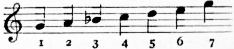

The more primitive biniou, still occasionally found in the remote districts of Cornouailles and Morbihan, has a chaunter with but five holes,2 giving part of the scale of D, the drone being also tuned to D. The drone of the biniou is of boxwood, handsomely inlaid with tin, and has a single or beating reed hidden within the stock.
The word biniou or bignou (a Gallicized form), often erroneously derived from bigno, se renfler beaucoup—an etymology not supported by Breton dictionaries—is the Breton plural form of benvek, instrument, tool, i.e. binviou, binvijou.3 The word is also found in the phrase, “Sac’h ar biniou” (a biniou bag), a bag used by weavers to hold their tools, spindles, &c. The biniou is still the traditional and popular instrument of the Breton peasants of Cornouailles and Morbihan, and is almost inseparable from the bombard (q.v.), which is no other than a survival of the medieval musette, hautbois or chalémie, formerly associated with the bag-pipe in western Europe (see Oboe). At all festivals, at the pardons, wedding feasts and threshing dances, the two traditional musicians or sonneurs give out in shrill penetrating tones the ancient Breton rondes4 and melodies.
1 See Victor Mahillon, Catalogue descriptif, vol. ii. (Ghent, 1896), p. 353, No. 1126; and Captain C.R. Day, Descriptive Catalogue of Musical Instruments (London, 1891), p. 62, No. 135.
2 See N. Quellien, Chansons et danses des Bretons (Paris, 1889), p. 39, and note, where the description of the instrument is not technical.
3 See Le Gonidec, Dictionnaire breton-français, ed. by T. Hersart de la Villemarque; and N. Quellien, op. cit. p. 37, note.
4 For examples of these see N. Quellien, op. cit. part ii.
BINMALEY, a town of the province of Pangasinan, Luzon, Philippine Islands, on the delta of the Agno river, about 5 m. W. of Dagupan, the north terminus of the Manila & Dagupan railway. Pop. (1903) 16,439. It has important fisheries, and manufactures salt, pottery, roofing (made of nipa leaves), and nipa wine. Rice and cocoanuts are the principal agricultural products of the town.
BINNACLE (before 18th century bittacle, through Span. bitácula, from Lat. habitaculum, a little dwelling), a case on the deck of a ship, generally in front of the steersman, in which is kept a compass, and a light by which the compass is read at night.
BINNEY, EDWARD WILLIAM (1812-1881), English geologist, was born at Morton, in Nottinghamshire, in 1812. He was articled to a solicitor in Chesterfield, and in 1836 settled at Manchester. He retired soon afterwards from legal practice and gave his chief attention to geological pursuits. He assisted in 1838 in founding the Manchester Geological Society, of which he was then chosen one of the honorary secretaries; he was elected president in 1857, and again in 1865. He was also successively secretary and president of the Literary and Philosophical Society of Manchester. Working especially at the Carboniferous and Permian rocks of the north of England, he studied also the Drift deposits of Lancashire, and made himself familiar with the geology of the country around Manchester. On the Coal Measures in particular he became an acknowledged authority, and his Observations on the Structure of Fossil Plants found in the Carboniferous Strata (1868-1875) formed one of the monographs of the Palaeontographical Society. His large collection of fossils was placed in Owens College. He was elected a fellow of the Royal Society in 1856. He died at Manchester on the 19th of December 1881.
BINNEY, HORACE (1780-1875), American lawyer, was born in Philadelphia, Pennsylvania, on the 4th of January 1780. He graduated at Harvard College in 1797, and studied law in the office of Jared Ingersoll (1749-1822), who had been a member of the Constitutional convention of 1787, and who from 1791 to 1800 and again from 1811 to 1816 was the attorney-general of Pennsylvania. Admitted to the bar in Philadelphia in 1800, Binney practised with great success for half a century, and was recognized as one of the leaders of the bar in the United States. He served in the Pennsylvania legislature in 1806-1807, and was a Whig member of the National House of Representatives from 1833 until 1835, ably defending the United States Bank, and in general opposing the policy of President Andrew Jackson. His most famous case, in which he was unsuccessfully opposed by Daniel Webster, was the case of Bidal v. Girard’s Executors, which involved the disposition of the fortune of Stephen Girard (q.v.). Binney’s argument in this case greatly influenced the interpretation of the law of charities. Binney made many public addresses, the most noteworthy of which, entitled Life and Character of Chief Justice Marshall, was published in 1835. He also published Leaders of the Old Bar of Philadelphia (1858), and an Inquiry into the Formation of Washington’s Farewell Address (1859); and during the Civil War he issued three pamphlets (1861, 1862 and 1865), discussing the right of habeas corpus under the American Constitution, and justifying President Lincoln in his suspension of the writ.
See the Life of Horace Binney (Philadelphia, 1904), by his grandson, C.C. Binney.
BINNEY, THOMAS (1798-1874), English Congregationalist divine, was born of Presbyterian parents at Newcastle-on-Tyne in 1798, and educated at an ordinary day school. After spending seven years in the employment of a bookseller he entered the theological school at Wymondley, Herts, now incorporated in New College, Hampstead. In 1829, after short pastorates at Bedford (New Meeting) and Newport, Isle of Wight, he accepted a call to the historic Weigh House chapel, London. Here he became very popular, and it was found necessary to build a much larger chapel on Fish Street Hill, to which the congregation removed in 1834. An address delivered on the occasion of the laying of the foundation stone was published, with an appendix containing a strong attack on the influence of the Church of England, which gave rise to a long and bitter controversy. Throughout his whole career Binney was a vigorous opponent of the state church principle, but those who simply classified him as a narrow-minded political dissenter did him injustice. His liberality of view and breadth of ecclesiastical sympathy entitle him to rank on questions of Nonconformity among the most distinguished of the school of Richard Baxter; and he maintained friendly relations with many of the dignitaries of the Established Church. He continued to discharge the duties of the ministry until 1869, when he resigned. In 1845 he paid a visit to Canada and the United States, and in 1857-1859 to the Australian colonies. The university of Aberdeen conferred the LL.D. degree on him in 1852, and he was twice chairman of the Congregational Union of England and Wales.
Binney was the pioneer in a much-needed improvement of the forms of service in Nonconformist churches, and gave a special impulse to congregational psalmody by the publication of a book entitled The Service of Song in the House of the Lord. Of numerous other works the best-known is his Is it Possible to Make the Best of Both Worlds? an expansion of a lecture delivered to young men in Exeter Hall, which attained a circulation of 30,000 copies within a year of its publication. He wrote much devotional verse, including the well-known hymn “Eternal Light! Eternal Light!” His last sermon was preached in November 1873, and after some months of suffering he died on the 24th of February 1874. Dean Stanley assisted at his funeral service in Abney Park cemetery.
BINOCULAR INSTRUMENT, or briefly Binocular,1 an apparatus through which objects are viewed with both eyes. In this article only those instruments will be considered in which solid objects or objects in space are viewed; reference should be made to the article Stereoscope for the instruments in which plane representations are offered to both eyes. The natural vision is such that different central projections of the objects are communicated to both eyes; the difference of the two perspective representations arises from the fact that the projection centres are laterally separated by an interval about equal to the distance between the eyes (the inter-pupillary distance). Binocular instruments should aid the natural spatial or stereoscopic vision, or make it possible if the eyes fail. If the objects be so far distant that the two perspectives formed by the naked eye are no more distinguished from each other, recourse may be had to binocular telescopes and range-finders; and if the objects be so small that, in order to observe details on them, we must bring our eyes so close to the objects that they cannot accommodate the images, recourse may be had to binocular microscopes and magnifying glasses.
The construction of binocular instruments dates back over several centuries, and has now been brought to great perfection. The subject of their theory and history has been exhaustively treated by M. von Rohr, Die binokularen Instrumente (Berlin, 1907), the first publication to present a complete account of these instruments.
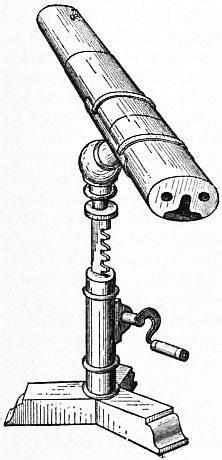
Fig. 1.
Binocular Instruments for Observation only.—The first binocular telescope, consisting of two telescopes placed side by side, was constructed in 1608 by Johann Lipperhey, the inventor of the ordinary or Dutch telescope. The subject was Telescope. next taken up by the monks. The Capuchin Antonius Maria Schyrläus (Schyrl) de Rheita (1597-1660) described in 1645 the construction of double terrestrial telescopes. Greater success attended the efforts of the Capuchin Chérubin d’Orléans, who flourished at about the same time, and constructed large double telescopes of the Dutch type of high magnification, for use in war, and smaller instruments of lower magnification; these instruments were provided with mechanism for adjusting to the interval between the eyes of the observer (fig. 1). After these discoveries the subject received no more attention until the 19th century; no improvements of these instruments are recorded in the literature of the second half of the 18th century.
The re-invention of the Dutch binocular telescope apparently dates from 1823, and is to be assigned to the Viennese optician, Johann Friedrich Voigtländer (1779-1859); but the credit of having placed these instruments on the market probably belongs to J.P. Lemière in Paris, who, in 1825, took out a French patent for an improvement of the Dutch double telescope. Lemière’s instruments were furnished with a common focusing arrangement, and the adapting to the inter-pupillary distance was effected by turning the two parallel telescopes round their common axis. The development of this instrument was studied by opticians for the remainder of the first half of the 19th century; the last improvement apparently was made by P.G. Bardou in 1854, and by H. Helmholtz in 1857 when he described the telestereoscope (fig. 2) with telescopic magnification. By utilizing the telescope with prism-inversion, devised in 1851 by Ignazio Porro (1795-1875), A.A. Boulanger succeeded in producing a binocular of an entirely new type in 1859 (fig. 3). But he overlooked the possibility of increasing the distance between the objectives; Camille Nachet introduced this improvement in 1875, but his instruments did not meet with much popularity. This was probably due to the fact that, at this time, the manufacture of the glass for the prisms was too difficult; this was overcome by E. Abbe, after the founding of the glass-works at Jena, who effected, independently of his predecessors, the wider separation of the objectives (fig. 4), and increased it in the telestereoscope (fig. 5), or relief telescope, in a manner nearly approaching to Helmholtz’s proposal.
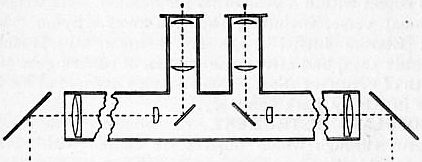
Fig. 2.
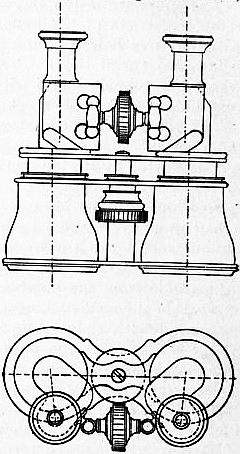
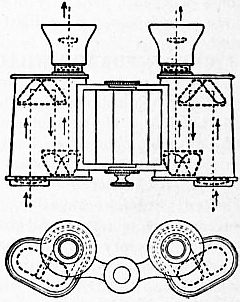
Fig. 3. Fig. 4.
The first binocular microscope was invented by the previously mentioned Father Chérubin, whose instrument consisted of two inverting systems, and consequently gave a totally wrong impression of depth, i.e. depressions appeared as elevations, Microscope. and vice versa, or, as we must say after Charles Wheatstone, it presented a pseudoscopic impression; this quality, however, was not recognized by the microscopists of the time. The instrument subsequently fell into complete neglect for nearly two centuries, to be revived in 1852 by Charles Wheatstone, who has stated that he had previously studied the problem; the publication of his views in his second great paper “On Binocular Vision,”2 in the Phil. Trans. for 1852, undoubtedly stimulated the investigation of this instrument, which was carried on with zeal and success more especially in England and the United States. In 1853 the American J.L. Riddell (1807-1867) devised his binocular microscope, which contained the essentials of Wheatstone’s pseudoscope. F.H. Wenham, another constructor, did not at first succeed in avoiding the pseudoscopic effect, but, by the application of refracting dividing prisms, he subsequently arrived at orthoscopic representations and continued the development of the different methods for producing micro-photographic stereograms; this was effected in the first case by placing a diaphragm over one half of the objective for each exposure, and in the second case by a suitable direction of the illuminating pencil (fig. 6). Of greater benefit, however, for stimulating interest in binocular microscopes, was his invention of reflecting dividing prisms (fig. 7). Other experiments, begun by Powell and Lealand, and developed with greater skill by Wenham, were concerned with the binocular vision of identical images. Such an impression could not possibly be stereoscopic, and these experiments led to the construction of a non-stereoscopic binocular microscope. Of the other workers in this field mention may be made of Alfred Nachet, who in 1853, and subsequently in 1863, brought forward two forms of binocular microscope.
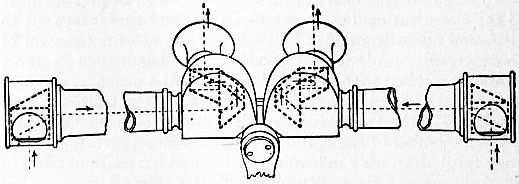
Fig. 5.
The earliest stages of the development of the binocular microscope had been always confined to those instruments with one objective, in the immediate neighbourhood of which the systems for dividing the pencil were placed. At a later date attempts were made to separate the two halves of the objective by modifying the eye-piece; this led to the construction of stereoscopic eye-pieces, initiated by R.B. Tolles, E. Abbe and A. Prazmowski. Of special importance is the work of Abbe; although, as he himself has stated, his methods accidentally led to the Wenham system, he certainly was far above his predecessors in his theoretical treatment of the problem, and in the perspicuity and clearness of his explanation. To him is also due the re-establishment of the instruments, which Wenham had abandoned by reason of too great technical difficulties (fig. 8). The newest form of the binocular microscope is very similar to the oldest form in which two completely separated tubes were employed. The inventor, H.S. Greenough, employs two systems for setting up the image, in order to avoid the pseudoscopic effect. After experiments in the Zeiss works, the erecting of Porro’s prisms simultaneously permitted a convenient adaptation to the eye-distance of the observer.
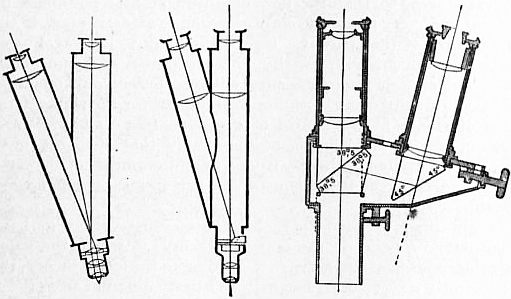
Fig. 6. Fig. 7. Fig. 8.
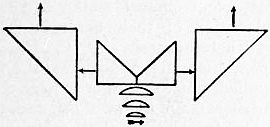
Fig. 9.
The first binocular magnifying glass or simple microscope (German, Lupe) was devised by J.L. Riddell in 1853; in this instrument (fig. 9) the pencil of light is transmitted to the eyes by means of two pairs of parallel mirrors. Simple microscope. Of the many different improvements mention may be made of A. Nachet’s. H. Westien made use of two Chevalier-Brücke’s simple microscopes with their long working distances in order to form an instrument in which the curvature of the image was not entirely avoided. Mention may also be made of the binoculars of K. Fritzsch (formerly Prokesch) and E. Berger.
Binocular Instruments for Range-finding.—For measuring purposes binocular telescopes with parallel axes are the only types employed. The measurement is effected by adjoining to the space or interval to be measured some means of measurement defined; for example, by a fixed scale which extends into the space, or by a movable point (Wandermarke). This instrument shows a transition to the stereoscope, inasmuch as the scale or means of measurement is not directly observed, but to each eye a plane representation is offered, just as in the stereoscope; the space to be measured, on the other hand, is portrayed in exactly the same way as in the double telescope. The method for superposing the two spaces on one another was deduced by Sir David Brewster in 1856, but he does not appear to have dealt with the problem of range-finding. The problem was attacked in 1861 by A. Rollet; later, in 1866, E. Mach published a promising idea, and finally—independently of the researches of his predecessors—Hektor de Grousilliers, in partnership with the Zeiss firm (E. Abbe and C. Pulfrich), constructed the first stereoscopic range-finder suitable for practical use.
(O. Hr.)
1 The term binocular (from the Lat. bini, two at a time, and oculi, eyes) was originally an adjective used to describe things adapted for the simultaneous use of both eyes, as in “binocular vision,” “a binocular telescope or microscope”; now “a binocular” is used as a noun, meaning a binocular microscope, a field-glass, &c.
2 The first part appeared in 1838.
BINOMIAL (from the Lat. bi-, bis, twice, and nomen, a name or term), in mathematics, a word first introduced by Robert Recorde (1557) to denote a quantity composed of the sum or difference to two terms; as a + b, a − b. The terms trinomial, quadrinomial, multinomial, &c., are applied to expressions composed similarly of three, four or many quantities.
The binomial theorem is a celebrated theorem, originally due to Sir Isaac Newton, by which any power of a binomial can be expressed as a series. In its modern form the theorem, which is true for all values of n, is written as
(x + a)n = xn + naxn−1 + n·(n − 1) a2xn−2 n·(n − 1)·(n − 2) a3xn−3 ... + an.
1·2 1·2·3
The reader is referred to the article Algebra for the proof and applications of this theorem; here we shall only treat of the history of its discovery.
The original form of the theorem was first given in a letter, dated the 13th of June 1676, from Sir Isaac Newton to Henry Oldenburg for communication to Wilhelm G. Leibnitz, although Newton had discovered it some years previously. Newton there states that
(p + pq)m/n = pm/n + m aq + m − n bq + m − 2n cq ... &c.,
n 2n 3n
where p + pq is the quantity whose (m/n)th power or root is required, p the first term of that quantity, and q the quotient of the rest divided by p, m/n the power, which may be a positive or negative integer or a fraction, and a, b, c, &c., the several terms in order, e.g.
a = pm/n, b = m aq, c = m − n bq, and so on.
n 2n
In a second letter, dated the 24th of October 1676, to Oldenburg, Newton gave the train of reasoning by which he devised the theorem.
“In the beginning of my mathematical studies, when I was perusing the works of the celebrated Dr Wallis, and considering the series by the interpolation of which he exhibits the area of the circle and hyperbola (for instance, in this series of curves whose common base or axis is x, and the ordinates respectively (1 − xx)0/2, (1 − xx)1/2, (1 − xx)2/2, (1 − xx)3/2, &c), I perceived that if the areas of the alternate curves, which are x, x − 1⁄3x3, x − 2⁄3x3 + 1⁄5x5, x − 3⁄3x3 + 3⁄5x5 − 1⁄7x7, &c., could be interpolated, we should obtain the areas of the intermediate ones, the first of which (1 − xx)1/2 is the area of the circle. Now in order to [do] this, it appeared that in all the series the first term was x; that the second terms 0⁄3x³, 1⁄3x³, 2⁄3x³, &c., were in arithmetical progression; and consequently that the first two terms of all the series to be interpolated would be x − ½x³/3, x − 3⁄2x³/3, x − 5⁄2x³/3, &c.
“Now for the interpolation of the rest, I considered that the denominators 1, 3, 5, &c., were in arithmetical progression; and that therefore only the numerical coefficients of the numerators were to be investigated. But these in the alternate areas, which are given, were the same with the figures of which the several powers of 11 consist, viz., of 11º, 11¹, 11², 11³, that is, the first 1; the second, 1, 1; the third, 1, 2, 1,; the fourth 1, 3, 3, 1; and so on. I enquired therefore how, in these series, the rest of the terms may be derived from the first two being given; and I found that by putting m for the second figure or term, the rest should be produced by the continued multiplication of the terms of this series (m − 0)/1 × (m − 1)/2 × (m − 2)/3 ..., &c. ... This rule I therefore applied to the series to be interpolated. And since, in the series for the circle, the second term was (½x³)/3, I put m = ½.... And hence I found the required area of the circular segment to be x − (½x3)/3 − (1⁄8x5)/5 − (1⁄16x7)/7, &c. ... And in the same manner might be produced the interpolated areas of other curves; as also the area of the hyperbola and the other alternates in this series (1 + xx)0/2, (1 + xx)1/2, (1 + xx)2/2, &c. ... Having proceeded so far, I considered that the terms (1 − xx)0/2, (1 − xx)2/2, (1 − xx)4/2, (1 − xx)6/2, &c., that is 1, 1 − x2, 1 − 2x2 + x4, 1 − 3x2 + 3x4 − x6, &c., might be interpolated in the same manner as the areas generated by them, and for this, nothing more was required than to omit the denominators 1, 3, 5, 7, &c., in the terms expressing the areas; that is, the coefficients of the terms of the quantity to be interpolated (1 − xx)1/2 or (1 − xx)3/2, or generally (1 − xx)m will be produced by the continued multiplication of this series m × (m − 1)/2 × (m − 2)/3 × (m − 3)/4 ... &c.”
The binomial theorem was thus discovered as a development of John Wallis’s investigations in the method of interpolation. Newton gave no proof, and it was in the Ars Conjectandi (1713) that James Bernoulli’s proof for positive integral values of the exponent was first published, although Bernoulli must have discovered it many years previously. A rigorous demonstration was wanting for many years, Leonhard Euler’s proof for negative and fractional values being faulty, and was finally given by Niels Heinrik Abel.
The multi- (or poly-) nomial theorem has for its object the expansion of any power of a multinomial and was discussed in 1697 by Abraham Demoivre (see Combinatorial Analysis).
References.—For the history of the binomial theorem, see John Collins, Commercium Epistolicum (1712); S.P. Rigaud, The Correspondence of Scientific Men of the 17th Century (1841); M. Cantor, Geschichte der Mathematik (1894-1901).
BINTURONG (Arctictis binturong), the single species of the viverrine genus Arctictis, ranging from Nepal through the Malay Peninsula to Sumatra and Java. This animal, also called the bear-cat, is allied to the palm-civets, or paradoxures, but differs from the rest of the family (Viverridae) by its tufted ears and long, bushy, prehensile tail, which is thick at the root and almost equals in length the head and body together (from 28 to 33 inches). The fur is long and coarse, of a dull black hue with a grey wash on the head and fore-limbs. In habits the binturong is nocturnal and arboreal, inhabiting forests, and living on small vertebrates, worms, insects and fruits. It is said to be naturally fierce, but when taken young is easily tamed and becomes gentle and playful.
BINYON, LAURENCE (1869- ), English poet, born at Lancaster on the 10th of August 1869, was educated at St Paul’s school, London, and Trinity College, Oxford, where he won the Newdigate prize in 1890 for his Persephone. He entered the department of printed books at the British Museum in 1893, and was transferred to the department of prints and drawings in 1895, the Catalogue of English Drawings in the British Museum (1898, &c.) being by him. As a poet he is represented by Lyric Poems (1894), Poems (Oxford, 1895), London Visions (2 vols., 1895-1898), The Praise of Life (1896), Porphyrion and other Poems (1898), Odes (1900), The Death of Adam (1903), Penthesilea (1903), Dream come true (1905), Paris and Oenone (1906), a one-act tragedy, and Attila, a poetical drama (1907); as an art critic by monographs on the 17th-century Dutch etchers, on John Crome and John Sell Cotman, contributed to the Portfolio, &c. In 1906 he published the first volume of a series of reproductions from William Blake, with a critical introduction.
See also R.A. Streatfeild, Two Poets of the New Century (1901), and W. Archer, Poets of the Younger Generation (1902).
BIO-BIO, a river of southern Chile, rising in the Pino Hachado pass across the Andes, 38° 45′ S. lat., and flowing in a general north-westerly direction to the Pacific at Concepción, where it is 2 m. wide and forms an excellent harbour. It has a total length of about 225 m., nearly one half of which is navigable.
BIO-BIO, an inland province of southern Chile, bounded N., W. and S. respectively by the provinces of Concepción, Arauco and Malleco, and E. by Argentina. It has an area of 5246 sq. m. of well-wooded and mountainous country, and exports timber to a large extent. The great trunk railway from Santiago S. to Puerto Montt crosses the western part of the province and also connects it with the port of Concepción. The capital, Los Angeles (est. pop. 7777 in 1902) lies 15½ m. E. of this railway and is connected with it by a branch line.
BIOGENESIS (from the Gr. βίος, life, and γένεσις, generation, birth), a biological term for the theory according to which each living organism, however simple, arises by a process of budding, fission, spore-formation of sexual reproduction from a parent organism. Under the heading of Abiogenesis (q.v.) is discussed the series of steps by which the modern acceptance of biogenesis and rejection of abiogenesis has been brought about. No biological generalization rests on a wider series of observations, or has been subjected to a more critical scrutiny than that every living organism has come into existence from a living portion or portions of a pre-existing organism. In the articles Reproduction and Heredity the details of the relations between parent and offspring are discussed. There remains for treatment here a curious collateral issue of the theory. It is within common observation that parent and offspring are alike: that the new organism resembles that from which it has come into existence: in fine, biogenesis is homogenesis. Every organism takes origin from a parent organism of the same kind. The conception of homogenesis, however, does not imply an absolute similarity between parent and organism. In the first place, the normal life-cycle of plants and animals exhibits what is known as alternation of generations, so that any individual in the chain may resemble its grand-parent and its grand-child, and differ markedly from its parent and child. Next, any organism may pass through a series of free-living larval stages, so that the new organism at first resembles its parent only very remotely, corresponding to an early stage in the life-history of that parent. (See Embryology, Larval Forms and Reproduction.) Finally, the conception of homogenesis does not exclude the differences between parent and offspring that continually occur, forming the material for the slow alteration of stocks in the course of evolution (see Variation and Selection). Homogenesis means simply that such organism comes into existence directly from a parent organism of the same race, and hence of the same species, sub-species, genus and so forth.
From time to time there have been observers who have maintained a belief in the opposite theory, to which the name heterogenesis has been given. According to the latter theory, the offspring of a given organism may be utterly different from itself, so that a known animal may give rise to another known animal of a different race, species, genus, or even family, or to a plant, or vice versa. The most extreme cases of this belief is the well-known fable of the “barnacle-geese,” an illustrated account of which was printed in an early volume of the Royal Society of London. Buds of a particular tree growing near the sea were described as producing barnacles, and these, falling into the water, were supposed to develop into geese. The whole story was an imaginary embroidery of the facts that barnacles attach themselves to submerged timber and that a species of goose is known as the bernicle goose. In modern times the exponents of heterogenesis have limited themselves to cases of microscopic animals and plants, and in most cases, the observations that they have brought forward have been explained by minuter observation as cases of parasitism. No serious observer, acquainted with modern microscopic technical methods, has been able to confirm the explanation of their observations given by the few modern believers in heterogenesis.
(P. C. M.)
BIOGRAPHY (from the Gr. βίος, life, and γράφη, writing), that form of history which is applied, not to races or masses of men, but to an individual. The earliest use of the word βιογραφία is attributed to Damascius, a Greek writer of the beginning of the 6th century, and in Latin biographia was used, but in English no earlier employment of the word, “biography” has been traced than that of Dryden in 1683, who uses it to describe the literary work of Plutarch, “the history of particular men’s lives.” It is obvious that this definition is necessary, for biography is not the record of “life” in general, but of the life of a single person. The idea of the distinction between this and history is a modern thing; we speak of “antique biography,” but it is doubtful whether any writer of antiquity, even Plutarch, clearly perceived its possible existence as an independent branch of literature. All of them, and Plutarch certainly, considered the writing of a man’s life as an opportunity for celebrating, in his person, certain definite moral qualities. It was in these, and not in the individual characteristics of the man, that his interest as a subject of biography resided.
The true conception of biography, therefore, as the faithful portrait of a soul in its adventures through life, is very modern. We may question whether it existed, save in rare and accidental instances, until the 17th century. The personage described was, in earlier times, treated either from the philosophical or from the historical point of view. In the former case, rhetoric inevitably clouded the definiteness of the picture; the object was to produce a grandiose moral effect, to clothe the subject with all the virtues or with all the vices; to make his career a splendid example or else a solemn warning. The consequence is that we have to piece together unconsidered incidents and the accidental record of features in order to obtain an approximate estimate. We may believe, for instance, that a faithful and unprejudiced study of the emperor Julian, from the life, would be a very different thing from the impression left upon us by the passions of Cyril or of Theodoret. In considering what biography, in its pure sense, ought to be, we must insist on what it is not. It is not a philosophical treatise nor a polemical pamphlet. It is not, even, a portion of the human contemporary chronicle. Broad views are entirely out of place in biography, and there is perhaps no greater literary mistake than to attempt what is called the “Life and Times” of a man. In an adequate record of the “times,” the man is bound to sink into significance; even a “Life and Times” of Napoleon I. would be an impossible task. History deals with fragments of the vast roll of events; it must always begin abruptly and close in the middle of affairs; it must always deal, impartially, with a vast number of persons. Biography is a study sharply defined by two definite events, birth and death. It fills its canvas with one figure, and other personages, however great in themselves, must always be subsidiary to the central hero. The only remnant of the old rhetorical purpose of “lives” which clearer modern purpose can afford to retain is the relative light thrown on military or intellectual or social genius by the achievements of the selected subject. Even this must be watched with great care, lest the desire to illuminate that genius, and make it consistent, should lead the biographer to glose over frailties or obscure irregularities. In the old “lives” of great men, this is precisely what was done. If the facts did not lend themselves to the great initial thesis, so much the worse for them. They must be ignored or falsified, since the whole object of the work was to “teach a lesson,” to magnify a certain tendency of conduct. It was very difficult to persuade the literary world that, whatever biography is, it is not an opportunity for panegyric or invective, and the lack of this perception destroys our faith in most of the records of personal life in ancient and medieval times. It is impossible to avoid suspecting that Suetonius loaded his canvas with black in order to excite hatred against the Roman emperors; it is still more difficult to accept more than one page in three of the stories of the professional hagiographers. As long as it was a pious merit to deform the truth, biography could not hope to flourish. It appears to have originally asserted itself when the primitive instinct of sympathy began to have free play, that is to say, not much or often before the 17th century. Moreover, the peculiar curiosity which legitimate biography satisfies is essentially a modern thing; and presupposes our observation of life not unduly clouded by moral passion or prejudice.
Among the ancients, biography was not specifically cultivated until comparatively later times. The lost “Lives” of Critias were probably political pamphlets. We meet first with deliberate biography in Xenophon’s memoirs of Socrates, a work of epoch-making value. Towards the close of the 1st century, Plutarch wrote one of the most fascinating books in the world’s literature, his Parallel Lives of 46 Greeks and Romans. In later Greek, the Life of Apollonius of Tyana was written by Philostratus, who also produced a Lives of the Sophists. In the 3rd century, Diogenes Laertius compiled a Lives of the Philosophers, which is of greater interest than a Lives of the Sophists composed a hundred years later by Eunapius. Finally in the 10th century, Suidas added a biographical section to his celebrated Lexicon. In Latin literature, the earliest biography we meet with is the fragment of the Illustrious Men of Cornelius Nepos. Memoirs began to be largely written at the close of the Augustan age, but these, like the Life of Alexander the Great, by Q. Curtius Rufus, were rather historical than biographical. Tacitus composed a life of his father-in-law, Agricola; this is a work of the most elegant and stately beauty. Suetonius was the author of several biographical compilations, of which the Lives of the Twelve Caesars is the best-known; this was produced in the year 120. Marius Maximus, in the 4th century, continued the series of emperors down to Heliogabalus, but his work has not been preserved. The Augustan History, finished under Constantine, takes its place, and was concluded and edited by Flavius Vopiscus.
Biography hardly begins to exist in English literature until the close of the reign of Henry VIII. William Roper (1496-1578) wrote a touching life of his father-in-law, Sir Thomas More, and George Cavendish (1500-1561?), a memoir of Cardinal Wolsey which is a masterpiece of liveliness and grace. It is with these two works, both of which remained in manuscript until the 17th century, that biography in England begins. The lives of English writers compiled by John Bale (1495-1563) are much more primitive and slight. John Leland (d. 1552) and John Pits (1560-1616) were antiquaries who affected a species of biography. In the early part of the 17th century, the absence of the habit of memoir writing extremely impoverishes our knowledge of the illustrious authors of the age, of none of whom there are preserved such records as our curiosity would delight in. The absence of any such chronicle was felt, and two writers, Thomas Heywood and Sir Aston Cokayne, proposed to write lives of the poets of their time. Unfortunately they never carried their plans into execution. The pioneer of deliberate English biography was Izaak Walton, who, in 1640, published a Life of Donne, followed in 1651 by that of Sir Henry Wotton, in 1665 by that of Richard Hooker, in 1670 by that of George Herbert, and in 1678 by that of Dr Robert Saunderson. These five reprinted, under the title of Walton’s Lives, were not only charming in themselves, but the forerunners of a whole class of English literature. Meanwhile, Fuller was preparing his History of the Worthies of England, which appeared after his death, in 1662, and John Aubrey (1626-1697) was compiling his Minutes of Lives, which show such a perfect comprehension of the personal element that should underlie biography; these have only in our own days been completely given to the public. Edward, Lord Herbert of Cherbury (1583-1648), wrote a brilliant autobiography, first printed in 1764; that of Anne Harrison, Lady Fanshawe (1625-1680), remained unknown until 1829. A very curious essay in biography is the memoir of Colonel John Hutchinson, written by his widow, Lucy, between 1664 and 1671. Margaret Lucas, duchess of Newcastle (1624?-1674), wrote her own life (1656) and that of her duke (1667). The Athenae Oxonienses of Anthony à Wood (1632-1695) was a complicated celebration of the wit, wisdom and learning of Oxford notabilities since the Reformation. In 1668 Thomas Sprat (1635-1713) wrote a Life of Cowley, which was very much admired and which exercised for many years a baneful influence on British biography. Sprat considered that all familiar anecdote and picturesque detail should be omitted in the composition of a memoir, and that moral effect and a solemn vagueness should be aimed at. The celebrated funeral orations of Jeremy Taylor were of the same order of eloquence, and the wind of those grandiose compositions destroyed the young shoot of genuine and simple biography which had budded in Walton and Aubrey.
From this time forth, for more than half a century, English biography became a highly artificial and rhetorical thing, lacking all the salient features of honest portraiture. William Oldys (1696-1761) was the first to speak out boldly; in 1747, in the preface to the Biographia Britannica, he pointed out “the cruelty, we might even say the impiety, of sacrificing the glory of great characters to trivial circumstances and mere conveniency,” and attacked the timid and scrupulous superficiality of those who undertook to write lives of eminent men, while omitting everything which gave definition to the portrait. In 1753 the Lives of the Poets, which bore the name of Theophilus Cibber (1703-1758), but was mainly written by Robert Shiels (d. 1753), gave a great deal of valuable information with regard to the personal adventures of our writers. Dr Johnson’s Life of Savage (1744), though containing some passages of extreme interest, was a work of imperfect form, but Mason’s Life and Letters of Gray (1774) marks a great advance in the art of biography. This was the earliest memoir in which correspondence of a familiar kind was used to illustrate and to expand the narrative, and Mason’s Gray is really the pioneer of almost all modern English biography. For the first time it was now admitted that letters to intimate friends, not written with a view to publication, might be used with advantage to illustrate the real character of the writer. Boswell, it is certain, availed himself of Mason’s example, while improving upon it, and in 1791 he published his Life of Dr Samuel Johnson, which is the most interesting example of biography existing in English, or perhaps in any language.
As soon as the model of Boswell became familiar to biographers, it could no longer be said that any secret in the art was left unknown to them, and the biographies of the 19th century are all more or less founded upon the magnificent type of the Life of Johnson. But few have even approached it in courage, picturesqueness or mastery of portraiture. In the next generation Southey’s lives of Nelson (1813) and John Wesley (1820) at once became classics; but the pre-eminent specimen of early 19-century biography is Lockhart’s superb Life of Sir Walter Scott (1837-1838). The biographies of the 19th century are far too numerous to be mentioned here in detail; in the various articles dedicated to particular men and women in this Encyclopaedia, the date and authorship of the authoritative life of each person will in most cases be found appended. Towards the close of the century there was unquestionably an excess, and even an abuse, in the habit of biography. It became the custom a few years or even months after the decease of an individual who had occupied a passing place in the eyes of the public, to issue a “Life” of him; in many cases such biography was a labour of utter supererogation. But the custom has become general, and it is very unlikely, notwithstanding the ephemeral interest of readers in the majority of the subjects, that it will ever go out of fashion, for it directly indulges both vanity and sentiment. What is true of Great Britain is true, though in less measure, of all other modern nations, and it is not necessary here to deal with more than the early manifestations of biography in the principal European literatures.
To Switzerland appears due the honour of having given birth to the earliest biographical dictionary ever compiled, the Bibliotheca Universalis of Konrad Gesner (1516-1565), published at Zürich in Latin, Greek and Hebrew, from 1545 to 1549. A very rare work, by a writer of the greatest obscurity, the Prosopographia of Verdier de Vauprivas, published at Lyons in 1573, professed to deal with the lives of all illustrious persons who had flourished since the beginning of the world.
In medieval and renaissance France there existed numerous memoirs and histories, such as those of Brantôme, into which the lives of great men were inserted, and in which a biographical character was given to studies of virtue and valour, or of the reverse. But the honour of being the earliest deliberate contribution to biography is generally given to the Acta Sanctorum, compiled by the Bollandists, the first volume of which appeared in 1653. This was the first biographical dictionary compiled in Europe, and its publication produced a great sensation. It was confined to the lives of saints and martyrs, but in 1674 Louis Moréri, in his Grand Dictionnaire, included a biographical section of a general character. But the earliest biographical dictionary which had anything of a modern form was the celebrated Dictionnaire historique et critique of Pierre Bayle, in 1696; the lives in this great work, however, are too often used as mere excuses for developing the philosophical and controversial views of the author; they are nevertheless the result of genuine research and have a true biographical view. The Dictionnaire was translated into English in 1734, and had a wide influence in creating a legitimate interest in biography in England.
In Italian literature, biography does not take a prominent place until the 15th century. The Lives of Illustrious Florentines, in which a valuable memoir of Dante occurs, was written in Latin by Filippo Villani. Vespasiano da Bistrici (1421-1498) compiled a set of biographies of his contemporaries, which are excellent of their kind. The so-called Life of Castruccio Castracani, by Machiavelli, is hardly a biography, but a brilliant essay on the ideals of statecraft. Paolo Giovio (1483-1552) wrote the lives of poets and soldiers whom he had known. All these attempts, however, seem insignificant by the side of the autobiography of Benvenuto Cellini (1501-1571), confessedly one of the most entertaining works of the world’s literature. A great deal of biography is scattered throughout the historical compilations of the Italian renaissance, and the Lives of the Artists, by Giorgio Vasari (1512-1574), is a storehouse of anecdotes admirably told. We find nothing else that requires special mention till we reach the memoir-writers of the 18th century, with the autobiographies of Count Carlo Gozzi and Alfieri; and on the whole, Italy, although adopting in the 19th century the habit of biography, has rarely excelled in it.
In Spanish literature Fernán Pérez de Guzmán (1378-1460), with great originality, enshrined, in his Generations and Likenesses, a series of admirable literary portraits; he has been called the Plutarch of Spain. But, in spite of numerous lives of saints, poets and soldiers, Spanish literature has not excelled in biography, nor has it produced a single work of this class which is universally read. In Germany there is little to record before the close of the 18th century.
In the course of the 19th century a new thing in biography was invented, in the shape of dictionaries of national biography. Of these, the first which was carried to a successful conclusion was the Swedish (1835-1857), which occupied 23 volumes. This dictionary was followed by the Dutch (1852-1878), in 24 volumes; the Austrian (1856-1891), in 35 volumes; the Belgian (which was begun in 1866); the German (1875-1900), in 45 volumes; and others, representing nearly all the countries of Europe. England was behind the competitors named above, but when she joined the ranks a work was produced the value of which can hardly be exaggerated. The project was started in 1882 by the publisher George Smith (1824-1901), who consulted Mr (afterwards Sir) Leslie Stephen. The first volume of the English Dictionary of National Biography was published on the 1st of January 1885, under Stephen’s editorship. A volume was published quarterly, with complete punctuality until Midsummer 1900, when volume 63 closed the work, which was presently extended by the issue of three supplementary volumes. In May 1891 Leslie Stephen resigned the editorship and was succeeded by Mr Sidney Lee, who conducted the work to its prosperous close, bringing it up to the death of Queen Victoria. The Dictionary of National Biography contains the lives of more than 30,000 persons, and has proved of inestimable service in elucidating the private annals of the British people.
(E. G.)
BIOLOGY (Gr. βίος, life). The biological sciences are those which deal with the phenomena manifested by living matter; and though it is customary and convenient to group apart such of these phenomena as are termed mental, and such of them as are exhibited by men in society, under the heads of psychology and sociology, yet it must be allowed that no natural boundary separates the subject matter of the latter sciences from that of biology. Psychology is inseparably linked with physiology; and the phases of social life exhibited by animals other than man, which sometimes curiously foreshadow human policy, fall strictly within the province of the biologist.
On the other hand, the biological sciences are sharply marked off from the abiological, or those which treat of the phenomena manifested by not-living matter, in so far as the properties of living matter distinguish it absolutely from all other kinds of things, and as the present state of knowledge furnishes us with no link between the living and the not-living.
These distinctive properties of living matter are—
1. Its chemical composition—containing, as it invariably does, one or more forms of a complex compound of carbon, hydrogen, oxygen and nitrogen, the so-called protein or albumin (which has never yet been obtained except as a product The properties of living matter. of living bodies), united with a large proportion of water, and forming the chief constituent of a substance which, in its primary unmodified state, is known as protoplasm.
2. Its universal disintegration and waste by oxidation; and its concomitant reintegration by the intussusception of new matter.
A process of waste resulting from the decomposition of the molecules of the protoplasm, in virtue of which they break up into more highly oxidated products, which cease to form any part of the living body, is a constant concomitant of life. There is reason to believe that carbonic acid is always one of these waste products, while the others contain the remainder of the carbon, the nitrogen, the hydrogen and the other elements which may enter into the composition of the protoplasm.
The new matter taken in to make good this constant loss is either a ready-formed protoplasmic material, supplied by some other living being, or it consists of the elements of protoplasm, united together in simpler combinations, which consequently have to be built up into protoplasm by the agency of the living matter itself. In either case, the addition of molecules to those which already existed takes place, not at the surface of the living mass, but by interposition between the existing molecules of the latter. If the processes of disintegration and of reconstruction which characterize life balance one another, the size of the mass of living matter remains stationary, while, if the reconstructive process is the more rapid, the living body grows. But the increase of size which constitutes growth is the result of a process of molecular intussusception, and therefore differs altogether from the process of growth by accretion, which may be observed in crystals and is effected purely by the external addition of new matter—so that, in the well-known aphorism of Linnaeus, the word “grow” as applied to stones signifies a totally different process from what is called “growth” in plants and animals.