VOLUME III SLICE VI Bent, James to Bibirine
Reading edition
Articles in This Slice
BENT, JAMES THEODORE BERRYER, ANTOINE PIERRE
BENT BERSERKER
BENTHAM, GEORGE BERT, PAUL
BENTHAM, JEREMY BERTANI, AGOSTINO
BENTINCK, LORD WILLIAM BERTAT
BENTINCK, LORD WILLIAM GEORGE FREDERICK CAVENDISH BERTAUT, JEAN
BENTIVOGLIO, GIOVANNI BERTH
BENTIVOGLIO, GUIDO BERTHELOT, MARCELLIN PIERRE EUGÈNE
BENTLEY, RICHARD (English scholar) BERTHIER, LOUIS ALEXANDRE
BENTLEY, RICHARD (British publisher) BERTHOLLET, CLAUDE LOUIS
BENTON, THOMAS HART BERTHON, EDWARD LYON
BENTON HARBOR BERTHOUD, FERDINAND
BENUE BERTILLON, LOUIS ADOLPHE
BEN VENUE BERTIN
BENZALDEHYDE BERTINORO, OBADIAH
BENZENE BERTINORO
BENZIDINE BERTOLD
BENZOIC ACID BERTOLD VON REGENSBURG
BENZOIN (ketone-alcohol) BERTRAM, CHARLES
BENZOIN (balsamic resin) BERTRAND, HENRI GRATIEN
BENZOPHENONE BERTRICH
BENZYL ALCOHOL BÉRULLE, PIERRE DE
BEOTHUK BERVIE
BEÖTHY, ÖDÖN BERWICK, JAMES FITZJAMES
BEOWULF BERWICKSHIRE
BEQUEST BERWICK-UPON-TWEED
BÉRAIN, JEAN BERYL
BÉRANGER, PIERRE JEAN DE BERYLLIUM
BERAR BERYLLONITE
BÉRARD, JOSEPH FRÉDÉRIC BERZELIUS, JÖNS JAKOB
BERAT BES
BERAUN BESANÇON
BERBER BESANT, SIR WALTER
BERBERA BESENVAL DE BRONSTATT, PIERRE VICTOR
BERBERINE BESKOW, BERNHARD VON
BERBERS BESNARD, PAUL ALBERT
BERCEUSE BESOM
BERCHEM, NICOLAAS BESSARABIA
BERCHTA BESSARION, JOHANNES
BERCHTESGADEN BESSBOROUGH, EARLS OF
BERCK BESSÈGES
BERDICHEV BESSEL, FRIEDRICH WILHELM
BERDYANSK BESSEL FUNCTION
BEREA BESSEMER, SIR HENRY
BEREKHIAH NAQDAN BESSEMER
BERENGARIUS BESSIÈRES, JEAN BAPTISTE
BÉRENGER, ALPHONSE MARIE MARCELLIN THOMAS BESSUS
BERENICE (princesses) BEST, WILLIAM THOMAS
BERENICE (seaport of Egypt) BESTIA
BERESFORD, LORD CHARLES WILLIAM DE LA POER BESTUZHEV-RYUMIN, ALEXIUS PETROVICH
BERESFORD, JOHN BESTUZHEV-RYUMIN, MIKHAIL PETROVICH
BERESFORD, WILLIAM CARR BERESFORD BET and BETTING
BEREZINA BETAÏNE
BEREZOV BETEL NUT
BEREZOVSK BETHANY
BERG BETHEL
BERGAMASK BÉTHENCOURT, JEAN DE
BERGAMO BETHESDA (Jerusalem)
BERGAMOT, OIL OF BETHESDA (Wales)
BERGEDORF BETH-HORON
BERGEN BETHLEHEM (Palestine)
BERGEN-OP-ZOOM BETHLEHEM (Pennsylvania, U.S.A.)
BERGERAC BETHLEHEMITES
BERGHAUS, HEINRICH BETHLEN, GABRIEL
BERGK, THEODOR BETHNAL GREEN
BERGLER, STEPHAN BÉTHUNE {family)
BERGMAN, TORBERN OLOF BÉTHUNE, CONON DE
BERGSCHRUND BÉTHUNE (town of France)
BERGUES BETROTHAL
BERHAMPUR (Bengal, India) BETTERMENT
BERHAMPUR (Madras, India) BETTERTON, THOMAS
BERI-BERI BETTIA
BERING, VITUS BETTINELLI, SAVERIO
BERING ISLAND, SEA and STRAIT BETTWS Y COED
BERING SEA ARBITRATION BETTY, WILLIAM HENRY WEST
BERIOT, CHARLES AUGUSTE DE BETUL
BERJA BETWA
BERKA BEUDANT, FRANÇOIS SULPICE
BERKELEY (English family) BEUGNOT, JACQUES CLAUDE
BERKELEY, GEORGE BEULÉ, CHARLES ERNEST
BERKELEY, MILES JOSEPH BEURNONVILLE, PIERRE DE RUEL
BERKELEY, SIR WILLIAM BEUST, FRIEDRICH FERDINAND VON
BERKELEY (California, U.S.A.) BEUTHEN (Niederbeuthen)
BERKELEY (town of England) BEUTHEN (Oberbeuthen)
BERKHAMPSTEAD BEVEL
BERKSHIRE, THOMAS HOWARD BEVERLEY, WILLIAM ROXBY
BERKSHIRE BEVERLEY
BÊRLAD BEVERLY
BERLICHINGEN, GOETZ BEVIS OF HAMPTON
BERLIN, ISAIAH BEWDLEY
BERLIN (German city) BEWICK, THOMAS
BERLIN (New Hampshire, U.S.A.) BEXHILL
BERLIN (Ontario, Canada) BEXLEY, NICHOLAS VANSITTART
BERLIN (carriage) BEXLEY
BERLIOZ, HECTOR BEY
BERM BEYBAZAR
BERMONDSEY BEYLE, MARIE HENRI
BERMUDAS BEYRICH, HEINRICH ERNST VON
BERMUDEZ BEYSCHLAG, WILLIBALD
BERN (Swiss canton) BEZA, THEODORE
BERN (Swiss city) BEZANT
BERNARD, SAINT BEZANTÉE
BERNARD OF CHARTRES BEZBORODKO, ALEKSANDER ANDREEVICH
BERNARD, CHARLES DE BEZEL
BERNARD, CLAUDE BÉZIQUE
BERNARD, JACQUES BEZWADA
BERNARD, MOUNTAGUE BHAGALPUR
BERNARD, SIMON BHAMO
BERNARD, SIR THOMAS BHANDARA
BERNARDIN OF SIENA, ST BHANG
BERNAUER, AGNES BHARAHAT
BERNAY BHARAL
BERNAYS, JAKOB BHARATPUR
BERNBURG BHATGÁON
BERNERS, JOHN BOURCHIER BHATTIANA
BERNERS, JULIANA BHAU DAJI
BERNHARD OF SAXE-WEIMAR BHAUNAGAR
BERNHARDT, SARAH BHEESTY
BERNHARDY, GOTTFRIED BHERA
BERNI, FRANCESCO BHILS
BERNICIA BHIMA
BERNICIAN SERIES BHIWANI
BERNINI, GIOVANNI LORENZO BHOPAL
BERNIS, FRANÇOIS JOACHIM DE PIERRE DE BHOPAWAR
BERNKASTEL BHOR
BERNOULLI BHUJ
BERNSTEIN, AARON BHUTAN
BERNSTORFF, ANDREAS PETER BIANCHINI, FRANCESCO
BERNSTORFF, CHRISTIAN GÜNTHER BIARRITZ
BERNSTORFF, JOHANN HARTWIG ERNST BIAS (Sage of Greece)
BEROSSUS BIAS (something oblique)
BERRY, CHARLES ALBERT BIBACULUS, MARCUS FURIUS
BERRY, CHARLES FERDINAND BIBER, HEINRICH JOHANN FRANZ VON
BERRY, JOHN BIBERACH
BERRY BIBIRINE
BENT, JAMES THEODORE (1852-1897), English traveller, was the son of James Bent of Baildon House, near Leeds, Yorkshire, where he was born on the 30th of March 1852. He was educated at Repton school and Wadham College, Oxford, where he graduated in 1875. In 1877 he married Mabel, daughter of R.W. Hall-Dare of Newtownbarry, Co. Wexford, and she became his companion in all his travels. He went abroad every year and became thoroughly acquainted with Italy and Greece. In 1879 he published a book on the republic of San Marino, entitled A Freak of Freedom, and was made a citizen of San Marino; in the following year appeared Genoa: How the Republic Rose and Fell, and in 1881 a Life of Giuseppe Garibaldi. He spent considerable time in the Aegean archipelago, of which he wrote in The Cyclades: or Life among the Insular Greeks (1885). From this period Bent devoted himself particularly to archaeological research. The years 1885-1888 were given up to investigations in Asia Minor, his discoveries and conclusions being communicated to the Journal of Hellenic Studies and other magazines and reviews. In 1889 he undertook excavations in the Bahrein Islands of the Persian Gulf, and found evidence that they had been a primitive home of the Phoenician race. After an expedition in 1890 to Cilicia Trachea, where he obtained a valuable collection of inscriptions, Bent spent a year in South Africa, with the object, by investigation of some of the ruins in Mashonaland, of throwing light on the vexed question of their origin and on the early history of East Africa. He made the first detailed examination of the Great Zimbabwe. Bent described his work in The Ruined Cities of Mashonaland (1892). In 1893 he investigated the ruins of Axum and other places in the north of Abyssinia, partially made known before by the researches of Henry Salt and others, and The Sacred City of the Ethiopians (1893) gave an account of this expedition. Bent now visited at considerable risk the almost unknown Hadramut country (1893-1894), and during this and later journeys in southern Arabia he studied the ancient history of the country, its physical features and actual condition. On the Dhafar coast in 1894-1895 he visited ruins which he identified with the Abyssapolis of the frankincense merchants. In 1895-1896 he examined part of the African coast of the Red Sea, finding there the ruins of a very ancient gold-mine and traces of what he considered Sabean influence. While on another journey in South Arabia (1896-1897), Bent was seized with malarial fever, and died in London on the 5th of May 1897, a few days after his return. Mrs Bent, who had contributed by her skill as a photographer and in other ways to the success of her husband’s journeys, published in 1900 Southern Arabia, Soudan and Sakotra, in which were given the results of their last expedition into that region. The conclusions at which Bent arrived as to the Semitic origin of the ruins in Mashonaland have not been accepted by archaeologists, but the value of his pioneer work is undeniable (see Zimbabwe).
BENT. 1. (From “to bend”), primarily the result of bending; hence any inclination from the straight, as in curved objects like a hook or a bow; this survives in the modern phrase “to follow one’s own bent,” i.e. to pursue a certain course in a direction deviating from the normal, as also in such phrases as Chaucer’s “Downward on a hill under a bent,” indicating a hollow or declivity in the general configuration of the land. From the bending of a bow comes the idea of tension, as in Hamlet, “they fool me to the top of my bent,” i.e. to the utmost of my capacity. 2. (From the O. Eng. beonet, a coarse, rushy grass growing in wet places; cf. the Ger. Binse, a reed), the name (“bent” or “bennet”) popularly applied to several kinds of grass and surviving in the form “bent-grass.”
BENTHAM, GEORGE (1800-1884), English botanist, was born at Stoke near Portsmouth on the 22nd of September 1800. His father, Sir Samuel Bentham (1757-1831), was the only brother of Jeremy Bentham, the publicist, and of scarcely inferior ability though in a different direction. Devoting himself in early life to the study of naval architecture, Sir Samuel went to Russia to visit the naval establishments in the Baltic and Black Seas. He was induced to enter the service of the empress Catherine II., built a flotilla of gunboats and defeated the Turkish fleet. For this he was made, in addition to other honours, colonel of a cavalry regiment. On the death of the empress he returned to England to be employed by the admiralty, and was sent (1805-1807) again to Russia to superintend the building of some ships for the British navy. He attained the rank, under the admiralty, of inspector-general of naval works. He introduced a multitude of improvements in naval organization, and it was largely through his recommendation that M.I. Brunel’s block-making machinery was installed at Portsmouth.
George Bentham had neither a school nor a college education, but early acquired the power of giving sustained and concentrated attention to any subject that occupied him—one essential condition of the success he attained as perhaps the greatest systematic botanist of the 19th century. Another was his remarkable linguistic aptitude. At the age of six to seven he could converse in French, German and Russian, and he learnt Swedish during a short residence in Sweden when little older. At the close of the war with France, the Benthams made a long tour through that country, staying two years at Montauban, where Bentham studied Hebrew and mathematics in the Protestant Theological School. They eventually settled in the neighbourhood of Montpellier where Sir Samuel purchased a large estate.
The mode in which George Bentham was attracted to the botanical studies which became the occupation of his life is noteworthy; it was through the applicability to them of the logical methods which he had imbibed from his uncle’s writings, and not from any special attraction to natural history pursuits. While studying at Angoulême a copy of A.P. de Candolle’s Flore française fell into his hands and he was struck with the analytical tables for identifying plants. He immediately proceeded to test their use on the first that presented itself. The result was successful and he continued to apply it to every plant he came across. A visit to London in 1823 brought him into contact with the brilliant circle of English botanists. In 1826, at the pressing invitation of his uncle, he agreed to act as his secretary, at the same time entering at Lincoln’s Inn and reading for the bar. He was called in due time and in 1832 held his first and last brief. The same year Jeremy Bentham died, leaving his property to his nephew. His father’s inheritance had fallen to him the previous year. He was now in a position of modest independence, and able to pursue undistractedly his favourite studies. For a time these were divided between botany, jurisprudence and logic, in addition to editing his father’s professional papers. Bentham’s first publication was his Catalogue des plantes indigènes des Pyrénées et du Bas Languedoc (Paris, 1826), the result of a careful exploration of the Pyrenees in company with G.A. Walker Arnott (1799-1868), afterwards professor of botany in the university of Glasgow. It is interesting to notice that in it Bentham adopted the principle from which he never deviated, of citing nothing at second-hand. This was followed by articles on various legal subjects: on codification, in which he disagreed with his uncle, on the laws affecting larceny and on the law of real property. But the most remarkable production of this period was the Outline of a New System of Logic, with a Critical Examination of Dr Whately’s Elements of Logic (1827). In this the principle of the quantification of the predicate was first explicitly stated. This Stanley Jevons declared to be “undoubtedly the most fruitful discovery made in abstract logical science since the time of Aristotle.” Before sixty copies had been sold the publisher became bankrupt and the stock went for wastepaper. The book passed into oblivion, and it was not till 1873 that Bentham’s claims to priority were finally vindicated against those of Sir William Hamilton by Herbert Spencer. In 1836 he published his Labiatarum genera et species. In preparing this work he visited, between 1830-1834, every European herbarium, several more than once. The following winter was passed in Vienna, where he produced his Commentationes de Leguminosarum generibus, published in the annals of the Vienna Museum. In 1842 he removed to Pontrilas in Herefordshire. His chief occupation for some succeeding years was his contributions to the Prodromus Systematis Naturalis Regni Vegetabilis, which was being carried on by his friend, A.P. deCandolle. In all these dealt with some 4730 species.
In 1854 he found the maintenance of a herbarium and library too great a tax on his means. He therefore offered them to the government on the understanding that they should form the foundation of such necessary aids to research in the Royal Botanic Gardens at Kew. At the same time he contemplated the abandonment of botanical work. Fortunately, he yielded to the persuasion of Sir William Hooker, John Lindley and other scientific friends. In 1855 he took up his residence in London, and worked at Kew for five days a week, with a brief summer holiday, from this time onwards till the end of his life. As his friend Asa Gray wrote: “With such methodical habits, with freedom from professional or administrative functions, which consume the time of most botanists, with steady devotion to his chosen work, and with nearly all authentic material and needful appliances at hand or within reach, it is not so surprising that he should have undertaken and have so well accomplished such a vast amount of work, and he has the crowning merit and happy fortune of having completed all that he undertook.” The government, in 1857, sanctioned a scheme for the preparation of a series of Floras or descriptions in the English language of the indigenous plants of British colonies and possessions. Bentham began with the Flora Hongkongensis in 1861, which was the first comprehensive work on any part of the little-known flora of China. This was followed by the Flora Australiensis, in seven volumes (1863-1878), the first flora of any large continental area that had ever been finished. His greatest work was the Genera Plantarum, begun in 1862, and concluded in 1883 in collaboration with Sir Joseph Hooker, “the greater portion being,” as Sir Joseph Hooker tells us, “the product of Bentham’s indefatigable industry.” As age gradually impaired his bodily powers, he seemed at last only to live for the completion of this monumental work.
When the last revise of the last sheet was returned to the printer, the stimulus was withdrawn, and his powers seemed suddenly to fail him. He began a brief autobiography, but the pen with which he had written his two greatest works broke in his hand in the middle of a page. He accepted the omen, laid aside the unfinished manuscript and patiently awaited the not distant end. He died on the both of September 1884, within a fortnight of his 84th birthday.
The scientific world received the Genera Plantarum with as unanimous an assent as was accorded to the Species Plantarum of Linnaeus. Bentham possessed, as Professor Daniel Oliver remarked, “an insight of so special a character as to deserve the name of genius, into the relative value of characters for practical systematic work, and as a consequence of this, a sure sifting of essentials from non-essentials in each respective grade.” His preparation for his crowning work had been practically lifelong. There are few parts of the world upon the botany of which he did not touch. In the sequence and arrangement of the great families of flowering plants, different views from those of Bentham may be adopted. But Bentham paved the way by an intimate and exact statement of the structural facts and their accurate relationship, which is not likely to be improved. In method and style, in descriptive work, Bentham was a supreme master. This, to quote Professor Oliver again, is “manifest not only in its terseness, aptness and precision, but especially in the judicious selection of diagnostic marks, and in the instinctive estimate of probable range in variation, which long experience and innate genius for such work could alone inspire.”
(W. T. T.-D.)
BENTHAM, JEREMY (1748-1832), English philosopher and jurist, was born on the 15th of February 1748 in Red Lion Street, Houndsditch, London, in which neighbourhood his grandfather and father successively carried on business as attorneys. His father, who was a wealthy man and possessed at any rate a smattering of Greek, Latin and French, was thought to have demeaned himself by marrying the daughter of an Andover tradesman, who afterwards retired to a country house near Reading, where young Jeremy spent many happy days. The boy’s talents justified the ambitious hopes which his parents entertained of his future. When three years old he read eagerly such works as Rapin’s History and began the study of Latin. A year or two later he learnt to play the violin and to speak French. At Westminster school he obtained a reputation for Greek and Latin verse writing; and he was only thirteen when he was matriculated at Queen’s College, Oxford, where his most important acquisition seems to have been a thorough acquaintance with Sanderson’s logic. He became a B.A. in 1763, and in the same year entered at Lincoln’s Inn, and took his seat as a student in the queen’s bench, where he listened with rapture to the judgments of Lord Mansfield. He managed also to hear Blackstone’s lectures at Oxford, but says that he immediately detected the fallacies which underlay the rounded periods of the future judge.
Bentham’s family connexions would naturally have given him a fair start at the bar, but this was not the career for which he was preparing himself. He spent his time in making chemical experiments and in speculating upon legal abuses, rather than in reading Coke upon Littleton and the Reports. On being called to the bar he “found a cause or two at nurse for him, which he did his best to put to death,” to the bitter disappointment of his father, who had confidently looked forward to seeing him upon the woolsack. The first fruits of Bentham’s studies, the Fragment on Government, appeared in 1776. This masterly attack upon Blackstone’s praises of the English constitution was variously attributed to Lord Mansfield, Lord Camden and Lord Ashburton. One important result of its publication was that, in 1781, Lord Shelburne (afterwards first marquess of Lansdowne) called upon its author in his chambers at Lincoln’s Inn. Henceforth Bentham was a frequent guest at Bowood, where he saw the best society and where he met Miss Caroline Fox (daughter of the second Lord Holland), to whom he afterwards made a proposal of marriage. In 1785 Bentham started, by way of Italy and Constantinople, on a visit to his brother, Samuel Bentham, a naval engineer, holding the rank of colonel in the Russian service; and it was in Russia that he wrote his Defence of Usury. Disappointed after his return to England in 1788 in the hope which he had entertained, through a misapprehension of something said by Lord Lansdowne, of taking a personal part in the legislation of his country, he settled down to the yet higher task of discovering and teaching the principles upon which all sound legislation must proceed. The great work, upon which he had been engaged for many years, the Principles of Morals and Legislation, was published in 1789. His fame spread widely and rapidly. He was made a French citizen in 1792; and his advice was respectfully received in most of the states of Europe and America, with many of the leading men of which he maintained an active correspondence. In 1817 he became a bencher of Lincoln’s Inn. His ambition was to be allowed to prepare a code of laws for his own or some foreign country. During nearly a quarter of a century he was engaged in negotiations with the government for the erection of a “Panopticon,” for the central inspection of convicts; a plan suggested to him by a building designed by his brother Samuel, for the better supervision of his Russian shipwrights. This scheme, which it was alleged would render transportation unnecessary, was eventually abandoned, and Bentham received in 1813, in pursuance of an act of parliament, £23,000 by way of compensation. It was at a later period of his life that he propounded schemes for cutting canals through the isthmus of Suez and the isthmus of Panama. In 1823 he established the Westminster Review. Emboldened perhaps by the windfall of 1813, Bentham in the following year took a lease of Ford Abbey, a fine mansion with a deer-park, in Dorsetshire; but in 1818 returned to the house in Queen’s Square Place which he had occupied since the death of his father in 1792. It was there that he died on the 6th of June 1832 in his eighty-fifth year. In accordance with his directions, his body was dissected in the presence of his friends, and the skeleton is still preserved in University College, London.
Bentham’s life was a happy one of its kind. His constitution, weakly in childhood, strengthened with advancing years so as to allow him to get through an incredible amount of sedentary labour, while he retained to the last the fresh and cheerful temperament of a boy. An ample inherited fortune permitted him to pursue his studies undistracted by the necessity for earning a livelihood, and to maximize the results of his time and labour by the employment of amanuenses and secretaries. He was able to gather around him a group of congenial friends and pupils, such as the Mills, the Austins and Bowring, with whom he could discuss the problems upon which he was engaged, and by whom several of his books were practically rewritten from the mass of rough though orderly memoranda which the master had himself prepared. Thus, for instance, was the Rationale of Judicial Evidence written out by J.S. Mill and the Book of Fallacies by Bingham. The services which Dumont rendered in recasting as well as translating the works of Bentham were still more important.
The popular notion that Bentham was a morose visionary is far removed from fact. It is true that he looked upon general society as a waste of time and that he disliked poetry as “misrepresentation”; but he intensely enjoyed conversation, gave good dinners and delighted in music, in country sights and in making others happy. These features of Bentham’s character are illustrated in the graphic account given by the American minister, Richard Rush, of an evening spent at his London house in the summer of the year 1818. “If Mr Bentham’s character is peculiar,” he says, “so is his place of residence. It was a kind of blind-alley, the end of which widened into a small, neat courtyard. There by itself stands Mr Bentham’s house. Shrubbery graced its area and flowers its window-sills. It was like an oasis in the desert. Its name is the Hermitage. Mr Bentham received me with the simplicity of a philosopher. I should have taken him for seventy or upwards. Everything inside the house was orderly. The furniture seemed to have been unmoved since the days of his fathers, for I learned that it was a patrimony. A parlour, library and dining-room made up the suite of apartments. In each was a piano, the eccentric master of the whole being fond of music as the recreation of his literary hours. It is a unique, romantic-like homestead. Walking with him into the garden, I found it dark with the shade of ancient trees. They formed a barrier against all intrusion. The company was small but choice. Mr Brougham; Sir Samuel Romilly; Mr Mill, author of the well-known work on India; M. Dumont, the learned Genevan, once the associate of Mirabeau, were all who sat down to table. Mr Bentham did not talk much. He had a benevolence of manner suited to the philanthropy of his mind. He seemed to be thinking only of the convenience and pleasure of his guests, not as a rule of artificial breeding as from Chesterfield or Madame Genlis, but from innate feeling. Bold as are his opinions in his works, here he was wholly unobtrusive of theories that might not have commended the assent of all present. When he did converse it was in simple language, a contrast to his later writings, where an involved style and the use of new or universal words are drawbacks upon the speculations of a genius original and profound, but with the faults of solitude. Yet some of his earlier productions are distinguished by classical terseness.”—(Residence at the Court of London, p. 286.) Bentham’s love of flowers and music, of green foliage and shaded walks, comes clearly out in this pleasant picture of his home life and social surroundings.
Whether or no he can be said to have founded a school, his doctrines have become so far part of the common thought of the time, that there is hardly an educated man who does not accept as too clear for argument truths which were invisible till Bentham pointed them out. His sensitively honourable nature, which in early life had caused him to shrink from asserting his belief in Thirty-nine articles of faith which he had not examined, was shocked by the enormous abuses which confronted him on commencing the study of the law. He rebelled at hearing the system under which they flourished described as the perfection of human reason. But he was no merely destructive critic. He was determined to find a solid foundation for both morality and law, and to raise upon it an edifice, no stone of which should be laid except in accordance with the deductions of the severest logic. This foundation is “the greatest happiness of the greatest number,” a formula adopted from Priestly or perhaps first from Beccaria. The phrase may, however, be found in writers of an earlier date than these, e.g. in Hutcheson’s Enquiry, published in 1725. The pursuit of such happiness is taught by the “utilitarian” philosophy, an expression used by Bentham himself in 1802, and therefore not invented by J.S. Mill, as he supposed, in 1823. In order to ascertain what modes of action are most conducive to the end in view, and what motives are best fitted to produce them, Bentham was led to construct marvellously exhaustive, though somewhat mechanical, tables of motives. With all their elaboration, these tables are, however, defective, as omitting some of the highest and most influential springs of action. But most of Bentham’s conclusions may be accepted without any formal profession of the utilitarian theory of morals. They are, indeed, merely the application of a rigorous common sense to the facts of society. That the proximate ends at which Bentham aimed are desirable hardly any one would deny, though the feasibility of the means by which he proposes to attain them may often be questioned, and much of the new nomenclature in which he thought fit to clothe his doctrines may be rejected as unnecessary. To be judged fairly, Bentham must be judged as a teacher of the principles of legislation. With the principles of private morals he really deals only so far as is necessary to enable the reader to appreciate the impulses which have to be controlled by law.
As a teacher of legislation he inquires of all institutions whether their utility justifies their existence. If not, he is prepared to suggest a new form of institution by which the needful service may be rendered. While thus engaged no topic is too large for his mental grasp, none too small for his notice; and, what is still rarer, every topic is seen in its due relation to the rest. English institutions had never before been thus comprehensively and dispassionately surveyed. Such improvements as had been necessitated were mere makeshifts, often made by stealth. The rude symmetry of the feudal system had been long ago destroyed by partial and unskilful adaptations to modern commercial life, effected at various dates and in accordance with various theories. The time had come for deliberate reconstruction, for inquiring whether the existence of many admitted evils was, as it was said to be, unavoidable; for proving that the needs of society may be classified and provided for by contrivances which shall not clash with one another because all shall be parts of a consistent whole. This task Bentham undertook, and he brought to it a mind absolutely free from professional or class feeling, or any other species of prejudice. He mapped out the whole subject, dividing and subdividing it in accordance with the principle of “dichotomy.” Having reached his ultimate subdivisions he subjects each to the most thorough and ingenious discussion. His earlier writings exhibit a lively and easy style, which gives place in his later treatises to sentences which are awkward from their effort after unattainable accuracy, and from the newly-invented technical nomenclature in which they are expressed. Many of Bentham’s phrases, such as “international,” “utilitarian,” “codification,” are valuable additions to our language; but the majority of them, especially those of Greek derivation, have taken no root in it. His neology is one among many instances of his contempt for the past and his wish to be clear of all association with it. His was, indeed, a typically logical, as opposed to a historical, mind. For the history of institutions which, thanks largely to the writings of Sir Henry Maine, has become a new and interesting branch of science, Bentham cared nothing. Had he possessed such a knowledge of Roman law as is now not uncommon in England, he must doubtless have taken a different view of many subjects. The logical and historical methods can, however, seldom be combined without confusion; and it is perhaps fortunate that Bentham devoted his long life to showing how much may be done by pursuing the former method exclusively. His writings have been and remain a storehouse of instruction for statesmen, an armoury for legal reformers. “Pillé par tout le monde,” as Talleyrand said of him, “il est toujours riche.” To trace the results of his teaching in England alone would be to write a history of the legislation of half a century. Upon the whole administrative machinery of government, upon criminal law and upon procedure, both criminal and civil, his influence has been most salutary; and the great legal revolution which in 1873 purported to accomplish the fusion of law and equity is not obscurely traceable to the same source. Those of Bentham’s suggestions which have hitherto been carried out have affected the matter or contents of the law. The hopes which have been from time to time entertained, that his suggestions for the improvement of its form and expression were about to receive the attention which they deserved, have hitherto been disappointed. The services rendered by Bentham to the world would not, however, be exhausted even by the practical adoption of every one of his recommendations. There are no limits to the good results of his introduction of a true method of reasoning into the moral and political sciences.
Bentham’s Works, together with an Introduction by J. Hill Burton, selections from his correspondence and a biography, were published by Dr Bowring, in eleven closely printed volumes (1838-1843). This edition does not include the Deontology, which, much rewritten, had been published by Bowring in 1834. Translations of the Works or of separate treatises have appeared in most European languages. Large masses of Bentham’s MSS., mostly unpublished, are preserved at University College, London (see T. Whittaker’s Report, 1892, on these MSS., as newly catalogued and reclassified by him in 155 parcels); also in the British Museum (see E. Nys, Études de droit international et de droit politique, 1901, pp. 291-333). See farther on the life and writings of Bentham: J.H. Burton, Benthamiana (1843); R. von Mohl, Geschichte und Literatur der Staatswissenschaften, bk. iii. (1858), pp. 595-635; R.K. Wilson, History of Modern English Law (1875), pp. 133-170; J.S. Mill, Dissertations (1859), vol. i. pp. 330-392; L. Stephen, The English Utilitarians (1900), vol. i.; A Fragment on Government, edited by F.C. Montague (1891); The Law Quarterly Review (1895), two articles on Bentham’s influence in Spain; A.V. Dicey, Law and Opinion in England (1905), pp. 125-209; C.M. Atkinson, Jeremy Bentham (1905).
(T. E. H.)
BENTINCK, LORD WILLIAM (1774-1839), governor-general of India, was the second son of the 3rd duke of Portland and was born on the 14th of September 1774. He entered the army, rose to the rank of lieutenant-colonel and was present at Marengo. In 1803 he was nominated governor of Madras, where he quarrelled with the chief justice, Sir Henry Gwillim, and several members of his council. The sepoy mutiny at Vellore in 1807 led to his recall. His name was considered at this time for the post of governor-general, but Lord Minto was selected instead; and it was not until twenty years later that he succeeded Lord Amherst in that office. His governor-generalship (1827-1835) was notable for many reforms, chief among which were the suppression of the Thugs (q.v.), the abolition of suttee, and the making of the English language the basis of education in India. It was on this last subject that Lord Macaulay’s famous minute was written. Lord William’s administration was essentially peaceful, but progressive and successful. He died at Paris on the 17th of June 1839.
See Demetrius C. Boulger, Lord William Bentinck, in the “Rulers of India” series (1892).
BENTINCK, LORD WILLIAM GEORGE FREDERICK CAVENDISH, better known as Lord George Bentinck (1802-1848), British politician, was the second surviving son of the fourth duke of Portland, by Henrietta, sister of Viscountess Canning, and was born on the 27th of February 1802. He was educated at home until he obtained his commission as cornet in the 10th hussars at the age of seventeen. He practically retired from the army in 1822 and acted for some time as private secretary to his uncle George Canning. In 1828 he succeeded his uncle Lord William Bentinck as member for Lynn-Regis, and continued to represent that constituency during the remaining twenty years of his life. His failures as a speaker in parliament seem to have discouraged him from the attempt to acquire reputation as a politician, and till within three years of his death he was little known out of the sporting world. As one of the leaders on “the turf,” however, he was distinguished by that integrity, judgment and indomitable determination which, when brought to bear upon weightier matters, quickly gave him a position of first-rate importance in the political world. On his first entrance into parliament he belonged to the moderate Whig party, and voted in favour of Catholic emancipation, as also for the Reform Bill, though he opposed some of its principal details. Soon after, however, he joined the ranks of the opposition, with whom he sided up to the important era of 1846. When, in that year, Sir Robert Peel openly declared in favour of free trade, the advocates of the corn-laws, then without a leader, after several ineffectual attempts at organization, discovered that Lord George Bentinck was the only man of position and family (for Disraeli’s time was not yet come) around whom the several sections of the opposition could be brought to rally. His sudden elevation took the public by surprise; but he soon gave convincing evidence of powers so formidable that the Protectionist party under his leadership was at once stiffened into real importance. Towards Peel, in particular, his hostility was uncompromising. Believing, as he himself expressed it, that that statesman and his colleagues had “hounded to the death his illustrious relative” Canning, he combined with his political opposition a degree of personal animosity that gave additional force to his invective. On entering on his new position, he at once abandoned his connexion with the turf, disposed of his magnificent stud and devoted his whole energies to the laborious duties of a parliamentary leader. Apart from the question of the corn-laws, however, his politics were decidedly independent. In opposition to the rest of his party, he supported the bill for removing the Jewish disabilities, and was favourable to the scheme for the payment of the Roman Catholic clergy in Ireland by the landowners. The result was that on December 23rd, 1847, he wrote a letter resigning the Protectionist leadership, though he still remained active in politics. But his positive abilities as a constructive statesman were not to be tested, for he died suddenly at Welbeck on the 21st of September 1848. It was to be left to Disraeli to bring the Conservative party into power, with Protection outside its programme.
See Lord George Bentinck: a Political Biography (1851), by B. Disraeli (Lord Beaconsfield).
BENTIVOGLIO, GIOVANNI (1443-1508), tyrant of Bologna, descended from a powerful family which exercised great influence in Bologna during the 15th century, was born after the murder of his father, then chief magistrate of the commune. In 1462 Giovanni contrived to make himself master of the city, although it was nominally a fief of the church under a papal legate. He ruled with a stern sway for nearly half a century, but the brilliance of his court, his encouragement of the fine arts and his decoration of the city with sumptuous edifices, to some extent compensated the Bolognese for the loss of their liberty. Cesare Borgia (q.v.) contemplated the subjugation of Bologna in 1500, when he was crushing the various despots of Romagna, but Bentivoglio was saved for the moment by French intervention. In 1502 he took part in the conspiracy against Cesare, but, when the latter obtained French assistance, he abandoned his fellow-conspirators and helped Borgia to overcome them. During the brief pontificate of Pius III., who succeeded Alexander VI. in 1503, Bentivoglio enjoyed a respite, but the new pope, Julius II., was determined to reduce all the former papal states to obedience. Having won Louis XII. of France to his side, he led an army against Bologna, excommunicated Bentivoglio and forced him to abandon the city (November 1506). The deposed tyrant took refuge with the French, whom he trusted more than the pope, and died at Milan in 1508.
Bibliography.—P. Litta, Le Famiglie celebri Italiane, vol, iii. (Milan, 1834); P. Villari, Machiavelli (Eng. trans., London, 1892); M. Creighton, History of the Papacy (London, 1897); A. von Reumont, Geschichte der Stadt Rom, vol. iii. (Berlin, 1868).
(L. V.*)
BENTIVOGLIO, GUIDO (1579-1644), Italian cardinal, statesman and historian, was born at Ferrara in 1579. After studying at Padua, he went to reside at Rome, and was received with great favour by Pope Clement VIII., who made him his private chamberlain. The next pope, Paul V., created him archbishop of Rhodes in 1607, and appointed him as nuncio to Flanders and afterwards to France; on his return to Rome in 1621 he was created cardinal and entrusted by Louis XIII. with the management of French affairs at the papal court. He became the intimate friend of Pope Urban VIII., who appointed him to the suburban see of Palestrina in 1691. An able writer and skilful diplomatist, Bentivoglio was marked out as Urban’s successor, but he died suddenly on the 7th of September 1644 at the opening of the conclave. Bentivoglio’s principal works are:—Della Guerra di Fiandria (best edition, Cologne, 1633-1639), translated into English by Henry, earl of Monmouth (London, 1654); Relazioni di G. Bentivoglio in tempo delle sue Nunziature di Fiandria e di Francia (Cologne, 1630); Lettere diplomatiche di Guido Bentivoglio (Brussels, 1631, frequently reprinted, best edition by L. Scarabelli, 2 vols., Turin, 1852). The complete edition of his works was published at Venice in 1668 in 4to. A selection of his letters has been adopted as a classic in the Italian schools.
BENTLEY, RICHARD (1662-1742), English scholar and critic, was born at Oulton near Wakefield, Yorkshire, on the 27th of January 1662. His grandfather had suffered in person and estate in the royalist cause, and the family were in consequence in reduced circumstances. Bentley’s mother, the daughter of a stonemason in Oulton, was a woman of excellent understanding and some education, as she was able to give her son his first lessons in Latin. From the grammar school of Wakefield Richard Bentley passed to St John’s College, Cambridge, being admitted subsizar in 1676. He afterwards obtained a scholarship and took the degree of B.A. in 1680 (M.A. 1683). He never succeeded to a fellowship, being appointed by his college, before he was twenty-one, headmaster of Spalding grammar school. In this post he did not remain long, being selected by Dr Edward Stillingfleet, dean of St Paul’s, to be domestic tutor to his son. This appointment introduced Bentley at once to the society of the most eminent men of the day, threw open to him the best private library in England, and brought him into familiar intercourse with Dean Stillingfleet, a man of sound understanding, who had not shrunk from exploring some of the more solid and abstruse parts of ancient learning. The six years which he passed in Stillingfleet’s family were employed, with the restless energy characteristic of the man, in exhausting the remains of the Greek and Latin writers, and laying up those stores of knowledge upon which he afterwards drew as circumstances required.
In 1689 Stillingfleet became bishop of Worcester, and Bentley’s pupil went to reside at Oxford in Wadham College, accompanied by his tutor. Bentley’s introductions and his own merits placed him at once on a footing of intimacy with the most distinguished scholars in the university, Dr John Mill, Humphrey Hody, Edward Bernard. Here he revelled in the MS. treasures of the Bodleian, Corpus and other college libraries. He projected and occupied himself with collections for vast literary schemes. Among these are specially mentioned a corpus of the fragments of the Greek poets and an edition of the Greek lexicographers. But his first publication was in connexion with a writer of much inferior note. The Oxford (Sheldonian) press was about to bring out an edition (the editio princeps) from the unique MS. in the Bodleian of the Greek Chronicle (a universal history down to A.D. 560) of John of Antioch (date uncertain, between 600 and 1000), called John Malalas or “John the Rhetor”; and the editor, Dr John Mill, principal of St Edmund Hall, had requested Bentley to look through the sheets and make any remarks on the text. This originated Bentley’s Epistola ad Millium, which occupies less than one hundred pages at the end of the Oxford Malalas (1691). This short tractate at once placed Bentley at the head of all living English scholars. The ease with which, by a stroke of the pen, he restores passages which had been left in hopeless corruption by the editors of the Chronicle, the certainty of the emendation and the command over the relevant material, are in a style totally different from the careful and laborious learning of Hody, Mill or E. Chilmead. To the small circle of classical students (lacking the great critical dictionaries of modern times) it was at once apparent that there had arisen in England a critic whose attainments were not to be measured by the ordinary academical standard, but whom these few pages had sufficed to place by the side of the great Grecians of a former age. Unfortunately this mastery over critical science was accompanied by a tone of self-assertion and presumptuous confidence which not only checked admiration, but was calculated to rouse enmity. Dr Monk, indeed, Bentley’s biographer, charged him (in his first edition, 1830) with an indecorum of which he was not guilty. “In one place,” writes Dr Monk, “he accosts Dr Mill as ὦ Ἰωαννιδίον (Johnny), an indecorum which neither the familiarity of friendship, nor the licence of a dead language, can justify towards the dignified head of a house.” But the object of Bentley’s apostrophe was not his correspondent Dr Mill, but his author John Malalas, whom in another place he playfully appeals to as “Syrisce.” From this publication, however, dates the origin of those mixed feelings of admiration and repugnance which Bentley throughout his career continued to excite among his contemporaries.
In 1690 Bentley had taken deacon’s orders in the Church. In 1692 he was nominated first Boyle lecturer, a nomination which was repeated in 1694. He was offered the appointment a third time in 1695 but declined it, being by that time involved in too many other undertakings. In the first series of lectures (“A Confutation of Atheism”) he endeavours to present the Newtonian physics in a popular form, and to frame them (especially in opposition to Hobbes) into a proof of the existence of an intelligent Creator. He had some correspondence with Newton, then living in Trinity College, on the subject. The second series, preached in 1694, has not been published and is believed to be lost. Andrew Kippis, the editor of the Biographia Britannica, mentions MS. copies of them as in existence. Scarcely was Bentley in priest’s orders before he was preferred to a prebendal stall in Worcester cathedral. In 1693 the keepership of the royal library becoming vacant, great efforts were made by his friends to obtain the place for Bentley, but through court interest the post was given to Mr Thynne. An arrangement, however, was made, by which the new librarian resigned in favour of Bentley, on condition that he received an annuity of £130 for life out of the salary, which only amounted to £200. To these preferments were added in 1695 a royal chaplaincy and the living of Hartlebury. In the same year Bentley was elected a fellow of the Royal Society, and in 1696 proceeded to the degree of D.D. The recognition of continental scholars came in the shape of a dedication, by Graevius, prefixed to a dissertation of Albert Rubens, De Vita Flavii Mallii Theodori, published at Utrecht in 1694.
While these distinctions were being accumulated upon Bentley, his energy was making itself felt in many and various directions. He had official apartments in St James’s Palace, and his first care was the royal library. He made great efforts to retrieve this collection from the dilapidated condition into which it had been allowed to fall. He employed the mediation of the earl of Marlborough to beg the grant of some additional rooms in the palace for the books. The rooms were granted, but Marlborough characteristically kept them for himself. Bentley enforced the law against the publishers, and thus added to the library nearly 1000 volumes which they had neglected to deliver. He was commissioned by the university of Cambridge to obtain Greek and Latin founts for their classical books, and accordingly he had cast in Holland those beautiful types which appear in the Cambridge books of that date. He assisted Evelyn in his Numismata. All Bentley’s literary appearances at this time were of this accidental character. We do not find him settling down to the steady execution of any of the great projects with which he had started. He designed, indeed, in 1694 an edition of Philostratus, but readily abandoned it to G. Olearius, (Öhlschläger), “to the joy,” says F.A. Wolf, “of Olearius and of no one else.” He supplied Graevius with collations of Cicero, and Joshua Barnes with a warning as to the spuriousness of the Epistles of Euripides, which was thrown away upon that blunderer, who printed the epistles and declared that no one could doubt their genuineness but a man perfrictae frontis aut judicii imminuti. Bentley supplied to Graevius’s Callimachus a masterly collection of the fragments with notes, published at Utrecht in 1697.
The Dissertation on the Epistles of Phalaris, the work on which Bentley’s fame in great part rests, originated in the same casual way. William Wotton, being about to bring out in 1697 a second edition of his book on Ancient and Modern Learning, claimed of Bentley the fulfilment of an old promise to write a paper exposing the spuriousness of the Epistles of Phalaris. This paper was resented as an insult by the Christ Church editor of Phalaris, Charles Boyle, afterwards earl of Orrery, who in getting the MS. in the royal library collated for his edition (1695) had had a little quarrel with Bentley. Assisted by his college friends, particularly Atterbury, Boyle wrote a reply, “a tissue,” says Dr Alexander Dyce (in his edition of Bentley’s Works, 1836-1838), “of superficial learning, ingenious sophistry, dexterous malice and happy raillery.” The reply was hailed by the public as crushing and went immediately into a second edition. It was incumbent on Bentley to rejoin. This he did (1699) in what Porson styles “that immortal dissertation,” to which no answer was or could be given, although the truth of its conclusions was not immediately recognized. (See Phalaris.)
In the year 1700 Bentley received that main preferment which, says De Quincey, “was at once his reward and his scourge for the rest of his life.” The six commissioners of ecclesiastical patronage unanimously recommended Bentley to the crown for the mastership of Trinity College, Cambridge. This college, the most splendid foundation in the university of Cambridge, and in the scientific and literary reputation of its fellows the most eminent society in either university, had in 1700 greatly fallen from its high estate. It was not that it was more degraded than the other colleges, but its former lustre made the abuse of endowments in its case more conspicuous. The eclipse had taken place during the reaction which followed 1660, and was owing to causes which were not peculiar to Trinity, but which influenced the nation at large. The names of John Pearson and Isaac Barrow, and, greater than either, that of Newton, adorn the college annals of this period. But these were quite exceptional men. They had not inspired the rank and file of fellows of Trinity with any of their own love for learning or science. Indolent and easy-going clerics, without duties, without a pursuit or any consciousness of the obligation of endowments, they haunted the college for the pleasant life and the good things they found there, creating sinecure offices in each other’s favour, jobbing the scholarships and making the audits mutually pleasant. Any excuse served for a banquet at the cost of “the house,” and the celibacy imposed by the statutes was made as tolerable as the decorum of a respectable position permitted. To such a society Bentley came, obnoxious as a St John’s man and an intruder, unwelcome as a man of learning whose interests lay outside the walls of the college. Bentley replied to their concealed dislike with open contempt, and proceeded to ride roughshod over their little arrangements. He inaugurated many beneficial reforms in college usages and discipline, executed extensive improvements in the buildings, and generally used his eminent station for the promotion of the interests of learning both in the college and in the university. But this energy was accompanied by a domineering temper, an overweening contempt for the feelings and even for the rights of others, and an unscrupulous use of means when a good end could be obtained. Bentley, at the summit of classical learning, disdained to associate with men whom he regarded as illiterate priests. He treated them with contumely, while he was diverting their income to public purposes. The continued drain upon their purses—on one occasion the whole dividend of the year was absorbed by the rebuilding of the chapel—was the grievance which at last roused the fellows to make a resolute stand. After ten years of stubborn but ineffectual resistance within the college, they had recourse in 1710 to the last remedy—an appeal to the visitor, the bishop of Ely (Dr Moore). Their petition is an ill-drawn invective, full of general complaints and not alleging any special delinquency. Bentley’s reply (The Present State of Trinity College, &c., 1710) is in his most crushing style. The fellows amended their petition and put in a fresh charge, in which they articled fifty-four separate breaches of the statutes as having been committed by the master. Bentley, called upon to answer, demurred to the bishop of Ely’s jurisdiction, alleging that the crown was visitor. He backed his application by a dedication of his Horace to the lord treasurer (Harley). The crown lawyers decided the point against him; the case was heard (1714) and a sentence of ejection from the mastership ordered to be drawn up, but before it was executed the bishop of Ely died and the process lapsed. The feud, however, still went on in various forms. In 1718 Bentley was deprived by the university of his degrees, as a punishment for failing to appear in the vice-chancellor’s court in a civil suit; and it was not till 1724 that the law compelled the university to restore them. In 1733 he was again brought to trial before the bishop of Ely (Dr Greene) by the fellows of Trinity and was sentenced to deprivation, but the college statutes required the sentence to be exercised by the vice-master (Dr Walker), who was Bentley’s friend and refused to act. In vain were attempts made to compel the execution of the sentence, and though the feud was kept up till 1738 or 1740 (about thirty years in all) Bentley remained undisturbed.
During the period of his mastership, with the exception of the first two years, Bentley pursued his studies uninterruptedly, although the results in the shape of published works seem incommensurable. In 1709 he contributed a critical appendix to John Davies’s edition of Cicero’s Tusculan Disputations. In the following year he published his emendations on the Plutus and Nubes of Aristophanes, and on the fragments of Menander and Philemon. The last came out under the name of “Phileleutherus Lipsiensis,” which he made use of two years later in his Remarks on a late Discourse of Freethinking, a reply to Anthony Collins the deist. For this he received the thanks of the university, in recognition of the service thereby rendered to the church and clergy. His Horace, long contemplated and in the end written in very great haste and brought out to propitiate public opinion at a critical period of the Trinity quarrel, appeared in 1711. In the preface he declared his intention of confining his attention to criticism and correction of the text, and ignoring exegesis. Some of his 700 or 800 emendations have been accepted, but the majority of them are now rejected as unnecessary and prosaic, although the learning and ingenuity shown in their support are remarkable. In 1716, in a letter to Dr Wake, archbishop of Canterbury, he announced his design of preparing a critical edition of the New Testament. During the next four years, assisted by J.J. Wetstein, an eminent biblical critic, who claimed to have been the first to suggest the idea to Bentley, he collected materials for the work, and in 1720 published Proposals for a New Edition of the Greek Testament, with specimens of the manner in which he intended to carry it out. He proposed, by comparing the text of the Vulgate with that of the oldest Greek MSS., to restore the Greek text as received by the church at the time of the council of Nice. A large number of subscribers to the work was obtained, but it was never completed. His Terence (1726) is more important than his Horace, and it is upon this, next to the Phalaris, that his reputation mainly rests. Its chief value consists in the novel treatment of the metrical questions and their bearing on the emendation of the text. To the same year belong the Fables of Phaedrus and the Sententiae of Publius Syrus. The Paradise Lost (1732), undertaken at the suggestion of Queen Caroline, is generally regarded as the most unsatisfactory of all his writings. It is marred by the same rashness in emendation and lack of poetical feeling as his Horace; but there is less excuse for him in this case, since the English text could not offer the same field for conjecture. He put forward the idea that Milton employed both an amanuensis and an editor, who were to be held responsible for the clerical errors, alterations and interpolations which Bentley professed to detect. It is uncertain whether this was a device on the part of Bentley to excuse his own numerous corrections, or whether he really believed in the existence of this editor. Of the contemplated edition of Homer nothing was published; all that remains of it consists of some manuscript and marginal notes in the possession of Trinity College. Their chief importance lies in the attempt to restore the metre by the insertion of the lost digamma. Among his minor works may be mentioned: the Astronomica of Manilius (1739), for which he had been collecting materials since 1691; a letter on the Sigean inscription on a marble slab found in the Troad, now in the British Museum; notes on the Theriaca of Nicander and on Lucan, published after his death by Cumberland; emendations of Plautus (in his copies of the editions by Pareus, Camerarius and Gronovius, edited by Schröder, 1880, and Sonnenschein, 1883). Bentleii Critica Sacra (1862), edited by A.A. Ellis, contains the epistle to the Galatians (and excerpts), printed from an interleaved folio copy of the Greek and Latin Vulgate in Trinity College. A collection of his Opuscula Philologica was published at Leipzig in 1781. The edition of his works by Dyce (1836-1838) is incomplete.
He had married in 1701 Joanna, daughter of Sir John Bernard of Brampton in Huntingdonshire. Their union lasted forty years. Mrs Bentley died in 1740, leaving a son, Richard, and two daughters, one of whom married in 1728 Mr Denison Cumberland, grandson of Richard Cumberland, bishop of Peterborough. Their son was Richard Cumberland, the dramatist. Surrounded by his grandchildren, Dr Bentley experienced the joint pressure of age and infirmity as lightly as is consistent with the lot of humanity. He continued to amuse himself with reading; and though nearly confined to his arm-chair, was able to enjoy the society of his friends and several rising scholars, J. Markland, John Taylor, his nephews Richard and Thomas Bentley, with whom he discussed classical subjects. He was accustomed to say that he should live to be eighty, adding that a life of that duration was long enough to read everything worth reading. He fulfilled his own prediction, dying of pleurisy on the 14th of July 1742. Though accused by his enemies of being grasping, he left not more than £5000 behind him. A few Greek MSS., brought from Mount Athos, he left to the college library; his books and papers to his nephew, Richard Bentley. Richard, who was a fellow of Trinity, at his death in 1786 left the papers to the college library. The books, containing in many cases valuable manuscript notes, were purchased by the British Museum.
Of his personal habits some anecdotes are related by his grandson, Richard Cumberland, in vol. i. of his Memoirs (1807). The hat of formidable dimensions, which he always wore during reading to shade his eyes, and his preference of port to claret (which he said “would be port if it could”) are traits embodied in Pope’s caricature (Dunciad, b. 4), which bears in other respects little resemblance to the original. He did not take up the habit of smoking till he was seventy. He held the archdeaconry of Ely with two livings, but never obtained higher preference in the church. He was offered the (then poor) bishopric of Bristol but refused it, and being asked what preferment he would consider worth his acceptance, replied, “That which would leave him no reason to wish for a removal.”
Bentley was the first, perhaps the only, Englishman who can be ranked with the great heroes of classical learning, although perhaps not a great classical scholar. Before him there were only John Selden, and, in a more restricted field, Thomas Gataker and Pearson. But Selden, a man of stupendous learning, wanted the freshness of original genius and confident mastery over the whole region of his knowledge. “Bentley inaugurated a new era of the art of criticism. He opened a new path. With him criticism attained its majority. Where scholars had hitherto offered suggestions and conjectures, Bentley, with unlimited control over the whole material of learning, gave decisions” (Mähly). The modern German school of philology does ungrudging homage to his genius. Bentley, says Bunsen, “was the founder of historical philology.” And Jakob Bernays says of his corrections of the Tristia, “corruptions which had hitherto defied every attempt even of the mightiest, were removed by a touch of the fingers of this British Samson.” The English school of Hellenists, by which the 18th century was distinguished, and which contains the names of R. Dawes, J. Markland, J. Taylor, J. Toup, T. Tyrwhitt, Richard Porson, P.P. Dobree, Thomas Kidd and J.H. Monk, was the creation of Bentley. And even the Dutch school of the same period, though the outcome of a native tradition, was in no small degree stimulated and directed by the example of Bentley, whose letters to the young Hemsterhuis on his edition of Julius Pollux produced so powerful an effect on him, that he became one of Bentley’s most devoted admirers.
Bentley was a source of inspiration to a following generation of scholars. Himself, he sprang from the earth without forerunners, without antecedents. Self-taught, he created his own science. It was his misfortune that there was no contemporary gild of learning in England by which his power could be measured, and his eccentricities checked. In the Phalaris controversy his academical adversaries had not sufficient knowledge to know how absolute their defeat was. Garth’s couplet—
“So diamonds take a lustre from their foil, And to a Bentley ’tis we owe a Boyle”—
expressed the belief of the wits or literary world of the time. The attacks upon him by Pope, John Arbuthnot and others are evidence of their inability to appreciate his work. To them, textual criticism seemed mere pedantry and useless labour. It was not only that he had to live with inferiors, and to waste his energy in a struggle forced upon him by the necessities of his official position, but the wholesome stimulus of competition and the encouragement of a sympathetic circle were wanting. In a university where the instruction of youth or the religious controversy of the day were the only known occupations, Bentley was an isolated phenomenon, and we can hardly wonder that he should have flagged in his literary exertions after his appointment to the mastership of Trinity. All his vast acquisitions and all his original views seem to have been obtained before 1700. After this period he acquired little and made only spasmodic efforts—the Horace, the Terence and the Milton. The prolonged mental concentration and mature meditation, which alone can produce a great work, were wanting to him.
F.A. Wolf, Literarische Analekten, i. (1816); Monk, Life of Bentley (1830); J. Mähly, Richard Bentley, eine Biographie (1868); R.C. Jebb, Bentley (“English Men of Letters” series, 1882), where a list of authorities bearing on Bentley’s life and work is given. For his letters see Bentlei et doctorum virorum ad eum Epistolae (1807); The Correspondence of Richard Bentley, edited by C. Wordsworth (1842). See also J.E. Sandys, History of Classical Scholarship, ii. 401-410 (1908); and the Bibliography of Bentley, by A.T. Bartholomew and J.W. Clark (Cambridge, 1908).
BENTLEY, RICHARD (1794-1871), British publisher, was born in London in 1794. His father owned the General Evening Post in conjunction with John Nichols, to whom Richard Bentley, on leaving St Paul’s school, was apprenticed to learn the printing trade. With his brother Samuel (1785-1868), an antiquarian of some repute, he set up a printing establishment, but in 1829 he began business as a publisher in partnership with Henry Colburn in New Burlington Street. Colburn retired in 1832 and Bentley continued business on his own account. In 1837 he began Bentley’s Miscellany, edited for the first three years of its existence by Charles Dickens, whose Oliver Twist, with Cruikshank’s illustrations, appeared in its pages. Bentley and his son George (1828-1895), as Richard Bentley & Son, published works by R.H. Barham, Theodore Hook, Isaac D’Israeli, Judge Haliburton and others; also the “Library of Standard Novels” and the “Favourite Novel Library.” In the latter series Mrs Henry Wood’s East Lynne appeared. In 1866 the firm took over the publication of Temple Bar, with which Bentley’s Miscellany was afterwards incorporated. Richard Bentley died on the 10th of September 1871. His son, George Bentley, and his grandson, Richard Bentley, junior, continued the business until it was absorbed (1898) by Macmillan & Co.
See also R. Bentley & Son (Edinburgh, 1886), a history of the firm reprinted from Le Livre (October, 1885).
BENTON, THOMAS HART (1782-1858), American statesman, was born at Hillsborough, Orange county, North Carolina, on the 14th of March 1782. His father, an Englishman of refinement and scholarship, died in 1790, leaving the boy under the influence of a very superior mother, from whom he received lessons in book learning, piety and temperance quite unusual in the frontier country. His home studies, facilitated by his father’s fine library, were supplemented by a brief stay at the university of North Carolina (Chapel Hill) in 1799. The family removed, probably in this year, to a large tract of land which had been acquired by the father on the outskirts of the Indian country (at Benton Town, now Leipers Fork) near Franklin, Tennessee. The following years, during which Benton was at various times school teacher, farmer, lawyer and politician, were the distinctively formative period of his life. His intense democracy and many features of his boldly cast personality were perfectly representative of the border people among whom he lived; although his education, social standing and force of character placed him above his fellows. In 1809 he served a term as state senator. Between 1815 and 1817 he transferred his interests to St Louis, Missouri, and in 1820 was elected United States senator from the new state. His senatorial career of thirty years (1821-1851) was one of extreme prominence. A friendship early formed in Tennessee for Andrew Jackson was broken in 1813 by an armed fracas between the principals and their friends, but after the presidential election of 1824 Benton became a Jacksonian Democrat and Jackson’s close friend, and as such was long the Democratic leader in the Senate, his power being greatest during Jackson’s second term. He continued to be the administration’s right-hand man under Van Buren, but gradually lost influence under Polk, with whom he finally broke both personally and politically.
The events of Benton’s political life are associated primarily with three things: the second United States Bank, westward expansion and slavery. In the long struggles over the bank, the deposits and the “expunging resolution” (i.e. the resolution to expunge from the records of the Senate the vote of censure of President Jackson for his removal of the government deposits from the bank), Benton led the Jackson Democrats. His opposition to a national bank and insistence on the peculiar virtues of “hard money,” whence his sobriquet of “Old Bullion,” went back to his Tennessee days. In all that concerned the expansion of the country and the fortunes of the West no public man was more consistent or more influential than Benton, and none so clear of vision. Reared on the border, and representing a state long the farthermost outpost across the Mississippi in the Indian country, he held the ultra-American views of his section as regarded foreign relations generally, and the “manifest destiny” of expansion westward especially. It was quite natural that he should advocate the removal westward of the Indian tribes, should urge the encouragement of trade with Sante Fé (New Mexico), and should oppose the abandonment in the Spanish treaty of 1819 of American claims to Texas. He once thought the Rocky Mountains the proper western limit of the United States (1824), but this view he soon outgrew. He was the originator of the policy of homestead laws by which the public lands were used to promote the settlement of the west by home-seekers. No other man was so early and so long active for transcontinental railways. But Benton was not a land-grabber, whether in the interest of slavery or of mere jingoism. In the case of Oregon, for instance, he was firmly against joint occupation with Great Britain, but he was always for the boundary of 49° and never joined in the campaign-jingo cry of “Fifty-four Forty or Fight.” It was he who chiefly aided Polk in withdrawing from that untenable position. He despised pretexts and intrigues. Both in the case of Oregon and in that of Texas, though one of the earliest and most insistent of those who favoured their acquisition, yet in the face of southern and western sentiment he denounced the sordid and devious intrigues and politics connected with their acquisition, and kept clear of these. For the same reason he opposed the Mexican War, though not its prosecution once begun. In the Texas question slavery was prominent. Toward slavery Benton held a peculiarly creditable attitude. A southerner, he was a slaveholder; but he seems to have gradually learned that slavery was a curse to the South, for in 1844 he declared that he would not introduce it into Texas lands “where it was never known,” and in 1849 proclaimed that his personal sentiments were “against the institution of slavery.” In the long struggle over slavery in the territories, following 1845, he was for the extreme demands of neither section; not because he was timorous or a compromiser,—no man was less of either,—but because he stood unwaveringly for justice to both sections, never adopting exaggerated views that must or even could be compromised. The truth is that he was always a westerner before he was a southerner and a union man before all things else; he was no whit less national than Webster. Hence his distrust and finally hatred of Calhoun, dating from the nullification episode of 1832-1833. As the South under Calhoun’s lead became increasingly sectional and aggressive, Benton increasingly lost sympathy with her. Though he despised political inaction Abolitionists, and hated their propaganda as inimical to the Union, he would not therefore close the national mails to Abolition literature, nor abridge the right of petition. No statesman was more prescient of the disunion tendencies of Calhoun’s policies, and as early as 1844 he prophetically denounced the treason to the Union toward which the South was drifting. He would not drift with her for the sake of slavery, and this was his political undoing. In 1851 Missouri rejected him in his sixth candidacy for the Senate, after he had been an autocrat in her politics for thirty years. In 1852 he was elected to the House of Representatives, but his opposition to the repeal of the Missouri Compromise caused his defeat in 1854. An unsuccessful campaign for the governorship of Missouri in 1856 ended his political career. He died at Washington on the 10th of April 1858.
Benton’s entire career was eminently creditable, and he is, besides, one of the most picturesque figures in American political history. His political principles—whether as regarded lobbying, congressional jobbing, civil service or great issues of legislation and foreign affairs—were of the highest. He was so independent that he had great dislike for caucuses, and despised party platforms—although he never voted any but the Democratic ticket, even when his son-in-law, J.C. Frémont, was the Republican presidential candidate in 1856; nor would he accept instructions from the Missouri legislature. His career shows no truckling to self-interest, and on large issues he outgrew partisanship. Although palpably inferior to each of his great senatorial colleagues, Webster, Clay and Calhoun, in some gifts, yet if character, qualities and career be taken in the whole his were possibly the most creditable of all. Benton was austere, aggressive and vain; besides, he had a fatal deficiency of humour. Nevertheless he had great influence, which was a deserved tribute to his ability and high character. An indefatigable student, he treated all subjects capably, and especially in questions of his country’s history and the exploration of the West had few equals—in the latter none. He acted always with uncalculating boldness, and defended his acts with extraordinary courage and persistence. Benton wrote a Thirty Years’ View ... of the American Government (2 vols., 1854-1856), characteristic of the author’s personality; it is of great value for the history of his time. He also compiled an Abridgment of the Debates of Congress, 1789-1850 (16 vols., 1857-1861), likewise of great usefulness; and published a bitter review of the Dred Scott decision full of extremely valuable historical details—Historical and Legal Examination of ... the Dred Scott Case (1857). All were written in the last eight years of his life and mostly in the last three.
The best biography is that by W.M. Meigs, Life of Thomas Hart Benton (Philadelphia and London, 1904). See also Theodore Roosevelt’s Thomas Hart Benton (Boston, 1887), in the “American Statesmen” series, which admirably brings out Benton’s significance as a western man; and Joseph M. Rogers’s Thomas Hart Benton (Philadelphia, 1905) in the “American Crisis” series.
BENTON HARBOR, a city of Berrien county, Michigan, U.S.A., on the Saint Joseph river, about 1 m. from Lake Michigan (with which it is connected by a ship canal), near the S.W. corner of the state, and 1 m. N.E. of St Joseph. Pop. (1890) 3692; (1900) 6562, of whom 795 were foreign-born; (1904) 6702; (1910) 9185. It is served by the Père Marquette, the Michigan Central, and the Cleveland, Cincinnati, Chicago & St Louis railways, by electric railways to St Joseph and Niles, Mich., and South Bend, Indiana, and for a part of the year by steamboat lines to Chicago and Milwaukee. One mile south-east of the city are a sanitarium and the Eastman mineral springs; within the city also there are springs and bath-houses. Near the city is a communistic religious community, the Israelite House of David, founded in 1903, the members believe that they are a part of the 144,000 elect (Revelation, vii, xiv) ultimately to be redeemed. Benton Harbor has a large trade in fruit (peaches, grapes, pears, cherries, strawberries, raspberries and apples) and other market garden produce raised in the vicinity. The city’s manufactures include fruit baskets, preserved fruits, cider, vinegar, pickles, furniture, lumber and stationers’ supplies, particularly material for the “loose-leaf ledger” system of accounting. Benton Harbor, which was known as Bronson Harbor until 1865, was incorporated as a village in 1869, was chartered as a city in 1891, and in 1903 received a new charter.
BENUE, a river of West Africa, the largest and most important affluent of the Niger (q.v.), which it joins after a course of over 800 m. in a general east to west direction from its source in the mountains of Adamawa. Through the Tuburi marshes there is a water connexion between the Benue (Niger) and Shari (Lake Chad) systems.
BEN VENUE, a mountain in south-west Perthshire, Scotland, 10 m. W. of Callander. Its principal peaks are 2393 and 2386 ft. high, and, owing to its position near the south-eastern shore of Loch Katrine, its imposing contour is one of the most familiar features in the scenery of the Trossachs, the mountain itself figuring prominently in The Lady of the Lake. On its northern base, close to the lake, Sir Walter Scott placed the Coir-nan-Uriskin, or “Goblin’s Cave.” Immediately to the south of the cave is the dell called Beal(ach)-nam-Bo, or “Cattle Pass,” through which were driven to the refuge of the Trossachs the herds lifted by the Highland marauders in their excursions to the lands south of Loch Lomond. The pass, though comparatively unvisited, offers the grandest scenery in the district.
BENZALDEHYDE (oil of bitter almonds), C6H5CHO, the simplest representative of the aromatic aldehydes. It was first isolated in 1803 and was the subject of an important investigation by J. v. Liebigin 1837 (Annalen, 1837, 22, p. 1). It occurs naturally in the form of the glucoside amygdalin (C20H27NO11), which is present in bitter almonds, cherries, peaches and the leaves of the cherry laurel; and is obtained from this substance by hydrolysis with dilute acids:
C20H27NO11 + 2H2O = HCN + 2C6H12O6 + C6H5CHO.
It occurs free in bitter almonds, being formed by an enzyme decomposition of amygdalin (q.v.). It may also be prepared by oxidizing benzyl alcohol with concentrated nitric acid; by distilling a mixture of calcium benzoate and calcium formate; by the condensation of chlor-oxalic ester with benzene in the presence of aluminium chloride, the ester of the ketonic acid formed being then hydrolysed and the resulting acid distilled:
C6H6 + Cl·CO·COOC2H5 = C6H5CO·COOC2H5 + HCl, C6H5CO·COOH = C6H5CHO + CO2;
by the action of anhydrous hydrocyanic acid and hydrochloric acid on benzene, an aldime being formed as an intermediate product:
C6H6 + HCN + HCl = C6H5CH : NH·HCl,
Benzaldine hydrochloride
C6H5CH : NH·HCl + H2O = NH4Cl + C6H5CHO;
and by the action of chromium oxychloride on toluene dissolved in carbon bisulphide (A. Etard, Berichte, 1884, 17, pp. 1462, 1700).
Technically it is prepared from toluene, by converting it into benzyl chloride, which is then heated with lead nitrate:
C6H5CH2Cl + Pb(NO3)2 = 2NO2 + PbCl·OH + C6H5CHO,
or, by conversion into benzal chloride, which is heated with milk of lime under pressure.
C6H5CHCl2 + CaO = CaCL2 + C6H5CHO.
E. Jacobsen has also obtained benzaldehyde by heating benzal chloride with glacial acetic acid:
C6H5CHCl2 + CH3COOH = CH3COCl + HCl + C6H5CHO.
Benzaldehyde is a colourless liquid smelling of bitter almonds. Its specific gravity is 1.0636 (0⁄0° C.), and it boils at 179.1° C. (751.3 mm). It is only slightly soluble in water, but is readily volatile in steam. It possesses all the characteristic properties of an aldehyde; being readily oxidized to benzoic acid; reducing solutions of silver salts; forming addition products with hydrogen, hydrocyanic acid and sodium bisulphite; and giving an oxime and a hydrazone. On the other hand, it differs from the aliphatic aldehydes in many respects; it does not form an addition product with ammonia but condenses to hydrobenzamide (C6H5CH)3N2; on shaking with alcoholic potash it undergoes simultaneous oxidation and reduction, giving benzoic acid and benzyl alcohol (S. Cannizzaro); and on warming with alcoholic potassium cyanide it condenses to benzoin (q.v.).
The oxidation of benzaldehyde to benzoic acid when exposed to air is not one of ordinary oxidation, for it has been observed in the case of many compounds that during such oxidation, as much oxygen is rendered “active” as is used up by the substance undergoing oxidation; thus if benzaldehyde is left for some time in contact with air, water and indigosulphonic acid, just as much oxygen is used up in oxidizing the indigo compound as in oxidizing the aldehyde. A. v. Baeyer and V. Villiger (Berichte, 1900, 33, pp. 858, 2480) have shown that benzoyl hydrogen peroxide C6H5·CO·O·OH is formed as an intermediate product and that this oxidizes the indigo compound, being itself reduced to benzoic acid; they have also shown that this peroxide is soluble in benzaldehyde with production of benzoic acid, and it must be assumed that the oxidation of benzaldehyde proceeds as shown in the equations:
C6H5CHO + O2 = C6H5·CO·O·OH, C6H5CO·O·OH + C6H5CHO = 2C6H5COOH.
Further see G. Bodlander, Ahrens Sammlung, 1899, iii. 470; W.P. Jorissen, Zeit. für phys. Chem., 1897, 22, p. 56; C. Engler and W. Wild, Berichte, 1897, 30, p. 1669.
The oxime of benzaldehyde (C6H5CH : N·OH), formed by the addition of hydroxylamine to the aldehyde, exhibits a characteristic behaviour when hydrochloric acid gas is passed into its ethereal solution, a second modification being produced. The former (known as the α or benz-anti-aldoxime) melts at 34-35° C.; the latter (β or benz-syn-aldoxime) melts at 130° C. and is slowly transformed into the α form. The difference between the two forms has been explained by A. Hantzsch and A. Werner (Berichte, 1890, 23, p. 11) by the assumption of the different spatial arrangement of the atoms (see Stereo-Isomerism). On account of the readiness with which it condenses with various compounds, benzaldehyde is an important synthetic reagent. With aniline it forms benzylidine aniline C6H5CH : N·C6H5, and with acetone, benzal acetone C6H5CH : CH·CO·CH3. Heated with anhydrous sodium acetate and acetic anhydride it gives cinnamic acid (q.v.); with ethyl bromide and sodium it forms triphenyl-carbinol (C6H5)3C·OH; with dimethylaniline and anhydrous zinc chloride it forms leuco-malachite green C6H5CH[C6H4N(CH3)2]2; and with dimethylaniline and concentrated hydrochloric acid it gives dimethylaminobenzhydrol, C6H5CH(OH)C6H4N(CH3)2. Heated with sulphur it forms benzoic acid and stilbene:
2C7H6O + S = C6H5COOH + C6H6CHS, 2C6H5CHS = 2S + C14H12.
Its addition compound with hydrocyanic acid gives mandelic acid C6H5CH(OH)·COOH on hydrolysis; when heated with sodium succinate and acetic anhydride, phenyl-iso-crotonic acid C6H5CH : CH·CH2COOH is produced, which on boiling is converted into α-naphthol C10H7OH. It can also be used for the synthesis of pyridine derivatives, since A. Hantzsch has shown that aldehydes condense with aceto-acetic ester and ammonia to produce the homologues of pyridine, thus:

On nitration it yields chiefly meta-nitro-benzaldehyde, crystallizing in needles which melt at 58° C. The ortho-compound may be obtained by oxidizing ortho-nitrocinnamic acid with alkaline potassium permanganate in the presence of benzene; or from ortho-nitrobenzyl chloride by condensing it with aniline, oxidizing the product so obtained to ortho-nitrobenzylidine aniline, and then hydrolysing this compound with an acid (Farben fabrik d. Meister, Lucius und Brüning). It crystallizes in yellowish needles, which are volatile in steam and melt at 46° C. It is used in the artificial production of indigo (see German Patent 19768).
Para-nitrobenzaldehyde crystallizes in prisms melting at 107° C. and is prepared by the action of chromium oxychloride on para-nitrotoluene, or by oxidizing para-nitrocinnamic acid. By the reduction of ortho-nitrobenzaldehyde with ferrous sulphate and ammonia, ortho-aminobenzaldehyde is obtained. This compound condenses in alkaline solution with compounds containing the grouping —CH2—CO— to form quinoline (q.v.) or its derivatives; thus, with acetaldehyde it forms quinoline, and with acetone, α-methyl quinoline. With urea it gives quinazolone and with mandelic nitrile and its homologues it forms oxazole derivatives (S.S. Minovici, Berichte, 1896, 29, p. 2097).

BENZENE, C6H6, a hydrocarbon discovered in 1825 by Faraday in the liquid produced in the compression of the illuminating gas obtained by distilling certain oils and fats. E. Mitscherlich prepared it in 1834 by distilling benzoic acid with lime; and in 1845 Hofmann discovered it in coal-tar. It was named “benzin” or “benzine” by Mitscherlich in 1833, but in the following year Liebig proposed “benzol” (the termination ol being suggested by the Lat. oleum, oil); the form “benzene” was due to A.W. Hofmann. The word “benzine” is sometimes used in commerce for the coal-tar product, but also for the light petroleum better known as petroleum-benzine; a similar ambiguity is presented by the word “benzoline,” which is applied to the same substances as the word “benzine.” “Benzene” is the term used by English chemists, “benzol” is used in Germany, and “benzole” in France.
Benzene is manufactured from the low-boiling fractions of the coal-tar distillate (see Coal-Tar). The first successful fractionation of coal-tar naphtha was devised by C.B. Mansfield (1819-1855), who separated a benzol distilling below 100° from a less volatile naphtha by using a simple dephlegmator. At first, the oil was manufactured principally for combustion in the Read-Holliday lamp and for dissolving rubber, but the development of the coal-tar colour industry occasioned a demand for benzols of definite purity. In the earlier stages 30%, 50% and 90% benzols were required, the 30% being mainly used for the manufacture of “aniline for red,” and the 90% for “aniline for blue.” (The term “30% benzol” means that 30% by volume distils below 100°.) A purer benzol was subsequently required for the manufacture of aniline black and other dye-stuffs. The process originally suggested by Mansfield is generally followed, the success of the operation being principally conditioned by the efficiency of the dephlegmator, in which various improvements have been made. The light oil fraction of the coal-tar distillate, which comes over below 140° and consists principally of benzene, toluene and the xylenes, yields on fractionation (1) various volatile impurities such as carbon disulphide, (2) the benzene fraction boiling at about 80° C., (3) the toluene fraction boiling at 100°, (4) the xylene fraction boiling at 140°. The fractions are agitated with strong sulphuric acid, and then washed with a caustic soda solution. The washed products are then refractionated. The toluene fraction requires a more thorough washing with sulphuric acid in order to eliminate the thiotolene, which is sulphonated much less readily than thiophene.
Benzene is a colourless, limpid, highly refracting liquid, having a pleasing and characteristic odour. It may be solidified to rhombic crystals which melt at 5.4° C. (Mansfield obtained perfectly pure benzene by freezing a carefully fractionated sample.) It boils at 80.4°, and the vapour is highly inflammable, the flame being extremely smoky. Its specific gravity is 0.899 at 0° C. It is very slightly soluble in water, more soluble in alcohol, and completely miscible with ether, acetic acid and carbon disulphide. It is an excellent solvent for gums, resins, fats, &c.; sulphur, phosphorus and iodine also dissolve in it. It sometimes separates with crystals of a solute as “benzene of crystallization,” as for example with triphenylmethane, thio-p-tolyl urea, tropine, &c.
Benzene is of exceptional importance commercially on account of the many compounds derivable from it, which are exceedingly valuable in the arts. Chemically it is one of the most interesting substances known, since it is the parent of the enormous number of compounds styled the “aromatic” or “benzenoid” compounds. The constitution of the benzene ring, the isomerism of its derivatives, and their syntheses from aliphatic or open-chain compounds, are treated in the article Chemistry. A summary of its chemical transformations may be given here, and reference should be made to the articles on the separate compounds for further details.
Passed through a red-hot tube, benzene vapour yields hydrogen, diphenyl, diphenylbenzenes and acetylene; the formation of the last compound is an instance of a reversible reaction, since Berthelot found that acetylene passed through a red-hot tube gave some benzene. Benzene is very stable to oxidants, in fact resistance to oxidation is a strong characteristic of the benzene ring. Manganese dioxide and sulphuric acid oxidize it to benzoic and o-phthalic acid; potassium chlorate and sulphuric acid breaks the ring; and ozone oxidizes it to the highly explosive white solid named ozo-benzene, C6H6O6. Hydriodic acid reduces it to hexamethylene (cyclo-hexane or hexa-hydro-benzene); chlorine and bromine form substitution and addition products, but the action is slow unless some carrier such as iodine, molybdenum chloride or ferric chloride for chlorine, and aluminium bromide for bromine, be present. It is readily nitrated to nitrobenzene, two, and even three nitro groups being introduced if some dehydrator such as concentrated sulphuric acid be present. Sulphuric acid gives a benzene sulphonic acid.
BENZIDINE (Dipara-diamino-diphenyl), NH2·C6H4·C6H4·NH2, a chemical base which may be prepared by the reduction of the corresponding dinitro-diphenyl, or by the reduction of azo-benzene with tin and hydrochloric acid. In this latter case hydrazo-benzene C6H5NH·NH·C6H5 is first formed and then undergoes a peculiar re-arrangement into benzidine (see H. Schmidt and G. Schultz, Annalen, 1881, 207, p. 320; O.N. Witt and Hans v. Helmont, Berichte, 1894, 27, p. 2352; P. Jacobson, Berichte, 1892, 25, p. 994). Benzidine crystallizes in plates (from water) which melt at 122° C., and boil above 360° C., and is characterized by the great insolubility of its sulphate. It is a di-acid base and forms salts with the mineral acids. It is readily brominated and nitrated; when the nitration is carried out in the presence of sulphuric acid, the nitro-groups take up the meta position with regard to the amino-groups. Benzidine finds commercial application since its tetrazo compound couples readily with amino-sulphonic acids, phenol carboxylic acids, and phenol and naphthol-sulphonic acids to produce substantive cotton dyes (see Dyeing). Among such dyestuffs are chrysamine or flavophenine, obtained from salicylic acid and diazotized benzidine, and congo red obtained from sodium naphthionate and diazotized benzidine. On the constitution of benzidine see G. Schultz (Annalen, 1874, 174, p. 227).
The Benzidine and Semidine Change.—Aromatic hydrazo compounds which contain free para positions are readily converted by the action of acids, acid chlorides and anhydrides into diphenyl derivatives; thus, as mentioned above, hydrazo-benzene is converted into benzidine, a small quantity of diphenylin being formed at the same time. The two products are separated by the different solubilities of their sulphates. This reaction is known as the benzidine transformation. If, however, one of the para positions in the hydrazo compound is substituted, then either diphenyl derivatives or azo compounds are formed, or what is known as the semidine change takes place (P. Jacobson, Berichte, 1892, 25, p. 992; 1893, 26, p. 681; 1896, 29, p. 2680; Annalen, 1895, 287, p. 97; 1898, 303, p. 290). A para mono substituted hydrazo compound in the presence of a hydrochloric acid solution of stannous chloride gives either a para diphenyl derivative (the substituent group being eliminated), an ortho-semidine, a para-semidine, or a diphenyl base, whilst a decomposition with the formation of amines may also take place. The nature of the substituent exerts a specific influence on the reaction; thus with chlorine or bromine, ortho-semidines and the diphenyl bases are the chief products; the dimethylamino, −N(CH3)2, and acetamino, −NHCOCH3, groups give the diphenyl base and the para-semidine respectively. With a methyl group, the chief product is an ortho-semidine, whilst with a carboxyl group, the diphenyl derivative is the chief product. The ortho- and para- semidines can be readily distinguished by their behaviour with different reagents; thus with nitrous acid the ortho-semidines give azimido compounds, whilst the para-semidines give complex diazo derivatives; with formic or acetic acids the ortho-semidines give anhydro compounds of a basic character, the para-semidines give acyl products possessing no basic character. The carbon disulphide and salicylic aldehyde products have also been used as means of distinction, as has also the formation of the stilbazonium bases obtained by condensing ortho-semidines with benzil (O.N. Witt, Berichte, 1892, 25, p. 1017).
Structurally we have:—
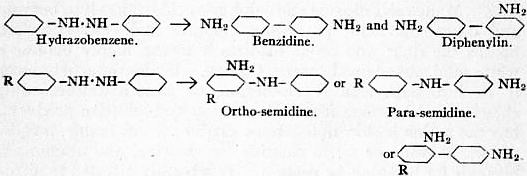
BENZOIC ACID, C7H6O2 or C6H5COOH, the simplest representative of the aromatic acids. It occurs naturally in some resins, especially in gum benzoin (from Styrax benzoin), in dragon’s blood, and as a benzyl ester in Peru and Tolu balsams. It can be prepared by the oxidation of toluene, benzyl alcohol, benzaldehyde and cinnamic acid; by the oxidation of benzene with manganese dioxide and concentrated sulphuric acid in the cold (L. Carius, Ann. 1868, 148, p. 51); by hydrolysis of benzonitrile or of hippuric acid; by the action of carbon dioxide on benzene in the presence of aluminium chloride (C. Friedel and J.M. Crafts, Ann. chim. phys. 1888 [6], 14, p. 441); by the action of carbon dioxide on monobrombenzene in the presence of sodium; by condensing benzene and carbonyl chloride in presence of aluminium chloride, the benzoyl chloride formed being subsequently hydrolysed; and similarly from benzene and chlorformamide:—
C6H6 + Cl·CONH2 = HCl + C6H5CONH2,
the benzamide being then hydrolysed. It may also be prepared by boiling benzyl chloride with dilute nitric acid (G. Lunge, Berichte, 1877, 10, p. 1275); by fusing sodium benzene sulphonate with sodium formate: C6H5SO3Na + HCO2Na = C6H5COONa + NaHSO3; by heating calcium phthalate with calcium hydroxide to 330°-350° C.; by heating benzotrichloride with water in a sealed tube, and from the hippuric acid which is found in the urine of the herbivorae. For this purpose the urine is concentrated and the hippuric acid precipitated by the addition of hydrochloric acid; it is then filtered and boiled for some time with concentrated hydrochloric acid, when it is hydrolysed into benzoic and amido-acetic acid. It is made commercially by boiling benzotrichloride (obtained from toluene) with milk of lime, the calcium benzoate so obtained being then decomposed by hydrochloric acid
2C6H5CCl3 + 4Ca(OH)2 = (C6H5COO)2Ca + 3CaCl2 + 4H2O.
Benzoic acid crystallizes in glistening leaflets (from water) which melt at 121.4° C. and boil at 249.2° C. (H. Kopp). Its specific heat is 0.1946. It sublimes readily and is volatile in steam. It is readily soluble in hot water and the ordinary organic solvents, but is only slightly soluble in cold water. When heated with lime, it is decomposed, benzene being formed; if its vapours are passed over heated zinc dust, it is converted into benzaldehyde (A. Baeyer, Ann. 1866, 140, p. 296). Distillation of its calcium salt gives benzophenone (q.v.) with small quantities of other substances, but if the calcium salt be mixed with calcium formate and the mixture distilled, benzaldehyde is produced. By the action of sodium amalgam on an aqueous solution of the acid, benzyl alcohol, tetrahydrobenzoic acid and hexahydrobenzoic acid are formed. The salts of benzoic acid are known as the benzoates and are mostly soluble in water. They are readily decomposed by mineral acids with the production of benzoic acid, and on addition of ferric chloride to their neutral solutions give a reddish-brown precipitate of ferric benzoate.
Benzoic anhydride, (C6H5CO)2O, is prepared by the action of benzoyl chloride on sodium benzoate, or by heating benzoyl chloride with anhydrous oxalic acid (R. Anschütz, Ann. 1884, 226, p. 15). It crystallizes in needles, melting at 42° C., and boiling at 360° C. It is insoluble in water but readily soluble in alcohol and ether.
Benzoyl chloride, C6H5COCl, is formed by distilling a mixture of phosphorus pentachloride and benzoic acid; by the action of chlorine on benzaldehyde, or by passing a stream of hydrochloric acid gas over a mixture of benzoic acid and phosphorus pentoxide heated to 200° C. (C. Friedel, Ber. 1869, 2, p. 80). It is a colourless liquid of very unpleasant smell, which boils at 198° C., and solidifies in a freezing mixture, the crystals obtained melting at −1° C. It shows all the characteristic properties of an acid chloride.
Ethyl benzoate, C6H5COOC2H5, is best prepared by boiling benzoic acid and alcohol with a small quantity of sulphuric acid for some hours (E. Fischer and A. Speier, Berichte, 1896, 28, p. 3252). It is a colourless liquid of boiling point 213° C.
Benzamide, C6H5CONH2, is prepared by the action of benzoyl chloride on ammonia or ammonium carbonate, or from ethyl benzoate and ammonia. It crystallizes (from water) in glistening leaflets which melt at 130° C. and boil at 288° C. Its silver salt behaves as if it were the salt of an imido benzoic acid, since it yields benzimido ethyl ether C6H5·C( : NH)·OC2H5 with ethyl iodide (J. Tafel and C. Enoch, Berichte, 1890, 23, p. 1550).
Chlor-, brom-, iodo- and fluor-benzoic acids are known and can be obtained by oxidizing the corresponding halogen toluenes, or from the amido acids, or by substitution. Nitration of benzoic acid gives chiefly meta-nitro-benzoic acid. The ortho- and para-nitro-benzoic acids can be obtained by oxidizing ortho-and para-nitro-cinnamic acids. Ortho-amino-benzoic acid, C6H4·NH2·COOH (anthranilic acid), is closely related to indigo (q.v.).
Gum benzoin, which contains from 12 to 20% of benzoic acid, is used in medicine as the essential constituent of benzoated lard, Adeps benzoatus, which owes its antiseptic properties to benzoic acid; and in friar’s balsam, Tinctura benzoini composita, which is an ancient and valuable medicament, still largely used for inhalation in cases of laryngitis, bronchitis and other inflammatory or actually septic conditions of the respiratory tract. It owes its value to the benzoic acid which it contains. A fluid drachm of friar’s balsam may be added to a pint of water at a temperature of about 140° F., and the resultant vapour may be inhaled from the spout of a kettle or from a special inhaler. Benzoic acid itself, ammonium benzoate and sodium benzoate are all administered internally in doses of from five to thirty grains. The ammonium salt is most often employed, owing to the stimulant character of the ammonium base. The acid itself is a powerful antiseptic. When administered internally, it causes the appearance of hippuric acid in the urine. This is due to its combination in the body with glycocoll. The combination probably occurs in the kidney. The hippuric acid in the urine acts as a stimulant and disinfectant to the urinary mucous membrane. Benzoic acid is also excreted by the bronchi and tends to disinfect and stimulate the bronchial mucous membrane. Hence the value of friar’s balsam. The acid and its salts are antipyretic and were used in Germany instead of salicylates in rheumatic fever. But the most important fact is that ammonium benzoate is largely used—often in combination with urinary anodynes such as tincture of hyoscyamus—as a urinary antiseptic in cases of cystitis (inflammation of the bladder) and pyelitis (inflammation of the pelvis of the kidney).