VOLUME III SLICE VI Bent, James to Bibirine (continued 7)
Reading edition
BERTHON, EDWARD LYON (1813-1899), English inventor, was born in London, on the 20th of February 1813, the son of an army contractor and descendant of an old Huguenot family. He studied for the medical profession in Liverpool and at Dublin, but after his marriage in 1834 he gave up his intention of becoming a doctor, and travelled for about six years on the continent. Keenly interested from boyhood in mechanical science, he made experiments in the application of the screw propeller for boats. But his model, with a two-bladed propeller, was only ridiculed when it was placed before the British admiralty. Berthon therefore did not complete the patent and the idea was left for Francis Smith to bring out more successfully in 1838. In 1841 he entered Magdalene College, Cambridge, in order to study for the Church. There he produced what is usually known as “Berthon’s log,” in which the suction produced by the water streaming past the end of a pipe projected below a ship is registered on a mercury column above. In 1845 he was ordained, and after holding a curacy at Lymington was given a living at Fareham. Here he was able to carry on experiments with his log, which was tested on the Southampton to Jersey steamboats; but the British admiralty gave him no encouragement, and it remained uncompleted. He next designed some instruments to indicate the trim and rolling of boats at sea; but the idea for which he is chiefly remembered was that of the “Berthon Folding Boat” in 1849. This invention was again adversely reported on by the admiralty. Berthon resigned his living at Fareham, and subsequently accepted the living of Romsey. In 1873, encouraged by Samuel Plimsoll, he again applied himself to perfecting his collapsible boat. Success was at last achieved, and in less than a year he had received orders from the admiralty for boats to the amount of £15,000. Some were taken by Sir George Nares to the Arctic, others were sent to General Gordon at Khartum, and others again were taken to the Zambezi by F.C. Selous. Berthon died on the 27th of October 1899.
BERTHOUD, FERDINAND (1727-1807), Swiss chronometer-maker, was born at Plancemont, Neuchâtel, in 1727, and settling in Paris in 1745 gained a great reputation for the excellence and accuracy of his chronometers. He was a member of the Institute and a fellow of the Royal Society of London, and among other works wrote Essais sur l’horlogerie (1763). He died in 1807 at Montmorency, Seine et Oise. He was succeeded in business by his nephew, Louis Berthoud (1759-1813).
BERTILLON, LOUIS ADOLPHE (1821-1883), French statistician, was born in Paris on the 1st of April 1821. Entering the medical profession, he practised as a doctor for a number of years. After the revolution of 1870, he was appointed inspector-general of benevolent institutions. He was one of the founders of the school of anthropology of Paris, and was appointed a professor there in 1876. His Démographie figurée de la France (1874) is an able statistical study of the population of France. He died at Neuilly on the 28th of February 1883.
His son Alphonse Bertillon, the anthropometrist, was born in Paris in 1853. He published in 1883 a work Ethnographie moderne des races sauvages, but his chief claim to distinction lies in the system invented by him for the identification of criminals, which is described by him in his Photographie judiciaire, Paris, 1890 (see Anthropometry). He was officially appointed in 1894 to report on the handwriting of the bordereau in the Dreyfus case, and was a witness for the prosecution before the cour de cassation on the 18th of January 1899.
BERTIN, a family of distinction in the history of French journalism. The most important member of the family, generally regarded as the father of modern French journalism, Louis François Bertin (1766-1841), known as Bertin aîné, was born in Paris on the 14th of December 1766. He began his journalistic career by writing for the Journal Français and other papers during the French Revolution. After the 18th Brumaire he founded the paper, with which the name of his family has chiefly been connected, the Journal des Débats. He was suspected of royalist tendencies by the consulate and was exiled in 1801. He returned to Paris in 1804 and resumed the management of the paper, the title of which had been changed by order of Napoleon to that of Journal de l’Empire. Bertin had to submit to a rigorous censorship, and in 1811 the conduct, together with the profits, was taken over entirely by the government. In 1814 he regained possession and restored the old title and continued his support of the royalist cause—during the Hundred Days; he directed the Moniteur de Gand—till 1823, when the Journal des Débats became the recognized organ of the constitutional opposition. Bertin’s support was, however, given to the July monarchy after 1830. He died on the 13th of September 1841. Louis François Bertin de Vaux (1771-1842), the younger brother of Bertin aîné, took a leading part in the conduct of the Journal des Débats, to the success of which his powers of writing greatly contributed. He entered the chamber of deputies in 1815, was made councillor of state in 1827, and a peer of France in 1830. The two sons of Bertin aîné, Edouard François (1797-1871) and Louis Marie François (1801-1854), were directors in succession of the Journal des Débats. Edouard Bertin was also a painter of some distinction.
BERTINORO, OBADIAH, Jewish commentator of the Mishnah, died in Jerusalem about 1500. Bertinoro much improved the status of the Jews in the Holy Land; before his migration thither the Jews of Palestine were in a miserable condition of poverty and persecution. His commentary on the Mishnah is the most useful of all helps to the understanding of that work. It is printed in most Hebrew editions of the Mishnah. Surenhusius, in his Latin edition of the last-named code (Amsterdam 1698-1703), translated Bertinoro’s commentary.
BERTINORO, a town and episcopal see of Emilia, Italy, in the province of Forli, 8 m. S.E. direct of Forli and 5½ m. N. of the station of Forlimpopoli, and 800 ft. above sea-level. Pop. (1901) town, 3753; commune, 7786. The town commands a fine view to the north over the plain of Emilia and the lower course of the Po, itself lying on the foothills of the Apennines. It appears to have been first fortified by Frederick Barbarossa, and its castle stood frequent sieges in the middle ages. Polenta, 2½ m. to the south of it, was the birthplace of Francesca da Rimini. The castle is almost entirely ruined, but the church of S. Donato, of the Lombard period, with Byzantine capitals, is interesting; Giosuè Carducci has written a fine ode on the subject (La Chiesa di Polenta, Bologna, 1897).
See C. Ricci, “Della Chiesa e castello di Polenta” in Atti e Memorie della Deputazione di Storia patria per le prooniae di Romagna, ser. iii. vol. ix. (Bologna, 1891), 1 seq.
(T. As.)
BERTOLD (1442-1504), elector and archbishop of Mainz, son of George, count of Henneberg, entered the ecclesiastical profession, and after passing through its lower stages, was made archbishop of Mainz in 1484. He appears to have been a firm supporter of law and order, an enemy of clerical abuses and a careful administrator of his diocese. Immediately after his election as archbishop he began to take a leading part in the business of the Empire, and in 1486 was very active in securing the election of Maximilian as Roman king. His chief work, however, was done as an advocate of administrative reform in Germany. During the reign of the emperor Frederick III. he had brought this question before the diet, and after Frederick’s death, when he had become imperial chancellor, he was the leader of the party which pressed the necessity for reform upon Maximilian at the diet of Worms in 1495. His proposals came to nothing, but he continued the struggle at a series of diets, and urged the Germans to emulate the courage and union of the Swiss cantons. He gained a temporary victory when the diet of Augsburg in 1500 established a council of regency (Reichsregiment), and in 1502 persuaded the electors to form a union to uphold the reforms of 1495 and 1500. The elector died on the 21st of December 1504. Bertold was a man of great ability and resourcefulness, and as a statesman who strove for an ordered and united Germany was far in advance of his age.
See J. Weiss, Berthold von Henneberg, Erzbischof von Mainz (Freiburg, 1889).
BERTOLD VON REGENSBURG (c. 1220-1272), the greatest German preacher of the later middle ages, was a native of Regensburg, and entered the Franciscan monastery there. From about 1250 onwards his fame as a preacher spread over all the German-speaking parts of the continent of Europe. He wandered from village to village and town to town, preaching to enormous audiences, always in the open air; the earnestness and straightforward eloquence with which he insisted that true repentance came from the heart, that pious pilgrimages and the absolution of the Church were mere outward symbols, appealed to all classes. He died in Regensburg on the 13th of December 1272. His German sermons, of which seventy-one have been preserved, are among the most powerful in the language, and form the chief monuments of Middle High German prose. His style is clear, direct and remarkably free from cumbrous Latin constructions; he employed, whenever he could, the pithy and homely sayings of the peasants, and is not reluctant to point his moral with a rough humour. As a thinker, he shows little sympathy with that strain of medieval mysticism which is to be observed in all the poetry of his contemporaries.
The best edition of Bertold’s German sermons is that by F. Pfeiffer and J. Strobl (2 vols., 1862-1880; reprinted, 1906); there is also a modern German version by F. Göbel (4th ed., 1906). The Latin sermons were edited by G. Jakob (1880). See C.W. Stromberger, Bertold von Regensburg, der grosste Volksredner des deutschen Mittelalters (1877), K. Unkel, Bertold von Regensburg (1882), and E. Bernhardt, Bruder Bertold von Regensburg (1905); A.E. Schönbach, Studien zur Geschichte der altdeutschen Predigt (Publications of the Vienna Academy, 1906).
BERTRAM, CHARLES (1723-1765), English literary impostor, was born in London, the son of a silk dyer. In 1747, being then teacher of English at the school for Danish naval cadets at Copenhagen, he wrote to Dr William Stukeley, the English antiquarian, that he had discovered a manuscript written by a monk named Richard of Westminster, which corrected and supplemented the Itinerary of Antoninus in Britain. He subsequently sent to Stukeley a copy of various parts of the work and a facsimile of a few lines of the manuscript. These were so cleverly executed that they quite deceived the English palaeographers of the period. Stukeley, finding that a chronicler of the fourteenth century, Richard of Cirencester, had also been an inmate of Westminster Abbey, identified him with Bertram’s Richard of Westminster, and, in 1756, read an analysis of the “discovery” before the Society of Antiquaries, which was published with a copy of Richard’s map. In 1757 Bertram published at Copenhagen a volume entitled Britannicarum Gentium Historiae Antiquae Scriptores Tres. This contained the works of Gildas and Nennius and the full text of Bertram’s forgery, and though Bertram’s map did not correspond with that of Richard, Stukeley discarded the latter and adopted Bertram’s concoction in his Itinerarium Curiosum published in 1776. Although Thomas Reynolds in his Iter Britanniarum (1799), an edition of the British portion of Antoninus’ Itinerary, was distinctly sceptical as to the value of Bertram’s manuscript, its authenticity was generally accepted until the middle of the 19th century. No original of the manuscript could then be found at Copenhagen, and B.B. Woodward, librarian of Windsor Castle, proved conclusively, by a series of articles in the Gentleman’s Magazine in 1866 and 1867, that the supposed facsimile of calligraphy produced by Bertram was a blend of the style of various periods, while the greater portion of the idiomatic Latin in the book was a mere translation of 18th century English phraseology. Nevertheless, as late as 1872, a translation of Bertram’s forgery was included in Bohn’s Antiquarian Library as one of the Six English Chronicles, and there is no doubt that the work had a wide and misleading influence upon many antiquarian writers. Bertram died in 1765.
BERTRAND, HENRI GRATIEN, Comte (1773-1844), French general, was born at Châteauroux. At the outbreak of the Revolution, he had just finished his studies, and he entered the army as a volunteer. During the expedition to Egypt, Napoleon named him colonel (1798), then brigadier-general, and after Austerlitz his aide-de-camp. His life was henceforth closely bound up with that of Napoleon, who had the fullest confidence in him, honouring him in 1813 with the title of grand marshal of the court. It was Bertrand who in 1809 directed the building of the bridges by which the French army crossed the Danube at Wagram. In 1813, after the battle of Leipzig, it was due to his initiative that the French army was not totally destroyed. He accompanied Napoleon to Elba in 1814, returned with him in 1815, held a command in the Waterloo campaign, and then, after the defeat, accompanied Napoleon to St Helena. He did not return to France until after Napoleon’s death, and then Louis XVIII. allowed him to retain his rank, and he was elected deputy in 1830. In 1840 he was chosen to go to bring Napoleon’s remains to France. He died at Châteauroux on the 31st of January 1844. His touching fidelity has made his name very popular in France.
BERTRICH, a village and watering place of Germany, in the Prussian Rhine province, in a narrow valley running down to the Mosel near Cochem. Its waters are efficacious in cases of gout, rheumatism and biliary affections. Pop. 500.
BÉRULLE, PIERRE DE (1575-1629), French cardinal and statesman, was born at Sérilly, near Troyes, on the 4th of February 1575. He was educated by the Jesuits and at the university of Paris. Soon after his ordination in 1599, he assisted Cardinal Duperron in his controversy with the Protestant Philippe de Mornay, and made numerous converts. He founded the Congregation of the French Oratory in 1611 and introduced the Carmelite nuns into France, notwithstanding the opposition of the friars of that order, who were jealous of his ascendancy. Bérulle also played an important part as a statesman. He obtained the necessary dispensations from Rome for Henrietta Maria’s marriage to Charles I., and acted as her chaplain during the first year of her stay in England. In 1626, as French ambassador to Spain, he concluded the treaty of Monzon. After the reconciliation of Louis XIII. with his mother, Marie de’ Medici, through his agency, he was appointed a councillor of state, but had to resign this office, owing to his Austrian policy, which was opposed by Richelieu. Bérulle encouraged Descartes’ philosophical studies, and it was through him that the Samaritan Pentateuch, recently brought over from Constantinople, was inserted in Lejay’s Polyglot Bible. His treatise, Des Grandeurs de Jésus, was a favourite book with the Jansenists. He died on the 2nd of October 1629. His works, edited by P. Bourgoing (2 vols., 1644) were reprinted, by Migne in 1857.
See M. de Bérulle et les Carmélites; Le Père de Bérulle et l’oratoire de Jésus; Le Cardinal de Bérulle et Richelieu (3 vols., 1872-1876), by the Abbé M. Houssaye; and H. Sidney Lear’s Priestly Life in France in the Seventeenth Century (London, 1873).
BERVIE, or Inverbervie, a royal and police burgh of Kincardineshire, Scotland. Pop. (1901) 1207. It is situated at the mouth of Bervie Water and is the terminus of the North British railway’s branch line from Montrose, which lies 14 m. S.W. The leading industries include manufactures of woollens, flax and chemicals, and there is also a brisk trade in live-stock. Bervie unites with Arbroath, Brechin, Forfar and Montrose in returning one member (for the “Montrose burghs”) to parliament. David II., driven by stress of weather, landed here with his queen Joanna in 1341, and, out of gratitude for the hospitality of the townsfolk, granted them a charter, which James VI. confirmed. Hallgreen Castle, a stronghold of the 14th century, is maintained in repair. About one m. south is the fishing village of Gourdon (pop. 1197), where boat-building is carried on. There is a small but steady export business from the harbour, which has a pier and breakwater. St Ternan’s, the Romanesque parish church of Arbuthnott, 2½ m. north-west, stands on the banks of the Bervie. In the chapel dedicated to St Mary, which was afterwards added to it, is the burial-place of the Arbuthnotts, who took their title from the estate in 1644. John Arbuthnot, Queen Anne’s physician and the friend of Swift and Pope, was a native of the parish. Kinneff, 2 m. north, on the coast, is of interest as the place where the Scottish regalia were concealed during the siege of Dunottar Castle.
BERWICK, JAMES FITZJAMES, Duke of (1670-1734), marshal of France, was the natural son of James, duke of York, afterwards James II. of England, by Arabella Churchill (1648-1730), sister of the great duke of Marlborough. He was born at Moulins (Bourbonnais) on the 21st of August 1670. He received his education in France at the hands of the Jesuits, and at the age of fifteen, his father having succeeded to the throne, he was sent to learn the business of a soldier under the famous general of the empire, Charles of Lorraine. He served his first campaign in Hungary, and was present at the siege of Buda. He then returned to England, was made a colonel of the 8th Foot, and in 1687 created duke of Berwick, earl of Teignmouth and Baron Bosworth. He then went out afresh to Hungary and was present at the battle of Mohacz. On his return to England he was made K.G., colonel of the 3rd troop of horse guards (Royal Horse Guards Blue) and governor of Portsmouth, but soon afterwards the revolution forced him to flee to France. He served under James II. in the campaign in Ireland, and was present at the battle of the Boyne. For a short time he was left in Ireland as commander-in-chief, but his youth and inexperience unfitted him for the post, and he was a mere puppet in stronger hands. He then took service in the French army, fought under Marshal Luxembourg in Flanders, and took part in the battles of Steinkirk and Neerwinden, at the latter of which he was taken prisoner. He was, however, immediately exchanged for the duke of Ormond, and afterwards he served under Villeroi. In 1695 he married the widow of Patrick Sarsfield, who died in 1698. His second marriage, with Anne Bulkeley, took place in 1700. As a lieutenant-general he served in the campaign of 1702, after which he became naturalized as a French subject in order to be eligible for the marshalate. In 1704, he first took command of the French army in Spain. So highly was he now esteemed for his courage, abilities and integrity, that all parties were anxious to have him on their side (Éloge, by Montesquieu). His tenure of the command was, however, very short, and after one campaign he was replaced by the Marshal de Tessé. In 1705 he commanded against the Camisards in Languedoc, and when on this expedition he is said to have carried out his orders with remorseless rigour. His successful expedition against Nice in 1706 caused him to be made marshal of France, and in the same year he returned to Spain as commander-in-chief of the Franco-Spanish armies. On the 25th of April 1707, the duke won the great and decisive victory of Almanza, where an Englishman at the head of a French army defeated Ruvigny, earl of Galway, a Frenchman at the head of an English army. The victory established Philip V. on the throne of Spain. Berwick was made a peer of France by Louis XIV., and duke of Liria and of Xereca and lieutenant of Aragon by Philip. Thenceforward Berwick was recognized as one of the greatest generals of his time, and successively commanded in nearly all the theatres of war. From 1709 to 1712 he defended the south-east frontier of France in a series of campaigns which, unmarked by any decisive battle, were yet models of the art of war as practised at the time. The last great event of the War of the Spanish Succession was the storming of Barcelona by Berwick, after a long siege, on the 11th of September 1714. Three years later he was appointed military governor of the province of Guienne, in which post he became intimate with Montesquieu. In 1718 he found himself under the necessity of once more entering Spain with an army; and this time he had to fight against Philip V., the king who owed chiefly to Berwick’s courage and skill the safety of his throne. One of the marshal’s sons, known as the duke of Liria, was settled in Spain, and was counselled by his father not to shrink from doing his duty and fighting for his sovereign. Many years of peace followed this campaign, and Marshal Berwick was not again called to serve in the field till 1733. He advised and conducted the siege of Philipsburg, and while the siege was going on was killed by a cannon-shot on the 12th of June 1734. Cool, self-possessed and cautious as a general, Marshal Berwick was at the same time not wanting in audacity and swiftness of action. He was a true general of the 18th century, not less in his care for the lives of his men than in his punctiliousness and rigidity in matters of discipline.
The Mémoires of Marshal Berwick, revised, annotated and continued by the Abbé Hooke, were published by the marshal’s grandson in 1778. Montesquieu made many contributions to this.
BERWICKSHIRE, a county of Scotland, forming its south-eastern extremity, bounded N. by Haddingtonshire and the North Sea; E. by the North Sea; S.E. by the county of the borough and town of Berwick; S. by the Tweed and Roxburghshire, and W. by Mid-Lothian. Its area is 292,577 acres or 457 sq. m., and it has a coast-line of 21 m. The county is naturally divided into three districts: Lauderdale, or the valley of the Leader, in the W.; Lammermuir, the upland district occupied by the hills of that name in the N.; and the Merse (the March or Borderland, giving a title to the earls of Wemyss), the largest district, occupying the S.E. The Lammermuirs are a range of round-backed hills, whose average height is about 1000 ft., while the highest summit, Says Law, reaches 1749 ft. From these hills the Merse stretches to the S. and E., and is a comparatively level tract of country. The coast is lofty, rocky and precipitous, broken by ravines and not accessible, except at Eyemouth Harbour, for small vessels, and at Coldingham and Burnmouth for fishing boats. St Abb’s Head, a promontory with a lighthouse upon it, rises to 310 ft. The Eye is the only river of any size which falls directly into the sea. The others—the Leader, the Eden, the Leet and the Whiteadder with its tributaries, the Blackadder and the Dye—all flow into the Tweed. Of these the largest and most important is the Whiteadder, which has its source in the parish of Whittingehame on the East Lothian side of the Lammermuirs, and, following a sinuous course of 35 m., joins the Tweed within the bounds or liberties of Berwick. There are small lochs at Coldingham, Legerwood, Spottiswoode, the Hirsel, near Coldstream, Hule Moss on Greenlaw Moor, and tiny sheets of water near Duns and Mersington.
Geology.—The north portion of the county embraces that part of the Silurian tableland of the south of Scotland which stretches from the Lammermuir Hills east to St Abb’s Head. The strata consist mainly of grits, greywackes, flags and shales, repeated by innumerable folds, trending north-east and south-west, which are laid bare in the great cliff section between Fast Castle and St Abb’s Head. This section of the tableland includes sediments, chiefly of Tarannon age, which form a belt 10 m. across from the crest of the Lammermuir Hills to a point near Westruther and Longformacus. In the Earnscleuch Burn north-east of Lauder representatives of Llandovery, Caradoc and Llandeilo rocks, together with the Arenig cherts, appear along an anticlinal fold in the midst of the younger strata. Again in the extreme north-west of the county near Channelkirk and to the north of the Tarannon belt radiolarian cherts and black shales with graptolites of Upper Llandeilo and Caradoc age are met with. The Lower Old Red Sandstone rocks, which rest unconformably on the folded and denuded Silurian strata, appear at Eyemouth and Reston Junction, and at St Abb’s Head are associated with contemporaneous volcanic rocks which are evidently on the same horizon as the interbedded lavas of Lower Old Red age in the Cheviots. The intrusive igneous materials of this period are represented by the granitic mass of Cockburn Law and the porphyrites of the Dirrington Laws. The Upper Old Red Sandstone, consisting of conglomerates and sandstones, rest unconformably alike on the Silurian platform as at Siccar Point and on the lower division of that system. The age of these beds has been determined by the occurrence of remains of Holoptychius nobilissimus in the sandstones at Earlston and in the Whiteadder north of Duns. On the Black Hill of Earlston these strata are traversed by a sheet of trachyte resembling the type of rock capping the Eildon Hills (see Roxburghshire: Geology). Overlying the strata just described there is a succession of volcanic rocks extending from Greenlaw southwards by Stichil and Kelso to Carham, which, at several localities, are followed by a band of cornstone resembling that near the top of the Upper Old Red Sandstone in the midland valley of Scotland. Next in order comes a great development of the Cementstone group of the Carboniferous system which spreads over nearly the whole of the low ground of the Merse and attains a great thickness. At Marshall Meadows north of Berwick-on-Tweed, thin bands of marine limestone occur, which probably represent some of the calcareous beds above the Fell sandstones south of Spittal.
Climate and Agriculture.—Owing to the maritime position, the winter is seldom severe in the lowland districts, but spring is a trying season on account of the east winds, which often last into summer. The mean annual rainfall is 30½ in. and the average temperature for the year is 47° F., for January 37° F., and for July 58.5° F. The climate is excellent as regards both the health of the inhabitants and the growth of vegetation. The soils vary, sometimes even on the same farm. Along the rivers is a deep rich loam, resting on gravel or clay, chiefly the former. The less valuable clay soil of the Merse has been much improved by drainage. The more sandy and gravelly soils are suitable for turnips, of which great quantities are grown. Oats and barley are the principal grain crops, but wheat also is raised. The flocks of sheep are heavy, and cattle are pastured in considerable numbers. Large holdings predominate—indeed, the average size is the highest in Scotland—and scientific farming is the rule. The labourers, who are physically well developed, are as a whole frugal, industrious and intelligent, but somewhat migratory in their habits. This feature in their character, which they may have by inheritance as Borderers, has admirably fitted them for colonial life, to which the scarcity of industrial occupation has largely driven the surplus population.
Other Industries.—Next to agriculture the fisheries are the most important industry. The Tweed salmon fisheries are famous, and the lesser rivers of the Merse are held in high esteem by anglers. Eyemouth, Burnmouth, Coldingham and Cove are engaged in the sea fisheries. Cod, haddock, herring, ling, lobsters and crabs are principally taken. The season for herring is from May to the middle of September and for white fish from October to the end of May. Coal, copper ore and ironstone exist in too small quantities to work, and the limestone is so far from a coal district as to be of little economic value. Earlston sends out ginghams and woollen cloths. At Cumledge on the Whiteadder, blankets and plaids are manufactured, and paper is made at Chirnside. The other manufactures are all connected with agriculture, such as distilleries, breweries, tanneries, &c. The trade is also mainly agricultural. Fairs are held at Duns, Lauder, Coldstream and Greenlaw; but the sales of cattle and sheep mostly take place at the auction marts at Reston, Duns and Earlston. There are grain markets at Duns and Earlston. Berwick, from which the county derives its name, is still its chief market. There is, however, no legal or fiscal connexion between the county and the borough.
The North British railway monopolizes the communications of the county. The system serves the coast districts from Berwick to Cockburnspath, and there is a branch from Reston to St Boswells.
Population and Government.—The population of Berwickshire was 32,290 in 1891 and 30,824 in 1901, in which year the number of persons speaking Gaelic and English was 74, and one person spoke Gaelic only. The only considerable towns are Eyemouth (pop. in 1901, 2436) and Duns (2206). The county returns one member to parliament. Lauder is the only royal burgh, and Duns the county town, a status, however, which was held by Greenlaw from 1696 to 1853, after which date it was shared by both towns until conferred on Duns alone. Berwickshire forms a sheriffdom with Roxburgh and Selkirk shires, and there is a resident sheriff-substitute at Duns, who sits also at Greenlaw, Coldstream, Ayton and Lauder. In addition to board and voluntary schools throughout the county, there is a high school, which is also a technical school, at Duns, and Coldstream and Lauder public schools have secondary departments. Duns school is subsidized by the county council, which pays the expenses of students attending it from a distance.
History.—Traces of Roman occupation and of ancient British settlement exist in various parts of the Merse. Edin’s or Etin’s Hall, on Cockburn Law, 4 m. north of Duns, is still called the Pech’s or Pict’s House, and is one of the very few brochs found in the Lowlands. After the Romans withdrew (409) the country formed part of the Saxon kingdom of Northumbria, and the inhabitants were converted to Christianity through the missionary efforts of Modan in the 6th, and Oswald, Aidan and Cuthbert (traditionally believed to have been born in the vale of the Leader) in the 7th centuries. The Northmen invaded the seaboard, but the rugged coast proved an effectual barrier. The Danes, however, landed in 886, and destroyed the nunnery at Coldingham, founded about 650 by Ebba, daughter of Æthelfrith, king of Northumbria, after whom the adjoining promontory of St Abb’s Head was named. After the battle of Carham (1018) the district, which then constituted part of the division of Lothian, was annexed to Scotland. Birgham (pron. Birjam), 3½ m. west of Coldstream, was the scene of the conference in 1188 between William the Lion and the bishop of Durham, which discussed the attempt of the English church to assert supremacy over the Scottish. Here also met in 1289 a convention of the Scots estates to consider the projected marriage of Prince Edward of England to the Maid of Norway; and here was signed in 1290 the treaty of Birgham, assuring the independence of Scotland. During the long period of international strife the shire was repeatedly overrun by armies of the English and Scots kings, who were constantly fighting for the ancient frontier town of Berwick. It was finally ceded to England in 1482, and the people afterwards gradually settled down to peaceful pursuits. The ford at the confluence of the Leet and Tweed near Coldstream gave access to south-eastern Scotland. Edward I. crossed it with his army in 1296, encamping at Hutton the day before the siege of Berwick, and it was similarly employed as late as 1640, when the marquess of Montrose led the Covenanters on their march to Newcastle, although James VI. had already caused a bridge to be constructed from Berwick to Tweedmouth. There are several places of historic interest in the county. Upon the site of the nunnery at Coldingham King Edgar in 1098 founded a Benedictine priory, which was one of the oldest monastic institutions in Scotland and grew so wealthy that James III. annexed its revenues to defray his extravagance, a step that precipitated the revolt of the nobles (1488). The priory was seriously damaged in the earl of Hertford’s inroad in 1545, and Cromwell blew up part of the church in 1650. The chancel (without aisles) was repaired and used as the parish church. The remains contain some fine architectural features, such as, on the outside, the Romanesque arcades surmounted by lancet windows at the east end, and, in the interior, the Early Pointed triforium. On the coast, about 4 m. north-west of Coldingham, are the ruins of Fast Castle—the “Wolf’s Crag” of Scott’s Bride of Lammermoor—situated on a precipitous headland. From Sir Patrick Hume it passed to Sir Robert Logan of Restalrig, who is alleged to have been one of the Gowrie conspirators, and to have intended to imprison James VI. within its walls (1600). Four miles west is the Pease or Peaths bridge, built by Thomas Telford in 1786 across the deep pass which was of old one of the strongest natural defences of Scotland. The bridge is 123 ft. high, 300 ft. long and 16 ft. wide. Near it are the ruins of Cockburnspath Tower, once a strong fortress and supposed to be the “Ravens wood” of the Bride of Lammermoor. In the south-west of the shire besides Dryburgh Abbey (q.v.) there are, at Earlston, the remains of the castle that was traditionally the residence of Thomas the Rhymer. Hume Castle, the ancient seat of the Home family, a picturesque ruin about 3 m. south of Greenlaw, is so conspicuously situated as to be visible from nearly every part of the county. Coldstream and Lamberton, being close to the Border, were both resorted to (like Gretna Green in the west) by eloping couples for clandestine marriage. In Lamberton church was signed in 1502 the contract for the marriage of James IV. and Margaret Tudor, which led, a century later, to the union of the crowns of Scotland and England.
See W.S. Crockett, Minstrelsy of the Merse, (Paisley, 1893); In Praise of Tweed (Selkirk, 1889); The Scott Country (London, 1902); J. Robson, The Churches and Churchyards of Berwickshire (Kelso, 1893); F.H. Groome, A Short Border History (Kelso, 1887); J. Tait, Two Centuries of Border Church Life (Kelso, 1889); Margaret Warrender, Marchmont and the Humes of Polwarth (Edinburgh, 1894); W.K. Hunter, History of the Priory of Coldingham (Edinburgh, 1858).
BERWICK-UPON-TWEED, a market town, seaport, municipal borough and county in itself, of England, at the mouth of the Tweed on the north bank, 339 m. N. by W. from London. Pop. (1901) 13,437. For parliamentary purposes it is in the Berwick-upon-Tweed division of Northumberland. It is the junction on the East Coast route from London to Scotland between the North Eastern and North British railways, a branch of the company first named running up the Tweed valley by Coldstream and Kelso. The town lies in a bare district on the slope and flat summit of an abrupt elevation, higher ground rising to the north and south across the river. It has the rare feature of a complete series of ramparts surrounding it. Those to the north and east are formed of earth faced with stone, with bastions at intervals and a ditch now dry. They are of Elizabethan date, but there are also lines of much earlier date, the fortifications of Edward I. Much of these last has been destroyed, and threatened encroachment upon the remaining relics so far aroused public feeling that in 1905 it was decided that the Board of Works should take over these ruins, including the Bell Tower, from the town council, and enclose them as national relics. The Bell Tower, from which alarms were given when border raiders were observed, is in fair preservation. There are slight remains of the castle, which fell into disrepair after the union of the crowns of England and Scotland. There are no traces of the churches, monasteries or other principal buildings of the ancient town. The church of Holy Trinity is a plain building without steeple, of the time of Cromwell. Of modern places of worship, the most noteworthy is Wallace Green United Presbyterian church (1859). The chief public building is the town hall (1760), a stately classic building surmounted by a lofty spire. Educational institutions include an Elizabethan grammar school and a blue-coat school; and there is a local museum. Two bridges connect the town with the south side of the Tweed. The older, which is very substantial, was finished in 1634, having taken twenty-four years in building. It has fifteen arches, and is 924 ft. long, but only 17 ft. wide. A unique provision for its upkeep out of Imperial funds dates from the reign of Charles II. The other, the Royal Border Bridge, situated a quarter of a mile up the river, is a magnificent railway viaduct, 126 ft. high, with twenty-eight arches, which extends from the railway station, a castellated building on part of the site of the old castle, to a considerable distance beyond the river. This bridge was designed by Robert Stephenson and opened by Queen Victoria in 1850.
The reach of the river from the old bridge to the mouth forms the harbour. The entrance to the harbour is protected by a stone pier, which stretches half a mile south-east from the north bank of the river mouth. The depth of water at the bar is 17 ft. at ordinary tides, 22 ft. at spring tides, but the channel is narrow, a large rocky portion of the harbour on the north side being dry at low water. There is a wet dock of 3½ acres. Principal exports are grain, coal and fish; imports are bones and bone-ash, manure stuffs, linseed, salt, timber and iron. The herring and other sea fisheries are of some value, and the salmon fishery, in the hands of a company, has long been famous. A fair is held annually at the end of May. There are iron-works and boat-building yards.
The custom of specially mentioning Berwick-upon-Tweed after Wales, though abandoned in acts of parliament, is retained in certain proclamations. The title of “county in itself” also helps to recall its ancient history. The liberties of the borough, commonly called Berwick Bounds, include the towns of Spittal, at the mouth, and Tweedmouth immediately above it, on the south bank of the river. The first is a watering-place (pop. 2074), with pleasant sands and a chalybeate spa; the second (pop. 3086) has iron foundries, engineering works and fish-curing establishments. Berwick-upon-Tweed is governed by a mayor, 6 aldermen and 18 councillors. Area, 6396 acres.
Very little is known of the history of Berwick before the Conquest. It was not until the Tweed became the boundary between England and Scotland in the 12th century that Berwick as the chief town on that boundary became really important. Until the beginning of the 14th century Berwick was one of the four royal boroughs of Scotland, and although it possesses no charter granted before that time, an inquisition taken in Edward III.’s reign shows that it was governed by a mayor and bailiffs in the reign of Alexander III., who granted the town to the said mayor and the commonalty for an annual rent. After Edward I. had conquered Berwick in 1302 he gave the burgesses another charter, no longer existing but quoted in several confirmations, by which the town was made a free borough with a gild merchant. The burgesses were given the right to elect annually their mayor, who with the commonalty should elect four bailiffs. They were also to have freedom from toll, pontage, &c., two markets every week on Monday and Friday, and a fair lasting from the feast of Holyrood to that of the Nativity of St John the Baptist. Five years later, in 1307, the mayor and burgesses received another charter, granting them their town with all things that belonged to it in the time of Alexander III., for a fee-farm rent of 500 marks, which was granted back to them in 1313 to help towards enclosing their town with a wall. While the war with Scotland dragged on through the early years of the reign of Edward II., the fortification of Berwick was a matter of importance, and in 1317 the mayor and bailiffs undertook to defend it for the yearly sum of 6000 marks; but in the following year, “owing to their default,” the Scots entered and occupied it in spite of a truce between the two kingdoms. After Edward III. had recovered Berwick the inhabitants petitioned for the recovery of their prison called the Beffroi or Bell-tower, the symbol of their independence, which their predecessors had built before the time of Alexander III., and which had been granted to William de Keythorpe when Edward I. took the town. Edward III. in 1326 and 1356 confirmed the charter of Edward I., and in 1357, evidently to encourage the growth of the borough, granted that all who were willing to reside there and desirous of becoming burgesses should be admitted as such on payment of a fine. These early charters were confirmed by most of the succeeding kings, until James I. granted the incorporation charter in 1604; but on his accession to the English throne, Berwick of course lost its importance as a frontier town. Berwick was at first represented in the court of the four boroughs and in 1326 in Robert Bruce’s parliament. After being taken by the English it remained unrepresented until it was re-taken by the Scots, when it sent two members to the parliament at Edinburgh from 1476 to 1479. In 1482 the burgesses were allowed to send two members to the English parliament, and were represented there until 1885, when the town was included in the Berwick-upon-Tweed division of the county of Northumberland. No manufactures are mentioned as having been carried on in Berwick, but its trade, chiefly in the produce of the surrounding country, was important in the 12th century. It has been noted for salmon fishery in the Tweed from very early times. There was a bridge over the Tweed at Berwick in the time of Alexander and John, kings of Scotland, but it was broken down in the time of the latter and not rebuilt until the end of the 14th century.
See Victoria County History, Northumberland; John Fuller, History of Berwick-upon-Tweed, &c. (1799); John Scott, Berwick-upon-Tweed: History of the Town and Guild (1888).
BERYL, a mineral containing beryllium and aluminium in the form of a silicate; its formula is Be3Al2Si6O18. The species includes the emerald (q.v.), the aquamarine (q.v.) and other transparent varieties known as “precious beryl,” with certain coarse varieties unfit for use as gem-stones. The name comes from the Gr. βήρυλλος, a word of uncertain etymology applied to the beryl and probably several other gems. It is notable that the relation of the emerald to the beryl, though proved only by chemical analysis, was conjectured at least as far back as the time of Pliny.
Beryl crystallizes in the hexagonal system, usually taking the form of long six-sided prisms, striated vertically and terminated with the basal plane, sometimes associated with various pyramidal faces (see fig.). It cleaves rather imperfectly parallel to the base. The colour of beryl may be blue, green, yellow, brown or rarely pink; while in some cases the mineral is colourless. The specific gravity is about 2.7, and the hardness 7.5 to 8, so that for a gem-stone beryl is comparatively soft. Whilst the gem-varieties are transparent, the coarse beryl may be opaque. The transparent crystals are pleochroic—a character well marked in emerald.
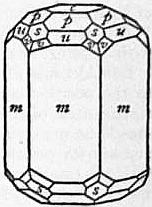
Crystal of beryl.
Beryl was much prized as a gem-stone by the ancients, and Greek intaglios of very fine workmanship are extant. The Roman jewellers, taking advantage of the columnar form of the natural crystal, worked it into long cylinders for ear-pendants. It was a favourite stone with the artists of the Renaissance, but in modern times has lost popularity, except in the form of emerald, which remains one of the most valued gem-stones. It is notable that English lapidaries of the 18th century often included the sard under the term beryl—a practice which has led to some confusion in the nomenclature of engraved gems.
Beryl occurs as an accessory constituent of many granitic rocks, especially in veins of pegmatite, whilst it is found also in gneiss and in mica-schist. Rolled pebbles of beryl occur, with topaz, in Brazil, especially in the province of Minas Geraes. Crystals are found in drusy cavities in granite in the Urals, notably near Mursinka; in the Altai Mountains, which have yielded very long prismatic crystals; and in the mining district of Nerchinsk in Siberia, principally in the Adun-Chalon range, where beryl occurs in veins of topaz-rock piercing granite. Among European localities may be mentioned Elba, good crystals being occasionally found in the tourmaline-granite of San Piero. In Ireland excellent crystals of beryl occur in druses of the granite of the Mourne Mountains in Co. Down, and others less fine are found in the highlands of Donegal, whilst the mineral is also known from the Leinster granite. It occurs likewise in the granite of the Grampians in Scotland, and is not unknown in Cornwall, specimens having been found, with topaz, apatite, &c., in joints of the granite of St Michael’s Mount.
Many localities in the United States yield beryl, sometimes sufficiently fine to be cut as a gem. It is found, for example, at Hiddenite and elsewhere in Alexander county, N.C.; at Haddam and Monroe, Conn.; at Stoneham and at Albany, in Oxford county, Maine; at Royalston, Mass.; and at Mt. Antero, Colorado, where it occurs with phenacite. Beryl of beautiful pink colour occurs in San Diego county, California. Coarse beryl, much rifted, is found in crystals of very large size at Grafton and Acworth, N.H.; a crystal from Grafton weighing more than 2½ tons. A colourless beryl from Goshen, Mass., has been called Goshenite; whilst crystals of coarse yellow beryl from Rubislaw quarry in Aberdeenshire, Scotland, have been termed Davidsonite.
Beryl suffers alteration by weathering, and may thus pass into kaolin and mica.
(F. W. R.*)
BERYLLIUM, or Glucinum (symbol Be, atomic weight 9.1), one of the metallic chemical elements, included in the same sub-group of the periodic classification as magnesium. It was prepared in the form of its oxide in 1798 by L.N. Vauquelin (Ann. de chimie, 1798, xxvi. p. 155) from the mineral beryl, and though somewhat rare, is found in many minerals. It was first obtained, in an impure condition, in 1828 by A.A.B. Bussy (1794-1882) and F. Wöhler by the reduction of the chloride with potassium, and in 1855 H.J. Debray prepared it, in a compact state, by reducing the volatilized chloride with melted sodium, in an atmosphere of hydrogen. L.F. Nilson and O. Pettersson (Wied. Ann. 1878, iv. p. 554) have also prepared the metal by heating beryllium potassium fluoride with sodium; P.M. Lebeau (Comptes rendus, 1895-1898, vols. 120-127) has obtained it in lustrous hexagonal crystals by electrolysing the double fluoride of beryllium and sodium or potassium with an excess of beryllium fluoride. It is a malleable metal, of specific gravity 1.64 (Nilson and Pettersson) and a specific heat of 0.4079. Its melting-point is below that of silver. In a fine state of division it takes fire on heating in air, but is permanent at ordinary temperatures in oxygen or air; it is readily attacked by hydrochloric and sulphuric acids, but scarcely acted on by nitric acid. It is also soluble in solutions of the caustic alkalis, with evolution of hydrogen a behaviour similar to that shown by aluminium. It combines readily with fluorine, chlorine and bromine, and also with sulphur, selenium, phosphorus, &c.
Considerable discussion has taken place at different times as to the position which beryllium should occupy in the periodic classification of the elements, and as to whether its atomic weight should be 9.1 or 13.65, but the weight of evidence undoubtedly favours its position in Group II., with an atomic weight 9.1 (O = 16) (see Nilson and Pettersson, Berichte, 1880, 13, p. 1451; 1884, 17, p. 987; B. Brauner, Berichte, 1881, 14, p. 53; T. Carnelley, Journ. of Chem. Soc., 1879, xxxv. p. 563; 1880, xxxvii., p. 125, and W.N. Hartley, Journ. of Chem. Soc., 1883, xliii. p. 316). The specific heat of beryllium has been calculated by L. Meyer (Berichte, 1880, 13, p. 1780) from the data of L.F. Nilson and O. Pettersson, and appears to increase rapidly with increasing temperature, the values obtained being 0.3973 at 20.2° C., 0.4481 at 73.2° C. and 0.5819 at 256.8° C.
Beryllium compounds are almost wholly prepared from beryl. The mineral is fused with potassium carbonate, and, on cooling, the product is treated with sulphuric acid, the excess of which is removed by evaporation; water is then added and the silica is filtered off. On concentration of the solution, the major portion of the aluminium present separates as alum, and the mother liquor remaining contains beryllium and iron sulphates together with a little alum. This is now treated for some days with a hot concentrated solution of ammonium carbonate, which precipitates the iron and aluminium but keeps the beryllium in solution. The iron and aluminium precipitates are filtered off, and the filtrate boiled, when a basic beryllium hydroxide containing a little ferric oxide is precipitated. To remove the iron, the precipitate is again dissolved in ammonium carbonate and steam is blown through the liquid, when beryllium oxide is precipitated. This process is repeated several times, and the final precipitate is dissolved in hydrochloric acid and precipitated by ammonia, washed and dried. It has also been obtained by J. Gibson (Journ. of Chem. Soc., 1893, lxiii. p. 909) from beryl by conversion of the beryllium into its fluoride.
Beryllium oxide, beryllia or glucina, BeO, is a very hard white powder which can be melted and distilled in the electric furnace, when it condenses in the form of minute hexagonal crystals. After ignition it dissolves with difficulty in acids. The hydroxide Be(OH)2 separates as a white bulky precipitate on adding a solution of an alkaline hydroxide to a soluble beryllium salt; and like those of aluminium and zinc, this hydroxide is soluble in excess of the alkaline hydroxide, but is reprecipitated on prolonged boiling. Beryllium chloride BeCl2, like aluminium chloride, may be prepared by heating a mixture of the oxide and sugar charcoal in a current of dry chlorine. It is deliquescent, and readily soluble in water, from which it separates on concentration in crystals of composition BeCl2·4H2O. Its vapour density has been determined by Nilson and Pettersson, and corresponds to the molecular formula BeCl2. The sulphate is obtained by dissolving the oxide in sulphuric acid; if the solution be not acid, it separates in pyramidal crystals of composition BeSO4·4H2O, while from an acid solution of this salt, crystals of composition BeSO4·7H2O are obtained. Double sulphates of beryllium and the alkali metals are known, e.g. BeSO4·K2SO4·3H2O as are also many basic sulphates. The nitrate Be(NO3)2·3H2O is prepared by adding barium nitrate to beryllium sulphate solution; it crystallizes with difficulty and is very deliquescent. It readily yields basic salts.
The carbide BeC2 is formed when beryllia and sugar charcoal are heated together in the electric furnace. Like aluminium carbide it is slowly decomposed by water with the production of methane. Several basic carbonates are known, being formed by the addition of beryllium salts to solutions of the alkaline carbonates; the normal carbonate is prepared by passing a current of carbon dioxide through water containing the basic carbonate in suspension, the solution being filtered and concentrated over sulphuric acid in an atmosphere of carbon dioxide. The crystals so obtained are very unstable and decompose rapidly with evolution of carbon dioxide.
Beryllium salts are easily soluble and mostly have a sweetish taste (hence the name Glucinum (q.v.), from γλυκύς, sweet); they are readily precipitated by alkaline sulphides with formation of the white hydroxide, and may be distinguished from salts of all other metals by the solubility of the oxide in ammonium carbonate. Beryllium is estimated quantitatively by precipitation with ammonia, and ignition to oxide. Its atomic weight has been determined by L.F. Nilson and O. Pettersson (Berichte, 1880, 13, p. 1451) by analysis of the sulphate, from which they found the value 9.08, and by G. Krüss and H. Moraht (Berichte, 1890, 23, p. 2556) from the conversion of the sulphate BeSO4·4H2O into the oxide, from which they obtained the value 9.05. C.L. Parsons (Journ. Amer. Chem. Soc., 1904, xxvi. p. 721) obtained the values 9.113 from analyses of beryllium acetonyl-acetate and beryllium basic acetate.
For a bibliography see C.L. Parsons, The Chemistry and Literature of Beryllium (1909).
BERYLLONITE, a mineral phosphate of beryllium and sodium, NaBePO4, found as highly complex orthorhombic crystals and as broken fragments in the disintegrated material of a granitic vein at Stoneham, Maine, where it is associated with felspar, smoky quartz, beryl and columbite. It was discovered by Prof. E.S. Dana in 1888, and named beryllonite because it contains beryllium in large amount. The crystals vary from colourless to white or pale yellowish, and are transparent with a vitreous lustre; there is a perfect cleavage in one direction. Hardness 5½-6; specific gravity 2.845. A few crystals have been cut and faceted, but, as the refractive index is no higher than that of quartz, they do not make very brilliant gem-stones.
BERZELIUS, JÖNS JAKOB (1779-1848), Swedish chemist, was born at Väfversunda Sorgard, near Linköping, Sweden, on the 20th (or 29th) of August 1779. After attending the gymnasium school at Linköping he went to Upsala University, where he studied chemistry and medicine, and graduated as M.D. in 1802. Appointed assistant professor of botany and pharmacy at Stockholm in the same year, he became full professor in 1807, and from 1815 to 1832 was professor of chemistry in the Caroline medico-chirurgical institution of that city. The Stockholm Academy of Sciences elected him a member in 1808, and in 1818 he became its perpetual secretary. The same year he was ennobled by Charles XIV., who in 1835 further made him a baron. His death occurred at Stockholm on the 7th of August 1848. During the first few years of his scientific career Berzelius was mainly engaged on questions of physiological chemistry, but about 1807 he began to devote himself to what he made the chief object of his life—the elucidation of the composition of chemical compounds through study of the law of multiple proportions and the atomic theory. Perceiving the exact determination of atomic and molecular weights to be of fundamental importance, he spent ten years in ascertaining that constant for some two thousand simple and compound bodies, and the results he published in 1818 attained a remarkable standard of accuracy, which was still further improved in a second table that appeared in 1826. He used oxygen—in his view the pivot round which the whole of chemistry revolves—as the basis of reference for the atomic weights of other substances, and the data on which he chiefly relied were the proportions of oxygen in oxygen compounds, the doctrines of isomorphism, and Gay Lussac’s law of volumes. When Volta’s discovery of the electric cell became known, Berzelius, with W. Hisinger (1766-1852), began experiments on the electrolysis of salt solutions, ammonia, sulphuric acid, &c., and later this work led him to his electrochemical theory, a full exposition of which he gave in his memoir on the Theory of Chemical Proportions and the Chemical Action of Electricity (1814). This theory was founded on the supposition that the atoms of the elements are electrically polarized, the positive charge predominating in some and the negative in others, and from it followed his dualistic hypothesis, according to which compounds are made up of two electrically different components. At first this hypothesis was confined to inorganic chemistry, but subsequently he extended it to organic compounds, which he saw might similarly be regarded as containing a group or groups of atoms—a compound radicle—in place of simple elements. Although his conception of the nature of compound radicles did not long retain general favour—indeed he himself changed it more than once—he is entitled to rank as one of the chief founders of the radicle theory. Another service of the utmost importance which he rendered to the study of chemistry was in continuing and extending the efforts of Lavoisier and his associates to establish a convenient system of chemical nomenclature. By using the initial letters of the Latin (occasionally Greek) names of the elements as symbols for them, and adding a small numeral subscript, to show the number of atoms of each present in a compound, he introduced the present system of chemical formulation (see Chemistry). Mention should also be made of the numerous improvements he effected in analytical methods and the technique of the blowpipe (Über die Anwendung des Löthrohrs, 1820), of his classification of minerals on a chemical basis, and of many individual researches such as those on tellurium, selenium, silicon, thorium, titanium, zirconium and molybdenum, most of which he isolated for the first time. Apart from his original memoirs, of which he published over 250, mostly in Swedish in the Transactions of the Stockholm Academy, his remarkable literary activity is attested by his Lehrbuch der Chemie, which went through five editions (first 1803-1818, fifth 1843-1848) and by his Jahresbericht or annual report on the progress of physics and chemistry, prepared at the instance of the Stockholm Academy, of which he published 27 vols. (1821-1848).
BES, or BĒSAS (Egyp. Bēs or Bēsa), the Egyptian god of recreation, represented as a dwarf with large head, goggle eyes, protruding tongue, shaggy beard, a bushy tail seen between his bow legs hanging down behind (sometimes clearly as part of a skin girdle) and usually a large crown of feathers on his head. A Bes-like mask was found by Petrie amongst remains of the twelfth dynasty, but the earliest occurrence of the god is in the temple of the queen Hatshepsut at Deir el Bahri (c. 1500 B.C.), where he is figured along with the hippopotamus goddess as present at the queen’s birth. His figure is that of a grotesque mountebank, intended to inspire joy or drive away pain and sorrow, his hideousness being perhaps supposed actually to scare away the evil spirits. In his joyous aspect Bes plays the harp or flute, dances, &c. He is figured on mirrors, ointment vases and other articles of the toilet. Amulets and ornaments in the form of the figure or mask of Bes are common after the New Kingdom; he is often associated with children and with childbirth and is figured in the “birth-houses” devoted to the cult of the child-god. Perhaps the earliest known instance of his prominent appearance of large size in the sculptures of the temples is under Tahraka, at Jebel Barkal, Nubia, at the beginning of the 7th century B.C. As the protector of children and others he is the enemy of noxious beasts, such as lions, crocodiles, serpents and scorpions. Large wooden figures of Bes are generally found to contain the remains of a human foetus. In the first centuries of our era an oracle of Besas was consulted at Abydos, where A.H. Sayce has found graffiti concerning him, and prescriptions exist for consulting Besas in dreams. It has been held that Bes was of non-Egyptian origin, African, as Wiedemann, or Arabian or even Babylonian, as W. Max Müller contends; he is sometimes entitled “coming from the Divine Land” (i.e. the East or Arabia), or “Lord of Puoni” (Punt), i.e. the African coast of the Red Sea; his effigy occurs also on Greek coins of Arabia. It is remarkable also that, contrary to the usual rule, he is commonly represented in Egyptian sculptures and paintings full faced instead of in profile. But the connexion of the god with Puoni may have grown out of the fact that dwarf dancers were especially brought to Egypt from Ethiopia and Puoni.
See K. Sethe in Pauly-Wissowa, Realencyclopädie, s.v.; A. Wiedemann, Religion of the Ancient Egyptians (London, 1897), p. 159; E.A.W. Budge, Gods of the Egyptians, ii. p. 284 (London); W. Max Müller, Asien u. Europa (Leipzig, 1893), p. 310.
(F. Ll. G.)
BESANÇON, a city of eastern France, capital of the department of Doubs, 76 m. E. of Dijon by the Paris-Lyon railway. Pop. (1906) town, 41,760; commune, 56,168. It is situated on the left bank of the river Doubs, 820 ft. above sea-level at the foot of the western Jura, and is enclosed by hills in every direction. The Doubs almost surrounds the city proper forming a peninsula, the neck of which is occupied by a height crowned by the citadel; on the right bank lie populous industrial suburbs. The river is bordered by fine quays, and in places by the shady promenades which are a feature of Besançon. On the right bank there is a fine bathing establishment in the Mouillère quarter, supplied by the saline springs of Miserey. The cathedral of St Jean, the chief of the numerous churches of the town, was founded in the 4th century but has often undergone reconstruction and restoration; it resembles the Rhenish churches of Germany in the possession of apses at each of its extremities. Several styles are represented in its architecture which for the most part is the work of the 11th, 12th and 13th centuries; the eastern apse and the tower date from the reign of Louis XV. In the interior there are a “Madonna and Child” of Fra Bartolommeo and a number of other paintings and works of art. The archiepiscopal palace adjoining the cathedral is a building of the 18th century. The church of Ste. Madeleine belongs to the 18th and 19th centuries. The Palais de Granvelle, in the heart of the town, was built from 1534 to 1540 by Nicolas Perrenot de Granvella, chancellor of Charles V., and is the most interesting of the secular buildings. It is built round a square interior court surrounded by arcades, and is occupied by learned societies. The hôtel de ville dates from the 16th century, to which period many of the old mansions of Besançon also belong. The law-court, rebuilt in recent times, preserves a Renaissance façade and a fine audience-hall of the 18th century. Some relics of old military architecture survive, among them a cylindrical tower of the 15th century near the Porte Notre-Dame, the southern gate of the city, and the Porte Rivotte, a gate of the 16th century, flanked by two round towers. The Roman remains at Besançon are of great archaeological value. Close to the cathedral there is a triumphal arch decorated with bas-reliefs known as the Porte Noire, which is generally considered to have been built in commemoration of the victories of Marcus Aurelius over the Germans in 167. It is in poor preservation and was partly rebuilt in 1820. Remains of a Roman theatre, of an amphitheatre, of an aqueduct which entered the town by the Porte Taillée, a gate cut in the rock below the citadel, and an arch of a former Roman bridge, forming part of the modern bridge, are also to be seen. Besançon has statues of Victor Hugo and of the Marquis de Jouffroy d’Abbans (b. 1751), inventor of steam-navigation.
Besançon is important as the seat of an archbishopric, a court of appeal and a court of assizes, as centre of an académie (educational division), as seat of a prefect and as headquarters of the VIIth army corps. It also has tribunals of first instance and of commerce, a chamber of commerce, a board of trade-arbitrators, an exchange and a branch of the Bank of France. Its educational establishments include the university with its faculties of science and letters and a preparatory school of medicine and pharmacy, an artillery school, the lycée Victor Hugo for boys, a lycée for girls, an ecclesiastical seminary, training colleges for teachers, and schools of watch-making, art, music and dairy-work. The library contains over 130,000 volumes, and the city has good collections of pictures, antiquities and natural history. The chief industry of Besançon is watch- and clock-making, introduced from the district of Neuchâtel at the end of the 18th century. It employs about 12,000 workpeople, and produces about three-fourths of the watches sold in France. Subsidiary industries, such as enamelling, are also important. The metallurgical works of the Société de la Franche-Comté are established in the city and there are saw-mills, printing-works, paper-factories, distilleries, and manufactories of boots and shoes, machinery, hosiery, leather, elastic fabric, confectionery and artificial silk. There is trade in agricultural produce, wine, metals, &c. The canal from the Rhône to the Rhine passes under the citadel by way of a tunnel, and the port of Besançon has considerable trade in coal, sand, &c.
As a fortress Besançon forms one of a group which includes Dijon, Langres and Belfort; these are designed to secure Franche Comté and to cover a field army operating on the left flank of a German army of invasion. The citadel occupies the neck of the peninsula upon which the town stands; along the river bank in a semicircle is the town enceinte, and the suburb of Battant on the right bank of the Doubs is also “regularly” fortified as a bridge-head. These works, and Forts Chaudanne and Brégille overlooking the Doubs at the bend, were constructed prior to 1870. The newer works enclose an area more suited to the needs of modern warfare: the chain of detached forts along the ridges of the left bank has a total length of 7½ m., and the centre of this chain is supported by numerous forts and batteries lying between it and the citadel. On the other bank Fort Chaudanne is now the innermost of several forts facing towards the south-west, and the foremost of these works connects the fortifications of the left bank with another chain of detached forts on the right bank. The latter completely encloses a large area of ground in a semicircle of which Besançon itself is the centre, and the whole of the newer works taken together form an irregular ellipse of which the major axis, lying north-east by south-west, is formed by the Doubs.
Besançon is a place of great antiquity. Under the name of Vesontio it was, in the time of Julius Caesar, the chief town of the Sequani, and in 58 B.C. was occupied by that general. It was a rich and prosperous place under the Roman emperors, and Marcus Aurelius promoted it to the rank of a colonia as Colonia Victrix Sequanorum. During the succeeding centuries it was several times destroyed and rebuilt. The archbishopric dates from the close of the 2nd century, and the archbishops gradually acquired considerable temporal power. As the capital of the free county of Burgundy, or Franche-Comté, it was united with the German kingdom when Frederick I. married Beatrix, daughter of Renaud III., count of Upper Burgundy. In 1184 Frederick made it a free imperial city, and about the same time the archbishop obtained the dignity of a prince of the Empire. It afterwards became detached from the German kingdom, and during the 14th century came into the possession of the dukes of Burgundy, from whom it passed to the emperor Maximilian I., and his grandson Charles V. Cardinal Granvella, who was a native of the city, became archbishop in 1584, and founded a university which existed until the French Revolution. After the abdication of Charles V. it came into the possession of Spain, although it remained formally a portion of the Empire until its cession at the peace of Westphalia in 1648. During the 17th century it was attacked several times by the French, to whom it was definitely ceded by the peace of Nijmwegen in 1678. It was then fortified by the engineer Vauban. Until 1789 it was the seat of a parlement. In 1814 it was invested and bombarded by the Austrians, and was an important position during the Franco-German War of 1870-71.
See A. Castan, Besançon et ses environs (Besançon, 1887); A. Guénard, Besançon, description historique (Besançon, 1860).
BESANT, SIR WALTER (1836-1901), English author, was born at Portsmouth, on the 14th of August 1836, third son of William Besant of that town. He was educated at King’s College, London, and Christ’s College, Cambridge, of which he was a scholar. He graduated in 1859 as 18th wrangler, and from 1861 to 1867 was senior professor of the Royal College, Mauritius. From 1868 to 1885 he acted as secretary to the Palestine Exploration Fund. In 1884 he was mainly instrumental in establishing the Society of Authors, a trade-union of writers designed for the protection of literary property, which has rendered great assistance to inexperienced authors by explaining the principles of literary profit. Of this society he was chairman from its foundation in 1884 till 1892. He married Mary, daughter of Mr Eustace Foster-Barham of Bridgwater, and was knighted in 1895. He died at Hampstead, on the 9th of June 1901. Sir Walter Besant practised many branches of literary art with success, but he is most widely known for his long succession of novels, many of which have enjoyed remarkable popularity. His first stories were written in collaboration with James Rice (q.v.). Two at least of these, The Golden Butterfly (1876) and Ready-Money Mortiboy (1872), are among the most vigorous and most characteristic of his works. Though not without exaggeration and eccentricity, attributable to the influence of Dickens, they are full of rich humour, shrewd observation and sound common-sense, and contain characters which have taken their place in the long gallery of British fiction. After Rice’s death, Sir Walter Besant wrote alone, and in All Sorts and Conditions of Men (1882) produced a stirring story of East End life in London, which set on foot the movement that culminated in the establishment of the People’s Palace in the Mile End Road. Though not himself a pioneer in the effort made by Canon Barnett and others to alleviate the social evils of the East End by the personal contact of educated men and women of a superior social class, his books rendered immense service to the movement by popularizing it. His sympathy with the poor was shown in another attempt to stir public opinion, this time against the evils of the sweating system, in The Children of Gibeon (1886).
Other popular novels by him were Dorothy Forster (1884), Armorel of Lyonesse (1890), and Beyond the Dreams of Avarice (1895). He also wrote critical and biographical works, including The French Humorists (1873), Rabelais (1879), and lives of Coligny, Whittington, Captain Cook and Richard Jefferies. Besant undertook a series of important historical and archaeological volumes, dealing with the associations and development of the various districts of London—of which the most important was A Survey of London, unfortunately left unfinished, which was intended to do for modern London what Stow did for the Elizabethan city. Other books on London (1892), Westminster (1895) and South London (1899) showed that his mind was full of his subject. No man of his time evinced a keener interest in the professional side of literary work, and the improved conditions of the literary career in England were largely due to his energetic and capable exposition of the commercial value of authorship and to the unselfish efforts which Sir Walter constantly made on behalf of his fellow-workers in the field of letters.
See also Autobiography of Sir Walter Besant (1902), with a prefatory note by S.S. Sprigge; the preface to the library edition (1887) of Ready-Money Mortiboy contains a history of the literary partnership of Besant and Rice.
BESENVAL DE BRONSTATT, PIERRE VICTOR, Baron de (1722-1794), French soldier, was born at Soleure. He was the son of Jean Victor Besenval, colonel of the regiment of Swiss guards in the pay of France, who was charged in 1707 by Louis XIV. with a mission to Sweden, to reconcile Charles XII. with the tsar Peter the Great, and to unite them in alliance with France against England. Pierre Victor served at first as aide-de-camp to Marshal Broglie during the campaign of 1748 in Bohemia, then as aide-de-camp to the duke of Orleans during the Seven Years’ War. He then became commander of the Swiss Guards. When the Revolution began Besenval remained firmly attached to the court, and he was given command of the troops which the king had concentrated on Paris in July 1789—a movement which led to the taking of the Bastille on the 14th of July. Besenval showed incompetence in the crisis, and attempted to flee. He was arrested, tried by the tribunal of the Châtelet, but acquitted. He then fell into obscurity and died in Paris in 1794. Besenval de Bronstatt is principally known as the author of Mémoires, which were published in 1805-1807 by the vicomte T.A. de Ségur, in which are reported many scandalous tales, true or false, of the court of Louis XVI. and Marie Antoinette. The authenticity of these memoirs is not absolutely established.
BESKOW, BERNHARD VON, Baron (1796-1868), Swedish dramatist and historian, son of a Stockholm merchant, was born on the 19th of April 1796. His vocation for literature was assisted by his tutor, the poet Johan Magnus Stjernstolpe (1777-1831), whose works he edited. He entered the civil service in 1814, was ennobled in 1826 and received the title of baron in 1843. He held high appointments at court, and was, from 1834 onwards, perpetual secretary of the Swedish academy, using his great influence with tact and generosity. His poetry is over-decorated, and his plays are grandiose historical poems in dramatic form. Among them are “Erik XIV.” (2 parts, 1826); and four pieces collected (1836-1838) as Dramatiska Studier, the most famous of which is the tragedy of “Thorkel Knutsson.” His works include many academical memoirs, volumes of poems, philosophy and a valuable historical study, Om Gustav den Tredje såsom konung och menniska (5 vols. 1860-1869, “Gustavus III. as king and man”), printed in the transactions of the Swedish Academy (vols. 32, 34, 37, 42, 44). He died on the 17th of October 1868.
See also a notice by C. D. af Wirsen in his Lefnadsteckningar (Stockholm, 1901).
BESNARD, PAUL ALBERT (1849- ), French painter, was born in Paris and studied at the École des Beaux-Arts, winning the Prix de Rome in 1874. Until about 1880 he followed the academic tradition, but then broke away completely, and devoted himself to the study of colour and light as conceived by the impressionists. The realism of this group never appealed to his bold imagination, but he applied their technical method to ideological and decorative works on a large scale, such as his frescoes at the Sorbonne, the École de Pharmacie, the Salle des Sciences at the hôtel de ville, the mairie of the first arrondissement, and the chapel of Berck hospital, for which he painted twelve “Stations of the Cross” in an entirely modern spirit. A great virtuoso, he achieved brilliant successes alike in water-colour, pastel, oil and etching, both in portraiture, in landscape and in decoration. A good example of his daring unconventionality is his portrait of Madame Réjane; and his close analysis of light can be studied in his picture “Femme qui se chauffe” at the Luxembourg in Paris.
BESOM (Old Eng. besema, a rod), originally a bundle of rods or twigs, used for sweeping, &c.; a stiff broom.
BESSARABIA, a government of south-west Russia, separated on the W. and S. from Moldavia and Walachia by the Pruth, and on the E. and N. from the Russian governments of Podolia and Kherson by the Dniester; on the S.E. it is washed by the Black Sea. Area, 17,614 sq. m. The northern districts are invaded by offshoots of the Carpathians, which reach altitudes of 800 to 1150 ft., and are cut up by numerous ravines and river valleys. Here, however, agriculture is the prevailing occupation, the soil being the fertile black earth. The crops principally raised are wheat and maize, though here, as well as in other parts of the government, barley, flax, tobacco, water-melons, gourds, fruit, wine, saffron and madder are grown. The middle of the government is also hilly (850-1000 ft.), and is heavily timbered, chiefly with beech, oak and mountain-ash, and, though to a smaller extent, with birch. The districts south of the old Roman earthworks which link the Dniester with the Pruth along the line of the Botna, just south of Bender, consist of level pasture-land known as the Budjak steppes. Here stock-breeding is the predominant calling, the people owning large numbers of sheep, cattle and horses, also goats, pigs and buffaloes. Lagoons fringe the lower course of the Pruth and the coast of the Black Sea, and marshy ground exists beside the Reuth and other tributaries of the Dniester. The climate is rather subject to extremes, the mean temperature for the year, at Kishinev, being 50° Fahr., of January 27°, and of July 72°. The rainfall amounts to over 25 in. annually. Salt, saltpetre and marble are the principal mineral products. Manufacturing industry is only just beginning, wine-making (17,000,000 gallons annually), cloth-mills, iron-works, soap-works and tanneries being the principal branches. Both the Dniester and the Pruth are important waterways commercially, the former being navigable up to Mogilev and the latter to Leovo (46° 30′ N. lat.). Down the Dniester come timber and wooden wares from Galicia, and grain and wool from Bessarabia itself. Three branches of the railway from Odessa to Poland penetrate the government and proceed towards the Carpathians. The population numbered 988,431 in 1860 and 1,938,326 in 1897, of whom only 302,852 were urban, while 942,179 were women. In 1906 it was estimated at 2,262,400. It consists of various races, nearly one-half (920,919 in 1897) being Moldavians, the others Little Russians, Jews (37% in the towns and 12% in the rural districts), Bulgarians (103,225), Germans (60,206), with some Gypsies (Zigani), Greeks, Armenians, Tatars and Albanians. The Germans, who form some thirty prosperous colonies in the Budjak steppes west from Akkerman, have been settled there since about 1814. The government is divided into eight districts, the chief towns of which are Akkerman (pop. 32,470 in 1900), Bender (33,741 in 1900), Byeltsi (18,526 in 1897), Izmail (33,607 in 1900), Khotin (18,126), Kishinev (125,787 in 1900), Orgeyev (13,356), and Soroki (25,523 in 1900). The capital is Kishinev. Kagul, on the Pruth, and Reni on the Danube (the place to which Alexander of Bulgaria was carried when kidnapped by the Russians in 1886), are small, but lively, river-ports.
The original inhabitants were Cimmerians, and after them came Scythians. During the early centuries of the Christian era Bessarabia, being the key to one of the approaches towards the Byzantine empire, was invaded by many successive races. In the 2nd century it was occupied by the Getae, a Thracian tribe, whom the Roman emperor Trajan conquered in 106; he then incorporated the region in the province of Dacia. In the following century the Goths poured into this quarter of the empire, and in the 5th century it was overrun one after the other by the Huns, the Avars and the Bulgarians. Then followed in the 7th century the Bessi, a Thracian tribe, who gave their name to the region, and in the 9th the Ugrians, that is to say the ancestors of the present Magyars of Hungary, the country being then known as Atel-kuzu. The Ugrians were forced farther west by the Turkish tribe of the Petchenegs in the 10th century, and these were succeeded in the 11th century by the Kumans (Comani) or Polovtsians, a kindred Turkish stock or federation. In the 13th century Bessarabia was overrun by the irresistible Mongols under the leadership of Batu, grandson of Jenghiz Khan. In this century also the Genoese founded trading factories on the banks of the Dniester. In 1367 Bessarabia was subdued and annexed by the ruling prince of Moldavia. During the 16th century it was in the possession alternately of the Turks and the Nogais or Crimean Tatars. From early in the 18th century it was a bone of contention between the Ottoman Turks and the Russians, the latter capturing it five times between 1711 and 1812. In the latter year it was definitely annexed to Russia, and in 1829 its frontier was pushed southwards so as to include the delta of the Danube. After the Crimean War, however, Russia ceded to Moldavia not only this later addition, but also certain districts in the south of the existing government, amounting altogether to an area of 4250 sq. m. and a population of 180,000. By the treaty of Berlin (1878) Russia recovered of this 3580 sq. m., with a population of 127,000.
See Nakko, History of Bessarabia, in Russian (1873).
(P. A. K.; J. T. Be.)
BESSARION, JOHANNES, or Basilius (c. 1395-1472), titular patriarch of Constantinople, and one of the illustrious Greek scholars who contributed to the great revival of letters in the 15th century, was born at Trebizond, the year of his birth being variously given as 1389, 1395 or 1403. He was educated at Constantinople, and in 1423 went to the Peloponnese to hear Gemistus Pletho expound the philosophy of Plato. On entering the order of St Basil, he adopted the name of an old Egyptian anchorite Bessarion, whose story he has related. In 1437 he was made archbishop of Nicaea by John VII. Palacologus, whom he accompanied to Italy in order to bring about a union between the Greek and Latin churches with the object of obtaining help from the West against the Turks. The Greeks had bitterly resented his attachment to the party which saw no difficulty in a reconciliation of the two churches. At the councils held in Ferrara and Florence Bessarion supported the Roman church, and gained the favour of Pope Eugenius IV., who invested him with the rank of cardinal. From that time he resided permanently in Italy, doing much, by his patronage of learned men, by his collection of books and manuscripts, and by his own writings, to spread abroad the new learning. He held in succession the archbishopric of Siponto and the bishoprics of Sabina and Frascati. In 1463 he received the title of Latin patriarch of Constantinople; and it was only on account of his Greek birth that he was not elevated to the papal chair. For five years (1450-1455) he was legate at Bologna, and he was engaged on embassies to many foreign princes, among others to Louis XI. of France in 1471. Vexation at an insult offered him by Louis is said to have hastened his death, which took place on the 19th of November 1472, at Ravenna. Bessarion was one of the most learned scholars of his time. Besides his translations of Aristotle’s Metaphysics and Xenophon’s Memorabilia, his most important work is a treatise directed against George of Trebizond, a violent Aristotelian, entitled In Calumniatorem Platonis. Bessarion, though a Platonist, is not so thoroughgoing in his admiration as Gemistus Pletho, and rather strives after a reconciliation of the two philosophies. His work, by opening up the relations of Platonism to the main questions of religion, contributed greatly to the extension of speculative thought in the department of theology. His library, which contained a very extensive collection of Greek MSS., was presented by him to the senate of Venice, and formed the nucleus of the famous library of St Mark.
See A.M. Bandini, De Vita et Rebus Gestis Bessarionis (1777); H. Vast, Le Cardinal Bessarion (1878); E. Legrand, Bibliographie Hellénique (1885); G. Voigt, Die Wiederbelebung des klassischen Altertums, ii. (1893); on Bessarion at the councils of Ferrara and Florence, A. Sadov, Bessarion de Nicée (1883); on his philosophy, monograph by A. Kandelos (in Greek: Athens, 1888); most of his works are in Migne, Patrologia Graeca, clxi.
BESSBOROUGH, EARLS OF. The Ponsonby family, who have contributed many conspicuous men to Irish and English public life, trace their descent to Sir John Ponsonby (d. 1678), of Cumberland, a Commonwealth soldier who obtained land grants in Ireland. His son William (1657-1724) was created Baron Bessborough (1721) and Viscount Duncannon (1723), and the latter’s son Brabazon was raised to the earldom of Bessborough in 1739. He was the father not only of the 2nd earl (1704-1793), but of John Ponsonby (q.v.), speaker of the Irish House of Commons. The 2nd earl was a well-known Whig politician, who held various offices of state; and his son the 3rd earl (1758-1844) was father of the 4th earl (1781-1847), first commissioner of works in 1831-1834, lord privy seal from 1835 to 1839 and lord-lieutenant of Ireland in 1846. He was succeeded by his three sons, the 5th earl (d. 1880), 6th earl (1815-1895), a famous cricketer and chairman of the Bessborough commission (1881) to inquire into the Irish land system, and 7th earl (d. 1906), and the last named by his son the 8th earl.
BESSÈGES, a town of south-eastern France, in the department of Gard, on the Cèze, 20 m. north of Alais by rail. Pop. (1906) 7662. The town is important for its coal-mines, blast-furnaces and iron-works.
BESSEL, FRIEDRICH WILHELM (1784-1846), German astronomer, was born at Minden on the 22nd of July 1784. Placed at the age of fifteen in a counting-house at Bremen, he was impelled by his desire to obtain a situation as supercargo on a foreign voyage to study navigation, mathematics and finally astronomy. In 1804 he calculated the orbit of Halley’s comet from observations made in 1607 by Thomas Harriot, and communicated his results to H.W.M. Olbers, who procured their publication (Monatliche Correspondenz, x. 425), and recommended the young aspirant in 1805 for the post of assistant in J.H. Schröter’s observatory at Lilienthal. A masterly investigation of the comet of 1807 (Königsberg, 1810) enhanced his reputation, and the king of Prussia summoned him, in 1810, to superintend the erection of a new observatory at Königsberg, of which he acted as director from its completion in 1813 until his death. In this capacity he inaugurated the modern era of practical astronomy. For the purpose of improving knowledge of star-places he reduced James Bradley’s Greenwich observations, and derived from them an invaluable catalogue of 3222 stars, published in the volume rightly named Fundamenta Astronomiae (1818). In Tabulae Regiomontanae (1830), he definitively established the uniform system of reduction still in use. During the years 1821-1833, he observed all stars to the ninth magnitude in zones extending from -15° to +45° dec., and thus raised the number of those accurately determined to about 50,000. He corrected the length of the seconds’ pendulum in 1826, in a discussion re-published by H. Bruns in 1889; measured an arc of the meridian in East Prussia in 1831-1832; and deduced for the earth in 1841 an ellipticity of 1⁄299. His ascertainment in 1838 (Astr. Nach., Nos. 365-366) of a parallax of 0″.31 for 61 Cygni was the first authentic result of the kind published. He announced in 1844 the binary character of Sirius and Procyon from their disturbed proper motions; and was preparing to attack the problem solved later by the discovery of Neptune, when fatal illness intervened. He died at Königsberg on the 17th of March 1846. Modern astronomy of precision is essentially Bessel’s creation. Apart from the large scope of his activity, he introduced such important novelties as the effective use of the heliometer, the correction for personal equation (in 1823), and the systematic investigation of instrumental errors. He issued 21 volumes of Astronomische Beobachtungen auf der Sternwarte zu Königsberg (1815-1844), and a list of his writings drawn up by A.L. Busch appeared in vol. 24 of the same series. Especial attention should be directed to his Astronomische Untersuchungen (2 vols. 1841-1842), Populäre Vorlesungen (1848), edited by H.C. Schumacher, and to the important collection entitled Abhandlungen (4 vols. 1875-1882), issued by R. Engelmann at Leipzig. His minor treatises numbered over 350. In pure mathematics he enlarged the resources of analysis by the invention of Bessel’s Functions. He made some preliminary use of these expressions in 1817, in a paper on Kepler’s Problem (Transactions Berlin Academy, 1816-1817, p. 49), and fully developed them seven years later, for the purposes of a research into planetary perturbations (Ibid. 1824, pp. 1-52).
See also H. Durège, Bessels Leben und Wirken (Zürich, 1861); J.F. Encke, Gedächtnissrede auf Bessel (Berlin, 1846); C.T. Anger, Erinnerung an Bessels Leben und Wirken (Danzig, 1845); Astronomische Nachrichten, xxiv. 49, 331 (1846); Monthly Notices Roy. Astr. Society, vii. 199 (1847); Allgemeine deutsche Biographie, ii. 558-567.
BESSEL FUNCTION, a certain mathematical relation between two variables. The Bessel function of order m satisfies the differential equation
d²u + 1 du + ( 1 − m² ) u = 0,
dρ² ρ dρ ρ²
and may be expressed as the series
ρm { 1 − ρ² + ρ4 ... };
2m·m! 2·2m + 2 2·4·2m + 2·2m + 4
the function of zero order is deduced by making m = 0, and is equivalent to the series 1 − ρ²/2² + ρ4/2²·4², &c. O. Schlömilch defines these functions as the coefficients of the power of t in the expansion of exp ½ρ(t − t−1). The symbol generally adopted to represent these functions is Jm(ρ) where m denotes the order of the function. These functions are named after Friedrich Wilhelm Bessel, who in 1817 introduced them in an investigation on Kepler’s Problem. He discussed their properties and constructed tables for their evaluation. Although Bessel was the first to systematically treat of these functions, it is to be noted that in 1732 Daniel Bernoulli obtained the function of zero order as a solution to the problem of the oscillations of a chain suspended at one end. This problem has been more fully discussed by Sir A.G. Greenhill. In 1764 Leonhard Euler employed the functions of both zero and integral orders in an analysis into the vibrations of a stretched membrane; an investigation which has been considerably developed by Lord Rayleigh, who has also shown (1878) that Bessel’s functions are particular cases of Laplace’s functions. There is hardly a branch of mathematical physics which is independent of these functions. Of the many applications we may notice:—Joseph Fourier’s (1824) investigation of the motion of heat in a solid cylinder, a problem which, with the related one of the flow of electricity, has been developed by W.E. Weber, G.F. Riemann and S.D. Poisson; the flow of electromagnetic waves along wires (Sir J.J. Thomson, H. Hertz, O. Heaviside); the diffraction of light (E. Lömmel, Lord Rayleigh, Georg Wilhelm Struve); the theory of elasticity (A.E. Love, H. Lamb, C. Chree, Lord Rayleigh); and to hydrodynamics (Lord Kelvin, Sir G. Stokes).
The remarkable connexion between Bessel’s functions and spherical harmonics was established in 1868 by F.G. Mehler, who proved that a simple relation existed between the function of zero order and the zonal harmonic of order n. Heinrich Eduard Heine has shown that the functions of higher orders may be considered as limiting values of the associated functions; this relation was discussed independently, in 1878, by Lord Rayleigh.
For the mathematical investigation see Spherical Harmonics and for tables see Table, Mathematical.
See A. Gray and G.B. Matthews, Treatise on Bessel’s Functions (1895); Encyclopädie der math. Wissenschaften; F.W. Bessel, Untersuchung des Teils der planetarischen Störungen (1824).
BESSEMER, SIR HENRY (1813-1898), English engineer, was born on the 19th of January 1813, at Charlton, in Hertfordshire. Throughout his life he was a prolific inventor, but his name is chiefly known in connexion with the Bessemer process for the manufacture of steel, by which it has been rendered famous throughout the civilized world. Though this process is now largely supplemented, and even displaced, by various rivals, at the time it was brought out it was of enormous industrial importance, since it effected a great cheapening in the price of steel, and led to that material being widely substituted for others which were inferior in almost every respect but that of cost. Bessemer’s attention was drawn to the problem of steel manufacture in the course of an attempt to improve the construction of guns. Coming to the conclusion that if any advance was to be made in artillery better metal must be available, he established a small iron-works in St Pancras, and began a series of experiments. These he carried on for two years before he evolved the essential idea of his process, which is the decarbonization of cast iron by forcing a blast of air through the mass of metal when in the molten condition. The first public announcement of the process was made at the Cheltenham meeting of the British Association in 1856, and immediately attracted considerable notice. Many metallurgists were sceptical on theoretical grounds about his results, and only became convinced when they saw that his process was really able to convert melted cast iron into malleable iron in a perfectly fluid state. But though five firms applied without delay for licences to work under his patents, success did not at once attend his efforts; indeed, after several ironmasters had put the process to practical trial and failed to get good results, it was in danger of being thrust aside and entirely forgotten. Its author, however, instead of being discouraged by this lack of success, continued his experiments, and in two years was able to turn out a product, the quality of which was not inferior to that yielded by the older methods. But when he now tried to induce makers to take up his improved system, he met with general rebuffs, and finally was driven to undertake the exploitation of the process himself. To this end he erected steelworks in Sheffield, on ground purchased with the help of friends, and began to manufacture steel. At first the output was insignificant, but gradually the magnitude of the operations was enlarged until the competition became effective, and steel traders generally became aware that the firm of Henry Bessemer & Co. was underselling them to the extent of £20 a ton. This argument to the pocket quickly had its effect, and licences were applied for in such numbers that, in royalties for the use of his process, Bessemer received a sum in all considerably exceeding a million sterling.
Of course, patents of such obvious value did not escape criticism, and invalidity was freely urged against them on various grounds. But Bessemer was fortunate enough to maintain them intact without litigation, though he found it advisable to buy up the rights of one patentee, while in another case he was freed from anxiety by the patent being allowed to lapse in 1859 through non-payment of fees. At the outset he had found great difficulty in making steel by his process—in his first licences to the trade iron alone was mentioned. Experiments he made with South Wales iron were failures because the product was devoid of malleability; Mr Göransson, a Swedish ironmaster, using the purer charcoal pig iron of that country, was the first to make good steel by the process, and even he was successful only after many attempts. His results prompted Bessemer to try the purer iron obtained from Cumberland haematite, but even with this he did not meet with much success, until Robert Mushet showed that the addition of a certain quantity of spiegeleisen had the effect of removing the difficulties. Whether or not Mushet’s patents could have been sustained, the value of his procedure was shown by its general adoption in conjunction with the Bessemer method of conversion. At the same time it is only fair to say that whatever may have been the conveniences of Mushet’s plan, it was not absolutely essential; this Bessemer proved in 1865, by exhibiting a series of samples of steel made by his own process alone. The pecuniary rewards of Bessemer’s great invention came to him with comparative quickness; but it was not till 1879 that the Royal Society admitted him as a fellow and the government honoured him with a knighthood. Bessemer died at Denmark Hill, London, on the 15th of March 1898.