VOLUME III SLICE VI Bent, James to Bibirine (continued 8)
Reading edition
Among Bessemer’s numerous other inventions, not one of which attained a tithe of the success or importance of the steel process, were movable dies for embossed stamps, a gold paint, sugar machinery, and a ship which was to save her passengers from the miseries of mal de mer. This last had her saloon mounted in such a way as to be free to swing relatively to the boat herself, and the idea was that this saloon should always be maintained steady and level, no matter how rough the sea. For this purpose hydraulic mechanism of Bessemer’s design was arranged under the control of an attendant, whose duty it was to keep watch on a spirit-level, and counteract by proper manipulation of the apparatus any deviation from the horizontal that might manifest itself on the floor of the saloon owing to the rolling of the vessel. A boat, called the “Bessemer,” was built on this plan in 1875 and put on the cross-Channel service to Calais, but the mechanism of the swinging saloon was not found effective in practice and was ultimately removed.
An Autobiography was published in 1905.
BESSEMER, a town of Jefferson county, Alabama, U.S.A., about 12 m. S.W. of Birmingham, a little N. of the centre of the state. Pop. (1890) 4544; (1900) 6538, including 3695 negroes; (1910) 10,864. The town is served by the Alabama Great Southern (Queen & Crescent route), the Louisville & Nashville, the Kansas City, Memphis & Birmingham (St Louis & San Francisco system), the Birmingham Southern, and the Atlanta, Birmingham & Atlantic railways. Bessemer is situated in the midst of the iron ore and limestone district of Alabama, in the south part of Jones’ Valley (about 3 m. wide.); to the east is the Red Ore mountain range, rich in red haematite; to the north-west are the Warrior coalfields; to the south-west, south and south-east are immense fossiliferous iron ore seams and the Cahaba coalfields; in the immediate vicinity of the city are limestone quarries, and about 18 m. north-east are the limestone kilns of Gate City. Mining, iron smelting and the manufacture of iron and coke are the chief industries of Bessemer; truck farming is also an important industry. In 1900 Bessemer was the eighth city of the state in population, second in amount of capital invested in manufacturing, and fourth in the value of its manufactured product for the year. Bessemer was laid out in 1887, and was incorporated in 1889.
BESSIÈRES, JEAN BAPTISTE, duke of Istria (1768-1813), French marshal, was born near Cahors in 1768. He served for a short time in the “Constitutional Guard” of Louis XVI. and as a non-commissioned officer took part in the war against Spain. In the Army of the Eastern Pyrenees and in the Army of the Moselle he repeatedly distinguished himself for valour, and in 1796, as captain, he served in Bonaparte’s Italian campaign. At Roveredo his conduct brought him to his chief’s notice, and after Rivoli he was sent to France to deliver the captured colours to the Directory. Hastening back to the front, he accompanied Napoleon in the invasion of Styria in command of the “Guides,” who formed the nucleus of the later Consular and Imperial Guard. As chef de brigade he next served in the Egyptian expedition, and won further distinction at Acre and Aboukir. Returning to Europe with Napoleon, he was present at Marengo (1800) as second-in-command of the Consular Guard, and led a brilliant and successful cavalry charge at the close of the day, though its effect on the battle was not as decisive as Napoleon pretended. Promoted general of division in 1802 and marshal of France in 1804, he made the most famous campaigns of the Grande Armée as colonel-general of the Guard Cavalry (1805, 1806, 1807). In 1805 he had received the Grand Eagle of the Legion of Honour, and in 1800 was created duke of Istria. With the outbreak of the Peninsular War, Marshal Bessières had his first opportunity of an independent command, and his crushing victory over the Spaniards at Medina del Rio Seco (1808) justified Napoleon’s choice. When disaster in other parts of the theatre of war called Napoleon himself to the Peninsula, Bessières continued to give the emperor the very greatest assistance in his campaign. In 1809 he was again with the Grande Armée in the Danube valley. At Essling his repeated and desperate charges checked the Austrians in the full tide of their success. At Wagram he had a horse killed under him. Replacing Bernadotte in the command of the Army of the North, a little later in the same year, the newly-created duke of Istria successfully opposed the British Walcheren expedition, and in 1811 he was back again, in a still more important command, in Spain. As Masséna’s second-in-command he was present at the battle of Fuentes d’Onoro, but Napoleon never detached him for very long, and in 1812 he commanded the Guard Cavalry at Borodino and in the retreat from Moscow. Wherever engaged he won further distinction, and at the beginning of the 1813 campaign he was appointed to the command of the whole of Napoleon’s cavalry. Three days after the opening of the campaign, while reconnoitring the defile of Poserna-Rippach, Bessières was killed by a musket-ball. Napoleon, who deeply felt the loss of one of his truest friends and ablest commanders, protected his children, and his eldest son was made a member of the Chamber of Peers by Louis XVIII. As a commander, especially of cavalry, Bessières left a reputation excelled by very few of Napoleon’s marshals, and his dauntless courage and cool judgment made him a safe leader in independent command. He was personally beloved to an extraordinary extent amongst his soldiers, and (unlike most of the French generals of the time) amongst his opponents. It is said that masses were performed for his soul by the priests of insurgent Spain, and the king of Saxony raised a monument to his memory.
His younger brother, Bertrand, Baron Bessières (1773-1855), was a distinguished divisional leader under Napoleon. After serving with a good record in Italy, in Egypt and at Hohenlinden, he had a command in the Grande Armée, and in 1808 was sent to Spain. He commanded a division in Catalonia and played a notable part at the action of Molins de Rey near Barcelona. Disagreements with his superior, General Duhesme, led to his resignation, but he subsequently served with Napoleon in all the later campaigns of the empire. Placed on the retired list by the Bourbons, his last public act was his defence of the unfortunate Ney. The rest of his long life was spent in retirement.
BESSUS, satrap of Bactria and Sogdiana under Darius III. In the battle of Gaugamela (1st of October 331) he commanded the troops of his satrapy. When Alexander pursued the Persian king on his flight to the East (summer 330), Bessus with some of the other conspirators deposed Darius and shortly afterwards killed him. He then tried to organize a national resistance against the Macedonian conqueror in the eastern provinces, proclaimed himself king and adopted the name Artaxerxes. But he was taken prisoner by treachery in the summer of 329. Alexander sent him to Ecbatana, where he was condemned to death. Before his execution his nose and ears were cut off, according to the Persian custom; we learn from the Behistun inscription that Darius I. punished the usurpers in the same way.
BEST, WILLIAM THOMAS (1826-1897), English organist, the son of a solicitor, was born at Carlisle on the 13th of August 1826. Having decided upon a musical career, he received his first instruction from the cathedral organist. He applied himself especially to Bach’s music, and became a player of great skill. His successive appointments were to Pembroke chapel, Liverpool, 1840; to a church for the blind, 1847, and the Liverpool Philharmonic Society, 1848. For a short time (1854-1855) he was in London at the Panopticon in Leicester Square, the church of St Martin-in-the-Fields, and Lincoln’s Inn chapel. In 1855 he returned to Liverpool as organist of St George’s Hall, where his performances rapidly became famous throughout England. Ill-health compelled him at last to retire in 1894. He was engaged as solo organist at all the Handel festivals at the Crystal Palace, and also as organist at the Albert Hall, where he inaugurated the great organ in 1871. He had been in the receipt of a civil list pension of £100 a year since 1880, and in 1890 went to Australia to give organ recitals in the town hall of Sydney. Best died at Liverpool on the 10th of May 1897.
His command over all the resources of his own instrument was masterly; his series of Saturday recitals at St George’s Hall, carried on for many years, included the whole field of organ music, and of music that could be arranged for the organ, ancient and modern; and his performances of Bach’s organ works were particularly fine. His own compositions for the organ, chiefly comprised in the publication entitled Organ Pieces for Church Use, have a strong and marked individuality. Best, unlike many soloists, was an all-round musician, and fully acquainted with every branch of the art. His bust, by Conrad Dressler, has been placed on the platform in front of the Liverpool organ, as a memorial of his long series of performances there.
BESTIA, the name of a family in ancient Rome, of which the following were the most distinguished.
1. Lucius Calpurnius Bestia, Roman tribune of the people in 121 B.C., consul in 111. Having been appointed to the command of the operations against Jugurtha, he at first carried on the campaign energetically, but soon, having been heavily bribed, concluded a disgraceful peace. On his return to Rome he was brought to trial for his conduct and condemned, in spite of the efforts of Marcus Scaurus who, though formerly his legate and equally guilty, was one of the judges. He is probably identical with the Bestia who encouraged the Italians in their revolt, and went into exile (90) to avoid punishment under the law of Q. Varius, whereby those who had secretly or openly aided the Italian allies against Rome were to be brought to trial (Appian, Bell. Civ. i. 37; Val. Max. viii. 6. 4). Both Cicero and Sallust express a high opinion of Bestia’s abilities, but his love of money demoralized him. He is mentioned in a Carthaginian inscription as one of a board of three, perhaps an agricultural commission.
See Sallust, Jugurtha; Cicero, Brutus, xxxiv. 128; for the general history, A.H.J. Greenidge, Hist. of Rome, vol. i. (1904), pp. 346 foll.
2. Lucius Calpurnius Bestia, one of the Catilinarian conspirators, possibly a grandson of the above. He was tribune elect in 63, and it had been arranged that, after entering upon his office, he should publicly accuse Cicero of responsibility for the impending war. This was to be the signal for the outbreak of revolution. The conspiracy, however, was put down and Bestia had to content himself with delivering a violent attack upon the consul on the expiration of his office. This Bestia is probably not the Lucius Calpurnius Bestia, aedile, and a candidate for the praetorship in 57. He was accused of bribery during his candidature, and, in spite of Cicero’s defence, was condemned. In 43 he attached himself to the party of Antony, apparently in the hope of obtaining the consulship.
Sallust, Catiline, xvii. 43; Appian, Bell. Civ. ii. 3; Cicero, Ad Q. Fr. ii. 3, 6.
BESTUZHEV-RYUMIN, ALEXIUS PETROVICH, Count (1693-1768), grand chancellor of Russia, the second son of Count Peter Bestuzhev, the early favourite of the empress Anne, was born at Moscow on the 1st of June 1693. Educated abroad, with his elder brother Mikhail, at Copenhagen and Berlin, he especially distinguished himself in languages and the applied sciences. Peter the Great, in 1712, attached him to Prince Kurakin at the Utrecht Congress that he might learn diplomacy, and for the same reason permitted him in 1713 to enter the service of the elector of Hanover. George I. took him to London in 1714, and sent him to St Petersburg as his accredited minister with a notification of his accession. Bestuzhev then returned to England, where he remained four years. It was the necessary apprenticeship to his brilliant diplomatic career. His passion for intrigue is curiously illustrated by his letter to the tsarevich Alexius at Vienna, assuring his “future sovereign” of his devotion, and representing his sojourn in England as a deliberate seclusion of a zealous but powerless well-wisher. This extraordinary indiscretion might well have cost him his life, but the tsarevich fortunately destroyed the letter.1 On his return to Russia he served for two years without any salary as chief gentleman of the Bedchamber at the court of Anne of Courland, and in 1721 succeeded Vasily Dolgoruki as Russian minister at Copenhagen. Copenhagen was then a whirlpool of diplomatic intrigue, for George I. was endeavouring to arm the northern powers against Peter the Great, and this it was Bestuzhev’s mission to counteract. On the occasion of the peace of Nystad, which terminated the 21 years war between Russia and Sweden, Bestuzhev designed and struck a commemorative medal with a panegyrical Latin inscription, which so delighted Peter (then at Derbent) that he sent a letter of thanks written with his own hand and his portrait set in brilliants. It was at this time too that the many-sided Alexius invented his famous “drops,” or tinctura toniconervina Bestuscheffi, the recipe of which was stolen by the French brigadier Lamotte, who made his fortune by introducing it at the French court, where it was known as Élixir d’Or.
The sudden death of Peter the Great seriously injured Bestuzhev’s prospects. For more than ten years he remained at Copenhagen, looking vainly towards Russia as a sort of promised land from which he was excluded by enemies or rivals. He rendered some important services, however, to the empress Anne, for which he was decorated and made a privy councillor. He also won the favour of Biren, and on the tragic fall of Artemy Voluinsky in 1739 was summoned home to take his place in the council. He assisted Biren to obtain the regency in the last days of the empress Anne, but when his patron fell three weeks later, his own position became extremely precarious. His chance came when the empress Elizabeth, immediately after her accession, summoned him back to court, and appointed him vice-chancellor. For the next twenty years, during a period of exceptional difficulty, he practically controlled the foreign policy of Russia. Bestuzhev rightly recognized that, at this time, France was the natural enemy of Russia. The interests of the two states in Turkey, Poland and Sweden were diametrically opposed, and Russia could never hope to be safe from the intrigues of France in these three borderlands. All the enemies of France were thus necessarily the friends of Russia, and her friends Russia’s enemies. Consequently Great Britain, and still more Austria, were Russia’s natural allies, while the aggressive and energetic king of Prussia was a danger to be guarded against. It was, therefore, the policy of Bestuzhev to bring about a quadruple alliance between Russia, Austria, Great Britain and Saxony, to counterpoise the Franco-Prussian league. But he was on dangerous ground. The empress herself was averse from an alliance with Great Britain and Austria, whose representatives had striven to prevent her accession; and many of her personal friends, in the pay of France and Prussia, took part in innumerable conspiracies to overthrow Bestuzhev. Nevertheless, step by step, Bestuzhev, aided by his elder brother Mikhail, carried out his policy. On the 11th of December 1742, a defensive alliance was concluded between Great Britain and Russia. Bestuzhev had previously rejected with scorn the proposals of the French government to mediate between Russia and Sweden on the basis of a territorial surrender on the part of the former; and he conducted the war so vigorously that by the end of 1742 Sweden lay at the mercy of the empress. At the peace congress of Åbo (January-August 1743) he insisted that the whole of Finland should be ceded to Russia, by way of completing the testament of Peter the Great. But the French party contrived to get better terms for Sweden, by artfully appealing to the empress’s fondness for the house of Holstein. The Swedes, at the desire of Elizabeth, accepted Adolphus Frederick, duke of Holstein, as their future king, and, in return, received back Finland, with the exception of a small strip of land up to the river Kymmene. Nor could Bestuzhev prevent the signing of a Russo-Prussian defensive alliance (March 1743); but he deprived it of all political significance by excluding from it the proposed guarantee of Frederick’s Silesian conquests. Moreover, through Bestuzhev’s efforts, the credit of the Prussian king (whom he rightly regarded as more dangerous than France) at the Russian court fell steadily, and the vice-chancellor prepared the way for an alliance with Austria by acceding to the treaty of Breslau (1st of November 1743). A bogus conspiracy, however, got up by the Holstein faction, aided by France and Prussia, who persuaded Elizabeth that the Austrian ambassador was intriguing to replace Ivan VI. on the throne, alienated the empress from Austria for a time; and Bestuzhev’s ruin was regarded as certain when, in 1743, the French agent, the marquis de La Chétardie, arrived to reinforce his other enemies. But he found a friend in need in M.L. Vorontsov, the empress’s confidant, who shared his political views. Still his position was most delicate, especially when the betrothal between the grand-duke Peter and Sophia of Anhalt-Zerbst (afterwards Catharine II.) was carried through against his will, and Elizabeth of Holstein, the mother of the bride, arrived in the Prussian interests to spy upon him. Frederick II., conscious of the instability of his French ally, was now eager to contract an offensive alliance with Russia; and the first step to its realization was the overthrow of Bestuzhev, “upon whom,” he wrote to his minister Axel von Mardefeld, “the fate of Prussia and my own house depends.” But Bestuzhev succeeded, at last, in convincing the empress that Chétardie was an impudent intriguer, and on the 6th of June 1744, that diplomatist was ordered to quit Russia within twenty-four hours. Five weeks later Bestuzhev was made grand chancellor (July 15th). Before the end of the year Elizabeth of Holstein was also expelled from Russia, and Bestuzhev was supreme.
The attention of European diplomacy at this time was concentrated upon the king of Prussia, whose insatiable acquisitiveness disturbed all his neighbours. Bestuzhev’s offer, communicated to the British government at the end of 1745, to attack Prussia if Great Britain would guarantee subsidies to the amount of some £6,000,000, was rejected as useless now that Austria and Prussia were coming to terms. Then he turned to Austria, and on the 22nd of May 1746, an offensive and defensive alliance was concluded between the two powers manifestly directed against Prussia. In 1747, alliances were also concluded with Denmark and the Porte. At the same time Bestuzhev resisted any rapprochement with France, and severely rebuked the court of Saxony for its intrigues with that of Versailles. About this time he was hampered by the persistent opposition of the vice-chancellor Mikhail Vorontsov, formerly his friend, now his jealous rival, who was secretly supported by Frederick the Great. In 1748, however, he got rid of him by proving to the empress that Vorontsov was in the pay of Prussia. The hour of Bestuzhev’s triumph coincided with the peace congress of Aix-la-Chapelle, which altered the whole situation of European politics and introduced fresh combinations, the breaking away of Prussia from France and a rapprochement between England and Prussia, with the inevitable corollary of an alliance between France and the enemies of Prussia. Bestuzhev’s violent political prejudices at first prevented him from properly recognizing this change. Passion had always been too large an ingredient in his diplomacy. His Anglomania also misled him. His enemies, headed by his elder brother Mikhail and the vice-chancellor Vorontsov, powerless while his diplomacy was faultless, quickly took advantage of his mistakes. When, on the 16th of January 1756, the Anglo-Prussian, and on the 2nd of May the Franco-Austrian alliances were concluded, Vorontsov advocated the accession of Russia to the latter league, whereas Bestuzhev insisted on a subsidy treaty with Great Britain. But his influence was now on the wane. The totally unexpected Anglo-Prussian alliance had justified the arguments of his enemies that England was impossible, while his hatred of France prevented him from adopting the only alternative of an alliance with her. To prevent underground intrigues, Bestuzhev now proposed the erection of a council of ministers, to settle all important affairs, and at its first session (14th-30th of March) an alliance with Austria, France and Poland against Frederick II. was proposed, though Bestuzhev opposed any composition with France. He endeavoured to support his failing credit by a secret alliance with the grand-duchess Catherine, whom he proposed to raise to the throne instead of her Holstein husband, Peter, from whom Bestuzhev expected nothing good either for himself or for Russia. The negotiations were conducted through the Pole Stanislaus Poniatowski. The accession of Russia to the anti-Prussian coalition (1756) was made over his head, and the cowardice and incapacity of Bestuzhev’s friend, the Russian commander-in-chief, Stephen Apraksin, after the battle of Gross-Jagersdorf (1757), was made the pretext for overthrowing the chancellor. His unwillingness to agree to the coalition was magnified into a determination to defeat it, though it is quite obvious that he could only gain by the humiliation of Frederick, and nothing was ever proved against him. Nevertheless he was deprived of the chancellorship and banished to his estate at Goretovo (April 1759), where he remained till the accession of Catharine II., who recalled him to court and created him a field marshal. But he took no leading part in affairs and died on the 21st of April 1768, the last of his race.
See The Sbornik of the Russian Historical Society, vols. 1, 3, 5, 7, 12, 22, 26, 66, 79, 80, 81, 85-86, 91-92, 96, 99, 100, 103 (St Petersburg, 1870, &c.); Politische Correspondenz Friedrichs des Grossen, vols. 1-21 (Berlin, 1879-1904.); R. Nisbet Bain, The Daughter of Peter the Great (London, 1899).
(R. N. B.)
1 A copy of the letter was taken by way of precaution, beforehand, by the Austrian ministers, and this copy is still in the Vienna archives.
BESTUZHEV-RYUMIN, MIKHAIL PETROVICH, Count (1688-1760), Russian diplomatist, elder brother of the foregoing, was educated at Berlin, and was sent by Peter the Great to represent Russia at Copenhagen in 1705. In 1720 he was appointed resident at London at a time when the English court was greatly inflamed against Peter, who was regarded as a dangerous rival in the Baltic; and Bestuzhev was summarily dismissed for protesting against the lately-formed Anglo-Swedish alliance. On the conclusion of the peace of Nystad in 1721 he was sent as ambassador to the court of Stockholm. His first official act was the signing of a defensive alliance between Russia and Sweden for twelve years, in 1724. He was successively transferred to Warsaw (1726) and to Berlin (1730), but returned to Stockholm in 1732. How far Bestuzhev was concerned in the murder (June 28th, 1739) of the Swedish diplomatic agent Sinclair in Silesia on his journey home from Constantinople, it is difficult to say. It is certain that Bestuzhev sent information to his court of Sinclair’s mission, which was supposed to be hostile to Russia, and even supplied the portrait of the envoy for recognition. The Swedish authorities are unanimous in describing Bestuzhev as the arch-plotter in this miserable affair; yet, while the active agents were banished to Siberia, Bestuzhev was not even censured. The Sinclair murder led ultimately to the Swedish-Russian War of 1741, when Bestuzhev was transferred first to Hamburg and subsequently to Hanover, where he endeavoured to conclude an alliance between Great Britain and Russia. On his return to Russia in 1743, he was made grand marshal, and married Anna, the widow of Paul Yaguzhinsky, Peter the Great’s famous pupil. A few months later his wife was implicated in a bogus conspiracy got up by the French ambassador, the marquis de La Chétardie, to ruin the Bestuzhevs (see Bestuzhev-Ryumin, Alexius), and after a public whipping, had her tongue cut out and was banished to Siberia. Thither Bestuzhev had not the manhood to follow her, but went abroad, and subsequently resumed his diplomatic career. His last and most brilliant mission was to Versailles, shortly after the conclusion of the coalition against Frederick the Great, where he cut a great figure. He died at Paris on the 26th of February 1760.
See Robert Nisbet Bain, The Daughter of Peter the Great (London, 1899); Mikhail Sergyievich, History of Russia (Rus.), vols. xv.-xxii. (2nd ed., St Petersburg, 1897).
(R. N. B.)
BET and BETTING (probably from O. Fr. abeter, to instigate, Eng. “abet,” i.e. with money). To “bet” is to stake money or something valuable on some future contingency. Betting in some form or other has been in vogue from the earliest days, commencing in the East with royal and noble gamblers, and gradually extending itself westwards and throughout all classes. In all countries where the English tongue is spoken betting is now largely indulged in; and in the United Kingdom it spread to such an extent amongst all grades of society, during the 19th century, that the interference of the legislature was necessary (see Gaming and Wagering). Bets can, of course, be made on any subject, and are a common method of backing one’s opinion or skill, whether at games of cards or in any other connexion; but the commonest form of betting is associated with the turf. In the early days of horse-racing persons who wished to bet often failed to gratify their inclination because of the difficulty of finding any one ready to wager. To obviate this difficulty the professional bookmaker arose. It was perceived that if a man laid money against a number of horses, conducting his business on discreet principles, he would in all probability receive enough to pay the bettor who was successful and to leave a surplus for himself; for the “bookmaker,” as the professional betting man came to be called, had enormous advantages in his favour. He was presumably shrewd and wary, whereas many of those with whom he dealt were precisely the opposite, and benefit arose to him from the mistakes and miscalculations of owners and trainers of horses, and from the innumerable accidents which occur to prevent anticipated success; moreover, if he carried out the theory of his calling he would so arrange his book, by what is called “betting to figures,” that the money he received would be more than he could possibly be called upon to pay. In practice, of course, this often does not happen, because “backers” will sometimes support two or three horses in a race only, and the success of one may result in loss to the bookmaker; but in the long run it has been almost invariably found that the bookmaker grows rich and that the backer of horses loses money. It is the bookmaker who regulates the odds, and this he does, sometimes by anticipating, sometimes by noting, the desire of backers to support certain animals. Such things as stable secrets can scarcely be said to exist at the present time; the bookmaker is usually as well able as any one else to estimate the chances of the various horses engaged in races. Notwithstanding that the reports of a trial gallop are of comparatively little value to any except the few persons who know what weights the animals carried when tried, the bookmaker is extraordinarily keen, and frequently successful, in his search for information; and on this the odds depend.
Betting in connexion with horse-racing is of two kinds: “post,” when wagering does not begin until the numbers of the runners are hoisted on the board; and “ante-post,” when wagering opens weeks or months before the event; though of this latter there is far less than was formerly the case, doubtless for the reason that before the introduction of so many new and valuable stakes attention was generally concentrated on a comparatively small number of races. Bets on the Derby, the Oaks and the St Leger were formerly common nearly a year before the running of the races, and a few handicaps, such as the Chester Cup, used to occupy attention months beforehand; the weights, of course, being published at a much longer interval prior to the contest than is at present the rule. As regards ante-post betting, bookmakers have their own ideas as to the relative prospects of the horses entered. A person who wishes to back a horse asks the price, and accepts or declines, as the case may be. If the bet is laid it will probably be quoted in the newspapers, and other persons who propose to wager on the race are so likely to follow suit that it is shrewdly suspected that in not a few cases bets are quoted which never have been laid, in order to induce the backers to speculate. According to the public demand for a horse the price shortens. If there is little or no demand the odds increase, the market being almost entirely regulated by the money; so that if a great many people bet on a certain animal the odds become shorter and shorter, till in many cases instead of laying odds against a horse, the bookmaker comes to take odds, that is, to agree to pay a smaller sum than he would receive from the backer if the animal lost. Post betting is conducted on very much the same principles. When the numbers are hoisted bookmakers proclaim their readiness to lay or take certain odds, which vary according to the demand for the different animals. Backers are influenced by many considerations: by gossip, by the opinions of writers on racing, and in many cases, unfortunately, by the advice of “tipsters,” who by advertisements and circulars profess their ability to indicate winners, a pretence which is obviously absurd, as if these men possessed the knowledge they claim, they would assuredly keep it to themselves and utilize it for their own private purposes.
The specious promises of such men do infinite mischief, as they so often appeal with success to the folly and gullibility of the ignorant, and in recent years the extent to which betting has grown has resulted in attempts to check it by organized means. A society for the purpose was formed in England called the Anti-Gambling League. A bookmaker named Dunn was summoned in 1897 for betting in Tattersall’s enclosure, which it was contended contravened the Betting House Act of 1853. This act had been aimed against what were known as “list houses,” establishments then kept by bookmakers for betting purposes, and associated with many disgraceful scandals. In the preamble to his bill Lord Cockburn began by remarking that “Whereas a new form of betting has of late sprung up,” and the Anti-Gambling League sought to argue that this included a form of betting which had not sprung up of late but had on the contrary been carried on without interference for many generations. The divisional court of the queen’s bench (Hawke v. Dunn, 13 T.L.R. 281) held that such betting was an infringement of the act, and that the enclosure was a “place” within the meaning of the act, and had been used by the respondent for the purpose of betting with persons resorting thereto, and that he was liable to be Convicted. The case was remitted to the justices, who convicted the defendant. A somewhat similar case was decided on the same day (M‘Inany v. Hildreth, 1897, 13 T.L.R. 285), in which it was held that a professional bookmaker who went to a place known as the “pit heap” at Jarrow, to which the public had access at all times, and made bets with persons assembled there, was properly convicted, and that the “pit heap” itself and the place where he stood were “places” within the meaning of the act. It was afterwards held by the court of appeal (Powell v. Kempton Park Racecourse Co., Ltd., 1897, 2 Q.B. 242), in an action brought to restrain a racecourse company from opening or keeping an enclosure on a racecourse by allowing it to be used by bookmakers, that the words “other place” must be construed as meaning a defined place, that the user of such a place implied some exclusive right in the user against others, and that the racecourse owners had not been guilty of permitting the enclosure to be used in the manner prohibited by the act of 1853. The decision in Hawke v. Dunn was disapproved of; and the House of Lords afterwards affirmed the decision of the court of appeal.
The Street Betting Act 1906 enacted that any person frequenting or loitering in streets or public places for the purpose of bookmaking, or betting, or wagering, should be liable on summary conviction, in the case of a first offence, to a fine not exceeding ten pounds, in the case of a second offence, to a fine not exceeding twenty pounds, and in the case of a third or subsequent offence, or in any case where he is proved to have committed the offence of having a betting transaction with a person under the age of sixteen years, to a fine, on conviction on indictment, not exceeding fifty pounds or to imprisonment with or without hard labour for a term not exceeding six months. On summary conviction the fine is a sum not exceeding thirty pounds or imprisonment with or without hard labour for a term not exceeding three months. A wide definition is given to the words “street” and “public place,” and racecourses are expressly exempted from the operation of the act.
On all French racecourses (since 1866), as on others nearly everywhere else on the continent, and likewise in the British colonies, a system of betting known as the Pari-Mutuel or Totalizator, is carried on. Rows of offices are established behind or near the stands, on each of which lists are exhibited containing the numbers of the horses that are to run in the coming race. At some of these the minimum wager is five francs, at others ten, twenty, fifty, one hundred, five hundred and in some cases a thousand. The person who proposes to bet goes to the clerk at one of these offices, mentions the number, as indicated on the card, of the horse he wishes to back, and states whether he desires to bet on it to win or for a place only. He receives a voucher for his money. After the race the whole amount collected at the various offices is put together and divided after a percentage has been deducted for the administration and for the poor. As soon as this has been done, the money is divided and the prices to be paid to winners are exhibited on boards. These prices are calculated on a unit of ten francs. Thus, for instance, if the winner is notified as bringing in twenty-five francs, the meaning is that the backer receives his original stake of ten and fifteen in addition, the money being paid immediately by another clerk attached to the office at which the bet was made. The great French municipalities derive considerable revenue in relief of rates from the Paris Mutuels. In Japan this system was made illegal in 1908.
BETAÏNE (Oxyneurine, Lycine), C5H13NO3, a substance discovered in the sugar beet (Beta vulgaris) in 1869 by C. Scheibler (Ber., 1869, 2, p. 292). It is also found in cotton seed, in the vetch and in wheat sprouts (E. Schulz and S. Frankfurt, Ber., 1893, 26, p. 2151). It may be synthetically prepared by oxidizing choline with chromic acid (O. Liebreich, Ber., 1869, 2, 13), (CH3)3N(OH)·CH2·CH2OH → C5H13NO3 + H2O; by heating trimethylamine with monochloracetic acid (Liebreich), (CH3)3N + CH2Cl·COOH = (CH3)3N(Cl)·CH2·COOH (betaïne hydrochloride); and by heating amino-acetic acid (glycocoll) with methyl iodide in the presence of an alkali (P. Griess, Ber., 1875, 8, p. 1406). It crystallizes from alcohol in large deliquescent crystals; and is readily soluble in water, but insoluble in ether. It is a weak base. As is shown by the various syntheses of the base, it is the methyl hydroxide of dimethyl glycocoll. This free base readily loses water on heating and gives an internal anhydride of constitution which is the type of the so-called “betaïnes.” These organic betaïnes are internal anhydrides of carboxylic acids, which contain an ammonium hydroxide group in the α-position. A. Hantzsch (Ber., 1886, 19, p. 31) prepared the betaïnes of nicotinic, picolinic and collidine carboxylic acids from the potassium salts of the acids, by treatment with methyl iodide, followed by moist silver oxide. The reaction may be shown as follows:—

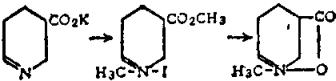
The methyl betaïne of nicotinic acid is identical with the alkaloid trigonelline, which was discovered in 1885 by E. Jahns in the seeds of Trigonella faenum-graecum (Ber., 1885, 18, p. 2518). It has also been obtained from nicotine by A. Pictet by oxidizing the methyl hydroxide of nicotine with potassium permanganate (Ber., 1897, 30, p. 2117).
Substances closely related to betaïne are choline, neurine and muscarine. Choline (bilineurine, sincaline), (Gr. χολή, bile), C5H15NO2 or HO·CH2·CH2·N(CH3)3·OH, first isolated by A. Strecker in 1862 (Ann. 123, p. 353; 148, p. 76), is found in the bile, in brain substance, and in yolk of egg in the form of lecithin, a complex ester of glycerin with phosphoric acid and the fatty acids. It is also found in combination with sinapic acid in sinapin, the glucoside obtained from white mustard, and can be obtained from this glucoside by hydrolysis with baryta water,
C16H23NO5 + 2H2O = C5H15NO2 + C11H12O5.
Sinapin. Choline. Sinapic acid.
It can be synthetically prepared by the action of trimethylamine on an aqueous solution of ethylene oxide (A. Wurtz, Ann. Suppl., 1868, 6, p. 201). It forms deliquescent crystals of strongly alkaline reaction, and absorbs carbon dioxide from the air. It is not poisonous. By continued boiling of its aqueous solution, it is resolved into glycol and trimethylamine.
Neurine, trimethyl vinyl ammonium hydroxide (Gr. νεῦρον, nerve), CH2 : CH·N(CH3)3·OH, is a product of the putrefaction of albumen. It may be prepared by the action of moist silver oxide on ethylene dibromide and trimethylamine,
CH2Br·CH2Br → CH2Br·CH2N(CH3)3Br → CH2 : CH·N(CH3)3·OH.
It is a crystalline solid, very soluble in water, and is strongly basic and very poisonous. Muscarine, C5H15NO3, is an exceedingly poisonous substance found in many fungi. It may be obtained synthetically by oxidizing choline with dilute nitric acid (O. Schmiedeberg, Jahresb., 1876, p. 804). The exact constitution has not yet been definitely determined.
BETEL NUT. The name betel is applied to two different plants, which in the East are very closely associated in the purposes to which they are applied. The betel nut is the fruit of the Areca or betel palm, Areca Catechu, and the betel leaf is the produce of the betel vine or pan, Chavica Betel, a plant allied to that which yields black pepper. The Areca palm is a native of the Malay Peninsula and Islands and is extensively cultivated over a wide area in the East, including southern India, Ceylon, Siam, the Malay Archipelago and the Philippine Islands. It is a graceful tree with a straight, slender, unbranched stem reaching 40 or 50 ft. in height and about 1½ ft. in circumference, and bearing a crown of 6-9 very large spreading pinnate fronds. The fruit is about the size of a small hen’s egg, and within its fibrous rind is the seed or so-called nut, the albumen of which is very hard and has a prettily mettled grey and brown appearance. The chief purpose for which betel nuts are cultivated and collected is for use as a masticatory,—their use in this form being so widespread among Oriental nations that it is estimated that one-tenth of the whole human family indulge in betel chewing. For this use the fruits are annually gathered between the months of August and November, before they are quite ripe, and deprived of their husks. They are prepared by boiling in water, cutting up into slices, and drying in the sun, by which treatment the slices assume a dark brown or black colour. When chewed a small piece is wrapped up in a leaf of the betel vine or pan, with a pellet of shell lime or chunam; and in some cases a little cardamom, turmeric or other aromatic is added. The mastication causes a copious flow of saliva of a brick-red colour, which dyes the mouth, lips and gums. The habit blackens the teeth, but it is asserted by those addicted to it that it strengthens the gums, sweetens the breath and stimulates the digestive organs. Among the Orientals betel is offered on ceremonial visits in the same manner as wine is produced on similar occasions by Europeans. Betel nuts are further used as a source of catechu, which is procured by boiling the nuts in water. The water of the first boiling becomes red and thick, and when this is inspissated after the removal of the nuts it forms a catechu of high astringency and dark colour called in Bombay “Kossa.” The nuts are again boiled, and the inspissated juice of the second decoction yields a weaker catechu of a brown or reddish colour. Betel nuts have been used by turners for ornamental purposes, and for coat buttons on account of the beauty of their structure. At one time they were supposed to be useful as a vermifuge. The nuts of other species of Areca are used by the poorer classes in the East as substitutes for the genuine betel nut.
The alkaloid arecaidine, C7H11NO2, occurs in areca or betel nuts, together with three other alkaloids: arecoline, C8H13NO2, guvacine, C6H9NO2, and arecaine, C7H11NO2. Arecaidine forms white crystals easily soluble in water, and difficultly soluble in alcohol. Chemically it is methyl-tetrahydro-nicotinic acid. Dehydration results in the formation of a “betaïne,” which is a tetrahydro-trigonelline (see Betaïne). Arecoline is an oil, and the physiological action of the betel nut is alone due to this substance. Chemically it is the methyl ester of arecaidine. Guvacine, named from “guvaca,” an Indian designation of the betel palm, forms white crystals. It is a secondary base, but its constitution is uncertain. Arecaine is n-methyl-guvacine.
BETHANY (mod. el-‘Azariyeh), a village nearly 2 m. E.S.E. from Jerusalem, on the eastern slope of the Mount of Olives, 2208 ft. above the sea. It is interesting as the residence of Lazarus and his sisters, and a favourite retreat of Jesus (see especially John xi., which describes the miracle of the resurrection of Lazarus at this place). From the 4th century down to the time of the Mahommedan invasion several ecclesiastical buildings were erected on the spot, but of these no distinct traces remain. El-‘Azariyeh is a poor village of about thirty families, with few marks of antiquity; there is no reason to believe that the houses of Mary and Martha and of Simon the Leper, or the sepulchre of Lazarus, still shown by the monks, have any claim to the names they bear. Another Bethany (with the alternative reading Bethabara) is mentioned in John i. 28, as “beyond Jordan”; it has not been identified.
BETHEL (Heb. “House of God”), originally called Luz, an ancient city of Palestine, on the N.W. border of the tribe of Benjamin, 11 m. N. of Jerusalem and nearly 2900 ft. above sea-level. From very early times it was a holy place, a circumstance probably due primarily to a very extraordinary group of boulders and rock-outcrops north of the town. Abraham recognized its sanctity (Gen. xii. 8); Jacob, in ignorance, slept in the sacred enclosure and was granted a vision (“Jacob’s ladder,” Gen. xxviii). For a while the ark seems to have been deposited here (Judg. xx. 27), and it was a place for consulting the oracle (Judg. xx. 18). At the secession of the northern kingdom under Jeroboam, Bethel became a royal residence and a national shrine (1 Kings xii. 29-31, Amos vii. 13), for which its position at the junction of main roads from N. to S. and E. to W. well fitted it. It was taken from Jeroboam by Abijah, king of Judah (2 Chr. xiii. 19). It seems to have continued to flourish down into the Christian era; remains of its ecclesiastical buildings still exist. The present village, which bears the name of Beitin, occupies about three or four acres, and has a population of 2000.
BÉTHENCOURT, JEAN DE (c. 1360-1422), French explorer, belonged to a noble family of Normandy, and held important offices at the court of Charles VI., king of France. His spirit was fired by hearing of the deeds of explorers and adventurers, and having formed a plan to conquer the Canary Islands he raised some money by pledging his Norman estates, and sailed from La Rochelle on the 1st of May 1402 with two ships, commanded by himself and Gadifer de la Salle. He was delayed by a mutiny off the coast of Spain, but reached the island of Lanzarote in July. Unable to carry out his project of conquest, he left his men at the Canaries and went to seek help at the court of Castile. He obtained men and provisions from Henry III. king of Castile, through the good offices of his uncle, Robert de Braquemont, who had considerable influence with Henry; he also received the title of king, and did homage to Henry for his future conquests. Returning to the Canaries in 1404 he found that Gadifer de la Salle had conquered Lanzarote and Fuerteventura, and explored other islands. La Salle, unwilling to accept a position of inferiority, left the Canaries and appealed unsuccessfully for redress at the court of Castile. Béthencourt was unable to complete his work of conquest and exploration. In 1405 he visited Normandy, and returned with fresh colonists who occupied Hierro. In December 1406 he left the islands to the government of his nephew, Maciot de Béthencourt, reserving for himself the royal title and a share in any profits obtained. He returned to Normandy, where he appears to have spent the remainder of his days. He died in 1422, and was buried in the church of Grainville-la-Teinturière. Béthencourt wrote a very untrustworthy account of his “conquest of the Canary Islands,” Le Canarien, livre de la conquête et conversion ses Canaries. This has been published with introduction and notes by G. Gravier (Rouen, 1874), and an English translation was edited by R.H. Major for the Hakluyt Society (London, 1872).
See also Canary Islands, for the controversy as to the relations between Béthencourt and La Salle.
BETHESDA (i.e. “House of Mercy,” John v. 2), better perhaps Bethzatha or Bethsaida, a pool or public bath in Jerusalem, where miraculous cures were believed to be performed. The following identifications have been suggested: Birket Isra’il, near St Stephen’s gate; a large cistern, near St Anne’s church; the “Twin Pools,” north of the Haram (the ancient Temple area); the Hammam esh-Shifa‘ or pool of healing, west of the Haram; the Virgin’s fountain, south of the Haram; and the “Pool of Siloam.” Which, if any, of these identifications is correct, it is impossible to say.
BETHESDA, an urban district of Carnarvonshire, N. Wales, 5 m. from Bangor, by a branch of the London & North-Western railway. Pop. (1901) 5281. It lies near the lower end of the fine Nant Ffrancon (valley of the Ogwen stream). The scriptural name is due, as often in Wales, to the village or hamlet taking its title from the Nonconformist church. Here are extensive slate quarries belonging to Lord Penrhyn. A narrow-gauge railway connects these with Port Penrhyn, at the mouth of the stream Cegid (hemlock, “cicuta”), which admits the entry of vessels of 300 tons to the quay at low water.
BETH-HORON (“the place of the hollow way”), the name of two neighbouring villages, upper and lower Beth-horon, on the ascent from the coast plain of Palestine to the high tableland of Benjamin, which was until the 16th century the high road from Jerusalem to the sea. The two towns thus played a conspicuous part in Israelitish military history (see Josh. x. 10; 1 Sam. xiii. 18; 1 Kings ix. 17; 1 Macc. iii. 13-24, vii. 39 ff., ix. 50). Josephus (Bell. Jud. ii. 19) tells of the rout of a Roman army under Cestius Gallus in A.D. 66. The Talmud states that many rabbis were born in the place. It is now represented by Beit ‘Ur-el-foka and Beit ‘Ur-et-tahta.
BETHLEHEM (Heb. “House of Bread,” or, according to a more questionable etymology, “of [the god] Lakhmu”), a small town in Palestine, situated on a limestone ridge (2550 ft. above sea-level), 5 m. S. of Jerusalem. The neighbourhood produces wheat, barley, olives and vines in abundance. It was occupied in very early times, though the references in Judges xvii., xix., and Ruth1 are of doubtful date. It was the early home of David and of Joab (2 Sam. ii. 32). It was fortified by Rehoboam, and in the neighbouring inn of Chimham the murderers of Gedaliah took refuge (Jer. xli. 17). Micah (v. 2) and other writers speak of it as Bethlehem-Ephrathah; perhaps Ephrathah was the name of the district. Almost complete obscurity, however, was gathering round it when it became (according to Matt. ii. and Luke ii.) the birthplace of Jesus. The traditional scene of the Nativity, a grotto on the eastern part of the ridge, is alleged to have been desecrated during the reign of Hadrian by a temple of Adonis. In 330 it was enclosed by a basilica built by the orders of the emperor Constantine. This basilica (S. Maria a Praesepio), which is still standing, was restored and added to by Justinian, and was later surrounded by the three convents successively erected by the Greek, Latin and Armenian Churches (see de Vogüé, Les Églises de la Terre Sainte). Captured by the Crusaders in the 11th century, Bethlehem was made an episcopal see; but the bishopric soon sank to a titular dignity. Beside the grotto of the Nativity other traditional sites are shown within the church, such as the Altar of the Magi, the Tomb of Eusebius, the cave wherein Jerome made his translation of the Bible, &c.
There are several monasteries and convents, and British, French and German schools. The village is well built and comparatively clean. The population (8000) has contained few Moslems since the Moslem quarter was destroyed by Ibrahim Pasha, in revenge for the murder of one of his favourites, after the insurrection of 1834. The carving of crucifixes and other sacred mementoes gives employment to a large proportion of the population. In 1850 a dispute arose between France and Russia, in the name of the Latin and Greek Churches respectively, concerning the possession of the key of the chief door of the basilica, and concerning the right to place a silver star, with the arms of France, in the grotto of the Nativity. The Porte, after much futile temporizing, yielded to France. The disappointment thus inflicted on Russia was a determining cause of the outbreak of the Crimean War (see Kinglake, Invasion of the Crimea, chap. iii.). [There is a tiny village of the same name in Zebulun, 7 m. N.W. of Nazareth (Josh. xv. 19).]
See bibliography under Palestine. For the modern town see Palmer, “Das jetzige Bethlehem,” in the Zeitschrift of the Deutsche Palästina-Verein, xvii. p. 89.
(R. A. S. M.)
1 The country of Moab is clearly visible from around Bethlehem.
BETHLEHEM, a borough of Northampton and Lehigh counties, Pennsylvania, U.S.A., on the N. bank of the Lehigh river, opposite South Bethlehem and 55 m. N. by W. of Philadelphia. Pop. (1890) 6762; (1900) 7293 (350 foreign-born); (1910) 12,837. It is served by the Central of New Jersey, the Lehigh & New England, the Lehigh Valley and the Philadelphia & Reading railways, and is connected by two long bridges with South Bethlehem. The borough lies on a ridge of ground commanding delightful landscape scenery extending north up the course of the river to the Blue Mountains 20 m. away. In Church Street and its vicinity still stand several specimens of the 17th-century style of architecture of eastern Germany. The same sect that erected these buildings, the Moravians, or United Brethren, maintain here the Moravian College and Theological Seminary, and a well-known school for girls (the Moravian Seminary), founded as a church boarding school in 1749 and reorganized in 1785, for girls of all denominations. During the War of Independence, from December 1776 to April 1777, and from September 1777 to April 1778, the old Colonial Hall in this seminary (built 1748) was used as a general hospital of the continental army. From its roof the famous Moravian trombones were long played on festal or funeral occasions, and later summoned the people to musical festivals. The Moravians have given Bethlehem a national reputation as a musical centre. Only a few years after the city was founded, Benjamin Franklin was strongly impressed with the fine music in its church, and towards the close of the 19th century a choir under the direction of the organist, J. Frederick Wolle, became widely known by rendering for the first time in America Bach’s St John Passion (in 1888), followed after short intervals by the St Matthew Passion, the Christmas Oratorio, the Mass in B Minor, and finally by an annual Bach festival continuing for three days, which was discontinued after Wolle’s removal to the university of California in 1905. Bethlehem has often been called the American Bayreuth. Among the borough’s industrial establishments, the manufactories of iron and steel are the most important, but it also manufactures brass, zinc, and silk and knit goods. The municipality owns and operates its waterworks. Bethlehem was founded by the Moravians, led by Count Nikolaus Ludwig Zinzendorf, shortly before Christmas in 1741, and the season of the year suggested its name; for the first century of its existence it was almost exclusively a settlement of that sect, and it is still their American headquarters. Bethlehem was incorporated as a borough in 1845. In 1904 the borough of West Bethlehem (pop. in 1900, 3465) was consolidated with Bethlehem.
See J.M. Levering, A History of Bethlehem, Pennsylvania (Bethlehem, 1903).
BETHLEHEMITES, a name borne at different times by three orders in the Roman Catholic Church. (1) A community of friars at Cambridge, in 1257, whose habit was distinguished from that of the ordinary Dominicans by a five-rayed red star (in reference to Matt. ii. 9 f). (2) An order of knighthood similar to the Knights of St John, established by Pius II. in 1459 to resist the inroads of the Turks. (3) The Bethlehemite Order of Guatemala, a nursing community founded in 1650 by Pedro Betancourt (d. 1667), extended by the brothers Rodrigo and Antonio of the Cross, and raised to an order by Innocent XI. in 1687. They wore a dress like that of the Capuchins, and Clement XI. in 1707 gave them the privileges of the mendicant orders. They spread throughout Central America and Mexico and as far south as Lima, and with the order of sisters, founded in 1668 by Anna Maria del Galdo, were conspicuous for their devotion during times of plague and other contagious diseases. This order became extinct about 1850. The name Bethlehemites has also sometimes been given to the Hussites of Bohemia because their leader preached in the Bethlehem church at Prague.
BETHLEN, GABRIEL (Gábor) (1580-1629), prince of Transylvania, the most famous representative of the Iktári branch of a very ancient Hungarian family, was born at Illyé, and educated at Szarhegy, at the castle of his uncle András Lázár. Thence he was sent to the court of Prince Zsigmond Báthory, whom he accompanied on his famous Wallachian campaign in 1600. Subsequently he assisted Stephen Bocskay to mount the throne of Transylvania (1605), and remained his chief counsellor. Bethlen also supported Bocskay’s successor Gabriel Báthory (1608-1613), but the prince became jealous of Bethlen’s superior abilities, and he was obliged to take refuge with the Turks. In 1613 he led a large army against his persecutor, on whose murder by two of his officers that year Bethlen was placed on the throne by the Porte, in opposition to the wishes of the emperor, who preferred a prince who would incline more towards Vienna than towards Constantinople. On the 13th of October 1613, the diet of Klausenburg confirmed the choice of the sultan. In 1615 Gábor was also officially recognized by the emperor Matthias. Bethlen no sooner felt firmly seated on his throne than he seized the opportunity presented to him by the outbreak of the Thirty Years’ War to take up arms in defence of the liberties and the constitution of the extra-Transylvanian Hungarian provinces, with the view of more effectually assuring his own position. While Ferdinand was occupied with the Bohemian rebels, Bethlen led his armies into Hungary (1619), and soon won over the whole of the northern counties, even securing Pressburg and the Holy Crown. Nevertheless he was not averse to a peace, nor to a preliminary suspension of hostilities, and negotiations were opened at Pressburg, Kassa and Beszterczebánya successively, but came to nothing because Bethlen insisted on including the Bohemians in the peace, whereupon (20th of August 1620) the estates of North Hungary elected him king. Bethlen accepted the title but refused to be crowned, and war was resumed, till the defeat of the Czechs at the battle of the White Hill gave a new turn to affairs. In Bohemia, Ferdinand II. took a fearful revenge upon the vanquished; and Bethlen, regarding a continuation of the war as unprofitable, concluded the peace of Nikolsburg (31st of December 1621), renouncing the royal title on condition that Ferdinand confirmed the peace of Vienna (which had granted full liberty of worship to the Protestants) and engaged to summon a general diet within six months. For himself Bethlen secured the title of prince of the Empire, the seven counties of the Upper Theiss, and the fortresses of Tokaj, Munkács and Ecsed. Subsequently Bethlen twice (1623 and 1626) took up arms against Ferdinand as the ally of the anti-Habsburg Protestant powers. The first war was concluded by the peace of Vienna, the second by the peace of Pressburg, both confirmatory of the peace of Nikolsburg. After the second of these insurrections, Bethlen attempted a rapprochement with the court of Vienna on the basis of an alliance against the Turks and his own marriage with one of the Austrian archduchesses; but Ferdinand had no confidence in him and rejected his overtures. Bethlen was obliged to renounce his anti-Turkish projects, which he had hitherto cherished as the great aim and object of his life, and continue in the old beaten paths. Accordingly, on his return from Vienna he wedded Catherine, the daughter of the elector of Brandenburg, and still more closely allied himself with the Protestant powers, especially with Gustavus Adolphus of Sweden, who, he hoped, would assist him to obtain the Polish crown. He died before he could accomplish any of his great designs (15th of November 1629), having previously secured the election of his wife Catherine as princess. His first wife, Susannah Károlyi, died in 1622.
Gabriel Bethlen was certainly one of the most striking and original personages of his century. A zealous Calvinist, whose boast it was that he had read the Bible twenty-five times, he was nevertheless no persecutor, and even helped the Jesuit Kaldy to translate and print his version of the Scriptures. He was in communication all his life with the leading contemporary statesmen, so that his correspondence is one of the most interesting and important of historical documents. He also composed hymns.
The best editions of his correspondence are those by Sándor Szilágyi, both published at Buda (1866 and 1879). The best life of him is that by the Bohemian historian Anton Gindely, Acta et documenta historiam Gabrielis Bethleni illustrantia (Budapest, 1890). This work has been largely utilized by Ignáe-Acsády in his excellent Gabriel Bethlen and his Court (Hung., Budapest, 1890).
(R. N. B.)
BETHNAL GREEN, an eastern metropolitan borough of London, England, bounded N. by Hackney, E. by Poplar, S. by Stepney and W. by Shoreditch. Pop. (1901) 129,680. It is a district of poor houses, forming part of the area commonly known as the “East End.” The working population is employed in the making of match-boxes, boot-making, cabinet-making and other industries; but was formerly largely devoted to silk-weaving, which spread over the district from its centre in Spitalfields (see Stepney). This industry is still maintained. The Bethnal Green museum was opened in 1872. It contains exhibits of food and animal products, formerly at South Kensington, entomological collections, &c.; and various loan exhibitions are held from time to time. The Museum also housed the Wallace collection until the opening of Hertford House, and the pictures now in the National Portrait Gallery. It stands in public gardens; there are several other small open spaces; and some 70 out of the 217 acres of Victoria Park are within the borough. Close by the park there stood, until the 19th century, a house believed to have belonged to the notorious Bishop Bonner, the persecutor of Protestants in the reign of Mary; his name is still attached to a street here. Among institutions are the missionary settlement of the Oxford House, founded in 1884, with its women’s branch, St Margaret’s House; the North-Eastern hospital for children, the Craft school und the Leather Trade school. The parliamentary borough of Bethnal Green has two divisions, each returning one member. The borough council consists of a mayor, 5 aldermen and 30 councillors. Area, 759.3 acres.
BÉTHUNE (Family). The seigneurs of Béthune, avoués (advocati) of the great abbey of Saint-Vaast at Arras from the 11th century, were the ancestors of a great French house whence sprang the dukes of Sully, Charost, Orval, and Ancenis; the marquises of Rosny, Courville and Chabris; the counts of Selles and the princes of Boisbelle and Henrichemont. Conon de Béthune (q.v.), the crusader and poet, was an early forebear. The most illustrious member of the Béthune family was Maximilien, baron of Rosny, and afterwards duke of Sully (q.v.), minister of Henry IV. His brother Philip, count of Selles and of Charost, was ambassador to Scotland, Rome, Savoy and Germany, and died in 1649. Hippolyte de Béthune, count of Selles and marquis of Chabris, who died in 1665, bequeathed to the king a magnificent collection of historical documents and works of art. The Charost branch of the family gave France a number of generals during the 17th and 18th centuries.
The last duke of Charost, Armand Joseph de Béthune (1738-1800), French economist and philanthropist, served in the army during the Seven Years’ War, after which he retired to his estates in Berry, where, and also in Brittany and Picardy, he sought to ameliorate the lot of his peasants by abolishing feudal dues, and introducing reforms in agriculture. During the Terror he was arrested, but was liberated after the 9th Thermidor. He was mayor of the 10th arrondissement of Paris under the Consulate, and died at Paris on the 20th of October 1800, of small-pox, contracted during a visit to a workshop for the blind which he had founded. He published essays on the way to destroy mendicancy and to improve the condition of the labourers, and also on the establishment of a fund for rural relief and the organization of rural education. His life throws light on some phases of the ancien régime which are often overlooked by historians. Louis XV. said of Charost, “Look at this man, his appearance is insignificant, but he has put new life into three of my provinces.” His only son, Armand Louis de Béthune, marquis de Charost, was beheaded on the 28th of April 1794.
BÉTHUNE, CONON or Quesnes, DE (c. 1150-1224), French trouvère of Arras, was born about the middle of the 12th century. He came about 1180 to the court of France, where he met Marie de France, countess of Champagne. To this princess his love poems are dedicated, and much of his time was passed at her court where the trouvères were held in high honour. At the French court he met with some criticisms from Queen Alix, the widow of Louis VII., on the roughness of his verse and on his Picard dialect. To these criticisms, interesting as proof of the already preponderant influence of the dialect of the Île de France, the poet replied by some verses in the satirical vein that best suited his temperament. Some of his best songs were inspired by anger at the delays before the crusade of 1188-1192. His plain-speaking made him many enemies, and when he returned with the rest after the fruitless capture of Acre, these were not slow to take advantage of the opportunity for retaliation. Conon took part with Baldwin of Flanders in the crusade which resulted in 1204 in the capture of Constantinople, and he is said to have been the first to plant the crusaders’ standard on the walls of the city. He held high office in the new empire and died about 1224. His verses, of which the crusading song Ah! amors com dure departie is well known, are marked by a vigour and martial spirit which distinguish them from the work of other trouvères.
The completest edition of his works is in the Trouvères belges of Aug. Scheler (1876).
BÉTHUNE, a town of northern France, capital of an arrondissement in the department of Pas-de-Calais, 24 m. N.N.W. of Arras, on the Northern railway between that town and St Omer. Pop. (1906) 12,601. Béthune is situated on a low hill at the confluence of the Lawe with the canal from Aire to Bauvin. Once strongly fortified, it is now surrounded by wide boulevards, and new quarters have grown up on its outskirts. The old town is composed of winding streets and culs-de-sac bordered by old houses in the Flemish style. In the central square stands one of the finest belfries of northern France, a square structure surmounted by a wooden campanile, dating from the 14th century. St Vaast, the principal church of Béthune, belongs to the 16th century. The town is the seat of a sub-prefect, and has a tribunal of first instance, a chamber of commerce and a communal college among its public institutions. Béthune lies in the midst of the richest coal mines in France. Its industries include the distillation of oil, tanning, salt-refining, brewing, and the manufacture of earthenware and casks. Trade is carried on in flax, cloth, cereals, oil-seeds, &c.
The town, which dates from the 11th century, was governed by its own lords till 1248, after which date it passed through the ownership of the counts of Flanders, the dukes of Burgundy, and the sovereigns of Austria and Spain. Ceded to France by the peace of Nijmwegen (1678), it was taken by the allied forces in 1710, and restored to France by the treaty of Utrecht.
BETROTHAL (A.S. treowth, “truth”), the giving “one’s truth,” or pledging one’s faith to marry. Although left optional by the church and not necessary in law, betrothal was anciently a formal ceremony which in most cases preceded the actual marriage service, usually by a period of some weeks, but the marriage might for various reasons be delayed for years. The canon law distinguished two types of betrothal:—(1) Sponsalia de praesenti, (2) Sponsalia de futuro. The first was a true though irregular marriage, and was abolished by the council of Trent as leading to clandestine unions and therefore being inimical to morality. The second, or betrothal properly so called, was a promise to marry at a future date, which promise without further ceremony became a valid marriage upon consummation. The church never precisely determined the form of the ceremony, but demanded for its validity that it should have been entered into freely and at a legal age, i.e. after the seventh birthday. The church further declared that females between the ages of seven and twelve, and males between seven and fourteen, could be betrothed, but not married, and that all such betrothals were to be public. The ill-defined laws as to betrothals tended to encourage abuses; and the people, especially in the rural districts, inclined to hold betrothal sufficient justification for cohabitation. Such pre-contract is known to have existed in the case of Shakespeare (q.v.). Francis Douce (Illustrations of Shakespeare and of Antient Manners, 1807) says that betrothal consisted of the “interchange of rings—the kiss—the joining of hands, to which is to be added the testimony of witnesses.” In France the presence of a priest seems to have been considered essential, and though this was not so elsewhere it was customary for the couple to get their parish priest to witness their promise. In England solemn betrothal was almost universally practised. Among the peasantry the place of rings was taken by a coin which was broken between the pair, each taking a part. But almost any gift sufficed. A case in 1582 is recorded where the lover gave the girl a pair of gloves, two oranges, two handkerchiefs and a red silk girdle. Sometimes the bride-elect received a bent or crooked sixpence. At the conclusion of the ceremony, which by no means always took place in a church, it seems to have been usual for the couple to pledge each other in a cup of wine, as do the Jews and Russians to-day. This drinking together was ever the universal custom of parties in ratification of a bargain. Joseph Strutt (1749-1802) states that by the civil law gifts given at betrothal could be recovered by the parties, if the marriage did not take place. But only conditionally, for if the man “had had a kiss for his money, he should lose one half of that which he gave. Yet with the woman it is otherwise, for, kissing or not kissing, whatever she gave, she may ask and have it again. However, this extends only to gloves, rings, bracelets and such-like small wares.” Though the church abstained from prescribing the form of the ceremony, it jealously watched over the fulfilment of such contracts and punished their violation. Betrothal, validly contracted, could be dissolved either by mutual consent, or by the supervening of some radical physical or social change in the parties, or by the omission to fulfil one of the conditions of the contract. But here the church stepped in, and endeavoured to override such law as existed in the matter by decreeing that whoever, after betrothal, refused to marry in facie ecclesiae, was liable to excommunication till relieved by public penance. In England the law was settled by an act of 1753, which enacted that an aggrieved party could obtain redress only by an action at common law for breach of promise of marriage (see Marriage).
Formal betrothal is no longer customary in England, but on the European continent it retains much of its former importance. There it is either solemn (publicly in church) or private (simply before witnesses). Such betrothals are legal contracts. They are only valid between persons of legal age, both of whom consent; and they are rendered void by fraud, intimidation and duress. In Germany if the parties are under age the consent of the parents is needed; but if this be unreasonably withheld the couple may appeal to a magistrate, who can sanction the betrothal. If the parents disagree, the father’s wish prevails. Public betrothal carries with it an obligation to marry, and in case of refusal an action “lies” for the injured party. In Germany the betrothal is generally celebrated before the relatives, and the couple are called bride and bridegroom from that day until marriage. In Russia, where it was once as binding as marriage, it is now a mere formal part of the marriage ceremony.
Among the ancient Jews betrothal was formal and as binding as marriage. After the ceremony, which consisted of the handing of a ring or some object of value to the bride and formal words of contract, and the mutual pledging of the couple in consecrated wine, a period of twelve months elapsed before the marriage was completed by the formal home-taking; unless the bride was a widow or the groom a widower, when this interval was reduced to thirty days. Latterly the ceremony of betrothal has become a part of the marriage ceremony, and the engagement has become the informal affair it is in England.
For betrothal customs in China, the East and elsewhere, consult L.J. Miln, Wooings and Weddings in Many Climes (London, 1900), and H.N. Hutchinson, Marriage Customs in Many Lands (London, 1897). On early English law as to betrothals see Sir F. Pollock and Maitland, History of English Law before the time of Edward I. (2nd ed., 1898). See also J.O. Halliwell-Phillipps, Outlines of the Life of Shakespeare (London, 1848, 1883).
BETTERMENT (i.e. “making better,” as opposed to “worsement”), a general term, used particularly in connexion with the increased value given to real property by causes for which a tenant or the public, but not the owner, is responsible; it is thus of the nature of “unearned increment.” When, for instance, some public improvement results in raising the value of a piece of private land, and the owner is thereby “bettered” through no merit of his own, he gains by the betterment, and many economists and politicians have sought to arrange, by taxation or otherwise, that the increased value shall come into the pocket of the public rather than into his. A betterment tax would be so assessed as to divert from the owner of the property the profit thus accruing “unearned” to him. (See also Compensation.) The whole problem is one of the incidence of taxation and the question of land values, and various applications of the principle of betterment have been tried in America and in England, raising considerable controversy from time to time.
See A.A. Baumann, Betterment, Worsement and Recoupment (1894).
BETTERTON, THOMAS (c. 1635-1710), English actor, son of an under-cook to King Charles I., was born in London. He was apprenticed to John Holden Sir William Davenant’s publisher, and possibly later to a bookseller named Rhodes, who had been wardrobe-keeper to the theatre in Blackfriars. The latter obtained in 1659 a licence to set up a company of players at the Cockpit in Drury Lane; and on the reopening of this theatre in 1660, Betterton made his first appearance on the stage. His talents at once brought him into prominence, and he was given leading parts. On the opening of the new theatre in Lincoln’s Inn Fields in 1661, Sir William Davenant, the patentee, engaged Betterton and all Rhodes’s company to play in his Siege of Rhodes. Betterton, besides being a public favourite, was held in high esteem by Charles II., who sent him to Paris to examine stage improvements there. According to Cibber it was after his return that shifting scenes instead of tapestry were first used in an English theatre. In 1692, in an unfortunate speculation, Betterton and his friend Sir Francis Watson were ruined; but Betterton’s affection for Sir Francis was so strong that he adopted the latter’s daughter and educated her for the stage. In 1693, with the aid of friends, he erected the New Playhouse in the tennis court in Lincoln’s Inn Fields. It was opened in 1695 with Congreve’s Love for Love. But in a few years the profits fell off; and Betterton, labouring under the infirmities of age and gout, determined to quit the stage. At his benefit performance, when the profits are said to have been over £500, he played Valentine in Love for Love. In 1710 he made his last appearance as Melantius in The Maid’s Tragedy; he died on the 28th of April, and was buried in Westminster Abbey.
In appearance he was athletic, slightly above middle height, with a tendency to stoutness; his voice was strong rather than melodious, but in recitation it was used with the greatest dexterity. Pepys, Pope, Steele and Cibber all bestow lavish praise on his acting. His repertory included a large number of Shakespearian roles, and although many of these were presented in the tasteless versions of Davenant, Dryden, Shadwell and Nahum Tate, yet they could not hide the great histrionic gifts which Betterton possessed, nor does his reputation rest on these performances alone. The blamelessness of his life was conspicuous in an age and a profession notorious for dissolute habits. Betterton was author of several adaptations which were popular in their day. In 1662 he had married Mary Saunderson (d. 1712), an admirable actress, whose Ophelia shared the honours with his Hamlet.
See Howe, Thomas Betterton (1891); The Life and Times of Thomas Betterton (1886).
BETTIA, a town of British India, in the Champaran district of Bengal; situated on a former branch of the Harha river, with a station on the Tirhoot section of the Bengal & North-Western railway. Bettia is the residence of one of the leading noblemen of northern Behar, who enjoys a rent-roll of £66,000. In 1901, owing to a disputed succession, the estate was under the management of the court of wards. It comprises land in no fewer than ten districts, much of which is let on permanent leases to indigo-planters. Besides the palace of the maharaja, the town contains a middle English school and a female dispensary, entirely supported out of the estate. There is a Roman Catholic mission, with about 1000 converts, which was founded by an Italian priest in 1746.
BETTINELLI, SAVERIO (1718-1808), Italian Jesuit and man of letters, was born at Mantua on the 18th of July 1718. After studying under the Jesuits in his native city and at Bologna he entered the society in 1736. He taught the belles-lettres from 1739 to 1744 at Brescia, where Cardinal Quirini, Count Mazzuchelli, Count Duranti and other scholars, formed an illustrious academy. He next went to Bologna, to pursue the study of divinity, and there he enjoyed the society of many learned and literary men. At the age of thirty he went to Venice, where he became professor of rhetoric, and was on friendly terms with the most illustrious persons of that city and state. The superintendence of the college of nobles at Parma was entrusted to him in 1751; and he had principal charge of the studies of poetry and history, and the entertainments of the theatre. He remained there eight years, visiting, at intervals, other cities of Italy, either on the affairs of his order, for pleasure or for health. In 1755 he traversed part of Germany, proceeded as far as Strassburg and Nancy, and returned by way of Germany into Italy, taking with him two young sons or nephews of the prince of Hohenlohe, who had requested him to take charge of their education. He made, the year following, another journey into France along with the eldest of his pupils; and during this excursion he wrote his famous Lettere dieci di Virgilio agli Arcadi, which were published at Venice with his sciolti verses, and those of Frugoni and Algarotti. The opinions maintained in these letters against the two great Italian poets and particularly against Dante, created him many enemies, and embroiled him with Algarotti. In 1758 he went into Lorraine, to the court of King Stanislaus, who sent him on a matter of business to visit Voltaire. Voltaire presented him with a copy of his works, with a flattering inscription in allusion to Bettinelli’s Letters of Virgil. From Geneva he returned to Parma, where he arrived in 1759. He afterwards lived for some years at Verona and Modena, and he had just been appointed professor of rhetoric there, when, in 1773, the order of Jesuits was abolished in Italy. Bettinelli then returned into his own country, and resumed his literary labours with new ardour. The siege of Mantua by the French compelled him to leave the city, and he retired to Verona, where he formed an intimate friendship with the chevalier Hippolito Pindemonti. In 1797 he returned to Mantua. Though nearly eighty years old, he resumed his labours and his customary manner of life. He undertook in 1799 a complete edition of his works, which was published at Venice in 24 vols. 12mo. Arrived at the age of ninety years, he still retained his gaiety and vivacity of mind, and died on the 13th of September 1808. The works of Bettinelli are now of little value. The only one still deserving remembrance, perhaps, is the Risorgimento negli studj, nelle Arti e ne’ Costumi dopo il Mille (1775-1786), a sketch of the progress of literature, science, the fine arts, industry, &c., in Italy.
BETTWS Y COED, an urban district of Carnarvonshire, North Wales, 4 m. from Llanrwst and 16 m. from Llandudno, on a branch of the London & North-Western railway. Pop. (1901) 1070. The name means “warm place of the wood,” according to Llyn’s definition of bettws. The other derivation of the word from Abbatis (domus) agrees with its vicinity to Yspytty1 Ifan (Ieuan), Hospitium Ioannis, near Pentre’r Foelas. The words “y coed” are added to distinguish this Bettws from several others in Wales, especially that near Llandeilo Fawr, Carmarthenshire, not far from the Bettws hills. Bettws y coed is a favourite village for artists and tourists. It is a centre for excursions towards Capel Curig and Snowdon, or towards Blaenau Festiniog, via Roman Bridge. There is excellent fishing for salmon and trout, and in summer coaches leave their daily loads of tourists here. The best-known streams and waterfalls are Llugwy, Lledr, with Rhaiadr y wenol (Swallow falls), Conwy and Machno falls. In the neighbourhood are Dolwyddelan castle and the hill of Moel Siabod.
1 Other places named “Yspytty” are Y. Cynfyn and Y. Ystwyth. For the name Yspytty, cf. Bale’s King John, 2125: “So many masendeens (maisons Dieu), hospytals and spyttle howses.”
BETTY, WILLIAM HENRY WEST (1791-1874), English actor, known as “the young Roscius,” was born on the 13th of September 1791 at Shrewsbury. He first appeared on the stage at Belfast before he was twelve years old, as Osman in Aaron Hill’s Zara, an English version of Voltaire’s Zaire. His success was immediate, and he shortly afterwards appeared in Dublin, where it is said that in three hours of study he committed the part of Hamlet to memory. His precocious talents aroused great enthusiasm in Glasgow and Edinburgh, and he was favourably compared with some of the greatest tragedians. In 1804 he first appeared at Covent Garden, when the troops had to be called out to preserve order, so great was the crush to obtain admittance. At Drury Lane the house was similarly packed, and he played for the then unprecedented salary of over 75 guineas a night. He was a great success socially, George III. himself presenting him to the queen, and Pitt upon one occasion adjourning the House of Commons that members might be in time for his performance. But this enthusiasm gradually subsided, and in 1808 he made his final appearance as a boy actor, and entered Christ’s College, Cambridge. He re-appeared four years later, but the public would have none of him, and he retired to the enjoyment of the large fortune which he had amassed as a prodigy. He died on the 24th of August 1874. His son Henry Betty (1819-1897) was also an actor.
BETUL, a town and district of British India, in the Nerbudda division of the Central Provinces. In 1901 the population of the town was 4739. The administrative headquarters of the district have been transferred to the town of Badnur (q.v.), 3 m. north.
The district of Betul has an area of 3826 sq. m. In 1901 the population was 285,363, showing a decrease of 12% in the decade, due to the results of famine. The mean elevation above the sea is about 2000 ft. The country is essentially a highland tract, divided naturally into three distinct portions, differing in their superficial aspects, the character of their soil and their geological formation. The northern part of the district forms an irregular plain of the sandstone formation. It is a well-wooded tract, in many places stretching out in charming glades like an English park, but it has a very sparse population and little cultivated land. In the extreme north a line of hills rises abruptly out of the great plain of the Nerbudda valley. The central tract alone possesses a rich soil, well watered by the Machna and Sampna rivers, almost entirely cultivated and studded with villages. To the south lies a rolling plateau of basaltic formation (with the sacred town of Multai, and the springs of the river Tapti at its highest point), extending over the whole of the southern face of the district, and finally merging into the wild and broken line of the Ghats, which lead down to the plains. This tract consists of a succession of stony ridges of trap rock, enclosing valleys or basins of fertile soil, to which cultivation is for the most part confined, except where the shallow soil on the tops of the hills has been turned to account. The principal crops are wheat, millet, other food-grains, pulse, oil-seeds, and a little sugar-cane and cotton. A large part of the area is covered with forests, which yield teak and other timber. The only manufacture is cotton cloth. A railway is projected from Itarsi through the district to Berar. Good roads are few; and none of the rivers is navigable. This district suffered very severely from the famine of 1896-1897, in 1897 the death-rate being as high as 73 per 1000. It suffered again in 1900, when in May the number of persons relieved rose to one-third of the total population.
Little is known of the early history of the district except that it must have been the centre of the first of the four ancient Gond kingdoms of Kherla, Deogarh, Mandla and Chanda. According to Ferishta, the Persian historian, these kingdoms engrossed in 1398 all the hills of Gondwana and adjacent countries, and were of great wealth and power. About the year 1418 Sultan Husain Shah of Malwa invaded Kherla, and reduced it to a dependency. Nine years later the raja rebelled, but although with the help of the Bahmani kings of the Deccan he managed for a time to assert his independence, he was finally subdued and deprived of his territories. In 1467 Kherla was seized by the Bahmani king, but was afterwards restored to Malwa. A century later the kingdom of Malwa became incorporated into the dominions of the emperor of Delhi. In 1703 a Mussulman convert of the Gond tribe held the country, and in 1743 Raghoji Bhonsla, the Mahratta ruler of Berar, annexed it to his dominions. The Mahrattas in the year 1818 ceded this district to the East India Company as payment for a contingent, and by the treaty of 1826 it was formally incorporated with the British possessions. Detachments of British troops were stationed at Multai, Betul and Shahpur to cut off the retreat of Apa Sahib, the Mahratta general, and a military force was quartered at Betul until June 1862. The ruined city of Kherla formed the seat of government under the Gonds and preceding rulers, and hence the district was, until the time of its annexation to the British dominions, known as the “Kherla Sarkar.” The town of Multai contains an artificial tank, from the centre of which the Tapti is said to take its rise: hence the reputed sanctity of the spot, and the accumulation of temples in its honour.
The climate of Betul is fairly healthy. Its height above the plains and the neighbourhood of extensive forests moderate the heat, and render the temperature pleasant throughout the greater part of the year. During the cold season the thermometer at night falls below the freezing point; little or no hot wind is felt before the end of April, and even then it ceases after sunset. The nights in the hot season are comparatively cool and pleasant. During the monsoon the climate is very damp, and at times even cold and raw, thick clouds and mist enveloping the sky for many days together. The average annual rainfall is 40 in. In the denser jungles malaria prevails for months after the cessation of the rains, but the Gonds do not appear to suffer much from its effects. Travellers and strangers who venture into these jungles run the risk of fever of a severe type at almost all seasons of the year.
BETWA, a river of India, which rises in the native state of Bhopal in Malwa, and after a course of 360 m., for the most part in a north-easterly direction, falls into the Jumna at Hamirpur. A weir is thrown across the Betwa about 15 m. from Jhansi town, whence a canal 168 m. long takes off, irrigating 106,000 acres of the Jalaun district; similar works have been carried out elsewhere on the river.
BEUDANT, FRANÇOIS SULPICE (1787-1850), French mineralogist and geologist, was born at Paris on the 5th of September 1787. He was educated at the École Polytechnique and École Normale, and in 1811 was appointed professor of mathematics at the lycée of Avignon. Thence he was called, in 1813, to the lycée of Marseilles to fill the post of professor of physics. In the following year the royal mineralogical cabinet was committed to his charge to be conveyed into England, and from that time his attention was directed principally towards geology and cognate sciences. In 1817 he published a paper on the phenomena of crystallization, treating especially of the variety of forms assumed by the same mineral substance. In 1818 he undertook, at the expense of the French government, a geological journey through Hungary, and the results of his researches, Voyage minéralogique et géologique en Hongrie, 3 vols. 4to, with atlas, published in 1822, established for him a European reputation. In 1820 he was appointed to the professorship of mineralogy in the Paris faculty of sciences, and afterwards became inspector-general of the university. He subsequently published treatises on physics and on mineralogy and geology, and died on the 10th of December 1850.
BEUGNOT, JACQUES CLAUDE, Count (1761-1835), French politician, was born at Bar-sur-Aube. A magistrate under the old régime, he was elected deputy to the Legislative Assembly (1791), then to the Convention. He was involved in the proscription of the Girondists and imprisoned until the 9th Thermidor. He next entered into relations with the family of Bonaparte, and in 1799, after the 18th Brumaire, again entered politics, becoming successively prefect of the lower Seine, councillor of state, and finance minister to Jerome Bonaparte, king of Westphalia. In 1808 Beugnot, who had meanwhile been appointed administrator of the duchy of Berg-Cleves, received the cross of officer of the Legion of Honour with the title of count. He returned to France in 1813, after the battle of Leipzig, and was made prefect of the department of Nord. In 1814 he was a member of the provisional government as minister of the interior; and by Louis XVIII. he was named director-general of police and afterwards minister of marine. He followed Louis to Ghent during the Hundred Days, and became one of his confidants. He contributed to draw up Louis’s charter, and in his memoirs boasted of having furnished the text of the proclamation addressed by the king to the French people before his return to France; but it is known now that it was another text that was adopted. Lacking the support of the ultra-royalists, he was given the title of minister of state without portfolio, which was equivalent to a retirement. Elected deputy, he attached himself to the moderate party, and defended the liberty of the press. In 1831 Louis Philippe made him a peer of France and director-general of manufactures and commerce. He died on the 24th of June 1835.
His son, Auguste Arthur Beugnot (1797-1865), was an historian and scholar, who published an Essai sur les institutions de Saint Louis (1821), Histoire de la destruction du paganisme en occident (2 vols., 1885), and edited the Olim of the parlement of Paris, the Assizes of Jerusalem, and the Coutumes de Beauvoisis of Philippe de Beaumanoir. He was a member of the chamber of peers under Louis Philippe, and opposed Villemain’s plan for freedom of education. After 1848 he maintained the same rôle, acting as reporter of the loi Falloux. He retired from public life after the coup d’état of Napoleon III., and died on the 15th of March 1865.
The Mémoires of J.C. Beugnot were published by his grandson, Count Albert Beugnot (2nd ed., Paris, 1868); see H. Wallon, Éloges académiques (1882); and E. Dejean, Un Préfet du Consulat: J.C. Beugnot (Paris, 1907).
BEULÉ, CHARLES ERNEST (1826-1874), French archaeologist and politician, was born at Saumur on the 29th of June 1826. He was educated at the École Normale, and after having held the professorship of rhetoric at Moulins for a year, was sent to Athens in 1851 as one of the professors in the École Française there. He had the good fortune to discover the propylaea of the Acropolis, and his work, L’Acropole d’Athènes (2nd ed., 1863), was published by order of the minister of public instruction. On his return to France, promotion and distinctions followed rapidly upon his first successes. He was made doctor of letters, chevalier of the Legion of Honour, professor of archaeology at the Bibliothèque Impériale, member of the Académie des Inscriptions et Belles-Lettres and perpetual secretary of the Académie des Beaux-Arts. He took great interest in political affairs, with which the last few years of his life were entirely occupied. Elected a member of the National Assembly in 1871, he zealously supported the Orleanist party. In May-November 1873 he was minister of the interior in the Broglie ministry. He died by his own hand on the 4th of April 1874. His other important works are: Études sur le Péloponnèse (2nd ed., 1875); Les Monnaies d’Athènes (1858); L’Architecture au siècle de Pisistrate (1860); Fouilles à Carthage (1861). Beulé was also the author of high-class popular works on artistic and historical subjects: Histoire de l’art grec avant Périclès (2nd ed., 1870); Le Procès des Césars (1867-1870, in four parts; Auguste, sa famille et ses amis; Tibère et l’héritage d’Auguste; Le Sang de Germanicus; Titus et sa dynastie).
See Ideville, Monsieur Beulé, Souvenirs personnels (1874).
BEURNONVILLE, PIERRE DE RUEL, Marquis de (1752-1821), French general. After service in the colonies, he married a wealthy Creole, and returning to France purchased the post of lieutenant of the Swiss guard of the count of Provence. During the Revolution he was named lieutenant-general, and took an active part in the battles of Valmy and Jemmapes. Minister of war in February 1793, he denounced his old commander, C.F. Dumouriez, to the Convention, and was one of the four deputies sent to watch him. Given over by him to the Austrians on the 3rd of April 1793, Beurnonville was not exchanged until November 1795. He entered the service again, commanded the armies of the Sambre-et-Meuse and of the North, and was appointed inspector of infantry of the army of England in 1798. In 1800 he was sent as ambassador to Berlin, in 1802 to Madrid. Napoleon made him a senator and count of the empire. In 1814 he was a member of the provisional government organized after the abdication of Napoleon, and was created a peer of France. During the Hundred Days he followed Louis XVIII. to Ghent, and after the second restoration was made marquis and marshal of France.