VOLUME III SLICE VI Bent, James to Bibirine (continued 4)
Reading edition
Many branches have been thrown out by this family during its many centuries of existence. Of these the most important descended from Maurice of Berkeley, the baron who died in Wallingford hold in 1326. His second son Maurice was ancestor of the Berkeleys of Stoke Giffard, whose descendant, Norborne Berkeley, claimed the barony of Botetourt and had a summons in 1764, dying without issue in 1770. Sir Maurice Berkeley of Bruton, a cadet of Stoke Giffard, was forefather of the Viscounts Fitzhardinge, the Lords Berkeley of Stratton (1658-1773) and the earls of Falmouth, all extinct, the Berkeleys of Stratton bequeathing their great London estate, including Berkeley Square and Stratton Street, to the main line. Edward Berkeley of Pylle in Somerset, head of a cadet line of the Bruton family, married Philippa Speke, whose mother was Joan, daughter of Sir John Portman of Orchard Portman, baronet. His grandson William, on succeeding to the Orchard Portman and Bryanston estates, took the additional name of Portman, and from him come the Viscounts Portman of Bryanston (1873). From James, Lord Berkeley, who died in 1463, descended Rowland Berkeley, a clothier of Worcester, who bought the estates of Spetchley. Rowland’s second son, Sir Robert Berkeley, the king’s bench justice who supported the imposition of ship-money, was ancestor of the Berkeleys of Spetchley, now the only branch of the house among untitled squires.
See John Smyth’s Lives of the Berkeleys, compiled c. 1618, edited by Sir John Maclean (1883-1885); J.H. Round’s introduction to the Somerset Domesday, V.C.H. series; G.E. C(okayne)’s Complete Peerage; Jeayes’s Descriptive Catalogue of the Charters and Muniments at Berkeley Castle (1892); Dictionary of National Biography; Transactions of Bristol and Gloucestershire Archaeological Society, 3 vols., viii., xlv., et passim; The Red Book of the Exchequer, Chronicles of Roger of Wendover, Matthew Paris, Adam of Murimuth, Robert of Gloucester, Henry of Huntingdon, &c. (Rolls Series); British Museum Charters, &c.
(O. Ba.)
BERKELEY, GEORGE (1685-1753), Irish bishop and philosopher, the eldest son of William Berkeley (an officer of customs who had, it seems, come to Ireland in the suite of Lord Berkeley of Stratton, lord lieutenant, 1670-1672, to whom he was related), was born on the 12th of March 1685, in a cottage near Dysert Castle, Thomastown, Ireland. He passed from the school at Kilkenny to Trinity College, Dublin (1700), where, owing to the peculiar subtlety of his mind and his determination to accept no doctrine on the evidence of authority or convention, he left the beaten track of study and was regarded by some as a dunce, by others as a genius. During his career at Dublin the works of Descartes and Newton were superseding the older text-books, and the doctrines of Locke’s Essay were eagerly discussed. Thus he “entered on an atmosphere which was beginning to be charged with the elements of reaction against traditional scholasticism in physics and in metaphysics” (A.C. Fraser). He became a fellow in 1707. His interest in philosophy led him to take a prominent share in the foundation of a society for discussing the new doctrines, and is further shown by his Common Place Book, one of the most valuable autobiographical records in existence, which throws much light on the growth of his ideas, and enables us to understand the significance of his early writings. We find here the consciousness of creative thought focused in a new principle which is to revolutionize speculative science. There is no sign of any intimate knowledge of ancient or scholastic thought; to the doctrines of Spinoza, Leibnitz, Malebranche, Norris, the attitude is one of indifference or lack of appreciation, but the influence of Descartes and specially of Locke is evident throughout. The new principle (nowhere in the Common Place Book explicitly stated) may be expressed in the proposition that no existence is conceivable—and therefore possible—which is not either conscious spirit or the ideas (i.e. objects) of which such spirit is conscious. In the language of a later period this principle may be expressed as the absolute synthesis of subject and object; no object exists apart from Mind. Mind is, therefore, prior both in thought and in existence, if for the moment we assume the popular distinction. Berkeley thus diverted philosophy from its beaten track of discussion as to the meaning of matter, substance, cause, and preferred to ask first whether these have any significance apart from the conscious spirit. In the pursuit of this inquiry he rashly invaded other departments of science, and much of the Common Place Book is occupied with a polemic, as vigorous as it is ignorant, against the fundamental conceptions of the infinitesimal calculus.
In 1707 Berkeley published two short mathematical tracts; in 1709, in his New Theory of Vision, he applied his new principle for the first time, and in the following year stated it fully in the Principles of Human Knowledge. In these works he attacked the existing theories of externality which to the unphilosophical mind is proved by visual evidence. He maintained that visual consciousness is merely a system of arbitrary signs which symbolize for us certain actual or possible tactual experience—in other words a purely conventional language.
The contents of the visual and the tactual consciousness have no element in common. The visible and visual signs are definitely connected with tactual experiences, and the association between them, which has grown up in our minds through custom or habit, rests upon, or is guaranteed by, the constant conjunction of the two by the will of the Universal Mind. But this synthesis is not brought forward prominently by Berkeley. It was evident that a similar analysis might have been applied to tactual consciousness which does not give externality in its deepest significance any more than the visual; but with deliberate purpose Berkeley at first drew out only one side of his argument. In the Principles of Human Knowledge, externality in its ultimate sense as independence of all mind is considered. Matter, as an abstract, unperceived substance or cause, is shown to be impossible, an unreal conception; true substance is affirmed to be conscious spirit, true causality the free activity of such a spirit, while physical substantiality and causality are held to be merely arbitrary, though constant, relations among phenomena connected subjectively by suggestion or association, objectively in the Universal Mind. In ultimate analysis, then, nature is conscious experience, and forms the sign or symbol of a divine, universal intelligence and will.
In 1711 Berkeley delivered his Discourse on Passive Obedience, in which he deduces moral rules from the intention of God to promote the general happiness, thus working out a theological utilitarianism, which may be compared with the later expositions of Austin and J.S. Mill. From 1707 he had been engaged as college tutor; in 1712 he paid a short visit to England, and in April 1713 he was presented by Swift at court. His abilities, his courtesy and his upright character made him a universal favourite. While in London he published his Dialogues (1713), a more popular exposition of his new theory; for exquisite facility of style these are among the finest philosophical writings in the English language. In November he became chaplain to Lord Peterborough, whom he accompanied on the continent, returning in August 1714. He travelled again in 1715-1720 as tutor to the only son of Dr St George Ashe (?1658-1718, bishop successively of Cloyne, Clogher and Derry). In 1721, during the disturbed state of social relations consequent on the bursting of the South Sea bubble he published an Essay towards preventing the Ruin of Great Britain, which shows the intense interest he took in practical affairs. In the same year he returned to Ireland as chaplain to the duke of Grafton, and was made divinity lecturer and university preacher. In 1722 he was appointed to the deanery of Dromore, a post which seems to have entailed no duties, as we find him holding the offices of Hebrew lecturer and senior proctor at the university. The following year Miss Vanhomrigh, Swift’s Vanessa, left him half her property. It would appear that he had only met her once at dinner. In 1724 he was nominated to the rich deanery of Derry, but had hardly been appointed before he was using every effort to resign it in order to devote himself to his scheme of founding a college in the Bermudas, and extending its benefits to the Americans. With infinite exertion he succeeded in obtaining from government a promise of £20,000, and after four years spent in preparation, sailed in September 1728, accompanied by some friends and by his wife, daughter of Judge Forster, whom he had married in the preceding month. Three years of quiet retirement and study were spent in Rhode Island, but it gradually became apparent that government would never hand over the promised grant, and Berkeley was compelled to give up his cherished plan. Soon after his return he published the fruits of his studies in Alciphron, or the Minute Philosopher (1733), a finely written work in the form of dialogue, critically examining the various forms of free-thinking in the age, and bringing forward in antithesis to them his own theory, which shows all nature to be the language of God. In 1734 he was raised to the bishopric of Cloyne. The same year, in his Analyst, he attacked the higher mathematics as leading to freethinking; this involved him in a hot controversy. The Querist, a practical work in the form of questions on what would now be called social or economical philosophy, appeared in three parts, 1735, 1736, 1737. In 1744 was published the Siris, partly occasioned by the controversy as to the efficacy of tar-water in cases of small-pox, but rising far above the circumstance from which it took its rise, and revealing hidden depths in the Berkeleian metaphysics. In 1751 his eldest son died, and in 1752 he removed with his family to Oxford for the sake of his son George, who was studying there. He died suddenly in the midst of his family on the 14th of January 1753, and was buried in Christ Church, Oxford.
In the philosophies of Descartes and Locke a large share of attention had been directed to the idea of matter, which was held to be the abstract, unperceived background of real experience, and was supposed to give rise to our ideas of external things through its action on the sentient mind. Knowledge being limited to the ideas produced could never extend to the unperceived matter, or substance, or cause which produced them, and it became a problem for speculative science to determine the grounds for the very belief in its existence. Philosophy seemed about to end in scepticism or in materialism. Now Berkeley put this whole problem in a new light by pointing out a preliminary question. Before we deduce results from such abstract ideas as cause, substance, matter, we must ask what in reality do these mean—what is the actual content of consciousness which corresponds to these words? Do not all these ideas, when held to represent something which exists absolutely apart from all knowledge of it, involve a contradiction? In putting this question, not less than in answering it, consists Berkeley’s originality as a philosopher. The essence of the answer is that the universe is inconceivable apart from mind—that existence, as such, denotes conscious spirits and the objects of consciousness. Matter and external things, in so far as they are thought to have an existence beyond the circle of consciousness, are impossible, inconceivable. External things are things known to us in immediate perception. To this conclusion Berkeley seems, in the first place, to have been led by the train of reflection that naturally conducts to subjective or egoistic idealism. It is impossible to overstep the limits of self-consciousness; whatever words I use, whatever notions I have, must refer to and find their meaning in facts of consciousness. But this is by no means the whole or even the principal part of Berkeley’s philosophy; it is essentially a theory of causality, and this is brought out gradually under the pressure of difficulties in the first solution of the early problem. To merely subjective idealism, sense percepts differ from ideas of imagination in degree, not in kind; both belong to the individual mind. To Berkeley, however, the difference is fundamental; sense ideas are not due to our own activity; they must therefore be produced by some other will-by the divine intelligence. Sense experience is thus the constant action upon our minds of supreme active intellect, and is not the consequence of dead inert matter. It might appear, therefore, that sensible things had an objective existence in the mind of God; that an idea so soon as it passes out of our consciousness passes into that of God. This is an interpretation, frequently and not without some justice, put upon Berkeley’s own expression. But it is not a satisfactory account of his theory. Berkeley is compelled to see that an immediate perception is not a thing, and that what we consider permanent or substantial is not a sensation but a group of qualities, which in ultimate analysis means sensations either immediately felt or such as our experience has taught us would be felt in conjunction with these. Our belief in the reality of a thing may therefore be said to mean assurance that this association in our minds between actual and possible sensations is somehow guaranteed. Further, Berkeley’s own theory would never permit him to speak of possible sensations, meaning by that the ideas of sensations called up to our minds by present experience. He could never have held that these afforded any explanation of the permanent existence of real objects. His theory is quite distinct from this, which really amounts to nothing more than subjective idealism. External things are produced by the will of the divine intelligence; they are caused, and caused in a regular order; there exists in the divine mind archetypes, of which sense experience may be said to be the realization in our finite minds. Our belief in the permanence of something which corresponds to the association in our minds of actual and possible sensations means belief in the orderliness of nature; and that is merely assurance that the universe is pervaded and regulated by mind. Physical science is occupied in endeavouring to decipher the divine ideas which find realization in our limited experience, in trying to interpret the divine language of which natural things are the words and letters, and in striving to bring human conceptions into harmony with the divine thoughts. Instead, therefore, of fate or necessity, or matter, or the unknown, a living, active mind is looked upon as the centre and spring of the universe, and this is the essence of the Berkeleian metaphysics.
The deeper aspects of Berkeley’s new thought have been almost universally neglected or misunderstood. Of his spiritual empiricism one side only has been accepted by later thinkers, and looked upon as the whole. The subjective mechanism of association which with Berkeley is but part of the true explanation, and is dependent on the objective realization in the divine mind, has been received as in itself a satisfactory theory. Suni Cogitationes has been regarded by thinkers who profess themselves Berkeleians as the one proposition warranted by consciousness; the empiricism of his philosophy has been eagerly welcomed, while the spiritual intuition, without which the whole is to Berkeley meaningless, has been cast aside. For this he is himself in no small measure to blame. The deeper spiritual intuition, present from the first, was only brought into clear relief in order to meet difficulties in the earlier statements, and the extension of the intuition itself beyond the limits of our own consciousness, which completely removes his position from mere subjectivism, rests on foundations uncritically assumed, and at first sight irreconcilable with certain positions of his system. The necessity and universality of the judgments of causality and substantiality are taken for granted; and there is no investigation of the place held by these notions in the mental constitution. The relation between the divine mind and finite intelligence, at first thought as that of agent and recipient, is complicated and obscure when the necessity for explaining the permanence of real things comes forward. The divine archetypes, according to which sensible experience is regulated and in which it finds its real objectivity, are different in kind from mere sense ideas, and the question then arises whether in these we have not again the “things as they are,” which Berkeley at first so contemptuously dismissed. He leaves it undetermined whether or not our knowledge of sense things, which is never entirely presentative, involves some reference to this objective course of nature or thought of the divine mind. And if so, what is the nature of the notions necessarily implied in the simplest knowledge of a thing, as distinct from mere sense feeling? That in knowing objects certain thoughts are implied which are not presentations or their copies is at times dimly seen by Berkeley himself; but he was content to propound a question with regard to those notions, and to look upon them as merely Locke’s ideas of relation. Such ideas of relation are in truth the stumbling-block in Locke’s philosophy, and Berkeley’s empiricism is equally far from accounting for them.
With all these defects, however, Berkeley’s new conception marks a distinct stage of progress in human thought. His true place in the history of speculation may be seen from the simple observation that the difficulties or obscurities in his scheme are really the points on which later philosophy has turned. He once for all lifted the problem of metaphysics to a higher level, and, in conjunction with his successor, Hume, determined the form into which later metaphysical questions have been thrown.
Bibliography.—The standard edition of Berkeley’s works is that of A. Campbell Eraser in 4 vols. (i.-iii. Works; iv. Life, Letters and Dissertation) published by the Clarendon Press (1871); this edition, revised throughout and largely re-written, was re-published by the same author (1901). Another complete edition edited by G. Sampson, with a biographical sketch by A.J. Balfour, and a useful bibliographical summary, appeared in 1897-1898. Prof. Fraser also published an excellent volume of selections (5th ed., 1899), and a short general account in a volume on Berkeley in the Blackwood Philos. Class. For Berkeley’s theory of vision see manuals of psychology (e.g. G.F. Stout, Wm. James); for his ethical views H. Sidgwick, Hist, of Ethics (5th ed., 1902); A. Bain, Mental and Moral Science (1872). See also Sir L. Stephen, English Thought in the 18th Century (3rd ed., 1902); J.S. Mill’s Dissertations, vols. ii. and iv.; T. Huxley, Critiques and Addresses, pp. 320 seq.; G.S. Fullerton, System of Metaphysics (New York, 1904); John Watson, Outline of Philos. (New York, 1898); J. McCosh, Locke’s Theory of Knowledge (1884); T. Lorenz, Ein Beitrag zur Lebensgeschichte G. Berkeleys (1900) and Weitere Beiträge z. Leb. G.B.’s (1901); histories of modern philosophy generally.
(R. Ad.; J. M. M.)
BERKELEY, MILES JOSEPH (1803-1889), English botanist, was born on the 1st of April 1803, at Biggin Hall, Northamptonshire, and educated at Rugby and Christ’s College, Cambridge, of which he became an honorary fellow. Taking holy orders, he became incumbent of Apethorpe in 1837, and vicar of Sibbertoft, near Market Harborough, in 1868. He acquired an enthusiastic love of cryptogamic botany in his early years, and soon was recognized as the leading British authority on fungi and plant pathology. He was especially famous as a systematist in mycology, some 6000 species of fungi being credited to him, but his Introduction to Cryptogamic Botany, published in 1857, and his papers on “Vegetable Pathology” in the Gardener’s Chronicle in 1854 and onwards, show that he had a very broad grasp of the whole domain of physiology and morphology as understood in those days. Moreover, it should be pointed out that Berkeley began his work as a field naturalist and collector, his earliest objects of study having been the mollusca and other branches of zoology, as testified by his papers in the Zoological Journal and the Magazine of Natural History, between 1828 and 1836. As a microscopist he was an assiduous and accurate worker, as is shown by his numerous drawings of the smaller algae and fungi, and his admirable dissections of mosses and hepaticae. His investigations on the potato murrain, caused by Phytophthora infestans, on the grape mildew, to which he gave the name Oidium Tuckeri, and on the pathogenic fungi of wheat rust, hop mildew, and various diseases of cabbage, pears, coffee, onions, tomatoes, &c., were important in results bearing on the life-history of these pests, at a time when very little was known of such matters, and must always be considered in any historical account of the remarkable advances in the biology of these organisms which were made between 1850 and 1880; and when it is remembered that this work was done without any of the modern appliances or training of a properly equipped laboratory, the real significance of Berkeley’s pioneer work becomes apparent. It is as the founder of British mycology, however, that his name will live in the history of botany, and his most important work is contained in the account of native British fungi in Sir W. Hooker’s British Flora (1836), in his Introduction to Cryptogamic Botany (1857), and in his Outlines of British Fungology (1860). His magnificent herbarium at Kew, which contains over 9000 specimens, and is enriched by numerous notes and sketches, forms one of the most important type series in the world. Berkeley died at Sibbertoft on the 30th of July 1889. He was a man of refined and courteous bearing, an accomplished classical student, with the simple and modest habits that befit a man of true learning.
A list of his publications will be found in the Catalogue of Scientific Papers of the Royal Society, and sketches of his life in Proc. Roy. Soc., 1890, 47, 9, by Sir Joseph Hooker, and Annals of Botany, 1897, 11, by Sir W.T. Thiselton-Dyer.
(H. M. W.)
BERKELEY, SIR WILLIAM (c. 1608-1677), British colonial governor in America, was born in or near London, England, about 1608, the youngest son of Sir Maurice Berkeley, an original member of the London Company of 1606, and brother of John, first Lord Berkeley of Stratton, one of the proprietors of the Carolinas. He graduated at Oxford in 1629, and in 1632 was appointed one of the royal commissioners for Canada, in which office he won the personal favour of Charles I., who appointed him a gentleman of the privy chamber. During this period he tried his hand at literary work, producing among other things a tragi-comedy entitled The Lost Lady (1638). In August 1641 he was appointed governor of Virginia, but did not take up his duties until the following year. His first term as governor, during which he seems to have been extremely popular with the majority of the colonists, was notable principally for his religious intolerance and his expulsion of the Puritans, who were in a great minority. During the Civil War in England he remained loyal to the king, and offered an asylum in Virginia to Charles II. and the loyalists. On the arrival of a parliamentary fleet in 1652, however, he retired from office and spent the following years quietly on his plantation. On the death, in 1660, of Samuel Matthews, the last parliamentary governor, he was chosen governor by the Virginia assembly, and was soon recommissioned by Charles II. His natural arrogance and tyranny seems to have increased with years, and the second period of his governorship was a stormy one. Serious frontier warfare with the Indians was followed (1676) by Bacon’s Rebellion (see Virginia), brought on by Berkeley’s misrule, and during its course all his worst traits became evident. His cruelty and barbarity in punishing the rebels did not meet with the approval of Charles II., who is said to have remarked that “the old fool has put to death more people in that naked country than I did here for the murder of my father.” Berkeley was called to England in 1677 ostensibly to report on the condition of affairs in the colony, and a lieutenant-governor (Herbert Jeffreys) was put in his place. Berkeley sailed in May, but died soon after his arrival, at Twickenham, and was buried there on the 13th of July 1677. In addition to the play mentioned he wrote A Discourse and View of Virginia (London, 1663).
BERKELEY, a city of Alameda county, California, U.S.A., on the E. shore of San Francisco Bay, named after Bishop Berkeley on account of his line “Westward the course of empire takes its way.” Pop. (1890) 5101; (1900) 13,214, of whom 3216 were foreign-born; (1910) 40,434. It is served by the Southern Pacific and the Santa Fé railway systems, both transcontinental; and is connected by electric lines (and ferry) with San Francisco, and by five electric lines with Oakland. Its attractive situation and pleasant outlooks have made it a favourite residential suburb of San Francisco, which lies at a distance of 7 m. across the bay. Berkeley is the seat of the California state university (see California, University of), opened in 1873; the inter-related Berkeley Bible Seminary (1896, Disciples of Christ); Pacific Theological Seminary (established in 1866 at Oakland, in 1901 at Berkeley, Congregational); Seminary of the Pacific Coast Baptist Theological Union, and Unitarian Theological School—all associated with the University of California; and the state institution for the deaf, dumb and blind. The site of Berkeley was a farming region until its selection for the home of the university. Berkeley was incorporated as a town in 1878.
BERKELEY, a market town of Gloucestershire, England, near the river Severn, in that portion of its valley known as the Vale of Berkeley, on a branch from the Midland railway. Pop. (1901) 774. It is pleasantly situated on a gentle eminence, in a rich pastoral vale to which it gives name, celebrated for its dairies, producing the famous cheese known as “double Gloucester.” The town has a handsome church (Early English and Decorated), a grammar school, and some trade in coal, timber, malt and cheese. Berkeley was the birthplace of Dr Edward Jenner (1749), who is buried in the church. Berkeley Castle, on an eminence south-east of the town, is one of the noblest baronial castles existing in England, and one of the few inhabited. The Berkeley Ship Canal connects Gloucester with docks at Sharpness, avoiding the difficult navigation of the upper part of the Severn estuary.
The manor of Berkeley gives its name to the noble family of Berkeley (q.v.). According to tradition, a nunnery to which the manor belonged existed here before the Conquest, and Earl Godwin, by bringing about its dissolution, obtained the manor. All that is certainly known, however, is that in Domesday the manor is assigned to one Roger, who took his surname from it. His descendants seem to have been ousted from their possessions during the 12th century by Robert fitz Harding, an Angevin partisan, who already held the castle when, in 1153, Henry, duke of Normandy (who became King Henry II. in the following year), granted him the manor. Under an agreement made in the same year, Maurice, son of Robert fitz Harding, married a daughter of Roger of Berkeley. Their descendants styled themselves of Berkeley, and in 1200 the town was confirmed to Robert of Berkeley with toll, soc, sac, &c., and a market on whatever day of the week he chose to hold it. This charter was confirmed to Thomas, Lord Berkeley, in 1330, and in 1395-1396 Lord Berkeley received a grant of another fair on the vigil and day of Holyrood. The descendants of the Berkeley family still hold the manor and town. Berkeley Castle was the scene of the death of Edward II. The king was at first entrusted to the care of Lord Berkeley, who, being considered too lenient, was obliged to give up his prisoner and castle to Sir John Mautravers and Thomas Gournay. The town has no charter, but is mentioned as a borough in 1284-1285. It was governed by a mayor and twelve aldermen, but by 1864 their privileges had become merely nominal, and the corporation was dissolved in 1885 under the Municipal Corporations Act. Berkeley was formerly noted for the manufacture of clothing, but the trade had decreased by the 16th century, for Leland, writing about 1520, says “the town of Berkeley is no great thing.... It hath very much occupied and yet somewhat doth clothing.”
See John Fisher, History of Berkeley (1864).
BERKHAMPSTEAD (Great Berkhampstead), a market town in the Watford parliamentary division of Hertfordshire, England, 28 m. N.W. from London by the London & North-Western railway. Pop. of urban district (1901) 5140. It lies pleasantly in the narrow well-wooded valley of the Bulbourne, and is close to the Grand Junction canal. The church of St Peter, a large cruciform structure, exhibits all the Gothic styles, and earlier fragments are traceable. There are several brasses of interest. The poet William Cowper was born in the rectory in 1731. The large grammar school is a foundation of 1541. Straw-plaiting and the manufacture of small wooden wares are the principal industries, and there are large chemical works. Of the castle earthworks and fragments of walls remain. The name of the town is Great Berkhampstead (or Berkhamsted), in distinction from Little Berkhampstead near Hatfield in this county.
Berkhampstead (Beorhhamstede, Berchehamstede) was undoubtedly of some importance in Saxon times since there were fifty-two burgesses there at the time of the Conquest. In 1156 Henry II. granted the men and merchants of the town the same laws and customs as they had in the time of Edward the Confessor, and that they should be quit of toll throughout England, Normandy, Aquitaine and Anjou. Berkhampstead rose to importance with its castle, which is said to have been built by Robert, count of Mortain, and when the castle fell into ruin after 1496 the town also began to decay. In 1618, however, the burgesses received an incorporation charter; but after the civil wars the corporate body began to fail through poverty, and in the 18th century had ceased to exist. The burgesses returned two members to parliament in 1320 and again in 1338 and 1341, but were never represented again. Before the 13th century the burgesses held a weekly market on Sunday and a yearly fair on St James’s day, but in 1218 Henry III. altered the market day to Monday. Roofing tiles were manufactured in Berkhampstead as early as the 13th century, and in Elizabeth’s reign the making of malt was the chief industry.
BERKSHIRE, THOMAS HOWARD, 1st Earl of (1587-1669), 2nd son of Thomas Howard, 1st earl of Suffolk and of Catherine, daughter of Sir Henry Knevet, Kt., widow of Richard Rich, was baptized on the 8th of October 1587. He succeeded to his mother’s estate of Charlton in Wiltshire, was created K.B. in 1605, became master of the horse to Prince Charles, and was created Lord Howard of Charlton and Viscount Andover in 1622, K.G. in 1625, and earl of Berkshire in 1626. In 1634 he was chosen high steward of the university of Oxford. He was a commissioner for negotiating the treaty of Ripon in 1640, and accompanied the king to York in 1642. While attempting to execute the king’s commission of array in Oxfordshire in August he was taken prisoner by Hampden at Watlington and imprisoned in the Tower, but after being censured by the Lords was liberated in September. In 1643 he was made governor of the prince of Wales, a post for which he was in no way fitted, and in which he showed himself factious and obstructive. He accompanied the prince to Scilly and to Jersey, but on the latter’s departure for France went to Holland. At the Restoration he was made a privy councillor and received rewards. He died on the 16th of July 1669, and was buried in Westminster Abbey. According to Clarendon “his affection for the crown was good; his interest and reputation less than anything but his understanding.” He married Elizabeth, daughter and co-heir of William, earl of Exeter, by whom he had nine sons and four daughters. Of these Charles succeeded him as 2nd earl of Berkshire; Thomas succeeded the latter; and Philip was ancestor of John, 15th earl of Suffolk and 8th earl of Berkshire, and so of the later earls of Suffolk and Berkshire.
BERKSHIRE [abbreviated Berks, pronounced Barkshire], a southern county of England, bounded N. by Oxfordshire and Buckinghamshire, E. by Surrey, S. by Hampshire, W. by Wiltshire, and N.W. for a short distance by Gloucestershire. Its area is 721.9 sq. m. Its entire northern boundary is formed by the river Thames, in the basin of which practically the whole county is included. In the north-west a narrow and broken line of hills, pierced in the west by the Cole stream, which here forms the county boundary, extends past Faringdon and culminates in a height over 500 ft. at Cumnor Hurst, which, with Wytham Hill, fills a deep northward bend of the Thames, and overlooks the city of Oxford from the west. The range separates the Thames valley from the Vale of White Horse which is traversed by the small river Ock, and bounded on the south by a line of hills known as the White Horse Hills or Berkshire Downs, richly wooded along their base, and rising sharply to bare rounded summits. In White Horse Hill on the western confines of the county a height of 856 ft. is reached. The line of these hills is continued north-eastward by the Chiltern Hills in Oxfordshire, but a division between the two is made by the Thames in a narrow valley or gap at Goring. Southward the Downs are scored with deep narrow valleys, the chief of which are those of the Lambourn and the Pang. The last stream runs eastward directly to the Thames; but the Lambourn and others join the Kennet, which drains a beautiful sylvan valley to the Thames at Reading. Another line of downs closely confines the vale of Kennet on the south from Newbury upwards, and although the greater part of these does not fall within the county, their highest point, Inkpen Beacon (1011 ft.), does so. The Enborne stream, rising here, and flowing parallel to the Kennet until turning north to join it, is for a considerable distance the county boundary. Between Reading and Windsor the Thames makes a northward bend, past Henley and Marlow, in the form of three sides of a square. Within the bend slight hills border the river, but south of these, and in the Loddon valley south of Reading, the county is low and flat. In the south-east of the county, however, there is a high sandy plateau, forming part of Bagshot Heath, over 400 ft. in elevation, and extending into Surrey. Fir-woods are characteristic of this district, and northward towards the Thames extends the royal park of Windsor, which is magnificently timbered. The proportion to the total area of the county which is under woods is, however, by no means so great as in the adjacent counties of Surrey and Hampshire. There is fine trout-fishing in the Kennet and some of its feeders.
Geology.—The dominant feature of the county, the Chiltern and White Horse Hills, owes its form to the Chalk, which spreads from Ashbury and Hungerford on the west to Henley and Maidenhead on the east. In the northern face of the escarpment we find the Lower Chalk with a hard bed, the Totternhoe Stone; on the southern slope lies the Chalk-with-Flints. At Kintbury it is quarried for the manufacture of whiting. At the foot of the Chalk escarpment is the Upper Greensand with a narrow crop towards the west which is broken up into patches eastwards. Looking northward from the Chalk hills, the low-lying ground is occupied successively by the Gault Clay, the Kimmeridge Clay, and finally by the Oxford Clay, which extends beyond the Thames into Oxfordshire. This low-lying tract is relieved by an elevated ridge of Corallian beds, between the Kimmeridge Clay and the Gault. It extends from near Faringdon past Abingdon to Cumnor and Wytham Hill. At Faringdon there are some interesting gravels of Lower Greensand age, full of the fossil remains of sponges. South of the Chalk, the county is occupied by Eocene rocks, mottled clays, well exposed in the brickfields about Reading, and hence called the Reading beds. At Finchampstead, Sunninghill and Ascot, these deposits are overlaid by the more sandy beds of the Bagshot series. Between the two last named formations is a broad outcrop of London Clay. Numerous outliers of Eocene rest on the Chalk beyond the main line of boundary. The Chalk of Inkpen Beacon is brought up to the south side of the Tertiary rocks by a synclinal fold; similarly, an anticline has brought up the small patch of Chalk in Windsor Park. Clay-with-Flints lies in patches and holes on the chalk, and flint gravels occur high up on either side of the Thames. Fairly thick beds of peat are found in the alluvium of the Kennet at Newbury.
Industries.—About seven-ninths of the total area is under cultivation; a large proportion of this being in permanent pasture, as much attention is paid to dairy-farming. Butter and cheese are largely produced, and the making of condensed milk is a branch of the industry. Many sheep are pastured on the Downs, important sheep-markets being held at the small town of East or Market Ilsley; and an excellent breed of pigs is named after the county. The parts about Faringdon are specially noted for them. Oats are the principal grain crop; although a considerable acreage is under wheat. Turnips and swedes are largely cultivated, and apples and cherries are grown. Besides the royal castle of Windsor, fine county seats are especially numerous.
The only manufacturing centre of first importance is Reading, which is principally famous for its biscuit factories. The manufacture of clothing and carpets is carried on at Abingdon; but a woollen industry introduced into the county as early as the Tudor period is long extinct. Engineering works and paper mills are established at various places; and boat-building is carried on at Reading and other riverside stations. There are extensive seed warehouses and testing grounds near Reading; and the Kennet and Windsor ales are in high repute. Whiting is manufactured from chalk at Kintbury on the Kennet.
Communications.—Communications are provided principally by the Great Western railway, the main line of which crosses the county from east to west by Maidenhead, Reading and Didcot. A branch line serves the Kennet valley from Reading; and the northern line of the company leaves the main line at Didcot, a branch from it serving Abingdon. The Basingstoke branch runs south from Reading, and lines serve Wallingford from Cholsey, and Faringdon from Uffington. Communication with the south of England is maintained by a joint line of the South Western and South Eastern & Chatham companies terminating at Reading, and there are branches of the Great Western and South Western systems to Windsor. The Lambourn valley light railway runs north-west to Lambourn from Newbury. Wide water-communications are afforded by the Thames, and the Kennet is in part canalized, to form the eastern portion of the Kennet and Avon canal system, connecting with the Bristol Avon above Bath.
Population and Administration.—The area of the ancient county is 462,208 acres; with a population in 1891 of 239,138, and in 1901 of 256,509. The area of the administrative county is 462,367 acres. The county contains twenty hundreds. The municipal boroughs are Abingdon (pop. 6480), Maidenhead (12,980), Newbury (11,061), Reading, the county town and a county borough (72,217), Wallingford (2808), Windsor or New Windsor (14,130), Wokingham (3551). Wantage (3766) is an urban district. Among lesser towns may be mentioned Faringdon in the north-west (2900), Hungerford on the Kennet (2906), and Lambourn in the valley of that name (2071), the villages of Bray (2978), Cookham (3874) and Tilehurst (2545), which, like others on the banks of the Thames, have grown into residential towns; and Sandhurst (2386). The county is in the Oxford circuit, and assizes are held at Reading. It has one court of quarter sessions, and is divided into twelve petty sessional divisions. The boroughs of Abingdon, Newbury, Maidenhead, Reading, Wallingford and Windsor have separate commissions of the peace, and Abingdon, Newbury, Reading and Windsor have separate courts of quarter sessions. There are 198 civil parishes. Berkshire forms an archdeaconry in the diocese of Oxford; a small portion, however, falls within the diocese of Salisbury. There are 202 ecclesiastical parishes or districts, wholly or in part within the county. There are three parliamentary divisions, Northern or Abingdon, Southern or Newbury, and Eastern or Wokingham, each returning one member; while the parliamentary borough of Reading returns one member, and parts of the borough of Oxford and Windsor are included in the county. There are several important educational establishments in the county. Radley College near Abingdon, Wellington College near Sandhurst, and Bradfield College, at the village of that name, 8 m. west of Reading, are among the more important modern public schools for boys. Bradfield College was founded in 1850, and is well known for the realistic performances of classical Greek plays presented by the scholars in an open theatre designed for the purpose. Abingdon and Reading schools rank among the lesser public schools. At Reading is a university extension college, and in the south-east of the county is the Sandhurst Royal Military College.
History.—During the Heptarchy Berkshire formed part of the kingdom of Wessex, and interesting relics of Saxon occupation have been discovered in various parts of the county. Of these the most remarkable are the burial grounds at Long Wittenham and Frilford, and there is evidence that the Lambourn valley was occupied in early Saxon times. The cinerary urns found in Berkshire undoubtedly contain the ashes of the Anglians who came south under Penda in the 7th century. The fortification called Cherbury Castle, not far from Denchworth, is said to have been first made up by Canute.
At the time of the Norman invasion Berkshire formed part of the earldom of Harold, and supported him stanchly at the battle of Hastings. This loyalty was punished by very sweeping confiscations, and at the time of the Domesday survey no estates of any importance were in the hands of Englishmen. When Alfred divided the country into shires, this county received the name of Berrocscir, as Asser says, “from the wood of Berroc, where the box-tree grows most plentifully.”1 At the time of the survey it comprised twenty-two hundreds; at the present day there are only twenty, of which eleven retain their ancient names. Many parishes have been transferred from one hundred to another, but the actual boundary of the county is practically unchanged. Part of the parishes of Shilton and Langford formed detached portions of the shire, until included in Oxfordshire in the reign of William IV. Portions of Combe and Shalbourne parishes have also been restored to Hampshire and Wiltshire respectively, while the Wiltshire portion of Hungerford has been transferred to Berkshire. The county was originally included in the see of Winchester, but in A.D. 909 it was removed to the newly-formed see of “Wiltshire,” afterwards united with Sherborne. In 1075 the seat of the bishopric was removed to Salisbury, and in 1836 by an order in council Berkshire was transferred to the diocese of Oxford. The archdeaconry is of very early origin and is co-extensive with the county. Formerly it comprised four rural deaneries, but the number has lately been increased to nine. Much of the early history of the county is recorded in the Chronicles of the abbey of Abingdon, which at the time of the survey was second only to the crown in the extent and number of its possessions. The abbot also exercised considerable judicial and administrative powers, and his court was endowed with the privileges of the hundred court and was freed from liability to interference by the sheriff. Berkshire and Oxfordshire had a common sheriff until the reign of Elizabeth, and the shire court was held at Grauntpont. The assizes were formerly held at Reading, Abingdon and Newbury, but are now held entirely at Reading.
At the time of the Domesday survey the chief lay-proprietor was Henry de Ferrers, ancestor of the earls of Derby, but it is remarkable that none of the great Berkshire estates has remained with the same family long. Thomas Fuller quaintly observes that “the lands of Berkshire are very skittish and apt to cast their owners.” The De la Poles succeeded to large estates by a marriage with the heiress of Thomas Chaucer, son of the poet, but the family became extinct in the male line, and the estates were alienated. The same fate befell the estates of the Achards, the Fitzwarrens and later the families of Norris and Befils.
The natural advantages of this county have always encouraged agricultural rather than commercial pursuits. The soil is especially adapted for sheep-farming, and numerous documents testify to the importance and prosperity of the wool-trade in the 12th century. At first this trade was confined to the export of the raw material, but the reign of Edward III. saw the introduction of the clothing industry, for which the county afterwards became famous. This trade began to decline in the 17th century, and in 1641 the Berkshire clothiers complained of the deadness of their trade and the difficulty of getting ready money, attributing the same to delay in the execution of justice. The malting industry and the timber trade also flourished in the county until the 19th century. Agriculturally considered, the Vale of the White Horse is especially productive, and Camden speaks of the great crops of barley grown in the district.
Owing to its proximity to London, Berkshire has from early times been the scene of frequent military operations. The earliest recorded historical fact relating to the county is the occupation of the district between Wallingford and Ashbury by Offa in 758. In the 9th and 10th centuries the county was greatly impoverished by the ravages of the Danes, and in 871 the invaders were defeated by Æthelwulf at Englefield and again at Reading. During the disorders of Stephen’s reign Wallingford was garrisoned for Matilda and was the scene of the final treaty in 1153. Meetings took place between John and his barons in 1213 at Wallingford and at Reading, and in 1216 Windsor was besieged by the barons. At the opening of the civil war of the 17th century, the sheriff, on behalf of the inhabitants of Berkshire, petitioned that the county might be put in a posture of defence, and here the royalists had some of their strongest garrisons. Reading endured a ten days’ siege by the parliamentary forces in 1643, and Wallingford did not surrender until 1646. Newbury was the site of two battles in 1643 and 1644.
In 1295, Berkshire returned two members to parliament for the county and two for the borough of Reading. Later the boroughs of Newbury, Wallingford, Windsor and Abingdon secured representation, and from 1557 until the Reform Act of 1832 the county was represented by a total of ten members. By this act Abingdon and Wallingford were each deprived of a member, but the county returned three members instead of two. Since the Redistribution of Seats Act 1885 the county has returned three members for three divisions, and Windsor and Reading return one member each, the remaining boroughs having lost representation.
Antiquities.—The remains of two great Benedictine monasteries at Abingdon and Reading are scanty. The ecclesiastical architecture of the county is not remarkable, excepting a few individual churches. Thus for Norman work the churches of Shellingford and Cholsey may be noted, together with the very small chapel, of early date, at Upton near Didcot. The church of Blewbury in the same locality is in the main transitional Norman, and retains some of its original vaulting. Of Early English churches there are several good examples, notably at Uffington, with its unusual angular-headed windows, Buckland near Faringdon, and Wantage. The tower of St Helen’s, Abingdon, well illustrates this period. The cruciform church of Shottesbrooke, with its central spire, is a beautiful and almost unaltered Decorated building; and St George’s chapel in Windsor Castle is a superb specimen of Perpendicular work. Apart from Windsor, Berkshire retains no remarkable medieval castles or mansions.
Authorities.—Chief of the older works are: Elias Ashmole. Antiquities of Berkshire (3 vols., 1719, 2nd ed., London, 1723; 3rd ed., Reading, 1736); D. and S. Lysons, Magna Britannia, vol. i. Other works are: Marshall, Topographical and Statistical Details of the County of Berkshire (London, 1830); Earl of Carnarvon, Archaeology of Berkshire (London, 1859); C. King, History of Berkshire (London, 1887); Lowsley, Glossary of Berkshire Words (London, 1888), and Index to Wills in the Court of the Archdeacon of Berkshire, 1508-1652 (Oxford, 1893); Victoria County History, Berkshire. See also The Berks Archaeological Society’s Quarterly Journal, and Berkshire Notes and Queries.
1 The derivation from Bibroci, a British tribe in the time of Caesar, which probably inhabited Surrey or Middlesex, seems philologically impossible.
BÊRLAD, the capital of the department of Tutova, Rumania, on the river Bêrlad, which waters the high plains of Eastern Moldavia. Pop. (1900) 24,484, about one-fourth of whom are Jews. At Bêrlad the railway from Jassy diverges, one branch skirting the river Sereth, the other skirting the Pruth; both reunite at Galatz. Among a maze of narrow and winding streets Bêrlad possesses a few good modern buildings, including a fine hospital, administered by the St Spiridion Foundation of Jassy. Bêrlad has manufactures of soap and candles, and some trade in timber and farm-produce, while the annual horse-fairs are visited by dealers from all parts of the country. In the vicinity are traces of a Roman camp.
BERLICHINGEN, GOETZ or Gottfried VON (1480-1562), German knight, was born at the castle of Jagsthausen now in Württemberg. In 1497 he entered the service of Frederick IV., margrave of Brandenburg-Ansbach, and in 1498 fought for the emperor Maximilian I. in Burgundy, Lorraine and Brabant, and next year in Switzerland. About 1500 he raised a company of freelances, and at their head took part in various private wars. In 1505, whilst assisting Albert IV., duke of Bavaria, at the siege of Landshut, his right hand was shot away, and an iron one was substituted which is still shown at Jagsthausen. In spite of this “Goetz with the iron hand” continued his feuds, their motive being mainly booty and ransom. In 1512 an attack near Forchheim on some merchants returning from the great fair at Leipzig, caused him to be put under the ban of the empire by Maximilian, and he was only released from this in 1514 upon a promise to pay 14,000 gulden. In 1516 he made a raid into Hesse and captured Philip IV., count of Waldeck, whom he compelled to pay a ransom of 8400 gold gulden, and in 1518 was again placed under the ban. He fought for Ulrich I., duke of Württemberg, when he was attacked by the Swabian League in 1519, and after a spirited resistance was compelled, through want of ammunition and provisions, to surrender the town of Möckmuhl. In violation of the terms of the capitulation he was held prisoner, and handed over to the citizens of Heilbronn, but owing to the efforts of Sickingen and Georg von Frundsberg was released in 1522, upon paying 2000 gulden, and swearing not to take vengeance on the League. When the Peasants’ War broke out in 1525 Goetz was compelled by the rebels of the Odenwald district to act as their leader. He accepted the position, according to his own account, partly because he had no choice, partly in the hope of curbing the excesses of the insurgents; but, finding himself in this respect powerless, after a month of nominal leadership, he took the first opportunity of escaping to his castle. For his part in the rebellion he was called to account before the diet of Speier, and on the 17th of October 1526 was acquitted by the imperial chamber. In spite of this the Swabian League seized the opportunity of paying off old scores against him. Lured to Augsburg, under promise of safe conduct, to clear himself of the charges made against him on behalf of the League, he was there treacherously seized on the 28th of November 1528, and kept a close prisoner for two years. In 1530 he was liberated on repeating his oath of 1522, and undertaking not to leave the neighbourhood of his castle of Hornberg on the Neckar. He appears to have remained there quietly until 1540 when the emperor Charles V. released him from his oath. In 1542 he fought against the Turks in Hungary, and in 1544 accompanied Charles when he invaded France. He returned to Hornberg, where he passed his time until his death on the 23rd of July 1562. He was twice married and left three daughters and seven sons. The counts von Berlichingen-Rossach, of Helmstadt near Heidelberg, one of the two surviving branches of the family, are his descendants. The other branch, that of the Freiherrn von Berlichingen-Jagsthausen, is descended from Goetz’s brother Hans. “Goetz von Berlichingen” is the title of Goethe’s play, which, published in 1773, marked an epoch in the history of German drama (see Goethe).
See R. Pallmann, Der historische Goetz von Berlichingen (Berlin, 1894); F.W.G. Graf von Berlichingen-Rossach, Geschichte des Ritters Goetz von Berlichingen und seiner Familie (Leipzig, 1861). Goetz’s Autobiography, valuable as a record of his times, was first published by Pistorius at Nuremberg (1731), and again at Halle (1886).
BERLIN, ISAIAH (1725-1799), an eminent rabbi of Breslau; he was the author of acute notes on the Talmud which had their influence in advancing the critical study of that work.
BERLIN, the largest city of the German empire, the capital of the kingdom of Prussia. It is the principal residence of the German emperor and king of Prussia, the seat of the imperial parliament (Reichstag) and the Prussian diet (Landtag) and of the state offices of the empire, except of the supreme court of justice (Reichsgericht), which is fixed at Leipzig. It lies in a flat, sandy plain, 110 ft. above sea-level, on both banks of the navigable Spree, which intersects it from S.E. to N.W. The highest elevation in the immediate neighbourhood is the Kreuzberg (200 ft.), a hill in the southern suburb of Schöneberg, which commands a fine view of the city. The situation of Berlin, midway between the Elbe and the Oder, with which rivers it is connected by a web of waterways, at the crossing of the main roads from Silesia and Poland to the North Sea ports and from Saxony, Bohemia and Thuringia to the Baltic, made it in medieval days a place of considerable commercial importance. In modern times the great network of railways, of which it is the centre and which mainly follow the lines of the old roads, further established its position. Almost equidistant from the remotest frontiers of Prussia, from north to south, and from east to west, 180 m. from Hamburg and 84 from Stettin, its situation, so far from being prejudicial to its growth and prosperity, as was formerly often asserted, has been, in fact, the principal determining factor in its rapid rise to the position of the greatest industrial and commercial city on the continent of Europe. In point of wealth and population it ranks immediately after London and Paris.
The boundaries of the city have not been essentially extended since 1860, and though large and important suburbs have crept up and practically merged with it, its administrative area remains unchanged. It occupies about 29 sq. m., and has a length from E. to W. of 6 and a breadth from N. to S. of 5½ m., contains nearly 1000 streets, has 87 squares and open spaces, 73 bridges and a population (1905) of 2,033,900 (including a garrison of about 22,000). If, however, the outer police district, known as “Greater Berlin,” embracing an area of about 10 m. radius from the centre, be included, the population amounts to about 3¼ millions.
Berlin is essentially a modern city, the quaint two-storied houses, which formerly characterized it, having given place to palatial business blocks, which somewhat dwarf the streets and squares, which once had an air of stately spaciousness. The bustle of the modern commercial city has superseded the austere dignity of the old Prussian capital. Thus the stranger entering it for the first time will find little to remind him of its past history. The oldest part of Berlin, the city and Alt-Kölln, built along the arms of the Spree, is, together with that portion of the town lying immediately west, the centre of business activity. The west end and the south-west are the residential quarters, the north-west is largely occupied by academic, scientific and military institutions, the north is the seat of machinery works, the north-east of the woollen manufactures, the east and south-east of the dyeing, furniture and metal industries, while in the south are great barracks and railway works.
In 1870 Berlin was practically bounded on the south by the Landwehr Canal, but it has since extended far beyond, and the Tempelhofer Feld, where military reviews are held, then practically in the country, is now surrounded by a dense belt of houses. The Landwehr Canal, leaving the Spree near the Schlesische Tor (gate), and rejoining it at Charlottenburg, after a course of 6 m., adds not a little to the charm of the southern and western districts, being flanked by fine boulevards and crossed by many handsome bridges. The object of this canal was to relieve the congestion of the water traffic in the heart of Berlin. It was superseded, however, in its turn by a new broad and deep canal opened in 1906, lying from 3 to 4 m. farther south. This, the Teltow Canal, leaves the Spree above Berlin at Köpenick, and running south of Rixdorf, Südende and Gross-Lichterfelde, enters the Havel at Teltow. This important engineering work was planned not only to afford a more convenient waterway between the upper Spree and the Havel (and thus to the Elbe), but was to remove from the city to its banks and vicinity those factories of which the noxious gases and other poisonous emanations were regarded as dangerous to the health of the community. A dislocation of the manufacturing factors has therefore been in progress, which with the creation of a “trans Tiberim” (as in ancient Rome) is, in many respects, altering the character and aspect of the metropolis.
The effect upon Berlin of the successful issue of the Franco-Prussian War of 1870-71 was electrical. The old Prussian capital girded itself at once to fulfil its new rôle. The concentration upon the city of a large garrison flushed with victory, and eager to emulate the vanquished foe in works of peace, and vie with them in luxury, was an incentive to Berliners to put forth all their energy. Besides the military, a tremendous immigration of civilian officials took place as the result of the new conditions, and, as accommodation was not readily available, rents rose to an enormous figure. Doubts were often expressed whether the capital would be able to bear the burden of empire, so enormous was the influx of new citizens. It is due to the magnificent services of the municipal council that the city was enabled to assimilate the hosts of newcomers, and it is to its indefatigable exertions that Berlin has in point of organization become the model city of Europe. In no other has public money been expended with such enlightened discretion, and in no other has the municipal system kept pace with such rapid growth and displayed greater resource in emergencies. In 1870 the sanitary conditions of Berlin were the worst of any city of Europe. It needed a Virchow to open the eyes of the municipality to the terrible waste of life such a state of things entailed. But open sewers, public pumps, cobble-paved roads, open market-places and overcrowded subterranean dwellings are now abolished. The city is excellently drained, well-paved, well-lighted and furnished with an abundant supply of filtered water, while the cellar dwellings have given place to light and airy tenements, and Berlin justly claims to rank among the cleanest and healthiest capitals in Europe. The year 1878 marks a fresh starting-point in the development of the city. In that year Berlin was the meeting-place of the congress which bears its name. The recognition of Germany as a leading factor in the world’s counsels had been given, and the people of Berlin could indulge in the task of embellishing the capital in a manner befitting its position. From this time forward, state, municipal and private enterprise have worked hand in hand to make the capital cosmopolitan. The position it has at length attained is due not alone to the enterprise of its citizens and the municipality. The brilliancy of the court and the triumph of the sense of unity in the German nation over the particularism of the smaller German states have conduced more than all else to bring about this result. It has become the chief pleasure town of Germany; and though the standard of morality, owing to the enormous influx of people bent on amusement, has become lower, yet there is so much healthy, strenuous activity in intellectual life and commercial rivalry as to entitle it, despite many moral deficiencies, to be regarded as the centre of life and learning in Germany. Dr A. Shadwell (Industrial Efficiency, London, 1906) describes it as representing “the most complete application of science, order and method of public life,” adding “it is a marvel of civic administration, the most modern and most perfectly organized city that there is.”
Streets.—The social and official life of the capital centres round Unter den Linden, which runs from the royal palace to the Brandenburger Tor. This street, one of the finest and most spacious in Europe, nearly a mile in length, its double avenue divided by a favourite promenade, planted with lime trees, presents Berlin life in all its varying aspects. Many historical events have taken place in this famous boulevard, notably the entry of the troops in 1871, and the funeral pageant of the emperor Willaim I. South of Unter den Linden lies the Friedrichstadt, with its parallel lines of straight streets, including the Behren-strasse—(the seat of finance)—the Wilhelm-strasse, with the palace of the imperial chancellor, the British embassy, and many government offices—the official quarter of the capital—and the busy Leipziger-strasse, running from the Potsdamer-platz to the Dönhoff-platz. This great artery and Unter den Linden are crossed at right angles by the Friedrich-strasse, 2 m. long, flanked by attractive shops and restaurants, among them the beer palaces of the great breweries. In the city proper, the König-strasse and the Kaiser-Wilhelm-strasse, the latter a continuation of Unter den Linden, are the chief streets; while in the fashionable south-west quarter Viktoria-strasse, Bellevue-strasse, Potsdamer-strasse and Kurfürsten-strasse and the Kurfürstendamm are the most imposing. Among the most important public squares are the Opern-platz, around or near which stand the opera house, the royal library, the university and the armoury; the Gendarmen-markt, with the royal theatre in its centre, the Schloss-platz; the Lustgarten, between the north side of the royal palace, the cathedral and the old and new museums; the Pariser-platz with the French embassy, at the Brandenburg Gate; the Königs-platz, with the column of Victory, the Reichstagsgebäude and the Bismarck and Moltke monuments; the Wilhelms-platz; the circular Belle-Alliance-platz, with a column commemorating the battle of Waterloo; and, in the western district, the spacious Lützow-platz.
Bridges.—Of the numerous bridges, the most remarkable are the Schloss-brücke, built after designs by Schinkel in 1822-1824, with eight colossal figures of white marble, representing ideal stages in a warrior’s life, the work of Drake, Albert Wolff and other eminent sculptors; the Kurfürsten—or Lange-brücke, built 1692-1695, and restored in 1895, with an equestrian statue of the great elector, and the Kaiser-Wilhelm-brücke (1886-1889) connecting the Lustgarten with the Kaiser-Wilhelm-strasse in the inner town. In the modern residential quarter are the Potsdamer-Viktoria-brücke, which carries the traffic from two converging streets into the outer Potsdamer-strasse, and the Herkules-brucke connecting the Lützow-platz with the Tiergarten. The first three cross the Spree and the last two the Landwehr Canal.
Churches.—Berlin, until the last half of the 10th century, was in respect of its churches probably the poorest of the capitals of Christendom, and the number of worshippers on an average Sunday was then less than 2% of the population. The city now contains over a hundred places of worship, of which ten are Roman Catholic, and nine Jewish synagogues. Of the older Evangelical churches but four date from medieval days, and of them only the Marien-kirche, with a tomb of Field marshal O.C. von Sparr (1605-1665), and the Nikolai-kirche are particularly noteworthy. Of a later date, though of no great pretensions to architectural merit, are the Petri-kirche with a lofty spire, the Französische-kirche and the Neue-kirche with dome-capped towers, on the Gendarmen-markt, and the round, Roman Catholic St Hedwigs—kirche behind the Opera-house. The Garrison church in the centre of the city, which was erected in 1722 and contained numerous historical trophies, was destroyed by fire in 1908. Of modern erections the new cathedral (Dom), on the Spree, which replaces the old building pulled down in 1853, stands first. It is a clumsy, though somewhat imposing edifice of sandstone in Italian Renaissance style, and has a dome rising, with the lantern, to a height of 380 ft. The Kaiser-Wilhelm-Gedächtnis-kirche (in the suburb Charlottenburg) with a lofty spire, the Dankes-kirche (in commemoration of the emperor William I.’s escape from the hand of the assassin, Nobiling, in 1878) in Wedding, and the Kaiser-Friedrich-Gedächtnis-kirche on a grassy knoll in the north of the Tiergarten are also worthy of notice. In the Monbijou Park, on the north bank of the Spree, is the pretty English church of St George. The main Jewish synagogue, a fine building in oriental style, erected in 1866, stands in a commanding position in the Oranienburger-strasse and is remarkable for its stained glass. Berlin was a walled city until 1867-1868. Of the former nineteen city gates only one remains, the Brandenburg Gate (1789-1793), an imitation of the Propylaea at Athens. It is 201 ft. broad and nearly 65 ft. high, and is supported by twelve Doric columns, each 44 ft. in height, and surmounted by a car of victory (Auriga), which, taken by Napoleon to Paris in 1807, was brought back by the Prussians in 1814. The gate has been enlarged by two lateral colonnades, each supported by sixteen columns.
Public Buildings.—In secular buildings Berlin is very rich. Entering the city at the Potsdam Gate, traversing a few hundred yards of the Leipziger-strasse, turning into Wilhelm-strasse, and following it to Unter den Linden, then beginning at the Brandenburg Gate and proceeding down Unter den Linden to its end, one passes, among other buildings, the following, many of them of great architectural merit—the admiralty, the ministry of commerce, the ministry of war, the ministry of public works, the palace of Prince Frederick Leopold, the palace of the imperial chancellor, the foreign office, the ministry of justice, the residences of the ministers of the interior and of public worship, the French and the Russian embassies, the arcade, the palace of the emperor William I., the university, the royal library, the opera, the armoury, the palace of the emperor Frederick III., the Schloss-brücke, the royal palace, the old and new museums and the national gallery. At a short distance from this line are the new town-hall, the mint, the imperial bank and the royal theatre. Berlin differs from all other great capitals in this respect that with the exception of the royal palace, which dates from the 16th century, all its public buildings are modern. This palace, standing in the very heart of the city, is a huge quadrangular building, with four courts, and is surmounted by a dome 220 ft. high. It contains more than 600 rooms and halls; among the latter the Weisse-saal used for great court pageants, the halls of the chapters of the Black and the Red Eagle orders, a picture gallery and a chapel. The first floor overlooking the Schloss-platz is the Berlin residence of the emperor, and that square is embellished by a huge fountain (Neptuns-brunnen) by R. Begas. Facing the west portal is the monument to the emperor William I., and before the north gate, opening upon the Lustgarten, are the famous bronze groups, the “horse-tamers” by Clodt, the gift of the emperor Nicholas I. of Russia. The establishment of the imperial government in Berlin naturally brought with it the erection of a large number of public buildings, and the great prosperity of the country, as well as the enhanced national feeling, has enabled them to be built on a scale of splendour befitting the capital of an empire. First in importance is the Reichstagsgebäude (see Architecture, plate ix. fig. 47), in which the federal council (Bundesrat) and the imperial parliament (Reichstag) hold their sittings. A special feature is the library, which is exceedingly rich in works on constitutional law. A new house has also been built for the Prussian parliament (Landtag) in the Albrecht-strasse. Other new official buildings are the patent office on the site of the old ministry of the interior; the new ministry of posts (with post museum) at the corner of the Mauer-strasse and Leipziger-strasse; the central criminal court in Moabit; the courts of first instance on the Alexander-platz; the ministry of police, and the Reichsversicherungsamt, the centre for the great system of state insurance. In addition to these, many buildings have been restored and enlarged, chief among them being the armoury (Zeughaus), the war office and the ministry of public works, while the royal mews (Marstall) has been entirely rebuilt with an imposing façade.
Among the public monuments comes first, in excellence, Ranch’s celebrated statue of Frederick the Great, which stands in Unter den Linden opposite the palace of the emperor William I.; and in size the monument to the emperor William I. (by R. Begas), erected opposite the west portal of the royal palace. The space for the site was gained by pulling down the old houses composing the Schlossfreiheit and damming the Spree. The monument, which cost £200,000, is surmounted by an equestrian statue of the emperor in a martial cloak, his right hand resting on a field marshal’s baton, reining in his charger, which is led by a female genius of peace. The high pedestal on which these figures stand is surrounded by an Ionic colonnade. The equestrian statue of the great elector on the Lange-brücke has been already mentioned. In the Lustgarten is a statue of Frederick William III., by Wolff; in the Tiergarten, Drake’s marble monument to the same ruler; and in the mausoleum in the park in Charlottenburg he and his queen, Louisa, are sculptured in marble by Rauch. Here also lie the emperor William I. and the empress Augusta under marble effigies by Encke. A second group of monuments on the Wilhelms-platz commemorates the generals of the Seven Years’ War; and a third in the neighbourhood of the opera-house the generals who fought against Napoleon I. On the Kreuzberg a Gothic monument in bronze was erected by Frederick William III. to commemorate the victories of 1813-1815; and in the centre of the Königs-platz stands a lofty column in honour of the triumphs of 1864, 1866 and 1870-1871, surmounted by a gilded figure of Victory. Literature, science and art are represented in different parts of the city by statues and busts of Rauch, Schinkel, Thaer, Beuth, Schadow, Winckelmann, Schiller, Hegel and Jahn. On the Königs-platz between the column of Victory and the Reichstagsgebäude, and immediately facing the western façade of the latter, is the bronze statue of Bismarck, unveiled in 1901, a figure 20 ft. in height standing on a granite base. From the south side of the Königs-platz crossing the Tiergarten and intersecting the avenue from the Brandenburg Gate to Charlottenburg runs the broad Sieges-allee adorned by thirty-two groups of marble statuary representing famous rulers of the house of Hohenzollern, the gift of the emperor William II. to the city. The Tiergarten, the beautiful west-end park with its thickets of dense undergrowth and winding lanes and lakes has lost somewhat of its sylvan character owing to building encroachments on the north side and the laying out of new rides and drives. It has, in addition to those above enumerated, statues of Queen Louisa, Goethe and Lessing.
Communications.—Berlin is the centre of the North German network of railways. No fewer than twelve main lines concentrate upon it. Internal communication is provided for by the Ringbahn, or outer circle, which was opened in 1871, and by a well-devised system connects the termini of the various main lines. The through traffic coming from east and west is carried by the Stadtbahn, or city railway, which also connects with and forms an integral part of the outer circle. This line runs through the heart of the city, and was originally a private enterprise. Owing, however, to the failure of the company, the work was taken in hand by the state, and the line opened in 1878. It has four tracks—two for the main-line through traffic, and two for local and suburban service, and is carried at a height of about 20 ft. above the streets. Its length is 12 m., the total cost 3¾ millions sterling. The chief stations are Zoologischer Garten, Friedrich-strasse, Alexander-platz and Schlesischer Bahnhof. Lying apart from the system are the Lehrter Bahnhof for Hamburg and Bremen, the Stettiner for Baltic ports, and the Görlitzer, Anhalter and Potsdamer termini for traffic to the south, of which the last two are fine specimens of railway architecture. Internal communication is also provided for by an excellent system of electric tram-lines, by an overhead electric railway running from the Zoologischer Garten to the Schlesische Tor with a branch to the Potsdam railway station, and by an underground railway laid at a shallow depth under the Leipziger-strasse. Most of the cabs (victorias and broughams) have fare-indicators. Steamboats ply above and below the city.
Industry, Trade and Commerce.—It is in respect of its manufacture and trade that Berlin has attained its present high pitch of economic prosperity. More than 50% of its working population are engaged in industry, which embraces almost all branches, of which new ones have lately sprung into existence, whilst most of the older have taken a new lease of life. The old wool industry, for example, has become much extended, and now embraces products such as shawls, carpets, hosiery, &c. Its silk manufactures, formerly so important, have, however, gradually gone back. It is particularly in the working of iron, steel and cloth, and in the by-products of these, that Berlin excels. The manufacture of machinery and steam-engines shows an enormous development. No fewer than 100 large firms, many of them of world-wide reputation, are engaged in this branch alone. Among the chief articles of manufacture and production are railway plant, sewing machines, bicycles, steel pens, chronometers, electric and electric-telegraph plant, bronze, chemicals, soap, lamps, linoleum, china, pianofortes, furniture, gloves, buttons, artificial flowers and ladies’ mantles, the last of an annual value exceeding £5,000,000. It has extensive breweries and vies in the amount of the output of this production with Munich. Berlin is also the great centre and the chief market for speculation in corn and other cereals which reach it by water from Poland, Austria and South Russia, while in commerce in spirits it rivals Hamburg. It is also a large publishing centre, and has become a serious rival to Leipzig in this regard.
The Börse, where 4000 persons daily do business, is the chief market in Germany for stocks and shares, and its dealings are of great influence upon the gold market of the world. Numerous banks of world-wide reputation, doing an extensive international business, have their seats in Berlin, chief among them, in addition to the Reichs-bank, being the Berliner Kassen-Verein, the Diskonto-Gesellschaft, the Deutsche Bank, and the Boden-Kredit Bank.
Learning and Art.—Berlin is becoming the centre of the intellectual life of the nation. The Friedrich Wilhelm University, although young in point of foundation, has long outstripped its great rival Leipzig in numbers, and can point with pride to the fact that its teaching staff has yielded to none in the number of illustrious names. It was founded in 1810, when Prussia had lost her celebrated university of Halle, which Napoleon had included in his newly created kingdom of Westphalia. It was as a weapon of war, as well as a nursery of learning, that Frederick William III. and the great men who are associated with its origin, called it into existence. Wilhelm von Humboldt was at that time at the head of the educational department of the kingdom, and men like Fichte and Schleiermacher worked on the popular mind. Within the first ten years of its existence it counted among its professors such names as Neander, Savigny, Eichhorn, Böckh, Bekker, Hegel, Raumer, Niebuhr and Buttmann. Later followed men like Hengstenberg, Homeyer, Bethmann-Hollweg, Puchta, Stahl and Heffter; Schelling, Trendelenburg, Bopp, the brothers Grimm, Zumpt, Carl Richter; later still, Twesten and Dorner, Gneist and Hinschius; Langenbeck, Bardeleben, Virchow, Du-Bois Reymond; von Ranke, Curtius, Lipsius, Hofmann the chemist, Kiepert the geographer; Helmholtz, van’t Hoff, Koch, E. Fischer, Waldeyer and von Bergmann among scientists and surgeons; Mommsen, Treitschke and Sybel among historians, Harnack among theologians, Brunner among jurists. Taking ordinary, honorary, extraordinary professors and licensed lecturers (Privat-docenten) together, its professorial strength consisted, in 1904-1905, of 23 teachers in the faculty of theology, 32 in that of law, 175 in that of medicine and 227 in that of philosophy—altogether 457. The number of matriculated students during the same period was 7154, as against 5488 in the preceding summer term. The number of matriculated students is usually greater in winter than in summer; the reason of the disproportion being that in the summer university towns having pleasant surroundings, such as Bonn, Heidelberg, Kiel and Jena, are more frequented. Berlin is essentially a Prussian university—of students from non-German states, Russia sends most, then the United States of America, while Great Britain is credited with comparatively few. It is, however, in the ugly palace of Prince Henry of Prussia, which was given for the purpose in the days of Prussian poverty and distress, that the university is still housed, and although some internal rearrangement has been effected, no substantial alterations have been made to meet the ever-increasing demand for lecture-room accommodation. The garden towards Unter den Linden is adorned by a bronze statue of Helmholtz; the marble statues of Wilhelm and Alexander von Humboldt, which were formerly placed on either side of the gate, have been removed to the adjacent garden. Technical education is provided in the magnificent buildings erected at a cost of £100,000 in Charlottenburg, which are equipped with all the apparatus for the teaching of science. Among other institutions of university rank and affiliated to it are the school of mines, the agricultural college, the veterinary college, the new seminary for oriental languages, and the high school for music. The geodetic institute has been removed to Potsdam. The university is, moreover, rich in institutions for the promotion of medical and chemical science, for the most part housed in buildings belonging to the governing body. There should also be mentioned the Royal Academy of Sciences, founded in 1700. The name of Leibnitz is associated with its foundation, and it was raised to the rank of a royal academy by Frederick the Great in 1743. The Royal Academy of Arts is under the immediate protection of the king, and is governed by a director and senate. There is also an academy of vocal music.
Schools.—Berlin possesses fifteen Gymnasia (classical schools, for the highest branches of the learned professions), of which four are under the direct supervision of the provincial authorities and have the prefix königlich (royal), while the remaining eleven are municipal and under the control of the civic authorities. They are attended by about 7000 scholars, of whom a fourth are Jews. There are also eight Real-gymnasia (or “modern” schools), numerous Real-schulen (commercial schools), public high schools for girls, and commodious and excellently organized elementary schools.
Museums.—The buildings of the royal museum are divided into the old and new museums. The former is an imposing edifice situated on the north-east side of the Lustgarten, facing the royal palace. It was built in the reign of Frederick William III. from designs by Schinkel. Its portico supported by eighteen colossal Ionic columns is reached by a wide flight of steps. The back and side walls of the portico are covered with frescoes, from designs by Schinkel, representing the world’s progress from chaos to organic and developed life. The sides of the flight of steps support equestrian bronze groups of the Amazon by Kiss, and the Lion-slayer by Albert Wolff. Under the portico are monuments of the sculptors Rauch and Schadow, the architect Schinkel, and the art critic Winckelmann. The interior consists of a souterrain, and of a first floor, entered from the portico through bronze doors, after designs by Stiller, weighing 7½ tons, and executed at a cost of £3600. This floor consists of a rotunda, and of halls and cabinets of sculpture. The second floor, which formerly contained the national gallery of paintings, is occupied by a collection of northern antiquities and by the Schliemann treasures.
The new museum, connected with the old museum by a covered corridor, is, in its internal arrangements and decorations, one of the finest structures in the capital. The lowest of its three floors contains the Egyptian museum; on the first floor plaster casts of ancient, medieval and modern sculpture are found, while the second contains a cabinet of engravings. On the walls of the grand marble staircase, which rises to the full height of the building, Kaulbach’s cyclus of stereochromic pictures is painted, representing the six great epochs of human progress, from the confusion of tongues at the Tower of Babel and the dispersion of the nations to the Reformation.
The national gallery, a fine building surrounded by a Corinthian colonnade and lying between the royal museums and the Spree, contains a number of modern German paintings. Behind these buildings, again, is the Pergamum museum, which houses a unique collection, the result of the excavations at Pergamum. Still farther away, on a triangular plot of land enclosed by the two arms of the Spree and the metropolitan railway, stands the Kaiser Friedrich museum (1904). This edifice, in the Italian baroque style, surmounted by a dome, possesses but little architectural merit, and its position is so confined that great ingenuity had to be employed in its internal arrangements to meet the demands of space, but its collection of pictures is one of the finest in Europe. Hither were removed, from the old and new museums, the national gallery of pictures, the statuary of the Christian epoch and the numismatic collection. The gallery of paintings, on the first floor, is distributed into the separate schools of Germany, Italy, Flanders and Holland, while another of the central rooms embraces those of Spain, France and England. The collection, which in 1874 contained 1300 paintings, was then enriched by the purchase by the Prussian government for £51,000 of the Suermondt collection which, rich in pictures of the Dutch and Flemish schools, contained also a few by Spanish, Italian and French masters. The gallery as a whole has been happily arranged, and there are few great painters of whom it does not contain one or more examples. The Kunst-gewerbe museum, at the corner of the Königgrätzer-strasse and Albrecht-strasse, contains valuable specimens of applied art.
Theatres.—In nothing has the importance of Berlin become more conspicuous than in theatrical affairs. In addition to the old-established Opernhaus and Schauspielhaus, which are supported by the state, numerous private playhouses have been erected, notably the Lessing and the Deutsches theatres, and it is in these that the modern works by Wildenbruch, Sudermann, and Hauptmann have been produced, and it may be said that it is in Berlin that the modern school of German drama has its home. In music Berlin is not able to vie with Leipzig, Dresden or Munich, yet it is well represented by the Conservatorium, with which the name of Joachim is connected, while the more modern school is represented by Xaver Scharwenka.
Government, Administration and Politics.—On the 1st of April 1881 Berlin was divided off from the province of Brandenburg and since forms a separate administrative district. But the chief presidency (Oberpräsidium), the Consistory, the provincial school-board, and the board of health of the province of Brandenburg remain tribunals of last instance to which appeals lie from Berlin. The government is partly semi-military (police) and partly municipal. The ministry of police (a branch of the home office) consists of six departments: (1) general; (2) trade; (3) building; (4) criminal; (5) passports; (6) markets. It controls the fire brigade, has the general inspection over all strangers, and is responsible for public order. The civil authority (Magistrat) consists of a chief mayor (Oberbürgermeister), a mayor (Bürgermeister), and a city council (Stadtrat). The Oberbürgermeister, who is ex officio a member of the Prussian Upper House, and the Bürgermeister are elected by the common council (Stadtverordnetenversammlung) of 144 members, i.e. three delegates chosen by manhood suffrage for each ward of the city; but the election is subject to the veto of the king without reason given. The Stadtrat consists of 32 members, of whom 15 are paid officials (including 2 syndics, 2 councillors for building, and 2 for education), while 17 serve gratuitously. For general work the Magistrat and the Stadtverordnetenversammlung coalesce, and committees are appointed for various purposes out of the whole body, these being usually presided over by members of the Magistrat. Their jurisdiction extends to water-supply, the drainage, lighting and cleaning of the streets, the care of the poor, hospitals and schools. Politically the city is divided into six Reichstag and four Landtag constituencies, returning six and nine members respectively, and it must be noted that in the case of the Landtag the allocation of seats dated from 1860, so that the city, in proportion to its population, was in 1908 much under-represented. It should have had twenty-five members instead of nine.
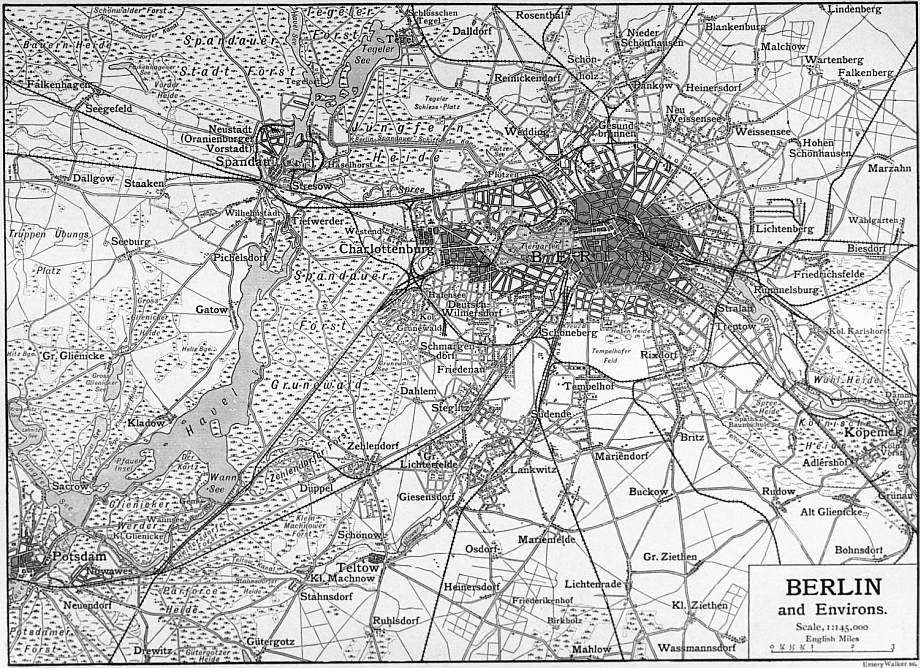
(Click to enlarge.)
Population.—The stupendous growth of the population of Berlin during the last century is best illustrated by the following figures. In 1816 it contained 197,717 inhabitants; in 1849, 431,566; in 1871, 826,341; in 1880, 1,122,330; 1890, 1,578,794, and in 1905, 2,033,900. The birth-rate is about 30, and the death-rate 20 per 1000 inhabitants a year. Illegitimate births amount to about 15% of the whole. According to religion, about 84% are Protestants, 10% Roman Catholics and 5% Jews, but owing to the great number of Jews who for social and other reasons ostensibly embrace the Christian faith, these last figures do not actually represent the number of Jews by descent living in the city.
Environs.—Marvellous as has been the transformation in the city itself, no less surprising results have been effected since 1875 in the surroundings of Berlin. On the east, north and west, the city is surrounded at a distance of some 5 m. from its centre by a thick belt of pine woods, the Jungfernheide, the Spandauer Forst, and the Grunewald, the last named stretching away in a south-westerly direction as far as Potsdam, and fringing the beautiful chain of Havel lakes. These forests enjoyed until quite recent times an unenviable notoriety as the camping-ground and lurking-place of footpads and other disorderly characters. After the opening of the circular railway in 1871, private enterprise set to work to develop these districts, and a “villa colony” was built at the edge of the Grunewald between the station West-end and the Spandauer Bock. From these beginnings, owing mainly to the expansion of the important suburb of Charlottenburg, has resulted a complete transformation of the eastern part of the Grunewald into a picturesque and delightful villa suburb, which is connected by railway, steam-tramway and a magnificent boulevard—the Kurfürstendamm—with the city. Nowadays the little fishing villages on the shores of the lakes, notably the Wannsee, cater for the recreation of the Berliners, while palatial summer residences of wealthy merchants occupy the most prominent sites. Suburban Berlin may be said to extend practically to Potsdam.
Traffic.—The public streets have a total length of about 350 m., and a large staff of workmen is regularly employed in maintaining and cleaning the public roads and parks. The force is well controlled, and the work of cleaning and removing snow after a heavy fall is thoroughly and efficiently carried out. The less important thoroughfares are mostly paved with the so-called Vienna paving, granite bricks of medium size, while the principal streets, and especially those upon which the traffic is heavy, have either asphalt or wood paving.
Water-Supply and Drainage.—The water-supply is mainly derived from works on the Müggel and Tegeler lakes, the river water being carefully filtered through sand. The drainage system is elaborate, and has stood the test of time. The city is divided into twelve radial systems, each with a pumping station, and the drainage is forced through five mains to eighteen sewage farms, each of which is under careful sanitary supervision, in respect both of the persons employed thereon, and the products, mainly milk, passing thence to the city for human consumption. Only in a few isolated cases has any contamination been traced to fever or other zymotic germs. In this connexion it is worth noting that the infectious diseases hospital has a separate system of drainage which is carefully disinfected, and not allowed to be employed for the purposes of manure.
Hospitals.—In no other city of the world is the hospital organization so well appointed as in Berlin, or are the sick poor tended with greater solicitude. State, municipal and private charity here again join hands in the prompt relief of sickness and cases of urgency. The municipal hospitals are six in number, the largest of which is the Virchow hospital, situate in Moabit and opened in 1906. It is arranged on the pavilion system, contains 2000 beds, and is one of the most splendidly equipped hospitals in the world. The cost amounted to £900,000. Next comes that of Friedrichshain, also built on the pavilion system, while the state controls six (not including the prison infirmaries) of which the world-renowned Charité in the Luisen-strasse is the principal. The hospitals of the nursing sisters (Diakonissen Anstalten) number 8, while there are 60 registered private hospitals under the superintendence of responsible doctors and under the inspection of government.
Charities.—Berlin is also very richly endowed with charitable institutions for the relief of pauperism and distress. In addition to the municipal support of the poor-houses there are large funds derived from bequests for the relief of the necessitous and deserving poor; while night shelters and people’s kitchens have been organized on an extensive scale for the temporary relief of the indigent unemployed. For the former several of the arches of the city railway have been utilized, and correspond in internal arrangement to like shelters instituted by the Salvation Army in London and various other cities.
Markets.—Open market-places in Berlin are things of the past, and their place has been taken by airy and commodious market halls. Of these, 14 in number, the central market, close to the Alexander-platz station of the city railway with which it is connected by an admirable service of lifts for the rapid unloading of goods, is the finest. It has a ground area of about 17,000 sq. yds., and is fitted with more than 2000 stalls. The other markets are conveniently situated at various accessible places within the city, and the careful police supervision to which they are subjected, both in the matter of general cleanliness, and in the careful examination of all articles of food exposed for sale, has tended to the general health and comfort of the population.
The central cattle market and slaughter-houses for the inspection and supply of the fresh meat consumed in the metropolis occupy an extensive area in the north-east of the city on the Ringbahn, upon which a station has been erected for the accommodation of meat trains and passengers attending the market. The inspection is rigorously carried out, and only carcases which have been stamped as having been certified good are permitted to be taken away for human consumption.
History.—The etymology of the word “Berlin” is doubtful. Some derive it from Celtic roots—ber, small, short, and lyn, a lake; others regard it as a Wend word, meaning a free, open place; others, again, refer it to the word werl, a river island. Another authority derives it from the German word Brühl, a marshy district, and the Slavonic termination in; thus Brühl, by the regular transmutation Bührl (compare Ger. bren-nen and Eng. burn), Bürhlin. More recent research, however, seems to have established the derivation from Wehr, dam.
Similar obscurity rests on the origin of the city. The hypotheses which carried it back to the early years of the Christian era have been wholly abandoned. Even the margrave Albert the Bear (d. 1170) is no longer unquestionably regarded as its founder, and the tendency of opinion now is to date its origin from the time of his great-grandsons, Otto III. and John I. When first alluded to, what is now Berlin was spoken of as two towns, Kölln and Berlin. The first authentic document concerning the former is from the year 1237, concerning the latter from the year 1244, and it is with these dates that the trustworthy history of the city begins. In 1307 the first attempt was made to combine the councils of Kölln and Berlin, but the experiment was abandoned four years later, and the two towns continued their separate existence till 1432, when the establishment of a common council for both led to disturbances of which the outcome was that Frederick II. the Iron in 1442 abolished this arrangement, seriously curtailed the privileges of both towns, and began the building of a castle at Kölln. A feud between the elector and the Berliners ended in the defeat of the latter, who in 1448 were forced to accept the constitution of 1442. From this time Berlin became and continued to be the residence of the Hohenzollerns, the elector John Cicero (1486-1499) being the first to establish a permanent court inside the walls. It was not, however, until the time of King Frederick William I. that the sovereigns ceased to date their official acts from Kölln. In 1539, under the elector Joachim II., Berlin embraced the Lutheran religion. Henceforth the history of Berlin was intimately bound up with the house of Hohenzollern. The conversion of the elector John Sigismund in 1613 to the Reformed (Calvinist) faith was hotly resented by the Berliners and led to bloody riots in the city. The Thirty Years’ War all but ruined the city, the population of which sank from some 14,000 in 1600 to less than 8000 in 1650. It was restored and the foundations of its modern splendour were laid by the Great Elector, by the time of whose death (1688) the population had risen to some 20,000. During this period several suburbs had begun to grow up, Friedrichswerder in 1667 and the Dorotheenstadt, so named in 1676 after the electress Dorothea its founder. In 1688 Frederick III. (afterwards King Frederick I.) began the Friedrichstadt, completed by Frederick William I. Under Frederick I., who did much to embellish the city as the royal Residenzsiadt, the separate administrations of the quarters of Berlin, Kölln, Friedrichstadt, Friedrichswerder and Dorotheenstadt were combined, and the separate names were absorbed in that of Berlin. The fortifications begun in 1658 were finally demolished under Frederick the Great in 1745, and the Neue Friedrich-strasse, the Alexander-strasse and the Wall-strasse were laid out on their site.