VOLUME III SLICE VI Bent, James to Bibirine (continued 3)
Reading edition
BERENGARIUS [Berengar] (d. 1088), medieval theologian, was born at Tours early in the 11th century; he was educated in the famous school of Fulbert of Chartres, but even in early life seems to have exhibited great independence of judgment. Appointed superintendent of the cathedral school of his native city, he taught with such success as to attract pupils from all parts of France, and powerfully contributed to diffuse an interest in the study of logic and metaphysics, and to introduce that dialectic development of theology which is designated the scholastic. The earliest of his writings of which we have any record is an Exhortatory Discourse to the hermits of his district, written at their own request and for their spiritual edification. It shows a clear discernment of the dangers of the ascetic life, and a deep insight into the significance of the Augustinian doctrine of grace. Sometime before 1040 Berengar was made archdeacon of Angers. It was shortly after this that rumours began to spread of his holding heretical views regarding the sacrament of the eucharist. He had submitted the doctrine of transubstantiation (already generally received both by priests and people, although in the west it had been first unequivocally taught and reduced to a regular theory by Paschasius Radbert in 831) to an independent examination, and had come to the conclusion that it was contrary to reason, unwarranted by Scripture, and inconsistent with the teaching of men like Ambrose, Jerome and Augustine. He did not conceal this conviction from his scholars and friends, and through them the report spread widely that he denied the common doctrine respecting the eucharist. His early friend and school companion, Adelmann, archdeacon of Liége, wrote to him letters of expostulation on the subject of this report in 1046 and 1048; and a bishop, Hugo of Langres, wrote (about 1049) a refutation of the views which he had himself heard Berengar express in conversation. Berengar’s belief was not shaken by their arguments and exhortations, and hearing that Lanfranc, the most celebrated theologian of that age, strongly approved the doctrine of Paschasius and condemned that of “Scotus” (really Ratramnus), he wrote to him a letter expressing his surprise and urging him to reconsider the question. The letter, arriving at Bec when Lanfranc was absent at Rome (1050), was sent after him, but was opened before it reached him, and Lanfranc, fearing the scandal, brought it under the notice of Pope Leo IX. Because of it Berengar was condemned as a heretic without being heard, by a synod at Rome and another at Vercelli, both held in 1050. His enemies in France cast him into prison; but the bishop of Angers and other powerful friends, of whom he had a considerable number, had sufficient influence to procure his release. At the council of Tours (1054) he found a protector in the papal legate, the famous Hildebrand, who, satisfied himself with the fact that Berengar did not deny the real presence of Christ in the sacramental elements, succeeded in persuading the assembly to be content with a general confession from him that the bread and wine, after consecration, were the body and blood of the Lord, without requiring him to define how. Trusting in Hildebrand’s support, and in the justice of his own cause, he presented himself at the synod of Rome in 1059, but found himself surrounded by zealots, who forced him by the fear of death to signify his acceptance of the doctrine “that the bread and wine, after consecration, are not merely a sacrament, but the true body and the true blood of Christ, and that this body is touched and broken by the hands of the priests, and ground by the teeth of the faithful, not merely in a sacramental but in a real manner.” He had no sooner done so than he bitterly repented his weakness; and acting, as he himself says, on the principle that “to take an oath which never ought to have been taken is to estrange one’s self from God, but to retract what one has wrongfully sworn to, is to return back to God,” when he got safe again into France he attacked the transubstantiation theory more vehemently than ever. He continued for about sixteen years to disseminate his views by writing and teaching, without being directly interfered with by either his civil or ecclesiastical superiors, greatly to the scandal of the multitude and of the zealots, in whose eyes Berengar was “ille apostolus Satanae,” and the academy of Tours the “Babylon nostri temporis.” An attempt was made at the council of Poitiers in 1076 to allay the agitation caused by the controversy, but it failed, and Berengar narrowly escaped death in a tumult. Hildebrand, now pope as Gregory VII., next summoned him to Rome, and, in a synod held there in 1078, tried once more to obtain a declaration of his orthodoxy by means of a confession of faith drawn up in general terms; but even this strong-minded and strong-willed pontiff was at length forced to yield to the demands of the multitude and its leaders; and in another synod at Rome (1079), finding that he was only endangering his own position and reputation, he turned unexpectedly upon Berengar and commanded him to confess that he had erred in not teaching a change as to substantial reality of the sacramental bread and wine into the body and blood of Christ. “Then,” says Berengar, “confounded by the sudden madness of the pope, and because God in punishment for my sins did not give me a steadfast heart, I threw myself on the ground, and confessed with impious voice that I had erred, fearing the pope would instantly pronounce against me the sentence of condemnation, and, as a necessary consequence, that the populace would hurry me to the worst of deaths.” He was kindly dismissed by the pope not long after, with a letter recommending him to the protection of the bishops of Tours and Angers, and another pronouncing anathema on all who should do him any injury or call him a heretic. He returned home overwhelmed with shame and bowed down with sorrow for having a second time been guilty of a great impiety. He immediately recalled his forced confession, and besought all Christian men “to pray for him, so that his tears might secure the pity of the Almighty.” He now saw, however, that the spirit of the age was against him, and hopelessly given over to the belief of what he had combated as a delusion. He withdrew, therefore, into solitude, and passed the rest of his life in retirement and prayer on the island of St Côme near Tours. He died there in 1088.
Berengar left behind him a considerable number of followers. All those who in the middle ages denied the substantial presence of the body and blood of Christ in the eucharist were commonly designated Berengarians. They differed, of course, in many respects, even in regard to the nature of the supper. Berengar’s own views on the subject may be thus summed up:—1. That bread and wine should become flesh and blood and yet not lose the properties of bread and wine was, he held, contradictory to reason, and therefore irreconcilable with the truthfulness of God. 2. He admitted a change (conversio) of the bread and wine into the body of Christ, in the sense that to those who receive them they are transformed by grace into higher powers and influences—into the true, the intellectual or spiritual body of Christ. The unbelieving receive the external sign or sacramentum; but the believing receive in addition, although invisibly, the reality represented by the sign, the res sacramenti. 3. He rejected the notion that the sacrament of the altar was a constantly renewed sacrifice, and held it to be merely a commemoration of the one sacrifice of Christ. 4. He dwelt strongly on the importance of men looking away from the externals of the sacrament to the spirit of love and piety. The transubstantiation doctrine seemed to him full of evil, from its tendency to lead men to overvalue what was sensuous and transitory. 5. He rejected with indignation the miraculous stories told to confirm the doctrine of transubstantiation. 6. Reason and Scripture seemed to him the only grounds on which a true doctrine of the Lord’s supper could be rested. He attached little importance to mere ecclesiastical tradition or authority, and none to the voice of majorities, even when sanctioned by the decree of a pope. In this, as in other respects, he was a precursor of Protestantism.
The opinions of Berengar are to be ascertained from the works written in refutation of them by Adelmann, Lanfranc, Guitmund, &c.; from the fragments of the De sacr. coena adv. Lanfr. liber, edited by Stäudlin (1820-1829); and from the Liber posterior, edited by A.F. and F.T. Vischer (1834). See the collection of texts by Sudendorf (1850); the Church Histories of Gieseler, ii. 396-411 (Eng. trans.), and Neander, vi. 221-260 (Eng. trans.); A. Harnack’s History of Dogma, Hauréau’s Histoire de la philosophie scolastique, i. 225-238; Hermann Reuter, Geschichte der religiosen Aufklarung des Mittelalters, vol. i. (Berlin, 1875); L. Schwabe, Studien zur Geschichte des Zweilen Abendmahlstreits (1887); and W. Broecking, “Bruno von Angers und Berengar von Tours,” in Deutsche Zeitichrift für Geschichtewissenschaft (vol. xii., 1895).
BÉRENGER, ALPHONSE MARIE MARCELLIN THOMAS (1785-1866), known as Bérenger de la Drôme, French lawyer and politician, son of a deputy of the third estate of Dauphiné to the Constituent Assembly, was born at Valence on the 31st of May 1785. He entered the magistracy and became procureur général at Grenoble, but resigned this office on the restoration of the Bourbons. He now devoted himself mainly to the study of criminal law, and in 1818 published La Justice criminelle en France, in which with great courage he attacked the special tribunals, provosts’ courts or military commissions which were the main instruments of the Reaction, and advocated a return to the old common law and trial by jury. The book had a considerable effect in discrediting the reactionary policy of the government; but it was not until 1828, when Bérenger was elected to the chamber, that he had an opportunity of exercising a personal influence on affairs as a member of the group known as that of constitutional opposition. His courage, as well as his moderation, was again displayed during the revolution of 1830, when, as president of the parliamentary commission for the trial of the ministers of Charles X., he braved the fury of the mob and secured a sentence of imprisonment in place of the death penalty for which they clamoured.
His position in the chamber was now one of much influence, and he had a large share in the modelling of the new constitution, though his effort to secure a hereditary peerage failed. Above all he was instrumental in framing the new criminal code, based on more humanitarian principles, which was issued in 1835. It was due to him that, in 1832, the right, so important in actual French practice, was given to juries to find “extenuating circumstances” in cases when guilt involved the death penalty. In 1831 he had been made a member of the court of appeal (cour de cassation), and the same year was nominated a member of the academy of moral and political sciences. He was raised to the peerage in 1839. This dignity he lost owing to the revolution of 1848; and as a politician his career now ended. As a judge, however, his activity continued. He was president of the high courts of Bourges and Versailles in 1840. Having been appointed president of one of the chambers of the court of cassation, he devoted himself entirely to judicial work until his retirement, under the age limit, on the 31st of May 1860. He now withdrew to his native town, and occupied himself with his favourite work of reform of criminal law. In 1833 he had shared in the foundation of a society for the reclamation of young criminals, in which he continued to be actively interested to the end. In 1851 and 1852, on the commission of the academy of moral sciences, he had travelled in France and England for the purpose of examining and comparing the penal systems in the two countries. The result was published in 1855 under the title La Répression pénale, comparaison du système pénitentiaire en France et en Angleterre. He died on the 15th of May 1866.
His son, René Bérenger (1830- ), continued the work of his father, and at the outbreak of the revolution of 1870 was avocat général of Lyons. He served as a volunteer in the Franco-German War, being wounded at Nuits on the 28th of December. Returned to the National Assembly by the department of Drõme, he was for a few days in 1873 minister of public works under Thiers. He then entered the senate, of which he was vice-president from 1894 to 1897. He founded in 1871 a society for the reclamation of discharged prisoners, and presided over various bodies formed to secure improvement of the public morals. He succeeded Charles Lucas in 1890 at the Academy of Moral and Political Science.
BERENICE, or Bernice, the Macedonian forms of the Greek Pherenice, the name of (A) five Egyptian and (B) two Jewish princesses.
(A) 1. Berenice, daughter of Lagus, wife of an obscure Macedonian soldier and subsequently of Ptolemy Soter, with whose bride Eurydice she came to Egypt as a lady-in-waiting. Her son, Ptolemy Philadelphus, was recognized as heir over the heads of Eurydice’s children. So great was her ability and her influence that Pyrrhus of Epirus gave the name Berenicis to a new city. Her son Philadelphus decreed divine honours to her on her death. (See Theocritus, Idylls xv. and xvii.)
2. Berenice, daughter of Ptolemy Philadelphus, wife of Antiochus Theos of Syria, who, according to agreement with Ptolemy (249), had divorced his wife Laodice and transferred the succession to Berenice’s children. On Ptolemy’s death, Antiochus repudiated Berenice and took back Laodice, who, however, at once poisoned him and murdered Berenice and her son. The prophecy in Daniel xi. 6 seq. refers to these events.
3. Berenice, the daughter of Magas, king of Cyrene, and the wife of Ptolemy III. Euergetes. During her husband’s absence on an expedition to Syria, she dedicated her hair to Venus for his safe return, and placed it in the temple of the goddess at Zephyrium. The hair having by some unknown means disappeared, Conon of Samos, the mathematician and astronomer, explained the phenomenon in courtly phrase, by saying that it had been carried to the heavens and placed among the stars. The name Coma Berenices, applied to a constellation, commemorates this incident. Callimachus celebrated the transformation in a poem, of which only a few lines remain, but there is a fine translation of it by Catullus. Soon after her husband’s death (221 B.C.) she was murdered at the instigation of her son Ptolemy IV., with whom she was probably associated in the government.
4. Berenice, also called Cleopatra, daughter of Ptolemy X., married as her second husband Alexander II., grandson of Ptolemy VII. He murdered her three weeks afterwards.
5. Berenice, daughter of Ptolemy Auletes, eldest sister of the great Cleopatra. The Alexandrines placed her on the throne in succession to her father (58 B.C.). She married Seleucus Cybiosactes, but soon caused him to be slain, and married Archelaus, who had been made king of Comana in Pontus (or in Cappadocia) by Pompey. Auletes was restored and put both Berenice and Archelaus to death in 55 B.C.
(B) 1. Berenice, daughter of Salome, sister of Herod I., and wife of her cousin Aristobulus, who was assassinated in 6 B.C. Their relations had been unhappy and she was accused of complicity in his murder. By Aristobulus she was the mother of Herod Agrippa I. Her second husband, Theudion, uncle on the mother’s side of Antipater, son of Herod I., having been put to death for conspiring against Herod, she married Archelaus. Subsequently she went to Rome and enjoyed the favour of the imperial household.
2. Berenice, daughter of Agrippa I., king of Judaea, and born probably about A.D. 28. She was first married to Marcus, son of the alabarch1 Alexander of Alexandria. On his early death she was married to her father’s brother, Herod of Chalcis, after whose death (A.D. 48) she lived for some years with her brother, Agrippa II. Her third husband was Polemon, king of Cilicia, but she soon deserted him, and returned to Agrippa, with whom she was living in 60 when Paul appeared before him at Caesarea (Acts xxvi.). During the devastation of Judaea by the Romans, she fascinated Titus, whom along with Agrippa she followed to Rome as his promised wife (A.D. 75). When he became emperor (A.D. 79) he dismissed her finally, though reluctantly, to her own country. Her influence had been exercised vainly on behalf of the Jews in A.D. 66, but the burning of her palace alienated her sympathies. For her influence see Juvenal, Satires, vi., and Tacitus, Hist. ii. 2.
1 Alabarch or Arabarch (Gr. ἀλαβάρχης, or ἀραβάρχης), the name of the head magistrate of the Jews in Alexandria under the Ptolemaic and Roman rules.
BERENICE, an ancient seaport of Egypt, on the west coast of the Red Sea, in 23° 56′ N., 35° 34′ E. Built at the head of a gulf, the Sinus Immundus, or Foul Bay, of Strabo, it was sheltered on the north by Ras Benas (Lepte Extrema). The port is now nearly filled up, has a sand-bar at its entrance and can be reached only by small craft. Most important of the ruins is a temple; the remnants of its sculptures and inscriptions preserve the name of Tiberius and the figures of many deities, including a goddess of the emerald mines. Berenice was founded by Ptolemy II. (285-247 B.C.) in order to shorten the dangerous Red Sea voyages, and was named in honour of his mother. For four or five centuries it became the entrepot of trade between India, Arabia and Upper Egypt. From it a road, provided with watering stations, leads north-west across the desert to the Nile at Coptos. In the neighbourhood of Berenice are the emerald mines of Zabara and Saket.
BERESFORD, LORD CHARLES WILLIAM DE LA POER (1846- ), British admiral, second son of the 4th marquess of Waterford, was born in Ireland, and entered the “Britannia” as a naval cadet in 1859. He became lieutenant in 1868, and commander in 1875. In 1874 he was returned to parliament as Conservative M.P. for Waterford, retaining his seat till 1880, and he was already known in this period as a gallant officer, with a special interest in naval administration. In 1875-1876 he accompanied the then prince of Wales on his visit to India as naval A.D.C.; from 1878 to 1881 he was commander of the royal yacht “Osborne.” He was in command of the gunboat “Condor” in the Mediterranean when the Egyptian crisis of 1882 occurred; and he became a popular hero in England in connexion with the bombardment of Alexandria (July 11), when he took his ship close in to the forts and engaged them with such conspicuous gallantry that the admiral ordered a special signal “Well done, Condor!” He was promoted captain for his services, and, after taking an active part in the re-establishment of order in Alexandria, he served again in Egypt on Lord Wolseley’s staff in the expedition of 1884-85, commanding the naval brigade at Abu Klea, Abu Kru and Metemmeh, and, with the river steamer “Safieh,” rescuing Sir C. Wilson and his party, who had been wrecked on returning from Khartum (Feb. 4, 1885). In November 1885 he was again returned to parliament as member for East Marylebone (re-elected 1886), and in Lord Salisbury’s ministry of 1886 he was appointed a lord of the admiralty. The press agitation in favour of a stronger navy was now in full swing, and it was well known that in Lord Charles Beresford it had an active supporter; but very little impression was made on the government, and in 1888 he resigned his office on this question, a dramatic step which had considerable effect. In the House of Commons he advocated an expenditure of twenty millions sterling on the fleet, and the passing of the Naval Defence Act in 1889 was largely due to his action. At the end of 1889 he became captain of the cruiser “Undaunted” in the Mediterranean, and when this ship was paid off in 1893 he was appointed in command of the steam reserve at Chatham, a post he held for three years. In 1897 he became rear-admiral, and again entered parliament, winning a by-election at York; he retained his seat till 1900, but was mainly occupied during these years by a mission to China on behalf of the Associated Chambers of Commerce; he published his book The Break-up of China in 1899. In 1902 he was returned to parliament for Woolwich, but resigned on his appointment to command the Channel squadron (1903-1905); in 1905 he was given the command of the Mediterranean fleet, and from 1906 to 1909 was commander-in-chief of the Channel fleet; in 1906 he became a full admiral. At sea he had always shown himself a remarkable disciplinarian, possessed of great influence over his men, and his reputation as one who would, if necessary, prove a great fighting commander was second to none; and, even when serving afloat and therefore unable to speak direct to the public, he was in the forefront of the campaign for increased naval efficiency. During the administration (1903-1910) of Sir John Fisher (see Fisher, Baron) as first sea lord of the admiralty it was notorious that considerable friction existed between them, and both in the navy and in public a great deal of party-spirit was engendered in the discussion of their opposing views. When Lord Charles Beresford’s term expired as commander-in-chief in March 1909 he was finally “unmuzzled,” and the attack which for some years his supporters had made against Sir J. Fisher’s administration came to a head at a moment coinciding with the new shipbuilding crisis occasioned by the revelations as to the increase of the German fleet. He himself came forward with proposals for a large increase in the navy and a reorganization of the administrative system, his first step being a demand for an inquiry, to which the government promptly assented (May) in the shape of a small Committee under the prime minister. Its report (August), however, gave him no satisfaction, and he proceeded with his public campaign, bitterly attacking the ministerial policy. In January 1910, at the general election, he was returned as Conservative M.P. for Portsmouth; but meanwhile Sir John Fisher’s term of office came to an end, and in his successor, Admiral Sir Arthur Knyvet Wilson (b. 1842), the navy obtained a first sea lord who commanded universal confidence.
BERESFORD, JOHN (1738-1805), Irish statesman, was a younger son of Sir Marcus Beresford, who, having married Catherine, sole heiress of James Power, 3rd earl of Tyrone, was created earl of Tyrone in 1746. After the death of the earl in 1763, Beresford’s mother successfully asserted her claim suo jure to the barony of La Poer. John Beresford, born on the 14th of March 1738, thus inherited powerful family connexions. He was educated at Trinity College, Dublin, was called to the Irish bar, and entered the Irish parliament as member for Waterford in 1760. His industry, added to the influence of his family, procured his admission to the privy council in 1768, and his appointment as one of the commissioners of revenue two years later. In 1780 he became first commissioner of revenue, a position which gave him powerful influence in the Irish administration. He introduced some useful reforms in the machinery of taxation; and he was the author of many improvements in the architecture of the public buildings and streets of Dublin. He was first brought into conflict with Grattan and the popular party, in 1784, by his support of the proposal that the Irish parliament in return for the removal of restrictions on Irish trade should be bound to adopt the English navigation laws. In 1786 he was sworn a member of the English privy council, and the power which he wielded in Ireland through his numerous dependants and connexions grew to be so extensive that a few years later he was spoken of as the “king of Ireland.” He was a vehement opponent of the increasing demand for relief of the Roman Catholics; and when it became known that Lord Fitzwilliam was to succeed Lord Westmorland as lord lieutenant in 1795 for the purpose of carrying out a conciliatory policy, Beresford expressed strong hostility to the appointment. One of Fitzwilliam’s first acts was to dismiss Beresford from his employment but with permission to retain his entire official salary for life, and with the assurance that no other member of his family would be removed. Beresford immediately exerted all his influence with his friends in England, to whom he described himself as an injured and persecuted man; he appealed to Pitt, and went in person to London to lay his complaint before the English ministers. There is little doubt that the recall of Lord Fitzwilliam (q.v.), which was followed by such momentous consequences in the history of Ireland, was, as the viceroy himself believed, mainly due to Beresford’s dismissal. There had been a misunderstanding on the point between Pitt and Fitzwilliam. The latter, whose veracity was unimpeachable, asserted that previous to his coming to Ireland he had informed the prime minister of his intention to dismiss Beresford, and that Pitt had raised no objection. Pitt denied all recollection of any such communication, and on the contrary described the dismissal as “an open breach of the most solemn promise.”1 In a letter to Lord Carlisle, justifying his action, Fitzwilliam mentioned that malversation had been imputed to Beresford. Beresford sent a challenge to Fitzwilliam, but the combatants were interrupted on the field and Fitzwilliam then made an apology.
When Lord Camden replaced Fitzwilliam in the viceroyalty in March 1795, Beresford resumed his former position. On the eve of the rebellion in 1798 his letters to Lord Auckland gave an alarming description of the condition of Ireland, and he counselled strong measures of repression. When first consulted by Pitt on the question of the union Beresford appears to have disliked the idea; but he soon became reconciled to the policy and warmly supported it. After the union Beresford continued to represent Waterford in the imperial parliament, and he remained in office till 1802, taking an active part in settling the financial relations between Ireland and Great Britain. He died near Londonderry on the 5th of November 1805. John Beresford was twice married: in 1760 to a foreign lady, Constantia Ligondes, who died in 1772; and, secondly, in 1774 to Barbara Montgomery, a celebrated beauty who figures in Sir Joshua Reynolds’s picture of “The Graces.” He had large families by both marriages. His son, John Claudius, kept a riding school in Dublin, which acquired an evil reputation as the chief scene of the floggings by which evidence was extorted of the conspiracy which came to a head in 1798. He took a prominent part in the Irish House of Commons, where he unsuccessfully moved the reduction of the proposed Irish contribution to the imperial exchequer in the debates on the Act of Union, of which, unlike his father, he was to the last an ardent opponent.
See Correspondence of the Right Hon. John Beresford, edited by W. Beresford (2 vols., London, 1854); Edward Wakefield, An Account of Ireland (2 vols., London, 1812); Earl Stanhope, Life of William Pitt (4 vols., London, 1861); W.E.H. Lecky, History of Ireland in the Eighteenth Century, vols. iii., iv., v. (5 vols., London, 1892).
(R. J. M.)
1 Stanhope, Life of Pitt, ii, 301.
BERESFORD, WILLIAM CARR BERESFORD, Viscount (1768-1854), British general and Portuguese marshal, illegitimate son of the first marquess of Waterford, was born on the 2nd of October 1768. He entered the British army in 1785, and while in Nova Scotia with his regiment in the following year lost the sight of one eye by a shooting accident. He first distinguished himself at Toulon in 1793, receiving two years later the command of the 88th regiment (Connaught Rangers). In 1799 his regiment was ordered to India, and a few months later Beresford left with Sir David Baird’s expedition for Egypt, and was placed in command of the first brigade which led the march from Kosseir across the desert. When, on the evacuation of Egypt in 1803, he returned home, his reputation was established. In 1805 he accompanied Sir David Baird to South Africa, and was present at the capture of Cape Town and the surrender of the colony. From South Africa he was despatched to South America. He had little difficulty in capturing Buenos Aires with only a couple of regiments. But this force was wholly insufficient to hold the colony. Under the leadership of a French émigré, the chevalier de Timers, the colonists attacked Beresford, and at the end of three days’ hard fighting he was compelled to capitulate. After six months’ imprisonment he escaped, and reached England in 1807, and at the end of that year he was sent to Madeira, occupying the island in the name of the king of Portugal. After six months in Madeira as governor and commander-in-chief, during which he learnt Portuguese and obtained an insight into the Portuguese character, he was ordered to join Sir Arthur Wellesley’s army in Portugal. He was first employed as commandant in Lisbon, but accompanied Sir John Moore on the advance into Spain, and took a conspicuous part in the battle of Corunna (see Peninsular War). In February 1809 Beresford was given the task of reorganizing the Portuguese army. In this task, by systematic weeding-out of inefficient officers and men, he succeeded beyond expectation. By the summer of 1810 he had so far improved the moral and discipline of the force that Wellington brigaded some of the Portuguese regiments with English ones, and at Busaco Portuguese and English fought side by side. Beresford’s services in this battle were rewarded by the British government with a knighthood of the Bath and by the Portuguese with a peerage.
In the spring of 1811 Wellington was compelled to detach Beresford from the Portuguese service. The latter was next in seniority to General (Lord) Hill who had gone home on sick leave, and on him, therefore, the command of Hill’s corps now devolved. Unfortunately Beresford never really gained the confidence of his new troops. At Campo Mayor his light cavalry brigade got out of hand, and a regiment of dragoons was practically annihilated. He invested Badajoz with insufficient forces, and on the advance of Soult he was compelled to raise the siege and offer battle at Albuera. His personal courage was even more than usually conspicuous, but to the initiative of a junior staff officer, Colonel (afterwards Viscount) Hardinge, rather than to Beresford’s own generalship, was the hardly-won victory to be attributed. Beresford then went back to his work of reorganizing the Portuguese army. He was present at the siege of Badajoz and at the battle of Salamanca, where he was severely wounded (1812). In 1813 he was present at the battle of Vittoria, and at the battles of the Pyrenees, while at the battle of the Nivelle, the Nive and Orthez he commanded the British centre, and later he led a corps at the battle of Toulouse. At the close of the Peninsular War he was created Baron Beresford of Albuera and Cappoquin, with a pension of £2000 a year, to be continued to his two successors.
In 1819 the revolution in Portugal led to the dismissal of the British officers in the Portuguese service. Beresford therefore left Portugal and placed the question of the arrears of pay of his army before the king at Rio Janeiro. On his return the new Portuguese government refused to allow him to land, and he accordingly left for home. On arriving in England he turned his attention to politics, and strongly supported the duke of Wellington in the House of Lords. In 1823 his barony was made a viscounty, and when the duke of Wellington formed his first cabinet in 1828 he gave Beresford the office of master-general of the ordnance. In 1830 Beresford retired from politics, and for some time subsequently he was occupied in a heated controversy with William Napier, the historian of the Peninsular War, who had severely criticised his tactics at Albuera. On this subject Wellington’s opinion of Beresford is to the point. The duke had no illusions as to his being a great general, but he thought very highly of his powers of organization, and he went so far as to declare, during the Peninsular War, that, in the event of his own death, he would on this ground recommend Beresford to succeed him. The last years of Beresford’s life were spent at Bedgebury, Kent, where he had purchased a country estate. He died on the 8th of January 1854.
BEREZINA, a river of Russia, in the government of Minsk, forming a tributary of the Dnieper. It rises in the marshes of Borizov and flows south, inclining to east, for 350 m. (250 m. navigable), for the most part through low-lying but well-wooded country. As a navigable river, and forming a portion of the canal system which unites the Black Sea with the Baltic, it is of importance for commerce, but is subject to severe floods. It was just above Borizov that Napoleon’s army forced the passage of the Berezina, with enormous losses, on the 26th-28th of November 1812, during the retreat from Moscow.
BEREZOV. a town of Asiatic Russia, in the government of Tobolsk, 700 m. N. of the city of that name, situated on three hills on the left bank of the Sosva, 26 m. above its mouth in the Ob, in 63° 55′ N. lat. and 65° 7′ E. long. It has more than once suffered from conflagrations—for example, in 1710 and 1808. Prince Menshikov, the favourite of Peter the Great and Catherine I., died here an exile, in 1729. In 1730 his enemy and rival, Prince Dolgoruki, was interned here with his family; and in 1742 General Ostermann was sent to Berezov with his wife and died there in 1747. The yearly mean temperature is 25° Fahr., the maximum cold being 4.7°. It has a cathedral, near which lie buried Mary Menshikov, once betrothed to the tsar Peter II., and some of the Dolgorukis. There is some trade in furs, mammoth bones, dried and salted fish. Pop. (1897) 1073.
BEREZOVSK, a village of east Russia, in the government of Perm, on the eastern slope of the Urals, 8 m. N.E. of Ekaterinburg. It is the centre of an important gold-mining region (5 m. by 2½) of the same name. The mines have been known since 1747. The inhabitants also manufacture boots, cut stone and carry on cabinet-making.
BERG (Ducatus Montensis), a former duchy of Germany, on the right bank of the Rhine, bounded N. by the duchy of Cleves, E. by the countship of La Marck and the duchy of Westphalia, and S. and W. by the bishopric of Cologne. Its area was about 1120 sq. m. The district was raised in 1108 to the rank of a countship, but did not become a duchy till 1380, after it had passed into the possession of the Jülich family. In 1423 the duchy of Jülich fell to Adolf of Berg, and in 1437 the countship of Ravensberg was united to the duchies. The male line of the dukes of Jülich-Berg-Ravensberg became extinct in 1511, and the duchy passed by marriage to John III. (d. 1539), duke of Cleves and count of La Marck, whose male line became extinct with the death of John William, bishop of Münster, in 1609. Of the latter’s four sisters, the eldest (Marie Eleonore) was married to Albert Frederick, duke of Prussia, the second (Anna) to Philip Louis, count palatine of Neuburg, the third (Magdalena) to John, count palatine of Zweibrücken, and the fourth (Sybille) to Charles of Habsburg, margrave of Burgau. The question of the succession led to a prolonged contest, which was one of the causes of the Thirty Years’ War. It was settled in 1614 by a partition, under which Berg, with Jülich, was assigned to the count palatine of Neuburg, in whose line it remained till 1742, when it passed to the Sultzbach branch of the house of Wittelsbach. On the death of Charles Theodore, the last of this line, in 1799, Jülich and Berg fell to Maximilian Joseph of Zweibrücken (Maximilian I. of Bavaria), who ceded the duchies in 1806 to Napoleon. Berg was bestowed by Napoleon, along with the duchy of Cleves and other possessions, on Joachim Murat, who bore the title of grand-duke of Berg; and after Murat’s elevation to the throne of Naples, it was transferred to Louis, the son of the king of Holland. By the congress of Vienna in 1815 it was made over to Prussia.
See B. Schönneshöfer, Geschichte des Bergischen Landes (Elberfeld, 1895); Stokvis, Manuel d’histoire, &c. vol. iii. (Leiden, 1890-1893); and R. Göcke, Das Grossherzogtum Berg unter Joachim Murat, Napoleon Ier und Louis Napoleon, 1806-1813 (Cologne, 1877).
BERGAMASK, or Bergomask (from the town of Bergamo in North Italy), a clumsy rustic dance (cf. Shakespeare, Midsummer Night’s Dream, v. 360) copied from the natives of Bergamo, reputed to be very awkward in their manners.
BERGAMO (anc. Bergomum), a city and episcopal see of Lombardy, Italy, capital of the province of Bergamo, situated at the foot of the Alps, at the junction of the Brembo and Serio, 33½ m. N.E. of Milan by rail, and 26 m. direct. Pop. (1901) town, 25,425; commune, 46,861. The town consists of two distinct parts, the older Città Alta, upon a hill 1200 ft. above sea-level, strongly fortified by the Venetians, and the new town (Città Bassa) below, the two being connected by a funicular railway. The most interesting building of the former is the fine Romanesque church of S. Maria Maggiore, founded in 1137 and completed in 1355, with a baroque interior and some interesting works of art. Adjoining it to the north is the Cappella Colleoni, with a richly sculptured polychrome façade, and a modernized interior, containing the fine tombs of Bartolommeo Colleoni (c. 1400-1475), a native of Bergamo, and his daughter Medea. The work was executed in 1470-1476 by Giovanni Antonio Amadeo, who was also employed at the Certosa di Pavia. The market-place (now Piazza Garibaldi) contains the Gothic Palazzo Vecchio or Broletto; close by are the cathedral (1614) and a small baptistery of 1340, rebuilt in 1898. The lower town contains an important picture-gallery, consisting of three collections of works of north Italian masters, one of which was bequeathed in 1891 by the art critic Giovanni Morelli. Bergamo has fine modern buildings and numerous silk and cotton factories. It also has a considerable cattle market, though its yearly Fiera di S. Alessandro (the patron saint) has lost some of its importance. Railways radiate from it to Lecco, Ponte della Selva, Usmate (for Monza or Seregno), Treviglio (on the main line from Milan to Verona and Venice) and (via Rovato) to Brescia, and steam tramways to Treviglio, Sarnico and Soncino.
The ancient Bergomum was the centre of the tribe of the Orobii; it became, after their subjection to Rome, a Roman municipality with a considerable territory, and after its destruction by Attila, became the capital of a Lombard duchy. From 1264 to 1428 it was under Milan, but then became Venetian, and remained so until 1797. Remains of the Roman city are not visible above ground, but various discoveries made are recorded by G. Mantovani in Not. Scav., 1890, 25.
(T. As.)
BERGAMOT, OIL OF, an essential oil obtained from the rind of the fruit of the Citrus bergamia. The bergamot is a small tree with leaves and flowers like the bitter orange, and a round fruit nearly 3 in. in diameter, having a thin lemon-yellow smooth rind. The tree is cultivated in southern Calabria, whence the entire supply of bergamot oil is drawn. Machinery is mostly used to express the oil from the fruit, which is gathered in November and December. The oil, which on standing deposits a stearoptene, bergamot camphor or bergaptene, is a limpid greenish-yellow fluid of a specific gravity of 0.882 to 0.886, and its powerful but pleasant odour is mainly due to the presence of linalyl acetate, or bergamiol, which can be artificially prepared by heating linalol with acetic anhydride. The chief use of bergamot oil is in perfumery. The word apparently is derived from the Italian town Bergamo. The name Bergamot, for a variety of pear, is an entirely different word, supposed to be a corruption of the Turkish beg-armudi (= prince’s pear; cf. Ger. Fürstenbirn).
BERGEDORF, a town of Germany, in the territory of Hamburg, on the river Bille, 10 m. by rail E. by S. from the city. Pop. (1900) 23,728. It produces vegetables and fruit for the Hamburg markets, and carries on tanning, glass manufacture, brewing and brick-making. It received civic rights in 1275, belonged to Lübeck and Hamburg conjointly from 1420 to 1868, and in the latter year was purchased by Hamburg. The surrounding district, exceptionally fertile marshland, is known as Die Vierlande, being divided into four parishes, whence the name is derived.
BERGEN, a city and seaport of Norway, forming a separate county (amt), on the west coast, in lat. 60° 23′ N. (about that of the Shetland Islands). Pop. (1900) 72,179. It lies at the head of the broad Byfjord, and partly on a rocky promontory (Nordnaes) between the fine harbour (Vaagen) and the Puddefjord. Its situation is very beautiful, the moist climate (mean annual rainfall, 74 in.) fostering on the steep surrounding hills a vegetation unusually luxuriant for the latitude. Behind the town lie the greater and lesser Lungegaard Lakes, so that the site is in effect a peninsula. The harbour is crowded with picturesque timber-ships and fishing-smacks, and is bordered by quays. The principal street is Strandgaden, on the Nordnaes, parallel with the harbour, communicating inland with the torv or marketplace, which fronts the harbour and contains the fish and fruit market. The portion of the city on the mainland rises in an amphitheatre. The houses, of wood or stucco, are painted in warm reds and yellows. On the banks of the lesser Lungegaard Lake is the small town park, and above the greater lake the pleasant Nygaards park, with an aquarium adjoining. Among the principal buildings are the cathedral (rebuilt in the 16th century), and several other churches, among which the Mariae Kirke with its Romanesque nave is the earliest; a hospital, diocesan college, naval academy, school of design and a theatre. An observatory and biological station are maintained. The museums are of great interest. The Vestlandske fishery and industrial museum also contains a picture gallery, and exhibition of the Bergen Art Union (Kunstforening). The Bergen museum contains antiquities and a natural history collection. The Hanseatic museum is housed in a carefully-preserved gaard, or store-house and offices of the Hanseatic League of German merchants, who inhabited the German quarter (Tydskenbryggen) and were established here in great strength from 1445 to 1558 (when the Norwegians began to find their presence irksome), and brought much prosperity to the city in that period. The Bergenhus and Fredriksberg forts defend the north and south entries of the harbour respectively. The first was originally built in the 13th century by King Haakon Haakonsson, and subsequently enlarged; and still bears marks of an English attack when a Dutch fleet was driven to shelter here in 1665. Near it are remains of another old fort, the Sverresborg. Electric trams ply in the principal streets.
Bergen is the birthplace of the poets Ludvig Holberg (1684-1754) and Johan Welhaven (1807-1873), of Johan Dahl the painter (1788-1857), of Ole Bull (1810-1880) and Edvard Grieg the musicians. There are statues to Holberg and Bull, and also to Christie, president of the Storthing (parliament) in 1815 and 1818.
Bergen ranks first of the Norwegian ship-owning centres, having risen to this position from fifth in 1879. The trade, however, is exceeded by that of Christiania. The staple export trade is in fish and their products: other exports are butter, copper ore and hides. The principal imports are coal, machinery, salt, grain and provisions. The manufactures are not extensive, but the preparation of fish products, shipbuilding, weaving and distillery, with manufactures of paper, pottery, tobacco and ropes are carried on. Bergen is an important centre of the extensive tourist traffic of Norway. Regular steamers serve the port from Hull and Newcastle (about 40 hours), from Hamburg, and from all the Norwegian coast towns. Many local steamers penetrate the fjords, touching at every village and gaard. Bergen is the nearest port to the famous Hardanger Fjord, and is the starting-point of a remarkable railway which runs through many tunnels and fine scenery towards Vossevangen or Voss. In 1896 a beginning was made with the continuation of this line through the mountains to connect with Christiania. In the first 50 m. from Voss the line ascends 4080 ft., passing through a tunnel 5796 yds. long.
Bergen (formerly Björgvin) was founded by King Olaf Kyrre in 1070-1075, and rapidly grew to importance, the Byfjord becoming the scene of several important engagements in the civil wars of subsequent centuries. The famous Hansa merchants maintained a failing position here till 1764. The town suffered frequently from fire, as in 1702 and 1855, and the broad open spaces (Almenninge) which interrupt the streets are intended as a safeguard against the spread of flames.
See Y. Nielsen, Bergen fra die äldste tider indtil nutiden (Christiania, 1877); H. Jager, Bergen og Bergenserne (Bergen, 1889).
BERGEN-OP-ZOOM, a town in the province of North Brabant, Holland, situated on both sides of the small river Zoom, near its confluence with the East Scheldt, 38½ m. by rail E. by N. of Flushing. It is connected by steam tramway with Antwerp (20 m. S.) and with the islands of Tholen and Duiveland to the north-west. Pop. (1900) 13,663. The houses are well built, the market-places and squares handsome and spacious. It possesses a port and an arsenal, and contains a fine town hall, with portraits of the ancient margraves of Bergen-op-Zoom, a Latin school, and an academy of design and architecture. The remains of the old castle of the margraves have been converted into barracks. The tower is still standing and is remarkable for its increase in size as it rises, which causes it to rock in a strong wind. The church contains a monument to Lord Edward Bruce, killed in a duel with Sir Edward Sackville, afterwards earl of Dorset, in 1613. There are numerous tile-works and potteries of fine ware; and a considerable trade is carried on in anchovies and oysters caught in the Scheldt. A large sugar-beet industry has also sprung up here in modern times.
Bergen-op-Zoom is a very old town, but little is known of its early history beyond the fact that it was taken by the Normans in 880. In the 13th century it became the seat of Count Gerhard of Wesemael, who surrounded it with walls and built a castle. By the end of the 15th century it had become one of the most prosperous towns of Holland, on account of its fisheries and its cloth-trade. In 1576 the town joined the United Netherlands, and was shortly afterwards fortified. In 1588 it was successfully defended against the duke of Parma by an English and Dutch garrison commanded by Colonel Morgan, and in 1605 it was suddenly attacked by Du Terail. In 1622 the Spaniards, under Spinola, made another attempt to take the town, but were forced to abandon the enterprise after a siege of ten weeks and the loss of 1200 men. Towards the end of the 17th century the fortifications were greatly strengthened by Coehoorn, and in 1725 they were further extended. In 1747, however, the town was taken by the French, under Marshal Löwendahl, who surprised it by means of a subterranean passage. Restored at the end of the war, it was again taken by the French under Pichegru in 1795. The English, under Sir Thomas Graham, afterwards Lord Lynedoch, in March 1814 made an attempt to take it by a coup de main, but were driven back with great loss by the French, who surrendered the place, however, by the treaty of peace in the following May.
The lordship of Bergen-op-Zoom appears, after the definite union of the Low Countries with the Empire in 924, as an hereditary fief of the Empire, and the succession of its lords may be traced from Henry (1098-1125), who also held Breda. In 1533 it was raised to a margraviate by the emperor Charles V., and was held by various families until in 1799 it passed, through the Sultzbach branch of the Wittelsbachs, to the royal house of Bavaria, by whom it was renounced in favour of the Batavian republic in 1801.
BERGERAC, a town of south-western France, capital of an arrondissement in the department of Dordogne, on the right bank of the Dordogne, 60 m. E. of Bordeaux on the railway to Cahors. Pop. (1906) town, 10,545; commune, 15,623. The river is rendered navigable by a large dam and crossed by a fine bridge which leads to the suburb of La Madeleine. Apart from a few old houses in the older quarter by the river, the town contains no monuments of antiquarian interest. There is a handsome modern church built in the middle of the 19th century. Bergerac is the seat of a sub-prefect and has tribunals of first instance and of commerce and a communal college. Wine of fine quality is grown in the district and is the chief source of the commerce of the town, which is mainly carried on with Libourne and Bordeaux. There is trade in grain, truffles, chestnuts, brandy and in the salmon of the Dordogne. The town has flour-mills, iron-works, tanneries, distilleries and nursery-gardens, and it has manufactures of casks and of vinegar. There are quarries of millstone in the vicinity. In the 16th century Bergerac was a very flourishing and populous place, but most of its inhabitants having embraced Calvinism it suffered greatly during the religious wars and by the revocation of the edict of Nantes (1685). It was in 1577 the scene of the signing of the sixth peace between the Catholics and Protestants. Its fortifications and citadel were demolished by Louis XIII. in 1621.
BERGHAUS, HEINRICH (1797-1884), German geographer, was born at Kleve on the 3rd of May 1797. He was trained as a surveyor, and after volunteering for active service under General Tauenzien in 1813, joined the staff of the Prussian trigonometrical survey in 1816. He carried on a geographical school at Potsdam in company with Heinrich Lange, August Petermann, and others, and long held the professorship of applied mathematics at the Bauakademie. But he is most famous in connexion with his cartographical work. His greatest achievement was the Physikalischer Atlas (Gotha, 1838-1848), in which work, as in others, his nephew Hermann Berghaus (1828-1890) was associated with him. He had also a share in the re-issue of the great Stieler Handatlas (originally produced by Adolf Stieler in 1817-1823). and in the production of other atlases. His written works were numerous and important, including Allgemeine Länder- und Völkerkunde (Stuttgart, 1837-1840), Grundriss der Geographie in fünf Bückern (Berlin, 1842), Die Völker des Erdballs (Leipzig, 1845-1847), Was man van der Erde weiss (Berlin, 1856-1860), and various large works on Germany. In 1863 he published Briefwechsel mit Alexander van Humboldt (Leipzig). He died at Stettin on the 17th of February 1884.
BERGK, THEODOR (1812-1881), German philologist, was born at Leipzig on the 22nd of May 1812. After studying at the university of his native town, where he profited by the instruction of G. Hermann, he was appointed in 1835 to the lectureship in Latin at the orphan school at Halle. After holding posts at Neustrelitz, Berlin and Cassel, he succeeded (1842) K.F. Hermann as professor of classical literature at Marburg. In 1852 he went to Freiburg, and in 1857 returned to Halle. In 1868 he resigned his professorship, and settled down to study and literary work in Bonn. He died on the 20th of July 1881, at Ragatz in Switzerland, where he had gone for the benefit of his health. Bergk’s literary activity was very great, but his reputation mainly rests upon his work in connexion with Greek literature and the Greek lyric poets. His Poetae Lyrici Graeci (1843. 5th ed. 1900, &c.), and Griechische Litteraturgeschichte (1872-1887, completed by G. Hinrichs and R. Peppmüller) are standard works. He also edited Anacreon (1834), the fragments of Aristophanes (1840), Aristophanes (3rd ed., 1872), Sophocles (and ed., 1868), a lyric anthology (4th ed., 1890). Among his other works may be mentioned: Augusti Rerum a se gestarum Index (1873); Inschriften römischer Schleudergeschosse (1876); Zur Geschichte und Topographie der Rheinlande in römischer Zeit (1882); Beiträge zur römischen Chronologie (1884).
His Kleine philologische Schriften have been edited by Peppmüller (1884-1886), and contain, in addition to a complete list of his writings, a sketch of his life. See Sandys, Hist. of Class. Schol iii. 146 (1908).
BERGLER, STEPHAN, German classical scholar, was born about 1680 at Kronstadt in Transylvania. The date of his death is uncertain. After studying at Leipzig, he went to Amsterdam, where he edited Homer and the Onomasticon of Julius Pollux for Wetzstein the publisher. Subsequently, at Hamburg, he assisted the great bibliographer J.A. Fabricius in the production of his Bibliotheca Graeca and his edition of Sextus Empiricus. He finally found a permanent post in Bucharest as secretary to the prince of Walachia, Alexander Mavrocordato, whose work Περὶ τῶν καθηκόντων (De Officiis) he had previously translated for Fritzsch, the Leipzig bookseller, by whom he had been employed as proof-reader and literary hack. In the prince’s library Bergler discovered the introduction and the first three chapters of Eusebius’s Demonstratio Evangelica. He died in Bucharest, and was buried at his patron’s expense. According to another account, Bergler, finding himself without means, drifted to Constantinople, where he came to an untoward end (c. 1740). He is said to have become a convert to Islam; this report was probably a mistake for the undisputed fact that he embraced Roman Catholicism. Bergler led a wild and irregular life, and offended his friends and made many enemies by his dissipated habits and cynical disposition. In addition to writing numerous articles for the Leipzig Acta Eruditorum, Bergler edited the editio princeps of the Byzantine historiographer Genesius (1733), and the letters of Alciphron (1715), in which seventy-five hitherto unpublished letters were for the first time included.
BERGMAN, TORBERN OLOF (1735-1784), Swedish chemist and naturalist, was born at Katrineberg, Vestergötland, Sweden, on the 20th of March 1735. At the age of seventeen he entered the university of Upsala. His father wished him to read either law or divinity, while he himself was anxious to study mathematics and natural science; in the effort to please both himself and his father he overworked himself and injured his health. During a period of enforced abstinence from study, he amused himself with field botany and entomology, to such good purpose that he was able to send Linnaeus specimens of several new kinds of insects, and in 1756 he succeeded in proving that, contrary to the opinion of that naturalist, Coccus aquaticus was really the ovum of a kind of leech. In 1758, having returned to Upsala, he graduated there, and soon afterwards began to teach mathematics and physics at the university, publishing papers on the rainbow, the aurora, the pyroelectric phenomena of tourmaline, &c. In 1767 Johann Gottschalck Wallerius (1709-1785) having resigned the chair of chemistry and mineralogy, Bergman determined to become a candidate, though he had paid no particular attention to chemistry. As evidence of his attainments he produced a memoir on the manufacture of alum, but his pretensions were strongly opposed, and it was only through the influence of Gustavus III., then crown prince and chancellor of the university, that he gained the appointment, which he held till the end of his life. He died at Medevi on Lake Vetter on the 8th of July 1784. Bergman’s most important chemical paper is his Essay on Elective Attractions (1775), a study of chemical affinity. In methods of chemical analysis, both by the blowpipe and in the wet way, he effected many improvements, and he made considerable contributions to mineralogical and geological chemistry, and to crystallography. He also made observations of the transit of Venus in 1761, and published a Physical Description of the Earth in 1766.
His works were collected and printed in 6 vols. as Opuscula Physica et Chemica in 1779-1790, and were translated into French, German and English.
BERGSCHRUND (Ger. Berg, mountain; Schrund, cleft or crevice), a gaping crack in the upper part of a snowfield or glacier, near the rock wall, caused by the glacier moving bodily away from the mountain-side as the mass settles downwards. The crack is roughly parallel to the rock-face of the upper edge of the glacier basin, and extends downwards to the solid rock beneath the glacier where at the bottom of this huge crevasse there are blocks of ice, and large pieces of rock torn off by the lower portion of the glacier from the rock wall and floor.
BERGUES, a town of northern France, in the department of Nord, at the junction of the canal of the Colme with canals to Dunkirk and Furnes (in Belgium), 5 m. S.S.E. of Dunkirk by rail. Pop. (1906) 4499. The town has a belfry, the finest in French Flanders, dating from the middle of the 16th century and restored in the 19th century. The church of St Martin is a brick building of the 17th century in the Gothic style with a modern façade. The town hall, dating from the latter half of the 19th century, contains a municipal library and an interesting collection of pictures. The industries of the town include brewing and malting, and the manufacture of brushes and oil.
BERHAMPUR, a town of British India, the headquarters of Murshidabad district, in Bengal, situated on the left bank of the river Bhagirathi, 5 m. below Murshidabad city. Pop. (1901) 24,397. Berhampur was fixed upon after the battle of Plassey as the site of the chief military station for Bengal; and a huge square of brick barracks was erected in 1767, at a cost of £300,000. Here was committed the first overt act of the mutiny, on the 25th of February 1857. No troops are now stationed here, and the barracks have been utilized for a jail, a lunatic asylum and other civic buildings. A college, founded by government in 1853, was made over in 1888 to a local committee, being mainly supported by the munificence of the rani Svarnamayi. In the municipality of Berhampur is included the remnant of the once important, but now utterly decayed city of Cossimbazar (q.v.).
BERHAMPUR, a town of British India, in the presidency of Madras. Pop. (1901) 25,729. It is the headquarters of Ganjam district, and is situated about 9 m. from the sea. It is a station on the East Coast railway, which connects Calcutta with Madras. Berhampur had a military cantonment, sometimes distinguished as Baupur, containing a wing of a native regiment; but the troops have been transferred elsewhere. There is some weaving of silk cloth, and export trade in sugar. The college, originally founded by government, is now maintained by the raja of Kallikota. Silk-weaving and sugar-manufacture are carried on.
BERI-BERI, a tropical disease of the greatest antiquity, and known to the Chinese from an extremely remote period. It gradually dropped out of sight of European practice, until an epidemic in Brazil in 1863, and the opening up of Japan, where it prevailed extensively, and the investigations into the disease in Borneo, brought it again into notice. The researches of Scheube and Bälz in Japan, and of Pekelharing and Winkler in the Dutch Indies, led to its description as a form of peripheral neuritis (see also Neuropathology). The geographical distribution of beri-beri is between 45° N. and 35° S. It occurs in Japan, Korea and on the Chinese coast south of Shanghai; in Manila, Tongking, Cochin China, Burma, Singapore, Malacca, Java and the neighbouring islands; also in Ceylon, Mauritius, Madagascar and the east coast of Africa. In the Western hemisphere it is found in Cuba, Panama, Venezuela and South America. It has been carried in ships to Australia and to England. Sir P. Manson has “known it originate in the port of London in the crews of ships which had been in harbour for several months,” and he suggests that when peripheral neuritis occurs in epidemic form it is probably beri-beric.
The cause is believed by many authorities to be an infective agent of a parasitic nature, but attempts to identify it have not been entirely successful. It is “not obviously communicable from person to person” (Manson), but may be carried from place to place. It clings to particular localities, buildings and ships, in which it has a great tendency to occur; for instance, it is apt to break out again and again on certain vessels trading to the East. It haunts low-lying districts along the coast, and the banks of rivers. Moisture and high temperature are required to develop its activity, which is further favoured by bad ventilation, overcrowding and underfeeding. Another strongly supported hypothesis is that it is caused by unwholesome diet. The experience of the Japanese navy points strongly in this direction. Beri-beri was constantly prevalent among the sailors until 1884, when the dietary was changed. A striking and progressive diminution at once set in, and continued until the disease wholly disappeared. Major Ronald Ross suggested that beri-beri was really arsenical poisoning. A natural surmise is that it is due to some fungoid growth affecting grain, such as rice, maize or some other food stuff commonly used in the localities where beri-beri is prevalent, and among sailors. The conditions under which their food is kept on board certain ships might explain the tendency of the disease to haunt particular vessels. Dr Charles Hose is the principal advocate of this theory. Having had much experience of beri-beri in Sarawak, he associates it with the eating of mouldy rice, a germ in the fungus constituting the poison. But Dr Hose’s views as to rice have been strongly opposed by Dr Hamilton Wright and others.
The most susceptible age is from 15 to 40. Children under 15 and persons over 50 or 60 are rarely attacked. Men are more liable than women. Race has no influence. Previous attacks powerfully predispose.
The symptoms are mainly those of peripheral neuritis with special implication of the phrenic and the pneumogastric nerves. There is usually a premonitory stage, in which the patient is languid, easily tired, depressed, and complains of numbness, stiffness and cramps in the legs; the ankles are oedematous and the face is puffy. After this, pronounced symptoms set in rapidly, the patient suddenly loses power in the legs and is hardly able to walk or stand; this paresis is accompanied by partial anaesthesia, and by burning or tingling sensations in the feet, legs and arms; the finger-tips are numb, the calf muscles tender. These symptoms increase, the oedema becomes general, the paralysis more marked; breathlessness and palpitation come on in paroxysms; the urine is greatly diminished. There is no fever, unless it is of an incidental character, and no brain symptoms arise. The patient may remain in this condition for several days or weeks, when the symptoms begin to subside. On the disappearance of the oedema the muscles of the leg are found to be atrophied. Recovery is very slow, but appears to be certain when once begun. When death occurs it is usually from syncope through over-distension of the heart. The mortality varies greatly, from 2 to 50% of the cases. The disease is said to be extremely fatal among the Malays. After death there is found to be serious infiltration into all the tissues, and often haemorrhages into the muscles and nerves, but the most important lesion is degeneration of the peripheral nerves. The cerebrospinal centres are not affected, and the degeneration of the nerve-fibres is more marked the farther they are from the point of origin. The implication of the phrenic and pneumogastric nerves, and of the cardiac plexus, accounts for the breathlessness, palpitation and heart failure; that of the vaso-motor system for the oedema and diminution of urine, and that of the spinal nerves for the loss of power, the impairment and perversion of sensation. According as these nerves are variously affected the symptoms will be modified, some being more prominent in one case and some in another.
Authorities.—See Sir Patrick Manson, Tropical Diseases (new ed., 1907), for a critical discussion of the subject, see The Times of 28th October 1905; a full bibliography is given by Manson in Allbutt and Rolleston’s System of Medicine (1907).
BERING (Behring), VITUS (1680-1741), Danish navigator, was born in 1680 at Horsens. In 1703 he entered the Russian navy, and served in the Swedish war. A series of explorations of the north coast of Asia, the outcome of a far-reaching plan devised by Peter the Great, led up to Bering’s first voyage to Kamchatka. In 1725, under the auspices of the Russian government, he went overland to Okhotsk, crossed to Kamchatka, and built the ship “Gabriel.” In her he pushed northward in 1728, until he could no longer observe any extension of the land to the north, or its appearance to the east. In the following year he made an abortive search for land eastward, and in 1730 returned to St Petersburg. He was subsequently commissioned to a further expedition, and in 1740 established the settlement of Petropavlosk in Kamchatka; and built two vessels, the “St Peter” and “St Paul,” in which in 1741 he led an expedition towards America. A storm separated the ships, but Bering sighted the southern coast of Alaska, and a landing was made at Kayak Island or in the vicinity. Bering was forced by adverse conditions to return quickly, and discovered some of the Aleutian Islands on his way back. He was afflicted with scurvy, and became too ill to command his ships, which were at last driven to refuge on an uninhabited island in the south-west of Bering Sea, where Bering himself and many of his company died. This island bears his name. Bering died on the 19th of December 1741. It was long before the value of his work was recognized; but Captain Cook was able to prove his accuracy as an observer.
See G.F. Müller, Sammlung russischer Geschichten, vol. iii. (St Petersburg, 1758); P. Lauridsen, Bering og de Russishe Opdagelsesrejser (Copenhagen, 1885).
BERING ISLAND, SEA and STRAIT. These take their name from the explorer Vitus Bering. The island (also called Avatcha), which was the scene of his death, lies in the south-western part of the sea, off the coast of Kamchatka, being one of the Commander or Komandor group, belonging to Russia. It is 69 m. long and 28 m. in extreme breadth; the area is 615 sq. m. The extreme elevation is about 300 ft. The smaller Copper Island lies near. The islands are treeless, and the climate is severe, but there is a population of about 650. Bering Sea is the northward continuation of the Pacific Ocean, from which it is demarcated by the long chain of the Aleutian Islands. It is bounded on the east by Alaska, and on the west by the Siberian and Kamchatkan coast. Its area is estimated at 870,000 sq. m. In the north and east it has numerous islands (St Lawrence, St Matthew, Nunivak and the Pribiloff group) and is shallow; in the south-west it reaches depths over 2000 fathoms. The seal-fisheries are important (see Bering Sea Arbitration). The sea is connected with the Arctic Ocean northward by Bering Strait, at the narrowest part of which East Cape (Deshnev) in Asia approaches within about 56 m. of Cape Prince of Wales on the American shore. North and south of these points the coasts on both sides rapidly diverge. They are steep and rocky, and considerably indented. The extreme depth of the strait approaches 50 fathoms, and it contains two small islands known as the Diomede Islands. These granite domes, lacking a harbour, lie about a mile apart, and the boundary line between the possessions of Russia and the United States passes between them. They are occupied by a small tribe of about 80 Eskimo, who have from early times plied the trade of middlemen between Asia and America. They call the western island Nunárbook and the eastern Ignálook. Haze and fogs greatly prevail in the strait, which is never free of ice.
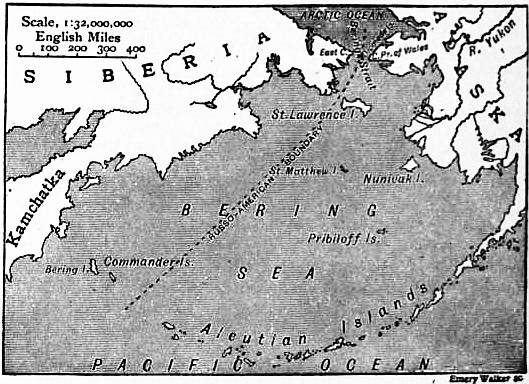
The earliest names associated with the exploration of Bering Strait are those of Russians seeking to extend their trading facilities. Isai Ignatiev made a voyage eastward from the Kolyma river in 1646, and Simon Dezhnev in 1648 followed his route and prolonged it, rounding the East or Dezhnev Cape, and entering the strait. The post of Anadyrsk was founded on the river Anadyr, and overland communications were gradually opened up. A Russian named Popov first learnt a rumour of the existence of islands east of Cape Dezhnev, and of the proximity of America, and presently there followed the explorations of Vitus Bering. In 1731 the navigator Michael Gvosdev was driven by storm from a point north of Cape Dezhnev to within sight of the Alaskan coast, which he followed for two days. Under Bering on his last voyage (1741) was Commander Chirikov of the “St Paul,” and after being separated from his leader during foggy weather this officer reached the Alaskan coast and explored a considerable stretch of it. Lieutenant Waxel and William Steller, a naturalist, left at the head of Bering’s party after his death, by their researches laid the foundation of the important fur trade of these waters. The Aleutian Islands gradually became known in the pursuit of this trade, through Michael Novidiskov (1745) and his successors, and it was not until Captain James Cook, working from the south, explored the sea and strait in 1778 that the tide of discovery set farther northward.
BERING SEA ARBITRATION. The important fishery dispute between Great Britain and the United States, which was closed by this arbitration, arose in the following circumstances.
In the year 1867 the United States government had purchased from Russia all her territorial rights in Alaska and the adjacent islands. The boundary between the two powers, as laid down by the treaty for purchase, was a line drawn from the middle of Bering Strait south-west to a point midway between the Aleutian and Komandorski Islands dividing Bering Sea into two parts, of which the larger was on the American side of this line. This portion included the Pribiloff Islands, which are the principal breeding-grounds of the seals frequenting those seas. By certain acts of congress, passed between 1868 and 1873, the killing of seals was prohibited upon the islands of the Pribiloff group and in “the waters adjacent thereto” except upon certain specified conditions. No definition of the meaning of the words “adjacent waters” was given in the act. In 1870 the exclusive rights of killing seals upon these islands was leased by the United States to the Alaska Commercial Company, upon conditions limiting the numbers to be taken annually, and otherwise providing for their protection. As early as 1872 the operations of foreign sealers attracted the attention of the United States government, but any precautions then taken seem to have been directed against the capture of seals on their way through the passages between the Aleutian Islands, and no claim to jurisdiction beyond the three-mile limit appears to have been put forward. On the 12th of March 1881, however, the acting secretary of the United States treasury, in answer to a letter asking for an interpretation of the words “waters adjacent thereto” in the acts of 1868 and 1873, stated that all the waters east of the boundary line were considered to be within the waters of Alaska territory. In March 1886 this letter was communicated to the San Francisco customs by Mr Daniel Manning, secretary of the treasury, for publication. In the same summer three British sealers, the “Carolena,” “Onward” and “Thornton,” were captured by an American revenue cutter 60 m. from land. They were condemned by the district judge on the express ground that they had been sealing within the limits of Alaska territory. Diplomatic representations followed, and an order for release was issued, but in 1887 further captures were made and were judicially supported upon the same grounds. The respective positions taken up by the two governments in the controversy which ensued may be thus indicated. The United States claimed as a matter of right an exclusive jurisdiction over the sealing industry in Bering Sea; they also contended that the protection of the fur seal was, upon grounds both of morality and interest, an international duty, and should be secured by international arrangement. The British government repudiated the claim of right, but were willing to negotiate upon the question of international regulation. Between 1887 and 1890 negotiations were carried on between Russia, Great Britain and the United States with a view to a joint convention. Unfortunately the parties were unable to agree as to the principles upon which regulation should be based. The negotiations were wrecked upon the question of pelagic sealing. The only seal nurseries were upon the Pribiloff Islands, which belonged to the United States, and the Komandorski group, which belonged to Russia. Consequently to prohibit pelagic sealing would have been to exclude Canada from the industry. The United States, nevertheless, insisted that such prohibition was indispensable on the grounds—(1) that pelagic sealing involved the destruction of breeding stock, because it was practically impossible to distinguish between the male and female seal when in the water; (2) that it was unnecessarily wasteful, inasmuch as a large proportion of the seals so killed were lost. On the other hand, it was contended by Great Britain that in all known cases the extermination of seals had been the result of operations upon land, and had never been caused by sealing exclusively pelagic. The negotiations came to nothing, and the United States fell back upon their claim of right. In June 1890 it was reported that certain American revenue cutters had been ordered to proceed to Bering Sea. Sir Julian Pauncefote, the British ambassador at Washington, having failed to obtain an assurance that British vessels would not be interfered with, laid a formal protest before the United States government.
Thereupon followed a diplomatic controversy, in the course of which the United States developed the contentions which were afterwards laid before the tribunal of arbitration. The claim that Bering Sea was mare clausum was abandoned, but it was asserted that Russia had formerly exercised therein rights of exclusive jurisdiction which had passed to the United States, and they relied inter alia upon the ukase of 1821, by which foreign vessels had been forbidden to approach within 100 Italian miles of the coasts of Russian America. It was pointed out by Great Britain that this ukase had been the subject of protest both by Great Britain and the United States, and that by treaties similar in their terms, made between Russia and each of the protesting powers, Russia had agreed that their subjects should not be troubled or molested in navigating or fishing in any part of the Pacific Ocean. The American answer was that the Pacific Ocean did not include Bering Sea. They also claimed an interest in the fur seals, involving the right to protect them outside the three-mile limit. In August 1890 Lord Salisbury proposed that the question at issue should be submitted to arbitration. This was ultimately assented to by the secretary of state, James Gillespie Blaine, on the understanding that certain specific points, which he indicated, should be laid before the arbitrators. On the 29th of February 1892 a definitive treaty was signed at Washington. Each power was to name two arbitrators, and the president of the French Republic, the king of Italy, the king of Norway and Sweden were each to name one. The points submitted were as follows:—(1) What exclusive jurisdiction in the sea now known as Bering Sea, and what exclusive rights in the seal fisheries therein, did Russia assert and exercise prior to and up to the time of the cession of Alaska to the United States? (2) How far were her claims of jurisdiction as to the seal fisheries recognized and conceded by Great Britain? (3) Was the body of water now known as Bering Sea included in the phrase “Pacific Ocean,” as used in the treaty of 1825 between Great Britain and Russia, and what rights, if any, in Bering Sea were held exclusively exercised by Russia after the said treaty? (4) Did not all the rights of Russia as to jurisdiction and as to the seal fisheries in Bering Sea east of the water boundary, in the treaty between the United States and Russia of the 30th of March 1867, pass unimpaired to the United States under that treaty? (5) Had the United States any and what right of protection over, or property in, the fur seals frequenting the islands of Bering Sea when such seals are found outside the three-mile limit? In the event of a determination in favour of Great Britain the arbitrators were to determine what concurrent regulations were necessary for the preservation of the seals, and a joint commission was to be appointed by the two powers to assist them in the investigation of the facts of seal life. The question of damages was reserved for further discussion, but either party was to be at liberty to submit any question of fact to the arbitrators, and to ask for a finding thereon. The tribunal was to sit at Paris. The treaty was approved by the Senate on the 29th of March 1892, and ratified by the president on the 22nd of April.
The United States appointed as arbitrator Mr John M. Harlan, a justice of the Supreme Court, and Mr John T. Morgan, a member of the Senate. The British arbitrators were Lord Hannen and Sir John Thompson. The neutral arbitrators were the baron de Courcel, the marquis Visconti Venosta, and Mr Gregers Gram, appointed respectively by the president of the French Republic, the king of Italy, and the king of Norway and Sweden. The sittings of the tribunal began in February and ended in August 1893. The main interest of the proceedings lies in the second of the two claims put forward on behalf of the United States. This claim cannot easily be stated in language of precision; it is indicated rather than formulated in the last of the five points specially submitted by the treaty. But its general character may be gathered from the arguments addressed to the tribunal. It was suggested that the seals had some of the characteristics of the domestic animals, and could therefore be the subject of something in the nature of a right of property. They were so far amenable to human control that it was possible to take their increase without destroying the stock. Sealing upon land was legitimate sealing; the United States being the owners of the land, the industry was a trust vested in them for the benefit of mankind. On the other hand, pelagic sealing, being a method of promiscuous slaughter, was illegitimate; it was contra bonos mores and analogous to piracy. Consequently the United States claimed a right to restrain such practices, both as proprietors of the seals and as proprietors and trustees of the legitimate industry. It is obvious that such a right was a novelty hitherto unrecognized by any system of law. Mr J.C. Carter, therefore, as counsel for the United States, submitted a theory of international jurisprudence which was equally novel. He argued that the determination of the tribunal must be grounded upon “the principles of right,” that “by the rule or principle of right was meant a moral rule dictated by the general standard of justice upon which civilized nations are agreed, that this international standard of justice is but another name for international law, that the particular recognized rules were but cases of the application of a more general rule, and that where the particular rules were silent the general rule applied.” The practical result of giving effect to this contention would be that an international tribunal could make new law and apply it retrospectively. Mr Carter’s contention was successfully combated by Sir Charles Russell, the leading counsel for Great Britain.
The award, which was signed and published on the 15th of August 1893, was in favour of Great Britain on all points. The question of damages, which had been reserved, was ultimately settled by a mixed commission appointed by the two powers in February 1896, the total amount awarded to the British sealers being $473,151.26.
(M. H. C.)
BERIOT, CHARLES AUGUSTE DE (1802-1870), Belgian violinist and composer. Although not definitely a pupil of Viotti or Baillot he was much influenced by both. He was very successful in his concert tours, and held appointments at the courts of Belgium and France. From 1843 to 1852 he was violin professor at the Brussels conservatoire. Then his eyesight began to fail, and in 1858 he became blind. His compositions are still often played, and are good, clean displays of technique.
BERJA, a town of southern Spain, in the province of Almeria; on the south-eastern slope of the Sierra de Gádor, 10 m. N.E. of Adra by road. Pop. (1900) 13,224. Despite the lack of a railway Berja has a considerable trade. Lead is obtained among the mountains, and the more sheltered valleys produce grain, wine, oil, fruit and esparto grass. These, with the paper, linen and cotton goods manufactured locally in small quantities, are exported from Adra.
BERKA, a town and watering-place of Germany, in the grand-duchy of Saxe-Weimar, on the Ilm and the Weimar-Kranichfeld railway, 8 m. S. of Weimar. Pop. 2300. It has sulphur baths, which are largely frequented in the summer. Berka was once celebrated for its Cistercian nunnery, founded in 1251. Two m. down the Ilm is the curious castle of Burgfarth, partly hewn out of the solid rock.
BERKELEY, the name of an ancient English family remarkable for its long tenure of the feudal castle built by the water of Severn upon the lands from which the family takes its name. It traces an undoubted descent from Robert (d. 1170) son of Harding. Old pedigree-makers from the 14th century onward have made of Harding a younger son of a king of Denmark and a companion of the Conqueror, while modern historians assert his identity with one Harding who, although an English thane, is recorded by Domesday Book in 1086 as a great landowner in Somerset. This Harding the thane was son of Elnod or Alnod, who is recognized as Eadnoth the Staller, slain in beating off the sons of Harold when they attacked his county. But if Harding the Berkeley ancestor be the Harding who, as the queen’s butler, witnesses King Edward’s Waltham charter of 1062, his dates seem strangely apart from those of Robert his son, dead a hundred and eight years later. Of Robert fitz Harding we know that he was a Bristol man whose wealth and importance were probably increased by the trade of the port. A partisan of Henry, son of the empress, that prince before his accession to the throne granted him, by his charter at Bristol in the earlier half of 1153, the Gloucestershire manor of Bitton, and a hundred librates of land in the manor of Berkeley, Henry agreeing to strengthen the castle of Berkeley, which was evidently already in Robert’s hands. In his rhymed chronicle Robert of Gloucester tells how—
“A bourgois at Bristowe—Robert Harding Vor gret tresour and richesse—so wel was mid the king That he gat him and is eirs—the noble baronie That so riche is of Berkele—mid al the seignorie.”
Later in the same year the duke of Normandy granted to Robert fitz Harding Berkeley manor and the appurtenant district called “Berkelaihernesse,” to hold in fee by the service of one knight or at a rent of 100 s. Being at Berkeley, the duke confirmed to Robert a grant of Bedminster made by Robert, earl of Gloucester, and in the first year of his reign as king of England he confirmed his own earlier grant of the Berkeley manor. About this time Robert, who had founded St Augustine’s Priory in Bristol, gave to the Black Canons there the five churches in Berkeley and Berkeley Herness. In their priory church he was buried in 1170, Berkeley descending to his son and heir Maurice.
Berkeley had already given a surname to an earlier family sprung from Roger, its Domesday tenant, whose descendants seem to have been ousted by the partisan of the Angevin. But if there had been a feud between the families it was ended by a double alliance, a covenant having been made at Bristol about November 1153 in the presence of Henry, duke of Normandy, whereby Maurice, son of Robert fitz Harding, was to marry the daughter of Roger of Berkeley, Roger’s own son Roger marrying the daughter of Robert. In his certificate of 1166 Robert tells the king that, although he owes the service of five knights for Berkeley, Roger of Berkeley still holds certain lands of the honour for which he does no service to Robert. This elder line of Berkeley survived for more than two centuries on their lands of Dursley and Cubberley, but after his father’s death Maurice, son of Robert, is styled Maurice of Berkeley. Robert of Berkeley, the eldest son of Maurice, paid in 1190 the vast sum of £1000 for livery of his great inheritance, but, rising with the rebellious barons against King John, his castle was taken into the king’s hands. Seizin, however, was granted in 1220 to Thomas his brother and heir, but the estate was again forfeit in the next generation for a new defection, although the wind of the royal displeasure was tempered by the fact that Isabel de Creoun, wife of Maurice, lord of Berkeley, was the king’s near kinswoman. Thomas, son of Maurice, was allowed to succeed his father in the lands, and, having a writ of summons to parliament in 1295, he is reckoned the first hereditary baron of the line.
Even in the age of chivalry the lords of Berkeley were notable warriors. Thomas, who as a lad had ridden on the barons’ side at Evesham, followed the king’s wars for half a century of his long life, flying his banner at Falkirk and at Bannockburn, in which fight he was taken by the Scots. His seal of arms is among those attached to the famous letter of remonstrance addressed by the barons of England to Pope Boniface VIII. Maurice, his son, joined the confederation against the two Despensers, and lay in prison at Wallingford until his death in 1326, the queen’s party gaining the upper hand too late to release him. But as the queen passed by Berkeley on her way to seize Bristol, she gave back the castle, which had been kept by the younger Despenser, to Thomas, the prisoner’s heir, who, with Sir John Mautravers, soon received in his hold the deposed king brought thither secretly. The chroniclers agree that Thomas of Berkeley had no part in the murder of the king, whom he treated kindly. It was when Thomas was away from the castle that Mautravers and Gournay made an end of their charge. Through the providence of this Thomas the Berkeley estates were saved to the male line of his house, a fine levied in the twenty-third year of Edward III. so settling them. Thomas of Berkeley fought at Creçy and Calais, bringing six knights and thirty-two squires to the siege in his train, with thirty mounted archers and two hundred men on foot. His son and heir-apparent, Maurice of Berkeley, was the hero of a misadventure recorded by Froissart, who tells how a young English knight, displaying his banner for the first time on the day of Poitiers, rode after a flying Picard squire, by whom he was grievously wounded and held to ransom. Froissart errs in describing this knight as Thomas lord of Berkeley, for the covenant made in 1360 for the release of Maurice is still among the Berkeley muniments, the ransom being stated at £1080.
Being by his mother a nephew of Roger Mortimer, earl of March, the paramour of Queen Isabel, Maurice Berkeley married Elizabeth, daughter of Hugh Despenser, the younger of Edward II.’s favourites and the intruder in Berkeley Castle. With his son and heir Thomas of Berkeley, one of the commissioners of parliament for the deposing of Richard II. and a warden of the Welsh marches who harried Owen of Glendower, the direct male line of Robert fitz Harding failed, and but for the settlement of the estates Berkeley would have passed from the family. On this Thomas’s death in 1417 Elizabeth, his daughter and heir, and her husband, Richard Beauchamp, earl of Warwick, the famous traveller, statesman and jouster, seized Berkeley Castle. Earl and countess only withdrew after James Berkeley, the nephew and heir male, had livery of his lands by the purchased aid of Humphrey of Gloucester. But the Beauchamps returned more than once to vain attacks on the stout walls of Berkeley, and a quarrel of two generations ended with the pitched battle of Nibley Green. Fought between the retainers of William, Lord Berkeley, son of James, and those who followed Thomas Talbot, Viscount Lisle, grandson of the illustrious Talbot and great-grandson of the countess of Warwick, this was the last private battle on English ground between two feudal lords. Young Lisle was shot under the beaver by an arrow, and the feud ended with his death, all claims of his widow being settled with an annuity of £100. Bitter as was the long quarrel, it kept the Berkeleys from casting their interest into the Wars of the Roses, in which most of their fellows of the ancient baronage sank and disappeared.
The victorious Lord Berkeley, whose children died young, was on ill terms with his next brother, and made havoc of the great Berkeley estates by grants to the Crown and the royal house, for which he was rewarded with certain empty titles. Edward IV. gave him a viscount’s patent in 1481, and Richard III. created him earl of Nottingham in 1483. His complacence extending to the new dynasty, Henry VII. made him earl marshal in 1485 and marquess of Berkeley in 1487. For this last patent he, by a settlement following a recovery suffered, gave the king and his heirs male Berkeley Castle and all that remained to him of his ancestors’ lands, enjoying for his two remaining years a bare life interest. At his death in 1491 the king took possession, bringing his queen with him on a visit to Berkeley.
Here follows a curious chapter of the history of the Berkeley peerage. When Thomas, Lord Berkeley, died in 1417, it might have been presumed that his dignity would descend to his heir, the countess of Warwick. Nevertheless, his nephew and heir male was summoned as a baron from 1421, apparently by reason of his tenure of the castle and its lands. When the marquess of Berkeley was dead without surviving issue, the castle having passed to the crown, Maurice, the brother and heir, had no summons. Yet this Maurice’s son, another Maurice, had a summons as a baron, although not “with the room in the parliament chamber that the lords of Berkeley had of old time.” The old precedence was restored when Thomas, brother and heir of this baron, was summoned. This Thomas, who had a command at Flodden, held his ancestors’ castle as constable for the king. A final remainder under the marquess’s settlement brought back castle and lands on the failure in 1553 of the heirs male of the body of Henry VII., and Henry, Lord Berkeley, had special livery of them in his minority. Yet although seized of the castle he took a lower seat in the parliament house than did his grandfather who was not so seized, being given place after Abergavenny, Audley and Strange.
By these things we may see that peerage law in old time rested upon the pleasure of the sovereign and upon no ascertained and unvarying custom. Of the power behind that pleasure this Henry, Lord Berkeley, had one sharp reminder. He was, like most of his line, a keen sportsman, and, returning to Berkeley to find that a royal visit had made great slaughter among his deer, he showed his resentment by disparking Berkeley Park. Thereat Queen Elizabeth sent him a warning in round Tudor fashion. Let him beware, she wrote, for the earl of Leicester coveted the castle by the Severn.
At the Restoration, George, Lord Berkeley, who had been one of the commissioners to invite Charles II.’s return from the Hague, petitioned for a higher place in parliament, claiming a barony by right of tenure before 1295, but his claim was silenced by his advancement on September 11, 1679, to be viscount of Dursley and earl of Berkeley. James, the 3rd earl, an active sea captain who was all but lost in company with Sir Cloudesley Shovel, became knight of the Garter and lord high admiral and commander-in-chief in the Channel, he and his house being loyal supporters of the Hanoverian dynasty.
The last and most curious chapter of the history of the Berkeley honours was opened by Frederick Augustus, the 5th earl of Berkeley (1745-1810). This peer married at Lambeth, on the 16th of May 1796, one Mary Cole, the daughter of a small tradesman at Wotton-under-Edge, with whom he had already lived for several years, several children having been born to them. In order to legitimatize the issue born before the marriage, the earl in 1801 made declaration of an earlier marriage contracted privately at Berkeley in 1785. On his death in 1811 the validity of this alleged marriage was tested by the committee of privileges of the House of Lords, and it was shown without doubt that the evidence for it, a parish register entry, was a forgery.
Under the will of his father, Colonel William Berkeley, the eldest illegitimate son, had the castle and estates, and on the failure of his claim to the earldom he demanded a writ of summons as a baron by reason of his tenure of the castle. No judgment was given in the matter, the king in council having declared in 1669 that baronies by tenure were “not in being and so not fit to be revived.” But Colonel Berkeley’s political influence afterwards procured him (1831) a peerage as Lord Segrave of Berkeley, and ten years later an earldom with the title of Fitzhardinge. He died without issue in 1857. His brother, Sir Maurice Fitzhardinge Berkeley, who succeeded to Berkeley under the terms of the 5th earl’s will, revived the claims, and was likewise given a new barony (1861) as Lord Fitzhardinge, a title in which he was succeeded by two of his sons, the 3rd baron (b. 1830) being in 1909 owner of the Berkeley and Cranford estates. The earldom of Berkeley was never assumed by the eldest legitimate son of the 5th earl, and was in 1909 enjoyed by Randal Thomas Mowbray Berkeley, 8th earl, grandson of admiral Sir George Cranfield Berkeley, second son of the 4th earl. In 1893 Mrs Milman (d. 1899), daughter and heir of Thomas Moreton Fitzhardinge Berkeley, 6th earl de jure, was declared by letters patent under the great seal to have succeeded to the ancient barony of Berkeley created by the writ of 1421; and she was succeeded by her daughter.