VOLUME III SLICE V Bedlam to Benson, George (continued 8)
Reading edition
III. Giovanni Bellini (1430-1431-1516) is generally assumed to have been the second son of Jacopo by his wife Anna; though the fact that she does not mention him in her will with her other sons has thrown some slight doubt upon the matter. At any rate he was brought up in his father’s house, and always lived and worked in the closest fraternal relation with Gentile. Up till the age of nearly thirty we find documentary evidence of the two sons having served as their father’s assistants in works both at Venice and Padua. In Giovanni’s earliest independent works we find him more strongly influenced by the harsh and searching manner of the Paduan school, and especially of his own brother-in-law Mantegna, than by the more graceful and facile style of Jacopo. This influence seems to have lasted at full strength until after the departure of his brother-in-law Mantegna for the court of Mantua in 1460. The earliest of Giovanni’s independent works no doubt date from before this period. Three of these exist at the Correr museum in Venice: a Crucifixion, a Transfiguration, and a Dead Christ supported by Angels. Two Madonnas of the same or even earlier date are in private collections in America, a third in that of Signor Frizzoni at Milan; while two beautiful works in the National Gallery of London seem to bring the period to a close. One of these is of a rare subject, the Blood of the Redeemer; the other is the fine picture of Christ’s Agony in the Garden, formerly in the Northbrook collection. The last-named piece was evidently executed in friendly rivalry with Mantegna, whose version of the subject hangs near by; the main idea of the composition in both cases being taken from a drawing by Jacopo Bellini in the British Museum sketch-book. In all these pictures Giovanni combines with the Paduan severity of drawing and complex rigidity of drapery a depth of religious feeling and human pathos which is his own. They are all executed in the old tempera method; and in the last named the tragedy of the scene is softened by a new and beautiful effect of romantic sunrise colour. In a somewhat changed and more personal manner, with less harshness of contour and a broader treatment of forms and draperies, but not less force of religious feeling, are the two pictures of the Dead Christ supported by Angels, in these days one of the master’s most frequent themes, at Rimini and at Berlin. Chronologically to be placed with these are two Madonnas, one at the church of the Madonna del Orto at Venice and one in the Lochis collection at Bergamo; devout intensity of feeling and rich solemnity of colour being in the case of all these early Madonnas combined with a singularly direct rendering of the natural movements and attitudes of children.
The above-named works, all still executed in tempera, are no doubt earlier than the date of Giovanni’s first appointment to work along with his brother and other artists in the Scuola di San Marco, where among other subjects he was commissioned in 1470 to paint a Deluge with Noah’s Ark. None of the master’s works of this kind, whether painted for the various schools or confraternities or for the ducal palace, have survived. To the decade following 1470 must probably be assigned a Transfiguration now in the Naples museum, repeating with greatly ripened powers and in a much serener spirit the subject of his early effort at Venice; and also the great altar-piece of the Coronation of the Virgin at Pesaro, which would seem to be his earliest effort in a form of art previously almost monopolized in Venice by the rival school of the Vivarini. Probably not much later was the still more famous altar-piece painted in tempera for a chapel in the church of S. Giovanni e Paolo, where it perished along with Titian’s Peter Martyr and Tintoretto’s Crucifixion in the disastrous fire of 1867. After 1479-1480 very much of Giovanni’s time and energy must have been taken up by his duties as conservator of the paintings in the great hall of the ducal palace, in payment for which he was awarded, first the reversion of a broker’s place in the Fondaco dei Tedeschi, and afterwards, as a substitute, a fixed annual pension of eighty ducats. Besides repairing and renewing the works of his predecessors he was commissioned to paint a number of new subjects, six or seven in all, in further illustration of the part played by Venice in the wars of Barbarossa and the pope. These works, executed with much interruption and delay, were the object of universal admiration while they lasted, but not a trace of them survived the fire of 1577; neither have any other examples of his historical and processional compositions come down, enabling us to compare his manner in such subjects with that of his brother Gentile. Of the other, the religious class of his work, including both altar-pieces with many figures and simple Madonnas, a considerable number have fortunately been preserved. They show him gradually throwing off the last restraints of the 15th-century manner; gradually acquiring a complete mastery of the new oil medium introduced in Venice by Antonello da Messina about 1473, and mastering with its help all, or nearly all, the secrets of the perfect fusion of colours and atmospheric gradation of tones. The old intensity of pathetic and devout feeling gradually fades away and gives place to a noble, if more worldly, serenity and charm. The enthroned Virgin and Child become tranquil and commanding in their sweetness; the personages of the attendant saints gain in power, presence and individuality; enchanting groups of singing and viol-playing angels symbolize and complete the harmony of the scene. The full splendour of Venetian colour invests alike the figures, their architectural framework, the landscape and the sky. The altar-piece of the Frari at Venice, the altar-piece of San Giobbe, now at the academy, the Virgin between SS. Paul and George, also at the academy, and the altar-piece with the kneeling doge Barbarigo at Murano, are among the most conspicuous examples. Simple Madonnas of the same period (about 1485-1490) are in the Venice academy, in the National Gallery, at Turin and at Bergamo. An interval of some years, no doubt chiefly occupied with work in the Hall of the Great Council, seems to separate the last-named altar-pieces from that of the church of San Zaccaria at Venice, which is perhaps the most beautiful and imposing of all, and is dated 1505, the year following that of Giorgione’s Madonna at Castelfranco. Another great altar-piece with saints, that of the church of San Francesco de la Vigna at Venice, belongs to 1507; that of La Corona at Vicenza, a Baptism of Christ in a landscape, to 1510; to 1513 that of San Giovanni Crisostomo at Venice, where the aged saint Jerome, seated on a hill, is raised high against a resplendent sunset background, with SS. Christopher and Augustine standing facing each other below him, in front. Of Giovanni’s activity in the interval between the altar-pieces of San Giobbe and of Murano and that of San Zaccaria, there are a few minor evidences left, though the great mass of its results perished with the fire of the ducal palace in 1577. The examples that remain consist of one very interesting and beautiful allegorical picture in the Uffizi at Florence, the subject of which had remained a riddle until it was recently identified as an illustration of a French medieval allegory, the Pèlerinage de l’âme by Guillaume de Guilleville; with a set of five other allegories or moral emblems, on a smaller scale and very romantically treated, in the academy at Venice. To these should probably be added, as painted towards the year 1505, the portrait of the doge Loredano in the National Gallery, the only portrait by the master which has been preserved, and in its own manner one of the most masterly in the whole range of painting.
The last ten or twelve years of the master’s life saw him besieged with more commissions than he could well complete. Already in the years 1501-1504 the marchioness Isabella Gonzaga of Mantua had had great difficulty in obtaining delivery from him of a picture of the “Madonna and Saints” (now lost) for which part payment had been made in advance. In 1505 she endeavoured through Cardinal Bembo to obtain from him another picture, this time of a secular or mythological character. What the subject of this piece was, or whether it was actually delivered, we do not know. Albrecht Dürer, visiting Venice for a second time in 1506, reports of Giovanni Bellini as still the best painter in the city, and as full of all courtesy and generosity towards foreign brethren of the brush. In 1507 Gentile Bellini died, and Giovanni completed the picture of the “Preaching of St Mark” which he had left unfinished; a task on the fulfilment of which the bequest by the elder brother to the younger of their father’s sketch-book had been made conditional. In 1513 Giovanni’s position as sole master (since the death of his brother and of Alvise Vivarini) in charge of the paintings in the Hall of the Great Council was threatened by an application on the part of his own former pupil, Titian, for a joint-share in the same undertaking, to be paid for on the same terms. Titian’s application was first granted, then after a year rescinded, and then after another year or two granted again; and the aged master must no doubt have undergone some annoyance from his sometime pupil’s proceedings. In 1514 Giovanni undertook to paint a Bacchanal for the duke Alfonso of Ferrara, but died in 1516; leaving it to be finished by his pupils; this picture is now at Alnwick.
Both in the artistic and in the worldly sense, the career of Giovanni Bellini was upon the whole the most serenely and unbrokenly prosperous, from youth to extreme old age, which fell to the lot of any artist of the early Renaissance. He lived to see his own school far outshine that of his rivals, the Vivarini of Murano; he embodied, with ever growing and maturing power, all the devotional gravity and much also of the worldly splendour of the Venice of his time; and he saw his influence propagated by a host of pupils, two of whom at least, Giorgione and Titian, surpassed their master. Giorgione he outlived by five years; Titian, as we have seen, challenged an equal place beside his teacher. Among the best known of his other pupils were, in his earlier time, Andrea Previtali, Cima da Conegliano, Marco Basaiti, Niccolo Rondinelli, Piermaria Pennacchi, Martino da Udine, Girolamo Mocetto; in later time, Pierfrancesco Bissolo, Vincenzo Catena, Lorenzo Lotto and Sebastian del Piombo.
Bibliography.—Vasari, ed. Milanesi, vol. iii.; Ridolfi, Le Maraviglie, &c., vol. i.; Francesco Sansovino, Venezia Descritta; Morelli, Notizia, &c., di un Assonimo; Zanetti, Pittura Veneziana; F. Aghietti, Elagio Storico di Jacopo e Giovanni Bellini; G. Bernasconi, Cenni intorna la vita e le opere di Jacopo Bellini; Moschini, Giovanni Bellini e pittori contemporanei; E. Galichon in Gazette des beaux-arts (1866); Crowe and Cavalcaselle, History of Painting in North Italy, vol. i.; Hubert Janitschek, “Giovanni Bellini” in Dohme’s Kunst und Künstler; Julius Meyer in Meyer’s Allgemeines Künstler-Lexikon, vol. iii. (1885); Pompeo Molmenti, “I pittori Bellini” in Studi e ricerche di Storia d’ Arte; P. Paoletti, Raccolta di documenti inediti, fasc. i.; Vasari, Vite di Gentile da Fabriano e Vittor Pisanello, ed. Venturi; Corrado Ricci in Rassegna d’ Arte (1901, 1903), and Rivista d’ Arte (1906); Roger Fry, Giovanni Bellini in “The Artist’s Library”; Everard Meynell, Giovanni Bellini in Newnes’s “Art Library” (useful for a nearly complete set of reproductions of the known paintings); Corrado Ricci, Jacopo Bellini e i suoi Libri di Disegni; Victor Goloubeff, Les Dessins de Jacopo Bellini (the two works last cited reproduce in full, that of M. Goloubeff by far the most skilfully, the contents of both the Paris and the London sketch-books).
(S. C.)
BELLINI, LORENZO (1643-1704), Italian physician and anatomist, was born at Florence on the 3rd of September 1643. At the age of twenty, when he had already begun his researches on the structure of the kidneys and had described the ducts known by his name (Exercitatio anatomica de structura et usu renum, 1662), he was chosen professor of theoretical medicine at Pisa, but soon after was transferred to the chair of anatomy. After spending thirty years at Pisa, he was invited to Florence and appointed physician to the grand duke Cosimo III., and was also made senior consulting physician to Pope Clement XI. He died at Florence on the 8th of January 1704. His works were published in a collected form at Venice in 1708.
BELLINI, VINCENZO (1801-1835), operatic composer of the Italian school, was born at Catania in Sicily, on the 1st of November 1801. He was descended from a family of musicians, both his father and grandfather having been composers of some reputation. After having received his preparatory musical education at home, he entered the conservatoire of Naples, where he studied singing and composition under Tritto and Zingarelli. He soon began to write pieces for various instruments, as well as a cantata and several masses and other sacred compositions. His first opera, Adelson e Savina, was performed in 1825 at a small theatre in Naples; his second dramatic work, Bianca e Fernando, was produced next year at the San Carlo theatre of the same city, and made his name known in Italy. His next work, Il Pirata (1827), was written for the Scala in Milan, to words by Felice Romano, with whom Bellini formed a union of friendship to be severed only by his death. The splendid rendering of the music by Tamburini, Rubini and other great Italian singers contributed greatly to the success of the work, which at once established the European reputation of its composer. In almost every year of the short remainder of his life he produced a new operatic work, which was received with rapture by the audiences of France, Italy, Germany and England. The names and dates of four of Bellini’s operas familiar to most lovers of Italian music are: I Montecchi e Capuleti (1830), in which the part of Romeo became a favourite with all the great contraltos; La Sonnambula (1831); Norma, Bellini’s best and most popular creation (1831); and I Puritani (1835), written for the Italian opera in Paris, and to some extent under the influence of French music. In 1833 Bellini had left his country to accompany to England the singer Pasta, who had created the part of his Sonnambula. In 1834 he accepted an invitation to write an opera for the national grand opera in Paris. While he was carefully studying the French language and the cadence of French verse for the purpose, he was seized with a sudden illness and died at his villa in Puteaux near Paris on the 24th of September 1835. His operatic creations are throughout replete with a spirit of gentle melancholy, frequently monotonous and almost always undramatic, but at the same time irresistibly sweet. To this spirit, combined with a rich flow of cantilena, Bellini’s operas owe their popularity. “I shall never forget,” wrote Wagner, “the impression made upon me by an opera of Bellini at a period when I was completely exhausted with the everlastingly abstract complication used in our orchestras, when a simple and noble melody was revealed anew to me.”
See also G. Labat, Bellini (Bordeaux, 1865); A. Pougin, Bellini, sa vie et ses œuvres (Paris, 1868).
BELLINZONA (Ger. Belienz), the political capital of the Swiss canton of Tessin or Ticino. It is 105 m. from Lucerne by the St Gotthard railway, 19 m. from Lugano and 14 m. from Locarno at the head of the Lago Maggiore, these two towns having been till 1881 capitals of the canton jointly with Bellinzona. The old town is built on some hills, on the left bank of the Tessin or Ticino river, and a little below the junction of the main Ticino valley (the Val Leventina) with that of Mesocco. It thus blocked the road from Germany to Italy, while a great wall was built from the town to the river bank. Bellinzona still possesses three picturesque castles (restored in modern times), dating in their present form from the 15th century. They belonged for several centuries to the three Swiss cantons which were masters of the town. The most westerly, Castello Grande or of San Michele, belonged to Uri; the central castle, that of Montebello, was the property of Schwyz; while the most easterly castle, that of Sasso Corbaro, was in the hands of Unterwalden. The 13th-century church of San Biagio (Blaise) has a remarkable 14th-century fresco, while the collegiate church of San Stefano dates from the 16th century. In 1900 the population of Bellinzona was 4949, practically all Romanists and Italian-speaking.
Possibly Bellinzona is of Roman origin, but it is first mentioned in 590. It played a considerable part in the early history of Lombardy, being a key to several Alpine passes. In the 8th century it belonged to the bishop of Como, while in the 13th and 14th centuries it was tossed to and fro between the cities of Milan and Como. In 1402 it was taken from Milan by Albert von Sax, lord of the Val Mesocco, who in 1419 sold it to Uri and Obwalden, which, however, lost it to Milan in 1422 after the battle of Arbedo. In 1499 (like the rest of the Milanese) it was occupied by the French, but in 1500 it was taken by Uri. In 1503 the French king ceded it to Uri, Schwyz and Unterwalden, which henceforth ruled it very harshly through their bailiffs till 1798. At that date it became the capital of the canton Bellinzona of the Helvetic republic, but in 1803 it was united to the newly-formed canton of Tessin.
(W. A. B. C.)
BELLMAN, KARL MIKAEL (1740-1795), Swedish poet, son of a civil servant, was born at Stockholm on the 4th of February 1740. When quite a child he developed an extraordinary gift of improvising verse, during the delirium of a severe illness, weaving wild thoughts together lyrically and singing airs of his own composition. When he was nineteen he became clerk in a bank and afterwards in the customs, but his habits were irregular and he was frequently in great distress, particularly after the death of his patron, Gustavus III. As early as 1757 he published Evangeliska Dödstankar, meditations on the Passion from the German of David von Schweidnitz, and during the next few years wrote, besides other translations, a great quantity of poems, imitative for the most part of Dalin. In 1760 appeared his first characteristic work, Månan (The Moon), a satirical poem, which was revised and edited by Dalin. But the great work of his life occupied him from 1765 to 1780, and consists of the collections of dithyrambic odes known as Fredmans Epistlar (1790) and Fredmans Sånger (1791). Fredman and his friends were well-known characters in the Stockholm pot-houses, where Bellman had studied them from the life. No poetry can possibly smell less of the lamp than Bellman’s. He was accustomed, when in the presence of none but confidential friends, to announce that the god was about to visit him. He would shut his eyes, take his zither, and begin apparently to improvise the music and the words of a long Bacchic ode in praise of love or wine. Most of his melodies are taken direct, or with slight adaptations, from old Swedish ballads, and still retain their popularity. Fredman’s Epistles bear the clear impress of individual genius; his torrents of rhymes are not without their method; wild as they seem, they all conform to the rules of style, and among those that have been preserved there are few that are not perfect in form. A great Swedish critic has remarked that the voluptuous joviality and the humour of Bellman is, after all, only “sorrow clad in rose-colour,” and this underlying pathos gives his poems their undying charm. His later works, Bacchi Tempel (The Temple of Bacchus) (1783), eight numbers of a journal called Hvad behagas? (What you Will) (1781), in 1780 a religious anthology entitled in a later edition (1787) Zions Hogtid (Zion’s Holiday), and a translation of Gellert’s Fables, are comparatively unimportant. He died on the 11th of February 1795. Much of Bellman’s work was only printed after his death, Bihang till Fredmans Epistlar (Nyköping, 1809), Fredmans Handskrifter (Upsala, 1813), Skaldestycken (“Poems,” Stockholm, 1814) being among the most important of these posthumous works. A colossal bronze bust of the poet by Byström (erected by the Swedish Academy in 1829) adorns the public gardens of Stockholm, and a statue by Alfred Nyström is in the Hasselbacken, Stockholm. Bellman had a grand manner, a fine voice and great gifts of mimicry, and was a favourite companion of King Gustavus III.
The best edition of his works was published at Stockholm, edited by J.G. Carlén, with biographical notes, illustrations and music (5 vols., 1856-1861); see also monographs on Bellman by Nils Erdmann (Stockholm, 1895) and by F. Niedner (Berlin, 1905).
BELLO, ANDRÉS (1781-1865), South American poet and scholar, was born at Caracas (Venezuela) on the 29th of November 1781, and in early youth held a minor post in the civil administration. He joined the colonial revolutionary party, and in 1810 was sent on a political mission to London, where he resided for nineteen years, acting as secretary to the legations of Chile, Colombia and Venezuela, studying in the British Museum, supplementing his small salary by giving private lessons in Spanish, by journalistic work and by copying Jeremy Bentham’s almost indecipherable manuscripts. In 1829 he accepted a post in the Chilean treasury, settled at Santiago and took a prominent part in founding the national university (1843), of which he became rector. He was nominated senator, and died at Santiago de Chile on the 15th of October 1865. Bello was mainly responsible for the civil code promulgated on the 14th of December 1855. His prose works deal with such various subjects as law, philosophy, literary criticism and philology; of these the most important is his Gramática castellana (1847), the leading authority on the subject. But his position in literature proper is secured by his Silvas Americanas, a poem written during his residence in England, which conveys with extraordinary force the majestic impression of the South American landscape.
Bello’s complete works were issued in fifteen volumes by the Chilean government (Santiago de Chile, 1881-1893); he is the subject of an excellent biography (Santiago de Chile, 1882) by Miguel Luis Amunátegui.
(J. F.-K.)
BELLO-HORIZONTE, or Minas, a city of Brazil, capital of the state of Minas Geraes since 1898, about 50 m. N.W. of Ouro Preto, connected with the Central of Brazil railway by a branch line 9 m. in length. Pop. (estimated) in 1906, 25,000 to 30,000. The city was built by the state on an open plateau, and provided with all necessary public buildings, gas, water and tramway services before the seat of government was transferred from Ouro Preto. The cost of transfer was about £1,000,000. The city has grown rapidly, and is considered one of the most attractive state capitals of Brazil.
BELLONA (originally Duellona), in Roman mythology, the goddess of war (bellum, i.e. duellum), corresponding to the Greek Enyo. By later mythologists she is called sometimes the sister, daughter or wife of Mars, sometimes his charioteer or nurse. Her worship appears to have been promoted in Rome chiefly by the family of the Claudii, whose Sabine origin, together with their use of the name of “Nero,” has suggested an identification of Bellona with the Sabine war goddess Nerio, herself identified, like Bellona, with Virtus. Her temple at Rome, dedicated by Appius Claudius Caecus (296 B.C.) during a battle with the Samnites and Etruscans (Ovid, Fasti vi. 201), stood in the Campus Martius, near the Flaminian Circus, and outside the gates of the city. It was there that the senate met to discuss a general’s claim to a triumph, and to receive ambassadors from foreign states. In front of it was the columna bellica, where the ceremony of declaring war by the fetialis was performed. From this native Italian goddess is to be distinguished the Asiatic Bellona, whose worship was introduced into Rome from Comana, in Cappadocia, apparently by Sulla, to whom she had appeared, urging him to march to Rome and bathe in the blood of his enemies (Plutarch, Sulla, 9). For her a new temple was built, and a college of priests (Bellonarii) instituted to conduct her fanatical rites, the prominent feature of which was to lacerate themselves and sprinkle the blood on the spectators (Tibullus i. 6. 45-50). To make the scene more grim they wore black dresses (Tertullian, De Pallio) from head to foot. The festival of Bellona, which originally took place on the 3rd of June, was altered to the 24th of March, after the confusion of the Roman Bellona with her Asiatic namesake.
See Tiesler, De Bellonae Cultu (1842).
BELLOT, JOSEPH RENÉ (1826-1853), French Arctic explorer, was born at Rochefort on the 18th of March 1826, the son of a farrier. With the aid of the authorities of his native town he was enabled at the age of fifteen to enter the naval school, in which he studied two years and earned a high reputation. He then took part in the Anglo-French expedition of 1845 to Madagascar, and received the cross of the Legion of Honour for distinguished conduct. He afterwards took part in another Anglo-French expedition, that of Parana, which opened the river La Plata to commerce. In 1851 he joined the Arctic expedition under the command of Captain Kennedy in search of Sir John Franklin, and discovered the strait between Boothia Felix and Somerset Land which bears his name. Early in 1852 he was promoted lieutenant, and in the same year accompanied the Franklin search expedition under Captain Inglefield. As on the previous occasion, his intelligence, devotion to duty and courage won him the esteem and admiration of all with whom he was associated. While making a perilous journey with two comrades for the purpose of communicating with Sir Edward Belcher, he suddenly disappeared in an opening between the broken masses of ice (August 1853). A pension was granted to his family by the emperor Napoleon III., and an obelisk was erected to his memory in front of Greenwich hospital.
BELLOWS, ALBERT F. (1829-1883), American landscape-painter, was born at Milford, Massachusetts, on the 20th of November 1829. He first studied architecture, then turned to painting, and worked in Paris and in the Royal Academy at Antwerp. He painted much in England; was a member of the National Academy of Design, and of the American Water Color Society, New York; and an honorary member of the Royal Belgian Society of Water-Colourists. His earlier work was genre, in oils; after 1865 he used water-colours more and more exclusively and painted landscapes. Among his water-colours are “Afternoon in Surrey” (1868); “Sunday in Devonshire” (1876), exhibited at the Philadelphia Exposition; “New England Village School” (1878); and “The Parsonage” (1879). He died in Auburndale, Massachusetts, on the 24th of November 1883.
BELLOWS, HENRY WHITNEY (1814-1882), American clergyman, was born in Boston, Massachusetts, on the 11th of June 1814. He graduated at Harvard College in 1832, and at the Harvard Divinity School in 1837, held a brief pastorate (1837-1838) at Mobile, Alabama, and in 1839 became pastor of the First Congregational (Unitarian) church in New York City (afterwards All Souls church), in charge of which he remained until his death. Here Bellows acquired a high reputation as a pulpit orator and lyceum lecturer, and was a recognized leader in the Unitarian Church in America. For many years after 1846 he edited The Christian Inquirer, a Unitarian weekly paper, and he was also for some time an editor of The Christian Examiner. In 1857 he delivered a series of lectures in the Lowell Institute course, on “The Treatment of Social Diseases.” At the outbreak of the Civil War he planned the United States Sanitary Commission, of which he was the first and only president (1861 to 1878). He was the first president of the first Civil Service Reform Association organized in the United States (1877), was an organizer of the Union League Club and of the Century Association in New York City, and planned with his parishioner and friend, Peter Cooper, the establishment of Cooper Union. In 1865 he proposed and organized the national conference of Unitarian and other Christian churches, and from 1865 to 1880 was chairman of its council. He died in New York City on the 30th of January 1882. A bronze memorial tablet by Augustus Saint Gaudens was unveiled in All Souls church in 1886. His published writings include Restatements of Christian Doctrine in Twenty-Five Sermons (1860); Unconditioned Loyalty (1863), a strong pro-Union sermon, which was widely circulated during the Civil War; The Old World in its New Face: Impressions of Europe in 1867-1868 (2 vols., 1868-1869); Historical Sketch of the Union League Club (1879); and Twenty-Four Sermons in All Souls Church, New York, 1865-1881 (1886).
See Russell N. Bellows, Henry Whitney Bellows (Keene, N.H., 1897), a biographical sketch reprinted from T.B. Peck’s Bellows Family Genealogy; John White Chadwick, Henry W. Bellows: His Life and Character (New York, 1882), a memorial address; and Charles J Stillé, History of the United States Sanitary Commission (Philadelphia, 1866).
BELLOWS and BLOWING MACHINES, appliances used for producing currents of air, or for moving volumes of air from one place to another. Formerly all such artificially-produced currents of air were used to assist the combustion of fires and furnaces, but now this purpose only forms a part of the uses to which they are put. Blowing appliances, among which are included bellows, rotary fans, blowing engines, rotary blowers and steam-jet blowers, are now also employed for forcing pure air into buildings and mines for purposes of ventilation, for withdrawing vitiated air for the same reason, and for supplying the air or other gas which is required in some chemical processes. Appliances of this kind differ from air compressors in that they are primarily intended for the transfer of quantities of air at low pressures, very little above that of the atmosphere, whereas the latter are used for supplying air which has previously been raised to a pressure which may be many times that of the atmosphere (see Power Transmission: Pneumatic).
Among the earliest contrivances employed for producing the movement of air under a small pressure were those used in Egypt during the Greek occupation. These depended upon the heating of the air, which, being raised in pressure and bulk, was made to force water out of closed vessels, the water being afterwards employed for moving some kind of mechanism. In the process of iron smelting there is still used in some parts of India an artificial blast, produced by a simple form of bellows made from the skins of goats; bellows of this kind probably represent one of the earliest contrivances used for producing currents of air.
The bellows1 now in use consists, in its simplest form, of two flat boards, of rectangular, circular or pear shape, connected round their edges by a wide band of leather so as to include an air chamber, which can be increased or diminished in volume by separating the boards or bringing them nearer together. The leather is kept from collapsing, on the separation of the boards, by several rings of wire which act like the ribs of animals. The lower board has a hole in the centre, covered inside by a leather flap or valve which can only open inwards; there is also an open outlet, generally in the form of a pipe or nozzle, whose aperture is much smaller than that of the valve. When the upper board is raised air rushes into the cavity through the valve to fill up the partial vacuum produced; on again depressing the upper board the valve is closed by the air attempting to rush out again, and this air is discharged through the open nozzle with a velocity depending on the pressure exerted.
The current of air produced is evidently not continuous but intermittent or in puffs, because an interval is needed to refill the cavity after each discharge. In order to remedy this drawback the double bellows are used. To understand their action it is only necessary to conceive an additional board with valve, like the lower board of the single bellows, attached in the same way by leather below this lower board. Thus there are three boards, forming two cavities, the two lower boards being fitted with air-valves. The lowest board is held down by a weight and another weight rests on the top board. In working these double bellows the lowest board is raised, and drives the air from the lower cavity into the upper. On lowering the bottom board again a fresh supply of air is drawn in through the bottom valve, to be again discharged when the board is raised. As the air passes from the lower to the upper cavity it is prevented from returning by the valve in the middle board, and in this way a quantity of air is sent into the upper cavity each time the lowest board is raised. The weight on the top board provides the necessary pressure for the blast, and at the same time causes the current of air delivered to be fairly continuous. When the air is being forced into the upper cavity the weight is being raised, and, during the interval when the lowest board is descending, the weight is slowly forcing the top board down and thus keeping up the flow of air.
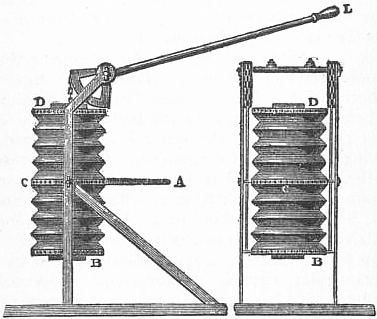
Figs. 1 and 2.—Common Smiths’ Bellows.
Hand-bellows for domestic use are generally shaped like a pear, with the hinge at the narrow end. The same shape was adopted for the older forms of smiths’ bellows, with the difference that two bellows were used superposed, in a manner similar to that just described, so as to provide for a continuous blast. In the later form of smiths’ bellows the same principle is employed, but the boards are made circular in shape and are always maintained roughly parallel to one another. These are shown on figs. 1 and 2. Here A is the blast pipe, B the movable lowest board, C the fixed middle board, close to which the pipe A is inserted, and D is the movable uppermost board pressed upon by the weight shown. The board B is raised by means of a hand lever L, through either a chain or a connecting rod, and lowered by a weight. The size of the weight on D depends on the air pressure required. For instance, if a blast pressure of half a pound per square inch is wanted and the boards are 18 in. in diameter, and therefore have an area of 254 sq. in., on each of the 254 sq. in. there is to be a pressure of half a pound, so that the weight to balance this must be half multiplied by 254, or 127 ℔ The diameter of the air-pipe can be varied to suit the required conditions. Instead of bellows with flexible sides, a sliding arrangement is sometimes used; this consists of what are really two boxes fitting into one another with the open sides both facing inwards, as if one were acting as a lid to the other. By having a valve and outlet pipe fitted as in the bellows and sliding them alternately apart and together, an intermittent blast is produced. The chief defect of this arrangement is the leakage of air caused by the difficulty in making the joint a sufficiently good fit to be air-tight.
Blowing Engines.—Where larger quantities of air at higher pressures than can conveniently be supplied by bellows are required, as for blast furnaces and the Bessemer process of steel-making, what are termed “blowing engines” are used. The mode of action of a blowing engine is simple. When a piston, accurately fitting a cylinder which has one end closed, is forcibly moved towards the other end, a partial vacuum is formed between the piston and the blank end, and if this space be allowed to communicate with the outer atmosphere air will flow in to fill the vacuum. When the piston has completed its movement or “stroke,” the cylinder will have been filled with air. On the return of the piston, if the valve through which the air entered is now closed and a second one communicating with a chamber or pipe is opened, the air in the cylinder is expelled through this second valve. The action is similar to that of the bellows, but is carried out in a machine which is much better able to resist higher pressures and which is more convenient for dealing with large quantities of air. The valves through which the atmosphere or “free” air is admitted are called “admission” or “suction” valves, and those through which the air is driven from the cylinder are the “discharge” or “delivery” valves. Formerly one side only of the blowing piston was used, the engine working “single-acting”; but now both sides of the piston are utilized, so that when it is moving in either direction suction will be taking place on one side and delivery on the other. All processes in connexion with which blowing engines are used require the air to be above the pressure of the outer atmosphere. This means that the discharge valves do not open quite at the beginning of the delivery stroke, but remain closed until the air in the cylinder has been reduced in volume and so increased in pressure to that of the air in the discharge chamber.
The power used to actuate these blowing-engines is in most cases steam, the steam cylinder being placed in line or “tandem” with the air cylinder, so that the steam piston rod is continuous with or directly joined to the piston rod of the air cylinder. This plan is always adopted where the cylinders are placed horizontally, and often in the case of vertical engines. The engines are generally built in pairs, with two blowing cylinders and one high-pressure and one low-pressure steam cylinder, the piston rods terminating in connecting rods which are attached to the pins of the two cranks on the shaft. In the centre of this shaft, midway between the two engines, there is usually placed a heavy flywheel which helps to maintain a uniform speed of turning. Some of the largest blowing engines built in Great Britain are arranged as beam engines; that is to say, there is a heavy rocking beam of cast iron which in its middle position is horizontal. One end of this beam is linked by a short connecting rod to the end of the piston rod of the blowing cylinder, while the other end is similarly linked to the top of the steam piston rod, so that as the steam piston comes up the air piston goes down and vice versa. At the steam end of the beam a third connecting rod works the crank of a flywheel shaft.
About the end of the 19th century an important development took place which consisted in using the waste gas from blast furnaces to form with air an explosive mixture, and employing this mixture to drive the piston of the actuating cylinder in precisely the same manner as the explosive mixture of coal gas and air is used in a gas engine. Since the majority of blowing engines are used for providing the air required in iron blast furnaces, considerable saving should be effected in this way, because the gas which escapes from the top of the furnace is a waste product and costs nothing to produce.
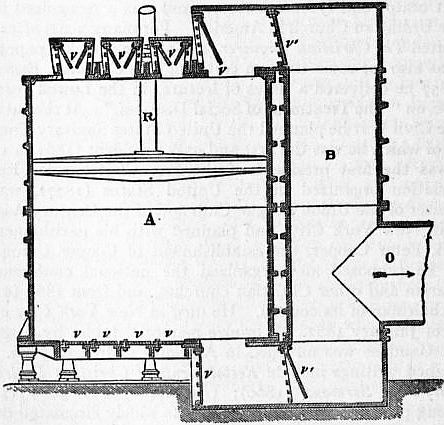
Fig. 3.—Section of Cylinder of Early Blowing Engine (1851).
The general action of a blowing engine may be illustrated by the sectional view shown on fig. 3, which represents the internal view of one of the blowing cylinders of the engines erected at the Dowlais Ironworks as far back as 1851. Many of the details are now obsolete, but the general scheme is the same as in all blowing engines. Here A is the air cylinder; in this is a piston whose rod is marked R; this piston is usually made air-tight by some form of packing fitted into the groove which runs round its edge. In this particular case the cylinder is placed vertically and its piston rod is actuated from the end of a rocking beam. The top and bottom ends are closed by covers and in these are a number of openings controlled by valves opening inwards so that air can flow freely in but cannot return. The piston is shown moving downwards. Air is now being drawn into the space above the piston through the valves v at the top, and the air in the space A below the piston, drawn in during the previous up-stroke, is being expelled through the valve v′ into the discharge chamber B, thence passing to the outlet pipe O. The action is reversed on the up-stroke. Thus it will be seen that air is being delivered both during the up-stroke and the down-stroke, and therefore flows almost continuously to the furnaces. There must, however, be momentary pauses at the ends of the strokes when the direction of movement is changed, and as the piston, though worked from an evenly rotating crank shaft, moves more quickly at the middle and slows down to no speed at the ends of its travel, there must be a considerable variation in the speed of delivery of the air. The air is therefore led from O into a large storage chamber or reservoir, whence it is again taken to the furnace; if this reservoir is made sufficiently large the elasticity of the air in it will serve to compensate for the irregularities, and a nearly uniform stream of air will flow from it. The valves used in this case and in most of the older blowing engines consist of rectangular metal plates hinged at one of the longer edges; these plates are faced with leather or india rubber so as to allow them to come to rest quietly and without clatter and at the same time to make them air-tight. It will be seen that some of these valves hang vertically and others lie flat on the bottom of the cover. The Dowlais cylinder is very large, having a diameter of 12 ft. and a piston stroke of 12 ft., giving a discharge of 44,000 cub. ft. of air per minute, at a pressure of 4¼ ℔ to the square inch.
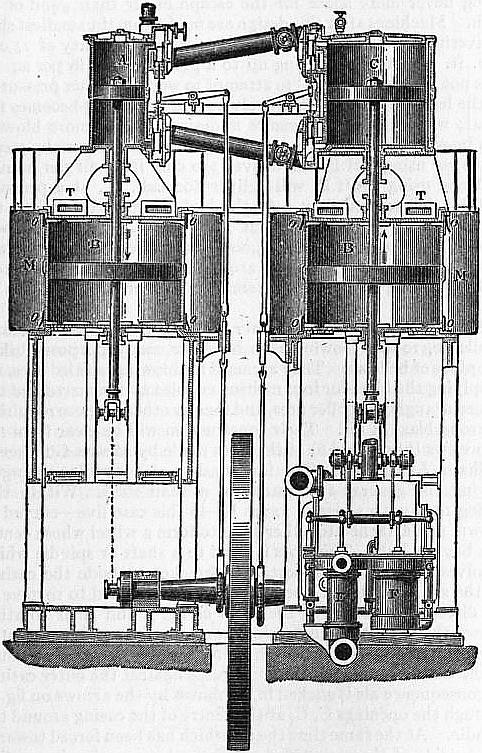
Fig. 4.—Vertical Section of Lackenby Blowing Engines (1871).
A later design of blowing engine, built in 1871 for the Lackenby iron-works, Middlesbrough, is shown in section in fig. 4, and is of a type which is still the most common, especially in the north of England. Here A, the high-pressure steam cylinder, and C, the low-pressure one, are placed in tandem with the air cylinders B, B, whose pistons they actuate. In these blowing cylinders the inlet valves in the bottom are circular disk valves of leather, eighteen in number; the inlet valves T on the top of the cylinder are arranged in ten rectangular boxes, having openings in their vertical sides, inside which are hung leather flap valves. The outlet valves O are ten in number at each end of the cylinders, and are hung against flat gratings which are arranged round the circumference. The blast is delivered into a wrought iron casing M which surrounds the cylinder. The combined area of the inlet valves is 860 sq. in., or one-sixth the area of the piston. The speed is twenty-four revolutions per minute and the air delivered at this speed is 15,072 cubic ft. per minute, the horse-power in the air cylinders being 258. The circulating pump E, air pump F, and feed pumps G, G, are worked off the cross-head on the low-pressure side.
A more modern form of blowing engine erected at the Dowlais works about the end of the 19th century, may be taken as typical of the present design of vertical blowing engine in use in Great Britain. The two air cylinders are placed below and in tandem with the steam cylinders as in the last case. The piston rods also terminate in connecting rods working on to the crank shaft. The air cylinders are each 88 in. in diameter, and the high and low pressure cylinders of the compound steam engine are 30 in. and 64 in. respectively, while the common stroke of all four is 60 in. The pressure of the air delivered varies from 4½ to 10 ℔ per sq. in. and the quantity per minute is 25,000 cub. ft. Each engine develops about 1200 horse-power. It is to be noted that flap valves such as those used in the 1851 Dowlais engine have in most cases given place to a larger number of circular steel disk valves, held to their seats by springs.
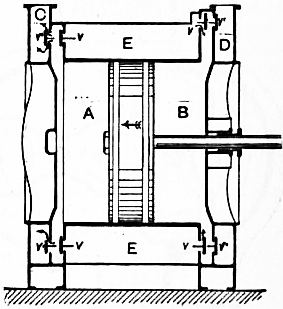
Fig. 5.—Richardsons, Westgarth & Co.’s Blowing Engine.
In a large blowing engine built in 1905 by Messrs Davy Bros. of Sheffield for the North-Eastern Steel Company at Middlesbrough (see Engineering, January 6, 1905) the same arrangement was adopted as in that just described. The two air cylinders are each 90 in. diameter and have a stroke of 72 in. The capacity of this engine is 52,000 cub. ft. of air per minute, delivered at a pressure of from 12½ to 15 ℔ per sq. in. when running at a speed of thirty-three revolutions per minute. The air valves consist of a large number of steel disks resting on circular seatings and held down by springs, which for the delivery valves are so adjusted in strength that they lift and release the air when the desired working pressure has been reached. It is worthy of note that in this engine no attempt is made to make the air pistons air-tight in the usual way by having packing rings set in grooves round the edge, but the piston is made deeper than usual and turned so as to be a very good fit in the cylinder and one or two small grooves are cut round the edge to hold the lubricant.
To illustrate a blowing engine driven by a gas engine supplied with blast furnace gas, fig. 5 gives a diagrammatic view of the blowing cylinder of an engine built by Messrs Richardsons, Westgarth & Co. of Middlesbrough about 1905. The gas cylinder is not shown. It will be seen that the air cylinder is horizontal, and it is arranged to work in tandem with the gas motor cylinder. The chief point of interest is to be found in the arrangement of the details of the air cylinder. Its diameter is 86½ in. and the length of piston stroke 55 in. As to the arrangement of the valves, if the piston be moving in the direction shown, on the left side of the piston at A air is being discharged, and follows the course indicated by the arrows, so as first to pass into the annular chamber which forms a continuation of the space A, and thence, through the spring-controlled steel disk valves v′, into the discharge chamber C, which ultimately leads to the blast pipe. It will be seen that the valves v on the other side of the annular chamber are closed. At the same time a partial vacuum is being formed in the space B, to be filled by the inflow of air through the valves v which are now open, the corresponding discharge valves v′ being closed. These valves on the inside and outside of the annular spaces referred to are arranged so as to form a circle round the ends of the barrel of the cylinder. The free air, instead of being drawn into the valves v direct from the air of the engine house, is taken from an enclosed annular chamber E, which may be in communication with the clean, cool air outside. It will be seen that the piston is made deep so as to allow for a long bearing surface in the cylinder. Two metal packing rings are provided to render the piston air-tight. The horse-power of this engine, which is designed on the Cockerell system, is 750.
Air valves of other types than those which have been mentioned have been tried, such as sliding grid valves, rotatory slide valves and piston valves, but it has been found that either flap or disk lift valves are more satisfactory for air on account of the grit which is liable to get between slide valves and their seatings. In some of the blowing engines made by Messrs Fraser & Chalmers (see Engineer, June 15, 1906), sheets of flexible bronze act as flap valves both for admission and delivery, the part which actually closes the opening being thickened for strength.
The pressure of the air supplied by blowing engines depends upon the purposes for which it is to be used. In charcoal furnaces the pressure is very low, being less than 1 ℔ per sq. in.; for blast furnaces using coal an average value of 4 ℔ is common; for American blast furnaces using coke or anthracite coal the pressure is as high as 10 ℔; while for the air required in the Bessemer process of steel-making pressures up to 25 or 30 ℔ per sq. in. are not uncommon. According to British practice one large blowing engine is used to supply several blast furnaces, while in America a number of smaller ones is used, one for each furnace.
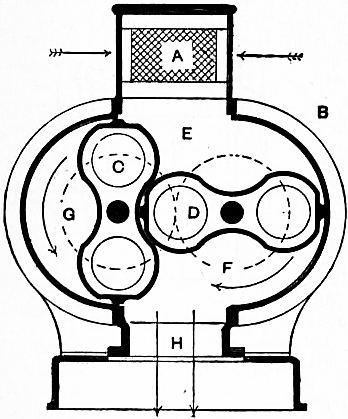
Fig. 6.—Thwaites’ Improved Roots’ Blower.
Rotary blowers occupy a position midway between blowing engines and fan blowers, being used for purposes requiring the delivery of large volumes of air at pressures lower than those of blowing engines, but higher than those of fan blowers. The blowing engine draws in, compresses and delivers its air by the direct action of air-tight pistons; the same effect is aimed at in a rotary blower with the difference that the piston revolves instead of moving up and down a cylinder.
Two of the best-known machines of this kind are Roots’ and Baker’s, both American devices. The mode of action of Roots’ blower, as made by Messrs Thwaites Bros. of Bradford, will be clear from the section shown on fig. 6. The moving parts work in a closed casing B, which consists of half-cylindrical curved plates placed a little more than their own radius apart, the ends being enclosed by two plates. Within the casing, and barely touching the curved part of the casing and each other, revolve two parts C, D, called “revolvers,” the speed of rotation of which is the same, but the direction opposite. They are compelled to keep their proper relative positions by a pair of equal spur wheels fixed on the ends of the shafts on which they run. The free air enters the casing through a wire screen at A and passes into the space E.
As the space E increases in volume owing to the movement of the revolvers, air is drawn in; it is then imprisoned between D and the casing, as shown at G, and is carried round until it is free to enter F, from which it is in turn expelled by the lessening of this space as the lower ends of the revolvers come together. In this way a series of volumes of air is drawn in through A, to be afterwards expelled from H in an almost perfectly continuous stream, this result being brought about by the relative variation in volume of the spaces E, F and G. In their most improved form the revolvers are made hollow, of cast iron, and accurately machined to a form such that they always keep close to one another and to the end casing without actually touching, there being never more space for the escape of air than 1⁄32nd of an inch. Machines after this design are made from the smallest size, delivering 25 cub. ft., to the largest, with a capacity of 25,000 cub. ft. per minute working up to a pressure of 3 ℔ per sq. in. It is not found economical to attempt to work at higher pressures, as the leakage between the revolvers and the casing becomes too great; where a higher pressure is desired two or more blowers can be worked in series, the air being raised in pressure by steps. A blower using 1 H.P. will deliver 350 cub. ft. of air per minute and one using 2¾ H.P. will deliver 800 cub. ft., at a pressure suitable for smiths’ fires. At the higher pressure required for cupola work—somewhere about ¾ ℔ per sq. in.—6½ H.P. will deliver 1300, and 123 H.P. 25,000 cub. ft. per minute. In the Baker blower three revolvers are used—a large one which acts as the rotating piston and two smaller ones forming air locks or valves.
Rotary Fans.—Now that power for driving them is so generally available, rotary blowing fans have for many purposes taken the place of bellows. They are used for blowing smiths’ fires, for supplying the blast for iron melting cupolas and furnaces and the forced draught for boiler fires, and for any other purpose requiring a strong blast of air. Their construction will be clear from the two views (figs. 7 and 8) of the form made by Messrs Günther of Oldham, Lancashire. The fan consists of a circular casing A having the general appearance of a snail shell. Within this casing revolves a series of vanes B—in this case five—curved as shown, and attached together so as to form a wheel whose centre is a boss or hub. This boss is fixed to a shaft or spindle which revolves in bearings supported on brackets outside the casing. As the shaft is rotated, the vanes B are compelled to revolve in the direction indicated by the arrow on fig. 7, and their rotation causes the air within the casing to rotate also. Thus a centrifugal action is set up by which there is a diminution of pressure at the centre of the fan and an increase against the outer casing. In consequence air is sucked in, as shown by the arrows on fig. 8, through the openings C, C, at the centre of the casing around the spindle. At the same time the air which has been forced towards the outside of the casing and given a rotary motion is expelled from the opening at D (fig. 8). All blowing fans work on the same principle, though differences in detail are adopted by different makers to meet the variety of conditions under which they are to be used. Where the fan is to be employed for producing a delivery or blast of air the opening D is connected to an air pipe which serves to transmit the current of air, and C is left open to the atmosphere; when, however, the main object is suction, as in the case where the fan is used for ventilation, the aperture C is connected through a suction pipe with the space to be exhausted, D being usually left open. Günther fans range in size from those which have a diameter of fan disk of 8 in. and make 5500 revolutions per minute, to those which have a diameter of 50 in. and run at from 950 to 1200 revolutions per minute. For exhausting the fans are run less quickly than for blowing, the speed for a fan of 10 in. diameter being 4800 revolutions for blowing and 3300-4000 for exhausting, while the 50-in. fan only runs at 550-700 when exhausting. These two exhausting fans remove 400-500 and 12,000-15,000 cub. ft. of air per minute respectively.
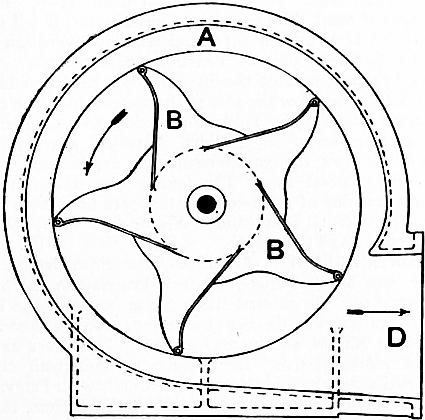
Fig. 7.—Günther’s Blowing Fan.
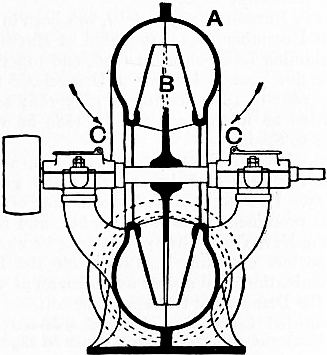
Fig. 8.—Günther’s Blowing Fan.
The useful effect of rotary fans, that is to say the proportion of the total power used to drive the fan which is actually utilized in producing the current of air, is very low for the smaller sizes, but may rise to 30-70% in sizes above 5 ft. in diameter. It has its maximum value for any given fan at a certain definite speed. Fans are most suitable in cases where it is required to move or deliver comparatively large volumes of air at pressures which are little above that of the atmosphere. Where the pressure of the current produced exceeds a quarter of a pound on the square inch the waste of work becomes so great as to preclude their use. The fan is not the most economical form of blower, but it is simple and inexpensive, both in first cost and in maintenance. The largest fans are used for ventilating purposes, chiefly in mines, their diameters rising to 40 or even 50 ft. The useful effect of some of these larger fans, as obtained from experiments, is as high as 75%. In the case of the Capell fan, which differs from other forms in that it has two series of blades, inner and outer, separated by a curved blank piece between the inner wings, dipping into the fan inlet, and the outer wings, very high efficiencies have been obtained, being as great as 90% in some cases. Capell fans are used for ventilating mines, buildings, and ships, and for providing induced currents for use in boiler furnaces. In the larger fans the casing, instead of having a curved section, is more often built of sheet steel and is given a rectangular section at right angles to the periphery. The Sirocco blowing fan, of Messrs Davidson of Belfast, has a larger number of blades, which are relatively narrow as measured radially, but wide axially. It can be made much smaller in diameter than fans of the older designs for the same output of air—a great advantage for use in ships or in buildings where space is limited—and its useful effect is also said to be superior. (See also Hydraulics, § 213.)
Helical or screw blowers, often called “air propellers,” are used where relatively large volumes of air have to be moved against hardly any perceptible difference in pressure, chiefly for purposes of ventilation and drying. Most often the propeller is used to move air from one room or chamber to another adjoining, and is placed in a light circular iron frame which is fixed in a hole in the wall through which the air is to be passed. The propeller itself consists of a series of vanes or wings arranged helically on a revolving shaft which is fixed in the centre of the opening. The centre line of the shaft is perpendicular to the plane of the opening so that when the vanes revolve the air is drawn towards and through the opening and is propelled away from it as it passes through. The action is similar to that of a steamship screw propeller, air taking the place of water. Such blowers are often driven by small electric motors working directly on the end of the shaft. For moving large volumes of air against little pressure and suction they are very suitable, being simpler than fans, cheaper both in first cost and maintenance for the same volume of air delivered, and less likely to fail or get out of order. To obtain the best effect for the power used a certain maximum speed of rotation must not be exceeded; at higher speeds a great deal of the power is wasted. For example, a propeller with a vane diameter of 2½ ft. was found to deliver a volume of air approximately proportional to the speed up to about 700 revolutions per minute, when 8000 cub. ft. per minute were passed through the machine; but doubling this speed to 1400 revolutions per minute only increased delivery by 1000 cub. ft. to 9000. At the lower of these speeds the horse-power absorbed was 0.6 and at the higher one 1.6.
Other Appliances for producing Currents of Air.—In its primitive form the “trompe” or water-blowing engine adopted in Savoy, Carniola, and some parts of America, consists of a long vertical wooden pipe terminating at its lower end in an air chest. Water is allowed to enter the top of the pipe through a conical plug and, falling down in streamlets, carries with it air which is drawn in through sloping holes near the top of the pipe. In this way a quantity of air is delivered into the chamber, its pressure depending on the height through which the water falls. This simple arrangement has been developed for use in compressing large volumes of air at high pressures to be used for driving compressed air machinery. It is chiefly used in America, and provides a simple and cheap means of obtaining compressed air where there is an abundant natural supply of water falling through a considerable height. The pressure obtained in the air vessel is somewhat less than half a pound per square inch for every foot of fall.
Natural sources of water are also used for compressing and discharging air by letting the water under its natural pressure enter and leave closed vessels, so alternately discharging and drawing in new supplies of air. Here the action is the same as in a blowing engine, the water taking the place of the piston. This method was first thoroughly developed in connexion with the Mt. Cenis tunnel works, and its use has since been extended.
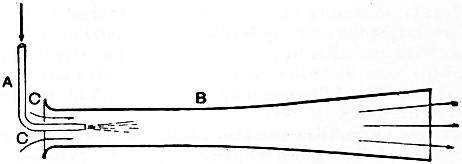
Fig. 9.—Steam-jet Blower.
In the jet blower (fig. 9) a jet of steam is used to induce a current of air. Into one end of a trumpet-shaped pipe B projects a steam pipe A. This steam pipe terminates in a small opening, say, one-eighth of an inch, through which the steam is allowed to flow freely. The effect is to cause a movement of the air in the pipe, with the result that a fresh supply is drawn in through the annular opening at C, C, and a continuous stream of air passes along the pipe. This is the form of blower made by Messrs Meldrum Bros. of Manchester, and is largely used for delivering air under the fire bars of boiler and other furnaces. In some cases the jets of steam are allowed to enter a boiler furnace above the fire, thus inducing a current of air which helps the chimney draught and is often used to do away with the production of smoke; they are also used for producing currents of air for purposes other than those of boiler fires, and are very convenient where considerable quantities of air are wanted at very low pressures and where the presence of the moisture of the steam does not matter.
Sometimes jets of high-pressure air flowing at great velocities are used to induce more slowly-moving currents of larger volumes of air at low pressures.
(W. C. P.)
1 The Old English word for this appliance was blástbaelig, i.e. “blow-bag,” cf. German Blasebalg. By the 11th century the first part of the word apparently dropped out of use, and baelig, bylig, bag, is found in early glossaries as the equivalent of the Latin follis. Baelig became in Middle English bely, i.e. “belly,” a sack or bag, and so the general word for the lower part of the trunk in man and animals, the stomach, and another form, probably northern in origin, belu, belw, became the regular word for the appliance, the plural “bellies” being still used till the 16th century, when “bellows” appears, and the word in the singular ceases to be used. The verb “to bellow” of the roar of a bull, or the low of a cow, is from Old English bellan, to bell, roar.
BELLOY, DORMONT DE, the name assumed by Pierre Laurext Buireite (1727-1775), French dramatist, was born at Saint-Flour, in Auvergne, on the 17th of November 1727. He was educated by his uncle, a distinguished advocate in Paris, for the bar. To escape from a profession he disliked he joined a troupe of comedians playing in the courts of the northern sovereigns. In 1758 the performance of his Titus, which had already been produced in St Petersburg, was postponed through his uncle’s exertions; and when it did appear, a hostile cabal procured its failure, and it was not until after his guardian’s death that de Belloy returned to Paris with Zelmire (1762), a fantastic drama which met with great success. This was followed in 1765 by the patriotic play, Le Siège de Calais. The moment was opportune. The humiliations undergone by France in the Seven Years’ War assured a good reception for a play in which the devotion of Frenchmen redeemed disaster. The popular enthusiasm was unaffected by the judgment of calmer critics such as Diderot and Voltaire, who pointed out that the glorification of France was not best effected by a picture of defeat. De Belloy was admitted to the Academy in 1772. His attempt to introduce national subjects into French drama deserves honour, but it must be confessed that his resources proved unequal to the task. The Siège de Calais was followed by Gaston et Bayard (1771), Pedro le cruel (1772) and Gabrielle de Vergy (1777). None of these attained the success of the earlier play, and de Belloy’s death, which took place on the 5th of March 1775, is said to have been hastened by disappointment.
BELL or INCHCAPE ROCK, a sandstone reef in the North Sea, 11 m. S.E. of Arbroath, belonging to Forfarshire, Scotland. It measures 2000 ft. in length, is under water at high tide, but at low tide is exposed for a few feet, the sea for a distance of 100 yds. around being then only three fathoms deep. Lying in the fairway of vessels making or leaving the Tay and Forth, besides ports farther north, it was a constant menace to navigation. In the great gale of 1799 seventy sail, including the “York,” 74 guns, were wrecked off the reef, and this disaster compelled the authorities to take steps to protect shipping. Next year Robert Stevenson modelled a tower and reported that its erection was feasible, but it was only in 1806 that parliamentary powers were obtained, and operations began in August 1807. Though John Rennie had meanwhile been associated with Stevenson as consulting engineer, the structure in design and details is wholly Stevenson’s work. The tower is 100 ft. high; its diameter at the base is 42 ft., decreasing to 15 ft. at the top. It is solid for 30 ft. at which height the doorway is placed. The interior is divided into six storeys. After five years the building was finished at a cost of £61,300. Since the lighting no wrecks have occurred on the reef. A bust of Stevenson by Samuel Joseph (d. 1850) was placed in the tower.
According to tradition an abbot of Aberbrothock (Arbroath) had ordered a bell—whence the name of the rock—to be fastened to the reef in such a way that it should respond to the movements of the waves, and thus always ring out a warning to mariners. This signal was wantonly destroyed by a pirate, whose ship was afterwards wrecked at this very spot, the rover and his men being drowned. Southey made the incident the subject of his ballad of “The Inchcape Rock.”
BELLUNO (anc. Bellunum), a city and episcopal see of Venetia, Italy, the capital of the province of Belluno, N. of Treviso, 54 m. by rail and 28 m. direct. Pop. (1901) town, 6898; commune, 19,050. It is situated in the valley of the Piave, at its confluence with the Ardo, 1285 ft. above sea-level, among the lower Venetian Alps. It was a Roman municipium. In the middle ages it went through various vicissitudes; it fell under the dominion of Venice in 1511, and remained Venetian until 1797. Its buildings present Venetian characteristics; it has some good palaces, notably the fine early Lombard Renaissance Palazzo dei Rettori, now the seat of the prefecture. The cathedral, erected after 1517 by Tullio Lombardo, was much damaged by the earthquake of 1873, which destroyed a considerable portion of the town, though the campanile, 217 ft. high, erected in 1732-1743, stood firm. The façade was never finished. Important remains of prehistoric settlements have been found in the vicinity; cf. G. Ghirardini in Notizie degli Scavi, 1883, 27, on the necropolis of Caverzano.
(T. As.)
BELMONT, AUGUST (1816-1890), American banker and financier, was born at Alzei, Rhenish Prussia, on the 8th of December 1816. He entered the banking house of the Rothschilds at Frankfort at the age of fourteen, acted as their agent for a time at Naples, and in 1837 settled in New York as their American representative. He became an American citizen, and married a daughter of Commodore Matthew C. Perry. He was the consul-general of Austria at New York from 1844 to 1850, when he resigned in protest against Austria’s treatment of Hungary. In 1853-1855 he was chargé d’affaires for the United States at the Hague, and from 1855 to 1858 was the American minister resident there. In 1860 he was a delegate to the Democratic National Convention at Charleston, South Carolina, actively supporting Stephen A. Douglas for the presidential nomination, and afterwards joining those who withdrew to the convention at Baltimore, Maryland, where he was chosen chairman of the National Democratic Committee. He energetically supported the Union cause during the Civil War, and exerted a strong influence in favour of the North upon the merchants and financiers of England and France. He remained at the head of the Democratic organization until 1872. He died in New York on the 24th of November 1890.
His son, Perry Belmont (1851- ), was born in New York on the 28th of December 1851, graduated at Harvard in 1872 and at the Columbia Law School in 1876, and practised law in New York for five years. He was a Democratic member of Congress from 1881 to 1889, serving in 1885-1887 as chairman of the committee on foreign affairs. In 1889 he was United States minister to Spain.
Another son, August Belmont (1853- ), was born in New York on the 18th of February 1853 and graduated at Harvard in 1875. He succeeded his father as head of the banking house and was prominent in railway finance, and in financing and building the New York subway. In 1904 he was one of the principal supporters of Alton B. Parker for the Democratic presidential nomination, and served as chairman of the finance committee of the Democratic National Committee.
A volume entitled Letters, Speeches and Addresses of August Belmont (the elder) was published at New York in 1890.
BELOIT, a city of Rock county, Wisconsin, U.S.A., situated on the S. boundary of the state, on Rock river, about 91 m. N.W. of Chicago and about 85 m. S.W. of Milwaukee. Pop. (1890) 6315; (1900) 10,436, of whom 1468 were foreign-born; (1910) 15,125. It is served by the Chicago & North-Western, and the Chicago, Milwaukee & St Paul railways, and by an inter-urban electric railway to Janesville, Wisconsin and Rockford, Illinois. Beloit is attractively situated on high bluffs on both sides of the river. The city is the seat of Beloit College, a co-educational, non-sectarian institution, founded under the auspices of the Congregational and Presbyterian churches in 1847, and having, in 1907-1908, 36 instructors and 430 students. It has classical, philosophical (1874) and scientific (1892) courses; women were first admitted in 1895. The Greek department of the college has supervised since 1895 the public presentation nearly every year of an English version of a Greek play. The river furnishes good water-power, and among the manufactures are wood-working machinery, ploughs, steam pumps, windmills, gas engines, paper-mill machinery, cutlery, flour, ladies’ shoes, cyclometers and paper; the total value of the factory product in 1905 was $4,485,224, 60.2% more than in 1900. Beloit, founded by New Englanders in 1838, was chartered as a city in 1856.
BELOMANCY (from βέλος, a dart, and μαντεία, prophecy or divination), a form of divination (q.v.) by means of arrows, practised by the Babylonians, Scythians and other ancient peoples. Nebuchadrezzar (Ezek. xxi. 21) resorted to this practice “when he stood in the parting of the way ... to use divination: he made his arrows bright.”
BELON, PIERRE (1517-1564), French naturalist, was born about 1517 near Le Mans (Sarthe). He studied medicine at Paris, where he took the degree of doctor, and then became a pupil of the botanist Valerius Cordus (1515-1544) at Wittenberg, with whom he travelled in Germany. On his return to France he was taken under the patronage of Cardinal de Tournon, who furnished him with means for undertaking an extensive scientific journey. Starting in 1546, he travelled through Greece, Asia Minor, Egypt, Arabia and Palestine, and returned in 1549. A full account of his travels, with illustrations, was published in 1553. Belon, who was highly favoured both by Henry II. and by Charles IX., was assassinated at Paris one evening in April 1564, when coming through the Bois de Boulogne. Besides the narrative of his travels he wrote several scientific works of considerable value, particularly the Histoire naturelle des estranges poissons (1551), De aquatilibus (1553), and L’Histoire de la nature des oyseaux (1555), which entitle him to be regarded as one of the first workers in the science of comparative anatomy.
BELPER, a market-town in the mid-parliamentary division of Derbyshire, England, on the river Derwent, 7 m. N. of Derby on the Midland railway. Pop. of urban district (1901), 10,934. The chapel of St John is said to have been founded by Edmund Crouchback, second son of Henry III., about the middle of the 13th century. There is an Anglican convent of the Sisters of St Lawrence, with orphanage and school. For a considerable period one of the most flourishing towns in the county, Belper owed its prosperity to the establishment of cotton works in 1776 by Messrs Strutt, the title of Baron Belper (cr. 1856), in the Strutt family, being taken from the town. Belper also manufactures linen, hosiery, silk and earthenware; and after the decline of nail-making, once an important industry, engineering works and iron foundries were opened. The Derwent provides water-power for the cotton-mills. John of Gaunt is said to have been a great benefactor to Belper, and the foundations of a massive building have been believed to mark the site of his residence. A chapel which he founded is incorporated with a modern schoolhouse. The scenery in the neighbourhood of Belper, especially to the west, is beautiful; but there are collieries, lead-mines and quarries in the vicinity of the town.
Belper (Beaurepaire) until 1846 formed part of the parish of Duffield, granted by William I. to Henry de Ferrers, earl of Derby. There is no distinct mention of Belper till 1296, when the manor was held by Edmund Crouchback, earl of Lancaster, who is said to have enclosed a park and built a hunting seat, to which, from its situation, he gave the name Beaurepaire. The manor thus became parcel of the duchy of Lancaster and is said to have been the residence of John of Gaunt. It afterwards passed with Duffield to the Jodrell family. In a great storm in 1545, 40 houses were destroyed, and the place was scourged by the plague in 1609.
See C. Willott, Historical Records of Belper.
BELSHAM, THOMAS (1750-1829), English Unitarian minister, was born at Bedford on the 26th of April 1750. He was educated at the dissenting academy at Daventry, where for seven years he acted as assistant tutor. After three years spent in a charge at Worcester, he returned as head of the Daventry academy, a post which he continued to hold till 1789, when, having adopted Unitarian principles, he resigned. With Joseph Priestly for colleague, he superintended during its brief existence a new college at Hackney, and was, on Priestly’s departure in 1794, also called to the charge of the Gravel Pit congregation. In 1805 he accepted a call to the Essex Street chapel, where in gradually failing health he remained till his death in 1829. Belsham’s first work of importance, Review of Mr Wilberforce’s Treatise entitled Practical View (1798), was written after his conversion to Unitarianism. His most popular work was the Evidences of Christianity; the most important was his translation and exposition of the Epistles of St Paul (1822). He was also the author of a work on philosophy, Elements of the Philosophy of the Human Mind (1801), which is entirely based on Hartley’s psychology. Belsham is one of the most vigorous and able writers of his church, and the Quarterly Review and Gentleman’s Magazine of the early years of the 19th century abound in evidences that his abilities were recognized by his opponents.
BELSHAZZAR (6th century B.C.), Babylonian general. Until the decipherment of the cuneiform inscriptions, he was known only from the book of Daniel (v. 2, 11, 13, 18) and its reproduction in Josephus, where he is represented as the son of Nebuchadrezzar and the last king of Babylon. As his name did not appear in the list of the successors of Nebuchadrezzar handed down by the Greek writers, various suggestions were put forward as to his identity. Niebuhr identified him with Evil-Merodach, Ewald with Nabonidos, others again with Neriglissor. The identification with Nabonidos, the last Babylonian king according to the native historian Berossus, goes back to Josephus. The decipherment of the cuneiform texts put an end to all such speculations. In 1854 Sir H.C. Rawlinson discovered the name of Bel-sarra-uzur—“O Bel, defend the king”—in an inscription belonging to the first year of Nabonidos which had been discovered in the ruins of the temple of the Moon-god at Muqayyar or Ur. Here Nabonidos calls him his “first-born son,” and prays that “he may not give way to sin,” but that “the fear of the great divinity” of the Moon-god may “dwell in his heart.” In the contracts and similar documents there are frequent references to Belshazzar, who is sometimes entitled simply “the son of the king.”
He was never king himself, nor was he son of Nebuchadrezzar. Indeed his father Nabonidos (Nabunaid), the son of Nabu-baladsu-iqbi, was not related to the family of Nebuchadrezzar and owed his accession to the throne to a palace revolution. Belshazzar, however, seems to have had more political and military energy than his father, whose tastes were antiquarian and religious; he took command of the army, living with it in the camp near Sippara, and whatever measures of defence were organized against the invasion of Cyrus appear to have been due to him. Hence Jewish tradition substituted him for his less-known father, and rightly concluded that his death marked the fall of the Babylonian monarchy. We learn from the Babylonian Chronicle that from the 7th year of Nabonidos (548 B.C.) onwards “the son of the king” was with the army in Akkad, that is in the close neighbourhood of Sippara. This, as Dr Th. G. Pinches has pointed out, doubtless accounts for the numerous gifts bestowed by him on the temple of the Sun-god at Sippara. So late as the 5th of Ab in the 17th year of Nabonidos—that is to say, about three weeks after the forces of Cyrus had entered Babylonia and only three months before his death—we find him paying 47 shekels of silver to the temple on behalf of his sister, this being the amount of “tithe” due from her at the time. At an earlier period there is frequent mention of his trading transactions which were carried out through his house-steward or agent. Thus in 545 B.C. he lent 20 manehs of silver to a private individual, a Persian by race, on the security of the property of the latter, and a year later his house-steward negotiated a loan of 16 shekels, taking as security the produce of a field of corn.
The legends of Belshazzar’s feast and of the siege and capture of Babylon by Cyrus which have come down to us from the book of Daniel and the Cyropaedia of Xenophon have been shown by the contemporaneous inscriptions to have been a projection backwards of the re-conquest of the city by Darius Hystaspis. The actual facts were very different. Cyrus had invaded Babylonia from two directions, he himself marching towards the confluence of the Tigris and Diyaleh, while Gobryas, the satrap of Kurdistan, led another body of troops along the course of the Adhem. The portion of the Babylonian army to which the protection of the eastern frontier had been entrusted was defeated at Opis on the banks of the Nizallat, and the invaders poured across the Tigris into Babylonia. On the 14th of Tammuz (June), 538 B.C., Nabonidos fled from Sippara, where he had taken his son’s place in the camp, and the city surrendered at once to the enemy. Meanwhile Gobryas had been despatched to Babylon, which opened its gates to the invader on the 16th of the month “without combat or battle,” and a few days later Nabonidos was dragged from his hiding-place and made a prisoner. According to Berossus he was subsequently appointed governor of Karmania by his conqueror. Belshazzar, however, still held out, and it was probably on this account that Cyrus himself did not arrive at Babylon until nearly four months later, on the 3rd of Marchesvan. On the 11th of that month Gobryas was despatched to put an end to the last semblance of resistance in the country “and the son (?) of the king died.” In accordance with the conciliatory policy of Cyrus, a general mourning was proclaimed on account of his death, and this lasted for six days, from the 27th of Adar to the 3rd of Nisan. Unfortunately the character representing the word “son” is indistinct on the tablet which contains the annals of Nabonidos, so that the reading is not absolutely certain. The only other reading possible, however, is “and the king died,” and this reading is excluded partly by the fact that Nabonidos afterwards became a Persian satrap, partly by the silence which would otherwise be maintained by the “Annals” in regard to the fate of Belshazzar. Considering how important Belshazzar was politically, and what a prominent place he occupied in the history of the period, such a silence would be hard to explain. His death subsequently to the surrender of Babylon and the capture of Nabonidos, and with it the last native effort to resist the invader, would account for the position he assumed in later tradition and the substitution of his name for that of the actual king.
See Th. G. Pinches, P.S.B.A., May 1884; H. Winckler, Zetischrift für Assyriologie, ii. 2, 3 (1887); Records of the Past, new series, i. pp. 22-31 (1888); A.H. Sayce, The Higher Criticism, pp. 497-537 (1893).
(A. H. S.)
BELT, THOMAS (1832-1878), English geologist and naturalist, was born at Newcastle-on-Tyne in 1832, and educated in that city. As a youth he became actively interested in natural history through the Tyneside Naturalists’ Field Club. In 1852 he went to Australia and for about eight years worked at the gold-diggings, where he acquired a practical knowledge of ore-deposits. In 1860 he proceeded to Nova Scotia to take charge of some gold-mines, and there met with a serious injury, which led to his return to England. In 1861 he issued a separate work entitled Mineral Veins: an Enquiry into their Origin, founded on a Study of the Auriferous Quartz Veins of Australia. Later on he was engaged for about three years at Dolgelly, another though small gold-mining region, and here he carefully investigated the rocks and fossils of the Lingula Flags, his observations being published in an important and now classic memoir in the Geological Magazine for 1867. In the following year he was appointed to take charge of some mines in Nicaragua, where he passed four active and adventurous years—the results being given in his Naturalist in Nicaragua (1874), a work of high merit. In this volume the author expressed his views on the former presence of glaciers in that country. In subsequent papers he dealt boldly and suggestively with the phenomena of the Glacial period in Britain and in various parts of the world. After many further expeditions to Russia, Siberia and Colorado, he died at Denver on the 21st of September 1878.
BELT (a word common to Teutonic languages, the Old Ger. form being balz, from which the Lat. balteus probably derived), a flat strap of leather or other material used as a girdle (q.v.), especially the cinctura gladii or sword-belt, the chief “ornament of investiture” of an earl or knight; in machinery, a flexible strap passing round from one drum, pulley or wheel to another, for the purpose of power-transmission (q.v.). The word is applied to any broad stripe, to the belts of the planet Jupiter, to the armour-belt at the water-line of a warship, or to a tract of country, narrow in proportion to its length, with special distinguishing characteristics, such as the earthquake-belt across a continent.
BELTANE, Beltene, Beltine, or Beal-Tene (Scottish Gaelic, bealltain), the Celtic name for May-day, on which also was held a festival called by the same name, originally common to all the Celtic peoples, of which traces still linger in Ireland, the Highlands of Scotland and Brittany. This festival, the most important ceremony of which in later centuries was the lighting of the bonfires known as “beltane fires,” is believed to represent the Druidical worship of the sun-god. The fuel was piled on a hill-top, and at the fire the beltane cake was cooked. This was divided into pieces corresponding to the number of those present, and one piece was blackened with charcoal. For these pieces lots were drawn, and he who had the misfortune to get the black bit became cailleach bealtine (the beltane carline)—a term of great reproach. He was pelted with egg-shells, and afterwards for some weeks was spoken of as dead. In the north-east of Scotland beltane fires were still kindled in the latter half of the 18th century. There were many superstitions connecting them with the belief in witchcraft. According to Cormac, archbishop of Cashel about the year 908, who furnishes in his glossary the earliest notice of beltane, it was customary to light two fires close together, and between these both men and cattle were driven, under the belief that health was thereby promoted and disease warded off. (See Transactions of the Irish Academy, xiv. pp. 100, 122, 123.) The Highlanders have a proverb, “he is between two beltane fires.” The Strathspey Highlanders used to make a hoop of rowan wood through which on beltane day they drove the sheep and lambs both at dawn and sunset.
As to the derivation of the word beltane there is considerable obscurity. Following Cormac, it has been usual to regard it as representing a combination of the name of the god Bel or Baal or Bil with the Celtic teine, fire. And on this etymology theories have been erected of the connexion of the Semitic Baal with Celtic mythology, and the identification of the beltane fires with the worship of this deity. This etymology is now repudiated by scientific philologists, and the New English Dictionary accepts Dr Whitley Stokes’s view that beltane in its Gaelic form can have no connexion with teine, fire. Beltane, as the 1st of May, was in ancient Scotland one of the four quarter days, the others being Hallowmas, Candlemas, and Lammas.
For a full description of the beltane celebration in the Highlands of Scotland during the 18th century, see John Ramsay, Scotland and Scotsmen in the 18th Century, from MSS. edited by A. Allardyce (1888); and see further J. Robertson in Sinclair’s Statistical Account of Scotland, xi. 620; Thomas Pennant, Tour in Scotland (1769-1770); W. Gregor, “Notes on Beltane Cakes,” Folklore, vi. (1895), p. 2; and “Notes on the Folklore of the North-East of Scotland,” p. 167 (Folklore Soc. vii. 1881); A. Bertrand, La Religion des Gaulois (1897); Jamieson, Scottish Dictionary (1808). Cormac’s Glossary has been edited by O’Donovan and Stokes (1862).
BELUGA (Delphinapterus leucas), also called the “white whale,” a cetacean of the family Delphinidae, characterized by its rounded head and uniformly light colour. A native of the Arctic seas, it extends in the western Atlantic as far south as the river St Lawrence, which it ascends for a considerable distance. In colour it is almost pure white; the maximum length is about twelve feet; and the back-fin is replaced by a low ridge. Examples have been taken on the British coasts; and individuals have been kept for some time in captivity in America and in London. See Cetacea.
BELVEDERE, or Belvidere (Ital. for “fair-view”), an architectural structure built in the upper part of a building or in any elevated position so as to command a fine view. The belvedere assumes various forms, such as an angle turret, a cupola, a loggia or open gallery. The name is also applied to the whole building, as the Belvedere gallery in the Vatican at Rome. For Apollo Belvidere see Greek Art, Plate II. fig. 55.
BELVIDERE, a city and the county-seat of Boone county, Illinois, U.S.A., in the N. part of the state, on the Kishwaukee river, about 78 m. N.W. of Chicago. Pop. (1890) 3867; (1900) 6937 (1018 foreign-born); (1910) 7253. It is served by the Chicago & North-Western railway, and by an extensive inter-urban electric system. Among its manufactures are sewing machines, boilers, automobiles, bicycles, roller-skates, pianos, gloves and mittens, corsets, flour and dairy products, Borden’s condensed milk factory being located there. Belvidere was settled in 1836, was incorporated in 1852 and was re-incorporated in 1881.
BELZONI, GIOVANNI BATTISTA (1778-1823), Italian explorer of Egyptian antiquities, was born at Padua in 1778. His family was from Rome, and in that city he spent his youth. He intended taking monastic orders, but in 1798 the occupation of the city by the French troops drove him from Rome and changed his proposed career. He went back to Padua, where he studied hydraulics, removed in 1800 to Holland, and in 1803 went to England, where he married an Englishwoman. He was 6 ft. 7 in. in height, broad in proportion, and his wife was of equally generous build. They were for some time compelled to find subsistence by exhibitions of feats of strength and agility at fairs and on the streets of London. Through the kindness of Henry Salt, the traveller and antiquarian, who was ever afterwards his patron, he was engaged at Astley’s amphitheatre, and his circumstances soon began to improve. In 1812 he left England, and after travelling in Spain and Portugal reached Egypt in 1815, where Salt was then British consul-general. Belzoni was desirous of laying before Mehemet Ali a hydraulic machine of his own invention for raising the waters of the Nile. Though the experiment with this engine was successful, the design was abandoned by the pasha, and Belzoni resolved to continue his travels. On the recommendation of the orientalist, J.L. Burckhardt, he was sent at Salt’s charges to Thebes, whence he removed with great skill the colossal bust of Rameses II., commonly called Young Memnon, which he shipped for England, where it is in the British Museum. He also pushed his investigations into the great temple of Edfu, visited Elephantine and Philae, cleared the great temple at Abu Simbel of sand (1817), made excavations at Karnak, and opened up the sepulchre of Seti I. (“Belzoni’s Tomb”). He was the first to penetrate into the second pyramid of Giza, and the first European in modern times to visit the oasis of Baharia, which he supposed to be that of Siwa. He also identified the ruins of Berenice on the Red Sea. In 1819 he returned to England, and published in the following year an account of his travels and discoveries entitled Narrative of the Operations and Recent Discoveries within the Pyramids, Temples, Tombs and Excavations in Egypt and Nubia, &c. He also exhibited during 1820-1821 facsimiles of the tomb of Seti I. The exhibition was held at the Egyptian Hall, Piccadilly, London. In 1822 Belzoni showed his model in Paris. In 1823 he set out for West Africa, intending to penetrate to Timbuktu. Having been refused permission to pass through Morocco, he chose the Guinea Coast route. He reached Benin, but was seized with dysentery at a village called Gwato, and died there on the 3rd of December 1823. In 1829 his widow published his drawings of the royal tombs at Thebes.
BEM, JOSEF (1795-1850), Polish soldier, was born at Tarnow in Galicia, and was educated at the military school at Warsaw, where he especially distinguished himself in mathematics. Joining a Polish artillery regiment in the French service, he took part in the Russian campaign of 1812, and subsequently so brilliantly distinguished himself in the defence of Danzig (January-November 1813) that he won the cross of the Legion of Honour. On returning to Poland he was for a time in the Russian service, but lost his post, and his liberty as well for some time, for his outspokenness. In 1825 he migrated to Lemberg, where he taught the physical sciences. He was about to write a treatise on the steam-engine, when the Polish War of Independence summoned him back to Warsaw in November 1830. It was his skill as an artillery officer which won for the Polish general Skrynecki the battle of Igany (March 8, 1831), and he distinguished himself at the indecisive battle of Ostrolenká (May 26). He took part in the desperate defence of Warsaw against Prince Paskievich (September 6-7, 1831). Then Bem escaped to Paris, where he supported himself by teaching mathematics. In 1833 he went to Portugal to assist the liberal Dom Pedro against the reactionary Dom Miguel, but abandoned the idea when it was found that a Polish legion could not be formed. A wider field for his activity presented itself in 1848. First he attempted to hold Vienna against the imperial troops, and, after the capitulation, hastened to Pressburg to offer his services to Kossuth, first defending himself, in a long memorial, from the accusations of treachery to the Polish cause and of aristocratic tendencies which the more fanatical section of the Polish emigrant Radicals repeatedly brought against him. He was entrusted with the defence of Transylvania at the end of 1848, and in 1849, as the general of the Szeklers (q.v.), he performed miracles with his little army, notably at the bridge of Piski (February 9), where, after fighting all day, he drove back an immense force of pursuers. After recovering Transylvania he was sent to drive the Austrian general Puchner out of the Banat of Temesvár. Bem defeated him at Orsova (May 16), but the Russian invasion recalled him to Transylvania. From the 12th to 22nd of July he was fighting continually, but finally, on the 31st of July, his army was annihilated by overwhelming numbers near Segesvár (Schässburg), Bem only escaping by feigning death. Yet he fought a fresh action at Gross-Scheueren on the 6th of August, and contrived to bring off the fragments of his host to Temesvár, to aid the hardly-pressed Dembinski. Bem was in command and was seriously wounded in the last pitched battle of the war, fought there on the 9th of August. On the collapse of the rebellion he fled to Turkey, adopted Mahommedanism, and under the name of Murad Pasha served as governor of Aleppo, at which place, at the risk of his life, he saved the Christian population from being massacred by the Moslems. Here he died on the 16th of September 1850. The tiny, withered, sickly body of Bem was animated by an heroic temper. Few men have been so courageous, and his influence was magnetic. Even the rough Szeklers, though they did not understand the language of their “little father,” regarded him with superstitious reverence. A statue to his honour has been erected at Maros-Vásárhely, but he lives still more enduringly in the immortal verses of the patriot poet Sandor Petöfi, who fell in the fatal action of the 31st of July at Segesvár. As a soldier Bem was remarkable for his excellent handling of artillery and the rapidity of his marches.