VOLUME III SLICE V Bedlam to Benson, George (continued 2)
Reading edition
It would be difficult to imagine anything more exhilarating to a beginner in bee-keeping than the sight of his first hive in the act of swarming. The little creatures are seen rushing in frantic haste from the hive like a living Swarming. stream, filling the air with ever-increasing thousands of bees on the wing. The incoming workers returning pollen-laden from the fields, carried away by the prevailing excitement, do not stop to unload their burdens in the old home, but join the enthusiastic emigrants, tumbling over each other pell-mell in the outrush; among them the queen of the colony will in due course have taken her place, bound like her children for a new home. It soon becomes apparent to the onlooker when the queen has joined the flying multitude of bees in the air, for they are seen to be closing up their ranks, and in a few moments begin to form a solid cluster, usually on the branch of a small tree or bush close to the ground. When this stage of swarming is reached the bee-keeper has but to take his hiving skep, hold it under the swarm, and shake the bees into it, preparatory to transferring Hiving swarms. them into a frame-hive already prepared for their reception. The process of hiving a swarm is very simple and need not occupy many moments of time under ordinary conditions, but so many unlooked-for contingencies may arise that the apiarist would do well to prepare himself beforehand by carefully reading the directions in his text-book.
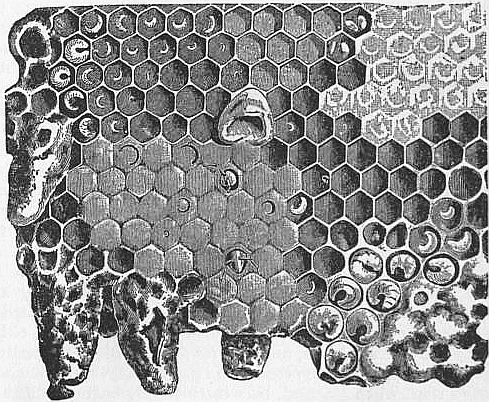
Fig. 25.—Honeycomb, Metamorphoses of the Honey Bee.
(From Cheshire’s Bees and Bee-keeping, Scientific and Practical.)
The illustration given in fig. 25 will serve more readily than words to enlighten the would-be bee-keeper. It shows a portion of honeycomb (natural size) not precisely as it appears when the frame containing it is lifted out of the hive, but as would be seen on two or more combs in the same hive, namely, the various cells built for—and occupied by—queens, drones and workers; also the larvae or grubs in the various stages of transformation from egg to perfect insect, with the latter biting their way out of sealed cells. It also shows sealed honey and pollen in cells, &c. To familiarize himself with the various objects depicted, all of which are drawn from nature, will not only help the reader to understand the different phases of bee-life during the swarming season, but tend to increase the interest of beginners in the pursuit. “Early drones, early swarms” was the ancient bee-man’s favourite adage, and the skilled apiarist of to-day experiences the same pleasurable thrill as did the skeppist of old at the sight of the first drone of the year, which betokens an early swarm. As the drones increase in number queen-cells are formed, unless steps be taken to turn aside the swarming impulse by affording additional room beforehand in the hive. The above brief outline of the guiding principles of natural swarming is merely intended as introductory to the fuller information given in a good text-book.
Management of an Apiary.—The main consideration in establishing an apiary is to secure a favourable location, which means a place where honey of good marketable quality may be gathered from the bee-forage growing around without any planting on the part of the bee-keeper himself. It is impossible to deal here with the varying conditions under which apiculture is carried on in all parts of the world, but, as a rule, the same principle applies everywhere. The bee industry prospers greatly Bee-forage in U.S.A. in America, where amid the vast stretches of mountain and canyon in California the bee-forage extends for miles without a break, and the climatic conditions are so generally favourable as to reduce to a minimum the chances of the honey crop failing through adverse weather.
The bee-keeper’s object is to utilize to the utmost the brief space of a worker-bee’s life in summer, by adopting the best methods in vogue for building up stocks to full strength before the honey-gathering time begins, and preparing for it by the exercise of skill and intelligence in carrying out this work.
In the United Kingdom there is a difference of several weeks in the honey season between north and south. Swarming usually begins in May in the south of England, and in mid-July in the north of Scotland, the issue of swarms coinciding with the early part of the main honey flow. The weather is naturally more precarious in autumn than earlier in the year, and chances of success proportionately smaller for northern bee-men, but the disadvantage to the latter is more than compensated for by the heather season, which extends well into September. With regard to the British bee-keeper located in the south, Value of pollen. the early fruit crop is what concerns him most, and where pollen (the fertilizing dust of flowers) is plentiful his bees will make steady progress. If pollen is scarce, a substitute in the form of either pea-meal or wheaten flour must be supplied to the bees, as brood-rearing cannot make headway without the nitrogenous element indispensable in the food on which the young are reared. But the main honey-crop of both north and south is gathered from the various trifoliums, The queen of bee-plants. among which the white Dutch or common clover (Trifolium repens) is acknowledged to be the most important honey-producing plant wherever it grows. In the United States, Canada, Australia, New Zealand and in many other parts of the world honey of the finest quality is obtained from this “queen of bee-plants,” and in lesser degree from other clovers such as sainfoin, alsike (a hybrid clover), trefoil, &c.
Before undertaking the management of a modern apiary, the bee-keeper should possess a certain amount of aptitude for the pursuit, without which it is hardly possible to succeed. He must also acquire the ability to handle bees judiciously and well under all imaginable conditions. In doing this it is needful to remember that bees resent outside interference with either their work or their hives, and will resolutely defend themselves when aroused even at the cost of life itself. Experience has also proved that, when alarmed, bees instinctively begin to fill their honey-sacs with food from the nearest store-cells as a safeguard against contingencies, and when so provided they are more amenable to interference. The bee-keeper, therefore, by the judicious application of a little smoke from smouldering fuel, blown into the hive by means of an appliance known as a bee-smoker, alarms the bees and is thus able to manipulate the frames of comb with ease and almost no disturbance. The smoker (fig. 26) devised by T.F. Bingham of Farwell, Michigan, U.S.A., is the one most used in America and in the United Kingdom. No other protection is needed beyond a bee-veil of fine black net, which slipped over a wide-brimmed straw hat protects the face from stings when working among bees; as experience is gained the veil is not always used. The man who is hasty and nervous in temperament, who fears an occasional sting, and resents the same by viciously killing the bee that inflicts it will rarely make a good apiarist. The methods of handling bees vary in different countries, this being in a great measure accounted for by the number of hives kept. Very few apiaries in the United Kingdom contain more than a hundred hives; consequently the British bee-keeper has no need for employing the forceful or “hustling” methods found necessary in America, British and American methods. where the honey-crop is gathered in car-loads and the hives numbered by thousands. It naturally follows that bee-life is there regarded very slightly by comparison, and the bee-garden in England becomes the “bee-yard” in America, where the apiarist when at work must thoroughly protect himself from being stung, and, safe in his immunity from damage, cares little for bee-life in getting through his task, the loss of a few hundred bees being considered of no account. There are, however, other reasons, apart from humanity, to account for the difference in handling bees as advocated in the United Kingdom. The great majority of apiaries owned by British bee-keepers are located in close proximity to neighbours; consequently a serious upset among the bees would in many cases involve an amount of trouble which should if possible be avoided; therefore quietness and the exercise of care when manipulating are always recommended by teachers, and practised by those who wisely take their lessons to heart.
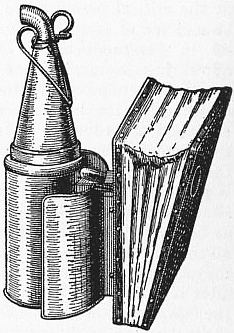
Fig. 26.—Bee-Smoker.
(Redrawn from the A B C of Bee-Culture, published by the A.I. Root Co, Medina, Ohio, U.S.A.)
Having made himself proficient in practical bee-work and chosen a suitable location for his apiary, the bee-keeper should carefully select the particular type of hive most suited to his means and requirements. This point settled, uniformity is Chosing a location. secured, and all loose parts of the hives being interchangeable time will be saved during the busy season when time means money. Beginning with not too many stocks he can test the capabilities of his location before investing much capital in the undertaking, so that by utilizing the information already given and adopting the wise adage “make haste slowly” he will realize in good time whether it will pay best to work for honey in comb or extracted honey in bulk; not only so, but the knowledge gained will enable him to select such appliances as are suited to his needs. As a rule, Bee-keeping for profit. it may be said that the man content to start with an apiary of moderate size—say fifty stocks—may realize a fair profit from comb-honey only; but so limited a venture would need to be supplemented by some other means before an adequate income could be secured. On the other hand, the owner of one or two hundred colonies would find it more lucrative to work for extracted honey and send it out to wholesale buyers in that form. By so doing a far greater weight of surplus per hive may be secured, and extracted honey will keep in good condition for years, while comb-honey must be sold before granulation sets in. At the same time it is but fair to say that bee-culture in the United Kingdom, if limited to honey-production alone, is not sufficiently safe for entire reliance to be placed on it for obtaining a livelihood. The uncertain climate renders it necessary to include either other branches of the craft less dependent on warmth and sunshine, or to combine it with fruit-growing, poultry-rearing, &c. Under such conditions the bees will usually occupy a good position in the balance-sheet.
Another indispensable feature of good bee-management is “forethought,” coupled with order and neatness; the rule of “a place for everything and everything in its place” prepares the bee-keeper for any emergency; constant watchfulness is Need of forethought. also necessary, not only to guard against disease in his hives, but to overlook nothing that tends to be of advantage to the bees at all seasons. Among the many ways of saving time nothing is more useful than a carefully-kept note-book, wherein are recorded brief memoranda regarding such items as condition of each stock when packed for winter, amount of stores, age and prolific capacity of queen, strength of colony, healthiness or otherwise, &c., all of which particulars should be noted and the hives to which they refer plainly numbered. It also enables the bee-keeper to arrange his day’s work indoors while avoiding disturbance to such colonies as do not need interference. In the early spring stores must be seen to and replenished where required; breeding stimulated when pollen begins to be gathered, and appliances cleaned and prepared for use during the busy season.
The main honey-gathering time (lasting about six or seven weeks) is so brief that in no pursuit is it more important to “make hay while the sun shines,” and if the bee-keeper needs a reminder of this truism he surely has it in the Length of bee season. example set by his bees. As the season advances and the flowers yield nectar more freely, visible signs of comb-building will be observed in the whitened edges of empty cells in the brood-chambers; the thoughtful workers are lengthening out the cells for honey-storing, and the bee-master takes the hint by giving room in advance, thus lessening the chance of undesired swarms. In other words, order and method, combined with the habit of taking time by the forelock, are absolutely necessary to the bee-keeper, seeing that the enormous army of workers under his control is multiplying daily by scores of thousands. As spring merges into summer, sunny days become more frequent; the ever-increasing breadth of bee-forage yields still more abundantly, and the excitement among the labourers crowding the hives increases, rendering room in advance, shade and ventilation, a sine qua non. It requires a level head to keep cool amongst a couple of hundred strong stocks of bees on a hot summer’s day in a good honey season. Swarm prevention. Moreover, it will be too late to think of giving ventilation at noontide, when the temperature has risen to 80° F. in the shade; the necessary precautions for swarm prevention must therefore be taken in advance, for when what is known as the “swarming fever” once starts it is most difficult to overcome.
The well-read and intelligent bee-keeper, content to work on orthodox lines, will be able to manage an apiary—large or small—by guiding and controlling the countless army he commands in a way that will yield him both pleasure and profit. All he needs is good bee weather and an apiary free from disease to make him appreciate bee-craft as one of the most remunerative of rural industries; affording a wholesome open-air life conducive to good health and yielding an abundance of contentment.
Diseases of Bees.—It is quite natural that bees living in colonies should be subject to diseases, and only since the introduction of movable-comb hives has it been possible to learn something about these ailments. The most serious disease with which the bee-keeper has to contend is that commonly known as “bee-pest” or “foul brood,” so called because of the young brood dying and rotting in the cells. This disease has been known from the earliest ages, and is probably the same as that designated by Pliny as blapsigonia (Natural History, bk. xi. ch. xx.). Coming to later times, Della Rocca minutely describes a disease to which bees were subject in the island of Syra, between the years 1777 and 1780, and through which nearly every colony in the island perished. From the description given it was undoubtedly foul brood, and the bee-keepers of the island became convinced, after bitter experience, that it was extremely contagious. Schirach also mentioned and described the disease in 1769, and was the first to give it the name of “foul brood.” Still later, in 1874, Dr Cohn, after the most exhaustive experiments and bacteriological research, realized that the disease was caused by a bacillus, and—nine years later—the name Bacillus alvei was given to it by Cheyne and Cheshire, whose views were in agreement with those of Dr Cohn.
The illustration (fig. 27) shows a portion of comb affected with foul brood in its worst form. The sealed cells are dark-coloured and sunken, pierced with irregular holes, and the larvae in all stages from the crescent-shaped healthy condition to that in which the dead larvae are seen lying at the bottom of the cells, flaccid and shapeless. The remains then change to buff colour, afterwards turning brown, when decomposition sets in, and as the bacilli present in the dead larvae increase and the nutrient matter is consumed, the mass in some cases becomes sticky and ropy in character, making its removal impossible by the bees. In course of time it dries up, leaving nothing but a brown scale adhering to the bottom or side of the cell. In the worst cases the larvae even die after the cells are sealed over; a strong characteristic and offensive odour being developed in some phases of the disease, noticeable at times some distance away from the hive.
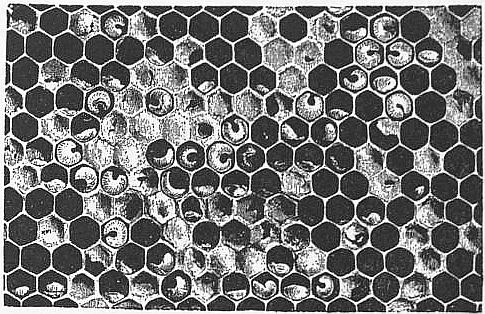
Fig. 27.—Foul Brood (Bacillus alvei).
(From Cheshire’s Bees and Bee-keeping, Scientific and Practical.)
Two forms of foul brood have been long known, one foul smelling, the other odourless; and investigations made during 1906 and 1907 showed that the etiology of the disease is not by any means simple, but that it is produced by different microbes, two others in addition to Bacillus alvei playing an important part. These are Bacillus brandenburgiensis, Maassen (syn. B. burri, Burri: B. larvae, white), and Streptococcus apis, Maassen (syn. B. Guntheri, Burri). The first two are found in both forms of foul brood, whereas the last is only present with B. alvei in the strong-smelling form of the disease, in which the larvae are attacked prior to the cells being sealed over.
The brood of bees, when healthy, lies in the combs in compact masses, the larvae being plump and of a pearly whiteness, and when quite young curled up on their sides at the base of the cells. When attacked by the disease, the larva moves uneasily, stretches itself out lengthwise in the cell, and finally becomes loose and flabby, an appearance which plainly indicates death.
When the disease attacks the larvae before they are sealed over Bacillus alvei is present, usually associated with Streptococcus apis, which latter imparts a sour smell to the dead brood. In cases where the disease is odourless the larvae are attacked after the cells are sealed over, and just before they change to pupae, when they become slimy, sputum-like masses, difficult to remove from the cells. Under these conditions Bacillus brandenburgiensis is found, although Bacillus alvei may also be present. The two bacilli are antagonistic, each striving for supremacy, first one then the other predominating. Various other microbes are also present in large numbers, but are not believed to be pathogenic or disease-producing in character.
It is, therefore, seen that at least three different microbes play an important part in the same disease. The danger of contagion lies in the wonderful vitality of the spores, and their great resistance to heat and cold. Dr Maassen records a case where he had no difficulty in obtaining cultures from spores removed from combs after being kept dry for twenty years. It should be borne in mind that the disease is much easier to cure in the earlier stages while the bacilli are still rod-shaped than when the rods have turned to spores.
Since the bacterial origin of foul brood has been established, the efforts of some bacteriologists have been employed in finding a simple remedy by means of which the disease may be checked in its earliest stages, and in this an appreciable amount of success has been attained. Nor has foul brood in its more advanced forms been neglected, all directions for treatment being found in text-books written by distinguished writers on apiculture in the United Kingdom, America and throughout the European continent.
The only other disease to which reference need be made here is dysentery, which sometimes breaks out after the long confinement bees are compelled to undergo during severe winters. This trouble may be guarded against by feeding the bees in the early autumn with good food made from cane sugar, and housing them in well-ventilated hives kept warm and dry by suitable coverings. When bees are wintered on thin, watery food not sealed over, and are unable for months to take cleansing flights, they become weak and involuntarily discharge their excrement over the combs and hive, a state of things never seen in a healthy colony under normal conditions. The stocks of bee-keepers who attend to the instructions given in text-books are rarely visited by this disease.
The above embraces all that is necessary to be said in relation to diseases, though bees have been subject to other ailments such as paralysis, constipation, &c.
In the Isle of Wight a serious epidemic broke out in 1906 which caused great destruction to bee-life in the following year. The malady was of an obscure character, but its cause has been under investigation by the British Board of Agriculture and Fisheries, and by European bacteriologists in 1908.
Authorities.—Though in modern times a great deal has appeared in the daily newspapers on the subject, it is a notable fact that not a tithe of the wonderful things published in such articles about bees and bee-keeping is worthy of credence or possesses any real value. Indeed, a pressman possessing any technical knowledge of the subject—beyond that obtainable from books—would be a rara avis. The account given above is the result of forty years’ practical experience with bees in England, the writer having for a great portion of the time been connected editorially with the only two papers in that country entirely devoted to bees and bee-keeping, The British Bee Journal (weekly, founded 1873), and Bee-keepers’ Record (monthly, founded 1882), the former being the only weekly journal in the world. The following books on the subject may be consulted for further details:—François Huber, New Observations on the Natural History of Bees; T.W. Cowan, British Bee-keepers’ Guide-Book, The Honey Bee, its Natural History, Anatomy and Physiology; Langstroth on the Honey Bee, revised by C. Dadant & Son; A.I. Root, A B C and X Y Z of Bee-culture; F.R. Cheshire, Bees and Bee-keeping; Dr Dzierzon, Rational Bee-keeping; E. Bertrand, Conduite du rucher; A.J. Cook, Manual of the Apiary; Dr C.C. Miller, Forty Years among the Bees; F.W.L. Sladen, Queen-rearing in England; S. Simmins, A Modern Bee Farm.
(W. B. Ca.)
BEECH, a well-known tree, Fagus sylvatica, a member of the order Fagaceae to which belong the sweet-chestnut (Castanea) and oak. The name beech is from the Anglo-Saxon boc, bece or beoce (Ger. Buche, Swedish, bok), words meaning at once a book and a beech-tree. The connexion of the beech with the graphic arts is supposed to have originated in the fact that the ancient Runic tablets were formed of thin boards of beech-wood. “The origin of the word,” says Prior (Popular Names of British Plants), “is identical with that of the Sanskrit bōkō, letter, bōkōs, writings; and this correspondence of the Indian and our own is interesting as evidence of two things, viz. that the Brahmins had the art of writing before they detached themselves from the common stock of the Indo-European race in Upper Asia, and that we and other Germans have received alphabetic signs from the East by a northern route and not by the Mediterranean.” Beech-mast, the fruit of the beech-tree, was formerly known in England as buck; and the county of Buckingham is so named from its fame as a beech-growing country. Buckwheat (Bucheweizen) derives its name from the similarity of its angular seeds to beech-mast. The generic name Fagus is derived from φάγειν to eat; but the φηγός of Theophrastus was probably the sweet chestnut (Aesculus) of the Romans. Beech-mast has been used as food in times of distress and famine; and in autumn it yields an abundant supply of food to park-deer and other game, and to pigs, which are turned into beech-woods in order to utilize the fallen mast. In France it is used for feeding pheasants and domestic poultry. Well-ripened beech-mast yields from 17 to 20% of non-drying oil, suitable for illumination, and said to be used in some parts of France and other European countries in cooking, and as a substitute for butter.
The beech is one of the largest British trees, particularly on chalky or sandy soils, native in England from Yorkshire southwards, and planted in Scotland and Ireland. It is one of the common forest trees of temperate Europe, spreading from southern Norway and Sweden to the Mediterranean. It is found on the Swiss Alps to about 5000 ft. above sea-level, and in southern Europe is usually confined to high mountain slopes; it is plentiful in southern Russia, and is widely distributed in Asia Minor and the northern provinces of Persia.
It is characterized by its sturdy pillar-like stem, often from 15 to 20 ft. in girth, and smooth olive-grey bark. The main branches rise vertically, while the subsidiary branches spread outwards and give the whole tree a rounded outline. The slender brown pointed buds give place in April to clear green leaves fringed with delicate silky hairs. The flowers which appear in May are inconspicuous and, as usual with our forest trees, of two kinds; the male, in long-stalked globular clusters, hang from the axils of the lower leaves of a shoot, while the female, each of two or three flowers in a tiny cup (cupule of bracts), stand erect nearer the top of the shoot. In the ripe fruit or mast the four-sided cupule, which has become much enlarged, brown and tough, encloses two or three three-sided rich chestnut-brown fruits, each containing a single seed. It is readily propagated by its seeds. It is a handsome tree in every stage of its growth, but is more injurious to plants under its drip than other trees, so that shade-bearing trees, as holly, yew and thuja, suffer. Its leaves, however, enrich the soil. The beech has a remarkable power of holding the ground where the soil is congenial, and the deep shade prevents the growth of other trees. It is often and most usefully mixed with oak and Scotch fir. The timber is not remarkable for either strength or durability. It was formerly much used in mill-work and turnery; but its principal use at present is in the manufacture of chairs, bedsteads and a variety of minor articles. It makes excellent fuel and charcoal. The copper-beech is a variety with copper-coloured leaves, due to the presence of a red colouring-matter in the sap. There is also a weeping or pendulous-branched variety; and several varieties with more or less cut leaves, are known in cultivation.
The genus Fagus is widely spread in temperate regions, and contains in addition to our native beech, about 15 other species. A variety (F. sylvatica var. Sieboldi) is a native of Japan, where it is one of the finest and most abundant of the deciduous-leaved forest trees. Fagus americana is one of the most beautiful and widely-distributed trees of the forests of eastern North America. It was confounded by early European travellers with F. sylvatica, from which it is distinguished by its paler bark and lighter green, more sharply-toothed leaves. Several species are found in Australia and New Zealand, and in the forests of southern Chile and Patagonia. The dense forests which cover the shore of the Straits of Magellan and the mountain-slopes of Tierra del Fuego consist largely of two beeches—one evergreen, Fagus betuloides, and one with deciduous leaves, F. antarctica.
BEECHER, CHARLES EMERSON (1856-1904), American palaeontologist, was born at Dunkirk, New York, on the 9th of October 1856. He graduated at the university of Michigan in 1878, and then became assistant to James Hall in the state museum at Albany. Ten years later he was appointed to the charge of the invertebrate fossils in the Peabody Museum, New Haven, under O.C. Marsh, whom he succeeded in 1899 as curator. Meanwhile in 1889 he received the degree of Ph.D. from Yale University for his memoir on the Brachiospongidae, a remarkable group of Silurian sponges; later on he did good work among the fossil corals, and other groups, being ultimately regarded as a leading authority on fossil crustacea and brachiopoda; his researches on the development of the brachiopoda, and on the Trilobites Triarthrus and Trinudeus, were especially noteworthy. In 1892 he was appointed professor of palaeontology in Yale University. He died on the 14th of February 1904.
Memoir by C. Schuchert in Amer. Journ. Science, vol. xvii., June 1904 (with portrait and bibliography).
BEECHER, HENRY WARD (1813-1887), American preacher and reformer, was born in Litchfield, Connecticut, on the 24th of June 1813. He was the eighth child of Lyman and Roxana Foote Beecher, and brother of Harriet Beecher Stowe. Entering Amherst College in 1830, and graduating four years later, he gave more attention to his own courses of reading than to college studies, and was more popular with his fellows than with the faculty. With a patience foreign to his impulsive nature, he submitted to minute drill in elocution, and became a fluent extemporaneous speaker. Reared in a Puritan atmosphere, he has graphically described the mystical experience which, coming to him in his early youth, changed his whole conception of theology and determined his choice of the ministry. “I think,” he says, “that when I stand in Zion and before God, the highest thing that I shall look back upon will be that blessed morning of May when it pleased God to reveal to my wondering soul the idea that it was His nature to love a man in his sins for the sake of helping him out of them.” In 1837 he graduated from Lane Theological Seminary in Ohio, of which his father was president, and entered upon his work as pastor of a missionary Presbyterian church at Lawrenceburg, Indiana, a village on the Ohio, about 20 m. below Cincinnati. The membership numbered nineteen women and one man. Beecher was sexton as well as preacher. Two years later he accepted a call to Indianapolis. His unconventional preaching shocked the more staid members of the flock, but filled the church to overflowing with people unaccustomed to churchgoing. He studied men rather than books; became acquainted with the vices in what was then a pioneer town; and in his Seven Lectures to Young Men (1844) treated these with genuine power of realistic description and with youthful and exuberant rhetoric. Eight years later (1847) he accepted a call to the pastorate of Plymouth Church (Congregational), then newly organized in Brooklyn, New York. The situation of the church, within five minutes’ walk of the chief ferry to New York, the stalwart character of the man who had organized it, and the peculiar eloquence of Beecher, combined to make the pulpit a national platform. The audience-room of the church, capable of seating 2000 or 2500 people, frequently contained 500 or 1000 more.
Beecher at once became a recognized leader. On the all-absorbing question of slavery he took a middle ground between the pro-slavery or peace party, and abolitionists like William Lloyd Garrison and Wendell Phillips, believing, with such statesmen as W.H. Seward, Salmon P. Chase, and Abraham Lincoln, that slavery was to be overthrown under the constitution and in the Union, by forbidding its growth and trusting to an awakened conscience, enforced by an enlightened self-interest. He was always an anti-slavery man, but never technically an abolitionist, and he joined the Republican party soon after its organization. In the earlier days of the agitation, he challenged the hostility which often mobbed the anti-slavery gatherings; in the later days he consulted with the political leaders, inspiring the patriotism of the North, and sedulously setting himself to create a public opinion which should confirm and ratify the emancipation proclamation whenever the president should issue it. When danger of foreign intervention cast its threatening shadow across the national path, he went to England, and by his famous addresses did what probably no other American could have done to strengthen the spirit in England favourable to the United States, and to convert that which was doubtful and hostile. In 1861-1863 he was the editor-in-chief of the Independent, then a Congregational journal; and in his editorials, copied far and wide, produced a profound impression on the public mind by clarifying and defining the issue. Later (in 1870), he founded and became editor-in-chief of the Christian Union, afterwards the Outlook, a religious undenominational weekly. His lectures and addresses had the spirit if not the form of his sermons, just as his sermons were singularly free from the homiletical tone. Yet his work as a reformer was subsidiary to his work as a preacher. He was not indeed a parish pastor; he inspired church activities which grew to large proportions, but trusted the organization of them to laymen of organizing abilities in the church; and for acquaintance with his people he depended on such social occasions as were furnished in the free atmosphere of this essentially New England church at the close of every service. But during his pastorate the church grew to be probably the largest in membership in the United States.
It was in the pulpit that Beecher was seen at his best. His mastery of the English tongue, his dramatic power, his instinctive art of impersonation, which had become a second nature, his vivid imagination, his breadth of intellectual view, the catholicity of his sympathies, his passionate enthusiasm, which made for the moment his immediate theme seem to him the one theme of transcendent importance, his quaint humour alternating with genuine pathos, and above all his simple and singularly unaffected devotional nature, made him as a preacher without a peer in his own time and country. His favourite theme was love: love to man was to him the fulfilment of all law; love of God was the essence of all Christianity. Retaining to the day of his death the forms and phrases of the New England theology in which he had been reared, he poured into them a new meaning and gave to them a new significance. He probably did more than any other man in America to lead the Puritan churches from a faith which regarded God as a moral governor, the Bible as a book of laws, and religion as obedience to a conscience to a faith which regards God as a father, the Bible as a book of counsels, and religion as a life of liberty in love. The later years of his life were darkened by a scandal which Beecher’s personal, political and theological enemies used for a time effectively to shadow a reputation previously above reproach, he being charged by Theodore Tilton, whom he had befriended, with having had improper relations with his (Tilton’s) wife. But in the midst of these accusations (February 1876), the largest and most representative Congregational council ever held in the United States gave expression to a vote of confidence in him, which time has absolutely justified. Not a student of books nor a technical scholar in any department, Beecher’s knowledge was as wide as his interests were varied. He was early familiar with the works of Matthew Arnold, Charles Darwin and Herbert Spencer; he preached his Bible Studies sermons in 1878, when the higher criticism was wholly unknown to most evangelical ministers or known only to be dreaded; and his sermons on Evolution and Religion in 1885, when many of the ministry were denouncing evolution as atheistic. He was stricken with apoplexy while still active in the ministry, and died at Brooklyn on the 8th of March 1887, in the seventy-fourth year of his age.
The principal books by Beecher, besides his published sermons, are: Seven Lectures to Young Men (1844); Plymouth Collection of Hymns and Tunes (1855); Star Papers, Experiences of Art and Nature (1855); Life Thoughts (1858); New Star Papers; or Views and Experiences of Religious Subjects (1859); Plain and Pleasant Talks about Fruits, Flowers, and Farming (1859); American Rebellion, Report of Speeches delivered in England at Public Meetings in Manchester, Glasgow, Edinburgh, Liverpool, and London (1864); Prayers from Plymouth Pulpit (1867); Norwood: A Tale of Village Life in New England (1867); The Life of Jesus the Christ (1871), completed in 2 vols. by his sons (1891); and Yale Lectures on Preaching (3 vols., 1872-1874).
The prinipal lives are: Noyes L. Thompson, The History of Plymouth Church (1847-1872); Thomas W. Knox, The Life and Work of Henry Ward Beecher (Hartford, Conn., 1887); Frank S. Child, The Boyhood of Henry Ward Beecher (Pamphlet, New Creston, Conn., 1887); Joseph Howard, Jr., Life of Henry Ward Beecher (Philadelphia, 1887); T.W. Hanford, Beecher: Christian Philosopher, Pulpit Orator, Patriot and Philanthropist (Chicago, 1887); Lyman Abbott and S.B. Halliday, Henry Ward Beecher: A Sketch of his Career (New York, 1887); William C. Beecher, Rev. Samuel Scoville and Mrs. H.W. Beecher, A Biography of Henry Ward Beecher (New York, 1888); John R. Howard, Henry Ward Beecher: A Study (1891); John Henry Barrows, Henry Ward Beecher (New York, 1893); and Lyman Abbott, Henry Ward Beecher (Boston, 1903).
(L. A.)
BEECHER, LYMAN (1775-1863), American clergyman, was born at New Haven, Connecticut, on the 12th of October 1775. He was a descendant of one of the founders of the New Haven colony, worked as a boy in an uncle’s blacksmith shop and on his farm, and in 1797 graduated from Yale, having studied theology under Timothy Dwight. He preached in the Presbyterian church at East Hampton, Long Island (1798-1810, being ordained in 1799); in the Congregational church at Litchfield, Connecticut (1810-1826), in the Hanover Street church of Boston (1826-1832), and in the Second Presbyterian church of Cincinnati, Ohio (1833-1843); was president of the newly established Lane Theological Seminary at Walnut Hills, Cincinnati, and was professor of didactic and polemic theology there (1832-1850), being professor emeritus until his death. At Litchfield and in Boston he was a prominent opponent of the growing “heresy” of Unitarianism, though as early as 1836 he was accused of being a “moderate Calvinist” and was tried for heresy, but was acquitted. Upon his resignation from Lane Theological Seminary he lived in Boston for a short time, devoting himself to literature; but he broke down, and the last ten years of his life were spent at the home of his son, Henry Ward Beecher, in Brooklyn, New York, where he died on the both of January 1863. Magnetic in personality, incisive and powerful in manner of expression, he was in his prime one of the most eloquent of American pulpit orators. In 1806 he preached a widely circulated sermon on duelling, and about 1814 a series of six sermons on intemperance, which were reprinted frequently and greatly aided temperance reform. Thrice married, he had a large family, his seven sons becoming Congregational clergymen, and his daughters, Harriet Beecher Stowe (q.v.) and Catherine Esther Beecher, attaining literary distinction.
Lyman Beecher’s published works include: A Plea for the West (1835), Views in Theology (1836), and various sermons; his Collected Works were published at Boston in 1852 in 3 vols. Consult his Autobiography and Correspondence (2 vols., New York, 1863-1864), edited by his son Charles; D.H. Alien, Life and Services of Lyman Beecher (Cincinnati, 1863); and James C. White, Personal Reminiscences of Lyman Beecher (New York, 1882).
His daughter, Catherine Esther (1800-1878), was born at East Hampton, Long Island, on the 6th of September 1800. She was educated at Litchfield Seminary, and from 1822 to 1832 conducted a school for girls at Hartford, Connecticut, with her sister Harriet’s assistance, and from 1832 to 1834 conducted a similar school in Cincinnati. She wrote and lectured on women’s education and in behalf of better primary schools, and radically opposed woman suffrage and college education for women, holding woman’s sphere to be domestic. The National Board of Popular Education, a charitable society which she founded, sent hundreds of women as teachers into the South and West. She died on the 12th of May 1878 in Elmira, New York. She published An Essay on Slavery and Abolition with Reference to the Duty of American Females (1837), A Treatise on Domestic Economy (1842), The True Remedy for the Wrongs of Women (1851), Letters to the People on Health and Happiness (1855), The Religious Training of Children (1864), and Woman’s Profession as Mother and Educator (1871).
His son, Edward Beecher (1803-1895), was born at East Hampton, Long Island, on the 27th of August 1803, graduated at Yale in 1822, studied theology at Andover, and in 1826 became pastor of the Park Street church in Boston. From 1830 to 1844 he was president of Illinois College, Jacksonville, Illinois, and subsequently filled pastorates at the Salem Street church, Boston (1844-1855), and the Congregational church at Galesburg, Illinois (1855-1871). He was senior editor of the Congregationalist (1849-1855), and an associate editor of the Christian Union from 1870. In 1872 he settled in Brooklyn, New York, where in 1885-1889 he was pastor of the Parkville church and where he died on the 28th of July 1895. He wrote Addresses on the Kingdom of God (1827), History of the Alton Riots (1837), Statement of Anti-Slavery Principles (1837), Baptism, its Import and Modes (1850), The Conflict of Ages (1853), The Papal Conspiracy Exposed (1855), The Concord of Ages (1860), and History of Opinions on the Scriptural Doctrine of Future Retribution (1878).
Charles Beecher (1815-1900), another of Lyman’s sons, was born at Litchfield, Connecticut, on the 7th of October 1815. He graduated at Bowdoin College in 1834, and subsequently held pastorates at Newark, New Jersey (1851-1857), and Georgetown, Massachusetts; and from 1870 to 1877 lived in Florida, where he was state superintendent of public instruction in 1871-1873. He died at Georgetown, Massachusetts, on the 21st of April 1900. He was an accomplished musician, and assisted in the selection and arrangement of music in the Plymouth Collection of Hymns and Tunes. He wrote David and His Throne (1855), Pen Pictures of the Bible (1855), Redeemer and Redeemed (1864), and Spiritual Manifestations (1879).
Thomas Kinnicutt Beecher (1824-1900), another son, born at Litchfield, Connecticut, on the 10th of February 1824, was pastor of the Independent Congregational church (now the Park church), at Elmira, New York, one of the first institutional churches in the country, from 1854 until his death at Elmira on the 14th of March 1900. He wrote Our Seven Churches (1870).
BEECHEY, FREDERICK WILLIAM (1796-1856), English naval officer and geographer, son of Sir William Beechey, R.A., was born in London on the 17th of February 1796. In 1806 he entered the navy, and saw active service during the wars with France and America. In 1818 he served under Lieutenant (afterwards Sir) John Franklin in Buchan’s Arctic expedition, of which at a later period he published a narrative; and in the following year he accompanied Lieutenant W.E. Parry in the “Hecla.” In 1821 he took part in the survey of the Mediterranean coast of Africa under the direction of Captain, afterwards Admiral, William Henry Smyth. He and his brother Henry William Beechey, made an overland survey of this coast, and published a full account of their work in 1828 under the title of Proceedings of the Expedition to Explore the Northern Coast of Africa from Tripoly Eastward in 1821-1822. In 1825 Beechey was appointed to command the “Blossom,” which was intended to explore Bering Strait, in concert with Franklin and Parry operating from the east. He passed the strait and penetrated as far as 71° 23′ 31″ N., and 156° 21′ 30″ W., reaching a point only 146 m. west of that reached by Franklin’s expedition from the Mackenzie river. The whole voyage lasted more than three years; and in the course of it Beechey discovered several islands in the Pacific, and an excellent harbour near Cape Prince of Wales. In 1831 there appeared his Narrative of a Voyage to the Pacific and Bering’s Strait to Co-operate with the Polar Expeditions, 1825-1828. In 1835 and the following year Captain Beechey was employed on the coast survey of South America, and from 1837 to 1847 carried on the same work along the Irish coasts. He was appointed in 1850 to preside over the Marine Department of the Board of Trade. In 1854 he was made rear-admiral, and in the following year was elected president of the Royal Geographical Society. He died on the 29th of November 1856.
BEECHEY, SIR WILLIAM (1753-1839), English portrait-painter, was born at Burford. He was originally meant for a conveyancer, but a strong love for painting induced him to become a pupil at the Royal Academy in 1772. Some of his smaller portraits gained him considerable reputation; he began to be employed by the nobility, and in 1793 became associate of the Academy. In the same year he was made portrait-painter to Queen Charlotte. He painted the portraits of the members of the royal family, and of nearly all the most famous or fashionable persons of the time. What is considered his finest production is a review of cavalry, a large composition, in the foreground of which he introduced portraits of George III., the prince of Wales and the duke of York, surrounded by a brilliant staff on horseback. It was painted in 1798, and obtained for the artist the honour of knighthood, and his election as R.A.
BEECHING, HENRY CHARLES (1859- ), English clergyman and author, was born on the 15th of May 1859, and educated at the City of London school and at Balliol College, Oxford. He took holy orders in 1882, and after three years in a Liverpool curacy he was for fifteen years rector of Yattendon, Berkshire. From 1900 to 1903 he lectured on pastoral and liturgical theology at King’s College, London, and was chaplain of Lincoln’s Inn, where he became preacher in 1903. He became a canon of Westminster in 1902, and examining chaplain to the bishop of Carlisle in 1905. As a poet he is best known by his share in two volumes—Love in Idleness (1883) and Love’s Looking Glass (1891)—which contained also poems by J.W. Mackail and J. Bowyer Nichols. He was a sympathetic editor and critic of the works of many 16th and 17th century poets, of Richard Crashaw (1905), of Herrick (1907), of John Milton (1900), of Henry Vaughan (1896). Under the pseudonym of “Urbanus Sylvan” he published two successful volumes of essays, Pages from a Private Diary (1898) and Provincial Letters and other Papers (1906). His works also include numerous volumes of sermons and essays on theological subjects.
BEECHWORTH, a town of Bogong county, Victoria, Australia, 172 m. by rail N.E. of Melbourne. Pop. (1901) 7359. The town is the centre of the Ovens goldfields, and the district is mainly devoted to mining with both alluvial and reef working, but much of the land is under cultivation, yielding grain and fruit. The water supply is derived from Lake Kerferd in the vicinity, which is a favourite resort of visitors; the scenery near the town, which lies at an elevation of 1805 ft. among the May Day Hills, being singularly beautiful. The industries of Beechworth include tanning, ironfounding and coach-building.
BEEF (through O. Fr. boef, mod. boeuf, from Lat. bos, bovis, ox, Gr. βοῦς, which show the ultimate connexion with the Sanskrit go, gāus, ox, and thus with “cow”), the flesh of the ox, cow or bull, as used for food. The use of the French word for the meat, while the Saxon name was retained for the animal, has been often noticed, and paralleled with the use of veal, mutton and pork. “Beef” is also used, especially in the plural “beeves,” for the ox itself, but usually in an archaic way. “Corned” or “corn” beef is the flesh cured by salting, i.e. sprinkling with “corns” or granulated particles of salt. “Collared” beef is so called from the roll or collar into which the meat is pressed, after extracting the bones. “Jerked” beef, i.e. meat cut into long thin slices and dried in the sun, like “biltong” (q.v.), comes through the Spanish-American charque, from echarqui, the Peruvian word for this species of preserved meat. For “Beefeater” see Yeomen of the Guard.
BEEFSTEAK CLUB, the name of several clubs formed in London during the 18th and 19th centuries. The first seems to have been that founded in 1709 with Richard Estcourt, the actor, as steward. Of this the chief wits and great men of the nation were members and its badge was a gridiron. Its fame was, however, entirely eclipsed in 1735 when “The Sublime Society of Steaks” was established by John Rich at Covent Garden theatre, of which he was then manager. It is said that Lord Peterborough supping one night with Rich in his private room, was so delighted with the steak the latter grilled him that he suggested a repetition of the meal the next week. From this started the Club, the members of which delighted to call themselves “The Steaks.” Among them were Hogarth, Garrick, Wilkes, Bubb Doddington and many other celebrities. The rendezvous was the theatre till the fire in 1808, when the club moved first to the Bedford Coffee House, and the next year to the Old Lyceum. In 1785 the prince of Wales joined, and later his brothers the dukes of Clarence and Sussex became members. On the burning of the Lyceum, “The Steaks” met again in the Bedford Coffee House till 1838, when the New Lyceum was opened, and a large room there was allotted the club. These meetings were held till the club ceased to exist in 1867. Thomas Sheridan founded a Beefsteak Club in Dublin at the Theatre Royal in 1749, and of this Peg Woffington was president. The modern Beefsteak Club was founded by J.L. Toole, the actor, in 1876.
See J. Timbs, Clubs and Club Life in London (1873); Walter Arnold, Life and Death of the Sublime Society of Steaks (1871).
BEELZEBUB, Beelzebul, Baalzebub. In 2 Kings i. we read that Ahaziah ben Ahab, king of Israel, fell sick, and sent to inquire of Baalzebub, the god of the Philistine city Ekron, whether he should recover. There is no other mention of this god in the Old Testament. Baal, “lord,” is the ordinary title or word for a deity, especially a local deity, cf. such place names as Baal Hazor (2 Sam. xiii. 23), Baal Hermon (Judges iii. 3), which are probably contractions of fuller forms, like Beth Baal Meon (Josh. xiii. 17), the House or Temple of the Baal of Meon. According to these analogies we should expect Zebub to be a place. No place Zebub, however, is known; and it has been objected that the Baal of some other place would hardly be the god of Ekron. These objections are hardly conclusive.
Usually Zebub is identified with a Hebrew common noun zebub = flies,1 occurring twice in the Old Testament,2 so that Baalzebub “is the Baal to whom flies belong or are holy. As children of the summer they are symbols of the warmth of the sun, to which ... Baal stands in close relation. Divination by means of flies was known at Babylon.”3 There are other cases of names compounded of Baal and an element equivalent to a descriptive epithet, e.g. Baalgad, the Baal of Fortune.4 For the “Fly-god,” sometimes interpreted as the “averter of insects,” cf Ζεὺς ἀπόμυιος, μυίαγρος, and the Hercules μυίαγρος. Clemens Alexander speaks of a Hercules ἀπόμυιος as worshipped at Rome. It has been suggested that Baalzebub was the dung-beetle, Scarabaeus pillularius, worshipped in Egypt.
A name of a deity on an Assyrian inscription of the 12th century B.C. has been read as Baal-zabubi, but this reading has now been abandoned in favour of Baal-sapunu (Baal-Zephon).5 Cheyne considers that Baalzebub is a “contemptuous uneuphonic Jewish modification of the true name Baalzebul.”6
In the New Testament we meet with Beelzebul,7 which some of the versions, especially the Vulgate and Syriac, followed by the Authorized Version, have changed to Beelzebub, under the influence of 2 Kings. In Matt. x. 25, Christ speaks of men calling the master of the house, i.e. Himself, Beelzebul.8 In Mark iii 22-27,9 the scribes explain that Jesus is possessed by Beelzebul10 and is thus enabled to cast out devils. The passage speaks of Beelzebul as Satan and as the prince of the demons.
The origin of the name Beelzebul is variously explained. (a) It is “a phonetic corruption, perhaps a softening of the original word”; as Bab-el-mandel is a corruption of Bab-el-mandeb. (b) Zebul is from zebel, a word found in the Targums in the sense of “dung,” so that Beelzebul would mean “Lord of Dung,” a term of contempt. The further suggestion has been made that zebul itself in the sense of “dung” is a term for a heathen deity, cf. the Old Testament use of “abomination” &c. for heathen deities, so that Beelzebul would mean “Chief of false gods,” and so arch-fiend. (c) Zebul is found in 1 Kings viii. 13 in the sense of “height,” beth-sebul—lofty house, and in Rabbinical writings in the sense of “house” or “temple,” or “the fourth heaven”;11 and Beelzebul may equal “Lord of the High House” or “Lord of Heaven.” This view is perhaps favoured by Matt. x. 25, “if they have called the lord of the house Beelzebul.” It appears, however, that Rabbinical writings use yōm (day-of) zebul for the festival of a heathen deity; and Jastrow connects this usage with the meaning “house” or “temple,” so that the meaning “Lord of the False Gods” might be arrived at in a different way.
The names Zebulun, ’Izebel (Jezebel), suggest that Zebul may be an ancient name of a deity; cf. the names בעל אזבל (B‘L ’ZBL), שמזבל (ShMZBL) in Punic and Phoenician inscriptions.12 The substitution of Beelzebub for Beelzebul by the Syriac, Vulgate and other versions implies the identification of the New Testament arch-fiend with the god of Ekron; this substitution, however, may be due to the influence of the Aramaic B‘el-debaba, “adversary,” sometimes held to be the original of these names.
There is no trace of Beelzebul or Beelzebub outside of the Biblical passages mentioned, and the literature dependent on them. If we assume a connexion between the two names, there is nothing to show how the god became in later times the devil.
In Paradise Lost, Book ii., Beelzebub appears as second only to Satan himself.
Bibliography.—Lightfoot, Horae Hebraicae et Talmudicae, Works, vol. ii. pp. 188 f., 429, ed. Strype (1684); Baethgen, Beitrage zur semitischen Religionsgeschichte, pp. 25, 65, 261. Commentaries on the Biblical passages especially Burney and Skinner on Kings, Meyer and A.B. Bruce on the Synoptic Gospels, and Swete on Mark. Articles on “Baal,” “Baalzebub,” “Beelzebub,” “Beelzebul,” in Hastings’ Bible Dict., Black and Cheyne’s Encycl. Bibl., and Hauck’s Realencyklopädie; on בעל זבב in Clarendon Press Hebr. Lex.; and on זבל and זבול in Jastrow’s Dict. of the Targumim, &c.
(W. H. Be.)
1 So Clarendon Press, Hebrew Lexicon, p. 127, with LXX.
2 Eccl. x. 1; Isaiah vii. 18.
3 Baethgen, Beitrage zur semitischen Religionsgeschichte, p. 25, cf. pp. 65, 261.
4 Josh, xii. 7.
5 Art. “Baalzebub,” Black and Cheyne’s Ency. Bibl.
6 With various spellings (e.g. Belzebul, and in XB, Beezebul), all variants of Beelzebul. Cf. Deissmann, Bible Studies, 332.
7 There is a variation of reading, which has been held to support the view that the passage means that men reproached Jesus with His supposed connexion with Beelzebul; cf. A.B. Bruce, in loco.
8 And in the parallel passages, Matt. xii. 22-29; Luke xi. 14-22.
9 Cf. John vii. 20, viii. 48, 52, x. 20.
10 Swete, in loco.
11 Jastrow, Dict. of the Targumim. &c., sub voce.
12 Lidzbarski, Handbuch der nordsemitischen Epigraphik, i. pp. 240, 377.
BEER, a beverage obtained by a process of alcoholic fermentation mainly from cereals (chiefly malted barley), hops and water. The history of beer extends over several thousand years. According to Dr Bush, a beer made from malt or red barley is mentioned in Egyptian writings as early as the fourth dynasty. It was called or heqa. Papyri of the time of Seti I. (1300 B.C.) allude to a person inebriated from over-indulgence in beer. In the second book (c. 77) of Herodotus (450 B.C.) we are told that the Egyptians, being without vines, made wine from barley (cf. Aesch. Suppl. 954); but as the grape is mentioned so frequently in Scripture and elsewhere as being most abundant there, and no record exists of the vine being destroyed, we must conclude that the historian was only partially acquainted with the productions of that most fertile country. Pliny (Natural History, xxii. 82) informs us that the Egyptians made wine from corn, and gives it the name of sythum, which, in the Greek, means drink from barley. The Greeks obtained their knowledge of the art of preparing beer from the Egyptians. The writings of Archilochus, the Parian poet and satirist who flourished about 650 B.C., contain evidence that the Greeks of his day were acquainted with the process of brewing. There is, in fact, little doubt that the discovery of beer and its use as an exhilarating beverage were nearly as early as those of the grape itself, though both the Greeks and the Romans despised it as a barbarian drink. Dioscorides mentions two kinds of beer, namely ζῦθος and κοῦρμι, but he does not describe them sufficiently to enable us to distinguish them. Sophocles and other Greek writers, again, styled it βρῦτον. In the time of Tacitus (1st century after Christ), according to him, beer was the usual drink of the Germans, and there can be little doubt that the method of malting barley was then known to them. Pliny (Nat. Hist. xxii. 82) mentions the use of beer in Spain under the name of celia and ceria and in Gaul under that of cerevisia; and elsewhere (xiv. 29) he says:—“The natives who inhabit the west of Europe have a liquid with which they intoxicate themselves, made from corn and water. The manner of making this liquid is somewhat different in Gaul, Spain and other countries, and it is called by different names, but its nature and properties are everywhere the same. The people in Spain in particular brew this liquid so well that it will keep good a long time. So exquisite is the cunning of mankind in gratifying their vicious appetites that they have thus invented a method to make water itself produce intoxication.”

The knowledge of the preparation of a fermented beverage from cereals in early times was not confined to Europe. Thus, according to Dr H.H. Mann, the Kaffir races of South Africa have made for ages—and still make—a kind of beer from millet, and similarly the natives of Nubia, Abyssinia and other parts of Africa prepare an intoxicating beverage, generally called bousa, from a variety of cereal grains. The Russian quass, made from barley and rye, the Chinese samshu, made from rice, and the Japanese saké (q.v.) are all of ancient origin. Roman historians mention the fact that the Britons in the south of England at the time of the Roman invasion brewed a species of ale from barley and wheat. The Romans much improved the methods of brewing in vogue among the Britons, and the Saxons—among whom ale had long been a common beverage—in their turn profited much by the instruction given to the original inhabitants of Great Britain by the Romans. We are informed by William of Malmesbury that in the reign of Henry II. the English were greatly addicted to drinking, and by that time the monasteries were already famous, both in England and on the continent, for the excellence of their ales. The waters of Burton-on-Trent began to be famous in the 13th century. The secret of their being so especially adapted for brewing was first discovered by some monks, who held land in the adjacent neighbourhood of Wetmore. There is a document dated 1295 in which it is stated that Matilda, daughter of Nicholas de Shoben, had re-leased to the abbot and convent of Burton-on-Trent certain tenements within and without the town; for which re-lease they granted her, daily for life, two white loaves from the monastery, two gallons of conventual beer, and one penny, besides seven gallons of beer for the men. The abbots of Burton apparently made their own malt, for it was a common covenant in leases of mills belonging to the abbey that the malt of the lords of the manor, both spiritual and temporal, should be ground free of charge. Robert Plot, in his Natural History of Staffordshire (1686), refers to the peculiar properties of the Burton waters, from which, he says, “by an art well known in this country good ale is made, in the management of which they have a knack of fining it in three days to that degree that it shall not only be potable, but is clear and palatable as we could desire any drink of this kind to be.” In 1630 Burton beer began to be known in London, being sold at “Ye Peacocke” in Gray’s Inn Lane, and according to the Spectator was in great demand amongst the visitors in Vauxhall. Until tea and coffee were introduced, beer and ale (see Ale) were, practically speaking, the only popular beverages accessible to the general body of consumers. Since the advent of tea, coffee, cocoa and mineral waters, the character of British beers has undergone a gradual modification, the strongly alcoholic, heavily hopped liquids consumed by the previous generation slowly giving place to the lighter beverages in vogue at the present time. The old “stock bitter” has given way to the “light dinner ale,” and “porter” (so called from the fact that it was the popular drink amongst the market porters of the 18th century) has been largely replaced by “mild ale.” A certain quantity of strong beer—such as heavy stouts and “stock” and “Scotch” ales—is still brewed nowadays, but it is not an increasing one. The demand is almost entirely for medium beers such as mild ale, light stout, and the better class of “bitter” beers, and light beers such as the light “family ales,” “dinner ales” and lager.
The general run of beers contain from 3 to 6% of alcohol and 4 to 7% of solids, the remainder being water and certain flavouring and preservative matters derived from the malt, hops and other materials employed in their manufacture. The solid, i.e. non-volatile, matter contained in solution in beer consists mainly of maltose or malt sugar, of several varieties of dextrin (see Brewing), of substances which stand in an intermediate position between the sugars and the dextrins proper, and of a number of bodies containing nitrogen, such as the non-coagulable proteids, peptones, &c. In addition there is an appreciable quantity of mineral matter, chiefly phosphates and potash. Dietetically regarded, therefore, beer possesses considerable food value, and, moreover, the nutritious matter in beer is present in a readily assimilable form.
It is probable that the average adult member of the British working classes consumes not less than two pints of beer daily. A reasonable calculation places the total proteids and carbohydrates consumed by the average worker at 140 and 400 grammes respectively. Taking the proteid content of the average beer at 0.4% and the carbohydrate content at 4%, a simple calculation shows that about 3% of the total proteid and 11% of the total carbohydrate food of the average worker will be consumed in the shape of beer.
The chemical composition of beers of different types will be gathered from the following tables.
A. English Beers. (Analyses by J.L. Baker, Hulton & P. Schidrowitz.) I. Mild Ales.
Number. Original Gravity. Alcohol %. Extractives (Solids) %.
1.1 1055.13 4.17 6.1
2.1 1055.64 4.47 5.7
3.2 1071.78 5.57 7.3
II. Light Bitters and Ales.
Number. Original Gravity. Alcohol %. Extractives (Solids) %.
1. 1046.81 4.15 4.0
2. 1047.69 4.23 4.1
3. 1047.79 4.61 3.2
4. 1050.30 4.53 4.2
5. 1038.31 3.81 3.5
III. Pale and Stock Ales.
Number. Original Gravity. Alcohol %. Extractives (Solids) %.
1.3 1059.01 4.77 5.8
2.4 1068.58 5.48 7.1
3.4 1076.80 6.68 5.9
IV. Stouts and Porter.
Number. Original Gravity. Alcohol %. Extractives (Solids) %.
1.5 1072.92 6.14 6.3
2.6 1054.26 4.73 4.5
3.6 1081.62 6.02 8.8
4.7 1054.11 3.90 6.5
The figures in the above tables are very fairly representative of different classes of British and Irish beers. It will be noticed that the Mild Ales are of medium original gravity8 and alcoholic strength, but contain a relatively large proportion of solid matter. The Light Bitters and Ales are of a low original gravity, but compared with the Mild Ales the proportion of alcohol to solids is higher. The Pale and Stock Ales, which represent the more expensive bottle beers, are analytically of much the same character as the Light Bitters, except that the figures all round are much higher. The Stouts, as a rule, are characterized by a high gravity, and contain relatively more solids (as compared with alcohol) than do the heavy beers of light colour. With regard to the proportions of the various matters constituting the extractives (solids) in English beers, roughly 20-30% consists of maltose and 20-50% of dextrinous matter. In mild ales the proportion of maltose to dextrin is high (roughly 1:1), thus accounting for the full sweet taste of these beers. Pale and stock ales, on the other hand, which are of a “dry” character, contain relatively more dextrin, the general ratio being about 1:1½ or 1:2. The mineral matter (“ash”) of beers is generally in the neighbourhood of 0.2 to 0.3%, of which about one-fourth is phosphoric acid. The proteid (“nitrogenous matters”) content of beers varies very widely according to character and strength, the usual limits being 0.3 to 0.8%, with an average of roughly 0.4%.
B. Continental Beers. (Analyses by A. Doemens.)
Description. Original Gravity. Alcohol %. Extractives (Solids) %.
Munich Draught Dark 1056.4 3.76 6.58
” ” ” 1052.6 3.38 6.45
Munich Draught Light 1048.0 3.18 5.55
” ” ” 1048.1 4.05 3.92
Munich Export 1054.3 3.68 6.32
” ” 1059.5 4.15 7.48
Munich Bock Beer9 1076.6 4.53 10.05
Pilsener Bottle 1047.7 3.47 4.90
Pilsener Draught 1044.3 3.25 4.58
Berlin Dark 1055.2 3.82 6.17
Berlin Light 1056.5 4.36 5.46
Berlin Weissbier 1033.1 2.644 3.01
It will be seen that, broadly speaking, the original gravity of German and Austrian beers is lower than that of English beers, and this also applies to the alcohol. On the other hand, the foreign beers are relatively very rich in solids, and the extractives: alcohol ratio is high. (See Brewing.)
C. American Beers and Ales. (Analyses by M. Wallerstein.)
Description. Original Gravity. Alcohol %. Extractives (Solids) %.
Bottom Fermentation Beers (Lager Type). 1. 1046.7 3.48 5.08
2. 1055.6 3.56 6.50
3. 1063.4 4.12 7.43
4. 1046.0 2.68 5.96
5. 1051.7 3.42 5.86
Top Fermentation Ales (British Type). 1. 1084.2 5.89 8.60
2. 1073.5 6.46 5.69
3. 1068.0 5.50 5.53
It will be noted that the American beers (i.e. bottom fermentation products of the lager type) are very similar in composition to the German beers, but that the ales are very much heavier than the general run of the corresponding British products.
Production and Consumption.—(For manufacture of beer, see Brewing.) Germany is the greatest beer-producing nation, if liquid bulk be taken as a criterion; the United States comes next, and the United Kingdom occupies the third place in this regard. The consumption per head, however, is slightly greater in the United Kingdom than in Germany, and very much greater than is the case in the United States. The 1905 figures with regard to the total production and consumption of the three great beer-producing countries, together with those for 1885, are as under:—
Country. Total Production (Gallons). Consumption per Head of Population (Gallons).
1905. 1885. 1905. 1885
German Empire. 1,538,240,000 932,228,000 23.3 19.8
United States. 1,434,114,180 494,854,000 19.9 8.8
United Kingdom. 1,227,933,46810 993,759,000 27.9010 27.1
The chief point of interest in the preceding table is the enormous increase in the United States. In considering the figures, the character of the beer produced must be taken into consideration. Thus, although Germany produces roughly 25% more beer in liquid measurement than the United Kingdom, the latter actually uses about 50% more malt than is the case in the German breweries. According to a Viennese technical journal, the quantities of malt employed for the production of one hectolitre (22 gallons) of beer in the respective countries is 0.40 cwt. in the German empire, 0.72 cwt. in the United States, and 0.81 cwt. in the United Kingdom. In a sense, therefore, England may still claim pre-eminence as a beer-producing nation. Large as the per capita consumption in the United Kingdom may seem, it is considerably less than is the case in Bavaria, which stands at the head of the list with over 50 gallons, and in Belgium, which comes second with 47.7 gallons. In the city of Munich the consumption is actually over 70 gallons, that is to say, about 1½ pints a day for every man, woman and child. It is curious to note that in Germany, which is usually regarded as a beer-drinking country par excellence, the consumption per head of this article is slightly less than in England, and that inversely the average German consumes more alcohol in the shape of spirits than does the inhabitant of the British Islands (consumption of spirits per head: Germany, 1.76 gallons; United Kingdom, 0.99 gallons). This is accounted for by the fact that the peasantry of the northern and eastern portions of the German empire consume spirits almost exclusively. In the British colonies beer is generally one of the staple drinks, but if we except Western Australia, where about 25 gallons per head of population are consumed, the demand is much smaller than in the United Kingdom. In Australia generally, the per capita consumption amounts to about 12 gallons, in New Zealand to 10 gallons, and in Canada to 5 gallons.
(P. S.)
1 London Ales.
2 Strong Burton Mild Ale.
3 Fairly representative of “Pale Ales.”
4 Heavy Stock Ales.
5 Irish Stout.
6 Nos. 2 and 3 are respectively “single” and “double” London Stouts from the same brewery.
7 London Porter or Cooper.
8 The specific gravity, or “gravity” as it is always termed in the industry, of the brewer is 1000 times the specific gravity of the physicist. This is purely a matter of convention and convenience. Thus when a brewer speaks of a wort of a “gravity” of 1045 (ten-forty-five) he means a wort having a specific gravity of 1.045. Each unit in the brewer’s scale of specific gravity is termed a “degree of gravity.” The wort referred to above, therefore, possesses forty-five degrees of gravity. The “original gravity,” it may here be mentioned, represents the specific gravity of the wort (see Brewing) before fermentation. The solids in the original wort may be ascertained by dividing the excess of the gravity over 1000 by 3.86. Thus in the case of Mild Ale No. 1 the excess of the original gravity over 1000 is 1055.13 − 1000 = 55.13. Dividing this by 3.86 we get 14.28, which indicates that the wort from which the beer was manufactured contained 14.28% of solids. In the trade the gravity of a beer (or rather of the wort from which it is derived) is generally expressed in pounds per barrel. This means the excess in weight of a barrel of the wort over the weight of a barrel of water. The weight of a barrel (36 gallons) of water is 360 ℔; in the above example the weight of a barrel of the beer wort is 360 × 1.05513 = 379.8. The gravity of the wort in ℔ is therefore 379.8 − 360 = 19.8. The beer which is made from this wort would also be called a 19.8 ℔ beer, the reference in all cases being to the original wort.
9 A particularly heavy beer, only brewed at certain times in the year.
10 The maxima of production and consumption were reached in 1899/1900, when the production amounted to 1,337,509,116 gallons (at the standard gravity) and consumption to 32.28 gallons per head.
BEERSHEBA, a place midway between Gaza and Hebron (28 m. from each), frequently referred to in the Bible as the southern limit of Palestine (“Dan to Beersheba,” Judg. xx. i, &c.) Its foundation is variously ascribed to Abraham and Isaac, and different etymologies for its name are suggested, in the fundamental documents of Genesis (xxi. 22, xxvi. 26). It was an important holy place, where Abraham planted a sacred tree (Gen. xxi. 23), and where divine manifestations were vouchsafed to Hagar (Gen. xxi. 17), Isaac (xxvi. 24), Jacob (xlvi. 2) and Elijah (1 Kings xix. 5). Amos mentions it in connexion with the shrines of Bethel and Gilgal (Amos v. 5) and denounces oaths by its numen (viii. 14). The most probable meaning of the name is “seven wells,” despite the non-Semitic construction involved in this interpretation. Seven ancient wells still exist here, though two are stopped up. Eusebius and Jerome mention the place in the 4th century as a large village and the seat of a Roman garrison. Extensive remains of this village exist, though they are being rapidly quarried away for building; some inscriptions of great importance have been found here. Later it appears to have been the site of a bishopric; remains of its churches were still standing in the 14th century. Some fine mosaics have been here unearthed and immediately destroyed, in sheer wantonness, by the natives quarrying building-stone. The Biblical Beersheba probably exists at Bir es-Seba‘, 2 m. distant.
BEESLY, EDWARD SPENCER (1831- ), English historian and positivist, son of the Rev. James Beesly, was born at Feckenham, Worcestershire, on the 23rd of January 1831. He was educated at Wadham College, Oxford, which may be regarded as the original centre of the English positivist movement. Richard Congreve (q.v.) was tutor at Wadham from 1849 to 1854, and three men of that time, Frederic Harrison (q.v.), Beesly and John Henry Bridges (1832-1906), became the leaders of Comtism in England. Beesly left Oxford in 1854 to become assistant-master at Marlborough College. In 1859 he was appointed professor of history at University College, London, and of Latin at Bedford College, London, in 1860. He resigned these appointments in 1893 and 1889, and in 1893 became the editor of the newly-established Positivist Review. He collaborated in the translation of Comte’s system of Positive Polity (4 vols., 1875-1879), translated his Discourse on the Positive Spirit (1903), and wrote a biography of Comte for a translation of the first two chapters of his Cours de philosophie positive, entitled Fundamental Principles of Positive Philosophy (1905). Professor Beesly stood unsuccessfully as Liberal candidate for Westminster in 1885 and for Marylebone in 1886, and is the author of numerous review articles on social and political topics, treated from the positivist standpoint, especially on the Irish question. His works also include a series of lectures on Roman history, entitled Catiline, Clodius, Tiberius (1878), in which he rehabilitates in some degree the character of each of his subjects, and Queen Elizabeth (1892), in the “Twelve English Statesmen” series.
BEET, a cultivated form of the plant Beta vulgaris (natural order Chenopodiaceae), which grows wild on the coasts of Europe, North Africa and Asia as far as India. It is a biennial, producing, like the carrot, a thick, fleshy tap-root during the first year and a branched, leafy, flowering stem in the following season. The small, green flowers are borne in clusters. A considerable number of varieties are cultivated for use on account of their large fleshy roots, under the names of mangel-wurzel or mangold, field-beet and garden-beet. The cultivation of beet in relation to the production of sugar, for which purpose certain varieties of beet stand next in importance to the sugar cane, is dealt with under Sugar. The garden-beet has been cultivated from very remote times as a salad plant, and for general use as a table vegetable. The variety most generally grown has long, tapering, carrot-shaped roots, the “flesh” of which is of a uniform deep red colour throughout, and the leaves brownish red. It is boiled and cut into slices for being eaten cold; and it is also prepared as a pickle, as well as in various other forms. Beet is in much more common use on the continent of Europe as a culinary vegetable than in Great Britain, where it has, however, been cultivated for upwards of two centuries. The white beet, Beta cicla, is cultivated for the leaves, which are used as spinach. The midribs and stalks of the leaves are also stewed and eaten as sea-kale, under the name of Swiss chard. B. cicla is also largely used as a decorative plant for its large, handsome leaves, blood red or variegated in colour.
The beet prospers in a rich deep soil, well pulverized by the spade. If manure is required, it should be deposited at the bottom of the trench in preparing the ground. The seeds should be sown in drills 15 ins. asunder, in April or early in May, and the plants are afterwards to be thinned to about 8 in. apart in the lines, but not more, as moderate-sized roots are preferable. The plants should grow on till the end of October or later, when a portion should be taken up for use, and the rest laid in in a sheltered corner, and covered up from frost. The roots must not be bruised and the leaves must be twisted off—not closely cut, as they are then liable to bleed. In the north the crop may be wholly taken up in autumn, and stored in a pit or cellar, beyond reach of frost. If it is desired to have fresh roots early, the seeds should be sown at the end of February or beginning of March; and if a succession is required, a few more may be sown by the end of March.
BEETHOVEN, LUDWIG VAN (1770-1827), German musical composer, was baptized (probably, as was usual, the day after birth) on the 17th of December 1770 at Bonn. His family is traceable to a village near Louvain, in Belgium, in the 17th century. In 1650 a lineal ancestor of the composer settled in Antwerp. Beethoven’s grandfather, Louis, quarrelled with his family, came to Bonn in 1732, and became one of the court musicians of the archbishop-elector of Cologne. He was a genial man of estimable character, and though Ludwig van Beethoven was only four years old when his grandfather died, he never forgot him, but cherished his portrait to the end of his life. Beethoven’s father, a tenor singer at the archbishop-elector’s court, was of a rough and violent temper, not improved by his passion for drink, nor by the dire poverty under which the family laboured. He married Magdelina Leim or Laym, the widow of a vâlet-de-chambre of the elector of Trier and daughter of the chief cook at Ehrenbreitstein. Beethoven’s father wished to profit as early as possible by his son’s talent, and accordingly began to give him a severe musical training, especially on the violin, when he was only five years old, at about which time they left the house in which he was born (515 Bonngasse, now preserved as a Beethoven museum, with a magnificent collection of manuscripts and relics). By the time Beethoven was nine his father had no more to teach him, and he entered upon a perhaps healthier course of clavier lessons under a singer named Pfeiffer. A little general education was also edged in by a certain Zambona. Van den Eeden, the court organist, and an old friend of his grandfather, taught him the organ and the pianoforte, and so rapid was Beethoven’s progress that when C.G. Neefe succeeded to Van den Eeden’s post in 1781, he was soon able to allow the boy to act as his deputy. With his permission Beethoven published in 1783 his earliest extant composition, a set of variations on a march by Dressler. The title-page states that they were written in 1780 “par un jeune amateur Louis van Beethoven âgé de dix ans.” Beethoven’s father was very clumsy in his unnecessary attempts to make an infant prodigy of his son; for the ante-dating of this composition, implying the correct date of birth, contradicts the post-dating of the date of birth by which he tried to make out that the three sonatas Beethoven wrote in the same year were by a boy of eleven. (Beethoven for a long time believed that he was born in 1772, and the certificate of his baptism hardly convinced him, because he knew that he had an elder brother named Ludwig who died in infancy.) In the same year, 1783, Beethoven was given the post of cembalist in the Bonn theatre, and in 1784 his position of assistant to Neefe became official. In a catalogue raisonné of the new archbishop Max Franz’s court musicians we find “No. 14, Ludwig Beethoven” described “as of good capacity, still young, of good, quiet behaviour and poor,” while his father (No. 8) “has a completely worn-out voice, has long been in service, is very poor, of fairly good behaviour, and married.”
In the spring of 1787 Beethoven paid a short visit to Vienna, where he astonished Mozart by his extemporizations and had a few lessons from him. How he was enabled to afford this visit is not clear. After three months the illness of his mother, to whom he was devoted, brought him back. She died in July, leaving a baby girl, one year old, who died in November. For five more years Beethoven remained at Bonn supporting his family, of which he had been since the age of fifteen practically the head, as his father’s bad habits steadily increased until in 1789 Ludwig was officially entrusted with his father’s salary. He had already made several lifelong friends at Bonn, of whom the chief were Count Waldstein and Stephan Breuning; and his prospects brightened as the archbishop-elector, in imitation of his brother the emperor Joseph II., enlarged the scale of his artistic munificence. By 1792 the archbishop-elector’s attention was thoroughly aroused to Beethoven’s power, and he provided for Beethoven’s second visit to Vienna. The introductions he and Count Waldstein gave to Beethoven, the prefix “van” in Beethoven’s name (which looked well though it was not really a title of nobility), and above all the unequalled impressiveness of his playing and extemporization, quickly secured his footing with the exceptionally intelligent and musical aristocracy of Vienna, who to the end of his life treated him with genuine affection and respect, bearing with all the roughness of his manners and temper, not as with the eccentricities of a fashionable genius, but as with signs of the sufferings of a passionate and noble nature.
Beethoven’s life, though outwardly uneventful, was one of the most pathetic of tragedies. His character has had the same fascination for his biographers as it had for his friends, and there is probably hardly any great man in history of whom more is known and of whom so much of what is known is interesting. Yet it is all too much a matter of detail and anecdote to admit of chronological summarizing here, and for the disentangling of its actual incidents we must refer the reader to Sir George Grove’s long and graphic article, “Beethoven,” in the Dictionary of Music and Musicians, and to the monumental biography of Thayer, who devoted his whole life to collecting materials. These two biographical works, read in the spirit in which their authors conceived them, will reveal, beneath a mass of distressing, grotesque and sometimes sordid detail, a nobility of character and unswerving devotion to the highest moral ideas throughout every distress and temptation to which a passionate and totally unpractical temper and the growing shadow of a terrible misfortune could expose a man.
The man is surpassed only by his works, for in them he had that mastery which was denied to him in what he himself calls his attempt to “grapple with fate.” Such of his difficulties as lay in his own character already showed themselves in his studies with Haydn. Haydn, who seems to have heard of him on his first visit to Vienna in 1787, passed through Bonn in July 1792, and was so much struck by Beethoven that it was very likely at his instigation that the archbishop sent Beethoven to Vienna to study under him. But Beethoven did not get on well with him, and found him perfunctory in correcting his exercises. Haydn appreciated neither his manners nor the audacity of his free compositions, and abandoned whatever intentions he may have had of taking Beethoven with him to England in 1794. Beethoven could do without sympathy, but a grounding in strict counterpoint he felt to be a dire necessity, so he continued his studies with Albrechtsberger, a mere grammarian who had the poorest opinion of him, but who could, at all events, be depended on to attend to his work. Almost every comment has been made upon the relations between Haydn and Beethoven, except the perfectly obvious one that Mozart died at the age of thirty-six, just at the time Beethoven came to Vienna, and that Haydn, as is perfectly well known, was profoundly shocked by the untimely loss of the greatest musician he had ever known. At such a time the undeniable clumsiness of Beethoven’s efforts at academic exercises would combine with his general tactlessness to confirm Haydn in the belief that the sun had set for ever in the musical world, and would incline him to view with disfavour those bold features of style and form which the whole of his own artistic development should naturally have predisposed him to welcome. It is at least significant that those early works of Beethoven in which Mozart’s influence is most evident, such as the Septet, aroused Haydn’s open admiration, whereas he hardly approved of the compositions like the sonatas, op. 2 (dedicated to him), in which his own influence is stronger. Neither he nor Beethoven was skilful in expressing himself except in music, and it is impossible to tell what Haydn meant, or what Beethoven thought he meant, in advising him not to publish the last and finest of the three trios, op. 1. But even if he did not mean that it was too daring for the public, it can hardly be expected that he never contrasted the meteoric career of Mozart, who after a miraculous boyhood had produced at the age of twenty-five some of the greatest music Haydn had ever seen, with the slow and painful development of his uncouth pupil, who at the same age had hardly a dozen presentable works to his credit. It is not clear that Haydn ever came to understand Beethoven, and many years passed before Beethoven realized the greatness of the master whose teaching had so disappointed him.
From the time Beethoven settled permanently in Vienna, which he was soon induced to do by the kindness of his aristocratic friends, the only noteworthy external features of his career are the productions of his compositions. In spite of the usual hostile criticism for obscurity, exaggeration and unpopularity, his reputation became world-wide and by degrees actually popular; nor did it ever decline, for as his later works became notorious for their extravagance and unintelligibility his earlier works became better understood. He was no man of business, but, in a thoroughly unpractical way, he was suspicious and exacting in money matters, which in his later years frequently turned up in his conversation as a grievance, and at times, especially during the depreciation of the Austrian currency between 1808 and 1815, were a real anxiety to him. Nevertheless, with a little more skill his external prosperity would have been great. He was always a personage of importance, as is testified by more than one amusing anecdote, like those of his walks with Goethe and his half-ironical comments on the hats which flew off more for him than for Goethe; and in 1815 it seemed as if the summit of his fame was reached when his 7th symphony was performed, together with a hastily-written cantata, Der glorreiche Augenblick and the blazing piece of descriptive fireworks entitled Wellingtons Sieg oder die Schlacht bei Vittoria, once popular in England as the Battle Symphony. The occasion for this performance was the congress of Vienna; and the government placed the two halls of the Redouten-Saal at his disposal for two nights, while he himself was allowed to invite all the sovereigns of Europe. In the same year he received the freedom of the city, an honour much valued by him. After that time his immediate popularity, as far as new works were concerned, became less eminent, as that of his more easy-going contemporaries began to increase. Yet there was, not only in the emotional power of his earlier works, but also in the known cause of his increasing inability to appear in public, something that awakened the best popular sensibilities; and when his two greatest and most difficult works, the 9th symphony and parts of the Missa Solemnis, were produced at a memorable concert in 1824, the storm of applause was overwhelming, and the composer, who was on the platform in order to give the time to the conductor, had to be turned round by one of the singers in order to see it.
Signs of deafness had given him grave anxiety as early as 1708. For a long time he successfully concealed it from all but his most intimate friends, while he consulted physicians and quacks with eagerness; but neither quackery nor the best skill of his time availed him, and it has been pointed out that the root of the evil lay deeper than could have been supposed during his lifetime. Although his constitution was magnificently strong and his health was preserved by his passion for outdoor life, a post-mortem examination revealed a very complicated state of disorder, evidently dating almost from childhood (if not inherited) and aggravated by lack of care and good food. The touching document addressed to his brothers in 1802, and known as his “will,” should be read in its entirety, as given by Thayer (iv. 4). No verbal quotation short of the whole will do justice to the overpowering outburst which runs almost in one long unpunctuated sentence through the whole tragedy of Beethoven’s life, as he knew it then and foresaw it. He reproaches men for their injustice in thinking and calling him pugnacious, stubborn and misanthropical when they do not know that for six years he has suffered from an incurable condition, aggravated by incompetent doctors. He dwells upon his delight in human society, from which he has had so early to isolate himself, but the thought of which now fills him with dread as it makes him realize his loss, not only in music but in all finer interchange of ideas, and terrifies him lest the cause of his distress should appear. He declares that, when those near him had heard a flute or a singing shepherd while he heard nothing, he was only prevented from taking his life by the thought of his art, but it seemed impossible for him to leave the world until he had brought out all that he felt to be in his power. He requests that after his death his present doctor, if surviving, shall be asked to describe his illness and to append it to this document in order that at least then the world may be as far as possible reconciled with him. He leaves his brothers his property, such as it is, and in terms not less touching, if more conventional than the rest of the document, he declares that his experience shows that only virtue has preserved his life and his courage through all his misery.
And, indeed, his art and his courage rose far above any level attainable by those artists who are slaves to the “personal note,” for his chief occupation at the time of this document was his 2nd symphony, the most brilliant and triumphant piece that had ever been written up to that time. On a smaller scale, in which mastery was the more easily attainable as experiment was more readily tested, Beethoven was sooner able to strike a tragic note, and hence the process of growth in his style is more readily traceable in the pianoforte works than in the larger compositions which naturally represent a series of crowning results. Only in his last period does the pianoforte cease to be Beethoven’s normal means of expression. Accordingly, if in the discussion of Beethoven’s works, with which we close this article, we dwell rather more on the pianoforte sonatas than on his greater works, it is not only because they are more easily referred to by the general reader, but because they are actually a key to his intellectual development, such as is afforded neither by his life nor by the great works which are themselves the crowning mystery and wonder of musical art.
Deafness causes inconvenience in conversation long before it is noticeable in music, and in 1806 Beethoven could still conduct his opera Fidelio and be much annoyed at the inattention to his nuances; and his last appearance as a player was not until 1814, when he made a great impression with his B flat trio, op. 97. At the end of November 1822 an attempt to conduct proved disastrous. The touching incident in 1824 has been described, but up to the last Beethoven seems to have found or imagined that ear-trumpets (of which a collection is now preserved at Bonn) were of use to him in playing to himself, though his friends were often pained when the pianoforte was badly out of tune, and were overcome when Beethoven in soft passages did not make the notes sound at all. The instrument sent him by Broadwood in 1817-1818 gave him great pleasure and he answered it with a characteristically cordial and quaint letter in the best of bad French. His fame in England was often a source of great comfort to him, especially in his last illness, when the London Philharmonic Society, for which the 9th symphony was written and a 10th symphony projected, sent him £100 in advance of the proceeds of a benefit concert which he had begged them to give, being in very straitened circumstances, as he would make no use of the money he had deposited in the bank for his nephew.
This nephew was the cause of most of his anxiety and distress in the last twelve years of his life. His brother, Kaspar Karl, had often given him trouble; for example, by obtaining and publishing some of Beethoven’s early indiscretions, such as the trio-variations, op. 44, the sonatas, op. 49, and other trifles, of which the late opus number is thus explained. In 1815, after Beethoven had quarrelled with his oldest friend, Stephan Breuning, for warning him against trusting his brother in money matters, Kaspar died, leaving a widow of whom Beethoven strongly disapproved, and a son, nine years old, for the guardianship of whom Beethoven fought the widow through all the law courts. The boy turned out utterly unworthy of his uncle’s persistent devotion, and gave him every cause for anxiety. He failed in all his examinations, including an attempt to learn some trade in the polytechnic school, whereupon he fell into the hands of the police for attempting suicide, and, after being expelled from Vienna, joined the army. Beethoven’s utterly simple nature could neither educate nor understand a human being who was not possessed by the wish to do his best. His nature was passionately affectionate, and he had suffered all his life from the want of a natural outlet for it. He had often been deeply in love and made no secret of it; but Robert Browning had not a more intense dislike of “the artistic temperament” in morals, and though Beethoven’s attachments were almost all hopelessly above him in rank, there is not one that was not honourable and respected by society as showing the truthfulness and self-control of a great man. Beethoven’s orthodoxy in such matters has provoked the smiles of Philistines, especially when it showed itself in his objections to Mozart’s Don Giovanni, and his grounds for selecting the subject of Fidelio for his own opera. The last thing that Philistines will ever understand is that genius is far too independent of convention to abuse it; and Beethoven’s life, with all its mistakes, its grotesqueness and its pathos, is as far beyond the shafts of Philistine wit as his art.