VOLUME II SLICE VI Armour Plates to Arundel, Earls of (continued 7)
Reading edition
The chief crops are oats and potatoes. Cattle and sheep are raised in considerable numbers. The game, which is abundant, consisting of blackcock and grouse, is strictly preserved. A few red deer still occur in the wilder hilly district. The fisheries are of some value. Loch Ranza being an important station.
Standing stones, cairns and other memorials of a remote antiquity occur near Tormore, on Machrie Bay, Lamlash, and other places. The Norse raiders found a home in Arran for a long period until the defeat of Haakon V. at Largs (1263) compelled them to retire. The chief name in the island’s history is that of Robert Bruce, who found shelter in the King’s Caves on the western coast. One was reputed to be his kitchen, another his cellar, a third his stable, while the hill above was styled the King’s Hill. From a point still known as King’s Cross he crossed over to Carrick, in answer to the signal which warned him that the moment for the supreme effort for his country was come. In Glen Cloy the ruins of a fort bear the name of Bruce’s Castle, in which his men lay concealed, and on the southern arm of Loch Ranza stands a picturesque ruined castle which is said to have been his hunting-seat. Kildonan Castle, near the south-easternmost point, is a fine ruin of the 14th century, once a royal stronghold. The island gave the title of earl to Thomas Boyd, who married the elder sister of James III., a step so unpopular with his peers that he had to fly the country, and the title soon afterwards passed to the Hamiltons. Brodick Castle, the ancestral seat of the dukes of Hamilton, is a splendid mansion on the northern shore of Brodick Bay.
Brodick is the chief village in Arran, but most of the dwelling-houses have been built at Invercloy, close to the pier. Three m. south (by road) is Lamlash, on a fine bay so completely sheltered by Holy Island as to form an excellent harbour for ships of all sizes. Four m. to the north lies the village of Corrie which takes its name from a rugged hollow in the hill of Am Binnein (2172 ft.) which overshadows it. Daniel Macmillan (1813-1857), the founder of the publishing firm of Macmillan & Co., was a native of Corrie.
About a mile and a half east of Lamlash village lies Holy Island, which forms a natural breakwater to the bay. It is 1¾ m. long, nearly ¾ m. wide, and its finely-marked basaltic cone rises to a height of 1030 ft. The island takes its name from the fact that St Molios, a disciple of St Columba, founded a church near the north-western point. In the saint’s cave on the shore may be seen the rocky shelf on which he made his bed, but his remains were interred in the hamlet of Clachan, some 2 m. from Blackwaterfoot. Off the south-eastern coast, ¾ m. from Port Dearg, lies the pear-shaped isle of Pladda, which serves as the telegraph station from which the arrival of vessels in the Clyde is notified to Glasgow and Greenock.
ARRANT (a variant of “errant,” from Lat. errare, to wander), a word at first used in its original meaning of wandering, as in “knight-errant,” thus an arrant or itinerant preacher, an arrant thief, one outlawed and wandering at large; the meaning easily passed to that of self-declared, notorious, and by the middle of the 16th century was confined, as an intensive adjective, to words of opprobrium and abuse, an arrant coward meaning thus a self-declared, downright coward.
ARRAS, a city of northern France, chief town of the department of Pas-de-Calais, 38 m. N.N.E. of Amiens on the Northern railway between that city and Lille. Pop (1906) 20,738. Arras is situated in a fertile plain on the right and southern bank of the Scarpe, at its junction with the Crinchon which skirts the town on the south and east. Of the fortifications erected by Vauban in the 17th century, only a gateway and the partially dismantled citadel, nicknamed la Belle Inutile, are left. The most interesting quarter lies in the east of the town, where the lofty houses which border the spacious squares known as the Grande and the Petite Place are in the Flemish style. They are built with their upper storeys projecting over the footway and supported on columns so as to form arcades; beneath these are deep cellars extending under the squares themselves. The celebrated hôtel de ville of the 16th century overlooks the Petite Place; its belfry, which contains a fine peal of bells, rises to a height of 240 ft. The decoration is in the richest Gothic style, and is especially admirable in the case of the windows. Of the numerous ecclesiastical buildings the cathedral, a church of the 18th century possessing some good pictures, is the most important. It occupies the site of the church of the abbey of St Vaast, the buildings of which adjoin it and contain the bishop’s palace, the ecclesiastical seminary, a museum of antiquities, paintings and sculptures, and a rich library.
Arras is the seat of a prefect and of a bishop. It has tribunals of first instance and of commerce, a chamber of commerce, a branch of the Bank of France, a communal college, training colleges, and a school of military engineering. Its industrial establishments include oil-works, dye-works and breweries, and manufactories of hosiery, railings and other iron-work, and of oil-cake. For the tapestry manufacture formerly flourishing at Arras see Tapestry. It has a very important market for cereals and oleaginous grains. The trade of the town is facilitated by the canalization of the Scarpe, the basin of which forms the port.
Before the opening of the Christian era Arras was known as Nemetacum, or Nemetocenna, and was the chief town of the Atrebates, from which the word Arras is derived. Passing under the rule of the Romans, it became a place of some importance, and traces of the Roman occupation have been found. In 407 it was destroyed by the Vandals, and having been partially rebuilt, came into the hands of the Franks. Christianity was introduced by St Vedast (Vaast), who founded a bishopric at Arras about 500. This was soon transferred to Cambrai, but brought back to its original seat about 1100. As the chief town of the province of Artois, Arras passed to Baldwin I., count of Flanders, in 863, and about 880 was ravaged by the Normans. During this troubled period it retained some vestiges of its former trade, and the woollen manufacture was established here at an early date. Early in the 12th century a commune was established here, but the earliest known charter only dates from about 1180; owing to the importance of Arras, this soon became a model for many neighbouring communes. At this time the city appears to have been divided into two parts, one dependent upon the bishop, and the other upon the count. When Philip Augustus, king of France, married Isabella, niece of Philip, count of Flanders, Arras came under the rule of the French king, who confirmed its privileges in 1194. As part of Artois it came in 1237 to Robert, son of Louis VIII., king of France, and in 1384 to Philip the Bold, duke of Burgundy, who promised to respect its privileges. Anxious to recover the city for France, Louis XI. placed a garrison therein after the death of Charles the Bold, duke of Burgundy, in 1477. This was driven out by the inhabitants, and Louis then stormed Arras, razed the walls, deported the citizens, whose places were taken by Frenchmen, and changed the name to Franchise. The successor of Louis, Charles VIII., restored the city to its former name and position, and as part of the inheritance of Mary, daughter and heiress of Charles the Bold, it was contended for by the French king, and his rival, the German king, Maximilian I. The peace of Senlis in 1493 gave Arras to Maximilian, and in spite of attacks by the French, it remained under the rule of the Habsburgs until 1640. Taken in this year by the French, this capture was ratified by the peace of the Pyrenees in 1659, and henceforward it remained part of France. It suffered severely during the French Revolution, especially from Joseph Lebon, who, like the brothers Maximilien and Augustin Robespierre, was a native of the town. Owing to its position and importance, Arras has been the scene of various treaties. In 1414 the peace between the Armagnacs and the Burgundians was made here, and in 1435 a congress met here to make peace between the English and their Burgundian allies on the one side, and the French on the other, and after the English representatives had withdrawn, a treaty was signed on the 20th of September between France and Burgundy. In 1482 Louis XI. made a treaty here with the estates and towns of Flanders about the inheritance of Mary of Burgundy, wife of the German king Maximilian I.
See E. Lecesne, Histoire d’Arras jusqu’en 1789 (Arras, 1880); Arras sous la Révolution (Arras, 1882-1883).
ARRAY (from the O. Fr. areyer, Med. Lat. arredare, to get ready), an orderly arrangement, particularly the drawing up of an army in position of battle. From the 13th century onwards in England “Commissions of Array” issued from the king for the levy of military forces (see Militia). In English law the term is used for the setting in order, name by name, of the panel of a jury, which may be challenged as a whole, “to the array,” or individually, “to the polls.”
ARRENOTOKOUS, ARRENOTOKY (from Gr. ἄρρην, male, and τόκος from τίκτειν, to beget), biological terms proposed by Leuckart and Eduard von Siebold to denote those parthenogenetic females which produce male young, while “thelytokous” and “thelytoky” would denote their producing female young.
ARREST (Fr. arrester, arrêter, to stop or stay), the restraint of a man’s person, for the purpose of compelling him to be obedient to the law. It is defined to be the execution of the command of some court of record or officer of justice.
Arrests in England are either in civil or in criminal cases.
I. In Civil Cases.—The arrest must be by virtue of a precept or order out of some court, and must be effected by corporal seizing or touching the defendant’s body, or as directed by the writ, capias et attachias, take and catch hold of. And if the defendant make his escape it is a rescous, or rescue, and attachment may be had against him, and the bailiff may then justify the breaking open of the house in which he is, to carry him away.
Arrests on mesne process (see Process), before judgment obtained, were abolished by the Debtors Act 1869, s. 6; an exception, however, is made in cases in which the plaintiff proves, at any time before final judgment, by evidence on oath to the satisfaction of a judge of one of the superior courts, that he has a good cause of action to the amount of £50, that the defendant is about to quit the country, and that his absence will materially prejudice the plaintiff in prosecuting his action. In such cases an order for arrest may be obtained till security to the amount of the claim be found.
Formerly a judgment creditor might arrest his debtor under a writ of capias ad satisfaciendum, but since 1869 imprisonment for debt has been abolished in England, except in certain cases, and in these the period of detention must not exceed one year.
The following persons are privileged from arrest, viz., 1st, members of the royal family and the ordinary servants of the king or queen regnant, chaplains, lords of the bedchamber, &c. This privilege does not extend to servants of a consort queen or dowager. 2nd, peers of the realm, peeresses by birth, creation or marriage, Scottish and Irish peers and peeresses. 3rd, members of the House of Commons during the session of parliament, and for a convenient time (forty days) before and after it. Members of Convocation appear to have the same privilege. 4th, foreign ambassadors and their “domestics and domestic servants.” Temporary privilege from arrest in civil process is enjoyed by barristers travelling on circuit, by parties, witnesses or attorneys connected with a cause, and by clergymen whilst performing divine service.
The arrest of any privileged person is irregular ab initio, and the party may be discharged on motion. The only exception is as to indictable crimes, such as treason, felony and breach of the peace.
There are no longer any places where persons are privileged from arrest, such as the Mint, Savoy, Whitefriars, &c., on the ground of their being ancient palaces.
Except in cases of treason, felony or breach of the peace, an arrest cannot be made on a Sunday, and if made it is void (Sunday Observance Act 1677); but it may be made in the night as well as in the day.
II. In Criminal Cases.—All persons whatsoever are, without distinction, equally liable to this arrest, and any man may arrest without warrant or precept, and outer doors may be broken open for that purpose. The arrest may be made,—1st, by warrant; 2nd, by an officer without warrant; 3rd, by a private person without warrant; or, 4th, by a hue and cry.
1. Warrants are ordinarily granted by justices of the peace on information or complaint in writing and upon oath, and they must be indorsed when it is intended they should be executed in another county by a magistrate of that county (see Indictable Offences Act 1848). A warrant issued by a metropolitan police magistrate can be executed anywhere by a metropolitan police officer. Warrants are also granted in cases of treason or other offence affecting the government by the privy council, or one of the secretaries of state, and also by the chief or other justice of the court of king’s bench (bench-warrant) in cases of felony, misdemeanour or indictment found, or criminal information granted in that court. Every warrant ought to specify the offence charged, the authority under which the arrest is to be made, the person who is to execute it and the person who is to be arrested. A warrant remains in force till executed or discharged by order of a court. An officer may break open doors in order to execute a warrant in cases of treason, felony or indictable offences, provided that, on demand, admittance cannot otherwise be obtained. (See Warrant.)
2. The officers who may arrest without warrant are,—justices of the peace, for felony or breach of the peace committed in their presence; the sheriff and the coroner in their county, for felony; constables, for treason, felony or breach of the peace committed in their view,—and within the metropolitan police district they have even larger powers (Metropolitan Police Acts 1829-1895).
3. A private person is bound to arrest for a felony committed in his presence, under penalty of fine and imprisonment. By the Prevention of Offences Act 1851, a private person is allowed to arrest any one whom he finds committing an indictable offence by night, and under the Malicious Damage Act 1861, any person committing an offence against that act may be arrested without warrant by the owner of the property damaged, or his servants, or persons authorized by him. So, too, by the Coinage Offences Act 1861. s. 31, any person may arrest any one whom he shall find committing any offence relating to the coin, or other offence against that act.
A person arrested without warrant must not be detained in private custody but must be taken with all convenient speed to a police station or justice and there charged (Summary Jurisdiction Act 1879).
4. The arrest by hue and cry is where officers and private persons are concerned in pursuing felons, or such as have dangerously wounded others. By the Fugitive Offenders Act 1881, provision was made for the arrest in the United Kingdom of persons committing treason, and felony in any of the British colonies and vice versa; as to the arrest of fugitives in foreign countries see Extradition.
The remedy for a wrongful arrest is by an action for false imprisonment.
In Scotland the law of arrest in criminal procedure has a general constitutional analogy with that of England, though the practice differs with the varying character of the judicatories. Colloquially the word arrest is used in compulsory procedure for the recovery of debt; but the technical term applicable in that department is caption, and the law on the subject is generically different from that of England. There never was a practice in Scottish law corresponding with the English arrest in mesne process; but by old custom a warrant for caption could be obtained where a creditor made oath that he had reason to believe his debtor meditated flight from the country, and the writ so issued is called a warrant against a person in meditatione fugae. Imprisonment of old followed on ecclesiastical cursing, and by fiction of law in later times it was not the creditor’s remedy, but the punishment of a refractory person denounced rebel for disobedience to the injunctions of the law requiring fulfilment of his obligation. The system was reformed and stripped of its cumbrous fictions by an act of the year 1837. Although the proceedings against the person could only follow on completed process, yet, by a peculiarity of the Scottish law, documents executed with certain formalities, and by special statute bills and promissory notes, can be registered in the records of a court for execution against the person as if they were judgments of the court.
The general principles as to the law of arrest in most European countries correspond more or less exactly to those prevailing in England.
An arrest of a ship, which is the method of enforcing the admiralty process in rem, founded either on a maritime lien or on a claim against the ship, is dealt with under Admiralty Jurisdiction.
See also article Attachment.
Arrest of Judgment is the assigning just reason why judgment should not pass, notwithstanding verdict given, either in civil or in criminal cases, and from intrinsic causes arising on the face of the record.
United States.—The law of arrest assimilates to that existing in England. Actual manual touching is not necessary (Pike v. Hanson, 9 N.H. 491; Hill v. Taylor, 50 Mich. 549); words of arrest by the officer, not protested against and no resistance offered, are sufficient (Emery v. Chesley, 18 N.H. 198; Goodell v. Tower, 1904, 58 Am. Rep. 790). Words of arrest, staying over night at prisoner’s house, going with him before the magistrate next day constitute arrest (Courtery v. Dozier, 20 Ga. 369). Restraining a person in his own house is arrest.
In civil cases in most of the states arrest for debt is abolished, except in cases of fraud or wilful injury to persons or property by constitutional provision or by statute. One arrested under process of a federal court cannot be arrested under that of a state court for the same cause. There is no provision in the United States constitution as to imprisonment for debt, but congress has enacted (in Rev. Stat., s. 990) that all the provisions of the law of any state applicable to such imprisonment shall apply to the process of federal courts in that state. A woman can be arrested in New York for wilful injury to person, character or property, and in certain other cases (Code, s. 553). The president, federal officials, governors of states, members of congress and of state legislatures (during the session), marines, soldiers and sailors on duty, voters while going to and from the polls, judges, court officials (1904, 100 N.W. 591), coroners and jurors while attending upon their public duties, lawyers, parties and witnesses while going to, attending or returning from court, and generally married women without separate property, are exempt from arrest.
In criminal cases a bench-warrant in New York may be served in any county without being backed by a magistrate (Code Crim. Proc., s. 304). In Nebraska one found violating the law may be arrested and detained until a legal warrant can be issued (Crim. Code, s. 283). A bail may lawfully recapture his principal (1905) 121 Georgia Rep. 594. Foreign ambassadors and ministers and their servants are exempt from arrest. Exemption from arrest is a privilege, not of the court, as in England, but of the person, and can be waived (Petrie v. Fitzgerald, 1 Daly 401).
ARRESTMENT, in Scots law, the process by which a creditor detains the goods or effects of his debtor in the hands of third parties till the debt due to him shall be paid. It is divided into two kinds: (1) Arrestment in security, used when proceedings are commencing, or in other circumstances where a claim may become, but is not yet, enforceable; and (2) Arrestment in execution, following on the decree of a court, or on a registered document, under a clause or statutory power of registration, according to the custom of Scotland. By the process of arrestment the property covered is merely retained in place; to realize it for the satisfaction of the creditor’s claim a further proceeding called “furthcoming” is necessary. By old practice, alimentary funds, i.e. those necessary for subsistence, were not liable to arrestment. By the Wages Arrestment Limitation (Scotland) Act 1870, the wages of all labourers, farm-servants, manufacturers, artificers and work-people are not arrestable except (1) in so far as they exceed 20s. per week; but the expense of the arrestment is not to be charged against the debtor unless the sum recovered exceed the amount of the said expense; or (2) under decrees for alimentary allowances and payments, or for rates and taxes imposed by law.
ARRETIUM (mod. Arezzo), an ancient city of Etruria, in the upper valley of the Arno, situated on the Via Cassia, 50 m. S.E. of Florentia. The site of the original city is not quite certain; some writers place it on the isolated hill called Poggio di S. Cornelio, 2½ m. to the S.E., where remains of a fortified enceinte still exist (cf. F. Noack in Römische Mitteilungen, 1897, p. 186); while others maintain, and probably rightly, that it occupied the hill at the summit of the modern town, where the medieval citadel (fortezza) was erected, and which was enclosed by an ancient wall. Numerous Etruscan tombs have been discovered within the lower portion of the area of the modern town, which appears to correspond in site with the Roman (C.I.L. xi. p. 1082; G. Gamurrini in Notizie degli scavi, 1883, 262; 1887, 437). Vitruvius (ii. 8. 9) and Pliny (Nat. Hist. xxxv. 173) speak of the strength of its walls of bricks, but these have naturally disappeared. Many remains of Roman buildings have been discovered within the modern town, and the amphitheatre is still visible in the southern angle. Arretium appears as one of the cities which aided the Tarquins after their expulsion. It was an opponent of Rome at the end of the 4th and beginning of the 3rd century B.C., but soon sought for help against the attacks of the Gauls, against whom it was almost a frontier fortress. It was an important Roman base during the Hannibalic wars (though at one time it threatened defection—Livy xxvii. 21-24), and in 205 B.C. was able to furnish Scipio with a considerable quantity of arms and provisions (Livy xxviii. 45). In 187 B.C. the high road was extended as far as Bononia. Arretium took the part of Marius against Sulla, and the latter settled some of his veterans there as colonists. Caesar, or Octavian, added others, so that there are three classes, Arretini veteres, Fidentiores, and Iulienses. A considerable contingent from Arretium joined Catiline and in 49 B.C. Caesar occupied it. C. Maecenas1 was perhaps a native of Arretium. Its fertility was famous in ancient times, and still more the red pottery made of the local clay, with its imitation of chased silver. The reliefs upon it are sometimes of considerable beauty, and large quantities of it, and the sites of several of the kilns, have been discovered in and near Arretium. It was also considerably exported. See Corp. Inscrip. Lat. xi. (Berlin, 1901) p. 1081, and Notizie degli scavi, passim (especially, 1884, 369, for the discovery of a fine group of the moulds from which these vases were made). The museum contains a very fine collection of these and a good collection of medieval majolica.
(T. As.)
1 The name Cilnius was apparently never borne by Maecenas himself, though he is so described, e.g. by Tacitus, Ann. vi. II, cf. Macrob. ii. 4, 12. The Cilnii with whom Maecenas was connected were a noble Etruscan family.
ARRHENIUS, SVANTE AUGUST (1859- ), Swedish physicist and chemist, was born on the 19th of February 1859, at Schloss Wijk, near Upsala. He studied at Upsala from 1876 to 1881 and at Stockholm from 1881 to 1884, then returning to Upsala as privat-docent in physical chemistry. He spent two years from 1886 to 1888 in travelling, and visited Riga Polytechnic and the universities of Würzburg, Graz, Amsterdam and Leipzig. In 1891 he was appointed lecturer in physics at Stockholm and four years later became full professor. Arrhenius is specially associated with the development of the theory of electrolytic dissociation, and his great paper on the subject, Recherches sur la conductibilité galvanique des électrolytes—(1) conductibilité galvanique des solutions aqueuses extrêmement diluées, (2) théorie chimique des électrolytes, was presented to the Stockholm Academy of Sciences in 1883. He was subsequently continuously engaged in extending the applications of the doctrine of electrolytic conduction in relation not only to the problems of chemical action but also, on the supposition that in certain conditions the air conducts electrolytically, to the phenomena of atmospheric electricity. In 1900 he published a Lärobok i teoretik elektrokemi, which was translated into German and English, and his Lehrbuch der kosmischen Physik appeared in 1903. In 1904 he delivered at the university of California a course of lectures, the object of which was to illustrate the application of the methods of physical chemistry to the study of the theory of toxins and antitoxins, and which were published in 1907 under the title Immunochemistry. In his Worlds in the Making (1908), an English translation of Das Werden der Welten (1907), he combated the generally accepted doctrine that the universe is tending to what Clausius termed Wärmetod through exhaustion of all sources of heat and motion, and suggested that by virtue of a mechanism which maintains its available energy it is self-renovating, energy being “degraded” in bodies which are in the solar state, but “elevated” or raised to a higher level in bodies which are in the nebular state. He further put forward the conception that life is universally diffused, constantly emitted from all habitable worlds in the form of spores which traverse space for years or ages, the majority being ultimately destroyed by the heat of some blazing star, but some few finding a resting-place on bodies which have reached the habitable stage.
ARRIA, in Roman history, the heroic wife of Caecina Paetus. When her husband was implicated in the conspiracy of Scribonianus against the emperor Claudius (A.D. 42), and condemned to death, she resolved not to survive him. She accordingly stabbed herself with a dagger, which she then handed to him with the words, “Paetus, it does not hurt” (Paete, non dolet; see Pliny, Epp. iii. 16; Martial i. 14; Dio Cassius lx. 16). Her daughter, also called Arria, was the wife of Thrasea Paetus. When he was condemned to death by Nero, she would have imitated her mother’s example, but was dissuaded by her husband, who entreated her to live for the sake of their children. She was sent into banishment (Tacitus, Annals, xvi. 34).
ARRIAN (Flavius Arrianus), of Nicomedia in Bithynia, Greek historian and philosopher, was born about A.D. 96, and lived during the reigns of Hadrian, Antoninus Pius and Marcus Aurelius. In recognition of his abilities, he received the citizenship of both Athens and Rome. He was greatly esteemed by Hadrian, who appointed him governor (legatus) of Cappadocia (131-137), in which capacity he distinguished himself in a campaign against the Alani. This is the only instance before the 3rd century in which a first-rate Roman military command was given to a Greek. Arrian spent a considerable portion of his time at Athens, where he was archon 147-148. With his retirement or recall from Cappadocia his official career came to an end. In his declining years, he retired to his native place, where he devoted himself to literary work. He died about 180. His biography, by Dio Cassius, is lost.
When young, Arrian was the pupil and friend of Epictetus, who had probably withdrawn to Nicopolis, when Domitian expelled all philosophers from Rome. He took verbatim notes of his teacher’s lectures, which he subsequently published under the title of The Dissertations (Διατριβαί), in eight books, of which the first four are extant and constitute the chief authority for Stoic ethics, and The Encheiridion (i.e. Manual) of Epictetus, a handbook of moral philosophy, for many years a favourite instruction book with both Christians and pagans. It was adapted for Christian use by St Nilus of Constantinople (5th century), and Simplicius (about 550) wrote a commentary on it which we still possess.
The most important of Arrian’s original works is his Anabasis of Alexander, in seven books, containing the history of Alexander the Great from his accession to his death. Arrian’s chief authorities were, as he tells us, Aristobulus of Cassandreia and Ptolemy, son of Lagus (afterwards king of Egypt), who both accompanied Alexander on his campaigns. In spite of a too indulgent view of his hero’s defects, and some over-credulity, Arrian’s is the most complete and trustworthy account of Alexander that we possess.
Other extant works of Arrian are: Indica, a description of India in the Ionic dialect, including the voyage of Nearchus, intended as a supplement to the Anabasis; Acies Contra Alanos, a fragment of importance for the knowledge of Roman military affairs; Periplus of the Euxine, an official account written (131) for the emperor Hadrian; Tactica, attributed by some to Aelianus, who wrote in the reign of Trajan; Cynegeticus, a treatise on the chase, supplementing Xenophon’s work on the same subject; the Periplus of the Erythraean Sea, attributed to him, is by a later compiler. Amongst his lost works may be mentioned: Τὰ μετ᾽ Ἀλέξανδρον, a history of the period succeeding Alexander, of which an epitome is preserved in Photius; histories of Bithynia, the Alani and the Parthian wars under Trajan; the lives of Timoleon of Syracuse, Dion of Syracuse and a famous brigand named Timoleon. Arrian’s style is simple, lucid and manly; but his language, though pure, presents some peculiarities. He was called “Xenophon the younger” from his imitation of that writer, and he even speaks of himself as Xenophon.
Complete works ed. F. Dubner (1846); Anabasis, C. Abicht (1889); with notes, C.W. Kniger (1835), C. Sintenis (1867) C. Abicht (1875); Scripta Minora, R. Hercher and A. Eberhard (1885), A.J. Roos, i., containing the Anabasis (Teubner series, 1907). English translations Anabasis, Rooke (1812), Anabasis and Indica, E.J. Chinnock (1893); Voyage of Nearchus with the spurious Periplus, W. Vincent (1807), J.W. M’Crindle (Calcutta, 1879), Periplus of the Euxine, W. Falconer (1805), Cynegettcus [W. Dansey] (1831). See also E. Bolla, Arriano di Nicomedia (1890); E. Schwartz in Pauly-Wissowa’s Realencyclopädie der classischen Altertumswissenschaft (1896), H.F. Pelham, “Arrian as Legate of Cappadocia,” in English Historical Review, October 1896; article Greece: History, ancient, “Authorities.”
ARRIS (Fr. areste, or arête), in architecture, the sharp edge or angle in which two sides or surfaces meet.
ARRONDISSEMENT (from arrondir, to make round), an administrative subdivision of a department in France. Dating nominally from 1800, the arrondissement was really a re-creation of the “district” of 1790. It comprises within itself the canton and the commune. It differs from the department and from the commune in being merely an administrative division and not a complete legal personality with power to acquire and possess. The purposes for which it exists are, again, unlike those of the department and the commune, comparatively limited. It is the electoral district for the chamber of deputies, each arrondissement returning one member; if the population is in excess of 100,000 it is divided into two or more constituencies. It is also a judicial district having a court of first instance. It is under the control of a sub-prefect. There are 362 arrondissements in the 87 departments. Each arrondissement has a council, with as many members as there are cantons, whose function is to subdivide among the communes their quota of the direct taxes charged to the arrondissement by the general council of the department. (See France) Somewhat different from the arrondissements of the department are the arrondissements (20 in number) into which Paris is divided. They bear a certain resemblance to the sub-municipalities created in London by the London Government Act 1899, and each forms a local administrative unit (see Paris).
France is also subdivided, for purposes of defence, into five maritime divisions, termed arrondissements. Instituted originally under the Consulate, they were suppressed in 1815, but re-established again in 1826. They are under the direction of maritime prefects, who, by a decree of 1875, must be vice-admirals in the navy.
ARROWROOT. A large proportion of the edible starches obtained from the rhizomes or root-stocks of various plants are known in commerce under the name of arrowroot. Properly the name should be restricted to the starch yielded by two or three species of Maranta (nat. ord. Marantaceae), the chief of which is M. arundinacea; and when genuine or West Indian arrowroot is spoken of, it is understood that this is the variety meant. Maranta arundinacea is probably a native of Guiana and western Brazil, but it has long been cultivated in the West Indian Islands, and has now spread to most tropical countries. The plant is a herbaceous perennial with a creeping root-stock which gives off fleshy cylindrical branches or tubers, covered with pale brown or white scales and afterwards ringed with their scars. It is at the period when these tubers are gorged with starch, immediately before the season of rest, that it is ripe for use. In addition to about 25% of starch, the tubers contain a proportion of woody tissue, vegetable albumen and various salts. The arrowroot may be separated on a small scale in the same manner as potato-starch is frequently prepared, that is, by peeling the root and grating it in water, when the starch falls to the bottom. The liquor is then drained off, and the starch purified by repeated washings till it is ready for drying. On a large scale the manufacture of arrowroot is conducted with specially arranged machinery. The rhizomes when dug up are washed free of earthy impurities and afterwards skinned. Subsequently, according to Pereira’s Materia Medica, “the carefully skinned tubers are washed, then ground in a mill, and the pulp washed in tinned-copper cylindrical washing-machines. The fecula (dim. of Lat. faex, dregs, or sediment) is subsequently dried in drying-houses. In order to obtain the fecula free from impurity, pure water must be used, and great care and attention paid in every step of the process. The skinning or peeling of the tubers must be performed with great nicety, as the cuticle contains a resinous matter which imparts colour and a disagreeable flavour to the starch. German-silver palettes are used for skinning the deposited fecula, and shovels of the same metal for packing the dried fecula. The drying is effected in pans, covered with white gauze to exclude dust and insects.”
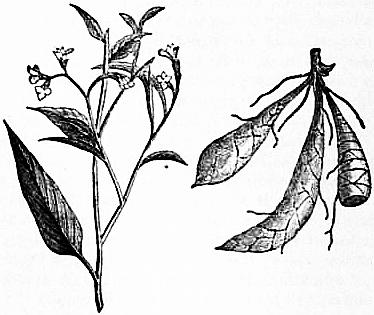
Fig. 1. Fig. 2.
Arrowroot Plant (Maranta arundinacea).—Fig. 1, stem, leaves and flowers; fig. 2, tubers.
Arrowroot is distinguished by the granules agglomerating into small balls, by slightly crepitating when rubbed between the fingers, and by yielding with boiling water a fine, transparent, inodorous and pleasant-tasting jelly. In microscopic structure the granules present an ovoid form, marked with concentric lines very similar to potato-starch, but readily distinguished by having a “hilum” marking at the thick extremity of the granule, while in potato-starch the same appearance occurs at the thin end (compare figs. 3 and 4 below). In addition to the West Indian supplies, arrowroot is found in the commerce of Brazil, the East Indies, Australia, Cape Colony and Natal.
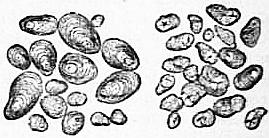
Fig. 3. Fig. 4.
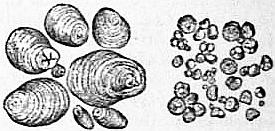
Fig. 5. Fig. 6.
Starch Granules magnified.
Fig. 3. Potato. Fig. 4. Arrowroot. Fig. 5. Tous-les-mois. Fig. 6. Manihot.
The name “arrowroot” is derived from the use by the Mexican Indians of the juice of the fresh root as an application to wounds produced by poisoned arrows. Sir Hans Sloane refers to it in his Catalogue of Jamaica Plants (1696), and it is said to have been introduced into England by William Houston about 1732. It is grown as a stove-plant in botanic gardens. The slender, much-branched stem is 5 or 6 ft. high, and bears numerous leaves with long, narrow sheaths and large spreading ovate blades, and a few short-stalked white flowers.
Tous-les-mois, or Tulema arrowroot, also from the West Indies, is obtained from several species of Canna, a genus allied to Maranta, and cultivated in the same manner. The granules of tous-les-mois are readily distinguishable by their very large size (fig. 5). East Indian arrowroot is obtained from the root-stocks of several species of the genus Curcuma (nat. ord. Zingiberaceae), chiefly C. angustifolia, a native of central India. Brazilian arrowroot is the starch of the cassava plant, a species of Manihot (fig. 6), which when agglutinated on hot plates forms the tapioca of commerce. The cassava is cultivated in the East Indian Archipelago as well as in South America. Tocca, or Otaheite arrowroot, is the produce of Tacca pinnatifida, the pia plant of the South Sea Islands. Portland arrowroot was formerly prepared on the Isle of Portland from the tubers of the common cuckoo-pint, Arum maculatum. Various other species of arum yield valuable food-starches in hot countries. Under the name of British arrowroot the farina of potatoes is sometimes sold, and the French excel in the preparation of imitations of the more costly starches from this source. The chief use, however, of potato-farina as an edible starch is for adulterating other and more costly preparations. This falsification can readily be detected by microscopic examination, and the accompanying drawings exhibit the appearance under the microscope of the principal starches we have described. Although these starches agree in chemical composition, their value as articles of diet varies considerably, owing to different degrees of digestibility and pleasantness of taste. Arrowroot contains about 82% of starch, and about 1% of proteid and mineral matter. Farina, or British arrowroot, at about one-twelfth the price, is just as useful and pleasant a food.
ARROWSMITH, the name of an English family of geographers. The first of them, Aaron Arrowsmith (1750-1823), migrated to London from Winston in Durham when about twenty years of age, and was employed by John Gary, the engraver. In 1790 he made himself famous by his large chart of the world on Mercator’s projection. Four years later he published another large map of the world on the globular projection, with a companion volume of explanation. The maps of North America (1796) and Scotland (1807) are the most celebrated of his many later productions. He left two sons, Aaron and Samuel, the elder of whom was the compiler of the Eton Comparative Atlas, of a Biblical atlas, and of various manuals of geography. They carried on the business in company with John Arrowsmith (1790-1873), nephew of the elder Aaron. In 1834 John published his London Atlas, the best set of maps then in existence. He followed up the atlas with a long series of elaborate and carefully executed maps, those of Australia, America, Africa and India being especially valuable. In 1863 he received the gold medal of the Royal Geographical Society, of which body he was one of the founders.
ARROYO (O. Sp. arrogio, Lat. arrogium, a rivulet or stream), the channel of a stream cut in loose earth, found often at the head of a gully, where the water flows only at certain seasons of the year.
ARSACES, a Persian name, which occurs on a Persian seal, where it is written in cuneiform characters. The most famous Arsaces was the chief of the Parni, one of the nomadic Scythian or Dahan tribes in the desert east of the Caspian Sea. A later tradition, preserved by Arrian, derives Arsaces I. and Tiridates from the Achaemenian king Artaxerxes II., but this has evidently no historical value. Arsaces, seeking refuge before the Bactrian king Diodotes, invaded Parthia, then a province of the Seleucid empire, about 250 B.C. (Strabo xi. p. 515, cf. Arrian p. 1, Müller, in Photius, Cod. 58, and Syncellus p. 284). After two years (according to Arrian) he was killed, and his brother Tiridates, who succeeded him and maintained himself for a short time in Parthia, during the dissolution of the Seleucid empire by the attacks of Ptolemy III. (247 ff.), was defeated and expelled by Seleucus II. (about 238). But when this king was forced, by the rebellion of his brother, Antiochus Hierax, to return to the west, Tiridates came back and defeated the Macedonians (Strabo xi. pp. 513, 515; Justin xli. 4; Appian, Syr. 65; Isidorus of Charax 11). He was the real founder of the Parthian empire, which was of very limited extent until the final decay of the Seleucid empire, occasioned by the Roman intrigues after the death of Antiochus IV. Epiphanes (165 B.C.), enabled Mithradates I. and his successors to conquer Media and Babylonia. Tiridates adopted the name of his brother Arsaces, and after him all the other Parthian kings (who by the historians are generally called by their proper names), amounting to the number of about thirty, officially wear only the name Arsaces. With very few exceptions only the name ΑΡΣΑΚΗΣ (with various epithets) occurs on the coins of the Parthian kings, and the obverse generally shows the seated figure of the founder of the dynasty, holding in his hand a strung bow. The Arsacidian empire was overthrown in A.D. 226 by Ardashir (Artaxerxes), the founder of the Sassanid empire, whose conquests began about A.D. 212. The name Arsaces of Persia is also borne by some kings of Armenia, who were of Parthian origin. (See Persia and Parthia.)
(Ed. M.)
ARS-AN-DER-MOSEL, a town of Germany, in the imperial province Alsace-Lorraine, 5 m. S. of Metz on the railway to Novéant. It has a handsome Roman Catholic church and extensive foundries. In the vicinity are the remains of a Roman aqueduct, which formerly spanned the valley. Pop. 5000.
ARSCHOT, PHILIPPE DE CROY, DUKE OF (1526-1595), governor-general of Flanders, was born at Valenciennes, and inherited the estates of the ancient and wealthy family of Croy. Becoming a soldier, he was made a knight of the order of the Golden Fleece by Philip II., king of Spain, and was afterwards employed in diplomatic work. He took part in the troubles in the Netherlands, and in 1563 refused to join William the Silent and others in their efforts to remove Cardinal Granvella from his post. This attitude, together with Arschot’s devotion to the Roman Catholic Church, which he expressed by showing his delight at the massacre of St Bartholomew, led Philip of Spain to regard him with still greater favour, which, however, was withdrawn in consequence of Arschot’s ambiguous conduct when welcoming the new governor, Don John of Austria, to the Netherlands in 1576. In spite, however, of his being generally distrusted by the inhabitants of the Netherlands, he was appointed governor of the citadel of Antwerp when the Spanish troops withdrew in 1577. After a period of vacillation he deserted Don John towards the end of that year. Jealous of the prince of Orange, he was then the head of the party which induced the archduke Matthias (afterwards emperor) to undertake the sovereignty of the Netherlands, and soon afterwards was appointed governor of Flanders by the state council. A strong party, including the burghers of Ghent, distrusted the new governor; and Arschot, who was taken prisoner during a riot at Ghent, was only released on promising to resign his office. He then sought to regain the favour of Philip of Spain, and having been pardoned by the king in 1580 again shared in the government of the Netherlands; but he refused to serve under the count of Fuentes when he became governor-general in 1594, and retired to Venice, where he died on the 11th of December 1595.
See J.L. Motley, The Rise of the Dutch Republic.
ARSENAL, an establishment for the construction, repair, receipt, storage and issue of warlike stores; details as to matériel will be found under Ammunition, Ordnance, &c. The word “arsenal” appears in various forms in Romanic languages (from which it has been adopted into Teutonic), i.e. Italian arzanale, Spanish arsenal, &c.; Italian also has arzana and darsena, and Spanish a longer form atarazanal. The word is of Arabic origin, being a corruption of daraṣ-ṣinā‘ah, house of trade or manufacture, dar, house, al, the, and ṣina‘ah, trade, manufacture, ṣana’a, to make. Such guesses as arx navalis, naval citadel, arx senatus (i.e. of Venice, &c.), are now entirely rejected.
A first-class arsenal, which can renew the matériel and equipment of a large army, embraces a gun factory, carriage factory, laboratory and small-arms ammunition factory, small-arms factory, harness, saddlery and tent factories, and a powder factory; in addition it must possess great store-houses. In a second-class arsenal the factories would be replaced by workshops. The situation of an arsenal should be governed by strategical considerations. If of the first class, it should be situated at the base of operations and supply, secure from attack, not too near a frontier, and placed so as to draw in readily the resources of the country. The importance of a large arsenal is such that its defences would be on the scale of those of a large fortress. The usual subdivision of branches in a great arsenal is into A, Storekeeping; B, Construction; C, Administration. Under A we should have the following departments and stores:—Departments of issue and receipt, pattern room, armoury department, ordnance or park, harness, saddlery and accoutrements, camp equipment, tools and instruments, engineer store, magazines, raw material store, timber yard, breaking-up store, unserviceable store. Under B—Gun factory, carriage factory, laboratory, small-arms factory, harness and tent factory, powder factory, &c. In a second-class arsenal there would be workshops instead of these factories. C—Under the head of administration would be classed the chief director of the arsenal, officials military and civil, non-commissioned officers and military artificers, civilian foremen, workmen and labourers, with the clerks and writers necessary for the office work of the establishments. In the manufacturing branches are required skill, and efficient and economical work, both executive and administrative; in the storekeeping part, good arrangement, great care, thorough knowledge of all warlike stores, both in their active and passive state, and scrupulous exactness in the custody, issue and receipt of stores. For fuller details the reader is referred to papers by Sir E. Collen, R.A., in vol. viii., and Lieut. C.E. Grover, R.E., in vol. vi. Proceedings of R. Artillery Institution. In England the Royal Arsenal, Woolwich, manufactures and stores the requirements of the army and navy (see Woolwich).
ARSENIC (symbol As, atomic weight 75.0), a chemical element, known to the ancients in the form of its sulphides. Aristotle gave them the name σανδαράκη, and Theophrastus mentions them under the name ἀρσενικόν. The oxide known as white arsenic is mentioned by the Greek alchemist Olympiodorus, who obtained it by roasting arsenic sulphide. These substances were all known to the later alchemists, who used minerals containing arsenic in order to give a white colour to copper. Albertus Magnus was the first to state that arsenic contained a metal-like substance, although later writers considered it to be a bastard or semi-metal, and frequently called it arsenicum rex. In 1733 G. Brandt showed that white arsenic was the calx of this element, and after the downfall of the phlogiston theory the views concerning the composition of white arsenic were identical with those which are now held, namely that it is an oxide of the element.
Arsenic is found in the uncombined condition in various localities, but more generally in combination with other metals and sulphur, in the form of more or less complex sulphides. Native arsenic is usually found as granular or curvilaminar masses, with a reniform or botryoidal surface. These masses are of a dull grey colour, owing to surface tarnish; only on fresh fractures is the colour tin-white with metallic lustre. The hardness is 3.5 and the specific gravity 5.63-5.73. Crystals of arsenic belong to the rhombohedral system, and have a perfect cleavage parallel to the basal plane; natural crystals are, however, of rare occurrence, and are usually acicular in habit. Native arsenic occurs usually in metalliferous veins in association with ores of antimony, silver, &c.; the silver mines of Freiberg in Saxony, St Andreasberg in the Harz, and Chañarcillo in Chile being well-known localities. Attractive globular aggregates of well-developed radiating crystals have been found at Akatani, a village in the province Echizen, in Japan.
Arsenic is a constituent of the minerals arsenical iron, arsenical pyrites or mispickel, tin-white cobalt or smaltite, arsenical nickel, realgar, orpiment, pharmacolite and cobalt bloom, whilst it is also met with in small quantities in nearly all specimens of iron pyrites. The ordinary commercial arsenic is either the naturally occurring form, which is, however, more or less contaminated with other metals, or is the product obtained by heating arsenical pyrites, out of contact with air, in earthenware retorts which are fitted with a roll of sheet iron at the mouth, and an earthenware receiver. By this method of distillation the arsenic sublimes into the receiver, leaving a residue of iron sulphide in the retort. For further purification, it may be sublimed, after having been previously mixed with a little powdered charcoal, or it may be mixed with a small quantity of iodine and heated. It can also be obtained by the reduction of white arsenic (arsenious oxide) with carbon. An electro-metallurgical process for the extraction of arsenic from its sulphides has also been proposed (German Patent. 67,973). These compounds are brought into solution by means of polysulphides of the alkali metals and the resultant liquor run into the cathode compartment of a bath, which is divided by diaphragms into a series of anode and cathode chambers; the anode divisions being closed and gas-tight, and containing carbon or platinum electrodes. The arsenic solution is decomposed at the cathode, and the element precipitated there.
Arsenic possesses a steel-grey colour, and a decided metallic lustre; it crystallizes on sublimation and slow condensation in rhombohedra, isomorphous with those of antimony and tellurium. It is very brittle. Its specific gravity is given variously from 5.395 to 5.959; its specific heat is 0.083, and its coefficient of linear expansion 0.00000559 (at 40° C.). It is volatile at temperatures above 100° C. and rapidly vaporizes at a dull red heat. It liquefies when heated under pressure, and its melting point lies between 446° C. and 457° C. The vapour of arsenic is of a golden yellow colour, and has a garlic odour. The vapour density is 10.6 (air = 1) at 564° C., corresponding to a tetratomic molecule As4; at a white heat the vapour density shows a considerable lowering in value, due to the dissociation of the complex molecule.
By condensing arsenic vapour in a glass tube, in a current of an indifferent gas, such as hydrogen, amorphous arsenic is obtained, the deposit on the portion of the tube nearest to the source of heat being crystalline, that farther along (at a temperature of about 210° C.) being a black amorphous solid, while still farther along the tube a grey deposit is formed. These two latter forms possess a specific gravity of 4.710 (14° C.) [A. Bettendorff, Annalen, 1867, 144, p. 110], and by heating at about 358°-360° C. pass over into the crystalline variety. Arsenic burns on heating in a current of oxygen, with a pale lavender-coloured flame, forming the trioxide. It is easily oxidized by heating with concentrated nitric acid to arsenic acid, and with concentrated sulphuric acid to arsenic trioxide; dilute nitric acid only oxidizes it to arsenious acid. It burns in an atmosphere of chlorine forming the trichloride; it also combines directly with bromine and sulphur on heating, while on fusion with alkalis it forms arsenites.
Arsenic and most of its soluble compounds are very poisonous, and consequently the methods used for the detection of arsenic are very important. For full accounts of methods used in detecting minute traces of arsenic in foods, &c., see “Report to Commission to Manchester Brewers’ Central Association,” the Analyst, 1900, 26, p. 8; “Report of Conjoint Committee of Society of Chemical Industry and Society of Public Analysts,” the Analyst, 1902, 27, p. 48; T.E. Thorpe, Journal of the Chemical Society, 1903, 83, p. 774; O. Hehner and others, Journal of Society of Chemical Industry, 1902, 21, p. 94; also Adulteration.
Arsenic and arsenical compounds generally can be detected by (a) Reinsch’s test: A piece of clean copper is dipped in a solution of an arsenious compound which has been previously acidified with pure hydrochloric acid. A grey film is produced on the surface of the copper, probably due to the formation of a copper arsenide. The reaction proceeds better on heating the solution. On removing, washing and gently drying the metal and heating it in a glass tube, a white crystalline sublimate is formed on the cool part of the tube; under the same conditions antimony does not produce a crystalline sublimate.
(b) Fleitmann’s test and Marsh’s test depend on the fact that arsenic and its compounds, when present in a solution in which hydrogen is being generated, are converted into arseniuretted hydrogen, which can be readily detected either by its action on silver nitrate solution or by its decomposition on heating. In Fleitmann’s test, the solution containing the arsenious compound is mixed with pure potassium hydroxide solution and a piece of pure zinc or aluminium foil dropped in and the whole then heated. A piece of bibulous paper, moistened with silver nitrate, is held over the mouth of the tube, and if arsenic be present, a grey or black deposit is seen on the paper, due to the silver nitrate being reduced by the arseniuretted hydrogen. Antimony gives no reaction under these conditions, so that the method can be used to detect arsenic in the presence of antimony, but the test is not so delicate as either Reinsch’s or Marsh’s method.
In the Marsh test the solution containing the arsenious compounds is mixed with pure hydrochloric acid and placed in an apparatus in which hydrogen is generated from pure zinc and pure sulphuric acid. The arseniuretted hydrogen produced is passed through a tube containing lead acetate paper and soda-lime, and finally through a narrow glass tube, constricted at various points, and heated by a very small flame. As the arseniuretted hydrogen passes over the heated portion it is decomposed and a black deposit formed. Instead of heating the tube, the gas may be ignited at the mouth of the tube and a cold surface of porcelain or platinum placed in the flame, when a black deposit is formed on the surface. This may be distinguished from the similar antimony deposit by its ready solubility in a solution of sodium hypochlorite. A blank experiment should always be carried out in testing for small quantities of arsenic, to ensure that the materials used are quite free from traces of arsenic. It is to be noted that the presence of nitric acid interferes with the Marsh test; and also that if the arsenic is present as an arsenic compound it must be reduced to the arsenious condition by the action of sulphurous acid. Arsenic compounds can be detected in the dry way by heating in a tube with a mixture of sodium carbonate and charcoal when a deposit of black amorphous arsenic is produced on the cool part of the tube, or by conversion of the compound into the trioxide and heating with dry sodium acetate when the offensive odour of the extremely poisonous cacodyl oxide is produced. In the wet way, arsenious oxide and arsenites, acidified with hydrochloric acid, give a yellow precipitate of arsenic trisulphide on the addition of sulphuretted hydrogen; this precipitate is soluble in solutions of the alkaline hydroxides, ammonium carbonate and yellow ammonium sulphide. Under like conditions arsenates only give a precipitate on long-continued boiling.
Arsenic is usually estimated either in the form of magnesium pyroarsenate or as arsenic sulphide. For the pyroarsenate method it is necessary that the arsenic should be in the arsenic condition, if necessary this can be effected by heating with nitric acid; the acid solution is then mixed with “magnesia mixture” and made strongly alkaline by the addition of ammonia. It is then allowed to stand twenty-four hours, filtered, washed with dilute ammonia, dried, ignited to constant weight and weighed, the filter paper being incinerated separately after moistening with nitric acid. From the weight of magnesium pyroarsenate obtained the weight of arsenic can be calculated.
In the sulphide method, the arsenic should be in the arsenious form. Sulphuretted hydrogen is passed through the liquid until it is thoroughly saturated, the excess of sulphuretted hydrogen is expelled from the solution by a brisk stream of carbon dioxide, and the precipitate is filtered on a Gooch crucible and washed with water containing a little sulphuretted hydrogen and dried at 100° C.; it is then well washed with small quantities of pure carbon disulphide to remove any free sulphur, again dried and weighed. Arsenic can also be estimated by volumetric methods; for this purpose it must be in the arsenious condition, and the method of estimation consists in converting it into the arsenic condition by means of a standard solution of iodine, in the presence of a cold saturated solution of sodium bicarbonate.
The atomic weight of arsenic has been determined by many different chemists. J. Berzelius, in 1818, by heating arsenious oxide with excess of sulphur obtained the value 74.3; J. Pelouze (Comptes rendus, 1845, 20, p. 1047) titrated arsenic chloride with silver solution and obtained 75.0; and F. Kessler (Pogg. Ann. 1861, 113, p. 134) by converting arsenic trisulphide in hydrochloric acid solution into arsenic pentasulphide also obtained 75.0.
Compounds.—Arsenic forms two hydrides:—The dihydride, As2H2, is a brown velvety powder formed when sodium or potassium arsenide is decomposed by water. It is a somewhat unstable substance, decomposing on being heated, with liberation of hydrogen. Arsenic trihydride (arsine or arseniuretted hydrogen), AsH3, is formed by decomposing zinc arsenide with dilute sulphuric acid; by the action of nascent hydrogen on arsenious compounds, and by the electrolysis of solutions of arsenious and arsenic acids; it is also a product of the action of organic matter on many arsenic compounds. It is a colourless gas of unpleasant smell, excessively poisonous, very slightly soluble in water. It easily burns, forming arsenious oxide if the combustion proceeds in an excess of air, or arsenic if the supply of air is limited; it is also decomposed into its constituent elements when heated. It liquefies at −40° C. and becomes solid at −118.9° C. (K. Olszewski). Metals such as tin, potassium and sodium, when heated in the gas, form arsenides, with liberation of hydrogen; and solutions of gold and silver salts are reduced by the gas with precipitation of metallic gold and silver. Chlorine, bromine and iodine decompose arsine readily, the action being most violent in the case of chlorine.
Arsenic tribromide, AsBr3, is formed by the direct union of arsenic and bromine, and subsequent distillation from the excess of arsenic; it forms colourless deliquescent prisms which melt at 20°-25° C., and boil at 220° C. Water decomposes it, a small quantity of water leading to the formation of the oxybromide, AsOBr, whilst a large excess of water gives arsenious oxide, As4O6.
Arsenic certainly forms two, or possibly three iodides. The di-iodide, As2I4 or AsI2, which is prepared by heating one part of arsenic with two parts of iodine, in a sealed tube to 230° C., forms dark cherry-red prisms, which are easily oxidized, and are readily decomposed by water. The tri-iodide, AsI3, prepared by subliming arsenic and iodine together in a retort, by leading arsine into an alcoholic iodine solution, or by boiling powdered arsenic and iodine with water, filtering and evaporating, forms brick-red hexagonal tables, of specific gravity 4.39, soluble in alcohol, ether and benzene, and in a large excess of water; in the presence of a small quantity of water, it is decomposed with formation of hydriodic acid and an insoluble basic salt of the composition 4AsOI·3As4O6·24H2O. It combines with alkaline iodides to form very unstable compounds. The pentaiodide, AsI5, appears to be formed when a mixture of one part of arsenic and seven parts of iodine is heated to 190° C., but on dissolving the resulting product in carbon bisulphide and crystallizing from this solvent, only the tri-iodide is obtained.
Arsenic trichloride, AsCl3, is prepared by distilling white arsenic with concentrated sulphuric acid and common salt, or by the direct union of arsenic with chlorine, or from the action of phosphorus pentachloride on white arsenic. It is a colourless oily heavy liquid of specific gravity 2.205 (0° C.), which, when pure and free from chlorine, solidifies at −18° C., and boils at 132° C. It is very poisonous and decomposes in moist air with evolution of white fumes. With a little water it forms arsenic oxychloride, AsOCl, and with excess of water it is completely decomposed into hydrochloric acid and white arsenic. It combines directly with ammonia to form a solid compound variously given as AsCl3·3NH3, or 2AsCl3·7NH3, or AsCl3·4NH3.
Arsenic trifiuoride, AsF3, is prepared by distilling white arsenic with fluorspar and sulphuric acid, or by heating arsenic tribromide with ammonium fluoride; it is a colourless liquid of specific gravity 2.73, boiling at 63° C.; it fumes in air, and in contact with the skin produces painful wounds. It is decomposed by water into arsenious and hydrofluoric acids, and absorbs ammonia forming the compound 2AsF3·5NH3. By the action of gaseous ammonia on arsenious halides at −30° C. to −40° C., arsenamide, As(NH2)3, is formed. Water decomposes it into arsenious oxide and ammonia, and when heated to 60° it loses ammonia and forms arsenimide, As2(NH)3 (C. Hugot, Compt. rend. 1904, 139, p. 54). For AsF5, see Ber., 1906, 39, p. 67.
Two oxides of arsenic are definitely known to exist, namely the trioxide (white arsenic), As4O6, and the pentoxide, As2O5, while the existence of a suboxide, As2O(?), has also been mooted. Arsenic trioxide has been known from the earliest times, and was called Hüttenrauch (furnace-smoke) by Basil Valentine. It occurs naturally in the mineral claudetite, and can be artificially prepared by burning arsenic in air or oxygen. It is obtained commercially by roasting arsenical pyrites in either a Brunton’s or Oxland’s rotatory calciner, the crude product being collected in suitable condensing chambers, and afterwards refined by resublimation, usually in reverberatory furnaces, the foreign matter being deposited in a long flue leading to the condensing chambers. White arsenic exists in two crystalline forms (octahedral and prismatic) and one amorphous form; the octahedral form is produced by the rapid cooling of arsenic vapour, or by cooling a warm saturated solution in water, or by crystallization from hydrochloric acid, and also by the gradual transition of the amorphous variety, this last phenomenon being attended by the evolution of heat. Its specific gravity is 3.7; it is only slightly soluble in cold water, but is more soluble in hot water, the solution reacting faintly acid. The prismatic variety of the oxide can be obtained by crystallization from a saturated boiling solution in potassium hydroxide, or by the crystallization of a solution of silver arsenite in nitric acid. Its specific gravity is 4.15. In the amorphous condition it can be obtained by condensing the vapour of the oxide at as high a temperature as possible, when a vitreous mass is produced, which melts at 200° C., has a specific gravity of 3.68-3.798, and is more soluble in water than the crystalline variety.
Arsenious oxide is very poisonous. It acts as a reducing agent; it is not convertible into the pentoxide by the direct action of oxygen; and its solution is reduced by many metals (e.g. zinc, tin and cadmium) with precipitation of arsenic and formation of arseniuretted hydrogen. The solution of arsenious oxide in water reacts acid towards litmus and contains tribasic arsenious acid, although on evaporation of the solution the trioxide is obtained and not the free acid. The salts of the acid are, however, very stable, and are known as arsenites. Of these salts several series are known, namely the ortho-arsenites, which are derivatives of the acid H3AsO3, the meta-arsenites, derivatives of HAsO2, and the pyro-arsenites, derivatives of H4As2O5. The arsenites of the alkali metals are soluble in water, those of the other metals are insoluble in water, but are readily soluble in acids. A neutral solution of an arsenite gives a yellow precipitate of silver arsenite, Ag3AsO3, with silver nitrate solution, and a yellowish-green precipitate (Scheele’s green) of cupric hydrogen arsenite, CuHAsO3, with copper sulphate solution. By the action of oxidizing agents such as nitric acid, iodine solution, &c., arsenious acid is readily converted into arsenic acid, in the latter case the reaction proceeding according to the equation H3AsO3 + I2 + H2O = H3AsO4 + 2HI. Arsenic pentoxide, As2O5, is most easily obtained by oxidation of a solution of arsenious acid with nitric acid; the solution on concentration deposits the compound 2H3AsO4·H2O (below 15° C.), which on being heated to a dark red heat loses its water of crystallization and leaves a white vitreous mass of the pentoxide. This substance dissolves slowly in water, forming arsenic acid; by heating to redness it decomposes into arsenic and oxygen. It deliquesces in moist air, and is easily reduced to arsenic by heating with carbon.
Arsenic acid, H3AsO4, is prepared as shown above, the compound 2H3AsO4·H2O on being heated to 100° C. parting with its water of crystallization and leaving a residue of the acid, which crystallizes in needles. On heating to 180° C. it loses water and yields pyroarsenic acid, H4As2O7, which at 200° C. loses more water and leaves a crystalline mass of meta-arsenic acid, HAsO3. These latter two acids are only stable in the solid state; they dissolve readily in water with evolution of heat and immediate transformation into the ortho-arsenic acid. The salts of arsenic acid, termed arsenates, are isomorphous with the phosphates, and in general character and reactions resemble the phosphates very closely; thus both series of salts give similar precipitates with “magnesia mixture” and with ammonium molybdate solution, but they can be distinguished by their behaviour with silver nitrate solution, arsenates giving a reddish-brown precipitate, whilst phosphates give a yellow precipitate.
There are three known compounds of arsenic and sulphur, namely, realgar As2S2, orpiment As2S3, and arsenic pentasulphide As2S5. Realgar occurs native in orange prisms of specific gravity 3.5; it is prepared artificially by fusing together arsenic and sulphur, but the resulting products vary somewhat in composition; it is readily fusible and sublimes unchanged, and burns on heating in a current of oxygen, forming arsenic trioxide and sulphur dioxide.
Orpiment (auri pigmentum) occurs native in pale yellow rhombic prisms, and can be obtained in the amorphous form by passing a current of sulphuretted hydrogen gas through a solution of arsenious oxide or an arsenite, previously acidified with dilute hydrochloric acid. It melts easily and volatilizes. It burns on heating in air, and is soluble in solutions of alkaline hydroxides and carbonates, forming thioarsenites, As2S3 + 4KHO = K2HAsO3 + K2HAsS3 + H2O. On acidifying the solution so obtained with hydrochloric acid, the whole of the arsenic is reprecipitated as trisulphide, K2HAsO3 + K2HAsS3 + 4HCl = 4KCl + 3H2O + As2S3. Arsenic pentasulphide, As2S5, can be prepared by fusing the trisulphide with the requisite amount of sulphur; it is a yellow easily-fusible solid, which in absence of air can be sublimed unchanged; it is soluble in solutions of the caustic alkalis, forming thioarsenates, which can also be obtained by the action of alkali polysulphides on orpiment. The thioarsenites and thioarsenates of the alkali metals are easily soluble in water, and are readily decomposed by the action of mineral acids. Arsenic compounds containing selenium and sulphur are known, such as arsenic seleno-sulphide, AsSeS2, and arsenic thio-selenide, AsSSe2. Arsenic phosphide, AsP, results when phosphine is passed into arsenic trichloride, being precipitated as a red-brown powder.
Many organic arsenic compounds are known, analogous to those of nitrogen and phosphorus, but apparently the primary and secondary arsines, AsH2·CH3 and AsH(CH3)2, do not exist, although the corresponding chlorine derivatives, AsCl2·CH3, methyl arsine chloride, and AsCl(CH4)2, dimethyl arsine chloride, are known. The tertiary arsines, such as As(CH3)3, trimethyl arsine, and the quaternary arsonium iodides and hydroxides, (CH3)4AsI and (CH3)4As·OH, tetramethyl arsonium iodide and hydroxide, have been obtained. The arsines and arsine chlorides are liquids of overpowering smell, and in some cases exert an extremely irritating action on the mucous membrane. They do not possess basic properties; the halogen in the chlorine compounds is readily replaced by oxygen, and the oxides produced behave like basic oxides. The chlorides AsCl2·CH3 and AsCl(CH3)2 as well as As(CH3)3 are capable of combining with two atoms of chlorine, the arsenic atom apparently changing from the tri- to the penta-valent condition, and the corresponding oxygen compounds can also be oxidized to compounds containing one oxygen atom or two hydroxyl groups more, forming acids or oxides. The compounds of the type AsX5, e.g. AsCl4·CH3, AsCl3(CH3)2, on heating break down, with separation of methyl chloride and formation of compounds of the type AsX3; the breaking down taking place more readily the fewer the number of methyl groups in the compound. The dimethyl arsine (or cacodyl) compounds have been most studied. On distillation of equal parts of dry potassium acetate and arsenious oxide, a colourless liquid of unbearable smell passes over, which is spontaneously inflammable and excessively poisonous. It is sometimes called Cadet’s fuming liquid, and its composition was determined by R. Bunsen, who gave it the name cacodyl oxide (κακώδης, stinking); its formation may be shown thus:
As4O6 + 8CH3CO2K = 2[(CH3)2As]2O + 4K2CO3 + 4CO2.
The liquid is spontaneously inflammable owing to the presence of free cacodyl, As2(CH3)4, which is also obtained by heating the oxide with zinc clippings in an atmosphere of carbon dioxide; it is a liquid of overpowering odour, and boils at 170°C. Cacodyl oxide boils at 150° C., and on exposure to air takes up oxygen and water and passes over into the crystalline cacodylic acid, thus:
[(CH3)2As]2O + H2O + O2 = 2(CH3)2As·O·OH.
Pharmacology.—Of arsenic and its compounds, arsenious acid (dose 1⁄60-1⁄15 gr.) and its preparation liquor arsenicalis, Fowler’s solution (dose 2-8 ♏), are in very common use. The iodide of arsenic (dose 1⁄20-1⁄5 gr.) is one of the ingredients of Donovan’s solution (see Mercury); and iron arsenate (dose 1⁄16-¼ gr. in a pill), a mixture of ferrous and ferric arsenates with some iron oxide, is of great use in certain cases. Sodium arsenate (1⁄40-1⁄10 gr.) is somewhat less commonly prescribed, though all the compounds of this metal have great value in experienced hands.
Externally, arsenious acid is a powerful caustic when applied to raw surfaces, though it has no action on the unbroken skin. Internally, unless the dose be extremely small, all preparations are severe gastro-intestinal irritants. This effect is the same however the drug be administered, as, even after subcutaneous injection, the arsenic is excreted into the stomach after absorption, and thus sets up gastritis in its passage through the mucous membrane. In minute doses it is a gastric stimulant, promoting the flow of gastric juice. It is quickly absorbed into the blood, where its presence can be demonstrated especially in the white blood corpuscles. In certain forms of anaemia it increases the number of the red corpuscles and also their haemoglobin content. None of these known effects of arsenic is sufficient to account for the profound change that a course of the drug will often produce in the condition of a patient. It has some power of affecting the general metabolism, but no wholly satisfactory explanation is forthcoming. According to Binz and Schultz its power is due to the fact that it is an oxygen-carrier, arsenious acid withdrawing oxygen from the protoplasm to form arsenic acid, which subsequently yields up its oxygen again. It is thus vaguely called an alterative, since the patient recovers under its use. It is eliminated chiefly by the urine, and to a less extent by the alimentary canal, sweat, saliva, bile, milk, tears, hair, &c., but it is also stored up in the body mainly in the liver and kidneys.
Therapeutics.—Externally arsenious acid has been much used by quack doctors to destroy morbid growths, &c., a paste or solution being applied, strong enough to kill the mass of tissue and make it slough out quickly. But many accidents have resulted from the arsenic being absorbed, and the patient thereby poisoned. Internally it is useful in certain forms of dyspepsia, but as some patients are quite unable to tolerate the drug, it must always be administered in very small doses at first, the quantity being slowly increased as tolerance is shown. Children as a rule bear it better than adults. It should never be given on an empty stomach, but always after a full meal. Certain cases of anaemia which do not yield to iron are often much improved by arsenic, though in other apparently similar ones it appears to be valueless. It is the routine treatment for pernicious anaemia and Hodgkin’s disease, though here again the drug may be of no avail. For the neuralgia and anaemia following malaria, for rheumatoid arthritis, for chorea and also asthma and hay fever, it is constantly prescribed with excellent results. Certain skin diseases, as psoriasis, pemphigus and occasionally chronic eczema, are much benefited by its use, though occasionally a too prolonged course will produce the very lesion for which under other circumstances it is a cure. A recent method of using the drug is in the form of sodium cacodylate by subcutaneous injection, and this preparation is said to be free from the cumulative effects sometimes arising after the prolonged use of the other forms. Other organic derivatives employed are sodium metharsenite and sodium anilarsenate or atoxyl; hypodermic injections of the latter have been used in the treatment of sleeping sickness. Occasionally, as among the Styrians, individuals acquire the habit of arsenic-eating, which is said to increase their weight, strength and appetite, and clears their complexion. The probable explanation is that an antitoxin is developed within them.
Toxicology and Forensic Medicine.—The commonest source of arsenical poisoning is the arsenious acid or white arsenic, which in one form is white and opaque, like flour, for which it has been mistaken with fatal results. Also, as it has little taste and no colour it is easily mixed with food for homicidal purposes. When combined with potash or soda it is used to saturate flypapers, and strong solutions can be obtained by soaking these in water; this fact has also been used with criminal intent. Copper arsenite (or Scheele’s green) used to be much employed as a pigment for wall-papers and fabrics, and toxic effects have resulted from their use. Metallic arsenic is probably not poisonous, but as it usually becomes oxidized in the alimentary canal, the usual symptoms of arsenical poisoning follow its use.
In acute poisoning the interval between the reception of the poison and the onset of symptoms ranges from ten minutes, or even less, if a strong solution be taken on an empty stomach, to twelve or more hours if the drug be taken in solid form and the stomach be full of food. The usual period, however, is from half an hour to an hour. In a typical case a sensation of heat developing into a burning pain is felt in the throat and stomach. This is soon followed by uncontrollable vomiting, and a little later by severe purging, the stools being first of all faecal but later assuming a rice water appearance and often containing blood. The patient suffers from intense thirst, which cannot be relieved, as drinking is immediately followed by rejection of the swallowed fluid. There is profound collapse, the features are sunken, the skin moist and cyanosed. The pulse is feeble and irregular, and respiration is difficult. The pain in the stomach is persistent, and cramps in the calves of the legs add to the torture. Death may be preceded by coma, but consciousness is often maintained to the end. The similarity of the symptoms to those of cholera is very marked, but if the suspicion arises it can soon be cleared up by examining any of the secretions for arsenic. More rarely the poison seems to centre itself on the nerve centres, and gastro-intestinal symptoms may be almost or quite absent. In such cases the acute collapse occurs in company with both superficial and deep anaesthesia of the limbs, and is soon followed by coma terminating in death. In criminal poisoning repeated doses are usually given, so that such cases may not be typical, but will present some of the aspects of acute and some of chronic arsenical poisoning. As regards treatment, the stomach must be washed out with warm water by means of a soft rubber tube, an emetic being also administered. Then, if available, freshly precipitated ferric hydrate must be given, which can be prepared by adding a solution of ammonia to one of iron perchloride. The precipitate is strained off, and the patient can swallow it suspended in water. While this is being obtained, magnesia, castor oil or olive oil can be given; or failing all these, copious draughts of water. The collapse must be treated with hot blankets and bottles, and subcutaneous injections of brandy, ether or strychnine. The pain can be lessened by injections of morphia.
Arsenic may be gradually absorbed into the system in very small quantities over a prolonged period, the symptoms of chronic poisoning resulting. The commonest sources used to be wall-papers, fabrics, artificial flowers and toys: also certain trades, as in the manufacture of arsenical sheep-dipping. But at the present time cases arising from these causes occur very rarely. In 1900 an outbreak of “peripheral neuritis” with various skin affections occurred in Lancashire, which was traced to beer made from glucose and invert sugar, in the preparation of which sulphuric acid contaminated with arsenic was said to have been used. But the nature of the disease in this case was decidedly obscure. The symptoms so closely resembled those of beri-beri that it has also been suggested that the illness was the same, and was caused by the manufacture of the glucose from mouldy rice (see Beri-Beri), though no proof of this was possible. The earliest symptoms are slight gastric disorders, loss of appetite and general malaise, followed later by colicky pains, irritation of eyelids and skin eruptions. But sooner or later peripheral neuritis develops, usually beginning with sensory disturbances, tingling, numbness, formication and occasionally cutaneous anaesthesia. Later the affected muscles become exquisitely tender, and then atrophy, while the knee-jerk or other reflex is lost. Pigmentation of the skin may occur in the later stages. Recovery is very slow, and in fatal cases death usually results from heart failure.
After acute poisoning, the stomach at a post-mortem presents signs of intense inflammation, parts or the whole of its mucous membrane being of a colour varying from dark red to bright vermilion and often corrugated. Submucous haemorrhages are usually present, but perforation is rare. The rest of the alimentary canal exhibits inflammatory changes in a somewhat lesser degree. After chronic poisoning a widely spread fatty degeneration is present. Arsenic is found in almost every part of the body, but is retained in largest amount by the liver, secondly by the kidneys. After death from chronic poisoning it is found present even in the brain and spongy bone. The detection of arsenic in criminal cases is effected either by Reinsch’s test or by Marsh’s test, the urine being the secretion analysed when available. But Reinsch’s test cannot be used satisfactorily for a quantitative determination, nor can it be used in the presence of chlorates or nitrates. And Marsh’s test is very unmanageable with organic liquids on account of the uncontrollable frothing that takes place. But in such cases the organic matter can be first destroyed by one of the various methods, usually the moist method devised by Fresenius being chosen.
ARSENIUS (c. 354-450), an anchorite, said to have been born of a noble Roman family, who achieved a high reputation for his knowledge of Greek and Roman literature. He was appointed by Theodosius the Great, tutor of the young princes Arcadius and Honorius, but at the age of forty he retired to Egypt, where for forty years he lived in monastic seclusion at Scetis in the Thebais, under the spiritual guidance of St John the Dwarf. He is said to have gained the admiration of his fellows by the extreme rigour of his asceticism. The remainder of his life he spent at Canopus, and Troë near Memphis, where he died at the age of ninety-five. Of his writings two collections of admonitory maxims are extant: the first, Διδασκαλία καὶ παραίνεσις, containing instructions for monks, is published with a Latin version by Fr. Combefis in Auctarium biblioth. patr. novissim. (Paris, 1672), pp. 301 f.; the second is a collection of forty-four wise sayings put together by his friends under the title of Ἀποφθέγματα (see Cotelerius, Eccl. graec. monum., 1677, i. pp. 353-372). In the Roman Catholic Church his festival is on the 19th of July, in the Orthodox Eastern Church on the 8th of May. His biography by Simeon Metaphrastes is largely fiction.
ARSENIUS AUTORIANUS (13th century), patriarch of Constantinople, lived about the middle of the 13th century. He received his education in Nicaea at a monastery of which he later became the abbot, though not in orders. Subsequently he gave himself up to a life of solitary asceticism in a Bithynian monastery, and is said, probably wrongly, to have remained some time in a monastery on Mount Athos. From this seclusion he was in A.D. 1255 called by Theodore II. Lascaris to the position of patriarch at Nicaea, and four years later, on that emperor’s death, became joint guardian of his son John. His fellow-guardian Georgios Mouzalon was immediately murdered by Michael Palaeologus, who assumed the position of tutor. Arsenius then took refuge in the monastery of Paschasius, retaining his office of patriarch but refusing to discharge its duties. Nicephorus of Ephesus was appointed in his stead. In 1261 Michael, having recovered Constantinople, induced Arsenius again to undertake the office of patriarch, but soon incurred his severe censure by ordering the young prince John to be blinded. Arsenius went so far as to excommunicate the emperor, who, having vainly sought for pardon, took refuge in false accusations against Arsenius and caused him to be banished to Proconnesus, where some years afterwards (according to Fabricius in 1264; others say in 1273) he died. Throughout these years he declined to remove the sentence of excommunication which he had passed upon Michael, and after his death, when the new patriarch Josephus gave absolution to the emperor, the quarrel was carried on between the “Arsenites” and the “Josephists.” The “Arsenian schism” lasted till 1315, when reconciliation was effected by the patriarch Niphon (see Gibbon, Decline and Fall of the Roman Empire, ed. J.B. Bury, 1898, vol. vi. 467 foll.). Arsenius is said to have prepared from the decisions of the councils and the works of the Fathers a summary of divine laws under the title Synopsis Canonum. This was published (Greek original and Latin version) by G. Voël and H. Justel in Bibliotheca Jur. Canon. Vet. (Paris, 1661), 749 foll. Some hold that the Synopsis was the work of another Arsenius, a monk of Athos (see L. Petit in Vacant’s Dict. théol. cathol. i. col. 1994); the ascription depends on whether the patriarch Arsenius did or did not sojourn at Mount Athos.
See Georgius Pachymeres ii. 15, iii. passim, iv. 1-16; Nicephorus Gregoras iii. 1, iv. 1; for the will of Arsenius see Cotelerius, Monumenta, ii. 168.
ARSES, Persian king, youngest son of Artaxerxes III., was raised to the throne in 338 B.C. by Bagoas (q.v.), who had murdered his father and all his brothers. But when the young king tried to make himself independent, Bagoas killed him too, with all his children, in the third year of his reign (336) (Diod. 17.5; Strabo 15. 736; Trogus, Prol. x., Alexander’s despatch to Darius III.; Arrian ii. 14. 5, and the chronographers). In Plutarch, De fort. Alex. ii. 3. 5, he is called Oarses; in Johannes Antioch. p. 38, Arsamos; in the canon of Ptolemy, Aroges (by Elias of Nisibis, Pīrūz); in a chronological tablet from Babylon (Brit. Mus. Sp. ii. 71, Zeitschrift für Assyriologie, viii. 176, x. 64) he is abbreviated into Ar. See Persia: Ancient History.
(Ed. M.)
ARSINOË, the name of four Egyptian princesses of the Ptolemaic dynasty. The name was introduced into the Ptolemaic dynasty by the mother of Ptolemy I. This Arsinoë was originally a mistress of Philip II. of Macedon, who presented her to a Macedonian soldier Loqus shortly before Ptolemy was born. It was, therefore, assumed by the Macedonians that the Ptolemaic house was really descended from Philip (see Ptolemies).
1. Daughter of Lysimachus, king of Thrace, first wife of Ptolemy II. Philadelphus (285-247 B.C.). Accused of conspiring against her husband, who perhaps already contemplated marriage with his sister, also named Arsinoë, she was banished to Coptos, in Upper Egypt. Her son Ptolemy was afterwards king under the title of Euergetes. It is supposed by some (e.g. Niebuhr, Kleine Schriften; cf. Ehrlichs, De Callimachi hymnis) that she is to be identified with the Arsinoë who became wife of Magas, king of Cyrene, and that she married him after her exile to Coptos. But this hypothesis is apparently without foundation. Magas before his death had betrothed his daughter Berenice to the son of his brother Ptolemy II. Philadelphus, but Arsinoë, disliking the projected alliance, induced Demetrius the Fair, son of Demetrius Poliorcetes, to accept the throne of Cyrene as husband of Berenice. She herself, however, fell in love with the young prince, and Berenice in revenge formed a conspiracy, and, having slain Demetrius, married Ptolemy’s son (see Berenice, 3).
2. Daughter of Ptolemy I. Soter and Berenice. Born about 316 B.C., she married Lysimachus, king of Thrace, who made over to her the territories of his divorced wife, Amastris. To secure the succession for her own children she brought about the murder of her stepson Agathocles. Lysandra, the wife of Agathocles, took refuge with Seleucus, king of Syria, who made war upon Lysimachus and defeated him (281). After her husband’s death Arsinoë fled to Ephesus and afterwards to Cassandreia in Macedonia. Seleucus, who had seized Lysimachus’s kingdom, was murdered in 281 by Ptolemy Ceraunus (half-brother of Arsinoë), who thus became master of Thrace and Macedonia. To obtain possession of Cassandreia, he offered his hand in marriage to Arsinoë, and being admitted into the town, killed her two younger sons and banished her to Samothrace. Escaping to Egypt, she became the wife of her full brother Ptolemy II., the first instance of the practice (afterwards common) of the Greek kings of Egypt marrying their sisters. She was a woman of a masterful character and won great influence. Her husband, though she bore him no children, was devoted to her and paid her all possible honour after her death in 271. He gave her name to a number of cities, and also to a district (nome) of Egypt.1 It is related that he ordered the architect Dinochares to build a temple in her honour in Alexandria; in order that her statue, made of iron, might appear to be suspended in the air, the roof was to consist of an arch of loadstones (Pliny, Hist. Nat. xxxiv. 42). Coins were also struck, showing her crowned and veiled on the obverse, with a double cornucopia on the reverse. She was worshipped as a goddess under the title of Θεὰ φιλάδελφος, and she and her husband as Θεοὶ ἄδελφοι (Justin xxiv. 2, 3; Pausanias i. 7).
See von Prott, Rhein. Mus. liii. (1898), pp. 460 f.
3. Daughter of Ptolemy III. Euergetes, sister and wife of Ptolemy IV. Philopator. She seems to be erroneously called Eurydice by Justin (xxx. 2), and Cleopatra by Livy (xxvii. 4). Her presence greatly encouraged the troops at the battle of Raphia (217), in which Antiochus the Great was defeated. Her husband put her to death to please his mistress Agathocleia, a Samian dancer (between 210 and 205). She was worshipped as Θεὰ φιλοπάτωρ; she and her husband as Θεοὶ φιλοπάτορες (Polybius v. 83, 84, xv. 25-33).
4. Youngest daughter of Ptolemy XIII. Auletes, and sister of the famous Cleopatra. During the siege of Alexandria by Julius Caesar (48) she was recognized as queen by the inhabitants, her brother, the young Ptolemy, being then held captive by Caesar. Caesar took her with him to Rome as a precaution. After Caesar’s triumph she was allowed to return to Alexandria. After the battle of Philippi she was put to death at Miletus (or in the temple of Artemis at Ephesus) by order of Mark Antony, at the request of her sister Cleopatra (Dio Cassius xlii. 39; Caesar, Bell. civ. iii. 112; Appian, Bell. civ. v. 9).
Authorities.—For general authorities see article Ptolemies. The article “Arsinoë” in Pauly-Wissowa’s Realencyclopädie contains a full list of those who bore the name, and also of the numerous towns which were called after the various princesses.
1 The appendix to pt. ii. of the Tebtunis series of papyri (Grenfell, Hunt and Goodspeed, 1907) contains a lengthy account of the topography of the Arsinoite nome.
ARSINOITHERIUM (so called from the Egyptian queen Arsinoë), a gigantic horned mammal from the Middle Eocene beds of the Fayum, Egypt, representing a sub-order of Ungulata, called Barypoda. The skull is remarkable for carrying a huge pair of horn-cores above the muzzle, which seem to be the enlarged nasal bones, and a rudimentary pair farther back; the front horn-cores, like the rest of the skull, consist of a mere shell of bone, and were probably clothed in life with horny sheaths. The teeth form a continuous even series, the small canines being crowded between the incisors and premolars; the crowns of the cheek-series are tall (hypsodont), with a distinctive pattern of their own. Although the brain is relatively larger, the bones of the limbs, especially the short, five-toed feet, approximate to those of the Amblypoda and Proboscidea; but in the articulation of the astragalus with both the navicular and cuboid Arsinoitherium is nearer the former than the latter group.
It is probable, however, that these resemblances are mainly due to parallelism in development, and are in all three cases adaptations necessary to support the enormous weight of the body. On the other hand, the marked resemblance of the structure of the tarsus is probably indicative of descent from nearly allied condylarthrous ancestors (see Phenacodus). No importance can be attached to the presence of horns as an indication of affinity between Arsinoitherium and the Amblypoda; and there are important differences in the structure of the skulls of the two, notably in the external auditory meatus, the occiput, the premaxillae, the palatal foramina and the lower jaw.
From the Proboscidea Arsinoitherium differs broadly in skull structure, in the form of the cheek-teeth, and in the persistence of the complete dental series of forty-four without gaps or enlargement of particular teeth. Whether there is any relationship with the Hyracoidea cannot be determined until we are acquainted with the forerunners of Arsinoitherium, which is evidently a highly specialized type.
It may be added that as the name Barypoda has been used at an earlier date for another group of animals, the alternative title Embrithopoda has been suggested in case the former should be considered barred.
See C.W. Andrews, Descriptive Catalogue of the Tertiary Vertebrata of the Fayum, British Museum (1906).
(R. L.*)
ARSON (from Lat. ardere, to burn), a crime which has been described as the malicious and voluntary burning of the house of another (3 Co. Inst. 66). At common law in England it is an offence of the degree of felony. In the Roman civil law arson was punishable by death. It appears early in the history of English law, being known in ancient laws by the term of boernet. It is mentioned by Cnut as one of the bootless crimes, and under the Saxon laws was punishable by death. The sentence of death for arson was, says Stephen (Commentaries, iv. 89), in the reign of Edward I. executed by a kind of lex talionis, for the incendiaries were burnt to death; a punishment which was inflicted also under the Gothic institutions. Death continued to be the penalty at least down to the reign of King John, according to a reported case (Gloucester Pleas, pl. 216), but in course of time the penalty became that of other common-law felonies, death by the gallows. It is one of the earliest crimes in which the mens rea, or criminal intent, was taken special notice of. Bracton deals at length with the mala conscientia, which he says is necessary for this crime, and contrasts it with negligentia (f. 146 b), while in many early indictments malice aforethought (malitia praecogitata) appears. Arson was deprived of “benefit of clergy” under the Tudors, while an act of 8 Henry VI. c. 6 (1429) made the wilful burning of houses, under particular circumstances, high treason, but acts of 1 Ed. VI. c. 12 (1547) and 1 Mary (1553) reduced it to an ordinary felony. The English law concerning arson was consolidated by 7 & 8 Geo. IV. c. 30, which was repealed and re-enacted by the Malicious Damage Act 1861.
The common-law offence of arson (which has been greatly enlarged by the act of 1861) required some part of the house to be actually burnt; neither a bare intention nor even an actual attempt by putting fire in or towards it will constitute the offence, if no part was actually burnt, but the burning of any part, however trifling, is sufficient, and the offence is complete even if the fire is put out or goes out of itself. The burning must be malicious and wilful, otherwise it is only a trespass. If a man by wilfully setting fire to his own house burn the house of his neighbour also, it will be a felony, even though the primary intention of the party was to burn his own house only. The word house, in the definition of the offence at common law, extends not only to dwelling-houses, “but to all out-houses which are parcel thereof, though not adjoining thereto.” Barns with corn and hay in them, though distant from a house, are within the definition.
The different varieties of the offence are specified in the Malicious Damage Act 1861. The following crimes are thereby made felonies: (1) setting fire to any church, chapel, meeting-house or other place of divine worship; (2) setting fire to a dwelling-house, any person being therein; (3) setting fire to a house, out-house, manufactory, farm-building, &c., with intent to impose and defraud any person; (4) setting fire to buildings appertaining to any railway, port, dock or harbour; or (5) setting fire to any public building. In these cases the act provides that the person convicted shall be liable, at the discretion of the court, to be kept in penal servitude for life, or for any term not less than three years (altered to five years by the Penal Servitude Acts Amendment Act 1864), or to be imprisoned for any time not exceeding two years, with or without hard labour, and, if a male under sixteen years of age, with or without whipping. Setting fire to other buildings, and setting fire to goods in buildings under such circumstances that, if the building were thereby set fire to, the offence would amount to felony, are subject to the punishments last enumerated, with this exception that the period of penal servitude is limited to fourteen years. The attempt to set fire to any building, or any matter or thing not enumerated above, is punishable as a felony. Russell says (Crimes, p. 1781) that the term building is no doubt very indefinite, but it was used in 9 & 10 Vict. c. 25, s. 2; and it was thought much better to adopt this term and leave it to be interpreted as each case might arise, than to attempt to define; as any such attempt would probably have failed in producing any expression more certain than the term “building” itself. In R. v. Manning, 1872 (L.R. 1 C.C.R. 338), it was held that an unfinished house was a building within the meaning of the act. The setting fire to crops of hay, grass, corn, &c., is punishable by penal servitude for any period not exceeding fourteen years, but setting fire to stacks of the same, or any cultivated vegetable produce, or to peat, coals, &c., is regarded as a more serious offence, and the penal servitude may be for life. For the attempt to commit the last two offences penal servitude is limited to seven years. Setting fire to mines of coal, anthracite or other mineral fuel is visited with the full measure of penalty, and in the case of an attempt the penal servitude is limited to fourteen years. By the Dockyards, &c., Protection Act 1772 it is a felony punishable by death wilfully and maliciously to set fire to any of His Majesty’s ships or vessels of war, or any of His Majesty’s arsenals, magazines, dockyards, rope-yards, victualling offices or buildings therein, or any timber, material, stores or ammunition of war therein or in any part of His Majesty’s dominions. If the person guilty of the offence is a person subject to naval discipline, he is triable by court-martial, and if found guilty, a sentence of capital punishment may be passed. The Malicious Damage Act 1861, s. 43, also includes as a felony the setting fire to any ship or vessel, with intent to prejudice any owner or part owner of the vessel, or of any goods on the same, or any person who has underwritten any policy of insurance on the vessel, or upon any goods on board the same.