VOLUME II SLICE VI Armour Plates to Arundel, Earls of (continued 6)
Reading edition
It was now apparently that he first conceived the plan of betraying some important post to the British. With this in view he sought and obtained from Washington (August 1780) command of West Point, the key to the Hudson River Valley. Arnold’s offers now became more explicit, and, in order to perfect the details of the plot, Clinton’s adjutant-general, Major John André, met him near Stony Point on the night of the 21st of September. On the 23rd, while returning by land, André with incriminating papers was captured, and the officer to whom he was entrusted unsuspectingly sent information of his capture to Arnold, who was thus enabled to escape to the British lines. Arnold, commissioned a brigadier-general in the British army, received £6315 in compensation for his property losses, and was employed in leading an expedition into Virginia which burned Richmond, and in an attack upon New London (q.v.) in September 1781. In December 1781 he removed to London and was consulted on American affairs by the king and ministry, but could obtain no further employment in the active service. Disappointed at the failure of his plans and embittered by the neglect and scorn which he met in England, he spent the years 1787-1791 at St John, New Brunswick, once more engaging in the West India trade, but in 1791 he returned to London, and after war had broken out between Great Britain and France, was active in fitting out privateers. Gradually sinking into melancholia, worn down by depression, and suffering from a nervous disease, he died at London on the 14th of June 1801.
Arnold had three sons—Benedict, Richard and Henry—by his first wife, and four sons—Edward Shippen, James Robertson, George and William Fitch—by his second wife; five of them, and one grandson, served in the British army. Benedict (1768-1795) was an officer of the artillery and was mortally wounded in the West Indies. Edward Shippen (1780-1813) became lieutenant of the Sixth Bengal Cavalry and later paymaster at Muttra, India. James Robertson (1781-1854) entered the corps of Royal Engineers in 1798, served in the Napoleonic wars, in Egypt and in the West Indies, and rose to the rank of lieutenant-general, was an aide-de-camp to William IV., and was created a knight of the Hanoverian Guelphic order and a knight of the Crescent. George (1787-1828) was a lieutenant-colonel in the Second Bengal Cavalry at the time of his death. William Fitch (1794-1828) became a captain in the Nineteenth Royal Lancers; his son, William Trail (1826-1855) served in the Crimean War as captain of the Fourth Regiment of Foot and was killed during the siege of Sevastopol.
Bibliography.—Jared Sparks’ Life and Treason of Benedict Arnold (Boston, 1835), in his “Library of American Biography,” is biassed and unfair. The best general account is Isaac Newton Arnold’s Life of Benedict Arnold (Chicago, 1880), which, while offering no apologies or defence of his treason, lays perhaps too great emphasis on his provocations. Charles Burr Todd’s The Real Benedict Arnold (New York, 1903) is a curious attempt to make Arnold’s wife wholly responsible for his defection. François de Barbé-Marbois’s Complot d’Arnold et de Sir H. Clinton contre les États-Unis (Paris, 1816) contains much interesting material, but is inaccurate. Two good accounts of the Canadian Expedition are Justin H. Smith’s Arnold’s March from Cambridge to Quebec (New York, 1903), which contains a reprint of Arnold’s journal of the expedition; and John Codman’s Arnold’s Expedition to Quebec (New York, 1901). Arnold’s Letters on the Expedition to Canada were printed in the Maine Historical Society’s Collections for 1831 (repr. 1865). See also William Abbatt, The Crisis of the Revolution (New York, 1899); The Northern Invasion of 1780 (Bradford Club Series, No. 6, New York, 1866); “The Treason of Benedict Arnold” (letters of Sir Henry Clinton to Lord George Germaine) in Pennsylvania Magazine of History and Biography, vol. xxii. (Philadelphia, 1898); and Proceedings of a General Court Martial for the Trial of Major-General Arnold (Philadelphia, 1780; reprinted with introduction and notes, New York, 1865).
ARNOLD, SIR EDWIN (1832-1904), British poet and journalist, was born on the 10th of June 1832, and was educated at the King’s school, Rochester; King’s College, London; and University College, Oxford, where in 1852 he gained the Newdigate prize for a poem on Belshazzar’s feast. On leaving Oxford he became a schoolmaster, and went to India as principal of the government Sanskrit College at Poona, a post which he held during the mutiny of 1857, when he was able to render services for which he was publicly thanked by Lord Elphinstone in the Bombay council. Returning to England in 1861 he worked as a journalist on the staff of the Daily Telegraph, a newspaper with which he continued to be associated for more than forty years. It was he who, on behalf of the proprietors of the Daily Telegraph in conjunction with the New York Herald, arranged for the journey of H.M. Stanley to Africa to discover the course of the Congo, and Stanley named after him a mountain to the north-east of Albert Edward Nyanza. Arnold must also be credited with the first idea of a great trunk line traversing the entire African continent, for in 1874 he first employed the phrase “a Cape to Cairo railway” subsequently popularized by Cecil Rhodes. It was, however, as a poet that he was best known to his contemporaries. The Light of Asia appeared in 1879 and won an immediate success, going through numerous editions both in England and America. It is an Indian epic, dealing with the life and teaching of Buddha, which are expounded with much wealth of local colour and not a little felicity of versification. The poem contains many lines of unquestionable beauty; and its immediate popularity was rather increased than diminished by the twofold criticism to which it was subjected. On the one hand it was held by Oriental scholars to give a false impression of Buddhist doctrine; while, on the other, the suggested analogy between Sakyamuni and Christ offended the taste of some devout Christians. The latter criticism probably suggested to Arnold the idea of attempting a second narrative poem of which the central figure should be the founder of Christianity, as the founder of Buddhism had been that of the first. But though The Light of the World (1891), in which this idea took shape, had considerable poetic merit, it lacked the novelty of theme and setting which had given the earlier poem much of its attractiveness; and it failed to repeat the success attained by The Light of Asia. Arnold’s other principal volumes of poetry were Indian Song of Songs (1875), Pearls of the Faith (1883), The Song Celestial (1885), With Sadi in the Garden (1888), Potiphar’s Wife (1892) and Adzuma (1893). In his later years Arnold resided for some time in Japan, and his third wife was a Japanese lady. In Seas and Lands (1891) and Japonica (1892) he gives an interesting study of Japanese life. He received the order of C.S.I. on the occasion of the proclamation of Queen Victoria as empress of India in 1877, and in 1888 was created K.C.I.E. He also possessed decorations conferred by the rulers of Japan, Persia, Turkey and Siam. Sir Edwin Arnold died on the 24th of March 1904.
ARNOLD, GOTTFRIED (1666-1714), German Protestant divine, was born at Annaberg, in Saxony, where his father was a schoolmaster. In 1682 he went to the Gymnasium at Gera, and three years later to the university of Wittenberg. Here he made a special study of theology and history, and afterwards, through the influence of P.J. Spener, “the father of pietism,” he became tutor in Quedlinburg. His first work, Die Erste Liebe zu Christo, to which in modern times attention was again directed by Leo Tolstoy, appeared in 1696. It went through five editions before 1728, and gained the author much reputation. In the year after its publication he was invited to Giessen as professor of church history. The life and work here, however, proved so distasteful to him that he resigned in 1698, and returned to Quedlinburg. In 1699 he began to publish his largest work, described by Tolstoy (The Kingdom of God is within You, chap, iii.) as “remarkable, although little known,” Unparteiische Kirchen- und Ketzerhistorie, in which he has been thought by some to show more impartiality towards heresy than towards the Church (cp. Otto Pfleiderer, Development of Theology, p. 277). His next work, Geheimniss der göttlichen Sophia, published in 1700, seemed to indicate that he had developed a form of mysticism. Soon afterwards, however, his acceptance of a pastorate marked a change, and he produced a number of noteworthy works on practical theology. He was also known as the author of sacred poems. Gottfried Arnold has rightly been classed with the pietistic section of Protestant historians (Bibliotheca Sacra, 1850).
See Calwer-Zeller, Theologisches Handwörterbuch, and the account of him in Albert Knapp’s new edition of Die erste Liebe zu Christo (1845).
ARNOLD, MATTHEW (1822-1888), English poet, literary critic and inspector of schools, was born at Laleham, near Staines, on the 24th of December 1822. When it is said that he was the son of the famous Dr Arnold of Rugby, and that Winchester, Rugby and Balliol College, Oxford, contributed their best towards his education, it seems superfluous to add that, in estimating Matthew Arnold and his work, training no less than original endowment has to be considered. A full academic training has its disadvantages as well as its gains. In the individual no less than in the species the history of man’s development is the history of the struggle between the impulse to express original personal force and the impulse to make that force bow to the authority of custom. Where in any individual the first of these impulses is stronger than usual, a complete academic training is a gain; but where the second of these impulses is the dominant one, the effect of the academic habit upon the mind at its most sensitive and most plastic period is apt to be crippling. In regard to Matthew Arnold, it would be a bold critic of his life and his writings who should attempt to say what his work would have been if his training had been different. In his judgments on Goethe, Wordsworth, Byron, Shelley and Hugo, it may be seen how strong was his impulse to bow to authority. On the other hand, in Arnold’s ingenious reasoning away the conception of Providence to “a stream of tendency not ourselves which makes for righteousness,” we see how strong was his natural impulse for taking original views. The fact that the very air Arnold breathed during the whole of the impressionable period of his life was academic is therefore a very important fact to bear in mind.
In one of his own most charming critical essays he contrasts the poetry of Homer, which consists of “natural thoughts in natural words,” with the poetry of Tennyson, which consists of “distilled thoughts in distilled words.” “Distilled” is one of the happiest words to be found in poetical criticism, and may be used with equal aptitude in the criticism of life. To most people the waters of life come with all their natural qualities—sweet or bitter—undistilled. Only the ordinary conditions of civilization, common to all, flavoured the waters of life to Shakespeare, to Cervantes, to Burns, to Scott, to Dumas, and those other great creators whose minds were mirrors—broad and clear—for reflecting the rich drama of life around them. To Arnold the waters of life came distilled so carefully that the wonder is that he had any originality left. A member of the upper stratum of that “middle class” which he despised, or pretended to despise—the eldest son of one of the most accomplished as well as one of the most noble-tempered men of his time—Arnold from the moment of his birth drank the finest distilled waters that can be drunk even in these days. Perhaps, on the whole, the surprising thing is how little he suffered thereby. Indeed those who had formed an idea of Arnold’s personality from their knowledge of his “culture,” and especially those who had been delighted by the fastidious and feminine delicacy of his prose style, used to be quite bewildered when for the first time they met him at a dinner-table or in a friend’s smoking-room. His prose was so self-conscious that what people expected to find in the writer was the Arnold as he was conceived by certain “young lions” of journalism whom he satirized—a somewhat over-cultured petit-maître—almost, indeed, a coxcomb of letters. On the other hand, those who had been captured by his poetry expected to find a man whose sensitive organism responded nervously to every uttered word as an aeolian harp answers to the faintest breeze. What they found was a broad-shouldered, manly—almost burly—Englishman with a fine countenance, bronzed by the open air of England, wrinkled apparently by the sun, wind-worn as an English skipper’s, open and frank as a fox-hunting squire’s—and yet a countenance whose finely chiselled features were as high-bred and as commanding as Wellington’s or Sir Charles Napier’s. The voice they heard was deep-toned, fearless, rich and frank, and yet modulated to express every nuance of thought, every movement of emotion and humour. In his prose essays the humour he showed was of a somewhat thin-lipped kind; in his more important poems he showed none at all. It was here, in this matter of humour, that Arnold’s writings were specially misleading as to the personality of the man. Judged from his poems, it was not with a poet like the writer of “The Northern Farmer,” or a poet like the writer of “Ned Bratts,” that any student of poetry would have dreamed of classing him. Such a student would actually have been more likely to class him with two of his contemporaries between whom and himself there were but few points in common, the “humourless” William Morris and the “humourless” Rossetti. For, singularly enough, between him and them there was this one point of resemblance: while all three were richly endowed with humour, while all three were the very lights of the sets in which they moved, the moment they took pen in hand to write poetry they became sad. It would almost seem as if, like Rossetti, Arnold actually held that poetry was not the proper medium for humour. No wonder, then, if the absence of humour in his poetry did much to mislead the student of his work as to the real character of the man.
After a year at Winchester, Matthew Arnold entered Rugby school in 1837. He early began to write and print verses. His first publication was a Rugby prize poem, Alaric at Rome, in 1840. This was followed in 1843, after he had gone up to Oxford in 1840 as a scholar of Balliol, by his poem Cromwell, which won the Newdigate prize. In 1844 he graduated with second-class honours, and in 1845 was elected a fellow of Oriel College, where among his colleagues was A.H. Clough, his friendship with whom is commemorated in that exquisite elegy Thyrsis. From 1847 to 1851 he acted as private secretary to Lord Lansdowne; and in the latter year, after acting for a short time as assistant-master at Rugby, he was appointed to an inspectorship of schools, a post which he retained until two years before his death. He married, in June 1851, the daughter of Mr Justice Wightman, Meanwhile, in 1849, appeared The Strayed Reveller, and other Poems, by A, a volume which gained a considerable esoteric reputation. In 1852 he published another volume under the same initial, Empedocles on Etna, and other Poems. Empedocles is as undramatic a poem perhaps as was ever written in dramatic form, but studded with lyrical beauties of a very high order. In 1853 Arnold published a volume of Poems under his own name. This consisted partially of poems selected from the two previous volumes. A second series of poems, which contained, however, only two new ones, was published in 1855. So great was the impression made by these in academic circles, that in 1857 Arnold was elected professor of poetry at Oxford, and he held the chair for ten years. In 1858 he published his classical tragedy, Merope. Nine years afterwards his New Poems (1867) were published. While he held the Oxford professorship he published several series of lectures, which gave him a high place as a scholar and critic. The essays1 On Translating Homer: Three Lectures given at Oxford, published in 1861, supplemented in 1862 by On Translating Homer: Last Words, a fourth lecture given in reply to F.W. Newman’s Homeric Translation in Theory and Practice (1861), and On the Study of Celtic Literature, published in 1867, were full of subtle and brilliant if not of profound criticism. So were the two series of Essays in Criticism, the first of which, consisting of articles reprinted from various reviews, appeared in 1865. The essay on “A Persian Passion Play” was added in the editions of 1875; and a second series, edited by Lord Coleridge, appeared in 1888.
Arnold’s poetic activity almost ceased after he left the chair of poetry at Oxford. He was several times sent by government to make inquiries into the state of education in France, Germany, Holland and other countries; and his reports, with their thorough-going and searching criticism of continental methods, as contrasted with English methods, showed how conscientiously he had devoted some of his best energies to the work. His fame as a poet and a literary critic has somewhat overshadowed the fact that he was during thirty-five years of his life—from 1851 to 1836—employed in the Education Department as one of H.M. inspectors of schools, while his literary work was achieved in such intervals of leisure as could be spared from the public service. At the time of his appointment the government, by arrangement with the religious bodies, entrusted the inspection of schools connected with the Church of England to clergymen, and agreed also to send Roman Catholic inspectors to schools managed by members of that communion. Other schools—those of the British and Foreign Society, the Wesleyans, and undenominational schools generally—were inspected by laymen, of whom Arnold was one. There were only three or four of these officers at first, and their districts were necessarily large. It is to the experience gained in intercourse with Nonconformist school managers that we may attribute the curiously intimate knowledge of religious sects which furnished the material for some of his keen though good-humoured sarcasms. The Education Act of 1870, which simplified the administrative system, abolished denominational inspection, and thus greatly reduced the area assigned to a single inspector. Arnold took charge of the district of Westminster, and remained in that office until his resignation, taking also an occasional share in the inspection of training colleges for teachers, and in conferences at the central office. His letters, passim, show that some of the routine which devolved upon him was distasteful, and that he was glad to entrust to a skilled assistant much of the duty of individual examination and the making up of schedules and returns. But the influence he exerted on schools, on the department, and on the primary education of the whole country, was indirectly far greater than is generally supposed. His annual reports, of which more than twenty were collected into a volume by his friend and official chief, Sir Francis (afterwards Lord) Sandford, attracted, by reason of their freshness of style and thought, much more of public attention than is usually accorded to blue-book literature; and his high aims, and his sympathetic appreciation of the efforts and difficulties of the teachers, had a remarkable effect in raising the tone of elementary education, and in indicating the way to improvement. In particular, he insisted on the formative elements of school education, on literature and the “humanities,” as distinguished from the collection of scraps of information and “useful knowledge”; and he sought to impress all the young teachers with the necessity of broader mental cultivation than was absolutely required to obtain the government certificate. In his reports also he dwelt often and forcibly on the place which the study of the Bible, not the distinctive formularies of the churches, ought to hold in English schools. He urged that besides the religious and moral purposes of Scriptural teaching, it had a literary value of its own, and was the best instrument in the hands even of the elementary teacher for uplifting the soul and refining and enlarging the thoughts of young children.
On three occasions Arnold was asked to assist the government by making special inquiries into the state of education in foreign countries. These duties were especially welcome to him, serving as they did as a relief from the monotony of school inspection at home, and as opportunities for taking a wider survey of the whole subject of education, and for expressing his views on principles and national aims as well as administrative details. In 1859, as foreign assistant commissioner, he prepared for the duke of Newcastle’s commission to inquire into the subject of elementary education a report (printed 1860) which was afterwards reprinted (1861) in a volume entitled The Popular Education of France, with Notices of that of Holland and Switzerland. In 1865 he was again employed as assistant-commissioner by the Schools Inquiry Commission under Lord Taunton; and his report on this subject, On Secondary Education in Foreign Countries (1866), was subsequently reprinted under the title Schools and Universities on the Continent (1868). Twenty years later he was sent by the Education Department to make special inquiries on certain specified points, e.g. free education, the status and training of teachers, and compulsory attendance at schools. The result of this investigation appeared as a parliamentary paper, Special Report on certain points connected with Elementary Education in Germany, Switzerland and France, in 1886. He also contributed the chapter on “Schools” (1837-1887) to the second volume of Mr Humphry Ward’s Reign of Queen Victoria. Part of his official writings may be studied in Reports for Elementary Schools (1852-1882), edited by Sir F. Sandford in 1889.
All these reports form substantial contributions to the history and literature of education in the Victorian age. They have been quoted often, and have exercised marked influence on subsequent changes and controversies. One great purpose underlies them all. It is to bring home to the English people a conviction that education ought to be a national concern, that it should not be left entirely to local, or private, or irresponsible initiative, that the watchful jealousy so long shown by Liberals, and especially by Nonconformists, in regard to state action was a grave practical mistake, and that in an enlightened democracy, animated by a progressive spirit and noble and generous ideals, it was the part of wisdom to invoke the collective power of the state to give effect to those ideals. To this theme he constantly recurred in his essays, articles and official reports. “Porro unum est necessarium. One thing is needful; organize your secondary education.”
In 1883 a pension of £250 was conferred on Arnold in recognition of his literary merits. In the same year he went to the United States on a lecturing tour, and again in 1886, his subjects being “Emerson” and the “Principles and Value of Numbers.” The success of these lectures, though they were admirable in matter and form, was marred by the lecturer’s lack of experience in delivery. It is sufficient, further, to say that Culture and Anarchy: an Essay in Political and Social Criticism, appeared in 1869; St Paul and Protestantism, with an Introduction on Puritanism and the Church of England (1870); Friendship’s Garland: being the Conversations, Letters and Opinions of the late Arminius Baron van Thunder-ten-Tronckh (1871); Literature and Dogma: an Essay towards a Better Apprehension of the Bible (1873); God and the Bible: a Review of Objections to Literature and Dogma (1875); Last Essays on Church and Religion (1877); Mixed Essays (1879); Irish Essays and Others (1882); Discourses in America (1885). Such essays as the first of these, embodying as they did Arnold’s views of theological and polemical subjects, attracted much attention at the time of their publication, owing to the state of the intellectual atmosphere at the moment; but it is doubtful, perhaps, whether they will be greatly considered in the near future. Many severe things have been said, and will be said, concerning the inadequacy of poets like Coleridge and Wordsworth when confronting subjects of a theological or philosophical kind. Wordsworth’s High Church Pantheism and Coleridge’s disquisitions on the Logos seem farther removed from the speculations of to-day than do the dreams of Lucretius. But these two great writers lived before the days of modern science. Arnold, living only a few years later, came at a transition period when the winds of tyrannous knowledge had blown off the protecting roof that had covered the centuries before, but when time and much labour were needed to build another roof of new materials—a period when it was impossible for the poet to enjoy either the quietism of High Church Pantheism in which Wordsworth had basked, or the sheltering protection of German metaphysics under which Coleridge had preached—a period, nevertheless, when the wonderful revelations of science were still too raw, too cold and hard, to satisfy the yearnings of the poetic soul. Objectionable as Arnold’s rationalizing criticism was to contemporary orthodoxy, and questionable as was his equipment in point of theological learning, his spirituality of outlook and ethical purpose were not to be denied. Yet it is not Arnold’s views that have become current coin so much as his literary phrases—his craving for “culture” and “sweetness and light,” his contempt for “the dissidence of Dissent and the Protestantism of the Protestant religion,” his “stream of tendency not ourselves making for righteousness,” his classification of “Philistines and barbarians”—and so forth. His death at Liverpool, of heart failure on the 15th of April 1888, was sudden and quite unexpected.
Arnold was a prominent figure in that great galaxy of Victorian poets who were working simultaneously—Tennyson, Browning, Rossetti, William Morris and Swinburne—poets between whom there was at least this connecting link, that the quest of all of them was the old-fashioned poetical quest of the beautiful. Beauty was their watchword, as it had been the watchword of their immediate predecessors—Wordsworth, Coleridge, Keats, Shelley and Byron. That this group of early 19th-century poets might be divided into two—those whose primary quest was physical beauty, and those whose primary quest was moral beauty-is no doubt true. Still, in so far as beauty was their quest they were all akin. And so with the Victorian group to which Arnold belonged. As to the position which he takes among them opinions must necessarily vary. On the whole, his place in the group will be below all the others. The question as to whether he was primarily a poet or a prosateur has been often asked. If we were to try to answer that question here, we should have to examine his poetry in detail—we should have to inquire whether his primary impulse of expression was to seize upon the innate suggestive power of words, or whether his primary impulse was to rely upon the logical power of the sentence. In nobility of temper, in clearness of statement, and especially in descriptive power, he is beyond praise. But intellect, judgment, culture and study of great poets may do much towards enabling a prose-writer to write what must needs be called good poetry. What they cannot enable him to do is to produce those magical effects which poets of the rarer kind can achieve by seizing that mysterious, suggestive power of words which is far beyond all mere statement. Notwithstanding the exquisite work that Arnold has left behind him, some critics have come to the conclusion that his primary impulse in expression was that of the poetically-minded prosateur rather than that of the born poet. And this has been said by some who nevertheless deeply admire poems like “The Scholar Gypsy,” “Thyrsis,” “The Forsaken Merman,” “Dover Beach,” “Heine’s Grave,” “Rugby Chapel,” “The Grande Chartreuse,” “Sohrab and Rustum,” “The Sick King in Bokhara,” “Tristram and Iseult,” &c. It would seem that a man may show all the endowments of a poet save one, and that one the most essential—the instinctive mastery over metrical effects.
In all literary expression there are two kinds of emphasis, the emphasis of sound and the emphasis of sense. Indeed the difference between those who have and those who have not the true rhythmic instinct is that, while the former have the innate faculty of making the emphasis of sound and the emphasis of sense meet and strengthen each other, the latter are without that faculty. But so imperfect is the human mind that it can rarely apprehend or grasp simultaneously these two kinds of emphasis. While to the born prosateur the emphasis of sense comes first, and refuses to be more than partially conditioned by the emphasis of sound, to the born poet the emphasis of sound comes first, and sometimes will, even as in the case of Shelley, revolt against the tyranny of the emphasis of sense. Perhaps the very origin of the old quantitative metres was the desire to make these two kinds of emphasis meet in the same syllable. In manipulating their quantitative metrical system the Greeks had facilities for bringing one kind of emphasis into harmony with the other such as are unknown to writers in accentuated metres. This accounts for the measureless superiority of Greek poetry in verbal melody as well as in general harmonic scheme to all the poetry of the modern world. In writers so diverse in many ways as Homer, Æschylus, Sophocles, Pindar, Sappho, the harmony between the emphasis of sound and the emphasis of sense is so complete that each of these kinds of emphasis seems always begetting, yet always born of the other. When in Europe the quantitative measures were superseded by the accentuated measures a reminiscence was naturally and inevitably left behind of the old system; and the result has been, in the English language at least, that no really great line can be written in which the emphasis of accent, the emphasis of quantity and the emphasis of sense do not meet on the same syllable. Whenever this junction does not take place the weaker line, or lines, are always introduced, not for makeshift purposes, but for variety, as in the finest lines of Milton and Wordsworth. Wordsworth no doubt seems to have had a theory that the accent of certain words, such as “without,” “within,” &c., could be disturbed in an iambic line; but in his best work he does not act upon his theory, and endeavours most successfully to make the emphasis of accent, of quantity and of sense meet. It might not be well for a poem to contain an entire sequence of such perfect lines as
“I thought of Chatterton, the marvellous boy,”
or
“Thy soul was like a star and dwelt apart,”
for then the metricist’s art would declare itself too loudly and weaken the imaginative strength of the picture. But such lines should no doubt form the basis of the poem, and weaker lines—lines in which there is no such combination of the three kinds of emphasis—should be sparingly used, and never used for makeshift purposes. Now, neither by instinct nor by critical study was Arnold ever able to apprehend this law of prosody. If he does write a line of the first order, metrically speaking, he seems to do so by accident. Such weak lines as these are constantly occurring—
“The poet, to whose mighty heart Heaven doth a quicker pulse impart, Subdues that energy to scan Not his own course, but that of man.”
Much has been said about what is called the “Greek temper” of Matthew Arnold’s muse. A good deal depends upon what it meant by the Hellenic spirit. But if the Greek temper expresses itself, as is generally supposed, in the sweet acceptance and melodious utterance of the beauty of the world as it is, accepting that beauty without inquiring as to what it means and as to whither it goes, it is difficult to see where in Arnold’s poetry this temper declares itself. Surely it is not in Empedocles on Etna, and surely it is not in Merope. If there is a poem of his in which one would expect to find the joyous acceptance of life apart from questionings about the civilization in which the poet finds himself environed (its hopes, its fears, its aspirations and its failures)—such questionings, in short, as were for ever Vexing Arnold’s soul—it would be in “The Scholar Gypsy,” a poem in which the poet tries to throw himself into the mood of a “Romany Rye.” The great attraction of the gypsies to Englishmen of a certain temperament is that they alone seem to feel the joyous acceptance of life which is supposed to be specially Greek. Hence it would have been but reasonable to look, if anywhere, for the expression of Arnold’s Greek temper in a poem which sets out to describe the feelings of the student who, according to Glanville’s story, left Oxford to wander over England with the Romanies. But instead of this we got the old fretting about the unsatisfactoriness of modern civilization. Glanville’s Oxford student, whose story is glanced at now and again in the poem, flits about in the scenery like a cloud-shadow on the grass; but the way in which Arnold contrives to avoid giving us the faintest idea either dramatic or pictorial of the student about whom he talks so much, and the gypsies with whom the student lived, is one of the most singular feats in poetry. The reflections which come to a young Oxonian lying on the grass and longing to escape life’s fitful fever without shuffling off this mortal coil, are, no doubt, beautiful reflections beautifully expressed, but the temper they show is the very opposite of the Greek. To say this is not in the least to disparage Arnold. “A man is more like the age in which he lives,” says the Chinese aphorism, “than he is like his own father and mother,” and Arnold’s polemical writings alone are sufficient to show that the waters of life he drank were from fountains distilled, seven times distilled, at the topmost slope of 19th-century civilization. Mr George Meredith’s “Old Chartist” exhibits far more of the temper of acceptance than does any poem by Matthew Arnold.
His most famous critical dictum is that poetry is a “criticism of life.” What he seems to have meant is that poetry is the crowning fruit of a criticism of life; that just as the poet’s metrical effects are and must be the result of a thousand semiconscious generalizations upon the laws of cause and effect in metric art, so the beautiful things he says about life and the beautiful pictures he paints of life are the result of his generalizations upon life as he passes through it, and consequently that the value of his poetry consists in the beauty and the truth of his generalizations. But this is saying no more than is said in the line—
“Rien n’est beau que le vrai; le vrai seul est aimable”—
or in the still more famous lines—
“‘Beauty is truth, truth beauty,’—that is all Ye know on earth, and all ye need to know.”
To suppose that Arnold confounded the poet with the writer of pensées would be absurd. Yet having decided that poetry consists of generalizations on human life, in reading poetry he kept on the watch for those generalizations, and at last seemed to think that the less and not the more they are hidden behind the dramatic action, and the more unmistakably they are intruded as generalizations, the better. For instance, in one of his essays he quotes those lines from the “Chanson de Roland” of Turoldus, where Roland, mortally wounded, lays himself down under a pine-tree with his face turned towards Spain and the enemy, and begins to “call many things to remembrance; all the lands which his valour conquered, and pleasant France, and the men of his lineage, and Charlemagne, his liege lord, who nourished him”—
“De plusurs choses à remembrer li prist, De tames teres cume li bers cunquist, De dulce France, des humes de sun ligu, De Carlemagne sun seignor ki l’nurrit.”
“That,” says Arnold, “is primitive work, I repeat, with an undeniable poetic quality of its own. It deserves such praise, and such praise is sufficient for it.” Then he contrasts it with a famous passage in Homer—that same passage which is quoted in the article Poetry, for the very opposite purpose to that of Arnold’s, quoted indeed to show how the epic poet, leaving the dramatic action to act as chorus, weakens the ἀπάτη of the picture—the passage in the Iliad (iii 243-244) where the poet, after Helen’s pathetic mention of her brother’s comments on the causes of their absence, “criticizes life” and generalizes upon the impotence of human intelligence, the impotence even of human love, to pierce the darkness in which the web of human fate is woven. He appends Dr Hawtrey’s translation:—
Ὤς φάτο τοὐς δ᾽ ἤδη κάτεχεν φυσίζοος αἶα ἐν Λακεδαίμονι αὖθι, φἰλῃ ἐν πατρίδι γαίῃ.
“So said she; they long since in Earth’s soft arms were reposing There, in their own dear land, their fatherland, Lacedaemon.”
“We are here,” says Arnold, “in another world, another order of poetry altogether; here is rightly due such supreme praise as that which M. Vitel gives to the Chanson de Roland. If our words are to have any meaning, if our judgments are to have any solidity, we must not heap that supreme praise upon poetry of an order immeasurably inferior.” He does not see that the two passages cannot properly be compared at all. In the one case the poet gives us a dramatic picture; in the other; a comment on a dramatic picture.
Perhaps, indeed, the place Arnold held and still holds as a critic is due more to his exquisite felicity in expressing his views than to the penetration of his criticism. Nothing can exceed the easy grace of his prose at the best. It is conversational and yet absolutely exact in the structure of the sentences; and in spite of every vagary, his distinguishing note is urbanity. Keen-edged as his satire could be, his writing for the most part is as urbane as Addison’s own. His influence on contemporary criticism and contemporary ideals was considerable, and generally wholesome. His insistence on the necessity of looking at “the thing in itself,” and the need for acquainting oneself with “the best that has been thought and said in the world,” gave a new stimulus alike to originality and industry in criticism; and in his own selection of subjects—such as Joubert, or the de Guérins—he opened a new world to a larger class of the better sort of readers, exercising in this respect an awakening influence in his own time akin to that of Walter Pater a few years afterwards. The comparison with Pater might indeed be pressed further, and yet too far. Both were essentially products of Oxford. But Arnold, whose description of that “home of lost causes, and forsaken beliefs, and unpopular names, and impossible loyalties,” is in itself almost a poem, had a classical austerity in his style that savoured more intimately of Oxford tradition, and an ethical earnestness even in his most flippant moments which kept him notably aloof from the more sensuous school of aesthetics.
The first collected edition of Arnold’s poems was published in 1869 in two volumes, the first consisting of Narrative and Elegiac Poems, and the second of Dramatic and Lyric Poems. Other editions appeared in 1877, 1881; a library edition (3 vols., 1885); a one-volume reprint of the poems printed in the library edition with one or two additions (1890). Publications by Matthew Arnold not mentioned in the foregoing article include: England and the Italian Question (1859), a pamphlet; A French Eton; or, Middle Class Education and the State (1864); Higher Schools and Universities in Germany (1874), a partial reprint from Schools and Universities on the Continent (1868); A Bible Reading for Schools; The Great Prophecy of Israel’s Restoration, an arrangement of Isaiah, chs. xl.-lxvi. (1872), republished with additions and varying titles in 1875 and 1883; an edition of the Six Chief Lives from Johnson’s Lives of the Poets (1878); editions of the Poems of Wordsworth (1879), and the Poetry of Byron (1881), for the Golden Treasury Series, with prefatory essays reprinted in the second series of Essays in Criticism; an edition of Letters, Speeches and Tracts on Irish Affairs by Edmund Burke (1881); and many contributions to periodical literature. The Letters of Matthew Arnold (1848-1888) were collected and arranged by George W.E. Russell in 1895, reprinted 1901. Matthew Arnold’s Note Books, with a Preface by the Hon. Mrs Wodehouse, appeared in 1902. A complete and uniform edition of The Works of Matthew Arnold (15 vols., 1904-1905) includes the letters as edited by Mr Russell. Vol. iii. contains a complete bibliography of his works, many of the early editions of which are very valuable, by Mr T.B. Smart, who published a separate bibliography in 1892. A valuable note on the rather complicated subject of Arnold’s bibliography is given by Mr H. Buxton Forman in Arnold’s Poems, Narrative, Elegiac and Lyric (Temple Classics, 1900).
It was Arnold’s expressed desire that his biography should not be written, and before his letters were published they underwent considerable editing at the hands of his family. There are, however, monographs on Matthew Arnold (1899) in Modern English Writers by Prof. Saintsbury, and by Mr H.W. Paul (1902), in the English Men of Letters Series. These two works are supplemented by Mr G.W.E. Russell, who, as the editor of Arnold’s letters, is in a sense the official biographer, in Matthew Arnold (1904, Literary Lives Series). There are also studies of Arnold in Mr J.M. Robertson’s Modern Humanists (1891), and in W.H. Hudson’s Studies in Interpretation (1896), in Sir J.G. Fitch’s Thomas and Matthew Arnold (1897), and a review of some of the works above mentioned in the Quarterly for January 1905 by T.H. Warren.
(T. W.-D.; J. G. F.)
1 These essays were edited in 1905 with an introduction by W.H.D. Rouse.
ARNOLD, SAMUEL (1740-1802), English composer, was born at London on the both of August 1740. He received a thorough musical education at the Chapel Royal, and when little more than twenty years of age was appointed composer at Covent Garden theatre. Here, in 1765, he produced his popular opera, The Maid of the Mill, many of the songs in which were selected from the works of Italian composers. In 1776 he transferred his services to the Haymarket theatre. In 1783 he was made composer to George III. Between 1765 and 1802 he wrote as many as forty-three operas, after-pieces and pantomimes, of which the best were The Maid of the Mill, Rosamond, Inkle and Yarico, The Battle of Hexham, The Mountaineers. His oratorios included The Cure of Saul (1767), Abimelech (1768), The Resurrection (1773), The Prodigal Son (1777) and Elisha (1795). In 1783 he became organist to the Chapel Royal. In 1786 he began an edition of Handel’s works, which extended to 40 volumes, but was never completed. In 1793 he became organist of Westminster Abbey, where he was buried after his death on the 22nd of October 1802. Arnold is chiefly remembered now for the publication of his Cathedral Music, being a collection in score of the most valuable and useful compositions for that service by the several English masters of the last 200 years (1790).
ARNOLD, THOMAS (1705-1842), English clergyman and headmaster of Rugby school, was born at West Cowes, in the Isle of Wight, on the 13th of June 1795. He was the son of William and Martha Arnold, the former of whom occupied the situation of collector of customs at Cowes. His father died suddenly of spasm in the heart in 1801, and his early education was confided by his mother to her sister, Miss Delafield. From her tuition he passed to that of Dr Griffiths, at Warminster, in Wiltshire, in 1803; and in 1807 he was removed to Winchester, where he remained until 1811, having entered as a commoner, and afterwards become a scholar of the college. In after life he retained a lively feeling of interest in Winchester school, and remembered with admiration and profit the regulative tact of Dr Goddard and the preceptorial ability of Dr Gabell, who were successively head-masters during his stay there.
From Winchester he removed to Oxford in 1811, where he became a scholar at Corpus Christi College; in 1815 he was elected fellow of Oriel College, and there he continued to reside until 1819. This interval was diligently devoted to the pursuit of classical and historical studies, to preparing himself for ordination, and to searching investigations, under the stimulus of continued discussion with a band of talented and congenial associates, of the profoundest questions in theology, ecclesiastical polity and social philosophy. The authors he most carefully studied at this period were Thucydides and Aristotle, and for their writings he formed an attachment which remained to the close of his life, and exerted a powerful influence upon his mode of thought and opinions, as well as upon his literary occupations in subsequent years. Herodotus also came in for a considerable share of his regard, but more, apparently, for recreation than for work. Accustomed freely and fearlessly to investigate whatever came before him, and swayed by a scrupulous dread of insincerity, he was doomed to long and anxious hesitation concerning some of the fundamental points of theology before arriving at a firm conviction of the truth of Christianity. Once satisfied, however, his faith remained clear and firm; and thenceforward his life became that of a supremely religious man.
To the name of Christ he was prepared to “surrender his whole soul,” and to render before it “obedience, reverence without measure, intense humility, most unreserved adoration” (Serm. ns. vol. iv. p. 210). He did not often talk about religion; he had not much of the accredited phraseology of piety even when he discoursed on spiritual topics; but more than most men he was directed by religious principle and feeling in all his conduct. He left Oxford in 1819, and settled at Laleham, near Staines, where he took pupils for the university. His spare time was devoted to the prosecution of studies in philology and history, more particularly to the study of Thucydides, and of the new light which had been cast upon Roman history and upon historical method in general by the researches of Niebuhr. He was also occasionally engaged in preaching, and it was whilst here that he published the first volume of his sermons. Shortly after he settled at Laleham, he married Mary, youngest daughter of the Rev. John Penrose, rector of Fledborough, Nottinghamshire. After nine years spent at Laleham he was induced to offer himself as a candidate for the vacant head-mastership of Rugby; and though he entered somewhat late upon the contest, and though none of the electors was personally known to him, he was elected in December 1827. In June 1828 he received priest’s orders; in April end November of the same year he took his degrees of B.D. and D.D., and in August entered on his new office.
In one of the testimonials which accompanied his application to the trustees of Rugby, the writer stated it as his conviction that “if Mr Arnold were elected, he would change the face of education all through the public schools of England.” This somewhat hazardous pledge was nobly redeemed. Under Arnold’s superintendence the school became not merely a place where a certain amount of classical or general learning was to be obtained, but a sphere of intellectual, moral and religious discipline, where healthy characters were formed, and men were trained for the duties, and struggles and responsibilities of life. His energies were chiefly devoted to the business of the school; but he found time also for much literary work, as well as for an extensive correspondence. Five volumes of sermons, an edition of Thucydides, with English notes and dissertations, a History of Rome in three vols. 8vo, beside numerous articles in reviews, journals, newspapers and encyclopædias, are extant to attest the untiring activity of his mind, and his patient diligence during this period. His interest also in public matters was incessant, especially ecclesiastical questions, and such as bore upon the social welfare and moral improvement of the masses.
In 1841, after fourteen years at Rugby, Dr Arnold was appointed by Lord Melbourne, then prime minister, to the chair of modern history at Oxford. On the 2nd of December 1841 he delivered his inaugural lecture. Seven other lectures were delivered during the first three weeks of the Lent term of 1842. When the midsummer vacation arrived, he was preparing to set out with his family to Fox How in Westmoreland, where he had purchased some property and built a house. But he was suddenly attacked by angina pectoris, and died on Sunday, the 12th of June 1842. His remains were interred on the following Friday in the chancel of Rugby chapel, immediately under the communion table.
The great peculiarity and charm of Dr Arnold’s nature seemed to lie in the supremacy of the moral and the spiritual element over his whole being. He was not a notable scholar, and he had not much of what is usually called tact in his dealings either with the juvenile or the adult mind. What gave him his power, and secured for him so deeply the respect and veneration of his pupils and acquaintances, was the intensely religious character of his whole life. He seemed ever to act from a severe and lofty estimate of duty. To be just, honest and truthful, he ever held to be the first aim of his being.
His Life was written by Dean Stanley (1845).
ARNOTT, NEIL (1788-1874), Scottish physician, was born at Arbroath on the 15th of May 1788. He studied medicine first at Aberdeen, and subsequently in London under Sir Everard Home (1756-1832), through whom he obtained, while yet in his nineteenth year, the appointment of full surgeon to an East Indiaman. After making two voyages to China he settled in 1811 to practise in London, and speedily acquired high reputation in his profession. Within a few years he was made physician to the French and Spanish embassies, and in 1837 he became a physician extraordinary to the queen. From his earliest youth Arnott had an intense love of natural philosophy, and to this was added an inventiveness which served him in good stead in his profession and yielded the “Arnott water-bed,” the “Arnott ventilator,” the “Arnott stove,” &c. He was the author of several works bearing on physical science or its applications, the most important being his Elements of Physics (1827), which went through six editions in his lifetime. In 1838 he published a treatise on Warming and Ventilating, and, in 1855, one on the Smokeless Fireplace. He was a strong advocate of scientific, as opposed to purely classical, education; and he manifested his interest in natural philosophy by the gift of £2000 to each of the four universities of Scotland and to the university of London, to promote its study in the experimental and practical form. He died in London on the 2nd of March 1874.
ARNOULD-PLESSY, JEANNE SYLVANIE (1819-1897), French actress, was born in Metz on the 7th of September 1819, the daughter of a local actor named Plessy. She was a pupil of Samson at the Conservatoire in 1829, and made her début as Emma at the Comédie Française in 1834 in Alexandre Duval’s La Fille d’honneur. She had an immense success, and Mlle Mars, to whom the public already compared her, took her up. Until 1845 she had prominent parts in all the plays, new and old, at the Théâtre Français, when suddenly at the height of her success, she left Paris and went to London, marrying the dramatic author, J.F. Arnould (d. 1854), a man much older than herself. The Comédie Française, after having tried in vain to bring her back, brought a suit against her, and obtained heavy damages. In the meantime Madame Arnould-Plessy accepted an engagement at the French theatre at St Petersburg, where she played for nine years. In 1855 she returned to Paris and was re-admitted to the Comédie Française, as pensionnaire with an engagement for eight years. This second part of her career was even more brilliant than the first. She revived some of her old rôles, but began to abandon the jeunes premières for the “lead,” in which she had a success unequalled since the retirement of Mlle Mars. Her later triumphs were especially associated with new plays by Émile Augier, Le Fils de Giboyer and Maître Guerin. Her last appearance was in Edouard Cadol’s La Grand-maman; she retired in 1876, and died in 1897.
ARNSBERG, a town of Germany, in the Prussian province of Westphalia, romantically situated on an eminence almost surrounded by the river Ruhr, 44 m. S.E. of Münster and 58 m. E.N.E. of Düsseldorf by rail. Pop. (1900) 8490. It is the seat of the provincial authorities, and has three churches, a court of appeal, a Roman Catholic gymnasium, which was formerly the Benedictine abbey of Weddinghausen, a library, a normal school and a chamber of commerce. Weaving, brewing and distilling are carried on, and there are manufactories of white lead, shot and paper, works for the production of railway plant, and saw-mills. Near the town are the ruins of the castle of the counts of Arnsberg, the last of whom, Gottfried, sold his countship, in 1368, to the archbishop of Cologne. The countship was incorporated by the archbishops in their duchy of Westphalia, which in 1802 was assigned to Hesse-Darmstadt and in 1815 to Prussia. The town, which had received its first charter in 1237 and later joined the Hanseatic League, became the capital of the duchy.
ARNSTADT, a town in the principality of Schwarzburg-Sondershausen, Germany, on the river Gera, 11 m. S. of Erfurt, with which it is connected by rail. Pop. (1900) 14,413. There are five churches, four Protestant and one Catholic. The Evangelical Liebfrauenkirche, a Romanesque building (mainly 12th-century), has two octagonal towers and a 10th-century porch. The palace contains collections of pictures and porcelain, and attached to it is a magnificent tower, all that remains of the castle built in 1560. The town hall dates from 1561. The industries of Arnstadt include iron and other metal founding, the manufacture of leather, cloth, tobacco, weighing-machines, paper, playing-cards, chairs, gloves, shoes, iron safes, and beer, and market-gardening and trade in grain and wood are carried on. There are copper-mines in the neighbourhood, as well as tepid saline springs, the waters of which are used for bathing, and are much frequented in summer. Arnstadt dates back to the 8th century. It was bought in 1306 by the counts of Schwarzburg, who lived here till 1716.
ARNSWALDE, a town of Germany, in the kingdom of Prussia, in a marshy district between four lakes, 20 m. S.W. of Stargard and on the main line between that place and Posen. Besides the Gothic church there are no noteworthy public buildings. Its industries include iron founding, machinery, and manufactures of cloth, matches and starch. Pop. (1900) 8665.
ARNULF (c. 850-899), Roman emperor, illegitimate son of Carloman, king of Bavaria and Italy, was made margrave of Carinthia about 876, and on his father’s death in 880 his dignity and possessions were confirmed by the new king of the east Franks, Louis III. The failure of legitimate male issue of the later Carolingians gave Arnulf a more important position than otherwise he would have occupied; but he did homage to the emperor Charles the Fat in 882, and spent the next few years in constant warfare with the Slavs and the Northmen. In 887, however, Arnulf identified himself with the disgust felt by the Bavarians and others at the incapacity of Charles the Fat. Gathering a large army, he marched to Tribur; Charles abdicated and the Germans recognized Arnulf as their king, a proceeding which L. von Ranke describes as “the first independent action of the German secular world.” Arnulf’s real authority did not extend far beyond the confines of Bavaria, and he contented himself with a nominal recognition of his supremacy by the kings who sprang up in various parts of the Empire. Having made peace with the Moravians, he gained a great and splendid victory over the Northmen near Louvain in October 891, and in spite of some opposition succeeded in establishing his illegitimate son, Zwentibold, as king of the district afterwards called Lorraine. Invited by Pope Formosus to deliver him from the power of Guido III., duke of Spoleto, who had been crowned emperor, Arnulf went to Italy in 894, but after storming Bergamo and receiving the homage of some of the nobles at Pavia, he was compelled by desertions from his army to return. The restoration of peace with the Moravians and the death of Guido prepared the way for a more successful expedition in 895 when Rome was stormed by his troops; and Arnulf was crowned emperor by Formosus in February 896. He then set out to establish his authority in Spoleto, but on the way was seized with paralysis. He returned to Bavaria, where he died on the 8th of December 899, and was buried at Regensburg. He left, by his wife Ota, a son Louis surnamed the Child. Arnulf possessed the qualities of a soldier, and was a loyal supporter of the church.
See “Annales Fuldenses” in the Monumenta Germaniae historica. Scriptores, Band i. (Hanover and Berlin, 1826); E. Dümmler, Geschichte des ostfränkischen Reichs (Leipzig, 1887-1888); M.J.L. de Gagern, Arnulfi imperatoris vita (Bonn, 1837); E. Dümmler, De Arnulfo Francorum rege (Berlin, 1852); W.B. Wenck, Die Erhebung Arnulfs und der Zerfall des karolingischen Reiches (Leipzig, 1852); O. Dietrich, Beitrâge zur Geschichte Arnolfs von Karnthen und Ludwigs des Kindes (Berlin, 1890); E. Mühlbacher, Die Regesten des Kaiserreichs unter den Karolingern (Innsbruck, 1881).
AROIDEAE (Arum family), a large and wide-spread botanical order of Monocotyledons containing about 1000 species in 105 genera. It is generally distributed in temperate and tropical regions, but especially developed in warm countries. The common British representative of the order, Arum maculatum (cuckoo-pint, lords and ladies, or wake robin), gives a meagre idea of its development. The plants are generally herbaceous, often, however, reaching a gigantic size, but are sometimes shrubby, as in Pothos, a genus of shrubby climbing plants, chiefly Malayan. Monstera is a tropical American genus of climbing shrubs, with large often much-perforated leaves; the fruiting spikes of a Mexican species, M. deliciosa, are eaten. The roots of the climbing species are of interest in their adaptation to the mode of life of the plant. For instance, some species of Philodendron have a growth like that of ivy, with feeding roots penetrating the soil and clasping roots which fix the plant to its support. In other species of the genus the seed germinates on a branch, and the seedling produces clasping roots, and roots which grow downwards hanging like stout cords, and ultimately reaching the ground. The leaves, which show great variety in size and form, are generally broad and net-veined, but in sweet-flag (Acorus Calamus) are long and narrow with parallel veins. In Arum the blade is simple, as also in the so-called arum-lily (Richardia), a South African species common in Britain as a greenhouse plant, and in Caladium, a tropical South American genus, and Alocasia (tropical Asia), species of which are favourite warm-greenhouse plants on account of their variegated leaves. In other genera the leaves are much divided and sometimes very large; those of Dracontium (tropical America) may be 15 ft. high, with a long stem-like stalk and a much-branched spreading blade. The East Indian genus Amorphophallus has a similar habit. A good series of tropical aroids is to be seen in the aroid house at Kew. The so-called water cabbage (Pistia Stratiotes) is a floating plant widely distributed in the tropics, and consisting of rosettes of broadish leaves several inches across and a tuft of roots hanging in the water.
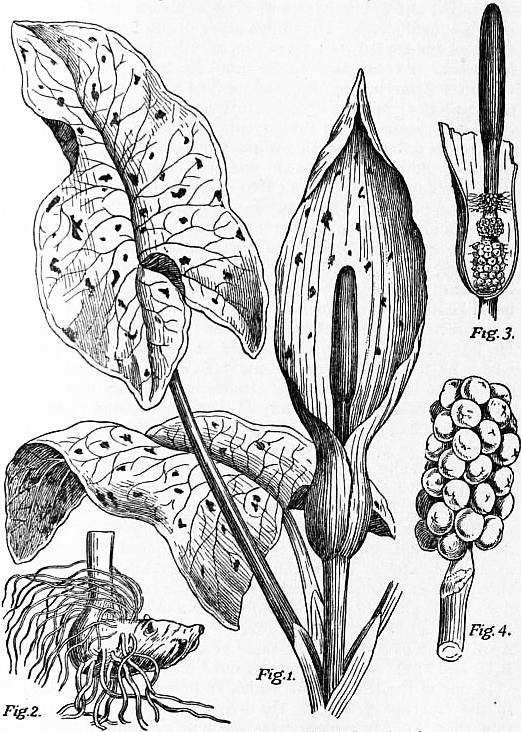
Arum maculatum, Cuckoo-pint
1. Leaves and inflorescence. 2. Underground root-stock. 3. Lower part of spathe cut open. 4. Spike of fruits. Showing in succession (from below) female flowers, male flowers, and sterile flowers forming a ring of hairs borne on the spadix.
The small flowers are densely crowded on thick fleshy spikes, which are associated with, and often more or less enveloped by, a large leaf (bract), the so-called spathe, which, as in cuckoo-pint, where it is green in colour, Richardia, where it is white, creamy or yellow, Anthurium, where it is a brilliant scarlet, is often the most striking feature of the plant. The details of the structure of the flower show a wide variation; the flowers are often extremely simple, sometimes as in Arum, reduced to a single stamen or pistil. The fruit is a berry—the scarlet berries of the cuckoo-pint are familiar objects in the hedges in late summer. The plants generally contain an acrid poisonous juice. The underground stems (rhizomes or tubers) are rich in starch; from that of Arum maculatum Portland arrowroot was formerly extensively prepared by pounding with water and then straining; the starch was deposited from the strained liquid.
The order is represented in Britain by Arum maculatum, a low herbaceous plant common in woods and hedgerows in England, but probably not wild in Scotland. It grows from a whitish root-stock which sends up in the spring a few long-stalked, arrow-shaped leaves of a polished green, often marked with dark blotches. These are followed by the inflorescence, a fleshy spadix bearing in the lower part numerous closely crowded simple unisexual flowers and continued above into a purplish or yellowish appendage; the spadix is enveloped by a leafy spathe, constricted in the lower part to form a chamber, in which are the flowers. The mouth of this chamber is protected by a ring of hairs pointing downwards, which allow the entrance but prevent the escape of small flies; after fertilization of the pistils the hairs wither. The insects visit the plant in large numbers, attracted by the foetid smell, and act as carriers of the pollen from one spathe to another. As the fruit ripens the spathe withers, and the brilliant red berries are exposed.
The sweet-flag Acorus Calamus (q.v.), which occurs apparently wild in England in ditches, ponds, &c., is supposed to have been introduced.
AROLSEN, a town of Germany, capital of the principality of Waldeck, 25 m. N.W. of Cassel, with which it is connected by rail via Warburg. Pop. 3000. It lies in a pleasant undulating country at an elevation of 900 ft. above the sea. The Evangelical parish church contains some fine statues by Christian Rauch, and the palace (built 1710-1720), in addition to a valuable library of 30,000 vols., a collection of coins and pictures, among the latter several by Angelica Kauffmann. Arolsen is the birthplace of the sculptor C. Rauch and of the painters Wilhelm and Friedrich Kaulbach.
ARONA, a town of Piedmont, Italy, in the province of Novara, on the W. bank of Lake Maggiore, 3 m. from its S. extremity, 23 m. N. of Novara, and 42 m. N.W. of Milan by rail. Pop. (1901) 4700. It is a railway centre of some importance on the Simplon line, and is also the southern terminus of the steamers which ply on Lake Maggiore. The church of S. Maria contains a fine altar-piece by Gaudenzio Ferrari. On a hill to the north of the town stands a colossal bronze statue of S. Carlo Borromeo (born here in 1538), erected in 1697. The pedestal, of red granite, is 42 ft. high, and the statue 70 ft. high; the latter is hollow, and can be ascended from within.
ARPEGGIO (from Ital. arpeggiare, to play upon the harp), in music, the notes of a chord, played in rapid succession as on a harp, and not together.
ARPI (Gr. Ἀργόριππα), an ancient city of Apulia, 20 m. W. of the sea coast, and 5 m. N. of the modern Foggia. The legend attributes its foundation to Diomedes, and the figure of a horse, which appears on its coins, shows the importance of horse-breeding in early times in the district. Its territory extended to the sea, and Strabo says that from the extent of the city walls one could gather that it had once been one of the greatest cities of Italy. As a protection against the Samnites Arpi became an ally of Rome, and remained faithful until after the battle of Cannae, but Fabius captured it in 213 B.C., and it never recovered its former importance. It lay on a by-road from Luceria to Sipontum. No Roman inscriptions have, indeed, been found here, and remains of antiquity are scanty. Foggia is its medieval representative.
(T. As.)
ARPINO (anc. Arpinum), a town of Campania, Italy, in the province of Caserta, 1475 ft. above sea-level; 12 m. by rail N.W. of Roccasecca, a station on the railway from Naples to Rome. Pop. (1901) 10,607. Arpino occupies the lower part of the site of the ancient Volscian town of Arpinum, which was finally taken from the Samnites by the Romans in 305 B.C. It became a civitas sine suffragio, but received full privileges (civitas cum suffragio) in 188 B.C. with Formiae and Fundi; it was governed as a praefectura until the Social War, and then became a municipium. The ancient polygonal walls, which are still finely preserved, are among the best in Italy. They are built of blocks of pudding-stone, originally well jointed, but now much weathered. They stand free in places to a height of 11 ft., and are about 7 ft. wide at the top. A single line of wall, with medieval round towers at intervals, runs on the north side from the present town to Civitavecchia (2055 ft.), on the site of the ancient citadel. Here is the Porta dell’ Arco, a gate of the old wall, with an aperture 15 ft. high, formed by the gradual inclination of the two sides towards one another. Below Arpino, in the valley of the Liris, between the two arms of its tributary the Fibrenus, and ¾ m. north of Isola del Liri, lies the church of S. Domenico, which marks the site of the villa in which Cicero was born and frequently resided. Near it is an ancient bridge, of a road which crossed the Liris to Cereatae (modern Casamari). The painter Giuseppe Cesari (1560-1640), more often known as the Cavaliere d’ Arpino, was also born here.
See O.E. Schmidt, Arpinum, eine topographisch-historische Skizze (Meissen, 1900).
(T. As.)
ARQUÀ PETRARCA, a village of Venetia, Italy, in the province of Padua, 3 m. to the S.W. of Battaglia. Pop. (1901) 1573. It is chiefly famous as the place where Petrarch lived his last few years and died in 1374. His house still exists, and his tomb, a sarcophagus supported by four short columns of red marble, stands in front of the church. Near Arquà, on the banks of the small Lago della Costa, is the site of a prehistoric lake village, excavations in which have produced interesting results.
See A. Moschetti and F. Cordenone in Bollettino del Museo Civico di Padova, iv. (1901), 102 seq.
ARQUEBUS (also called harquebus, hackbut, &c.), a firearm of the 16th century, the immediate predecessor of the musket. The word itself is certainly to be derived from the German Hakenbühse (mod. Hakenbüchse, cf. Eng. hackbut and hackbush), “hook gun.” The “hook” is often supposed to refer to the bent shape of the butt, which differentiated it from the straight-stocked hand gun, but it has also been suggested that the original arquebus had a metal hook near the muzzle, which was used to grip the wall (or other fixed object) so as to steady the aim and take up the force of recoil, that from this the name Hakenbühse spread till it became the generic name for small arms, and that the original form of the weapon then took the name of arquebus à croc. The French form arquebuse and Italian arcobugio, archibugio, often and wrongly supposed to indicate the hackbut’s affinity with the crossbow (“hollow bow” or “mouthed bow”), are popular corruptions, the Italian being apparently the earlier of the two and supplanting the first and purest French form haquebut. Previous to the French wars in Italy, hand-gun men and even arbalisters seem to have been called arquebusiers, but in the course of these wars the arquebus or hackbut came into prominence as a distinct type of weapon. The Spanish arquebusiers, who used it with the greatest effect in the Italian wars, notably at Bicocca (1522) and Pavia (1525), are the originators of modern infantry fire action. Filippo Strozzi made many improvements in the arquebus about 1530, and his weapons were effective up to four and five hundred paces. He also standardized the calibres of the arquebuses of the French army, and from this characteristic feature of the improved weapon arose the English term “caliver.” In the latter part of the 16th century (c. 1570) the arquebus began to be displaced by the musket.
ARQUES-LA-BATAILLE, a village of France, in the department of Seine-Inférieure, 4 m. S.E. of Dieppe by the Western railway. Pop. (1906) 1250. Arques is situated near the confluence of the rivers Varenne and Bethune; the forest of Arques stretches to the north-east. The interest of the place centres in the castle dominating the town, which was built in the 11th century by William of Arques; his nephew, William the Conqueror, regarding it as a menace to his own power, besieged and occupied it. After frequently changing hands, it came into the possession of the English, who were expelled in 1449 after an occupation of thirty years. In 1589 its cannon decided the battle of Arques in favour of Henry IV. Since 1869 the castle has been state property. The first line of fortification was the work of Francis I.; the second line and the donjon date back to the 11th century. The church of Arques, a building of the 16th century, preserves a fine stone rood screen, statuary, stained glass and other relics of the Renaissance period.
ARRACK, Rack or Rak, a generic name applied to a variety of spirituous liquors distilled in the Far East. According to some authorities the word is derived from the Arabic arak (perspiration), but according to others (see Morewood’s History of Inebriating Liquors, 1834, p. 140) it is derived from the areca-nut, a material from which a variety of arrack was long manufactured, and is of Indian origin. The liquor to which this or a similar name is applied is (or was, since the introduction of European spirits and methods of manufacture is gradually causing the native spirit industries on the old lines to decay) manufactured in India, Ceylon, Siam, Java, Batavia, China, Corea, &c., and its manufacture still constitutes a considerable industry. The term arrack as designating a distilled liquor does not, however, appear to have been confined to the Far East, as, in Timkowski’s Travels, it is stated that a spirit distilled from koumiss (q.v.) by the Tatars, Mongols and presumably the Caucasian races generally, is called arrack, araka or ariki. In Ceylon arrack is distilled chiefly from palm toddy, which is the fermented juice drawn from the unexpanded flower-spathes of various palms, such as the Palmyra palm (Borassus flabelliformis) and the cocoa palm (Cocos nucifera). At the beginning of the 19th century the arrack industry of Ceylon was of considerable dimensions, whole woods being set apart for no other purpose than that of procuring toddy, and the distillation of the spirit took place at every village round the coast. The land rents in 1831 included a sum of £35,573 on the cocoa-nut trees, and the duties on the manufacture and retail of the spirit amounted to over £30,000. On the Indian continent arrack is made from palm toddy, rice and the refuse of the sugar refineries, but mainly from the flowers of the muohwa or mahua tree (Bassia latifolia). The mahua flowers are very rich in sugar, and may, according to H.H. Mann, contain as much as 58% of fermentable sugar, calculated on the total solids. Even at the present day the process of manufacture is very primitive, the fermentation as a rule being carried on in so concentrated a liquid that complete fermentation rarely takes place. According to Mann, the total sugar in the liquor ready for fermentation may reach 20%. The ferment employed (it is so impure that it can scarcely be called yeast) is obtained from a previous fermentation, and, as the latter is never vigorous, it is not surprising that the resulting spirit contains, compared with the more scientifically prepared European spirits, a very high proportion of by-products (acid, fusel oil, &c.). The injurious nature of these native spirits has long been known and has been frequently set down to the admixture of drugs, such as hemp (ganga), but a recent investigation of this question appears to show that this is not generally the case. The chemical constitution of these liquors alone affords sufficient proof of their inferior and probably injurious character.
See H.H. Mann, The Analyst (1904).
ARRAH, a town of British India, headquarters of Shahabad district, in the Patna division of Bengal, situated on a navigable canal connecting the river Sone with the Ganges. It is a station on the East Indian railway, 368 m. from Calcutta. In 1901 the population was 40,170. Arrah is famous for an incident in the Mutiny, when a dozen Englishmen, with 50 Sikhs, defended an ordinary house against 2000 Sepoys and a multitude of armed insurgents, perhaps four times that number. A British regiment, despatched to their assistance from Dinapur, was disastrously repulsed; but they were ultimately relieved, after eight days’ continuous fighting, by a small force under Major (afterwards Sir Vincent) Eyre.
ARRAIGNMENT (from Lat. ad, to, and rationare, to reason, call to account), a law term, properly denoting the calling of a person to answer in form of law upon an indictment. After a true bill has been found against a prisoner by the grand jury, he is called by name to the bar, the indictment is read over to him, and he is asked whether he be guilty or not of the offence charged. This is the arraignment. Formerly, it was usual to require the prisoner to hold up his hand, in order to identify him the more completely, but this practice is now obsolete, as well as that of asking him how he will be tried. His plea in answer to the charge is then entered, or a plea of not guilty is entered for him if he stands mute of malice and refuses to plead, If a person is mute by the visitation of God (i.e. deaf and dumb), it will be no bar to an arraignment if intelligence can be conveyed to him by signs or symbols. If he pleads guilty, sentence may be passed forthwith; if he pleads not guilty, he is then given in charge to a jury of twelve men to inquire into the truth of the indictment. He may also plead in abatement, or to the jurisdiction, or demur on a point of law. Several defendants, except those entitled to the privilege of peerage, charged on the same indictment, are arraigned together.
In Scots law the term for arraignment is calling the diet.
The Clerk of Arraigns is a subordinate officer attached to assize courts and to the Old Bailey. He is appointed by the clerk of assize (see Assize) and acts as his deputy. He assists at the arraignment of prisoners, and puts the formal questions to the jury when delivering their verdict.
ARRAN, EARLS OF. The extinct Scottish title of the earls of Arran (not to be confused with the modern Irish earls of Arran—from the Arran or Aran Islands, Galway—a title created in 1762) was borne by some famous characters in Scottish history. Except the first earl, Thomas Boyd (see Arran), and James Stewart, all the holders of this title were members of the Hamilton family.
James Hamilton, 1st earl of Arran of the new creation (c. 1475-1529), son of James, 1st Lord Hamilton, and of Mary Stewart, daughter of James II. of Scotland, was born about 1475, and succeeded in 1479 to his father’s titles and estates. In 1489 he was made sheriff of Lanark, was appointed a privy councillor to James IV., and in 1503 negotiated in England the marriage between the king and Margaret Tudor. Hamilton excelled in the knightly exercises of the day, and the same year on the 11th of August, after distinguishing himself in a famous tournament, he was created earl and justiciary of Arran. In 1504 as lieutenant-general of the realm he was employed in reducing the Hebrides, and about the same time in an expedition with 10,000 men in aid of John, king of Denmark. In 1507 he was sent ambassador to France, and on his return through England was seized and imprisoned by Henry VII. After the accession of Henry VIII., Arran, in 1509, signed the treaty of peace between the two countries, and later, when hostilities began, was given command of a great fleet equipped for the aid of France in 1513. The expedition proved a failure, Arran wasting time by a useless attack on Carrickfergus, lingering for months on the Scottish coast, and returning with a mere remnant of his fleet, the larger ships having probably been purchased by the French government. During his absence the battle of Flodden had been lost, and Arran found his rival Angus, who enjoyed Henry’s support, married to the queen dowager and in control of the government. Arran naturally turned to the French party and supported the regency of the duke of Albany. Later, however, becoming impatient of the latter’s monopoly of power, he entered into various plots against him, and on Albany’s departure in 1517 he was chosen president of the council of regency and provost of Edinburgh. The same year he led an expedition to the border to punish the murderers of the French knight La Bastie. In September, however, after a temporary absence with the young king, the gates of Edinburgh were shut against him by the Douglases, and on the 30th of April 1520 the fierce fight of “Cleanse the Causeway” took place in the streets between the two factions, in which the Hamiltons were worsted. The quarrel, however, between Angus and his wife, the queen-mother, with whom Arran now allied himself, gave the latter another opportunity of regaining power, which he held from 1522, after Albany’s return to France, till 1524, when he was forced to include Angus in the government. In 1526, on the refusal of the latter to give up his control of the king on the expiry of his term of office, Arran took up arms, but retreated before Angus’s forces, and having made terms with him, supported him in his close custody of the king, in September defeating the earl of Lennox, who was marching to Edinburgh to liberate James. On the proscription of Angus and the Douglases, Arran joined the king at Stirling. He died in 1529. His eldest son James succeeded him.
James Hamilton, 2nd earl of Arran and duke of Châtelherault (c. 1515-1575), accompanied James V. in 1536 to France, and on the latter’s death in 1542 was, in consequence of his position as next successor to the throne after the infant Mary, proclaimed protector of the realm and heir-presumptive of the crown, in 1543. He was a zealous supporter of the reformation, authorized the translation and reading of the Scriptures in the vulgar tongue, and at first supported the English policy in opposition to Cardinal Beaton, whom he arrested on the 27th of January 1543, arranging the treaty with England and the marriage of Mary with Prince Edward in July, and being offered by Henry the hand of the princess Elizabeth for his son. But on the 3rd of September he suddenly joined the French party, met Beaton at Stirling, and abjured his religion for Roman Catholicism. On the 13th of January 1544, with Angus, Lennox and others, he signed a bond repudiating the English alliance. In 1544 an attempt was made to transfer the regency from him to Mary of Lorraine, but Arran fortified Edinburgh and her forces retired; in March 1545 a truce was arranged by which each had a share in the government. Meanwhile, immediately on the repudiation of the treaty, war had broken out with England, and Arran was unable either to maintain order within the realm or defend it from outside aggression, the Scots being defeated at Pinkie on the 10th of September 1547. He reluctantly agreed in July 1548 to the marriage of the dauphin with Mary, whom he had designed for his son, to the appeal for French aid, and to the removal of Mary for security to France, and on the 5th of February 1549 was created duke of Châtelherault in Poitou, his eldest son James being henceforth commonly styled earl of Arran. In June 1548 he had also been made a knight of the order of St Michael in France. On the 12th of April 1554 he abdicated in favour of the queen-mother, whose government he supported till after the capture of Edinburgh in October 1559 by the lords of the congregation, when he declared himself on their side and took the Covenant. The same month he was one of the council of the Protestant lords, joined them in suspending Mary of Lorraine from the regency, and was made provisionally one of the governors of the kingdom. In order to discredit him with the English government a letter was forged by his enemies, in which Arran declared his allegiance to Francis II., but the plot was exposed. On the 27th of February 1560 he agreed to the treaty of Berwick with Elizabeth, which placed Scotland under her protection. The death the same year of Francis II. renewed his hopes of a union between his son and Mary, but disappointment drove him into an attitude of hostility to the court. In 1562 he was accused by his son, probably already insane, of plots against Mary’s person, and he was obliged to give up Dumbarton Castle. Lennox claimed precedence over Arran in the succession to the throne, on the plea of the latter’s supposed illegitimacy, and his restoration to favour in 1564, together with the project of Mary’s marriage with Darnley, still further embittered Arran; he refused to appear at court, was declared a traitor, and fled to England, where on his consent to go into exile for five years he received a pardon from Mary. In 1566 he went to France, where he made vain attempts to regain his confiscated duchy. After the murder of Darnley in 1567 he was nominated by Mary on her abdication one of the regents, and he returned to Scotland in 1569 as a strong supporter of her cause. In March in an assembly of nobles called by Murray, he acknowledged James as king, but on the 5th of April he was arrested for not fulfilling the compact, and continued in confinement till April 1570. After Murray’s assassination in January 1570, the regency in July was given to Lennox, and in June 1571 Arran assembled a parliament, when it was declared that Mary’s abdication was obtained by fear, and the king’s coronation was annulled. On the 28th of August he was declared a traitor and “forfeited,” but he continued to support Mary’s hopeless cause and to appeal for help to France and Spain, in spite of the pillage of his houses and estates, till February 1573, when he acknowledged James’s authority and laid down his arms. He died on the 22nd of January 1575. He was by general consent a weak, fickle man, whose birth alone called him to high office. He married Margaret, daughter of James Douglas, 3rd earl of Morton, and had, besides several daughters, four sons: James, who succeeded him as 3rd earl of Arran, John, 1st marquess of Hamilton, David, and Claud, Lord Paisley, ancestor of the dukes of Abercorn.
James Hamilton, 3rd earl (c. 1537-1609), was styled earl of Arran after the creation of his father as duke of Châtelherault in 1549; the latter title did not descend to him, having been resumed by the French crown. His father’s ambition destined him for the hand of Mary queen of Scots, and his union with the princess Elizabeth was proposed by Henry VIII. as the price of his father’s adherence to the English interest. He was early involved in the political troubles in which Scotland was then immersed. In 1546 he was seized as a hostage at St Andrews by the murderers of Cardinal Beaton and released in 1547. In 1550 he went to France, was given the command of the Scots guards, and in 1557 distinguished himself in the defence of St Quentin. He became a strong adherent of the reformed doctrine. His arrest was ordered by Henry II. in 1559, Mary (probably in consequence of his projected union with Elizabeth which would have raised the Hamiltons higher than the Stuarts) declaring her wish that he should be “used as an arrant traitor.” He, however, escaped to Geneva and then to England, and had an interview with Elizabeth in August. He returned to Scotland in September, where he supported his father’s adherence to the lords of the Congregation against Mary of Lorraine, upheld the alliance with Elizabeth, and became one of the leaders of the Protestant party in the subsequent fighting, in particular organizing, together with Lord James Stuart (afterwards earl of Murray), in 1560, a stubborn resistance to the French at Dysart, and saving Fife. In November 1559 he had declined Bothwell’s challenge to single combat. Subsequently he signed the treaty of Berwick, became one of the lords of the Congregation, and was appointed a visitor for the destruction of the religious houses. The same year proposals were again made for his marriage with Elizabeth, which were rejected by the latter in 1561; and subsequently after the death of Francis II. (in December 1560), he became, with the strong support of the Protestants and Hamiltons, a suitor for Mary, also without success. He was chosen a member of her council on her arrival in Scotland in 1561, but took up a hostile attitude to the court in consequence of the practice of the Roman Catholic religion. He now showed marked signs of insanity, and was confined in Edinburgh Castle, where he remained till May 1566. He had then lost the power of speech, and from 1568 he lived in retirement with his mother at Craignethan Castle, while his estates were administered by his brother John, afterwards 1st marquess of Hamilton. In 1579, at the time of the fresh prosecution of the Hamiltons, when the helpless Arran was also included in the attainder of his brothers and his titles forfeited, the castle was besieged on the pretence of delivering him from unlawful confinement, and Arran and his mother were brought to Linlithgow, while the charge of his estates was taken over by the government. In 1580 James Stewart (see below) was appointed his guardian, and in 1581 acquired the earldom; but his title and estates were restored after Stewart’s disgrace in 1586, when the forfeiture was repealed. Arran died unmarried in March 1609, the title devolving on his nephew James, 2nd marquess of Hamilton.
James Stewart (d. 1595), the rival earl of Arran above referred to, was the son of Andrew Stewart, 2nd Lord Ochiltree. He served in his youth with the Dutch forces in Holland against the Spanish, and returned to Scotland in 1579. He immediately became a favourite of the young king, and in 1580 was made gentleman of the bedchamber and tutor of his cousin, the 3rd earl of Arran. The same year he was the principal accuser of the earl of Morton, and in 1581 was rewarded for having accomplished the latter’s destruction by being appointed a member of the privy council, and by the grant the same year, to the prejudice of his ward, of the earldom of Arran and the Hamilton estates, on the pretence that the children of his grandmother’s father, the 1st earl of Arran, by his third wife, from whom sprang the succeeding earls of Arran, were illegitimate. He claimed the position of second person in the kingdom as nearest to the king by descent. The same year he married Elizabeth, daughter of John Stewart, earl of Atholl, and wife of the earl of March, after both had been compelled to undergo the discipline of the kirk on account of previous illicit intercourse. He became the rival of Lennox for the chief power in the kingdom, but both were deprived of office by the raid of Ruthven on the 22nd of August 1582, and Arran was imprisoned till September under the charge of the earl of Gowrie. In 1583, however, he assembled a force of 12,000 men against the new government; the Protestant lords escaped over the border, and Arran, returning to power, was made governor of Stirling Castle and in 1584 lord chancellor. The same year Gowrie was captured through Arran’s treachery and executed after the failure of the plot of the Protestant lords against the latter’s government. He now obtained the governorship of Edinburgh Castle and was made provost of the city and lieutenant-general of the king’s forces. Arran induced the English government to refrain from aiding the banished lords, and further secured his power by the forfeitures of his opponents. His tyranny and insolence, however, stirred up a multitude of enemies and caused his rapid fall from power. His agent in England, Patrick, Master of Gray, was secretly conspiring against him at Elizabeth’s court. On account of the murder of Lord Russell on the border in July 1585, of which he was accused by Elizabeth, he was imprisoned at the castle of St Andrews, and subsequently the banished lords with Elizabeth’s support entered Scotland, seized the government and proclaimed Arran a traitor. He fled in November, and from this time his movements are furtive and uncertain. In 1586 he was ordered to leave the country, but it is doubtful whether he ever quitted Scotland. He contrived secretly to maintain friendly communications with James, and in 1592 returned to Edinburgh, and endeavoured unsuccessfully to get reinstated in the court and kirk. Subsequently he is reported as making a voyage to Spain, probably in connexion with James’s intrigues with that country. His unscrupulous and adventurous career was finally terminated towards the close of 1595 by his assassination near Symontown in Lanarkshire at the hands of Sir James Douglas (nephew of his victim the earl of Morton), who carried his head in triumph on the point of a spear through the country, while his body was left a prey to the dogs and swine. He had three sons, the eldest of whom became Lord Ochiltree.
ARRAN, the largest island of the county of Bute, Scotland, at the mouth of the Firth of Clyde. Its greatest length, from the Cock of Arran to Bennan Head, is about 20 m., and the greatest breadth—from Drumadoon Point to King’s Cross Point—is 11 m. Its area is 105,814 acres or 165 sq. m. In 1891 its population was 4824, in 1901, 4819 (or 29 persons to the sq. m.). In 1901 there were 1900 persons who spoke English and Gaelic and nine Gaelic only. There is daily winter communication with Brodick and Lamlash by steamer from Ardrossan, and in summer by many steamers which call not only at these piers, but at Corrie, Whiting Bay and Loch Ranza.
The chief mountains are in the north. The highest is Goatfell (2866 ft., the name said to be a corruption of the Gaelic Goadh Bhein, “mountain of the winds”). Others are Caistel Abhail (2735 ft., “peaks of the castles”), Beinn Tarsuinn (2706 ft.), Cir Mhor (2618 ft.) and Beinn Nuis (2597 ft.). In the south Tighvein (1497 ft.) and Cnoc Dubh (1385 ft.) are the most important. Owing to the mountainous character of the island, glens are numerous. Glen Rosa and Glen Sannox are remarkable for their wild beauty, and among others are Iorsa, Catacol, Chalmadale, Cloy, Shant, Shurig, Tuie, Clachan, Monamore, Ashdale (with two cascades) and Scorrodale. Excepting Loch Tanna, the inland lakes are small. Loch Ranza, an arm of the sea, is one of the most beautiful in Scotland. The streams, or “waters” as they are called, are nearly all hill burns, affording good fishing.
The oldest rocks, consisting of slate, mica-schists and grits, which have been correlated with the metamorphic series of the eastern Highlands, form an incomplete ring round the granite in the north of the island and occupy the whole of the west coast from Loch Ranza south to Dougrie. On the east side in North Glen Sannox Burn, they are associated with cherts, grits and dark schists with pillowy lavas, tuffs and agglomerates which, on lithological grounds, have been regarded as probably of the same age as the Arenig cherts and volcanic rocks in the south of Scotland. The Lower Old Red Sandstone strata are separated from the foregoing series by a fault and forma curving belt extending from Corloch on the east coast south by Brodick Castle to Dougrie on the west shore. Consisting of red sandstones, mudstones and conglomerates, they are inclined at high angles usually away from the granite massif and the encircling metamorphic rocks. They are associated with a thin band of lava visible on the west side of the island near Auchencar and traceable inland to Garbh Thorr. The Upper Old Red Sandstone, composed of red sandstone and conglomerates, is only sparingly developed. The strata occur on the east shore between the Fallen Rocks and Corrie, and they appear along a narrow strip to the east and south of the lower division of the system, between Sannox Bay and Dougrie. On the north side of North Glen Sannox they rest unconformably on the Lower Old Red rocks. Contemporaneous lavas, highly decomposed, are intercalated with this division on the north side of North Glen Sannox where the band is highly faulted. The Carboniferous rocks of Arran include representatives of the Calciferous Sandstone, the three subdivisions of the Carboniferous Limestone series, and to a small extent the Coal Measures, and are confined to the north part of the island. They appear on the east coast between the Fallen Rocks and the Cock of Arran, where they form a strip about a quarter of a mile broad, bounded on the west by a fault. Here there is an ascending sequence from the Calciferous Sandstone, through the Carboniferous Limestone with thin coals formerly worked, to the Coal Measures, the strata being inclined at high angles to the north. On the south side of a well-marked anticline in the Upper Old Red Sandstone at North Sannox, the Carboniferous strata reappear on the coast with a south dip showing a similar ascending sequence for about half a mile. The lower limestones are well seen at Corrie, but the thin coals are not there represented. From Corrie they can be traced southwards and inland to near the head of Ben Lister Glen. The small development of Upper Carboniferous strata, visible on the shore south of Corrie and in Ben Lister Glen, consists of sandstones, red and mottled clays and purple shales, which yield plant-remains of Upper Carboniferous facies. These may represent partly the Millstone Grit and partly the Coal Measures. Contemporaneous volcanic rocks, belonging to three stages of the Carboniferous formation, occur in Arran. The lowest group is on the horizon of the Calciferous Sandstone series, being visible at Corrie where it underlies the Corrie limestone, and is traceable southwards beyond Brodick. The second is represented by a thin lava, associated with the Upper Limestone group of the Carboniferous Limestone series, and the highest is found in Ben Lister Glen intercalated with the Upper Carboniferous strata, and may be the equivalent of the volcanic series which, in Ayrshire, occupies the position of the Millstone Grit. The Triassic rocks are arranged in two groups, a lower, composed of conglomerates and sandstones, and an upper one consisting of red and mottled shales and marls with thin sandstones and nodular limestones. In the extreme north at the Cock of Arran, there is a small development of these beds; they also occupy the whole of the east coast south of Corrie, and they spread over the south part of the island south of a line between Brodick Bay and Machrie Bay on the west. At Corrie and the Cock of Arran they rest on Upper Carboniferous strata; in Ben Lister Glen, on the lower limestone group of the Carboniferous Limestone series; and on the west coast they repose on the Old Red Sandstone. There is, therefore, a clear discordance between the Trias and all older strata in Arran. The former extension of Rhaetic, Liassic and Cretaceous formations in the island is indicated by the presence of fragments of these strata in a large volcanic vent on the plateau, on the south side of the road leading from Brodick to Shiskine. The fossils from the Rhaetic beds belong to the Avicula contorta zone, those from the Lias to the Ammonites angulatus zone, while the blocks of limestone with chert contain Inoceramus, Cretaceous foraminifera and other organisms. The materials yielding these fossils are embedded in a course volcanic agglomerate which gives rise to crags and is pierced by acid and basic igneous rocks. One of the striking features in the geology of Arran is the remarkable series of intrusive igneous rocks of Tertiary age which occupy nearly one-half of the area and form the wildest and grandest scenery in the island. Of these the most important is the great oval mass of granite in the North, composed of two varieties; one, coarse-grained and older, forms the outside rim, while the fine-grained and newer type occurs in the interior. Another granite area appears on the south side of the road between Brodick and Shiskine, where it is associated with granophyre and quartz-diorite and traverses the volcanic vent of post-Cretaceous or Tertiary age already described. In the south of the island there are sills and dykes of felsite, quartz-porphyry, rhyolite, trachyte and pitchstone. The felsite sheets are well represented in Holy Island. It is worthy of note that the dykes and sheets of felsite are seldom pierced by the basalt dykes and are probably about the most recent of the intrusive rocks. The best example of the basic sills forms the Clauchland Hills and runs out to sea at Clauchland Point. Finally the basic dykes of dolerite, basalt and augite-andesite are abundant and traverse the various sedimentary formations and the granite.