VOLUME II SLICE VI Armour Plates to Arundel, Earls of (continued 11)
Reading edition
16. Quick-firing Field Guns.—In 1891, a work by General Wille of the German army (The Field Gun of the Future) and in 1892 another by Colonel Langlois of the French service (Field Artillery with the other Arms) foreshadowed many revolutionary changes in matériel and tactics which have now taken place. The new ideas spread rapidly, and the quick-firing gun came by degrees to be used in every army. The original designs have been greatly improved upon (see Ordnance: Field artillery equipments), but the principles of these designs have not undergone serious modification. These are, briefly, the mechanical absorption of the recoil, by means of brakes or buffers, and the development of “time shrapnel” as the projectile of field artillery. The absorption of recoil of itself permits of a higher rate of fire, since the gun does not require to be run up and relaid after every shot. Formerly such an advantage was illusory (since aim could not be taken through the thick bank of smoke produced by rapid fire), but the introduction of smokeless powder removed this objection. Artillerists, no longer handicapped, at once turned their attention to the increase of the rate of fire. At the same time a shield was applied to the gun, for the protection of the detachment. This advantage is solely the result of the non-recoiling carriage. The gunners had formerly to stand clear of the recoiling gun, and a shield was therefore of but slight value.
17. Time Shrapnel.—The power of modern artillery owes even more to the improvement of the projectile than to that of the gun (see Ammunition). The French, always in the forefront of artillery progress, were the first nation to realize the new significance of the time-fuze and the shrapnel shell. These had been in existence for many years; to the British army are due both the invention and the development of the shrapnel, which made its first appearance in European warfare at Vimeira in 1808. But, up to the introduction of rifled pieces, the Napoleonic case-shot attack was universally and justly considered the best method of fighting, and in the transition stage of the matériel many soldiers continued to put faith in the old method,—hence the Prussian artillery in 1866 had many smooth-bore batteries in the field,—and between 1860 and 1870 gunners, now convinced of the superiority of the new equipments, undoubtedly sought to turn to account the minute accuracy of the rifled weapons in unnecessarily fine shooting. Thus, in 1870 the French time-fuze was only graduated for two ranges, and the Germans used percussion fuzes only. But this phase has passed, and General Langlois has summarized the tactics of the newest field artillery in one phrase: “It results in transferring to 3000 yds. the point-blank and case-shot fire of the smooth-bore.” The meaning of this will be discussed later; here it will be sufficient to say that it is claimed for the modern gun and the modern shell that the Napoleonic method1 of annihilating by a rain of bullets has been revived, with the distinction that the shell, and not the gun, fires the bullets close up to the enemy. In the Boer War, Pieter’s Hill furnished a notable example of this “covering,” as distinct from “preparation,” of an assault by artillery fire.
18. Heavy Field, Siege and Garrison Artillery.—Amongst other results of this war was a recrudescence of the idea of “dispersion.” This will be noticed later; the more material result of the Boer War, and of the generally increasing specialization in the various functions of the artillery arm, has been the reintroduction of heavy ordnance into field armies. The field howitzer reappeared some time before the outbreak of that war, and the British howitzers had illustrated their shell-power in the Sudan campaign of 1898. During the latter part of the 19th century, siege and fortress artillery underwent a development hardly less remarkable than that of field artillery in the same time. Rifled guns, “long” and “short” for direct and curved fire, formed the siege artillery of the Germans in 1870-71, and with the reduction of the old-fashioned fortresses of France began a new era in siegecraft (see Fortification and Siegecraft). At the present time howitzers2 (B.L. rifled) are the principal siege weapons, while heavy direct-fire guns (see Ordnance passim) still retain a part of the work formerly assigned to the artillery of the attack. For an account of a siege with modern artillery see Macalik and Länger, Kampf um eine Festung, which describes an imaginary siege of Königgrätz. On the whole, it may be said that modern artillery has caused a revolution in methods of fortification and siegecraft, which is little less far-reaching than the original change from the trébuchet to the bombard.
Organization
19. Field Artillery Organization.—A battery of field artillery comprises three elements, viz. matériel,—guns, carriages, ammunition and stores; personnel,—officers, non-commissioned officers, gunners, drivers and artificers; and transport,—almost invariably horses, though other animals, and also motor and mechanical transport, are used under special circumstances. As for the matériel, the guns used by field artillery in almost all countries are quick-firers, throwing shells of 13 to 18 pounds; details of these will be found in the article Ordnance. The number of guns in a battery varies in different countries between four and eight; by far the most usual number is six. With the introduction of the quick-firing gun, the tendency towards small batteries (of four guns) has become very pronounced, the ruling motives being (a) better control of fire in action, and (b) more horses available to draw the increased number of ammunition wagons required. “Mixed” batteries of guns and howitzers were formerly employed on occasion, and were supposed to be adapted to every kind of work. However, the difference between the gun and the howitzer was so great that at all times one part of the armament was idle, while the general increase in the artillery arm has permitted batteries and brigades of howitzers to be formed, separately, as required. Machine guns (q.v.) are not treated in Great Britain as being artillery weapons, though abroad they are often organized in batteries. During, and subsequent to the Boer War, heavier machine guns, called pompoms, came into use. The rocket (q.v.), formerly a common weapon of the artillery, is now used, if at all, only for mountain and forest warfare against savages.
20. Ammunition.—The vehicles of a battery include (besides guns and limbers) ammunition wagons, store and provision carts or wagons and forage wagons. On the amount of ammunition that should be carried with a field battery there was formerly a considerable diversity of opinion. The greater the amount a battery carries with it, the more independent it is; on the other hand, every additional wagon makes the battery more cumbrous and, by lengthening out the column, keeps back the combatant troops marching in rear. But since the introduction of the Q.F. gun it has been universally recognized that the gun must have a very liberal supply of ammunition present with it in action, and the old standard allowance of one wagon per gun has been increased to that of two and even three. Formerly batteries were further hampered by having to carry the reserve of small-arm ammunition for infantry and cavalry. But the greater distances of modern warfare accentuate the difficulties of such a system, and the reserve ammunition for all arms is now carried in special “ammunition columns” (see Ammunition), the personnel and transport of which is furnished by the artillery.
21. Interior Economy.—The organization and interior economy of a battery is much the same in all field artillery. In England the command is held by a major, the second in command is a captain. The battery is divided into three “sections” of two guns each, each under a subaltern officer, who is responsible for everything connected with his section—men, horses, guns, carriages, ammunition and stores. Each section again consists of two sub-sections, each comprising one gun and its wagons, men and horses, and at the head of each is the “No. 1” of the gun detachment—usually a sergeant—who is immediately responsible to the section commander for his sub-section.
The No. 1 rides with the gun, there is also another mounted non-commissioned officer who rides with the first wagon, and the gunners are seated on the gun-carriage, wagon and limbers. The increased number of wagons now accompanying the gun has, however, given more seating accommodation to the detachment, and this distribution has in some cases been altered. The three drivers ride the near horses of their respective pairs, each gun and each wagon being drawn by six horses. On the march, the gun is attached to the limber, a two-wheeled carriage drawn by the gun team; the wagon consists likewise of a “body” and a limber. A battery has also a number of non-combatant carriages, such as forge and baggage wagons. In addition to the gunners and drivers, there are men specially trained in range-taking, signalling, &c., in all batteries.
22. Special Natures of Field Artillery.—Horse Artillery differs from field in that the whole gun detachment is mounted, and the gun and wagon therefore are freed from the load of men and their equipment. The organization of a battery of horse artillery differs but slightly from that of a field battery; it is somewhat stronger in rank and file, as horse-holders have to be provided for the gunners in action. Horse artillery is often lightened, moreover, by sacrificing power (see Ordnance). The essential feature of Mountain Artillery in general is the carrying of the whole equipment on the backs of mules or other animals. The total weight is usually distributed in four or five mule-loads. For action the loads are lifted off the saddles and “assembled,” and the time required to do this is, in well-trained batteries, only one minute. For the technical questions connected with the gun and its carriage, see Ordnance. The weight of a shell in a mountain gun rarely exceeds 12 ℔, and is usually less. In most armies the field howitzer has, after an eclipse of many years, reasserted its place. The weapons used are B.L. or Q.F. howitzers on field carriages; the calibre varies from about 4 to 5 in. In Great Britain the field howitzer batteries are organized as, and form part of, the Royal Field Artillery, two batteries of six howitzers each forming a brigade.
23. Heavy Ordnance.—Heavy Field Artillery, officially defined as “all artillery equipped with mobile guns of 4-in. calibre and upwards,” is usually composed, in Great Britain, of 5-in. or 4.7-in. Q.F. guns on field carriages. 6-in. Q.F. guns have also been used. A battery (4 guns) is attached to the divisional artillery of each division, a company of the Royal Garrison Artillery furnishing the personnel. The four guns are divided into two sections, each section under an officer and each subsection under a non-commissioned officer, as in the horse and field batteries. Siege and garrison artillery have not usually the complete and permanent organization that distinguishes field artillery. For siege trains the matériel is usually kept in store, and the personnel and transport are supplied from other sources according to requirement. In garrison artillery, the guns mounted in fortresses and batteries, or stored in arsenals for the purpose, furnish the matériel, and the companies of garrison artillery the personnel. In Great Britain, the Royal Garrison Artillery finds the mountain batteries and the heavy field artillery in addition to its own units. The siege trains are, as has been said, organized ad hoc on each particular occasion (see Fortification and Siegecraft). In Great Britain, the guns and howitzers manned by the R.G.A. would be 6-in. and 8-in. howitzers, 4.7-in. and 6-in. guns, and still heavier howitzers, as well as the field and heavy batteries belonging to the divisions making the siege.
24. Higher Organization of Artillery.—The higher units, in almost every country except Great Britain, are the regiment, and, sometimes, the brigade of two or more regiments. These units are distributed to army corps, divisions and districts, in the same way as units of other arms (see Army). In Great Britain the Royal Regiment of Artillery still comprises the whole personnel of the arm, being divided into the Royal Horse, Royal Field and Royal Garrison Artillery; to each branch Special Reserve and Territorial artillery are affiliated. Over and above the military command of these higher units, provision is usually made for technical control of the matériel, and a variety of training and experimental establishments, such as schools of gunnery, are maintained in all countries. The more special unit of organization in mobile artillery is the brigade, formerly called brigade-division (German, Abteilung; French groupe). The brigade is in Great Britain the administrative and tactical unit. Mountain artillery is not organized in brigades in the British empire. The unit consists, in the case of guns, of three batteries (18 guns, heavy artillery 12), in the case of field howitzers of two batteries (12 howitzers), and in the horse artillery of two batteries (12 guns), and is commanded by a lieutenant-colonel. To each brigade is allotted an ammunition column. The necessity for such a grouping of batteries will be apparent if the reader notes that 54 field guns, 12 howitzers and 4 heavy field guns form the artillery of a single British division of about 15,000 combatants.
25. Grouping of the Artillery.—The “corps artillery” (formerly the “reserve artillery”) now consists only of the howitzer and heavy brigades, with a brigade of horse artillery. The latter is held at the disposal of the corps commander for the swift reinforcement of a threatened point; the howitzers and the heavy guns have, of course, functions widely different from those of the mass of guns. As the field artillery is required to come into action at the earliest possible moment, it has now been distributed amongst the infantry divisions, and marches almost at the head of the various combatant columns, instead of being relegated perhaps to the tail of the centre column. The redistribution of the British army (1907) on a divisional basis is a remarkable example of this; even the special natures of artillery (except horse artillery) are distributed amongst the divisions. In Germany two “regiments” (each of 2 Abteilungen = 6 batteries) form a brigade, under an artillery general in each division who thus disposes of 72 field guns, and the howitzers, with such horse artillery batteries as remain over after the cavalry has been supplied, still form a corps or reserve artillery. In 1903 the French, after long hesitation, assigned the whole of the field artillery to the various divisions, but later (for reasons stated in the article Tactics) arranged to reconstitute the old-fashioned corps artillery in war. (See also Army, § 49).
Tactical Work
26. General Characteristics of Field Artillery Action.—The duty of field artillery in action is to fire with the greatest effect on the target which is for the moment of the greatest tactical importance. This definition of field artillery tactics brings the student at once to questions of combined tactics, for which consult the article Tactics. The purpose of the present article is to indicate the methods employed by the gunners to give effect to their fire at the targets mentioned. For this purpose the artillery has at its disposal two types of projectile, common (or rather, high explosive) shell and shrapnel, and two fuzes, “time” and “percussion” (see Ammunition). The actual process of coming into action may be described in a few words. The gun is, at or near its position in action, “unlimbered” and the gun limber and team sent back under cover. Ammunition for the gun is first taken from the wagon that accompanies it, as it is very desirable to keep the limbers full as long as possible, in case of emergencies such as that of a temporary separation from the wagon. Limber supply is, however, allowed in certain circumstances. The wagon is now placed as a rule by the side of the gun, an arrangement which immensely simplifies the supply of ammunition, this being done under cover of the armour on the wagon and of the gun-shield and also without fatigue to the men. The older method of placing the wagon at some distance behind the gun is still occasionally used, especially in the case of unshielded equipments. No horses are allowed, in any case, to be actually with the line of guns. According to the British Field Artillery Training of 1906, a battery in action would be thus distributed: first, the “fighting battery” consisting of the six guns, each with its wagon alongside, and the limbers of the two flank guns; then, under cover in rear, the “first line of wagons” comprising the teams of the fighting battery, the four remaining gun limbers, and six more wagons. The non-combatant vehicles form the “second line of wagons.”
27. Occupation of a Position.—This depends primarily upon considerations of tactics, for the accurate co-operation of the guns is the first essential to success in the general task. In details, however, the choice of position varies to some extent with the nature of the equipment: for instance, an elevated position is better adapted than a low one for high velocity guns firing over the heads of their own infantry, and again, the “spade” with which nearly all equipments are furnished (see Ordnance) should have soil in which it can find a hold. Cover for the gun and its detachment cannot well be obtained from the configuration of the ground, because, if the gun can shoot over the covering mass of earth, the hostile shells can of course do likewise. Sufficient protection is given by the shield, and thus “cover” for field-guns simply means concealment. Cover for the “first line of wagons” is, however, a very serious consideration. As to concealment, it is stated that “the broad white flash from a gun firing smokeless powder is visible” to an enemy “unless the muzzle is at least 10 ft. below the covering crest” (Bethell, Modern Guns and Gunnery, 1907, p. 147). Concealment therefore, means only the skilful use of ground in such a way as to make the enemy’s ranging difficult. This frequently involves the use of retired positions, on reverse slopes, in low ground, &c., and in all modern artillery the greatest stress is laid on practice in firing by indirect means. Controversy has, however, arisen as to whether inability to see the foreground is not a drawback so serious that direct fire from a crest position, in spite of its exposure, must be taken as the normal method. The latter is of course immensely facilitated by the introduction of the shield. A great advantage of retired positions is that, provided unity of direction is kept, an overwhelming artillery surprise (see F. A. Training, 1906, p. 225) is carried out more easily than from a visible position. The extent of front of a battery in action is governed by the rule that no two gun detachments should be exposed to being hit by the bullets of one shell, and also by the necessity of having as many guns as possible at work. These two conditions are met by the adoption of a 20-yards interval between the muzzles of the guns. At the present time the gun and its wagon are placed as close together as possible, to obtain the full advantage of the armoured equipment. The shield, behind which the detachments remain at all times covered from rifle (except at very short range) and shrapnel bullets,3 enables the artillery commander to handle his batteries far more boldly than formerly was the case. General Langlois says “the shield-protected carriage is the corollary to the quick-firing gun.” Armour on the wagon, enabling ammunition supply as well as the service of the gun, to be carried on under cover, soon followed the introduction of the shield. The disadvantage of extra weight and consequently increased difficulty of “man-handling” the equipment is held to be of far less importance than the advantages obtained by the use of armour.
28. Laying.—“Elevation” may be defined as the vertical inclination of the gun, “direction” as the horizontal inclination to the right or left, necessary to direct the path of the projectile to the object aimed at. “Laying” the gun, in the case of most modern equipments, is divided, by means of the device called the independent line of sight (see Ordnance), into two processes, performed simultaneously by different men, the adjustment of the sights and that of the gun. The first is the act of finding the “line of sight,” or line joining the sights and the point aimed at; for this the equipment has to be “traversed” right or left so as to point in the proper direction, and also adjusted in the vertical plane. The simplest form of laying for direction, or “line,” is called the “direct” method. If the point aimed at is the target, and it can be seen by the layer, he has merely to look over the “open” sights. But the point aimed at is rarely the target itself. In war, the target, even if visible, is often indistinct, and in this case, as also when the guns are under cover or engaging a target under cover, an “aiming point” or “auxiliary mark,” a conspicuous point quite apart and distinct from the target, has to be employed (“indirect” method). In the Russo-Japanese War the sun was sometimes used as an aiming point. When the guns are behind cover and the foreground cannot be seen, an artificial aiming point is often made by placing a line of “aiming posts” in the ground. If an aiming point can be found which is in line with the target, as would be the case when aiming posts are laid out, the laying is simple, but it is as often as not out of the line. Finding the “line” in this case involves the calculation, from a distant observing point, of the angle at which the guns must be laid in order that, when the sights are directed upon the aiming point, the shell will strike the target. It is further necessary to find the “angle of sight” or inclination of the line of sight to the horizontal plane. If aim be taken over the open sights at the target, the line of sight naturally passes through the target, but in any other case it may be above or below it. Then the point where the projectile will meet the line of sight, which should coincide with the target, is beyond it if the line of sight is below or angle of sight is too small, and short of it if the line of sight is too high—that is, range and fuze will be wrong. The process of indirect laying for elevation therefore is, first, the measurement of the angle of sight, and secondly, the setting of the sights to that angle by means of a clinometer; this is called clinometer laying. In all cases the actual elevation of the gun to enable the shell to strike the target is a purely mechanical adjustment, performed independently; the gun is moved relatively to the sights, which have been previously set as described. Frequently the battery commander directs the guns from a point at some distance, communication being maintained by signallers or by field telephone. This is the normal procedure when the guns are firing from cover. Instruments of precision and careful calculations are, of course, required to fight a battery in this manner, many allowances having to be made for the differences in height, distance and angle between the position of the battery commander and that of the guns.
29. Ranging4 (except on the French system alluded to below) is, first, finding the range (i.e. elevation required), and secondly, correcting the standard length of fuze for that range in accordance with the circumstances of each case. To find the elevation required, it is necessary to observe the bursts of shells “on graze” with reference to the target. The battery commander orders two elevations differing by 300 yds., e.g. “2500, 2800,” and tells off a “ranging section” of two guns. These proceed to fire percussion shrapnel at the two different elevations, in order to obtain bursts “over” (+) and “short” (−). When it is certain that this “long bracket” is obtained, the “100 yds. bracket” is found, the elevations in the given case being, perhaps, 2600 and 2700 yds. “Verifying” rounds are then fired, to make certain of the 100 yds. bracket. The old “short bracket” (50 yds.) is not now required except at standing targets. Circumstances may, of course, shorten the process; for instance, a hit upon the target itself could be “verified” at once. The determination of the fuze (by time shrapnel) follows. The fuze has a standard length for the ascertained range, but the proper correction of this standard length to suit the atmospheric conditions has to be made. The commander has therefore already given out a series of corrector5 lengths, his object being to secure bursts both in air and on graze. When he is finally satisfied he opens fire “for effect.”
30. An example of the ordinary method of ranging, adapted from Field Artillery Training, 1906, is given below.
Battery commander gives target, &c., and orders: “Right section ranging section; remainder corrector 150 increase 10, 4400-4700,” for the long bracket.
No. 1 gun fires, elevation 4400 yds., P.S., round observed − No. 2 gun fires, elevation 4700 yds., P.S., round observed +
B.C. orders “4500-4600.”
No. 1 gun fires, elevation 4500 yds., P.S., round observed − No. 2 gun fires, elevation 4600 yds., P.S., round observed +
The 100 yds. bracket appears to be 4500-4600. B.C. orders: “Remainder 4500 time shrapnel,” and gives the ranging section 4500-4600 to “verify.” Guns 3, 4, 5, 6 set fuzes for 4500 with correctors 150, 160, 170, 180.
No. 1 gun fires, elevation 4500 yds., P.S., round observed − No. 2 gun fires, elevation 4600 yds., P.S., round observed +
B.C. orders: “Remainder 4500, one round gun fire, 3 seconds.”
No. 3 elevation 4500 yds. T.S. corrector 150 air No. 4 elevation 4500 yds. T.S. corrector 160 air No. 5 elevation 4500 yds. T.S. corrector 160 graze No. 6 elevation 4500 yds. T.S. corrector 180 graze
B.C. selects corrector 160 and goes to “section fire.”
The battery now begins to fire “for effect.”
No. 1 elevation 4500 yds. T.S. corrector 160 air No. 3 elevation 4500 yds. T.S. corrector 160 air
followed by Nos. 5, 2, 4 and 6.
There is another method of ranging, viz. with time shrapnel only. In this the principle is that several shells, fired with the same corrector setting, but at different elevations, will burst in air at different points along one line. Bursts high in the air cannot be judged, and it is therefore necessary to bring down the line of bursts to the target, so that the bursts in air appear directly in front or directly in rear of it. Rounds are therefore fired (in pairs owing to possible imperfections in the fuzes) to ascertain the corrector which gives the best line of observation. This found, the target is bracketed by bursts low in the air observed + and −, as in the ordinary method with percussion shrapnel.
The operations of finding the “line of fire” and the proper elevation may be combined, as the shells in ranging can be made to “bracket” for direction as well as for elevation. The line can be changed towards a new target in any kind of direct and indirect laying, in the latter case by observing the angle made with it by the original line of fire and giving deflection to the guns accordingly. Further, the fire of several dispersed batteries may be concentrated, distributed, or “switched” from one target to another on a wide front, at the will of the commander.
31. Observation of Fire, on the accuracy of which depends the success of ranging, may be done either by the battery commander himself or by a special “observing” party. In either case the shooting is carefully observed throughout, and corrections ordered at any time, whether during the process of ranging or during fire for effect. The difficulties of observation vary considerably with the ground, &c., for instance, the light may be so bad that the target can hardly be seen, or again, if there be a hollow in front of the target, a shell may burst in it so far below that the smoke appears thin, the round being then judged “over” instead of “short.” On the other hand, a hollow behind the target may cause a round to be lost altogether. Ranging with time shrapnel has the merit of avoiding most of these “traps.” The “French system of fire discipline,” referred to below, has this method as the usual procedure.
32. Fire.—Field Artillery ranges are classed in the British service as: “distant,” 6000 to 4500 yds.; “long,” 4500 to 3500; “effective,” 3500 to 2000: and “decisive,” 2000 and under. The actual methods of fire employed are matters of detail; it will be sufficient to say that “section fire,” in which the two guns of a section are fired alternately at a named interval, usually 30 seconds, and “rapid fire,” in which two, three or more rounds as ordered are fired by each gun as quickly as possible, are the normal methods. Each battery usually engages a portion of the objective equal in length to its own front, owing to the spread of the cone of shrapnel bullets (see below). The fire is, of course, almost always frontal, though enfilade and oblique fire, when opportunities occur for their employment, are more deadly than ever, because of the depth of the cone. As for the general conduct of an artillery action, accurate fire for effect, at a medium rate, is used in most armies, but in the French and, since 1906, in the British services a new method has arisen, in consequence of the introduction of the modern quick-firer and the perfection of the time shrapnel. The French battery (1900 Q.F. equipment) consists of four guns and twelve wagons. The gun is shielded, as also are the wagons; the high velocity and flat trajectory give a maximum depth to the cone of shrapnel bullets. In the hope of obtaining a rapid and overwhelming fire, the French artillery ranges only for a long bracket, and once this bracket is found, the ground within its limits is swept from end to end in a burst of rapid fire. This is termed a rafale (squall or gust), and technically signifies “a series of eight rounds per gun, each two rounds being laid with 100 metres more elevation than the last pair, the whole fired off as rapidly as possible.” The cone of time shrapnel being assumed as 300 yds. (or metres), it is clear that four pairs of rounds, bursting, say, at 1000, 1100, 1200 and 1300 yds. (adding, for the last, 300 yds. for its forward effect), sweep the whole ground between 1000 and 1600 yds. from the guns. The maximum depth would, of course, be obtained with four elevations differing by the depth of the cone; in such a case the space from 1000 to 2200 yds. would be covered, though much less effectively, since the same number of bullets are distributed over a larger area. On the other hand, the rafale, at a minimum, covers 300 yds., all the guns in this case being laid at the same elevation throughout. Here the maximum number of bullets is obtained for every square yard attacked. Between these extremes, a skilful artillery officer can vary the rafale to the needs of each several case almost indefinitely. “Sweeping” fire is a series of three rounds per gun, one in the original line, one to the right and one to the left of it; this is significantly called “mowing” (tir fauchant). A further refinement in both services is the combined “search and sweep.” Forty-eight rounds, constituting in the French army a series of this last kind, can, it is said, be fired in 1 minute and 15 seconds, without setting fuzes beforehand, to cover an area of 600 × 200 metres. The result of such a series, worked out mathematically, is that 19% of all men and 75% of all horses, in the area and not under cover, should be hit by separate bullets (Bethell, Modern Guns and Gunnery, 1907). Even allowing a liberal deduction for imperfect distribution of bullets, we may feel certain that nothing but shielded guns could live long in the fire-swept zone. This is, of course, a rate of fire which could not be kept up for any length of time by the same battery. A French battery, firing at the maximum rate, would expend every available round in 13 minutes.
33. Projectiles Employed.—“Time shrapnel,” say the German Field Artillery regulations, “is the projectile par excellence ... against all animate targets which are not under cover.” It achieves its purpose, as has been said, by sending a shower of bullets over an area of ground in such quantity that this is swept from end to end. These bullets are propelled, in a cone, forward from the point of burst of the shell, and the effective depth of this cone at medium ranges with a fairly high velocity gun may be taken at 300 yds. Further, the corrector enables the artillery commander to burst his shells at any desired point; for example, a long fuze may be given, to burst them close up when firing upon a deep target (such as troops in several lines, one behind the other), and thereby to obtain the maximum searching effect, or to obtain direct hits on shielded guns, while a short corrector, bursting the shell well in front of the enemy, allows the maximum lateral spread of the bullets, and therefore sweeps the greatest front. The number of bullets in the shell is such that troops in the open under effective shrapnel fire must suffer very heavily, and may be almost annihilated. If the enemy is close behind good cover, the bullets, indeed, pass harmlessly overhead. This, however, leads to a very important fact, viz. that artillery can keep down the fire of hostile infantry, “blind” the enemy, in Langlois’ phrase, by pinning it down to cover. Under cover the men are safe, but if they raise their heads to take careful aim, they will almost certainly be hit. Their fire under such conditions is therefore unaimed and wild at the best, and may be wholly ineffective. Common shell and high-explosive shell (see Ammunition) belong to another class of projectile. The former is now not often used, but a certain proportion of H.E. shell is carried by the field artillery in many armies (see table in Ordnance: Field Equipments). This has a very violent local effect within a radius of 20 to 25 yds. of the point of burst (see Ammunition, fig. 10). It therefore covers far less ground than shrapnel, and is naturally used either (a) against troops under substantial cover or (b) to wreck cover and buildings. In the former case the shell is supposed to send a rain of splinters vertically downwards. This it will do, provided the fuze is minutely accurate, and a burst is thus obtained exactly over the heads of the enemy, but this is now generally held to be unlikely, and in so far as effect against personnel is concerned the H.E. shell is not thought to be of much value. Indeed, in the British and several other services, no H.E. shells at all are carried by field batteries, reliance being placed upon percussion shrapnel in attacking localities, buildings, &c., and for ranging. Experiments have been made towards producing a “H.E. shrapnel,” which combines the characteristics of both types (see, for a description, Ammunition). For the projectiles used in attacking shielded guns, see section on “field howitzers” below. Case shot is now rarely employed. In the war of 1870-71 Prince Kraft von Hohenlohe-Ingelfingen, who commanded the Prussian Guard artillery, reported the expenditure of only one round of case, and even that was merely “broken in transport.” The close-quarters projectile of to-day is more usually shrapnel with the fuze set at zero. Langlois, however, calls case shot “the true projectile for critical moments, which nothing can replace.”
34. Tactics of Field Artillery.—On the march, the position and movement of the guns are regulated by the necessity of coming quickly into action; the usual place for the arm is at or near the heads of the combatant columns, i.e. as far forward as is consistent with safety. Safety is further provided for by an “escort,” or, if such be not detailed, by the nearest infantry or cavalry. In attack, the role of the field artillery is usually (1) to assist if necessary the advanced guard in the preliminary fighting—for this purpose a battery is usually assigned to that corps of troops, other batteries also being sent up to the front as required, (2) to prepare, and (3) to support or cover the infantry attack. “Preparation” consists chiefly in engaging and subduing the hostile artillery. This is often spoken of as the “artillery duel,” and is not a meaningless bombardment, but an essential preliminary to the advance. Massed guns with modern shrapnel would, if allowed to play freely upon the attack, infallibly stop, and probably annihilate, the troops making it. The task of the guns, then, is to destroy the opposing guns and artillerymen, a task which will engage almost all the resources of the assailant’s artillery in the struggle for artillery superiority. Shielded guns, enhanced rate of fire, perfection in indirect laying apparatus, and many other factors, have modified the lessons of 1870, and complicated the work of achieving victory in the artillery duel so far that the simple “hard pounding” of former days has given way to a variety of expedients for inflicting the desired loss and damage, as to which opinions differ in and within every army. One point is, however, clear and meets with universal acceptance. “The whole object of the duel is to enable the artillery subsequently to devote all available resources to its principal task, which is the material and moral support of the infantry during each succeeding stage of the fight” (French regulations). One side must be victorious in the end, and when, and not until, the hostile artillery is beaten out of action, the victor has acquired the power of pressing home the attack. The British regulations (1906), indeed, deal with the steps to be taken when, though the artillery of the attack is beaten, the infantry advance is continued, but only so as to order the guns to “reopen at all costs,” in other words, as a forlorn hope. The second part of the preparation, the gradual disintegration of the opposing line of infantry, has practically disappeared from the drill books. The next task of the guns, and that in which modern artillery asserts its power to the utmost, is the support of the infantry attack. The artillery and infantry co-operate, “the former by firing rapidly when they see their own infantry ... press forward, and the latter by making full use of the periods of intense artillery fire to gain ground” (British F.A. Training, 1906). Thus aided, the infantry closes in to decisive ranges, and as it gains ground to the front, every gun “must be at once turned upon the points selected ... the most effective support afforded to the attacking infantry by the concentrated fire of guns and field howitzers. The former tie the defenders to their entrenchments (for retreat is practically impossible over ground swept by shrapnel bullets), distract their attention and tend to make them keep their heads down, while the shell from the field howitzers searches out the interior of the trenches, the reverse slopes of the position, and checks the movement of reinforcements towards the threatened point.” In these words the British Field Artillery drill-book of 1902 summarizes the act of “covering” the infantry advance. Unofficial publications are still more emphatic. The advance of the infantry to decisive range would often be covered by a mass of one hundred or more field guns, firing shrapnel at the rate of ten rounds per gun per minute at the critical moment. Against such a storm of fire the defending infantry, even supposing that its own guns had refitted and were again in action, would be powerless. It is in recognition of the appalling power of field artillery (which has increased in a ratio out of all proportion to the improvements of modern rifles) that the French system has been elaborated to the perfection which it has now attained.
With modern guns and modern tactics artillery almost invariably fires over the heads of its own infantry. The German regulations indeed say that it should be avoided as far as possible, but, as a matter of fact, if the numerous guns of a modern army (at Königgrätz there were 1550 guns on the field, at Gravelotte 1252, at Mukden 3000) were to be given a clear front, there would be no room for deploying the infantry. Consequently the French regulations, in which the power of the artillery is given the greatest possible scope, say that “it almost always fires over the heads of its own infantry.” With field guns and on level ground it is considered dangerous that infantry in front of the guns should be less than 600 yds. distant—not for fear of the shells striking the infantry, but because the fragments resulting from a “premature” burst are dangerous up to that distance. The question of distance is more important in connexion with the “covering” of the assault. Up to a point, the artillery enables the attacking infantry to advance with a minimum of loss and exhaustion, and thus to close with the enemy at least on equal terms, if not with a serious advantage, for the fire of the guns may shake, perhaps almost destroy the enemy’s power of resistance. But when the infantry approaches the enemy the guns can no longer fire upon the latter’s front line without risk of injuring their friends. All that they can do, when the opposing infantries can see the whites of each other’s eyes, is to lengthen the fuze, raise the trajectory and sweep the ground where the enemy’s supports are posted. Under these circumstances it is practically agreed that the risk should be taken without hesitation at so critical a moment as that of a decisive infantry assault which must be pushed home at whatever cost. “It will be better for the infantry to chance a few friendly shells than to be received at short range with a fresh outburst of hostile rifle fire” (Rouquerol, Tactical Employment of Quick-firing Field Artillery). Thus, the distance at which direct support ceases, formerly 600 yds., has been diminished to 100, and even to 50 yds. Howitzers can, of course, maintain their fire almost up to the very last stage, and, in general, high-explosive shell, owing to its purely local effect, may be employed for some time after it has become unsafe to use shrapnel.
35. Field artillery in defence, which would presumably be inferior to that of the attack, must, of course, act according to circumstances. We are here concerned not with the absolute strength or weakness of the passive defensive, which is a matter of tactics (q.v.), but with the tactical procedure of artillery, which, relatively to other methods, is held to offer the best chance of success, so far as success is attainable. On the defensive in a prepared position, which in European warfare at any rate will be an unusually favourable case for the defender—the guns have two functions, that of engaging and holding the hostile artillery, and that of meeting the infantry assault. The dilemma is this, that on the one hand a position in rear of the line of battle, with modern improvements in communicating and indirect laying apparatus, is well suited for engaging the hostile guns, but not for meeting the assault; and on the other, guns on the forward slope of the defender’s ridge or hill can fire direct, but are quickly located and overwhelmed, for they can hardly remain silent while their own infantry bears the fire of the assailant’s shrapnel. Thus the defender’s guns would, as a rule, have to be divided. One portion would seek to fight from rearward concealed positions, and use every device to delay the victory of the enemy’s guns and the development of the battle until it is too late in the day for a serious infantry attack. Further, the enemy’s mistakes and the “fortune of war” may give opportunities of inflicting severe losses; such opportunities have always occurred and will do so again. In the possible (though very far from probable) case of the defender not merely baffling, but crushing his opponent in the artillery duel, he may, if he so desires, himself assume the role of assailant, and at any rate he places a veto on the enemy’s attack.
The portion told off to meet the infantry assault would be entrenched on the forward slope and would take no part in the artillery duel. Very exceptionally, this advanced artillery might fire upon favourable targets, but its paramount duty is to remain intact for the decisive moment. Here again the defender is confronted with grave difficulties. It is true that his advanced batteries may be of the greatest possible assistance at the crisis of the infantry assault, yet even so the covering fire of the hostile guns, as soon as the hostile infantry had found them their target, may be absolutely overwhelming; moreover, once the fight has begun, the guns cannot be withdrawn, nor can their positions easily be modified to meet unexpected developments. The proportion of the whole artillery force which should be committed to the forward position is disputed. Colonel Bethell (Journal Royal Artillery, vol. xxxiii. p. 67) holds that all the mountain guns, and two-thirds of the field guns, should be in the forward, all the howitzers and heavy guns and one-third of the field guns in the retired position. But in view of the facts that if once the advanced guns are submerged in the tide of the enemy’s assault, they will be irrecoverable, and that a modern Q.F. gun, with plenty of ammunition at hand, may use “rapid fire” freely, artillery opinion, as a whole, is in favour of having fewer guns and an abnormal ammunition supply in the forward entrenchments, and the bulk of the artillery (with the ammunition columns at hand) in rear. But the purely passive defensive is usually but a preliminary to an active counter-stroke. This counter-attack would naturally be supported to the utmost by the offensive tactics of the artillery, which might thus at the end of a battle achieve far greater results than it could have done at the beginning of the day. In pursuit, it is universally agreed that the action of the artillery may be bold to the verge of rashness. The employment of field artillery in advanced and rear guard actions varies almost indefinitely according to circumstances; with outposts, guns would only be employed exceptionally.
36. Marches.—The importance of having the artillery well up at the front of a marching column is perhaps best expressed in the phrase of Prince Kraft von Hohenlohe-Ingelfingen, “save hours and not minutes.” The Germans in 1870 so far acted up to the principle that Prince Hohenlohe, when asked, at the beginning of the battle of Sedan, for a couple of guns, was able to reply, “You shall have ninety” (see, for details of the march of the Guard artillery, his Letters on Artillery, 6th letter). The German regulations for field service say, very plainly, “the horses have not done their work until they have got the guns into action, even at the cost of utter exhaustion.” A notable march was made by the 62nd battery, R.F.A., in the South African War. On the day of the battle of Modder River, the battery marched 32 m. (mostly through deep sand) arriving in time to take part in the action. Such forced marches, if rare, are nowadays expected to be within the power of field artillery to accomplish. Horse artillery is capable of more than this, and as to pace, manoeuvring at the cavalry rate. Heavy guns are the least mobile, and would rarely be able to keep pace with infantry in a forced march. Field artillery walks 4, trots 9, and gallops at the rate of 15 m. an hour. A fair marching pace (trot and walk) is 4 m. an hour for field, 5 for horse batteries. A march of 14 m. would, according to the German regulations, be performed by
a field battery in 5 hours, a horse battery in 4 hours,
under favourable circumstances (Bronsart von Schellendorf).
37. Power and Mobility.—It will have been made clear that every gun represents a compromise between these two requirements, and that each type of artillery has been evolved in accordance with the relative requirements of these conditions in respect of the work to be performed. The classification which has been followed in this article represents the practically unanimous decision of every important military state. Still, there has always been controversy between the individual adherents of each side, and the Boer War experiences raised the question as to whether field artillery, as the term is usually understood, should not be abolished, with a view to having only heavy guns and horse artillery with a field army.
38. Concentration and Dispersion.—The use of their artillery made by the Boers in the South African War led to the revival of the idea of “dispersing” guns instead of “concentrating” them. It would be more accurate to say that military thinkers had, after the introduction of the quick-firing gun, challenged every received principle, and amongst others the employment of artillery in masses, which, as a result of the war of 1870, “had become almost an article of faith.” The idea was to make use of the increased power of the guns to gain equally great results with the employment of less material than formerly. Thus the dispersion of guns is bound up with the passive defensive. The first editions of the British Field Artillery Training and Combined Training, strongly influenced as they were by South African experience, did not legislate, even in dealing with defence, for “dispersion” in the Boer manner, but only for adaptability (see Field Artillery Training, 1902, p. 15). In the Boer War, whilst the Boers nearly always scattered their guns, almost the only occasion upon which their artillery played a decisive part was at Spion Kop, where its fire was concentrated upon the point of assault. At Pieter’s Hill, the fire of seventy guns covered the British infantry assault in the Napoleonic manner. On the whole it may be accepted as a general truth that guns are safe, and may be locally effective, when dispersed, but that they cannot produce decisive effect except when used in masses. It must, however, be clearly understood that a “mass” in this sense means a large number of guns, under one command, and susceptible of being handled as a unit, so far as the direction and effectiveness of their fire is concerned. This being secured, and on that condition only, it does not matter whether the actual gun positions are scattered over a few square miles, or are closed in one long line and using direct fire—they are still a mass, and capable of acting effectively as such. While there are undoubtedly grave dangers in using the indirect method too freely, technical improvements in laying, telephones, &c., have had much to do with the possibility, at any rate under favourable circumstances, of a concentration which may be described as one of shells rather than of guns, and the reader is reminded in this connexion that the work formerly done by the gun is now performed by the shell.
39. Horse Artillery is to be regarded as field artillery of great mobility and manoeuvring power. Its value may be said, in general terms, to lie in augmenting the weak fire-power of the mounted troops, and in facilitating their work as much as possible. Thus, when cavalry meets serious opposition in reconnoitring, the guns may be able to break down the enemy’s resistance without calling for assistance from the main body of the cavalry, and, in the action of cavalry versus cavalry, the “paramount duty of the horse artillery is to shatter the enemy’s cavalry” (Field Artillery Training, 1906), i.e. to “prepare” the success of the cavalry charge by breaking up as far as possible the enemy’s power of meeting it. In the cavalry battle, covering fire is practically impossible, owing both to the short distances separating the combatants and to the rapidity of their movements, but steps are taken “to enable all the guns to bear on the enemy’s cavalry at the points of collision.” The ideal position for the horse artillery is out to a flank, the cavalry manoeuvring so as to draw the enemy’s cavalry under enfilade fire, and at the same time to force them to mask the fire of their own horse artillery. Another and a most important function of the horse batteries is to reinforce, with the greatest possible speed, any point in the general line of battle which is in need of artillery support. For this reason the corps artillery generally includes horse batteries.
40. Field Howitzers are somewhat less mobile than field guns; they have, however, far greater shell power. The special features of the weapon are, of course, the product of the special requirements which have called it into existence. These are, briefly (a) the necessity of being able to “search” the interior of earthworks, a task which, as has been said, is beyond the power of high-velocity field guns, and (b) demolition work, which is equally beyond the power of even a H.E. shell of field-gun calibre. The first of these conditions implies a steep “angle of descent,” which again implies a high angle of elevation. The second requires great shell power but does not call for high velocity. The howitzer, therefore, is a short gun, firing a heavy shell at high angles of elevation. Howitzers almost always are laid by the indirect method of fire from under cover, since it is clear that, with high angles of elevation, the gun may be brought close up to the covering mass, and still fire over it. Ranging must be done very accurately and yet economically, as but few of their heavy shells can be carried in the wagons and limbers, and the shells descending upon an enemy almost vertically lose the long sweeping effect of the field shrapnel which neutralizes minor errors of ranging. The projectiles employed are high explosive and shrapnel, the latter for use against personnel under cover, the former for demolition of field works, casemates or buildings. It is very generally held that howitzer time shrapnel is the best form of projectile for the attack of shielded guns. Here it may be said that no completely satisfactory method of dealing with these has yet been discovered. The best procedure with field guns is said to be lengthening the fuze to obtain a high percentage of bursts on graze. A shell striking the face of the shield will penetrate it, and should kill some at least of the gun detachment behind. The high-explosive shrapnel alluded to above is designed primarily for the attack of shielded guns.
41. Heavy Field Artillery, alternatively called Artillery of Position, as has been said, includes all guns of 4-in. calibre and upwards, mounted on travelling carriages. In South Africa, where firm soil was usually to be found, 6-in. guns were employed as heavy field guns, but in Europe even the 5-in. (British Service) is liable to sink into the ground. In Great Britain, guns only are used by this branch; abroad, the “heavy artillery of the field army,” the “light siege train,” &c., as it is variously called, is as a rule composed of howitzers of a heavier calibre than the field howitzer, the 15-cm. (6-in.) howitzer being most commonly met with. This artillery has, however, a different tactical rôle from the heavy field artillery of the British service; and it is always with a view to the attack of permanent or semi-permanent fortifications that the matériel is organized. In Great Britain, heavy batteries armed with the 5-in. gun are considered as “an auxiliary to the horse and field artillery” (Heavy Artillery Training). Ranging is conducted with greater deliberation than ranging with the lighter guns, though upon the same general lines. Parts of the process may, however, be omitted in certain circumstances. Heavy guns use high-explosive (lyddite) shells and time shrapnel, the former for ranging and for demolishing cover, the latter against personnel. Laying is usually indirect. The tactical principles upon which heavy artillery does its work are based, in the main, on the long range (up to 10,000 yds.) and great shell-power of the guns. This power enables the artillery to reach with effect targets which are beyond the range of lighter ordnance, and it is, therefore, considered possible to disperse the guns in batteries, and even in sections of two guns, along the front of the army, without forfeiting the power of concentrating their fire on any point—a power which otherwise they would not possess owing to their want of mobility. At the same time it is not forbidden to bring them into line with the rest of the artillery, in order to achieve a decisive result. In the attack, beside the general task of supplementing the effect of other natures of ordnance, heavy artillery may demolish cover, buildings, &c., held by the enemy, and during the infantry assault they may do excellent service in sweeping a great depth of ground, their smaller angle of descent, and the greater remaining velocity and heavier driving charge of their shrapnel, as compared with field guns, enabling them to do this effectively. In the defence, long-range fire has great value, especially in sweeping approaches which the enemy must use. In pursuit, the heavy artillery may be able to shell the main body of the enemy during its retreat, even if it has left a rearguard. In retreat, the want of mobility of these guns militates against their employment in exposed positions, such as rearguards usually have to take up.
Bibliography.6—Amongst general historical works may be mentioned Napoleon III. and Col. Favé, Études sur le passé et l’avenir de l’artillerie (Paris. 1846-1871); C. von Decker, Geschichte des Geschützwesens (Berlin, 1822); H.W.L. Hime, Stray Military Papers (London, 1901); Die Beziehung Friedrichs des Grossen zu seiner Artillerie (Berlin, 1865); H. von Müller, Die Entwickelung der Feldartillerie, 1815-1892 (Berlin, 1893-1894); J. Campana, L’Artillerie de campagne, 1792-1901 (Paris, 1901); v. Reitzenstein, Das Geschützwesen, &c. in Hannover und Braunschweig 1365 bis zur Gegenwart (Leipzig, 1900); Kretschmar, Gesch. d. sächsischen Feldart. 1620-1878 (1879); Schöning, Gesch. des brandenbg.-preuss. Art. (1844-1845); Schneller, Litteratur d. Artillerie (1768); v. Tempelhof, Gesch. d. Artillerie (1797); Duncan, Hist. of the Royal Artillery. A complete bibliography and criticism of the artillery works of the 14th, 15th and 16th centuries will be found in Max Jähns, Geschichte der Kriegswissenschaften, pp. 221-236, 382-424, 621, 658 and 747-752. For the early 17th century, Diego Ufano, Tratado de la Artilleria (1613) is a standard treatise of the time, but the mystery preserved by artillerists in regard to their arm is responsible for an astonishing dearth of artillery literature even in the time of the Thirty Years’ War. In 1650 appeared Casimir Simienowicz’ Ars magnae artilleriae, an English translation of which was published in London in 1729, and in 1683 Michael Mieth published Artilleriae Recentior Praxis. The first edition of Surirey de S. Remy, Mémoires d’Artillerie, appeared in Paris in 1697. With the reorganization of the arm in the early 18th century came many manuals and other works (see Jähns, op. cit. pp. 1607-1621 and 1692-1698), amongst which may be mentioned the marquis de Quincy’s Art de la guerre (1726). From 1740 onwards numerous manuals appeared, mostly official règlements—see French General Staff, L’Artillerie française au XVIIIe siècle (1908); and the tactical handling of the arm is treated in general works, such as Guibert’s, on war. See also de Morla, Tratado de la Artilleria (1784), translated into German by Hoyer (Lehrbuch der Art.-Wissenschaft, Leipzig, 1821-1826); Du Service de l’artillerie à la guerre (Paris, 1780, German translation, Dresden, 1782, and English, by Capt. Thomson, R.A., London, 1789), Bardet de Villeneuve’s Traité de l’artillerie (Hague, 1741), and Hennébert, Gribeauval, Lieut.-Général des armées du Roy (Paris, 1896). Important works of the period 1800-1850 are Scharnhorst, Handbuch der Artillerie (Hanover, 1804-1806, French translation by Fourcy, Traité sur l’artillerie, Paris, 1840-1841); Rouvroy, Vorlesungen über die Artillerie (Dresden, 1821-1825); Timmerhans, Essai d’un traité d’artillerie (Brussels, 1839-1846); C. v. Decker, Die Artillerie für alle Waffen (1826); Griffiths, The Artillerist’s Manual (Woolwich, 1840); Piobert, Traité d’artillerie (Paris, 1845-1847); Taubert (translated by Maxwell), Use of Field Artillery on Service (London, 1856); Capt. Simmonds, R.A., Application of Artillery in the Field (London, 1819); Gassendi, Aide-mémoire à l’usage des officiers d’artillerie (Paris, 1819). See also Girod de l’Ain, Grands artilleurs, Drouot, Sénarmont, Éblé (Paris, 1894). Among the numerous works on modern field artillery may be mentioned Prince Hohenlohe-Ingelfingen, Briefe über Artillerie (Berlin, 1887, 2nd ed., English translation by Col. Walford, Letters on Artillery, Woolwich, 1887); Hoffbauer, Taktik der Feldartillerie, 1866 und 1870-1871 (Berlin, 1876), and Applikatorische Studie über Verwendung der Artillerie (Berlin, 1884); Erb, L’Artillerie dans les batailles de Metz (Paris, 1906); Leurs, L’Art. de campagne prussienne 1864-1870 (Brussels, 1874); v. Schell, Studie über Taktik der Feldartillerie (quoted above); Hennébert, Artillerie moderne (Paris, 1889); and for quick-firing artillery, Langlois, Artillerie de campagne en liaison avec les autres armes (Paris, 1892 and 1907); Wille, Feldgeschütz der Zukunft (Berlin, 1891); Waffenlehre (2nd ed., 1901); and Zur Feldgeschützfrage (Berlin, 1896); Rohne, Die Taktik der Feldartillerie (Berlin, 1900), Studie über d. Schnellfeuergeschütze in Rohrrücklauflafette (Berlin, 1901), Die französische Feldartillerie (Berlin, 1902); Entwicklung des Massengebrauchs der Feldartillerie (Berlin, 1900); and articles in Jahrbücher f. d. Deutsche Armee und Marine (October 1901 and January 1905); Hoffbauer, Die Frage des Schnellfeuerfeldgeschützes (Berlin, 1902), and Verwendung der Feldhaubitzen (Berlin, 1901); Wangemann, Für die leichte Feldhaubitze (Berlin, 1904); von Reichenau, Studie über ... Ausbildung der Feldart. (Berlin, 1896), Einfluss der Schilde auf die Entwicklung des F.-A. Materials, and Neue Studien über die Entwicklung der Feldart. (Berlin, 1902 and 1903); Smekal, Führung und Verwendung der Divisions-Artillerie (Vienna, 1901); Korzen and Kühn, Waffenlehre (Vienna, 1906); G. Rouquerol, Emploi de l’artillerie de campagne à tir rapide (Paris, 1901), and Organisation de l’artillerie de campagne (Paris, 1903); Girardon-Lagabbe, Organisation du matériel de l’artillerie de campagne (Paris, 1903); and in English, Capt. P. de B. Radcliffe’s translation of Rouquerol’s work (The Tactical Employment of Quick-firing Field Artillery, London, 1903), and especially Lt.-Col. H.A. Bethell, Modern Guns and Gunnery (Woolwich, 1907). See also the current drill manuals of the British, French and German artillery.
(C. F. A.)
1 Napoleon’s maxim, quoted above, reappears in spirit in the British F.A. Training of 1906 (p. 225).
2 The old smooth-bore mortar for high-angle fire has of course disappeared, but the name “mortar” is still applied in some countries to short rifled howitzers.
3 Though not of course against the direct impact of shrapnel or H.E. shells.
4 Finding the line is also an integral part of ranging. When an aiming point is used, the angle at which the guns must be laid with reference to it is calculated and given out by the battery commander. The modern goniometric sight permits of a wide angle (in England 180° right or left) being given. “Deflection” is a small angular correction applied to individual guns.
5 The “corrector” is an adjustment on the sights of the gun used to determine the correct fuze. In the British Q.F. equipment, a graduated dial or drum shows the elevation of the gun above the line of sight. The fuze lengths are marked on a movable scale opposite the range graduations to which they apply, and the “corrector” moves this fuze scale so as to bring different fuze lengths opposite the range graduation. For example, a certain corrector setting gives 11½ on the fuze scale opposite 4000 yds. on the range scale, and if the shells set to 11½ burst too high, a new corrector setting is taken, the fuze length 12 is now opposite to the 4000 range graduation, and this length gives bursts closer up and lower. In the German service a corrector (Aufsatzschieber) alters the real elevation given to the gun, so that while throughout the battery all guns have the same (nominal or ordered) elevation shown on the sights, the real elevations of individual guns vary according to the different corrector settings. Thus bursts at different heights and distances from the target are obtained by shifting the trajectory of the shell. The fuze, being set for the nominal elevation common to all the guns, burns for the same time in each case, and thus the burst will be lower and closer to the target with a less (real) elevation, and higher and farther from it with a greater.
6 Most of the works named deal with technical questions of equipment, ammunition, ballistics, &c.
ARTIODACTYLA (from Gr. ἄρτιος, even, and δάκτυλος, a finger or toe, “even-toed”), the suborder of ungulate mammals in which the central (and in some cases the only) pair of toes in each foot are arranged symmetrically on each side of a vertical line running through the axes of the limbs. As contrasted with the Perissodactyla living, and in a great degree extinct, Artiodactyla are characterized by the following structural features. The upper premolar and molar teeth are not alike, the former being single and the latter two-lobed; and the last lower molar of both first and second dentition is almost invariably three-lobed. Nasal bones not expanded posteriorly. No alisphenoid canal. Dorsal and lumbar vertebrae together always nineteen, though the former may vary from twelve to fifteen. Femur without third trochanter. Third and fourth digits of both feet almost equally developed, and their terminal phalanges flattened on their inner or contiguous surfaces, so that each is not symmetrical in itself, but when the two are placed together they form a figure symmetrically disposed to a line drawn between them. Or, in other words, the axis or median line of the whole foot is a line drawn between the third and fourth digits (fig. 1). Lower articular surface of the astragalus divided into two nearly equal facets, one for the navicular and a second for the cuboid bone. The calcaneum with an articular facet for the lower end of the fibula. Stomach almost always more or less complex. Colon convoluted. Caecum small. Placenta diffused or cotyledonary. Teats either few and inguinal, or numerous and abdominal.
Artiodactyla date from the Eocene period, when they appear to have been less numerous than the Perissodactyla, although at the present day they are immeasurably ahead of that group, and form indeed the dominant ungulates. As regards the gradual specialization and development of the modern types, the following features are noteworthy.
1. As regards the teeth, we have the passage of a simply tubercular, or bunodont (βουνός, a hillock) type of molar into one in which the four main tubercles, or columns, have assumed a crescentic form, whence this type is termed selenodont (σελήνη, the new moon). Further, there is the modification of the latter from a short-crowned, or brachyodont type, to one in which the columns are tall, constituting the hypsodont, or hypsiselenodont, type. It is noteworthy, however, that in some instances there appears to have been a retrograde modification from the selenodont towards the bunodont type, the hippopotamus being a case in point. Other modifications are the loss of the upper incisors; the development of the canines into projecting tusks; and the loss of the anterior premolars.
2. As regards the limbs. Reduction of the ulna from a complete and distinct bone to a comparatively rudimentary state in which it coalesces more or less firmly with the radius. Reduction of the fibula till nothing but its lower extremity remains. Reduction and final loss of outer pair of digits (second and fifth), with coalescence of the metacarpal and metatarsal bones of the two middle digits to form a cannon-bone. Union of the navicular and cuboid, and sometimes the ectocuneiform bone, of the tarsus.
3. Change of form of the odontoid process of the second or axis vertebrae from a cone to a hollow half-cylinder.
4. Development of horns or antlers on the frontal bones, and gradual complication of form of antlers.
5. By inference only, increasing complication of stomach with ruminating function superadded. Modification of placenta from simple diffused to cotyledonary form.
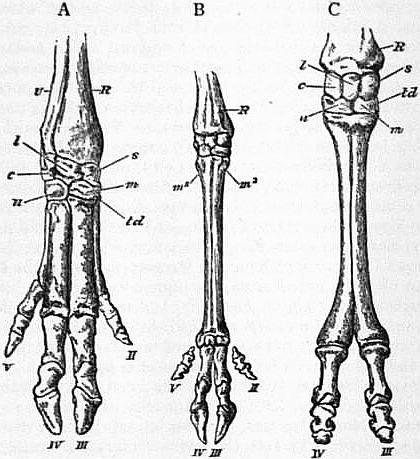
Fig. 1.—Bones of Right Fore Feet of existing Artiodactyla.
A, Pig (Sus scrofa). B, Red deer (Cervus elaphus). C, Camel (Camelus bactrianus). U, Ulna. R, Radius. c, Cuneiform. l, Lunar. s, Scaphoid. u, Unciform. m, Magnum. td, Trapezoid.
In the Sheep and the Camel the long compound bone, supporting the two main (or only) toes is the cannon-bone.
The primitive Artiodactyla thus probably had the typical number (44) of incisor, canine and molar teeth, brachyodont molars, conical odontoid process, four distinct toes on each foot, with metacarpal, metatarsal and all the tarsal bones distinct, and no frontal appendages.
As regards classification, the first group is that of the Pecora, or Cotylophora, in which the cheek-teeth are selenodont, but there are no upper incisors or canine-like premolars, while upper canines are generally absent, though sometimes Pecora. largely developed. Inferior incisors, three on each side with an incisiform canine in contact with them. Cheek-teeth consisting of p.3⁄3, m.3⁄3, in continuous series. Auditory bulla simple and hollow within. Odontoid process of second vertebra in the form of a crescent, hollow above. Lower extremity of the fibula represented by a distinct malleolar bone articulating with the outer surface of the lower end of the tibia. Third and fourth metacarpals and metatarsals confluent into cannon-bones (fig. 1 B), and the toes enclosed in hoofs. Outer toes small and rudimentary, or in some cases entirely suppressed; their metacarpal or metatarsal bones never complete. Navicular and cuboid bones of tarsus united. The skull generally lacks a sagittal crest; and the condyle of the lower jaw is transversely elongated. Horns or antlers usually present, at least in the male sex. Left brachial artery arising from a common innominate trunk, instead of coming off separately from the aortic arch. Stomach with four complete cavities. Placenta cotyledonous. Teats 2 or 4.
The group at the present day is divided into Giraffidae (giraffe and okapi), Cervidae (deer), Antilocapridae (prongbuck), and Bovidae (oxen, sheep, goats, antelopes, &c.). (See Pecora.)
The second group is represented at the present day by the camels (Camelus) of the Old, and the llamas (Lama) of the New World, collectively constituting the family Camelidae. They derive their name of Tylopoda (“boss-footed”) Tylopoda. from the circumstance that the feet form large cushion-like pads, supporting the weight of the body, while the toes have broad nails on their upper surface only, instead of being encased in hoofs. The cheek-teeth are selenodont, and one pair of upper incisors is retained, while some of the anterior premolars assume a canine-like shape, and are separated from the rest of the cheek-series. Auditory bulla filled with honeycombed bony tissue. Odontoid process of second vertebra semi-cylindrical; skull with a sagittal crest; and the condyle of the lower jaw rounded. Third and fourth metacarpals and metatarsals (which are alone present) fused into cannon-bones for the greater part of their length, but diverging inferiorly (fig. 1, C) and with their articular surfaces for the toes smooth, instead of ridged as in the Pecora. Navicular and cuboid bones of tarsus distinct. No horns or antlers. Stomach, although complex, differing essentially from that of the Pecora. Placenta diffuse, without cotyledons. Teats few. (See Tylopoda.)
In the same sectional group is included the North American family of oreodonts (Oreodontidae), which are much more primitive ruminants, with shorter necks and limbs, the full series of 44 teeth, all in apposition, and the metacarpal and metatarsal bones separate, and the toes generally of more normal type, although sometimes claw-like. (See Oreodon.) The Eocene American genus Homacodon is regarded as representing a third family group, the Homacodontidae (= Pantolestidae), in which the molars were of a bunodont type, and approximate to those of the Condylarthra from which this family appears to have sprung, and to have given origin on the one hand to the Oreodontidae, and on the other to the Camelidae. The family is represented in the Lower, or Wasatch, Eocene by Trigonolestes, in the Middle (Bridger) Eocene by Homacodon (Pantolestes), and in the Upper (Uinta) Eocene by Bunomeryx.
The third group is that represented by the chevrotains or mouse-deer, forming the family Tragulidae, with Tragulus in south-eastern Asia and Dorcatherium (or Hyomoschus) in equatorial Africa. The cheek-teeth are selenodont, Tragulina. as in the two preceding groups; there are no upper incisors, but there are long, narrow and pointed upper canines, which attain a large size in the males; the lower canines are incisor-like, as in the Pecora, and there are no caniniform premolars in either jaw. Cheek-teeth in a continuous series consisting of p.3⁄3, m.3⁄3. Odontoid process of axis conical. Fibula complete. Four complete toes on each foot. The middle metacarpals and metatarsals generally confluent, the outer ones (second and fifth) slender but complete, i.e. extending from the carpus or tarsus to the digit. Navicular, cuboid and ectocuneiform bones of tarsus united. Auditory bulla of skull filled with cancellar tissue. No frontal appendages. Ruminating, but the stomach with only three distinct compartments, the maniplies or third cavity of the stomach of the Pecora being rudimentary. Placenta diffused. (See Chevrotain.)
In this place must be mentioned the extinct Oligocene European group typified by the well-known genus Anoplotherium of the Paris gypsum-quarries, and hence termed Anoplotherina, although the alternative title Anoplotherina. Dichobunoidea has been suggested. It includes the two families Anoplotheriidae and Dichobunidae, of which the first died out with the Oligocene, while the second may have given origin to the Tragulina and perhaps the Pecora. There is the full series of 44 teeth, generally without any gaps, and most of the bones of the skeleton are separate and complete; while, in many instances at any rate, the tail was much longer than in any existing ungulates, and the whole bodily form approximated to that of a carnivore. The upper molars, which may be either selenodont or buno-selenodont, carry five cusps each, instead of the four characteristic of all the preceding groups; and they are all very low-crowned, so as to expose the whole of the valleys between the cusps. In Anoplotherium, some of the species of which were larger than tapirs, there were either two or three toes, the latter number being almost unique among the Artiodactyla. Allied genera are Diplobune and Dacrytherium.
The Dichobunidae include the genus Dichobune, of which the species were small animals with buno-selenodont molars. Xiphodon and Dichodon represent another type with cutting premolars and selenodont molars; while Caenotherium and Plesiomeryx form yet another branch, with resemblances to the ruminants. The most interesting genera are however, the Upper Oligocene and Lower Miocene Gelocus and Prodremotherium, which have perfectly selenodont teeth, and the third and fourth metacarpal and metatarsal bones respectively fused into an imperfect cannon-bone, with the reduction of the lateral metacarpals and metatarsals to mere remnants of their upper and lower extremities. While Gelocus exhibits a marked approximation to the Tragulidae, Prodremotherium comes nearer to the Cervidae, of which it not improbably indicates the ancestral type. The Dichobunidae may be regarded as occupying a position analogous to that of the Homacodontidae in the Tylopoda, and like the latter, are probably the direct descendants of Condylarthra.
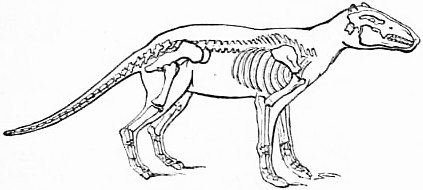
Fig. 2.—Restoration of Anoplotherium commune.
The last section of the Artiodactyla is that of the Suina, represented at the present day by the pigs (Suidae), and the hippopotamuses (Hippopotamidae), and in past times by the Anthracotheriidae, in which may probably be Suina. included the Elotheriidae. In the existing members of the group the cheek-teeth approximate to the bunodont type, although showing signs of being degenerate modifications of the selenodont modification. There is at least one pair of upper incisors, while the full series of 44 teeth may be present. The metacarpals and metatarsals are generally distinct (fig. 1 A), and never fuse into a complete cannon-bone; and the navicular and cuboid bones of the tarsus are separate. The odontoid process of the second vertebra is pig-like: and the tibia and fibula and radius and ulna are severally distinct. The stomach is simple or somewhat complex, and the placenta diffused. The Suidae include the Old World pigs (Suinae) and the American peccaries (Dicotylinae), and are characterized by the snout terminating in a fleshy disk-like expansion, in the midst of which are perforated the nostrils; while the toes are enclosed in sharp hoofs, of which the lateral ones do not touch the ground. There is a caecum. The Dicotylinae differ from the Suinae in that the upper canines are directed downwards (instead of curving upwards) and have sharp cutting-edges, while the toes are four in front and three behind (instead of four on each foot), and the stomach is complex instead of simple. In the Old World a large number of fossil forms are known, of which the earliest is the Egyptian Eocene Geniohyus. Originally the family was an Old World type, but in the Miocene it gained access into North America, where the earliest form is Bothriolabis, an ancestral peccary showing signs of affinity with the European Miocene genus Palaeochoerus. (See Swine and Peccary.)
The Hippopotamidae are an exclusively Old World group, in which the muzzle is broad and rounded and quite unlike that of the Suidae, while the crowns of the cheek-teeth form a distinctly trefoil pattern, when partially worn, which is only foreshadowed in those of the latter. The short and broad teeth terminate in four subequal toes, protected by short rounded hoofs, and all reaching the ground. The hinder end of the lower jaw is provided with a deep descending flange. Both incisors and canines are devoid of roots and grow throughout life, the canines, and in the typical species one pair of lower incisors, growing to an immense size. The stomach is complex; but there is no caecum. Although now exclusively African, the family (of which all the representatives may be included in the single genus Hippopotamus, with several subgeneric groups) is represented in the Pliocene of Europe and the Lower Pliocene of northern India. Its place of origin cannot yet be determined.
The extinct Anthracotheriidae were evidently nearly allied to the Hippopotamidae, of which they are in all probability the ancestral stock. They agree, for instance, with that family in the presence of a descending flange at the hinder end of each side of the lower jaw; but their dentition is of a more generalized type, comprising the full series of 44 teeth, among which the incisors and canines are of normal form, but specially enlarged, and developing roots in the usual manner. The molars are partially selenodont in the typical genus Anthracotherium, with five cusps, or columns, on the crowns of those of the upper jaw, which are nearly square. The genus has a very wide distribution, extending from Europe through Asia to North America, and occurring in strata which are of Oligocene and Miocene age. In Ancodon (Hyopotamus) the cusps on the molars are taller, so that the dentition is more decidedly selenodont; the distribution of this genus includes not only Europe, Asia and North Africa, but also Egypt where it occurs in Upper Eocene beds in company with the European genus Rhagatherium, which is nearer Anthracotherium. On the other hand, in Merycopotamus, of the Lower Pliocene of India and Burma, the upper molars have lost the fifth intermediate cusp of Ancodon; and thus, although highly selenodont, might be easily modified, by a kind of retrograde development, into the trefoil-columned molars of Hippopotamus. In the above genera, so far as is known, the feet were four-toed, although with the lateral digits relatively small; but in Elotherium (or Entelodon), from the Lower Miocene of Europe and the Oligocene of North America, the two lateral digits in each foot had disappeared. This is the more remarkable seeing that Elotherium may be regarded as a kind of bunodont Anthracotherium. It shows the characteristic hippopotamus-flange to the lower jaw, but has also a large descending process from the jugal bone of the zygomatic arch of the skull. Finally, we have in the Pliocene of India the genus Tetraconodon, remarkable for the enormous size attained by the bluntly conical premolars; as the molars are purely bunodont, this genus seems to be a late and specialized survivor of a primitive type.
(R. L.*)
ARTISAN, or Artizan, a mechanic; a handicraftsman in distinction to an artist. The English word (from Late Lat. artitianus, instructed in arts) at one time meant “artist,” but has been restricted to signify the operative workman only.
ARTOIS, an ancient province of the north of France, corresponding to the present department of Pas de Calais, with the exclusion of the arrondissements of Boulogne and Montreuil, which belonged to Picardy. It is a rich and well-watered country, producing abundance of grain and hops, and yielding excellent pasture for cattle. The capital of the province was Arras, and the other important places were Saint-Omer, Béthune, Aire, Hesdin, Bapaume, Lens, Lillers, Saint-Pol and Saint-Venant. The name Artois (still more corrupted in “Arras”) is derived from the Atrebates, who possessed the district in the time of Caesar. From the 9th to the 12th century Artois belonged to the counts of Flanders. It was bestowed in 1180 on Philip Augustus of France by Philip of Alsace, as the dowry of his niece Isabella of Hainaut. At her death in 1190, Baldwin IX., count of Flanders (d. 1206), and then his son-in-law, Ferrand (Ferdinand) of Portugal, count of Flanders, disputed the possession of the country with the king of France, Ferrand being in the coalition which was overthrown by Philip Augustus at Bouvines (1214). In 1237 Artois, which was raised to a countship the following year, was conferred as an appanage by Saint Louis on his brother Robert, who died on crusade in 1250. His son, Robert II., took part in the wars in Navarre, Sicily, Guienne and Flanders, and was killed at the battle of Courtrai in 1302. After his death, his son Philip having predeceased him (1298), Artois was adjudged to his daughter Mahaut, or Matilda, as against her nephew Robert, son of Philip, who attempted to support his claim to the countship by forged titles. Banished from France for this crime (1322), Robert of Artois took refuge in England, where he became earl of Richmond, and incited Edward III. to make war upon Philip of Valois. His descendants, the counts of Eu (q.v.), continued to style themselves counts of Artois. By the marriage of Mahaut (d. 1329) with Otto IV., Artois passed to the house of Burgundy, in whose possession it remained till the marriage of Mary, the daughter of Charles the Bold, to the archduke Maximilian brought it to the house of Austria. Louis XI., however, occupied portions of Artois, and the claims of Austria were contested by France until the treaty of Senlis (1493). The emperor Charles V. established the council of Artois, with sovereign authority. At the end of the Thirty Years’ War Artois was again conquered by the French, and the conquest was ratified in the treaty of the Pyrenees (1659) by Spain, to whom the province had fallen in 1634. During the war between France and Holland (1672-77) and that of the Spanish Succession. Artois was invaded again, but the treaties of Nijmwegen (1678) and of Utrecht (1713) confirmed the sovereignty of France. The title of count of Artois was borne by Charles X. of France before his accession to the throne. This new creation became extinct on the death of the comte de Chambord in 1883.
ART SALES. The practice of selling objects of art by auction in England dates from the latter part of the 17th century, when in most cases the names of the auctioneers were suppressed. Evelyn (under date June 21, 1693) mentions a “great auction of pictures (Lord Melford’s) in the Banquetting House, Whitehall,” and the practice is frequently referred to by other contemporary and later writers. Before the introduction of regular auctions the practice was, as in the case of the famous collection formed by Charles I., to price each object and invite purchasers, just as in other departments of commerce. But this was a slow process, especially in the case of pictures, and lacked the incentive of excitement. The first really important art collection to come under the hammer was that of Edward, earl of Oxford, dispersed by Cock, under the Piazza, Covent Garden, on 8th March 1741/2 and the five following days, six more days being required by the coins. Nearly all the leading men of the day, including Horace Walpole, attended or were represented at this sale, and the prices varied from five shillings for an anonymous bishop’s “head” to 165 guineas for Vandyck’s group of “Sir Kenelm Digby, lady, and son.” The next great dispersal was Dr Richard Mead’s extensive collection, of which the pictures, coins and gems, &c., were sold by Langford in February and March 1754, the sale realizing the total, unprecedented up to that time, of £16,069. The thirty-eight days’ sale (1786) of the Duchess of Portland’s collection is very noteworthy, from the fact that it included the celebrated Portland vase, now in the British Museum. Many other interesting and important 18th-century sales might be mentioned. High prices did not become general until the Calonne, Trumbull (both 1795) and Bryan (1798) sales. As to the quality of the pictures which had been sold by auction up to the latter part of the 18th century, it may be assumed that this was not high. The importation of pictures and other objects of art had assumed extensive proportions by the end of the 18th century, but the genuine examples of the Old Masters probably fell far short of 1%. England was felt to be the only safe asylum for valuable articles, but the home which was intended to be temporary often became permanent. Had it not been for the political convulsions on the continent, England, instead of being one of the richest countries in the world in art treasures, would have been one of the poorest. This fortuitous circumstance had, moreover, another effect, in that it greatly raised the critical knowledge of pictures. Genuine works realized high prices, as, for example, at Sir William Hamilton’s sale (1801), when Beckford paid 1300 guineas for the little picture of “A Laughing Boy” by Leonardo da Vinci; and when at the Lafontaine sales (1807 and 1811) two Rembrandts each realized 5000 guineas, “The Woman taken in Adultery,” now in the National Gallery, and “The Master Shipbuilder,” now at Buckingham Palace. The Beckford sale of 1823 (41 days, £43,869) was the forerunner of the great art dispersal of the 19th century; Horace Walpole’s accumulation at Strawberry Hill, 1842 (24 days, £33,450), and the Stowe collection, 1848 (41 days, £75,562), were also celebrated. They comprised every phase of art work, and in all the quality was of a very high order. They acted as a most healthy stimulus to art collecting, a stimulus which was further nourished by the sales of the superb collection of Ralph Bernal in 1855 (32 days, £62,690), and of the almost equally fine but not so comprehensive collection of Samuel Rogers, 1856 (18 days, £42,367). Three years later came the dispersal of the 1500 pictures which formed Lord Northwick’s gallery at Cheltenham (pictures and works of art, 18 days, £94,722).
Towards the latter part of the first half of the 19th century an entirely new race of collectors gradually came into existence; they were for the most part men who had made, or were making, large fortunes in the various industries of the midlands and north of England and other centres. They were untrammelled by “collecting” traditions, and their patronage was almost exclusively extended to the artists of the day. The dispersals of these collections began in 1863 with the Bicknell Gallery, and continued at irregular intervals for many years, e.g. Gillott (1872), Mendel (1875), Wynn Ellis and Albert Levy (1876), Albert Grant (1877) and Munro of Novar (1878). These patrons purchased at munificent prices either direct from the easel or from the exhibitions not only pictures in oils but also water-colour drawings. As a matter of investment their purchases frequently realized far more than the original outlay; sometimes, however, the reverse happened, as, for instance, in the case of Landseer’s “Otter Hunt,” for which Baron Grant is said to have paid £10,000 and which realized shortly afterwards only 5650 guineas. One of the features of the sales of the ’seventies was the high appreciation of water-colour drawings. At the Gillott sale (1872) 160 examples realized £27,423, Turner’s “Bamborough Castle” fetching 3150 gns.; at the Quilter sale (1875) David Cox’s “Hayfield,” for which a dealer paid him 50 gns. in 1850, brought 2810 gns. The following are the most remarkable prices of later years. In 1895 Cox’s “Welsh Funeral” (which cost about £20) sold for 2400 gns., and Burne-Jones’s “Hesperides” for 2460 gns. In 1908, 13 Turner drawings fetched £12,415 (Acland-Hood sale) and 7 brought £11,077 (Holland sale), the “Heidelberg” reaching 4200 gns. For Fred Walker’s “Harbour of Refuge” 2580 gns. were paid (Tatham sale) and 2700 gns. for his “Marlow Ferry” (Holland). The demand for pictures by modern artists, whose works sold at almost fabulous prices in the ’seventies, has somewhat declined; but during all its furore there was still a small band of collectors to whom the works of the Old Masters more especially appealed. The dispersal of such collections as the Bredel (1875), Watts Russell (1875), Foster of Clewer Manor (1876), the Hamilton Palace (17 days, £397,562)—the greatest art sale in the annals of Great Britain—Bale (1882), Leigh Court (1884), and Dudley (1892) resulted, as did the sale of many minor collections each season, in many very fine works of the Old Masters finding eager purchasers at high prices. A striking example of the high prices given was the £24,250 realized by the pair of Vandyck portraits of a Genoese senator and his wife in the Peel sale, 1900.
Since the last quarter of the 19th century the chief feature in art sales has been the demand for works, particularly female portraits, by Reynolds, his contemporaries and successors. This may be traced to the South Kensington Exhibitions of 1867 and 1868 and the annual winter exhibitions at Burlington House, which revealed an unsuspected wealth and charm in the works of many English artists who had almost fallen into oblivion. A few of the most remarkable prices for such pictures may be quoted: Reynolds’s “Lady Betty Delmé” (1894), 11,000 gns.; Romney’s “The Ladies Spencer” (1896), 10,500 gns.; Gainsborough’s “Duchess of Devonshire” (1876), 10,100 gns. (for the history of its disappearance see Gainsborough, Thomas), “Maria Walpole,” 12,100 gns. (Duke of Cambridge’s sale, 1904); Constable’s “Stratford Mill” (1895), 8500 gns.; Hoppner’s “Lady Waldegrave” (1906), 6000 gns.; Lawrence’s “Childhood’s Innocence” (1907), 8000 gns.; Raeburn’s “Lady Raeburn” (1905), 8500 gns. Here may also be mentioned the 12,600 gns. paid for Turner’s “Mortlake Terrace” in 1908 (Holland sale).
The “appreciation” of the modern continental schools, particularly the French, has been marked since 1880; of high prices paid may be mentioned Corot’s “Danse des Amours” (1898), £7200; Rosa Bonheur’s “Denizens of the Highlands” (1888), 5550 gns.; Jules Breton’s “First Communion,” £9100 in New York (1886); Meissonier’s “Napoleon I. in the Campaign of Paris,” 12¼ in. by 9¼ in. (1882), 5800 gns., and “The Sign Painter” (1891), 6450 gns. High prices are also fetched by pictures of Daubigny, Fortuny, Gallait, Gérôme, Troyon and Israëls. The most marked feature of late has been the demand for the 18th-century painters Watteau, Boucher, Fragonard, Pater and Lancret; thus “La Ronde Champêtre” of the last named brought £11,200 at the Say Sale in 1908, and Fragonard’s “Le Reveil de Vénus” £5520 at the Sedelmeyer sale, 1907.
“Specialism” is the one important development in art collecting which has manifested itself since the middle of the 19th century. This accounts for and explains the high average quality of the Wellesley (1866), the Buccleuch (1888) and the Holford (1893) collections of drawings by the Old Masters; for the Sibson Wedgwood (1877), the Duc de Forli Dresden (1877), the Shuldham blue and white porcelain (1880), the Benson collection of antique coins (1909), and for the objects of art at the Massey-Mainwaring and Lewis-Hill sales of 1907. Very many other illustrations in nearly every department of art collecting might be quoted—the superb series of Marlborough gems (1875 and 1899) might be included in this category but for the fact that it was formed chiefly in the 18th century. The appreciation—commercially at all events—of mezzotint portraits and of portraits printed in colours, after masters of the early English school, was one of the most remarkable features in art sales during the last years of the 19th century. The shillings of fifty years before were then represented by pounds. The Fraser collection (December 4 to 6, 1900) realized about ten times the original outlay, the mezzotint of the “Sisters Frankland,” after Hoppner, by W. Ward, selling for 290 guineas as against 10 guineas paid for it about thirty years previously. The H.A. Blyth sale (March 11 to 13, 1901, 346 lots, £21,717 : 10s.) of mezzotint portraits was even more remarkable, and as a collection it was the choicest sold within recent times, the engravings being mostly in the first state. The record prices were numerous, and, in many cases, far surpassed the prices which Sir Joshua Reynolds received for the original pictures; e.g. the exceptionally fine example of the first state of the “Duchess of Rutland,” after Reynolds, by V. Green, realized 1000 guineas, whereas the artist received only £150 for the painting itself. Even this unprecedented price for a mezzotint portrait was exceeded on the 30th of April 1901, when an example of the first published state of “Mrs Carnac,” after Reynolds, by J.R. Smith, sold for 1160 guineas. At the Louis Huth sale (1905) 83 lots brought nearly £10,000, Reynolds’s “Lady Bampfylde” by T. Watson, first state before letters, unpublished, fetching 1200 guineas. Such prices as these and many others which might be quoted are exceptional, but they were paid for objects of exceptional rarity or quality.
It is not necessary to pursue the chronicle of recent sales, which have become a feature of every season. It is worth mentioning, however, that the Holland sale, in June 1908, realized £138,118 (432 lots), a “record” sum for a collection of pictures mainly by modern artists; and that for the Rodolphe Kann collection (Paris) of pictures and objects of art, including 11 magnificent Rembrandts, Messrs Duveen paid £1,000,000 in 1907. In every direction there has been a tendency to increase prices for really great artistic pieces, even to a sensational extent. The competition has become acute, largely owing to American and German acquisitiveness. The demand for the finest works of art of all descriptions is much greater than the supply. As an illustration of the magnitude of the art sale business it may be mentioned that the “turnover” of one firm in London alone has occasionally exceeded £1,000,000 annually.
Bibliography.—The chief compilations dealing with art sales in Great Britain are: G. Redford, Art Sales (1888); and W. Roberts, Memorials of Christie’s (1897); whilst other books containing much important matter are W. Buchanan, Memoirs of Painting; The Year’s Art (1880 and each succeeding year); F.S. Robinson, The Connoisseur; and L. Soullie, Les Ventes de tableaux, dessins et objets d’art au XIXe siècle (chiefly French).