EMPIRES AND EMPERORS
Reading edition
I
THE TSAR AND TSARINA AT THEIR HOME OF PETERHOF
It is half-past nine in the morning, as I start on my journey to Peterhof, having been honoured by the Tsar with an invitation thither. It is yet cold and chilly. The great metropolis is covered with a veil of fog. One would imagine that winter had already begun, and it is difficult to realize that according to the calendar it is the month of August. The street leading to the Baltic station, St. Petersburg, is still half deserted.
There Switzers begin to sweep the doorways, and detachments of soldiers hurry to take up their different posts. There are a few milk-carts that rattle to and fro, and one or two private vehicles occupied by people in full dress and uniforms covered with decorations, throwing into sharp contrast the dreary surroundings of the humble suburb. In fact, contrasts are the most striking feature of the capital of the vast Russian Empire—contrasts in light and shadow, splendour and humility, and I dare say contrasts in everything that is characteristic of the West and the East.
The railway station, where I arrive at last, is certainly one of the most interesting illustrations of what I have just pointed out—the very link and meeting-place of the West with the East. It is crowded with people: their countenances are so different, their dress so picturesque, their behaviour so unconventional, yet so characteristic, that I forget that I am on a railway platform, and imagine myself amidst the picturesqueness of a great caravanserai.
Perfect order is kept. The train is already at the platform, ready to start, and I am shown without delay into my compartment. There are a great many officials, all of them in striking uniforms. In fact, there are nearly as many railway employés as travellers, and together they form incoherent groups of Oriental brightness.
The train winds through colourless and uninteresting suburbs for some time. Here and there we have a glimpse of the white Neva, arched by beautiful bridges and skirted with magnificent palaces. We pass near many small villages full of summer-houses, all built of wood. Each house is painted in different colours, and has its own pretty garden. There are some red, some green, and some blue, making a polychromatic mosaic on the green fields. They are all summer residences of the official or semi-official world, who are obliged to pass the summer near town. Indeed, the great charm of St. Petersburg consists in its neighbourhood. These attractive retreats, or, as they are called, Datshas, are on the riverside or on the seashore, or hidden in a quiet neighbourhood like the magnificent Imperial residences, Tsarskoe Selo, Pavlovsk, and Gatschina.
But among them all, Peterhof is the most famous—the Versailles of the North. I think Peterhof undoubtedly deserves the first place. There is not only splendour, but there is real beauty too. Art and nature contribute to make it one of the loveliest spots on earth. There is, in fact, only one royal residence, I think, that can compare with it, and that is the castle of Pena on the high peaks overlooking the ocean near Lisbon.
To get an idea of Peterhof we must imagine a luxuriant forest overshadowing the blue waters of the Baltic. Buried in the woods are summer-houses, gardens, fountains, Greek temples, and triumphal arches. The palace itself stands on a hill that has been cut into terraces—terraces that are surrounded by balustrades and ornamented by statues and flower-vases. Then as a centre there is a magnificent cascade looking like a crystal staircase leading up to a golden palace; it spreads out its waters into a silver carpet covering the pathway and flowing in a broad canal to the sea, bordered by an avenue of rippling fountains.
And when we get tired of the golden palace, of its silver carpet and its dazzling brightness, we return to some of the smaller residences, of which there are many scattered about in the grounds. Some are little French châteaux, some others imitate Dutch farms or Roman villas. They are all different in style and taste, but they are all charming, and contain priceless collections of art. Each has interesting annals; each has some historical connexion and a past of romantic or tragic memory. Wars have been declared, treaties ratified, peace re-established in its lofty halls and gilded salons, every one the scene of important events. Peter the Great's many schemes were born within these walls; and from these groves Catharine II ruled with her iron sceptre.
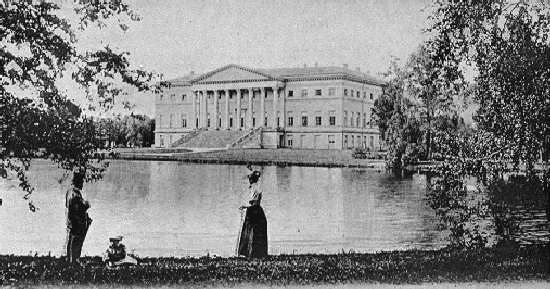
LE PALAIS ANGLAIS "The great charm of Petersburg is its neighbourhood" [To face page 4]
The present Tsar selected for his home one of the smaller châteaux, called Alexandrovsky.
Alexandrovsky is indeed a modest house. It has no lofty cupolas, no magnificent gates, no stately cour d'honneur. It is a simple villa such as is seen in the neighbourhood of well-to-do commercial towns. It might be somewhere near Birmingham or Queenstown. It is built of bright red bricks, has some friendly bow windows, and is ornamented by some little turrets.
Its charm consists in its homeliness. Its beauty is its situation.
It stands in the centre of a green lawn on the border of the sea. It is surrounded by a little flower-garden, where, instead of magnificent fountains and marble statues, there are masses of bloom full of colour and scent; borders of lilies, hollyhocks, poppies, and sweet peas form a natural fence of many hues against the sombre background of the wood. It is a garden which you can realize is tended with affection.
The Empress herself takes an interest in it, and, surrounded by her daughters, passes in this charming retreat many quiet hours of the long summer afternoons. Undoubtedly, this must remind her of lovely Wolfsgarten, hidden in the Hessian forests, where she passed the merry days of her childhood, where she returns so faithfully nearly every year, and where she is so beloved by all the villagers.
Her Majesty is tall, has a fine presence, and is extremely graceful in all her movements. She is refined in the highest degree and very artistic in her disposition. Her leisure hours are mainly occupied in drawing, painting, and music. She is an ardent supporter of all the artistic societies in the capital, and gives a great impetus to literary training in all the different schools which are under her patronage. There are a large number of these schools in St. Petersburg, and she pays personal visits to them frequently.
Her greatest interest, however, is concentrated in her children, and she finds her chief happiness in her own home. Her domestic virtues are those which make her respected by the whole nation. Coming as she did from a far-away country, and being a foreigner, it must have been no easy matter to be at once understood. For refined and retiring natures it is specially difficult to become at once popular. It is only in time, and by having opportunities to show deeper qualities, that sympathy can be awakened. By kind actions, by benevolence towards those she came in contact with, and by unbounded charity, the love of the nation was secured. But how she won the hearts of all was by being an ideal mother.
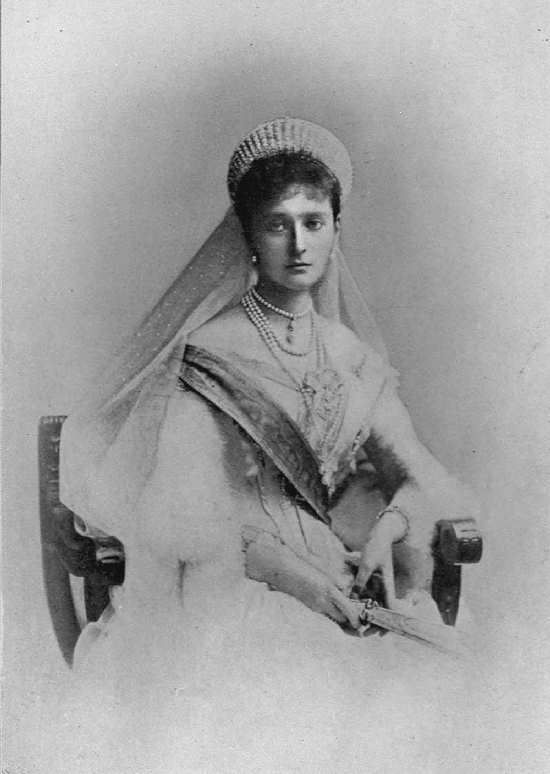
Copyright, Nops Ltd. H.I.M. THE EMPRESS OF RUSSIA [To face page 6]
The Empress is a devoted mother. She attends to her children, as much as possible, personally, and with the greatest care supervises the education of her four little daughters.
The nurseries are established entirely on the English system. There is great simplicity in the furniture, but plenty of fresh air and a good water supply.
The nursery governess is an English lady, and the rules of this little world are strictly observed and precisely carried out, Her Majesty herself having been brought up, as a grandchild of Queen Victoria, on the same principles. Method and punctuality are strictly observed, and the little Princesses must attend to their duties most scrupulously; lessons, recreation, exercises—everything is timed and planned in advance. There is a great deal to be done in the twenty-four hours, lessons and all sorts of small duties of many kinds.
The simplicity of everything might serve as a model to many households.
The food they partake of is of the plainest kind, healthy, but nothing elaborate, consisting mainly of porridge, bread and butter, milk and vegetables, and a little meat or fish. So it is with their attire; generally they are dressed in scrupulously neat white cotton, but it is devoid of all ornament. They pass many hours of the day on the seashore, and as they are running about, laughing, building castles in the sand, or clasping their beloved mother round the neck, they make a perfect picture of happiness.
I reach Peterhof at half-past ten by the special train which daily conveys the Tsar's guests and visitors. Officials, Court dignitaries, aides-de-camp, and others of those who are on duty, have hurried to the large platform, which, covered with red carpet, presents the appearance of a reception-hall. There is great animation at the Peterhof station all the time the Court is there, as the greater part of the suite live in town.
Before the station is a long row of carriages belonging to the Imperial household; peculiar-shaped victorias are there, horsed by enormous black Orloff stallions with great arching necks and flowing manes and tails, looking very much as if they had stepped from one of the pictures of Wouvermans or Velasquez. Lackeys, with three-cornered hats, gaiters, and heavy scarlet coats covered with gold lace, usher each guest to his vehicle, and each starts in a different direction to the many palaces and offices. Rattling over gravelled roadways, I first fully realize that in a few moments I shall be in the presence of the mighty Tsar of all the Russias, the ruler over the greater part of the enormous Asiatic continent, the autocratic head of millions of human beings.
My request is a very modest one—simply permission to get to my destination in the Far East through Siberia. There was some difficulty at the Russian frontier about my further journey, and I was advised to get the obstacles removed by His Majesty himself. He very likely knew that I am only interested in the spiritual and philanthropic institutions established in the Far East, my desire being to get through to my objective as soon as possible.
We drive for quite a quarter of an hour through woods, and here and there as we pass by different residences meet sentries marching up and down. We pass through several gates, all of them made of plain wooden bars—they might almost be in Leicestershire—each opened and closed by a Cossack. As we get nearer there are more sentries, and several times the password is given by the groom.
Alexandrovsky stands isolated in a quiet corner of the vast domain. Its home grounds are surrounded by walls and a kind of palisade. At last, having passed the last sentry and the last gate, the carriage stops at the private garden entrance.
I am received by an officer who shows me immediately into the palace—I ought to say villa. Villa indeed it is in every respect, and the entrance-hall is so small that it scarcely holds the few servants who are in attendance. The staircase is very narrow, too, and winds in exactly the same way as in small old-fashioned English houses.
The drawing-room gives the same impression of comfort and cheerfulness—the privileges of English homes. It is small, and with a rather low ceiling. The furniture is extremely plain. The few sofas and armchairs are covered with bright material, and the woodwork is lacquered white. The walls are covered with watercolours, sketches, and photographs. In one corner there stands a piano with music, and in the window a desk, apparently both much in use. The main feature of this room is the quantity of flowers. Tables, brackets, and furniture, are laden with jars, vases, and bowls filled with fresh-cut, sweet-smelling flowers.
But I have no time for further observations or to analyze more minutely this bright, homely abode in all its detail, giving as it does such a good insight into the private life of its owners. Simple, bright, unassuming, it is a sincere illustration of domestic happiness; and with its writing-desk littered with papers, its piano covered with music, and tiny jars and vases full of sweet-smelling blossoms, it is a human document in itself.
The door opens and an imposing A.D.C. enters and announces that His Majesty is ready to receive me. He is one of the Grand Dukes on duty at the palace for the day. He is a first cousin of the Emperor, an officer in the Russian army, and a most accomplished linguist. He narrated to me many interesting details of his yachting tour in far-distant seas. He had just returned from India, and seemed much impressed by the beauties of that wonderful land.
A bell begins to ring, a signal that the Emperor is ready to receive me. I am shown into the next room, which is even smaller and simpler than the one which I have just left. In its extreme modesty the furniture seems to be reduced to a few chairs, a lounge, and a large writing-table which occupies the greater part of the room.
This is His Majesty's study.
But if the interior is so very unassuming, the view out of the windows is simply magnificent; it looks straight on to the sea—a grey and shining mirror, crowned by the dark battlements of majestic Kronstadt. The famous citadel floats like a mirage in the blue haze of the distance, looking even finer than usual as I see it from one of the Tsar's windows.
The room is so small that there is no space to make the obligatory three bows. I have scarcely stepped into the room when His Majesty gets up and meets me himself with his well-known affability. Nicholas II wears the undress uniform of a Russian general—dark blue and green, with a very little gold lace, and a single medal on his breast—a modest garment, subdued in colouring, suited very well in every respect to its owner.
The portraits of the Emperor are well enough known to make it unnecessary for me to go into minute details. He is not tall, and of rather delicate frame, but healthy, and with a good complexion. What strikes one at the first moment is his open and kind-hearted expression. The two main features that impressed me at the first glance are the turquoise-blue colour of his eyes and their open gaze. Those eyes, which are the chief feature of his countenance, and seem to be a family inheritance, can hardly fail to arouse deep sympathy in the beholder. A very great likeness exists in this respect to the heir to the English throne.
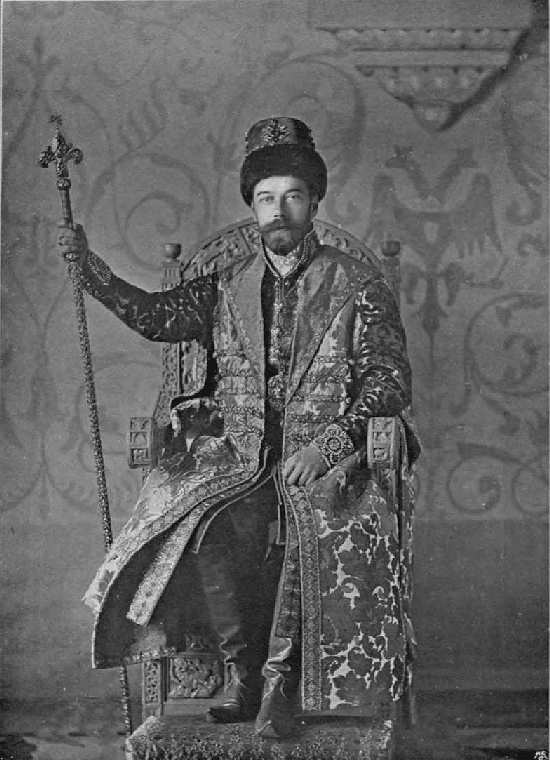
Photo, Levinsky Copyright, Nops Ltd. H.I.M. NICHOLAS II, EMPEROR OF RUSSIA [To face page 12]
His Majesty seemed to be much interested in my proposed journey across Siberia, and wanted to know how long I intended to stay in those regions. He spoke in an interesting way about his own experiences; he knows the whole length of the country in fact, as Tsarevitch he turned the first sod for the railway about twelve years ago in Vladivostok, and now the line runs from one end to the other, linking two continents. But he himself has travelled over the greater part of the route in the simple Russian tarantas.
He gave me with great vivacity many of his innumerable reminiscences and impressions. He was interested in every question, and tried to see everything as much as possible for himself. He stopped at each place of any importance and investigated the situation in detail. Besides his official engagements, he was keenly interested in the purely historical and scientific sides of these unknown regions. The knowledge he gathered during his journey is unique in value, and of the greatest importance to students of the Asiatic races, their origin, life, and future development. Undoubtedly there has been no other ruler of this enormous empire who ever before ventured to enter these remote districts.
He told me what never-failing interest it was to him to come across the different races in his Asiatic dominions, and to see the nomadic tribes there leading their own primitive life. It was a pleasure to listen, not only to his world-wide experiences, but to all his different impressions, gathered with the fresh conception of a young man, and to realize the keen interest which every sentence so eloquently expressed.
He spoke with such benevolence about his subjects, with such love about all those with whom he came in contact throughout his endless wanderings, that there should be no doubt that the Tsar of all the Russias really loves his subjects tenderly, and that their welfare is the highest aim of his life.
And he spoke further of his hopes of improving their condition, of witnessing their advancement, and of his earnest wish to have peace during his reign all over his territory. When he spoke about the great blessing of universal peace his voice vibrated with an emotion that carried the conviction, that so long as the fate of his vast empire depended entirely on his personal desire, there would be no cruel wars, but calm peace and prosperity over all his possessions. In replying I ventured to remark, "What could prevent the mighty Tsar of all the Russias carrying out his wishes?" He only answered, with a never-to-be-forgotten expression, "I see you are yet a new-comer in this country."
His Majesty showed the greatest care in making my journey through his vast empire, across Siberia, not only possible, but also in insuring that I should see as much as possible—that I should be able to observe and learn as much as would be useful to my endeavour.
His Majesty's permission was extended to embrace such hospitality as I would not have sought. I took the liberty of saying I would prefer to proceed as a humble missionary to my destination.
His Majesty kindly insisted:
"If you will not accept it for yourself, accept it for the satisfaction of your mother. She must be very anxious. I know from my own travels how hard it is for parents to be separated from their children by thousands of miles. I sent a telegram every day, but, even then, I knew what their sufferings were. It will give your mother some relief to know that while you are in this empire you are under my protection...."
*****
Time seems to have flown. On my way back I write with difficulty in my solitary compartment, by the rays of a single light. My day at Peterhof has seemed to vanish as a moment, but it has been so full of interesting incidents that to look back upon it is as if a month had been crowded into a day. I have no time to go into details in my diary, so to be correct I limit myself to generalities, and if I cannot put down in extenso all that was of interest—I might say of importance—I want to fix the main outlines of the picture.
II
TO THE FAR EAST BY THE TRANS-SIBERIAN RAILWAY
I FROM PETERSBURG TO MANCHURIA
Is it really possible to get to the Far East by land? Is the Siberian Railway open to the public? Is it comfortable? Those were the universal questions that everybody without exception addressed to me on my arrival. As for the first: yes, it is possible. With reference to the second, we must make distinctions. It is well known that to get through Russia everybody must be provided with a passport signed by the local Russian consul. It is different for priests and other church dignitaries who do not belong to the Greek denomination; these require a special permission granted by the Tsar himself. About comfort! The express trains are not only comfortable, but luxurious. In my many travels I do not remember having seen anything better fitted up, or affording to the traveller greater facilities for forgetting the long strain of the journey. The Trans-Siberian Railway is undoubtedly a marvellous piece of engineering. It may have defects, and it may need several alterations, but as a whole it deserves full admiration. Besides its commercial and strategical importance, as a mere civilizing influence it might become incalculable.
Another question which is constantly addressed to me is: Is not the journey very monotonous? Is it not a most uninteresting and flat country? Are not the natives of a very low type? The answer to these questions depends entirely on what the wanderer is interested in. If he looks for variety and excitement, the journey may be to a certain extent uneventful. For those who are in search of Swiss scenery and Alpine grandeur, it may seem flat and colourless. As for social intercourse and pleasure, naturally, these cannot be expected. But to anybody who is interested in land and folk—I mean those whose emotions are awakened by the deeper characteristics of the different countries and their inhabitants—the journey across the Asiatic continent cannot fail to offer a series of continuous revelations. From a geographical point of view, I admit it is in part very flat, and sometimes for days the train pursues its way in an unbroken line through green pastures or the denseness of virgin forests. The people one meets at different hamlets are certainly rough-looking, children of the Steppes; but it is exactly the untouched state of those regions, and the originality of their inhabitants, that render it all of the greatest value to the student of history and folk-lore. The land may be hilly or flat; its greatest interests are not dependent upon its mere external features, and the attractive points of a race do not consist purely in the state of its advancement. They may still be very primitive, living in tents, wearing skins, leading nomadic lives, unaffected, and yet give us an insight into their characteristics and capabilities. When untouched and unaffected by outside influences, they afford even better material for psychological observation, and present us human documents of exceptional interest in regard to the possibilities of their future.
But what compensates largely for the lack of panoramic effects is the vastness of the scenery. Grand it is in every respect. Undulating steppes like the wave-beaten ocean; never-ending, densely wooded regions which seem to extend without limit. Its chief beauty—if beauty it may be called—is the sentiment. The charm of these northern regions of Asia vibrates in their atmosphere. Sentiment and atmosphere! These are the two features of that strange land which impressed me most during the endless hours I looked from the balcony of my railway car, or when I stopped at one or other of the various townships; or, again, when I was visiting some of the native encampments. Among all I noticed that was new and striking, the most surprising thing was undoubtedly the "unseen"—what one might call the moral or metaphysical sides; the impression of unseen strength, exuberant vitality, primeval power, which forces itself on the traveller indirectly again and again in endless forms and aspects. We see it in the soil and in the people. It is equally expressed in the inanimate and animate nature. We perceive it in the yet unploughed fields, and we feel it among the unawakened humanity. It is more an instinctive sensation than the absolute reality which gives us revelations as to the future of this part of the globe.
I proceeded slowly, stopping at every place of interest, and made a short halt wherever there was anything that appealed to me. And when my journey was ended, I regretted it had been so short, and I was sorry the time was too limited to permit me to penetrate deeper into the matter. But I did not fail to put down my impressions from day to day. I made a short note of everything that was interesting, new, or striking, just as it presented itself to me—just as I saw it at the moment.
At present, when the general interest towards the Far East is widening, and people seem to wish to know a little more about Asiatic nations and their different races, and when every year will see more travellers and students trying to make the link between West and East stronger, I hope a few extracts from my diary may strengthen their wish, and help them to realize and put their intentions into execution. There are great openings for activity, and scope for intelligence; and there is a great deal to be done from commercial, scientific, and humanitarian points of view, for the benefit of the whole civilized world and the greater glory of the Almighty.
II FROM PETERSBURG TO MOSCOW
The Tsar very kindly consented to all the concessions necessary to traverse his extensive empire, and, after my leave-taking, an official brought me all the requisite papers, which had been signed by the Minister of Railways. What an interesting man Prince Chilkoff is! and such an enthusiast too! He lives literally in the midst of his locomotives, rails, and sleepers. I think his favourite abode is the extensive railway workshops of the metropolis. Looking at him, you would think he was born in Chicago; he speaks perfect English, but with a slight American intonation. He is American moreover in his keen sense of business and boundless energy. To hear him talk about the land, new tracks, almost impracticable tunnels, and steel bridges crossing the large rivers, is like a most descriptive geographical lecture; and when he starts on his favourite theories on locomotives, boilers, and pumps, one regrets not knowing more about the mysteries and fascinations of mechanics.
Prince Chilkoff[1] went through a very thorough mechanical training, and has been studying the matter in the United States for many years. He worked there himself, and got initiated into all the secrets of railway communication. He returned finally to his own country, where he hoped to devote his knowledge and qualifications to the benefit of his countrymen. But every post of any importance seemed to be occupied. I hear he was told there was only a subordinate vacancy in the mechanical department. "Give it to me," was his answer, and he is today Minister of all the Russian State Railways, and controller of nearly 25,000 miles of railway and other means of communication.
His study is a large room in the Ministry of Railways, which is a country-like residence, standing in extensive grounds. In the centre of his famous office are two large tables, covered, as are also the walls, with books, plans, and railway charts; and as he kindly explains the route I shall take, he gets up and points it out on a geographical map opposite his writing-table. What an enormous territory this Asiatic continent is! I look at it with a kind of amazement and a sort of fear. Shall I really get across it in a comfortable railway carriage, as you would go on a trip into the country? My host seems to divine my thoughts, and with a smile assures me that from one end to another the line is entirely under the same central management, and a telegraph apparatus from the head office brings him unbroken news throughout the entire length. "I quite understand it might seem strange and unusual to other countries, but you must not forget our tendencies and our force consist in centralization." He has made the Siberian journey again and again, and gives me most valuable information respecting what to see, and where to stop, and what is really of interest. It is a grand work, and, considering the space of time in which it was achieved, and its extent, it seems nearly incredible. Including the branch lines, the Siberian Railway is over ten thousand kilometres long, and its construction was begun only twelve years ago. Prince Chilkoff has, moreover, under his management, 10,400 post offices, and over 100,000 miles of telegraph line.
I leave his house charged with valuable hints and a packet of letters and recommendations; and Prince Chilkoff, with a cordial hand-shake, repeats, "Good luck! and don't forget to let me know if anything should prove unsatisfactory."
My last day at St. Petersburg is even more crowded than the rest of the week has been. Calls of farewell, final preparations, leaving cards and inscribing my name in visiting-books, occupy the greater part of it. But this going to and fro gives me opportunity of seeing it again from end to end in all its immensity before I leave. What an extraordinary idea to build a town in the midst of a marsh! to dig canals where one cannot build roads, and to be surrounded with a plain as flat as a table. Peter the Great must have been very much impressed by Amsterdam! There are corners in St. Petersburg drenched and misty as on the borders of the Zuyder Zee. But if it has reminiscences of quiet, home-like Holland, again there are brilliant thoroughfares like a Parisian boulevard. The Nevsky Prospect, in its bustle and traffic, full of colour and of life, is unique. Nevsky is the main artery of the capital—palaces belonging to the Imperial family and the grandees, public buildings, bazaars, workshops, and every edifice you can think of. And each is of different style, each of different height, and each is painted in a different hue of the rainbow. Its main feature—I dare say attraction—is its incoherence.
During this last week the Russian metropolis presented itself to me from a thousand different sides, and in how many different lights too! Trying to remember them all before I depart for good, I do so with preference for what was pleasant, instructive, and good. Besides, I do not come to criticize, I merely come to pass through, and so I prefer to put down in my diary what might prove instructive. I fully understand the great attraction which St. Petersburg always has for foreigners. I admit it also, though I should not choose it for my residence or for my sphere of labour. The polish is perfect, and of course, if one does not belong to a country, as a passing visitor one scarcely requires more. The conditions of life—at least, for the well-to-do—are most agreeable; manners all that can be desired; refinement exquisite. I do not think you can come in contact anywhere with better informed and more richly equipped people than here. Some of the scientific institutions, like the Naval Academy and the Public Library, are quite remarkable; and the new Polytechnic School—a regular town in itself, with its five faculties and its laboratories—stands alone. Then the museums and galleries contain the most celebrated art treasures. The famous Hermitage, large as it is, can scarcely hold them all. Antiques, gems, jewels, weapons, vases, engravings, and pictures, all of the first order; and I must say they appreciate what they do possess, and the arrangements of the museums are excellent. Unquestionably there is a highly intellectual current, or, if you would prefer to call it so, undercurrent, which comes to brilliant manifestations here and there; sometimes most unexpectedly, amid squalor and débris.
The huge electric globes cast a cold and glaring light over the gloomy square in front of the Moscow station. A dense crowd invades passages, halls, and waiting-rooms, and, like the swelling tide, groans, surges, and finally overflows the platforms. Travelling in Russia has a different meaning altogether from that which it possesses elsewhere—it really means a removal: a regular déplacement. Then, people seem to leave for ever: all their belongings appear to follow them, so enormous and so diverse is their kit. From simple boxes and knapsacks to kitchen utensils and even furniture, it embraces everything one could desire in one's own abode. And afterwards, when they take leave, their shaking of hands, embracing, and tears, give the impression that they never are to meet again. And this is only the local train, taking me as far as Moscow. What will it be there, at the Siberian terminus?
The journey lasts only one night, across the famous wheat-growing plains, and to-morrow, in the early hours of the morn, I hope to reach the ancient capital of the Tsars. I want to break my journey to see the ancient metropolis of the mighty rulers, to revisit all the famous scenes where so many important chapters of eastern history were once displayed to view. I want to see again the towering Kremlin, with its mosaic basilicas and treasure-houses, slumbering at present in quiet dreams of the past under their golden domes. And I want to get prepared and acclimatized to a certain extent for Siberia; for Moscow belongs altogether to the other continent; it is really the capital of Asia.
III THROUGH EUROPEAN RUSSIA
The fading disc of the sinking sun disappears slowly beneath the horizon of the waving corn-fields. The first day of the journey is over. It was uneventful, calm, but it has not lacked interest. We have ploughed through endless fields of rich land, with a peaceful agricultural aspect. Here and there a few scattered villages of dark mud huts, and large white churches. Sometimes there is a country seat of some landed gentleman, buildings which remind me very much of an Indian bungalow. They are very long and of only one storey high, half hidden by ancient trees. On the high roads peasants are just returning in endless streams, with carts and kettles, from their daily work. However far off they may have been working, they always return home for the night, for Russian peasants seldom live on their farms. The whole picture speaks of such perfect peace: the slowly moving and singing workmen, and the little villages bathed in the afterglow, express such simple happiness, that I can scarcely realize that some of those very districts have been the scene of violence and cruel outrages. It is indeed difficult to believe the reports of the latest troubles and dissatisfaction which have burst forth in the midst of the quietest of mujiks. How difficult it is to understand the inner feelings of these quaint folk! Sleepy as they may look, uncultured, and a couple of centuries behind the rest of the world, they can yet occasionally awaken; and when they awake, their passions burst out like as a stream of lava without restraint.
During the day we stop at many smaller and larger places, nearly all insignificant, and generally very far from the station—sometimes so far that I can scarcely understand the reason of our stopping. For miles and miles around there is no human habitation, and we wonder by whose hands all those fields are worked. The most important township seemed to be Marsanka. It is a typical Russian country town, with its wooden houses, each surrounded by a flower-garden, and each garden fenced by lattice-work. The houses and gates are all painted in bright colours. A river encloses the entire place like a loop, and beyond the river are low-lying hills. The main feature of the place is given by innumerable windmills, of all sizes and of every imaginable construction—all equally conspicuous, equally high, and equally equipped with gigantic sails. They all whirl—they all work as if they would never stop. I do not think I ever saw so many windmills within view at one time; I counted more than a hundred. What a fertile country it must be, to keep so many busy!
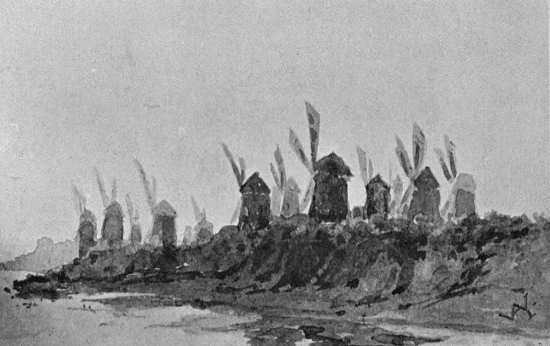
MARSANKA After a Water Colour Drawing by the Author "The main feature of the place is given by innumerable windmills" [To face page 28]
It is night as we arrive at Pienza, and we can see nothing except the railway station; but, as I hear, this is the main sight of the place. A fine building, though constructed of wood. I must also add that the stations all along the line are fine and convenient. They are well kept, a great many have restaurants, abundantly stocked, with richly laid out tables, and fair attendance. Prices are high, but this is to be expected, considering the distance from which they sometimes procure their provisions. Here at Pienza I find even luxury. Grapes and peaches from the Crimea, wine from Germany and France, and all kinds of American and English conserves; and, as ornamentation, fine old French candelabra, derived probably from some ruined noble's residence.
The station is animated. A great many officers and a great many officials, all dressed in uniform. Some are travellers, some have just come from the town for mere amusement. The great express has not yet lost its novelty, and twice a week is the object of universal admiration. Our train consists of two first-class and three second-class carriages, a dining-car, luggage-van, tender, and engine. A long corridor leads from one end to the other, and affords a convenient walk for daily exercise. The compartments are nicely fitted up; the one I occupy, a so-called saloon, affords me a comfortable home during the journey. The dining-car is fitted up in American style; and, as I see, all the seats are taken from morning till night. To my fellow-passengers their meals seem to be their only occupation, for if the train stops, and there is a restaurant, they alight and commence each time a fresh meal. Indeed, my fellow-passengers are great eaters and great talkers; they seem to speak about everything with the same ease and unreserve. Especially when they start on their own countrymen and government, there is no end to their sarcasm and witty remarks. To any one liking to hear about the local conditions, the Siberian journey gives an exceptional opportunity. People soon become acquainted, and if so they are delighted to find somebody to whom to grumble. Before twenty-four hours had passed I learnt more about the corn-fields and little villages we skirted; about Russian agricultural and industrial aspirations; about agrarian Plehve and M. de Witte's commercial enterprises than I ever should have expected.
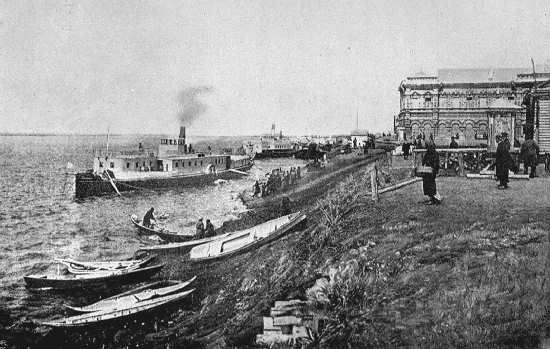
SAMARA "I shall make a short stay at Samara" [To face page 30]
It seems that Russia is at present passing through a serious crisis which affects everybody, rich and poor—especially the latter. The conditions of the peasantry are often very hard, though the reports we read are generally exaggerated. Education and moral training might do a great deal to lift them out of their stagnant state, to inspire self-reliance, and awaken sound ambitions; but this is exactly what appears to be lacking, and where so much good could be done. And the people deserve education, for these Russian peasants, as a whole, are a fine stock—strong and healthy, easy to lead, and not difficult to improve. Even more, they have generally an unspoilt heart, and are capable of gratitude. What I hear unanimously abused is the local administration. If I were to believe half what I heard about the unworthiness of the official employés, their untruthfulness and bribery, it would be bad enough, and would easily explain the reason of the continuous outbreaks. The antagonism between the so-called Progressives and Conservatives is becoming more intolerant, and strivings for reform on a smaller or larger scale seem to be universal. Some are hopeful, some pessimistic; some see Russia's future secured on the same old patriarchal and primitive foundations, others believe in commercial prosperity, trade, and advance. It is a great problem, and it is equally interesting to listen to the advocate of one or other theory. Yet I am afraid that in their sanguine anticipations they are equally far from what will prove to be the reality.
All the talk I listen to serves as a description of, or comment on, the uninterrupted panorama which unfolds itself without ceasing before us as we glide swiftly along. It is a kind of prologue to the epic of this land which we shall soon leave altogether.
To-morrow we shall cross the Volga by the famous steel bridge of nearly a mile. I shall make a short stay at Samara, and shall visit its well-known orphanages, asylums, and other charitable establishments which the town is so proud of; and, somewhat farther towards the east, the train will wind along the Ural Mountains to Siberia.
IV WESTERN SIBERIA
At half-past nine in the morning we cross the boundary of the two continents. We are in Asia. A kind of mysterious feeling impresses itself on my mind. New sensations infuse themselves into me. Encouraging hopes awaken, which I trust will give me endurance to carry out my work and aims.
Asia! What a field for exploration! What an unlimited area for higher aspirations! Modest as our endeavours may be, the result may prove incalculable in the future. From a commercial, civilizing, or spiritual point of view, there is an equally vast field for action.
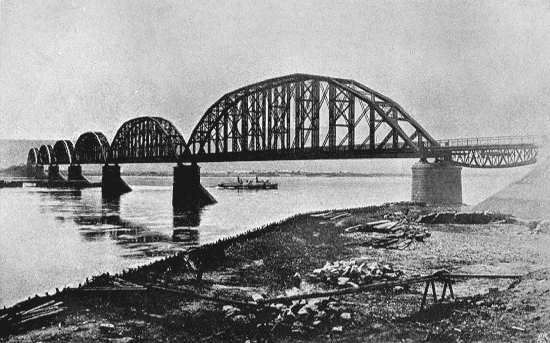
ON THE VOLGA "The famous steel bridge of nearly a mile" [To face page 32]
Our last day in Europe passed on the Baskir land—a high plateau, a severe and cold region, covered with rich pasture and inhabited by a semi-nomadic race of the same name. Fine people they are, of heavy countenance and magnificent frame; very conservative in their habits, very clannish in their intimacies, and even today living from preference in tents. They wear sheepskins; cover their heads, like Eskimos, with furs; and, instead of boots, roll round their feet and legs skins fastened like a classic sandal with endless straps of leather. They look uncouth, but picturesque. Their movements are unquestionably plastic. This race is one of the finest of the Tartar stock, and I am sorry to learn that they are slowly dying out.
We stop at different places, and on each platform there are many Baskirs, men and women all looking very much alike. They are bringing from their encampments milk, eggs, and poultry, to sell. I ask several of them the prices of their goods, and I am astonished at the cheapness of the market. The price of meat per pound amounts to the trifle of five kopecks; while for twenty roubles one may buy a horse, and a good one too. The soil is rich, its fertility is exceptional, and it possesses every quality for agricultural purposes. The future of the district is bound to be prosperous, and, what is more, the climate is most invigorating—raw and windy, but withal reminding me very much of the northern Scottish moors. Even the scenery, when it becomes a little more hilly, has a certain likeness to Scotland, and the same charm of solitude and melancholy. All this district impressed me very much, both from a geographical and an ethnological point of view, and by its magnitude it cannot fail to appeal to our minds.
The famous Ural range, I must simply confess, did not come up to my expectations. I understand the beauty of glaciers and snow-clad peaks, barren as they may be, and I fully appreciate all the beauty of a vast plain, or the charm of a sand-covered desert; but the medium—what is neither one nor the other, neither handsome nor grand, but what so many admire and call "pretty scenery"—never appeals to me. What interested me more was the economic possibility of this long stretch of slopes. The extent of the treasures of this range is yet unknown, though there are mines which were flourishing in the eighteenth century. Suleta's shafts were sunk in 1757, and are still under the workman's tools. The mines belong largely to the Crown; they are partly worked by societies, and some are private property. The Strogonoffs and Beloselskys have all made their great wealth in these mines. Some of them seem to be inexhaustible. What is more, besides gold, silver, lead, iron, almost every mineral seems to be contained in their depths. We met a great many workmen as we stopped, apparently without any reason, on our way, winding up endless zigzags to the top of the mountain. I am rather astonished that they do not in the least look like miners. They are neither blackened by coal-dust or smoke, nor have they the gloomy expression and sad countenance of those people who are bound to work and live underground, deprived of the rays of the sun for the greater part of their lives. They look much more like farmers—people of bright disposition. I hear the wages are low; but their needs are small, so that they can easily procure all that seems necessary to their happiness. On the top of the mountain there stands a lofty granite obelisk, with a short but significant inscription. There are only two words: on one side "Europe," on the other "Asia."
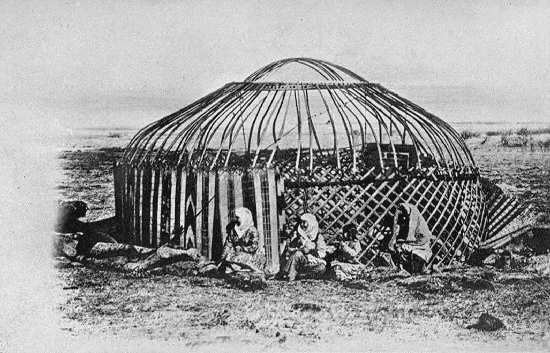
SIBERIAN HOME "Very conservative in their habits" [To face page 34]
We are in Western Siberia, in the midst of an expanse of steppe. It seems to be boundless, and it has nothing to mark its space. It is like a sea, with all the suggestiveness of the ocean. Our train crawls like a black reptile, like a monster of a fairy tale, breathing its steam and black smoke against the cloudless sky. What a sky it is! Pale blue, cold and without a single cloud. I am afraid I must again contradict the general opinion of travellers about this corner of the earth. I have repeatedly heard travellers tell of the gloom and tediousness of the journey across it. I cannot agree with either remark. Instead of gloom, I rather think repose would be a more appropriate expression to describe its true character; and tediousness is really a question of personal disposition.
I again break my journey at several places, and always find more of interest and more new material for study than I should have dared to anticipate. Western Siberia is a marvellous territory, and it possesses all that is required to make a country flourishing. I quite understand the great interest which it arouses, and it is natural that the country should invest money lavishly for the furtherance of its progress. They have built up in a comparatively short time some important townships. Petropaulovsk, and especially Omsk, Tobolsk, and Tomsk, are already well-known centres, provided with richly endowed public institutions. The Government maintains some large schools and colleges, and does everything in its power to attract new settlers to the uninhabited regions.
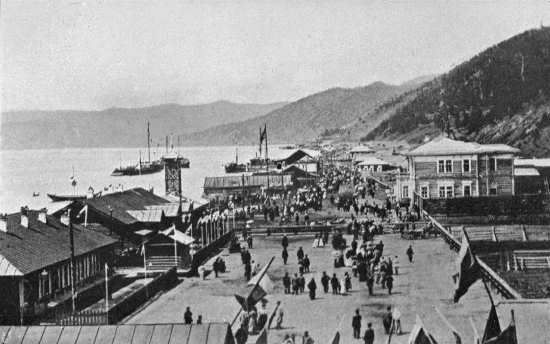
A SIBERIAN TOWN "They have built up in a comparatively short time some important townships" [To face page 36]
The colonization of Siberia is one of the most important national questions—to people thousands and thousands of square miles; to exploit all its resources; to make a country where there is now only surface and space. And the Government knows how to offer attractions. Land is granted under the most favourable conditions; there is no taxation for the first three years, seed is provided on easy terms, and, if required, agricultural implements and machinery are sold on the instalment system. The journey is nearly free, the fare being reduced to a few kopecks per hundreds of miles. Petropaulovsk is bound to become one day the junction of Central Asia, when railway lines will run to the north along the Obi valley and south via Atmolinsk, to Tashkend and Bokhara. All this is well thought out, and already carefully planned. Its accomplishment seems to be a mere question of time, and, as indeed is well known as an historical fact, time has never seemed to be an obstacle to the achievement of any aspiration conceived by Russia.
The long line across the vast desert area is marked at intervals by smaller or larger railway stations. For whom, and what for? one might ask, as there is nothing in sight. No town, no village, not even one human habitation. But, we are told, Government will soon build a township. It already has a name, and some of those imaginary cities even have a small Greek basilica, surmounted with glaring green cupolas. Again, some are partly finished, and their wide streets are bordered by a few wooden buildings. At the corners there are commodious shops; on the open square very likely a school; near it store-houses for wheat and temporary lodgings for settlers. It all looks so attractive from the railway station that I wonder if they do it on purpose to make it tempting.
Some of these new places do not entirely lack artistic beauty, and certainly they all have the same characteristic of appearing very national, holding firmly to the native taste and following the Muscovite style of architecture. Everything, it must be confessed, is in keeping with the surroundings, and at the same time practical and adequate to the locality. The new settler builds a small house of wood, and at the same time tries to make it look neat by carving it elaborately if he can, and never fails to paint the wood in all kinds of bright colours.
V CENTRAL SIBERIA
From unlimited pastures we pass to endless forests. For days we are surrounded by magnificent vegetation, including beautiful trees of varied hues. There are dark oaks and pale elms, copper beeches and silver birches, the colour of which is just turning. The foliage is fading, and as one pierces through their depths the leaves shake and rustle and pour down in golden showers. Beautiful this Siberian woodland is! Unknown, unpenetrated, striking in its virgin prime.
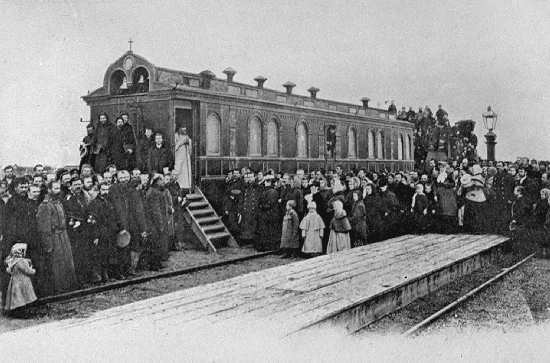
RAILWAY CHURCH SERVICE "A rolling Greek basilica" [To face page 38]
The railway cuts through in a straight line for hundreds of miles, and there is nothing to be seen on either side but centenarian trees and feathery ferns. What a field of exploration for a botanist! What a collection of beautiful herbs and mosses! What exquisite wild flowers! The colour of them is so deep and glorious, and the green of the grass is of the richest shade. Many of the species are scarcely known yet, and it is quite astonishing to find, in these far-away regions, plants belonging to families of quite different latitudes. If the flora is so surprising, the fauna is even more so: animals of every size and of every description, from large bears to tiny squirrels. There are many kinds of quadrupeds: wolves, foxes, snow-leopards, wild goats, martens, sables, ermines, and all the innumerable members of the feline race. But what are even more interesting than the animal nature are the fossils found along the banks of the rivers and deep in the gloom of the earth. Some magnificent specimens of antediluvian skeletons have been excavated, and these are zealously kept in the museums of St. Petersburg, Moscow, and Irkutsk. And for the ornithologist it is a perfect land for research. The birds and their lives seem to have in Siberia a most interesting past, and the laws of migration offer a special field of observation. Some come from as far as Australia, while others choose for their winter home New Zealand. The theories explaining this mystery of nature are rather conflicting, and scientists have devised various explanations of these far-distant wanderings. The butterflies and beetles are unique also; in fact, it is a world in itself lost in far-away Siberia.
The long track between Tomsk and Irkutsk has the reputation of being the dreariest and the most desolate part of the journey. I did not expect to find much, which may very likely be the reason that I was so surprised to come across towns like Krasnoyark, Kanks, and Udinsk. The first, especially, is an important centre for trade and business. Besides wheat and other cereals, it is the great depot for the increasing exportation of skins, furs, tallow, grease, and lately butter. The export of butter is becoming of the greatest importance in Siberia. Farming is increasing from day to day, and the Danes accomplish a great deal in this respect. The yearly export to Europe, especially to the English market, is quite astonishing, even more so when we take into consideration that there are no winter pastures, and that all the cattle must be kept on stable food. It is easy to understand the amount of labour and care it requires, and yet it must pay, considering the number of Danish families which come yearly to settle down in Siberia. For some time Krasnoyark has been the terminus of the Western Siberian line, and it derives its present importance partly from this fact. Udinsk is growing rapidly too, and is the centre of a vast area. Around its station I saw an enormous encampment of small Russian tarantas, or cars, heavily laden with piles of sacks. Barns near the line were packed with wheat and corn; and yet these stores do not seem to remain there long, for all through the journey we constantly passed trains loaded with cereals. What will it be when all of this enormous land, the whole of Siberia, is under cultivation!
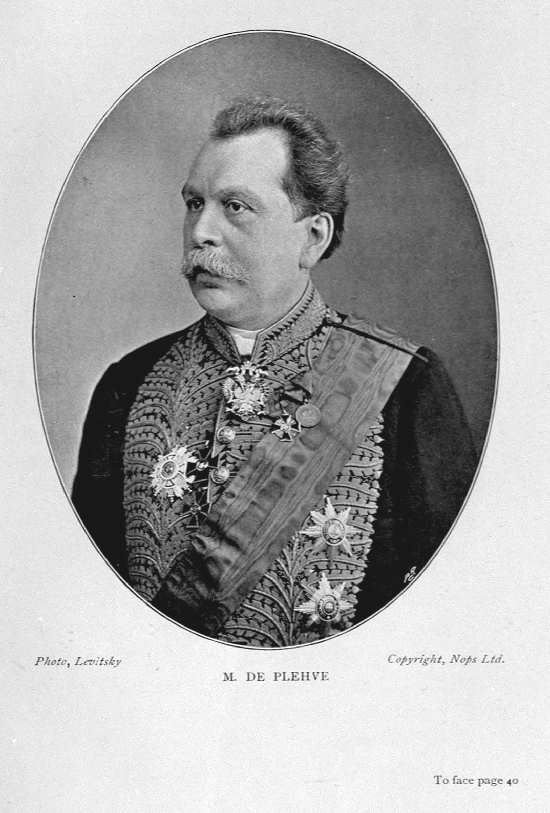
M. DE PLEHVE Photo, Levitsky Copyright, Nops Ltd. [To face page 40]
It was most interesting to watch all these and many other features; to realize all that has been done already since the railway was constructed, and to conjecture the country in its full development; for nature seems to have provided it with everything. I am more and more astonished to find "dreadful Siberia" in reality as rich as, or even richer than its neighbour across the sea—the beautiful Canada.
Behind the green forest a dark blue wall seems to fence the plain in towards the south. This is the Altai range. Its length is six hundred verst, and its peaks seem to be crushed under the heavy clouds. On the other side is China. The Altai district has some of the most beautiful scenery of the whole globe. It is densely wooded, and dotted with lakes and watered by endless streams and rivers, for the largest streams of Asia flow from there to the Polar Sea. The mighty Yenisei, Lena, Obi, all have their sources among this wilderness. The Altai range was the cradle of the most ancient races, for the earliest inhabitants of the earth belonged to the same stock as the Finnish and Turanian, and prehistorical remains of them are to be found to this day. Even Herodotus mentions these early folk. Later on Mongolian hordes swept over the calm valleys, and the present populace show visible traces of the extraordinary mixture of the different races which arose in or overran this country. What great people some of them became! What extraordinary might some of them acquired! With what striking lines they have filled the pages of history! And as in those days long gone by, some of those tribes still preserve their independence and unlimited freedom. They have even kept the old name of the highest peak, and call it, as ever before, Chin-Chan, the golden mountain.
I was roused from my reflections by the clanging of the railway bell at the Irkutsk station. At last I had arrived at the largest town, what people here call the "Paris" of Siberia. Since yesterday morning I have been travelling in the territory of the government bearing the same name, of which it is the administrative centre. The district of Irkutsk is enormous, with its five divisions of Nijni-Oudinsk, Balagansk, Kirinsk, Irkutsk, and Erbolinsk, of which each is a territory in itself. It extends south to China, and submerges north into the Arctic Ocean. Its variety equals its size. Besides the flat pasture regions, it has mountains towering up to Alpine elevations. Moonkov-Sarde is 11,430 feet high. The fertility of the soil is equalled by the richness of the mines; but this vast area contains scarcely a million people. The northern part of it is entirely barren, and hardly explored at all. The present populace derive their origin from Mongolian lineage. The most numerous are the Buriats, Tungus, and Kalmuks, who lead nomadic lives, and for occupation rear their herds, hunt, and fish. They are not yet acquainted with agriculture, and when they settle by the sides of rivers and fertile districts they leave the land to be cultivated by the Slavs, and acquire their tools and requisites by the simple method of exchange. Their religion is idolatry. In the south there are a great many Buddhists, and Mohammedanism appeals especially to the Tartars.
Of all the strange folk by whom Siberia is inhabited, general curiosity seems to be most interested in the convicts, of whom, during the last century alone, more than one hundred thousand were sent into exile. Only half of them ever returned to their homes again—many died; and only a small contingent settled down after the expiration of the punishment. But all this has often been narrated and described by famous authors: sometimes in such vivid colours, depicted in all its gloom, lamented with sighs of agony, that on visiting some of the prisons and workhouses I am quite astonished to find them far above my expectations. Considering the ordinary condition of a Russian criminal, the difference between home and prison is not harder than in any other country. If the officials and jailers are men with human sympathies, there is every opportunity of spending their time in a way which will lead to general improvement. Where the misery really comes in is with those who are of a higher culture and greater refinement, and who are, justly or unjustly, punished for some uproar, and who suffer merely for their convictions.
To give an adequate idea of the Irkutsk station on a foggy and rainy autumn night, at the hour when the express arrives, is simply beyond possibility. And to describe the way of getting from the station to the town is even more so. To begin with, the railway station does not look like a station in other parts of the world at all. Roads or streets cannot be seen, and a town, in our acceptation of the word, does not exist. The words seem to change and to lose their meanings there. If it had been light I should have tried to take some pictures of the desolation; but it is pitch dark, so I will confine myself for the moment to putting down a few notes—my first impressions.
The train stops with a sudden jerk. The door of my compartment is torn open with violence, some brigand-looking men jump in, and as suddenly as they came disappear again, but alas! with all my luggage. How long it took to gather and regain it altogether, I do not remember; and the extent of my walks from one end of the long platforms to the other I cannot calculate. On the chilly platform of Irkutsk station all ideas of time and space vanish completely. I think I should be seeking to the present hour if a martial-looking officer had not come to my help. His height is imposing, his gestures commanding, and his voice resounding. He uses all his enviable qualities at once, and all for the same purpose—to find my kit. He fights his way to achieve this by cutting through ground heavily barricaded by cases, sacks, travelling-bags, and furniture. He makes people stand up and clear out of his way, scolds and threatens all the porters and every mujik he comes across. And, strange as it seems to me, his efforts are crowned with success. He hands me over all my belongings! I thank him heartily for his kindness and express my sincere hope that, owing to his great strategical abilities, I may find him, if ever I return to Siberia, promoted to the rank of general. At the same time I cannot omit remarking that the general civility and kindness which were shown to me, by employés and passengers alike, were most gratifying. Everybody seemed to wish to help, to give information, and offer whatever they possessed. Their manners, from the highest to the lowest, were irreproachable. I will go further, and say that on no railway have I ever met guards showing more attention and more good-nature. And much patience they require. The electric bells of the different compartments seemed to tinkle incessantly, as if the only occupation of some of the travellers was to ask what they already know, and to order what they do not require.
Whips crack, horses neigh, coachmen yell, travellers scream, porters quarrel. Such is the scene which awaits me in front of the station. I secure one of the many small droshkies, of which there are hundreds, and all shaky and open like the public vehicles of sunny Naples. The only difference is that instead of sunbeams there is sleet falling on us from above. My belongings are put on another droshky, skilfully fitted together like an elaborate mosaic. We start in a sea of mud—dark and liquid as a sauce—which covers everything like a shiny varnish. The depths beneath must be great, for sometimes my droshky is nearly submerged, and the lava-like stream floods our small vehicle. But it seems to be built for use on land or on water, for sometimes I have a sensation of floating in a canoe, rather than rolling along on wheels. We reach terra firma in the shape of a bridge formed of logs, nailed and tied together. The bridge is long, but at last, on coming to the end of it, the driver announces with pride, "We are at Irkutsk." I cannot help asking, "Where?" for I do not see any buildings or any sign of a town. It takes some time before I can distinguish in the depths of the night high palisades, looking very much like those surrounding soldiers' encampments in the Middle Ages. Above the palisades a few roofs emerge, low and sloping, very much like a tent. But at a sharp turn a brilliant electric globe spreads its beams, like those of a lighthouse at sea, to lead the wanderer to a secure harbour. Following its course, we land at the doorway of the famous Hôtel du Métropole.
For famous it is! I shall certainly not forget it, and hope never to see it again, for I think it contains all that Western bad taste and Eastern filth combined can produce. Along a passage carpeted with red Brussels and mud a waiter, in evening dress, but apparently without linen, shows me to an apartment furnished with green plush, but devoid of bedding. I am told that travellers are expected to bring their own sheets and blankets. I have none, and after some rushing about I am provided with sheets which I prefer not to use, and would rather content myself for my night's rest with an easy chair and some travelling-rugs. There is, moreover, no washstand, for the queer apparatus in the corner, bearing, apparently as an ornament, only one basin about the size of a finger-bowl, cannot be so described. No hot water! And if you call for any they bring a few drops in a cream-jug. Finally, there is no air either! The windows are nailed up all the year through. On trying to open one it nearly fell to pieces. So if people nowadays ask me what hotels in Siberian towns are like, I am bound to say you have plush and gold, but no fresh air and no hot water!
VI THE SIBERIAN METROPOLIS
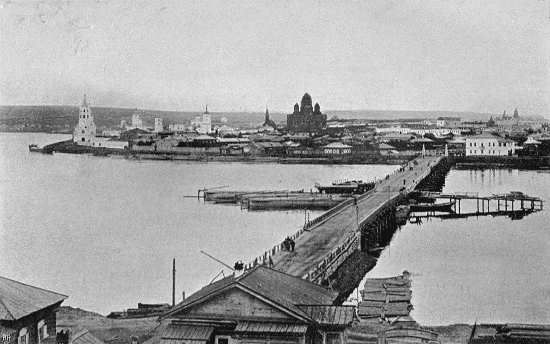
IRKUTSK "As I walk down to the Angara's banks I am short of adjectives" [To face page 48]
How shall I record all the tumultuous impressions of the first twenty-four hours passed in Irkutsk? After the gloom of the night a brilliant morning broke forth, brilliant as it is only seen on these high plateaux. As I took my first glance round, everything seemed to swim in a blaze of light. The small log houses seemed to have grown into palaces. The palisades presented colours of hundreds of different shades. Monuments and gilded domes seemed to have arisen out of the ground. All the gloomy picture of last night vanished altogether, dispersed by the light of the sun like the melting away of a nightmare. What a magician this celestial body is! Painter, sculptor, and architect, he can construct and raise marvels out of nothing, and make us see and admire where all is only glamour.
As I walk down to the Angara's banks I am short of adjectives. Language fails to describe the pureness of the atmosphere, the variety of the tints of the distant mists, and the whole scenery of the plain with its vibrating mirages. I think it is at the early hours of the morn and at sunset that one can best realize the charm of this strange country, understand the dreamy legends which were born on the soil, realize the soul of its people, and penetrate into its wondrous atmosphere, full of enigmas and mysteries.
Irkutsk is a large and important centre, the seat of the military and civil governors, of the Catholic bishop, of the commander of the forces. There are high schools, many public institutions, and factories. Irkutsk is a famous commercial town, and is one of the most prominent markets for international trade. The high street is an endless row of shops, full of goods made in Germany, and some in America. I do not see much English merchandise; but, as I hear, English commercial interests are only represented in a few of the larger mines and building enterprises. The Siberian national museum deserves special mention. It is a fine stone building, rich in all that relates to the origin, history, and folk-lore of Siberia. A few hours passed in its halls give one a most extensive insight into the conditions of the different races and tribes which have peopled these regions for centuries.
Irkutsk from a social standpoint seems to offer some advantages too. Government employés, officers, and others regard it as a special favour to get an appointment here. There is a great deal of entertainment, and in the centre of the town is a most pretentious building—the Imperial Opera House. Life is expensive, and the population shows a great tendency to luxury, and even more, what one might call waste. Money is spent easily and uselessly, as is generally the case in growing places and recent settlements. In this respect there is a slight resemblance between Irkutsk and a Western American ranch or an Australian mining town; and in the afternoon, when everybody promenades on the wooden pavements, which run like bridges across and along the muddy streets, the inhabitants show exactly the same variety of origin and of social condition as in those towns beyond the seas.
Besides Russian, I hear German spoken. Poles are numerous too, and all the different Baltic provinces have a fair number of representatives. Nearly all the trade is in their hands. Russians are not commercial people as a rule. And there is a large Chinese colony, mostly occupied with the famous overland tea trade via Kiahta. They walk for hours and hours up and down all these endless pathways, and a great many sit, covered with furs, in front of their house doors to see the show. About eight o'clock everything becomes quiet; streets are deserted, doors are closed, shutters fastened, lights extinguished; and there are only the watchmen sauntering slowly from corner to corner, monotonously tapping their wooden rattles to let householders know that they are awake, and to give the robber at the other side of the street time to escape.
It is worth while! I should, after all, recommend travellers to stop for a few days in some of the largest Siberian towns, in spite of the rough hotels and the primitive ways; it gives such a definite idea of their buildings, inhabitants, and mode of living, as could never be procured from books.
VII TRANS-BAIKALIA
I have arrived at the climax of the journey. We are crossing Lake Baikal. It is the most celebrated passage of the whole overland journey; the scenery is fine: an extensive sheet of water, brilliant like a mirror, surrounded by high mountains and majestic rocks; but I am inclined to repeat what I said before about hilly scenery: lake districts do not appeal to me. A sea in its greatness, and a marsh in its diverse variations of colour, are both perfect in their artistic values, only different in conception. The former imposing, like a picture of Meesdag; the latter, hazy like a Corot, each perfect in its style. But a lake, even the prettiest, does not rise above the effects of a chromo-lithograph. Lake Baikal, viewed from the north, loses its banks, and so has the advantage of appearing as an ocean.
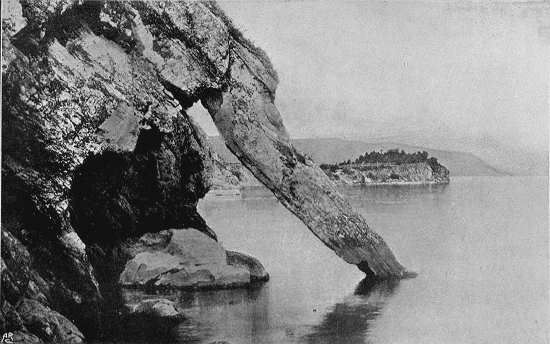
LAKE BAIKAL "There are some enormous rocks as if thrown in by the hand of a Titan [To face page 52]
The whole distance is flat, veiled in silver mists and pierced through here and there by the crystal peaks of the distant mountains. There are a few islands scattered about, some enormous rocks, as if thrown in by the hand of a Titan. To each a legend is attached. Each has a different fairytale. All of them, I am told, were inhabited by dwarfs and fairies, possessed of marvellous gifts, and belonging to a wondrous past. At least the mythical minds of these archaic people endowed each striking spot with a different tale, and there are many such, especially on the south-eastern shore, which displays a great variety of scenery, and this proves to be a serious hindrance to the completion of the railway track. The line around Lake Baikal is not completed yet, for there are several tunnels still to be bored and a great many rocks to be cut through; but it is, after all, the only portion of the track which offers any serious difficulty to the engineer. All the rest has been easy to accomplish, and, with the exception of building the great railway bridges, consisted mainly of simply laying the rails on level ground. But although it was not difficult to construct, it might have been better done. The rails are altogether too light, and after a few years of traffic working it is already under constant repair, and will have to be altered altogether very soon, as it is so defectively ballasted.
At present the train is carried across the lake by a huge vessel built in Newcastle. In winter they sometimes use an ice-breaker, which apparently works very slowly, for generally the railway provides, for passengers and goods, sledges on which to traverse the frozen waters.
Our boat is overcrowded. Passengers of all nations and of all grades. Besides Russian officials, there are foreign tradesmen, a few Germans, one American, and a Dane, a detachment of soldiers guarding convicts, and a few settlers. And so I have an opportunity of watching the four leading classes of this new country. These are, indeed, the four different elements by which Siberia is becoming populated. I am rather impressed by the perfect cordiality with which they share the common fate in their new home. The soldiers are Cossacks, a kind of irregular troops, and enjoy perfect freedom. The Government gives them a certain territory, where they go in for agriculture and raise cattle and horses, and at the same time are liable for some military service. They are fine men, excellent soldiers, and deserve their long-established fame for courage. The settlers are all of a different race, coming mostly from central and southern Russia. They are indifferent-looking, miserably clad, poor folk, with sallow faces and sad eyes. Whole families—fathers and mothers, grandparents and grandchildren—have all gone together to the far-away promised land to live and to die.
The Russian Government is very anxious to settle agriculturists in these Eastern Siberian regions, for the land is as yet barely cultivated at all. Farmers are very scarce, and the famous mines are also short of labourers. It seems that possibilities here are even greater than in Western Siberia, the only drawback being the enormous distance. Yet the journey scarcely costs anything, as I mentioned before; the fare is merely a nominal sum. It is evident that Russian railways can afford to lose; their deficits last year amounted to the sum of fourteen million roubles. But the main object of these State railways is not to make money—anyhow, not at present. They are designed to colonize this newly-acquired country, and settle Slavs among the native Mongolian and Tartar tribes. And besides—and I think before and above all—there are the strategical interests to be considered. Undoubtedly the Siberian Railway is a military one, and with all its junctions and crossings seems to have been planned with the view to forwarding troops and ammunition speedily. And even the often-discussed puzzle—why does the Siberian Railway so very frequently avoid entering the most important townships?—might be partly explained from a military standpoint. Opinions differ as to whether the railway in its present state can prove entirely satisfactory for the conveyance of large army corps. At the same time, we must not forget that it is partly under construction still, and its final completion seems to be far in the future.
The crossing of Lake Baikal takes between four and five hours. The passage is extremely rough, and squalls burst forth very unexpectedly. We arrived about sunset on the eastern shore, at a place called Myssowa, where there are a few log houses scattered about, and a rough railway station; but in the dining-room there is a table laid out in a lavish style, and, like the smallest of them on the line, it does not lack its pride—a gilt centre-piece and five-armed candelabra. We do not start again until midnight, so I have time to go for a walk, though soon return from it, for it is very dreary. There are but few buildings, and I am afraid every one is a public-house, for Myssowa, being the centre of a rich mining district, shows all the sad sides of the miners' life. The money they earn during a hard day's work is thrown away in the hours of the night. In the front of the station are a few dozen of them standing about; dismal and stolid-looking creatures, emerged from the slums of Western towns and launched in Eastern Siberia. In these far-away regions, workmen are rather well paid, and that is the reason so many remain for some time in the course of their flight.
It is snowing hard. The feathery flakes fly and skim like so many white-winged butterflies against the pale grey sky. It is bitterly cold, and the windows of my railway carriage are thickly frozen over, and when they clear there is not much to be seen. The high mountains have disappeared, and there is no majestic plain before us. The whole district is hilly, with here and there a river, and very scant vegetation. Villages seem to be unknown, and the first place of any importance we stop at is Petrovsk, a locality which owes its origin to its deep mines, enormous factories, and a large prison to furnish the workmen. What a gloomy site! Never have I seen factories and forges more desolate, and never has smoke appeared heavier and blacker to me than that which I see puffing from the numberless chimneys. It is an inferno, whose horrors only the genius of a Dante could describe. And if Petrovsk had a city gate, its sole inscription could be "Lasciate ogni speranza voi ch' entrate."
And how many have entered this ghastly place! How many of the Russian and Polish nobles have been exiled here! Nariskins, Mouravievs, Anenkoffs, Volkonskys, Troubetzkois—we find descendants of all. How many historical families have had their political aspirations stranded here! The miseries of Omsk have been described by Dostoievsky, but those of Petrovsk will never be entirely known. Many of the exiles have been followed by their brave wives, ladies of marvellous courage, leaving palaces to follow their husbands and to suffer voluntary exile.
Through the frozen lands of Trans-Baikalia we continue our way. I am told the country is very rich. There are over thirty mines in work at present, and there might be a great many more. Where they have already started farming it has proved a great success, and some of the towns show signs of rising commercial activity; but I know not why this part of Siberia misses altogether the great charm, in admiration of which I was lost a few days ago. The high plateau of the Baskirs, the steppes of the Kirghiz, and the dense forests of the Kalmuks, all had a peculiar charm and atmosphere; but Trans-Baikalia, though undoubtedly possessing great economic possibilities, seems to have no beauty at all. The inhabitants are Buriats, and nomads, like the others, but lack their sympathetic features, and seem so strange—so entirely different. Their yellow, parchment-like skins and beady eyes lack all expression, or if they have any, it is so incomprehensible to us that we look at them as mere curiosities—as children belonging to another planet.
They live in tents or in huts covered with a kind of felt prepared from horsehair and furnished with skins; and breed horses, of which they possess large studs of their own. Men and women are famous riders, and live in saddles from the cradle to the grave. Men and women wear very much the same kind of garments, heavy boots and low felt hats, and leave their long hair hanging in greasy tresses. They resemble the Chinese very much, and even more so the Tibetans and Bhutanese, and profess the same religion too—for nearly all are Buddhists. Hundreds of Lamas swarm all over the country, and there are several monasteries belonging to them. The Government, which is generally hostile to any creed except the Greek Church, not only tolerates, but apparently supports their claims to a certain extent. Russia seems of late to be taking a great interest in its Buddhist subjects, of whom it possesses several hundred thousands. It even accords them every facility to make their great pilgrimages to the Lama of Lhassa, in mysterious Tibet, and by this means gets into constant communication with the forbidden land.
The last day of our journey is passed in the Amur region; that enormous district, which was granted to Russia without the drawing of a sword and without any cost, by a single stroke of the pen of Count Muraviev after the Treaty of Pekin in 1860. From Chitta the line turns to the south-east, and we are proceeding to the so-called Chinese frontier. At midnight we reach our destination, a settlement called Manchury, lost in a corner of the desert of Gobi. On the other side extends Manchuria, which I am emphatically assured belongs to the Yellow Empire. From here the railway runs under a different title. Instead of being the "Russian State," it is called the "Eastern Chinese Railway Company." It has three main branches. One runs from Siberia to Harbin, the second from Harbin to Vladivostok, the third from Harbin to Port Arthur. They unite the Yellow with the Black Sea through Moscow, and the Pacific with the Baltic through St. Petersburg. What may have appeared to be a dream only a few years ago is a reality today.
A saloon car containing a bedroom, study with verandah, servant's quarters, and a kitchen, which the Company very kindly put at my disposal, and which is to serve as my home while getting as far as Niu-chwang and Port Arthur, is now being attached to the new train, and while it is being got ready I have time to sum up recollections and arrange my papers.
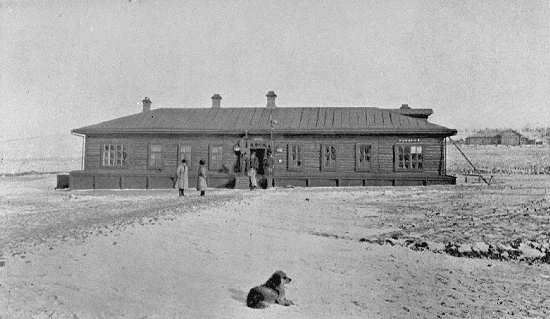
THE STATION OF MANCHURY "Lost in a corner of the desert of Gobi" [To face page 60]
There is more to note than I expected, for I found interest in every direction and in every respect. Siberia is more than a country, it is a continent—I might even say a world of its own. It has its characteristics and special features; its own soil and its own folk; its own geography, ethnography, and climate. It is an unknown land altogether; new or old, as you like to call it. To understand it requires more instinct than erudition, more sympathy than analysis. The observer must have sentiment; and even so it may or may not appeal to him, and he may like it or not, yet he cannot fail to regard it as impressive and imposing. It is a land of nearly five million square miles, and it has eight organized provinces, of which each is larger than most of the Western kingdoms. It can be maintained and developed from its unlimited resources, and guarded by an army amounting, if required, to millions. It is grand in every respect. It is watered by the largest streams of Asia, and possesses the most extensive fresh-water lake of one hemisphere. It has a greater area of productive land than all Europe put together; its forests are hardly measurable; its mountains tower high to the sky; its reputed monotony should rather be called vastness, for variety it does not lack, only it occurs at enormous intervals.
The same distinctions prevail with regard to the inhabitants; they belong to various tribes and descend from different races. Some belong to the Tartar, some to the Mongolian, some to the Caucasian family. Some are yellow, and some are white. To-day the rulers are the latter, but it is the home of the former. Will the white remain the dominating race, or will it be overwhelmed by the yellow, or will it become amalgamated and swallowed up by the great majority? What an interesting problem, and how inexplicable! It is, indeed, hard to understand the nature of these people; to read their thoughts; to comprehend their lives; and to realize their ideals.
Once mighty, now in decay; leading a subordinate, unorganized existence, lacking energy, unfit for higher aspirations. And yet physically all these nomads are fine creatures, possessing all the power of their forefathers of the time of Genghis Khan. How long will it take them to awaken? How long will it require to realize and acquire all the advantages of Western civilization and the elevating power of Christianity?
These are questions which can only be answered by the history of the future. The best forecast, I am afraid, will fall short of what will prove to be the reality. I fear there may yet be many wars, and I hope peace too, and conferences and treaties; but racial struggles cannot be settled on battle-fields or in houses of parliament. The destiny of mankind has a higher tribunal.
Whatever may be the future of the Far East, the Siberian Railway will have undoubtedly a certain share, if not by altering, certainly by hastening its course.
It was a mighty step forward. The step of a Colossus!
III
MANCHURIA UNDER RUSSIAN RULE
Am I on Chinese territory? Does Manchuria really belong to the Yellow Empire? Since I crossed the Russian frontier several days ago there has not been the slightest change that I could see. Everything has remained Russian.
Our train was in charge of Muscovite soldiers, the railway officials at the stopping places were Russian officers, the barracks around were inhabited by Cossacks. The line was guarded by Russian troops, and if the latest reports could be trusted, public safety seemed far from secured. Hardly a day passed without atrocities of some kind being reported, and skirmishes between Manchu marauders and Russian scouts were of frequent occurrence. The railway itself was constantly threatened, the banks destroyed, and the rails torn up; so even our train was provided with a military escort to defend it in case of necessity.
The "Eastern Chinese Railway Company," so called in order that there might be something Chinese at all events about the name, is an exclusively Russian enterprise, and no one disputes its entirely strategic object, which is to connect Vladivostok and Port Arthur with Moscow and St. Petersburg. This became very evident to me during my journey. The line is constructed by Russian troops and military engineers under the direction of officers. It is still far from complete, and I was therefore the better able to watch the progress of this interesting undertaking. The work is carried on at great speed—thousands of coolies are employed upon it under the supervision of Cossacks. The sand is moved in wheelbarrows, sleepers are laid and rails fixed, all at one and the same time, by different gangs of workmen. The system of construction is the same as that so successfully adopted by General Annenkoff for the Trans-Caspian Railway.
I had plenty of time to give my full attention to it, for there was nothing else to see. We were crossing the north-eastern border of the Gobi desert, and if ever desert was rightly so named, it is this one. The Sahara has at least the charm of the tropics, the Arabian desert has the beauty of a cloudless sky, the desert of Bikanir possesses the golden hues of the Indian sun; but the Gobi desert has nothing to commend it; it is absolutely desolate. There is neither colour nor charm, but a leaden sky hangs over an endless expanse of grey dust—or rather, ashes—which, when whirled about in the wind, obscures heaven and earth and covers everything as with a shroud. Not a village was in sight, not even a solitary dwelling. The only living creatures in this desolate region seemed to be the Russian troops and the legions of coolies working under their orders.
Before going any further I must explain that I was travelling by goods train. The line, as already said, was not finished, the rails hardly laid, and there were no proper stations; guards and officials being accommodated in temporary huts and encampments. There was no regular tariff and no tickets were issued. Trains of trucks with materials for construction plied between the main junctions, and these same trains also conveyed the workmen and the persons connected with the undertaking, to their various destinations.
It was necessary to get a special permission from the authorities to travel by this route. Of course I was prepared to rough it, and the directors had not disguised from me the fact that as yet no arrangements had been made for the convenience of passengers. They could not even promise that I should reach Port Arthur without delay, for some of the temporary bridges had been destroyed by the autumn rains, and the railway banks in various parts were washed away by the floods. But a special car was placed at my disposal for the whole journey across Manchuria, and this semi-saloon car became my domicile for several weeks.
To give some idea of my movable house, I may say that although the exterior was extremely simple, the interior was comfortable enough. It consisted of a bedroom, a study, a passage, a lavatory, and a small balcony; besides these, there were a kitchen and sleeping accommodation for my servant. The balcony was my favourite resort: many a peaceful hour have I spent there in reading or writing, and looking out upon that dismal landscape unfolding itself in its monstrous immensity.
Sometimes my home was shunted and I was left for days to amuse myself in the vicinity of some place of interest. Then it would be hooked on again behind trucks carrying bricks, iron, and all kinds of machinery. My carriage was my home, my stronghold. And indeed it was not unlike a fortified castle when it stood motionless near one of the stations, with sentries and watches patrolling round or halting in the neighbouring encampment. I was never quite sure whether they regarded me as a convict or whether they kept a kindly watch over me.
Along the route various stations were in process of building, some already roofed. Unpretentious structures they were, never more than one storey high, and roofed with black tiles. Outwardly they resemble the Chinese houses, and the beams are curved in the "Ting" style. Although unfinished, they impress one as if encumbered with a weary past, rather than as having a bright future in store.
Everything, in fact, has a doleful aspect here. There are no gardens and no cultivation of any kind worth mentioning. The station yards are swamps, or pools of mud. Here and there an attempt has been made to improve matters, and stones or planks are laid down at intervals to assist the traveller in crossing.
Refreshment rooms are liberally provided on the Trans-Siberian line, and occasionally they even have some pretence to luxury; but in Manchuria they are of the most primitive description, scarcely provided with the barest necessities. A wooden table and a rough bench are the usual accommodation, and the cabbage soup or the national kasha made of buck-wheat is served by an amateur cook with all the air of a novice in the profession. At the junctions, where trade is somewhat brisker, one is able to get piroshki, which means, as it is, one of the favourite Russian dishes.
Primitive as the refreshment places are—a bare tent sometimes serving the double purpose of kitchen and dining-room, with an old kerosene-oil case for table and dresser—they are always much frequented. On the same principle as that adopted for the construction of the railway, the Russian "chefs" make the Chinese coolies do all the work.
Travelling through Manchuria in this leisurely manner, I had plenty of time to obtain a thorough acquaintance with its different regions. From a geographical point of view the northern portion consists of a barren tableland; towards the south it becomes wooded, and in the vicinity of the towns the ground is fairly well cultivated.
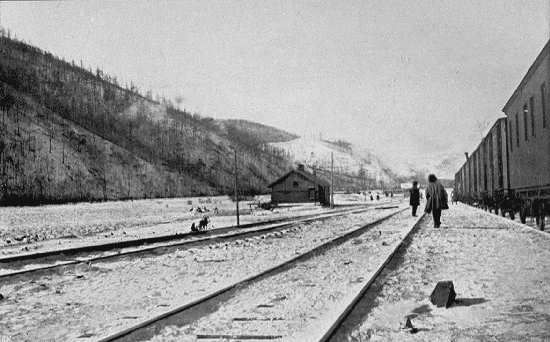
TSI-TSI-KAR "The capital of Northern Manchuria is Tsi-tsi-kar" [To face page 68]
The capital of Northern Manchuria is Tsi-tsi-kar. The Governor of the province resides there, and it is the centre of that part of the country. But the town itself is very primitive, and far behind the other two chief towns, Kirin and Mukden. The population is a mixture of Manchus, Chinese, and Buriats, who do a small trade in raw materials, more especially in skins of all sorts.
From a very early date caravans have made this place one of their stopping stations on their way from the southern provinces to the districts north of the Amur. The people still use the same primitive carts as in those remote times, sometimes drawn by Mongolian ponies—I have seen as many as sixteen or eighteen to one cart—more often by oxen.
The peculiar way in which the harness was fixed always amused me: it seemed an inextricable confusion of straps and cords. How do they manage it? It is a problem which only Chinese patience can solve.
I had equally good opportunities of studying the local dress and the customs of the natives. In this vast, barren region, where no European had ever penetrated before the construction of the railway, everything is still in its primitive state. The people live partly by agriculture, such as it is, and partly by fishing. The houses are extremely poor; we should call them hovels, built of bricks or dried mud. There they live, together with their cattle and other domestic animals. Like all Asiatics, they are devoted to horse-breeding, and I visited several large haras.
Flocks and herds abound, but the animal one meets with most frequently is the pig; but the pigs of this region are very different from ours. They are usually black, with long, thin tails, looking rather like boars. Numbers of them are to be seen in every yard, rooting up the ground and giving the Manchu homestead about as untidy and dirty an appearance as is possible to conceive.
Of poultry there is no lack either. Geese, ducks, and fowls share the family abode. The entrance to every house is guarded by half-savage dogs, like so many wolves, and certainly not less ferocious. More than once I was nearly devoured by them, and as it is not advisable to fight them I always took care to have my pockets full of biscuits.
A Manchu home, in short, has the appearance of a cattle show, or a Noah's ark, and the life lived is unquestionably antediluvian.
Speaking generally, the cultural standard of the Manchus is much below the average Chinese level. The people look more barbarous to begin with, their occupations are all of a rough nature, and the old Confucian doctrines have never penetrated to them. They have always led a merely animal rather than an intellectual life, an existence of strife rather than of thought, and to this day the Imperial army consists almost exclusively of Manchu soldiers.
Our progress was very slow. For many days we travelled on leisurely, with occasional stoppages long enough to enable me to make excursions into the interior. I tried every means of conveyance—bullock-carts, Mongol ponies, Cossack horses. It was tiring work, but gave me extraordinary opportunities of making myself familiar with the country and its inhabitants. At last I reached Kharbin, a famous town, being the junction where the three railways of Manchuria meet, viz. the Vladivostok, the Port Arthur, and the Siberian lines.
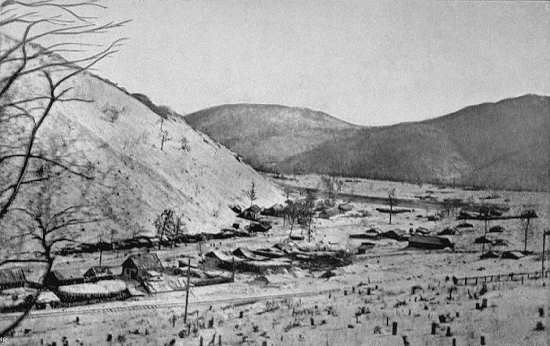
KHARBIN "Of all the places I have visited during this long journey, Kharbin seems to me the dreariest" [To face page 70]
Of all the places I have visited during this long journey, Kharbin seems to me the dreariest, the most desolate. A dull, cold autumn afternoon greeted me on my arrival. The rain fell in torrents; not only did the water pour down from the skies, but it oozed up from the ground as well. The river had overflowed, and all the land was inundated. Half the place stood under water. The railway station looked like a little island in the midst of a marsh. Together with the few passengers for Vladivostok I was carried on men's shoulders into the waiting-room, a mere barn, where we found a mixed crowd of mujiks and Cossacks with their luggage, which consisted of bedding, cooking utensils, packages and bundles of all sorts and sizes, tied together, piled around them.
The same place also served as refreshment room, and at one end of it about a dozen officers were dining at a big table. A pretentious gilded chandelier—ironically reminding one of Western luxury—formed the centre-piece. But I had no time to admire its beauty or even to sit down to my meal, although I was nearly famished. The station-master came bustling up to me with a very disconsolate countenance and informed me that he had received a telegram intimating that a bridge near Liaoyang had been carried away by the floods, and that in consequence of the defective state of the roads it was impossible to say when the next train would start.
It would be difficult to describe my consternation on hearing this depressing announcement, for I fully realized the awfulness of my position should I be compelled to make a prolonged stay in this place. The roads were so bad that excursions would be out of the question, and I should have to remain a prisoner in my carriage until the road was open again.
Meanwhile, I gladly accepted the offer of a seat in a tarantass to drive round the town. Kharbin is of interest from a modern point of view because it is one of the headquarters of the Russians in Manchuria.