EMPIRES AND EMPERORS (continued 6)
Reading edition
"All this is peculiar to our nature, it is the basis of our inner contentment, a contentment which no one can give, but which may easily be taken from us."
Even for the much-criticized, and unquestionably corrupt institution of the state, the loyal patriot has a few condoning words:—
"The simple and natural character of our civilization, the peaceable nature of our people, above all, the institution of the family, itself a little state—a political, social, and economic unit—these and other facts have rendered us independent of government control to an extent which to Europeans may seem incredible. Neither the acts nor the omissions of the authorities at Pekin have any real or permanent effect on the life of our masses, except so far as they register the movements of popular sentiment and demand. Otherwise, as you foreigners know to your cost, they remain a dead letter. The government may make conventions and treaties, but it cannot put them into effect, except in so far as they are endorsed by public opinion.... Our fundamental institutions are no arbitrary inventions of power, they are the form which the people have given to their lives. No government created and no government would think of modifying them.... Law, in a word, is not with us a rule imposed from above; it is the formula of the national life, and its embodiment in practice precedes its inscription in a code."
Referring to the political disputes between China and Europe, another Chinese writer says:
"When first your traders came to China it was not at our invitation; yet we received them, if not with enthusiasm, at least with tolerance. So long as they were content to observe our regulations we were willing to sanction their traffic, but always on the condition that it should not disturb our social and political order. To this condition, in earlier days, your countrymen consented to conform, and for many years, in spite of occasional disputes, there was no serious trouble between them and us. The trouble arose over a matter in regard to which you yourselves have hardly ventured to defend your conduct. A considerable part of your trade was the commerce in opium. The use of this drug, we observed, was destroying the health and the morals of our people, and we therefore prohibited the trade. Your merchants, however, evaded the law; opium was smuggled in, till at last we were driven to take the matter into our own hands and to seize and destroy the whole stock of the forbidden drug. Your government made our action an excuse for war. You invaded our territory, exacted an indemnity, and took from us the island of Hong Kong. Was this an auspicious beginning? Was it calculated to impress us with a sense of the justice and fair play of the British nation? Years went on; a petty dispute about the privileges of the flag—a dispute in which we still believe that we were in the right—brought us once more into collision with you. You made the unfortunate conflict an excuse for new demands. In conjunction with the French you occupied our capital and imposed upon us terms which you would never have dared to offer to a European nation. We submitted because we must; we were not a military power. But do you suppose our sense of justice was not outraged? Or later, when every power in Europe, on some pretext or other, has seized some part of our territory, do you suppose because we cannot resist that we do not feel?"
These passages, one-sided though they may be, give us some idea of what the Chinese think of Europe, of the politics of the West, and of our civilization as a whole, and we cannot be greatly surprised that the yellow empire looks upon us as its greatest enemy. From the time that our first trading vessels touched the coasts of China, closely followed by men-of-war, the Chinese have been on the losing side, both economically and politically. One great Power after another came upon the scene of action, and seized and occupied provinces, many of them larger than their own European dominions. When a Chinese schoolboy of today studies the map of his country, and considers how much smaller it has become in the course of the last hundred years, how can it fail to make him sad?
Almost ever since the victorious English navy first made its appearance at Hong Kong, foreign Powers have been occupied in tearing away pieces from the empire. Russia owns the whole northern portion of the land, and with one stroke of the pen Count Muravieff has torn from China and incorporated into the Russian Empire the gigantic Amur district, or, as it is now called, Eastern Siberia, the area of which is almost larger than that of the whole of Central Europe. Korea, once a vassal state, is practically governed by Japan, while Tonking and Annam have become French colonies.
Besides suffering these territorial losses China has been compelled to pay heavy damages after each war. In order to procure these moneys fresh taxes have to be levied, so that it may be said with truth that every son of the land—apart from the ignominy put upon his national pride—has personally to bear some part of the burden laid upon his country. Such was the condition of things at the time of the riots in 1900, and feelings have not greatly altered since then, although on the surface all appears smooth and quiet. The recent war between Russia and Japan has roused the people afresh; and do we wonder at the exultation which fills the masses of the yellow race, now that one of its nations at last appears to be getting the better of its white opponents?
*****
Will China, in case of need, unite with Japan to destroy the common enemy? Will the Chinese seek retaliation for what they consider to have been an injustice done to them, and which they evidently have not forgotten? It is hardly likely—at any rate, not just yet. Japan and China are now farther apart than one would think possible, considering their close geographical vicinity, and the cultural analogy which till recently existed between them.
Looked at from a distance, and when one does not know all the circumstances, certain kindred features may stand out prominently; but the likeness vanishes when one comes to live amongst them. As a matter of fact, a greater dissimilarity can hardly be imagined than that which separates China from Japan. The difference may be traced throughout their past and present histories. Corporeal build and manner of thought, state organization, government and system of education, all were different. Their similarity begins and ends in the basis from which they both started, namely, the old Chinese civilization founded on Buddhist principles, and early borrowed by Japan from China. The Nippon of the past had no national culture. From China, across Korea, Japan received the doctrines of Buddha, of Confucius, of Mencius, or Thao. From China also came the first scholars, artists, and writers. What to us are the Greek and Latin classics the writings of the old Chinese academicians are to Japan. Upon them the Japanese have based their views of life; from them their artists received their inspiration, and the ideas conceived in China found expression in Japanese literature. As with us Latin, so in Japan Chinese is the language of ancient literature. It is probably owing to this circumstance that so many erroneous views exist in the West concerning the mutual relationship of these two Eastern nations. They are always being mistaken the one for the other, their virtues and failings confused, their good and bad points confounded.
Formerly everything that came from the borders of the Yellow Sea was simply called "chinoiserie," and now in the same way everything that arrives from there is called Japanese. It would seem as if Europe even now could not distinguish between them; above all, as if we were unable to realize the psychological and metaphysical differences of the two nations. We do not judge by what is essential, real, and original, we only go by outward appearances, by what is conspicuous at first sight.
And now, since Japan has made its mark in the contest with Russia, it is only its external success which causes us surprise, the internal change of the people leaves us unmoved. The public of Europe is strangely ignorant of the moral worth of Japan. The interest of the moment is concentrated on the little Japanese soldier, who handles the British gun so dexterously, who blindly rushes into danger, and dies by thousands. And all one knows or cares to know about China is, that it is backward, dull, and stupid.
But as regards the real cause of the present relations, and whether there is a possibility of further developments—this is a matter of small interest to the general public. The nations of Europe seem to be as little concerned to understand the inner qualities of the peoples on the Yellow Sea, their psychological divergences and moral strength, as they trouble to know the history of their early culture and intellectual existence.
This want of interest is noticeable in all our dealings with the yellow races. In industrial undertakings we constantly confuse China and Japan, and Japanese goods often pass for Chinese. Even those who profess to have studied the history of Japanese art have been found to attribute to Japan the fundamental ideas which originated in China. The more one comes into contact with Chinese and Japanese works, the more clearly one sees that the honour of originality and initiative belongs to China.
The celebrated Japanese painters, sculptors, and bronze-workers were taught by China; they were clever imitators of Chinese art. In point of execution they have doubtless in many cases surpassed their masters. The detail work of Japanese art is decidedly finer and better finished than the Chinese, and in the work of reproduction they have attained a degree of perfection unparalleled in any other industrial nation. But this, after all, is rather a matter of skill than of genius. The artistic conception, the creative power, was far more original in ancient China than in ancient Japan, and although the minutiæ of Chinese art were often crude and imperfect, the fundamental idea was always noble and grand. We notice this particularly in their architecture. China's marble and stone yamens and pagodas were imitated by Japan, but with this difference, that they are built of wood and roofed over with shingles or thatch. In the various branches of sculpture and painting we see the same divergence. The Japanese was always an excellent copyist, but he drew his inspirations from China, in much the same manner in which the masters of the Renaissance school used the antique masterpieces for their models.
Just as the Japanese imitated and appropriated the customs and institutions of the ancient Chinese Empire, so they have now, with astonishing rapidity, adopted European civilization. Their power of assimilation is incredible. When we compare the Japan of today with the land as it was five-and-twenty years ago, our surprise is fully justified. From being under the most antiquated feudal system, the empire has suddenly become one of the most progressive states. At the Mikado's command all things were changed: government, army, education, even national views of life and ideals. The authority of the Shogun is replaced by a parliament. The descendant of the old Samurai becomes a soldier, moulded after the German pattern. The agricultural classes are gradually transformed into factory hands. From day to day the old institutions and beliefs are being destroyed, and with the new constitution a new religion is also called into existence, or rather the obsolete and somewhat obscure Shinto cult is converted into the religion of the state. How much of real conviction there has been in this magic change or how much of it has been the work of natural evolution, it is difficult to say. Inward convictions and the problems of moral satisfaction are outside the pale of politics. Whether the present-day Japanese, who wears a silk hat, is happier than his ancestor with his kimono—whether the workman in the factory is more contented than the former agricultural labourer—whether the internal peace of the land is better secured under the new system than it was under the old régime—who shall say? It will even remain doubtful whether their thirst for glory was not more gratified when guarding the frontiers and the territory of their ancient Daimios than now, when, according to Western notions, their chief object is occupation and material gain.
The most serious of all future eventualities is evidently whether these rashly accomplished innovations, and the total transformation of all existing conditions, may not, as was the case in Europe, lead to a material and moral crisis. In the most progressive circles of the land this is a much-discussed point. The recent labour riots, and the continually occurring strikes in the great cities, cast a certain shadow over the possibilities of the future. Baron Ivasaki, the greatest industrial power in the land, whose ships frequent all parts of the world, who has banking connexions in all commercial centres, who employs a large number of clerks, and has every opportunity of investigating the labour question in all its details, has published some interesting articles on the social questions of Japan. Another prominent Japanese writer, Okuma, occupies himself chiefly with the moral condition of the people, anticipating with fear the time when the innate religious feeling, and the once imperturbable loyalty to the Head of the State, should be shaken to its roots. The ultimate crystallization of the economic and moral relations of future Japan is, after all, the most interesting problem which this nation at present offers.
*****
The reason that China still delays its reorganization, and cannot blindly follow in the footsteps of Japan, lies chiefly in the internal constitution of the land. The population, which is above all things peaceful and cautious, waits to see what effect the transformation has upon Japan, whether it is really for the good of the people. The above-quoted passages from the works of Chinese writers clearly show that the Chinese as a people do not covet either military glory or exorbitant material wealth. For them the basis of happiness is peace and stability. The disturbance of harmony is irksome to the nation. This was the initial thought which prompted them in olden times to build a great wall to protect their native land from foreign intrusion. The Chinese are now beginning to realize that the highest wall cannot stem the current of time; that progress—or let us say the course of events—sweeps away even the mightiest obstacle before it. The necessity of their ultimate reorganization is more and more apparent to those natives who have come into contact with the outer world; only, as Chang-chi-tung said, "It cannot be expected or desired that we should be transformed in the twinkling of an eye."
The more impetuous advocates of reform, the representatives of the so-called "Progressive Party," have their headquarters at Shanghai. The members of this faction are mostly educated, travelled persons, speaking several European languages, students who have finished their university career, officials, merchants, and authors. Some amongst them, on account of their revolutionary tendencies, have been banished from Pekin or from the interior, and reside in the European quarters and districts governed by consular magistrates. These are the leaders of the discontented. They reject all existing conditions and demand the total abolition of the present system of government. But the man of the day I should say is Yuan-chi-kai. It is he who represents the Progressive Party at the Court of Pekin. To his influence may be attributed the various reforms introduced during the last few years, and the notable changes in the politics of the Tsung-li Yamen. Of all the viceroys of the united empire he is the one most directly in touch with the representatives of foreign Powers.
Yuan-chi-kai is in the first instance a military leader. His policy, which is to secure peace for his land, is based on military principles. It is probably at his instigation that a number of young Chinamen were sent at state expense to Japanese universities, in order that they might there study the effect of the imported reforms upon an Asiatic nation already imbued with European ideas. To a Chinaman all these institutions would appear in Japan in a more intelligible form than in Europe, where all conditions are so absolutely contrary to their preconceived notions. Perhaps, in his capacity of soldier, Yuan-chi-kai also hoped that the Japanese might impart some of their military enthusiasm to the lethargic youths of his country. So far the results have been satisfactory. A residence in Europe has seldom proved of much benefit to Chinese students, but a visit to the universities and schools of Tokio, Yokohama, or Kobe, has seldom failed to answer its purpose.
The already modernized Chinaman is doubtless an interesting figure, and he displays highly intellectual qualities. Life in the harbour towns, where he has free intercourse with foreigners from all parts of the world, has considerably widened his field of vision, and offers him ample opportunity for making comparison between the natives of the various European countries. It enables him also to become more familiar with the achievements of Western culture. The latest products of French industry, Manchester goods, or any of the most recent European inventions, reach these shores within a very short time. There are many wholesale merchants and bankers who have for several years been in direct communication with the city of London, or Wall Street in New York. They are bold and enterprising men, and work their business exclusively on modern principles. Their offices are fitted up in European fashion with telephones and type-writers; only here and there a rare plant, some precious object of art, or a singing bird in a cage, betrays the native instinct of love of nature and art. The national dress is still worn, and the wide silk trousers and traditional pigtail strike one at first as somewhat out of place in these modern surroundings.
At Hong Kong, Shanghai, and Tien-tsin, one has excellent opportunities of seeing the business man at home. During my stay in those towns I thoroughly enjoyed the social intercourse with these people. It is interesting to ponder over what may become of them as they continue to acquire all the advantages of Western accomplishments. What possibilities this nation possesses!
The millionaires generally build their houses in European style. The furniture of their reception-rooms is also of foreign make, and only the beautiful porcelains and other art treasures remind us that we are in China. Honestly speaking, all this modernization in house-building and furnishing is to be regretted, for surely the Chinese yamen is more tasteful than the European house of iron and brick!
Dress has thus far not been touched by the fashion, and anything more beautiful than the richly embroidered silk and velvet mantles of the wealthy classes can hardly be imagined. Neither has Americanism been able to obliterate the old-world manners and rules of courtesy, or to sever the bond of family affection and the inborn respect to parents. A Chinaman protects his home above all that is dear to him. In my intercourse with the Chinese I have noticed that even the most advanced among them, who have lived for years in England or in France, and who have enjoyed all the advantages of our commercial and industrial achievements, scrupulously avoid imitating the private life of the West. All that relates to business is zealously excluded from the home, and it frequently happens that the wife or the child has never entered the office of husband or father, nor does the father ever mention business matters in the home circle. The office is for work, he says, the home for rest.
It has often been remarked to me that with us the wear and whirl of business and of excessive ambition, destroy the joy of living. One of my acquaintances at Hong Kong once said, "The conditions of life in the West nowadays make man his own enemy. He sacrifices his whole life to acquire what is in the main worthless, without giving himself time to enjoy what he already possesses."
A banker expressed himself in a similar manner. "Most people in Europe," he said, "love money for its own sake, but not for what money can do to ennoble their lives."
The more intimately I have become acquainted with Chinese mood and thought, the better have I learned to understand the psychical condition of the people. It has been said that the Chinaman, when first he comes to Europe, is struck by the sad expression on all the faces. They say that the Anglo-Saxon, or perhaps more still the Latin nations, appear to be more upset by some paltry superficial annoyance, a social slight or deception, than the Chinaman is at the sight of death. They say that we prize exorbitantly what is of small real value, while the things which make life worth living and give inward satisfaction are neglected by us. And I must confess that I have not been able to confute this statement. Life in the West—that is to say, the stability of the moral equilibrium of existence—is very precarious. Steam-engines have long since killed all sentimentality in us, and deeper feelings are only too frequently sacrificed to outward appearances and conventionalities. Where even the basis of religious conviction fails, there is nothing left to compensate for the vicissitudes of life.
The Chinese Christian, as the progressive element of the land, desires above all things that his children should lead pure, Christian lives, a point which is frequently neglected with us. I have known many Chinese Christian families. I have been in the houses of simple labourers and in the huts of peasants, as well as in the mansions of the wealthy, and I have found, as a rule, with poor and rich alike, that charity and brotherly affection are not empty terms, but that they find expression in their daily life. Their care for the poor and needy is quite touching. Such at least has been my experience, and I have heard the same from missionaries who have spent their lives amongst them. The charge of insincerity, which is so often brought against the Chinese converts, is greatly exaggerated, at any rate as far as the Catholics are concerned.
We must not forget that the greater portion of the Chinese Catholics have been Christians for many generations, and receive regular religious instruction. The arrival of the first missionaries dates back to the thirteenth century. It was Kublai Khan who invited them first to settle in the country, and in course of time he entrusted the education of his son to them.
More than six hundred years have passed since the foundation of the bishopric at Pekin; Monte Corvino was appointed first bishop by Pope Clement V, and Marco Polo, the famous Italian traveller, accompanied him. Six thousand baptisms took place in the course of the three following years, and the number of Christians soon grew to a hundred thousand. Frequently recurring persecutions hindered the spread of the gospel; however, it is not my object here to trace the history of Christianity in China, a question I deal with in another volume, but rather to point out that the descendants of those early converts have embraced the Catholic faith already as the religion of their fathers. With regard to the so-called forced, or paid conversions, I must mention in the first place that adult conversions very seldom occur, and have seldom brought the person concerned any material advantage, but on the contrary exposed him to injustice and persecution. A Chinaman rarely renounces or changes a once settled conviction, and the greater number of baptisms recorded were administered to the children of Christian parents or to orphans and deserted boys, and especially girls, who, without the intervention of the Church, would have died of starvation or neglect. Such children are put in orphanages under the supervision of nuns, and taught a trade which afterwards enables them to provide for themselves. The more talented among them are educated in the Middle Schools belonging to the Mission, and in the colleges established in the larger towns. The administration of these institutions is in the hands of the clergy, and their popularity is best proved by the fact that a considerable number of their students profess other religions.
The children of the well-to-do merchant class, before they can receive any appointment or start on a foreign tour of study, generally finish their education at one of these establishments, which, especially in the harbour towns, are of a very high standard. Their usefulness and superiority are also universally acknowledged. All classes of society, regardless of creed, contribute to the maintenance of these schools. The "Christian Brothers" at Pekin have quite lately erected a large college on entirely modern principles, which supplies a long-felt want in the capital.
In spite of all these reforms, it will be long before China acknowledges the superiority of the West. Although public opinion is slowly and gradually changing, this is not entirely because the people recognize the superiority of Western culture, but rather because they are in self-defence obliged to make reforms in order to ward off the dangers which threaten on all sides.
To a Chinaman the ideal of happiness was quietness and peace; the object of his civilization to conquer and subdue the brutishness of human nature, and to combat all desire for violence. As a result of this education and such a turn of mind which have been in force for more than ten thousand years, militarism has not only been banished from their social code of law, but died out of the upper social classes. From generation to generation the Chinese are taught that the greatest of all virtues is equanimity; can we therefore wonder that they do not yet appreciate European civilization, which appears to teach the reverse? If the Chinese have been at last compelled to relinquish their ancient views of life and to accept ours, can we blame them if they do it grudgingly?
After all, it is only a question of time: how long the Chinese can hold out, and stick to their old civilization. It may be decades, it may be hundreds of years. Time is a factor of only secondary importance where it concerns the transformation of a whole race. But the day is coming, must come, when not only China's four hundred millions, but the milliard of the whole Tartar races shall, without exception, adopt the European civilization, and all the advantages of it. And if in that remote future the question of the Yellow Peril should arise, the consequences may indeed be serious. For China would naturally remain hostile to the West, and, in conjunction with Japan, be its most formidable foe, so long as the two cultures of the West and the East do not learn to understand each other. Little as we really know of the peoples of the East, still less do they know of us. To remove the mutual misunderstanding should be our earnest endeavour. And this, though not an easy task, considering the prominence which has been given to the existing differences, is not an impossible one; for does not the burden of it fall alike on both the white and the yellow race?
When we shall have succeeded in dispersing the prejudices existing on either side; when we shall have learnt to appreciate the virtues of the yellow race, and they shall have recognized the nobler ideals which animate us; then the two races, instead of opposing one another in the battle-field, will, let us hope, offer one another the hand of good fellowship, and the banner on the one side of the united brotherhood will bear as a device, "Mutual Aid and Help" instead of "Aggression and Oppression"; and on the other side, "Friendship and Confidence" instead of "Violence and Mistrust."
Let us hope that the Chinese will benefit, not only by our military equipments and material achievements, but that they will also share our spiritual supremacy, and above all learn or recognize the fundamental principles—the basis of all true civilization, the Christian virtues of Faith, Hope, and Charity. XIV
CONCLUSION
The foregoing chapters were written on the eve of the war. Since that time the situation is, to some degree, altered, though not so essentially as might be imagined; and I even believe the general feeling to be, to a certain extent, the same today as it was yesterday. Neither party is entirely satisfied; the interests and aims of neither the one nor the other seem to have been fully realized, and both appear to have lost more than they have gained in the lengthy, costly, and cruel war. On the one side, the Russians have had to renounce the most valuable provinces of what they regarded as their former acquisitions, whilst the Japanese have not been compensated, either by the definite annexation of Korea or of Manchuria. The political situation is fundamentally identical with that of yesterday, or rather with that of a decade ago. The Peace of Portsmouth does not alter the status quo much from what it was after the Treaty of Simonosaki, still less from what it was before the Alliance of Chifu.
The problem of the domination of Eastern Asia is not solved; the two great races, the white and the yellow, with their conflicting interests, are striving for the mastery as before.
The Peace of Portsmouth might more justly be called an armistice. A truce has been concluded, and we hope that this truce may be of longer duration than the last. And, above all, let us hope that it may really tend to the well-being of the countries interested, and of cultural and moral advantage for the nations concerned.
Though the Peace of Portsmouth may be unimportant, the moral influence of its articles is all the more real from a purely material point of view. Japan, in spite of her admirable self-restraint, has become one of the Great Powers, and she shows her strength, her security, and her power, more especially by her moderation and self-control. The renunciation of certain points and the ratification of many conditions required, undoubtedly, a self-control and a political foresight which this young nation has lately proved she possesses. After an unexpected succession of brilliant victories—when the fleet of her rival had been annihilated, the forts of Port Arthur laid in ruins, the hostile armies forced back step by step—it was hardly credible that Nippon would refrain from insisting upon complete evacuation of Manchuria, annexation of Saghalien, and at least a certain amount of war indemnity.
Was it not natural that Count Witte should inform his depressed countrymen with satisfaction, that Russia is still as much a Great Power in the Far East as she was before? Was it not pardonable if this piece of news, and many others of a similar kind with regard to Russia's diplomatic acquisitions, gave rise to tumult in the streets of Tokio, and, at any rate among the lower classes of Japan, to loud expressions of dissatisfaction? Such spontaneous manifestations of a people's feelings are easily understood and cannot be taken amiss; but these people, in spite of their dissension, will daily recognize more and more what uncommon astuteness has been displayed by the envoys of the nation, in their acceptance of the present and, to some extent, unsatisfactory terms of peace.
Time will prove what were the motives which chiefly determined the Japanese Government to desist from further prosecution of the war. Certainly the rôle played by the leading Powers must have been an important one. It seemed increasingly doubtful if the forms of future loans would ensure the same interest for the groups concerned. Anglo-American credit, which Japan apparently possessed to an unlimited extent at the outbreak of the war, became circumspect and cautious to a degree. Further financial undertakings, which, in consequence of the unexpected and decisive defeat of Russia, might have resulted in insolvency, could of course not be agreeable to the French and Continental stockholders.
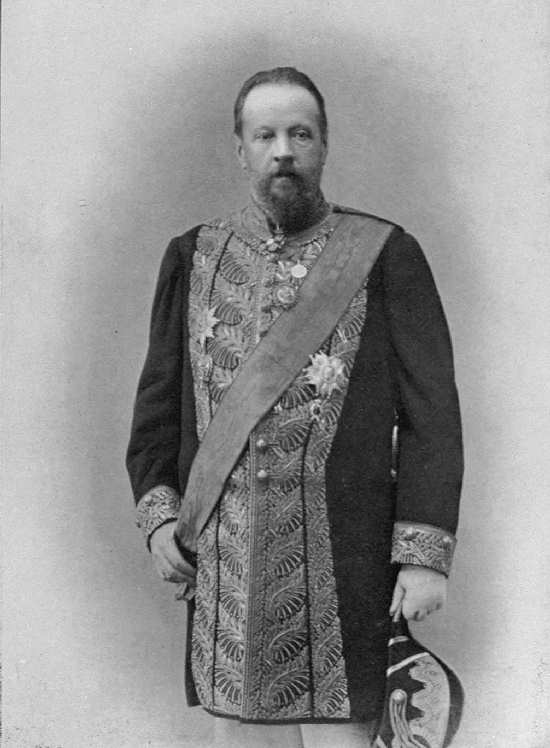
COUNT WITTE [To face page 384]
From an international point of view it was desired that the situation, at any rate as far as appearances went, should remain unchanged. What was aimed at was equilibrium, not preponderance. Opinions which made themselves heard, not only in Central Europe, but also in the English and American newspapers, showed more and more plainly how critical the situation would be if Japan alone possessed undisputed paramount power in Eastern Asia. The leading papers, which at first had been so enthusiastic and described with such unbounded admiration Japan's gallant battles and unexpected victories, grew gradually reserved as the question of how far Japan's ambitions might one day extend, became doubtful.
Economic acquisitions were feared even more than the actual strategic conquests. Already a portion of the commerce of the Far East has left European hands and fallen to the share of Japan, and evidently this will more and more be the case. The vicinity of the country, the cheap rate of wages, the simplicity of social conditions and those of labour, even at the present day, all contribute to give Japan the advantage in the competition. What their Government chiefly covet, at any rate just now, are new commercial spheres—safe markets—to profit by the great wealth of neighbouring states. By adroit commercial treaties with China, exploitation of the mineral riches of Manchuria and the Korean mines, Japan may, in a very short time, not only make good her war expenditure, but consolidate the economical condition of the empire and increase the general well-being.
From a political point of view, it can no longer be denied that the Pacific Ocean will be, at least on the eastern half, dominated by the Japanese fleet. In short, it is this point which is the essential one.
As I have already stated, Japan's schemes of conquest, if she had any, would be directed less towards the north than towards the south. Siberia never seems to have had a great attraction for her, and I believe that even Manchuria, together with the Amur Provinces, leaves her indifferent. She intends to let the original possessor, China, reconquer it one day. Her far-seeing policy seems to be governed by the assumption that the Eastern Asiatic continent belongs to her neighbours, the Chinese. For herself, she wants to secure the position of a great Sea Power. Her island home, and more especially her sea-faring population, tend to guide her in this direction. As factors to this end they have not only subjective competency, but the greatest objective possibilities. The Island Empire of the Pacific is still, to a great extent, with all her wealth, a terra incognita. We may say the same of the South Sea Islands, which are mostly only under the nominal dominion of the white races. Honolulu and the Philippines might one day be included in the dominions of this newly-arisen great Power; and her sphere of action will possibly create a yet larger circle.
Australasia, even, might become the ultimate aim of Japanese Imperialism and commercialism. The climatic conditions of the northern parts are such that Europeans find it difficult to settle there, and in the limitless sugar and coffee plantations the employment of white labour has always been unsuccessful, in spite of every effort. The number of the white inhabitants is still very small, although the continent was first occupied over a hundred years ago. The original native tribes have slowly died out; but the new settlers, over this whole extent of enormous territory, do not number as many as the population of London. Sparsely peopled, she stands there isolated and unfortified, defenceless, so to speak, in the midst of the sea.
The actual guarantee for her independence is offered by the circumstance that she forms part of the British Empire. This dominion is of course nominal; still, it is enough, at any rate at present, to protect the continent from foreign attack. But it is not hard to foresee what would happen to Australia, with the adjacent islands, Tasmania and New Zealand, should she be severed from Great Britain. Indeed, it is much to be feared that if ever the present alliance between England and Japan were to change into hostility, the former pupils and friends might be obliged to turn their arms against their instructors and allies.
Now, however, a truce has been declared in Eastern Asia. The Peace of Portsmouth has been concluded, and the consequences of this recent event will undoubtedly be greater than the bloodiest battles of the past few months, although it occasioned less noise. I must acknowledge that I am somewhat astonished that the world which welcomed with such jubilation Japan's victories at sea, seems to fail to understand her greatness in the field of diplomacy. Yet nothing was harder than to find such a solution of the various antagonistic problems as should ensure a free path for progress in the future. After such glorious battles, after the unchecked progress of an army intoxicated with success, it must have been very hard to halt, and to utilize this interlude for future strengthening and eventual expansion. Nothing could really have hindered the march to Harbin or to the Baikal district. Even the occupation of Vladivostok was merely a question of time. But, as has already been stated, it was not to Japan's interest to press northwards, and still less to carry the day by sowing the seeds of a yet greater hatred, and exciting the conquered country to a policy of revenge.
That, probably, was the reason why the Japanese gave up the war indemnity, and hope to refund it themselves from the agricultural wealth of the strip of land annexed, instead of from the Russian coffers. Japan did not desire either to increase the animosity of her enemy or to lose the sympathy of her allies. Above all, she abstained from rousing hostility and jealousy on too many sides before the definite attainment of her goal.
The self-command evinced by the Japanese is the greatest feature that, in the whole course of her history, we have had occasion to admire, it is even greater than her bravery, and this same attribute was manifested in a remarkable manner during the entire war. In the battles, whether in their dealings with prisoners and wounded, in slight advantages, or in important victories, they strove to manifest their moderation, self-control, and humanity.
Komura's task was no easier than Oyama's or Togo's. To accept and carry into execution the peace, in its present form, must have been all the more distasteful in that the whole country was against it and expressed its opinion in an exceedingly hostile manner.
Yet, had the populace been more deliberate in its judgment, they must have appreciated the diplomacy of their statesmen no less than the strategy of their generals. They may, moreover, rest assured that the present peace, though it may appear somewhat unjust to them, will prove to be of as great benefit and of as sure advantage as if better terms had been arranged. Was it not so, in the case of past victorious wars, especially as regards the terms of peace concluded with little glory and renown at Simonosaki and Chifu, which yet contributed so much to heighten the army's thirst for combat, and to develop the patriotism of the nation? Undoubtedly Japan is reckoning upon future eventualities and struggles in which she will demand yet more courage from her army and even greater enthusiasm from her sons.
*****
But for the moment, at least, we may look with confidence to the Peace, and hope that Nippon, which has won the admiration of the whole world in the late war, will show herself not less capable in time of peace. May she assist the countries that have come within her sphere—especially Korea—to a higher development! May she improve the conditions of agriculture, industry, as well as of culture, and truly strengthen all those moral, ethical, and spiritual aspirations which alone make for the positive weal of mankind! In one word—may the Land of the Rising Sun earnestly strive to cast rays of light on Eastern Asia!
INDEX
Agriculture, system of, in China, 119; in Korea, 218, 226 Alexandrovsky château, style, 4, 9; situation, 5, 9; garden, 5; drawing-room, 9; study, 11 Altai range, 41 Amur district, incorporated into the Russian Empire, 59, 362 Angara river, 49 Anglo-Korean commercial agreement, 224 Annam, under French administration, 362 Annenkoff, General, 64 Art, character of Chinese, 182, 348-50; of Japanese, 278 Asia, 32 Atmolinsk, 36 Australasia, the future of, 386
Baikal Lake, crossing the, 51-3, 55; islands, 52; railway line, 52 Balagansk, 42 Baltic, the, 59 Baskir plateau, 32, 58; character and dress of the people, 32; climate, 33 Bikanir desert, 64 Black Sea, 59 Bokhara, 36 Boxer movement of 1900, 155 Buddhists, 58 Buriats, 43; their appearance, 58; dress, 58; religion, 58 "Bushido," establishment of, 316; definition of the word, 316; code of moral principles, 317; origin, 317; unwritten laws, 320; principles of justice, 320; courage, 321; honour, 322; "hara-kiri," or suicide, 323-6; "kataki-ushi," or vengeance, 326-8 Butter, export of, 40
Calico, sale of, in Korea, 268 Cemetery, Portuguese, at Pekin, 167 Chan-chi-Tung, Viceroy, his characteristics, 136, 352; attempts at reform, 136, 352; writings, 137; political views, 352; mercantile spirit, 353; views on education, 353; extracts from his work on "China's Only Hope," 353-5 Chefoo, Treaty of, 155 Chemulpo, 225, 229 Ch'ien-men, or Great Street, in Pekin, 168 Ch'ien-men San-tan Bridge, 168 Chilkoff, Prince, Minister of Railways, his characteristics, 20; mechanical training, 21; his study, 21; management of the railway transport during the war, 21n. Chin-Chan Mountain, 42 China, 41; method of agriculture, 119; suzerainty of Korea, 200; system of education, 209; language, 211; outbreak of war in 1894 with Japan, 231; magnitude, 340; territorial losses, 362; payment of war indemnities, 362; relations with Japan, 363-7; originality and initiative, 364-7; delay in reorganization, 369; advocates of reform, 370 China, Emperor of, imprisoned, 161, 187; failure of his struggle for freedom, 187 China, Dowager Empress of, her summer residence, 160; appearance and dress, 183; character, 183; reception of the representatives of the Powers, 184; interest in the ladies, 186; diplomatic ability, 186 "China's Only Hope," extracts from, 353-5 Chinampoo, 225 Chinese, relations with Russians, 94, 119; capacity for work, 127; energy and industry, 176; character of their art, 182, 348-50; characteristics, 341-3; superiority of the native servant, 342; labour question, 344; virtues of the lower middle class, 344; honesty of tradesmen, 345; guild or club houses, 346; musical and theatrical entertainments, 347; intellectual capacity, 351, 371; ideal of happiness, 369, 378; dress, 373; family affection, 373; their view of Anglo-Saxons, 374; care of the poor, 375; number of Christians, 376; schools, 377 Ching, Prince, Prime Minister for Foreign Affairs, 177; his appearance, 177; characteristics, 178 Chitta, 59 Cholera, epidemic of, at Mukden, 105 Chopsticks, use of, 148 Chunchuses, band of, 82, 118 Clement V, Pope, appoints the first Bishop of Pekin, 376 Confucius, influence of his teaching, 159 Convicts, number of, 43 Cossacks, their characteristics, 54; escort of, 111; hilarity, 115; steeplechase 115-18 Cryptomerea, avenue of, 302
Dalny, 123 Datshas, 3 Dogs of Korea, their character, 256-8; of Manchuria, 69 Dostoievsky, on the miseries of Omsk, 57
Earth, Temple of the, in Pekin, 172 Eastern Chinese Railway Co., 59, 63, 76, 125; system of construction, 64; festivities on the transfer to China, 129 Education method of, in Japan, 292; in Korea, 209, 234, 238, 272 Erbolinsk, 42
Formosa, 284 Funeral, torchlight procession in Seoul, 258-62 Funerals, style of, in Korea, 220 Fusan, 225, 229
Gardens, style of, in Japan, 310 Gen-San, 225 Genghis Khan, 61 Germany, trade with Korea, 226 Gen-sen plant, value of, in Korea, 194, 227 Gobi desert, 59, 64 Goods train, travelling by, 65 Guild or club houses in China, 346
Halung-kiang, 75 Han river, 193, 229 Hang-Jang, 200 Hankau, club house at, 347 Hankau-chwang, 129, 131 "Hara-kiri," or suicide, 323-6 Haras, 69 Harbin, 59 Heaven, Temple of, in Pekin, 171; in Seoul, 252 Honolulu, 386 Hwang-ssu temple, 170
Insatsu Kyoku, or Printing Office in Tokio, 294 Irkutsk, 39, 42; characteristics, 42; inhabitants, 43, 50; railway station, 44-6; impressions of, 48-50; attractions, 50; Imperial Opera House, 50; Chinese colony, 50 Ivasaki, Baron, his articles on Japan, 290, 368
Jade Canal, 142 Japan trade with Korea, 225; outbreak of war in 1894 with China, 231; administration of Korea, 232, 235; temples, 276; lacquer-work, 277; monuments, 277; character of art, 278-81; Katsura-no-Rikyu Palace, 278; tea ceremonies, 281, 322; construction of railways, 284; telegraph lines, 285; telephones, 285; electricity, 286; steamship service, 286-8; reorganization of the country, 289-91, 314, 332, 367; education, 292; Tokio University, 292; character of the military equipment, 296, 316; reception at the Yeddo Palace, 301-10; avenue of cryptomerea, 302; style of gardens, 310; history, 315; system of vassalage, 315; the Samurais military code, 316-23, 334; definition of the word "Bushido," 316; origin, 317; "hara-kiri," or suicide, 323-6; "kataki-ushi," or vengeance, 326-8; creed, 330; military discipline, 333; religion, 336-8; Shintoism or nature-worship, 337; imitations and appropriations, 364-7; development, 367; relations with China, 363-7; conclusion of peace with Russia, 381; motives for desisting from war, 383-5; moderation and self-control, 382, 388; policy, 385, 387-9 Japan, Emperor of, 305; audience with, 305-7; his interest in various questions, 306 Japan, Empress of, audience with, 308-10; her dress, 308; characteristics, 308 Japanese, their force of imagination, 280, 282; characteristics, 280-3, 289, 296, 311, 315, 341; gift of adaptation, 291, 315; causes of their success, 315; faculty of assimilation, 315, 367; power of discipline, 315; courteousness, 322; conventional smile, 329; creed, 330; sword, 331; fondness for study, 335; religious views, 337 Jasper, waters of, 143
Kai-Teng, 200 Kalmuks, the, 43, 58 Kanks, 40 Kao-Li, 199 Kasha, 67 Kataki-ushi, or vengeance, 326-8 Katsura-no-Rikyu Palace, 278 Kharbin, 70-73 Ki-Tsze, founder of Korea, 197 Kiahta, 51 Kien-lung, Empress, 170 Kirghiz, steppes of the, 58 Kirin, 68, 75 Kirinsk, 42 Kinshiu railway, 284 Kobe, 284, 339 Koerber, Professor, 294 Korea, its origin, 189, 197; difference between ancient and modern, 190; situation, 192; area, 192; mines, 192, 227; rivers, 193, 229; climate, 193; flora, 193; value of the gen-sen plant, 194, 227; timber, 194; animals, 195; minerals, 195; founder of the nation, 197; law forbidding the writing of history, 198; diaries of court officials, 198; three kingdoms, 199; history, 199-203; under the suzerainty of China, 200; system of administration, 203-5; number of governorships, 204; organization of the army, 204; corruption of officials, 205; system of justice, 206; criminal cases, 207; practice of torture, 207; prisons, 207; methods of punishment, 208; education, 209, 234, 238, 272; language, 211; Emperor Li Hsi, 211; revolution of 1895, 213; family life, 214; condition of women, 215; rights of marriage, 216; wedding ceremony, 217; methods of agriculture, 218, 226; work and recreations of women, 219; amusements of men, 219; music, 220; funerals, 220; children, 221; schools, 221; houses, 222; food, 222; dress, 222; games, 223; recitations, 223; relations with foreign Powers, 224; trade, 224-6; means of transport, 227; the "Pedlars' Guild," 228; railways, 229; harbours, 229; money, 230; independence, 231; under Japanese and Russian influence, 232, 235; character of the people, 233, 237; college at Yong Sang, 238; dogs, 256; governed by Japan, 362 Korea, Crown Prince of, 273 Korea, Emperor of, his attempts at reform, 212; intrigues and plots against his life, 213; sons, 213; his power, 269; appearance, 270; costume, 270; interest in the West, 270-2 Korea, Empress of, murdered, 267 Koreans, their origin, 195; physical characteristics, 196, 233, 237; intellectual powers, 238; costume, 244, 248, 263; method of education, 252, 272 Krasnoyark, 40 Ku-hung-ming, extracts from his "Letters from a Viceroy's Residence," 356-60 Kublai Khan, 376 Kunsan, 225 Kuropatkin, General, 124 Kwo-tsze-chien temple, 170 Kyoto, 284
Lacquer-work in Japan, 277 Lama of Lhassa, pilgrimages to, 59 Lama monastery in Pekin, 170 Legations in Pekin, 152 Lena, 41 "Letters from a Viceroy's Residence," extracts from, 355-60 Li Cheng Ying, 211 Li Hsi, Emperor of Korea, 211 Li-Hu, 80 Li Hung-Chang, Viceroy, his country house, 132; character as a financier, 132; development of Tien-tsin, 134 Li Ping, 211 Liao river, 124, 126 Liaotung, peninsula, 122, 125; gulf of, 124 Liaoyang, bridge near, carried away by the floods, 71, 120; crossing the, 121 Lotus Lake, 160
Maisan Hill, 160, 162; origin of the name, 162 Manchuria, 59; journey across, 66-121; refreshment rooms, 67; capital, 68; inhabitants, 69, 70; homes, 69; pigs, 69; poultry, 69; dogs, 69; mineral wealth, 75; size, 75; population, 75; fertility, 109; character of the scenery, 110; occupied by Russia, 231 Manchury, 59 Manchus, their characteristics, 70, 110; mode of locomotion, 90; relations with the Russians, 94; fatalism, 105 Mandarin, mode of travelling, 113 Marsanka, 28 Masampo, 225 Métropole, Hôtel du, arrival at, 47 Mikado, audience with, 306 See Japan, Emperor of Min, Prince, his typical old Korean home, 266 Mines in Korea, 227 Ming dynasty, 199 Ming, General, his funeral, 221 Mission, Roman Catholic, at Niu-chwang, 128; at Pekin, siege of the, 149; at Seoul, 254 Mochi-Shan, coal mines at, 125 Moji, Straits of, 285 Mokpo, 225 Monte Corvino, appointed first Bishop of Pekin, 376 Moonkov-Sarde Mountain, 42 Moscow, 26 Mujiks, their character, 111 Mukden, 68; journey to, 78-86; impressions of, 88; mode of locomotion, 89; plan of the city, 91; public edifices, 92; Imperial Palace, 92, 97; interior, 93; character of the people, 94; system of local government, 95; the yamen, 95; reception given by the Governor, 96-100; number of dishes, 98; visit to the Imperial Tombs, 100-4; epidemic of cholera, 105; journey from, 109-18 Muraviev, Count, 59 Myssowa, 55
Nagasaki, shipbuilding yards, 288, 339 Neva, the, 2 New Zealand, 387 Nicholas II, Emperor of Russia, his appearance, 11; reminiscences of his journey across Siberia, 12; love for his subjects, 13; on the blessing of peace, 13 Nijni-Oudinsk, 42 Nippon Tetsudo Railway, 284 Nippon Yusen Kaisha Steam Company, annual report, 286 Nitobe, Dr., 317 Niu-chwang, Port, 124; railway, 124; trade, 125, 127; importation of opium, 125; life on land and on the river, 126; settlement of the Roman Catholic Mission, 128; festivities on the transfer of the railway to China, 129
Obi, 41; valley, 36 Okuma, 369 Omsk, 36, 57 Opium, importation of, 125 Osaka, 339 Commercial Exhibition at, 225
Pacific, the, 59 Pagoda, thirteen-storeyed, at Pekin, 167 Peasants, Russian, condition of, 27, 30 Pechili, Gulf of, 124 "Pedlars' Guild," organization of, in Korea, 228 Pei-tang, 145, 172 Peiho, 133 Pekin, first impressions of, 140, 145-9; arrival in, 141; shops, 147; signboards, 148; use of chopsticks, 148; the Western Gate, 149; siege of the Mission, 149; climate, 150; legations, 152-4; Banks, 154; siege, 154; result of the Treaty of Chefoo, 155; fortifications of the European quarter, 156; ground plan, 158, 160; Imperial City, 158, 160, 165; Purple or Forbidden City, 158, 165; Imperial Palace, 158, 164, 168; the Southern Gate, 158; influence of Confucius, 159; the Northern Gate, 162; Tartar City, 162, 165; Chinese City, 165; excursions, 167; Imperial deer park, 167; Princesses' tombs, 167; Portuguese Cemetery, 167; thirteen-storeyed pagoda, 167; summer palaces, 167; Ch'ien-men or Great Street, 168; temples, 169-72; towers, 172; reception at the Summer Palace, 177-88 Pekin, Treaty of, in 1860, 59 Pena, Castle of, 3 Pet-Si, 199 Peterhof, 3; palace, 3; cascade, 3; châteaux, 4; station, 7 St. Petersburg, impressions of, 23; conditions of life, 24 Petropaulovsk, 36 Petrovsk, 56 Philippine Islands, 386 Pi-yung-kung, or Hall of the Classics in Pekin, 169 Piek-Pai party, 201 Pienza, 28 Pigs of Manchuria, 69 Piroshki, 67 Polo, Marco, 376 Port Arthur, 59, 122; military and naval fortress, 122 Portsmouth, Peace of, result of the, 381, 387 Punishment, methods of, in Korea, 208
Railway, Eastern Chinese, 59, 63, 76, 125; system of construction, 64; festivities on the transfer to China, 129 Railway, Trans-Siberian, 22 See Trans-Siberian Railways, construction of, in Japan, 284 Railways, Russian, deficit of, 54 Roman Catholic Mission, at Niu-chwang, 128; Pekin, 149; Seoul, 254 Ronins, the forty-seven, story of, 326 Russia, travelling in, 25; condition of the peasants, 27, 30; state railways, deficit of, 54; hospitality, 106; occupation of Manchuria, 231; incorporates the Amur district, 59, 362; conclusion of peace with Japan, 381 Russia, Empress of, her appearance, 5; characteristics, 5; devotion to her children, 6; simplicity of living, 7 Russians and Chinese, relations between, 94, 119
S—a, Baron, 305 Sahara desert, 64 Samara, 31 Samurai, meaning of the term, 318; unwritten laws, 320; principles, 320; benevolence, 321; courteousness, 322; calm demeanour, 328; conventional smile, 329; creed, 330; sword, 331 San-ju-neu-Shiki, manufacture of, 295 Sanyo Railway, 284 Sedan-chairs, use of, in Korea, 244, 248 Sentry-boxes, number of, in Seoul, 246 Seoul, 200, 225; railways, 229; electric tramways, 230; first impressions of, 240-2; unifor245; number of sentry-boxes, 246; the Royal Palace, 247; sedan-chairs, 248; wedding procession, 249; British Legation, 251; mode of education, 252, 272; German Consulate, 253; Roman Catholic cathedral, 254; barracks, 255; dogs, 256-8; funeral torchlight procession, 258-62; revolution, 263; the white city, 263; number of palaces, 264; reception at the New Palace, 264-6; style of the building, 267; court livery, 268; the Emperor, 269-73; the Crown Prince, 273; the chief eunuch, 274 Shimbashi, 275 Shintoism, or nature-worship, 337 Shops, signboards of, in Pekin, 148 Shufeldt, Commodore, 224 Si-Pai party, 201 Siba, grove of, 327 Siberia, export of butter, 40; convicts, 43; characteristics, 60; extent, 60; provinces, 60; inhabitants, 61; Central, 38; vegetation, 38; animals, 39; birds, 39; Eastern, cultivation of, 54; Western, 35; townships, 36; colonization, 37 Siberian Railway, 16 See Trans-Siberian Sin-La, 199 Song-Ching, 225 South Sea Islands, 386 Steam navigation companies of Japan, 286 Suicide, or "hara-kiri," 323-6 Summer Palace, reception at, Pekin, 177-88; artistic beauty of the decorations, 181; state banquet, 188
Ta-chung-ssu, or Temple of the Great Bell, 170 Ta-shik-chia, 125 Tai Wen Kun, assumes the regency of Korea, 211; his character, 212; schemes against the Empress, 212; banished, 212 Taku Fort, 132; bombardment of, 135 Talienwan, Bay of, 123 Tao-Tso, first King of Korea, 199 Tarantass, 72, 110 Tashkend, 36 Tasmania, 387 Tea ceremonies in Japan, 281, 322 Telegraph lines in Japan, 285 Telephones, number of, in Japan, 285 Temples of Japan, 276; Pekin, 169-72 Teshoo Lama, 170 Tien-tsin, 133; railway, completion, 127, 134; population, 133; European quarter, 133; situation, 134; export of coal, 135; fighting at, 135 Tobolsk, 36 Tokio, impressions of, 275, 283, 301; University, 292; number of students, 293; the library, 293; Printing Office, or Insatsu Kyoku, 294; Commercial Museum, 295; arsenal, 295; style of the buildings, 301 Tombs, Imperial, at Mukden, 100-4 Tombs, Princesses', at Pekin, 167 Tomsk, 36, 39 Tong-Shan, first coal-pit, 135 Tonking, under French administration, 362 Tormer-To, 200 Torture, practice of, in Korea, 207 Trans-Baikalia, mines, 57; inhabitants, 58 Trans-Siberian Railway, 16; extent, 22; construction, 12, 22, 55 Troikas, 94 Tsi-tsi-kar, 68, 75; population, 68 Tungus, the, 43
Udinsk, 40 Ural Mountains, 33; mines, 34; inscription, 35
Vladivostok, 59 Volga, the, 31
Wafungtien, 125 Wetzel, Mr., director of the East China Railway, kidnapped by Chunchuses, 118 White, Mr., 124 Windmills, number of, 28 Witte, Count, 383 Women, treatment of, in Korea, 215; form of marriage, 217; work, 219; recreations, 219
Yalu river, 193, 229 Yangtse-kiang, 137 Yeddo Palace, reception at, 303; decorations, 304 Yellow Sea, 59; bays of the, 130 Yenisei, 41 Ying-tsé, 124 Yokohama, 339 Yong-Sang, college and seminary at, 238 Yuan-chi-kai, Viceroy, 370; his policy, 371 Yuan-tsi-Khai, 137 Yung-Lo, 171
Zakouska, 107 Z'mershan, coal-mines at, 125
PLYMOUTH WILLIAM BRENDON AND SON PRINTERS
Transcriber's Note: Obvious spelling, punctuation and typographical errors have been corrected.