EMPIRES AND EMPERORS (continued 5)
Reading edition
This synopsis grows in interest, and is even more surprising when we consider that the first enterprise in steam navigation was started only in 1868 between Osaka and Tokio, and in 1880 the Company possessed a fleet comprising about fifty boats. Skippers, engineers, and all the chief officers, were Westerners, and nearly all Englishmen. But the Japanese proved to be apt pupils, and every year a greater number of foreigners were replaced by natives. To-day there are only the captains and a few other officers on the international lines who are still foreigners, but even their days are numbered.
During my lengthened stay in the Far East, I travelled a great deal on their lines, crossed the Yellow Sea in several directions, went down once to Shanghai and once to Hong Kong, made an expedition to the Philippines and the neighbouring islands, and, finally, made a journey in one of their largest boats to Australasia; and I can speak of them with high praise in every respect. Of course, a great many of the boats are built in England, with all the latest improvements. They have electric light and ventilators. And if people who are hard to please sometimes find fault with the chef's department, I think they are epicures who would make the same objections on all other lines. But every one unites in praising the general cleanliness on board.
One of the suburbs of Tokio is almost entirely devoted to shipbuilding, and on the strand of the large inner bay there are numberless boats in course of construction, though the most important shipbuilding yards are in Nagasaki. Tokio itself is the central point of all the most important commercial enterprises. The national and other banks, railway and shipping companies, all have their headquarters here. Next the modest, old-fashioned wooden houses, huge palaces of brick and steel tower aloft, built on the newest principles of American skyscrapers. I must confess I don't admire them, and I was sadly disappointed to find such commonplace and up-to-date erections in the Mikado's capital, where I expected to be delighted with mysterious pagodas of a romantic age.
Every day I passed several hours in these huge blocks, and steadily became more and more interested in Japan's commercial activity. In fact, since the reorganization of the country on Western principles the questions of education and commerce are the most pressing of all the problems with which they are confronted. Since the establishment of the new era, which opened their once secluded country to the outer world, transformed their patriarchal system of government into a parliamentary constitution, and reformed the whole army and effected a complete change in the juridical system, the national economics and the education of the rising generation are the riddles to be solved in the future. All the commercial life gave me a great opportunity of realizing the exceptional physical capabilities, diligence, and capacity for hard work, displayed by this people. The number of hours of work an average man can do in the fields or in the factories greatly exceeds that of the Western races. And what is even more striking is the great manual skill shown. The dexterity of a Japanese artisan is too well known to need description, but what I cannot omit to mention is the rapidity with which they execute their work; this faculty seems almost instinctive or innate, and one glance at a model is enough to enable the workman to reproduce the object with absolute accuracy. Another great advantage possessed by them is that the necessaries of life are so restricted. The frugal meals consist merely of a little rice or raw fish; for luxury they have half a cup of sakki or rice wine, and for recreation and pleasure an afternoon walk in the flowering orchards or cherry-groves. And if they have a superfluous coin, they can go to the theatres, where national epics are performed in the old-fashioned fascinating style, and where a penny gives admittance from morning to night. Their physical endurance and freshness of mind are two qualities which contribute to the great success they have achieved. How long will they be able to preserve them unspoilt? How long will they be able to guard them from corruption? It is evident that with a different manner of life they are bound to undergo a change; with an increase of daily needs, dissatisfaction is certain to grow.
Baron Ivasaki, one of Japan's principal financiers, and the leader of many social enterprises, after his return from a voyage of investigation round the world, wrote a most interesting paper, not only dealing with his personal experiences but pointing out possibilities, both of financial and moral crises that might occur if the country did not unite to promote, not only commercial and financial endeavour, but a high moral tone. All good patriots and friends of Japan agree with the author in this respect. Unquestionably, there is always a great danger when a nation's ideals become merely material. It is even more disastrous if its spiritual life threatens to become extinct. One of the causes of Japan's strength has been her firm belief in her religious, national, and domestic codes. The great rapidity with which she has adopted Western civilization might easily have resulted in her acceptance, not only of our good points, but also of our bad ones. Considering her marvellous gift of adaptation, the question arises whether this does not happen sometimes, to the detriment of better judgment. In her great zeal to advance and to use all Western means, some of her deeper thinkers begin to realize the dangers which might beset her. The rapid transformation of the old social order must develop by gradation to avoid fresh revolutions, and to spread over the whole country. It is not enough for her to accept merely the technical side of Western civilization, she must understand and be fully convinced by its moral and spiritual principles. The nations of Europe may belong to different denominations, but their mind and soul are imbued by the higher laws of Christianity. Baron Ivasaki, in his articles, points out with great foresight that it is not enough for his countrymen's future greatness and happiness to improve materially, if there is not a corresponding moral elevation.
It becomes evident that the most important question of the day is that of education. During my prolonged stay in the capital I visited a great many schools and colleges. Besides the well-equipped Government Primary Schools I saw many Grammar and High Schools, Public and Private Colleges, and Missionary Establishments. Public instruction, as a rule, is very satisfactory. The teaching of foreign languages, and especially of technical knowledge, is quite surprising, and the examinations in these subjects have the best results. Education, as such, is less successfully carried out; the chief defect of our Western system of devoting itself exclusively to the imparting of knowledge, to the detriment of the formation of character and the arming of the child for the battle of life, more from a moral than from a material standpoint, is also the drawback of this country. Among Tokio's scholastic foundations the University is the most important. To give an epitome of its history:—
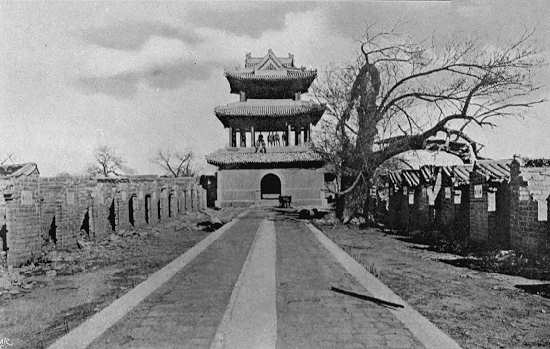
THE STATE EXAMINATION HALL AT PEKIN "The students are secluded for several days in the small cells, while the professors watch from the tower" [To face page 292]
"The germ of this institution was the Bansho Shirabejo, or 'Place for the Examination of Barbarian Writings,' founded by the Tokugawa Government in 1856. Seven years later, this name was altered to that of Kaisei-jo, or, 'Place for Developing and Completing,' which indicated a change for the better in the views held by the Japanese as to the value of European learning. Numerous other modifications have taken place, both in the name and scope of the institution, which since 1881 has been placed on a thoroughly modern footing, and now includes colleges of Law, Medicine, Engineering, Literature, Science and Agriculture, where lectures are delivered by a large staff of professors of various nationalities and in various languages. The students number over 2700. The courses that attract most students are those of Law, Medicine, and Engineering. A large hospital connected with the University stands in the same grounds. Other institutions under the authority of the President of the University are the Botanical Gardens in the district of Koishikawa, and the Tokio Observatory at Ligura."
It is a large establishment, covering a huge area of park-like ground, dotted with long red brick piles. Different faculties occupy separate buildings, and if not picturesque, they are well adapted to their function. The library is especially fine, very well equipped, and cleverly organized. It interested me to observe that whenever I came the large reading-room was always filled with students, and it afforded a good opportunity of watching the keenness with which they pursue their studies. I made acquaintance with several of the leading professors, some of whom are Western. They all assisted me very kindly in my investigations. The statements of Professor von Koerber, who is the teacher of the history of modern philosophy, were of especial value. To judge the mental capacity of the rising generation, it is essential to see how metaphysical questions appeal to them, and, as I perceived, they were more prone to accept theories which appealed to their great imaginative qualities than to draw abstract conclusions by the medium of purely logical deductions. They prefer Schopenhauer to Kant, Plato to Aristotle, and so it will be easy to comprehend the unquestionable influence which the modern evolutionist school exerts over the mind of young Japan.
Another institution of great importance is the Government Printing Office, the so-called Insatsu Kyoku, its scope including much besides printing, the paper currency of the country being manufactured here too. The offices are marvellously equipped, but the skill of the workmen is even more marvellous. The reproduction of different old prints, etchings, and watercolours by mechanical means, is a triumph of art, and the editions de luxe of the old Japanese masters are unique in their way. As I said before, manual skill and the faculty of copying are national gifts, and, during my repeated visits to workshops, factories, and builders' yards, it was these characteristics which most impressed me. I returned frequently to the new Commercial Museum, where there is such a good opportunity given to judge what Japan's commercial production will be in the future. There are already several branches in which they run us very close, if they don't surpass us. In the production of cheap articles they are certainly already ahead, and common calico and cotton goods have not only replaced the European supply for the requirements of the country, but they almost monopolize the market of Korea, and export a great deal to China and Eastern Asia. Cheap china is manufactured to a great extent also, and so are cloth, felt, and leather goods of all kinds. In the Museum there are specimens of the different home industries, and if the quality leaves something to be desired, and does not promise to be very durable, the prices are so low that the customer can afford to purchase, as all Orientals like to do, something new constantly. Unquestionably within a very short time Tokio's and Osaka's large firms will be the great competitors of Birmingham and Manchester, and the European trade in the East will be mostly secured by Japan.
In speaking of Tokio's noteworthy establishments, I finish, where I might have begun, with the Arsenal, where the famous San-ju-nen Shiki, Japan's victorious weapon, is manufactured. Arms, guns, soldiering and fights are out of my sphere, but I could not help observing the up-to-date character of Tokio's military equipment. Not only do the barracks bear witness to perfect order and cleanliness, but the military schools and training establishments are well organized and demand hard work in every respect. Soldiers and officers impress us equally by their neatness and perfect turn-out and their spirit of discipline; and still more impressive are the extraordinary vivacity and unceasing activity which they display. Their endurance and capacity for work are, I think, unsurpassed by any other army.
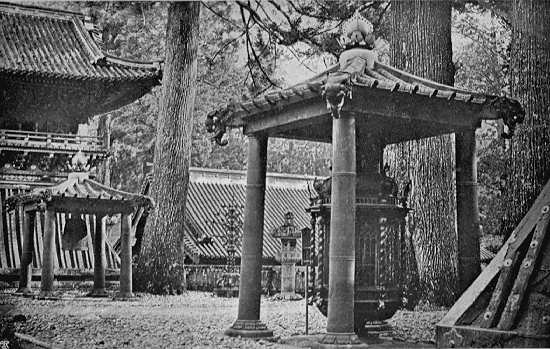
SHRINES AT NIKKO "To conjure up the past or to recall bygone traditions, one ought to linger in Nara's sacred groves and Nikko's hidden shrines" [To face page 296]
Finally, if I were asked to enumerate the interesting sights of Tokio, or to give advice what to see, and especially how to see Tokio, I should to a certain extent deviate from the generally adopted plans of the guide-books. Instead of drawing attention to the past, I would deal more with the present; instead of describing the monuments of bygone ages only, I would point out the modern institutions of the capital; instead of dreaming in the old cemeteries of the Shoguns and Ronins, I would awaken some interest in schools, factories, and barracks. In fact, instead of dwelling on what is dead, I would study what is to be born and what is already alive. And so the first disappointment of missing the expected gay fairyland will turn into interest in serious reality. Thus travellers would derive greater benefit and waste less time, if they were prepared at the outset for Tokio, not as it may once have been and as we still imagine it from description, but as it has developed in the last quarter of a century. To conjure up the past or to recall bygone traditions, one ought to linger in Nara's sacred groves and Nikko's hidden shrines; but on arrival in Tokio and Osaka, one is awakened to the reality of modern times, and dreams are bound to give place to the hard work of life. After the first disappointment caused by the capital's inartistic and rather incoherent aspect of today, one cannot fail to be impressed by the activity of its inhabitants; and the repugnance roused by its prosaic outlook, where new and old mingle indiscriminately, once overcome, one begins to understand and appreciate the indefatigable labour by which all this change has been achieved.
I would advise my friends, if they can do so, to choose a favourable season for visiting Tokio. If possible, they should arrive in the middle of the spring, when the magnificent forests and shady groves are in foliage, when the orchards are in bloom, and the flower-gardens most luxuriant; or in the autumn, when the leaves begin to turn, when the maples glow like fires on the hillsides, and the sea-breeze scatters the yellow leaves of the birch in golden showers. To stay there during the months when the beauty of nature is at its zenith, and by its marvellous harmony of colour and outline, which is, after all, Japan's main beauty, makes one forget what time has destroyed and civilization ruined, and recompenses one for many charms vanished for ever. At this time of the year the different suburbs offer delightful retreats for the traveller's leisure hours. And some of the old monuments, even though they be not works of art of great value, yet, surrounded as they are by rich vegetation, present a perfect tout ensemble. To those who have the privilege of entering the Mikado's palace, and perchance obtain an invitation to the celebrated Imperial chrysanthemum festival, the beauty of the grounds at this season will compensate for the modesty of the buildings and the simplicity of the interior; and though the brilliant hues of the courtiers' embroidered kimonos are replaced by black frock-coats, the chrysanthemums are still gorgeous and dazzling.
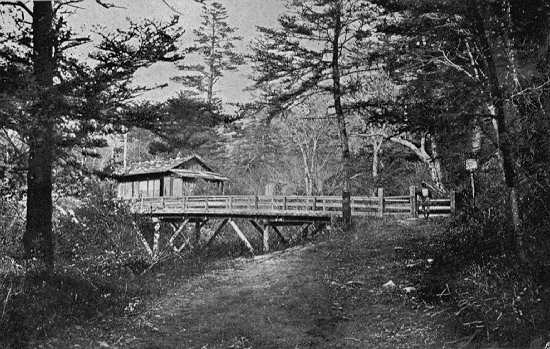
DELIGHTFUL SCENERY "When the magnificent forests and shady groves are in foliage" [To face page 298]
I can't help repeating with emphasis my advice to take interest in life's more serious factors. As soon as possible after arrival, observe and study, whenever there is a chance, the daily routine of one of the most advancing young countries which unfolds before the visitor. Do not restrict your visits merely to sights; besides museums inspect some schools, and instead of hunting up pagodas of little artistic value, see some of the workshops. In particular, look carefully at the work, as such, and form your conclusions from your personal experience. And I would counsel the getting of introductions to managers of large firms, to the directors of railway and shipping companies; in fact, to all the leaders of Tokio's various social movements. Call on the different ministries, and do not omit to make the acquaintance of the chiefs of the numerous political parties, whom you will find marvellously well informed on political matters, and generally very interesting. And witness some of the sittings of Parliament and a few public assemblies and meetings of shareholders. In short, my last word of advice would be, do not go with the idea of idling, but of studying, in Tokio; and in this case you may not think it pretty, but unquestionably you will realize that it is one of the most interesting cities in the whole wide world.
If Japan has proved herself a very clever scholar of the West, the West on its side can learn a great deal today from Japan. In this respect we could not find a better object-lesson than the Imperial capital, Tokio.
XII
THE EMPEROR AND EMPRESS OF JAPAN AT THE YEDDO PALACE
It is snowing. The white flakes fall persistently, and are driven round and round in whirlwinds. Looking out of my window the landscape is cold and dreary. The large square roofs of the houses and the trees are covered with a heavy white mantle.
In no direction can a single soul be seen. It is as if the whole town and the inhabitants had gone into their winter sleep; all is silent and dead under Nature's immaculate pall. I can scarcely believe that I am in the Land of the Rising Sun; it is so difficult to realize that this snowed-in city is the capital of Japan, as colour and glitter form the two main features in our primary conception of Nippon's Island.
We expect to see the brilliant shades of the bright pictures and rich embroideries and heavy silks of Japan even more brilliant under the beams of this Eastern sun, as it is represented on the national flag.
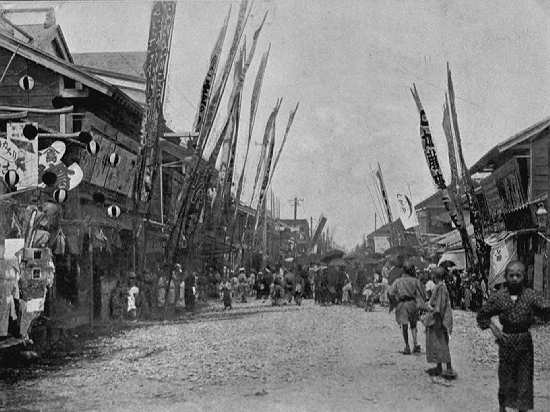
STREET IN JAPAN "I never saw more poles and beams and masts of different height piercing the sky" [To face page 300]
The European hopes to find Japan above all an Asiatic, even an exotic country. He wants something like the bazaars of Cairo or Ceylon's palm-groves, tropical like the wildernesses of Java, and ever-blooming like Burmah's gardens. Arriving at Tokio, disappointment in this respect is general, for Tokio is neither bright nor artistic. In fact, the capital of Japan is one of the most colourless and prosaic places on the globe.
Its buildings are nearly all of logs of wood—planks nailed to each other—without any external ornamentation; to commend their style or taste is impossible, for most of the houses have not even an attractive appearance. The old pagodas and the historic temples make an exception to the general rule, but their number is limited, and they are hidden by the groves of centuries.
The general impression of the town is monotonous, and what makes it even more so is that the houses are, as a rule, only one storey high, and the unpainted wood they are constructed of assumes in time a weather-beaten hue; in fact, the outline is only broken by an innumerable number of telegraph-poles. I never saw more poles and beams and masts of different height piercing the sky.
I was rather sorry to have such a cold morning for the day of the audience graciously accorded to me by the Emperor. I must confess that I should have preferred a warm, bright day in the late spring, when everything is in blossom, every corner full of flowers, and Japan looks more as it is pictured on its rich screens and artistic fans.
It is still quite early when the large, heavy barouche belonging to our legation comes to fetch me, and the two strong, well-bred, native horses have hard work to get through the snow-covered streets. Our way is uninteresting; the thoroughfares are too wide altogether, and the small houses on both sides are dwarfed and insignificant.
But we also pass some large modern buildings, American brick-and-steel erections. These are public offices and banks, and make a rather unpleasant contrast in the calm scenery. For some time we skirt a large canal partly frozen over; this forms the outer moat of the Imperial castle.
We stop before a large gate. It is opened at once, and a detachment of small but well-set-up Japanese soldiers present arms. Next comes a bridge, a new stone construction, ornamented with huge candelabra, without much architectural beauty, and without any Japanese flavour. But it leads to a magnificent avenue of cryptomerea, each tree a giant, and all of them of venerable age, their trunks covered with dark moss, and their foliage forming an emerald arch—emerald set in crystals, for their branches are heavily laden with frost.
The avenue looks like a corner of the famous Tokaïdo highway, the Japanese main artery for centuries, where the whole country wandered—rich and poor, mighty and humble, from Kioto to Tokio, from the Mikado's to the Shogun's Court, the Daimios with their retinues in gold and silver; where, too, all the warriors rode in their rich armour, and all the troops marched to war, or home to rest; where all the pilgrims walked to the famous shrines of Nara and Nikko.
This avenue, leading to the palace, affords compensation for all the inartistic streets outside the walls. I am even glad that it is covered with snow, and that its sole inhabitants are a few gardeners shovelling the ice aside. The dark trees and the white snow, and these few men clad in straw capes looking very much like the back of a porcupine, and wearing hats like flat tea-trays, are so original and so typical. At last I have a real Japanese picture before me, and not one of those we get at home highly coloured and made partly for the cheap Western markets, but a picture full of harmony in an artistic setting, like one of those famous Kakomenos in black and white by the most celebrated disciples of the great Kano school.
A sharp turn brings us to an open space, and the palace is in front of us.
I am afraid "palace" is not the right expression, as it looks from the outside like a large Indian bungalow. It is only one storey high, mainly constructed of wood and beams, scarcely ornamental, and covered with a sloping roof of indifferent tiles. There is nothing striking about it, nothing that would attract attention, nothing that is at all imposing; it looks comfortable and nothing more.
The carriage stops before a flight of steps leading to a simple but spacious ante-room. There is a large table on which are the Imperial visiting-books, a few chairs; round the room stand some servants, dressed in ordinary French livery. I am shown through a long corridor, which is Japanese in character. It has no furniture at all; the beams are carved, and if not imposing are perfect in detail. The large drawing-room, where we sit down, is entirely modern.
The furniture is such as you would see anywhere in Europe, and specially in America—rich, but without any special style or individuality, the only exceptions being a fine cabinet of priceless old lacquer ware, and a large golden screen ornamented with an enormous dragon and signed "Kano Montonabu."
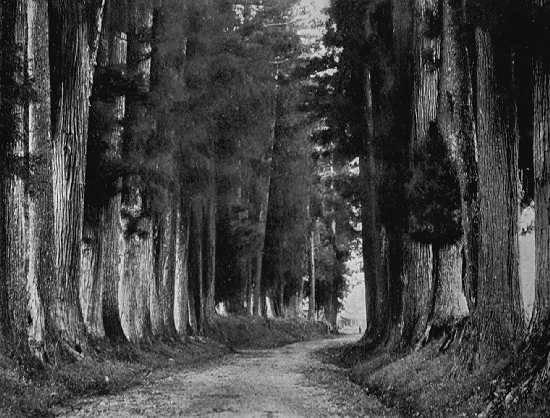
THE TOKAÏDO "The avenue looks like a corner of the famous Tokaïdo highway" [To face page 304]
I was rather sorry that the decorations of the whole room did not adhere to the national taste. I should have liked to banish every gilded bracket and velvet lounge, and restore it to its original simplicity—such simplicity as is to be found in the Katsura Palace at Kioto.
The Emperor is a late riser, and until he is ready Baron S——a keeps me company. He speaks perfect English, having studied in England for many years; and, even more, he married an English lady whose house has become the meeting-place of all Western and local celebrities.
It is a charming villa, looking very much like an English cottage, and overlooking one of the prettiest corners of the Bay of Tokio; full of English books and Japanese art treasures—English comfort and Japanese taste—it is one of those homes that one remembers with pleasure, and looks forward to seeing again.
The Baron is certainly a most accomplished Master of Ceremonies; he has all the gentleness of old Japanese manners, and all the culture of Japanese civility, and performs his somewhat tedious duties as if they gave him a personal pleasure.
There are several other gentlemen in attendance—the Lord Chamberlain, also a few A.D.C.'s and chamberlains-in-waiting. They are all wearing Court dresses of dark blue, or of red with gold lace.
His Majesty receives me in his private apartment, whither I am escorted through endless passages. The nearer we get, the colder is the temperature. All the reception-rooms are heated with water-pipes to suit Western taste, but in the Imperial rooms there are only old-fashioned braziers. The reception-room is small, typically Japanese, has no windows, but only sliding screens, and is denuded of all furniture. The Mikado is standing in the centre, and for the occasion is wearing the uniform of a general of his army, consisting of a dark blue tunic, and even darker red trousers; and as a kind attention he wears the diamond-set star of St. Stephen, first King of Hungary. He is surrounded by his staff and several A.D.C.'s, and throughout, the formalities are carried out with perfect Court ceremonial.
His Majesty shakes hands in a military fashion and at once puts me at my ease by asking questions. First, he wants to hear about my country and our venerable monarch.
"When did you leave home?" "How is His Majesty, your benevolent sovereign?" "By what route did you come out?" "Did you find the Siberian line comfortable?" "Prince Katsura came from King Edward's Coronation by the same line, and enjoyed his journey very much. Your journey through this region which is so little known must have interested you." "How long did the last part of your journey through Manchuria take, and what were your experiences like in Korea?" "It must be most interesting coming from Europe to see such entirely different countries and people." "I hope your experiences have been satisfactory." "I wish you to see as much in Japan as you think would be of interest to you. As you may observe, we are working very hard, and we try to adopt in many respects the main features of Western civilization and ideas. I am glad to hear you are interested in education. I dare say you liked our University library and the new printing establishments; you ought to see some of the provincial towns, too, and the commercial activity carried on in some of them. Don't omit to see Osaka; I am going myself next month, so I hope I may meet you there again."
Commercial and economic questions evidently interested His Majesty, who was taking a very active part in the arrangements for the Exhibition at Osaka, which was about to be opened. And he spoke about many other questions regarding the country and its development.
The Emperor detained me for an unusual length of time, and seemed to be interested in all the different matters that formed the subject of our conversation. It must be rather difficult for a sovereign who is brought up from birth within these palace walls to realize the outer world, and it must be even more so to get an insight into human nature, meeting it only at official receptions.
Before I left a message came from Her Majesty the Empress, expressing a wish to receive me too. Her apartments are in an adjoining wing. Her boudoir is ornamented in the French style, and her windows overlook a small Japanese garden. Her dress was of Western fashion too, rather elaborate for that early hour of the day, but in good taste. Her two ladies-in-waiting were clad in the same fashion.
At the first glance I understood the Empress's great popularity. Her gentleness and kind heart are visible in her glance in an exceptional way. There is something very small and fragile about her. She looks rather delicate, and her pale features wear an expression of sadness which cannot fail to impress. She seems, besides being kindly disposed and benevolent by nature, to have had sorrows like most other human beings, and this feature, shared in common by owners of palaces and of hovels, makes her very human, and very sympathetic. She has led, in her vast palace and high position, a rather solitary life, and solitude gives time for thought, and to ponder deeply on the problems of our destinies. Nobody could better understand this spirit of abnegation for the sake of a higher ideal than Her Majesty. Indeed woman's devotion of herself to the good of her family has always been as much praised in Japan as man's loyalty to his country. The paramount qualities of the female side of this nation are not yet known by the world at large, and are very often misjudged by those who have passed through Nippon's island. But all those who have stayed for some length of time, especially the members of the Missions, speak with great respect of their qualities and virtues, and particularly of the marvellous sense of duty and spirit of self-sacrifice of the daughters for their parents, of the wives for their husbands, and of the mothers for their sons.
Our conversation was mainly about abstract questions, family life, education, charitable works, hospitals, orphanages, and homes. She is patroness of the Red Cross Society of Japan, and listened with great interest to my account of the work carried on by the Sisters of Charity, and in the different institutions under the Archbishop's care. Her sympathy can do a great deal, and I hope she will use it in favour of this great work, carried out with such apostolic zeal for the benefit of the sick and forlorn orphans, to save the children's lives, and to nurse the lepers and the incurables, whatever the cost and sacrifice.
She went into all kinds of details, and asked hundreds of questions about these poor little mites, and exhibited that interest which only a woman can when she is talking about children. It seemed to appeal to her heart, and she repeatedly expressed her gladness at having had the opportunity of hearing about the good work carried on by our church.
I left the room full of the hope that her noble kindness might prove to be a support to this little fraction of her needful subjects.
As a special favour, I was shown over all the different apartments. We went through the state rooms and inner apartments, walked through endless corridors, and viewed the numerous art treasures. There is an extraordinary mixture in taste of West and East, but there is no doubt that the supremacy belongs to the latter, for what is Japanese is really fine.
All the long dadoes are carved elaborately and of exquisite workmanship, and the fretted ceilings are charming in design and colouring. They are as a rule of dark beams, framing gilt grounds; the carving and bronze casts are finely executed.
We finished our wanderings in a delightful little garden, which is Japanese indeed in the highest degree. There is a tiny pond, no larger than a good-sized basin, surrounded by a rockery imitating Fuji; and across an almost imaginary stream a few inches wide is thrown a wooden bridge. Everything is minute: even the little rustic summer-house is no larger than that of a doll. It is a Lilliputian world of its own. Even the trees are dwarfs; but the Japanese imagination makes everything large.
If any one is interested in the Japanese mind and its imaginative qualities, the best fields of study are some of these famous gardens laid out by the great æsthetes of the seventeenth and eighteenth centuries; men of undoubted refinement and culture, some being statesmen retired from the excitement of political life, and many Mikados seeking rest in solitude, after the glitter and pomp of the Court.
Their gardens simply consisted of a few square yards of ground, surrounded by a plain bamboo hedge, a log house built of a few planks, and consisting of two rooms, with gravel scattered before the doorways, and a few tiny bushes growing round. Small and simple, I dare say primitive to European eyes, but to a Japanese mind these shrubs represent a virgin forest, the log house is a palace, the gravel court unlimited sea, and the stepping-stones so many islands.
With their love of artistic refinement and elaborate civilization, they look through the shades of broken prisms, and scent perfumes of different compositions, and build up a whole imaginary world of dainty colours and exquisite odours. But who, coming from the West, would ever understand any of these details of an historical past and ancient customs and strange manifestations of national culture?
And who, returning from one of these gardens, so full of reminiscences of old Japan, to the modern streets, would understand how the new towns are being built up of brick and steel, and how the whole nation is changed by hard work and boundless energy?
And above all, who can at this moment explain or understand all the progress of modern Japan and fully realize all its future importance?
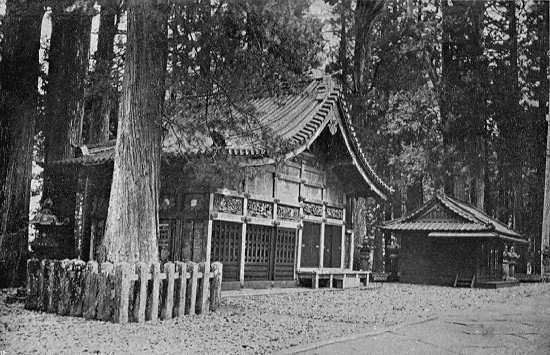
A TYPICAL NIPPON BUILDING "Small and simple, I dare say primitive to European eyes, but to a Japanese mind the log house represents a palace" [To face page 312]
XIII
JAPAN AND CHINA ON THE THRESHOLD OF THE TWENTIETH CENTURY
I JAPAN
The question of the Yellow Peril has once again come to the front through the recent East-Asiatic war. The unprecedented success of Japan, both by land and sea, has roused universal surprise. When the first news of victories gained by the small insular power reached Western Europe, they were received with genuine joy; but as the Japanese advanced on the mainland of Asia, symptoms of anxiety began to manifest themselves.
What would happen if they conquered all Eastern Asia, and perhaps Siberia also? Above all, what would happen if Japan, united with China, were to overrun the Russian dominions, and one day threaten Central Europe? Already here and there the sad recollection of the old Tartar campaigns was being revived; and indeed, why should not a modern, ambitious commander follow in the wake of his famous predecessor, Genghis Khan? A modern military genius, a Yellow Napoleon, enjoying equal popularity and possessing the same magic power, with millions of money and countless troops at his disposal, might surely become a very serious and formidable antagonist. But would it be to the interest of the yellow race to overrun Europe? This problem is yet awaiting its solution.
I venture to think that under the present conditions the majority of the Eastern people have no intention or desire to enlarge their territory beyond its original borders. If they can only get back what is nominally theirs—what, not more than half a century ago, was possessed by them—they will be satisfied. Japan, which is decidedly overpopulated, and cannot adequately provide for its nearly fifty millions of inhabitants, dispersed over the various islands, may possibly have an eye on some of the neighbouring Asiatic coastlands, but for colonizing purposes is more likely to turn its attention towards the South Sea. And since the ambition of Japan has been awakened, and its adaptabilities to modern culture, its unflagging energy, and its admirable military skill, been developed, there is more possibility that in a remote future Nippon might make Australasia the Utopia of its colonizing efforts.
Certain it is that a brilliant future awaits Japan. The land is rich, and its position, between Eastern Asia and Western America, most advantageous, both from an economic and from a strategic point of view. The people are healthy, strong, industrious, and possess in an extraordinary degree the faculty of assimilation. In this respect, indeed, Japan is unrivalled by any other race.
The primary cause of their present marvellous success must unquestionably be sought in this faculty of assimilation and in the power of discipline—in the wonderful ease wherewith they appropriate all the acquisitions of the West—the way in which they carry them out. The second cause of their success is their old military system of government, which has produced the present-day soldiers. But in order to grasp thoroughly the situation it is necessary to cast a cursory glance on the past history of Japan. In doing so we should remember in the first place that ancient Nippon was built upon the system of vassalage. The land was divided into principalities of various sizes, at the head of each of which was a Daimio, or vassal chieftain, just as the empires of the West were formerly protected and ruled over by baronial chiefs. Feudalism in Europe led to perpetual frontier quarrels and wars, and this was the case also in Japan. The Daimios were always at enmity with one another, and their government was a period of petty warfare.
The military element, therefore, naturally occupied a prominent position, and just as in Europe the knight became the founder of Chivalry, so in Japan the Samurais established the Bushido. And as the German knight of Chivalry created a legal system called Club-law, for the protection of his own interests, so the soldiers of Japan had their own military code. The military thus became the privileged class of society. This caste, with its rigorous rules and external organization, had a perfectly developed existence, a special moral standard, and to a certain extent a religion of its own. As the age of Chivalry was created by the knights of old, so "Bushido," the ethics of the Samurais, originated in the Land of the Rising Sun.
To give an exact definition of the word "Bushido" is impossible, because the conception of it is unknown to us. There are no analogous circumstances necessitating its existence with us. The idea of chivalry is the nearest approach to an interpretation of the word, although literally "Bushido" means "Military manner"—the manner and the way in which it is the duty of the armed nobility to fight, to live, and to die. We notice that according to this definition the word includes more than a mere title; it expresses a whole social system, and regulates the views and appreciations of life of all its members.
The description given by Dr. Nitobe enables us to form some idea of Bushido from a Japanese standpoint. "Bushido is the code of moral principles which the knights were required or instructed to observe. It is not a written code; at best it consists of a few maxims handed down by oral tradition or coming from the pen of some well-known warrior or savant. More frequently it is a code unuttered and unwritten, but impressed on the fleshy tablets of the heart. It was founded, not on the creation of one brain, however able, or on the life of a single personage, however renowned. It was an organic growth of decades and centuries of military career. It perhaps fills the same position in the history of ethics that the English Constitution does in political history; yet it has nothing to compare with the Magna Carta or the Habeas Corpus Act. It is true that early in the seventeenth century Military Statutes (Buké Hatto) were promulgated, but their thirteen short articles were taken up mostly with marriages, castles, leagues, etc., and didactic regulations were but meagrely touched upon. We cannot, therefore, point out any definite time and place, and say, Here is its fountain-head. It is not till the feudal age that it attains consciousness. Its origin, in respect to time, may be identified with feudalism. But feudalism itself is woven of many threads, and Bushido shares its intricate nature. As in England the political institution of feudalism may be said to date from the Norman Conquest, so we may say that in Japan its rise was simultaneous with the ascendancy of Toritomo late in the twelfth century. As, however, in England we find the social elements of feudalism far back in the period previous to William the Conqueror, so, too, the germs of feudalism in Japan have been long existent before.
"Again, in Japan as in Europe, when feudalism was formally inaugurated, the professional class of warriors naturally came into prominence. These were known as samurai, meaning literally, like the old English cniht (knecht, knight), guards or attendants, resembling in character the soldurii, whom Caesar mentioned as existing in Aquitania. A Sinico-Japanese class, named Bu-Ké or Bu-Shi (fighting knights), was also adopted in common use. They were a privileged class, and must originally have been a rough breed who made fighting their vocation. Coming to profess great honour and great privileges, and correspondingly great responsibilities, they soon felt the need of a common standard of behaviour, especially as they were always on a belligerent footing and belonged to different clans.
"'Fair play in fight!' What fertile germs of morality lie in this primitive sense of savagery and childhood! Is it not the root of military and civic virtues? We smile (as if we had outgrown it!) at the boyish desire of the small Britisher, Tom Brown, 'to leave behind him the name of a fellow who never bullied a little boy or turned his back on a big one.' And yet, who does not know that this desire is the cornerstone on which moral structures of mighty dimensions can be reared? May I not go even so far as to say that the gentlest and most peace-loving of religions endorses this aspiration? This desire of Tom's is the basis on which the greatness of England is largely built, and it will not take us long to discover that Bushido does not stand on a lower pedestal. If fighting in itself, be it offensive or defensive, is, as Quakers rightly testify, brutal and wrong, we can still say with Lessing, 'We know from what failings our virtue springs.' Sneaks and cowards are epithets of the worst opprobrium to healthy, simple natures. Childhood begins life with those notions, as does also knighthood; but as life grows larger and its relations become many-sided, the early faith seeks sanction from higher authority and more rational sources for its own justification, satisfaction, and development. If military systems had operated alone, without higher moral support, how far short of chivalry would the moral ideal have fallen! In Europe Christianity, interpreted with concessions convenient to chivalry, infused it nevertheless with a spiritual ideal. 'Religion, war, and glory were the three rules of a perfect Christian knight,' says Lamartine."
Bushido has no written laws; it has been handed down as a tradition from father to son. Its originator was not a sage like Confucius, not an ascetic like Buddha; it was the people itself. It is the immediate expression of past ages, and, as far as man's memory reaches, the interpreter of the sentiments of victorious warriors.
With the increasing power of the Samurais grew also the necessity, as was the case with knighthood, to purify the atmosphere of their fortresses by self-prescribed rules. And it lies in the natural order of things, embracing all national codes, that those points should be most carefully guarded on which the people felt themselves to be weakest.
The first principle, then, was, Justice to all. The Samurais despise above all things trickery and deceit, all unfairness. "Adhere inflexibly to thy principle,"—thus writes a Bushi—"and be ready to die for the sake of duty; but also be ready to strike and to kill if honour demand it of thee." And the more the general situation became degenerated, the more prominent became the letter of this law in the clash of swords.
The second principle was courage. From his earliest childhood the Japanese boy was brought up to be a soldier, and in his education many points remind us of the old Spartan rigour. Often the mother would admonish a crying child with such words as: "Shame not the honour of thy family; men of this house have never been known to cry." Or again, she might stimulate her son's courage by saying: "What wilt thou say when in battle thou losest arm or leg?" or, "How wilt thou control thy face if the Emperor should bid thee to cut off thine ears or to perform the hara-kiri?" To be brave was the aim of every boy, and frequently was he called upon to prove his courage. He was made to go hungry, to walk great distances, and in many cases this system of hardening verged on cruelty.
On the other hand, the benevolence of the Samurai often degenerated into sentimentality, and the Bushida-nashake—the warm soldier's heart—has become proverbial. To render assistance to the weak and helpless was one of the soldier's paramount duties, and, like the Italian Condottieri and the knights of the Middle Ages who, although they tyrannized over the people, were yet anxious to appear civilized and cultured, and were not blind to their own faults and cruelties, so the Samurais laid special stress upon the observance of social forms, and taught their boys, besides the military arts, such accomplishments as poetry, music, and other fine arts.
Courteousness became a second nature, and to this day, although it sometimes may lack sincerity and has in many cases become an empty form, Japanese politeness always excites the astonishment and admiration of the foreigner on his first arrival in the land. Nippon society manners are the most complicated and tedious imaginable. The smallest affairs of everyday life are circumscribed with the most childish and elaborate rules. The way to enter a friend's house, how to address him, what to talk about, everything is carefully prescribed, even the slight attention of offering the guest a cup of tea amounts to a ceremony, regulated in its minutest details. The Cha-no-yu (tea-drinking), in truth, is more than a ceremony, it is a precious tradition, a rite, illustrating the refinement of taste and the imagination of the people.
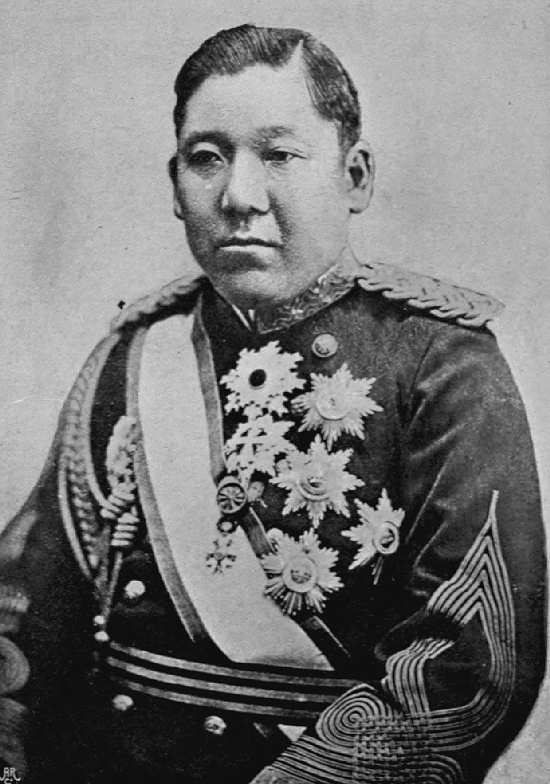
MARSHALL OYAMA Copyright, Nops Ltd. [To face page 322]
The third fundamental principle of Bushido is honour; more particularly expressed in Guai-bun and Men-moku, which form the basis of the conception of the Samurai. But even the valour of the most heroic Samurai is as nothing compared to his pride and vanity, and to a certain extent these two qualities are still striking characteristics of the nation. Extreme sensitiveness and readiness to take offence are the unavoidable consequences of such highly developed self-constrictions. The "affaires d'honneur" of the Latin races, and the often mistaken chivalry of the German "Junker" are but weak parallels to the sensitiveness of the Bushi. The hot-blooded Samurai was offended on every possible occasion, and many an innocent life has been sacrificed to this intensely developed military pride.
Whole volumes have been written upon the manner in which these "questions of honour" should be dealt with, and more than one tragic page had its comical features also. Thus, for instance, the story is told of a Busiaki, who killed a peasant for drawing his attention to the fact that there was an insect on his coat. For, argued the Busiaki, vermin feed on beasts, and therefore his remark amounts to an insult. And as the simple peasant was not entitled to give satisfaction for the supposed offence in any other manner, he had to pay for it with his life, in order that the honour of the Busiaki might be cleared. This condition of things might lead also to vengeance and suicide, and the favourite form of the latter was "hara-kiri," which has attained world-wide fame. It is suicide by cutting open the abdomen, and this custom was one of the institutions by which distant Japan has been so often misjudged. To the European the idea is revolting and sinful, but the pride and imagination of that far-away people magnified it into a sublime action.
The most sympathetic characters in the history of Japan have thus ended their days, and many popular heroes of national epics thus gave up their lives. In every Japanese drama there is at least one hero who dies on the stage in this manner, amid the thundering applause of an appreciative audience. If not a punishment, the motive for committing suicide is almost always an exaggerated conception, not of despair, but of offended dignity or vanity. And like every action of this enigmatical people, hara-kiri and supuku became in time a ceremony, in which every detail of the proceedings was carefully formulated. The victim, dressed in white, and with unmoved countenance, had to perform the operation with a sharp-edged sword. This formality gone through in the supreme manner in which Bushido prescribed it, and the personal vanity being apparently satisfied, the victim seemed not to feel the bodily suffering, and faced his death with calmness. To realize the pagan standpoint of hara-kiri I will quote the following lines of the Japanese author.
"I do not wish to be understood as asserting religious or even moral justification of suicide, but the high estimate placed upon honour was ample excuse with many for taking one's own life. Death involving a question of honour was accepted in Bushido as a key to the solution of many complex problems, so that to an ambitious Samurai a natural departure from life seemed a rather tame affair and a consummation not devoutly to be wished. I dare say that many Westerners will admit the fascination of, if not a positive admiration for, the sublime composure with which Cato, Brutus, Petronius, and a host of other ancient worthies, terminated their own earthly existence. Is it too bold to hint that the death of the first of the philosophers was partly suicidal? When we are told so minutely by his pupils how their master willingly submitted to the mandate of the state—which he knew was morally mistaken—in spite of the possibilities of escape, and how he took up the cup of hemlock in his own hand, even offering libation from its deadly contents, do we not discern in his whole proceeding and demeanour an act of self-immolation? No physical compulsion here, as in ordinary cases of execution. True the verdict of the judges was compulsory; it said, 'Thou shalt die, and that by thine own hand.' If suicide meant no more than dying by one's own hand, Socrates was a clear case of suicide. But nobody would charge him with a crime; Plato, who was averse to it, would not call his master a suicide. Now, my readers will understand that hara-kiri, or seppuku, was not a mere suicidal process. It was an institution, legal and ceremonial. An invention of the Middle Ages, it was a process by which warriors could expiate their crimes, apologize for errors, escape from disgrace, redeem their friends, or prove their sincerity. When enforced as a legal punishment it was practised with due ceremony. It was a refinement of self-destruction, and none could perform it without the utmost coolness of temper and composure of demeanour, and for these reasons it was particularly befitting the profession of bushi."
Kataki-ushi, or vengeance, is another strong feature of national feeling. Contrary to the Christian doctrine of forgiveness, the Japan of olden days endeavoured to exalt the original instinct of human nature, "an eye for an eye, a tooth for a tooth," into a decree. And how deep this notion has rooted itself into the hearts of the people is best illustrated by the story of the forty-seven Ronins, which everybody in Japan knows by heart, and which is the favourite nursery tale of each Nippon child.
Simple as the story is, it is very characteristic. A nobleman is betrayed by his adversary and put to death. Forty-seven of his followers become bandits and swear to revenge their lord. After many vicissitudes the object of their revenge falls into their hands and they kill him. When brought to justice all the forty-seven commit hara-kiri.
Their graves remain to this day in the grove of Siba, and it is one of the first places visited by country people who come to Tokio. Devout hands keep the modest little tombstones supplied with wreaths of fresh flowers. And thus the forty-seven Ronins have become the most popular heroes of the nation, because their offence and expiation interpret one of the most salient features characteristic of the race, which, judged from a national standard, shines in a different light as we can see from the following passage:—
"We have thus seen the Bushido institution of suicide; we will now see whether its sister institution of revenge has its mitigating features. I hope I can dispose of the question in a few words, since a similar institution—or call it custom, as you will—prevailed among all peoples, and has not yet become entirely obsolete, as attested by the continuance of duelling and lynching. Among a savage tribe which has no marriage, adultery is not a sin, so in a period which has no criminal court murder is not a crime, and only the vigilant vengeance of the victim's people preserves social order. 'What is the most beautiful thing on earth?' said Osiris to Horus. The reply was, 'To avenge a parent's wrongs.' To which a Japanese would have added 'and a nearer's.' In revenge there is something which satisfies one's sense of justice. The avenger reasons: 'My good father did not deserve death—he who killed him did great evil. My father, if he were alive, would not tolerate a deed like this. Heaven itself hates wrong-doing. It is the will of my father, it is the will of heaven, that the evil-doer should cease from his work. He must perish by my hand, because he shed my father's blood; I who am his flesh and blood must shed the murderer's. The same heaven shall not shelter him and me.' The logic is simple and childish, but it shows an innate sense of exact balance and equal justice. Our sense of revenge is as exact as our mathematical faculty, and until both terms of the equation are satisfied we cannot get over the sense of something undone. Both of these institutions of suicide and revenge lost their raison d'être at the promulgation of the criminal code. The sense of justice satisfied, there is no need of Kataki-uchi. As to Hara-kiri, though it, too, has no existence de jure, we still hear of it from time to time, and shall continue to hear I am afraid, as long as the past is remembered."
In spite of his valour, his passion for war, his thirst for revenge, the Samurai always preserved in his demeanour the utmost calm. Bushido ordained that a knight was never to show either joy or anger. And while remarking that the foreigner in Japan is struck by the often exaggerated politeness of the people, I should have added that he is certainly no less impressed by the inexpressiveness of their faces. Whether sad or joyful, they always wear the same conventional smile, which is sometimes cold as ice, sometimes nervous, or in cases of strong emotion passes into subdued laughter; but traces of really deep emotion are never visible.
What a Baldasare Castiglione or a Lord Chesterfield attempted to exemplify in the West, was bred in the blood of these people as the highest form of good manners. I have seen weddings and witnessed funeral processions where the family on either occasion wore exactly the same expression. In emotions of any kind that conventional smile alone betrays their feelings.
That same smile is on every countenance at great national festivals. With that smile wives took leave of their husbands, children of their fathers, mothers of their sons, when the troops started for the battle-field. The outward form and expression of it remains the same always. The face, or rather the mask that is worn on the stage of life, as in the theatre of ancient Greece, never changes. No matter if the piece enacted change in its course to be a comedy, tragedy, or a drama. So it was ordained by the code of Bushido, which, very likely because it was an unwritten law, came to be all the more binding.
Bushido thus had its own ethical laws, its own religious tenets. As the knight of the Middle Ages created his own rules of life for use within his own turreted stronghold—a code which scarcely held good beyond the trenches of the castle, but which at the same time he magnified into a divine law, a "Gottesurtheil"—so also the Samurai created his own dogmas.
The basis of his creed is Buddhism mixed with the doctrines of Confucius and Shintoism, the primitive faith of the nation. Originally this was nature worship and the cult of the sun, but subsequently it came to be extended to the person of the Mikado. The Samurai thus elevated his emperor into a deity, or rather an idol, and the emperor, gradually more and more isolated from his people, passed his days within the walls of his palace in a series of ritualistic ceremonies, while the burden of the government was laid upon the Shogun, who acted at the same time as Regent and Generalissimo. Loyalty and devotion to their ruler were exalted into a cult. The person of the Mikado was sacred and inviolable. Land and people were, so to speak, his personal property, to do with as he liked. His smallest wish was a command, the blind fulfilment of which was incumbent upon every citizen of the state. The first petition in the prayers of the Samurai was always for his emperor, and the second for his country. And if with us the first gift a child receives is a little cross, in token of his Christian calling, so the Japanese mother of old would place a miniature sword by the side of her babe, to show that his purpose in life was to defend his emperor, his country, and his honour. At the age of five the soldier's boy would receive as a toy a small real sword, and at fifteen the Samurai was of age, and from that time he wore a sharp-bladed weapon.
The sword represented with them more than a weapon of defence. It was a precious and symbolic possession. The manner in which it should be worn was carefully prescribed, and whenever the warrior sat down to his meal or to rest, his weapon was placed on a tray by his side, and woe to the person who touched it with his foot! Such an offence could be wiped out only in blood.
As a mark of the highest reverence, the Samurai raised his sword to his brow, and this act, too, was made almost into a solemn rite. Cutlers and sword-makers occupied a privileged position among the tradespeople, and in welding the blade, every stroke of the hammer was accompanied by the repetition of appropriate sayings and heroic devices. And when the sword was finished, inlaid with gold and silver, in Damascene fashion, sharp as an arrow, and flexible as a Toledo stiletto, it was, of its kind, a masterpiece. We may safely assert that neither in painting nor in sculpture, nor in any branch of industrial art, has Japan ever reached such a high standard of perfection as in the manufacture of bronzes and armour.
The most treasured possession of the Samurai, his pride and his glory, was his sword. And now, since these weapons have been replaced by Krupp guns and Maxim bayonets, every Japanese gentleman preserves the sword of his ancestors as a token of former greatness.
For times are changed. During the last forty years the feudal system of Japan has grown into a representative government, and the old conservative manner of thought and conventions have had to give way to progressive ideas. In outward form the European system is generally adopted, although intrinsically many things remain eminently national; for whether the external form be American or English, the underlying principle remains national.
The Japanese are still as determined as of old; their valour is unchanged; their loyalty undimmed. The grandson of the Samurai of antiquity still boasts many of the proclivities of his ancestors, and above all, the moral law of Bushido is still in his blood. The masses still think as their predecessors thought. It is only in dress and armament that they have changed: their feelings have remained as of old, and the same may be said of most of the national institutions, from the organization of the family to the constitution of the state. What has changed is the form and the colour; but the work of internal transformation is left for future generations to accomplish.
In order rightly to apprehend the present situation of Japan, to explain the admirable military discipline of the soldiers, to understand why in their blind devotion to their country they think nothing of sacrificing thousands of lives, it is necessary to make ourselves acquainted with the inner workings of the feudal system, the moral basis of their actions, the principles of Bushido and Samuraism. For it is only by a full knowledge of all these influences, and the conditions of the past, that we can arrive at a true understanding of its present strength.
The life and the death of the forty-seven Ronins may account for the fixed determination wherewith the troops met their death before the walls of Port Arthur. Nippon's sons are in the first instance warriors. They have fought for centuries; they have fought for the honour of their country, they have shed their blood for the glory of the Mikado, and with the same stoic determination they now fight to glorify their land.
To form a better idea of the Japanese army we must indeed bear in mind the peculiar features embodied in the principle of Bushido and the Samurais code. Even the true character of the Japanese youths studying in Western lands and wearing European clothing, can only be adequately understood by those who have been to a certain extent acquainted with their fathers. And the same applies to the whole of modern progressive, fighting Japan; its administration, its state organization, its politics, its military ambition, its social agitations, its industrial developments, and the entire transformation of its labour.
Just as we can only understand the existing condition of the land and of the people, by studying its evolution in the past, so with regard to its future development it is only from psychological features that we can draw definite conclusions. During my stay in Japan I was particularly interested in collecting data from the personal experiences of those Europeans who had resided there for many years. Besides the members of the various European legations it was chiefly the commercial class and the merchants who furnished me with many valuable details. Daily intercourse with the different grades of Japanese society has shown me the life of the people from many varied points of view. Particularly interesting to me were the experiences of the European teachers attached to the numerous civil and military schools. They were all unanimous in praise of their pupils, for their industry and perseverance.
Like most Asiatics, the Japanese are fond of study and of books in general, and even the school-children seem to do their lessons with pleasure. They are quick and sharp, ambitious and untiring in their zeal. The national inclination of the Japanese tends towards technical science. Everything practical appeals to them, and even philosophical problems are looked at from a utilitarian point of view.
The course of Modern Philosophy at the University of Tokio gave me some striking illustrations of the manner in which the Japanese look upon the great thinkers of the West. Upon this point I have dwelt more at large in another work of mine, and I will therefore only mention here, that as in science material rather than the moral questions appeal to them, so in the case of philosophy it is the manner in which Western thought bears upon the imagination which takes hold of them, more than the way in which the conclusions are deduced by strictly logical processes.
But the inner life, the soul of the nation, is unquestionably best known to the missionaries who have laboured among them for generations. Since the time of St. Francis Xavier, who landed in Japan as early as the sixteenth century and founded the first churches and schools, there has, with longer or shorter intervals, been a supply of priests and teachers from Europe.
In the course of the seventeenth century, long accounts from Japan came to the Holy See, giving graphic descriptions of the condition of the land. In these are detailed the first missionary attempts, which met with such unexpected success, and these reports present a very vivid picture of the days when people accepted Christianity by hundreds and thousands, and nearly the whole of Southern Japan became Christianized. Later followed the long period of religious persecution, of suffering and torture. Yet in spite of so much cruel bloodshed, in spite of the numerous hecatombs of martyrs, there are still some direct descendants of the first Christian families.
Since the middle of the nineteenth century Christianity has received a fresh impetus, and at present Japan is divided into four dioceses, at the head of which is the Archbishop of Tokio. Scattered throughout the land are many missionary establishments and Christian communities. In the larger towns many primary and middle schools are established, and educational institutions for girls exist in large numbers too. The orphanages are most successful, and the leper establishments—where those living dead are cared for by the nuns at the sacrifice of their own lives—cannot fail to excite universal admiration.
Although at present the public spirit of Japan does not show much enthusiasm concerning religious questions, Christianity is at any rate free from persecution. The Japanese of the present day is more or less indifferent to matters of religion. He seeks satisfaction in earthly goods. The old Buddhistic faith has lost much of its influence, and the adherents of the doctrine of Confucius are rapidly decreasing in number. With the introduction of the new constitution, the Government has resuscitated the ancient Shintoism and made it the religion of the state. The sovereign, the Mikado, himself professes this faith. Shintoism, or nature-worship, now chiefly serves as one of the great vehicles of patriotic force. Its ceremonies are most primitive, consisting mainly of short prayers of a sentence or two, and of bowing of the head and the clasping of hands. Their chapels are also of the simplest. They are plain, four-walled wooden structures without ornaments or pictures or decorations of any kind. The only conspicuous object in them is the symbol of their deity, a smoothly polished metal disc, representing the sun.
But this religion, which was universally re-proclaimed from one day to another by imperial command, does not appear to satisfy the masses—at any rate not the devout among them—who prefer to seek peace and consolation in constant prayer and supplication, and therefore continue to visit the Buddhist temples and convents. The cultured and more advanced classes are more and more interested in learning the tenets of the Christian faith; yet, although it is doubtful whether Christianity will ever make much progress in Japan, it is certain that Western civilization, being based on Christianity, is very deficient without its moral support. The leading circles in Japan are conscious of this fact, and realize more and more that a purely material life, and the lack of all spiritual comfort, can never give lasting satisfaction.
Should the day arrive when the people will abandon their ancient beliefs, without having had the opportunity of becoming familiar with a higher creed, a sad deterioration must be the inevitable result. And the nation may be exposed to a similar danger should the old moral basis of their existence be shaken by the too sudden introduction of new conditions, and before the growing generation has had time to reach a standard of spiritual development corresponding to it. Thus far the rapid progress of Japan has been confined chiefly to material efforts; there has not been leisure to give sufficient care to the spiritual and moral needs of the people. The first aim and object of the young Japanese is to become rich, great, and mighty. Blindly they follow the example of the commercial Powers of Western Europe. With marvellous rapidity they have assimilated all that was external, all that was palpable. The Japanese fleet in the harbour of Nagasaki is a marvel of efficiency, while Kobe and Yokohama, as commercial towns, compare favourably with some of the largest trade centres of the United States and Britain. Osaka and Tokio, encouraging factories of every kind, have secured to Japan the market of the East, and life in the principal cities is in almost every respect a faithful copy of European institutions. But whether the people are essentially happier, with this external veneer, and the strong strain and high pressure it involves, is quite another thing, and a question of great importance to all who have the welfare of the nation seriously at heart. A too rapid transformation of existing conditions might very easily lead to an economic crisis, symptoms of which are already beginning to manifest themselves.
Greater still would be the danger of a moral crisis, and equally unavoidable, so long as the people conform only outwardly to the exigencies of the newly acquired culture, without realizing its moral value, and whilst ignoring its spiritual aims.
II CHINA
China is in almost every respect diametrically opposed to Japan. In the first place, the two empires are entirely different in their geographical features and geological formation. In China towering mountain crags and vast, immeasurable plains alternate with one another. Some of those plains are dreary, desolate, barren wastes, while in other parts the ground is closely cultivated, yet wholly inadequate to feed China's millions. The canals which traverse the land in all directions are like so many huge rivers, and the streams sometimes widen into regular lakes, the borders of which cannot be descried by the naked eye.
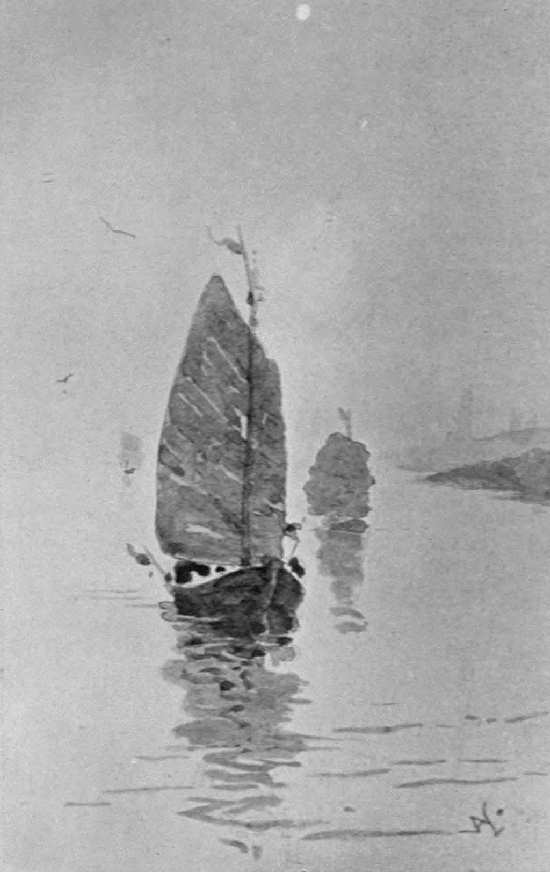
ON THE YANG-TZE-KIANG After a water-colour drawing by the author "And the streams sometimes widen into regular lakes, the borders of which cannot be descried by the naked eye" [To face page 340]
Everything is large, gigantic, in this yellow empire, and even in those parts where the country offers neither geographical advantages nor natural charms, we are impressed by its vastness, its immensity, as all that is truly great is imposing.
Japan, with its groves of evergreen, its flowering meadows, its smiling, graceful scenery, delights the beholder; but China, with its wide expanses, its enormous tracts of land and its virgin forests, captivates us by its sombre magnitude.
And if the difference between the external conditions of the two yellow empires is great, still greater is the distinction between the peoples which inhabit these neighbouring states.
Physically the Japanese is small, but strong and wiry—he is all muscle. The Chinaman is big, broad-shouldered, and his nervous system is more developed. The Japanese is before all things a man of action. He lives in a perpetual state of motion, he is always doing, and works from morning till night. His marvellous vital power finds expression in a multitude of ways. He acts hastily, often too hastily to give himself time to consider his actions. The Chinaman, on the contrary, is reflective. Before he undertakes anything he thinks out every detail of it, and his intelligence thus greatly reduces his actual labour. The Chinese coolies and labourers are like so many intelligent machines. They work imperturbably, with systematic precision, and always attain their end. Instructive instances of this may be seen among the Chinese labourers abroad, where a Chinaman does the work of two Europeans with half the trouble. The secret of the advantage which they thus gain over their Western rivals lies first in the right distribution of labour, and secondly in that great moral quality which ensures their success, namely temperance. The Chinese working in the fields of California, in the gardens of Australia, or as miners in South America, are good examples of the vitality and energy which these people possess.
It is foolish to say—as I have often heard it said—that the advantage lies simply in the stronger constitution of the race; on the contrary, very often we must admit that the true advantage lies in their intellectual superiority. These national characteristics may be best observed in the lower classes, and particularly in the domestic servant. Every European residing in China acknowledges the superiority of the native servant above any other. He is quiet in his movements, intelligent, industrious; and it is almost incredible how quickly these Chinese peasants learn to anticipate the wishes of their European masters. At the foreign Embassies at Pekin and at the Consulates of the interior, I observed how the pigtailed cook prepares the most delicate dishes according to the latest art in French cooking; the blue-robed house-servant keeps the establishment in perfect order, and the day labourer performs his task with accurate precision.
But it is on a journey that we have the best opportunity for learning to appreciate the salient qualities of the Chinese servant. Far in the interior, in lonely, barren regions, our yellow companion always found ways and means to prepare a warm meal for us, and to improvise a tent or hut wherein we could pass the night. The missionaries in China tell many stories of the marvellous resourcefulness of their Chinese attendants; how they saved the itinerant pastor from dying of hunger and thirst; how, if there was nothing better to be had, they would catch a few sparrows and make a savoury dish of these tiny birds. And, if even tiny birds failed, they would make pasties of locusts or a dinner from leaves and grasses.
Of the Chinaman it may be said with truth that he never gives in. This, indeed, is one of the chief characteristics of his race. He is resourceful even where the European has given up in despair. And we must have the courage to face this truth. The recent hostility against the Chinese coolies in San Francisco, and the laws against yellow labour lately put in force in Australasia, are the expression of it. It is true that among the Chinese labourers abroad there are many spoiled characters, drunkards and card-players; but I venture to think that it was not out of consideration for them that the decrees were issued which prevent the Chinese coolie from enriching the public-houses in America and Australia through his intemperate habits, nor yet to save him from wasting his substance in the foul quarters of the harbour towns. No; all these measures rather indicate the existence of a racial jealousy, for as a rule the Chinaman is more industrious and more temperate than the European. The question of Chinese labour has in our times become one of the economic problems of the Far East, of America and Australia, and recently also of South Africa. However, this is not the place to enter further into this question. Here, as relating to our subject, it is only of importance to note that the coolie who belongs to the lowest class of Chinese society, although he is poor, has fewer wants, and receives smaller wages, than the labourer of any other country, does not on that account do less work or work of an inferior quality. On the contrary, both intellectually and physically, he is generally not behind his social equals of other nationalities.
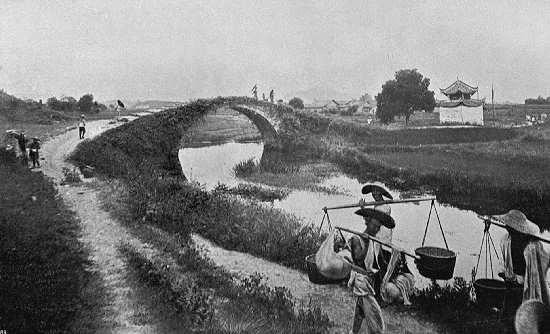
IN THE FLOWERY LAND "The coolie, who belongs to the lowest class of Chinese society, although he is poor, has fewer wants, and receives smaller wages, does not on that account do less work" [To face page 344]
Very marked also are the virtues of the Chinese tradespeople and merchants; in other words, of the lower middle class. Here again, what strikes one most is the amount of work done and the indefatigable zeal of the people. In the second place we note with surprise the simplicity of their way of living, their evident contentment with the bare necessities of life, even among the fairly well-to-do, and their desire to be and abide in the state of life in which they have been born. The joiner's son becomes a joiner, the builder's son a builder. Only by way of exception does a Chinaman strike out in a new direction. The height of his ambition is, at most, to become a better joiner or a better builder than his father was before him—to improve in quality more than in quantity. Another prominent feature of the Chinese trader is his respect for his caste. As in Japan with the Daimios and Samurais, whose moral basis was a military one, the pledged word was sacred, and the white flag inviolable, so the peaceable trader of China, whose life is governed by the civil code, is always true to his bargain. There is scarcely an instance on record in which a Chinese tradesman has broken his word. In the large commercial towns, overcrowded with merchants and goods from all parts of the world, written contracts with Chinamen are hardly ever thought necessary. Market prices and rates of exchange may vary—and in many cases the local producer incurs heavy losses by a premature selling of the harvest to the European agent—but when a sale is once concluded, a Chinaman never attempts to evade his obligations.
European bankers and wholesale dealers tell us that the difference between China and Japan in this respect is great. In the case of the latter, unfilled engagements and arrears of payment are a standing rule in the ledger accounts of most Continental firms, and considerable loss is sometimes incurred by these houses through the avarice and the subtle devices of some traders. The Japanese to a certain extent, in imitation of the Latin nations, aims at becoming rich, or at least well-to-do, quickly. It is his object to amass sufficient wealth, by a few profitable speculations, to enable him to retire into private life.
The Chinaman, on the contrary—like the Anglo-Saxon—makes trade his vocation in life. "Life is business," he says.
And so in China as in England, or perhaps even more in America, the industrial classes and the merchants have become the ruling power in the country. Socially they constitute a privileged class. As in Anglo-Saxon states the Chambers of Commerce and the Trade Unions, so in China the ancient Guilds arrange all business matters for themselves. The Guilds, indeed, are a most important institution in Chinese society. Their influence is not confined to trade and commerce; it dominates many other relations in life, and the often secret resolutions passed by the Guilds are of great force in matters of local administration and general politics.
Some of the larger Guild or Club houses are well worth our attention. From an architectural point of view they are good specimens of old Chinese style. They generally consist of several buildings, or more correctly, of a row of halls and pagodas, separated by flower-gardens with small fishponds, and courts with shady groves. Besides the official departments there are conversation-halls and tea-rooms, much frequented by the members after the transaction of business. The most magnificent of these houses are found in the interior, in the cities on the Hoang-ho and the Yang-tze-kiang. The club-house of the tea-merchants at Hankau ranks first in point of artistic perfection. It is a good specimen of the national taste. Slender pagodas, china towers, trim gardens, boldly arched bridges, all harmonious in form and colour, testify to the marvellous creative genius of this people. Never have I seen such finely pointed, tent-shaped roofs, such delicately tapered gables, such carving, and such tracery. Never could I have believed it possible for any architect to build, in fragile clay and line pottery, such bastion-like walls, and towers reaching up into the sky, and surmounted by a roof of porcelain as delicate and rare as a precious teacup. These Guild-houses are truly store-houses of old Chinese art treasures, and in them receptions and dramatic performances often take place.
Among the musical and theatrical entertainments of China, there are some which continue from morning till night. On their merit, however, a European can hardly be expected to pass a fair judgment. The queerness and quaintness of the performance is what strikes one most at first. Yet among the old dramatists there were many of first-rate talent, and life and knowledge of the world were very forcibly expressed by them, but in a form unfamiliar to the European mind. The Chinese, we think, are sometimes too realistic and somewhat formal actors; but yet, even in their modern, degenerate, historical pieces, we find frequent traces of the prehistoric ideals of the Greek drama.
The musical accompaniment of the performance is no less interesting. Contrary to the generally accepted idea that the Chinese have no feeling for music, I venture to think that Chinese music, although it may be discordant and unpleasing to the European ear, is not without great merits. We should not forget that the Chinese musical scale is set quite differently from ours, and is offensive to us chiefly because it is unfamiliar. But notwithstanding its deafening shrillness, it has great rhythmical power; and after all it only sounds harsh to us on account of its complexity. It must not be forgotten that their musical tones are not, as in the West, divided into two, but into four parts. In fact, they have not only half, but third and fourth gradations.
The same with regard to their plastic art—the foreigner is easily apt to consider the external form only. He appreciates or rejects it according as it comes up to our Western standard of beauty or not, but does not stop to look at it from the national cultural point of view. And yet it is impossible to understand Chinese art without doing so. In China art was confined to experts, while in Japan it acquired an ever-increasing popular character. But the Chinese is by far the higher form of art. The Chinese have always been the teachers and pioneers in all matters of thought and creative genius in the Far East. Architecture, sculpture, painting, with all their various ramifications, date back to the remote ages of Chinese antiquity. What we have on record of the time of the first emperors gives us some idea of their refinement and of the art treasures then already in existence, and of still greater value in this respect are the few known monuments of the Shung Dynasty and of the subsequent Mongol period.
Interesting above all are remains of buildings dating back to the Ming Age, which still exist in considerable numbers. Chinese art surprises one principally on account of its force and of the originating power manifested by it. In their colossal structures we chiefly admire the height of the pagodas, the length of the bridges; we are struck by the earnestness of the conception, the magnitude of the design, the masterful execution, the concentration of thought; all these appeal to us even now, in their dilapidated condition. The Imperial Palace at Pekin, although in ruins, is still one of the most magnificent structures in the world. And the same might be said of all other branches of art. We see it in the old bronze statues, in the delicate porcelain work, the exquisite carvings, and the precious cut stones. These relics in themselves may leave us cold, design and colour may not be to our taste, but the artistic idea, and above all the artistic ideal, underlying all these masterpieces, and the power of execution, cannot fail to impress any one at all interested in art.
We must remember that although the Chinese conception of art is so different from ours, the interest of it to us lies not exclusively in the productions themselves, but rather in the mind which produced them. The longer we associate with the Chinese the more we feel attracted to them, the more we recognize their worth, embodied in the versatile spheres of art and culture. In process of time we learn to appreciate, not only the civilization of Chinese antiquity—which was centuries in advance of ours, and had already reached a high state of development when Europe was still peopled by wild, unknown hordes—but we also begin to appreciate the different embodiments of that strange culture too.
When we study the history of the people in the days of their glory, or read the biographies of their great emperors, we almost become reconciled even to the inferiority of their existing form of government. Only as we glance through the works of their sages and great writers, who lived many centuries before our era, do we get a somewhat clearer idea of the intellectual capacity of this race, whose culture extended beyond their own boundaries far into neighbouring lands; penetrated to the uttermost borders of the East, and finally—making its way across Korea—laid the foundation of Japanese civilization.
This primeval culture has crumbled away. Only here and there among the ruins do we find glowing fragments and brilliant pieces of it; but even these remnants fill us with genuine wonder, and are eloquent witnesses to the greatness and strength of the nation's genius.
What has remained strong, above all, to this day, amid the complete general disorganization, is the race itself, as such. The prejudice against the Chinese may still be as general as ever, yet one cannot help drawing attention to the fact that neglected, uneducated, and wretched as the population is at present, there are everywhere abundant proofs of unflagging energy and exceptional capacity for work. These two characteristics strike one most forcibly among the lower classes, while among the partisans of the European movement, the progressive mercantile middle class, or among the scientists, scholars, and statesmen, who still occupy the old classical standpoint, a rare power of perception and intellectual development is worthy of recognition.
The greatest living statesman of China is undoubtedly Chang-chi-Tung. His influence as viceroy of the two important provinces of Hupek and Hunan is supreme. Since the death of Li Hung-Chang he ranks first in the estimation of his countrymen. He may not possess an equally keen insight and the extraordinary knowledge of human nature which the late viceroy had at his command, and he may lack his political shrewdness, but from a moral point of view Chang-chi-Tung occupies an incomparably higher level. He is not only a statesman, but he is also a sage and a philosopher. He is a follower of Confucius and every inch a patriot. He is said to encourage Confucianism among his countrymen, but he is tolerant towards other religious convictions, and within the radius of his colossal viceregal dominions, hospitality is shown to all, including Christians. In politics he is moderate, and although conservative in principle, he favours practical reforms and innovations, as may be gathered from the many industrial establishments in his capital. Personally he owns cotton-mills and factories, built a few years ago by Belgian engineers, which, under European management, have from the first yielded good results. Gradually the foreign employés have been replaced by natives, and at present the whole administration of this extensive concern is in the hands of natives.
The mercantile spirit of this enterprising viceroy is not in any way inferior to his political genius. Brick-kilns, china-, glass-, and iron-works and gun-factories, besides a whole network of railways, have been established under his administration. His soldiers, instructed by German officers, are probably the best drilled and best organized troops of the empire, and his well-equipped, excellently armed cavalry is the pride of the land. His energies, however, are more particularly centred upon the educational problem. He favours practical instruction, and in order to further this, he proposes to convert some of the unused pagodas into schools. Chang-chi-Tung, himself a writer of no mean order, is perhaps the best read, and certainly the most influential Chinese author living. His work entitled "China's Only Hope," published shortly after the last war with Japan, caused a great sensation. Several million copies were issued, and the Emperor himself wrote a dedication for it. This book is of great interest, not only for the Chinese, but also for us, because it throws a strong side-light upon the character of the author and upon the party to which at present the most important portion of the Chinese belong.
A few extracts will give some idea of the tendency of the work:—
"Comparing the history of China during the last two years with the history of Europe during the last fifty years, the question involuntarily arises whether the governments of Western states can furnish examples of benevolence, self-sacrifice, and loyalty equal to ours.
"Although China is not as rich as Europe, its people, whether rich or poor, high or low, enjoy greater freedom. European states may be very powerful, their ruling classes very rich, but the labouring population is disproportionately poor and miserable, and frequently unjustly dealt with. A system of government which ignores such social contrasts, or rather, which creates them, can never be an example for us to follow."
Elsewhere he says:—
"The standpoint of the West is practical; we, on the contrary, are idealistic. Our sages and our scholars have taught us that the happiness of a nation consists in the well-being of its people. Our religions teach us equality and charity; our customs, the organization of our family life, all social institutions, point to this one thing; to make the millions of our people contented."
Again, in another passage, speaking of inventions, he says:—
"I do not contest the technical superiority of the West. I myself am a promoter of progress, but I do not desire that our institutions, which have stood for centuries, should be transformed all in a moment. I note with satisfaction—speaking of progress—that the same elements which at first raged so fiercely against the introduction of railways and steam navigation, have now become the most staunch supporters of these useful inventions."
An equally interesting specimen of a modern Chinaman's opinion of European affairs, is a pamphlet which appeared some years ago, in the English language, under the title of "Letters from a Viceroy's Residence."
The author is a young Celestial who spent many years in the West, and upon his return was appointed secretary to one of the viceroys. The object of these letters was, in the first place, to convince his master of the fact that, in spite of his long residence in the West, he had remained a good patriot. In the second place, he hoped to awaken the interests of the Queen Regent. Several of these letters appeared first in the columns of an English newspaper, published in Japan, and unquestionably praise is due to the author, Ku-hung-ming, at least for his zeal in making himself acquainted with the various languages and literatures of Western lands. The power of his discernment and discrimination may be seen from the manner in which he points out what there is defective, puerile, and unintelligible amongst us. When he condemns shortcomings he generally does so by quoting our own writers against us, and he exposes our mistakes to the merciless scourge of our own criticism. There is not a writer, a statesman, or a philosopher, of any note, to whom he does not in some way or other appeal. He concludes an elaborate study of the civilizations of the West and the East with the words of Carlyle: "Europe is an Anarchy, with a policeman at its head"; and he quotes Ruskin, to apply to China the theory that "culture means a society of cultured beings."
"To the ordinary European trader it seems no doubt a strange thing that we should object to what he describes as the opening out of our national resources. Viewing everything, as he habitually does, from the standpoint of profit and loss, he conceives that if it can be shown that a certain course will lead to the increase of wealth, it follows that that is the course that ought to be adopted. The opening of China to his country and his trade he believes will have this result; and he concludes that it is our interest to welcome rather than to resist his enterprise. From his point of view he is justified; but his point of view is not ours. We are accustomed, before adopting any grave measures of policy, to estimate their effects, not merely on the sum total of our wealth, but (which we conceive to be a very different thing) on our national well-being. You, as always, are thinking of the means of living, we, of the quality of the life lived. And when you ask us, as you do in effect, to transform our whole society, to convert ourselves from a nation of agriculturists to a nation of traders and manufacturers, to sacrifice to an imaginary prosperity our political and economic independence, and to revolutionize, not only our industry, but our manners, morals, and institutions, we may be pardoned if we first take a critical look at the effects which have been produced among yourselves by the conditions you urge us to introduce in China."
This statement is of peculiar interest as showing that with regard to European innovations China occupies a position diametrically opposed to that of Japan. Evidently China is not blind where European conditions are concerned. The Chinese do not ignore the material and technical advantages and achievements of Europe. They realize with tolerable clearness the superior material conditions which modern life offers. The only point upon which they are not clear is how far all these innovations help us to make life more tolerable, and how far they contribute to the inner satisfaction or happiness of the people.
"I have learned that the most brilliant discoveries, the most fruitful applications of inventive genius, do not of themselves suffice for the well-being of society, and that an intelligence which is concentrated exclusively on the production of labour-saving machines, may easily work more harm for the dislocation of industry than it can accomplish good by the increase of wealth. For the increase of wealth—that is, of the means of comfort—is not to my mind necessarily good in itself; everything depends on the way in which the wealth is distributed and on its effect on the moral character of the nations. And it is from that point of view that I look with some dismay upon the prospect of the introduction of Western methods into China."
The author then describes at some length, and perhaps in somewhat too glowing terms, the cheerfulness, the contentment, the philosophy, the joy of living of the Chinese people. He speaks of the strong bond of affection which unites families, their literary and artistic tastes, their deep-rooted love of nature, all of which stand them in such good stead in time of trouble.