EMPIRES AND EMPERORS (continued 4)
Reading edition
It is considered very bad form for brothers and sisters to associate with each other. The inevitable consequence is that family life, as we understand it, has no existence there.
The Korean regards his wife as a being far below him, and would not think for a moment of consulting her on anything of consequence. Although man and wife live under the same roof they are practically aliens to each other. But strange to say, though women in Korea have no rights, either social or within their own family circle, they are outwardly respected and addressed in terms of high esteem.
If we consider that the bride has innumerable duties to observe towards her consort, while he has none towards her, it seems only natural that the number of happy unions is strictly limited. But notwithstanding the abnormal relations that exist between the parents, the children are brought up by the mother to respect their father deeply. Disrespect towards the mother is of no consequence, but insubordination to the father is severely punished. In prison, sickness, or old age, a father can always rely on the assistance and support of his son. No virtue in Korea is esteemed more than filial devotion.
A peculiarity of a Korean marriage is that it is a matter of interest to every one except the parties mostly concerned, who see one another for the first time at the beginning of the ceremony. The parents and friends arrange the match, in accordance with their own interests, and if both parties agree and the bargain is concluded, the formalities are of the simplest. There is no religious ceremony and no legal contract. Early in the morning the best man arrives to tie the bridegroom's pigtail in a knot on the top of his head, and this not only remains for ever as an outward and visible sign of his condition, but entitles him to be treated as a man and to enter public life. He may be a mere child, just over ten years of age, but he has no longer any right to play with his friends and must choose his associates among old men—octogenarians they may be. He has all civil rights and is expected to behave accordingly. If, on the contrary, a man is unable to afford the luxury of a home and a wife, he may reach the age of fifty, but he must still wear his pigtail down his back, has none of the advantages of a citizen, and is expected to play with kites, marbles, and such-like, and any folly he may commit is excused, as would be the naughtiness of a baby, who is not responsible for his actions.
The wedding ceremony itself is most simple. There is no going to the registry office or to church. The whole function consists of a procession, when the bride and bridegroom are conducted by their respective relations to a dais; there they are put face to face, and see each other for the first time, look at each other, bow, and the knot is tied indissolubly. The mutual surprise sometimes must be rather unexpected. But, whether agreeable or not, it is considered very bad taste to show any emotion. Without exchanging a single word, a few minutes afterwards the young bride is conducted to her home, where she is cloistered for ever. Social etiquette demands that the bridegroom shall return to the company of his young bachelor friends for a few days, which are passed in festivities, if not orgies. A honeymoon is unknown, and wedding trips have never been instituted. The young wife becomes more or less a head servant to her mother-in-law, and no visible change is introduced into the husband's daily routine. If married life begins in such extraordinary conditions, it remains equally ill-balanced all through life. The husband has everything, the wife nothing; she has not even a name. And yet, though legally a nonentity, socially, if clever, she can attain to a certain position. Unseen, unknown, and nameless, in a hidden corner of the women's quarter, she can receive her lady friends, get all the news of the outer world, and send messages by her slaves. There have been cases when women had even decisive political influences, and, like spiders, ambushed in corners, spread their nets.
VIII
The main occupation of the Korean is agriculture. It is the ground which produces everything that is necessary for life, and it is the ground, also, which is taxed principally to furnish the necessary funds for the Government. The methods of cultivation are exceedingly primitive, but the soil itself is so extremely fertile, and the irrigation so good, that the crops are quite sufficient. The women share in the cultivation of the fields, besides which they do all the domestic work, which is no mean task if we take into consideration that many functions performed in other countries by tradesmen must here be performed by them, such as the cutting of the flax, the preparing and weaving and the making of it into garments—so that they are field labourers, manufacturers, weavers, tailors, and finally washerwomen to their own husbands and households. It is the same with all the food. The poor women must first grow the rice and beans, then cut and dry them, pound them, and lastly cook them. But the principal occupation of the women of Korea is the preparing of their husbands' suits of clothes. A Korean has generally two suits of white linen, each of which he wears in turn for a week. These suits are not sewn, but stuck together, and every week the suit that was worn the week before must be taken to pieces, washed, and then glazed by beating, which last occupies almost a whole week.
The recreations of the women are very few, and, in fact, they are treated as slaves to their husbands. The men, on the contrary, have all kinds of amusements. The two great national sports are shooting with bows and arrows, and flying of kites. They are very fond of open-air gatherings, and arrange most delightful picnics, where they entertain their friends, and engage professional singers and dancers to amuse them. These singers and dancers are women who form a separate caste. Westerners find it difficult to appreciate Korean music, but I could not help liking its quaint cadence and plaintive melancholy. The songs mostly treat of historical legends and reminiscences of old days, but some, of course, are lyric. Korean dancing, on account of its dignity and calm, is by far the most plastic and rhythmical of all Oriental worship of Terpsichore.
Among the old customs, birthday festivities occupy the first place, particularly when a man attains his sixtieth year. On that day he becomes an object of admiration to the whole community, having been spared by Fate to such an age. After this day whatever he may say is listened to with great respect, even if his advice is not always followed.
But of all the social institutions funerals play the most important part. These last for days, or weeks, and even sometimes for a whole month, and mourning is observed for several years. And this observance is strict in Korea. One may even say that a mourner is buried alive, for he must cover his face, and, if he meets his friends in the street, he may not stop to speak to them or shake hands. During my stay in Seoul one of the late Empress's relations, General Ming, died, and I never saw a more magnificent pageant than his funeral. The cortège was over a mile long, and led by paid weepers. As it wound its way along, it was the most extraordinary conglomeration of riders, dancers, children, mourners, officials, torch, lantern, and flag bearers, and, in fact, it seemed to absorb the whole population of Seoul.
Children do not receive too much attention in this far-away country. The little girls soon share in the housework, and the boys leave their mothers when they are about six, being sent first to school and then to the men's quarters, where they are carefully secluded from any kind of woman's society, even from that of their own sisters.
Any one who is interested in Korean children will have an opportunity of studying their national characteristics and natural abilities in the schools, of which there are a great many in Korea. Besides the old-fashioned Primary Schools, there are the Chinese Classical Schools, Missionary Schools, and, last but not least, the different National Schools for Interpreters. There are several English, even more Japanese and Russian, all of which undoubtedly will be of some use; and there is even a German School, and, of course, a French Interpreters' School. I must say I was deeply interested to see the scholars, neatly dressed in white cotton, sitting with Oriental patience at their desks, and pronouncing with the greatest assiduity the unpronounceable and to them unintelligible syllables. I admired the endurance and self-control of the children. If they are not quick and have not the imaginative capacity of a Japanese child, they are good, even if not so deep thinkers as the Chinese.
The houses in Korea are very small and offer but little comfort. Most of them have not more than two rooms, exclusive of the kitchen. Three-roomed dwellings are very uncommon, and without exception are most scantily furnished. The roadside inns naturally are of the most primitive kind, and visitors are expected to bring their own provisions and bedding with them.
The staple food consists of rice and a few vegetables; people with some means eat occasionally a little meat or fish. Milk and butter are unknown. Beef is difficult to obtain, except in the capital. There is no mutton, but plenty of dog's flesh.
The principal beverage is made of fermented rice. Koreans, like Chinese, are fond of their pipes, and smoke a great deal.
Their dress is very ample. To be smart, you must wear two or three pairs of trousers, as many shirts, and four or five kaftans made of white linen. Sandals are the principal foot-gear.
Chess is one of their popular games. High and low are alike enthusiasts. In fact, the Koreans have almost as high a reputation for skill in the game as the Chinese.
They are also fond of card-playing. Gambling seems to be in the blood of the Yellow races. There is no country where card-sharpers drive so brisk a business as in Korea.
In outdoor sports the Korean does not excel. His disinclination to physical effort is too strong and his nature is altogether too lethargic for violent exertion. Such mild diversions as kite-flying and archery he sometimes does indulge in, and, if so, shows no little proficiency.
Game is plentiful, but energy rare, and so we do not find many types of the shikari of India, but more of the trapper class.
The Koreans are a musical people. Every village has its choir—its amateur musical society. With them songs are largely used as an accompaniment to the dance. Here, at last, the Korean awakes.
The theatre proper is not represented in this country, but they have dramatic performances of a kind.
Recitations are given by a single performer, who himself plays all the characters of the story. It reminds one somewhat of the Homeric rhapsodists, or the medieval jongleurs.
IX
The last quarter of the nineteenth century has brought about some unexpected changes in Korea. The rigid isolation is gradually vanishing. Not even Chosen is able to conceal from the outer world her hidden and Hermit Land.
The first breach was made by the United States Navy. Commodore Shufeldt was the first representative of a Western Power to conclude a treaty with her. A year later the Anglo-Korean commercial agreement was ratified. Then the other European Powers came in their turn to establish diplomatic relations there. In the meantime the prejudice against the foreigner is losing a good deal of its virulence. The first steps towards international intercourse had been made.
These relations with foreign countries promise, above all, to be advantageous to commerce and industry; and considering the comparatively short period during which this influence has been at work, and the primitive conditions of locomotion, foreign trade is making unexpected progress. The receipts of the foreign Customs are steadily increasing, and whilst the returns of 1893 amounted to 7,986,880 yen, in 1898 they reached the sum of 24,702,237 yen. The latest statistics show the Customs revenues as £122,783. The total import of the last year represented £1,382,381, and the exports £846,034.
Besides the capital, Seoul, Chemulpo, Fusan, Gen-San, Mokpo, Chinampo, Masampo, Kunsan, and Song-ching are being opened to trade. The general commerce is almost exclusively in the hands of Japanese and Chinese. In this respect Japan has made extraordinary progress during the last few years. In 1897 her imports amounted to 1,911,851 yen, and those of England were 3,713,907 yen. Four years later the Japanese trade increased to 2,844,815 and England's dropped to 2,853,866. Since the Commercial Exhibition at Osaka, Japan's trade with Korea has advanced even more, so that, for instance, cotton goods, once imported exclusively from Manchester, are now replaced by the fabrics of Nippon. The latter seem to be in a more advantageous position, for, considering that the distance between Japan and Korea is inconsiderable and the wages in these two countries are only one-sixth of those in English manufacturing towns, European products are experiencing more and more difficulty in competing with the Japanese in Asia. The shipping trade, too, is in the hands of Japan, and in the course of last year 3920 vessels with nearly a million tons of cargo anchored in the ports of Korea. Besides Japan and England, there is America that is seeking a new market for her exports. Of continental European countries, Germany is represented by the greatest number of articles, though of small importance and size, like nails, stove pipes, needles, chemicals, and aniline dyes. The total imports from Germany at present scarcely represent a quarter of a million marks.
The Chinese share the local trade with the Japanese. The shopkeeper belongs to one or other of the neighbouring states. As we observed when referring to the past state of Korea, her own people possess no commercial instincts. Their needs are few, and even those are supplied in their homes. Their clothes are woven and sewn by their wives. The flax grows in their gardens. Every house has as much ground attached to it as suffices, more or less, for the wants of the family. More than that is not required. It is owing mainly to this patriarchal simplicity that, though the soil of the country is rich, not half of it is under cultivation.
The manner of tilling the soil is rather primitive. Up to this day wooden ploughs are used. Threshing is done by ordinary poles. Agricultural implements are unknown.
In spite of her fertile valleys, favourable climate, and cheap labour, Korea is not agriculturally developed. Of its products, rice takes the first place. There is also plenty of wheat, barley, oats, and beans. The most profitable plant is gin-sen, which has already been described.
The principal wealth of Korea is undoubtedly stored in its mines. The amount of ore contained in the mountains of the country is prodigious. There are numerous ancient gold and silver mines, although their working was prohibited by law. Since the conclusion of the international treaties some of them have been taken over by foreign companies, and already, during the last few years, have produced considerable profits. In 1897 the export in gold amounted to 2,004,049 yen, in 1901 to 4,993,351 yen. But under the present conditions it is impossible to ascertain the exact amount. The mountains in the north-eastern part of the country are the richest in gold. The capital invested is mostly German and Belgian.
In addition to gold and silver, there are copper, iron, and coal mines in working, but commercial enterprise is rather handicapped by the want of means of communication.
X
Until recently Korea was not only almost devoid of railways, but had scarcely any roads. Transport by means of carts is to this day exceptional—oxen and pack-horses only being employed. Endless strings of caravans cover the whole length of the land. Seeds, timber, fuel, metal, and stones—everything is carried by cattle to its destination. But human labour is even more general and much cheaper than animal labour. It is still the man's shoulder that carries most of the load and burden. What a Korean can carry is almost incredible. Besides heredity it is only through long training that he has acquired such exceptional strength.
One of the most ancient organizations of Korea is the Pedlars' Guild. It was founded centuries ago. There are families who for generations have known no other occupation than carrying the miscellaneous pack from one part of the country to another. They wander over hills and dales from morning till night. Like their ancestors they migrate continually. It is little wonder that they should have known the inner state and life of the country better than anybody else. They were the carriers of news in Korea, and represented the Press of their land, and their influence and power still prevail. Public opinion finds in them its most direct interpreter. There is no movement, outbreak, or revolt in which they do not participate. The most important messages are conveyed through the pedlars, and it is their guild that nourishes the flames of all rebellions.
In Korea there are several fine rivers. The Han, watering the central provinces of the country, and the Yalu in the north, are the two principal ones. During a few months of the year both are frozen. Neither of them is used as a waterway. The traveller who is fond of adventures hires a fishing-barge, engages a dozen fishermen, and taking with him some old furniture and provisions, tries to make himself comfortable in that Noah's ark. Steamers are unknown on the rivers.
Railways are now in a somewhat more advanced stage. Between Chemulpo and Seoul there is a regular train service, and the short distance of twenty-six miles can be covered with Western comfort.
Japan is at present engaged in building the great southern line as far as Fusan. A French company has obtained the concession to build the northern line. On the other hand, the work of a private company on the line leading towards Manchuria is making little headway. Still, it is only a matter of time for Korea to become a network of railways. Then her harbours will be the natural gates of Eastern Asia. Her bays in the south are always free from ice, making most excellent ports, and capable of harbouring any number of ships. Chemulpo, but more particularly Fusan, the extreme southern point of the peninsula, must necessarily become one of the termini and one of the principal emporiums of the whole continent. I do not think that those who look upon it as the Shanghai of the future are mistaken.
Besides railways, Seoul possesses also an electric tramway and electric light. Both concerns were planned by American companies, and are said to be very profitable. The new Mint is also organized on European principles. The standard money is the Japanese yen; the brass rings used formerly as small coins are being replaced by the nickel sen. The various commercial articles are steadily undergoing changes, and manufactured goods are ousting the homemade products of the small shops. Each day supplies new things and ideas. Each week marks another step on the road to progress. The work is slow, being rendered difficult by many obstacles from within and without, but it cannot now be stopped in its natural course.
Korea is at present in her first stage of transition. The old system has collapsed, and a new order must be inaugurated. Most striking to the stranger are the antagonisms of the present day. Almost everything is in a state of metamorphosis, and it is curious to notice institutions of past centuries by the side of recent reforms. Through the ancient city gate electric cars are passing, and in the vicinity of the gabled pagoda can be seen the chimney of a factory. Day by day some Western institutions, customs, and ideas are being adopted. It looks like gradual advancement.
XI
It is barely some decades since Korea opened her doors to foreigners, and even in this short time she has introduced innovations which have shaken her to her foundations, and I fear even greater changes are awaiting her in the near future. Her ancient suzerain, China, has retired from her political arena, but Japan has taken even stronger hold of the country than ever before, and a new element has been introduced into the field by the occupation by Russia of Manchuria and the Yalu. Such was the condition of the country when in 1894 the war broke out between China and Japan. Korea obtained her independence without participating in any way in the great fight. Her king became an emperor. But all these changes were only superficial. A new internal administration could not be consolidated in a few days, and Korea's independence is only on the protocol.
The freedom of Korea was, as we saw, proclaimed with great pomp just at the moment when she had the least chance of making use of that unexpected independence. Surrounded by enemies, she had neither the moral strength nor the military force to maintain it. She was bound to follow the advice of one or the other of her neighbours; in fact, it was only by showing herself to be of no use to her allies that she could ensure her very existence. One day it was the Chinese, the next the Japanese, then the Russians. She has always been a mere instrument in the hands of these Powers. Their influence has changed very rapidly without any apparent cause. Which of her attachments has been the most sincere, who can say? The manifestations of both were equally ostensible and complete, and the Koreans went so far as to proclaim their adherence by adopting the uniform of the favoured country for their soldiers, and the inhabitants of Seoul have had the pleasure of seeing their army parading the main streets first in the uniform of Cossacks, and then in that of Nippon.
Ever since the latter part of the nineties Japan has been showing remarkable activity. She has invested considerable capital in the country, opened banks, founded large commercial firms, built railways, and established a regular steamship service. She goes even farther and is endeavouring to instil fresh life into the people. She is trying to remodel the Korean government on Japanese principles. As to the army of (nominally) eighty thousand soldiers, of which nearly eight thousand are stationed in Seoul, it is being drilled by Japanese officers and supplied with European rifles and uniforms. Japan is establishing modern schools, and desires to transform young and old alike.
During my visit Russian influence contended with Japanese for the mastery, but in the midst of all these antagonistic fluctuations it is scarcely possible to speak of political convictions. The people dislike the Russians as much as they detest the Japanese. They resemble a man in danger of drowning, who stretches out his hand to his enemy, in the vain hope of not being submerged in the floods. Public men are divided into a great many parties and form different political groups. Some even belong to the most reactionary of the time, while others are more favourably disposed to progress, and all of them are open to conviction where personal advantage is concerned. If the dislike of foreign nations is intense, the hatred of their compatriots who are attached to other political factions is still greater. And when the national apathy and indolence are broken through by animosity to rivals, the people become blind to reason, cruel, and bloodthirsty. They have no self-control, as they have never been trained to a higher moral standard, and there is no education such as will develop their better qualities. Among all the puzzles of the present day in Korea, certainly the most important is how to bring up the rising generation. The conditions, not only of Korea but of the neighbouring states, being entirely changed, her old methods are of no practical use for the present situation. The future requires a different system. In order to face the difficulties of the present, they must bring up their children to be men; and I have been most interested to note how the children respond to a better method of training. During my stay in the country I visited again and again native, foreign, and missionary schools, and came to the conclusion that the Koreans are not lacking in the mental qualities which are required by our Boards of Education. I listened to boys of fourteen and fifteen, not only translating the classics as well as the children in our schools do, but, what was more exceptional, they showed a real pleasure in dealing with deeper questions, where logical thought and sequence of ideas were requisite. They like to study, and, to my great astonishment, I was told by the rector of our seminary that, during the vacations, many of the boys go on with the next year's course.
Their moral training is not very difficult either. The children are docile, obedient, and good-natured, and are most amenable to religious principles. Catechists have a high opinion of their catechumens, who take deep interest in theological doctrine. As a rule, they evince a real desire to be better acquainted with spiritual matters, and, if they become Christians, conscientiously adhere to their faith and observe the religious rites. All who have lived in Korea are of the same opinion—that this unexplored country and its backward people need before all cultivation and education, and it depends entirely on those who take this great work of development into their hands whether it shall become a flourishing land and its people happy or not. And in that case, instead of the country being the seat of disturbance and war, and the inhabitants mere instruments in the hands of their enemies, the land of the Morning Calm may deserve its name and become a guarantee for the commercial prosperity and the peace of the Far East.
Such was the general situation at the moment of the outbreak of the Japanese-Russian war.
XII
It is evident that Korea is yet incapable of self-government. She is dependent on one or the other neighbour. Since China fell out of the ranks of conquering Powers Japan has taken up arms as she did centuries ago. To-day it is she who is aiming at ruling Eastern Asia, as if it were her mission to awaken the peoples of Asia and to instil Western civilization into them. The movement is of great interest and of more import than we should dare to believe. Its significance is incalculable. Whether Japan will be the master who is to transform the Asiatic races is another puzzling problem. Already a considerable number of young Chinese are frequenting Japanese high schools and colleges. Delegates are being sent from Pekin, at the expense of the Government, to Japanese commercial and industrial institutions to study and to become acquainted with modern ideas.
Korea is face to face with similar problems of transformation. Who is to secure her definite leadership—Japan or Russia? The present war is more than a boundary dispute; it means the old struggle between the white and yellow races for the hegemony of Asia. On whichever side success ultimately lies, on that of Russia or of Japan, let all those who know Korea and are interested in her fate, hope that the conquerors will fulfil the duties victory involves. The little country deserves that her rulers should earnestly study her conditions and seek to improve them. Even from a merely utilitarian standpoint it will prove a better policy to develop and help than to exploit to excess or to oppress her. It is just as important that her people, who ever since their infancy have been the victims of cruel foes and the prey of bad government, should be elevated to a higher standard.
For those who like to gather knowledge, not only about the outward circumstances of foreign countries but also about their inner life, it will be of interest to know that in spite of their degradation Korea's people have preserved unimpaired the sensitiveness of their mind. They are by no means insensible to lofty ideas. They are even capable of showing some enthusiasm for higher ideals. There is hardly another nation in the East which evinces more sincere appreciation of Christian ethics and doctrines than the Koreans.
Scarcely half a century has passed since the first Roman Catholic priests began their work, and they already number about fifty parishes and over fifty thousand parishioners. The old religious hatred is gradually changing into sympathy. Recently a few orphanages were built where children, abandoned by their parents, are being brought up and trained for some useful vocation.
The people are beginning to conceive clearer ideas about Christian virtues, and those who see under what wretched conditions the missionaries live, in what poor huts they dwell, on what scanty fare they have to live—especially when they realize that these men have left their own families, homes, and their country to educate little orphans, to help the needy, and to nurse the sick, no matter of what creed or sect, be they pagans or worshippers of the sun or of ancestors—regard this self-sacrifice with an admiration which is general and sincere.
For those who wish to form an estimate of the intellectual powers of a people, the missionary schools offer undoubtedly the greatest facilities. It is there that the natural inclinations, good or bad, find direct expression. Of all my surprising experiences in Korea—a country rich in surprises—nothing equalled my impressions of the new college and seminary at Yong-Sang. There young people of twelve to fifteen gave as precise answers to questions put to them as one could hear in the best European high schools. And there Korea's primitive children can express themselves fluently in classical Latin. It was interesting for me to get an insight into their capabilities and observe their industry. For hours they would pore over their books if the teacher would not call them away for recreation. With the inherited inclination of Oriental people for abstract sciences, they enter with delight and pleasure into any metaphysical question. I was delighted to hear how successful their training is, and how easy it is to form their minds. I saw young Korea in a new light. There I best realized the force of the maxim that the future of a nation lies in the potentialities of its youths and their sound bringing up. But education can be of value only when carefully founded on higher morality and guided by true religion.
With such an education Chosen's children might hold in their hands one day their country's independence and prosperity.
Korea's exceptional geographical position, its natural wealth, and inborn physical strength, should tend to make her in the extreme Far East a sort of buffer state, and a bulwark of international good fellowship and established peace.
Nations, like individuals, have their moral codes and vocations. Nemesis must always overtake evil of every kind, and to the virtuous alone is granted the palm of victory.
IX
SEOUL, THE CAPITAL OF KOREA
I have arrived safely in Seoul. It is eventide, and the moon is just appearing. In the dimness the most desolate imperial residence in the world seems still more desolate, more wretched, miserable, and forlorn.
My sedan-chair is being carried through a long street, or rather road, of small houses—but houses they cannot be called: those I have seen up to the present can at the best be termed hovels.
At last we reach the walls of the inner city—for till now we have been merely in the outer town. The wall is ragged and thorny. In front stand a number of roofed and painted gates. I almost imagine myself back in Pekin, for the picture is a replica, but in miniature. I am, however, unable in the dusk to see how much smaller it is, only the general effect is the same, stamped with the familiar Chinese characteristics.
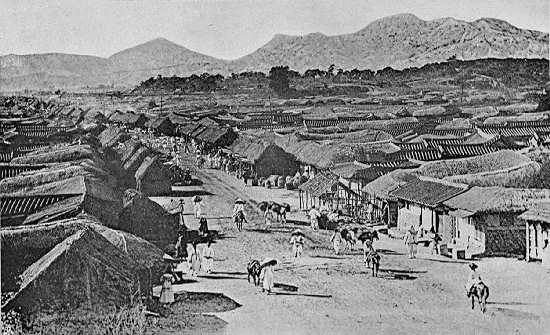
SEOUL "The broad streets seem an immense cemetery, and the mean little flat-roofed houses graves" [To face page 240]
The moon is now shining brightly, but it shows nothing new in the aspect of the road within the walls. The main street of Seoul is as deep in clay and mud as it was at the time when the "waters dried up." Its houses have not altered; they are scarcely more than the clay huts of prehistoric man, his protection against cold or heat.
The first sight of an unknown country stamps itself on our minds in a manner unique, and I requested the bearers of my chair to walk slowly, for I did not wish to lose my first impression. There is a fascination in the unknown—a wonderful interest attached to the unexpected. Our wanderings amongst strange peoples in the streets of a city which we have not visited before are not for the pen to describe.
Everything that is unknown is mysterious, until reality tears aside the veil, and so long as it is built up by our imagination and peopled by fantastic creations it remains to a certain extent a City of Dreams.
The streets are gradually getting broader, and the clay huts grow even more insignificant. I stop for a moment in the great square, which may be the centre of the city, but is little more than a cross-road leading into a few side-streets.
It is scarcely seven o'clock, and yet over all broods a death-like silence, a peaceful calm, as complete as one can imagine. The broad streets seem an immense cemetery, and the mean little flat-roofed houses graves. One might think it is All Saints' Day, for on each grave a little lamp is burning. A lantern hangs from the eaves of each roof, showing a yellowish flame.
But the people themselves are returning like ghosts to their homes, each robed in white—each and all mute. Without a sound they flit over the roads of the endless graveyard, until they disappear into the depths of some one of the illuminated tombs.
I have never been so impressed by any other city I have seen as I was by my first sight of Seoul. As I saw the city just now, by the light of a November moon, dark, dumb, desolate, and ghostly, it resembled some fairy city more than reality; like those storied places sung of in the poetry of almost every people, the tale of which is listened to with such rapture by the little folk of the nursery, who know nothing as yet of life's seamy side.
Such a town was Seoul to me, the first few hours after my arrival.
Next morning I was aroused by the sound of drums and trumpets. But whose? Do they belong to the ghosts? What can have happened that the home of silence should have been disturbed by such an awful uproar?
I hasten to my window. The long street, the square, every inch of ground, is occupied by soldiers. These are short and yellow, wearing a black uniform, the black cloth of which, set off by a broad red collar and contrasted with the yellow faces, makes a motley colour-scheme, almost like a chequered field. The men seem to like it. If the mixture serves no other purpose it offers an excellent target for an enemy, which was probably the idea of its inventors.
The din continues. The trumpets blare, and these black, red, and yellow little people, like tin soldiers, keep moving before me; to and fro, up one street and down another they go, like stage-property soldiers, now appearing on and again disappearing from the stage—always the same supers; but one would think they were a mighty army. And all the time the bayonets flash on the rifle-barrels, whose weight seems rather too much for the little men. The drums still beat, and fanfares ring out on the frosty morning.
What has happened? Has the coronation not been postponed after all? Is the Emperor at last inaugurating the long-awaited festivities?
I ring the bell, and a servant, dressed in white, and wearing a pigtail twisted up in a knot, enters. His long coat is of linen, his head covered by a hat of horsehair, which resembles in shape the wire lid used to protect preserves from flies.
This quaint servant seems more surprised at my question than I at his livery.
"But the army has been reorganized by European officers. It has been taught, in the Western style, to march, manœuvre, and kill, and for the performance of this gay farce new taxes have been raised. And now you, a European, coming from the West, ask, with obvious irony, 'What does this all mean?'"
I can see how amusing the whole situation is, and what a ludicrous side it has. The fact of the collar being a few inches deeper, or of the colour of the tunic, does not alter the character of the uniform; it is still a distinctive mark, even in its best form, whether the mechanism which propels the bullet be new or old fashioned. The rifle always destroys, and whether a soldier is a couple of feet taller or not, whether he has a yellow or a white complexion, his calling is a rather gloomy one. For do we not consider that soldier most efficient who destroys the greatest number of lives?
Dawn now turns into morning, and the doors of the shops open one by one. Most of them are only protected for the night by mats or a few planks.
Later on the customers begin to arrive, all of them dressed in white. Men and women alike wear long linen coats (kaftans), and their lined foot-gear is also of linen; in fact, they are white from top to toe, excepting the black hat of horsehair.
Now and again I see a sedan-chair, which, however, is not larger than a good-sized box, its occupant huddled up inside. I cannot perceive any carriage, trap, or horse, in spite of the growing traffic, which, however, is perfectly noiseless. Perhaps this may account for the fact of my still being under the impression of being in a deserted city.
It is generally on the first day that we catch the most characteristic traits, or, at any rate, that the most salient features strike our imagination. While our perceptive powers are still fresh, we are able to be impressed by the smallest peculiarities.
After breakfast I go out for a stroll, and find in front of me the palace gate, outside which some soldiers are standing. Beyond it stretches a long street, towards which I turn. This is the same thoroughfare which yesterday resembled a vast graveyard, but the houses now stand open, as the wooden wall, looking on the street, has been removed. There are a considerable number of shops, but small and mean, displaying no wares that attract my attention. Those of the cabinet-makers make the best show, consisting of small chests, inlaid with brass ornamentation, having large polished locks. These are no less quaint than they are tasteful. There seems to be a great demand for them, for in a whole row I can see nothing else. There is also no lack of fruit and seeds, but the baskets do not offer a quarter of the variety of a Chinese grocer. I do not think I saw any more shops, at least any that I remarked. They seemed small and empty, never more than a couple of customers in them.
What especially attracted my attention was the large number of sentry-boxes. Every five or ten yards you came across a box, with a stubby black-red-and-yellow soldier inside, armed!
No matter where I turn, there are sentry-boxes everywhere—to the right, to the left, in front and behind me. Can it be a fact that this army is required to keep these little folk in order?
*****
No sooner had I put this question to myself than I became aware of a disturbance going on—some coolies, carrying vegetables, engaged in a battle royal, and two boys pitching into each other. But the private stands there unmoved. His look seems rather to approve than condemn. He is evidently not intended to keep the peace; this does not seem to be part of his duties; so the coolies may fight as much as they like among the cabbages. (The group, by the way, forms a pretty picture—the coolies in white, with the green loads on their backs, in the thick of the fray.) The smaller of the boys commences to cry, as blood is dripping from his forehead; but the soldier is not affected by the sight of this either. I wonder if what he just muttered was that the "Red Cross" was not his business.
As I went on I heard more screaming and quarrelling, and witnessed a few more little skirmishes. It was not until now that I realized how unaccustomed I was to quarrels and fights, as in China I never saw one man fighting another—they have their thousands of years of civilization to thank for that.
Later I approach a hall which is being repaired. It has a pointed roof and broad eaves, similar to those of the palace at Pekin.
A whole forest of wood is stored up there in the shape of beams. As I see with what precision the workmen make the various parts fit together, without the use of nails, I am delighted that the traditions of ancient architecture are not yet extinct.
I am now in the neighbourhood of the Royal Palace. In front of the main gate is a large square, which farther on turns into a street, with public buildings on either side. These are the Ministerial Offices, where is spun the web of the Korean Government.
Externally the palace has little to distinguish it. The façade is rather low, and the walls are mud-coated, while the gates are not much better, in the Chinese style, and crowned by tiles.
The gates, which are wide open, lead into a large inner courtyard, where there are a number of ordinary and state sedan-chairs. Crowds of servants, attendants, and coolies, are warming themselves in the sun, others are playing at ball, which they kick off and catch with their legs.
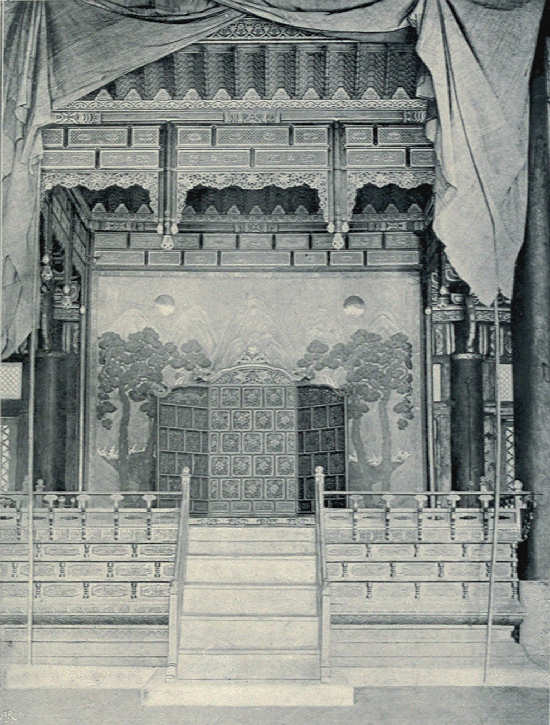
THE EMPEROR'S THRONE IN THE OLD PALACE "The throne is reached by a short flight of steps, and the canopy is of barbaric splendour" [To face page 248]
In the middle of the street one meets mandarins hurrying to their offices, magistrates and other men of consequence, most of them in chairs, or rather boxes, carried by two servants. The vehicle is covered with a cloth, that of the better class matching in colour the servants' liveries. I have seen grey and yellow ones also. These belong to the Korean aristocracy.
The most attractive of all was the "carriage" of a noble in mourning. His chair had quite recently been covered with cloth of a yellowish hue, the same as that worn by his two servants, their coats reaching nearly to the ground. In order to give their limbs free play, these had been split up as far as the waist. But this can be nothing more than fashion, for not even the whip would make a Korean hurry. The servants also wear a broad girdle, tied up in a bow, round their waists.
When in mourning they wear straw hats, not black, but shaped like a fair-sized old-fashioned bread-basket. These have wide sloping brims, reaching the shoulders, and entirely concealing the face. In such a weird costume they strongly resemble yellow mushrooms sprung up on a summer's day. Straw sandals complete the costume.
In spite of these strange details and absurd combinations, the general effect is good; the colours, the silk-covered chair, straw hat and sandals, blend harmoniously together. Seen from a distance, they almost have the appearance of ivory knick-knacks, such as you see exhibited for sale in Japanese curio shops.
But I hear a noise in the distance, and from the direction of the western gate a motley crowd comes towards me. It must be either a funeral or a wedding. So far I cannot distinguish which. The next moment two children detach themselves from the crowd and seem to lead the procession. Their dress is glaring, of green, purple, and scarlet silk, with their dark hair encircling their foreheads in gleaming plaits. They are also decked out with flowers and butterflies.
Behind them is carried a large box, painted red, and polished. It is evidently a wedding, and this is very likely the dowry. Now follow the dancers, in pairs, but wide apart from each other. Their costume—I cannot describe it! Almost shapeless, it consisted of skirt over skirt, kerchiefs, veils, all pell-mell and of every colour of the rainbow.
I take note of many things which to-morrow might escape me.
Street life is one ever-flowing stream. In Seoul, I observe, everybody lives on the thoroughfares, and this is probably the reason why the roads are so wide and the dwellings so cramped. In this trait the Korean is like the Spaniard or Italian, for he is never so happy as when out of doors. There he stands on his threshold, or basking in the sunny courtyards; or he lights his pipe and strolls up and down for hours. His carriage is slow and stately. I wonder where he is going, and what he is thinking of—nowhere and of nothing. I should say, "Il flâne." There is no suitable word in another language for this aimless meandering. "Loitering" indicates only physical slowness, nor does even "to lounge or saunter" exactly convey the idea. Physical sluggishness and moral vacuum are not simultaneously connoted by them.
Now and again a private comes by. He is the coming man! If he learns nothing else in the barrack-yard, he certainly does learn how to walk.
His pigtail has been shorn off. At first he bemoaned it, for this antiquated head-dress of his embodied a general principle, and with its departure he was cut adrift from all his old associations and traditions; but, like the child he is at heart, he soon forgets his pigtail and its traditions along with it, and today is proud of the metamorphosis.
As the man of progress and of the future, he scorns the white coats, sandals, and hats, of his countrymen.
On reaching the hotel I find a gentleman awaiting me; it is the Minister of Great Britain. He has learnt of my arrival, and is come to offer me his hospitality, my country not having a legation in the city.
The Hôtel du Palais in Seoul is new and fairly well managed, and so I did not wish to put any one to inconvenience. The bishop being away, and having no legation, I was anxious to remain my own master. We never know when we may become a nuisance to the kindest of hosts. The pleasantness of a visit, after all, depends more on circumstances than on the host or guest.
All this I frankly explained, and in the end we made a compromise in such a way as not to disturb our daily programme. I was to be his guest, but each of us was to attend to his usual occupations, and we were to meet only at luncheon time. As for the afternoons, we left everything to circumstances.
The British Legation, on the other side of the new palace, is a pretty country mansion, with a loggia, built on a bank, and enclosed by a garden. The secretary's house stands in another part of the grounds, and at the entrance a pavilion for the guards is in course of construction.
The interior is typically English, the same as we find it in the houses of the well-to-do classes, whose root principle is, "My home is my castle." Among those with whom the family life is such a fine example of domestic virtues, the "home" strikes us very forcibly and with such graciousness. Indeed, the "home" idea is one of Great Britain's bulwarks.
My room was ready for me, bright and cheerful. The creeper on the balcony was still green, and my windows looked out on to the courtyard of the neighbouring palace.
In the afternoon I went to the German Consulate, and passed on the way the Temple of Heaven—a pagoda standing on a hill, with a fair double roof and in front of it a marble altar.
It is a replica, a poor one it is true, of Pekin's masterpiece, but quite pretty from a scenic point of view.
From a small house at the corner a very babel of sound issues forth. It is the inarticulate mechanical repetition of one chapter—exactly the same method our own schoolmasters used to employ for instilling knowledge.
As the door in the courtyard is open, I enter. In front of me I find a room, not more than ten feet square, in which ten or more youngsters are crowded together. There they sit on the floor, dressed green instead of white, and their long hair hanging down in fine plaits.
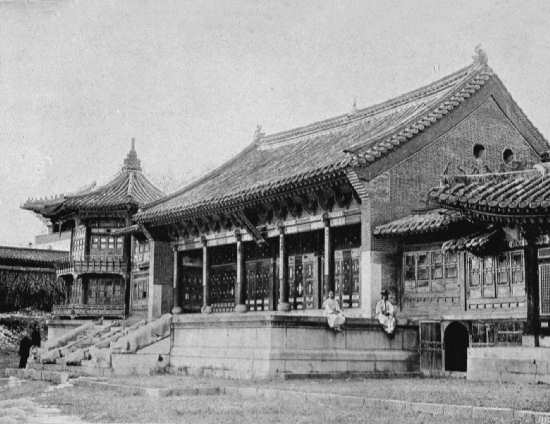
THE IMPERIAL LIBRARY IN SEOUL "One of those charming buildings full of originality" [To face page 252]
Each has a big A B C book in his hand. Every word has a different letter; these they repeat, and in this way knowledge is driven into them. They pronounce everything out loud, moving the upper part of their body to right and left, backwards and forwards, all the time.
The dominie is seated in front, also squatting on the floor. His eyes are shielded by goggles of enormous size, and he wears on his head a horsehair crown.
He is wisdom personified, outwardly at any rate, and his thoughts seem to be ranging far away in the distance; and from his Olympic seat he casts an indifferent eye on his perspiring pupils. But, as a famous Chinese pedagogue says, "Chinese spelling and writing can only be mastered mechanically; the best scholar is the jackass."
The German Consulate is a new building, but by no means as comfortable as the English. The Consul-General is also entrusted with Austro-Hungarian affairs, and would look after them if there were any to look after. But I am afraid that the Viennese Foreign Office of the present régime does not quite realize the commercial interests which it might promote, and follows strictly the advice of the late Secretary of Foreign Affairs, Ct. Kálnoky, given to an enthusiastic youth, "If you want to succeed in your career and maintain your position when once acquired, do not forget 'On n'est jamais en disgrace pour ce qu'on n'a pas fait.'" He is very courteous, and talks a good deal of Japan, where he acted as Councillor of the Legation.
From there to the Roman Catholic Mission is but a few yards. As I enter its iron grilled gate, my surprise is as great as it is agreeable, for I see before me a grand cathedral, and on either side spacious buildings standing in their own wooded grounds.
It was built on the model of one of the old cathedrals in the Netherlands—red brick, Gothic, a style which, as I invariably avow, I do not like to find in the East. But this is only a criticism due to my artistic sense. As a building, nothing can be said against it, for of its kind it is perfect. But what struck me most was its cleanliness. The stone floor was as bright as a mirror.
The bishop was away on circuit, and would not return for ten days, so Father——, the vicar, received me, and showed me over the whole little colony, the school, and convent and orphanage; but of these I will speak more fully elsewhere.
As I took my leave the sun was setting. The peaks of the encircling hills were reflected in purple tints on the topaz sky. The Mission down below, in the dell, appeared in a bluish mist, only the cathedral cresting the hill.
Returning home by a circuitous route, I find the streets even more thronged than in the morning. I glance into a few shops, but there is not much worth seeing. The furriers, who are engaged in cutting out and sewing a number of tunics, capes, and fur coats, seem to be the busiest. There are also a good many jackets and still more waistcoats without sleeves to protect the chest and back. Over these are worn white linen kaftans. No wonder the wearers look like walking eider-down quilts.
To the right I noticed a tavern, much like the Chinese roadside inn, and in the large open stable a row of small rough-haired horses were standing with straw rugs on their backs. A coolie was carrying water from the well in two brass vessels, hanging on the ends of a long pole. The pole does not, however, rest upon his shoulders, but is fastened crosswise to his back, giving man and load the appearance of a living pair of scales.
Next come some unpretentious little barracks, which, in their smallness, are after the pattern of the soldiers, a number of whom are looking out of the windows. In the absence of any better occupation, they are chewing pumpkin-seeds.
Now we arrive at the curiosity shops displaying several porcelain articles, a few of bronze, many tiles, and a farrago of rubbish.
On the cross-road are some more barracks, comprised in a long low building, the little men in front of which were wearing, not only red collars, but also red dolmans. Here the cavalry are garrisoned, and a little scrap of a hussar is just galloping home. This warrior is not a whit taller than Hop o' my Thumb, his charger scarce larger than a well-developed calf of two months.
By the side of this toy hussar rattled a formidable sabre, which seemed in danger of pulling him down from his horse.
Without that impediment his seat is poor enough. On his coming nearer I see that the murderous instrument is an ordinary cavalry sword. His uniform is the most chequered I ever saw. The dolman of the Korean hussar is of a cinnamon colour, his collar and cuffs emerald-green, and his breeches stripes saffron. If the pattern of his uniform was the plumage of a parrot, the imitation is indeed most successful.
I was wandering farther on, when in front of a gate some dogs nearly knocked me down.
The streets of Seoul, like those of Pekin and Constantinople, are full of them, but with this difference, that the dogs here are well-kept and strong. If a single one of these starts barking, this signal of some approaching danger is in a minute responded to throughout a whole quarter. It was so in my case. As I came too near the threshold, the guardian on duty there was under the impression that I intended to encroach on his domain. His attitude towards me was anything but friendly, and not being armed with either stick or umbrella, I instinctively stooped down to pick up a stone. This movement on my part, however, was sufficient to make him retire summarily into his own courtyard. He was perfectly in the right, and it only showed what a faithful watch-dog he was.
The Korean canine race is a subject worthy of a few words, because it affords some of the most typical figures in the streets of Seoul. I must confess I never have seen better-trained dogs than these. In the streets they are the meekest of quadrupeds, and as quiet as lambs.
A single word is quite sufficient to make the Seoul dog scamper home to his doorway. He knows that it is his duty to be there. He will lie in the little yard for hours and hours, but prefers, best of all, to take his ease on the doorstep, with his head in the street, so as not to lose sight of any one approaching. He hardly takes any notice of you, as long as you walk in the middle of the road. At most he would stare at dark-clothed people with other than yellow faces, to the sight of whom he is not accustomed, for ever since he came into this world he has seen none other than white kaftans.
But the moment any stranger directs his steps towards the house, the dog gives a growl or two, and on further approach barks as loud as he can. He reserves his attack until you are within his range, that is to say about a yard from him. By that time the auxiliary forces from the neighbourhood have concentrated, and you have the whole brigade snarling and yapping at your heels.
This fearsome pandemonium at last brings the master of the house, or a member of his family, to the seat of the disturbance, and a single word, or merely a sign, suffices for Cerberus to retire to a corner, wagging his tail.
*****
Darkness has set in. Calm reigns supreme. The fresh autumnal night is silently spreading its grey veil of mist over the white city. But look! is not that the northern light breaking through the dark? In the direction of Puk-Han it begins to dawn. The sky unexpectedly flashes up; its subdued red light is getting more and more brilliant. Now flames of hundreds of torches illuminate the atmosphere. Here is another surprise, as if the many strange phenomena of the day had not yet reached their climax.
It is a torchlight procession, the like of which I have never seen before. Pedestrians, sedan-chairs, men on horseback, are coming forward in an endless string. And what a pageant this is! What effective grouping! The minutest detail has been carried out with artistic taste. The smallest traits are wonderfully harmonized, to enhance the general effect.
The procession is headed by children, dressed in white from top to toe, wearing bell-shaped head-gear. Then follow bearers of torchlights and banners, servants carrying inscriptions attached to poles, others dangling lanterns, and behind these another group burning straw plaits.
The next section of the procession consists of riders, of whom eight are entirely covered by white cloaks. You would imagine they were phantoms, if it were not that they are weeping bitterly. These are the paid mourners, like the moaning women of ancient Rome; for it is a native funeral. A member of the Min family is being taken to his last resting-place. He is a descendant of a famous clan, a relative of the late Empress of Korea, so regal pomp is awarded him. And the funeral procession is really grand, although all dresses worn therein are of unbleached linen. The trimmings are for the most part of paper, but in such striking combinations, and designed and finished so perfectly, that we disregard the details and only admire the general effect. The group of moaning women is followed by monsters, dressed as guys, such as gruesome fables are peopled with. One wears a red, another a yellow, mask; this a green, and that a blue one. The appearance of all is awe-inspiring, their heads being adorned with horns, cockscombs, and crowns. Now more and more new groups follow, approaching in a stately way, and disappearing slowly in the darkness of the night.
How long the procession lasted I could not ascertain, but some thousand persons must have marched by ere the two gilt catafalques appeared on the scene. Both were alike, resembling monumental pagodas, gabled in many places, designed with the quaint originality of this people, and ornamented with all the fullness of their fancy. The two coffins, prescribed by ancient traditions, rest on pedestals in the shadow of high baldachinos. Behind the coffin walks a person wrapped in sackcloth, suggestive of the cloth worn over their uniforms by members of the society of the Misericordia in Italy. The catafalques and coffins are carried on their shoulders by thirty-two mourners, proceeding slowly and rhythmically.
But the pageant is not yet at an end. On a number of sedan-chairs are heaped up the personal belongings of the deceased. His clothes, household furniture, horses, and cows, all follow him, so that they may be consumed as a burnt-offering by his grave-side; all in effigy, for they are but of paper. It is in such cheap counterfeit that the ancient traditions are being preserved by the more practical progeny of the present day. The silver coins, thrown by the riding "weepers" amongst the crowd, are likewise make-believe, being really nothing but small discs of paper. One sedan-chair follows another; hosts of carriers and servants accompany the members of the family. There is the whole tribe; a whole brigade is riding behind the gabled catafalque. All are covered with sackcloth; even the mendicant is dressed in white—the whole procession is white. And as they turn round at the top of the hill, the effect of the picture is unique. The weeping women, the monsters, the mourners and attendants, the gigantic catafalques, and the immense crowd, formed one of the strangest sights I ever contemplated. The furled banners, dangling inscriptions, open sunshades, lanterns with dim lights in the darkness of the night, formed the quaintest setting. The light of torches, the burning bunches of bulrushes and straw, are tinting in a vibrating red the long, white and ghostly procession. The beating of drums, and the droning of bagpipes, furnish the music, and the weeping women the proper chorus. This strange funeral, in fact, is the most perfect "danse macabre."
The full moon, fuller than usual, as though anxious to light up the weird procession, is rising in a slow and stately manner behind the hills. Her melancholy rays filter through the night, her silvery splendour intensifying the ghostliness of the scene.
*****
The first day spent in the capital of Korea is nearing its end. Quietness penetrates the night—such profound quietness as can only be enjoyed in Seoul. The alley leading to the legation is dark and deserted. And as I walk home I try to recall to my memory all that I have perceived and heard; all that was new to me and striking; all the contrasts and the incoherency of earliest perceptions.
No guests were bidden to dinner, and when my host put the question to me, "What do you think about Seoul?" I was scarcely able to express my thoughts clearly. What do I really think about Seoul? What about her people, her life, physiology, and atmosphere? I will write it down forthwith, ere knowledge spoils the glamour of first impressions, whilst every tint is shining in glaring colour, whilst every detail can be observed through the microscope of novelty.
On the last day of my sojourn here, I will look through these short notes, and, like a schoolmaster, correct in red ink any mistakes that may be found therein. Town and people will then be better known, but the charm of the first day will vanish for ever.
X
THE EMPEROR OF KOREA AT THE NEW PALACE
Since last night we have been in the midst of revolution; but it seems that a revolution in Korea is very much like everyday life in other corners of the earth, and nobody attaches any importance to it. Everybody pursues his daily task, the ordinary routine goes on in its slow and lumbering way. Official life maintains its sluggish pulsation, and to my astonishment I even get an invitation to be received in the course of the afternoon by the Emperor and the Crown Prince.
It is a calm day, calm in every respect, and the people of Seoul seem to be at rest, as I am carried by eight unusually large bearers towards the New Palace. The little cortège is of a strange character. My sedan-chair is covered with green silk, and, with the bearers in dark purple, makes quite a patch of colour in the whitewashed streets.
Seoul might be called the white city. The houses are white, and every living being, young and old, man and woman, is clad in white cotton. I should really think that the absence of colour and sound is the most striking feature of the Land of the Morning Calm.
The reception takes place at the New Palace. There are four palaces in Seoul, the Eastern, Northern, Western, and the one I am just entering. I have passed a great many delightful afternoons in their magnificent grounds, forlorn gardens, quaint summer-houses, and charming pagodas.
I returned again and again to sketch for a while, or to admire the once-famous Korean art, which, I am afraid, has vanished for ever, like the famous bronze-workers, sculptors, and cloisonné makers, like the whole once-famous civilization that has left only a few magnificent monuments of its existence.
The sedan-chairs are put down before the main entrance, which looks very much like that of a suburban railway station, with its glass roof, supported by iron posts. It is modern indeed. It may be useful, but it is sadly commonplace. There is a platform, too, not to miss anything to complete the tout ensemble.
I am shown first into an ante-room which might be that of any small country villa, and our coats are hung on racks which have every appearance of having come straight from Tottenham Court Road. And then we step into a drawing-room, which I prefer to call a waiting room, an exact replica of those dreary places where we are compelled to waste so many hours of our lives. It might belong to a dentist, a doctor, or a public official at home.
In the centre there is a huge table with the kind of books which nobody ever dreams of reading. The furniture is featureless, but not altogether unpretentious, and the engravings and pictures are of a sort that nobody cares for. I was told by way of compliment to the West that the Court arranged this apartment for foreign receptions, and I wonder if it was entirely without sarcasm or pardonable malice that visitors are confronted with a room that makes all the faults of modern Western taste so manifest. It was a climax of all that is banal.
Whilst waiting we are entertained by His Excellency the Master of Ceremonies, the Lord Chamberlain, and several A.D.C.'s. They all wear European uniforms, dark marine-blue tunics, with many black and gold badges and heavily braided dark red trousers. Everything is of the best material and highly finished, apparently made far beyond Korea's frontiers. Some of the officials talk French, some English, and all are most interesting and entertaining. They have charming manners and all the natural refinements of an ancient race.
Two of them are old acquaintances. I met them years ago at Buckingham Palace, on the occasion of Queen Victoria's Diamond Jubilee. Prince Min is an accomplished man of the world. He has just built a new house on the outskirts of the city, "with all the most modern improvements," but I am rather sorry he has left his old home, lost in the maze of the inner town and buried in the shade of a few fine chestnut trees. It was such a typical old Korean home, looking outside like a hut built of mud and covered with thatch, but inside looking like a white paper box. Its tiny rooms were carpeted with silky matting, and for furniture it had half a dozen silk cushions—for ornamentation, but a single flower stand.
There is a striking contrast between this modern waiting-room and the old Korean house; a contrast of vulgarity and refinement. I am sorry to say I saw only a few of these quaint old places, and I fear that on my next visit they will all have disappeared. To pass the time, tea, champagne-cup, and cigarettes, are handed round, as they would be in any Western house.
The New Palace and its diplomatic receptions are managed by a Western lady.
There are some other Westerners holding Court appointments here, some with the title of teacher of languages, and many others under different pretexts. But few of them render services that are ever required.
The building of this New Palace is unquestionably strange and antagonistic, but I will confine myself to observing the material sides. Its conception and architecture are equally incoherent; it is such an unintelligible mixture of old and new, national and foreign. Near the hall, built exactly like an old yamen, there stands a shed of corrugated iron, and a wonderful old gate leads to a passage furnished with Viennese chairs. The whole palace was built as opportunity offered, without previous plans. It came to be erected in the following way. During the last revolution, the Empress lost her life: she was dragged out of her room, atrociously tortured, and stabbed by ruffians, or, as some say, by foreign soldiers. Afterwards, her body was burned in the adjoining deer park, at the foot of the eastern hills. The Emperor himself escaped only with the greatest difficulty, in a disguise, carried on men's shoulders, as Anchises was out of the burning ruins of Troy. He never returned to those ill-fated walls, but took refuge in the Russian Legation, and remained there for a long time to be in greater security.
After this, land was secured near the legations, amidst the foreign settlement, and there the New Palace was erected. It is not completed yet, and I am afraid it will remain unfinished for many years, and offer a source of income to the commercial, trading, labouring, and idling classes of the country.
At last His Majesty awoke from his siesta and was ready to receive me. There are no ushers and no Court functionaries, and little or no display. The servants who came with the message wore a red calico kaftan to the ground, with a red calico hood that looked like a domino. It is the Court livery, simple to make and cheap to buy. Calico is the national material, that everybody wears at all seasons of the year—in winter padded with cotton-wool or sheepskin. There are over 10,000,000 purchasers of calico in Korea, and it has become quite an interesting commercial question whether Japan's Osaka or England's Manchester will secure the future market.
By a little door and through a narrow passage, built of white deal boards, we get to the inner court, which is really a backyard surrounded by store-rooms and servants' sheds.
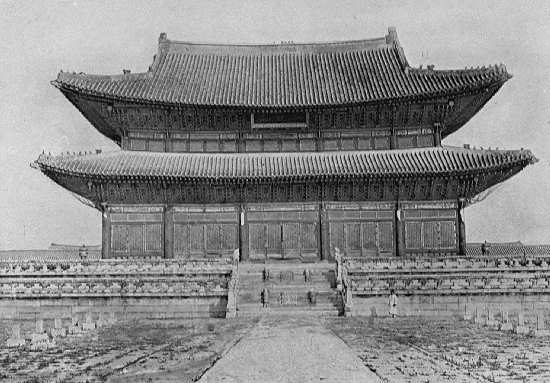
THE THRONE ROOM "Since the revolution, in which the Empress lost her life, the Emperor has never returned there" [To face page 268]
To avoid the mud it is necessary to use a pathway composed of two planks. They are narrow enough to test the skill of an equilibrist, and it may be they are put down to drill the courtiers in that useful art. On this occasion these planks are covered with narrow bright red carpet—a poor specimen of the thing usually found in "furnished apartments," not at all conducive to comfort, and apparently only a harbour for the dust. The yard is deserted. Here and there, out of peep-holes and half-open doors, a few red-calicoed servants are gazing with inquisitive eyes, but not one of them is in attendance.
From the central building a wide, unpainted door leads into the yard. The door is open and we see a kind of hall, with its walls covered with a large-patterned blue-and-white paper, which probably lay for years neglected and unadmired in some mean shop. There is a table in the centre and a high screen behind. Squeezed in between the two stands the Emperor. I can hardly realize that I am in the presence of the all-powerful potentate—an Emperor who is more than ruler, and more even than despot, in fact, an idol in the eyes of his people. His person is sacred, his power is boundless, his word is law, and he owns everything, land and people, without restriction, his simple wish is a command.
If human hand touches him it is sacrilege, and the punishment for sacrilege is death. Even the dead body of an emperor must be lifted into the coffin by a special device. If the Emperor touches a subject, the body so touched becomes blessed. The Emperor's name must not be mentioned except in whispers. His portrait is never painted except after death, when it becomes an object of worship in the ancestral halls. Once a foreign envoy sought to present the Emperor with the portrait of his sovereign, but the Minister for Foreign Affairs regarded the offer as an outrage and the portrait was never accepted. How very strange all these customs seem to be! But it is scarcely thirty years since Korea was still, if not the "Land of the Morning Calm," at least the "Hermit Kingdom," secluded and unknown.
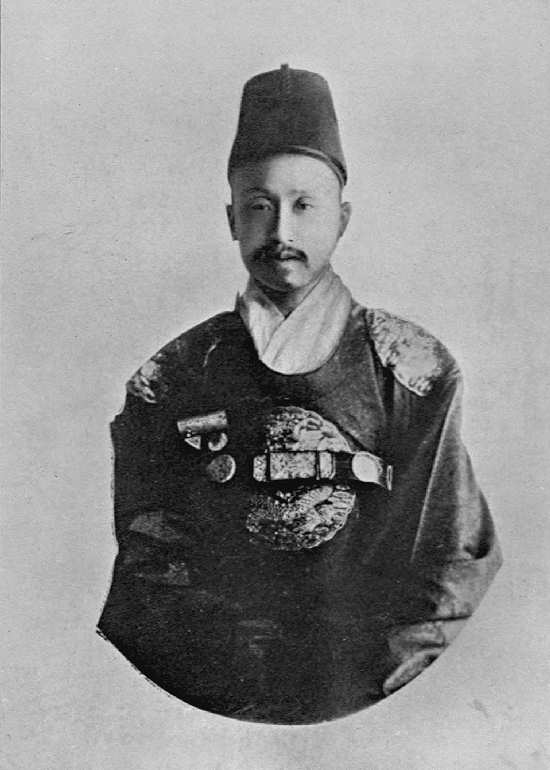
THE EMPEROR OF KOREA Copyright, Nops Ltd. [To face page 270]
My impression of the Emperor is favourable. His features are heavy, but the face is kind and his expression is benevolent. Physically he is delicate. I cannot imagine him to be a man of strong likes or dislikes, and his shyness approaches timidity. He wore ancient Korean state robes of rich yellow hue, embroidered with numberless cabalistic signs. Around his waist was clasped a stiff ceremonial girdle, inlaid with jade. It looked much like an iron hoop round a shrunken barrel and seemed peculiar to Western eyes, accustomed to belts that, on the contrary, grip the body only too closely.
The representative of my country, who has lived for many years in Korea, and is an excellent scholar, had scarcely time to make the necessary introductions before the Emperor opened the conversation. He was most interested in the way I had come, and hearing that I had used the overland route, his questions were inexhaustible. "When did you leave home?"
"How long have you been travelling?" "What interested you most?" "What is the country like?" "What do the people do?" "What are their ambitions?" and so on. He seemed to be interested in my own country, and especially in all the different manners and customs of the West.
"Is your country a very hilly one?" "Are the people agricultural, as here?" "Is your capital a very fine one, and what is the Emperor's palace like? I hear there are magnificent Court functions, and pageants with a great many carriages. My envoys, coming home from the European tour, gave me very interesting details of your magnificent cities and great wealth, and brought home many valuable souvenirs and pictures. I am sorry to be too old, otherwise I myself would start to see all I have heard about."
The state coaches seemed to appeal most to his imagination, which, after all, is but natural, considering that such a thing as a carriage has never been known to the Koreans. His Majesty even expressed a wish to order one in Europe.
Question after question came, giving me scarcely time to give answers. I, of course, could not ask questions except in an indirect way, for in this respect Korea sticks firmly to the etiquette of all Courts, which provides that the monarch alone is allowed to start a new topic of conversation.
"You must have been very glad on your arrival at Seoul to find that the finest building is your cathedral? What it must have been to have built up such a high tower! and I am told its interior is beautiful. Who was your architect? How much did it cost?" I explained that it was built by one of the fathers who studied with great care the architectural books of Viollet Le Duc, and that the expense had been very limited, on account of nearly everything being made on the spot.
But he was even more interested to hear about our orphan schools close by, where nearly two hundred children are saved from misery and death. He was pleased to hear a little more of what happens outside the palace gates, to know something more about the charitable work carried out in his own country.
It was astonishing to see with what keen interest he followed my explanations.
He wanted to know my ideas concerning Koreans, and especially Korean children and the rising generation trained in our schools. I was glad to have an opportunity of expressing my satisfaction, and I told him how very much surprised I was at seeing the Korean children at work, and hearing their answers.
I could scarcely believe that boys out here could be such good Latin scholars, some of them far in advance of boys of the same age in European schools. I was even more astonished to see the real pleasure it gave them to study and to improve. To me it shed quite a new light on the Korean character and mind. What is more satisfactory still is, that when these children go back to their forlorn homes, as they do for several months each year, they seldom fail to return, and never forget what they have been taught.
Next the Emperor sat the Crown Prince, a man slightly over thirty years of age, overgrown and heavy, apathetic, and lethargic in all his movements. He shows little interest in anything outside his own sphere, and scarcely any capacity for the reception of new ideas. He is married, but has no family.
But there is a younger brother who is in every respect the reverse. He is bright, clever, active, and instead of the heavy atmosphere of the palace seeks the fresh air of far-away countries; At present he is in the United States, working hard, studying and gathering knowledge, experience, and statesmanship, which may, as he hopes it will, be of use to himself and to his country.
Behind the Emperor and Crown Prince stands a huge dark figure, casting a heavy black shadow on them. His expression is stolid, and he is mute, but he watches and follows everything that goes on around us. He is the chief eunuch of the palace, a man of great importance and influence.
The chamberlains and princes accompany me to my sedan-chair when I go. Before I leave them they make an appointment for next day to show me the ancestral hall and some of the public buildings.
I must say they are all very courteous, and want to show me much that they think would prove useful to me. At last we start, sedan-chairs begin to swing, hanging from eight bearers' shoulders. A horseman rides ahead, while the legation servants and the Kisos form a guard. As we come to the large place before the palace there is a dense crowd, a faction of the revolutionists as I am told. The city is in great excitement. As we pass along we meet crowds everywhere.
Seoul is divided into two parties. One is bitter against Russia and claims the delivery and punishment of Y.-Yung-Yk, on whom all the Imperial confidence and favours are bestowed at this moment. Another party is in favour of him and Russia. The former is for Japan—but there is no party to support their own country, to work for its independence, and to secure its freedom. There seem to be very few Koreans for Korea.
XI
TOKIO
As the train stops at the terminus of Shimbashi, I can scarcely realize that I have reached the capital of beautiful Japan. The huge station is one of the most commonplace erections I have ever come across in my long journeys. Platforms, booking offices, waiting rooms, are perfect copies of all that the Western mind has produced to be useful, but from an artistic point of view featureless and colourless. And even the crowd, which bustles along and overflows the whole place, is as drab as it could be in any commercial centre on our side of the globe. Even those who still cling to the national kimono, instead of keeping to the old bright colours, have it made of dark cloth or modern cotton material. As I step out into the street my disappointment is even greater. I see a few buildings constructed of wood, without any ornamentation, the unpainted timber grey and weather-beaten.
I must say the day is very much against the creation of a favourable impression. It is a cold January morning, gloomy and dark, sleet falling from leaden clouds, and the streets are thickly covered with black mud. I can almost imagine myself in the suburbs of Pittsburg, for there is a great deal of smoke, the only apparent difference being that steel is replaced mostly by timber. As my jinrickshaw rolls along through the maze of wide streets and narrow lanes, I do not feel elated. My extraordinary vehicle, which is drawn by two men harnessed tandem fashion and pushed by another, has, however, an Eastern flavour, though the 'rickshaw was actually invented by an Anglo-Saxon genius.
During the first weeks of my stay I visited all the ancient monuments, temples, and pagodas, and all the usual haunts of the traveller. There are some fine specimens of Japanese art, though they cannot be compared to the buildings of the smaller cities. I come from Nara and Kyoto, and this may be one of the reasons that everything is so far below my expectations. Some of the temples are certainly large, and one or two pagodas quaintly designed, many of the carvings being elaborate. But even the best specimens can only be classed as decorative art. Among them all, the most noteworthy examples of Japanese architecture are the temples dedicated to the memory of the Shōguns. The decoration of the inner halls is sometimes exquisite, the beams and friezes being beautifully worked. Bronzes, finely cast, magnificently finished, make the interiors delightful. I specially admired the specimens of lacquer-work I saw in the course of my rambles. Nearly all the temples had panels, doors, chests, boxes, utensils, and odds and ends of exceptional beauty. It takes a long time for a Western eye to appreciate fully the real qualities of good lacquer; but when once it has been trained it will always put their lacquer-work foremost among the artistic productions of this people next to bronzes, if not before them. The industry still survives in full vigour, and I saw several specimens which came very near those in the carefully guarded collection of Nikko. I also saw many fine bronzes, though their beauty is often depreciated by the too-great elaborateness of the design. Old national armour is to be found in many of the temples and collections of the capital, but, though most beautiful, it is not yet in much demand in the bric-à-brac market.
But I have come to the conclusion that the real charm of ancient Yeddo must have lain more in nature than in art, in its bright suburbs, evergreen groves, wistaria-covered arbours, and chrysanthemum gardens; nature in her exuberance, in her spring bloom, or the varied tints of autumn intermingled with arched bridges, carved balustrades, and flights of steps, relieved by art. Monuments in Japan seem to serve above all as a foreground to a fine view: the most conspicuous towers, ex-voto lanterns, or finest "tories," acquire an artistic value more from their surroundings than from their intrinsic worth. The way in which the monuments are placed, the effect they give to the landscape, and especially the view to be seen from them, are the main points of interest. I am sorry that books written on Japanese art generally fail to perceive its real value, and point out merits it does not possess. It is particularly the imagination that ought to be dwelt on; not merely the handiwork, but the conception of the brain. Shrines, kiosks, pagodas, may sometimes be very primitive, but in the imagination of the artist they represented fairy buildings. It is the same with their tiny little gardens, or dwarf woods. Though they are in reality minute, they grow in the owners' minds to veritable parks or virgin forests. Some of the so-called Imperial palaces around Nikko are most humble abodes, surrounded by a little strip of land. Katsura-no-Rikyu Palace, for instance, consists simply of a few planks nailed together, forming a kind of log house of one storey, a few feet square, and divided in the interior by partitions or the so-called sliding screens. Certainly it is no palace; it can scarcely be called a house. It is literally a shed roofed with bamboo and thatch,—nothing more. And yet the followers of the imaginative school of æsthetics saw it with different eyes. To them it represented what their fancy imagined, not what they saw in reality, and the little open space before the building, which, with the best will in the world, can only be called a gravel yard, dotted with unhewn stones, was to them the illimitable surface of the ocean, the scattered blocks so many islands and continents. In the corner stands a little estrade of bamboo, where the Mikado and his chosen friends used to sit in deep contemplation before the elaborate world of their fancy, and enjoy the passive happiness of the Zen doctrine.
It would interest me to treat this subject most explicitly, and to deal with Japanese art from a psychological point of view; to consider not merely the objects it has created, but rather the mind and genius which have been manifested in its different creations; to deal more at length with the founders and pupils of the famous masters' schools of Nara and Kyoto, and to explain where their real value lies. To discuss the paintings, statuary, and architecture, the refinement of their watercolours, which can only be called sketches, small bronzes and jade or stone figures, the netsukes on masks, makimonos, "tories" and pagodas, would afford to our matter-of-fact appreciation an opportunity of realizing more fully the strength of their imagination. The average European generally admires in Japanese work the finish of detail, elaborateness of execution, and the patience of labour, applied to its object. He pays high prices for the workman's skill and manual dexterity, but seems to be quite indifferent to the artist's idea as such, and the originality of the conception escapes him entirely.
Yet in the most famous creations of the celebrated æsthetes we are more struck by the force of their imagination than by the actual work itself. The cha-no-yu style consisted, as mentioned above with reference to the Katsura-no-Rikyu Palace, of a few planks, bamboo beams, and thatched roof, and Kobori Enshu, Nippon's Le Notre, designed his gardens to offer a panoramic effect more than a place of recreation. It was not the house nor the grounds in their real grandeur which effected the impression desired; in fact, it was not reality at all that was before them in its crude and sometimes primitive material; but the suggestiveness of log house and gravel yard, which developed in their vivid fantasy into enchanted palace and fairy land. Men retiring from active life; generals crowned with many victories; distinguished, even abdicating Mikados, secluded themselves in different rural retreats to enjoy, after the struggles of life, perfect peace. They led a life of their own, an existence not so much of active reality as of passive contemplation, in which they discussed different ideas and strove for new ideals. They invented an artificial life of artistic refinement, admiring for days together a single work of art or a flower in full bloom, inhaling choice aromas and smelling exquisite perfumes. And stately processions were organized to go and partake of afternoon tea in a summer-house, where every movement was prescribed by strict etiquette, and where the handing and receiving of the cup were attended by fastidious courtesies, and the making of the beverage of a special green leaf, pounded to powder, and poured out of a black earthen pot, was an occupation requiring several hours. The tea ceremonies have often been described; there is a whole literature at our disposal, in which the regulations respecting these proceedings are put down with the authority of a code. But what is far more interesting than the description of the elaborate ceremonies is the problem of how the mind of the people could have manifested itself in such a complex and, to us, incomprehensible way. We shall never fully realize how these men could have sat on the Tsuki-mi-dai, the bamboo dais, for hours, watching the moon rising behind the meadows, gazing at the scene before them, lost in the intricacy of their contemplation. And we shall never understand their thoughts as we shall never realize the world as seen from a Tsuki-mi-dai.
Is it astonishing if, in their imagination, reality and fiction became "confusion worse confounded," huts grew to palaces, the single stones to islands, and, finally, they built up a world of their own? As children gazing at clouds give full play to their fancy, so did they see in the external world what really existed only in their inner consciousness. The explanation of many of those vagaries lies in the strength of their fantasy, the vividness of their illusions; but we might go even further and justly say that one of the strongest qualities of the nation is the strength of their imagination. With them fiction almost becomes reality, fancies acquire positive values, and subjective sensations are allowed to act upon the objective world. Any one who is interested in metaphysical questions will be struck by this trait, not only in their art, but in every incident of their existence. Whether in the past or present, it will strike us as one of the main characteristics of the Japanese, and, turning over the pages of their long history, it is one of the prevailing features. It was a potent factor, which gave strength to their convictions and endurance to their arms. In fact, their whole ancient moral code and their laws of chivalry were based on the same principle. The two qualities which inspire sincere admiration all over the world—their great loyalty to the sovereign and boundless patriotism—are emanations of the same disposition. In fact their greatest achievements were carried out under the influence of some abstract conception and brought to success by a national or ethical ideal.
II
If the artistic colouring of Tokio has faded away for ever, its present aspect is marked by the evidences of practical life, and if one's first impression is one of general disappointment, the second is one of deep interest. We soon realize that the capital of Japan has ceased to be a mere bazaar, full of glitter, where all the toys and fancies of the East have been stored to make a pleasant resort for the Western traveller. It is a place of hard work, for the accomplishment of serious aims.
Though my expectations in visiting the old monuments were not fulfilled, and, as I said before, from an antiquarian and artistic standpoint the town failed to satisfy me, I became daily more deeply interested in the busy life and commercial enterprise of modern Nippon. Workshops, manufactories, banks, insurance offices, are increasing rapidly in number. The electric and steam companies, railways and shipping, telegraph and telephone companies, have developed in a most astounding manner. If we consider that the railway was only introduced into the country in 1872, for the short distance from Tokio to Yokohama, which was followed by another short line in 1876 from Kobe to Kyoto, and the first long line connecting the two capitals was opened in 1890, it is even more astonishing to see what has been done in the succeeding ten years. To-day railways have been laid all over the country, and all the main cities are connected by direct lines. To give an idea of this rapid development, I may refer to the fact that in 1887 there were 580 miles open for traffic, and in 1899 there were 3421 miles. Besides the Government railways a great many private companies have been formed. About thirty years after the commencement of Japan's new era, the Government lines extended to 833 miles, including 60 miles in Formosa, and the routes still under construction 1250. There were forty-four private companies as well, with a capital of 228 million yen. The rolling stock of the Government railways amounted to about 1500 locomotives, 5000 cars, and 18,000 goods wagons. Among private lines the Nippon Tetsudo is the most important; it is about 1000 miles long. The next in importance are the Kiushiu and Sanyo railways. To-day it is possible to go from the north end of the country to the south, a distance of 1400 miles. The only interruption on the whole track is the Straits of Moji, where there is still a ferry, but this, it is said, will probably be replaced by a steel bridge, such as that over the Forth. The greater part of the rolling stock is manufactured at home, only wheels and axles being imported to any great extent from abroad.
The first telegraph line was installed in 1869 by English engineers. In 1877 all the foreign employés had been replaced by natives, and ten years later Japan joined the International Telegraph Union. In 1891 the Government purchased from the Great Northern Telegraph Company, with great strategical foresight, and took into its own hands, all the cables forming a direct connexion with Korea. The telegraph offices are not far off 2000 in number, and the length of the wires is close on 30,000 kilometres. The number of internal messages amounts to 16 millions, and of international messages to about 300,000. The longest main line is from Tokio to Nagasaki—877 kilometres. There are several thousands of employés, and in many places bicycles are used for delivering the telegrams.
The telephone in Japan is more common than in any other country in the world, except perhaps Norway. Besides the Government and public telephone offices, nearly every large commercial house, and most private homes, have telephones.
The establishment of the electric system of illumination has become most popular in the smallest villages, and forlorn hamlets are lighted by electricity.
Steam navigation companies are numerous. Besides local companies running small steamers in the larger bays and inland seas, there are several companies for international commerce. Among all these companies the most important is the Nippon Yusen Kaisha. It is the pride of modern Japan, and I quite agree that there are very few enterprises in the shipping line which could surpass it in size and excellence of organization. To quote from their annual report, which will be of interest as giving an idea of the success they have achieved: "With a capital of 22 million yen, establishing regular steamship services all over the world, and with a fleet of 70 steamers aggregating 200,000 tons gross, the majority of them new and provided with every resource for contributing to the comfort of passengers and every modern facility for the carrying trade, the Nippon Yusen Kaisha now ranks among the greatest enterprises of the kind in the world. The regular services maintained by it, independently of its lines between all the principal ports in Japan, are with China, Asiatic Russia, the Straits Settlements, India, the Red and Mediterranean Seas, Europe, Canada, America, and Australia. The Japanese Diet in 1899 resolved to grant subsidies to the company's European and American Lines, and thus all foreign and home lines, with but a few exceptions, have been ordered to run under the mail contract of the Imperial Japanese Government. The Head Office is in Tokio, and Branch Offices and Agencies to the number of over seventy, particulars of which are given elsewhere, are situated at all the ports of call and other important points. The total number of the Company's employés is about 1200, in addition to about 3500 of crews, firemen, etc."