EMPIRES AND EMPERORS (continued 2)
Reading edition
The town has sprung up within recent years, about the time of the Chino-Japanese war. It consists of barracks and military quarters, ammunition stores, railroad factories, and a few private houses for the families of officers, railway officials, and employés. It has no pretence to beauty, and in the flooded condition in which I saw it, its gloomy buildings, streaming with rain, looked deplorable. We came past some shops where tinned meats, vegetables, and other provisions are sold. There is also a hotel, which I prefer not to describe. I was told that the place even boasts a café and music-hall, the only place of poor amusement for the officers and their wives in garrison there. Kharbin is supposed to have about fifteen thousand inhabitants, but where were they? Were they dead, asleep, or hiding? I could not see a single living being. Could this be altogether accounted for by the weather, even allowing that the water in the streets rose to the knees of the horses, and that the wheels of our vehicle were submerged to the axle?
As we drove along my amiable guide explained to me that Kharbin is a military place, destined to see much active service in the event of a war, because, being situated on the junction of three great railway lines, it would be the centre for the mobilization and concentration of the troops. It would probably become the headquarters of the intendant and of the ammunition service. Hospitals, too, would be erected and the Red Cross would have a large staff there. I listened with interest to all these conjectures and plans for the future.
It was night when we returned to the station, where an agreeable surprise awaited me. I was told that a goods train with a convoy of coolies and troops to repair the line which had been destroyed, would be ready to start a little after midnight. Could my carriage be attached to it? I inquired. At first it seemed doubtful. No one appeared to know how far we could get, and there was even some question as to whether the road would bear the weight of the train. However, anything, no matter what, would be better than Kharbin, I thought; even the uncertainty of the future was preferable to the certainty of the present.
About three o'clock in the morning, after an interminable night of bustling, coming and going of troops, rushing about of coolies, shunting and whistling of engines, we at last began to move. The train presented a curious appearance. It consisted chiefly of open trucks and a few wagons in which the soldiers lay huddled together, with their winter coats tucked under their heads for pillows, while hundreds of coolies were packed like cattle in the open carriages.
At first we passed slowly through a vast, partially submerged plain. Often the road was entirely under water, and in various places so badly damaged that we had to proceed with the greatest possible caution. More than once the coolies had to turn out with pickaxe, shovel, and building material to repair the line, under the strict supervision of the officers of the railway service. I availed myself of the frequent stoppages and our altogether casual progress to study the country.
When at last we reached the large province of Central Manchuria there was a notable change in the geographical aspect. The ground became hilly and wooded. We followed several winding valleys, irrigated by tortuous watercourses, and surrounded by mountain ridges. In some parts it was decidedly pretty. The soil is fertile, and nature has endowed it with many precious gifts. The mountain slopes are rich in minerals and the woods abound with game. The mineral wealth of Manchuria is as yet unexplored, and there are comparatively few gold, silver, and copper mines in process of exploitation. Some foreign syndicates have been formed, more especially in the south, and these have proved successful, but since the Russian occupation of the railway district they have been hampered by all sorts of difficulties, and except in the free port of Niu-chwang, the introduction of foreign capital has been stopped.
In actual size Central Manchuria is considerably smaller than the northern district of Tsi-tsi-kar—also known as Halung-kiang—but the population of the north is only about one million, while Central Manchuria contains twice as many inhabitants. The seat of government for this latter district is at Kirin, a very ancient town with quaint houses built in the old Chinese style, yamens with shining roofs, temples and pagodas, all very picturesque.
Kirin itself is famous for the battlemented wall which, with its heavy ramparts and pagoda-like towers, is very imposing. But the chief attraction of this provincial capital is the surrounding scenery. Valleys and mountains, dark forests and distant blue mountain peaks, form a most charming picture. It is indeed a glorious region, and a joy both to the sportsman and to the artist. The fishing in the mountain streams is excellent, and there are still numbers of leopards, bears, wolves, a certain kind of deer, foxes, and hares in the forests. For the artist the opportunities here are not less ample; pretty woodland scenery, attractive bits of street corners, and town scenery, and above all the historical monuments, the celebrated royal tombs, and the commemorative tablets on the river banks, or hidden in the sacred groves; all these are excellent subjects for sketches.
The great difficulty at the present moment is how to reach these beautiful regions. There are, so far, only a very few stations in process of building on this route, and it must be remembered that even these, though called by the names of the various places, are often twenty or thirty miles distant from the towns they represent, and that there are scarcely any means of conveyance, and that in many cases there is not even a road!
It would seem as if the Eastern Chinese Railway scrupulously avoided all inhabited regions, and certainly in its present condition, and as long as there are no branch lines, it is useless for all purposes of ordinary traffic or commercial enterprise. The Russian officers who have projected it appear to have had only one object in view, to connect in the most direct manner Vladivostok and Port Arthur with the Siberian line, for the sole purpose of transporting troops in case of need with the least possible delay.
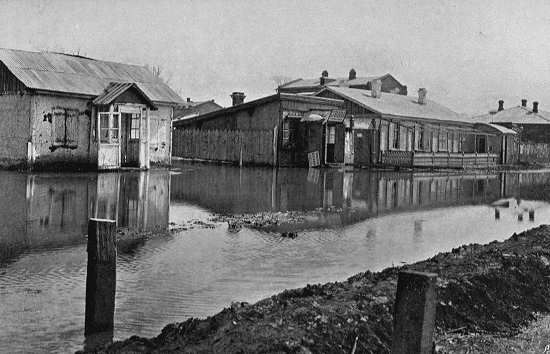
A STREET IN KHARBIN "The water in the streets rose to the knees of the horses" [To face page 76]
All this great work has been done quietly, unostentatiously, and without arousing any ill-feeling among the natives. At the present moment one may travel for a whole day without catching sight of anything more conspicuous than railway buildings, barracks, and encampments with Russian soldiers lining the entire length of the route.
After several days' travelling we emerged into cultivated plains, rich pasture land intersected by patches of Indian corn, beans, etc. Crops of all kinds presented themselves before our eyes. The country no longer showed the barren desolation of the Gobi desert, nor the romantic wildness of Central Manchuria. It was peopled! There were men working in the fields, and I could see houses and little farms, poor and miserable enough it is true, but at least indicative of human life.
*****
FROM MUKDEN STATION TO MUKDEN TOWN
It was dawn when I looked out of my carriage window—a dull grey dawn. The sky was covered with leaden clouds and the rain came down in torrents. The river banks were entirely submerged, and the train stood still in a sea of mud. The scene of general deluge vividly recalled my ideas of the Flood, and it was like stepping out of the ark when I alighted from my carriage. Close by I saw a modest structure, one storey high, more like a peasant's hut than anything else, and I could scarcely believe that this was the station intended for Mukden, the capital of Manchuria. To my consternation I learnt that the train would go no farther that day. It might go on to-morrow or perhaps in a week's time.
There was plenty of time therefore to explore Mukden, although the town was over twenty miles away. But how was I to get there? There was no road to be seen and no vehicle anywhere about. I made inquiries from the station-master, a Russian officer, with a long beard and resplendent with gold lace. He advised me to send my interpreter to one of the neighbouring farms, where I might possibly obtain a Chinese cart, a driver, and a couple of mules, to convey me to Mukden in as short a time as the state of the roads would permit. I followed this advice. The courier wasted the greater part of the day in arguing with the farmers, while I was left in my carriage at the mercy of the hurricane, and occupied the time in writing down my unpleasant impressions, wind and rain supplying the accompaniment of music.
Towards the close of the afternoon my faithful Sancho returned, and pointed to a kind of cabriolet on two wheels with three mules harnessed in tandem fashion, and driven by a crooked little Chinaman. I cannot deny that the effect was extremely picturesque. The car was lacquered yellow, the hood covered with blue; the mules were grey, and the little driver was sheltered by a huge umbrella of gold-coloured oil-cloth. But although picturesque, it was far from comfortable. The vehicle had no springs and no seat; in fact, it consisted simply of a wooden board about two and a half feet square, on which one had to sit cross-legged like a Turk or a tailor. If the occupant happens to be neither the one nor the other, he suffers agonies before five minutes have passed. The only attempt at comfort was a small calico rug at the bottom of the cart, but this was a poor protection against the extremely hard wood of Manchuria.
I hesitated a moment before venturing to enter this uncomfortable conveyance, and pictured vividly to myself the horrors of a night's journey in it. But I had promised to visit, if possible, the site of our Mission station, which had been pillaged and burned in the last Boxer insurrection, and which had been the scene of so much noble martyrdom. So after all I made up my mind to go.
Little Li-Hu cracked his long whip, which, by the by, looked more like a fishing rod than a whip. And indeed, I might have amused myself with some angling on the way, for the mules were up to their fetlocks in chocolate-coloured liquid mud.
The first sight which attracted my attention on the road was a one-storeyed building, used as barracks and occupied by Cossacks. I learnt that it served as an encampment for the protection of the railway station.
Then followed a long stretch of road without anything remarkable to be seen.
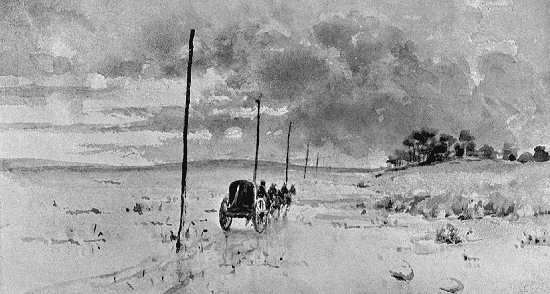
FROM MUKDEN FLATS ON TO THE TOWN After a Water-colour Drawing by the Author "Then followed a long stretch of road without anything remarkable to be seen" [To face page 80]
There were fields on both sides of the way, but they could not be seen because all the land was entirely submerged as in Egypt at the rising of the Nile. I presumed that we were on a road, for we advanced between two rows of irregularly planted trees; I also concluded that at one time this road had been paved, perhaps centuries ago, but it was decidedly bumpy now.
These speculations were presently confirmed when we arrived at a bridge delicately arching a creek. It was a very fine structure, carved in Chinese fashion, and of great architectural beauty. I left my carriage to examine it more closely, and when I had scraped off some of the mud with which it was encrusted, I found that it was entirely built of white marble.
After crossing the river the road became still worse. I was jolted up and down, thrown from side to side, my head was knocked against the wooden frame of the hood, and after a mile or so of this torture I could bear it no longer and decided to try the back of one of the mules.
Riding without a saddle on the back of a thin Manchu mule cannot be said to be a comfortable mode of travelling, and my agonies are better imagined than described.
Here was I, in an unknown country, surrounded by a desert which seemed more desolate than ever in its flooded condition, the rain coming down as if all the sluices of heaven had been opened, while the tiny driver at whose mercy I was, might, for all I knew, be a cut-throat.
My vocabulary was as yet limited to two words, how-di and poo-how. Perhaps they are written quite differently, but this is how they sound. The former stands for everything that is good, pretty, pleasant (I have never had occasion to use it); the other expresses the reverse, and I was quite tired of saying it, because it never proved to be of the slightest effect.
We encountered no one on the road, but passed one little vehicle like mine, in which I counted at least ten visible occupants. Four were seated on the shafts, some on the mules, and the others outside on the hood. I could not see how many there were inside. All the outside passengers had large umbrellas of oil-cloth, the same as my driver, and they looked like big sunflowers. It was quite cheering to see those people so perfectly happy, laughing and joking under such wretched conditions.
Their stoicism gave me relief, and I shook the water from my dripping clothes and felt a little better too. But as night approached and the desolation became more oppressive, my self-confidence fell from hour to hour. Darkness magnified all the surroundings, and gave them a fantastic aspect. The lights in the distant farm-houses looked like will-o'-the-wisps; the trees became phantoms, and the barking of the dogs sounded like the roar of the dragons, which, as every one knows, are natives of the Yellow Empire. All the fairy stories of my childhood came back to my memory, and assumed a shape in the reality of my surroundings.
I must add, too, that what I had read lately about Manchuria was not encouraging. The country, I knew, was still in a state of agitation and suppressed revolt. Gangs of bandits traversed the country in all directions, burning farmsteads, pillaging villages, murdering travellers. Skirmishes often took place between them and the Cossacks, and more than once during my journey I heard the firing of shots. The most dreaded of all these ruffians are the Chunchuses; they are formed into more or less organized bodies, like the bandits of ancient Italy, and they possess as much influence as the Mafia of Sicily.
It was getting late and we had travelled for many hours without seeing any trace of houses. I could ask no questions, because I could only say those two words, poo-how and how-di. Even if Li-Hu had been of a communicative turn of mind I should not have understood his explanations, so we continued our lugubrious ride in perfect silence, I perched on the back of a mule, with the shafts of the cart for stirrups, while Li-Hu had the carriage all to himself. He wriggled about like a serpent and finally sought consolation for the bitter reality of the present in the happy dreams of the past.
At last the will-o'-the-wisps drew nearer, the phantoms took the form of ordinary trees, and the roars of the dragons resolved themselves into the barking of dogs.
I scarcely dared to believe that I had reached my destination, lest I should be disappointed. Li-Hu was sound asleep, but the mules made straight for a dismal-looking building, and stopped as by instinct in front of a conspicuous signboard. By the same instinct, I suppose, Li-Hu awoke and I asked eagerly, "Mukden? Mukden?" But evidently I was wrong, for he emphatically shook his head.
After a while the innkeeper appeared on the threshold and looked even more forbidding than the house itself, through the open doors of which escaped thick clouds of opium-smoke. I should have preferred to remain on the back of my mule, as there was no possibility of stretching my legs because of the mud, but they were already unharnessing my beast, so I had no choice, and was obliged to enter the house.
The place was lugubrious in the extreme. It looked like a witch's cave, and all things combined to complete this impression. There was the cauldron hanging on a chain over the fire, while enormous logs of wood diffused a sulphurous flame in the light of which the inmates of the place looked truly terrible. At least a dozen men were crouching on the floor, and several others lay asleep on the kang or heated earthen bench which ran all along the dwelling. They were smoking opium in small bronze pipes.
At my entrance most of them roused themselves from their stupor, and their small eyes expressed astonishment, united with curiosity, mistrust, and hatred. I could detect all the hostility of the East against the West in that look. The ill-will of the yellow race towards "the white devils" manifested itself in all its bitterness and force. I must confess that I did not feel quite at my ease in this uncanny company, and it was only the deep interest which I felt in these people, in the den and its surroundings, the novelty of the situation and my passionate interest in human nature, which helped me through the ordeal.
What was going to happen? Would they remain passive, or were they going to attack me? They were interrogating Li-Hu. It was like a play to watch the proceedings. Without understanding the language, it was easy enough to follow the drift of the argument. "Who is it? Where is he going? What has he got?"
From the expression of Li-Hu's face and his hesitation in answering, I gathered that the information he had to give concerning his charge was not satisfactory, but I also noted with interest how cleverly he concocted a story to his own advantage. Evidently the shrewd Chinaman had in his mind two strong points in my favour. In the first place I had not yet paid him, and in the second place I had been entrusted to his care by the station-master, by whom he was known. I also detected that he did not want to rouse the animosity of the other men, consequently he never mentioned my private car, probably also by the advice of the station-master, and from the expression of his face and the manner in which he turned out his pockets, he was clearly representing me as a poor missionary who was going to Mukden to fetch his pay at the bank, and whom it would not be worth while to kidnap on his way there.
The minutes dragged on like so many hours; the night seemed endless. Finally, to pass the time, I began to draw with some coloured chalks. Would that interest them? I wondered. I could not be sure at first, but the ruffians slowly gathered round me and I never had more complacent spectators. Those men who, a few minutes ago, would have taken my life, or at least my purse, suddenly became quite friendly. Like the lyre of Orpheus, my pictures did wonders, soothing the savage instincts and softening the passions of these brigands. It was the greatest triumph my modest crayons ever won for me.
At last there was a general stir. Li-Hu prepared his cart, and we started once more. It was still dark, but the rain had ceased and the cold rays of the moon from time to time broke through the parting clouds. By means of these occasional flashes of light I discerned in the distance, silhouetted against the horizon, the dark outlines of a pagoda. Surely that was the point we were making for. We had long since left the so-called main road, and were jolting and jerking along by fields of turnips and Indian corn. The shocks were perhaps not quite so rough as before, on the half-paved highroad, but their violence was yet amazing.
It was daybreak when we arrived before the principal gate of Mukden, and after the night of darkness and peril the glories of the city seemed enhanced. The sky was cloudless and intensely blue, as if enamelled in cobalt on a golden ground. The richly sculptured fronts of the houses shone with truly Oriental splendour. It was the early hour of the morn. People poured out of the city gates to start their daily tasks in the fields and farms. Every one wore bright-coloured garments, and looked happy and cheerful. Everything breathed contentment: the effect was charming. It was the victory of light over darkness.
The sun, like a great magician, had waved his wand, touched and dispersed clouds and gloom, and thrown, so it would seem, a veil of oblivion over the sadness and misery of the past night, to give courage and hope to begin another day.
IV
THE CAPITAL OF MANCHURIA
My surprise on first beholding the famous city of Mukden was as complete as it was agreeable. The scene before me was simply delightful. At first I could not distinguish anything clearly, neither lines nor forms. I was dazzled by the intensity of colour and light.
The façade of every house was ornamented with strange carvings and mouldings; never before had I seen such fantastic prodigality of human imagination. All the lines curve upward, and every house resembles a pagoda on a small scale. So many motives, so many different colours; red, yellow, green, blue, in endless profusion, the effect being increased by rich gilding.
In front of the houses are shops or booths, where are exposed—generally in the open—goods and merchandise of all kinds, arranged in fanciful pyramids in accordance with Oriental caprice. Embroideries, rich silks, artificial flowers, fans, and umbrellas, anything, in fact, to tempt the local taste or satisfy the daily demands. The displays of porcelain are particularly attractive, also the shows of silver and brass ware. Most fascinating are the stalls of the bric-à-brac dealers with their fine lacquer-work, fluted vases of priceless value, old porcelains, cloisonné boxes, and artistically designed snuff-bottles[2].
Before every booth a tall mast or pole is dressed, from which floats a flag as signboard, and both are elaborately inscribed with advertisements of wares sold inside the shop. The bootmakers' insignia are particularly artistic and only surpassed in splendour by the rich festoons of gold which mark the pawnbrokers' shops. The main thoroughfare, with its endless variety of cabalistic design and rich colouring, is like an Oriental bazaar or the gorgeous scenery of a theatre. But what struck me most was the enormous vitality and activity of this marvellous city.
It was like watching an ants' nest to see this surging tide of human beings incessantly flooding the squares and streets. Men and women, young and old, of all ranks and all nationalities, push and press past one another. Some are carried in beautiful chairs, others content themselves with a modest kind of wheelbarrow, in which six or seven persons can be accommodated on a narrow board, and which is pushed along by a famished-looking coolie. These wheelbarrows answer the purpose of omnibuses in the Manchu capital, and they take a person from one end of the city to the other for about a quarter of a halfpenny. "Rickshaws" have recently come into fashion; they are a great improvement on the old means of conveyance, for instead of being pushed they are pulled along. All true Manchus, however, prefer riding on horseback to any other mode of locomotion.
Whatever room is left in the street is taken up by pedestrians, labourers carrying enormous loads, and coolies going about their daily business. It is an impressive sight, and once more I came to the conclusion that the intrinsic character of a place is not expressed in the arrangement of its streets, or in the height and style of its buildings, but in the general manifestation of its activity.
While the eye takes in all these various details, the ear need not be idle. The air is full of sound. Strains of music proceeding from the tea-houses, costermongers' cries, shrieks of quarrelsome children, and high-pitched voices in admonition; shouting and noise of all sorts and in endless variety are heard.
At every step there is a fresh surprise. Fortunately, so far, no guide-books have been written to describe the attractions of the Manchu capital, and no cumbersome descriptions spoil the effect of its genuine charms
To form an idea of the plan of the city, imagine an oblong chess-board. Like all Chinese towns, it is regular in the principal lines. There are two main streets in the form of a cross, intersected by innumerable narrow lanes, and in the middle of the town, where the two chief thoroughfares cross, stands a high tower from the top of which a drum and a gong announce the beginning and the close of the day. Also from this high vantage ground the alarm is given in case of danger, and a detachment of soldiers, stationed in a sort of pigeon-holes, spend the hours of their watch in peaceful slumber.
It would be difficult to enumerate all the places of interest which Mukden contains, for everything is interesting to the Western mind, even to the smallest cottage with its curiously shaped roof and quaint style. And the interest lies not only in their material conception or in their exterior, but also in their inner qualities, and especially in the fact that they give expression to the mental and artistic ideas of the nation. As has already been said, it is at first the general effect, the picturesqueness, and the novelty, which strike one as so charming. Some of the houses are very dilapidated, the walls lean over, and the roofs are covered with a tangled growth of moss and grass. But all this makes them the more attractive from an artistic point of view.
Among the most interesting public edifices are the yamens belonging to the Government, and occupied by the Governor and some others of the mandarins of high degree; one or two Lama monasteries; the large buildings where the Russian Consul and the Commander-in-Chief reside; and last, but not least, the building occupied by the famous Russo-Chinese Bank and its agents.
Naturally the Imperial Palace is a place of great interest. With its enclosure of walls it forms a city within the city. It is divided into various courts, and consists of a great many separate structures, detached houses, halls, and pavilions. Taken separately these are not of great importance, but the whole effect is very striking. The colonnades, beams, and brackets are of carved wood, richly painted and gilded. All the woodwork is painted dark purple, and the roofs, like those of all edifices connected with the Imperial Family, or dedicated to Confucius, are covered with yellow tiles. The greater part of the palace is now occupied by Russian troops.
Near the palace gate is a low building in which a whole detachment of soldiers is quartered, and the open court is lined with cannon. It was only on my showing them a special permission from the commander that the sentries allowed me to pass.
The interior of the palace is in a sad state of ruin. Since the Imperial Family departed for Pekin, it has never been inhabited, and the few art treasures still remaining are carelessly scattered about the place. There are some valuable panels, some precious jades, and exquisite porcelains, but the greater portion of them disappeared after the last war. Some say that these treasures have been stolen by the Boxers, but according to another version the thieves must be looked for elsewhere. I was told that the very rare collection of old manuscripts and official documents is now quietly reposing among the archives at St. Petersburg to be protected from destruction.
My eyes wandered from the reception-halls to the vestibules, from the terraces to the gardens. It was all so original, so quaint. But the thing which specially strikes the visitor is the incongruity of transforming this sacred cradle of the master minds of the Celestial Empire into a Cossack encampment. As I passed out through the principal entrance, a Muscovite warrior stood on guard by the Dragon's door, and his white blouse contrasted strangely with the heavy bulk of the palace.
As the day advanced, the crowds in the city increased. Russian soldiers paraded the streets and patrolled the ramparts in small detachments. I saw officers on frisky ponies and ladies with their families going about in the national troïkas.
It is especially noteworthy that these Russian people not only feel perfectly at home among the Manchus, but that the conquered people associate on the most friendly terms with their conquerors in the taverns and inns. They sit amicably side by side and appear to be the best of friends. It is true that many of the enemies were born on the same soil; they are practically semi-Asiatics themselves; often have a common origin, and belong to the same race; above all, live the same primitive and uncultivated life.
The great difference which separates the European, whether of the Anglo-Saxon or the Latin race, from the Mongol and the Tartar, does not exist here. As soon as a fight is concluded, they settle down to their ordinary life; the greatest cruelties committed on either side are soon forgotten. Hatred may lurk in their innermost minds, but outwardly they live in peace together.
They have the same tastes, the same amusements, and agree particularly on the question of frugality. Contempt of comfort, indifference to refinement, and a very rudimentary degree of culture, are common to both of them. One thing which even more prevents any feeling of coldness arising between them is that, far from trying to transform and educate the conquered nation, the conquerors often stoop to the low level of the subjugated people.
With the exception of the railway I am not aware that any attempts have been made to civilize the Manchus. Commerce is not encouraged and international traffic does not exist, because all the towns have thus far been closed to foreigners. The Russian Government is even taking steps to get into its own hands the English and American mining operations which are being financed by some new loans. In spiritual matters the same restrictions prevail, and the difficulties which are put in the way of the missionary work increase from day to day.
In local government a semblance of the old forms is preserved. Manchuria is divided into three administrations, Tsi-tsi-kar, Kirin, and Mukden. Each province has a governor, and all three are under the authority of a viceroy or mandarin of the highest rank, who resides at Mukden.
The official yamen, and the staff of dignitaries of various degrees, are here exactly what they are everywhere else. They all appear extremely busy, writing extraordinary cabalistic signs on sheets of rice-paper. The small details of local affairs keep them occupied all day; probably they know nothing of matters of serious importance, but they seem admirably suited to fill a post which involves a minimum of responsibility and brings with it a good substantial salary. There appears to be a perfect entente cordiale between the Manchu mandarins and the Russian generals, and if perchance a difference of opinion should occur, the difficulty is generally smoothed over by the irresistible influence and the mysterious power of the Russo-Chinese Bank.
The important event of my first day was the official reception given by the Governor. I was carried to the palace in a chair, followed by an interpreter and my little major-domo. The canopy of the chair was covered with green silk, and four stalwart fellows carried me through the narrow, tortuous streets. The shaking was terrible, for where the pavement should have been there were big holes filled with liquid mud. I could forgive my bearers for their rough handling of my chair, but it was difficult not to resent being bumped on to the ground every time they changed shoulders, which they did without slackening their pace. It was not a great height to fall from, but the sensation was decidedly unpleasant. It was like a nightmare; the time occupied by the fall seemed interminable, and on reaching the ground I felt like being hurled to the bottom of a precipice.
At last we came to the principal entrance of the palace, at least what I supposed to be the principal entrance, judging from a group of queerly attired creatures, who presented arms—and such arms! It was an extraordinary collection, reminding me of the get-up of some old Chinese play. They were fierce-looking warriors, carrying halberds, javelins, and sickles on long poles, glittering and sparkling in the midday sun.
As seen from the outside, the palace is a poor structure. The massive wall which flanks the front gate is decorated with pictures of dragons to scare away, as I was told, evil spirits and "the white devils." The first court I came to was not much more attractive. It seemed, in fact, no better than a stable yard. There were a few horses tied to their stalls and some shelters for the soldiers and servants. I had to cross several courts before I arrived at the court of honour, which was square like the others, and had halls on each side. It was beautifully decorated with flowers and shrubs. There were chrysanthemums, and dwarf orange, peach, and pear trees, especially cultivated for the purpose of ornamentation. The effect produced was exquisite, and though the surroundings are all more or less in a state of decadence, that inner court is a picturesque specimen of Chinese domestic architecture.
But I had no time to study it in detail, for the Mandarin stood there in the centre, surrounded by his court. He was in a robe of dark blue silk, magnificently embroidered, and his suite was no less gorgeously attired. When I appeared upon the threshold of the vestibule we exchanged profound bows, and repeated this salutation until we met half way. Then we shook hands in Western fashion, no easy task, considering that my host's finger-nails were at least two inches long. The customary introductions over, he led the way to his private apartments.
The first room was entirely Chinese, and contained some exquisitely carved armchairs. The effect of the second room was spoiled by two easy chairs of Vienna manufacture, a hideous French clock, and a tablecloth, probably of Manchester make.
The preliminary compliments once exchanged—a formidable business here—His Excellency asked me some dozen questions which in the West would be considered most indiscreet, but are obligatory in the East. Then he conducted me to the dining-hall, where luncheon was set on a round table profusely decorated with flowers and sweetmeats.
Innumerable little dishes were scattered over the silk tablecloth, and saucers filled with raisins, grapes, almonds, olives, and a variety of dainties. Etiquette prescribes that the guest shall be placed on the left of his host, and that the first mouthful of food shall be put on to his plate by the host himself. After that the servants bring in dishes containing the most delicate productions of the Chinese culinary art. Fish soup and snail soup, sharks' fins in unpalatable jellies, all kinds of minces and hashes, and patties with sauces most unpleasant to Western taste, composed the menu.
Custom, which regulates all public and social functions in this country, demands that no less than fifty different dishes be presented to a guest of distinction. All these concoctions are handed round on large trays, in series of eight at a time. They look different, but all taste alike, at least so it seemed to me. They are both sweet and sour, and whether they go by the name of minced birds'-nests, or croquettes of dog-flesh, I could detect no difference in taste. The other guests, however, fully made up for my want of appreciation.
As the meal proceeded, the conversation became more animated. When the subjects dictated by ceremony had been disposed of, the company expressed much interest in my researches and studies. My host questioned me on many points. He was decidedly clever, and although one was apt to forget the solemnity of the occasion on looking at his somewhat ridiculous costume and hat, formed in the shape of a pagoda surmounted by a precious stone the size of a potato, and adorned with waving peacock's feathers—in which attire even the wisest man would look a fool—I could not help being impressed by his sagacity.
He was somewhat reserved, but seemed pleased to talk about his country, and gave me some valuable information when he saw how much interested I was in the ancient history of the land, and the origin of its inhabitants. For they, thousands of years ago, had proceeded from the same stock as the people of my own race, who had founded the kingdom in Pannonia. The foundation of the Manchu empire is connected even more closely than I thought with the migration of the Huns. It would, indeed, open a vast field of study for the historian to seek the connecting link and the affinity existing between the first Magyars and Manchus.
The repast over, the Governor proposed a visit to the imperial tombs, the chief sight of the country. Indeed, there is nothing the people venerate more deeply than those monuments of the defunct members of their dynasty; they are the pride of the nation.
We started without much delay. It was a glorious afternoon, and in the brightness of the autumn sun the country looked its best. Our cavalcade galloped across pasture land, where horses and cattle peaceably grazed together. Here and there a shepherd sought diversion in the consoling melody of some old song, like all human beings whose lives are spent in solitude, and in the contemplation of the immensity of nature. The music was simple and the instrument simpler still, an archaic flute cut out of a reed.
Skirting the far end of the pasture was a dark brushwood; my companions told me that this was the sacred grove containing the imperial tombs. The distance to the town might be about six or seven miles, but our little horses carried us quickly over the ground. The Manchu dignitaries, in their flowing silken robes, their pagoda-like hats, their embroideries and long pigtails, looked unquestionably most picturesque. My mount and my saddle were similar to theirs, pretty, but at the same time I must say that I never rode on anything more uncomfortable than a Chinese saddle of embossed wood, with stirrups in the shape of slippers, and fixed so high that knees and chin nearly meet.
Two large stone monuments flank the path which leads to the sacred grove. Forbidding-looking dragons guard the entrance. A deep cutting gives access to the place of interment, and this long alley is guarded on both sides by monsters of various descriptions. Elephants, camels, gigantic human figures, are placed at intervals facing each other, all cut in stone, and intended to ward off the evil spirits.
The beauty of the place is indescribable. The darkness of the foliage, the white stone statues, and the paved pathway winding through the woods, all help to give it the character of an enchanted forest, where solitude reigns, and the air is full of poetry.
Later we crossed some marble bridges of exquisite workmanship, their curiously sculptured balustrades softly reflecting themselves in the blue waters of the little streams flowing lazily between the flowering banks. I was told that the statues, the streams, and the bridges, have all of them some allegorical meaning in connexion with the spirits of the departed.
At length, passing through a porch, we stood face to face with an arch of such surpassing beauty, that for a moment I was dazed and lost in speechless admiration. Surely this must be one of the greatest, one of the most wonderful architectural creations of the Yellow Empire. Material, design, proportions, all the details, are so supremely beautiful. It is of marble, the arch resting on two huge blocks with cross-bars and buttresses supported by imperial dragons. The decorations are exquisite, and the carving of the friezes unique of its kind. Not even among all the marvellous monuments of Pekin, Nankin, or Hankow, did I find anything to rival it. The beauty of the conception, as well as the finished workmanship, impress one most forcibly, because of its being so perfectly in keeping with the signification of the whole triumphal arch, which symbolizes the passage of the spirit, after a life of strife and victory, to the abodes of their ancestors and everlasting peace. In this respect I know of nothing to compare with it, unless it be that pearl of Asiatic architecture, the Taj Mahal.
The tomb itself is enclosed by courts, halls, sacrificial temples, guard-houses, and sentry-sheds. We left our horses at the inner entrance, and the massive doors of red lacquer-work groaned on their hinges as they were slowly pushed open by half a dozen soldiers. We found ourselves in a square yard, a kind of court of honour, with avenues of trees many centuries old, giants and monsters in stone, and canals fenced in with marble balustrades and arched by bridges. These courts are divided by open galleries which lead to the central pagoda. This square building contains the commemorative tablet, a monument cut out of a single stone of about thirty feet high. The whole stands on a colossal tortoise, larger than two elephants.
Immense cauldrons, big enough to cook a whole ox at a time, for sacrificial purposes, are placed at short distances. Once a year a great ceremony is held in honour of the Great Ancestor. On this occasion the Emperor should be present in person, but for many years the imperial court has been represented by ambassadors; and considering what a journey from Pekin to Mukden involves, it is not surprising that the sovereign is content to be present by proxy. I was told that the mandarins selected to undertake this onerous pilgrimage are often persons whose presence is not desired at Pekin. Their adventurous journey often occupies many months, and often there have been cases in which the envoys never returned at all.
The Great Ancestor was one of the founders of the Manchu dynasty in China, and his real tomb is cut out in the heart of the mountain, but the exact spot is unknown. We spent the greater part of the afternoon among the tombs, and I made the best use I could of the permission to sketch and to take photographs. But the most perfect apparatus, and the pen of the most accomplished narrator, are bound to fail to do justice to the reality. Art and nature are blended so exquisitely here that it is impossible to give an adequate idea of the place. However beautiful the individual monuments may be—and they are very beautiful—the real charm of the ideal site lies in the perfect harmony of solitude and peace.
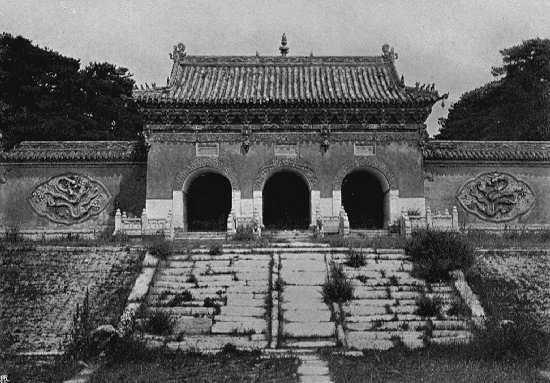
THE ENTRANCE TO THE IMPERIAL TOMBS "The massive doors of red lacquer-work groaned on their hinges" [To face page 104]
On the return journey we again passed through the muddy, dreary suburbs. Most of the houses along the dull, deserted roads, are built of clay and covered with straw. Rough planks close the entrance, and from the windows the rice-paper hangs down in tatters. We met several funeral processions, the huge black coffins being carried in front.
I have forgotten to mention that cholera was raging in the town; hundreds of people died daily, and the sanitary conditions of the place were so wretched that nothing could be done to stop it. Considering the manner in which the coolies live, it is only surprising that they do not all succumb. On this account the authorities at first had been averse to the idea of my visit to Mukden, but as there was smallpox in China and typhoid fever in Korea, there did not seem much to choose between the two; and, besides, I was firmly convinced that Providence would let me finish the work I had undertaken to do.
The epidemic broke out three months ago, and had claimed many victims among the Russian troops. The morale of the men was at a very low ebb in consequence. Upon the coolies and the Manchus the effect was different. Their innate fatalism teaches them to look upon death as a benevolent friend, and as they bear away the coffins with the remains of their loved ones, they look as unconcerned as if they were taking them to a place of joy. All the small objects cherished by the dead are placed upon the coffin to be burned at the grave-side, and when the smoke rises up to heaven, popular superstition has it that all these objects assume shape again in a higher sphere, for the gratification of their former owners. It is only right, however, to add, that as the heirs are solicitous to save anything that may be of value, counterfeits of the real things, in paper or cardboard, are often substituted, and so the auto-da-fé takes place only in effigy.
Having been entertained at luncheon by the Chinese Governor, to make the day complete I was the guest of the Russian Resident at dinner. We may criticize the Muscovite system of government, we may censure the ways and means employed by the Russian administration, but there is only one opinion as regards Russian hospitality. No matter what quarter of the globe one comes from, whether one be a political ally or a traditional foe, a Russian never fails in the duties of hospitality. As long as the guest is under his roof he is looked upon as a member of the family. Host and hostess, in fact all the household, go out of their way to show kindness to him. And it is all done on such a lavish scale! His room is overheated, rugs and furs are wrapped round him whether he desires them or not, and above all a special point is made of loading him with food and drink at all hours of the day and of the night.
The Russian Residence, or Consulate, as it is still sometimes called before the world, is a yamen like all other public buildings in China, only perhaps a little more ruinous than those I saw in the morning. The interior is greatly lacking in comfort and luxury. It gives rather the impression of a camp than of a home; there is no furniture beyond what is strictly necessary, and nothing has been done to make it pretty or attractive. The only redeeming feature is the table, which appears to be permanently set for meals. It is covered with quite as many little dishes as the table of the Mandarin, but instead of fruit and sweetmeats, they contain hors-d'œuvres, such as caviare, herrings, smoked salmon, cucumber, and all the innumerable varieties which compose the famous national Zakouska. There was a perfect array of bottles on the table; I do not remember ever seeing so many crowded on to one table. There were wines from the Crimea, various liqueurs, and vodka. During dinner the guests smoked perfumed cigarettes, and talked of their family affairs and distant homes. It was difficult to realize that the boundless plains of Siberia separated us from the banks of the Neva, for the picture before me was so typically Russian, in all its variety of shades and colours. I almost felt as if I were "in company with the gentlemen" of Tourgueniéff.
My visit to Mukden had certainly been full of interest. Not only the town itself, its famous monuments, and its strangely superannuated people, but the whole situation as it is at present, offers endless scope for speculation. Chinese mandarins and Russian generals, Cossacks and coolies, how oddly they are amalgamated in incoherent groups! What developments may not the future have in store? Truly this is a fascinating problem. Will Manchuria be more prosperous under the new régime? Will the people be able to rise to a higher level? As I took leave of the spot, now so desolate, where the mission settlement once stood, I asked myself whether it would ever be rebuilt and whether men would come forward to take the place of those martyrs who had sacrificed their life in the cause of the orphans and forsaken children of China. Casting one last lingering look upon the place, which I should probably never see again, the dismal outline of the ruined bell-tower seemed to rise up in pathetic protest against human intolerance and blind persecution.
*****
THE RETURN JOURNEY
The city of Mukden contained so much that was of interest to me, that my stay there was prolonged beyond my original intentions. The Governor, to whom I had related all the difficulties and discomforts of my journey, very kindly placed a carriage at my disposal and gave me an escort to see me safely back to the station. But perilous as the outward journey had been, the return was no less full of various emotions.
It was a beautiful autumn day when I left the town. Nature seemed to be making one last effort to assert the power of her charms before falling into her winter sleep. As we passed through the precincts of the city, the gardens literally glittered with colour. All imaginable shades, from copper-tinted saffron to bronzed purple, were there displayed. These gardens are certainly most beautifully cultivated. Presently we emerged into the open plain, and now I had the opportunity, which I had missed before, of forming some idea of the fertility of this privileged land. Manchuria is undoubtedly one of the richest countries in the world. The soil is excellent, the hills are thickly wooded, the mountains abound in minerals. Along the route we passed farms where maize and beans seemed to be chiefly cultivated, and all the people, men, women, and children, were at work in the field.
The landscape is rather monotonous. We traversed a wide plain enclosed by mountains which touch the horizon; but although the scenery cannot be called picturesque, it is not devoid of a certain grandeur. It has a charm peculiar to itself, an atmosphere of vague melancholy. All vast plains, those of Egypt for instance, or of Rajputana, have this same undefinable, intangible characteristic, of which one is faintly conscious without being able to describe it. The people who live in such a free atmosphere are naturally affected by it, and the Manchus possess all the characteristics of a race inhabiting an exposed country.
The Manchu is attached to his native land; he loves to live in the open, and is never so happy as when galloping across the endless plain or hunting in the virgin forests. As we laboriously proceeded on the uneven road, my fancy had full play, and I received new ideas and impressions from these novel surroundings. Since I had explored the interior of the country more carefully, my ideas about Manchuria had certainly undergone a great change. Every now and then, however, my cogitations were rudely interrupted as we jumped over ditches, crawled up or ran down the inclines, and it was a wonder that my poor tarantass was not smashed in the attempt. It may be as well, perhaps, to give some idea of what a tarantass is like. Four small wheels, very far apart, and joined by wooden axles, were fixed in the centre to a long pole, on which the basket, in shape something between a boat and a bath, was fastened. The vibration of this pole takes the place of springs, although it would be incorrect to say that it performed the office of such civilized improvements. But the pole kept the wheels and the basket together, and this, after all, is an accomplishment to be proud of on the highroads of Asia. My carriage was not drawn by mules this time, but I had three horses harnessed abreast, in the Muscovite style. They were small Cossack horses, with long manes and tails, slightly larger than Shetland ponies, strong and lively. The middle one was somewhat bigger than the two others; it could trot, while the ponies to the right and left of it had to gallop all the time, their heads gracefully arched and held a little to one side. The harness was most eccentric, and consisted of straps without number, the use of which it was difficult to see, but the silver-nailed mountings, studded in Eastern fashion, looked decidedly picturesque.
My coachman was a Cossack, and evidently very much impressed with the importance of his mission. About fifteen men formed the escort, their white blouses and flat white caps forming a striking feature in the landscape. They are good-natured, simple-minded folk, these mujiks, with bright blue eyes, clear complexion, and a childlike expression. They are evidently quite at home in this far-away country, for the ways of life in their native land are primitive and patriarchal, and differ but little from those in this foreign land. It is difficult to believe that these men can ever be cruel, and in time of war commit the greatest atrocities in cold blood and almost unconsciously. When the war is over they at once make friends with the conquered people, and freely mix with the yellow tribes. A little two-wheeled cart, containing provisions, and with a young Cossack as driver, completed my escort.
If I were asked what were the most striking objects I passed on the road, I should mention two pagodas, one of which is particularly beautiful, seven storeys high, and richly carved. Monsters of Chinese mythology and all the embellishments which the sickly imagination of that ancient race could devise, have been lavishly represented upon it. We also passed some remarkable commemorative stones—massive blocks, resting on enormous tortoises—on which are inscribed the exploits of the defunct heroes of the country. The many farms on our route testified to the agricultural resources of the land, and the villages are not without interest from a sociological point of view. The houses are very shabby and dilapidated, but what amused me was the number of children there were playing about. There did not seem to be room enough to contain them all, and there were hardly any doors to be seen; the population appears to jump out of the ground like mushrooms. We met carts of various descriptions, pedestrians, strange equipages, and stranger horsemen, and to finish up with, a mandarin travelling in state. This personage was carried in a litter covered with embroidered silk, and the luggage packed, in cases of wonderful lacquer-work, was carried by his men on their backs. Suite and servants followed him in single file, and all the emblems of his dignity, flags, Chinese lanterns, umbrellas, and banners, with various inscriptions, were carried before him. His Excellency was guarded by a detachment of native soldiers, in crimson mantles with lozenge-shaped pieces of velvet let in at the front and back, and elaborately embroidered with Chinese characters. Of course, many of the details of this show were very shabby. The canopy of the litter was torn and faded, the velvet of the uniforms was caked with mud, the banners were in rags, and yet as a whole it was one of the most artistic displays I have ever seen. Asiatics certainly have the knack of making their pageants effective. A mandarin of secondary order, visiting a functionary about equal in rank to a tax-collector, has an escort of followers and soldiers amounting to several dozen men, while the highest Western officials are content with two footmen behind their carriage on grand occasions.
I have already said that the journey back to Mukden station was no improvement on the journey thence, and yet, as I write these lines, seated in my comfortable railway carriage, my adventure, now that it is a thing of the past, seems like a dream to me. To make the story more interesting I must begin at the end, namely, with the dramatic incident of the journey, and tell how we only just escaped being kidnapped or possibly killed by a band of brigands. Thanks to Providence, however, no more serious harm was done to us than the fall of the tarantass into the swollen river, a compulsory bath in full uniform for some of the Cossacks, various bruises and scratches, and a broken litter. The intended attack was changed into flight, and the tragedy turned into a comedy, to the satisfaction of all. I will briefly relate the facts.
When we arrived at the first village, the Cossacks declared that the horses were thirsty, and that a halt was therefore necessary. They all dismounted and hurried into the wayside inn, leaving me alone with the horses. But as I could see neither well nor bucket, I could do nothing for the poor beasts. After a while the men returned, and there was no mistaking the state of affairs. If the horses had had no water, the men had found plenty to drink. Presently we came to another village, and the same thing occurred there, only this time they did not trouble to invent any excuse, and never mentioned the thirsty horses. I need hardly say that after each halt the conversation waxed more animated, and the horses were pushed on more furiously. After the third stoppage the situation became alarming. They no longer talked, but all shouted at once, the clatter of their voices being intermixed with snatches of popular songs, while the trot of the horses changed to a gallop.
I felt desperate, for I knew that I was quite powerless against the inveterate national custom of these children of nature. They continued, however, to behave well towards me, and treated me with the greatest respect. They were only very hilarious, that was all. They shouted and sang and waved their red kerchiefs as we sped along.
The last hamlet passed, and there being no further chance of obtaining refreshment until Mukden station was reached, a steeplechase was proposed across country, to the station. I cannot tell what distance we thus covered, for the speed at which we went exceeded all my previous experiences. The race over the uneven ground caused me many different sensations. Across the plain it was rapid and exciting, and I fully participated in the exhilaration of these wild children. Across the cultivated ground it was pleasant enough for those on horseback, but to me, in my tarantass, it was like being on the rack. But it was in crossing the maize-fields that I suffered most.
The race increased in speed. Horses and men completely lost their heads, and it was no longer a question of restraining them. The horses took the bits between their teeth and simply went like the wind. We seemed to fly over the ditches and tore through the reed hedges. Some of the animals slipped and the men fell head over heels in the mud, while guns and swords described glittering circles in the air. Finally, in trying to clear a deep creek, one of the wheels of the provision-cart came off, and all the contents were scattered. Then, to my joy, I saw looming in the distance, like a haven of refuge, the miserable shed which is called Mukden station.
I lay down at the bottom of the tarantass, with a feeling of deliverance near at hand. I must explain that my straw seat had fallen to pieces at an early stage of our mad race, so that the only way to remain in the tarantass was by lying down at the bottom and holding on to the sides. But even this comparative degree of comfort was extended to me for only a short time, for suddenly I received a terrible shock; there was a grinding noise produced by the carriage, followed by an exclamation from the driver, unintelligible to me; the sound of horses struggling in the water; and finally I felt an icy wave dashing over me. I thought I was drowning, and instinctively raised myself in my basket. We were in the middle of a river which had overflowed its banks! My little horses were half submerged. Some of the Cossacks were still in the saddle; others were wading through the muddy stream up to their waists in water. They were all in a state of great excitement, talking and shouting, but all quite cheerful. Some were washing their scratches, others struggling desperately to rescue their belongings, which were floating away on the stream, and the horses, at last, with supreme contentment, were able to drink their fill of the water so long withheld and so fully deserved.
The steeplechase under ordinary conditions may be a noble sport and may have its charm and many dangers, but it cannot be compared with such a cross-country race in a tarantass, escorted by a detachment of Cossacks. And yet, in spite of all, I am indebted to these hardy companions, for their mad escapade and their wild merriment saved our lives. Whilst in full career, with horses neighing, Cossacks shouting, and swords flashing, we became aware of a body of men, who had presumably been hiding in the bushes, escaping towards the distant woods. Evidently they thought we were pursuing them, and they fled in disorder. I learnt afterwards that it was a band of those Chunchuses who have been the terror of the district for many years, and very likely the same I met on my previous journey. Not long ago they kidnapped Mr. Wetzel, the director of the East China Railway, whose adventures have been described at length in the newspapers. He was carried into the interior, underwent the most terrible tortures, and was on the verge of losing his mind when his ransom arrived.
If my Cossacks had not indulged in that steeplechase my journey might have had a tragic ending. Thanks to our furious riding, we startled the band lying in wait for a prey; but if they had seen us quietly proceeding like ordinary travellers along the highroad, they would undoubtedly have attacked us; and I will therefore conclude with the well-known proverb: "All's well that ends well."
V
PORT ARTHUR, DALNY, NIU-CHWANG, TIEN-TSIN
The country between Mukden and Port Arthur is the granary of Manchuria. Rice, corn, and maize grow in great profusion, and there are from thirty-five to forty different kinds of peas and beans. Chinese agriculture is based on excellent principles. The system of irrigation and the methods of working fully deserve our attention; but the plentiful harvests are chiefly due to the remarkable mode of manuring. The same piece of ground can yield several crops in rotation in one year. It would seem that the land never requires to lie fallow.
As I watched the Chinese farmers and labourers, I was vividly struck by the contrast between this peace-loving, agricultural population, and the armed Cossacks who lined the route. The nearer we came to the coast the more numerous they seemed to become, and there were more and larger barracks also. Yet the Russian military and the Chinese farmers appear to live on friendly terms with one another. I frequently saw Russian soldiers and Chinamen sitting at the same table, merrily talking together, and I even noticed signs of Russification among the natives, for many pigtails were twisted up and hidden under a Russian schapka. They eat the same food with an equally good appetite, and appear to have many tastes in common. If, during the Boxer agitation, the Russian troops behaved with exceptional cruelty towards the natives, it is certain that at present there is a perfect understanding between them. And after all they belong more or less to the same stock; their historic past is very similar, and they both live the same primitive life.
*****
I was now nearing the end of my journey, and although the progress had been slow it had been full of incidents. The last obstacle on the route we encountered at Liaoyang, where a bridge had been swept away. I was prepared for this delay, for some weeks before, the station-master at Harbin had given me a thrilling account of the accident. I remember wondering at the time whether he was exaggerating and trying to dissuade me from penetrating further into the interior of Manchuria; but when I saw the state of affairs at Liaoyang I realized that his story had been perfectly true. The scene before me was one of general confusion. Thousands of Russian soldiers and Chinese coolies were engaged in carting sand, cutting poles, and fixing rails; all talking and shouting at once in different tongues and dialects.
It was a veritable babel. About a thousand men were occupied in constructing a bridge of stone and iron. A few thousand others were throwing up sandbanks to check the water, while another gang of workmen was making a pontoon. We stopped several hours and no one seemed to know how or when we should get across. But the scene was so exciting, and gave me such an excellent opportunity of watching the Chinese at work, that I did not grudge the delay. At last some engineering officers suggested dividing the train and trying to take it across by the pontoon in portions.
How it was exactly managed I am unable to describe, for what with the jerking and bumping of my carriage, and the whistling, creaking, and groaning of the engine over the swaying pontoon, I had no chance of making observations. And when the temporary rails over the pontoon became submerged and the waves dashed up to my carriage door, I followed the example of the stoker and the guard and stood on the step, barefooted, ready to jump and attempt to swim to land if the whole tottering structure should collapse and disappear under the waves.
Thus ended my journey across Manchuria. Many delays and excursions into the interior had retarded my progress, but at last I arrived safe and sound at Port Arthur, where I remained two days, including a visit to Dalny. Port Arthur, as I saw it, was merely a military station on the extremity of the peninsula of Liaotung. At one time it was the chief naval arsenal of China, but after the war with Japan its defences and military works were destroyed. When, in 1898, the Russians leased the two places, Port Arthur and Dalny, they made the former into a great military and naval fortress. It was placed under the control of an admiral who had chief command over the troops and the maritime forces. He had under him a double staff of naval and military officers, comprising the commander of the port, the chiefs of the naval staff, the riflemen, the artillery, the engineering service, and the intelligence department, the harbour master, the chief of the torpedo division, the first assistant to the commander of the port, the second assistant, the commander of the commercial port, the ordnance officers of the Governor-General, the civil governor, the diplomatic agent, the secretary of finances, and the chief of the police.
Port Arthur undoubtedly has a very complicated form of administration, and at first it was suggested that it should be made into an eastern Kronstadt, or the Asiatic citadel of the great empire. The place itself and the surrounding hills are full of fortifications, and I have been assured over and over again that it would be perfectly impossible to take it by sea. It is one long line of arsenals, torpedo depots, barracks, and encampments. The fact that Port Arthur is essentially a military port is not disguised; there are only a few buildings, including those of the East China Railway Company and the Russo-Chinese Bank, which do not openly serve military purposes.
A new town has grown up on the opposite side to satisfy the demands of trade. This is called Dalny, and is situated on the bay of Talienwan, to the north-west of Port Arthur. The territory, like that of Port Arthur, was given in lease by China, and it is intended to make this into a free port connected by the Manchurian Railway with Vladivostok, Moscow, the Black Sea, and the Baltic. It might in time become the great commercial centre of the extreme East. The port is about six miles long and very deep, and offers exceptional facilities for navigation.
Dalny in its present condition has a somewhat paradoxical aspect. Palaces emerge from the sands, public monuments fill the deserted squares, avenues and boulevards are traced out on the shore. Dalny is the hope of the partisans of Russian commerce and progress, while Port Arthur is the pride of the military party. The development of the former is encouraged by the energetic efforts of Mr. White; the latter finds a powerful protector in General Kuropatkin.
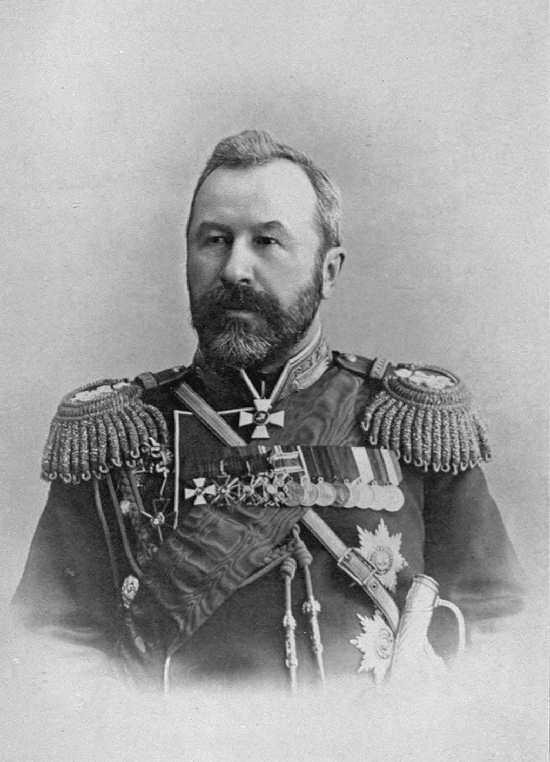
GENERAL KUROPATKIN [To face page 124]
Port Arthur impressed me greatly on account of its strategic importance, but what I saw of Dalny did not inspire me with much confidence as to its commercial future. During my visit I saw all that has been accomplished since 1898, and certainly, although many things are still far from perfect, and the mistakes made are very palpable even to the uninitiated, one cannot fail to recognize that much has been done in so short a time. But if we knew at what cost all this has been accomplished, our admiration would probably be considerably reduced.
No boat for Taku was likely to start for some time, so I decided to continue my journey to Pekin by rail. As far as Ying-tsé we travelled over the main Manchurian line, whence a branch line runs to Niu-chwang. This is the most northerly port of the Yellow Empire open to foreign trade. It is situated at a distance of thirteen miles from the mouth of the river Liao, which discharges into the gulf of Liaotung, a continuation of the gulf of Pechili. The railway line, which brings Niu-chwang into direct communication with Siberia and Pekin, was just finished. Branch lines in the direction of Tien-tsin had existed before this, but they were destroyed in the late Boxer troubles. To give my readers a somewhat accurate idea of the importance of this town I will try to quote from the Official journals:—
The town of Niu-chwang is rapidly growing in importance since the construction of the railway. The East China Railway between Port Arthur, Dalny, and the junction of Ta-shik-chia, whence a branch line runs to Port Arthur, was finished as far as Mukden towards the close of 1899. The Chinese Imperial line was also completed then. It was subsequently decided to deal systematically with the mineral resources of Manchuria, owing to the East China line having laid open the coal-mines at Mochi-Shan and Z'mershan near the Liaoyang, and at Wafungtien in the south of the Liaotung peninsula. The railway line runs right along these rich exploitations. An unprecedented commercial activity has accompanied these developments, resulting in an increase of 49 per cent. for 1898.
The chief articles of trade for this port are beans and oil-cake, with an export of 2,241,053 piculs of the former and 2,289,544 piculs of the latter in 1899. The net quantity of opium imported in 1898 was 92 piculs as against 2453 in 1879. The importation of opium has been steadily declining in the course of the last few years, the poppy seed being largely and successfully cultivated in Manchuria. The total figure of the trade of this port for 1899 has risen to 48,357,623 taels as against 32,441,315 in 1898. The port figured conspicuously in the disturbances of 1900; the Chinese troops which attacked the town being defeated by the Russians, who took possession of the port. Trade was necessarily at a standstill in 1900.
Niu-chwang was a revelation to me. I saw for the first time a real Chinese town in all its immensity. It appeared an inextricable labyrinth of streets and alleys overflowing with people. All our Western ideas are reversed here; indeed, buildings and people alike seemed to belong not only to another hemisphere, but to another planet. The lines are so strange, the colours so brilliant, the sounds so sharp, that one is at once deafened, blinded, and astonished. Beyond the city, on the solid earth, is the floating town on the river. The Liao at this point, little more than half a mile wide, is literally covered with vessels of every description.
It is a thronged mass of large merchant ships, smaller boats, and wooden junks. Each boat is a home, in which always one, and often several, families are housed with all their belongings: children, pigs, and poultry filling the decks. Those of the better classes who can afford it have regular summer-houses on the river, built like pagodas, elaborately furnished and surrounded by artificial gardens with dwarf trees in costly pots. In between this confusion of boats, narrow passages and regular canals are left free on the water, in which graceful canoes are seen gliding and winding about like gondolas. Both on land and water, the crowds of human beings, and exuberance of life, are overwhelming.
One feels ill at ease and lost among this surging mass of humanity. The narrowest streets and the largest squares, the courts and the floating houses, all teem with life; and, in contrast with the sleepy, passive multitudes of India, all are active here, from the youngest to the oldest. All seem intent on their business, all appear to have some strenuous end in view. The capacity for work which this race possesses manifests itself everywhere from morning till night. Chinese strength and vitality are here seen in all their original energy and force.
Niu-chwang is an important place even now, but it has every possibility and likelihood of becoming one of the great commercial centres of the future. Its international trade has been hitherto hindered by the fact that the river is frozen for three months in the year, but since the completion of the Tien-tsin line the town has become easy of access by land. A railway bridge over the Liao is projected, and when this is built the train will run directly from Pekin to St. Petersburg. At present travellers have to cross the river in wooden junks, and continue their journey by the Chinese trains.
In the centre of the commercial town is the settlement of the Catholic Mission. Buried in a maze of tortuous streets, it is almost lost sight of in the bustle and noise of the adjacent fair, giving the impression of some Oriental bazaar. The little church, and the few small houses belonging to the Mission, are enclosed as far as possible by a whitewashed garden wall, which is but a poor protection in case of siege or serious disorders. If the populace were to show signs of hostility that ruinous wall would not hold out long against the mob; but they who join the Mission, who devote their lives to deeds of charity, who feed the starving, and care for the destitute, put their trust in a defence stronger than the strongest towers of this world. From the time that the missionary leaves his native land and offers his life to the Almighty, he spends his days in a constant state of uncertainty. From the moment that he sets foot on the shores of the Yellow Empire dangers of all kinds crowd around him. These martyrs to duty are continuously exposed to open and secret persecution, terrible epidemics, privations, and hardships of all kinds. Yet in spite of manifold trials and dangers, young priests and nuns who have only just taken the vow, go over to the Far East, happy and full of zeal, ready to devote their lives to the noble spiritual work.
On the day of my departure from Niu-chwang I had the good fortune to witness an historical event, the official transfer of the railway to the Chinese Governor-General of Manchuria. Since the last war the route between Niu-chwang and Hankau-chwang had been under the military control of Russia, while the other route between the latter town and Tien-tsin was held by British troops. There were great festivities in honour of the day. The station buildings were decorated with all the pomp of Asiatic taste; everywhere Venetian masts, floating banners, Chinese inscriptions, and Russian trophies, announced the great event, with laurel garlands symbolizing victory, and olive branches speaking of eternal peace. Ambitious mandarins and gold-bedizened Russian generals exchanged salutes and bows in sign of mutual respect. No doubt it was a case of "live and let live," for all appeared quite satisfied.
An interminable programme marked the order of the festivities, and if I had had an aptitude for journalism I could have written columns upon "The Official Transfer of the East China Railway Line by Russia to China." I could have indulged in lengthy descriptions of the receptions, presentations, floral offerings, banquets, with streams of champagne, and endless flow of toasts. But the best correspondent could not have said more than I have done here upon the principal event, the actual transfer of the railway. He could not have pierced, any more than I could, that thick veil which hides from us the knowledge as to whether that railway has actually become Chinese property or not.
The country between Niu-chwang and Hankau-chwang is at first flat and uninteresting, although rich in vegetation. Nearer to the sea it becomes more varied, and in parts it is quite picturesque. Some of the bays of the Yellow Sea—which, by the by, is intensely blue just there—resemble the fjords and are dominated by craggy rocks. We advanced slowly and stopped at many stations, the Russian soldiers still always predominating over the native contingent.
It was late in the evening, when our train, with much noise, passed through the breach in the famous wall, by which I was greatly impressed. That enormous mass of masonry, one of the most colossal structures ever made by human hands, is here seen to the best advantage, skirting the steep inclines of the mountains, ascending to the tops of the highest peaks, or descending into the plains to lose itself finally in the unfathomable depths of the sea.
It is indeed a wonderful sight, and, like that other gigantic human undertaking, the Pyramids of Egypt, this wall is interesting, not only for its own sake, but also as marking a stage in the history of the civilization of the world. I gazed at it, and looked at our powerful engine, with its long train of American-built carriages, as it passed through the breach, and in that one glance there was much to comprehend both from the past and for the future of Asia.
At Hankau-chwang a surprise awaited me. The English troops had finished their mission, and on this momentous occasion the commander gave a dinner. The guests were assembled in the little yamen near the station. The dining-room was tastefully draped and hung with pretty watercolours. Books and knick-knacks lay about, and the table was covered with an immaculately white cloth and set out with a dinner-service of severe simplicity, but scrupulously clean. A simple abode it was, but every detail of it would bring to temporary inmates the pleasant recollections of the comforts and the charm of their English homes.
Another interesting stage of my journey was from Hankau-chwang to Tien-tsin, through one of the richest districts of China. Our train stopped frequently, for we touched many important towns. Trade is brisk in this part. In places the ground was cultivated like a vegetable garden, but the real wealth of the district lies in its coal-mines. In the way of structural curiosities the two chief sites on the road were the country house of Li Hung-Chang and Fort Taku.
The late Viceroy and great politician had also been a clever financier. His weakness for speculation and commercial enterprise was well-known throughout the country. The coal-mines of this neighbourhood were partly his property. He not only looked well after his personal affairs, but also took care to inquire into the financial position of those with whom he dealt. Whenever he entertained a foreign diplomatist, or granted an interview to the director of some international company, or even the head of some ordinary business house desirous of gaining information about special concessions or privileges, the first question the Viceroy asked invariably was: "What is he worth? How rich is he?" The success of a petition depended, so I was told, to a great extent upon the sum of money poured into the coffers of the statesman as a preliminary investment.
Fort Taku does not need to be described at length. It has played a conspicuous part in the history of the last five-and-twenty years—in the struggles between the West and the East, the White and the Yellow races. It has been several times bombarded, destroyed, and rebuilt. At present it is again in ruins.
There is now a new commercial town in course of erection. In the place of the old-world style, modern colonists have introduced a somewhat vulgar and insipid form of architecture, which possesses neither the picturesqueness of the old Chinese towns nor the advantages of our European cities. The colony is as yet in its infancy, and only counts a few rows of small houses and some miserable shops.
The last stopping-place on my journey was Tien-tsin. Situated on the crossing of the Peiho and the Grand Canal, this is one of the most important towns of China. It has a population of over a million, and is divided into the city proper, the foreign confines, and the suburbs. The old part is a perfect specimen of a Chinese town, overpopulated, brilliant, noisy, and dirty; a hustling, bustling crowd of humanity living like bees in a hive. It contains many interesting monuments, although the chief attraction of the city no longer exists, I mean its enclosure, the wall which surrounded a square of four thousand feet. It was pulled down to make room for trade traffic.
The European quarter is very different in character; it has large squares, shady avenues, and beautiful buildings. Each nation represented there has a little colony of its own, with barracks, commercial offices, and consular residences. The English colony, which is close to the French, boasts of the best buildings, has large, well-kept streets, and is guarded by some very fine-looking Sikhs. The large dwelling-houses, the homely bungalows, and the turbaned figures of the tall soldiers, remind one of some Indian cantonment. The Italian and Austrian quarters are on the other side of the canal, and almost lost among the native town. Since the occupation of the Allied Troops the importance of Tien-tsin has grown considerably, and in time it is likely to become a powerful rival to Shanghai as far as international commercial interests are concerned. In fact, it has all the commercial advantages of Shanghai. When we consider that at the time of the Ming dynasty it occupied only a secondary position, its development is the more remarkable. Tien-tsin is about eighty miles distant from Pekin, and lies near the sea; its commercial advantages as the market for export and import trade are therefore evident.
The railway has added another considerable advantage to the many already possessed by Tien-tsin, namely that of bringing it into direct communication with the mainland. Li Hung-Chang, who, in his capacity of Viceroy, resided there for many years, was a strong supporter of the place. Under him it became, not only a large commercial centre, but with the normal schools for the organization of army and navy, other elements were attracted towards the place, and different occupations introduced.
Tien-tsin, in fact, has become the home of the progressive party. Pamphlets, daily papers, literary and political clubs, have propagated the views and ideas of the great Viceroy. It was Li Hung-Chang who started the first coal-pit in the neighbourhood of Tong-shan, about thirty years ago, and the export of coal is making rapid progress. The output amounts at present to nearly three hundred thousand tons. Another local industry of great importance is the production of salt. This is a Government monopoly, and is obtained through the evaporation of sea-water. The salt lies piled up in heaps along the banks of the river. Spirituous liquors are distilled in large quantities and sent into the interior. The exports include wines, furs, skins, bristles, and wood. Export trade, which did not exist five-and-twenty years ago, now reaches a total of about fifteen million taels per annum.
From the time of the first European expedition in 1858, Tien-tsin has been the scene of much fighting and many desperate battles. During the last rebellion the disturbances were greater there than anywhere else, and it was there also that the Boxers, in the beginning of June, 1900, set fire to the Foreign Mission settlements. At first no one seemed to realize the imminence of the danger, and it was not until the second half of the same month, after the bombardment of Taku, that hostilities, attended with all the horrors of war, were seriously commenced. The attack on the European colony, the blockade of the barracks, the destruction of the railway station, and the massacre of the missionaries and Christians, followed each other rapidly. Eye-witnesses have given us graphic descriptions of the atrocities committed during the insurrection. The bravery of the troops, the missionaries, the Christian women, and the children, has excited the admiration of the world. Many ruins still testify to this prolonged siege.
The chief event of my stay in this place was my visit to the Viceregal Palace. If Li Hung-Chang had been a great statesman, his successor was not unworthy of him. Yuan-tsi-Khai and Chan-chi-Tung are the two most prominent men of modern China. Nature has endowed them very differently, but they are alike zealous in their endeavours to rouse China from its apathy. Although the ways and means by which they hope to effect their object are different, the end in view is the same. Chan-chi-Tung is a peace-loving man, an ardent follower of the doctrine of Confucius, and strongly attached to the national principles of morality. He favours reform in undertakings of a purely commercial and industrial nature, in financial transactions; but in intellectual and spiritual questions he is very conservative. In his own province he has made successful attempts at improvement. He has established factories, cotton mills and looms, forges, local railways, and an important arsenal on the Yangtse-kiang.
His adversaries—and he has many, like every one who rises above the common level—accuse him of being an idealist. But in most cases his ideas, practically carried out, have proved to be of very real benefit to his country. He is a deep thinker and a most pleasant and interesting companion. His writings on various political and social questions are fine specimens of human philosophy.
Yuan-tsi-Khai is, on the contrary, before all a man of action, a soldier at heart. He loves to fight his enemies and to press forward without considering the difficulties in the way.
My sojourn at Tien-tsin was of special service to me in obtaining clearer ideas as to the actual conditions of China. I made the acquaintance of many interesting persons, some of whom are the makers of the history of our time. They were not all of the same nationality, nor did they all pursue the same vocation, nor were they all of the same mind; their opinions also were widely different. But it is to a certain extent owing to the antagonism of their views that I was enabled to form some provisional conclusions.
It was on a bright afternoon of the short St. Martin's summer that I accomplished the last twenty-four miles of my long railway journey across the two continents. As I neared my final destination, Pekin, and passed through the flat and barren country I could hardly realize that I had traversed such an enormous distance during the last few months. I tried to recall to mind the different countries I had passed through and their inhabitants, the prosperous towns and the miserable villages I had visited; the centres of civilization and the primitive solitudes.
Then I began to comprehend all I had seen. Much of my previous conceptions of this part of the world had been vague, for the difference between what one imagines and what actually is, is great! One may gather the most reliable information, listen to the most explicit descriptions, or study the best books, but how far all this falls short of personal experience! The best references, the most accurate figures, the most lucid writings, will never produce the same effect as reality, and it is not upon those somewhat abstract notions that our faculties are exercised with the greatest profit. What one feels has even more weight than what one sees, and psychological studies are of greater value than statistics. To know a country, it is the life, the everyday existence, of its inhabitants that we have to study. Life in all its varied expressions, in labour and in rest, in its fundamental principles and its manifold manifestations, this it is which reveals to us the deep source from which the energizing elements flow in diverse directions.
It was growing dark as we neared the end of our journey. On the platforms of the small stations we passed, I saw foreign soldiers belonging to the Allied Forces; here fair Teuton giants, there short, brown bersaglieri. And at each succeeding station there was more movement, more confusion, till we reached the metropolis. The sun was setting as we skirted the imperial deer park. Every moment the light effects increased in beauty. The sombre masses of foliage, framed by the blue lines of the eastern hills, formed an enchanting picture.
Outlines and colours were so unexpected, so strangely blended, that it looked like a painting from the magic brush of some great Chinese master. The forests stood out dark and menacing, as if still sheltering the monsters and dragons of ancient folk-lore, and the hills were like so many pointed sugar-loaves, heaped up by some awful giants.
It was as perfect a Chinese landscape as I could have wished to see, and to crown all, the sun went down in a blaze of light; it was as if fiery darts were being shot across the flaming sky. I have seen many sunsets in the tropics, and in the East, but never anything to equal this. The brightness of it flooded with saffron the clouds of dust always hanging over the capital, and illumined all the million atoms which rise from the Mongolian desert....
At an unexpected turn in the road it seemed as if the golden veil was torn aside to give me a glimpse of the mysterious city. The stage effect was perfect; the curtain might have been drawn by a clever manager's hand to reveal the great Hatamen Gate in all its magnificence. The famous crenellated walls; the lofty towers and proud pagodas, first described by Marco Polo; the heavy bastions, and the marble bridges, were but indistinctly visible, and therefore all the more suggestive and beautiful. In fact, my first impression of Pekin was of a fancy or dream. What the city really looked like was as yet mercifully hidden from me; my imagination could have full play, untrammelled by the disillusions of knowledge and experience. Afterwards I saw things differently, but that first day the great city of the mighty Khan seemed as a mirage to me.
The crumbling citadel of a great nation, nay, of the whole glory of a mighty race, the monument of its art, the Walhalla of its history, shone in the dazzling splendour of the afterglow, like a golden city floating on golden clouds.
VI
PEKIN
I THE ARRIVAL
It is evening when I arrive in Pekin. The train stops outside the Tartar Wall. Darkness shrouds everything, and the place seems to be deserted. Not even a guard or porter is to be seen. Alongside the embankment a few coolies with gigantic lanterns are waiting for the passengers, and, in quaint procession, with innumerable balloons hanging from long bamboo sticks, are searching for their masters. They all shout, but no one seems to understand them. There is no trace of any vehicles or carriages, and I don't see even a platform. I am standing in the midst of a desert; behind me, some sandhills and a pool are all I can distinguish, and in front, among the crowd of coolies, a tall figure is conspicuous, which approaches, and, by the yellow rays of a pumpkin-like lantern, I recognize an old acquaintance. Here he occupies the position of First Secretary of Legation, and brings me an invitation from his chief. My trunks are taken in charge by an attendant, and we walk towards my new abode, which my friend tells me is close by.
It is explained to me that the present railway station is only a temporary one; only since the occupation by the Allied Forces have trains been able to penetrate as far as the inner wall. They used to have to stop miles away, as no engine was allowed to desecrate the holy city of Pekin. At a short distance from the temporary station is a tunnel-like opening in the wall, and I am informed that it was made for the use of members of the legations and foreign settlement, and has ex-territorial rights granted to it. I pass through the so-called Gate of the Nations full of expectation, for I am most anxious for surprises, which certainly are not wanting.
I hope to see before me a fairy city and scenes like those on the stage; but instead of splendour and glitter I see mist. By the flickering light of a few paraffin lamps I begin to distinguish the famous international quarter, but I feel it would be better if they were not lit, for they only disclose ruins and débris. Among heaps of bricks and mortar we reach the edge of a ditch of stagnant water, which, as my companion informs me, not without some pride, is the so-called Canal of Jade. It is a magnificent name, which I have known for a long time. If I have pictured it to myself as different from what it is in reality, it is not the fault of an exaggerated fancy; and as we stumble along in the lane skirting the ditch—I beg its pardon; on the banks of the waters of Jasper—I still cannot perceive anything else but garden walls. I don't even see the famous Jade Stream, for though long ago there may have been water in the ditch, there are now only puddles here and there. But if I can't see, I smell all the more; smell all kinds of unimaginable and imaginable odours.
At last we approach a gate with a martial sentry in front of it. The password is given, and we are at last at home. In the courtyard, on the edge of the grass, are a number of lanterns. Large and yellow, they look like melons. The effect is charming, but as they give but very indifferent light, I can only distinctly discern some pillars and arches. Now we pass through some open halls and reach a garden-like square. To the right and left from the windows of small summer-houses the light of candles filters through. In front is another building in the same style, a few columns supporting a heavy roof; the columns are of red lacquered wood, and the tiles of emerald-green. Beyond this is another garden, and lastly the legation proper. The door is open and the hall ablaze with light. On the broad staircase are servants in red—pigtailed Chinese, dressed after the fashion of their country. They salute us, bowing low, with their hands folded.