Dr. GEORG BRANDES (continued 3)
Rasmus Björn Anderson translation
"'Have you really courage to go forth with me into the wide world?' asked the chimney-sweep, tenderly. 'Have you considered how large it is, and that we can never come back here again?' 'I have,' said she. And the chimney-sweep gazed fixedly upon her, and then he said: 'My way lies up the chimney. Have you really courage to go with me through the stove, and to creep through all the flues?' ... And he led her towards the door of the stove. 'It looks quite black,' said she, but still she went with him and on through all the intricacies of the interior, and through the flues, where a pitchy darkness reigned." After long, long troublesome ascent they reached the top of the chimney and seated themselves on its edge. "The heaven and all its stars were above them, and all the roofs of the town below them; they could see far around, far away into the world. The poor shepherdess had never pictured it to herself thus; she leaned her little head on her sweep, and wept so bitterly that all the gilding of her girdle came off. 'O this is too much!' said she; 'I cannot bear it. This world is too large. O were I but again on the little table under the looking-glass! I shall never be happy till I am there again. I have followed you into the wide world; now, if you really love me, you may follow me home again.'"
A more profound, more mercilessly true, more self-evident analysis of a certain kind of feminine enthusiasm and its energy when it undertakes to act boldly without regard to consequences, and without looking backwards, can be found, I think, in the works of no other Danish writer. What delicacy of presentation: the momentary resolute enthusiasm, the heroic conquering of the first horror, the endurance, bravery, firmness, until the moment which requires courage, when the firmness is shattered, and the yearning for the little table under the looking-glass is awakened. Many a voluminous romance would have been exalted by such a page, and we find in it a compensation for the fact that Andersen is no master in the province of the romance. The drama is a species of poetic production that requires the faculty for differentiating an idea and distributing it among many characters; it requires an understanding of conscious action, a logic power to guide this, an eye to the situation, a passion for becoming absorbed and overwhelmed in the inexhaustible study of individual, many-sided characters. Therefore it is that the drama is still farther removed from the genius of Andersen than the romance, and that his lack of capacity for the dramatic style increases with mathematical exactness in the same ratio as each variety of dramatic art is removed from the nursery story, and consequently from his gifts. He naturally succeeds best with the nursery-story comedy; although, to be sure, it possesses little more of comedy than the name. It is a mixed species, and if it were put to the test of the Spanish story, it would be recognized as a bastard. In the comedy of special situations he is happy with respect to the poetic execution of single scenes ("The King's Dream"), but singularly unfortunate in the execution of the idea as a whole ("The Pearl of Good Fortune"). The comedy proper is not poorly suited to his gifts. Certain of his nursery stories are, indeed, veritable Holberg comedies; "The Happy Family" is a Holberg character-comedy, and "It is Quite True" possesses a decided Holberg plot. In stories of this kind character delineation comes easier to him than in the grave drama, for in them he walks directly in the footsteps of Holberg, so strikingly does his talent accord in a single direction with that of this early Northern dramatist. Andersen is, as I have already remarked, no direct psychologist; he is rather a biologist than an especially well-informed student of human nature. His predilection is for describing man through animals or plants, and seeing him develop from the rudiments of his nature. All art contains an answer to the question, What is man? Inquire of Andersen how he defines man, and he will reply, Man is a swan hatched in the "duck-yard" of Nature.
To a person who takes an interest in psychological investigations, who, without being able to grasp a complex character, possesses a refined development of observation for single qualities, for characteristic peculiarities, animals, especially those with which we are familiar, afford great relief. We are usually accustomed to credit each animal with an individual attribute, or at all events, with a limited group of attributes. The snail is slow, the nightingale is the unpretending singer with the glorious voice, the butterfly is the fair inconstant one. There is nothing then to prevent the poet who possesses the gifts needed to represent these striking little traits, from following in the footsteps of Holberg, the man who wrote "Den Vægelsindede" (The Fickle One), as Andersen did in "The New Lying-In Room." He betrays here, moreover, one of his many points of similarity with Dickens, whose comic characterizations are frequently limited to a few traits repeated ad infinitum.
In the epopee, which belongs in our day to the impossible forms of poetry and which demands all the qualities that Andersen lacks, he can merely find play for certain petty fancies, as for instance, when he characterizes the spirit of China, in his "Ahasuerus," in a droll lyric episode, or when he permits the twittering swallows (exactly as in a nursery story) to describe the festal hall of Attila.
In his descriptions of travel very naturally a large number of his best qualities come to light. Like his favorite, the migratory bird, he is in his element when he travels. He observes with the eye of a painter, and he describes like an enthusiast. Yet even here two faults are apparent: one is that his lyric tendency at times runs away with him, so that he chants a hymn of praise instead of giving a description, or exaggerates instead of painting (see, for instance, the gushing and untrue description of Ragatz and Pfäffers); the other, that the underlying, personal, egotistical element of his nature, giving evidence that his innermost personality lacks reserve, occasionally obtrudes itself in a most disturbing manner.
The latter tendency characterizes with especially marked force the style of his autobiography. The criticism that can with justice be made on his "Story of My Life" is not so much that the author is throughout occupied with his own private affairs (for that is quite natural in such a work); it is that his personality is scarcely ever occupied with anything greater than itself, is never absorbed in an idea, is never entirely free from the ego. The revolution of 1848 in this book affects us as though we heard some one sneeze; we are astonished to be reminded by the sound that there is a world outside of the author.
In lyric poetry Andersen has met with foreign success—even Chamisso has translated some of his songs; yet I am always loath to see him lay aside his bright colored, realistic prose dress, that is so true to nature, in order to veil himself in the more uniform mantle of verse. His prose has fancy, unrestrained sentiment, rhythm, and melody. Why, then, cross the brook to find water? His poems, too, are frequently distinguished by a peaceful and childlike spirit, a warm and gentle sentiment. We see that the result of his attempts in the different regions of poetry proceeds quite directly, like the unknown x in mathematics, from the nature of his talents on one side, and the nature of the kind of poetic creation he has chosen on the other.
Thus the nursery story remains his sole individual creation, and for it he requires no patent, since no one is likely to rob him of it. In Andersen's day it was a common thing to attempt to classify all kinds of poetic creations with their varieties in an æsthetic system, according to the method of Hegel; and Hegel's Danish disciple, Heiberg, projected a complicated system in which the rank of the comedy, the tragedy, the romance, the nursery story, etc., was definitely fixed, while to Heiberg's own art-form an especially high rank was accorded. It is, however, in a certain measure pedantic to speak of general classes of art. Every creative artist thoroughly individualizes his own species of art. The form which he has used, no other has it in his power to use. So it is with the nursery story, whose theory Andersen made no attempt to describe, whose place in the system there has been no effort to establish, and which I, for one, should take good care not to define. There is, indeed, something very curious about æsthetic systematic classification; it impresses one very much in the same way as division of rank in the State: the more one broods over it, the more heretical one becomes. Perhaps this arises from the fact that to think is in the main synonymous with becoming a heretic. Yet like every natural type, Andersen's nursery story has its individual character, and his theories are comprised in the laws it obeys, whose boundaries it may not overstep without bringing to light a monster. Everything in the world has its law, even that species of poetry which transcends the laws of nature.
Andersen somewhere remarks, that he has made attempts in pretty much every radiation of the nursery story. This remark is striking and good. His nursery stories form a complete whole, a web with manifold radiations, that seems to address the beholder in the words of the spider's web in "Aladdin," "See how the threads can become entwined in the delicate net!" If it will not seem too much like bringing the dust of the schoolroom into the parlor, I should like to call the reader's attention to a celebrated scientific work in Adolf Zeising's "Æsthetic Investigations," in which can be found a complete series of æsthetic contrasts, in all their different phases (the beautiful, the comic, the tragic, the humorous, the touching, etc.), arranged in one great star, just as Andersen has planned in respect to his nursery stories.
The form of fancy and the method of narration in the nursery story admit the treatment of the most heterogeneous materials in the most varied tones. Within its province may be found sublime narratives, as "The Bell"; profound and wise stories, as "The Shadow"; fantastically bizarre, as "The Elfin Mound"; merry, almost wanton ones, as "The Swineherd," or "The Leap Frog "; humorous ones, as "The Princess on the Pea," "Good Humor," "The False Collar," "The Lovers"; also stories with a tinge of melancholy, as "The Constant Tin Soldier"; deeply pathetic poetic creations, as "The Story of a Mother"; oppressively dismal, as "The Red Shoes"; touching fancies, as "The Little Sea-Maid"; and those of mingled dignity and playfulness, as "The Snow Queen." Here we encounter an anecdote like "A Great Sorrow," which resembles a smile through tears, and an inspiration like "The Muse of the Coming Age," in which we feel the pinion strokes of history, the heart-throbs and pulse-beats of the active, stirring life of the present, as violent as in a fever, and yet as healthy as in a happy moment of enthusiastic inspiration.[7] In short, we find everything that lies between the epigram and the hymn.
Is there, then, a boundary line which limits the nursery story, a law which binds it? If so, where does it lie? The law of the nursery story lies in the nature of the nursery story, and its nature is dependent on that of poetry. If, at the first moment, it would seem that nothing is prohibited a species of poetic creation which can permit a princess to feel a pea through twenty mattresses and twenty eider-down beds, it is but a semblance. The nursery story, which unites unbridled freedom of invention with the restraint its central idea impresses upon it, must steer between two rocks: between the luxuriance of style that lacks ideas, and dry allegory; it must strike the medium course between too great fulness and too great meagreness. This, Andersen most frequently succeeds in doing, and yet not always. Those of his stories that are based on materials derived from folk-lore, as "The Flying Trunk," or those that may be classed with the fairy-tale proper, as "Thumbling," do not attract grown people as they do children, because the story in such instances conceals no thought. In his "Garden of Paradise" everything preceding the entrance to the garden is masterly, but the Fairy of Paradise herself seems to me to be invested with little, if any, beauty or charm. The opposite extreme is when we see the barren intention, the dry precept, through the web of poetic creation; this fault, as might be expected in our reflecting and conscious age, is one of more frequent occurrence. We feel it keenly because the nursery story is the realm of the unconscious. Not only are unconscious beings and objects the leaders of speech in it, but what triumphs and is glorified in the nursery story is this very element of unconsciousness. And the nursery story is right; for the unconscious element is our capital and the source of our strength. The reason why the travelling companion could receive aid from the dead man, was because he had entirely forgotten that he had formerly helped this same dead man, and even simple Hans gains the princess and half the kingdom, because with all his folly he is so exceedingly naïve. Even stupidity has its genial side and its good luck; with the poor intermediate beings, the Nureddin natures alone, the nursery story knows not what to do.
Let us consider some instances of sins against the unconscious. In the beautiful story of "The Snow Queen" a most disturbing influence is exercised by the scene where the Snow Queen requests little Kay to make figures with the ice puzzle for the understanding, and he is unable to represent the word "Eternity." There is also clumsy and un-poetic bluntness in "The Neighboring Families" whenever the sparrow's family mention the rose by the abstract, and for a sparrow rather unnatural, term, "the beautiful." It would have been understood, without this hint, that the roses were the representatives of the beautiful in the narrative, and in encountering this abstract word in the nursery story we recoil as though we had come into contact with a slimy frog.
This tendency to allegory in narratives for children appears most frequently, as might be expected, in the form of instruction and moralizing; in some of the nursery stories, as in "The Buckwheat," the pedagogic element plays an exaggerated rôle. In others, as "The Flax," we feel too strongly at the conclusion—as in Jean Paul—the tendency to exhibit, in season and out of season, the doctrine of immortality. Toward the end of the latter story a few little, somewhat "insipid beings" are created who announce that the song is never done. In some cases finally the tendency is more personal. A whole series of stories ("The Duckling," "The Nightingale," "The Neighboring Families," "The Daisy," "The Snail and The Rose-Tree," "Pen and Inkstand," "The Old Street Lamp") allude to the poet's life and the poet's lot, and in single cases we see traces—a rare exception with Andersen—of invention being dragged in forcibly in order to bring out the tendency. What sense and what conformity to nature is there, for instance, in the fact that the street lamp can only let others see the beautiful and symbolic sights that had been interwoven with its experience when it is provided with a wax candle, and that its faculties are useless when provided with an ordinary light? It is quite incomprehensible until we conceive it to be an allegory on a poet's supposed need of prosperity in order to accomplish anything. "And so genius must run after cupboard lore!" wrote Kierkegaard on the occasion of the appearance of "Only a Fiddler." Still more infelicitous is the scene where the street lamp, in its melted-down condition, in its other life, finds its way to a poet and thus fulfils its destiny. So strongly as this the tendency has rarely shown itself.
The first duty of the nursery story is to be poetic, its second to preserve the marvellous element. Therefore, it is first of all necessary that the order of the legendary world be sacred to it. What in the language of legendary lore is regarded as a fixed rule, must be respected by the nursery story, however unimportant it may be in relation to the laws and rules of the real world. Thus it is quite inappropriate for the nursery story, as in Andersen's "The Dryad," to part its heroine from her tree, to let her make a symbolic journey to Paris, to go to the "bal Mabille," etc., for it is not more impossible for all the kings of the earth to place the smallest leaf on a nettle than it is for legendary lore to tear a dryad away from its tree. But in the second place, it lies in the nature of the nursery story form that its outline can frame nothing that, in order to obtain its poetic rights, requires a profound psychological description, an earnest development, such as would be adapted either to the nature of the drama or the romance. A woman like Marie Grubbe, a sketch of whose interesting life Andersen gives us in the story of "Chicken-Grethe," is too much of a character for it to be possible for the author of the nursery story to describe or interpret; when he attempts to do so, we feel a disproportion between the object and the form.[8] There is less occasion, however, to marvel at these few blemishes than at the fact that they so very rarely occur. I have only called attention to them because it is interesting to become acquainted with the boundary lines by observing how they have been overstepped, and because it seemed to me more important to ascertain how the Pegasus of the nursery story, notwithstanding all its freedom to race and fly through the circle, has its firm tether in the centre.
Its beauty, its strength, its power of flight, and its grace, we do not see by observing its limits, but by following its many and bold movements within its circle. Upon this fact we will in conclusion cast a glance. The nursery story field lies before us like a large, rich flowery plain. Let us freely stroll about this, let us cross it in all directions, now plucking a flower here, now there, rejoicing in its coloring, its beauty, its tout-ensemble. These brief little poetic creations stand in the same relation to the poetry of greater compass as little flowers to the trees of the forest. Whoever on a beautiful day in spring takes a walk in a forest by the seaside in order to view the beeches in their youthful splendor, with their brown velvety buds encased in light green silk, and after gazing aloft for awhile bends his eyes downward to the earth, will find that the carpet of the forest is as beautiful as its ceiling of tree-tops. Here grow in lowly state many colored anemones, white and dark red mayflowers, yellow stars of Bethlehem, and saxifrage, starwort, buttercups and dandelions. Near together are the buds, the full-blown flowers, and those which already bear seed, the virgin and the fecundated plants, the flowers without fragrance and those with pleasant perfume, the poisonous, and the useful, the healing weed. Frequently the plant which takes the humblest place in the system, as the flowerless fern, is the most beautiful to the eye. Flowers which seem to be complex prove on closer scrutiny to consist of very few leaves, and plants whose bloom seems to be one flower, bear on their top a wealth of blossoms only united by the stalk. So, too, it is with the nursery stories. Those which in respect to their worth seem the most insignificant, as "The Leap-Frog," often contain a whole life philosophy in a nutshell, and those which appear to be a single whole, as "The Galoshes of Fortune," are often composed of a loosely united cluster of blossoms. Some are in the bud, as "The Drop of Water"; others are about bursting the seed, as "The Jewish Girl," or "The Stone of the Wise Men." Some consist of but a single point, as "The Princess on the Pea"; others have grand, noble form, as "The Story of a Mother," a tale that is a special favorite in India, and that resembles that tropical flower, the calla, which in its sublime simplicity consists of but a single leaf.
I open the book at random, and my eye falls on "The Elfin Mound." What life and what humor! "In the kitchen there was a great quantity of frogs among the dishes; adders' skins, with little children's fingers inside; salad of mushroom-seed; wet mice's snouts and hemlock,... rusty nails and church-window glass were among the delicacies and kickshaws." Does any one think that the children are forgotten here? By no means. "The old Elfin King had his golden crown polished with powdered slate-pencil. It was the pencil of the head scholar; and to obtain this one is very difficult for the Elfin King." Does any one think there is nothing here for grown people? A still greater mistake! "O how I long to see the old Northern Elf! His sons, people say, are coarse, blustering fellows...." They "went with open throats, for they disdained the cold." What a banquet! The skeleton horse is among the invited guests. Does any one think that Andersen would forget the character of the guests at a festal gathering? "The Elfin maidens were now to dance, simple as well as stamping dances.... Confound it! their legs grew so long, one did not know which was the beginning nor which was the end, one could not distinguish legs from arms; all was twirling about in the air like sawdust; and they went whizzing round to such a degree that the Skeleton Horse grew quite sick, and was obliged to leave the table." Andersen is acquainted with the nervous system of the skeleton horse, and is mindful of his weak stomach.
He has the genuine gift for creating supernatural beings, in modern times so rare. How deeply symbolical and how natural it is, for instance, that the little sea-maid, when her fish-tail shrivelled up and became "the prettiest pair of white feet a little girl could have," should feel as though she were treading on pointed needles and sharp knives at every step she took! How many poor women tread on sharp knives at every step they take, in order to be near him whom they love, and are yet far from being the most unhappy of women!
What a splendidly drawn band is that multitude of sprites in "The Snow Queen," what a superb symbol the witches' mirror, and how thoroughly the author has comprehended this queen herself, who, sitting in the midst of the desert snow field, had imbibed all its cold beauty! This woman is to a certain degree related to Night, one of Andersen's peculiarly characteristic creations. It is not Thorwaldsen's mild, sleep-bringing night, not Carstens' venerable, motherly night; it is black, gloomy, sleepless, and awful night. "Out in the snow sat a woman in long black garments, and she said, 'Death has been with you in your room; I saw him hasten away with your child; he strides faster than the wind, and never brings back what he has taken away.' 'Only tell me which way he has gone,' said the mother. 'Tell me the way, and I will find him.' 'I know him,' said the woman in the black garments; 'but before I tell you, you must sing me all the songs that you have sung to your child. I love those songs; I have heard them before. I am Night, and I saw your tears when you sang them.' 'I will sing them all, all!' said the mother. 'But do not detain me, that I may overtake him, and find my child.' But Night sat dumb and still. Then the mother wrung her hands, and sang, and wept. And there were many songs, but yet more tears." Then the mother journeys onward, weeps out her eyes in order that for this price she may be borne to the opposite shore, and in the great hot-house of Death gives her long black hair to an old gray-haired woman in exchange for the old woman's white hair.
We meet with a countless multitude of fanciful creations, little elf-like divinities, such as Ole Shut-Eye (the sandman), or the goblins with the red caps, and the northern dryad, the Elder-Tree Mother. We feel Andersen's strength when we compare it with the weakness of the contemporary Danish poets in this respect. What pale forms are not Heilberg's Pomona, Astræa, or Fata Morgana! Andersen invests even a shadow with a body. What says the shadow? What does it say to its master? "I, as you know well, have from a child followed in your footsteps." This is true. "We have grown up together from childhood." This is not less true, and when after his call he takes his leave, he says, "Farewell! here is my card; I live on the sunny side of the street, and am always at home in rainy weather."[9] Andersen is familiar with the shadow's pangs of yearning, its customs, and its delights. "I ran about the streets in the moonlight; I made myself long up the walls—it tickles the back so delightfully!" The story of the shadow, which by no means reminds us of Chamisso, is a little world in itself. I do not hesitate to pronounce it one of the greatest master novels in Danish literature. It is the epopee of all shadows, of all people who are feeble imitations, of all those characters that lack originality and individuality, all those who imagine that through mere emancipation from their prototypes they can attain independence, personality, and true, genuine, human existence. It is also one of the few stories in which the poet, in spite of his tender-hearted optimism, has ventured to allow a hideous truth to stand forth in its entire nakedness. The shadow resolves, in order to insure himself against all revelations concerning his past, to take the man's life. "'Poor Shadow!' (that is the man) said the Princess; 'he is very unfortunate; it would be a real work of charity to deliver him from the little life he has; and when I think properly over the matter, I am of opinion that it will be necessary to do away with him in all stillness!' 'It is certainly hard!' said the Shadow, 'for he was a faithful servant!' and then he gave a sort of a sigh. 'You are a noble character!' said the Princess." This story is one of those in which the transition from the natural to the supernatural can most readily be observed. The shadow worked its way up "so as to become its own master," until it seems quite natural that it should at last make itself free.
We close the book, and open it again at another place. Here we meet with "The Leap-Frog." A brief and comprehensive treatise on life. The main characters are a Flea, a Grasshopper and a Leap-Frog, made of the breast-bone of a goose; the king's daughter is the prize for the highest jumper. "Pay heed, all of you," says the muse of the nursery story. "Spring with understanding. It is of no use to jump so high that no one can see you; for then the rabble will insist that it would have been as well not to have jumped at all. Only look at all the greatest minds, thinkers, poets, and men of science. For the multitude it is the same as though they had not jumped at all; they reap no harvest of reward, a body is needed for that. Neither is it of any use to spring high and well, for those who spring right into the face of the Powers that be. In this way, forsooth, a person would never make a career. No; take the Leap-Frog for a model. He is almost apoplectic; first of all he has the appearance of one that cannot jump at all, and many motions he certainly cannot make either; nevertheless, he makes—with the instinct of stupidity, with the dexterity of indolence—a little side-jump, into the lap of the princess. Take example from this; he has shown that he has understanding." What a pearl of a nursery story! and what a faculty for making psychological use of animals! It cannot be denied that the reader is at times inclined to cherish a doubt as to what this fancy of permitting animals to speak can signify. It is one thing whether we readers feel that it strikes home to us, and then whether the character of the animal is really hit, the animal that has not one human quality. Meanwhile, we can readily comprehend that it is impossible to speak of animals, even in a purely scientific way, without attributing to them qualities with which we are familiar through our own nature. How, for instance, could we avoid painting the wolf as cruel? Andersen's skill only consists in producing a poetic, a striking seeming conformity between the animal and its human attributes. How true it is when the cat says to little Rudy: "Come out upon the roof with me, little Rudy. It is all nonsense to fancy one must fall down; you won't fall unless you are afraid; come, set one of your paws here, the other there, and take care of yourself with the rest of your paws! Keep a sharp lookout, and be active in your limbs. If there be a hole, spring over it, and keep a firm footing as I do." How natural it is when the old snail says: "You need not be in a hurry—but you always hurry so, and the little one is beginning just the same way. Has he not been creeping up that stalk these three days? My head quite aches when I look up at him." What finer description of a lying-in room than the story of the hatching of the young duckling? What more probable than that the sparrows, when they want to abuse their neighbors, should call them "those thick-headed roses."[10]
One story I have reserved until the end; I will now search for it, for it is, as it were, the crown of Andersen's work. It is the story of "The Bell," in which the poet of naïveté and nature has reached the pinnacle of his poetic muse. We have seen his talent for describing in a natural way that which is superhuman, and that which is below the human. In this story he stands face to face with nature herself. It treats of the invisible bell which the children, who had just been confirmed, went out into the wood to seek—young people in whose breasts yearning for the invisible, alluring, and wondrous voices of nature was still fresh. The king of the country had "vowed that he who could discover whence the sounds proceeded should have the title of 'Universal Bell-ringer,' even if it were not really a bell. Many persons now went to the wood, for the sake of getting the place, but one only returned with a sort of explanation; for nobody went far enough; that one not farther than the others. However, he said that the sound proceeded from a very large owl, in a hollow tree; a sort of learned owl, that continually knocked its head against the branches.... So now he got the place of 'Universal Bell-ringer,' and wrote yearly a short treatise 'on the Owl'; but everybody was just as wise as before." The children who had been confirmed go out this year also, and "they hold each other by the hand; for, as yet, they had none of them any high office." But soon they begin to grow weary, one by one, and some of them return to town, one for one reason, another for another pretext. An entire class of them linger by a small bell in an idyllic little house, without considering, as the few constant ones, that so small a bell could not possibly cause so enticing a play of tones, but that it must give "very different tones from those that could move a human breast in such a manner"; and with their small hope, their small yearning, they betake themselves to rest near their small discovery, the small bell, the small idyllic joy. I fancy the reader must have met some of these children after they were grown up. Finally but two remain, a king's son and a poor little boy in wooden shoes, and "with so short a jacket that one could see what long wrists he had." On the way they parted; for one wished to seek the bell on the right, the other on the left. The king's son sought the bell in the road that lay "on the side where the heart is placed"; the poor boy sought it in the opposite direction. We follow the king's son, and we read admiringly of the mystic splendor with which the poet has invested the region, in altering and exchanging the natural coloring of the flowers. "But on he went, without being disheartened, deeper and deeper into the wood, where the most wonderful flowers were growing. There stood white lilies with blood-red stamens; sky-blue tulips, which shone as they moved in the winds; and the apple-trees, the apples of which looked exactly like large soap-bubbles: so only think how the trees must have sparkled in the sunshine!" The sun goes down; the king's son begins to fear that he will be surprised by night; he climbs upon a rock in order to see the sun once more before it disappears in the horizon. Listen to the poet's song of praise:—
"And he seized hold of the creeping-plants, and the roots of trees,—climbed up the moist stones where the water-snakes were writhing, and the toads were croaking,—and he gained the summit before the sun had quite gone down. How magnificent was the night from this height! The sea the great, the glorious sea, that dashed its long waves against the coast—was stretched out before him. And yonder, where sea and sky meet, stood the sun, like a large, shining altar, all melted together in the most glowing colors. And the wood and the sea sang a song of rejoicing, and his heart sang with the rest: all nature was a vast, holy church, in which the trees and buoyant clouds were the pillars; flowers and grass the velvet carpeting; and heaven itself the large cupola. The red colors above faded away as the sun vanished, but a million stars were lighted, a million diamond lamps shone; and the king's son spread out his arms toward heaven, and wood, and sea; when at the same moment, coming by a path to the right, appeared, in his wooden shoes and short-sleeved jacket, the poor boy who had been confirmed with him. He had followed his own path, and had reached the spot just as soon as the son of the king had done. They ran toward each other, and stood together, hand in hand, in the vast church of nature and of poetry, while over them sounded the invisible, holy bell; blessed spirits floated around them, and lifted up their voices in a rejoicing hallelujah."
Genius is the wealthy king's son, its attentive follower the poor boy; but art and science, although they may have parted on their way, meet in their enthusiasm, and their devotion to the divine, universal soul of nature.
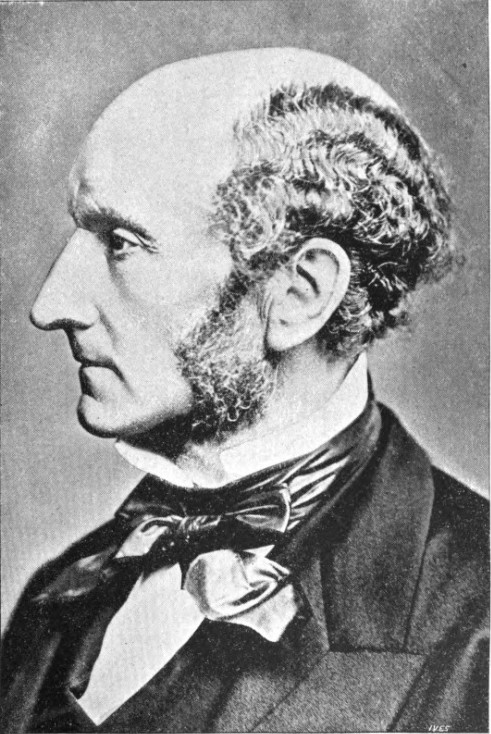
JOHN STUART MILL.
JOHN STUART MILL.
1879.
I.
One day in July, 1870, as I was pacing the floor of my room in Paris, with a book in my hand, I heard a modest knock at the door. The clock-maker, thought I, for it was the appointed time when, once each week, on the stroke of the hour, an assistant of the clock-maker was in the habit of making his appearance to wind up all the clocks of the little hotel garni.
I opened the door. Without there stood a tall, thin, elderly man, in a rather long black frock-coat buttoned about the waist. "Walk in!" said I, and resumed my book without bestowing further scrutiny upon him. But the man stood still, raised his hat, and questioningly mentioned my name. "That is my name," I replied, and before I could ask any question in return, I heard uttered in a subdued voice, the words, "I am Mr. Mill." Had the gentleman introduced himself as the king of Portugal, I could scarcely have been more astonished, and I do not know what he could have said that for the moment would have given me greater pleasure. My feeling was the same that a corporal of the young guards, under the first empire, might have experienced, had the great Napoleon, during one of his rounds in the camp, paid him the honor to notice his existence by giving his ear a pull.
I had attempted to make Stuart Mill known in my fatherland, and on this account he had repeatedly written to me, besides sending numerous pamphlets and newspapers, likely to be of interest to me, both to Copenhagen and to Paris; so he knew my address, and as he was passing through Paris, where, strange to relate, he did not possess a single acquaintance, he did not hesitate to traverse the long distance from the Windsor Hotel to the Rue Mazarin to honor his young correspondent with a visit.
As he mentioned his name to me, I recalled at once his portrait. It gave, however, as little idea of the expression of his countenance and the hue of his skin, as of the way in which he walked and stood. Although sixty-four years of age, his complexion was as pure and fresh as that of a child. He had the smooth, childlike skin and the rosy cheeks that are scarcely ever seen in elderly men of the continent, but that not seldom may be observed in the white-haired gentlemen who take their noonday horseback rides in Hyde Park. His eyes were bright, and of a deep, dark blue, his nose slender and curved, his brow high and arched, with a strongly marked protuberance over the left eye; he looked as though the labor of thought might have forced its organs to extend in order to make more room. The face, with its large and marked features, was full of simplicity, but was not calm; it was, indeed, continually distorted by a nervous twitching, which seemed to betray the restless, tremulous life of the soul. In conversation, he had difficulty in finding words, and sometimes stammered at the beginning of a sentence. Seated comfortably in my room, with his fresh, superb physiognomy, and his powerful brow, he looked like a younger and more vigorous man than he really was. When I accompanied him on the street later, however, I observed that his walk, in spite of its rapidity, was rather halting, and that, notwithstanding his slender form, age had left its impress on his bearing. His dress made him seem older than he was. The old-fashioned coat he wore proved how indifferent he was to his external appearance. He was clad in black, and a crape band was wound in many irregular folds about his hat. Although she had been long dead, he still wore mourning for his wife.
No further signs of negligence were visible; a quiet nobility and a perfect self-control pervaded his presence. Even to one who had not read his works it would have been very evident that it was one of the kings of thought that had taken his seat in the red velvet arm-chair near the fireplace, whose mantel clock my unfounded suspicion led me to suppose he had come to wind up.
II.
He spoke first of all of his wife, whose grave in Avignon he had just left. He had purchased a house in that city, where she had died, and always passed half of the year there. Already in his introduction to her essay on the "Enfranchisement of Women," which was the foundation of his own book on "The Subjection of Women," he had given public utterance to his enthusiastic admiration for the deceased. He had there said, the loss of the authoress was one that, even from a purely intellectual point of view, could never be repaired; he had declared that he would rather see the essay remain "unacknowledged, than that it should be read with the idea that even the faintest image could be found in it of a mind and heart which, in their union of the rarest, and what are deemed the most conflicting, excellences, were unparalleled"; indeed, he had called "the highest poetry, philosophy, oratory, or art," "trivial by the side of her," and had ended with the prophecy, that if mankind continued to improve, its spiritual history for ages to come would be nothing but "the progressive working out of her thoughts and realization of her conceptions." In this tone, too, he spoke of her in my room. We may well suppose that the man who could thus express himself was no great portrait-painter, and we may doubt the objective tendency of his judgment; we cannot, however, accuse him of viewing marriage as a mere contract, a charge frequently brought against him on account of his ultra-rationalistic standpoint on the woman question. Great poets, like Dante and Petrarch, have erected over the women who were fantastically beloved by them a fantastic monument; but I do not know that ever a poet gave such true and such warm expression to his loving veneration of a female character as Mill, in the words in which his opinion of her worth and her enduring significance to him was couched. The inscription he had cast on her tombstone in Avignon is no evidence of an artistic talent for the lapidary style; it has too many and too eulogistic words. How energetic and beautiful, though, is the sentence with which it ends, "Were there even a few hearts and intellects like hers, this earth would already become the hoped-for heaven." I asked Mill if his wife had ever written anything else than the essay edited by him. "No," he answered; "but all through my writings you will find her ideas; the best passages in my books are by her." "In your 'System of Logic' too?" I asked once more. "No," he replied, half apologetically; "my Logic was written before I was married." I could not avoid thinking that the contributions of Mrs. Mill to the inductive logic, even in the opposite case, could scarcely have been very considerable; a little thinking and reasoning would, under all circumstances, have fallen to the lot of Mill himself. The tone of reverential submissiveness apparent in his conversation was, however, peculiar to the temperament of the great thinker.
His nature was endowed with a decided inclination to serve not a cause alone, but its personal incarnation, and thus he was led to worship one after the other, two individuals, who, rare and significant though they may have been, were by no means his superiors,—his father and his wife. To his father (and to Bentham) he looked up in his early youth, to his wife all the rest of his life.
No one who has read Mill's "Autobiography" will have forgotten the gloomy description he gives of the desperate state of languor which ushered in his manhood. It was a long and painful crisis, during which his nature reacted against the excessive development of his faculties caused by his abnormal education. Instead of admiring the perfect intellectual organization which enabled him to come forth uninjured from the overfreighted and dangerous school of his father, English mediocrity was fond of pronouncing him, because of this hot-house culture, an abnormal being who was by no means fitted to be a teacher and an example. In the incredibly large and varied store of information imparted to him when he was a mere boy, the proof of the unnaturalness of his teachings and the "inhumanity" of Stuart Mill was found. What could be expected from a reading-machine that had studied Greek at three years of age, and at thirteen had gone through a course of political economy? The crisis which followed this overloading has been no less misinterpreted than was the encyclopædic education of the boy. Its symptoms were total indifference to all objects that previously had seemed to the young man worth desiring, and an unbroken state of joylessness, during which he asked himself whether the complete realization of all his ideas, and the achievement of the reforms for which he had been eager, would cause him genuine satisfaction, and found himself compelled to answer the question in the negative. Philosophers have discovered in this crisis nature's contradiction of Mill's utilitarian theory, inasmuch as, according to his own confession, the realization of the greatest possible happiness for the greatest possible number would have failed to make him happy. Theologians have found in it the stealthy approach of that secret melancholy, that deep-seated despair, which is always experienced by unbelievers, even when they themselves are not aware of it. Still, it is scarcely evidence against utilitarianism that morality alone is not sufficient for happiness, and it would be poor testimony, indeed, in behalf of the indispensability of dogmatic belief that a highly gifted and eminently critical youth of twenty years of age (who, moreover, both earlier and later managed to make his way cheerfully through the world without dogmatic belief) passed one whole winter in a state of profound aversion to action, overwhelmed with that sense of the misery of existence, with which every speculative mind is compelled to contend, and which almost every one is forced to conquer at least once in a lifetime. Among highly developed men there are but few who have not known this self-abandonment; with some it is of short duration, with others it becomes chronic: the exterior cause, as well as the weapons to be used against it, alone differ. Every one has his armor against discontent, one the impulse to work, another ambition, another family life, another frivolity; but through the meshes of his coat of mail weariness of life will occasionally find its way. With Stuart Mill this armor was manifestly the certainty of being in harmony with the mind of another person whom he esteemed more highly than himself. We must not overlook his own utterance that if he had, during the sorrowful crisis, "loved any one sufficiently to making confiding his griefs a necessity, he should not have been in the condition he was." Had Mill at that time been acquainted with his future wife, the crisis would certainly not have assumed such an acute character: she would have helped him to conquer his profound dejection more surely than dogmas and moral systems. This is very obvious from the pertinent words with which he has described his condition, "I was thus, as I said to myself, stranded at the commencement of my voyage, with a well equipped ship and a rudder, but no sail." The sail of this ship, which bore so rich and precious a freight, was and always remained his enthusiastic tendency to bow in profound submission before a chosen idol. At that period the influence of his father was markedly on the wane, that of his wife had not yet begun; consequently he stood still.
So much, at least, was made very plain in my first conversation with Mill, that the gain of this woman friend was the greatest boon of his life. Only in one of the passages that he has written about her has he succeeded in giving an exact idea of the peculiar nature of her character, and that is where he compares her to Shelley. A female Shelley—so she stood before him in his youth; later, even Shelley, who was so early snatched away, seemed to him a child in thought and intellectual maturity in comparison with what she became. He states many times, in very decided terms, what he owes to her: the perception of the region of ultimate aims, that is, the final consequences of theory; and of that of the nearest means, that is, of the immediately useful and practically attainable. The original endowment which he himself acknowledges, was now directed to the fusion of these extremes, to finding the medium course in political and moral truths.
Nevertheless, it does not seem to me probable that Mrs. Mill inspired her husband with any direct new thought. The essential significance to him must, I think, be sought in two other points. In the first place, she strengthened his mental courage, and it is the boldness rather than the novelty of thought that gives its character to such classic works, as "On Liberty." Many times, even during our first conversation, he returned with regret to the lack of courage that everywhere withholds writers from supporting new ideas. He said, "There are writers of the first rank, such as George Sand, whose actual originality consists in courage. I leave out of consideration," he added, "her indescribably beautiful style, whose music can only be compared with the pleasing sounds of a symphony." The very confidence that a sense of harmony with the thought of another arouses, had enabled the wife of Stuart Mill to promote in him the courage he so extolled in George Sand.
In the second place, through her female universality, Mrs. Mill prevented her husband from running into any prejudice whatsoever. She confirmed in his mind a certain scepticism that led him to keep open amid the ice of doctrine one spot that would never freeze; and in thus inclining him to be sceptical, she became the cause of his progress. While the majority of so-called freethinkers have almost always purchased relative free thought in one point with double obduracy in other respects, Mill was continually on his guard against conventional prejudice; indeed, until the day of his death he carried on a sharp warfare against it, ferreting it out in its stronghold with the utmost intrepidity, in order to denounce and annihilate it.
Finally, there can be no doubt that Mrs. Mill was largely responsible for the active part her husband took in advocating the elevation of woman's social position. I felt interested to learn whether he had ever replied to his assailants on the woman question. He had given them no answer, nor did he purpose to pay any heed to them. "Why," said he, "forever keep repeating the same thing? Not one of them has produced anything of value." I touched upon the opposition of several physicians, whose objections were based on the necessities of nature to which a woman is subjected. He spoke harshly and positively against the prejudices of physicians in general. Long and tenderly he lingered, on the contrary, on the pleasure women took in performing the duties of the medical profession, and of the decided vocation they not unfrequently manifested for it. He mentioned Miss Garrett, who had recently taken a medical degree in Paris, and praised her as the first woman who had had the courage to make such an attempt. In a letter to me, he had once designated the woman question as "in his eyes the most important of all political questions of the present day." At all events, it was one of those which during the last years of his life personally occupied him the most.
He did not hesitate, either in his written or in his spoken words, to use the strongest expressions in order to place in the right light his conception of the unnaturalness of women's state of dependence. Indeed, he had not been afraid to challenge universal laughter through his vehement assertion, that, as we had never seen woman in freedom, we did know nothing whatever until now of her nature; as though Raphael's Sistine Madonna, Shakespeare's young maidens, all the literature about women, in fact, had taught us nothing of the feminine character. On this point he was almost fanatical. He, who in all the relations between man and woman was refinement and delicacy itself, allowed himself to be positively insulting in his expressions when an opinion differing from his own on his favorite topic was uttered in his presence. One day I chanced to be visiting a celebrated French savant when the mail brought him a letter from Stuart Mill. It was an answer to a communication in which the Frenchman had expressed the opinion that the change in the social status of women, demanded in Mill's essay on "The Subjection of Women," might turn out well in England, where it would harmonize with the character of the race, but that in France, where the talents and tastes of the women were so contrary to it, there could be no possibility of success. Mill's pithy reply, which was handed to me with a smile, read as follows: "I see in your remarks that contempt for woman which is so prevalent in France. All that I can say on the subject is, that the French women pay this contempt back with interest to the men of France."
The peculiarity of Mill's standpoint in this emancipation question was, that it was based solely and entirely on a Socratic ignorance. He refused to see in the accumulated experience of ages any proof in regard to the boundaries of the so long enthralled feminine mind, and insisted that à priori we knew nothing at all about woman. He proceeded from no doctrinal view of especial feminine faculties, resting content with the simple proposition that man had no right to deny woman any occupation to which she felt attracted; and he declared everything like guardianship to be utterly useless as well as unjust, since free competition would of itself exclude woman from every occupation for which she was incapacitated, or in which man decidedly surpassed her. He has repelled many people by immediately deducing the final logical consequences of his theory the first time the question was brought forward, and by advocating the immediate participation of women in the affairs of government; but, as an Englishman, he had a too matter-of-fact mind not to limit the practical agitation to a single point. I remember asking him why—in utter disregard of what appeared to me the first requisite of all, social emancipation—every effort in England and America was concentrated on political suffrage, which was so much more difficult to attain. He replied, "Because when that is gained, all the rest will follow."
III.
He rose to take his leave, and having been informed that I meditated a trip to London, he asked me if I would make it with him. Fearing to intrude, I declined, and received an invitation to visit him in England. I had at that time just read Mill's masterly work on the philosophy of William Hamilton, was very full of it, and my mind was burdened with a thousand philosophic questions aroused by it. I was, therefore, greatly rejoiced that so rare an opportunity offered itself to discuss my doubts with the author himself, and a week later I rang the bell at the garden gate in front of Mill's country seat in Blackheath Park, near London, that little wicket gate before which I have never stood without a feeling of joyous expectation, and which I have never closed behind me without a sense of having been intellectually enriched.
My university education in Copenhagen had been an abstract metaphysical one; the professors of philosophy of the institution were men who, although mutually opposed to one another and supposed to be advocates of diametrically opposite standpoints, in all essentials bore the impress of the same school. They had begun their career as theologians, and had later become Hegelians, some influenced by the left flank of the Hegel school, others by the right. They had finally, together with all the rest of the world at that time, become "emancipated from Hegel," which, however, must be so interpreted as to admit of Hegel's still remaining first and last in their mental sphere. The methods of Hegel, employed now more naïvely, now in a more sophistic way, were preached from a cathedra, devoted to the worship of the absolute, the subjective-objective; his works were cited, his few witticisms repeated, and a wearisome, never-ending controversy against his supposed errors was carried on, from which we students gathered that they were almost all founded on his undervaluation of the real, especially in his faulty discernment of the natural sciences. We were taught, however, to consider his errors more precious than the truths of other thinkers, since truth could only be attained, as was shown by the example of our worthy professors, by creeping through the loop-hole of some error of Hegel. The University of Copenhagen, notwithstanding its otherwise by no means too friendly sentiments towards Germany, held it as an incontestable fact that modern philosophy was a German, as ancient philosophy had been a Grecian science. The existence of English empiricism and of French positivism was not recognized at the university; of English philosophy, in especial, we only heard as of a system that had long since been overthrown, and whose death-blow had been dealt to it by Kant. It had only been possible for me, by a vigorous effort of the will, to tear myself free, as best I could, from the bonds of the school prevailing in Denmark, and at the period when I met Stuart Mill I was still wavering between the speculative and the positive tendency. I made no secret to Mill of my state of uncertainty.
"So, then, you are very familiar with Hegel," said he. "Do you understand German?"
"To be sure I do; I read it almost as readily as I do my mother-tongue."
"I do not understand the German language," he said, in reply, "and have never read a line of German literature in the original. In fact, I know so little German that when I have been in Germany, I have had difficulty in finding my way at railroad stations and elsewhere."
"Have you made the acquaintance of the German philosophers through translations?"
"Kant I have read in a translation, of Hegel not a syllable either in a translation or in the original. I know him only through reviews and refutations, best of all through a concise presentation of his views by the only Hegelian in England,—Stirling."
"And what impressions have you received of Hegel?"
"That the writings in which Hegel has attempted to apply his principles may perhaps contain some good things, but that everything purely metaphysical in what he has written is sheer nonsense!"
I was startled, and suggested that I supposed this remark was to be taken cum grano salis.
"No; every word is meant to be understood literally," replied he. Then he dwelt on the outlines of the system, on the first preliminaries, the theory of being that is identified with nothing, and exclaimed, "What would you expect from a whole that begins with such sophistry? Have you really read Hegel?"
"Certainly; I have read most of his writings."
Mill (with a highly incredulous air), "And you have understood him?"
"I think so; at least, in all the principal features of his works."
He (with almost naïve astonishment), "But is there actually anything to understand?"
I did what I could to reply to this singular and rather diffusive question, and Mill, by no means convinced, yet as though he entered into my thought, said, "I understand very well the reverence, or the gratitude, you cherish for Hegel. We are always grateful to those who have taught us to think."
Never have I felt so keenly, as during this conversation, how thoroughly Mill was a man cast in one mould, a genuine Englishman, wilful and obstinate, equipped with a singularly iron will, and absolutely devoid of any flexible critical power of appropriation. What took the deepest hold of me, however, was the impression of the ignorance in which the most noteworthy men of different countries, even of the few lands most closely akin to their own, are of their mutual merits, and that in this second half of our nineteenth century. It seemed to me one could do much good by simply studying, confronting, and understanding these great minds that fail to understand one another.
I endeavored to bring into play against the principles of empirical philosophy the mode of contemplation I owed to my university training. To my astonishment, all the arguments I brought forward, and on whose effect upon Mill I had counted much, had long been familiar to him. "Those," said he, "are the old German arguments." He traced them all back to Kant, and had his answers to them ready.
It would not be in place in these pages to treat of the real significance of the controversy between the two modern schools, a problem which, in Germany, by almost all thinkers, is solved from the Teutonic point of view; as a matter of course, Stuart Mill would not admit that David Hume had been refuted by Kant, an opinion which I now thoroughly share with him, and which I believe will be universally prevalent when the Kant worship begins to be somewhat on the decline. (I already find a trace of this change of conception in Germany in Fr. Paulsen's admirable work on Kant's "Theory of Knowledge.") At that time, to be sure, I had a presentiment that there must be some way of reconciling the rationalistic and the empiric theory of knowledge, but I did not yet know Herpert Spencer's simple solution of the problem. Mill spoke briefly but decidedly against all attempts at mediation, and concluded, with the mingling of modesty and decision that was peculiar to him, in the following words, which have remained fixed in my memory, "I believe that we must choose between the theories."
In the same spirit he expressed himself concerning the various modern philosophers, whose thought was nearly related to his own. He recommended me to become acquainted with Herbert Spencer, yet would not advise me, he said, to study Spencer's later works; he thought that in these Spencer had deviated from the "good method." On the other hand, he urgently commended to me Spencer's "Principles of Psychology," and the two chief works of his, in my estimation, far less intellectual contemporary Bain,—"The Senses and the Intellect" and "The Emotions and the Will." He presented me with a copy of the "Analysis of the Human Mind," by his much-revered father (the edition prepared and supplied with notes by himself and Bain), extolling the book to me as the main work of the English school in this century; and I having expressed to him my admiration of his critique of Hamilton's philosophy, he sent me the book the very next day. Almost of itself the conversation fell on Taine's recently issued volume, "De l'intelligence," in which Mill is so zealously investigated, profited by, and refuted, and in which the English tendency has perhaps placed its most enduring monument in French philosophy. Mill praised Taine, called his book one of the most profound and important works of modern France, and said about the same things to me regarding it that I found repeated later in his review of it ("Fortnightly Review," July, 1870). As a whole, he liked the book; but he had the same kind of objections to offer against the last chapters as against the later works of Herbert Spencer. We must, according to his conviction, most decidedly "choose," once for all, between the conditional knowledge of empiricism and the absolute certainty of intuition, and Taine, in the last volume of his work, had attempted to establish axioms which, not being derived from experience, had validity for the whole universe, independent of the boundaries of our experience. Mill, himself, thought, as is well known, that even the propositions of algebra and of geometry, whose empiric origin he endeavored to establish, could only be sure of a limited dominion. He extolled to me the little book "Essays by a Barrister," from which he himself quoted a few sentences. The barrister finds it quite conceivable that our multiplication-table, as well as our Euclid, may be utterly valueless in another solar system. "The question is," he says, "whether our certainty of the truth of the multiplication table arises from experience or from a transcendental conviction, excited by experience, but anterior to and formative of it." To illustrate the former of these views he presents a few striking examples:—
"There is a world in which, whenever two pairs of things are either placed in proximity or are contemplated together, a fifth thing is immediately created, and brought within the contemplation of the mind engaged in putting two and two together. This is surely neither inconceivable, for we can readily conceive the result by thinking of common puzzle tricks, nor can it be said to be beyond the power of Omnipotence, yet, in such a world, surely two and two may be five; that is, the result to the mind of contemplating two twos would be to count five. This shows that it is not inconceivable that two and two might make five; but, on the other hand, it is perfectly easy to see why in this world we are absolutely certain that two and two make four. There is probably not an instant of our lives, in which we are not experiencing the fact. We see it whenever we count four books, four tables or chairs, four men in the street, or the four comers of a paving stone, and we feel more sure of it than of the rising of the sun to-morrow, because our experience upon the subject is so much wider, and applies to such an infinitely greater number of cases. Nor is it true that every one who has once been brought to see it is equally sure of it. A boy who has just learned the multiplication table is pretty sure that twice two are four, but is often extremely doubtful whether or not seven times nine are sixty-three. If his teacher told him that twice two made five, his certainty would be greatly impaired.
"It would be possible to put a case of a world, in which two straight lines should be universally supposed to include a space. Imagine a man, who had never had any experience of straight lines through the medium of any sense whatever, suddenly placed upon a railway, stretching out on a perfectly straight line to an indefinite distance in each direction. He would see the rails, which would be the first straight lines he ever saw, apparently meeting, or at least tending to meet, at each horizon; and he would thus infer in the absence of all other experience that they actually did enclose a space, when produced far enough. Experience alone could undeceive him. A world in which every object was round with the exception of a straight, inaccessible railway, would be a world in which every one would believe that two straight lines enclosed a space." In his conversation, Mr. Mill expressed his adherence to these humorous sophistries, which have been so keenly criticised by Spencer, and he added, "If we possessed the sense of sight without the sense of touch, we would have no doubt that two or more bodies might exist in the same place, so completely is every so-called a priori axiom dependent on the character of our organs and experiences."
IV.
Our conversation turned one day on the then existing circumstances in Rome. I compared the religious condition of Rome with that of France; I reminded Stuart Mill of the phenomenon observed by both of us in Paris of the beau monde congregating in a church, and added: "In your Dissertations and Discussions, you have written some words which you will scarcely now defend. You say: 'So far as the upper ranks are concerned, France may as properly be called a Buddhistic as a Catholic country; the latter is not more true than the former.' Would you still maintain this?" He answered: "It was at that time more true than now. In our day a new reaction has taken place, the possibility of which I could not conceive. In my youth I did not believe that man could retrograde; now I know it." A portion of the blame for this retrogression he ascribed to the French university philosophy. He spoke with a deprecation which was not to be wondered at, coming from his lips, of Cousin and his school. "But in spite of all," he concluded, "I cling to my old conviction that the history of France in modern times is the history of all Europe."
This view, which is reflected in all the works of Stuart Mill, is, in my judgment, a one-sidedness which can easily be accounted for by his ignorance of the German language and literature, and his undervaluation of the English situation, in which he, as a matter of course, was well able to detect the evils. He had visited France when he was very young; he told me he had passed his fifteenth year there, and had during that time learned all the French now at his command. As the French language was the only foreign tongue he spoke fluently and frequently (even though not without a strong English accent), and as through his whole life he had exerted himself to introduce French ideas into England, and to impart to his countrymen a love for the French national spirit, France necessarily represented to him Europe almost as though he were a native-born Frenchman.
Among all the Frenchmen whom Mill knew, Armand Carrel was, I believe, the one whom he held in the highest esteem. The essay he has written about this young French journalist is perhaps the most beautiful and the most overflowing with sentiment of anything he has written. In his great admiration for Armand Carrel, I find a partial explanation of his vehement antipathy to Sainte-Beuve. He could never forgive Sainte-Beuve for the fact that he, who had once been a collaborator of the "National," and a friend of Carrel, had become friendly to the Empire, and allowed himself to be elected senator. And yet this isolated fact was scarcely sufficient to warrant the hard words Mill dropped concerning Sainte-Beuve in my presence. Sainte-Beuve was distasteful to him for the same reason that Carrel so greatly pleased him. He had not thoroughly studied him; his "Port Royal," for instance, he had never read; but a mind with such keenness and such firmly rooted principles as Mill's, was naturally repelled by the pliant and undulating temperament of Sainte-Beuve. Stuart Mill was a man of almost metallic character, rigid, angular, and immovable; the spirit of Sainte-Beuve, on the contrary, was like a lake, broad, tender, elastic, and of great circumference, yet moving altogether in little ripples of an undefined and varying size. Therefore Stuart Mill was, as it were, created to be an authority; his tone was that of one accustomed to command, and even when his demeanor was the boldest, he seemed, through the very conciseness and confidence with which he substantiated his results, to repulse every contradiction. Sainte-Beuve, on the contrary, never closed a subject entirely and without reservation; he was never quite catholic, nor quite romantic, nor quite imperial, nor quite a naturalist; one thing alone he was absolutely and entirely—Sainte-Beuve, in other words, the critic with feminine sympathy and ever-lurking scepticism. He was of the tiger race, yet was no tiger. He attached himself thoroughly to no one and to nothing, but he rubbed against everything, and the inevitable friction produced sparks. Mill's repugnance to him was like the antipathy of the dog for the cat. It was impossible for Sainte-Beuve to write simply; he could not pronounce a verdict without making it dependent on a whole system of subordinate conditions; he could not utter ever so brief a eulogy without spicing it with all kinds of malice. The greatest critic of France, after the death of Saint-Beuve, once said to me, "A laudatory sentence from Saint-Beuve is a veritable nest of leeches." Now, take in comparison the character of the mind and the whole style of Stuart Mill; his thoughts always on a grand scale, embracing the universal, allowing the individual to slip from notice; his diction unadorned, without artistic finish, naked as a landscape, whose sole beauty is the simplicity and power of the position of the land.
On one of the last days of my stay in London the conversation with Stuart Mill turned on the relation between literature and theatre in England and in France. He expressed the opinion, so common in our day, that the French who in the seventeenth century appropriated Spanish, in the eighteenth century English, and in the nineteenth century German ideas, in reality possess no other literary originality than that which lay in the form. Stuart Mill, whose mind was pretty much devoid of a sense of the purely æsthetic, and who cared more for the idea in art than for art itself as art, apparently did not realize that the poetic and artistic originality of the French would remain unaffected even by this undue limitation of its inventive genius; for where form and contents are inseparable, originality in form is identical with originality in general. Without permitting myself to touch on this point of view in my conversation with Mill, I merely replied, that one characteristic commonly held up as a reproach to the French, their so-called superficiality, was most highly useful to them when they imitated, for their imitation is but a semblance. With a strong tendency to be influenced by everything foreign, the French unite an almost total lack of capacity to form an objective impression of the foreign; consequently the national stamp is always plainly recognizable beneath the thin coating of foreign gloss. By way of example, I mentioned Victor Hugo, as an imitator of Shakespeare, and Alfred de Musset, as an imitator of Byron. "However," I added, "I will heartily admit the superiority of English poetry to the French if you will reward me by conceding the superiority of French dramatic art over the English." I had the previous evening attended the performance at the Adelphi Theatre, of Molière's "Le malade imaginaire," under the title of "The Robust Invalid," and having very often seen the play in Paris, I had a fine opportunity to compare the English mode of acting with the French. The invalid and the servant-girl were allowed all manner of coarse exaggerations; they bawled aloud in the roughest conceivable way, even had the audacity to end the second act with a cancan; and this while English prudery demanded that the scene with the syringe, and all expressions supposed to violate decency, should be omitted. "Yes," said Mill, "the theatre with us has fallen into decay. So far as the comedy is concerned, this may be accounted for by the fact that English nature is so devoid of form, and so untheatrical, and because our gestures are so stiff and so rare, while the French, even in their daily lives, always demean themselves like actors; yet in the direction of tragedy we can show some great names. Who knows, though, but that in our day reading may supplant theatre-going and compensate for it?"
He led the conversation from the theatre to English authors, and discussed with warmth two men as totally different from himself as Dickens and Carlyle. Thoroughly matter-of-fact as he was himself, he could appreciate as well as any one the poet with the great, warm heart, and the historian with the gushing, visionary imagination. Dickens was at that time just deceased; a few days previous to our conversation I had stood on the spot in Westminster Abbey where his body had but recently been laid to rest. His grave was still covered with living roses, while heavy, cold stone monuments covered the surrounding graves; it had the effect of a symbol. I communicated my impression to Mill, who expressed deep regret that he had not known Dickens personally, and had only learned through others of his amiability in private intercourse.
The last words we exchanged concerned the directly impending Franco-German War, to which Mill looked forward with gloomy misgivings. He considered it a misfortune for all humanity, for the entire European civilization.
I gazed long into his deep, blue eyes, before I could prevail upon myself to bid him a final farewell. It was my earnest desire to imprint upon my mind this so earnest and so stem, yet at the same time so bold, countenance, with all its youthful freshness. I wished to render it impossible to me to forget the peculiar greatness stamped on the man's form and on his every word. It is of considerable importance in grasping the character of an author to learn in what relation the impression of his human disposition stands to that of his disposition as an author. I have never known a great man in whom these two impressions were so thoroughly harmonious as in Mill. I have never discovered any quality in him as an author that I have not rediscovered in my personal intercourse with him, and I have found his different characteristics in both spheres exalted above and subordinated to one another in precisely the same order and manner. There are authors in whose writings some definite quality—for instance, philanthropy, or wit, or dignity—plays a more prominent rôle than in their lives; others whose writings display not a trace of those qualities, such as humor or free humanity, which render them amiable in their private lives. Most authors are far inferior to their books. In Stuart Mill no such inequality existed, for he was the very incarnation of truthfulness. There occurs in Mill's "Autobiography" a situation which affords an opportunity of measuring the degree of this truthfulness. I have in mind his position when he, the social reformer, who was so far removed from all demagogism, at a meeting of electors, comprised chiefly of the working class, was asked if he had written and made public the statement that the working classes of England were, as a rule, liars. He answered at once, and briefly, "I did." "Scarcely," he adds, "were these two words out of my mouth, when vehement applause resounded through the whole meeting. It was evident that the working people were so accustomed to expect equivocation and evasion from those who sought their suffrages, that when they found, instead of that, a direct avowal of what was likely to be disagreeable to them, instead of being affronted, they concluded at once that this was a person whom they could trust."
Mill gives the most modest interpretation of the proceeding, but the reader surmises what a halo of truthfulness must at that moment have hovered about him whose accusation of pervading falsehood was met with storms of applause from men spoiled by the flatteries of demagogues. In daily life, too, Mill bore that invisible nimbus of exalted love of truth. His whole being radiated with purity of character. It is needful to look back to the most sublime philosophic characters of antiquity, to Marcus Aurelius and his peers, if peers he has, to find a parallel to Mill. He was equally true and equally great, whether he addressed his maturely considered thought in some renowned work to a circle of readers spread over the whole globe, or whether, in his own home, without any assumption of superiority, he dropped an accidental remark to a chance visitor.
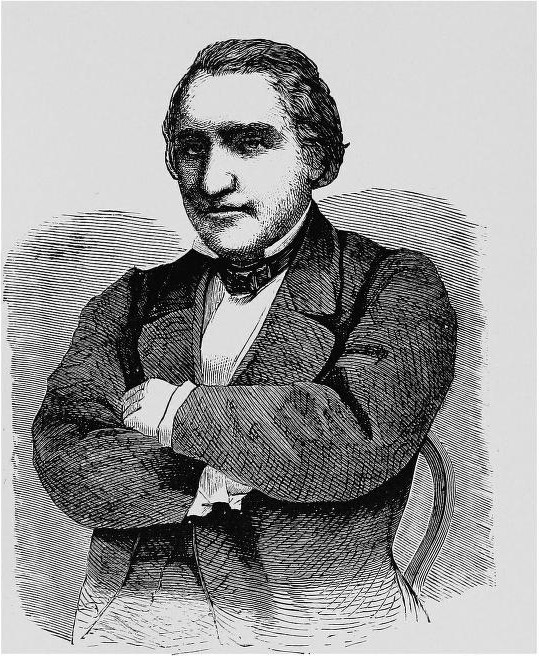
ERNEST RENAN.
ERNEST RENAN.
1880.
It was not my intention to call on Renan during my stay in Paris from April to September, 1870, for I have always had an absolute horror of robbing celebrated men of their time under pretext of paying tribute to them. When, however, Taine—Renan's most intimate friend—repeatedly urged me to look up his "friend, the philologist," I gathered up my courage, and one day, provided with a letter of introduction from Taine, found myself on the third floor of a house in Rue de Vannes, where Renan lived. His surroundings were exceedingly simple. Since he had been deprived of the chair of Hebrew in the "Collège de France," he was without any fixed income, and his first popular publication was the only one of his books that had been at all remunerative.
Judging from his works and portrait, I had imagined Renan to be a refined reproduction of Jules Simon, philanthropic, gentle, with his head slightly inclined to one side; I found him decided, terse, and bold in his utterances, firm in his convictions, with somewhat of the modesty of the savant, but still more of the confidence and air of superiority of the man of the world. Renan was at the time forty-seven years of age. He was sitting at his writing-table when I entered his room, a little, broad-shouldered man, with a slight stoop, and a large, heavy head; his features were coarsely moulded, his complexion poor; he had blue eyes that displayed a wondrous power of penetration, and a mouth that, even in repose, was eloquent and indicative of shrewdness. His far from beautiful yet unquestionably attractive face, with its expression of lofty understanding and excessive industry, was framed in a mass of long brown hair that over the temples gradually shaded into white. In looking at him I was reminded of one of his own sentences, "La science est roturière".
I.
In early youth I had been repelled by the works of Renan, who is by no means the author for youth. Moreover, his "Life of Jesus," the first of his writings that fell into my hands, is perhaps his weakest work; the trace of sentimentality, the occasional appearance of unction, that last remnant of a priestly education, all that to a young person must seem either unduly effeminate, or lacking in genuineness, prevented me from arriving at a correct estimation of his literary qualities. That first impression had later been lost; the noble collection, "Etudes d'histoire religieuse," had opened my eyes to the almost feminine delicacy of feeling that could only seem unmanly to very youthful and inexperienced minds, and I found it quite natural that he who had justly been called "the most gentle of the bold" should be unable to speak without melancholy of his exceptional position. "The worst penalty a man who has fought his way to a life of reflection is compelled to pay for the independent stand he has taken, is to see himself excluded from the great religious family to which belong the best souls on earth, and regarded by the very beings with whom he would most gladly live in spiritual harmony, as a corrupt man. One must be very sure of one's position not to be shaken when women and children clasp their hands and cry, Oh, believe as we do!"
I had, however, erred in my supposition that any reminder of this elegiac tone would ring through Renan's every-day mode of expression. The main characteristic of his conversation was a thorough intellectual freedom, the magnificent repose of a genial child of the world. The nerve and sinew of his words was an unbounded contempt for the majority and for the masses, such as I had never before encountered in any one who displayed neither misanthropy nor bitterness. The first time I saw him he led the conversation to human stupidity. He said, evidently in view of inspiring his younger fellow-laborer with tranquillity of mind for the coming storms of life, "Most men are not human beings at all, but apes"; but he said it without anger. The words of Géruzez occurred to my mind, "L'âge mûr méprise avec tolérance." Traces of this calm contempt may be found in the prefaces to his works; many years later it received poetic expression in his translation of Shakespeare's "Tempest"; but in his essay on Lamennais he has plainly defined it. He says: "There is found in Lamennais quite too much anger and not sufficient contempt. The literary consequences of this fault are very serious. Anger leads to declamation, bluntness, often coarse insults; while contempt, on the contrary, almost always produces a refined and dignified style. Anger bears within itself a need of being shared. Contempt is a subtile, penetrating delight which does not require the sympathy of others. It is discreet and all-sufficient to itself."
Renan's manner of speaking has a certain upward-soaring flight, a certain sprightly and redundant grace, without which no one ever gains the praise in Paris accorded to Renan, that in social intercourse and conversation he was "charmant." Of the solemnity which his style often displays there was not a trace in its oral form. There was nothing priestlike about him, and he was wholly devoid of the pathos of a martyr of free thought. It was his wont to introduce a turn in the discourse with his favorite expression, "Diable!" and he was so far removed from striking the bitter and elegiac tone, that his equanimity had rather a touch of Olympian cheerfulness. Whoever knew anything of the childishly odious attacks with which he was daily assailed from the orthodox ranks, and whoever, like myself, had observed in Veuillot's journalistic circles how opinions wavered between whether the right punishment for his heresy was hanging or shooting, could not but feel interested to inquire of Renan if he had not suffered a great deal for his convictions. "I!" was the answer; "not the least! I hold no intercourse with Catholics; I am only acquainted with one of them; we have one in the 'Academic des Inscriptions,' and we are very good friends. The sermons preached against me I do not hear; the pamphlets written against me I do not read. What possible harm could they do me?" According to Renan's opinion, the devout Catholics of France constitute about one-fifth of the population; and he thought they were far more fanatical than the orthodox Catholics of other places, because Catholicism in Spain and Italy is viewed almost as a matter of custom, while in France it is stimulated by intelligent opposition.
I found Renan, in June, 1870, very much exhilarated by the events in Rome. "A statue should be erected to Pius IX.," said he. "He is an extraordinary man. Since Luther no one has rendered such great service to religious freedom as he. He has advanced the cause about three hundred years. Without him Catholicism might very well have remained unchanged for three hundred years, shut up in a closed room with its spider's web and its thick dust. Now we are airing the room, and every one can see for himself that it is empty, and that nothing lies concealed within it." He had entertained a fear that during the negotiations concerning the infallibility of the Pope, even at the last moment, some compromise or other would be effected, through which everything would practically remain in the former channels; but this possibility had just vanished, and it could readily be foreseen that the bishops would shun no consequence, not even the result anticipated by Renan, which was, that a dismemberment would take place within Catholicism similar to that existing in Protestantism. It has been proved that the policy of the Catholic Church was wiser than its opponents at the first moment supposed. The division that took place was neither deep nor important, and there is not the slightest prospect of a dismemberment that can in any way be compared with the nature of the sects of Protestantism. Renan, who thought chiefly of France, hoped that time might open the eyes of the French bourgeoisie, which had thrown itself completely into the arms of the Church since the February Revolution, and was watching with profound anxiety the position so inimical to civilization assumed by the papal power.
In his interesting novel "Ladislaus Bolski," Victor Cherbuliez has turned into mild ridicule certain pet theories of Renan, by putting into the mouth of the good-natured yet thoroughly unpractical mentor of the hero, Renan's doctrine concerning the delicate nature of truth, and the consequent necessity of approaching it with the utmost deliberation and caution. George Richardet believes with Renan, that everything depends on some shade of meaning; that truth is not simply white or black, but is one shade of these colors, and he is wrecked because we cannot act in shades, but must act totally or not at all. In fact, Richardet aims at an actual realization of the idea expressed by Renan in one of many passages on the subject, as follows: "We might as well attempt to hit a winged insect with a club, as to grasp the truth in a moral science with the coarse claws of syllogism. Logic cannot grasp delicate shades of meaning, yet truths that are of a moral nature depend solely and entirely upon these shades. It is, therefore, of no avail to pounce on truth with the clumsy violence of a wild boar, for fleet and nimble truth will escape the ruthless attack, and all the pains taken to capture it will be in vain."
Whoever is familiar with Renan's literary activity knows how closely he adheres to this thought when he writes. How different is the fate of his beloved shades of meaning when he speaks! While Taine, whose writings are filled with such bold utterances, is ever moderate and subdued in conversation, only allowing himself to be guided by the strictest considerations of justice and fairness, Renan, when he speaks, goes to extremes, and is by no means the knight of the delicate shades of thought. In one point alone were the two men equally decided in their expressions. This was when the discourse turned on that spiritualistic philosophy of France which strove to gain strength in its tender alliance with the Church, that system of philosophy which originally won the hearts of fathers of families, by bearing on its shield dogmas and virtue, and that in the place of discoveries of new truths, promised to furnish the entire land with good morals as the fruits of its scientific research. It had at that time control of all the professorships of France. In Sorbonne it was represented by Janet and Caro. Janet, the more refined, more elegant spirit, endeavored to understand his opponents and set them right, while Caro, a specimen of genuine mediocrity, won the applause of the audiences he addressed, by flinging out his arms and vigorously beating his broad chest, and by his appeals to the freedom of the will. To Renan, who, nevertheless, has treated of Cousin as an orator and an author in so elegant an essay, the entire eclectic philosophy was orally mere "official soup," "children's pap," "product of mediocrity, calculated for mediocrity." Indeed, so obstinate was he on this point, that he, the advocate of fine shadings, could never be persuaded that spiritualism was not absolutely false. For Taine, on the other hand, he cherished an admiration that was almost passionate, "Taine, c'est l'homme du vrai, l'amour de la vérité même." In spite of the strikingly apparent difference of their natures,—Taine's style has the strength of a fountain, Renan's style flows as much like a stream as does the verse of Lamartine,—Renan declared himself to be in accord with his friend on all essentials. And when one day I led the conversation to the so frequently discussed question, namely, how much justice there was in the universal tendency to bewail the intellectual decadence of France, Renan immediately referred to Taine. "Decadence, what do you mean by that?" he exclaimed. "Everything is relative. Is not Taine, for instance, of vastly more importance than Cousin and Villemain put together? There is yet much intellect in France." Several times he repeated the words, "Il y a beaucoup d'esprit en France."
In common with nearly all cultivated Frenchmen, Renan was a reverential admirer of George Sand. This remarkable woman had been able to extend her dominion over the younger generation of France, without being in the least untrue to her youthful ideals. An idealist like Renan, she had won through her idealism; a naturalist like Taine, through the mysterious endowments that testified of her nearness to nature; the younger Dumas, to whom we might believe the heroes and heroines of George Sand, concerning whom his dramas often make bitter criticisms, would be especially odious, was perhaps the one among the post-romantic authors who stood personally nearest to her. The enthusiasm of Dumas for George Sand was, upon the whole, only a consequence of his literary susceptibility; the enthusiasm of Renan was of a deeper character. As strong as must necessarily be his hatred for Béranger, in whom he sees the personification of all that is frivolous and prosaic in the French national character, and whose narrow "Dieu des bonnes gens" is a thorn in the eye of the follower of Herder, the pantheistic thinker and dreamer, quite as lively must naturally be his sympathy for the authoress of "Lélia," "Spiridion," and so many other dreamily enthusiastic writings.
Notwithstanding his wide range of vision, Renan is not without national limitations in his literary sympathies. In a conversation about England, he had nothing whatever that was good to say of Dickens; he was not even inclined to be fair. "The pretentious style of Dickens," said he, "makes the same impression on me as the style of a provincial newspaper." His well-known unjust article on Feuerbach fills us with less astonishment, when we learn in how marked a degree the defects of Dickens caused him to overlook the merits. It is the same morbidly developed taste for a classic and well-tempered mode of expression which gives Renan an antipathy to the humorous peculiarities in the style of Dickens and to the passionate form of Feuerbach's style; the genial mannerism of the English seemed to him provincial; the violence of the German appeared to him to savor of a tobacco-like after-taste of the pedantry of German-student atheism.
II
In the spring of 1870 Renan was on the point of making a trip to Spitzbergen, in company with Prince Napoleon. Shortly before starting he was discussing politics with me one day. "You can become thoroughly acquainted with the Emperor," said he, "through his writings. He is a journalist on the throne, a publicist who takes pains to inquire into popular opinion. Since his whole power depends upon the latter, he has occasion to employ more art, notwithstanding his inferiority, than Bismarck, who can afford to disregard everything. Until now he has been merely physically, not intellectually, enfeebled, but he has been extremely cautious (extrêmement cauteleux), and he entertains a profound distrust of himself hitherto unknown to him." Renan's estimate of Napoleon was very similar to that expressed by Sainte-Beuve, in the well-known fragment on "The Life of Cæsar." Ollivier, whom he had known for a long time, he criticised severely. "He and the Emperor are admirably suited to each other," said he; "they have the same kind of ambitious mysticism; they are, as it were, allied through their chimeras." As early as the year 1851 Ollivier had often said to Renan, "As soon as I am at the helm, as soon as I become premier—"