Dr. GEORG BRANDES (continued 7)
Rasmus Björn Anderson translation
III.
In conversation with Paludan-Müller, little was learned concerning his life. He never made any communications regarding it to the public, nor was it his wont to speak in private of his personal experiences. He was by no means a good narrator. He discussed every great problem with interest; but facts, as such, occupied his mind in but a trifling degree. His mode of speech was argumentative, not figurative; the poetic element manifested itself in brilliant flashes, but scarcely ever in a picturesque expression. In a critical, or even violently exciting situation, I have never seen Paludan-Müller. I do not even know whether his external life ever presented momentous critical situations. The external lives of the Danish writers of his day were as a rule empty. They were educated in one school of learning or another, passed several years at the University of Copenhagen in vain endeavors to acquire some professional science, published their first poetry, undertook an extended journey abroad, and had awarded to them some official position, or a poet's stipend. To the lot of some of them was added a long and obstinate struggle for recognition. But even this dramatic element was lacking in the life of Paludan-Müller. He took part in no intellectual campaign. True, he was for a time not estimated according to his deserts, but he was never wholly misunderstood. His life seems, therefore, to have had as few sharp angles as that of most of our modern men of talent.
He was born in 1809 at a parsonage in Fünen, became a student in 1828, passed a mediocre examination in jurisprudence in 1835, married in 1838, and during the years 1838-40 travelled through Middle and Southern Europe. In 1851 he was made a knight of the order of Danebrog, and in 1854 received a professor's title. Moreover, in his mature manhood, he was a poet and a recluse.
What he was as a youth, we must conjecture from his works. From what I have heard, I imagine him to have been greatly fêted in social circles, the decided lion of aristocratic houses of Fünen; it has been told to me that he possessed such humor and so decided a faculty for impromptu invention, that he would sometimes create on the spur of the moment an entire little drama, and play it entirely alone, running from one side of his improvised stage to the other, in order to reply to his own speeches. I remember, too, having heard that in his younger days he had experienced a deep heart-grief, a young girl whom he loved having been snatched from him by death. Very early, at all events, the chain of bitter experiences, without which he could not have written the first part of "Adam Homo" in his thirty-first year, subdued his original love of life, and when still young, he retired from the world, withdrawing entirely from public, almost entirely from social life, and devoting himself exclusively to his home, his art, and his theological and philosophic studies. His marriage was childless, so that even in his household life there was nothing to fix his gaze on the world without. The more completely he severed the cords that had bound him to his surroundings, the more self-controlled and contemplative he became. Through accidental remarks alone, through words that he dropped in the course of conversation, without dreaming what an impression they must make upon a young man, did I gain a clear idea of the nature of the results at which he had arrived in the course of his life-experience and knowledge of human nature. These results were not of an optimistic nature.
Never shall I forget the day when I carried to him a pamphlet, my first published work. "I thank you," said he. "It will give me great pleasure to read the book. How soon do you want it back?" "I beg of you to keep it." "You want to present the book to me. Oh, innocence! He gives his own books to people. Do you carry it to others as well? What? To your friends and near acquaintances? Well, believe me, you will not long continue such a course. This is something authors only do when they are very young." At that time such a speech excited me to very much the same opposition as the cold, cruel irony of "Adam Homo"; later I learned to understand better the freedom from illusion and the caution from which it sprang. To-day Paludan-Müller's reserve appears only natural to me.
The sharp suspicion he sometimes manifested was rather touching than insulting, for Paludan-Müller was not suspicious on his own account, but rather for the sake of those who enjoyed his favor. He always feared that the wicked world, especially dangerous womankind, would lure his favorites to destruction, and warnings on his part were never lacking. Among his precepts may be found some of those half-worldly, half-Christian admixtures of well-calculated egotism and conventional morality, which are so full of good sense, and yet are listened to so unwillingly by young people. One day in the year 1867, for instance, he exclaimed: "What is that you are saying? Some Italian ladies whom you visited frequently at Paris have invited you to stay at their house during the Exposition? You should not think of such a thing!" "And why not? I can assure you these ladies are not only thoroughly irreproachable in character, but are people of the highest culture." "That makes no difference, no difference whatever, nor did I say anything to the contrary; I only remarked that it would be wiser to have nothing to do with these Italian women. Use your time and your talents for whole relations; that is what we should do. It is wisest to sow where we can ourselves reap the harvest; a young man would do better to employ his time for the benefit of his mother, his sister, his wife, in other words, in whole relations; everything else is lost time." He said this with great earnestness, and in a peculiarly domineering way, as though he were resolved not to listen to any objections that might be offered. It made me a little angry at the time, because the innocent invitation of these foreign ladies was by no means cause sufficient for such an outburst; but when I think of it now, this mistrust only seems to me one of the spiritual conditions from which "Adam Homo" proceeded.
It was but comparatively seldom, however, that this negative side of his character came to light. I have preserved a far stronger impression of the loving and thoughtful care for others manifested by Paludan-Müller, of the princely refinement of his nature. His bearing to his wife, who was ten years older than himself, was the perfection of chivalry, and a similar chivalrous demeanor marked his intercourse with the many ladies, by no means endowed with personal attractions, who visited at his home. To the admiration and flatteries of beautiful women, he was absolutely unsusceptible. I remember one case, when an exceedingly handsome lady, who had succeeded in getting a seat next to him at a social gathering, overwhelmed him with honestly meant thanks, not unmingled with a critic's appreciation, for "Adam Homo." She utterly failed to win the favor of Paludan-Müller. What he said to me afterwards was, "She has, no doubt, in her not very long life, wrought a considerable amount of mischief." On the other hand, he treated with peculiar warmth ladies who were in humble and reduced circumstances. There was in his family an old unmarried aunt, who was well advanced in the sixties, and who, although a good-hearted, excellent person, was most unattractive in personal appearance. Paludan-Müller became the self-appointed knight of this old lady; he always paid her the choicest attention, and he who scarcely ever invited any one to dine with him always celebrated her birthday each summer with a little dinner party, and each time proposed a toast for her in the most hearty words.
IV.
Frederik Paludan-Müller was the son of a refined and highly cultured Danish bishop. He inherited his father's talents for idealistic reflection. He does not belong, like Grundtvig and Ingemann, Heiberg and Poul Möller, Hauch and Christian Winther, Aarestrup and Bödtcher, to the great Oehlenschläger group. Like Henrik Hertz, he belongs to the circle of J. L. Heiberg. Unquestionably, Heiberg was the Danish master of poetic art, to whom from the outset he looked up. He was, as he once told me himself, so captivated in his youth with the personal presence and conversation of Heiberg that sometimes the latter, in order to get clear of him when they had been together until late in the night, was forced to repeat the formula: "Now listen to me once for all, Paludan-Müller; if you do not leave immediately, I shall be obliged to order a bed for you on the floor." He never referred to Heiberg's poetry but with the greatest warmth. It was attractive to him because of its lucidity, its wealth of thought, and its romantic flight. He rejoiced in its satire, the related chords met with a response within his own soul, and its speculative tendencies harmonized with his own propensity to depict what was universally valid, universally human. His judgments regarding other poets were instructive so far as they afforded an insight into the nature of his own talent. He who so highly esteemed reflection in poetry, could not sympathize with Oehlenschläger. One day when the discourse turned on Oehlenschläger, he exclaimed, with the most comical gravity, "In short, Oehlenschläger was stupid." I laughed, and asked, "Do you think that 'Axel and Valborg amount to-nothing?" He replied, "There maybe much that is fine in the work, yet only in temper and sentiment; there is no thought in it." Thought, which Théophile Gautier once defined, "the final medium in which the poet takes refuge when he is devoid of both passion and coloring," was the main essential with Paludan-Müller, if not in his poetry, at least in his æsthetics. He himself always strove to represent the idea, in the Platonic sense of the word, as what was eternally typical. Therefore it was that he wrote "Amor and Psyche," "Adam Homo," and "Ahasuerus." When he failed to find this universality, this typical element, he could discover no merit in poetry. He had no patience, for instance, with Björnson's novels of peasant life. "Anything of that kind may be very well on a small scale," he said. "It is great folly, however, to devote an entire book to the inner emotions of a little poultry-yard maiden." What made this remark peculiarly individual was the fact that he offered no critical objections to the mode of treatment; he simply protested against the material as material, against the propriety of a detailed description of an uncultured inner life. A taste for naïveté was wholly lacking in him. On the other hand, he had an actual horror of the theatrical, and in his zealous antipathy he many times found it where others had not discovered it. He called Runeberg theatrical, for instance, and with critical assurance he cited one of the extremely few passages of the Finnish poet where a glimmer of the theatrical can be found. "What a theatre hero is not his Sandel," said he.
"My horse! bid them saddle my noble Bijou!'
"Who else than a hero of the coulisses would speak so? And then the description of his position on the redoubt,—
'He proudly remained, unmoved was his mien, As at first he still sat in view; His eye it was calm, his brow was serene, And he shone on his noble Bijou!'"
Paludan-Müller hated the theatrical because he was always on his guard against all greatness that manifested itself in æsthetic form. He found the great Alexander small, and the Indian ascetic Kalanus sublime. In his eyes, human greatness was confined to moral greatness, and moral greatness for him passed entirely into moral purity.
V.
Though he started in his general æsthetic views on the career pointed out by Heiberg, he nevertheless struck ere long into his own independent course. Heiberg was only a moralist in the name of true culture and of good taste; Paludan-Müller became one in the name of stem religious discipline. In religious questions, Heiberg had espoused the cause of Hegelian speculative Christianity; Paludan-Müller became an orthodox theologian. Thus his path for not an inconsiderable distance ran parallel with that of Sören Kierkegaard. Not that he was in any way influenced by this solitary thinker. He cherished but little sympathy for him, and was repelled by his broad, unclassical form, for whose merits he had no comprehension, and whose inner harmony with the mind of the author he did not perceive. It was the general spirit of the times which produced the intellectual harmony of these two solitary chastisers of their contemporaries. Step by step, Danish literature had departed from the ideals of the period of enlightenment, which had still continued to exist in the poetic creations of Oehlenschläger, as well as in the popular scientific works of Hans Christian Oersted. Their life had been of but brief duration. The Danish churchman to whom Schleiermacher corresponded was Mynster, but there is a wide gulf between Schleiermacher's freethinking and Mynster's orthodoxy. At the beginning of the nineteenth century, a single theologian, Clausen, was the sole spokesman of rationalism; he soon, however, turned completely toward the religious reaction then beginning. Rationalism, it is true, for a short time seemed to have become metamorphosed and developed into Hegelian philosophy of religion; but this movement, too, was wholly unproductive of results. Heiberg, who was its leader, became a follower of that speculative theologian of the Hegelian right flank, Martensen, and Martensen, in his turn, became thoroughly converted to high-church dogmatism. Nothing was now lacking for the completion of this spiritual movement but to deduce from it the practical, ethical results of dogmatic faith. This was done when the race of Oehlenschlägers and Oersteds had begotten the race of Kierkegaards and Paludan-Müllers.
In Kierkegaard's "Either—Or" is found the sentence, "There are poets who, through their poetic creations, have found themselves." This remark can well be applied to Paludan-Müller. For what else has a poet done who has traversed the path from coquetry to simplicity, from the intellectual to the true, from the sportive and brilliant to the transparently clear, and from the pleasing to the great?
Paludan-Müller appeared in his early days to be the virtuoso among the contemporary poets of Denmark. The themes of his first works were almost completely buried beneath the trills of caprice and the delicate gradations of wit. In his "Kjærlighed ved Hoffet" (Love at Court, translated into German by E. v. Zoller, 1832), a comedy-after the pattern of the times which was partly inspired by Shakespeare, partly by Gozzi, pastoral poetry and lyrical court phraseology, puns and witticisms, dreamy enthusiasm, and fool's bells, all jingled together. The fact was, the work had been enriched from the horn of plenty of a highly endowed youth, who was free from care and without any defined plan. In the poem "Danserinden" (The Dancing-Girl), whose form and rhythm remind the reader so strongly of Byron's "Beppo," or Alfred de Musset's "Namouna," the virtuosity was more unbridled and capricious; the smooth-flowing stanzas narrated, lamented, laughed, mocked, played pranks, and glided one into the other with a loquacious flexibility, recalling the manner in which one arabesque passes into another. The serious portions of the narrative do not impress the reader as having actually occurred; the satirical remarks do not seem to be meant in earnest. When, however, a command to believe in the immortality of the soul is interwoven, for instance, with a recommendation of tea, a warning against the insipid poets, and other warnings of a still more captious nature, the cause may be traced less to a frivolous state of mind than to the youthful exuberance that fills the poet from the moment he feels his favorite form of verse, the eight-line stanza, galloping and prancing beneath his efforts. "The Dancing-Girl" is a mingling of intellect and inspiration, out of which neither clear colors nor distinct forms have developed themselves. It is a musical composition that now expresses the light dance of jig, now the yearning of melancholy, as these emotions alternate in the years of puberty, with their bold hopes, their uncomprehended yearnings, their thoughtless squandering of the powers of life. "The Dancing-Girl" was followed the next year by "Amor and Psyche," a new work of artistic virtuosity, which impresses itself most harmoniously upon the reader's favor, but has no power to bum forms or images into the soul. It is a music that is at once apprehended, but almost as promptly forgotten, one continual melodious solo and chorus song of spirits, zephyrs, and nymphs, whose sole fault is that it is too perfect in artistic form, too polished and smooth. The whole long dramatic poem does not contain a single characteristic or individual peculiarity, either in diction or in the mode of treatment, and yet something characteristic, that is to say, something unusually marked or sharply defined, would have had a most pleasing effect. As astonishing as is the technique, it is not felt, and only where the technique is present can we speak of style in the true sense of the word. Not those parts which are loaded with the greatest metrical display contain the most vital strophes, bearing most distinctly the impress of the poet's genius; they are found in the following words of Sorrow, where she casts her dark veil over the sorrowing Psyche:—
"Round each mortal's cradle flying, Close the mother's couch beside, Hordes of woes are softly sighing, Gloom and care with them abide. Tears the tender eyes bedewing, Fears the budding smile subduing, Shrieks the infant's lips are parting, While dawn's heralds onward glide. And when childhood's time is vanished, Youth's brief joy has had its day, Garlands won are faded, banished, Gone is love's bewitching play— When, alas! the dreams have perished, Once so fondly, proudly cherished, Hide e'en dead delights and pleasures In the pangs of death away."
In these stanzas the melancholy that was peculiar to Paludan-Müller becomes apparent. There is here betrayed that view of death which developed into a tendency to dwell on the thought of death, and which was destined eventually to burst forth in the love of death manifested by a Tithon, a Kalanus, or an Ahasuerus. We here detect the interest in the law of destruction which later produced the poem "Abels Död" (The Death of Abel), the belief that dead happiness embraces within itself all the pangs of death which found expression in "Tithon," and the feeling that dissolution lurks ever on the threshold of life and of joy, which so often breaks through the poetry of Paludan-Müller. Pay heed, for instance, to the following lines from the poem entitled "Dance Music":—
"Lo! the sunshine, golden, gleaming, Lights with smiles the azure skies! Yonder cloud speeds onward, beaming; Like a bird, with wings, it flies. Hear the ringing Now of singing That is filling Lofty trees with music thrilling,— All this glory swiftly dies."
We may call this tone shrill, yet it did not jar like a false note in the ear of Paludan-Müller. On the contrary, he found a certain satisfaction, a certain consolation, indeed, in keeping before his own eyes and those of others the inexorable, the inevitable fate of all that is finite. When the custom of circulating the photographs of celebrated men, with a brief autograph inscription, came into vogue, he wrote beneath a picture that represented him reading a book, the characteristic words:—
"All earthly things, 'tis written here, Go up and down by turns; So he who stands above to-day What is before him learns."
Justice, however, has not been accorded to the drama "Amor and Psyche," if attention be merely called to the fact that it is the harbinger of the poet's most beautiful and profound works. As intellectual poetry it has a connected and complete symbolism which obliges the author to be more rigid than ever before in handling his materials, and it is distinguished by that peculiar tinting which is so characteristic of Paludan-Müller's mythological poems. It is not a strong tinting, now gray in gray, now light in light; yet the poem is by no means colorless. The truth is, its hue is that of the reflection of pearls, the glimmer of mother of pearl, the delicate play of prismatic shades that might have radiated from the shell in which Venus emerged from the sea. The Phantasus of Paludan-Müller paints the portrait of Psyche for Amor on just such a "pearl-white" shell; and this is almost symbolic of the way in which the poet himself has executed the form of Psyche. This class of his creations, indeed, is not of an earthly nature; earth is not their true home, and even those among them who like Psyche are of earthly descent, must bid to earth a final imperative farewell.
Psyche (kneeling). "Gaia, thou hallowéd mother, Who gave me birth and protection. Thou from whose lips ever tender, I heard life's earliest accents, Take thou thy daughter's farewell! Nevermore shall I behold thee, Never again shall I wander Over the loved spots of memory. * * * * * * * Yonder, in heavenly mansions, Earthly sorrows will vanish."
The entire poetic endeavor of Paludan-Müller in this period was, upon the whole, one magnificent, many-shaded leave-taking of Gaia. What else, indeed, was the tendency of romance! It feared and shunned the life about it, and the era so wholly devoid of character in which its poets, to their sorrow, found themselves born. Paludan-Müller with his whole soul shared this repugnance of the romantic school for the actual surroundings of the poet, as well as its aversion to lingering, even in fancy, about this heavy, dark globe which kept up its ceaseless revolutions with the poet and all his air-castles, whether he would have it so or not. The age in which he lived was loathsome to him, and he had his own era and his own contemporaries in mind when he permitted Tithon to say of his:—
"What fruits thinkest thou this era will develop? An era 'tis that needs a mighty storm To rouse its energies from heavy slumber; An era full of dreams instead of efforts, Of petty competition, not of action bold; An era when each crowns himself with glory And sees himself in heroes of the past, When mortals would be lofty as immortals And yet have servile minds—how I abhor them!"
True, this description concerns Asia Minor at the time of the Trojan War; but it is one that accords marvellously well with that given in "Adam Homo" of the reign of Christian VIII. in Denmark:—
"It was a time when mediocre mortals Were puffed up everywhere with boastful pride; * * * * * * * * * * * A time when there were those together clustered Who something great to pass proposed to bring, While they at best accomplished not a thing."
It is readily comprehensible that a poet who cast so gloomy a gaze upon his surroundings should have preferred, like Tithon, a sojourn in the "realm of the aurora" to that among his own contemporaries.
The most singular fact of all was that he was not alone in his predilection for this higher sphere. All the best brains of the period had instituted the same comparison and made the same choice; there was a poetic vein in most of them, and so it came to pass that in the realm of the aurora the poet found himself in a numerous company.
This wrought a change in the poetic tendency of Paludan-Müller. He paused suddenly in his flight from reality, wheeled about, and took the direction back to earth again. In the poem "Tithon" he paints life on the island of the morning dawn, on the coast of the sea of ether, to which the love of Aurora has uplifted Tithon. It is an existence such as that of Rinaldo in the enchanted gardens of Armida, and a veil of roseate hue is spread over all the surroundings, over the skies, as well as over the beautiful women of the island. It is a life passed amid song, clinking of goblets, love, and music, and sails on the sea of ether in eternal youth, during an eternal spring. And yet this life is never spiritless and insipid, nor are its enjoyments ever commonplace; they are blissful enjoyments. It is akin to the life of which so many noble enthusiasts among the Danish contemporaries of our poet dreamed; the life that hovered before Carsten Hauch, for instance, when he sang of that "sea of the milky way, where the spirits of the redeemed, freed from care and sorrow, their eyes illumined with the brilliant light of immortality, glide onward through unknown clouds." It is that alibi of enjoyment that Ludwig Bödtcher and so many other similar artist natures, during the best years of their lives, sought beneath the skies of Italy; it is that never-ending spring and that eternal youth which Christian Winther and Hans Christian Andersen, and all those men of their generation who like themselves did not know how to grow old, permitted themselves to cling to and conjure up. It is a strong proof, however, of the greatness of Paludan-Müller's spirit that this life and this beauty did not long attract him. His poetic muse depicts Tithon, in the midst of his forgetfulness of earth and his revelling in enjoyment, devoured with half-unconscious yearning for his country, his people, his relations, and the entire un-ideal reality which he has forsaken. Nor is this yearning without foundation; for nothing less than Priam's ascension to the throne, the abduction of Helen, the ten-years' war of which Homer is supposed to have sung, and the complete destruction of Troy, has taken place while Tithon is revelling in the cloud-land of the morning dawn. Thus it was once upon a time, when the French Revolution was enacting from beginning to end its magnificent drama, that certain people on the coast of the Sound were singing drinking-songs and club-songs. Thus it was that Copenhagen played its private comedy during the battle of Waterloo, and Denmark rioted in beautiful verses and rejoiced in æsthetic tilting-matches while the July Revolution was in full blast.
Paludan-Müller has his Tithon compel Aurora to give him permission to return to earth, and the following words uttered by Tithon at the moment when, after long absence, he once more sets foot upon earth, indicate perhaps the most significant turning-point of the poet's own course of development—
"O Earth, thy air is heavy! Like a burden It falls upon my limbs and on my bosom; A deadly weight, it presses on my shoulders. Unfriendly is thy greeting—cold and sharp, To meet me sendest thou thy wind inclement, And in thy winter garb hast clad thyself. Where'er I gaze, thy plains look bare and dreary; The leaves upon thy trees are sere and yellow; Thy grass is withered; decked hast thou already Yon hill-tops far away with wreaths of snow. Wilt thou alarm me? Is so stern thy visage? Because in utter folly I forsook thee? All hail to thee, O thou, my native soil! With this fond kiss my tears of joy I tender! Thou fill'st my heart e'en tho' thou'rt bare and dreary."
The territory here trodden by Paludan-Müller with Tithon is the territory of Adam Homo. At the moment when the atmosphere of earth weighs heavily on Tithon's shoulders, Paludan-Müller once more hails Gaia. He had at that time already completed the first part of "Adam Homo."
VI.
"This is flesh of our flesh and blood of our blood," Paludan-Müller's contemporaries might have exclaimed when "Adam Homo" appeared. The same poet who in youth had painted nebulous images in the clouds, and who as an old man, having returned to the standpoint of his youth, wrote: "People demand flesh and blood of poetry; flesh and blood are to be found in the slaughter-houses; of the poetic art sentiment and soul alone should be required"—this same poet, in the meridian of his manhood, gave to his contemporaries and to posterity the truest, most lifelike poem Danish literature, up to that time, had produced,—a work whose hero, far from resembling its author's former heroes, who were simply poetically clad thoughts, was the reader's own brother, a being whose character is a cruel satire. Like Shylock's pound of flesh, the book was cut from the spot nearest the heart of the living generation, with the knife of inexorable moral law.
Almost reluctantly the poet seems to have attacked his task. As the realistic epoch was but of brief duration with him, he gives us the impression of having actually drawn close to reality merely in order to settle his account with it once for all, through his bitter derision and his scathing judgment, and then to forsake it again in the utmost haste. It seems as though he would say: "You have reproached me with having no eye for the home-life about me, you have always charged me with the foreign nature of my delineations; very well, I will make it right with you, I will single out one from your very midst and take him for my hero." About the same time Kierkegaard, who was also moved by a bitter scorn for his contemporaries, wrote in his "Stages on the Path of Life": "One step is yet to be taken, a veritable non plus ultra, since such a generation of pot-house politicians and life-insurers charge poesy with injustice because she does not select her heroes among its own worthy contemporaries. Surely this is doing poesy a wrong; but it would be well not to pursue her too long; otherwise she might end Aristophanes-like by seizing the first sausage-dealer that came in her way and making a hero of him." This step is actually taken in "Adam Homo." The naked reality, all that is ugly in the external world, the lack of ideality in social life, all the frailty, wretchedness, baseness, and despicableness in the inner life of humanity, is laid bare without reserve, without mercy. The poet's muse, which formerly, in his "Dancing-Girl," coquettishly veiled in crêpe and gauze, had sped lightly over the polished floor in dainty slippers, has now transformed itself into a Sister of Mercy, who, at once stem and gentle, ventures out in the worst weather, well shod in stout shoes. Fearless of misery wherever it may be found, not susceptible to any contagion whatever, she passes unharmed through the filthiest and most wretched streets, or she stands in the houses of the aristocrats, undazzled by their lustre and splendor, and penetrates all hearts with her sublime, superior gaze. She calls everything by its true name, the most delicate falsehood as well as the coarsest misery.
The poem was a bit of Denmark, a bit of history,—a bit of living web cut from the great loom of time. The metaphysical mirror of the humanity that the mythical poesies had produced was here supplanted by the psychological and ethical study of a single individual. The scene was no longer laid in a court in the land of romance, nor in an air-castle in the realm of ether; the action took place in Jütland, Zealand, and Fünen, and the period being neither the eternal moment nor the fantastic "Once upon a time," embraced the years 1830-48, the golden years of the bourgeoisie in Western Europe, and those in which it founded its dominion in Northern Europe. For the first time, space and time were recognized as significant powers by Paludan-Müller.
Yet while the poet's task had thus become individualized, and had acquired defined boundary lines in time and space, it none the less aimed at universality. Adam Homo—that was meant, as the title itself indicated, to represent man in general, and the hero was no less typical than the poet's previous mythical heroes. He is in the main a mythical form; his history is the mythical biography of the Danish bourgeoisie.
There was one expression that kept continually recurring in the discourse of Paludan-Müller when he spoke of science or art, and that expression was "great tasks." In these words were comprised his claims upon himself and his fellow-laborers. He himself always sought out great tasks, because it was his firm belief that they alone develop the powers and are worthy of an effort of strength, and he was continually encouraging us, his younger fellow-laborers, to set ourselves the task of dealing with great problems, because only through the solution of such could our work win a permanent place in literature. "There is," said he, "in all literatures more than enough that is scattered to the winds like chaff; make it your task to attempt something that will endure, something that has a future before it." The surest means of attaining this end was, in his estimation, in his own art, the endeavor to represent, in the characters and destinies of the individual personalities, the type of universal humanity. Those poets, in whose efforts the casual plays a certain rôle, will not attain so high a plane, it is true, yet will often acquire, by way of compensation, a more volatile, more sportive life, a more captivating charm; for the accidental in poetic art is synonymous with the bizarre, the gracefully surprising, the incalculable, and yet so natural irregularity. In the choice of his plots Paludan-Müller is to a rare degree the enemy of chance. His perception of what is fundamentally human, no less than his lack of original creative genius, prevented him from ever selecting psychologically singular subjects. The race of the normal homo sapiens, in its entire folly, was the sole material that possessed for him a thorough power of attraction.
In "Adam Homo," the task the poet set himself was to show how a man, taken from the masses, and equipped with neither the best nor the poorest endowments, from youth up, a man as full of ideal hopes and resolutions as his betters, can squander his entire intellectual fortune, and finally end as a spiritless, narrow-minded old fogy. At the same time he wished to portray how the hero for every degree he descended in the intellectual and moral scale, was compelled, of a necessity, to climb one round higher in the social ladder.
Paludan-Müller was little inclined to throw any light on the history of his works; but when once, without any preliminary, I asked, "What part of 'Adam Homo' did you write first?" he replied, unhesitatingly, "The epitaph,"—the only lines in the poem that are printed in italics.
"Here Adam Homo rests, a worthy soul and bright, A Baron, Statesman, too, who wore the ribbon white."
Had his contemporaries possessed this elucidation, which did not surprise me in the least, they would not have fumbled about so blindly in their efforts to understand the first six cantos of the poem that appeared in 1841, and whose continuation and completion did not follow until seven years later. Even Heiberg, the foremost Danish critic of the day, after reading the first part, deemed it possible that the poet might intend to let Adam end as a happy married man, in an idyllic country parsonage. So far was the public at first removed from comprehending the wrathful pessimism and the well-considered irony from which the poetic work had proceeded. People had no idea that from the moment Paludan-Müller had put pen to paper, it had been his design to allow this representative of the Danish bourgeoisie, who began life with youthful amiability and youthful enthusiasm, gradually to give up all he had once believed in, and to betray the confidence of all those who believed in him. No one suspected that it was Adam Homo's destiny to come out as a popular man and a popular orator, only directly afterwards to alter his "ideal," and to drop the love of common people, to develop into a "polished man," to seek refuge amid courtiers and statesmen, and finally, covered with titles, and hung all over with orders, to be solemnly buried as a baron, a privy councillor, a chevalier, etc.
And if Heiberg had no conception of this, can we wonder that the public at first remained wholly without comprehension of the significance of the poem? The book met with no success, and was pronounced decidedly dull. The reading world, unaccustomed to such substantial food, and having been so often invited by Paludan-Müller to feast at the table of the gods on Olympus, found some passages offensive, others commonplace, and came to the conclusion that Paludan-Müller must this time have chosen a theme that lay quite beyond the province of his genius. And yet this so deliberately condemned "Adam Homo" was destined, when completed, not many years later, to take the rank of the most typical and most significant existing Danish work of the narrative kind.
Doctrinal æsthetics would naturally object not a little to an epos presenting a picture which, as a whole, is so little edifying, an epos whose prevailing mood presents so imperfect an atonement, indeed, properly speaking, only a theological atonement. Even from a non-doctrinal standpoint there is also a fundamental objection to be made. The great difficulty, based on the subject itself, was that Paludan-Müller did not aim, as such an infinite number of other authors have aimed, at portraying for the reader the narrow-minded, commonplace citizen in his foil glory, in order to submit him at once to sharp criticism. He on the contrary wanted to show how such strait-laced old fogies become what they are. Now most characters of the kind in poetry, as well as in real life, do not become what they are, or at least only become so to a trifling degree: they are born Philistines. In such forms the ugly element is resolved, without the slightest inharmonious echo, into the comical. The father of Adam Homo is one of these native-born Philistines, and is, therefore, thoroughly comical. But to delineate the gradual growth of the comic character is upon the whole a stumbling-block for modern poesy. Aristophanes would not attempt it; as the Greek tragedy began with the catastrophe, so Greek comedy began at once with the complete upheaval of the world. In "Adam Homo" the consequence of the hero becoming comical instead of being so from the beginning, is, in short, that at first he calls forth sympathy through his amiability, and that toward the end he arouses merriment through the ridiculousness that he manifests. But the transition itself, which consists in the gradual ruin of a well-endowed human being, is repulsively sorrowful, and yet it is the point of the whole.
Adam Homo is a weak person, whose weakness makes him faithless in love and unreliable in politics. He is not weak, however, in the same way as are so many of Goethe's principal characters, such as Weislingen, Fernando, Clavigo, or Eduard; for he is not charmingly attractive in his weakness. In common with the majority of modern authors, Goethe has often invested weakness with the charm of amiability, as in modern poetry generally it is but too frequently the secret of amiability. Nothing, however, is the object of a more scathing irony on the part of Paludan-Müller than a defence of Adam Homo, such as that of the advocates hominis, in the last canto, which is based on the amiability of the hero.
Without being directly amiable, weak people may have something attractive from a humorous point of view. There is an old method, based on the nature of the case, by means of which they are most sure of pleasing. Personal amiability can invest weakness only for a time with the lustre of freedom and the form of strength, yet it is always on the point of transforming itself into something base or odious. Against this downfall, however, it can secure itself by the acceptance of an inexorable fate; for viewed in a fatalistic light it arouses only laughter and deteriorates wholly into the comical. This general application Paludan-Müller has succeeded in making with perhaps more depth, and, from a psychological standpoint, more correctness, than has ever before been employed. His Adam is a theoretician, who always has at his command a ready supply of half-conscious sophistry, and who throughout his entire life casts the responsibility of his pitiful weakness alternately upon mere chance and upon stem necessity.
If, notwithstanding all this, the total impression be not unconditionally comical, it is because of a circumstance that Mendelssohn in his "Rhapsodien" has thus keenly and justly characterized: "We cease to laugh," said he, "at persons who are dear to us, or in any way near to us, as soon as their faults or follies begin to assume an important character." Every one, however, is his own nearest neighbor, and if a continual "Thou art the man" be hurled at us, it becomes impossible for us to laugh.
In the course of the narrative, the author of "Adam Homo" is continually telling us indirectly what he utters directly in the last canto, as follows:—
"Thou, too, shalt make one day the selfsame journey, When thou at length with life on earth art done; And as the actor needs initiation, So thou must make beforehand preparation. "In Homo's stead thyself thou well mightst be, And words that served for Homo's just confession, When him behind the grave's dark brink we see, Might rouse the thought: View all with due discretion; Whate'er applies to him, applies as well to me."
Even the most ludicrous matters in such a case cease to be wholly absurd, and absolute terror at thought of the possibilities that dwell within his own soul readily seizes the reader, especially the youthful reader, in considering passages which the author had meant to have a purely poetic effect. Thus, for instance, in the place where Homo has become lord chamberlain, we read:—
"There swayed his solitude a wondrous feeling; His soul seemed freed from every narrowing band; Within his heart of hearts he blessed the hand That dealt his wounds and gave him means of healing, That now so tenderly was balsam dealing, That helped his spirit ruin to withstand. A guiding Providence he saw most clearly, And, deeply moved, his thanks he gave sincerely."
The biting satire in this gratitude for the keys of office has almost a painful effect. The poet takes the matter too gravely to be able to excite us to laughter over his hero; he does not venture to designate him as amiable, for Adam is seriously to be condemned; he will not abandon him to comedy, for Adam—in accordance with the author's views of life as a theologian—must preserve a loop-hole for mercy.
The standpoint of Paludan-Müller is not that of humor but of ethical irony, for what distinguishes irony from humor is its lack of sympathy with its object. This standpoint is not the purely artistic one that lingers with the same loving absorption over the sick and over the well, over vice and over virtue, over what the artist hates in the actual world, and over that which is dear to him. Nor is his mode of contemplation the purely humane, which, arrayed by the love of humanity, remains mild, considerate, and harmonious, and which begets a laughter that is without bitterness. Paludan-Müller's satire is cold and scathing, and thus acquires a peculiar power of its own. Just observe how the burning scorn of the poet almost imperceptibly breaks a path for itself through an adjective or an incidental remark, as often as there is occasion to deride the hero's good impulses, which are of such brief duration.
Here are a few examples: A letter from home announces to Adam that his mother, who has long been in failing health, is lying at the point of death, and in order to be able to see her once more, he tears himself away from his affianced bride and starts on the journey to Jütland. But while still under way he learns of his mother's death that has meanwhile taken place. Deeply affected, he communicates the sorrowful tidings to his sweetheart, assuring her at the same time of his faith in the future and of his unchangeable fidelity. The letter is not hypocritical, can scarcely even be called hollow; it is merely naïve. The poet, however, who knows long before the reader how Adam is to end, can scarcely wait for the moment when the change in him takes place. A long time before Adam has merited the satirical chastisement Paludan-Müller swings the scourge of mockery above his head to an accompaniment of laughter, as follows:—
"He rose and his epistle sealed with power, And then he sought the post-office once more, Where he all franked his full confession bore, Thus yielding up his bosom's richest dower."
Adam goes on board the steamer to hasten home to visit his mother's newly made grave. On the vessel, however, he most unexpectedly encounters his first flame, the Countess Clara, who in order to secure the escort of Adam to her country estate, introduces him to her husband, the corpulent, dull Chamberlain Galt. In vain does Adam struggle against accepting the invitation, under the plea that his mother has just died. Clara declares it to be her positive duty to console him in his affliction. His betrothal he has either concealed or denied. He allows himself to be persuaded to postpone his journey home. Clara and he sally forth to make purchases; she wishes to buy a feather for her hat, he a weed of crêpe for his. Clara first secures her ostrich feather in her own hat:—
"Round Adam's hat she folded then the sable, And that it charmingly became him found; They entered now the carriage,—he complacently, And Clara, waving plume and all, triumphantly."
If we but pause to remember that this weed is the badge of mourning for his glorious, ardently loved mother, we find ourselves painfully affected by this cruel irony. "If it be true," we involuntarily exclaim, "that we are so completely children of the moment, of the passing mood, of self-deception, that our best feelings, our most earnest resolutions and our purest memories, may thus evaporate into mist, or vanish like smoke, how canst thou, O poet, make so satirical a face at the thought? Hast thou no tears for that singular and dismal mixture of human nature that renders such misery possible?" The questioner must compel himself to recall the fact that this poet beyond all else is an enraged moralist, who is pursuing a combined religious and poetical tendency in his poem. Personal morality is to him everything, and he does not regard it as a link of the great whole, a special organic function of the organism of the world, comparable to that of the liver or the heart in the human body. He has eyes for it alone. Wherever he finds it, his gaze becomes obscure to all else; wherever it is lacking, he sees only its absence; and "eo ipso profulget, quod non videtur."
Adam may be said to live through three periods; in the first he is naïve, in the second he is wicked, in the third he is stupid. In the first and third the masterly power of the portrayal is only entertaining; in the middle period of selfdelusion and of slow inner debasement and corruption, the same masterly power produces a painfully distressing, effect on the tender-hearted reader, especially the lady reader. But objections of this kind cannot mar the worth of a poem if it but possess the merit of being alive, and "Adam Homo" bears within itself a life that will survive the existence of a series of human generations. The works which were mentioned in the same breath with this poem at the time of its appearance are already forgotten, and after the lapse of several hundred years people will in all probability still turn back to it as one of the classic works of Danish literature; for "Adam Homo" is not only a work of art, it is an historic record of the first rank.
Unquestionably the views of a past period have left behind them strong traces in the satire which uplifts itself above this period and judges it. But without his vigorous hold on the current theological and social views of life, the poet, on the other hand, would scarcely have been able to preserve his never-failing surety of moral judgment, which now makes the poem so clear and transparent. To him, as to his contemporaries in Denmark, Strauss is a horror and George Sand an absurdity. He is so eager to attack Strauss that he has the sponsors mention him in the very first conversation in the book, at the time of Adam's christening; although Adam, at the appearance of the poem in 1841, must have been about twenty-five years old, and "The Life of Jesus," by Strauss, only appeared in 1835. And if he wants to delineate a representative of the female type that he detests, he knows no better way than to make her a caricature of female emancipation, and let her have the portrait of George Sand hanging on her wall. We would do wrong, however, to cling to a single unwise judgment, or a limitation in any one point, where there is so much that bears witness of the keenest and most comprehensive mind. What though the metaphysical threads that wind their way through the narrative, the numerous reflections regarding the freedom of the will, chance, and necessity appear to us a trifle antiquated; they occupy upon the whole so little space that they could not prejudice the effect of the totality on any susceptible mind. And what a fulness of deep and clear impressions do not remain!
It appears to me unquestionable that this is the most masculine poetic work that has been written in the Danish language. Many other poets of modern times have been children, or blind enthusiasts, or wanton youths, or vain egotists; the author of "Adam Homo" was a man. Who would have thought that Paludan-Müller, when he once resolved to descend from the ivory tower where he had hitherto held sway, would have set foot on the pavement with so bold a tread! Other poetic works of Danish literature are characterized by grace, beauty, romantic enthusiasm, or thorough apprehension of nature; this book is true, and is thus more instructive and more profound than all the rest combined. Read it more than once, and you will be convinced of its truth.
The six last cantos of the poem appeared at an inopportune moment, in December, 1848, just as an awakening national life had engendered a host of bright hopes and beautiful illusions, in the midst of whose brilliancy this book in its remoteness from the moment seemed to signify no more than the light of a single star signifies to a ball held in the open air with an illumination of a thousand torchlights. Some nights later, however, long after the torches are burned out, the star becomes visible. Or is it possible that the present generation of cultured youth in Denmark does not yet see it? Often one cannot help asking to what use the youth of a nation puts its most excellent books. Are they really only extant that they may be handsomely bound and placed on the book-shelves for display? Were it otherwise, how could it be that so few traces of their influence are found? Or has the influence of "Adam Homo" perhaps been that it has served other sons of Adam as a sort of guide-book for the journey through life, with directions concerning the goal that is to be reached, the means which must be used, and the rocks that must be avoided, if they would attain as many of the splendors of this earthly life as the hero of the poem?
"Adam Homo," more than all else that Paludan-Müller has written, is a national poem. There is not the slightest doubt that it, like Puschkin's "Eugen Onägin," was called forth and suggested by Byron's "Don Juan"; the form of the work, the metre, the changeful mood, the quaint swaying to and fro between irony and pathos, finally certain points in Adam's amorous susceptibility when a schoolboy, and certain details of his wedding, are reminders of the celebrated English epopee; but although "Adam Homo" could never have gained its present shape had it not been for the previous existence of the Byronic poem, the Danish poetic work has such an aroma and earthly flavor of the soil which engendered it that it can claim a place among the few original epic poems of first rank which Europe has produced during the century. It is a poem that stands alone in the field of literature.
VII.
Next to "Adam Homo," the most interesting work of Paludan-Müller is "Kalanus." It is the positive expression of his ideal, as "Adam Homo" is the negative. Nowhere is his intellectual tendency more akin to the native bent of his great contemporary Kierkegaard than in this work. The problem which "Kalanus" endeavors to solve is precisely the same as the one whose solution Kierkegaard attacked in his "Either-Or" (Enten-Eller), namely, that of contrasting two personalities, one of whom is the direct representative of innate genius, of the pleasure-loving, extremely energetic view of life; and the other the incarnation of ethical profundity and moral grandeur, allowing them to struggle and contend, and convincing the reader of the decisive defeat of the purely natural views of life. With Kierkegaard the two opposing modes of contemplation of life are represented by a follower of æsthetics, and a judge of the supreme court, with Paludan-Müller by celebrated names in history; no less a man than the conqueror of the world, Alexander the Great, represents in "Kalanus" the æsthetic view of life, and the opponent allotted to him is the philosopher Kalanus. The ideal situation in the presentation of an intellectual wrestling-match of this sort would be that the author should succeed in equipping the contending parties with an equal degree of excellency. The actual situation, in this case, is that with Kierkegaard the representative of æsthetics is lavishly endowed with intellectual gifts, while the endowments of the representative of ethics, on the other hand, appear somewhat wooden and weak; and that with Paludan-Müller, on the contrary, the representative of ethics is no less intellectual than inspired, a man of the purest spiritual beauty, while the great Alexander is not placed upon the pinnacle of his historic fame. Such an Alexander as that of Paludan-Müller would never have vanquished Asia. In his enthusiasm for the thinker of India, our author seems to have lost the vital impression that Alexander was a genius, not merely heroic like Achilles, but great like Cæsar. And in the same way as with Alexander, the Grecian mind, as a whole, is degraded to a lower sphere, while the great representatives of Grecian philosophy, in the period of its glory, are permitted to make occasional remarks of so insignificant a nature, and so indicative of poverty of thought, that the Indian recluse has no difficulty whatever in overcoming their arguments. Thus, to be sure, the conqueror remains the only one who is in the slightest degree a worthy opponent of the ascetic.
The plot represents the Indian hermit Kalanus as believing devoutly that he has discovered in Alexander, who has just reached India on his triumphal progress through Asia, a revelation of Brahma's eternal light. He approaches the king in humble adoration, follows him at a respectful distance in his march through the desert as far as Pasargada, where he has the good fortune to be led once more into the presence of the mighty ruler, and falling upon his bended knee, he addresses him with the titles, "God, Ruler, Prince of Wisdom, King of Power." Alexander, recognizing the rare worth of the man, with kindly purpose attaches him to his person, and permits him to participate in a festival he holds that same evening. At this celebration, which the poet has portrayed with marked success, there are present some beautiful Greek courtesans, who sing the praises of Alexander, and amid loud rejoicing ransack his jewel-casket. To his profound astonishment and infinite horror, Kalanus now discovers that the great potentate, in whom he had seen the incarnate god, is neither inclined to shun the intoxication slumbering in the dregs of the flowing goblet, nor is master of the demon that lies concealed behind the mask of female beauty. In the first moment of consternation he plunges, knife in hand, at one of the courtesans, but is soon disarmed. Like one paralyzed he stands rooted to the spot when the banquet is over, not only bitterly disabused in his faith, but crushed with contrition to think that he should have confounded Brahma with a weak and mortal man like himself. Through self-annihilation alone can he hope to atone for his sin, and return to the god. He resolves, after Indian fashion, to immolate himself on the flaming pyre.
The next day, however, when Alexander, having slept off his intoxication, learns the resolution of Kalanus, he fears that he dealt too sternly the previous evening with his foreign adorer. So he hastens to Kalanus to gladden the hermit's heart with the assurance that he still enjoys the favor of Alexander. He arrives at the moment when Kalanus, thoroughly prepared in spirit for the sacrificial fires, has just been anointed by his mother for death. The potentate makes an effort to calm the ascetic, and learns to his surprise that Kalanus has not been swayed by fear of Alexander's wrath. He implores him to cast aside his resolve, but in vain. The tyrant in Alexander is aroused; he threatens Kalanus, he commands him to live; but his menaces rebound from him who is about to die of his own free will. On the wondering at the defiance of the Indian follows in the king's heart fury, and when the quiet thinker, remaining in an unruffled state of composure, only lays stress on the unworthy attitude of permitting the mind to be transported with anger, Alexander believes that scorn has followed in the footsteps of defiance. With the exclamation "slave!" he raises his hand to smite the ascetic. The blow, however, is parried, and the bitterness of the monarch, dispelled by the calm, tender efforts at persuasion, becomes transformed into noble entreaties, magnanimous promises,—all in vain. Alexander implores Kalanus to live out of friendship for him, entreats him to share with him his throne, to accept crown and sceptre from his hand,—his words produce as little impression as his previous threats. Then follows a sublime scene: Alexander casts himself upon his knees before Kalanus, and supplicates him to live.
This scene is the most beautiful, the most dramatic, the most spiritual that Paludan-Müller ever wrote. It is the crown of his dramatic scenes. It is the sum total of his thoughts and dreams. In the moment when Paludan-Müller allows Alexander to sink upon his knees, he casts all the greatness of the world, its splendor and its honor, genius and fame as well, at the feet of moral purity. This bending of the knee outweighs the prostration of Kalanus before Alexander in the first act. But even the utmost self-abasement of the hero is in vain, and the drama ends with the ascension from the funeral pyre of the spirit of Kalanus, purified in the sacred flames, to the heaven of Brahma. With all that Kierkegaard has to offer of intellectual endeavor, wit, learning, dialectics, and moral enthusiasm, in his "Either—Or," he has achieved no such brilliant triumph for the ethical mode of viewing life as that of Paludan-Müller in this one scene.
And as we must accept the obstinate adherences of Tithon to his resolution to return to earth as a symptom of the approach of the brief-lived yet so happy tendency of Paludan-Müller to realism, so we can see in the equally obstinate adherence of Kalanus to his resolve to forsake earthly life a symptom of the poet's return to the abstract poesy of his youth. The heathen mythological element reappears in his works "Paradise" and "Ahasuerus" as biblical myths. In the works that follow "Adam Homo," to be sure, there is a far deeper psychology than in those of the author's first youth; the psychological insight gained in the years of mature manhood could not possibly be lost; but these later works no longer treat of life in its breadth and with its motley coloring. They are works that withdraw from reality, and find vent in cloister life, in the hermit ideal, in expiatory death, or in the destruction of the universe; their poetry is that of renunciation, of the annihilation of self and of the universe.
VIII.
The most vigorous product of this last period is the dramatic poem "Ahasuerus," an emphatic prologue of the Last Judgment. We experience, with the cobbler of Jerusalem, the last day of the world, learn from him of the course of earthly life since Christianity redeemed humanity, are informed how beastliness followed close upon the heels of humanity until the rule of the animal nature was followed by the Antichrist, as described in the poem. It is a drama to which Joseph de Maistre might with rapture have signed his name, and its attacks on constitutionalism and tolerancy form a versified commentary on the syllabus of the Vatican. The poem denotes, in common with some of the later writings of Kierkegaard, the crisis of the reaction in Danish literature against the eighteenth century. In its monologue there are some very tedious portions; but it has some dazzlingly superb, and at the same time, exceedingly touching passages in the songs of the choruses, which express the anguish of mortals in the contemplation of the coming misfortune, and no less in the exquisite song of the angels who lull Ahasuerus into eternal repose. Yet the most individual part of the poem, a passage which displays an almost Michael-Angelo-like grandeur, is that where the trumpet tones evoke annihilation in all that is finite. Let me cite the first three stanzas:—
"The Trumpet (from the clouds). "Kneel, kneel, O earth! in sack-cloth clad and ashes, Discard the mask with boastful pride that flashes! The angel hosts in the sky are now appearing; Your doom is nearing! "Down, down to dust, ye vanities resplendent, Ye stones of nature, works of art transcendent! Each crowned turret, and each lofty tower, Destroyed your power. "Down, down to dust, the cup of death there draining, From dreams of honor, schemes of pride refraining, Down, down, and learn the worth, all steeped in degradation, Of reputation."
These trumpet tones are the résumé of Paludan-Müller's poetry.
As an antithesis to the repentant Wandering Jew in "Ahasuerus" is given the Antichrist. Unfortunately the weakness of this form is somewhat prejudicial to the effect of the poem. This Antichrist accords thoroughly with ecclesiastical tradition; he is no Lucifer, no fallen angel; in his commonplace, feeble attitude he vividly recalls the vacillating, deceitful Antichrist of Luca Signorelli in the cathedral of Orvieto. Moreover, it can readily be comprehended that Paludan-Müller, in his adherence to the orthodox impressions of his childhood, might fancy he could not paint the devil black enough, or, more correctly speaking, flat enough. Now, in order to invest the drama with play and counter-play, and thrilling interest, the Antichrist should have been equipped with powerful and brilliant qualities, that would in themselves have explained his authority. If Alexander was placed at a disadvantage, however, still less justice was done the Antichrist, and no better fate was reserved for the Lucifer in Paludan-Müller's double drama "Paradise." This Lucifer, to be sure, is enterprising and keen-sighted; he conceives, for instance, the original idea to split the kernel from which the Tree of Knowledge is to grow; but such a Lucifer after the "Cain" of Byron is after all only an Iliad after the Iliad of Homer. The first half of "Paradise" contains the most exquisite lyric strains. In the alternating song between spirit and nature, and in the song of the angel to the morning star, may be found a cosmic poetry which, in its purity and freshness, is only surpassed by that of Shelley; but the insignificance of Lucifer combined with the unsuccessful, and by far too childish naïveté of Adam and Eve, weakens the impression of the great plan of the poem. The orthodoxy of Paludan-Müller checked the flight of his fancy in "Ahasuerus" as well as in "Paradise": in majorem gloriam dei Antichrist became a prattler; Lucifer a spirit of the second rank.
IX.
As an artist, Paludan-Müller presents the contradiction that in his entire intellectual tendency he is a pronounced spiritualist, with a marked bias for the supernatural and abstract, while in his unquestionably most important and most vital work, which would surely preserve his name from oblivion, even had he written nothing else, he proved himself a decided realist, and looked actual life in the face with a persistence that is very rare in Danish poetry. Now this contradiction in itself indicates still another, as follows:—
Only reluctantly, as a rule, did he approach earth, and yet it was extremely seldom that he engaged in spiritual poetry according to the traditional acceptation of the phrase. His Pegasus bore him quite as often to the heathen Elysium as to the Christian heaven, and even where he seems to be directly expressing the Christian ideal, he is merely touching upon it to leave it in the next breath. "Kalanus," for instance, appears at the first glance as though it should properly be called a Christian poem; for it unquestionably arouses the thought in the reader's mind that if Kalanus, instead of being the contemporary of Alexander, had been a contemporary of Christ, and if the latter, as the orthodox maintain, had called himself God, all the hopes and aspirations of the ascetic would assuredly have been fulfilled. If we regard it a little more closely, however, we shall find that the poem contains rather an Indian than a Christian enthusiasm for death. Suicide, which Christianity has always condemned, is represented as the one absolutely ideal action, and even if the flames of the funeral pyre be accepted as a purgatory, similar to that with which "Adam Homo" ends, it is, nevertheless, extremely singular that the sole dogma which seems to exercise an inspiring influence upon this Protestant poet is the dogma of purgatory that has been rejected by Protestantism, just as the sole moral type which he passionately extols is that of the hermit which Protestantism has discountenanced.
It was an honest and true remark that the brother of the poet uttered over his coffin, when, after the attempt made by Bishop Martens en to claim Paludan-Müller as the poet of the official Protestant Church, he said that he who had never employed his poetry in the service of the Church could not, without some reservation, be called a Christian poet. With all his private orthodoxy, Paludan-Müller never wrote a single hymn. With all his poetic predilection for the Bible and Christian legends, he always turned back to the heathen myth as to the mirror of his soul. He was a Christian because he was spiritual by nature, not the reverse, and his spirituality, therefore, accorded quite as fully with the withdrawal from earth in the holy Nirvana, and with the classical enthusiasm for Venus Urania, as with the Christian enthusiasm for saints and martyrs. Under all forms, self-abnegation, penance, mortification of the flesh and blood were dear to him.
He might well, like the Greek philosopher of old, have borne the surname Peisithanatos. He belonged, like Leopardi, to that little group of spirits that may justly be called the lovers of death. When his contemporary, the great Danish erotic poet, Christian Winther, became old, he wrote a poem in which he gave expression to his love of life, and declared that when his last hour should strike, he would "place himself in Charon's boat with sullen mien and deep chagrin"; Paludan-Müller, on the contrary, wanted to cry to Charon, like that Adonis about whom he wrote his last poem, "Take me, too!" and, before the ferryman could distinguish whence the voice came, he wanted to spring into the boat.
I do not speak here of his personal faith as a man; I know that he believed in a life after death; I even remember how, when he learned that David Strauss had dedicated a book to the memory of his deceased brother, he, in his naïve orthodoxy, conceived this to be a proof that Strauss had not been able to tear himself free from the idea of personal immortality. I merely wish to speak of Paludan-Müller as a thinker, as a poet; and as such he loved death, not immortality. How weary, how deadly weary of life is Tithon! With what earnestness Kalanus asks of Alexander: "O tell me, what can better be than death?" With what rapture does not Ahasuerus take refuge in his sheltered grave at the moment when all other poor mortals must arise from theirs, and with what blissful joy does not he repeat his refrain, "Away to repose, eternal!"
As an old man, Paludan-Müller wrote his lengthy novel "Ivar Lykke," which contains a beautiful testimony of his ardent patriotic love and his upright mode of thought, but which otherwise is a work of but little poetic merit. He, who for thirty years had lived the life of a recluse, could not write novels. The colossal work in three volumes is completely outbalanced by the short poem, occupying but comparatively few pages, "Adonis," which was his parting word to the reading world. The latter is a heathen apotheosis of death. Wearied of Venus and of her restless pleasures, Adonis takes refuge in the realm of Proserpine, and there reposes in a state of eternal meditation. Proserpine accosts him in the following tender words:—
"Consolation seek with me! None of passion's fancies learning, No regrets, no sighs, no yearning— Meditation first shall be."
And the poem ends with this solemn and beautiful stanza:—
"In the realm to death made blest, Lethe's waters round them closing, These two lovers sat reposing, As for everlasting rest. All is silent as can be, And the vaulted skies up yonder Swarm with many a starry wonder, While the moon sinks in the sea."
In this dreamy attitude, at the feet of the goddess of death, let us leave the noble poet.
There he sits, while his most beautiful poetic visions glide in nebulous form before his eyes. He sees the River Styx. Venus, Urania, and Endymion sail in a boat down the stream, while the crown which Venus wears casts a brilliant starry sheen over the gloomy waves and shores. He sees Amor and Psyche blissfully floating by in lofty Kassiopeia and proud Orion; he descries Adam and Alma gliding past, all closely wrapped in the purifying flames of purgatory; he beholds Alexander kneeling before Kalanus, and the slender, refined form of the Indian, with the white bandage about his brow, and singing his swan's song, ascend from the funeral pyre through the smoke and the black clouds to Brahma.
"At the feet of her, his goddess, Happy now he sits and dreams; All aglow death's kingdom seems,"
while his works survive him and render his name immortal.
There was always a great deal of sky in his paintings, but his name will be most enduringly united with that part of his pictures which portrays earth and the earthly.
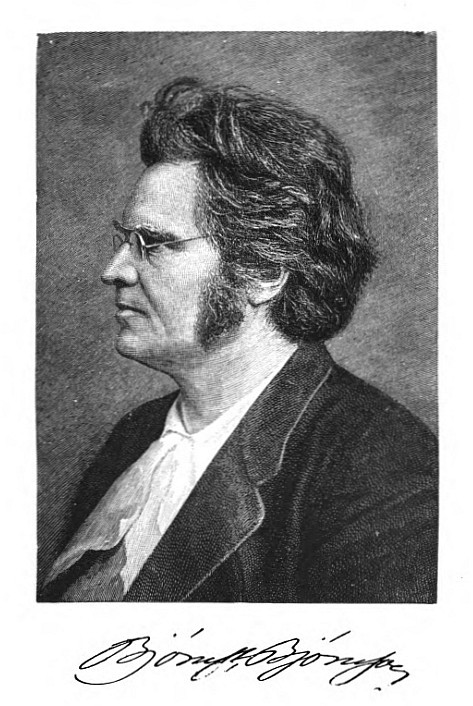
BJÖRNSTJERNE BJÖRNSON.
1882.
Beyond his fatherland Björnstjerne Björnson is known as a great poet. To Norway he is more than a poet. Not only has he written beautiful stories, songs, and dramas for his people; he lives the daily life of this people, and holds unbroken intercourse with them. He who has it in his power to create the most refined, the most delicate poetry, does not esteem himself above the rudest tasks, those of the journalist and the popular orator, where there is a question of furthering the moral and political education of the Norwegian people, by combating an error or a lie, or by ensuring the propagation of some simple, but as yet unrecognized truth. There emanates from him a breath of life. Where his spirit now penetrates there follows a development of self-knowledge and love of truth, national faults are shaken off, a growing interest is manifested in all intellectual topics, all public affairs, and a wholesome self-confidence appears side by side with this interest. He has grasped the significance of the poet's mission in its broadest sense.
In his oration at the unveiling of the Wergeland monument, May 17, 1881, Björnson said of his great predecessor, the European poet, who ranks next to Shelley:—
"You have all heard how Henrik Wergeland, during one period of his life, was in the habit of carrying his pockets full of the seeds of trees, ever and anon strewing a handful of these about him in his daily walks, and how he endeavored to persuade his associates to do the same, because no one could know what the results might be. This is so true-hearted, so touchingly poetic an instance of patriotism, that it stands on the pinnacle of the best he has written."
What is here related in a literal sense of Wergeland may be told in a higher sense of Björnson. He is the great seed-sower of Norway. This country is a mountainous land; it is rocky, rugged, and barren. The seed falls on stony ground, and many a grain is blown away by the wind. Nevertheless, Björnson perseveres unweariedly in his labors. A large quantity of his seed has already sprouted; many a tree planted by his hand is already in blossom, and so far as the fruit is concerned, his efforts were never designed for the present generation alone.
I.
It is only necessary to bestow a glance upon Björnson, in order to be convinced how admirably he is equipped by nature for the hot strife a literary career brings with it in most lands, and especially in the combat-loving North. Shoulders as broad as his are not often seen, nor do we often behold so vigorous a form, one that seems as though created to be chiselled in granite.
There is, perhaps, no labor which so completely excites all the vital forces, exhausts the nerves, refines and enervates the feelings, as that of literary production. There has never been the slightest danger, however, that the exertions of his poetic productiveness would affect his lungs, as in the case of Schiller, or his spine, as in the case of Heine; there has been no cause to fear that inimical articles in the public journals would ever give him his death-blow, as they did Halvdan, the hero of his drama "Redaktoren" (The Editor), or that he would yield, as so many modern poets have yielded, to the temptation of resorting to pernicious stimulants or dissipations, as antidotes for the overwrought or depleted state of the nervous system, occasioned by creative activity. Nothing has injured Björnson's spine, his lungs are without blemish and know no cough, while his shoulders were fashioned to bear, without discomposure, the rude thrusts which the world gives, and to return them. As for his nerves, I am convinced that he has not learned from personal experience the significance of the word. As an author he is never nervous, neither when he displays his true delicacy, nor even when he evinces his most marked sentimentality. He has nothing of the refinement that a light degree of work, duty, or fatigue gives.
Strong as the beast of prey whose name twice occurs in his,[1] muscular, without the slightest trace of corpulence, of an athletic build, he looms up vigorously in my mind, with his massive head, his firmly compressed lips, and his sharp, penetrating gaze from behind his spectacles. His exterior reveals the son of a preacher, his voice, play of features and gestures betray more of the actor's talent than poets usually possess. It would be impossible for literary hostilities to overthrow this man, and for him there never existed that greatest danger to authors (a danger which for a long time menaced his great rival, Henrik Ibsen), namely: that of having his name shrouded in silence. Even as a very young author (as a theatrical critic and political writer), he had entered the field of literature with such an eagerness for combat, that a rumbling noise arose about him wherever he appeared. Like his own Thorbjörn in "Synnöve Solbakken" he displayed in early youth the combative tendency of the athlete, but like his Sigurd in "Sigurd's Flight," he fought not merely to practise his strength, but from genuine, although often mistaken love of truth and justice. At all events, he understood thoroughly how to attract attention.
An author may possess great and rare gifts, and yet, through lack of harmony between his own personal endowments and the national characteristics or the degree of development of his people, may long be prevented from attaining a brilliant success. Many of the world's greatest minds have suffered from this cause. Many, as Byron, Heine, and Henrik Ibsen, have left their native land; many more who have remained at home have felt forsaken by their compatriots. With Björnson the case is quite different. He has never, it is true, been peacefully recognized by the entire Norwegian people; at first, because the form he used was too new and unfamiliar; later, because his ideas were of too challenging a nature for the ruling, conservative, and highly orthodox circles of the land; even at the present time he is pursued by the press of the Norwegian government and by the leading official society, with a fury which is as little choice in its selection of means as is in other countries the exasperation felt by the champions of thrones and altars. In spite of all this, Björnstjerne Björnson has his people behind him and about him, as perhaps no other poet, unless it be Victor Hugo. When his name is mentioned it is equivalent to hoisting the flag of Norway. In his noble qualities and in his faults, in his genius and in his weak points, he as thoroughly bears the stamp of Norway as Voltaire bore that of France. His boldness and his naïveté, his open-heartedness as a man, and the terseness of his style as an artist, the highly wrought and sensitive Norwegian popular sentiment, and the lively consciousness of the one-sidedness and the intellectual needs of his fellow-countrymen that has driven him to Scandinavianism, Pan-Germanism, and cosmopolitanism,—all this in its peculiar combination in him is so markedly national, that his personality may be said to offer a résumé of the entire people. None of his contemporaries so fully represent this people's love of home and of freedom, its self-consciousness, rectitude, and fresh energy. Indeed, just now he also exemplifies, on a large scale, the people's tendency to self-criticism, not that scourging criticism which chastises with scorpions, and whose representative in Norway is Ibsen, in Russia, Turgenief, but that sharp, bold expression of opinion begotten of love. He never calls attention to an evil in whose improvement and cure he does not believe, or to a vice which he despairs of seeing outrooted. For he has implicit faith in the good in humanity, and possesses entire the invincible optimism of a large, genial, sanguine nature.
According to his character, he is half chieftain of a clan, half poet. He unites the two forms most prominent in ancient Norway: that of the warrior, and that of the skald. In his intellectual constitution he is partly a tribune of the people, partly a lay preacher; in other words, he combines, in his public demeanor, the political and religious pathos of his Norwegian contemporaries, and this was yet more apparent after he broke loose from orthodoxy than it was before. Since his so-called apostasy, in fact, he has been a missionary and a reformer to a greater degree than ever.
He could have been the product of no other land than Norway, and far less than other authors could he thrive in any but his native soil. In the year 1880, when the rumor spread through the German press, that Björnson, weary of continual wrangling at home, was about to settle in Germany, he wrote to me, "In Norway will I live, in Norway will I lash and be lashed, in Norway will I sing and die." To hold such intimate relations with one's fatherland is most fortunate for a person who is sympathetically comprehended by this fatherland. And this is the case with Björnson. It is a matter dependent on conditions deeply rooted in his nature. He who cherishes so profound an enthusiasm for the reserved, solitary Michael Angelo, and who feels constrained, as a matter of course, to place him above Raphael, is himself a man of a totally different temperament,—one who is never lonely, even when most alone (as he has been since 1873 on his gard in remote Gausdal), but who is social to the core, or more correctly speaking, a thoroughly national character. He admires Michael Angelo because he reveres and understands the element of greatness, of profound earnestness, of mighty ruggedness in the human heart and in style; but he has nothing in common with the great Florentine's melancholy sense of isolation. He was born to be the founder of a party, and was, therefore, early attracted to enthusiastic and popular party leaders, such as the Dane Grundtvig and the Norwegian Wergeland, although wholly unlike either in his plastic, creative power. He is a man who needs to feel himself the centre, or rather the focus of sympathy, and insensibly he forms a circle about him, because his own nature is the résumé of a social union.
II.
Björnstjerne Björnson was born Dec. 8, 1832, in a valley of the Dovre Mountains at a place called Kvikne, where his father was parish priest. The natural scenery of this region is cheerless, poor, and barren; the cliffs are mostly naked; here and there fir and birch may be dotted about, but the soil is so wretched, and the weather so severe, that the peasant can only count on a harvest one year out of every five. No grain-field would thrive in the vicinity of the parsonage. In the sparsely populated valley the farm-houses lay widely separated from one another. High banks of snow covered mountain and valley in the winter, surrounding every house with a bulwark, and inviting to trips in sledges and on snow-shoes. When the little Björnstjerne was six years old, his father was removed to Nässet in Romsdal, the region of all Norway most celebrated for its beauty. Lofty and majestic in their grandeur, the mountains rise up on either side of the valley with their boldly-formed pinnacles, which, as the plain sinks lower and lower, and the fjord is approached, gradually present themselves in more and more remarkable outlines to the eye. Very few Norwegian valleys can compare in wealth of varied beauty with Romsdal; even the flat character of the valley, as well as its unusual mountain formations, invest it with a peculiar stamp. The region was fertile and comparatively well populated; the farm-houses, most of them two stories high, were neat and pretty, and the inhabitants friendly, notwithstanding their silent reserve. The difference between this and the former place of residence was striking and impressive; it taught the child to reflect and to compare, to see the old in the light of the new, the new in the light of the old; to look upon himself with the eyes of others, and to become conscious of his own character. The grandeur of the surrounding nature and the busy, eager life of the people filled with glowing pictures the susceptible soul of the vigorous and richly endowed youth. Sent to the Latin school of the little town of Molde, he organized societies among the boys, and soon became a leader among his schoolmates. He read everything in the way of history and poetry he could get into his possession, the folk-lore tales of Asbjörnsen, the folk-songs of Landstad,—both but newly collected at that time,—the old Norse sagas of the kings, popular romances and poems, especially the works of Wergeland, which he devoured with passionate eagerness. At seventeen years of age he went to Christiania, in order to prepare for the entrance examination at the university. There he devoted himself chiefly to Danish literature, entered into intimate relations of friendship with the genial, although eccentric, Aasmund Vinje, who had already won a name as a dialect poet, as well as with the historian Ernst Sars, a young man of his own age, who did not become known to fame until later, and overflowing with youthful spirits, he led a life agitated by many and varied intellectual pursuits. The Danish theatre, at that time under the most careful management, interested him and exercised the most lively influence upon him. When, in the year 1852, he returned as a student to the parental roof, and passed there a year, the life of the people was revealed to him in a new light. He lived with the people, and wrote popular songs, which were often committed to memory and sung by the peasants.
Returned to Christiania, he came before the public as a critic, especially as a dramatic critic, wrote with all the vehemence of genial youth, with all the injustice of a rising poet, and gained many enemies. In his reading at this period, he gave the preference to Danish thinkers of the epoch in literature then drawing to a close,—Heiberg, Sibbern, Kierkegaard,—and a little later he became gradually absorbed in the emotional world of Grundtvig. The latter's doctrine of a "cheerful Christianity" attracted Björnson as the antithesis of the gloomy pietism of his native land, the strong faith in the lofty endowments and mission of the Scandinavian North, which he found in Grundtvig, could not but captivate this typically northern youth who was so wholly unacquainted with Europe. Until a very few years ago traces of Grundtvig's influence could be detected in him. Even at the present time it is not wholly obliterated. In those early days he found within the boundaries of Grundtvigianism all that which later, when he had torn himself free from the magic spell of Grundtvig's sphere, he sought and found, outside of these limits,—humanity in its highest freedom and beauty. This was the result of the narrowness of his horizon. The conclusions of modern philosophy and social science had not been introduced in those days into the university of Christiania. Valuable results were accomplished in specialties, but intellectual intercourse with Europe was otherwise cut off here as well as in Denmark. In fact there was no European consciousness at the university. The priest's son from a retired village, the scholar from a small city, was not removed, even in the metropolis, from the circles of variously shaded orthodoxy. Hence the circumscribed, sometimes childish element in Björnson's first works; hence the self-sufficient naïveté, so unique of its kind, which at this period constitutes his strength as a poet.
A few trips into the neighboring countries,—first of all his participation in the expedition of the students to Upsala, in 1856, immediately thereupon a prolonged residence in Copenhagen,—brought his poetic talents to maturity. He had already begun his little drama "De Nygifte" (The Newly Married Couple), but had laid it aside with a keen sense of the inadequacy of his powers, not to resume work on it until ten years later. In brief lyric poems of the genuine folk-song character, he had calmed his creative impulse without satisfying it. He now wrote the firstling of his dramatic muse, "Mellem Slagene" (Between the Battles), an earnest little play in one act, that treats of an episode from the Norwegian civil war of the early Middle Ages, and whose terse, ragged prose style, which formed the sharpest contrast to the sonorous, verbose iambics of the Danish dramas of the Oehlenschläger school, inaugurated a new form of the Northern style. The play was rejected by Heiberg, at that time director of the royal theatre at Copenhagen, was first produced on the stage in Christiania, and was not printed until some time afterward. How far Björnson and the entire later poetic literature have progressed on the path thus broken, can be best observed by witnessing to-day a theatrical performance of this little drama, which on its first appearance repelled, because of the supposed wildness of its materials and the harshness of their treatment, and which now actually seems to us quite idyllic and by far too sentimental.
Meanwhile, his mission to write novels of peasant life became even clearer to Björnson, and after publishing anonymously a few shorter stories, by way of experiment, he gave the public, in 1857, his "Synnöve Solbakken." This literary débût was a victory, and the reception of the little volume in Denmark, whose verdict is usually the decisive one for the poetic creations of Norway, especially tended to make it a decided triumph. The fresh originality, the novelty of the materials, and the manner in which they were handled, does not sufficiently explain this success. It was the result of the remarkable harmony of the book, with all that was desired and demanded of a poetic work by a portion of the reading world of the day. The national liberal party of that time (the party name was first adopted in Germany at a later period) absolutely determined the literary taste; it demanded something of a primeval Northern, vigorously national, ancient Scandinavian character, and at the same time,—an element which seemed curiously at variance with this,—Christian ethics, combined with an innocent idyllic tone, a poetry which banished Titanic defiance and modern passion with equal severity from its sphere. In the eyes of the national liberal party, passion was unpoetic and melancholy was affectation; the party of intelligence, as it is modestly called and still calls itself, deemed everything European suspicious, and believed that the far North alone had preserved that moral purity and freshness which was to regenerate the decaying civilization of Europe, and as for modern ideas, in the strictest sense of the words, they simply had no existence for the blissful ignorance of this party. Björnson's stories of peasant life, without considering their great and true merits, almost seemed like the fulfilment of the party programme. The circumstances of the poet's youth, and his early reading had led him to regard peasant life in the light of the old Norse sagas; while he had gained through his familiarity with the life and thought of the peasants, on the other hand, a comprehension of the ancient sagas. His first long story, as well as many of his very short ones (as "The Father," "The Eagle's Nest," etc.), produced a revival of the old saga style, while the materials, in conformity with the wishes of the people, were popular, without being characterized by sharply pronounced realism. In Germany Teutonists alone are familiar with the Icelandic sagas; in the Scandinavian countries, these in many respects admirable and almost always interesting narratives, have not only been popular since the revival of the national sentiment, but have been surrounded by a certain halo of glory, as venerable monuments of a great past. Beyond all else their style has been held in high esteem. And this style, calm, epic in nature, always presenting a clear picture that in the antique time sprang into existence as the form suitable for the narration of discord, murder, revenge for bloodshed, arson, adventurous voyages and deeds of valor, was preserved by Björnson, or rather it was revived by him, and through its grandeur ennobled and exalted the subject-matter, the love life of young Norwegian peasant lads and lasses. The temperament of the poet was so thoroughly akin to that of the ancient story-teller, and the human race depicted by him was so completely in accord with that represented in ancient saga lore, that in spite of everything a harmonious whole was produced.
Björnson belongs to those fortunate beings who are not compelled to seek a form, because they possess one of their own. His earliest novel is a thoroughly ripe fruit. In his first venture he is classic. He is not one of those poets who throughout a long life are continually increasing the perfection of the artistic form of their works, and are unable to invest the latter with inner equilibrium until after hard struggles with refractory materials have been undergone. His career has not been like that of so many others, a mountain ascent amid clouds of mist, crowned only with a few sunny hours at the top; it has rather been an upward climbing, during which beautiful prospects have been disclosed to the eye at every stage. Indeed, his development has been of such a nature that even at the outset, with his original comparative narrowness or poverty of ideas, he grasped the highest artistic perfection of form, and eventually imparted to his works an ever richer ideal life and an ever increasing knowledge of the human heart. In thus enlarging their scope, however, he has never marred their poetic worth, but he has frequently somewhat sacrificed their plastic and classic equilibrium.
Nevertheless, it must not be thought that Björnson's first works were hailed with the unanimous applause which people now often profess to believe they received. There are many individuals to be found to-day in the Scandinavian countries, to whom it is satisfactory to point out some work of Björnson which they have always praised, in order that they may, with all the greater appearance of impartiality, censure his later creations. His first novels and dramas formed too strong a contrast with all that the public had been accustomed to admire to be received without opposition, and many people of literary culture who had been in hearty sympathy with the previously prevailing poesy, could not but feel their æsthetic creed to be violated by them. In Denmark, indeed, a great and rich school of poetry, whose influence had extended far into Norway, was on the eve of its decline. The sonorous pathos of Oehlenschläger still rang with its musical accents in every ear, his representations of the antiquity and early middle ages of the North seemed to men of the old school, even if outwardly less true, at least inwardly more true than the writings of Björnson; the unsurpassed elegance and grace of Henrik Hertz had enfeebled their taste for primitive simplicity, and finally people missed in the new Norwegian poetry the lofty philosophic culture which Heiberg had accustomed the public to require of the poet and to find in his works. I recollect distinctly how strange and novel "Synnöve Solbakken" and "Arne" seemed to me on their first appearance.
The opposing voices were hushed by the healthy taste for all that was genuine which has almost everywhere been preserved by the great reading-world, but the rapidity of the success was dependent on the circumstance that the ruling Scandinavian party took the new poetry under its protection and proclaimed the poet's fame abroad with a flourish of trumpets. In those days the adherents of the national liberal party of the three Scandinavian countries were favorably inclined to the peasant in literature. People loved the peasant in the abstract; the real, concrete peasant was yet unknown to them. They had granted him the right of suffrage, they had felt convinced that he would continue throughout all time to permit himself to be guided by those "who had conferred on him the gift of freedom," and they lived in hopes that he would never use this "freedom" for any other purpose than to elect and honor his city benefactors. For this reason the peasant at that time was still called by the organs of the great cities the healthy pith of the people; in him was seen the scion of the knights of antiquity; he was celebrated in song and addressed in flattering terms. Works of fiction which glorified his life with extreme delicacy, and at the same time in a new and elevated style, were sure of an enthusiastic reception in Denmark, especially when they originated in one of the sister-countries, which stood almost nearer to the heart of every true Scandinavian than his own fatherland.