Dr. GEORG BRANDES (continued 4)
Rasmus Björn Anderson translation
When I, with my simple political principles, urged the necessity of obligatory education, a thought I constantly had occasion to advocate, and which was everywhere treated as an absurdity or as a long since abandoned whim, Renan was, in my estimation, so paradoxical that I could scarcely believe him to be in earnest. His arguments, however, are interesting, especially because similar ones were continually presented at that time by the most prominent men of France, although perhaps in a different form. Renan maintained, first of all, that enforced education was tyranny. "I have myself," said he, "a little child that is in feeble health. How despotic it would be to take that child from me in order to educate it!" I replied that there would be exceptions made by the law. "Then no one would send children to school," he answered. "You do not know our French peasants. They would gain nothing from such legislation. Let them till the soil and pay their taxes, or give them a musket in their hand, and a knapsack on their back, and they are the best soldiers in the world. But what is well adapted to one race does not always suit another. France is not like Scotland or the Scandinavian countries; Puritanic and Teutonic customs cannot take root in our soil. France is not a religious country, and every attempt to make it so would prove abortive. Ours is a land that produces two things,—what is great and what is fine (du grand et du fin). Respectable mediocrity will never thrive here. These two words express the ideal needs of the population; as for the rest, there is but one thing they want, and that is to amuse themselves, to experience through pleasure that they are living. And finally, believe me, it is my firm conviction that elementary education is a downright evil. What is a human being that can read and write—I mean a human being that can do nothing but read and write? An animal, a stupid and conceited animal. Give human beings an education of from fifteen to twenty years' duration, if you can; otherwise, nothing! Anything less, so far from making them any wiser, only destroys their natural amiability, their instinct, their innate sound reason, and renders them positively unendurable. Is there anything worse than to be governed by a seminarist? The sole reason why we are forced to occupy ourselves with this question is because this mass of street boys (ce tas de gamins) gained the upper hand and wrung from us the right of universal suffrage. No, let us agree that culture is only a good in the case of highly-cultivated people, and that the half-cultivated are to be regarded as useless, arrogant apes." I spoke of decentralization, of elevating the condition of the provincial cities, Lyons, for instance. "Lyons!" he burst out, in absolute earnest, "why, it would never occur to any one to transform the metropolitan cities of the provinces into intellectual focuses, for they would at once come under the control of the bishops. No," he added with droll conviction, "in such cities nothing but absurdities will ever be accomplished." After such utterances from the man of all others in France who fought most vigorously for a reform in the higher schools and universities, it is perhaps easier to understand why it was that the indifference of the liberals in that country went hand in hand with the zeal of the Catholic priesthood, whenever there arose a question of remedying that ignorance of the lower classes which later proved so dangerous for the outer and inner security of the land. Old Philarète Chasles, who was really no Chauvinist, made himself very merry one evening in May, 1870, over my faith in the efficacious power of compulsory education; he called it my Revalenta arabica, and facetiously declared that I hoped through it to make the human race happy through all eternity. He asked me, too, if I did not think the peasants made sufficiently good fathers of families and good soldiers, without the aid of the schoolmaster. The war soon taught these men that the soldier who can read and write has a power in his hands never before adequately appreciated. It was, indeed, remarkable to see how ideas we are apt to ascribe wholly to the Catholic priesthood—as, for instance, this idea of the absolute harmfulness of imperfect knowledge—had gradually gained such authority in a land saturated with Catholicism that, with a slight alteration of form, they even swayed the opponents of the Catholic faith.
Another equally interesting application of the Renan theory, that what was good in Germany or in the North was not necessarily suitable for France, I heard one day at Renan's country villa in Sèvres when he himself was absent. The conversation fell on French convenance marriages. A lady, closely allied to Renan, a German-born lady, who was thoroughly imbued with his ideas, defended the French custom of founding marriages on an agreement between the suitor and the parents, and of permitting the wedding to take place after a few obligato visits. "This manner of forming a matrimonial alliance," said she, "would not exist without very good reasons. Although brought up in France, I who am German by birth did not marry in this way. As often as it was proposed to me to take a suitor into consideration, I declared that I would not see him; the mere fact that he came as a suitor sufficed to make him odious in my eyes. I was acquainted with my husband several years before our marriage." Who can offer any protest against the French custom, however, that has seen, as I have in the case of so many of our friends—and she mentioned one and another—who were introduced but one week before their wedding-day, and yet whose union proved so happy and satisfactory to both parties.
While I was viewing these words, partly as a subterfuge employed to escape passing judgment on the relations of near friends, partly as a symptom of the French characteristic desire to represent every national peculiarity, however unfortunate it may be, as an unalterable quality of the race, a gentleman who was present, one of the most unprejudiced of French authors, laid his hand on the head of his little daughter, a child of two years old, and said: "Do you think it would be right for me to give my little girl to the first man that might appear on the scene, and without appealing to us, her parents, manage to steal away her heart? Remember how great is the inexperience of a young girl, and do not forget the conditions of the actual world, nor what scoundrels there are abroad, nor what a past, what diseases, what bestial appetites a young man may have, which a father's eye may detect, but whose existence the innocent mind of a young maiden neither can nor should deem possible. The world is an enemy. Should not I with all my might defend my little daughter against this enemy? If, some day fifteen years hence, suitors for her hand announce themselves, we parents, if we are then living, will act as follows: we will discard those who cannot suitably be taken into consideration, either because of their social position, or because of moral or physical weaknesses; we will make a choice selection, and from this permit the young girl to choose as she pleases." To account for this mode of contemplation, the secluded education of young girls in convents, or in boarding-schools, should be borne in mind. Viewed in this light, even when consideration is taken of the greater ardor and sensuality of the Latin races, the conclusion arrived at is perhaps not unreasonable.
III.
I was in London when the Franco-German war broke out, and being so fortunate as to have intercourse with some wholly unbiased men of great political insight, I foresaw sooner than my French acquaintances all the disasters the war must inevitably bring upon France. On my return to Paris, I found the people full of hope and confidence; indeed, there was, as is well known, a manifestation of arrogance that could not but affect every stranger unpleasantly. This arrogance, however, was by no means shared by men of science. As yet there had been no battle; but already the news of the suicide of Prévost Paradol in North America had filled with the most painful forebodings every one who knew him and was aware how thoroughly posted he was in the preparations and resources of France. The terrible event occurred immediately after an attack of fever, yet no one doubted that Paradol had laid hands on himself with a full consciousness of what he was doing, and with a plain design. That he had not merely sent in his resignation was because—so it would seem—he was altogether too proud to admit that he had in any way been in error; he was not even willing to make such an admission in an argument, and now he had been guilty of a triple error: believing in the justice of the constitutional tendency of the emperor; seeking the post of ambassador to Washington; and finally not giving up his post at once, when the odious comedy of universal suffrage in May had shown what the constitutional temper of the emperor indicated. The declaration of war, in his eyes identical with the downfall of France, caused him to prefer death to a position in which he could not consistently remain, and from which he was unable to withdraw without a humiliation far worse to him than death. This solitary pistol-shot, resounding across the ocean as the signal of many hundred thousand terrible volleys, deeply affected the friends and companions of Prévost Paradol's youth. Taine, who had been making a brief trip to Germany, where he went to collect materials for an essay on Schiller, which had been interrupted by the war, was profoundly moved by the thought of the impending crisis. "I have just come from Germany," said he, "and have conversed with so many industrious and excellent men. When I consider how much trouble it costs to bring a human child into the world, to tend it, bring it up, educate it, establish it in life; when I, furthermore, consider how many struggles and hardships this child must itself undergo in order to gain preparation for life, and then reflect that all this must now be cast into a ditch as a mass of bloody flesh, I can do nothing but mourn! With two regents of the nature of Louis Philippe, we might have succeeded in escaping the war; with two chieftains like Bismarck and Louis Napoleon, it became a necessity." He was at that time the first Frenchman whom I heard take into consideration the possibility of German superiority.
Then came a series of shocks in the first tidings of great defeats, only varied by false rumors of victory directly after the battle at Weissenburg. Dejected and sorrowful was the prevailing mood in the city in those days, when the proclamations at the street comers told of armies put to rout and lost battles; but more fearful still was the mood on that 6th of August, when the first half of the day was passed in the mad intoxication of triumph over victory, the last half in mortified despondency. How great would have been the humiliation had there been the slightest foreboding of the battle of Wörth, whose fate was at the same moment sealed! When, early in the morning, the news of great victories spread through the city, all Paris covered itself with banners; the citizens walked the streets with little flags in their hats; all the horses had little flags on their heads. I sat in front of a café, opposite the "Hôtel de Ville," gazing at the houses about the public square that were decked with hundreds of small flags, when suddenly there appeared, at the window of a house near me, a hand that hastily drew in the flag there floating in the breeze. Never shall I forget that hand, or that act. Trifling as was the occurrence, it startled me; for there was something so sorrowful about the movement of the hand; something in its appearance testifying so plainly of disappointment, that the thought immediately flashed through my mind: "The news of victory must be false!" Soon hands were seen at all the surrounding windows; the flags quickly disappeared, and in quarter of an hour the whole banner decoration seemed as though it had been blown away by the wind. A proclamation from the government had declared that nothing at all was reported that day from the scene of war, and that the police were on the track of the promulgators of false news, in order to punish them severely. The promulgators of false news! As though the hungering imaginations and the languishing yearning of the great city were not the only guilty ones!
About a week later, on the 12th of August, I met Renan. He had returned from the far North before the appointed time. I have never seen him so deeply moved. He was desperate; this trivial word is the only appropriate one. He was beside himself with exasperation. "Never," said he, "was an unhappy people so governed by imbeciles as we are. One might have supposed that the emperor had had an attack of insanity. But the fact is, he is surrounded by the most contemptible flatterers. I know officers of high rank, who were well aware that the Prussian cannons far surpassed our much-lauded mitrailleuses, but; who dared not tell him so, because he had taken an active part in the preparation of these machine-guns himself, had done a little drawing on the design, which is expressed in official language by the statement that he is the inventor of the mitrailleuse. Never was there so great a lack of brains (si peu de tête) in an imperial ministry; he was himself sensible of it. I am acquainted with a person to whom he said so, and yet he undertook a war with such a ministry. Was ever such folly known? Is it not heart-rending? As a people, we are vanquished for a long time to come. And to think that all that we men of science have been striving to build up for the past fifty years—sympathy between nations, mutual understanding, fruitful co-operation—is overthrown with one blow. How such a war destroys the love of truth! What lies, what calumnies, will not for the next fifty years be eagerly believed by one people of the other, and separate them from one another for immeasurable time! What a delay of European progress! We cannot raise up again in a hundred years what these people have tom down in a day."
No one could have been more grieved at the rupture between the two great neighbors than Renan, who had so long stood in France as the representative of German culture. Nor could any one have spoken with greater gratitude than he, of German thought. One of his favorite remarks was: "There is nothing that can hold so much as a German head." He seemed to have little liking for the Germans personally, but he spoke with respect of their noble intelligence. To the South German, however, in every other respect than in a capacity for the affairs of government, he ascribed a far higher endowment than to the North German, an opinion shared by the majority of cultivated Frenchmen.
In speaking of his journey, Renan said: "We were in Bergen when the first ambiguous tidings of the threatened war reached us from France. None of us could deem it possible. The prince and I looked at each other. He who possesses so rare and so keen an intellect merely said, 'It cannot be,' and gave orders to continue our journey. We sailed to Tromsöe. When we reached that place two despatches awaited the prince, one from his secretary in Paris, and another from Emile Ollivier with these words: 'Guerre inévitable! 'We held a brief council, but so irrational did the affair appear to us, since Leopold von Hohenzollern had withdrawn his candidacy; so impossible did it seem that this pretext could incite all Europe, and especially all Germany, against us; and, finally, so great was our desire to sail to Spitzbergen and see 'the great icebergs,' that we resolved to depart the next morning. We went to bed. My room was situated next to that of the prince's adjutant. Early in the morning I heard the valet awaken the adjutant with a despatch. I rose, we went on board, the ship set sail, and you may fancy my astonishment when I saw that we were taking a southward course. The prince sat in despair, staring fixedly before him. The first words he uttered were: 'Voilà leur dernière folie, il n'en feront pas d'autres.' He was a true prophet; this will be their last folly." "I myself," added Renan, "was of the same opinion. I knew how badly we were prepared, but who could have dreamed that the crisis would come so soon! Do not say that we may yet be victorious. We will never be victorious again; we have never, under this emperor, conquered, in a definite way, any tribes whose subjugation could serve as a happy omen, when Prussia was in question. The Arabs are the poorest tacticians in the world." More than once he broke out with the words: "Was such a thing ever heard of before! Poor prince! Poor France!" He was so vehement that he exhausted himself in imprecations on all the leading men; according to his words, at this time uttered with little regard to shades of meaning, they were all weak-minded creatures, or villains. "What is this Palikao?" he cried. "A thief, a pronounced thief, to whom our best houses are closed; and does not every one know that one of his colleagues is a criminal, a murderer, who has only escaped capital punishment by flight! And in the hands of such men lies our fate!"
I saw tears in his eyes, and I bade him adieu. I have never seen him since that day. He quickly regained his composure and the control of his grief; but in that sorrowful outburst Renan was another man than when he wrote, "The savant is a spectator in the universe. He knows that the world belongs to him only as an object for study; and even if he could reform it, he would perhaps find it so curious an object that he would lose all desire to do so." It is scarcely likely that Renan was altogether in earnest when he uttered these audacious and aristocratic words; but even if he was, the emotions he experienced in the year 1870 would have inclined him to repudiate them.
It is difficult to estimate how demoralizing an influence, during the second empire, life under the dominion and pressure of the "fait accompli" exercised on the French savant. A tendency to quietism and fatalism, to the approval of everything that had once been accomplished, characterized beyond all else French moral science under Napoleon III. Traces of its influence could be observed everywhere in social life and in conversation. Entire freedom from enthusiasm was looked upon as almost equivalent to culture and ripe scholarship. A young foreigner had daily opportunity to marvel over the reserve and the passiveness of even the best of these people, as soon as there arose any question of a practical reform; and I remember well coming home one evening in May, 1870, very much out of humor, and writing in my note-book: "There was once another France." Once, indeed, there had been a wide-awake, enthusiastic, poetic France, keenly alive to the needs of humanity. It seems as though such a France must gradually arise from the debasement, which, even if it brought with it no other good, at least has given all aspiring souls a new impetus toward the truth.
With changeful emotions Renan has watched the development of republican France. Although the republicans almost immediately restored to him his professorship, their demeanor toward him, as well as toward the other friends of Prince Napoleon, was rather cool and reserved. Thoroughly aristocratic in his views as he is, he gave the democrats to understand in his "Caliban" how exceedingly little he esteemed them; yet in a letter written shortly afterward to a German friend, in explanation of his speech on entering the French Academy, he said: "What now, if, while your statesmen are absorbed in this thankless task of chastising and trampling under foot, the French peasant, with his rude understanding, his unvarnished politics, his labor, and his savings, should happily found an order-loving and enduring republic! Would it not be droll?" He is patriot and philosopher enough to become friendly, in the course of time, to any form of government which satisfied the majority of his fellow-countrymen, and corresponded to their intellectual standpoint.
Renan, as it is well known, is a native of Brittany, and has all the peculiarities of his race. The Bretons, in modern French literature, are distinguished by a common trait. Like Chateaubriand and Lamennais, Renan hates the commonplace, the easy-going, frivolous tone; and although a victim of doubt, he has the most ardent need of a faith and an ideal. For his narrow fatherland he cherishes a most profound attachment. In a hopeful moment he has even apostrophized his race with the words: "O simple clan of farmers and seamen, to whom, in an extinguished land, I owe the strength to preserve my soul alive!" We must not place too literal an interpretation on this outburst of feeling. No one realized more profoundly than Renan how far from being extinguished was that France of which he wrote to Strauss, that it was essential to Europe as "a lasting protest against pedantry and dogmatism." But the remark is characteristic of the at once obstinate and restless, enthusiastic and sceptical child of Brittany. If he renounce his faith in any one particular, as he here lost faith in France, it is only to adhere elsewhere with all the warmer enthusiasm to an ideal. In religion, too, he has a Brittany in which he believes.
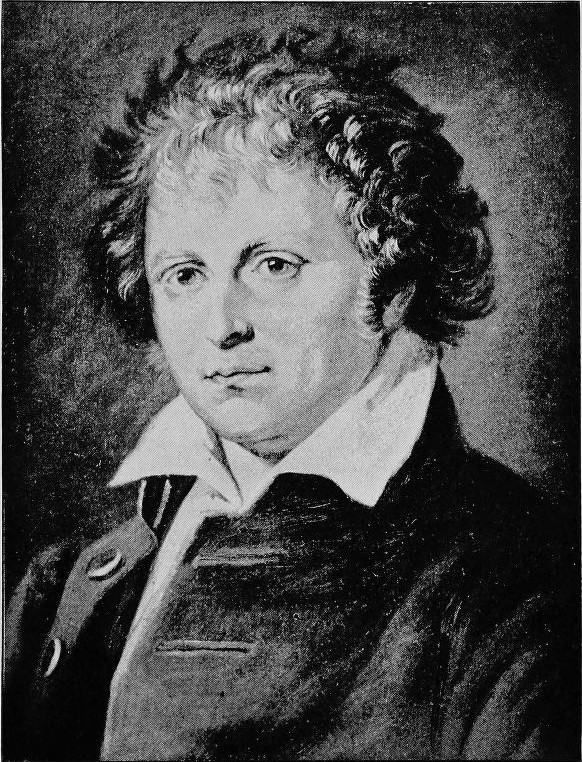
ESAIAS TEGNÉR
ESAIAS TEGNÉR.
1878.
Literary fame in the Scandinavian countries is for the most part a matter of mere local importance. Works written in languages which are spoken by a few million people only, and which in no portion of the world are studied or read as polite languages, are likely to have every chance of European and American renown against them. As a general thing, but few poetic productions are translated into other tongues; and, indeed, to a work that appeals to the sense of beauty, above all to a metrical work, the outer form of language is what the enamel is to the teeth: it invests it at the same time with durability and brilliancy.
Nevertheless, it is a well-known fact that certain northern authors have succeeded in finding more recognition in foreign countries than at home; they represent, as it were, to the entire reading-world, the poetic life of their fatherland, and their names are blended in the public consciousness with the name of their native land. Such fame has been attained by but one of the poets of Sweden,—Esaias Tegnér.
He is not the greatest among those who have contributed to the poetry of the Swedish language; before him and after him another greater poet produced in this tongue creations superior to his in clearness of style and fidelity to life. With Bellman and Runeberg, however, he must be classed; and, while inferior to them in poetic fancy, he may be said to surpass both in intellectual vigor.
Three times in the course of history, the Swedish people has succeeded in combining the classic and the popular in its poetry. The first time was when Bellman, during the reign of Gustavus III., selected his types from life among the people and in the inns of Stockholm, and sang "The Songs of Fredman" to a zither accompaniment, with a mimic display of masterly skill. The second time was when Tegnér, fifty years later, turned back to the heroic life of the ancient North, found in an old saga materials for a romance cycle, and gave Sweden a picture of Viking life and Viking love in the North, as his contemporaries conceived it. Finally this combination of the classic and the popular occurred about a generation ago, when—forty years after Finland had been tom from her old mother country—the greatest of Finland's sons, inspired by recollections of his childhood, depicted the honorable struggle of his fatherland against Russian supremacy, and thereby the national characteristics of the Finnish people, in a more realistic style than any one else had yet ventured to employ. Runeberg, in his soul-stirring bivouac poetry, has compressed into the smallest limits war idyls and tragedies of the battlefield.
Neither in a drama nor in an epic poem, therefore, has one of these three Swedish poets found the possibility of presenting to the world the best fruits of his genius. All three, however widely they may otherwise differ, have triumphed in the same species of art, one that is lyric in form, and whose contents compose an epic cycle of short poems. The first of these poets has produced burlesque dithyrambs; the second, old Norse heroic lays; the third, anecdotes of modern warfare; but each one has arranged his choicest poems in a connected series, and these three groups of songs alone invest Swedish poetry with cosmopolitan rank.
The most celebrated of these three cycles is the "Fridthjof's Saga," and when Tegnér is mentioned outside of Sweden, it is exclusively as its author. This work has become the national poem of the Swedish people, and translations into all European tongues—among others, eighteen different German, and twenty-two different English translations—have spread it broadcast over the earth. Sweden has not been lacking in gratitude to the man to whom she owes so much. Such noble and eloquent words have been spoken, written, and sung throughout Sweden, in honor of Tegnér, that no one could bestow on him greater praise than has already been accorded him by the children of his native land. Sweden has exalted the glorified form of the poet, in supernatural size, upon a mighty pedestal, proved by closer scrutiny to be a miniature mountain of massive eulogies, biographies, and festal songs, while at the base incense without stint has been burned. What then remains for the critic? Nothing, unless perchance to cleanse from the beautiful face, with tender hand, the blinding fumes of the incense, in order that the delicate features may stand out clearly, and seem more human, more lifelike. Perchance, too, it may devolve on him to compare the statue carefully with the original, and draw a pen-and-ink sketch of the latter, in which it is plainly indicated where the statue lacks precision or has a too abstract conception. The writer of these pages, at all events, enters on his task with the innate sympathy of the Scandinavian, the impartiality of one who is not a Swede, and the honest purpose of the critic, to represent the form in the sharp sun-light of truth.
I.
The ancestors of Esaias Tegnér, both on his father's and on his mother's side, were Swedish peasants. As in so many other instances of the prominent talent of the north, his descent may be traced from the peasant class through the ranks of the priesthood. This generally comes to pass in the following way: the grandfather plows his fields with his own hand, the son displays a thirst for knowledge, and through many sacrifices on the part of his parents, and the support of kindly disposed people, progresses far enough in his studies to enter on a theological course; for during many centuries the priest was the absolute representative among the peasants of the learned class. In this son, the vigorous, untutored peasant-nature becomes subjected to its first rude polish; the preacher no longer plows his own fields, although he may supervise their cultivation; the preacher begins to think, although the final result of his studies is not the consequence of his thought. In the grandson, or great grandson, the original fundamental nature finally becomes so refined, that it produces scientific, technical, or poetic talent. Thus it was in the case before us. The father of Tegnér was a priest, the mother a priest's daughter, and these clerical progenitors were the children of peasants. The aristocratic sounding name was formed when the father, Esaias Lucasson, from the little village Tegna (Tegnaby), was entered in the Latin register of the gymnasium as Esaias Tegnerus.
The parsonage was early blessed with sons and daughters, and at Kyrkerud, on the 13th of November, 1782, was born the fifth son of the house, the eventually so celebrated Esaias. He was only nine years old when the home was broken up by the death of his father. The latter left his family without means of support, and his widow, whose heart was filled with anxiety for the future of her six fatherless children, joyfully seized the opportunity offered her to place her youngest son as clerk with a highly esteemed state official living in the vicinity. In the office of Assessor Bran ting, through tasks in penmanship and keeping accounts, the boy acquired habits of industry which lasted through life; and of even greater value to the little clerk was the opportunity afforded him, at the early age when all impressions are the most profound, of making the acquaintance, from the travelling carriage, of the picturesque, natural beauties of the home region, during the extensive trips he was permitted to share with his worthy chief, whose duties as assessor compelled him to traverse every portion of Wermland. Although active and industrious when at work, young Esaias was inclined to be forgetful and absent-minded at times, to become wholly absorbed in his book, or waking dreams, and he would often be found wandering along some solitary road soliloquizing in a low tone. He read poetry, works of history, above all else northern sagas; and in a collection of the latter, Björner's "Kämpadater," he discovered "The Saga of Fridthjof the Bold," which lingered twenty-five years in his fancy before it began to germinate.
These two impressions, that of Sweden's nature and of the old Norse myths and sagas, were inseparable; they mingled together, gliding softly one into the other in the young soul. Often, when perched on the back seat of Branting's carriage, the future poet was driven between forest-decked mountains, through deep ravines, along the banks of those mighty waters that stream through the land, it seemed to him as though Nature were vieing with him in freaks of fancy. Romantic indeed were the landscapes presented to his view in the long summer days, when twilight and dawn flowed gently together, and the roseate glow never vanished from the horizon, while an old northern landscape charmed him in winter, when the snow was piled in high banks, when the brooks hung in long icicles from the rocks, and the youth felt as though he actually saw, in the moonlight playing on the snow, winter personified, in the colossal form of a god, with a snow-storm in his beard, and a wreath of fir upon his head.
"Swedish poetry;" says Tegnér somewhere, "is, and ever will be, a poetry of nature in the strictest sense of the word; for it centres in our glorious natural scenery, in our lakes, rocks, and waterfalls;" and when, shortly after the completion of "Fridthjof," he wishes to explain the origin of the poem, he himself mentions, in addition to his early, familiar acquaintance with the old Norse sagas, the fact that he was born and brought up in a remote mountain parish, "where Nature herself makes poetry in weird and gigantic forms, and where the ancient gods still wander about in the flesh, of winter nights." "In such surroundings," he continues, "left wholly to myself, it was not singular that I acquired a certain predilection for the untamed and the colossal that has never left me."
And not only the contents, but also the fundamental form of his own as well as of all other Swedish poetry, Tegnér, in his riper years, strove to trace to impressions of the peculiar nature of Sweden. He is astonished at the exclusive preference of his people for the lyric, at the tendency of this people to crowd the entire world of poetry into a few strophes, and he inquires into the reason of this characteristic. "Does it not lie for the most part in the nature itself which surrounds us? Are not the mountains, with their valleys and torrents, the lyric of Nature, while the gentler plains, with their calm rivers, are Nature's epos? Many of our mountain regions are true dithyrambs of nature, and man delights in making poetry in the same key as that of the nature about him." And then boldly endeavoring to draw the utmost inference of his thought, he bursts into the query, "Does not a lyric vein permeate all Swedish poetry? Are not the most prominent representatives of our national traits in ancient as well as in modern times, rather lyric than epic characters?" He was evidently thinking of such minds as Sweden's greatest kings and greatest generals, and perhaps not least of all of himself.
It is an undoubted fact that the nature about him attracted him, as a poet, far more through its phantastic than through its utilitarian element. I say designedly "as a poet," for as a man he cherished a healthy, practical interest in the means of subsistence and sources of industry of his people. He has, however, never depicted this people in its struggles with material nature. There cannot be found in his works a single scene representing the great mining operations through which Swedish iron is brought to the light of day; he has never presented a picture of the hardy miner or the sturdy smith; never vouchsafed a view of the blazing, steaming, glowing furnace in the midst of the snow. These realistic impressions rebounded from his romantic fancy, inclined as it was to view everything in the abstract, to symbolize. Sweden did not present herself to his mind's eye as the workshop of the nation; his Svea was a shield-bearing maiden, and her dower of iron was in his eyes less the source of the natural wealth of the land than the broad girdle about her waist and the once so mighty sword within her hand.
II.
Very early it was discovered that the gifted boy possessed talents which made it seem desirable to furnish him with higher opportunities for education than those afforded in the office of Assessor Branting. A conversation that took place one evening, during a long country drive, when young Esse, as the boy was called, replied to the religious reflections of his pious chief, concerning the signs of God's omnipotence in the bright starry firmament, with an exposition of the laws governing the heavenly bodies, that he had derived from a popular work on philosophy, gave the first impetus to the step of entering Esaias on a learned career. An instinct, to which the future bishop ever remained true, led him to grasp with both hands the rational explanation of the workings of the universe, and to cast aside the theological in all cases where the latter seemed to him superfluous.
Under the guidance of his elder brother, he was now initiated into the study of Latin, Greek, and French, and he taught himself sufficient English to be able to read the poems of Ossian, at that time in the height of their glory. Like a foal trotting at its mother's side, he accompanied his brother to the various homes where the latter officiated as tutor; and in the last family in which his brother taught, Esaias, when but fourteen years of age, found in the youngest daughter of the house his future wife. Like so many other precocious youths, he avoided the boisterous sports of his comrades; his greatest delight was to sit alone in his chamber, absorbed in Homer; and he had to be dragged by main force to sleighing parties and skating matches, although he was by no means an unskilful skater. In the year 1799 he entered the university of Lund, devoted himself to the ancient languages, philosophy, and æsthetics; and in 1802, according to the pathetic custom of the land, was crowned with laurels as master (magister) of philosophy. From 1802 to 1810 he lived in Lund as a young instructor (docent) of good renown; from 1810 to 1825 he gave lectures on Grecian literature that were very popular and well attended. In the year 1812, in accordance with a very poor Swedish custom, he was at the same time presented with a professor's chair, and appointed pastor of several parishes in the vicinity of Lund; in 1826, finally, he left the little university town in order to retire as a bishop to the rural solitude of Vexiö.
Let us bestow a glance upon the young magister of Lund. He is pleasing to behold,—blue-eyed, rosy-cheeked, with yellow, curly hair, vigorously built, and with a tendency to corpulency. As long as he remained a bachelor he was a retired dreamer, who brooded over his own fancies in solitude; but so soon as he had placed foot beneath his own table, his intellectual powers unfolded, and he proved himself to possess a light-hearted nature that was social in the highest degree, and bubbling over with merriment. A child of the world, who knew how to do honor to a good table and noble wine; an easily inflamed and by no means seraphic Apollino; an adorer of all female beauty; a genius that emitted brilliant flashes of well-considered and sparkling wit, rather than the glowing flames of a deep-seated fire; an individual who was tolerably unconcerned about his conventional dignity, but who was none the less thoroughly well prepared to maintain the proud sovereignty of his own personality; such is the phase of character Tegnér presented to the outside world. Beneath this exterior are concealed his deeper traits. These are partly of a poetic, partly of an oratorical, nature; a lyric inspiration and a glowing style that are peculiarly his own.
III.
The lyric inspiration of Tegnér early reveals itself as an innate tendency to enthusiasm for everything that stands out in bold relief from the gray and prosaic background of everyday life. All deeds of heroic valor; all brilliant honors, let them be gained as they may, attract him by their radiance, and he revels even in their tinsel. A strong respect for the great names of history, a decided disinclination to apply discriminating criticism to fame once established, form one of the deepest and most unchangeable traits of his character. It is the unusual climax attained by this fundamental tendency which impels him to write poetry. Indeed, it is this which makes him a poet. In order, however, the better to understand this tendency, we must go back to the sources of his inspiration, investigate what ideal he seeks, discovers, or creates, see in what sort of inner images he objectizes the natural peculiarities or intellectual attributes which correspond to the best of his native powers. He does not dream of Oehlenschläger's Aladdin form; he is neither unsophisticated enough nor bold enough to do so. Just as little is he inclined to mirror himself in a Hamlet or a Faust. The heroes of scepticism and of thought are far too abstract for his vigorous, boyish imagination; it dreams of sturdier ideals. Still less do his conceptions concentrate about a Manfred type. Guilt does not allure him, and the mysterious has for his frank nature no charm. Brought up and developed amid idyllic conditions, and surrounded by universal good-will in the little town which he himself named "an academic village," he could not possibly give way to the cosmopolitan prose pathos of the long repressed Schiller. The ideal which slowly shapes itself in his mind is a national and northern romantic ideal.
It is a luminous image of stormily progressive and remodelling power, partly of a warlike, partly of a civilizing nature. All of the forms which Tegnér, in the course of years, has shown marked preference for delineating, have been invested with it. In one of his university addresses, for instance, he undertook to give a characterization of Luther. In order to accomplish this he places his hero in the point of view from which it is his wont to consider men of action. First he emphatically declares that every word and action of Luther bore the stamp of "overwhelming vigor."
"There was something chivalrous, in fact, I might almost say, romantic, in his character, his every undertaking.... His action was like a battle completed, his word like one just begun. He was one of those mighty souls who, like certain trees, flourish only amid storms. His grand, adventurous life always seemed to me like a heroic poem, with its struggles and its final victory."
We are all the more strongly impressed with the character of the orator from this very one-sided treatment of a many-sided theme when we note that Tegnér has therein presented determining qualities which, with slightly altered attributes, he can apply a few years later, almost word for word, to King Gustavus III. of Sweden, whose personality differs as widely as possible from that of Luther. Scarcely any proof is needed to show that between the sturdy Saxon reformer and the theatrical, Gallicized, and skeptical monarch there was no other bond of union than that which Tegnér's admiration created for both. Tegnér said of Gustavus, "In his nature there was not only something grand, but at the same time something chivalrous; lofty heroic power was displayed in him, not with shield and sword, but with the lightest drapery of grace. He was a grand, romantic, heroic poem, with all its adventures and fascinations, but at the same time with the tenderest effusions of the heart and the most wanton gambols of joy."
Grandeur, strength, and adventurous romance, then, are the common fundamental qualities for both Luther and Gustavus; both are knights of chivalry, and the lives of both appear to Tegnér like a romantic epic poem. What else and what more could he say about Fridthjof? What else, in truth, has he said, when in his own characterization he called attention to the fresh life, the bold defiance, and the haughtiness of this hero and this heroic poem!
In this tendency we have the deepest, firmest foundation on which his conceptions of heroic ideals gradually came to rest.
There are some youthful, innocent odes dating from the period of Tegnér's sixteenth year, written on the occasion of the rumor of Bonaparte's death in Egypt. In them the poet glorifies Bonaparte as the hero of freedom, whose honor is not purchased through blood and tears, yet who will bring enlightenment and joy to the whole world. It is an echo from the refrain of the humanitarian period which rings from these childish lips. They hail Napoleon with a categorical "Live for humanity or perish!" The mature man views the subject differently. In the great religious, political, and literary reaction against the period of enlightenment, the anti-Gallican current which won Sir Walter Scott and Oehlenschläger, was wholly obnoxious to Tegnér. The reaction, however, struck an æsthetic chord which harmonized with his temperament. This was its contempt for utility as a measure for the worth of a deed. The fact was, ultra-utilitarianism, and the species of philanthropy interlinked with it, had opposed itself to the conception of the chivalrous and the romantic.
"The old chivalrous dream," says Tegnér, "of the honor of nations, was either declared point-blank to be a freak of the imagination, or else to be synonymous with their domestic welfare. Everything in history was estimated, as in a counting-house, according to its practical results; and no higher estimate placed on a house of correction, or a threshing-machine, than on Alexander's adventurous expedition to India, or the fruitless victory of Charles XII."
He does not exaggerate; poor Alexander the Great was ranked in Sweden, by an inspired enlightener of the people, as far inferior to that benefactor of mankind who invented the cheap and nutritious Brunswick mum.[1] Tegnér's youthful conceptions of virtuous, useful heroes now become modified by the prevailing controversies, and are brought into harmony with the protest of the entire romantic bent of his mind against the narrow-minded care for the welfare of humanity as a main essential. Moral considerations give way before the romantic-metaphysical adoration of the hero of fate.
"Wherefore scorn me thus forever, Legions frail and transitory, Shorn of will, devoid of might? Catch the butterfly, but never Stay the eagle, crown'd with glory, As it seeks its mountain height. * * * * * * * "Ask the storm, amid its wailing, Ask the sky's majestic thunder, When earth quails 'neath its alarms, If the lily 'tis assailing; Tho' the grove be thrilled with wonder, If a loving pair it harms."
Thus he expresses himself in the poem entitled "Hjelten" (The Hero), 1813. These sentiments, to be sure, are far from being Tegnér's final views. Accustomed as he was to gaze upward to individual personality as the highest form of existence, he was only likely to be moved on some special occasion and in a half defiant way to give vent to such pantheistic notions as those in this poem. And, as a consciously reflecting spirit, he was much rather inclined not to believe in the unconscious than to overestimate it, making, for instance, a large number of polemic attacks on the doctrine of a blind poetic inspiration; yet his preference for the warlike stormy march of progress was so deeply rooted in his heart that he did not recoil from giving such bold expression to it as in the poem just cited.
Still more strongly than in the various lays to the honor of Napoleon, does he express his contempt for material gain as the result of deeds of heroism in his poem, "Alexander on the Hydaspes." The poet has chosen the moment when the exhausted and dispirited troops implore the great Alexander not to conduct them farther into Asia, but to lead his army homeward. The king replies scornfully: "Do you think that I, as a youth, came down from the Macedonian mountains to furnish you with gold and purple raiment? I seek honor; honor alone and nothing else!"—a reply which, in point of sharpness and precision, leaves nothing to be desired. The disregard of human life and human happiness evinced by the highly endowed and intrepid despot is represented as unconditionally justifiable.
It is therefore very easy to understand how Charles XII., whom the Swedish people, with justice, have never ceased to admire, could become a hero without reproach to Tegnér. He scarcely even deems it a stain upon Charles that, with all his brilliant qualities, he plunged Sweden into such depths that it has never since been able to regain its place among the great powers of Europe. It was no mere chance that it was Tegnér, among all the poets of Sweden, who wrote the glorious poem on this king, which, although composed merely as a poem for a special occasion, became the national song of Sweden. An impractical rushing into danger always fired his imagination; the stubbornness that, with gaze fixed upon a self-written code of honor, despised prudent actions, was in his eyes scarcely a fault, and consequently an indifference as to whether a deed would lead to victory or destruction, if it were only brilliant and noisy, was, in his estimation, a virtue.
"Northland's strength defies and never Death can conquest from us sever, For e'en should we fall at last, Life in battle's sport was past,"[2]
are the words his "Gerda," in the epos of the same name, addresses to Bishop Absalom.
The circumspection of the statesman and the lawgiver had no power to rouse his enthusiasm; but he loved the royal youth "before whose word the meshes of the statesman's wiles are rent asunder" (Tegnér's "Charles XII."). The long-considered plans of the military commander did not seem to him the true evidence of warlike genius; but he admired beyond measure instantaneous inspiration on the battlefield, and the courageous impetuosity which followed it.
This is apparent when Tegnér describes a hero so different from, and so vastly superior to, Charles XII., as the Deliverer of Protestantism, Gustavus Adolphus. What he commends in him is not so much his merits as a political leader and warlike commander-in-chief, as it is the qualities which place him, as much as possible, on a parallel with a soldier-general like Charles XII. He lingers with enthusiasm over the "sudden, lightning flashes of thought on the battlefield," which characterized him, as "every other warrior-like genius." He extols Gustavus because he loved danger for danger's sake, and delighted in toying with death. In short, he holds fast to the narrow old Norse measure of manliness, and endeavors to apply it even in cases where it is far surpassed by genuine greatness. For instance, he considers it almost ignominious in Wallenstein to have (for good reasons) declined the battle that Gustavus, "his chivalrous opponent," offered him at Nuremberg.
What gives this ideal of Tegnér its final retouche is the candor he demands of his heroes. His own honest and sturdy nature mirrors itself therein. Of Wallenstein he says that he might have been called a great man "had he been noble and candid." Magnanimity will not suffice; candor is equally essential. The old Norse berserkers, in their martial fervor, flung their shields on their backs, and this mode of action found so much favor in Tegnér's eyes that he would gladly have seen it transported to the intellectual battle-field. Indeed, frankness seemed to him even a sort of guaranty for nobility of thought, and he regards the former with more warmth than the latter; for in his derogatory characterization of Wallenstein, he lays especial stress on his gloomy, reserved nature, without charging him with a single really ignoble trait. With him he contrasts Gustavus Adolphus, as the luminous, frank nature, endowed with a candor which was less doubtful in Tegnér himself than in the king who was, as a rule, retiring and little accessible.
Thus every form with which Tegnér's muse is occupied, receives a gentle pressure which moulds it into the form of the ideal hero, ever hovering before the poet's own mind.
IV.
Closely allied to the lyric inspiration with Tegnér is the supplemental faculty which makes him witty in social intercourse, happy in epigram and impromptu, prominent as a professor, remarkable as a letter writer, orator and preacher, and beyond all else great in his metrical flow of poetically constructed language; a faculty which cannot be called outright a talent for rhetoric, but which provisionally, although perhaps rather vaguely, might be designated, in his case, as the intellectual faculty. His intellect was not the French esprit. The latter, in its most characteristic form, as with Voltaire, is pure understanding unadorned by imagery. The esprit of Tegnér, on the contrary, ran continually into imagery. He thought in figures, consequently he spoke in figures. The gift of abstract thought was lacking in him, indeed he was so wholly devoid of it that he did not even believe in its results in others: metaphysics was to him an abomination as a phantom of the brain, woven of threads which he could not discern; dogmatics were his terror, as a tissue of absurdities, to which his understanding could find no outlet. And he had a good, healthy, self-reliant understanding which instinctively abhorred all obscurity of thought and of speech. He had so lively an impulse to render perceptible all that he thought and felt, that figure after figure crowded upon him. It was this that gave his language those electric flashes of sparkling light which so captivated his contemporaries; it was this that rendered his epistolary style so entertaining, and caused exasperated critics to compare his poetry to gorgeous-colored empty soap-bubbles; it was this finally that made him witty, for there is a certain kind of wit that depends on the surprising succession of swiftly-dissolving images. This intellectuality might be called the fruitfulness of form. The mood into which he was transported by intellectual productiveness sprouted and blossomed incessantly; it was only by way of exception that it could project grand, wholly-completed images, or simple figures, formed of a few main outlines, but it produced a continuous flow of miniature figures which stood antithetically or contrastingly opposed to one another, which glided one over the other, were united and transmitted onward. His mind was loaded, revolver-like, with fancies, and they followed one another in swift succession, shot after shot, all aimed at the same point, striking surely, but each thrusting aside the one that had preceded it. Idea and figure were not separated in his mind, nor were their relations far-fetched, as Tegnér's opponents believed and asserted; and yet they were not purely one and the same.
In his imagination, thought and figure were related in about the same degree as the initial letters in the old monastic manuscripts were related to the miniature paintings with which they were interwoven and illuminated. If we call up before our mind's eye a manuscript in which the overwhelming majority of characters, not single ones alone, are thus illuminated, we can form a certain conception of the series of harmonious associations of ideas and figures which Tegnér's brain incessantly produced. Or if we recall one of those marble designs from the early days of the Italian Renaissance, in which the artist has executed at his pleasure small images on the larger statue, where he has chiselled, for instance, on the helm fallen from the head of Goliath, and lying at David's feet, a little bas-relief of a quadriga in full galop, which forms, it is true, a part of the whole, but which, owing to its loose connection with it, as well as to its independent claims to consideration, dissipates the interest. If we think of a poetic mind calculated to conceive such bas-reliefs, and of a diction inclined to color these, we can form an approximately correct idea of Tegnér's manner of treating his poetic motive. His style is a sort of chromatic architecture and sculpture, and possesses the attractive and the repellent qualities of both. Colored sculpture is generally looked upon in our day as a species of barbarism; and yet the Greeks have employed it, nor was it ever wholly discarded by them. It cannot be called un-Grecian, and yet to most people in our day, it appears tasteless and antiquated. Those poems and speeches in which Tegnér's most characteristic manner stands forth with its utmost strength and distinctness, may be compared to those Grecian and Roman statues that produce quite as much effect through their exterior splendor as through their ideal beauty. The goddesses had golden chains about their necks, wore beautiful long veils, and ear-rings; they possessed a complete wardrobe, and an entire casket of jewels. Precisely in the same way have the jeweller and the artist worked together in Tegnér. In many instances the result has been a successful and attractive whole, which could be rejected by a pedant or a doctrinist alone. Not rarely, however, the result has been an excessive exaggeration. A pamphleteer of Tegnér's time (the witty Palmär), once censured this tendency in words which suit the comparison just used. "Greet your muse," said he, "and beg it not to overburden itself with metaphors, as is its wont. These jewels, even when they are genuine, must be worn with moderation. Let these trinkets be placed about the neck, in the ears, and on the fingers, if you will, but—on the toes—fie, for shame!"
I can more accurately explain my meaning through examples. Mary, in "Axel," resolves to follow the Russian army as a soldier.
"Beneath a soldier's cap She hides away her ringlets, dark as night; In a buff vest her slender form is laced; Alas, for such fair form in such array! O'er shoulder, known by Grecian poet's song, Death's spy-glass, the dread carabine, is hung."[3]
The expression, "death's spy-glass," for the dread carabine, is picturesque, and so far not bad; but none the less must it be said that the figure is not altogether appropriate. Not only has it nothing whatever to do with Mary's form, but it answers only to a gun in general, not to the particular weapon on her shoulder; for this would scarcely kill a Swede. Upon me this figure produces the same effect as if I were to see on the margin of the text, a carefully executed miniature of the dismal skeleton, with the scythe in one hand, and holding the carabine to its eye with the other, in order to take aim.
In the "Children of the Lord's Supper," the old priest beseeches the children he is about to confirm, to choose prayer and innocence as the guides of their lives. Both are personified with a few strokes, and then the figure is engraved in a small biblical relief, of the kind that is seen in Italy on the bronze doors of churches and baptisteries.
"Innocence, child beloved, is a guest from the world of the blessed; Beautiful, and in her hand a lily; on life's roaring billows Swings she in safety; she heedeth them not, in the ship she is sleeping."[4]
Or an example may be taken from Tegnér's epistolary style. He waxes eloquent (1817) against the European reaction. "Gaze at the signs of the times from the North, and from the South! Do you know any vulgarity, any barbarism, any insane prejudice their regeneration does not promise? The serpent of time often sheds its skin; but more perverse than at this precise moment, it has never been, as far as history extends, even though it hissed nothing but hymns, and though its back were as completely covered with biblical texts as a tombstone." Is there not in this energetic but thoroughly unaffected effort at clear perception, something that reminds us of chromatic sculpture. Do we not see before us, in due form, the serpent of time, with its red outlines; and does not its back, all covered with peculiar ciphers, look like the image of a god, in the shape of a beast, covered with hieroglyphics, or tile inscriptions, on some ancient Assyrian or Egyptian wall? And when finally the similitudes are read with which Tegnér, in "Fridthjof," endeavors to paint female beauty, can it not readily be comprehended why attention should be called to the hard metallic glow of the coloring of an antique idol?
"The bards praise Gerda's fair cheeks too high, Fresh snows which playful north-lights dye! I cheeks have seen whose daylights clear, Two dawnings blushing in one sphere."[5]
It would be unjust to cite this last stanza as an adequate specimen of Tegnér's picturesque method; nevertheless there is something typical in it. Most of the similitudes produced by the fancy of Tegnér, so far exceed the brilliancy of nature, that to me they appear very much the same as the image he makes his Ingeborg weave of Fridthjofs falcon:—
"Here on his hand, Work I thy form on the cloth's broad band; Pinions of silver, and glowing Gold talons sewing."[6]
With a predilection of this kind, something conventional and stiff can scarcely be avoided. The inclination to transform every idea into a figure beguiles Tegnér, in uninspired moments, into a common-place use of once-applied similes, which keep recurring in an almost stereotyped way. Thus he has (merely to keep to the birds) a few bird forms which he never wearies of dragging in eagle, nightingale, and dove. They stand as equivalents for strength, poetry, and piety. The eagle used for this purpose by Tegnér retains no more of the nature of the real eagle than may be seen in the eagles that adorn royal escutcheons; Tegnér's eagle is purely heraldic. In his poetry may be found lines like these: "Alas! poor Psyche, fly as she will, on earth she is but an eagle with butterfly's pinions"; or similes like the following: "Within her throat a nightingale she carried, and a snow-white dove by night and by day did linger in her bosom." An eagle with butterfly pinions is a creature totally contrary to nature, and when a nightingale is firmly fixed in a female throat, it does not exactly contribute to the perspicuity of the thought.
In his address on entering the Swedish Academy, he defends himself figurative language. He emphatically pronounces it to be the aim of poetry to offer images, not ideas, to the imagination, and considers it the character of language to be a gallery of faded pictures which the poet must of necessity revive. In this he is far from wrong, although he would have done well to take to heart the truly Hellenic remark once made by the Grecian poetess Corinne to Pindar, that "seeds should be sown with the hand, not with the sack." Fortunately for him the main lack of his poetic endowment, the peculiar mingling of poverty and prodigality, was so popular in its nature that, in his country and at his time, it tended to smooth the path to fame rather than to obstruct it.
V.
Tegnér was born about the middle of the reign of Gustavus III. The assassination took place when he was ten years old; consequently he, who in later years was so fond of styling himself a Gustavian, had childish reminiscences alone of that period, and no other personal impressions of the character of Gustavus than those gained at second hand from a legend, embellished or idealized by tender hands. Even this was scarcely needed to make the period seem like one of rare brilliancy, in comparison with the leaden epoch which followed. Gustavus III. was a man of great energy, endowed with remarkable talents, unusual virtues, and dazzling vices; he was a vain despot, yet had an enlightened mind; he was one of the many crowned followers of Voltaire that were the product of the eighteenth century; he was full of superstition and yet a free-thinker, frivolous yet intellectual, in matters of trifling import displaying a petty spirit, but having traits of true greatness; he was brave, magnanimous, a hero of the stage, with genuine courage in his breast. During his whole life he attracted about him, through the magic of his mental powers, all the gifted literary men of his land, especially the poets, who saw in him a colleague; not one of them could boast so distinctly marked a dramatic talent as his. Thus it was that for a long time he imprinted upon the manners, the forms of speech, the literature of Sweden, the stamp of an exquisitely refined, light, frivolous culture; and it is the conversational tone of his day that invested Tegnér's letters, even in the reign of Charles John (Bernadotte), with their grace and their soaring flights of fancy. His was a form that had remained fixed in history, like one of Bernini's admirable statues; full of mannerism, coquettish, affected, if you will, with airily rustling drapery, but presenting an attitude that was bold and unflinching, and producing an impression of the most profound significance. Nor could this be denied, however little satisfaction might be taken in the figure. And what had come after him? First, the regency of the brother of Gustavus, the duke of Södermanland, which embraces the period from Tegnér's tenth to his fourteenth year. The regent, a wretched imbecile, who had grown prematurely gray in the service of Venus, and who was well adapted to be the prey of every Phryne and every Cagliostro, was wholly governed by his favorite Reuterholm, who represented the type of brutal and incompetent passion for rule. Not from love of freedom, but simply as an indirect way of censuring the murdered king, these empty-pated men introduced freedom of the press into Sweden, and, without any preparation or gradual transition, all the inflammatory writings of the French Revolution now flooded the land. The long-continued ignorance concerning what was transpiring in France and throughout Europe was followed by a tumultuous and immature enthusiasm for freedom. During the reign of Gustavus the word republican was still synonymous with the word philosopher; so that in the year 1789 a courtier like Rosenstein could commend his nephew to the king by stating that the young man, although somewhat infected with republican views, had kept these so well within bounds that they "only served to increase his love for his king, his fatherland, and honor." Later, as contrasted with the pitiful wreck on the throne, the word became invested with a more accurate significance. With eager suspense the people followed the defensive war of the French Republic; its victory was decisive for public opinion; the peaceful citizens of the small towns of Sweden spoke in the same tone as the extreme left of the French convention.
No sooner had that misfortune occurred than the freedom of the press, established half a year earlier with so much false pathos, was abolished, and throughout Sweden the persecution of Jacobinism became rife; even the loyal Swedish Academy, because it voted against admitting to its membership the totally uncultured favorite of the regent, was treated as a Jacobin club, and closed.
An act of baseness of the worst sort caused contempt to reach its climax. The conspiracy of Armfelt, the Swedish Alcibiades, was discovered, and the duke-regent endeavored to avail himself of this opportunity to make the fair young Mlle. Rudenskjöld, one of the ornaments of the court, cruelly atone for the obstinacy with which she had rejected the gallant propositions of the aged married libertine. Intercepted letters furnishing proofs that Armfelt had been her lover, she was arrested, and accused of being a participator in his crime; but when the duke, through his chancellor, judicially ordered her to be whipped on the public market-place for her immorality, the exasperated populace branded him with so deep a stigma that it could neither be effaced by time, nor covered with the white hairs of old age; not even the deportment of Bernadotte toward Charles XIII., with its wily assumption of simplicity, could bury it in oblivion.
While all these events were taking place, Tegnér was still too young to be able to enter into or understand them; but the after effects on his mind were profound and strong. No remote corner of the land was too far distant to be reached by the sparks from the crater of the revolution; no youth, whose intelligence had once been aroused, was so absorbed in his studies that he escaped hearing outbursts of contempt for royalty and government, which he at once applied to his own land. Persecuted "Enlightenment" became a magic, a beloved word to every youth. The Swedish Academy, which under other circumstances might readily have become an object of his displeasure, simply as an academy, as an official and antiquated institution for the gilding of mediocrity, very early appeared to Tegnér as a knightguard of the light, the worth of which had been fully tested. The prevailing revolutionary spirit had no power over his harmonious soul, and only led him to the conditional royalism which is revealed throughout his writings. He was in favor of royalty when the king was worthy of his throne, not otherwise.
In the year 1796 the regency came to an end, and from that time until 1809 (that is, from Tegnér's fourteenth to his twenty-seventh year), Gustavus (IV.) Adolphus reigned as king. Pedantically honorable, rigidly grave, rigorously frugal as this monarch was, he could not but produce, when he first appeared upon the stage, a pleasing contrast to his uncle. It soon became apparent, however, that this youthful form was wholly unnational. The physiognomy proved to be rather Spanish than Swedish. Gustavus IV. bears a striking resemblance to the type of regents of the Spanish decadence, with character modelled after the great, lamentable shadow of Philip II., who held sway in Madrid so long after his death. The same petty adherence to etiquette, the same haughty gloom, the same awkward formality, the same melancholy piety, combined with fanatic faith in royalty by the grace of God. The court which, ten years earlier, had presented the appearance of a festal painting by Watteau, was now as quiet and as ceremonious as the Spanish court under Charles II., and even the great Philip could not have punished the crime of lèse-majesty with more severity than Gustavus, the fault of neglecting to raise the hat in the street to him. In Rosenstein he had had a noble tutor, with a thoroughly independent mind. Gustavus III. had permitted this most honorable instructor to have full sway. "Rosenstein has my full consent to educate my son as a philosopher," said he; "the boy will be a royalist as soon as he ascends the throne." This father, as a matter of course, was in nowise responsible for that inflexible faith in revealed religion which allowed his son to read in the Apocalypse prophecies concerning his own destiny. The fact was, the reaction with which, amid the fitful changes of the century, the air was everywhere freighted, had stolen through secret by-paths into the mind of the crown prince, and had completely overpowered it. The frivolity of the father, to be sure, had served as a warning, and had given the first backward impulse; the murder of the father gave the second. Soon Gustavus IV. had gone farther in his ever-present consciousness of majesty than any Bourbon. He forbade the daily papers to use the pronoun "we" in such applications as, "We are waiting with impatience for news," "We have had a severe winter," because this seemed to him equivalent to an encroachment on that royal prerogative which is known as Pluralis majestatis. All the publications that appeared in the land were subjected by his orders to the strictest supervision; and personally he cherished so great a horror of books that he burst into loud utterances of delight whenever he heard that a printing-house had failed. He himself never read anything except his Bible and the regulation work on military tactics.
And this was the king, who, in the foolish war against Napoleon, never rested until he had lost Stralsund and Rügen, and whose insane war against Russia led to the definite conquest of all Finland by a Russian army. Runeberg in his poem "The King" in "Fänrik (Ensign) Staal," has erected for Gustavus IV. the monument he deserved. In the year 1809 a couple of courageous officers compelled him to abdicate the throne. The duke of Södermanland followed him as Charles XIII., and it was shortly afterward, when the adopted son of the latter died, that the French party in Sweden, through a mistaken idea of pleasing Napoleon and the illusory hope of thus winning back Finland, had Bernadotte chosen crown prince. His form emerged in a brilliant light from the gloomy background of the shadows of his predecessors. During a period of thirty-three years, the celebrated commander-in-chief guided the politics of Sweden; and this king whose reign is contemporaneous with Tegnér's most vigorous years, shares with Tegnér the honor of having given the name to the generation he ruled over. The period from 1810 to 1840 belongs to Charles John, and to Tegnér.
Such are the pictures of the rulers who at that time, one after another, imprinted their physiognomies on Sweden, and whose profiles are stamped on the coins that passed through the fingers of Tegnér when he was a child, a clerk, a student, and a magister.
VI.
Tegnér is instructor (docent) at the University of Lund; he is twenty-two years old, and is passing his summer vacation on the Rämen estate in the Myhrmann family, with whose youngest daughter, Anna, he is betrothed.
Here one day in September there appears, on a visit, the afterward so celebrated historian and poet, Erik Gustav Geijer, a young man of Tegnér's own age, who is freighted with the latest wisdom of the day, and bubbling over with a youthful impulse to impart and discuss his ideas. He makes attempt after attempt to approach Tegnér, but fails to find common ground on which they can meet. The slender son-in-law elect of the house is variable and full of moods, an enamored dreamer, a laughing mocker. There is a glitter of merriment in his eyes, his words are flashes of lightning. It is no more possible to follow the channel of his thoughts than the course of the sunbeam through the foliage. The two young people are taking a walk together and have entered into a discussion on the way. Let us listen to what they are saying. The leader of the conversation is Geijer, who asks,—
"What Tegnér really thinks of the civilization of this locality? If he does not believe that all the so-called popular enlightenment is an evil? He, Geijer, looks on the sound reason of the masses as the most unfortunate delusion that it could ever occur to any one to venerate. Only the chosen ones of humanity had the higher sense which enabled them to grasp science in its full truth. Was not that the opinion also of the Herr Docent?"
"No, not by any means; he would call that mysticism."
"Mysticism! What did Tegnér understand by mysticism?"
"Well, to lie flat on one's back, to take a little nap and allow one's self to be shadowed by the power of the Most High."
"Seriously speaking, did Tegnér admit of no intellectual intuition?"
"No, he cared nothing for the Teutonic mania—but he cared all the more for blueberries;" and just here there were growing some most excellent ones in the enjoyment of which he became profoundly absorbed: "Moreover, he did not doubt that Geijer understood the matter better than he did; he (Tegnér) had always heard Geijer called a genius, and such people only could meddle with philosophy. He, for his part, who knew of himself that no more reason than was absolutely necessary to carry him through the world had fallen to his lot, was not very fond of playing blindman's-buff, except with pretty young girls, and enjoyed least of all to do it with such learned gentlemen as Kant and Schelling."
"But without mysteries and without mysticism there was no religion."
"Did Geijer recognize the faculty in Lund, or not? This honorable body of pedants had accorded to him, Tegnér, the well-merited testimony that he led a quiet, God-fearing life, something that in these latter days was rare enough. On the other hand, so far as the dogma deemed so highly essential to salvation, the doctrine of the Trinity, was concerned, it was wholly beyond his intellectual horizon."
"Nevertheless, it could very easily be explained. There was no contradiction in the idea of the Trinity; for the antithesis already presupposed unity. God as the absolute being was not created, but had been from all eternity, and yet, must be conceived as an existing Being, for He is the creator of all things, and is in all things. The simple solution of this seeming contradiction was, that the parts which mutually presupposed one another were in reality one; the Redeemer and the Father, speculatively comprehended, were one, although not a unit.... Was not that clear to every nobly born mind?"
Tegnér, who was quite lost in the contemplation of the gambols of a wagtail, replied absently, "That he did not recognize the privileges of nobility."
"In what sense not? Geijer, in the highest degree, advocated hereditary aristocracy."
"And I," replied his opponent, his mouth full of blueberries, "I was always, from childhood up, a bit of a Jacobin."
This word had, as already indicated, a less terror-inspiring significance in Sweden than in France, apart from the fact that from Tegnér's lips it came half as a jest. But in the jest there lay the earnest verity that he belonged to the honest friends of freedom in civil life and in thought, who had not been intimidated by the bloody deeds of the Revolution. With genuine horror he had perceived, in the beginning of the century, the approach from the South of the religio-political reaction in Sweden, and it was as yet an unenrolled soldier in the army of the civilization of enlightenment that here ran against one of the first and farthest removed outposts of romantic feudalism.
Tegnér, in common with all the prominent men whose youth fell at the close of the eighteenth century, came into the world early enough to steer out into life with sails inflated by the great cosmopolitan wind of freedom, then sweeping over the earth. His earliest reading was the Gustavian classics of Sweden, which were based on Locke, so far as their philosophy was concerned, and on Voltaire in regard to their literary tendencies. Both Kellgren and Leopold were disciples of Voltaire, and both were political liberals, who did not even attempt to conceal their convictions at court. They were careful not to wound the religious sentiments of the multitude by scoffing; but they cherished all the traditions of the century, and fought in their behalf a brilliant fight. Kellgren's satiric poem, "The Enemies of Light," was a banner. In the same direction as the poetry of these men, only fraught with even more poetic fruitfulness, Schiller's influence guided young Tegnér. On the boundary line of youth, like Schiller, he celebrates enlightenment in a poem on Rousseau, and he writes reflective verses, in the spirit of the times, on such themes as religion, culture, and tolerance.
Neither family tradition nor the force of education led the priest's son to opposition to Christian dogmas. Together with all the rest of his intellectually awakened contemporaries he had received, when yet a boy, the cold douche of Voltaire. When sixteen years old he wrote: "I am now reading Voltaire; but I do not see how I can get through even the most important and most essential parts. It is all admirable, and it is difficult to choose among so many beauties." Most of the young men of his day who had entertained similar presumptions, were quickly borne by the altered spirit of the times to religious conservatism. For this Tegnér was too honest and too great. What insured him from losing his independence in religious matters was that vigorous element of his being, called by himself the pagan element, that was the natural result of the solid structure and the genuine steadfastness of his character. Two classes of men about him were swept onward in the reaction against the eighteenth century, with such force that they were borne by it to orthodoxy, and to feudalism. One class was composed of authors whose natures were inclined to run through the whole scale of the emotions of the Middle Ages, that is,—rather in fancy than in reality,—to give way to contrition and self-contempt in order to be uplifted by the supernatural aid of grace to everlasting bliss, and whose poetry was distinguished by an excess of nervous excitability of all forms,—by mystic Platonic devotion, sighing, melancholy, intensely sensual erotic tenderness, alarming arrogance. This class formed the romantic phalanx proper, called in Sweden the Phosphorists. The characteristics mentioned are apparent in an unequal degree in Atterbom, Stagnelius, Hammerskjöld, etc., but are found in all. The second class of men had broader shoulders and healthier spirits; they were historic enthusiasts who had been blinded by the national sentiment, by the love of the faith and the institutions of the past, to all that was just and great in the criticism of the preceding century; such men as Geijer, and the Gothic union of Upsala, whose centre he was, and to whose national efforts Tegnér lent his aid without entering into either the religious or the political sympathies and doctrines of the society.
The pagan element that Tegnér discovered in his own nature, derived its nourishment from two sources in his earliest studies; first from his relations to northern antiquities, and second from his devotion to Greek poetry. In a letter of 1825, he wrote: "A certain spiritual kinship with our barbaric ancestors, which no culture can wipe out, always impelled me to turn back to their grotesque but magnificent forms." What he especially had in mind when he referred to this spiritual kinship was that wilfulness of the ancient Norseman which betrayed itself in his case in a challenging manner, and in that tendency to melancholy which had been one of the characteristics of the ancients. In Tegnér it was not revealed by romantic lamentations, but by a grave and sometimes gloomy temperament, which, after his fortieth year found such abundant food that it degenerated into weariness of life and contempt for humanity. The poetic symbol for this Titanic element in his composition, for gigantic strength of nature, for inner unrest beneath the weight of a mighty pressure, he sought now among the Scandinavians, now among the Grecians; and thus the old Norse and the old Greek mythology became blended in his fancy. The old Norse giant speaks to him in the same way as Goethe's Prometheus:—
"I hate the radiant Asas And Ask's fair children, Who bow before the Gods That I despise."
And his lament, "The Age of the Asas" (Asatiden), is so nearly allied to Schiller's "Gods of Greece" that the poet must unquestionably have derived his ideas from this poem.
"Ye lofty mem'ries, engraved on historic page, Like empty harness that no one can wear, all lonely; With shrinking awe ye're viewed by this trifling age, For hero life in the North is a saga only. "Sleep calmly, thou Past! In vain would I dun to-day Drag forth thy deeds from their graves as some rusty token; Here strangers only to unknown gods now pray, The sinews of song and the blade of action lie broken."
Here, too, Norse and Greek paganism are blended in the author's memory.
In fact, the pagan element in Tegnér's composition first attained its higher consecration when he became acquainted with old Hellenic literature. In it he found a pre-Christian culture, which gained its climax in propitiatory beauty, not in defiant personal struggles. He saw in it human nature rounded and polished in a manner that was at once poetic and religious. Viewed from the standpoint of this world of beauty, that supernatural element which had waged such passionate warfare against the past century, no longer rose offensively before the mind, but rather fell away as superfluous. Tegnér's deism overshadowed his polemic tendency, and assumed the form of a Hellenic adoration of reason and beauty. The purely human element, which had been the source of beauty in Grecian poetry, soon became in his eyes the essential poetic element, and this is the reason why throughout his life he refused to recognize devotional poetry as true poesy. This was made manifest on sundry occasions, as, for instance, in reference to the poetic writings of Franzén. In 1823, he writes to Brinkman of Franzén: "But the beautiful rests finally on the rational, precisely as the dome, no matter how high it may arch, has its invisible points of support in the temple walls. But the temple walls of our dear Franzén are a trifle too well adorned with crucifixes which obscure the impression." Of the "Columbus" of the same poet, he writes nine years later, after he is bishop, therefore: "How much nearer to the heart would be a fresher and more vigorous romantic tone, without legends, without attempts at Conversion, and without missionaries. I hate, God forgive me! the pious tone in life as well as in poetry," and with a significance closely allied to this, he expresses himself in his last years (1840) in regard to a little volume of poetry: "Such excess of piety always appears to me, poor heathen, a trifle sickly and dull." For this reason, also, quite contrary to the custom of the priesthood, he passionately protested to Adlersparre against allowing the unchristian traits in the great modern heroes of genius, such as Goethe or Byron, to be effaced. His open, thoroughly honest nature was immediately on its guard against pious frauds.
Poetry in and for itself seemed to him a power of a religious nature; or more accurately speaking, he called poesy the highest, purest, most human expression of humanity, and all else that we are in the habit of revering as high and noble, he pronounced mere modifications of poetry. Religion itself is to him "a practical poesy, a branch of the great parent stem of poetry, engrafted on the tree of life." In other words, religion is a poesy which is believed; its dogmatic part, therefore, forms a metaphysical poem, whose value depends on the worth of the practical teachings that can be evolved from it,—an inference which Tegnér, it is true, never draws without a proviso, but which can always be read between the lines in his writings.
With all the more freedom from reserve he has given voice to his unprejudiced humanism in expressions of sympathy for purely human greatness, and for those pagan virtues which are condemned by the church fathers as vices. To Geijer who, to be sure, was not strictly orthodox, but who was an unconditional believer in divine revelation, he wrote in the year 1821: "As concerns your opinion that a special revelation, Christianity, for instance, is theoretically necessary to the human mind, I must say a doubt may be entertained. It were difficult to explain why the highest human development, the actual years of jubilee of our race, should have occurred in the south, as well as in the north, before the name of Christianity was ever heard. Let us thank God for our purer faith, but do not let us forget that the records of the nobility of the human race are full of pagan names." Whenever Tegnér desires to glorify a character, he does not rest until he has shown a side from which it appears truly Grecian or Roman. In order to place this unconscious, purely instinctive effort in the sharpest light, I choose two examples where he has depicted heroes of the Christian faith as champions of the days of antiquity, and later arrives at the conclusion that, owing to preconceived sympathies, he has erred. In his reformation speech, he had incorporated in the person of Luther everything that the champions of classic culture of that day, an Ulrich von Hutten or a Franz von Sickingen, had fought for and gained. Seven years later, when forced by his official position to more emphatic historic-theological studies, he writes in deep dejection: "The lofty conceptions which I cherished in former times, regarding Luther and the reformation, are greatly modified. How many Luthers are not yet needed?" In his Festival speech of 1832, he had said of Gustavus Adolphus that his was "a heroic nature of the great and purely human stamp of which Greece and Rome had presented so many prototypes," and these words, as a whole series of epistolary passages testify, were chosen with a polemic design, because he knew that the other orators would represent the king essentially as a theologian in armor, and a "martyr of the concordance book." Five years later he himself writes concerning Gustavus Adolphus: "To the height of the now current cosmopolitan ideas, he was, to be sure, wholly incapable of soaring; as a forerunner of a new epoch he can scarcely be considered. The freedom of thought for which he did combat was nothing else than freedom of conscience, and it is very doubtful if Protestantism ever presented itself to him from any point of view but the purely theological." More profound investigation had in this instance, too, brought the honest poet to renounce the position he had once assumed. But this repeated withdrawal from an audacious, yet passionately maintained attempt to find the purely human, the colossal pagan element, in all heroes,—as though they were every one cast in a perfect mould,—even in those about whose brow orthodoxy had so firmly laid its iron ring, that no room remained for Tegnér's free Grecian laurel wreath, conclusively manifests how vigorously a free classic humanitarianism had penetrated through every pore into the poet's soul.
He had begun by intense admiration for all that was knightly, adventurous, or defiant, for honor, as such alone, with all its tinsel. In this enthusiasm, which he never lost, his feelings were those of a child of nature and a child of his people. "For," declares Tegnér's poem to Charles John (Karl Johann), "beyond all else in the Swedish mind stands honor, true or false, it matters not; it still lives in the memory." Tegnér is not only a child of nature, however; he is also a child of history, and history places him between the enlightenment period of the eighteenth, and the religious reaction of the beginning of the nineteenth century. He follows neither. With vigorous individuality he makes his choice among the elements of culture that are offered to him, until an independent mode of contemplation of human life, especially the relations between religion and poetry, is formed in his mind; and we see him, with his warm poetic temperament, rousing himself to involuntary, and often fruitless, efforts to bring reality into harmony with the great humanist ideal in which his method of contemplation finds its outlet. What injustice Runeberg did Tegnér when, in the year 1832, he wrote: "In him scarcely the glimmer of an ideal can be seen, indeed, not so much as an inner struggle that allows us to detect any traces of a dim foreboding that there is such a thing." Forty-four years later, the great Finnish rival of Tegnér indicated in a footnote that this assertion now seemed to him almost too presumptuous, but this was not enough; it would have been a simple act of justice had he contradicted his former statement.
VII.
From Tegnér's humanistic contemplation of the world followed, with inner consistency, the political standpoint he took during the first fifty years of his life, and from his combined religious and political views followed, of a necessity, his literary party-standpoint.
He was not, like the majority of the poetic minds in Germany and Denmark of that day (a Tieck, an A. W. Schlegel, an Oehlenschläger, a Heiberg), indifferent to politics. While, for instance, a phenomenon like the holy alliance scarcely embittered an hour of the lives of the poets just named, the letters of Tegnér overflow with an indignation and a scorn at this confederation of rulers, which can only be distinguished from similar emotions of Byron by the fact that the proud and independent Englishman gave public expression to his wrath in great works of poetry, whose plain language lashed the despots of Europe with scorpions, while the civil officer and professor at Lund was obliged to confine himself chiefly to private outbursts of indignation: yet not altogether. Throughout his entire youth, his political sentiments find voice in fugitive poems, and even though they do not occupy much space in his poetry, their significance can scarcely be estimated highly enough; for it was the seething, fermenting element in his soul that gave breadth to it, and prevented Tegnér from being made petty by the petty circumstances amid which fate had cast his lot. Had not the politics of Sweden and of Europe thrown his mind into a continual state of oscillation between indignation and enthusiasm, his poems would never have attained the grandeur of style which occasioned their transmission beyond the borders of their native land.
His first political poems owed their origin to Sweden's debasement under Gustavus IV. So it is with that "Svea," in which he writes:—
"O Finland, home of truth! O Ehrensvärd's[7] monument! So lately like a bloody shield from Sweden's bosom rent! A monarch rules our fens, whose name is scarcely known, And where our herds once grazed stands now the stranger's throne!"
Yet very early the poet's gaze turned from the special concerns of his fatherland to the world's politics. The fanatic hatred of Gustavus IV. for Napoleon had evoked in the youthful soul of Tegnér only admiration for the hated emperor; the alliance of Bernadotte with the armies in league against Napoleon had no power to break the sympathy of the poet; and while the romantic school, as early as 1813, allowed itself to be transported to such outbursts of joy over the deeds of the crown prince as: "In Charles John's footsteps walks Sweden's angel," or the following absurd panegyric concerning the French-speaking Gascon: "At the head of the army flashes Thor, with his mighty, luminous hammer, and Charles John the god of thunder is called," Tegnér devoted a series of poems to the defence of the revolutionary element in the mission of Napoleon. At the final downfall of the latter he wrote that bitter and severe poem, inspired by despair at the triumph of the reaction, "The New Year, 1816." Hearken to its energetic finale:—
"Huzzah! religion is Jesuit hight And Jacobin every human claim; The world is free and the raven is white; Long life to the Pope and him we'll not name! I'll go to Germany, famed in story, There sonnets I'll write to our age's glory. "Thou'rt welcome, New Year, with thy lies and deceit, Thy mysteries, murders, and dubious worth! A ball from thy arquebus now would be sweet, I trust thou wilt fire on our earth. Her brain is aglow, she is restless and dreary, One shot, and she need no longer be weary."
This public expression of opinion strictly corresponds to Tegnér's private letters of the same period. In 1813 he writes:—"Whoever fancies that Europe can be free helped by Russians and their consorts, or that the success of the Cossacks is of advantage to Sweden, may be right, but his views and mine widely differ. I was born and I grew up in hatred of the barbarians, and I hope, too, to die in the same frame of mind, untainted by modern sophistry." In 1814 he gives vent to still greater dejection, as follows: "Who can believe in the restoration of European equilibrium; or rejoice at the victory of absolute worthlessness over power and genius?" In 1817, finally, with marvellous accuracy, he characterizes the spiritual reaction, in the following words: "Politics is the main essential; the inner revolution of the tendency of thought is on the whole political; the religious and scientific transformations we are experiencing, are both more or less chance results and reactionary processes, and are, therefore, without significance or permanence. When the masonry of a house is completed, the scaffolding falls away. It is true that these results at the first glance appear serious enough; but does not their exaggerated and caricature-like nature, the hair-splitting tendency of science, and the monastic flavor of religion, betray conclusively that they are merely a reaction against the former practical and freethinking spirit? Does it not seem now as though people were both profound and pious out of spite, and because twenty years ago it was deemed boorish to be either? ... The most important thing of all would doubtless be a change of base in religious dogmas, for religious movements when genuine, are also practical; but what reason have we to conclude that such a change exists among the majority, except as a fashion and a grimace, and with many perhaps from still worse motives?"