Dr. GEORG BRANDES (continued 5)
Rasmus Björn Anderson translation
Meanwhile, this reaction had most emphatically made its appearance on Sweden's own soil. In opposition to the old Franco-Swedish tendency in literature, represented by the Swedish Academy, the "Phosphorists" proclaimed, in all essentials, the principles of the German romantic school; metaphysical proofs were furnished of the mysteries of Christianity, the period of enlightenment was derided, the academy was treated as an assembly of old powdered periwig blocks, and the advocates of Alexandrines were pursued with sonnets. As for the rest, there was the Madonna and the Calderon worship, incense was burned at the altars of Schlegel and Tieck, contempt for Schiller and enthusiasm for the kingdom by the grace of God, were the fashion.
When Charles John assumed the reins of government, he, "the Republican on the throne," as he was at first called, the marshal of Napoleon, with all the traditions of the Revolution behind him, could not possibly feel warranted in entering into closer relations with the men of the new school. They manifested trop de zèle; they did not recognize the sovereignty of the people, by which both himself and his dynasty must be supported; they had their friends abroad in the camp, where endeavors were made for the restoration of the old legitimist royal family to the European throne. The adherents to the romantic school naturally desired nothing more ardently than to convince the king that his doubts of their loyalty were wholly groundless. Count Fleming, in order to prove the harmlessness of the young school, translated into French for the king, an essay by Geijer. The king declared that he did not understand it. "What is the true meaning of this new school?" he asked. A courtier replied: "Nothing in the world, your majesty, but this: when you ask any one in the old school, what is two and two, he will answer, four; but if you ask a person in the new school, his answer will be, it is the square root of sixteen, or a tenth of forty, or something else that requires a little reflection." "That is precisely what I thought," said Charles John. Atterbom was appointed instructor in German literature to Prince Oscar; Geijer filled precisely the same place to Charles John that Chateaubriand at one time held toward Napoleon I. Ere long the unhappy influence of the conservative youth of the doctrinaire party became apparent. The reactionary elements of society made use of the doctrines of this party, and soon there arose in Sweden a bold and powerful reaction, which, the moment it became apparent at court, frightened Charles John from further attempts at reform, and drove him into paths which were in disharmony with the previous course of his life. He was, for instance, most unfavorably inclined at first to hereditary nobility, all the more so because the earliest parliamentary opposition to his government had proceeded from the nobility, but after his alliance with Geijer and his comrades, he even wished to force a hereditary nobility on Norway, where all aristocracy had long been abolished.
Under these circumstances, Tegnér felt himself, as it were, a member of the great European opposition. He pronounces the holy "Mohammedan" alliance to be a stillborn embryo, "whose burial on the gallows-hill he had every hopes of living to see;" he calls the politics of the period "infernal"; he writes to Franzén: "Concerning European politics of the present day, no honest man, not even a German, can express himself without a sense of shame and horror. In poetry it can be at best but the object of a Juvenal satire. To name the truly diabolical tendency of the obscurantism of the day, whenever there is a question of anything noble or great, whether it be in verse or in prose, may be designated a bitter irony." In the politics of the interior, he demands ministerial responsibility, equality before the law, the right of voting supplies, parliamentary representation,—in short, the usual programme of the opposition in liberal Europe. Such were the views to which he gave publicity in his great speech at the marriage of Prince Oscar, in 1823,—a noble wine served in polished crystal. In modern times, according to his conception of affairs, two powers were confronting each other,—personal merit, which had no other support than itself, and inherited rank; a plebeian and a patrician principle. This contrast had appeared in its sharpest form during the struggle between the despotism that arose from the Revolution, and that which came from the legitimists. Tegnér calls attention to the fact that the prince's young bride, who had but shortly before landed in Sweden, combined through her birth the two contending elements, and thus, as it were, united the past with the present. For her father (the son of the Empress Josephine, Eugène Beauharnais), "like so many other distinguished men, was a son of his own deeds, whose pedigree was an outgrowth of his sword," and on the maternal side she was descended from one of the oldest princely families of Europe (the mother of the bride was Amalie of Bavaria, of the house of Wittelsbach).
It does not occur to me to see in this attempt to symbolize the origin of the august lady anything more or less than a well-planned, well-expressed compliment. But from the lips of Tegnér it is interesting; for to him this marriage between the son of the general of the Revolution and the daughter of ancient royalty had a profound significance. At the time when he made this speech, he was engaged in writing a poem designed to end with a similar reconciliatory union, in the long-delayed marriage between the son of a peasant, Fridthjof —who, through his deeds of valor, had fought his way up to equal rank with the most renowned of heroes—and the king's daughter, Ingeborg, who traced her origin to the gods of Valhal, and whose brothers, in their princely arrogance, had denied Fridthjof her hand. In "Fridthjof's Saga," the same two principles—that of personal merit and that of the nobility of birth—form the two poles through which passes the axis of the poem. Even in the second canto of this poem, where the friendship between King Bele and Thorstein, Viking's son, is described, the ancient yeoman says:—
"Obey the king. With force and skill Shall one the sceptre sway."[8]
and the aged king on the other hand tells of that
"Warrior-might which always more Was prized than royal birth."[9]
In the last canto the aged priest of Balder exclaims:—
"Thou hatest Bele's sons! but wherefore hate them? Forsooth, because that to a yeoman's child They would not give their sister,—she, descended From Seming's blood, th' illustrious Odin's offspring! Yes, sprung from Valhal's throne is Bele's race,— Bright genealogy, just source of pride! But birth is chance, is fortune, thou observest, And cannot be a merit. Know, my son, That man still boasts of fortune, not of merit. Say! is't not gen'rous gods who were the givers, Should any noble quality adorn us? With haughty pride thou art thyself inflamed At all thy hero exploits, all thy fierce-nerv'd Resistless strength; but did'st thou give thyself This force?'"[10]
The speech on Oscar's wedding-day, and the final chord in "Fridthjof's Saga," mark an epoch in the career of the poet, when his political views of life had found repose in a fitful harmony, for which he had struggled with unwearied persistence. A few years earlier and the Revolutionary fermentation was seething with passionate impatience within his breast; a few years later and his displeasure at the early stages of Swedish liberalism drove him to the opposite extreme; but on the dividing line that separated these two currents, there was vouchsafed to him a bright and inspired moment, with a free poetic horizon on either side.
VIII.
"Man is the flower of the metallic race of the earth, and his language is the magnetic fluid of this race, which, by the force of his will, is shed upon the world. If all speech is at bottom music (the ear of nature is of metal, and what the spirit of the world whispers into it is music), we need to seek a long time before we can discover the kind of kinship that transforms it into material substance for the poetic fancy."
This hard piece of eloquence is given here as a sample of the style of which Atterbom, the leader of the romantic school, made use in his youth. It contains so decided a challenge to parody that it is no wonder Tegnér yielded to the temptation to aim some mocking darts at it.
The religious and political views of Tegnér, combined with his literary standpoint, gave him a lofty watchtower, situated far above the two contending parties of the old and the new school, but from which he almost exclusively aimed his shafts at the latter. He who had entered the new century in early youth, and who was but twenty years old when he had experienced, in Lund, Sweden's upward soaring flight of poetic fancy, could not possibly feel his poetic needs satisfied by the insipid didactic and comic poems of the Gustavians. There was nothing, however, that incited him to combat against them, and they passed away all too soon, one after the other, until Leopold alone remained as the last surviving representative of the ancient régime. When Tegnér was in the full vigor of his manhood, Leopold was blind, and even had he otherwise been inclined to attack the old man, it was now impossible for him to do so. On the other hand, the first appearance of the "Phosphorists" upon the scene had provoked his displeasure in the highest degree. They discoursed in a philosophic idiom, which was intelligible neither to himself nor to any other uninitiated person. They opposed the academy as foreign,—that is to say, French,—and were themselves German to the core. Moreover, to Tegnér the French traditions were much dearer than the German. Not even his predilection for Grecian lore had estranged him from the classic French rules of taste. In his eyes Grecian characteristics very early became synonymous with self-control in art, and French poetry was in every respect well governed. It was no mere chance, therefore, that led him to the remark that the French national spirit "in many instances is more nearly allied to the Grecian than the Germans and their apes, since Lessing's time, have been willing to admit." His admiring attitude toward the old academicians during the sharp controversy against the "Phosphorists" recalls vividly, indeed, strikingly, Byron's contemporaneous enthusiasm for Pope and contempt for the lake school. The causes were in part akin: fidelity to childhood's impressions, delight in contradiction, partiality to intelligent lucidity and Latin rhetoric; but this attitude had still deeper ground in the relation to the Grecian peculiarities, and to the French studies of the antique,—a relation which is not found in Byron, but which characterizes Tegnér. Byron's art was employed in giving an organ to passion: Tegnér, like the ancients, desired that passion might be clad in strict decorum, in order to avoid a pathological effect. He had never liked reality, and had as little fancy for metaphysics; but the ideal form he loved. The inner schisms which he conceived to be the problem for art to solve were not deep; at heart he did not wish to see more violent struggles between body and soul, condition and desire, duty and happiness, etc., represented in poetry than could be reconciled with the harmony of healthfulness. It was rather the pure, polished form that fascinated him than the natural freshness of the Greeks, consequently the quality which the French classic style had in common with the Grecian. All these instincts brought him very near to the old school, and removed him from the new.
His chief warfare against the latter was waged by the young instructor (magister) in his great metrical speech delivered at Lund in 1820, the celebrated "Epilog," in which he demanded of the young academicians the banner-oath to the banner of light. The popularity of this poem was so great that during the summer following its delivery no two young students could talk together ten minutes without devoting at least five of them to quoting and interpreting the "Epilog." Certain lines of this speech have an almost proverbial force and truth.
"Heed not, tho' indolence to you may whisper, That far too mighty is the strife for powers like yours, That 'twill be fought as well without your aid. Alone a general never wins a battle; 'Tis won for him by solid ranks of soldiers."
He ends by placing the Temple of Truth, as the ancients conceived it, face to face with the Tower of Babel, erected by the adherents to the romantic school, the heavy, barbaric structure, "whose obscurity peeps through the narrow windows." If we pay strict heed, however, to the architecture of the Pantheon, which he describes as that of the ancients, we shall observe that its style, with its singular mingling of Roman and Gothic, far from being antique, is an involuntary reproduction of Tegnér's own personal art ideal, which is the fruit of so many classic and romantic combinations.
"The ancients built to Truth a lofty temple, A fair rotunda, glowing as the firmament. The open dome let in from ev'ry quarter A flood of light, while through the pillared forest The winds of heaven with tender music frolicked, But now our people build a Tower of Babel."
A rotunda whose light is obtained from every quarter, not from above alone, and which does not rest on simple masonry, but is combined with pillared forests, is rather a reminder of St. Peter's church with its complex style than of any structure built by the ancients. It was, in truth, rather a temple for all mankind, like this church, than the simple Roman house of gods, that floated before Tegnér's eye as the symbol of truth. What he wished to extol was simply transparency and lucidity in the realm of poetry, as in that of thought. The adoration of the hidden roots of life, of the obscurity of night, the mother of all things, and of the shadows, the source of color, as preached in Germany by Novalis, in Denmark by Hauch, in Sweden by Atterbom, seemed to him suspicious, indeed odious; he viewed it in the same spirit with which an ancient Apollo worshipper might have attended a Moloch service, and protested against it in the name of the light.
In the name of the light, and above all else in the name of poetic art, of whose psychologic origin he had early formed an original conception. By the romantic schools of all lands poesy was comprehended as the dearly purchased product of suffering and sorrow, as the pearl which is the result of diseased secretions. To Goethe it was the ideal confession of the soul, the noblest means of salvation from impressions and memories, that laid siege to the healthfulness of the character. Kierkegaard compared the poet to the unhappy being who is tortured by a slow fire in the brazen steer of Phalaris, and whose cries resound like music in the ears of the tyrant. Heiberg has the poet sing that if he had been good he would have produced poor poetry; but since he is bad he has written good poetry, for that touches him the most deeply which is denied himself. All these views accord in the one idea that poetry has its origin in yearning, in regret, in pain; in short, in something negative.
Tegnér traces its origin to healthfulness. Over and over again he attacks in his letters what he calls the hysteric cramps of the romantic school. "Nothing is so repulsive to me as this eternal litany over the torments of life, which belongs to reality and not to poetry. Is not poetry the healthfulness of life? Is not song the jubilee of humanity, bravely streaming forth from fresh lungs?" And this application is not the expression of a momentary mood with Tegnér; it keeps recurring again and again as a stereotyped definition. He does not comprehend how poetry, "which is nothing else than the healthfulness of life, nothing but a leap of joy from the borders of every-day life, can color the fresh round cheek with a hectic flush."
The definition assumed poetic proportions and melodious form in the sportive poem "The Song," called forth by a romantic elegy of the same name. It contains the programme of Tegnér's poetry, as follows: "The poet has no cause for lament, he has never been driven from the Garden of Eden. With heavenly delight he embraces life, as a bride,
'For song is not eternal longing, 'Tis one glad shout of victory.'
Disharmony that has no solution is unknown to him.
'My golden harp shall never borrow Sad tones that I have brought to light; The poet was not made for sorrow, The sky of song is ever bright.'"
It was a hard and bitter Nemesis that condemned him, who, in the year 1819 possessed sufficient vital strength and flow of spirits to write these lines, to become, only six or seven years later, wellnigh mute as a poet, after he had produced one of the most despairing poems of all literature; yet both before and after his "Ode to Melancholy" (Mjeltsjukan) was written, the doctrine of the inner equilibrium of the poet and of poetry's consciousness of victory was still realized in the writings of Tegnér. As his soul passed through crisis after crisis, as disappointment and sorrow undermined his cheerful and sanguine temperament, he preferred silence rather than to permit the depressed state of his soul to have a depressing influence on his art; and if he still intoned an occasional song, it was in order to reveal himself in poetic composition as the mobile, youthful nature he no longer was in actual life.
The muse of Tegnér never had that melancholy fundamental quality that is common to the folk poetry of all northern lands. It has, indeed, nothing corresponding to the folk-song, nothing of its naïveté, nothing of its simple minor chords. Tegnér admired popular poetry; he did not believe his songs superior to it, as the artistic poets of the preceding century had felt; but he considered it, and justly, an unattainable model. The artistic type of his lyric muse, therefore, is not the folk-song,—neither that of the Finns, as in the case of Franzén, nor that of the Servians, as with Runeberg, nor that of the Swedes, as with Atterbom,—but the cantata, now in the style of the heroic song, and now in the style of the bravour-aria. The last word is not used in the sense of a vocal selection calculated to shine through its embellishments alone, but is meant to represent the abundantly ornamented and full outburst of an overflowing vital courage. All the art forms of which Tegnér avails himself,—the hymn, the ballad, the love-song,—receive under his treatment a character which I know not how to characterize more sharply than with the word, bravour.
IX.
We find the poet in the humble white house at the corner of Franciskan and Kloster streets in Lund, pacing the floor of his spacious two-windowed study, murmuring and humming his verses to himself, and now and then pausing before an open cabinet that serves him for a desk, to write down his strophes as he completes them. In the room two canary birds are warbling; accompanied by their song he is composing his "Fridthjof." He is at this time about forty years old; neither passion nor disease have as yet imprinted their traces on his visage The furies are lurking on his threshold; but it almost seems as if they purposed to await the completion of the main work of his life before they crossed it, and seized upon him for their prey. His brow is clear and arched; his gaze bright and free.
"Both earnest and profoundly true Is every feature of his noble face,"
as he says of his Axel.
He has chosen his theme, or more correctly speaking, his theme has emerged from the memories of his childhood and presented itself so alluringly before him that he has designed the outlines of its treatment, and commenced his work within them. He wishes to furnish a picture of life in the ancient north. With full conviction he had formerly joined the "Gothic" union; for he saw in the national historic and poetic tendency of this society the true medium course between the cosmopolitan rationalistic culture and the exaggerated Teutonic enthusiasm of the "Phosphorists." He soon experienced the grief, however, of seeing how his worthy and ardent ally, Pehr Henrik Ling, who had taken a position in the intellectual life of Sweden similar to that of Arndt and Jahn in Germany, drove the Swedish public in alarm from the poetry of northern antiquity by his boasting language and his colossal disregard of form. His awkward touch on harp strings made of northern bear sinews destroyed the superb material which, in the hands of Oehlenschläger, had won all hearts in Denmark. Tegnér concluded to take one single saga as a central point about which to gather all the most characteristic images of the ancient north: viking life and brotherhood in arms, the wisdom of the Hávamál and the vows made on Frey's boar at Yuletide, the heroic song and the election of kings at the Thing, the self infliction of wounds with the point of the sword and the runic stone, the poesy of life and of death in ancient times. There must be a good, pure atmosphere in the poem; a sharp, fresh breeze must blow through it; Scandinavians should feel at home in it; but beyond all else there must be none of the icy temperature of the old Norse poems of the worthy Ling! This saga was, of course, a love story, and with the yearnings and sorrows of love the hard web of his material must be permeated. The material was Norse, but the treatment must be Swedish; Norway and Sweden which not long before had been divided, must now be blended together in song. There was a rustling in his mind's ear as of the clash of shields and the whizzing of a shower of arrows, the rattling of quivers and the clinking of foaming beakers, the stamping of fiery coursers and the restless flight of hooded falcons, blows on the sword and strokes with the sword, and through it all the long, languishing, cooing, dreamy nightingale note and the still more thrilling call of the quail in the stillness of the summer night. As regards the scenery he truly had no need to transplant himself in fancy into its midst; he had become too thoroughly familiar with it in his childhood and youth in the country to require any such effort. He knew them well, these trees with white trunks and drooping crowns; one of them bore two characters in its birch trunk: were these the letters, "E" and "A," or was it an "F" and an "I" in runes? He knew, between fir-overgrown coasts, this smooth icy path over which the steel-footed warrior sped, while behind him came rushing the sledge in which sat that fair young queen who would soon pass over her own name on the ice.
"And many a rune, too, on the ice he engraves; Fair Ing'borg drives o'er her own name on the waves."[11]
And when the springtime came, when the billows beckoned enticingly, when the sea spoke aloud of deeds of valor, while the boats along the coast seemed most urgent in their invitations to come on board and seek a knowledge of the world, he was well aware what a viking must have felt at such a moment.
"Ellide, too, now has no sport on the sea; Now ceaseless her cable she jerks to get free."[12]
But it was not possible to journey forth into the world. At the foster-father's house, at Hilding's,—at Myhrman's, on the Rämen estate,—dwelt the fairest of the fair, the beloved one whom it was impossible to forsake. And all the memories of youth, sweet and childlike, overpower him at this thought. He remembers how it was his wont to carry to Anna the first anemone that blossomed and the first strawberry,
"The first pale flow'r that spring had shed, The strawberry sweet that first grew red."[13]
And he dreams of so many good times when he and she (or was it Fridthjof and Ingeborg?) paused in their wanderings by the rustling waters of the forest streamlet, and there was no other way for Ingeborg to cross than to let him bear her over in his arms, and smiling he wrote,
"So pleasant feels, when foam-rush 'larms, The gentle ding of small white arms!"[14]
And unconsciously there blends with these memories another erotic enthusiasm of a more recent date, another form, that of the fully matured Ingeborg—not Anna Myhrman, whose footsteps are heard in the adjoining room. The footsteps of the excellent housewife who is now in the meridian of life do not reach his ear; no, it is a younger, more attractive face, a slenderer form, another, more musical voice; he dare not love this woman, it were contrary to divine and human law; she is married to King Ring, to Fridthjof's friend, whose confidence in him is unbounded. Fridthjof must away, far out to sea, to deaden his yearning with deeds of valor and victories. But one day—late though it may be, one day will come the hour of atonement, and the stormy heart of Fridthjof will find repose.
The old Norse Fridthjof's Saga is a narrative written in Iceland about the year 1300; it is assumed that the historic portions of the incidents took place about the year 800. Fridthjof, the son of a bonde, who was brought up with the king's daughter Ingeborg, sues for her hand and is rejected. In order to be revenged on her brothers, he refuses to give them his powerful aid in the war against King Ring, and avails himself of their absence to enter into a betrothal with Ingeborg, who has been shut up by her brothers in Baldershage a place consecrated to Balder, where it was forbidden man to embrace a woman, for it was supposed that Fridthjof would not dare seek a rendez-vous in that sacred spot. But Fridthjof defies the gods, visits Ingeborg, and violates the temple. Meanwhile peace is concluded with Ring on condition that the brothers give the aged king their sister to wife. Of Fridthjof they demand that he go forth on their errand to collect tribute from Angantyr, on the Orkney Islands. During his absence they set fire to the home of his fathers. Fridthjof returns, finds the king sacrificing in Baldershage, and casts the purse of silver he has brought with him into Helge's face with such force that Helge falls down in a swoon. Through an accident Balder's image is cast into the fire, and the whole house becomes wreathed in flames. Fridthjof flees, returns, visits King Ring, saves the life of the old king, and, when finally the latter dies, marries Ingeborg.
In this plot Tegnér's poetic eye detects the main features of an object of universal human interest, and susceptible of generalizing symbolism. Fridthjof struggles for his love with reckless defiance; in spite of all the powers that be, he is determined to conquer his happiness amid storm.
"His good sword pointing to the norn's fair bosom, Thou shalt,' saith he, 'thou shalt give way!"'[15]
He refuses to obey a royal mandate. In the prime of his manhood he becomes, first a violator of the temple, then a temple burner, then the outlawed, proscribed "Wolf in the Sanctuary" (varg i veum). He flees and does penance, renounces and is purified, and receives at last the hand of the beloved object of his affections as a reward, not for his struggle, but for his persistent fidelity. Not the maiden but the widow, not happiness itself but the pale reflection of happiness, he embraces as his bride. Was not this in itself a symbol of human life?
One step more and the symbol stands completed in all its radiance. There was a central point to the saga which, beneath the poet's gaze, must necessarily become transformed to a fruitful germ. This was the sanctuary of Balder. About a Balder's temple everything revolves; here Ingeborg is imprisoned; here Ingeborg and Fridthjof meet; here the kings offer sacrifice. The temple was honored; it was violated; it was burned to the ground.
Balder was a peculiar god; in him paganism, as the contemporaries imagined it, was brought into contact with the Christianity many would gladly have adapted to it. Balder represented paganism without fierceness, Christianity without dogmatism. The Jesus in whom Tegnér believed, like him whom Oehlenschläger acknowledged, had more of the nature of a Balder than of a Christ. And it was the temple of Balder that Fridthjof, in his youthful arrogance, had burned. This burning of the temple must necessarily be made the main catastrophe of the saga; it determined, with overwhelming force, a highly spiritual conclusion. Fridthjof must necessarily end by rebuilding the temple which he had burned to ashes.
For is not youthful vigor in its uncurbed impetuosity always a violator of the temple, and do we not all end in our years of maturity with an honest effort to atone for the profanation committed in the heat of youthful passion? Do we not all, to the best of our ability, build the temple larger, stronger, more beautiful than we found it? As it was with that emperor who found a metropolis of wood and left behind him one of marble, so it will be at all times with energetic and earnest natures who discover their surroundings to be swayed by a hallowed temple of poor wood; they will bum it to ashes, and leave behind them another Balder's temple, and the strongest among them one like that of Fridthjof.
"Of granite blocks enormous, joined with curious care And daring art, the massy pile was built, and there (A giant work intended To last till time was ended) It rose like Upsal's temple, where the North Saw Valhal's halls fair imag'd here on earth."[16]
Thus conceived, the poem grouped itself about a grand, simple, fundamental thought, and with this before his eyes Tegnér proceeded, first of all, to plan the final romance.
Of course, every feature of the old narrative could not be used. But of the changes he undertakes, only those have psychologic interest in which his poetic character is to be recognized.
First of all, he removes everything that from an erotic point of view could give offence to a reader, above all, to a lady reader of his day. For this reason all family bookcases were thrown open to his poem. According to Tegnér's own confession, he gained the idea for his "Fridthjof" from Oehlenschläger's "Helge," and in Denmark people have never been quite able to comprehend how it was that the imitation attained so much greater fame than the vigorous original; but how was it possible that a poem which, like that of Oehlenschläger, from beginning to end treated of a northern Vendetta, of fratricide, arson, drunkenness, rape, tarring, and incest, could ever vie for public favor with a poetic work like "Fridthjofs Saga," which was made, as it were, for a birthday or a Christmas present, and which, in fact, for more than twenty years, has been a standing confirmation gift for young girls in Germany? To be sure, Tegnér keeps up an incessant play (with a relish, too, that to me personally is very distasteful) on words and expressions, with which, according to accepted literary standards, the idea of something sensual is connected; he compares Ingeborg's bosom to "budding roses" and other protuberances, which a female bosom is as wholly unlike as it is possible to be; but in this harmless dalliance of the poet is exhausted all tendency to sensuality in the poem. His Scandinavians of old love like a well-bred couple of affianced lovers in modern Sweden. Yet, while they do not for one instant forget themselves, the poet is less strict, and we sometimes feel his eye fixed on Ingeborg's white neck. It would certainly have been better had the poet's eye been more chaste and had Fridthjof been more human. From the way in which the sexual element of this love story is treated, we are strongly reminded that the poet is not only invested with an academician but with a priestly office, and is about to mount to a still higher one. Plainly enough Tegnér has wished to make the poem conform thoroughly to modern views of heroic virtue and female chastity. Therefore, although he allows Fridthjof to pass the night with Ingeborg in Baldershage, it is done in all propriety and honor, and he has Fridthjof, when accused in the Thing, solemnly declare that he had not broken Balder's peace. Thus Tegnér does not hesitate to rob his poem of its actual ideal centre of gravity, the conscious and defiantly executed desecration, if by so doing he succeeds in preserving the decorum of his narrative. Fridthjof declares that his love belongs rather to heaven than to earth; at his rendez-vous with Ingeborg he wishes that he were dead, and, with the pale maid in his arms, could wander to Valhal—certainly a most unnatural thought for an impassioned lover in the hour of his bliss.
"To that far heaven my love belongeth, More than this earth,—receive it then; In heav'n 'twas nurtured, and it longeth To reach its starry home again."[17]
Strange words from the lips of a poet who, moreover, was never weary of pursuing Platonic love with mockery, and with pretty sharp mockery too. His own was a fiery, passionate temperament. Notwithstanding his marriage, his years, and his office, he was an ardent and, as rumor declared, frequently a successful adorer of the fair sex. His conversational tone with ladies was often so loose as to scandalize people; and in letters, aphorisms, and poems published after his death, he made no concealment of his realistic conception of love. He does not even pay homage to the spiritualistic presentation of the relation of the sexes in poetry. He writes, for instance:—
"Aeneadum genitrix, hominum divumque voluptas is not only poetized by the ancients, but deified as well. Our sentimental, nervous contemplation of love is by no means the only one, still less the most vigorous. How pale and weak, even from a purely poetic point of view, are most of the modern erotics with their water-colored tintings when compared to the eternal fresco paintings of the ancients!" And yet I should hesitate to believe that Tegnér would allow himself to be guided in this point exclusively by conventional motives. He was educated in far too idealistic doctrines ever to draw, with full consciousness, from a model, nor has he had a defined model for Ingeborg, as can plainly be detected in the poem itself, which on that account lost in individual realistic life what it gained in typical grandeur. Yet wholly without a model no artist can paint, and entirely without remodelling the dispositions and impressions of real life no poet can compose, least of all so subjective a poet as Tegnér. In the beginning of the poem he was inspired by the memories of his intercourse with his betrothed bride on the country estate of her parents; the idyllic element of Fridthjofs love undoubtedly arises from these memories, but not its dreamily enthusiastic pathos. Numerous indications point to the fact that Tegnér, who, like most poets, was always half in love, was thoroughly enamored during the years when he was writing his "Fridthjofs Saga."
At the time when the canto in which Fridthjofs love attains its highest lyric expression was written (1824), Tegnér's affections may perchance have still been in a state of ecstatic, half-unconscious frenzy, now intersected with budding desire, now with that languishing for death, which sometimes accompanies even prosperous love, when an excess of passionate yearning, filling and torturing the soul, calls forth the wish that the heart might break:—
"How bless'd were he already yonder! How bless'd who now with thee could die,— And, conqu'ring, 'mong the gods could wander, Embracing his pale maid on high."[18]
Perhaps he was simply not in a condition to carry into poetic practice his own poetics of love. As there are, undoubtedly, poets who, with full justice, can take for their motto the line,—
"Vita verecunda est, Musa jocosa mihi,"
so, too, there are poets who, especially at the time when romantic idealism governed poetry, have felt themselves constrained by an inner impulse to realize the formula of the opposing ranks.
The second modification of his materials—in which Tegnér's literary individuality vigorously betrayed itself—is the removal of all that might strike us as burlesque in the ancient narrative. The burlesque features appeared to the idealistic poet simply disturbing and odious. I choose a prominent example.
The ninth chapter of the old saga, in which Fridthjof brings the tribute to the sacrifice-offering kings, represents Balder-worship in the following vivid manner: "Then Fridthjof went in and saw that there were but a few people in the hall of the dises; the kings were there at the time sacrificing, and sat drinking. Fire was burning on the floor, and the wives of the kings sat at the fires and warmed the gods, whereas other women were anointing the gods and wiping them with napkins. Fridthjof went before King Helge, and said, 'Here you have the tribute.' Herewith he swung the purse wherein was the silver, and threw it at his nose so violently that two teeth were broken out of his mouth, and he fell into a swoon in his high seat; but Half-dan caught him, so that he did not fall into the fire.... But as Fridthjof walked over the floor toward the door, he saw that goodly ring (which he had given Ingeborg) on the hand of Helge's wife while she was warming Balder at the fire. Fridthjof took after the ring, but it stuck fast to her hand, and so he dragged her along the floor toward the door, and then Balder fell into the fire. But when Half-dan's wife caught after him quickly, the god that she had been warming also fell into the fire. The flame now blazed up around both the gods, as they had previously been anointed, and thence it ran up into the roof, so that the whole house was wrapped in flames. Fridthjof got hold of the ring before he went out."[19]
The objections that may be raised to the historic reliability of this presentation are not unknown to me. But what a superb piece of prose from an ethnographic and picturesque point of view! How plainly the narrative brings the whole naïvely burlesque scene before the mind's eye!
Whoever has beheld in the Berlin museum the little clay image of an old Norse goddess, can form a vivid conception of these odious little idols which the pious women hold on their laps, anointing them and warming them by the fire. Everything is admirable here; the old northern piety which leads the people to see a Balder in the puppet, with the same burning faith that in our day leads men and women of the people in the South to see the Queen of Heaven in another puppet, and the surrounding scenery with the smoking wood-pile in the centre and the drinking knights in the adjoining hall. A more modern poet with a lively appreciation of the coloring of time and locality would not have had the heart to alter the slightest trifle in such a scene; he would have viewed it as a treasure-trove. I do not speak of the realists; realists do not write romance cycles; I have in mind the great stylists among the poets of the present day. It is a scene which might have been introduced into Victor Hugo's "La légende des siècles" (The Legend of the Centuries); but still better adapted would it have been for so rigid an artist as Lecomte de Lisle, who might have interwoven it in his "Poèmes barbares." To Tegnér, however, this scenery only seemed rude, odious, wholly unavailable for poetic art. The sharp contrasts between barbaric and Hellenic poetry did not exist for him; he strove to the best of his endeavors to Hellenize his barbaric material. From principle he refrained from mingling the wild burlesque element with a pathetic or beautiful whole. Instead, he painted—and with profound art—a night in which the midnight sun stands high in the heavens; in which Balder's pyre, the symbol of the sun, bums on the consecrated stone, while pale priests, with silvery white beards, stand with flint-knives in their hands around the temple wall. The statue of Balder towers up on a pedestal, with Fridthjofs ring entwined about its arm, and the king, with his crown on his head, is busied about the altar. This scenery is far more beautiful than that of the saga, but it is abstract and much less individual.
Besides the scandalous and burlesque elements in his material, there is a third thing which Tegnér recoils from and avoids. It is guilt.
It belongs to Tegnér's poetic system to shun all sharply pronounced guilt, no less than all that is decidedly odious or quaint. His hero is too benignly good to be carried to extremes of passing rage, revenge, or fierceness. He makes an assault and controls himself at once. He does not take revenge, as in the saga, for the mortification and grief the kings have inflicted on him; he does not scuttle their ship on his return home in order to punish them for the injustice they have done him; his weapon-brothers sink the vessel later, in order to facilitate Fridthjofs flight. We saw, furthermore, that Fridthjof, in his relations to Ingeborg, according to Tegnér's treatment, was guilty of no actual profanation of the temple. But most strikingly does the poet's solicitude to avoid profound guilt reveal itself where Fridthjofs relation to the burning of the temple is described. In the saga Fridthjof always displays a haughty spirit towards Balder. He declares that he rates the favor of Ingeborg of more account than that of Balder. When the return of the kings compels him to give up his nightly visits in Baldershage, he speaks with a certain irony concerning Balder to Ingeborg, saying, "Well and handsomely have you treated us, nor has the bonde Balder been angry with us."[20] And finally, when through his heedlessness fire has arisen in Balder's temple, in his destructive rage he flings a flaming firebrand at the roof. Tegnér gives the scene quite differently. The state of mind of his Fridthjof toward Balder is most pious; he kneels before him at Ingeborg's side, and commends to his protection their mutual love; he makes energetic efforts to extinguish the fire in the temple, and when these fail, he moves away weeping and full of anguish.
Thus transformed, the character as a whole is more human and more noble, although undeniably less primitive, but the idealizing and modernizing process rendered it impossible to avoid a certain conflict between the character as it was represented by the poet, and several of the energetic traits that were attributed to it by the saga, and that passed unaltered into the poem. During the completion of the work, the poet must many times have queried within himself, whether it were after all worth while to treat ancient materials, when the antiquarian and the poetic elements could not be harmonized without incessant and useless compromises. His letters are full of evidences of this doubt; when the work was at length finished, after a struggle with the materials that lasted fully five years, they criticise "Fridthjof" most severely; they remind the admirers of the poem that poetry must be a "growing and not a preserved fruit"; they ring continued changes on the theme that "Fridthjof" is too much of an ancient saga to be a modern poem, and is in too high a degree modern poetry to be an old Norse saga; they declare that all poetry must be modern, "in the same sense that flowers are so in the springtime," and they condemn all that is archæological in the poem, as newly built ruins. Nevertheless, the universal critical mood has not erred when it rather took umbrage at the too modern than at the too antique element of the poem. A rigid stylist would not have had Fridthjof forbid the presence of women on board ship in his "Viking Code," with such a sentimental play of words as the following:—
"For the dimple deceives on her cheek, and her tresses Would net-like entrap thee above."[21]
Tegnér himself draws a parallel between his work and such studies as Goethe's "Iphigenia" and Walter Scott's "The Lady of the Lake." The last parallel has more truth than the first, although Tegnér himself says, "the Scotch particularism in Scott, like the Judaical tone in the Old Testament, limits and suppresses what might otherwise have freer and higher flight." Tegnér finds himself in a literary-historic station, which is half-way between the two extremes, Walter Scott and Byron. Half a century of his life falls within the lifetime of Goethe, and he witnessed the whole of Byron's life. From Goethe, whom it was difficult for him to understand, he learned but little; he showed himself most susceptible to his influence when it approached him through Oehlenschläger; for the Byronic impression his temperament was more open, yet he held himself bravely above all contamination, and the effort to do so was facilitated in a higher degree by the romantic idealistic vaccine with which he had early been inoculated. As a poet he was too filled with his own ego to comprehend the impersonal element in the creative powers of Goethe; on the other hand, his egotism was not sufficiently profound to enable him to follow Byron on his voyages of discovery within subjectivity. Like Scott and Oehlenschläger he is national, closely bound to his country, his people and its heroic past; but there is in his nature a tendency against distinctly marked personality: he approaches the Byronic type at a certain remoteness.
As soon as the sixteenth to the nineteenth cantos of "Fridthjof" appeared in the year 1820, a universal cry of admiration rang through Sweden. Even the members of the romantic school, deeply moved, extended their hands for reconciliation. Before the entire work was completed (1825) Tegnér's fame had spread to the neighboring countries, especially to Germany, where Tegnér's first translator, Frau Amalia von Helwig, so well known as the friend of Goethe, made the aged poet acquainted with fragments of "Fridthjof," and won for it his favor. He called the attention of the German public to the poem, and although what he wrote about Tegnér in the vigorless style of his old age scarcely amounts to a dozen lines, it can readily be understood what an event a recognition on the part of Goethe grew to be in a small country like Sweden. Goethe's words read as follows: "We need not enter into any detailed statement to prove to those readers already friendly to the North, how admirable these cantos are. May the author as speedily as possible complete the entire work, and may the excellent translator continue to take pleasure in her labors that we may possess this sea-epic complete in the same purport and tone as what has already appeared! We would only add the brief remark that the vigorous, gigantic, barbaric style of antique poetry, approaches us, in a manner nearly incomprehensible to ourselves, with a new, musingly tender, yet undisfigured and highly agreeable form." To this day the Swedes never weary of referring to these words of praise. The admiration for Tegnér in his fatherland increased with the growing popularity of the poem; indeed, after his death it became so strong that it drowned almost all criticism, and finally reached its climax in such exaggerations as that of Mellin, who proclaimed Tegnér to be the "greatest poet of the Teutonic race." That homage to the man, however, which is and will always remain the best, is that which is at the same time homage to the truth.
X.
"On life's exalted summit, where the waters Of living streams are parted, once I stood, And watched the current seeking divers quarters; Around me all was bright and fair and good. * * * * * * * * * * "A melancholy demon then did waken, Who suddenly my heart's warm blood did taste; And lo! the scene grew gloomy and forsaken, The sun and moon extinguished were in haste, My glowing landscape autumn hues had taken, Each flow'r was withered, ev'ry grove a waste; All vigor from my frozen senses vanished, All courage, all rejoicing now was banished."
While Tegnér was still occupied in putting the last touches to his "Fridthjof," the furies that had been lurking on his threshold shook their snaky locks before his eyes and stretched forth their long, lank arms to embrace him. They were the furies of disease, of passion, of life-weariness, and of dawning insanity, and they joined hands and danced round him in a circle.
The year 1825, the same in which "Fridthjof" appeared and proclaimed his fame to every quarter of the globe, was the year that marked the great crisis of his life. Physical as well as mental was the crisis. It has, to be sure, a purely bodily side; yet apart from the fact that this must be obscure even to a physician, it is only the mental and emotional side that the critic can study, and in it seems undoubtedly to have been the prime cause of the disorder. The mental and emotional catastrophe, however, is almost as obscure as the physical. It has hitherto remained unnoticed, chiefly because the editions of Tegnér's poems have been made, in usum delphini, by his surviving relatives. Their division into periods is thoroughly confusing; the poems are sparingly dated; indeed, as I have discovered, most of the love poems are pre-dated twenty-five years, in order to make the reader believe they were intended for Tegnér's wife when she was his betrothed bride. "The Ode to Melancholy" (Mjeltsjukan), the poem of which a strophe and a half have just been given, is inserted in the last edition, not dated between a poem of 1812 and another one of 1813. Tegnér's letters prove that it dates from 1825.
This year begins for Tegnér with violent illness; even on New Year's day of the year he is so ill that he believes death to be nigh at hand. In March he writes that his mind becomes every day more and more clouded. "God preserve me from melancholy and misanthropy," he says. In July he writes: "Blindness seems to me one of the most horrible of earthly misfortunes—next to one which I myself have experienced." Everything that formerly gave him pleasure is now distasteful to him. His disease continues as an inner restlessness, yet without any actual bodily pain. "My fancy, which was very excitable at the outset, is now like a whirlpool, that casts into swift rotation and soon destroys everything it can draw into its vortex."
The physicians think his liver is affected. "The fools! the soul is affected, and for it there is no medicine but that which is obtained in the great universal drug-shop beyond the grave." He declares that he cannot impart to his friends the cause of his sufferings. In November the violence of his malady seems to yield to a certain repose. He makes, so he says, fine daily progress in indifference, in which the happiness and wisdom of life consists. The destiny of the wise man, he thinks, is to become ever more and more of a tortoise. As long as he has a single exposed nerve, his whole being is a prey to torture. He feels "how thoroughly the dregs of contempt for the biped race are lodged in the depths of his soul." "Ah!" he exclaims, "genuine inner grief that attacks the strong soul nourishes itself, just as it does with war when it is rightly organized, or a wild beast when it has attained its full growth." On his birthday, Nov. 13, he sinks into the deepest melancholy; he thinks it would be better to celebrate, as do the Egyptians, the day of death. What puts him especially out of tune is the fact that this birthday is the last one that he will pass in Lund, where he has made his home for twenty-six years; having been appointed bishop he will be compelled to hold intercourse with strangers who will not understand him; as bishop he will come into possession of a disorganized diocese, and will be decried as a despot. In former times this would have been a matter of total indifference to him, nor would he have concerned himself in the least about the mob; but now he is nervous, hypochondriac, and out of tune, and he begins to comprehend the meaning of fear of man. "And yet this is not my only, not even my greatest, sorrow. Night, however, keeps silence, and the grave is mute; it behooves her sister, Sorrow, equally well to hold her peace." When finally, on the last day of the year, he draws the balance of what he has learned and gained in it, he writes:
"Ah, the old year! what I have suffered in it no one knows, unless it be the Great Recorder above yonder clouds. Nevertheless, I am indebted to the year. It has been more gloomy, but also more earnest, than all the others combined. I have learned at my own expense how much a human heart can endure without breaking, and what power God has deposited beneath the left side of a man's breast. As I said before, I am indebted to the year, for it has made me rich in what is the standing capital of human wisdom and independence: a vigorous, deeply rooted contempt for the human race." The excitability of his nervous system permits him to have no rest by day or by night. "My mind is in an unchristian state, for it has no Sabbath.... I cannot drink mineral water in the coming summer. But is there not a mineral water that is called 'Lethe'?"
What has happened? That bodily pain and disease exist here in a high degree is undoubted. Esaias Tegnér had had an elder brother, Johann, whose brain was diseased, and who, at thirty-nine years of age, died of insanity; the younger brother was continually brooding over the thought that insanity was a family inheritance. Thomander, later a bishop, who visited Tegnér in March, 1825, writes of him: "He has now more gloomy hours than formerly; many a one, but no one more than himself, fears for his reason; it is a fixed idea of his that he will become insane, because his brother and other relatives have been so." No one, however, can doubt that the melancholy which so suddenly warped the cheerful and fresh disposition of Tegnér had other causes than bodily disease; too many utterances point to a defined, concrete fact,—a fact, to be sure that Tegnér himself will not communicate, but the nature of which is, nevertheless, plainly indicated. It is "the heart" that is affected. It is contempt for humanity that has overpowered him. It is contempt for "the character" of another person that is the first cause of his weariness of life, and this person "is or has been dear" to him. We need not have studied Tegnér very profoundly to conclude that there is a woman behind all this, and that every one of these outbursts may be traced back to an unhappy or an unsatisfied erotic passion.
Among the letters of Bishop Thomander there is one dated 1827, in which it is mentioned that Tegnér, while he was still in Lund, cherished warm sentiments of affection for the beautiful wife of one of his friends. From her piano he never moved when she was singing. "Lovely Rose,"[22] by Atterbom, was his favorite song. Thomander writes that in a house where he met Tegnér, he warned the elder daughter not to sing "Lovely Rose," because he knew that if she did "the evil spirit would come over Saul"; but owing to a misunderstanding the forbidden song was sung, and Tegnér's good humor was banished for several days. In one of Tegnér's letters of May, 1826, we read in corroboration of this: "To listen to singing was something to which I had become especially accustomed during the last years of my stay in Lund, where I had daily opportunity of hearing a female voice that still echoes in my heart." To the lady here in question, Tegnér had written for his friend, in 1816, a sort of versified love-letter, in which her beauty, her goodness of heart, and her singing are extolled to the skies. He speaks in it of the danger of looking into her eyes. It appears that what was then called a danger in jest became a real danger for Tegnér several years later. His admiration for the disposition and talents of this beautiful woman seems gradually to have kindled a flaming passion, and this passion was evidently reciprocated. Local tradition has not a little to tell of his relation with her, which, moreover, could not have left his domestic happiness undisturbed. At all events, it certainly added much to his grief at parting from Lund. Still living contemporaries of Tegnér have, furthermore, communicated to me an occurrence which served as an essential motive for his contempt for humanity, especially his contempt for woman. He discovered that a very distinguished lady, with whom he was captivated, had yielded to the advances of a wholly unpolished, boorish man. Did it so greatly shock him who was himself faithless to find faithlessness everywhere, that he gave way completely to weariness of life? Did he simply tell himself that he was scorned because he was old and almost gray, and was he cast into a state of despair because the happiness of youth was at an end for him? Was he so agitated at finding animal passion where he had honored the crown of female culture and beauty, that in his morbid condition this indignation at a single individual grew to universal loathing of life? I cannot decide the question. I can only see that the bitter melancholy bored, in the once so trusty ship of his destiny, the hole through which the black waters of misanthropy and of insanity rushed in and deluged everything. During the shipwreck he wrote the melancholy lines:—
"For thee, mankind, with praise I am o'erflowing, God's image, thou, of true and perfect plan! And yet two lies betray thy record glowing,— The one is woman hight, the other man. From songs of old were truth and honor flowing, They best were sung when cheating erst began. Thou child of heav'n! One truth thou ownest now,— The mark of Cain, deep branded on thy brow. "A fiery mark, by God's own finger given, Why did I never heed the sign before! This smell of mould beneath yon starry heaven Doth poison vernal bloom for evermore; And by the grave alone the smell is given, Tho' wardens strict may guard the marble door. Alas! corruption is the soul of life, No pow'r can crush it; ev'rywhere 'tis rife."
The state of discord into which the soul of Tegnér sank during the latter part of the time when "Fridthjof" was in the course of progress, has left its traces even in this cheerful and harmonious poem. One of the last-written cantos is that which bears the title "Fridthjof's Return." Its contents, by way of exception, are not modeled after the old Norse poem. Fridthjof returns home, learns that Ingeborg has been persuaded to become King Ring's wife, and in the first burst of his indignation exhausts himself in a stream of wrath at the faithlessness of the beloved object of his affections. No critical reader can fail to see how nearly related the following outburst is to the just-cited strophes of "The Ode to Melancholy."
'O woman, woman!' cried Fridthjof, madly, 'When thought with Loke first sheltered gladly, A lie it was! and he sent it then In woman's shape to the world of men! Yes! a blue-eyed lie, who with false tears ruleth, Enchanteth always, and always fooleth; A rose-cheek'd lie, with rich swelling breast, And in spring-ice virtue and wind-faith drest. With guileful heart she, deceitful, glances, And perjury still on her fresh lips dances! And yet how dear to my soul was she— How dear was then, ah! yet is, to me! * * * * * * * * * "'In human bosom all faith is spent, Since Ing'borg's voice has to guile been lent; * * * * * * * * * "'Where sword-blades scatter the barrows' seed, O'er hill, o'er dale shall my footsteps speed; All crown'd, perchance, I may meet a stranger, I'd know if then I shall spare from danger! Some youth, perchance, I may meet, all calm, And full of love 'mid the shields' alarm,— Some fool on honor and truth depending, From pity I'll hew!—his poor life quick ending; I'll save from shame; he shall glorious die; Not guil'd, betray'd, nor despis'd—as I!'"[23]
We detect here in Fridthjofs inner being the same spiritual process we have just observed in the character of Tegnér. Not content with condemning the one woman for her faithlessness to himself, he extends his condemnation to the entire sex. "Woman is a lie," says Fridthjof, as well as the author of the "Ode to Melancholy." He who builds on "fidelity and honor" is a fool, are Tegnér's words in one instance as well as in the other. One single bitter experience increases in proportions with Fridthjof, as well as with his author, until it becomes contempt for the human race, and weariness of life. No wonder, since they are more nearly akin than are father and son.
From this time forth the chapter of woman's faithlessness as woman is the standing theme with Tegnér. His letters are variations on this theme. It is impossible for him, for instance, to mention a good or a bad translation without either remarking that beautiful translations, like beautiful women, are not always the most faithful, or that fidelity and beauty are rarely good friends. He cannot speak of a gift from a woman without calling her heart the worst, the most dangerous, present she could make. Woman in general he regards henceforth as a sort of "society machine or musical box that sounds very nicely indeed, when properly wound up." As for love, it becomes so inclined to suicide that the moment it is no longer compelled to sigh in vain, it dies by its own hand. Of Ingeborg, he writes, "In the nature of the heart of woman, there certainly exists reason sufficient for her faithlessness to her lover, yet this fact must receive some sort of gilding from a poet who desire to behave politely to the fair sex." Indeed, so confirmed did Tegnér gradually become in this habit of describing woman as unreliable and fickle that many years later, when in the capacity of bishop he made his school addresses, he was unable to refrain from edifying the schoolboys with his theory. In an address of the year 1839 he calls the boys happy because of the wealth of hope that belongs to their youth. Then he adds, "Hope, in all languages known to me, is of the feminine gender, nor does it deny its sex. True, it deceives; but believe gladly, believe long in the fair deceiver, and clasp her to your bosom." Tegnér must undeniably have been very full of bitterness to give vent to it at so inopportune a moment and to so very unsuitable a public. But not this single passionate disharmony alone can be dated from the crisis indicated in the life of the poet; from this period, a more vehement, more passionate tone altogether began to manifest itself in his letters and in his poetry. Indeed, a truly Shakespearean tragic passion may be found in them. The world is out of joint, and how can it ever be set right again by Hamlet's arm. He no longer places reliance on Ophelia; she must get her to a nunnery if she will remain pure. For, frailty, thy name is woman! What is life? "A brief reprieve under the gallows." And what is the history of the world? "A dog's dance." A loathsome comedy is everything that Hamlet sees about him: "painted decorations for the stage with paper roses and theatrical sunshine." He could easily go mad over it; very likely it will at last make him mad; but first the lie and pitiful wretchedness of life must be unmasked, without mercy, without forbearance.
There is a wild recklessness in Tegnér's letters of 1825, never before detected in him. He is asked, for instance, about his colleagues, the theologians. They are "Hesekiel's cherubs with the heads of oxen, yet without wings." And the bishops? "Born or manufactured imbeciles." And the Apostle Paul himself? "Grecian sophistry engrafted on Judaic crudeness." What does he say about royalty? "The power is as absurd as it is abominable when it falls into the hands of trivially, helplessness, or stupidity,—look at the state calendars of Europe." And what about providence? "'Providence is a conception without the slightest support.' I know very well what Lessing and the other Germans have maintained: that the world's history is the universal doom of providence. That is a pretty poetic fancy, and I, too, could well give expression to it in verse; but I do not seriously believe it."
It seems to me as though in all these despairing words regarding human worth and female fidelity, regarding kings and bishops, Christianity and history, I heard an under-current of that thrilling elegy, "The Ode to Melancholy":—
"Ho, watchman, tell! How late may be the hour? Will this dark night forever find no end? A blood-stained moon peeps forth from clouds that lower, In tearful mood the stars their presence lend. As though in league with old-time, youthful power, My mocking pulses through my veins the life-blood send. With ev'ry throb how boundless is the anguish, Alas! my torn and bleeding heart must languish!"
XI.
No feature better illustrates Sweden's stage of civilization in the lifetime of Tegnér than the manner in which science and religion were connected. The relations between State and Church were so intimate, I had almost said so naïve, that a professor, simply as such, was at the same time a priest, and the natural, the looked-for advancement for a capable professor in Greek, botany, or history, was that he should be—made a bishop. It was a kind of government household arrangement that was a vivid reminder of the private housekeeping in Molière's "Harpagon." The university teacher, whose desk in Lund was exchanged on Sunday for the pulpit in the country, was a sort of Maître Jacque with his vestment above his professor's coat, and was in a position to ask the State, in the event of any perplexity, a question similar to that of the celebrated servant of the miser, who said: "If you please, is it your coachman or your cook whom you are addressing? I am both."
The original cause of Tegnér's desire for advancement was of a purely economic nature; he had debts, and the increase of income served him in very good stead. Like all the cultivated people of his day, he was accustomed to draw a line of distinction between the esoteric and the exoteric side of religion; and although in point of character he deemed himself a pagan, his frame of mind was often a most pious one. He was too thoroughly a poet not to yield to frequent and changeful impressions, and thus it was that he failed at first to consider his convictions any hindrance to his acceptance of the office of bishop. Yet scarcely did he bear the title of bishop before he began to despise, from the bottom of his soul, all the ambiguity and incompleteness in which he found himself involved, and to which his duty toward his family held him bound. And so his misanthrophy and his distaste for life, which had arisen during the years of the crisis indicated, increased more and more. Energetic and loyal to duty as he was, he threw himself with all his might into the exterior affairs of his office; he became the civilizer and organizer of his bishopric, an ardent and enterprising school director, a superior and daring educator of his clergy. The purely civil standpoint he took in his conception of the Church is very similar to that assumed at the same time in England by Coleridge, who was upon the whole far less of a freethinker. "The former religious significance of the Church can, of course, never be re-established," says Tegnér, "for the system on which it depends has now slumbered during three centuries of history, and it would be of no avail whatever for one or another to act as though he believed in the somnambulist. But the Church has also a civil significance, and this can and must be supported as an integral part of the human social order. If this significance, too, be allowed to fall victim to torpidity and lethargy, I see no reason why the clergy, together with the entire religious apparatus, be not suppressed for the benefit of the state treasury." In order to comprehend how strong he must have felt the demands upon him to be the low degree of culture and morals of the clergy in Sweden of that time must be fully realized. On him it devolved to impart to die priests under him the elements of human culture, and to remove from office the worst drunkards among them. There had been given to him an Augean stable to clean.
His dull, spiritless occupations wore on his already shattered health and spirits. "The examinations are now at hand, and I shall have to pass a whole week," he cries, "in the gymnasium. Then come the clerical examinations and the ordinations. After this there are no less than eight new churches to be consecrated during the summer. And through all this, addresses must be made,—continual addresses about nothing and for nothing. 'Words, words, words,' says Hamlet. Pity me; I am wearied to death with speeches and discontent, and yet must continue to torment myself without cessation. No one pays heed to what I say, nor do I myself take any interest in it, for that matter. That is what I call talking to the winds, and dissipating one's life in ceremonies." There came moments when everything of a priestly nature seemed an abomination to him. In such a moment he wrote jestingly to a friend, whom he was asking to purchase him a pair of horses: "Not black ones; I cannot endure the parson's color." It was a sorrowful mistake that so modern a spirit should be thus enveloped in a costume of the middle ages; the vestment had no power to transform him as it has transformed so many others; but it tormented him, slowly devouring his vitals, like some poisoned garment.
And yet the days of his brilliancy were not past. Before his sun set, a glorious rose-tinted sky was yet in store for him. The many scattered clouds that had gathered above his head and in his horizon, only served, as is so apt to be the case, to make his sunset richer and more glowing. The period of lyric enthusiasm was forever past for Tegnér; faith in the future and in progress, which is the source of life's courage, had long been exhausted. But one faculty he had yet in reserve, one talent which had hitherto been subordinated to the creative fancy and to lyric inspiration, and that was the poetic-rhetorical gift. This attained its highest bloom during the time that he officiated as bishop.
As Tegnér's talent for the production of what are by himself styled "lyric" characters, is closely allied to the lyric propensity of the whole Swedish nation, so, too, this second faculty of his harmonizes marvellously with fundamental qualities of his people. The Swedish nation has a peculiar gift for representation. The Swedes love what looks well, and understand better than the Danes and the Norwegians how to make advantageous arrangements; in customs, social life and speech, they have more form and, at the same time, a more formal manner than other Scandinavians. Their language itself is ceremonious; the word "you" is wholly lacking as a mode of polite address, so that the name or title of the person addressed must be incessantly repeated. No northern people understand as well as the Swedes how to conduct a procession, a festival, a public ceremony, a grand entrance, or a coronation, with the tout ensemble requisite to secure a good effect. To this national love of representation, whose nursery gardens, from readily intelligible reasons, were always the Church and the universities, corresponds a peculiar kind of national, festive eloquence. Swedish eloquence is at the same time more pathetic and more pompous than that of the other Scandinavian people. It has something of an ecclesiastical vibration, which the Church contributes, something of the professor-like stamp which the universities preserve, and finally, after the Swedish Academy was founded, it assumed an academic element of its own, which may be designated a proclivity for euphemism, an inclination to paraphrase thought and to call things by beautiful names. Of the deficiencies of this school Tegnér had but few, but he possessed all that vigor and richness of language, all the clearness and figurative splendor of diction, all the faculty to express different phases of sentiment and to bring an entire assembly into accord with them that had been developed by it. All this attained its finest bloom in Tegnér's festal addresses and poems. His most renowned festal poem was produced in the year 1829.
The students at Lund had invited Oehlenschläger to be present at their Commencement, and when Tegnér learned this he resolved to avail himself of the opportunity to crown Adam Oehlenschläger with one of the laurel wreaths destined for the magisters of the day. A Swedish idea, and a poetic one, too! Moreover, the idea of a noble, not vain poet! So far removed was Tegnér from every exaggerated effort to obtain recognition that it seemed to him quite natural to crown another as his master. He had finished his address and called upon the rector to confer the degrees of master of arts, when turning to Oehlenschläger, who stood by the high altar in the cathedral, he once more took up the word, and thus accosted the rector,—
"Ere you begin to distribute your laurels, hand one to me; Not for myself, but for one through whom I to all would pay honor. The Adam of skalds is here, the king of Northern poets. Heir to the throne in poesy's realm, for the throne is Goethe's. Oscar, if he but knew it, would surely sanction my action; Now not in his name, far less in my own, but in that of song immortal, That illustrious name, resounding in Hakon and Helge, Would I proffer this wreath; it grew where Saxo lived. Past is the age of division,—in realms of the free-born spirit It should never have been,—and familiar tones now ringing Across the Sound enchant us all, and yours more than others. Therefore, Svea offers this wreath, I speak in the name of Svea; Take from a brother's hand this gift, and wear it this day to remember."
And amid the din of kettle-drums, trumpets, and cannon, he placed the wreath on Oehlenschläger's head. May the ceremony belong to the moment alone, and the kettle-drums, trumpets, cannon, the entire janizary music vanish on the instant! It was, nevertheless, a grand and a beautiful moment, and the remembrance of it has tended to fraternize the northern peoples as little else could have done.
XII.
The year 1830, that brought the July Revolution to France, led to a change in the political temper of Sweden, and soon in the entire political situation; it was a year that gave to liberalism a new impulse, significantly modifying its aims and altering the language of its press. Before 1830, the ideal of the Swedish liberals had been freedom; now it became democracy. As a matter of course, the advance of liberalism drove the conservative groups to the opposite extreme. Upsala was the headquarters of the reactionary party; here Geijer held sway, and the loyal students followed him so faithfully that, in a serenade to Charles John they thus designated their party: "obéir, mourir, et se taire" (to obey, to die, and keep silence). In retaliation the Stockholm liberal press called Upsala a foul nest of Tories, and the university professors, dried-up moles. A new style of journalism developed itself, which, owing to the prevailing absolutism, could only obtain a hearing through a personal, unrestrained tone. The style of this press was frivolous and sharp; it wounded with pin pricks and persiflage. Neither the court nor the person of Charles John was spared. If this tone pleased in certain circles of the metropolis, it excited lively displeasure elsewhere, especially in the provincial towns, and no one was more thoroughly annoyed by it than Tegnér, whose shattered mind was too thoroughly out of tune to permit him to see the good that might possibly arise one day from all these sins against good taste and against respect for the name of the old king. He offered a passionate protest against it, and the liberal papers attacked him like a swarm of wasps. The consequence was that he soon turned wholly against the liberal press as well as against the doctrines promulgated by it. Intellectual aristocrat as he was, the demagogic tendency was repulsive to him; an ideal conception of the people he had never attained in his best days, and now, after all faith in human purity and spiritual beauty was destroyed in him, he was less able than ever to acquire it. Amid these circumstances he was obliged to come upon the scene as a professional politician, his position as bishop compelling him to take part in parliamentary affairs at Stockholm. It cannot be wondered at that this was done in a conservative direction; indeed, Tegnér came forward as a true enfant terrible of conservatism, for when the old martial spirit came over him he spared neither friend nor foe. Henceforth, through all his writings, as well as through his speeches in parliament, ring bitter sallies against the new form of journalism, which seems to him a symptom of Sweden's decay. Listen to his words:
"The Swedish colors were yellow and blue, And strength and honor of yore in them were clad; But now the mire is your national hue, falsehood Your Epic Song, and slander is set free Six days each week, nor scarcely rests the seventh. Its eye doth pierce the life of every mortal, At every key-hole it doth place its ear. Ye men of Sweden, is this your boasted freedom?"
His illness, from the first outbreak, had given him no peace. A trip to the baths at Carlsbad in the year 1833 brought him no relief, to say nothing of recovery. The most substantial value of the journey was the purely intellectual result that Tegnér became rather better acquainted with Germany than he had hitherto been. He had but little sympathy for this country, its obscure philosophy of that time being repellant to him, and he thought that it had spent its energies in the appropriation of foreign literary productions without having the ability to impart to these an individual stamp. He compares the Germans with the Caspian Sea, which is watered by a number of streams, yet being without an outlet, evaporates in mist. On his journey, during which great attention, both from private sources and from orders of the king, Friedrich Wilhelm IV. himself, was shown the poet whose fame had spread throughout Germany, he received at least a superficial impression of the positive qualities of the people. He writes, among other things: "Germany, in spite of her chaotic nebulous state, has undeniably been for a long time the seat of learning of Europe, and Prussia is undoubtedly the present centre of intelligence of the civilized world." He was too old, however, to begin his school-days afresh; and doubly weary of life, now that all hopes of improvement were at an end, he returned to his stultifying calling and his vain struggle against the political development of Sweden.
His loathing of the press, which he sought in vain to subdue, went so far that his heart finally became estranged from both the government and the people of Sweden. He writes: "O my poor fatherland! At the public leaders themselves I do not wonder; they live by their calumnies just as the executioner lives by his heads, and the flayer by his scourge; but what shall be said of a people, of the body of most worthy Swedish people, that not only endures this miserable, paltry state of affairs, but encourages, bribes, permits, admires it? It can only be explained by the supposition that our nation, with a few rare exceptions, has degenerated into a vulgar mob. As far as I can see, nothing remains for us but to bid farewell, if not to the land of Sweden, at least to the Swedish language, and to write Finnish, or Lappish." In another place we read: "My dream of the honor and sound reason of the Swedish people is long since ended and forever dissipated." And with a turn that is interesting, because it proves how nearly related, in Tegnér's own estimation, to his opposition to the romantic school was his warlike attitude to the liberals, he writes: "You can readily fancy my opinion of the royal Swedish public. The thought—it was but a dream—that anything great could be accomplished by such a mob, I have long since abandoned. These people are and always will be degraded. In whatever form folly may appear, political or literary, as Phosporism or Rabulism, the masses are always ready to fall into it. So pitiful a race is not worth wasting powder on."
These utterances all date from the year 1839 and the first month of 1840. Such a burden of hopelessness and misanthropy might cause the strongest spirit to succumb; how much more one that was already undermined by sixteen years of disease! When Tegnér was in Stockholm during the session of parliament of 1840, the catastrophe occurred. Insanity broke out. He gave vent partly to wild outbursts of sensuality in the height of delirium, partly and most frequently he occupied himself with colossal plans, gigantic financial operations, schemes of emigrations on a large scale, and magnificent conquest. His star was extinguished.
It was kindled anew, to shine with a milder, fainter light for several years longer, but its red Mars-like glow was never seen again. What must not the unhappy man of genius have suffered before insanity came to a decisive outbreak! As early as 1835 he told Adlersparre that his soul was on fire and his heart was bleeding, but that his malady to which people were wont to give the pet name of hypochondria, should be called by its real name, madness. "It is an inheritance," he added, "and it is beyond my power to free myself." On the occasion of his last visit to Wermland, he said: "I am the personification of Antisana; I stand with my feet in the snow, but my head bums and I spit fire." He prophesied that he had not long to live, but spoke with a wail of anguish of the manner in which he was doomed to die. It was: "to be devoured bit by bit by that thousand-tongued monster hypochondria." What did he not suffer? I made use of the expression that the furies had crossed his threshold. He himself saw his calamity under a similar form. "You do not know the influence of the fury to whom I have been wedded, without the aid of parson or bridesmaid; indeed, without the slightest wooing," he wrote. "She is begotten of the union of a nightmare and a vampire; and even when she is not riding on my breast or sucking my heart's blood, she gives me to understand that she is near, and meditates honoring me in a short time with a visit." Actual delirium, after such a preparatory state, must have come almost as a deliverance. The physicians ordered a journey to a hospital in Schleswig, then in high standing.
The sojourn at the insane asylum did not last long; but it is interesting to follow the poet even there, so beautiful and peculiarly individual were the ravings by which he was tormented. A person who accompanied him to the place has preserved for us the following outburst of his while the malady lasted: "The whole confusion arises from the damnable zeal of the people here about the diadem they wished to put on my head. You might otherwise think it was a superb affair: pictures in miniature, not painted, but living, truly existing miniatures of fourteen of the noblest of poets, formed a wreath. There were Homer and Pindar, Tasso and Virgil, Schiller, Petrarch, Ariosto, Goethe, etc. Between each pair there glowed a radiant star, not of tinsel, nor yet of diamonds, but of actual cosmic material. In the centre of the brow there was a diadem in the form of a lyre, which had borrowed something of the sun's own light. As long as this lyre stood still all was well; but suddenly it began a rotary motion. Swifter and swifter became its movements, until it made every nerve in my body quiver. Finally it fell to whirling round with such speed that it was transformed into a sun. Then my whole being became agitated and broken; for, you must know, the diadem was not entwined about my head, but about the brain itself. And now it swung round with a wholly incomprehensible violence, until all at once it burst. Darkness, darkness, darkness and night spread over the whole world, whichever way I might turn. I became bewildered and feeble; I who have always despised weakness in men, I wept and shed hot, scalding tears. All was over."
Is not this rather the poetry of insanity than insanity itself? And how the true nature of the poet comes out even in this singular dream,—the youthful dream of wreaths and crowns, heated red-hot in the forge of insanity! In place of the cool laurel wreath which he had wound about Oehlenschläger's head, the norns had now placed this fiery ring about his brow. Happily, it grew cool again, and in the spring of 1841 the poet was able to return home.
In his last great poem, "The Crowned Bride" (Kronbruden), in which he has described himself, we see the aged bishop as a village patriarch surrounded by a venerating parish. The years glide by in that milder frame of mind which age brought with it; a stroke of paralysis in the year 1843 announced that death was not far distant, and Nov. 2, 1846, the weary poet breathed his last.
If we take a retrospective view of the development of this nature in whose rich soil the germs of genius and insanity lay as close together as in a double nut, we shall see the vigorous and cheerful temperament burst forth like a spark of fire from the flint-like ground of the Swedish peasantry. He draws nourishment from the natural beauties of Sweden and from the old sagas of Scandinavia. He raves about deeds of valor and combat, and expresses his enthusiasm in language of flame-gilded imagery. He makes the acquaintance of the spirit of antiquity, and the innate defiance of his character becomes softened into a Greco-religious harmony. His religious freethinking leads him to political freethinking, and his religious conciliatory spirit brings with it an attempt at the political conciliation of the opposing tendencies of the century. His spiritual standpoint determines his literary standpoint, the promulgation of the Gospel of lucidity, of light, and of song, as the expression of spiritual healthfulness. From this lofty height he completes the most important work of his life, the ideal picture of northern antiquity, as it was dreamed by its own contemporaries. In order to be just to his work, we must bear firmly in mind the period in which it arose. If we compare it with a northern master-work of our own day (with Björnson's "Bergliot," for instance), we shall find it neither Norwegian nor characteristically northern. It is only relatively northern, but its most beautiful cantos are unconditionally beautiful. This work, which was destined to afford, in the great struggle of the day, the decisive testimony of the significance of poetic healthfulness, was scarcely completed before it became apparent that the germs of disease in the poet's soul had attained such vigorous growth that some great spiritual crisis alone was needed to wither all the life-courage about which the ill-favored parasite had entwined its tendrils. The summer of life was over. The late autumn yielded yet a few beautiful fruits, and the tree was dead.
The impression I most desire to convey is that the man who gave world-wide fame to the name Esaias Tegnér, was beyond all else entirely human, in faults as well as in virtues, a thoroughly conscientious, upright soul, highly excitable, but with a radiant love of beauty and truth. His human earthly presence is so full of worth that in spite of all its weaknesses it is of profound interest even to foreigners, while the purely ideal image of Tegnér as a poet, will always stand forth in glorified outlines before the people in whose language he wrote, and upon whom he has acted like a radiant beam of the sun of the nineteenth century.
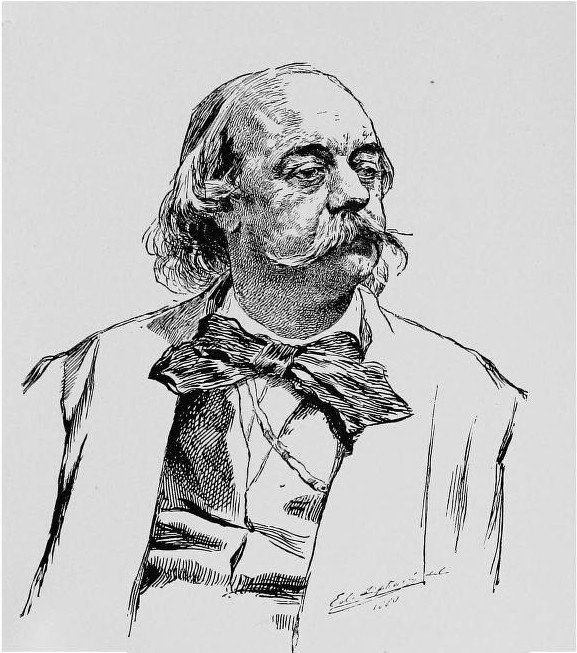
GUSTAVE FLAUBERT.
GUSTAVE FLAUBERT.
1881.
Gustave Flaubert was born at Rouen, in the year 1821. When, in 1880, he was snatched away by sudden death, he did not leave European literary art in the same condition in which he had found it. No artist, as such, could desire to hand down to posterity a better renown. The work of his life marks a step in the history of the novel.
He was a prose author of the first rank; for several years indeed no one stood higher than he in France. His strength as a prosaist reposed upon an artistic and literary conscientiousness, which was exalted almost to the dignity of genius. He became a great artist because he was unsparing in his efforts, both when he was making preparations to write and when he was engaged in writing; he collected the results of his observations, facts, and illustrations, with the painstaking of a mere savant, while striving, with the passionate eagerness of a mere adorer of form, to fashion his materials in a plastic and harmonious manner. He became a master of modern fiction because he was sufficiently self-denying to be willing to represent real psychological events alone, and to shun all effects of poetic eloquence, all pathetic or dramatic situations which appeared beautiful or interesting at the expense of the truth. His name is synonymous with artistic earnestness and literary rigor.
He was not a savant who was at the same time a writer of fiction, or who, in the course of his life, became a writer of fiction. His literary work is based on earnest, slowly acquired preparatory studies. His books have nothing in them that is juvenile or frivolous, nothing that is smiling or versatile. These books are the results of a slowly developed and late maturity. He did not make his début until he was thirty-five years old, and, although he devoted his whole time to literature, he left behind him in his fifty-ninth year but seven works.[1]
His was a profoundly original, but by no means elementary character. His originality was dependent on the fact that two literary currents united in his temperament and there formed a new well-spring. In his youth he received simultaneously, or almost simultaneously, two impulses, which determined his intellectual career.
The first current that reached him was the romantic-descriptive tendency in literature originating with Chateaubriand, a tendency characterized by a style fraught with lyrical emotion and brilliant coloring, which charmed the French reading public for the first time in "Atala" and "Les Martyres," and which later gained a far firmer and more powerful rhythm, as well as a far superior picturesque vigor, in Victor Hugo's "Les Orientales," and "Notre Dame de Paris." Like all poets, indeed like all human beings, Flaubert was inclined in youth to the lyrical, and his lyric muse, through the historic development of French poesie, became a varied-hued and melancholy homage to the religion of beauty. The second current directed into his inner being, was the tendency of Balzac's novels against the modern, their employment of what was hideous and brutal as characteristic, their passionate realistic bias, and their fidelity of observation.
While these two currents flowed at one and the same time through his inner being, and after the lapse of some time became blended together, they received a new coloring and a new name.
As a youth he had composed for the drawers of his writing-table many descriptive and pathetic lyrics, in Hugo's, Gautier's, and Byron's style; but justly feeling that his originality could not assert itself in this direction, and that, upon the whole, there was no longer room for anything original in this department, he withheld his productions from the public, and reconciled himself to the idea of appearing comparatively ungifted, or, at all events, unproductive. About the same time he made literary efforts in an opposite direction; he spoke himself sometimes of a tragi-comedy on the smallpox; but this attempt, too, he refrained from publishing. Not until Chateaubriand and Balzac had fostered in his mind a new poetic form, did he feel sure of his originality, and made his first public appearance.
I.
Even to those who have read little or nothing of Flaubert, it is well known that in the year 1856 he created an extraordinary sensation in Paris, and very soon throughout Europe, with a novel entitled "Madame Bovary." An absurd lawsuit,—the state attorney prosecuted both author and publisher, on the plea of the immoral tendencies of the work, and a unanimous verdict of acquittal on the part of the jury, could do little to increase the attention which the strongly individual new talent had excited. The book appeared singular and scandalous, as is apt to be the case with new attempts in literature. It was a token of opposition. People compared it with the literary productions of earlier times, and asked themselves if it was poetry. It was rather a reminder of surgery, of anatomy. Very much later, in Parisian literary circles where fidelity to a former conception of poetry was maintained, it was said: "Will you please excuse us from reading M. Flaubert's skeletons." The author was called an ultra-realist; people found in his novel only the merciless, inexorable physiology of every-day life in its sorrowful ugliness.