DONATELLO
Reading edition
The materials for a biography of Donatello are so scanty, that his life and personality can only be studied in his works. The Renaissance gave birth to few men of productive genius whose actual careers are so little known. Unlike many of his contemporaries, Donatello composed no treatise on his art; he wrote no memoir or commentary, no sonnets, and indeed scarcely a letter of his even on business topics has survived. For specific information about his career we therefore depend upon some returns made to the Florentine tax-collectors, and upon a number of contracts and payments for work carried out in various parts of Italy. But, however familiar Donatello the sculptor may be to the student of Italian art, Donatello the man must remain a mystery. His biography offers no attraction for those whose curiosity requires minute and intimate details of domestic life. Donatello bequeathed nothing to posterity except a name, his masterpieces and a lasting influence for good.
The Denunzia de' beni, which was periodically demanded from Florentine citizens, was a declaration of income combined with what would now be called census returns. Donatello made three statements of this nature,[1] in 1427, 1433 and 1457. It is difficult to determine his age, as in each case the date of his birth is differently inferred. But it is probable that the second of these returns, when he said that he was forty-seven years old, gives his correct age. This would place his birth in 1386, and various deductions from other sources justify this attribution. We gather also that Donatello lived with his mother Orsa, his father having died before 1415. The widow, who is mentioned in 1427, and not in 1433, presumably died before the latter date. One sister, Tita, a dowerless widow, is mentioned in the earliest denunzia, living with her mother and Donatello, her son Giuliano having been born in 1409. It is probable that Donatello had a brother, but the matter is somewhat obscure, and it is now certain that he cannot be identified with the sculptor Simone, who used to be considered Donatello's brother on the authority of Vasari.
Competition for the Baptistery Gates.
The year 1402 marks an event of far-reaching importance in the history of Italian art. Having decided to erect bronze doors for their Baptistery, the Florentines invited all artists to submit competitive designs. After a preliminary trial, six artists were selected and a further test was imposed. They were directed to make a bronze relief of given size and shape, the subject being the Sacrifice of Isaac. Few themes could have been better chosen, as the artist had to show his capacity to portray youth and age, draped and undraped figures, as well as landscape and animal life. The trial plaques were to be sent to the judges within twelve months. Donatello did not compete, being only a boy, but he must have been familiar with every stage in the contest, which excited the deepest interest in Tuscany. A jury of thirty-four experts, among whom were goldsmiths and painters as well as sculptors, assembled to deliver the final verdict. The work of Jacobo della Quercia of Siena was lacking in elegance and delicacy; the design submitted by Simone da Colle was marred by faulty drawing; that of Niccolo d'Arezzo by badly proportioned figures; while Francesco di Valdambrino made a confused and inharmonious group. It was evident that Ghiberti and Brunellesco were the most able competitors, and the jury hesitated before giving a decision. Brunellesco, however, withdrew in favour of his younger rival, and the commission was accordingly entrusted to Ghiberti. The decision was wise: Ghiberti's model, technically as well as æsthetically, was superior to that of Brunellesco. Both are preserved at Florence, and nobody has regretted the acceptance of Ghiberti's design, for its rejection would have made a sculptor of Brunellesco, whose real tastes and inclinations were towards architecture, to which he rendered services of incomparable value.
First Journey to Rome.
For a short time Donatello was probably one of the numerous garzoni or assistants employed by Ghiberti in making the gates, but his first visit to Rome is the most important incident of his earlier years. Brunellesco, disappointed by his defeat, and wishing to study the sculpture and architecture of Rome, sold a property at Settignano to raise funds for the journey. He was accompanied by Donatello, his stretissimo amico, and they spent at least a year together in Rome, learning what they could from the existing monuments of ancient art, and making jewelry when money was wanted for their household expenses. Tradition says that they once unearthed a hoard of old coins and were thenceforward known as the treasure-seekers—quelli del' tesoro. But the influence of antiquity upon Donatello was never great, and Brunellesco had to visit Rome frequently before he could fully realise the true bearings of classical art. It has been argued that Donatello never made this early visit to Rome on the ground that his subsequent work shows no traces of classical influence. On such a problem as this the affirmative statement of Vasari is lightly disregarded. But the biographer of Brunellesco is explicit on the point, giving many details about their sojourn; and this book was written during the lifetime of both Donatello and Brunellesco. The argument against the visit is, in fact, untenable. Artists were influenced by classical motives without going to Rome. Brunellesco himself placed in his competition design a figure inspired by the bronze boy drawing a thorn out of his foot—the Spinario of the Capitol. Similar examples could be quoted from the work of Luca della Robbia, and it would be easy to show, on the other hand, that painters like Masaccio, Fra Angelico, and Piero della Francesca were able to execute important work in Rome without allowing themselves to be influenced by the classical spirit except in details and accessories. Moreover, if one desired to press the matter further, it can be shown that in the work completed by Donatello before 1433, the year in which he made his second and undisputed visit, there are sufficient signs of classical motive in his architectural backgrounds to justify the opinion that he was acquainted with the ancient buildings of Rome. The Relief on the font at Siena and that in the Musée Wicar at Lille certainly show classical study. At the same time, in measuring the extent to which Donatello was influenced by his first visit to Rome, we must remember that it is often difficult and sometimes impossible to determine the source of what is generically called classical. The revival or reproduction of Romanesque motives is often mistaken for classical research. In the places where Christianity had little classical architecture to guide it—Ravenna, for instance—a new line was struck out; but elsewhere the Romanesque had slowly emerged from the classical, and in many cases there was no strict line of demarcation between the two. But Donatello was very young when he went to Rome, and the fashion of the day had not then turned in favour of classical study. The sculptors working in Rome, colourless men as they were, drew their inspiration from Gothic and pre-Renaissance ideals. In Florence the ruling motives were even more Gothic in tendency. It is in this school that Donatello found his earliest training, and though he modified and transcended all that his teachers could impart, his sculpture always retained a character to which the essential elements of classical art contributed little or nothing.
The Predecessors of Donatello.
Florence was busily engaged in decorating her great buildings. The fourteenth century had witnessed the structural completion of the Cathedral, excepting its dome, of the Campanile, and of the Church of Or San Michele. During the later years of the century their adornment was begun. A host of sculptors was employed, the number and scale of statues required being great. There was a danger that the sculpture might have become a mere handmaid of the architecture to which it was subordinated. But this was not the case; the sculptors preserved a freedom in adapting their figures to the existing architectural lines, and it is precisely in the statuary applied to completed buildings that we can trace the most interesting transitions from Gothic to Renaissance. It is needless to discuss closely the work which was erected before Donatello's return from Rome: much of it has unhappily perished, and what remains is for the purposes of this book merely illustrative of the early inspiration of Donatello. Piero Tedesco made a number of statues for the Cathedral, Mea and Giottino worked for the Campanile. Lorenzo di Bicci, sculptor, architect, and painter, was one of those whose influence extended to Donatello; Niccolo d'Arezzo was perhaps the most original of this group, making a genuine effort to shake off the conventional system. But, on the whole, the last quarter of the fourteenth century showed but little progress. Indeed, from the time of the later Pisani there seems to have been a period of stagnation, a pause during which the anticipated progress bore little fruit. Orcagna never succeeded in developing the ideas of his master. The shrine in Or San Michele, marvellous in its way, admirable alike for diligence and sincerity, stands alone, and was not imbued with the life which could make it an influence upon contemporary art.
First Work for the Cathedral.
The first recorded payment to Donatello by the Domopera, or Cathedral authorities, was made in November 1406, when he received ten golden florins as an instalment towards his work on the two prophets for the North door of the church, which is rather inaccurately described in the early documents as facing the Via de' Servi. Fifteen months later he received the balance of six florins. These two marble figures, small as they are, and placed high above the gables, are not very noticeable, but they contain the germ of much which was to follow. The term "prophet" can only be applied to them by courtesy, for they are curly-haired boys with free and open countenances; one of them happens to hold a scroll and the other wears a chaplet of bay leaves. There is a certain charm about them, a freshness and vitality which reappears later on when Donatello was making the dancing children for the Prato pulpit and the singing gallery for the Cathedral. The two prophets, particularly the one to the right, are clothed with a skill and facility all the more remarkable from the fact that some of the statues made soon afterwards, show a stiff and rigid treatment of drapery. Closely allied to these figures is a small marble statue, about three feet high, belonging to Madame Edouard André in Paris. It is a full-length figure of a standing youth, modelled with precision, and intended to be placed in a niche or against a background. Like the prophets just described, it has a high forehead, while the drapery falls in strong harmonious lines, a corner being looped up over the left arm. It is undoubtedly by Donatello, being the earliest example of his work in any collection, public or private, and on that account of importance, apart from its intrinsic merits.
The Cathedral Façade.
Donatello soon received commissions for statues of a more imposing scale to be placed on the ill-fated façade of the Cathedral. All beautiful within, the churches of Florence are singularly poor in those rich façades which give such scope to the sculptor and architect, conferring, as at Pisa, distinction on a whole town. The churches of the Carmine, Santo Spirito and San Lorenzo are without façades at all, presenting graceless and unfinished masonry in place of what was intended by their founders. Elsewhere there are late and florid façades alien to the spirit of the main building, while it has been left to our own generation to complete Santa Croce and the Cathedral. The latter, it is true, once had a façade, which, though never finished, was ambitiously planned. A large section of it was, however, erected in Donatello's time, but was removed for no reason which can be adequately explained, except that on the occasion of a royal marriage it was thought necessary to destroy what was contrived in the maniera tedesca, substituting a sham painted affair which was speedily ruined by the elements. The ethics of vandalism are indeed strange and varied. In this case vanity was responsible. It was superstition which led the Sienese, after incurring defeat by the Florentines, to remove from their market-place the famous statue by Lysippus which brought them ill-luck, and to bury it in Florentine territory, so that their enemies might suffer instead. Ignorance nearly induced a Pope to destroy the "Last Judgment" of Michael Angelo, whose colossal statue of an earlier Pontiff, Julius II., was broken up through political animosity. One wishes that in this last case there had been some practical provision such as that inserted by the House of Lords in the order for destroying the Italian Tombs at Windsor in 1645, when they ordained that "they that buy the tombs shall have liberty to transport them beyond the seas, for making the best advantage of them." The vandalism which dispersed Donatello's work could not even claim to be utilitarian, like that which so nearly caused the destruction of the famous chapel by Benozzo Gozzoli in the Riccardi Palace (for the purposes of a new staircase);[2] neither was it caused by the exigencies of war, such as the demolition of the Monastery of San Donato, a treasure-house of early painting, razed to the ground by the Florentines when awaiting the siege of 1529. The Cathedral façade was hastily removed, and only a fraction of the statuary has survived. Two figures are in the Louvre; another has been recently presented to the Cathedral by the Duca di Sermoneta, himself a Caetani, of Boniface VIII., a portrait-statue even more remarkable than that of the same Pope at Bologna. Four more figures from the old façade, now standing outside the Porta Romana of Florence, are misused and saddened relics. They used to be the major prophets, but on translation were crowned with laurels, and now represent Homer, Virgil, Dante and Petrarch. Other statues are preserved inside the Cathedral. Before dealing with these it is necessary to point out how difficult it is to determine the authorship and identity of the surviving figures. In the first place, our materials for reconstructing the design of the old façade are few. There were various pictures, some of which in their turn have perished, where guidance might have been expected. But the representations of the Cathedral in frescoes at San Marco, Santa Croce, the Misericordia and Santa Maria Novella help us but little. Up to the eighteenth century there used to be a model in the Opera del Duomo: this also has vanished, and we are compelled to make our deductions from a rather unsatisfactory drawing made by Bernardo Pocetti in the sixteenth century. It shows the disposition of statuary so sketchily that we can only recognise a few of the figures. But we have a perfect idea of the general style and aim of those who planned the façade, which would have far surpassed the rival frontispieces of Siena, Pisa and Orvieto. We are met by a further difficulty in identifying the surviving statues from the fact that the contracts given to sculptors by the Chapter do not always specify the personage to be represented. Moreover, in many cases the statues have no symbol attribute or legend, which usually guide our interpretation of mediæval art. Thus Donatello is paid pro parte solutionis unius figure marmoree;[3] or for figuram marmoream.[4] Even when an obvious and familiar explanation could be given, such as Abraham and Isaac, the accounts record an instalment for the figure of a prophet with a naked boy at his feet.[5]
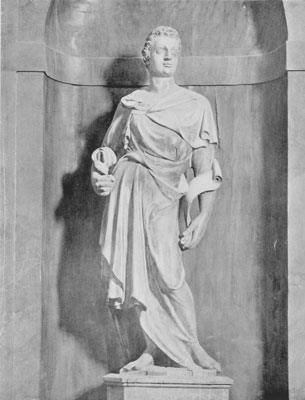
Alinari
JOSHUA
CATHEDRAL, FLORENCE
The Daniel and Poggio.
Nine large marble figures for the Cathedral are now accepted as the work of Donatello. Others may have perished, and it is quite possible that in one at least of the other statues Donatello may have had a considerable share. With the exception of St. John the Baptist and St. John the Evangelist, all these statues are derived from the Old Testament—Daniel, Jeremiah and Habbakuk, Abraham and the marble David in the Bargello, together with the two figures popularly called Poggio and the Zuccone. Among the earliest, and, it must be acknowledged, the least interesting of these statues is the prophet standing in a niche in the south aisle close to the great western door of the Cathedral. It has been long recognised as a Donatello,[6] and has been called Joshua. But, apart from the fact that he holds the scroll of a prophet, whereas one would rather expect Joshua to carry a sword, this statue is so closely related to the little prophets of the Mandorla door that it is almost certainly coeval with them, and consequently anterior in date to the period of the Joshua for which Donatello was paid some years later. We find the same broad flow of drapery, and the weight of the body is thrown on to one hip in a pronounced manner, which is certainly ungraceful, though typical of Donatello's early ideas of balance. It probably represents Daniel. He has the high forehead, the thick curly hair and the youthful appearance of the other prophets, while his "countenance appears fairer and fatter in flesh,"[7] reminding one of Michael Angelo's treatment of the same theme in the Sistine Chapel.
Like several of Donatello's statues, this figure is connected with the name of a Florentine citizen, Giannozzo Manetti, and passes for his portrait. There is no authority for the tradition, and Vespasiano de' Bisticci makes no reference to the subject in his life of Manetti. The statue is, no doubt, a portrait and may well have resembled Manetti, but in order to have been directly executed as a portrait it could scarcely have been made before 1426, when Manetti was thirty years old, by which date the character of Donatello's work had greatly changed. These traditional names have caused many critical difficulties, as, when accepted as authentic, the obvious date of the statue has been arbitrarily altered, so that the statue may harmonise in point of date of execution with the apparent age of the individual whom it is supposed to portray. A second example of the confusion caused by the over-ready acceptance of these nomenclatures is afforded by the remarkable figure which stands in the north aisle of the Cathedral, opposite the Daniel. This statue has been called a portrait of Poggio Bracciolini, the secretary of many Popes. Poggio was born in 1380 and passed some time in Florence during the year 1456. It has, therefore, been assumed[8] that the statue was made at this time or shortly afterwards, either as Donatello's tribute of friendship to Poggio or as an order from the Cathedral authorities in his commemoration. This theory is wholly untenable. We have no record of any such work in 1456. The statue does not portray a man seventy-six years old. Distinguished as Poggio was, his nature did not endear him greatly to the Florentine churchmen; and, finally, the style of the sculpture predicates its execution between 1420 and 1430. We can, of course, admit that Poggio's features may have been recognised in the statue, and that it soon came to be considered his portrait. In any case, however, we are dealing with a portrait-statue. The keen and almost cynical face, with its deep and powerful lines, is certainly no creation of the fancy, but the study of somebody whom Donatello knew. It is true there are contradictions in the physiognomy: sarcasm and benevolence alternate, as the dominating expression of the man's character. The whole face is marked by the refinement of one from whom precision and niceness of judgment would be expected. It is not altogether what Poggio's achievements would lead one to expect; neither is it of a type which, as has been suggested, would allow us to call it the missing Joshua. The idea that Job may be the subject is too ingenious to receive more than a passing reference.[9]
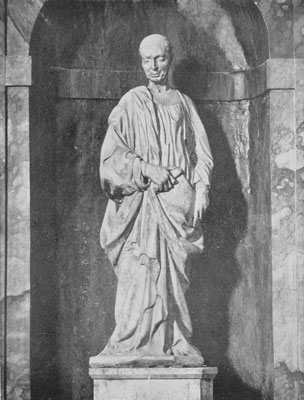
Alinari
POGGIO
CATHEDRAL, FLORENCE
There is one detail in the statue of Poggio which raises a problem familiar to students of fifteenth-century art, especially frequent in paintings of the Madonna, namely, the cryptic lettering to be found on the borders of garments. In the case of Poggio, the hem of the tunic just below the throat is incised with deep and clear cyphers which cannot be read as a name or initials. Many cases could be quoted to illustrate the practice of giving only the first letters of words forming a sentence.[10] In this case the script is not Arabic, as on Verrocchio's David. The lettering on the Poggio, as on Donatello's tomb of Bishop Pecci at Siena and elsewhere, has not been satisfactorily explained. Even if painters were in the habit of putting conventional symbols on their pictures in the form of inscriptions, it is not likely that this careful and elaborate carving should be meaningless. The solution may possibly be found in Vettorio Ghiberti's drawing of a bell, the rim of which is covered with similar hieroglyphics. The artist has transcribed in plain writing a pleasant Latin motto which one may presume to be the subject of the inscription. If this were accurately deciphered a clue might be found to unravel this obscure problem.[11]
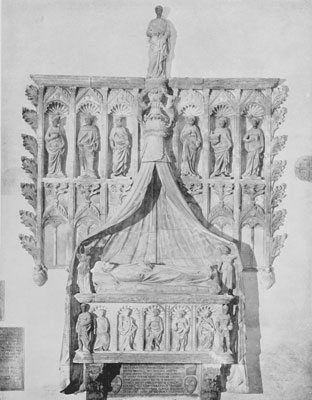
Alinari
MOCENIGO TOMB
SAN GIOVANNI E PAOLO, VENICE
Closely analogous to the statue which we must continue to call Poggio is a striking figure of Justice surmounting the tomb of Tommaso Mocenigo in the Church of San Giovanni e Paolo at Venice. Mocenigo died in 1423, and the tomb was made by two indifferent Florentine artists, whose poor and imitative work must be referred to later on in connection with the St. George. But the Justice, a vigorous and original figure, holding a scroll and looking downwards, so absolutely resembles the Poggio in conception, attitude, and fall of drapery, that the authorship must be referred to Donatello himself. It is certainly no copy. One cannot say how this isolated piece of Donatello's work should have found its way to Venice, although by 1423 Donatello's reputation had secured him commissions for Orvieto and Ancona and Siena. But it is not necessary to suppose that this Justice was made to order for the Mocenigo tomb; had it remained in Florence it would have been long since accepted as a genuine example of the master.
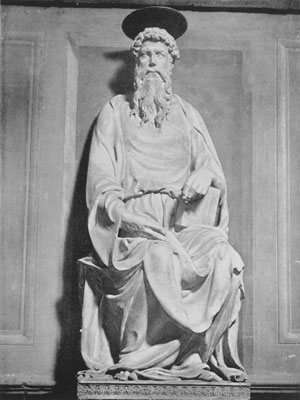
Alinari
ST. JOHN THE EVANGELIST
CATHEDRAL, FLORENCE
St. John the Evangelist and the marble David.
The third great statue made for the façade by Donatello is now placed in a dark apsidal chapel, where the light is so bad that the figure is often invisible. This is the statue of St. John the Evangelist, and is much earlier than Poggio, having been ordered on December 12, 1408. Two evangelists were to be placed on either side of the central door. Nanni di Banco was to make St. Luke, Niccolo d'Arezzo St. Mark, and it was intended that the fourth figure should be entrusted to the most successful of the three sculptors; but in the following year the Domopera changed their plan, giving the commission for St. Matthew to Bernardo Ciuffagni, a sculptor somewhat older than Donatello. Ciuffagni was not unpopular as an artist, for he received plenty of work in various parts of Italy; but he was a man of mediocre talent, neither archaic nor progressive, making occasional failures and exercising little influence for good or ill upon those with whom he came in contact. He has, however, one valued merit, that of being a man about whom we have a good deal of documentary information. Donatello worked on the St. John for nearly seven years, and, according to custom, was under obligation to complete the work within a specified time. Penalty clauses used to be enforced in those days. Jacopo della Quercia ran the danger of imprisonment for neglecting the commands of Siena. Torrigiano having escaped from England was recalled by the help of Ricasoli, the Florentine resident in London, and was fortunate to avoid punishment. Donatello finished his statue in time, and received his final instalment in 1415, the year in which the figures were set up beside the great Porch. This evangelist, begun when Donatello was twenty-two and completed before his thirtieth year, challenges comparison with one worthy rival, the Moses of Michael Angelo. The Moses was the outcome of many years of intermittent labour, and was created by the help of all the advances made by sculpture during a century of progress. Yet in one respect only can Michael Angelo claim supremacy. Hitherto Donatello had made nothing but standing figures. The St. John sits; he is almost inert, and does not seem to await the divine message. But how superb it is, this majestic calm and solemnity; how Donatello triumphs over the lack of giving tension to what is quiescent! The Penseroso also sits and meditates, but every muscle of the reposing limbs is alert. So, too, in the Moses, with all its exaggeration and melodrama, with its aspect of frigid sensationalism, which led Thackeray to say he would not like to be left alone in the room with it, we find every motionless limb imbued with vitality and the essentials of movement. The Moses undoubtedly springs from the St. John, transcending it as Beethoven surpassed Haydn. In spite of nearly unpardonable faults verging on decadence, it is the greater though the less pleasing creation of the two. The St. John surveys the world; the Moses speaks with God.
Alinari
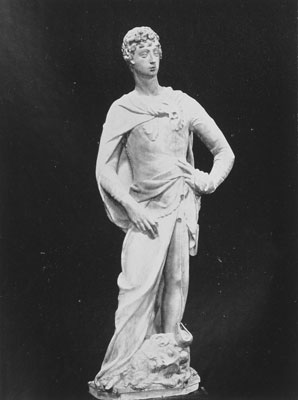
MARBLE DAVID
BARGELLO, FLORENCE
The fourth statue made for the Cathedral proper is contemporary with the St. John. The marble David, ordered in 1408 and completed in 1416, was destined for a chapel inside the church. The Town Commissioners, however, sent a somewhat peremptory letter to the Domopera and the statue was handed over to them. It was placed in the great hall of the Palace, was ultimately removed to the Uffizzi, and is now in the Bargello Museum. The David certainly has a secular look. This ruddy youth of a fair countenance, crowned with a wreath, stands in an attitude which is shy and perhaps awkward, and by his feet lies the head of Goliath with the smooth stone from the brook deeply embedded in his forehead. The drapery of the tunic is close fitting, moulded exactly to the lines of his frame, and above it a loose cloak hangs over the shoulders and falls to the ground with a corner of cloth looped over one of the wrists in a familiar way.[12] It would be idle to pretend that the David is a marked success like the St. John. It neither attains an ideal, as in the St. George, nor is it a profound interpretation of character like the Habbakuk or Jeremiah. Its effect is impaired by this sense of compromise and uncertainty. It is one of the very rare cases in which Donatello hesitated between divergent aims and finally translated his doubts into marble.
Statues of the Campanile.
We must now refer to a group of statues which adorn the Campanile, the great Bell tower designed by Giotto for the Cathedral. Not counting the numerous reliefs, there are sixteen statues in all, four on each side of the tower, and in themselves they epitomise early Florentine sculpture. Donatello's statues of Jeremiah, Abraham, and St. John the Baptist offer no difficulties of nomenclature, but the Zuccone and the Habbakuk are so called on hypothetical grounds. The Zuccone has been called by this familiar nickname from time immemorial: bald-head or pumpkin—such is the meaning of the word, and nobody has hitherto given a reasoned argument to identify this singular figure with any particular prophet. As early as 1415 Donatello received payment for some of this work, and the latest record on the subject is dated 1435. We may therefore expect to find some variety in idea and considerable development in technique during these twenty years. Donatello was not altogether single-handed. It is certain that by the time these numerous works were being executed he was assisted by scholars, and the Abraham was actually made in collaboration with Giovanni di Bartolo, surnamed Il Rosso. It is not easy to discriminate between the respective shares of the partners. Giovanni was one of those men whose style varied with the dominating influence of the moment. At Verona he almost ceased to be Florentine: at Tolentino he was himself; working for the Campanile he was subject to the power of Donatello. The Prophet Obadiah, which corresponds in position to the St. John Baptist of Donatello on the western face of the tower, shows Rosso to have been a correct and painstaking sculptor, with notions much in advance of Ciuffagni's; noticeable also for a refinement in the treatment of hands, in which respect many of his rivals lagged far behind. Judging from the inscription at Verona, Rosso was appreciated by others—or by himself:[13] he is, in fact, an artist of merit, rarely falling below a respectable average in spite of the frequency with which he changed his style.
St. John the Baptist.
Rosso does not compare favourably with Donatello. Obadiah is less attractive than St. John the Baptist, its pendant. The test is admittedly severe, for the St. John is a figure remarkable alike in conception and for its technical skill. Were it not for the scroll bearing the "Ecce Agnus Dei," we should not suggest St. John as the subject. Donatello made many Baptists—boys, striplings and men young and mature: but in this case only have we something bright and cheerful. He is no mystic; he differs fundamentally from the gloomy ascetic and the haggard suffering figures in Siena and Berlin. So far from being morose in appearance, clad in raiment of camel's hair, fed upon locusts and wild honey, and summoning the land of Judæa to repent, we have a vigorous young Tuscan, well dressed and well fed, standing in an easy and graceful attitude and not without a tinge of pride in the handsome countenance. In short, the statue is by no means typical of the Saint. It would more aptly represent some romantic knight of chivalry, a Victor, a Maurice—even a St. George. It competes with Donatello's own version of St. George. In all essentials they are alike, and the actual figures are identical in gesture and pose, disregarding shield and armour in one case, scroll and drapery in the other. The two figures are so analogous, that as studies from the nude they would be almost indistinguishable. They differ in this: that the Saint on the Campanile is John the Baptist merely because we are told so, while the figure made for Or San Michele is inevitably the soldier saint of Christendom. It must not be inferred that the success of plastic, skill less that of pictorial, art depends upon the accuracy or vividness with which the presentment "tells its story." Under such a criterion the most popular work of art would necessarily bear the palm of supremacy. But there should be some relation between the statue and the subject-matter. Nobody knew this better than Donatello: he seldom incurred the criticism directed against Myron the sculptor—Animi sensus non expressisse videtur.[14] The occasional error, such as that just noticed, or when he gives Goliath the head of a mild old gentleman,[15] merely throws into greater prominence the usual harmony between his conception and its embodiment. The task of making prophets was far from simple. Their various personalities, little known in our time, were conjectural in his day: neither would the conventional scroll of the prophet do more than give a generic indication of the kind of person represented. Donatello, however, made a series of figures from which the ηθος of the prophets emanates with unequalled force.
Alinari
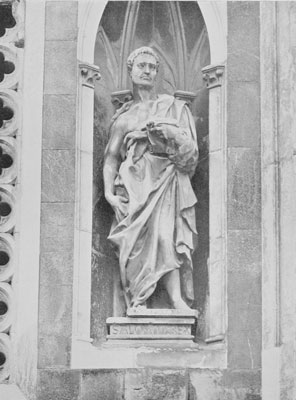
JEREMIAH
CAMPANILE, FLORENCE
Jeremiah and the Canon of Art.
The Jeremiah, for instance, which is in the niche adjacent to the still more astonishing Zuccone (looking westwards towards the Baptistery), is a portrait study of consummate power. It is the very man who wrote the sin of Judah with a pen of iron, the man who was warned not to be dismayed at the faces of those upon whose folly he poured the vials of anger and scorn; he is emphatically one of those who would scourge the vices of his age. And yet this Jeremiah has his human aspect. The strong jaw and tightly closed lips show a decision which might turn to obstinacy; but the brow overhangs eyes which are full of sympathy, bearing an expression of sorrow and gentleness such as one expects from the man who wept for the miserable estate of Jerusalem—Quomodo sedet sola civitas!
Tradition says that this prophet is a portrait of Francesco Soderini, the opponent of the Medici; while the Zuccone is supposed to be the portrait of Barduccio Cherichini, another anti-Medicean partisan. Probabilities apart, much could be urged against the attributions, which are really on a par with the similar nomenclatures of Manetti and Poggio. The important thing is that they are undoubted portraits, their identity being of secondary interest; the fact that a portrait was made at all is of far greater moment to the history of art. Later on, Savonarola (whose only contribution to art was an unconscious inspiration of the charming woodcuts with which his sermons and homilies were illustrated) protested warmly against the prevailing habit of giving Magdalen and the Baptist the features of living and well-known townsfolk.[16] The practice had, no doubt, led to scandal. But with Donatello it marks an early stage in emancipation from the bondage of conventionalism. Not, indeed, that Donatello was the absolute innovator in this direction, though it is to his efforts that the change became irresistible. Thus in these portrait-prophets we find the proof of revolution. The massive and abiding art of Egypt ignored the personality of its gods and Pharaohs, distinguishing the various persons by dress, ornament, and attribute. They had their canon of measurement, of which the length of the nose was probably the unit.[17] The Greeks, who often took the length of the human foot as unit, were long enslaved by their canon. Convention made them adhere to a traditional face after they had made themselves masters of the human form. The early figures of successful athletes were conventional; but, according to Pliny, when somebody was winner three times the statue was actually modelled from his person, and was called a portrait-figure: "ex membris ipsorum similitudine expressa, quas iconicas vocant!" Not until Lysistratus first thought of reproducing the human image by means of a cast from the face itself, did they get the true portrait in place of their previous efforts to secure generalised beauty.[18] In fact, their canon was so stringent that it would permit an Apollo Belvedere to be presented by foppish, well-groomed adolescence, with plenty of vanity but with little strength, and altogether without the sign-manual of godhead or victory. Despite shortcomings, Donatello seldom made the mistake of merging the subject in the artist's model: he did not forget that the subject of his statue had a biography. He had no such canon. Italian painting had been under the sway of Margaritone until Giotto destroyed the traditional system. Early Italian coins show how convention breeds a canon—they were often depraved survivals of imperial coins, copied and recopied by successive generations until the original meaning had completely vanished, while the semblance remained in debased outline. Nothing can be more fatal than to make a canon of art, to render precise and exact the laws of æsthetics. Great men, it is true, made the attempt. Leonardo, for instance, gives the recipe for drawing anger and despair. His "Trattato della Pintura"[19] describes the gestures appropriate for an orator addressing a multitude, and he gives rules for making a tempest or a deluge. He had a scientific law for putting a battle on to canvas, one condition of which was that "there must not be a level spot which is not trampled with gore." But Leonardo da Vinci did no harm; his canon was based on literary rather than artistic interests, and he was too wise to pay much attention to his own rules. Another man who tried to systematise art was Leon Battista Alberti, who gave the exact measurements of ideal beauty, length and circumference of limbs, &c., thus approaching a physical canon. The absurdity of these theories is well shown in the "Rules of Drawing Caricatures," illustrated by "mathematical diagrams."[20] Development and animation are impossible wherever an art is governed by this sterile and deadening code of law. The religious art of the Eastern Church has been stationary for centuries, confined within the narrow limits of hieratic conventions. Mount Athos has the pathetic interest of showing the dark ages surviving down to our own day in the vigour of unabated decadence. Though not subjected to any serious canon, the predecessors of Donatello seemed at one time in danger of becoming conventionalised. But Donatello would not permit his art to be divorced from appeals to reason and intellect; once started, his theory held its own. Donatello was bound by no laws; with all its cadence and complexity his art was unsuited to a canon as would be the art of music. He seems almost to have disregarded the ordinary physical limitations under which he worked. He had no "cant of material," and whether in stone, bronze, wood, or clay, he went straight ahead in the most unconcerned manner.
Alinari
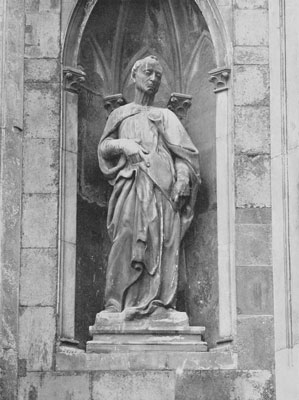
HABAKKUK
CAMPANILE, FLORENCE
Habbakuk and the Sense of Distance.
We do not know much about Habbakuk. He left two or three pages of passionate complaint against the iniquity of the land, but his "burden" lacks those outbursts of lyric poetry which are found in most of the other minor prophets. Donatello gives him the air of a thinker. He holds a long scroll to which he points with his right hand while looking downward, towards the door of the Cathedral. It is a strong head, as full of character as the Jeremiah. But Habbakuk is less the man of action, and the deep lines about the mouth and across the forehead show rather the fruits of contemplation. There may be a note of scepticism in the face. But this Habbakuk is no ascetic, and there is much strength in reserve: his comment though acrid would be just. The veins in the throat stand out like cords. They are much more noticeable in the photograph than when one sees the statue from the Piazza. It must be remembered that these figures on the Campanile are something like fifty-five feet from the ground: they were made for these lofty positions, and were carved accordingly. They show Donatello's sense of distance; the Zuccone shows his sense of light and shade, the Abraham his sense of proportion. Donatello had the advantage of making these figures for particular places; his sculpture was eminently adapted to the conditions under which it was to be seen. In the vast majority of cases modern sculpture is made for undetermined positions, and is fortunate if it obtains a suitable emplacement. It seldom gets distance, light and proportion in harmony with the technical character of the carving. Donatello paid the greatest care to the relation between the location of the statue and its carving: his work consequently suffers enormously by removal: to change its position is to take away something given it by the master himself. The Judith looks mean beneath the Loggia de' Lanzi; the original of the St. George in the museum is less telling than the copy which has replaced it at Or San Michele. Photography is also apt to show too clearly certain exaggerations and violences deliberately calculated by Donatello to compensate for distance, as on the Campanile, or for darkness, as on the Cantoria. The reproductions, therefore, of those works not intended to be seen from close by must be judged with this reservation. The classical sculptors seem to have been oblivious of this sense of distance. Cases have been quoted to show that they did realise it, such as the protruding forehead of Zeus or the deep-set eyes of the Vatican Medusa. These are accidents, or at best coincidences, for the sense of distance is not shown by merely giving prominence to one portion or feature of a face. In Roman art the band of relief on the Column of Trajan certainly gets slightly broader as the height increases: but the modification was half-hearted. It does not help one to see the carving, which at the summit is almost meaningless, while it only serves to diminish the apparent height of the column. So, too, in the triumphal arches of the Roman Emperors little attention was paid to the relative and varying attitudes of the bas-reliefs. From Greek art the Parthenon Frieze gives a singular example of this unrealised law. When in situ the frieze was only visible at a most acute angle and in a most unfavourable light: beyond the steps it vanished altogether, so one was obliged to stand among the columns to see it at all, and it was also necessary to look upwards almost perpendicularly. The frieze is nearly three feet four inches high and its upper part is carved in rather deeper relief than the base: but, even so, the extraordinary delicacy of this unique carving was utterly wasted, since the technical treatment of the marble was wholly unsuited to its emplacement. The amazing beauty of the sculpture and the unsurpassed skill of Phidias were never fully revealed until its home had been changed from Athens to Bloomsbury.
Alinari
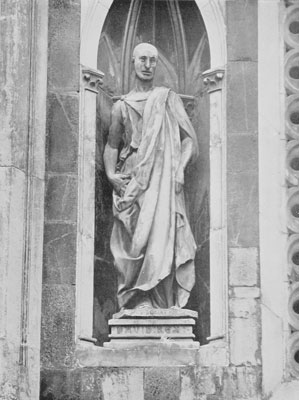
THE ZUCCONE
CAMPANILE, FLORENCE
The Zuccone, "Realism" and Nature.
The Zuccone is one of the eternal mysteries of Italian art. What can have been Donatello's intention? Why give such prominence to this graceless type? Baldinucci called it St. Mark.[21] Others have been misled by the lettering on the plinth below the statue "David Rex": beneath the Jeremiah is "Salomon Rex."[22] These inscriptions belonged, of course, to the kings which made way for Donatello's prophets. The Zuccone must belong to the series of prophets; it is fruitless to speculate which. Cherichini may have inspired the portrait. Its ugliness is insuperable. It is not the vulgar ugliness of a caricature, nor is it the audacious embodiment of some hideous misshapen creature such as we find in Velasquez, in the Gobbo of Verona, or in the gargoyles of Notre Dame. There is no deformity about it, probably very little exaggeration. It is sheer uncompromising ugliness; rendered by the cavernous mouth, the blear eyes, the flaccid complexion, the unrelieved cranium—all carried to a logical conclusion in the sloping shoulders and the simian arms. But the Zuccone is not "revenged of nature": there is nothing to "induce contempt." On the other hand, indeed, there is a tinge of sadness and compassion, objective and subjective, which gives it a charm, even a fascination. Tanto è bella, says Bocchi, tanto è vera, tanto è naturale, that one gazes upon it in astonishment, wondering in truth why the statue does not speak![23] Bocchi's criticism cannot be improved. The problem has been obfuscated by the modern jargon of art. Donatello has been charged with orgies of realism and so forth. There may be realism, but the term must be used with discretion: nowadays it generally connotes the ugly treatment of an ugly theme, and is applied less as a technical description than as a term of abuse. Donatello was certainly no realist in the sense that an ideal was excluded, nor could he have been led by realism into servile imitation or the multiplication of realities. After a certain point the true ceases to be true, as nobody knew better than Barye, the greatest of the "realists." The Zuccone can be more fittingly described in Bocchi's words. It is the creation of a verist, of a naturalist, founded on a clear and intimate perception of nature. Donatello was pledged to no system, and his only canon, if such existed, was the canon of observation matured by technical ability. We have no reason to suppose that Donatello claimed to be a deep thinker. He did not spend his time, like Michael Angelo, in devising theories to explain the realms of art. He was without analytical pedantry, and, like his character, his work was naïve and direct. Nor was he absorbed by appreciation of "beauty," abstract or concrete. If he saw a man with a humped back or a short leg he would have been prepared to make his portrait, assuming that the entity was not in conflict with the subject in hand. Hence the Zuccone. Its mesmeric ugliness is the effect of Donatello's gothic creed, and it well shows how Donatello, who from his earliest period was opposed to the conventions of the Pisan school, took the lead among those who founded their art upon the observation of nature. A later critic, shrewd and now much neglected, said that Titian "contented himself with pure necessity, which is the simple imitation of nature."[24] One could not say quite so much of Donatello, in whom, curiously enough, the love of nature was limited to its human aspect. He seems to have been impervious to outdoor nature, to the world of plants and birds and beasts. Ghiberti, his contemporary, was a profound student of natural life in all its forms, and the famous bronze doors of the Baptistery are peopled with the most fanciful products of his observation. "I strove to imitate nature to the utmost degree," he says in his commentary.[25] Thus Ghiberti makes a bunch of grapes, and wanting a second bunch as pendant, he takes care to make it of a different species. The variety and richness of his fruit and flower decoration are extraordinary and, if possible, even more praiseworthy than the dainty garlands of the Della Robbia. With Donatello all is different. He took no pleasure in enriching his sculpture in this way. The Angel of the Annunciation carries no lily; when in the Tabernacle of St. Peter's he had to decorate a pilaster he made lilies, but stiff and unreal. His trees in the landscape backgrounds of the Charge to Peter and the Release of Princess Sabra by St. George are tentative and ill-drawn. The children of the Cantoria, the great singing gallery made for the Cathedral, are dancing upon a ground strewn with flowers and fruit. The idea was charming, but in executing it Donatello could only make cut flowers and withered fruit. There is no life in them, no savour, and the energy of the children seems to have exhausted the humbler form of vitality beneath their feet. Years afterwards, when Donatello's assistants were allowed a good deal of latitude, we find an effort to make more use of this invaluable decoration: the pulpits of San Lorenzo, for instance, have some trees and climbing weeds showing keen study of nature. But Donatello himself always preferred the architectural background, in contrast to Leonardo da Vinci, who, with all his love of building, seldom if ever used one in the backgrounds of his pictures: but then Leonardo was the most advanced botanist of his age.
The Zuccone and the Sense of Light and Shade.
Speaking of the employment of light and shade as instruments in art, Cicero says: "Multa vident pictores in umbris et in eminentia, quæ nos non videmus." One may apply the dictum to the Zuccone where Donatello has carved the head with a rugged boldness, leaving the play of light and shade to complete the portrait. Davanzati was explicit on the matter,[26] showing that the point of view from which the Zuccone was visible made this coarse treatment imperative, if the spectator below was to see something forcible and impressive. "The eyes," he says, "are made as if they were dug out with a shovel: eyes which would appear lifelike on the ground level would look blind high up on the Campanile, for distance consumes diligence—la lontananza si mangia la diligenzia." The doctrine could not be better stated, and it governs the career of Donatello. There is nothing like the Zuccone in Greek art: nothing so ugly, nothing so wise. Classical sculptors in statues destined for lofty situations preserved the absolute truth of form, but their diligence was consumed by distance. What was true in the studio lost its truth on a lofty pediment or frieze. They preserved accuracy of form, but they sacrificed accuracy of appearance; whereas relative truth was in reality far more important—until, indeed, the time comes when the lights and shades of the studio are reproduced in some art gallery or museum.
Alinari
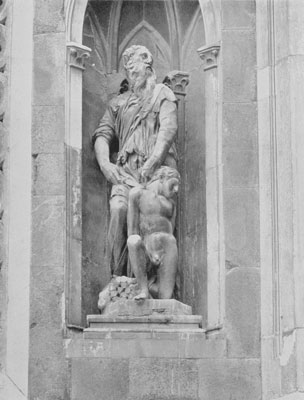
ABRAHAM AND ISAAC
CAMPANILE, FLORENCE
Abraham and the Sense of Proportion.
The statue of Abraham and Isaac on the east side of the Campanile is interesting as being the first group made by Donatello. The subject had already been treated by Brunellesco and Ghiberti in relief. Donatello had to make his figures on a larger scale. Abraham is a tall, powerful man with a long flowing beard, looking upwards as he receives the command to sheath the dagger already touching the shoulder of his son. The naked boy is kneeling on his left leg and is modelled with a good deal of skill, though, broadly speaking, the treatment is rather archaic in character. It is a tragic scene, in which the contrast of the inexorable father and the resigned son is admirably felt. Donatello had to surmount a technical difficulty, that of putting two figures into a niche only intended for one. His sense of proportion enabled him to make a group in harmony with its position and environment. It fits the niche. Statues are so often unsuited to their niches; scores of examples could be quoted from Milan Cathedral alone where the figures are too big or too small, or where the base slopes downwards and thus fails to give adequate support to the figure. There is an old tradition which illustrates Donatello's aptitude for grouping. Nanni di Banco had to put four martyrs into a niche of Or San Michele, and having made his statues found it impossible to get them in. Donatello was invoked, and by removing a superfluous bit of marble here, and knocking off an arm there, the four figures were successfully grouped together. The statues, it must be admitted, show no signs of such usage, and Nanni was a competent person: but the story would not have been invented unless Donatello had been credited in his own day with the reputation of being a master of proportion and grouping. Donatello, however, never really excelled in the free standing group. His idea was a suite or series of figures against a background, a bas-relief. The essential quality of a group is that there should be something to unite the figures. We find this in the Abraham, but the four martyrs by Nanni di Banco are standing close together as if by chance, and cannot properly be called a group in anything but juxtaposition of figures. Il Rosso helped to make Abraham. The commission was given jointly to the two sculptors in March 1421, and the statue was finished, with unusual expedition, by November of the same year. The hand of Rosso cannot be easily detected except in the drapery, which differs a good deal from Donatello's. The latter must have been chiefly responsible for the grouping and wholly so for the fine head of Abraham.
Drapery and Hands.
Rosso's drapery was apt to be treated in rather a small way with a number of little folds. Donatello, on the other hand, often tended to the opposite extreme, and in the Campanile figures we see the clothes hanging about the prophets in such ample lines that the Zuccone and Jeremiah are overweighted with togas which look like heavy blankets. Habbakuk and the Baptist are much more skilfully draped, deference being shown to the anatomy. "To make drapery merely natural," said Sir Joshua Reynolds, "is a mechanical operation to which neither genius nor taste are required: whereas it requires the nicest judgment to dispose the drapery so that the folds have an easy communication, and gracefully follow each other with such natural negligence as to look like the effect of chance, and at the same time show the figure under it to the utmost advantage."[27] The sculptors of the fifteenth century did not find it so easy to make drapery look purely natural, and we are often confronted by cases where they failed in this respect. It arose partly from a belief that drapery was nothing more than an accessory, partly also from their ignorance of what was so fully realised by the Greeks, that there can be very little grace in a draped figure unless there are the elements of beauty below. Another comment suggested by Donatello's early work in marble is that he was not quite certain how to model or dispose the hands. They are often unduly big; Michael Angelo started with the same mistake: witness his David and the Madonna on the Stairs. It was a mistake soon rectified in either case. But till late in life Donatello never quite succeeded in giving nerve or occupation to his hands. St. Mark, St. Peter, and St. John all have a book in their left hands, but none of them hold the book; it has no weight, the hand shows no grip and has no sense of possession. Neither did Donatello always know where to put the hands, giving them the shy and self-conscious positions affected by the schoolboy. The Bargello David is a case in point. His hands are idle, they have really nothing to do, and their position is arbitrary in consequence. It is all a descent from the Gothic, where we find much that is inharmonious and paradoxical, and a frequent lack of concord between the component parts. St. George, standing erect in his niche, holds the shield in front of him, its point resting on the ground. But, notwithstanding the great progress made by Donatello in modelling these hands—(so much indeed that one might almost suspect the bigger hands of contemporary statues to be faithful portraits of bigger hands)—one feels that the shield does not owe its upright position to the constraint of the hands. They do not reflect the outward pressure of the heavy shield, which could almost be removed without making it necessary to modify their functions or position. It was reserved for Michael Angelo to achieve the unity of purpose and knowledge needed in portraying the human hand. He was the first among Italian sculptors to render the relation of the hand to the wrist, the wrist to the forearm, and thence to the shoulder and body. In the fifteenth century nobody fully understood the sequence of muscles which correlates every particle of the limb, and Donatello could not avoid the halting and inconclusive outcome of his inexperience.
Minor Works for the Cathedral.
There remain a few minor works for the Cathedral which require notice. In October 1421 an unfinished figure by Ciuffagni was handed over to Donatello and Il Rosso. It is probable that Dr. Semper is correct in thinking that this may be the statue on the East side of the Cathedral hitherto ascribed to Niccolo d'Arezzo, though it can hardly be the missing Joshua. We have here a middle-aged man with a long beard, his head inclined forward and supported by his upraised hand with its forefinger extended. Donatello was fond of youth, but not less of middle age. With all their power these prophets are middle-aged men who would walk slowly and whose gesture would be fraught with mature dignity. Donatello did not limit to the very young or the very old the privilege of seeing visions and dreaming dreams. Two other statues by Donatello have perished. These are Colossi,[28] ordered probably between 1420 and 1425, and made of brick covered with stucco or some other kind of plaster. They stood outside the church, on the buttress pillars between the apsidal chapels. One of them was on the north side, as an early description mentions the "Gigante sopra la Annuntiata,"[29] that is above the Annunciation on the Mandorla door. The perishable material of these statues was selected, no doubt, owing to the difficulty and expense of securing huge monoliths of marble. In this case one must regret their loss, as the distance from which they would be seen would amply justify their heroic dimensions. But the idea of Colossi, which originated in Egypt and the East, is to astonish, and to make the impression through the agency of bulk. The David by Michael Angelo is great in spite of its unwieldiness. Michael Angelo himself was under no illusions about these Colossi. His letter criticising the proposal to erect a colossal statue of the Pope on the Piazza of San Lorenzo is in itself a delightful piece of humour, and ridiculed the conceit with such pungency that the project was abandoned. Finally, Donatello made two busts of prophets for the Mandorla door. The commission is previous to May 1422, when it is noted that Donatello was to receive six golden florins for his work. They are profile heads carved in relief upon triangular pieces of marble, which fill two congested architectural corners. They look like the result of a whim, and at first sight one would think they were ordered late in the history of the door to supplement or replace something unsatisfactory. But this is not the case. Half corbel and half decoration, they are curious things: one shows a young man, the other an older bearded man. Both have long hair drawn back by a fillet, and in each case one hand is placed across the breast. They have quite a classical look, and are the least interesting as well as the least noticeable of the numerous sculptures made for the Cathedral by Donatello. The Domopera evidently appreciated his talent. To this day, besides these busts and the two small prophets, there survive at least nine marble figures made for the Duomo, some of them well over life size. There were also the Colossi, and it will be seen later on that the Domopera gave him further commissions for bronze doors, Cantoria, altar and stained glass; he also was employed as an architectural expert. Years of Donatello's life were spent on the embellishment of Santa Maria del Fiore, a gigantic task which he shared with his greatest predecessors and his most able contemporaries. The task, indeed, was never fully accomplished. The Campanile is not crowned by the spire destined for it by Giotto: the façade has perished and the interior is marred by the errors of subsequent generations. But the Cathedral of Florence must nevertheless take high rank among the most stately churches of Christendom.
Alinari
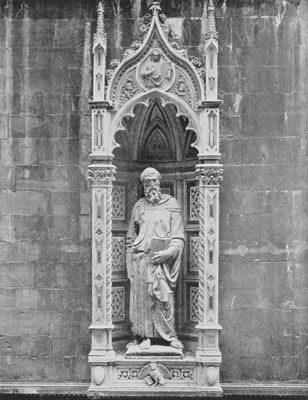
ST. MARK
OR SAN MICHELE
Or San Michele, St. Peter and St. Mark.
From the earliest times there used to be a church dedicated to St. Michael, which stood within the orto, the garden named after the saint. The church was, however, removed in the thirteenth century and was replaced by an open loggia, which was used for a corn market and store. In the following century the open arches of the loggia were built up, again making a church of the building, in which a venerated Madonna, for which Orcagna made the tabernacle, was preserved. The companies and merchant guilds of Florence undertook to present statues to decorate the external niches of the building. Besides Donatello, Ghiberti, Verrocchio, Gian Bologna and Nanni di Banco were employed; and there are also some admirable medallions by Luca della Robbia. Donatello made four statues—St. Peter, St. Mark, St. Louis and St. George. He was to have made St. Phillip as well, but the shoemakers who ordered the statue could not afford to pay Donatello's price and the work was entrusted to Nanni di Banco. Two only of Donatello's statues are left at Or San Michele, the St. Louis being now in Santa Croce, while the St. George has been placed in the Bargello. All these statues were put into niches of which the base is not more than eight feet from the ground, and being intended to be seen at a short distance are carved with greater attention to detail and finish than is the case with the prophets on the Campanile. St. Peter is probably the earliest in date, having been made, judging from stylistic grounds, between 1407 and 1412. This statue shows a doubt and hesitation which did not affect Donatello when making the little prophets for the Mandorla door. The head is commonplace and inexpressive; the pose is dull, and the drapery with its crimped edges ignores the right leg. There is, however, nothing blameworthy in the statue, but, on the other hand, there is nothing showing promise or deserving praise. Had it been made by one of the macchinisti of the time it would have lived in decent obscurity without provoking comment. In fact the statue does not owe its appearance in critical discussions to its own merits, but to the later achievement of the sculptor. Thus only can one explain Bocchi's opinion that "living man could not display truer deportment than we find in the St. Peter."[30] One of the figures from the Cathedral façade now in the Louvre, an apostle or doctor of the Church, shows whence Donatello derived his prosy idea, though the St. Peter is treated in a less archaic manner. The St. Mark is much more successful: there is conviction as well as vigour and greater skill. Michael Angelo exclaimed that nobody could disbelieve the Gospel when preached by a saint whose countenance is honesty itself. The very drapery—il prudente costume e religioso—[31] was held to contribute to Michael Angelo's praise. The grave and kindly face, devout and holy,[32] together with a certain homeliness of attitude, give the St. Mark a character which would endear him to all. He would not inspire awe like the St. John or indifference like St. Peter. He is a very simple, lovable person whose rebuke would be gentle and whose counsel would be wise. In 1408 the Linaiuoli, the guild of linen-weavers, gave their order to select the marble, and in 1411 the commission was given to Donatello, having been previously given to Niccolo d'Arezzo, who himself became one of Donatello's guarantors. The work had to be finished within eighteen months, and the heavy statue was to be placed in the niche at the sculptor's own risk. The statement made by Vasari that Brunellesco co-operated on the St. Mark is not borne out by the official documents. It is interesting to note that the guild gave Donatello the height of the figure, leaving him to select the corresponding proportions. The statue was to be gilded and decorated.[33] A further commission was given to two stone-masons for the niche, which was to be copied from that of Ghiberti's St. Stephen. These niches have been a good deal altered in recent times, and the statues are in consequence less suited to their environment than was formerly the case. Judging from the plates in Lasinio's book, the accuracy of which has not been contested, it appears that the niches of St. Eligius and St. Mark have been made more shallow, while the crozier of the former and the key in St. Peter's hand are not shown at all, and must be modern restorations.
St. Louis.
The St. Louis is made of bronze. The reputation of this admirable figure has been prejudiced by a ridiculous bit of gossip seriously recorded by Vasari, to the effect that, having been reproached for making a clumsy figure, Donatello replied that he had done so with set purpose to mark the folly of the man who exchanged the crown for a friar's habit. Vasari had to enliven his biographies by anecdotes, and their authenticity was not always without reproach. In view of his immense services to the history of art one will gladly forgive these pleasantries; but it is deplorable when they are solemnly quoted as infallible. One author says: "... impossibile a guardare quel goffo e disgraziato San Lodovico senza sentire una stretta al cuore." This is preposterous. The statue has faults, but they do not spring from organic error. The Bishop is overweighted with his thick vestments, and his mitre is rather too broad for the head; the left hand, moreover, is big and Donatellesque. But the statue, now placed high above the great door of Santa Croce, is seen under most unfavourable conditions, and would look infinitely better in the low niche of Or San Michele. Its proportions would then appear less stumpy, and we would then be captivated by the beauty of the face. It has real "beauty"; the hackneyed and misused term can only be properly applied to Donatello's work in very rare cases, of which this is one. The face itself is taken from some model, which could be idealised to suit a definite conception, and in which the pure and symmetrical lines are harmonised with admirable feeling. Every feature is made to correspond, interrelated by some secret necessary to the art of portraiture. The broad brow and the calm eyes looking upwards are in relation with the delicately chiselled nose and mouth, while the right hand, which is outstretched in giving the blessing, is rendered with infinite sentiment and grace. St. Louis, in short, deserves high commendation, as, in spite of errors, it achieves something to which Donatello seldom aspired; and it has the further interest of being his earliest figure in bronze, a material in which some of his most renowned works were executed. The whole question of Donatello's share in the actual casting will be considered at a later stage. It will be enough to say at this point that the St. Louis, which was probably finished about 1425, was cast with the assistance of Michelozzo.
Alinari
ST. GEORGE
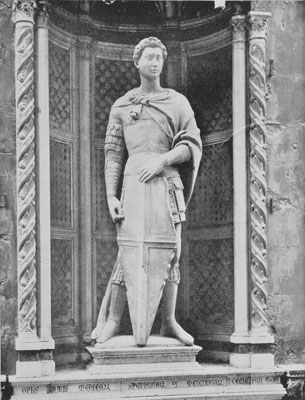
IN NICHE ON OR SAN MICHELE
St. George.
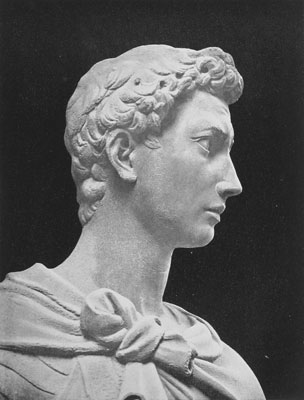
The St. George is the most famous of Donatello's statues, and is generally called his masterpiece. The marble original has now been taken into the Museum, and a bronze cast replaces it at Or San Michele. The cause of this transfer is understood to be a fear that the statue would be ruined by exposure, although one would think that this would apply still more to the exquisite relief, which remains in situ, though unprotected by the niche. In the side-lighted Bargello, the St. George is crowded into a shallow niche (with plenty of highly correct detail) and is seen to the utmost disadvantage; but no incongruity of surroundings, no false relations of light can destroy the profound impression left by this statue, which was probably completed about 1416, in Donatello's thirtieth year. Vasari was enthusiastic in its praise. Bocchi wrote a whole book about it,[34] in which we might expect to find valuable information; but the interest of this ecstatic eulogy is limited. Bocchi gives no dates, facts or authorities; nothing to which modern students can turn for accurate or specific knowledge of Donatello. Cinelli says the St. George was held equal to the rarest sculpture of Rome,[35] and well it might be. The St. George was made for the Guild of Armourers; he is, of course, wearing armour, and the armour fits him, clothes him. It is not the clumsy inelastic stuff which must have prevented so many soldiers from moving a limb or mounting a horse. In this case the lithe and muscular frame is free and full of movement, quite unimpeded by the defensive plates of steel. He stands upright, his legs rather apart, and the shield in front of him, otherwise he is quite unarmed; the St. George in the niche is alert and watchful: in the bas-relief he manfully slays the dragon. The head is bare and the throat uncovered; the face is full of confidence and the pride of generous strength, but with no vanity or self-consciousness. Fearless simplicity is his chief attribute, though in itself simplicity is no title to greatness: with Donatello, Sophocles and Dante would be excluded from any category of greatness based on simplicity alone. St. George has that earnest and outspoken simplicity with which the mediæval world invested its heroes; he springs from the chivalry of the early days of Christian martyrdom, the greatest period of Christian faith. Greek art had no crusader or knight-errant, and had to be content with Harmodius and Aristogeiton. Even the Perseus legend, which in so many ways reminds one of St. George, was far less appreciated as an incident by classical art than by the Renaissance; and even then not until patron and artist were growing tired of St. George. M. Reymond has pointed out the relation of Donatello's statue to its superb analogue, St. Theodore of Chartres Cathedral. "C'est le souvenir de tout un monde qui disparaît."[36] Physically it may be so. The age of chivalry may be passed in so far that the prancing steed and captive Princess belong to remote times which may never recur. But St. George and St. Theodore were not merely born of legend and fairy tale; their spirit may survive in conditions which, although less romantic and picturesque, may still preserve intact the essential qualities of the soldier-saint of primitive times. The influence of the St. George upon contemporary art seems to have been small. The Mocenigo tomb, which has already been mentioned, has a figure on the sarcophagus obviously copied from the St. George; and elsewhere in this extremely curious example of plagiarism we find other figures suggested by Donatello's statues. The little figure in the Palazzo Pubblico at Pistoja is again an early bit of piracy. In the courtyard of the Palazzo Quaratesi in Florence, built by Brunellesco between 1425 and 1430, an early version of the head of St. George was placed in one of the circular panels above the pillars. It is without intrinsic importance, being probably a cast, but it shows how early the statue was appreciated. A more important cast is that of the bas-relief now in London, which has a special interest from having been taken before the original had suffered two or three rather grievous blows.[37] Verrocchio made a drawing of the St. George,[38] and Mantegna introduced a similar figure into his picture of St. James being led to execution.[39] But Donatello's influence cannot be measured by the effect of St. George. In this particular case his work did not challenge competition; its perfection was too consummate to be of service except to the copyist. In some ways it spoke the last word; closed an episode in the history of art—εσχατος του ιδιου γενους.
Alinari
ST. GEORGE
BARGELLO
Donatello and Gothic Art.
The relation of St. George and other Italian works of this period, both in sculpture and painting, to the Gothic art of France cannot be ignored, although no adequate explanation has yet been given. St. George, the Baptists of the Campanile and in Rome, and the marble David are intensely Franco-Gothic, and precisely what one would expect to find in France. The technical and physical resemblance between the two schools may, of course, be a coincidence; it may be purely superficial. But St. Theodore might well take his place outside Or San Michele, while the St. George (in spite of the difference in date) would be in complete ethical harmony with the statues on the portals of Chartres. Even if they cannot be analysed, the phenomena must be stated. Donatello may have spontaneously returned to the principles which underlay the creation of the great statuary of France, the country of all others where a tremendous school had flourished. But what these fundamental principles were it is impossible to determine. It is true there had always been agencies at work which must have familiarised Italy with French thought and ideas. From the time of the dominant French influence in Sicily down to the Papal exile in France—which ended actually while Donatello was working on these statues, one portion or another of the two countries had been frequently brought into contact. The Cistercians, for instance, had been among the most persistent propagators of Gothic architecture in Italy, though nearly all their churches (of which the ground-plans are sometimes identical with those of French buildings) are situated in remote country districts of Italy, and being inaccessible are little known or studied nowadays. France, however, was herself full of Italian teachers and churchmen, who may have brought back Northern ideas of art, for they certainly left small traces of their influence on the French until later on; their presence, at any rate, records intercourse between the two countries. A concrete example of the relation between the two national arts is afforded by the fact that Michelozzo was the son of a Burgundian who settled in Florence. Michelozzo was some years younger than Donatello, and it is therefore quite out of the question to assume that the St. George could have been due to his influence: he was too young to give Donatello more than technical assistance. In this connection one must remember that French Gothic, though manifested in its architecture, was of deeper application, and did not confine its spirit to the statuary made for the tall elongated lines of its cathedrals. What we call Gothic pervaded everything, and was not solely based on physical forms. Indeed, whatever may be the debt of Italian sculpture to French influence, the Gothic architecture of Italy excluded some of the chief principles of the French builders. It was much more liberal and more fond of light and air. Speaking of the exaggerated type of Gothic architecture, in which everything is heightened and thinned, Renan asks what would have happened to Giotto if he had been told to paint his frescoes in churches from which flat spaces had entirely disappeared. "Once we have exhausted the grand idea of infinity which springs from its unity, we realise the shortcomings of this egoistic and jealous architecture, which only exists for itself and its own ends, régnant dans le désert."[40] The churches of Umbria and Tuscany were as frames in which space was provided for all the arts; where fresco and sculpture could be welcomed with ample scope for their free and unencumbered display. Donatello was never hampered or crowded by the architecture of Florence; he was never obliged, like his predecessors in Picardy and Champagne, to accommodate the gesture and attitude of his statue to stereotyped positions dictated by the architect. His opportunity was proportionately greater, and it only serves to enhance our admiration for the French sculptors. In spite of difficulties not of their own making, they were able to create, with a coarser material and in a less favourable climate, what was perhaps the highest achievement ever attained by monumental sculpture. The Italians soon came to distrust Gothic architecture. It was never quite indigenous, and they were afraid of this "German" transalpine art. Vasari attacks "Questa maledizione di fabbriche," with their "tabernacolini l'un sopra l'altro, ... che hanno ammorbato il mondo."[41] One would expect the denunciation of Milizia to be still more severe. But he admits that "fra tante monstruosità l'architettura gottica ha alcune bellezze."[42] Elsewhere mentioning the architect of the Florentine Cathedral (while regretting how long the corrotto gusto survived), he says, "In questo architetto si vede qualche barlume di buona architettura, come di pittura in Cimabue suo contemporaneo."[43] He detects some glimmer of good architecture. Sir Joshua Reynolds was cautious: "Under the rudeness of Gothic essays, the artist will find original, rational, and even sublime inventions."[44] It should be remembered that the word Tedesca, as applied to Gothic art, meant more than German, and could be almost translated by Northern. Italians from the lakes and the Valtellina were called Tedeschi, and Italy herself was inhabited by different peoples who were constantly at war, and who did not always understand each other's dialects. Dante said the number of variations was countless.[45] Alberti, who lived north of the Apennines during his boyhood, took lessons in Tuscan before returning to Florence. The word Forestiere, now meaning foreigner, was applied in those days to people living outside the province, sometimes even to those living outside the town. Thus we have a record of the cost of making a provisional altar to display Donatello's work at Padua—"per demonstrar el desegno ai forestieri."[46] No final definition of Gothic art, of the maniera tedesca is possible. Some of its component parts have been enumerated: rigidity, grotesque, naturalism, and so forth; but the definition is incomplete, cataloguing the effects without analysing their cause. Whether Donatello was influenced by the ultimate cause or not, he certainly assimilated some of the effects. The most obvious example of the Gothic feeling which permeated this child of the Renaissance, is his naturalistic portrait-statues. Donatello found the form, some passing face or figure in the street, and rapidly impressed it with his ideal. Raffaelle found his ideal, and waited for the bodily form wherewith to clothe it. "In the absence of good judges and handsome women"—that is to say, models, he paused, as he said in one of his letters to Castiglione. One feels instinctively that with his Gothic bias Donatello would not have minded. He did not ask for applause, and at the period of St. George classical ideas had not introduced the professional artist's model. Life was still adequate, and the only model was the subject in hand. The increasing discovery of classical statuary and learning made the later sculptors distrust their own interpretation of the bodily form, which varied from the primitive examples. Thus they lost conviction, believing the ideal of the classicals to surpass the real of their own day. The result was Bandinelli and Montorsoli, whose world was inhabited by pompous fictions. They neither attained the high character of the great classical artists nor the single-minded purpose of Donatello. Their ideal was based on the unrealities of the Baroque.
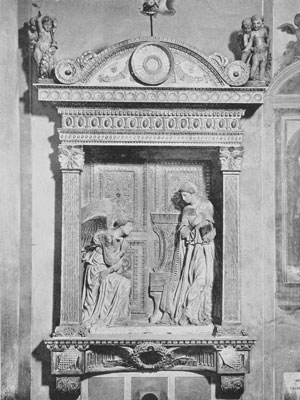
Alinari
ANNUNCIATION
SANTA CROCE, FLORENCE
The Crucifix and Annunciation.
Donatello loved to characterise: in one respect only did he typify. Where there was most character there was often least beauty. This is illustrated by two works in Santa Croce, the Christ on the Cross and the Annunciation. They differ in date, material, and conception, but may be considered together. As to the exact date of the former many opinions have been expressed. Vasari places it about 1401, Manetti about 1405, Schmarsow 1410, Cavalucci 1416, Bode 1431, Marcel Reymond 1430-40. It is quite obvious that the crucifix is the product of rather a timid and uncertain technique, and does not show the verve and decision which Donatello acquired so soon. It is made of olive wood, and is covered by a shiny brown paint which may conceal a good deal of detailed carving. The work is sober and decorous, and not marred by any breach of good taste. It is in no sense remarkable, and has nothing special to connect it with Donatello. Its notoriety springs from a long and rather inconsequent story, which says that, having made his Christ in rivalry with Brunellesco, who was occupied on a similar work, Donatello was so much saddened at the superiority of the other crucifix that he exclaimed: "You make the Christ while I can only make a peasant: a te è conceduto fare i Cristi, ed a me i contadini".[47] Brunellesco's crucifix,[48] now hidden behind a portentous array of candles, is even less attractive than that in Santa Croce. Brunellesco was the aristocrat, the builder of haughty palaces for haughty men, and may have really thought his cold and correct idea superior to Donatello's peasant. To have thought of taking a contadino for his type (disappointing as it was to Donatello) was in itself a suggestive and far-reaching departure from the earlier treatment of the subject. In the fourteenth century Christ on the Cross had been treated with more reserve and in a less naturalistic fashion. The traditional idea disappeared after these two Christs, which are among the earliest of their kind, afterwards produced all over Italy in such numbers. As time went on the figure of Christ received more emphasis, until it became the vehicle for exhibiting those painful aspects of death from which no divine message of resurrection could be inferred. The big crucifix ascribed to Michelozzo shows how far exaggeration could be carried.[49] The opened mouth, the piteous expression, the clots of blood falling from the wounds, combine to make a figure which is repellent, and which lost all justification, from the fact that this tortured dying man shows no conviction of divine life to come. Donatello's bronze crucifix at Padua, made years afterwards, showed that he never forgot that a dying Christ must retain to the last the impress of power and superhuman origin. In the conflict of drama and beauty, Donatello allowed drama to gain the upper hand. But the Annunciation would suggest a different answer, for here we find what is clearly a sustained effort to secure beauty. The Annunciation is a large relief, in which the angel and the Virgin are placed within an elaborately carved frame, while on the cornice above there are six children holding garlands. Its date has been the subject of even more discussion than that of the Crucifix,[50] and the conflict of opinion has been so keen that the intrinsic merits of this remarkable work have been sometimes overlooked. The date is, of course, important for the classification of Donatello's work, but it is a pity when the attention of the critic is monopolised by minor problems. Milizia, when in doubt about the date of Alberti's birth, did not go too far in saying "disgrazia grande per chi si trova la sua felicità nelle date." The Annunciation was erected by the Cavalcanti family, and the old theory that it was ordered to commemorate their share in the victory over Pisa in 1406 has been upheld by the presence on the lower frieze of a winged wreath, an emblem of victory. The object of the donor is conjectural: we know nothing about it; and the association of wings and a wreath is found elsewhere in Donatello's work.[51] Moreover, the rich Renaissance decoration is quite sufficient to demonstrate that the work must be much later than 1406, though whether immediately before or after the second Roman visit must be founded on hypothesis. The precise date of the particular decoration is too nebular to permit any exact statement on the subject. There was never any line of demarcation between one school and another. One can find Gothic ideas long after the Renaissance had established its principles,[52] while the period of transition lasted so long, especially in the smaller towns, that the old and new schools often flourished concurrently. This relief is made of Pietra Serena, of a delicate bluish tint, very charming to work in, according to Cellini, though without the durability needed for statues placed out of doors.[53] It has been enriched with a most lavish hand and there is no part of the work without sumptuous decoration. The base, with the central wreath, is flanked by the Cavalcanti arms: above them rise two rectangular shafts enclosing the relief on either side. These columns are carved with a fretwork of leaves, and their capitals are formed of strongly chiselled masks of a classical type, like those on the Or San Michele niche. Above the shafts comes the plinth, which has a peculiar egg and dart moulding, in its way ugly, and finally the whole thing is crowned with a bow-shaped arch, upon which the six terra cotta Putti are placed, two at either extremity and the other pair lying along the curved space in the centre;[54] the panelled background and the throne are covered with arabesques. But this intricate wealth of decoration does not distract attention from the main figures. The Virgin has just risen from the chair, part of her dress still resting on the seat. Her face and feet turn in different directions, thus giving a dualism to the movement, an impression of surprise which is in itself a tour de force. But there is nothing bizarre or far-fetched, and the general idea one receives is that we have a momentary vision of the scene: we intercept the message which is well rendered by the pose of the angel, while its reception is acknowledged by the startled gesture of the Virgin. "È stupendo l'artifizio."[55] The scheme is what one would expect from Luca della Robbia. Nothing of the kind reappears in Donatello's work, and the attainment of beauty as such is also beyond the sphere of his usual ambition. Indeed, so widely does the Annunciation differ from our notions about the artist, that it has been recently suggested that Donatello was assisted in the work: while some people doubt the attribution altogether. The idea that Michelozzo should have done some of the actual carving may be well or ill founded; in any case, no tangible argument has been advanced to support the idea. Donatello's authorship is vouched for by Albertini, who wrote long before Vasari, and whose notice about the works of art in Florence is of great value.[56] But we have no standard of comparison, and Donatello himself had to strike out a new line for his new theme. The internal evidence in favour of Donatello must therefore be sought in the accessories; and in architectural details which occur elsewhere,[57] such as the big and somewhat incontinent hands, the typical putti, and the rather heavy drapery. To this we may add the authority of early tradition, the originality and strength of treatment, and finally the practical impossibility of suggesting any alternative sculptor.
Martelli, David and Donatello's Technique.
Tradition says that Ruberto Martelli was the earliest of Donatello's patrons. So far as we know, there were two Rubertos: the elder was seventy-three at the time of Donatello's birth, and must therefore have been a nonagenarian before his patronage could be effectively exercised; the other was twenty-two years younger than the sculptor, whom he could not have helped as a young man. But there is no question about the interest shown by the family in Donatello's work. The David and the St. John, together with a portrait-bust and the coat of arms, still show their practical appreciation of his work and Donatello's gratitude to the family. Vasari is the first to mention these works, and it must be remarked that Albertini, who paid great attention to Donatello, mentions nothing but antique sculpture in the Martelli palace. The David and the St. John Baptist are both in marble, and were probably made between 1415 and 1425. The David, which was always prized by the family, is shown in the background of Bronzino's portrait of Ugolino Martelli.[58] It was then standing in the courtyard of the palace, but was taken indoors in 1802 per intemperias. The statue is not altogether a success. Its allure is good: but the anatomy is feminine, the type is soft and yielding; the attitude is not spontaneous; and the head of Goliath, tucked uncomfortable between the feet, is poor. There is a bronze statuette in Berlin which has been considered a study for this figure, though it is most unlikely that Donatello himself would have taken the trouble to make bronze versions of his preparatory studies. The work, however, is in all probability by Donatello, and most of the faults in the marble statue being corrected, it may be later than the Martelli figure, from which it also varies in several particulars. The statuette is full of life and vigour, and the David is a sturdy shepherd-boy who might well engage a lion or a bear. In one respect the Martelli figure is of great importance. It is unfinished—the only unfinished marble we have of the master, and it gives an insight into the methods he employed. It is fortunate that we have some means of understanding how Donatello gained his ends, although this statue does not show him at his best; indeed it may have been abandoned because it did not reach his expectations. However, we have nothing else to judge by. The first criticism suggested by the David is that Donatello betrays the great effort it cost him. Like the unfinished Faith by Mino da Fiesole,[59] it is laboured and experimental. They set to work hoping that later stages would enable them to rectify any error or miscalculation, but both found they had gone too far. The material would permit no such thing, and with all their skill one sees that the blocks of marble did not unfold the statues which lay hidden within. As hewers of stone, Donatello and Mino cannot compare with Michael Angelo. Jacopo della Quercia alone had something of his genius of material. Nobody left more "unfinished" work than Michael Angelo. The Victory, the bust of Brutus, the Madonna and Child,[60] to mention a few out of many, show clearly what his system was. In the statue of Victory we see the three stages of development or completion. The statue is in the stone, grows out of it. The marble seems to be as soft as soap, and Michael Angelo simply peels off successive strata, apparently extracting a statue without the smallest effort. The three grades are respectively shown in the rough-hewn head of the crouching figure, then in the head of the triumphant youth above him, finally in his completed torso. But each stage is finished relatively. Completion is relative to distance; the Brutus is finished or unfinished according to our standpoint, physical or æsthetic. Moreover, the treatment is not partial or piecemeal; the statue was in the marble from the beginning, and is an entity from its initial stage: in many ways each stage is equally fine. The paradox of Michael Angelo's technique is that his abozzo is really a finished study. The Victory also shows how the deep folds of drapery are bored preparatory to being carved, in order that the chisel might meet less resistance in the narrow spaces; this is also the case in the Martelli David. As a technical adjunct boring was very useful, but only as a process. When employed as a mechanical device to represent the hair of the head, we get the Roman Empress disguised as a sponge or a honeycomb. These tricks reveal much more than pure technicalities of art. Gainsborough's habit of using paint brushes four or five feet long throws a flood of light upon theory and practice alike. There is, however, another work, possibly by Donatello himself, which gives no insight into anything but technical methods, but which is none the less important. This is the large Madonna and Child surrounded by angels, belonging to Signor Bardini of Florence. It is unhappily a complete wreck, five heads, including the Child's, having been broken away. It is a relief in stucco, modelled, not cast, and is closely allied with a group of Madonnas to which reference is made hereafter.[61] We can see precisely how this relief was made. The stucco adheres to a strong canvas, which in its turn is nailed on to a wooden panel. The background, also much injured, is decorated with mosaic and geometrical patterns of glass, now dim and opaque with age. The relief must have been of signal merit. Complete it would have rivalled the polychrome Madonna of the Louvre: as a fragment it is quite sufficient to prove that the Piot Madonna, in the same museum, is not authentic. One more trick of the sculptor remains to be noticed. Vasari and Bocchi say that Donatello, recognising the value of his work, grouped his figures so that the limbs and drapery should offer few protruding angles, in order to minimise the danger of fracture. It was his insurance against the fragility of the stone: when working in bronze such precautions would be less necessary. It is quite true that in the larger figures there is a marked restraint in this respect, while in his bas-reliefs, where the danger was less, the tendency to raise the arms above the head is often exaggerated. But too much stress should not be laid upon this explanation: it is hard to believe that Donatello would have let so crucial a matter be governed by such a consideration. Speaking generally, Donatello was neither more nor less restrictive than his Florentine contemporaries, and it was only at a later period that the isolated statue received perfect freedom, such as that in the Cellini Perseus, or the Mercury by Gian Bologna, or Bernini's work in marble.
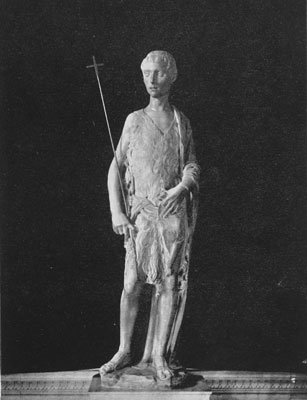
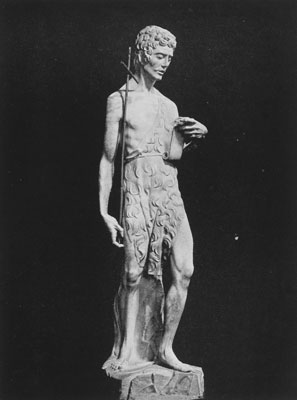
Alinari SAN GIOVANNINO PALAZZO MARTELLI, FLORENCE Alinari ST. JOHN BAPTIST, MARBLE BARGELLO
Early Figures of St. John.
Another important statue in the Martelli palace is that of St. John the Baptist. Besides being the earliest patron of Florence, St. John was the titular saint of every Baptistery in the land. This accounts for the frequency with which we find his statues and scenes from his life, particularly in Tuscany. With Donatello he was to some extent a speciality, and we can almost trace the sculptor's evolution in his presentment of the Baptist, beginning with the chivalrous figure on the Campanile and ending with the haggard ascetic of Venice. We have St. John as a child in the Bargello, as a boy in Rome, as a stripling in the Martelli palace. On the bell-tower he is grown up, in the Frari he is growing older, and at Siena he is shown as old as Biblical history would permit. The St. John in the Casa Martelli, oltra tutti singolare,[62] was so highly prized that it was made an heirloom, with penalties for such members of the family who disposed of it. This St. John is a link between the Giovannino and the mature prophet. He is, as it were, dazed, and sets forth upon his errand with open-mouthed wonder. He has a strain of melancholy, and seems rather weakly and hesitating. But there is no attempt after emaciation. The limbs are well made, and as sturdy as one would expect, in view of the unformed lines of the model: the hands also are good. As regards the face, one notices that the nose and mouth are rather crooked, and that the eyes diverge: not, indeed, that these defects are really displeasing, since they are what one sometimes finds in living youth. Another Baptist which has hitherto escaped attention is the small marble figure, about four feet high, which stands in a niche over the sacristy door of San Giovanni Fiorentino in Rome. It was placed there a few years ago, when, owing to the prevalent mania of rebuilding, it became necessary to demolish the little oratory on the Corso which belonged to the Mother Church close by. The statue was scarcely seen in its old home: how it got there is unknown. The church itself was not founded by the Florentines until after Donatello's death, and this statue looks as if it had been made before Donatello's visit to Rome in 1433. But its authenticity cannot be questioned. We have the same type as in the Martelli Baptist, with something of the Franco-Gothic sentiment. This St. John is rather younger, a Giovannino, his thin lithe figure draped with the camel-hair tunic which ends above the knees. Hanging over the left shoulder is a long piece of drapery, falling to the ground behind him, and giving support to the marble, just as in the other Baptist. We have the open mouth, the curly hair and the broad nostrils: in every way it is a typical work of the sculptor. There are two other early Baptists, both in the Bargello. The little relief in Pietra Serena[63] is a delightful rendering of gentle boyhood. The modelling shows Donatello's masterful treatment of the soft flesh and the tender muscles beneath it. Everything is subordinated to his object of showing real boyhood with all the charm of its imperfections. The head is shown in profile, thus enabling us to judge the precise nature of all the features, each one of which bears the imprint of callow morbidezza. Even the hair has the dainty qualities of childhood: it has the texture of silk. It is a striking contrast to the life-sized Baptist who has just reached manhood. We see a St. John walking out into the desert. He looks downward to the scroll in his hand, trudging forward with a hesitating gait,—but only hesitating because he is not sure of his foothold, so deeply is he absorbed in reading. It is a triumph of concentration. Donatello has enlisted every agency that could intensify the oblivion of the world around him. It is from this aloofness that the figure leaves a detached and inhospitable impression. One feels instinctively that this St. John would be friendless, for he has nothing to offer, and asks no sympathy. There is no room for anybody else in his career, and nobody can share his labours or mitigate his privations. In short, there is no link between him and the spectator. Unless we interpret the statue in this manner, it loses all interest—it never had any beauty—and the St. John becomes a tiresome person with a pedantic and ill-balanced mind. But Donatello can only have meant to teach the lesson of concentrated unity of purpose, which is the chief if not the only characteristic of this St. John. Technically the work is admirable. The singular care with which the limbs are modelled, especially the feet and hands, is noteworthy: while the muscular system, the prominent spinal cord, and the pectoral bones are rendered with an exactitude which leads one to suppose Donatello reproduced all the peculiarities of his model. It has been said that Michelozzo helped Donatello on the ground that certain details reappear on the Aragazzi monument. The argument is speculative, and would perhaps gain by being inverted,—by pointing out that when making the Aragazzi figures, Michelozzo, the lesser man, was influenced by Donatello, the greater.