DONATELLO (continued 4)
Reading edition
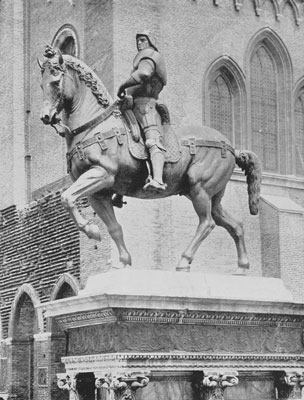
Alinari
COLLEONE
VENICE
Smaller Reliefs and Plaquettes.
The Gattamelata reliefs seem to be sixteenth-century work. They show a detail of which Donatello and his scholars were fond, namely, the Medusa's head. It reappears on the Martelli Patera[213] and on the sword-hilt in the Royal Armoury at Turin. The former has been ascribed to Donatello, but the attribution is untenable. It is a bronze medallion of a Satyr and Bacchante, executed with much skill, but not recalling the spirit or handling of Donatello. It is an admirable example of the bronze-work which became popular in Northern Italy, to which Donatello gave the initial impetus, and which soon became ultra-classical in style. The sword-hilt is more interesting, and it is signed "Opus Donatelli Flo." Some of the detail has a richness which might suggest rather a later date; but the general outline, especially the small crouching putti, was, no doubt, designed by the master. The history of this curious and unusual specimen is unknown, and it is outside Donatello's sphere of activity. Michael Angelo, it may be remembered, also had the caprice of making a sword for the Aldobrandini family. The manufacture of plaquettes, small bronze plates which were widely used for decorating caskets, inkstands, candlesticks, &c., became a specialised art; and some of these dainty reliefs are possibly made from Donatello's own designs. There are, however, a few larger bronzes of greater importance in which his personality was able to assert itself more freely than in the reduced plaquettes. But the work of scholars and imitators has been frequently mistaken for Donatello's own productions. Thus the Ambras (Vienna) relief of the Entombment, with its exaggerated ideas of classical profile, must be the work of a scholar. The Sportello at Venice[214] also shows later Renaissance decoration in its rich arabesques, though two hands seem to have been employed—the four central putti and the two angels being more Donatellesque than the remainder. The relief of the Flagellation in Paris[215] is more important, as we have a rugged and severe treatment both in the subject and its execution: but the summary treatment of such details as the hair makes one doubtful if Donatello can have been wholly responsible. A somewhat analogous Flagellation in Berlin[216] is the work of a clever but halting plagiarist. He has inserted a Donatellesque background of arches showing the lines of stonework, and a pleasant detached girl who reminds us of the figure on the Siena and St. George reliefs. But the imitator's weak hand is betrayed by the anatomy of the three principal figures. The positions are those of force and energy, but there is no tension or muscular effort, and there is no vestige of vigour in the rounded backs and soft limbs. Even if Donatello furnished the original sketch, it is quite impossible that he should have executed or approved the carving. Madame André's Martyrdom of St. Sebastian is work in which the finishing-touches were probably added by a pupil, but this striking composition shows dramatic qualities which one must associate with Donatello himself. So also the tondo Madonna belonging to M. Gustave Dreyfus, in which the figures are ranged behind a balustrade, making the "garden enclosed"—a popular symbolical treatment of the Virgin and Child—is doubtless from one of Donatello's designs.[217] Though imperfect, the London Deposition or Lamentation[218] is an important work, and has a value as showing the methods of fastening figures in relief on to the foundation of the background, though in this case the bulk of the background is missing. Three other reliefs should be mentioned, all representing Christ on the Cross. Of these, the Berlin example,[219] though sadly injured since its acquisition for the museum, is notable; being, in fact, a genuine sketch by Donatello himself, and in a degree comparable to the clay study of the same subject in London.[220] The bronze relief, belonging to Comte Isaac de Camondo in Paris, is a most remarkable work of the Paduan period. Donatello has succeeded in conveying the sense of desolating tragedy without any adventitious aid of violence or movement. The whole thing is massive, and treated with a studied simplicity which concentrates the silence and loneliness of the scene. It is superb, and superior to a varied treatment of the same subject in the Bargello. In this well-known relief the crowded scene is full of turmoil and confusion. In the foreground are the relatives and disciples of Christ. Many soldiers are introduced, some of whom closely resemble the tall men-at-arms in Mantegna's frescoes at Padua. Donatello's hand is obvious in the angels and in the three crucified figures, which are modelled with masterly conviction. The rest of the composition has been ruthlessly gilded and chased until the statuesque lines are lost in a mass of tiresome detail; which is regrettable, for the conception is fine.
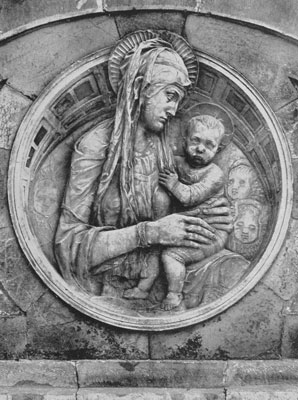
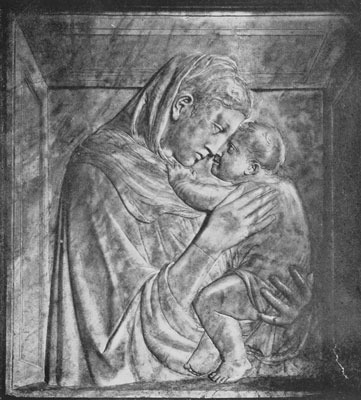
Alinari MADONNA AND CHILD SIENA CATHEDRAL W.A. Mansell "PAZZI" MADONNA BERLIN
The Madonnas.
A whole treatise would be required to describe all the Madonnas which have been attributed to Donatello. Within the limits of this volume the discussion must be confined to certain groups which are directly related to him, ignoring a much larger number of subordinate interest. The tendency is to ascribe to Donatello many more than he can possibly have made—varying inversely from the attitude of modern criticism, which has asserted that not twenty paintings by Giorgione have survived. Hundreds of artists must have made these Madonnas, of which only a small minority are in bronze or marble. Many names of sculptors are recorded to whom we can only attribute one or two works; the remainder being generically ascribed to the school of some great man, and often enough to the great man himself. The bulk of these reliefs of the Madonna and Child are in stucco, terra-cotta, carta pesta and gesso—cheap malleable materials which were easily and rapidly worked: the reliefs were manufactured in great numbers for the market. Then again, well-known works were cast, and small differences in colour and finish often gave them the semblance of original work. Vasari says that almost every artist in Florence possessed a cast of Pollaiuolo's battle-piece.[221] Such facsimiles are eagerly sought after nowadays, and are treated as genuine works of the sculptor. It must also be remembered that during the last decades there has been a systematic multiplication of these reliefs, and that forgeries can be found in most of the great collections of Europe. The first difficulty encountered in trying to discept between Donatello and his school, is that authenticated examples from which to make our inductions are very rare. Donatello certainly made Madonnas in relief: Vasari mentions half a dozen; Neroccio, the Sienese sculptor, possessed una Madonna di gesso di Donatello.[222] There are Madonnas on the tombs of Pope John and Cardinal Brancacci. The latter shows no trace of Donatello's craft, and the former is of indifferent merit, and was certainly not made by Donatello alone. There are two Madonnas at Padua, one the large altar statue, the other a tiny relief three inches in diameter on one of the bronze Miracle panels. The sources of stylistic data are therefore most scanty. One may say generally that in the authenticated Virgins as well as in the other heads of women, Donatello makes a marked nasal indenture, thus separating him from those later men who drew their heads with the classical profile, showing a straight and continuous line from the forehead down the nose. But even this cannot be pressed too far. As regards the Christ, Donatello seems to preserve the essence and immaturity of childhood. His treatment of the Child is never hieratic, and it is always full of warm human sentiment. The Paduan relief, for instance, is almost a genre representation of a mother and child, domestic and intimate, with nothing but the halos to indicate the higher meaning of the theme. Having said so much, we come to the other Madonnas which are assigned on various grounds to Donatello: those known as the Madonnas Pazzi, Orlandini, Siena Cathedral, Pietra Piana; the London oval, the Madonna of the Rose, the Capella Medici group, and the Piot and Courajod Madonnas in the Louvre. All of these have one or more features which conflict with our ideas of Donatello. It is impossible to say that any one of them must inevitably be by Donatello himself; none of them carry their own sign-manual of authenticity. The Pazzi Madonna in Berlin[223] is now generally ascribed to Donatello himself, and certainly no more grandiose version of the subject exists. The Virgin is holding up the Child close to her beautiful face; she broods over him, and the countenance is full of foreboding. The solemnity of the large Paduan Madonna is visible here, and it is only made to apply to the Virgin, for the Child is a typical bambino. So, too, in the relief outside the transept door of Siena Cathedral we find this grim careworn expression and the sense of impending drama: the massacre of the Innocents is still to come. This relief, a marble tondo, is in such abnormally perfect condition that one wonders if it may not be a later replica of some original which the atmosphere disintegrated. Donatello must have provided the design; at any rate, it is difficult to suggest an alternative name. The four winged cherubs are, however, lifeless and ill-drawn, while the Christ is more like some of the putti on the Aragazzi reliefs than Donatello's typical boy. The share of Michelozzo in the reliefs ascribed to Donatello is larger than has been hitherto acknowledged. The Orlandini Madonna[224] yearns like a tigress as she holds up her child and gazes into its face; here again we have a composition for which Donatello must have been primarily responsible, though the full profile is attributable to inefficient handling of the marble rather than to deliberate intention. Signor Bardini's version of this relief has a delicacy lacking in the original; one touch of colour removes a certain awkwardness of the profile. The Madonna in the Via Pietra Piana at Florence belongs to a different category. Here again the design is Donatellesque, but the face of the Madonna has a dull and vacant look; not only is it without the powerful modelling of the Pazzi or Siena reliefs, but it shows none of the sentiment for which those two Madonnas are so remarkable. There are several reproductions in Berlin and London,[225] all differing from the Florentine version in the drapery of the head-dress. Closely related to this Madonna is another composition which only exists in soft materials.[226] The Virgin, with long wavy hair, looks downwards towards her Child, who is looking outwards to the spectator. This is a work of merit, with something attractive in the anxious and clinging attitude of the Madonna. The large clay Madonna and Child in London,[227] the Christ sitting in a chair and the Virgin with hands joined in worship, has been the subject of much controversy. There are good grounds for doubting its authenticity. The angular treatment of the head and a dainty roundness of the wrist often indicate that Bastianini had a share in this class of work.[228] This relief has all the merits and demerits of the circular Piot Madonna in the Louvre.[229] Here, too, the handling of Bastianini has been detected, though there is a clumsiness which is seldom seen in the productions of that distinguished artist. The frame and the background, which are integral features of the composition, can leave no doubt as to the origin of this work. But the Piot relief has an interest which the London terra-cotta cannot boast, for a fifteenth-century original from which the copyist worked is in existence, now belonging to Signor Bardini. This is a tondo Madonna of uncoloured stucco, of no particular value in itself; but it is the model from which the Piot sophistication was contrived; or else it is a cast from the lost original of marble. It reveals all the whims of the copyist: the treatment of the hands, the lissome tissue of the drapery, and the angular structure of the skull. A less interesting forgery is the marble Madonna in London.[230] Three reproductions of the lost Donatellesque original exist, the Berlin copy[231] being in stucco, that at Bergamo terra-cotta. Signor Bardini has an effaced and poor copy of the same relief, in which the hand of the Madonna is obviously meant to be holding something; but the stucco has been much rubbed away and one cannot tell the original intention of the sculptor. But the two other genuine versions are in better condition and supply the answer, showing that the Virgin held a large rose between her fingers. The man who made the London relief copied from the incomplete version, and carved an empty meaningless hand with the fingers grasping something which does not exist.
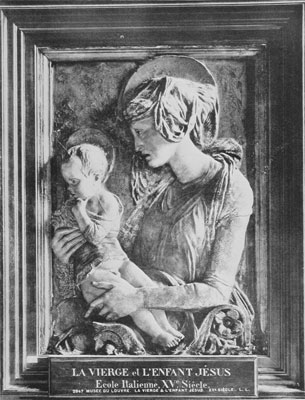
Alinari
MADONNA AND CHILD
LOUVRE (NO. 389), PARIS
The little oval Madonna in London[232] is a work of much interest. It is coloured stucco, and Dr. Bode, who has dated it as early as 1420-30, believes it to be the first example of the Santa conversazione in Italian plastic art. A variant belonging to Dr. Weisbach in Berlin is of equal importance, and both are probably original works and not casts. The Berlin relief is not so thickly painted as the London medallion, and shows signs of the actual modelling. There are contradictions in these valuable works. The music-making angels are like a figure on the Salome relief at Siena: but they are also related to Luca della Robbia's reliefs on the Campanile, and to a terra-cotta Madonna in London[233] (which reminds one of the Pellegrini Chapel); Matteo Civitale uses a similar type on the tomb of St. Regulus at Lucca; while the crowned saint of the London version was copied at a later date on a well-known plaquette forming the lid of a box of which several examples exist.[234] The figure of the Madonna and Child also suggests another hand; and with the exception of the stone relief in the Louvre, and another derived from it at Padua,[235] it is the only case in which the Virgin is not shown in profile. These latter works are bold and vigorous, and must be ultimately referred to Donatello, the head of the Madonna being rendered by fluent and precise strokes of the chisel. A bronze relief in the Louvre (No. 390), which came from Fontainebleau, has Donatellesque motives; but the spiral coils of hair, and still more the fact that the Virgin's breasts are hammered into the likeness of putti's faces—wholly alien to Donatello's serious ideas—sufficiently prove it to belong to the later Italian school which flourished at the French Court. The Courajod Madonna (Louvre, 389) is modestly called a schoolpiece; but it is a work of first-class importance, for which Donatello is to be credited. This is a very large relief in painted terra, the Madonna being in profile to the left, with a wan and saddened expression. The arm is stiff and wooden, while the undercutting of the profile, like that of the Siena tondo, is so pronounced that, when standing close to the wall on which the relief is fixed, one can see the Virgin's second eye—unduly prominent and much too near to the nose. This is a needless and distracting mannerism, though, of course, the blemish is only noticeable from one point of view, being quite invisible as one sees the relief from the front, or in a photograph. The Berlin Museum has another large Madonna comparable for its scale and rich colouring to the Courajod relief. This came from the convent of Santa Maria Maddalena de' Pazzi at Florence.[236] The Child, draped in swaddling-clothes, stands up leaning against the Virgin, who looks downwards. Above them are four cherubs, full of character and vivacity, the whole composition being typical of Donatello, though naturally enough much of the primitive colouring has disappeared during the last four centuries. One other group remains to be noticed, founded upon the large marble relief in the Capella Medici of Santa Croce.[237] We detect Donatello's ideas, but no sign of his handiwork: neither was he responsible for the composition, of which the governing feature is a total absence of his masterly occupation of space. There are also florescent details in the halos, drapery, and so forth, which are closer to Agostino di Duccio than to Donatello. Though not all by the same sculptor, these reliefs are most interesting and suggestive, showing the growth and activity of a small school which drew some inspiration from Donatello while preserving its own individuality. We find an intricate treatment of a very simple idea. As compositions, Donatello's Madonnas were always simple. But our knowledge of the subject is still empirical, and until the problem has been further sifted by the most severe tests of research and criticism, our opinions as to Donatello's personal share in the array of Madonnas must remain subject to revision.
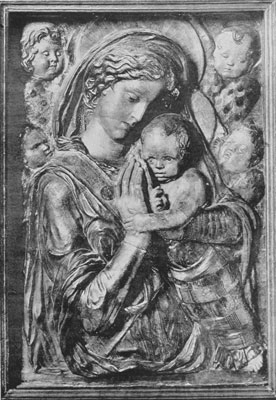
W.A. Mansell
MADONNA (Berlin)
FROM SANTA MARIA MADDALENA DEI PAZZI, FLORENCE
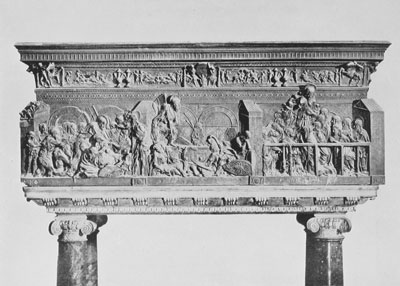
Alinari
SIDE PANEL OF PULPIT
SAN LORENZO, FLORENCE
The Pulpits of San Lorenzo.
Donatello was sixty-seven when he returned from Padua. He seems to have been unsettled during his later years, undertaking ambitious schemes which he did not execute, and hesitating whether Florence or Siena should be the home of his old age. The bronze pulpits of San Lorenzo[238] are the most important works of this period, and they were left unfinished at his death. Donatello was an old man, and the work bears witness to his advancing years. Bandinelli says that the roughness of the modelling was caused by failing eyesight,[239] and it is obvious that, notwithstanding the signs of feverish activity, and an apparent desire to get the work finished, much was left uncompleted at his death. The pulpits were not even erected until a later date; some of the panels were subsequently added in wood, and others do not correctly fit into the structural design. But the genius of Donatello shines through the finishing-touches of his assistants. Drama is replaced by tragedy; and in these panels the concluding incidents of the Passion are pictured with intense earnestness and pathos. But Donatello would not allow gloom to monopolise his composition. The paradox of the pulpits consists in the frieze of putti above the reliefs: putti who dance, play, romp, and run about. Some of them are busily engaged in moving a heavy statue: others are pressing grapes into big cauldrons. The boy dragging along a violoncello as big as himself is delightful. The contrast afforded by this happy and buoyant throng to the unrelieved tragedy below is strikingly unconventional; and the spirit of both portions is so well maintained that there is neither conflict of emotion nor sense of incongruity. The scenes (including those added at a later date) are sixteen in number. Except the later reliefs of St. John, St. Luke, the Flagellation, and the Ecce Homo, all are of bronze, upon which more care seems to have been expended than on the clay models from which they were cast. On the southern pulpit the scene on the Mount of Olives shows the foreshortened Apostles sleeping soundly as in Mantegna's pictures. Christ before Pilate and Christ before Caiaphas are treated as different episodes, in two similar compartments of one great hall, separated by a large pier. The Crucifix and the Deposition are, perhaps, the most remarkable of all these reliefs: corresponding in many ways to works already described; but not having been over-decorated like the Bargello relief, show greater dignity and less confusion. The background of the Deposition is flat, but broken here and there by faintly-indicated horsemen; naked boys riding on shadowy steeds like those vague figures which seem to thread their way through some panel of Gothic tapestry. There is an element of stiacciato in the Entombment, giving it the air of a mystery rather than of an historical fact. The draperies are thin and graceful, suited to the softer modelling of the limbs: some of the faces are almost dainty. Passing to the northern pulpit, we come to three scenes divided by heavy buttresses, but unified by figures leaning against them, and overstepping the lateral boundaries of the reliefs. The subjects are the Descent into Limbo, the Resurrection and the Ascension. The link between the two former is a haggard emaciated Baptist. The Christ is old and tired. The people who welcome him in Limbo are old and tired, feebly pressing towards the Saviour. The Roman guards lie sleeping, self abandoned in their fatigue, while Christ, wearied and suffering, steps from the tomb with manifest effort. One feels that the physical infirmities of the artist are reflected in these two works, so vivid in their presentment of the heavy burden of advanced years. But in the Resurrection a fresh note is struck. The bystanders are gathered round the Christ, who gives the Benediction. His robe is held back by little angels, and the scene is pervaded by an atmosphere of staid and decorous calm. Donatello has treated this relief in a more archaic spirit. The absence of paroxysms of acute grief, giving a certain violence to other parts of the pulpits, makes the contrast of this relief more effective; but, even so, this scene of the Ascension is fraught with dramatic emphasis. The Descent of the Holy Ghost is less interesting. There is a monotony in the upraised hands, while the feeling of devotional rhapsody is perhaps unduly enforced. The relief of the Maries at the Tomb, which occupies the western end of this pulpit, is almost Pisanesque in the relative size of the people to the architecture. There is a combination of trees and pilasters seeming to support the long low roof beneath which the incident is portrayed. A curious feeling of intimacy is conveyed to the spectator. The pulpits are full of classical details—far more so than in anything we find at Padua. It is very noticeable in the armour of the soldiers, in their shields bearing the letters S.P.Q.R. and the scorpion, and in the antique vases which decorate the frieze. The centaurs holding the cartel on which Donatello has signed his name are, of course, classical in idea, while the boys with horses are suggested by the great Monte Cavallo statues.[240] Then, again, the architecture is replete with classical forms; in one relief Donatello introduces the Column of Trajan. But here, as elsewhere, the classicisms are held in check, and never invade or embarrass the dominant spirit of the Quattrocento. How far Donatello was helped by assistants must remain problematical in the absence of documentary evidence. Bellano and Bertoldo were in all probability responsible for a good deal. In the relief of St. Laurence it is possible that Donatello's share was relatively small. Moreover, one part of the frieze of children is so closely allied to the work of Giovanni da Pisa at Padua, that one is justified, on stylistic grounds, in suggesting that he may also have been employed. But it is certain that the share of Bellano must have been limited to the more technical portion of the work, for there is happily nothing to suggest the poverty of his inventive powers. These pulpits are very remarkable works; they have an inexhaustible wealth of detail in which Donatello can be studied with endless pleasure. The backgrounds are full of his architectural fancy, and the sustained effort put forth by Donatello is really astonishing. But he was an octogenarian, and there are signs of decay. Michael Angelo and Beethoven decayed. Dante and Shakespeare were too wise to decay; Shelley and Giorgione died too young. But the sculptor's intellect must be reinforced by keen eyes and a steady hand: of all artists, Nature finds him most vulnerable. Donatello's last work shows the fatigue of hand and eye, though the intellect never lost its ardent and strenuous activity. There was no petulance or meanness in his old age, no decadence; he merely grew old, and his personality was great until the end.
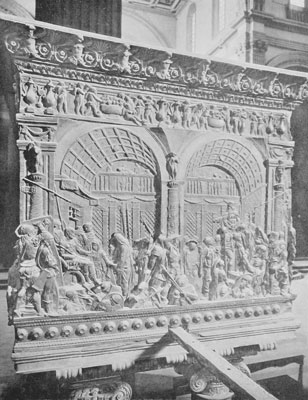
Alinari
END PANEL OF PULPIT
SAN LORENZO, FLORENCE
Donatello's Influence on Sculpture.
The influence of Donatello on his three greatest contemporaries was small. Jacopo della Quercia always retained his own massive style. Luca della Robbia and Ghiberti—the Euphuist of Italian sculpture—were scarcely affected by the sterner principles of Donatello. All four men were, in fact, exponents of distinct and independent ideas, and handed on their traditions to separate groups of successors. Nanni di Banco and Il Rosso were, however, impressed by Donatello's monumental work, while other sculptors, such as Simone Fiorentino, Vecchietta, Michelozzo, Andrea del Aquila and Buggiano (besides much anonymous talent) were largely influenced by him. It is owing to the fact that Donatello was the most influential man of his day that so many "schoolpieces" exist.[241] The influence on his successors is less easily determined, except so far as concerns the men who worked for him at Padua, together with Riccio, the most skilful bronze caster of his day, who indirectly owed a good deal to Donatello. But Urbano da Cortona and his colleagues produced little original work after their return from Padua: their training seems to have merged their individuality into the dominant style of Donatello; and much of their subsequent work is now ascribed to Donatello or his bottega. Verrocchio, whom Gauricus calls Donatello's rival, owes little or nothing to the elder man, and the versatile sculptors who outlived Donatello, such as Rossellino, Benedetto da Maiano, Mino da Fiesole and Desiderio, show relatively small traces of his influence. But Donatello's sculpture acted as a restraining influence, a tonic: it was a living protest against flippancy and carelessness, and his influence was of service even where it was of a purely negative character. Through Bertoldo Donatello's influence extended to Michael Angelo, affecting his ideas of form: But Jacopo della Quercia, who was almost as great a man as Donatello, is the prototype of Michael Angelo's spirit. Jacopo ought to have founded a powerful, indeed an overwhelming school of sculpture at Siena. Cozzarelli, Neroccio, and the Turini just fail to attain distinction; but their force and virility should have fructified Jacopo's ideas and developed a supreme school of monumental sculpture. As regards Michael Angelo, there can be no question of his having been influenced by Donatello's St. John the Evangelist and the Campanile Abraham. The Madonna delle treppe[242] in a lesser degree is suggested by Donatello. The Trinity on the niche of St. Louis again reminds one of Michael Angelo's conception of the Eternal Father. His Bacchus in Berlin[243] was held to be the work of Donatello himself, and the Pietà in St. Peter's has also a reminiscence of the older master. But in all these cases the resemblance is physical. The intellectual genius of Michael Angelo owed nothing to Donatello. Condivi records one of Michael Angelo's rare obiter dicta about his predecessors[244] to the effect that Donatello's work, much as he admired it, was inadequately polished owing to lack of patience. The criticism was not very sagacious, and one would least expect it from Michael Angelo, of whose work so much was left unfinished. But, at any rate, Donatello commanded his approval, and contributed something to one of the greatest artists of the world. But the ideals of Michael Angelo were too comprehensive to be derived from one source or another, too stupendous to spring from individuals. He sought out the universal form: he took mankind for his model; and while he typified humanity he effectively denationalised Italian sculpture.
Early Criticism of Donatello.
Donatello's activity is the best testimonial to the appreciation of his work during his lifetime. Sabba del Castiglione was proud to possess a specimen of Donatello's sculpture.[245] Commissions were showered on him in great numbers, and Gauricus says that he produced more than all his contemporaries.[246] Flavius Blondius of Forli compares him favourably with the ancients.[247] Bartolomeo Fazio warmly praised Donatello, his junior.[248] Francesco d'Olanda[249] and Benvenuto Cellini[250] also admired him. Lasca credited Donatello with having done for sculpture what Brunellesco did for architecture:
"E Donatello messe la scultura Nel dritto suo sentier ch' era smarrita Cosi l'architettura Storpiata, e guasta alle man' de' Tedeschi...."
and so forth.[251] Another early poem, the Rappresentazione of King Nebuchadnezzar, shows the great popularity of Donatello in the humbler walks of life.[252] Vasari's rhetoric led him to say that Donatello was sent by Nature, indignant at seeing herself caricatured.[253] Bocchi claims that, having equalled the ancients and surpassed the sculptors of his own day, Donatello's name will live in the perpetual memory of mankind.[254]
Character and Personality of Donatello.
Donatello must be judged by his work alone. His intellect is only reflected in his handicraft. We know little about him, but all we know bears tribute to his high character. The very name by which he was called—Donatello—is a diminutive, a term of endearment. His generosity, his modesty, and a pardonable pride, are recorded in stories which have been generically applied to others, but which were specific to himself. He shared his purse with his friends:[255] he preferred plain clothing to the fine raiment offered by Cosimo de' Medici;[256] and he indignantly broke the statue for which a Genoese merchant was unwilling to pay a fair price.[257] He was recognised as a man of honourable judgment, and he was called upon to act as assessor several times. The friend of the Medici, of Cyriac of Ancona, of Niccolo Niccoli, the greatest antiquarian of the day, and of Andrea della Robbia, one of the pall-bearers at his funeral, must have been a man of winning personality and considerable learning. But he was always simple and naïve: benigno e cortese, according to Vasari,[258] but as Summonte added with deeper insight, his work was far from simple.[259] He is one of the rare men of genius against whom no contemporary attack is recorded. He was content with little;[260] his life was even-tenored; his work, though not faultless, shows a steady and unbroken progress towards the noblest achievements of plastic art.