DONATELLO (continued 3)
Reading edition
Alinari
NICCOLÒ DA UZZANO
BARGELLO, FLORENCE
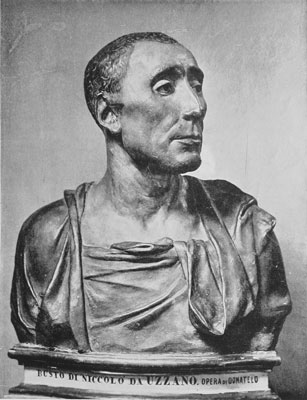
Niccolò da Uzzano and Polychromacy.
The bust of Niccolò da Uzzano has gained its widespread popularity from its least genuine feature—namely, the paint with which it is disfigured. The daubs of colour give it a fictitious importance, an actual realism which invests it with the illusion of living flesh and blood. This is all the more unfortunate, as the bust is a remarkable work, and does not gain by being made into a "speaking likeness." Its merits can best be appreciated in a cast, where the form is reproduced without the dubious embellishments of later times. Niccolò was a high-minded patrician, an implacable opponent of the Medici, and a warm friend of higher education: it is also of interest that he should have been an executor of the will of John XXIII. He was born in 1359, and died in 1432. The bust is made of terra-cotta, and shows a man of sixty-five or so, and would therefore be coeval with the later Campanile prophets (but nothing beyond old tradition can be accepted as authority for the nomenclature). The modelling of the head is quite masterly. Niccolò is looking rather to the left; his keen and hawklike countenance, and his piercing eyes, deep set and quivering within pendulous eyelids, give a sense of invincible logic and penetration. The laconic, matter-of-fact mouth, and the resolute jaw add strength and courage to the physiognomy: the nose and its disdainful nostrils are those of the haughty optimate. The head is, however, less fine than the face: a skull of rather common proportions, and a sloping though broad forehead are its marked features. Donatello has given him an ugly ear; Niccolò's ear was, therefore, ugly, and the throat is swollen. The shoulders are covered with a thick piece of drapery, leaving the throat and upper part of the breast bare. Such is the impression conveyed by Niccolò in the cast. In the Bargello the colouring modifies what the form itself was meant to suggest. The smallest error of a paint-brush, the slightest deepening of a pigment, are quite sufficient to make radical alterations in the sentiment of a statue. When applied to plastic art, colour is potent enough to change the essential purpose of the sculptor. The chief reason why the terra-cotta bust of St. John at Berlin looks flippant and fastidious is, that the painter was indiscreet in drawing the eyebrows and lips: owing to his carelessness, they do not coincide with the features indicated by the modeller, and the entire character of the boy is consequently changed. The question of polychromacy in Donatello's sculpture is of great importance, and requires some notice. It is no longer denied that classical statues were frequently coloured. The Parthenon frieze and many celebrated monuments of antiquity were picked out with colour. Others received some kind of polish, circumlitio,—like the dark varnish which is on the face of the Coscia effigy. Again, the use of ivory, precious stones, and metal was common. The lips and eyeballs were frequently overlaid by thin slabs of silver.[160] The origin of polychromacy, doubtless, dates back to the most remote ages. It was first needed to conceal imperfections, and to supply what the carver felt his inability to render. It connotes insufficiency in the form. The sculptor, of all people, ought to be able to see colour in the uncoloured stone: he ought to realise its warmth, texture and shades. Nobody has any right to complain that a statue is uncoloured: the substance and quality of the marble is in itself pleasing, but relative truth is all that is required in a portrait-bust. If one wants to know the colour of a man's eye, or the precise tint of his complexion, the painter's art should be invoked, but only where its gradations and subtleties can be fully rendered—on the canvas. Polychromacy is a mixture of two arts: it is one art trying to steal a march upon another art by producing illusion. That is why the pantaloon paints his face, and why the audience laughs: the spirit which tolerates painted statues ends by adorning them with necklaces. Donatello, whose sense of light and shade was acutely developed, least required the adventitious aid of colour. Polychromacy was to a certain extent justified on terra-cotta, to soften the toneless colour of the clay, and on wood it served a purpose in hiding the cracks of a brittle substance. Nowadays it is happily no more than a refugium peccatorum. There is, however, no doubt that in Donatello's day it was widely used, and used by Donatello himself. It began in actual need, then became a convention, and long survived: il n'y a rien de plus respectable qu'un ancien abus. During the fifteenth century statues were coloured during the highest proficiency of sculpture: buildings were painted,[161] and bronze was habitually gilded. Donatello's Coscia, and his work at Siena and Padua, still show signs of it. The St. Mark was coloured, and the Cantoria was much more brilliant with gold than it is now. The St. Luke, which was removed from Or San Michele,[162] has long been protected from the weather, and still shows traces of a rich brocade decorated with coloured lines. The Christ of Piero Tedesco on the façade of the Cathedral had glass eyes. Roland and Oliver, two wonderful creations on the façade of the Cathedral at Verona, had blue enamel eyes. The Apostles in the Church of San Zeno, in the same city, are exceptionally interesting, being one of the rare cases where the genuine colouring is visible, although it has been much worn. The early colourists used tempera;[163] as this perished, oil paint was substituted, and there are very few painted statues extant on which restoration has never taken place, and consequently where the original colour of the sculptor is intact. With repainting, the original artist disappears: even if the work is cast, the delicate tints of the first colouring must be impaired, and repainting follows. Thus the Niccolò da Uzzano is covered with inferior oil colour, and only in a few details can the primitive tempera be detected. The later addition creates the fictitious interest, and immensely reduces the real importance of this masterly production.
Portrait-busts.
It is a singular fact admitting of no ready explanation that portrait-busts, so common in Tuscany, should scarcely have existed in Venice. Florence was their native home. From the time of Donatello every sculptor of note was responsible for one or more, while certain artists made it a regular occupation. Luca della Robbia, however, one of the most consummate sculptors of his day, made no portrait except the effigy of Bishop Federighi. There are one or two small heads in the Bargello, but they scarcely come within the category of studied portraits, while the heads on the bronze doors of the Duomo, though modelled from living people, are small and purely decorative in purpose. Glazed terra-cotta was a material so admirably adapted to showing the refinements of feature and character, as we can see in both Luca's and Andrea's work, that this absence is all the more surprising. At the same time, numerous as portrait-statues were in Tuscany, they do not compare in numbers with those executed in classical times. In the fifteenth century the statue was a work of art, and its actual carving was an integral part of the art: so the replica in sculpture was rare. But under the Roman Empire statues of the same man were erected in scores and hundreds in the same city; their multiplication became a profession in itself, and a large class of artisans must have grown up, eternally copying and recopying portrait-busts and giving them the haunting dulness of mechanical reproductions. The artist himself was more interested in the torso than the head; some artists came to be regarded as specialists in their own lines; Calcosthenes for instance, who made athletes, and Apollodorus, who made philosophers. Donatello made several portrait-busts, and two or three others, such as the head of St. Laurence, and the so-called St. Cecilia in London, which are portraits in all essentials. These two are idealised heads, both made late in life, judging from a certain sketchiness, in no way detracting from their sterling qualities, but indicative of Donatello's fluency as an oldish man. Both are in terra-cotta. The St. Laurence is placed on the top of one of the great chests in the Sacristy of San Lorenzo, too high above the eye-level.[164] It has no connection with the decorative work carried out there by the master, and it is difficult to see how it could have been meant to fit in with the altar. However, the authorship of Donatello is beyond question. St. Laurence is almost a boy, wearing his deacon's vestments. His head is raised up as if he had just heard something and were about to reply. The eager and inquiring look is most happily shown. The sentiment of this bust is quite out of the common; it has an engaging expression which is rare in the sculpture of all ages, differing from what is called animation or vivacity. These also may be found in the St. Laurence, where the exact but indescribable movement of the face as he is about to speak is rendered with immense skill. The bust, though modelled with a free hand, is not carelessly executed; everything is in concord, and the treatment of the clay shows exceptional dexterity, more so, at any rate, than is the case in the St. Cecilia.[165] The name given to this bust is traditional, there being no symbol to connect it with her; but it suggests at least that the work was not meant purely as a portrait. In technique and conception it is not quite equal to the St. Laurence, but it is none the less a work of rare merit, and being Donatello's only clay portrait in this country has a special value to us. The Saint looks downwards, pensive, quiet and modest, the embodiment of tranquillity and calm. There is no movement or effort about her, neither does the work show any effort on the part of the sculptor. It is equable in a very marked degree; the smooth regular features are simple and well defined, and the hair, brushed back from the forehead, has a softness which could scarcely be obtained in marble. The bust known as Louis III. of Gonzaga is interesting in another way: it is bronze and has been left in an unfinished state. Two versions of it exist—one in Berlin, the other in Paris, belonging to Madame André, the latter being perhaps the less ugly of the two. It used to be known as Alfonso of Naples, on the assumption that Donatello must surely have made a bust of that prince. This theory, however, had to be abandoned, and it is now held to be a portrait of the Gonzaga as being a closer resemblance to him than to Alfonso, or Giovanni Tornabuoni. Mantegna's portrait of Gonzaga, though made later, shows a rather different type, less displeasing than the bronze. In the bust we have what is probably the portrait of a coarse and clumsy person; he is petulant in the mouth, weak in the chin, gross in the thick and heavy jaw. The bronze is extremely rough, and shows no signs of the nervous and individual touches which we find in Donatello's terra-cotta. Both the busts are unfinished; in the absence of chasing and hammering they are covered with bubbles and splotches of metal. They have, therefore, not passed through the hands of assistants, except so far as the actual casting of the bronze was concerned. During the process of casting the refinements of a clay model would often be impaired, but this shows no sign of having been made from an original of merit. The man is ugly, it is true; but the broad expanse of his lifeless cheek and the bulbous forehead would in real life have been explained and justified by bone and muscle, which the sculptor would have rendered in his clay study. The ugliness of the man, however, is unrelated to the qualities of the bust. Nobody could make the likeness of an ugly man better than Donatello; and since the faults of this portrait lie more in the modelling than in the sitter, one is driven to conclude that the bust must be entirely the work of an assistant, or else a failure of the master.
An effective counterpart to this bust exists in Berlin. It is also a life-sized bronze of an older man, and in many ways the likeness to the Gonzaga bust is notable. But wherever Gonzaga's features lack distinction this portrait shows fine qualities and good breeding. Nothing could better illustrate how minute are the plastic details which will revolutionise a countenance; how easily noble and handsome features can degenerate into what is sordid and vulgar. In this bust the chin, though receding, is far from weak; the lips are full but not sensual; the nose has the faint aquiline curve of distinction. There is benevolence in the eyes, meditation in the brow, dignity and reserve throughout the physiognomy: it is the portrait of a man who may be great, but who must be good. When a bronze abozzo has to be finished the detail is added by hammering the metal, or incising it with gravers. Thus the bronze has to be reduced, it being seldom possible to enlarge it at any point. But the Gonzaga bust would require to be enlarged in several places to make it a lifelike head. In the case of the portrait just described, the metal was cast from a rough sketch which, in the first place, had the qualities of a living and consistent head, and which, in the second place, was modelled with sufficient amplitude to permit the entire head to be hammered, and the exquisite details to be added. Technically this head is almost unequalled among Donatello's bronze portraits; it is quite superb. Comparison with the Gattamelata at Padua is fair to neither. But it can be suitably compared with the bronze portrait in the Bargello generally known as the Young Gattamelata. The tomb of Giovanni Antonio, son of the famous Condottiere, is in the Santo at Padua. The effigy resembles this bust. Giovanni died young in 1456, and on the whole there is sufficient reason for considering it to be his portrait. On this assumption the bust can be dated about 1455. It is a happy combination of youth and maturity. On the one side we have the smooth features, still unmarked by frowns and furrows, the soft youthful texture of the skin, and something young in the thick curly hair. On the other hand, the character of the face shows perfect self-confidence in its best sense, as well as self-control and determination. A scrap of drapery covers the outer edge of either shoulder, and round his neck is a riband, at the end of which hangs a large oval gem, Cupid in a chariot making his horses gallop. Thus the throat and breast are bare, and show exceptionally good rendering of those thin bones and thick tendons which must always be a severe test to the modeller. As for the bronze itself, the surface is wrought with much care and finish, though the Berlin bust is unapproached in this respect. A few other portrait-busts remain to be noticed, which at one time or another have been attributed to Donatello. The Vecchio Barbuto, a thoroughly poor piece of work, and the Imperatore Romano[166] with its sadly disjointed and inconsequential appearance, are works which scarcely recall the touch of Donatello. The bust of a veiled lady is more interesting.[167] In the old Medici catalogue it used to be called Donna velata incognita, or sacerdotessa velata: and it was also called Annalena Malatesta: a suggestion has been recently made that it represents the Contessina de' Bardi, who married Cosimo de' Medici. Vasari certainly mentions a bronze bust of the Contessina by Donatello; but the family records would scarcely have called so important a person a nun or an incognita: moreover, she did not die till 1473, and as this bust is obviously made from a death-mask, it is clear that Donatello could not be its author. The custom of making death-masks is described by Polybius: in Donatello's time it became very popular, and Verrocchio became one of the foremost men in this branch of trade, which combined expedition and accuracy with cheapness. The wax models were coloured and used as chimney-piece decorations, in ogni casa di Firenze. The bronze bust of San Rossore in the Church of Santo Stefano at Pisa has been attributed to Donatello. From the denunzia of 1427 we know that Donatello was occupied on a bust of the saint, and certain payments are recorded.[168] But beyond this fact there is no reason for assigning the Pisa bust to him. No explanation is offered of its removal from Florence to Pisa, and had we not known that Donatello made such a bust, this uncouth and slovenly thing would never have been ascribed to him. It is a reliquary, the crown of the head being detachable, and the head can also be separated from the bust. It is heavily gilded and minutely chased with the trivial work of some meagre craftsman; the eyes seem to have been enamelled. It is merely interesting as a school-piece. Speaking generally, Donatello's portraits are less important as busts than when they are portions of complete statues. Excluding Niccolò da Uzzano and the old man at Berlin, the heads he made cannot compare with the portraits of John XXIII., Brancacci, Habbakuk and St. Francis at Padua. Donatello helped to lay the foundations of the tremendous school of portraiture which flourished after his death, both in sculpture and painting; based, in certain parts of Italy, on the principles he had laid down, though thriving elsewhere upon independent lines; such, for instance, as the remarkable group of portraits ascribed to Laurana or Gagini. But at his best Donatello rarely approached the comprehensive powers of Michael Angelo. With the latter we see the whole corpus or entity made the vehicle of portraiture; everything is forced to combine, and to concentrate the ηθος of the conception; everything is driven into harmony. Michael Angelo gives a portrait which is also typical, while preserving the real. Donatello seldom got beyond the real; but he went far towards realising the highest forms of portraiture, and two or three of his works, though differing in standard from the Brutus or the Penseroso, surpass anything achieved by his contemporaries.
Relief-portraits.
A few portraits in relief require a word of notice. As a rule they are later in date, though they are often given to Donatello. It became fashionable to have one's portrait made as a Roman celebrity: an Antonine for instance; a Galba or a Faustina; or as some statesman, like Scipio or Cæsar. Donatello was not responsible for these portraits, though several have been attributed to him. But he made one or two such reliefs, such as the little St. John in the Bargello which has already been described. The oval-topped portrait in the same collection, made of pietra serena—a clean-shaved man with longish hair and an aquiline nose, is wrongly ascribed to Donatello. There is a much more interesting portrait, two copies of which exist; one is in London, the other in Milan.[169] It is a relief-portrait of a woman in profile to the right; her neck and breast are bare, treated similarly to the magnificent bust in the Bargello (177). The two reliefs, of which the Milan copy is oval, while ours is rectangular with a circular top, are modelled with brilliant and exquisite morbidezza: the undercutting is square, so that the shadows assert themselves; the wavy hair is brushed back and retained by a fillet, leaving the neck and temples quite free. In many ways it is the marble version of those portraits attributed to Piero della Francesca in the National Gallery[170] and elsewhere, but treated so that while the painting is curious the marble is beautiful. These reliefs cannot be traced to Donatello, though they show his style and influence in several particulars. Madame André has a marble relief of an open-mouthed boy crowned with laurels, and with ribands waving behind. It is very close to the Piot St. John in the Louvre, and analogous in some respects to two other reliefs of great interest, both in Paris, belonging respectively to La Marquise Arconati-Visconti and to M. Gustave Dreyfus. These are marble reliefs of St. John and Christ facing each other, exquisite in their childhood. The former is round, the latter square. It is usual to ascribe them to Desiderio, and there are details which lead one to agree on the point. They show, however, that Donatello's influence was strong enough to survive his death in particulars which later men might well have ignored. And the two reliefs combine the strength of Donatello with the sweetness of Desiderio.
San Lorenzo.
Donatello must have completed the most important decorative work in the Sacristy of San Lorenzo by 1443. Brunellesco was the architect, and there were differences between them as to their respective spheres of work. Donatello made the bronze doors, a pair of large reliefs, four large circular medallions of the Evangelists, as well as four others of scenes from the life of St. John the Evangelist. Excluding the doors, everything is made of terra-cotta. The reliefs over the inner doors of the Sacristy represent St. Stephen and St. Laurence on one side, and St. Cosmo and St. Damian on the other. They are nearly life size, modelled in rather low-relief upon panels with circular tops, and of exceptional size for works in terra-cotta. The reliefs are enclosed in Donatello's framework of latish Renaissance design, but the figures themselves are very simple. There is a minimum of ornament, and they harmonise with the remarkable scheme of the bronze doors below them, with which they have so many points in common. The ceiling of the chapel has been repeatedly whitewashed, and the eight medallions are consequently blurred in surface and outline. It is a real misfortune, for, so far as one can judge, they contain compositions and designs of great interest, by which a new light would probably be thrown upon several doubtful problems were it possible to study them with precision. Criticism must therefore be guarded, and their position is such as to make examination difficult. The Roundels of the Evangelists are modelled with boldness and severity, qualities which one is not surprised to find in Donatello, but which are here emphasised, for they stand out in spite of the coats of whitewash. In some ways they resemble the Evangelists of the Capella Pazzi. Here one notices a delicacy of decoration on the seats, desks, &c., contrasting with the rugged grandeur of the figures themselves, and with the absence of ornament, which is so marked a feature of the other reliefs in the Sacristy. The four scenes from the life of St. John (Vasari says from the lives of the Evangelists) are even more interesting than the panels just mentioned. It appears from the few words Vasari devotes to the Sacristy that Donatello also painted views upon the ceiling, but no trace remains. The incidents depicted in the roundels are St. John's Apotheosis, Martyrdom, and Sojourn on Patmos, and the Raising of Drusiana. There are landscapes and architectural backgrounds; many figures are introduced, and there is a good deal of nude study. We also notice a feature of frequent occurrence—a trick of giving depth to the scene and vividness to the foreground, by letting figures be cut off short by the frames. Men seem to be standing on the spectator's side of the relief, and only appear at the point where they can be partly included in the composition. The field becomes one that would be included within the range of vision as seen through a round window or telescope. Mantegna made great use of this idea. The more one looks at these eight medallions the more one regrets their present condition: washing is all that is required. If they could be carefully cleaned we would certainly find details of interest, and in all probability facts of importance. The frieze of angels' heads which surrounds the Sacristy is of secondary interest, as there are only two different cherubs, which are reproduced by moulds all along its entire length. Signs of gilding and colour are still visible. Pretty as they are, these angels cannot challenge comparison with the Pazzi frieze or with Donatello's similar work elsewhere—for instance, on the base of the Cantoria or upon the Or San Michele niche. The marble balustrade of the altar may have been designed by Donatello. The Sacristy shows how well adapted terra-cotta was for decoration on a large scale. But Donatello was too wise to cover the walls with his reliefs, as is the case in the Capella Pellegrini at Verona. Here the sculpture is used to decorate the chapel walls, there the walls are merely used to uphold the sculpture.
Alinari
BRONZE DOORS
SAN LORENZO, FLORENCE
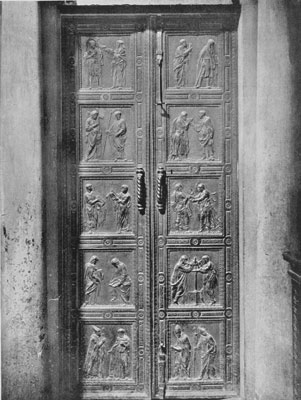
The Bronze Doors.
There is no more instructive study than the bronze doors of Italian churches. They are the earliest specimens of bronze casting to be found in Italy of Christian times; they show the gradual transition from Eastern to Western forms of art, and they were usually made by the most prominent sculptor of the day. Their size is considerable, they are frequently dated, and their condition is often extraordinarily good. Donatello's are relatively small, but they adhere to the best traditions. Excluding the great doors made by Luca della Robbia for the Sacristy of the Duomo, these in San Lorenzo are among the latest which were produced according to the ancient model and the correct idea. Thenceforward the doors ceased to be doors; the reliefs ceased to show the qualities of bronze, and disregarded the principles of sculpture. Donatello made two pairs of doors, one on either side of the altar. The doors open in the middle; there are thus four long-hinged panels of bronze, and each panel has five reliefs upon it. It is doubtful if the most archaic doors in Italy show such uniformity of design, for all the twenty bronze reliefs illustrate one single theme, namely, the conversation of two standing men. The panels simply consist of two saints, roughly sketched in somewhat low-relief upon an absolutely flat background: there is great variety in the drapery, and some of the figures might come out of thirteenth-century illuminations. Never was a monotonous motive invested with such variety of treatment: never was simplicity better attained by scrupulous elimination. Donatello's symmetrical idea had been previously employed, and Torrigiano put his figures in couples on what Bacon called one of the "stateliest and daintiest monuments of Europe."[171] Luca della Robbia put his figures in threes on the Cathedral gates, a seated figure in the centre, with a standing figure on either side. But Donatello had to make twice as many panels as Luca. Martyrs, apostles and confessors are talking on the San Lorenzo doors. Thus St. Stephen shows the stone of his martyrdom to St. Laurence. Elsewhere St. Peter's movement suggests that he is upbraiding his fellow, for the argument excites these saints. They gesticulate freely; martyrs seem to fence with their palm-leaves. One will turn away abruptly, another will pay sudden attention to his book, while his companion continues to talk. One man slaps his book to clinch the discussion, another jots down a note; two others are ending their controversy and prepare to leave—in opposite directions. But, though these are literal descriptions of the scenes, there is no levity; everything is ordained according to Donatello's strict formula. He was none the less determined to adhere to the old conventional and non-pictorial treatment of the gates, and at the same time to give animation to every panel. In this he has succeeded, but the symmetrical arrangement in pairs preserves a decorum in spite of the vigorous movement pictured on the doors. These doors open and shut: they were meant to do so, especially to shut. Ghiberti's second pair of doors for the Baptistery do not shut: they are closed, but they do not give the sense of shutting anything in or keeping anything out. They are more like windows than doors. They give no impression of defence or resistance: they are doors in nothing but name, and the chance that they hang on hinges. Were it merely a contest between Ghiberti and Donatello as to which sculptor were the more skilled constructor of doors, further comment would be unprofitable; but it raises the wider question of the laws and limitations of bas-relief—the application to sculpture of the principles of painting; in short, the broad line of demarcation between two different arts. Michael Angelo probably realised the unity of the arts better than Donatello, but Donatello knew enough to treat sculpture with due respect: he valued it too highly to confuse the issue by pictorial embellishments. It is no question of a convention, still less of a canon. But there are inherent boundaries between the two arts; and where the boundaries are overstepped, one or the other art must lose some of its essential quality and charm. Donatello's reliefs at Padua are crowded: Ghiberti's (on the second gates) are overcrowded. The difference in degree produces a difference in principle. If Ghiberti had made pictures instead of reliefs, the atmosphere would keep the objects in their right places, while differences of colour would give distinction to certain parts and the chief figures would still predominate. In other reliefs Ghiberti lavished so much care on landscape and architecture that the figures become of secondary importance: on one relief a tree casts its shadow on a cloud.[172] Ghiberti, in fact, with all his plastic elegance, with a grace, suavity and sense of beauty which Donatello never approached, was a painter at heart. "L'animo mio alla pittura era in grande parte volto," he says in his Commentary,[173] and the faults of his sculpture are due to this versatility. Donatello only used his pictorial knowledge to perfect form and feature; and, complex as his architectural backgrounds often are, they never suggest experiments in perspective, and they never detract from the primacy of the people and the incident. Michael Angelo was under no illusion on this point: he never confused painting and sculpture. Yet he said Ghiberti's gates would be worthy portals of paradise. "Ce n'est pas la seul sottise qu'on lui fasse dire," drily remarked the Chevalier des Brosses;[174] and, curiously enough, about the time that Michael Angelo made his famous Judgment, an amateur of the day made a much shrewder criticism, long since forgotten, that the doors would be adequate to stand at the gates of Purgatory:—"sarebbon bastanti a stare alle porte del Purgatorio."[175] The ambiguity is not without humour. Sculpture, indeed, had no reason to ape or imitate painting. Sculpture, in fact, was in advance of painting during the first half of the fifteenth century. Donatello, Luca della Robbia, Jacopo della Quercia, and Ghiberti were greater men in sculpture than their contemporaries in painting. The arts were in rivalry; the claim for precedence was zealously canvassed. The sculptors claimed superiority because their art was older, because statuary has more points of view than one. You can walk round it, while a picture has only one light and one view. Moreover, the argument of utility applies most to sculpture, which can be used for tombs, columns, fountains, caryatides, &c. Sculpture has finality, for, though it takes longer to make, it cannot be constantly altered like a picture. While all arts try to imitate nature, sculpture gives the actual form, but painting only its semblance. A man born blind has a sense of touch which gives him pleasure from sculpture, which is better suited to theology, which has greater durability, and so forth. The painter replied that, if a statue has more than one point of view, a picture containing many figures can give even greater variety. Then the argument of utility denies the essence of art, which is to imitate nature, not to adorn brackets and pilasters; but even if decoration be an end in itself, painting can be used where sculpture would be too heavy. The painter continues that his art requires higher training in such things as atmosphere and perspective. As to the greater durability of sculpture, the material and not the art is responsible; but, in any case, painting lasts long enough to be worth achieving. Finally, sculpture cannot always imitate nature: the sense of colour can make a sunset, a storm at sea, moonlight, landscape and human emotions, which are best translated by varying colour and light. The controversy is unsettled to this day.[176] The wise man, like Donatello, selected his art and never overstepped the boundary.
Alinari
JUDITH
LOGGIA DEI LANZI, FLORENCE
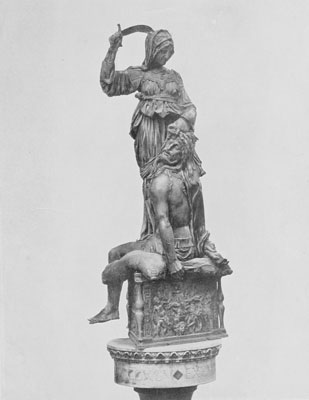
The Judith.
The bronze statue of Judith was probably made shortly before Donatello's journey to Padua. It is his only large bronze group, and its faults are accentuated by the most unfortunate position it occupies in the lofty Loggia de' Lanzi. It was meant to be the centrepiece of some large fountain. The triangular base, and the extremities of the mattress on which Holofernes sits, have spouts from which the water would issue, though the bronze is not worn away by the action of water. As we see the statue now, it looks small and dwarfed. In a courtyard it would look far more imposing, and when it came from Donatello's workshop, placed upon a pedestal designed for it, its present incongruities would have been absent. For instance, the feet of Holofernes would have been upheld by something from below, as the marks in the bronze indicate. With all its disadvantages, the statue is extremely interesting. Judith stands over Holofernes. With her left hand she holds him up by clutching his hair: her right arm is uplifted, in which she holds the sword. The action seems arrested during a moment of suspense: one doubts if the sword will ever fall. Judith, who was the ideal of courage and beauty, seems to hesitate; there is nothing to show that her arm is meant to descend, except her inexorable face—and even that is full of sadness and regrets. It is more dramatic that this should be so. Cellini's Perseus close by has already committed his murder. The crisis has passed, the blood spurts from the severed head and trunk of the Medusa; so we have squalid details instead of the overpowering sense of impending tragedy. With Cellini there was no room for mystery: no imagination could be left to the spectator. "Celui qui nous dict tout nous saousle et nous dégouste." Holofernes is an amazing example of Donatello's power. He is a really drunken man: we see it in the comatose fall of the limbs, in the drooping features, the languid inanition of the arms. The veins throb in his hands and feet: the spine has ceased to be rigid, and were it not for the support of Judith's hands buried in his hair, he would topple over inanimate. The treatment of the bronze is successful and its patina is admirable. Judith's drapery, it is true, has a restless crackling appearance. It is furrowed into small and rather fussy folds, almost suggesting, like the figures of the Parthenon pediment, the pleats of wetted linen on a lay figure. Judith's arm is overweighted by the heavy sleeve. There are, however, pleasing details, especially the band of embroidery over her breast decorated with the flying putti; and her veil, Michael Angelesque in its way, is treated with skill and distinction. The base consists of three bronze reliefs joined into a triangle, separated at each angle by a narrow bronze plaque, beyond which is a curved pilaster giving extra support to the figures above. These reliefs are bacchic in idea and Renaissance in execution. Children dance, play and sleep around the mask from which the jet of water would issue. These reliefs, much inferior to the bronze capital at Prato, have been over-rated. As a group the Judith is not really successful. It is a pile of figures, less telling in some ways than the Abraham and Isaac, though, having no niche, it has to undergo the severer test of criticism from every aspect. But before Michael Angelo the Italian free-standing group was tentative. Even in Michael Angelo's sculpture, when we consider its massive scale, the extent and number of his commissions, and the ease with which he worked his material, it is astonishing how few free-standing groups were made. His grouping was applied to the relief. The free group is, of course, the most comprehensive vehicle of intensified emotion or action; it gives an opportunity of doubling or trebling the effect on the spectator. Sculpture has never realised to the full the chances offered by grouped plastic art of heroic proportions. Classical groups cannot be fairly judged by the Laocoon, the Farnese Bull, or even the Niobe reliefs. Their theatrical character is so patent, that it is obvious how far inferior they must be to the work of greater men whose genuine productions have perished. But, even so, the group being the medium through which emotions could be intensified to the uttermost, it is not necessary to assume that they were common in classical times; partly owing to the technical difficulties and expense, and partly owing to their disinclination to make sculpture interpret profound impressions, mental or intellectual.
There are only four life-sized statues of women by Donatello: this Judith, the Magdalen, the St. Justina, and the Madonna at Padua. The Dovizia is lost, and she was treated as an emblematic personage. These figures and the statuettes at Siena show that, although not accustomed to make female statues, Donatello was perfectly competent to do so. The little Eve, on the back of the Madonna's throne at Padua—the only nude figure of a woman he ever made, and here only in relief—is exquisite in sentiment and form. The statue of Judith had an adventurous life. After the revolution in 1495, the group was removed from the Medici palace to the Ringhiera of the Palazzo Pubblico, and the words of warning against tyranny were engraved on its new base: "Exemplum salutis publicæ cives posuere, 1495." Judith was the type of nationalism, the heroine of a war of independence: and this mark of the Florentine love of liberty has lasted to our own day. No Medici dared to obliterate the ominous words. Donatello was not much in politics: his father had taken too violent a share in the feuds of his day, and narrowly escaped execution. Nor was Donatello's art coloured by politics: the Florentines did not give commissions like the Sienese for allegorical representations of the life and duties of citizenship. Differing from Michael Angelo, Donatello made no Brutus; he did not concentrate the political tragedies of his day into a Penseroso and a group of statues full of grave symbolical protests against the statecraft of his time; and, except for the accidental loss of Judith's pedestal, Donatello's art never suffered from the curse of politics. Michael Angelo was always surrounded by the pitfalls of intrigue and politics: some of his work was sacrificed in consequence. The colossal statue of Pope Julio was hurled from its place on the façade of San Petronio, Maestro Arduino the engineer, having covered the ground where it was to fall with straw and fascines, in order that no damage should be done—to the pavement! And the broken statue was sent away to Ferrara, where it was converted into a big cannon, which they felicitously christened Juliana![177]
Alinari
ST. MARY MAGDALEN
BAPTISTERY, FLORENCE
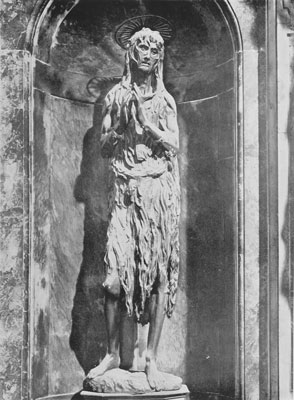
The Magdalen and Similar Statues.
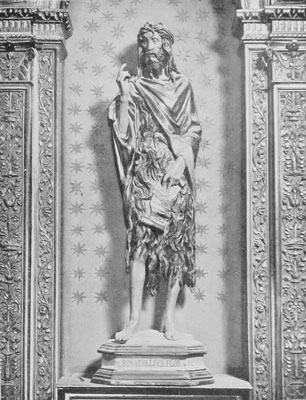
We have now to consider a group of rugged statues differing in date but animated by the same motive, the Magdalen in Florence and three statues of St. John the Baptist in Siena, Venice, and Berlin. Of these, the Magdalen in the Baptistery at Florence is the most typical and the most uncompromising. She stands upright, a mass of tattered rags, haggard, emaciated, almost toothless. Her matted hair falls down in thick knots; all feminine softness has gone from the limbs, and nothing but the drawn muscles remain. It is a thin wasted form, piteous in expression, painful in all its ascetic excess. The Magdalen has, of course, been the subject of hostile criticism. It gives a shock, it inspires horror: it is an outrage on every well-clothed and prosperous sinner.[178] In point of fact, Donatello's summary method of carving the wood has given a harshness and asperity to features which in themselves are not displeasing. In a dimmed light, or looking with unfocused eyes on the reproduction, it is clear that the structural lines of the face were once well favoured. But from the beginning the Magdalen was a work which made a profound impression, and its popularity is measured by the number of statues of a like nature. Charles VIII. wanted to buy it in 1498, but the Florentines thought it priceless and hid it away. Two years later they had the bronze diadem added by Jacopo Sogliani.[179] Finally, at a period when this type of sculpture with all its appeal to the traditions of the Thebaid, was least likely to have been acceptable in art or exemplar, the statue was placed in a niche above an altar erected on purpose for its reception, where an inscription testifies to the regard in which it was then held.[180] This Magdalen is didactic in purpose. Donatello seems to have given less attention to the modelling, subtle as it is, than to the concentration of the one absorbing lesson which was to be conveyed to the spectator. His object was to show repentance, abject unqualified remorse; purified by suffering, refined by bodily hardship, and sustained by the "sun of discipline and virtue." There is no luxury in this Magdalen, but she may have contributed to the reaction when Pompeo Battoni and the like transformed her into an opulent personage, dressed in purple, who reclines in some luscious glade while simpering over a bible. By then art had ceased to know how penitence could be decently portrayed, and the penitent was not long a genuine subject of art. The Greeks, of course, had no penitent or ascetic in their theocracy: even the cynic scarcely found a place in their art. In Italy the Thebaids of Lorenzetti are among the earliest versions; the sculpture of the following century brought it still more home to the public, and then the true mediæval sentiment upon which this and similar works were founded vanished and has never reappeared. The date of the Magdalen has provoked a good deal of controversy: whether it was made immediately before or after the visit to Padua cannot be determined. But the statue has so many features in common with the Siena Baptist of 1457 that one can most safely ascribe it to some date after Donatello's return to Florence. It is certainly more easy to justify the Magdalen from the pulpits of San Lorenzo than from anything made before his journey to Northern Italy. One misapprehension may be removed. It is argued that the Magdalen cannot be posterior to Padua on the ground that by 1440 Donatello had ceased to work in any material but soft and ductile clay, which was converted into bronze by his assistants. The argument is that of one who probably thinks that the Entombment at Padua is made of terra-cotta, and who forgets that Donatello executed a number of works in stone for the Marchese Gonzaga about 1450.[181]
Alinari
ST. JOHN THE BAPTIST
FRARI CHURCH, VENICE
The statues of St. John at Siena, Berlin, and Venice[182] are closely analogous to the Magdalen. St. John is the ascetic prophet who spent years in seclusion, returning from the desert to preach repentance. These three figures have one curious feature in common—a flavour of the Orient. The St. John is some fakir, some Buddhist saint. Asiatic as the Baptist was, it is seldom that Italian art gave him so Eastern a type; but the explanation is simply that Donatello evolved his own idea of what a self-centred and fasting mystic would resemble, and his conception happens to coincide with the outcome of similar conditions actually put into practice elsewhere. The Berlin bronze is St. John as Baptist, the others show him with the scroll as Precursor. He always wears the camel's-hair tunic, which ends just below the knee; at Siena it is thick, like some woolly fleece; it conceals and broadens the frame, thus suggesting a stoutness which is not warranted by the size of the leg. The modelling of legs and arms in these statues is noteworthy. They are thin, according to Donatello's idea of his subject; and though the thinness takes the natural form of slender circumference, one sees that the limb with its angular modelling and its flat surfaces has become thin: the thinness is explained by the character. The feet of the Siena bronze are exceptionally good; the wrist and forearm of the Venice figure are admirable. The Siena Baptist is nearly life-sized, and was made in 1457. He is the least introspective of the three, a mature strong man, and the oldest of the many Baptists Donatello made. The Berlin figure is the flushed eccentric, holding up the cup he used in baptizing. The figure is half the size of life, and was doubtless one of the numerous statuettes which crowned fonts. It has been suggested that this bronze, which is defective in several places, was commissioned for the Cathedral of Orvieto in 1423.[183] But the type would appear more advanced than the busts on the Mandorla doorway or the Siena work made about this time. Moreover, the contract specifies a St. John cum signo crucis et demonstratione ecce agnus Dei. A Baptist was made at the same time for Ancona, and is now lost. On first seeing the St. John in Venice one's impression is to laugh. But he is not really a wild man of the woods—he is simply covered with and made grotesque by thick masses of oil paint. A close examination of the figure shows that in some places the paint is over a quarter of an inch thick, and the last coating it has received is glutinous in quality, and has been laid on with such freedom that the position and shape of certain features are altered. But if seen close at hand, the statue (which it is understood will shortly be cleaned) shows distinct merits. The modelling of the extremities is good, and though it is clear that Donatello was never quite willing to treat St. John as on a par with the other Saints, we have a systematic and generic rendering of his idea. In some measure painting was needed as a preservative for wood statues, otherwise it is difficult to justify the covering of a fine material by paint which cannot do justice to itself, while it must hide the refinements of the carving. Donatello worked but little in wood. Crucifixes were commonly made of it, but the material was one which could never receive quella carnosità and morbidezza[184] of marble or metal. The Greeks limited their use of it to garden and woodland themes: the Egyptians used it but little, because they had so few trees. In Donatello's time it was popular, and came to be regarded as a distinct art. Thus the Sienese wood-carvers were forbidden to work in stone,[185] but the great masters like Donatello did not strictly adhere to the rules, and did not refrain from invading the art of the woodcarver. There is a large class of statues derived from the four just described. One of these, attributed to Donatello, is the St. Jerome at Faenza, also made of wood.[186] Chocolate-coloured paint has been ladled all over the body. The beard is faint lavender, and the canvas loin-cloth is blue. The pose and expression are mannered. It is usual to dismiss it in an offhanded way as a bad and later work; but the modelling shows signs of skill, and until the paint is removed it is useless to make guesses. Two bronze statuettes of the Baptist[187] are distinctly Donatellesque, and made about 1450, though it is impossible to assign them with certainty to the master himself. Michelozzo's versions of St. John at Montepulciano, on the Cathedral altar in Florence, and in the Annunziata, show the influence of Donatello; but the Baptist is a milder prophet, and no longer the hermit. In the Scalzi at Florence there is a Baptist which is typical of many others of the same character. The Magdalen was less copied than the St. John. The version nearest Donatello himself is in London, a large grim bust;[188] in the same collection is a relief of her apotheosis, and the Louvre possesses a similar work.[189] Neither of the latter is by Donatello himself, but they recall his influence.[190] The large Magdalen in Santa Trinità at Florence is a good example of the bottega.
The Altar at Padua.
Donatello was fifty-seven when he left Florence in 1443 to spend ten eventful years at Padua. There he carried out his masterpieces of bronze for the Cathedral and the equestrian statue of Gattamelata on the Piazza opposite Donatello's little house, which to this day is occupied, appropriately enough, by a carver—Bortolo Slaviero, tagliapietra. It is now established that Donatello was invited to Padua for the Church and that the Gattamelata was not commissioned until later.[191] At this time Padua was a centre of humanistic learning and intellectual activity. There was a hive of antiquarians and collectors, and, according to its lights, a thriving school of painters.[192] The Florentine Palla Strozzi was living there in retirement, and he may have been partly responsible for the invitation to Donatello. But the indigenous art of Padua was dependent on Venice, and needed some fertilising element. Squarcione with his 140 pupils founded his art upon traditional and conventional data: had it not been for Donatello and the radical changes which resulted from his sojourn at Padua, a fossilised school would have become firmly rooted, and would probably have influenced the whole of the Veneto. Mantegna was still young when Donatello arrived, and though there is no reason to suppose that he received work from Donatello as Squarcione did, it is clear that, without this influx of Southern ideas, he would have had some difficulty in shaking off the conventionalisms of his home. But though Donatello's immediate influence on Paduan art was decisive (and its ramifications soon extended to Venice), he was himself influenced by his fresh surroundings, and his native bent towards complexity was increased. He assimilated many of the local likes and dislikes. If Gattamelata had been erected in some Florentine square there would have been less ornament; if Colleone had been commissioned for Siena there would have been less braggadocio. Leonardo never recovered his Tuscan frame of mind after his sojourn in Milan. Donatello himself realised these novelties to the full, and their results upon his art. While he was making the intricate bas-reliefs, the selective genius of Luca della Robbia was composing the Florence Lunettes,[193] monumental in their simplicity. And though Vasari records the enthusiasm with which Donatello's productions were greeted in the North, the sculptor recognised the dangers of unqualified praise, and said he must return home to Florence to receive criticism and censure, the stimulus to better work and greater glory. But the maggiore gloria was not to be attained. He was old when he left Padua, and on his departure he had completed the greatest undertaking of his career—the High Altar of the Santo, with all its marble setting and the bronze figures. A crucifix, the Madonna and Child, six saints, a Pietà, twelve panels of angels, four reliefs of St Anthony's Miracles, the Symbols of the Evangelists, and a large marble Entombment. Donatello's altar was unfortunately dismantled in the seventeenth century, and the statues were dispersed throughout the Church. The altar was reconstructed a few years ago, and the bronzes have suffered during their exile, but they are still in good preservation. The new marble altar is a thoughtful and painstaking construction; its details are derived from Donatellesque motives, and the bronzes are fitted in with skill. It cannot, however, be in any sense a reproduction of the old altar, of which no drawing is preserved. And the earliest description, which has been carefully followed as far as circumstances allow, shows that the existing sculpture is incomplete: at least four marble reliefs have been lost.[194] One may further remark that the twelve angels in high relief, now forming the face of the altar frontal, are so designed, especially as regards their aureoled heads, that one concludes it must have been Donatello's intention for them to have been looked up to rather than looked down upon. The present arrangement of the altar is simple and effective. The frontal itself is composed of children singing and playing music. In the centre is the Pietà, and on either side is an Evangelist's symbol flanked by two saints on the level of the top of the altar. The retable has two miracle reliefs, and between them a small bronze Christ, which has been put there in error. Above the retable is the Madonna with two saints on either side: the crucifix surmounts the whole composition. The back of the altar has the remaining Miracle reliefs and Evangelist symbols, together with the Entombment.
Alinari
SAINT FRANCIS, THE MADONNA, AND SAINT ANTHONY
SANT' ANTONIO, PADUA
The Large Statues.
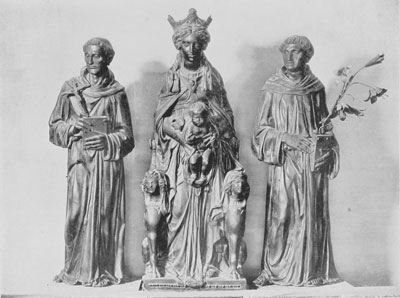
Of the seven large free-standing statues, that of the Madonna and Child worthily occupies the central position. Nobody was more modern than Donatello, nobody less afraid of innovation. But in this Madonna he went back to archaic ideas, and we have a conception analogous to the versions of the two previous centuries:[195] indeed, his idea is still older, for there is something Byzantine in this liturgical Madonna, who gazes straight in front of her, and far down the nave of the Santo—a church with mosque-like domes, like those of the early Eastern architects. The Child is seated in her lap, as in the earliest representation of the subject: here, however, the Christ is a child, with an element of helplessness almost indicated, whereas the primitive idea had been to show the vigour and often the features of a biggish boy. Donatello's version is much more pathetic, as the little Christ raises a tiny hand in benediction. The Virgin herself is of unequalled solemnity, while her young and gracious face, exquisite in expression and contour, is full of queenly beauty. But there is still this atmosphere of mystery, an enigmatic aloofness in spite of the warm human sentiment. The Sphinx's faces, with all their traditions of secrecy, contribute their share to the cryptic environment. Donatello uses them as the supports of the throne on which the Madonna is seated; behind it are Adam and Eve in relief: in front she herself shows the New Adam to the multitude, on whom he confers his blessing. St. Francis of Assisi stands on the right of the Madonna, as founder of the Order, and taking precedence of St. Anthony, to whom the church is dedicated. He holds the crucifix and the book of rules. He is draped in the ordinary Franciscan habit, which falls round his feet, giving a stiffness to the figure as seen in profile, and making him appear rather short when seen from the front. The workmanship is good, the hands, with lightly shown stigmata, being excellent; but the lack of distinction in the figure makes one look more closely at the head, which is modelled with great power and freedom, showing that Donatello still possessed the vigour and penetration for which the Campanile prophets are notable. The head is full of character; not perhaps what one would expect from the apostle of self-abnegation: but it is determined, strong in the mouth and broad chin. It was, of course, only meant to be seen a few feet from the ground, and the lines do not compare in depth with the Habbakuk or the Zuccone; but there is none the less an analogy in the manner by which Donatello calls in the assistance of light and shade to add tone and finish to the modelling. St. Anthony was a deservedly popular saint in Padua, where he preached and denounced the local tyrant; and he may be accounted the greatest man of Portuguese birth. But Donatello does not seem to have found the subject very inspiring. He has taken his idea from rather an ordinary friar such as he or we might see any day. It is a good homely face, neither worldly nor spiritual, and only redeemed from the commonplace by technical ability. St. Daniel is more interesting; the young deacon is extremely well posed, the plain and massive features being drawn with a firm and confident touch; and the deacon's vestments, which always take an easy and becoming fall, are decorated in a typical way with winged children arbitrarily introduced, and looking more like the detail of some bas-relief than a piece of embroidered ornament. St. Justina wears the coronet as princess, and bears the palm-leaf as martyr. She has no pronounced characteristic, the face being rather unemotional; but the gesture of her outstretched hand is not without an appealing dignity. The hair, like that of the Madonna, is parted in the centre, and stands off from the forehead, and then falls in rich tresses about her shoulders. It has not the soft and silken texture of the Madonna's hair, which is rendered with as great a skill as one sees in the Virgin of the Annunciation. In both these latter cases Donatello succeeds in giving to the hair an indescribable suggestion of something full of elasticity and lustre. But St. Justina's hair at least grows: so many sculptors of ability failed to indicate that needful quality. St. Procdocimus and St. Louis are of subordinate merit, and show the work of assistants in several particulars. The former was first Bishop of Padua and converted the father of St. Justina to Christianity. At first sight the statue is pleasing, but on closer examination the weaknesses, especially in the face, become marked. There is indecision, not in the pose or general idea, but in the details which give character to the whole conception. The features are chiselled by a small mesquin personality, and what might have been a fine statue if carried out by Donatello has been ruined by his assistants. The ewer which the Bishop carries is a later addition, from the design of which one might almost argue that the statue itself is later than the others.[196] The St. Louis, wearing his episcopal robes above the Franciscan habit, his mitre decorated with a fleur-de-lys of royal France, is also hammered all over, giving the bronze the appearance of being dotted with little pin-holes. The head is, however, marked by the grave austerity for which the St. Louis in Santa Croce is so remarkable, and which became the typical rendering of the saint in fifteenth-century plastic art. However much Donatello may have allowed a free hand to his assistants in this statue, the fine qualities of the head are attributable to a strict adherence to his own sketch. The last of the great bronze figures is the crucifix above the high altar. It is magnificent, apart from the technical qualities which rival Donatello's most brilliant achievements. All the lines droop together in a wonderful cadenza; the face is transfigured by human pain, but all the superhuman power remains. Donatello combines the literal and symbolical meaning of the Cross; the Godhead is still there. Donatello did not forget that the crucified Christ, when represented by the sculptor, had to preserve all the immortality of the Son of God. His contadino Christ in Florence has its interest in art; this Christ marks the summit of his plastic ability; but it shows that, without any appeal to terror or emotionalism, without, indeed, suppressing the signs of physical pain, Donatello was able to give an overwhelming portrait of Christ's agony. The celestial and the terrestrial are unified and fused into one tremendous concentration of human suffering, tempered by divine power.
Alinari
MIRACLE OF THE SPEAKING BABE
SANT' ANTONIO, PADUA
Alinari
MIRACLE OF THE MISER'S HEART
SANT' ANTONIO, PADUA
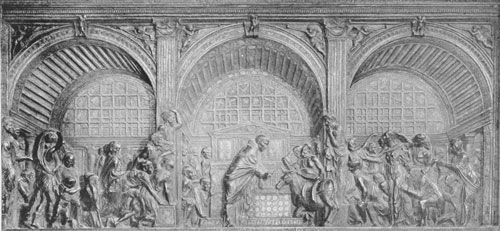
Alinari
MIRACLE OF THE MULE
SANT' ANTONIO, PADUA
The Bronze Reliefs.
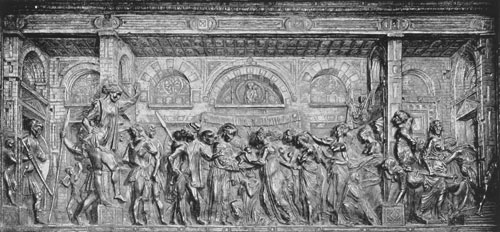
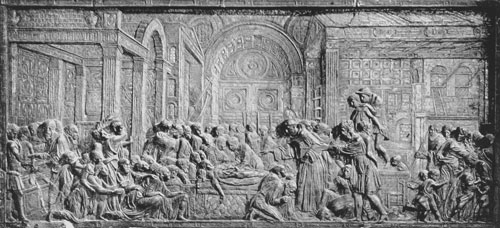
The four panels of Miracles take the highest rank among Donatello's bas-reliefs. Their size is considerable, being about four feet long. They have one theme in common, namely, the supernatural gifts of St. Anthony and the veneration of the populace. Donatello's crowds are admirable; they are deep crowds. The people are rather hot and jostling each other: they stand on benches or stairs in order to get a better view of what is proceeding. The edges of the crowds, where the people are too far off to be active spectators, lose interest in the central incident; they gossip as bystanders or sit down: often they are shown actually leaving the place. It is singular how ill-designed many of the classical crowds are, especially the battle-scenes: they are constructed without regard for the human necessity of standing on something; and we have grotesque topsy-turvy compositions, the individual parts of which are unrivalled in technique.[197] Michael Angelo's first and last representation of a crowd in sculpture shows the same fault, which, indeed, was far from uncommon.[198] It arose from a desire to show more of the crowd than could be naturally seen from the eye level, and the whole relief was consequently covered with figures, the background proper being suppressed. In these Paduan reliefs Donatello manages to give ample density and variety, and there is never any doubt as to the ownership of legs or arms. His early relief at Siena, on the other hand, has a group where there is confusion, which is not justified in a quiet gathering of people. Another feature which the four reliefs have in common is Donatello's treatment of narrative. Ghiberti's plan was to put several incidents into one relief, forming a sequence of events leading up to the critical episode, to which he usually gave the best place in the foreground. He consistently followed up his formula in the second gates, and brought the practice to its perfection. Whether suitable or not for gates, it would have been an intelligible treatment of purely decorative reliefs, like those at Padua. Donatello, however, confines his plaques to single incidents: in one case only does he add a second detail, and there only as a corroborative fact. The narrative is shown in the crowd itself. Attitudes and expression are made to reflect the spirit of what has gone before, while the actual occurrence suffices to show the final issue of the story. Thus we have all the ideas of which others would have made a series of subordinate scenes: incredulity, fear, surprise, mockery, apathy and worship. The crowd shows everything which has already passed, and the composition of the bas-reliefs thus secures a striking homogeneity. It is difficult to say which of them is best. The variety in dress, scene and physiognomy is so remarkable; varying, no doubt, according to the tastes of the garzone responsible for finishing it. Probably the miracle of the Speaking Babe is the best known. A nobleman of Ferrara doubted the honour of his wife; St. Anthony conferred the power of speech on her infant child, which proclaimed its mother's innocence. Donatello has put an exquisite little Madonna and Child just above the central figures of the legend. The composition of this group, as in the others, is broken by the architecture, otherwise the length of the bronzes might have tended to a monotonous row of figures. But the projecting background does not make the episode less coherent. The mother is just receiving back her baby from the saint; behind her are women, friends and others; whereas the opposite side of the relief is entirely occupied by men, who are around her husband; and the suggested conflict of the sexes is averted by the miracle. The husband, who wears an odd sort of bonnet tricolore, and several of his comrades are simply dressed in short cloaks open at the sides and ending just below the hip. The legs and arms, and especially the hands, are very well modelled. In this relief the actors are quiet and decorous, and where not motionless are moving slowly. The miracle of the Miser's Heart is more emotional: "where thy heart is there shall thy treasure be also." The miser having died, St. Anthony said that his heart would be found in his strong box: this was proved to be the case, and then when the body was opened it was found that his heart was absent. The scene is nominally inside a church: in the background is a procession of clergy and choristers with their cross and candles. In the centre is the bier with the corpse lying on it. The body is opened and the crowd looks on in feverish though suppressed excitement. St. Anthony is pointing towards the dead man: and the crowd realises that the heart is absent—ubi thesaurus ibi cor. Numbers of people have dropped on to their knees, others kiss the ground where the saint stands. There are signs of distress and apprehension on all sides. Some children scuttle back to their parents; one of the mothers bends down to catch her child just as it is going to fall. Two boys have climbed on to an altar or pedestal to get a better view: one of them wears the peaked cap still worn by the undergraduates of Padova la dotta. The whole scene is immensely dramatic and grim, without any frenzy or excess; and its solemn effect is enhanced by the reserve of the people in spite of their excitement. The background is full of detail, largely obtained by the chisel: one part of it, with the stairs, ladders and upper storey, resembles the Lille relief. There are two important inscriptions, cut into the metal, to which reference will be made later. The subject of the third relief (now placed on the retable and already getting dimmed by candle-grease) is the healing of the youth Leonardo, who kicked his mother and confessed to St. Anthony, who properly observed that so sinful a foot should be cut off. The injunction was taken too literally, and the saint's miraculous power replaced the severed limb. Strictly speaking, this miracle takes place in the open air, for Donatello has introduced a rudimentary sun with most symmetrical rays, and half a dozen clouds which look like faults in the casting. But the whole relief is framed by an architectural structure, some amphitheatre with the seats ranged like steps. A balustrade runs all round the huge building, and a number of idlers standing about at the far end are reduced to insignificant proportions, thus giving distance and depth to the scene. Leonardo lies on the ground in sad pain, and Anthony has just restored the foot. The central group is not much animated, but two or three of the men's heads are telling character-studies. Donatello has concentrated his crowd into the centre: at the sides the miracle passes unheeded. A fat man is soliloquising with his hand reposing on an ample stomach: a boy with a long stick and something like a knapsack on his back is attracting the attention of a young woman, who seems absorbed in watching the miracle: her child tries to pull her along to go closer. In the corner are some strange recumbent figures, almost classical in idea; and a tall woman completely veiled, with her face buried in her hands. The last of the reliefs illustrates St. Anthony's power over animals. One Bovidilla, a sceptic, possessed a mule; the saint offered the consecrated wafer to the animal when starving, and Bovidilla was converted by the refusal of the animal to eat it. The scene takes place within a church, which, so far as we see the apse and choir, is composed of three symmetrical chapels with vaulted and coffered roofs. There is plenty of classical detail, but still more of the Renaissance; there is no occasion to assume the design to have been copied from the Tempio di Pace or the Caracalla baths. St. Anthony occupies the centre, and the kneeling mule is on the right, his master close at hand. The church is crowded with people, who, on the whole, show more curiosity than reverence. Several garrulous boys by the door are amused; an old beggar hobbles in; a mother tries to keep a child quiet. Others take any post they can secure, and a good many are crouching on the ground in all sorts of postures, making a variety which amounts to unevenness. In all these panels the head of St. Anthony is of a finer type than that shown in the other version on the altar. The features are clear cut, and there is an air of earnest distinction which is not observed on the large statue. Speaking generally, one notices that while ample scope is allowed to the fancies of picturesque architecture in all these reliefs, Donatello always keeps it within proper bounds. Donatello was not tempted into the interacting problems of perspective and intarsia, which caused so many Paduan artists to lose grasp of the wider aspects of their calling. Then we notice how the crowd qua crowd plays its proper part: out of some two hundred faces in these panels not more than two or three look out to the spectator—a quality inherited by Mantegna. The reliefs are essentially local pictures of local significance; not only the costume, but the types are Paduan, such as we find in the local school of painting: but we find nothing of the kind in Donatello before the journey to the north, and the types scarcely reappear on the altar of San Lorenzo. But, in spite of this, the reliefs have a catholicity which extends their influence far beyond the limits within which Donatello confined his work. Finally, the wealth of local colouring and animation makes these reliefs among the earliest in which "genre" or "conversation" has prominence. They offer a most striking contrast to the sedate Florentine crowds painted in the Brancacci chapel by Masaccio.
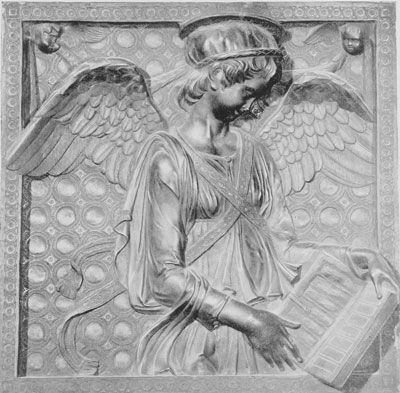
Alinari
SYMBOL OF ST. MATTHEW
SANT' ANTONIO, PADUA
The Symbols of the Evangelists.
There are four other bronze reliefs, the Symbols of the Evangelists. Donatello has contrived to invest these somewhat awkward themes with alternate drama and poetry. The emblems of Ezekiel's vision were too intricate for Western art, and long before the fifteenth century they had been reduced to the simple forms of the lion, ox, eagle and angel, with no attribute except wings. All four reliefs are rectangular, about eighteen inches square. The ox is, of course, the least inspiring, and here as elsewhere is treated in a dry perfunctory manner. The oxen on the façade of Laon Cathedral offered some scope to the sculptor, being life-sized; but in a small relief the subject was not attractive. The lion is more vigorously treated. As a work of natural history he is better than the Marzocco, and he has a certain heraldic extravagance as well. The limbs have tension, the muscles are made of steel, and there is strength and watchfulness, attributes which led the early architects to rest the pilasters of the pulpit and portal upon lions' backs. But the eagle of St. John is superb, even grander than the famous classical marble of the same subject.[199] It has the broad expanse of wings, vibrating as though the bird were about to take flight: the long lithe body with its soft pectoral feathers, the striking claws, and the flattened head with cruel gleaming eye, all combine to give a terribilità which is, perhaps, unsurpassed in all the countless versions of the symbol. But the drama of the eagle is eclipsed by the quiet unostentatious poetry of the angel of St. Matthew. We see a girl of intense grace and refinement, winged as an angel and looking modestly downwards to the open gospel in her hands. Delicacy is the keynote pervading every detail of the relief: in her hands, arms and throat, in the soft curves of the young frame, and in the drapery itself, which suggests all that is dainty and pure—everywhere, in fact, we find charm and tenderness, rare even in a man like Ghiberti, almost unique in Donatello.
The Choir of Angels.
In the original contract with Donatello, ten angels were commissioned, and were exhibited on the provisional wooden altar (13, vi. '48). It appears, however, that they were insufficient, and two more panels were ordered. These may possibly be the reliefs in each of which a couple of angels are represented singing, certainly the most successful of all. There is a palpable inequality in the remainder. They not only show differences of treatment in the details of drapery, chiselling and general decoration, but there is a substantial lack of harmony in their broad conception. It is impossible to believe that the two angels leaning inwards against the edge of the relief (the fourth respectively from either end of the altar) could have been modelled by Donatello. Not only are they vulgar and commonplace, but they are malformed: well might Donatello long for criticism and censure if these two stupid little urchins were standards of his production. Next to one of these pipers is a child playing the lute, delicious in every respect: he is made by the genius, the other by the hack. They contrast in every particular—drapery, anatomy, face and technique. The lutist is admirable as he looks down at his instrument to catch the note; capital also is the boy playing the double pipe, with the close drapery swirling about his plump limbs, as one sees in San Francesco of Rimini, that temple dedicated to Isotta and to Childhood. The head of the boy playing the harp shows the best characteristics of this group. The hair is relatively short, and falls in thick glossy ringlets over his ears; it is bound by a heavy chaplet of leaves and rosettes; above this wreath the hair is smooth and orderly. There was no occasion to exclude the pleasing little touches, as in the case of the Cantoria children, where deep holes penetrate the children's hair, so that the "distance should not consume the diligence." At Padua, where the choristers were to be seen a few feet only from the ground, the sculptor's efforts to show the warm shades and recesses of the hair were amply repaid. The boys singing the duets differ from the remainder: they are busily occupied with their music, carefully following the score. The disposition of two children in a panel only large enough for one has not been so successfully met as when Abraham and Isaac were fitted into the narrow niche on the Campanile; but the affectionate attitude of these boys and their sincerity make one overlook a slight technical shortcoming. The two heads in close proximity give a certain sense of atmosphere between them, not easily rendered when one of them had to be modelled in comparatively high-relief.
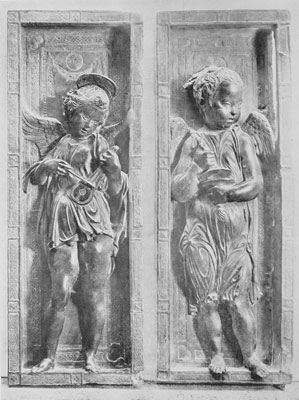
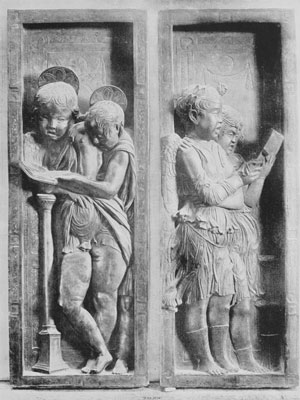
Alinari CHORISTERS SANT' ANTONIO, PADUA Alinari CHORISTERS SANT' ANTONIO, PADUA
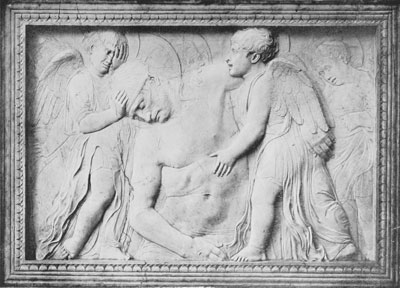
CHRIST MOURNED BY ANGELS
LONDON
The Pietà and the Entombment.
The remaining work for the high altar consists of a marble Entombment and a bronze relief of Christ mourned by Angels, treated as a Pietà. The tabernacle door, which occupies the centre of the high altar, differs in shape, quality and design from everything else, and is wholly unworthy of its prominent position. The lower relief is, however, a work of exceptional interest. It is placed in the centre of the frontal with the reliefs of choristers on either side of it, a tragic culmination to all the happy children around it. The Christ is resting upright in the tomb, half of the figure only being visible. The head is bowed and the hands crossed: the face is wan and haggard. The body is modelled to emphasise the pronounced lines of the big curve formed by the ribs from which the lower part of the body is fast sinking: Donatello did the same thing with the crucifix. An angel stands at each side of the Christ, holding up a curtain or pall behind the figure. Each of these boys has a hand pressed against his cheek, the picture of tragedy: they weep over the dead Saviour, their anguish is indescribable. In the marble version of the same subject in London,[200] the angels are actually supporting the Christ, who, without their maintenance, would fall down. His head is resting against one of the children's hands: one of the arms has slipped down inanimate, while the other hangs over the shoulder of the second angel, a consummate rendering of what is dead: the veins are tumified, the skin is shrinking, and the muscles are uncontrolled. This Christ is in some ways the more remarkable plastic achievement, though it is not so characteristic as the Paduan version. The two reliefs are probably coeval, though that in London, with its attendant angels, has indications of being rather earlier in date, and almost shows the hand of Michelozzo in one or two details. But the head of Christ, with its short thin beard, and the hair held back by a corded fillet, is similar to much that is exclusively Paduan. The Entombment, a very large marble relief, consists of eight life-sized figures, four of whom are lowering the body into the sepulchre. Here for the first time we have that frenzied and impassioned scene which became so common in Northern Italy. The Entombment on the St. Peter's Tabernacle is insipid by the side of this, where grief leads the Magdalen to tear out thick handfuls of her hair; others throw up their hands as they abandon themselves, as they scream in ungovernable sorrow. It is a riot of woe, and the more solemn figures who are engaged with the dead body have grown grey with care. This relief dates a new departure: the Entombment and other episodes of the Passion henceforward lose their calm emblematic character, and are fraught with tragedy and gloom. Donatello's relief became the prototype for the Bellini, for Mantegna, and a host of artists who, without, perhaps, having seen the original, drew their inspiration from what it had already inspired. For a while this intensification of the last scenes of Christ's life bore good fruit for art, especially in the northern provinces: but after a certain point nervous exhaustion ensued and produced a kind of hysteria, where the Magdalen's tears must end in convulsive laughter, and where the tragedy is so demonstrative that the solemn element is utterly lost.[201] The profound pathos and teaching of the earlier scenes were exchanged for what was theatrical. But Tragedy always held a place in Italian, or rather in Christian art: it was out of place in antiquity. The smiling and perennial youth of the gods, their happinesses, loves, and adventures, gave relatively small scope for the personal aspects of tragedy. There was no need for vicarious or redemptive suffering: what pain existed, and they rarely expressed it in marble, was human in its origin and punitive in effect: Icarus, Niobe, Laocoon, Prometheus; and even here the proprieties of good taste imposed strict limits, beyond which the portrayal of tragedy could not go without violating unwritten laws. It had to occupy a secondary place in their art: the dying gladiator was merely a broken toy tossed aside. Their tragedies were largely limited to Nemesis, the Moirai, the Erinnydes, and lower forms, such as harpies. But occasionally one gets a breath of mediævalism and its haunting mysteries. The Sleeping Fury at Rome, for instance,[202] where sleep steals in during a moment of respite from torture, is superb, and, moreover, stands almost alone in its presentment of a certain impelling tragedy, which, with the advent of Christianity, became an integral and dominating feature of its art.
Alinari
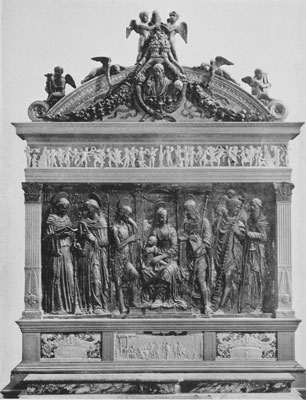
SUPER ALTAR BY GIOVANNI DA PISA
EREMITANI CHURCH, PADUA
Donatello's Assistants.
The variety of workmanship at Padua would be an infallible proof that Donatello had the assistance of a number of disciples, even if we had no documentary evidence on the point. Bandinelli refers to their numbers: when needing help he wrote to the Grand Duke saying that Donatello always had eighteen or twenty assistants, without whose aid it would have been impossible for him to have made the Paduan altar.[203] But we also possess bills, contracts, and schedules, in which we can find the names of Donatello's garzoni. The work, it must be remembered, was not wholly confined to sculpture: among the earliest recorded payment to Donatello is that for structural work on the Loggia (30, iii. 1444). Giovanni Nani of Florence was already engaged there (3, iii. 43) as a sort of master mason on Donatello's arrival: he made the marble pedestal for the crucifix (19, vi. 47), and several others are mentioned in a subordinate capacity, such as Niccolo Cocaro (23, iv. 49), Meo and Pipo of Florence (30, iv. 49), Antonio of Lugano, taia pria (12, v. 49); Bartolomeo of Ferrara went to Valstagna to open up the quarry—una montagna de lo alabastro (13, viii. 46). Employment was also given to Jacomo, a goldsmith (9, v. 48), to Squarcione the painter (21, xi. 47), to Moscatelo, the maker of majolica (v. 49), and to Giovanni da Becato, who made a metal grille behind the altar. Francesco del Mayo and Andrea delle Caldiere were the chief bronze casters; a dozen or fifteen other names are recorded. None of these can have had much influence on the sculpture itself; but there were men of greater calibre, Giovanni da Pisa, Urbano da Cortona, Antonio Celino of Pisa, and Francesco Valente of Florence. Though called garzoni and disipoli of Donatello (June and Sept. 47), they soon became men of trained capacity, and were specifically mentioned in some of the contracts. Thus it appears that each was entrusted with one of the evangelist's symbols; they were also largely responsible for the bronze choristers (27, iv. 46). Their whims and idiosyncrasies are visible in many particulars: in the halos for instance. The gospel emblems all have halos, likewise most of the singing children, whereas there are none on the Madonna and the great statues of canonised saints on the altar. But it is impossible here to enter upon the most interesting problem of their respective shares on the altar sculpture, and how far they were independent of Donatello beyond the chiselling and polishing of the bronze; the subject would need discussion at too great length. It is, however, worth while to refer to some of their work, for which they were exclusively responsible. Thus the Fulgosio tomb in the Santo, and the superaltar in the Eremitani at Padua (though much disfigured by paint), show that Giovanni da Pisa was influenced by Donatello to a remarkable degree. The composition of the altar consists of a broad relief of the Madonna with three saints on either side of her: below it is a predella divided into three panels; above, a frieze of dancing children similar to those on the pulpits of San Lorenzo. The composition is crowned by a tympanum and putti suggested by Donatello's Annunciation. Several of the larger figures might almost be the work of Donatello, though the personality of Giovanni makes itself felt throughout. Urbano of Cortona was another interesting man. He received a commission to decorate the chapel of the Madonna delle Grazie in the Sienese Cathedral,[204] and he had to make the Symbols of the Evangelists: nel fregio ... si debi fare IIII. evangelisti in forma d'animali. Donatello himself, excellentissimus sculptor, seu magister sculture,[205] was commissioned later on to work in this chapel; but there can be no doubt that the angel of St. Matthew, now preserved in the Opera del Duomo,[206] is the work of Urbano. It is the identical design of the emblem on the Paduan altar, pleasant in its way, but differing in all the material elements of charm; but it is an important document in that it shows a further stage in the evolution of Donatello through the hand of a painstaking pupil. Of Celino and Valente our knowledge is less—perhaps because there was never any friction between the master and his assistants, which gives so unenviable a record to the relation of Michael Angelo with his pupils.[207] The two inscriptions on the background of the Miracle of the Miser's Heart, read as follows: "S. ANT. DI GIOV DE SE E SUORŪ": and "Ŝ DI PIERO E BARTOLOMEO E SUŌ." They have been variously interpreted. Some have suggested that they indicate the names of donors, or that the letter s means sepulchrum, and that they are in the nature of epitaphs. It would seem more probable that they are signatures of those who were occupied in giving final touches to the chiselling of the background.
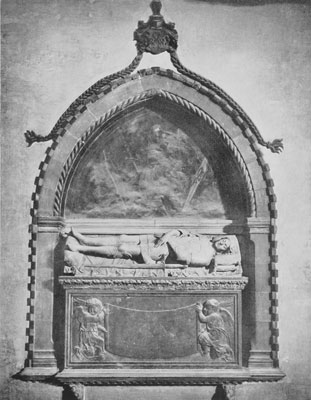
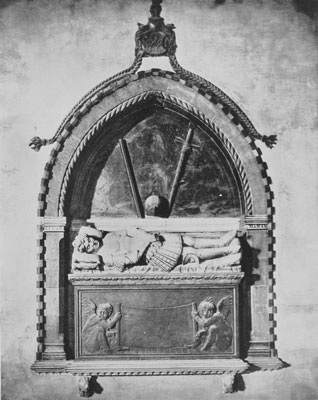
Alinari TOMB OF GIOVANNI, SON OF GENERAL GATTAMELATA PADUA Alinari TOMB OF GENERAL GATTAMELATA SANT' ANTONIO, PADUA
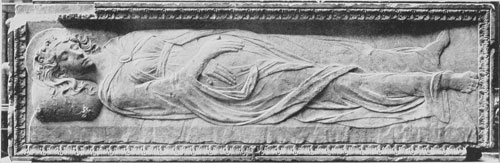
SHRINE OF ST. JUSTINA
LONDON
Bellano and the Gattamelata Tombs.
One other sculptor, Bellano, is said by Vasari to have been so much affected by Donatello's influence that the work of the two men was often indistinguishable. This places Bellano too high. Scardeone, it is true, says he was mirus cœlatura;[208] but Gauricus is more accurate in calling him ineptus artifex.[209] He was really a lugubrious person, though on rare occasions he made a good thing, such, for instance, as the statuette of St. Jerome, belonging to M. Gustave Dreyfus. But his large bas-relief of St. Anthony and the Mule[210] is stiff and laboured. The tomb of Roycelli, the monarcha sapientie in the Santo, with its wealth of poverty-stricken decoration, shows that Bellano was a man who could work on a large scale, but whose sense of fitness and harmony was weak. So also the Roccabonella fragments, in spite of a rugged, rough-hewn appearance, show an absence of ethical and intellectual qualities; while the fussy and breathless reliefs round the choir of the Santo are farcical in several respects. There was another man influenced by Donatello, who must be nameless pending further investigation: his style cannot be identified with anything on the great altar, but he was a sculptor of immense power. He made the so-called shrine of Santa Giustina in London,[211] and the two Gattamelata monuments in the Santo. These tombs are very simple, consisting of the effigies of the two Condottieri, fully armed, but with bared heads. Below is a broad stone relief of children holding the scroll between them, as on the Coscia tomb in Florence. Above is a lunette containing painting, the whole composition being framed by a severe moulding, and surmounted by the family crest and badge. They are most remarkable. The two recumbent figures lie calm and peaceful: they show the ennobling aspect of death, the belief in a further existence. This sculptor with his sensitive touch makes us realise the migration. To "make the good end" was, indeed, a product of Christianity: antiquity was content if a man parted from life "handsomely." Greek art can, of course, show no sign of the Christian virtues of death. Like the Egyptians, their object was to present the dead as still alive, even where the aid of fiction had to be invoked. To them sleep and death are often indistinguishable; often again one is left in doubt as to which of the figures on a funeral relief represents the departed. With death the human body, having ceased to be the home of life, ceased also to be a welcome theme of art. These two Gattamelatas, father and son, have fought the good fight, and in the carved effigy acquire a statuesque repose which is full of dignity and pathos. The famous warrior of Ravenna, Guido Guidarelli as he is called, though of a later date, is fashioned in the same spirit; showing, moreover, certain peculiarities in the armour which one notices in the tombs at Padua. The d'Alagni monument in S. Domenico at Naples, and a tomb in the Carmine of Pisa, are similar in respect of sentiment. So, too, is the shrine of Santa Giustina in London, of which the details as well as the organic treatment leave no doubt as to its authorship, so closely does it resemble the tomb of Giovanni Gattamelata. It is a work of singular refinement and beauty. We see the recumbent figure of the saint on the façade of a sarcophagus, at either side of which are little angels made by the same hand and at the same date as those on Giovanni's tomb. Santa Giustina is modelled in low-relief; the sculptor seems to draw in the stone, and the drapery is like linen: not a blanket or counterpane, but some thin clinging material which is moulded to the form below. In some ways this precious work is analogous to the more famous bas-relief belonging to the Earl of Wemyss, the St. Cecilia which has been ascribed to Donatello. This wonderful thing is not well known: it has been seldom exhibited, and the photograph by which it is usually judged is taken from a reproduction moulded a generation ago. The original, of rather slaty Lavagna stone, has never been photographed, and the cast, many thousands of which exist, entirely fails to show the intangible and diaphanous qualities of the original. The widespread popularity of the St. Cecilia would (if possible) be enhanced were we more familiar with the genuine work itself. It is certainly one of the most accomplished examples of Italian plastic art; not, indeed, by Donatello himself, for there is a softness and glamour which cannot be associated with his chisel. But it has the unequalled tenderness and grace for which the Gattamelata tomb is so notable, placing its nameless author in the highest ranks of Italian sculpture.
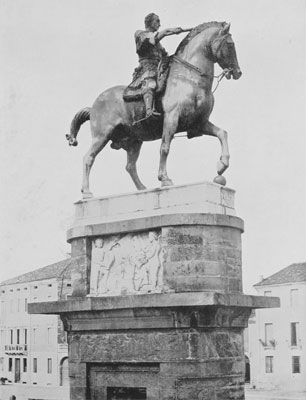
Alinari
GENERAL GATTAMELATA
PADUA
Gattamelata.
Erasmo Narni, General Gattamelata, died in 1443, and the Venetians, whom he had honourably served, granted the privilege of a site in the tributary town of Padua for the monument, the cost of which was borne by the family of the dead Condottiere. Donatello had to reconstruct the anatomy of a horse on a colossal scale. He was faced by the formidable task of making the first equestrian bronze statue erected in Italy during the Renaissance, and no model existed except the antique statue of Marcus Aurelius at Rome. Donatello was, however, familiar with the four horses on the façade of San Marco at Venice. He undertook to complete the Gattamelata monument by September 1453, but the bulk of the casting was finished as early as 1448, though the chiselling and chasing of the bronze required further work for two or three years. The statue was placed on the pedestal before the agreed date, and a conference was held at Venice to settle the price.[212] There were four assessors on either side, and it was finally agreed that the total payment should be a sum equivalent to about two thousand guineas in our own day. Donatello does not seem to have been hampered by his lack of experience. The work is adroitly handled, the technical difficulty of welding the large pieces of bronze is successfully overcome, and the metal is firm and self-supporting. There are faults, of course, though the fact that the horse ambles need not be considered an error. But the relative proportions of the horse and rider are not quite accurately preserved, Gattamelata being, if anything, rather below the right scale. The monument is, however, so massive and grandiose that criticism seems out of place; indeed, in the presence of the statue one feels that everything is subordinated to the power and mastery of Gattamelata himself. The general is bareheaded, and the strong courageous face is modelled with directness and energy. The gesture is commanding, and he rides easily in the saddle. Colleone's statue at Venice is superior in many ways: yet the radical distinction between them is that whereas Gattamelata is the faithful portrait of a modest though successful warrior, it must be confessed that Verrocchio makes an idealised soldier of fortune, full of bravado and swagger, a Malbrook s'en va-t-en guerre of the Quattrocento. But, striking as the contrast of sentiment is, noticeable alike in the artist and his model, these two statues remain the finest equestrian monuments in the world, their one possible rival being Can Grande at Verona. Donatello has decorated Gattamelata's saddle and armour with a mass of delicate and vivacious detail, which modifies the severity without distracting the eye. The putti which act as pommels to the saddle are delightful little figures, and the damascened and chased fringes of the armour are excellent. Moreover, the armour does not overweight the figure. The horse, of rather a thick and "punchy" breed, is well suited to carry a heavy load; he is full of spirit, and is neighing and chafing, as the old critics pointed out. An enormous wooden horse, some twenty-four feet long, is preserved in the Sala della Raggione at Padua. It used to belong to the Capodalista family, and has been considered Donatello's model for the Gattamelata charger. This is unlikely, and it was more probably used in some procession, being ridden by a huge emblematic figure. It is improbable that Donatello should have done more than sketch the design; but the head of the horse is admirable, with the feathery ears and bushy topknot which one finds in the Venice quadriga, on Gattamelata's steed, and on the colossal bronze head of a horse now preserved in the Naples Museum. This used to be considered an antique, but it is now established beyond all question that Donatello made it; and it was presented in 1471 to Count Mataloni by Lorenzo de' Medici. It is an interesting work, defective in some places, and treated similarly to classical examples; indeed, Donatello was obviously influenced in all his equine statuary by the most obvious classical horses at his command, namely, those at Venice. He does not seem to have taken ideas from the Marcus Aurelius, which he had not seen for upwards of ten years when commissioned to make the Gattamelata. The base of the statue is simple, but scarcely worthy of the monument it supports. The pedestal made by Leopardi for the Colleone monument is both more decorative and dignified. On Donatello's pedestal there are two marble reliefs of winged boys holding the general's helmet, badge and cuirass. The reliefs on the monument are copies of the maimed originals now preserved in a dark passage of the Santo cloister. There must be many statues elsewhere, now taken for originals, which are nothing more than replicas of what had gradually perished. If one closely examines the sculpture on some of the church façades—Siena Cathedral, for instance—one finds that most of the statues are only held together by numberless metal ties and clamps; and one may safely assume that many of those in really good condition have been placed there at later dates.