DONATELLO (continued 2)
Reading edition
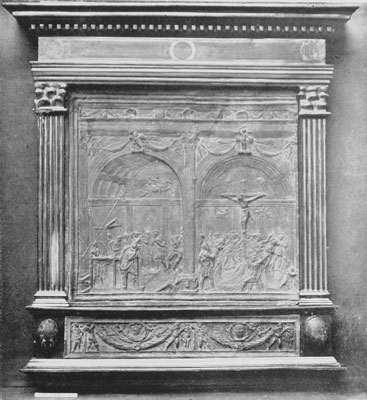
CLAY SKETCH OF CRUCIFIXION AND FLAGELLATION
LONDON
Donatello as Architect and Painter.
Fully as Donatello realised the unity of the arts, we cannot claim him as a universal genius, like Leonardo or Michael Angelo, who combined the art of literature with plastic, pictorial and architectural distinction. But at the same time Donatello did not confine himself to sculpture. He was a member of the Guild of St. Luke: he designed a stained-glass window for the Cathedral: his opinion on building the Cupola was constantly invited, and he made a number of marble works, such as niches, fountains, galleries and tombs, into which the pursuit of architecture and construction was bound to enter. Moreover, his backgrounds were usually suggested by architectural motives. Donatello joined the painters' guild of St. Luke in 1412, and in a document of this year he is called Pictor.[64] There is a great variety in the names and qualifications given to artists during the fifteenth century. In the first edition of the Lives, Vasari calls Ghiberti a painter. Pisano, the medallist, signed himself Pictor. Lastrajuolo, or stone-fitter, is applied to Nanni di Banco.[65] Giovanni Nani was called Tagliapietra,[66] Donatello is also called Marmoraio, picchiapietre,[67] and woodcarver.[68] In the commission from the Orvieto Cathedral for a bronze Baptist he is comprehensively described as "intagliatorem figurarum, magistrum lapidum atque intagliatorem figurarum in ligno et eximium magistrum omnium trajectorum."[69] Finally, like Ciuffagni,[70] he is called aurifex, goldsmith.[71] Cellini mentions Donatello's success in painting,[72] and Gauricus, who wrote early in the sixteenth century, says that the favourite maxim inculcated by Donatello to his pupils was "designate"—"Draw: that is the whole foundation of sculpture."[73] The only pictorial work that has survived is the great stained-glass Coronation of the Virgin in the Duomo. Ghiberti submitted a competitive cartoon and the Domopera had to settle which was "pulchrius et honorabilius pro ecclesia." Donatello's design was accepted,[74] and the actual glazing was carried out by Bernardo Francesco in eighteen months.[75] The background is a plain blue sky, and the two great figures are the centre of a warm and harmonious composition. The window stands well among its fellows as regards colour and design, but does not help us to solve difficult problems connected with Donatello's drawings. Numbers have been attributed to him on insufficient foundation.[76] The fact is that, notwithstanding the explicit statements of Borghini and Vasari that Donatello and Michael Angelo were comparable in draughtsmanship, we have no authenticated work through which to make our inductions. A large and important scene of the Flagellation in the Uffizzi,[77] placed within a complicated architectural framework, and painted in green wash, has some later Renaissance features, but recalls Donatello's compositions. In the same collection are two extremely curious pen-and-ink drawings which give variants of Donatello's tomb of John XXIII. in the Baptistery. The first of them (No. 660) shows the Pope in his tiara, whereas on the tomb this symbol of the Papacy occupies a subordinate place. The Charity below carries children, another variant from the tomb itself. The second study (No. 661) gives the effigy of a bareheaded knight in full armour lying to the left, and the basal figures also differ from those on the actual tomb. These drawings are certainly of the fifteenth century, and even if not directly traceable to Donatello himself, are important from their relation to the great tomb of the Pope, for which Donatello was responsible. But we have no right to say that even these are Donatello's own work. In fact, drawings on paper by Donatello would seem inherently improbable. Although he almost drew in marble when working in stiacciato, the lowest kind of relief, he was essentially a modeller, rather than a draughtsman. Leonardo was just the reverse; Michael Angelo was both, but with him sculpture was the art. Donatello had small sense of surface or silhouette, and we would not expect him to commit his ideas to paper, just as Nollekens,[78] who drew so badly that he finally gave up drawing, and limited himself to modelling instead—turning the clay round and round and observing it from different aspects, thus employing a tactile in place of a pictorial medium. Canova also trusted chiefly to the plastic sense to create the form. But Donatello must nevertheless have used pen and ink to sketch the tombs, the galleries, the Roman tabernacle, and similar works. It is unfortunate that none of his studies can be identified. There is, however, one genuine sketch by Donatello, but it is a sketch in clay. The London Panel[79] was made late in life, when Donatello left a considerable share to his assistants. It is therefore a valuable document, showing Donatello's system as regards his own preliminary studies and the amount of finishing he would leave to pupils. We see his astonishing plastic facility, and the ease with which he could improvise by a few curves, depressions and prominences so complex a theme as the Flagellation, or Christ on the Cross. It is a marvel of dexterity.
Alinari
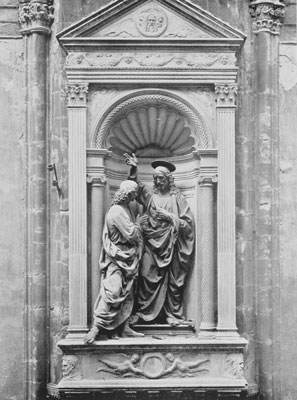
NICHE OF OR SAN MICHELE
THE GROUP BY VERROCCHIO
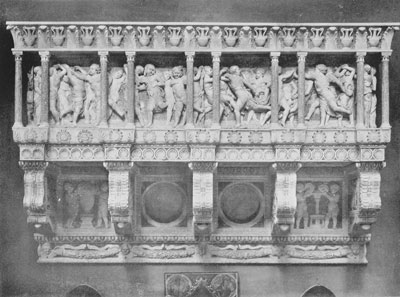
Sculpture relies upon the contour, architecture upon the line. The distinction is vital, and were it not for the number and importance of the exceptions, from Michael Angelo down to Alfred Stevens, one would think that the sculptor-architect would be an anomaly. In describing the pursuits of Donatello and Brunellesco during their first visit to Rome, Manetti says that the former was engrossed by his plastic researches, "senza mai aprire gli occhi alla architettura." It is difficult to believe that Donatello had no eyes for architecture. There are several reasons to show that later on he gave some attention to its study. Like the Roman Tabernacle, the Niche on Or San Michele[80] is without any Gothic details. Albertini mentions Donatello as its sole author, but it is probable that Michelozzo, who helped on the statue of St. Louis, was also associated with its niche. It is a notable work, designed without much regard to harmony between various orders of architecture, but making a very rich and pleasing whole. It is decorated with some admirable reliefs. On the base are winged putti carrying a wreath; in the spandrils above the arch are two more. The upper frieze has also winged cherubs' heads, six of them with swags of fruit and foliage, all of exceptional charm and vivacity. The motive of wings recurs in the large triangular space at the top; flanking the magnificent Trinity, three grave and majestic heads, which though united are kept distinct, and though similar in type are full of individual character. This little relief, placed rather high, and discountenanced by the bronze group below, is a memorable achievement of the early fifteenth century and heralds the advent of the power and solemnity, the Terribilità of Michael Angelo. Donatello's aptitude for architectural setting is also illustrated by the choristers' galleries in the Cathedral and San Lorenzo. The former must be dealt with in detail when considering Donatello's treatment of childhood. As an architectural work it shows how the sculptor employed decorative adjuncts such as mosaic and majolica[81] to set off the white marble; he also added deep maroon slabs of porphyry and bronze heads, thus combining various arts and materials. Having no sculpture, the Cantoria of San Lorenzo is perhaps more important in this connection, as it is purely constructive, while its condition is intact: the Cathedral gallery having been rebuilt on rather conjectural lines. In San Lorenzo we find the same ideas and peculiarities, such as the odd egg and dart moulding which reappears on the Annunciation. The colour effects are obtained by porphyry and inlaid marbles. But we see how much Donatello trusted to sculpture, and how indifferently he fared without it. This gallery does not retain one's attention. There is a stiffness about it, almost a monotony, and it looks more like the fragment of a balcony than a Cantoria, for there is no marked terminal motive to complete and enclose it at either end. Two gateways have been ascribed to Donatello, but there is nothing either in their architecture or the treatment of their heraldic decoration, which is distinctive of the sculptor.[82] There can be no doubt that Donatello was employed as architect by the Chapter of Sant' Antonio at Padua,[83] and his love of buildings is constantly shown in the background of his reliefs. But the strongest testimony to his architectural skill is derived from the fact that he was commissioned in 1416 to make a model for the then unfinished cupola of the Cathedral at Florence. Brunellesco and Nanni di Banco also received similar orders. Brunellesco alone understood the immense difficulty of the task, and in the next year he announced his return to Rome for further research. In 1418 the sum of two hundred gold florins was offered for the best model, and in 1419 Ghiberti, Nanni di Banco, Donatello and Brunellesco all received payments for models. Donatello's was made of brick. Ultimately the work was entrusted to Brunellesco, who overcame the ignorance and intrigues which he encountered from all sides, his two staunch friends being Donatello and Luca della Robbia. As to the nature of Donatello's models we know nothing; it is, however, clear that his opinion was at one time considered among the best available on a problem which required knowledge of engineering. As a military engineer Donatello was a failure. He was sent in 1429 with other artists to construct a huge dam outside the besieged town of Lucca, in order to flood or isolate the city. The amateur and dilettante of the Renaissance found a rare opportunity in warfare; and this passion for war and its preparations occurs frequently among these early artists. Leonardo designed scores of military engines. Francesco di Giorgio has left a whole bookful of such sketches, in one of which he anticipates the torpedo-boat.[84] So, too, Michael Angelo took his share in erecting fortifications, though he did not fritter away so much time on experiments as some of his contemporaries. Donatello and his colleagues did not even leave us plans to compensate for their ignominious failure. One is struck by the confidence of these Renaissance people, not only in art but in every walk of life. They were so sure of success, that failure came to be regarded as surprising, and very unprofessional. Michael Angelo had no conception of possible failure. He embarked upon the colossal statue of the Pope when quite inexperienced in casting; he was the first to taunt Leonardo on his failure to make the equestrian statue. When somebody failed, the work was handed over to another man, who was expected to succeed. Thus Ciuffagni had to abandon an unpromising statue, quod male et inepte ipsam laboravit,[85] and the David of Michael Angelo was made from a block of marble upon which Agostino di Duccio had already made fruitless attempts.
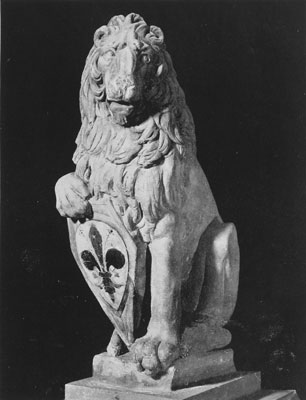
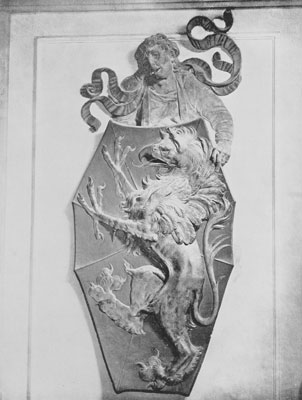
Alinari THE MARZOCCO BARGELLO Alinari THE MARTELLI SHIELD
Two fountains are ascribed to Donatello, made respectively for the Pazzi and Medici families. The former now belongs to Signor Bardini. It is a fine bold thing, but the figure and centrepiece are unfortunately missing. The marble is coated with the delicate patina of water: its decoration is rather nondescript, but there is no reason to suppose that Rossellino's fonte mentioned by Albertini was the only one possessed by the Great House of the Pazzi. The Medici fountain, now in the Pitti Palace, is rather larger, being nearly eight feet high. The decoration is opulent, and one could not date these florid ideas before Donatello's later years. The boy at the top dragging along a swan is Donatellesque, but with mannerisms to which we are unaccustomed. The work is not convincing as regards his authorship. The marble Lavabo in the sacristy of San Lorenzo is also a doubtful piece of sculpture. It has been attributed to Verrocchio, Donatello and Rossellino. It has least affinity to Donatello. The detailed attention paid by the sculptor to the floral decoration, and the fussy manner in which the whole thing is overcrowded, as if the artist were afraid of simplicity, suggest the hand of Rossellino, to whom Albertini, the first writer on the subject, has ascribed it. Donatello made the Marzocco, the emblematic Lion of the Florentines, and it has therefore been assumed that he also made its marble pedestal. This is held to be contemporary with the niche of Or San Michele. So far as the architectural and decorative lines are concerned this is not impossible, though the early Renaissance motives long retained their popularity. There is, however, one detail showing that the base must be at least twenty-five years older than the niche. The arms of the various quarters of Florence are carved upon the frieze of the base. Among these shields we notice one bearing "on a field semée of fleurs-de-lys, a label, above all a bendlet dexter." These are not Italian arms. They were granted in 1452 to Jean, Comte de Dunois, an illegitimate son of the Duc d'Orléans. His coat had previously borne the bendlet sinister, but this was officially turned into a bendlet dexter, to show that the King had been pleased to legitimise him in recognition of his services to Joan of Arc. Jean was a contemporary of Donatello, and the coat may have been placed among the other shields as a compliment to France. Certainly no quarter of a town could use a mark of cadency below a bendlet, and Florence was more careful than most Italian towns to be precise in her heraldry. Numbers of stone shields bearing the arms of Florentine families were placed upon the palace walls. When high up and protected by the broad eaves they have survived; but, as a rule, those which were exposed to the weather, carved as they usually were in soft stone, have perished.[86] Bocchi mentions that Donatello made coats-of-arms for the Becchi, the Boni and the Pazzi. Others have been ascribed to him, namely, the Stemma of the Arte della Seta, from the Via di Capaccio, that on the Gianfigliazzi Palace, the shield inside the courtyard of the Palazzo Davanzati, and that on the Palazzo Quaratesi, all in Florence. These have been much repaired, and in some cases almost entirely renewed. The shield on the eastern side of the old Martelli Palace (in the Via de' Martelli, No. 9) is, perhaps, coeval with Donatello, but it is insignificant beside the shield preserved inside the present palace. This coat-of-arms, which is coloured according to the correct metals and tinctures, is one of the finest extant specimens of decorative heraldry. It is a winged griffin rampant, with the tail and hindlegs of a lion. The shield is supported by the stone figure of a retainer, cut in very deep relief, as the achievement was to be seen from the street below. But the shield itself rivets one's attention. This griffin can be classed with the Stryge, or the Etruscan Chimæra as a classic example of the fantastic monsters which were used for conventional purposes, but which were widely believed to exist. It possesses all the traditional attributes of the griffin. It is fearless and heartless: its horrible claws strike out to wound in every direction, and the whole body vibrates with feline elasticity, as well as the agile movement of a bird. Regarding it purely as a composition, we see how admirably Donatello used the space at his command: his economy of the shield is masterly. It is occupied at every angle, but nowhere crowded. The spaces which are left vacant are deliberately contrived to enhance the effect of the figure. It is the antithesis of the Marzocco.[87] The sculptor must have seen lions, but the Marzocco is not treated in a heraldic spirit, although it holds the heraldic emblem of Florence, the fleur de lys florencée. Physically it is unsuccessful, for it has no spring, there is very little muscle in the thick legs which look like pillars, and the back is far too broad. But Donatello is saved by his tact; he was ostensibly making the portrait of a lion; though he gives none of its features, he gives us all the chief leonine characteristics. He excelled in imaginary animals, like the Chinese artists who make admirable dragons, but indifferent tigers.
Alinari
SALOME RELIEF, SIENA.
STATUETTE OF FAITH (TO LEFT)
The Siena Font.
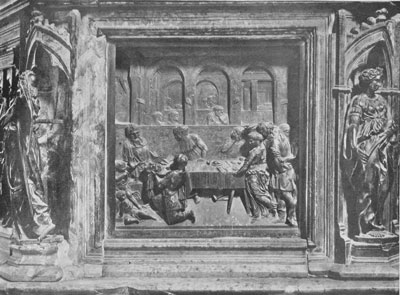
Siena had planned her Cathedral on so ambitious a scale, that had not the plague reduced her to penury the Duomo of Florence would have been completely outrivalled. The Sienese, however, ordered various works of importance for their Cathedral, and among these the Font takes a high place. It was entrusted to Jacopo della Quercia, who had the active assistance of Donatello and Ghiberti, as well as that of the Turini and Neroccio, townsmen of his own. Donatello was thus brought under new influences. He made a relief, a sportello or little door, two statuettes, and some children, all in bronze, being helped in the casting by Michelozzo. Jacopo, who was about ten years older than Donatello, had been a competitor for the Baptistery gates. He was a man of immense power, in some ways greater than Donatello; never failing to treat his work on broad and massive lines, and one of the few sculptors whose work can survive mutilation. The fragments of the Fonte Gaya need no reconstruction or repair to tell their meaning; their statuesque virtues, though sadly mangled, proclaim the unmistakable touch of genius. But Donatello's personality was not affected by the Sienese artists. Jacopo, it is true, was constantly absent, being busily engaged at Bologna, to the acute annoyance of the Sienese, who ordered him to return forthwith. Jacopo said he would die rather than disobey, "potius eligeret mori quam non obedire patriæ suæ"; but the political troubles at the northern town prevented his prompt return. However, after being fined he got home, was reconciled to the Chapter, and ultimately received high honours from the city. His font is an interesting example of transition; the base is much more Gothic than the upper part. The base or font proper is a large hexagonal bason decorated with six bronze reliefs and a bronze statuette between each—Faith, Hope, Charity, Justice, Prudence, and Strength. The reliefs are scenes from the life of the Baptist. From the centre of the font rises the tall Renaissance tabernacle with five niches, in which Jacopo placed marble statues of David and the four major prophets, one of which suggested the San Petronio of Michael Angelo. A statue of the Baptist surmounts the entire font. In spite of the number of people who co-operated with Jacopo, the whole composition is harmonious. Donatello made the gilded statuettes of Faith and Hope. The former, looking downwards, has something of Sienese severity. Hope is with upturned countenance, joining her hands in prayer; charming alike in her gesture and pose. Two instalments for these figures are recorded in 1428. The authorities had been lax in paying for the work, and we have a letter[88] asking the Domopera for payment, Donatello and Michelozzo being rather surprised—"assai maravigliati"—that the florins had not arrived. The last of these bronze Virtues, by Goro di Neroccio, was not placed on the font till 1431. Donatello also had the commission for the sportello, the bronze door of the tabernacle. But the authorities were dissatisfied with the work and returned it to the sculptor, though indemnifying him for the loss.[89] This was in 1434, the children for the upper cornice having been made from 1428 onwards. The relief, which was ordered in 1421, was finished some time in 1427. It is Donatello's first relief in bronze, and his earliest definitive effort to use a complicated architectural background. The incident is the head of St. John being presented on the charger by the kneeling executioner. Herod starts back dismayed at the sight, suddenly realising the purport of his action. Two children playing beside him hurriedly get up; one sees that in a moment they, too, will be terror-stricken. Salome watches the scene; it is very simple and very dramatic. The bas-relief of St. George releasing Princess Sabra, the Cleodolinda of Spencer's Faerie Queen, is treated as an epic, the works having a connecting bond in the figures of the girls, who closely resemble each other. Much as one admires the élan of St. George slaying the dragon, this bronze relief of Siena is the finer of the two; it is more perfect in its way, and Donatello shows more apt appreciation of the spaces at his disposal. The Siena plaque, like the marble relief of the dance of Salome at Lille, to which it is analogous, has a series of arches vanishing into perspective. They are not fortuitous buildings, but are used by the sculptor to subdivide and multiply the incidents. They give depth to the scene, adding a sense of the beyond. The Lille relief has a wonderful background, full of hidden things, reminding one of the mysterious etchings of Piranesi.
Alinari
TOMB OF COSCIA, POPE JOHN XXIII.
BAPTISTERY, FLORENCE
Alinari
EFFIGY OF POPE JOHN XXIII.
BAPTISTERY, FLORENCE
Michelozzo and the Coscia Tomb.
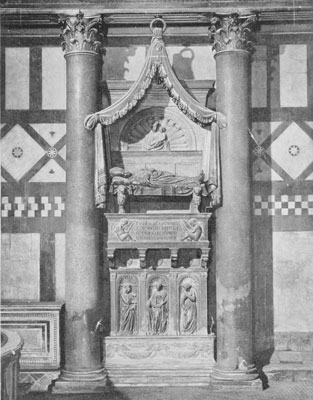
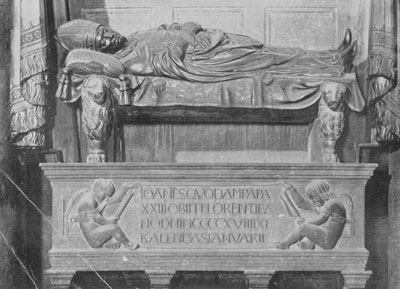
For ten years Donatello was associated with Michelozzo,[90] who began as assistant and finally entered into a partnership which lasted until 1433. The whole subject is obscure, and until we have a critical biography of Michelozzo his relation with various men and monuments of the fifteenth century must remain problematical. Michelozzo has not hitherto received his due meed of appreciation. As a sculptor and architect he frequently held a subordinate position, and it has been assumed that he therefore lacked independence and originality. But the man who was Court architect of the Medici, and director of the Cathedral building staff, was no mere hack; while his sculpture at Milan, Naples, and Montepulciano show that his plastic abilities were far from mean. He was a great man with interludes of smallness. When Donatello required technical help in casting, Michelozzo was called in. Though Donatello had worked for Ghiberti on the bronze gates, he was never quite at home in the science of casting. Gauricus says he always employed professional help—"nunquam fudit ipse, campanariorum usus opera semper."[91] Caldieri cast for him at Padua. Michelozzo also helped Luca della Robbia in casting the Sacristy gates which Donatello should have made; the commissions which Donatello threw over were those for work in bronze. The partnership extended over some of the best years of Donatello's life, and three tombs, the St. Louis, and the Prato pulpit are among their joint products. The tombs of Pope John XXIII. in the Baptistery, that of Aragazzi the Papal Secretary at Montepulciano, and that of Cardinal Brancacci at Naples, are noteworthy landmarks in the evolution of sepulchral monuments, which attained their highest perfection in Italy. In discussing them it will be seen how fully Michelozzo shared the responsibilities of Donatello. Baldassare Coscia, on his election to the Papacy, took the title of John XXIII. He was deposed by a council and retired to Florence, where he died in 1418. He was befriended by the Medici, who erected the monument, the last papal tomb outside Rome, to his memory. "Johannes Quondam Papa XXIII." is inscribed on it, and it is said that Coscia's successful rival objected to this appellation of his predecessor, but the protest went unheeded. The tomb is remarkable in many ways. Its construction is most skilful, as it was governed by the two upright pillars between which the monument had to be fitted. We have a series of horizontal lines; a frieze at the base, then three Virtues; above this the effigy, and finally a Madonna beneath a baldachino. Each tier is separated by lines which intersect the columns at right angles. The task of making a monument which would not be dwarfed by these huge plain pillars was not easy. But the tomb, which is decorated with prudent reserve, holds its own. The effigy is bronze: all the rest is marble. It was probably coloured, and a drawing in Ghiberti's note-book gives a background of cherry red, with the figures gilded.[92] Coscia lies in his mitre and episcopal robes, his head turned outwards towards the spectator. The features are admirably modelled with the firmness and consistency of living flesh: indeed it is the portrait of a sleeping man, troubled, perhaps, in his dream. The tomb was made some years after Coscia's death, and Donatello has not treated him as a dead man. The effigy is a contrast to that of Cardinal Brancacci, where we have the unmistakable lineaments and fallen features of a corpse. The dusky hue of Coscia's face should be noticed; the bronze appears to have been rubbed with some kind of dark composition, similar in tone to that employed by Torrigiano. Below the recumbent Pope is the sarcophagus; two delightful winged boys hold the cartel on which the epitaph is boldly engraved. The three marble figures in niches at the base, Faith, Hope and Charity, belong to a different category. Albertini says that the bronze is by Donatello, and "li ornamenti marmorei di suoi discipuli." Half a century later, Vasari says that Donatello made two of them, and that Michelozzo made the Faith, which is the least successful of the three. Modern criticism tends to revert to Albertini, assigning all to Michelozzo, with the presumption that Hope, which is derived from the Siena statuette, was executed from Donatello's design. Certainly the basal figures are without the brio of Donatello's chisel; likewise the Madonna above the effigy, which is vacillating, and may have been the earliest work of Pagno di Lapo, a man about whom we have slender authenticated knowledge, but whom we know to have been well employed in and around Florence. In any case, we cannot reconcile this Madonna with Michelozzo's sculpture. As will be seen later on, Michelozzo had many faults, but he was seldom insipid. The Madonna and Saints on the façade of Sant' Agostino at Montepulciano show that Michelozzo was a vigorous man. This latter work is certainly by him, the local tradition connecting it with one Pasquino da Montepulciano being unfounded. The Coscia tomb is among the earliest of that composite type which soon pervaded Italy. At least one other monument was directly copied from it, that of Raffaello Fulgosio at Padua. This was made by Giovanni da Pisa, and the sculptor's conflict between respect for the old model, and his desires after the new ideas, is apparent in the whole composition.
The Aragazzi Tomb.
In the Denunzia de' beni of 1427 Donatello states that he was working with Michelozzo on the tomb of Bartolommeo Aragazzi, and the monument has therefore been ascribed to them both. But recent research has established that, though preparatory orders were given in that year, a fresh contract was made two years later, and that Donatello's share in the work was nil. Michelozzo alone got payment up to 1436 or thereabouts, when the tomb was completed. Donatello's influence would, perhaps, have been visible in the design, but unhappily we can no longer even judge of this, for the tomb is a wreck, having been broken up to make room for structural alterations.[93] Important fragments are preserved, scattered about the church; but the sketch of the tomb, said to be preserved in the local library, has never yet been discovered. The monument had ill-fortune from the very beginning. An amusing letter has come down to us, pathetic too, for it records the first incident in the tragedy. Leonardo Aretino writes to Poggio, that when going home one day he came across a party of men trying to extricate a wagon which had stuck in the deep ruts. The oxen were out of breath and the teamsmen out of temper. Leonardo went up to them and made inquiries. One of the carters, wiping the sweat from his brow, muttered an imprecation upon poets, past, present and future (Dii perdant poetas omnes, et qui fuerunt unquam et qui futuri sunt.) Leonardo, a poet himself, asked what harm they had done him: and the man simply replied that it was because this poet, Aragazzi, who was lately dead, ordered his marble tomb to be taken all the way to Montepulciano from Rome, where he died; hence the trouble. "Hæc est imago ejus quam cernis," said the man, pointing to the effigy, having incidentally remarked that Aragazzi was "stultus nempe homo ac ventosus."[94] Certainly Aragazzi was not a successful man, and he was addicted to vanity. In the marble we see a wan melancholy face, seemingly of one who failed to secure due measure of public recognition. The monument need not be further described, except to say that two of the surviving figures are very remarkable. They probably acted as caryatides, of which there must have been three, replacing ordinary columns as supporters of the sarcophagus. They can hardly be Virtues, for they are obviously muscular men with curly hair and brawny arms. They are not quite free from mannerisms: the attitudes, granting that the bent position were required by their support of the tomb, are not quite easy or natural. But, in spite of this, they are really magnificent things, placing their author high among sculptors of his day.
Alinari
TOMB OF CARDINAL BRANCACCI
NAPLES
The Brancacci Tomb.
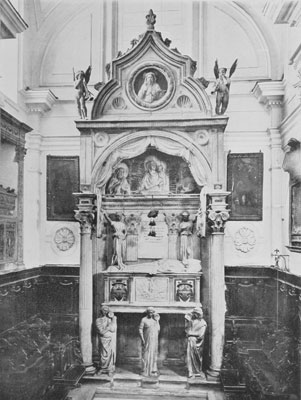
The Church of Sant' Angelo a Nilo at Naples contains the monument of Cardinal Brancacci, one of the most impressive tombs of this period. The scheme is a modification of the Coscia tomb. Instead of the three Virtues in niches at the base, there are three larger allegorical figures, which are free standing caryatides below the sarcophagus. They are allegorical figures, perhaps Fates, and correspond with the two somewhat similar statues at Montepulciano. The Cardinal's effigy lies upon the stone coffin, the face of which has a bas-relief between heraldic shields. Two angels stand above the recumbent figure, holding back the curtain which extends upwards to the next storey, surrounding a deep lunette in which there is a Madonna between two Saints. Here the monument should have ended, but it is surmounted by an ogival arch, flanked by two trumpeting children and with a central medallion of God the Father. This topmost tier may have been a subsequent addition. It overweights the whole monument, introduces a discordant architectural motive, and is decorated by inferior sculpture. The Madonna in the lunette is also poor, and the curtain looks as if it were made of lead. But the lower portion of the tomb compensates for the faults above. The caryatides, the bas-relief of the Assumption, the Cardinal himself and the mourning angels above him, are all superb in their different ways. Michelozzo may have been responsible for the architecture, and Pagno di Lapo for the upper reliefs. Donatello himself made the priceless relief of the Assumption, also the effigy, and the two attendants standing above it. The entire tomb is marble: it was made at Pisa,[95] close to the inexhaustible quarries which, being near to the sea, made transport easy and cheap. From the time of Strabo, the marmor Lunense had been carried thence to every port of the Peninsula.[96] Michelozzo took the tomb to Naples, and perhaps added the final touches: not, indeed, that the carving is quite complete, the Cardinal's ear, for instance, being rough-hewn. Brancacci lies to the left, wearing a mitre on his head, which is raised on a pillow. The chiselling of the face is masterly. The features are shown in painful restless repose. The eyes are sunken and half closed: the lips are drawn, the brow contracted, and the throat shows all the tendons and veins which one notices in the Habbakuk, but which are here relaxed and uncontrolled. It is a death-mask: a grim and instantaneous likeness of the supreme moment, when the agony may have passed away, but not without leaving indelible traces of the crisis. The two angels look down on the dead prelate. They hold back the curtain which would conceal the effigy, thus inviting the spectator into the privacy of the tomb. In some ways these two angels are among the noblest creations of the master. They are comparatively small, their position is subordinate, and they have been repaired by a clumsy journeyman. Yet they have a majestic solemnity. They are calm impersonal mourners—not shrouded like the bowed figures which bear the effigy of the Sénéchal of Burgundy.[97] They stand upright, simply posed and simply clad guardian angels, absorbed by watching the dead. The three large figures which support the sarcophagus are by Michelozzo, and are intimately related to the Aragazzi caryatides. That on the right has a Burgundian look. They form a striking group, and their merits are not appreciated as they should be owing to the excellence of the sculpture immediately above them.
Stiacciato.
The Assumption of the Virgin occupies the central position of the tomb. It is a small panel. The Virgin is seated in a folding-chair which is familiar in fifteenth-century art. Surrounding her are angels supporting the clouds which make an oval halo round her, a mandorla. The cloud, curiously enough, is very heavy, yielding to the touch, and upheld by the flying angels, whose hands press their way into it, and bear their burden with manifest effort. There is none of the limpid atmosphere which Perugino secured in painting, and Ghiberti in sculpture. But, on the other hand, the air is full of drama, presaging an event for which Donatello thought a placid sky unsuitable. There are seven angels in all; the lowest, upon whose head the Virgin rests her foot, is half Blake and half Michael Angelo. But there are many other busy little cherubs swimming, climbing, and flying amidst the interstices of cloudland. The Virgin herself, draped in easy-flowing material, has folded her hands, and awaits her entry to Paradise. Her face is the picture of anxiety and apprehension. The Assumption is carved in the lowest possible relief, called stiacciato. The word means depressed or flattened. It is the word with which Condivi describes the appearance of Michael Angelo's nose after it had been broken—it was "un poco stiacciato; non per natura," but by the blow of a certain Torrigiano, "huomo bestiale e superbo."[98] Donatello was fond of this method of work. We have a fine example in London,[99] and his most successful use of stiacciato is on the Roman Tabernacle made a few years after the Brancacci relief. Donatello did not invent this style. It had been used in classical times, though scarcely to the extent of Donatello, who drew in the marble. The Assyrians also used this low-relief; we find the system fully understood in what are perhaps the most spirited hunting scenes in the world.[100] In these we also notice the square and rectangular undercutting similar to that in many of Donatello's reliefs. Another specimen of this very low-relief is found in Mr. Quincy Shaw's marble panel of the Virgin and Child seated among clouds and surrounded by putti. This has been attributed to Donatello on good authority,[101] though it must be remarked that the cherubs' faces show poverty of invention which might suggest the hand of a weaker man. Moreover, the cherubs have halos, which is a later development, and quite contrary to Donatello's early practice. But the relief is an interesting composition, and if by Donatello, may be regarded as the parent of a group which attained popularity. M. Gustave Dreyfus has a smaller marble variant of great charm, made by Desiderio. A stucco panel treated in much the same manner is preserved at Berlin. The Earl of Wemyss has an early version in repoussé silver of high technical merit. From this point of view nothing is more instructive than a Madonna and Child at Milan.[102] It is probably the work of Pierino da Vinci, and is a thin oval slab of marble carved on either side. One side is unfinished, and is most valuable as showing the facility with which the sharp graving tools were employed to incise the marble. The composition bears a resemblance to the reliefs just mentioned, and the pose of the two heads is Donatellesque, but the Child is elongated and ill-drawn. Again, from a technical point of view, a medallion portrait of the late Lord Lytton shows that artists of our own day have used stiacciato with perfect confidence and success.[103] Donatello was not always quite consistent in its employment. In the Entombment at Padua it is combined with high-relief. He, no doubt, acted deliberately; that is to say, he did not sketch a hand in stiacciato, because he had forgotten to provide for it in deeper relief. But the result is that the quality of the different planes is lost, and there are discrepancies in the relative values of distance. The final outcome of stiacciato is the art of the medallist. It is said that Donatello made a medal, but nobody has determined which it is. Michelozzo certainly made one of Bentivoglio, about 1445.[104] This admirable art, which reached its perfection during Donatello's lifetime, owes something of its progress to the pioneer of stiacciato.
Alinari
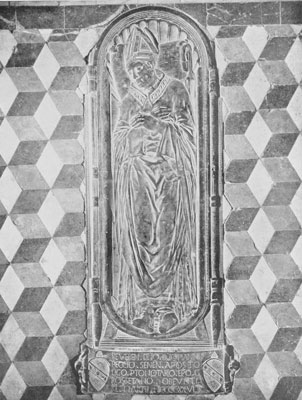
TOMB PLATE OF BISHOP PECCI
SIENA CATHEDRAL
Tombs of Pecci, Crivelli, and Others.
The tomb of Giovanni de' Medici in San Lorenzo is interesting, and has been ascribed to Donatello. There is no documentary authority for this attribution, and on stylistic grounds it is untenable.[105] It is a detached tomb, so common elsewhere, but of singular rarity in Italy. The isolated tomb like this one, like that of Ilaria del Carretto, or that of Pope Sixtus IV. in St. Peter's, has great advantages over the tall upright monument appliqué to a church wall. The latter is, however, the ordinary type of the Renaissance. The free-standing tomb can be seen from all aspects and lights. Although it must be smaller—some of the later wall-tombs are fifty feet high—the sculptor was obliged to keep his entire work well within the range of vision, and had to rely on plastic art alone for success. Much admirable sculpture, especially the effigies, has been lost by being placed too high on some pretentious catafalque in relief against a wall. The tomb of Giovanni, it is true, though standing in the centre of the sacristy, is covered by a large marble slab, which is the priest's table. It throws the tomb into dark shadow and makes it difficult to see the carving. There are few tombs of important people upon which so much trouble has been expended with so little result. Donatello is also said to have made a tomb for the Albizzi, but it has perished.[106] The tomb of Chellini in San Miniato, which tradition ascribed to Donatello, is probably the work of Pagno di Lapo. The prim and priggish Cardinal Accaiuoli in the Certosa of Florence does not suggest Donatello's hand. Though conscientious and painstaking, the work is without a spark of energy or conviction. These latter are slab-tombs, flat plates fastened into the church pavements. We have two authentic tombs of this character, on both of which Donatello has signed his name. Had he not done so, we could never have established his authorship of the marble slab-tomb of Archdeacon Crivelli in the Church of Ara Cœli at Rome. It has been trampled by the feet of so many generations, that all the features have been worn away; the legend is wholly effaced in certain parts, and one corner has had to be restored (though at some early date). But at best it cannot have compared with Donatello's similar tomb of Bishop Pecci at Siena, and one could quote numerous instances of equally good work by nameless men. There is one close to the Crivelli marble itself, another in the Pisa Baptistery, two in Santa Croce, and so forth. This kind of tomb had to undergo rough usage. Everybody walked upon it: the deep relief made it a receptacle for mud and rubbish. The effigy of the deceased, as was probably intended by him, was humbled in the dust: adhesit pavimento. The slabs got injured, and were often protected by low tables with squat legs. Later on the slabs were raised enough to prevent people standing on them, and thus became like free-standing tombs; but it only made them more suitable for the sitting requirements of the congregation. These sunken tombs, in fact, became a nuisance. Although they were not carved in the very deep relief like those one sees in Bavaria, they collected the dirt, and a papal brief was issued to forbid them—ut in ecclesiis nihil indecens relinquatur,[107] and the existing slabs were ordered to be removed. Irretrievable damage must have resulted from this edict, but fortunately it was disobeyed in Rome and ignored elsewhere. Nowadays it has become the custom to place these slabs upright against the walls, thus preventing further detrition. To Cavaliere D. Gnoli we owe the preservation of the Crivelli tomb, which was in danger of complete demolition.[108] By being embedded in a wall instead of lying in a pavement this kind of monument, while losing its primitive position, often gains in appearance. Crivelli, for instance, lies within an architectural niche. His head rests on a pillow, the tassels of which fall downwards towards his feet. When placed against a wall the need for a pillow may vanish, but the meaning and use of the niche becomes apparent, while the tassels no longer defy the laws of gravitation. He becomes a standing figure at once, and the flying putti above his head assume a rational pose. It has been suggested that this and similar tomb-plates were always intended to be placed upright, and that the delicate ornamentation, of which some traces survive, would never have been lavished on marble doomed to gradual destruction. No general rule can be laid down, but undoubtedly most of these slabs were meant to be recumbent. There are few cases where some contradiction of emplacement with pose cannot be detected. But two examples may be noted where the slabs were clearly intended to be placed in walls. An unnamed bishop at Bologna lies down, while at either end of the slab an angel stands, at right angles to the recumbent figure, holding a pall or curtain over the dead man.[109] Signor Bardini also has an analogous marble effigy of a mitred bishop, about 1430-40, who lies down while a friar stands behind his head. These slabs were, therefore, obviously made for insertion in a wall, and they are quite exceptional. The tomb-plate of Bishop Pecci in Siena Cathedral is less open to objection on the ground of incongruity between its position and the Bishop's pose. It is made of bronze, and is set in the tessellated pavement of green, white and mauve marble. Technically it is a triumph. Although the surface is considerably worn, we have the sense of absolute calm and repose—in striking contrast to the wearied look of Brancacci. The Bishop died on March 1, 1426; a few days previously he wrote his will, while he lay dying—"sanus mente licet corpore languens"—and left careful instructions as to his burial in an honourable part of the Cathedral and how the exact cost of his funeral was to be met.[110] In a way the figure resembles St. Louis, and Donatello probably had the help of Michelozzo in the casting. The work itself is extremely good, and the bronze has the rich colour which one finds most frequently in the smaller provincial towns where time is allowed to create its own patina. Donatello was a bold innovator, and the Tomb of Coscia, though not the parent of the Renaissance theory of funeral monuments, had marked influence upon its evolution. From the simple outdoor tombs placed upon pillars, such as one principally finds north of the Apennines, there issued a grander idea which culminated in the monuments of the Scaligers at Verona. But Donatello reverted to the earlier type of indoor tomb, and from his day the tendency to treat them as an integral feature of mural and structural decoration steadily increased. A host of sculptors filled the Tuscan churches with those memorials which constitute one of their chief attractions. These men imbued death with its most gentle aspect, concealing the tragedy and sombre meaning of their work with gay arabesques and the most living and lovable creations of their fancy. The putti, the bright heraldry, the play of colour, and the opulence of decoration, often distract one's eye from the effigy of the dead: and he, too, is often smiling. He may represent the past: the rest of the tomb is born of the present, and seldom—exception being made for a group of tombs to which reference will be made later on[111]—seldom is there much regard for the future. The dead at least are not asked to bury their dead. They lie in state, surrounded by all that is most young and blithe in life: it is a death which shows no indifference to the life which is left behind. With them death is in the midst of life, not life in the midst of death. Donatello was too severe for the later Renaissance, and the brilliant sculptors who succeeded him lost influence in their turn. With the development of sculpture, which during Michael Angelo's lifetime acquired a technical skill to which Donatello never aspired, the tomb became a vehicle for ostentation and display; and there was a reaction towards the harsher symbols of death. Instead of the quiet mourner who really mourns, we have the strident and professional weeper—a parody of sorrow. Tier upon tier these prodigious monuments rise, covering great spaces of wall, decorated with skulls and skeletons, with Time carrying his scythe, with negro caryatides, and with apathetic or showy models masquerading as the cardinal virtues. The effigy itself is often perched up so high as to be invisible, or sitting in a ridiculous posture. "Princes' images on their tombs," says Bosola in Webster's play, "do not lie as they were wont, seeming to pray up to heaven; but with their hands under their cheeks, as if they had died of toothache."[112] Venice excelled in this rotund and sweltering sculpture. Yet it cannot be wholly condemned. Though artificial, theatrical and mundane, its technical supremacy cannot be denied. The amazing ease with which these huge monuments are contrived, and the absolute sense of mastery shown by the sculptor over the material are qualities too rare to be lightly overlooked. Whatever we may think of the artist, our admiration is commanded by the craftsman.
The Second Visit to Rome.
During the year 1433, when Florence enjoyed the luxury of driving Cosimo de' Medici into exile, Donatello went to Rome in order to advise Simone Ghini about the tomb of Pope Martin V.—temporum suorum filicitas, as the epitaph says.[113] This visit to Rome, which is not contested, like the visit thirty years earlier, did not last long, and certainly did not divert Donatello from the line he had struck out. At this moment the native art of Rome was colourless. A generation later it became classical, and then lapsed into decadence. The number of influences at work was far smaller than would at first be imagined. It is generally assumed that Rome was the home of classical sculpture. But early in the fifteenth century Rome must have presented a scene of desolation. The city had long been a quarry. Under Vespasian the Senate had to pass a decree against the demolition of buildings for the purpose of getting the stone.[114] Rome was plundered by her emperors. She was looted by Alaric, Genseric, Wittig and Totila in days when much of her art remained in situ. She was plundered by her Popes. Statues were used as missiles; her marble was exported all over the world—to the Cathedrals of Orvieto and Pisa, even to the Abbey Church of Westminster. Suger, trying to get marble columns for his church, looked longingly at those in the baths of Diocletian, a natural and obvious source, though happily he stole them elsewhere.[115] The vandalism proceeded at an incredible pace. Pius II. issued a Bull in 1462 to check it; in 1472 Sixtus IV. issued another. Pius, however, quarried largely between the Capitol and the Colosseum. The Forum was treated as an ordinary quarry which was let out on contract, subject to a rental equivalent to one-third of the output. But in 1433, and still more during the first visit, there was comparatively little sculpture which would lead Donatello to classical ideas. Poggio, writing just before Donatello's second visit, says he sees almost nothing to remind him of the ancient city.[116] He speaks of a statue with a complete head as if that were very remarkable—almost the only statue he mentions at all. Ghiberti describes two or three antique statues with such enthusiasm that one concludes he was familiar with very few. In fact, before the great digging movement which enthralled the Renaissance, antique sculpture was rare. But little of Poggio's collection came from Rome: Even Lorenzo de' Medici got most of his from the provinces. A century later Sabba del Castiglione complains of having to buy a Donatello owing to the difficulty of getting good antiques.[117] Rome had been devastated by cupidity and neglect as much as by fire and sword. "Ruinarum urbis Romæ descriptio" is the title of one of Poggio's books. Alberti says that in his time he had seen 1200 ruined churches in the city.[118] Bramantino made drawings of some of them.[119] Pirro Ligorio, an architect of some note, gives his recipe for making lime from antique statues—so numerous had they become. But much remained buried before that time, sotterrate nelle Rovine d'Italia,[120] and Vasari explains that Brunellesco was delighted with a classical urn at Cortona, about which Donatello had told him, because such a thing was rare in those times, antique objects not having been dug up in such quantities as during his own day.[121] But the passion for classical learning developed quickly, and was followed by the desire for classical art. Dante had scarcely realised the art of antiquity, though more was extant in 1300 than in 1400. Petrarch, who was more sympathetic towards it, could scarcely translate an elementary inscription. From the growing desire for knowledge came the search for tangible relics: but love of classical art was founded on sentiment and tradition. As regards the sculptors themselves, their art was less influenced by antiquity than were the arts of poetry, oratory and prose. While Rossellino, Desiderio, Verrocchio and Benedetto da Maiano maintained their individuality, the indigenous literature of Tuscany waned. Sculpture retained its freedom longer than the literary arts, and when the latter recovered their national character sculpture relapsed in their place into classicism. From early times sculptors had, of course, learned what they could from classical exemplars. Niccola Pisano copied at least four classical motives. There was no plagiarism; it was a warm tribute on his part, and at that time a notable achievement to have copied at all. But the imitation of antiquity was carried to absurd lengths. Ghiberti, who was a literary man, says that Andrea Pisano lived in the 410th Olympiad.[122] But Ghiberti remained a Renaissance sculptor, and his classical affectation is less noticeable in his statues than in his prose. Filippo Strozzi went so far as to emancipate his favourite slave, a "grande nero," in his will.[123] But Gothic art died hard. The earlier creeds of art lingered on in the byways, and the Renaissance was flourishing long before Gothic ideas had completely perished—that is to say, Renaissance in its widest meaning, that of reincarnated love of art and letters: if interpreted narrowly the word loses its deep significance, for the Renaissance engendered forms which had never existed before. But it must be remembered that in sculpture classical ideas preceded classical forms. Averlino, or Filarete, as a classical whim led him to be called, began the bronze doors of St. Peter's just before Donatello's visit. They are replete with classical ideas, ignoble and fantastic, but the art is still Renaissance. Comparatively little classical art was then visible, and its infallibility was not accepted until many years later, when Rome was being ransacked for her hidden store of antiquities. Statues were exhumed from every heap of ruins, generally in fragments: not a dozen free-standing marble statues have come down to us in their pristine condition. The quarrymen were beset by students and collectors anxious to obtain inscriptions. Traders in forgeries supplied what the diggers could not produce. Classical art became a fetish.[124] The noble qualities of antiquity were blighted by the imitators, whose inventive powers were atrophied, while their skill and knowledge left nothing to be desired. Excluding the Cosmati, Rome was the mother of no period or movement of art excepting the Rococo. As for Donatello himself, he was but slightly influenced by classical motives. His sojourn in Rome was short, his time fully occupied; he was forty-seven years old and had long passed the most impressionable years of his life. He was a noted connoisseur, and on more than one occasion his opinion on a question of classical art was eagerly sought. But, so far as his own art was concerned, classical influences count for little. His architectural ideas were only classical through a Renaissance medium. When a patron gave him a commission to copy antique gems, he did his task faithfully enough, but without zest and with no ultimate progress in a similar direction. When making a portrait he would decorate the sitter's helmet or breastplate with the cameo which actually adorned it. With one exception, classical art must be sought in his detail, and only in the detail of work upon which the patron's advice could be suitably offered and accepted. Donatello may be compared with the great sculptors of antiquity, but not to the extent of calling him their descendant. Raffaelle Mengs was entitled to regret that the other Raffaelle did not live in the days of Phidias.[125] Flaxman was justified in expressing his opinion that some of Donatello's work could be placed beside the best productions of ancient Greece without discredit.[126] These obiter dicta do not trespass on the domain of artistic genealogy. But it is inaccurate to say, for instance, that the St. George is animated by Greek nobility,[127] since in this statue that quality (whether derived from Gothic or Renaissance ideals) cannot possibly have come from a classical source. Baldinucci is on dangerous ground in speaking of Donatello as "emulando mirabilmente la perfezione degli antichissimi scultori greci"[128]—the writer's acquaintance with archaic Greek sculpture may well have been small! We need not quarrel with Gori for calling Donatello the Florentine Praxiteles; but he is grossly misleading in his statement that Donatello took the greatest pains to copy the art of the ancients.[129] Donatello may be the mediæval complement of Phidias, but he is not his artistic offspring.
Alinari
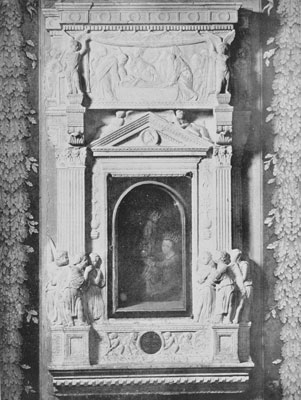
TABERNACLE
ST. PETER'S, ROME
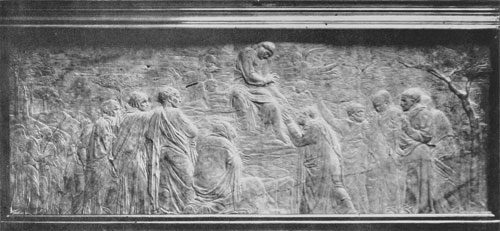
THE CHARGE TO PETER
LONDON
Work at Rome.
Up till a few years ago the most important work Donatello made in Rome was unknown. We were aware that he had made a tabernacle, but all record of it was lost, until Herr Schmarsow identified it in 1886.[130] It was probably made for the Church of Santa Maria della Febbre,[131] and was transported to St. Peter's when Santa Maria was converted into a sacristy. The tabernacle is now in the Sacristy of the Canons, surrounded by sham flowers and tawdry decoration, which reduce its charms to a minimum. Moreover, the miraculous painting of the Madonna and Child which fills the centrepiece—having, perhaps, replaced a metal grille or marble relief, has been so frequently restored that a discordant element is introduced. The tabernacle is about six feet high; it is made of rather coarse Travestine marble, and in several parts shows indications of the hand of an assistant. It has suffered in removal; there are two places where the work has been repaired, and the medallion in the lower frieze has been filled with modern mosaic; otherwise it is in good order. It is essentially an architectural work, but the number of figures introduced has softened the hard lines of the construction, giving it plenty of life. Four little angels, rather stumpy and ill-drawn, are sitting on the lower plinth. Above them rise the main outer columns which support the upper portion of the tabernacle, and enclose the central opening, where the picture is now fixed. At the base of these columns there are two groups of winged children, three on either side, looking inwards towards the central feature of the composition. They bend forward reverently with their hands joined in prayer and adoration—admirable children, full of shyness and deference. The upper part of the tabernacle, supported on very plain corbels, is occupied by a broad relief, at either end of which stand other winged angels, more boyish and confident than those below. This relief is, perhaps, Donatello's masterpiece in stiacciato. It is the Entombment, his first presentment of those intensely vivid scenes which were so often reproduced during his later years. Christ is just being laid in the tomb by two solemn old men with flowing beards, St. Joseph and St. Peter. The Virgin kneels as the body is lowered into the tomb. Behind her is St. Mary Magdalene, her arms extended, her hair dishevelled; scared by the frenzy of her grief. To the right St. John turns away with his face buried in his hands. The whole composition—striking in contrast to the quiet and peaceful figures below—is treated with caution and reserve. But we detect the germ of the pulpits of San Lorenzo, where the rough sketch in clay could transmit all its fire and energy to the finished bronze. In this case Donatello not only felt the limitations of the marble, but he was not yet inclined to take the portrayal of tragedy beyond a certain point. The moderation of this relief entitles it to higher praise than we can give to some of his later work. The other panel in stiacciato made about this time belonged to the Salviati family.[132] Technically the carving is inferior to that in St. Peter's, and it may be that in certain parts, especially, for instance, round the heads of Christ and one of the Apostles, the work is unfinished. Christ is seated on the clouds, treated like those on the Brancacci panel, and hands the keys to St. Peter. The Apostles stand by, the Virgin kneels in the foreground, and on the left there are two angels like those on the tabernacle. Trees are lightly sketched in, and no halos are employed. The work is disappointing, for it is carved in such extraordinarily low-relief that parts of it are scarcely recognisable on first inspection; the marble is also rather defective. As a composition—and this can best be judged in the photograph—the Charge to Peter is admirable. The balance is preserved with skill, while the figures are grouped in a natural and easy fashion. The row of Apostles to the left shows a rendering of human perspective which Mantegna, who liked to make his figures contribute to the perspective of the architecture around them, never surpassed. This panel, in spite of Bocchi's praise, shares one obvious demerit with the relief in St. Peter's. The Virgin, who kneels with outstretched hands as she gazes upwards to the Christ, is almost identical with a figure on the Entombment. She is ugly, with no redeeming feature. The pose is awkward, the drapery graceless, the contour thick, and her face, peering out of the thick veil, is altogether displeasing. One has no right to look for beauty in Donatello's statues of adults: character is what he gives. But neither does one expect this kind of vagary. There is great merit in the plaintive and wistful ugliness of the Zuccone: Here the ugliness is wanton, and therefore inexcusable. The Crivelli tomb and the Baptist in San Giovanni Fiorentino have been already described. There were other products of Donatello's visit to Rome, but they are now lost. Tradition still maintains that the wooden Baptist in S. Giovanni Laterano is his work. But it cannot possibly be by him, though it may be a later copy of a fifteenth-century original. Curiously enough, there is another Baptist in the same church which is Donatellesque in character and analogous in some respects to the St. John at Siena, namely, the large bronze statue signed by Valadier and dated 1772. Valadier was a professional copyist, some of his work being in the Louvre. Where he got the design for this Baptist we do not know; but it is certainly not typical of the late eighteenth century. Titi mentions a head in Santa Maria Sopra Minerva, and a medallion portrait of Canon Morosini in Santa Maria Maggiore.[133] Neither of them can be found.
The Medici Medallions.
The Medici did not remain in exile long, and their return to Florence marks an epoch in the artistic as well as the political history of Tuscany. From this moment the sway of the private collector and patron began. Gradually the great churches and corporations ceased giving orders on the grand scale, for much of the needful decoration was by then completed. By the middle of the century patronage was almost wholly vested in the magnates of commerce and politics: if a chapel were painted or a memorial statue set up, in most cases the artist worked for the donor, and not for the church authorities. The monumental type of sculpture became more rare, bric à brac more common. Well-known men like Donatello received the old kind of commission to the end of their lives, while younger men, though fully occupied, were seldom entrusted with comprehensive orders. Even Michael Angelo was more dependent on the Pope than upon the Church. Among the earliest commissions given by the Medici after their return was an order for marble copies of eight antique gems. These were placed in the courtyard of their Florentine house, now called the Palazzo Riccardi. They are colossal in size, and represent much labour and no profit to art. Nothing is more suitably reproduced on a cameo than a good piece of sculpture; but the engraved gem is the last source to which sculpture should turn for inspiration. Donatello had to enlarge what had already been reduced; it was like copying a corrupt text. The size of these medallions accentuates faults which were unnoticed in the dainty gem. The intaglio of Diomede and the Palladium (now in Naples) is too small to show the fault which is so glaring in the marble relief, where Diomede is in a position which it is impossible for a human being to maintain. But the relief is admirably carved: nothing could be better than the straining sinews of the thigh; and it is of interest as being the only one which is related to any other work of the sculptor. The head of one of the angels in the Brancacci Assumption is taken from this Diomede or from some other version of it. A similar treatment is found in Madame André's relief of a young warrior. It has been pointed out that some of the gems from which these medallions were made did not come into the Medici Collections until many years later.[134] Cosimo may have owned casts of the originals, or Donatello may have copied them in Rome, for they belonged at this time to the Papal glyptothek, from which they were subsequently bought. The subjects of these roundels are Ulysses and Athena, a faun carrying Bacchus, two incidents of Bacchus and Ariadne, a centaur, Dædalus and Icarus, a prisoner before his victor, and the Diomede. Gems became very popular and expensive: a school of engravers grew up who copied, invented, and forged. Carpaccio introduced them into his pictures,[135] and Botticelli used them so freely that they almost became the ruling element of decoration in the "Calumny." Gems are incidentally introduced in Donatello's bust of the so-called Young Gattamelata, and on Goliath's helmet below the Bronze David. The Medusa head occurs on the base of the Judith, on the Turin Sword hilt, and on the armour of General Gattamelata. So much of Donatello's work has perished that it is almost annoying to see how well these Medici medallions are preserved—the work in which his individuality was allowed little play, and in which he can have taken no pride.
Alinari
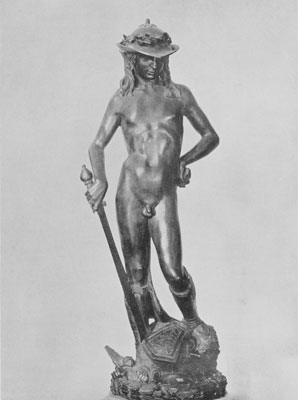
THE BRONZE DAVID
BARGELLO, FLORENCE
The Bronze David.
According to Vasari, the Bronze David was made for Cosimo before the exile of the Medici, and consequently previous to Donatello's second journey to Rome. It was removed from the courtyard of the palace to the Palazzo Pubblico, where it remained for many years. Doni mentions it as being there in 1549,[136] and soon afterwards it was replaced by Verrocchio's fountain of the Boy squeezing the Dolphin. It is now in the Bargello. The base has been lost. Albertini says it was made of variegated marbles.[137] Vasari says it was a simple column.[138] It has been suggested that the marble pillar now supporting the Judith belonged to the David, but the David is even less fitted to this ill-conceived and pedantic shaft than Judith herself. The David soon acquired popularity; the French envoy, Pierre de Rohan, wanted a copy of it. It was certainly a remarkable innovation, being probably the first free-standing nude statue made in Italy for a thousand years. There had been countless nude figures in relief, but the David was intended to be seen from every side of Cosimo's cortile. There was no experimental stage with Donatello; his success was immediate and indeed conclusive. David is a stripling. He stands over the head of Goliath, a sword in one hand and a stone in the other, wearing his helmet, a sort of sun-hat in bronze which is decorated with a chaplet of leaves; below his feet is a wreath of bay. It is a consistent study in anatomy. The David is perhaps sixteen years old, agile and supple, with a hand which is big relative to the forearm, as nature ordains. The back is bony and rather angular; the torso is brilliantly wrought, with a purity of outline and a morbidezza which made the artists in Vasari's time believe the figure had been moulded from life. One might break the statue into half a dozen pieces, and every fragment would retain its vitality and significance. The limbs are alert and full of young strength, with plenty more held in reserve: it is heroic in all respects except dimension. The face is clear cut, and each feature is rendered with precision. The expression is one of dreamy contemplation as he looks downwards on the spoils and proof of conquest. David hath slain his tens of thousands! Finally the quality of the statue is enhanced by the care with which the bronze has been chiselled. Goliath's helmet, and David's greaves, on which the fleur de lys florencée has been damascened, are decorated with unfailing tact. The embellishment is in itself a pleasure to the eye, but it is prudently contained within its legitimate sphere; for Donatello would not allow the accessory to invade the statue itself, which is the chief fault of the rival David by Verrocchio. Donatello's statue marks an epoch in the study of anatomy. It is a genuine interpretation of a very perfect piece of humanity; but his knowledge compared with that of his successors was empiric. Leonardo's subtle skill was based upon dissection. Michael Angelo likewise studied from the human corpse, distasteful as he found the process. Donatello had no such scientific training: he had no help from the surgeon or the hospital, hence mistakes; his doubt, for instance, about the connection between ribs and pectoral bones was never resolved. But, notwithstanding this lack of technical data, the Bronze David has a distinction which is absent in statues made by far more learned men. Donatello's intuition supplied what one would not willingly exchange for the most exact science of the specialist. The David was an innovation, but the phrase must be guarded. It was only an innovation so far as it was a free-standing study from the nude. Nothing is more misleading than the commonplace that Christianity was opposed to the representation of the nude in its proper place. The early Church, no doubt, underwent a prolonged reaction against all that it might be assumed to connote; one might collect many quotations from patristic literature to this effect. But the very articles of the Christian Creed militated against the ultimate scorn of the human body: the doctrine of the Resurrection alone was enough to give it more sanctity than could be derived from all the polytheism of antiquity. The Baptism of Christ, the descent into Limbo, and the Crucifixion itself, were scenes from which the use of drapery had to be less or more discarded. The porches and frontals of Gothic churches abounded in nude statuary, from scenes in the Garden of Eden down to the Last Judgment. Abuses crept in, of course, and the Faith protested against them. The advancing standard of comfort and, no doubt, a steadily deteriorating climate, diminished the everyday familiarity with undraped limbs. Clothes became numerous and more normal; the artist came to be regarded as the purveyor of what had ceased to be of natural occurrence. He was encouraged by the connoisseur, lay and cleric, who found his literature in antiquity, and then demanded classical forms in his art. The nude was arbitrarily employed: there was no biblical authority for a naked David, and Donatello was therefore among the first to err in this respect. The taste for this kind of thing sprang from humanism, and throve with hellenism, till a counter-reaction came suddenly in the sixteenth century. Michael Angelo was hotly attacked for his excessive study from the nude as prejudicial to morals.[139] Ammanati wrote an abject apology to the Accademia del Disegno for the very frank nudity of his statues.[140] Some of the work of Bandinelli and Bronzino had to be removed. What was a rational and healthy protest has survived in grotesque and ill-fitting drapery made of tin—very negation of propriety. Although needed for biblical imagery, the nude in Italy was always exotic; in Greece it was indigenous. From the time of Homer there had been a worship of physical perfection. The Palæstra, the cultivation of athletics in a nation of soldiers, the religions of the country, with its favourable atmosphere, climate, and stone, all combined to make the nude a normal aspect of human life. But it was not the sole inspiration of their art: in Sparta, where there was most nude there was least art; in Italy, when there was worst art there was most nude.
Alinari
CANTORIA
IN OPERA DEL DUOMO, FLORENCE
Donatello and Childhood.
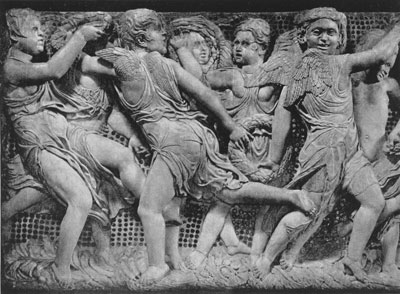
Michael Angelo strove to attain the universal form. His world was peopled with Titans, and he realised his ambition of portraying generic humanity: not, indeed, by making conventional, but by eliminating everything that was not typical. The earliest plastic art took clay and moulded the human form; the next achievement was to make specific man—the portrait; lastly, to achieve what was universal—the type. The progress was from man, to man in particular, and ultimately to man in general. There was a final stage when the typical lost its type without reverting to the specific, to the portrait. The successors of Michael Angelo were among the most skilful craftsmen who ever existed; but their knowledge only bore the fruit of unreality. Donatello did not achieve the typical except in his children: it was only in children that Michael Angelo failed. He missed this supreme opportunity; those on the roof of the Sistine Chapel are solemn and grown old with care: children without childhood. With Donatello all is different. His greatness and title to fame largely rest upon his typical childhood: his sculpture bears eloquent witness to the closest observation of all its varying and changeful moods. Others have excelled in this or that interpretation of child-life: Greuze with his sentimentalism, the Dutch painters with their stolidity. In Velasquez every child is the scion of some Royal House, in Murillo they are all beggars. They are too often stupid in Michelozzo: in Andrea della Robbia they are always sweet and winsome; Pigalle's children know too much. Donatello alone grasped the whole psychology. He watched the coming generation, and foresaw all that it might portend: tragedy and comedy, labour and sorrow, work and play—plenty of play; and every problem of life is reflected and made younger by his chisel. How far the sculptors of the fifteenth century employed classical ideas is not easily determined. There was, however, one classical form which was widely used, namely, the flying putti holding a wreath or coat-of-arms between them: we find it on the frieze of the St. Louis niche, and it is repeated on Judith's dress. The wreath or garland, of which the Greeks were so fond, became a favourite motive for the Renaissance mantelpiece. The classical amoretti, of which many versions in bronze existed, were also frequently copied. But there was one radical difference between the children of antiquity and those of the Renaissance. Though children were introduced on to classical sarcophagi and so forth, it is impossible to say that it was for the sake of their youth. There are genii in plenty; and in the imps which swarm over the emblematic figure of the Nile in the Vatican the sculptor shows no love or respect for childhood. There is no child on the Parthenon frieze, excepting a Cupid, who has really no claim to be reckoned as such. Donatello could not have made a relief 150 yards long without introducing children, whether their presence were justified or not. He would probably have overcrowded the composition with their young forms. Whether right or wrong, he uses them arbitrarily, as simple specimens of pure joyous childhood. Antique sculpture, too, had its arbitrary and conventional adjuncts—the Satyr and the Bacchic attendants; but how dreary that the vacant spaces in a relief should have to rely upon what is half-human or offensive—the avowedly inhuman gargoyles of the thirteenth century are infinitely to be preferred. Donatello was possessed by the sheer love of childhood: with him they are boys, fanciulli ignudi,[141] very human boys, which, though winged and stationed on a font, were boys first and angels afterwards. And he overcame the immense technical difficulties which childhood presents. The model is restive and the form is immature, the softness of nature has to be rendered in the hardest material. The lines are inconsequent, and the limbs do not yet show the muscles on which plastic art can usually depend. Nothing requires more deftness than to give elasticity to a form which has no external sign of vigour. So many sculptors failed to master this initial difficulty—Verrocchio, for instance. He made the bronze fountain in the Palazzo Pubblico, and an equally fine statue of similar dimensions now belonging to M. Gustave Dreyfus. Both have vivacity and movement, but both have also a fat stubby appearance; the flesh has the consistency of pudding, and though soft and velvety in surface is without the inner meaning of the children on the Cantoria. In this work, where Donatello has carved some three dozen children, we have a series of instantaneous photographs. Nobody else had enough knowledge or courage to make rigid bars of children's legs: here they swing on pivots from the hip-joint. It is the true picture of life, rendered with superlative skill and bravura. But Donatello's children serve a purpose, if only that of decoration. At Padua they form a little orchestra to accompany the duets. The singing angels there are among the most charming of the company; and whether intentionally or not, they give the impression of having forgotten the time, or of being a little puzzled by the music-book! But Donatello fails to express the exquisite modulation by which Luca della Robbia almost gives actual sound to his Cantoria: where one sees the swelling throat, the inflated lungs, the effort of the higher notes, and the voice falling to reach those which are deep. Luca's children, it is true, are bigger and older; but in this respect he was unsurpassed, even by painters whose medium should have placed them beyond rivalry in such a respect. The choir of Piero della Francesca's Nativity is so well contrived that one can distinguish the alto from the tenor; but Luca was able to do even more. He gives cadence, rhythm and expression where others did no more than represent the voice. Donatello's dancing children are more important than his musicians. He was able to give free vein to his fancy. We have flights of uncontrollable children, romping and rioting, dashing to and fro, playing and laughing as they pass about garlands among them. And their self-reliance is worth noticing; they are absorbed in their dance—children dance rather heavily—and only a few of them look outwards. There is no self-consciousness, no appeal to the spectator: they are immensely busy, and enjoy life to the full. Then we have a more demure type of childhood: they are shield-bearers on the Gattamelata monument, or occupy an analogous position on the lower part of the Cantoria. Others hold the cartel or epitaph as on the Coscia tomb. And again Donatello introduces children as pure decoration. The triangular base of the Judith, for instance, and the bronze capital which supports the Prato pulpit, have childhood for their sole motive. He smuggles children on to the croziers of St. Louis and Bishop Pecci: they are the supporters of Gattamelata's saddle: they decorate the vestments of San Daniele. They share the tragedy of the Pietà, and we have them in his reliefs. The entire frieze of the pulpits of San Lorenzo is simply one long row of children—some two hundred in all.
Alinari
CANTORIA (DETAIL)
FLORENCE
The Cantoria.
The Cantoria, or organ-loft, of the Florentine Cathedral was ordered soon after Donatello's return from Rome, and was erected about 1441. It was placed over one of the Sacristy doors, corresponding in position with Luca della Robbia's cantoria on the opposite side of the choir. The ill-fortune which dispersed the Paduan altar and Donatello's work for the façade likewise caused the removal of this gallery. Late in the seventeenth century a royal marriage was solemnised, for which an orchestra of unusual numbers was required, and the two cantorie were removed as inadequate. The large brackets remained in situ for some time, but were afterwards taken away also. The two galleries have now been re-erected at either end of the chief room of the Opera del Duomo. But the size of the galleries is considerable, and they occupy so much of the end walls to which they are fixed, that it is impossible to see the sides or outer panels of either cantoria. In the case of Luca's gallery, the side panels have been replaced by facsimiles, and the originals can be minutely examined, being only four or five feet from the ground, and very suggestive they are. As the side panels of Donatello's gallery are equally invisible in their present position they might also be brought down to the eye level. Comparison with Luca's work would then be still more simplified. But though in a trying light, and too low down, the sculpture shows that it was Donatello who gave the more careful attention to the conditions under which the work would be seen. The delicacy and grace of Luca's choir make Donatello's boys look coarse and rough-hewn. But in the dim Cathedral, where Donatello's children would appear bold and vivacious, the others would look insipid and weak. Moreover, the lower tier of Luca's panels beneath the projection and enclosed by the broad brackets, would have been in such a subdued light that some of the heads in low-relief would have been scarcely emphasised at all. In reconstructing Donatello's gallery an error has been made by which a long band of mosaic runs along the whole length of the relief, above the children's heads. M. Reymond has pointed out that the ground level should have been raised in order to prevent what Donatello would undoubtedly have avoided, namely, a blank and meaningless stretch of mosaic.[142] M. Reymond's brilliant suggestion about a similar point in regard to the other cantoria, a criticism which has been verified in a remarkable manner, entitles his suggestion to great weight. The angles of the cantoria where the side panels join the main relief lack finish: something like the pilasters which cover the angles of the Judith base are required. As for the design, the gallery made by Luca della Robbia has an advantage over Donatello's in that the figures are not placed behind a row of columns. There is something tantalising in the fact that the most boisterous and roguish of all the troop is concealed by a pillar of spangled white and gold. These pillars were perhaps needed to break the long line of the relief: but they have no such significance, as, for instance, the row of pillars on the Saltarello tomb,[143] behind which the Bishop's effigy lies—a barrier between the living and the dead, across which the attendant angels can drop the curtain. Donatello's gallery is, perhaps, over-decorated. There is less gilding now than formerly, and the complex ornament does not materially interfere with the broad features of the design: but a little more reserve would not have been amiss.
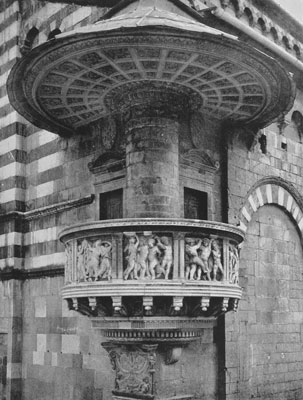
Alinari
THE PRATO PULPIT
The Prato Pulpit.
The second work in which Donatello took his inspiration exclusively from childhood is at Prato. It is an external pulpit, fixed at the southern angle of the Cathedral façade, and employed to display the most famous relic possessed by the town, namely, the girdle of the Virgin. The first contract was made as early as 1428 with Donatello and Michelozzo, industriosi maestri, to whom careful measurements were given.[144] The sculptors promised to finish the work by September 1, 1429. Five years later, there was still no pulpit, and having vainly invoked the aid of Cosimo, they finally sent to Rome, where Donatello had by then gone, and a revised contract was made with the industrious sculptors, though Michelozzo is not mentioned by name.[145] The work was finished in about four years, and within three weeks of signing the new contract one of the reliefs was completed; it may, of course, have been already begun. Its success was immediate. "All say with one accord that never has such a work of art been seen before;" and the writer of the entertaining letter from which this eulogy is quoted goes on to say that Donatello is of good disposition; that such men are not found every day, and that he had better be encouraged by a little money.[146] The Prato pulpit has seven marble reliefs on mosaic grounds, separated by twin pilasters: there are thirty-two children in all.[147] It is a most attractive work, cleverly placed against the decorous little Cathedral and not surrounded by sculpture of the first order with which to make invidious comparisons. But beside the cantoria it is almost insignificant. The Prato children dance too, but without the perennial spring; they have plenty of movement, but seem apt to stumble. They do not scamper along with the feverish enthusiasm of the other children: they must get very tired. Moreover, several of the panels are confused. They are, of course, crowded, for Donatello liked crowds, especially for his children; but his crowds were well marshalled and the individual figures which composed them were not allowed to suffer by their surroundings anatomically. The Prato children belong to a chubby and robust type. They have a tendency to short necks and unduly big heads which sink on to the torso. Michelozzo never grasped the spirit of childhood; those at Montepulciano were not a success, and he was largely responsible for the Prato Pulpit; it has been suggested that Simone Ferrucci also assisted. Certainly it would be Michelozzo's idea to divide the frieze into compartments, which interrupt the continuity of the relief and necessitate fourteen terminal points instead of four on the cantoria. We can also detect Michelozzo's hand in the rather stiff and professional details of the architecture. But he seems to have also executed some of the reliefs, even if the general idea from which he worked should have been Donatello's. Thus the panel most remote from the cathedral façade is involved in design and faulty in execution; and the children's expression is aimless and dull. But it must not be inferred that the Prato Pulpit is in any sense a failure, or even displeasing. Its popularity is thoroughly well deserved. The test of comparison with the cantoria is most searching, too severe indeed, for such a high standard could not be maintained. But if the capo d'opera of sculptured child-life be excluded, the Prato Pulpit will always retain a well-deserved popularity. Two further points should be noted. Below the pulpit is a bronze relief, shaped like the capital of a large column. There should be two of them, and it used to be believed that the second was destroyed in 1512 when the Spanish troops sacked the town. But the story is apocryphal, for the documents show that payment was only made for one relief, and that Michelozzo was entirely responsible for the casting. It is a most decorative panel, the motive being ribands and wreaths, among which there are eleven winged putti of different sizes. At the top of the capital is a big baby in high-relief peeping over the edge; an exquisite fancy reminding us of the two inquisitive children clambering over the heraldic shields on the Pecci monument. On the base of the capital are two other putti of equal charm, winged like the rest, and sedately looking outwards in either direction. The volutes of the bronze are decorated with other figures, less boyish and almost suggesting the touch of Ghiberti, who, it may be remarked, was appointed assessor of the contract by the Wardens of the Girdle. Finally, one may inquire what Donatello's motive can have been in designing the frieze: what may be the relation of the sculpture to the precious Girdle. No conclusive answer can be given. In the organ-loft of Luca della Robbia the object was to show praise of the Lord "with all kinds of instruments"[148]: Donatello's was to "let them praise his name in the dance."[149] At Prato we have dance and music for no apparent reason, except perhaps as a display of joyfulness appropriate to the great festival of exhibiting the Cingolo. It is possible that the curious little reliquary in which the Girdle is actually preserved may supply the clue to some legend or tradition connected with the relic. This cofanetto was remodelled about this time, and the primitive motive and design may have been impaired. But we have a series of winged putti made of ivory, who dance and play about much as those on the pulpit, but amongst whom one can see scraps of rope, signifying the Girdle, from which they derive their incentive to joy and vivacity.
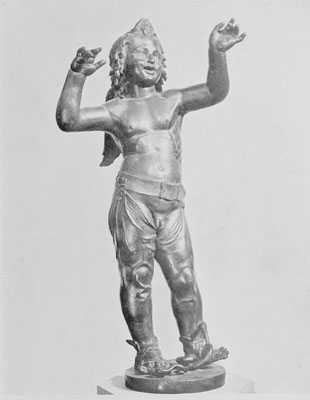
Alinari
BRONZE AMORINO
BARGELLO
Other Children by Donatello.
There are six putti above the Annunciation in Santa Croce. They are made of terra-cotta, while the rest of the work is in stone, and designed in such a way that the children are superfluous. They are, however, undoubtedly by Donatello, and may have been added as an afterthought. Two stand on either side of the curved tympanum, clinging to each other as they look downwards, and afraid of falling over the steep precipice. Their attitude is shy and timid, as Leonardo said was advisable when making little children standing still.[150] Though unnecessary, their presence on the relief is justified by Donatello's skill and humour. In the great reliefs at Padua, Siena and Lille he introduces them without any specific object, though he contrives that they shall show fear or surprise in response to the incident portrayed. It is puzzling to know what the bronze boy in the Bargello should be called. Perseus, Mercury, Cupid, Allegory and Amorino have been suggested: he combines attributes of them all together with the budding tail of a faun, and the gambali, the buskin-trouser of the Tuscan peasant[151]—"vestito in un certo modo bizzarro" as Vasari says. Cinelli thought it classical, and it resembles an undoubted antique in the Louvre. Donatello has clearly taken classical motives; the winged feet and the serpents twining between them are not Renaissance in form or idea. But the statue itself is closely akin to the Cantoria children, but being in bronze shows a higher polish, and, moreover, is treated in a less summary fashion. It is a brilliant piece of bronze: colour, cast and chiselling are alike admirable, and there is a vibration in the movement as the saucy little fellow looks up laughing, having presumably just shot off an arrow; or possibly he has been twanging a wire drawn tightly between the fingers. It throws much light on the bronze boys at Padua made ten or fifteen years later. This Florentine boy shows how completely Donatello, perhaps with the assistance of a caster, could render his meaning in bronze. In two or three cases at Padua the work is clumsy and slipshod, showing how he allowed his assistants to take liberties which he would never have countenanced in work finished by his own hands. The Bargello has another Amorino of bronze, a nude winged boy standing on a cockleshell, and just about to fly away; quite a pleasing statuette, and executed with skill except as regards the extremities of the fingers, where the bronze has failed. It resembles Donatello's putti who play and dance on the corners of the tabernacle of Quercia's font at Siena; but the base of this figure differs from that of the other four. A fifth of the Sienese putti was recently bought in London for the Berlin Gallery, an invaluable acquisition to that growing collection.[152] This group, however, is less important than the wonderful pair of bronze putti belonging to Madame André.[153] These are much larger: they carry candle-sockets and are lightly draped with a few ribands and garlands: judging from the way they are huddled up, it is possible that they formed part of a larger work. They appear to be a good deal later than the Cantoria, though they do not show any technical superiority to the large Bargello Amorino; but they have not quite got that freshness which cannot be dissociated from work made between 1433 and 1440. Madame André has another superb Donatello—a marble boy: his attitude is unbecoming, but the modelling of this admirable statue—the urchin is nearly life-sized—is almost unequalled. There is a similar figure in the Louvre made by some imitator. It need hardly be said that Donatello's children, especially the free-standing bronze statuettes, were widely copied. According to Vasari, Donatello designed the wooden putti carrying garlands in the new Sacristy of the Duomo. There are fourteen of these boys, and they overstep the cornice like Michelozzo's angels in the Capella Portinari at Milan. Donatello may have given the sketch for one or two, but there is a lack of intelligence about them, besides a certain monotony. Moreover, it is improbable that Donatello would have designed garlands so bulky that they threaten to push the little boys who carry them off the cornice. In spite of its faults, this frieze is charming. The naïveté of the quattrocento often invests its errors with attraction. It would be wearisome to catalogue the scores of bronze children which show undoubted imitation of Donatello. They exist in every great collection, one of exceptional merit being in London.[154] A large school sprang into existence, chiefly in Padua and Venice, whence it spread all over Northern Italy, and produced any number of bronze works which recall one or other feature of Donatello's children. But they never approached Donatello. Their work was a sort of minuteria—table ornaments, plaquettes, inkstands, and the ordinary decoration of a sitting-room. Monumental childhood almost ceased to exist in Italian plastic art, and, after Michael Angelo, degenerated into stout and prosperous children lolling in clouds and diving among the draperies which adorned the later altars and tombs. Their didactic value was soon lost to Italian sculpture, and with it went their inherent grace and significance. Donatello was among the first as he was among the last seriously to apply to sculpture the words ex ore infantium perfecisti laudem.
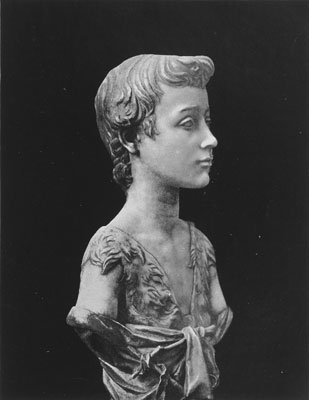
Alinari
SAN GIOVANNINO
FAENZA MUSEUM
Boys' Busts.
It is inexplicable that modern criticism should withdraw from Donatello all the free-standing or portrait-busts of boys, while going to the opposite extreme in ascribing to him an enormous number of Madonnas. We know that Donatello was passionately fond of carving children on his reliefs: we also know that only two versions of the Madonna can be really authenticated as his work. Why should Donatello have made no busts of boys when it is not denied that he was responsible for something like one hundred boys in full-length; and how does it come about that scores of Madonnas should be attributed to him when we only have the record of a few? There can be no doubt that Donatello would not have rested content with children in relief or in miniature. The very preparation of his numerous works in this category must have led him to make busts as well, quite apart from his own inclinations. The stylistic method of argument should not be abused: if driven to a strict and logical conclusion it becomes misleading. It ignores the human element in the artist. It pays no attention to his desire to vary the nature of his work or to make experiments. It eliminates the likelihood of forms which differ from the customary type, and it makes no allowance for possibilities or probabilities, least of all for mistakes. It is purely on stylistic grounds that each bust connected with Donatello's name has been withdrawn from the list of his works. A fashion had grown up to ascribe to Donatello all that delightful group of marble busts now scattered over Europe. Numbers were obviously the work of competent but later men: Rossellino, Desiderio, Mino da Fiesole, and so forth. There remain others which are more doubtful, but which in one detail or another are alleged to be un-Donatellesque, and have therefore been fearlessly attributed to other sculptors from whose authenticated work they often dissent. That, however, was immaterial, the primary object being to disinherit Donatello without much thought as to his lawful successor in title. A critical discrimination between these busts was an admitted need; everything of the kind had been conventionally ascribed to Donatello just as Luca della Robbia was held responsible for every bit of glazed terra-cotta. These ascriptions to the most fashionable and lucrative names had become conventional, and had to be destroyed. Invaluable service has been rendered by reducing the number given to Donatello and adding to the number properly ascribed to others. But the process has gone too far. The difficulties are, of course, great, and stylistic data offer the only starting-point; but as these data are readily found by comparison with Donatello's accepted work, it ought to be possible, on the fair and natural assumption that Donatello may well have made such busts, to determine the authenticity of a certain proportion. In any case, it would be less difficult to prove that Donatello did, than that he did not make statues of this description. Among the busts of very young boys which cannot be assigned to Donatello are those belonging to Herr Benda in Vienna, and to M.G. Dreyfus in Paris. Nothing can exceed their softness and delicacy of modelling, and they are among the most winning statuettes in the world. They were frequently copied by Desiderio and his entourage. One of the little heads in the Vanchettoni Chapel at Florence is likewise animated by a similar exemplar. There is something girlish about them, a pursuit of prettiness which is no doubt the source of their singular attraction, and which invests them with an irresistible charm. The San Giovannino, also in the Vanchettoni, is a more concrete version of childhood, but is by the same hand as its fellow. These four busts fail to characterise the child's head; not indeed that characterisation was needed to make an enchanting work, but that Donatello's children elsewhere show more of the individual touches of the master and personal notes of the child. The Duke of Westminster possesses a life-sized head of a boy,[155] which is palpably by Donatello, though no document exists to prove it. We have all the essentials of Donatello's modelling; the handling is uncompromising and firm; the child is treated more like a portrait. Indeed, many of these children's busts, even when symbolised by St. John's rough tunic, were avowed portraits—the Martelli San Giovannino, for instance, which from Vasari's time has been ascribed, and probably with justice, to Donatello. This little head enjoys a reputation which it scarcely deserves. The expression is dull, the hair grows so low that scarcely any forehead is visible; the cheeks bulge out, and the mouth is too small. We have, in fact, a lifelike presentment of some boy, perhaps of the Martelli family, showing him at his least prepossessing moment, when the bloom of childhood has passed away, and before the lines have been fined down and merged into the stronger contours of youth. Desiderio would have improved Nature by modifying the boy's features, and we should have had a work comparable to those previously mentioned. But Donatello (and perhaps his patrons) preferred a less idealised version. The Martelli figure, and a most important boy's bust belonging to Frau Hainauer in Berlin, are now usually ascribed to Rossellino. But his St. John in the Bargello, where all the features are softened down, and his authenticated work in San Miniato and elsewhere, make the attribution open to question. The St. John at Faenza is also denied to be by Donatello; one of the critics who is quite certain on the point believes the bust to be made of wood! These problems cannot be settled by spending ten lire on photographs. The bust at Faenza,[156] though a faithful portrait, is one of the most romantic specimens of childhood depicted by Donatello. Admirably modelled, and with a surface like ivory, it gives the intimate characteristics of the model. Nothing has been embellished or suppressed, if we may judge from the absolute sequence and correspondence of all the features. The flat head, the projecting mouth, and the much-curved nose, are sure signs of accurate and painstaking observation; they combine to give it a personal note which adds much to its abstract merits. The St. John in the Louvre[157] is also a portrait, but of an older boy, in whom the first signs of maturity are faintly indicated: lines on the forehead, a stronger neck, and a harder accentuation of nose and mouth. But he is still a boy, though he will soon go forth into the wilderness. By the side of the Faenza Giovannino he would appear rough; beside the Vienna and Dreyfus statuettes he would be harsh and unsympathetic. He has no smiling countenance, no fascinating twinkle of the eye: the type has not been generalised as in Desiderio's work, and it therefore lacks those qualities, the very absence of which makes it most Donatellesque. The fundamental distinction between Donatello and the later masters can be emphasised by comparing this bust with another group of terra-cotta heads, which are analogous, although the boy in them is older. One in the Berlin Gallery[158] has been painted, and no final judgment can be passed until the more recent accretions of oil-colour have been removed. But the whole conception is weakly and vapid. The brown eyes, the nicely rouged cheeks, the mincing look, and the affectation of the pose make a genteel page-boy of him, and all suggest a later imitation—about 1470 perhaps—and contemporary with the somewhat analogous though better rendering in the Louvre.[159] The version belonging to M. Dreyfus differs in certain details from the Berlin bust, and it has been fortunate in escaping careless painting; it has more vigour and virility. One remark may be made about the Faenza, Grosvenor House, Martelli, Hainauer and Louvre busts: they all show a peculiarity in the treatment of the hair. It is bunched together and drawn back from behind the ears, and is gathered on the nape of the neck, down which it seems to curl. This is precisely the treatment observed in the Mandorla relief, the Martelli David, the young Gattamelata, and the Amorino in the Bargello: in a lesser degree it is observable in the Isaac and the Siena Virtues. The point is not one upon which stress could properly be laid, but it is a further point of contact between Donatello's accepted work and some few out of the numerous boys' busts which he must inevitably have made.