REIGN OF WILLIAM III.: 1695–1702.
Reading edition
During this period, the affairs of Scotland were in a marked degree subordinate to those of England. The king, absorbed in continental wars and continental politics, paid little attention to his northern kingdom; he left it chiefly to the care of its state-officers, using as a medium of his own influence, William Carstares, a Presbyterian minister of extraordinary worth, sincerity, and prudence, who had gained his entire esteem and confidence, and who usually attended him wherever he was. A parliament which sat in May 1695, was chiefly occupied with the investigation of the Glencoe massacre, and with measures connected with the rising commercial enterprise of the country, including the formation of a native bank, and that of a company for trading with Africa and the Indies. The latter of these speculations was worked out in an expedition to Darien, and an attempted settlement there, which, through English mercantile jealousy, and the king’s indifference to Scottish interests, ended so unfortunately as greatly to incense the Scottish nation, and increase the party disaffected to the Revolution government. The misery hence arising was increased by a dearth from a succession of bad seasons. Nevertheless, this period will be found in our chronicle to have been remarkable for the establishment of manufactories of various kinds, and for various other industrial enterprises, shewing that the national energies were beginning to take a decidedly new direction. At the same time, instances of deplorable superstition, cruelty, and intolerance were sufficiently numerous to attest that the days of barbarism were not past.
Incessant efforts were made by the Jacobite party to procure the restoration of King James, and the discontents excited by Darien were greatly favourable to their views. Yet the heart of the middle class throughout the more important provinces remained firm in Presbyterianism, for which the Revolution government was the sole guarantee; and in this lay an insuperable bar to all reactionary projects. A war against France, which had begun immediately after the Revolution (May 1689), was brought to a conclusion in September 1697, by the treaty of Ryswick, which included an acknowledgment by Louis XIV. of the title of King William to the English throne. The exiled king, old and abandoned to ascetic devotion, indulged a hope that he would outlive William, and be then quietly recalled. He died, however, in September 1701, with only the assurance of the French king in favour 108of the restoration of his son. William survived him but a few months, dying of a fever and ague on the 8th March 1702. His vigorous talents, his courage, his essential mildness and tolerance, abated as they were by an unpopular coldness of manners, are amply recognised in English history; among the Scots, while Presbyterians thank him for the establishment of their church, there is little feeling regarding the Dutch king, besides a strong resentment of his concern in the affairs of Glencoe and Darien.
1695. Feb. 17.
This day, being Sunday, the Catholics of Edinburgh were so bold as to hold a meeting for worship in the Canongate. It was fallen upon and ‘dissipat’ by the authorities, and the priest, Mr David Fairfoul, with James De Canton and James Morris, fencing-masters, and John Wilson of Spango, were committed to prison, while the Lord Advocate obtained a list of other persons present. The Privy Council ordered the four prisoners to be carried from the Canongate to the Edinburgh Tolbooth, and appointed a committee to take what steps it might think meet regarding the list of worshippers.
On the 28th February, the Council permitted the liberation of the two fencing-masters, on assurance of their doing nothing offensive to the government in future, under a penalty of five hundred merks. At the same time, they ordained ‘Harry Graham, and his landlord, James Blair, periwig-maker in Niddry’s Wynd; James Brown, son to Hugh Brown, chirurgeon, and the said Hugh his father; John Abercrombie, merchant in Edinburgh, and John Lamb in the Water of Leith, to give bond in the same terms and under the same penalty;’ else to be kept in prison. Orders were given to search for John Laing, writer, John Gordon, writer, and James Scott in the Canongate, ‘who, being also at the said meeting, have absconded.’ The priest Fairfoul was treated with unexpected mercy, being liberated on condition of banishment, not to return under a penalty of three hundred pounds sterling.[135]
Feb. 19.
Robert Davidson, merchant in Ellon, Aberdeenshire, represented to the Privy Council that he had been in a good way of merchandise, and proprietor of a two-story house, when in the beginning of December last some of Lord Carmichael’s dragoons were quartered upon him, and deposited their powder in one of his low 109|1695.| rooms. As they were one morning dividing the powder, it caught fire, and demolished the house, together with his whole merchandise and household plenishing, carrying the bed whereon he and his family lay to the top of the house, and seriously injuring a relative who was living with him at the time, and for the cost of whose cure he was answerable. Robert petitioned for some compensation, and the Council—following its rule of a vicarious beneficence—allowed him to raise a voluntary collection at the church-doors of Aberdeenshire and the two adjacent counties.[136]
Feb.
There never, perhaps, was any mystic history better attested than that of ‘the Rerrick Spirit.’ The tenant of the house, many of his neighbours, the minister of the parish, several other clergymen, the proprietor of the ground living half a mile off, all give their testimonies to the various things which they ‘saw, heard, and felt.’ The air of actuality is helped even by the local situation and its associations. It is in the same parish with Dundrennan Abbey, where Queen Mary spent her last night in Scotland. It is upon the same rock-bound coast which Scott has described so graphically in his tale of Guy Mannering, which was indeed founded on facts that occurred in this very parish. Collin, the house of the laird, still exists, though passed into another family. Very probably, the house of Andrew Mackie himself would also be found by any one who had the curiosity to inquire for it; nor would he fail, at the same time, to learn that the whole particulars of this narration continue to be fresh in popular recollection, though four generations have passed away since the event. Few narrations of the kind have included occurrences and appearances which it was more difficult to reconcile with the theory of trick or imposture.
Andrew Mackie, a mason, occupied a small farm, called Ring-croft, on the estate of Collin, in the parish of Rerrick, and stewartry of Kirkcudbright. He is spoken of as a man ‘honest, civil, and harmless beyond many of his neighbours,’ and we learn incidentally that he had a wife and some children. In the course of the month of February 1695, Andrew was surprised to find his young cattle frequently loose in the byre, and their bindings broken. Attributing it to their unruliness, he got stronger bindings; but still they were found loose in the morning. Then he removed the beasts to another place; and 110|1695.| when he went to see them next morning, he found one bound up with a hair tether to the roof-beam, so strait, that its feet were lifted off the ground. Just about this time, too, the family were awakened one night with a smell of smoke; and when they got up, they found a quantity of peats lying on the floor, and partially kindled. It seemed evident that some mischievous agent was at work in Ring-croft; but as yet nothing superhuman was in the surmises of the family.
On Wednesday, the 7th of March, a number of stones were thrown in the house—‘in all places of it’—and no one could tell whence they came, or who threw them. This continued during day and night, but mostly during the night, for several days, the stones often hitting the members of the family, but always softly, as if they had less than half their natural weight. A kind of fear began to take possession of the little household, and the father’s fireside devotions waxed in earnestness. Here, however, a new fact was developed: the stone-throwing was worst when the family was at prayers. On the Saturday evening, the family being for some time without, one or two of the children, on entering, were startled to observe what appeared a stranger sitting at the fireside, with a blanket about him. They were afraid, and hesitated; but the youngest, who was only nine or ten years of age, chid the rest for their timidity, saying: ‘Let us sain [bless] ourselves, and then there is no ground to fear it!’ He perceived that the blanket around the figure was his. Having blessed himself, he ran forward, and pulled away the blanket, saying: ‘Be what it will, it hath nothing to do with my blanket.’ It was found to be a four-footed stool set on end, and the blanket cast over it.
Attending church on Sunday, Andrew Mackie took an opportunity, after service, of informing the minister, Mr Telfair, how his house had been disturbed for the last four days. The reverend gentleman consequently visited Ring-croft on Tuesday. He prayed twice, without experiencing any trouble; but soon after, as he stood conversing with some people at the end of the barn, he saw two stones fall on the croft near by, and presently one came from the house to tell that the pelting within doors had become worse than ever. He went in, prayed again, and was hit several times by the stones, but without being hurt. After this there was quiet for several days. On Sunday it began again, and worse than before, for now the stones were larger, and where they hit, they gave pain. On the ensuing Wednesday, the minister 111|1695.| revisited the house, and stayed a great part of the night, during which he was ‘greatly troubled.’ ‘Stones and several other things,’ says he, ‘were thrown at me; I was struck several times on the sides and shoulders very sharply with a great staff, so that those who were present heard the noise of the strokes. That night it threw off the bed-side, and rapped upon the chests and boards as one calling for access. As I was at prayer, leaning on a bed-side, I felt something pressing up my arm. I, casting my eyes thither, perceived a little white hand and arm, from the elbow down, but presently it evanished.’
The neighbours now began to come about the house, to gratify their curiosity or express sympathy; and both when they were within doors, and when they were approaching or departing, they were severely pelted. Mackie himself got a blow from a stone, which wounded his forehead. After several apparent efforts of a visionary being to seize him by the shoulder, he was griped fast by the hair of the head, and ‘he thought something like nails scratched his skin.’ This, however, was little in comparison to what happened with some of the neighbours, for, as attested by ‘Andrew Tait in Torr,’ they were seized and dragged up and down the house by the clothes. ‘It griped one John Keig, miller in Auchencairn, so by the side, that he entreated his neighbours to help: it cried it would rive [tear] the side from him. That night it lifted the clothes off the children, as they were sleeping in bed, and beat them on the hips as if it had been with one’s hand, so that all who were in the house heard it. The door-bar and other things would go thorough the house, as if a person had been carrying them in his hand; yet nothing seen doing it. It also rattled on chests and bed-sides with a staff, and made a great noise.’ ‘At night it cried, “Whisht! whisht!” at every sentence in the close of prayer; and it whistled so distinctly, that the dog barked and ran to the door, as if one had been calling to hound him.’
At the request of the laird, Charles M‘Lellan of Collin, a number of ministers put up public prayers on account of these strange occurrences, and on the 4th of April two came to the house to see what they could do in behalf of the family. They spent the night in fasting and prayer, but with no other apparent effect than that of rendering the supposed spirit more ‘cruel.’ One of the reverend gentlemen got a wound in the head from a stone, and the other had his wig pulled off, and received several sore blows, which, however, were healed quickly. A fiery peat was 112|1695.| thrown amongst the people, and in the morning when they arose from prayer, ‘the stones poured down on all who were in the house to their hurt.’
Two days after, the affair took a new turn, when Mackie’s wife was induced to lift a stone which she found loose at the threshold of the house, and perceived underneath ‘seven small bones, with blood, and some flesh, all closed in a piece of old soiled paper;’ the blood being fresh and bright. She presently ran to the laird’s house, about a quarter of a mile distant, to fetch him; and while she was gone, the spirit became worse than ever, ‘throwing stones and fire-balls in and about the house; but the fire, as it lighted, did evanish. It thrust a staff through the wall above the children in bed, shook it over them, and groaned.’ The laird came and lifted the bones and flesh, after which the trouble ceased for a little time. Next day, however, being Sunday, it recommenced with throwing of stones and other heavy articles, and set the house twice on fire. In the evening, when the eldest boy was coming home, ‘an extraordinary light fell about him, and went before him to the house, with a swift motion.’
On the ensuing morning, the 8th April, Mackie found in his close a letter written and sealed with blood, superscribed thus: ‘3 years tho shall have to repent a net it well.’ Within he read: ‘Wo be to the Cotlland Repent and tak warning for the door of haven ar all Redy bart against the I am sent for a warning to the to fllee to god yet troublt shallt this man be for twenty days a 3 rpent rpent Scotland or els tow shall.’[137]
Following up the old notion regarding the touching of a murdered person in order to discover the murderer, all the surviving persons who had lived in the house during the twenty-eight years of its existence, were convened by appointment of the civil magistrate before Charles M‘Lellan of Collin, ‘and did all touch the bones,’ but without any result.
On a committee of five ministers coming two days after to the house, the disturbing agency increased much in violence. According to the parish minister, Telfair, who was present on this occasion, ‘It came often with such force, that it made all the house shake; it brake a hole through the timber and thatch of 113|1695.| the roof, and poured in great stones, one whereof, more than a quarter weight, fell upon Mr James Monteath his back, yet he was not hurt.’ When a guard was set upon the hole in the roof, outside, it broke another hole through the gable from the barn, and threw stones in through that channel. ‘It griped and handled the legs of some, as with a man’s hand; it hoised up the feet of others, while standing on the ground; thus it did to William Lennox of Millhouse, myself, and others.’
After this, the disturbances went on with little variation of effect for a week or more. A pedler felt a hand thrust into his pocket. Furniture was dragged about. Seeing a meal-sieve flying about the house, Mackie took hold of it, when the skin was immediately torn out. Several people were wounded with the stones. Groaning, whistling, and cries of Whisht—Bo, bo—and Kuck, kuck! were frequently heard. Men, while praying, were over and over again lifted up from the ground. While Mackie was thrashing in the barn, some straw was set fire to, and staves were thrust at him through the wall. When any person was hit by a stone, a voice was heard saying: ‘Take that till you get more;’ and another was sure to come immediately.
On the 24th of April, there was a fast and humiliation in the parish on account of the demonstrations at Ring-croft; and on that day the violences were more than ever extreme, insomuch that the family feared they should be killed by the stones. ‘On the 26th, it threw stones in the evening, and knocked on a chest several times, as one to have access, and began to speak, and call those who were sitting in the house witches and rooks, and said it would take them to hell. The people then in the house said among themselves: “If it had any to speak to it, now it would speak.” In the meantime, Andrew Mackie was sleeping. They wakened him, and then he, hearing it say: “Thou shalt be troubled till Tuesday,” asked, “Who gave thee a commission?” It answered: “God gave me a commission, and I am sent to warn the land to repent, for a judgment is to come, if the land do not quickly repent;” and commanded him to reveal it upon his peril. And if the land did not repent, it said it would go to its father, and get a commission to return with a hundred worse than itself, and it would trouble every particular family in the land. Andrew Mackie said: “If I should tell this, I would not be believed.” Then it said: “Fetch [your] betters; fetch the 114|1695.| minister of the parish, and two honest men on Tuesday’s night, and I shall declare before them what I have to say.” Then it said: “Praise me, and I will whistle to you; worship me, and I will trouble you no more.” Then Andrew Mackie said: “The Lord, who delivered the three children out of the fiery furnace, deliver me and mine this night from the temptations of Satan!” It replied: “You might as well have said, Shadrach, Meshach, and Abednego.”’ On a humble person present here putting in a word, the voice told him he was ill-bred to interfere in other people’s discourse. ‘It likewise said: “Remove your goods, for I will burn the house.”’
The house was actually set on fire seven times next day, and the care of the inmates preventing damage of this kind from extending, the end of the house was pulled down in the evening, so that the family was forced to spend the night in the barn. On the second next day, the house being again set fire to several times, Mackie carefully extinguished all fires about the place, and poured water upon his hearth; yet after this, when there was no fire within a quarter of a mile, the conflagrations, as was alleged, were renewed several times.
The period announced in the bloody letter of the 8th instant was now approaching, and in a conversation with Mackie, the supposed spirit good-naturedly informed him that, ‘except some casting of stones on Tuesday to fulfil the promise,’ he should have no more trouble. Tuesday, being the 30th of April, was the twenty-third day from the finding of the letter. That night, Charles M‘Lellan of Collin and several neighbours were in the barn. As he was at prayer, he ‘observed a black thing in the corner of the barn, and it did increase, as if it would fill the whole house. He could not discern it to have any form, but as if it had been a black cloud; it was affrighting to them all. Then it threw bear-chaff and mud in their faces, and afterwards did grip severals who were in the house by the middle of the body, by the arms, and other parts of their bodies, so strait, that some said for five days thereafter they thought they felt those grips.’ Such, excepting the firing of a sheep-cot next day, was the last that was seen, heard, or felt of the Rerrick Spirit.
So great was the impression made by these incidents, that early in the ensuing year Mr Telfair published an account of them in a small pamphlet, which went through a second edition in Scotland, and was reprinted, with alterations of language, 115|1695.| in London.[138] At the end appeared the attestations of those who ‘saw, heard, and felt’ the various things stated—namely, ‘Mr Andrew Ewart, minister at Kells; Mr James Monteath, minister at Borgue; Mr John Murdo, minister at Crossmichael; Mr Samuel Stirling, minister at Parton; Mr William Falconer, minister at Kelton; Charles M‘Lellan of Collin, William Lennox of Millhouse, Andrew and John Tait in Torr, John Cairns in Hardhills, William Macminn, John Corsby, Thomas Macminn, Andrew Paline, &c.’ It may be remarked, that for each particular statement in the Relation, the names of the special witnesses are given; and their collected names are appended, as to a solemn document in which soul and conscience were concerned.
Mar. 19.
The degree of respect felt by the authorities of this age for the rights of the individual, is shewn very strikingly in a custom which was now and for a considerable time after largely practised, of compromising with degraded and imputedly criminal persons for banishment to the American plantations. For example, at this date, thirty-two women of evil fame, residing in Edinburgh, were brought before the magistrates as a moral nuisance. We do not know what could have been done to them beyond whipping and hard labour; yet they were fain to agree that, instead of any other punishment, they should be banished to America, and arrangements for that purpose were immediately made.
In the ensuing June, a poor woman of the same sort, named Janet Cook, residing in Leith, was denounced for offences in which a father and son were associated—a turpitude which excited a religious horror, and caused her to be regarded as a criminal of the highest class. The Lord Advocate reported of Janet to the Privy Council, that she had been put under the consideration of the Lords of Justiciary, as a person against whom ‘probation could not be found,’ but that the Lords were nevertheless ‘of opinion she might be banished the kingdom,’ and she herself had ‘consented to her banishment.’ The Lords of the Privy Council seem to have had no more difficulty about the case than those of 116|1695.| the Court of Justiciary had had; they ordered that Janet should depart furth of the kingdom and not return, ‘under the highest pains and penalties.’
In January 1696, a woman named Elizabeth Waterstone, imprisoned on a charge identical in all respects with the above, was, in like manner, without trial, banished, with her own consent, to the plantations.
On the 7th of February 1697, four boys who were notorious thieves, and eight women who were that and worse, were called before the magistrates of Edinburgh, and ‘interrogat whether or not they would consent freely to their own banishment furth of this kingdom, and go to his majesty’s plantations in America.’ ‘They one and all freely and unanimously consented so to do,’ and arrangements were made by the Privy Council for their deportation accordingly. It was only ordained regarding the boys that Lord Teviot might engage them as recruits for Flanders, in which case he was immediately to commence maintaining them.
On the 15th February 1698, Robert Alexander, ‘a notorious horse-stealer,’ now in prison, was willing to appease justice by consenting to banishment without trial. He likewise made discoveries enabling several countrymen to recover their horses. The Privy Council therefore ordained him to be transported by the first ship to the plantations of America, not to return thence under pain of death.
William Baillie, ‘ane Egyptian,’ prisoner in the Tolbooth of Edinburgh, but regarding whom we hear of no specific offence and no trial, was summarily ordered (Sep. 12, 1699) to be transported in the first ship going to the plantations, the skipper to be allowed a proper gratuity from the treasury, and at the same time to give caution for five hundred merks that he would produce a certificate of the man being landed in America.[139]
It was long before justice in Scotland took any qualm about this free-and-easy way of dealing with accused persons. So late as 1732, two men of humble rank—Henderson, a sedan-carrier, and Hamilton, a street-cadie—suspected of being accessory to the murder of an exciseman, having petitioned for banishment before trial, were sent from the jail in Edinburgh to Glasgow, there to wait a vessel for the plantations.[140]
1695. Apr. 3.
117The Earl of Home, as a dangerous person, had for some time been confined to his house of the Hirsel, near Coldstream; but now he was required to enter himself prisoner in Edinburgh Castle. He represented himself as under such indisposition of body as to make this unendurable, and the Council therefore ordered Dr Sir Thomas Burnet, the king’s physician, to take a chirurgeon with him to the Hirsel, and inquire into the state of his lordship’s health. The doctor and surgeon reported in such terms that the earl was allowed to remain at the Hirsel, but not without caution to the extent of two thousand pounds sterling. For their pains in travelling fifty miles and back, and giving this report, the Council allowed Dr Burnet two hundred merks (£11, 2s. 2d.), and Gideon Elliot, chirurgeon, one hundred merks.[141]
May 20.
A hership of cattle having taken place on the lands of Lord Rollo, in Perthshire, the Master of Rollo was pleased to prosecute the matter a little more energetically than was convenient to some of his neighbours. He seems to have particularly excited the resentment of James Edmonstoun of Newton, one of whose tenants was found in possession of a cow reclaimed as part of the hership. Newton, being soon after at the house of Clavidge, spoke some despiteful words regarding the Master, which were afterwards taken notice of. At the same house, about the same time, Patrick Graham, younger of Inchbrakie, spoke in the like angry terms of the Master. ‘It has been noised in the country,’ said he, ‘that I have courted the Master of Rollo, and fawned upon him; but when occasion serves, something different will be seen.’
These two hot-headed men spent a couple of days together at Ryecroft, a house of young Inchbrakie, and probably there inflamed their common resentment by talking over their grievances. On the day noted in the margin, hearing that the Master of Rollo was to go in the afternoon to Invermay House, they rode to his house of Duncrub, and from that place accompanied him to Invermay, together with the Laird of Clavidge and a gentleman named M‘Naughton. Inchbrakie was remarked to have no sword, while his companion Newton was provided with one. Supping at the hospitable board of Invermay, these two conducted themselves much in the manner of men seeking a quarrel. Inchbrakie said to the Master: ‘Master, although John Stewart killed and 118|1695.| salted two of your kine, you surely will not pursue him, since your father and his Miss ate them!’ Hereupon Clavidge remarked that this was not table-talk; to which Newton made answer: ‘I think you are owning that.’ Then Inchbrakie and Newton were observed to whisper together, and the latter was heard saying: ‘I will not baulk you, Inchie.’ Afterwards, they went out together, and by and by returned to table. What was the subject of their conversation during absence, might only too easily be inferred from what followed.
At ten o’clock the party broke up, and the strangers mounted their horses, to ride to their respective homes. The Laird of Invermay, having observed some mischief brewing in the mind of Newton, endeavoured to make him stay for the night, but without success. The Master, Clavidge, and M‘Naughton rode on, with Inchbrakie a little in front of them. When Newton came up, Inchbrakie and he turned a little aside, and Newton was then observed to loose his belt and give his sword to Inchbrakie. Then riding on to the rest of the party, he contrived to lead Clavidge and M‘Naughton a little ahead, and commenced speaking noisily about some trivial matter. Hearing, however, the clashing of two swords behind them, Clavidge and M‘Naughton turned back, along with Newton, and there saw the Master of Rollo fallen on his knees, while Inchbrakie stood over him. The latter called out to Newton, ‘He has got it.’ Clavidge rushed to sustain the sinking man, while Inchbrakie and Newton went apart and interchanged a few hurried sentences. Presently Newton came up again, when Clavidge, perceiving that the Master was wounded to the death, cried out: ‘O God, such a horrid murder was never seen!’ To this Newton, standing coolly by, said: ‘I think not so—I think it has been fair.’ The poor Master seems to have died immediately, and then Newton went again aside with Inchbrakie, gave him his own hat, and assisted him to escape. In the morning, when the two swords were found upon the ground, the bloody one proved to be Newton’s.
Inchbrakie fled that night to the house of one John Buchanan, whom he told that he had killed the Master of Rollo, adding, with tokens of remorse: ‘Wo worth Newton—wo worth the company!’ and stating further that Newton had egged him on, and given him a weapon, when he would rather have declined fighting.
Inchbrakie escaped abroad, and was outlawed, but, procuring a 119|1695.| remission, returned to his country in 1720.[142] James Edmonstoun of Newton was tried (Aug. 6, 1695) for accession to the murder of John Master of Rollo, and condemned to banishment for life.[143] It is stated that, nevertheless, he carried the royal standard of James VIII. at the battle of Sheriffmuir, and even after that event, lived many years on his own estate in Strathearn.[144]
May.
The Estates at this date advert to the fact that sundry lands lying along the sea-coast had been ruined, in consequence of their being overwhelmed with sand driven from adjacent sand-hills, ‘the which has been mainly occasioned by the pulling up by the roots of bent, juniper, and broom bushes, which did loose and break the surface and scroof of the sand-hills.’ In particular, ‘the barony of Cowbin and house and yards thereof, lying in the sheriffdom of Elgin, is quite ruined and overspread with sand,’ brought upon it by the aforesaid cause. Penalties were accordingly decreed for such as should hereafter pull up bent or juniper bushes on the coast sand-hills.[145]
A remarkable geological phenomenon, resulting in the ruin of a family of Morayland gentry, is here in question. We learn from an act of parliament, passed two months later, that, within the preceding twenty years, two-thirds of the estate of Culbin had been overwhelmed with blown sand, so that no trace of the manor-house, yards, orchards, or mains thereof, was now to be seen, though formerly ‘as considerable as many in the country of Moray.’ Alexander Kinnaird of Culbin now represented to the parliament, that full cess was still charged for his lands, being nearly as much as the remainder of them produced to him in rent; and he petitioned that his unfortunate estate might, in consideration of his extraordinary misfortune, be altogether exempted from cess. Three years after this date, we hear of the remaining fourth part of Culbin as sold for the benefit of the creditors of the proprietor, and himself suing to parliament for a personal protection. In time, the entire ruin of the good old barony was completed. Hugh Miller says: ‘I have wandered for hours amid the sandwastes of this ruined barony, and seen only a few stunted bushes of broom, and a few scattered tufts of withered bent, occupying, 120|1695.| amid utter barrenness, the place of what, in the middle of the seventeenth century, had been the richest fields of the rich province of Moray; and, where the winds had hollowed out the sand, I have detected, uncovered for a few yards-breadth, portions of the buried furrows, sorely dried into the consistence of sun-burned brick, but largely charged with the seeds of the common cornfield weeds of the country, that, as ascertained by experiment by the late Sir Thomas Dick Lauder, still retain their vitality. It is said that an antique dove-cot, in front of the huge sand-wreath which enveloped the manor-house, continued to present the top of its peaked roof over the sand, as a foundered vessel sometimes exhibits its vane over the waves, until the year 1760. The traditions of the district testify that, for many years after the orchard had been enveloped, the topmost branches of the fruit-trees, barely seen over the surface, continued each spring languidly to throw out bud and blossom; and it is a curious circumstance, that in the neighbouring churchyard of Dike there is a sepulchral monument of the Culbin family, which, though it does not date beyond the reign of James VI., was erected by a lord and lady of the lost barony, at a time when they seem to have had no suspicion of the utter ruin which was coming on their house. The quaint inscription runs as follows:
VALTER : KINNAIRD : ELIZABETH : INNES : 1613 :
THE : BVILDARS : OF : THIS : BED : OF : STANE :
AR : LAIRD : AND : LADIE : OF : COVBINE :
QVHILK : TVA : AND : THARS : QVHANE : BRAITHE IS : GANE :
PLEIS : GOD : VIL : SLEIP : THIS : BED : VITHIN :
I refer to these facts, though they belong certainly to no very remote age in the past history of our country, chiefly to shew that in what may be termed the geological formations of the human period, very curious fossils may be already deposited, awaiting the researches of the future. As we now find, in raising blocks of stone from the quarry, water-rippled surfaces lying beneath, fretted by the tracks of ancient birds and reptiles, there is a time coming when, under thick beds of stone, there may be detected fields and orchards, cottages, manor-houses, and churches—the memorials of nations that have perished, and of a condition of things and a stage of society that have for ever passed away.’[146]
June 4.
The same advantages of situation which are now thought to 121|1695.| adapt Peterhead for a harbour of refuge for storm-beset vessels—placed centrally and prominently on the east coast of Scotland—rendered it very serviceable in affording shelter to vessels pursued by those French privateers which, during the present war, were continually scouring the German Ocean. Very lately, four English vessels returning from Virginia and other foreign plantations with rich commodities, would have inevitably been taken if they had not got into Peterhead harbour, and been protected there by the fortifications and the ‘resoluteness’ of the inhabitants. The spirit manifested in keeping up the defences, and maintaining a constant guard and watch at the harbour, had incensed the privateers not a little; and one Dunkirker of thirty-four guns took occasion last summer to fire twenty-two great balls at the town, nor did he depart without vowing (as afterwards reported by a Scottish prisoner on board) to return and do his endeavour to set it in a flame. The people, feeling their danger, and exhausted with expensive furnishings and watchings, now petitioned the Privy Council for a little military protection—which was readily granted.[147]
June.
As political troubles subsided in Scotland, the spirit of mercantile enterprise rose and gained strength. The native feelings of this kind were of course stimulated by the spectacle of success presented in England by the East India Company, and the active trade carried on with the colonies. These sources of profit were monopolies; but Scotland inquired, since she was an independent state, what was to hinder her to have similar sources of profit established by her own legislature. The dawnings of this spirit are seen in an act passed in the Scottish parliament in 1693, wherein it is declared, ‘That merchants may enter into societies and companies for carrying on trade as to any sort of goods to whatsoever countries not being at war with their majesties, where trade is in use to be, and particularly, besides the kingdoms of Europe, to the East and West Indies, to the Straits and Mediterranean, or upon the coast of Africa, or elsewhere,’ and promising to such companies letters-patent for privileges and other encouragements, as well as protection in case of their being attacked or injured. Amongst a few persons favouring this spirit, was one of notable character and history—William Paterson—a native of Scotland, but now practising merchandise 122|1695.| in London—a most active genius, well acquainted with distant countries, not visionary, animated, on the contrary, by sound commercial principles, yet living, unfortunately for himself, before the time when there was either intelligence or means for the successful carrying out of great mercantile adventures. Paterson, in the early part of this year, had gained for himself a historical fame by projecting and helping to establish the Bank of England. For his native country he at the same time projected what he hoped would prove a second East India Company.
At the date noted, an act passed the Scottish parliament, forming certain persons named into an incorporation, under the name of The Company of Scotland Trading to Africa and the Indies, who should be enabled to ‘plant colonies, and build cities and forts, in any countries in Asia, Africa, or America, not possest by any European sovereign,’ ‘by consent of the natives and inhabitants thereof,’ and to take all proper measures for their own protection and the advancement of their special objects, only acknowledging the supremacy of the king by the annual payment of a hogshead of tobacco. It was scrupulously arranged, however, that at least one half of the stock of this Company should be subscribed for by Scotsmen residing either at home or abroad.
Although the war pressed sorely on the resources of England, Paterson calculated securely that there was enough of spare capital and enterprise in London to cause the new Scottish trading scheme to be taken up readily there. When the books for subscription were opened in October, the whole £300,000 offered to the English merchants was at once appropriated. By this time, the fears of the East India Company and of the English mercantile class generally had been roused; it was believed that the Scottish adventurers would compete with them destructively in every place where they now enjoyed a lucrative trade. The parliament took up the cry, and voted that the noblemen and gentlemen named in the Scottish act were guilty of a high crime and misdemeanour. Irritated rather than terrified by this denunciation, these gentlemen calmly proceeded with their business in Scotland. The subscription books being opened on the 26th of February 1696, the taking up of the stock became something like a national movement. It scarcely appeared that the country was a poor one. Noblemen, country gentlemen, merchants, professional men, corporations of every kind, flocked to put down their names for various sums according to their ability, till not merely the £300,000 devoted to 123|1695.| Scotsmen was engaged for, but some additional capital besides.[148] In a list before me, with the sums added up, I find the total is £336,390 sterling; but, of course, the advance of this large sum was contemplated as to be spread over a considerable space of time, the first instalment of 25 per cent. being alone payable within 1696.
Meanwhile the furious denunciations of the English parliament proved a thorough discouragement to the project in London, and nearly the whole of the stockholders there silently withdrew from it; under the same influence, the merchants of Hamburg were induced to withdraw their support and co-operation, leaving Scotland to work out her own plans by herself.
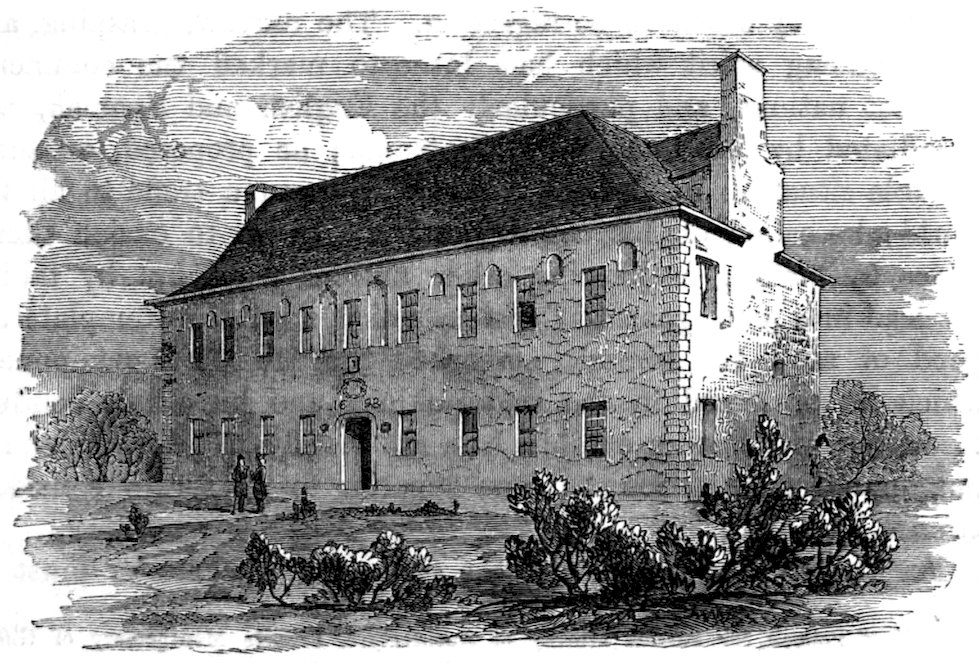
African Company’s House at Bristo Port, Edinburgh.
She proceeded to do so with a courage much to be admired. A handsome house for the conducting of the Company’s business was erected; schemes for trade with Greenland, with Archangel, with the Gold Coast, were considered; the qualities of goods, possible 124|1695.| improvements of machinery, the extent of the production of foreign wares, were all the subject of careful inquiry. Under the glow of a new national object, old grudges and antipathies were forgotten. William Paterson, indeed, had set the pattern of a non-sectarian feeling from the beginning, for, writing from London to the Lord Provost of Edinburgh in July 1695, we find him using this strain of language, hitherto unwonted in Scotland: ‘Above all, it is needful for us to make no distinction of parties in this great undertaking; but of whatever nation or religion a man be, he ought to be looked upon, if one of us, to be of the same interest and inclination. We must not act apart in anything, but in a firm and united body, and distinct from all other interests whatsoever.’
The design of Paterson presents such indications of a great, an original, and a liberal mind, as to make the obscurity which rests on his history much to be regretted. The narrow, grasping, and monopolising spirit which had hitherto marked the commerce of most nations, and particularly the English and Spanish, was repudiated by this remarkable Scotsman; he proposed, on some suitable situation in Central America, to open a trade to all the world; he called on his countrymen not to try to enrich themselves by making or keeping other nations poor, but by taking the lead in a more generous system which should contemplate the good of all. He himself embarked the few thousand pounds which he possessed in the undertaking, and his whole conduct throughout its history exhibits him not merely as a man of sound judgment and reflection, but one superior to all sordid considerations.
For the further progress of the Company, the reader must be 125|1695.| referred onward to July 1698, when the first expedition sailed from Leith.
Further to improve the system of correspondence throughout the kingdom, the parliament passed an act for establishing a General Post-office in Edinburgh, under a postmaster-general, who was to have the exclusive privilege of receiving and despatching letters, it being only allowed that carriers should undertake that business on lines where there was no regular post, and until such should be established. The rates were fixed at 2s. Scots for a single letter within fifty Scottish miles, and for greater distances in proportion. It was also ordained that there should be a weekly post to Ireland, by means of a packet at Portpatrick, the expense of which was to be charged on the Scottish office. By the same law, the postmaster-general and his deputies were to have posts, and furnish post-horses along all the chief roads ‘to all persons,’ ‘at 3s. Scots for ilk horse-hire for postage for every Scots mile,’ including the use of furniture and a guide.[149] It would appear that, on this footing, the Post-office in Scotland was not a gainful concern, for in 1698 Sir Robert Sinclair of Stevenston had a grant of the entire revenue, with a pension of £300 sterling per annum, under the obligation to keep up the posts, and after a little while gave up the charge, as finding it disadvantageous.[150]
It is to be observed that this post-system for Scotland was provided with but one centre—namely, the capital. Letters coming from London for Glasgow arrived in Edinburgh in the first place, and were thence despatched westwards at such times as might be convenient. At one time, the letters were detained twelve hours in Edinburgh before being despatched to Glasgow! It seems at present scarcely credible that, until the establishment of Palmer’s mail-coaches in 1788, the letters from London to Glasgow passed by this circuitous route, and not by a direct one, although the western city had by that time a population of fifty thousand, and was the seat of great commercial and manufacturing industry.
July.
Glasgow—which in 1556 stood eleventh in the roll of the Scottish burghs, contributing but £202, while Edinburgh afforded £2650—appears, in the list now made up for a monthly cess to defray the expenses of the war, as second, Edinburgh giving £3880; Glasgow, £1800; Aberdeen, £726; Dundee, 126|1695.| £560; Perth, £360; Kirkcaldy, £288, &c. ‘To account for this comparative superiority of the wealth of Glasgow at this time, I must take notice that since before the Restoration the inhabitants had been in possession of the sale of both refined and raw sugars for the greater part of Scotland; they had a privilege of distilling spirits from their molasses, free from all duty and excise; the herring-fishery was also carried on to what was, at that time, thought a considerable extent; they were the only people in Scotland who made soap; and they sent annually some hides, linen, &c., to Bristol, from whence they brought back, in return, a little tobacco—which they manufactured into snuff and otherwise—sugars, and goods of the manufacture of England, with which they supplied a considerable part of the whole kingdom.’—Gibson’s History of Glasgow, 1777.
It is probable that the population did not then exceed twelve thousand; yet the seeds of that wonderful system of industry, which now makes Glasgow so interesting a study to every liberal onlooker, were already sown, and, even before the extension of English mercantile privileges to Scotland at the Union, there was a face of business about the place—a preparation of power and aptitude for what was in time to come. This cannot be better illustrated than by a few entries in the Privy Council Record regarding the fresh industrial enterprises which were from time to time arising in the west.
December 21, 1699.—A copartnery, consisting of William Cochran of Ochiltree, John Alexander of Blackhouse, and Mr William Dunlop, Principal of the University of Glasgow, with Andrew Cathcart, James Colquhoun, Matthew Aitchison, Lawrence Dunwoodies, William Baxter, Robert Alexander, and Mungo Cochran, merchants of Glasgow, was prepared to set up a woollen manufactory there, designing to make ‘woollen stuffs of all sorts, such as damasks, half-silks, draughts, friezes, drogats, tartains, craips, capitations, russets, and all other stuffs for men and women’s apparel, either for summer or winter.’ Using the native wool, they expected to furnish goods equal to any imported, and ‘at as easie a rate;’ for which end they are ‘providing the ablest workmen, airtiests, from our neighbouring nations.’ They anticipated that by such means ‘a vast soum of ready money will be kept within the kingdom, which these years past has been exported, it being weel known that above ten thousand pound sterling in specie hath been exported from the southern and western parts of this kingdom to Ireland yearly for 127|1695.| such stuffs, and yearly entered in the custom-house books, besides what has been stolen in without entering.’
In the same year, John Adam, John Bryson, John Alexander, and Harry Smith, English traders, had brought home to Glasgow ‘English workmen skilled to work all hardware, such as pins, needles, scissors, scythes, tobacco-boxes, and English knives, for which a great quantity of money was yearly exported out of the kingdom.’ They designed so far to save this sending out of money by setting up a hardware-manufactory in Glasgow. On their petition, the Privy Council extended to their designed work the privileges and immunities provided by statute for manufactories set up in Scotland.
In the ensuing year, William Marshall, William Gray, John Kirkmyre, and William Donaldson, merchants in Glasgow, projected the setting up of a work there for making of ‘pins and needles,[151] boxes, shears, syshes, knives, and other hardware,’ whereby they expected to keep much money within the country, and give employment to ‘many poor and young boys, who are and have been in these hard and dear times a burden to the kingdom.’ To them likewise, on petition, were extended the privileges of a manufactory.
February, 1701.—Matthew and Daniel Campbell, merchants in Glasgow, designed to set up an additional sugar-work, and, in connection with it, a work ‘for distilling brandy and other spirits from all manner of grain of the growth of this kingdom.’ With this view, they had ‘conduced and engaged several foreigners and other persons eminently skilled in making of sugar and distilling of brandy, &c., whom, with great travel, charges, and expense, they had prevailed with to come to Glasgow.’ All this was in order that ‘the nation may be the more plentifully and easily provided with the said commodities, as good as any that have been in use to be imported from abroad,’ and because ‘the distillery will both be profitable for consumption of the product of the kingdom, and for trade for the coast of Guinea and America, seeing that no trade can be managed to the places foresaid, or the East Indies, without great quantities of the foresaid liquors.’
1695.
128On their petition, the privileges of a manufactory were granted to them.
In the progress of manufacturing enterprise in the west, an additional soap-work connected with a glass-work came to be thought of (February 1701). James Montgomery, younger, merchant in Glasgow, took into consideration ‘how that city and all the country in its neighbourhood, and further west, is furnished with glass bottles.’ The products of the works at Leith and Morison’s Haven ‘cannot be transported but with a vast charge and great hazard.’ He found, moreover, ‘ferns, a most useful material for that work, to be very plenty in that country.’ There was also, in the West Highlands, great abundance of wood-ashes, ‘which serve for little or no other use, and may be manufactured first into good white soap, which is nowhere made in the kingdom to perfection; and the remains of these wood-ashes, after the soap is made, is a most excellent material for making glass.’ He had, therefore, ‘since March last, been with great application and vast charge seeking out the best workmen in England,’ and making all other needful preparations for setting up such a work.
On his petition, the Council endowed his work with the privileges of a manufactory, ‘so as the petitioner and his partners may make soap and glass of all kinds not secluded by the Laird of Prestongrange and his act of parliament.’[152]
July 7.
The Bank of England, projected by the noted William Paterson, amidst and by favour of the difficulties of the public exchequer during King William’s expensive continental wars, may be said to have commenced its actual banking operations on the first day of this year. Considerable attention was drawn to the subject in London, and the establishment of a similar public bank in both Ireland and Scotland became matter of speculation. There was in London an almost retired merchant named John Holland, who thought hereafter of spending his time chiefly in rural retirement. To him came one day a friend, a native of Scotland, who was inspired with a strong desire to see a bank established in his country. He desired that Mr Holland would think of it. ‘Why,’ said the latter, ‘I have nearly withdrawn from all such projects, and think only of how I may spend the remainder of my days in peace.’ ‘Think of it,’ said his Scottish friend, ‘and if you will 129|1695.| enter into the scheme, I can assure you of having an act of our parliament for it on your own conditions.’
Mr Holland accordingly drew out a sketch of a plan for a bank in Scotland, which his friend, in a very few days thereafter, had transfused into a parliamentary bill of the Scottish form. He had also spoken, he said, to most of his countrymen of any mercantile importance in London to engage their favour for the scheme. Mr Holland was readily induced to lend his aid in further operations, and the project appears to have quickly come to a bearing, for, little more than six months from the opening of the Bank of England, the act for the Bank of Scotland had passed the native parliament.
In our country, as in England, exchanges and other monetary transactions, such as are now left to banking companies, had hitherto been solely in the hands of a few leading merchants; some such place as the back-shop of a draper in the High Street of Edinburgh, or an obscure counting-room in the Saltmarket of Glasgow, was all that we could shew as a bank before this period; and the business transacted, being proportioned to the narrow resources and puny industry of the country, was upon a scale miserably small. Yet there was now, as we have seen, an expansive tendency in Scotland, and the time seems to have arrived when at least a central establishment for the entire country might properly be tried in the capital.
While, unluckily, we do not know the name of the Scottish gentleman who propounded the scheme to Mr Holland, we are enabled, by the recital of the act, to ascertain who were the first patrons and nurses of the project generally. Of merchants in London, besides the English name of Mr Holland, we find those of Mr James Foulis,[153] Mr David Nairn, Mr Walter Stuart, Mr Hugh Frazer, Mr Thomas Coutts, and Mr Thomas Deans, who were all of them probably Scotsmen. Of Edinburgh merchants, there were Mr William Erskine, Sir John Swinton, Sir Robert Dickson, Mr George Clark, junior, and Mr John Watson. Glasgow was wholly unrepresented. These individuals were empowered by the act to receive subscriptions between the ensuing 1st of November and 1st of January. The whole scheme was modest, frugal, and prudential in a high degree. 130|1695.| It was contemplated that the Bank of Scotland should start with a subscribed capital of £1,200,000 Scots—that is, £100,000 sterling, in shares of £1000 Scots each; two-thirds to be subscribed by individuals residing in Scotland, and one-third by individuals residing in England, no person to hold more than two shares. The company was to be under the rule of a governor, deputy-governor, and twenty-four directors, of the last of whom twelve should be English, these being ‘thought better acquainted with the nature and management of a bank than those of Scotland.’ As a further encouragement to English assistance, the act ordained that any person subscribing for a part of the stock, should be considered as ipso facto naturalised.
The subscription of the £66,666, 13s. 4d. allowed to Scotland began at the appointed time, the Marquis of Tweeddale, his majesty’s commissioner to parliament, and his son, Lord Yester, being the first who put down their names. The subscription of the remaining £33,333, 6s. 8d. was effected in London in one day, the chief adventurers being Scotsmen resident there. The heads of the concern in Edinburgh felt themselves sadly ignorant of the arrangements required for a public bank, and deemed it absolutely necessary that Mr Holland should come down to advise and superintend their proceedings. He very generously agreed to do so, reside for some time in Edinburgh, and return upon his own charges; while they, as liberally, took care, by a rich present to his wife, that he should be no loser by the journey. He relates[154] that his proposals were all at first objected to and controverted by the Scotch managers, in consequence of their utter ignorance of banking, yet all in perfect good-humour, and manifestly from a pure desire to get at the expedients which were best; and all were ultimately agreed to. This occasioned a difficulty at starting, and to this was added no small amount of jealous opposition and distrust; nevertheless, Mr Holland remarks that, within two months, and even while the Bank of England was notoriously unable to pay its bills, those of the Scottish establishment had attained to a surprising degree of credit. It may here be remarked, that, ere long, by consent of the English proprietors, the whole twenty-four directors were elected from the Scottish shareholders, leaving thirteen English ones to act as trustees, ‘to manage what affairs the company 131|1695.| should have at London;’ and in time, when there were no longer so many as thirteen proprietors in England, even this arrangement was abandoned.
Several of the prominent Scottish shareholders were members of the African Company; but it appears that there was anything but a concert or good agreement between the two sets of projectors. Paterson regarded the Bank of Scotland as in some degree a rival to his scheme, and talked of the act appointing it as having been ‘surreptitiously gained.’ While so sanguine about the African Company, he thought the bank unlikely to prove a good thing to those concerned in it, little foreseeing that it would flourish for centuries after the Indian Company had sunk in its first calamitous venture.
The Bank of Scotland set up in a floor in the Parliament Close, with a moderate band of officials, and ten thousand pounds sterling of paid-up capital. It had scarcely started, when the African Company added a banking business to its other concerns, meaning thus to overpower the project of Mr Holland. That gentleman was in Edinburgh at the time. He saw that the African Company was in the highest vogue with the public, while few took any notice of his modest establishment. As governor, he prudently counselled that they should make no attempt to enforce the exclusive privilege which the statute had conferred upon them for twenty-one years, but to limit themselves to standing on their guard against ‘that mighty Company,’ lest it should try to injure or ‘affront’ them by a run upon their cash. For this reason, by his advice, twenty thousand pounds of the capital was called up, in addition to the ten thousand lodged at first. The smallness of these sums is amusing to men who know what banking in Scotland now is; yet it appears that from the first the Bank of Scotland had five, ten, twenty, fifty, and hundred pound notes. After a little while, it was found that banking did not succeed with the African Company, chiefly because they lent money in too large sums to their own shareholders, and the Bank of Scotland was then allowed to go on without any competition. The capital lately called up was then paid back, leaving the original sum of £10,000 alone in the hands of the bank.
The chief business of the bank at first was the lending of money on heritable bonds and other securities. The giving of bills of exchange—the great business of the private bankers—was, after deliberation at a general meeting of the ‘adventurers,’ tried, with a view to extending the usefulness of the concern as far as 132|1695.| possible. In pursuance of the same object, and ‘for carrying the circulation of their notes through the greatest part of the kingdom,’ branch-offices were erected at Glasgow, Dundee, Montrose, and Aberdeen, ‘with cashiers and overseers at each place, for receiving and paying money, in the form of inland exchange, by notes and bills made for that purpose.’ But, after what appeared a fair trial, the directors ‘found that the exchange trade was not proper for a banking company.’ A bank they conceived to be ‘chiefly designed as a common repository of the nation’s cash—a ready fund for affording credit and loans, and for making receipts and payments of money easy by the company’s notes.’ To deal in exchange was ‘to interfere with the trade and business of private merchants.’ The Bank of Scotland found it ‘very troublesome, unsafe, and improper.’ One reason cited some years afterwards, by a person connected with the bank, was—‘There is so much to be done in that business without doors, at all hours by day and night, with such variety of circumstances and conditions, as are inconsistent with the precise hours of a public office, and the rules and regulations of a well-governed company; and no company like the bank can be managed without fixing stated office-hours for business, and establishing rules and regulations which will never answer the management of the exchange trade.’ As for the branch-offices, the inland exchange contemplated there failed from another cause, strikingly significant of the small amount of commercial intercourse then existing between the capital and the provinces of Scotland. The bank, we are told, found it impracticable to support the four sub-offices ‘but at an expense far exceeding the advantage and conveniency rising therefrom; for, though the company would willingly have been at some moderate charge to keep them up, if they could thereby have effectuated an answerable circulation of bank-notes about these places, for accommodating the lieges in their affairs, yet they found that those offices did contribute to neither of those ends; for the money that was once lodged at any of those places by the cashiers issuing bills payable at Edinburgh, could not be redrawn thence by bills from Edinburgh‘—of course, because of there being so little owing in Edinburgh to persons residing in the provinces. So, after a considerable outlay in trying the branch-offices, the directors were obliged to give them up, and ‘bring back their money to Edinburgh by horse-carriage.’[155]
1695.
133The company’s business was thenceforward for many years ‘wholly restricted to lending money, which seems to be the only proper business of a bank, and all to be transacted at Edinburgh.’[156]
July 17.
The estates of Duncan Forbes of Culloden, in sundry parishes near Inverness, having been much wasted in 1689 and 1690, both by the ravages of the king’s enemies and the necessary sustentation of his troops, he now gave in a petition shewing that his damages had in all amounted to the sum of £47,400, 6s. 8d. Scots. The parliament recommended his case to the gracious consideration of his majesty,[157] and the result was a requital, not in money, but in the form of a perpetual privilege to the Laird of Culloden of distilling from the grain raised on his estate of Ferintosh, upon paying of only a small composition in lieu of excise.
The estate of Ferintosh consisted of about eighteen hundred arable acres,[158] and the produce of barley was so considerable that a very large quantity of whisky came to be produced within its bounds; Hugo Arnot says nearly as much as in all the rest of Scotland together—but Hugo, it must be admitted, is a remarkably unstatistical author. Whatever might be the exact truth, there was certainly a surprising quantity of usquebaugh issued forth from the domains of Forbes, insomuch that Ferintosh came to be that quasi synonym for whisky which ‘Kilbagie’ and ‘Glenlivet’ afterwards were in succession. The privilege of course yielded a large revenue to the family, and in time made ample compensation for all their patriotic sufferings past and potential. In 1784, when at length the government was inclined to purchase it back, there was such a demonstration made of its lucrativeness, that the capital sum of £21,500 assigned for it was thought to be but a poor equivalent.
The minister of Dingwall, in his account of the parish, written a few years after the abolition of the Ferintosh privilege, tells of a remarkable consequence of that measure. During the continuance of the privilege, quarrels and breaches of the peace were abundant among the inhabitants, yielding a good harvest of business to the procurators (i. e. solicitors) of Dingwall. When the privilege ceased, the people became more peaceable, and the prosperity of attorneyism in Dingwall sustained a marked abatement.
1695. May 16.
134It was not so subscribing a world at the close of the seventeenth century as it is now; yet, poor as our country then was, she kept her heart open for important public objects, and for works in which faith and charity were concerned.
There was no bridge over the Clyde between Bothwell Bridge and Little-gill Bridge, a space of eighteen miles. At Lanark, there was a ferry-boat; but the river was frequently impassable, and there were repeated instances of the whole passengers being swept down and engulfed in the Stonebyres Linn. Arrangements were now made, chiefly by a collection at all the church-doors in the kingdom, for building ‘a sufficient stone bridge’ at the foot of the Inch of Clydeholm—this charitable measure being rendered necessary by the poverty to which the burgh of Lanark had been reduced by spoliation during the late reign, ‘by exactions of fines, free quarters for soldiers, and the like.’
By order of parliament, a collection of money was made, in July 1695, in the parish churches of the kingdom, for the benefit of Andrew Watson, skipper, and eight mariners of his vessel, who, in a voyage from Port Glasgow to Madeira, on the 19th of November in the preceding year, in latitude 38 degrees, had been attacked by two Salee rovers, and by them carried as captives to Mamora, in Marocco. In their petition to parliament, they described themselves as resting in a slavery more cruel and barbarous than they could express, without the proper necessaries of life, and ‘above all, deprived of the precious gospel, which they too much slighted when they enjoyed it,’ with no prospect before them but to die in misery and torment, unless they have some speedy relief. The contributions were to be handed to John Spreul, merchant in Glasgow, he finding caution to apply them to their proper end.
1697. Apr. 15.
‘Those of the Scots nation residing at Konigsberg, in Prussia,’ petitioned the Privy Council by their deputy, Mr Francis Hay, for assistance in building a kirk for their use, for which they had obtained a liberty from the Duke of Brandenburg. A collection at all the church-doors in the kingdom was ordained for this purpose; and it is surprising with what sympathy the poor commons of Scotland would enter on a movement of this kind. We find that the little parish of Spott, in East Lothian, contributed nearly three pounds sterling towards the Konigsberg kirk.
At the ‘break of a storm’—by which is meant the melting of a great fall of snow—in November 1698, the southern streams were flooded, and the bridge of Ancrum was so broken and damaged that it could be no longer serviceable. This being the only bridge 135|1698.| upon the water of Teviot, on an important line of communication between the north and south in the centre of the Borders, and there being no ferry-boat on the river but one seven miles further up, it was most desirable that it should be rebuilt; but the calculated expense was betwixt eight and nine thousand merks (from £450 to £500 sterling), and an act of Council offering a pontage to any one who would undertake this business altogether failed of its object. In these circumstances, the only alternative was a collection at all the church-doors in the kingdom, and permission to make such a levy was accordingly granted by the Privy Council.
1695. Aug.
The vicissitudes of witchcraft jurisprudence in Scotland are remarkable. While Presbyterianism of the puritanic type reigned uncontrolled between 1640 and 1651, witches were tortured to confession and savagely burnt, in vast numbers, the clergy not merely concurring, but taking a lead in the proceedings. During the Cromwell ascendency, English squeamishness greatly impeded justice in this department, to the no small dissatisfaction of the more zealous. On the Restoration, the liberated energies of the native powers fell furiously on, and got the land in a year or two pretty well cleared of those vexatious old women who had been allowed to accumulate during the past decade. From 1662 to the Revolution, prosecutions for witchcraft were comparatively rare, and, however cruel the government might be towards its own opponents, it must be acknowledged to have introduced and acted consistently upon rules to some extent enlightened and humane with regard to witches—namely, that there should be no torture to extort confession, and no conviction without fair probation. I am not sure if the opposite party would not have ascribed it mainly to the latitudinarianism of Episcopacy, that the whole history of witchcraft, throughout the two last Stuart reigns, betrayed an appearance as if the authorities were not themselves clear for such prosecutions, and, in dictating them, only made a concession to the popular demands.
For a few years after the Revolution, the subject rested in the quiescence which had fallen upon it some years before. But at length the General Assembly began to see how necessary it was to look after witches and charmers, and some salutary admonitions about these offenders were from time to time issued. The office of Lord Advocate, or public prosecutor, had now fallen into the hands of Sir James Steuart of Goodtrees, a person who shared in the highest convictions of the religious party at present in power, 136|1695.| including reverence for the plain meaning of the text, ‘Thou shalt not suffer a witch to live.’ The consequence was, that the reign of William III. became a new Witch Period in Scotland, and one involving many notable cases.
Aug. 8.
In August 1695, two married women, named M‘Rorie and M‘Quicken, residing respectively at the Mill-burn and Castlehill of Inverness, were in the Tolbooth of that northern burgh, under a suspicion of being witches; and the Privy Council, seeing the inconvenience of having them brought to an inquest in Edinburgh, issued a commission for their being tried on the spot by David Polson of Kinmilnes, sheriff-depute of Inverness; William Baillie, commissar there; Alexander Chisholm, bailie to Lord Lovat; Duncan Forbes of Culloden; —— Cuthbert of Castlehill; and —— Duff, provost of Inverness, any three of them to be a quorum. The arrangements for the trial were all carefully specified in this commission; and it was intimated in the end that, ‘in case the said judges shall find the said panels guilty of the said horrid crime laid to their charge,’ the commissioners should adjudge them ‘to be burned or otherwise execute to death.’
In March 1696, a commission was issued in similar terms for the trial of ‘Janet Widdrow, in the parish of Kilmacolm, presently prisoner in the Tolbooth of Paisley, alleged guilty of the horrid crime of witchcraft.’ Two months later, the Lord Advocate applied to the Council for an extension of power to the commission against Janet Widdrow, as ‘it is now informed that the said Janet doth fyle and put out several others, and as there are some persons in these bounds against whom there are probable and pregnant grounds of suspicion.’ The request was complied with.
Some months later (December 3, 1696), we hear of some informalities in the process against Janet Widdrow and Isobel Cochrane, and the Lord Advocate was requested to report on the matter.[159]
So much for the present; but let the reader see onward under February 1697, March 1, 1698, &c.
Aug.
It is remarked by a Presbyterian historian of the popular class, that the time of the ‘Persecution’ was one of general abundance. God, he believed, did not choose to let his people suffer in more ways than one. But, not long after King William had brought days of religious security, the seasons began to be bad, and much physical suffering ensued. According to this historian, Alexander 137|1695.| Peden foretold how it would be. ‘As long,’ said he, ‘as the lads are upon the hills, you will have bannocks o’er night; but if once you were beneath the bield of the brae, you will have clean teeth and many a black and pale face in Scotland.’[160]
Nevertheless, the country was so much at its ease in the matter of food in July 1695, that the Estates then passed an act for encouraging the export of grain, allowing it to go out duty free, and ordaining that so it should be whenever wheat was at or under twelve pounds (Scots) the boll; bear, barley, and malt under eight; pease and oats, under six; provided these grains should be carried in Scottish ships.
By an act passed in 1672, it was forbidden to import meal from Ireland while the price in Scotland remained below a certain rate. And that this was a serious matter, is proved by an order of Council in April 1695, for staving the grain brought from Carrickfergus in two vessels, named the James and the Isobel, and for handing over the vessels themselves to Sir Duncan Campbell of Auchinbreck, who had seized them on their way to a Scottish port. It never occurred to a legislator of those days that there was a kind of absurdity, as well as a glaring selfishness, in arranging for his own country receiving while it should not give.
As if to rebuke such policy, the very month after good food prospects had induced the Scottish Estates to permit of exportation, the crop was stricken in one night by an easterly fog, and ‘got little more good of the ground.’[161] The corn was both bad and dear. So early as November, this produced a disorder of the cholera type, accompanied by severe fevers: ‘all our old physicians had never seen the like, and could make no help.’ It was not in all cases the direct result of bad unwholesome victual, for several, who used old corn, or sent to Glasgow for Irish meal, were nevertheless smitten with the prevailing malady, ‘in a more violent and infectious manner than the poorest in the land.’[162]
The price of victual having, in the western shires, ascended beyond the importation rate fixed in 1672, the Privy Council (December 13), ‘in consideration of the present scarcity in those parts, and the distress ensuing upon it,’ gave allowance for the importation of meal, ‘but of no other grain,’ from Ireland, to ‘any port between the mouth of Annan and the head of Kintyre,’ between this date and the 1st of February exclusive.
1695.
138A few days later, the Council took measures for fining certain baxters of Glasgow and others who had imported grain before the issue of the above licence.
On the 7th of February 1696, the Council extended the period during which Irish meal might be imported to the 15th of April, seeing that the price of the article in the western shires still continued above that set down in the act of 1672. On the 25th of February, the period was farther extended to the 15th of May.
In June, the evil having become more serious, the whole ports of the kingdom were opened to foreign grain, while the usual denunciations were launched against persons keeping up victual in girnels and stacks. |1696. Aug.| Now the summer was passing into autumn, and the weather was of such a character, or, as the Privy Council expressed it, the season was so ‘unnatural,’ ‘as doth sadly threaten the misgiving and blasting of the present crop, to the increase of that distress whereby the kingdom is already afflicted.’ For these reasons, at the request of the church, a fast was proclaimed for the 25th of August in churches south of the Tay, and on the 8th of September in ‘all the planted churches of the rest of this kingdom.’
Viewing the ‘pinching straits and wants’ of the poor at this crisis, and the demands which these make upon Christian charity and compassion, the Council recommended that on the day of the fast, and the Lord’s Day thereafter, there should be a ‘cheerful and liberal contribution’ at the church-doors for the indigent, ‘as the best and most answerable expression of earnestness in the aforesaid duty.’ Another edict held out a bounty of one pound Scots for every boll of foreign victual imported.[163]
Some Englishmen having brought a parcel of corn to the market of Kelso, William Kerr of Chatto’s servants exacted from them a custom he had a right to from all victual there sold—this right being one of which his family had been ‘in immemorial possession.’ The Englishmen resisted the exaction with scorn and violence, and Chatto was obliged to appeal for protection of his right to the Privy Council. Such, however, was at that time the need for foreign grain, that the Council suspended Chatto’s right for the next three months.
July 30.
Some gentlemen in Edinburgh received information from their correspondents in Aberdeenshire, that that county and the one next adjacent were nearly destitute of victual, and that ‘if they be 139|1696.| not speedily supplied, and victual transported [thither], a good part of that and the next county will undoubtedly starve.’ Already, within the last fortnight, several had died from want. In these circumstances, George Fergusson, bailie of Old Meldrum, and Alexander Smith, writer in Edinburgh, proposed to purchase a thousand or twelve hundred bolls of corn and bear in the north of England, and have it carried by sea to Aberdeen, there to sell it at any rate the proper authorities might appoint above the cost and the expense of carriage, and the surplus to be used for any suitable public object, the proposers having no desire of profit for themselves, ‘but allenarly the keeping of the poor in the said shire from starving.’ They were anxious, however, to be protected from the risk of losing their outlay, in case the vessel should be taken by the French privateers, and they petitioned the Privy Council accordingly. Their wishes were recommended to the consideration of the Lords of the Treasury.
It was reported from Roxburghshire, on the 22d December 1696, that, in consequence of the ‘great frosts, excessive rains, and storms of snow,’ the corns in many places ‘are neither cut down nor led in, nor is the samen ripened nor fit for any use, albeit it were cut down and led in.’ The boll of meal was already at twenty-four pounds Scots, and bear, wheat, and rye at fourteen or fifteen pounds per boll. Already many poor people and honest householders were ‘reduced to pinching straits and want,’ and still more extreme scarcity was to be expected.
In these circumstances, the Lords of the Privy Council granted permission to Thomas Porteous, late provost, and Robert Ainslie, late bailie in Jedburgh, to import victual from England without duty, overland. If any of the said victual should be imported by sea, it would be confiscated for the use of the poor, ‘unless it can be made appear that the victual imported by sea was bought and paid for by the product of this kingdom, and not by transporting money out of the kingdom for the same.’[164]
1695. Nov. 22.
The Feast of St Cecilia was celebrated in Edinburgh with a concert of vocal and instrumental music, shewing a more advanced state of the art than might have been expected.[165] The scheme of the performances exhibits a series of pieces by Italian masters, as 140|1695.| Corelli and Bassani, to be executed by first and second violins, flutes and hautbois, and basses; the opening piece giving seven first violins, five second violins, six flutes and two hautbois. There were thirty performers in all, nineteen of them gentlemen-amateurs, and eleven teachers of music. Among the former were Lord Colville, Sir John Pringle, Mr Seton of Pitmedden, Mr Falconer of Phesdo, Mr John (afterwards General) Middleton, Lord Elcho, and Mr John Corse, keeper of the Low Parliament House Records. Some of these gentlemen are described as having been skilled in music, and good players on the violin, harpsichord, flute, and hautbois. Among the professional men were Henry Crumbden, a German, ‘long the Orpheus in the music-school of Edinburgh;’ Matthew M‘Gibbon, father of William M‘Gibbon, noted for his sets of Scots airs with variations and basses; Adam Craig, a good orchestra-player on the violin; Daniel Thomson, one of the king’s trumpets; and William Thomson, a boy, son of the above, afterwards editor of a well-known collection (being the first) of Scots songs, with the music.[166]
See under 1718 for further notices of the rise and progress of music in Scotland.
Nov.
In this age, every person of any note who died became the subject of a metrical elegy, which was printed on a broadside, and cried through the streets. Allan Ramsay, a few years later, makes satiric allusion to the practice:
None of all the rhyming herd
Are more encouraged and revered,
By heavy souls to theirs allied,
Than such who tell who lately died.
No sooner is the spirit flown
From its clay cage to lands unknown,
Than some rash hackney gets his name,
And through the town laments the same.
An honest burgess cannot die,
But they must weep in elegy:
Even when the virtuous soul is soaring
Through middle air, he hears it roaring.[167]
The poetry of these mortuary verses is usually as bad as the typography, and that is saying a great deal; yet now and then 141|1695.| one falls in with a quaint couplet or two—as, for example, in the piece:
ON THE MUCH TO BE LAMENTED DEATH OF WORTHY UMPHREY MILNE, WATCHMAKER, BURGESS OF THE METROPOLITAN CITY OF SCOTLAND, WHO DEPARTED THIS LIFE, NOVEMBER THE 18TH, 1695.
In gloomy shades of darksome night, where Phœbus hides his head,
I heard an echo cry aloud, that Umphrey Milne was dead.
My stupid senses rose aloft and wakened with a cry,
Let Pegasus, the Muses’ horse, go through the air and fly,
To tell the ends of all the earth that he has lost his breath—
· · · · ·
I will not name his parentage, his breeding, nor his birth;
But he that runs may read his life—he was a man of worth.
He valued not this earth below, although he had it satis,
He loved to lay his stock above, and now he is beatus.
· · · · ·
Since none can well describe his worth that in this land doth dwell,
He’ll waken at the trumpet’s blow, and answer for himsell.
The street elegists got a capital subject in July 1700, when Lady Elcho died in youth and beauty, in consequence of her clothes catching fire.[168] Of her it is said:
Were it the custom now to canonise,
We might her in the Alb of Saints comprise.
She either was as free from faults as they,
Or had she faults, the flame purged these away.
As to her ladyship’s surviving husband:
Only well-grounded hopes of her blest state
Can his excessive agonies abate,
And the two hopeful boys she left behind,
May mitigate the sorrows of his mind.
Dec. 13.
The dies and punches required for the new coinage now about to be issued, were the work of James Clarke, being the first time the work had ever been executed within the kingdom. James had done the whole business in less than a year, ‘which used to take no less than two or three years when executed in England, and cost the general and master of the Mint great attendance and much expenses;’ but as yet ‘he had not received one farthing for his work,’ although it had been agreed that he should have a half of his charges beforehand. The Privy Council, on his petition, 142|1695.| recommended the Treasury to pay him two hundred pounds sterling, being the sum agreed upon.[169]
Dec.
In Scotland, justice had at this time, as heretofore, a geographical character. It did not answer for a Highlander to be tried too near the lands of his feudal enemies. If, on the other hand, he was to be tried in Edinburgh, his accusers were likely to find the distance inconveniently great, and prefer letting him go free.
James Macpherson of Invernahaven was under citation to appear before the Lords of Justiciary at Inverness, on a charge of having despoiled John Grant of Conygass of certain oxen, sheep, and other goods in June or July 1689, ‘when Dundee was in the hills.’ The Laird of Grant being sheriff of Inverness, and other Grants engaged in the intended trial, Macpherson, though protesting his entire innocence, professed to have no hope of ‘impartial justice;’ yet he appeared at the citation, and was immediately committed close prisoner to the Tolbooth of Inverness, where he was denied the use of pen and ink, and the access of his friends, so that he ‘expected nothing but a summary execution.’
On his petition, the Privy Council ordained (December 10) that he should be liberated under caution, and allowed to undergo a trial before the Court of Justiciary in Edinburgh. He accordingly presented himself before the Lords on the last day of the year, and was committed to the Tolbooth of Edinburgh. On the 28th of January, he petitioned for entire liberation, as Grant of Conygass failed to appear to urge the prosecution; and, with the concurrence of the Laird of Grant, a member of the Privy Council, this petition was complied with.[170]
Not content with the proper Physic Garden assigned to him at the end of the North Loch,[171] James Sutherland had, in February last, extended his operations to ‘the north yard of the Abbey where the great Dial stands, and which is near to the Tennis Court.’ Under encouragement from the Lords of the Treasury, he had been active in levelling and dressing the ground. He ‘had there this summer a good crop of melons;’ he had ‘raised many other curious annuals, fine flowers, and other plants not ordinary in this country.’ He entertained no doubt of being 143|1695.| able in a few years ‘to have things in as good order as they are about London,’ if supplied with such moderate means as were required to defray charges and make the needful improvements, ‘particularly reed-hedges to divide, shelter, and lay the ground lown and warm, and a greenhouse and a store to preserve oranges, lemons, myrtles, with other tender greens, and fine exotic plants in winter.’
Fifty pounds sterling had been assigned to Sutherland out of the vacant stipends of Tarbat and Fearn in Ross-shire; but of this only about a half had been forthcoming, and he had expended of his own funds upwards of a thousand pounds Scots (£83, 13s. 4d. sterling). He entreated the Lords of the Privy Council to grant reimbursement and further encouragement, ‘without which the work must cease, and the petitioner suffer in reputation and interest, what he is doing being more for the honour of the nation, the ornament and use of his majesty’s palace, than his own private behoof.’
The Council recommended the matter to the Lords of the Treasury.[172]
1696. Jan. 14.
Margaret Balfour, Lady Rollo, had brought her husband relief from a burden of forty thousand merks resting on his estate, being a debt owing to her father; and without this relief he could not have enjoyed the family property. She had, according to her own account, endeavoured to live with him as a dutiful and loving wife, and they had children grown up; yet he had been led into a base course of life with a female named Isobel Kininmont, and in October last he had deserted his family, and gone abroad. The lady now petitioned the Privy Council for aliment to herself and her six children. The estate, she said, being eight thousand merks per annum (£444, 8s. 10d.⅔), she conceived that four thousand was the least that could be modified for her behalf, along with the mansion of Duncrub, which had been assigned to her as her jointure-house.
The Lords of the Council ordained that Lord Rollo should be cited for a particular day, and that for the time past, and till that day, the tenants should pay her ladyship a thousand pounds Scots, she meanwhile enjoying the use of Duncrub House. Lord Rollo, failing to appear on the day cited, was declared rebel, and the lady’s petition was at the same time complied with in its whole extent.[173]
1696. Jan.
144William Murray, tavern-keeper in the Canongate, was again a prisoner on account of an offensive news-letter. He had suffered close imprisonment for twenty-one weeks, till ‘his health is so far decayed, that, if he were any longer where he is, the recovery thereof will be absolutely desperate.’ His house having been shut up by the magistrates, his liquors and furniture were spoiled, and ‘his poor wife and family exposed to the greatest extremity and hazard of being starved for cold and hunger in this season of the year.’ He represented to the Privy Council that he was willing to be tried for any crime that could be laid to his charge. ‘Ane Englishman’s directing,’ however, ‘of ane news-letter to him was neither a crime nor any fault of his.... In case there was anything unwarrantable in the letter, the postmaster was obliged in duty to have suppressed the same, after he had read and perused it.’ His having, on the contrary, delivered it, ‘after he had read and perused it,’ was ‘sufficient to put him in bonâ fide to believe that the letter might thereafter be made patent.’
Murray went on to say that ‘this summar usage of himself and his poor family, being far above the greatest severity that ever was inflicted by their Lordships or any sovereign court of the nation, must be conceived to be illegal, arbitrary, and unwarrantable, and contrair both to the claim of right and established laws and inviolable practice of the nation.’
The Council did so far grant grace to Murray as to order him out of jail, but to be banished from Lothian, with certification that, if found in those bounds after ten days, he should be taken off to the plantations.[174]
Jan. 16.
The imbecile Laird of Drum was recently dead, and the lady who had intruded herself into the position of his wife—Marjory Forbes by name—professed a strong conviction that she would ere long become the mother of an heir to the estate. For this consummation, however, it was necessary that she should have fair-play, and this she was not likely to get. Alexander Irvine of Murtle, heir of tailzie to the estate in default of issue of the late laird, had equally strong convictions regarding the hopes which Lady Drum asserted herself to entertain. He deemed himself entitled to take immediate possession of the castle, while Marjory, on her part, was resolved to remain there till her 145|1696.| expected accouchement. Here arose a fine case of contending views regarding a goodly succession, worthy to be worked out in the best style of the country and the time.
Marjory duly applied to the Privy Council with a representation of her circumstances, and of the savage dealings of Murtle. When her condition and hopes were first spoken of some months ago, ‘Alexander Irvine, pretended heir of tailzie to the estate of Drum’—so she designated him—‘used all methods in his power to occasion her abortion, particularly by such representations to the Privy Council as no woman of spirit, in her condition, could safely bear.’ When her husband died, and while his corpse lay in the house, Murtle ‘convocat a band of armed men to the number of twenty or thirty, with swords, guns, spears, fore-hammers, axes, and others, and under silence of night did barbarously assault the house of Drum, scaled the walls, broke up the gates and doors, teared off the locks, and so far possessed themselves of all the rooms, that the lady is confined in a most miserable condition in a remote, obscure, narrow corner, and no access allowed to her but at ane indecent and most inconvenient back-entry, not only in hazard of abortion, but under fear of being murdered by the said outrageous band of men, who carouse and roar night and day to her great disturbance.’
The lady petitioned that she should be left unmolested till it should appear in March next whether she was to bring forth an heir; and the Lords gave orders to that effect. Soon after, on hearing representations from both parties, four ladies—namely, the spouses of Alexander Walker and John Watson of Aberdeen, on Murtle’s part, and the wife of Count Leslie of Balquhain and the Lady Pitfoddels, on Lady Drum’s part—were appointed to reside with her ladyship till her delivery, Murtle meanwhile keeping away from the house.[175]
If I am to believe Mr Burke, Marjory proved to have been under a fond illusion, and as even a woman’s tenacity must sometimes give way, especially before decrees of law, I fear that Murtle would have her drummed out of that fine old Aberdeenshire château on the ensuing 1st of April.
Sir Robert Grierson of Lagg, the notable ‘persecutor,’ who had been not a little persecuted himself after the Revolution as a person dangerous to the new government, was now in trouble on 146|1696.| a different score. He was accused of the crimes of ‘clipping of good money and coining of false money, and vending the samen when clipped and coined,’ inferring the forfeiture of life, land, and goods.
It appears that Sir Robert had let his house of Rockhill to a person named John Shochon, who represented himself as a gunsmith speculating in new modes of casting lead shot and stamping of cloth. A cloth-stamping work he had actually established at Rockhill, and he kept there also many engraving tools which he had occasion to use in the course of his business. But a suspicion of clipping and coining having arisen, a search was made in the house, and though no false or clipped coin was found, the king’s advocate deemed it proper to prosecute both Shochon and his landlord on the above charge.
June 22.
The two cases were brought forward separately at the Court of Justiciary, and gave rise to protracted proceedings; but the result was, that Sir Robert and Shochon appeared to have been denounced by enemies who, from ignorance, were unable to understand the real character of their operations, and the prosecution broke down before any assize had been called.[176]
Shochon was residing in Edinburgh in 1700, and then petitioned parliament for encouragement to a manufactory of arras, according to a new method invented by him, ‘the ground whereof is linen, and the pictures thereof woollen, of all sorts of curious colours, figures, and pictures.’[177]
‘Lagg’—who had drowned religious women at stakes on the sands of Wigton—had the fortune to survive to a comparatively civilised age. He died in very advanced life, at Dumfries, about the close of 1733.
Apr. 10.
Some printed copies of certain ‘popish books’—namely, The Exposition of the True Doctrine of the Catholic Church in Matters of Controversy, An Answer to M. Dereden’s Funeral of the Mass, and The Question of Questions, which is, Who ought to be our Judges in all Differences in Religion?—having been seized upon in a private house in Edinburgh, and carried to the lodging of Sir Robert Chiesley, lord provost of the city, the Privy Council authorised Sir Robert ‘to cause burn the said books in the back-close of the town council by the hand of the common executioner, until they be consumed to ashes.’
1696.
147Six months later, the Privy Council ordered a search of the booksellers’ shops in Edinburgh for books ‘atheistical, erroneous, profane, or vicious.’
We find the cause of this order in the fact, that John Fraser, book-keeper to Alexander Innes, factor, was before the Council on a charge from the Lord Advocate of having had the boldness, some day in the three preceding months, ‘to deny, impugn, argue, or reason against the being of a God;’ also he had denied the immortality of the soul, and the existence of a devil, and ridiculed the divine authority of the Scriptures, ‘affirming they were only made to frighten folks and keep them in order.’