REIGN OF WILLIAM III.: 1695–1702. (continued 4)
Reading edition
Dr Pitcairn, knowing well the kind of men he had to deal with, made no attempt at defence; neither did he utter any complaint as to the violation of his private correspondence. He pleaded that he had written in his cups with no evil design against the government, and threw himself entirely on the mercy of the Council. His submission was accepted, and he got off with a reprimand from the Lord Chancellor, after giving bond with his friend Sir Archibald Stevenson, under two hundred pounds sterling, to live peaceably under the government, and consult and contrive nothing against it.[263]
Feb. 3.
This is the date of a conflagration in Edinburgh, which made a great impression at the time, and was long remembered. It 226|1700.| broke out in one of the densest parts of the city, in a building between the Cowgate and Parliament Close, about ten o’clock of a Saturday night. Here, in those days, lived men of no small importance. We are told that the fire commenced in a closet of the house of Mr John Buchan, being that below the residence of Lord Crossrig, one of the judges. Part of his lordship’s family was in bed, and he was himself retiring, when the alarm was given, and he and his family were obliged to escape without their clothes. ‘Crossrig, naked, with a child under his oxter [armpit], happing for his life,’ is cited as one of the sad sights of the night. ‘When people were sent into his closet to help out with his cabinet and papers, the smoke was so thick that they only got out a small cabinet with great difficulty. Albeit his papers were lying about the floor, or hung about the walls of his closet in pocks, yet they durst not stay to gather them up or take them ... so that that cabinet, and his servant [clerk]‘s lettron [desk], which stood near the door of the lodging, with some few other things, was all that was saved, and the rest, even to his lordship’s wearing-clothes, were burnt.’[264] According to an eye-witness, the fire continued to burn all night and till ten o’clock on Sunday morning, ‘with the greatest frayor and vehemency that ever I saw a fire do, notwithstanding that I saw London burn.’[265] ‘The flames were so terrible, that none durst come near to quench it. It was a very great wind, which blew to such a degree, that, with the sparks that came from the fire, there was nothing to be seen through the whole city, but as it had been showers of sparks, like showers of snow, they were so thick.’[266]
‘There are burnt, by the easiest computation, between three and four hundred families; the pride of Edinburgh is sunk; from the Cowgate to the High Street, all is burnt, and hardly one stone left upon another. The Commissioner, the President of Parliament, the President of the Court of Session [Sir Hugh Dalrymple], the Bank [of Scotland], most of the lords, lawyers, and clerks were burnt, besides many poor families. The Parliament House very nearly [narrowly] escaped; all registers confounded [the public registers being kept there]; clerks’ chambers and processes in such a confusion, that the lords and officers of state are just now met in Ross’s tavern, in order to adjourn the session 227|1700.| by reason of the disorder. Few people are lost, if any at all; but there was neither heart nor hand left among them for saving from the fire, nor a drop of water in the cisterns. Twenty thousand hands flitting [removing] their trash, they knew not where, and hardly twenty at work. Many rueful spectacles, &c.’[267]
The Town Council recorded their sense of this calamity as a ‘fearful rebuke of God,’ and the Rev. Mr Willison of Dundee did not omit to improve the occasion. ‘In Edinburgh,’ says he, ‘where Sabbath-breaking very much abounded, the fairest and stateliest of its buildings, in the Parliament Close and about it (to which scarce any in Britain were comparable), were on the fourth of February (being the Lord’s Day), burnt down and laid in ashes and ruins in the space of a few hours, to the astonishment and terror of the sorrowful inhabitants, whereof I myself was an eye-witness. So great was the terror and confusion of that Lord’s Day, that the people of the city were in no case to attend any sermon or public worship upon it, though there was a great number of worthy ministers convened in the place (beside the reverend ministers of the city) ready to have prayed with or preached to the people on that sad occasion, for the General Assembly was sitting there at the time. However, the Lord himself, by that silent Sabbath, did loudly preach to all the inhabitants of the city,’ &c.[268]
Some of the houses burnt on this occasion, forming part of the Parliament Square, were of the extraordinary altitude of fourteen stories, six or seven of which, however, were below the level of the ground on the north side. These had been built about twenty years before by Thomas Robertson, brewer, a thriving citizen, who is described in his epitaph in the Greyfriars’ churchyard as ‘remarkable for piety towards God, loyalty towards his prince, love to his country, and civility towards all persons;’ while he was also, by these structures, ‘urbis exornator, si non conditor.’[269] But Robertson, as youngest bailie, had given the Covenant out of his hand to be burnt at the Cross in 1661; and ‘now God in his providence hath sent a burning among his lands, so that that which was eleven years a-building, was not six hours of burning. Notwithstanding this, he was a good man, and lamented to his death the burning of the Covenant; he was also very helpful to the Lord’s prisoners during the late persecution.’[270]
1700.
228There being no insurance against fire in those days, the heirs of Robertson were reduced from comparative affluence to poverty, and the head of the family was glad to accept the situation of a captain in the city guard, and at last was made a pensioner upon the city’s charge.[271]
Amongst the burnt out has been mentioned the Bank of Scotland. ‘The directors and others concerned did with great care and diligence carry off all the cash, bank-notes, books, and papers in the office; being assisted by a party of soldiers brought from the Castle by the Earl of Leven, then governor thereof, and governor of the bank, who, with the Lord Ruthven, then a director, stood all the night directing and supporting the soldiers, in keeping the stair and passage from being overcrowded. But the Company lost their lodging and whole furniture in it.’[272]
Lord Crossrig, who suffered so much by this fire, tells us in his Diary, that in the late evil times—that is, before the Revolution—he had been a member of a society that met every Monday afternoon ‘for prayer and conference.’ Since their deliverance, such societies had gone out of fashion, and profanity went on increasing till it came to a great height. Hearing that there were societies setting up in England ‘for reformation of manners,’ and falling in with a book that gave an account of them, he bethought him how desirable it was that something of the sort should be attempted in Edinburgh, and spoke to several friends on the subject. There was, consequently, a meeting at his house in November 1699, at which were present Mr Francis Grant (subsequently Lord Cullen); Mr Matthew Sinclair; Mr William Brodie, advocate; Mr Alexander Dundas, physician, and some other persons, who then determined to form themselves into such a society, under sanction of some of the clergy. The schedule of rules for this fraternity was signed on the night when the fire happened.
‘This,’ says Crossrig, ‘is a thing I remark as notable, which presently was a rebuke to some of us for some fault in our solemn engagement there, and probably Satan blew that coal to witness his indignation at a society designedly entered into in opposition to the Kingdom of Darkness, and in hopes that such an occurrence should dash our society in its infancy, and discourage us to proceed therein. However, blessed be our God, all who then met have continued steadfast ever since ... and we have had many meetings since that time, even during the three months 229|1700.| that I lived at the Earl of Winton’s lodging in the Canongate.... Likeas, there are several other societies of the same nature set up in this city.’[273]
Feb.
The burning out of the Bank of Scotland was not more than twenty days past, when a trouble of a different kind fell upon it. ‘One Thomas M‘Gie, who was bred a scholar, but poor, of a good genius and ready wit, of an aspiring temper, and desirous to make an appearance in the world, but wanting a fund convenient for his purpose, was tempted to try his hand upon bank-notes. At this time all the five kinds of notes—namely, £100, £50, £20, £10, and £5—were engraven in one and the same character. He, by artful razing, altered the word five in the five-pound note, and made it fifty. But good providence discovered the villainy before he had done any great damage, by means of the check-book and a record kept in the office; and the rogue was forced to fly abroad. The check-book and record are so excellently adapted to one another, and well contrived; and the keeping them right, and applying thereof, is so easy, that no forgery or falsehood of notes can be imposed upon the bank for any sum of moment, before it is discovered. After discovering this cheat of M‘Gie, the company caused engrave new copper-plates for all their notes, each of a different character, adding several other checks; so that it is not in the power of man to renew M‘Gie’s villainy.’[274]
Feb.
The glass-work at Leith made a great complaint regarding the ruinous practice pursued by the work at Newcastle, of sending great quantities of their goods into Scotland. The English makers had lately landed at Montrose no less than two thousand six hundred dozen of bottles, ‘which will overstock the whole country with the commodity.’ On their petition, the Lords of the Privy Council empowered the Leith Glass Company to send out officers to seize any such English bottles and bring them in for his majesty’s use.[275]
Mar. 14.
The ill-reputed governments of the last two reigns put down unlicensed worship among the Presbyterians, on the ground that the conventicles were schools of disaffection. The present government acted upon precisely the same principle, in crushing attempts at the establishment of Episcopal meeting-houses. The 230|1700.| commission of the General Assembly at this time represented to the Privy Council that the parishes of Eyemouth, Ayton, and Coldingham[276] were ‘very much disturbed by the setting up of Episcopal meeting-houses, whereby the people are withdrawn from their duty to his majesty, and all good order of the church violat.’ On the petition of the presbytery of Chirnside, backed by the Assembly Commission, the Privy Council ordained that the sheriff shut up all these meeting-houses, and recommended the Lord Advocate to ‘prosecute the pretended ministers preaching at the said meeting-houses, not qualified according to law, and thereby not having the protection of the government.’[277]
This policy seems to have been effectual for its object, for in the statistical account of Coldingham, drawn up near the close of the eighteenth century, the minister reports that there were no Episcopalians in his parish. It is but one of many facts which might be adduced in opposition to the popular doctrine, that persecution is powerless against religious conviction.
Notwithstanding the many serious and the many calamitous things affecting Scotland, there was an under-current of pleasantries and jocularities, of which we are here and there fortunate enough to get a glimpse. For example—in Aberdeen, near the gate of the mansion of the Earl of Errol, there looms out upon our view a little cozy tavern, kept by one Peter Butter, much frequented of students in Marischal College and the dependents of the magnate here named. The former called it the Collegium Butterense, as affecting to consider it a sort of university supplementary to, and necessary for the completion of, the daylight one which their friends understood them to be attending. Here drinking was study, and proficiency therein gave the title to degrees. Even for admission, there was a theme required, which consisted in drinking a particular glass to every friend and acquaintance one had in the world, with one more. Without these possibly thirty-nine or more articles being duly and unreservedly swallowed, the candidate was relentlessly excluded. On being accepted, a wreath was conferred, and Master James Hay, by virtue of the authority 231|1700.| resting in him under the rules of the foundation, addressed the neophyte:
Potestatem do tibique
Compotandi bibendique,
Ac summa pocula implendi,
Et haustus exhauriendi,
Cujusve sint capacitatis,
E rotundis aut quadratis.
In signum ut manumittaris,
Adornet caput hic galerus,
Quod tibi felix sit faustumque,
Obnixe comprecor multumque.
There were theses, too, on suitably convivial ideas—as, for example:
’Gainst any man of sense,
Asserimus ex pacto,
Upon his own expense,
Quod vere datur ens
Potabile de facto....
If you expect degrees,
Drink off your cup and fill,
We’re not for what you please:
Our absolute decrees
Admit of no free-will....
The longer we do sit,
The more we hate all quarrels,
(Let none his quarters flit),
The more we do admit
Of vacuum in barrels. &c.
Or else:
For to find out a parallaxis
We’ll not our minds apply,
Save what a toast in Corbreed[278] makes us;
Whether the moon moves on her axis,
Ask Black and Gregory.[279]
That bodies are à parte rei,
To hold we think it meetest;
Some cold, some hot, some moist, some dry,
Though all of them ye taste and try,
The fluid is the sweetest.
232Post sextam semi hora
At night, no friend refuses
To come lavare ora;
Est melior quam Aurorâ,
And fitter for the Muses, &c.
1700.
A diploma conferred upon George Durward, doubtless not without very grave consideration of his pretensions to the honour, is couched in much the same strain as the theses:
To all and sundry who shall see this,
Whate’er his station or degree is,
We, Masters of the Buttery College,
Send greeting, and to give them knowledge,
That George Durward, præsentium lator,
Did study at our Alma Mater
Some years, and hated foolish projects,
But stiffly studied liquid logics;
And now he’s as well skilled in liquor
As any one that blaws a bicker;
For he can make our college theme
A syllogism or enthymeme....
Since now we have him manumitted,
In arts and sciences well fitted,
To recommend him we incline
To all besouth and north the line,
To black and white, though they live as far
As Cape Good-Hope and Madagascar,
Him to advance, because he is
Juvenis bonæ indolis, &c.
We have, however, no specimen of the wit of this fluid university that strikes us as equal to a Catalogus Librorum in Bibliothecâ Butterensi; to all external appearance, a dry list of learned books, while in reality comprehending the whole paraphernalia of a tavern. It is formally divided into ‘Books in large folio,’ ‘Books in lesser folio,’ ‘Books in quarto,’ ‘Books in octavo,’ and ‘Lesser Volumes,’ just as we might suppose the university catalogue to have been. Amongst the works included are: ‘Maximilian Malt-kist de principiis liquidorum—Kircherus Kettles de eodem themate—Bucket’s Hydrostaticks—Opera Bibuli Barrelli, ubi de conservatione liquoris, et de vacuo, problematice disputatur—Constantinus Chopinus de philosophicis bibendi legibus, in usum Principalis, curâ Georgii Leith [described in a note as a particularly assiduous pupil of the college] 12 tom.—Compendium ejus, for weaker capacities—Barnabius Beer-glass, de lavando gutture—Manuale Gideonis Gill, de Syllogismis concludentibus—Findlay 233|1700.| Fireside, de circulari poculorum motu,’ &c. One may faintly imagine how all this light-headed nonsense would please Dr Pitcairn, as he sat regaling himself in the Greping Office, and how the serious people would shake their heads at it when they perused it at full length, a few years afterwards, in Watson’s Collection of Scots Poems.
July 31.
The commissioners of the General Assembly, considering the impending danger of a late harvest and consequent scarcity, and the other distresses of the country, called for the 29th day of August being solemnised by a fast. In the reasons for it, they mention the unworthy repining at the late providences, and ‘that, under our great penury and dearth, whilst some provoked God by their profuse prodigality, the poorest of the people, who suffered most, and who ought thereby to have been amended, have rather grown worse and worse.’
Duncan Robertson, a younger son of the deceased Laird of Struan, had fallen out of all good terms with his mother, apparently in consequence of some disputes about their respective rights. Gathering an armed band of idle ruffians, he went with them to his mother’s jointure-lands, and laid them waste; he went to a ‘room’ or piece of land occupied by his sister Margaret, and carried off all that was upon it; he also ‘laid waste any possession his other sister Mrs Janet had.’ When a military party, posted at Carie, came to protect the ladies, he fired on it, and afterwards plainly avowed to the commander that his object was to dispossess his mother and her tenants. By this cruel act, Lady Struan and her other children had been ‘reduced to these straits and difficulties, that they had not whereupon to live.’
Aug. 2.
The Privy Council gave orders for the capture of Duncan Robertson, and his being put in the Tolbooth of Edinburgh, and kept there till further orders.[280]
Nov. 16.
A band of persons, usually called Egyptians or gipsies, used to go about the province of Moray in armed fashion, helping themselves freely to the property of the settled population, and ordinarily sleeping in kilns near the farmhouses. There seems to have been thirty of them in all, men and women; but it was 234|1700.| seldom that more than eight or ten made their appearance in any one place. It was quite a familiar sight, at a fair or market in Banff, Elgin, Forres, or any other town of the district, to see nearly a dozen sturdy Egyptians march in with a piper playing at their head, their matchlocks slung behind them, and their broadswords or dirks by their sides, to mingle in the crowd, inspect the cattle shewn for sale, and watch for bargains passing among individuals, in order to learn who was in the way of receiving money. They would be viewed with no small suspicion and dislike by the assembled rustics and farmers; but the law was unable to put them entirely down.
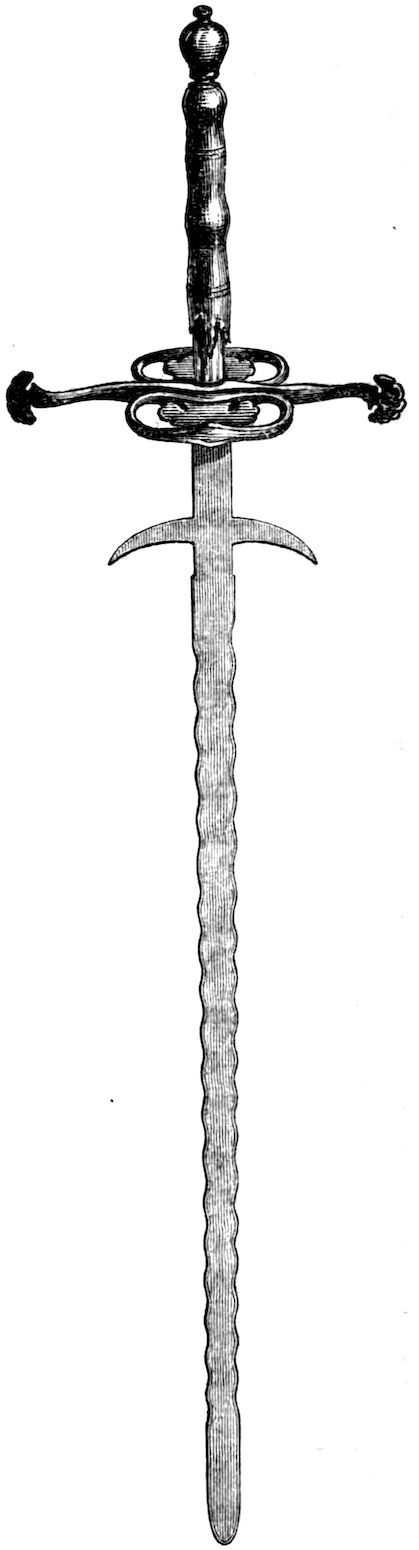
Macpherson’s Sword.
James Macpherson, who was understood to be the natural son of a gentleman of the district by a gipsy mother, was a conspicuous or leading man in the band; he was a person of goodly figure and great strength and daring, always carrying about with him—how acquired we cannot tell—an example of the two-handed swords of a former age, besides other weapons. He had a talent for music, and was a good player on the violin. It has been stated that some traits of a generous nature occasionally shone out in him; but, on the whole, he was merely a Highland cateran, breaking houses and henroosts, stealing horses and cattle, and living recklessly on the proceeds, like the tribe with which he associated.
Duff, Laird of Braco, founder of the honours and wealth of the Earls of Fife, took a lead at this time in the public affairs of his district. He formed the resolution of trying to give a check to the lawless proceedings of the Egyptians, by bringing their leaders to justice. It required some courage to face such determined ruffians with arms in 235|1700.| their hands, and he had a further difficulty in the territorial prejudices of the Laird of Grant, who regarded some of the robbers as his tenants, and felt bound, accordingly, to protect them from any jurisdiction besides his own.[281] This remark bears particularly upon two named Peter and Donald Brown, who had lived for half a year at a place closely adjacent to Castle-Grant, and the former of whom was regarded as captain of the band.
Finding Macpherson, the Browns, and others at the ‘Summer’s Eve Fair in Keith, the stout-hearted Braco made up his mind to attack them. To pursue a narrative which appears to be authentic: ‘As soon as he observed them in the fair, he desired his brother-in-law, Lesmurdie, to bring him a dozen stout men, which he did. They attacked the villains, who, as they had several of their accomplices with them, made a desperate resistance. One of them made a pass at Braco with his hanger, intending to run him through the heart; but it slanted along the outside of the ribs, and one of his men immediately stabbed the fellow dead. They then carried Macpherson and [Peter] Brown to a house in Keith, and set three or four stout men to guard them, not expecting any more opposition, as all the rest of the gang were fled. Braco and Lesmurdie were sitting in an upper room, concerting the commitment of their prisoners, when the Laird of Grant and thirty men came calling for them, swearing no Duff in Scotland should keep them from him. Braco, hearing the noise of the Grants, came down stairs, and said, with seeming unconcern and humour: “That he designed to have sent them to prison; but he saw they were too strong a party for him to contend with, and so he must leave them;” but, without losing a moment, he took a turn through the market, found other two justices of peace, kept a court, and assembled sixty stout fellows, with whom he retook the two criminals, and sent them to prison.’[282]
1700.
236James Macpherson, the two Browns, and James Gordon, were brought before the sheriff of Banffshire at Banff, on the 7th of November 1700, charged with ‘being habit and repute Egyptians and vagabonds, and keeping the markets in their ordinary manner of thieving and purse-cutting’ ... being guilty also of ‘masterful bangstrie and oppression.’ A procurator appeared on the part of the young Laird of Grant, demanding surrender of the two Browns, to be tried in the court of his regality, within whose bounds they had lived, and offering a culreach or pledge for them;[283] but the demand was overruled, on the ground that the Browns had never been truly domiciliated there. Witnesses were adduced, who detailed many felonies of the prisoners. They had stolen sheep, oxen, and horses; they had broken into houses, and taken away goods; they had robbed men of their purses, and tyrannously oppressed many poor people. It was shewn that the band was in the habit of speaking a peculiar language. They often spent whole nights in dancing and debauchery, Peter Brown or Macpherson giving animation to the scene by the strains of the violin. An inhabitant of Keith related how Macpherson came to his house one day, seeking for him, when, not finding him, he stabbed the bed, to make sure he was not there, and, on going away, set the ale-barrel aflowing. The jury gave a verdict against all the four prisoners; but sentence was for the meantime passed upon only Macpherson and Gordon, adjudging them to be hanged next market-day.[284]
Macpherson spent the last hours of his life in composing a tune expressive of the reckless courage with which he regarded his fate. He marched to the place of execution, a mile from the town, playing this air on his violin. He even danced to it under the fatal tree. Then he asked if any one in the crowd would accept his fiddle, and keep it as a memorial of Macpherson; and finding no one disposed to do so, he broke the instrument over his knee, and threw himself indignantly from the ladder. Such was the life and death of a man of whom one is tempted to think that, with such qualities as he possessed, he might, in a happier age, 237|1700.| have risen to some better distinction than that which unfortunately he has attained.[285]
1701. Jan. 25.
At this date one of the most remarkable of the precursors of Watt in the construction of the steam-engine, comes in an interesting manner into connection with Scotland. Captain Thomas Savery, an Englishman, ‘treasurer to the commissioners of sick and wounded,’ had, in 1696, described an engine framed by himself, and which is believed to have been original and unsuggested, ‘in which water is raised not only by the expansive force of steam, but also by its condensation, the water being raised by the pressure of the atmosphere into receivers, from which it is forced to a greater height by the expansive force of the steam.’[286] He had obtained a patent for this engine in 1698, to last for thirty-five years.
We have seen that there were busy-brained men in Scotland, constantly trying to devise new things; and even now, Mr James Gregory, Professor of Mathematics in the Edinburgh University—a member of a family in which talent has been inherent for two centuries—was endeavouring to bring into use ‘a machine invented by him for raising of water in a continued pipe merely by lifting, without any suction or forcing, which are the only ways formerly practised, and liable to a great many inconveniences.’ By this new machine, according to the inventor, ‘water might be raised to any height, in a greater quantity, and in less space of time,’ than by any other means employing the same force. It was useful for ‘coal-pits or mines under ground.’ On his petition, 238|1701.| Mr Gregory obtained an exclusive right to make and use this machine for thirty-one years.
Another such inventive genius was Mr James Smith of Whitehill, who for several years made himself notable by his plans for introducing supplies of water into burghs. Smith had caught at Savery’s idea, and made a paction with him for the use of his engine in Scotland, and now he applied to the Estates for ‘encouragement.’ He says that, since his bargain with Captain Savery, he ‘has made additions to the engine to considerable advantage, so that, in the short space of an hour, there may be raised thereby no less than the quantity of twenty tuns of water to the height of fourteen fathoms.’ Any member of the honourable house was welcome to see it at work, and satisfy himself of its efficiency; whence we may infer that an example of it had come down to Edinburgh. In compliance with his petition, Smith was invested with the exclusive power of making the engine and dealing with parties for its use during the remainder of the English patent.[287]
Savery’s steam-engine, however, was a seed sown upon an infertile soil, and after this date, we in Scotland at least hear of it no more.
July 10.
It pleased the wisdom of the Scottish legislature (as it did that of the English parliament likewise) to forbid the export of wool and of woolly skins, an encouragement to woollen manufacturers at home, at the expense, as usual, of three or four times the amount in loss to the rest of the community. At this date, Michael Allan, Dean of Guild in Edinburgh, came before the Privy Council to shew that, in consequence of the extreme coldness and backwardness of the late spring, producing a mortality of lambs, there were many thousands of lambs’ skins, or morts, which could not be manufactured in the kingdom, and would consequently be lost, but which would be of value at Dantzig and other eastern ports, where they could be manufactured into clothing. He thought that property to the value of about seven thousand pounds sterling might thus be utilised for Scotland, which otherwise ‘must of a necessity perish at home, and will be good for nothing;’ and the movement was the more desirable, as the return for the goods would be in ‘lint, hemp, iron, steel, pot-ashes, and knaple, very useful for our 239|1701.| manufactures, and without which the nation cannot possibly be served.’
The Council called in skinners, furriers, and others to give them the best advice, and the result was a refusal to allow the skins to be exported.
Rather more than a twelvemonth before (June 4, 1700), it was intimated to the Privy Council by ‘the manufactory of Glasgow,’ that one Fitzgerard, an Irish papist, ‘has had a constant trade these three years past of exporting wool and woollen yarn to France, and that he has at this present time combed wool and woollen yarn to the value of three thousand pounds sterling ready to be exported, to the great ruin of the nation, and of manufactories of that kind.’ The Council immediately sent orders to the magistrates of Glasgow to take all means in law for preventing the exportation of the articles in question.[288]
Feb. 20.
A petition on an extraordinary subject from the magistrates and town-council of Elgin, was before the Privy Council. Robert Gibson of Linkwood had been imprisoned in their Tolbooth as furious, at the desire of the neighbouring gentry, and for the preservation of the public peace. In the preceding October, when the magistrates were in Edinburgh on business before the Privy Council, Gibson set fire to the Tolbooth in the night-time, and there being no means of quenching the flames, it was burnt to the ground. Their first duty was to obtain authority from the Privy Council to send the incendiary in shackles to another place of confinement, and now they applied for an exemption from the duty of receiving and confining prisoners for private debts till their Tolbooth could be rebuilt. They obtained the required exemption until the term of Whitsunday 1703.
Feb.
Wodrow relates a story of the mysterious disappearance of a gentleman (chamberlain of a countess) dwelling at Linlithgow, and esteemed as a good man. A gentleman at Falkirk, with whom he had dealings, sent a servant one afternoon desiring him to come immediately. His wife would not allow him to travel that evening, and the servant departed without him. Long before daylight next morning, the chamberlain rose and prepared for his journey, but did not omit family worship. In the part of Scripture which he read (Acts xx.), occurred the sentence, ‘you shall 240|1701.| see my face no more.’ Whether this occurred by chance or not is not known, but he repeated the passage twice. After departing, he returned for his knife; again he returned to order one of his sons not to go out that day. By daylight his horse was found, with an empty saddle, near Linlithgow Bridge (a mile west of the town), and no search or inquiry made then, or for a considerable time after, sufficed to discover what had become of him. Wodrow states the suspicion of his being murdered, but as he had taken only some valuable papers with him, and viewing the fact of his being a steward, it does not seem difficult to account for his disappearance on a simpler hypothesis.[289]
Mar. 1.
The contract for a marriage between Sir John Shaw of Greenock and Margaret Dalrymple, eldest daughter of the Lord President of the Court of Session, being signed to-day, ‘there was an entire hogshead of claret drunk’ by the company assembled on the occasion. At the marriage, not long after, of Anne, a younger daughter of the Lord President, to James Steuart, son of the Lord Advocate, ‘the number of people present was little less,’ being just about as many as the house would hold. A marriage was, in those days, an occasion for calling the whole connections of a couple of families together; and where the parties belonged, as in these cases, to an elevated rank in society, there was no small amount of luxury indulged in. Claret was, in those days, indeed, but fifteen, and sack eighteen pence, while ale was three-halfpence, per bottle, so that a good deal of bibulous indulgence cost little.
The expenditure upon the clothes of a bride of quality was very considerable. Female fineries were not then produced in the country as they are now, and they cost probably twice the present prices. We find that, at the marriage of a daughter of Smythe of Methven to Sir Thomas Moncrieff of that Ilk, Bart., in December of this very year, there was a head suit and ruffles of cut work at nearly six pounds ten shillings; a hood and scarf at two pounds fifteen shillings; a silk under-coat nearly of the same cost; a gown, petticoat, and lining, at between sixteen and seventeen pounds; garters, at £1, 3s. 4d.: the entire outfit costing £109, 18s. 3d.[290]
When Mrs Margaret Rose, daughter of the Laird of Kilravock, was married in 1701, there was an account from Francis Brodie, 241|1701.| merchant in Edinburgh, for her wedding-clothes, including seventeen and a quarter ells of flowered silk, £11, 13s.; nine and a quarter ells of green silk shagreen for lining, £2, 14s.; six and a half ells of green galloon, 19s. 6d.; with other sums for a gown and coat, for an under-coat, and an undermost coat; also, for a pair of silk stockings, 12s.; a necklace and silk handcurcher, 8s.; and some thirty or forty other articles, amounting in all to £55, 8s. 9d. sterling. This young lady carried a tocher of 9000 merks—about nine times the value of her marriage outfit—to her husband, John Mackenzie, eldest son of Sir Alexander Mackenzie of Coul.
At the marriage of Anne Dalrymple to Mr James Steuart, ‘the bride’s favours were all sewed on her gown from top to bottom, and round the neck and sleeves. The moment the ceremony was performed, the whole company ran to her, and pulled off the favours; in an instant, she was stripped of them all. The next ceremony was the garter [we have seen what it cost], which the bridegroom’s man attempted to pull from her leg, but she dropped it on the floor; it was a white and silver ribbon, which was cut in small parcels, [a piece] to every one in company. The bride’s mother then came in with a basket of favours belonging to the bridegroom; those and the bride’s were the same with the bearings of their families—hers, pink and white; his, blue and gold colour.’ ‘The company dined and supped together, and had a ball in the evening; the same next day at Sir James Steuart’s. On Sunday, there went from the President’s house to church three-and-twenty couple, all in high dress. Mr Barclay, then a boy, led the youngest Miss Dalrymple, who was the last of them. They filled the galleries of the [High] Church from the king’s seat to the wing loft. The feasting continued till they had gone through all the friends of the family, with a ball every night.’[291]
Mar. 14.
It was not yet three years since the people of Scotland were dying of starvation, and ministers were trying to convince their helpless flocks that it was all for their sins, and intended for their good. Yet now we have a commission issued by the government, headed as usual with the king’s name, commanding that all loads of grain which might be brought from Ireland into the west of Scotland, should be staved and sunk, and this, so far as appears, without a remark from any quarter as to the horrible impiety of 242|1701.| the prohibition in the first place, and the proposed destruction of the gifts of Providence in the second.[292]
An example of the simple inconvenience of these laws in the ordinary affairs of life is presented in July 1702. Malcolm M‘Neill, a native of Kintyre, had been induced, after the Revolution, to go to Ireland, and become tenant of some of the waste lands there. Being now anxious to settle again in Argyleshire, on some waste lands belonging to the Duke of Argyle, he found a difficulty before him of a kind now unknown, but then most formidable. How was he to get his stock transported from Ballymaskanlan to Kintyre? Not in respect of their material removal, but of the laws prohibiting all transportation of cattle from Ireland to Scotland. It gives a curious idea of the law-made troubles of the age, that Malcolm had to make formal application to the Privy Council in Edinburgh for this purpose. On his petition, leave to carry over two hundred black-cattle, four hundred sheep, and forty horses, was granted. It is a fact of some significance, that the duke appears in the sederunt of the day when this permission was given. That without such powerful influence no such favour was to be obtained, is sufficiently proved by the rare nature of the transaction.
1700. Jan. 9.
We find, in January 1700, that the execution of the laws against the importation of Irish cattle and horses had been committed to Alexander Maxwell, postmaster at Ayr, who seems to have performed his functions with great activity, but not much good result. He several times went over the whole bounds of his commission, establishing spies and waiters everywhere along the coast. By himself and his servants, sometimes with the assistance of soldiers, he made a great number of seizures, but his profits never came up to his costs. Often, after a seizure, he had to sustain the assaults of formidable rabbles, and now and then the cattle or horses were rescued out of his hands. For six weeks at a time he was never at home, and all that time not thrice in his bed—for he had to ride chiefly at night—but on all hands he met with only opposition, even from the king’s troops, ‘albeit he maintains them and defrays all their charges when he employs them.’ On his petition (January 9, 1700), he was allowed a hundred pounds by the Privy Council as an encouragement to persevere in his duty.
In the autumn of 1703, an unusual anxiety was shewn to enforce the laws against the importation of provisions from Ireland and 243|1700.| from England. Mr Patrick Ogilvie of Cairns, a brother of the Lord Chancellor, Earl of Seafield, was commissioned to guard the coasts between the Sound of Mull and Dumfries, and one Cant of Thurston to protect the east coast between Leith and Berwick, with suitable allowances and powers. It happened soon after that an Irish skipper, named Hyndman, appeared with a vessel of seventy tons, full of Irish meal, in Lamlash Bay, and was immediately pounced upon by Ogilvie. It was in vain that he represented himself as driven there by force of weather on a voyage from Derry to Belfast: in spite of all his pleadings, which were urged with an air of great sincerity, his vessel was condemned.
Soon after, a Scottish ship, sailing under the conduct of William Currie to Londonderry, was seized by the Irish authorities by way of reprisal for Hyndman’s vessel. The Scottish Privy Council (February 15, 1704) sent a remonstrance to the Duke of Ormond, Lord Lieutenant of Ireland, setting forth this act as ‘an abuse visibly to the breach of the good correspondence that ought to be kept betwixt her majesty’s kingdoms.’ How the matter ended does not appear; but the whole story, as detailed in the record of the Privy Council, gives a striking idea of the difficulties, inconveniences, and losses which nations then incurred through that falsest of principles which subordinates the interests of the community to those of some special class, or group of individuals.
Ogilvie was allowed forty foot-soldiers and twenty dragoons to assist him in his task; but we may judge of the difficulty of executing such rules from the fact stated by him in a petition, that, during the interval of five weeks, while these troops were absent at a review in the centre of the kingdom, he got a list of as many as a hundred boats which had taken that opportunity of landing from Ireland with victual. Indeed, he said that, without a regular independent company, it was impossible to prevent this traffic from going on.[293]
We do not hear much more on this subject till January 1712, when Thomas Gray, merchant in Irvine, and several other persons, were pursued before the Court of Session for surreptitious importation of Irish victual, by Boswell and other Ayrshire justices interested in the prices of Scottish produce. The delinquents were duly fined. Fountainhall, after recording the decision, adds a note, in which he debates on the principles involved in the free trade in corn. ‘This importation of meal,’ says he, ‘is good for 244|1700.| the poor, plenty making it cheap, but it sinks the gentlemen’s rents in these western shires. Which of the two is the greater prejudice to the bulk of the nation? Problema esto: where we must likewise balance the loss and damage we suffer by the exporting so much of our money in specie to a foreign country to buy it, which diminishes our coin pro tanto: But if the victual was purchased in Ireland by exchange of our goods given for it, that takes away that objection founded on the exporting of our money.’[294]
1701. Apr. 15.
John Lawson, burgess of Edinburgh, was projector of an Intelligence-office, to be established in the Scottish capital, such as were already planted in London, Paris, Amsterdam, and other large cities, for ‘recording the names of servants, upon trial and certificate of their manners and qualifications, whereby masters may be provided with honest servants of all sorts, and servants may readily know what masters are unprovided’—and ‘the better and more easy discovery of all bargains, and the communication and publishing all proposals and other businesses that the persons concerned may think fit to give notice and account of, for the information of all lieges.’
He had been at pains to learn how such offices were conducted in foreign countries, and had already set up a kind of register-office for servants in Edinburgh, ‘to the satisfaction and advantage of many, of all ranks and degrees.’ There was, however, a generation called wed-men and wed-wives, who had been accustomed, in an irregular way, to get employers for servants and nurses, and servants and nurses for masters and mistresses. It was evident to John that his intelligence-office could never duly thrive unless these practitioners were wholly suppressed. He craved exclusive privileges accordingly from the Privy Council—that is, that these wed-men and wed-wives be discharged ‘on any colour or pretence’ from meddling with the hire of servants, or giving information about bargains and proposals—though ‘without prejudice [he was so far modest] to all the lieges to hire servants and enter into bargains, and do all other business upon their own proper knowledge, or upon information gratuitously given.’
Honest John seems to have felt that something was necessary to reconcile the authorities to a plan obviously so much for his own interest. The religious feeling was, as usual, a ready resource. He reminded the Lords that there had been great inconveniences 245|1701.| from the dishonest and profligate servants recommended by the wed-men and wed-wives; nay, some had thus been intruded into families who had not satisfied church-discipline, and did not produce testimonials from ministers! He held out that he was to take care ‘that all such as offer themselves to nurse children shall produce a certificate of their good deportment, in case they be married, and if not, that they have satisfied the kirk for their scandal, or have found a caution so to do.’
One great advantage to the public would be, that gentlemen or ladies living in the country could, by correspondence with the office, and no further trouble or expense, obtain servants of assured character, ‘such as master-households, gentlemen, valets, stewards, pages, grieves, gardeners, cooks, porters, coachmen, grooms, footmen, postilions, young cooks for waiting on gentlemen, or for change-houses; likewise gentlewomen for attending ladies, housekeepers, chambermaids, women-stewards and cooks, women for keeping children, ordinary servants for all sorts of work in private families, also taverners and ticket-runners, with all sorts of nurses who either come to gentlemen’s houses, or nurse children in their own’—for so many and so various were the descriptions of menials employed at that time even in poor Scotland.
With regard to the department for commercial intelligence, it was evident that ‘men are often straitened how and where to inquire for bargains they intend,’ while others are equally ‘at a loss how to make known their offers of bargains and other proposals.’ The latter were thus ‘obliged to send clapps, as they call them,[295] through the town, and sometimes to put advertisements in gazettes, which yet are noways sufficient for the end designed, for the clapps go only in Edinburgh, and for small businesses, and the gazette is uncertain, and gazettes come not to all men’s hands, nor are they oft to be found when men have most to do with them, whereas a standing office would abide all men, and be ever ready.’
The Council complied with Lawson’s petition in every particular, only binding him to exact no more fee than fourteen shillings Scots (1s. 2d.), where the fee is twelve pounds Scots (£1 sterling) or upwards, and seven shillings Scots where the fee is below that sum.
July 3.
The infant library of the Faculty of Advocates having been 246|1701.| burnt out of its original depository in the Parliament Square, a new receptacle was sought for it in the rooms under the Parliament House—the Faculty and the Edinburgh magistrates concurring in the request—and the Privy Council complied, only reserving the right of the high constable to view and search the place ‘the time of the sitting of parliament’—a regulation, doubtless, held necessary to prevent new examples of the Gunpowder Treason.
Aug. 27.
Lord Basil Hamilton, sixth son of the Duchess of Hamilton—a young man endeared to his country by the part he had taken in vindicating her rights in the Darien affair—lost his life by a dismal accident, leaving but one consolation to his friends, that he lost it in the cause of humanity. Passing through Galloway, with his brother the Earl of Selkirk and some friends, he came to a little water called the Minnick, swelled with sudden rain. A servant went forward to try the ford, and was carried away by the stream. Lord Basil rushed in to save the man, caught him, but was that moment dismounted, and carried off by the torrent; so he perished in the sight of his brother and friends, none being able to render him any assistance. It was a great stroke to the Hamilton family, to the country party, and indeed to the whole of the people of Scotland. Lord Basil died in his thirtieth year.
On the evening of the next day, the Earl of Selkirk came, worn with travel, to the gate of Hamilton Palace, to tell his widowed mother of her irreparable loss. But, according to a story related by Wodrow, her Grace was already aware of what had happened. ‘On the Wednesday’s night [the night of the accident] the duchess dreamed she saw Lord Basil and Lord Selkirk drowned in a water, and she thought she said to Lady Baldoon [Lord Basil’s wife], “Charles and Basil are drowned,” Charles being the Earl of Selkirk. The Lady Baldoon, she thought, answered: “Lord Selkirk is safe, madam; there is no matter.” The duchess thought she answered: “The woman’s mad; she knows not her lord is dead;” and that she [Lady Baldoon] added: “Is Basil dead? then let James [the duke] take all: I will meddle no more with the world.” All this she [the duchess] told in the Thursday morning, twelve hours or more before Lord Selkirk came to Hamilton, who brought the first word of it.’[296]
Dec. 5.
Four men were tried at Perth for theft by the commissioners 247|1701.| for securing the peace of the Highlands, and, being found guilty, were liable to the punishment of death. The Lords, however, were pleased to adjudge them to the lighter punishment of perpetual servitude, not in the plantations, as we have seen to be common, but at home, and the panels to be ‘at the court’s disposal.’ One of them, Alexander Steuart, they bestowed as a gift on Sir John Areskine of Alva, probably with a view to his being employed as a labourer in the silver-mine which Sir John about this time worked in a glen of the Ochils belonging to him.[297] Sir John was enjoined to fit a metal collar upon the man, bearing the following inscription: ‘Alexr. Steuart, found guilty of death for theft, at Perth, the 5th of December 1701, and gifted by the justiciars as a perpetual servant to Sir John Areskine of Alva;’ and to remove him from prison in the course of the ensuing week.[298] The reality of this strange proceeding has been brought home to us in a surprising manner, for the collar, with this inscription, was many years ago dredged up in the Firth of Forth, in the bosom of which it is surmised that the poor man found a sad refuge from the pains of slavery. As a curious memorial of past things, it is now preserved in our National Museum of Antiquities.
The reader will perhaps be surprised to hear of a silver-mine in the Ochils, and it may therefore be proper, before saying anything more, that we hear what has been put on record on this subject.
‘In the parish of Alva, a very valuable mine of silver was discovered about the commencement of the last century[299] by Sir James [John] Erskine of Alva, in the glen or ravine which separates the Middle-hill from the Wood-hill. It made its first appearance in small strings of silver ore, which, being followed, led to a large mass of that metal. A part of this had the appearance of malleable silver, and was found on trial to be so rich as to produce twelve ounces of silver from fourteen ounces of ore. Not more than £50 had been expended when this valuable discovery was made. For the space of thirteen or fourteen weeks, it is credibly affirmed that the proprietor obtained ore from this mine to the value of £4000 per week. When this mass was exhausted, the silver ore began to appear in smaller quantities; 248|1701.| symptoms of lead and other metals presented themselves, and the search was for the present abandoned.’[300]
It is related that Sir John, walking with a friend over his estate, pointed out a great hole, and remarked: ‘Out of that hole I took fifty thousand pounds.’ Then presently, walking on, he came to another excavation, and, continued he: ‘I put it all into that hole.’
Nevertheless, the search was renewed by his younger brother, Charles Areskine, Lord Justice-Clerk, but without the expected fruit, though a discovery was made of cobalt, and considerable quantities of that valuable mineral were extracted even from the rubbish of his predecessor’s works. In 1767, Lord Alva, the son of the Lord Justice-Clerk, bestowed a pair of silver communion-cups upon the parish of Alva, with an inscription denoting that they were fashioned from silver found at the place.
The granting of Steuart as ‘a perpetual servant’ to Sir John Areskine sounds strangely to modern ears; but it was in perfect accordance with law and usage in Scotland in old times; and there was even some vestige of the usage familiar to Englishmen at no remote date, in laws for setting the poor to work in workhouses. The act of the Highland justiciars was the more natural, simple, and reasonable, that labourers in mines and at salt-works were regarded by the law of Scotland as ‘necessary servants,’ who, without any paction, by merely coming and taking work in such places, became bound to servitude for life, their children also becoming bound if their fathers in any way used them as assistants. Such is the view of the matter coolly set down in the Institutes of Mr John Erskine (1754), who further takes leave to tell his readers that ‘there appears nothing repugnant, either to reason, or to the peculiar doctrines of Christianity, in a contract by which one binds himself to perpetual service under a master, who, on his part, is obliged to maintain the other in all the necessaries of life.’ It appears that the salters and miners were transferred with the works when these were sold; but a right in the masters to dispose of the men otherwise, does not appear to have been a part of the Scots law.
In the year 1743, there appears to have been a disposition among the bondsmen of the coal-mines in Fife and Lothian to assert their freedom. Fifteen men who worked in the Gilmerton coal-works having absented themselves in October, and gone to 249|1701.| work at other collieries, their master, Sir John Baird of Newbyth, advertised them, so that no other master might break the act of parliament by entertaining them, and also that the deserters might be secured. In the same year, the Marquis of Lothian had to complain of three boys who ran away from his colliery at Newbattle, and took refuge amongst the people of another estate, supposed to have been that of the Viscount Oxenford. He accordingly addressed the following letter to that nobleman:
‘Newbattle, July the 21st, 1743.
‘My Lord—Being told Sir Robert Dixon is not at home, I am equally satisfied that Mr Biger should determine the use and practice of coal-masters in such cases, if he pleases to take the trouble, which I suppose is all your lordship is desirous to know before you let me have these boys that ran away from my colliery, and was entertained by your people; but if I mistake your intention, and you think it necessary I prove my title to them in law, I am most willing to refer the whole to Mr Biger, and therefore am ready to produce my evidence at any time you please to appoint, and if my claim is found to be good, shall expect the boys be returned without my being obliged to find them out. My lord, I am not so well acquainted with Mr Biger as to ask the favour; therefore hopes your lordship will do it, and wish it may be determined soon, if convenient. I beg my best respects to Lady Orbiston; and am, my lord,
‘Your lordship’s most obedient
‘and humble Servant,
‘Lothian.’
‘P. S.—I have not the smallest pretensions to the faither of these boys, and should have pleasure in assisting you if I could spare any of my coaliers.’[301]
Whether Mr Gibson of Durie had been dealt with in the same manner by his colliers, we do not know; but in November he advertised for hands, offering good and regularly paid wages, and ‘a line under his hand, obliging himself to let them go from the works at any time, upon a week’s warning, without any restraint whatever.’ He would also accept a loan of workers from other coal-proprietors, and oblige himself ‘to restore them when demanded.’[302]
I must not, however, forget—and certainly it is a curious thing 250|1701.| to remember—that I have myself seen in early life native inhabitants of Scotland who had been slaves in their youth. The restraints upon the personal freedom of salters and colliers—remains of the villainage of the middle ages—were not put an end to till 1775, when a statute (15 Geo. III. 28) extinguished them. I am tempted to relate a trivial anecdote of actual life, which brings the recentness of slavery in Scotland vividly before us.
About the year 1820, Mr Robert Bald of Alloa, mining-engineer, being on a visit to Mr Colin Dunlop, at the Clyde Ironworks, near Glasgow, found among the servants of the house an old working-man, commonly called Moss Nook, who seemed to be on easy terms with his master. One day, Mr Bald heard the following conversation take place between Mr Dunlop and this veteran:
‘Moss Nook, you don’t appear, from your style of speaking, to be of this part of the country. Where did you originally come from?’
‘Oh, sir,’ answered Moss Nook, ‘do you not know that your father brought me here long ago from Mr M‘Nair’s of the Green [a place some miles off, on the other side of the river]? Your father used to have merry-meetings with Mr M‘Nair, and, one day, he saw me, and took a liking to me. At the same time, Mr M‘Nair had taken a fancy to a very nice pony belonging to your father; so they agreed on the subject, and I was niffered away for the pony. That’s the way I came here.’
The man had, in short, been a slave, and was exchanged for a pony. To Mr Bald’s perception, he had not the least idea that there was anything singular or calling for remark in the manner of his leaving the Green.
1702.
A Scottish clergyman resident in England—the same who lately ‘promoted contributions for the printing of Bibles in the Irish language, and sent so many of them down to Scotland, and there is no news he more earnestly desires to know than what the G[eneral] A[ssembly] doth whenever it meeteth for promoting the interests of the Gospel in the Highlands’—at this time started a scheme for ‘erecting a library in every presbytery, or at least county, in the Highlands.’ He had been for some time prevented from maturing his plan by bodily distempers and faint hopes of success; but now the scheme for sending libraries to the colonies had encouraged him to come forward, and he issued a printed 251|1702.| paper explaining his views, and calling for assistance. His great object was to help the Highland Protestant clergy in the matter of books, seeing that, owing to their poverty, and the scarcity of books, few of them possessed property of that kind to the value of twenty shillings; while it was equally true, that at the distance they lived at from towns, the borrowing of books was with most of them impossible. It was the more necessary that they should be provided with books, that the Romish missionaries were so active among the people: how could the clergy encounter these adversaries without the knowledge which they might derive from books? ‘The gross ignorance of the people in those parts, together with some late endeavours to seduce the inhabitants of the isle of Hirta to a state of heathenism,[303] make it very necessary that they be provided with such treatises as prove the truth of the Christian religion. At the same time, the excellent parts and capacities of the ministers generally throughout the Highlands give good ground to expect much fruit from such a charity.’
The promoter of the scheme felt no hesitation in asking assistance in the south, because the poverty of Scotland—‘occasioned chiefly by their great losses at sea, the decay of trade, the great dearth of corn, and the death of cattle for some years together—renders the people generally unable to do much in the way of charity. Nevertheless, there are not wanting those amongst them, who, amidst their straits and wants, are forward to promote this or any other good design, even beyond their power.’ He hoped no native would take offence at this confession, the truth of which ‘is too much felt at home and known abroad to be denied.... But if any are so foolish as to censure this paragraph, their best way of confutation is to take an effectual and speedy course to provide a competent number of libraries for such parts of our native country as need them most.’
He even went so far as to draw up a set of rules for the keeping and lending of the books—a very stringent code certainly it is; ‘but,’ says he, ‘they who know the world but a little, and have seen the fate of some libraries, will reckon the outmost precaution we can use little enough to prevent what otherwise will be unavoidable. It’s a work of no small difficulty to purchase a parcel of good books for public advantage; nor is it less difficult 252|1702.| to preserve and secure them for posterity, when they are purchased.’[304]
A Memorial concerning the Highlands, published at Edinburgh in the ensuing year, described them as full of ignorance and heathenism. Most of the people were said to be unacquainted with the first principles of Christianity; a few had been ‘caught by the trinkets of popery.’ While there were schools at Inverness, Forres, Keith, Kincardine O’Neil, Perth, &c.—places closely adjacent to the Highlands—there were none in the country itself, excepting one at Abertarf (near the present Fort-Augustus, in Inverness-shire), which had been erected by charitable subscription, but where it was found nearly impossible to get scholars unless subsistence was provided for them. In remote places, children remained unbaptised for years. In the country generally, theft and robbery were esteemed as ‘only a hunting, and not a crime;’ revenge, in matters affecting a clan, even when carried the length of murder, was counted a gallantry; idleness was a piece of honour; and blind obedience to chiefs obscured all feeling of subjection to civil government.[305]
It was under a sense of the unenlightened state of the Highlands, and particularly of the hold which the Catholic religion had obtained over the Gael, that the ‘Society for the Propagation of Christian Knowledge’ was soon after formed by a combination of the friends of Presbyterian orthodoxy. It was incorporated in 1709, at which time a strong effort was made by the courts of the Established Church to promote contributions in its behalf, though under some considerable discouragements. Wodrow tells us that this Society was originated by a small knot of gentlemen, including Mr Dundas of Philipston, clerk of the General Assembly; Sir H. Cunningham, Sir Francis Grant [Lord Cullen], Commissary Brodie, Sir Francis Pringle, and Mr George Meldrum, who, about 1698, had formed themselves into a society for prayer and religious correspondence. Writing now to Mr Dundas about the subscriptions, and enclosing twenty-five pounds as a contribution from the presbytery of Paisley, he apologises for the smallness of the sum in proportion to the importance of the object, and says: ‘The public spirit and zeal for any good designs is much away from the generality here.’ ‘The truth is,’ says he, regarding 253|1702.| another matter, ‘the strait of this part of the country is so great, through the dearth of victual, that our collections are very far from maintaining our poor, and our people ... are in such a pet with collections for bridges, tolbooths, &c., that when any collection is intimate, they are sure to give less that day than their ordinary.’[306] Nevertheless, the Society was able to enter on a course of activity, which has never since been allowed to relax.
The scheme of presbyterial libraries was realised in 1705 and 1706 to the extent of nineteen, in addition to which fifty-eight local libraries were established; but these institutions are understood to have been little successful and ill supported. In 1719, the Christian Knowledge Society had forty-eight schools established, increased to a hundred and nine in 1732, and to two hundred at the close of the century. Its missionary efforts were also very considerable. Such, however, were the natural and other difficulties of the case, that a writer described the people in 1826 as still ‘sunk in ignorance and poverty.’[307] It is not merely that schools must necessarily be few in proportion to geographical space, and school-learning, therefore, difficult of attainment, but the Highlander unavoidably remains unacquainted with many civilising influences which the communication of thought, and observation of the processes of merchandise and the mechanical trades, impart to more fortunate communities. The usual consequence of the introduction of Christianity to minds previously uneducated has been realised. It has taken a form involving much of both old and new superstition, along with feelings of intolerance towards dissent even in the most unessential particulars, such as recall to men in the south a former century of our history.
It is remarkable that, while the bulk of the Highland population were unschooled and ignorant, there were abundance of gentlemen who had a perfect knowledge of Latin, and even composed Latin poetry. Nor is it less important or more than strictly just to observe that, amidst all the rudeness of former times in the Highlands, there was amongst the common people an old traditionary morality, which included not a little that was entitled to admiration. To get a full idea of what this was, one must peruse the writings of Mrs Grant and Colonel Stewart. The very depredations so often spoken of could hardly be said to 254|1702.| involve a true turpitude, being so much connected as they were with national and clan feelings.
Feb. 10.
Captain Simon Fraser of Beaufort, who had long been declared rebel for not appearing to answer at the Court of Justiciary on the charge of rape brought against him by the dowager Lady Lovat,[308] was described at this time as living openly in the country as a free liege, ‘to the contempt of all authority and justice.’ The general account given of his habits is rather picturesque. ‘He keeps in a manner his open residence within the lordship of Lovat, where, and especially in Stratherrick,[309] he further presumes to keep men in arms, attending and guarding his person.’ These he also employed in levying contributions from Lady Lovat’s tenants, and he had thus actually raised between five and six thousand merks. ‘Proceeding yet to further degrees of unparalleled boldness, [he] causes make public intimation at the kirks within the bounds on the Lord’s Day, that all the people be in readiness with their best arms when advertised.’ The tenants were consequently so harassed as to be unable to pay her ladyship any rents, and there were ‘daily complaints of these strange and lawless disorders.’
The Council granted warrants of intercommuning against the culprit, and enjoined his majesty’s forces to be helpful in apprehending him.[310] We find that, in the month of August, Fraser had departed from the country, but his interest continued to be maintained by others. His brother John, with thirty or forty ‘loose and broken men,’ went freely up and down the countries of Aird and Stratherrick, menacing with death the chamberlains of the Lady Lovat[311] and her husband, Mr Alexander Mackenzie of Prestonhall, if they should uplift the rents in behalf of their master and mistress, and threatening the tenants in like manner, if they should pay their rents to those persons. The better to support this lawless system, John kept a garrison of armed gillies in the town of Bewly, ‘the heart of the country of Aird,’ entirely at the cost of the tenants there. Within the last few weeks, they had taken from the tenants of Aird ‘two hundred custom wedders and lambs,’ and, breaking up the meal-girnels of Bewly, they had supplied themselves with sixty bolls of 255|1702.| meal. At the beginning of July, Fraser, younger of Buchrubbin, and two accomplices, came to the house of Moniack, the residence of Mr Hugh Fraser, one of the lady’s chamberlains, ‘and having by a false token got him out of his house,’ first reproached him with his office, and then ‘beat him with the butts of their guns, and had murdered him if he had not made his escape.’
Mr Hugh Fraser and Captain John Mackenzie, ‘conjunct bailie and chamberlain,’ applied for protection to the Highland commission of justiciary, who ordered a small military party to go and maintain the law in the Aird. But it was very difficult to obtain observance of law in a country where the bulk of the people were otherwise minded. The introduction of soldiers only added to the fierceness of the rebellious Frasers, who now sent the most frightful threats to all who should take part with Lady Lovat and her husband.
On the 5th of August, John Fraser came from Stratherrick with a party of fifty armed followers, and gathering more as he passed through the Aird, he fell upon the house of Fanellan, where Captain Mackenzie and the ten soldiers were, with between two and three hundred men, calling upon the inmates to surrender, on pain of having the house burnt about their ears if they refused. They did refuse to yield, and the Frasers accordingly set fire to the house and offices, the whole of which were burnt to the ground. Captain Mackenzie, Hugh Fraser of Eskadale, the ten soldiers and their commander, Lieutenant Cameron, besides a servant of Prestonhall, were all taken prisoners. Having dismissed the soldiers, the Frasers carried the rest in a bravadoing triumph through the country till they came to the end of Loch Ness. There dismissing Lieutenant Cameron, they proceeded with the two bailies and the servant to Stratherrick, everywhere using them in a barbarous manner. The report given nine days after in Edinburgh says of the prisoners, whether they be dead or alive is unknown.
The Privy Council, feeling this to be ‘such an unparalleled piece of insolence as had not been heard of in the country for an age,’ instantly ordered large parties of troops to march into the Fraser countries, and restore order.
On the 8th of September, the Council sent Brigadier Maitland and Major Hamilton their thanks ‘for their good services done in dispersing the Frasers,’ and, a few days after, we find orders issued for using all endeavours to capture John Fraser. Captain 256|1702.| Grant’s company remained in Stratherrick till the ensuing February.[312]
Mar. 11.
At ten o’clock in the evening, Colonel Archibald Row arrived express at Edinburgh with the news of the king’s death. King William died in Kensington Palace at eight o’clock in the morning of Sunday the 8th instant: it consequently took three days and a half for this express to reach the Scottish capital, being a day more than had been required by Robert Carey, when he came to Edinburgh with the more welcome intelligence of the demise of Queen Elizabeth, ninety-nine years before.
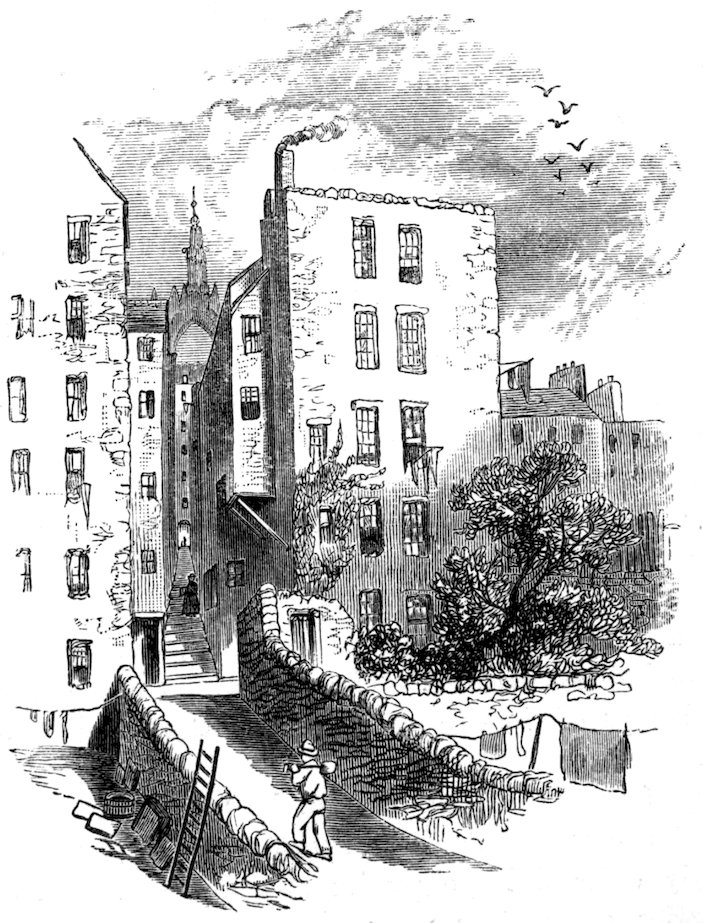
House of Lord Advocate Steuart, at bottom of Advocates’ Close, west side.
257