REIGN OF QUEEN ANNE: 1702–1714.
Reading edition
The death of King William without children (March 8, 1702), opened the succession to the Princess Anne, second daughter of the late King James. Following up the policy of her predecessor, she had not been more than two months upon the throne, when, in conjunction with Germany and Holland, she proclaimed war against the king of France, whose usurpation of the succession to Spain for a member of his family, had renewed a general feeling of hostility against him. This war, distinguished by the victories of the Duke of Marlborough, lasted till the peace of Utrecht in 1713. The queen had been many years married to Prince George of Denmark, and had had several children; but all were now dead.
King William left the people of Scotland in a state of violent discontent, on account chiefly of the usage they had received in the affair of Darien. Ever since the Revolution, there had been a large party, mainly composed of the upper classes, in favour of the exiled dynasty. It was largely reinforced, and its views were generally much promoted, by the odium into which the government of William III. had fallen, and by the feelings of jealousy and wrath which had been kindled against the whole English nation. This was not a natural state of things for Scotland, for the bulk of the people, Presbyterian at heart, could have no confidence in a restored sovereign of the House of Stuart; but anger had temporarily overcome many of the more permanent feelings of the people, and it was hard to say what course they might take in the dynastic difficulties which were impending.
In 1700, the English parliament, viewing the want of children to both William and the Princess Anne, had settled the crown of England upon the Electress Sophia of Hanover, daughter of the Princess Elizabeth, daughter of King James I., she being the nearest Protestant heir; thus excluding not only the progeny of James II., but that of several elder children of the Princess Elizabeth, all of whom were of the Roman Catholic religion. It was highly desirable that the Scottish Estates should be induced to settle the crown of Scotland on the same person, in order that peace might be preserved between the two kingdoms; but the discontents of the Scotch stood in the way. Not that there existed in Scotland any insuperable desire for another person, or any special objection to Sophia; the great majority would probably have voted, in ordinary circumstances, for this very course. 258But Scotland had been wronged and insulted; it was necessary to shew the English that this could not be done with safety to themselves. She had a claim to equality of trading privileges: it was right that she should use all fair means to get this established. Accordingly, in 1703, the Scottish parliament passed two acts calculated to excite no small alarm in the south: one of them, styled the Act of Security, ordaining that the successor of Queen Anne should not be the same person with the individual adopted by the English parliament, unless there should be a free communication of trade between the two countries, and the affairs of Scotland thoroughly secured from English influence; the other, providing that, as a means of enforcing the first, the nation should be put under arms. The queen, after some hesitation, was obliged to ratify the Act of Security. In the debates on these measures, the Scottish parliament exhibited a degree of eloquence which was wholly a novelty, and the memory of which long survived. It was a remarkable crisis, in which a little nation, merely by the moral power which animated it, contrived to inspire fear and respect in one much its superior in numbers and every other material element of strength.
The general sense of danger thus created in England proved sufficient to overcome that mercantile selfishness which had inflicted so much injustice upon Scotland. It came to be seen, that the only way to secure a harmony with the northern kingdom in some matters essential to peace, was to admit it to an incorporating union, in which there should be a provision for an equality of mercantile privileges. To effect this arrangement, accordingly, became the policy of the English Whig ministry of Queen Anne. On the other hand, the proposition did not meet a favourable reception in Scotland, where the ancient national independence was a matter of national pride; nevertheless, there also a parliamentary sanction was obtained for the preliminary steps.
In May 1706, the Commissioners, thirty from each nation, met at Westminster, to deliberate on the terms of the proposed treaty. It was soon agreed upon that the leading features of the act should be—a union of the two countries under one sovereign, who, failing heirs of the queen, should be the Electress of Hanover or her heir; but each country to retain her own church establishment and her own laws—Scotland to send sixteen representative peers and forty-five commoners to the British parliament—Scottish merchants to trade freely with England and her colonies—the taxes to be equalised, except that from land, which was to be arranged in such a way that when England contributed two millions, Scotland should give only a fortieth part of the sum, or forty-eight thousand pounds; and as the English taxes were rendered burdensome by a debt of sixteen millions, Scotland was to be compensated for its share of that 259burden by receiving, as ‘an Equivalent,’ about four hundred thousand pounds of ready money from England, which was to be applied to the renovation of the coin, the discharge of the public debts, and a restitution of the money lost by the African Company.
When these articles were laid before the Scottish Estates in October, they produced a burst of indignant feeling that seemed to overspread the whole country. The Jacobite party, who saw in the union only the establishment of an alien dynasty, were furious. The clergy felt some alarm at the prelatic element in the British parliament. The mass of the people grieved over the prospect of a termination to the native parliament, and other tokens of an ancient independence. Nevertheless, partly that there were many men in the Estates who had juster views of the true interests of their country, and partly that others were open to various influences brought to bear upon their votes, the act of union was passed in February 1707, as to take effect from the ensuing 1st of May. The opposition was conducted principally by the Duke of Hamilton, a Jacobite, and, but for his infirmity of purpose, it might have been more formidable. The Duke of Queensberry, who acted on this occasion as the queen’s commissioner to parliament, was rewarded for his services with an English dukedom. The Privy Council, the record of whose proceedings has been of so much importance to this work, now came to an end; but a Secretary of State for Scotland continued for the next two reigns to be part of the apparatus of the central government in the English metropolis.
Of the discontent engendered on this occasion, the friends of the exiled Stuarts endeavoured to take advantage in the spring of 1708, by bringing a French expedition to the Scottish coasts, having on board five thousand men, and the son of James II., now a youth of twenty years of age. It reached the mouth of the Firth of Forth, and many of the Jacobite gentry were prepared to join the young prince on landing. But the Chevalier de St George, as he was called, took ill of small-pox; the British fleet under Admiral Byng came in sight; and it was deemed best to return to France, and wait for another opportunity.
The Tory ministry of the last four years of Queen Anne affected Scotland by the passing of an act of Toleration for the relief of the persecuted remnant of Episcopalians, and another act by which the rights of patrons in the nomination of clergy to charges in the Established Church were revived. The Whigs of the Revolution felt both of these measures to be discouraging. During this period, in Scotland, as in England, the Cavalier spirit was in the ascendency, and the earnest Whigs trembled lest, by complicity of the queen or her ministers, the Pretender should be introduced, to the exclusion of the Protestant heir. But the sudden death of Anne on the 1st of August 1714, neutralised all 260such schemes, and the son of the then deceased Electress Sophia succeeded to the British throne, under the name of George I., with as much apparent quietness as if he had been a resident Prince of Wales.
1702. July.
On the principle that minute matters, which denote a progress in improvement, or even a tendency to it, are worthy of notice, it may be allowable to remark at this time an advertisement of Mr George Robertson, apothecary at Perth, that he had lately set up there ‘a double Hummum, or Bath Stove, the one for men, and the other for women, approven of by physicians to be of great use for the cure of several diseases.’ A hummum is in reality a Turkish or hot-air bath. We find that, within twenty years after this time, the chirurgeons in Edinburgh had a bagnio, or hot bath, and the physicians a cold bath, for medical purposes.
The Edinburgh Gazette which advertises the Perth hummum, also announces the presence, in a lodging at the foot of the West Bow of Edinburgh, of Duncan Campbell of Ashfield, chirurgeon to the city of Glasgow, who had ‘cutted nine score persons [for stone] without the death of any except five.’[313] There was also a mysterious person, styled ‘a gentleman in town,’ and ‘to be got notice of at the Caledonian Coffee-house,’ who had ‘had a secret imparted to him by his father, an eminent physician in this kingdom, which, by the blessing of God, certainly and safely cures the phrenzie’—also ‘convulsion-fits, vapours, and megrims—in a few weeks, at reasonable rates, and takes no reward till the cure is perfected.’
In the same sheet, ‘G. Young, against the Court of Guard, Edinburgh,’ bespoke favour for ‘a most precious eye-water, which infallibly cures all distempers in the eyes, whether pearl, web, catracht, blood-shot dimness, &c., and in less than six times dressing has cured some who have been blind seven years.’
The custom of vending quack medicines from a public stage on the street—of which we have seen several notable examples in the 261|1702.| course of the seventeenth century—continued at this time, and for many years after, to be kept up. Edinburgh was occasionally favoured with a visit from a famous practitioner of this kind, named Anthony Parsons, who, in announcing his arrival in 1710, stated the quality of his medicines, and that he had been in the habit of vending them on stages for thirty years. In October 1711, he advertised in the Scots Postman—‘It being reported that Anthony Parsons is gone from Edinburgh to mount public stages in the country, this is to give notice that he hath left off keeping stages, and still lives in the Hammermen’s Land, at the Magdalen Chapel, near the head of the Cowgate, where may be had the Orvietan, a famous antidote against infectious distempers, and helps barrenness, &c.’ Four years later, Parsons announced his design of bidding adieu to Edinburgh, and, in that prospect, offered his medicines at reduced rates; likewise, by auction, ‘a fine cabinet organ.’[314]
In April 1724, one Campbell, commonly called (probably from his ragged appearance) Doctor Duds, was in great notoriety in Edinburgh as a quack mediciner. He does not seem to have been in great favour with the populace, for, being seen by them on the street, he was so vexatiously assaulted, as to be obliged to make his escape in a coach. At this time, a mountebank doctor erected a stage at the foot of the Canongate, in order to compete with Doctor Duds for a share of business; but a boy being killed by a fall from the fabric the day of its erection, threw a damp on his efforts at wit, and the affair appears to have proved a failure.[315]
The author just quoted had a recollection of one of the last of this fraternity—an Englishman, named Green—who boasted he was the third generation of a family which had been devoted to the profession. ‘A stage was erected in the most public part of a town, and occupied by the master, with one or two tumblers or rope-dancers, who attracted the multitude. Valuable medicines were promised and distributed by a kind of lottery. Each spectator, willing to obtain a prize, threw a handkerchief, enclosing one or two shillings, on the stage. The handkerchief was returned with a certain quantity of medicines. But along with them, a silver cup was put into one to gratify some successful adventurer.’
‘Doctor Green, younger of Doncaster’—probably the second of the three generations—had occasion, in December 1725, to advertise 262|1702.| the Scottish community regarding his ‘menial servant and tumbler,’ Henry Lewis, who, he said, had deserted his service with a week’s prepaid wages in his pocket, and, as the doctor understood, ‘has resorted to Fife, or some of the north-country burghs, with design to get himself furnished with a play-fool, and to set himself up for a doctor experienced in the practice of physic and chirurgery.’ Doctor Green deemed himself obliged to warn Fife and the said burghs, whither he himself designed to resort in spring, against ‘the said impostor, and to dismiss him as such.’[316]
We have this personage brought before us in an amusing light, in May 1731, in connection with the King’s College, Aberdeen. He had applied to this learned sodality for a diploma as doctor of medicine, ‘upon assurances given under his hand, that he would practise medicine in a regular way, and give over his stage.’ They had granted him the diploma accordingly. Finding, afterwards, that he still continued to use his stage, ‘the college, to vindicate their conduct in the affair, and at the same time, in justice to the public, to expose Mr Green his disingenuity, recorded in the Register of Probative Writs his letter containing these assurances.’ They also certified ‘that, if Mr Green give not over his stage, they will proceed to further resentment against him.’[317]
Down to this time there was still an entire faith among the common sort of people in the medical properties of natural crystals, perforated stones, ancient jet ornaments, flint arrow-heads, glass beads, and other articles. The custom was to dip the article into water, and administer the water to the patient. The Stewarts of Ardvorlich still possess a crystal which was once in great esteem throughout Lower Perthshire for the virtues which it could impart to simple water. A flat piece of ivory in the possession of Campbell of Barbreck—commonly called Barbreck’s Bone—was sovereign for the cure of madness. This article is now deposited in the Museum of the Scottish Antiquaries in Edinburgh. The Lee Penny—a small precious stone, set in an old English coin, still possessed by the Lockharts of Lee—is another and highly noted example of such charms for healing.
It was also still customary to resort to certain wells and other waters, on account of their supposed healing virtues, as we have seen to be the case a century earlier. Either the patient was brought to the water, and dipped into it, or a fragment of his 263|1702.| clothing was brought and cast into, or left on the side of it, a shackle or tether of a cow serving equally when such an animal was concerned. If such virtues had continued to be attributed only to wells formerly dedicated to saints, it would not have been surprising; but the idea of medicinal virtue was sometimes connected with a lake or other piece of water, which had no such history. There was, for example, on the high ground to the west of Drumlanrig Castle, in Nithsdale, a small tarn called the Dow [i. e. black] Loch, which enjoyed the highest medical repute all over the south of Scotland. People came from immense distances to throw a rag from a sick friend, or a tether from an afflicted cow, into the Dow Loch, when, ‘these being cast in, if they did float, it was taken for a good omen of recovery, and a part of the water carried to the patient, though to remote places, without saluting or speaking to any one they met by the way; but, if they did sink, the recovery of the party was hopeless.’[318] The clergy exerted themselves strenuously to put down the superstition. The trouble which the presbytery of Penpont had, first and last, with this same Dow Loch, was past expression. But their efforts were wholly in vain.[319]
1702. July 3.
264‘It pleased the great and holy God to visit this town [Leith], for their heinous sins against him, with a very terrible and sudden stroke, which was occasioned by the firing of thirty-three barrels of powder; which dreadful blast, as it was heard even at many miles distance with great terror and amazement, so it hath caused great ruin and desolation in this place. It smote seven or eight persons at least with sudden death, and turned the houses next adjacent to ruinous heaps, tirred off the roof, beat out the windows, and broke out the timber partitions of a great many houses and biggings even to a great distance. Few houses in the town did escape some damage, and all this in a moment of time; so that the merciful conduct of Divine Providence hath been very admirable in the preservation of hundreds of people, whose lives were exposed to manifold sudden dangers, seeing they had not so much previous warning as to shift a foot for their own preservation, much less to remove their plenishing.’ So proceeded a petition from ‘the distressed inhabitants of Leith’ to the Privy Council, on the occasion of this sore calamity. ‘Seeing,’ they went on to say, ‘that part of the town is destroyed and damnified to the value of thirty-six thousand nine hundred and thirty-six pounds, Scots money, by and attour several other damages done in several back-closes, and by and attour the household plenishing and merchant goods destroyed in the said houses, and victual destroyed and damnified in lofts, and the losses occasioned by the houses lying waste; and seeing the owners of the said houses are for the most part unable to repair them, so that a great part of the principal seaport of the nation will be desolate and ruinous, if considerable relief be not provided,’ they implored permission to make a charitable collection throughout the kingdom at kirk-doors, and by going from house to house; which prayer was readily granted.[320]
July 8.
The Earl of Kintore, who had been made Knight Marischal of Scotland at the Restoration, and afterwards raised to the peerage for his service in saving the regalia from the English in 1651, was still living.[321] He petitioned the Privy Council at this date on account of a pamphlet published by Sir William Ogilvie of Barras, in which his concern in the preservation of the regalia was unduly depreciated. His lordship gives a long recital on the subject, from which it after all appears that his share of the business was confined to his discommending obedience to 265|1702.| be paid to a state order for sending out the regalia from Dunnottar Castle—in which case it was likely they might have been taken—and afterwards doing what he could to put the English on a false scent, by representing the regalia as carried to the king at Paris. He denounces the pamphlet as an endeavour ‘to rob him of his just merit and honour, and likewise to belie his majesty’s patents in his favour,’ and he craved due punishment. Sir William, being laid up with sickness at Montrose, was unable to appear in his own defence, and the Council, accordingly, without hesitation, ordered the offensive brochure to be publicly burnt at the Cross of Edinburgh by the common hangman.
David Ogilvie, younger of Barras, was soon after fined in a hundred pounds for his concern in this so-called libel.[322]
There is something unaccountable in the determination evinced at various periods to assign the glory of the preservation of the regalia to the Earl of Kintore, the grand fact of the case being that these sacred relics were saved by the dexterity and courage of the unpretending woman—Mrs Grainger—the minister’s wife of Kineff, who, by means of her servant, got them carried out of Dunnottar Castle through the beleaguering lines of the English, and kept them in secrecy under ground for eight years. See under March 1652.
Aug.
The arrangements of the Post-office, as established by the act of 1695, were found to be not duly observed, in as far as common carriers presumed to carry letters in tracts where post-offices were erected, ‘besides such as relate to goods sent or to be returned to them.’ A very strict proclamation was now issued against this practice, and forbidding all who were not noblemen or gentlemen’s servants to ‘carry, receive, or deliver any letters where post-offices are erected.’
Inviolability of letters at the Post-office was not yet held in respect as a principle. In July 1701, two letters from Brussels, ‘having the cross upon the back of them,’ had come with proper addresses under cover to the Edinburgh postmaster. He ‘was surprised with them,’ and brought them to the Lord Advocate, who, however, on opening them, found they were ‘of no value, being only on private business;’ wherefore he ordered them to be delivered by the postmaster to the persons to whom they were directed.
1702.
266Long after this period—in 1738—the Earl of Ilay, writing to Sir Robert Walpole from Edinburgh, said: ‘I am forced to send this letter by a servant twenty miles out of town, where the Duke of Argyle’s attorney cannot handle it.’ It sounds strangely that Lord Hay should thus have had to complain of his own brother; that one who was supreme in Scotland, should have been under such a difficulty from an opposition noble; and that there should have been, at so recent a period, a disregard to so needful a principle. But this is not all. Lord Ilay, in time succeeding his brother as Duke of Argyle, appears to have also taken up his part at the Edinburgh Post-office. In March 1748, General Bland, commander of the forces in Scotland, wrote to the Secretary of State, ‘that his letters were opened at the Edinburgh Post-office; and I think this is done by order of a noble duke, in order to know my secret sentiments of the people and of his Grace. If this practice is not stopped, the ministers cannot hope for any real information.’ Considering the present sound administration of the entire national institution by the now living inheritor of that peerage, one cannot without a smile hear George Chalmers telling[323] how the Edinburgh Post-office, in the reign of the second George, was ‘infested by two Dukes of Argyle!’
It will be heard, however, with some surprise, that the Lord Advocate may still be considered as having the power, in cases where the public interests are concerned, to order the examination of letters in the Post-office. So lately as 1789, when the unhappy duellist, Captain Macrae, fled from justice, his letters were seized at the Post-office by order of the Justice-clerk Braxfield.
The sport of cock-fighting had lately been introduced into Scotland, and a cock-pit was now in operation in Leith Links, where the charges for admission were 10d. for the front row, 7d. for the second, and 4d. for the third. Soon after, ‘the passion for cock-fighting was so general among all ranks of the people, that the magistrates [of Edinburgh] discharged its being practised on the streets, on account of the disturbances it occasioned.’[324]
1702.
267William Machrie, who taught in Edinburgh what he called ‘the severe and serious, but necessary exercise of the sword,’ had also given a share of his attention to cock-fighting—a sport which he deemed ‘as much an art, as the managing of horses for races or for the field of battle.’ It was an art in vogue over all Europe—though ‘kept up only by people of rank, and never sunk down to the hands of the commonalty’—and he, for his part, had studied it carefully: he had read everything on the subject, conversed and corresponded on it with ‘the best cockers in Britain,’ carefully observing their practice, and passing through a long experience of his own.
Thus prepared, Mr Machrie published in Edinburgh, in 1705, a brochure, styled An Essay on the Innocent and Royal Recreation and Art of Cocking, consisting of sixty-three small pages; from which we learn that he had been the means of introducing the sport into Edinburgh. The writer of a prefixed set of verses evidently considered him as one of the great reformers of the age:
‘Long have you taught the art of self-defence,
Improved our safety then, but now our sense,
Teaching us pleasure with a small expense.’
For his own part, considering the hazard and expense which attended horse-racing and hawking, he was eager to proclaim the superior attractions of cocking, as being a sport from which no such inconveniences arose. The very qualities of the bird recommended it—namely, ‘his Spanish gait, his Florentine policy, and his Scottish valour in overcoming and generosity in using his vanquished adversary.’ The ancients called him an astronomer, and he had been ‘an early preacher of repentance, even convincing Peter, the first pope, of his holiness’s fallibility.’ ‘Further,’ says he, ‘if variety and change of fortune be any way prevalent to engage the minds of men, as commonly it is, to prefer one recreation to another, it will beyond all controversy be found in cocking more than any other. Nay, the eloquence of Tully or art of Apelles could never with that life and exactness represent fortune metamorphosed in a battle, as doth cocking; for here you’ll see brave attacks and as brave defiances, bloody strugglings, and cunning and handsome retreats; here you’ll see generous fortitude ignorant of interest,’ &c.
Mr Machrie, therefore, goes con amore into his subject, fully trusting that his treatise on ‘this little but bold animal could not 268|1702.| be unacceptable to a nation whose martial temper and glorious actions in the field have rendered them famed beyond the limits of the Christian world;’ a sentence from which we should have argued that our author was a native of a sister-island, even if the fact had not been indicated by his name.
Mr Machrie gives many important remarks on the natural history of the animal—tells us many secrets about its breeding; instructs us in the points which imply strength and valour; gives advices about feeding and training; and exhibits the whole policy of the pit. Finally, he says, ‘I am not ashamed to declare to the world that I have a special veneration and esteem for those gentlemen, within and about this city, who have entered in society for propagating and establishing the royal recreation of cocking (in order to which they have already erected a cock-pit in the Links of Leith); and I earnestly wish that their generous and laudable example may be imitated in that degree that, in cock-war, village may be engaged against village, city against city, kingdom against kingdom, nay, the father against the son, until all the wars in Europe, wherein so much Christian blood is spilt, be turned into the innocent pastime of cocking.’
Machrie advertised, in July 1711, that he was not the author of a little pamphlet on Duelling, which had been lately published with his name and style on the title-page—‘William Machrie, Professor of both Swords.’ He denounced this publication as containing ridiculous impossibilities in his art, such as ‘pretending to parry a pistol-ball with his sword.’ Moreover, it contained ‘indiscreet reflections on the learned Mr Bickerstaff [of the Tatler],’ ‘contrary to his [Machrie’s] natural temper and inclination, as well as that civility and good manners which his years, experience, and conversation in the world have taught him.’[325]
The amusement of cock-fighting long kept a hold of the Scottish people. It will now be scarcely believed that, through the greater part of the eighteenth century, and till within the recollection of persons still living, the boys attending the parish and burghal schools were encouraged to bring cocks to school at Fasten’s E’en (Shrove-tide), and devote an entire day to this barbarising sport. The slain birds and fugies (so the craven birds were called) became the property of the schoolmaster. The minister of Applecross, in Ross-shire, in his account of the parish, written about 1790, 269|1702.| coolly tells us that the schoolmaster’s income is composed of two hundred merks, with payments from the scholars of 1s. 6d. for English, and 2s. 6d. for Latin, and ‘the cock-fight dues, which are equal to one quarter’s payment for each scholar.’[326]
A Short Account of Scotland, written, it is understood, by an English gentleman named Morer, and published this year, presents a picture of our country as it appeared to an educated stranger before the union. The surface was generally unenclosed; oats and barley the chief grain products; wheat little cultivated; little hay made for winter, the horses then feeding chiefly on straw and oats. The houses of the gentry, heretofore built for strength, were now beginning to be ‘modish, both in fabric and furniture.’ But ‘still their avenues are very indifferent, and they want their gardens, which are the beauty and pride of our English seats.’ Orchards were rare, and ‘their apples, pears, and plums not of the best kind;’ their cherries tolerably good; ‘for gooseberries, currants, strawberries, and the like, they have of each, but growing in gentlemen’s gardens; and yet from thence we sometimes meet them in the markets of their boroughs.’ The people of the Lowlands partly depended on the Highlands for cattle to eat; and the Highlanders, in turn, carried back corn, of which their own country did not grow a sufficiency.
Mr Morer found that the Lowlanders were dressed much like his own countrymen, excepting that the men generally wore bonnets instead of hats, and plaids instead of cloaks; the women, too, wearing plaids when abroad or at church. Women of the humbler class generally went barefoot, ‘especially in summer.’ The children of people of the better sort, ‘lay and clergy,’ were likewise generally without shoes and stockings. Oaten-cakes, baked on a plate of iron over the fire, were the principal bread used. Their flesh he admits to have been ‘good enough,’ but he could not say the same for their cheese or butter. They are ‘fond of tobacco, but more from the snish-box than the pipe.’ Snuff, indeed, had become so necessary to them, that ‘I have heard some of them say, should their bread come in competition with it, they would rather fast than their snish should be taken away. Yet mostly it consists of the coarsest tobacco, dried by the fire, and powdered in a little engine after the form of a tap, which they 270|1702.| carry in their pockets, and is both a mill to grind and a box to keep it in.’
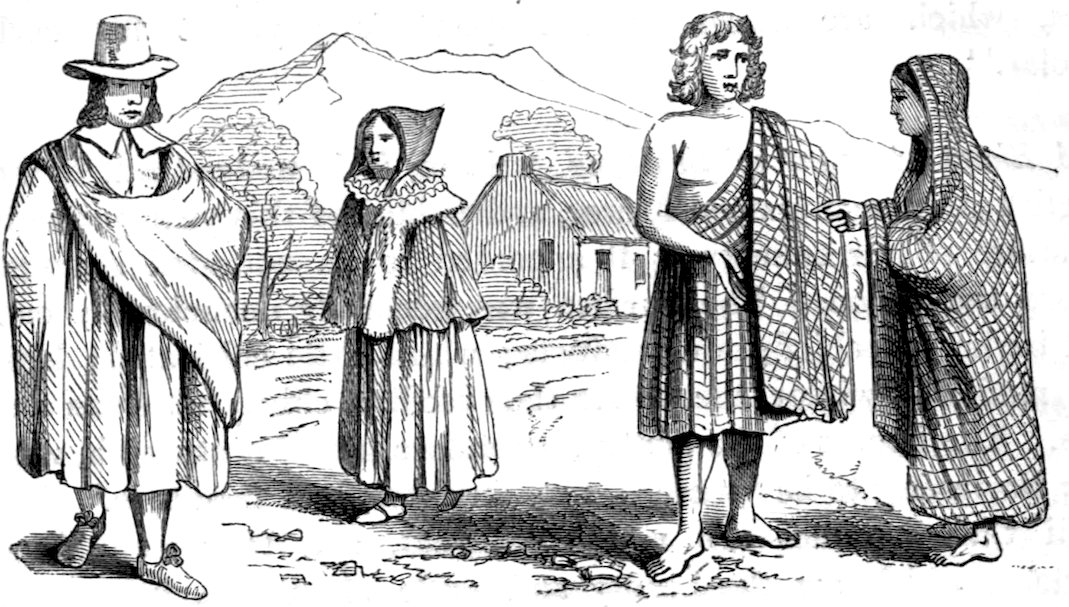
Dresses of the People of Scotland.—From Speed’s Atlas, 1676.
Stage-coaches did not as yet exist, but there were a few hackneys at Edinburgh, which might be hired into the country upon urgent occasions. ‘The truth is, the roads will hardly allow them those conveniences, which is the reason that the gentry, men and women, choose rather to use their horses. However, their great men often travel with coach-and-six, but with so little caution, that, besides their other attendance, they have a lusty running-footman on each side of the coach, to manage and keep it up in rough places.’
Another Englishman, who made an excursion into Scotland in 1704, gives additional particulars, but to the same general purport. At Edinburgh, he got good French wine at 20d., and Burgundy at 10d. a quart. The town appeared to him scarcely so large as York or Newcastle, but extremely populous, and containing abundance of beggars. ‘The people here,’ he says, ‘are very proud, and call the ordinary tradesmen merchants.’ ‘At the best houses they dress their victuals after the French method, though perhaps not so cleanly, and a soup is commonly the first dish; and their reckonings are dear enough. The servant-maids attended without shoes or stockings.’
At Lesmahago, a village in Lanarkshire, he found the people living on cakes made of pease and barley mixed. ‘They ate no meat, nor drank anything but water, all the year round; and the common people go without shoes or stockings all the year round. I pitied their poverty, but observed the people were fresh and 271|1702.| lusty, and did not seem to be under any uneasiness with their way of living.’
In the village inn, ‘I had,’ says he, ‘an enclosed room to myself, with a chimney in it, and dined on a leg of veal, which is not to be had at every place in this country.’ At another village—Crawford-John—‘the houses are either of earth or loose stones, or are raddled, and the roofs are of turf, and the floors the bare ground. They are but one story high, and the chimney is a hole in the roof, and the fireplace is in the middle of the floor. Their seats and beds are of turf earthed over, and raddled up near the fireplace, and serve for both uses. Their ale is pale, small, and thick, but at the most common minsh-houses [taverns], they commonly have good French brandy, and often French wine, so common are these French liquors in this country.’
Our traveller, being at Crawford-John on a Sunday, went to the parish church, which he likens to a barn. He found it ‘mightily crowded, and two gentlemen’s seats in it with deal-tops over them. They begin service here about nine in the morning, and continue it till about noon, and then rise, and the minister goes to the minsh-house, and so many of them as think fit, and refresh themselves. The rest stay in the churchyard for about half an hour, and then service begins again, and continues till about four or five. I suppose the reason of this is, that most of the congregations live too far from the church to go home and return to church in time.’[327]
The general conditions described by both of these travellers exhibit little, if any advance upon those presented in the journey of the Yorkshire squire in 1688,[328] or even that of Ray the naturalist in 1661.[329]
1703. Jan. 24.
George Young, a shopkeeper in the High Street of Edinburgh, was appointed by the magistrates as a constable, along with several other citizens in the like capacity, ‘to oversee the manners and order of the burgh and inhabitants thereof.’ On the evening of the day noted, being Sunday, he went ‘through some parts of the town, to see that the Lord’s Day and laws made for the observance thereof were not violat.’ ‘Coming to the house of Marjory Thom, relict of James Allan, vintner, a little before ten o’clock, and 272|1703.| finding in the house several companies in different rooms, [he] did soberly and Christianly expostulate with the mistress of the house for keeping persons in her house at such unseasonable hours, and did very justly threaten to delate her to the magistrates, to be rebuked for the same. [He] did not in the least offer to disturb any of her guests, but went away, and as [he was] going up the close to the streets, he and the rest was followed by Mr Archibald Campbell, eldest son to Lord Niel Campbell, who quarrelled him for offering to delate the house to the magistrates, [telling him] he would make him repent it.’ So runs George Young’s own account of the matter. It was rather unlucky for him, in his turn at this duty, to have come into collision with Mr Campbell, for the latter was first-cousin to the Duke of Argyle, and a person of too much consequence to be involved in a law which only works sweetly against the humbler classes, being, indeed, mainly designed for their benefit.
To pursue Young’s narrative. ‘Mr Archibald came next day with some others towards the said George his shop, opposite to the Guard [house], and called at his shop, which was shut by the hatch or half-door: “Sirrah, sirrah!” which George not observing, nor apprehending his discourse was directed to him, Mr Archibald called again to this purpose: “I spoke to you, Young the constable.” Whereupon, George civilly desiring to know his pleasure, he expressed himself thus: “Spark, are you in any better humour to-day than you was last night?” George answered, he was the same to-day he was last night. “I was about my duty last night, and am so to-day. I hope I have not offended you; and pray, sir, do not disturb me.” Mr Archibald, appearing angry, and challenging George for his taking notice of Mrs Allan’s house, again asked him if he was in any better temper, or words to that purpose; [to which] George again replied, He was the same he was, and prayed him to be gone, because he seemed displeased. Whereupon Mr Archibald taking hold of his sword, as [if] he would have drawn it, George, being within the half-door, fearing harm, threw open the door, and came out to Mr Archibald, and endeavoured to catch hold of his sword. Mr Archibald did beat him upon the eye twice or thrice, and again took hold of his sword to draw and run at him; which he certainly had done, if not interrupted by the bystanders, who took hold of his sword and held him, till that the Town-guard seized Mr Archibald, and made him prisoner.’
Mr Campbell, being speedily released upon bail, did not wait to 273|1702.| be brought before the magistrates, but raised a process against Young before the Privy Council, ‘intending thereby to discourage all laudable endeavours to get extravagancy and disorder [repressed].’ In the charge which he brought forward, Mr Campbell depicts himself as walking peaceably on the High Street, when Young attacked him, seized his sword, and declared him prisoner, without any previous offence on his part. The Guard thereafter dragged him to their house, maltreating him by the way, and kept him a prisoner till his friends assembled and obtained his liberation. The process went through various stages during the next few weeks, and at length, on the 9th of March, the Council found Young guilty of a riot, and fined him in four hundred merks (upwards of £22 sterling), to be paid to Mr Campbell for his expenses; further ordaining the offender to be imprisoned till the money was forthcoming.
To do the Duke of Argyle justice, his name does not appear in the list of the councillors who sat that day.
Mar. 6.
Sir John Bell, a former magistrate of Glasgow, kept up a modest frame of Episcopal worship in that Presbyterian city, having occasionally preachers, who were not always qualified by law, to officiate in his house. On the 30th of January, a boy-mob assailed the house while worship was going on, and some windows were broken. However, the magistrates were quickly on the spot, and the tumult was suppressed.
A letter from the queen to the Privy Council, dated the 4th February, glanced favourably at the Episcopalian dissenters of Scotland, enjoining that the clergy of that persuasion should live peaceably in relation to the Established Church, and that they should, while doing so, be protected in the exercise of their religion. It was a sour morsel to the more zealous Presbyterians, clergy and laity, who, not from any spirit of revenge, but merely from bigoted religious feelings, would willingly have seen all Episcopalians banished at the least. At Glasgow, where a rumour got up that some Episcopalian places of worship would be immediately opened under sanction of her majesty’s letter, much excitement prevailed. Warned by a letter from the Lord Chancellor, the magistrates of the city took measures for preserving the peace, and they went to church on the 7th of March, under a full belief that there was no immediate likelihood of its being broken. The Episcopalians, however, were in some alarm about the symptoms of popular feeling, and it was deemed 274|1703.| necessary to plant a guard of gentlemen, armed with swords, in front of the door of Sir John Bell’s house, where they were to enjoy the ministrations of a clergyman named Burgess. Some rude boys gathered about, and soon came to rough words with this volunteer guard, who, chasing them with their swords, and, it is said, violent oaths, along the Saltmarket, roused a general tumult amongst all who were not at church. The alarm soon passed into the churches. The people poured out, and flocked to the house where they knew that the Episcopalians were gathered. The windows were quickly smashed. The worshippers barricaded and defended themselves; but the crowd broke in with fore-hammers, though apparently hardly knowing for what purpose. The magistrates came with some soldiers; reasoned, entreated, threatened; apprehended a few rioters, who were quickly rescued; and finally thought it best to limit themselves to conducting the scared congregation to their respective homes—a task they successfully accomplished. ‘Afterwards,’ say the magistrates, ‘we went and did see Sir John Bell in his house, where Mr Burgess, the minister, was; and, in the meantime, when we were regretting the misfortune that had happened to Sir John and his family, who had merited much from his civil carriage when a magistrate in this place, it was answered to us by one of his sons present, that they had got what they were seeking, and would rather that that had fallen out than if it had been otherways.’
The Privy Council, well aware how distasteful any outrages against the Episcopalians would be at court, took pains to represent this affair in duly severe terms in their letters to the secretaries of state in London. They also took strong measures to prevent any similar tumult in future, and to obtain reparation of damages for Sir John Bell.
Generally, the condition of Episcopal ministers continued to be uncomfortable. In February 1705, Dr Richard Waddell, who had been Archdean of St Andrews before the Revolution, and was banished from that place in 1691, but had lately returned under protection of her majesty’s general indemnity, became the subject of repressive measures on the part of the Established Church. Letters of horning were raised against him by ‘John Blair, agent for the kirk,’ and, notwithstanding strong protestations of loyalty to the queen, he was ordained by the Privy Council once more ‘to remove furth of the town and parochine of St Andrews, and not return thereto.’[330]
1703. Apr.
275An elderly woman named Marion Lillie, residing at Spott, in East Lothian, was in the hands of the kirk-session, on account of the general repute she lay under as a witch. Amidst the tedious investigations of her case in the parish register, it is impossible to see more than that she occasionally spoke ungently to and of her neighbours, and had frightened a pregnant woman to a rather unpleasant extremity by handling her rudely. The Rigwoodie Witch,[331] as a neighbour called her, was now turned over to a magistrate, to be dealt with according to law; but of her final fate we have no account.
Spott is a place of sad fame, its minister having basely murdered his wife in 1570,[332] and the estate having belonged to a gentleman named Douglas, whom we have seen concerned in the slaughter of Sir James Home of Eccles, and who on that account became a forfeited outlaw.[333] The wife of a subsequent proprietor, a gambler named Murray, was daughter to the Lord Forrester, who was stabbed with his own sword by his mistress at Corstorphine in 1679.[334] There is extant a characteristic letter of this lady to Lord Alexander Hay, son of the Earl of Tweeddale, on his bargaining, soon after this time, for the estate, with her husband, without her consent—in which she makes allusion to the witches of Spott:
‘THES TO LORD ALEXANDER HAY.
‘Spott, 19 May.
‘This way of proceeding, my lord, will seem verey abrupte and inconsiderat to you; but I laye my count with the severest censer you or may malicious enemies can or will saye of me. So, not to be tedious, all I have to speak is this: I think you most absurd to [have] bought the lands of Spott from Mr Murray without my consent, which you shall never have now; and I hope to be poseser of Spott hous when you are att the divel; and believe me, my childrin’s curse and mine will be a greater moth in your estate than all your ladey and your misirable wretchedness can make up and pray [pay].
‘This is no letter of my lord Bell Heavins, and tho you saye, in spite of the divell, you’le buy it befor this time twell month, you may come to repent it; but thats non of my bisnes. I shall only saye this, you are basely impertinent to thrust me away in a hurrey from my houss at Whitsunday, when I designed not 276|1703.| to go till Martinmis: and I wish the ghosts of all the witches that ever was about Spott may haunt you, and make you the unfortountest man that ever lived, that you may see you was in the wrong in makeing aney such bargain without the consent of your mortal enemy,
Clara Murray.’[335]
July 1.
The country was at this time in a state of incandescent madness regarding its nationality, and the public feeling found expression through the medium of parliament. By its order, there was this day burned at the Cross of Edinburgh, by the hangman, a book entitled Historia Anglo-Scotica, by James Drake, ‘containing many false and injurious reflections upon the sovereignty and independency of this nation.’ In August 1705, when the passion was even at a greater height, the same fate was awarded by the legislature to a book, entitled The Superiority and Direct Dominion of the Imperial Crown of England over the Crown and Kingdom of Scotland; also to a pamphlet, called The Scots Patriot Unmasked, both being the production of William Atwood. On the same day that the latter order was given, the parliament decreed the extraordinary sum of £4800 (Scots?) to Mr James Anderson, for a book he had published, A Historical Essay shewing that the Crown and Kingdom of Scotland is Imperial and Independent. Nor was this all, for at the same time it was ordered that ‘Mr James Hodges, who hath in his writings served this nation,’ should have a similar reward.[336]
Sep. 3.
The Scottish parliament at this time patronised literature to a considerable extent, though a good deal after the manner of the poor gentleman who bequeathed large ideal sums to his friends, and comforted himself with the reflection, that it at least shewed good-will. Alexander Nisbet had prepared a laborious work on heraldry,[337] tracing its rise, and describing all its various figures, besides ‘shewing by whom they are carried amongst us, and for what reasons,’ thus instructing the gentlefolk of this country of their ‘genealogical pennons,’ and affording assistance to ‘curious antiquaries’ in understanding ‘seals, medals, historie, and ancient records.’ But Alexander was unable of his own means to publish 277|1703.| so large a work, for which it would be necessary to get italic types, ‘whereof there are very few in this kingdom,’ and which also required a multitude of copper engravings to display ‘the armorial ensigns of this ancient kingdom.’ Accordingly, on his petition, the parliament (September 3, 1703), recommended the Treasury to grant him £248, 6s. 8d. sterling ‘out of what fund they shall think fit.’[338]
Aug. 9.
In 1695, the Scottish parliament forbade the sale of rum, as interfering with the consumpt of ‘strong waters made of malt,’ and because the article itself was ‘rather a drug than a liquor, and highly prejudicial to the health of all who drink it.’ Now, however, Mr William Cochrane of Kilmaronock, John Walkenshaw of Barrowfield, John Forbes of Knaperna, and Robert Douglas, merchant in Leith, designed to set up a sugar-work and ‘stillarie for distilling of rum’ in Leith, believing that such could never be ‘more necessary and beneficial to the country, and for the general use and advantage of the lieges, than in this time of war, when commodities of that nature, how necessary soever, can hardly be got from abroad.’ On their petition, the designed work was endowed by the Privy Council with the privileges of a manufactory.
Sep. 10.
The steeple of the Tolbooth of Tain had lately fallen in the night, to the great hazard of the lives of the prisoners, and some considerable damage to the contiguous parish church. On the petition of the magistrates of this poor little burgh, the Privy Council ordained a collection to be made for the reconstruction of the building; and, meanwhile, creditors were enjoined to transport their prisoners to other jails.
Nearly about the same time, voluntary collections were ordained by the Privy Council, for erecting a bridge over the Dee at the Black Ford; for the construction of a harbour at Cromarty, ‘where a great quantity of the victual that comes to the south is loadened;’ and for making a harbour at Pennan, on the estate of William Baird of Auchmedden, in Aberdeenshire, where such a convenience was eminently required for the shelter of vessels, and where ‘there is likewise a millstone quarry belonging to the petitioner [Baird], from which the greatest part of the mills in the kingdom are served by sea.’
1703. Nov. 11.
278Amidst the endless instances of misdirected zeal and talent which mark the time, there is a feeling of relief and gratification even in so small and commonplace a matter as an application to the Privy Council, which now occurs, from Mr William Forbes, advocate, for a copyright in a work he had prepared under the name of A Methodical Treatise of Bills of Exchange. The case is somewhat remarkable in itself, as an application by an author, such applications being generally from stationers and printers.
Dec.
Usually, in our day, the opposing solicitors in a cause do not feel any wrath towards each other. It was different with two agents employed at this time in the Court of Session on different interests, one of them being Patrick Comrie, who acted in the capacity of ‘doer’ for the Laird of Lawers. To him, one day, as he lounged through the Outer House, came up James Leslie, a ‘writer,’ who entered into some conversation with him about Lawers’s business, and so provoked him, that he struck Leslie in the face, in the presence of many witnesses. Leslie appealed to the court, on the strength of an old statute which decreed death to any one guilty of violence in the presence of the Lords, and Comrie was apprehended. There then arose many curious and perplexing questions among the judges as to the various bearings of the case; but all were suddenly solved by Comrie obtaining a remission of his offence from the queen.[339]
In this year was published[340] the first intelligent topographical book regarding Scotland, being ‘A Description of the Western Isles, by M. Martin, Gentleman.’ It gives accurate information regarding the physical peculiarities of these islands, and their numberless relics of antiquity, besides many sensible hints as to means for improving the industry of the inhabitants. The author, who seems to have been a native of Skye, writes like a well-educated man for his age, and as one who had seen something of life in “busier scenes than those supplied by his own country. He has also thought proper to give an ample account of many superstitious practices of the Hebrideans, and to devote a chapter to the alleged power of second-sight, which was then commonly attributed to special individuals throughout the whole of Celtic Scotland. All this he does in the same sober painstaking manner in which he tells of matters connected with the rural economy of the people, 279|1703.| fully shewing that he himself reposed entire faith in the alleged phenomena. In the whole article, indeed, he scarcely introduces a single expression of a dogmatic character, either in the way of defending the belief or ridiculing it, but he very calmly furnishes answers, based on what he considered as facts, to sundry objections which had been taken against it. But for his book, we should have been much in the dark regarding a system which certainly made a great mark on the Highland mind in the seventeenth century, and was altogether as remarkable, perhaps, as the witch superstitions of the Lowlands during the same period.
He tells us—‘The second-sight is a singular faculty of seeing an otherwise invisible object, without any previous means used by the person that sees it, for that end. The vision makes such a lively impression upon the seers, that they neither see nor think of anything else, except the vision, as long as it continues, and then they appear pensive or jovial, according to the object which was represented to them.
‘At the sight of a vision, the eyelids of the person are erected, and the eyes continue staring until the object vanish. This is obvious to others who are by, when the persons happen to see a vision, and occurred more than once to my own observation, and to others who were with me.’
The seers were persons of both sexes and of all ages, ‘generally illiterate, well-meaning people;’ not people who desired to make gain by their supposed faculty, or to attract notice to themselves—not drunkards or fools—but simple country people, who were rather more apt to feel uneasy in the possession of a gift so strange, than to use it for any selfish or unworthy purpose. It really appears to have been generally regarded as an uncomfortable peculiarity; and there were many instances of the seers resorting to prayers and other religious observances in order to get quit of it.
The vision came upon the seer unpremonishedly, and in all imaginable circumstances. If early in the morning, which was not frequent, then the prediction was expected to be accomplished within a few hours; the later in the day, the accomplishment was expected at the greater distance of time. The things seen were often of an indifferent nature, as the arrival of a stranger; often of a character no less important than the death of individuals. If a woman was seen standing at a man’s left hand, it was a presage that she would be his wife, even though one of the parties might then be the mate of another. Sometimes several women would be seen standing in a row beside a man, in which case it was expected 280|1703.| that the one nearest would be his first wife, and so on with the rest in their turns.
When the arrival of a stranger was predicted, his dress, stature, complexion, and general appearance would be described, although he might be previously unknown to the seer. If of the seer’s acquaintance, his name would be told, and the humour he was in would be described from the countenance he bore. ‘I have been seen thus myself,’ says Martin, ‘by seers of both sexes at some hundred miles’ distance; some that saw me in this manner, had never seen me personally, and it happened according to their visions, without any previous design of mine to go to those places, my coming there being purely accidental.’
It will be remembered that, when Dr Johnson and Boswell travelled through the Hebrides in 1773, the latter was told an instance of such prediction by the gentleman who was the subject of the story—namely, M‘Quarrie, the Laird of Ulva. ‘He had gone to Edinburgh, and taken a man-servant along with him. An old woman who was in the house said one day: “M‘Quarrie will be at home to-morrow, and will bring two gentlemen with him;” and she said she saw his servant return in red and green. He did come home next day. He had two gentlemen with him, and his servant had a new red and green livery, which M‘Quarrie had bought for him at Edinburgh, upon a sudden thought, not having the least intention when he left home to put his servant in livery; so that the old woman could not have heard any previous mention of it. This, he assured us, was a true story.’[341]
Martin tells a story of the same character, but even more striking in its various features. The seer in this case was Archibald Macdonald, who lived in the isle of Skye about the time of the Revolution. One night before supper, at Knockowe, he told the family he had just then seen the strangest thing he ever saw in his life; to wit, a man with an ugly long cap, always shaking his head; but the strangest thing of all was a little harp he had, with only four strings, and two hart’s horns fixed in the front of it. ‘All that heard this odd vision fell a laughing at Archibald, telling him that he was dreaming, or had not his wits about him, since he pretended to see a thing that had no being, and was not so much as heard of in any part of the world.’ All this had no effect upon Archibald, ‘who told them that they must excuse him if he laughed at them after the accomplishment of the vision.’ Archibald 281|1703.| returned to his own house, and within three or four days after, a man exactly answering to the description arrived at Knockowe. He was a poor man, who made himself a buffoon for bread, playing on a harp, which was ornamented with a pair of hart’s horns, and wearing a cap and bells, which he shook in playing. He was previously unknown at Knockowe, and was found to have been at the island of Barray, sixty miles off, at the time of the vision. This story was vouched by Mr Daniel Martin and all his family—relatives, we may presume, of the author of the book now quoted.
Martin relates a story of a predicted visit of a singular kind to the island of Egg; and it is an instance more than usually entitled to notice, as he himself heard of it in the interval between the vision and its fulfilment. A seer in that island told his neighbours that he had frequently seen the appearance of a man in a red coat lined with blue, having on his head a strange kind of blue cap, with a very high cock on the forepart of it. The figure always appeared in the act of making rude advances to a young woman who lived in the hamlet, and he predicted that it would be the fate of this girl to be treated in a dishonourable way by some such stranger. The inhabitants considered the affair so extremely unlikely to be realised, that they treated the seer as a fool. Martin tells that he had the story related to him in Edinburgh, in September 1688, by Norman Macleod of Graban, who had just then come from the isle of Skye, there being present at the time the Laird of Macleod, Mr Alexander Macleod, advocate, and some other persons. About a year and a half after, a few government war-vessels were sent into the Western Islands to reduce some of the people who had been out with Lord Dundee. Major Fergusson, who commanded a large military party on board, had no thought of touching at Egg, which is a very sequestered island, but some natives of that isle, being in Skye, encountered a party of his men, and one of the latter was slain. He consequently steered for Egg, to revenge himself on the natives. Among other outrages, the young woman above alluded to was carried on board the vessel, and disgracefully treated, thus completely verifying the vision.
An instance of the second-sight, which fell under the observation of the clever statesman Viscount Tarbat, is related by Martin as having been reported to him by Lord Tarbat himself. While travelling in Ross-shire, his lordship entered a house, and sat down on an arm-chair. One of his retinue, who possessed the faculty of 282|1703.| a seer, spoke to some of the rest, wishing them to persuade his lordship to leave the house, ‘for,’ said he, ‘a great misfortune will attend somebody in it, and that within a few hours.’ This was told to Lord Tarbat, who did not regard it. The seer soon after renewed his entreaty with much earnestness, begging his master to remove out of that unhappy chair; but he was only snubbed as a fool. Lord Tarbat, at his own pleasure, renewed his journey, and had not been gone many hours when a trooper, riding upon ice, fell and broke his thigh, and being brought into that house, was laid in the arm-chair to have his wound dressed. Thus the vision was accomplished.
It was considered a rule in second-sight, that a vision seen by one seer was not necessarily visible to another in his company, unless the first touched his neighbour. There are, nevertheless, anecdotes of visions seen by more than one at a time, without any such ceremony. In one case, two persons, not accustomed to see visions, saw one together, after which, neither ever enjoyed the privilege again. They were two simple country men, travelling along a road about two miles to the north of Snizort church, in Skye. Suddenly they saw what appeared as a body of men coming from the north, as if bringing a corpse to Snizort to be buried. They advanced to the river, thinking to meet the funeral company at the ford, but when they got there, the visionary scene had vanished. On coming home, they told what they had seen to their neighbours. ‘About three weeks after, a corpse was brought along that road from another parish, from which few or none are brought to Snizort, except persons of distinction.’
A vision of a similar nature is described as occurring to one Daniel Stewart, an inhabitant of Hole, in the North Parish of St Mary’s, in the isle of Skye; and it was likewise the man’s only experience of the kind. One day, at noon, he saw five men riding northward; he ran down to the road to meet them; but when he got there, all had vanished. The vision was repeated next day, when he also heard the men speak. It was concluded that the company he saw was that of Sir Donald Macdonald of Sleat, who was then at Armadale, forty miles distant.
The important place which matrimony occupies in social existence, makes it not surprising that the union of individuals in marriage was frequently the alleged subject of second-sight. As already mentioned, when a woman stood at a man’s left hand, she was expected to be his wife. It was also understood that, when a man was seen at a woman’s left hand, he was to be her 283|1703.| future husband. ‘Several persons,’ says Martin, ‘living in a certain family, told me that they had frequently seen two men standing at a young gentlewoman’s left hand, who was their master’s daughter. They told the men’s names, and as they were the young lady’s equals, it was not doubted that she would be married to one of them, and perhaps to the other, after the death of the first. Some time after, a third man appeared, and he seemed always to stand nearest to her of the three; but the seers did not know him, though they could describe him exactly. Within some months after, this man, who was last seen, did actually come to the house, and fulfilled the description given of him by those who never saw him but in a vision; and he married the woman shortly after. They live in the isle of Skye; both they and others confirmed the truth of this instance when I saw them.’
The Rev. Daniel Nicolson, minister of the parish of St Mary’s, in Skye, was a widower of forty-four, when a noted seer of his flock, the Archibald Macdonald already spoken of, gave out that he saw a well-dressed lady frequently standing at the minister’s right hand. He described her complexion, stature, and dress particularly, and said he had no doubt such a person would in time become the second Mrs Nicolson. The minister was rather angry at having this story told, and bade his people pay no attention to what ‘that foolish dreamer, Archibald Macdonald,’ had said, ‘for,’ said he, ‘it is twenty to one if ever I marry again.’ Archibald, nevertheless, persisted in his tale. While the matter stood in this position, it was related to Martin.
The minister afterwards attended a synod in Bute—met a Mrs Morison there—fell in love with her, and brought her home to Skye as his wife. It is affirmed that she was instantly and generally recognised as answering to the description of the lady in Archibald’s vision.
About 1652, Captain Alexander Fraser, commonly called the Tutor of Lovat, being guardian of his nephew, Lord Lovat, married Sybilla Mackenzie, sister of the Earl of Seaforth, and widow of John Macleod of Macleod. The Tutor, who had fought gallantly in the preceding year for King Charles II. at Worcester, was thought a very lucky man in this match, as the lady had a jointure of three hundred merks per annum![342] The marriage, however, is more remarkable on account of its having 284|1703.| been seen many years before, during the lifetime of the lady’s first husband. We have the story told with all seriousness, though in very obscure typography, in a letter which Aubrey prints[343] as having been sent to him by a ‘learned friend’ of his in the Highlands, about 1694.
Macleod and his wife, while residing, we are to understand, at their house of Dunvegan in Skye, on returning one day from an excursion or brief visit, went into their nursery to see their infant child. To pursue the narration: ‘On their coming in, the nurse falls a-weeping. They asked the cause, dreading the child was sick, or that the nurse was scarce of milk. The nurse replied the child was well, and she had abundance of milk. Yet she still wept. Being pressed to tell what ailed her, she at last said that Macleod would die, and the lady would shortly be married to another man. Being asked how she knew that event, she told them plainly, that, as they came into the room, she saw a man with a scarlet cloak and white hat betwixt them, giving the lady a kiss over the shoulder; and this was the cause of her weeping; all which,’ pursues the narrator, ‘came to pass. After Macleod’s death [which happened in 1649], the Tutor of Lovat married the lady in the same dress in which the woman saw him.’
The Bishop of Caithness, a short while before the Revolution, had five daughters, one of whom spoke grudgingly of the burden of the family housekeeping lying wholly upon her. A man-servant in the house, who had the second-sight, told her that ere long she would be relieved from her task, as he saw a tall gentleman in black walking on the bishop’s right hand, and whom she was to marry. Before a quarter of a year had elapsed, the prediction was realised; and all the man’s vaticinations regarding the marriage-feast and company also proved true.
A curious class of cases, of importance for any theory on the subject, was that in which a visionary figure or spectre intervened for the production of the phenomena. A spirit in great vogue in the Highlands in old times—as, indeed, in the Lowlands also—was known by the name of Browny. From the accounts we have of him, it seems as if he were in a great measure identical with the drudging goblin of Milton, whose shadowy flail by night would thrash the corn
‘That ten day-labourers could not end.’
Among our Highlanders, he presented himself as a tall man. 285|1703.| The servants of Sir Norman Macleod of Bernera were one night assembled in the hall of the castle in that remote island, while their master was absent on business, without any intimation having been given of the time of his probable return. One of the party, who had the second-sight, saw Browny[344] come in several times and make a show of carrying an old woman from the fireside to the door; at last, he seemed to take her by neck and heels, and bundle her out of the house; at which the seer laughed so heartily, that his companions thought him mad. He told them they must remove, for the hall would be required that night for other company. They knew, of course, that he spoke in consequence of having had a vision; but they took it upon themselves to express a doubt that it could be so speedily accomplished. In so dark a night, and the approach to the island being so dangerous on account of the rocks, it was most unlikely that their master would arrive. In less than an hour, a man came in to warn them to get the hall ready for their master, who had just landed. Martin relates this story from Sir Norman Macleod’s own report.
The same Sir Norman Macleod was one day playing with some of his friends at a game called the Tables (in Gaelic, palmermore), which requires three on a side, each throwing the dice by turns. 286|1703.| A critical difficulty arising as to the placing of one of the table-men, seeing that the issue of the game obviously must depend upon it, the gentleman who was to play hesitated for a considerable time. At length, Sir Norman’s butler whispered a direction as to the best site for the man into his ear; he played in obedience to the suggestion, and won the game. Sir Norman, having heard the whisper, asked who had advised him so skilfully. He answered that it was the butler. ‘That is strange,’ quoth Sir Norman, ‘for the butler is unacquainted with the game.’ On inquiry, the man told that he had not spoken from any skill of his own. He had seen the spirit, Browny, reaching his arm over the player’s head, and touching with his finger the spot where the table-man was to be placed. ‘This,’ says Martin, ‘was told me by Sir Norman and others, who happened to be present at the time.’
Sir Norman Macleod relates another case in which his own knowledge comes in importantly for authentication. A gentleman in the isle of Harris had always been ‘seen’ with an arrow in his thigh, and it was expected that he would not go out of the world without the prediction being fulfilled. Sir Norman heard the matter spoken of for many years before the death of the gentleman. At length the gentleman died, without any such occurrence taking place. Sir Norman was at his funeral, at St Clement’s kirk, in Harris. The custom of that island being to bury men of importance in a stone chest in the church, the body was brought on an open bier. A dispute took place among the friends at the church door as to who should enter first, and from words it came to blows. One who was armed with a bow and arrows, let fly amongst them, and after Sir Norman Macleod had appeased the tumult, one of the arrows was found sticking in the dead man’s thigh!
Martin was informed by John Morison of Bragir, in Lewis, ‘a person of unquestionable sincerity and reputation,’ respecting a girl of twelve years old, living within a mile of his house, who was troubled with the frequent vision of a person exactly resembling herself, who seemed to be always employed just as she herself might be at the moment. At the suggestion of John Morison, prayers were put up in the family, in which he and the girl joined, entreating that God would be pleased to relieve her from this unpleasant visitation; and after that she saw her double no more. Another neighbour of John Morison was haunted by a spirit resembling himself, who never spoke to him within doors, but pestered him constantly out of doors with impertinent questions. 287|1703.| At the recommendation of a neighbour, the man threw a live coal in the face of the vision; in consequence of which, the spirit assailed him in the fields next day, and beat him so sorely, that he had to keep his bed for fourteen days. Martin adds: ‘Mr Morison, minister of the parish, and several of his friends, came to see the man, and joined in prayer that he might be freed from this trouble; but he was still haunted by that spirit a year after I left Lewis.’
Another case in which the spirit used personal violence, but of an impalpable kind, is related by Martin as happening at Knockowe, in Skye, and as reported to him by the family who were present when the circumstance occurred. A man-servant, who usually enjoyed perfect health, was one evening taken violently ill, fell back upon the floor, and then began to vomit. The family were much concerned, being totally at a loss to account for so sudden an attack; but in a short while the man recovered, and declared himself free of pain. A seer in the family explained the mystery. In a neighbouring village lived an ill-natured female, who had had some hopes of marriage from this man, but was likely to be disappointed. He had seen this woman come in with a furious countenance, and fall a-scolding her lover in the most violent manner, till the man tumbled from his seat, albeit unconscious of the assault made upon him.
Several instances of second-sight are recorded in connection with historical occurrences. Sir John Harrington relates that, at an interview he had with King James in 1607, the conversation having turned upon Queen Mary, the king told him that her death had been seen in Scotland before it happened, ‘being, as he said, “spoken of in secret by those whose power of sight presented to them a bloody head dancing in the air.” He then,’ continues Harrington, ‘did remark much on this gift.’[345] It is related in May’s History of England, that when the family of King James was leaving Scotland for England, an old hermit-like seer was brought before them, who took little notice of Prince Henry, but wept over Prince Charles—then three years old—lamenting to think of the misfortunes he was to undergo, and declaring he should be the most miserable of princes. A Scotch nobleman had a Highland seer brought to London, where he asked his judgment on the Duke of Buckingham, then at the height of his fortunes as the king’s favourite. 288|1703.| ‘Pish!’ said he, ‘he will come to nothing. I see a dagger in his breast!’ In time the duke, as is well known, was stabbed to the heart by Lieutenant Felton.
In one of the letters on second-sight, written to Mr Aubrey from Scotland about 1693–94, reference is made to the seer Archibald Macdonald, who has already been introduced in connection with instances occurring in Skye. According to this writer, who was a divinity student living in Strathspey, Inverness-shire, Archibald announced a prediction regarding the unfortunate Earl of Argyle. He mentioned it at Balloch Castle (now Castle-Grant), in the presence of the Laird of Grant, his lady, and several others, and also in the house of the narrator’s father. He said of Argyle, of whom few or none then knew where he was, that he would within two months come to the West Highlands, and raise a rebellious faction, which would be divided in itself, and disperse, while the earl would be taken and beheaded at Edinburgh, and his head set upon the Tolbooth, where his father’s head was before. All this proved strictly true.
Archibald Macdonald was a friend of Macdonald of Glencoe, and accompanied him in the expedition of Lord Dundee in 1689 for the maintenance of King James’s interest in the Highlands. Mr Aubrey’s correspondent, who was then living in Strathspey, relates that Dundee’s irregular forces followed General Mackay’s party along Speyside till they came to Edinglassie, when he turned and marched up the valley. At the Milltown of Gartenbeg, the Macleans joined, but remained behind to plunder. Glencoe, with Archibald in his company, came to drive them forward; and when this had been to some extent effected, the seer came up and said: ‘Glencoe, if you will take my advice, you will make off with yourself with all possible haste. Ere an hour come and go, you’ll be as hard put to it as ever you were in your life.’ Glencoe took the hint, and, within an hour, Mackay appeared at Culnakyle, in Abernethy, with a party of horse, and chased the Macleans up the Morskaith; in which chase Glencoe was involved, and was hard put to it, as had been foretold. It is added, that Archibald likewise foretold that Glencoe would be murdered in the night-time in his own house, three months before it happened.
A well-vouched instance of the second-sight connected with a historical incident, is related by Drummond of Bohaldy, regarding the celebrated Highland paladin, Sir Ewen Cameron of Locheil, who died at the age of ninety in 1719. ‘Very early that morning 289|1703.| [December 24, 1715] whereon the Chevalier de St George landed at Peterhead, attended only by Allan Cameron, one of the gentlemen of his bedchamber, Sir Ewen started, as it were, in a surprise, from his sleep, and called out so loud to his lady (who lay by him in another bed) that his king was landed—that his king was arrived—and that his son Allan was with him, that she awaked.’ She then received his orders to summon the clan, and make them drink the king’s (that is, the Chevalier’s) health—a fête they engaged in so heartily, that they spent in it all the next day. ‘His lady was so curious, that she noted down the words upon paper, with the date; which she a few days after found verified in fact, to her great surprise.’ Bohaldy remarks that this case fully approved itself to the whole clan Cameron, as they heard their chief speak of scarcely anything else all that day.[346]
Predictions of death formed a large class of cases of second-sight. The event was usually indicated by the subject of the vision appearing in a shroud, and the higher the vestment rose on the figure, the event was the nearer. ‘If it is not seen above the middle,’ says Martin, ‘death is not to be expected for the space of a year, and perhaps some months longer. When it is seen to ascend higher towards the head, death is concluded to be at hand within a few days, if not hours, as daily experience confirms. Examples of this kind were shewn me, when the person of whom the observation was made enjoyed perfect health.’ He adds, that sometimes death was foretold of an individual by hearing a loud cry, as from him, out of doors. ‘Five women were sitting together in the same room, and all of them heard a loud cry passing by the window. They thought it plainly to be the voice of a maid who was one of the number. She blushed at the time, though not sensible of her so doing, contracted a fever next day, and died that week.’
In a pamphlet on the second-sight, written by Mr John Fraser, dean of the Isles, and minister of Tiree and Coll, is an instance of predicted death, which the author reports on his own knowledge. Having occasion to go to Tobermory, in Mull, to assist in some government investigations for the recovery of treasure in the vessel of the Spanish Armada known to have been there sunk, he was accompanied by a handsome servant-lad, besides other attendants.[347] A woman came before he sailed, and, through the 290|1703.| medium of a seaman, endeavoured to dissuade him from taking that youth, as he would never bring him back alive. The seaman declined to communicate her story to Mr Fraser. The company proceeded on their voyage, and met adverse weather; the boy fell sick, and died on the eleventh day. Mr Fraser, on his return, made a point of asking the woman how she had come to know that this lad, apparently so healthy, was near his death. She told Mr Fraser that she had seen the boy, as he walked about, ‘sewed up in his winding-sheets from top to toe;’ this she always found to be speedily followed by the death of the person so seen.
Martin relates that a woman was accustomed for some time to see a female figure, with a shroud up to the waist, and a habit resembling her own; but as the face was turned away, she never could ascertain who it was. To satisfy her curiosity, she tried an experiment. She dressed herself with that part of her clothes behind which usually was before. The vision soon after presented itself with its face towards the seeress, who found it to be herself. She soon after died.
Although the second-sight had sunk so much in Martin’s time, that, according to him, there was not one seer for ten that had been twenty years before, it continued to be so much in vogue down to the reign of George III., that a separate treatise on the subject, containing scores of cases, was published in 1763 by an educated man styling himself Theophilus Insulanus, as a means of checking in some degree the materialising tendencies of the age, this author considering the gift as a proof of the immortality of the soul. When Dr Johnson, a few years later, visited the Highlands, he found the practice, so to speak, much declined, and the clergy almost all against it. Proofs could, nevertheless, be adduced that there are even now, in the remoter parts of the Highlands, occasional alleged instances of what is called second-sight, with a full popular belief in their reality.
1704. Jan. 25.
Charles, Earl of Hopetoun,[348] set forth in a petition to the Privy Council, that in his minority, many years ago, his tutors had caused a windmill to be built at Leith for grinding and refining the ore from his lead-mines. In consequence of the unsettling of a particular bargain, the mill had been allowed to lie unused till now, when it required some repair in order to be fit for service. 291|1704.| One John Smith, who had set up a saw-mill in Leith, being the only man seen in this kind of work, had been called into employment by his lordship for the repair of the windmill; but the wright-burgesses of Edinburgh interfered violently with the work, on the ground of their corporation privileges, ‘albeit it is sufficiently known that none of them have been bred to such work or have any skill therein.’ Indeed, some part of the original work done by them had now to be taken down, so ill was it done. It was obviously a public detriment that such a work should thus be brought to a stand-still. The Council, entering into the earl’s views, gave him a protection from the claims of the wright-burgesses.
Feb.
It is notorious that the purity of the Court of Session continued down to this time to be subject to suspicion. It was generally understood that a judge favoured his friends and connections, and could be ‘spoken to’ in behalf of a party in a suit. The time was not yet long past when each lord had a ‘Pate’—that is, a dependent member of the bar (sometimes called Peat), who, being largely fee’d by a party, could on that consideration influence his patron.
A curious case, illustrative of the character of the bench, was now in dependence. The heritors of the parish of Dalry raised an action for the realisation of a legacy of £3000, which had been left to them for the founding of a school by one Dr Johnston. The defender was John Joissy, surgeon, an executor of the testator, who resisted the payment of the money on certain pretexts. With the assistance of Alexander Gibson of Durie, a principal clerk of Session, Joissy gained favour with a portion of the judges, including the president. On the other hand, the heritors, under the patronage of the Earl of Galloway, secured as many on their side. A severe contest was therefore to be expected. According to a report of the case in the sederunt-book of the parish, the Lord President managed to have it judged under circumstances favourable to Joissy. The court having ‘accidentally appointed a peremptor day about the beginning of February 1704 for reporting and deciding in the cause, both parties concluded that the parish would then gain it, since one of Mr Joissy’s lords came to be then absent. For as my Lord Anstruther’s hour in the Outer House was betwixt nine and ten of the clock in the morning, so the Earl of Lauderdale, as Lord Ordinary in the Outer House, behoved to sit from ten to twelve in 292|1704.| the forenoon: for by the 21st act of the fourth session of the first parliament of King William and Queen Mary, it’s statuted expressly, that if the Lord Ordinary in the Outer Houses sit and vote in any cause in the Inner House after the chap of ten hours in the clock, he may be declined by either party in the cause from ever voting thereafter therintill: yet such was the Lord President’s management, that so soon as my Lord Anstruther returned from the Outer House at ten of the clock, and that my Lord Lauderdale was even desired by some of the lords to take his post in the Outer House in the terms of law: yet his lordship was pleased after ten to sit and vote against the parish, the president at that juncture having put the cause to a vote.’
The heritors, by the advice of some of the lords in their interest, gave in a declinature of Lord Lauderdale, on the ground of the illegality of his sitting in the Inner House after ten o’clock; whereupon, next morning, the Lord President came into the court in a great rage, demanding that all those concerned in the declinature should be punished as criminals. The leading decliner, Mr Ferguson of Cairoch, escaped from town on horseback, an hour before the macer came to summon him. The counsel, John Menzies of Cammo, and the agent, remained to do what they could to still the storm. According to the naïve terms of the report, ‘the speat [flood] was so high against the parish and them all the time, that they behoved to employ all their friends, and solicit a very particular lord that morning before they went to the house; and my Lord President was so high upon’t, that when Cammo told him that my Lord Lauderdale, contrair to the act of parliament, sat after ten o’clock, his lordship unmannerly said to Cammo, as good a gentleman as himself, that it was a damned lie.’
Menzies, though a very eminent counsel, and the agent, found all their efforts end in an order for their going to jail, while a suitable punishment should be deliberated upon. After some discussion, a slight calm ensued, and they were liberated on condition of coming to the bar as malefactors, and there begging the Earl of Lauderdale’s pardon. The parish report states that no remedy could be obtained, for ‘the misery at that time was that the lords were in effect absolute, for they did as they pleased, and when any took courage to protest for remeid of law to the Scots parliament, they seldom or never got any redress there, all the lords being still present, by which the parliament 293|1704.| was so overawed that not ane decreit among a hundred was reduced.’[349]
It is strange to reflect, that among these judges were Lord Fountainhall and Lord Arniston, with several other men who had resisted tyrannous proceedings of the old government, to their own great suffering and loss. Wodrow promises of Halcraig, that, for his conduct regarding the test in 1684, his memory would be ‘savoury.’ The same author, speaking of the set in 1726 as dying out, says he wishes their places may be as well filled. ‘King William,’ he says, ‘brought in a good many substantial, honest country gentlemen, well affected to the government and church, and many of them really religious, though there might be some greater lawyers than some of them have been and are. But, being men of integrity and weight, they have acted a fair and honest part these thirty years, and keep the bench in great respect. May their successors be equally diligent and conscientious!’[350] Of course, by fairness and honesty, Wodrow chiefly meant soundness in revolution politics, and steadfast adherence to the established church.
Another instance of the vigorous action of the Lords in the maintenance of their dignity occurred in December 1701. A gentleman, named Cannon of Headmark, having some litigation with the Viscount Stair and Sir James Dalrymple, his brother Alexander, an agent before the court, used some indiscreet expressions regarding the judges in a paper drawn up by him. Being called before the Lords, and having acknowledged the authorship of the paper, he was sent to prison for a month, ordered then to crave pardon of the court on his knees, and thereafter to be for ever debarred from carrying on business as an agent.[351]
Some letters regarding a lawsuit of William Foulis of Woodhall in 1735–37, which have been printed,[352] shew that it was even then still customary to use influence with the Lords in favour of parties, and the female connections appear as taking a large share in the business. One sentence is sufficient to reveal the whole system. ‘By Lord St Clair’s advice, Mrs Kinloch is to wait on Lady Cairnie to-morrow, to cause her to ask the favour of Lady St Clair to solicit Lady Betty Elphinston and Lady Dun’—the former being the wife of Lord Coupar, and the 294|1704.| latter of Lord Dun, two of the judges. Lord St Clair’s hint to Mrs Kinloch to get her friend to speak to his own wife—he thus keeping clear of the affair himself—is a significant particular. Lord Dun, who wrote a moral volume, entitled Advices,[353] and was distinguished for his piety, is spoken of by tradition as such a lawyer as might well be open to any force that was brought to bear upon him. The present Sir George Sinclair heard Mr Thomas Coutts relate that, when a difficult case came before the court, where Lord Dun acted alone as ‘ordinary,’ he was heard to say: ‘Eh, Lord, what am I to do? Eh, sirs, I wiss ye wad mak it up.’
It will be surprising to many to learn that the idea of having ‘friends’ to a cause on the bench was not entirely extinct in a reign which people in middle life can well recollect. The amiable Charles Duke of Queensberry, who had been the patron of Gay, was also the friend of James Burnett of Monboddo, and had exacted a promise that Burnett should be the next person raised to the bench. ‘On Lord Milton’s death (1767), the duke waited on his majesty, and reminded him of his promise, which was at once admitted, and orders were immediately given to the secretary of state [Conway] to make out the royal letter. The lady of the secretary was nearly allied to the family of Hamilton, and being most naturally solicitous about the vote which Mr Burnett might give in the great cause of which he had taken so much charge as a counsel, she and the Duchess of Hamilton and Argyle were supposed to have induced their brother-in-law, Mr Secretary Conway, to withhold for many weeks the letter of appointment, and is even supposed to have represented Mr Burnett’s character in such unfavourable colours to the Lord Chancellor Henley, that his lordship is reported to have jocosely declared, that if she could prove her allegations against that gentleman, instead of making him a judge, he would hang him. This delay gave rise to much idle conjecture and conversation in Edinburgh, and it was confidently reported that Mr Burnett’s appointment would not take place till after the decision of the Douglas cause. Irritated by these insinuations against his integrity, he wrote to the Duke of Queensberry, declaring that if his integrity as a judge could be questioned in this cause, he should positively refuse to be trusted with any other; and so highly did he resent the opposition made by the secretary to his promotion, that he took measures for 295|1704.| canvassing his native county, in order to oppose in parliament a ministry who had so grossly affronted him. The Duke of Queensberry, equally indignant at the delay, requested an audience of his majesty, and tendered a surrender of his commission as justice-general of Scotland, if the royal promise was not fulfilled. In a few days the letter was despatched, and Lord Monboddo took his seat in the court.’[354]
Feb. 2.
Under the excitement created by the news of a Jacobite plot, the zealous Presbyterians of Dumfriesshire rose to wreak out their long pent-up feelings against the Catholic gentry of their district. Having fallen upon sundry houses, and pillaged them of popish books, images, &c., they marched in warlike manner to Dumfries, under the conduct of James Affleck of Adamghame and John M‘Jore of Kirkland, and there made solemn incremation of their spoil at the Cross.
A number of ‘popish vestments, trinkets, and other articles’ having been found about the same time in and about Edinburgh, the Privy Council (March 14) ordered such of them as were not intrinsically valuable to be burned next day at the Cross; but the chalice, patine, and other articles in silver and gold, to be melted down, and the proceeds given to the kirk-treasurer.[355]
Notwithstanding this treatment, we find it reported in 1709, that ‘papists do openly and avowedly practise within the city of Edinburgh and suburbs.’ It was intimated at the same time, that there is ‘now also a profane and deluded crew of enthusiasts, set up in this place, who, under pretence to the spirit of prophecy, do utter most horrid blasphemies against the ever-glorious Trinity, such as ought not to be suffered in any Christian church or nation.’[356]
Sir George Maxwell of Orchardton, in the stewartry of Kirkcudbright, having gone over to the Church of Rome, and the next heir, who was a Protestant, being empowered by the statute of 1700 to claim his estate, his uncle, Thomas Maxwell of Gelstoun, a man of seventy years of age, came forward on this adventure (June 1704), further demanding that the young baronet should be decerned to pay him six thousand merks as a year’s rent of his estate for employing George Maxwell of Munshes, a known 296|1704.| papist, to be his factor, and five hundred more from Munshes himself for accepting the trust.