REIGN OF WILLIAM III.: 1695–1702. (continued 3)
Reading edition
This was entirely a piece of private war, in the style so much in vogue in the reign of the sixth James, but which had since declined, and was now approaching its final extinction. The leader of the assailants was Captain Simon Fraser, otherwise called the Master of Lovat, the same personage who, as Lord Lovat, fifty years after, came to a public death on Tower-hill.
1697.
186The father of this gentleman had recently succeeded a grandnephew as Lord Lovat; but his title to the peerage and estates, although really good, had been opposed under selfish and reckless views by the Earl of Tullibardine, son of the Marquis of Athole, and brother of the widow of the late Lovat; and as this earl chanced to be a secretary of state and the king’s commissioner to parliament, his opposition was formidable. Tullibardine’s wish was to establish a daughter of the late lord, a child of eleven years old, as the heiress, and marry her to one of his own sons. His sons, however, were boys; so he had to bethink him of a more suitable bridegroom in the person of Lord Salton, another branch of the house of Fraser. Meanwhile, Captain Simon, wily as a cat, and as relentless, sought to keep up his juster interest by similar means. He first tried to get the young lady into his power by help of a follower named Fraser of Tenechiel; but Tenechiel took a fit of repentance or terror in the midst of his enterprise, and replaced the child in her mother’s keeping. Lord Salton was then hurried northward to the Dowager Lady Lovat’s house of Castle Downie, to woo his child-bride, and arrange for her being brought to safer lodgings in Athole. He went attended by Lord Mungo Murray, brother at once to the Earl of Tullibardine and the Dowager Lady Lovat. The Master, seeing no time was to be lost, brought a number of the chief gentlemen of his clan together at a house belonging to Fraser of Strichen, and had no difficulty in taking them bound under oaths to raise their followers for the advancement of his cause. It was by their aid that he had seized on Lord Salton and Lord Mungo Murray at the wood of Bunchrew.
Lord Salton and his friend were conducted amidst savage shouts and drawn dirks to the house of Fanellan, and there confined in separate apartments. The fiery cross was sent off, and the coronach cried round the country, to bring the faithful Frasers to the help of their young chief. A gallows was raised before the windows of the imprisoned gentlemen, as a hint of the decisive measures that might be taken with them. They saw hundreds of the clansmen arrive at muster on the green, with flags flying and bagpipes screaming, and heard their chief taking from them oaths of fidelity on their bare daggers. When five hundred were assembled—a week having now elapsed since the first assault—the Master put himself at their head, and went with his prisoners to Castle Downie, which he took into his care along with its mistress. The child, however, was safe from him, for 187|1697.| she had been already transferred to a refuge in her uncle’s country of Athole. Fraser was, of course, mortified by her escape; but he was a man fertile in expedients. He first dismissed his two prisoners, though not till Salton had bound himself under a forfeiture of eight thousand pounds to ‘interfere’ no more in his affairs. His plan was now to secure, at least, the dowager’s portion of the late lord’s means by marrying her. So, too, he calculated, would he embarrass the powerful Tullibardine in any further proceedings against himself.
That night, the lady’s three female attendants were removed from her by armed men; and one of them, on being brought back afterwards to take off her ladyship’s clothes, found her sitting in the utmost disorder and distress on the floor, surrounded by Fraser and his friends, himself trying by burned feathers to prevent her senses from leaving her, and the others endeavouring to divest her of her stays. Robert Monro, minister of Abertarf, then pronounced the words of the marriage-ceremony over her and the Master of Lovat. As the woman hurried out, she heard the screams of her mistress above the noise of the bagpipes played in the apartment adjacent to her bedroom; and when she came back next morning, she found the lady to appearance out of her judgment, and deprived of the power of speech. Lady Lovat was at this time a woman of about thirty-five years of age.
Such accounts of this outrage as reached the low country excited general horror, and Tullibardine easily obtained military assistance and letters of fire and sword against the Master of Lovat and his accomplices. The Master was not only supported by his father and other clansmen in what he had done, but even by the Earl of Argyle, who felt as a relative and old friend of the house, as well as an opponent of Tullibardine. On the approach of troops, he retired with his reluctant bride to the isle of Agais, a rough hill surrounded by the waters of the Beauly, where Sir Robert Peel spent the last summer of his life in an elegant modern villa, but which was then regarded as a Highland fastness. A herald, who ventured so far into the Fraser territory to deliver a citation, left the paper on a cleft stick opposite to the island. Fraser had several skirmishes with the government troops; took prisoners, and dismissed them, after exacting their oaths to harass him no more; and, in short, for a year carried on a very pretty guerrilla war, everywhere dragging about with him his wretched wife, whose health completely gave way through exposure, fatigue, 188|1697.| and mental distress. In September 1698, he and nineteen other gentlemen were tried in absence, and forfaulted for their crimes, which were held as treasonable—a stretch of authority which has since been severely commented on. At length, the Master—become, by the death of his father, Lord Lovat—tired of the troublous life he was leading, and by the advice of Argyle, went to London to solicit a pardon from the king. Strong influence being used, the king did remit all charges against him for raising war, but declined to pardon him for his violence to the Lady Lovat, from fear of offending Tullibardine. He was so emboldened as to resolve to stand trial for the alleged forced marriage; but it was to be in the style of an Earl of Bothwell or an Earl of Caithness in a former age. With a hundred Frasers at his back, did this singular man make his appearance in Edinburgh, in the second year before the beginning of the eighteenth century, to prefer a charge against the Earl of Tullibardine—perhaps the very last attempt that was made in Scotland to overbear justice. On the morning, however, of the day when the charge was to be made, his patron, Argyle, was informed by Lord Aberuchil, one of the judges (a Campbell), that if Fraser appeared he would find the judges had been corrupted, and his own destruction would certainly follow. He lost heart, and fled to England.[217]
Nov. 9.
Sir Robert Dickson of Sorn-beg was one of a group of Edinburgh merchants of this age, who carried on business on a scale much beyond what the general circumstances of the country would lead us to expect. He at this time gave in a memorial to the king in London, bearing—‘In the year 1691, I with some others who did join with me, did engage ourselves to the Lords of your majesty’s Treasury in Scotland, by a tack [lease] of your customs and foreign excise, by which we did oblige ourselves to pay yearly, for the space of five years, the sum of twenty thousand three hundred pounds sterling. Conform to which tack, we continued as tacksmen during all the years thereof, and did punctually, without demanding the least abatement or defalcation, make payment of our whole tack-duty, save only the sum of six hundred pounds, which still remains in my hand unpaid, and which I am most willing to pay, upon the Lords of the Treasury granting me and my partners ane general discharge.’ Nevertheless, ‘the Lords of the Treasury have granted a warrant for seizing of my 189|1697.| person, and committing me prisoner until I make payment of the sum of two thousand and three hundred pounds sterling more, which they allege to be due to the officers of state for wines, and which I humbly conceive I and my partners can never be obliged to pay, it being no part of my contract. And I humbly beg leave to inform your majesty that, if such a custom be introduced, it will very much diminish your majesty’s revenue; for it is not to be thought that we nor any other succeeding tacksmen can give such gratification over and above our tack-duty without a considerable allowance, and this still prejudges your majesty’s interest. [Sir Robert seems to mean that, if farmers of revenue have to give gratuities to officers of state, these must be deducted from the sum agreed to be paid to his majesty.] They were so forward in the prosecution of the said warrant, that I was necessitat to leave the kingdom, and come here and make my application to your majesty.’ The memorial finally craved of the king that he would remit ‘the determination of the said wines’ to the Lords of Session.
The Lords of the Privy Council had, of course, the usual dislike of deputies and commissions for seeing appeals taken against their decisions to the principal authority, and they embraced the first opportunity of laying hold of the customs tacksman and putting him up in the Tolbooth. There he did not perhaps change his mind as to his non-liability in justice for two thousand three hundred pounds for presents of wine to the officers of state in connection with the farming or tack of the customs, being a good ten per cent. upon the whole transaction; but he probably soon became sensible that the Privy Council of Scotland was not a body he could safely contend with. The Lord Advocate speedily commenced a process against him, on the ground of his memorial to the king falling under the statute of King James V. for severe punishment to those who murmur any judge spiritual or temporal, and prove not the same; and on this charge he was brought before the Council (1st of February 1698). It was shewn that the charge for gratuities was ‘according to use and wont,’ and that the memorial was a high misdemeanour against their lordships; therefore inferring a severe punishment. As might have been expected, Sir Robert was glad to submit, and on his knee to crave pardon of their lordships, who thereupon discharged him.[218]
1697.
190The reader, who has just seen some other Edinburgh merchants punished for imputing to state-officers the possibility of their being bribed with money, will probably smile when he sees another in trouble so soon after, for remonstrating against the necessity he had been under of actually giving them bribes.
Dec. 28.
It had occurred to Mr Charles Ritchie, minister of the gospel, to be asked by Lieutenant Whitehead, of Colonel Sir John Hill’s regiment at Fort-William, to join him in marriage with the colonel’s daughter, and the ceremony was performed in the presence of several of the officers of the regiment, the minister professing to know of no impediment to the union of the young couple. For this fact, Mr Charles had been carried to Edinburgh, and put up in the Tolbooth, where he languished without trial for several months. He now petitioned for release or banishment, stating that he had been kept in jail all this time ‘without any subsistence,’ and ‘is reduced to the greatest extremity, not only for want of any mean of subsistence, but also by want of any measure of health.’
The Council, viewing his consent to banishment, granted him that boon, he enacting himself bound to depart ‘furth of the kingdom’ before the 1st of February, and never to return without his majesty’s or the Council’s warrant to that effect.[219]
Throughout this year, there were protracted legal proceedings before the Privy Council, between Blair of Balthayock, in Perthshire, and Carnegie of Finhaven, in Forfarshire, in consequence of the latter having brought on a marriage between his daughter and a young minor, his pupil, Blair of Kinfauns, the relative of Balthayock. The affair ended in a condemnation of Finhaven and a fine of one hundred and fifty pounds, to be paid to Balthayock for his expenses in the action.
On the 20th September 1703, by which time Balthayock was dead, Finhaven presented a petition to the Privy Council, setting forth that he had not submitted to the sentence, but placed the sum of the fine in consignment, and thereupon was liberated. Balthayock had never called for the suspension; her majesty’s late gracious indemnity had discharged the fine, ‘the cause of which,’ he alleged, ‘was natural and ordinary, and the marriage every way suitable.’ There might be demur to the last 191|1697.| particular, as young Kinfauns, when led into the marriage with Carnegie’s daughter, was only a boy. Nevertheless, the Council now ordained the money to be rendered back to the petitioner.[220]
1698. Jan. 27.
The Court of Session had before it a remarkable case, involving matters of the highest delicacy, regarding two prominent members of society. David Lord Cardross—son of the Lord Cardross whose piety had exposed him to sufferings all but the highest in the late reigns—was married in February 1697 to the daughter of Henry Fairfax of Hurst, in Berkshire, an heiress of ten thousand pounds. They were the grand-parents of the Chancellor Lord Erskine. He had been helped in the obtaining of this match by Sir John Cochrane, another eminent sufferer in the late times of trial. To secure his best services as proxenata, or, as it is called in Scotland, black-foot, Lord Cardross had given Sir John a bond, securing him a thousand pounds, if he should be able to effect the marriage. When the marriage was completed, Cochrane applied for the promised sum, but was met with the assertion that no money was fairly due, as the lady’s hand had been obtained without his assistance. He sued Lord Cardross first in Westminster Hall, where the bond was declared void by the Lord Chancellor, as granted ob turpem causam, and now in the Court of Session for similar reasons, much to the enjoyment of all the lovers of gossip. Sir John, probably seeing public sentiment to be against him, gave up his claim to the whole £1000 as a reward for his services, and restricted it to £600, as required to repay him for expenses he had incurred in Lord Cardross’s lovesuit. Even this was denied to him, unless he could ‘condescend’ upon an account of special outlays in Lord Cardross’s behalf. We do not hear of his doing anything in consequence of this award, and it is to be suspected that he lost some character by the transaction, as well as legal expenses, and got nothing in return.[221]
Those who looked back with feelings of sympathy and pride to the sufferings of the patriots under the late reigns, must have had some painful feelings when they reflected on the present doings of some of them and their descendants. The Argyle of this day, though a man of both ability and spirit, highly qualified to serve his country, was now living in circumstances which certainly formed a marked contrast with the history of his grandfather and 192|1698.| father. Being married unhappily—his wife was a daughter of the Duchess of Lauderdale—he was induced to associate himself with another lady, for whose sake he seems to have in a great measure abandoned public life. Purchasing a house called Chirton, near Newcastle (which he bequeathed to his mistress), he was content to spend there in inglorious self-indulgence the days which ought to have been consecrated to the service of his country. Sad to say, this representative of pious martyrs died of bruises received in a house of evil fame at North Shields (September 1703). Even worse was the story of his Grace’s brother, James, who carried off Miss Wharton, an heiress of thirteen, and forcibly married her (November 1690)—a crime, the proper consequences of which he escaped, while his instrument and assistant, Sir John Johnston of Caskieben, paid the penalty of an ignominious death at Tyburn. Worse still, the actual Gordon of Earlstoun, so renowned for his resolute conduct in the evil days, fell, more than twenty years after, under censure for a lapse in virtue of the highest class, and underwent the higher excommunication; ‘but,’ says Wodrow, ‘they find the intimation of it will not be for edification, and people will still converse with him, do as they will; so the sentence is not pronounced.’
Feb. 22.
We have seen something of an old clan-feud between the Laird of Mackintosh and his vassal, Macdonald of Keppoch. The Keppoch who had overthrown the chief at Inverroy in 1688, and afterwards burned down his house of Dunachtan, was now dead; but in his son, Coll Macdonald, he had left a worthy successor. Coll was as defiant of the Mackintosh claims as his father had been, and, though he lived within ten miles of the well-established garrison of Fort-William, he seemed as utterly beyond the reach of the law as if he had haunted the wilds of Canada. It now became necessary to take sharp measures with him, in order to make good the rights of his superior.
The king, seeing ‘it is below the justice of our government that any of our loyal subjects should be disappointed of the benefit of our laws,’ was pleased to resort once more to that desperate remedy of letters of fire and sword which he had, to all subsequent appearance, employed once too often six years before in the case of the Glencoe Macdonalds. A commission was accordingly granted to Lachlan Mackintosh of that Ilk, to the governor for the time of Fort-William, Farquharson of Monaltrie, Farquharson of Invercauld, and a number of other gentlemen, ‘to convocate 193|1698.| our lieges in arms, and pass and search, seek, hunt, follow and take, and in case of resistance, pursue to the death Coll Macdonald [and a multitude of other persons specified, outlaws and fugitives from justice], and if any of them shall happen to flee to houses or strengths [then grants full power] to asseige the said houses or strengths, raise fire, and use all force and warlike engines that can be had for winning thereof,’ slaughter of the persons pursued not to be imputed as a crime.[222]
There was, in reality, nothing to prevent the same class of inhumanities flowing from this order as had followed on the Glencoe commission, if the officers intrusted with it had been disposed, as in the other case, to carry it out to the letter. It was effectual for its purpose without any extreme atrocities, and, three months after, we hear of a detachment from Fort-William to assist Mackintosh ‘in maintaining his own lands against Keppoch and others, who may disturb him in the peaceable possession thereof.’
In a poem written in 1737, Coll Macdonald of Keppoch is spoken of as a kind of Rob Roy, who had fought against the government at Killiecrankie, Cromdale, and Dunblane; who had resisted the law regarding lands which he occupied, and been denounced rebel on that account; who ‘from thefts and robberies scarce did ever cease;’ but who had, nevertheless, not merely kept possession of his territory, but rather improved his circumstances; and finally, four years ago, had died at home in peace. He was, says the poet in a note, ‘a man of low stature, but full of craft and enterprise: his life, if printed, would make an entertaining piece, whether one considers the depth of his genius, the boldness of his adventures, or the various turns of adverse fortune which he bore with uncommon steadiness, and had the art to surmount.’
Mar. 1.
A commission was granted by the Privy Council to Sir John Maxwell of Pollock, —— Maxwell of Dalswinton, Hugh M‘Guffock of Rusco, Adam Newall of Barskeroch, and four other gentlemen, to try, and, if guilty, adjudge to death, Elspeth M‘Ewen and Mary Millar, now prisoners in the tolbooth of Kirkcudbright, ‘alleged guilty of the horrid crime of witchcraft, and [who] has committed several malefices.’
On the 26th of July, a committee of Privy Council reported that they had examined the proceedings of the commissioners in 194|1698.| the case of Elspeth M‘Ewen (the report signed by the Lord Advocate), who had been pronounced guilty upon her own confession and the evidence of witnesses, ‘of a compact and correspondence with the devil, and of charms and of accession to malefices.’ It was ordered that the sentence of death against Elspeth should be executed, under care of the steward of Kirkcudbright and his deputies, on the 24th of August.
In July, a number of noblemen and gentlemen of Renfrewshire sent a letter to the Privy Council, setting forth the case of a young woman named Margaret Laird, of the Earl of Glencairn’s land in the parish of Kilmacolm. Since the 15th of May, ‘she hath been under ane extraordinary and most lamentable trouble, falling into strange and horrible fits, judged by all who have seen her to be preternatural, arising from the devil and his instruments.’ In these fits, ‘she sees and distinctly converses with divers persons whom she constantly affirms to be her tormentors, and that both while the fits continue, and in the intervals wherein she is perfectly free of all trouble and composed.’ The persons named were of those formerly accused by ‘confessing witches.’ ‘In some of these fits there is such obstruction upon her external senses, that she neither sees nor feels bystanders, though in the meantime she sees and converses with any of her alleged tormentors when we cause any of them come before her; and at the sight or touch of any of them, yea, even upon her essaying to name them when not present, she’s thrown into the fits, and therein gives such an account of their circumstances (though otherwise unknown to her) as is very convincing.’ The writers had been so impressed by the various facts brought under their notice, as proving fascination or witchcraft, that they found themselves obliged to make a representation of the case ‘out of pity to the poor distressed damsel;’ and they were the more solicitous about the affair, that the country people were in a state of such excitement, and so incensed against the alleged witches, that ‘we fear something may fall out in their hands that the government would willingly prevent.’
The Council appointed a committee of inquiry, and ordered the sheriff of the county—the Earl of Eglintoun—to apprehend the suspected witches, ‘that it may appear whether, after their being seized and committed, the said Margaret shall complain of their tormenting her or not.’
In September, Mary Morison, spouse of Francis Duncan, skipper, Greenock, was under accusation of witchcraft, but allowed to be at liberty within the city of Edinburgh, ‘the said 195|1698.| Francis her husband first giving bond that the said Mary shall keep the said confinement, and that he shall produce her before the Lords of Justiciary at any time to which she shall be cited before the 15th of November next, under a penalty of ten thousand pounds Scots.’
Mrs Duncan was detained as a prisoner in Edinburgh till the 15th November, although no such proof could be found against her as the Advocate could raise an action upon, her husband kept all the time away from his employment, and her ‘numerous poor family’ starving in neglect at home. On a petition setting forth these circumstances, and re-asserting her entire innocence, she was set at liberty.
The Lord Advocate soon after reported to the Privy Council a letter he had received from the sheriff of Renfrewshire, stating that ‘the persons imprisoned in that country as witches are in a starving condition, and that those who informed against them are passing from them, and the sheriff says he will send them in prisoners to Edinburgh Tolbooth, unless they be quickly tried.’ His lordship was recommended to ask the sheriff to support the witches till November next, when they would probably be tried, and the charges would be disbursed by the treasury. A distinct allowance of a groat a day was ordered on the 12th of January 1699 for each of the Renfrewshire witches.[223]
While the works of Satan were thus coming into new prominence, the clergy were determined not to prove remiss in their duty. We find the General Assembly of this year remitting to their ‘commission,’ ‘to give advice to presbyteries and ministers, upon application, against witchcraft, sorcery, and charming.’ In the ensuing year, they deliberated on an address to the Privy Council, for punishing witches and charmers; and the same subject comes up in the two subsequent years, in one instance in connection with ‘masquerades, balls, and stage-plays.’[224]
May 10.
An ‘unkindly cold and winter-like spring’ was threatening again to frustrate the hopes of the husbandman, ‘and cut off man and beast by famine.’ Already the dearth was greatly increased, and in many places ‘great want both of food and seed’ was experienced, while the sheep and cattle were dying in great numbers. In consideration of these facts, and of the abounding 196|1698.| sins of profaneness, Sabbath-breaking, drunkenness, &c., ‘whereby the displeasure of God was manifestly provoked,’ a solemn humiliation and fast was ordered for the 17th of May within the synod of Lothian and Tweeddale, and the 25th day of the month for the rest of the kingdom.
An edict of the same date strictly forbade the exportation of victual. One, dated the 7th July, orders that the girnels at Leith, which had been closed in hopes of higher prices, be opened, and the victual sold ‘as the price goes in the country, not below the last Candlemas fairs.’ On the 13th, there was an edict against regrating or keeping up of victual generally, threatening the offenders with forfeiture of their stocks. In September, the tolerance for importing of foreign grain was extended to the second Tuesday of November ensuing. On the 9th November, a proclamation stated that ‘through the extraordinary unseasonableness of the weather for some months past, and the misgiving of this year’s crop and harvest, the scarcity of victual is increased to that height, as threatens a general distress and calamity.’ Wherefore the exportation of grain was again strictly prohibited. A strong proclamation against forestalling and regrating appeared on the 15th of the same month.
A solemn fast was kept on the 9th of March 1699, on account of ‘the lamentable stroke of dearth and scarcity.’ During this spring there were officers appointed to search out reserved victual, and expose it at current prices; also commissioners to appoint prices in the several counties. We find the commissioners of supply for the county of Edinburgh, by virtue of powers intrusted to them by the Privy Council, ordaining in April maximum prices for all kinds of grain—an interference with the rights of property at which our forefathers never scrupled, notwithstanding the constant experience of its uselessness for the object in view. They fixed that, till September next, the highest price for the best wheat should be seventeen pounds Scots per boll, the best oats twelve pounds, and the best oatmeal sixteen shillings and sixpence per peck (half a stone).[225]
‘These unheard-of manifold judgments continued seven years [?], not always alike, but the seasons, summer and winter, so cold and barren, and the wonted heat of the sun so much withholden, that it was discernible upon the cattle, flying fowls, and insects decaying, that seldom a fly or cleg was to be seen: our harvests not in 197|1698.| the ordinary months; many shearing in November and December; yea, some in January and February; many contracting their deaths, and losing the use of their feet and hands, shearing and working in frost and snow; and, after all, some of it standing still, and rotting upon the ground, and much of it for little use either to man or beast, and which had no taste or colour of meal.
‘Meal became so scarce, that it was at two shillings a peck, and many could not get it. It was not then with many, “Where will we get siller?” but, “Where shall we get meal for siller?” I have seen, when meal was sold in markets, women clapping their hands and tearing the clothes off their heads, crying: “How shall we go home and see our children die of hunger? They have got no meat these two days, and we have nothing to give them!” Through the long continuance of these manifold judgments, deaths and burials were so many and common, that the living were wearied with the burying of the dead. I have seen corpses drawn in sleds. Many got neither coffin nor winding-sheet. I was one of four who carried the corpse of a young woman a mile of way, and when we came to the grave, an honest poor man came and said: “You must go and help to bury my son; he has lain dead these two days; otherwise, I shall be obliged to bury him in my own yard.” We went, and there were eight of us had to carry the corpse of that young man two miles, many neighbours looking on us, but none to help us. I was credibly informed that in the north, two sisters on a Monday morning were found carrying the corpse of their brother on a barrow with bearing ropes, resting themselves many times, and none offering to help them. I have seen some walking about at sunsetting, and next day, at six o’clock in the summer morning, found dead in their houses, without making any stir at their death, their head lying upon their hand, with as great a smell as if they had been four days dead; the mice or rats having eaten a great part of their hands and arms.
‘Many had cleanness of teeth in our cities, and want of bread in our borders; and to some the staff of bread was so utterly broken (which makes complete famine), that they did eat, but were neither satisfied nor nourished; and some of them said to me, that they could mind nothing but meat, and were nothing bettered by it; and that they were utterly unconcerned about their souls, whether they went to heaven or hell.
‘The nearer and sorer these plagues seized, the sadder were their effects, that took away all natural and relative affections, so that husbands had no sympathy for their wives, nor wives for their 198|1698.| husbands, parents for their children, nor children for their parents. These and other things have made me to doubt if ever any of Adam’s race were in a more deplorable condition, their bodies and spirits more low, than many were in these years.
‘The crowning plague of all these great and manifold plagues was, many were cast down, but few humbled; great murmuring, but little mourning; many groaning under the effects of wrath, but few had sight or sense of the causes of wrath in turning to the Lord: and as soon as these judgments were removed, many were lift up, but few thankful; even these who were as low as any, that outlived these scarce times, did as lightly esteem bread as if they had never known the worth of it by the want of it. The great part turned more and more gospel-proof and judgment-proof; and the success of the gospel took a stand at that time in many places of the land, but more especially since the Rebellion, 1715.
‘King William his kindness is not to be forgotten, who not only relieved us from tyranny, but had such a sympathy with Scotland, when in distress of famine, that he offered all who would transport victual to Scotland, that they might do it custom-free, and have twenty pence of each boll.
‘I cannot pass this occasion without giving remarks upon some observable providences that followed these strange judgments upon persons who dwelt in low-lying fertile places, who laid themselves out to raise markets when at such a height, and had little sympathy with the poor, or those who lived in cold muirish places, who thought those who lived in these fertile places had a little heaven; but soon thereafter their little heavens were turned into little hells by unexpected providences.... There was a farmer in the parish of West Calder (in which parish 300 of 900 examinable persons wasted away, who at that time was reckoned worth 6000 merks of money and goods) that had very little to spare to the poor; the victual lay spoiling in his house and yard, waiting for a greater price. Two honest servant-lasses, whose names were Nisbet, being cast out of service (for every one could not have it; many said, they got too much wages that got meat for their work), these two lasses would not steal, and they were ashamed to beg; they crept into a house, and sat there wanting meat until their sight was almost gone, and then they went about a mile of way to that farmer’s yard, and ate four stocks of kail to save their lives. He found them, and drove them before him to the Laird of Baad’s, who was a justice-of-peace, that he might get them punished. 199The laird inquired what moved them to go by so many yards, and go to his. They said: “These in their way were in straits themselves, and he might best spare them.” The laird said: “Poor conscionable things, go your way—I have nothing to say to you.” One of them got service, but the other died in want; it was her burial I mentioned before, who was carried by us four. But so in a very few years he was begging from door to door, whom I have served at my door, and to whom I said: “Who should have pity and sympathy with you, who kept your victuals spoiling, waiting for a greater price, and would spare nothing of your fulness to the poor; and was so cruel to the two starving lasses, that you took them prisoners for four stocks of kail to save their lives? Ye may read your sin upon your judgment, if ye be not blind in the eyes of your soul, as ye are of one in your body, and may be a warning to all that come after you.”’[226]
These striking and well-told anecdotes of the dearth are from the simple pages of Patrick Walker. The account he gives of the religious apathy manifested under the calamity is corroborated by a rhymster named James Porterfield, who was pleased to write a series of poems on three remarkable fires in Edinburgh, which he viewed entirely in the light of ‘God’s Judgments against Sin’—such being indeed the title of his book,[227] which he dedicated to the magistrates of the city. He says:
To awake us from our sin,
Horses and cattle have consumed been;
And straits and dearth our land have overswayed,
And thousand lives therewith have been dismayed;
Many through want of bread dropped at our feet,
And lifeless lay upon the common street:
These plagues made no impression on the flock,
And ministers seemed ploughing on a rock.
In the five or six years of this dearth, ‘the farmer was ruined, and troops of poor perished for want of bread. Multitudes 200|1698.| deserted their native country, and thousands and tens of thousands went to Ireland, &c. During the calamity, Sir Thomas Stewart laid out himself, almost beyond his ability, in distributing to the poor. He procured sums from his brother, the Lord Advocate, and other worthy friends, to distribute, and he added of his own abundantly. His house and outer courts were the common resort of the poor, and the blessing of many ready to perish came upon him; and a blessing seemed diffused on his little farm that was managed for family use, for, when all around was almost blasted by inclement seasons and frosts in the years 1695–6–7, it was remarked here were full and ripened crops. The good man said the prayers of the poor were in it, and it went far.’[229]
When the calamity was at its height in 1698, the sincere but over-ardent patriot, Fletcher of Salton, published a discourse on public affairs, in which he drew a lamentable picture of the condition of the great bulk of the people. He spoke of many thousands as dying for want of bread, whilst, ‘from unwholesome food, diseases are so multiplied among the poor people, that, if some course be not taken, this famine may very probably be followed by a plague.’ ‘What man,’ he adds, with a just humanity, ‘is there in this nation, if he have any compassion, who must not grudge every nice bit, and every delicate morsel he puts in his mouth, when he considers that so many are dead already, and so many at this minute struggling with death, not for want of bread, but of grains, which, I am credibly informed, have been eaten by some families, even during the preceding years of scarcity. And must not every unnecessary branch of our expense, or the least finery in our houses, clothes, or equipage, reproach us with our barbarity, so long as people born with natural endowments, perhaps not inferior to our own, and fellow-citizens, perish for want of things absolutely necessary to life?’[230] This generous outburst, at once accordant with the highest moral duty and the principles of political economy, stands somewhat in contrast with a sentiment often heard of among the rich in Ireland during the famine of 1847, to the effect, that keeping up their system of luxurious living was favourable to the poor, because giving employment for labour.
May 31.
Sir Alexander Home of Renton, in Berwickshire, appears to 201|1698.| have been of weak mind, and unhappy in his married life, his wife, Dame Margaret Scott, having for some years lived apart from him. He had so arranged his affairs, that his brother, Sir Patrick Home of Lumsden, advocate, was his heir, he retaining only a liferent, notwithstanding that he had a son, a boy, in life. The unfortunate gentleman being on his death-bed, Sir Patrick’s wife, Dame Margaret Baird, came to attend him (her husband being in England), and took up her residence in the principal room of the house, called the Chamber of Dais. At the same time came the alienated wife and her son, Robert Home, professing to understand that Sir Patrick had only accepted a factory for the payment of Sir Alexander’s debts, and for the behoof of his children. The dying man, hearing of his wife’s arrival, admitted her to an interview, at which he forgave her ‘the injuries and provocations he had received from her,’ but, at the same time, ordered her to depart, ‘telling those that interceded for her, that her behaviour was such that he could not keep her in his house, she being capable by her nature to provoke him either to do violence to her or himself.’ She contrived, however, to lurk in or about the house for a few days, till her poor husband was no more.
There is then the usual ostentatious funeral—a large company assembled—a table of deals erected in the hall for their entertainment at dinner before the obsequies—the surviving brother, Sir Patrick, ostensibly master of the house, and his wife keeping state in it, but the widow and her boy cherishing their own purpose in some bye-place. When the company, duly refreshed, had departed with the corpse to Coldingham kirkyard, excepting a small armed guard left in the dining-room, Lady Renton, as she chose to call herself, came forth from her concealment, with sundry supporters, and desired her sister-in-law, Lady Patrick Home, to quit the chamber of dais, and give place to her. Lady Patrick refusing to go, the other lady threatened, with most opprobrious language, to turn her out by violence; and for this purpose caused Mr John Frank, advocate, and a few other friends, to be called back from the funeral. Lady Patrick was, however, a full match for the widow. She reviled her and her friends, ‘calling them villains, rascals, footmen, and vowing she would let them know [that] nobody had a right to the house but her Pate; and [if we are to believe the opposite party] she dreadfully over and over again cursed and swore with clapping of hands, that she would not stir off her bottom (having settled herself upon the resting-chyre) 202|1698.| until the pretended lady and her brats were turned out of doors; railing and reproaching the [Lady Renton], calling her a disgrace to the family, and otherwise abusing her by most injurious and opprobrious language, and vowed and swore, if once her Pate were come from the burial, she would sit and see the [pretended lady] and her children, and all that belonged to her, turned down stairs, and packed to the yetts.’ She then called in the guard from the dining-room, and incited them to turn her sister-in-law out of the house; which they declining to do, she broke out upon them as cowardly rascals that did not know their duty. She and her women, she said, had more courage than they. They at least protected her, however, from being turned out of the house by Lady Renton, which otherwise might have been her fate.
When Sir Patrick returned in the evening from the funeral, he approved of his lady’s firmness, and intimated to Lady Renton his determination to keep possession of the house in terms of law, asserting that she had no title to any refuge there. Finding all other means vain, she contrived, while the chamber of dais was getting cleared of the temporary table, to possess herself of the key, and lock the door. A violent scene took place between her and Sir Patrick; but she could not be induced to give up the key of the chamber, and he finally found it necessary to get the door broken up. Then he learned that she had caused his bed to be carried away and locked up; and when all remonstrances on this point proved vain, he had to send, at a late hour, for the loan of a bed from a neighbour. Meanwhile, the widow herself was reduced to the necessity of keeping herself and her children immured in the footman’s room, there being no other part of the house patent to her. Such was the posture of the relatives of the deceased gentleman on the night of his funeral.
The parties came with their respective complaints before the Privy Council, by whom the case was remitted to the decision of the Court of Session. We learn from Fountainhall, that the Lords decided (June 24) against the widow as not being ‘infeft’ (which Sir Patrick was); but the young Sir Robert carried on a litigation against his uncle for several years—first, for the reduction of his father’s disposition of the estate; and, secondly, when this was decided in his favour, in defence against Sir Patrick’s plea, that he, as heir-male and of provision to his father, was bound to warrant his father’s deed. On a decision being given in Sir Robert’s favour on this point also, the uncle appealed the case to the House of Peers; and ‘both of them did take their journey to 203|1698.| London (though in the midst of winter) to see it prosecute.’ Here, in 1712, the interlocutors of the Court of Session were affirmed.[231]
June 26.
This day, being Sunday, the magistrates of Aberdeen ‘seized a popish meeting at the house of one Alexander Gibb, merchant in their town.’ They ‘found the altar, mass-book, bell, cross, images, candles, and incense, the priests’ vestments, and a great many popish books, the value of ane hundred pounds sterling, and imprisoned Alexander Gibb and one John Cowie, a trafficking papist, who calls himself a Quaker;’ but by a secret communication with the house of George Gray, merchant, ‘the priests who were at the meeting did escape.’
The Privy Council thanked the magistrates ‘for their good service in this affair,’ and ordered them to send Gibb, Cowie, and Gray to Edinburgh, under a guard, with ‘all the popish books, vestments, and other popish trinkets, and particularly the book of their popish baptisms, confirmations, or marriages.’ The magistrates were also enjoined to send ‘a list of the names and designations of all the persons which they can learn were at the said popish meeting’ to the Lord Advocate; and to secure ‘all popish schoolmasters or schoolmistresses, or breeders of youth in the popish religion, and all priests and trafficking papists found in their bounds.’
Lieutenant Vandraught was ordered (July 28) eight pounds, to requite his expenses in bringing Alexander Gibb, John Cowie, and George Gray as prisoners from Aberdeen, along with the vestments, images, trinkets, and popish books which had been taken on the above occasion. A few days after, George Gray convinced the Lords that he was a sound Protestant, and that, having only possessed his house since June last, he was unaware of the communication with the adjacent one through which the priests were supposed to have escaped; indeed, was innocent of the whole matter; wherefore they immediately ordered him to be set at liberty.
The Council ordered the articles taken to be carried back to Aberdeen, the silver chalice, crucifix, and all other silver-work to be melted down, and the proceeds given to the poor of the burgh, and all the other articles ‘to be carried to the mercat-cross, and the magistrates to see them burnt thereat by the hands of the common executioner.’
1698.
204John Cowie remained in the Edinburgh Tolbooth till the 24th of November, notwithstanding an extremely low state of health, and stout protestations against his being a ‘trafficking papist’—that is, ‘one who endeavours to proselytise others to the Catholic faith.’ On a petition setting forth his unmerited sufferings, the Lords ordered him to be set free, but not without giving caution that he would henceforth live on the south side of the Tay.
Alexander Gibb (December 15) represented himself as having now suffered five months of wretched imprisonment, oppressed with sickness, poverty, and old age, being seventy-three years old. He was content to take freedom, on the condition of never returning to Aberdeen, ‘though he can hardly live elsewhere.’ The Lords liberated him on that condition, for the observance of which he had to give bond to the extent of five hundred merks.
In April 1699, notwithstanding the severe procedure in the recent case of the Catholics who met for worship at Aberdeen, it was found that the Duke of Gordon made bold to have such meetings in his ‘lodging’ in Edinburgh. If Macky is right in saying of him that ‘he is a Catholic because he was bred so, but otherwise thinks very little of revealed religion,’ we may suppose that his Grace was mainly induced by good-nature to allow of these dangerous assemblages. However this might be, the authorities made seizure of the Duke and a considerable number of people of all ranks, as they were met together in his house for mass. The whole party was soon after cited before the Privy Council, when his Grace and seven of the other offenders appeared. The Duke spoke so boldly of the laws against his faith and worship, that he was immediately sent prisoner to the Castle; three others were put in the Tolbooth. What was done with the rest, does not appear. After a fortnight’s imprisonment, the Duke made a humble apology, and was liberated.
In a letter from the king, dated at Loo, July 14th, the procedure of the Council in the case of the Duke’s disrespectful expressions was approved of, the more so ‘since those of that persuasion must be convinced they have met with nothing from us but the utmost lenity.’ ‘We have ever,’ says William, ‘been adverse from prosecuting any on account of their religion, so long as, in the exercise thereof, they have kept within the bounds of moderation; but when, in contempt of our lenity, they proceed to such ane open and barefaced violation of the laws as tends evidently to the disturbance of the public peace, you may be assured we will never countenance nor protect them, but suffer the law and justice to 205|1698.| have its due course.’ It is difficult to see how the few Catholics of Edinburgh, if they were to be allowed their worship at all, could have conducted it more inoffensively than by meeting in a private house, or how it could be an offence on their part that the vulgar were liable to be provoked to outrage by the fact of their worshipping.
It was thought at this time, however, that ‘popery’ was becoming impudent, and an unusual number of priests was supposed to be going about the country. Considering the hazard with which ‘the true Protestant religion’ was threatened, the parliament, in May 1700, enacted a severe statute, which continued to be acted upon for many years afterwards, assigning a reward of five hundred merks for the detection of each priest and Jesuit, and ordaining that any one who was so by habit and repute, and refused to disclaim the character on oath, should be liable to banishment without further ceremony, under certification that, on returning, still a papist, he should be liable to death. Lay Catholics were in the same act declared incapable of succeeding to heritable property; and their incompetency to educate their children, formerly established, was confirmed.[232] The identity of this act in principle with the dragooning system practised against the western hill-folk in 1685, is obvious.
Notwithstanding the crushing severity of this treatment, the professors of the Catholic religion in Scotland contrived to establish about this time, and to maintain, one seminary for at least the preparation of its priesthood; but it was of a character to impress more forcibly the sternness of Protestant prohibition than had there been none. It was literally a little cottage, situated on the bank of the Crombie Water, in a very sequestered situation among the mountains dividing Inveravon parish, in Banffshire, from the Cabrach, Glenbucket, and Strathdon, in Aberdeenshire. It was named Scalan, which means an obscure or shadowy place, and the name was most appropriate. Here, far from the haunts of civilised man, hardly known but to a few shepherds, or the wandering sportsman, living on the proceeds of a small tract of mountain-ground, a priest superintended the education of eight or ten youths, designed for the most part to complete their course and take ordination on the continent; though, occasionally, the rite of ordination was performed at Scalan. This truly humble seminary, as singular a memorial of the tenacity of the human 206|1698.| heart towards the religious tenets impressed on it as the Covenanters’ moorland communion-tables or their mossy graves in the west, continued in existence at the close of the eighteenth century.[233]
July 26.
The African Company, undeterred by the opposition of the English mercantile class, had never for a moment, since the subscription of their stock in spring 1696, paused in their design. They caused six ships of good size to be built in Holland, and these they partially mounted with guns, with a view to defence in case of need, at the same time taking care to furnish them with an ample store of provisions, and of every conceivable article likely to be required in a new colony. Twelve hundred select men, many of them Highlanders, and not a few soldiers who had been discharged at the peace of Ryswick, mustered under a suitable number of officers, who were generally men of good birth, on board this little fleet. ‘Neighbouring nations,’ says Dalrymple, ‘with a mixture of surprise and respect, saw the poorest kingdom of Europe sending forth the most gallant and the most numerous colony that had ever gone from the old to the new world.’
On the summer day noted, the colony left Leith, in five ships, amidst ‘the tears, and prayers, and praises’ of a vast multitude of people, all interested in the enterprise either by a mercantile concern in it, or as viewing it in the light of an effort to elevate the condition and character of their country. We are told by one who might have heard eye-witnesses describe the scene, and probably did so,[234] that ‘many seamen and soldiers whose services had been refused, because more had offered themselves than were needed, were found hid in the ships, and, when ordered ashore, clung to the ropes and timbers, imploring to go, without reward, with their companions.’ The ships had a prosperous voyage to a point on the Gulf of Darien, which had been previously contemplated as suitable for their settlement, though the order for the purpose was kept sealed till the expedition touched at Madeira. Landing here on the 4th of November, they proceeded to fortify the peninsula on one side of the bay, cutting a channel through the connecting isthmus, and erecting what they called Fort St 207|1698.| Andrew, with fifty cannon. ‘On the other side of the harbour [bay] there was a mountain a mile high, on which they placed a watch-house, which, in the rarefied air within the tropics, gave them an immense range of prospect, to prevent all surprise. To this place it was observed that the Highlanders often repaired to enjoy a cool air, and to talk of their friends whom they had left behind.’ They purchased the land they occupied from the natives, and sent out friendly messages to all Spanish governors within their reach. The first public act of the colony was to publish a declaration of freedom of trade and religion to all nations.’[235]
It does not belong to the plan of the present work to detail the history of the Darien adventure. Enough to say that a second expedition of six ships sailed in May and August 1699, and that this was soon followed by a third, comprising thirteen hundred men. Before the first of these dates, the first colony had fully experienced the difficulties of their position. One of their vessels happening to fall ashore near Carthagena, the crew and its master, Captain Pinkerton, were seized as pirates, and with difficulty spared from hanging. Hunger, dissension, and disease took possession of the settlement, and in June the survivors had to leave it, and sail for New York. When the second set of ships arrived, they found the place a desert, marked only by the numerous graves of the first settlers. The men of the second and third expeditions, brought together on that desolate spot, felt paralysed. Discontent and mutiny broke out amongst them. After one brilliant little effort against the Spaniards, the remainder of these unfortunate colonists had to capitulate to their enemies, and abandon their settlement (March 1700). It has been stated that not above thirty of them ever returned to their native country.
The failure of the Darien settlement was a death-blow to the African Company, the whole capital being absorbed and lost. So large a loss of means to so poor a country, amidst the home-troubles of famine and disease, was felt severely. It seemed to the people of Scotland that the hostility of the king’s government, rather than that of the Spaniards, had been chiefly to blame for their misfortunes; and certainly there is some truth in the allegation. Nevertheless, when the whole matter is viewed without national prejudice, it must be admitted that there was a radical want of prudential management and direction in the expedition to 208|1698.| Darien, and that thus chiefly did Scotland lose the opportunity of possessing herself of the most important station for commerce in the world.
It is stated by Macky, in his Characters, that Mr Johnston, Secretary of State for Scotland (son of the celebrated Archibald Johnston of Warriston), was the person who carried the bill for the African Company through the Scottish parliament, and that it proved for a time his ruin as a statesman. ‘What was very strange, the Whigs, whose interest it was to support him, joined in the blow. This soured him so, as never to be reconciled all the king’s reign, though much esteemed.’[236]
Aug. 8.
The records of parliament at this date present a remarkable example of the mutability of fortune. Robert Miln had risen by trade to considerable distinction, and, in the latter years of Charles II., was one of two persons who farmed the entire customs and excise revenue of Scotland. He acquired lands—Binny and Barnton, in Lothian—and in 1686 was raised to a baronetage. He had, however, been unfortunate in some of his latter transactions, and become involved in large responsibilities for others; so that now he was in danger of having his person laid hold of by his creditors. On his petition, the parliament gave him a personal protection. Serious people, who remembered that Sir Robert, as bailie of Linlithgow, had conducted the burning of the Covenant there in 1662, would smile grimly, and draw inferences, when they heard of him as a supplicant in fear of a jail. Wodrow tells us that he subsequently died in bankrupt circumstances in ‘the Abbey;’[237] that is, the sanctuary of Holyrood.
Sep. 20.
Warrant was given by the Privy Council to the keeper of the Tolbooth, to provide meat and drink to the prisoners under his care, as per a list furnished by the Lord Advocate, at the rate of four shillings Scots per diem, to be paid by the Treasury.
From various orders by the Privy Council, it appears that a groat a day was at this time deemed a proper allowance for the subsistence of an imprisoned witch, recruit, or any other person in humble life dependent for aliment on the public.
Oct.
Jean Gordon, widow of Mr William Fraser, minister of Slaines, 209|1698.| Aberdeenshire, had been for some years decayed in body and mind, so as probably to be a considerable burden to her surviving relatives. One morning in this month, she was found dead in her bed, and after the usual interval, she was duly interred. Soon after, some suspicions arose against Mr William Fraser, minister of the gospel, stepson of the deceased, to the effect that he had poisoned and bled her to death, although, as he alleged, he had been absent at Aberdeen at the time of her death. A warrant being obtained, the body was raised from the grave, and examined. No external mark of violence was discovered, and science did not then give the means of detecting the internal consequences of poison. It was resolved, however, to revive, in this instance, a mode of discovering murder, which has long been ranked with vulgar superstitions. The body being laid out in open view, Mr William Dunbar, minister of Cruden, prayed to God that he would discover the authors of any violence done to the deceased lady, if any there were; and then the persons present, one by one, including the suspected stepson, touched the body; ‘notwithstanding whereof there appeared nothing upon the body to make the least indication of her having been murdered.’ A precognition reporting all these circumstances, and making no charge against any one, was sent to the Lord Advocate.
The friends of the deceased nevertheless continued to suspect the stepson, and caused him to be apprehended and thrown into Aberdeen jail. He lay there unaccused for three months, ‘to the ruin of himself and his small family,’ till at length they agreed to have him charged before the Commissioners of Justiciary for the Highlands. Hereupon (March 6, 1699) he petitioned the Privy Council for trial before the High Court of Justiciary; which was granted.[238] What was the upshot of the affair does not appear.
Nov. 29.
It was reported by the Lord Advocate to the Privy Council that there had just been put into his hand a challenge at sharps, which had been sent by one fencing-master to another, ‘to be performed in the face of the school.’ He was told ‘it was but a business of sport, and that there was no hazard in it.’ Nevertheless, the Council recommended his lordship to inquire further into the matter, and report, or act as he might think of it.[239]
Dec. 1.
Mr George Brown, a minister under banishment from Edinburgh 210|1698.| on account of the performance of irregular marriages, came before the Privy Council for their favour in behalf of an instrument he had invented—called Rotula Arithmetica—‘whereby he is able to teach those of a very ordinary capacity who can but read the figures, to add, subtract, multiply, and divide, though they are not able otherwise readily to condescend [specify] whether seven and four be eleven or twelve.’ This instrument he set forth as calculated ‘for freeing the mind from that rack of intortion to which it is obliged in long additions, as some honourable persons of their Lordships’ number (with whom he had the honour to converse on that head) are able to instruct.’
The Lords treated this arithmetical nonjurant relentingly, and both gave him a copyright in the Rotula for fourteen years, and allowed him to return to Edinburgh.
On the 13th December 1698, the Lords of the Council recommended the Lords of the Treasury to give ‘a reasonable allowance to Mr George Brown, minister, to be ane encouragement to him for his inventing and making of his Rotula Arithmetica.’
His arithmetical machine comes up again three or four times in the Privy Council books during the next few years.
Dec. 22.
Charles Hope of Hopetoun had a band of workmen constantly engaged at his mines in the Leadhills, far up one of the higher vales of Lanarkshire. It not being worth while for each man to go singly some miles for his victuals, the proprietor was desirous of arranging that one should go and make marketing for himself and all the rest; but there was an obstacle—under terror of a late act against forestalling, no one could venture to sell so much grain to any single person as was required for this body of miners. Hopetoun[240] was therefore obliged to address the Privy Council, setting forth the case, and craving a permission for his bailie to make purchases to the required amount, on full security that the victual so bought should not be ‘laid up or girnelled, or sold out to any other persons except the said workmen,’ and that it should 211|1698.| be ‘given out and sold to the workmen at the price it was bought for in the market, and no higher.’ A dispensation from the act was granted to Hopetoun accordingly.
At the same time, a like concession was made in favour of ‘Robert Allan, chamberlain to the Earl of Marr,’ for the benefit of the men working in his lordship’s coal-mines; the same privilege was conferred on the Duke of Queensberry, for the workmen at his lead-mines, and ‘workmen builders at his Grace’s house [Drumlanrig];’ on the Earl of Annandale, for his servants and workmen; and on Alexander Inglis, factor for the colliers on the estate of Clackmannan. All these noblemen were members of the Privy Council.
Not long after (May 4, 1699), Roderick Mackenzie of Prestonhall was desirous of bringing a quantity of victual from his lands in Forfarshire, to be used at his residence in Mid-Lothian; but it was prevented by the magistrates of Dundee from being shipped there, upon pretence of a late act of Privy Council, allowing certain persons to prohibit the transporting of victual from the northern to the southern districts, if they should see fit. It was evident, argued Mackenzie, that this act was only designed to prevent a traffic in corn for profit at the expense of the lieges: his case was wholly different, as clearly appeared from the smallness of the quantity in question—namely, forty bolls of meal, twenty of malt, and thirty of oats.
On his petition, the Council allowed him to transport the victual, and enjoined that in doing so ‘he should not be troubled or robbed within the said town of Dundee, or liberties thereof, as they will be answerable.’[243]
Dec. 27.
Foreigners were accustomed to come to Scotland with ships, and carry away multitudes of people to their own plantations, there to serve as labourers. There was now issued a strict proclamation against this practice, offenders to be held and treated as man-stealers.[244]
Nevertheless, in November 1704, Captain William Hutcheson, of the province of Maryland, petitioned the Privy Council for liberty to transport to his country six young pickpockets and twenty-two degraded women, then in the correction-house of Edinburgh, who had all ‘of their own choice and consent’ agreed to go along with him; and the request was agreed to, under no 212|1698.| other restriction than that he was not to carry away any other persons, and should ‘aliment’ those whom he was to take away until they should leave the country.
Nearly about the same time, John Russell, merchant in Edinburgh, was allowed to carry off twenty persons, chiefly women, from the jails of the city, to the plantations.
Such were the facts in view when pamphleteers afterwards twitted the rebellious colonists with the taunt that the Adam and Eve of Maryland and Virginia came out of Newgate.
1699. Jan.
When the Bank of Scotland was started in 1695, there were no notes for sums below five pounds. For the extension of the bank’s paper, there were now issued notes for twenty shillings—ever since a most notable part of the circulating medium in Scotland. These small notes readily got into use in Edinburgh and some parts of the provinces; yet the hopes which some entertained of their obtaining a currency in public markets and fairs were not at first realised—for, as one remarks thirty years later, ‘nothing answers there among the common people but silver money,[245] even gold being little known amongst them.’[246]
Jan. 30.
The funeral of Lady Anne Hall, wife of Sir James Hall of Dunglass, took place at the old church near her husband’s seat, and was attended by a multitude of the nobility and other distinguished persons. A quarrel happened between the respective coachmen of the Earls of Lothian and Roxburgh, for precedence, ‘which was very near engaging the masters, but was prevented.’ It appears that the two noble earls were aspirants for promotion in the peerage, and thus were rendered more irritable.[247]
Mar. 2.
After the Mercurius Caledonius had come to the end of its short and inglorious career in 1661, there was no other attempt at a newspaper in Scotland till 1680, when one was tried under the name of the Edinburgh Gazette. This having likewise had a short life, nineteen years more were allowed to elapse before the craving of the public mind for intelligence of contemporary events called for another effort in the same direction.
There was a gentleman hanging about Edinburgh, under the 213|1699.| name of Captain Donaldson; originally in trade there; afterwards an officer in the Earl of Angus’s regiment, for which he had levied a company at his own charge. He had been wounded in seven places at the battle of Killiecrankie, and was confined for several weeks by the Highlanders in Blair Castle. Finally turned adrift at the peace of Ryswick, with no half-pay, he found himself in want of both subsistence and occupation, when he bethought him of favouring his fellow-citizens with periodical news.[248] Having issued two or three trial-sheets, which were ‘approven of by very many,’ he now obtained from the Privy Council an exclusive right to publish ‘ane gazett of this place, containing ane abridgment of foraine newes, together with the occurrences at home;’ and the Edinburgh Gazette (the second of the name) accordingly began to make its appearance at the date marginally noted.
Wisely calculating that news were as yet but a poor field in our northern region, Donaldson supplemented the business of his office with a typographical device on which more certain dependence could be placed. He informed the Privy Council that he had fallen upon a wholly new plan for producing funeral-letters—namely, to have the principal and necessary parts done by characters ‘in fine writ,’ raised on ingots of brass, leaving blanks for names, dates, and places of interment. Stationery in this form would be convenient to the public, especially in cases of haste, ‘besides the decencie and ornament of a border of skeletons, mortheads, and other emblems of mortality,’ which he had ‘so contrived that it may be added or subtracted at pleasure.’ The Lords, entering into Donaldson’s views on this subject, granted him a monopoly of his invention for nineteen years.
Very few months had the Gazette lived when it brought its author into trouble. On the 8th of June he was suddenly clapped in prison by the Privy Council, ‘for printing several things in his Gazette which are not truths, and for which he has no warrant.’ Five days after, he came before them with a humble petition, in which he set forth, that he had begun the Gazette under a sense of its probable usefulness, ‘notwithstanding he was dissuaded by 214|1699.| most of his friends from attempting to undertake it, as a thing that could not defray the charges of printing, intelligence, &c.’ Trusting that their Lordships must now ‘see how useful it is,’ he begged them to overlook what was amiss in a late number, and ‘give him instructions how to act for the future.’ They liberated him, and at the same time made arrangements for having the Gazette duly revised by a committee of their own body before printing.[249]
Donaldson will reappear before us under date February 19, 1705.
Mar. 16.
Robert Logan, cabinet-maker, professed to have made an invention which even the present inventive age has not seen repeated. He averred that he could make kettles and caldrons of wood, which could ‘abide the strongest fire,’ while boiling any liquor put into them, ‘as weel as any vessels made of brass, copper, or any other metal,’ with the double advantage of their being more durable and only a third of the expense. The Earl of Leven having made a verbal report in favour of the invention, Robert obtained a monopoly of it for ‘two nineteen years.’[250]
June.
Apostacy from the Protestant religion was held as a heinous crime in Scotland. By an act of James VI., all persons who had been abroad were enjoined, within twenty days after their return, to make public profession of their adherence to ‘the true faith;’ otherwise to ‘devoid the kingdom’ within forty days. By another statute of the same monarch, an apostate to popery was obliged to leave the country within forty days, ‘under highest pains.’
The faithfully Presbyterian Lord Advocate had now heard of a dreadful case in point. David Edie, formerly a bailie of Aberdeen, having been some years abroad, was come home a papist, everywhere boldly avowing his apostacy; nay, he might be considered as a trafficking papist, for he had written a letter to Skene of Fintry, containing the reasons which had induced him to make this disastrous change. Already, the magistrates of his native city had had him up before them on the double charge of apostacy and trafficking; but ‘he behaved most contemptuously and insolently towards them, saying: “They acted Hogan-Mogan-like; but he expected better times.”’ It was therefore become 215|1699.| necessary to take the severest measures with him, ‘to the terror of others to commit the like in time coming.’
On the 9th of November, David Edie was brought before the Privy Council, and charged by the Lord Advocate and Solicitor-general with the crime of apostacy, when he fully avowed his change of opinion, and likewise his having written on the subject to Skene of Fintry. He was consequently remitted to the Tolbooth of Edinburgh, to remain there a prisoner during the pleasure of the Council. They were, however, comparatively merciful with the ex-bailie, for, five days later, they called him again before them, and passed upon him a final sentence of banishment from the kingdom, he to be liberated in the meantime, in order to make his preparations, on his granting due caution for his departure within forty days.
July 17.
The tacksmen of the customs and their officers were of course far from being popular characters. The instinct for undutied liquors was strong in the Scotch nature, and would occasionally work to unpleasant results. Two waiters, named Forrest and Hunter, went at the request of the tacksmen to Prestonpans, to try to verify some suspicions which were entertained regarding certain practices in that black and venerable village. Finding several ankers of sack and brandy hid in the house of Robert Mitchell, skipper, they carried them to the Custom-house, and as they were returning, they were assailed by a multitude of men and women, who ‘fell desperately upon them, and did bruise and bleed them to ane admirable height,’ robbing them, moreover, of their papers and fourteen pounds of Scots money. Things might have been carried to a worse extremity, had not the collector and others come up and diverted the rabble. As it was, one of the men was so severely wounded, as to lie for some time after in the chirurgeon’s hands.
A few days after, information being given of an embezzlement at Leith, a few waiters were sent on the search, and finding a number of half-ankers of brandy in a chest in a house in the Coalhill, carried them off to the Custom-house, but were assailed on the way by a great rabble, chiefly composed of women, who beat them severely, and rescued the goods.
The Lord Advocate was ordered by the Privy Council to inquire into these doings, and take what steps might seem necessary.[251]
1699. July.
216Whenever a gentleman at this time returned from France, he became an object of suspicion to the government, on account of his having possibly had some traffickings with the exiled royal family, with views to the raising of disturbances at home. The Earl of Nithsdale having come from that country in July, a committee of the Privy Council was sent to speak with him, and ‘report what they find in the said earl’s deportment in France or since he came therefrom.’ A few days afterwards, he was formally permitted ‘to go home and attend to his own affairs.’ In November, Graham of Boquhapple, having returned from France ‘without warrant from his majesty,’ was put up in the old Tolbooth, there to remain a close prisoner till further order, but with permission for his family and a physician to visit him. At the end of February, Graham, having given an ingenuous account of himself as a worn-out old soldier of the Revolution, was liberated.[252]
July 18.
From Ross-shire, a new batch of witches was reported, in the persons of ‘John Glass in Spittal; Donald M‘Kulkie in Drumnamerk; Agnes Desk in Kilraine; Agnes Wrath there; Margaret Monro in Milntown; Barbara Monro, spouse to John Glass aforesaid; Margaret Monro, his mother; Christian Gilash in Gilkovie; Barbara Rassa in Milntown; Mary Keill in Ferintosh; Mary Glass in Newton; and Erick Shayme.’ All being ‘alleged guilty of the diabolical crimes and charms of witchcraft,’ it was most desirable that they should be brought to a trial, ‘that the persons guilty may receive condign punishment, and others may be deterred from committing such crimes and malefices in time coming;’ but the distance was great, and travelling expensive; so it was determined to issue a commission to Robertson of Inshes and several other gentlemen of the district, for doing justice on the offenders.
The proceedings of Mr Robertson and his associates were duly reported in November, and a committee was appointed by the Privy Council to consider it, that they might afterwards give their opinion, ‘whether the sentence mentioned in the said report should be put in execution as pronounced or not.’ On the 2d of January 1700, the committee, composed of the judges Rankeillor and Halcraig, reported that Margaret Monro and Agnes Wrath had made confession—for them they recommended some 217|1699.| arbitrary punishment. Against John Glass in Spittal, and Mary Keill in Ferintosh, it was their opinion that nothing had been proved. The Council consequently assoilzied these persons from the sentence which had been passed upon them by the local commissioners, and ordered their liberation from the jail of Fortrose. As to the other persons, they adopted the proposal of an arbitrary punishment, remitting to the committee to appoint what they thought proper.[253] This is the first appearance of an inclination in the central authorities to take mild views of witchcraft.[254] We are not yet, however, come to the last instance of its capital punishment.
On the 20th of November 1702, Margaret Myles was hanged at Edinburgh for witchcraft. According to a contemporary account: ‘The day being come, she was taken from the prison to the place of execution. Mr George Andrew, one of the preachers of this city, earnestly exhorted her, and desired her to pray; but her heart was so obdured, that she answered she could not; for, as she confessed, she was in covenant with the devil, who had made her renounce her baptism. After which, Mr Andrew said: “Since your heart is so hardened that you cannot pray, will you say the Lord’s Prayer after me?” He began it, saying: “Our Father which art in heaven;” but she answered: “Our Father which wart in heaven;” and by no means would she say otherways, only she desired he might pray for her. He told her: “How could she bid him pray for her, since she would not pray for herself.” Then he sung two verses of the 51st Psalm, during which time she seemed penitent; but when he desired her to say: “I renounce the devil,” she said: “I unce the devil;” for by no means would she say distinctly that she renounced the devil, and adhered unto her baptism, but that she unced the devil, and hered unto her baptism. The only sign of repentance she gave was after the napkin had covered her face, for then she said: “Lord, take me out of the devil’s hands, and put me in God’s.”’[255]
July 25.
The inventive spirit, of which we have seen so many traits within the last few years, had entered the mind of the poor 218|1699.| Englishman, Henry Neville Payne, so long confined, without trial, under the care of the Scottish government, on account of his alleged concern in a Jacobite conspiracy. In a petition dated at Stirling Castle, he stated to the Privy Council, that ‘though borne down with age, poverty, and a nine years’ imprisonment, he is preparing ane experiment for river navigation, whereby safer, larger, and swifter vessels may be made with far less charge than any now in use.’ As this experiment, however, owing to the straitened circumstances and personal confinement of the inventor, had cost ten times more than it otherwise would have done, so did he find it could not be perfected unless he were allowed personally to attend to it. He entreated that, however they might be determined to detain him in Scotland, they would, ‘in Christian compassion to his hard circumstances, permit him on his parole, or moderate bail, to have freedom within some limited confinement near this place, to go forth of the Castle, that he may duly attend his business, as the necessity of it requires.’
The Council granted him liberty of half a mile’s range from the Castle, during a limited portion of the day, under a guard.[256]
Sep. 15.
In his Second Discourse on Public Affairs, published in 1698, Fletcher of Salton made some statements regarding the multitude of the vagrant poor in Scotland which have often been quoted. He remarked that, owing to the bad seasons of this and the three preceding years, the evil was perhaps now greater than it had ever been; ‘yet there have always been in Scotland such numbers of poor, as by no regulations could ever be ordinarily provided for; and this country has always swarmed with such numbers of idle vagabonds, as no laws could ever restrain.’ He estimated the ordinary number of such people at a hundred thousand, and the present at two hundred thousand—‘vagabonds who live without any regard to the laws of the land, or even those of God and nature.’ ‘No magistrate,’ he says, ‘could ever discover which way one in a hundred of these wretches died, or that ever they were baptised. Many murders have been discovered among them; and they are not only a most unspeakable oppression to poor tenants (who, if they give not bread or some kind of provision to perhaps forty such villains in a day, are sure to be insulted by them), but they rob many poor people who live in houses distant from any neighbourhood. 219|1699.| In years of plenty, many thousands of them meet together in the mountains, where they feast and riot for many days; and at country-weddings, markets, burials, and other the like public occasions, they are to be seen, both men and women, perpetually drunk, cursing, blaspheming, and fighting together.’
To remedy this evil, Fletcher proposed in all seriousness what reads like Swift’s suggestion to convert the children of the Irish poor into animal food. He recommended that the great mass of the able-bodied of these superfluous mortals should be reduced to serfdom under such persons as would undertake to keep and employ them, arguing that slavery amongst ancient states was what saved them from great burdens of pauper population, and was a condition involving many great advantages to all parties. He was for hospitals to the sick and lame, but thought it would be well, for example and terror, to take three or four hundred of the worst of the others, commonly called jockies, and present them to the state of Venice, ‘to serve in the galleys against the common enemy of Christendom.’
Most of the patriot’s contemporaries probably acknowledged the existence of the evil which he described—though he probably exaggerated it to the extent of at least a third—but there is no appearance of the slightest movement having ever been made towards the adoption of his remedy. A modern man can only wonder at such a scheme proceeding from one whose patriotism was in general too fine for use, and who held such views of the late tyrannical governments, that he was for punishing their surviving instruments several years after the Revolution.[257]
At the date noted, the government was revolving more rational plans for mitigating the evils of the wide-spread mendicancy. 220|1699.| The Privy Council issued a proclamation, adverting to the non-execution of the laws for the poor during the time of the scarcity, but intimating that better arrangements were rendered possible by the plentiful harvest just realised. The plan ordered to be adopted was to build correction-houses at Edinburgh, Dumfries, Ayr, Glasgow, Stirling, Perth, Dundee, Aberdeen, and Inverness, each for the county connected with the burgh, into which the poor should be received: no allusion is made to the other counties. The poor were to be confined to the districts in which they had had residence for the last three years. It was ordained of each correction-house, that it should have ‘a large close sufficiently enclosed for keeping the said poor people, that they be not necessitat to be always within doors to the hurt and hazard of their health.’ And the magistrates of the burghs were commanded to take the necessary steps for raising these pauper-receptacles under heavy penalties.[258]
Nov. 9.
It was customary for the Lords of Privy Council to grant exclusive right to print and vend books for certain terms—being all that then existed as equivalent to our modern idea of copyright. Most generally, this right was given to booksellers and printers, and bore reference rather to the mercantile venture involved in the expense of producing the book, than to any idea of a reward for authorcraft. Quite in conformity with this old view of literary rights, the Council now conferred on George Mossman, stationer in Edinburgh, ‘warrant to print and sell the works of the learned Mr George Buchanan, in ane volume in folio, or by parts in lesser volumes,’ and discharged ‘all others to print, import, or sell, the whole or any part of the said Mr George his works in any volume or character, for the space of nineteen years.’
In conformity with the same view of copyright, another Edinburgh stationer, who, in 1684, had obtained a nineteen years’ title to print Sir George Mackenzie’s Institutes of the Law of Scotland, soon after this day was favoured with a renewal of the privilege, on his contemplating a second edition.
Robert Sanders, printer in Glasgow, had printed a large impression of a small book, entitled Merchandising Spiritualised, or the Christian Merchant Trading to Heaven, by Mr James Clark, minister at Glasgow; which, in Sanders’s opinion, was calculated 221|1699.| to be ‘of excellent use to good people of all ranks and degrees.’ For his encouragement in the undertaking, he petitioned the Privy Council (July 13, 1703) for an exclusive right of publishing the book; and he was fortified in his claim by a letter from the author, as well as a ‘testificat from Mr James Woodrow, professor of divinity at Glasgow, anent the soundness of the said book.’ The Council, taking all these things into account, gave Sanders a licence equivalent to copyright for nineteen years.[259]
Nov. 30.
The abundant harvest of 1699 was acknowledged by a general thanksgiving. But, that the people might not be too happy on the occasion, the king, in the proclamation for this observance, was made to acknowledge that the late famine and heavy mortality had been a just retribution of the Almighty for the sins of the people; as likewise had been ‘several other judgments, specially the frustrating the endeavours that have been made for advancing the trade of this nation.’ [The royal councillors were too good Christians, or too polite towards their master, to insinuate as a secular cause the subserviency of the king to English merchants jealous of Scottish rivalry.] For these reasons, he said, it was proper, on the same day, that there be solemn and fervent prayers to God, entreating him to look mercifully on the sins of the people, and remove these, ‘the procuring causes of all afflictions,’ and permit that ‘we may no more abuse his goodness into wantonness and forgetfulness.’
The people of Scotland were poor, and lived in the most sparing manner. When they made an honourable attempt to extend their industry, that they might live a little better, their sovereign permitted the English to ‘frustrate the endeavour.’ He then told them to humble themselves for the sins which had procured their afflictions, and reproached them with a luxury which they had never enjoyed. The whole affair reminds one of the rebuke administered by Father Paul to the starved porter in The Duenna: ‘Ye eat, and swill, and drink, and gormandise,’ &c.
Dec. 14.
Notwithstanding the abundance of the harvest, universally acknowledged a fortnight before by solemn religious rites, there was already some alarm beginning to arise about the future, chiefly in consequence of the very natural movements observed among possessors of and dealers in grain, for reserving the stock against 222|1699.| eventual demands. There now, therefore, appeared a proclamation forbidding export and encouraging import, the latter step being ‘for the more effectual disappointing of the ill practices of forestalled and regraters.’[260]
Dec. 7.
We have at this time a curious illustration of the slowness of all travelling in Scotland, in a petition of Robert Irvine of Corinhaugh to the Privy Council. He had been cited to appear as a witness by a particular day, in the case of Dame Marjory Seton, relict of Lewis Viscount of Frendraught, but he did not arrive till the day after, having been ‘fully eight days upon the journey that he usually made in three,’ in consequence of the unseasonableness of the weather, by which even the post had been obstructed. The denunciation against him for nonappearance was discharged.[261]
1700. Jan.
A case of a singular character was brought before the Court of Justiciary. In the preceding July, a boy named John Douglas, son of Douglas of Dornock, attending the school of Moffat, was chastised by his teacher, Mr Robert Carmichael, with such extreme severity that he died on the spot. The master is described in the indictment as beating and dragging the boy, and giving him three lashings without intermission; so that when ‘let down’ for the third time, he ‘could only weakly struggle along to his seat, and never spoke more, but breathed out his last, and was carried dying, if not dead, out of the school.’ Carmichael fled, and kept out of sight for some weeks, ‘but by the providence of God was discovered and seized.’
‘The Lords decerned the said Mr Robert to be taken from the Tolbooth of Edinburgh by the hangman under a sure guard to the middle of the Landmarket, and there lashed by seven severe stripes; then to be carried down to the Cross, and there severely lashed by six sharp stripes; and then to be carried to the Fountain Well, to be severely lashed by five stripes; and then to be carried back by the hangman to the Tolbooth. Likeas, the Lords banish the said Mr Robert furth of this kingdom, never to return thereto under all highest pains.’[262]
Robert Carmichael was perhaps only unfortunate in some constitutional weakness of his victim. An energetic use of the lash 223|1700.| was the rule, not the exception, in the old school—nay, even down to times of which many living persons may well say, ‘quæque miserrima vidi, et quorum pars magna fui.’ In the High School of Edinburgh about 1790, one of the masters (Nicol) occasionally had twelve dunces to whip at once, ranking them up in a row for the purpose. When all was ready, he would send a polite message to his colleague, Mr Cruikshank, ‘to come and hear his organ.’ Cruikshank having come, Mr Nicol would proceed to administer a rapid cursory flagellation along and up and down the row, producing a variety of notes from the patients, which, if he had been more of a scientific musician, he might have probably called a bravura. Mr Cruikshank was sure to take an early opportunity of inviting Mr Nicol to a similar treat.
Jan.
One of the most conspicuous persons at this time in Scotland—one of the few, moreover, known out of his own country, or destined to be remembered in a future age—was Dr Archibald Pitcairn. He practised as a physician in Edinburgh, without an equal in reputation; but he was also noted as a man of bright general talents, and of great wit and pleasantry. His habits were convivial, after the manner of his time, or beyond it; and his professional Delphi was a darkling tavern in the Parliament Close, which he called the Greping Office (Latinè, ‘Greppa’), by reason of the necessity of groping in order to get into it. Here, in addition to all difficulties of access, his patients must have found it a somewhat critical matter to catch him at a happy moment, if it was true, as alleged, that he would sometimes be drunk twice a day. It is also told of him that, having given an order at home, that when detained overnight at this same Greping Office, he should have a clean shirt sent to him by a servant next morning, the rule was on one occasion observed till the number of clean shirts amounted to six, all of which he had duly put on; but, behold, when he finally re-emerged and made his way home, the whole were found upon him, one above the other! Perhaps these are exaggerations, shewing no more than that the habits of the clever doctor were such as to have excited the popular imagination. It was a matter of more serious moment, that Pitcairn was insensible to the beauties of the Presbyterian polity and the logic of the Calvinistic faith—being for this reason popularly labelled as an atheist—and that, in natural connection with this frame of opinion, he was no admirer of the happy revolution government.
He had, about this time, written a letter to his friend, Dr Robert 224|1700.| Gray, in London; and Captain Bruce, a person attached to the service of the Duke of Hamilton, had sent it to its destination under a cover. It fell, in London, into the hands of the Scottish Secretary, Seafield, who immediately returned it to the Lord Chancellor in Edinburgh, as one of a dangerous character towards the government. The Lord Chancellor immediately caused Dr Pitcairn and Captain Bruce to be apprehended and put into the Tolbooth, each in a room by himself. On the letter being immediately after read to the Privy Council (January 16), they entirely approved of what had been done, and gave orders for a criminal process being instituted before them against the two gentlemen.
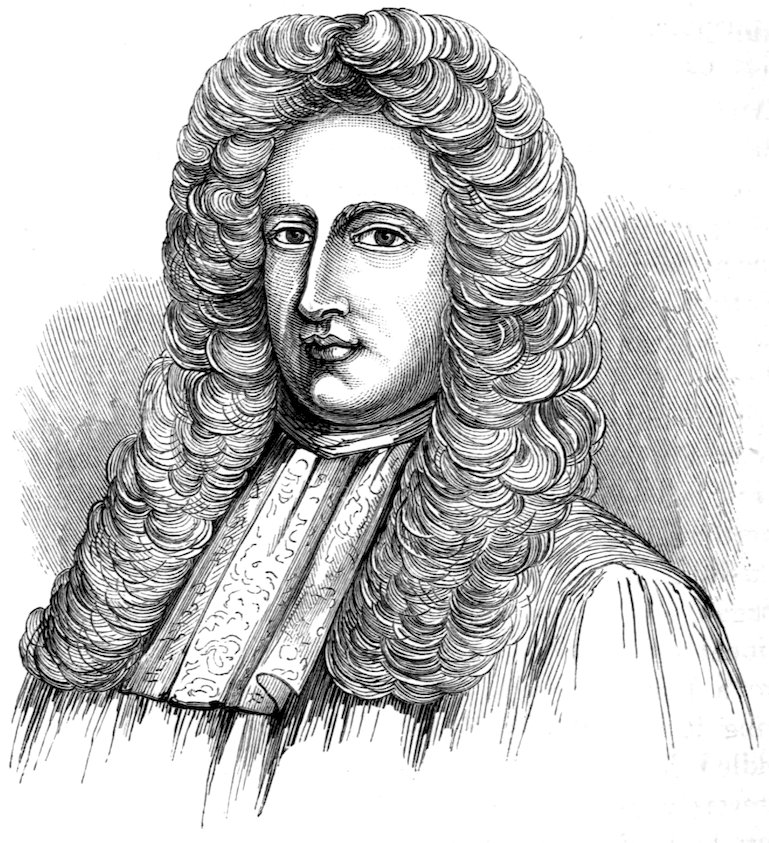
Dr Pitcairn.
On the 25th of January, Pitcairn was brought before the Council on a charge of contravening various statutes against leasing-making—that is, venting and circulating reproaches and false reports against the government. He was accused of having, on a certain day in December, written a letter to Dr Gray in reference to an 225|1700.| address which was in course of signature regarding the meeting of parliament. This, he said, was going on unanimously throughout the nation, only a few courtiers and Presbyterian ministers opposing it, and that in vain; ‘twice so many have signed since the proclamation anent petitioning as signed it before.’ ‘He bids him [Dr Gray] take notice that there is one sent to court, with a title different, to beguile the elect of the court, if it were possible.’ ‘And all the corporations and all the gentlemen have signed the address, and himself among the rest; and it is now a National Covenant, and, by Jove, it would produce a national and universal ——; to which he adds that he is thinking after a lazy way to reprint his papers, but hopes there shall be news ere they are printed, and that he is calculating the force of the musculi abdominis in digesting meat, and is sure they can do it, une belle affaire.’
In the letters of charge brought forward by the Lord Advocate, it was alleged that there were here as many falsehoods as statements, and the object of the whole to throw discredit on the government was manifest. One of his allegations was the more offensive as he had sought to confirm it ‘by swearing profanely as a pagan, and not as a Christian, “by Jove, it will produce a national and universal ——,” which blank cannot be construed to have a less import than a national and universal overturning.’ Seeing it clearly evidenced that he had ‘foolishly and wickedly meddled in the affairs of his majesty and his estate, he ought to be severely punished in his person and goods, to the terror of others to do the like in time coming.’