REIGN OF GEORGE I.: 1714–1727. (continued 4)
Reading edition
The Scottish newspaper which first narrated the singular story of the capture of these men, remarked: ‘The gentleman who did this piece of good service to his country, will no doubt be taken notice of, and rewarded by the government.’ Sir Walter Scott relates from the tradition of the country what actually happened to Mr Fea in consequence of his gallantry. ‘So far from receiving any reward from government, he could not obtain even countenance enough to protect him against a variety of sham suits, raised against him by Newgate solicitors, who acted in the name of Gow and others of the pirate crew; and the various expenses, vexatious prosecutions, and other legal consequences in which his gallantry involved him, utterly ruined his fortune and his family.’[620]
May.
The Duke of Douglas, last direct descendant of the ancient and once powerful House of Douglas, was a person of such weak character as to form a dismal antithesis to the historical honours of the family—entitled to the first vote in parliament, to lead the 507|1725.| van of the Scottish army, and to carry the king’s crown in all processions. Just turned thirty years of age, his Grace lived at his ancestral castle in Lanarkshire, taking no such part as befitted his rank and fortune in public affairs, but content to pass his time in the commonest pleasures, not always in choice society.[621] Amongst his visitors was a young man named Ker, a natural son of Lord John Ker, the younger brother of the late Marquis of Lothian, and also brother to the Dowager-countess of Angus, the duke’s mother. This youth, as cousin to the duke, though under the taint of illegitimacy, presumed to aspire to the affections of his Grace’s only sister, the celebrated Lady Jane; and it is also alleged that he presumed to give the duke some advice about the impropriety of his keeping company with a low man belonging to his village. Under a revengeful prompting, it is said, from this fellow, the poor duke stole by night into the chamber of Mr Ker, and shot him dead as he lay asleep. Some servants, hearing the noise, came to his Grace’s room, and found him in great distress at the frightful act which he had committed, and which he made no attempt to deny. He was as speedily as possible conducted to Leith, and sent off in a vessel to Holland, there to remain until he could safely return.[622]
The peerages being politely silent about this affair, we do not learn how or when the duke was restored to Scottish society. More than thirty years after, when turned of sixty, he married the daughter of a Dumbartonshire gentleman, a lady well advanced in life, by whom he had no children. Dr Johnson, who met the duchess as a widow at Boswell’s house in 1773, speaks of her as an old lady who talked broad Scotch with a paralytic voice, and was scarcely intelligible even to her countrymen. Had the doctor seen her ten years earlier, when she was in possession of all her faculties, he would have found how much comicality and rough wit could be expressed in broad Scotch under the coif of a duchess. I have had the advantage of hearing it described by the late Sir James Steuart of Coltness, who was in Paris with her Grace in 1762, when she was also accompanied by a certain Laird of Boysack, and one or two other Scotch gentlemen, all bent on making the utmost of every droll or whimsical circumstance that came in their way. Certainly the language and style 508|1725.| of ideas in which the party indulged was enough to make the hair of the fastest of our day stand on end. There was great humour one day about a proposal that the duchess should go to court, and take advantage of the privilege of the tabouret, or right of sitting on a low stool in the queen’s private chamber, which it was alleged she possessed, by virtue of her late husband’s ancestors having enjoyed a French dukedom (Touraine) in the fifteenth century. The old lady made all sorts of excuses in her homely way; but when Boysack started the theory, that the real objection lay in her Grace’s fears as to the disproportioned size of the tabouret for the co-relative part of her figure, he was declared, amidst shouts of laughter, to have divined the true difficulty—her Grace enjoying the joke fully as much as any of them. Let this be a specimen of the mate of the last of the House of Douglas.
June 24.
We have already seen that the favourite and ordinary beverage of the people before this date was a light ale, not devoid of an exhilarating power, which, being usually sold in pints (equal to two English quarts) at 2d., passed in prose and verse, as well as common parlance, under the name of Twopenny. The government, conceiving they might raise twenty thousand pounds per annum out of this modest luxury of the Scotch, imposed a duty of sixpence a bushel upon malt; and now this was to be enforced by a band of Excise officers.
The Scotch, besides the ignorant impatience of taxation natural to a people to whom fiscal deductions were a novelty, beheld in this measure a mark of the oppressive imperiousness of the British senate, and bitterly thought of what the Union had brought upon them. At Glasgow, this was a peculiarly strong feeling, its member of parliament, Mr Campbell of Shawfield, having taken a leading part in getting the malt-tax imposed. On the 23d June, when the act came into force, the populace gave many tokens of the wrath they entertained towards the excisemen who were putting it in practice; but no violence was used. Next day, there was shewn a continual disposition to gather in the streets, which the magistrates as constantly endeavoured to check; and a military party was introduced to the town. At length, evening having drawn on, the indignation of the populace could no longer be restrained. An elegant house which Shawfield had built for himself, and furnished handsomely, was attacked, and reduced to desolation, notwithstanding every effort of the magistrates to induce the mob to disperse. Next day, the mob rose again, and 509|1725.| came to the town-house in the centre of the town, but in no formidable numbers. The military party was then drawn out by their commander, Captain Bushell, in a hollow square, in the centre of the crossing at the town-house, each side facing along one of the four streets which meet there; when, some stones being thrown at the soldiers, the officer gave way to anger, and without any order from the provost, fired upon the multitude, of whom eight were killed and many wounded. The multitude then flew to a guard-house where arms were kept, armed themselves, and, ringing the town-bell to give an alarm, were prepared to attack and destroy the comparatively small military party, when, at the urgency of the provost, the latter withdrew from the town, and sought refuge at Dumbarton.
The news of this formidable riot, or rather insurrection, created great excitement among a set of government authorities which had lately come into office, amongst whom was Mr Duncan Forbes as Lord Advocate. They took up the matter with a high hand. Attended by a large body of troops, Forbes marched to Glasgow, and seized the magistrates, under accusation of having favoured the mob, and bringing them to Edinburgh, clapped them up in the Tolbooth. Such, however, was the view generally taken of the malt-tax, that the Glasgow provost and bailies were everywhere treated as martyrs for their country, and as they passed through the streets of Edinburgh to prison, some of the lately displaced government officials walked bareheaded before them. By an appeal to the Court of Justiciary, as to the legality of their mittimus, they were quickly liberated. The only effectual vengeance the government could inflict, was an act ordaining the community of Glasgow to pay Shawfield five thousand pounds as compensation for the destruction of his house. The feelings of the people of the west were grievously outraged by the conduct of the government in this affair, and the more so that they considered it as an injustice inflicted by friends. Was it for this, they asked, that they had stood so stoutly for the Whig cause on every trying occasion since the Revolution?
In August, the officials had a new trouble on their hands. The Edinburgh brewers intimated an intention to discontinue brewing ale. Duncan Forbes stood aghast at the idea of what might happen if the people were wholly deprived of their accustomed beverage. After all, the difficulty involved in a proposal to force men to go on in a trade against their will was not too great to be encountered in those days. The Edinburgh Evening Courant 510|1725.| of the 26th of August, quietly informs us that ‘Mr Carr, engraver to the Mint, who kept a brewery in this city, and several others of the brewers, are incarcerate in the Canongate Tolbooth, for not enacting themselves to continue their trade of brewing, in terms of the Act of Sederunt of the Lords of Council and Session.’ ‘The Twopenny ale,’ adds this respectable chronicle, ‘begins to grow scarce here; notwithstanding which the city remains in perfect tranquillity.’ Long before the unimaginable crisis of an entire exhaustion of beer had arrived, forty of the brewers of Edinburgh, and ten of Leith, thought proper to resume work, and the dissolution of society was averted.[623]
Such were the troubles which Scotland experienced a hundred and thirty-five years ago, at the prospect of a tax of twenty thousand pounds per annum!
July.
Christian Shaw, daughter of the Laird of Bargarran, has been presented in her girlhood as the cause of a number of prosecutions for witchcraft, ending in the burning of no fewer than five women on Paisley Green.[624] As this young lady grew up to woman’s estate, she attained distinction of a better kind, as the originator of one of the great branches of industry for which her native province has since been remarkable. She was actually the first person who introduced the spinning of fine linen thread into Scotland. ‘Having acquired a remarkable dexterity in spinning fine yarn, she conceived the idea of manufacturing it into thread. Her first attempts in this way were necessarily on a small scale. She executed almost every part of the process with her own hands, and bleached her materials on a large slate in one of the windows of the house. She succeeded so well, however, in these essays, as to have sufficient encouragement to go on, and to take the assistance of her younger sister and neighbours. The then Lady Blantyre carried a parcel of her thread to Bath, and disposed of it advantageously to some manufacturers of lace.... About this time, a person who was connected with the family, happening to be in Holland, found means to learn the secrets of the thread-manufacture, which was carried on to a great extent in that country, particularly the art of sorting and numbering the threads of different sizes, and packing them up for sale, and the construction and management of the twisting and twining machines. 511|1725.| This knowledge he communicated, on his return, to his friends in Bargarran, and by means of it they were enabled to conduct their manufacture with more regularity, and to a greater extent. The young women of the neighbourhood were taught to spin fine yarn, twining-mills were erected, correspondences were established, and a profitable business was carried on. Bargarran thread became extensively known, and being ascertained by a stamp, bore a good price.’[625] By and by, the work was undertaken by others, and in time it became a leading manufacture of the district. About 1718, Christian Shaw married Mr Miller, the minister of Kilmaurs parish, and it is presumed she passed through the remainder of her life much in the same manner as other persons in that respectable grade.
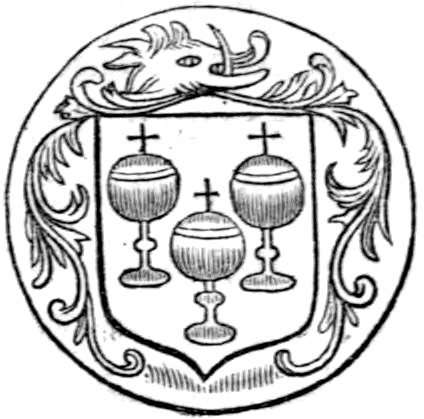
Bargarran Coat of Arms.
The newspapers of the time at which we are now arrived, present the following advertisement: ‘The Lady Bargarran and her daughters having attained to a great perfection in making, whitening, and twisting of Sewing Threed, which is as cheap and white, and known by experience to be much stronger than the Dutch, to prevent people’s being imposed upon by other Threed, which may be sold under the name of Bargarran Threed, the Papers in which the Lady Bargarran, and her daughters at Bargarran, or Mrs Miller, her eldest daughter, at Johnston, do put up their Threed, shall, for direction, have thereupon the above coat of arms. Those who want the said Threed, which is to be sold from fivepence to six shillings per ounce, may write to the Lady Bargarran at Bargarran, or Mrs Miller at Johnston, near Paisley, to the care of the Postmaster of Glasgow; and may call for the samen in Edinburgh, at John Seton, merchant, his shop in the Parliament Close, where they will be served either in wholesale or retail: and will be served in the same manner at Glasgow, by William Selkirk, merchant in Trongate.’
Crawford, in his History of Renfrewshire, tells us that the coat-armorial worn by the Shaws of Bargarran bore—‘azure, three covered cups or.’ There is something amusingly characteristic in the wife and daughter of a far-descended Scottish gentleman beginning a business in ‘threed,’ and putting the family arms on their wares.
1725. Oct.
512After the long period during which religious and political contentions absorbed or repressed the intellectual energies of the people, the first native who exhibited in his own country a purely scientific genius was Colin Maclaurin—a man of Highland extraction (born in 1698), whose biography relates that he was fitted to enter a university at eleven, mastered at twelve the first six books of Euclid in a few days without assistance, and gained the chair of mathematics in Marischal College, Aberdeen, at nineteen, after a competitive examination of ten days. Having gone to London, and there been introduced to Sir Isaac Newton, Dr Clark, Sir Martin Folks, and other cultivators of science, Maclaurin was encouraged to publish several mathematical treatises which gave him an established reputation while still a young man.
At this time, the advanced years of Mr James Gregory, professor of mathematics in the university of Edinburgh, making it necessary that he should have an assistant, who should also be his successor, Mr Maclaurin became a candidate for the situation, with the recommendation of the illustrious Newton. The appointment lay with the magistrates and town council of Edinburgh, who were the patrons of the university—an arrangement which has been abolished in our age, with little regard to the rights of property, and still less to the practical good working of the connection. On this occasion there were some circumstances alike honourable to Maclaurin, to Newton, and to the Edinburgh municipality. Sir Isaac, hearing there was a difficulty about salary for the new professor, the emoluments being reserved for the old one, wrote to the lord provost of the city as follows: ‘I am glad to understand that Mr Maclaurin is in good repute amongst you for his skill in mathematics, for I think he deserves it very well, and, to satisfy you that I do not flatter him, and also to encourage him to accept the place of assisting Mr Gregory, in order to succeed him, I am ready (if you please to give me leave) to contribute twenty pounds per annum towards a provision for him till Mr Gregory’s place becomes void, if I live so long.’ The town council respectfully declined this generous offer, and made suitable arrangements otherwise for the young professor.
Colin Maclaurin amply justified the recommendation of Sir Isaac by the distinction he attained as a teacher, and his various original contributions to geometry and physics. A general impulse was given by him to the cultivation of science. When any remarkable experiment was reported from other countries, 513|1725.| there was a general wish in Edinburgh to see it repeated by Maclaurin; and when any comet or eclipse was pending, his telescopes were sure to be in requisition. Unfortunately, the career of this brilliant geometer was cut short in consequence of a cold he caught while assisting to improve the defences of Edinburgh against the army of Prince Charles Edward. He lies under the south-west corner of the Greyfriars’ Church, where a plain mural tablet arrests the attention of the student by telling that he was elected to his chair, Newtono suadente, and calls on all to take as a consolation, in that field of grief and terror, the thought that the mind which was capable of producing such works must survive the frail body.
Nov. 20.
The post from Edinburgh to London continued to be carried on horseback, and was of course liable to casualties of what now appear to us of a strange character. That which left Edinburgh on Saturday the 20th November 1725, was never heard of after it passed Berwick. ‘A most diligent search has been made, but neither the boy, the horse, nor the packet, has yet been heard of. The boy, after passing Goswick, having a part of the sands to ride which divide the Holy Island from the mainland, it is supposed he has missed his way, and rode towards the sea, where he and his horse have both perished.’[626]
A mail due at Edinburgh one day at the close of January 1734, was apologised for by the postmaster as late. ‘It seems the post-boy who rides the stage from Haddington to Edinburgh is perished in the river Tyne, the mail this morning being taken out of that river.’ That due on the 10th of October in the preceding year did not reach its destination till the evening of the 11th. ‘It seems the post-boy [so called, although most likely a middle-aged man], who made the stage between Dunbar and Haddington, being in liquor, fell off. The horse was afterwards found at Linplum, but without the mail, saddle, or bridle.’[627]
On the 9th December 1735, we have the following announcement: ‘The London post did not come on till this day at noon, on occasion of the badness of the roads.’—Cal. Merc.
As a variety upon these kinds of accident, and equally indicating the simplicity of the institution in those days, may be noticed a mistake of February 1720, when, ‘instead of the 514|1725.| mail should have come in yesterday (Sunday), we had our own mail of Thursday last returned‘—the presumption being that the mail for Edinburgh had been in like manner sent back from some unknown point in the road, to London. And this mistake happened once more in December 1728, the bag despatched on a Saturday night being returned the second Sunday morning after; ‘’tis reckoned this mistake happened about half-way on the road.’[628]
The immediate practical business of the Post-office of Edinburgh appears to have been conducted, down to the reign of George I., in a shop in the High Street, by a succession of persons named Mean or Mein, the descendants of the lady who threw her stool at the bishop’s head in St Giles’s in 1637; thence it was promoted to a flat in the east side of the Parliament Close; thence, again, in the reign of George III., to a detached house behind the north side of the Cowgate. We find that, in 1718, it had a ‘manager’ at two hundred a year, a clerk at fifty, a comptroller, an assistant at an annual salary of twenty-five pounds, and three letter-carriers at five shillings a week. In 1748, this establishment was little changed, excepting that there were added an ‘apprehender of private letter-carriers,’ and a ‘clerk to the Irish correspondents.’[629] There is a faithful tradition in the office, which I see no reason to doubt, that one day, not long after the rebellion of 1745, the London bag came to Edinburgh with but one letter in it, being one addressed to the British Linen Company.
In 1758, a memorial of traders to the Convention of Burghs expressed impatience with the existing arrangements of the post between Edinburgh and London, which, owing to a delay of about a day at Newcastle, and a pause at York, with other impediments, occupied 131 hours. It was urged that the three posts which passed weekly between the two capitals should depart from Edinburgh at such a time as, reaching Newcastle in 21 hours, they might be in time for immediate dispatch by the post thence to London, and so give a return to correspondence with the metropolis in seven or eight days, instead of about eleven, as at present.[630]
It may be curious to trace the progress of business in this important office, as far as the central Scottish establishment is concerned. The number of persons employed in 1788 was 31; 515|1725.| in 1828, it was 82; in 1840, when the universal penny post was set on foot, it reached 136; in 1860, it was 244. The number of letters delivered in Edinburgh in a week in 1824 was 27,381; in 1860, it amounted to 156,000. The number of letters passing through Edinburgh per week in 1824 was 53,000; in 1860, it was 420,000. At the same time, the number of bags despatched from Edinburgh daily was 369, weighing forty-nine hundredweight. At the time when these notes were drawn up, the establishment had become too large for a spacious and handsome building erected in 1819, and another office of ampler proportions was about to be erected.
Dec.
Wodrow notes that at this time the merchants of Glasgow, in despair of the colonial tobacco-trade, were beginning to think of ventures in other directions, as the East Indies, and the Greenland whale-fishing. Meanwhile, a Fishery Company, some time since set up at Edinburgh, was languishing, the officials eating up more than the profit. ‘As far as I can see,’ says the worthy minister of Eastwood, ‘till the Lord send more righteousness and equity, and of a public spirit, no company or copartnery among us will do any good.’
In the ensuing August, the same chronicler notes some important points in the progress of Glasgow, without giving us any hint of improvement in respect of righteousness. ‘This summer,’ says he, ‘there seems to be a very great inclination through the country to improve our manufactory, and especially linen and hemp. They speak of a considerable society in Glasgow of the most topping merchants, who are about to set up a manufactory of linen, which will keep six hundred poor people at work. The gentlemen, by their influence, seem much to stir up country-people, and to encourage good tradesmen, and some care is taken to keep linen and webs exactly to standard, and to see that the stuff be good and marketable.... What will come of it, I know not. I have seen frequent attempts of this nature come to very little.’[631]
It is gratifying to think that the year 1725, which is so sadly memorable in the history of Glasgow on account of the ‘Shawfield Mob,’ really did become the epoch of that vast system of textile manufacture for which the city has since been so celebrated. The first efforts of her looms were confined to linen 516|1725.| cloth, lawns, and cambrics. Seven years later, one of her enterprising citizens, a Mr Alexander Harvie, ‘at the risk of his life, brought away from Haerlem two inkle-looms and a workman,’[632] and was thus enabled to introduce the manufacture of inkles into his native town, where it long flourished. The establishment of the cotton-manufacture in and around Glasgow was the work of a subsequent age, and need not be dwelt upon here.
Considering the engrossing nature of the pursuits of commerce, it is remarkably creditable to Glasgow that her university has always been maintained in a high state of efficiency, and that she has never allowed the honours of literature to be wholly diverted to her more serene sister of the east. So far had printing and publishing advanced in Glasgow in the reign of the second George, that, in 1740, a type-founding establishment was commenced there, being the first to the north of the Tweed. The immediate credit of this good work is due to Mr Alexander Wilson, a native of St Andrews. He subsequently became professor of practical astronomy in the Glasgow University, and there, in 1769, worked out the long-received theory of the solar spots, which suggests their being breaches in a luminous envelope of the sun’s body.
Favoured by the presence of a type-foundry, two citizens of Glasgow named Faulls, but who subsequently printed their name as Foulis, commenced the business of typography in 1741, and soon became distinguished for their accurate and elegant work, particularly in the printing of the classics. Eager to produce what might be esteemed an immaculate edition of Horace, they caused the successive proof-sheets, after revision, to be hung up at the gate of the university, with the offer of a reward for the discovery of an error. Before 1747, the Messrs Foulis had produced editions of eighteen classics, all of them beautiful specimens of typography.
After all, the merchants of infant Glasgow were able to overcome the difficulties which an iniquitous rivalry threw in the way of their tobacco-trade. It went on gradually increasing till a sudden stop was put to it by the revolt of the American colonies, when it had reached an annual importation of about fifty thousand hogsheads, being the great bulk of what was consumed in the three kingdoms. In the early days of the trade, when capital was not abundant, the custom was for a very small group of the more considerable merchants to advance two or three hundred pounds 517|1725.| each, and ask the lesser men around them to add such shares as they pleased; by these means to make purchase of goods suited for use in Virginia, which were sent out under the care of a supercargo, to be exchanged for a lading of tobacco. ‘The first adventure ... was sent under the sole charge of the captain of the vessel. This person, though a shrewd man, knew nothing of accounts; and when he was asked by his employers, on his return, for a statement of how the adventure had turned out, told them he could give them none, but there were its proceeds, and threw down upon the table a large hoggar (stocking) stuffed to the top with coin [being of course the money-surplus of the goods sent out, after the cargo of tobacco was paid for]. The company conceived that if an uneducated person had been so successful, their gains would have been still greater if a person versed in accounts had been sent out. Under this impression, they immediately despatched a second adventure with a supercargo highly recommended for a knowledge of accounts, who produced to them a beautifully made-out statement of his transactions, but no hoggar.’[633]
Afterwards, the groups of adventurers associated little more than their credit in the getting up of cargoes of goods for the colonial market, and these were not in general paid till the return of the tobacco, at the distance perhaps of a twelvemonth. When the manager of the copartnery was ready to discharge its obligations, he summoned the various furnishers of the goods to a tavern, where, over a measure of wine to each, paid for by themselves, he handed them the amount of their various claims, receiving a discharged account in return. In such retreats all important matters of business were then transacted. They were in many instances kept by the female relations of merchants who had not been successful in business; and in selecting one whereto to summon the furnishers of goods for payment, the manager would generally have an eye to a benevolent design in favour of the family of an associate of former days.
As the century rolled on, and transactions increased in magnitude, luxury and pride crept in, men learned to garnish their discourse with strange oaths, and the Wodrow pre-requisite of ‘righteousness’ was always less and less heard of. The wealth of the Tobacco Lords, as the men pre-eminent in the trade were called, reached an amount which made them the wonder of their 518|1725.| country. One named Glassford, during the Seven Years’ War, had twenty-five vessels engaged in the business, and was said to trade for half a million.[634] They formed a kind of aristocracy in their native city, throwing all tolerably successful industry in other walks into the shade. Old people, not long deceased, used to describe them as seen every day on the Exchange, or a piece of pavement in Argyle Street so called, walking about in long scarlet cloaks and bushy wigs, objects of awful respect to their fellow-citizens, who, if desirous of speaking to one of them on business, found it necessary to walk on the other side of the street, till they should be fortunate enough to catch his eye, and be signalled across. All this came to an end with the breaking out of the American war; when, however, the irrepressible energies and wealth of that wonderful people of the west speedily found new fields of operation—cotton, timber, iron, chemicals, ship-building, and (in sober sincerity) what not?
1726.
The Tennis Court theatricals of spring 1715 probably did not long hold their ground. Thereafter, we hear of no further amusement of the kind being in any fashion attempted in Edinburgh till 1719, when ‘some young gentlemen’ performed The Orphan and the Cheats of Scapin, but most probably in a very private manner, though Allan Ramsay consented to introduce the performance with a prologue.[635] Among the Wodrow pamphlets preserved in the Advocates’ Library, is a broadside containing ‘Verses spoken after the performance of Otway’s tragedy, called The Orphan, at a private meeting in Edinburgh, December 9, 1719, by a boy in the University [added in manuscript, “Mr Mitchell”].’ He ends with a threat to meet adverse critics in the King’s Park. Edinburgh was about the same time occasionally regaled with the visits of a certain Signora Violante, who trooped about the three kingdoms for the exhibition of feats in tumbling and posture-making.[636]
It would appear that the first Scottish theatricals not quite insignificant were presented in the winter 1725–26, when Anthony Aston, a performer not without his fame, came to Edinburgh with a company of comedians, and was so far favourably received that he ventured to return in the ensuing year. On that occasion, Allan Ramsay composed for him the following prologue, 519|1726.| conveying to us some notion of the feelings with which the venture was regarded:
‘“Tis I, dear Caledonians, blythesome Tony,
That oft, last winter, pleased the brave and bonny,
With medley, merry song, and comic scene:
Your kindness then has brought me here again,
After a circuit round the Queen of Isles,
To gain your friendship and approving smiles.
Experience bids me hope—though, south the Tweed,
The dastards said: “He never will succeed:
What! such a country look for any good in,
That does not relish plays, nor pork, nor pudding!”
Thus great Columbus, by an idiot crew,
Was ridiculed at first for his just view;
Yet his undaunted spirit ne’er gave ground,
Till he a new and better world had found.
So I—laugh on—the simile is bold;
But, faith! ’tis just: for till this body’s cold,
Columbus-like, I’ll push for fame and gold.’[637]
The prevalent feeling on the subject in authoritative circles may be inferred from the conduct of the magistracy and clergy. An act of council being passed, prohibiting Mr Aston from acting within the limits of their jurisdiction, the presbytery met, and appointed a deputation to wait upon the magistrates, and thank them ‘for the just zeal they had shewn in the matter.’ A committee was at the same time appointed to draw up an act and exhortation against the frequenting of stage-plays, which, by their order, was read from all the pulpits in the district.[638]
Wodrow talks of Aston’s proceedings as ‘filling up our cup of sin.’ ‘Three or four noblemen—some of them ruling elders—combined to favour the comedians, giving them such a warrant as they thought their peerage entitled them to give. Three or four of the Lords of Session were favourable to them, and yet no direct interlocutor was given them, empowering them to set up. The matter took several different shapes, and many different decisions were given by the Lords, which concerned circumstances rather than the direct lawfulness of their plays.’ Wodrow speaks of a large attendance, especially at their tragedies, the Mourning Bride having had a run of three nights. ‘A vast deal of money, 520|1726.| in this time of scarcity, is spent this way most sinfully.’ They even ‘talk of building a public playhouse at Edinburgh.’
To the great vexation of the ecclesiastical authorities, the decree of the magistrates was appealed against in the Court of Session, with what were believed to be good hopes of success. Just at that crisis, we find Mr Wodrow writing in great concern on the subject, from his Renfrewshire manse, to Mr George Drummond, commissioner of customs in Edinburgh (November 27, 1727). He states that his parishioner, Lord Pollock, one of the judges, was unfortunately detained at home, being ‘considerably failed, and very crazy;’ so he could not attend the court to give his vote. ‘I pray God may order matters so as to prevent my fears in this matter.... I desire to have it on my heart, and shall stir up some who, I hope, are praying persons, to be concerned in it. However it go, I think the magistrates of Edinburgh may have peace in the honest appearance they have made against those seminaries of idleness, looseness, and sin.’[639]
There was, however, no legal means of putting down Mr Aston. The magistrates’ interdict was suspended, and from that time the players had only to contend with public opinion.[640]
Feb. 12.
Serious onlookers are eager to note other symptoms of the alarming progress of levity. A private letter-writer remarks, under our marginal date, that, ‘notwithstanding the general complaint of scarcity of money, there were never so many diversions in one winter.... There is scarce one night passes without either medley, concert, or assembly, and these entertainments generally conclude with some private marriage, of which we have a vast number ... such as Sir Edward Gibson and Mrs Maitland, a cousin of the Earl of Lauderdale; M‘Dowal and a daughter of Dr Stirling; a son of Bailie Hay with Regent Scott’s daughter; and my Lord Bruce is to be married regularly to Mrs Robertson, who has above £3000, this very night.’
A few days after, the same writer reports a private marriage as discovered between the son of Sir John Dalrymple and ‘Matthew Crawford’s daughter.’ ‘Sir John seems pretty much disobliged that his son should not have asked his consent, though it’s 521|1726.| thought he will soon get over all difficulties.’ The eccentric Earl of Rosebery ‘has been for a considerable time in prison, where it’s believed he will spend the remainder of his days with his good friend Burnbank.’
A few weeks later, an abduction in the old style was perpetrated by a Highlander upon ‘a niece of Mr Moubray the wright,’ not above twelve years of age, whose gouvernante had betrayed her upon a promise of a thousand merks, the young lady having £3000 of fortune. Mr Moubray ‘luckily catched them near to Queensferry, as they were coming to town to be married.’ ‘The gouvernante is committed to prison, as is also the gentleman.’[641]
In May, Mr Wodrow adverts to a rumour that there were some clubs in Edinburgh, very secretly conducted, composed of gentlemen of atheistical opinions. They were understood to be offshoots of a similar fraternity in London, rejoicing in the name of the Hell-fire Club, as signifying the disregard of the members for the thing referred to. Wodrow whispers with horror, that the secretary of the Hell-fire Club, a Scotsman, was reported to have come to Edinburgh to plant these affiliated societies. ‘He fell into melancholy, as it was called, but probably horror of conscience and despair, and at length turned mad. Nobody was allowed to see him, and physicians prescribed bathing for him, and he died mad at the first bathing. The Lord pity us,’ concludes Mr Wodrow; ‘wickedness is come to a terrible height!’[642]
There is among the Wodrow pamphlets a broadside giving an account of the Hell-fire Clubs, Sulphur Societies, and Demirep Dragons then in vogue. It includes a list of persons of quality engaged in these fraternities, and the various names they bore—as Elisha the Prophet, the King of Hell, Old Pluto, the Old Dragon, Lady Envy, the Lady Gomorrah, &c. An edict had been issued against them by the government, reciting that there was reason to suspect that, in the cities of London and Westminster, there were scandalous clubs or societies of young persons, who meet together, and in blasphemous language insult God and his holy religion, and corrupt the morals of one another. The justices of the peace were enjoined to be diligent in rooting out such schools of profanity.
The Hell-fire Club seems to have projected itself strongly on the popular imagination in Scotland, for the peasantry still occasionally speak of it with bated breath and whispering horror. 522|1726.| Many wicked lairds are talked of, who belonged to the Hell-fire Club, and who came to bad ends, as might have been expected on grounds involving no reference to miracle.
Public combats with sword and rapier were among the amusements of the age. They took place regularly in London, at a place called the Bear Garden, and at an amphitheatre in the Oxford Road; likewise at Hockley. It seems scarcely credible that not only was this practice permitted, but it was customary for the men who were to cut and slash at each other in the evening, to parade through the streets in the forenoon, in fancy dresses, with drums beating and colours flying, as an advertisement of the performance.
Sometimes, when one of these modern gladiators attained to fame, he would go to a provincial city, and announce himself as willing to fight all-comers on a public stage for any sum that might be agreed upon. Such persons seem most frequently to have been natives of the sister-island. One Andrew Bryan, an Irishman, described as ‘a clean young man’—that is, a well-made, nimble person—came to Edinburgh, in June 1726, as a gladiatorial star, and challenged any who might choose to take him up. For days he paraded the streets with his drum, without meeting a combatant, and several gentlemen of the city began to feel annoyed at his vapourings, when at length the challenger was answered. There had at this time retired to Edinburgh an old Killiecrankie soldier, named Donald Bane—a man who had attained the distinction of a sergeantcy, who had taught the broadsword exercise, who had fought creditably in all the wars of William and Anne in succession, but was withal much of a scapegrace, though a good-humoured one, as fully appears from a little autobiography which he published, along with the rules of the art of defence. Though now sixty-two, and inclined to repent of much of his earlier career, Donald retained enough of his original spirit to be disposed to try a turn at sharps with Bryan; so, meeting him in the street one day, he sent his foot through the drum, as an indication that he accepted the challenge. Gentlefolks were interested when they heard of it, and one learned person thought proper to compose for Bane a regular answer to the challenge in Latin verse—
‘Ipse ego, Donaldus Banus, formâ albus et altus,
Nunc huic Andreæ thrasoni occurrere deero,’ &c.
The combat took place at the date noted, on a stage erected for 523|1726. June 23.| the purpose behind Holyrood Palace, in the presence of a great number of noblemen, gentlemen, military officers, and others. It was conducted with much formality, and lasted several hours, with a variety of weapons; and not till Bryan had received seven wounds from his unscathed antagonist, did he feel the necessity of giving in. The victory of the Highland veteran seems to have given rise to great exultation, and he was crowned with praises in both prose and rhyme. He was compared to Ajax overcoming Thersites; and one Latin wit remarked in a quatrain, that the stains of the two former Donald Banes of Scottish history were wiped off by the third. A more fortunate result for us was the publication of Bane’s autobiography,[643] containing a number of characteristic anecdotes.
Little more than two years after the combat of Bane and Bryan, a similar encounter is noted in the Edinburgh Courant as taking place in the Tennis Court at Holyrood, between ‘Campbell the Scots, and Clerk the Irish gladiator,’ when the former received a wound in the face, and the second sustained seven in the body.
Aug. 8.
At an election for the county of Roxburgh at Jedburgh, a quarrel arose between Sir Gilbert Elliot of Stobbs, a candidate, and Colonel Stewart of Stewartfield, who opposed him. Colonel Stewart, who was ‘a huffing, hectoring person,’ is said to have given great provocation, and gentlemen afterwards admitted that Stobbs was called upon by the laws of honour to take notice of the offence. According to a petition to the Court of Session from the son of Stewart, Elliot stabbed him as he sat in his chair on the opposite side of a table, with his sword by his side.
The homicide took refuge in Holland, but was soon enabled by a pardon to return to his own country.[644]
Aug. 9.
The correspondence of General Wade with the Secretary of State Townsend,[645] makes us aware that at this time several of the attainted gentlemen of 1715 had returned to Scotland, in the hope of obtaining a pardon, or at least of being permitted to remain undisturbed. The general humanely pleads for their being pardoned on a formal submission. Amongst them was Alexander Robertson of Struan, chief of the clan Robertson, a gentleman 524|1726.| who had fought for the Stuarts both at Killiecrankie and Sheriffmuir, and who is further memorable for his convivial habits and his gifts in the writing of pure, but somewhat dull English poetry.
In the year of the Revolution, being a youth of twenty at the university of St Andrews, Struan accepted a commission in some forces then hastily proposed to be raised for James VII.; and, keeping up this military connection, he joined the Highland army of Lord Dundee, but was taken prisoner by the enemy, September 1689, and thrown into the Edinburgh Tolbooth. Here a piece of Highland gratitude served him a good turn. Four years before, when the Perthshire loyalists were hounded out to ravage the lands of the unfortunate Argyle, the late Laird of Struan had, for humane reasons, pleaded for leave to stay at home and take care of the country. The now restored Earl of Argyle, remembering this kindness to his family, interceded for young Robertson, and procured his liberation in exchange for Sir Robert Maxwell of Pollock, who was in the hands of the Highlanders. Struan then passed into France, and joined the exiled king, hoping ere long to return and see the old régime restored; and in his absence, the Scottish parliament declared him forfaulted. He spent many years of melancholy exile in France, enduring the greatest hardships that a gentleman could be subjected to, having no dependence but upon occasional remittances from his mother. Being at length enabled to return to Perthshire, he once more forfeited all but life by joining in the insurrection of 1715. For nine years more he underwent a new exile in the greatest poverty and hardship, while, to add to his mortifications, a disloyal sister, hight ‘Mrs Margaret,’ contrived to worm herself into the possession of his forfeited estates.
In France, Struan had for a fellow in misfortune a certain Professor John Menzies, under whom he had studied at St Andrews, and who seems to have been an old gentleman of some humour. There is extant a letter of Menzies to Struan, giving him advice about his health, and which seems worthy of preservation for the hints it gives as to the habits of these expatriated Scotch Jacobites. It bears to have been written in answer to one in which Struan had spoken of being ill:
‘Paris, March 20.
‘D. S.—I have been out of town a little for my own health, which has kept me some days from receiving or answering your last, in which you speak of some indisposition of yours. I 525|1726.| hope that before now it is over of itself by a little quiet and temperance, and that thereby nature has done its own business, which it rarely fails to do when one gives it elbow-room, and when it is not quite spent. “When that comes, the house soon comes down altogether. This I have always found in my own case. Whenever I was jaded by ill hours and company, and the consequences of that, I have still retired a little to some convenient hermitage in the country, with two or three doses of rhubarb, and as many of salts. That washes the Augean stable, and for the rest I drink milk and whey, and sometimes a very little wine and water. No company but Horace and Homer, and such old gentlemen that drink no more now. I walk much, eat little, and sleep a great deal. And by this cool and sober and innocent diet, nature gets up its head again, and the horse that was jaded and worn out grows strong again, so that he can jog on some stages of the farce of life without stumbling or breaking his neck. This is a consultation I give you gratis from my own practice and never-failing experience, which is always the best physician. And I am satisfied it would do in your case, where I reckon nature is haill at the heart still, after all your cruel usage of it.
‘As to all those pricklings and startings of the nerves, they come from the ill habit of the blood and body, brought on by ill diet and sharp or earthy wine, as your Orleans wine is reckoned to be—for there are crab-grapes as there are crab-apples, and sloes as well as muscadines.
‘There are great differences of constitutions. Those of a sanguine can drink your champagne or cyder all their life, and old Davy Flood has drunk punch these fifty years daily. Whereas a short time of the lemons that’s in punch would eat out the bottom of my stomach, or make me a cripple. Much champagne, too, would destroy my nerves, though I like its spirit and taste dearly. But it will not do, that is, it never did well with me when I was young and strong; now much less. My meaning in this dissertation about wine and constitutions is plainly this, first, to recommend to you frequent retraites, in order to be absolutely cool, quiet, and sober, with a little gentle physic now and then, in order to give time and help to nature to recover. And when you will needs drink wine—that it be of the haill and old south-country wines, Hermitage, Coté Rotis, Cahors, &c., with a little water still, since there is a heat in them.
‘As to any external tremblings or ailings of the nerves, pray make constant usage of Hungary-water to your head and 526|1726.| nosethrills, and behind your ears—of which I have found an infinite effect and advantage of a long time, for I have been very often in the very same case you describe, and these have always been my certain cures. Repetatur quantum sufficit, and I will warrant you.
‘Write again, and God bless you.’[646]
Struan was now successful in obtaining a pardon, and for the remainder of his days he lived in the cultivation of the bottle and the muse at his estate in Rannoch. Only prevented by old age from risking all once again in the adventure of Prince Charlie, he died quietly in 1749, having reached his eighty-first year. So venerable a chief, who had used both the sword of Mars and the lyre of Apollo in the cause of the Stuarts, could not pass from the world notelessly. His funeral was of a character to be described as a great provincial fête. It was computed that two thousand persons, including the noblemen and gentlemen of the district, assembled at his house to carry him to his last resting-place, which was distant eighteen English miles; and for all of these there was entertainment provided according to their different ranks.[647]
Having taken personal surveys of the Highlands in the two preceding years, General Wade was prepared, in this, to commence the making of those roads which he reported to be so necessary for the reduction of the country to obedience, peace, and civilisation. He contemplated that, after the example set by the Romans sixteen hundred years before, the work might be done by the soldiers, on an allowance of extra pay; and five hundred were selected as sufficient for the purpose. Engineers and surveyors he brought down from England, one being the Edmund Burt to whom we have been indebted for so much information regarding the Highlands at this period, through the medium of the letters he wrote during his long residence in this country.[648]
1726.
527‘In the summer seasons [during eleven years], five hundred of the soldiers from the barracks and other quarters about the Highlands were employed in those works in different stations. The private men were allowed sixpence a day, over and above their pay as soldiers. A corporal had eightpence, and a sergeant a shilling. But this extra pay was only for working-days, which were often interrupted by violent storms of wind and rain. These parties of men were under the command of proper officers, who were all subalterns, and received two shillings and sixpence per diem, to defray their extraordinary expense in building huts, making necessary provision for their tables from distant parts (unavoidable, though unwelcome visits), and other incidents arising from their wild situation.’[649]
A Scottish gentleman, who visited the Highlands in 1737, discovered the roads completed, and was surprised by the improvements which he found to have arisen from them, amongst which he gratefully notes the existence of civilised places for the entertainment of travellers. It pleased him to put his observations into verse—rather dull and prosaic verse it is, one must admit—yet on that very account the more useful now-a-days, by reason of the clearness of the information it gives.[650] After speaking of Wade’s success in carrying out the Disarming Act, and his suppression of disorders by the garrisons and Highland companies, he proceeds to treat of the roads, which had impressed him as a work of great merit. It seemed to him as an undertaking in no slight degree arduous, considering the limited means and art which then existed, to extend firm roads across Highland morasses, to cut out paths along rough hillsides, and to protect the way when it was formed from the subsequent violent action of Highland torrents and inundations. One of the most difficult parts of the first road was that traversing the broad, lofty mountain called Corryarrack, near to Fort Augustus. It is ascended on the south side by a series of zigzags, no less than thirteen in number. The general expended great care and diligence in the work, even to the invention of a balsam for healing the wounds and hurts inflicted on the men by accident.
In the forming of the numerous bridges required upon the roads, there was one natural difficulty, in addition to all others, in the want of easily hewn stone. The bridge of five arches across the Tay at Weem was considered as a marvellous work at the 528|1726.| time. In another part of the country, an unusually rugged river gave Wade and his people a great deal of trouble. The men, oppressed with heat during the day, and chilled with frosts as they bivouacked on the ground at night, were getting dispirited, when the general bethought him of a happy expedient.
‘A fatted ox he ordered to be bought,
The best through all the country could be sought.
His horns well polished and with ribbons graced,
A piper likewise played before the beast.
Such, were in days of yore for victims led,
And on the sacrifice a feast was made.
The ox for slaughter he devotes, and then
Gives for a gratis feast unto his men.
Quick and with joy a bonfire they prepare,
Of turf and heath, and brushwood fagots, where
The fatted ox is roasted all together;
Next of the hide they make a pot of leather,
In which the lungs and tripe cut down they boil,
With flour and tallow mixed in lieu of oil.
Then beef and pudding plentifully eat,
With store of cheering Husque[651] to their meat.
Their spir’ts thus raised, their work becomes a play,
New vigour drives all former stops away.
The place from that received another name,
And Oxbridge rises to all future fame.’
We derive some interesting facts about Wade’s proceedings at this time from his correspondence, still in manuscript.[652]
Writing to the Secretary of State, Lord Townsend, Edinburgh, 9th August 1726, he says: ‘I can with satisfaction assure your lordship that the Disarming Act has fully answered all that was proposed by it, there being no arms carried in the Highlands but by those who are legally qualified; depredations are effectually prevented by the Highland companies; and the Pretender’s interest is so low, that I think it can hope for no effectual assistance from that quarter.’
Dating from Killiwhimmen [Fort Augustus] on the 16th of the ensuing month, he tells his lordship:
‘I have inspected the new roads between this place and Fort William, and ordered it to be enlarged and carried on for wheel-carriage over the mountains on the south side of Loch Ness, as far as the town of Inverness, so that before midsummer next there will be a good coach-road from that place, which before was not 529|1726.| passable on Horseback in many places. This work is carried on by the military with less expense and difficulty than I at first imagined it could be performed, and the Highlanders, from the ease and convenience of transporting their merchandise, begin to approve and applaud what they at first repined at and submitted to with reluctancy.’
Writing, in September 1727, to Lord Townsend, he states that he had lately found the Highlands in perfect tranquillity, ‘and the great road of communication so far advanced, that I travelled to Fort William in my coach-and-six, to the great wonder of the country people, who had never seen such a machine in those parts. I have likewise given directions for carrying on another great road southward through the Highlands from Inverness to Perth, which will open a communication with the low country, and facilitate the march of a body of troops when his majesty’s service may require it.’
The general’s coach-and-six had been brought to Inverness by the coast-road from the south, and Burt assures us that ‘an elephant exposed in one of the streets of London could not have excited greater admiration. One asked what the chariot was. Another, who had seen the gentleman alight, told the first, with a sneer at his ignorance, it was a great cart to carry people in, and such like. But since the making of some of the roads, I have passed through them with a friend, and was greatly delighted to see the Highlanders run from their huts close to the chariot, and, looking up, bow with their bonnets to the coachman, little regarding us that were within. It is not unlikely that they looked upon him as a kind of prime minister, that guided so important a machine.’[653]
Wade, writing to Mr Pelham from Blair, 20th July 1728, says: ‘I am now with all possible diligence carrying on the new road for wheel-carriage between Dunkeld and Inverness, of about eighty measured English miles in length; and that no time may be lost in a work so necessary for his majesty’s service, I have employed 300 men on different parts of this road, that the work may be done during this favourable season of the year, and hope, by the progress they have already made, to have forty miles of it completed before the end of October,[654] at which time the heavy rains make it impracticable to proceed in the work till the summer following.
1726.
530‘There is so great a scarcity of provisions in this barren country, that I am obliged to bring my biscuit, cheese, &c., for the support of the workmen, from Edinburgh by land-carriage, which, though expensive, is of absolute necessity. There is about fifteen miles of this road completely finished, and, I may venture to assure you, it is as good and as practicable for wheel-carriage as any in England. There are two stone-bridges building on the road that was finished last year between Inverness and Fort William, and two more are begun on this road, all which will, I hope, be completed by the middle of October. The rest that will be wanting will be eight or ten in number to complete the communication, which must be deferred to the next year.’
July.
The Society of Improvers at this date made a suggestion to the governors of George Heriot’s Hospital (magistrates and clergy of Edinburgh) which marks a degree of liberality and judgment far beyond what was to be expected of the age. They recommended that the boys of that institution, all being children of persons in reduced circumstances, should have instruction in useful arts imparted to them along with the ordinary elements of learning. Such a practice had already been introduced in Holland and France, and even in England (in workhouses), with the best effects. They at the same time recommended that the girls in the Merchant Maiden Hospital should be taught the spinning of flax and worsted, and be put in twos and threes weekly into the kitchen to learn house affairs. A committee was appointed to confer with the magistrates upon this plan; but the matter was afterwards put into the hands of the Trustees for the Encouragement of Manufactures.[655]
It would appear as if some practical result had followed, at least for a time, as in December 1730, the Edinburgh newspapers advert in terms of admiration to two girls of the Merchant Maiden Hospital, who, ‘upon being only three weeks taught the French method of spinning, have spun exceeding fine yarn at the rate of twelve and a half spindle to the pound avoirdupois, which is thought to be the best and finest that ever was done in this country.’
Sep. 10.
Inoculation, or, as it was at first called, engrafting for the small-pox, was reported from the East to British physicians as early as 531|1726.| 1714, but neglected. Lady Mary Wortley Montagu, visiting Turkey with her husband, the British ambassador, found it in full vogue there, and reported it at once so safe and so effectual, that people came together as to a party of pleasure to have it performed upon them by old women. It was in March 1718 that her ladyship, viewing the matter in entire independence of all silly fears, submitted her infant son to the process. Finding it successful, she exerted herself, on her return to England, to have the practice introduced there, and, by favour of Caroline, Princess of Wales, gained her point against the usual host of objectors. Her own daughter was the first person inoculated in Great Britain. It was then tried on four criminals, reprieved for the purpose, and found successful. Two of the princess’s children followed, in April 1722. The process was simultaneously introduced into Boston, in Massachusetts.
Lady Mary tells us next year, that inoculation was beginning to be a good deal practised. ‘I am,’ says she, ‘so much pulled about and solicited to visit people, that I am forced to run into the country to hide myself.’[656] Yet the fact is, that it made its way very slowly, having to encounter both the prejudices of medical men, who misapprehended its scientific nature, and the objections of certain serious people, who denounced it as ‘taking the Almighty’s work out of his hands.’[657] Just as the two young princesses were recovering, appeared a pamphlet, in which the author argued that this new invention is ‘utterly unlawful, an audacious presumption, and a thing forbid in Scripture, in that express command: “Thou shalt not tempt the Lord thy God.”’ It would appear as if there never yet was any valuable discovery made for the alleviation of misery, or the conferring of positive benefits on mankind, but there are some persons who find it irreligious, and would be rejoiced in seeing it fail. It must have been under such a spirit that some one inserted in the prints of the day a notice desiring ‘all persons who know anything of the ill success of inoculation, to send a particular account thereof to Mr Roberts, printer in Warwickshire.’ Only 897 persons (of whom seventeen died) were inoculated during the first eight years.[658]
The operation appears not to have been introduced in Scotland till upwards of five years after its introduction in London. A letter of the date noted, from Mr R. Boyd in Edinburgh to the 532|1726.| Rev. Mr Wodrow at Eastwood, gives the following among other matters of familiar intelligence: ‘The story of Abercromby of Glassaugh’s child being inoculated in this country, and recovered of the small-pox, is in the written letter and some of the prints.’[659] From the reference to a written letter—namely, a periodical holograph sheet of news from London—we may infer that the infant in question was inoculated there, and that the practice was as yet unknown in our country.
Oct. 19.
An interesting and singular scene was this day presented in the streets of Edinburgh. Five men, named Garnock, Foreman, Stewart, Ferrie, and Russell, were executed at the Gallowlee on the 10th of October 1681, and their heads put up at the Cowgate Port, while their bodies were interred under the gallows. Some of their friends lifted and re-interred the bodies in the West Churchyard, and also took down the heads for a similar purpose; but, being scared, were obliged to inhume these relics, enclosed in a box, in a garden at Lauriston, on the south side of the city. On the 7th October of this year, the heads were discovered as they had been laid there forty-five years before, the box only being consumed. Mr Shaw, the owner of the garden, had them lifted and laid out in a summer-house, where the friends of the old cause had access to see them. Patrick Walker relates what followed. ‘I rejoiced,’ he says, ‘to see so many concerned grave men and women favouring the dust of our martyrs. There were six of us concluded to bury them upon the nineteenth day of October 1726, and every one of us to acquaint friends of the day and hour, being Wednesday, the day of the week upon which most of them were executed, and at 4 of the clock at night, being the hour that most of them went to their resting graves. We caused make a compleat coffin for them in black, with four yards of fine linen, the way that our martyrs’ corps were managed; and, having the happiness of friendly magistrates at the time, we went to the present Provost Drummond, and Baillie Nimmo, and acquainted them with our conclusions anent them; with which they were pleased, and said, if we were sure that they were our martyrs’ heads, we might bury them decently and orderly.... Accordingly, we kept the foresaid day and hour, and doubled the linen, and laid the half of it below them, their nether jaws being parted from their heads; but being young men, their teeth 533|1726.| remained. All were witness to the holes in each of their heads, which the hangman broke with his hammer; and, according to the bigness of their skulls, we laid their jaws to them, and drew the other half of the linen above them, and stufft the coffin with shavings. Some pressed hard to go thorow the chief parts of the city, as was done at the Revolution; but this we refused, considering that it looked airy and frothy, to make such show of them, and inconsistent with the solid serious observing of such an affecting, surprising, unheard-of dispensation: but took the ordinary way of other burials from that place—to wit, we went east the back of the wall, and in at Bristo Port, and down the way to the head of the Cowgate, and turned up to the churchyard, where they were interred closs to the Martyrs’ Tomb, with the greatest multitude of people, old and young, men and women, ministers and others, that ever I saw together.’
A citizen of Edinburgh heard from a lady born in 1736 an account, at second-hand, of this remarkable solemnity—with one fact additional to what is stated by Walker. ‘In the procession was a number of genteel females, all arrayed in white satin, as emblematical of innocence.’
A proceeding in which the same spirit was evinced is noted in the Edinburgh Courant of November 4, 1728. ‘We hear that the separatists about Dumfries, who retain the title of Cameronians, have despatched three of their number to Magus Muir, in Fife, to find out the burial-place of Thomas Brown, Andrew ..., James Wood, John Clyde, and John Weddell, who were there execute during the Caroline persecution for being in arms at Bothwell Bridge, and have marked the ground, in order to erect a monument with an inscription like that of the Martyrs’ Tomb in Greyfriars’ Churchyard, to perpetuate the zeal and sufferings of these men.’
A few months later, we learn from the same sententious chronicler: ‘The Martyrs’ Tomb in the Greyfriars’ Churchyard is repaired, and there is added to it a compartment, on which is cut a head and a hand on pikes, as emblems of their sufferings, betwixt which is to be engraved a motto alluding to both.’
1727. Mar. 30.
Died Sir Alexander Ogilvy of Forglen, Baronet, a judge of the Court of Session under the designation of Lord Forglen. There is no particular reason for chronicling the demise of a respectable but noteless senator of the College of Justice, beyond the eccentric and characteristic circumstances attending it. According to a note in the unpublished diary of James Boswell, the biographer 534|1727.| of Dr Johnson—when Lord Forglen was approaching the end of his life, he received a visit from his friend Mr James Boswell, advocate, the grandfather of the narrator of the anecdote. The old judge was quite cheerful, and said to his visitor: ‘Come awa, Mr Boswell, and learn to dee: I’m gaun awa to see your auld freend Cullen and mine. [This was Lord Cullen, another judge, who had died exactly a year before.] He was a guid honest man; but his walk and yours was nae very steady when you used to come in frae Maggy Johnston’s upon the Saturday afternoons.’ That the reader may understand the force of this address, it is necessary to explain that Mrs Johnston kept a little inn near Bruntsfield Links, which she contrived to make attractive to men of every grade in life by her home-brewed ale. It here appears that among her customers were Mr Boswell, a well-employed advocate, and Lord Cullen, a judge—one, it may be observed, of good reputation, a writer on moral themes, and with whose religious practice even Mr Wodrow was not dissatisfied.
Dr Clerk, who attended Lord Forglen at the last, told James Boswell’s father, Lord Auchinleck, that, calling on his patient the day his lordship died, he was let in by his clerk, David Reid. ‘How does my lord do?’ inquired Dr Clerk. ‘I houp he’s weel,’ answered David with a solemnity that told what he meant. He then conducted the doctor into a room, and shewed him two dozen of wine under a table. Other doctors presently came in, and David, making them all sit down, proceeded to tell them his deceased master’s last words, at the same time pushing the bottle about briskly. After the company had taken a glass or two, they rose to depart; but David detained them. ‘No, no, gentlemen; not so. It was the express will o’ the dead that I should fill ye a’ fou, and I maun fulfil the will o’ the dead.’ All the time, the tears were streaming down his cheeks. ‘And, indeed,’ said the doctor afterwards in telling the story, ‘he did fulfil the will o’ the dead, for before the end o’‘t there was na ane o’ us able to bite his ain thoomb.’[660]
535