SONGS.
Reading edition
THE GILGIT QUEEN AND THE MOGULS. 1. GILGITI SONG.
Once upon a time a Mogul army came down and surrounded the fort of Gilgit. At that time Gilgit was governed by a woman, Mirzéy Juwāri[20] by name. She was the widow of a Rajah supposed to have been of Balti descent. The Lady seeing herself surrounded by enemies sang:
I. Mirzéy Juwāri = Oh [daughter of] Mirza, Juwāri! Shakeréy piál; darú = [Thou art a] sugar cup; in the Dunyá sang taréye = world [thy] light has shone II. Abi Khānn[21] djālo = Abi Khān [my son] was born Lamâyi tey! latshār tāro = [I thy mother] am thy sacrifice; the morning star Nikāto = has risen
The meaning of this, according to my Gilgiti informant, is: Juwari laments that “I, the daughter of a brave King, am only a woman, a cup of pleasures, exposed to dangers from any one who wishes to sip from it. To my misfortune, my prominent position has brought me enemies. Oh, my dear son, for whom I would sacrifice myself, I have sacrificed you! Instead of preserving the Government for you, the morning-star which shines on its destruction has now risen on you.”
SONG OF DEFIANCE. 2. GILGITI WAR SONG.
In ancient times there was a war between the Rajahs of Hunza and Nagyr. Muko and Báko were their respective Wazeers. Muko was killed and Báko sang:
Gilgiti.
Ala, mardāney, Báko-se: má shos they! Múko-se: má shos they! Báko-ga dīn sajjéy Múko mayáro they
English.
Hurrah! warriors, Bako [says]: I will do well Muko [also says] I will do well And Bako turned out to be the lion [Whilst] Muko was [its prey], a [mere] Markhōr [the wild “snake-eating” goat]
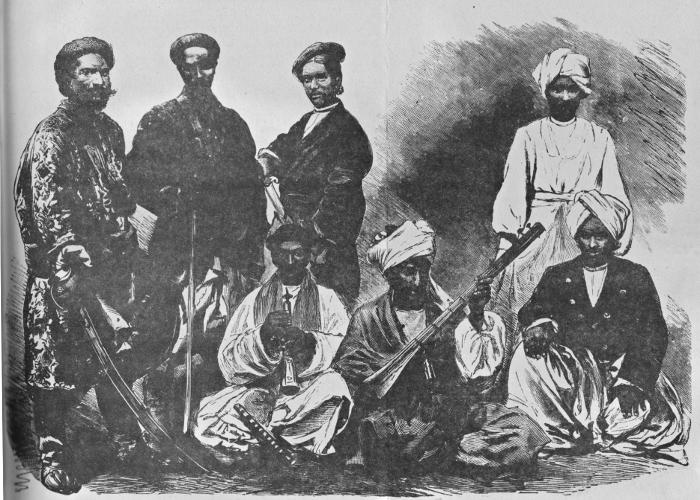
Group of Natives from Hunza, Yasin, and Nagyr listening to Musicians from Chitrál and Badakhshán.
LAMENT FOR THE ABSENT WARRIOR BY HIS MOTHER. 3. ANOTHER GILGITI WAR SONG.
Biyashtëyn náng Kashíru A Paradise [is the lot of whoever is struck by] the bullet of Kashiru? Góu nélli,[22] áje Sahibe Khann He has gone, my child, mother of Sahibe Khann [to the wars]. Suregga karé wey jill bey? And the sun when coming will it shining become? (When will his return cause the sun again to shine for me?) Mutshútshul shong putéye Of Mutshutshul[23] the ravine he has conquered Híyokto bijéy, lamayi Yet my soul is in fear, oh my beloved child, [literally: oh my sacrifice] Ardàm Dolója yujéy To snatch [conquer] Doloja[24] is [yet necessary = has yet to be done].
Translation.
“The bullet of Kashiru sends many to Paradise. He has gone to the wars, oh my child and mother of Sahib Khan! Will the sun ever shine for me by his returning? It is true that he has taken by assault the ravine of Mutshutshul, but yet, oh beloved child, my soul is in fear for his fate, as the danger has not passed, since the village Doloja yet remains to be conquered.”
4. THE SHIN SHAMMI SHAH. OLD NATIONAL SHINA SONG.
Shammi Shah Shaîtingêy mítojo. Shammi Shah Shaíting, from his courtyard.
Djálle The green fields’ tshâye birds dûloe promenade dên. they give.
Nyé They (near) tziréye twitter tshayote birds kóy bijéy. who fears?[25]
Tómi tom From tree to tree shiudóke a whistle dên. they give.
Alldátey Alldát’s pótskeyn grandson’s mítojo. from the courtyard.
Djalle The green fields tshaye birds dúloe promenade dên. give.
Nyé They tziréye twitter tshayote birds kóy bijey. who fears?[25]
Tomi tom; From tree to tree; shiudôke a whistling den. they give.
Shammi Shah Shaíthing was one of the founders of the Shín rule. His wife, although she sees her husband surrounded by women anxious to gain his good graces, rests secure in the knowledge of his affections belonging to her and of her being the mother of his children. She, therefore, ridicules the pretensions of her rivals, who, she fancies, will, at the utmost, only have a temporary success. In the above still preserved song she says, with a serene confidence, not shared by Indian wives.
Translation.
“In the very courtyard of Shammi Sha Shaîting. “The little birds of the field flutter gaily about. “Hear how they twitter; yet, who would fear little birds, “That fly from tree to tree giving [instead of lasting love] a gay whistle? “In the very courtyards of Alldat’s grandson these birds flutter gaily about, yet who would fear them? “Hear how they twitter, etc., etc., etc.
5. A WOMAN’S SONG (GILGITI). [THE DESERTED WIFE AND THE FAITHLESS HUSBAND.]
The Wife:
Mey My kukúri kukuri Patan Pathán gayta going béyto he sat djék tòn? what am I to do?
Pípi Aunt! batzísse from the family garáo he absence dên; has given; múso tshûsh. I cocoon.
Gá And sikkìm coloured silk qatì spinning bring animal báleo bind dês; do = could.
Mió My dudélo milk-sweet tshût late biló! has become!
The Husband:
Anì That Azari Azari, [is] rey[26] a Deodar cedar[?]
Rajóy, Kingly, nà is it not so sómmo? [my] love! anì That Azareo Azari rôk illness bilôs. I have.
Anì This Wazíreyn Wazîr’s shuyi child gas-mall, princess, na not [so] sommo! love?
Bálli Then dapújo from my waist gî (girdle) bem; taking I’ll sit; anì this pâr beyond tshísheyn. the mountains.
Súri Sun war this side’s tshîsheyn mountain djondjì[27] birch tree(?) tzáe to you bijôte. both.
Somm Alike tshinèm; I love; anù This shëò white qoáreyn hawk kinì—ga black and Tshikki[28] fragrant bag méy mine begà being beìh; sit; balli Then pashéjo on my turban gi wearing beyim. I will sit.
Translation of “A Woman’s Song.”
The deserted wife sings:—My Pathan! oh kukúri, far away from me has he made a home; but, aunt, what am I to do, since he has left his own! The silk that I have been weaving during his absence would be sufficient to bind all the animals of the field. Oh, how my darling is delaying his return!
The faithless husband sings:—[My new love] Azari is like a royal Deodar; is it not so, my love? for Azari I am sick with desire. She is a Wazeer’s princess; is it not so, my love? Let me put you in my waist. The sun on yonder mountain, and the tree on this nigh mountain, ye both I love dearly. I will recline when this white hawk and her black fragrant tresses become mine; encircling with them my head I will recline [in happiness.]
6. THE JILTED LOVER’S DREAM. [IN THE ASTORI DIALECT.]
Tshunni (Oh) Little nazdik delicate mulayi.[29] [maid] woman.
Barêyo The husband báro, old na.[30] is, [is he not?]
Hapótok With a bear thyayé done it gé. going, [you have “been and gone and done it.”]
Sómmi In the sleep rátijo of night Sómmi The sleep shakejo from the arm. Mey nish harayé My sleep awake gé. has gone. Mashàq Turning round phirì again phùt opening hastily talósto. I saw. Méy laktéy My darling píribann waistband tshîtsho variegated häun. was. Datshîno Right hata-jó hand-from aina mirror giní, taking, Tshakéoje Looking wazze. she came. Nu This kabbo left hata-jó hand-from surmá antimony giní. taking, Paléoje Applying wazze. she came.
The above describes the dream of a lover whose sweetheart has married one older than herself; he says:
Translation.
“That dear delicate little woman has a frightful old husband. “Thou hast married a bear! In the dead of night, resting on my arm, “My sleep became like waking. Hastily I turned and with a quick glance saw “That my darling’s waistband shone with many colours, “That she advanced towards me holding in her right a mirror into which she looked, “That she came near me applying with her left the antimony to her eyes.”
7. MODERN ASTORI SONG.
This Song was composed by Rajah Bahadur Khan, now at Astŏr, who fell in love with the daughter of the Rajah of Hunza to whom he was affianced. When the war between Kashmir and Hunza broke out, the Astoris and Hunzas were in different camps; Rajah Bahadur Khan, son of Rajah Shakul Khan, of the Shíah persuasion,[31] thus laments his misfortunes:
Lotshúko Early sabäin in morning’s kên time nimâz [usual] prayers thé done duwá supplication them I make Qabûl thé, Accept, Rahîma oh merciful [God] Garìbëy of the poor duwa the prayer. Dòn [her] teeth [are] mahî—yeen of fish bone = like ivory, dim [her] body puru—yeen [like a] reed[32] tshamûye [her] hair tshîké musk hane is. me My armán longing tûte to you hane is Bulbúl [Oh] nightingale shakàr. sweet!
Chorus falls in with “hai, hai, armân bulbúl” = “oh, oh, the longing [for the] nightingale!”[33]
Translation.
After having discharged my usual religious duties in the early morning, I offer a prayer which, oh thou merciful God, accept from thy humble worshipper. [Then, thinking of his beloved.] Her teeth are as white as ivory, her body as graceful as a reed, her hair is like musk. My whole longing is towards you, oh sweet nightingale.
Chorus: Alas, how absorbing this longing for the nightingale.
8. GURAIZI SONGS.
This district used to be under Ahmad Shah of Skardo, and has since its conquest by Ghulab Singh come permanently under the Maharajah of Kashmîr. Its possession used to be the apple of discord between the Nawabs of Astor and the Rajahs of Skardo. It appears never to have had a real Government of its own. The fertility of its valleys always invited invasion. Yet the people are of Shîná origin and appear much more manly than the other subjects of Kashmîr. Their loyalty to that power is not much to be relied upon, but it is probable that with the great intermixture which has taken place between them and the Kashmîri Mussulmans for many years past, they will become equally demoralized. The old territory of Guraiz used in former days to extend up to Kuyam or Bandipur on the Wular Lake. The women are reputed to be very chaste, and Colonel Gardiner told me that the handsomest women in Kashmîr came from that district. To me, however, they appeared to be tolerably plain, although rather innocent-looking, which may render them attractive, especially after one has seen the handsome, but sensual-looking, women of Kashmîr. The people of Guraiz are certainly very dirty, but they are not so plain as the Chilásis. At Guraiz three languages are spoken: Kashmîri, Guraizi (a corruption of a Shiná dialect), and Panjabi—the latter on account of its occupation by the Maharajah’s officials. I found some difficulty in getting a number of them together from the different villages which compose the district of Guraiz, the Arcadia of Kashmir, but I gave them food and money, and after I got them into a good humour they sang:
GURAIZI HUNTING SONG.
Guraizi. English.
Pere, tshaké, gazàri meyaru = Look beyond! what a fine stag!
Beyond, look! a fine stag.
Chorus. Pére, tshaké, djôk maar âke dey. = Chorus. Look beyond! how gracefully he struts.
Beyond, look! how he struts!
Pére, tshaké, bhapûri bay bâro = Look beyond! he bears twelve loads of wool.
Beyond, look! shawl wool 12 loads.
Chorus. Pére, tshaké, djôk maarâke dey. = Chorus. Look beyond! how gracefully he struts.
Beyond, look! how he does strut!
Pére, tshaké, dòni shilélu = Look beyond! his very teeth are of crystal.
Beyond, look! [his] teeth are of crystal [glass]
Chorus. Pére, tshaké, djôk maarâke dey. = Chorus. Look beyond! how gracefully he struts.
This is apparently a hunting song, but seems also to be applied to singing the praises of a favourite.
There is another song, which was evidently given with great gusto, in praise of Sheir Shah Ali Shah, Rajah of Skardo.[34] That Rajah, who is said to have temporarily conquered Chitrál, which the Chilasis call Tshatshál,[35] made a road of steps up the Atsho mountain which overlooks Bûnji, the most distant point reached before 1866 by travellers or the Great Trigonometrical Survey. From the Atsho mountain Vigne returned, “the suspicious Rajah of Gilgit suddenly giving orders for burning the bridge over the Indus.” It is, however, more probable that his Astori companions fabricated the story in order to prevent him from entering an unfriendly territory in which Mr. Vigne’s life might have been in danger, for had he reached Bûnji he might have known that the Indus never was spanned by a bridge at that or any neighbouring point. The miserable Kashmîri coolies and boatmen who were forced to go up-country with the troops in 1866 were, some of them, employed, in rowing people across, and that is how I got over the Indus at Bûnji; however to return from this digression to the Guraizi Song:
9. PRAISE OF THE CONQUEROR SHEIR SHAH ALI SHAH.
Guraizi. English.
Sheir Shah Ali Shah = Sheir Shah Ali Shah.
Nōmega djong = I wind myself round his name.[36]
Ká kōlo shing phuté = He conquering the crooked Lowlands.
Djar súntsho taréga = Made them quite straight.
Kâne Makponé = The great Khan, the Makpon.
Kâno nom mega djong = I wind myself round the Khan’s name.
Kó Tshamūgar bòsh phuté = He conquered bridging over [the Gilgit river] below Tshamûgar.
Sar[37] súntsho taréga = And made all quite straight.
I believe there was much more of this historical song, but unfortunately the paper on which the rest was written down by me as it was delivered, has been lost together with other papers.
“Tshamūgar,” to which reference is made in the song, is a village on the other side of the Gilgit river on the Nagyr side. It is right opposite to where I stayed for two nights under a huge stone which projects from the base of the Niludâr range on the Gilgit side.
There were formerly seven forts at Tshamūgar. A convention had been made between the Rajah of Gilgit and the Rajah of Skardo, by which Tshamūgar was divided by the two according to the natural division which a stream that comes down from the Batkôr mountain made in that territory. The people of Tshamūgar, impatient of the Skardo rule, became all of them subjects to the Gilgit Rajah, on which Sher Shah Ali Shah, the ruler of Skardo, collected an army, and crossing the Makpon-i-shagaron[38] at the foot of the Haramûsh mountain, came upon Tshamūgar and diverted the water which ran through that district into another direction. This was the reason of the once fertile Tshamūgar becoming deserted; the forts were razed to the ground. There are evidently traces of a river having formerly run through Tshamūgar. The people say that the Skardo Rajah stopped the flow of the water by throwing quicksilver into it. This is probably a legend arising from the reputation which Ahmad Shah, the most recent Skardo ruler whom the Guraizis can remember, had of dabbling in medicine and sorcery.[39]
CHILASI SONGS.
[The Chilasis have a curious way of snapping their fingers, with which practice they accompany their songs, the thumb running up and down the fingers as on a musical instrument.]
10. CHILASI.
Tù hùn Gítshere bódje sòmmo dímm bamèm Mèy shahínni pashalóto dewà salám dáute Rás; Aje góje bómto méy dùddi aje nush Hargìnn Zúe déy mo bejómos Samat Khánay sóni mó báshémm tutàk Mùugà deyto; mó dabtar dèm
11. A. Tshekòn thónn; tikki wéy nush, oh Berader Adòn; thōn; madéy nush; ey Berader B. Hamírey tshûki, púki thàs, palútos Ni rátey ló ne bĕy, oh Berader!
The last word in each sentence, as is usual with all Shín songs, is repeated at the beginning of the next line. I may also remark that I have accentuated the words as pronounced in the songs and not as put down in my Vocabulary.
Translation.
MESSAGE TO A SWEETHEART BY A FRIEND.
You are going up to Gitshe, oh my dearest friend, Give my compliment and salute when you see my hawk. Speak to her. I must now go into my house; my mother is no more And I fear the sting of that dragon,[40] my step-mother— Oh noble daughter of Samat Khan; I will play the flute And give its price and keep it in my bosom.
The second song describes a quarrel between two brothers who are resting after a march on some hill far away from any water or food wherewith to refresh themselves.
Younger brother.—Am I to eat now, what am I to say, there is, oh my brother, neither bread nor water. Am I to fetch some [water] what am I to say, there is no masak [a water-skin], oh my brother! Elder brother.—The lying nonsense of Hamir (the younger brother) wounds me deeply (tears off the skin of my heart). There will be no day to this long night, oh my brother!
12. THE TRANSITORINESS OF THIS WORLD.
Kàka, Brother! mosè I what djò am râum to say? | | Mèy My dássga choice nè bèy it is not | | Tàbàm In the aresà whole of the dáro present time | | Módje To me làshga shame nè béy is not | | Dajála The next éle world near jilto has come | | Jáko People udàsóne despairing han will be
2nd Verse.
Watàn In my dáro country zár famous | | Tu You mashahúre famous have billé become | | Ash To-day bajóni to get you dégi prepared bárri on a musafiri great journey | | Zari Openly mójo me lai langíddi = íje much pains | | Djíll My soul mey is in hawallí your keeping | | Sín qatída The river phúne is flowing, the large flower | | Sudà Of silver chogarong colour.[41]
A PRAYER OF THE BASHGELI KAFIRS. [In the Kalásha dialect.]
The ideas and many of the words in this prayer were evidently acquired by my two Kafirs on their way through Kashmir:
“Khudá, tandrusti dé, prushkári rozì de, abattì kari, dewalat man. Tu ghóna asas, tshik intara, tshik tu faidá káy asas. Sat asmán tì, Stru suri mastruk mótshe dé.”