APPENDICES. (continued 2)
Reading edition
LETTERS FROM MIHTAR NIZAM-UL-MULK TO DR. LEITNER:
My kind and true friend and dear companion, may you know:
That before this, prompted by excess of friendship and belief in me, you had written to me a letter of sincerity full of pleasing precepts and words of faithfulness. These were received and caused joy to my heart. My true friend, whatever words of faith and sincere regard there were, these have been written in my mind. For I am one of your disciples and well-wishers here, and have no other care but that of serving and well-wishing my friends. My heart sorrows at separation from friends, but there is no remedy except resignation. As I consider your stay there [in London] as my own stay, I hope from your friendship that you have expressed words of my well-being and my sincerity towards the Lord Bahadoor and the Great Queen and thus performed the office of friendship and caused joy there. Another request is that if you have found a good dog like “Zulu,” when you come to Delhi please send it to Jummoo. My men are there, and shall bring it to me. Further, the volume of papers on the customs of Chitrár and the old folk-tales have been written partly in Persian and partly in the Chitrári language. We are frontier and village people, and are deficient in intelligence and eloquence. They have not been very well done, and I don’t know if they will please you or not. But we have no better eloquence or practice as we are hillmen.
Tuesday 11th Shavval 1304 despatched from Turikoh to London.
The standard of affection and friendship, the foundation-stone of kindness and obligation, my friend, may his kindness increase!
After expressing the desire of your joy-giving meeting be it known to your kind self, that the condition of this your faithful friend is such as to call for thanks to the Almighty. The safety and good health of that friend [yourself] is always wished for. As you had sent me several volumes of bound papers to write on them the customs of the Chitrar people and their folk-tales, partly in Persian and partly in Chitrari language, I have in accordance with this request of that true friend got them written partly in Persian and partly in Chitrari and sent to you. Inshallah, they will reach you, but I do not know whether they will please you or not; in any case you know, that whatever may be possible to do by a faithful friend or by his employés I will do, with the help of God, if you will forgive any faulty execution of your wishes, and continue to remember me for any services in my power, and keep me informed continually of your good health so as to dispel my anxiety. The condition here is of all news the best, as no new event has happened; but three persons, wayfarers and travellers, have come from Wakhan to Mastuch and two of these persons I have sent on to Chitrar, and one of these wanderers has remained (behind) at Mastuch. They don’t know anybody. Sometimes they say we are Russians, and sometimes they say we are Frenchmen. And I with my own eye have not seen them. If I had seen them, they might have told me. Another desire is that you send me something worth reading in English words and write opposite to them their translation into Persian, so that it may be a pleasure and useful to me. I have another request to make which is that you may be pleased to give an early fulfilment to your kind promise of visiting Chitrar with your lady for the purpose of sight-seeing and sport and study. I have been waiting ever since for your arrival. It is really only right that you should come now when the weather is very delightful, game is abundant, and I have made every arrangement for our hunting together. Everything is tranquil and you will be able to return before the winter, greatly pleased. Let this become a fact. The writer Sirdar Nizam-ul-Mulk, Tuesday the 11th of Shevvál, from Turikoh to London. May it be received!
APPENDIX III. FABLES, LEGENDS, AND SONGS OF CHITRAL[113] (called Chitrár by the natives).
Collected by H. H. Sirdar Nizám-ul-Mulk, Raja of Yasin, etc., and by Dr. G. W. Leitner, and translated from Persian or Chitráli.
I. Fables.
1. The Vindictive Fowl.
A fowl sat near a thistle, and opened a rag, in which corals were tied up. Suddenly one fell into the thistle; the fowl said, “O thistle, give me my coral.” The thistle said, “This is not my business.” The fowl said, “Then I will burn thee.” The thistle agreed. The fowl then begged the fire to burn the thistle. The fire replied, “Why should I burn this weak thorn?” The fowl thereupon threatened to extinguish the fire by appealing to water: “O water, kill this fire for my sake.” The water asked, “What is thy enmity with the fire, that I should kill it?” The fowl said, “I will bring a lean cow to drink thee up.” The water said, “Well”; but the cow refused, as it was too lean and weak to do so. Then the fowl threatened to bring the wolf to eat the cow. The wolf refused, as he could feed better on fat sheep. The fowl threatened the wolf with the huntsman, as he would not eat the lean cow. The huntsman refused to shoot the wolf, as it was not fit to eat. The fowl then threatened the huntsman with the mouse. The huntsman replied, “Most welcome.” But the mouse said that it was feeding on almonds and other nice things, and had no need to gnaw the leather-skin of the huntsman. The fowl then said, “I will tell the cat to eat thee.” The mouse said, “The cat is my enemy in any case, and will try to catch and eat me, wherever it comes across me, so what is the use of your telling the cat?” The fowl then begged the cat to eat the mouse. The cat agreed to do so whenever it was hungry: “Now,” it added, “I do not care to do so.” The fowl then became very angry, and threatened to bring little boys to worry the cat. The cat said, “Yes.” The fowl then begged the little boys to snatch the cat one from the other, so that it might know what it was to be vexed. The boys, however, just then wanted to play and fight among themselves, and did not care to interrupt their own game. The fowl then threatened to get an old man to beat the boys. The boys said, “By all means.” But the old man refused to beat the boys without any cause, and called the fowl a fool. The fowl then said to the Pîr (old man), “I will tell the wind to carry away thy wool.” The old man acquiesced; and the wind, when ordered by the fowl, with its usual perverseness, obeyed the fowl, and carried off the old man’s wool. Then the old man beat the boys, and the boys worried the cat, and the cat ran after the mouse, and the mouse bit the huntsman in the waist, and the huntsman went after the wolf, and the wolf bit the cow, and the cow drank the water, and the water came down on the fire, and the fire burnt the thistle, and the thistle gave the coral to the fowl, and the fowl took back its coral.
2. The Story of the Golden Mouse who tells the Story of a Mouse and a Frog.
There was a kind of mice that had a golden body. They never went out of their hole. One day one of them thought: “I will go out and see the wonders of God’s creation.” So it did; and when thirty or forty yards from its hole, a cat, prowling for game, saw it come out from the hole. The cat, that was full of wiles, plotted to get near the hole, awaiting the return of the mouse, who, after its peregrinations, noticed the mouth of the hole closed by the wicked cat. The mouse then wished to go another way, and turned to the left, towards a tree, on which sat concealed a crow, expecting to devour the mouse when it should run away from the cat. The crow then pounced on the mouse, who cried out to God, “O God, why have these misfortunes overtaken such a small being as myself? My only help is in thee, to save me from these calamities.” The mouse was confused, and ran hither and thither, in vain seeking a refuge, when it saw another cat stealthily approaching it; and, in its perplexity, the mouse nearly ran into the cat’s paws; but that cat had been caught in a hunter’s net, and could do nothing. The crow, and the cat which was watching at the hole, saw that the mouse had got near another cat between the two. They thought that the mouse had fallen a victim to the second cat, and that it was no use remaining. It was the fortune of the mouse that they should be so deceived. The trembling mouse saw that the two enemies had gone. It thanked the Creator for having escaped from the cat and the crow, and it said, “It would be most unmanly of me not to deliver the cat in the net, as it has been the instrument of my safety; but then, if I set it free, it will eat me.” The mouse was immersed in thought, and came to the conclusion to gnaw the net at a distance from the cat, and that as soon as the hunter should come in sight, the cat then, being afraid of the hunter, would seek its own safety, and not trouble itself about the mouse. “Thus I will free the cat from the hunter and the net, and deliver my own life from the cat,” was the thought of the mouse. It then began to gnaw the net at a distance. The cat then said to the mouse, “If you want to save me, for God’s sake, then gnaw the net round my throat, and not at a distance; that is no use to me when the hunter will come. You err if you think that I will eat you as soon as I get out. For all the faults, hitherto, have been on the side of cats, which you mice have never injured, so that, if you are magnanimous and release me, there is no such ungrateful monster in the world as would return evil for the unmerited good that I implore you to bestow on me.” The golden mouse, which was very wise, did not attend to this false speech, but continued to gnaw the net at a distance, so that, when the hunter came, there only remained the threads round the neck of the cat, which the mouse bit asunder at the last moment and then ran back into its hole. The cat bolted up the tree where the crow had sat, the huntsman saw that the cat had escaped, and that his net was gnawed in several places, so he took the net to get it repaired in the Bazaar.
Then the cat descended from the tree and said to herself, “The time of meals is over, it is no use to go home; I had better make friends with the mouse, entice it out of the hole, and eat it.” This she did, and going to the hole, called out: “O faithful companion and sympathizing friend, although there has been enmity between cats and mice for a long time, thou hast, by God’s order, been the cause of my release, therefore come out of the hole, and let us lay the foundation of our friendship.” The mouse replied: “I once tried to come out, and then I fell from one danger into another. Now it is difficult for me to comply with your request. I have cut the threads encircling your throat, not out of friendship for you, but out of gratitude to God. Nor is our friendship of any use in this world, as you will gather from the story of
3. “The Frog and the Mouse.”
The mouse then narrated: “There was once a mouse that went out for a promenade, and going into people’s houses, found food here and there, and in the dawn of the next morning it was returning to its home. It came to a place where there was a large tank, round which there were flowers and trees; and a voice was heard from out of the tank. Coming near, it saw that it emanated from a being that had no hair on its body, no tail, and no ear. The mouse said to itself: ‘What is this ill-formed being?’ and thanked God that it was not the ugliest of creatures. With this thought the mouse, that was standing still, shook its head to and fro. The frog, however, thought that the mouse was smitten with astonishment at his beauty and entranced with pleasure at his voice, and jumping out of the corner of the tank came near: ‘I know, beloved, that you are standing charmed with my voice; we ought to lay the firm basis of our friendship, but you are sharper than I am, therefore go to the house of an old woman and steal from it a thread, and bring it here.’ The mouse obeyed the order. The frog then said: ‘Now tie one end to your tail and I will tie the other end to my leg, because I want to go to your house, where you have a large family and there are many other mice, so that I may know you from the others. If again you visit me, the tank is large, my friends many, and you too ought to distinguish me from the rest. Again, when I want to see you I will follow the thread to your hole, and when you want to see me you will follow it to the tank.’ This being settled, they parted. One day the frog wanted to see the mouse. Coming out of the tank he was going to its hole, when he saw the mouse-hawk, who pounced upon the frog as he was limping along, and flew up with him in its claws. This pulled the end to which the mouse was tied. It thought that its lover had come to the place and wanted to see it; so it came out, only to be dragged along in the air under the mouse-hawk. As the unfortunate mouse passed a Bazaar it called out: ‘O ye Mussulmans, learn from my fate what happens to whoever befriends beings of a different species.’
“Now,” said the golden mouse to the cat, “this is the story which teaches me what to do; and that is, to decline your friendship and to try never again to see your face.”
4. The Quail and the Fox.
The Quail said: I teach thee art. Night and day I work at art; Whoever lies, the shame is on his neck.
A quail and a fox were friends. The fox said: “Why should you not make me laugh some day?” The quail replied, “This is easy.” So they went to a Bazaar, where the quail, looking through the hole in the wall of a house, saw a man sitting, and his wife turning up and down the “samanak” sweetmeat with a big wooden ladle (much in the same way as the Turkish rakat lokum, or lumps of delight, are made). The quail then settled on the head of the man. The woman said to him, “Don’t stir; I will catch it.” Then the quail sat on the woman’s head, so the man asked the woman to be quiet, as he would catch the quail, which, however, then flew back to the head of the man. This annoyed the wife, who struck at the quail with the wooden ladle, but hit instead the face of her husband, whose eye and beard were covered with the sweetmeat, and who thereupon beat his wife. When the fox saw this, he rejoiced and laughed greatly; and both the fox and quail returned to their home. After a time the fox said to the quail: “It is true that you have made me laugh, but could you feed me?” This the quail undertook to do, and with the fox went to a place where a woman was carrying a plate of loaves of bread to her husband in the fields. Then the quail repeated her tactics, and sat on the head of the woman, who tried to catch it with one hand. The quail escaped and settled on one shoulder, then on another, and so on till the woman became enraged, put the plate of bread on the ground, and ran after the quail, who, by little leaps, attracted her further and further away till she was at a considerable distance from it, when the fox pounced on the bread and appeased his hunger.
Some time after, the fox wanted to put the cleverness of the quail again to the test, and said: “You have made me laugh, you have fed me, now make me weep.” The quail replied, “Why, this is the easiest task of all,” so she took the fox to the gate of the town and called out: “O ye dogs of the Bazaar, come ye as many as ye are, for a fox has come to the gate!” So all the dogs, hearing this good news, assembled to hunt the fox, which, seeing the multitude of its enemies, fled till he reached a high place. Turning round, he saw the dogs following, so he jumped down and broke his back. The fox therefore helplessly sat down and said to the approaching quail: “O sympathizing companion, see how my mouth has become filled with mud and blood, and how my back has been broken. This is my fate in this world; now, could you kindly clean my mouth from mud and blood, as my end is near?” The intention of the fox was, that he should take the opportunity of this artifice to swallow the quail in revenge of her being the cause of its death. The quail, in her unwise friendship, began to clean the fox’s mouth. The accursed fox caught her in his mouth; but the quail, which was intelligent and clever, said, “O beloved friend, your eating me is lawful, because I forgive you my blood, on condition that you pronounce my name, otherwise you will suffer an injury.” The base fox, although full of wiles, clouded by approaching death, fell into the trap, and as soon as he said “O quail,” his teeth separated, and the quail flew away from him and was safe, whilst the fox died.
II. Stories and Legends.
There is a story which seems to illustrate the fact that private hatred is often the cause of the injury that is ascribed to accident. A man slaughtered a goat, and kept it over-night in an outhouse. His enemy put a number of cats through the airhole, and when their noise awoke the master of the house he only found the bones of his goat. But he took their bones, and scattered them over the field of his enemy the same night; and the dogs came, smelling the bones, searched for them, and destroyed the wheat that was ripe for reaping. One blamed the cats, the other blamed the dogs; but both had the reward of their own actions.
Sulei was a man well known on the frontier of Chitrál for his eloquence. One day, as he was travelling, he met a man from Badakhshan, who asked him whether he knew Persian. Sulei said, “No.” “Then,” replied the Badakhshi, “you are lost” [nobody, worthless]. Sulei at once rejoined, “Do you know Khowár?” (the language of Chitrál). “No,” said the Badakhshi. “Then you too are lost,” wittily concluded Sulei (to show that personal worth or eloquence does not depend on knowing any particular language).
It is related that beyond Upper Chitrár there is a country called Shin or Rashan. It is very beautiful, and its plains are gardens, and its trees bear much fruit, and its chunars (plane trees) and willows make it a shaded land. Its earth is red, and its water is white and tasty. They say that in ancient times the river of that district for a time flowed with milk without the dashing (of the waves) of water.
Besir is a place near Ayin towards Kafiristan. The inhabitants were formerly savage Kafirs, but are now subjects of the Mehter (Prince) of Chitrár. They carry loads of wood, and do not neglect the work of the Mehter. They are numerous and peaceful, and in helplessness like fowls, but they are still Kafirs; though in consequence of their want of energy and courage they are called “Kalàsh.” The people of Ayin say that in ancient times five savages fled into the Shidi Mount and concealed themselves there.
Shidi is below Ayin opposite Gherát on the east (whence Shidi is on the west). Between them is a river. It is said that these savages had to get their food by the chase. One day word came to them from God that “to-day three troops of deer will pass; don’t interfere with the first, but do so with the others.” When, however, the troops came, the savages forgot the injunctions of God, and struck the first deer. Now there was a cavern in the mountain where they lived, into which they took the two or three deer that they had killed and were preparing to cook, two being sent out to fetch water. By God’s order the lips of the cavern were closed, and the three men imprisoned in it. God converted the three into bees, whilst the two who had gone to fetch water fled towards Afghanistan. Thus were created the first honey-bees, who, finding their way out of the cavern, spread themselves and their sweet gift all over the world. This is a story told by the Kalàsh, who credit that the bees are there still; but it is difficult to get there, as the mountains are too steep, but people go near it and, pushing long rods into the hole of the cavern, bring them back covered with honey.
Shah Muhterim is the name of a Mehter (prince), the grandfather of the present Ruler of Chitrár. This Mehter was renowned as a descendant of fairies, who all were under his command. Whatever he ordered the fairies did. Thus some time passed. From among them he married a fairy, with whom he made many excursions. She bore him a daughter. Seven generations have passed since that time. This daughter is still alive, and her sign among the fairies is that her hair is white, which does not happen to ordinary fairies. Whenever a descendant of the Shah Muhterim leaves this transitory world for the region of permanence, all the fairies, who reside in the mountains of Chitrár, together with that white-haired lady, weep and lament, and their voices are clearly heard. This statement is sure and true, and all the men on the frontiers of Chitrár are aware of the above fact.
The People of Aujer (the Bœotia of Chitral).
There is a country “Aujer,” on the frontier of Chitrár (or Chitrāl as we call it), the inhabitants of which in ancient times were renowned for their stupidity. One had taken service at Chitrár, and at a certain public dinner noticed that the King (Padishah) ate nothing. So he thought that it was because the others had not given anything to the king. This made him very sorry. He left the assembly, and reached home towards evening; there he prepared a great amount of bread, and brought it next day to the council enclosure, beckoning to the king with his finger to come secretly to him. The king could not make this out, and sent a servant to inquire what was the matter; but the man would not say anything except that the king should come himself. On this the king sent his confidant to find out what all this meant. The man answered the inquiries of the confidant by declaring that he had no news or claim, but “as they all ate yesterday and gave nothing to the king, my heart has become burnt, and I have cooked all this bread for him.” The messenger returned and told the king, who told the meeting, causing them all to laugh. The king, too, smiled, and said: “As this poor man has felt for my need, I feel for his;” and ordered the treasurer to open for him the door of the treasury, so that he might take from it what he liked. The treasurer took him to the gate, next to which was the treasurer’s own house, where he had put a big water-melon, on which fell the eye of that stupid man from Aujer. He had never seen such a thing, and when he asked, “What is it?” the treasurer, knowing what a fool he had to deal with, said, “This is the egg of a donkey.” Then he showed him the gold, silver, jewels, precious cloths, and clean habiliments of the treasury from which to select the king’s present. The man was pleased with nothing, and said, “I do not want this; but, if you please, give me the egg of the donkey, then I shall indeed be glad.” The treasurer and the king’s confidant, consulting together, came to the conclusion that this would amuse the king to hear, and gave him the melon, with the injunction not to return to the king, but to take the egg to his house, and come after some nights (days). The fool was charmed with this request, went towards his home, but climbing a height, the melon fell out of his hand, rolled down towards a tree and broke in two pieces. Now there was a hare under that tree, which fled as the melon touched the tree. The fool went to his house full of grief, said nothing to his wife and children, but sat mournfully in a corner. The wife said, “O man, why art thou sorry? and what has happened?” The man replied: “Why do you ask? there is no necessity.” Finally, on the woman much cajoling him, he said: “From the treasury of the prince (mehter) I had brought the egg of the donkey; it fell from me on the road, broke, and the young one fled out from its midst. I tried my utmost, but could not catch it.” The woman said: “You silly fellow! had you brought it, we might have put loads on it.” The man replied, “You flighty thing! how could it do so, when it was still so young? Why, its back would have been broken.” So he got into a great rage, took his axe, and cut down his wife, who died on the spot.
Once, a donkey having four feet, in this country of donkeys having two feet, put his head into a jar of jáo (barley), but could not extricate it again. So the villagers assembled, but could not hit on a plan to effect this result. But there was a wise man in that land, and he was sent for and came. He examined all the circumstances of the case, and finally decided that they should do him “Bismillah”; that is to say, that they should cut his throat with the formula, “in the name of God,” which makes such an act lawful. When they had done this to the poor donkey, the head remained in the jar, and the wise man ordered them now to break the jar. This they did, and brought out the head of the donkey. The wise man then said: “If I had not been here, in what manner could you have been delivered of this difficulty?” This view was approved by all, even by the owner of the donkey.
Two brothers in that country of idiots, being tired of buying salt every day, decided on sowing it over their fields, so that it may bring forth salt abundantly. The grass grew up, and the grasshoppers came; and the brothers, fearing that their crop of salt would be destroyed, armed themselves with bows and arrows to kill the grasshoppers. But the grasshoppers jumped hither and thither, and were difficult to kill; and one of the brothers hit the other by mistake with an arrow instead of a grasshopper, and he got angry, and shot back and killed his brother.
A penknife once fell into the hands of this people, so they held a council in order to consider what it was. Some thought it was the young one of a sword, the others that it was the baby of an axe, but that its teeth had not yet come out. So the argument waxing hot, they fell to fight one another, and many were wounded and killed.
A number of these people, considering that it was not proper that birds alone should fly, and that they were able to do so, clad themselves in posteens (some of which are made from the light down of the Hindukush eagle), and threw themselves down from a great height, with the result that they reached the ground killed and mangled.
III. Songs.
A Song (of evidently recent date, as the influence on it of Persian poetry is obvious).
The Confession of the Soul.
1. (He.) If thy body be as lithe as (the letter) Alif (ا), thy eye is as full as (the letter) Nûn (ن). If thou art Laila, this child (or lover) is Majnûn (referring to the well-known story of these true lovers). 2. (She.) If thou art the Prince of the Sultan of Rûm (Turkey) Come and sit by me, free from constraint; My eye has fallen on thee, and I now live. 3. My friend had scarcely come near me—why, alas, has he left? My flesh has melted from these broken limbs. 4. How could I guard against the enmity of a friend? May God now save me from such grief! 5. (He.) Were I to see 200 Fairies and 100,000 Houris, I should be a Káfir (infidel), O my beloved! If my thoughts then even strayed from thee. 6. Yea, not the Houri nightingale, nor my own soul and eyes as Houris, Would, on the day of judgment, divert my thought from thee. 7. I envy the moth, for it can fly Into the fire in which it is burnt (whereas I cannot meet thee). 8. (She.) My friend, who once came nigh me, suddenly left me—to weep. My grief should move the very highest heaven. A coral bed with its root has been torn out and gone. 9. A ship of pilgrims (Calendárs) has sunk, and yet the world does not care. The end of all has been a bad name to me. 10. (He.) On this black earth how can I do (sing) thy praise? Imbedded in the blue heaven (of my heart) thou wilt find it; And yet, O child (himself), how great a failure (and below thy merits)! 11. Before thy beauty the very moon is nothing, For sometimes she is full and sometimes half. May God give thee to me, my perfect universe! 12. (She.) If an angel were a mortal like myself, It would be ashamed to see my fate (unmoved). 13. (He.) O angel! strangely without pity, Thou hast written her good with my evil (linked our fates). 14. (Both.) All have friends, but my friend is the Chief (God), And of my inner grief that friend is cognizant; His light alone loves our eyes and soul. 15. Break with the world, its vanities, its love; Leave ignorance, confess, and let thy goal be heaven!
The following is an attempt to render the pretty tune of a more worldly Laila and Majnûn song, which reminds one of the “Yodeln” of the Tyrolese. It was sung to me by Taighûn Shah, the poet-minstrel of the Raja, to the accompaniment of a kind of guitar. The Chitráli language, it will be perceived, is musical.
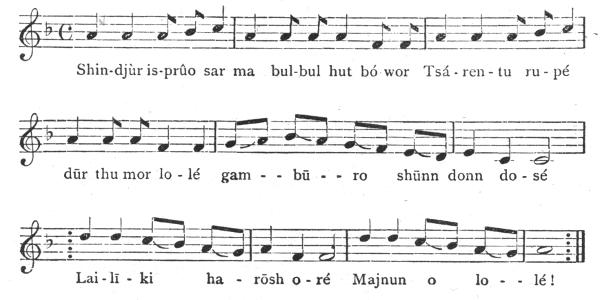
Shin·djùr is-prûo sar ma bul-bul hut bó·wor Tsá·ren-tu ru-pé
dūr thu mor lo - lé gam - - bū - - ro shūnn donn do - sé
Lai - lī - ki ha - rōsh o - ré Majnun o lo - - lé!
APPENDIX IV. THE RACES AND LANGUAGES OF THE HINDU-KUSH.
By Dr. G. W. Leitner.
GROUP OF DARDS AND CENTRAL ASIATICS WITH DR. LEITNER.
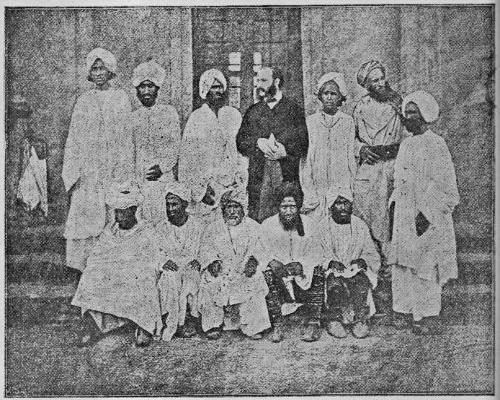
Standing Nos. 1 2 3 4 5 6 (see next page.)
Sitting Nos. 7 8 9 10 11 (see next page.)
Standing—1. Khundayar, son of a Shiah Akhun (priest) at Nagyr; 2. Maulvi Najmuddin, a poet from Kolab; 3 and 4. Khudadad and Hatamu, pilgrims from Nagyr; 5. A Chitrali soldier; 6. Matavalli, of Hunza.
Sitting—7. Mir Abdullah, a famous Arabic scholar and jurist from Gabrial; 8. Hakim Habibullah, a Tajik, a physician from Badakshan; 9. Ghulam Muhammad, Dr. Leitner’s Gilgit retainer; 10. Ibrahim Khan, a Shiah, Rono (highest official caste), of Nagyr; 11. Sultan Ali Yashkun, of Nagyr.
The accompanying illustration was autotyped some years ago from a photograph taken in 1881, and is now published for the first time. Following the numbers on each figure represented we come first to No. 1, the tall Khudayár, the son of an Akhun or Shiah priest of Nagyr, a country ruled by the old and wise Tham or Raja Zafar Ali Khan, whose two sons, Alidád Khan in 1866, and Habib ulla Khan in 1886, instructed me in the Khajuná language, which is spoken alike in gentle but brave Nagyr and in its hereditary rival country, the impious and savage Hunza “Hun-land,” represented by figure 6, Matavalli, the ex-kidnapper whom I took to England, trained to some Muhammadan piety, and sent to Kerbelá a year ago. No. 2 was an excellent man, an Uzbek visitor from Koláb, one Najmuddin, a poet and theologian, who gave me an account of his country. Nos. 3 and 4 are pilgrims from Nagyr to the distant Shiah shrine in Syria of the martyrdom of Husain at Kerbelá; No. 5 is a Chitráli soldier, whilst No. 7 is a distinguished Arabic Scholar from Gabriál, from whom much of my information was derived regarding a peaceful and learned home, now, alas! threatened by European approach, which my travels in 1866 and 1872, and my sympathetic intercourse with the tribes of the Hindu Kush, have unfortunately facilitated. The Jalkóti, Dareyli, and others, who are referred to in the course of the present narrative, will either figure on other illustrations or must be “taken as read.” No. 8 is the Sunni Moulvi Habibulla, a Tájik of Bukhara and a Hakîm (physician). No. 9 is my old retainer, Ghulám Muhammad, a Shiah of Gilgit, a Shîn Dard (highest caste), who was prevented by me from cutting down his mother, which he was attempting to do in order “to save her the pain of parting from him.” 10. Ibrahim Khan, a Shiah, Rôno (highest official caste) of Nagyr, pilgrim to Kerbelá. 11. Sultan Ali Yashkun (2nd Shîn caste) Shiah, of Nagyr, pilgrim to Kerbelá. The word “Yashkun” is, perhaps, connected with “Yuechi.”
The languages spoken by these men are: Khajuná by the Hunza-Nagyr men; Arnyiá by the Chitráli; Turki by the Uzbek from Koláb; Shiná by the Gilgiti; Pakhtu and Shuthun, a dialect of Shiná, by the Gabriáli. The people of Hunza are dreaded robbers and kidnappers; they, together with the people of Nagyr, speak a language, Khajuná, which philologists have not yet been able to classify, but which I believe to be a remnant of a pre-historic language. They are great wine-drinkers and most licentious. They are nominally Muláis, a heresy within the Shiah schism from the orthodox Sunni Muhammadan faith, but they really only worship their Chief or Raja, commonly called “Thàm.” The present ruler’s name is Mohammad Khan. They are at constant feud with the people of Nagyr, who have some civilization, and are now devoted Shiahs (whence the number of pilgrims, four, from one village). They are generally fair, and taller than the people of Hunza, who are described as dark skeletons. The Nagyris have fine embroideries, and are said to be accomplished musicians. Their forts confront those of Hunza on the other side of the same river. The people of Badakhshán used to deal largely in kidnapped slaves. A refugee, Shahzada Hasan, from the former royal line (which claims descent from Alexander the Great), who has been turned out by the Afghan faction, was then at Gilgit with a number of retainers on fine Badakhshi horses, awaiting the fortunes of war, or, perhaps, the support of the British. He was a younger brother of Jehandár Shah, who used to infest the Koláb road, after being turned out by a relative, Mahmûd Shah, with the help of the Amir of Kabul. Koláb is about eleven marches from Faizabád, the capital of Badakhshán. The Chitráli is from Shogòt, the residence of Adam Khor (man-eater), brother of Aman-ul-Mulk, of Chitrál, who used to sell his Shiah subjects regularly into slavery and to kidnap Bashgeli Kafirs. The man from Gabriál was attracted to Lahore by the fame of the Oriental College, Lahore, as were also several others in this group; and there can be no doubt that this institution may still serve as a nucleus for sending pioneers of our civilization throughout Central Asia. Gabriál is a town in Kandiá, or Kiliá, which is a secluded Dard country, keeping itself aloof from tribal wars. Gilgit and its representative have been described in my “Dardistan,” to which refer, published in parts between 1866 and 1877.
I. POLO IN HUNZA-NAGYR.
Although our first practical knowledge of “Polo” was derived from the Manipuri game as played at Calcutta, it is not Manipur, but Hunza and Nagyr, that maintain the original rules of the ancient “Chaughán-bazi,” so famous in Persian history. The account given by J. Moray Brown for the “Badminton Library” of the introduction of Polo into England (Longmans, Green & Co., 1891), seems to me to be at variance with the facts within my knowledge, for it was introduced into England in 1867, not 1869, by one who had played the Tibetan game as brought to Lahore by me in 1866, after a tour in Middle and Little Tibet. Since then it has become acclimatized not only in England, but also in Europe. The Tibet game, however, does not reach the perfection of the Nagyr game, although it seems to be superior to that of Manipur. Nor is Polo the only game in Hunza-Nagyr. “Shooting whilst galloping” at a gourd filled with ashes over a wooden scaffold rivals the wonderful performances of “archery on horseback,” in which the people of Hunza and Nagyr (not “Nagar,” or the common Hindi word for “town,” as the telegram has it) are so proficient. Nor are European accompaniments wanting to these Central Asian games; for prizes are awarded, people bet freely in Hunza as they do here, they drink as freely, listen to music, and witness the dancing of lady charmers, the Dayál, who, in Hunza, are supposed to be sorceresses, without whom great festivities lose their main attraction. The people are such keen sportsmen that it is not uncommon for the Tham, or ruler, to confiscate the house of the unskilful hunter who has allowed a Markhôr (Ibex) that he might have shot to escape him. Indeed, this even happens when a number of Markhôrs are shut up in an enclosure, “tsá,” as a preserve for hunting. The following literally translated dialogue regarding Polo and its rules tells an attentive reader more “between the lines” than pages of instructions:—
Poló = Bolá.—The Raja has ordered many people: To-morrow Polo I will play. To the musicians give notice they will play.
Hast thou given notice, O (thou)?
Yes, I have given notice, O Nazúr; let me be thy offering (sacrifice).
Well, we will come out, that otherwise it will become (too) hot.
The Raja has gone out for Polo; go ye, O (ye); the riders will start.
Now divided will be, O ye! (2) goals nine nine (games) we will do (play). Tola-half (= 4 Rupees) a big sheep bet we will do.
Now bet we have made. To the Raja the ball give, O ye, striking (whilst galloping) he will take.
O ye, efforts (search) make, young men, to a man disgrace is death; you your own party abandon not; The Raja has taken the ball to strike; play up, O ye musicians!
Now descend (from your horses) O ye; Tham has come out (victorious); now again the day after to-morrow, he (from fatigue) recovering Poló we will strike (play).
Rules:—The musical instruments of Polo; the ground for the game; the riders; the goals; 9, 9 games let be (nine games won); the riders nine one side; nine one (the other) side; when this has become (the case) the drum (Tsagàr) they will strike.
First the Tham takes the ball (out into the Maidan to strike whilst galloping at full speed).
The Tham’s side upper part will take.
The rest will strike from the lower part (of the ground).
Those above the goal when becoming will take to the lower part.
Those below the goal when becoming to above taking the ball will send it flying.
Thus being (or becoming) whose goal when becoming, the ball will be sent flying and the musicians will play.
Whose nine goals when has become, they issue (victorious).
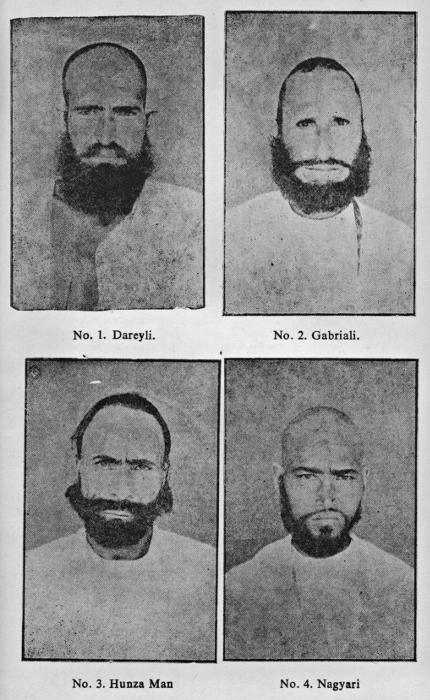
No. 1. Dareyli. No. 2. Gabriali.
No. 3. Hunza Man. No. 4. Nagyri.
II. THE KOHISTÁN OF THE INDUS, INCLUDING GABRIÁL.
Account of Mir Abdulla.
The real native place of Mir Abdulla is in the territory of Nandiyar; but his uncle migrated to, and settled in, Gabriál. The Mir narrates:—
“In the country of Kunar there is a place called Pusht, where lives a Mulla who is famous for his learning and sanctity. I lived for a long time as his pupil, studying Logic, Philosophy, and Muhammadan Law, the subjects in which the Mulla was particularly proficient. When my absence from my native place became too long, I received several letters and messages from my parents, asking me to give up my studies and return home. At last I acceded to their pressing demands and came to my native village. There I stayed for a long time with my parents; but as I was always desirous to pursue my studies, I was meditating on my return to Pusht, or to go down to India.
In the meantime I met one Abdulquddūs of Kohistan, who was returning from India. He told me that a Dár-ul-u’lûm (House of Sciences) had been opened at Lahore, the capital of the Punjab, where every branch of learning was taught, and that it was superintended by Dr. L., who being himself a proficient scholar of Arabic and Persian, was a patron of learning and a warm supporter of students from foreign countries. I was accompanied by two pupils of mine, named Sher Muhammad and Burhánuddin; and I started together with them from my native village. We passed through the territory of Dir, which is governed by Nawab Rahmatulla Khan. The Qazi of that place was an old acquaintance of mine, and he persuaded me to stop my journey, and promised to introduce me to the Nawab, and procure for me a lucrative and honourable post. I declined his offer, and continued my journey. The next territory we entered in was that of Nawab Tore Mian Khan, who reigns over eight or nine hundred people. After staying there some days we reached Kanan Gharin, which was governed jointly by Nawabs Fazl Ahmad and Bayazid Khan. After two days’ march we came to Chakesur, which was under a petty chief named Suhe Khan. Here we were told that there are two roads to India from this place—one, which is the shorter, is infested with robbers; and the other, the longer one, is safe; but we were too impatient to waste our time, and decided at once to go by the shorter way, and proceeded on our journey. We met, as we were told, two robbers on the road, who insisted on our surrendering to them all our baggage. But we made up our minds to make a stand, though we were very imperfectly armed, having only one “tamancha” among three persons. In the conflict which ensued, one of the robbers fell, and the other escaped; but Burhanuddin, one of our party, was also severely wounded, and we passed the night on the banks of a neighbouring stream, and reached next day Ganagar Sirkol Jatkol, where we halted for eight or nine days. In this place the sun is seen only three or four times a year, when all the dogs of the village, thinking him an intruding stranger, begin to bark at him. Burhanuddin, having recovered there, went back to his home, and I, with the other companion, proceeded to the Punjab, and passing through the territory of a chief, named Shálkhan, entered the British dominions. On arriving at Lahore we were told that Dr. L. was not there, and my companion, too impatient to wait, went down to Rampur, and I stayed at Lahore.” He then gave an account of—
THE KOHISTÁN (OR MOUNTAINOUS COUNTRY). (A Different Country from one of the Same Name near Kabul.)
Boundaries.—It is bounded on the north by Chitrál, Yasin, and Hunza, on the east by Chilas, Kashmir, and a part of Hazara; on the south by Yaghistán (or wild country); on the west by Swat and Yaghistán.
It is surrounded by three mountainous ranges running parallel to each other, dividing the country into two parts (the northern part is called Gabriál). The Indus flows down through the country, and has a very narrow bed here, which is hemmed in by the mountains.
The northern part, which is called Gabriál, has only two remarkable villages—Kandyá, on the western side of the river, and Siwa on the eastern; and the southern part contains many towns and villages:—
On the eastern side of the river,—
Town. Name of influential Malak (Landowner).
(1) Ladai Machú.
(2) Kolai Shah Said.
(3) Palas (9,000 pop.) Lachur.
(4) Marín Karm Khán.
On the western side of the river,—
Town. Name of influential Malak
(5) Batera
(6) Patan (8,000 pop.) Qudrat Ali.
(7) Chakarga
(8) Ranotia
That part of Yaghistán which bounds Kohistan on the west is divided into (1) Thakot, which is governed by Shalkhán, and (2) Dishán, which is under Ram Khan; and that part of Yaghistán which bounds it on the south is divided into three valleys,—
(1) Alahi, governed by Arsalan Khan.
(2) Nandiyar, ” Zafar Khan.
(3) Tikráí, ” Ghaffar Khan (has also two cannons).
Between the southern part of Kohistan and Alahi, in the eastern corner, there is a plain, of a circular form, surrounded on all sides by mountains. This plain is always covered with grass, and streams of clear and fresh water run through it. Both the grass and the water of this vast meadow are remarkable for their nourishing and digestive qualities. This plain is called “Chaur,” and is debatable ground between the Kohistanis of Ladai, Kolai, and Palas, and the Afghans of Alahi.
People.—The people of this country are not allied to the Afghans, as their language shows, but have the same erect bearing and beautiful features.
Language.—Their language is altogether different from that of their neighbours, the Afghans, as will be shown by the following comparison:—
Kohistani. Pushto (the Afghan Language).
1. To-morrow night to Lahore I will go. 1. To-morrow night to Lahore I will go.
Douche rate Lahore bajanwa. Saba shapa ba Lahore shazam.
2. Thou silent be. 2. Thou silent be.
Tohe chut guda. Tah chup shai.
3. Prepare, ye young men. 3. Prepared be, O young men.
Jubti masha. Saubhal she zalmú.
There is a song very current in Kohistan which begins,—
Palas kulal mariga, Patane jirga hotiga, Johle johal madado propár asáli = “In Palas a potter was killed, in Patan the jirga (or tribal assembly) sat.”
“The corrupted (Jirga of Malaks) took a bribe, and retaliation was ignored.” The Afghans are called Pathans.
Religion.—They have been converted to Islám since four or five generations, and they have forsaken their old religion so completely that no tinge of it now remains; and when a Kohistani is told that they are “nau-Muslims,” that is, “new Muhammadans,” he becomes angry.
Muslim learning, and the building of mosques have become common in Kohistan, and now we find twenty or thirty learned mullas in every considerable town, besides hundreds of students, studying in mosques.
Dress.—Their national dress consists of a woollen hat, brimmed like that of Europeans, and a loose woollen tunic having a long جاكى along the right breast, so that one can easily get out the right hand to wield one’s arms in a fight. Their trousers are also made of wool and are very tight. In the summer they wear a kind of leathern shoes borrowed from the Afghans, but in the winter they wear a kind of boots made of grass (the straw of rice) reaching to the knees. They call it “pájola.”
Till very lately their only arms were a small “khanjar” (dagger), bows and arrows; but they have borrowed the use of guns and long swords from the Afghans.
The dress of their women consists of a loose woollen head-dress with silken fringes, a woollen tunic and blue or black trousers of cotton cloth, which they call “shakara.” Generally their women work with their husbands in the corn-fields, and do not live confined to their houses.
Government.—They have no chiefs like the Afghans, but influential Malaks lead them to battle, who are paid no tribute, salary, etc.
When an enemy enters their country they whistle so sharply that the sound is heard for miles; then the whole tribe assembles in one place for the defence of their country, with their respective Malaks at their heads.
Mode of Living, and other Social Customs.—In winter they live in the valleys, in houses made of wood and stones; but in summer they leave their houses in the valleys for those on the peaks of mountains, and the mass of the population spends the summer in the cooler region; but those who cultivate the land live the whole day in the valley, and when night comes go up to their houses on the heights. Their food is the bread of wheat, and milk furnished by their herds of cattle (gaómesh, cows, goats, and sheep), which is their sole property. There are no regular Bazárs even in the large villages; but the arrival of a merchant from India is generally hailed throughout the country. The woollen cloth which they use generally is manufactured by them.
Marriage.—Very lately there was a custom amongst them that the young man was allowed to court any girl he wished; but now, from their contact with the Afghans, the system of “betrothal” at a very early age is introduced, and the boy does not go till his marriage to that part of the village in which the girl betrothed to him lives. The Kohistanis say that they have learned three things from the Afghans:—
(1) The use of leathern shoes,
(2) The use of long swords and guns,
(3) The system of betrothal.
III. A ROUGH SKETCH OF KHATLÁN (KOLÁB) AND ADJOINING COUNTRIES.[114]
By Maulvi Najmuddin, a Theologian and Poet from Koláb.
Names of Manzils (Stations) From Kolab to the Punjab.
کولاب (1) Kolab.
صیاد (2) Sayad. Situated on this side of the Amoo, and belongs to Badakhshan.
ین قلع (3) Yan-Qalá.
چاھیاب (4) Chahyáb. Governed then (18 years ago) by Sultan Azdahar, son of Yusuf Ali Khán.
دشت سبز (5) Dashti-sabz. A halting-place.
رستاق (6) Rustáq. Governed then by Ismail Khán, son of Yusuf Ali Khán.
قزل درہ (7) Kizil Dara.
الکاشان (8) Elkáshán. The Himalaya begins.
اتن جلب (9) Átin Jalab. Here the river Kokcha[115] is crossed.
دشت سفید (10) Dasht-e-sufed.
فیض اباد (11) Faízabad. Capital of Badakhshan; governed then by Jahandár Shah; is situated on the river Kokchá.
رباط (11) Rubát.
دشت فراخ (12) Dashti Farákh.
وردوج (13) Wardúj. Contains a mine of sulphur.
(14) Names are forgotten.
(15)
زیباق (16) Zibáq. Peopled by Shi’as (or rather Muláis).
دہ گول (17) Deh Gôl. The frontier village of Badakhshán; only a kind of inn.
سنگر (18) Sanghar. A halting-place.
چترال (19) Chitrál. Governed then by Aman-ul-mulk (as now).
سرغال (20) Sarghál.
رباطَك (21) Rubatak.
دیر (22) Dír. Governed then by Ghazan Khán.
سوات (23) Swat.
پشاور (24) Peshawar.
That part of the country lying at the foot of the Hindu Kush mountains, which is bounded on the north by Kokand and Karatigan, on the east by Durwaz, on the south by Badakhshan and the Amu, on the west by Sherabad and Hissar (belonging to Bukhara) is called Khatlan ختلان. Koláb, a considerable town containing a population of about ten thousand, is situated at the distance of five miles from the northern bank of the Amu, and is the capital of the province. The other towns of note are Muminabad مؤمن اباد, Daulatabad دولتاباد, Khawaling خوالنگ, Baljawan بلجوان, and Sarchashmá سرچشمہ.
The country, being situated at the foot of mountains, and being watered by numerous streams, is highly fertile. The most important products are rice, wheat, barley, kharpazá, etc.; and the people generally are agricultural.
There is a mine of salt in the mountains of خواجه مؤمن Khawaja Mumin; and the salt produced resembles the Lahori salt, though it is not so pure and shining, and is very cheap.
Cattle breeding is carried on on a great scale, and the wealth of a man is estimated by the number of cattle he possesses. There is a kind of goat in this country which yields a very soft kind of wool (called Tibit); and the people of Kolah prepare from it hoses and a kind of turban, called Shamali (from shamal, the northern wind, from which it gives shelter).
Religion.—Generally the whole of the population belongs to the Sunni sect (according to the Hanafi rite).
Tribes.—The population of the country is divided into Laqai, Battash, and Tajiks. The Laqais live in movable tents (khargah) like the Kirghiz, and lead a roving life, and are soldiers and thieves by profession. The Battashes live in villages, which are generally clusters of kappás (thatched cottages), and are a peaceful and agricultural people. The Tajiks live in the towns, and are mostly artisans.
Language.—Turki is spoken in the villages and a very corrupt form of Persian in the towns. Most of the words are so twisted and distorted that a Persian cannot understand the people of the country without effort.
Government.—The country is really a province of Bukhárá; but a native of Kolab, descended from the Kapchaqs by the father’s and from the Laqais by the mother’s side, became independent of Bukhará. After his death, his four sons, Sayer Khan, Sara Khan, Qamshin Khan, Umra Khan, fought with one another for the crown; and Sara Khan, having defeated the other three, came to be the Chief of the province, but was defeated by an army from Bukhará and escaped to Kabul.
When Najmuddin left his country, it was governed by a servant of the court of Bukhárá.
The houses are generally built of mud, cut into smooth and symmetrical walls, and are plastered by a kind of lime called guch. Burnt bricks are very rare, and only the palace of the governor is made partially of them. The walls are roofed by thatch made of “damish” (reeds), which grow abundantly on the banks of the Amoo.
The dress consists of long, flowing choghás (stuffed with cotton) and woollen turbans. The Khatlanis wear a kind of full boot which they call chamush, but lately a kind of shoe is introduced from Russia, and is called nughai.
The country is connected with Yarkand by two roads, one running through Kokand and the other through the Pamir.
The above and following accounts were in answer to questions by Dr. Leitner, whose independent researches regarding Kandiá in 1866-72 were thus corroborated in 1881, and again in 1886, when the photographs which serve as the basis of our illustrations were taken.
IV. THE LANGUAGE, CUSTOMS, SONGS, AND PROVERBS OF GABRIÁL.
Position.—A town in Kandiá, a part of Yaghistan (the independent, or wild, country) situated beyond the river Indus (Hawā-sinn), which separates it from Chilás. The country of Kandiá extends along both sides of the Kheri Ghá, a tributary of the Indus, and is separated from Tangir by a chain of mountains.
The town of Gabriál is situated three days’ march from Jalkôt, in a north-west direction, and is one day’s march from Patan, in a northerly direction. Patan is the chief city of Southern Kandiá.
Inhabitants.—The whole tract of Kandiá can send out 20,000 fighting men. They are divided into the following castes:—
(1) Shîn, the highest, who now pretend to be Quraishes, the Arabs of the tribe to which the Prophet Muhammad belonged. (Harif Ullá, the Gabriáli, and Ghulam Mohammad, of Gilgit, call themselves Quraishes.)
(2) Yashkun, who now call themselves Mughals, are inferior to the Shîn. A Yashkun man cannot marry a Shîn woman. Ahmad Shah, the Jalkoti belonged to this caste.
3 (3) Doeúzgar, carpenters. In reality these people constitute no distinct castes, but all belong to a third, the Kamin, caste.
(4) Jolá, weavers.
(5) Akhár, blacksmiths.
(6) Dôm, musicians.
(7) Kámìn, lowest class.
The people of Northern Kandiá (Gabriál) are called Bunzárî, and of the southern part (i.e., Patan) Maní, as the Chilasis are called Boté. A foreigner is called Raráwi, and fellow-countryman, Muqámi.
Religion.—The Gabriális, as well as all the people of Chilás, Patan, and Palas, are Sunnis, and are very intolerant to the Shias, who are kidnapped and kept in slavery (Ghulam Mohammad, the Gilgiti, has been for many years a slave in Chilás, as Ahmad Shah reports). The Gabriális were converted to Muhammadanism by a saint named Bâbâji, whose shrine is in Gabriál, and is one of the most frequented places by pilgrims. The Gabriális say that this saint lived six or seven generations ago. Mir Abdulla (who is really of Afghanistan, but now lives in Gabriál,) says that the Gabriális were converted to Islám about 150 years ago. Lately, this religion has made great progress among the people of Kandiá generally. Every little village has a mosque, and in most of the towns there are numerous mosques with schools attached to them, which are generally crowded by students from every caste. In Gabriál, the Mullahs or priests are, for the most part, of the Shîn caste, but men of every caste are zealous in giving education to their sons. Their education is limited to Muhammadan law (of the Hanifite school), and Arabian logic and philosophy. Very little attention is paid to Arabic or Persian general literature and caligraphy, that great Oriental art; so little, indeed, that Harifullah and Mir Abdulla, who are scholars of a very high standard, are wholly ignorant of any of the caligraphic forms, and their handwriting is scarcely better than that of the lowest primary class boys in the schools of the Punjab.
The most accomplished scholar in Kandiá is the high priest and chief of Patan, named Hazrat Ali, who is a Shîn.
The people generally are peaceful, and have a fair complexion and erect bearing. Their social and moral status has lately been raised very high. Robbery and adultery are almost unknown, and the usual punishment for these crimes is death. Divorce is seldom practised; polygamy is not rare among the rich men (wadán), but is seldom found among the common people.
Government.—Every village or town is governed by a Council of elders, chosen from among every tribe or “taífa.” The most influential man among these elders for the time being is considered as the chief of the Council. These elders are either Shîns or Yashkun. No Kamìn can be elected an elder, though he may become a Mullá, but a Mulla-kamìn also cannot be admitted to the Council.
The reigning Council of Gabriál consists of 12 persons, of whom 9 are Shins and 3 Yashkuns. Patshé Khân is the present chief of the Council. The post of Chief of the Council is not hereditary, but the wisest and the most influential of the elders is elected to that post. Justice is administered by the Mullahs without the interference of the Council, whose operation is limited to inter-tribal feuds.
Customs and Manners.—Hockey on horseback, which is called “lughât” in Gabriál, is played on holidays; and the place where they meet for the sport is called “lughât-kárin-jha.”
Guns are called “nâli” in Gabriál, and are manufactured in the town by blacksmiths.
Dancing is not practised generally, as in the other Shin countries. Only “Doms” dance and sing, as this is their profession; they play on the “surúi” (pipe), rabáb (harp), and shaṇdo (drum).
The “purdá” system, or “veiling” women, is prevalent among the gentry, but it is only lately that the system was introduced into this country.
When a son is born, a musket is fired off, and the father of the newborn son gives an ox as a present to the people, to be slaughtered for a general festival.
Infanticide is wholly unknown.
Marriage.—The father of the boy does not go himself, as in Gilgit, to the father of the girl, but sends a man with 5 or 6 rupees, which he offers as a present. If the present is accepted, the betrothal (lóli) is arranged. As far as the woman is concerned the “lóli” is inviolable. The usual sum of dowry paid in cash is 80 rupees.
A bride is called “zhiyán,” and the bridegroom “zhiyán lo.”
Language.—On account of the want of intercourse between the tribes the language of Kohistan is broken into numerous dialects; thus the structure of the dialects spoken in Kandiá, i.e., in Gabriál and Patan, differs from that of the language spoken in Chilás and Palus, i.e., in the countries situated on this side of the Indus. Harifullah, a Gabriáli, did not understand any language except his own; but Ahmad Shah, an inhabitant of Jalkôt (situated in the southern part of Chilás), understood Gabriáli, as he had been there for a time. Ghulam Mohammad, our Gilgiti man, who had been captured in an excursion, and had lived as a slave in Chilás, also thoroughly understood Jalkóti.
The language of Kohistan (as Chilás, Kandiá, etc., are also called) is divided into two dialects, called Shéná and Shúthun respectively. In the countries situated on that side of the Indus, that is in Kandiá, Shúthun is spoken.
The following pages are devoted to Ballads, Proverbs, Riddles, and Dialogues in the Shúthun dialect.
Songs = Gíla. Meshón gíla = men’s songs; Gharón gíla = female songs.
1. An Elegy.
Fifteen years ago a battle was fought between Arslán Khan of Kali, and Qamar Ali Khan of Pálus, in which 300 men were killed on both sides. Phaju, on whose death the elegy is written by his sister, was one of the killed. The inhabitants of Palus are called “Sikhs,” in reproach.
i. Rugé níle, jimátyán-kachh-dúkánt, In a green place, next a mosque, in a sitting (resting) place, Chá chápár gála mazé, shahzada marégil In a surrounded fort within, the prince was killed Rugé níle, jimátyán kachh, dúkánt In a green place, next a mosque, in a resting place Sheú wále, bathrí, sóh viráti walégil. Bring the bier, lay it down, (so that) that heirless one may be brought to his home. ii. Rúge níle, wo Shérkot shar hogaé, In the green place, that Sherkot, where the halting-places of guests Diri Sikáno qatle karégil. Are deserted, the Sikhs (infidels, that is the Pálusis) slaughter committed (did). Rúge níle, Shérkot, barí bigá hojowo, In the green place, in Sherkot, a great fight happened to be, Kali Khel, Phajú dasgír marégil. O Kalikhel (a tribe of Kohistan) Phajú is captured and killed.
Translation.
1. In a green place, next the mosque, in a place of rest. Within an enclosure the prince was killed. In a green place, next a mosque, in a spot of rest, Bring the bier and lay it down, to bring him home who has no heir. 2. In the green place, that Sherkôt, where the halting-place of guests Is deserted, the Sikhs committed slaughter. In the green place, in Sherkot, a great fight took place, Oh, Kalikhel tribe, Phajú was captured and killed.
2. The following song is a chârbait, or quatrain, composed by Qamrán, a Gabriali poet. The song treats of the love between Saif-ul-mulk, a prince of Rúm, and Shahparì (the Fairy-queen).
The first line of a charbait is called Sarnâmâh, and the remaining poem is divided into stanzas or “Khhàṛáo,” consisting each of four lines. At the end of every stanza the burden of the song is repeated:
Sarnamah.—Ma húga musfar, mi safár hugâe Hindustan waín I became a stranger, my travel became towards Hindustan. Mí duâ’ salám, duâ’ salámi ahl Kohistan waín My prayer-compliments, prayer-compliments, to the inhabitants of Kohistan (may go forth). Malá Malúkh thû, O Badrái tou ínê haragilua I myself am Malukh (name of the Prince Saif-ul-mulk), O Badra, thou didst lose me. Burden.—Hái, Malá Malúkh thû, O Badrái, ché Malúkh tîṇ tâó bar zíthu Woe, I am Malukh, O Badra, now thy Malukh from thy sorrow has lost his senses. i. Stanzas.—1. Mala Malukh thu, O Badrai, Malúkh tîṇ, tâó thú dazélo I myself am Malukh, O Badra, thy Malukh burnt has been from thy heat. 2. Hyó níeṇ nidhéto qarâré, Malúkh Badré wátbe thú harzélo In the heart there is no ease, which Malukh after Badra has lost. 3. Be tí áṇs yârâúâ, mah pai-mukhé á’ṇs soh wéloṇ Ours, yours, was friendship, I beardless at that time. 4. Gini kirí thi, háê háê, mi Azli qalam zikzithu Why dost thou ... woe! woe! the pen of Eternity wrote so. Burden.—5. Hái, Malá Malúkh thu, O Badrai, Ché Malukh tîṇ tâó harzi thu. Woe, I am Malukh, O Badra, etc., etc. ii. 1. Gini kiri the, hae hae, mi azló mazé lìkh taqdîr thú Why dost thou ... woe, woe! in Eternity did Fate write so. 2. Darwázoṇ mazá galáchhe dhuî Mato tiṇ daráṇ faqîr thu On thy gate I lit fire (like Jôgís), I a boy was the beggar of thy door. 3. To hikmat biu báz-shâî thi kishéu lûṇgo maza zanzîr thu By thy stratagem thou takest the eagle a prisoner in the chain of thy black locks. 4. Kisheu lûngá, narai narai, panar mûṇla bé the zetdu Black locks, in strings, on thy bright face are twined. 5. Hae Mala Malukh thu.... Woe, I am Malukh, etc.... iii. 1. Kisheu lûngá narai narai, panar mûṇ la âwizâṇ thu Black locks in strings on thy bright face are hanging. 2. Mi laṛmûṇ mazá karáé, tiu makhchúe gi mi armâṇ thu In my body is the knife, thine is this deed which was my desire. 3. A’khir dhar héṇti nímgaré shoṇ fáni na, malá rawâṇ thu At length will remain unfinished this waning (world), I now depart. 4. Hyó mi kir súraí súraí, Jandun giná thu, ma mari thu My heart didst thou pierce in holes, where is my life, I am dead. 5. Hae Hae.... Woe, I am Malukh, etc. iv. 1. Hyó mi kir súraí súraí térubir, teṇ shon niázah ghiu My heart didst thou pierce throughout, by this thy spear. 2. Mála thu muṛé, ti dalbaráṇ, lailo bá mi janázah ghiu I am thy dead boy, thy lover, O dearest, go off from my bier. 3. Khún tiu gḥaṛ hoga, ghi tulá nibháé ansi khévah ghiu My blood is on thy neck, alas! thou didst not sit with me, being engaged in thy toilet. 4. Khévah kirethi zhare tin soh khiyál mudá chaizbithú Thy toilet do now, now that thy remembrance of me is slackened by Time.
Matal (Masl = Proverbs).
Proverbs.—(1) Zánda chapélo razan bhiyáṇt. One who is struck by all, fears even a rope. (2) Zoṛoṇ waé nhálé k hurá zhiká. Looking towards (the length of) the sheet, extend your feet. (3) Háte ché rachhélú darwáze aṛat kara. Elephant if you keep, make your door wide. (4) Kaṛotál ghutágir, láwáṇ na hol kir. The Lion attacks, the Jackal makes water. (5) Qá mil tillu gûṇ kaáṇt, báz mil tillu máséu khánt. With crow went, ate dung; with eagle went, ate flesh. i.e. In the company of the crow you will learn to eat dung and in that of the eagle, you will eat flesh. (6) Taṇgá gatam karé rupaé balyúṇ. A penny, for collecting went, lost rupee. (7) Aíṇ tale kaṇwalé déthé, mazé háṛ shárá túṇ. Big mouth flattery does, inwardly (in mind) breaks bones. (8) Dúṇí lawáṇo karú márch. Two Jackals a lion kill. (9) Dhon mazé ek bakrí budi agalu, bûtoṇ bakroṇ ethi. In a flock, if a contagious disease to one goat come, it comes to all goats. (10) Gúṇ khuch táṇt soṇ, gháṇo cháí hont. Dung is spread out however much, bad smell so much more becomes. (11) Zhá zhui dárú. Brother’s remedy is brother. (12) Tálaiṇ uthi, kozá dishál, tiu dú boṇdi. A sieve rose, to pot said, “You have two holes.” (13) Zar bádshah tamam hotoṇ, hiyá bandgár shilát. Money of the king is spent, heart of the treasurer pains.
Isholá (Question).
Riddles.—(1) Shúṇ ghélá chíz thuṇ, che naháláṇt tasi wáiṇ pasháṇt amá? Such what thing is, which they see towards it, they see themselves in it? Answer: Mirror. Shúṇ áhan thi. = Such mirror is. (2) Shúṇ gheḷá chíz thúṇ che surat záné thi, tilháṇt nai? Such what thing is, whose figure serpent-like is, does not move? Answer: Rope. Shúṇ rás thi. = Such rope is. (3) Shúṇ ghelá chíz thúṇ, aṇgár dheráni gellú, dhúaṇ darya bau nikáṇt? Such what thing is, fire is applied to dry grass, the river of smoke flows from it. Answer: Hookâh. (4) Shúṇ ghélá chíz thúṇ, che mut surté waré nahále? hasáṇt, khuroṇ we nahále roṇt? Such what thing is, who seeing towards other body laughs, seeing towards feet, weeps? Answer: Peacock.
SHÚTHUN. WORDS AND DIALOGUES.
Words.
God, Khávaṇd.
fairy, kháperé.
demon, div.
female demon, balái.
paradise, janat.
fire, aṇgár.
earth, uzmuk.
water, wí.
heaven, asmán.
moon, yúṇ.
star, tará.
darkness, tamáí.
shadow, chhoṇl.
day, des.
light, láwar.
night, rál.
midday, mazardi.
midnight, áṛ-rál.
evening, nosháṇ.
to-day, ázuk des.
yesterday, bayaluk des.
to-morrow, rályaṇk des.
heat, taó, tát.
cold, hewán.
flame, lám.
smoke, dhúáṇ.
thunder, hagá-dazi-gé.
lightning, mili.
rain, ájo.
drop, ájo-tìpo.
rainbow, bijonṛ.
snow, hiṇ yúṇ.
ice, kambuk.
hail, mékh.
dew, palús.
earthquake, bhúnál.
dust, udhún.
pebbles, lakh-bato.
sand, sighál.
mud, chichál.
plain, maidán, meráh.
valley, dará.
mount, kháu.
foot of mountain, múndh.
river, sín.
wooden bridge, síú.
rivulet, uchhu.
streamlet, kháṛ.
avalanche, hiṇál.
lake, dhám.
pond, dhamkalú.
confluence, milil.
banks, sin-kaí.
yonder bank, pír sinkai.
this bank, ár sinkai.
a well, kohi.
country, watau.
village, gáụ.
place, zhaí.
army, kauár.
leader, kauár sardár.
lumberdár, malak.
tax-gatherer, jám kai.
policeman, zeitú.
cannon, tof.
gun, náli.
sword, tarwál.
dagger, karái.
lance, naizá, shel.
powder, náláṇ daru.
ball, goli.
ditches, kahe.
war, kali.
thief, lú.
sentinel, ráth.
guard, chár.
guide, pan-pasháṇtuk.
coward, khiá to.
traitor, fatandár.
bribe, baṛi.
prisoner, bandi.
slave, dim.
master, maulá.
servant, naukar.
drum, shaudo.
sheath, káti.
grip, kauzá.
bottom of sheath, kundi.
hatchet, ckháí.
file, soán.
smoothing iron, rambi.
scythe, liṇzh.
tongs, ochhúṇ.
razor, chhúr.
mirror, áhin.
plough, hól.
oar, phiyá.
yoke, úṇ.
ladle, tagú.
kneading roller, chhagór.
kettle, chati.
little kettle, chedin.
stone kettle, botá-bháṇ.
pan, to.
coal, phúthe.
key, kunji.
lion, khará.
shawl, shíyúṇ.
bedding, bathár.
lock, sáṛ.
bolt, hul.
vineyard, dháṇgá.
stable, ghozai.
” for cattle, gáṇ zai.
” for sheep, bakroṇ-ghuzál.
water mill, yáṇzh.
iron peg, kili.
bullet-bag, koti.
powder-flask, darú kothi.
iron and flint, tíz.
tinder, khú.
bow, sháe.
arrow, káṇó.
quiver, káṇó bhaṇ.
ship, jaház.
boat, heṛi.
century, shol kála.
year, kála.
half-year, aṛa-kála.
three months, sha-yúṇ.
week, sát-dés.
spring, basáṇ.
summer, barish.
autumn, sharal.
Lunar Muhammadan Months.
Khudá tálá yúṇ, Rajab.
Shahqadar, Shaaban.
Rozoṇ yúṇ, Ramazan.
Lukut (smaller) eed yúṇ, Shawal.
Kháli yúṇ, Zi Qáad.
Gháíṇ eed yúṇ, Zi Haj.
Hasan Husain yúṇ, Muharram.
Chár bheyáṇ (four sisters), four months of Rabiulawwal: Rabi 2, Jamadi 1, Jamadi 2.
man, máṇsho.
male, mésh.
woman, gharoṇ.
new-born child, chinot.
girl, mati.
virgin, bikra-mati.
bachelor, cháur.
old man, zárá.
old woman, zírí.
puberty, zuáni.
life, zhigi.
death, máreg.
sickness, ráṇs.
sick, najúr.
health, mith ráhat.
relation, zhává.
brotherhood, sak zhá.
friend, yár.
aunt, máfi.
father, abá.
paternal uncle, pichá.
mother, yá.
brother, zhá.
sister, bhiyúṇ.
son, púsh.
daughter, dhí.
daughter’s husband, zamá zhú.
grandson, pázho.
granddaughter, pozhi.
nephew, zhá-lichh.
husband, baryú.
wife’s brother, shábri.
wife’s mother, ichosh.
wife’s father, shor.
pregnancy, ghaleíṇ.
nurse, razáí mahal.
priest, moláṇ.
mosque, jamáat.
pupil, shágar.
sportsman, dháuzír.
goldwasher, keryáṇ.
peasant, déqán.
horse-stealer, gálwáṇ.
robber, lú.
brick-baker, ustá kár.
butcher, qasábi.
shepherd, payál.
cowherd, go-chár.
groom, kharbal.
body, surté adúmá.
skin, chám.
bones, hár.
marrow, métho.
flesh, maséṇ.
fat, miyún.
blood, rát.
veins, rage.
head, shish.
occiput, shisháṇ-kokar.
brain, metho.
curls, chaṇdú.
tresses, pétú.
forehead, tál.
eyes, aṇchhi.
eyebrow, ruzí.
eyelids, papáíṇ.
pupil, machhá.
tears, áṇchhe.
ears, kaná.
hearing, shúoṇ.
cheeks, hargel.
chin, dáí.
nose, nathúr.
nostrils, shúli.
odour, gháṇ.
sneezing, zhitá.
upper lip, bul-dhút.
nether lip, múṇ-dhút.
mouth, áiṇ.
taste, khoṇd.
licking, chara.
sucking, chúshoṇ.
beard, dáí-bál.
moustaches, phuṇge.
teeth, daná.
tongue, zíb.
jaw, tálú.
throat, marri.
neck, shák.
shoulder, phyá.
back, dah.
fore-arm, mutá.
palm, kát-zil.
nails, naḳhá.
thumb, aṇgú.
middle finger, mazwál angúi.
breast, heṇ li.
lungs, phap.
liver, shúr.
kidneys, juká.
breath, dhéṇs.
coughing, kháṇg.
spleen, shiyáṇ.
belly, vari.
side, shígát.
ribs, pash.
thighs, sethi.
knee, kútá.
feet, khurá.
sole, sháṇdá.
anger, rush.
aversion, achháq.
boastful, amá-tikú.
cheating, tḥag.
courage, hyo-kura.
cowardice, bhiyáto.
blind, shéo.
deaf, borá.
dumb, cháo.
dwarf, khátoṇ.
giant, zhigo.
hunch-back, dakoro.
stammering, hup-hup.
one-eyed, ek-áchhá.
bed, shi-úṇ.
broom, láhúli.
canal, yáh.
fort, kalá.
house, báo.
ladder, párchaṇgi.
street, durro.
water-jug, dhomb-lú.
wall, kúṛ.
window, bá-úṇ.
guest, maláshi.
host, malásh-khais.
breakfast, vépli.
midday meal, ashari-goli.
luncheon, mazardiṇ-goli.
evening meal, bilalú-ki-goli.
sour dough, kham birá.
light, lawár.
I, má.
thou, tú.
he, úṇ.
we, améṇ.
you, tus.
they, áiṇ.
great, ghéroṇ.
small, lakho.
much, che.
beautiful, sugá.
ugly, adash.
clean, sáf.
dirty, mulgán.
deep, khatoṇ.
rich, poyandá.
poor, kám toáṇ.
miserly, sakh.
oath, súgáu.
Dialogues.
What is your name? tiṇ ná gi thú?
Where do you come from? tú guláṇ ethú?
Where do you go to? tú guláṇ byáṇ thú?
When did you come? tú kal ethú?
Come quickly, zino é.
Go slowly, suple bhá.
Beat him now, as uskéṇ koteh.
Kill him afterwards, as hilék pásrih máreh.
How is the road between this and there? uṇgáí shálgái har páṇ goshe the?
Very bad and dangerous, chaí kharáb thi, chai gi aụ thi.
Very easy; a plain, and nothing to fear, chaí hasán thi; bodi maiaán kingi bhíl nithi.
Is there any water on the road? paú mazé wi thú ya na thú (way-in water is or not is)?
Why should there not be any? giné nithú?
There is plenty, and good water, cho thú, sains thú.
The water is bad and salty, achhak thú, lúsuláe milál thú.
There is a big river on the road, which you will not be able to cross, pánda mazé, ghái sin thi, pir-khingí (on that side) ni biháṇt.
Why? Is there no bridge? ginah? síú nithú?
There was a rope bridge, but to-day it broke, bilálá síú áṇs, áz sher thi.
Can it be not repaired? sáṇdhat nai éṇ?
There are no men for two days’ march all round. There are neither twigs nor ropes to be got. How am I to do? shásh taraf se másh nithu, doṇ diṇ so mazaló-mazé, gishí sandhyí?
How can he come; he has gone about some business, sóh gishé éshóto, soh kámi béjthú.
Go! be silent. Bring him at once, or else I shall be very angry, bóh! chubbó; má khapá hothiú, zino bádi á.
What do you want? tú gi lukhát?
I do not want anything except to drink and eat, mà kiṇgeh ni lukhaṇt, kháṇ púr lukháṇt.
I have nothing; what can I give you? minge kíngé nithú, má gi dáwá?
First of all bring cold water, buttó mú tḥo tú mitḥa wi á.
Afterwards bring milk, ghi, butter, paitóṇ shír, ghil, shishaṇ.
How many days will you stay here? tú ondháṇ ketúk desi bhayáṇto?
I will start to-morrow early, má ráli béṇto.
Get coolies (porters), petwáre á.
How many coolies do you want? ketúk petwáre pakár thú?
The road is full of stones, páṇdá maze batáh chaí vaṇte.
Your loads are very heavy, tíṇ aíṇ (-this) peté chaí abur thíṇ.
The coolies will not be able to carry them, zaṇ petwaré búí ner haṇthé.
I beg that you will make your loads a little lighter, and then you will arrive quicker, mi arzí thi, as peté hilék achhrá; amén hálo chhíl.
Be patient; I will pay for all; I will give the rate to the coolies. If you act well I will reward you, sabar karé; móṇh buto mazdúri dashul; téṇ miṭh kám karlu, má tighé inám dashut.
Get the horses ready, ghúí tayár karáh.
Put the saddle on, ghúí tal kátḥí sambhál karé.
Take the saddle and bridle off, ghúí na maláni alú karé, háṇ káthé.
Catch hold of this, as dháí.
Do not lose it, as phat niré.
Do not forget what I say, míṇ bál (my word) né ushá.
Hear! look! take care, káno hin shúná, anchhí náhlí l fikar karé.
Tie the horse to that tree, gho as gáí mél gáṇdá.
Keep watch all night, rál chokidárí karáh.
Are there many thieves here? úndá lú ché thé?
What is this noise? shún awáz kasiṇ thúṇ?
Who are you? tú káṇ thúṇ?
Get away from here, uṇd gáí báh.
Shoot him the moment he comes near, uṇgáí ígálo, asíṇ tumakáh deh.
This man is treacherous, úṇ másh bepat thú.
Don’t let him go, as másh úṇdú phat niyáréh.
Bind him, imprison him, enchain him; put him into stocks, as gaṇdáh; asiṇ háthe zanzír gáláh; as kundi galáh.
I am going to sleep, hú íṇ má sútá bijáṇtaé.
Don’t make a noise, chozuk niyáreh.
How many people are there in the village? as gáṇó maz katú maṇsh thé?
I have not counted them, méṇ ishmár niyárchí.
Is the soil fertile or sterile? dol níl thé, gíh shíshi thé?
Is there much fruit? mévá chaí thé?
Is there much grain in the village? as watné maz án cho thú?
How many taxes do you pay in the year? ek kál maz ketúk masúl diyáṇt tus?
Are you satisfied? tú khush-hál thú?
How is your health? tú uṇdáṇ arám thú?
I am in good health, arám thú.
Good temper, tabyát sáf.
Bad temper, tabyát asak.
God bless you, khudáé tigé barakat dé.
May God lengthen your life, khudáe tiṇ umar chai kare.
My name is Gharib Shah, míṇ ná Gharíb Sháh thú.
My age is twenty years, míṇ umar bísh káláh thú.
My mother is dead; my father is alive; míṇ mháṇli marigai, míṇ mahálo zaná thú.
How is the road, good or bad? pán mit thi ghi achak thi?
In one or two places it is good, in others bad, ek dú záé mit thíṇ, ek dú záé achak thíṇ.
How did you come from Chilas? tú Chilasúṇ gishéí thú?
I could not get a horse, I went on foot, gho nyans, maton, khuron tal ethú.
Are the mountains on the road high? pán maze kháná úchat thé?
When are you going back? tú kaiá bashotá?
I am poor, má gharíh thú.
We kill all infidels, bé bud kafra maráṇ the.
I have come to learn the language, má zíb chhitáíṇ éthú.
What do I care about? miṇ gi parwá thú?
I make my prayers five times every day, má har dés panjwaqtúṇ nimáz karáṇ thé.
Where did you come from? tu guláṇ ethú?
Come into the house, bá khuní é.
Sit at your ease, mitho bhaí.
Are you well? tú mit thú?
Are your children well? tíu chinomati júṛ thé?
Is your sister’s son well? tíu sazú júṛ thé?
Are you very ill? tú cho ácháq (sick) thé?
May God restore you to health! khudá tálá tú joṛ kéré.
Light the fire, angár guyáh.
Cook the food, goli pazáh.
Spread the bed, bathári karé.
It is very cold, chaí lúí thé.
It is very hot, chaí tut thé.
Put on your clothes, zúr shá.
Catch hold of the horse, gho dhaí.
Look at that man, píshas másh nahálá.
Take care, fikar karé.
You will fall, tú ullá shat.
Take a good aim, mitḥi nazir karé.
I will give you help, ma timál madat karéshat.
I am hungry, bring food that I may eat, má húshoshat, goli á, khéij.
I am thirsty, bring water that I may drink, má chúha húga, wi á, púmá.
I am sleepy now, I will go to sleep, migé nízh íge, nizh karáṇthú.
What do you call this in your language? tus shas chizí taí zíb hín gimá manáth?
How much is the produce of this land? as zaímuz ketúk paidá húnt?
Can you sing? tige gila eṇthe?
V.—ANTHROPOLOGICAL OBSERVATIONS ON DARDS AND KAFIRS IN DR. LEITNER’S SERVICE.
(Measurements in Centimetres.)
1. ABDUL GHAFÛR, KAFIR OF KAMÔZ, about 24 or 25 years of age.
Height, 168·5; hair, black; eyes, hazel; colour of face, ruddy; colour of body, very light brown; narrow forehead; high instep; big boned; length round the forehead, biggest circumference of head, 53·75; protruding and big ears; square face; long nose, slightly aquiline; good regular teeth; small beard; slight moustache and eyebrows; distance between eyebrows, ordinary; good chest; fine hand; well-made nails. Weight, 10 st. 2¾ lbs.
2. KHUDAYÁR, YASHKUN NÁGYRI; age 24.[116]
Height, 182; colour of body, light yellow brown; round the head, 52·5; teeth, good, regular; nose, very slightly aquiline; little growth on upper lip; none on cheeks; long, straight, coarse black hair; eyes, hazel; ears, not so protruding; better-proportioned forehead; small hand; good instep; foot bigger, in proportion, than hand (not so good as other’s hand); 80 pulse. Weight, 9 st. 10 lbs.
3. IBRAHÍM, RÔNO, NAGYRI; age 34.
Height, 162·3; round the head, 56·5; eyes, dark brown; big hands and feet; instep, good; colour, brown; good muscular foot; strong arms; hair, black; plentiful growth on upper lip; nose, aquiline; broad nostrils; full lips. Weight, 10 st. 12 lbs. (No. 10 on Drawing 1 of Appendix IV.)
4. MATAVALLI, YASHKUN OF HUNZA; age 30.[116]
Height, 164·0; very hairy, including hands; round the head, 54·0; head, pyramidal pointed; sinister countenance; very big hands and feet; thin lips; great moustache, coarser hair; more flat-soled than rest. Weight, 9 st. 8½ lbs. (Full details in “Comparative Table.”)
5. SULTAN ALI, YASHKUN OF NAGYR; age 35.
Height, 165·25; round the head 53·75; square head; retroussé, small nose; small mouth; red beard, plentiful; black hair; brown eyes; very big hands and feet, also instep. Weight, 9 st. 12 lbs. (No. 11 on Drawing 1 of Appendix IV.)
6. KHUDADAD OF NAGYR; age 30.
Height, 163·3; round the head, 54·4; stupid expression; big chest; ordinary hands and feet; low forehead; rising head; very muscular; eyes, brown; complexion, brown; thickish nose; very narrow forehead; underhung jaw; lots of hair. Weight, 9 st. 12 lbs. (No. 3 on Drawing 1 of Appendix IV.)
7. HATÁMU OF NAGYR; age 16.
Height, 162·1; round the head, 54·4 (broad head); low Grecian forehead; small nose; eyes, dark brown; light brown complexion; small hands and feet; regular, white teeth. Weight, 7 st. 13 lbs. (No. 4 of above Drawing.)
8. GHULAM MUHAMMAD, SHÎN OF GILGIT; age 38.[116]
Height, 161·0; round the head, 54; beard, prematurely grey; lost second incisor; small hands and feet; fair instep; brown eyes and complexion; nose, straight; ears all right. Weight 8 st. 5 lbs.
ANTHROPOLOGICAL. ETHNOLOGICAL. (See also Drawing 1 of Appendix IV.)
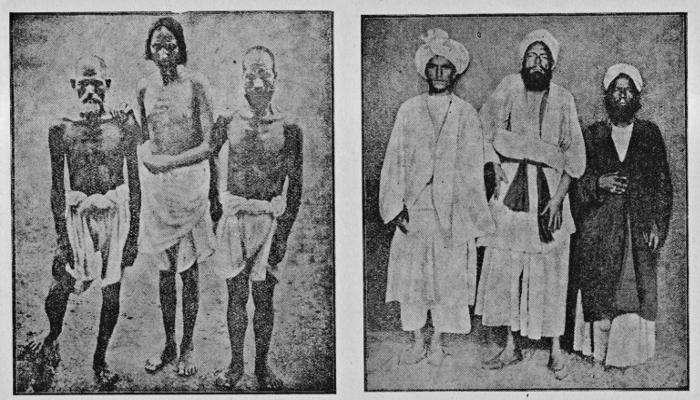
Gilgiti (Ghulman Muhammad). Nagyri (Khudayar). Hunza Man (Matavalli). A Gabriali Student and two Messengers (A Chitrali and a Yasini), from a Brother of the late Mihtar Aman-ul-Mulk, Ruler of Chitral.
FURTHER MEASUREMENTS OF THE ABOVE MEN BY THE SCHWARZ SYSTEM.
(See explanations of these numbers further on, page 5.)
Numbers by Schwarz. 1. Abdul-Ghafûr, Kamôz Káfir. 2. Khudayar Yashkun, Nagyri. 3. Ibrahîm, Nagyri Róno. 4.[117] Matavalli, Hunza Yashkun. 5. Sultan Ali, Yashkun, Nagyri. 6. Khudadád Nagyri. 7. Hatamu Nagyri. 8. Ghulam Muhamad, Gilgiti Shîn.
28 30 26·7·5 29·2 31·5 25·5 28·5 24·7 29·5
29 15 24·7·5 14 13·5 14 11·75 31·1 15·5
30 14·5 13·5 14·5 13·6 13·7·5 14·2 12·7 14
31 10·2·5 8·7·5 9·5 9·6 8·7·5 9·2 8·1 9·1
32 3·7·5 3·5 3 3·7·5 3·25 3·3 3·8 3·9
34 3·9 4 4·6 4·1 3·6 3·6 3·4 3·5
35 5·5 4 4·7·5 5 4·1 5·5 4·5 4·8
36 14 11·2 11·7·5 11·25 11·2 11·2 11·1 10·2
37 18·7·5 20·2·5 20·6 20·8 19 20·75 19·2 18·5
39 46 44·7·5 48 44·5 44·5 48·6 41·5 39·6
DESCRIPTION OF JAMSHÉD, THE SIAH PÔSH KAFIR.
Jamshêd of Katár, the nephew of General Feramorz, the renowned Kafir General in the service of the late Amir Sher Alí of Kabul, was a confidential orderly both in the service of the Amir Sher Alí and in that of Yakúb Khan, whose cause he espoused against that of his father, in consequence of which, when his master was imprisoned, he fled to Rawalpindi, where he came to me. He had witnessed some of the most exciting scenes in modern Kabul history, had risen to the rank of Major, and had served with Prince Iskandar of Herát, whom he afterwards again met in London.
In 1872 I published from Jamshêd’s dictation an account of the “Adventures of Jamshèd, a Siah Pôsh Kafir, and his wanderings with Amir Sher Alí,” and also “a statement about slavery in Kabul, etc.,” which contained the names of places and tribes previously unknown to Geographers and Ethnographers, as well as historical and political material, the value of which has been proved by subsequent events. I took him with me to England, not only on account of the interest which exists in certain scientific quarters as regards the “mysterious race” of which he was a member, but also in order to draw the attention of the Anti-slavery Society and of Government to the kidnapping of Kafirs—the supposed “poor relations” of the European—which is carried on by the Afghans.
His measurement was taken, according to the systems of both Broca and Schwarz (of the Novara expedition), by Dr. Beddoe, and the type appeared to approach nearest to that of the slavonized Macedonians of the Herzegovina, like one of whose inhabitants he looked, thus creating far less attention, especially when dressed à l’européenne in Europe, than he did at Lahore, where Lord Northbrook saw him. The Anti-slavery Society sent him to the Chiefs of Katár with a communication to the effect that Englishmen strongly disapproved of slavery, and that they should represent their case to the Panjab Government. A curious incident in connection with his presence in England may be mentioned. It was the 6th May, 1874, the day of the “Two Thousand”; the result of the Newmarket race was eagerly expected, when the Globe came out with the following titles placed on the posters: “Result of the ‘Two Thousand.’” “An Interesting Race” (the latter was an article on the race of the Siah Pôsh Kafirs). The result may be imagined. Hundreds of Welshers plunged into an account of the Siah Pôsh Kafirs under the notion that they were going to have a great treat in a telegraphic description of a Newmarket race. I was informed that the wrath of the sporting roughs who besieged the office was awful when they found out their mistake. Poor Jamshêd was seen across the Panjab border by one of my Munshis, but returned some months later to Lahore, whence he found his way to Brussa, in Asia Minor. It is supposed that he took service in the Turkish Army, but he has not since been heard of. As I intend to publish an account of the Káfirs of Katár (now, I fear, all Nimchas, or half-Muhammadans), Gambir, etc., I reserve the interesting statements of Jamshêd to their proper Section in my “Káfiristán.”
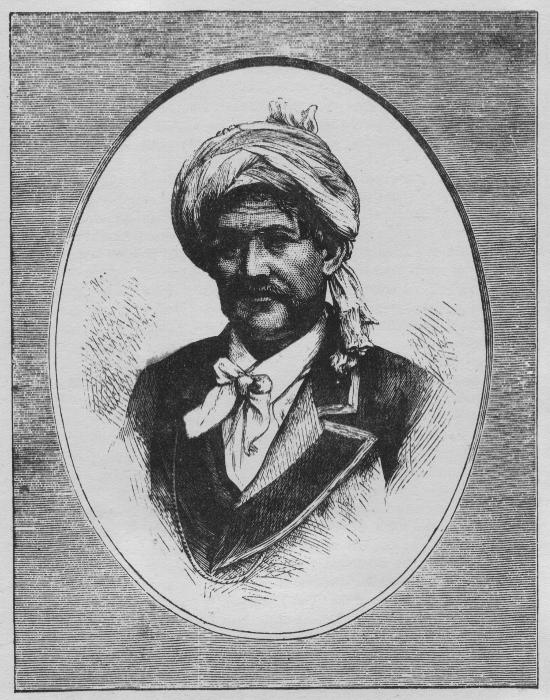
Jamshêd, the Siah Pôsh Kafir, Brought to England by Prof. Leitner in 1872.
COMPARATIVE TABLE OF ANTHROPOLOGICAL OBSERVATIONS ON SOME OF THE DARDS IN DR. LEITNER’S SERVICE.
(The first five and the last are described by the French system; the sixth by the German system, put into millimetres and centimetres respectively.)
A MATAVALLI.[118] B KHUDÁYÁR. C GHULAM MUHAMMAD. D GHULÁM. E ABDULLAH. F MIR ABDULLAH.[119] G[120] DR. LEITNER.
Date and place of observation 2-6-81: Simla 2-6-81: Simla 2-6-81: Simla —— Simla 2-6-81: Simla 23-3-86: Lahore 2-6-81: Simla
Age; sex; profession 32 yrs.; m.; peasant and warrior 21 yrs.; m.; student 40 yrs.; m.; agriculturist 18 yrs.; m. 40 yrs.; m.; agriculturist 30 yrs.; m.; Jurist 40 yrs.
Caste, tribe, and tongue Yashkun; Khajuná; Burishki Yashkun; Khajuná; Burishki Shiná Shîn (Kashmir subject) Shîn; (Kashmir subject) Dard; Gabriál
Religion and birthplace Shiah; (probably Mulái) Hunza Shiah; Nagyr Shiah; Gilgit Sunni; Gurukôt near Astor Sunni; Gurukôt near Astor Sunni
Thin, medium, or stout medium thin medium medium medium stout
Weight[121] 9 st. 8½ lb. 9 st. 10 lb. 8 st. 5 lb. 14 st. 4 lb.
Colours[122] skin, exposed parts 53 (red brown) 54 38 52 37 forehead & cheeks, reddish-brown 25 (very fair)
” covered parts 21 (light red brown) 47 38 53 37 lips, pink; covered parts, lighter 24 (very fair)
hair 48 (black) 42 grey 48 48 black fair
beard 41 (black) 43 grey 48 48 red-brown fair; slightly red
eyes 3 (light brown) 3 2 1 1 iris: dark brown; ball: white, bluish, injected 14 (blue)
Hair: straight, wavy, curly, frizzled, or woolly straight curly curly curly curly black, short, curly curly
Beard: thick (abundant), scanty, or none thick, long and stiff scanty very thick thick very thick straight; woolly; brown-reddish abundant
Skin: smooth, a little, or very hairy very hairy a little hairy a little hairy very hairy very hairy hairy on breast, little on arms very hairy
Shape of profile of nose (p. 111) No. 2 (nearly quite straight) 5 5 5 5, very high nostrils convex 5
Lips: thick, medium, or thin medium (arched) medium medium thin medium thin, arched medium
” straight, or turned outwards straight straight straight straight little turned outward thin, straight thin, straight
Teeth: large, medium, or small small medium large small small small medium
” incisors, straight (vertical), slanting, or very slanting straight (incisors wide apart) straight straight straight straight straight vertical
The set of teeth: very good, good, medium, bad, or very bad good (but dirty) very good good very good very bad transparent, very white medium
Skull Diameters: antero-posterior, maximum 195 millim. 183 186 187 193 191 201
” ” inial 192 ” 180 187 185 183 186 200
” transverse, maximum 144 ” 144 144 144 140 141 163
” auriculo-vertical (fr. m.) 116 ” 110 123 110 114 119 126
Curves: inio-frontal 345 ” 315 325 335 345 340
” horizontal 540 ” 525 540 540 520 530 600
” transverse sub-auricular 330 ” 315 320 335 320 330
facial angle (Camner) 81 ” 81 73
From point of chin to edge of hair 185 ” 177 191 193
” ophryon to alveolar point 95 ” 75 94
Breadth between zygomata 139 ” 132 136 133
Length of nose 48 ” 52 59 54
Breadth of nose 31 ” 39 35 33
From ophryon to root of nose 12 ” 20 16
Width between inner angle of eyes 38 34 35
” ”cheekbones 94 ” 108 103
Height (standing) 164 centim. 182 161 159 152 166 171
” (sitting) 126 ” 131 124 125 124 126
Greatest extension of arms 162 ” 180 174 167 165 165 182
” ” of span 20 ” 16½ 16 20 19 19
Total length of foot 25 ” 26 25 24½ 23½ 25½ 27
Length of ditto, ante-malleolar 20 ” 21½ 19 20 19½ 22
Forehead high; slightly receding high; slightly retreating medium; straight medium; straight high; straight high; breadth of forehead 107 high; slightly receding
Frontal bone (bord sourcillier) very marked well developed much developed scarcely any scarcely any pronounced very pronounced
Intra-ocular distance scarcely any deep very deep not deep not deep deep; distance 3·4 very small
Eyebrows bushy, crossing, forming but one line very bushy arched, bushy, crossed arched, bushy, crossed arched, bushy, crossed standing far apart, thin arched
Eyes straight straight straight straight straight straight straight
Cheeks little salient little salient salient little salient little salient very salient salient
Zygomatic arch very salient salient salient much developed much developed salient not salient
Chin oval oval oval oval oval oval square
Ears medium, little salient (round, small) medium flat long; height of ear 6·3 medium
Mouth medium small thick length of mouth 5·3 medium
Neck strong proportioned proportioned well proportioned strong proportioned strong
Torso strong square proportioned well made slim (svelte) proportioned vigorous
Extremities very small fine fine medium medium small medium[123]
JAMSHÊD.—A Katár Káfir; nephew of General Feramorz.
MEASUREMENTS OF HEAD (BY DR. JOHN BEDDOE).
ENGLISH MILLIMETRES. INCHES.
1. Greatest length of head from glabella 6·8 172·7
2. Length from tuber occip. to greatest convexity of frontal arch 6·7 170·2
3. Length from tuber occip. to glabella 6·8 172·7
4. Greatest length of head from smooth depression above glabella (ophryon) 6·75 171·4
5. Greatest length of head from depression at root of nose 6·65 168·9
6. Length from chin to vertex 9·1 231·1
7. Least breadth between frontal crests 3·7 94
8. Greatest breadth between zygomata 5·1 129·5
9. Breadth from tragus to tragus 5· 127
10. Greatest breadth of head, yielding cranial index 86·7 5·9 149·8
11. Breadth between greatest convexities of mastoid processes 5·3 134·6
12. Greatest circumference of head 20·6 523·2
13. Circumference at glabello-inial line 20·4 518·1
14. Circumference at inion and frontal convexity 20·5 520·6
15. Arc from nasal notch to inion (tuber occip.) 12·8 325·1
16. Arc from one meatus to the other across top of head 14·4 365·7
17. Arc from one meatus to the other over glabella 11·5 292·1
18. Length of face (nasal notch to chin), giving facial index, 80·4 4·1 104·1
Height from meatus to vertex 5·3 133·5
Bigoniac breadth 4·1 103·5
The head, though strongly brachy-cephalic, is distinctly of Aryan type; high and round, but not at all acro-cephalic; the inion is placed very high.
JAMSHÈD—(continued).
The following Measurements are according to the System of Schwarz, of the Novara Expedition.
CENTIMETRES.
28. From the growth of hair to the incisura semilunaris sterni 25·
29. From the inion to the Halswirbel (vertebra prominens) 14·45
30. Direct diameter, from one meatus aud. ext. to the other 11·85
31. Outer angle of the eye to the other 8·75
32. Inner angle of the eye to the other 2·75
33. Distance of the fixed points of the ear 4·05
34. Breadth of the nose 3·2
35. Breadth of the mouth 5·