LEGENDS RELATING TO ANIMALS.[77]
Reading edition
LEGENDS RELATING TO ANIMALS.[77]
1.—A BEAR PLAYS WITH A CORPSE.
It is said that bears, as the winter is coming on, are in the habit of filling their dens with grass and that they eat a plant, called “ajalí,” which has a narcotic effect upon them and keeps them in a state of torpor during the winter. After three months, when the spring arrives, they awake and go about for food. One of these bears once scented a corpse which he disinterred. It happened to be that of a woman who had died a few days before. The bear, who was in good spirits, brought her to his den, where he set her upright against a stone and fashioning a spindle with his teeth and paws gave it to her into one hand and placed some wool into the other. He then went on growling “mû-mû-mû” to encourage the woman to spin. He also brought her some nuts and other provisions to eat. Of course, his efforts were useless, and when she after a few days gave signs of decomposition he ate her up in despair. This is a story based on the playful habits of the bear.
2.—A BEAR MOURNS A GIRL.
Another curious story is related of a bear. Two women, a mother and her little daughter, were one night watching their field of Indian corn “makai,” against the inroads of these animals. The mother had to go to her house to prepare the food and ordered her daughter to light a fire outside. Whilst she was doing this a bear came and took her away. He carried her into his den, and daily brought her to eat and to drink. He rolled a big stone in front of the den, whenever he went away on his tours, which the girl was not strong enough to remove. When she became old enough to be able to do this he used daily to lick her feet, by which they became swollen and gradually dwindled down to mere misshapen stumps. The girl eventually died in childbirth, and the poor bear after vain efforts to restore her to life roamed disconsolately about the fields.
3.—ORIGIN OF BEARS.
It is said that bears were originally the offspring of a man who was driven into madness by his inability to pay his debts, and who took to the hills in order to avoid his creditors.[78]
4.—THE BEAR AND THE ONE-EYED MAN.
The following story was related by a man of the name of Ghalib Shah residing at a village near Astór, called Parishing. He was one night looking out whether any bear had come into his “tromba” field.[79] He saw that a bear was there and that he with his forepaws alternately took a pawful of “tromba,” blew the chaff away and ate hastily. The man was one-eyed [shéo = blind; my Ghilgiti used “Kyor,” which he said was a Persian word, but which is evidently Turkish] and ran to his hut to get his gun. He came out and pointed it at the bear. The animal who saw this ran round the blind side of the man’s face, snatched the gun out of his hand and threw it away. The bear and the man then wrestled for a time, but afterwards both gave up the struggle and retired. The man, after he had recovered himself went to look for the gun, the stock of which he found broken. The match-string by which the stock had been tied to the barrel had gone on burning all night and had been the cause of the gun being destroyed. The son of that man still lives at the village and tells this story, which the people affect to believe.
5.—WEDDING FESTIVAL AMONG BEARS.
A Mulla, of the name of Lal Mohammad, said that when he was taken a prisoner into Chilás,[80] he and his escort passed one day through one of the dreariest portions of the mountains of that inhospitable region. There they heard a noise, and quietly approaching to ascertain its cause they saw a company of bears tearing up the grass and making bundles of it which they hugged. Other bears again wrapped their heads in grass, and some stood on their hind-paws, holding a stick in their forepaws and dancing to the sound of the howls of the others. They then ranged themselves in rows, at each end of which was a young bear; on one side a male, on the other a female. These were supposed to celebrate their marriage on the occasion in question. My informant swore to the story and my Ghilgiti corroborated the truth of the first portion of the account, which he said described a practice believed to be common to bears.
6.—THE FLYING PORCUPINE.
There is a curious superstition with regard to an animal called “Harginn,” which appears to be more like a porcupine than anything else. It is covered with bristles; its back is of a red-brownish and its belly of a yellowish colour. That animal is supposed to be very dangerous, and to contain poison in its bristles. At the approach of any man or animal it is said to gather itself up for a terrific jump into the air, from which it descends unto the head of the intended victim. It is said to be generally about half a yard long and a span broad. Our friend Lal Mohammad, a saintly Akhunzada, but a regular Münchhausen, affirmed to have once met with a curious incident with regard to that animal. He was out shooting one day when he saw a stag which seemed intently to look in one direction. He fired off his gun, which however did not divert the attention of the stag. At last, he found out what it was that the stag was looking at. It turned out to be a huge “Harginn,” which had swallowed a large Markhor with the exception of his horns! There was the porcupine out of whose mouth protruded the head and horns of the Markhor!! My Ghilgiti, on the contrary, said that the Harginn was a great snake “like a big fish called Nang.” Perhaps, Harginn means a monster or dragon, and is applied to different animals in the two countries of Ghilghit and Astor.
7.—A FIGHT BETWEEN WOLVES AND A BEAR WHO WANTED TO DIG THEIR GRAVE.
A curious animal something like a wolf is also described. The species is called “Kō.”[81] These animals are like dogs; their snouts are of a red colour, and are very long; they hunt in herds of ten or twenty and track game which they bring down, one herd or one Kō, as the case may be, relieving the other at certain stages. A Shikári once reported that he saw a large number of them asleep. They were all ranged in a single long line. A bear approached, and by the aid of a long branch measured the line. He then went to some distance and measuring the ground dug it out to the extent of the line in length. He then went back to measure the breadth of the sleeping troop when his branch touched one of the animals which at once jumped up and roused the others. They all then pursued him and brought him down. Some of them harassed him in front, whilst one of them went behind and sucked his stomach clean out. This seems to be a favourite method of these animals in destroying game. They do not attack men, but bring down horses, sheep and game.
The Flora and Fauna of Dardistan have been so minutely described in Part II. of my “Languages and Races of Dardistan,” though mainly from a linguistic standpoint, that I have nothing to say here about the products and animals of that country. Nor need I say anything about the dress of its people, except that its rolled-up woollen cap is, practically, the sign of the brotherhood (sometimes like that of Cain) among all members of the Dard race, and, at once, distinguishes them from Pathans, Affghans, Kashmiris, and others. The beautifully-knit stockings are also a Dard art, and seem to have suggested, rather than followed, Kashmir patterns. Above all, the quasi-Celtic brass brooches of the women, and the family axes of the Hunza-Nagyris denote the antiquity of the Dard race. Curious is also the dress, light as air and softly warm, made of the fluff of the white giant vulture or of that of the wild fowl. I must also refer the reader who wishes to know details about the rivers, mountains, etc., of Dardistan, and the occupations of its peoples, to Part II. of my “Languages and Races of Dardistan,” and to the main volume, of which this is a Supplement, namely, the so-called “Hunza and Nagyr Handbook,” a volume of 247 folio pages.
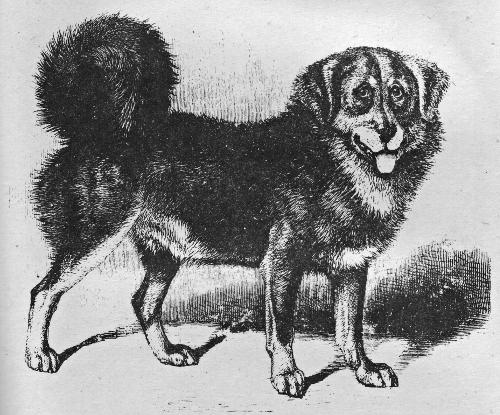
Dr. Leitner’s Tibet Dog “Chang.”