APPENDICES.
Reading edition
i. Hunza-Nagyr and the Pamirs.
ii. Recent Events in Chilas and Chitral.
iii. Fables, Songs, and Legends of Chitral.
iv. Races and Languages of the Hindukush.
v. Anthropological Observations and Measurements.
vi. Rough Itineraries in the Hindukush.
vii. A Secret Religion in the Hindukush.
viii. The Sciences of Language and of Ethnology as illustrated by the Language and Customs of Hunza (a separate Pamphlet).
SPECIMENS OF THE BURISHKI RACE OF HUNZA (ON A SLOPE OF THE PAMIR), OF NAGYR, AND OF YASIN.
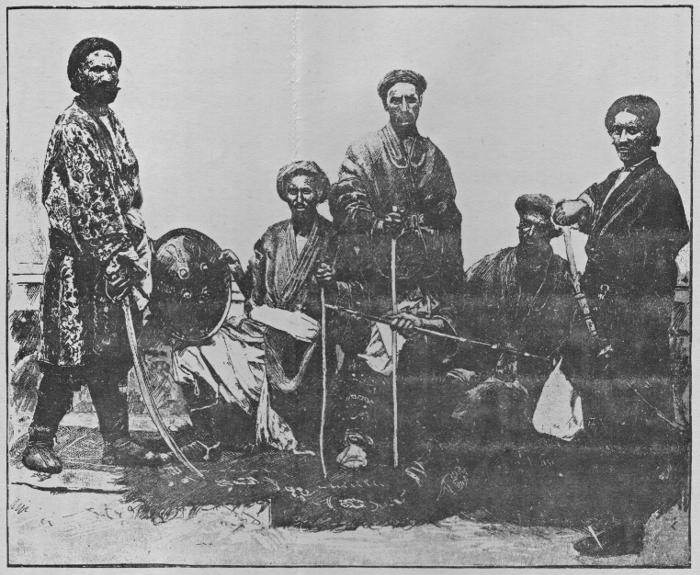
MATAVALLI, the first Hunza man who came to Europe. SOME BURISHKIS FROM YASIN separating the Hunza and Nagyri Warriors. SAYAD ALI, of Nagyr.
APPENDIX I. HUNZA, NAGYR, AND THE PAMIR REGIONS.[106]
I wish to record how from small beginnings, owing to carelessness, exclusiveness, and official desire for promotion, Northern India may be lost and British interests in Europe and Asia become subordinate, as they have often been, to Russian guidance; how statesmanship has laboriously invited dangers which physical barriers had almost rendered impossible; and how it may still be practicable to maintain as independent States the numerous mountain strongholds which Nature has interposed between encroachment and intrigue from either the Russian or the English sphere of action in Asia, much to the benefit of these two Powers and of the peace of mankind.
When, after an enormous expenditure of men and money and during campaigns which lasted over thirty-six years, Russia had conquered independent Circassia—a task in which she was largely aided by our preventing provisions and ammunitions from reaching by sea the so-called rebels, although we ourselves were fighting against her in 1856, quorum pars parva fui, it was easy to foresee that our conduct, which some called chivalry, others loyalty, and some duplicity or folly, would give her the present command of the Black Sea and lead to the subjugation of Circassia. The same conduct was repeated at Panjdeh, and may be repeated on the Pamir, much to the personal advantage of the discreet officers concerned. We have also recently discovered that the holding of Constantinople by a neutral Power is not essential to British interests, as we had long ago found out that neither Merv nor Herat were keys to India. Indeed, as we give up position after position, a crop of honours falls to those who bring about our losses and, like charity, covers a multitude of political sins of ignorance or treason.
It seemed, however, that there was one obscure corner which the official sidelight could not irradiate. Valley after valley, plateau after plateau, high mountains and difficult passes separate the populations of India from those of Central Asia. Innumerable languages and warlike races, each unconquerable in their own strongholds if their autonomy and traditions are respected, intervene between invaders from either side who would lead masses of disciplined slaves to slaughter and conquest. It is not necessary to draw an imaginary line on Lord Salisbury’s large or small Map of Asia across mountains and rivers, and dividing arbitrarily tribes and kingdoms whose ancestry is the same, call it “the neutral zone.” No sign-board need indicate “the way to India,” and amid much ado about nothing by ambitious subordinates and puzzled superiors settle to the momentary satisfaction of the British public that Russia can go so far and no farther. Where the cold, the endless marching over inhospitable ground, and starvation do not show the frontier, the sparse population, the unknown tongue, and the bullet of the raider will indicate it sufficiently, without adding to the number of generals or knights for demarcating impossible boundaries.
The reassurances given by Lords Lansdowne and Cross to the native Princes of India indicate the policy that should be adopted with regard to all the Mountain States beyond India proper. It is by everywhere respecting the existing indigenous Oriental Governments that we protect them and ourselves against invasion from without and treachery from within. The loyalty of our feudatories is most chivalrous and touching, but it should be based on enlightened self-interest in order to withstand the utmost strain. The restoration of some powers to the Maharaja of Kashmîr came not a minute too soon. Wherever elsewhere reasonable claims are withheld, they should be generously and speedily conceded. The Indian princes know full well that we are arming them, at their own expense, against a common foe who is not wanting in promises, and who is already posing as a saviour to the people of Raushan, Shignan, Wakhan, Hunza, and even Badakhshan, whose native dynasties or traditions we have either already put aside or are believed to threaten.
As for the small States offering a fruitful field for intrigue, their number and internal jealousies (except against a common foreign invader) are in themselves a greater safeguard than the resistance of a big but straggling ally, whose frontier, when broken through at one of its many weak points, finds an unresisting population from which all initiative has disappeared. The intrigue or treachery of a big ally is also a more serious matter than that of a little State. What does it matter if English and Russian agents intrigue or fraternize among the ovis poli, and the Kirghiz shepherds of the Pamir, or advocate their respective civilizations in Yasin, Chitrál, Wakhan, Nagyr, Hunza, etc. Ambitious employes of both empires will always trouble waters, in order to fish in them; but their trouble is comparatively innocuous, and resembles that of Sisyphus when it has to be repeated or wasted in a dozen States, before the real defences of either India or of Russia in Asia are reached. Indeed, so far as India is concerned, the physical difficulties on our side of the Himalayas or of the Hindukush, except at a few easily defensible passes, are insuperable to an invader, even after he has crowned the more approachable heights when coming from the North.
The only policy worthy of the name is to leave the Pamir alone. Whatever line is drawn, it is sure to be encroached upon by either side. Races will be found to overlap it, and in the attempt to gather the fold, as with the Sarik and Salor Turkomans, a second Panjdeh is sure to follow. Intrigues will be active on both sides of the line; and, as in Kashmîr, the worried people will hail the foreigner as a saviour, so long as he has not taken possession, when they find his little finger heavier than the whole body of the indigenous oppressor. I have suffered so much from my persistent exposure of the misrule and intrigues of Kashmîr by those who now hail the fait accompli of its practical annexation, that I may claim to be heard in favour of at least one feature of its former native administration. With bodies of troops averaging from 20 to 200, the late Maharaja, who foresaw what has happened after his death, kept the Hunza-Nagyr frontier in order. It certainly was by rule of thumb, and had no dockets, red tape, and reports. Indeed, his frontier guardians were, as I found them, asleep during a state of siege in 1866, or, when war was over, were engaged in storing grain outside the forts; but peace was kept as it will never be again, in spite of 2,000 Imperial troops, first-rate roads, and suspension bridges over the “Shaitan Naré,” instead of the rotten rope-way that spanned “Satan’s Gorge,” or of boats dragged up from Srinagar over the mountains to enable a dozen sepoys to cross the Indus at a time, or to convey couriers with a couple of bullets, some dried butter-cakes, and an open letter or two, who ran the siege at Gilgit and brought such effective reinforcements to its defenders!
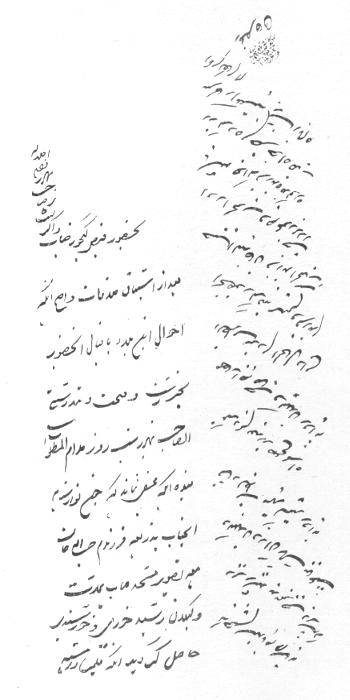
Nor has our diplomacy been more effectual than our arms, as the encounter at Chalt with Hunza-Nagyr, hereditary foes, but whom our policy has united against us, has shown. To us Nagyr is decidedly friendly; but a worm will turn if trodden on by some of our too quickly advanced subalterns. That, however, the wise and amiable Chief of Nagyr, a patriarch with a large progeny, and preserving the keenness of youth in his old age, is really friendly to us in spite of provocation, may be inferred from the following letter to me, which does credit alike to his head and heart, and which is far from showing him to be our inveterate foe, as alleged by the Pioneer. His eldest son began to teach me the remarkable Khajuná language, which I first committed to writing in 1866, during the siege of Gilgit, and another son continued the lessons in 1886. The latter is a hostage in Kashmîr, to secure the good behaviour of his tribe, which is really infinitely superior in culture and piety to those around them. The father, who is over 90, writes in Persian to the following effect, after the usual compliments:—“The affairs of this place are by your fortune in a fair way, and I am in good health and constantly ask the same for you from the Throne which grants requests. Your kind favour with a drawing of the Mosque has reached me, and has given me much pleasure and satisfaction. The reason of the delay in its receipt and acknowledgment is due to the circumstance that, owing to disturbances (fesád) I have not sent agents to Kashmîr this year. After the restoration of peace, I will send [a letter] with them. In the meanwhile, I have caught your hem [seek your protection] for my son Habibullah Khan, a beloved son, about whom I am anxious; the aforesaid son is a well-wisher to the illustrious English Government.—Za’far Khan.” [The letter was apparently written in June last, when The Times reported a “rising,” because the British Agent was at Chalt with 500 men.]
It seems to me that none but a farseeing man could, in the midst of a misunderstanding, if not a fight, with us, so write to one in the enemy’s camp, unless he were a true man alike in war and peace, and a ruler whose good-will was worth acquiring. As for his son, I know him to be indeed well-disposed to our Government. He was very popular among our officers when I saw him in Kashmîr, owing to his modesty, amiability, and unsurpassed excellence at Polo. In fact, my friendship with several of the chiefs since 1866 has aided our good relations with them; and it is a pity if they should be destroyed for want of a little “savoir,” as also “savoir faire,” on our part.
Between the States of Nagyr and Hunza there exists a perpetual feud. They are literally rivals, being separated by a swift-flowing river on which, at almost regulated distances, one Nagyr fort on one bank frowns at the Hunza fort on the other. The paths along the river sides are very steep, involving at times springing from one ledge of a rock to another, or dropping on to it from a height of six feet, when, if the footing is lost, the wild torrent sweeps one away. Colonel Biddulph does not credit the Nagyris with bravery. History, however, does not bear out his statement; and the defeat inflicted on the Kashmîr troops under Nathu Shah in 1848 is a lesson even for the arrogance of a civilized invader armed with the latest rifle. The Nagyris are certainly not without culture; in music they were proficient before the Muhammadan piety of the Shiah sect somewhat tabooed the art. At all events, they are different in character from the Hunzas with whom they share the same language, and their chiefs the same ancestry. The Hunzas, in whom a remnant of the Huns may be found, were great kidnappers; but under Kashmîr influence they stopped raiding since 1869, till the confusion incidental to our interference revived their gone occupation. Indeed, it is asserted on good authority, that even our ally of Chitrál, who had somewhat abandoned the practice of selling his Shiah or Kalásha Kafir subjects into slavery, and who had so disposed of the miners for not working his ruby mines to profit, has now returned to the trade in men, “with the aid of our present of rifles and our moral support.” Nor is Bokhara said to be behind Chitrál in the revival of the slave-trade from Darwáz, in spite of Russian influence; so that we have the remarkable instance of two great Powers both opposed to slavery and the slave-trade, having revived it in their approach to one another. Nor is a third Power, quite blameless in the matter; for when we worried Hunza, that robber-nest remembered its old allegiance to distant Kitái and arranged with the Chinese authorities at Yarkand to be informed of the departure of a caravan. Then, after intercepting it on the Kulanuldi road, the Hunzas would take those they kidnapped from it back for sale to Yarkand!
As a matter of fact, we have now a scramble for the regions surrounding and extending into the Pamirs by three Powers, acting either directly or through States of Straw. The claims of Bokhara to Karategin and Darwáz—if not to Shignán, Raushan, and Wakhan are as little founded as are those of Afghanistan on the latter three districts. Indeed, even the Afghan right to Badakhshan is very weak. The Russian claims through Khokand on the pasturages of the Kirghiz in two-thirds of the Pamirs are also as fanciful as those of Kashmir or China on Hunza. As in the scramble for Africa, the natives themselves are not consulted, and their indigenous dynasties have been either destroyed, or dispossessed, or ignored.
In an Indian paper, received by to-day’s mail (29 Nov., 1891), I find the following paragraph: “Col. A. G. Durand, British Agent at Gilgit, has received definite orders to bring the robber tribes of Hunza and Nagar under control. These tribes are the pirates of Central Asia, whose chief occupation is plundering caravans on the Yarkand and Kashgar. Any prisoners they take on these expeditions are sold into slavery. Colonel Durand has established an outpost at Chalt, about thirty miles beyond Gilgit, on the Hunza river, and intends making a road to Aliabad, the capital of the Hunza chief, at once. That he will meet with armed opposition in doing so is not improbable.”
For some months past the mot d’ordre appears to have been given to the Anglo-Indian Press, to excite public feeling against Hunza and Nagyr, two States which have been independent for fourteen centuries. The cause of offence is not stated, nor, as far as I know, does one exist of sufficient validity to justify invasion. In the Pioneer and the Civil and Military Gazette I find vague allusions to the disloyalty or recalcitrance of the above-mentioned tribes, and to the necessity of punishing them. As Nagyr is extremely well-disposed towards the British, and is only driven into making common cause with its hereditary foe and rival of Hunza by fear of a common danger,—the loss of their independence,—I venture to point out the impolicy and injustice of interfering with these principalities.
I have already referred to a letter from the venerable chief of Nagyr, in which he strongly commends to my care one of his sons, Raja Habibulla, as a well-wisher of the English Government. Indeed, he has absolutely done nothing to justify any attack on the integrity of his country; and before we invade it other means to secure peace should be tried. I have no doubt that I, for one, could induce him to comply with everything in reason, if reason, and not an excuse for taking his country, is desired. Nagyr has never joined Hunza in kidnapping expeditions, as is alleged in the above-quoted paragraph. Indeed, slavery is an abomination to the pious and peaceful agriculturist of that interesting country. The Nagyris are musical and were fond of dances, polo, ibex battue-hunting, archery and shooting from horseback, and other manly exercises; but the growing piety of the race has latterly proscribed music and dancing. The accompanying drawing of a Nagyri dance in the neighbouring Gilgit gives a good idea of similar performances at Nagyr.
The country is full of legendary lore, but less so than Hunza, where Grimm’s fairy tales appear to be translated into actual life. No war is undertaken except at the supposed command of an unseen fairy, whose drum is on such occasions sounded in the mountains. Ecstatic women, inhaling the smoke of a cedar-branch, announce the future, tell the past, and describe the state of things in neighbouring valleys. They are thus alike the prophets, the historians, and the journalists of the tribe. They probably now tell their indignant hearers how, under the pretext of shooting or of commerce, Europeans have visited their country, which they now threaten to destroy with strange and murderous weapons; but Hunza is “ayeshó,” or “heaven-born,” and the fairies, if not the inaccessible nature of the country, will continue to protect it.
The folly of invading Hunza and Nagyr is even greater than the physical obstacles to which I have already referred. Here, between the Russian and the British spheres of influence in Central Asia, we have not only the series of Pamirs, or plateaux and high valleys, which I first brought to notice on linguistic grounds, in the map accompanying my tour in Dardistan in 1866 (the country between Kashmir and Kabul), and which have been recently confirmed topographically; but we have also a large series of mountainous countries, which, if left alone, or only assured of our help against a foreign invader, would guarantee for ever the peace alike of the Russian, the British, and the Chinese frontiers. Unfortunately, we have allowed Afghanistan to annex Badakhshan, Raushan, Shignan, and Wakhan, at much loss of life to their inhabitants; and Russia has similarly endorsed the shadowy and recent claims of Bokhara on neighbouring provinces, like Darwáz and Karategin.
It is untrue that Hunza and Nagyr were ever tributaries of Kashmîr, except in the sense that they occasionally sent a handful of gold dust to its Maharaja, and received substantial presents in return. It is to China or Kitái that Hunza considers itself bound by an ancient, but vague, allegiance. Hunza and Nagyr, that will only unite against a foreign common foe, have more than once punished Kashmîr when attempting invasion; but they are not hostile to Kashmîr, and Nagyr even sends one of the princes to Srinagar as a guarantee of its peaceful intentions. At the same time, it is not very many months ago that they gave us trouble at Chalt, when we sought to establish an outpost, threatening the road to Hunza and the independence alike of Hunza and Nagyr.
Just as Nagyr is pious, so Hunza is impious. Its religion is a perversion even of the heterodox Mulái faith, which is Shiah Muhammadan only in name, but pantheistic in substance. It prevails in Punyál, Zebak, Darwáz, etc. The Tham, or Raja, of Hunza used to dance in a Mosque and hold revels in it. Wine is largely drunk in Hunza, and like the Druses of the Lebanon, the “initiated” Muláis may consider nothing a crime that is not found out. Indeed, an interesting connection can be established between the doctrines of the so-called “Assassins” of the Crusaders, which have been handed down to the Druses, and those of the Muláis in various parts of the Hindukush. Their spiritual chief gave me a few pages of their hitherto mysterious Bible, the “Kelám-i-Pir,” in 1886, which I have translated, and shortly intend to publish. All I can now say is, that, whatever the theory of their faith, the practice depends, as elsewhere, on circumstances and the character of the race.
The language of Hunza and Nagyr solves many philological puzzles. It is a prehistoric remnant, in which a series of simple consonantal or vowel sounds stands for various groups of ideas, relationships, etc. It establishes the great fact, that customs and the historical and other associations of a race are the basis of the so-called rules of grammar. The cradle, therefore, of human thought as expressed in language, whether of the Aryan, the Turanian, or the Shemitic groups, is to be found in the speech of Hunza-Nagyr; and to destroy this by foreign intervention, which has already brought new diseases into the Hindukush, as also a general linguistic deterioration, would be a greater act of barbarism than to permit the continuance of Hunza raiding on the Yarkand road. Besides, that raiding can be stopped again, by closing the slave-markets of Badakhshan, Bokhara, and Yarkand, or by paying a subsidy, say of £1,000 per annum, to the Hunza chief.
Indeed, as has already been pointed out, the recrudescence of kidnapping is largely due to the state of insecurity and confusion caused by our desire to render the Afghan and the Chinese frontiers conterminous with our own, in the vain belief that the outposts of three large and distant kingdoms, acting in concert, will keep Russia more effectively out of India than a number of small independent republics or principalities. Afghanistan may now be big, but every so-called subject in her outlying districts is her inveterate foe. As stated in a letter from Nevsky to the Calcutta Englishman, in connection with Colonel Grambcheffsky’s recent explorations:
“One and all, these devastated tribes are firm in their conviction that the raids of their Afghan enemies were prompted and supported by the gold of Abdur Rahman’s English protectors. They will remember this on the plateau of Pamir, and among the tribes of Kaffiristan.”
However colourable this statement may be as regards Shignán, Raushan, and perhaps even Wakhan, I believe that the Kafirs are still our friends. At the same time it should not be forgotten that, owing to the closing of the slave-markets in Central Asia, the sale of Shiah subjects had temporarily stopped in Chitrál. The Kafirs were being less molested by kidnapping Muhammadan neighbours; the Hunzas went back to agriculture, which the Nagyris had never abandoned; Kashmîr, India, and the Russian side of Central Asia afforded no opening for the sale of human beings. The insensate ambition of officials, British and Russian, the gift of arms to marauding tribes and the destruction of Kashmîr influence, have changed all this, and it is only by a return to “masterly inactivity,” which does not mean the continuance of the Cimmerian darkness that now exists as to the languages and histories of the most interesting races of the world, that the peace and pockets of three mighty empires can be saved.
In the meanwhile, it is to the interest of Russia to force us into heavy military expenditure by false alarms; to create distrust between ourselves and China by pretending that Russia and England alone have civilizing missions in Central Asia, with which Chinese tyranny would interfere; to hold up before us the Will-o’-the-wisp of an impossible demarcation of the Pamirs, and finally, to ally itself with China against India. For let it not be forgotten, that once the Trans-Siberian railway is completed, China will be like wax in her hand; and that she will be compelled to place her immense material in men and food at the disposal of an overawing, but, as far as the personnel is concerned, not unamiable neighbour. The tribes, emasculated by our overwhelming civilization, and driven into three large camps, will no longer have the power of resistance that they now possess separately.
Let us therefore leave intact the two great belts of territories that Nature has raised for the preservation of peace in Asia—the Pamir with its adjacent regions to the east and west, and the zone of the Hindukush with its hives of independent tribes, intervening between Afghanistan on the one side and Kashmîr on the other, till India proper is reached. This will never be the case by a foreign invader, unless diplomatists “meddle and muddle,” and try to put together what Nature has put asunder. What we require is the cultivation of greater sympathy in our relations with natives; and, comparing big things with small, it is to this feeling that I myself owed my safety, when I put off the disguise in which I crossed the Kashmîr frontier in 1866 into countries then wrongly supposed by our Government to be inhabited by cannibals. This charge was also made, with equal error, by one tribe against the other. Then too, as in 1886, the Indian Press spoke of Russian intrigues; but then, as in 1886, I found the very name of Russia to be unknown, except where it had been learnt from a Kashmîr Munshi, who had no business to be there at all, as the treaty of 1846, by which we sold Kashmîr to Ghulab Singh, assigned the Indus as his boundary on the west. Now, as to the question as to “What and where are the Pamirs?” I have already stated my view in a letter to the Editor of the Morning Post, which I trust I may be allowed to quote:
“As some of the statements made at the Royal Geographical Society are likely to cause a sense of false security, as dangerous to peace as a false alarm, I write to say that ‘Pamirs’ do not mean ‘deserts,’ or ‘broken valleys,’ and that they are not uninhabitable or useless for movements of large bodies of men. They may be all this in certain places, at certain periods of the year, and under certain conditions; but had our explorers or statesmen paid attention to the languages of this part of the world, as they should in regard to every other with which they deal, they would have avoided many idle conjectures and the complications that may follow therefrom. I do not wish them to refer to philologists who have never been to the East, and who interpret ‘Pamir’ as meaning the ‘Upa-Meru’ Mountain of Indian mythology, but to the people who frequent the Pamirs during the summer months, year after year, for purposes of pasturage, starting from various points, and who in their own languages (Yarkandi, Turki, and Kirghiz) call the high plain, elevated valley, table-land, or plateau which they come across ‘Pamir.’ There are, therefore, in one sense many ‘Pamirs,’ and as a tout-ensemble, one ‘Pamir,’ or geographically, the ‘Pamir.’ The legend of the two brothers, ‘Alichur and Pamir,’ is merely a personification of two plateaux. Indeed, the obvious and popular idea which has always attached to the word ‘Pamir,’ is the correct one, whether it is the geographical ‘roof of the world,’ the ‘Bám-i-dunya’ of the poet, or the ‘Pamir-dunya’ of the modern journalist. We have, therefore, to deal with a series of plateaux, the topographical limits of which coincide with linguistic, ethnographical, and political limits. To the North, the Pamirs have the Trans-Altaic Mountain range marking the Turki element, under Russian influence; the Panja river, by whatever name, on the West is a Tadjik or Iranian Frontier [Affghan]. The Sarikol on the East is a Tibetan, Mongolian, or Chinese Wall, and the South is our natural frontier, the Hindukush, to go beyond which is physical death to the Hindu, and political ruin to the holder of India, as it also is certain destruction to the invader, except by one pass, which I need not name, and which is accessible from a Pamir. That the Pamirs are not uninhabitable may be inferred from Colonel Grambcheffsky’s account [which is published at length elsewhere in this issue of the Asiatic Quarterly Review]. A few passages from it must now suffice:—‘The Pamir is far from being a wilderness. It contains a permanent population, residing in it both summer and winter.’ ‘The population is increasing to a marked extent.’ ‘Slavery on the Pamir is flourishing: moreover, the principal contingents of slaves are obtained from Chatrar, Jasen, and Kanshoot, chanates under the protectorate of England.’ ‘On descending into Pamir we found ourselves between the cordons of the Chinese and Affghan armies.’ ‘The population of Shoognan, numbering 2,000 families, had fled to Pamir, hoping to find a refuge in the Russian Provinces’ (from ‘the untold atrocities which the Affghans were committing in the conquered provinces of Shoognan,’ etc.). ‘I term the whole of the tableland “Pamir,” in view of the resemblance of the valleys to each other.’
“The climate of the Pamirs is variable, from more than tropical heat in the sun to arctic cold in the shade, and in consequence, is alike provocative and destructive of life. Dr. G. Capus, who crossed them from north to south, exactly as Mr. Littledale has done, but several months in the year before him, says in his ‘Observations Météorologiques sur le Pamir,’ which he sent to the last Oriental Congress,—‘The first general fact is the inconstancy of severe cold. The nights are generally coldest just before sunrise.’ ‘We found an extreme amplitude of 61 deg. between the absolute minimum and maximum, and of 41 deg. between the minimum and the maximum in the shade during the same day.’ ‘The thermometer rises and falls rapidly with the height of the sun.’ ‘Great cold is less frequent and persistent than was believed to be the case at the period of the year dealt with’ (March 13 to April 19), ‘and is compensated by daily intervals of elevation of temperature, which permit animal life, represented by a fairly large number of species, and including man, to keep up throughout the winter under endurable conditions.’ Yet ‘the water-streak of snow, which has melted in contact with a dark object, freezes immediately when put into the shadow of the very same object.’ ... The solution of political difficulties in Central Asia is not in a practically impossible, and certainly unmaintainable, demarcation of the Pamirs, but in the strengthening of the autonomy of the most interesting races that inhabit the series of Circassias that already guard the safety alike of British, Chinese, and of Russian dominion or spheres of influence in Central Asia.”
Woking, Nov. 29.
It is not impossible that the tribes may again combine in 1892 as they did in 1866 to turn out the Kashmîr troops from Gilgit. The want of wisdom shown in forcing on the construction of a road from Chalt to Aliabad, in the centre of Hunza, as announced in to-day’s Times, must bring on, if not a confederation of the tribes against us, at any rate their awakened distrust. It is doubtful whether it was ever expedient to establish an outpost at Gilgit, and the carrying it still farther to the traditional apple of discord, the holding of Chalt, which commands the Hunza road, is still more impolitic. As in Affghanistan, so here, whatever power does not interfere is looked upon as the saviour from present evils. Once we have created big agglomerations under Affghanistan, or China, or Kashmir, we are liable to the dangers following either on collapse, want of cohesion, treachery from within, the ambitions of a few men at the respective courts, or, as with us, to serious fluctuations in foreign politics due to the tactics of English parties. The change, therefore, from natural boundaries to the wirepulling of diplomatists at Kabul, Peking, or Downing Street is not in the interests of peace, of our empire, or of civilization. Besides, it should not be forgotten that we have added an element of disturbance, far more subtle than the Babu, to our frontier difficulties. The timid Kashmîri is unsurpassed as an intriguer and adventurer among tribes beyond his frontier. The time seems to have arrived when, in the words of the well-known Persian proverb,[107] the sparseness of races round the Pamirs should bid us to be on our guard against the Affghan, the “bad-raced” Kashmîrî, and the Kambó (supposed to be the tribe on the banks of the Jhelum beyond Mozaffarabad). Perhaps, however, the Kambó is the Heathen Chinee; and the proverb would then be entirely applicable to the present question. After the construction of the Trans-Siberian Railway, Russia will be able to exert the greatest pressure on China. The Russian strength at Vladivostok is already enormous, and when the time comes she can hurl an overwhelming force on what remains of Chinese Manchuria, before which Chinese resistance will melt like snow. Peking and the north of China are thus quite at the mercy of Russia. She will find there the most populous country of those she rules in Asia, and with ample supplies. China has a splendid raw material, militarily speaking; and Russia could there form the biggest army that has ever been seen in Asia, to hold in terrorem over a rival or to hurl at the possessions of a foe.
It is against such possibilities that the maintenance of “masterly inactivity,” qualified by the moral and, if need be, pecuniary or other material support of the Anglo-Indian Government is needed. This is the object of this paper, before I enter into the more agreeable task of describing the languages, customs, and country of perhaps the most interesting races that inhabit the globe.
The Times of the 30th November publishes a map of the Pamirs and an account of the questions connected with them that, like many other statements in its articles on “Indian affairs,” are incorrect and misleading. Having been on a special mission by the Panjab Government, in 1866, when I discovered the races and languages of “Dardistan,” and gave the country that name, and again having been on special duty with the Foreign Department of the Government of India in 1886 in connection with the Boorishki language and race of Hunza, Nagyr, and a part of Yasin, regarding which I have recently completed Part I. of a large work, I may claim to speak with some authority as regards these districts, even if I had no other claim. The point which I wish to specially contradict at present, is the one relating to the Russians bringing themselves into almost direct contact with “the Hunza and other tribes subject to Kashmîr and, as such, entitled to British protection and under British control.”
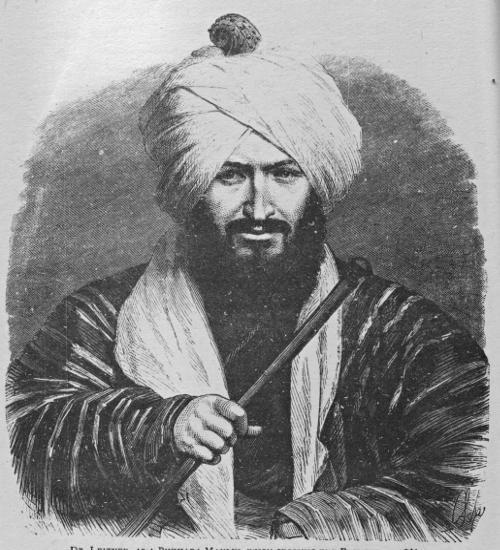
Dr. Leitner as a Bukhara Maulvi, when crossing the Frontier in 1866 during the Kashmîr War with the Dard Tribes.
When I crossed the then Kashmîr frontier in 1866, in the disguise of a Bokhara Maulvi, armed with a testimonial of Muhammadan theological learning, I found that the tribes of Hunza, Nagyr, Dareyl, Yasin, and Chitrál had united under the leadership of the last-named to expel the Kashmîr invaders from the Gilgit Fort. My mission was a purely linguistic one; but the sight of dying and dead men along the road, that of heads stuck up along the march of the Kashmîr troops, and the attempts made on my life by our feudatory, the late Maharaja of Kashmîr, compelled me to pay attention to other matters besides the languages, legends, songs, and fables of the interesting races with whom I now came in contact under circumstances that might not seem to be favourable to the accomplishment of my task. I had been warned by the then Lieutenant-Governor of the Panjab, Sir Donald McLeod, whose like we have not seen again, not to cross the frontier, as the tribes beyond were supposed to be cannibals; but as I could not get the information of which I was in search within our frontier, I had to cross it. My followers were frightened off by all sorts of wild stories, till our party was reduced from some fifty to three, including myself. The reason for all this was, that the Maharaja was afraid that I should find out and report his breach of the Treaty by which we sold Kashmîr to him in 1846, and in which the Indus is laid down as his boundary on the west. In 1866, therefore, at any rate, even the tenure of Gilgit, which is on the other side of the Indus, was contested and illegal, whilst the still more distant Hunza and Nagyr had more than once inflicted serious punishment on the Kashmîr troops that sought to invade districts that have preserved their autonomy during the last fourteen centuries, as was admitted by The Times of the 2nd November, 1891, before its present change with the times, if an unintentional pun may be permitted.
Then, as ever, the Anglo-Indian newspapers spoke of Russian intrigues in those regions. I am perfectly certain that if, instead of the fussiness of our statesmen and the sensationalism of our journals, the languages, history, and relations of these little-known races had been studied by them, we should never have heard of Russia in that part of the East. It is also not by disingenuousness and short cuts on maps or in diplomacy, but by knowledge, that physical, ethnographical, and political problems are to be solved; nor will the bold and brilliant robberies of Russia be checked by our handing over the inhabitants of the supposed “cradle of the human race” to Affghan, Kashmîr, or Chinese usurpations. Above all, it is a loss of time to palm off myths as history in order to suit the policy or conceal the ignorance of the moment.
Just as little as Darwaz and Karategin are ancestral dominions of Bokhara, and, therefore, under Russian influence, so little did even Badakhshan, and much less so, Raushan, Shignan, and Wakhan, ever really belong to Affghanistan. As for the Chinese hold on Turkistan, we ourselves denied it when we coquetted with Yakub Khush Begi, though Kitái was ever the acknowledged superior of Eastern Turkistan. If Hunza admits any allegiance, it is to China, and not to Kashmîr; and the designations of offices of rule in that country are of Chinese, and not of Aryan origin, including even “Thàm,” the title of its Raja.
As a matter of fact, however, the vast number of tribes that inhabit the many countries between the Indus and the Kuner own no master except their own tribal head or the tribal council. From kidnapping Hunza, where the right to plunder is monarchical, hereditary, and “ayeshó” = “heaven-born,” to the peace and learning of republican Kandiá or Gabriál, all want to be left alone. If a neighbour becomes troublesome, he is raided on till an interchange of presents restores harmony. It is impossible to say that either side is tributary to the other. The wealthier gives the larger present; the bigger is considered the superior in a general sort of way, and so two horses, two dogs, and a handful of gold dust are yearly sent by Hunza to Kashmîr or to Yarkand as a cloak for much more substantial exactions in return. Nagyr sends a basket of apricots instead of the horses and dogs. In 1871 Chitrál still paid a tribute to Badakhshan in slaves, but it would be absurd to infer from this fact that Chitrál ever acknowledged the suzerainty of Jehandar Shah, or of the Affghan faction that dispossessed him. Nor were the Khaibaris, or other highway robbers, our rulers, because we paid them blackmail, or they our subjects because they might bring us “sweetmeats.”
The points in which most Englishmen are as deficient as Russians are generally proficient, are language and a sympathetic manner with natives. That, however, linguistic knowledge is not useless may be inferred from the fact that it enabled me, to use the words of my Chief, Commissary General H. S. Jones, C.B., during the Russian War in 1855, “to pass unharmed through regions previously unknown and among tribes hitherto unvisited by any European.”
Also in topography and geography linguistics are necessary; and the absurd mistakes now made at certain learned societies and in certain scientific journals, regarding the Pamirs, would be avoided by a little study of the Oriental languages concerned. In 1866, the map which accompanies my philological work on “Dardistan” shows, on linguistic grounds, and on the basis of native itineraries, the various Pamirs that have been partially revealed within the last few weeks, or have been laboriously ascertained by expensive Russian and British expeditions between 1867 and 1890. The publication of my material, collected at my own expense and which shall no longer be delayed, would have saved many complications; but when, e.g., I pointed out, in 1866, that the Indus, after leaving Bunji, ran west instead of south, as on the then existing maps, I got into trouble with the Topographical Survey, which “discovered” the fact through its well-known “Mulla” in 1876. The salvation of India that is not made “departmentally” is crucified; and whoever does not belong to the regular military or civil services has no business to know or to suggest. Mr. Curzon, when presiding at a meeting of the late Oriental Congress, assured us that a new era had risen; but only the other night, at the Royal Geographical Society, a complaint was made of the reluctance of official departments in giving the Society information. As a rule, the mysteriousness of offices only conceals their ignorance, of which we have an instance in Capt. Younghusband being sent to shut the passes after the Russians had already stolen a march on, or through, them.
The neutralization of the Pamirs is the only solution of a difficulty created by the conjectural treaties of diplomatists and the ambition of military emissaries. Left as a huge happy hunting-ground for sportsmen, or as pasturage for nomads from whatever quarter, the Pamirs form the most perfect “neutral zone” conceivable. That the wanderings of these nomads should be accompanied by territorial or political claims, whether by Russia, China, Affghanistan, Kashmir, or ourselves, is the height of absurdity. As for Hunza-Nagyr, the sooner they are left to themselves the better for us, who are not bound to help Kashmîr in encroaching on them. Kashmîr managed them very fairly after 1848; and when it was occasionally defeated, its prestige did not suffer, for the next summer invariably found the tribal envoys again suing for peace and presents. The sooner the Gilgit Agency is withdrawn, the greater will be our reputation for fair dealing. Besides, we can take hostages from the Chiefs’ families as guarantees of future tranquillity. Hunza-Nagyr are certainly not favourable to Russia, whilst Nagyr is decidedly friendly to us. The sensational account of Colonel Grambcheffsky’s visit to Hunza, which he places on his map where Nagyr is, seems to be one of the usual traps to involve us in great military expenditure and to alienate the tribes from us. It is also not creditable that, for party or personal purposes, the peaceful and pious Nagyris,—whom our own Gilgit Resident, Colonel Biddulph, has reported on as distinguished for “timidity and incapacity for war,” “never having joined the Hunza raids,” “slavery being unknown in Nagyr,”—should be described as “kidnappers,” “raiders along with Hunza,” “slave-dealers,” “robbers,” and “scoundrels,”—statements made by a correspondent from Gilgit in a morning newspaper of to-day, and to all of which I give an unqualified contradiction.
The establishment of the Gilgit Agency has already drawn attention to the shortest road for the invasion of India; and it is significant that its advocate at Gilgit should admit that all the tribes of the Indus Valley “sympathized with the Hunzas,” from whose depredations they are erroneously supposed to have suffered, and that they were likely “to attack the British from behind by a descent on the Gilgit road” to Kashmîr. Why should “the only other exit from Gilgit by way of the Indus Valley be through territories held by tribes hostile to the British”? Have the Gilgit doings already alienated the poor, but puritanical Chilásis, tributaries of Kashmîr, who adjoin our settled British district of Kaghan? Are we to dread the Republic of Muhammadan learning, Kandiá, that has not a single fort; pastoral Dareyl; the Koli-Palus traders; agricultural Tangir, and other little Republics—one only of eleven houses? As for the places beyond them, our officials at Attock, Peshawur, Rawalpindi, and Abbottabad will deal with the Pathan tribes in their own neighbourhood, which have nothing to do with the adjoining Republics of quiet, brave, and intelligent Dards, on both sides of the Indus, up to Gilgit, to which I have referred, and which deserve our respectful study, sympathy, and unobtrusive support.
G. W. Leitner.
16th December, 1891.
The following account, published by Reuter’s Telegram Company, will supplement the preceding article:—
“Woking, Dec. 13.
“A representative of Reuter’s Agency interviewed Dr. Leitner at his residence at Woking to-day, with the object of eliciting some information on the subject of the Hunza and Nagyr tribes, with whom the British forces are at present in conflict.
“Dr. Leitner, it is needless to say, is the well-known discoverer of the races and languages of Dardistan (the country between Kabul and Kashmir), which he so named when sent on a linguistic mission by the Punjab Government in 1864, at a time when the various independent tribes, including Hunza and Nagyr, had united in order to turn the troops of the Maharaja of Kashmir out of Gilgit. At that time it was considered that the treaty of 1846, by which Great Britain sold Kashmir to the Maharaja, had confined him to the Indus as his westward boundary, and had therefore rendered his occupation of Gilgit an encroachment and breach of treaty.
“Dr. Leitner, although the country was in a state of war, which is not favourable to scientific research, managed to collect a mass of information, and a fine ethnographical collection, which is at the museum at Woking. He has also made many friends in the country, and is doubtless the highest, if not the only, authority regarding these countries.
“Dr. Leitner, who was quite unprepared for to-day’s visit, said that the relations which he had kept up with the natives of Gilgit, Hunza, Nagyr, and Yasin forced him to the conclusion that a conflict had been entered into which might have easily been avoided by a little more sympathy and knowledge, especially of the Nagyr people. Indeed, it was not a light matter that could have induced the venerable chief of Nagyr to make common cause with his hereditary foe of Hunza, unless he feared that the British threatened their respective independence.
“Not many weeks ago Dr. Leitner received a letter from the chief of Nagyr, in which he recommended to his kind attention his son, now in Kashmir, on the ground that he, even more so than any other member of his numerous family, was a well-wisher to the British Government. At that time the chief could not have had any feelings of animosity, although he might have protested, together with his rival of Hunza, against the British occupation of Chalt. In fact, it was not true that Nagyr and Hunza were really subject to Kashmir, except in the vague way in which these States constantly recognised the suzerainty of a neighbouring power in the hope of getting substantial presents for their offerings of a few ounces of gold dust, a couple of dogs, or basket of apricots, etc. Thus Chitrál, the ally of Great Britain, used to pay a tribute of slaves to the Ameers of Badakshan; but it would be absurd on that ground to render Chitrál a part of Afghanistan, because Badakshan now, in a manner, belongs to Abdurrahman. Hunza, again, sends a tribute to China; and, in a general way, China is the only Power that ever had a shadow of claim on these countries, but it is a mere shadow. Dr. Leitner said, the only policy for Great Britain is, in the words of the Secretary of State or Viceroy, ‘to maintain and strengthen all the indigenous Governments.’ This policy he would extend to the triangle which has Peshawur for its base, and thereby interpose a series of almost impregnable mountainous countries, which would be sufficiently defended by the independence of their inhabitants. If Circassia could oppose Russia for thirty years, even although Russia had the command of the Black Sea, how much more effective would be the resistance of the innumerable Circassias which Providence had placed between ourselves and the Russian frontier in Asia? We ought to have made these tribes look upon us as a distant but powerful friend, ready to help them in an emergency; but now, by attacking two of them, we caused Russia to be looked upon as the coming Saviour; indeed, the people of Wakhan, on the Pamir side of Hunza, were already doing so, whilst Shignan and Roshan, which had been almost depopulated by our friends, the Afghans, had already begun to emigrate into Russian territory. Here Dr. Leitner added that the Russian claims through Bokhara were as illusory as those of Kashmir, and historically even less founded than those of China. Indeed, no one had a right to these countries except the indigenous peoples and chiefs who inhabited them; and in this scramble for the regions round the Pamir, great Britain was simply breaking down her natural defences by stamping out the independence of native tribes and making military roads; for it was the absence of those roads on the British side that rendered it impossible to an invader to do England any real harm or to advance on India proper.
Asked why the trouble had broken out at the present time, Dr. Leitner said, that he had been kept without information of the immediate cause, but he felt certain that it was owing to the attempt to construct a military road to Hunza, whereby England would only facilitate the advent of a possible invader from that direction, besides making Hunza throw in its lot with that invader. It was perfectly untrue, as alleged in some of the Indian papers, that the Nagyris were kidnappers, and that our attack would be an advantage to the cause of anti-slavery. The fact was just the other way. Kidnapping had been stopped in 1869 as far as Hunza was concerned.
The Nagyris never raided at all; Chitrál also gave up selling its Káfir or Shiah subjects into slavery when the markets of Badakshan were closed; but now that confusion had caused the English and Russian advance, Hunza had again taken to raiding, and Chitrál to selling slaves. As for Nagyr, the case was quite different; they were an excellent people and very quiet, so much so that Colonel Biddulph, the Resident, described them as “noted for timidity and incapacity for war,” whereas in his “Tribes of the Hindu Kush” he also states that the people of Hunza are not warlike in the sense in which the Afghans are said to be so. No doubt the Nagyris dislike war, but would fight bravely if driven to do so. Colonel Biddulph adds: “They are settled agricultural communities, proud of the independence they have always maintained for fourteen centuries, hemmed in by lofty mountains, and living under rulers who boast of long, unbroken descent from princes of native blood.” He also bears testimony to the fact that “the Nagyr people were never concerned in these raids, and slavery does not exist among them.” At the same time Dr. Leitner fully admitted that the Hunza people were not a model race, since they used to be desperate raiders and kidnappers, and very immoral and impious. The father of the present king used to dance in a state of drunkenness in the mosque; but, on the other hand, we were not bound to be the reformers of Hunza by pulling down one of the bulwarks to our Indian Empire. Hunza was a picturesque country in every sense; it was nominally governed by fairies: ecstatic women were the prophetesses of the tribe, recounted its past glories, and told what was going on in the neighbouring valleys, so they were its historians and journalists as well as its prophetesses. No war was undertaken unless the fairies gave their consent, and the chief fairy, Yudeni, who protects the “Tham” (a Chinese title), has no doubt already struck the sacred drum in order to call the men of the country to defend the “Heaven-born,” as their chief is called. The two “Thams” of Hunza and Nagyr, who have a common ancestry, are also credited with the power of causing rain, and there would certainly appear to be some foundation for this remarkable fact.
The two tribes are great polo players; archery on horseback is common amongst them; and they are very fair ibex hunters.
The people of Nagyr are as pious and gentle as those of Hunza are the contrary. Their language went back to simple sounds as indicative of a series of human relations or experiences, and clearly showed that the customs and associations of a race were at the basis of so-called rules of grammar. Nothing more wonderful than their language could be conceived; it went to the root of human thought as expressed in language, but the language had already suffered by foreign influences between 1866, when one son of the Rajah of Nagyr taught him, and 1886, when another son of the Rajah continued his lessons.
As regards religion, the Hunzas are Mulais, a mysterious and heretical sect, akin to the Druses of the Lebanon, practising curious rites, and practically infidels. He had obtained a few pages of their secret Bible, the Kelam-i-pir, which throws much light on the doctrines of the so-called “assassins” during the Crusades. The Nagyris are pious Muhammadans of the Shiah denomination.
Dr. Leitner then showed the map accompanying his linguistic work on Dardistan. After comparing it with the most recent Russian and British maps, that of Dr. Leitner gives the fullest and clearest information, not only as regards Hunza-Nagyr, where all the places where fighting has occurred are marked, but also as regards the various Pamirs, thus anticipating in 1866 on linguistic grounds and native itineraries the different Pamirs that have recently been settled geographically. It shows that the ethnographical frontier of the Pamirs to the north are the Turki-speaking nomads of the trans-Altaic range (now Russian); to the west the Persian, or Tajiks (now Afghan); to the south the Aryan Hindu Kush [British]; and to the east the wall of the Serikol Mountains, dividing or admitting Chinese, Tibetan, or Mongolian influence. The indeterminate river courses through the Pamir, or a line stretched across its plateaux, valleys, and mountains, are obviously an unmaintainable demarcation, which is liable to be transgressed by shepherds under whatever rule; but the whole of the Pamirs together, as a huge and happy hunting-ground, are, no doubt, if neutralized by the three Powers concerned, the best possible frontier, as “no man’s land,” and a perfect neutral zone. “What matter,” continued Dr. Leitner, “if the passes are easy of access on the Russian side, it is on the descent, and on the ascent on our side that almost insuperable difficulties begin. Where we are now fighting in Hunza-Nagyr only the low state of the river which divides Hunza from Nagyr enables us to make a simultaneous advance on both. Otherwise we should have to let ourselves man by man down from one ledge of rock to another, and if we miss our footing be whirled away in the most terrible torrent the imagination can conceive. Why, then, destroy such a great defence in our favour if Hunza is kept friendly, as it so easily can be, especially with the pressure exercised on it by the Nagyris, whose forts frown on those of Hunza all down the river that separates their countries? I cannot conceive anything more wanton or suicidal than the present advance even if we should succeed in removing one of the most important landmarks in the history of the human race by shooting down the handful of Nagyris and Hunzas that oppose us. They preserve the pre-historic remnants of legends and customs that explain much that is still obscure in the life and history of European races. A few hundred pounds a year judiciously spent and the promise of the withdrawal of the Gilgit Agency, which was already once before attacked when under Colonel Biddulph, would be a far better way of securing peace than shooting down with Gatlings and Martini-Henry rifles people who defend their independence within their crags with bows, arrows, battleaxes, and a few muskets; and promise of the withdrawal of the Gilgit Agency might be contingent upon the increase of the number of hostages belonging to the chiefs’ families that are now annually sent to Kashmir as a guarantee of friendly relations.
The Hunzas and Nagyris are not to be despised as foes; they are very good marksmen. In 1886, when the Kashmir troops thought they had cleared the plain before the Gilgit Fort entirely of enemies, and not a person was to be seen outside it, the tribesmen would glide along the ground unperceived behind a stone pushed in front of them, and resting their old flint muskets on them shoot off the Maharajah’s Sepoys whenever they showed themselves outside the fort. Indeed, it was this circumstance that induced Dr. Leitner to abandon the protection of the fort and make friends with the tribesmen outside. All the tribes desired was to be left alone in their mountain fastnesses. They had sometimes internecine feuds, but would unite against the common foe. It was merely emasculating their powers of resistance to subject them, either on the one side to Bokhara, which meant Russia, or to Afghanistan or Kashmir, which meant Great Britain, or to China, which meant dependence on a Power that might be utilized any day against Great Britain after the completion of the trans-Siberian railway. Diplomatists, frontier delimitation commissions, and officers, both British and Russian, anxious for promotion, had, continued Dr. Leitner, created the present confusion; and it was now high time to rely rather on the physical obstacles that guaranteed the safety alike of the British, Russian, and Chinese frontiers than on the chapter of political accidents.
Dr. Leitner, who is going to give a lecture at the Westminster Town-hall to-morrow afternoon on “The Races, Religions, and Politics of the Pamir Regions,” then showed our representative Col. Grambcheffsky’s map, which put Hunza where Nagyr ought to be, and ignored the latter place altogether, just as did the last map of the Geographical Society in connection with Mr. Littledale’s tour. Grambcheffsky’s map, however, had since been corrected by evidently an English map, and it was strange that Russians had easier access to English maps than Englishmen themselves. In fact, all this secrecy, Dr. Leitner maintained, was injurious to the acquisition of full knowledge regarding imperfectly known regions. Attention was then directed to a number of maps, that of Mr. Drew, a Kashmir official, showing Hunza-Nagyr to be beyond Kashmir influence. This was practically confirmed by several official maps and the statements of Colonels Biddulph and Hayward, the latter of whom placed the Kashmir frontier towards Hunza at Nomal, whilst the British are now fighting sixteen and a half miles beyond in front of Mayun, where the first Hunza fort is. The Nagyr frontier Dr. Leitner places at Jaglot, which is nineteen miles from Nilt, where we are simultaneously fighting the first Nagyr fort.
Dr. Leitner, in conclusion, expressed his conviction, from his knowledge of the people concerned, that any one with a sympathetic mind could get them to do anything in reason; but that encroachments, whether overt or covert, would be resisted to the utmost. Indeed, England’s restlessness had brought on the present trouble.
In 1866, he stated, the very name of Russia was unknown in these parts, and in 1886 was only known to a few. Yet the English Press in both these years spoke of Russian intrigues among the tribes. He did not fear them as long as the Indian Empire relied on its natural defences, its inner strength, and on justice to its chiefs and people, and as long as its policy with the tribes was guided by knowledge and good feeling.
APPENDIX II. NOTES ON RECENT EVENTS IN CHILÁS AND CHITRÁL.
In 1866 I was sent by the Punjab Government on a linguistic mission to Kashmir and Chilás at the instance of the Bengal Asiatic Society and on the motion of the late Sir George Campbell, who hoped to identify Kailás or the Indian Olympus with Chilás.[108] Although unable to support that conjecture, I collected material which was published in Part I. of my “Dardistan” and which the Government declared “as throwing very considerable and important light on matters heretofore veiled in great obscurity.” That some obscurity still exists, is evident from the Times telegram of to-day (5th December, 1892), in which an item of news from the Tak [Takk] valley is described as coming from Chitrál, a distant country with which Chilás has nothing to do. The Takk village is fortified, and through the valley is the shortest and easiest road to our British district of Kaghán. It is alleged that some headmen of Takk wished to see Dr. Robertson at Gilgit, who thereupon sent a raft to bring them, but the raft was fired on and Capt. Wallace, who went to its assistance, was wounded. [Chilás is on the Kashmir side of the Indus, and the Gilgit territory is reached by crossing the Indus at Bunji.]
The incident is ascribed either to “the treachery of the men who professed willingness to come in” or to the mischievousness of “other persons.” It is probable from this suggestion of treachery and the unconscious use of the words “to come in,” which is the Anglo-Indian equivalent for “surrender,” that the headmen of Takk were not willing to make over their Fort to the British or to open the road to Gilgit. The Takk incident, therefore, is not a part of the so-called “Chitrál usurpation,” under which heading it immediately appears, but is a part of our usurpation on the tribes inhabiting the banks of the Indus. In 1843, these tribes inflicted a severe loss on the Sikh invaders, and in my “history of the wars with Kashmir” the part taken by the manly defenders of Takk, now reduced from 131 to some 90 houses, is given in detail. It seems to me that as the Gilgit force was unable to support “the Chitrál usurpation” of our protégé, Afzul-ul-Mulk, owing to his being killed by his uncle Sher Afzul, it is to be employed to coerce the Indus tribes to open out a road which ought never to have been withdrawn from their hold. About 50 years ago the Takk men were stirred into so-called rebellion by Kashmir agents in order to justify annexation. It is to be hoped that history will not repeat itself, or that, at any rate, the next 50 years will see the Indus tribes as independent and peaceful as they have been since 1856, especially in Chilás (before 1892), and as mysterious as Hunza ought to have remained till our unnecessary attack on that country caused practically unknown Russia to be looked upon as the Saviour of Nations “rightly struggling to be free” (see Baron Vrevsky’s reply to the Hunza deputation). Quem Deus vult perdere, prius dementat; and no greater instance of folly can be conceived, than the construction of a military road through countries in which the chamois is often puzzled for its way. Nor was the attention of the Russians drawn to them before we made our own encroachments.
As for the Pamirs, whatever may be the present interpretation of Prince Gortchakoff’s Convention, the Russians were unwilling to let political consequences or limits accompany the erratic wanderings of Kirghiz sheep in search of pasturage in that region. Prince Gortchakoff’s advocacy of a Neutral Zone and of the autonomy of certain tribes was justified by the facts (which he, however, rather guessed than knew) and was worthy alike of that Diplomatist and of our acceptance in the interests of India and of peace. The incorporation of certain Districts in the domain, or under the sphere of influence, of Afghanistan, was distasteful to tribes attached to their hereditary rulers or to republican institutions and was not too willingly accepted by the Amir of Afghanistan, who now expects us to defend the white Elephants that we have given him better than we did Panjdeh. Some Muláis that had fled from Russian tyranny to Afghan territory assured me that “the finger of an Afghan was more oppressive than the whole Russian army.” Indeed, so far as Central Asia is concerned, Russia, with the exception of certain massacres, has hitherto behaved, on the whole, as a great civilizing power.[109]
As for Sirdar Nizám-ul-Mulk, this is his name and not his title. He is the “Mihtar” or “Prince” Nizám-ul-Mulk, and neither an Indian “Sirdár” nor a “Nizám.” He is also the “Badshah” of Turikoh, this being the district assigned to him in his father’s lifetime as the heir-apparent. He was snubbed by us for offering to relieve that excellent officer, Col. Lockhart, when a prisoner in Wakhan! He has written to me from Turikoh for “English phrases and words with their Persian equivalents as a pleasure and a requirement.” This does not look like hostility to the British. He spoke to me in 1886 of his brother Afzul’s bravery with affection and pride, though he has ever maintained his own acknowledged right as the successor of his father Amán-ul-Mulk. If he has been alienated from us or has ever been tempted to throw himself into the arms of Russia, it has most assuredly been our fault. Besides, just as we have abandoned the Shiah Hazaras, our true friends during the late Afghan War, to be destroyed by their religious and political foe, the Sunni Amir Abdurrahman, so have the Amir Sher Ali and the Tham of Hunza, Safdar Ali Khan, rued their trust in Russian Agents. I regret, therefore, to find in the Times telegram of to-day that “the Nizám” “is acting without the support of the British Agent” “who has not interfered,” when he had already interfered in favour of the usurper Afzul-ul-Mulk.
As for the connivance of Amir Abdurrahman, my “rough history of Dardistan from 1800 to 1872” shows that, in one sense, Chitrál is tributary to Badakhshán and as we have assigned Badakhshán to the Amir, he, no doubt, takes an interest in Chitrál affairs. I believe, however, that interest to be somewhat platonic, and he knows that his friend Jehandár Shah (the late wrongfully deposed hereditary ruler of Badakhshán) never paid any tribute to Afghanistan. But Chitrál once also paid tribute to Dîr, with whose able Chief, Rahmat-ullah-Khan, “the Nizám” is connected by marriage. Chitrál on the other hand has received a subsidy from Kashmir since 1877, but this was as much a tribute from Kashmir to Aman-ul-Mulk, as a sign of his subjection to Kashmir, for shortly after he made offers of allegiance to Kabul. With all alike it is
“The good old rule, the simple plan, That they should take who have the power And they should keep who can.”
It is misleading to speak of their relations to neighbouring States as “tributary.” Are the Khyberis tributary to us or we to them, because we pay them a tribute to let our merchants travel through their Pass? Have we never ourselves come, first as suppliants, then as merchants, then as guests, then as advisers, then as protectors, and, finally, as conquerors?
The procedure of Afghanistan, of Chitrál, of Kashmir, and of our own is very much alike and so are the several radii of influence of the various factors in “the question.” We have our fringe of independent frontier tribes with whom we flirt, or wage war, as suits the convenience of the moment. Afghanistan has a similar fringe of independent Ishmaelites round it and even through it, whose hands are against everybody and everybody’s hands against them. Chitrál is threatened all along its line by the Kafirs, who even make a part of Badakhshán insecure, but are nevertheless our very good friends. Kashmir has its fringe on its extreme border, especially since, in violation of our treaty of 1846, it has attacked countries beyond the Indus on the west, including the Kunjûtis of Hunza, who resumed their raiding—which had ceased in 1867—during and after Col. Lockhart’s visit in 1886. Yet there can be little doubt about “the loyalty” of those concerned. The Amirs of Afghanistan consider themselves “shields of India,” as I have heard two of them say, and so did our Ally of Kashmir, who ought never to have been reduced to a subordinate feudatory position. What wonder then that old Amán-ul-Mulk of Chitrál should also have tried to become a buffer between Afghanistan on the West, Kashmir on the East, India on the South and, latterly, Russia in the North, if indeed the whole story of Russian intrigue in Chitrál be at all truer than a similar mare’s nest which we discovered in Hunza? It is the policy of Russia to create false alarms and thereby to involve us in expenditure, whilst standing by and posing as the future saviour of the tribes. Our tendency to compromises and subservient Commissions of delimitation and to “scuttling” occasionally, is also well known and so we are offered in Russian papers “an Anglo-Russian understanding on the subject of Chitrál,” as if Chitrál was not altogether out of the sphere of Russia’s legitimate influence! It is also amusing to find in the Novosti that Russia’s sole desire is “to prevent Afghanistan from falling into British hands.” We are already spending at Gilgit on food etc. for our troops more in one year than were spent in the 40 years of the so-called mismanagement of Kashmir, which I myself steadily exposed, but which kept the frontier far more quiet than it has been since the revival of the Gilgit Agency. There is every prospect now of heavier and continued expenditure as the policy of the Foreign Department of the Government of India develops. On that policy a veto should at once be put by the British Parliament and public, if our present Liberal Administration cannot do so without pressure from without. We should conciliate Nizam-ul-Mulk before it is too late. He is connected with Umra Khan of Jandôl and with the influential Mullah Shahu of Bajaur through his maternal uncle, Kokhan Beg. He has also connections in Badakhshan, Hunza and Dîr, as already stated. Indeed, we ought to have given him our support from the beginning. I doubt whether it would be desirable to subdivide Chitrál as stated in to-day’s Times, letting Sher Afzul keep Chitrál proper, giving Yasin to “the Nizám” and letting Umra Khan retain what he has already seized of Southern Chitrál. As for Sher Afzul, I believe, that he is also “loyal.”
As for Hunza, I am not at all certain that the fugitive, Safdar Ali Khan, really murdered his father. At all events when the deed was committed, I find that it was attributed to Muhammad Khan,[110] probably not the present Mir Muhammad Nazim who has acknowledged the suzerainty of England (through Kashmir) and of China. The latter power has always had something to say to Hunza, and the very title of its Chief “Tham” is of Chinese origin. The subsidy that China used to pay for keeping open the commercial road from Badakhshan and Wakhan through the Pamirs along Kunjût (Hunza) to Yarkand, was about £380 per annum, and this sum was divided between four States and ensured the immunity of the route from raids.[111] I doubt whether in future £380 a year on Hunza alone will enable us to keep it quiet, and I am sure that the lofty superciliousness with which Chinese officials discuss the Pamir question, as something that scarcely concerns them, is no evidence of that pertinacious power abandoning claims to a suzerainty in those regions which are historically founded, although their exercise has been more by an appeal to imagination of the glorious and invincible, if distant, “Khitái,” than by actual interference.
Indeed, it is China alone that has a grievance—against Russia for the occupation of the Alichur Pamir—against Afghanistan for expelling her troops from Somatash (of subsequent Yanoff fame)—and against England for encroaching on her ancient feudatory of Hunza, whose services in suppressing the Khoja rebellion in 1847 are commemorated in a tablet on one of the gates of Yarkand.
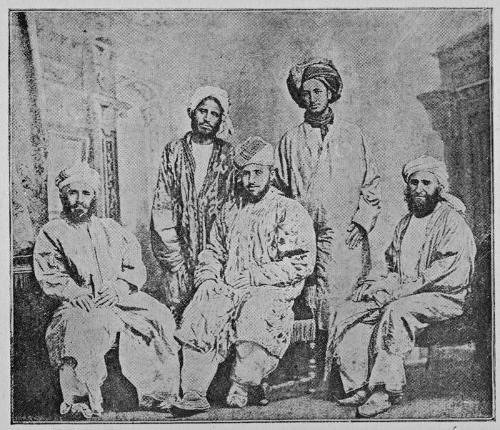
H. H. Mihtar Nizam-ul-Mulk and his late Yasin Council.
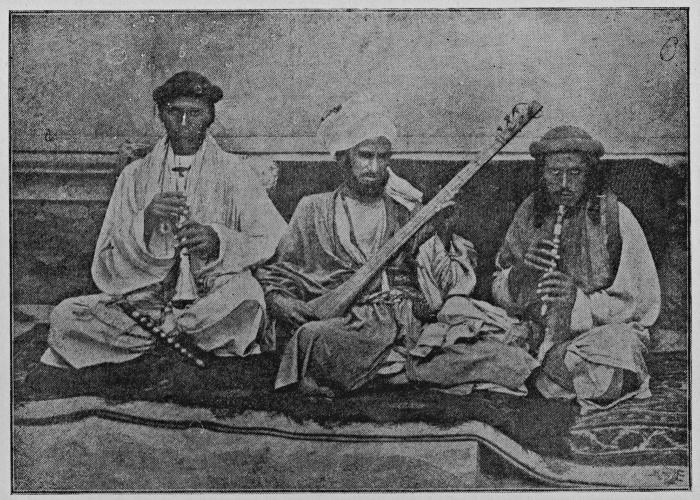
Chitrali Musicians and the Badakshi Poet, Taighun Shah.
Note.—We add a reproduction of the photographs of the Mihtar and Badshah Nizam-ul-Mulk, sitting in Council with his uncle, Bahadur Khan, now at Gilgit, where he represented Afzul-ul-Mulk. On the Nizam’s left is his foster-uncle, Maimun Shah, whilst behind him stand our Indian Agent, Wafadár Khan and a Chitráli office-holder, Wazîr Khan, of corresponding rank. We also give the portrait of the Chitrál Court poet and musician, the celebrated Taighûn Shah, one of whose songs, with its notation, was published in our issue of the 1st of January, 1891. He is seated with the two flute-players who always precede the King of Chitrál when on a tour.
Although the period may be past in which a great English Journal could ask, “what is Gilgit?” the contradictory telegrams and newspaper accounts which we receive regarding the countries adjoining Gilgit show that the Press has still much to learn. Names of places, as far apart as Edinburgh and London, are put within a day’s march on foot. Names of men figure on maps as places and the relationships of the Chiefs of the region in question are invented or confounded as may suit the politics of the moment, if not the capacity of the printer. The injunctions of the Decalogue are applied or misapplied, extended or curtailed, to suit immediate convenience, and a different standard of morality is constantly being found for our friends of to-day or our foes of to-morrow. The youth Afzul-ul-Mulk was credited with all human virtues and with even more than British manliness, as he was supposed to be friendly to us. He had given his country into our hands in order to receive our support against his elder brother, the acknowledged heir of the late Aman-ul-Mulk of Chitrál, but that elder brother, Nizám-ul-Mulk, was no less friendly to English interests, although he has the advantage of being a man of capacity and independence. The sudden death of Aman-ul-Mulk coincided with the presence of our protégé at Chitrál, and the first thing that the virtuous Afzul-ul-Mulk did, was to invite as many brothers as were within reach to a banquet when he murdered them. No doubt, as a single-minded potentate, he did not wish to be diverted from the task of governing his country by the performance of social duties to the large circle of acquaintances in brothers and their families which Providence bestows on a native ruler or claimant in Chitrál and Yasin. A member of the Khush-waqtia dynasty of Yasin, which is a branch of the Chitrál dynasty, told me when I expressed my astonishment at the constant murders in his family: “A real relative in a high family is a person whom God points out to one to kill as an obstacle in one’s way, whereas a foster-relative (generally of a lower class) is a true friend who rises and falls with one’s own fortune” (it being the custom for a scion of a noble house to be given out to a nurse.)
The dynasty of Chitral is said to have been established by Baba Ayub, an adventurer of Khorassan. He adopted the already existing name of Katór, whence the dynasty is called Katore. The Emperor Baber refers to the country of Katór in his Memoirs and a still more ancient origin has been found in identifying Katór with “Kitolo, the King of the Great Yuechi, who, in the beginning of the 5th century, conquered Balkh and Gandhara, and whose son established the Kingdom of the Little Yuechi, at Peshawur.” (See Biddulph’s “Tribes of the Hindoo Koosh,” page 148.) General Cunningham asserts that the King of Chitrál takes the title of Shah Kator, which has been held for nearly 2,000 years, and the story of their descent from Alexander may be traced to the fact that they were the successors of the Indo-Grecian Kings in the Kabul valley. If Katór is a corruption of Kaisar, then let it not be said that the remnant of the Katore exclaimed with the Roman gladiator: “Ave, Kaisar-i-Hind, morituri te salutant.”
Amán-ul-Mulk, the late ruler of Chitrál, was, indeed, a terrible man, who to extraordinary courage joined the arts of the diplomatist. He succeeded his elder brother, surnamed Adam-Khôr or “man-eater.” His younger brother, Mir Afzul, is said to have been killed by him or to have committed a convenient suicide; another brother, Sher Afzul, who is now in possession of Chitrál, was long a fugitive in Badakhshan whence he has just returned with a few Afghans (such as any pretender can ever collect) and a hundred of the Chitráli slaves that used to be given in tribute to the Mir of Badakhshan, which itself never paid a tribute to Kabul before the late Sher Ali of Afghanistan installed Mahmud Shah, who expelled his predecessor Jehandar Shah, the friend of Abdur-Rahman, the present Amir of Afghanistan. Another brother of Aman-ul-Mulk was Kokhan Beg, whose daughter married the celebrated Mullah Shahu Baba, a man of considerable influence in Bajaur, who is feared by the Badshah of Kunar (a feudatory of Kabul and a friend of the British) and is an enemy of the Kamôji Kafirs, that infest one of the roads to Chitrál. This Kokhan Beg, who was a maternal uncle of Afzul-ul-Mulk, was killed the other day by his brother Sher Afzul coming from Badakhshan. I mention all this, as in the troubles that are preparing, the ramifications of the interests of the various pretenders are a matter of importance. Other brothers of Aman-ul-Mulk are: Muhammad Ali (Moriki), Yádgar Beg, Shádman Beg and Bahádur Khán (all by a mother of lower degree), and another Bahádur Khán, who was on the Council of Nizám-ul-Mulk. Nizám-ul-Mulk has therefore to contend with one or more of his uncles, and by to-day’s telegram[112] is on his way to the Chitrál Fort in order to expel Sher Afzul with the aid of the very troops that Sher Afzul had sent to turn out Afzul-ul-Mulk’s Governor from Yasin. I believe that Nizám-ul-Mulk has or had two elder half-brothers, Gholam of Oyôn and Majid Dastagir of Drôshp; but, in any case, he was the eldest legitimate son and, according to Chitrál custom, was invested with the title of Badshah of Turikoh, the rule of which valley compelled his absence from Chitrál and not “his wicked and intriguing disposition” as alleged by certain Anglo-Indian journals. Of other brothers of Nizám-ul-Mulk was Shah Mulk (of lower birth), who was Governor of Daraung and was killed by Afzul-ul-Mulk. He used to live at Dros (near Pathan in Shashi). Afzul-ul-Mulk of Drasun, whom we have already mentioned as a wholesale fratricide, was killed in his flight to one of the towers of the Chitrál Fort from the invading force of his uncle, Sher Afzul of Badakhshan. A younger half-brother is also Behram-ul-Mulk (by a lower mother), called “Viláyeti,” of Moroi in Andarti. Other brothers are: Amin-ul-Mulk, a brother of good birth of Oyôn (Shoghôt), who was reared by a woman of the Zondré or highest class; Wazir-ul-Mulk (of low birth) of Brôz; Abdur-Rahman (low-born) at Owir (Barpèsh), and Badshah-i-Mulk, also of Owir, who was reared by the wife of Fath-Ali Shah. There are no doubt other brothers also whose names I do not know. Murid, who was killed by Sher Afzul, is also an illegitimate brother.
A few words regarding the places mentioned in recent telegrams may be interesting: Shogôth is the name of a village, of a fort, and of a district which is the north-western part of Chitrál, and it also comprises the Ludkho and tributary valleys. Through the district is the road leading to the Dara and Nuqsán passes, to the right and left respectively, at the bottom of which is a lake on which official toadyism has inflicted the name of Dufferin in supersession of the local name. Darushp (Drôshp) is another big village in this district and in the Ludkho valley, and Andarti is a Fort in it within a mile of the Kafir frontier. The inhabitants of Shogôth are descendants of Munjanis, whose dialect (Yidgah) I refer to elsewhere, and chiefly profess to be Shiahs, in consequence of which they have been largely exported as slaves by their Sunni rulers. Baidam Khan, a natural son of Aman-ul-Mulk, was the ruler of it. The Ludkho valley is traversed by the Arkari river which falls into that of Chitrál. At the head of the Arkari valley are three passes over the Hindukhush, including the evil-omened “Nuqsán,” which leads to Zeibak, the home of the heretical Maulais (co-religionists of the Assassins of the Crusades) in Badakhshán. It is shorter, more direct, and freer from Kafir raids than the longer and easier Dora pass. Owir is a village of 100 houses on the Arkari river, and is about 36 miles from Zeibak. Drasan is both the name of a large village and of a fort which commands the Turikoh valley, a subdivision of the Drasan District, which is the seat of the heir-apparent to the Chitrál throne (Nizám-ul-Mulk). Yet the Pioneer, in its issue of the 5th October last, considers that Lord Lansdowne had settled the question of succession in favour of Afzul-ul-Mulk, that Nizám-ul-Mulk would thus be driven to seek Russian aid, but that any such aid would be an infringement of the rights of Abdur-Rahman. Now that Abdur-Rahman is suspected, on the flimsiest possible evidence, to have connived at Sher Afzul’s invasion of Chitrál, we seek to pick a quarrel with him for what a few weeks ago was considered an assertion of his rights. Let it be repeated once for always that if ever Abdur-Rahman or Nizám-ul-Mulk, or the Chief of Hunza or Kashmir or Upper India fall into the arms of Russia, it will be maxima nostra culpa. I know the Amir Abdur-Rahman, as I knew the Amir Sher Ali, as I know Nizám-ul-Mulk, and of all I can assert that no truer friends to England existed in Asia than these Chiefs. Should Abdur-Rahman be alienated, as Sher Ali was, or Nizám-ul-Mulk might be, it will be entirely in consequence of our meddlesomeness and our provocations. Russia has merely to start a will-o’-the-wisp conversation between Grombcheffsky and the Chief of Hunza, when there is internal evidence that Grombcheffsky was never in Hunza at all, and certainly never went there by the Muztagh Pass, that we, ignoring the right of China and of the treaty with Kashmir in 1846, forgetful of the danger in our rear and the undesirability of paving for an invader the road in front, fasten a quarrel on Hunza-Nagyr, and slaughter its inhabitants. No abuse or misrepresentation was spared in order to inflame the British public even against friendly and inoffensive Nagyr. What wonder that a Deputation was sent from Hunza to seek Russian aid and that it returned contented with presents, and public expressions of sympathy which explained away the Russian official refusal as softened by private assurances of friendship? Whatever may be the disaster to civilization in the ascendancy of Russian rule, the personal behaviour of Russian agents in Central Asia is, generally, pleasant. As in Hunza, so in Afghanistan, some strange suspicion of the disloyalty of its Chief, suggested by Russia, may involve us in a senseless war and inordinate expense, with the eventual result that Afghanistan must be divided between England and Russia, and their frontiers in Asia become conterminous. Then will it be impossible for England ever to oppose Russia in Europe, because fear of complications in Asia will paralyze her. Then the tenure of India will depend on concessions, for which that country is not yet ripe, or on a reign of terror, either course ending in the withdrawal of British administration from, at any rate, Northern India. Yet it is “Fas ab hosti doceri,” and when Prince Gortschakoff urged the establishment of a neutral zone with autonomous states, including Badakhshan, he advocated a policy that would have conducted to centuries of peace and to the preservation of various ancient forms of indigenous Oriental civilization by interposing the mysterious blanks of the Pamirs and the inaccessible countries of the Hindukush between Russian and British aggression.
Instead of this consummation so devoutly to be wished, and possible even now, though late, if action be taken under good advice and in the fulness of knowledge, either Power—
“Thus with his stealthy pace With Tarquin’s ravishing strides, towards his design Moves like a ghost.”
If ever the pot called the kettle black, it is the story of Anglo-Russian recriminations. Russian intrigues are ever met by British manœuvres and Muscovite earth-hunger can only be paralleled by English annexations. Here a tribe is instigated to revolt, so that its extermination may “rectify a boundary,” there an illusory scientific frontier is gradually created by encroachments on the territories of feudatories accused of disloyalty, if not of attempts to poison our agents. By setting son against father, brother against brother and, in the general tumult, destroying intervening republics and monarchies, Anglo-Russian dominions are becoming conterminous. Above all
“There’s not a one of them but in his house I keep a servant fee’d.”
And it is this unremitting suspicion which is alike the secret of present success and the cause of eventual failure in wresting and keeping Asiatic countries and of the undying hatred which injured natives feel towards Europeans.
The attempt to obtain the surrender of the Takk fort, and of the Takk valley, a short and easy road to the British District of Kaghán, has merely indicated to Russia the nearest way to India, just as we forced her attention to Hunza and are now drawing it to Chitrál. David Urquhart used to accuse us of conspiracy with Russia in foreign politics. Lord Dufferin in his Belfast speech sought the safety of India in his friendship with M. de Giers and his Secretary popularized Russia in India by getting his work on “Russia” translated into Urdu. Certainly the coincidence of Russian as well as British officials being benefited by their respective encroachments, Commissions, Delimitations, etc., would show their “mutual interest” to consist in keeping up the farce of “Cox and Box” in Central Asia, which must end in a tragedy.
As an official since 1855, when I served Her Majesty during the Russian War, I wish to warn the British public against the will-o’-the-wisp of our foreign policy, especially in India. I can conceive that a small, moral and happy people should seek the ascendancy of its principles, even if accompanied by confusion in the camps of its enemies. I can understand that the doctrines of Free Trade, of a free Press, a Parliamentary rule, the Anti-Slavery propaganda and philanthropic enterprises generally, with which the British name is connected, should have been as good as an army to us in every country of the world in which they created a Liberal party, but these doctrines have often weakened foreign Executive Governments, whilst “Free Trade” ruined their native manufacture. What I, however, cannot understand is that a swarming, starving and unhappy population should seek consolation for misery at home in Quixotism abroad, especially when that Quixotism is played out. If bread costs as much now as in 1832 although the price of wheat has fallen from 60s. to 27s. a quarter, it is, indeed, high time that we should lavish no more blood and treasure on the stones of foreign politics, but that we should first extract the beam from our own eye before we try to take out the mote from the eye of others.
What these foreign politics are worth may be inferred from the growing distrust on the Continent of British meddlesomeness or from what we should ourselves feel if even so kindred a race as the Prussians sought to monopolize British wealth and positions. It would be worse, if they did so without possessing a thorough knowledge of the English language or of British institutions. Yet we are not filled with misgivings when our Indian Viceroys or Secretaries of State cannot speak Hindustani, the lingua franca of India or when an Under-Secretary has a difficulty in finding Calcutta on the Map.
India should be governed in the fulness of knowledge and sympathy, not by short cuts. It should not be the preserve of a Class, but the one proud boast of its many and varied peoples. When Her Majesty assumed Her Indian title, it was by a mere accident, in which pars magna fui, at the last moment, that the Proclamation was translated to those whom it concerned at the Imperial Assemblage. This superciliousness, wherever we can safely show it, the cynical abandonment of our friends, the breach of pledges, the constant experimentalizing on the natives, the mysteriousness that conceals official ignorance, is the enemy to British rule in India, not Russia. A powerful Empire can afford to discard the arts of the weak, and should even “show its hand.” India should be ruled by a permanent Viceroy, a member of the Royal family, not by one whom the exigencies of party can appoint and shift. When in 1869 the Chiefs and people of the Panjab deputed me to submit their petition that H.R.H. the Prince of Wales be pleased to visit India, it was because they felt that it was desirable in the interests of loyalty to the Throne. If it be true that H.R.H. the Duke of Connaught is going out as the next Viceroy, I can only say that the longer his admirers miss him in England, the better for India, which requires its best interests to be grouped round a permanent Chief.
Dec. 7th.—As for the wanton aggression on Chilás which never gave us the least trouble, as all our Deputy Commissioners of Abbottabad can testify, it is a sequel of our interference last year with Hunza-Nagyr. The Gilgit Residency has disturbed a peace that has existed since 1856 and now continues in its suicidal policy of indicating and paving the nearest military road to British territory to an invader. In November 1891 I wrote of the possibility of driving even the peaceful, if puritanical, Chilásis into aggression and now the Times telegraphs the cock-and-bull story of the raft, enlarged in to-day’s Times telegram into an attack of the Chilási tribesmen aided by those of Darêl (another newly-created foe) on our convoy proceeding from Bunji—the extreme frontier of Kashmir according to the treaty of 1846—to Dr. Robertson’s Camp at (now) Talpenn (spelt “Thalpin” in the telegram) and (then) Gôr, with, of course, the inevitable result of the victory of the heroism of rifles against a few old muskets and iron wrist-bands (which the Chilásis use in fighting).
There are still other realms to conquer for our heroes. There is the small Republic of Talitsha of 11 houses; there is Chilás itself which admits women to the tribal Councils and is thus in advance even of the India Office and of the Supreme Council of the Government of India; there is the Republic of Muhammadan learning, Kandiá, that has not a single fort; there is, of course, pastoral Dareyl; there are the Koli-Palus tribes, agricultural Tangîr and other little Republics. Soon may we hear of acts of “treachery,” “disloyalty,” etc. from Hôdur and Sazîn, till we shoot down the supposed offenders with Gatlings and destroy the survivors with our civilization. I humbly protest against these tribes being sacrificed to a mistaken Russophobia. I have some claim to be heard. I discovered and named Dardistan and am a friend of its peoples. Although my life was attempted more than once by agents of the Maharaja of Kashmir, I was the means of saving that of his Commander-in-Chief, Zoraweru, when on his Dareyl expedition. This is what the Gilgit Doctor did in 1866 and what the Gilgit Doctor should do in 1892. This is how friendship for the British name was, and should be, cemented, and not by shedding innocent blood or by acts worthy of agents provocateurs.
As for the “toujours perdrix” of the Afghan advance from Asmar (Times, December 8th) it is better than the telegram in the Standard of the 2nd December 1892, in which the Amir makes Sher Afzul Ruler of Kafiristan, a country that has yet to be conquered, and which says “Consequently there is now no buffer-state between Afghanistan and the Pamirs”!! “Goods carried from India to Russian Turkestan, through Chitral and Kafiristan, will pay duty to the Amir.” Such journalistic forecasts and geography are inevitable when full and faithful official information, such as it is, is, in a free country, not obtainable by Parliament, the Press, and the Public. Reuter’s Central Asian Telegrams, though meagre, are more correct than those of certain correspondents of the Times and Standard.
Dec. 9th.—Dr. Robertson has, at last, entered Chilás, and found it deserted. Solitudinem faciunt, pacem appellant. The Times Correspondent now admits that Chilás has no connexion with Chitrál, but he still gives us “Tangail” for “Tangir,” and omits the name of the member of the ex-royal family of Yasin, who is supposed to have stirred up against us the tribes of Darel and “Tangail,” among whom he has resided for years. This is one of the Khushwaqtias, though not the loyal chief to whom I have referred, and who has rendered us good service. So we have now an excuse for entering Tangir also. In the meanwhile, the Russian Svet points out that the Russians “would only have to march some 250 miles along a good road to enter Cashmere,” “since it is impossible to invade India viâ Afghanistan.” Yet are we nibbling at the Amir Abdurrahman, whose troops merely occupy the status quo ante at Asmar, confronted by Umra Khan on the other side of the Kuner river. We are forgetting the lessons of the Afghan campaigns, and especially that, although Abdurrahman allowed himself to be proclaimed by us, in his absence, as Amir, he marched in at one side of Kabul, whilst we marched out at the other. We forget that, with the whole country against us in a revived Jehád, with the discontent among our native troops and with a crushing expenditure, we preferred a political fiasco in order to avoid a still greater military fiasco. The Russians also urge “the construction of a military road on their side from Marghelan across the Pamirs” leaving us to finish it for them on our side of the Hindukush. The pretension to Wakhan, however, is already disposed of in Prince Gortchakoff’s Convention with Lord Granville in 1872, and no notice need be taken of the preposterous claim of the Svet to place Chitrál under a Russian protectorate! Thus have we sown the wind and reaped the whirlwind. Our real defence of India lies, as Lord Lawrence ever held, in its good government, and to this I would respectfully add, in justice to its Chiefs, wherever they have a legitimate grievance. Mere speeches of Viceroys, unaccompanied by acts, will not convince them of our “good intentions.” It is also not by emasculating the Dard tribes and breaking down their powers of resistance to the level of Slaves to the British, that we can interpose an effectual barrier to the invading Myriads of Slavs that threaten the world’s freedom. By giving to the loyalty of India the liberty which it deserves, on the indigenous bases that it alone really understands and in accordance with the requirements of the age, we can alone lead our still martial Indian Millions in the defence of the Roman Citizenship which should be the reward of their chivalrous allegiance to the Queen.
G. W. Leitner.
P.S.—15 Dec. 1892. The just cause of Nizám-ul-Mulk appears to have triumphed. Sher Afzul is said to have fled. So far Chitrál. As for Chilás, the people have come to Dr. Robertson’s Camp and express friendliness.