A NOTE ON CLASSICAL ALLUSIONS TO THE DARDS AND TO GREEK INFLUENCE ON INDIA.
Reading edition
The Dards.
Herodotus (III. 102-105) is the first author who refers to the country of the Dards, placing it on the frontier of Kashmir and in the vicinity of Afghanistan. “Other Indians are those who reside on the frontiers of the town ‘Kaspatyros’ and the Paktyan country; they dwell to the north of the other Indians and live like the Baktrians; they are also the most warlike of the Indians and are sent for the gold,” etc. Then follows the legend of the gold-digging ants (which has been shown to have been the name of a tribe of Tibetans by Schiern), and on which, as an important side-issue, consult Strabo, Arrian, Dio Chrysostomus, Flavius Philostratus the elder, Clemens Alexandrinus, Ælian, Harpokration, Themistius Euphrades, Heliodorus of Emesa, Joannes Tzetzes, the Pseudo-Kallisthenes and the scholiast to the Antigone of Sophocles[1]—and among Romans, the poems of Propertius, the geography of Pomponius Mela, the natural history of the elder Pliny and the collections of Julius Solinus.[2] The Mahabharata also mentions the tribute of the ant-gold “paipilika” brought by the nations of the north to one of the Pandu sons, king Yudhisthira.
In another place Herodotus [IV. 13-27] again mentions the town of Kaspatyros and the Paktyan country. This is where he refers to the anxiety of Darius to ascertain the flow of the Indus into the sea. He accordingly sent Skylax with vessels. “They started from the town of Κασπάτυρος and the Πακτυική χώρη towards the east to the sea.” I take this to be the point where the Indus river makes a sudden bend, and for the first time actually does lie between Kashmir and Pakhtu-land (for this, although long unknown, must be the country alluded to),[3] in other words, below the Makpon-i-Shang-Rong, and at Bunji, where the Indus becomes navigable.[4] The Paktyes are also mentioned as one of the races that followed Xerxes in his invasion of Hellas (Herod. VII. 67-85). Like our own geographers till 1866, Herodotus thought that the Indus from that point flowed duly from north to south, and India being, according to his system of geography, the most easterly country, the flow of the Indus was accordingly described as being easterly. I, in 1866, and Hayward in 1870, described its flow from that point to be due west for a considerable distance (about one hundred miles). (The Paktyes are, of course, the Afghans, called Patans, or more properly Pakhtus, the very same Greek word). “Kaspatyros” is evidently a mis-spelling for “Kaspapyros,” the form in which the name occurs in one of the most accurate codes of Herodotus which belonged to Archbishop Sancroft (the Codex Sancroftianus) and which is now preserved at Emmanuel College, Cambridge. Stephanus Byzantianus (A.V.) also ascribes this spelling to Hekatœus of Miletus.[5]
Now Kaspapyros or Kaspapuros is evidently Kashmir or “Kasyapapura,” the town of Kasyapa, the founder of Kashmir, and to the present day one may talk indifferently of the town of Kashmir, or of the country of Kashmir, when mentioning that name, so that there is no necessity to seek for the town of Srinagar when discussing the term Kaspatyrus, or, if corrected, Kaspapuros, of Herodotus.
Herodotus, although he thus mentions the people (of the Dards) as one neighbouring (πλησιοχώροι) on Kashmir and residing between Kashmir and Afghanistan, and also refers to the invasions which (from time immemorial it may be supposed, and certainly within our own times) this people have made against Tibet for the purpose of devastating the goldfields of the so-called ants, does not use the name of “Dard” in the above quotations, but Strabo and the elder Pliny, who repeat the legend, mention the very name of that people as Derdæ or Dardæ, vide Strabo XV., ἐν Διρδαις ἔθνει μεγάλω τῶν προσεώων καὶ ὀρείνων Ἰνδῶν. Pliny, in his Natural History, XI. 36, refers to “in regione Septentrionalium Indorum, qui Dardæ vacantur.” Both Pliny and Strabo refer to Megasthenes as their authority in Chapter VI., 22. Pliny again speaks of “Fertilissimi sunt auri Dardæ.” The Dards have still settlements in Tibet where they are called Brokhpa (see page 60 of text). The Dards are the “Darada” of the Sanscrit writers. The “Darada” and the “Himavanta” were the regions to which Buddha sent his missionaries, and the Dards are finally the “Dards, an independent people which plundered Dras in the last year, has its home in the mountains three or four days’ journey distant, and talks the Pakhtu or Daradi language. Those, whom they take prisoners in these raids, they sell as slaves” (as they do still). (Voyage par Mir Izzetulla in 1812 in Klaproth’s Magasin Asiatique, II., 3-5.) (The above arrangement of quotations is due to Schiern.)[6]
Influence of Greece on Asia in General and India in Particular.
The most important contribution to this question, however, is Plutarch’s Speech on Alexander’s fortune and virtue (περὶ Ἀλεξάνδρου τύχης καὶ ἀρετῆς), the keynote to which may be found in the passage which contains the assertion that he Κατέσπειρε τὴν Ἀσίαν ἑλληνικοῖς τέλεσι, but the whole speech refers to that marvellous influence.
That this influence was at any rate believed in, may be also gathered from a passage in Aelian, in which he speaks of the Indians and Persian kings singing Homer in their own tongues. I owe the communication of this passage to Sir Edward Fry, Q.C., which runs as follows; Ὄτι Ἰνδοὶ τῆ παρα σφίσιν ἐπιχωριά φωνη τά Ὁμήρου μεταγράψαντις ᾄδουσιν οὐ μάνοι, ἀλλὰ καὶ οἲ Περσῶν βασιλεῖς εὶ τι χρη πιστεύειν τοῖς ὕπερ τούτων ἱστοροῦσι.—Aeliani Variæ Historiæ, Lib. XII., Cap. 48. [I find from a note in my edition that Dio Chrysostom tells the same story of the Indians in his 53rd Oration.—E.F.]
I trust to be able to show, if permitted to do so, in a future note (1) that the Aryan dialects of Dardistan are, at least, contemporaneous with Sanskrit, (2) that the Khajuná is a remnant of a prehistoric language, (3) that certain sculptors followed on Alexander’s invasion and taught the natives of India to execute what I first termed “Græco-Buddhistic” sculptures, a term which specifies a distinct period in history and in the history of Art.
G. W. Leitner.
P.S. in 1893.—The above, which appeared in “the Calcutta Review” of January 1878, was also reprinted in the Asiatic Quarterly Review of April 1893 with reference to Mr. J. W. McCrindle’s recent work on “Ancient India: Its Invasion by Alexander the Great,” in which he omits to draw attention to the importance of Plutarch’s Speech on the civilizing results of Alexander’s invasion, and makes no mention whatever of the traces which Greek art has left on the Buddhistic sculptures of the Panjab.
He only just mentions Plutarch’s speech on page 13 of his otherwise excellent work, published by Messrs. Constable of 14 Parliament Street, London. As that speech, which is divided into two parts, is, however, of the utmost importance in showing what were believed to be in Plutarch’s days the results of Alexander’s mission, I think it necessary to quote some of the most prominent passages from it relating to the subject under inquiry. I also propose to show in a monograph on the græco-buddhistic sculptures, now at the Woking Museum, which I brought from beyond the Panjab frontier, that Alexander introduced not only Greek Art but also Greek mythology into India. I will specially refer to the “Pallas Athene,” “the rape of Ganymede,” and “the Centaur” in my collection, leaving such sculptures as “Olympian games,” “Greek soldiers accompanying Buddhist processions,” “the Buddhist Parthenon,” [if not also Silanion’s “Sappho with the lyre,”]—all executed by Indian artists—to tell their own tale as to the corroborations in sculpture of passages in ancient Greek and Roman writers relating to the genial assimilation of Eastern with Western culture which the Great Conqueror of the Two Continents, “the possessor of two horns,” the “Zu’l-Qarnein” (Al-Asghar) of the Arabs, endeavoured to bring about.
The following passages from Plutarch’s Speech may, I hope, be read with interest. The author endeavours to answer his question as to whether Alexander owed his success “to his fortune or to his virtue” by showing that he was almost solely indebted to his good qualities:
“The discipline of Alexander ... oh marvellous philosophy, through which the Indians worship the Greek gods.”
“When Alexander had recivilized Asia, they read Homer and the children of the Persians ... sang the tragedies of Euripides and Sophocles.” “Socrates was condemned in Athens because he introduced foreign Gods ... but, through Alexander, Bactria and the Caucasus worshipped the Greek Gods.” “Few among us, as yet, read the laws of Plato, but myriads of men use, and have used, those of Alexander, the vanquished deeming themselves more fortunate than those who had escaped his arms, for the latter had no one who saved them from the miseries of life, whilst the conqueror had forced the conquered to live happily.”
“Plato only wrote one form of Government and not a single man followed it because it was too severe, whereas Alexander founded more than 70 cities among barbarous nations and permeating Asia with Hellenic Institutions....” Plutarch makes the conquered say that if they had not been subdued “Egypt would not have had Alexandria nor India Bucephalia,” that “Alexander made no distinction between Greek and Barbarian, but considered the virtuous only among either as Greek and the vicious as Barbarian” and that he by “intermarriages and the adaptation of customs and dresses sought to found that union which he considered himself as sent from heaven to bring about as the arbitrator and the reformer of the universe.” “Thus do the wise unite Asia and Europe.” “By the adoption of (Asiatic) dress, the minds were conciliated.” Alexander desired that “One common justice should administer the Republic of the Universe.”
“He disseminated Greece and diffused throughout the world justice and peace.” Alexander himself announces to the Greeks, “Through me you will know them (the Indians) and they will know you, but I must yet strike coins and stamp the bronze of the barbarians with Greek impressions.” The fulfilment of this statement is attested by the Bactrian coins. I submit that he who left his mark on metal did so also on sculpture, as I have endeavoured to show since 1870 when I first called my finds “græco-buddhistic,” a term which has, at last, been adopted after much opposition, as descriptive of a period in History and in the history of Art and Religion.
[The above quotations are all from the 1st Part of Plutarch’s oration; the second is reserved for the proposed monograph.]
G. W. Leitner.
For “Divisions of the Dard Race” and the countries which they occupy see page 58.
FIRST GROUP OF DARDS, ETC., TAKEN IN 1866.
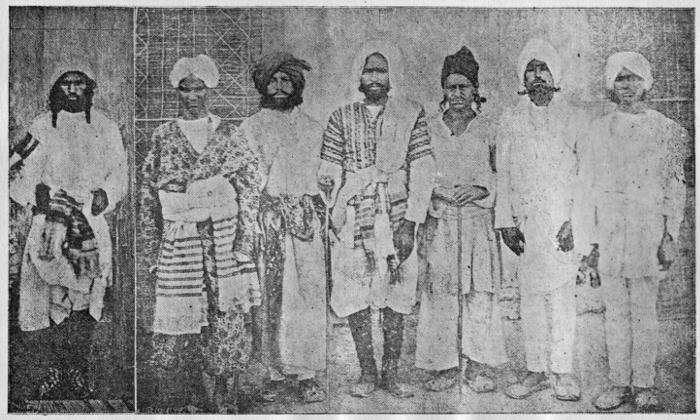
Gulam Muhammad, of Gilgit (A Shiah Muhammadan). Gharib Shah and Friend, Both of Chilas (Sunni Muhammadans). Mirza beg, of Astor (Sunni). Kazim, From Skardo (Little Tibet). (Shiah). Malek and Batshu (Kalasha and Bashgali Kafirs) (Subjects of Chitral).