MACHINE SHOP MANAGEMENT
Reading edition
MANUFACTURING
Manufacturing Conditions and Developments. Millions of dollars are annually spent in building new factories. Other millions are spent in equipping them with the best machinery that trained and experienced men have been able to devise. Still more millions of money are annually paid to the officials who manage and the employees who man these enormous manufacturing plants.
Why? Why could not these expert employees labor in their own homes or their individual shops, and produce the manufactured goods without all these enormous expenses? What are the necessities which impel men to spend these vast sums of money in erecting, equipping, and operating these immense plants?
Casually considering the question, the factory or manufacturing plant does not seem to be a real necessity. A large force of employees working under a single management does not seem to be the most economical method of producing the desired goods. Certainly every man is free to choose his own particular line of work; and there are many persons who, seeing a large force of employees giving their entire life work to the enrichment of successful manufacturers, while the employees themselves work long hours at hard and laborious tasks and fare so poorly that they are seldom enabled to save any considerable portion of their wages, not infrequently ending an industrious life in poverty and want, are led to believe that the factory is not a necessity or even a benefit to mankind, but rather a means for reducing the individual worker to a condition of grinding servitude, voluntary perhaps, but often the result of dire necessity.
These people, considering all the hardships in the life of factory employees, are likely to hold and often to express the opinion that the highest welfare of the human race really demands a return to the simpler life of early days, when a much larger proportion of the people lived upon farms, producing their own provisions, raising the flax and the wool wherewith they clothed themselves, quite independently of the wealthy classes, whether bankers, capitalists, or manufacturers, the factory as we know it to-day having hardly begun its marvelous era of existence.
Let us consider for a moment how all this has come about. In the earlier years of the independence of this country, the chief dependence was upon the results of agricultural work. In due time the development of the resources of the country has placed manufacturers at the front, so that in very recent years the value of manufactured products has become nearly double that of agricultural.
These results, like many others of a less notable character, commenced from very small beginnings; and it has been by inborn mechanical ability, remarkable ingenuity, patient development, and tireless energy, that mechanical undertakings have been developed from meager initial facilities, until, in the vast manufacturing enterprises of the present day, the American mechanic in nearly all lines leads the world in originality and practical achievement.
Early New England Mechanics. When the early settlers of New England labored under the restrictive and harassing laws of the Mother Country, and under their administration were goaded and exasperated beyond endurance in many ways, not the least of which was that of being obliged to purchase many manufactured articles from England at extortionate prices—or, if purchased from other countries, still paying taxes to England for the privilege—they rebelled. Determining to buy no more foreign goods, they set out, at first in most clumsy and primitive fashion, to make for themselves such articles as were really necessaries, and, in noble self-denial, to live without those which they could not make for themselves. They doubtless little realized, however, that they were thereby laying the foundations of the greatest manufacturing country in the world. By the principles thus inaugurated, they instituted the first industrial boycott in the history of the country—the one that has had more important and far-reaching influences than anything of the kind before or since.
Industrial Freedom. While the departure of the Pilgrims for this country, and the making of their homes on the "stern and rock-bound coast" of New England, were for the purpose of seeking religious freedom, it is also true that freedom soon meant very much more than this to them; and with a larger conception of their opportunities and possibilities, some of which were in reality forced upon them by adverse circumstances, there came to them the inspiration of industrial as well as religious freedom. The world has seen and has given them due credit for the determined and heroic manner in which they went about their self-appointed task; and they have amply demonstrated to posterity their appreciation of and grasp upon the possibilities and conditions, and the breadth and nobility of character which they exhibited in working out the many perplexing problems that confronted them.
Development of American Industrial Enterprises. American manufacturing came into being with these small beginnings and crude efforts to fashion those common objects of household necessity and daily use, which, although crude and clumsy, yet answered the purpose until supplanted later by those of more improved form and workmanship. These primitive successes led to greater endeavors, and developed into still broader usefulness, when the time came that necessities had been provided for and luxuries were now demanded by the higher plane of living to which the people had in due time advanced.
Thus the crude beginnings and rude surroundings among which the early American mechanic performed his work, were in his own house. Soon he outgrew these primitive facilities, and built small shops, frequently in the garden or back yard of his home. These gradually enlarged. The development of the business demanded increased facilities, and buildings were erected quite independent of the home surroundings, and two or more men were associated as manufacturers. These plants developed and enlarged, and in due course of time became the machine shops and the factories, which have since multiplied many hundreds of times, not only in number and in value, but in influence and importance, until to-day our country stands the foremost manufacturing nation of the world. This is true, not only as to the volume and value of her manufactured productions, but also as to their great range and diversity of kind and usefulness. One by one the American mechanic has taken up the various classes of work formerly monopolized by this country or that, failing perhaps at first, but always progressing and developing, until, by native ingenuity and unflagging energy, all obstacles have been overcome, all difficulties put aside, new industries have come into being, and other "victories" of peace "no less than those of war" have been added to the laurels of the American mechanic and of his ever-ready and ever-confident partner, the American manufacturer and capitalist. It is to this combination, each confident of and faithful to the abilities and honor of the other, and each acting his part in his own sphere of usefulness, that the immense success of American manufacturing is due.
The factories of to-day are the logical results of a natural growth and development of the various branches of business for which they were originally built and organized. As the buildings increased in numbers and dimensions, the methods of construction, the equipment, and the systems by which they were managed, developed methods of greater economy and efficiency.
Tools of the Early Mechanic. The early mechanic had few tools and appliances wherewith to perform his work; and these were crude and primitive, consisting principally of a limited number of hand-tools brought from the Old Country, and occasionally a hand-lathe of modern dimensions and operated by foot-power. But with their few tools and meager facilities, and animated by the condition that "necessity is the mother of invention," these old-time mechanics proceeded with practical common sense and ingenuity to design and construct better tools and machines—which have continually developed, until we have the splendid array of manufacturing machinery seen on every hand to-day. As machinery developed, larger and larger amounts of money had to be expended; and the banker had to be called upon to provide it. Thus the capitalist became the partner of the manufacturer, the one furnishing the mechanical ability and inventive genius for the actual designing and building of machinery and manufactured goods, while the other contributed the money to carry on the work, and the business ability necessary to market the product.
Relations of Capital and Labor. In brief, this is the condition to-day. But, says the carping critic, "there are often hundreds of struggling and hard-working employees where there is one rich manufacturer." This may be partly true, although it is a fact beyond dispute that the American mechanic is the best paid workman in the world. It is true that there are hundreds of workmen to one capitalist. Why? The Creator has so ordained that there shall be many of moderate ability, and but few possessing the unusual ability and talent to lead them. So it has ever been since the days of Moses, and so it probably will ever continue to be. Doestick's regiment composed entirely of colonels was a manifest absurdity, and so intended as an illustration of a well-known and natural condition that should be realized by every reasonable and thoughtful man who considers these questions.
Considering carefully the great scheme of manufacturing, and the immense industrial problem of supplying the wants of the people of this great country and providing for the vast volume of trade that goes abroad, by the modern manufacturing plants equipped with all that is latest and best in machinery for every conceivable purpose, it should not be forgotten that, as the very basis and foundation of the whole, stands the modern machine tool, and that it is principally to the great and important development of this that we owe primarily our industrial growth and prosperity as a manufacturing nation. To the machine tool may easily be traced the gradual but continued upward tendency of the mechanic and his methods, from the hard physical toil and small pay of the early days, to the immeasurably lighter exertion and increased compensation made possible by the highly developed condition of the automatic machines of the present day. It has been an oft-repeated victory of "mind over matter," wherein brains have won where hands made but little advance; ideas have developed wonderful mechanisms that have revolutionized the earlier methods of manufacturing and raised the standard of mechanical excellence beyond what was thought possible years ago, and at the same time reduced the cost to a fraction of its former amount.
Here, again, the capitalist furnished the means whereby the practical realization of the ingenious designs of the mechanic's fertile brain became possible, and the successful combination of capital and labor brought success to both.
Combinations of Capital. But here comes our critical labor agitator again with the comment: "It is all very well to talk about the amicable relations of capital and labor, and how each ought to help the other, but how about the great combinations of capital that we ordinarily call "trusts"? To give a correct and intelligent, as well as a fair and truthful answer to this question, we must know the conditions under which the combination is formed, the plan upon which it is organized, and the object of its formation. As these are not given, we must assume the conditions of some well-known combination. Let it be the United States Steel Corporation. One of the foremost men in this combination has defined his position on the subject, and in so doing has outlined the policy of the corporation, by saying:
"Any combination of capital which operates, first, to prevent competition; second, to increase the price of the product; and third, to reduce the wages of the workmen, is working under a trio of wrong principles that sooner or later will bring about disaster."
Let us see how the actual operation of this combination of capital really works out in practice.
First—The Steel Corporation has never sought to prevent competition. Steel mills, large and small, have operated when, where, and how they pleased, with no interference from the Steel Corporation.
Second—The price of steel has not been increased; on the contrary, it has been greatly reduced under its management. Thirty years ago a very indifferent quality of machine steel cost from 8 to 12 cents per pound. To-day ordinary machine steel of a much better quality than that mentioned above can be had for 2 cents a pound or less.
Third—The wages of workmen have not only not been reduced, but have actually been doubled since the labor troubles in the steel mills known as the "Homestead Strike" (1892). The Steel Corporation has gone much further than to double the wages of the steel workers. They have made it possible for the workmen to become partners in the great work of the corporation, by obligating themselves to sell to their workmen a certain amount each year of stock in the corporation, so that the men who labor in the mills may also become part owners and participate in the dividends resulting from their work on exactly the same percentage as the capitalist himself does.
Our critic comes back to the charge by saying that "the Steel Corporation has bought up many steel plants in various parts of the country, and added them to its already enormous properties." Quite true. And for what purpose? Let us see what they do with these plants. How do they manage this part of the business? What is their plan of working? The conditions were these: Before the advent of the United States Steel Corporation, there were many isolated steel manufacturing plants, each being equipped for the making of a number of kinds of steel products—for instance, steel railroad rails, structural steel, merchant bar steel, steel boiler-plates, steel tank-plates, and so on. The equipment necessary for producing these different forms of steel was very expensive; and inasmuch as a considerable portion of this equipment for some particular kind of product would necessarily be idle on account of the fluctuations of trade, the expense burden was abnormally high on account of this idle equipment. How has this condition been handled by the Steel Corporation? This has been the plan: Suppose they have purchased five plants, each making the five classes of product indicated above, and working under the disadvantages of a variety of products. These plants are examined, and inventories made of their equipments. It is then decided which mill is best adapted for making each one of the five classes of products. Then there is a redistribution of the equipment of the plants, placing in the plant selected for it all that in the several plants is adapted to a certain product; removing all the machinery from this plant that is not adapted to the particular product to be turned out, to be distributed among the other plants according to the particular class of products for which each one is designed. Thus each plant is equipped to turn out the single class of product which is most appropriate for it, by drawing upon the other plants for such machinery as they have which may supplement its own in this line.
By this plan, each plant makes but one class of product. Having the best machinery from all the plants for this purpose, and concentrating its energies on a single class, it is enabled not only to turn out a better product, but to turn it out much more economically than before. As the workmen become more expert on their single line of product, they work more efficiently and consequently earn higher wages. All these conditions, producing an economical output, enable the manufacturers to reduce the selling price.
The conditions of economy brought about in the management of the manufacturing operations and in marketing the product, are very marked when a large number of plants operate under one general head. Again, with the immense amount of capital at the disposal of such a corporation, it is enabled to secure the services of the best experts, and the most valuable processes in existence.
There are many other advantages, not only to the corporation and its employees, but to the users of its products, and so to the general public, when a combination of capital is honestly made and honestly administered.
Betterment of Industrial Conditions. What has been said of the Steel Corporation as to favoring of employees, has been duplicated in various ways by different manufacturers all over the country. Factory sites have been beautified by landscape gardening, and trees and shrubbery have made the surroundings of working men and women pleasant and attractive. Land has been purchased, and workingmen's homes built and rented to them at fair rates. Factory dining rooms are provided; reading rooms, libraries, gymnasiums, clubs, and social organizations are inaugurated; emergency hospitals or "first aid" rooms are arranged, with all or nearly all these services free except that provided in dining rooms, which is furnished at actual cost. More recently, a firm in Connecticut announces that it will furnish free medical attendance to all its employees and their families.
Schools have been established for apprentices, wherein they receive such technical instruction as may be necessary to their success in the trade they are learning—and this, not only without expense to themselves or to their parents, but they are paid by the hour for time spent in their school work, the same as for their time in the shop.
To foster a practical interest in the work of the shops, many concerns have what is called the Suggestion System, whereby the employees may make written suggestions of any improvements which they desire as to shop methods and routine, the design and construction of the product, and many kindred subjects, the best suggestions made each month receiving prizes.
All of these matters emphasize the fact that the mutual interests of the capitalist who manufactures and sells, and of the employee by the efforts of whose hand and brain the products are being turned out, are each year being recognized and in a very large majority of cases are being acted upon in good faith.
Methods of Modern Manufacturing. In former times, machines were built one at a time or in very small lots. Parts were made and fitted to the particular machine to which they belonged; and while the same general form and dimensions were practically maintained, there was no attempt made to render the several parts so exact as to fit upon any other machine than the one for which they were intended. Systems of gauges had not been developed, and the planer was yet a comparatively new tool; much work was still done by hand, the hammer, the cold chisel, and the file being the chief reliance of a large majority of machinists. This was the state of the machine shop and its methods nearly up to the year 1800.
Interchangeable Manufacturing. The use of milling cutters and the commencement of practically interchangeable manufacturing, came into machine shop practice at nearly the same time. It has been said that "but for the milling machine, there would have been no such thing as interchangeable manufacturing." It might be said with quite as much truth, that if the system of interchangeable manufacturing had not been conceived, there would have been little need for the milling machine. Each, to a great extent, depended very much upon the development of the other—and upon a third factor, the conception and development of the method of handling work (particularly small parts) in jigs and fixtures.
Milling cutters were made in America by one of the early machinists, a Frenchman named Vaucanson, who died in 1782. A sample of these had a hexagonal instead of a round hole, and the pitch of the teeth was very fine, so that the cutter resembled a saw rather than those at present in use. It is said that a man by the name of Bodmer, in Manchester, England, had made a milling machine in 1824.
It is altogether probable that Eli Whitney, the inventor of the cotton gin, had built and used milling machines previous to this date, as the following item of mechanical history would seem to indicate. In January, 1798, Eli Whitney received from the United States Government an order to furnish ten thousand muskets, of which four thousand were to be delivered in one year, and the balance in two years. Mr. Whitney went at the undertaking in a very thorough and systematic manner. He first developed a water power; then erected suitable buildings; considered and developed ways and means for a larger and better product than had previously been realized; designed and built machinery to effect it; and trained workmen to a degree of skill necessary to success in their new employment.
The difficulties which Mr. Whitney encountered and the obstacles which he had to overcome, were so much greater than he anticipated that it was really eight years instead of two before he had succeeded in completing the government order for the ten thousand muskets. However, the progress which he had made in this new enterprise, and the character of the product which he turned out and delivered, were so satisfactory to the government officials that Congress treated him with the greatest courtesy and consideration.
His shops were situated in the city of New Haven, Conn., and soon became the Mecca of government officials, manufacturers, traveling notables, and foreigners, who had heard of this wonderful American mechanic and came to see his work for themselves—to find that the system, the machines, and the tools which he had perfected were well worth the journey. His innovations in the manufacture of arms formed as great an epoch in mechanical history as had his invention of the cotton gin.
Jigs and fixtures were among his equipment; and it is altogether probable that milling machines were also in use, since he must have had practical knowledge of the utility of the milling cutter at this time, as it is generally assumed that the first practical use of the milling machine was in the making of parts of muskets.
The buildings which Mr. Whitney erected for his use were substantial stone structures, and stand in a part of the city called in his honor "Whitneyville." They form a part of the extensive plant of the Winchester Repeating Arms Company.
At this point and at this early day, therefore, was inaugurated the modern system of interchangeable manufacturing—or the manufacturing, in large numbers, of duplicate parts, within such a limited degree of variation as to admit of their ready interchangeability with one another. The system was not one that would be confined to the manufacture of arms, but was adaptable to the production of all kinds of small and moderate-sized machinery, and was the initial effort which in due time revolutionized the then existing shop methods, and which has since built up the American system of manufacturing to the proud distinction of being superior to anything of the kind in other manufacturing countries.
In the operations of modern manufacturing, the principal object sought is to turn out the product economically and accurately. To produce these results economically, the parts must be produced very rapidly. To produce them rapidly, not only must there be a very complete and efficient equipment of machines, attachments, tools, jigs, fixtures, and gauges or measuring devices, but there must also be a very complete system of shop methods by which the operation of this equipment is carried on.
It has been well said that "the man in whose brain the manufacturing system was born was he who first took a piece of scrap iron and drilled two holes in it, to guide a drill in making another piece with two holes in it the same distance apart as in the first piece." The men who now fill our drafting rooms and tool rooms, and who devise and construct tools for the production of interchangeable metal parts, are his descendants. They have made possible the manufacture of the breech-loading gun, the typewriter, the cheap sewing machine, the cash register, the machine-made watch, the automobile, as well as a thousand and one other mechanical articles, machines, and devices which form an integral part of our twentieth-century civilization.
To render these systems efficient and economical for these purposes, the work must be repetition or duplicate work. That is, there must be very large numbers of each of the different parts; and to carry out the scheme of operation for the division and subdivision of work; a single operation on a large number of parts is performed; then the work is handled again, perhaps in another machine, and another operation is performed; and so on until the part is complete. Thus a piece of comparatively simple form may require a large number of separate and distinct operations to complete it. But, as each single operation is performed by one operator, he may give his undivided attention to the accuracy of that operation; hence very accurate work can be produced.
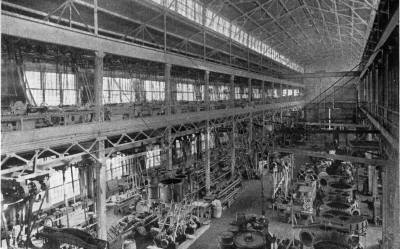
A MACHINE SHOP WITH GALLERIES AT THE SHIPBUILDING PLANT OF THE GAS ENGINE & POWER CO. AND CHARLES L. SEABURY & CO., CONSOLIDATED
In the development of these systems, the work has continually grown more and more complex, as have also the requirements as to the buildings in which manufacturing work is performed, and as to the equipment necessary to perform it. Conditions have been continually changing; greater speed as well as greater accuracy in all machine operations has been demanded; and a largely increased output per employee has been required. So great and urgent has been this demand that the employee of to-day will turn out from three to ten times the volume of product of a given kind that he did only a few years ago. Undoubtedly this result has been brought about in great measure by the great improvement in machines, tools, and fixtures. Much is also due to the use of tools composed of high-speed steel; still more, to the employment of improved systems for handling work.
But all of these do not fully explain the enormous increase in product per employee. This has been brought about by various methods of shop management. One of these is the specialization of operations and the division and subdivision of departments, whereby each operator has a certain well-defined and very limited number of operations to perform. These operations he performs over and over, hundreds and sometimes thousands of times daily, until he becomes so accustomed to each movement that the operations are performed not only with great rapidity but also with great accuracy. Still another factor in the question of individual output, is the efforts that have been made through systems of premiums, bonus, and similar methods of reward for individual effort when the output reaches or exceeds a certain fixed limit. These rewards are not confined to the operatives, but are often extended to the foremen, assistant foremen, gang bosses, and others of the "non-productive" force who have indirectly contributed to the efficiency of individuals and hence to departmental efficiency.
In the succeeding articles, these matters will be taken up and treated in detail, giving the actual practice as now prevailing in some of the best organized manufacturing plants.
MACHINE SHOP MANAGEMENT
Modern Meaning of Shop Management. The present understanding of the term Shop Management is quite different from the sense in which it was used years ago. Formerly the management of the shop was vested in a superintendent whose duties consisted in purchasing material, inspecting it when it was received, turning it over to the foreman, and in a general way looking after the work as it was being performed. In addition to these duties, he frequently handled the selling of the product, the collection of accounts, and the proper provision for meeting the pay-roll on pay-days. He also had a general supervision over the grounds and buildings and their care and maintenance, as well as the provision for power, lighting, and heating. By this arrangement of duties, it will be seen that comparatively little time was devoted to actual shop operations, and much time to different lines of duties that might more economically and often quite as efficiently be performed by assistants at a much lower rate of pay.
In the modern methods of shop management, all these things are changed. The specialization of workmanship, the division of duties, the limiting of responsibilities—each restricted within narrow limits by sharply defined regulations—have reduced the variety of operations of the workman, and of responsibilities and duties of the men who direct manufacturing work.
We find the purchasing of material and supplies in charge of a Purchasing Agent. We find these purchases checked by a Receiving Clerk, turned over to a Storekeeper, and subject to examination by a regular Inspector. They are then put into the storeroom, whence they are drawn as needed for the different departments, the foremen of which sign definite orders for such kinds, quantities, and qualities as may be needed, specifying the purposes for which they are to be used or the particular orders to which they are to be charged. When issued, they are receipted for by the person receiving them. All this is conducted with the same regard for business rules as if the foreman were making a purchase on his own account and paying for the goods. We find the selling of the product in the hands of an expert Sales Manager, often assisted by a corps of engineers, draftsmen, bookkeepers, and clerks, numbering more persons than the entire factory's force of non-producers twenty years previously. A Credit and Collection Department attends to all collections, and the Treasurer and Cashier see to it that the money for the pay-roll is on hand when wanted. A Production Engineer regulates the volume of work going into the shop, and the sequence of mechanical operations by which each piece or part is to be machined and perfected. An assistant to the Superintendent looks after the condition and maintenance of grounds and buildings, yards, and the transportation facilities of the plant.
By these developments of the system of management into a division of duties and responsibilities, the time, attention, and abilities of the Superintendent may be devoted to his legitimate purposes of superintendence or supervision, planning and directing the work of the assistants and heads of departments.
A Typical Manufacturing Plant. For the purpose of taking up the question of Management in a systematic and practical manner, we must first assume that we have a shop to manage; and secondly, that it is of the usual type of manufacturing plant, built, organized, and managed at the present day. The plan of such a plant is given in Fig. 1.
In planning a plant of this character, provision must primarily be made for the various departments for the following purposes:
1. An Engineering Department, wherein the machines forming the product may be designed and the drawings made for the various classes of mechanics who are to perform the work of turning out the product.
2. A Pattern-Making Department, in which the necessary patterns are made for use in the foundry for producing the castings.
3. A Forge Shop, capable of producing such forgings as are required in the machinery to be built.
4. An Iron and Brass Foundry, in which may be produced the rough castings of the parts that are to enter into the machines constituting the product.
5. Manufacturing Departments, in which all parts (large and small) of the product are made from the rough stock—such as castings, forgings, bar stock, and the like, to the completed parts ready for assembling.
6. Assembling and Erecting Departments, in which individual parts may be assembled into groups of related parts, and these erected into complete machines.
7. A Power Plant, containing the proper equipment for furnishing the necessary power for driving the machinery in these various departments, and for providing lighting and heating facilities for the plant.
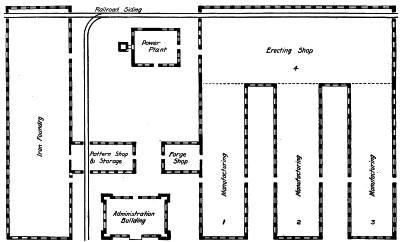
Fig. 1. Typical Layout of a Manufacturing Plant.
The General Office of the concern is of course understood; but, as it cannot properly be classed with departments of the plant, it is not included in the above enumeration.
In addition to the above list of principal departments, there will be the following—quite as necessary, but secondary in importance:
1. The Transportation System, including shop and yard tracks and cars, elevators, cranes, hoists, and all similar appliances for handling material.
2. The Tool Room, for making tools, jigs, and fixtures, and for properly storing them in a convenient manner for issuing when they are called for.
3. An Experimental Room, which all progressive concerns find necessary in the development of their product.
4. The Store-Room, in which are stored the raw material and the purchased stock, either partly or completely manufactured, which are issued to the different departments as needed for their daily routine work.
5. The Finished Parts Store-Room, in which the smaller parts of the product, as fast as they are completed, are stored and held until wanted for the process of assembling.
6. The Pattern Storage Room. In this department, often occupying several floors of a building specially constructed for this purpose, are stored all patterns for the iron and brass foundries, and also those sent to outside foundries for malleable and steel castings.
7. The Carpenter Shop. This is a general utility department making boxes and crates for shipping; doing carpenter work in keeping the grounds and buildings in proper repair, and making necessary changes therein; making and repairing flasks for the foundry; and similar work.
8. The Paint Shop. A small room serving little more than as a storeroom for paints and painters' materials, as their work is principally done at various points in the shops, wherever the machines or parts may happen to be.
9. The Shipping Room. In a plant building large machinery, the shipping room is simply an office for the shipper, the physical work of shipping being done in the shops, wherever the machine may happen to be at the time.
Referring to the plan given in Fig. 1, it will be seen that the Administration Building is placed in substantially the center of the front line of the plant. The first and second floors of such a building are usually devoted to administrative, commercial, and accounting purposes. The upper floor is usually occupied by the Engineering Department and drafting room.
The three Manufacturing Buildings numbered 1, 2, and 3 are devoted to the various operations of making the parts of which the machinery product is composed. These parts are then sent to the Erecting Building (No. 4).
The system of shop transportation consists primarily of shop tracks and cars, and is extended to the yard, being so designed as to connect all buildings of the plant with one another and with the yard. It also reaches the railroad tracks at numerous points. Overhead traveling cranes cover the manufacturing buildings, and extend into the erecting building far enough to form a connection with the large traveling crane serving it, by which the large parts of machines are carried from place to place as may be required by the erecting men. This crane serves to load the finished machines upon the railroad cars, when they are to be shipped, the railroad track being extended within the building for this purpose, as shown in Fig. 1.
The Tool Room is given as central a location as possible, and would naturally be near the junction of building No. 2 with the erecting building.
The Experimental Room has no particular place, but is frequently so placed as to be away from the active manufacturing operations, with which it is liable to interfere if too closely related.
The general Store-Room for purchased material may be in the erecting building, but is frequently located, for convenience of communication, nearer the general offices—as for instance, in front of building No. 1.
The smaller parts are stored in a Finished Parts Store-Room, usually located in this building. Thence they are issued to the Assembling Department as required.
The Pattern Shop building will often be composed of three floors. On the ground floor will be the Carpenter Shop and flask making and repairing work. On the second floor will be the pattern-making shop, and on the third floor will be the pattern storage rooms. A large elevator serves all three floors.
The Paint Shop is sometimes located in one of the manufacturing buildings or the erecting building; but as the painting of machine parts and complete machines is generally done in any one of the departments where the work may be, and the paint shop is hardly more than a storeroom for paints, a due consideration of the question of fire protection would indicate that it had better be placed in a small building entirely detached from all manufacturing buildings.
The Power House, in the former method of transmitting power by shafting and belting, was located as nearly as possible in the center of the space over which power was to be distributed. Since the advent of electricity and its common use for transmitting power, the question of the location of the power house is relieved from this condition; it may be located at the point most convenient to railroad facilities for receiving fuel, or for obtaining the necessary water for boilers, for fire purposes, etc.
In a plant manufacturing small machines or a kind of product which is shipped in small quantities, it is obvious that the Shipping Room must be convenient to the point from which these goods are to be taken by railroad cars, by boat, or by teams. If most of the shipping is of large machines or articles which must be handled by cranes, the railroad tracks will be run into the erecting building, and the machines loaded there, in order to avoid the expense of extra handling and moving them. This is the arrangement shown in Fig. 1. In this case the shipping room may be in the Administration Building, so as to be convenient to the other office departments. In some kinds of business it is convenient to have the shipping room and general storeroom near each other, as there is considerable business done in each that is quite closely related to the other.
The Iron and Brass Foundry is usually located at some distance from the manufacturing buildings, in order that the latter may be as free as possible from the annoyance of smoke and dust. It is connected with the other departments by the system of shop and yard tracks, and the railroad siding track passes through one end of the building as a matter of convenience in shipping castings. There is also a branch track running along the side of the foundry building for the purpose of delivering coke, coal, moulding sand, pig iron, scrap iron, and other foundry materials.
It should be noted that the buildings shown in the plan are located in a compact mass, with considerably less than the usual yard room. In this instance, however, the plan was so drafted to economize space on the drawing. It is the law in some European countries that not over 50 per cent of the area of a manufacturing site shall be covered by roofs. Such a law would be of much value in this country, to prevent the crowding of buildings to such an extent as to be unhealthful to employees.
While factory buildings are frequently erected of from three to to six floors, the modern tendency is to reduce the number of floors in all shops and manufacturing buildings; and in the case of machine shops, a large majority of them are built of only one floor. Some, however, have wide galleries at the side, by which considerable second-floor space is added; while the central portion remains open to the roof, and supplies ample space for the accommodation of the overhead traveling crane, as well as the necessary added height needed for erecting large machinery.
Foundries are necessarily built of a single floor, although there are several in different parts of the country where moulding rooms are located as high as the third floor. This latter arrangement is usually made for brass moulding, rather than for iron moulding.
Organization of a Manufacturing Plant. Having the design of the plant, and assuming that the required buildings have been erected in accordance with this plan, the next step will be to organize the management both in a general way and also as relates to the various departments usually necessary to inaugurate the business of manufacturing.
As the scope of this treatise covers only the shop and its management, we need not take up the commercial organization of the company by which it is capitalized and maintained. We shall therefore consider the General Manager as the head of the organization, and proceed to examine the methods usually adopted for the division of authority and responsibilities from him to the actual workmen at the bench, at the machines, and on the floors.
The chart shown in Fig. 2 illustrates the plan of the organization. Nearly all minor officials and office employees, such as bookkeepers, clerks, stenographers, etc., are omitted from this chart, to avoid confusion and to simplify the understanding of the organization plan and its numerous details.
The General Manager has a personal Assistant, and, for his commercial affairs, the service of a commercial Accountant and a Cashier. Other office employees are similar in number, duties, and responsibilities to those in the usual commercial office.
By referring to the chart, it will be seen that the organization is divided into two distinctly different parts. First, that of production or manufacturing proper; and second, that of selling or marketing the output produced.
In this case the production division is by far the most numerous and complex. This, however, is not always the case—as, for instance, in the case of a manufacturing concern selling its product through local agents. Frequently the territory over which sales are made is divided along state lines, and a District Agent appointed for each state. These, in turn, appoint the Local Agents. This necessitates an organization of hundreds of local agents, supervised by state or district agents, and these in turn by a General Agent. Thus a very large organization is built up for disposing of the product.
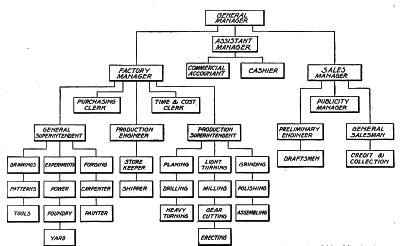
Fig. 2. Chart Illustrating Plan of Organization of a Typical Manufacturing Plant. Showing channels of authority connecting officials and departments.
Another plan is the employment of Traveling Canvassers, each having a certain territory to cover, who make their reports to either state or district agents, or to the general agent located at a central point—sometimes at the factory, but not necessarily so.
As competition becomes stronger and net profits smaller, the problem of marketing the product becomes more and more important; greater and more complex selling organizations are necessary; and the expense of selling increases. The advertising organization, or what has come to be known as the Publicity Department, is a most important adjunct to the modern manufacturing business; and large amounts of money are annually expended in its maintenance.
In the case under consideration, the selling of the product is in charge of a Sales Manager, who has as his office staff the Publicity Manager; the Preliminary Engineer, and the draftsmen and estimators who assist him; the General Salesman, who is in reality the personal assistant to the Sales Manager; and the Credit and Collection Clerk.
The Publicity Manager, sometimes called the Advertising Manager, has charge of all advertising of whatever kind, demonstrations at expositions and at agencies, and, in fact, all work that may be properly comprised under the term "publicity"—that is, keeping the public informed as to the product of the company and its adaptability to meet the needs of the public in the special lines it manufactures.
The Preliminary Engineer is in charge of such engineering matters as are necessary upon new work, or work upon which the Sales Manager desires to estimate. It frequently happens that considerable designing and drawing are necessary in this connection, previous to definite orders being given or contracts signed. It often happens that the product of the concern must be changed in certain details so as to adapt it to the uses of various customers, to the different local conditions under which it is to be used, and to the various purposes for which it is to be used. In case an order is given and contracts signed, the preliminary drawings thus produced become a part of the transaction, and are used by the Production Department in getting out the machinery to fill the order.
The purpose of the Credit and Collection Office is to canvass the financial standing of customers and prospective customers; to make collections when necessary to do so; and generally to advise the Sales Manager on these important matters. The official in charge of this office is frequently called the Credit Man, and must be a person of peculiar ability in his special line in order to protect the concern from fraud, imposition, and financial losses when dealing with customers of commonly unknown or doubtful financial ability and standing.
The Production Division is under charge of the Factory Manager, who has for his personal assistant a Production Engineer or Superintendent, who plans the productive scheme of the factory and supervises the departmental distribution of the work and the shop operations necessary for the routine work upon it. In a large manufacturing establishment, the Production Engineer will be at the head of a considerable force of draftsmen and clerks comprising what is sometimes called the Planning Department, which arranges all operations, shop routine, time schedules, premium rates, and similar matters. The Factory Manager will also have the usual office assistants, and have direct control of the Purchasing Department, the Time and Cost Department, the General Store-Room, and the Shipping Room. In some concerns the Time and Cost Department is a part of the Planning Department, as the records of this department cover nearly every kind of information required for the Time and Cost systems.
All other departments of the factory are divided into two general classes. The first comprises the general departments, as follows:
The Engineering Department, or Drafting Room.
The Experimental and Development Department.
The Power Plant, for both the generation and the distribution of power.
The Iron and Brass Foundries.
The Forge Shop and Cutting-Off Rooms.
The Carpenter Shop (including sometimes the Flask Making and Repairing Departments).
The Paint Shop and Painters' Supply Room.
The Transportation Department for shops and yards.
These are under the supervision of the General Superintendent, who has charge of all mechanical matters except those strictly pertaining to production or to the actual manufacturing of the product.
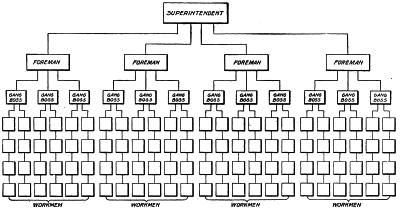
Fig. 3. Chart Showing Official Channels of Communication and Authority from Superintendent to Workmen in a Typical Manufacturing Establishment.
The second general class is that of Production, and will ordinarily consist of the following departments:
The Planing Department, including shapers and slotters.
The Drilling and Boring Department, including vertical, horizontal, and radial drills and boring machines.
The Heavy Turning Department, including lathes of less than 24-inch swing.
The Milling Machine Department, including horizontal, vertical, and special milling machines, profile machines, etc.
The Gear-Cutting Department, for the making of all classes of gears.
The Grinding Department, including cylindrical, disc, and surface grinding.
The Polishing Department, which includes polishing, buffing, etc.
The Assembling Department, in which parts (usually comparatively small) are assembled in groups of related parts and stored, pending the final erection of the machines.
The Erecting Department, in which the entire machine is erected and usually tested, and inspected, receiving the final painting and other finishing work ready for shipping.
Should the character of the product be such as to require it, there will be also a Plating Department, usually located adjoining the Polishing Department.
This class of departments will be under the direct supervision of the Production Superintendent.
Each department is in charge of a Foreman, who is responsible for the discipline, the work, and the efficiency of the force under him. Frequently the department is large enough to require one or more assistant foremen. Under these may also be Gang Bosses, each of whom will have a small force of employees, called gangs, for whose work and efficiency he is responsible.
Shop Management. Referring to the Chart, Fig. 2, it will be noticed that the rectangular figures representing different offices, departments, or officials are connected by lines. These are commonly called lines of authority, and a careful study of them will show in what manner and through what channels the orders of an official pass to the employees for whose work he is responsible.
Tracing these lines from the head of the establishment through the various offices and officials to the different departments, we get a fundamental idea of Shop Management.
This system will be rendered somewhat simpler by reference to the Chart, Fig. 3, which shows the path or official channel of communication and authority from the Superintendent down to the workmen. It also emphasizes the fundamental idea of all official business passing through the officials in charge of intermediate departments.
Thus, if the Factory Manager desires a certain thing done, he does not give the order to one of the workmen, nor to a foreman, but to the Superintendent. The Superintendent will give his orders to the foreman of the department wherein the work is to be done. If this is a department in which there are gang bosses, the Foreman will give his orders to the proper gang boss, who will select a suitable workman, or as many of them as may be necessary, and instruct them as to the work, and will personally see that it is performed promptly and in the proper manner. When the work is completed, he will report the fact to the foreman, who will in turn report to the Superintendent, who informs the Factory Manager that his orders have been executed.
This process may seem unnecessarily complicated, and in consequence it is sometimes referred to as red tape. It is, however, necessary to have a well-defined and properly understood system and channel for all routine business, some of the reasons for which are as follows:
First—it has been said that "no man can serve two masters," and this is quite true in all questions of shop management. Every loyal workman has learned by precept and tradition to look to his immediate superior for all orders and instructions relating to his work, and he naturally and properly resents any attempt to ignore or belittle his legitimate "boss."
Second—As the efficiency of the workmen depends to a great extent upon their loyalty to the management, and as that loyalty can be secured and maintained only by a spirit of justice and fair-dealing to all, including officials and workmen, all authority and responsibility should be sharply defined and properly limited, to the end that the business and work may proceed in an orderly and efficient manner; that all officials and workmen may know when they are within their proper limit of rights; and doing their duties without fear of overstepping their due bounds or interfering with the rights and privileges of their fellows.
Nearly all rules are subject to some exceptions, and the above have theirs. The discipline of the shop, or what is sometimes referred to as the police regulations, are expected to be enforced by all officials at all times.
Two of these exceptions are of such a general nature and application that they are here noted.
First—Any official noticing an infraction of the discipline of the plant may call the attention of the employee offending, without regard to the department in which he works, and require him at once to cease violating the rules. But the official should, as soon as possible, report the matter to the head of the department in which the offending employee works.
Second—Any official noticing work being wrongly done, or material wasted, or machinery obviously injured, or the safety of the workmen, the building, or the machinery endangered, may peremptorily order the action to cease, and at once report the fact to the head of the department or to the Superintendent, as he may judge proper.
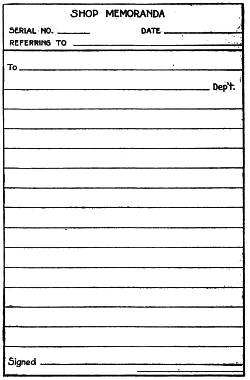
Fig. 4. Form for Ordinary Official Communications. A carbon copy is made on tinted paper.
Official Communications. For ordinary communications other than General or Special Orders, Production Orders, letters, etc., a written form should be habitually used. The usual form is shown in Fig. 4. These forms are put up in pads of alternate sheets of white and light-tinted paper, the former being perforated at the top so as to be readily torn out while the tinted sheet remains fast at the stub. Both sheets are printed with the same form, and all are serially numbered in pairs of one white and one tinted sheet. Carbon paper is used, the white sheet being written upon and the tinted one receiving the carbon impression. Each official is supplied with these pads, and by their use he always retains a copy of any memorandum or communication he makes to another official or department. The serial numbers are intended to aid in the identification of any memorandum that may have become somewhat illegible. The use of these blanks saves any misunderstanding that might occur from giving and receiving verbal orders; and serves to prevent errors and mistakes, and to fix the responsibility for their occurrence upon the party in error.
Successful Management. The spirit of shop management should always be a spirit of leadership. This cannot usually be obtained unless the manager possesses natural ability as a leader. Successful military chieftains are examples of this condition. They lead the men instead of driving them, and the result is a condition of enthusiastic loyalty.
It is also quite as necessary that a leader should be a practical man with sound technical training and practical experience in the business which he undertakes to manage. If he is not thus equipped for his duties, the facts soon become apparent to his subordinates, and his reputation suffers accordingly. The workmen lose confidence in his leadership, and lack enthusiasm in the performance of their duties, going about their work in a listless and perfunctory manner that is very detrimental to the efficiency of the plant.
Still another quality necessary in the successful manager, is the ability to judge men and their capacities for various duties. To get always the right man for the position, the machine, or the job, is a valuable trait in any man who is to direct the work of even a moderate-sized establishment. The larger the plant and the more diversified the business carried on in it, the more valuable and indispensable this characteristic will become. The manager who is continually or frequently changing his subordinate officials, and consequently producing changes in the working force, will always find his duties arduous, and will also find it well-nigh impossible to get the plant up to the degree of efficiency that is to be reasonably expected. The volume of output will continually fall below the normal point, and the quality of the work will also deteriorate. The work of management should be a constant upbuilding of the force, and of development and education along the lines of advancement in the special output of the concern. This cannot be carried on if the composition of the force, or the officials who handle it, are in a transition state of change, doubt, and uncertainty.
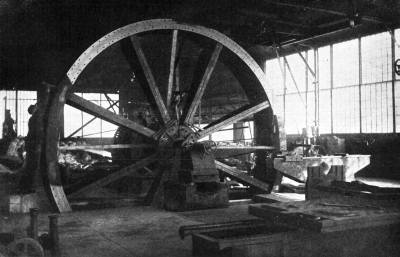
SHOWING USE OF PIT LATHE IN MACHINING A CENTER OF SWING BRIDGE Chicago Bridge & Iron Works, Chicago, Ill.
There is, on the part of many officials having charge of men, a propensity to interfere too much with workmen and their work, and thus to hinder rather than help them. While it is quite true that every official from the Gang Boss up to the Factory Manager can, at various times, help the workmen in their allotted tasks by timely advice and suggestions, it is also true that this is a matter that can be easily overdone, until it becomes an annoying nuisance and unnecessarily interferes with the men in the discharge of their legitimate duties.
Workmen are quick to discern when suggestions and advice are well meant and instructive, and when they come as a kind of veiled criticism. The official who permits himself to indulge in this sort of dictation soon falls into a practice of nagging that is most exasperating to the men. It is a practice that first weakens and then destroys the official's influence with the men, who obey only from necessity. When this condition exists, the working efficiency of the force is at a very low ebb.
On the other hand, really helpful advice and suggestions, made in a cheerful manner and from a quite apparent desire to assist workmen, will usually meet with a quick and loyal response that argues well for the efficiency of the workmen.
Another point on the road to success, is a patient and interested listening to suggestions that workmen have to make, even though it is on trivial matters. It should always be borne in mind that the workman laboring day after day on the same class, and often on the same kind of pieces, of work, is in a position to discern and to study out many minor improvements in tools and methods which are valuable. A kindly hearing accorded him, the adoption of such suggestions as are practical, with some substantial reward for his study, will encourage not only him but other workmen to study their work and endeavor to find better and more efficient ways of doing it. Thus an active and interested spirit of loyalty is brought about that is one of the most valuable assets of the plant.
The successful manager is he who is enabled to unite his working force of subordinate officials and workmen in a complete and loyal organization, all working for the common good and for the success and prosperity of the concern. Having gained this condition, the question of efficient and economical manufacturing is practically as well as theoretically solved.
SHOP METHODS AND RECORDS
From the principles that have been advanced in connection with the subjects of Manufacturing and Shop Management, it will be readily seen that the work of the manufacturing plant of the present day is a very complex matter, and there must necessarily be very complete and carefully formulated plans and systems by which all its operations are regulated, and a somewhat elaborate plan of records by which these operations and their results are recorded and filed.
In formulating the necessary plans for the methods and records of a manufacturing establishment, we must first determine the requirements of the work and decide definitely on what we wish to accomplish. In other words, the conditions must be first examined and analyzed, their various factors studied at their true value, and the requirements determined, so that a general plan of operations may be followed.
These methods shall cover the following subjects:
1. The selection and employment of workmen. 2. The methods of keeping the time of all employees. 3. The manner of paying workmen. 4. The ordering of work into the shops. 5. The routine of passing work through the shops. 6. The method of drawing stock and materials. 7. The ways of keeping and issuing tools.
Importance of Records. Each of these methods will become a part of the routine of the establishment, and the operations carried on under it will be proper matters for regular records made from day to day.
Such records are exceedingly valuable as current information, and, when properly filed, become quite as valuable for reference in the future as for use in current operations.
In all improvements in the working routine of manufacturing operations, there should be previous records by which the present performances may be checked and compared. By this arrangement, it is comparatively easy to ascertain whether or not any improvement is being made, and in what direction it is being made. This knowledge will suggest further plans and betterments. Should the records prove that there are losses rather than gains being made, the warning is equally valuable, and we make haste to better results and greater efficiency in the work.
Thus, whether the plans and methods in use are really successful, or quite the reverse, it is of the utmost importance that we should know by prompt and accurate records just what the results are, in order to keep in close touch with the progress of events, and that, when plans do not produce the favorable results expected and desired, the information may be promptly available, the warning be heard, and plans altered or amended until they bring about a successful routine in the manufacturing operations.
Selection and Employment of Workmen. This is an important matter, since it costs money to introduce new men in any business, and requires from a day or two to several weeks for the new man to become sufficiently accustomed to his work and surroundings to be of the same value as the man who is perfectly familiar with the shop, the routine and methods of work, and the foreman under whom he works.
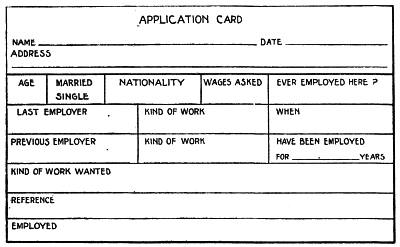
Fig. 5. Application Card.
It is therefore necessary to go about this matter in a methodical manner, and to keep records of:
(a) All persons making application for employment. (b) All persons regularly accepted as employees. (c) Individual records of all regular workmen. (d) All employees who leave the employment of the company.
To accomplish these results, the official whose duty it is to employ men will fill out, or will have a clerk fill out, an Application Card of the form shown in Fig. 5, for each person applying for a position. It will be noticed that it is important to know whether the applicant has ever been employed in this establishment previous to the present application. If so, his record can be readily referred to for information as to the desirability of employing him again. It is also necessary that the record of his last employer be known, and frequently of the employer previous to the last, as these matters will also be taken into consideration in determining his fitness for the position for which he applies. It is also necessary to know how many years he has been employed in manufacturing establishments, as this fact, taken in consideration with his age, will frequently furnish information upon which to base judgment as to his fitness.
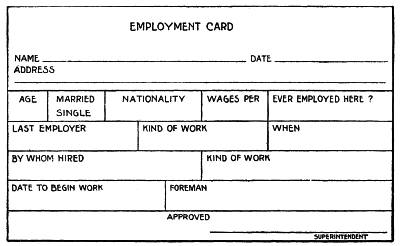
Fig. 6. Employment Card.
The Application Card, being on file, is available for the use of such foremen or other officials as may be in need of workmen. Should the applicant be decided to be available, after consultation between the official to whom application was made and the foreman desiring to increase his force, the applicant will be sent for, and employed at a rate mutually satisfactory, and an Employment Card of the form shown in Fig. 6 filled out. This will repeat some of the information contained on the Application Card; but it is necessary to have two cards in any event, as the information must be filed in separate drawers.
The Employment Card will also give the name of the official employing the man, as well as that of the foreman under whom he is to work, the kind of work he is to perform, and when he is to commence work. It will also require the approval of the Superintendent or Factory Manager, as the case may be, to make it valid and operative.
The applicant having become one of the regular employees of the concern, a third card is made out for filing in the List of Employees drawer. This will be upon the form shown in Fig. 7, and is called a Service Card. It will be noticed that each of these three cards is headed with the name and address of the person whom it represents.
The Service Card gives the department in which the employee is to work, the kind of work which he is to do, the date he begins work, and his rate of pay. Spaces are also provided for noting the amount and date of any increases in his rate, and for the record of a transfer to another department should he be moved, as is frequently the case with new men who may not be quite adaptable to the kind of work first attempted, but entirely satisfactory at some other class of work.
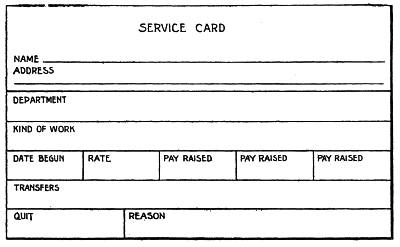
Fig. 7. Service Card.
A space is also provided for noting the date of the workman's leaving the employ of the company, and also for giving the reason for it. This will be valuable information in case the workman should subsequently apply for employment. When an employee leaves the service of the company, his Service Card is removed from the List of Employees drawer, and placed in a fourth drawer labeled Discharged or Quit, being held there for future reference.
Individual Record of Standing. In many well-conducted manufacturing establishments, it is customary to keep a record of the standing of the men as rated each month, as a valuable reference in cases of proposed promotion, increases in pay, reliability for special work and positions of responsibility. Various methods of marking the records of the men each month have been tried, but the simplest method is to use the number 100 for perfect, and to divide it as follows:
Good workmanship 50
Punctuality in reporting for work 30
Deportment during working hours 20
——
Total 100
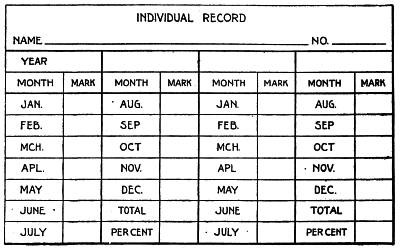
Fig. 8. Individual Record Card.
Demerits are marked off as to workmanship, by the foreman, according to his judgment aided by the Inspector's reports of the work done by the man.
Punctuality is judged by the number of times late, each instance reducing the mark by one unit. As the workman enters the shop twice a day, morning and afternoon, assuming 26 working days in the month, a practical disregard of punctuality soon reduces his record in this respect to zero.
Deportment is judged by the Foreman, who also takes into account occasions on which the workman may have been reported for violating the regulations in this respect.
A Record Card is shown in Fig. 8, upon which monthly records are kept. The total for any period, divided by the number of months covered by the record, will give the percentage of a perfect record. This card provides for a record for two years.
If it seems advisable to do so for special reasons, a similar card may be formulated covering the six working days of the week. A year's record in this form may be entered on a card 4 by 6 inches, by arranging the horizontal and vertical ruling for that purpose.
Such a record may be profitably kept of the work of the office force, as well as of the men in the shops. It will be valuable in many ways in judging of the availability of the men for special work, as well as for promotion.
Necessarily such records should be very carefully kept; otherwise there is liable to be serious injury done to the working reputation and integrity, as well as reliability, of the men.
The Employment Agent. In large concerns, an official is regularly appointed as an Employment Agent, and it is his duty to keep the office and the shops supplied with competent men engaged at reasonable wages. He must therefore keep in close and accurate touch with the labor market, for the same reasons that the purchasing agent must know the state of the market for material and supplies. He must know how and where to reach workmen of the different classes whenever he is called upon to furnish them.
While ordinary laborers may nearly always be obtained from the daily applications made at the office, skilled men must be hunted up; and it is not usually easy to find just the man with the qualifications desired.
When men are wanted for positions above the average skilled workmen, the best and most promising will be nearly always distributed among the present employees who are deserving of advancement. To promote one of them, rather than hire some man from outside the organization, is usually good business policy. The man and his abilities are generally well known, while a stranger is always an unknown quantity. The men, being acquainted with the man, will be pleased to see him get the deserved promotion; and it is always wise to consider the popularity of proposed orders affecting the working force. The man himself will feel his added responsibilities much more than an outside man will, and will generally work harder to succeed in his new position. Therefore it is always best to give the first chance to present employees who have been faithful to the responsibilities thus far placed upon them.
It will be found that in most of the departments there are employees who from one reason or another are doing work quite below their real capacity, hoping that later on there may be better opportunities for the coveted position. The Employment Agent should know the men of the force, and their abilities, so as to take advantage of these conditions. A man may be needed by a foreman in one department who is not aware that in a neighboring department may be just the kind of man he wants. The Employment Agent should know where to find the man at once.
Again, one department may, from the condition of the work, be short of help, and may request the Employment Agent to hire a certain number of men of certain qualifications and abilities. At the same time, there may be another department in which there are more men than can be used to advantage. An arrangement for the temporary or permanent transfer of some of these men will be a great help to both departments, and will have the added advantage of keeping good men permanently employed.
If a workman feels that his employment is permanent, and that there are fair opportunities for advancement, this will be the surest way to hold him faithful and loyal to the interests of the establishment; and the conditions that bring about this condition of mind in him will also draw other good men who will be glad to be counted as among those faithful to a company which appreciates their services and which will look to their interests as they consider those of their employers. The result will be that these men will give their best services, and even be on the alert to further the interests of the employer who has favored them. Thus a strong working organization is built up, which becomes one of the best and most valuable assets of the company.
Time Keeping. As cost of labor is usually greater than any other in the manufacturing plant, and frequently greater than all other factors in the cost of manufacturing, it is very important that the records pertaining to this expense be properly planned and accurately kept.
Various methods have been adopted and used for this purpose. Some of the more prominent plans will be given. They are each adapted to some certain kind or class of work, and it will often be found that in practice still different forms must be devised in order to meet the existing conditions.
There are three methods of recording the time of employees—namely:
1. By entering the time in a book or upon cards, by a Time-Keeper.
2. By entering the time upon cards by the workman himself.
3. By stamping the time upon cards by the workman in a time-recording clock.
The first of these methods is the oldest form, and has now to a great extent gone out of use.
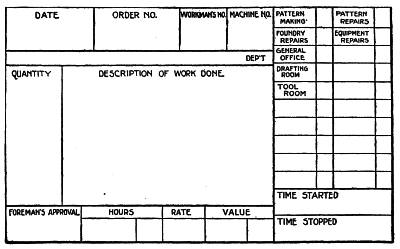
Fig. 9. Pattern Shop Time Card.
A large majority of the work of a manufacturing plant requires that the time worked by the employees shall be registered twice. That is, one entry shall be of the day time (time paid for by the day), which necessitates the recording of the total number of hours worked each day; the second entry shall record the job time (the time worked upon the different jobs during the day). This second entry is sometimes called Time Distribution, since the employee's time is distributed over the different jobs upon which he has worked.
Time-Card Forms. This work is sometimes done by means of time cards as shown in Figs. 9, 10, 11, and 12, which are given as characteristic examples of these methods. These cards are of different tints as a convenient method of recognizing them.
Fig. 9 is yellow, and is used in the Pattern Shop.
Fig. 10 is chocolate-colored, and is used in the Forge Shop.
Fig. 11 is blue, and is used by the Carpenters and Flask Makers.
Fig. 12 is white, and is used in the Machine Shop.
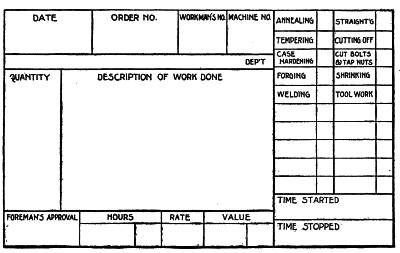
Fig. 10. Forge Shop Time Card.
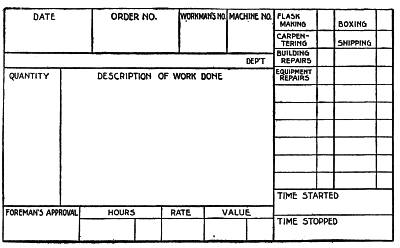
Fig. 11. Time Card for Carpenters and Flask Makers.
Similar card forms may be devised for any other department of a plant, or for the departments of plants doing entirely different work.
When these cards are used as a means of distributing the time to the various jobs or orders in force in the shop, the day time, from which the pay-roll is made up, is usually recorded on a strip of paper in a time clock, the operation being performed by each employee as he passes into the shop morning and afternoon, and when leaving at noon and night. Passing to the clock, the workman swings a lever to his individual number, and presses in a knob, whereby the exact time of the operation is recorded upon a slip of paper, a ribbon, or a disc within the clock.
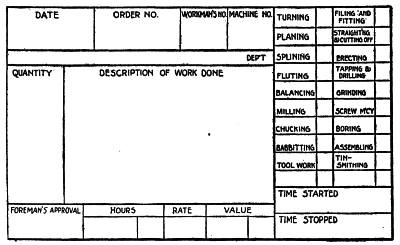
Fig. 12. Machine Shop Time Card.
In other forms of time clock, an individually numbered key is inserted in one of the individually numbered holes, turned around, and withdrawn. The time is recorded in a manner quite similar to that used in the case just described above.
The four forms for time cards shown are quite similar, the difference being in the list of operations given at the right-hand end of the card.
At the top of the card are spaces for the date, order number, workman's number, and the number of the machine upon which he works (provided the work is done on a machine). In the next space, the name of the department is given. This is followed by spaces for the quantity—that is, the number of pieces, feet, or inches of such material as is designated in this way, or the number of pounds in weight of the material. Then comes a brief description of the work.
Opposite each of these is a square in which the workman can indicate the particular kind of work he has been doing, by marking an X. Thus the form shown in Fig. 9 contains the following classes of work—namely, Pattern Making, meaning new pattern work; Pattern Repairs, referring to repairs charged to the job; Foundry Repairs, or repairs to patterns or fixtures the expense of which is to be charged to the Foundry Department; Equipment Repairs, referring to pattern shop equipment; General Office, consisting of small jobs of equipment and maintenance that are better done by a pattern maker than by a carpenter; Drafting Room, similar new work and repairs, such as drafting boards, angles, etc.; Tool Room, similar work chargeable to this department, such as boxes or cases for special tools, and work not entrusted to a carpenter.
Whatever may be the kind of work the employee is engaged upon, he checks it as described; and after the words "Time Started," he notes the hour and minute he begins work. When the job is completed, he notes the time after the words "Time Stopped," The elapsed time, the rate, and the value are filled in by the time clerk.
This card is turned in to the foreman or dropped in a box provided for that purpose, it having been approved by the foreman of the department in which the work is done. It then goes to the time clerk.
As each workman has a card for each different job and for each day, it follows that all the job cards for a single day must aggregate the same amount of time as that indicated on the stamped record within the recording time clock. Discrepancies of this kind are investigated, and the time distribution readjusted until satisfactory, the foreman of the department usually being consulted in the case.
Recording-Clock Time-Cards. Recording time clocks are also made which operate automatically to produce changes in the position of the card dropped into a receptacle provided for the purpose, such, that when a lever is manipulated, not only is the exact hour and minute stamped upon the card, but it is stamped in its proper place upon the card so as to correspond with the proper day of the week and also indicate whether forenoon or afternoon. The horizontal changes of position are made by hand, previous to manipulating the operating lever.
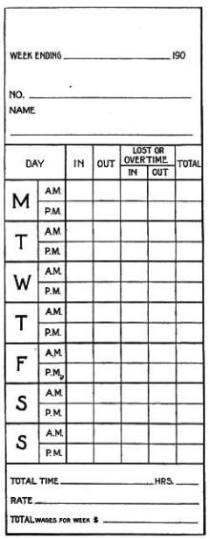
Fig. 13. Day Time Card.
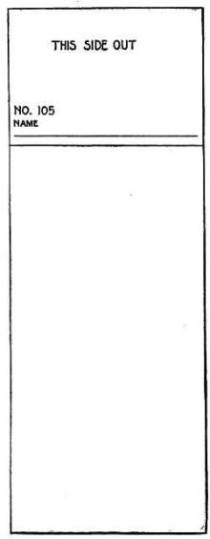
Fig. 14. Back of Day Time Card.
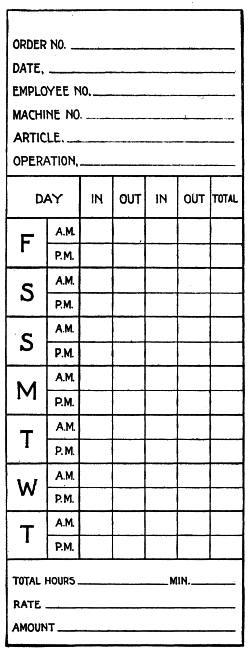
Fig. 15. Job Time Card.
A form for a regular Day Time card is shown in Fig. 13. The days of the week are given, and each divided by horizontal lines into spaces for forenoon and afternoon. Vertically the dividing lines divide spaces for the time the workman comes IN, goes OUT, and for similar records for lost time or overtime, as the case may be.
At the top of the card is the date, generally given as the last day of the week for which time is made up. This is followed by the number and name of the employee. Following the table prepared for the time stampings, is a space for the total time, the rate, and the amount due for the week.
The back of the card is shown in Fig. 14, and is plain except at the top, which is printed in large and plain type "This Side Out," as employees are liable to introduce the card with its face outward. For convenience the employee's number and name are given on this side as well as on the face.
By the above method of time recording, all employees will use the regular Day Time card. Such employees as work on the regular production orders, and on work properly chargeable to them, will in addition to the Day Time card use a Job Time card, of the form shown in Fig. 15. This card is provided with spaces at the top for the order number, date, employee's number, machine number, article or piece upon which the work is being done, and the name of the operation that is being performed. The body of the card has the same spaces for the recording stampings. It will be noticed that the card shown in Fig. 13 runs from Monday to Sunday, inclusive. This is the usual form, but in some shops the fiscal week ends on different days of the week. In the job card shown in Fig. 15, it ends on Thursday.
In the use of these job cards, a card is made out for each job or order, without regard to the number of different jobs an employee may have in a day. The aggregate of the time shown on all these cards for a day must aggregate the amount shown on the day time card from which the pay-roll is made up. Thus each card acts as a check on the other, and accuracy is insured to a considerable degree.
When the work for which the job time is issued has been completed, and the card receives its final stamping, it may be turned over to the foreman, who will send it to the Time Clerk. This gives the foreman an opportunity to look it over and correct any mistakes that may have been made. In some shops the card is dropped into a box marked Job Time Cards—Completed, whence it is gathered up with others, by the Time Clerk. Coming into the possession of the Time Clerk, he will check it up, together with such others as the workman may have used on the same day, in order to ascertain if the total time on the job cards for the day equals that shown on the day time card.
When the Time Clerk has compared the cards, he will send the job cards to the Cost Clerk, who will enter the amounts in a Job Time Summary book of the form shown in Fig. 16. On this blank, the number, name, and rate of each man are written. The succeeding columns are headed with the various current order numbers. Entries are made opposite the man's name, of the pay-roll value of the time he has worked on the various orders or jobs for the day. The total, carried out in the extreme right-hand column, represents his pay for the day. The totals at the bottom of the job columns represent the value of the time spent on each order, for the day. The work is checked as correct when the sum of all the totals of the right-hand column is exactly equal to the sum of all the totals at the foot of the columns.
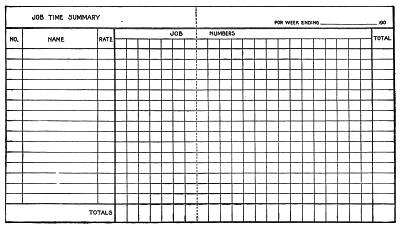
Fig. 16. Job Time Summary.
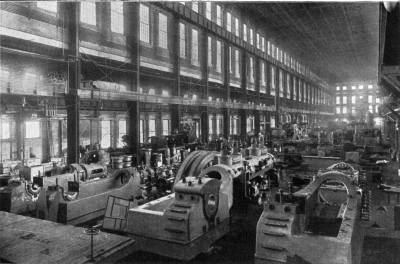
SOUTH END OF ERECTING SHOP, WEST ALLIS WORKS Allis-Chalmers Company, Milwaukee, Wis.
The entries in this book are made by quite young clerks, who handle only these job cards and books as their daily tasks, and who become very expert, accurate, and rapid at this work. The totals are carried by the Cost Clerk or one of his assistants to the cost ledger, in which the costs of both labor and material, as well as all expense charges, are brought together. Sometimes this work is done upon cards, each one representing an order and containing in brief and condensed form all the charges of whatever kind made against the order.
Methods of Paying Employees. The methods by which pay-rolls are made up and the employees paid, are important; and whatever plans are adopted, they should realize the following desirable requirements:
1. The record of amounts due the men should be absolutely accurate and in accordance with the rates at which the men were employed, subject (a) to such modifications as may be made by reason of properly authorized changes in rate; (b) to such modifications as may be made from week to week by overtime work, or by the operation of methods of "piece work," "premium work," or any of the several plans for rewarding exceptionally efficient work; (c) to such deductions as may properly be made on account of advance payments that have been made upon due authority.
2. The methods of making up the pay-roll and paying the men should secure promptness in this work, so that the pay of the employees may not be held back for an unreasonable length of time pending the necessary clerical work.
3. The methods of payment should be such that no workman can know the amount paid to any other workman.
To accomplish the results desired in the first requirement, if the amounts due the men are made up from the time recorded by the men themselves—that is, in a recording clock—is a comparatively easy task, since it is principally a matter of mathematics, with a strict attention to details.
Changes in rate of pay do not usually take effect until the week following that in which the order is given. This order will be in the form of a request by the foreman of the department in which the workman is employed, stating the reasons for the increase. This is sent to the Superintendent or Factory Manager for approval. If approved it is then sent to the Pay Clerk, who files the notice for future reference and makes the required change on his pay-roll.
Premium work rates will be made up by the foremen of the departments, and approved by the Superintendent, in smaller shops. In large plants the rates will be made up by a clerk in the Production Department, and approved by the Production Engineer. In either case they will be sent directly to the Pay Clerk.
Advances to men will be made only in special cases, upon a written request from the foreman, stating the reasons and approved by the Superintendent.
The second requirement can be met by having the time cards of the style used in recording clocks (as shown in Figs. 13,14, and 15). The convenience and rapidity of making up the time of these cards is apparent from the fact that the record of the entire week is contained upon the face of one day time card, lost time being checked only in red ink in the total column at the right, and the sum of the amounts of lost time being subtracted from the regular working time for the week Thus, if the working time is 55 hours per week, and the lost time was ½ hour one day and ¼ hour another, making ¾ hour, we subtract that from 55, leaving 54¼ hours as the time for the week. This is much more rapidly done than to carry out the total time for each day and add up these totals for the six days of the week.
The Pay-Roll Sheet or Pay-Roll Book is shown in Fig. 17. This is now frequently made as a loose sheet or such number of sheets as may be necessary to contain all the names, frequently as many as 50 names on the sheet. Upon examination of this printed form, it will be seen that the regular time is divided into productive and non-productive labor. This is for the purpose of ascertaining what portion of the labor is applied directly upon the product, and what portion is applied indirectly, such as foreman, clerks, general laborers, etc., whose work is classed as non-productive.
The amount of the regular time is computed, and entered in the column headed Amount. If there is an amount due in premiums, it is entered in the next column, and the two amounts added in the column headed Total Amount. In the next column is entered the amount of any advances that may have been made, which is deducted from the total amount, leaving the net Amount Due, which is entered in the next column. This amount is paid over to the employee, who signs his name in the space under By whom received, and the operation is complete. The men's numbers are placed at the extreme left hand and right hand of the form as a matter of convenience in rapidly handling the work of paying off.
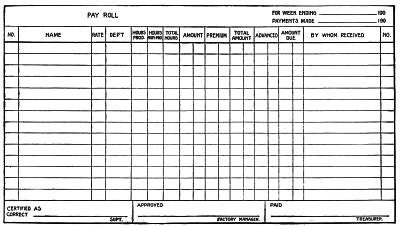
Fig. 17. Pay-Roll Sheet.
When the pay-roll has been completely made up, it is submitted to the Superintendent, who certifies as to its being a correct list of men actually employed, and to the rates of the different men. It is then submitted to the Factory Manager for approval. After the amounts due the men are actually paid and receipted for, the Treasurer certifies the fact, and the pay-roll becomes a voucher for the amount represented on the roll.
Giving Orders for Manufacturing Work. As ordinarily considered, orders are of two general classes, namely:
1. Production Orders, by which the production departments are set to work manufacturing some regular or special product which is to be sold to customers.
2. Plant Orders. These orders relate to the repairs and maintenance of the grounds, buildings, and equipment of the plant, and to new additions to and alterations of the same.
Both of these classes originate with the Factory Manager, who receives instructions as to all important orders from the General Manager of the company, who will authorize and keep in touch, not only with the production of the plant, but in a general way with all changes, improvements, and maintenance expenses of the establishment.
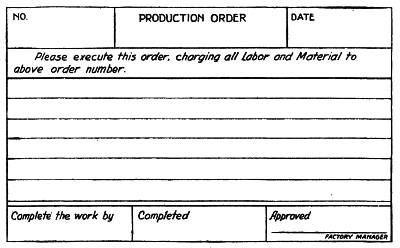
Fig. 18. Production Order.
Production Orders. Fig. 18 shows the form of a regular production order. This card or blank is made of such dimensions as the kind of manufacturing business to which it pertains may require. It is customary to use a card 4 by 6 inches; but if such is to be written upon the central space in order to describe the work properly, it should be somewhat larger. The principal features of this form are spaces for the title of the card, the order number, and date. At the bottom is given the date when the work is expected to be completed, and the date of its actual completion. These dates are important as a matter of reference in considering the promptness and efficiency of the departments where the work has been done.
The work to be done is briefly described in the central portion, together with such references to sets of drawings, etc., as may be necessary to render the terms of the order indisputably certain. This order is signed by the Factory Manager and sent to the Superintendent. In a large concern it is sent to the Superintendent of Production or the Production Engineer, according to the particular manner of the organization of the official force.
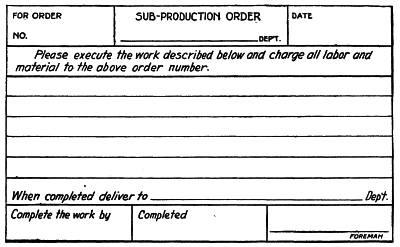
Fig. 19. Sub-Production Order.
In any event the order is turned over to the official having charge of production, who will make out Sub-Production orders (Fig. 19) for each department in which the particular work described upon the orders is to be done. A time limit is given for the completion of the work, and a space provided for the actual date of completion. They are not signed when issued, but are dated and signed by the foreman when the work is completed.
Plant Orders. As has been described, plant orders are those necessary for the changes, improvements, and maintenance of the plant and equipment. In some establishments there are two series of orders, namely: (a) those for improvements and maintenance of the plant proper—that is, grounds and buildings; and (b) improvements and maintenance of equipment. This is a very proper and natural division. These accounts may be subdivided to a very great extent, but not with corresponding value.
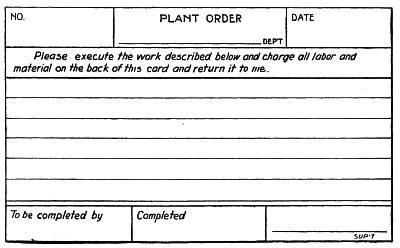
Fig. 20. Plant Order.
Plant orders are usually issued by the Superintendent (or General Superintendent, in a large plant), and are returnable to him, as will be seen upon reference to the form shown in Fig. 20. This order is usually directed to a certain department. If more than one department is involved in the work, a separate order is issued to each. The general form of the order is the same as in the two preceding ones, the instructions being changed to suit the nature of the case.
On the back of this order is a form for entering the cost of material and labor, as shown in Fig. 21. The dates upon which each item (or group of items) of material is furnished, are given, as are also the dates for the various items of labor, although the work of an entire week may be entered upon a single line. On the second half of the card, space is provided for the totals of both material and labor cost; also such general expenses in the form of a percentage or such other apportionment as may be authorized, are entered.
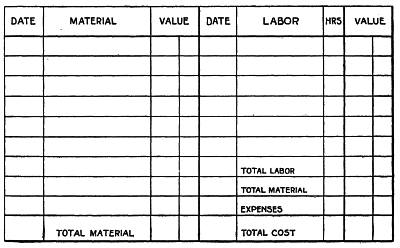
Fig. 21. Back of Plant Order Shown in Fig. 20. For entering cost of material and labor.
By this method the order for the work, and a summary of the expense of executing the order, are contained upon the same card, which is very convenient for future reference and comparison.
Storing and Issuing Stock and Materials. The orders having been put in force in the shop, the next step is to obtain the necessary material or stock with which to do the work.
All purchased stock, material, and stores are turned over to the General Storekeeper, whose duty it is to classify them, store them properly, and issue them only on properly authorized requisitions. A large portion of his stock he obtains by making requisitions upon the Purchasing Agent.
To account properly for the receipts and issues of this stock so as always to have on hand what is wanted, and at the same time to avoid carrying an unnecessarily large stock of any of the articles in store, he uses a Stock Ledger Card of the form shown in Fig. 22. This gives the name of the article listed, and its dimensions, weight, etc. At the right of this are entered the maximum and the minimum quantities to be kept in stock. Whenever the stock on hand is reduced to near the minimum quantity, the Purchasing Agent is requested to order enough more to bring the quantity up to the maximum.
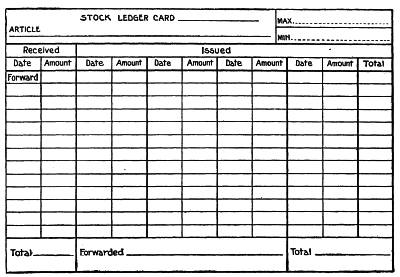
Fig. 22. Stock Ledger Card. Same form is printed also on back of card.
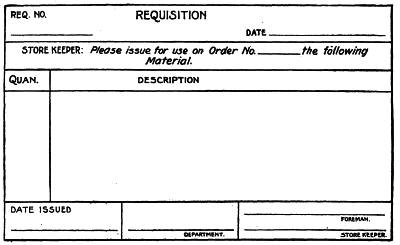
Fig. 23. Form of Requisition. Carbon copies of the entries are made on the Invoice form, Fig. 24.
In making requisitions upon the Purchasing Agent, the Storekeeper must take into consideration the length of time necessary to obtain the article wanted. Wire nails, wood screws, and such articles can usually be obtained in 24 hours, while brass tubing may take three weeks. Iron castings can be had in two days, while steel castings will frequently require six weeks.
When articles are received in stores, the date and quantity will be entered under the heading Received, and other quantities added to these as received. Articles issued will be charged under the heading Issued, giving the date and amount. The quantity on hand may be quickly ascertained by adding the quantities received and the quantities issued, and subtracting the sum of the issues from the sum of the receipts.
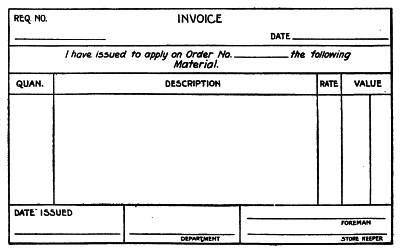
Fig. 24. Form of Invoice. Entries are made by means of carbon paper, duplicating those made on the Requisition form, Fig. 23.
As most articles are purchased in considerable quantities and issued in small lots, there will be few entries of receipts and a large number of entries of issues; therefore the greater portion of the card is devoted to records of issues. The card is printed with the same form on both sides; and when the spaces on the first side are filled, the account is balanced, and the results carried to the opposite side.
These cards are kept in filing drawers, where they are located in alphabetical order by the names of the articles they represent.
A foreman, on receipt of a regularly numbered and authorized production order or sub-production order, is thereby authorized to make requisition for such stock and material as may be necessary to use in the execution of the order. This he will do by the use of the Requisition shown in Fig. 23, entering the order number and date, and specifying the quantities and descriptions of the articles required. Ordinarily each requisition will contain but one article or class of articles. At the bottom of the requisition, the foreman will enter the name of his department and his own signature.
These requisition blanks are made up in pads (the form shown in Fig. 23), of white paper alternating with tinted paper on which is the Invoice form shown in Fig. 24. This latter form has its ruling and other principal features identical with the form of the requisition, so that by the use of carbon paper the foreman makes a duplicate on the Invoice blank, of the order number and date, the articles required, the name of his department, and his own signature.