COST-ANALYSIS ENGINEERING
Reading edition
Definition. Cost-Analysis Engineering is that branch of Engineering which has for its object the analysis of costs of construction or of operation, with a view to effecting a greater economy of production, and with a view to securing accuracy in estimating the probable cost of projected structures or operations.
The Modern Manager a Cost-Analysis Engineer. It takes few men to design machines and structures, but it takes many men to superintend their operation. Therefore the great field of activity for the engineer of the future is in the field of operation rather than of design.
Until very recent years, engineers have rested satisfied with being designers of labor-saving appliances. Now, however, they are beginning to assume the broader and more profitable function of operating the plants which their brains have created. To handle the ordinary industrial enterprise successfully, involves:
First, the application of engineering ability in selecting and improving the machines used;
Second, managerial ability in organizing the workmen, and in stimulating them to produce a large output economically;
Third, advertising ability to sell the product.
The man who combines in himself the maximum sum of these three abilities is the man best adapted to succeed as the executive of an industrial enterprise. Since the introduction of systems of cost analysis and unit-payments for work done, engineers have become best qualified to act as managers of manufacturing plants. We include contracting and railroading among manufacturing industries, for the contractor manufactures structures, and the railroader manufactures transportation.
Before cost analysis had been developed to its present stage of excellence, the successful manager of men was usually one who had relied upon his lynx eyes and his knowledge of the weaknesses of human nature. He was often a man who owed his success largely to the fear he could inspire in his subordinates. He was domineering; he held his men to their tasks; he was, indeed, an industrial captain; and he used army discipline. He regarded every worker as a thief who would not hesitate at petty larceny of time, even in the face of the foreman, and who delighted in grand larceny behind his back. His foremen were his spies; and he set himself to spy upon his foremen. But cost-analysis engineering is evolving a wholly different class of managers and foremen.
To most people, a cost-keeping system means nothing but a sort of bookkeeping; and they are unable to understand how a bookkeeper can develop into a successful manager. But the truth is that modern cost keeping involves cost analysis, and cost analysis involves a study and comparison of methods and machines, and such a study leads to improvements and to commercial success.
Cost keeping, in the sense that we use the term, has for its main object the determination of the efficiency of men. A proper system of cost keeping tells you daily what each workman or each gang of workmen has accomplished. It is better than a foreman, for it cannot "stand in" with the men. It is better than a foreman, for it costs you less and it tells you more. A cost-keeping system tells you who are your good men, and who are your lazy men. It shows you whom to discharge, and whom to promote. It tells you whose wages are too high, and whose are not high enough. And, finally, it leads to that ideal condition of industrial organization known as profit-sharing. How often have we read in novels of Utopia, where all men share in the profits of all business; and how often have we smiled with incredulity at the prospect? Yet Utopia is right here in America, in spots; and it is a Utopia far more rational than that of the dreamers. There are many firms that pay their men on a unit-price or bonus system. This is profit-sharing, and it is a profit-sharing begotten by the use of cost-keeping systems; for, when a manager has learned by cost keeping that certain men or groups of men produce more than others, he soon perceives the advantage of stimulating them to further use of brain and muscle by paying them either a bonus for each unit produced in excess of a prescribed minimum, or a unit-price for each piece of work performed. The men invariably respond to this stimulus, and often in a remarkable degree. It is nothing unusual for a man to increase his output 50 per cent upon the introduction of a bonus system of payment; and there are many instances of increase amounting to 200 per cent. Each man then becomes a contractor, and works with the zeal of a contractor, for his earnings increase as his energy and ability increase. This is practical profit-sharing that any workman can understand. It is not something vague and intangible, like 5 per cent per annum. It is something very real and immediate, for a man can feel it in the pay envelope at the end of every week.
Cost keeping, then, leads to better management, although dispensing largely with submanagers. It substitutes the record card for the "big stick," yet the record card itself is the biggest stick ever devised.
The Science of Management. The managing of industrial enterprises is still more or less of an art; but the art is fast passing through the period of evolution that produces a science. There are, unquestionably, certain underlying principles of management which can be summarized into rules or laws. These rules or laws constitute the science of management, and it is our purpose to present certain of the more important laws of management.
Individual Incentive. When a group of men undertake to do a certain piece of work, such as shoveling earth into a wagon, the tendency is for each man to do as little as his neighbor. The inevitable result is that the shovels move with rhythmic precision, and the slowest man becomes the pacemaker for the rest. If any one of the men is ambitious to do a larger day's work, he is deterred by the knowledge that his employer will never know that it is he to whom the credit is due for a larger output. Then, too, the other men are apt to upbraid an ambitious man, and urge him not to set a "bad example" by working fast. To offset this tendency to fall to the lowest level of efficiency, employers have placed foremen over their employees, the duty of these foremen being to accelerate the motions of the men in any way possible. Each foreman has an individual incentive to get work done economically, for his employer studies the total amount of work done by the gang under the foreman, and rewards or punishes the foreman accordingly, the reward usually consisting of praise and an increase in salary. But the workmen under such a foreman have no individual incentive, and they will shirk their tasks as far as possible. Clearly, then, the first law of management is to create an individual incentive for every employee to do his best.
Creating Individual Incentive in a Gang. There are, and always will be, certain kinds of work that must be performed by a group of men working together, or, as we shall call it, a gang of men. When this is the case, the first step to be taken is to devise a method of readily and accurately measuring the work performed each day—not each week or each month—by the gang. The next step is to notify the men that, for all work performed daily in excess of a specified number of units of work, a bonus or premium will be paid for each excess unit. Of this bonus, the foreman will get a specified percentage, and the men will divide the rest among themselves. Thus a powerful individual incentive is created. It is true that certain men in the gang will remain less efficient than certain others, but the general average output will be greatly increased. The foreman himself will have enough incentive to see to it that the lazy or inefficient workmen in the gang are discharged, for it will no longer pay him to play the part of indulgence for the sake of being "a good fellow."
Devising Ways of Dispensing with Gang Work. Simply because it has always been the custom to do certain classes of work by gangs, should not deter a manager from endeavoring to devise a way of splitting the gang up into individual units. Indeed, it should be self-evident that if the creating of individual incentive is the fundamental law of management, a great amount of study may profitably be devoted to increasing individual incentive by doing away with gang work entirely. To illustrate, let us assume that 12 men are engaged in shoveling earth into wagons, working in two gangs of 6 men, with one foreman supervising the 12. If a sufficient number of teams and wagons are used, there will always be 2 wagons in the pit being loaded, and 6 men shoveling into each wagon. As fast as a wagon is loaded, it pulls out, and an empty one takes its place. If a manager is told that he can do away with this system of gang work, he will usually reply that it is impossible. Nevertheless, it is possible to reduce this gang work to individual work in most instances, as follows:
Instead of having 2 wagons and teams in the pit all the time, have 6 wagons without teams—6 empty wagons. Assign two men to each wagon. Provide a dividing board between the sides of each wagon, running either longitudinally or cross-wise, so that each man has his definite half of the wagon to fill. Then pair the men off according to their respective abilities, putting the two best men on one wagon, the two next best on another wagon, and so on. When a team brings an empty wagon into the pit, let it be unhooked from the empty wagon and hooked to a loaded wagon, thus saving team time, which would otherwise be consumed in waiting for the wagon to be loaded.
It is possible to give many illustrations of this sort, but not desirable, for our object is to indicate the laws that should be applied, rather than to solve specific problems. The student of cost-analysis engineering will derive his greatest stimulus from applying the laws to specific cases that come under his own observations.
Prompt Reward. Most men believe in Heaven, and many believe in Hell; but few are greatly affected in their action by the hope of the one or the fear of the other. Any reward or punishment that is remote in the time of its application, has a relatively faint influence in determining the average man's conduct. To be most effective, the reward or punishment must follow swiftly upon the act. Hence a managerial policy that may be otherwise good is likely to fail if there is not a prompt reward for excellence. All profit-sharing systems have failed, principally because of failure to recognize the necessity of prompt reward, as well as because of failure to recognize the necessity of individual incentive. The lower the scale of intelligence, the more prompt should be the reward. A common laborer should receive at least a statement of what he has earned every day. If, in the morning, he receives a card stating that he earned $2.10 the previous day, he will go at his task with a vim, hoping to do better. But if he does not know what he has earned until the end of a week, his imagination is not apt to be vivid enough to spur him to do his best.
One contractor, known to the authors, has a large blackboard on which the hourly record of his brickmasons is chalked up. He has found that this constant record of where they stand in the day's race is a splendid stimulus.
Sufficient Reward. When a man produces more than has been his custom, he feels entitled to a very large percentage of his increased output. His sense of justice is keen on this matter, and rightly so. It is true that he is not entitled to all the increase, for his employer may have provided him with machines or tools of a better kind, for which payment must ultimately be made. Moreover, more rapid work with any machine means more rapid wearing-out of its parts, and a consequent expense to the employer. Finally, the employer who has used his brains to devise ways of increasing the output of the employees is entitled to a very substantial reward. No one begrudges Thomas Edison his wealth. He has earned it by virtue of his inventions. In like manner, every man should be richly rewarded for every labor-saving machine or method which he creates or which he applies. However, employers are prone to try to take too large a part of the profit effected by an introduction of a system of unit-payment for work done.
Mr. Fred W. Taylor says that a workman should receive 30 to 100 per cent increase in wages upon the introduction of a piece-rate or bonus system of payment. Mr. Halsey says that the workman should receive one-third of increased value of his product resulting from an application of the bonus or premium system of payment. But the fact is that the employer should share liberally with his men; and, in the long run, the competition of other employers who are bidding for the services of workmen will force wages up to a point where the workman secures all but a very moderate percentage of the value of his daily product.
Educational Supervision. As previously stated, the old type of foreman mingles the functions of a spy with the functions of a mule-driver. The higher we go in the scale of human intelligence, however, the more noticeable is the fact that the supervisors are teachers of the men they supervise. These supervisors, foremen, managers—call them what you may—have learned that it pays better to spend time in training their men than to spend time in tongue-thrashing. Only of late years has it been discovered that systematic training of the least intelligent of workmen pays equally as well as the training of the most intelligent. The manager who recognizes the necessity of educational supervision, undertakes, first, a careful time study of each class of work. Then he analyzes the results, and deduces methods of securing greater economy. Having evolved a method of procedure, he reduces it to writing, and furnishes his foremen with detailed written or printed instructions to be followed, or, where the workmen are intelligent enough, the instructions are given to them directly; otherwise it is the function of the foreman to instruct the workmen.
Divorce of Planning from Performance. We have just spoken of the education of the workmen by the manager; but, before such education is possible, the manager must educate himself. In brief, he must study the problem and plan its most economic solution. According to the old-style method of management, each foreman was left largely to his own resources in planning methods, and, added to this duty, he had several other duties to perform, such as "pounding the men on the back" when lazy, seeing that materials were promptly supplied, employing and discharging men, looking after the condition of machines, etc. This multiplicity of duties can be properly performed, only by a foreman possessed of a multiplicity of talents. Since few foremen can comply with such a specification for brains, it follows that good foremen of the old style are rare indeed. The modern system of management consists in taking away from the foreman the function of planning the work, and in providing a department that does all the planning. This planning department should be under the supervision of the Cost-Analysis Engineer, for it is he and his assistants who, by unit-timing of work and by cost keeping, are best able to ascertain what methods should be applied to get the most economic results. Having planned a method, the Cost-Analysis Engineer delegates its pursuance to one or more foremen.
Subdivision of Duties. The previous rule of action comes under another, still more general in character—namely, the law of the subdivision of duties. Men are gifted with faculties and muscles that are extremely variable. One man will excel at running a rock drill, another at keeping time, another at surveying, and so on. It is clear, therefore, that the fewer the duties that any one man has to perform, the easier it is to find men who can perform the task well. But give a man many duties to perform, and he is almost certain to do poorly in at least one respect, if not in several. One foreman may have a great knack at "keeping an eye on" machinery, and in having few break-downs and delays. Then it is the part of wisdom to burden him with no other duties, unless the magnitude of the work does not warrant dividing the duties among two or more men. Let him be the machinery and tool foreman, reporting directly to the Cost-Analysis Engineer, and subordinate to no other foreman.
Another foreman may have a special knack at teaching workmen how to use tools and machines. Let him have no other duty but to see that the men have the proper tools, get them promptly, and use them properly. Let him be the gang foreman.
According to the magnitude of the work, there may be different kinds of foremen, all coming in contact with the same men, perhaps, but each performing different functions.
Limitations of Military Organization. Most industrial organizations to-day resemble military organizations, with their generals and intermediate officers, down to sergeants, each man reporting to but one man higher in rank. There is little doubt that the present tendency in industrial organizations is to abandon the military system to a very large extent, and for the following reasons:
A soldier has certain duties to perform, few in number, and simple in kind. Hence the man directly in command can control the actions of his subordinates easily and effectively. Control, moreover, should come invariably from the same officer, to avoid any possibility of disastrous confusion, and to insure the instant action of a body of men as one single mass.
On the other hand, industrial operations do not possess the same simplicity, particularly where men are using machines; nor is there the necessity of action in mass. The military organization, therefore, should be modified to suit the conditions; and one of these modifications is the introduction of two or more foremen in charge of certain functions or duties of the same men or groups of men, as explained in the paragraph on Subdivision of Duties.
Opposition to Change. All men have a certain mental inertia which makes them resist any change of their methods and habits. Foremen are particularly resistant to change, because of their custom of giving orders more frequently than receiving orders. Hence the Cost-Analysis Engineer who is trying to introduce modern methods is sure to meet with violent opposition from foremen; and the older the foreman, the more violent the opposition. When the Cost-Analysis Engineer introduces a new method, he must personally attend to every detail, or it will surely "go wrong." The old foreman will see to it that it does "go wrong," just to show that the "new-fangled ideas" are worthless.
Opposition may also develop among labor unions, particularly if it is proposed to pay on the piece-rate plan—that is, to pay so and so much for each unit of work performed. The bonus plan and the premium plan (to be described later) are schemes to overcome this opposition to the piece-rate plan, but in essence they are all the same.
No manager of men can attain great success unless he has grit enough and tact enough to overcome the opposition to change which he will encounter from all quarters. If he realizes in advance that such opposition is as certain to manifest itself as it is certain that it takes power to change the direction or speed of motion of a heavy body, he will have possessed himself of one of the laws of successful management.
A man cannot impart motion to a very heavy rock by violent impact of his own body against it; but he can separate it into fragments, and move each fragment by itself. In like manner, no attempt should be made to change all the methods of an industrial organization at one stroke. Separate it into elements, and take one element at a time, beginning with the simplest. Apply your cost-keeping system to that element—it may be only the hauling of materials with teams—and effect the change desired. Then take another element of the organization, and apply the system to it. Continue thus, fragment by fragment, and you will overcome the opposition that would otherwise resist your greatest effort.
Respect Your Own Ability. One of the most common mistakes made by managers lies in assuming that a skilled workman necessarily knows better how to perform work than does the manager himself. A manager should first aim to familiarize himself with the methods used by the best workmen, and then, by an itemized time study, he should set his own wits to work to improve the methods. Workmen, for the most part, do their work just as robins build their nests—by the pattern of precedent. They put little or no brains into improving the process, because it usually means no money in their pockets to effect an improvement, and because they reason that an improvement that effects a saving in time may actually result in the discharge of some of their fellow workmen. It should be a cardinal law of management to give very little weight to the claims that workmen make as to their own skill or knowledge; and the same holds true as to foremen. Because a man has blasted rock for twenty years, should not make his opinion of such force as to prevent a manager from undertaking to show that man how to do rock-blasting more economically. We have frequently effected great economies in rock-blasting after a time study occupying fewer weeks than the blaster had occupied of years in the same sort of work. The trained mind of the Cost-Analysis Engineer enables him to analyze costs and methods, and to develop improvements which no amount of so-called "practical experience" can effect.
Weigh carefully every reason against any proposed change in method, and act accordingly; but pay no attention whatsoever to predictions of failure that are bare of reasons. Do not be influenced even by many positive statements that your proposed method has been tried and has failed; for its failure may have been purposely brought about, or some small condition essential to its success may have been absent.
Therefore, respect your own ability. The manager who cannot improve upon methods used by his men is not fit to manage.
Profit Does Not Mean Excellence. Many a manager points to the profits of his business as the profit of his ability. He forgets that to a plainsman a small hill looks like a mountain. The general level of mediocrity makes such managers fancy that they are quite extraordinary if their business shows a large profit.
The Cost-Analysis Engineer can frequently take a profitable business and convert it into a wealth-producer beyond all dreams of the ordinary self-satisfied manager. Nor should the Cost-Analysis Engineer himself grow satisfied. There is positively no limit to the economies in production which may be effected by the human brain.
The Human Engine. The human body is an engine, or rather a boiler and engine combined. Its fuel is about 3 pounds of solid food daily, containing about as much energy as one pound of carbon or coal. One pound of coal will develop energy enough to perform about 10,000,000 foot-pounds of work; that is, it will raise 10,000,000 pounds one foot high, if there is no loss of power. But in all boilers and engines there is a loss of power, due to heat lost by radiation, heat carried away in the escaping gases and solids, etc., and heat developed by friction. A steam boiler and engine suffers so much loss of heat energy from these sources, that it rarely develops an efficiency of more than 10 per cent of the theoretical energy of the coal consumed. Curiously enough, the human body is not much more efficient than a steam boiler and engine; so that, while the one pound of carbon fed into the human body has a theoretical energy of about 10,000,000 foot-pounds, the actual useful work performed by a man is seldom more than 1,500,000 foot-pounds a day, or about 15 per cent of the theoretical energy of the food consumed.
When a man is walking, his whole body rises and falls each step, the rise being about one-seventh of a foot. Hence, in walking 25 miles in a day, about 2,000 steps per mile, a man weighing 140 pounds does 1,000,000 foot-pounds of work in raising the weight of his own body, to say nothing of the energy consumed in swinging his legs. A man may walk the 25 miles in 10 hours, or he may walk it in 8 hours. In either case, he does substantially the same amount of work, and burns up substantially the same amount of food.
It should be clear, therefore, that when workmen are doing intermittent work, with periods of comparative rest, they are capable of working correspondingly harder during the periods of exertion. Thus, in running a rock drill, the physical labor is light, except when shifting the drill or when changing drill bits. At such times, the men should be required to work with great vigor in order to reduce the lost time.
It should also be clear that workmen should be taught to make no unnecessary movements of the body in doing work. Yet it is a fact that few workmen economize their energy by avoiding unnecessary motions.
It should also be clear that it pays to house workmen at no great distance from their work, so as to reduce the labor of going to and from the work; for every foot-pound of energy spent in going or coming reduces by that much the available energy of the man.
If it were practicable to measure the amount of resistance involved in doing each class of physical work, we could readily reduce to a science the setting of reasonable daily tasks. The authors are of the opinion that a careful study of resistances will eventually enable managers to fix certain tasks with great accuracy. To illustrate, let us assume that it is desired to know how much sand a workman should be able to shovel into a wagon box 5 feet from the ground in a day. It is not impracticable to measure the force required to push the shovel into the sand, and the distance pushed. The average weight of the earth on a shovel, and the weight of the shovel can be ascertained. The vertical height that this load is lifted, is easily measured. If the workman bends his body to fill the shovel, the weight of his body above the waist, multiplied by the height that the center of gravity of that weight travels will give the foot-pounds of work done in bending the body. And thus, by a calculation of each element of work done, an accurate forecast of the total possible work could be made.
Such a study as this will often disclose an unsuspected lack of economy in using certain tools. From such a study, for example, it is perfectly clear that the long-handled shovel, universally used in the far West for shoveling sand, gravel, etc., is a more economical tool than the short-handled shovel used in the East. Men have argued about this matter for years without coming to a definite conclusion, the reason being that workmen accustomed to the short-handled shovel prefer it, while workmen accustomed to the long-handled shovel show an equal preference for that type of tool.
COST GETTING
In taking of time and in the application of the cost of labor to the cost of work, there are probably as many systems as there are organizations doing work; and even within any one organization using a well-defined system throughout its entire operations, there will be no two men making the same interpretation of the rules laid down, or—more especially—whose methods of attack will be the same. But in spite of these many variations of method, there are several primary systems which are standard, and which can be found in one form or another on all properly conducted work.
The starting point of all cost getting is the taking of the time in the field, and it is here that the greatest variation in individual method is found. The most common way of taking this time record from which the pay-roll and the cost distribution is made, is for the time-keeper to go over the work with a notebook and put down therein with a pencil the number of each man and the particular part of the work that he is engaged on.
Two systems of record keeping, of which small cards form the basis, are also in vogue. One of these systems uses what is known as punch-cards—that is, cards in which the records of time, distribution, and performance are made by means of an ordinary conductor's punch; and the other has the record made in a way somewhat similar to the entries in a notebook—a written record being made on the cards with a pencil. Another system bases its records upon reports turned in by foremen.
Time-Keeper with Notebook. While the manner of taking time with a notebook varies according to the training and experience of the time-keeper, it may be said that there are in general two ways in which such notes are kept. In the first, the time-keeper has a list of the numbers of all men on the work, and, as he goes over the work, simply checks off the numbers, showing that each particular man is at work and indicating upon what branch of the work he is engaged.
A more common way, however, is for the time-keeper to make headings corresponding to the distribution used in making up the office records, and to write under each of these headings the numbers of the men working upon the part of the work so named. This method is often simplified by the time-keeper becoming so familiar with the foreman, and the numbers of the men under the particular foreman, that he is able to dispense with the headings entirely, and simply use the foreman's name or number in place of it. This, of course, makes the time-keeper's notes more or less unintelligible to anyone but himself, and makes it necessary for him to do office work as well as his field work. Moreover, not being a permanent or intelligible record, it is impossible for even the man who made the notes to return to them in case any dispute arises or a mistake is found to have been made, and get information after the notes have "grown cold." The time-keeper becomes so familiar with the appearance of the men who are on the work, that he learns to know their numbers, and often attempts to put them down without seeing their numbered checks. This is often a source of error, as the uneducated foreign laborer is very liable to make a mistake in stating his number; and if he does, there will exist no record of his having worked that day, and he will get no pay for it. The apportioning of the cost of his labor to any work that he may have been on, will also be the cause of trouble.
Of course, the time-keeper's memory serves him if any men are absent from the gang for any reason, and he is able to ask the foreman whether or not that particular man is working. A man may be away from the gang and be missed by the time-keeper altogether. In this case, no chance is given for correction of the record, unless the time-keeper goes over the work again soon after; and the consequence is that costs will be in error, and the men will be short of pay at the end of the month. This is especially liable to be true when night work is being done.
Men may be changed from gang to gang, or a whole gang may be changed from one job to another, and the time-keeper knows nothing of it unless he happens to be on the spot at just the right time. Such a change would not show in his time record; and while the men would get credit for their full time, the distribution of costs would be much in error. The difficulty in recording such changes can be seen from the following extract from a report of a Consulting Engineer after inspecting work upon a road-making contract:
"In one case, at 10:30, there were eight men carrying stone to the crusher, and three men on the crusher platform. Two others were in the cut, loosening earth and loading; and half an hour later, two of the four men who had been blasting were also loosening and loading."
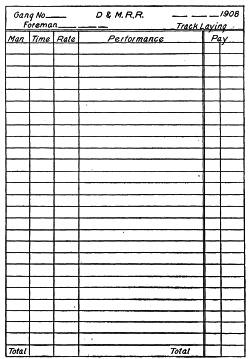
Fig. 1. Time-Keeper's Slip. Duplicate record is made automatically on a similar slip by carbon paper.
This, of course, indicates an unusually loose organization, but is an example of what a time-keeper with a notebook has to contend against.
In case of emergency—say in steam shovel work—a train of dump cars goes over the side of a dump, and a track gang is called upon to help the regular dump gang so that the difficulty may be overcome as soon as possible. The time-keeper might fail to make record of an hour or an hour and a-half which the track gang put on this work, because he did not see them at work at that particular time. This, of course, affects the distribution of cost. One advantage from the notebook is that much of the distribution is made in the field, with a corresponding reduction of office work.
Punch-Cards. The keeping of time by means of punch-cards has been tried with considerable success on many jobs, but only recently has it been reduced to a practical basis for use on large construction work.
The Construction Service Company of New York City has developed a system of time and cost keeping, using the duplicate punch-card almost entirely. Several of these cards are reproduced in connection with this text.
As a general thing, the punching of the cards is done by foremen of the gang, or by someone who has the performance of the gang under direct observation. The cards show not only the time worked by each man upon any one day, but just as exactly the time worked upon any job by all the men. A duplicate of the record is made automatically, to be kept in the time-keeper's office, the other going to headquarters for permanent record.
The record thus obtained is absolutely exact, especially as to distribution; but the system has some of the same objections that the notebook has. For instance, unless the cards are kept by the foreman himself, whoever punches them may inadvertently miss a man. This, however, is not so liable to happen as when a notebook is used. Whenever a single punch appears opposite a man's number, it is apparent that all his time must be accounted for in some way or other; while, with a notebook, it may be that, having been missed once, no record of any time will appear.
There is absolutely no opportunity for a time-keeper or for a foreman to "fudge" his account in any way, for a punch mark once made in the card cannot be erased or destroyed in any way. The record stands.
Time-Keeper's Cards. Instead of the time-keeper keeping his records in a notebook, as has been described, he may be provided with slips of tough paper of such size and shape as will readily go into his pocket, or will fit in a filing cabinet.
The modus operandi of these cards or slips is as follows:
Each card or slip is devoted to but one gang and one ledger account—such, for example, as placing ties in railroad work, gang No. 6. It will show the foreman's name; the name or number, or both, of each man; and the amount of time that he spent on this particular class of work. The sum of the amounts for the gang on this classification, will be the cost for this gang and this account for the day in question.
If a man has been working at more than one piece of work on that day, the time-keeper makes the apportionment of time on the spot; and the portion of his time that he has spent placing ties is put on the "Placing Ties" card or slip. The remainder of his time is placed on another slip corresponding to the other ledger account. If the time-keeper is uncertain as to which ledger account the work belongs to, he writes a description of the work at the top of the card or slip. A convenient form for a slip is illustrated in Fig. 1; and a convenient form for a file card, in Fig. 2.
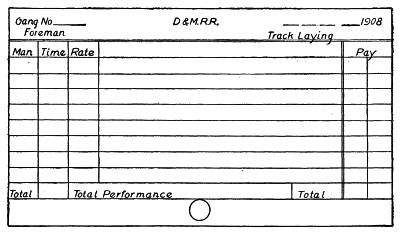
Fig. 2. Time-Keeper's Card. Duplicate record is made automatically on similar card by carbon paper.
It is frequently of advantage to have time-cards show, in addition to their pay and work performed, a log of the conditions, such as temperature and weather; the causes and duration of each delay; the general conditions on the work; the kind, condition, and the make of tools, machinery, etc.; and any further details that may be important. How this can be done on the various cards illustrated in this volume, can be seen from a study of the illustrations.
Written Time-Cards have the advantage of the minimum of departure from existing methods; the disadvantages that arise are slight; and it is difficult to so arrange the cards as to obtain duplicates. A foreman with a dirty thumb will make a paper sheet on which he writes in the field look as if it had been dragged through the mud; while, with a punch, he can bring his card in with comparatively small damage. In general, it may be said that for the time-keeper's use the written card has a slight advantage over the punch-card; while the reverse is the case for records to be obtained by the foreman, or whenever the men, such as drillers or teamsters, hold their own cards.
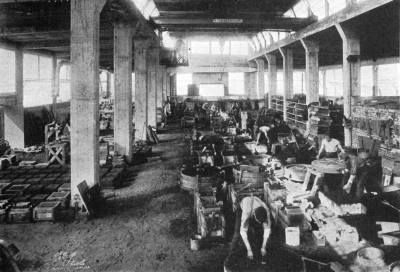
A TYPICAL FOUNDRY FOR LARGE CASTINGS IN THE TORONTO, CAN., PLANT OF THE FAIRBANKS-MORSE COMPANY
Foreman's Report. When the making-up of the pay-roll and the distribution of cost depend upon the reports of foremen, many serious difficulties are introduced into the work. Most foremen are intelligent enough to make a satisfactory report, and even more of them are honest enough to make a correct report. It is a curious fact, however, that among men of this class, while they would use every care in accounting for money entrusted to them, there is no tendency to consider time in the same light; and in consequence the reports of time given are liable to be very lax.
Moreover, if a foreman felt so inclined, if there were no one checking him or his reports, it would be a very simple matter for him to "fudge" his accounts so as to be able to acquire considerable graft.
If the foreman is intelligent and conscientious, a report and a distribution can be obtained from him which would be very easy to work into an excellent office record. Unfortunately, the desired combination seldom obtains, and there are very few large works carried on with such a system of time-keeping.
Cost Distribution. The time having been taken in the field, it now becomes necessary to make a distribution of costs in the office. The cost is that which is paid for producing work, being the material and labor cost of production, added to the proper proportions of expense cost, the expense being incurred in carrying on the operation and so making the actual work a possibility. The distribution of the cost is necessary in order that the contractor may see whether or not any particular operation is profitable; and a detailed analysis of the distribution, such as will be given later, will indicate in what respect the work may be made cheaper and more profitable.
In all cost distribution, there are certain items which cause trouble; and their proper disposition has led to much discussion among authorities on them, and has been the source of many different arrangements for their proper apportioning to the various operations on the work. For instance, there is the time of such men as are engaged upon water-supply service, drainage systems, the blacksmith, machinists, electricians, water boy, the time of watchmen, police, etc., which may come under the heading of "general labor;" and there are such items as the transportation and distribution of coal to various parts of the work, the transportation and handling of stores, and numerous other items which, while seemingly affecting the whole work, are directly chargeable to some particular operation.
In many instances of distribution, the item of General Expenses, which includes the expense of storekeeper, time-keeper, bookkeepers, clerks, and such office force as may be required, is rather difficult of disposition. Those items which are usually monthly, may be distributed daily at a rate per day found by dividing the monthly rate by the number of days in the month, or they may be lumped at the end of the month and apportioned to the various operations. If they are distributed from day to day, it is rather difficult to tell just what proportion of them should go to each operation, as the cost of any operation is liable to vary greatly from day to day. If they are left to the end of the month, it is impossible to tell from day to day the exact cost of the work.
Overhead Expenses are another source of difficulty. Under this heading can be placed all salaries which do not ordinarily appear upon the pay-roll, such as the salary of the General Manager of the work, the Chief Engineer, and the officers of the company, and such expenses as office rent, telephone, office furniture, stationery, etc. Just where General Expenses leave off, and Overhead Expenses begin, is rather hard to determine, the line of demarcation varying in almost all cases.
One of the greatest troubles in distribution is caused by overtime of men who are on a daily and monthly basis. Under the same head might be placed Lost Foreman's Time—that is, the time which the monthly and daily men are paid for, and which produces no output.
TIME-KEEPER'S NOTEBOOK
A page from a time-keeper's notebook is reproduced in Fig. 3. The necessity for an explanation of such a record is apparent. The work on which this record was made, was a job of rock excavation on which two steam shovels were being used, and the time and output of each shovel were kept separately. The record was made on the 17th of the month.
At the left of the page, within the curved line under the heading "sh. 2," we have the names of the shovel crew and the numbers of the pit men. At the side of these names and numbers, is the record of the performance of the shovel of the day previous, the 16th, the shovel runner having given it to the time-keeper while the latter was on his first round on the 17th. Just below the record of the shovel, there are four numbers under a heading Ditch. In order to drain the shovel pit, it was necessary to use four men for cutting a ditch, and the time of these men is charged to the shovel. Underneath the record for the No. 2 shovel, is the record of shovel No. 1. It is recorded in exactly the same way as the other record.
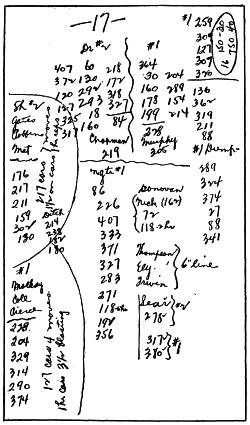
Fig. 3. Page from a Time-Keeper's Notebook.
In the center of the page, at the top, is the record of the drill gang for each shovel. There were six drills working in gang No. 2; but the record does not show this clearly, as there are two columns of six numbers each, one column being the driller's numbers, and the other being those of the drill helpers. Then there is a column of four numbers representing the muckers. The time-keeper knows, of course, which is which; but if for any reason anyone else than himself had to use the notes in the office, they would be useless. The number under the line is that of the man who carries bits to and from the blacksmith. The name of the fireman of the boiler which furnishes steam to the drills is given, and the number of his helper.
The record of gang No. 1 is given in the same garbled manner, there being 5 drillers, 5 helpers, and 4 muckers in the gang, besides the man carrying bits, the fireman (whose name is given), and his helper. It will be noticed that in neither gang is the name or number of the foreman given, the time-keeper relying upon his memory to make the record complete in the office.
In the upper right-hand corner of the page, is the record of the blasting gang, in front of shovel No. 1. There are 5 men, including the foreman, whose number is given first. Within the ring is shown the number of pounds of powder used on the previous day as reported by the foreman. The record reads "on the 16th, 150 pounds of 30% powder, and 750 pounds of 40%."
Directly below this, midway down the page, is the record of the men working on dump No. 1. The foreman's number heads the list, the numbers of his men following.
Just to the right of the shovel records, and below the record for drill gang No. 2, is the heading "ng.tr. # 1;" and the men whose numbers are under this heading are engaged in laying and repairing the narrow-gauge track for the dump trains from shovel No. 1. Just below the middle of the page, is a list of names and numbers utterly unintelligible to anyone but the one who made it. The facts are these: Donovan is the man who looked after the storage of powder; within the bracket, Nick (the time-keeper, not knowing the last name, used his number, as well as the part of the name that he knows) is the blacksmith; and No. 72 is his helper; No. 118 helped the blacksmith for two hours, having been taken from the narrow-gauge track gang. The time-keeper had to depend entirely upon the blacksmith telling him this, or his record would have been incomplete. The next three men whose names appear in this column were engaged upon repairing a 6-inch pipe line; and the next two pairs within brackets, marked No. 2 and No. 1, are the pipe-fitters for the drill gangs and shovels No. 2 and No. 1 respectively.
DISTRIBUTION FROM TIME-KEEPER'S NOTEBOOK
The time-keeper, having taken his notes over the entire job, sends them to the office so that the time may be posted for each man, and the distribution made.
The time-keeper goes over his notes, and picks out the items that are chargeable to drilling. In gang No. 2, there are 6 drillers at 30 cents per hour; 6 helpers, 4 muckers, 1 man carrying bits, and one fireman's helper, all at 17 cents, and one fireman at 25 cents. From the note at the bottom of the page, he knows (although no one else would) that Lear at 20 cents and No. 278 at 17 cents, were also with this gang. This, with the foreman at $3.50 per day, figures to $29.08. These are the charges that go directly to drilling, being the cost of time of the men actually engaged upon that operation and nothing else. But besides this, there must be apportioned to this cost a certain part of the Superintendent's salary, a portion of the labor on the 6-inch water pipe and the whole water system, a portion of the time of the blacksmith, the watchman, the storekeeper, the time-keeper, clerks, the water boy, and numerous other items.
In exactly the same way, the cost of the operation of the steam shovels is figured. For instance, No. 2 has an engineer at $125, a cranesman at $100, and a fireman at $75, a month, and 6 pitmen at 20 cents per hour, making the total charge of crew $19.27. To this the time-keeper added $5.44 as the cost of digging the ditch that drains the shovel pit. To charge this whole amount against the shovel for that day, is manifestly unjust, as the work of draining through this ditch will continue for many days, always facilitating the work of the shovel. The cost of subsequent days' work is lessened, while the cost of this particular day, as given with the $5.44 charge against it, is entirely too high. The spreading of an item of this kind is an extremely difficult matter, but it must be done. The steam-shovel cost must also have its proportional share of the charge for Superintendent, water system, blacksmith, etc.
The charge for narrow-gauge track is $14.86, being the time of one foreman at 20 cents, and 9 men for 8 hours and one man for 6 hours at 17 cents. The charge against No. 1 dump is $8.40, being the time for one foreman at 20 cents, and 5 men for 8 hours at 17 cents. The cost of blasting is figured exactly the same way, and the 900 pounds of powder used entered in the material account charged against the work in front of shovel No. 1.
The headings for the distribution of steam-shovel work, aside from Drilling and Blasting, would be Shovel crew, Pit crew, Dump crew, Laying shovel track, Train crew, and Laying narrow-gauge track, all of which in the end can be summarized under Loading and Transporting, and the unit-cost of moving a yard of material figured from this summary.
PUNCH-CARDS
The manner in which the time-keeper takes his notes in a notebook has been shown, and the impracticability of many of its phases pointed out. Two punch-cards for use on such work as that mentioned—namely, rock excavation with steam shovels and dump trains—are shown in Figs. 4 and 5. They are the Steam-Shovel Card and the Train Record. The shovel card is kept by the shovel runner or the fireman, and the train record is kept by the dinkey runner. Each keeps his own record separately; and, at the end of the day's work, the records must check each other.
The steam-shovel card shows the date, the number of cars loaded per hour, and the total number loaded per day. It also shows the time of starting and stopping the shovel for any reason, the stops for moving up being indicated in a different way from other stops; and thus a record of moves is kept automatically. The time of the shovel crew and the exact number of hours worked by the pit crew, are also shown, together with the cubic feet of coal consumed by the shovel. The causes of delays and the condition of the shovel are written in the blank spaces under their proper heading at the bottom of the card; but with this exception, the entire record is made with the use of an ordinary conductor's punch.
The train card shows the number of trips made by a train each day, the time of leaving the shovel on any trip being shown to the nearest 5 minutes. The number of cars hauled by all the trains during any hour must check with the number of cars loaded, as shown on the shovel card. The train card, besides showing the date, shows the total number of cars hauled (the total of all cards must check the total cars as shown by the steam-shovel record), the cubic feet of coal consumed, the average yardage per car, the haul in stations of 100 feet, the number of the dinkey engine, and a report of its condition, whether it be good, fair, or bad. This card is signed with the dinkey runner's name.
It will be seen that the record is very much more complete than that taken by the time-keeper, and is more reliable as to methods, being made while the work is going on; and the greater part of it is checked by having two records made separately, instead of taking a verbal report from the shovel runner the following day as in the example previously shown.
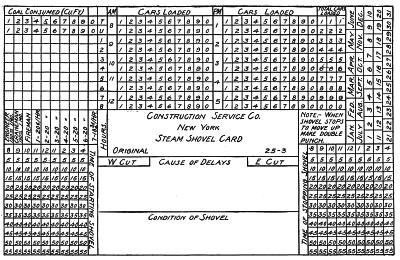
Fig. 4. Punch-Card for Recording Work of Excavation with Steam Shovel.
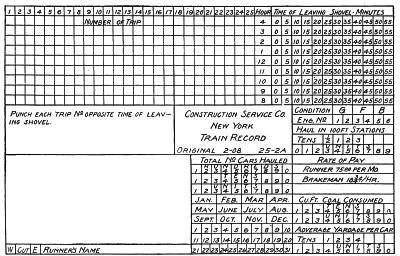
Fig. 5. Punch-Card for Recording Work of Dump Trains in Excavation Work.
Neither the train record nor shovel card, however, show any distribution of time, but are really performance records. The pipe and steamfitter's card reproduced in Fig. 6 gives an excellent example of how the time is taken and the distribution automatically made all at one time.
The classifications of labor are: Shovel, Channeller, Drills, Dinkey, and Trains, Pump, Tank, General Water System, and Blacksmith, being lettered, it will be noticed, from A to H at the head of the column. Each card provides space for the record of the foreman and 14 men. These eight classifications will probably cover all the work that the pipe and steamfitters are called upon to do; but if not, there are two extra lines on which can be written any classifications out of the ordinary.
There will be certain men assigned to certain regular work, as in the case previously quoted under the head of the Time-Keeper's Notebook, where there were two pipemen for each drill outfit. If these men spend their entire day of eight hours doing nothing but looking after the water supply for the drills, a punch mark would be made above the number of each of them on the card and opposite the figure 8, which represents the hours worked. To the left of the eight, and in the same line, and also in the vertical column opposite the word Drills, another punch mark will be made. Again, opposite the letter C, which is the key for the classification of drills, and in the column assigned to each man, and below his name, another punch mark will be made. This gives the workman full time, showing that he worked eight hours on drill water supply and nothing else. Suppose the foreman worked three hours on the general water system, three hours on the pumping station, and two hours directing the repair of the water tank. There would then be on the record a punch mark in his column opposite 3, 6, and 8; at the left of 3 in the column headed G, another punch will appear; at the left of 6 in the column E, another punch will be found, and still another at the left of 8 in the column F. In the column under the foreman's name, punch marks would be made opposite E, F, and G, showing that he worked on these three classifications.
In the same way, the time and occupation of each man under this foreman can be indicated, no matter how many changes he may make in his work during the day. The time, however, is recorded only to the nearest hour.
.
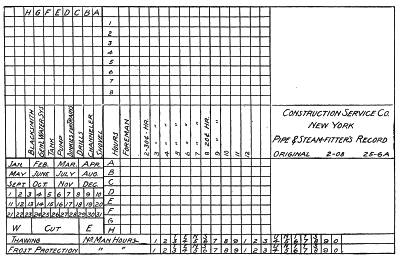
Fig. 6. Pipe and Steamfitter's Card, Showing Method of Taking Time, and of Simultaneous Automatic Distribution.
Provision is made in the lower left-hand corner, for the punching of the date; and along the lower edge is the place for the recording of the number of hours used in thawing the pipes, etc., and in providing protection for them. This latter record was found necessary, because the work on which these cards were used was done in an extremely cold locality and continued throughout the entire year.
When the records are made in the field and are sent in to the office to be transferred to permanent records, it is not necessary for the man who made the record to be at hand to interpret his notes, as there is absolutely no opportunity given him to allow his note taking to vary in the least from day to day, the record being absolutely automatic.
PROCESS COST SUBDIVISION
While the object of the regular distribution of cost is the obtaining of unit-costs, there is another cost analysis which may be called a refinement of the cost-keeping system, and which, if properly used, can bring about a marked reduction in all costs. While this will be discussed more fully in the chapter upon Reduction of Cost, it is a form of time-keeping, and so will be touched upon here. On more or less rough construction work, it seems rather absurd to attempt to reduce the various processes of any operation to such a fineness that they may be timed to minutes and even to seconds. Conditions vary so greatly, the character of the work being done changes so much from time to time, and the personnel of the organization is sometimes shifted so much, that it seems impossible to reduce performance to any satisfactory basis which may be used as a standard. Nevertheless, without attempting to reach such a basis, careful watching and timing of the different parts of the work will result in much better performance and increased profits, as can be clearly shown.
Take, for instance, a driller working with a steam drill in fairly even rock, with no marked obstacles in his way and with very little mucking to do. Notice the exact time at which his tripod is in place and the drill ready to work. The driller places his bit in the drill, turns on the steam, and the drill starts. Note the time of starting the drill; note the time when the drill stops, the bit having gone down its full length; and do the same with each subsequent bit, noting carefully the exact time consumed in changing. When the last bit is down its full length and the hole is finished, note the time required to take out the bit, move the weights, loosen the tripod, and make everything ready for the moving. Then note just how many men are required to move the drill, and just how long it takes them to do it; and finally, how long it takes the driller to get his drill again in working order and started.
It will be found that a large majority of drillers take entirely too much time in the changing of bits, and that almost invariably there are too many men helping to move a drill, and that they take too long for it. Another source of delay is preparing the drill for work after it has been moved. It is perhaps just as well to take plenty of time for this, in order to get the drill properly set and adjusted before starting it; but the loss of time between the adjustment and the starting may be said to be about the same as that lost in changing bits, if not a little more.
When the driller takes too long in changing bits, it is largely his own fault, and he should be watched more carefully by the foreman, and, if necessary, instructed. If time is wasted in the moving of the drill, it is the fault of the foreman alone. By a careful timing and balancing of the various processes in drilling, the most competent men can easily be picked out.
In the case of concreting, the minutes lost in the handling of a batch of material from the stock pile to its final position as concrete, often amount to a great deal. Suppose on a small job a half-yard mixer is being used, and it averages for 8 hours 30 batches per hour, or 120 yards per day. If it is possible to reduce the time of each batch 15 seconds, the output of the plant will be increased over 14 per cent; or, figured on a basis of 120 yards, there will be an increase of 17 yards, which—at, say, $5.00 per yard—would mean a handsome increase in the daily profits. And still, 15 seconds seems to be almost too trivial a matter for which to spend time and perhaps a little extra money in the way of time-keeping.
Starting with the unmixed material in the stock pile, notice how long it takes the men to load their wheelbarrows with sand and stone; then the time that the material remains in the wheelbarrow, both at the beginning and stopping end of the trip to the mixer; and also the time in transit. If the material is dumped into measuring boxes, note the time that it remains in the boxes. If it is dumped directly from the wheelbarrows into the mixer, it is necessary to take the time of mixing from when the first wheelbarrow was dumped until the batch is dumped. The mixer may be said to be the governor of the whole operation; for the men handling unmixed material can handle it no faster than the mixer takes it, and the men handling the mixed concrete can get it no faster than the mixer furnishes it to them. For this reason the observation of the operation of the mixer should be made with special care. It is not our intention to tell how, or to give advice concerning the mixing of concrete; but it is desired to show how, if any time is to be saved, it will be through the saving of seconds in each operation.
If the mixed concrete is to be dumped as a batch into the hopper or hoist, the question of time saving is much simpler than if portions of the batch have to be dumped into wheelbarrows. If, however, it is necessary to dump into wheelbarrows, a basis for the time necessary to empty the mixer can be found only by careful timing and noting the action of the men during the timing.
The time between the filling and the emptying of the wheelbarrow of concrete, will of course vary greatly according to the haul; but here again, careful timing and observation will soon establish a basis from which the most economical manner of distributing the concrete can be made; and exactly the same thing is true of the return of the empty barrels.
All of this may seem to be a digression from the subject of cost getting; but in fact it is merely a discussion of a very refined form of cost getting, and a branch of the subject which has perhaps been given too little attention. When the daily output of a job is up to or above the average, everything looks bright, and no one who is responsible feels overburdened with care. If, however the output falls too low, some glaring cause is at once sought, and the fall of output blamed to some unforeseen circumstance or accident. This is all very well, as accidents affecting output cannot be entirely avoided, and unforeseen conditions will make great differences in performance; but the careful analysis of process cost subdivision will bring about results that will astonish those "practical men" who think that they have got their unit-costs down to the lowest point simply because their output is generally large and everyone on the work seems to be working to his top notch.
OUTPUT
The reason for compiling the data for which the time-keeper is responsible, is that, from the analysis of the distribution made, the contractor is able to tell what work is being done with profit; and, if any particular operation shows loss, the analysis will help more than anything else to discover the reason for the loss. In figuring his profit on any work, the contractor must figure on a unit-cost basis, exactly the same as he figures when he prepares his bid. In order to do this, he must have an exact measurement of output. In many classes of work, this measurement is extremely simple; but in others no little ingenuity is required to devise a scheme which will give the information wanted exactly and without requiring much work.
The payment for work is based upon the engineer's estimate. The monthly estimate is usually more or less a guess, made simply for the purpose of paying the contractor approximately according to what he has done. The monthly estimate is generally a pretty fair approximation of the exact amount of work done; and the final estimate covers everything included in the contract that has not already been taken care of.
The contractor's measurements of work done each day should agree quite closely with the engineer's estimate; but, if the work is difficult to measure, the contractor has many times more opportunity of making errors in his measurement by going over it daily than the engineer has who only goes over it once. A careful consideration of the differences in the amount of estimates will sometimes show the contractor how his estimates can be made to balance with those of any particular corps of engineers, and he can govern his daily measurement accordingly.
There are few measurements in the field which can be reduced to a unit, or rather which can be counted directly. Linear measurements are easy enough to get; the measurement of area is a little more difficult; while the measurements of volume, especially in rough work, are often extremely difficult to make in a satisfactory manner. Measurement by weight is often found to be of great advantage, if proper facilities can be arranged for weighing.
The measurement of drill output is extremely simple. The holes for any one day's work can be marked as they are finished, and, at the end of the day, all measured; or they can be measured as finished, and their depth taken, and hence the entire day's work is easily determined. This, of course, is a linear measurement; and in the same class would fall such work as laying track, ballasting, grading with a road machine, and the measurement of the work of track and wheel scrapers.
The measurement of quantities whose units are areas is only a little more difficult. Paving, for instance, is very easily measured, the distance from curb to curb generally being constant, and so really reducing the measuring to a linear measurement—that is, the length of the section of pavement laid. Brick laying, while really a cubical measurement, is taken in the same way, the area of the face of the wall laid being taken, and multiplied by the standard number of bricks to any given thickness of wall. This really reduces the measurement for brick laying to a unit-basis, the unit being one brick. Painting and plastering are measured in the same way; and so also is roofing. On road work, plowing and sprinkling are estimated per unit-area; and in quarry work, channeling is so estimated.
The determination of volume on construction work is liable to be very difficult. Take, for instance, the output of a steam shovel cutting through rock. The walls of the cut will be very irregular both in line and in slope, no matter how skilfully the shovel is operated; and the face of the cut is liable to be even more irregular. No absolutely exact measurement can be made; and for this reason it is common practice to estimate the contents of the cars rather than attempt to estimate the size of the pit excavation during any one day. Generally the size of the pit is roughly measured, and the yardage figured from this measurement. It is also figured from the number of cars loaded, and, if carefully done and the estimate of the volume of the cars loaded is correct, both figures should balance at the end of the month with the monthly estimate, which, on account of the large volume measured, can practically ignore such irregularity as would affect the other two measurements. In earth excavation, the measurement is much simpler, because the pit is more regular and the cars can be fully loaded.
There are natural working units that lend great simplicity to calculations of cost—such, for example, as a floor panel in a building, a column, a bridge panel, a pier of masonry, etc.
Another unit of measurement is often obtained through the percentage of a total or of another unit, such as the amount of sand in a yard of concrete. Knowing the mix, a percentage of the total yardage of concrete will be the amount of sand that has been moved.
Care should be taken properly to subdivide the units of measurement. The ordinary unit of concrete work is the cubic yard or the cubic foot. The mistake is frequently made, of estimating the cost of forms and of reinforcement only in terms of the cubic yards of concrete. The cost of forms should be estimated also by the number of feet, board measure. Reinforcing steel should be estimated by the pound.
One difficult kind of work to obtain costs on by the regular method, is the laying of cut stone. A very simple way to obtain this is to paint on each stone a number, and let the time-keeper get the dimensions of the stone after it has been cut, before it has been placed in the wall. Then the stone layer simply records the number of each stone as it is laid.
A check on the measurement of the quantity of the work done is frequently obtained by the measurement of the quantity of the work left undone or of the material remaining in the stock piles.
COST SHOWING
The object of cost keeping is to furnish accurate and early information to those in authority, both as to where they stand financially on the work, and what necessities or opportunities there are for improvement in economy.
In order to accomplish the object of cost keeping, it is necessary that there be some efficient method of cost showing; and it is essential that the system of cost showing, in combination with the system of cost keeping, shall meet the following specifications:
1. It shall be accurate.
2. It shall be simple.
3. It shall be easy to study.
4. It shall be easy to compile.
5. It shall be capable of being compiled in a very short time after the receipt of the original figures.
It needs no argument to prove that the cost-showing system should be accurate. If it be full of errors, its usefulness is entirely obviated; and 1 per cent of error in it will do a great deal more than 1 per cent of damage to its efficiency, in assisting the manager to increase the efficiency of the work. There is, however, a limit to the desirable precision of such an affair. The cost of putting in ties on a certain railroad for a certain month, for instance, may have been 7.2143 cents. If the last two figures are interesting from the statistician's point of view, they are utterly useless to a practical manager. If the previous month's performance has been, we shall say, 6.94 cents per tie, this month's figures will have shown an increase in cost of O.27 cent, which is approximately 3.9 per cent of the previous month's figure. In other words, the tie-placing efficiency has decreased 3.9 per cent. It is very questionable whether the figure 4 per cent, although not quite so precise, would not be rather more useful to the manager than the figure 3.9 per cent; and, personally, the authors would favor the briefer work. The degree of refinement to which these records should be carried, is, in the last analysis, a matter for the individual judgment of the manager himself. The student should bear in mind the folly of unnecessarily elaborate figures.
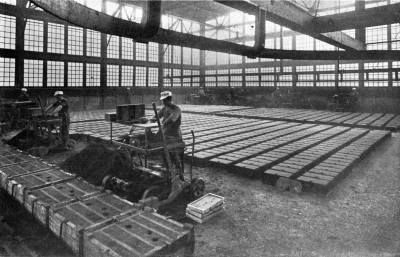
AN EXCELLENT EXAMPLE OF THE MODERN FOUNDRY FOR SMALL CASTINGS The Moulding Machines are Shown in Operation. Note the Plentiful Supply of Daylight. The Michigan Stove Co., Detroit, Mich.
The second specification, that the cost-showing system shall be simple, is almost as important as the first. If it be not simple, the chances for inaccuracy will be tremendously multiplied. It will take more work to carry it on; and the straightening-out of errors and discrepancies will be so difficult, and will require so much of the time of persons in authority, as to leave them no opportunity to do their other work. Plainly, it should not be necessary for a manager to do a lot of detailed work on cost-keeping or cost-showing systems himself.
Specifications Nos. 3 and 4 are more or less included in specification No. 2. Specification No. 5, however, is also of great importance. Information that is stale is about as useless as no information at all. If you tell a foreman on Monday that the work of his gang for the week ending ten days before was not up to the mark, he will not have much respect for your cost-keeping system; he will certainly not remember sufficiently well the causes that produced his bad work, to remedy them; or he will be able to pick out of the haze of history enough excuses to let himself out of the responsibility of his bad work, and to put his manager at sea as to where this foreman and his gang really stand. It is therefore of prime importance that the arrangement for showing the manager what his costs are, with the salient conditions affecting such costs, shall be so rapid as to be "red-hot" all the time.
The commonest arrangement of cost showing—and the only one ordinarily found at the present day on most contract work—is an abstract prepared on a piece of yellow paper by the time-keeper for the inspection of the manager each morning; and this has so few disadvantages that it would be very satisfactory, were it not that it is impossible from it to compare at a glance the work done, let us say yesterday, with that done previously. It is, however, far better than any other system which lacks any of the essentials indicated above.
USE OF CHARTS
The best method that has so far been devised is by the use of charts showing to scale the different unit-costs for the various days in the month. Such charts are illustrated in Figs. 7 and 8. They are from the records of the Construction Service Company. One of these (Fig. 7) indicates the cost of channeling rock. It will be seen from the line A, that during this month the number of square feet channeled varied from 75 to 375, and that the labor cost varied from a maximum of 62 cents to a minimum of 8 cents. On the 8th, the morning crew did not work, because, as it happened, of severe weather, which accounted for the low output on that day. On the 24th, the night shift allowed the pipes to freeze up. It may be mentioned that the foreman of the night shift, whose name appears in brackets on the chart, has since turned his attention to other fields of industry than channeling. On the 28th, the channeler had reached a point where the cut was frequently filled up by earth that slid in from the side and caused such a large amount of sludge as to cushion the blows of the blade; and the chart shows on that day a high cost, due to the cleaning away of this earth.
The chart illustrated in Fig. 8 is that for steam-shovel work on the same contract of the Construction Service Company. Line A indicates the approximate number of yards moved per day. Line B shows the pay-roll, ranging from $165 to $310 per day, and including a percentage for incidentals; while line C represents the values of the B quantity divided by the A quantity, and gives the unit-cost in labor per yard for excavating and moving rock. It will be noted that the Sundays are skipped. These came on the 5th, 12th, 19th, and 26th of the month. There were some men employed on each of these Sundays; but their time was so distributed over the rest of the month as not to show for the Sundays, as the steam shovels did not work on that day.
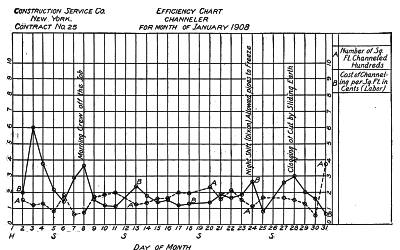
Fig. 7. Efficiency Chart Indicating Cost of Channeling Rock.
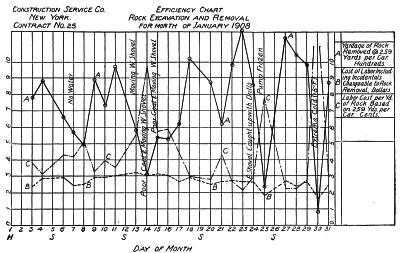
Fig. 8. Efficiency Chart Showing Costs in Connection with Steam-Shovel Work in Rock Excavation and Removal.
These charts are of a size to be filed in one of the standard loose-leaf books, and their range is from zero to about 12; thus it is possible to show any quantity to scale for any day in the month. This company has not found it of advantage to plot more than 4 lines on any one chart.
Charts such as these may be marked each morning by the time-keeper upon a tracing prepared for this purpose; and at the end of the month the lines connecting the points may be inked in, and the chart blue-printed and the blue-print filed in a convenient place for immediate reference.
There are several ways of working out the unit-cost from the figures, such for example as:
1. Performance per time unit
2. Performance per dollar;
3. Cost per unit of performance.
The first of these is not, properly speaking, a cost statement, although it is a function of a cost statement and for certain purposes is more convenient. The number of feet of rock drilled per drill hour, is a very convenient form for record.
When drilling under conditions of snow and ice, more muckers have to be employed than at other times. If the cost of mucking is included in the cost of drilling, as it frequently is, the true index of how well the drills are getting on is the number of feet per drill hour, rather than the cost of the operation to the contractor.
The second method is the reciprocal of the third. Other systems will suggest themselves by virtue of the peculiar requirements of each case in practice.
Checking by Charts. A great advantage of the chart system of cost showing, is that it acts as an automatic check upon the cost-keeping system in general. As indicated earlier in this volume, it occasionally happens that a punch-card is not turned in, or the time-keeper fails to get certain data. This is immediately discoverable by the gap on the chart, and thus the chart acts as a check on the cost-getting department. This will not entirely obviate the necessity for inspection to ascertain whether the time-cards are properly kept and the work is properly done.
The showing of costs should be made daily for the men immediately identified with the field work; they should be made weekly for the general manager, and monthly for the home office. These monthly office reports are sometimes valuable in the planning of the financial arrangements for the work. On a job involving, say, a pay-roll of $5,000 a week, with monthly estimates, early information as to performance over the month is of very great value.
Showing the men certain charts and records will serve to increase their interest in their work, but this should not be overdone. It is as well that the men should not know the actual cost of their work to the contractor in dollars and cents. If, on the contract price, the contractor is making a handsome profit, the men want more money. If the contractor is not making a handsome profit, the men are apt to think that they are on a losing job, and become discouraged accordingly. The economy of the contractor's work should be private information, since it might do him considerable damage by becoming known to competing contractors. The charts showing the performance per unit of time, however, are not subject to the restrictions above mentioned.
COST KEEPING
In the foregoing there has been nothing that is a part of the regular bookkeeping, with the exception that part of the time-keeper's records are necessary to the bookkeeper. It should be appreciated at the start, that the bookkeeper's work is of great importance, that it cannot be superseded by a cost-keeping system, and that it should not be divided up with the cost-keeping system. The scoffers at cost analysis are inclined to take the ground that a bookkeeper, a cost-keeper, a cost-analysis engineer, are more or less clumsy substitutes for managerial intelligence; and they point to the proposition that in the last analysis it should be easy to let the office boy run the job with a textbook at one elbow and a calculating machine at the other.
It is insisted upon at the start, that cost keeping is as important as bookkeeping, but that it has an entirely different function; and in applying cost keeping to construction work, it is very important that a distinct line of demarcation be drawn between the two branches.
Another error that is frequently made by antiquarian students, men who are studying old methods of engineering and construction rather than those of to-day, is that a cost-keeping system is assumed to be complete by the man who runs it, when he knows how many feet of hole his drillers are able to average per hour, per day, or per week. The cost analyst will point to the fact that in the literature of the subject many false statements are made as to the costs of certain items of work, and will show that no allowance has been made for depreciation, repairs, etc., not to say profit, interest on the contractor's money, and a host of other things. The student is warned that a proper cost-keeping system must of necessity take into consideration all the items of cost on the job; and, further, it should take them into account with such detail that it will be a real, living help to a man in estimating future costs on similar work.
Now, as a general thing, the essential similarity of items has been lost sight of when these items are parts of work which is not generally dissimilar. For example, the item of earthwork in the construction of a large dam may be very similar in its essential cost to, and may be of the greatest use in assisting a contractor or engineer to figure the cost of, earthwork under similar climatic conditions on a railroad embankment; yet those who are most interested in the subject are inclined to classify dams as an entirely different sort of structure from railroads. The designing of a dam is a different matter from the design of a railroad; but to build one will often involve the same kind of tools, the same kind of machinery, the same kind of men, the same kind of "horse sense," and the same general principles of construction, as to build the other. Therefore, if his costs are properly subdivided and intelligently kept on one kind of construction, the contractor or engineer will be materially aided, not only in estimating the cost of the work upon the other, but in being in close touch with his work after he has started.
Every construction organization ought to have a schedule of standard items which may be called ledger accounts; and its books ought to be kept in such a manner that the records of the total and of the unit-amounts for these items on past work and on current work may be immediately available for the benefit of its officers. No two contractors will have the same arrangement for distributing cost; no two will have the same items for the accounts; but there are certain fundamental items that will come into use on almost every large piece of work, and some of them have a peculiar significance, and should be treated with special care.
Estimates on Ledger Items. In making estimates it is important to have this list in sight, in order that important items may not be omitted. Such a list, which will cover a large portion of the ordinary charges, is here given:
1. Gang Labor:
(a) Hourly rate;
(b) Monthly rate.
The men who work by the month are apt to have to spend a good deal of non-productive time, on account of weather conditions, etc.; while the men who are on an hourly basis, as a general thing, do some profitable work whenever they are paid. It is feasible to figure a good deal more closely on the cost of work for those men who have practically no lost time to be taken care of, as emergencies or incidentals. It will be noted, also, that the cost and the time of hourly and daily men can be figured and charted day by day; whereas it is impossible to know exactly what the charges will be for labor that is paid by the month, until the end of the month. In order to make report charts showing cost as completely as possible, it is a frequent practice to add a certain percentage to the cost of the known items, to cover the so-called lost foremen's time; and to make at the end of the month a correction of a greater or less size, in order to make the cost-keeping end tally with the bookkeeping end of the work.
2. General Labor, etc. This item will comprise the labor of the men who have something to do with more than a few parts of the work. A watchman's time is not spent in drilling, or on a steam shovel while it is running. Nevertheless a proportionate part of his salary should be divided among the different branches of the work. Sometimes this will be a very small item, sometimes a large item. For example, if a steam shovel is excavating 30,000 yards of material per month, the watchman's unit-charge to excavation may be very small; but if the shovel is tied up for nearly the whole month, the charge per unit for watchman's time may be alarmingly high. This is one reason why unit-cost and total cost should always go together. A blacksmith's time, part of which is spent in sharpening drills, need not be all chargeable to drilling, because he may spend a good deal of time in repairing the steam shovel or fixing hand tools, etc.
3. Overhead Labor. Clerks, bookkeepers, messengers, office force, and General Manager are ordinarily included among the items of overhead charge, as well as salaries of general officers.
4. Overhead Materials. In this classification, there are included stationery, office furniture, supplies, etc. When the office furniture is disposed of upon the completion of the work, its value should be credited upon this item.
5. Overhead Incidentals. These may include various items, such as telephone, office rent, telegraph messages, express charges on incidentals not directly connected with plant, etc.
6. Preparatory Costs. These include the cost of getting ready to do the work, and, depending upon the nature of the job, may include any or all of the following items:
(a) Temporary roads; (b) Temporary trestles; (c) Clearing and grubbing; (d) Snow removal and drainage; (e) Traveling expenses to job; (f) Preliminary estimates, calculations, and surveys; (g) Freight and handling of materials to and from job; (h) Freight on preliminary supplies; (i) Handling of preliminary supplies; (j) Licenses and premiums on bonds, etc. (k) Legal expenses; (l) Loss on initial operations; (m) Right of way and cost of site; (n) Sheds, storehouses, and other temporary buildings; (o) Tools, less final value.
7. Supplies. These are chargeable F. O. B. the job, or at the railroad station nearest to the work. They include all supplies for carrying on the work, as distinct from material, including explosives, coal, oil, waste, etc., and may include a charge for water.
8. Interest and Depreciation on Plant. This item is variously estimated by different people, and may vary greatly. It is impossible to establish an absolute rule; but on the average contractor's plant, it may be stated that 1/10 of 1 per cent per working day is a very fair general average figure. The average steam shovel, for example, will work perhaps 200 days, under favorable weather conditions; and on this basis the interest and depreciation charge will be 20 per cent per year, and is not far from a fair figure. Some contractors allow 33 per cent per year on such material as road machinery, including crushers, steam rollers, etc. This is a little high, provided that a reasonable charge is made for repairs.
9. Repairs to Plant. How much money it takes to keep the equipment in proper condition for performing efficient work, is a question on which the limits of space prevent a detailed discussion. On such a machine as a standard-gauge steam locomotive in constant operation to the limit of its capacity, repairs may run as high as 20 per cent per year; and on a rock drill the repairs may be 50 per cent or more per year.
10. Rent, Stumpage, etc. The item of rent includes the rental of ground and the storage buildings, if any, outside of the office expenses. Stumpage is the cost of standing timber, the purchaser being privileged to leave the stump after cutting down the tree.
11. Materials of Construction. These are chargeable F. O. B. the job, or at the railroad station nearest to the work.
12. Handling of Supplies.
13. Freight, when not included in item No. 11 or No. 7.
14. Unloading, Hauling and Storing Materials and Supplies.
15. Re-handling Materials and Supplies.
16. Interest on Cash Capital Exclusive of Plant.
17. Taxes and Insurance on Property (including boilers).
18. Accidental Insurance, to protect workmen and the public.
19. Advertising, Medical Expense, and Charity.
20. Discounts on Bonds, Warrants, or Notes.
21. Contingency Labor.
22. Contingency Materials.
23. Contingency Supplies.
24. Cost of Finding and Recovering Lost Freight and Supplies.
25. Profit.
COST REDUCTION
The ultimate aim of cost analysis is economic efficiency; and any system or method of cost analysis which does not result in the lessening of the total cost per unit of work performed, must necessarily be a failure.
After the costs on work have been partially analyzed, it becomes the province of the engineer to introduce methods and devices whereby the expense of obtaining the various data may be more than offset in the general economy of the work. It was long ago realized that shop practice could be economized by methods of systematization; and we have an early instance of the appreciation of this fact in the story of the struggles and methods re-sorted to by James Watt in the construction of the early steam engines. The troubles arising from incompetent workmen, drunkenness, and the necessity of doing work in different parts of the country far removed from headquarters, were as real then as they are now, with this disadvantage, that in the eighteenth century the press, the telephone, and the professional schools had not reached a development admitting of intelligent coöperation in the attack upon this problem.
Within the last score of years it has been found that cost-analysis applied to shop work problems gives most amazing results. When the piece-work system was introduced, it was believed that the final solution of the problem had been attained. The men were then placed upon the footing of contractors. A man got so much pay for accomplishing so much work; and it was most clearly to his interest to accomplish the maximum of work in order to get the maximum of pay. It was immediately evident that the good men would soon show such a contrast to the poor men on the work as to inspire a constant rivalry, thereby resulting in a very much higher output. In order that the desire to accomplish more work should not interfere with the quality of the work, all materials were systematically and rigidly inspected.
For a good many years the piece-work system flourished, and it is still flourishing as compared with its predecessors. It is vigorously fought by trades unions and by the less able among the men. It is tolerated by those of mediocre ability, and it is heartily endorsed by the most skilful. In order to remove the resistance of labor unions, a modification of the piece-rate system, known as the bonus system, has been devised. It will be described in a subsequent paragraph.
Remarkable development has been achieved in the shop by the most brilliant work on the part of the men who have applied cost analysis, favored by the fact that in the shop one has conditions of work which are practically invariable from day to day. It is possible, then, to compare the work done per unit of time in the morning, with the work done per unit of time in the afternoon, or for each hour in the day, and thus to determine the effect of fatigue of the operators upon their efficiency and the effect of such specific influences as the character of artificial light, the grade of steel in tools, and even the economic value of providing reading rooms, white-enameled lavatories, and recreation for the operatives. To cost analysis has been largely due the development of the special high-speed steels and an amazing number of improvements in machinery, entirely aside from the stimulus and education of the workmen.
In field work, however, comparatively little has been accomplished in the world at large along these lines, not because the opportunity is lacking, but because certain of the difficulties appeal more glaringly to the pioneer in the field, and offer some peculiar discouragements. The conditions are not uniform from day to day. The locus of the work is changing, the weather is variable, and a very large number of external agencies will be continually interfering with the scheduled regularity of the work. The method or process whereby a piece of work can be done more economically, may be instituted at just the time when some apparently trivial variation of the weather, or breakdown in a water system, or interruption in train service, may produce an entirely opposite effect which will more than nullify the advantages obtained from the improved process or method, and will sometimes cover a period of a good many days and possibly weeks, making it appear that the improved method is not only a failure but a dragon in disguise.
Field work is constantly presenting obstacles and difficulties which have to be met and fought, calling for emergency judgment on the part of the men in charge and on the part of all the men on the work to a greater or less extent; and here alone is one of the chief reasons why a contractor comes to depend almost exclusively upon the personality of his superintendent or foreman, to the exclusion of systematic analysis.
It is abundantly demonstrable that when results are properly charted, and when a careful record is kept of the causes of interruption and the extent of the accidental obstacles, the problem becomes much simplified. It is astonishing how intimately a manager may come into touch in a short time with the obstacles to his work, and with the most efficient methods for their removal, by means of proper reports and cost analysis, and especially by the intelligent use of charts.